
Partitioned Calculation of Node-Level Carbon Emission Factors for Large-Scale Power Systems Based on Centralized Data Distribution Pattern and BiCGSTAB Algorithm

Abstract
1. Introduction
- (a)
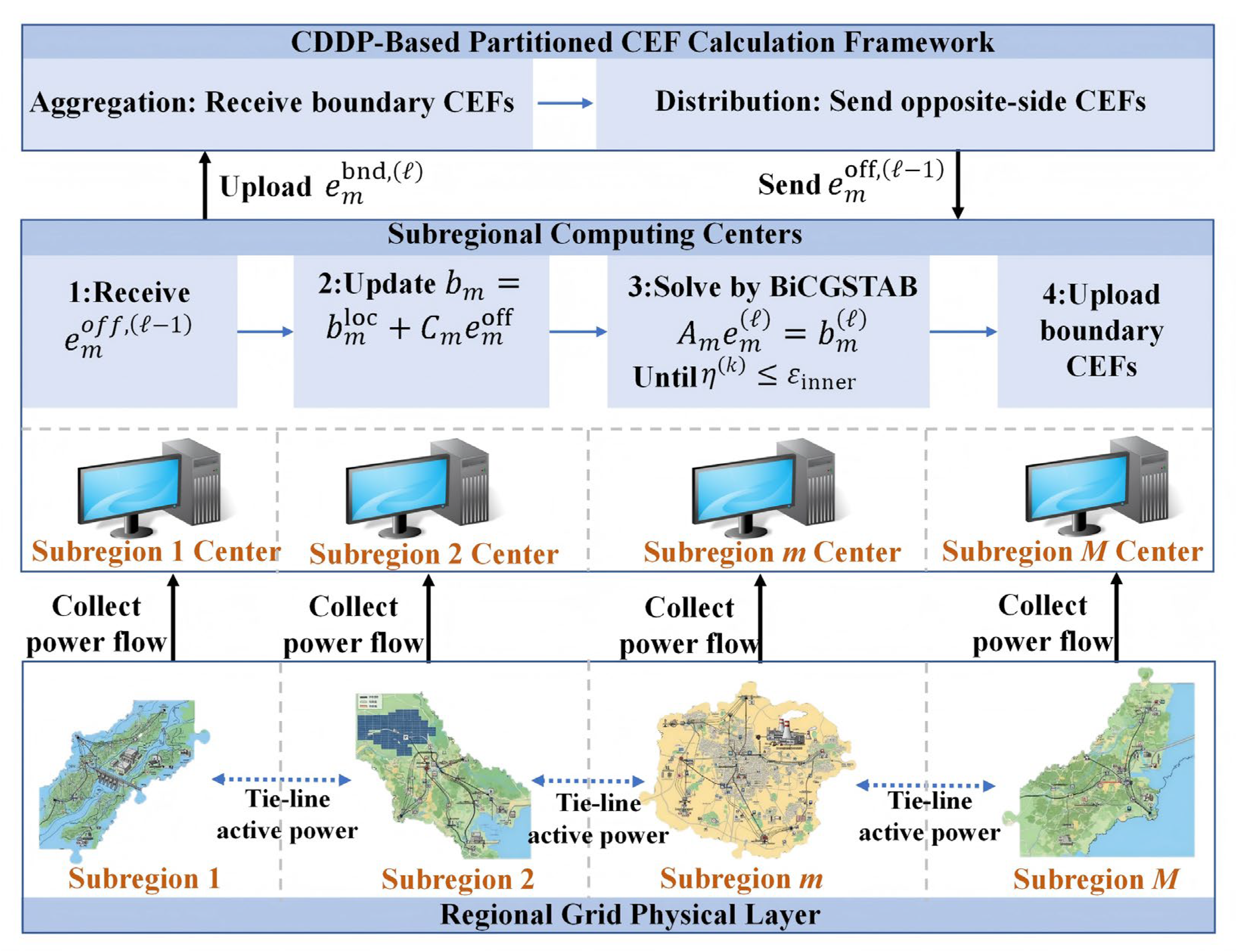
- A partitioned CEF calculation framework compatible with the “unified dispatch and hierarchical management” organizational structure of new-type power systems is established. In the proposed framework, each regional management entity only needs to disclose boundary-node CEFs, thereby helping to protect operational privacy.
- (b)
- The BiCGSTAB algorithm is introduced to solve the nonsymmetric carbon emission flow model within each region. The convergence behavior of the inner and outer iterations is also analyzed.
- (c)
- Large-scale validation is carried out on systems with up to 25,000 nodes, demonstrating the feasibility of the proposed method for engineering implementation in large-scale new-type power systems.
2. Methodology
2.1. Derivation of Dynamic Carbon Emission Factor
2.2. Solution Method Based on the BiCGSTAB Algorithm
2.3. CDDP-Based Partitioned CEF Calculation Framework
2.3.1. Region Decomposition and Subregional Equation Construction
2.3.2. Centralized Data Distribution Protocol
2.3.3. Dual-Layer Convergence Mechanism and Computational Procedure
3. Results
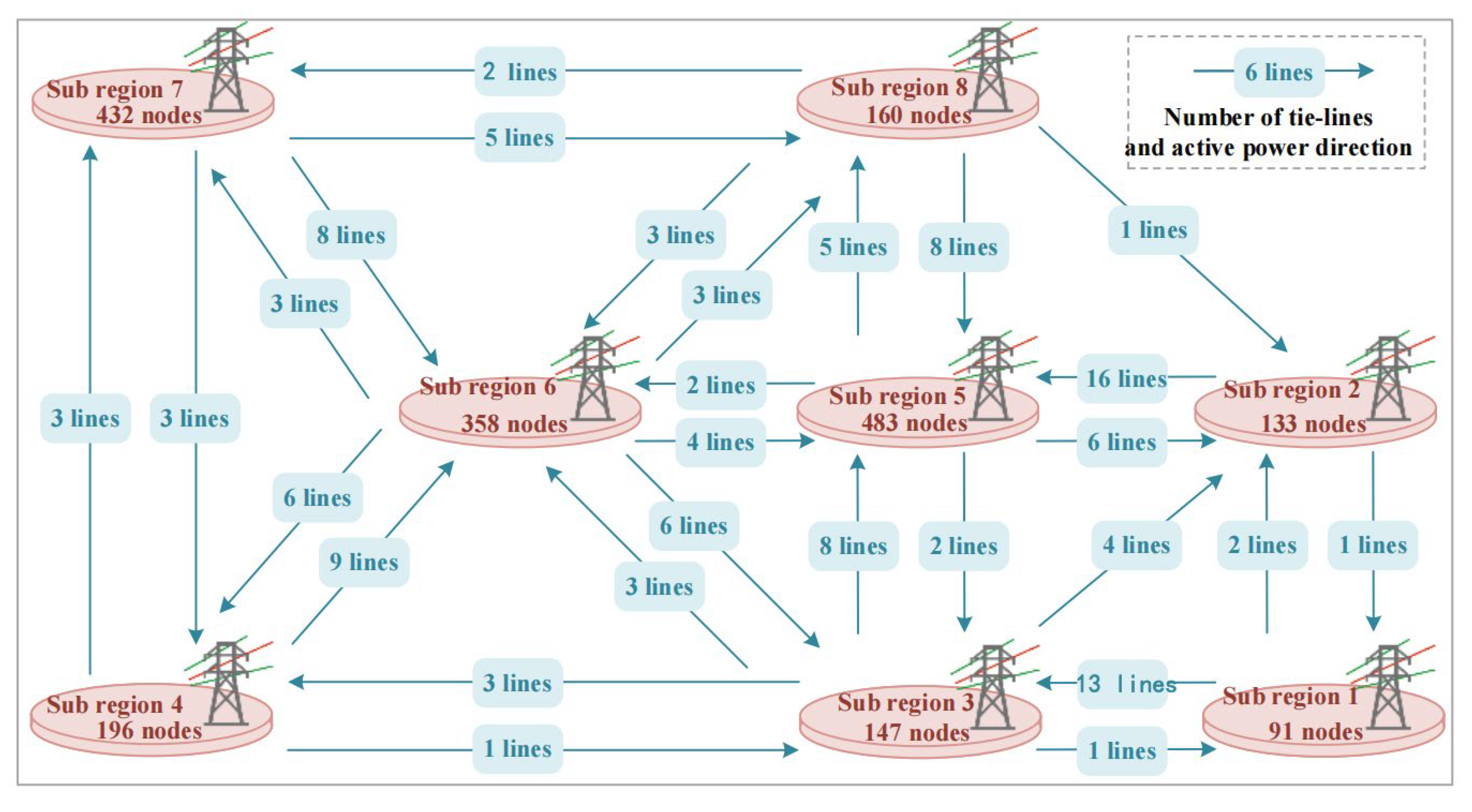
3.1. Test System Setup and Data Description
| Algorithm 1: DDP-BiCGSTAB partitioned calculation procedure for node-level CEFs. |
| Input: Full-network power flow data, regional partition scheme convergence thresholds , maximum number of iterations Output: node-level CEF vector of each region 1:Begin 2:Each subregion m: construct , ; extract send the subscription template to the CB//initialization stage 3:CB: aggregate subscription templates, generate submission templates, and distribute them to each subregion 4:Each subregion m initialization: 5://iterative calculation stage 6:WHILE AND DO 7: 8: Each subregion m (parallel region): 9: Update using Equation (14) 10: With as the initial solution, call BiCGSTAB to solve until (The solution at the end of the previous iteration is used as the initial solution of the current iteration, and the gradual refinement of the boundary vector through outer iterations is used to accelerate inner-layer convergence) 11: Submit to the CB according to the submission template 12: CB: aggregate and distribute , and calculate using Equation (17) 13:END WHILE 14:RETURN 15:END |
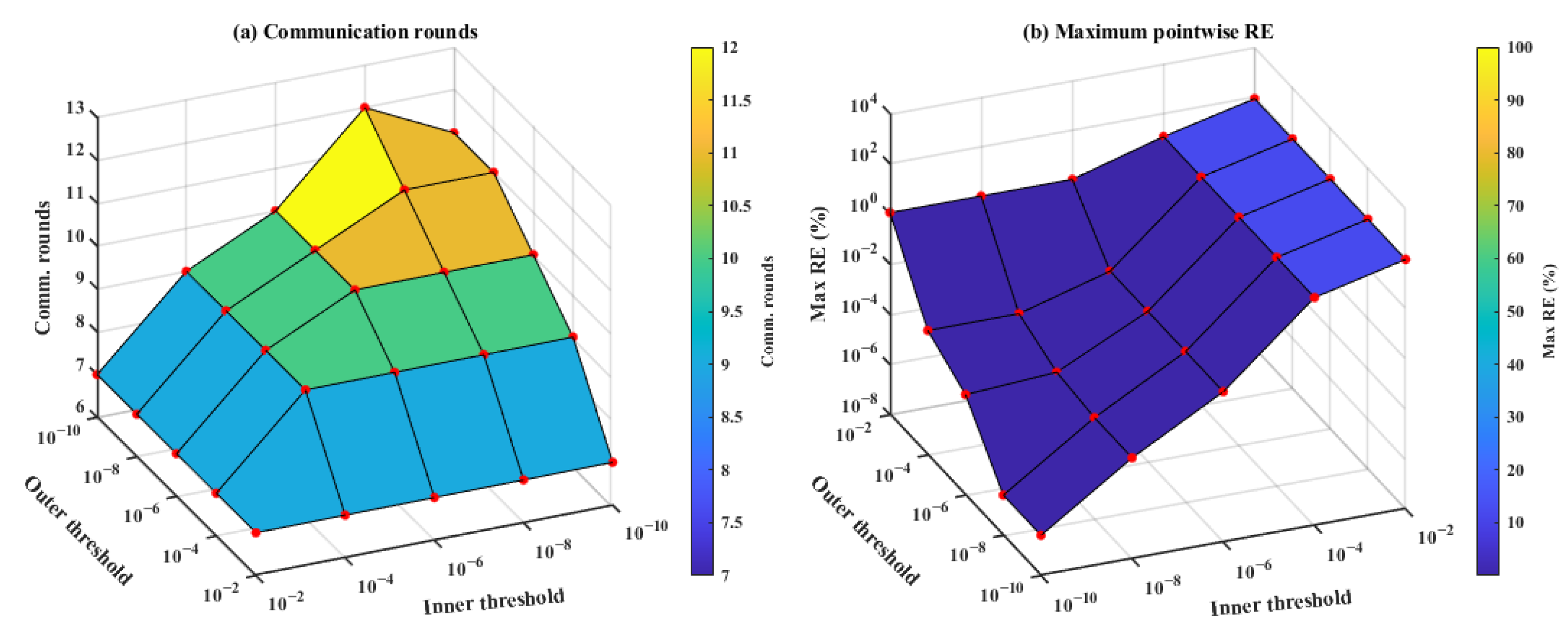
3.2. Sensitivity Analysis and Parameter Selection
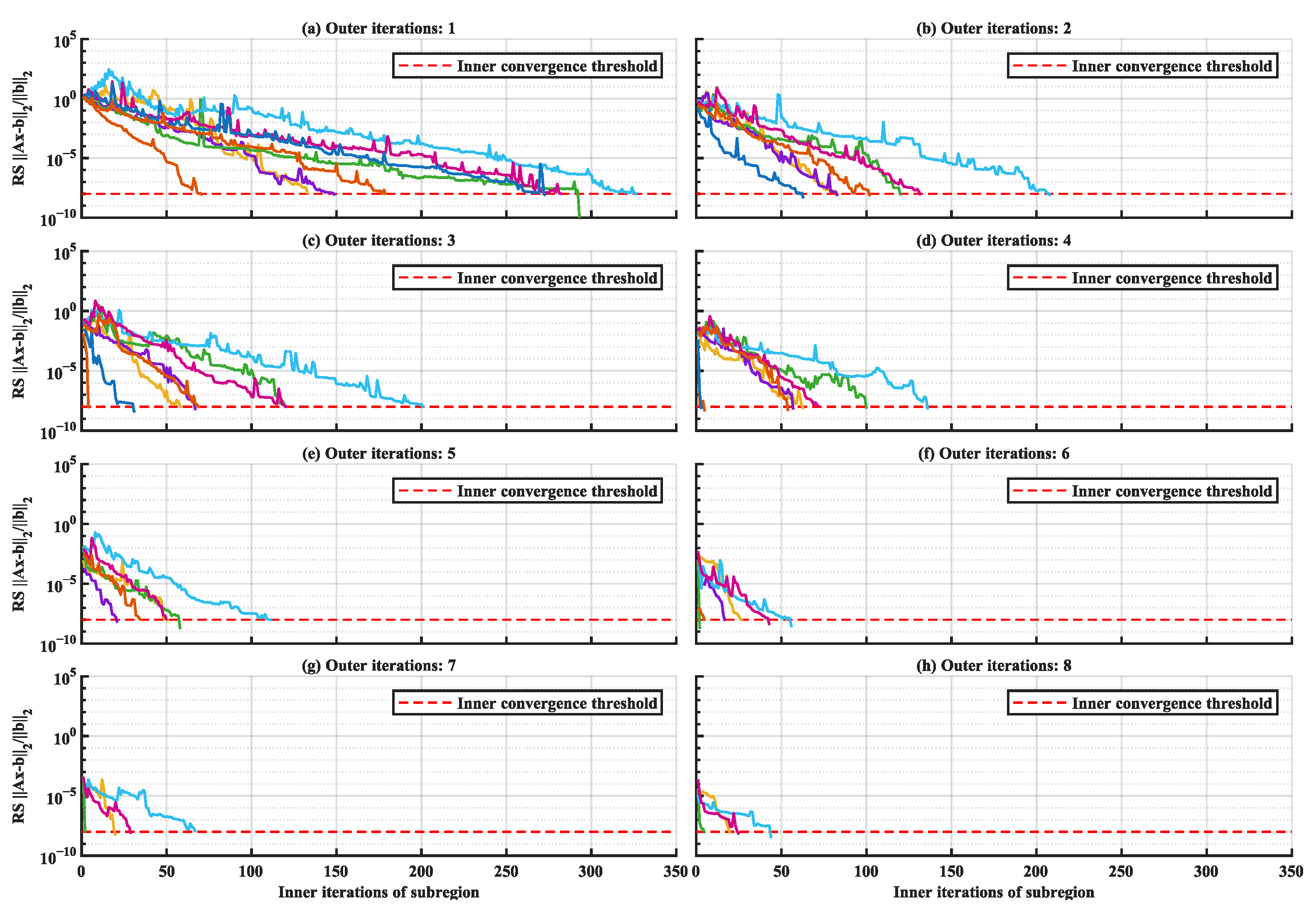
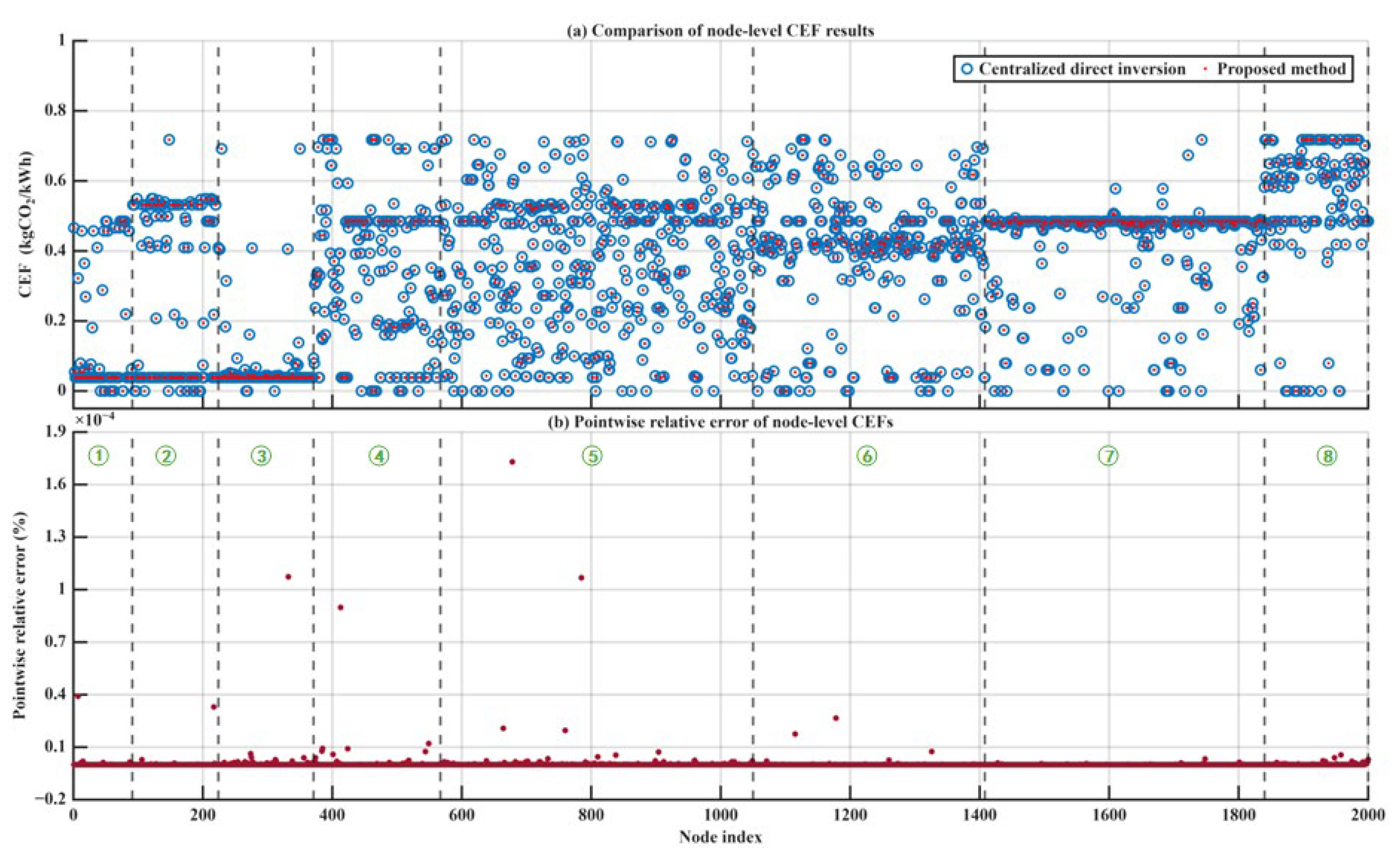
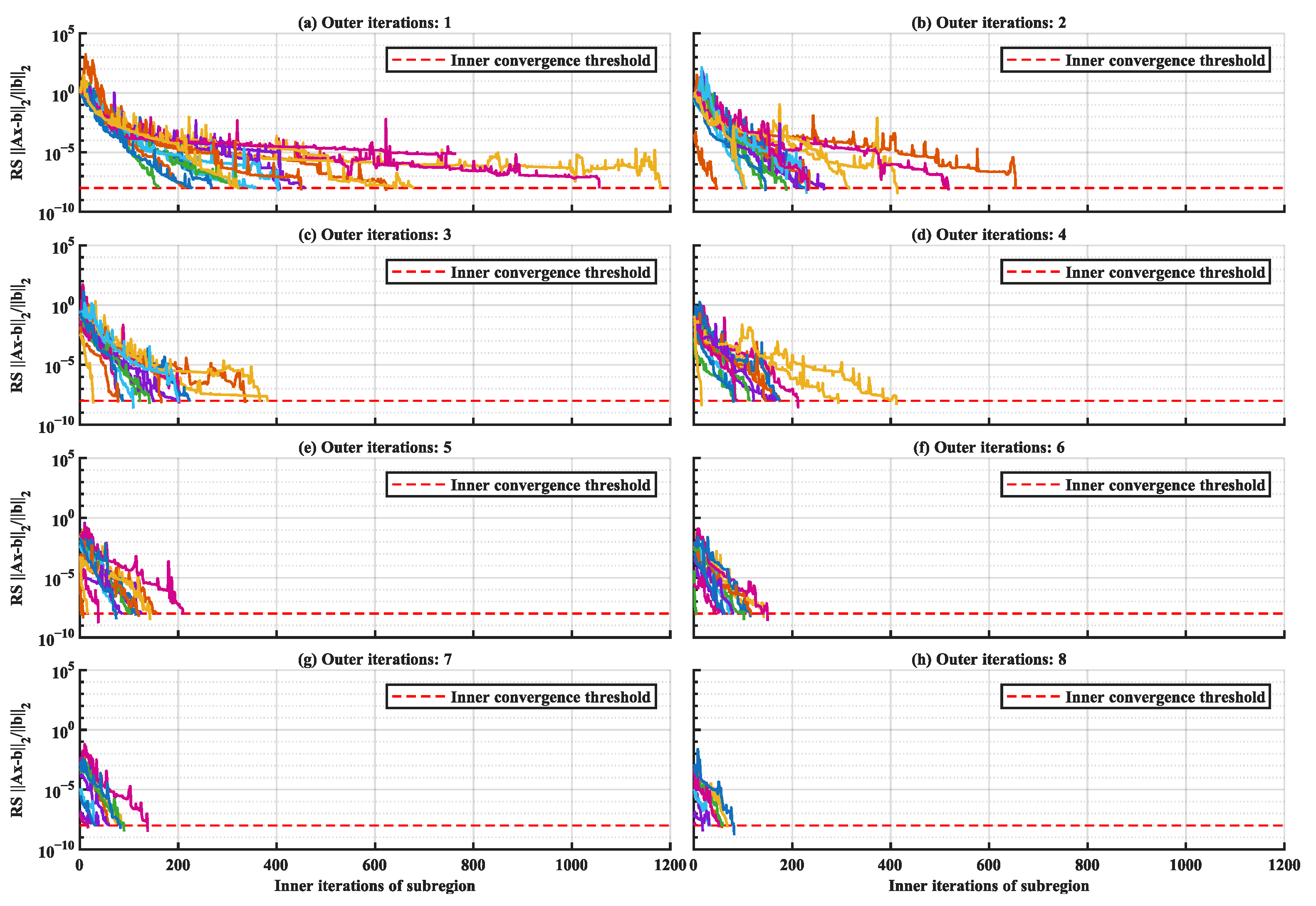
3.3. Performance on the 2000-Node, 8-Region System
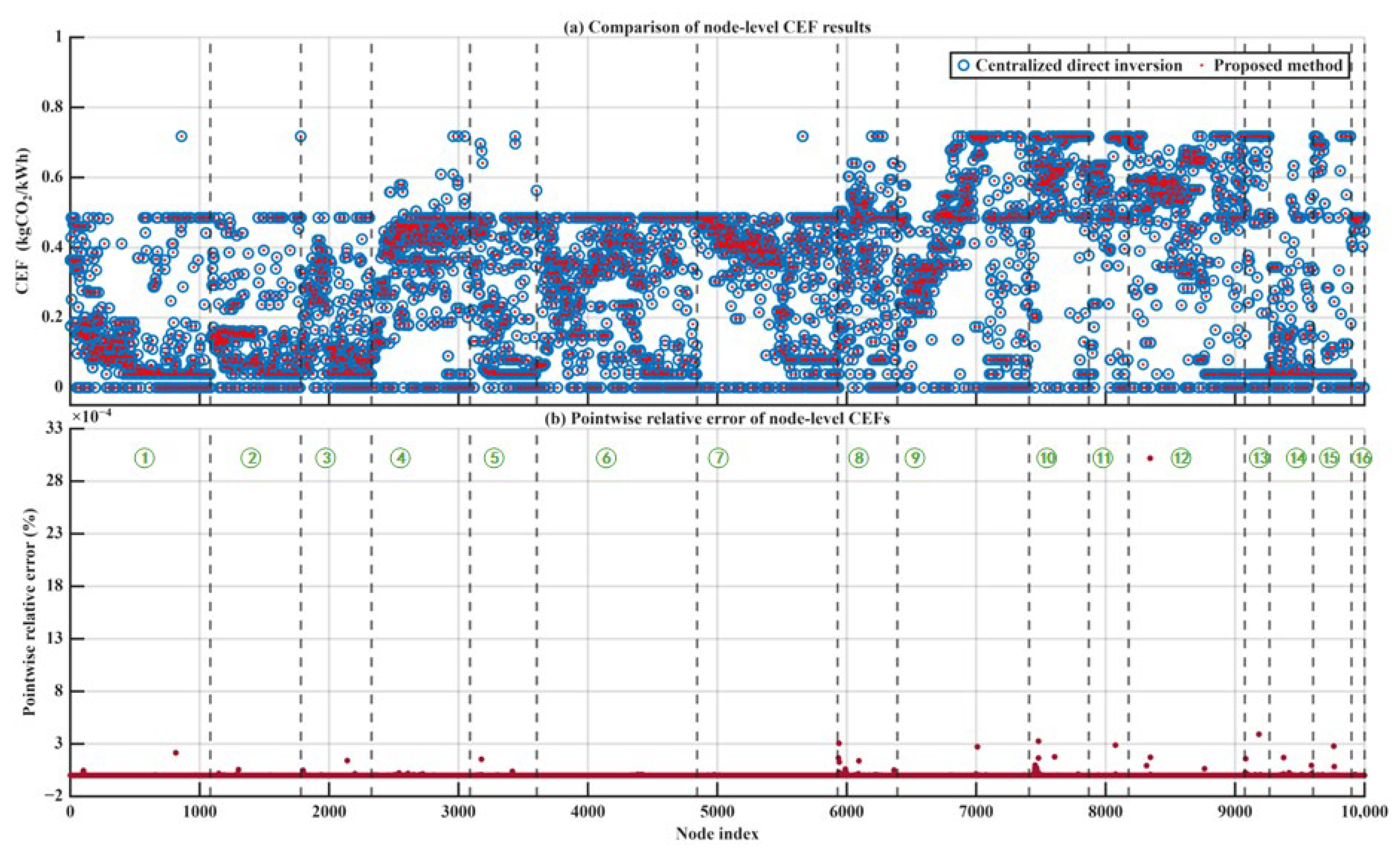
3.4. Performance on the 10,000-Node, 16-Region System
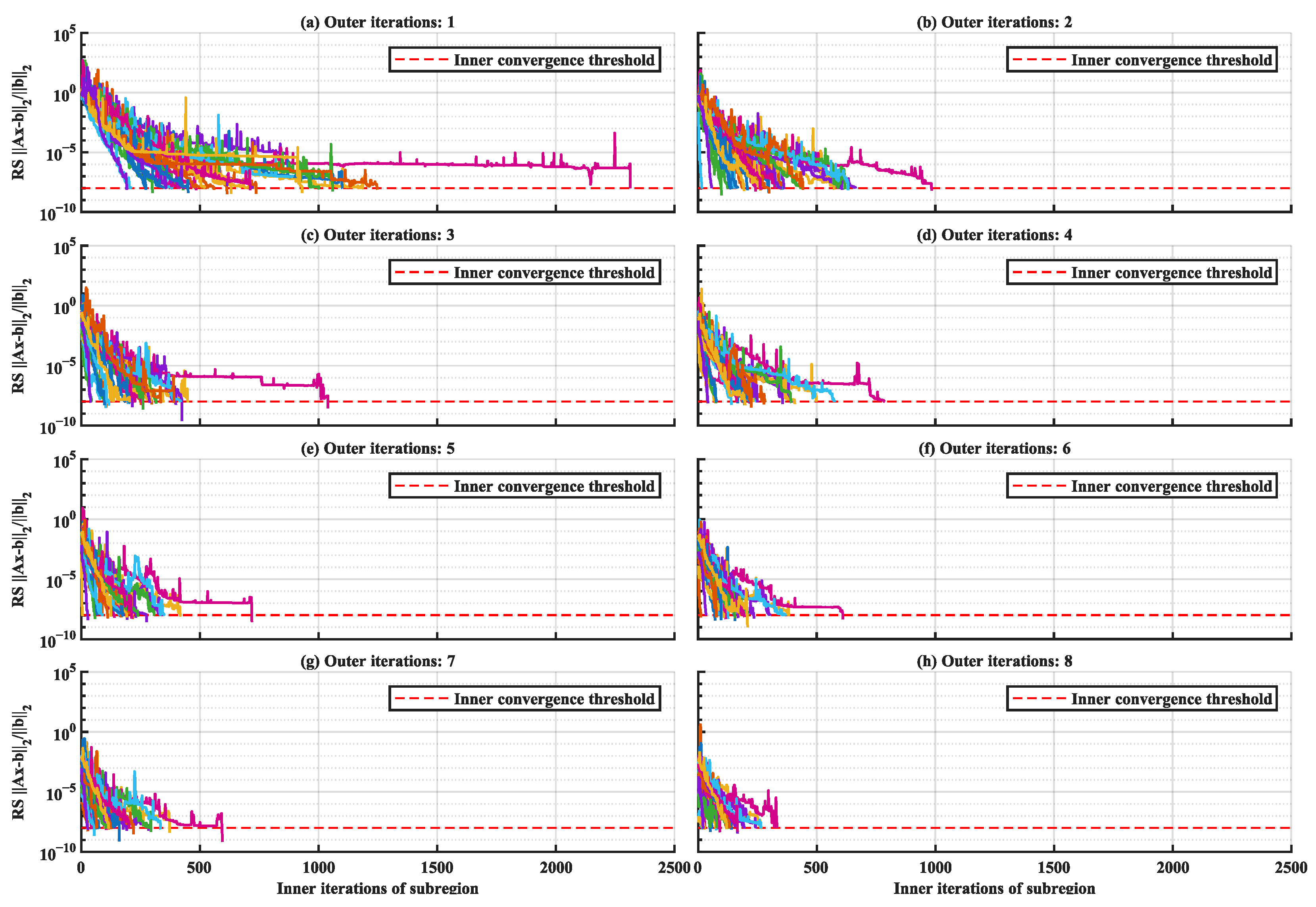
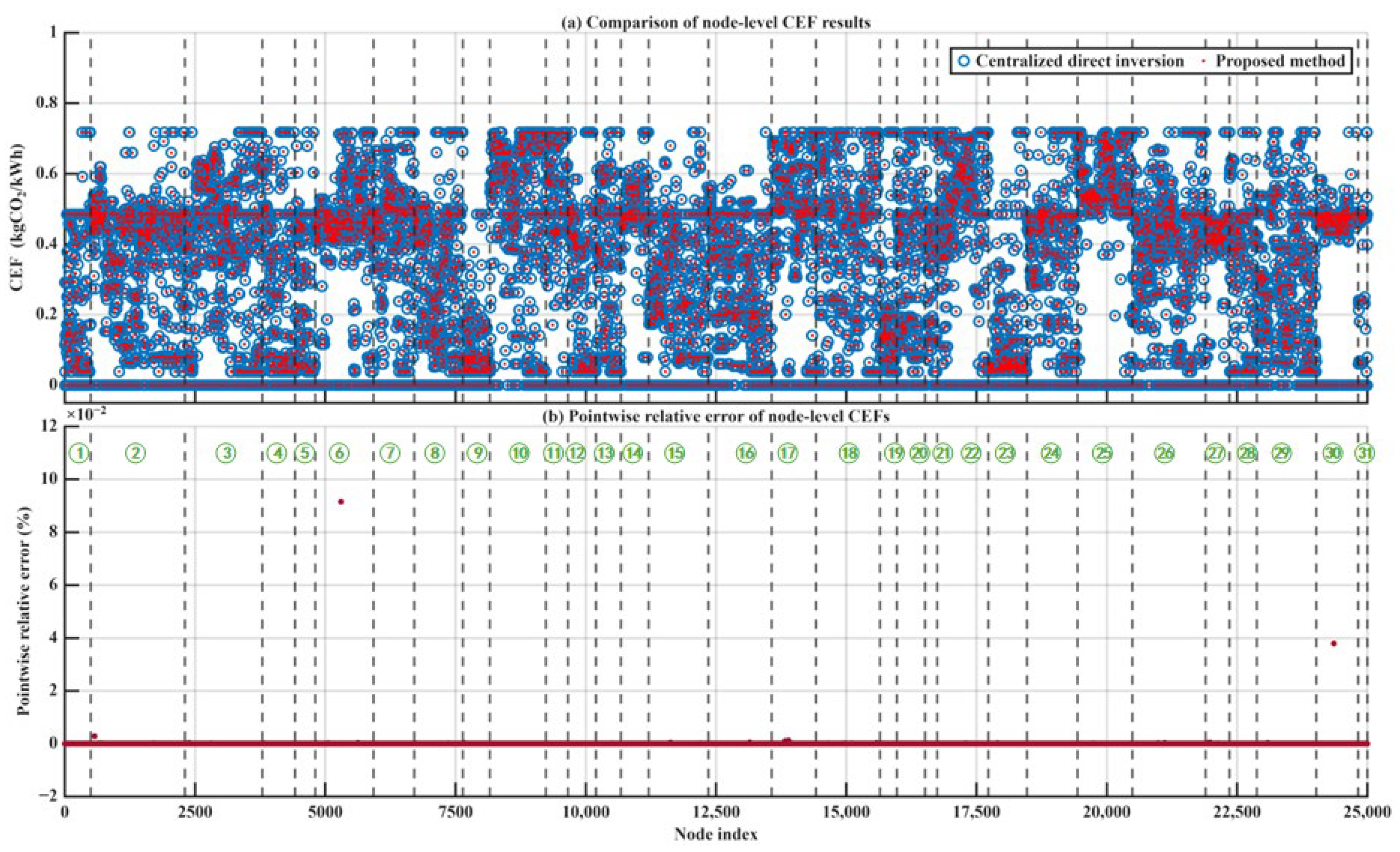
3.5. Performance on the 25,000-Node, 31-Region System
4. Discussion
5. Conclusions
Author Contributions
Funding
Institutional Review Board Statement
Informed Consent Statement
Data Availability Statement
Conflicts of Interest
Abbreviations
| CEF | Carbon emission factor |
| CDDP | Centralized data distribution pattern |
| CB | Centralized broker |
| BiCGSTAB | Biconjugate gradient stabilized algorithm |
| RE | Relative error |
References
- Zhu, S.; Ji, J.; Huang, Q.; Li, S.; Ren, J.; He, D.; Yang, Y. Optimal scheduling and trading in joint electricity and carbon markets. Energy Strategy Rev. 2024, 54, 101426. [Google Scholar] [CrossRef]
- Yang, C.; Liu, J.; Liao, H.; Liang, G.; Zhao, J. An improved carbon emission flow method for the power grid with prosumers. Energy Rep. 2023, 9, 114–121. [Google Scholar] [CrossRef]
- Park, B.; Dong, J.; Liu, B.; Kuruganti, T. Decarbonizing the grid: Utilizing demand-side flexibility for carbon emission reduction through locational marginal emissions in distribution networks. Appl. Energy 2023, 330, 120303. [Google Scholar] [CrossRef]
- Wang, Y.; Qiu, J.; Tao, Y.; Zhao, J. Carbon-oriented operational planning in coupled electricity and emission trading markets. IEEE Trans. Power Syst. 2020, 35, 3145–3157. [Google Scholar] [CrossRef]
- Chen, X.; Chao, H.; Shi, W.; Li, N. Towards carbon-free electricity: A flow-based framework for power grid carbon accounting and decarbonization. Energy Convers. Econ. 2024, 5, 396–418. [Google Scholar] [CrossRef]
- Kang, C.; Zhou, T.; Chen, Q.; Wang, J.; Sun, Y.; Xia, Q.; Yan, H. Carbon emission flow from generation to demand: A network-based model. IEEE Trans. Smart Grid 2015, 6, 2386–2394. [Google Scholar] [CrossRef]
- Cheng, Y.; Zhang, N.; Zhang, B.; Kang, C.; Xi, W.; Feng, M. Low-carbon operation of multiple energy systems based on energy-carbon integrated prices. IEEE Trans. Smart Grid 2019, 11, 1307–1318. [Google Scholar] [CrossRef]
- Cheng, Y.; Zhang, N.; Wang, Y.; Yang, J.; Kang, C.; Xia, Q. Modeling carbon emission flow in multiple energy systems. IEEE Trans. Smart Grid 2018, 10, 3562–3574. [Google Scholar] [CrossRef]
- Li, B.; Song, Y.; Hu, Z. Carbon flow tracing method for assessment of demand side carbon emissions obligation. IEEE Trans. Sustain. Energy 2013, 4, 1100–1107. [Google Scholar] [CrossRef]
- Wang, Y.; Qiu, J.; Tao, Y. Optimal power scheduling using data-driven carbon emission flow modelling for carbon intensity control. IEEE Trans. Power Syst. 2021, 37, 2894–2905. [Google Scholar] [CrossRef]
- Sang, L.; Xu, Y.; Sun, H. Encoding carbon emission flow in energy management: A compact constraint learning approach. IEEE Trans. Sustain. Energy 2023, 15, 123–135. [Google Scholar] [CrossRef]
- Chen, X.; Sun, A.; Shi, W.; Li, N. Carbon-aware optimal power flow. IEEE Trans. Power Syst. 2024, 40, 3090–3104. [Google Scholar] [CrossRef]
- Chen, W.; Liu, G.P. Privacy-preserving consensus-based distributed economic dispatch of smart grids via state decomposition. IEEE/CAA J. Autom. Sin. 2024, 11, 1250–1261. [Google Scholar] [CrossRef]
- Zimmerman, R.D.; Murillo-Sanchez, C.E.; Thomas, R.J. MATPOWER: Steady-state operations, planning, and analysis tools for power systems research and education. IEEE Trans. Power Syst. 2010, 26, 12–19. [Google Scholar] [CrossRef]
- Van der Vorst, H.A. Bi-CGSTAB: A fast and smoothly converging variant of Bi-CG for the solution of nonsymmetric linear systems. SIAM J. Sci. Stat. Comput. 1992, 13, 631–644. [Google Scholar] [CrossRef]
- Erseghe, T. Distributed optimal power flow using ADMM. IEEE Trans. Power Syst. 2014, 29, 2370–2380. [Google Scholar] [CrossRef]
- Mhanna, S.; Verbic, G.; Chapman, A.C. Adaptive ADMM for distributed AC optimal power flow. IEEE Trans. Power Syst. 2018, 34, 2025–2035. [Google Scholar] [CrossRef]
- An, W.; Ding, D.; Wang, Z.; Liu, Q.; Dong, H. Privacy-preserving distributed optimization for economic dispatch in smart grids. Automatica 2025, 177, 112275. [Google Scholar] [CrossRef]
- Sun, L.; Ding, D.; Dong, H.; Bai, X. Privacy-preserving distributed economic dispatch for microgrids based on state decomposition with added noises. IEEE Trans. Smart Grid 2023, 15, 2424–2433. [Google Scholar] [CrossRef]
- Bu, L.; Chen, X.; Gan, L.; Yu, K.; Zhou, Y.; Cao, J.; Cao, Y. Low-carbon operation method of the building based on dynamic carbon emission factor of power system. IET Smart Grid 2023, 6, 67–85. [Google Scholar] [CrossRef]
- Zhang, X.; Guo, Z.; Pan, F.; Yang, Y.; Li, C. Dynamic carbon emission factor based interactive control of distribution network by a generalized regression neural network assisted optimization. Energy 2023, 283, 129132. [Google Scholar] [CrossRef]
- Guo, Z.; Zhang, X.; Pan, F.; Yang, Y.; Li, J. Dynamic electricity-carbon factors driven fast day-ahead coordination and optimization of source-load-storage in distribution networks with a white box accelerator. Energy 2025, 331, 137049. [Google Scholar] [CrossRef]
- Liu, Z.; Guan, D.; Wei, W.; Davis, S.J.; Ciais, P.; Bai, J.; Peng, S.; Zhang, Q.; Hubacek, K.; Marland, G.; et al. Reduced carbon emission estimates from fossil fuel combustion and cement production in China. Nature 2015, 524, 335–338. [Google Scholar] [CrossRef] [PubMed]
- Shan, Y.; Liu, J.; Liu, Z.; Xu, X.; Shao, S.; Wang, P.; Guan, D. New provincial CO2 emission inventories in China based on apparent energy consumption data and updated emission factors. Appl. Energy 2016, 184, 742–750. [Google Scholar] [CrossRef]
- Texas A&M University. Electric Grid Test Cases. Available online: https://electricgrids.engr.tamu.edu/electric-grid-test-cases/ (accessed on 9 April 2026).
- Giannelos, S.; Konstantelos, I.; Strbac, G. A new class of planning models for option valuation of storage technologies under decision-dependent innovation uncertainty. In Proceedings of the 2017 IEEE Manchester PowerTech, Manchester, UK, 18–22 June 2017; pp. 1–6. [Google Scholar] [CrossRef]
- Amann, G.; Escobedo Bermúdez, V.R.; Boskov-Kovacs, E.; Gallego Amores, S.; Giannelos, S.; Iliceto, A.; Ilo, A.; Chavarro, J.R.; Samovich, N.; Schmitt, L.; et al. E-Mobility Deployment and Impact on Grids: Impact of Electric Vehicle and Charging Infrastructure on European Transmission and Distribution Grids: Innovation Needs; Publications Office of the European Union: Luxembourg, 2022. [Google Scholar] [CrossRef]
- Koutsandreas, D.; Ardehali, A.; Giannelos, S.; Pudjianto, D. Quantifying the trade-offs between clean-energy expansion and land requirements: Evidence from Greece. Energies 2026, 19, 2261. [Google Scholar] [CrossRef]
- Giannelos, S. Option Valuation of Smart Grid Technology Projects Under Endogenous and Exogenous Uncertainty. Ph.D. Thesis, Imperial College London, London, UK, 2016. [Google Scholar]
- Malamaki, K.-N.D.; Fotopoulou, M.; Martinez-Lopez, D.; Lampsidis, G.; Ferrer-Fernandez, P.; Andriopoulos, N.; Tzanis, N.; Kaousias, K.; Chassioti, E.; Moraitis, I. Day ahead optimization of insular systems considering future interconnection: The case of Ikaria island. Sustain. Energy Grids Netw. 2025, 44, 102018. [Google Scholar] [CrossRef]
- Liu, J.; Li, J.W.; Li, X.; Li, Y.P.; Gao, P.P.; Jin, L. An optimization model to provide electric power systems’ net zero-carbon emission pathways considering diverse measures under double-side randomness and vagueness. Renew. Energy 2026, 256, 124637. [Google Scholar] [CrossRef]



| Ref. | Method | Partitioned Calculation | Max. Scale (Nodes/Regions) |
|---|---|---|---|
| [6] | Centralized carbon emission flow | No | <1000/– |
| [7] | Centralized multi-energy carbon emission flow | No | <1000/– |
| [10] | Data-driven Bayesian carbon emission flow | No | <1000/– |
| [12] | Carbon-aware OPF with nodal carbon intensity | No | <1000/– |
| [21] | Demand-side low-carbon energy management with nodal CEF | No | <1000/– |
| This work | Partitioned CDDP-BiCGSTAB | Yes (subregional sparse nonsymmetric BiCGSTAB) | 25,000/31 |
| Symbol | Description | Unit |
|---|---|---|
| Node-level CEF vector of the full network | kgCO2/kWh | |
| CEF of node n | kgCO2/kWh | |
| CEF of generator g connected to node n | kgCO2/kWh | |
| Active power output of generator g connected to node n | kW | |
| Set of upstream nodes injecting active power into node n | - | |
| Active power injected into node n through branch (j-n) | kW | |
| Coefficient matrix of the full-network CEF equation | kW | |
| Constant vector of the full-network CEF equation | kgCO2/h | |
| Node set of subregion m | - | |
| Number of nodes in subregion m | - | |
| Set of boundary nodes in subregion m | - | |
| Set of opposite-side nodes injecting power into subregion m | - | |
| Coefficient matrix of subregion m | kW | |
| Node-level CEF vector of subregion m | kgCO2/kWh | |
| Constant vector of subregion m | kgCO2/h | |
| Boundary coupling matrix of subregion m | kW | |
| CEF vector of opposite-side nodes for subregion m | kgCO2/kWh | |
| Inner-layer relative residual | - | |
| Inner-layer convergence threshold | - | |
| Boundary convergence error at the l-th outer iteration | kgCO2/kWh | |
| Outer-layer convergence threshold | kgCO2/kWh | |
| Pointwise relative error | % |
| Generator Type | (kgCO2/kWh) |
|---|---|
| Coal-fired power | 0.7180 |
| Oil-fired power | 0.8390 |
| Natural gas | 0.4850 |
| Hydropower | 0.0380 |
| Photovoltaic power | 0.0790 |
| Wind power | 0.0380 |
| Nuclear power | 0.0600 |
| Test System | Nodes | Branches | Generators | Regions | Generator Types | Voltage Levels (kV) | System Description |
|---|---|---|---|---|---|---|---|
| ACTIVSg 2000 | 2000 | 3206 | 432 | 8 | Gas, Hydro, Nuclear, PV, Coal, Wind | 500, 230, 161, 115, 24, 22, 20, 18, 13.8, 13.2 | Synthetic grid for Texas, USA |
| ACTIVSg 10k | 10,000 | 12,706 | 1937 | 16 | Gas, Hydro, Nuclear, PV, Coal, Wind | 765, 500, 345, 230, 161, 138, 115, 24, 22, 20, 18, 13.8, 13.2, 1 | Synthetic grid for the western USA |
| ACTIVSg 25k | 25,000 | 32,230 | 3779 | 31 | Gas, Hydro, Nuclear, PV, Coal, Wind, Oil | 765, 500, 345, 230, 161, 138, 115, 100, 69, 24, 22, 20, 18, 13.8, 13.2, 1 | Synthetic grid for the northeastern USA |
| Test System | Nodes | Regions | Max. Relative Error (%) | Main Observation |
|---|---|---|---|---|
| ACTIVSg 2000 | 2000 | 8 | 0.00019 | Accurate agreement with the centralized direct solution |
| ACTIVSg 10k | 10,000 | 16 | 0.0030 | Accuracy maintained at the ten-thousand-node scale |
| ACTIVSg 25k | 25,000 | 31 | 0.0900 | Maximum error remains below 0.1% under large-scale regional coupling |
Disclaimer/Publisher’s Note: The statements, opinions and data contained in all publications are solely those of the individual author(s) and contributor(s) and not of MDPI and/or the editor(s). MDPI and/or the editor(s) disclaim responsibility for any injury to people or property resulting from any ideas, methods, instructions or products referred to in the content. |
© 2026 by the authors. Licensee MDPI, Basel, Switzerland. This article is an open access article distributed under the terms and conditions of the Creative Commons Attribution (CC BY) license.
Share and Cite
Chen, Y.; Chen, R.; Jiang, H.; Huang, Y.; Zhang, F. Partitioned Calculation of Node-Level Carbon Emission Factors for Large-Scale Power Systems Based on Centralized Data Distribution Pattern and BiCGSTAB Algorithm. Technologies 2026, 14, 420. https://doi.org/10.3390/technologies14070420
Chen Y, Chen R, Jiang H, Huang Y, Zhang F. Partitioned Calculation of Node-Level Carbon Emission Factors for Large-Scale Power Systems Based on Centralized Data Distribution Pattern and BiCGSTAB Algorithm. Technologies. 2026; 14(7):420. https://doi.org/10.3390/technologies14070420
Chicago/Turabian StyleChen, Yushi, Rouyi Chen, Hui Jiang, Yanlu Huang, and Fan Zhang. 2026. "Partitioned Calculation of Node-Level Carbon Emission Factors for Large-Scale Power Systems Based on Centralized Data Distribution Pattern and BiCGSTAB Algorithm" Technologies 14, no. 7: 420. https://doi.org/10.3390/technologies14070420
APA StyleChen, Y., Chen, R., Jiang, H., Huang, Y., & Zhang, F. (2026). Partitioned Calculation of Node-Level Carbon Emission Factors for Large-Scale Power Systems Based on Centralized Data Distribution Pattern and BiCGSTAB Algorithm. Technologies, 14(7), 420. https://doi.org/10.3390/technologies14070420