Article

Ultrasound-Assisted Synthesis of Fe3+/Zr4+-Modified Layered Double Hydroxides for RSM-Optimized Fluoride Remediation: Structural Insights and Evaluation in Groundwater


by
Gloribel Vázquez-Cornejo
1,
Sasirot Khamkure
2,*,
Prócoro Gamero-Melo
3,
Victoria Bustos-Terrones
4,
Ulises Carrasco-Dehesa
5,
Audberto Reyes-Rosas
6,
Arely M. López-Martínez
7,
Carlos D. Silva-Luna
8,
María L. Rivera-Huerta
8,
Edson B. Estrada-Arriaga
9 and
Juan G. Garcia-Maldonado
10,*
1
Postgraduate and Continuing Education Sub-Coordination, Instituto Mexicano de Tecnología del Agua, Jiutepec 62550, Mexico
2
Irrigation and Drainage Department, Secretaría de Ciencia, Humanidades, Tecnología e Innovación (SECIHTI), Universidad Autónoma Agraria Antonio Narro, Saltillo 25315, Mexico
3
Sustainability of Natural Resources and Energy, Cinvestav Saltillo, Ramos Arizpe 25900, Mexico
4
Environmental Engineering and Sustainability Research Laboratory, Universidad Politécnica del Estado de Morelos, Jiutepec 62550, Mexico
5
Institute of Engineering, Universidad Nacional Autónoma de México, Cd. Universitaria, Coyoacán, Mexico City 04510, Mexico
6
Department of Biosciences and Agrotechnology, Centro de Investigación en Química Aplicada, Saltillo 25294, Mexico
7
Department of Macromolecular Chemistry and Synthesis, Centro de Investigación en Química Aplicada, Blvd. Enrique Reyna 140, San José de los Cerritos, Saltillo 25294, Mexico
8
Potabilization Sub-Coordination, Instituto Mexicano de Tecnología del Agua, Jiutepec 62550, Mexico
9
Sanitation Systems and Wastewater Reuse Sub-Coordination, Instituto Mexicano de Tecnología del Agua, Jiutepec 62550, Mexico
10
Physical Experimentation and Technological Innovation Sub-Coordination, Instituto Mexicano de Tecnología del Agua, Jiutepec 62550, Mexico
*
Authors to whom correspondence should be addressed.
Technologies 2026, 14(6), 324; https://doi.org/10.3390/technologies14060324
Submission received: 14 April 2026 / Revised: 24 May 2026 / Accepted: 25 May 2026 / Published: 28 May 2026
(This article belongs to the Special Issue Sustainable Water and Environmental Technologies of Global Relevance)

Abstract

This study investigates the structure–performance relationship of Fe3+- and Zr4+-modified layered double hydroxides (LDHs) for fluoride removal from water. Mg–Al LDHs with different metal loadings (Zr0.05, Zr0.1, Fe0.8, and Fe1) were synthesized via ultrasound-assisted coprecipitation and characterized using XRD, SEM–EDS, FTIR, XPS, and N2 physisorption. Among the synthesized materials, Zr0.05-LDH exhibited the highest adsorption performance. Response surface methodology identified adsorbent dosage as the most influential parameter, achieving a maximum fluoride removal efficiency of 98.17% under optimal conditions (pH ≈ 5, adsorbent dose of 0.88 g/L, and initial fluoride concentration of 12.6 mg/L). Zr0.05-LDH showed the largest specific surface area (261 m2/g) and a maximum adsorption capacity of 137 mg/g, as described by the Langmuir isotherm model. Kinetic studies indicated rapid adsorption, with equilibrium reached at approximately 180 min. Fluoride removal was governed primarily by inner-sphere complexation at Zr4+ and Fe3+ sites, accompanied by anion exchange and electrostatic interactions. The adsorbent retained 89% of its capacity after five regeneration cycles. Groundwater tests from Durango, Mexico, demonstrated effective fluoride reduction below Mexican and WHO guideline limits despite competing anions. These results demonstrate the potential of modified LDHs for fluoride-contaminated groundwater treatment.

1. Introduction

Fluoride contamination in drinking water is a major environmental and public health concern, particularly in regions of Asia, Africa, and Latin America, where groundwater is the primary source of drinking water [1,2]. Fluoride (F), owing to its small ionic radius, high electronegativity, and chemical stability, can be readily mobilized under specific hydrogeochemical conditions. Its occurrence in groundwater is commonly associated with the dissolution of fluoride-bearing minerals such as fluorapatite, fluorite, and cryolite, as well as with anthropogenic sources including phosphate fertilizers, industrial emissions, and untreated wastewater discharges [3,4]. In arid and semi-arid regions, elevated pH, high alkalinity, and limited calcium availability enhance fluoride release by suppressing Ca2+ coprecipitation and promoting OH substitution within mineral structures [5]. Low concentrations of fluoride in drinking water may be beneficial for dental health. However, prolonged exposure can lead to dental and skeletal fluorosis. The World Health Organization (WHO) recommends a maximum fluoride concentration of 1.5 mg/L in drinking water [6]. Therefore, it is important to develop efficient defluoridation technologies [7].
Various technologies have been applied for fluoride removal, including chemical precipitation, coagulation, ion exchange, electrocoagulation, nanofiltration, and reverse osmosis [8,9]. Although effective, these methods are often limited by high operational costs, significant energy requirements, membrane fouling, and the generation of secondary waste streams [10]. As a result, adsorption has gained considerable attention due to its operational simplicity, cost-efficiency, and high removal efficiency [11,12]. However, its performance is strongly dependent on adsorbent properties, including structural stability, surface chemistry, and susceptibility to competing ions [13].
Among emerging adsorbents, layered double hydroxides (LDHs) have attracted significant attention because of their tunable composition, high anion-exchange capacity, and structural versatility [14,15]. However, pristine LDHs often exhibit limited adsorption capacity, low selectivity, and structural instability under variable aqueous conditions, which restricts their practical application [16]. Consequently, recent studies have focused on modifying LDHs through metal cation substitution to improve adsorption performance [17]. Iron-modified LDHs (Fe–LDHs) have shown enhanced fluoride adsorption because of increased surface charge density and strengthened electrostatic interactions and surface complexation mechanisms [16]. Similarly, zirconium-based materials are widely reported to exhibit a high affinity for fluoride, which may be associated with the formation of inner-sphere complexes involving Zr–F interactions [18].
The development of LDH-based adsorbents has often been guided by the assumption that increased metal incorporation results in enhanced adsorption performance. However, this assumption remains largely unverified and may be overly simplistic. Adsorption efficiency does not necessarily increase linearly with metal content but instead depends on the interplay among metal dispersion, structural organization, and active-site accessibility. These considerations highlight limitations in prevailing design strategies and emphasize the importance of mechanistic understanding for the rational development of high-performance adsorbents.
Nevertheless, the relationship between metal incorporation, structural organization, and adsorption performance remains insufficiently understood, particularly in LDH systems modified with high-valence cations such as Zr4+. Potential non-linear effects of metal loading, together with trade-offs among active site density, metal dispersion, and structural stability, are still not fully understood, which makes the rational design of optimized adsorbents more challenging.
Accordingly, this study systematically evaluates the effect of Fe3+ and Zr4+ incorporation on the structure–performance relationships of LDH-based adsorbents for aqueous fluoride removal. The adsorbents were synthesized and characterized, and response surface methodology (RSM) was applied to optimize the adsorption conditions and assess the factors affecting fluoride removal. The results showed that adsorption performance was more strongly related to the balance between structural crystallinity and metal dispersion than to the total amount of metal incorporated into the material. These findings suggest that the prepared materials are promising adsorbents for fluoride removal in water treatment applications.

2. Materials and Methods

2.1. Materials

Analytical-grade reagents were used for the synthesis of LDHs, including magnesium nitrate hexahydrate (Mg(NO3)2·6H2O, Meyer, Mexico City, Mexico; 98%), aluminum nitrate nonahydrate (Al(NO3)3·9H2O, Sigma-Aldrich, St. Louis, MO, USA; 99%), iron(III) nitrate nonahydrate (Fe(NO3)3·9H2O, Sigma-Aldrich, St. Louis, USA; 98%), and zirconium oxynitrate hydrate (ZrO(NO3)2·H2O, Sigma-Aldrich, St. Louis, USA; 98%). Sodium carbonate (Na2CO3, J.T. Baker, Phillipsburg, NJ, USA; 99%), sodium hydroxide (NaOH, 97%, Karal, Mexico City, Mexico; 97%), and hydrochloric acid (HCl, Fermont, Monterrey, Mexico; 37%) were used for pH adjustment. Fluoride stock solutions were prepared from sodium fluoride (NaF, Sigma-Aldrich, St. Louis, USA; 98.5%). Deionized water was used in all experiments.

2.2. Synthesis of Adsorbents (LDHs)

Layered double hydroxides (LDHs) with a nominal Mg/Al molar ratio of 3:1 were synthesized as reference materials. Metal-modified LDHs were prepared by incorporating Fe3+ (0.8 and 1 mol) into the Mg–Al framework while maintaining a total trivalent cation content of 1 mol. For Zr4+-modified materials (0.05 and 0.1 mol), the combined Al3+ + Zr4+ content was fixed at 1 mol to preserve charge balance within the layered structure.
All materials were synthesized by ultrasound-assisted coprecipitation. Briefly, a mixed metal nitrate solution was added dropwise to a 500 mL Erlenmeyer flask containing 50 mL of 0.5 mol/L Na2CO3 under vigorous stirring. Simultaneously, a 1 mol/L NaOH solution was added to maintain the pH at 10. The resulting suspension was subjected to ultrasonic irradiation (130 W, 20 kHz) for 30 min, followed by aging at 65 °C for 18 h under continuous stirring (170 rpm).
After aging, the precipitates were repeatedly washed with deionized water until neutral pH was achieved, then filtered and dried at 80 °C for 12 h. The obtained solids were designated as LDH, Fe0.8-LDH, Fe1-LDH, Zr0.05-LDH, and Zr0.1-LDH according to their composition. Prior to use, the materials were ground and passed through a 200-mesh sieve (~75 µm) to ensure a uniform particle size distribution, followed by calcination at 500 °C for 4 h to obtain the corresponding mixed metal oxides. Despite calcination, these materials are referred to as LDH-based materials due to their origin and their ability to undergo partial reconstruction in aqueous media via the memory effect.

2.3. Characterization of Adsorbents

The physicochemical properties of the synthesized adsorbents were characterized using complementary analytical techniques.
X-ray diffraction (XRD) patterns were collected using a Bruker D8 Advance diffractometer (Bruker, Karlsruhe, Germany) equipped with a Göbel mirror, Cu Kα radiation (λ = 1.5406 Å), and a NaI detector. Measurements were conducted over a 2θ range of 3–80°, with a step size of 0.02° and a scanning rate of 2°/min.
Surface chemical composition and oxidation states were analyzed by X-ray photoelectron spectroscopy (XPS) using a Thermo Scientific K-Alpha spectrometer (East Grinstead, UK). The instrument was operated under ultra-high vacuum conditions (2.4 × 10⁻⁷ mbar) with a monochromatic Al Kα source (1486.68 eV). The analyzed area had a diameter of approximately 400 μm.
Morphological characteristics were examined using a field-emission scanning electron microscope (FE-SEM, JEOL JSM-7800F Prime; Tokyo, Japan). The elemental composition and its distribution were analyzed by energy-dispersive X-ray spectroscopy (EDS, Bruker) coupled with the microscope.
The textural properties of the samples, including specific surface area, pore volume, and pore size distribution, were determined from N2 adsorption–desorption isotherms using a Micromeritics ASAP 2020 analyzer (Norcross, GA, USA). Prior to analysis, the samples were degassed at 100 °C for 12 h. The specific surface area was calculated using the Brunauer–Emmett–Teller (BET) method.
The functional groups present on the adsorbents were identified by Fourier transform infrared (FTIR) spectroscopy. Spectra were recorded using a Shimadzu IRAffinity-1S spectrometer (Shimadzu Corp., Kyoto, Japan) equipped with a GS10800 attenuated total reflectance (ATR) accessory (Specac Ltd., Orpington, UK). Measurements were performed in ATR mode over the spectral range of 400–4000 cm−1, with a resolution of 2 cm−1 and 45 scans per sample.

2.4. Batch Adsorption Experiments

Batch adsorption experiments were conducted in Erlenmeyer flasks using orbital shaking at 150 rpm and 25 ± 5 °C. After adsorption, water samples were collected and filtered through a 0.45 μm syringe filter prior to fluoride analysis. The residual fluoride concentration was measured using an ion-selective electrode (Orion 9609BNWP, Thermo Fisher Scientific Inc., Waltham, MA, USA) after the addition of TISAB III. Each experimental condition was performed in duplicate to ensure reproducibility. The fluoride removal efficiency (%) and adsorption capacity (qe, mg/g) were calculated using Equations (1) and (2).
R e m o v a l   % = ( C o C e ) C o ×   100
q e   ( m g / g ) = C o C e m × V
where Co and Ce (mg/L) represent the initial and equilibrium fluoride concentrations, respectively, while m (g) and V (L) denote the mass of adsorbent and the solution volume.
Initial adsorption experiments were conducted using LDH as the reference material, and Fe1-LDH, Fe0.8-LDH, Zr0.1-LDH, and Zr0.05-LDH. In each test, 20 mg of adsorbent was dispersed in 20 mL of a fluoride solution (10 mg/L), corresponding to an adsorbent dosage of 1 g/L. Experiments were performed at the natural solution pH (≈6) with a contact time of 240 min.

2.4.1. Experimental Design (RSM)

Based on the adsorption experiment results, fluoride removal using Zr0.05-LDH was optimized using a Central Composite Design (CCD) within the Response Surface Methodology (RSM) framework. The independent variables were initial fluoride concentration, pH and adsorbent dosage, each evaluated at three levels (Table 1), while fluoride removal (%) was selected as the response variable. A total of 40 experimental runs, including duplicates, were conducted under constant orbital stirring (150 rpm) for 240 min at 25 ± 5 °C.

2.4.2. Adsorption Kinetics

Adsorption kinetic studies were conducted for all synthesized adsorbents. In each experiment, 500 mg of adsorbent was contacted with 500 mL of a fluoride solution (12 mg/L) at pH 5 in Erlenmeyer flasks. At predetermined time intervals (5, 10, 15, 20, 30, 45, 60, 120, 180, 240, 300, and 360 min), aliquots were collected and filtered using 0.45 μm syringe filters prior to fluoride analysis. The adsorption capacity at time t (qₜ, mg/g) was calculated from the residual fluoride concentration.
The kinetic data were analyzed using the pseudo-first order (Equation (3)), pseudo-second order (Equation (4)), and Elovich (Equation (5)) models [18,19]. Model parameters were obtained by nonlinear regression using Qtiplot software (version 0.9.8.3-3).
q t = q e   1 e K 1 t
q t = K 2 q e 2   t ( 1 + K 2 q e t )
q t = 1 β l n ( 1 + α β t )
where qe is the adsorption capacity at equilibrium (mg/g), qt is the adsorption capacity at time t (mg/g), t is the contact time (min), K1 is the pseudo-first-order rate constant (1/min or min−1), K2 is the pseudo-second-order rate constant (g/mg·min or g mg−1·min−1)), α is the initial sorption rate (mg/g·min−1), and β is the desorption constant (g/mg).

2.4.3. Adsorption Isotherms

Equilibrium adsorption experiments were conducted to determine the maximum fluoride adsorption capacity of the synthesized adsorbents. Fluoride solutions with initial concentrations ranging from 5 to 80 mg/L (5, 10, 20, 30, 40, 50, 60, and 80 mg/L) were prepared and contacted with the adsorbents at a dosage of 1.0 g/L and pH 5. The suspensions were agitated at 150 rpm for 5 h at room temperature to ensure equilibrium conditions.
The equilibrium adsorption data were analyzed using the Langmuir (Equation (6)) and Freundlich (Equation (7)) isotherm models [20,21]. Model parameters were obtained by non-linear regression using OriginPro 2021 software (OriginLab Corporation, Northampton, MA, USA).
q e = q m K L C e   1 + K L C e
q e = K F C e 1 n  
where qe is the adsorption capacity at equilibrium (mg/g), Ce is the equilibrium concentration of the adsorbate in solution (mg/L), qm is the maximum adsorption capacity (mg/g), KL is the Langmuir affinity or energy constant (L/mg), KF is the Freundlich constant related to adsorption capacity [mg/g (L/mg)1/n], and 1/n is the heterogeneity factor associated with adsorption intensity (dimensionless).

2.4.4. Regenerability and Recyclability

The regeneration and reusability of Zr0.05-LDH and Fe0.8-LDH were evaluated using 1.0 M NaOH as the desorbing agent. After fluoride saturation during the kinetic experiments, the adsorbents were recovered, dried at 105 °C for 12 h and weighed. The materials were then contacted with an appropriate volume of desorption solution to maintain a constant adsorbent dosage of 1 g/L under continuous stirring for 120 min.
Reusability was assessed over five consecutive adsorption–desorption cycles. In each cycle, adsorption was carried out using a fluoride solution with an initial concentration of 12 mg/L at pH 5. After desorption, the adsorbents were washed with deionized water, filtered and dried at 105 °C for 12 h. A calcination step at 500 °C for 4 h was subsequently applied to restore active sites before the next cycle.

2.4.5. Groundwater Adsorption Study

The adsorption performance of Zr0.05-LDH and Fe0.8-LDH was evaluated using groundwater collected from a well in the state of Durango, Mexico, where fluoride levels exceed the maximum permissible limit (1.0 mg/L) set by the Mexican standard NOM-127-SSA1-2021. Adsorption tests were conducted at a dose of 1.0 g/L and an initial pH of 5. The concentrations of sulfate (SO42−), chloride (Cl), nitrate (NO3), phosphate (PO43−), fluoride (F), and silica (SiO2) were determined before and after treatment using a HACH DR1900 portable spectrophotometer (Hach, Loveland, CO, USA). Fluoride concentrations were specifically quantified using an ion-selective electrode (Thermo Scientific Orion, model 9609BNWP; Waltham, MA, USA).

2.4.6. Statistical Analysis

All adsorption experiments were conducted in duplicate (n = 2), and results are reported as mean ± standard deviation. Error bars representing standard deviations have been included in the experiment of preliminary, kinetic and isotherm adsorption, regeneration and groundwater application.

3. Results and Discussion

3.1. Characterization of Materials

3.1.1. X-Ray Diffraction (XRD) Analysis

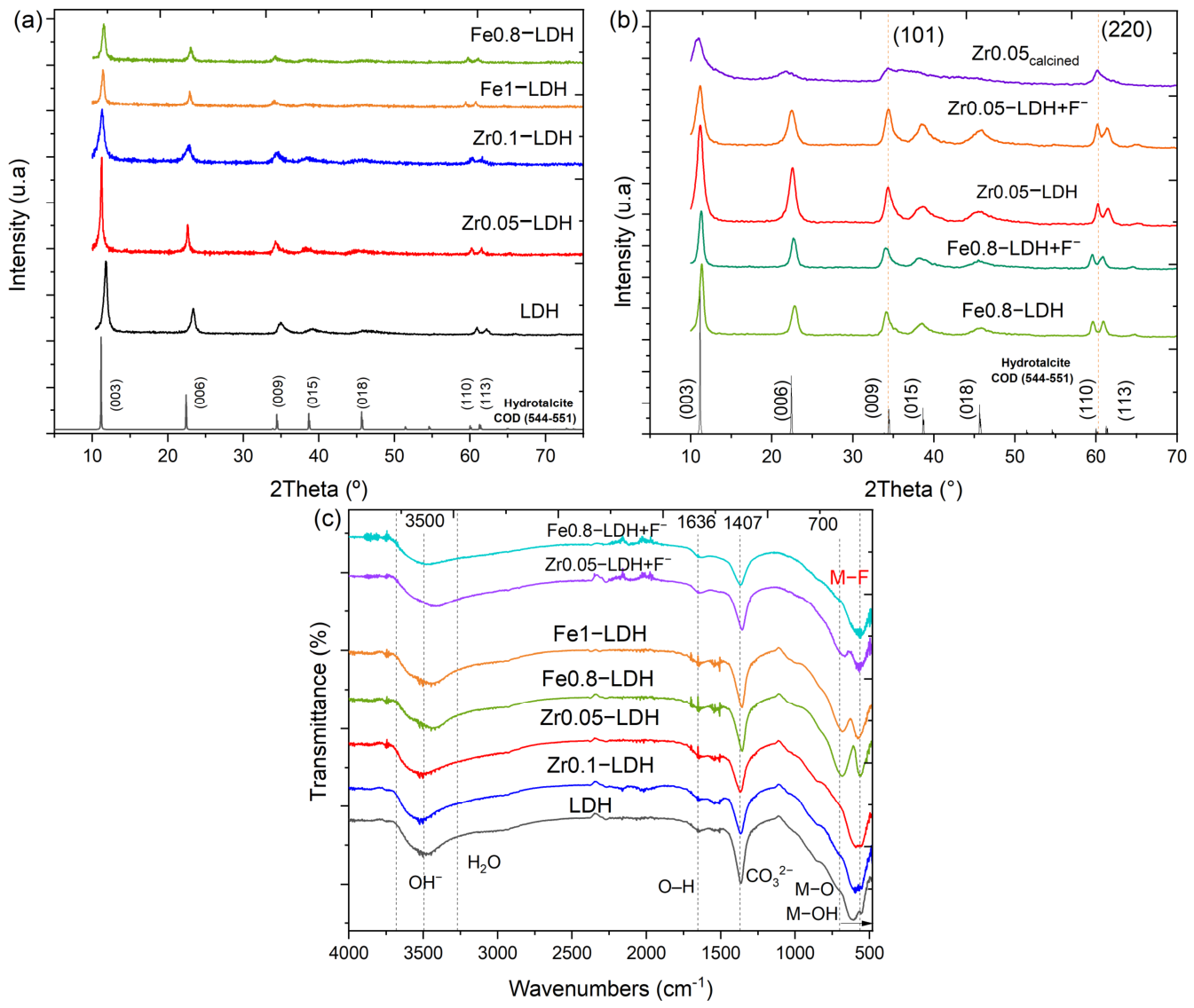
The X-ray diffractograms of the adsorbent materials exhibited typical behavior of layered double hydroxides (LDHs) with a hydrotalcite-type structure, consistent with the crystallographic reference pattern COD 554–551 (Figure 1a). All samples showed characteristic reflections in the 2θ range of approximately 11–60°, which were indexed to the (003), (006), (009), (015), (018), (110) and (113) planes, in agreement with previous studies reported for the LDH phase [22,23]. Although the LDH structure was confirmed for all materials, variations in relative peak intensities and peak broadening were observed. These differences are attributed to reduced crystallinity and structural distortions induced by the incorporation of a third cation (Fe3+ or Zr4+) [24,25]. These changes are commonly associated with the partial isomorphic substitution of Al3+ by Zr4+ or Fe3+ within the brucite-like layers [26].
In Figure 1b, the diffractograms of the samples before and after adsorption, as well as the calcined Zr0.05 sample, are shown. After fluoride adsorption (Zr0.05-LDH + F and Fe0.8-LDH + F), a partial reconstruction of the LDH phase was observed due to the memory effect, as evidenced by the reappearance together with attenuation and broadening of the (003), (006), and (009) reflections. This indicates that the layered structure was partially restored, although with reduced crystallinity. These results suggest that fluoride adsorption occurred without complete destruction of the LDH structure as shown in Figure 1b, but with some degree of structural modification, possibly due to surface interaction and/or partial intercalation processes. This behavior is consistent with previous studies reporting partial reconstruction of calcined LDHs upon anion adsorption [27].
The unit cell parameters a and c were calculated from the (110) and (003) reflections, where c = 3d003 corresponds to the interlayer repeat distance and a = 2d110 represents the average cation–cation distance within the brucite-like layers [27]. As summarized in Table 2, incorporation of Zr4+ resulted in a slight increase in a parameter with increasing molar ratio, which is consistent with the larger ionic radius of Zr4+ (0.72 Å) compared with Al3+ (0.675 Å), confirming partial isomorphic substitution within the LDH structure [28,29]. In contrast, Fe3+-modified materials exhibited negligible variation in a parameter, while a modest increase in c at higher Fe3+ loadings suggests adjustments in interlayer spacing associated with cation incorporation [30].

3.1.2. Fourier Transform Infrared Spectroscopy (FTIR) Analysis

Fourier transform infrared (FTIR) spectroscopy was employed to identify surface functional groups and assess the structural integrity of the adsorbents before and after fluoride adsorption. As shown in Figure 1c, both pristine and fluoride-loaded samples exhibit the characteristic vibrational features of layered double hydroxides (LDHs), indicating that the layered framework remains intact after adsorption. A broad absorption band in the range of 3000–3633 cm−1 is attributed to the stretching vibrations of hydroxyl groups (–OH), arising from both structural hydroxyls and interlayer water molecules. The band at approximately 2989 cm−1 is associated with physically adsorbed water within the lamellar structure [31], while the signal near 1636 cm−1 corresponds to the H–O–H bending vibration. The absorption band at 1407 cm−1 corresponds to the symmetric stretching vibration of interlayer carbonate anions [14].
Following fluoride uptake, the FTIR profiles of both Zr0.05–LDH + F and Fe0.8–LDH + F still show the main features of the original LDH materials, indicating that the structure remains stable after fluoride adsorption. Bands in the 500–700 cm−1 region are assigned to Zr–O and Zr–OH vibrations [32]. The FTIR band at 800 cm−1 corresponds to lattice metal–oxygen (M–O) vibrations (M = Mg, Al, Fe, Zr) [26].
After fluoride adsorption, the decrease in the intensity of the –OH stretching band indicates that surface hydroxyl groups are involved in the fluoride adsorption process. This behavior is likely associated with an OH/F ion-exchange mechanism, in which hydroxyl groups are partially replaced by fluoride ions [33]. Therefore, the results suggest that fluoride ions may interact with metal active sites on the calcined LDH surface, potentially involving inner-sphere complex formation. Together with the XPS results, these findings support a synergistic adsorption mechanism governed by hydroxyl exchange and metal–fluoride complex formation.

3.1.3. X-Ray Photoelectron Spectroscopy (XPS) Analysis

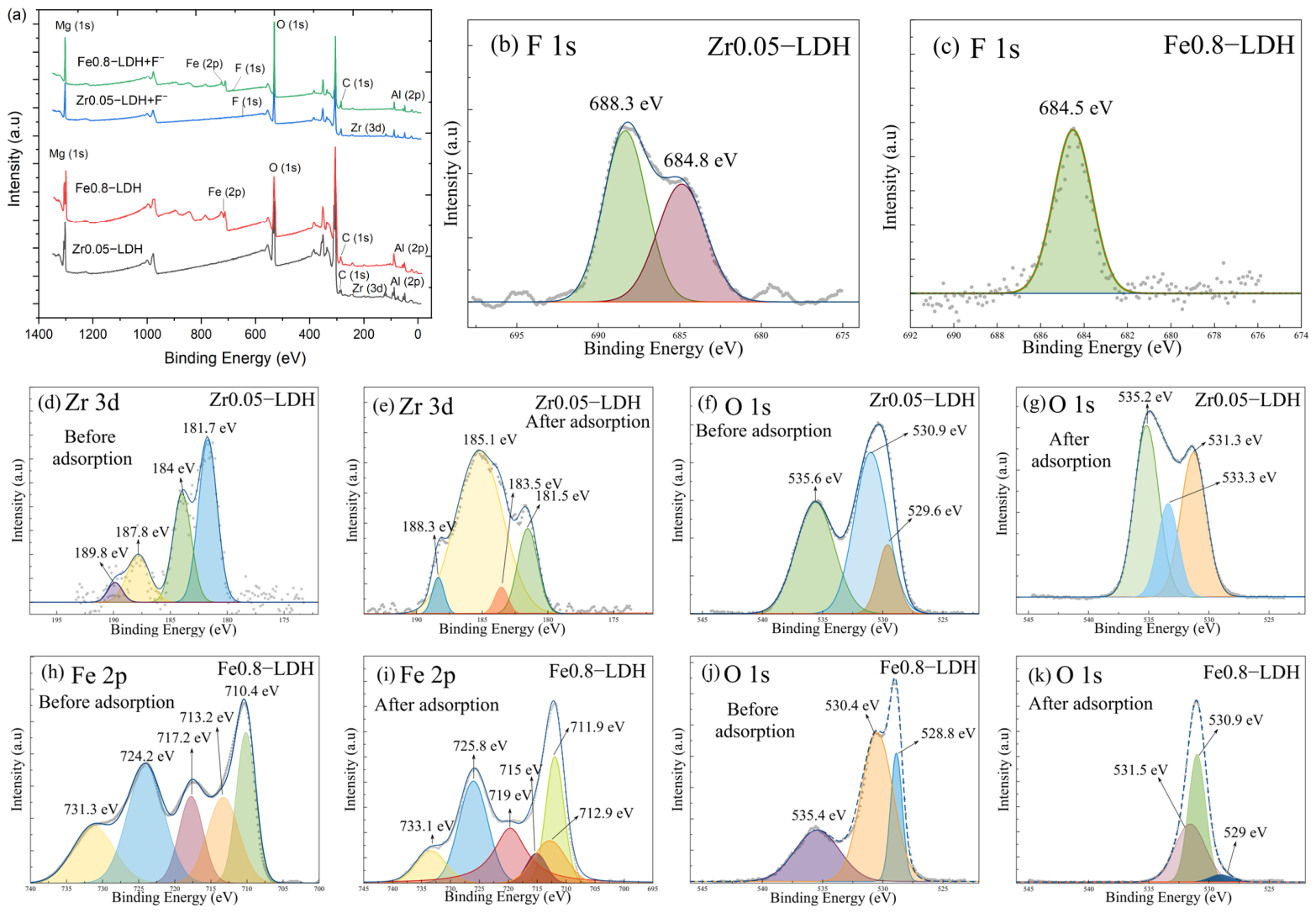
X-ray photoelectron spectroscopy (XPS) was used to investigate the surface chemical states of calcined Zr0.05-LDH and Fe0.8-LDH before and after fluoride adsorption (Figure 2a). After adsorption, distinct changes were observed in the F 1s, Zr 3d, Fe 2p, and O 1s regions, providing direct evidence of fluoride interaction with surface metal sites and functional groups [34].
The F 1s signal, which was absent in the pristine materials, appeared after fluoride exposure, with binding energies centered at 684–685 eV, characteristic of metal–fluoride (M–F, where M = Zr, Fe) bond formation, thus confirming direct fluoride complexation (Figure 2b,c). In calcined Zr0.05-LDH, an additional shoulder at higher binding energy (~688 eV) was detected and attributed to weakly coordinated or electrostatically retained fluoride species, indicating the coexistence of chemisorption and non-specific interactions [35].
The Zr 3d spectrum exhibited peaks at 182–185 eV, consistent with Zr4+ species (Figure 2d). After fluoride adsorption, a slight shift (~0.3 eV) toward lower binding energy was observed (Figure 2e). All spectra were calibrated using the C 1s peak (284.8 eV). The observed shift suggests that electrons may transfer from F to Zr4+, associated with the formation of stable Zr–F bonds and slight changes in the local electronic environment [36,37].
These results suggest the possible involvement of inner-sphere complexation during fluoride adsorption. In this mechanism, fluoride ions bind directly to metal sites on the surface of the calcined LDHs adsorbent by replacing surface hydroxyl (–OH) groups, resulting in the formation of metal–fluoride bonds (≡M–F). This interaction may also promote partial dehydration of fluoride ions and the formation of stable surface complexes with some covalent character. This process occurs at Lewis acid sites such as Zr4+ because of their high charge density and strong affinity for fluoride ions. Compared with outer-sphere interactions, inner-sphere complexation is generally associated with more stable and less reversible adsorption. In this context, it may contribute to the formation of stronger adsorption sites and to the overall adsorption performance observed in this system.
In the Fe 2p region, peaks at approximately 711 and 724 eV, together with their satellite features, confirmed the predominance of Fe3+ species (Figure 2h) [38]. After fluoride uptake, changes in the Fe3+/Fe2+ ratio were observed, which may suggest the possible involvement of surface redox processes in fluoride adsorption (Figure 2i). This behavior has been reported for Fe-based LDHs, where partial reduction of Fe3+ stabilizes Fe–F surface complexes [23,34,39]. However, given the inherent limitations of XPS quantification and potential fitting uncertainties, this interpretation should be considered as an initial contribution rather than a definitive mechanistic proof.
The O 1s spectra were deconvoluted into lattice oxygen (M–O, ~530 eV), surface hydroxyl groups (M–OH, ~531.5 eV), and adsorbed water (~533 eV) (Figure 2f,j). After fluoride adsorption, the relative contribution of M–OH decreased, while that of adsorbed H2O increased, consistent with an OH/F exchange mechanism in which displaced hydroxyl groups form water (Figure 2g,k) [35]. The surface chemistry of calcined LDHs is consistent with the FTIR results, which show attenuation of the –OH stretching bands. However, carbonate-related vibrations remain largely unchanged, indicating preservation of the LDH framework.
Detailed XPS analysis reveals that fluoride adsorption using calcined LDHs proceeds through a synergistic combination of mechanisms. These include initial OH/F anion exchange, evidenced by the depletion of surface hydroxyl groups, together with direct surface complexation at zirconium and iron sites. This was confirmed by the appearance of distinct F 1s signals and associated binding energy shifts. In parallel, electrostatic attraction toward the positively charged calcined LDH layers provides an additional driving force for fluoride uptake [36,39]. In this system, chemisorption via stable M–F bond formation is the dominant pathway. Zirconium sites in calcined LDHs are suggested to play an important role through possible inner-sphere interactions with fluoride, while iron may contribute by enhancing redox flexibility and increasing the density of active sites [40,41].
The XRD and BET results further support that the structural integrity of the adsorbent is maintained after adsorption and demonstrate the complementary roles of Zr and Fe in controlling adsorption performance.

3.1.4. Specific Surface Area

Nitrogen physisorption analysis at 77 K (BET/BJH), as shown in Table 3, revealed that Zr0.05-LDH exhibited the highest specific surface area (261 m2/g). All metal-modified samples, except Fe1-LDH, showed higher surface areas than pristine LDH, confirming the beneficial effect of controlled metal incorporation on textural properties. An optimal Zr loading (0.05 mol) enhanced surface accessibility without significantly altering mesoporosity, as supported by scanning electron microscopy (SEM) observations.
In contrast, higher Zr4+ incorporation (0.1 mol) resulted in reduced pore volume and pore diameter, likely due to structural densification and limited Zr4+ dispersion within the LDH framework. This behavior is consistent with energy-dispersive X-ray spectroscopy (EDS) and X-ray diffraction (XRD) results, which indicate increased lattice distortion and reduced structural openness at higher Zr4+ contents [42].
For Fe-modified materials, Fe0.8-LDH exhibited a higher specific surface area than Fe1-LDH, highlighting the structural role of residual aluminum. Even low Al3+ incorporation improved structural stability and promoted a more homogeneous elemental distribution, as confirmed by SEM and EDS analyses. Conversely, Fe1-LDH showed greater heterogeneity and structural disorder, likely associated with iron-rich domains and partial formation of amorphous Fe2O3 phases, which reduce porosity and effective surface area [43].
These results indicate that metal composition and dispersion critically influence LDH structural organization and porosity, which in turn govern adsorption performance. In particular, the incorporation of Zr4+ and Fe3+ changes the surface and structural properties of the adsorbent. In this study, Zr4+ exhibited a high affinity for fluoride, which may be attributed to Lewis acid–base interactions that favor inner-sphere complexation. Fe3+ also affected the adsorption behavior by increasing the surface charge and creating more adsorption sites. However, excessive metal incorporation may alter the structure of calcined LDHs, leading to pore blockage, reduced porosity, and limited accessibility of active sites. Therefore, metal dispersion, surface accessibility, and structural integrity play important roles in calcined LDHs and influence fluoride removal performance, as observed for the Zr0.05–LDH sample.

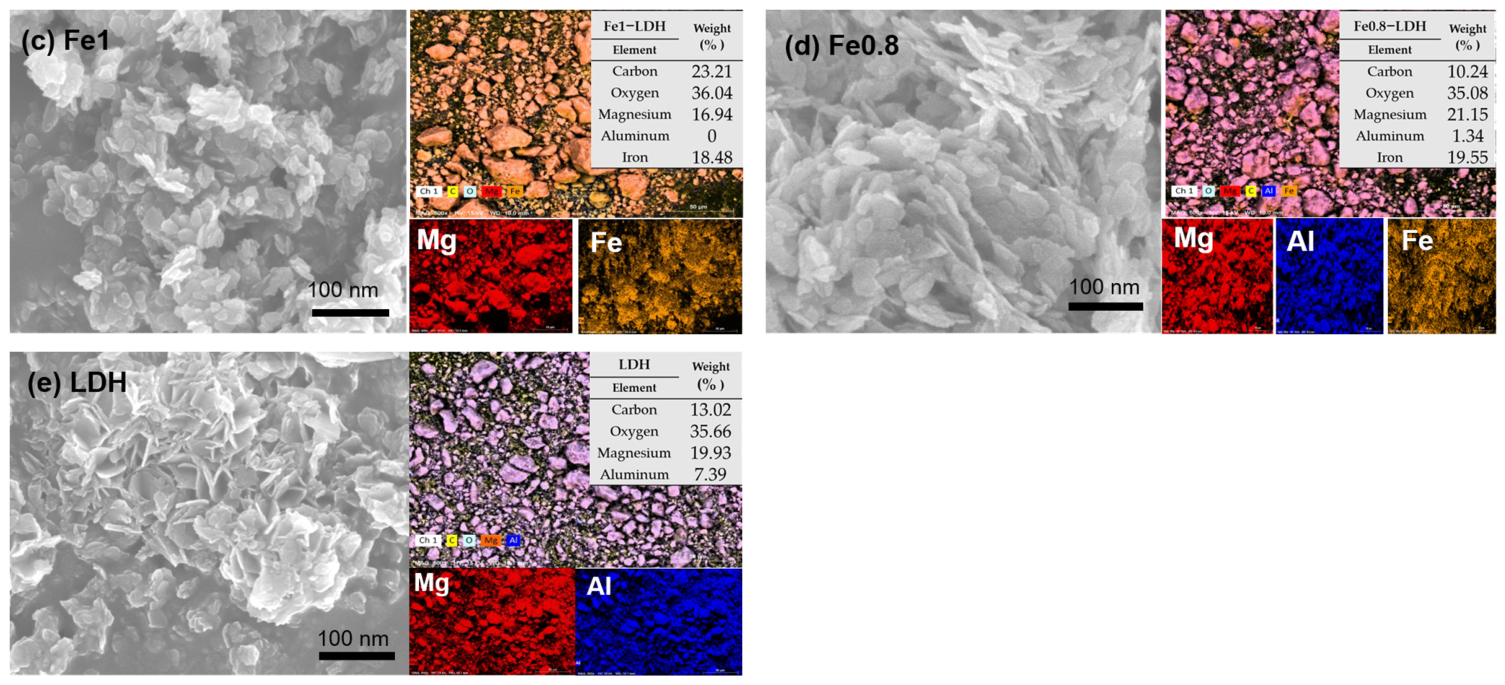
3.1.5. Scanning Electron Microscopy (SEM), Energy-Dispersive X-Ray Spectroscopy (EDS), and Elemental Mapping

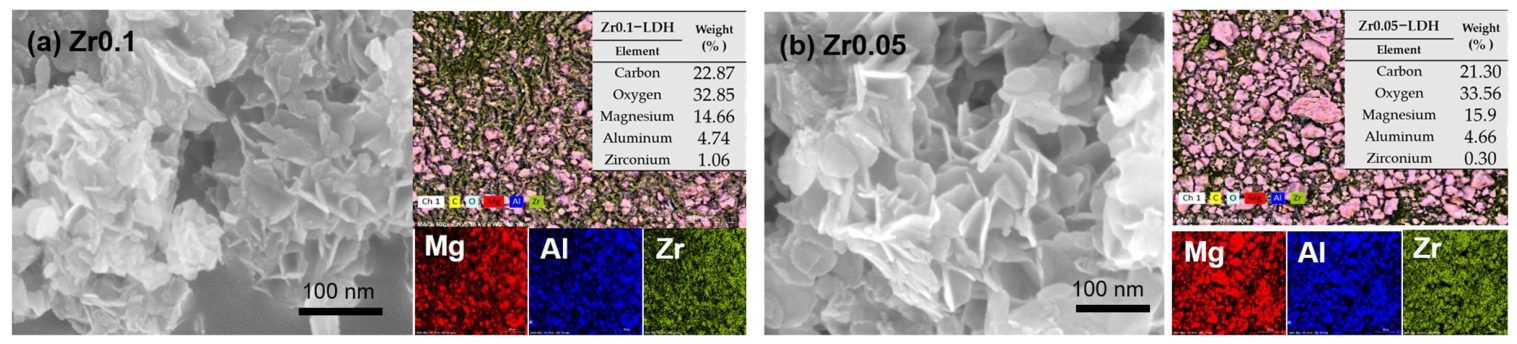
SEM micrographs (Figure 3) show that all synthesized materials retain the characteristic lamellar morphology of hydrotalcite-like structures, confirming the successful formation of calcined LDHs. Nevertheless, cationic modification induces distinct and systematic morphological variations. In Zr4+-modified materials, platelet size and thickness increase with increasing nominal Zr loading, consistent with the expansion of the lattice parameter determined by XRD. This behavior suggests interlamellar structural distortion induced by Zr4+ incorporation. In addition, the more compact aggregation of platelets at higher Zr4+ contents may be attributed to increased surface energy, promoting denser packing [29].
In contrast, Fe3+-modified materials exhibit a more heterogeneous morphology, characterized by less uniform platelet size and irregular stacking, indicative of less controlled nucleation and growth. Similar morphological features have been reported for Fe-doped LDH systems and are commonly associated with the partial formation of iron oxide species [44]. This interpretation is consistent with the appearance of additional FTIR bands in the 550–600 cm−1 region, which are attributed to Fe–O vibrations.
EDS analysis supports the morphological observations and provides quantitative insight into metal incorporation. In Zr-modified materials, the detected Zr4+ content increased only from approximately 0.30 to 1.06 wt.% despite a twofold increase in nominal loading, indicating non-proportional incorporation and suggesting a substitution limit within the LDH lattice. Elemental mapping revealed a homogeneous Zr4+ distribution without localized enrichment, ruling out the formation of segregated crystalline Zr phases and suggesting the presence of highly dispersed species or amorphous domains (e.g., ZrO2). This behavior is consistent with the reduced crystallinity observed in the XRD patterns [45].
For Fe-based materials, the higher Fe3+ content (approximately 18–19 wt.%) reflects greater incorporation efficiency. However, the binary Mg/Fe system shows less homogeneous elemental distribution, consistent with the presence of Fe-rich domains. In contrast, the Mg/Al/Fe system exhibits a more uniform distribution of elements, indicating that Al3+ plays a key structural role in stabilizing the layered framework and regulating cation dispersion [46].
Overall, these results demonstrate that chemical composition and cation distribution critically govern LDH structural order, substitution behavior, and the formation of secondary phases. These factors directly influence crystallinity, porosity, and ultimately, the adsorption performance of the materials.

3.2. Batch Experimentation of Fluoride Adsorption

3.2.1. Fluoride Adsorption Tests

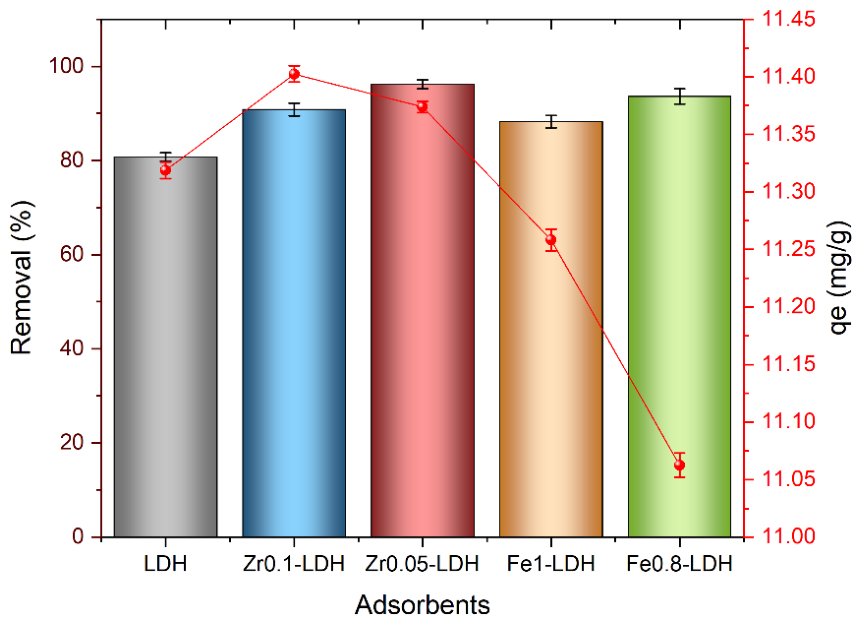
The fluoride adsorption performance of LDH, Fe1-LDH, Fe0.8-LDH, Zr0.1-LDH, and Zr0.05-LDH was evaluated under identical conditions (Figure 4). Pristine LDH exhibited the lowest removal efficiency (~80%) with low standard deviation, highlighting the beneficial effect of metal modification. Zr0.05-LDH achieved the highest fluoride removal efficiency (~96–97%), outperforming Zr0.1-LDH and demonstrating a non-linear relationship between metal loading and adsorption performance.
This behavior indicates that fluoride uptake is governed not only by metal content, but also by the balance between active site availability and metal dispersion. Zirconium-based materials exhibit strong fluoride affinity through inner-sphere complexation (Zr–F); however, excessive Zr4+ incorporation may promote the formation of amorphous domains, limit site accessibility, and reduce adsorption efficiency [47].
Fe-modified materials also showed enhanced performance compared with pristine LDH, with Fe0.8-LDH outperforming Fe1-LDH. This result highlights the stabilizing role of Al3+, which promotes structural order and a more homogeneous distribution of active sites within the LDH framework [15]. Overall, these results demonstrate that adsorption performance is primarily dictated by structural organization and metal dispersion rather than by nominal metal composition alone.

3.2.2. Optimization of Fluoride Removal via RSM

Based on the adsorption results and structural characterization, calcined Zr0.05-LDH was selected for process optimization. Optimization was performed using Response Surface Methodology (RSM) with a Central Composite Design (CCD). The resulting quadratic model exhibited an acceptable predictive performance (R2 = 0.83), indicating that a second-order polynomial adequately describes fluoride removal behavior within the studied experimental range. This moderate coefficient of determination is consistent with the physicochemical heterogeneity of calcined LDH-based adsorption systems, associated with non-uniform active site distribution and the coexistence of multiple adsorption mechanisms.
The low standard error of estimate (1.67) and mean absolute error (MAE = 0.83) indicate good agreement between experimental and predicted values. R2 values above 0.70 are generally considered acceptable for systems with inherent variability [48]; therefore, an R2 value of 0.83 can be regarded as satisfactory for optimization purposes. The resulting regression model is expressed by Equation (8), indicating that the model is reliable for predicting fluoride removal within the studied conditions. The remaining minor residual variability is likely attributable to the intrinsic heterogeneity of the LDH adsorption sites rather than poor model fitting.
R e m o v a l   % = 95.94 + 0.52 x 1 + 7.42 x 2 0.42 x 3 + 1.75 x 2 · x 3 3.61 x 1 2 3.09 x 2 2 1.57 x 3 2
with the coded variables x1 (concentration), x2 (ads dose), and x3 (pH).
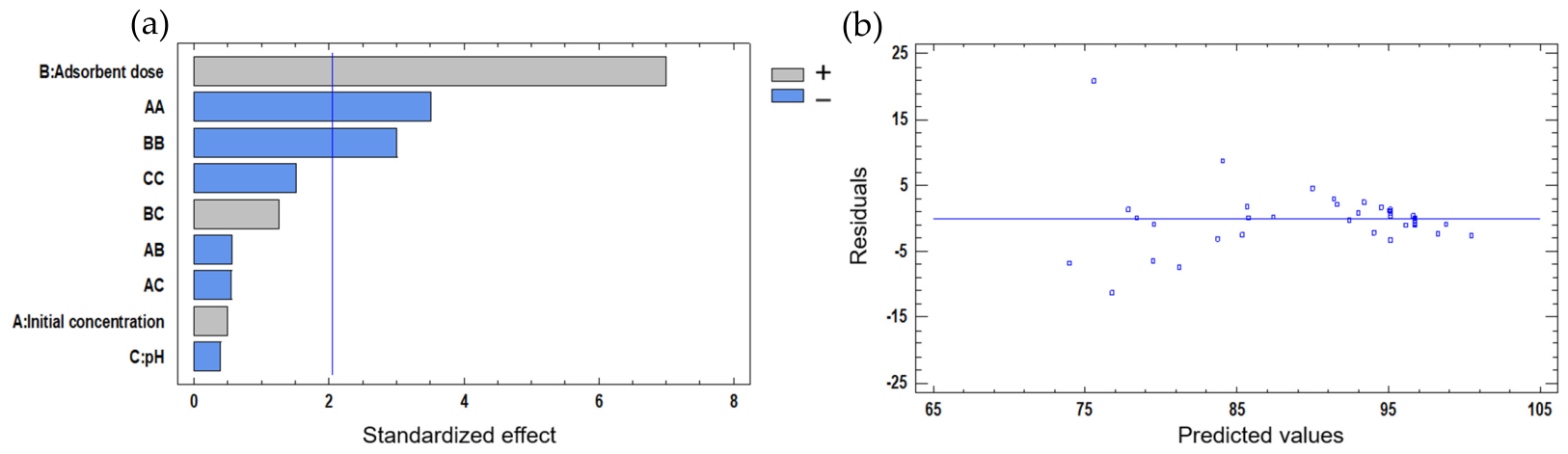
ANOVA results indicate that adsorbent dosage is the dominant factor (p < 0.001), whereas the linear effects of initial concentration and pH are not statistically significant (p > 0.05), although their quadratic terms contribute to model curvature. This is also observed in the standardized Pareto chart (Figure 5a), in which the adsorbent dosage exhibits the largest standardized effect, exceeding the significance limit. In contrast, the effects of initial concentration and pH remain below the critical line, indicating a smaller statistical influence in the studied range. The significant quadratic terms suggest non-linear behavior, with fluoride removal reaching optimal values under specific conditions.
The lack-of-fit was significant (F = 29.31, p < 0.05), indicating that the quadratic model does not fully describe the response beyond the pure error, as shown in Table 4. This implies that additional curvature or unmodeled effects may be present within the explored factor space. The model is therefore used mainly to identify factor influence and guide optimization trends, while predictions are interpreted cautiously.
The residuals versus predicted values plot (Figure 5b) shows a random scatter of data points around zero, with no visible patterns, indicating good agreement between the experimental and predicted values. Although a slight clustering of residuals at higher predicted values can be observed, it remains within acceptable limits and does not compromise model validity. No significant outliers were detected, further supporting the reliability of the regression.
Although the lack-of-fit result suggests unexplained variability in the experimental data, the ANOVA, Pareto chart, and residual analyses indicate that the model remains statistically useful for process optimization, with adsorbent dosage identified as the primary factor controlling fluoride removal.
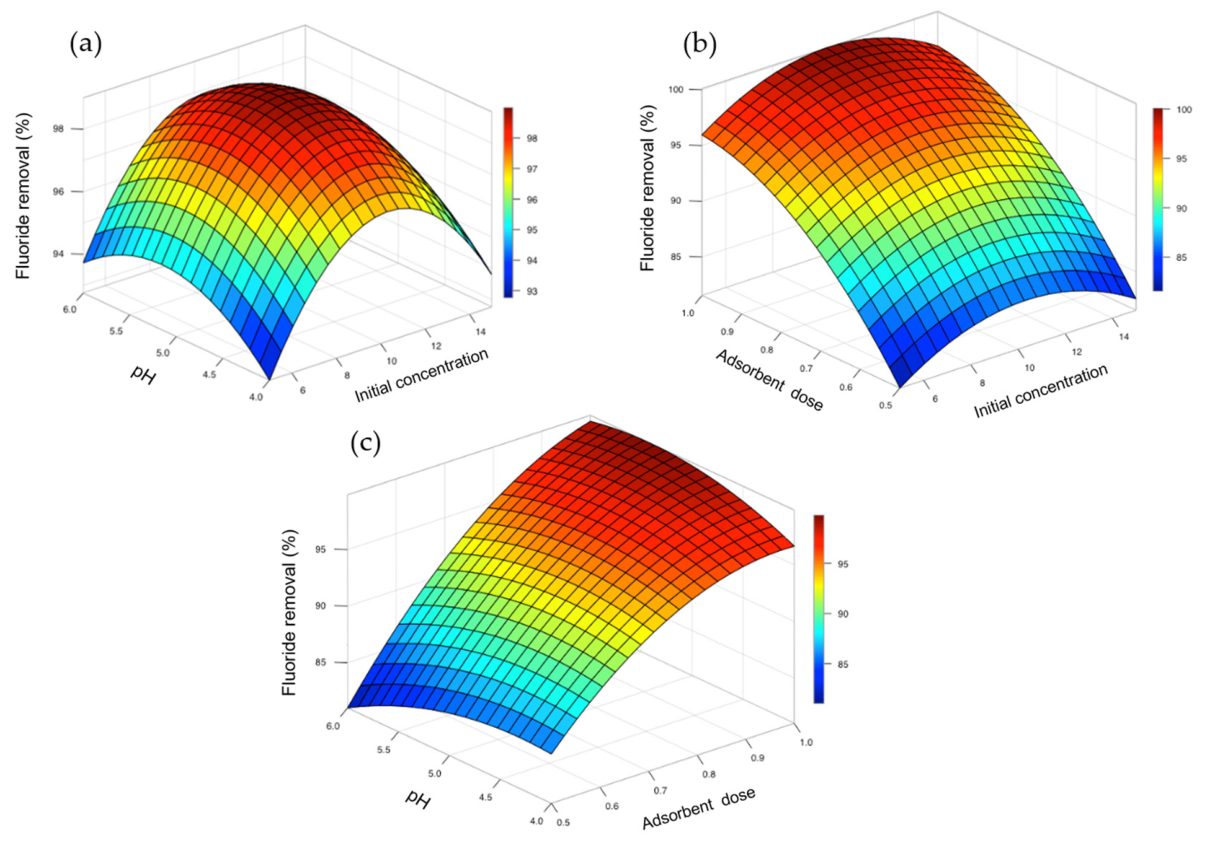
Fluoride was 0. 88 g/L, followed by a plateau at around 98%, indicating a site saturation regime in which further increases in available active sites do not enhance adsorption performance. The interaction between pH and initial fluoride concentration (Figure 6a) shows a decline in removal efficiency at pH values above 6, which is associated with reduced surface protonation and increased competition from OH ions. Under mildly acidic conditions (approximately pH 5), fluoride uptake is favored due to enhanced electrostatic attraction and inner-sphere complexation with Zr active sites [49].
In contrast, the weak interaction between adsorbent dosage and initial fluoride concentration (Figure 6b) suggests that, once enough adsorbent is available, the system becomes less sensitive to variations in fluoride concentration. The interaction between adsorbent dose versus pH (Figure 6c) indicates that the adsorbent dosage exerts a stronger influence than pH, as dosages above 0.85 g/L consistently achieve fluoride removal close to 98%. The optimal conditions (C0 = 12.6 mg/L, dosage = 0.88 g/L, and pH = 4.9) resulted in a maximum fluoride removal of 98.17%, demonstrating that process performance is governed primarily by accessible active site density and surface chemistry rather than by nominal fluoride concentration alone.

3.2.3. Kinetic Study

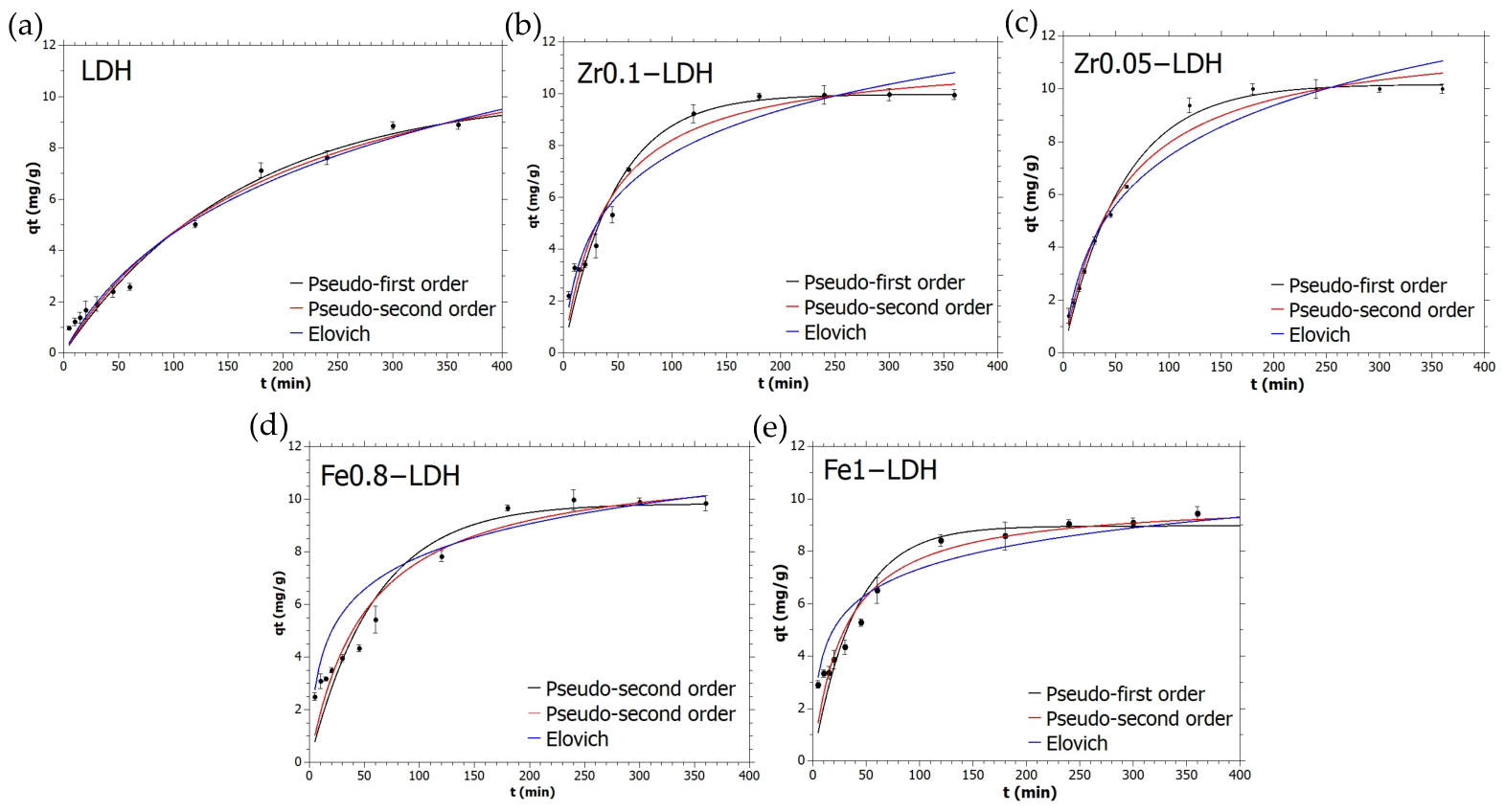
Adsorption kinetics were evaluated using the pseudo-first-order (PFO), pseudo-second-order (PSO), and Elovich models (Figure 7). For all materials, a rapid uptake phase was observed during the initial stage (0–60 min), followed by a slower approach to equilibrium, which was reached after approximately 180–240 min.
The kinetic parameters are shown in Table 5, the PSO model provided a satisfactory description of the kinetic behavior of the modified LDH systems, particularly for Fe0.8-LDH (R2adj ≈ 0.984), suggesting that surface-controlled interactions play an important role in fluoride uptake. However, the comparable performance of different models in several cases indicates that no single kinetic model fully captures the complexity of the adsorption process. Notably, Zr0.05-LDH showed the best fit with the PFO model (R2adj = 0.992; RMSE = 0.29), indicating that the initial adsorption stage is dominated by rapid uptake at readily accessible surface sites.
In contrast, the PSO model predicted a higher equilibrium adsorption capacity (qₑ = 12.17 mg/g) for Zr0.05-LDH and more accurately described the later stages of adsorption, suggesting the coexistence of multiple kinetic regimes [50]. This behavior likely reflects an initial fast interaction with surface hydroxyl groups, followed by slower processes involving specific metal-based active sites [50,51]. The Elovich model further supports the presence of surface heterogeneity across all materials, consistent with a distribution of adsorption energies induced by metal incorporation [52].
The kinetic performance followed the order Zr0.05-LDH > Fe0.8-LDH > Zr0.1-LDH > LDH > Fe1-LDH, indicating that adsorption kinetics are governed primarily by the accessibility and distribution of active sites rather than by their nominal concentration. These results reinforce the role of structural organization and metal dispersion in controlling adsorption dynamics.
As shown by the error bars in Figure 7 (standard deviation, n = 2), fluoride adsorption remains highly consistent across all samples. Slightly larger standard deviations were observed for some data points. This variation is expected given the rapid initial uptake, where even small differences in sampling time can introduce minor fluctuations.

3.2.4. Isotherm Study

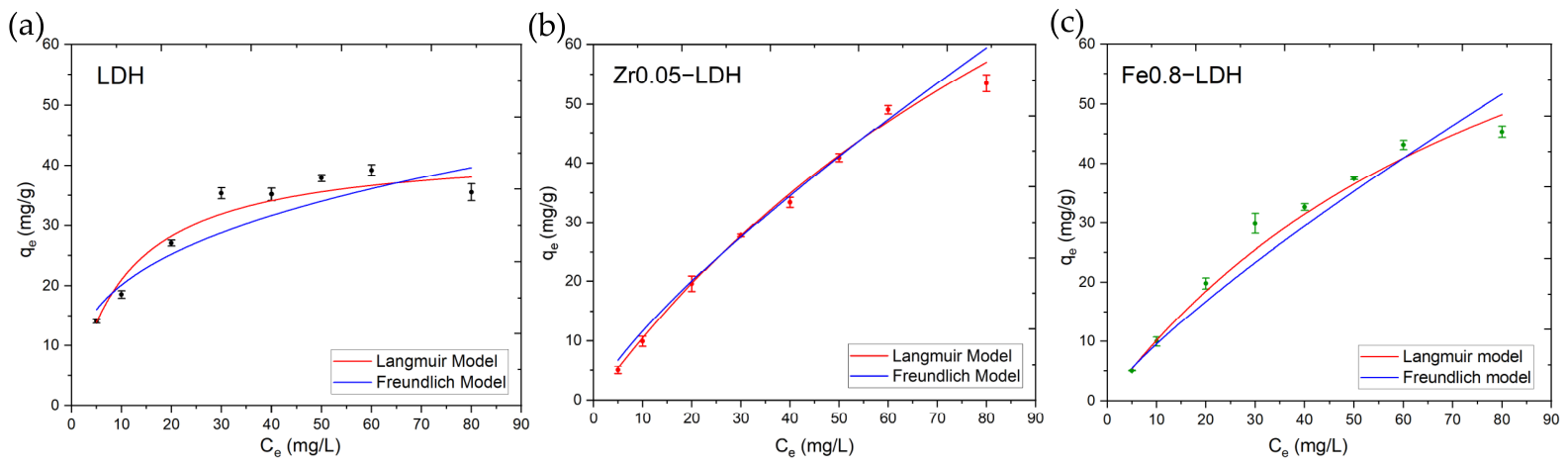
The equilibrium adsorption behavior of fluoride onto LDH, Zr0.05-LDH, and Fe0.8-LDH was evaluated over an initial concentration range of 5–80 mg/L using the Langmuir and Freundlich isotherm models (Figure 8). The experimental data were fitted using nonlinear regression to avoid distortions associated with linearization, and the resulting parameters are summarized in Table 6 [53].
Among the evaluated models, the Langmuir isotherm showed the best fit, with adjusted coefficients of determination (R2adj) of 0.992 for Zr0.05-LDH, 0.988 for Fe0.8-LDH, and 0.947 for pristine LDH. This behavior suggests adsorption on a relatively homogeneous distribution of energetically comparable active sites and is consistent with a predominantly monolayer adsorption process. Accordingly, fluoride uptake within the investigated concentration range is likely governed primarily by specific surface interactions rather than multilayer adsorption.
FTIR analysis shows a decrease in the intensity of –OH stretching bands after adsorption, indicating the participation of surface hydroxyl groups through an OH/F exchange mechanism. In parallel, XPS revealed the appearance of F 1s signals (~685 eV) and the binding energy shifts in the Zr 3d and Fe 2p regions confirmed the formation of metal–fluoride (M–F) interactions and associated local electronic redistribution. These observations support a mechanism involving surface complexation at metal centers in addition to anion exchange, in agreement with the adsorption behavior inferred from the Langmuir model.
This behavior may also be related to the partial reconstruction of LDH-like structures upon contact with aqueous solutions, enabling the coexistence of oxide surfaces and hydroxylated layers that participate in adsorption through surface complexation and anion exchange. The maximum adsorption capacities followed the order Zr0.05-LDH (137 mg/g) > Fe0.8-LDH (82.4 mg/g) > pristine LDH (54.7 mg/g), highlighting the role of controlled metal incorporation in enhancing both active site density and accessibility [36].
In most cases, the standard deviation, as shown in Figure 8, was low compared to the corresponding adsorption capacities. However, since only duplicate experiments were performed (n = 2), the variability should be interpreted with some caution, and a higher number of replicates would provide greater statistical confidence.
As summarized in Table 7, the performance of Zr0.05-LDH is competitive with, and in some cases superior to, previously reported LDH-based adsorbents. Compared with other LDH systems such as MgAlZr and Mg/Fe/La materials (Table 6), Zr0.05-LDH exhibits comparable or higher adsorption capacity, which may be attributed to optimized Zr4+ incorporation that increased active-site accessibility while preserving structural integrity. These results place the developed material among the most effective LDH-based adsorbents reported for fluoride removal and suggest that metal dispersion plays a more important role than composition alone.
Although the Langmuir model provided the best overall fit, the Freundlich model also showed good agreement (R2adj = 0.98), suggesting a degree of surface heterogeneity and the contribution of secondary mechanisms such as electrostatic attraction and OH/F exchange [53,54]. Fluoride adsorption is best described as a combined process, where Langmuir-type behavior reflects dominant site-specific interactions, while spectroscopic evidence (FTIR and XPS) indicates the contribution of chemisorption through surface complexation [33].
Table 7. Comparative analysis of the maximum fluoride adsorption capacity (qe) of the synthesized Zr0.05-LDH and Fe0.8-LDH relative to previously reported LDH-based adsorbents.
Adsorbentqe (mg/g)Reference
Mg/Al-LDH-Cl59.60[21]
MgAlZr-LDH51.92 [36]
CaAlZr-LDH131.03[55]
NiFe-LDH23.49[56]
Mg/Fe/La60.00[57]
Zr0.05-LDH137.12This study
Fe0.8-LDH82.36This study

3.2.5. Recyclability of Zr0.05-LDH and Fe0.8-LDH

Regenerability is a key factor determining the economic feasibility and operational stability of adsorbent materials. In this study, the recyclability of Zr0.05-LDH and Fe0.8-LDH was evaluated over consecutive adsorption–desorption cycles using 1.0 M NaOH as the regenerating agent. The use of NaOH is justified by the strong affinity of OH ions to replace fluoride in the LDH structure, facilitated by similar ionic radii and the high rehydration capacity of hydrotalcite materials [35,58].
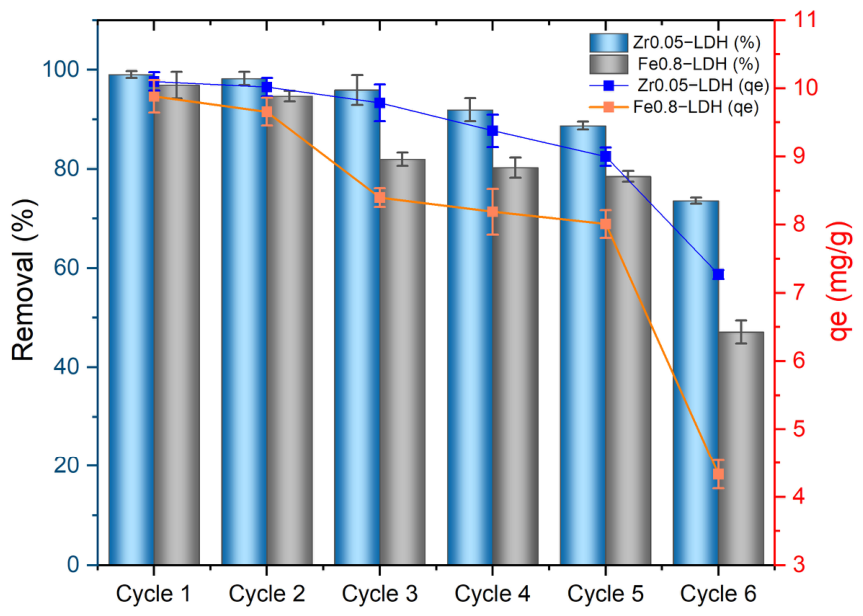
As shown in Figure 9, both adsorbents exhibited high adsorption efficiency over the first five adsorption–desorption cycles, indicating good regeneration capability. The regeneration results show that Zr0.05-LDH maintains more stable performance with lower variability compared to Fe0.8-LDH across cycles. After five cycles, Zr0.05-LDH achieved an adsorption capacity of 9.0 mg/g (89% retention), while Fe0.8-LDH retained 8.4 mg/g (82%). However, a significant decrease in performance was observed in the sixth cycle, with a 31% decrease in removal efficiency for Zr0.05-LDH and 50% for Fe0.8-LDH.
After several adsorption–desorption cycles, the material showed a gradual loss in adsorption capacity. This behavior may be related to partial deactivation of active sites, pore saturation by residual species, and some degree of particle agglomeration. Fluoride removal is generally associated with chemisorption processes, potentially involving inner-sphere complex formation; under these conditions, some adsorbed species may remain strongly attached to the surface and may not be fully removed during desorption [59]. To mitigate these effects, optimization of regeneration conditions (e.g., NaOH concentration and contact time), incorporation of stabilizing supports or binders, and development of composite or granular forms of LDHs could improve structural stability and long-term reusability in practical applications.
As shown in Figure 9, the standard deviations indicate that the data are not equally consistent across all groups. Some data have a wider spread, meaning the values vary more and are less consistent, while others are more tightly grouped, indicating more precise and reliable results. This behavior suggests that certain conditions may lead to greater variability in the data.
These results confirm that Zr0.05-LDH exhibits enhanced durability and regeneration stability compared to Fe-modified systems, reinforcing its potential as a cost- effective and sustainable adsorbent for water treatment applications.

3.2.6. Evaluation Under Real-Water Conditions

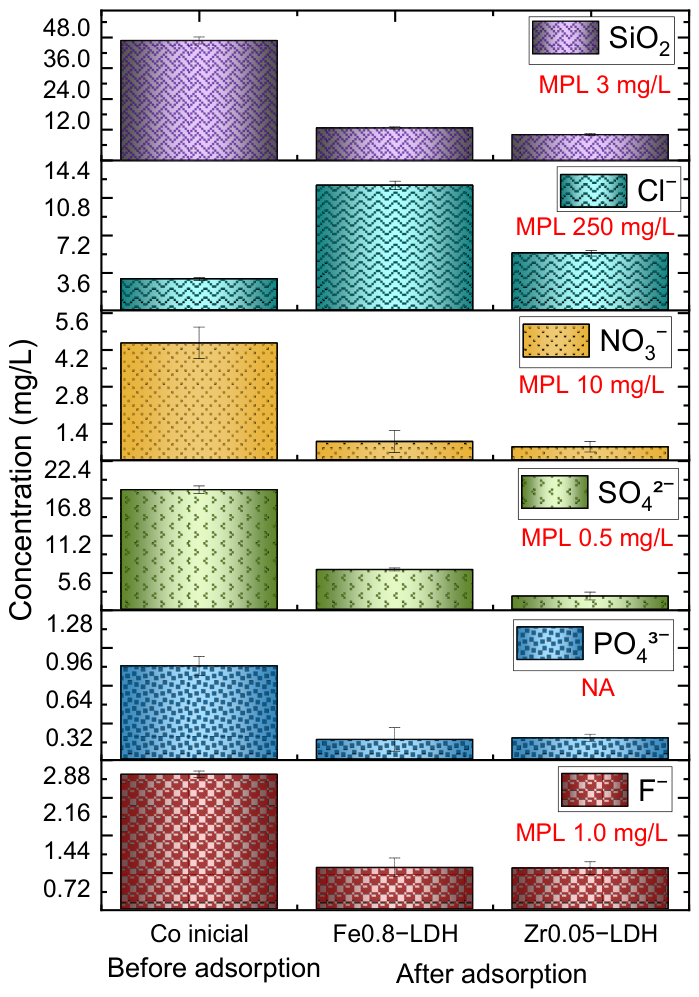
Groundwater usually contains various dissolved ions that can interfere with fluoride adsorption by competing for the active sites of the adsorbent. To evaluate this effect under real conditions, groundwater from a well located in Durango, Mexico, was tested. The groundwater sample had a fluoride concentration of 2.99 mg/L, which is higher than the limit allowed by NOM-127-SSA1-2021 (1.0 mg/L). As shown in Figure 10, fluoride removal by the calcined LDHs remained relatively high in the presence of groundwater anions, which include Cl (3.0 mg/L), NO3 (1.0 mg/L), SO42− (18 mg/L), PO43− (0.8 mg/L), and SiO2 (46.8 mg/L). This behavior differed from that obtained with synthetic fluoride solutions, where the removal efficiency was close to 99%. Part of this decrease may be related to competitive adsorption effects caused by the coexistence of other dissolved species in the groundwater matrix.
After treatment, some of these anions also showed partial removal. This indicates that the adsorbents can interact with several anionic species simultaneously and are therefore not completely selective toward fluoride under real groundwater conditions. Silica species may interact with surface metal centers or form surface complexes, further contributing to the decrease in fluoride selectivity [60]. While this multicomponent removal contributes to overall water-quality improvement, it also reduces fluoride removal efficiency due to competition for active sites.
Under groundwater conditions, fluoride removal efficiencies decreased to 69.42% for Zr0.05-LDH and 68.99% for Fe0.8-LDH, corresponding to adsorption capacities of 1.798 and 1.787 mg/g, respectively. This reduction is attributed to competitive adsorption effects, particularly from multivalent anions, whose higher charge density enhances electrostatic interactions and may partially displace fluoride from active sites [15,36].
This competitive behavior can be further rationalized by considering fundamental physicochemical parameters such as ionic charge density (z/r) and hydration energy. A mixture of anions such as SO42− and PO43− can interact directly with hydrotalcite-like materials because of their higher charge and polyatomic structure. It can be explained that the competition of fluoride for available adsorption sites is enhanced by the strong electrostatic attraction to the positively charged LDH layers, including their affinity for surface –OH groups [36]. Conversely, fluoride differs due to its monovalency, small ionic radius and high electronegativity which results in high charge density and strong hydration energy.
According to HSAB theory, F acts as a hard base and presents a strong binding with hard Lewis acid centers such as Zr4+. These results suggest the possible formation of inner-sphere Zr–F interactions [61]. Consequently, Zr0.05-LDH exhibits higher fluoride removal efficiency, adsorption capacity, and greater tolerance to multivalent interferents under groundwater conditions. This interpretation is consistent with previous reports [49,62], and is further supported by FTIR and XPS analyses, which confirm that fluoride adsorption is governed by synergistic surface complexation and ion-exchange mechanisms.
Overall, although the complexity of groundwater matrices reduces adsorption efficiency relative to idealized systems, both materials demonstrate promising performance. However, the lower and more consistent standard deviation values for Fe0.8-LDH suggest better stability in complex groundwater matrices, as reflected in Figure 10.

4. Conclusions

This study shows that calcined Fe3+- and Zr4+-modified LDHs can remove fluoride from groundwater. The adsorption performance was influenced not only by the amount of metal incorporated into the structure, but also by its dispersion and the structural characteristics of the material. Zr0.05-LDH exhibited the best balance between material structure and active-site accessibility. Therefore, these materials demonstrate high adsorption capacity (137 mg/g) and fluoride removal (98%) under the selected operating conditions.
The XPS and FTIR results suggest that fluoride adsorption mainly occurred through interaction with Zr4+ active sites, probably by the formation of inner-sphere surface complexes. Ion exchange between OH and F, together with electrostatic interactions, also contributed to the adsorption process. The adsorption behavior indicated the presence of various types of active sites and interaction mechanisms on the calcined LDH adsorbent surface. Kinetic and isotherm analyses further suggest that adsorption proceeds through rapid surface interaction followed by chemisorption-dominated equilibrium.
Under real groundwater conditions, the presence of competing anions reduced fluoride removal efficiency due to competitive adsorption effects; however, both Zr0.05-LDH and Fe0.8-LDH reduced fluoride concentrations below regulatory limits. The superior performance of Zr0.05-LDH under these conditions highlights the role of specific chemical affinity between fluoride and Zr4+ centers in maintaining selectivity within complex aqueous matrices.
From a translational perspective, the high adsorption capacity and regeneration stability demonstrated by calcined Zr0.05-LDH (up to 89% capacity retention after five cycles) support its potential for practical water-treatment applications. For future work, it would be worthwhile to explore transforming powdered LDHs into pelletized or composite forms to improve their mechanical stability and make them more suitable for potential use in packed-bed column systems. Nevertheless, the present study was limited to batch-scale experiments using powdered adsorbents. Therefore, the results mainly contribute to a better understanding of adsorption behavior and material performance at the laboratory scale and can serve as a foundation for further studies aimed at practical water treatment applications.

Author Contributions

Conceptualization, G.V.-C. and S.K.; methodology, G.V.-C. and S.K.; software, G.V.-C. and A.R.-R.; formal analysis, G.V.-C., S.K. and V.B.-T.; investigation, G.V.-C.; resources, P.G.-M. and J.G.G.-M.; data curation, G.V.-C.; writing—original draft preparation, G.V.-C.; writing—review and editing, S.K., V.B.-T., J.G.G.-M., U.C.-D., E.B.E.-A., A.M.L.-M., M.L.R.-H. and C.D.S.-L.; visualization, G.V.-C. and A.R.-R.; supervision, S.K. and J.G.G.-M. All authors have read and agreed to the published version of the manuscript.

Funding

This research received no external funding.

Institutional Review Board Statement

Not applicable.

Informed Consent Statement

Not applicable.

Data Availability Statement

The original contributions presented in this study are included in the article. Further inquiries can be directed to the corresponding authors.

Acknowledgments

G. Vazquez-Cornejo acknowledges support from SECIHTI. The authors used Microsoft Copilot, web version, accessed in May 2026 (Microsoft Corporation, Redmond, WA, USA), and Grammarly, online version, accessed in May 2026 (Grammarly Inc., San Francisco, CA, USA), to improve the language and clarity of this manuscript. The authors reviewed and edited the output and take full responsibility for the content. The authors thank Martha E. Rivas-Aguilar for the SEM/EDS analyses, Sergio Rodríguez-Arias for the XRD characterizations, and Socorro Garcia-Guillermo for the XPS analysis.

Conflicts of Interest

The authors declare no conflicts of interest.

Abbreviations

The following abbreviations are used in this manuscript:
LDHLayered double hydroxide
NOMMexican official standard
MPLMaximum permissible limit
RSMResponse surface method
NAData not available

References

  1. Podgorski, J.; Berg, M. Global Analysis and Prediction of Fluoride in Groundwater. Nat. Commun. 2022, 13, 4232. [Google Scholar] [CrossRef]
  2. Shaji, E.; Sarath, K.V.; Santosh, M.; Krishnaprasad, P.K.; Arya, B.K.; Babu, M.S. Geoscience Frontiers Fluoride Contamination in Groundwater: A Global Review of the Status, Processes, Challenges, and Remedial Measures. Geosci. Front. 2024, 15, 101734. [Google Scholar] [CrossRef]
  3. Feng, G.; Li, Z.; Su, C.; Xie, X.; Ge, W.; Gan, Y.; Luo, Z.; Pi, K.; Pan, H.; Gao, Y.; et al. Provenance and Geogenic Modes of High-Fluoride Groundwater Occurred in Various Sedimentary Environments: Constraints of Hydrogeology and Hydrogeochemstry. Appl. Geochem. 2025, 195, 106624. [Google Scholar] [CrossRef]
  4. Mohapatra, M.; Anand, S.; Mishra, B.K.; Giles, D.E.; Singh, P. Review of Fluoride Removal from Drinking Water. J. Environ. Manag. 2009, 91, 67–77. [Google Scholar] [CrossRef]
  5. Li, J.; Wang, Y.; Zhu, C.; Xue, X.; Qian, K.; Xie, X.; Wang, Y. Hydrogeochemical Processes Controlling the Mobilization and Enrichment of Fluoride in Groundwater of the North China Plain. Sci. Total Environ. 2020, 730, 138877. [Google Scholar] [CrossRef] [PubMed]
  6. WHO. Guidelines for Drinking-Water Quality: Fourth Edition Incorporating the First and Second Addenda; WHO: Geneva, Switzerland, 2022; Volume 21. [Google Scholar]
  7. Wan, K.; Huang, L.; Yan, J.; Ma, B.; Huang, X.; Luo, Z.; Zhang, H.; Xiao, T. Removal of Fluoride from Industrial Wastewater by Using Different Adsorbents: A Review. Sci. Total Environ. 2021, 773, 145535. [Google Scholar] [CrossRef]
  8. Kumar, P.S.; Suganya, S.; Srinivas, S.; Priyadharshini, S.; Karthika, M.; Karishma Sri, R.; Swetha, V.; Naushad, M.; Lichtfouse, E. Treatment of Fluoride-Contaminated Water. A Review. Environ. Chem. Lett. 2019, 17, 1707–1726. [Google Scholar] [CrossRef]
  9. Dehghani, M.H.; Gholami, S.; Karri, R.R.; Lima, E.C.; Mahvi, A.H.; Nazmara, S.; Fazlzadeh, M. Process Modeling, Characterization, Optimization, and Mechanisms of Fluoride Adsorption Using Magnetic Agro-Based Adsorbent. J. Environ. Manag. 2021, 286, 112173. [Google Scholar] [CrossRef] [PubMed]
  10. Arana Juve, J.M.; Christensen, F.M.S.; Wang, Y.; Wei, Z. Electrodialysis for Metal Removal and Recovery: A Review. Chem. Eng. J. 2022, 435, 134857. [Google Scholar] [CrossRef]
  11. Ahmad, S.; Singh, R.; Arfin, T.; Neeti, K. Fluoride Contamination, Consequences and Removal Techniques in Water: A Review. Environ. Sci. Adv. 2022, 1, 620–661. [Google Scholar] [CrossRef]
  12. Zhu, S.; Khan, M.A.; Kameda, T.; Xu, H.; Xia, M.; Yoshioka, T. New insights into the capture performance and mechanism of hazardous metals Cr3+ and Cd2+ onto an effective layered double hydroxide based material. J. Hazard. Mater. 2022, 426, 128062. [Google Scholar] [CrossRef] [PubMed]
  13. Dong, Y.; Kong, X.; Luo, X.; Wang, H. Adsorptive Removal of Heavy Metal Anions from Water by Layered Double Hydroxide: A Review. Chemosphere 2022, 303, 134685. [Google Scholar] [CrossRef]
  14. Ma, W.; Chen, Y.; Zhang, W.; Zhao, W. Performance and Mechanism of Mg-Ca-Fe Hydrotalcite-like Compounds for Fluoride Removal from Aqueous Solution. J. Fluor. Chem. 2017, 200, 153–161. [Google Scholar] [CrossRef]
  15. Sun, L.; Niu, J.; Liu, H.; Liu, F.; Reka, A.A.; Matusik, J.; Feng, P. Exploring Layered Double Hydroxide Efficiency in Removal of Fluoride Ions from Water: Material Insights, Synthesis and Modification Strategies and Adsorption Mechanisms. RSC Sustain. 2025, 3, 715–737. [Google Scholar] [CrossRef]
  16. Nakamura, T.; Fujiwara, T.; Ogata, F.; Kawasaki, N. Synthesis of Novel Mg–Al–Fe-Type Hydrotalcite with Various Mg/Al/Fe Ratios and Its Selective Adsorption of As(V) from Water. J. Environ. Chem. Eng. 2021, 9, 104557. [Google Scholar] [CrossRef]
  17. Dębek, R.; Motak, M.; Galvez, M.E.; Grzybek, T.; Da Costa, P. Promotion Effect of Zirconia on Mg(Ni,Al)O Mixed Oxides Derived from Hydrotalcites in CO2 Methane Reforming. Appl. Catal. B Environ. 2018, 223, 36–46. [Google Scholar] [CrossRef]
  18. Gong, S.; Huang, H.; Wang, Y.; Liu, F.; Chen, Z.; Jiang, T.; Peng, R.; Wang, J.; Chen, X. Efficient Removal of Fluorine from Leachate of Spent Lithium Iron Phosphate Calcine by Porous Zirconium-Based Adsorbent. Materials 2025, 18, 5475. [Google Scholar] [CrossRef]
  19. Wang, J.; Guo, X. Adsorption Kinetic Models: Physical Meanings, Applications, and Solving Methods. J. Hazard. Mater. 2020, 390, 122156. [Google Scholar] [CrossRef]
  20. Ayawei, N.; Ebelegi, A.N.; Wankasi, D. Modelling and Interpretation of Adsorption Isotherms. J. Chem. 2017, 2017, 3039817. [Google Scholar] [CrossRef]
  21. Han, M.; Shen, X.; Wang, W.; Guo, J.; Liu, Y.; Zhai, Y. Mg/Al-LDH-Cl for Fluoride Removal from Water: High-Capacity Adsorption and Recyclable Regeneration. Ind. Eng. Chem. Res. 2025, 64, 11255–11269. [Google Scholar] [CrossRef]
  22. Mazumder, M.; Das, R.; Sajib, M.S.J.; Gomes, A.J.; Islam, M.; Selvaratnam, T.; Rahman, A. Comparison of Different Hydrotalcite Solid Adsorbents on Adsorptive Desulfurization of Liquid Fuel Oil. Technologies 2020, 8, 22. [Google Scholar] [CrossRef]
  23. Dai, X.; Chen, Y.; Zhou, W.Y.; Peng, X. Reduced MgFe Hydrotalcite Efficiently Catalyzes the Aerobic Oxidation of Alkylarenes. Appl. Catal. A Gen. 2023, 657, 119143. [Google Scholar] [CrossRef]
  24. Arhzaf, S.; Naciri Bennani, M.; Abouarnadasse, S.; Ziyat, H.; Qabaqous, O. Effect of Mg/Al Molar Ratio on the Basicity of Mg-Al Mixed Oxide Derived from Mg-Al Hydrotalcite. Mediterr. J. Chem. 2020, 10, 625. [Google Scholar] [CrossRef]
  25. Li, Z.; Zhang, J.; Qu, C.; Tang, Y.; Slaný, M. Synthesis of Mg-Al Hydrotalcite Clay with High Adsorption Capacity. Materials 2021, 14, 7231. [Google Scholar] [CrossRef] [PubMed]
  26. Orbuleţ, O.D.; Bobirică, L.; Enache, M.; Pațac, R.C.; Bosomoiu, M.; Modrogan, C. Adsorption of Phosphates from Wastewater Using MgAlFe-Layered Double Hydroxides. Environments 2025, 12, 316. [Google Scholar] [CrossRef]
  27. Trujillano, R.; González-García, I.; Morato, A.; Rives, V. Controlling the Synthesis Conditions for Tuning the Properties of Hydrotalcite-like Materials at the Nano Scale. ChemEngineering 2018, 2, 31. [Google Scholar] [CrossRef]
  28. Świrk Da Costa, K.; Rønning, M.; Motak, M.; Grzybek, T.; Da Costa, P. Synthesis Strategies of Zr- and Y-Promoted Mixed Oxides Derived from Double-Layered Hydroxides for Syngas Production via Dry Reforming of Methane. Int. J. Hydrogen Energy 2021, 46, 12128–12144. [Google Scholar] [CrossRef]
  29. Gao, P.; Li, F.; Zhan, H.; Zhao, N.; Xiao, F.; Wei, W.; Zhong, L.; Wang, H.; Sun, Y. Influence of Zr on the Performance of Cu/Zn/Al/Zr Catalysts via Hydrotalcite-like Precursors for CO2 Hydrogenation to Methanol. J. Catal. 2013, 298, 51–60. [Google Scholar] [CrossRef]
  30. Oviedo, E.; Ayrault, P.; Brunet, S.; Linares, C. Synthesis and Characterization of Tertiary Hydrotalcites and Their Oxides: Me2+ Fe3+ Al3+(Me2+ = Co2+, Mg2+, Ni2+ o Zn2+). Rev. Ing. UC 2017, 24, 341–350. [Google Scholar]
  31. Shabanian, M.; Hajibeygi, M.; Raeisi, A. FTIR Characterization of Layered Double Hydroxides and Modified Layered Double Hydroxides. In Layered Double Hydroxide Polymer Nanocomposites; Elsevier: Amsterdam, The Netherlands, 2020; pp. 77–101. [Google Scholar]
  32. Wu, Q.; Huang, X.; Sun, S.; Li, Y.; Liu, F.; Chen, X.; Wang, N.; Wang, T.; Zhou, Z.; Lu, B.; et al. Crystal Phase-Dependent ZrO2 for Fluoride Adsorption in Hydrochloric Acid. J. Environ. Chem. Eng. 2026, 14, 121866. [Google Scholar] [CrossRef]
  33. Zhu, W.; Li, Z.; Tan, Y.; He, G.; Jiang, X.; Li, Y.; Zhang, W.; Chen, X. Enhanced Fluoride Removal Performance from Water by Calcined-State Mayenite (Ca12Al14O33): Adsorption Characteristics and Mechanism. Materials 2025, 18, 2189. [Google Scholar] [CrossRef]
  34. Choong, C.E.; Wong, K.T.; Jang, S.B.; Saravanan, P.; Park, C.; Kim, S.H.; Jeon, B.H.; Choi, J.; Yoon, Y.; Jang, M. Granular Mg-Fe Layered Double Hydroxide Prepared Using Dual Polymers: Insights into Synergistic Removal of As(III) and As(V). J. Hazard. Mater. 2021, 403, 123883. [Google Scholar] [CrossRef] [PubMed]
  35. Ning, K.; Zheng, S.; He, Y.; Hu, Y.; Hao, S.; Cui, Q.; Chen, H. Removal of Fluoride from Aqueous Solutions through Fe(III) Modified Water Treatment Residues. J. Clean. Prod. 2023, 382, 135374. [Google Scholar] [CrossRef]
  36. Wang, W.; Shen, X.; Liu, Y.; Han, M.; Zhai, Y. A Novel Fluoride Removal Adsorbent of a Zr4+-Doped Mg-Al-Layered Double Hydroxide: Synthesis and Fluoride Removal Performance. Ind. Eng. Chem. Res. 2025, 64, 5949–5961. [Google Scholar] [CrossRef]
  37. Sultana, M.Z.; Wang, P.; Liu, J.; Lin, D.; Xu, Z.; Xu, Q.; Zhen, Y.; Pang, M.; Wan, L.; Wang, B. Noble-Metal-Free Bi-Functional Electrocatalyst Design Approach to Prompt Synergistic Properties with Incorporating High-Valence Zr Metal for Overall Water Splitting. Int. J. Hydrogen Energy 2024, 62, 825–834. [Google Scholar] [CrossRef]
  38. Li, S.; Guo, Y.; Xiao, M.; Zhang, T.; Yao, S.; Zang, S.; Fan, H.; Shen, Y.; Zhang, Z.; Li, W. Enhanced Arsenate Removal from Aqueous Solution by Mn-Doped MgAl-Layered Double Hydroxides. Environ. Sci. Pollut. Res. 2019, 26, 12014–12024. [Google Scholar] [CrossRef]
  39. He, C.; Mo, W.; Yang, Y.; Guo, W.; Huang, Y.; Yu, C.; Su, X.; Yang, J.; Feng, J.; He, A.; et al. Microwave-Assisted Modification of Magnetic Mg/Al/Fe-LDH Hydrotalcite for Efficient Arsenic Removal from Water. J. Environ. Manag. 2025, 381, 125228. [Google Scholar] [CrossRef]
  40. Wang, R.; Wang, D.; Peng, W.; Zhang, J.; Liu, J.; Wang, Y.; Wang, X. Removal of F from Water by Magnetic Floriform Magnesium Zirconium Hydrotalcite-like Material Doped with Fe2O3 and ZrO2. Desalination 2022, 544, 116142. [Google Scholar] [CrossRef]
  41. Xie, Y.; Yuan, X.; Wu, Z.; Zeng, G.; Jiang, L.; Peng, X.; Li, H. Adsorption Behavior and Mechanism of Mg/Fe Layered Double Hydroxide with Fe3O4-Carbon Spheres on the Removal of Pb(II) and Cu(II). J. Colloid Interface Sci. 2019, 536, 440–455. [Google Scholar] [CrossRef] [PubMed]
  42. Tang, F.; Yang, H.; Chen, H.; Zhou, M.; Huang, P.; He, Y.; Song, P.; Wang, R. Preparation of ZrLDH-Based 3D Microspheres for Phosphate Recovery. J. Environ. Chem. Eng. 2022, 10, 108484. [Google Scholar] [CrossRef]
  43. Xiao, W.; Liao, Y.; Deng, L.; Yu, J.; Wei, S.; Zhang, Q.; Jiang, Z. Simultaneous Removal of Arsenic and Cadmium in Aqueous Solution by a Novel Hydrotalcite-like Absorbent FeMnCa-LDHs. Inorg. Chem. Commun. 2024, 163, 112312. [Google Scholar] [CrossRef]
  44. Pastor, A.; Rodriguez-Rivas, F.; de Miguel, G.; Cruz-Yusta, M.; Martin, F.; Pavlovic, I.; Sánchez, L. Effects of Fe3+ Substitution on Zn-Al Layered Double Hydroxides for Enhanced NO Photochemical Abatement. Chem. Eng. J. 2020, 387, 124110. [Google Scholar] [CrossRef]
  45. Rozov, K.; Curtius, H.; Bosbach, D. Preparation, Characterization and Thermodynamic Properties of Zr-Containing Cl-Bearing Layered Double Hydroxides (LDHs). Radiochim. Acta 2015, 103, 369–378. [Google Scholar] [CrossRef]
  46. Heredia, A.C.; Oliva, M.I.; Agú, U.; Zandalazini, C.I.; Marchetti, S.G.; Herrero, E.R.; Crivello, M.E. Synthesis, Characterization and Magnetic Behavior of Mg–Fe–Al Mixed Oxides Based on Layered Double Hydroxide. J. Magn. Magn. Mater. 2013, 342, 38–46. [Google Scholar] [CrossRef]
  47. Águilar-Martínez, I.; Pérez-Tavares, J.A.; González-Aguiñaga, E.; Cardoso-Avila, P.E.; Pérez Ladrón de Guevara, H.; Patakfalvi, R. Synthesis and Application of Fe3O4–ZrO2 Magnetic Nanoparticles for Fluoride Adsorption from Water. Inorganics 2025, 13, 248. [Google Scholar] [CrossRef]
  48. Montgomery, D.C. Design and Analysis of Experiments, 9th ed.; John Wiley & Sons: Hoboken, NJ, USA, 2017. [Google Scholar]
  49. Bhatnagar, A.; Kumar, E.; Sillanpää, M. Fluoride Removal from Water by Adsorption—A Review. Chem. Eng. J. 2011, 171, 811–840. [Google Scholar] [CrossRef]
  50. AL-Darwish, N.; Abu-Sharar, T.M. Kinetics of Fluoride Adsorption onto Native and Mg(OH)2-Amended Limestone. Appl. Water Sci. 2021, 11, 37. [Google Scholar] [CrossRef]
  51. Guo, X.; Wang, J. A General Kinetic Model for Adsorption: Theoretical Analysis and Modeling. J. Mol. Liq. 2019, 288, 111100. [Google Scholar] [CrossRef]
  52. Jiménez-Núñez, M.L.; Solache-Ríos, M.; Chávez-Garduño, J.; Olguín-Gutiérrez, M.T. Effect of Grain Size and Interfering Anion Species on the Removal of Fluoride by Hydrotalcite-like Compounds. Chem. Eng. J. 2012, 181–182, 371–375. [Google Scholar] [CrossRef]
  53. López-Luna, J.; Ramírez-Montes, L.E.; Martinez-Vargas, S.; Martínez, A.I.; Mijangos-Ricardez, O.F.; del Carmen A. González-Chávez, M.; Carrillo-González, R.; Solís-Domínguez, F.A.; del Carmen Cuevas-Díaz, M.; Vázquez-Hipólito, V. Linear and Nonlinear Kinetic and Isotherm Adsorption Models for Arsenic Removal by Manganese Ferrite Nanoparticles. SN Appl. Sci. 2019, 1, 950. [Google Scholar] [CrossRef]
  54. Sumathi, J.; Benedict, B.A.; Sheela, L.S.; Bhagavathsingh, J.; Manickam, V. Adsorption Isotherms and Kinetic Studies for the Defluoridation from Aqueous Solution Using Eco-Friendly Natural Adsorbent like Terminalia Chebula. Sustain. Chem. Clim. Action 2024, 4, 100040. [Google Scholar] [CrossRef]
  55. Kang, Z.; Han, M.; Zhang, H.; Wang, W.; Li, L.; Shen, X. A Novel Shale-like CaAlZr Layered Double Hydroxide for Highly Efficient Defluoridation via Multi-Pathway Synergy. J. Environ. Chem. Eng. 2026, 14, 121392. [Google Scholar] [CrossRef]
  56. Luo, Y.; Sun, L.; Niu, J.; Zhi, M.; Yao, C.; Liu, H.; Liu, F.; Reka, A.A.; Akhtar, F.; Feng, P. Enhanced Fluoride Removal Performance of Rapidly Synthesized Porous Layered Double Hydroxide. Mater. Lett. 2025, 400, 139118. [Google Scholar] [CrossRef]
  57. Wu, P.; Wu, J.; Xia, L.; Liu, Y.; Xu, L.; Song, S. Adsorption of Fluoride at the Interface of Water with Calcined Magnesium-Ferri-Lanthanum Hydrotalcite-like Compound. RSC Adv. 2017, 7, 26104–26112. [Google Scholar] [CrossRef]
  58. Huízar Álvarez, R.; Carrillo Rivera, J.; Juárez, F. Fluoride in Groundwater: Levels, Origin and Natural Control at the Tenextepango Region, Morelos, Mexico. Investig. Geográficas—Inst. Geogr. Univ. Nac. Autónoma México 2016, 2016, 40–58. [Google Scholar]
  59. Zhang, Y.; Huang, K. Defluoridation Behavior of Layered Fe-Mg-Zr Hydroxides and Its Continuous Purification of Groundwater. Colloids Surf. A Physicochem. Eng. Asp. 2019, 578, 123640. [Google Scholar] [CrossRef]
  60. Lin, H.; Chen, T.; Yan, B.; Huang, Z.; Zhou, Y.; Huang, J.; Xiao, X. A Functionalized Silicate Adsorbent and Exploration of Its Adsorption Mechanism. Molecules 2020, 25, 1820. [Google Scholar] [CrossRef]
  61. Zhao, D.; Yang, Y.; Chen, J.P. Performance of Removing Aqueous Contaminant by Zirconium Based Adsorbents: A Critical Review. Front. Chem. Eng. 2024, 6, 1282076. [Google Scholar] [CrossRef]
  62. Huang, C.; Yang, Y.; Hu, X.; Wang, Q.; Fu, H.; Wang, P.; Zhou, Y.; Zhang, L.; Zhong, Y. Synergistic Effect of Lewis Acid-Base Sites in Zr4+-Doped Layered Double Hydroxides Promotes Rapid Decontamination of Nerve and Blister Agents under Ambient Conditions. J. Hazard. Mater. 2025, 482, 136565. [Google Scholar] [CrossRef]
Figure 1. (a) XRD patterns of pristine, zirconium- and iron-modified LDHs; (b) XRD patterns of Zr0.05-LDH and Fe0.8-LDH before and after fluoride adsorption, and calcined Zr0.05−LDH; and (c) FTIR spectra of LDHs (Zr0.1, Zr0.05, Fe0.8, and Fe1) and their calcined forms before adsorption, and after fluoride adsorption (Zr0.05-LDH + F and Fe0.8-LDH + F).
Technologies 14 00324 g001
Figure 2. XPS spectra of Zr- and Fe-modified calcined LDHs before and after fluoride adsorption: (a) survey spectra; (b,c) F 1s spectra confirming fluoride incorporation; (d,e,h,i) Zr 3d and Fe 2p regions showing changes in metal chemical states; (f,g,j,k) O 1s spectra deconvoluted into M–O, M–OH, and adsorbed H2O contributions.
Technologies 14 00324 g002
Figure 3. Surface morphology and elemental distribution of the synthesized adsorbents: (a) Zr0.1-LDH, (b) Zr0.05-LDH, (c) Fe1-LDH, (d) Fe0.8-LDH and (e) LDH; FE-SEM micrographs at 100,000× magnification (scale bar: 100 nm) with corresponding EDX spectra and elemental mapping of pristine and Fe3+/Zr4+-modified Mg–Al calcined LDHs.
Technologies 14 00324 g003aTechnologies 14 00324 g003b
Figure 4. Comparative fluoride adsorption performance of pristine and metal-modified (Fe3+- and Zr4+) Mg–Al LDHs (mean ± standard deviation, n = 2). Experimental screening conditions: initial fluoride concentration = 10 mg/L, adsorbent dosage = 1 g/L, initial pH = 6, contact time = 4 h, and stirring speed = 150 rpm.
Technologies 14 00324 g004
Figure 5. (a) Standardized effect graph. The vertical line indicates the significance threshold (p = 0.05). (b) Residual-versus-predicted plot for fluoride removal. The horizontal blue line represents the zero-residual reference line.
Technologies 14 00324 g005
Figure 6. Three-dimensional (3D) response surface plots illustrating the interactive effects of process variables on fluoride removal efficiency: (a) initial pH vs. initial fluoride concentration; (b) adsorbent dose vs. initial fluoride concentration; and (c) initial pH vs. adsorbent dose. Optimized conditions: dosage = 0.88 g/L, pH = 4.89, and initial concentration = 12.59 mg/L.
Technologies 14 00324 g006
Figure 7. Adsorption kinetics of fluoride removal on pristine and modified calcined Mg–Al LDHs (F0 = 12 mg/L, pH 5, adsorbent dosage = 1 g/L): (a) LDH; (b) Zr0.1-LDH; (c) Zr0.05-LDH; (d) Fe0.8-LDH; and (e) Fe1-LDH (mean ± standard deviation, n = 2).
Technologies 14 00324 g007
Figure 8. Fluoride adsorption isotherms and data fitting using the Langmuir and Freundlich models): (a) LDH; (b) Zr0.05−LDH; (c) Fe0.8−LDH (mean ± standard deviation, n = 2). Experimental conditions: adsorbent dose = 1.0 g/L and pH = 5.
Technologies 14 00324 g008
Figure 9. Reusability and performance of modified, calcined LDHs for fluoride remediation: adsorption–desorption cycles of Zr0.05-LDH and Fe0.8-LDH using 1.0 M NaOH as the regenerating agent (mean ± standard deviation, n = 2).
Technologies 14 00324 g009
Figure 10. Fluoride removal efficiency in real groundwater: performance of Zr0.05-LDH and Fe0.8-LDH in the presence of coexisting anions (mean ± standard deviation, n = 2).
Technologies 14 00324 g010
Table 1. Independent variables and their levels used in the Response Surface Methodology (RSM) design for fluoride adsorption optimization.
Independent FactorsLevels
−101
Initial fluoride concentration (mg/L)51015
pH456
Adsorbent dose (g/L)0.50.751.0
Table 2. Unit cell parameters and characteristic XRD reflection data for pristine LDH and the synthesized Zr- and Fe-modified adsorbents.
Unit Cell
Parameters
(003)(110)c = 3d003a = 2d110
Adsorbentd (Å)d (Å)
LDH11.367.780560.491.529223.34153.0584
Zr0.111.257.860260.321.533223.58063.0664
Zr0.0511.267.829560.361.532323.48853.0646
Fe111.417.746059.471.553023.23803.1060
Fe0.811.437.738859.711.547423.21643.0948
Table 3. Textural characteristics of Mg–Al LDH and their changes following Fe3+ and Zr4+ modification.
AdsorbentSurface Area (m2/g)Diameter (nm)Volume (cm3/g)
LDH218.026.531.44
Zr0.1-LDH243.215.400.94
Zr0.05-LDH261.016.001.04
Fe1-LDH215.016.140.87
Fe0.8-LDH233.518.291.067
Table 4. Analysis of Variance ANOVA for SQRT.
Source ModelSum of
Squares
Degree of
Freedom
Mean
Square
F Valuep Value
A: pH7.3088817.308880.240.6280
B: Adsorbent dose1493.9711493.9749.020.0000
C: Initial concentration4.8794814.879480.160.6920
AA375.8991375.89912.330.0015
AB10.0172110.01720.330.5709
AC9.548119.54810.310.5800
BB275.651275.659.040.0054
BC48.7902148.79021.600.2159
CC70.7672170.76722.320.1384
Blocks26.9781126.97810.890.3546
Lack of Fit Test868.2621945.69829.31<0.0001
Pure error15.5893101.5589
Total (corr.)3105.9439
Table 5. Kinetic model parameters and statistical error analysis for fluoride adsorption on pristine and calcined Fe3+- and Zr4+-modified Mg–Al LDHs.
ModelParametersLDHZr0.1Zr0.05Fe0.8Fe1
Pseudo-first orderqe (mg/g)9.909.9811.1710.108.96
K1(1/min or min−1)0.060.020.020.010.03
R2adj0.980.950.990.870.90
RMSE0.420.680.290.990.79
Pseudo-second orderqe (mg/g)11.0511.5312.1711.719.96
K2 (g/mg·min or mg−1·min−1)0.000360.00210.00150.00150.0034
R2adj0.980.950.980.900.94
RMSE0.420.640.460.950.61
Elovichα (g/mg·h)0.080.510.340.362.4
β (g/mg·h)0.220.400.3370.370.7
R2adj0.980.950.960.920.88
RMSE0.430.710.700.820.82
Table 6. Isotherm parameters and statistical error analysis for fluoride adsorption on pristine and metal-modified calcined Mg–Al LDHs (Zr0.05-LDH and Fe0.8-LDH).
ModelParametersLDHZr0.05Fe0.8
Langmuirqe (mg/g)54.73137.1282.37
R20.950.990.99
R2adj0.950.990.98
KL (L/mg)0.030.010.017
RMSE0.150.090.04
FreundlichKF (mg/g)·(L/mg)1/n4.432.042.93
n0.501.320.64
R20.890.990.97
R2adj0.890.980.95
RMSE0.260.700.82
Disclaimer/Publisher’s Note: The statements, opinions and data contained in all publications are solely those of the individual author(s) and contributor(s) and not of MDPI and/or the editor(s). MDPI and/or the editor(s) disclaim responsibility for any injury to people or property resulting from any ideas, methods, instructions or products referred to in the content.