Article

Artificial Intelligence in Web Accessibility: Towards a Theory of LLM-Assisted Remediation for Visual Disabilities


by
Guillermo Vera-Amaro
1,
Rodolfo Vera-Amaro
2,*,
Miguel Felix Mata-Rivera
2,* and
José Rafael Rojano-Cáceres
1,*
1
Facultad de Estadística e Informática, Universidad Veracruzana, Xalapa-Enríquez 91020, Veracruz, Mexico
2
Sección de Estudios de Posgrado e Investigación (SEPI)–Unidad Profesional Interdisciplinaria de Ingeniería y Tecnologías Avanzadas (UPIITA), Instituto Politécnico Nacional, Mexico City 07740, Mexico
*
Authors to whom correspondence should be addressed.
Technologies 2026, 14(5), 287; https://doi.org/10.3390/technologies14050287
Submission received: 13 April 2026 / Revised: 2 May 2026 / Accepted: 3 May 2026 / Published: 8 May 2026
(This article belongs to the Section Information and Communication Technologies)

Abstract

Recent research on web accessibility has explored the use of artificial intelligence (AI), particularly large language models (LLMs), to support accessibility remediation. However, the field lacks a theoretical perspective explaining how LLMs can be integrated to systematically support this process. This study proposes a theory of LLM-assisted web accessibility remediation. It is built through the integration of qualitative evidence, prior literature, accessibility standards, and empirical studies on LLM-based remediation. The resulting theory provides an explanatory framework describing how LLMs can assist web accessibility remediation through iterative cycles of analysis, transformation, and validation, and identifies key factors including prompting strategies, input representations, and validation mechanisms. This work provides a conceptual foundation for understanding and systematically studying LLM-assisted accessibility remediation, and supports both research and practice by guiding future studies and informing the design of models, methods, tools, and accessibility engineering practices.

1. Introduction

Web accessibility aims to ensure that people with disabilities can perceive, understand, navigate, and interact with web-based systems [1]. Despite more than two decades of standardization efforts and the widespread adoption of guidelines such as the Web Content Accessibility Guidelines (WCAG) [2], accessibility barriers remain prevalent across the Web.
Recent empirical studies report that a large proportion of websites (95%) fail to meet accessibility requirements [3,4], limiting access to information and digital services for users with disabilities, particularly users with visual impairments [5]. These persistent barriers highlight that achieving accessibility is not merely a matter of technical compliance but involves complex interactions between developers, tools, evaluation practices, and the experiences of end users [6].
To address accessibility barriers, web accessibility research has developed a range of evaluation and remediation approaches. Automated testing tools can detect certain types of accessibility violations [7,8,9], while expert inspection methods and user-centered evaluations provide deeper insights into usability barriers experienced by people with disabilities [10,11]. However, these approaches remain labor-intensive and often difficult to integrate into regular development workflows. In practice, accessibility remediation—the process of identifying, interpreting, and correcting accessibility barriers—requires iterative interpretation of guidelines, code transformations, and validation with assistive technologies and users [12].
Prior research reports that developers frequently face limited awareness of accessibility issues, insufficient understanding of accessibility standards and guidelines, lack of explicit accessibility requirements, time constraints, and limited support from project management [13]. As a result, accessibility remediation is often postponed, inconsistently applied, or addressed only late in the development lifecycle [14].
Recent advances in AI, particularly LLMs [15], have opened new possibilities for supporting accessibility-related tasks. LLMs have demonstrated the ability to generate or transform source code [16], explain software artifacts [17], and assist developers in complex programming activities [18,19]. Early studies suggest that these capabilities could be applied to accessibility remediation, for example by assisting developers in generating alternative text [20], restructuring HTML [21,22], or proposing accessibility-compliant code evaluations [23,24]. Nevertheless, most existing research focuses on isolated technical solutions or tool prototypes [25,26,27]. Therefore, to understand how accessibility-related elements can be systematically integrated with LLMs, it is necessary to propose a theory that explains and relates existing empirical evidence to the definition of the underlying concepts.
In general, a theory is a system of ideas intended to explain a phenomenon and organize knowledge about it [28]. Theories are essential to explain complex socio-technical phenomena [29], and enable cumulative knowledge building [30,31]. Prior research distinguishes different types of theories depending on what they aim to explain [32]. Variance theories explain why outcomes vary by relating dependent variables to causal factors. Theories for understanding, in contrast, help make sense of what exists or is happening in a domain by organizing phenomena into meaningful categories; in software engineering, these contributions often take the form of taxonomies, classifications, or typologies. Process theories, in contrast, explain how phenomena unfold over time through sequences of actions and interactions.
From this perspective, this paper proposes a process theory of LLM-assisted web accessibility remediation in the context of users with visual impairments, particularly blind users interacting with web systems through screen readers. The theory is built from the interaction between actors, technologies, evaluation activities, and accessibility constraints within web development processes to explain how LLM-assisted web accessibility remediation can be elaborated. The theory is developed using a sequential mixed-methods research design inspired by prior work on theory construction in software engineering [33] and the guidance in [32].
The theoretical contribution of this work lies in the following aspects that extend beyond existing research:
  • First, unlike prior studies that primarily focus on isolated techniques (e.g., automated evaluation tools or specific task solutions), this work formulates a process theory that explains accessibility as an emergent outcome of iterative evaluation and remediation cycles using LLMs within web development contexts.
  • Second, the theory explicitly conceptualizes LLMs as an intervention mechanism embedded within the remediation process, rather than as a standalone tool, thereby clarifying its role in supporting, mediating, and transforming accessibility practices.
  • Third, the proposed theory provides a unifying conceptual foundation that integrates user-centered observations, accessibility standards, and AI capabilities, offering a basis for systematically guiding future models, methods, and empirical studies in LLM-assisted accessibility engineering.
  • In particular, this work contributes to a broader research effort aimed at developing a conceptual model for accessibility remediation [34], where the theory serves as its explanatory foundation.
Technologies 14 00287 i001
The remainder of this paper is organized as follows. Section 2 describes the research design adopted for theory development. Section 3, Section 4 and Section 5 present the three phases through which the proposed theory was constructed and refined, including the inductive analysis of user experiences, deductive integration with prior research and accessibility standards, and empirical refinement through LLM-supported remediation experiments. Section 6.1 evaluates the resulting process theory of LLM-assisted web accessibility remediation. Finally, Section 6 and Section 7 discuss the implications and limitations of the theory and outline directions for future research.

2. Research Design

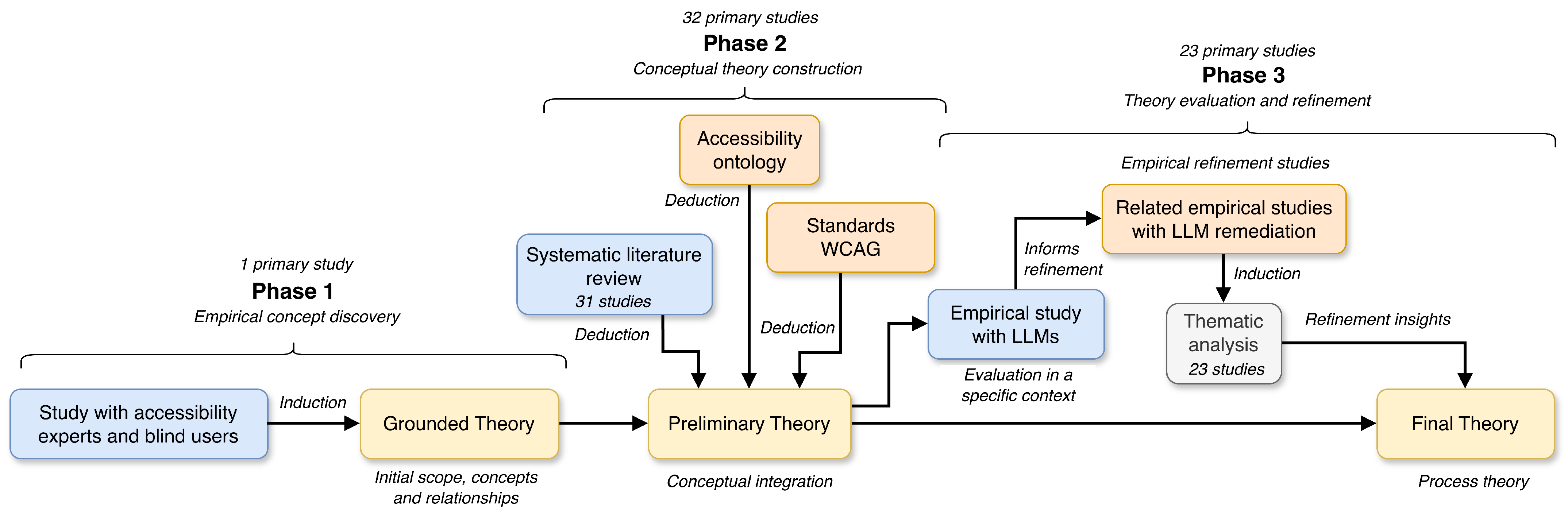
The research design follows established guidance for theory development in software engineering [32] and mixed-methods research [33,35,36]. A sequential mixed-methods design composed of three phases was adopted to support the construction of an empirically grounded process theory (see Figure 1). The design was selected to address limitations of single-method approaches to theory development. While grounded theory is well suited for inductively generating concepts from qualitative data, it does not by itself ensure integration with existing knowledge. Similarly, secondary studies such as systematic literature reviews can synthesize prior findings but lack direct empirical grounding in user experience, and case studies are often limited in scope and generalizability. This design enables the integration of inductive and deductive reasoning across multiple sources of evidence [30,32].
As shown in Figure 1, the present study does not involve new data collection with human participants. Instead, it builds the proposed theory through secondary analysis of open-access data from previously published empirical studies and additional literature-based evidence. In this sense, the empirical components incorporated in the phases are used as analytical inputs for theory construction rather than as newly conducted studies within this manuscript.

2.1. Phases

The research design follows a sequential logic of three phases in which empirical grounding, conceptual integration, and empirical refinement are combined:
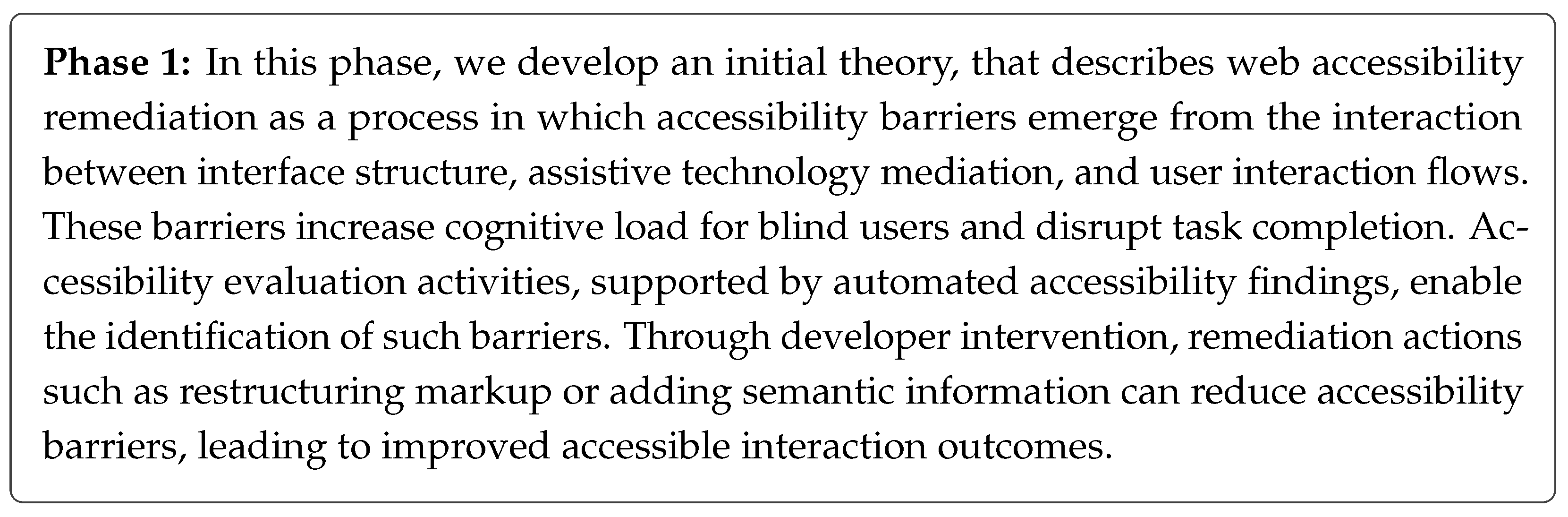
  • Phase 1 provides inductive empirical grounding through qualitative analysis of blind user experiences interacting with web systems [12].
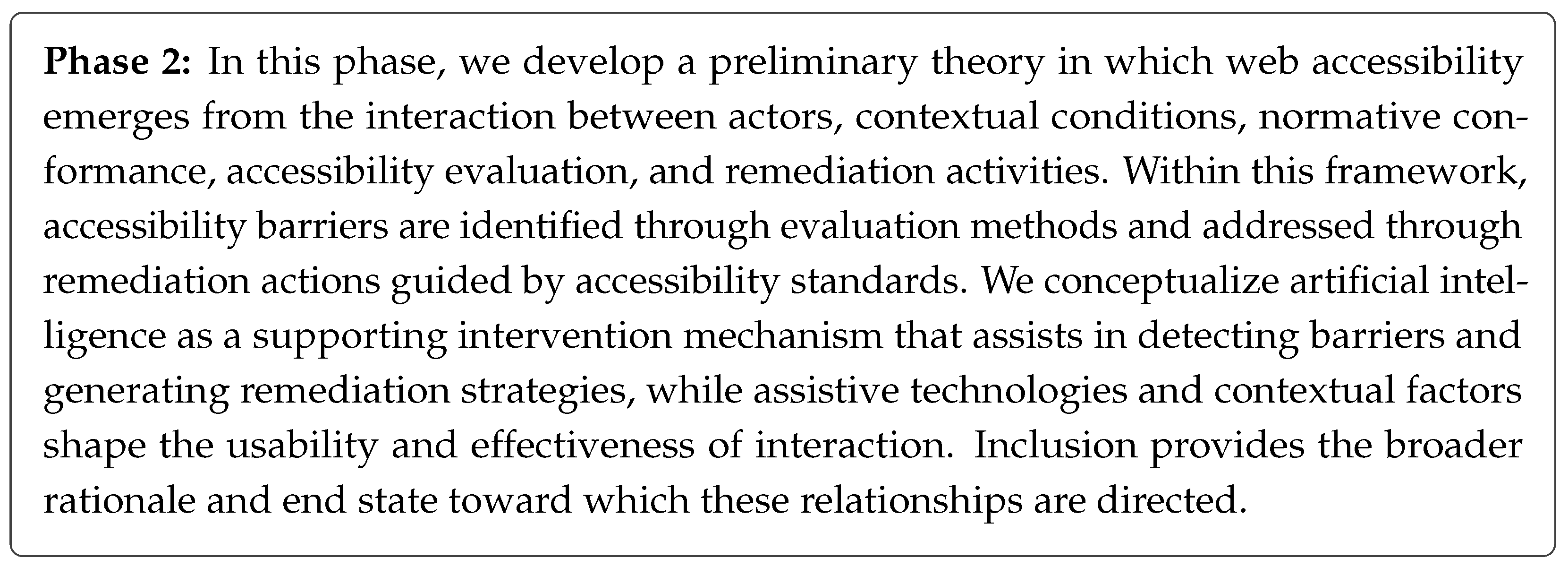
  • Phase 2 develops a preliminary theory through deductive integration with existing evidence from systematic literature review [37], standards [2,38,39,40,41,42], and concepts derived from an accessibility ontology [43].
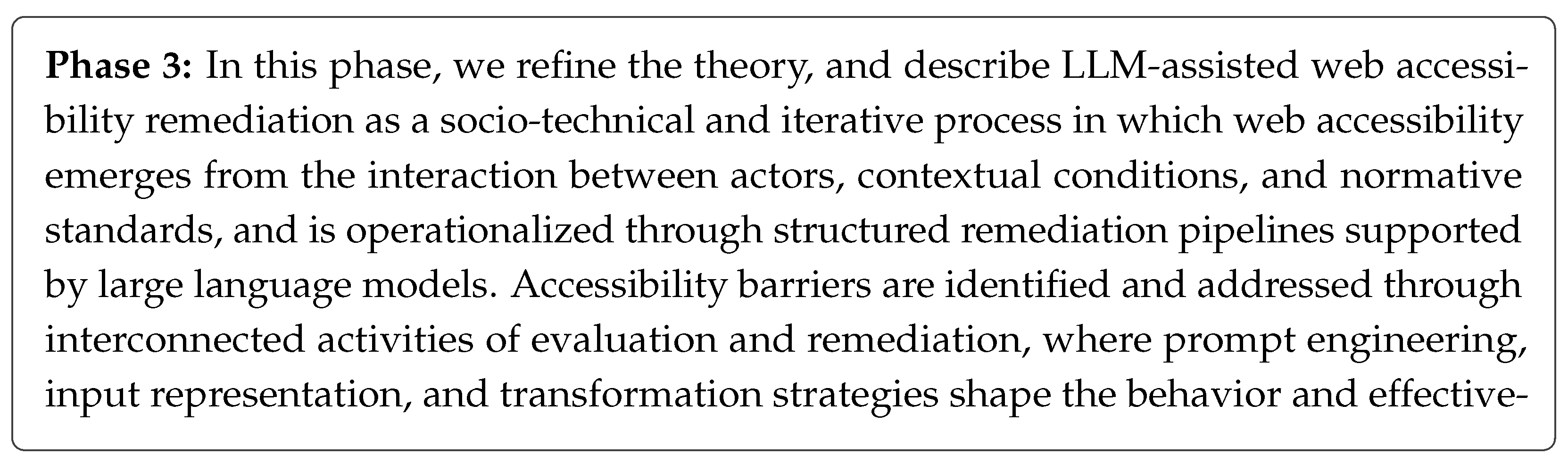
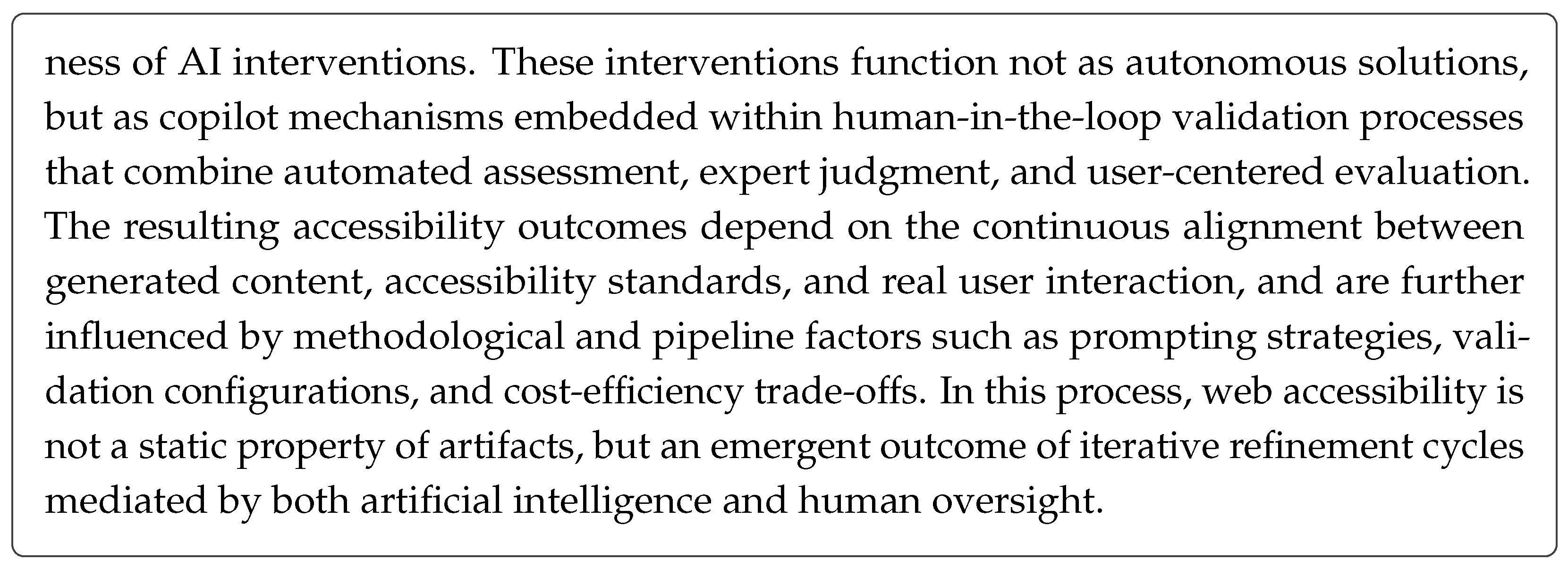
  • Phase 3 refines this preliminary theory through additional empirical evidence derived from a previously published empirical study conducted by the authors [6], as well as recent related studies reflecting the current state of the art in LLM-based accessibility remediation [16,21,23,24,25,26,27,44,45,46,47,48,49,50,51,52,53,54], enabling the elaboration and validation of the proposed concepts and relationships.
This sequential integration of inductive and deductive reasoning allows theory development to be grounded both in empirical observations and in existing knowledge from the literature. Such an approach has been recommended for theory construction in software engineering, where complex socio-technical phenomena often require combining multiple sources of evidence to achieve explanatory power and conceptual clarity [30,32].

2.2. Terminology

According to [28,30], the fundamental elements of a theory include its core entities called constructs, the relationships between those entities, and the scope conditions that delimit the situations in which the theory applies. To maintain consistent terminology throughout this paper, the term concepts is used instead of constructs to refer to the central elements of the proposed theories, following the terminology adopted in prior theory-building work in software engineering [33].
In this study, concepts represent the key elements involved in web accessibility remediation processes, including actors, technologies, evaluation activities, and accessibility constraints. Relationships between these concepts describe how remediation activities unfold within web development contexts.
The scope of the theory proposed in this paper is limited to accessibility remediation in web systems supported by artificial intelligence techniques, particularly LLMs, with a primary focus on scenarios involving visual impairments. Although some concepts are described using general accessibility terminology, their empirical grounding corresponds to screen-reader-mediated interaction.

3. Phase 1: Inductive Theory Construction Through Grounded Theory

The objective of the first phase was to develop a grounded theory of accessibility remediation based on the lived experiences of blind users interacting with web systems. Grounded theory, originally introduced by Glaser and Strauss [55], is a qualitative methodology aimed at generating theory inductively from empirical data rather than testing predefined hypotheses. Since its introduction, several methodological traditions have emerged within it [56].
The first tradition, associated with Glaser [55], emphasizes the strongly inductive nature of theory generation and encourages researchers to approach data with minimal theoretical preconceptions. A second tradition, developed by Strauss and Corbin [57], introduced more systematic procedures for coding and verifying emerging theoretical structures. A third tradition, known as constructivist grounded theory, was later proposed by Charmaz [58] as a synthesis that maintains the flexibility of the original approach while explicitly recognizing the interpretive role of the researcher during theory construction.
Following prior theory-building research in software engineering [33], the present study adopts the constructivist grounded theory approach proposed by Charmaz [58]. This approach is particularly suitable in contexts where researchers interpret experiential accounts and seek to derive conceptual explanations of socio-technical phenomena. In the context of accessibility research, this perspective enables the identification of concepts that capture how users experience accessibility barriers and how these experiences reveal underlying remediation needs.
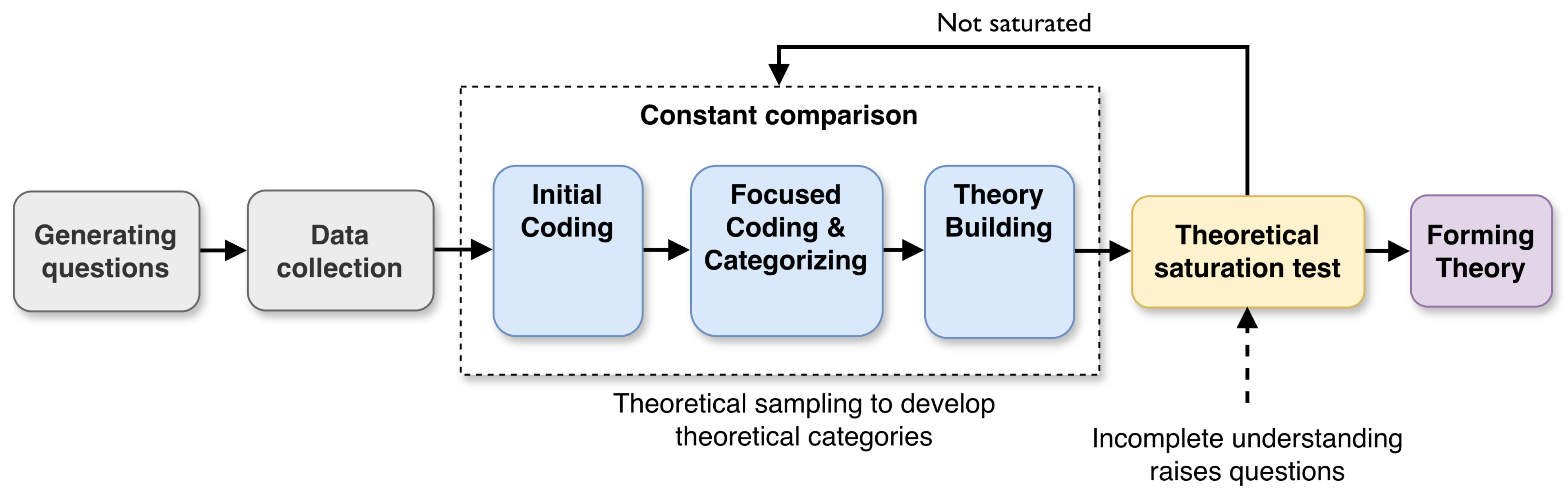
Figure 2 summarizes the constructivist grounded theory process followed in this phase. The analysis begins with the formulation of research questions and qualitative data collection, followed by iterative coding cycles based on initial coding, focused coding, and theory building. These activities are performed using the constant comparative method until theoretical saturation is reached, allowing the formation of an initial grounded theory.
The first step, initial coding, involves assigning concise codes to segments of qualitative data while remaining closely grounded in the participants’ observations. These codes are then compared and synthesized during focused coding, where the most significant and recurrent codes are grouped into higher-level categories. Finally, during theory building, relationships between these categories are analyzed in order to construct an explanatory conceptual structure [56].
Throughout these stages, the analysis relies on the principle of constant comparison, in which data fragments, codes, and emerging categories are continuously compared to refine conceptual distinctions and theoretical relationships [33]. Two research questions guided the inductive coding process in this phase:
  • RQ1: How do users with visual impairments experience accessibility barriers when interacting with web environments through screen readers?
  • RQ2: Which characteristics or interaction conditions facilitate accessible use of web systems from the perspective of users with visual impairments?
The first research question focuses on identifying accessibility barriers, breakdowns, and navigation difficulties encountered during interaction with web systems. The second question focuses on identifying conditions that support accessible interaction, including interface cues, structural navigation mechanisms, and feedback mechanisms that enable blind users to successfully complete tasks.

3.1. Data Collection for Grounded Theory Construction

The qualitative data used in this phase were obtained from the empirical study reported by the authors in [12]. Thus, grounded theory was drawn primarily from direct observation sessions, participant feedback, and recorded reflections about navigation difficulties, breakdowns, and perceived support mechanisms, which the authors identified as accessibility challenges faced by blind authors when interacting with WordPress software, as a representative complex web system, with particular attention to navigation, content editing, menu management, and other authoring-related tasks.
In the reported empirical study, the participant group comprised three blind authors from different geographical regions of the country (north, central, and south), one person without visual disabilities, and one instructor familiar with complex web system workflows [12]. The blind participants represented advanced screen reader users, with 15 to 18 years of experience using JAWS or NVDA, whereas the other participant represented a novice user of assistive technologies. The instructor had experience as both a keyboard user and an intermediate screen reader user. This distribution reflects both regional diversity and the proficiency levels reported among screen reader users (advanced 58.3%, intermediate 36%, beginner 5.7%), as well as the predominance of JAWS and NVDA, which together account for nearly 80% of usage [5].
Although the number of participants is consistent with prior accessibility and usability research, where small samples of users with visual impairments have been shown to reveal a large proportion of relevant issues [59,60], it could be considered limited; this is consistent with the objectives of constructivist grounded theory, which prioritizes depth of understanding over statistical generalization [58].
The goal of this phase was not to obtain a representative sample, but to generate rich, experience-based insights into accessibility barriers and remediation practices from first-hand accounts of experienced users in realistic interaction contexts.
The available data provided a sufficiently rich empirical basis for inductive coding, as they capture not only accessibility violations, but also user frustration, coping strategies, contextual dependencies, and conditions that facilitated task completion.
Consistent with constructivist grounded theory, the purpose of using this empirical material in the present paper is not to reproduce the original usability findings, but to reinterpret them analytically in order to derive higher-level concepts relevant to the emerging theory of AI-assisted web accessibility remediation. In this sense, the qualitative obtained data provide the experiential grounding for the first theoretical abstraction, while later phases expand and refine that abstraction through deductive integration and additional empirical evidence.

3.2. Initial and Focused Coding

The qualitative material used in this phase [61] was analyzed following the constructivist grounded theory coding procedure described in Section 3. In accordance with Charmaz’s methodology, the analysis began with initial coding, where short descriptive codes were assigned to segments of qualitative data while remaining closely grounded in the empirical observations [58]. These codes captured interaction breakdowns, navigation strategies, interface structure issues, and accessibility defects observed during the authoring tasks.
Specifically, the initial coding stage incorporated evidence from three sources. First, observational notes and participant feedback reported in the source study (P1–P5 labels in Table 1) documented difficulties encountered by blind users when interacting with the web system interface through screen readers. Second, the BW evaluation provided a structured set of accessibility barriers identified through expert inspection, as documented in the open-access dataset (BW label in Table 1). Third, automated accessibility analysis results reported in the study, obtained using WAVE, described detectable markup and structural accessibility issues (WAVE label in Table 1). These sources were analyzed jointly in order to capture both experiential and technical aspects of accessibility barriers.
Through the process of constant comparison, similar codes were progressively aggregated during the focused coding stage. In this step, the most significant and recurrent initial codes were grouped into higher-level conceptual categories that describe recurring patterns in accessibility barriers and interaction breakdowns [33]. This step enabled the transition from descriptive observations to conceptual abstraction by identifying common structural causes underlying multiple accessibility problems.
This procedure was continued until theoretical saturation was reached, that is, the point at which additional data did not lead to the identification of new codes or categories. During the analysis, later observations largely confirmed previously identified patterns, with new data being consistently mapped to existing codes rather than generating substantially new concepts. This indicates that the core categories of the grounded theory were sufficiently developed in relation to the observed phenomena. The qualitative data analysis software ATLAS.ti Version 26.0.0 (33859) was used to systematically support the coding process, data organization, and traceability of categories throughout the analysis [62].
The focused coding stage revealed several recurring categories describing how accessibility barriers emerge from the interaction between interface structures, assistive technologies, and user navigation strategies. In total, 68 codes were identified and grouped into 10 categories. Table 1 presents representative traceability links between empirical evidence, codes and categories (four illustrative code examples per category). The complete coding schema, including all identified codes and representative supporting excerpts, is publicly available through the external Mendeley Data repository in [62].
These categories represent higher-level abstractions derived from the empirical observations and form the basis for identifying conceptual elements of accessibility remediation processes. In the next step of the analysis, these categories are further synthesized to derive the core concepts and relationships that constitute the initial grounded theory of accessibility remediation.

3.3. Emerging Concepts

The qualitative analysis revealed ten high-level concepts describing how accessibility barriers emerge during interaction with web authoring systems and how they can be identified and addressed through remediation activities. Together, they capture both the experiential aspects of accessibility barriers encountered by blind users and the technical mechanisms through which such barriers can be detected and mitigated.
In the following, the most frequent subcategories of the concepts mentioned above are presented. The concepts are in bold font, and the subcategories are written in small capitals. The complete set of categories and subcategories derived during the coding process is also available in the external Mendeley Data repository reported in [62].
Accessibility barriers: This concept represents obstacles that prevent blind users from effectively interacting with web interfaces. Most statements associated with this concept referred to structural or semantic problems in the interface. Frequent subcategories include missing semantic structure, unlabeled controls, keyboard navigation dead-ends, and inaccessible form elements. Observations also indicated issues related to visual-only formatting information and misplaced action buttons, which made important interface elements difficult to locate using screen readers.
Interface structure: This concept describes how the organization of interface components affects accessibility. Participants frequently reported difficulties caused by complex interface layouts or poorly structured navigation regions. Subcategories include interface region organization, toolbar complexity, menu hierarchy structure, and control discoverability. In particular, inconsistent placement of controls such as publishing or saving buttons often caused confusion during task execution.
Interaction flow: Interaction flow refers to the sequence of actions required to complete authoring tasks within web environments. Participants described difficulties maintaining orientation while navigating between editing areas, menus, and configuration panels. Common subcategories include task navigation sequence, control discovery process, and error recovery process. Disruptions in interaction flow often resulted from structural accessibility issues in the interface.
Screen reader mediation: Interaction with the system occurred through assistive technologies, particularly screen readers. Participants relied on various navigation strategies when exploring the interface. The most frequent subcategories include sequential keyboard navigation, region navigation strategies, screen reader shortcut usage, and screen reader command conflicts. These mechanisms shaped how users perceived and navigated the interface.
User cognitive load: Many observations indicated that accessibility barriers increased the cognitive effort required to complete tasks. Participants often had to explore the interface sequentially in order to locate relevant controls. Frequent subcategories include excessive sequential navigation, interface disorientation, control search effort, and ambiguous feedback interpretation.
Accessibility evaluation: This concept represents the activities used to identify accessibility problems in the system. In the study, accessibility evaluation occurred through both manual and automated approaches. Subcategories include manual barrier identification, screen reader interaction testing, structural markup inspection, and heuristic accessibility review.
Automated accessibility findings: Automated tools generated findings indicating potential accessibility problems. The automated evaluation conducted using WAVE produced a set of indicators that supported the manual inspection process. Frequent subcategories include wave-detected errors, wave-detected alerts, structural markup warnings, and potential accessibility risks.
Developer intervention: The correction of accessibility issues required explicit actions performed by developers or content authors. These interventions typically involved modifying markup or restructuring interface elements. Subcategories include code modification, markup correction, interface restructuring, and theme or plugin configuration.
Accessibility remediation actions: Accessibility remediation actions represent the concrete modifications performed to remove identified barriers. Frequent subcategories include adding missing labels, improving heading structure, adding aria attributes, restructuring html semantics, and improving keyboard navigation.
Accessible interaction outcomes: This concept represents the observable outcomes when accessibility barriers are reduced or eliminated. Participants described successful interaction when interface elements became easier to locate and interpret. Subcategories include successful task completion, improved control discoverability, reduced navigation effort, and accessible content authoring.

3.4. Relationships Between Concepts

The concepts identified in the grounded theory analysis are connected through a set of relationships describing how accessibility barriers emerge and how they can be addressed through remediation activities. These relationships reflect patterns observed during the interaction sessions and the accessibility evaluation process.
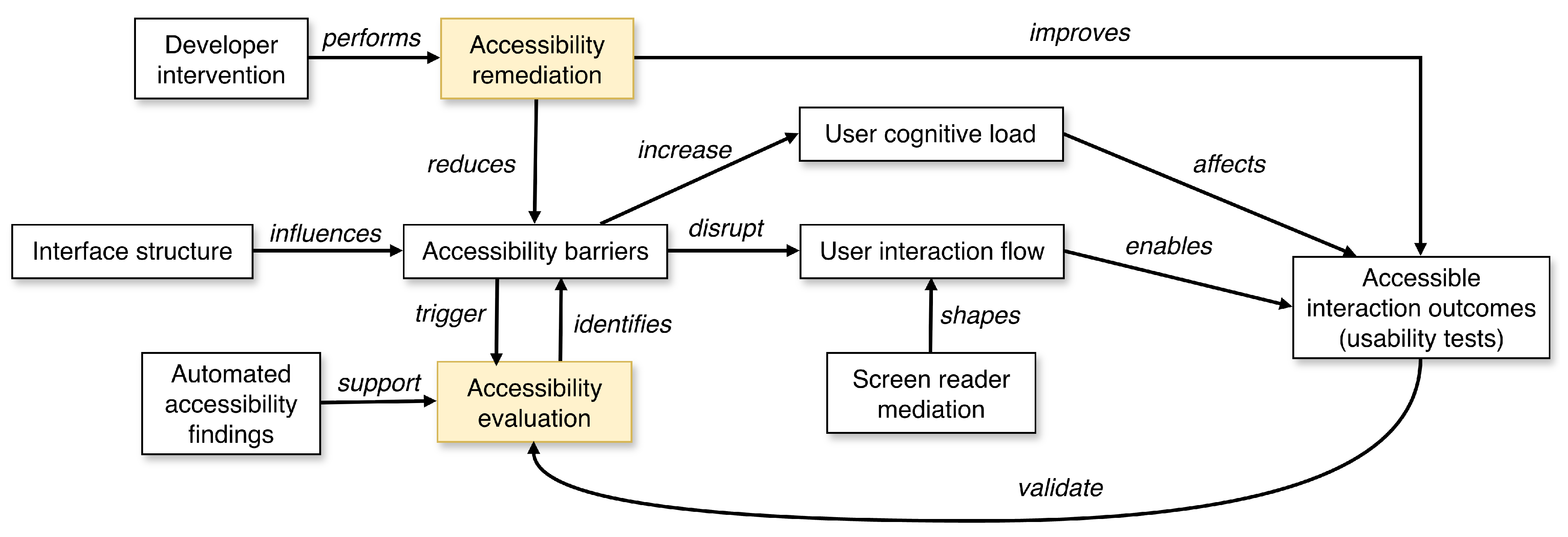
First, the interface structure strongly influences the emergence of accessibility barriers. Structural issues such as missing semantic markup, poorly organized interface regions, or unlabeled controls frequently resulted in interaction difficulties for screen reader users. When these structural problems occur, they directly affect how assistive technologies interpret the interface.
Second, screen reader mediation shapes the interaction flow. Because blind users rely on screen readers to explore and navigate the interface, the way the assistive technology interprets interface elements determines the sequence of actions required to complete tasks. When semantic information is incomplete or ambiguous, interaction often becomes sequential and exploratory.
Third, the presence of accessibility barriers increases user cognitive load. Participants often had to perform extensive sequential navigation to locate interface elements or understand the current interaction context. This additional effort disrupted the interaction flow and increased the difficulty of completing tasks.
Finally, the correction of accessibility problems requires developer intervention. Developers perform accessibility remediation actions such as restructuring markup, adding labels, or improving navigation mechanisms. These remediation actions reduce the presence of accessibility barriers and lead to improved accessible interaction outcomes, including successful task completion and reduced navigation effort.
Figure 3 presents the high-level concepts and relationships derived from the grounded theory analysis. The concepts that directly constitute the accessibility remediation phenomenon are highlighted, while contextual factors influencing the process are represented with white background. The resulting conceptual structure addresses the research questions guiding this phase by identifying both the characteristics of accessibility barriers experienced by blind users (RQ1) and the factors influencing their detection and remediation (RQ2).
Technologies 14 00287 i002

4. Phase 2: Preliminary Theory Through Deductive Integration

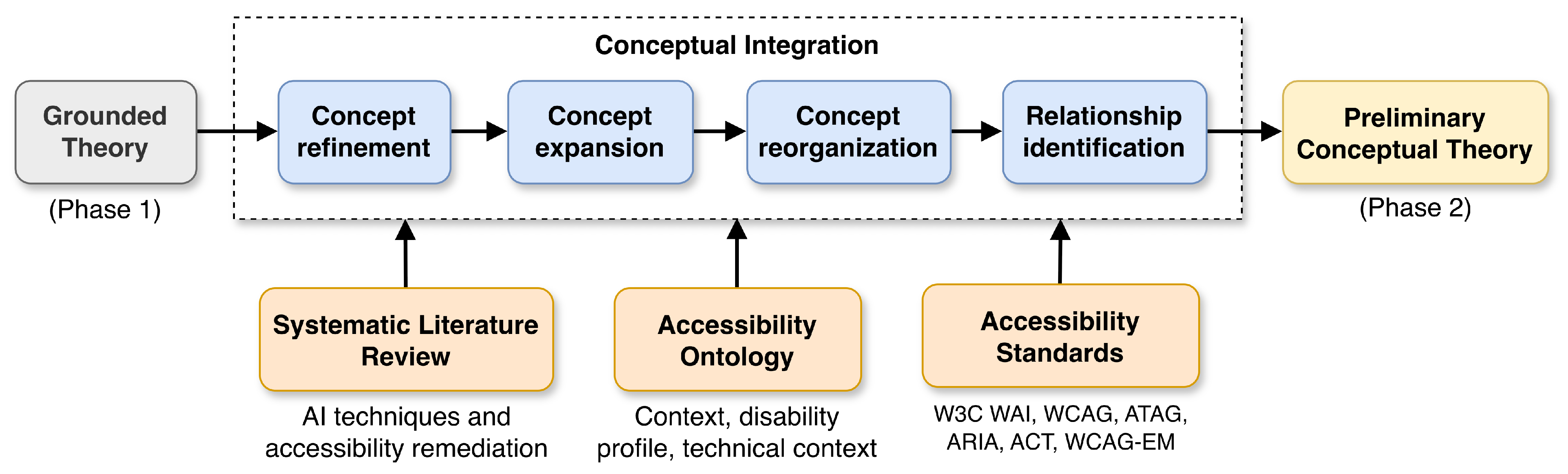
Following the research design, the next step after inductively deriving a preliminary grounded theory from the qualitative analysis in Phase 1, was to embed this theory deductively in existing knowledge on web accessibility, accessibility evaluation, and artificial intelligence. This step integrates the grounded concepts obtained from Phase 1, with evidence from a systematic literature review of 31 studies on AI-based accessibility approaches [37,63], accessibility standards developed by the W3C Web Accessibility Initiative (WAI) [2,39,40,41,42], and the accessibility context ontology proposed in [43].
Process theories focus on explaining how outcomes emerge from sequences of actions and interactions [32]. The purpose of this deductive integration is to refine the initial grounded concepts and situate them within a broader conceptual framework describing accessibility remediation as a socio-technical process. While Phase 1 focused on experiential aspects of accessibility barriers and remediation activities, the literature provides additional concepts related to normative conformance, contextual factors, assistive technologies, and AI-based intervention mechanisms. The result of this integration is a preliminary theory of AI-assisted web accessibility remediation that remains compatible with the grounded theory derived from user observations while incorporating established constructs from accessibility research and standards. Figure 4 summarizes the process followed in this phase.

4.1. Integrated Concepts

In the following, the concepts that were deductively integrated into the grounded theory are described. Some concepts from Phase 1 were retained, some were refined, and others were introduced deductively from the literature and the accessibility ontology. The concepts are presented in bold font, and representative subcategories are written in small capitals. A complete list of categories and subcategories is provided in the dataset [62].
Web Accessibility: In this preliminary theory, web accessibility becomes the emerging concept that integrates the grounded theory of barriers and remediation with the normative and contextual literature. Web accessibility is understood not only as technical conformance with accessibility standards, but as the possibility that people with disabilities can perceive, understand, navigate, interact with, and contribute to web content autonomously [1]. Relevant subcategories include autonomous interaction, goal achievement, effective navigation, and accessible contribution. This concept refines the accessible interaction outcomes concept identified in Phase 1 by embedding them in a broader socio-technical notion of accessibility.
Accessibility Barriers: The concept of accessibility barriers, originally identified in Phase 1, is retained and refined in this deductive integration. In this phase, the concept is aligned with the literature and normative standards, which describe recurrent and detectable accessibility failures. Representative subcategories include missing alternative text, incorrect semantics, navigation breakdowns, aria misuse, and form label errors. These barriers are particularly relevant because they constitute the primary targets of evaluation and remediation activities, and are often associated with violations of established accessibility criteria such as WCAG success criteria.
Actors: The grounded theory concept of blind users is broadened in this phase into the more general concept of actors. This concept includes users with disabilities, developers, and accessibility experts. Although the empirical grounding of Phase 1 focused on blind users interacting through screen readers, the literature and the ontology indicate that accessibility processes involve multiple stakeholders with different roles and responsibilities [43].
Context: The concept of interface structure from Phase 1 is reorganized under the broader concept of context. Following [43], context includes technical context, disability profile, environment, and used platform. In the present theory, technical context comprises web browsers, devices, web platforms, markup structures, and assistive technologies such as screen readers. Disability profile includes type of disability, user situation, and user identity. The literature and the ontology indicate that disability types extend beyond blind users and users with low vision to include auditory disabilities, cognitive disabilities, motor disabilities, and speech disabilities, following W3C classifications [64]. This concept explains why accessibility barriers and remediation outcomes vary depending on the combination of user characteristics, technologies, and environmental conditions.
Usability: The concept of user cognitive load identified in Phase 1 is deductively refined into usability. Usability captures the degree to which interaction is clear, efficient, predictable, and satisfactory for users with disabilities [65]. In the context of blind users, relevant subcategories include navigability, predictability, clarity of feedback, and cognitive effort. This refinement is important because the literature repeatedly shows that technical accessibility does not automatically imply usable interaction [66,67].
Normative Conformance: The concept of accessibility barriers is deductively complemented by normative conformance, which refers to the degree to which web content or authoring tools satisfy established accessibility requirements [2]. Important subcategories include wcag criteria, atag requirements, aria semantics, act rules, and wcag-em procedures. Normative conformance is particularly relevant in the present theory because many remediation activities aim to correct identifiable violations of markup semantics, keyboard access, labels, headings, and alternative text.
Accessibility Evaluation: The concept of evaluation from Phase 1 is retained and expanded through the literature on accessibility assessment methods. Accessibility evaluation now includes both automated testing and human evaluation, including expert inspection, user testing, direct observation, and barrier walkthrough [10,68]. The concept also incorporates automated conformance tools such as WAVE, Lighthouse or Axe. Automated tools can detect part of the accessibility barriers reflected in normative violations, but the literature and the empirical findings from phase 1 both indicate that conformance testing alone is insufficient to explain perceived usability or autonomous interaction. This concept functions as the bridge between normative conformance and experienced accessibility [23].
Assistive Technologies: The concept of screen reader mediation is expanded into assistive technologies. This includes screen readers such as JAWS, NVDA, VoiceOver, Narrator, TalkBack, and Orca, as well as other technologies that mediate interaction with web content (braille displays, voice interfaces, keyboard navigation) [69,70,71,72]. This refinement is supported by both the ontology and the literature, which show that accessibility depends not only on page structure, but also on how assistive technologies interpret and present that structure to users.
Artificial Intelligence: A new concept introduced deductively in this phase is artificial intelligence. AI is defined as the field concerned with designing systems capable of performing tasks that normally require human intelligence, such as reasoning, perception, and learning [73]. In the accessibility literature, AI appears as a family of techniques capable of detecting barriers, classifying defects, generating alternative content, and supporting remediation [74]. Relevant subcategories include machine learning, deep learning, natural language processing, generative AI, and large language models [37]. This concept does not replace evaluation or human intervention, but introduces a new type of intervention mechanism into the remediation process.
Accessibility Remediation: The grounded theory concept of remediation actions is retained and generalized into accessibility remediation. This concept includes semantic restructuring, alternative text generation, aria enrichment, navigation improvement, text-contrast correction, and language specification. The literature review shows that remediation may be manual, automated, or AI-assisted, and may target either content, structure, or interaction mechanisms [20,21]. This concept becomes central in Phase 2 because it explicitly links barriers, evaluation, standards, and intervention.
Inclusion: Finally, the deductive step introduces inclusion as the normative and ethical horizon of the theory. Inclusion refers to equitable participation, independent access, design for diversity, and universal access [65]. Although this concept was not explicit in the grounded theory of Phase 1, it is necessary in the preliminary theory because it explains why accessibility remediation matters beyond technical quality alone.

4.2. Integrated Relationships

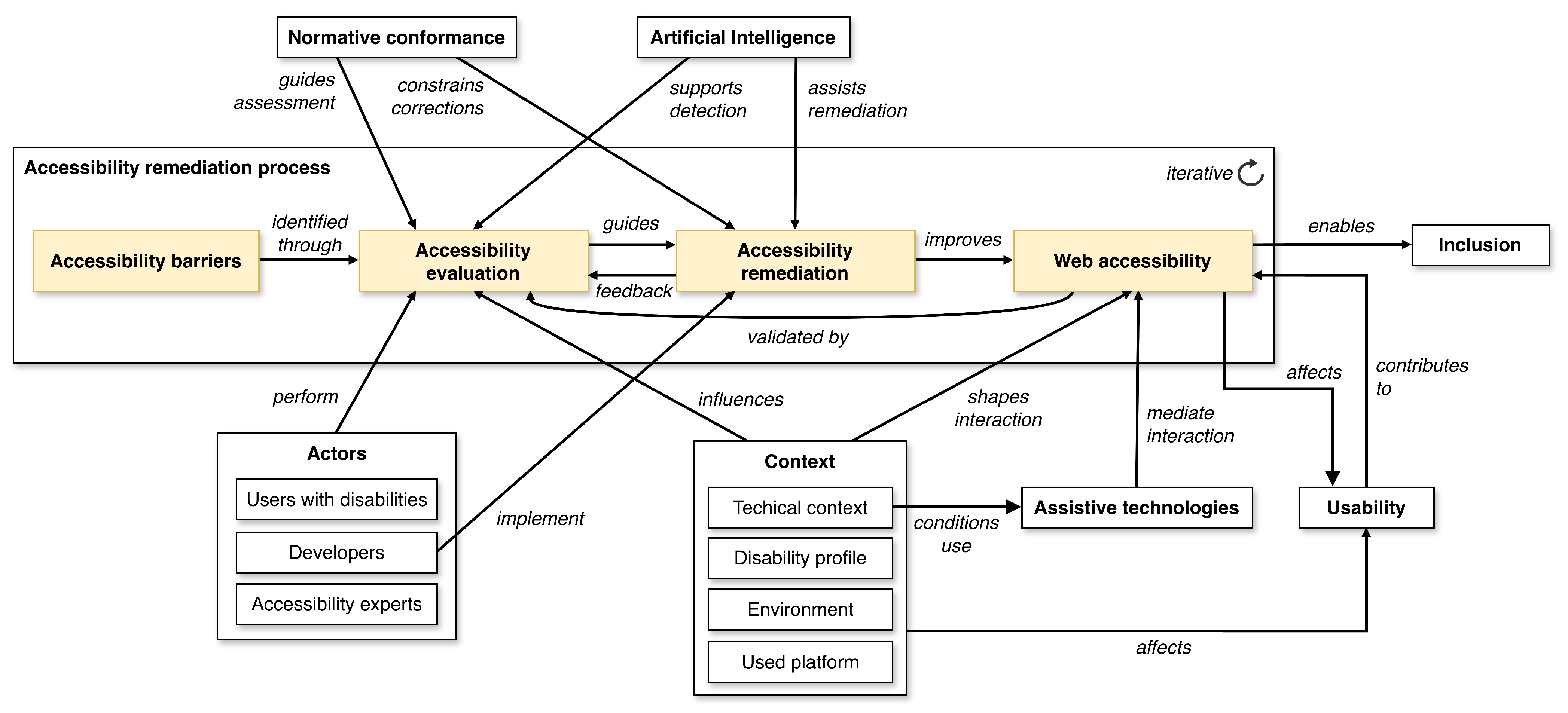
The relationships in the preliminary theory are intentionally expressed with generic terms such as influences, affects, guides, or supports, since additional empirical work is required to refine them further. Nevertheless, several groups of relationships can already be identified from the deductive integration.
A first group of relationships concerns the interaction between context, assistive technologies, and usability. The ontology and the literature indicate that accessibility is experienced under specific combinations of user characteristics, technical settings, and environmental conditions [43]. In this theory, context affects both the interpretation of interface structures by assistive technologies and the usability perceived by users. This relationship explains why the same web page may be experienced differently depending on the browser, device, screen reader, or type of disability involved.
A second central group of relationships connects normative conformance with accessibility evaluation and actors. Accessibility standards define the criteria against which content and authoring tools are assessed, while evaluation methods operationalize those criteria through automated checks, expert reviews, and user-based assessments [2,40,41]. These evaluation activities are performed by different actors: developers typically execute automated testing, accessibility experts conduct expert inspections to identify structural and semantic barriers, and users with disabilities participate in user-centered evaluations that reveal usability issues beyond formal conformance.
A third group of relationships concerns the role of artificial intelligence in accessibility remediation. The literature review shows that AI techniques can intervene at multiple points in the remediation process, including barrier detection, severity prediction, alternative text generation, and code transformation [37]. In the preliminary theory, AI is modeled as a potential intervention mechanism that supports remediation rather than replacing human evaluation or accessibility expertise. This relationship is especially relevant for later phases of the theory, where AI-supported remediation strategies are empirically refined.
A fourth group of relationships links accessibility evaluation with accessibility remediation. Evaluation identifies barriers and produces feedback about the accessibility state of a page or authoring environment, while remediation acts on that feedback to reduce or eliminate barriers. This makes evaluation a bridge between normative conformance and web accessibility outcomes. In practical terms, the process is iterative: barriers are identified, interpreted, corrected, and re-evaluated. This iterative structure is consistent with the process-theoretical perspective adopted in the paper.
A fifth group of relationships connects web accessibility, usability, and inclusion. Web accessibility affects usability through the interaction between users, assistive technologies, and contextual conditions, which shape how accessible content is actually experienced in practice. Furthermore, both web accessibility and usability contribute to the broader outcome of inclusion, which represents the ultimate goal of the remediation process. While accessibility enables the possibility of access, usability influences the effectiveness and quality of interaction, and together they determine the extent to which users can meaningfully participate in digital environments.
In this theory, web accessibility is not equivalent to usability, but it directly affects it under specific contextual conditions. A system may therefore be normatively accessible while still presenting usability challenges depending on the interaction mediated by assistive technologies and the user context. This distinction helps explain situations where a system satisfies accessibility standards but still results in inefficient or difficult interaction for users [75].
Figure 5 summarizes the high-level concepts and relationships of this preliminary theory.
Technologies 14 00287 i003

5. Phase 3: Refinement of the Process Theory

The goal of the third phase was to refine and elaborate the preliminary theory by incorporating additional empirical evidence related to LLM-assisted remediation, particularly those associated with prompting, structured transformation, evaluation, and human oversight. While Phase 2 established a broader theory of web accessibility remediation by integrating the grounded theory with the literature, ontology, and accessibility standards, several concepts remained too general to explain how remediation is operationalized in practice.
In particular, the concept of artificial intelligence required further refinement, since the empirical literature suggests that LLM-based accessibility support is not a uniform mechanism, but a family of interventions whose effects depend on input representation, prompting strategies, validation procedures, and user-centered assessment.
As in [33], this phase corresponds to a second inductive step guided by the preliminary theory. Rather than seeking statistical generalization, the purpose was conceptual and theoretical refinement. As presented in Figure 1, this phase draws on previously published empirical studies as secondary data sources. The first empirical input corresponds to the study reported in [6], which evaluated LLM-assisted accessibility remediation using different prompting strategies, input formats, and validation procedures.
That study served to assess whether the general structure of the preliminary theory was empirically plausible and to identify which concepts required greater specificity. A second empirical input consisted of a thematic synthesis of related empirical studies on LLM-based accessibility remediation, conducted to elaborate and refine the categories emerging from the preliminary theory.

5.1. Data Collection for Theory Refinement

The data used in this phase correspond to a previously published empirical investigation conducted by the authors [6], whose data are openly accessible in [76] and are used as a source of empirical evidence to refine the preliminary theory developed in Phase 2. The study assessed how LLMs could support accessibility remediation tasks under controlled prompting conditions, and whether the resulting outputs were consistent with the theoretical relationships proposed between evaluation, remediation, technological mediation, and accessibility outcomes.
The study evaluated two of the most frequently used LLM families in accessibility-related studies (GPT-4o and Gemini 2.0 Flash) [37]. The experimental design systematically varied input representation (HTML and Markdown) and the use of structured templates to assess their influence on accessibility remediation outcomes.
Prompt engineering played a central role by explicitly framing the task as WCAG 2.2 accessibility correction, guiding the models to perform semantic restructuring, alternative text generation, and code-level accessibility improvements. Given known limitations of LLMs—such as hallucinations, incomplete transformations, and variability—generation was constrained through structured prompts and template guidance, and all outputs were subjected to iterative validation.
Output quality was assessed through a multi-layered evaluation combining automated tools (WAVE and Lighthouse), expert inspection (Barrier Walkthrough), and user-based evaluation (Cognitive Walkthrough). Automated metrics were used as a filtering stage, while expert and user evaluations provided deeper validation of semantic accessibility and usability.
The results showed consistent improvements across all evaluation dimensions. In particular, WAVE findings were reduced from 16 errors and 11 alerts to 0 errors and 1 alert, critical accessibility barriers were reduced from six to two, and user evaluation achieved a 95.83% task completion success rate. These results provide empirical support for the effectiveness of LLM-assisted remediation and further demonstrate the practical relevance of the theoretical mechanisms proposed in this work.

Implications for Theory Refinement

This study was particularly relevant for theory refinement because it provides empirical evidence that allows reinterpreting the concept of AI-assisted remediation from a general intervention mechanism, as formulated in Phase 2, to a set of observable remediation practices carried out under controlled conditions using LLMs.
The results show that accessibility outcomes are not determined by the presence of an LLM alone, but by how the remediation process is operationalized. The effectiveness of LLM-assisted remediation depends on factors such as input representation, prompting strategies, transformation structure, and validation procedures. In this sense, AI should be understood as a mediated and configuration-dependent intervention mechanism rather than as an autonomous solution. The quantitative improvements, including reductions in accessibility errors and increased accessibility scores, provide empirical support for the effectiveness of iterative evaluation–remediation cycles, reinforcing the process-theoretical interpretation proposed in this work.
These findings suggested that the concept of artificial intelligence in the preliminary theory was too broad and needed to be refined into more specific concepts related to LLMs, such as prompting, structured transformation, validation, and human oversight.

5.2. Thematic Synthesis Procedure

To refine the preliminary theory, a thematic synthesis of empirical studies on LLM-based accessibility remediation was conducted following the guidelines proposed in [77]. The studies, shown in Table 2, were identified in Scopus and Web of Science databases using the search string: “web accessibility” AND (“large language model” OR llm).
In this procedure, the empirical studies were treated as units of analysis, and the synthesis progressed through iterative coding. Using the preliminary concepts from Phase 2 and the insights derived from the empirical study, we formulated two refined research questions:
  • RQ1: How is LLM-assisted web accessibility remediation operationalized in empirical studies in terms of evaluation, remediation strategies, and human involvement?
  • RQ2: What methodological, technical, and contextual factors influence the effectiveness of LLM-supported accessibility evaluation and remediation?
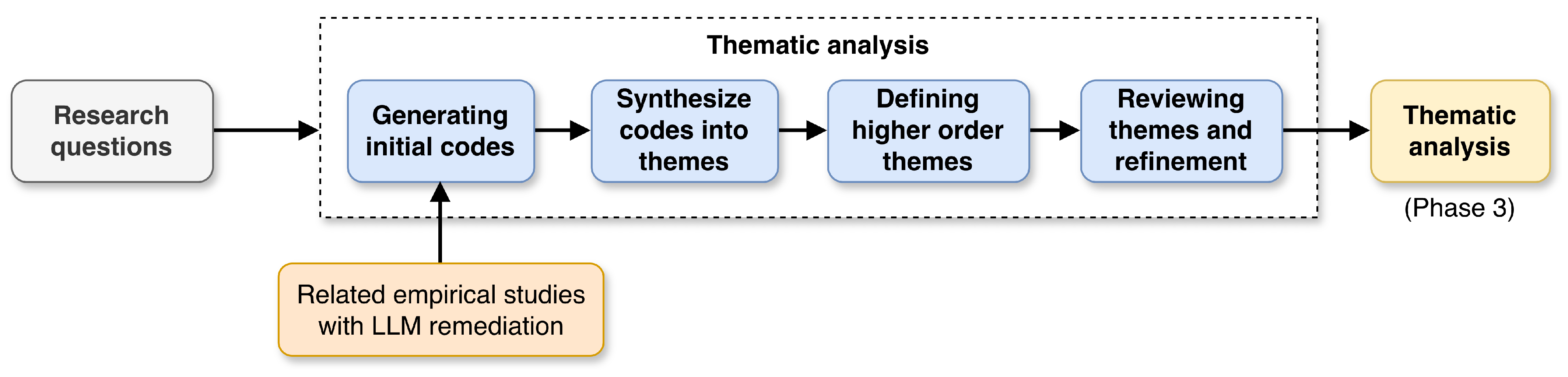
These research questions guided the coding process by orienting the identification of relevant fragments, the grouping of codes into descriptive themes, and the abstraction of those themes into higher-order theoretical categories. This approach is appropriate in software engineering when evidence from multiple empirical studies needs to be translated into conceptual explanations rather than merely summarized descriptively [77].
As shown in Figure 6, the synthesis was guided by the preliminary theory derived in Phase 2. In that sense, the analysis resembled what Saldaña [82] describes as elaborative coding, since the new material was interpreted in relation to an existing theoretical structure [33]. The purpose was not to generate a new theory from scratch, but to elaborate and refine the concepts and relationships of the preliminary theory.
The analysis was supported by the qualitative data analysis software ATLAS.ti Version 26.0.0 (33859), which facilitated the systematic organization of fragments, code assignment, and traceability between studies and emerging concepts. The complete coding schema is provided as dataset in [62].
The coding process identified recurrent empirical fragments related to LLM-supported evaluation, text-contrast correction, webpage generation, multimodal accessibility auditing, extension-based support for users with disabilities, and developer-oriented accessibility tools. These fragments were iteratively grouped into themes and higher-order themes, enabling a structured explanation of how LLM-assisted accessibility remediation is operationalized in empirical studies.
As presented in Table 3, Table 4, Table 5, Table 6 and Table 7, the resulting synthesis showed five recurring higher-order themes for the emerged central topic LLM-assisted web accessibility remediation: Human oversight and validation, LLM-supported evaluation, LLM-supported remediation, Methodological and pipeline factors and User-facing accessibility support. These higher-order themes comprise 18 themes and 87 codes, collectively refining the concepts of artificial intelligence, evaluation, and remediation introduced in Phase 2, and also revealed new dimensions of the process that had not been explicit in the preliminary theory.

5.3. Refined Concepts

In this section, the most frequent subcategories for the high-level concepts are described. As in the previous phases, the concepts are presented in bold, the subcategories are written in small capitals.
LLM-assisted transformation: This concept introduces a structured pipeline that explains how large language models operationalize accessibility remediation tasks. Rather than treating AI as a single intervention mechanism, the empirical evidence shows that remediation is carried out through a sequence of interdependent activities that transform input representations into accessible outputs. In this context, the process is better understood as a pipeline composed of interconnected sub-concepts rather than simple subcategories, since each stage performs a distinct functional role within the transformation process. These sub-concepts include input acquisition, input transformation, prompt engineering, LLM processing, and generated output. These findings indicate that the effectiveness of LLM-assisted remediation depends on the configuration and interaction of these stages, rather than on the model alone, reinforcing the view of AI as a mediated and process-dependent intervention mechanism.
Input acquisition: This concept refers to the mechanisms used to extract source content from web pages before it is processed by the model. Across studies, the most common input source is raw HTML, although other inputs such as markdown, screenshots, or DOM structures are also used. Frequent subcategories include web scraping, html input, screenshot capture, and template extraction. This concept defines what information is made available to the pipeline, directly influencing the scope and completeness of subsequent transformations.
Content adaptation: This concept refers to the preprocessing steps applied to acquired inputs to improve their suitability for LLM interpretation. Rather than using raw data directly, many approaches transform inputs into formats that better align with model capabilities. Frequent subcategories include text extraction from html, markdown conversion from html, structure simplification, and multimodal transformation. This concept explains how different preprocessing strategies lead to variations in model performance and remediation outcomes.
Prompt engineering: One of the clearest refinements introduced in this phase concerns the role of prompting. The empirical study and the thematic synthesis both show that the quality of LLM-assisted remediation depends strongly on how instructions are formulated and structured. Frequent subcategories include zero-shot prompting, few-shot prompting, template-guided prompting, chain-of-verification, prompt chaining, context augmentation, retrieval-augmented generation, and hallucination handling. This concept refines the broad Phase 2 notion of AI intervention by identifying prompting as a primary alignment mechanism between remediation goals and model behavior.
LLM processing: This concept refers to the internal generation phase in which the model interprets the input and produces candidate transformations based on the provided prompt and context. Although often treated as a black-box operation, the empirical studies highlight that model behavior varies depending on factors such as model architecture, decoding settings, prompt formulation, context length, and the completeness of the provided input. These factors may lead to inconsistent corrections, hallucinated elements, or incomplete accessibility fixes, making validation a necessary part of the remediation cycle. Frequent subcategories include instruction-following behavior, context interpretation, reasoning patterns, and decoding strategies. This concept explains variability in outputs even when input and prompts remain stable, emphasizing that model inference is a probabilistic and context-sensitive process.
Structured transformation: This concept captures the intermediate stage in which the outputs generated by the model are organized into coherent and actionable modifications over the input content. Unlike accessibility remediation itself, which refers to the types of fixes applied, structured transformation focuses on how those fixes are systematically constructed, formatted, and integrated into the existing structure of the webpage. Frequent subcategories include template-based transformation, html restructuring, component-level modification and format normalization. This concept bridges the gap between raw model outputs and executable changes, ensuring that generated content can be consistently applied within real web environments.
Generated output: The last concept of the pipeline, refers to the final artifacts produced by the transformation pipeline. These outputs may vary in scope and granularity, ranging from localized code corrections to complete webpage transformations. Frequent subcategories include corrected html, accessible components, alternative text generation, restructured layouts, and full-page generation. The quality of the generated output is a critical factor in determining the effectiveness of the remediation process, as it directly influences both conformance to accessibility standards and the usability of the resulting content for end users.
Accessibility Evaluation: The concept from Phase 2 is refined to include llm-assisted evaluation, automated testing, user evaluation, expert review, and hybrid evaluation. The empirical findings reveal an emerging role of LLMs in identifying accessibility problems through llm-assisted evaluation. Studies report the use of LLMs for semantic barrier detection, automation of previously manual criteria, accessibility auditing, and multimodal accessibility inspection. These findings indicate that AI does not merely support remediation after evaluation, but can also actively participate in the evaluation process itself.
Structured accessibility remediation: The concept of accessibility remediation is refined into a structured process of transformation. The most recurrent subcategories include ai-generated adaptations, semantic restructuring, alternative text generation, aria enrichment, navigation improvement, text-contrast correction and language specification. This concept extends the remediation actions described in Phase 2 by making explicit that remediation may operate at different granularities, from local code repair to large-scale content regeneration.
Human oversight and validation: A major refinement emerging from this phase is that LLM-assisted remediation remains dependent on human oversight. Frequent subcategories include expert heuristic review, blind-user validation, manual checklist inspection, peer review of outputs, and hybrid validation. This concept clarifies that accessibility evaluation and remediation cannot be treated as purely automated activities if the goal is to improve actual user interaction rather than only formal conformance.
User-facing accessibility support: While the preliminary theory focused primarily on remediation in code and evaluation processes, the thematic synthesis revealed a complementary line of work aimed directly at supporting users with disabilities through AI-generated adaptations. Frequent subcategories include web summarization, context-aware image descriptions, browser-extension integration, and full-page regeneration. This concept broadens the theory by showing that LLM-assisted accessibility may intervene not only in content production or repair, but also in the experience of content consumption.
Methodological and pipeline factors: Another concept emerging from the synthesis concerns the operational conditions that shape LLM-assisted remediation outcomes. Frequent subcategories include prompt sensitivity, pipeline dependence, template effects, experimental setup, and cost-efficiency trade-offs. This concept helps explain why similar remediation goals may lead to different results depending on the exact orchestration of the AI pipeline.
Web accessibility: The concept of web accessibility remains central in the revised theory, but it is now more explicitly tied to the interaction between generated content quality, validation procedures, and user-centered outcomes. In this phase, web accessibility is refined through subcategories such as conformance improvement, semantic clarity, task completion, reduced cognitive effort, and usable accessible output. This concept thus absorbs empirical insights from remediation pipelines and validation practices.

5.4. Refined Relationships

Only a limited number of new relationships are needed to refine the preliminary theory, but these relationships are conceptually important because they make explicit how AI-supported remediation is operationalized.
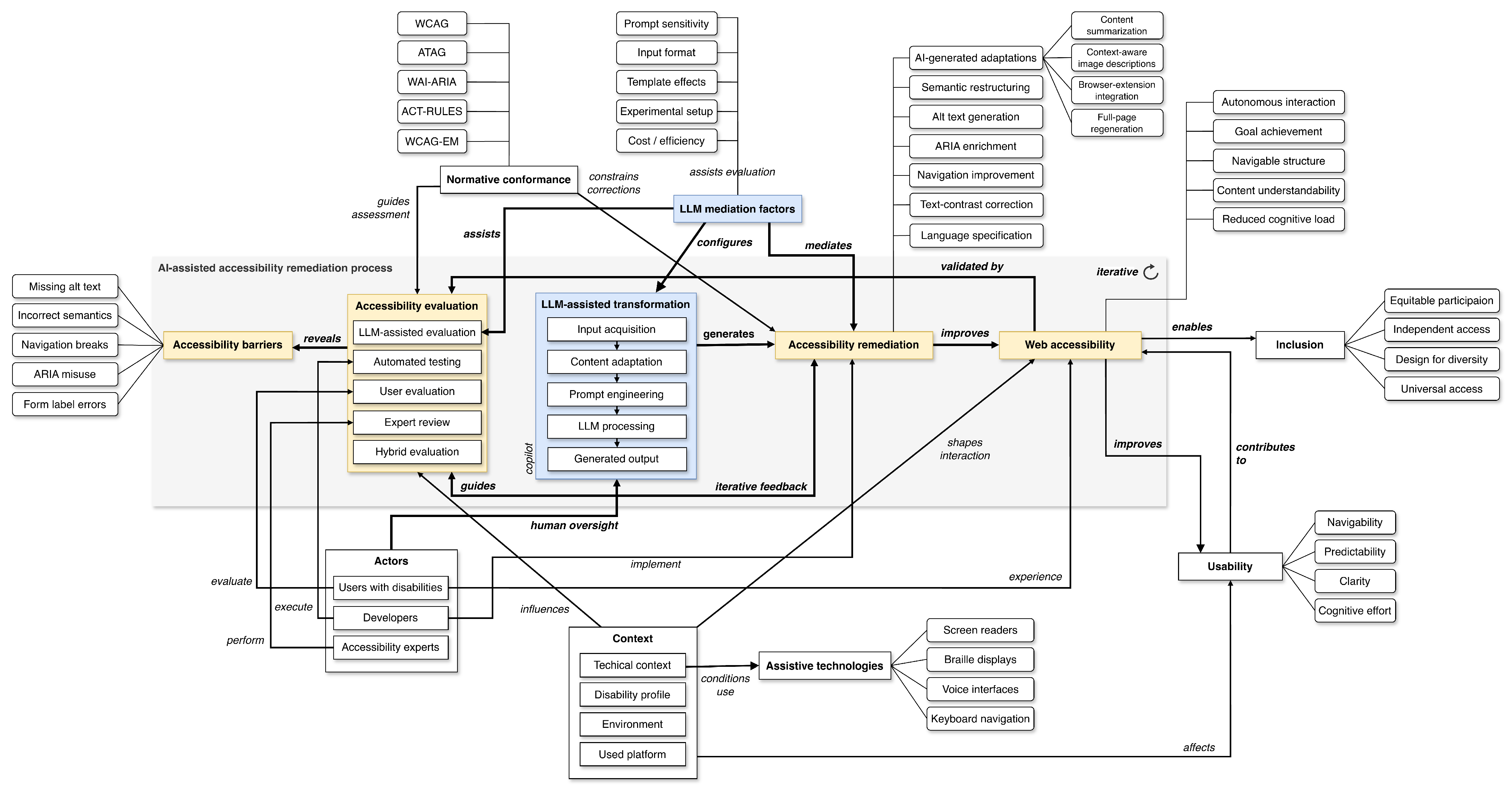
A first central relationship is that prompt engineering and input acquisition and representation influence both LLM-assisted accessibility evaluation and structured accessibility remediation. In other words, model behavior does not depend solely on the model itself, but on how the remediation task is framed and what representation of the web content is provided. This relationship adds methodological specificity to the more general Phase 2 claim that AI supports remediation.
A second relationship is that human oversight and validation constrain and refine both LLM-assisted accessibility evaluation and structured accessibility remediation. The empirical evidence consistently indicates that automated remediation and automated auditing are insufficient on their own. Expert review and user validation remain necessary to interpret results, identify residual barriers, and determine whether generated outputs are genuinely usable.
A third relationship is that structured accessibility remediation contributes to web accessibility through iterative validation. This relationship is not linear. Generated or corrected content must be re-evaluated, often using a combination of tools, expert assessment, and user-centered testing. In this sense, the process described by the revised conceptual theory is cyclical rather than one-directional.
A fourth relationship is that user-facing accessibility support complements remediation-oriented interventions. Whereas some AI systems aim to fix code or improve conformance, others provide direct support to users through content summarization, alternative descriptions, or navigational aids. These interventions do not replace remediation, but broaden the ways in which AI can improve accessibility outcomes.
Finally, the revised conceptual theory clarifies that artificial intelligence should not be modeled as an autonomous replacement for accessibility expertise. Rather, AI functions as a copilot or intervention mechanism whose usefulness depends on standards, pipeline design, evaluation practices, and human oversight. This relationship refines the preliminary conceptual theory by making the socio-technical nature of LLM-assisted accessibility remediation more explicit. Figure 7 presents the revised conceptual theory resulting from this phase.
Technologies 14 00287 i004aTechnologies 14 00287 i004b

6. Discussion

This section examines the proposed theory from a conceptual and empirical perspective. The discussion evaluates the theory in terms of its internal coherence, plausibility, scope, explanatory power, and practical usefulness. In addition, the theory is positioned with respect to existing research on accessibility evaluation and AI-assisted software development, highlighting both points of alignment and areas where it extends or challenges prior work. Finally, the threats to validity of the study are discussed to clarify the current boundaries of the theory and directions for future refinement.

6.1. Evaluation

The proposed theory is evaluated following the guidelines for theory construction in software engineering [30,32], considering its plausibility, internal coherence, scope, explanatory power, usefulness, and qualitative criteria.

6.1.1. Plausibility

The theory is grounded in multiple complementary sources of evidence, including qualitative data from blind users, accessibility standards, and empirical studies on LLM-based remediation. The resulting conceptualization aligns with well-documented challenges in web accessibility, particularly the persistent gap between normative conformance and actual usability [66,67]. Prior research has also shown that developers often lack sufficient understanding of assistive technologies and accessibility practices, reinforcing the need for supportive mechanisms such as LLM-assisted remediation [13].

6.1.2. Internal Coherence

The theory presents a consistent structure in which concepts and relationships are integrated into a unified process explanation. The interactions between accessibility barriers, evaluation, remediation, and outcomes are systematically connected through the notion of iterative refinement. The introduction of LLM-assisted transformation as a structured pipeline further strengthens coherence by providing a clear mechanism through which artificial intelligence influences remediation activities.
Moreover, the relationships between concepts are intentionally defined at an abstract level (e.g., influences, mediates, constrains), which is consistent with recommendations for early-stage theories [32].

6.1.3. Generality

The scope of the proposed theory is constrained to web accessibility remediation in contexts involving visual impairments and LLM-assisted interventions. Although some concepts (e.g., evaluation, remediation, and usability) may be transferable to other types of disabilities, such extensions are not empirically validated in this work and would require additional studies considering different interaction modalities, assistive technologies, and accessibility requirements.
The empirical grounding of the theory draws on two previously published empirical studies and their accessible data involving participants with visual impairments. While these studies alone do not support broad generalization, the theory was further developed through the integration of multiple sources of evidence, including a systematic literature review of 31 studies, a thematic synthesis of 23 studies, accessibility standards, and an ontological model study. Although these sources vary in design, scale, and objectives, their convergence provides supporting evidence for the general patterns captured by the theory.
This sequential triangulation strengthens the robustness of the resulting conceptual theory by combining user-centered insights with established knowledge and additional empirical observations, mitigating the limitations associated with small qualitative samples.
Nevertheless, the theory should not be interpreted as statistically generalizable in a strict sense. Instead, its generality lies in its conceptual abstraction and its grounding across multiple empirical contexts, consistent with the goals of theory building in software engineering [32].

6.1.4. Explanatory Power

The theory contributes by explaining accessibility not as a static property of web artifacts, but as an emergent outcome of interactions between actors, technologies, and evaluation processes. This perspective extends prior work that treats accessibility primarily as a function of compliance with standards [75], and aligns with the view that standards provide a necessary foundation but must be complemented by user-centred and participatory design approaches [84].
The theory also explains why similar levels of conformance may lead to different user experiences, by incorporating contextual factors, assistive technologies, and human validation processes. Furthermore, it accounts for variability in LLM-assisted remediation outcomes by introducing concepts such as prompt engineering, input transformation, and pipeline configuration.

6.1.5. Utility

The usefulness of the theory lies in its potential to guide both research and practice. For researchers, it provides a structured framework for studying AI-assisted accessibility, identifying key variables and relationships that can be empirically investigated. For practitioners, it offers a conceptual model that clarifies how LLMs can be integrated into accessibility workflows, highlighting the importance of prompt design, validation strategies, and human oversight. This is particularly relevant given that developers frequently report a lack of knowledge regarding accessibility principles and assistive technologies, as well as the absence of systematic guidance for implementing accessibility features in practice [13].
Additionally, the theory is useful for addressing recurrent accessibility problems observed in real-world web evaluations. Large-scale studies have shown that a high proportion of accessibility issues are concentrated in a small number of recurring error types, which persist across time despite advances in standards and tools [3,4]. As shown in Table 8, these include low contrast text, missing alternative text, missing form labels, and empty interactive elements.
The theory provides a structured way to address these categories through its core concepts. The accessibility evaluation concept enable the systematic detection of such barriers using both automated tools and expert-based methods. The LLM-assisted transformation concept—particularly the stages of input acquisition, prompt engineering, and LLM processing—supports the generation of remediation actions such as adding alternative text, restructuring form elements, or improving semantic markup. These transformations are further constrained and guided by the normative standards concept, ensuring that generated outputs align with established accessibility requirements. Finally, the human oversight and validation concept play a critical role in verifying the correctness and contextual adequacy of the generated solutions, especially for complex or ambiguous cases.
In this sense, the theory describes accessibility remediation as an iterative process in which recurrent, high-impact errors (Table 8) can be systematically identified, prioritized, and addressed through the coordinated interaction of evaluation methods, LLM-assisted generation, and human validation.

6.1.6. Qualitative Evaluation Criteria

Given the interpretive nature of theory construction, the proposed theory is assessed using qualitative evaluation criteria, including credibility, originality, resonance, and usefulness [58]. This perspective is consistent with prior theory-building work in software engineering [33].
Credibility is supported by the integration of multiple sources of evidence across the three phases of the study, including an inductive grounded theory derived from observations with blind users, a deductive integration with the prior literature and accessibility standards, and a subsequent empirical refinement based on LLM-supported studies. Throughout these phases, constant comparison was applied to align emerging categories with existing concepts and to ensure consistency across data sources.
Regarding originality, the theory contributes a novel conceptualization of accessibility remediation as a process explicitly mediated by AI, moving beyond prior work that primarily focuses on accessibility evaluation or socio-technical integration factors. It also introduces a structured view of LLM-assisted remediation as part of an iterative accessibility process.
In terms of resonance, the theory reflects well-documented accessibility challenges reported in prior studies, particularly the gap between normative conformance and user-perceived accessibility, as well as the increasing role of AI tools in software development practices. The empirical findings and thematic synthesis are consistent with these observations, suggesting that the theory captures relevant aspects of real-world accessibility work.
Finally, the usefulness of the theory lies in its ability to organize and explain the interaction between evaluation, remediation, and LLM-assisted transformation, providing a conceptual basis for future empirical studies and tool development. Nevertheless, further validation in diverse contexts is required to strengthen these qualitative properties and achieve a higher level of theoretical saturation.

6.2. Empirical Support with Existing Work

The theory is consistent with existing research while also extending it in important ways. It aligns with prior studies on accessibility evaluation methods [10] and user-centered accessibility assessment [68], as well as with emerging research on LLM applications in accessibility presented in Table 2.
The analyzed studies provide converging evidence for different parts of the proposed theory. Several works support the role of LLMs in accessibility evaluation, including automated auditing, validation of accessibility criteria, and detection of barriers (e.g., [23,24,47,52,79,80]). These studies reinforce the concept of LLM-assisted accessibility evaluation and its integration with traditional methods.
A second group of studies supports the concept of accessibility remediation, showing that LLMs can generate or correct accessible web content, including HTML transformations, ARIA enrichment, and full-page generation (e.g., [16,20,21,46,49,50,53,78]). These works provide evidence that remediation is not a single-step activity, but a process involving prompting, generation, and iterative validation.
Other studies support the role of user-facing accessibility support, including content summarization, navigation assistance, and generation of alternative descriptions (e.g., [25,26,27,48,51,54]). These findings extend the scope of the theory beyond code-level remediation toward interaction-level accessibility improvements.
Finally, several studies provide evidence for the importance of pipeline configuration and AI mediation factors, including prompt design, input representation, and tool integration (e.g., [6,34,44,81]). These studies support the claim that the effectiveness of LLM-assisted remediation depends on how the process is operationalized, rather than on the model alone.
Overall, the reviewed empirical studies support the main components and relationships of the proposed theory. While individual studies focus on specific aspects of the process, their combined evidence provides support for the theory as a whole, suggesting that LLM-assisted web accessibility remediation is best understood as a structured, iterative, and human-technical process.

6.3. Theoretical Positioning

In line with [32], the proposed theory is best characterized as a teleological process theory. It explains how actors pursue the goal of improving web accessibility through iterative cycles of evaluation and remediation, guided by normative standards and supported by AI-based tools.
Unlike variance theories, which model relationships between independent and dependent variables, or taxonomies, which classify concepts, this theory focuses on sequences of actions and interactions that lead to accessibility outcomes.
It is important to distinguish the proposed contribution from other common artifacts in software engineering, such as models, frameworks, architectures, or processing pipelines. While these artifacts typically prescribe structures, components, or workflows for implementing solutions, the proposed work is theoretical in nature and aims to explain the underlying mechanisms through which accessibility emerges under LLM mediation. In this sense, the theory does not define a specific implementation, but rather provides an explanatory lens to understand how evaluation, remediation, actors, and technologies interact within accessibility processes. This positioning clarifies both the nature of the contribution and its intended use within software engineering research.

6.4. Comparison to Prior Theories and Models

Existing theoretical models of web accessibility have primarily focused on the integration of accessibility practices within organizational and development contexts.
Early models such as the Web Accessibility Integration Model [85] conceptualize accessibility as the result of interactions between societal foundations, stakeholder perceptions, and web development processes.
Subsequent extensions, including the Expanded Web Accessibility Integration Model [86], incorporate additional dimensions such as market forces, attitudes toward disability, and advocacy, emphasizing that accessibility adoption is influenced by socio-organizational factors beyond technical implementation.
Similarly, the E-government Accessibility Development Model [87] contextualizes accessibility within public-sector systems by introducing institutional knowledge and governance structures.
A recent systematic literature review [88] confirms that these models largely conceptualize accessibility as a multi-level integration problem shaped by external, organizational, and technological factors. However, they do not explicitly model the operational process through which accessibility is evaluated, remediated, and iteratively improved in practice. The theory proposed in this work extends these models in two key ways:
  • First, it shifts the focus from static integration factors to a dynamic remediation process, explicitly modeling the interaction between evaluation methods, remediation actions, and accessibility outcomes.
  • Second, it incorporates artificial intelligence as an active intervention mechanism within this process, capturing how LLM-based techniques transform accessibility workflows.
In this sense, the proposed theory complements prior integration models by providing a process-oriented and operational perspective on how accessibility is achieved and improved over time.
Technologies 14 00287 i005aTechnologies 14 00287 i005b

6.5. Threats to Validity

As with any conceptual theory grounded in empirical and interpretive processes and developed through a mixed-methods research design [36], several limitations and threats to validity must be acknowledged.

6.5.1. Internal Validity

The initial phase relied on qualitative data derived from a limited number of observations reported in prior empirical work involving blind users and accessibility experts. In addition, Phase 3 involved the interpretive analysis and mapping of empirical findings from LLM-based remediation studies onto the emerging conceptual structure.
Although the analysis followed a constructivist grounded theory approach with constant comparison, the identification of codes, categories, and relationships across phases is inherently interpretive. While care was taken to ensure consistency in coding, conceptual abstraction, and cross-phase integration, alternative interpretations of the data remain possible.

6.5.2. External Validity and Scope

A potential limitation of this study lies in the relatively small number of participants involved in the first phase. Therefore, the findings derived from Phase 1 should not be interpreted as statistically representative of the broader population of users with visual impairments, but rather as analytically grounded insights aimed at theory construction.
While this may limit the diversity of observed experiences, it is consistent with the exploratory and theory-building nature of constructivist grounded theory, which prioritizes conceptual depth over statistical representativeness. The analysis reached theoretical saturation, as no substantially new codes or categories emerged in the later stages of coding.
To mitigate this limitation, this work adopts a multi-phase design in which the initial findings are triangulated with evidence from the literature, accessibility standards, and additional empirical studies used as secondary data sources. This integration enhances the credibility, transferability, and explanatory power of the proposed theory.
The scope of the proposed theory is constrained to web accessibility remediation in contexts involving visual impairments and LLM-assisted interventions. Although some concepts (e.g., context, evaluation, remediation, and usability) may be transferable to other types of disabilities or domains, the theory has not yet been extensively examined across different contexts. Further empirical research is needed to assess and refine the theory in relation to other types of disabilities.
Furthermore, the empirical grounding is primarily based on specific types of web content and interaction scenarios, which may limit its broader applicability across diverse platforms and use contexts.

6.5.3. Construct Validity

The conceptualization of key elements such as accessibility, usability, and LLM-assisted remediation is based on the integration of grounded data, existing standards, and the prior literature. However, these constructs may vary depending on interpretation, measurement approaches, or evolving standards. In particular, the operationalization of accessibility outcomes through both normative conformance and user experience remains an open area for further refinement.
Overall, the proposed theory should be understood as a preliminary but structured explanation of LLM-assisted web accessibility remediation, which can be refined, extended, and empirically tested in future work.

6.5.4. Limitations of LLM-Based Evidence

The empirical refinement in Phase 3 relies on studies involving LLM-based systems, which are subject to known limitations such as non-deterministic outputs, hallucinations, sensitivity to prompting, and variability across models and configurations. These characteristics may affect the stability and reproducibility of LLM-assisted remediation processes, and consequently influence the observed relationships in the theory.

6.5.5. Researcher Bias

As the theory was developed through iterative qualitative analysis and conceptual integration, there is a risk of researcher bias in the selection, interpretation, and abstraction of evidence, which may influence how concepts and relationships were identified and structured. To mitigate this risk, several strategies were employed:
  • First, the inductive findings from Phase 1 were systematically compared with the existing literature and accessibility standards during Phase 2, providing a form of triangulation between empirical data and prior knowledge.
  • Second, the theory was further refined through additional empirical evidence in Phase 3, following an elaborative coding approach that mapped new observations onto the existing conceptual structure.
  • Third, constant comparison was applied across data sources to reduce inconsistencies and reinforce conceptual coherence.
Despite these measures, theory construction inherently involves interpretive and creative decisions that cannot be fully formalized. As noted in prior work on theory building [32], there is always an element of abstraction and conceptual judgment that depends on the researcher’s perspective. Therefore, the resulting theory should be understood as one plausible and systematically derived interpretation of the phenomenon, open to further refinement and alternative conceptualizations.

7. Conclusions and Future Work

This paper presented a conceptual theory of LLM-assisted web accessibility remediation. The theory is grounded in qualitative observations with blind users reported in prior empirical studies, integrated with the existing literature and accessibility standards, and refined through secondary analysis of empirical studies involving LLM-based remediation approaches. It explains how accessibility emerges from the interaction between evaluation activities, remediation actions, contextual factors, and LLM-assisted transformations within web development processes.
The proposed theory can be characterized as a teleological process theory [32], where actors iteratively pursue the goal of improving accessibility through cycles of evaluation, transformation, and validation. In this process, accessibility is not a static property but an evolving outcome shaped by repeated interactions between developers, tools, and users, with AI acting as a supporting mechanism within these cycles. Beyond its theoretical contribution, the theory has implications for research, education, and professional practice.
Researchers. The proposed theory provides a structured conceptual foundation for studying accessibility as a dynamic, socio-technical process rather than a static property. It offers a set of interrelated concepts and relationships that can guide the design of empirical studies, particularly in identifying variables, structuring experimental workflows, and interpreting LLM-assisted remediation outcomes. For example, concepts such as evaluation, contextual factors, and LLM-assisted transformation can be operationalized to define experimental conditions, measurement strategies, and evaluation pipelines. Furthermore, the theory enables the systematic comparison of different remediation approaches by situating them within a common process-oriented framework. This opens opportunities for designing controlled experiments, benchmarking AI-assisted techniques, and reinterpreting existing empirical results under a unified conceptual lens. Current research on web accessibility remediation, such as [6,34], can build upon this theory by operationalizing its concepts and refining its relationships through additional empirical evidence.
Education. In software engineering education, the theory supports the integration of accessibility as a continuous process rather than an isolated compliance task. Prior work highlights the importance of teaching accessibility early [89] and adopting an accessibility-first mindset [90], aligned with principles of universal usability [91]. The theory provides a conceptual structure to help students understand accessibility as an iterative, socio-technical process supported by AI.
Practitioners. For practitioners, the theory helps explain persistent gaps between accessibility standards and real-world implementation. Developers often face challenges in interpreting and applying guidelines such as WCAG [92], and accessibility issues remain common in software projects [83]. While LLM-based tools offer new opportunities to support remediation [53], the theory emphasizes that their effectiveness depends on their integration within structured evaluation and remediation processes.
A central insight of the theory is that accessibility cannot be achieved through automation alone. Consistent with prior research, effective accessibility evaluation requires a combination of automated tools, expert-based inspection, and direct participation of users with disabilities [10,67,68]. User-centered methods remain essential for identifying real barriers and validating remediation outcomes [59]. In this context, AI should be understood as augmenting, rather than replacing, human expertise.
Future work should focus on extending and further examining the theory across broader contexts. In particular, future studies may incorporate controlled experimental designs and quantitative benchmarking to systematically compare LLM-assisted remediation strategies across different models, prompting configurations, and evaluation pipelines.
In addition, expanding the empirical grounding of the theory through larger and more diverse participant samples—including users with varying levels of expertise, different assistive technologies, and diverse contextual conditions—would enable further refinement and validation of the proposed relationships.
Such extensions would also support the exploration of accessibility remediation processes across different types of disabilities and interaction modalities. Furthermore, longitudinal and real-world development studies could provide further evidence of how LLM-assisted remediation evolves over time in practice.
Finally, the theory can serve as a foundation for the development of tools, educational approaches, and methodological guidelines that operationalize LLM-assisted accessibility remediation in practice.

Author Contributions

Conceptualization, G.V.-A.; methodology, G.V.-A.; software, G.V.-A.; validation, G.V.-A., R.V.-A., M.F.M.-R. and J.R.R.-C.; formal analysis, G.V.-A.; investigation, G.V.-A.; resources, G.V.-A. and J.R.R.-C.; data curation, G.V.-A.; writing—original draft preparation, G.V.-A.; writing—review and editing, G.V.-A., R.V.-A., M.F.M.-R. and J.R.R.-C.; visualization, G.V.-A.; supervision, R.V.-A. and M.F.M.-R.; project administration, G.V.-A., R.V.-A. and M.F.M.-R.; funding acquisition, G.V.-A., R.V.-A., M.F.M.-R. and J.R.R.-C. All authors have read and agreed to the published version of the manuscript.

Funding

This work was supported by the Secretaría de Ciencia, Humanidades, Tecnología e Innovación (SECIHTI) under scholarship No. 1351657. This research was funded by Instituto Politécnico Nacional with grant number SIP-20260353.

Institutional Review Board Statement

Not applicable. This study is based on secondary analysis of previously published empirical studies and literature; no new data were collected from human participants for the present manuscript; therefore, ethical review and approval were not required.

Informed Consent Statement

Not applicable to the present study. No new human-subject data were collected. Informed consent procedures for the original empirical studies are reported in the corresponding primary publications.

Data Availability Statement

The dataset supporting the findings of this study has been deposited in the publicly accessible Mendeley Data repository at [62].

Conflicts of Interest

The authors declare no conflicts of interest.

Abbreviations

The following abbreviations are used in this manuscript:
LLMLarge Language Model
AIArtificial Intelligence
W3CWorld Wide Web Consortium
WCAGWeb Content Accessibility Guidelines
WAIWeb Accessibility Initiative
ARIAAccessible Rich Internet Applications
RQResearch Question
BWBarrier Walkthrough
SEPISección de Estudios de Posgrado e Investigación
UPIITAUnidad Profesional Interdisciplinaria en Ingeniería y Tecnologías Avanzadas

References

  1. Henry, S.L. Introduction to Web Accessibility. Available online: https://www.w3.org/WAI/fundamentals/accessibility-intro/ (accessed on 7 March 2026).
  2. Henry, S.L. WCAG 2 Overview. Available online: https://www.w3.org/WAI/standards-guidelines/wcag/ (accessed on 7 March 2026).
  3. WebAIM. The WebAIM Million. Available online: https://webaim.org/projects/million/ (accessed on 7 March 2026).
  4. Martins, B.; Duarte, C. Large-scale study of web accessibility metrics. Univers. Access Inf. Soc. 2024, 23, 411–434. [Google Scholar] [CrossRef] [Scilit]
  5. WebAIM. Screen Reader User Survey #10 Results. Available online: https://webaim.org/projects/screenreadersurvey10/ (accessed on 7 March 2026).
  6. Vera-Amaro, G.; Rojano-Cáceres, J.R. Accessible Web Content Generation Using LLMs: An Empirical Study on Prompting Strategies and Template-Guided Remediation. IEEE Lat. Am. Trans. 2025, 23, 1230–1239. [Google Scholar] [CrossRef] [Scilit]
  7. Alsaeedi, A. Comparing Web Accessibility Evaluation Tools and Evaluating the Accessibility of Webpages: Proposed Frameworks. Information 2020, 11, 40. [Google Scholar] [CrossRef] [Scilit]
  8. Fischer, T.; Lundell, B.; Gamalielsson, J. Coverage of web accessibility guidelines provided by automated checking tools. Univers. Access Inf. Soc. 2025, 24, 3615–3637. [Google Scholar] [CrossRef] [Scilit]
  9. Ismailova, R.; Inal, Y. Comparison of Online Accessibility Evaluation Tools: An Analysis of Tool Effectiveness. IEEE Access 2022, 10, 58233–58239. [Google Scholar] [CrossRef] [Scilit]
  10. Luján-Mora, S.; Masri, F. Evaluation of Web Accessibility: A Combined Method. In Information Systems Research and Exploring Social Artifacts; IGI Global: Hershey, PA, USA, 2013; pp. 314–331. [Google Scholar] [CrossRef] [Scilit]
  11. Acosta-Vargas, P.; Rybarczyk, Y.; Perez, J.; Gonzalez, M.; Jimenes, K.; Leconte, L.; Esparza, D. Towards Web Accessibility in Telerehabilitation Platforms. In Proceedings of the 2018 IEEE Third Ecuador Technical Chapters Meeting (ETCM), Cuenca, Ecuador, 15–19 October 2018; IEEE: New York, NY, USA, 2018; pp. 1–6. [Google Scholar] [CrossRef] [Scilit]
  12. Vera-Amaro, G.; Rojano-Cáceres, J.R. Accessibility Challenges for Blind Users Authoring in Content Management Systems: An Empirical Study. IEEE Rev. Iberoam. de Tecnol. del Aprendiz. 2026, 21, 268–278. [Google Scholar] [CrossRef] [Scilit]
  13. Alghamdi, A.M.; Aljedaani, W.; Jalali, H.; Ludi, S.; Eler, M.M. Understanding developer challenges and trends in web accessibility: A stack overflow analysis. Univers. Access Inf. Soc. 2025, 24, 1701–1717. [Google Scholar] [CrossRef] [Scilit]
  14. Lazar, J. A Born-Accessible Model of Software and Digital Content Development. In Proceedings of the INTERACT Conference 2023 Keynote, York, UK, 28 August–1 September 2023. [Google Scholar]
  15. Zhao, W.X.; Zhou, K.; Li, J.; Tang, T.; Wang, X.; Hou, Y.; Min, Y.; Zhang, B.; Zhang, J.; Dong, Z.; et al. A Survey of Large Language Models. arXiv 2023, arXiv:2303.18223. [Google Scholar]
  16. Aljedaani, W.; Habib, A.; Aljohani, A.; Eler, M.; Feng, Y. Does ChatGPT Generate Accessible Code? Investigating Accessibility Challenges in LLM-Generated Source Code. In Proceedings of the 21st International Web for All Conference, Singapore, 13–14 May 2024; Association for Computing Machinery: New York, NY, USA, 2024; pp. 165–176. [Google Scholar] [CrossRef] [Scilit]
  17. Hemmat, A.; Sharbaf, M.; Kolahdouz-Rahimi, S.; Lano, K.; Tehrani, S.Y. Research directions for using LLM in software requirement engineering: A systematic review. Front. Comput. Sci. 2025, 7, 1519437. [Google Scholar] [CrossRef] [Scilit]
  18. Husein, R.A.; Aburajouh, H.; Catal, C. Large language models for code completion: A systematic literature review. Comput. Stand. Interfaces 2025, 92, 103917. [Google Scholar] [CrossRef] [Scilit]
  19. Li, Y.; Shi, J.; Zhang, Z. An Approach for Rapid Source Code Development Based on ChatGPT and Prompt Engineering. IEEE Access 2024, 12, 53074–53087. [Google Scholar] [CrossRef] [Scilit]
  20. Othman, A.; Dhouib, A.; Nasser Al Jabor, A. Fostering websites accessibility: A case study on the use of the Large Language Models ChatGPT for automatic remediation. In Proceedings of the 16th International Conference on PErvasive Technologies Related to Assistive Environments (PETRA ’23); Association for Computing Machinery: New York, NY, USA, 2023; pp. 707–713. [Google Scholar] [CrossRef] [Scilit]
  21. Delnevo, G.; Andruccioli, M.; Mirri, S. On the Interaction with Large Language Models for Web Accessibility: Implications and Challenges. In Proceedings of the 2024 IEEE 21st Consumer Communications & Networking Conference (CCNC), Las Vegas, NV, USA, 6–9 January 2024; IEEE: New York, NY, USA, 2024; pp. 1–6. [Google Scholar] [CrossRef] [Scilit]
  22. Suh, H.; Tafreshipour, M.; Malek, S.; Ahmed, I. Human or LLM? A Comparative Study on Accessible Code Generation Capability. arXiv 2025, arXiv:2503.15885. [Google Scholar] [CrossRef] [Scilit]
  23. López-Gil, J.M.; Pereira, J. Turning manual web accessibility success criteria into automatic: An LLM-based approach. Univers. Access Inf. Soc. 2025, 24, 837–852. [Google Scholar] [CrossRef] [Scilit]
  24. Duarte, C.; Costa, M.; Seixas Pereira, L.; Guerreiro, J. Expanding Automated Accessibility Evaluations: Leveraging Large Language Models for Heading-Related Barriers. In Proceedings of the Companion Proceedings of the 30th International Conference on Intelligent User Interfaces, Cagliari, Italy, 24–27 March 2025; ACM: New York, NY, USA, 2025; pp. 39–42. [Google Scholar] [CrossRef] [Scilit]
  25. Pedemonte, G.; Leotta, M.; Ribaudo, M. Improving Web Accessibility With an LLM-Based Tool: A Preliminary Evaluation for STEM Images. IEEE Access 2025, 13, 107566–107582. [Google Scholar] [CrossRef] [Scilit]
  26. Srivastava, D.; Afsal, C.P.; Kuppusamy, K.S. NAVIGATE: LLM-Based Web Content Summarization to Improve Accessibility for Persons with Visual Impairments. In Proceedings of the Conference on Intelligent Human Centered Computing; Springer: Singapore, 2026; pp. 36–46. [Google Scholar] [CrossRef] [Scilit]
  27. Calì, E.; Fulcini, T.; Coppola, R.; Laudadio, L.; Torchiano, M. A Prototype VS Code Extension to Improve Web Accessible Development. arXiv 2025, arXiv:2503.09673. [Google Scholar] [CrossRef] [Scilit]
  28. Gregor, S. The Nature of Theory in Information Systems. MIS Q. 2006, 30, 611–642. [Google Scholar] [CrossRef] [Scilit]
  29. Baxter, G.; Sommerville, I. Socio-technical systems: From design methods to systems engineering. Interact. Comput. 2011, 23, 4–17. [Google Scholar] [CrossRef] [Scilit]
  30. Sjøberg, D.I.K.; Dybå, T.; Anda, B.C.D.; Hannay, J.E. Building Theories in Software Engineering. In Guide to Advanced Empirical Software Engineering; Springer: London, UK, 2008; pp. 312–336. [Google Scholar] [CrossRef] [Scilit]
  31. Stol, K.J.; Fitzgerald, B. Uncovering theories in software engineering. In Proceedings of the 2013 2nd SEMAT Workshop on a General Theory of Software Engineering (GTSE), San Francisco, CA, USA, 26–26 May 2013; IEEE: New York, NY, USA, 2013; pp. 5–14. [Google Scholar] [CrossRef] [Scilit]
  32. Ralph, P. Toward Methodological Guidelines for Process Theories and Taxonomies in Software Engineering. IEEE Trans. Softw. Eng. 2019, 45, 712–735. [Google Scholar] [CrossRef] [Scilit]
  33. Baltes, S.; Diehl, S. Towards a theory of software development expertise. In Proceedings of the 2018 26th ACM Joint Meeting on European Software Engineering Conference and Symposium on the Foundations of Software Engineering; ACM: New York, NY, USA, 2018; pp. 187–200. [Google Scholar] [CrossRef] [Scilit]
  34. Vera-Amaro, G.; Rojano-Cáceres, J.R. Towards a Conceptual Model for AI-Driven Web Accessibility Remediation: A Prompt-Based Approach. In Proceedings of the 2025 13th International Conference in Software Engineering Research and Innovation (CONISOFT), La Paz, Mexico, 27–31 October 2025; IEEE: New York, NY, USA, 2025; pp. 288–297. [Google Scholar] [CrossRef] [Scilit]
  35. Di Penta, M.; Tamburri, D.A. Combining Quantitative and Qualitative Studies in Empirical Software Engineering Research. In Proceedings of the 2017 IEEE/ACM 39th International Conference on Software Engineering Companion (ICSE-C), Buenos Aires, Argentina, 20–28 May 2017; IEEE: New York, NY, USA, 2017; pp. 499–500. [Google Scholar] [CrossRef] [Scilit]
  36. Johnson, R.B.; Onwuegbuzie, A.J.; Turner, L.A. Toward a Definition of Mixed Methods Research. J. Mix. Methods Res. 2007, 1, 112–133. [Google Scholar] [CrossRef] [Scilit]
  37. Vera-Amaro, G.; Rojano-Cáceres, J.R. Towards accessible website design through artificial intelligence: A systematic literature review. Inf. Softw. Technol. 2025, 186, 107821. [Google Scholar] [CrossRef] [Scilit]
  38. Campbell, A.; Adams, C.; Montgomery, R.B. All WCAG 2.2 Understanding Docs. Available online: https://www.w3.org/WAI/WCAG22/Understanding/ (accessed on 7 March 2026).
  39. Nurthen, J.; Cooper, M.; Henry, S.L. WAI-ARIA Overview. Available online: https://www.w3.org/WAI/standards-guidelines/aria/ (accessed on 7 March 2026).
  40. Abou-Zahra, S.; Henry, S.L. Accessibility Conformance Testing (ACT) Overview. Available online: https://www.w3.org/WAI/standards-guidelines/act/ (accessed on 7 March 2026).
  41. Henry, S.L. Authoring Tool Accessibility Guidelines (ATAG) Overview. Available online: https://www.w3.org/WAI/standards-guidelines/atag/ (accessed on 7 March 2026).
  42. Henry, S.L.; Abou-Zahra, S. WCAG-EM Overview: Website Accessibility Conformance Evaluation Methodology. Available online: https://www.w3.org/WAI/test-evaluate/conformance/wcag-em/ (accessed on 7 March 2026).
  43. Bendaly Hlaoui, Y.; Zouhaier, L.; Ben Ayed, L. Model driven approach for adapting user interfaces to the context of accessibility: Case of visually impaired users. J. Multimodal User Interfaces 2019, 13, 293–320. [Google Scholar] [CrossRef] [Scilit]
  44. Fathallah, N.; Hernández, D.; Staab, S. AccessGuru: Leveraging LLMs to Detect and Correct Web Accessibility Violations in HTML Code. In Proceedings of the 27th International ACM SIGACCESS Conference on Computers and Accessibility; ACM: New York, NY, USA, 2025; pp. 1–22. [Google Scholar] [CrossRef] [Scilit]
  45. Abu Doush, I.; Kassem, R. Can generative AI create accessible web code? A benchmark analysis of AI-generated HTML against accessibility standards. Univers. Access Inf. Soc. 2025, 24, 3483–3506. [Google Scholar] [CrossRef] [Scilit]
  46. Lin, W.; Adewale, B.; Li, M.; Nasir, M.; Sultana, A.; Khokhar, R.H.; Zhang, Y. Dynamic Web Page Modification for Accessibility Using AI and Large Language Models. In Computer and Information Science and Engineering; Springer: Cham, Switzerland, 2025; Volume 1192, pp. 33–46. [Google Scholar] [CrossRef] [Scilit]
  47. Andruccioli, M.; Bassi, B.; Delnevo, G.; Salomoni, P. Leveraging Large Language Models for Sustainable and Inclusive Web Accessibility. Big Data Cogn. Comput. 2025, 9, 247. [Google Scholar] [CrossRef] [Scilit]
  48. Moterani, G.; Lin, W.R. Breaking the Linear Barrier: A Multi-Modal LLM-Based System for Navigating Complex Web Content. In Proceedings of the 2025 IEEE 49th Annual Computers, Software, and Applications Conference (COMPSAC), Toronto, ON, Canada, 8–11 July 2025; IEEE: New York, NY, USA, 2025; pp. 2066–2075. [Google Scholar] [CrossRef] [Scilit]
  49. Doush, I.A.; Kassem, R. Evaluating AI-Generated Web Code for Accessibility Compliance: A Metric-Driven Approach. In Proceedings of the 11th International Conference on Software Development and Technologies for Enhancing Accessibility and Fighting Info-Exclusion; ACM: New York, NY, USA, 2024; pp. 338–344. [Google Scholar] [CrossRef] [Scilit]
  50. Panchanadikar, R.; Bhosekar, M.S.; Dixon, E. Can Generative AI Create Accessible Websites? In Proceedings of the 27th International ACM SIGACCESS Conference on Computers and Accessibility; ACM: New York, NY, USA, 2025; pp. 1–6. [Google Scholar] [CrossRef] [Scilit]
  51. Huynh, G.K.; Lin, W. SmartCaption AI—Enhancing Web Accessibility with Context-Aware Image Descriptions Using Large Language Models. In Proceedings of the 2024 International Conference on Computer and Applications (ICCA), Cairo, Egypt, 17–19 December 2024; IEEE: New York, NY, USA, 2024; pp. 1–7. [Google Scholar] [CrossRef] [Scilit]
  52. Paternò, F.; Vinci, M.; Manca, M.; Iannuzzi, N. How an LLM Can Improve Automatic Web Accessibility Validation ? In Proceedings of the 16th Biannual Conference of the Italian SIGCHI Chapter; ACM: New York, NY, USA, 2025; pp. 1–8. [Google Scholar] [CrossRef] [Scilit]
  53. Aljedaani, W.; Eler, M.M.; Parthasarathy, P.D. Enhancing Accessibility in Software Engineering Projects with Large Language Models (LLMs). In Proceedings of the 56th ACM Technical Symposium on Computer Science Education V. 1; ACM: New York, NY, USA, 2025; Volume 1, pp. 25–31. [Google Scholar] [CrossRef] [Scilit]
  54. Afsal, C.P.; Kuppusamy, K.S. WEBSumm: A Chrome Extension for Summarizing Web Content Using LLMs for Visually Impaired Users. SN Comput. Sci. 2025, 6, 171. [Google Scholar] [CrossRef] [Scilit]
  55. Glaser, B.G.; Strauss, A.L. The Discovery of Grounded Theory; Routledge: London, UK, 1999; pp. 1–271. [Google Scholar] [CrossRef] [Scilit]
  56. Stol, K.J.; Ralph, P.; Fitzgerald, B. Grounded theory in software engineering research. In Proceedings of the 38th International Conference on Software Engineering; ACM: New York, NY, USA, 2016; pp. 120–131. [Google Scholar] [CrossRef] [Scilit]
  57. Corbin, J.M.; Strauss, A.L. Basics of Qualitative Research: Techniques and Procedures for Developing Grounded Theory, 4th ed.; Sage Publications: Thousand Oaks, CA, USA, 2015; p. 431. [Google Scholar]
  58. Charmaz, K. Constructing Grounded Theory: A Practical Guide Through Qualitative Analysis; Sage Publications: Thousand Oaks, CA, USA, 2006; p. 223. [Google Scholar]
  59. Ferreira, S.B.L.; da Silveira, D.S.; Capra, E.P.; Ferreira, A.O. Protocols for Evaluation of Site Accessibility with the Participation of Blind Users. Procedia Comput. Sci. 2012, 14, 47–55. [Google Scholar] [CrossRef] [Scilit]
  60. Nielsen, J. Why You Only Need to Test with 5 Users. Nielsen Norman Group. 2000. Available online: https://www.nngroup.com/articles/why-you-only-need-to-test-with-5-users/ (accessed on 2 May 2026).
  61. Vera-Amaro, G.; Rojano-Cáceres, J.R. Dataset for Accessibility Challenges for Blind Users Authoring in Content Management Systems: An Empirical Study. Mendeley Data. 2026. Available online: https://data.mendeley.com/datasets/wsfmmw6294/3 (accessed on 2 May 2026).
  62. Vera-Amaro, G.; Vera-Amaro, R.; Mata-Rivera, F.; Rojano-Cáceres, J.R. Supplementary Material for Artificial Intelligence in Web Accessibility: Towards a Theory of AI-Assisted Remediation for Visual Disabilities. Mendeley Data. 2026. Available online: https://data.mendeley.com/datasets/w5pz4pzvrb/1 (accessed on 2 May 2026).
  63. Vera-Amaro, G.; Rojano-Cáceres, J.R. Dataset for Paper Towards Accessible Website Design through Artificial Intelligence: A Systematic Literature Review. Mendeley Data. 2025. Available online: https://data.mendeley.com/datasets/brgfhwndz6/2 (accessed on 2 May 2026).
  64. Abou-Zahra, S. How People with Disabilities Use the Web. W3C Web Accessibility Initiative (WAI), World Wide Web Consortium (W3C). 2024. Available online: https://www.w3.org/WAI/people-use-web/ (accessed on 2 May 2026).
  65. Henry, S.L.; Abou-Zahra, S.; White, K. Accessibility, Usability, and Inclusion. W3C Web Accessibility Initiative (WAI), World Wide Web Consortium (W3C). 2016. Available online: https://www.w3.org/WAI/fundamentals/accessibility-usability-inclusion/ (accessed on 2 May 2026).
  66. Petrie, H.; Kheir, O. The Relationship between Accessibility and Usability of Websites. In Proceedings of the SIGCHI Conference on Human Factors in Computing Systems (CHI ’07); Association for Computing Machinery: New York, NY, USA, 2007; pp. 397–406. [Google Scholar] [CrossRef] [Scilit]
  67. Brajnik, G. Beyond Conformance: The Role of Accessibility Evaluation Methods. In Proceedings of the Web Information Systems Engineering—WISE 2008 Workshops; Springer: Berlin/Heidelberg, Germany, 2008; Volume 5176, pp. 63–80. [Google Scholar] [CrossRef] [Scilit]
  68. Brajnik, G. Web Accessibility Testing: When the Method Is the Culprit. In Proceedings of the Lecture Notes in Computer Science (Including Subseries Lecture Notes in Artificial Intelligence and Lecture Notes in Bioinformatics); Springer: Berlin/Heidelberg, Germany, 2006; Volume 4061, pp. 156–163. [Google Scholar] [CrossRef] [Scilit]
  69. JAWS. JAWS®—Freedom Scientific. Freedom Scientific. 2024. Available online: https://www.freedomscientific.com/products/software/jaws/ (accessed on 2 May 2026).
  70. NVDA. About NVDA. NV Access. 2024. Available online: https://www.nvaccess.org/about-nvda/ (accessed on 2 May 2026).
  71. Apple. Accessibility—Vision—Apple; Apple Inc.: Cupertino, CA, USA, 2024; Available online: https://www.apple.com/accessibility/vision/ (accessed on 2 May 2026).
  72. Microsoft. Complete Guide to Narrator; Microsoft Corporation: Redmond, WA, USA, 2024; Available online: https://support.microsoft.com/en-us/windows/complete-guide-to-narrator-e4397a0d-ef4f-b386-d8ae-c172f109bdb1 (accessed on 2 May 2026).
  73. Russell, S.; Norvig, P. Artificial Intelligence: A Modern Approach, 4th ed.; Pearson: Hoboken, NJ, USA, 2020. [Google Scholar]
  74. Acosta-Vargas, P.; Acosta-Vargas, G.; Salvador-Acosta, B.; Jadán-Guerrero, J. Addressing Web Accessibility Challenges with Generative Artificial Intelligence Tools for Inclusive Education. In Proceedings of the 2024 Tenth International Conference on eDemocracy & eGovernment (ICEDEG), Lucerne, Switzerland, 24–26 June 2024; IEEE: New York, NY, USA, 2024; pp. 1–7. [Google Scholar] [CrossRef] [Scilit]
  75. Power, C.; Freire, A.P.; Petrie, H.; Swallow, D. Guidelines are Only Half of the Story: Accessibility Problems Encountered by Blind Users on the Web. In Proceedings of the SIGCHI Conference on Human Factors in Computing Systems (CHI ’12); Association for Computing Machinery: New York, NY, USA, 2012; pp. 433–442. [Google Scholar] [CrossRef] [Scilit]
  76. Vera-Amaro, G.; Rojano-Cáceres, J.R. Dataset for Accessible Web Content Generation Using LLMs: An Empirical Study on Prompting Strategies and Template-Guided Remediation. Mendeley Data. 2025. Available online: https://data.mendeley.com/datasets/zybws98spf/2 (accessed on 2 May 2026).
  77. Cruzes, D.S.; Dyba, T. Recommended Steps for Thematic Synthesis in Software Engineering. In Proceedings of the 2011 International Symposium on Empirical Software Engineering and Measurement, Banff, AB, Canada, 22–23 September 2011; IEEE: New York, NY, USA, 2011; pp. 275–284. [Google Scholar] [CrossRef] [Scilit]
  78. Ahmed, A.; Fresco, M.; Forsberg, F.; Grotli, H. From Code to Compliance: Assessing ChatGPT’s Utility in Designing an Accessible Webpage—A Case Study. arXiv 2025, arXiv:2501.03572. [Google Scholar] [CrossRef] [Scilit]
  79. Bassi, B.; Delnevo, G.; Franco, M.; Gaggi, O.; Gatto, S.; Mirri, S.; Olaiya, K. An Assessment of LLM-Based Auditing and Validation for Web Accessibility. In Proceedings of the 2025 International Conference on Information Technology for Social Good; ACM: New York, NY, USA, 2025; pp. 297–305. [Google Scholar] [CrossRef] [Scilit]
  80. Gu, M.; Wang, Z.; Lai, S.; Gao, Z.; Zhou, S.; Bu, J. Towards Scalable Web Accessibility Audit with MLLMs as Copilots. In Proceedings of the AAAI Conference on Artificial Intelligence (AAAI 2026); Association for the Advancement of Artificial Intelligence: Washington, DC, USA, 2026; pp. 38515–38523. Available online: https://arxiv.org/abs/2511.03471 (accessed on 2 May 2026).
  81. Huang, C.; Ma, A.; Vyasamudri, S.; Puype, E.; Kamal, S.; Garcia, J.B.; Cheema, S.; Lutz, M. ACCESS: Prompt Engineering for Automated Web Accessibility Violation Corrections. arXiv 2024, arXiv:2401.16450. [Google Scholar] [CrossRef] [Scilit]
  82. Saldana, J. The Coding Manual for Qualitative Researchers; SAGE Publications Ltd.: London, UK, 2025. [Google Scholar] [CrossRef] [Scilit]
  83. Aljedaani, W.; Parthasarathy, P.D.; Joshi, S.; Eler, M.M. Accessibility Insights from Student’s Software Engineering Projects. In Proceedings of the 56th ACM Technical Symposium on Computer Science Education V. 1; ACM: New York, NY, USA, 2025; Volume 1, pp. 39–45. [Google Scholar] [CrossRef] [Scilit]
  84. Vollenwyder, B.; Petralito, S.; Iten, G.H.; Brühlmann, F.; Opwis, K.; Mekler, E.D. How compliance with web accessibility standards shapes the experiences of users with and without disabilities. Int. J. Hum.-Comput. Stud. 2023, 170, 102956. [Google Scholar] [CrossRef] [Scilit]
  85. Lazar, J.; Dudley-Sponaugle, A.; Greenidge, K.D. Improving web accessibility: A study of webmaster perceptions. Comput. Hum. Behav. 2004, 20, 269–288. [Google Scholar] [CrossRef] [Scilit]
  86. Farrelly, G. Practitioner barriers to diffusion and implementation of web accessibility. Technol. Disabil. 2011, 23, 223–232. [Google Scholar] [CrossRef] [Scilit]
  87. Agangiba, M.; Kabanda, S. Towards a Conceptual Framework for E-Government Accessibility for Persons with Disabilities in Developing Countries. In Proceedings of the CONF-IRM 2016 Conference; Association for Information Systems: Atlanta, GA, USA, 2016; Available online: https://aisel.aisnet.org/confirm2016/49/ (accessed on 2 May 2026).
  88. Chadli, F.E.; Moumen, A.; Gretete, D. Factors & Theoretical Models Related to Web Accessibility Integration: A Systematic Literature Review. In Proceedings of the 2025 International Conference on Circuit, Systems and Communication (ICCSC), Fez, Morocco, 19–20 June 2025; IEEE: New York, NY, USA, 2025; pp. 1–7. [Google Scholar] [CrossRef] [Scilit]
  89. Putnam, C.; Dahman, M.; Rose, E.; Cheng, J.; Bradford, G. Best Practices for Teaching Accessibility in University Classrooms. ACM Trans. Access. Comput. 2016, 8, 13. [Google Scholar] [CrossRef] [Scilit]
  90. Churchill, E.F. Putting accessibility first. Interactions 2018, 25, 24–25. [Google Scholar] [CrossRef] [Scilit]
  91. Shneiderman, B. Promoting Universal Usability with Multi-Layer Interface Design. In Proceedings of the 2003 Conference on Universal Usability (CUU ’03); Association for Computing Machinery: New York, NY, USA, 2002; pp. 1–8. [Google Scholar] [CrossRef] [Scilit]
  92. Alghamdi, A.M.; Aljedaani, W.; Ludi, S.; Javed, Y. Automating Accessibility Compliance: Leveraging Machine Learning to Analyze Developer Challenges with WCAG Guidelines. In Proceedings of the 2025 8th International Conference on Data Science and Machine Learning Applications (CDMA), Riyadh, Saudi Arabia, 16–17 February 2025; IEEE: New York, NY, USA, 2025; pp. 61–66. [Google Scholar] [CrossRef] [Scilit]
Figure 1. Sequential mixed-methods research design. The three phases of the study are highlighted in yellow. Blue elements represent previously published studies conducted by the authors. Orange elements denote external sources of evidence, including the literature, standards, and related studies.
Technologies 14 00287 g001
Figure 2. Constructivist grounded theory analysis process used in Phase 1. Adapted from [58].
Technologies 14 00287 g002
Figure 3. High-level concepts and relationships of the grounded theory emerging from Phase 1.
Technologies 14 00287 g003
Figure 4. Deductive integration process used in Phase 2.
Technologies 14 00287 g004
Figure 5. High-level concepts and relationships of the preliminary conceptual theory from Phase 2.
Technologies 14 00287 g005
Figure 6. Thematic analysis process used in Phase 3.
Technologies 14 00287 g006
Figure 7. High-level concepts and relationships of the refined conceptual theory from Phase 3.
Technologies 14 00287 g007
Table 1. Representative traceability between empirical evidence, codes, and categories derived from the Phase 1 grounded theory analysis (Part 1) [62].
QuoteSourceCodeCategoryCategory Description
“Encountered dead ends when interacting with the toolbar, leading to frustration and inefficient navigation.”P1Structural navigation breakdownAccessibility barriersObstacles that prevent blind users from interacting effectively with web interfaces.
“Emphasized that many accessibility barriers were related to the lack of proper semantic structure.”P5Missing semantic structure
“Forms contained multiple action buttons placed unpredictably.”P2Unlabeled controls
“Save buttons appearing unpredictably without clear screen reader cues.”P1Misplaced action buttons
“Faced confusion when navigating between the toolbar and the main menu.”P1Interface region organizationInterface structureOrganization of interface elements, menus, toolbars, and page regions.
“The toolbar was challenging to navigate due to confusion with the main menu’s structure.”P2Toolbar structure complexity
“Observed that block-based interfaces introduced additional complexity.”P5Editor structure complexity
“Navigation challenges were observed when using the main menu.”P1Menu hierarchy structure
“Faced inconsistent navigation flows between different sections.”P1Task navigation sequenceInteraction flowSequence of actions required to complete authoring tasks.
“Experienced difficulty locating key functions, particularly the publish button.”P1Control discovery process
“Forms had multiple action buttons placed arbitrarily.”P3Form interaction process
“The participant was unable to create a new page and could only edit existing ones.”P1Content editing workflow
“The participant managed to expand menus using a combination of screen reader commands.”P2Screen reader navigation strategiesScreen reader mediationHow assistive technologies interpret and present interface information.
“Relied heavily on the Tab key to explore all elements, making navigation inefficient.”P3Keyboard exploration behavior
“This participant felt very comfortable on the first day of training, especially when the instructor did not use assistive technology.”P4Mouse exploration
“Relied heavily on the Tab key to navigate through elements, which made the process slow and inconsistent.”P1Tab sequential navigation
“Observed that participants relied heavily on linear navigation (Tab key), which increased cognitive load and task completion time”P5Excessive sequential navigationUser cognitive loadMental effort required to navigate and interpret the interface.
“Navigating between sections was confusing because save buttons appeared inconsistently.”P2Interface disorientation
“Installing plugins was time-consuming and unintuitive, requiring repetitive searches and reviews.”P1Control search effort
“Struggled to understand the difference between toolbar and menu functions.”P1Ambiguous feedback interpretation
“Automated tools were used to detect accessibility violations and errors.”WAVEAutomated accessibility detectionAccessibility evaluationActivities used to identify accessibility problems.
“Manual evaluation was conducted using a structured heuristic method to assess accessibility barriers.”BWManual barrier identification
“This task-based usability inspection evaluates accessibility involving blind participants directly.”BWScreen reader interaction testing
“Structural issues were identified through inspection of HTML and accessibility elements.”BWStructural markup inspection
“WAVE errors (WCAG violations such as missing labels or headings).”WAVEWave detected errorsAutomated accessibility findingsErrors and alerts detected by automated accessibility tools.
“WAVE alerts (potential issues requiring manual review).”WAVEWave detected alerts
“WAVE provided warnings about structural accessibility issues.”WAVEStructural markup warnings
“Alerts indicated potential issues requiring further inspection.”WAVEPotential accessibility risks
“Learned the importance of adding alternative text to images.”P1Adding missing labelsAccessibility remediation actionsCode or interface modifications intended to remove barriers.
“Heading structures were inconsistent and not logically organized.”P2Improving heading structure
“The widget screen was difficult to manage due to its block-based design; disabling blocks improved accessibility.”P3Simplifying interface structure
“Navigation improved after learning keyboard shortcuts.”P1Improving keyboard navigation
“Switching to HTML view enabled users to identify and fix issues.”P2Code modificationDeveloper interventionHuman actions taken to repair or improve accessibility.
“The participant managed to modify the site’s main menu and locate the save button, but found it complicated.”P2Markup correction
“Disabling the block editor and switching to the classic TinyMCE editor enabled the participant to independently publish a new page.”P1Interface restructuring
“Install a plugin to generate alt text automatically usgin AI improved accessibility and workflow efficiency.”P1Plugin configuration
“After disabling the block editor and switching to the classic TinyMCE editor, the participant was able to publish a new page independently.”P2Successful task completionAccessible interaction outcomesSuccessful and efficient interaction with web systems.
“After the instructor introduced screen reader-based training, the participant’s navigation efficiency significantly improved.”P4Improved control discoverability
“The widget area was hard to use due to its block-based layout; installing a plugin to disable blocks made navigation smoother.”P2Reduced navigation effort
“After training with the instructor using a screen reader, the participant was able to follow instructions more effectively.”P3Accessible content authoring
Table 2. Empirical studies included in the thematic analysis of Phase 3.
StudyYearLLM Application ScenarioParticipantsParticipants with Disabilities
[26]2026Generation of accessible summaries from HTML content through contextual promptingNoneNone
[44]2025Prompting, generation, and evaluation for HTML accessibility correction using role-prompting, contextual prompting, zero-shot, and ReActNoneNone
[46]2025LLM-based generation for dynamic webpage accessibility modificationNoneNone
[45]2025Prompting, generation, and evaluation of AI-generated HTML against accessibility standards2None
[25]2025Prompt-based generation of accessible descriptions for STEM images351 (blind)
[78]2025Prompting, generation, and evaluation of accessible webpages using zero-shot and prompt chaining4None
[6]2025Scraping, prompting, generation, and evaluation using HTML/Markdown inputs, prompt engineering, and template guidance42 (blind)
[79]2025Prompting, generation, and evaluation of LLM-based accessibility auditingNoneNone
[23]2025Prompting and evaluation to automate manual accessibility success criteriaNoneNone
[47]2025Evaluation-focused use of LLMs for sustainable and inclusive web accessibilityNoneNone
[27]2025Generation and evaluation through a VS Code extension using prompt chaining and role-prompting3None
[48]2025Generation of accessible navigation support using JSON-based inputNoneNone
[50]2025Prompting, generation, and evaluation of AI-generated accessible websites2None
[80]2025Evaluation-focused use of multimodal LLMs as accessibility audit copilotsNoneNone
[24]2025Evaluation of heading-related accessibility barriers using contextual prompting and zero-shot promptingNoneNone
[52]2025Scraping and evaluation using LLM-supported automatic validation1None
[53]2025Generation and evaluation of accessibility support in software engineering contexts215None
[54]2025Generation of accessible summaries through a browser extension for visually impaired users2222 (visually impaired)
[51]2024Generation of context-aware image descriptions for accessibility3None
[81]2024Scraping, prompting, and generation for automated correction of accessibility violationsNoneNone
[49]2024Prompting, generation, and evaluation of AI-generated code for accessibility compliance2None
[16]2024Generation and evaluation of LLM-generated accessible code88None
[21]2024Evaluation of interaction with LLMs for accessibility-related tasksNoneNone
Table 3. Thematic analysis for the higher order theme Human oversight and validation [62].
SourceCodeThemeHigher ThemeCentral Topic
[16]Inconsistent accessibility complianceAccessibility quality of generated codeHuman oversight and validationLLM-assisted web accessibility remediation
[16]Generated code accessibility gaps
[16]Need for post-generation review
[50]Full-website generation quality
[45]Benchmarking generated HTML
[52]Tool augmentation rather than replacementHuman-in-the-loop auditing
[80]LLM copilot role
[6,25,27,45,49,50,51,52,53,54,78,83]Human oversight requirement
[80]AI as support mechanism
[54]Target-user evaluationDirect user validation
[25]User feedback on generated descriptions
[6,25,54]Participation of users with disabilities
[21,23,24,44,47,53,79,80,81]Automation-dominant evaluationEvaluation imbalance
[6,25]Limited participation of users with disabilities
[6,50,52,53,78]Different outcomes in evaluations
[6]Hybrid automated and human evaluationValidation of remediation outcomes
[78]Tool-based validation
[78]Hybrid conformance checking
[44]Automated validator integration
[45]Manual checklist validation
[48]Post-correction validation
Table 4. Thematic analysis for the higher order theme LLM-supported evaluation [62].
SourceCodeThemeHigher ThemeCentral Topic
[23]Manual-to-automatic conversionExtension of accessibility evaluationLLM-supported evaluationLLM-assisted web accessibility remediation
[23]Automation of manual success criteria
[23]LLM-based conformance judgment
[24]Semantic barrier interpretation
[24]Coverage beyond conventional tools
[44]Multimodal accessibility detectionLLM-assisted accessibility auditing
[52]LLM-augmented evaluation
[79]LLM as accessibility auditor
[46]Scalable multimodal auditing
[47]LLM beyond traditional validators
[47]HTML-based conformance assessment
Table 5. Thematic analysis for the higher order theme LLM-supported remediation [62].
SourceCodeThemeHigher ThemeCentral Topic
[21]HTML barrier correctionLLM-based code correctionLLM-supported remediationLLM-assisted web accessibility remediation
[20]Automatic HTML correction
[20]WCAG-oriented repair
[20]Score improvement after remediation
[44]LLM-assisted violation correction
[48]Deployment-oriented automatic remediation
[48]Fine-tuned correction model
[78]Accessible webpage generationLLM-based content generation
[46]Full-page accessibility regeneration
[46]HTML/CSS transformation
[50]Shot-based accessible generation
[50]Website generation
[24,26,44]Context interpretation
[44,79,81]Reasoning patterns
[6,52,81]Temperature and decoding strategies
[21]Hallucination handling
Table 6. Thematic analysis for the higher order theme Methodological and pipeline factors [62].
SourceCodeThemeHigher ThemeCentral Topic
[45]WCAG-based benchmarkingNormative grounding of experimentsMethodological and pipeline factorsLLM-assisted web accessibility remediation
[45]Benchmarking generated HTML
[79]Identifying hallucinations
[45]Normative grounding
[6,44,78,81]Pipeline dependenceOperational and pipeline constraints
[6,52,81]Scraping dependence
[47]HTML as primary input
[21]Practical limitations of LLM interaction
[52]Heading-related evaluationPipeline orchestration
[6]Input transformation
[44]Pipeline stages
[6]Scraping results evaluation
[6]Prompting strategy effectsPrompt engineering for remediation
[6]Input representation effects
[6,21,44,81]Hallucination mitigation
[24,26,44]Context augmentation
[6]Template effects
[21]Standard prompting
[6,44]Retrieval-augmented generation
[79]Chain-of-verificationVerification-oriented prompting
[44,81]ReAct prompting
[24,26,44]Contextual prompting
[27,44,45,79]Chain-of-thought
[6]Template-guided correctionStructured remediation design
[6,21,44,46,78,81]HTML restructuring
[25,26,27,48,51,54]Component-level modification
[26,46,48,54]Format normalization
Table 7. Thematic analysis for the higher order theme User-facing accessibility support [62].
SourceCodeThemeHigher ThemeCentral Topic
[51]Context-aware alt textSpecialized accessible content generationUser-facing accessibility supportLLM-assisted web accessibility remediation
[51]Image description generation
[25]Specialized image accessibility
[26,46,48,54]Restructured layouts
[27]IDE-integrated accessibility supportDeveloper-oriented accessibility assistance
[27]Developer tooling
[48]Browser extensions development
[46]Multi-disability adaptationUser-facing adaptation
[26]Web summarization
[26]Browser extension support
[26]Support for visually impaired users
[6,46,50]Full-page generation
[54]User-centered summarization
Table 8. Most common WCAG accessibility failures in home pages in large-scale studies [3].
WCAG Failure Type% of Home Pages
Low contrast text79.1%
Missing alternative text for images55.5%
Missing form input labels48.2%
Empty links45.4%
Empty buttons29.6%
Missing document language15.8%
Disclaimer/Publisher’s Note: The statements, opinions and data contained in all publications are solely those of the individual author(s) and contributor(s) and not of MDPI and/or the editor(s). MDPI and/or the editor(s) disclaim responsibility for any injury to people or property resulting from any ideas, methods, instructions or products referred to in the content.