Article

Comparative Analysis of Turbulent Models for Gas Flow Dynamics in Cyclone Separators

by
Egor S. Savin
and
Alexander V. Khoperskov
*
Department of Information Systems and Computer Modelling, Volgograd State University, Universitetsky Pr., 100, Volgograd 400062, Russia
*
Author to whom correspondence should be addressed.
Technologies 2026, 14(5), 282; https://doi.org/10.3390/technologies14050282
Submission received: 25 February 2026 / Revised: 30 March 2026 / Accepted: 11 April 2026 / Published: 6 May 2026

Abstract

This study investigates the unsteady gas flow structure in a cyclone separator using high-resolution Large Eddy Simulation (LES). Unlike traditional approaches, a method for analyzing velocity field dynamics based on velocity increments is proposed and validated. This technique enables the identification of coherent structures and high-frequency pulsations even on relatively coarse computational grids—a task beyond the capabilities of classical RANS models. Comparative analysis reveals that standard two-equation isotropic turbulence models systematically overestimate tangential velocity near the walls, suggesting they should be used with caution in cyclone applications. While the anisotropic RSM provides better agreement for the mean tangential velocity, it fails to capture the episodic “superbursts” and near-wall streaks resolved by LES. Numerical experiments revealed two distinct dynamic regimes in the conical section: continuous background pulsations caused by stochastic vortex migration and periodic superbursts triggered by vortex core–wall interactions. Special emphasis is placed on the identification of near-wall velocity streaks resulting from hydrodynamic instability in the viscous sublayer. It is shown that the unsteadiness and subsequent bursting of these structures induce high-frequency gas pulsations directly at the wall, which can significantly affect the dynamics of solid particles near the surfaces. These findings provide new insights into turbulent transport in swirling flows and establish a robust framework for further investigation of separation mechanisms.

1. Introduction

A critical issue in air quality management is the removal of fine particulate matter originating from both natural and anthropogenic sources [1,2,3,4]. Mathematical modeling of engineering devices streamlines the design process, enabling multi-parameter optimization and reducing the reliance on resource-intensive laboratory-scale experiments. Gas–solid separation ensures air purification and constitutes a critical component of various industrial processes [5,6,7,8,9]. A wide range of separation techniques and devices exists, with dry and wet cyclone dust collectors (CDCs) being particularly prominent [10,11,12,13,14,15]. The ubiquity of cyclones in industrial applications is attributed to their robust design, minimal maintenance requirements, and extended operational lifespan without the need for consumables [6,16,17,18]. The primary limitation of cyclones is their diminished efficiency in capturing fine particulate matter [11,19]. This underscores the need for novel configurations capable of high separation efficiency for sub-micron particles [17,20,21,22,23].
The development and evaluation of such advanced designs rely heavily on Computational Fluid Dynamics (CFD) methods [5,24,25,26]. Unlike laboratory measurements, numerical analysis enables the visualization of complex vortex flow structures and the identification of local pressure loss zones. Furthermore, detailed modeling allows for high-precision reconstruction of three-dimensional velocity fields, which determine particle trajectories and, consequently, collection efficiency—a key factor for optimizing separator geometry. The mathematical modeling of cyclone dust collectors involves two primary stages. First, it requires an accurate representation of the gas flow within the complex internal geometry [17,27,28,29]. Given that this highly turbulent flow governs the transport of polydisperse solid particles, the fidelity of the entire model hinges on the quality of the hydrodynamic simulation [28,30,31,32]. While determining particle trajectories in a predefined velocity field is computationally less demanding, the simulation of unsteady, three-dimensional turbulent vortex structures remains the dominant challenge. Consequently, the reliability of the model must be ensured through the validation of velocity fields against available experimental data [7,11,33,34,35,36,37].
Obtaining such data poses significant technical challenges, as measurement accuracy directly depends on the chosen method and experimental conditions. Furthermore, many studies lack a comprehensive description of critical parameters, such as the exact geometry of inlet and outlet sections or the mass concentration of the solid phase, which exerts a back-influence on the gas flow. In addition to the primary vortex, the flow contains several secondary structures that significantly affect the local concentration of fine particles in certain regions [38] and contribute to increased pressure drop and energy consumption [39]. The lack of data regarding signal processing algorithms, particularly in calculating turbulence characteristics, creates additional obstacles for the accurate replication of physical experimental conditions in numerical models (see reviews [6,7,33,40]).
Experimental studies for the validation of numerical cyclone models are generally categorized into three types, with the spatial distribution of gas velocity being the most critical yet challenging to obtain [10,20,34,36,41,42,43]. Such measurements typically rely on advanced techniques such as Laser Doppler Anemometry (LDA) or Hot-Wire Anemometry (HWA). Although LDA offers high precision for mean tangential velocity ( U φ ), with errors often within 1% in the upper annular zone around the vortex finder (VF), its accuracy remains intrinsically linked to the size of the tracer particles [43]. A particle diameter of 0.5–2 μm represents a necessary compromise in LDA measurements. However, smaller particles are subject to Brownian noise and the optical diffraction limit, which may lead to an overestimation of turbulent kinetic energy, whereas larger particles exhibit significant slip velocity relative to the gas phase. Furthermore, maintaining an optimal signal-to-noise ratio requires precise control over particle concentration to avoid multiple scattering effects. Additional uncertainties arise in the vortex core, where errors in mean velocity may increase to 3–5% due to vortex precession and particle scarcity. Notably, the uncertainty in turbulence statistics (velocity fluctuations) is substantially higher, potentially exceeding 10% in near-axial regions. This inherent experimental scatter must be considered when evaluating the performance of advanced turbulence models like the RSM.
The issue of velocity field measurement accuracy becomes even more acute when analyzing minor velocity components, which are small compared to the primary swirl motion. The measurement of axial ( U z ) and radial ( U r ) velocity components presents greater challenges due to their lower magnitudes. In the outer region of the vortex, the uncertainty in U z is approximately 0.5 m/s, whereas in the core, the error may reach 1.5 m/s, amounting to approximately 20% of the characteristic axial velocity. Despite these experimental limitations, comparing model data with measured velocity profiles remains the sole means of validation. A systematic cross-comparison of experimental and simulated gas velocity fields across multiple cross-sections remains the most rigorous validation strategy. This approach enables a comprehensive assessment of the model’s predictive accuracy based on a dense dataset of spatially distributed measurements [20,37,44,45].
The second approach relies on measuring the pressure drop, defined as Δ P ( c ) = P ( i n ) P ( o u t ) . For a specific device under a fixed operating mode, this method yields only a single integral value. Although such measurements are simpler and more common in the literature [12,31], they provide limited information for model validation compared to detailed velocity field distributions. Finally, the separation efficiency η ( d ( p ) ) as a function of particle diameter d ( p ) serves as a common benchmark for validation, with an extensive body of research available [7,8,22,31,46]. Experimental determination of fractional efficiency is typically performed using a laser aerosol particle size spectrometer. In addition to cyclone-specific studies, some researchers focus on canonical flow cases with similar physical characteristics, such as the Monson U-duct experiment. This approach involves examining high-fidelity experimental data on air flow in curved geometries to verify the model’s ability to capture complex vortex structures [29].
The first validation method is inherently local, as it focuses on the internal gas-flow kinematics and requires the reproduction of the three-dimensional, small-scale turbulent structures u ( r ) [12,31,32,41]. In contrast, the other two experimental types are integral. While parameters such as Δ P ( c ) and η are fundamentally dependent on the velocity field u ( r ) , the underlying particle trajectories and spatial pressure distributions remain undetermined. Achieving consistent agreement between simulated and experimental velocity profiles across the working chamber is a prerequisite for the reliable prediction of integral characteristics. This approach represents a more stringent test of the model’s accuracy. Consequently, the present study focuses on the detailed analysis of the gas velocity field, which serves as the primary determinant of both pressure drop and particle transport.
The diversity of both cyclone geometries and their operating regimes necessitates a thorough analysis of separation efficiency, with numerical simulations serving as a widely adopted tool [20,29,30,31,35]. Varying the internal configuration within a numerical model enables the identification of optimized designs in terms of particle–gas separation efficiency, energy consumption, and resistance to abrasive wall wear [13,16,22,31]. A number of studies demonstrate the high sensitivity of cyclone separator performance to even seemingly minor modifications of their internal configuration [47,48,49].
The diversity of CFD packages, turbulence models, and physical approximations across various studies significantly complicates the comparative analysis of published results [6,20,21,29,50]. A primary concern is the lack of transparency regarding the full set of turbulence parameters and boundary conditions, which often renders exact reproduction difficult [8,28,51]. Furthermore, it is frequently ambiguous whether the gas-dynamic models are steady-state or transient, where the latter depends heavily on the averaging techniques and time intervals employed. Finally, critical details such as the selection of initial conditions, convergence criteria, closure constants in turbulence models, and near-wall treatment algorithms are often omitted from publications, further hindering the systematic validation of CFD findings.
The turbulent state of the gas phase inside cyclone separators imposes significant constraints on the selection of computational models capable of accurately describing the dynamics of both the carrier gas and dispersed particulate matter. The modeling of turbulence remains a computationally challenging problem, characterized by substantial uncertainty when applied to specific engineering problems [41,52,53,54,55]. Virtually all turbulence models, ranging from algebraic formulations and classical two equation closures ( k ε , k ω , SST, Durbin’s v 2 f ) to large eddy simulation and Reynolds stress transport models, require closure through empirical expressions [8,56,57,58]. This introduces a set of adjustable coefficients whose values are typically justified by reference to experimental data obtained from canonical flow configurations, a fundamental issue known as the turbulence closure problem. The use of standard, default closure constants frequently yields unsatisfactory predictive performance for complex flows, thereby necessitating case specific recalibration of the turbulence model.
Cyclone simulations can be performed using various software packages, such as Ansys Fluent, Ansys CFX, SolidWorks, COMSOL Multiphysics, OpenFOAM, and FlowVision [20,29,31,45]. However, Ansys Fluent is one of the most widely used CFD solvers for cyclone device modeling. Simulation of cyclone dust collectors (CDCs) requires a comprehensive suite of tools, including CAD modules for 3D geometry construction, mesh generators, and various CFD solvers capable of modeling complex turbulence and multi-diameter particle dynamics. Additionally, these tools must support the processing and visualization of multidimensional transient data. Consequently, the overwhelming majority of CDC research papers cited here rely on Ansys products [11,18,22,27,28,33].
The traditional approach to cyclone modeling is engineering-driven, aiming to determine gas separation efficiency as a function of particle size for specific designs. Applied problems are frequently addressed using a “black box” concept, where internal design details are secondary to global variables: gas properties (flow rate, viscosity), particle characteristics (density, size distribution), and overall device geometry. The resulting performance is measured by separation efficiency and pressure drop, which dictate operational expenditures. In contrast, the goal of this work is to investigate the complex physical processes and vortex-like turbulent flows within a cyclone using various turbulence models. We aim to identify how different factors influence the formation of the observed velocity profiles throughout the device.

2. Materials and Methods

2.1. Cyclone Stairmand: Geometry and Velocities

In this section, we describe the CDC designs for which the computational models were calibrated. The basic design is a Stairmand cyclone with a ratio of the outlet channel diameter D e to the main cylindrical working chamber diameter D, D e / D = 0.5 [7,33]. Figure 1 and Table 1 contain the main characteristics of this CDC. The positions of the cross-sections S0–S4 are defined according to the study by [33], where the experimental velocity profiles were measured.
The cyclone 3D geometry was developed in Autodesk Inventor and subsequently imported into Ansys Fluent [53]. To ensure numerical grid independence, a series of five computational meshes was employed with the following element counts: N 1 ( g ) = 99,473, N 2 ( g ) = 319,847, N 3 ( g ) = 669,080, N 4 ( g ) = 1,178,055 and N 5 ( g ) = 2,279,176. A triangulation-based meshing approach ensures high-fidelity representation of the engineering device’s complex internal geometry [8,31,49,59]. Boundary conditions were set as follows: a no-slip condition (zero velocity) was applied at the walls. At the inlet, a uniform velocity profile of U ( i n ) = 20 m·s−1 was specified for gas with a density of ϱ = 1.225 kg/m3. Inflow turbulence was characterized by a relative intensity of I = 0.037 and a hydraulic diameter of 0.082 m. The gas discharge was modeled using the “Outflow” boundary condition, which assumes zero normal gradients for all flow variables (extrapolation from adjacent cells). Under quasi-steady conditions, the average outlet velocity satisfies ( U ¯ ( o u t ) = U ( i n ) . To ensure a fully developed flow at the cyclone entrance, the inlet channel length was set to 5 a ( i n ) , which effectively eliminates any dependence on the upstream profile (Figure 1). Similarly, to minimize the impact of the outlet pipe on the vortex core properties within the working chamber [60], the outlet tube length was fixed at 2 D . In total, over 170 numerical experiments were conducted across various models to evaluate the impact of turbulence modeling on the gas flow structure.
The azimuthal velocity U φ ( x ) = | U y ( x ) | is measured in a cross-section along the x-coordinate (see the geometry in Figure 1). The gas rotates clockwise, and the measurement result is the velocity U y ( x ) , also referred to as the tangential component. The velocity distribution along the y-coordinate typically differs slightly due to the non-axisymmetric nature of the swirling flow. In cyclone theory, the vertical component U z is conventionally termed the axial velocity.
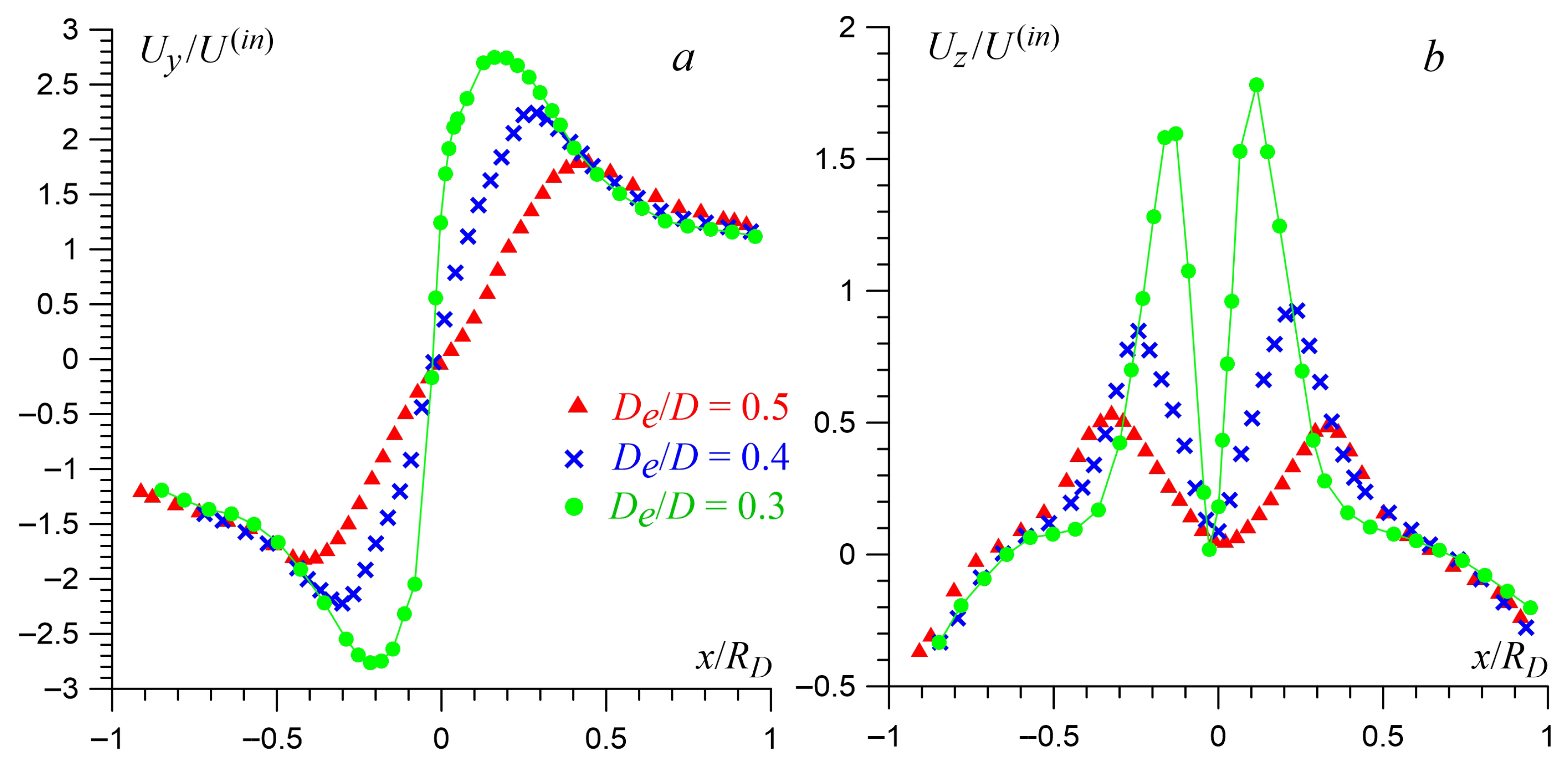
In this study, we use the standard LDA gas velocity measurements from Hoekstra’s work [33], widely recognized for the validation of various CFD models [12,23]. Figure 2a,b illustrates the experimental LDA profiles of two mean gas velocity components for three Stairmand cyclone designs with D = 290 mm, H = h c y l + h c o n = 1160 mm, D c o n = 108 mm, a ( i n ) = 145 mm and b ( i n ) = 58 mm, where the apparatuses differ in vortex finder diameters D e = 145 , 116 and 86 mm [33]. The symbol sizes in Figure 2 and Figure 3 approximately correspond to the measurement uncertainties. The profiles in Figure 2 and Figure 3 are presented in a coordinate system conventional for cyclones, which is obtained by rotating the coordinate system in Figure 1 around the x-axis by an angle of π . The x-coordinate is normalized by the cyclone radius R D at the given cross-section.
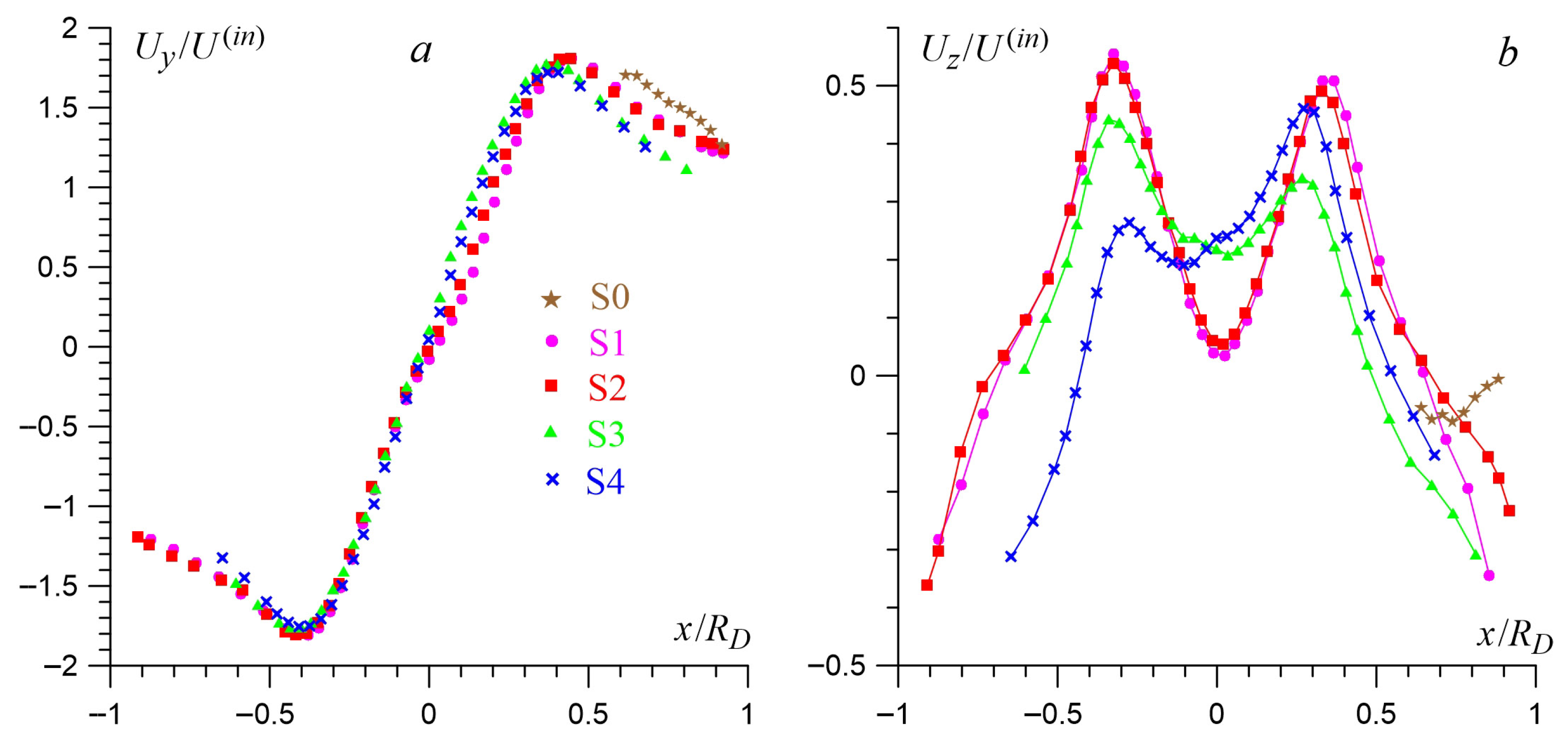
Figure 3 presents the radial profiles of the tangential and axial velocity components for five different cross-sections along the vertical coordinate S0, S1, S2, S3, and S4 (Table 1). Location S0 corresponds to the mid-height of the inlet duct (see Figure 1). The U y / U ( i n ) distributions exhibit minor variations with height. Certain non-monotonic behaviors are observed in the x / R D = 0 ÷ 0.4 region, reflecting the non-axisymmetry of the vortex caused by its precession and other physical processes. A second characteristic feature is a slight reduction in the rotational velocity within the free vortex region ( r / R D 0.4 ) as the flow descends. The angular momentum decreases due to gas–wall interactions, internal friction, and a slight direct gas transfer from the outer region to the vortex core along the entire height. Overall asymmetry of the flow structure relative to the vertical z-axis is observed. This stems from two factors. First, the gas inlet immediately induces a global flow asymmetry. The second factor is the so-called precession of the Rankine vortex core [10,20,60], where the upward flow follows a helical path along the z-axis [12,44,61].
The overall structure of the tangential velocity profile U φ ( r ) reflects the global vortex (see Figure 2) present in all cyclone designs. While variations in the chamber geometry affect the quantitative features of U φ / U ( i n ) , certain qualitative characteristics remain constant. Specifically, there is always a near-axis zone of approximate solid-body rotation for r < r ( s s r ) , followed by a peak velocity region where U φ ( r = r ( v ) ) = U φ max . The differentially rotating gas at the periphery ( r > r ( v ) ) is characterized by the condition d U φ / d r < 0 . The specific values of r ( v ) , r ( s s r ) , U φ max , and the vortex exponent n v = d ln U φ / d ln r may vary across different cyclones, while the characteristic rotation curve is preserved [34,52,60].

2.2. Mathematical Modeling of Incompressible Gas Flow in Cyclones

Flows within a cyclone are essentially subsonic, allowing the gas to be treated as incompressible with the velocity condition div   u = 0 . The velocity fluctuation component due to turbulence u ( r , t ) , combined with the mean velocity U ( r , t ) , yields the total velocity u = U + u . The Unsteady Reynolds-Averaged Navier–Stokes (URANS or RANS) equations are [31,55,62]
ϱ U t + ϱ · ( U U ) = p + μ ( m ) Δ U + · τ ^ R + ϱ   g   ,
where ϱ is the density of the gas, p is the pressure, g is the specific gravitational force, μ ( m ) = ϱ ν ( m ) is the dynamic molecular viscosity, ( ν ( t ) is the kinematic molecular viscosity), τ ^ R = ϱ   u i u j ¯ is the symmetric Reynolds stress tensor, R ^ i j = u i u j ¯ is the kinematic Reynolds stresses. Turbulence models are distinguished by their approach to Reynolds stress closure.
Simple algebraic turbulence models do not involve additional partial differential equations (PDEs). More refined turbulence models, such as k ε , k ω , SST (as a combination of k ε and k ω , along with other modifications), v 2 f , and the Spalart–Allmaras model [29,36,63], require additional PDEs for certain characteristics, including the specific turbulence kinetic energy k ( t ) , its dissipation rate ε ( t ) , or the specific rate of turbulence kinetic energy dissipation ω ( t ) , among others.
The quantities
k ( t ) = 1 2 i = 1 3 R i i   ,       ε ( t ) = ν ( m )   u i x k u i x k ¯
are defined in terms of velocity fluctuations. Here and throughout, summation is implied over repeated indices. The evolutionary equations for the k ε model are [8,23,42,53]
ϱ k ( t ) t + ϱ ( u · ) k ( t ) = · μ ( m ) + μ ( t ) σ k k ( t ) + G ( k ) ϱ ε ( t )   ,
ϱ ε ( t ) t + ϱ ( u · ) ε ( t ) = · μ ( m ) + μ ( t ) σ ε ε ( t ) + C ε 1 ε ( t ) k ( t ) G ( k ) C ε 2 ϱ ε ( t )   2 k ( t )   ,
where μ ( t ) is the turbulent dynamic viscosity, σ k and σ ε are the turbulent Prandtl numbers for k ( t ) and ε ( t ) , respectively, G ( k ) = ϱ R ^ i j U j / x i is the generation of turbulence kinetic energy, C ε 1 and C ε 2 are the closure constants. Turbulent viscosity is defined in terms of k ( t ) and ε ( t )
μ ( t ) = ϱ ν ( t ) = C μ   ϱ   k ( t )   2 / ε ( t )   ,
which closes the k ε turbulence model with constant C μ .
The k ε and k ω models belong to the two-parameter type and describe isotropic turbulence. There are modifications to these models, such as the Quadratic k ε or Durbin’s v 2 f , which are capable of reproducing some fluctuation anisotropy. A fully anisotropic model is the Reynolds Stress Model (RSM), based on an additional six equations for the components R ^ i j [28,44,64]. The presence of anisotropic pulsations in a cyclone is caused not only by the walls of the apparatus but also by the differential rotation of the gas, as confirmed by experimental data and simulations [18,23,28,33,37,52]. The calculation of the Reynolds stress tensor τ ^ i j involves an ensemble averaging procedure for chaotic (turbulent) velocity fluctuations u i under the condition u i ¯ = 0 , where the mean velocity is given by U i = U i + u i ¯ = U i ¯ + u i ¯ . The corresponding transport equations are given by [23,31,42,44,53,60]
ϱ   R ^ i j t + ϱ U k R ^ i j x k = D ^ i j ( t ) + D ^ i j ( m ) + P ^ i j + Φ ^ i j ε ^ i j   ,
where D ^ i j ( t ) is the turbulent diffusion tensor, P ^ i j is the stress production, Φ ^ i j is the pressure strain, and ε ^ i j is the dissipation tensor. The molecular diffusion is
D ^ i j ( m ) = x k ν ( m ) R ^ i j x k   .
Each term on the right-hand side of (6) accounts for different physical processes leading to changes in the Reynolds stresses
D ^ i j ( t ) = x k ϱ   u i u j u k ¯ x k p δ k j u i + δ i k u j ¯   ,   P ^ i j = ϱ R ^ i k U j x k ϱ R ^ j k U i x k   , Φ ^ i j = p u i x j + u j x i ¯   ,     ε ^ i j = 2 μ ( m ) u i x k   u j x k ¯   .
Turbulence is generated from the mean flow by converting energy into chaotic fluctuations within a system of vortices. In cyclones, the primary contribution to P ^ i j comes from the radial gradient of the tangential velocity. The modeling of these processes in the RSM differs from the k ε approach as it accounts for stress anisotropy [65].
Solid walls with no-slip boundary conditions always create transverse gradients of the mean velocity even on a flat surface. Complex curved solid surfaces contribute to additional turbulence generation by introducing anisotropy into the vortex system. Therefore, the thin near-wall layer requires high-quality simulations as it determines the essential properties of the entire flow.
The quantity D ^ i j ( t ) in (6) describes turbulent diffusion or turbulent transport through the third-order correlation of velocity fluctuations. A random turbulent fluctuation u k transports the turbulent stress R ^ i j and energy to an adjacent region of space. This represents a process of turbulence self-transport. The second factor in D ^ i j ( t ) is determined by diffusion due to pressure fluctuations p where energy transport occurs through the work of pressure forces. Third-order correlations D ^ i j k ( I I I ) = u i u j u k ¯ can only be calculated by means of approximation via second moments. The model by B.J. Daly and F.H. Harlow (1970) [66] provides this relationship in the form of the Generalized Gradient Diffusion Hypothesis
D ^ i j k ( I I I ) = C s ϱ k ( t ) ε ( t ) R ^ k m R ^ i j x m   or   D ^ i j k ( I I I ) = ϱ ν ( t ) σ k ( t ) R ^ i j x k   ,
where C s , also denoted as C μ in the Ansys Fluent notation, is the empirical constant with a value between 0.22 and 0.25. The second version in (9) represents the Simple Gradient Diffusion Hypothesis for cases where diffusion is an isotropic or scalar quantity. The term k ( t ) R ^ k m / ε ( t ) in (9) acts as the tensorial diffusion coefficient.
The second term in D ^ i j ( t ) is caused by pressure fluctuations p in (8) where we can distinguish two factors [54]
D ^ i j ( p ) = p u i ¯ x j p u j ¯ x i =   p u i x j ¯ + p u j x i ¯   u i p x j ¯ + u j p x i ¯   .
The pressure–strain correlation term in square brackets is arguably the most significant in the RSM, because pressure fluctuations can change the shape of anisotropic vortices and redistribute energy from more intense velocity components to weaker ones. This factor enhances the isotropy of turbulence. Since the trace of this term is zero, no change in the turbulent kinetic energy k ( t ) occurs. The second factor in parentheses, known as the velocity–pressure gradient correlation, represents the rate of work done by pressure gradient fluctuations on velocity fluctuations, which also contributes to turbulence isotropy. The minus signs in the equations above correspond to motion against the gradient as diffusion ensures the transport of a characteristic from regions of higher values to regions of lower values.
It is necessary to approximate the terms involving p since no equation for the pressure fluctuation exists. By isolating individual contributions in (10), the Rotta model (Linear Return-to-Isotropy Model) and the linear approximation in the Launder–Reece–Rodi (LRR) model yield
D ^ i j ( p 1 ) = p ϱ u i x j ¯ p ϱ u j x i ¯ = C 1 ε k ( t ) R ^ i j 2 3 δ i j k ( t )   ,       D ^ i j ( p 2 ) = C 2 P ^ i j 1 3 δ i j P ( S p )   ,
respectively. Empirical constants C 1 and C 2 determine the intensity of these diffusion processes. The trace P ( t r ) = P ^ i i of the tensor P ^ i j defines the generation rate of the turbulence kinetic energy k ( t ) (see (2)). The second part of the pressure fluctuation effect D ^ i j ( p 2 ) is associated with interactions with mean velocity gradients. This physical process, known as the rapid pressure–strain, is more immediate.
The term Φ ^ i j in (6) is composed of three parts
Φ ^ i j = Φ ^ i j ( s l o w ) + Φ ^ i j ( r a p i d ) + Φ ^ i j ( w a l l )   ,
where Φ ^ i j ( s l o w ) is the slow pressure–strain term, Φ ^ i j ( r a p i d ) is the rapid pressure–strain term. The term Φ ^ i j ( w a l l ) = Φ ^ i j ( w-s ) + Φ ^ i j ( w-r ) modifies the sum of Φ ^ i j ( s l o w ) and Φ ^ i j ( r a p i d ) by reducing the tensor components directed toward the wall. The component Φ ^ i j ( w-s ) (w-s = wall slow) represents a correction to the slow part while the second term Φ ^ i j ( w-s ) acts on the rapid part Φ ^ i j ( r a p i d ) .
The first term in (8) is proportional to the molecular viscosity, which is of the order ν ( m ) c s ( m f p ) , where ( m f p ) is the mean free path and c s is the characteristic thermal velocity of gas molecules. The smallness of the molecular viscosity makes the contribution of this term negligible, given that ν ( m ) / ν ( t ) 10 2 10 5 in the main flow far from solid surfaces. The dimensionless parameter y + = u τ y / ν ( m ) defines the near-wall region of the flow as the dimensionless distance from the wall to the center of the first grid cell. It is expressed through the physical distance to the first cell y 1 (turbulence theory traditionally uses the coordinate y for the distance from the wall, as in this paragraph and below) and the friction velocity u τ = τ w a l l / ϱ . The total shear stress in the gas is composed of molecular and turbulent momentum transport, the latter of which is zero at the wall. Therefore, the wall shear stress τ w a l l = μ ( m ) ( U / y ) w a l l is determined solely by the transverse gradient of the mean velocity U. The value of y + represents the local Reynolds number based on u τ .
Three zones are distinguished in the near-wall region. The viscous sublayer (VSL) is defined by the dominance of viscosity ν ( m ) U / y | R ^ i j | with a linear velocity profile U y . The buffer layer (BL) is characterized by the condition ν ( m ) U / y | R ^ i j | . This zone of comparable molecular viscosity and Reynolds stress ( y + 10 30 ) provides the maximum production of turbulence energy P ^ i j . This layer is notable because the turbulent fluctuations R ^ i j are already significant while the velocity gradient U / y remains large. Direct Numerical Simulation (DNS) studies reveal complex unsteady structures in the buffer layer including velocity streaks, non-stationary vortices, and rapid gas mixing regimes between the VSL and BL through ejections of slow fluid away from the wall and sweeps of fast fluid toward the wall [67,68,69]. This leads to an explosive growth of all Reynolds stress components P ^ i j .
Further distance from the wall leads to small mean velocity gradients and a decrease in the tensor P ^ . We enter the log-law region where ν ( m ) U / y | R ^ i j | . This core of the turbulent flow forms at a distance y + 30 50 , where the molecular viscosity contribution decreases to 1 percent. The velocity distribution U ( y ) fully transforms into a logarithmic profile at y + > 50 100 . The turbulent flow forgets the wall and the lifetime of the vortices is independent of viscosity down to the Kolmogorov scale where the influence of the term ε ^ i j in (6) becomes significant. The assumption of isotropic dissipation yields
ε ^ i j = 2 3 δ i j ε ( t ) ,
where ε ( t ) is determined from Equation (4). The definition of the rates of dissipation of turbulent kinetic energy (2) depends on the molecular viscosity, which ensures the complete conversion of the energy of small vortices into heat. Flow velocities within cyclones are relatively low at 10 to 20 m/s resulting in a coordinate y + = 12 that corresponds to approximately 0.1 to 0.2 mm. This imposes a constraint on the near-wall cell size y 1 0.02 mm.
The Reynolds Stress Model involves several physically grounded closure parameters. Their number can vary depending on the specific RSM version such as Launder–Reece–Rodi (LRR), Stress– ω , Linear Pressure–Strain (LPS), Speziale–Sarkar–Gatski (SSG), SSG/LRR- ω in the FLOMANIA Project (Flow Physics Modelling—An Integrated Approach), and others.
The following set represents the base parameters for the RSM.
  • The value C 1 = 1.8 representing the standard value used throughout in (11) determines the dissipation rate of the turbulence kinetic energy due to viscosity in the boundary layer [44].
  • The parameter C 2 = 0.6 specifies the intensity of the pressure strain correlation term, characterizing the rapid part of the interaction between turbulence and the mean velocity field in (11) [44].
  • The coefficient C 3 = 0.5 defines the near-wall redistribution of the turbulent stresses u i u j ¯ within the wall reflection term Φ ^ i j by suppressing the normal stresses relative to the wall.
  • The coefficient C 4 = 0.3 describes the rapid pressure response to the mean flow shear.
  • The RSM also involves an evolution equation for the turbulence kinetic energy dissipation rate C ϵ 1 = 1.44 where the coefficient determines the intensity of dissipation generation driven by the production of turbulence kinetic energy [44,65].
  • The parameter C ϵ 2 = 1.92 specifies the dissipation rate of the vortices [44].
  • The turbulent viscosity ν ( t ) = C μ k ( t )   2 / ε ( t ) includes the turbulent viscosity constant C μ = 0.09 [8,31,53,65].
  • The Prandtl number for the turbulence kinetic energy σ k = 1.0 is included in Equation (3) and defines the transport efficiency of the energy k ( t ) by turbulent fluctuations [44].
  • The turbulent Prandtl number σ ε = 1.3 for the turbulence kinetic energy dissipation rate ε ( t ) is included in Equation (4) and defines the diffusion of the dissipation rate.
The parameters listed above should be supplemented by several additional quantities that define the RSM turbulence model [53,54,55,65].
A significant number of studies are based on isotropic models such as k ω , k ε , and other similar approaches [8,17,22,36,56] despite the well known advantages of the RSM and LES turbulence models and their modifications [12,23,27,35,45,46]. The RSM requires substantially more computational resources and exhibits lower stability in numerical simulations compared to two- and three-parameter turbulence models.
The application of the LES model yields good results primarily for studying unsteady solutions [27,35,45,58]. Necessary computational resources depend on the choice of the integration step Δ t ( r s m ) or Δ t ( l e s ) in the RSM or LES respectively. Each such step is performed in a certain number of iterations n ( r s m ) or n ( l e s ) . The number of PDEs in the RSM is 11 against three in LES. However the complexity of the Navier–Stokes equations and the features of the applied numerical parallel algorithms result in approximately 60 to 70 percent of the iteration time being spent on the RANS integration. This leads to a performance gain for LES of only 20 to 40 percent when using CPUs with 16 to 64 cores. The smaller data volume for LES is an advantage when using a large number of cores so the scaling of LES is better than that of the RSM. The LES model requires several times more iterations with n ( l e s ) / n ( r s m ) 3–4. Thus one time integration step is completed in approximately the same time. However there is a critical difference in choosing Δ t ( r s m ) and Δ t ( l e s ) . Physical adequacy of simulation requires Δ t ( r s m ) / Δ t ( l e s ) 1 . We observe a difference from approximately seven times for engineering approaches to 100 times for research purposes in the studied cyclone regimes. The theoretical linear complexity with respect to the number of grid elements is O ( N ( g ) ) . The practical implementation shows faster degradation for the RSM at large N ( g ) when exceeding the L3 Cache limits. The critical N ( g ) value for LES occurs for a mesh with approximately 2.5 times more elements compared to the RSM.
All simulations across the considered turbulence models, including the laminar approximation, are based exclusively on unsteady formulations. The following sections present a comparison of the results obtained using the k ε (Launder–Spalding), k ω (Wilcox), and RSM (Linear Pressure–Strain) models with their standard closure coefficients.

3. Results

3.1. Measured and Modeled Velocity Profiles

The main efforts of various authors are focused on model calibration through the validation of the tangential velocity component U φ by comparison with experimental data [23,70]. This is undoubtedly crucial since the rotation velocity dominates the overall motion. Furthermore the velocity gradient U φ / r in the near-wall layer determines the turbulence generation so the quality of the U φ ( r ) profiles plays a key role in developing an adequate description of the turbulent motion as well.
A simpler approach involves the analysis of simulation grid convergence on a set of grids with different numbers of cells. This does not provide full model validation. However such testing is necessary in the absence of experimental measurements. Studies of this kind regarding the tangential velocity were conducted for instance in [12,23,64]. Convergence for the axial velocity was considered in [23,46].
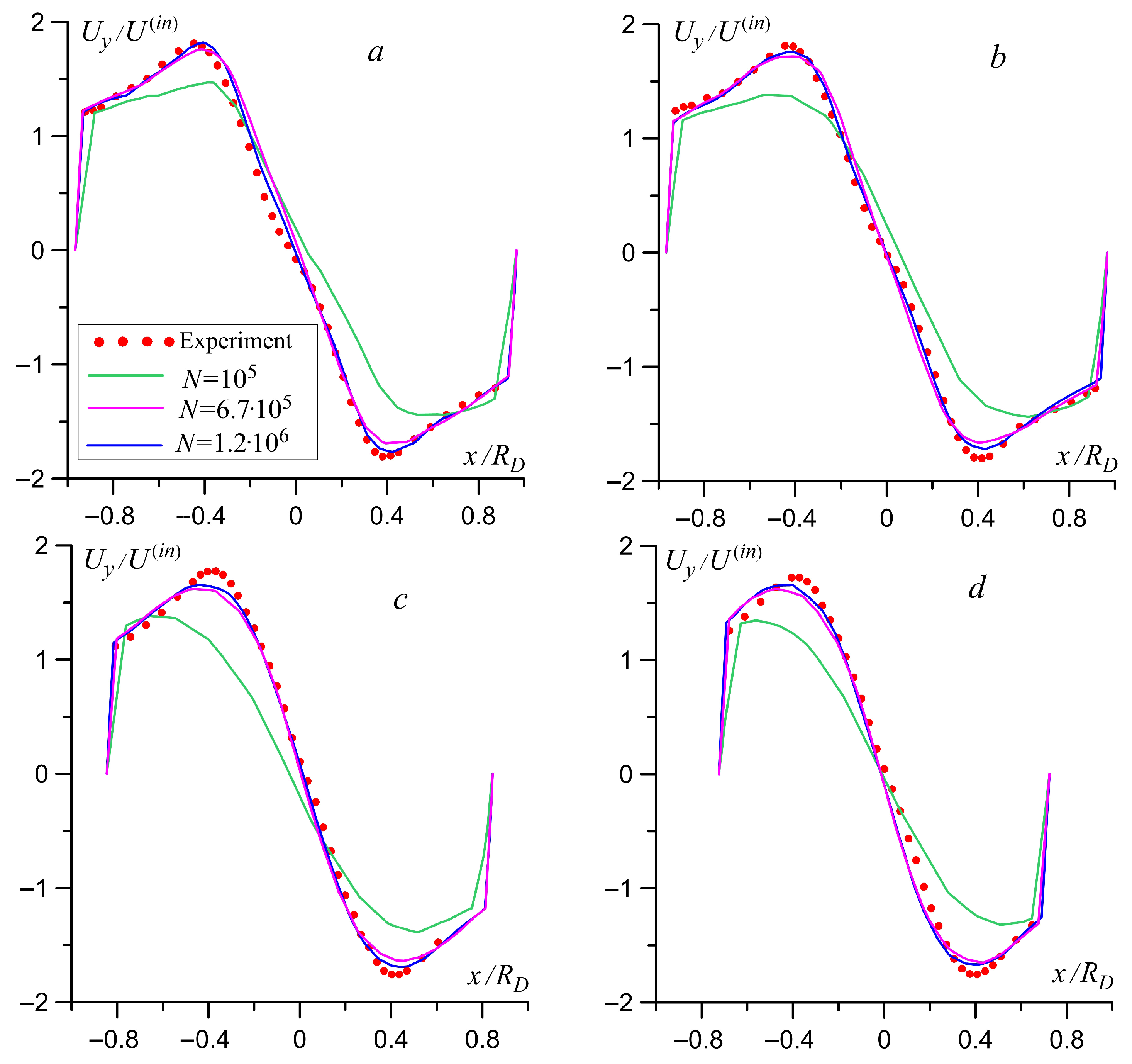
Figure 4 shows the radial distributions of the gas tangential velocity component inside the cyclone chamber at different cross sections along the x-coordinate (see Figure 1). These relationships, as well as those presented hereafter, were derived by time-averaging the variables obtained from the unsteady simulations. Circles represent the measured velocity profiles as in Figure 3. The coarse grid ( N 1 ( g ) = 10 5 ) shows noticeable discrepancies with the experimental data in both the vortex core and at the rotation maximum. The grid with N 3 ( g ) = 6.7 · 10 5 provides an acceptable result. A twofold increase in the number of cells already ensures a good approximation to the experimental data. The difference in results between N 3 ( g ) 6.7 · 10 5 and N 4 ( g ) 12 · 10 5 is within the line thickness. There are small deviations in the velocity maxima regions within 10 percent. This systematic issue requires additional modification of the turbulence model for a more correct description of the turbulent diffusion (8). Transitioning to designs with D e / D < 0.5 requires more detailed computational grids.
The tangential velocity is key to the analysis of dust particle separation [31]. This is due to the physics of particle motion within cyclones as the centrifugal force ( U φ 2 / r ) pushes the dust toward the wall. The quadratic dependence of the force on the rotation speed is more sensitive to errors in the U φ simulation. A narrow vortex core with a small r ( v ) and a large U φ   max increases the separation efficiency. This is associated with an increase in the difference between the centrifugal force and the gas drag force defined by Stokes law including modifications due to the dependence of the drag coefficient C d on the particle Reynolds number R e ( p ) [31,60]. The C d value at R e ( p ) < 1 corresponds to the classical Stokes law and changes with increasing R e ( p ) for R e ( p ) > 1 . Therefore many authors focus their validation efforts on the tangential velocity component, often considering it sufficient without a detailed analysis of the axial velocity [12,28].
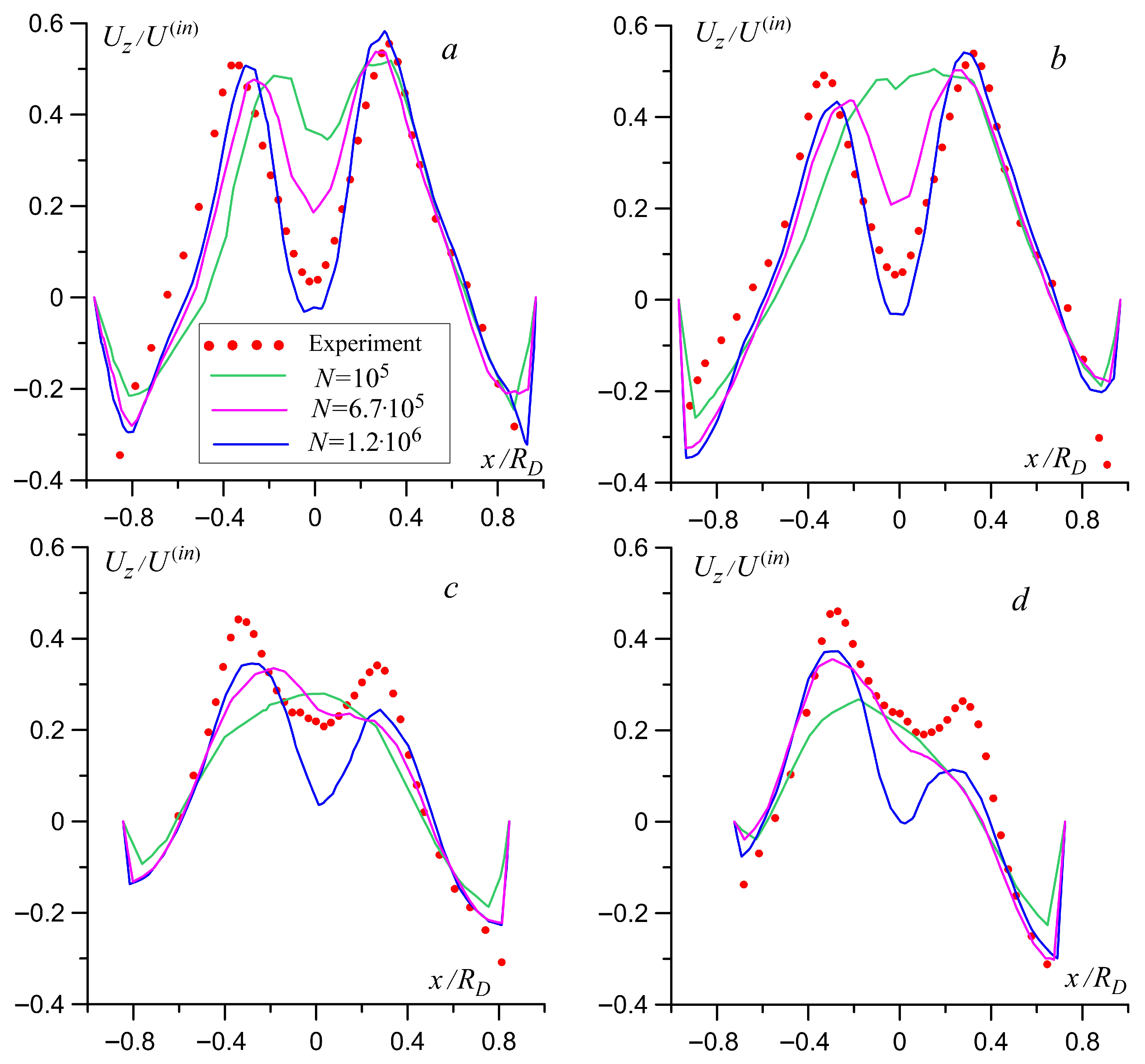
The axial velocity U z is shown in Figure 5 for the same conditions as in Figure 4. We observe stronger deviations compared to the tangential velocity. The structure of vertical flows is in a sense more complex than U φ ( x ) . The function U z ( x ) has five local extrema that separate the near wall zones of downward flow and the central region of upward motion. The upward flow has a highly non-uniform profile. Its characteristic feature is a low velocity near the axis of symmetry and a maximum in the vicinity of r ( v ) . Moreover the position of this maximum is located slightly closer to the center compared to r ( v ) . Under certain conditions the formation of a downward flow ( U z < 0 ) on the cyclone axis of symmetry is possible in other designs [37,42,46,70].
The difference between the modeled and measured U z ( x ) profiles is significant compared to U φ ( x ) . The coarse grid with N 1 ( g ) is insufficient to resolve the flow features as seen in Figure 5. Increasing the number of cells to N 3 ( g ) improves the agreement although it does not achieve small errors as for U φ in Figure 4. The velocity profiles in the upper part of the cyclone are more accurate than those at the bottom of the apparatus in the cone. This is apparently due to differences between the model design and the real cyclone used for measurements [33] which included a dust collection hopper. This part of the device is not described in the experiment so our model does not contain it, which affects the results for the cross sections in the cone.
The gas tangential velocity is predominantly determined by the balance between the centrifugal force and the pressure gradient in Equation (1) in the cylindrical coordinate system ( r , φ , z )
U φ 2 r p r   .
This balance is robust as it is defined by the overall apparatus geometry and the law of conservation of angular momentum. Internal friction has a weak effect on the immense angular momentum of the gas without affecting the general vortex structure. The force balance (14) is highly stable due to self-regulation. An increase in the rotation speed pushes additional gas to the periphery which increases the pressure at the wall and prevents further flow acceleration. Thus the balance (14) forms a stable vortex macrostructure due to the conservation of total angular momentum which is primarily determined by the inlet flow velocity U ( i n ) and the radius of the working chamber R D .
The axial velocity structure U z depends on a delicate balance between the inlet and outlet flows and internal friction, which is determined by small scale turbulence. This causes different flow patterns in the central zone of the cyclone, ranging from a single jet flow with a vertical velocity maximum along the axis [60,64] to more complex profiles with three extrema (see Figure 2 and Figure 5). The formation of a downward flow on the cyclone axis with U z < 0 is also possible [42,70]. Such a recirculation zone appears due to the complex interaction between pressure fields and centrifugal forces. The downward flow on the axis is typically associated with the non-uniformity of the vertical pressure profile in the cyclone center ( r r ( v ) ), where the low pressure region p ( r = 0 , z ) is located. Different signs of the pressure gradient p ( r = 0 , z ) / z can form either upward or downward secondary flows within the vortex core. This flow feature depends on the working chamber geometry, especially in the conical part due to the decreasing radius. Therefore, the lower cone is the most likely location for axial flow inversion with downward gas motion on the axis. An important factor is also the presence and geometry of the dust collection hopper at the very bottom of the design [30,35,43]. We observe poorer agreement between the simulated axial velocities and the experimental measurements compared to the tangential velocity, which has also been noted in other studies [37,60].
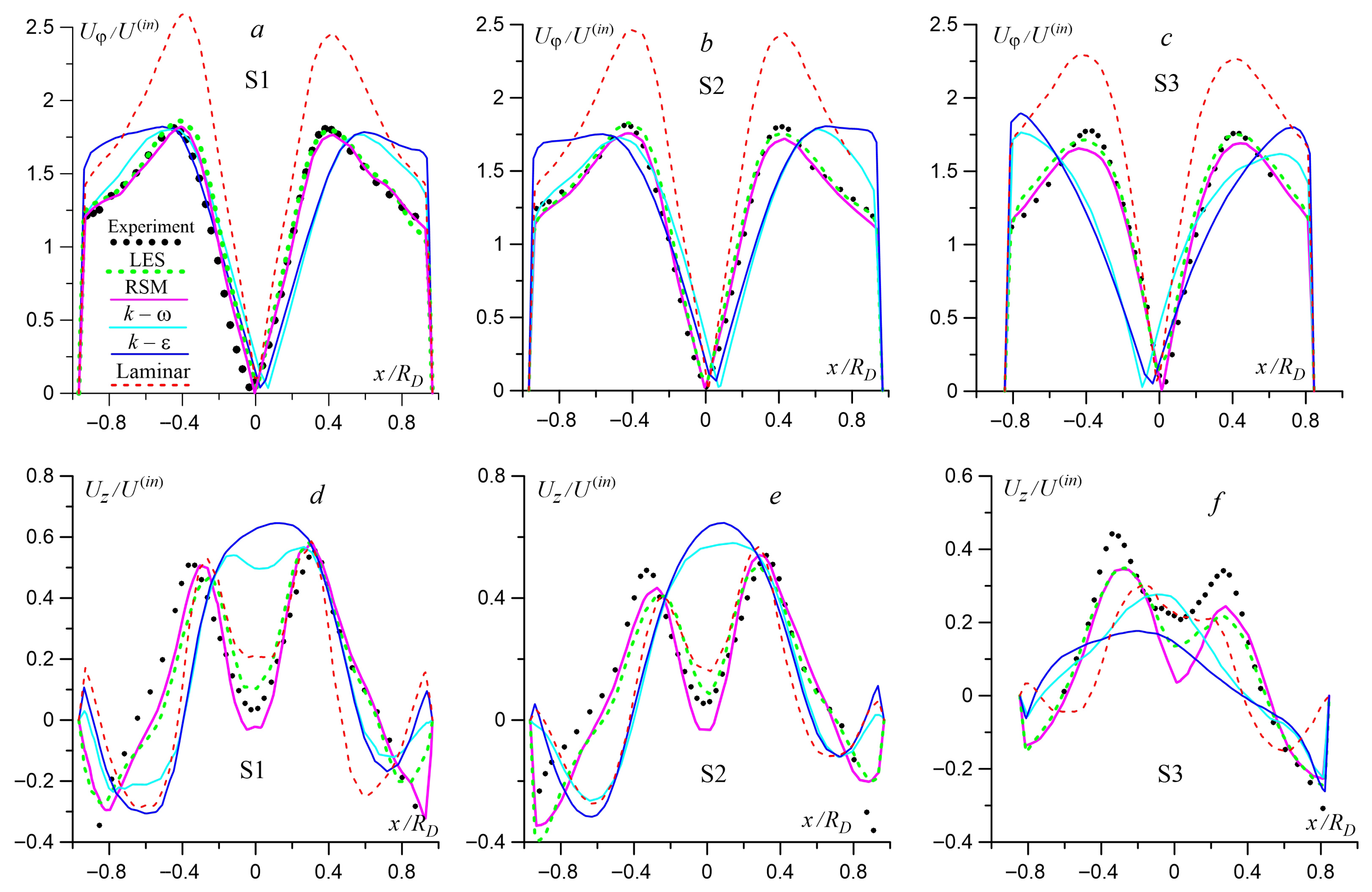
Figure 6 shows simulation results for different turbulence models. Experimental U φ and U z profiles along the x coordinate (black circles [33]) are compared with simulations using the RSM (magenta line), LES (green), k ω (cyan), and k ε (blue) models in cross-sections S1 (panels a and d), S2 (b and e), and S3 (c and f). Both RSM versions, with and without the wall reflection term, as well as the LES model, provide acceptable accuracy that can be further enhanced by calibrating the closure parameters such as C 1 , C 2 , C μ , σ k , and σ ε . The k ε and k ω models lead to U φ ( x ) velocity profiles that significantly differ from the RSM and LES results, showing poorer agreement with the experimental curves. The tangential velocity profiles in the k ε and k ω models exhibit excessively fast rotation at the periphery and slower rotation in the vortex core due to the strong turbulence smearing inherent in isotropic models. The U φ maxima are more diffused and shifted toward the walls compared to the measured velocities. This effect is particularly pronounced in the cone region (cross-section S3 in panel c), where the maximum is pressed against the wall and the rotation speed is higher by 12 m·s−1. The vortex core occupies most of the working chamber, causing the outer part of the vortex with decreasing velocity to disappear in the cone. The RSM and LES models reproduce the observed U φ ( x ) velocity profiles substantially better.
The differences are even more pronounced when considering the axial velocity (panels d, e, f). The k ε and k ω models fail to reproduce the velocity dip U z near the axis ( x = 0 ). There are strong discrepancies near the walls, where the actual downward flow is located in the region r / R D 0.6 and the vertical velocity maximum is pressed against the walls. In contrast to the RSM and LES models, the two-parameter turbulence models shift the downward flow away from the wall, covering the area up to r / R D 0.4 . In the cyclone cone, these discrepancies become even more significant. The k ε and k ω models describe isotropic turbulence, which is the reason for the poor agreement with the measured data. The anisotropic turbulence in the RSM and LES models describes the observed data more accurately.
We also calculated the velocity field using the ‘Laminar’ approximation provided by Fluent (see dashed red lines in Figure 6). This model does not include the R ^ i j terms in Equation (1), meaning that turbulence is absent. This approach requires a very small integration step Δ t and an increased number of iterations to achieve convergence within each step. Strictly speaking, such a simulation without turbulence corresponds to a model with high numerical viscosity ν ( n u m ) , since small- and medium-scale vortices are not resolved by the standard grid. All turbulent fluctuations are filtered out by the high numerical viscosity, which is estimated as ν ( n u m 1 ) = α ( n u m ) Δ ( c e l l ) | U | according to the convergence estimates for the first-order upwind scheme. Here Δ ( c e l l ) is the cell size, U is the local flow velocity, and α ( n u m ) is a dimensionless parameter close to unity. The second-order upwind scheme can reduce the numerical viscosity to ν ( n u m 2 ) = α ( n u m 2 ) Δ ( c e l l ) | U | Δ ( c e l l ) / L ( U ) , where L ( U ) is the characteristic scale of the velocity gradient variation. This scale varies from values on the order of the vortex core radius to the boundary layer thickness δ ( b ) . The smallness of δ ( b ) brings the values of ν ( n u m 1 ) and ν ( n u m 2 ) closer together.
It is important to note that the “Laminar” model with numerical viscosity can reproduce the general shape of the U φ ( x ) profile, including the localization of the velocity maximum near the radius r ( v ) as seen in experimental distributions. However, it yields significantly overestimated rotation speeds (panels a, b and c). We observe local minima of the vertical component near the axis in the “Laminar” model (panels d, e and f). However, the calculation quality near the walls proves to be inadequate. The “Laminar” model acts as a substitute for a turbulence model in an uncontrolled manner, as it depends substantially on the grid through the cell sizes Δ ( c e l l ) . The inclusion of turbulence models provides the necessary reduction in tangential velocity by approximately 30–50%, consistent with physical experiments.
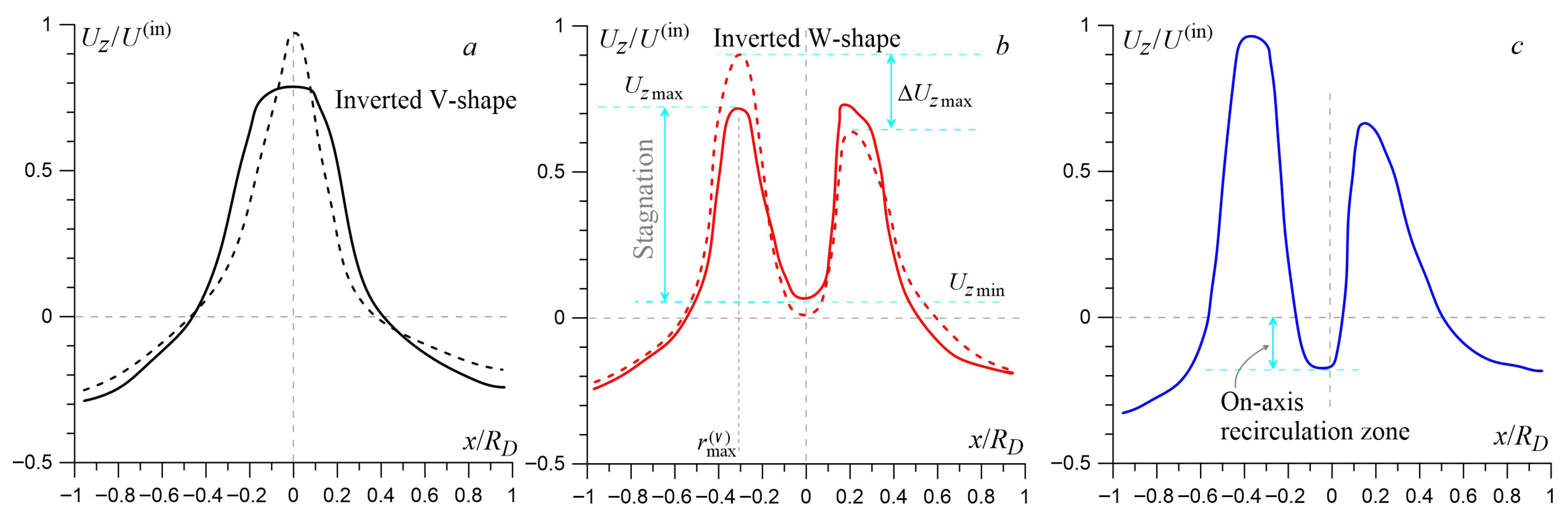
Axial velocity profiles within the cross-section are extremely sensitive to the cyclone’s internal geometry, the characteristics of the inlet duct and vortex finder [71,72], gas velocity U ( i n ) , and even wall roughness. Three distinct types of axial velocity profiles can be identified in the cross-section, as shown in Figure 7. The first type (Panel a) features a single maximum of positive velocity located approximately on the cyclone axis (where the gas ascends) and two minima near the walls, where the gas descends. The profile of this velocity may vary with the jet width (see the dashed and solid lines in Figure 7a). The second type is more complex, characterized by five extrema, as illustrated in Figure 7b. In this case, axial velocity stagnation occurs near the axis, causing the maximum vertical velocity U z   max ( U z > 0 ) to shift to a certain distance r max ( v ) (indicated by the solid line in Panel b). A typical phenomenon is the non-uniformity of the peak axial velocity relative to the azimuthal angle φ within the cross-sectional plane. In Figure 7b, this is manifested as two velocity peaks at x < 0 and x > 0 (see the dashed line in Panel b). Such asymmetry Δ U z   max can be significant. Finally, a third profile type is characterized by a downward gas flow emerging in the vicinity of the axis (Panel c), a phenomenon referred to as an on-axis recirculation zone with U z < 0 [42,46,70,73].
The on-axis stagnation zone is a common finding in physical experiments involving cyclones [33,45,52,60,71]. Similar to the tangential velocity distribution, this axial velocity profile is often referred to as an inverted W-shape [71], in contrast to the inverted V-shape profile shown in Panel a. This phenomenon is primarily driven by the specific pressure distributions from the axis to the wall and along the vertical coordinate, which establish the conditions for the transition from a free to a forced vortex. Further intensification of this stagnation leads to the formation of a recirculation zone. Notably, the recirculation velocity on the axis can exceed the axial velocity observed near the walls.

3.2. Turbulence Characteristic Distributions

This section aims to compare various unsteady turbulence models in predicting the dynamic state of the gas flow. The distributions presented herein characterize the statistically stationary, quasi-steady flow regimes.
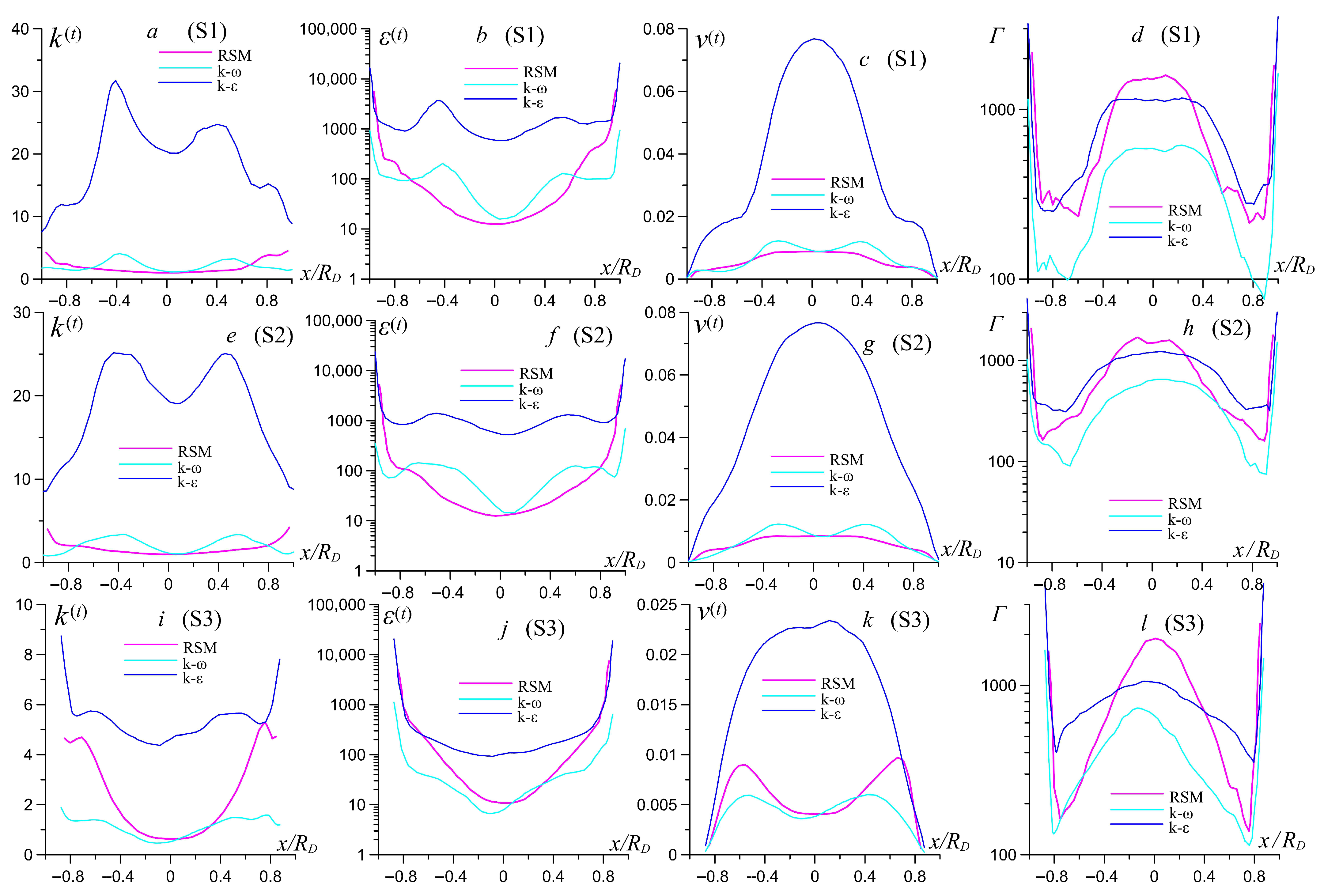
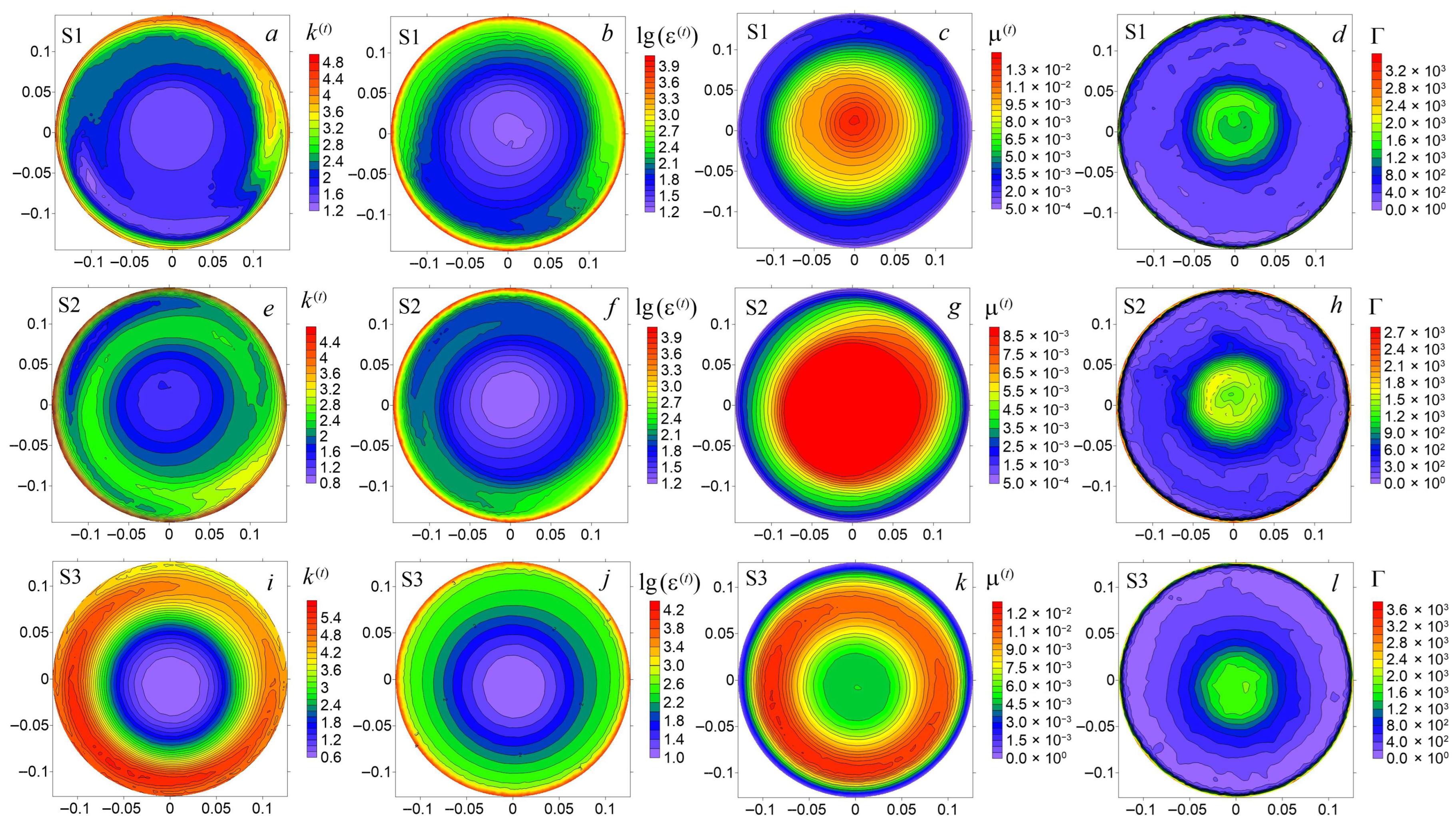
Figure 8 shows the profiles of the turbulence kinetic energy k ( t ) , the corresponding dissipation rate ε ( t ) , the turbulent viscosity μ ( t ) , and the vorticity magnitude Γ = | rot   U | , calculated in different cross sections of the cyclone using three turbulence models. The turbulence kinetic energy for the k ε and k ω models is an order of magnitude larger than that for the RSM in the main cylindrical part of the cyclone. Both isotropic turbulence models exhibit a characteristic maximum near the radius r ( v ) , where the vortex core ends (compare the positions of U φ ( x ) maxima in Figure 6 and k ( t ) in Figure 8). The presence of such a k ( t ) maximum is considered a classical result, as it is easily explained by the narrow transition zone from increasing to decreasing tangential velocity where turbulence is effectively produced. However, this conclusion is not confirmed by the RSM, which is less sensitive to the radial gradient of the tangential velocity. The vortex core region is characterized by weak turbulence with a k ( t ) minimum. We observe a broad flat plateau that rises as it approaches the walls. The RSM does not account for the transition from the increase to the decrease in U φ ( r ) in the upper cylindrical part of the cyclone. The influence of this tangential velocity feature in the lower conical part is enhanced due to the proximity to the walls and the vortex rope precession.
The turbulence kinetic energy dissipation rate profiles in Figure 8b,f,j are similar to k ( t ) ( x ) , showing weaker non-uniformities in the k ε and k ω models. The primary turbulence dissipation occurs in the near wall layer, where the ε ( t ) ( x ) gradient reaches one order of magnitude for isotropic turbulence and nearly two orders for the RSM. There is a smooth decrease in the dissipation rate toward the cyclone axis due to turbulent diffusion.
The turbulent viscosity distributions in accordance with (5) reflect the features of the k ( t ) ( x ) and ε ( t ) ( x ) dependencies (panels c, g, k). The maximum viscosity is located in the vortex core region within r / R D 0.4 (this critical radius value reflects the design of the studied cyclone and varies in other apparatus geometries) for all turbulence models. However, the isotropic turbulence models lead to ν ( t ) values that are several times higher than the turbulent viscosity in the RSM. The k ε model overestimates the turbulent viscosity to the greatest extent. The k ω model generates a lower viscosity, whose profile exhibits local maxima in the vicinity of the radius where U φ / r = 0 in accordance with the traditional explanation.
RSM simulations yield a nearly flat plateau for ν ( t ) in the cylindrical part (cross sections S1 and S2) within the vortex core region r / R D 0.4 . The region r / R D 0.5 outside the core is characterized by a monotonic decrease in the turbulent viscosity without a maximum at the point where the tangential velocity derivative changes sign. This effect is driven by several factors. First, convective transport due to the radial velocity increases the viscosity in the center. Turbulent diffusion also contributes to the smoothing of this plateau. Diffusion is effective because U φ / r const and the turbulence generation is uniform in this region. Second, core oscillations and complex spatial motions due to the vortex rope precession effectively smear the turbulence. Finally, the RSM accounts for the streamline curvature. Therefore, centrifugal forces suppress radial fluctuations in the outer part, which stabilizes the flow, and enhance disturbances near the axis where the velocity is low. Thus, the inner part of the vortex mixes itself, transforming into a zone of intense chaos.
The situation changes in the lower conical part (cross-section S3), where the RSM turbulent viscosity also exhibits local maxima (panel k), signaling a fundamental restructuring of the vortex. We do not observe a significant increase in the radial gradient of the tangential velocity within the cone. Furthermore, the radii of the U φ and ν ( t ) maxima do not coincide. Therefore, the peak is caused by the combined unidirectional influence of several factors. Rapid changes in the precessing vortex rope serve as the energy source. The rope precession acquires new properties at the bottom of the cone due to the confinement by the close walls, the effect of the rope end wandering along the bottom, sharp impacts, and wall contacts with brief sticking (wall-touching and wall-attachment phenomena). The characteristic frequencies of these processes are 10 to 20 Hz. All this generates pressure disturbances with a characteristic amplitude of about 50 Pa, which induce radial velocity fluctuations u r ( p u r ). The nearby wall effectively reflects the pressure fluctuations, leading to a local enhancement of the Reynolds stresses (pressure–strain correlation) under the joint action of Φ ^ i j ( w a l l ) and Φ ^ i j ( r a p i d ) in (12). Energy is redistributed from radial disturbances into fluctuations parallel to the wall. Thus, the shear stresses u φ u φ ¯ and u z u z ¯ are enhanced, redistributing the fluctuation directions due to terms such as P ^ r φ R ^ φ φ U φ / r that arise in a rotating gas within the cylindrical coordinate system.
The ratio of turbulent viscosity to molecular viscosity in the RSM does not exceed μ ( t ) / μ ( m ) 10 3 . The monotonic decrease of ν ( t ) outside the vortex core is attributed to the decline in both the tangential velocity U φ r n (where n 0.5–0.9) and its derivative ( 1 / r 1 + n ), which acts as a turbulence production source. Turbulent diffusion in a cyclone is a detrimental factor, as it transports Reynolds stresses R ^ i j from the regions of intense turbulence production near the walls into the central zones of the chamber, including the vortex core. This process dampens the vortex by reducing the peak tangential velocity U φ , thereby decreasing the overall separation efficiency.
The final column in Figure 8 illustrates the vorticity distribution obtained from various models, confirming high levels of eddy viscosity in the core region. The relationship between ν ( t ) and Γ is complex and involves the production of turbulent fluctuations driven by the shear of axial velocities U z / r .
Figure 9 illustrates the 2D distributions of k ( t ) , ε ( t ) and ν ( t ) in the RSM for cross-sections in the upper cylindrical part of the cyclone (S1 and S2) and the lower conical section (S3). All parameters exhibit a reasonably high degree of axisymmetry throughout the main volume of the cyclone. Significant disturbances are observed in the near-wall region ( r R D ), which are associated with intense turbulence production within this layer and the reflection of pressure and radial velocity fluctuations from the wall. These processes occur at small scales, inducing azimuthal non-uniformity, for instance, in the vorticity Γ .

3.3. Large Eddy Simulation Model

The LES model is based on the filtered Navier–Stokes equations with respect to the filtered velocity u ¯ . Equation (1) contains a term with the subgrid-scale stress τ ^ i j ( s g s ) instead of the Reynolds stress tensor. The physical meaning of the turbulent viscosity in the LES model μ s g s ( t ) differs qualitatively from the RANS (Reynolds-Averaged Navier-Stokes) family of models. The value μ s g s ( t ) is the SubGrid-Scale viscosity, which is determined, for instance, via the Smagorinsky model
μ s g s ( t ) = C S 2 ϱ ( Δ V ) 2 | S ^ |   ,       S ^ i j = 1 2 u i x j + u j x i   ,
where | S ^ | = 2 S i j S j i is expressed through the strain rate tensor S ^ i j , and Δ V = ( Δ V ) 1 / 3 is the grid filter size calculated via the cell volume Δ V . The standard value of the Smagorinsky constant is C S = 0.1–0.2 (0.065–0.1 for cyclones), and the product C S Δ determines the mixing length for subgrid-scale eddies. These are the scales of the smallest eddies that dissipate into heat. LES resolves vortices with a size of 7–10 cells or more in each direction. Structures with a size of 4–7 cells are described with significant error, yet this approach allows for moving beyond the limitations of RANS. SubGrid-Scale viscosity extracts energy from the flow within a cell and dissipates it into heat, mimicking the action of eddies down to the scale of C S Δ 0.1 Δ . The small subgrid-scale viscosity allows for the modeling of vortices as small as 2 Δ V , despite the high error margin. In LES, viscosity acts only where the mesh resolution is insufficient to resolve the eddies. A modification is the Dynamic Smagorinsky–Lilly model in Fluent, where C S is calculated dynamically for each cell based on local flow characteristics within the range 0 < C S 0.12 . The Subgrid Viscosity Ratio (SVR) μ s g s ( t ) / μ ( m ) differs from the Turbulent Viscosity Ratio (TVR) μ ( t ) / μ ( m ) , as TVR describes the viscosity of all turbulent eddies in the flow within the RANS approach and exhibits a weaker dependence on the computational mesh. LES utilizes SVR to simulate the viscosity of only those small-scale eddies that are smaller than the cell size. Consequently, SVR is strongly mesh-dependent, following μ s g s ( t ) ( Δ V ) 2 , or more complex patterns due to changes in | S ^ | upon mesh refinement.
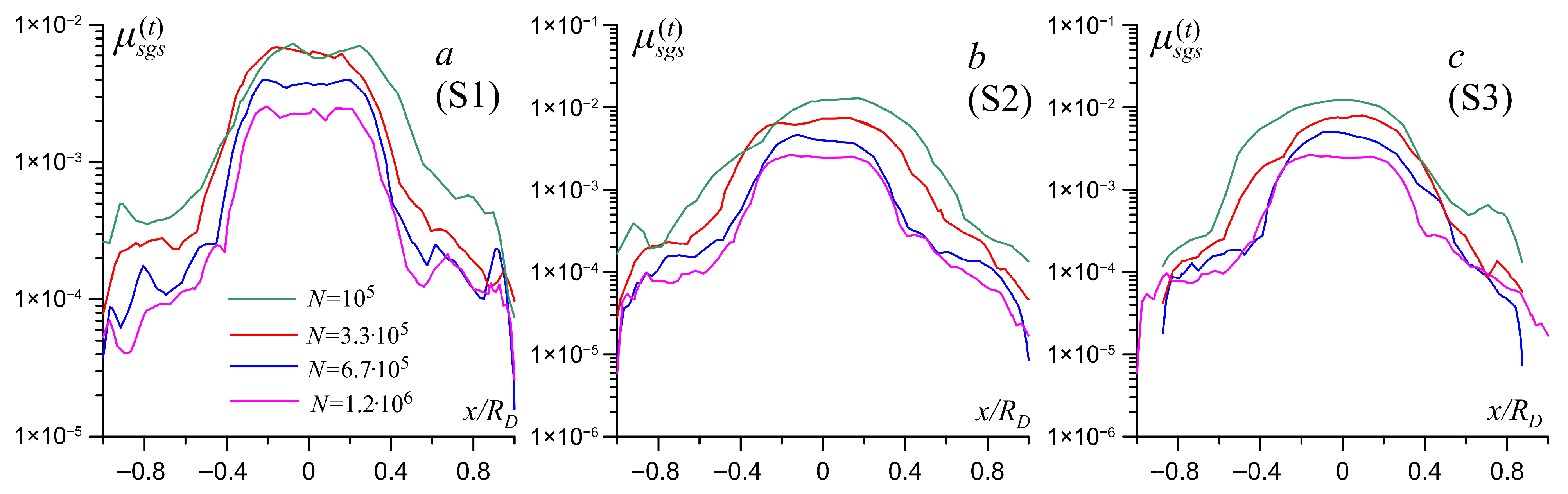
Figure 10 shows the μ s g s ( t ) profiles in different cross-sections for a set of computational grids. Increasing the number of cells N leads to a decrease in turbulent viscosity. The vortex core is characterized by significantly higher SubGrid-scale viscosity values compared to the outer region of the vortex. The difference is approximately 30 times. The processing of our numerical experiments yields the relationship μ s g s ( t ) N n μ , with the exponent falling within the range n μ 0.5–0.8. This weak dependence significantly increases the computational resources required for LES.
Additional capabilities are provided by the Wall-Adapting Local Eddy-viscosity (WALE) model, which serves as an advanced alternative to the Smagorinsky model. Unlike the Smagorinsky model, WALE automatically zeros out the subgrid-scale viscosity at the wall. WALE also provides a more accurate description of the rotation in the central zone of the cyclone, characterized by nearly solid-body gas rotation, as it distinguishes shear flow from curvilinear flow with rotation. This ensures a lower SVR compared to the Smagorinsky model. The value μ s g s ( t ) / μ ( m ) determines the quality of the LES simulation, as low subgrid-scale viscosity allows for a more accurate resolution of smaller eddies.
A small SVR (or TVR for RANS) in the central zone along the axis of rotation ensures the conservation of the vortex rope’s energy and creates the necessary conditions for Vortex Core Precession (VCP). The bending and oscillatory motions of the VCP are a significant factor in particle separation [44]. The oscillations of the vortex rope generate intense velocity fluctuations that affect particles near the walls, entraining them back into the central zone. This reduces the separation efficiency. A powerful non-stationary axial vortex is capable of re-entraining dust from the dust hopper back into the cone and further upward. Furthermore, the precessing vortex rope induces additional aerodynamic drag.
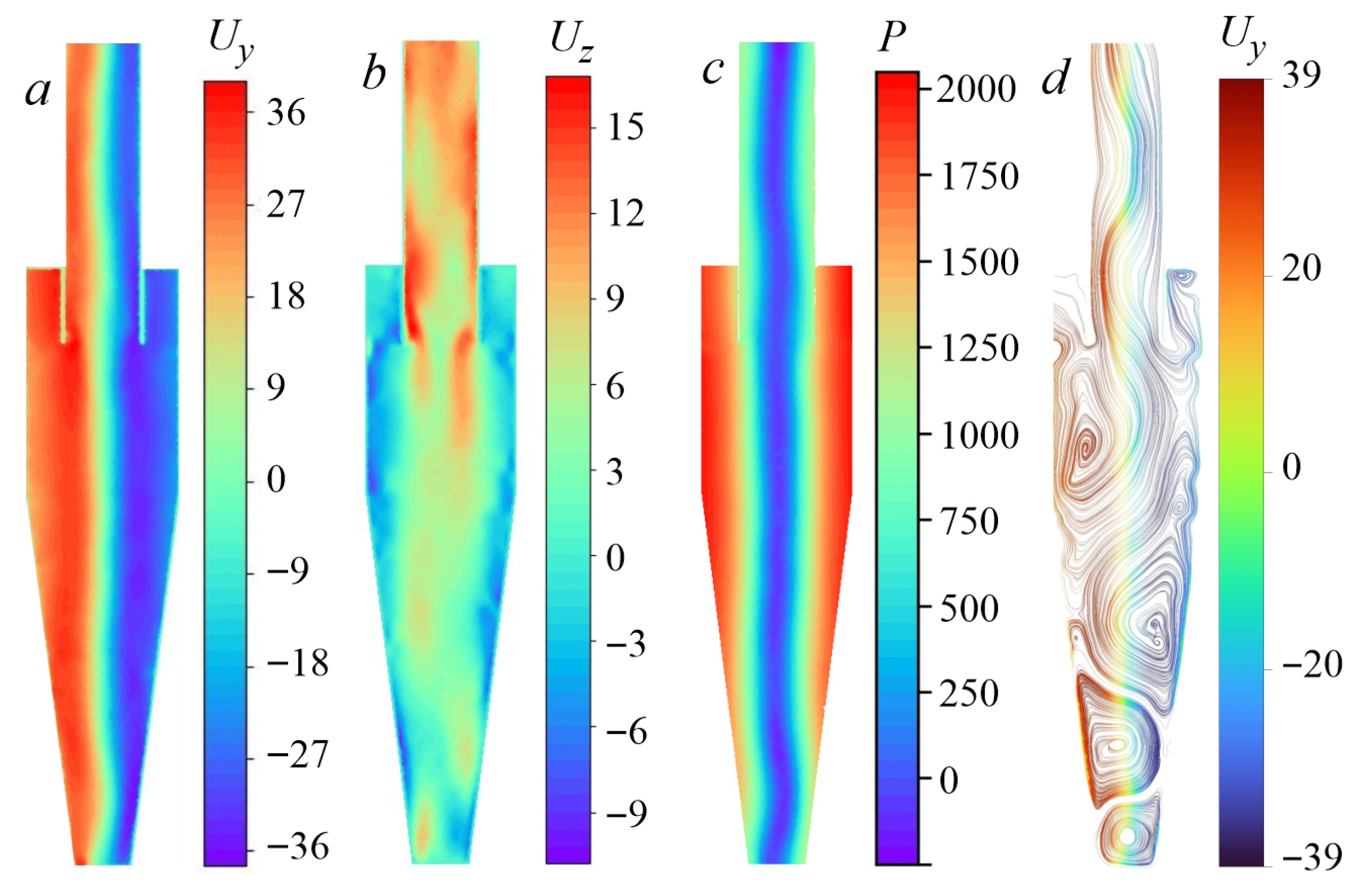
All parameter distributions presented in Section 3.3, Section 3.4 and Section 3.5 were obtained using the LES model on a grid consisting of N 5 ( g ) = 2,279,176 cells. Figure 11a shows the instantaneous distribution of tangential velocity in the x z plane at y = 0 , demonstrating the vortex core precession (VCP) effect. The vortex core is positioned entirely within the vortex finder and experiences extremely minor deviations from axial symmetry. The axial stability of the vortex rope is determined by its rigid confinement by the vortex finder walls and the presence of an axial gradient within the outlet pipe. The maximum gas rarefaction is observed just before the entrance to the vortex finder, where the absolute minimum of static pressure Δ p v f occurs. Further gas movement in the outlet pipe is accompanied by an increase in static pressure due to a decrease in rotational kinetic energy, which is converted into pressure via the Bernoulli effect. This transition is irreversible due to viscous losses, in accordance with the generalized Bernoulli’s equation. The primary increase in Δ p v f occurs over a segment approximately 2 D in length and is proportional to the square of the tangential velocity: Δ p v f U φ max 2 U ( i n ) 2 . This process defines the static pressure recovery potential, which for U ( i n ) = 20 m · s 1 is 400–500 Pa. Noticeable precession of the vortex rope begins below the outlet pipe. The bending wavelength decreases as it approaches the lower part of the cone. The relative amplitude of the bends in the cone increases due to the reduction in the working zone radius R D .
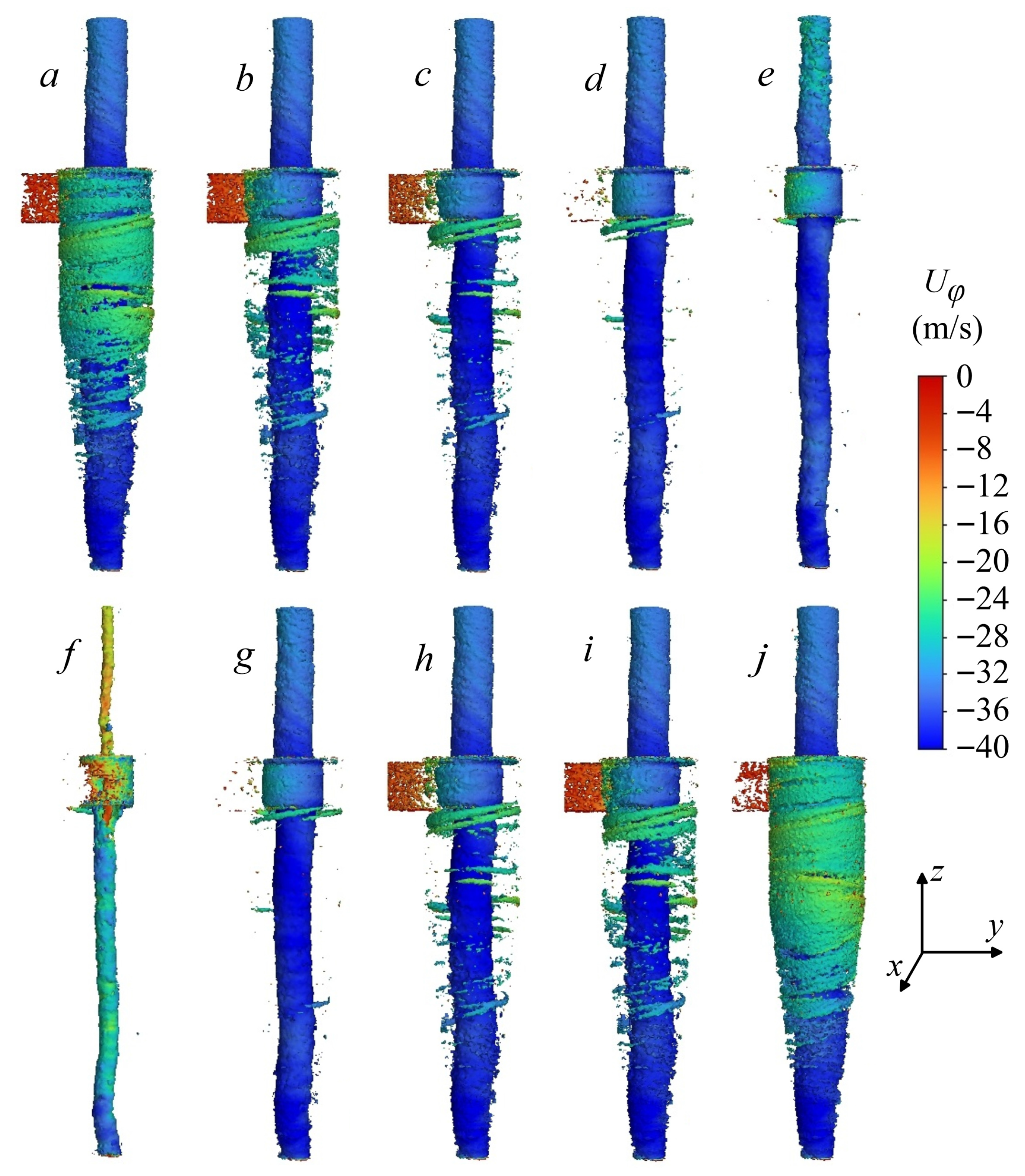
Vortex structures are effectively analyzed using the distributions of the vorticity tensor Ω ^ i j and the strain rate tensor S ^ i j , whose relationship allows for identifying regions where rotation dominates over deformation. Calculating the Q-criterion, defined as Q = 1 / 2 ( | | Ω ^ | | 2 | | S ^ | | 2 ) , enables the isolation of pure rotation zones from high-shear regions. A more rigorous criterion for identifying vortex motion is the λ 2 eigenvalue of the tensor J ^ i j = | | Ω ^ | | 2 + | | S ^ | | 2 . Figure 12 illustrates various isosurfaces of the Q and λ 2 criteria. The conditions Q = 0 and λ 2 = 0 serve to separate the vortex core from deformation zones or the free stream. Panels c and h clearly show the boundaries of the vortex rope, where the instantaneous tangential velocity reaches its maximum (indicated in blue). Additionally, helical structures are observed around the core even at Q = 0 and λ 2 = 0 surfaces (greenish hues), reflecting the presence of small-scale vortex formations near the walls. These structures remain discernible even at Q = 10 5 s−2 and λ 2 = 10 5 s−2, where the vorticity tensor contribution is dominant.
We also present the instantaneous distributions of axial velocity and pressure within the x z cross-section of the cyclone (Figure 11b,c). The U z magnitude exhibits significant non-uniformity, although the bi-modal nature of the axial velocity profile featuring a deficit near the cyclone axis remains clearly visible. The two peaks in the U z ( x ) profile to the left and right of the axis ( x = 0 ) differ in magnitude, which represents a typical flow pattern (see Figure 5 and Figure 6 and [37,45,60,70]). There is a consistent alignment between the minima of tangential velocity and static pressure, which determines the vortex core position in accordance with the balance Equation (14). Panel d illustrates the streamlines in the y = 0 cross-section, highlighting movements ’towards’ ( U y > 0 ) and ’away from’ ( U y < 0 ) the observer, which are attributed to the rotation. Vortex structures are clearly distinguishable in various parts of the cyclone.

3.4. Velocity Fluctuation Dynamics: Generation, Propagation, and Decay

This final section is devoted to studying the dynamics of velocity fluctuations based on LES numerical simulations. The analysis of the spatio-temporal distributions of the full velocity u ( r , t ) in the Navier–Stokes equation is performed using a simple yet effective approach. The computational experiment yields a discrete time function u i j k n = u i j k ( t n ) for each cell ( i , j , k ) . The temporal difference
δ u i j k n = u i j k n u i j k n n δ = u i j k ( t n ) u i j k ( t n n δ )
is calculated between time steps t n and t n n δ with n δ = 1 , 2 , 3 ,   . The velocity increment δ u i j k n indicates the magnitude of change in a given velocity component at point r i j k over the interval δ t n δ = t n t n n δ . The choice of n δ is determined by the rate of the ongoing changes. Since the fluctuations are quasi-periodic with a certain characteristic period T, the optimal value of n δ is expected to provide δ t n δ T / 4 . Small intervals δ t n δ T / 4 yield changes too insignificant for a reliable analysis of the evolution. Conversely, large intervals δ t n δ T / 4 fail to detect the fluctuations. Naturally, as characteristic processes in different parts of the cyclone occur at different rates, the period T depends on the coordinates and may vary over time. Therefore, analyzing certain zones requires a tailored selection of n δ .
It should be emphasized that the distribution of δ u i j k n does not characterize the intensity of the fluctuations. Instead, this quantity determines the rate of change of the velocity field. By calculating δ u i j k n / δ t n δ , we obtain the local time derivative of the velocity at point r i j k . Large absolute values of | δ u i j k n | or | δ u i j k n / δ t n δ | indicate rapid changes in the structure of the fluctuations.
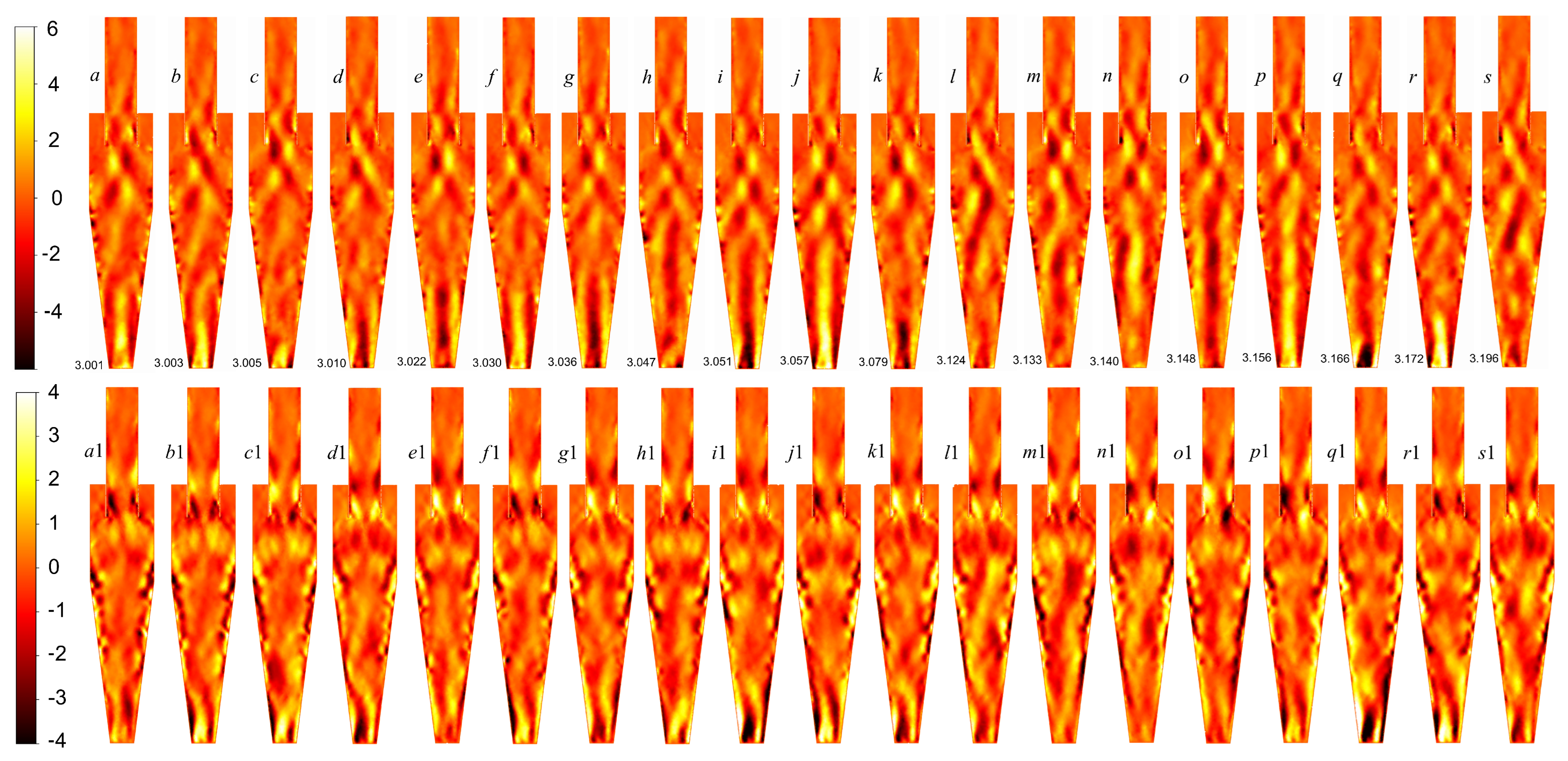
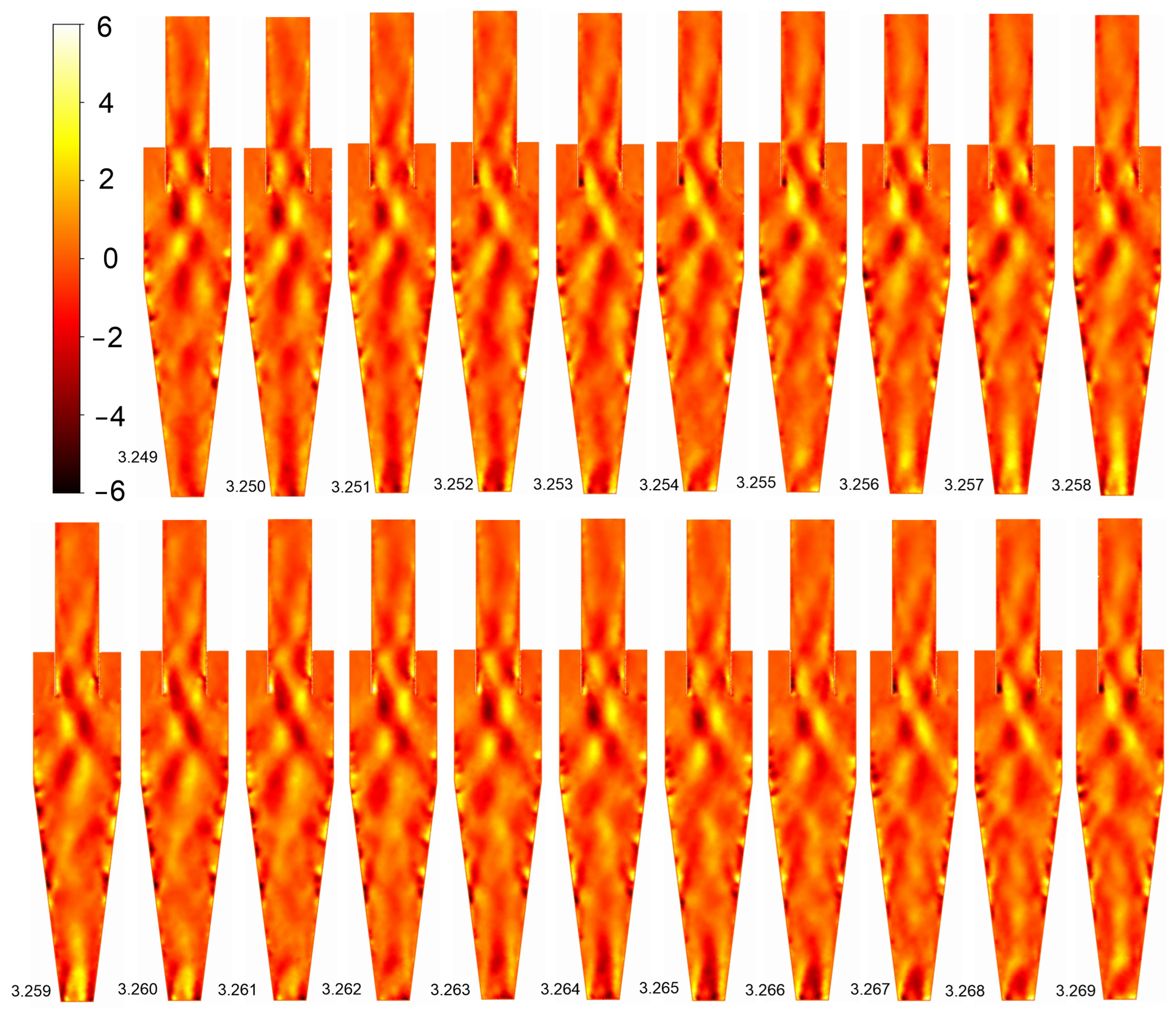
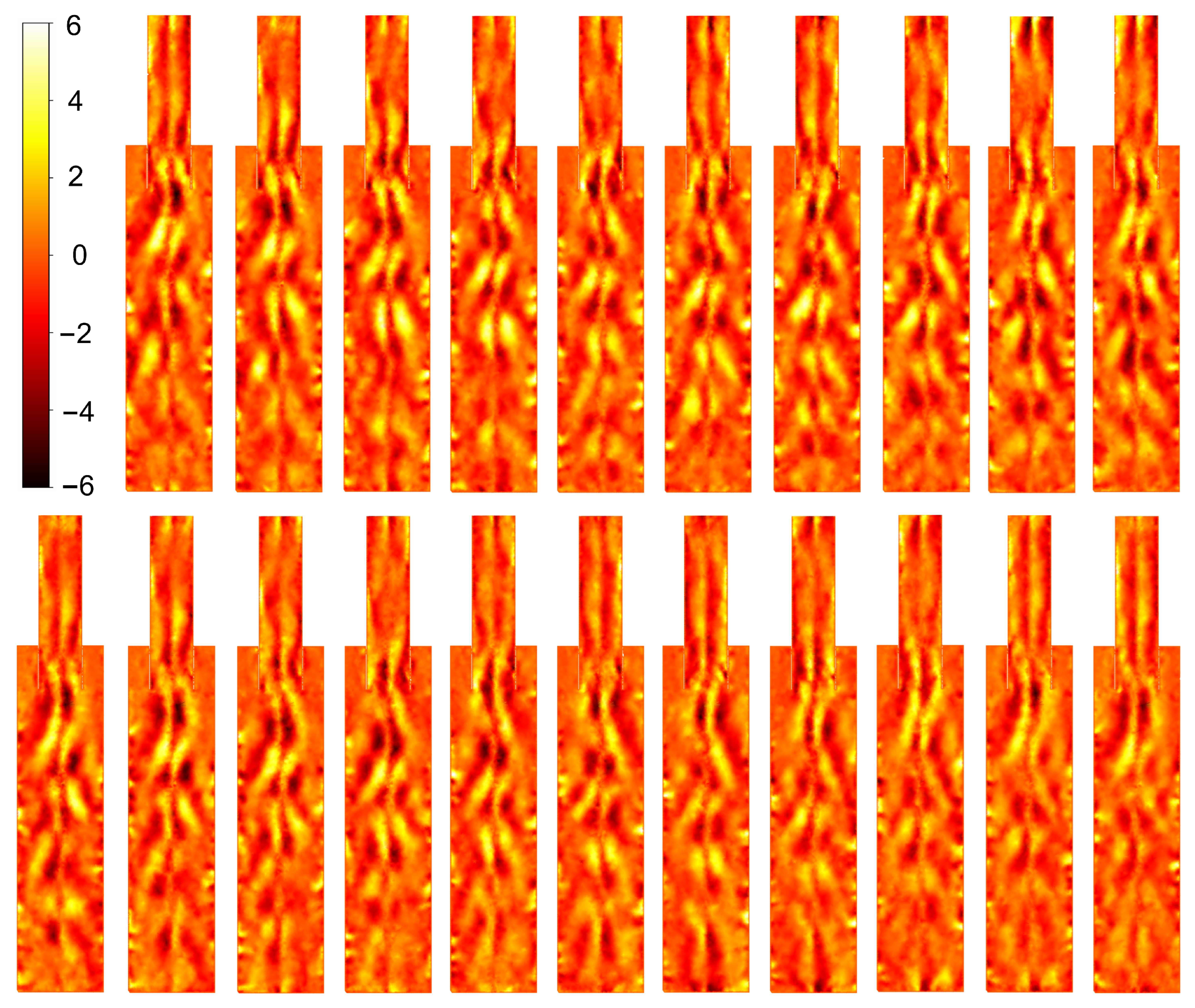
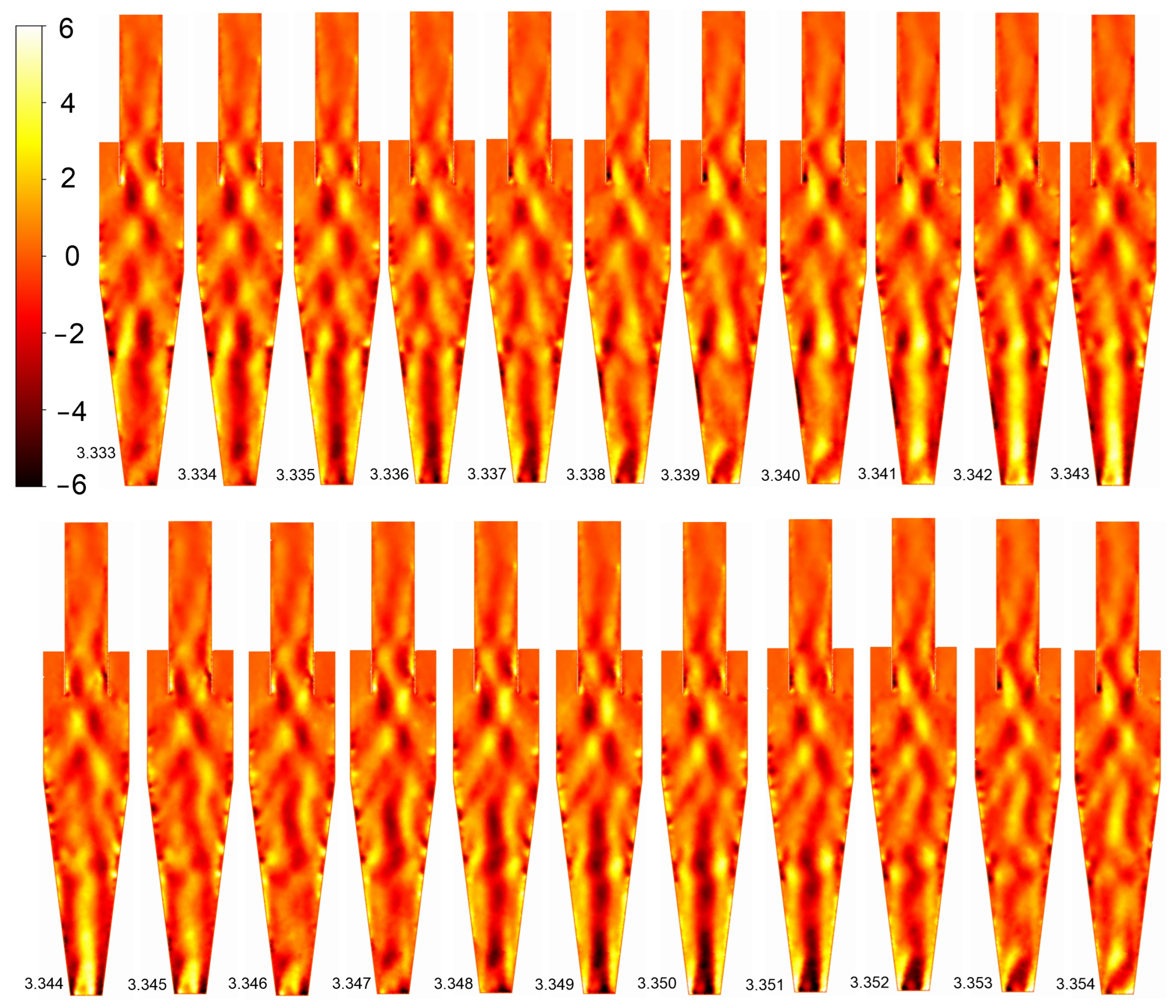
The panels in Figure 13 show a sequence of velocity increment distributions for the tangential velocity ( δ U φ component in the ( x , y = 0 , z ) plane) and the axial velocity ( δ U z ) at various time instants. We selected the moments when characteristic processes associated with the restructuring of the fluctuation pattern occur. The magnitudes of δ U z are typically lower than those of δ U φ . Consequently, different velocity limits are applied to the respective colorbars. Four distinct features of the evolution, related to the inception, propagation, and decay of disturbances, are highlighted below.
(1) First, rapid changes in tangential velocity occur beneath the exit pipe due to a critical change in flow topology within this narrow zone. A portion of the gas enters from the annular space between the main cylinder and the outer wall of the vortex finder (VF). Such a sharp change in the flow direction requires a significant increase in tangential velocity as the radius decreases from D / 2 to D e / 2 . A transition occurs from a free vortex in the outer region to an intense forced vortex in the central core, creating strong velocity shear. The formation of the maximum velocity gradient in this zone renders the flow highly unstable to any small perturbations. Flow separation from the bottom edge of the VF leads to the formation of vortex structures. In this case, rotational energy is converted into the energy of chaotic fluctuations, resulting in the non-stationary behavior of velocity increments near the vortex finder inlet, as clearly seen in almost all panels of Figure 13.
Furthermore, intense turbulence generation occurs within the lower half of the vortex finder itself, although the magnitudes of δ U φ and δ U z are notably smaller than those observed near the VF tip. Several mechanisms contribute to the formation of disturbances inside the VF. A key factor is the vortex breakdown, triggered as the highly swirled flow transitions from the wide cyclone body into the narrow VF duct. The vortex core precession (PVC) is intensified upon entry into the VF, where the vortex stability is compromised. The distortions in the parameter distributions within the VF (Figure 11) indicate the precession of the global vortex structure. The “loose” or diffuse nature of the vortex rope is manifested in the axial velocity distribution (Panel b), where the U z peaks are pushed toward the walls, while the on-axis stagnation zone undergoes transverse oscillations. Intense generation of turbulent fluctuations at the bottom edge enhances the jitter of the vortex rope, leading to chaotic bending. This increased oscillation amplitude causes the vortex core to intermittently impinge upon the internal walls of the VF.
(2) The second feature concerns the velocity increment dynamics in the near-wall region during the transition from the cylindrical to the conical section of the apparatus. All distributions in Figure 13 exhibit a chain of small-scale disturbances in this zone (visible as black and yellow spots), which are scarcely observed at the top of the cylindrical section. This generation of small localized fluctuations is enhanced by the narrowing of the working chamber in the cone and the presence of the wall surface kink. These velocity increment disturbances slowly slide downward along the wall, manifesting as so-called near-wall streaks.
(3) The third process occurs within the lower third of the conical section and reflects the unstable behavior of the vortex rope end. The attachment point of the vortex core to the solid surface migrates freely across the bottom of the cone and can even jump to the lateral walls. This triggers rapid changes in velocity fluctuations throughout the lower conical region. As demonstrated in several panels of Figure 13, these global velocity increment disturbances encompass the entire apex area. We observe two distinct modes of velocity increment intensification. First, the instability of the vortex terminus can occur locally, without external influence from the upper flow (Figure 14). This type of unsteadiness remains relatively weak. Second, a significant surge in δ U near the cone floor can be triggered by the additional penetration of disturbances propagating downward along the vortex core from the upper part of the apparatus (Figure 15). We define a “superburst” as an episodic, extreme velocity increment that significantly exceeds ordinary unsteady fluctuations in the conical apex. While typical pulsations are driven by the local instability and stochastic “jumping” of the vortex terminus between the floor and the walls, a superburst occurs when high-energy disturbances, originating from the vortex finder region, propagate downward along the vortex core. Upon reaching the lower section, these descending perturbations act as an additional external forcing on the precessing vortex end. The constructive interference of these two mechanisms—the downward disturbances and the interaction between the precessing vortex terminus and the cyclone walls—leads to a transient, high-amplitude event marking a peak state of flow instability. The temporal evolution in Figure 15 demonstrates that a superburst is either triggered or sustained by a downward vortex core disturbance. This contrasts with the more quiescent phase observed in Figure 14.
(4) Finally, a critical feature of the velocity increment dynamics is the direction of disturbance propagation, which is consistently downward throughout the cyclone. The aforementioned movement of small-scale δ U fluctuations along the walls in the cylinder-to-cone transition zone appears to be convective in nature, as the near-wall gas flow also descends. However, the most significant and powerful δ U disturbances occur predominantly within the vortex core region. Their persistent counter-current propagation represents an intriguing phenomenon reflecting the elastic nature of the vortex rope. The restoring force is either the Coriolis force for Kelvin waves within the rotating medium or the radial gradient of the angular velocity Ω ( r ) in the case of Rossby waves. The specific physical mechanism may be associated with a Doppler frequency shift, ω k U ¯ z ± ω , which favors downward-propagating waves. Our processing of the simulation results yields characteristic phase velocities for δ U disturbances in the range of v p h ( 1 ) / U ( i n ) 0.5–0.8 for various pulsations and their localizations within the cylindrical section. As a rule, the magnitude of v p h ( 1 ) decreases as the flow approaches the conical section.

3.5. Streaks Properties in the Near-Wall Layer of Cyclone

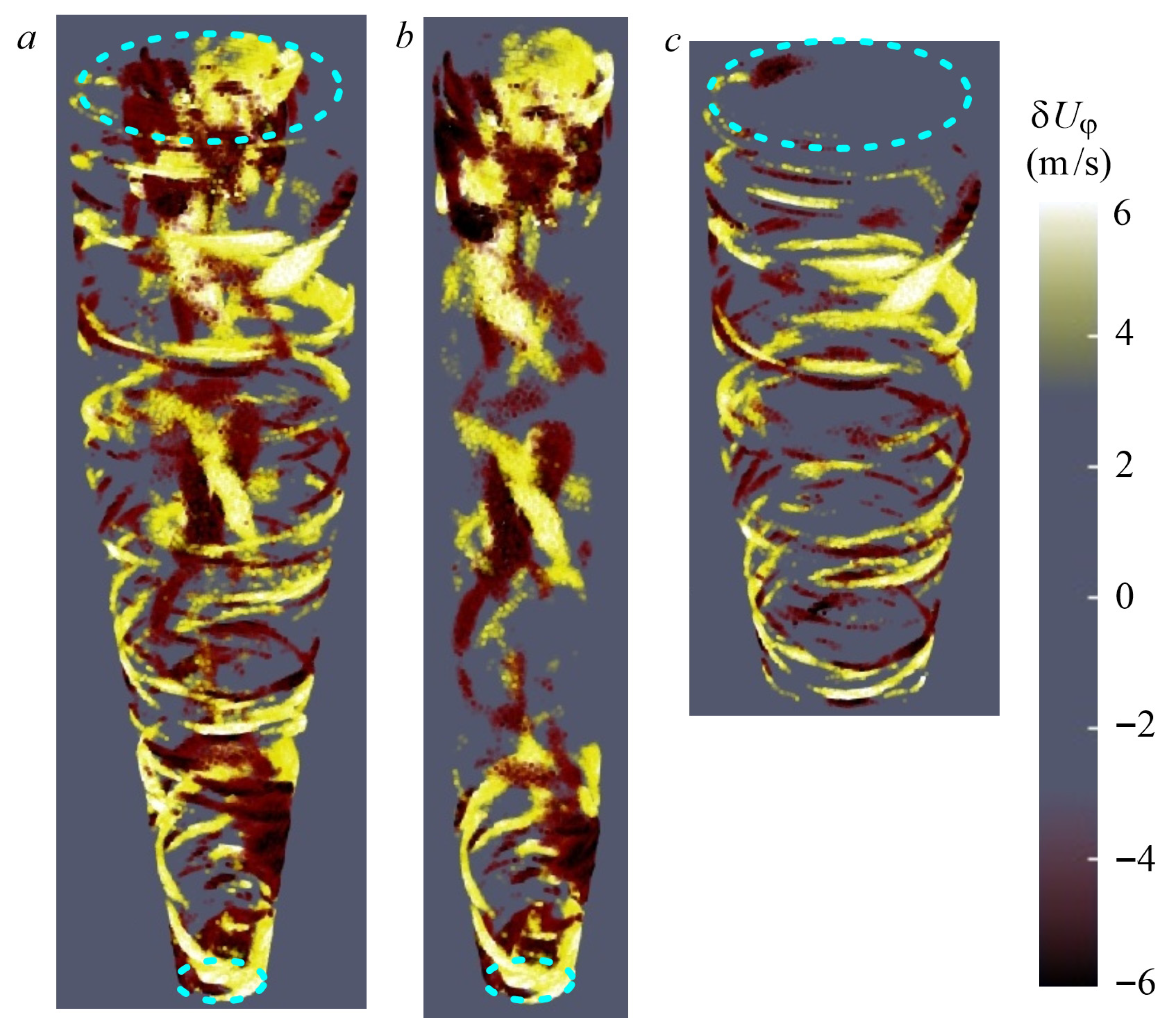
This section provides a more detailed discussion of the previously mentioned velocity streaks. These structures, identified through velocity increments, reflect the development of wall-bounded turbulence. The generation of streaks originates from hydrodynamic instability within the viscous sublayer, subsequently encompassing the entire logarithmic layer as nonlinear turbulent eddies evolve [74]. The subsequent detachment of these structures from the wall leads to their eventual decay. Notably, streaks are detectable only in the LES model; our RSM simulations fail to resolve them. This discrepancy arises from the specific subgrid-scale (SGS) modeling in LES, particularly the Wall-Adapting Local Eddy-viscosity (WALE) model [75], which operates at the scale of two computational cells. Consequently, the velocity increment disturbances observed in LES do not fully resolve the spatial geometry of the streaks, but rather reflect their temporal birth and decay processes at the subgrid level. Therefore, the actual physical dimensions of these near-wall structures remain an open question, requiring further simulations on significantly finer grids with full boundary layer resolution. Nevertheless, the velocity increment method proves to be a robust tool for capturing the characteristic frequencies and temporal dynamics of these subgrid processes, which would otherwise remain hidden in conventional time-averaged fields.
The simulation results provide estimates for their vertical phase propagation speed in the range of v p h ( 2 ) / U ( i n ) 0.2–0.5. This process is largely confined to the upper cone and virtually does not penetrate into the lower half of the conical section. Figure 16a presents the overall 3D structure of the tangential velocity increments within the cyclone, where only the most intense disturbances are shown by filtering out | δ U φ | < 3 m/s. The spatial distribution of δ U φ in the near-axis zone occupied by the vortex core is separately depicted in panel b. One can observe characteristic vertically elongated velocity disturbances of the vortex rope propagating downward from the vortex finder (see Figure 15). Panel c illustrates the spatial arrangement of the near-wall streaks for the main body of the cyclone at heights z / h c o n > 1 / 3 . The 3D length of these elongated structures ranges approximately from 10° to 125°, with their longitudinal distribution remaining generally uniform along the vertical coordinate. In the lower conical section, a complex combination of two disturbance types is observed, involving both near-wall patterns and the inherent unsteadiness of the vortex terminus.
In two-phase flows, these striated patterns are associated with both the carrier gas and the dispersed phase. While such phenomena have not yet been extensively studied in cyclones, experimental evidence exists in atmospheric physics, for instance [76]. Measurements of particle streaks indicate that these clusters may persist longer than their fluid counterparts, exhibiting characteristic dependencies on the Stokes and Reynolds numbers. However, the formation mechanisms, as well as the spatial and temporal scales of these structures in the atmospheric surface layer, differ significantly from those in a cyclone, necessitating dedicated investigations. In this context, our findings on velocity increment time scales provide a fundamental basis for estimating the persistence and “lifetime” of such particle streaks within the cyclone’s high-shear environment.
Particle streaks may serve as the primary mechanism for increasing wall roughness as the cyclone operates. Such localized, intense impacts on the walls can be significantly more severe than uniform particle collisions. Consequently, the classical “uniform wear” model requires modification. Instead of a gradual thinning of the entire wall, heterogeneous erosion patterns may emerge [77]. The theory of erosion as a micro-cutting process by a rigid particle generally predicts maximum wear for ductile materials at shallow impact angles ( α max ( a t t a c k ) = 12–18°), which is characteristic of the sliding motion of dust streaks along the cyclone walls [78]. The particle impact angle is approximately equal to
α ( a t t a c k ) arctan u r ( p ) U φ   ,       u r ( p ) = d ( p )   2 ϱ ( p ) ϱ U φ 2 18   μ ( m )   r   ,
where u r ( p ) is the radial velocity of a particle with density ϱ ( p ) at radius r prior to wall impact. The quadratic dependence of u r ( p ) on the particle diameter d ( p ) ensures that cyclones are highly effective for coarse dust. However, their collection efficiency drops sharply for particles smaller than 5–10 μm. Applying the cyclone parameters from Table 1 to Equation (17) yields tan ( α ( a t t a c k ) ) = 1.5 · 10 3 ( d ( p ) / 1   μ m ) 2 for the velocity profile shown in Figure 3. According to the α max ( a t t a c k ) criterion, particles with diameters of d ( p ) = (10–15) μ m are the most hazardous in terms of erosive wear. This factor is further exacerbated by the formation of ring-like or helical structures within the dust phase, as confirmed by both experimental trajectory measurements and numerical models [38,79]. Such behavior clearly indicates the absence of a uniform particle flux, which intensifies localized abrasive impact.

4. Discussion

The analysis reveals that the flow structure in the cyclone is extremely sensitive to the choice of turbulence model. One- and two-equation models (such as k ε and k ω ) are capable of reducing velocities to characteristic measured values; however, they significantly distort the radial profiles of axial velocity compared to experimental results. The size of the vortex core characterized by quasi-solid-body rotation near the cyclone axis increases twofold or more. Due to the isotropic nature of turbulence in these models, the rotation speed in the outer vortex and near-wall zones is approximately 25% higher than measured values.
Our simulations confirm the superiority of the Reynolds Stress Model (RSM) and Large Eddy Simulation (LES) in predicting velocity fields. Nevertheless, even these models require meticulous calibration, particularly for cyclones with narrow vortex finders, which significantly reduce the vortex core size and enhance radial velocity gradients. RSM and LES reproduce the tangential velocity with high precision, achieving an error margin comparable to LDA measurements. Consequently, the predicted gas rotation structure accurately describes the transport of dust particles to the wall, ensuring an adequate representation of the separation process.
Regarding the turbulence characteristics in different models, our analysis shows substantial differences in the spatial distributions of the turbulent kinetic energy k ( t ) ( r , t ) , dissipation rate ε ( t ) ( r , t ) , eddy viscosity μ ( t ) ( r , t ) , and flow vorticity between the two types of turbulence models. The use of the first type, including k ε , k ω , and their modifications, is found to be unacceptable for modeling cyclone separators. The second type, which includes various Reynolds Stress Models (RSMs) and Large Eddy Simulation (LES) approaches (Smagorinsky–Lilly, WALE, Dynamic Smagorinsky–Lilly, Wall-Modeled LES, and Dynamic Kinetic Energy Subgrid-Scale models), provides satisfactory agreement with LDA measurements due to the correct accounting for turbulence anisotropy, which is critical for cyclone flows.
When considering k ( t ) ( r , t ) , ε ( t ) ( r , t ) , and μ ( t ) ( r , t ) , the RSM predicts a monotonic decrease from the cylindrical walls toward the axis, where the minimum is reached. We find no evidence of additional turbulence generation in the zone of maximum gas rotation speed. In contrast, k ε and k ω models exhibit more complex behavior with local maxima near the transition from the vortex core to the outer region of the vortex. The discrepancies in the radial profiles of k ( t ) , ε ( t ) and μ ( t ) between k ε and RSM are particularly large, reaching factors of 10 to 100 in certain regions. Furthermore, RSM turbulence characteristics change significantly in the lower conical section due to the interaction between the vortex rope and the adjacent walls.
The simulations show only slight deviations from axial symmetry in the distribution of turbulence characteristics. The influence of vortex core precession is reflected in the positions of the local minima of k ( t ) ( r ) , ε ( t ) ( r ) and μ ( t ) ( r ) , which are shifted relative to the geometric axis of the cyclone.
We emphasize the necessity of rigorous computational model validation using different gas velocity components across various cyclone cross-sections, including axial velocity. On one hand, calibration should be based on the analysis of numerical characteristics, such as mesh properties, element count, geometry, and size. Demonstrating convergence across different mesh sets allows for the identification of necessary simulation conditions. Another aspect of calibration is the selection of a turbulence model, which may also be linked to mesh parameters. For instance, a qualitative description of near-wall processes in a narrow zone requires a joint analysis of mesh selection and the mathematical model. Numerical mesh parameters have a particular impact on Large Eddy Simulation (LES), as subgrid-scale viscosity determines the small-scale flow structure and is extremely sensitive to cell size.
The RSM and LES models are capable of producing high-quality distributions of tangential velocities U φ , reproducing measurement data, which represents a significant achievement of the CFD approach [12,23,60,64,70]. The quadratic dependence of centrifugal force on U φ strongly influences the assessment of separation efficiency, as even a few percent of error is at least doubled in the context of particle motion. High values of the U φ component and the geometric features of the apparatus significantly facilitate LDA/PIV measurements of the rotational component. Thus, CFD simulations and experimental data can provide a consistent structure of the global gas vortex inside the apparatus with an error margin within 5 percent.
Low axial velocities are more sensitive to the distribution of turbulent fluctuations, including those driven by radial and vertical pressure gradients. The structure of the U z ( r , z ) profiles is significantly more complex than the U φ distributions. While the tangential velocity typically exhibits only two maxima within the cyclone cross-section, a characteristic U z ( r ) profile can contain up to five velocity extrema, including two upflow zones and three downflow zones. Furthermore, the axial flow near the axis may change direction, pulsating due to the vortex core precession. An LDA measurement error of 1–2 m · s 1 has a negligible effect on U φ but poses significant challenges for determining the axial gas motion because U φ | U z | . Consequently, the U z component is a highly sensitive parameter, easily affected by measurement noise or small-scale inaccuracies in numerical models. High fidelity in simulating axial flows is critical, as these motions determine the particle residence time within the chamber, directly impacting separation efficiency. Thus, while the tangential velocity serves as the foundation of the numerical model, the axial flow represents the ultimate test of its predictive accuracy.
Detailed analysis and validation of the radial velocity component U r , perpendicular to the cyclone’s symmetry axis, are virtually absent from the scientific literature, both in terms of LDA/PIV measurements and numerical simulations (CFD). The radial motion is governed by two distinct physical mechanisms. The first is associated with the steady mass-driven flow toward the axis, which sustains the upward and downward streams. Stationary axisymmetric models yield | U r | = (0.05–0.15) U ( i n ) below the vortex finder. Generally, the magnitude of the radial component decreases as the gas descends, reaching | U r | 0.03   U ( i n ) . The second mechanism is linked to vortex core precession (VCP), the description of which requires unsteady RSM/LES simulations. VCP can amplify U r beneath the outlet pipe, reaching magnitudes of | U r | (0.1–0.2) U ( i n ) , which serves as a significant cause for the short-circuiting of large particles [44]. In the main cylindrical section of the cyclone, the radial flow is minimal ( | U r | (0.02–0.05) U ( i n ) ) and often falls within the margin of LDA measurement error. The conditions in the lower conical section are more complex, as the contribution of precession becomes the dominant factor. This leads to low-frequency radial velocity pulsations with amplitudes of | U r | 0.05   U ( i n ) , necessitating specific measures to protect the dust layer in the hopper [7,35,43]. The movement of the vortex rope end induces “vortex wandering” (the bullwhip effect), which suspends particles and keeps the dust in a fluidized state. This precessing rope generates a suction effect, creating conditions for particle re-entrainment. Consequently, despite its critical importance, radial gas motion remains an overlooked factor in fluid dynamics research, serving as a key indicator of the fundamental physics behind vortex rope precession.
The classical cyclone geometry incorporates a conical lower section to enhance separation efficiency by shortening the particle travel distance. However, the proximity of the precessing vortex core to the walls can trigger superburst events when the vortex terminus makes contact with the slanted surface. Stochastic jumping of the vortex end induces rapid velocity fluctuations in the apex region, adversely affecting dust deposition. Panel f in Figure 12 highlights the centermost part of the vortex core, where maximum bending occurs in the narrowest part of the cone, reflecting the intensification of core precession within the confined zone.
Figure 17 demonstrates the disappearance of superbursts in the LES model when the cyclone walls are moved away from the lower vortex core. Simulations in a purely cylindrical cyclone devoid of a conical section show a more stable precession. Thus, we attribute the superburst phenomenon to the interaction between the precessing vortex terminus and the closely spaced walls of the converging section.

5. Conclusions

Several key insights emerge from our findings.
(1) Two-equation isotropic turbulence models, specifically k ω and k ε with standard closure coefficients, tend to overestimate tangential velocities at the cyclone periphery compared to experimental data. The most significant discrepancies are observed in axial velocity profiles, particularly within the near-axis region occupied by the vortex core. In contrast, RSM and LES models provide higher predictive accuracy, more adequately reproducing the flow structure throughout the apparatus.
(2) We propose using velocity increments δ u n = u ( t n ) u ( t n n δ ) ( n δ 1 ) or local flow acceleration to analyze velocity field dynamics in numerical cyclone models. Unlike the direct analysis of the velocity field itself, this approach enables the detection of flow structures across various spatial and temporal scales, even on coarse computational grids. This method effectively isolates features in both the spatial and temporal domains.
(3) LES-based analysis of velocity increment δ U dynamics reveals that rapid velocity pulsations are generated almost continuously beneath the vortex finder. These disturbances propagate downstream through the vortex core at velocities ranging from 0.5 U ( i n ) to 0.8 U ( i n ) , though their penetration into the conical section remains limited and sporadic. Furthermore, we identified two distinct regimes of velocity increment unsteadiness in the lower cone triggered by the vortex terminus instability. The first regime consists of a continuous background of pulsations arising from the stochastic migration of the vortex attachment point. Periodically, this is interrupted by ’superbursts’ of unsteadiness when the system is further excited by disturbances arriving from the upper cyclone, leading to direct interaction between the vortex core and the conical walls.
(4) The identified superbursts in the lower conical section manifest as rapid gas velocity fluctuations that can significantly affect particle deposition along the cyclone walls. These velocity changes reach magnitudes of up to 1 m/s within 10 3 s and encompass the entire lower part of the device. Modeling such phenomena is only possible using the LES approach, as RSM and other RANS-based turbulence models are inherently unable to capture these transient effects.
(5) Velocity increment analysis within the LES framework enables the identification of small-scale near-wall disturbances associated with velocity streaks. These elongated structures are manifestations of wall-bounded turbulence originating in the viscous sublayer due to hydrodynamic instability. These near-wall streaks serve as the primary source of turbulence because their instability and subsequent bursting generate the vortex system that fills the separator volume. By inducing high-frequency gas pulsations directly at the wall, streaks significantly influence the dynamics of solid particles. Our study demonstrates the feasibility of extracting these near-wall streaks from LES subgrid-scale physics at spatial scales of 1–2 computational grid cells.

Author Contributions

Conceptualization, A.V.K.; methodology, E.S.S.; software, E.S.S.; validation, E.S.S.; formal analysis, E.S.S.; investigation, E.S.S.; resources, A.V.K.; data curation, E.S.S.; writing—original draft preparation, E.S.S.; writing—review and editing, A.V.K.; visualization, E.S.S.; supervision, A.V.K.; project administration, A.V.K.; funding acquisition, A.V.K. All authors have read and agreed to the published version of the manuscript.

Funding

The work was supported by the Ministry of Science and Higher Education of the Russian Federation (project FZUU-2026-0005).

Institutional Review Board Statement

Not applicable.

Informed Consent Statement

Not applicable.

Data Availability Statement

Data are contained within the article.

Conflicts of Interest

The authors declare no conflicts of interest.

Abbreviations

The following abbreviations are used in this manuscript:
CFDComputational Fluid Dynamics
RSMReynolds Stress Model
LESLarge Eddy Simulation
PVCPrecessing Vortex Core
SGSSubGrid-Scale
CDCCyclone Dust Collector
LDALaser Doppler Anemometry
HWA   Hot-Wire Anemometry
VSLViscous Sublayer
TVRTurbulent Viscosity Ratio
SVRSubgrid Viscosity Ratio
WALEWall-Adapting Local Eddy-Viscosity
VCPVortex Core Precession
RANSReynolds-Averaged Navier–Stokes
VFVortex Finder

References

  1. Khan, R.K.; Strand, M.A. Road dust and its effect on human health: A literature review. Epidemiol. Health 2018, 40, e2018013. [Google Scholar] [CrossRef]
  2. Anlimah, F.; Gopaldasani, V.; MacPhail, C.; Brian Davies, B. A systematic review of the effectiveness of dust control measures adopted to reduce workplace exposure. Environ. Sci. Pollut. Res. 2023, 30, 54407–54428. [Google Scholar] [CrossRef]
  3. Essamlali, I.; Nhaila, H.; El Khaili, M. Supervised Machine Learning Approaches for Predicting Key Pollutants and for the Sustainable Enhancement of Urban Air Quality: A Systematic Review. Sustainability 2024, 16, 976. [Google Scholar] [CrossRef]
  4. Alkhodaidi, A.; Attiah, A.; Mhawish, A.; Hakeem, A. The Role of Machine Learning in Enhancing Particulate Matter Estimation: A Systematic Literature Review. Technologies 2024, 12, 198. [Google Scholar] [CrossRef]
  5. Liu, W.; Ye, G.; Liu, P. CFD-DEM Simulation of the Effect of Transverse Inclination Angle on Particle Moving Behavior in Spiral Separation. Separations 2026, 13, 73. [Google Scholar] [CrossRef]
  6. Tang, S.; Ibrahim, M.D.; Rigit, A.R.H.; Zhang, W.; Wei, C. A Systematic Review of Coal Mine Dust Suppression Methods Based on Numerical Simulations and Experimental Investigations. Int. J. Eng. Technol. Innov. 2024, 15, 237–253. [Google Scholar] [CrossRef]
  7. Bayareh, M. A Review of the Experimental Analysis of Gas–Solid Cyclone Separators. ChemBioEng Rev. 2024, 11, e202400036. [Google Scholar] [CrossRef]
  8. Salehyar, S.; Ghaemi, A.; Mashhadimoslem, H.; Shirvani, M. Experimental and Numerical Studies on Improving Cyclone Efficiency by Rotation of Cyclone Body. J. Chem. Pet. Eng. 2023, 57, 189–202. [Google Scholar]
  9. Butenko, M.; Shafran, Y.; Khoperskov, S.; Kholodkov, V.; Khoperskov, A. The optimization problem of the ventilation system for metallurgical plant. Appl. Mech. Mater. 2013, 379, 167–172. [Google Scholar] [CrossRef]
  10. Sun, L.; Xie, M.; Man, M.; Li, J.; Dong, Y.; Song, J. Comparative Analyses of Dynamic Characteristics of Gas Phase Flow Field Within Different Structural Cyclone Separators. Processes 2024, 12, 2455. [Google Scholar] [CrossRef]
  11. Wasilewski, M.; Ligus, G.; Brar, L.S. Investigations of the flow phenomena inside square cyclone separators with different prismatic heights. Sep. Purif. Technol. 2025, 362, 131724. [Google Scholar] [CrossRef]
  12. Wang, S.; Li, H.; Wang, R.; Wang, X.; Ruichao, T.; Sun, Q. Effect of the inlet angle on the performance of a cyclone separator using CFD-DEM. Adv. Powder Technol. 2019, 30, 227–239. [Google Scholar] [CrossRef]
  13. Azarov, V.N.; Borovkov, D.P.; Redhwan, A.M. Applicaition of Swirling Flows in Aspiration Systems. Int. Rev. Mech. Eng. 2014, 8, 750–753. [Google Scholar]
  14. Azarov, V.N.; Azarov, D.V. Pyleuloviteli so Vstrechnymi Zakruchennymi Potokami; Izd-vo VolGGTU: Volgograd, Russia, 2020. [Google Scholar]
  15. Kong, K.-J.; Hwang, S.-H. Development and Performance Evaluation Experiment of a Device for Simultaneous Reduction of SOx and PM. Energies 2024, 17, 3337. [Google Scholar] [CrossRef]
  16. Azarov, V.N.; Stefanenko, I.V.; Borovkov, D.P.; Majd, O. Optimization of Design Parameters of Dust Collectors with Counter-Current Swirling Flows in the Systems of Dedusting Ventilation. Int. Rev. Mech. Eng. 2018, 12, 721–725. [Google Scholar] [CrossRef]
  17. Kuznetsov, S.I.; Mikhailik, V.D.; Rusanov, S.A. Modeling of the hydrodynamics of a cyclonic rotational dust collector of increased efficiency. J. Eng. Phys. Thermophys. 2012, 85, 349–355. [Google Scholar] [CrossRef]
  18. Elsayed, K. Optimization of the cyclone separator geometry for minimum pressure drop using Co-Kriging. Powder Technol. 2015, 269, 409–424. [Google Scholar] [CrossRef]
  19. Stairmand, C.J. The design and performance of cyclone separator. Trans. Inst. Chem. Eng. 1951, 29, 356–383. [Google Scholar]
  20. Savin, E.S.; Khoperskov, A.V. Review of computational models for cyclone-type dust collectors. Math. Phys. Comput. Simul. 2025, 28, 54–106. [Google Scholar] [CrossRef]
  21. Rivera-Garcia, M.O.; Reyna, M.A.; Camarillo-Ramos, M.A.; Reyna-Vargas, M.A.; Avitia, R.L.; Cuevas-Gonzalez, D.; Osornio Vargas, A.R. Cyclone Separator for Air Particulate Matter Personal Monitoring: A Patent Review. Atmosphere 2023, 14, 624. [Google Scholar] [CrossRef]
  22. Krisch, R.; Paschedag, A.R.; Müller, K.W. Numerical Investigation and Experimental Validation of Separation Efficiency in a Dual-Inlet Cyclone with a Downcomer Tube. Sep. Sci. Technol. 2025, 61, 333–346. [Google Scholar] [CrossRef]
  23. Soliman, M.M.; El-shaer, Y.; Elsayed, K.; Ibrahim, M.A. Performance enhancement of gas cyclone with streamlined ports using CFD simulations. J. Eng. Appl. Sci. 2025, 72, 4. [Google Scholar] [CrossRef]
  24. Dimitrijevica, D.; Schmida, M.; Haraseka, M.; Bosenhofer, M. Comparison of experimental, empirical, and CFD pressure losses of lab-scale sampling cyclones. Sep. Purif. Technol. 2025, 354, 128992. [Google Scholar] [CrossRef]
  25. Babu, K.S.; Sivapirakasam, S.P.; Venkatesh, S. CFD-based evaluation of performance enhancement in a baffle-integrated settling chamber coupled with a cyclone separator. Powder Technol. 2026, 469, 121767. [Google Scholar] [CrossRef]
  26. El-Emam, M.A.; Zhou, L.; Bai, L.; Zhao, Z. Modeling and Performance Analysis of Different Gas–Bioparticle Cyclone Separators: CFD–DEM Simulations. Ind. Eng. Chem. Res. 2023, 62, 18552–18578. [Google Scholar] [CrossRef]
  27. Misiulia, D.; Liden, G.; Antonyuk, S. Cyclone dimensionless pressure drop, cut size, and separation slope: One dimensionless number (Reynolds) to rule them all. Particuology 2024, 95, 235–251. [Google Scholar] [CrossRef]
  28. Xu, H.; Luo, M.; Chen, Y.; Fu, X.; Dong, Y.; Liu, D. Optimized design and test based on Fluent cyclone dust removal device. Flow Meas. Instrum. 2025, 106, 102953. [Google Scholar] [CrossRef]
  29. Bogdanov, D.; Poniaev, S. Numerical simulation of turbulent flow in a cyclonic separator. J. Phys. Conf. Ser. 2014, 572, 012056. [Google Scholar] [CrossRef]
  30. Misiulia, D.; Nedumaran, P.K.; Antonyuk, S. Effect of the Discharging Flap on Particle Separation in a Cyclone. Chem. Eng. Technol. 2023, 46, 1098–1105. [Google Scholar] [CrossRef]
  31. Paganel, T.V.; Alban, E.F.; Cyrille, M.A.; Abbe, C.V.N. CFD Simulation of an Industrial Dust Cyclone Separator: A Comparison with Empirical Models: The Influence of the Inlet Velocity and the Particle Size on Performance Factors in Situation of High Concentration of Particles. J. Eng. 2024, 2024, 5590437. [Google Scholar] [CrossRef]
  32. Belousov, A.S.; Ovsyannikov, D.A. Validation of Spatial Models of Turbulent Flows During Preparation, Production, and Use of Chemical Fibers. Fibre Chem. 2024, 56, 284–287. [Google Scholar] [CrossRef]
  33. Hoekstra, A.J. Gas Flow Field and Collection Efficiency of Cyclone Separators. Ph.D. Dissertation, Delft University of Technology, Delft, The Netherlands, 2000. [Google Scholar]
  34. Hoekstra, A.J.; Derksen, J.J.; van den Akker, H.E.A. An experimental and numerical study of turbulent swirling flow in gas cyclones. Chem. Eng. Sci. 1999, 54, 2055–2065. [Google Scholar] [CrossRef]
  35. Gronald, G.; Derksen, J.J. Simulating turbulent swirling flow in a gas cyclone: A comparison of various modeling approaches. Powder Technol. 2011, 205, 160–171. [Google Scholar] [CrossRef]
  36. Fraser, S.M.; Abdel Razek, A.M.; Abdullah, M.Z. Computational and experimental investigation in a cyclone dust separator. Proc. Inst. Mech. Eng. Part E J. Process. Mech. Eng. 1997, 211, 247–257. [Google Scholar] [CrossRef]
  37. Slack, M.D.; Prasad, R.O.; Bakker, A.; Boysan, F. Advances in Cyclone Modelling Using Unstructured Grids. Chem. Eng. Res. Des. 2000, 78, 1098–1104. [Google Scholar] [CrossRef]
  38. Cui, H.; Chen, J.-Y.; Wu, X.-J.; Cao, M.-Q.; Yanga, L.-X.; Fan, X.-Q.; Wei, Y.-D. Experimental study on the instability characteristics of the top ash ring in the cyclone separator. Sep. Purif. Technol. 2025, 355, 129549. [Google Scholar] [CrossRef]
  39. Wang, C.; Ma, Y.; Sui, W. The Secondary Flows in a Cyclone Separator: A Review. Processes 2023, 11, 2935. [Google Scholar] [CrossRef]
  40. Ayl, E.; Kocak, E. A comprehensive review of cyclone separator technology. Powder Technol. 2025, 103, 2751–2789. [Google Scholar] [CrossRef]
  41. Belousov, A.S.; Sazhin, B.S. Characteristics of flow structures in units for processing fibre-forming polymers inactive hydrodynamic regimes. Fibre Chem. 2007, 39, 475–479. [Google Scholar] [CrossRef]
  42. Alahmadi, Y.H.; Awadh, S.A.; Nowakowski, A.F. Simulation of Swirling Flow with a Vortex Breakdown Using Modified Shear Stress Transport Model. Ind. Eng. Chem. Res. 2021, 60, 6016–6026. [Google Scholar] [CrossRef]
  43. Obermair, S.; Woisetschlager, J.; Staudinger, G. Investigation of the flow pattern in different dust outlet geometries of a gas cyclone by laser Doppler anemometry. Powder Technol. 2003, 138, 239–251. [Google Scholar] [CrossRef]
  44. Guo, M.; Xue, H.; Pang, J.; Le, D.K.; Sun, X.; Yoon, J.Y. Numerical investigation on the swirling vortical characteristics of a Stairmand cyclone separator with slotted vortex finder. Powder Technol. 2023, 416, 118236. [Google Scholar] [CrossRef]
  45. Sayed, M.; Dehbi, A.; Niceno, B.; Mikityuk, K.; Krinner, M. Flow Simulation of Gas Cyclone Separator at High Reynolds Number Using the Elliptic-Relaxation Hybrid LES/RANS (ER-HRL) Model. In Proceedings of the 6th World Congress on Momentum, Heat and Mass Transfer (MHMT 21), Lisbon, Portugal, 17–19 June 2021; Volume 110, pp. 1–8. [Google Scholar]
  46. Erol, H.I.; Turgut, O.; Unal, R. Experimental and numerical study of Stairmand cyclone separators a comparison of the results of small-scale and large-scale cyclones. Heat Mass Transf. 2019, 55, 2341–2354. [Google Scholar] [CrossRef]
  47. Chlebnikovas, A. Fluid Flow Dynamics and Micro-Dust Separation in Multi-Module Cyclone-Separators: Experimental Research and Comparative Analysis. Separations 2025, 12, 313. [Google Scholar] [CrossRef]
  48. Zhou, C.; Dai, X.; Zhou, M.; Zeng, Y. Numerical Simulation and Influence Analysis of Geometrical Parameters in Gas–Solid Separation Process for a Cyclone Separator. Processes 2025, 13, 2723. [Google Scholar] [CrossRef]
  49. Li, G.; Gong, J.; Wang, Z.; Liu, R. Simulation of Helical-Baffle Inlet Structure Cyclone Separator. Separations 2025, 12, 166. [Google Scholar] [CrossRef]
  50. Azarov, V.N.; Lukanin, D.V.; Borovkov, D.P.; Redhwan, A. Experimental Study of Secondary Swirling Flow Influence on Flows Structure at Separation Chamber Inlet of Dust Collector with Counter Swirling Flows. Int. Rev. Mech. Eng. 2014, 8, 851–856. [Google Scholar] [CrossRef]
  51. Averin, G.; Shevtsova, M.; Bronnikova, M. Quassiclassical approximation of solutions of boundary convective-type problems of heat and mass transfer. Appl. Math. Phys. 2023, 55, 57–69. [Google Scholar]
  52. Jiao, J.; Liu, Z.; Zheng, Y. Evaluations and Modifications on Reynolds Stress Model in Cyclone Simulations. Chem. Eng. Technol. 2007, 30, 15–20. [Google Scholar] [CrossRef]
  53. ANSYS. ANSYS Fluent Theory Guide, Release 2025 R1; ANSYS, Inc.: Canonsburg, PA, USA, 2025. [Google Scholar]
  54. Speziale, C.G.; Sarkar, S.; Gatski, T.B. Modelling the pressure-strain correlation of turbulence: An invariant dynamical systems approach. J. Fluid Mech. 1991, 227, 245–272. [Google Scholar] [CrossRef]
  55. Wilcox, D.C. Turbulence Modeling for CFD; DCW Industries, Inc.: Philadelphia, PA, USA, 2006. [Google Scholar]
  56. Li, H.; Song, Z.; Zhang, A.; Sun, Z.; Jin, L. Optimization of an axial coarse powder separator for low-density lignite based on the optimal seeking method. Particuology 2023, 79, 133–142. [Google Scholar] [CrossRef]
  57. Durbin, P.A.; Pettersson Reif, B.A. Statistical Theory and Modeling for Turbulent Flows; Wiley: Hoboken, NJ, USA, 2011. [Google Scholar]
  58. Xu, C.; Fang, T.; Liu, D.; Liu, Z.; Yang, W. A new scale-adaptive hybrid Reynolds-averaged Navier–Stokes and large eddy simulation model considering rotational effect for separated flow predictions. Phys. Fluids 2025, 37, 065113. [Google Scholar] [CrossRef]
  59. Bicherakhova, O.S. Construction of Triangular Meshes of Multiply Connected Domains Based on Delaunay Triangulation. Math. Phys. Comput. Simul. 2025, 28, 37–49. [Google Scholar] [CrossRef]
  60. Wang, B.; Xu, D.L.; Chu, K.W.; Yu, A.B. Numerical study of gas–solid flow in a cyclone separator. Appl. Math. Model. 2006, 30, 1326–1342. [Google Scholar] [CrossRef]
  61. Yang, Z.; Castaneda, V.; Ogus, G.; Holemans, T.; Vanierschot, M.; Valera-Medina, A. Identification and dynamics of coherent structures in a Coanda swirling jet flow. Exp. Therm. Fluid Sci. 2022, 142, 110817. [Google Scholar] [CrossRef]
  62. Pope, S.B. Turbulent Flows; Cambridge University Press: Cambridge, UK, 2000. [Google Scholar]
  63. Shur, M.L.; Strelets, M.K.; Travin, A.K.; Spalart, P.R. Turbulence Modeling in Rotating and Curved Channels: Assessing the Spalart–Shur Correction. AIAA J. 2000, 38, 784–792. [Google Scholar] [CrossRef] [PubMed]
  64. Wu, Z.; Zheng, G.; Li, S. Prediction of Erosion of a Hydrocyclone Inner Wall Based on CFD-DPM. Fluids 2025, 10, 266. [Google Scholar] [CrossRef]
  65. Launder, B.E.; Reece, G.J.; Rodi, W. Progress in the development of a Reynolds-stress turbulence closure. J. Fluid Mech. 1975, 68, 537–566. [Google Scholar] [CrossRef]
  66. Daly, B.J.; Harlow, F.H. Transport Equations in Turbulence. Phys. Fluids 1970, 13, 2634–2649. [Google Scholar] [CrossRef]
  67. Ma, R.; Alame, K.; Mahesh, K. Direct numerical simulation of turbulent channel flow over random rough surfaces. J. Fluid Mech. 2021, 908, A40. [Google Scholar] [CrossRef]
  68. Alfonsi, G.; Ciliberti, S.A.; Mancini, M.; Primavera, L. Direct Numerical Simulation of Turbulent Channel Flow on High-Performance GPU Computing System. Computation 2016, 4, 13. [Google Scholar] [CrossRef]
  69. Appelbaum, J.; Kloker, M.; Wenzel, C. A systematic DNS approach to isolate wall-curvature effects in spatially developing boundary layers. Theor. Comput. Fluid Dyn. 2025, 39, 10. [Google Scholar] [CrossRef]
  70. Tian, Y.; Chen, Z.; Zhuang, Q. Effect of gas flow rate on separation efficiency at different scaling scales of cyclone separators. Front. Heat Mass Transf. 2023, 20, 26. [Google Scholar]
  71. Wei, Q.; Sun, G.; Gao, S. Numerical analysis of axial gas flow in cyclone separators with different vortex finder diameters and inlet dimensions. Powder Technol. 2020, 369, 321–333. [Google Scholar] [CrossRef]
  72. Elsayed, K.; Lacor, C. The effect of cyclone vortex finder dimensions on the flow pattern and performance using LES. Comput. Fluids 2013, 71, 224–239. [Google Scholar] [CrossRef]
  73. Pandey, S.; Saha, I.; Prakash, O.; Mukherjee, T.; Iqbal, J.; Roy, A.K.; Wasilewski, M.; Brar, L.S. CFD Investigations of Cyclone Separators with Different Cone Heights and Shapes. Appl. Sci. 2022, 12, 4904. [Google Scholar] [CrossRef]
  74. Lozano-Duran, A.; Jimenez, J. Time-resolved evolution of coherent structures in turbulent channels: Characterization of eddies and cascades. J. Fluid Mech. 2014, 759, 432–471. [Google Scholar] [CrossRef]
  75. Nicoud, F.; Ducros, F. Subgrid-Scale Stress Modelling Based on the Square of the Velocity Gradient Tensor. Flow Turbul. Combust. 1999, 62, 183–200. [Google Scholar] [CrossRef]
  76. Berk, T.; Coletti, F. Dynamics and scaling of particle streaks in high-Reynolds-number turbulent boundary layers. J. Fluid Mech. 2023, 975, A47. [Google Scholar] [CrossRef]
  77. Finnie, I. The mechanism of erosion of ductile metals. In Proceedings of the Third U. S. National Congress of Applied Mechanics; ASME: New York, NY, USA, 1958; pp. 527–532. [Google Scholar]
  78. Finnie, I. Erosion of Surfaces by Solid Particles. Wear 1960, 3, 87–103. [Google Scholar] [CrossRef]
  79. Gao, Z.; Liu, Z.; Song, Z.; Li, C.; Qi, X.; Ling, H.; Wei, Y. Peculiarities of particle motion inside cyclone separator by using LES-DRW model. Eng. Res. Des. 2022, 183, 512–524. [Google Scholar] [CrossRef]
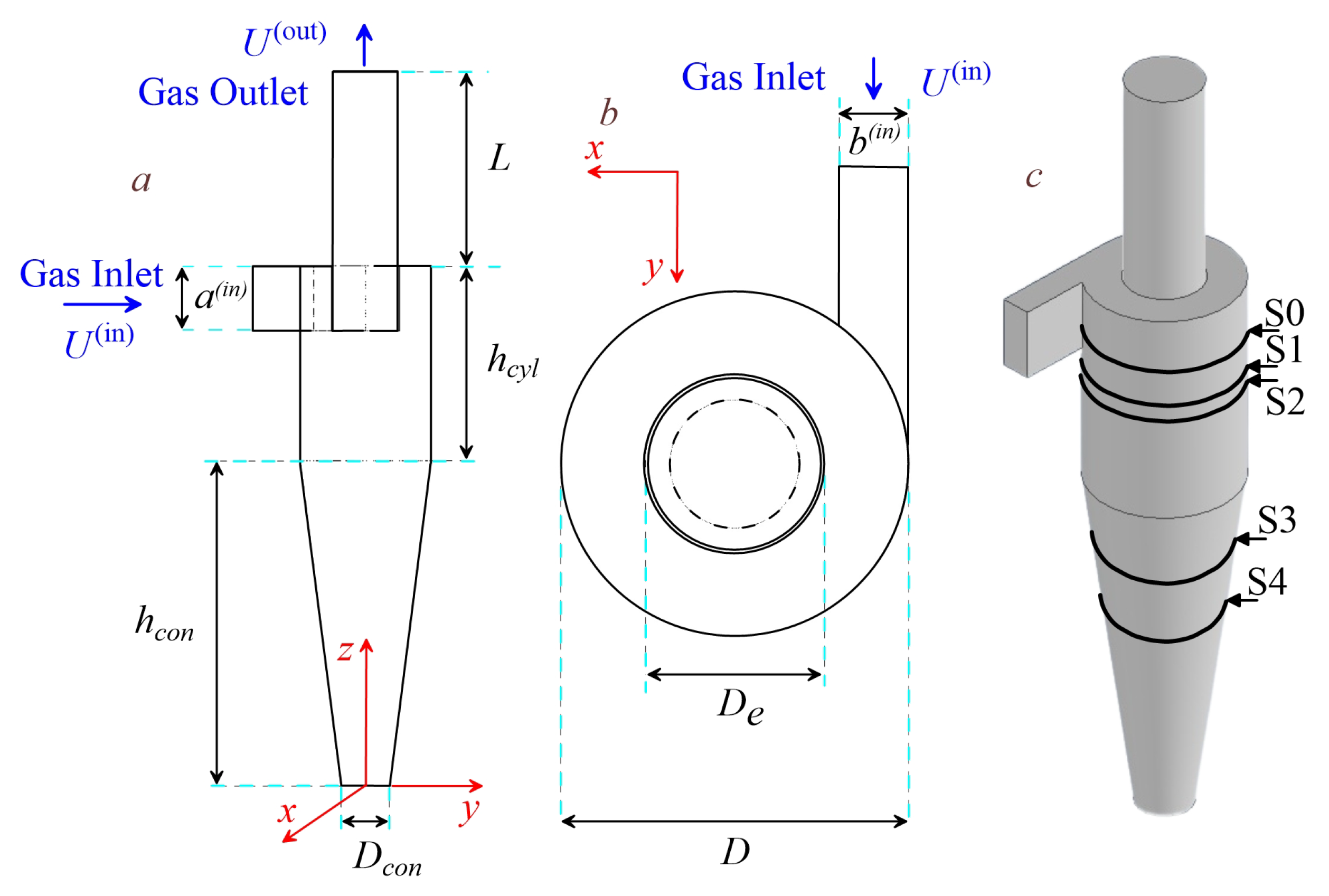
Figure 1. Geometry of the standard Stairmand cyclone design: (a) front view, (b) top view, and (c) section positions.
Technologies 14 00282 g001
Figure 2. Tangential (a) and axial (b) velocity components measured in cross-section S2 for a Stairmand cyclone with various vortex finder diameters D e / D = 0.5 , 0.4 , 0.3 [33].
Technologies 14 00282 g002
Figure 3. LDA velocity profiles of (a) tangential and (b) axial velocity components at different axial cross-sections of the cyclone with D e / D = 0.5 .
Technologies 14 00282 g003
Figure 4. Tangential velocity profiles for four cross-sections in the LES model: S1 (a), S2 (b), S3 (c), S4 (d). Different lines represent simulation results on various grids.
Technologies 14 00282 g004
Figure 5. Axial velocity profiles for four cross-sections at different cyclone heights, S1 (a), S2 (b), S3 (c), S4 (d).
Technologies 14 00282 g005
Figure 6. Tangential and axial velocity distributions in the cyclone for various turbulence models and cross-sections: (a) U φ in S1; (b) U φ in S2; (c) U φ in S3; (d) U z in S1; (e) U z in S2; (f) U z in S3.
Technologies 14 00282 g006
Figure 7. Three main types of axial velocity distributions in cyclones: (a) inverted V-shape; (b) inverted W-shape; (c) recirculation zone near the axis.
Technologies 14 00282 g007
Figure 8. Distributions of physical turbulence characteristics and vorticity along the x axis at y = 0 for various turbulence models and cross-sections S1 (ad); S2 (eh) and S3 (il) ([ k ( t ) ] = m2/s2, [ ε ( t ) ] = m2/s3, [ μ ( t ) ] = kg/(m s), [ Γ ] = 1/s.
Technologies 14 00282 g008
Figure 9. Distributions of turbulence parameters in various cross-sectional planes of the separation chamber (RSM results): S1 (ad); S2 (eh) and S3 (il).
Technologies 14 00282 g009
Figure 10. Subgrid-scale viscosity in the LES model at different cross-sections: (a) S1; (b) S2; (c) S3.
Technologies 14 00282 g010
Figure 11. Instantaneous distributions of U y ( x , z ) (a), U z ( x , y ) (b), p ( x , y ) (c) and streamlines in the LES model (d) (all quantities are given in SI units).
Technologies 14 00282 g011
Figure 12. Isosurfaces of Q-criterion (top row) and λ 2 -criterion (bottom row) calculated from the LES gas velocity field: Q = 10 5 s−2 (a); Q = 5 · 10 4 s−2 (b); Q = 0 (c); Q = 10 5 s−2 (d); Q = 5 · 10 5 s−2 (e); λ 2 = 7.5 · 10 5 s−2 (f); λ 2 = 10 5 s−2 (g); λ 2 = 0 (h); λ 2 = 2 · 10 4 s−2 (i); λ 2 = 8 · 10 4 s−2 (j). Colors represent the tangential gas velocity distributions mapped onto the corresponding Q and λ 2 isosurfaces.
Technologies 14 00282 g012
Figure 13. Tangential (top row, (as)) and axial (bottom row, (a1s1)) velocity increments ( δ U φ ( x , y = 0 , z ) and δ U z ( x , y = 0 , z ) ) obtained from the LES model at different time steps. The numbers at the bottom of the images represent the corresponding time instants.
Technologies 14 00282 g013
Figure 14. Weak non-stationarity in the behavior of the velocity increment distribution ( δ U φ ) in the lower part of the cone. The time interval is 0.02 s with a step of 0.001 s.
Technologies 14 00282 g014
Figure 15. Evolution of the tangential velocity increment over a short interval of 0.021 s. The corresponding time instants are shown below each image. Strong velocity increment unsteadiness in the conical apex, triggered by disturbances from the vortex finder (VF) propagating along the vortex core through the entire cyclone.
Technologies 14 00282 g015
Figure 16. 3D visualization of tangential velocity increments (see also Figure 15): (a) overall flow structure within the entire cyclone; (b) the region r < D e / 2 = 0.0725 m, primarily encompassing vortex core disturbances; (c) the peripheral zone near the walls, D / 2 = 0.145   m   r 0.1 m.
Technologies 14 00282 g016
Figure 17. Tangential velocity increment distributions in a cylindrical cyclone without a conical section at various timestamps over a 0.06 s interval.
Technologies 14 00282 g017
Table 1. Basic parameters of a Stairmand cyclone with a ratio D e / D = 0.5 .
D
(m)
De
(m)
hcyl
(m)
hcon
(m)
a(in)
(m)
b(in)
(m)
Dcon
(m)
L
(m)
S0
(m)
S1
(m)
S2
(m)
S3
(m)
S4
(m)
0.29 0.145 0.435 0.725 0.145 0.058 0.108 0.435 1.088 0.9788 0.943 0.58 0.435
Disclaimer/Publisher’s Note: The statements, opinions and data contained in all publications are solely those of the individual author(s) and contributor(s) and not of MDPI and/or the editor(s). MDPI and/or the editor(s) disclaim responsibility for any injury to people or property resulting from any ideas, methods, instructions or products referred to in the content.