Article

Data-Driven Evolutionary Resource Allocation for Vehicle–UAV Collaborative Inspection with Path-Scheduling Feedback


1
School of Electrical Engineering, Southeast University, Nanjing 210096, China
2
School of Cybersecurity, Southeast University, Nanjing 210096, China
*
Author to whom correspondence should be addressed.
Technologies 2026, 14(5), 283; https://doi.org/10.3390/technologies14050283
Submission received: 4 April 2026 / Revised: 28 April 2026 / Accepted: 3 May 2026 / Published: 6 May 2026

Abstract

To address the challenges of strong coupling between resource allocation and collaborative scheduling in vehicle–UAV cooperative inspections of power distribution lines, as well as the difficulty in balancing efficiency and stability, this paper proposes a path-scheduling feedback-based evolutionary cooperative optimization method. First, an integrated modeling framework for resource allocation and execution scheduling is constructed, incorporating vehicle path decisions and drone task scheduling into a unified optimization space. Next, a feedback-driven two-layer multi-objective evolutionary collaborative optimization algorithm (FB-MOC2) is introduced. The outer layer performs evolutionary search for adaptive resource allocation, while the inner layer solves path planning and collaborative scheduling, with dynamic resource adjustments achieved through execution-layer feedback, forming a data-driven adaptive optimization process. Subsequently, sensitivity analysis is conducted on resource deployment mechanisms, revealing phased evolutionary patterns between resource scale and system performance, and identifying the effective operational range for resource allocation. Finally, the algorithm’s robustness is validated under multiple failure scenarios. Simulation results demonstrate that the proposed method reduces total operation time from 412 min to 315 min, improves battery utilization to 78.5%, and maintains recovery costs within 1.65 times the baseline even under high drone failure rates, while ensuring full inspection coverage. This approach provides an effective bio-inspired and data-driven solution for adaptive resource allocation and robust scheduling in intelligent power distribution line inspections.

1. Introduction

With the continuous expansion of new-type power systems and distribution networks, transmission line inspection is increasingly challenged by wide coverage, high frequency, and complex environments, resulting in growing demands for fine-grained monitoring of critical components [1]. Traditional inspection methods based on manual operations or single-mode approaches are no longer sufficient in terms of efficiency, safety, and operational continuity to meet the requirements of highly reliable maintenance [2]. In recent years, unmanned aerial vehicles (UAVs) have emerged as an effective solution for intelligent power line inspection due to their flexibility and rapid deployment capability, driving research efforts toward three main directions: path planning, collaborative scheduling, and resource allocation [3,4,5].
To support autonomous UAV inspection in complex environments, improving path planning and decision-making capabilities has become a primary research focus. Existing methods have evolved from sampling-based planning to learning-driven approaches. RRT-based methods have been enhanced with heuristic sampling and information-guided strategies to improve search efficiency [6,7], while endurance-constrained models have been formulated to minimize inspection time and solved using evolutionary algorithms [8]. More recently, deep reinforcement learning and Transformer-based models have been introduced to improve decision-making in complex environments [9]. Nevertheless, these methods are primarily designed for single-UAV operations and fail to capture the coupling between resource scale and system-level performance, thereby remaining fundamentally limited by energy constraints in terms of operational range and endurance [10,11,12].
To overcome the limited operational range of single UAVs, vehicle–UAV collaborative inspection has emerged as a promising paradigm to enhance system coverage. Existing studies primarily improve collaborative scheduling efficiency by leveraging vehicle mobility to dynamically deploy UAV takeoff and landing points [13], jointly optimizing vehicle routes and UAV operational regions under predefined parking locations and service radii [14], and optimizing task allocation and execution sequences in multi-UAV settings [15,16]. However, these approaches typically treat the number of UAVs and the configuration of parking locations as fixed inputs, such that scheduling optimization is conducted under predetermined resource conditions, without capturing the coupling between resource allocation and scheduling decisions.
As research deepens, recent studies have begun to consider the impact of resource allocation on system performance. Under fixed UAV fleet sizes, some works analyze the effect of resource scale on inspection efficiency by optimizing vehicle routing and task assignment [17], while others introduce multi-UAV collaboration under predefined parking layouts to enhance coverage through task partitioning and coverage strategies [18]. In addition, UAV fleet sizes are often determined via offline parameter tuning to balance inspection time and resource cost, remaining independent of scheduling optimization [19]. More generally, resource configurations are preset based on task distribution or operational radii, upon which path planning and scheduling are performed [20,21]. As a result, existing approaches largely follow a decoupled modeling paradigm, without adaptively adjusting resource allocation during optimization.
Therefore, leveraging data generated during the execution process to adaptively regulate resource allocation has become a key issue for further improving the performance of vehicle–UAV collaborative inspection systems. Unlike existing methods that rely on prior settings or offline analysis, this work adopts a data-driven paradigm by incorporating path–scheduling execution outcomes as feedback into the resource optimization process, thereby establishing a closed-loop mapping between resource allocation and execution performance. Based on this, a feedback-driven bi-level multi-objective evolutionary optimization framework is developed, in which the outer layer performs resource search with the number of UAVs and the configuration of parking locations as decision variables, while the inner layer jointly optimizes vehicle routing and UAV scheduling under given resource conditions, with execution performance fed back to guide the evolutionary process and enable adaptive resource allocation. Furthermore, feasibility feedback and resource redundancy suppression mechanisms are introduced to identify the effective operating region for resource investment. Experimental results demonstrate that the proposed method achieves an effective balance between system efficiency and resource utilization under inspection coverage and safety constraints and exhibits strong adaptability and robustness in complex scenarios.

2. Resource Allocation and Execution Process for Vehicle–UAV Collaborative Inspection

2.1. System Components and Collaborative Workflow

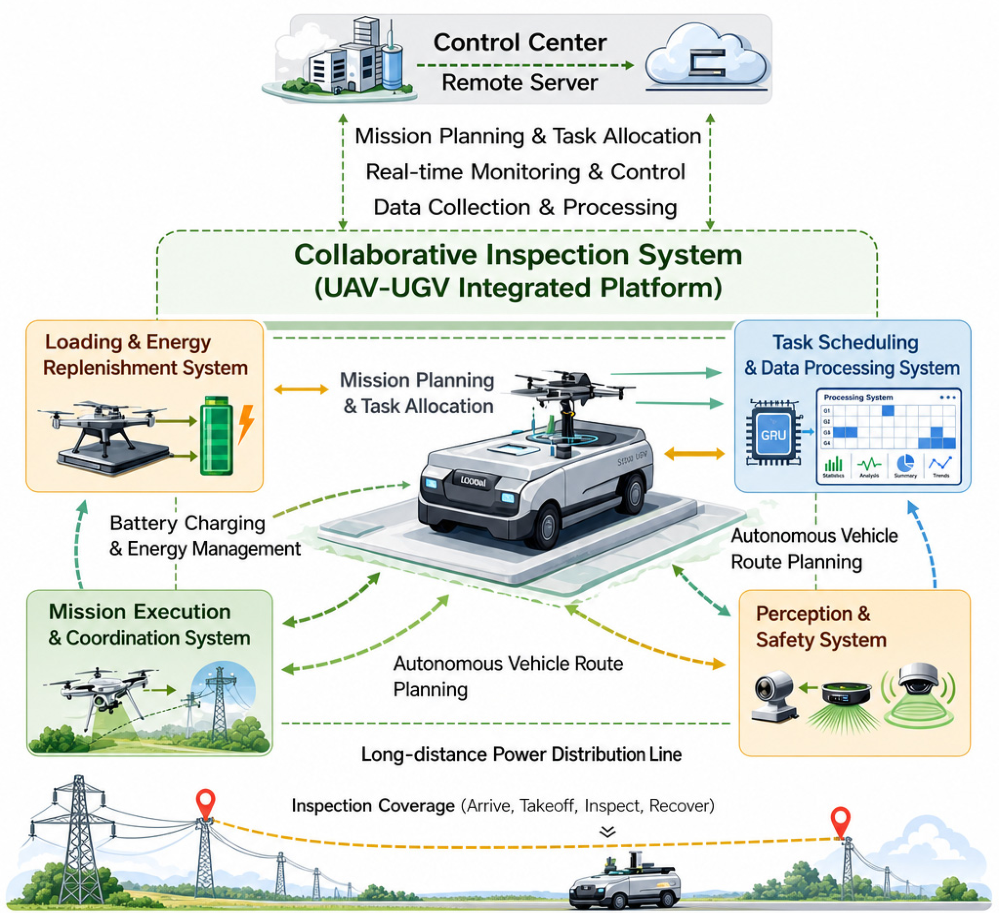
Given the characteristics of power distribution line inspections, including numerous inspection points and dispersed spatial distribution, a vehicle–UAV collaborative inspection system is proposed. By coordinating ground vehicles and multiple UAVs, the system enables efficient coverage of distribution lines and associated equipment. The system consists of ground inspection vehicles, a UAV fleet, a vehicle-mounted support unit, and a set of inspection task points, as illustrated in Figure 1. Based on an integrated vehicle–UAV platform, it forms a collaborative inspection framework with modules for task scheduling, energy management, and safety monitoring, supporting subsequent path planning and resource allocation.
Let the set of inspection points for power distribution lines be
T = t 1 , t 2 , , t T
where t i represents the i-th inspection point; T represents the total number of inspection points.
Specific inspection points include typical power equipment such as distribution poles, switchgear, substation nodes, and key locations along feeder lines. Inspection vehicles serve as mobile operational and support platforms, responsible for maneuvering along distribution lines or road networks and performing drone takeoffs, landings, recharging, and mission coordination at designated parking points. The set of candidate parking points is defined as
P = p 1 , p 2 , , p P
where p i represents the i-th candidate parking spot; P represents the total number of candidate parking spots.
The deployment of the drone fleet in the system is recorded as follows:
u = u 1 , u 2 , , u u
where u i represents the i-th drone; u represents the total number of drones in the system.
The UAV takes off from a parking point, performs inspection tasks at surrounding distribution substation inspection points, and returns to the corresponding parking point upon completion of the mission. During operations, the vehicle and the UAV form a distinct spatiotemporal coupling relationship [22,23]; the vehicle’s path determines the temporal sequence and spatial distribution of available parking points, while the UAV’s flight radius, operational duration, and energy consumption, in turn, constrain the vehicle’s parking rhythm and dwell time.
In terms of the collaborative workflow, the system’s operation can be summarized as the following closed-loop process: (1) inspection vehicles sequentially visit a set of parking points along a predetermined route; (2) at each parking point, nearby power distribution tasks are assigned based on available drone resources; (3) drones complete their inspection tasks and return to the vehicle platform for recharging and redeployment; (4) vehicles adjust their parking duration based on the drones’ task completion status and continue driving.

2.2. Analysis of the Coupling Relationship Between Resource Allocation and Execution Scheduling

In the vehicle–UAV collaborative power distribution inspection system, resource allocation parameters—such as the number of drones and the scale of parking sites—do not directly determine system performance. Instead, they indirectly influence vehicle routes, drone task assignments, and collaborative efficiency by imposing constraints on the execution scheduling space [24,25]. Therefore, the relationship between resource allocation and execution scheduling is neither linear nor independent; rather, it exhibits significant structural coupling characteristics.
The resource allocation vector is represented as follows:
x = N u , P
where N u represents the number of drones; P represents the size of the parking area.
Given x, the execution layer must perform vehicle route planning and UAV scheduling under resource constraints; the set of feasible executions can be represented as follows:
Ω ( x ) = Π C ( Π ) = 1 , E u ( Π ) E max , u
where C represents mission coverage; E u represents the actual energy consumption of the u-th drone; E max represents the battery capacity of a single drone.
Clearly, the size and structure of Ω ( x ) vary with changes in resource allocation; resource allocation cannot be evaluated directly without considering execution scheduling. The evaluation of resource allocation inherently depends on execution-level performance data, resulting in a data-driven coupling between decision variables and system behavior. For a given resource allocation x, system performance may vary significantly depending on the execution strategy Π employed. Conversely, the optimal performance achievable at the execution level is also constrained by the feasible region Ω ( x ) defined by the resource allocation.
Further analysis shows that when resources are insufficient, the feasible region Ω ( x ) shrinks significantly due to constraints on parallel processing capacity and time windows, and system performance is primarily limited by the existence of feasible solutions, that is:
Ω ( x ) 0
This leads to a rapid increase in total execution time and scheduling cost. As resource allocation gradually increases and the feasible region expands, the system is able to perform coordinated path and scheduling optimization across a larger solution space, resulting in significantly improved execution performance. However, once resource allocation exceeds a certain threshold, although Ω ( x ) continues to grow, the scheduling complexity at the execution level and the degree of resource idleness increase simultaneously, causing the system’s overall cost function to trend upward, that is:
J s y s ( x ) x > 0 , x > x
where J s y s ( x ) represents the total system cost; x represents the critical point corresponding to the optimal resource allocation interval.
The above analysis indicates that the performance of the vehicle–UAV collaborative inspection system exhibits a distinct non-monotonic behavior as resource allocation changes; the system’s optimal operating state corresponds to a dynamic balance between the expansion of the feasible resource domain and the increase in scheduling costs. This interaction reflects a feedback-driven relationship, where execution performance implicitly guides resource allocation decisions.

3. A Feedback-Driven Two-Level Multi-Objective Coordinated Optimization Algorithm

3.1. Overall Algorithm Framework

To address the strong coupling among path planning, task scheduling, and resource allocation in vehicle–UAV collaborative inspection [26], this paper proposes a feedback-driven bi-level multi-objective optimization algorithm (FB-MOC2). The framework establishes a closed-loop structure comprising outer-layer resource allocation search, inner-layer collaborative scheduling, and performance feedback, enabling coordinated optimization of resource configuration and execution scheduling.
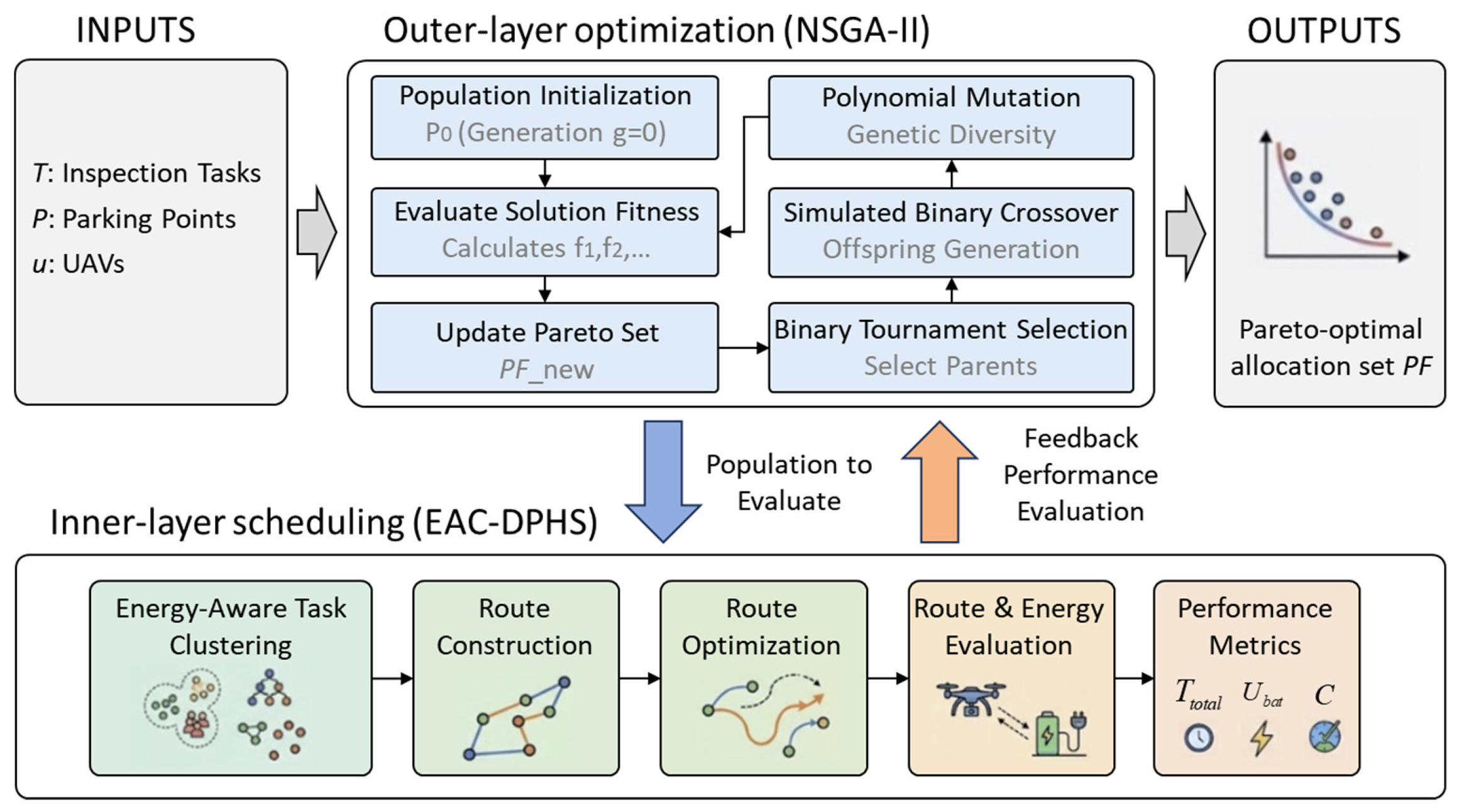
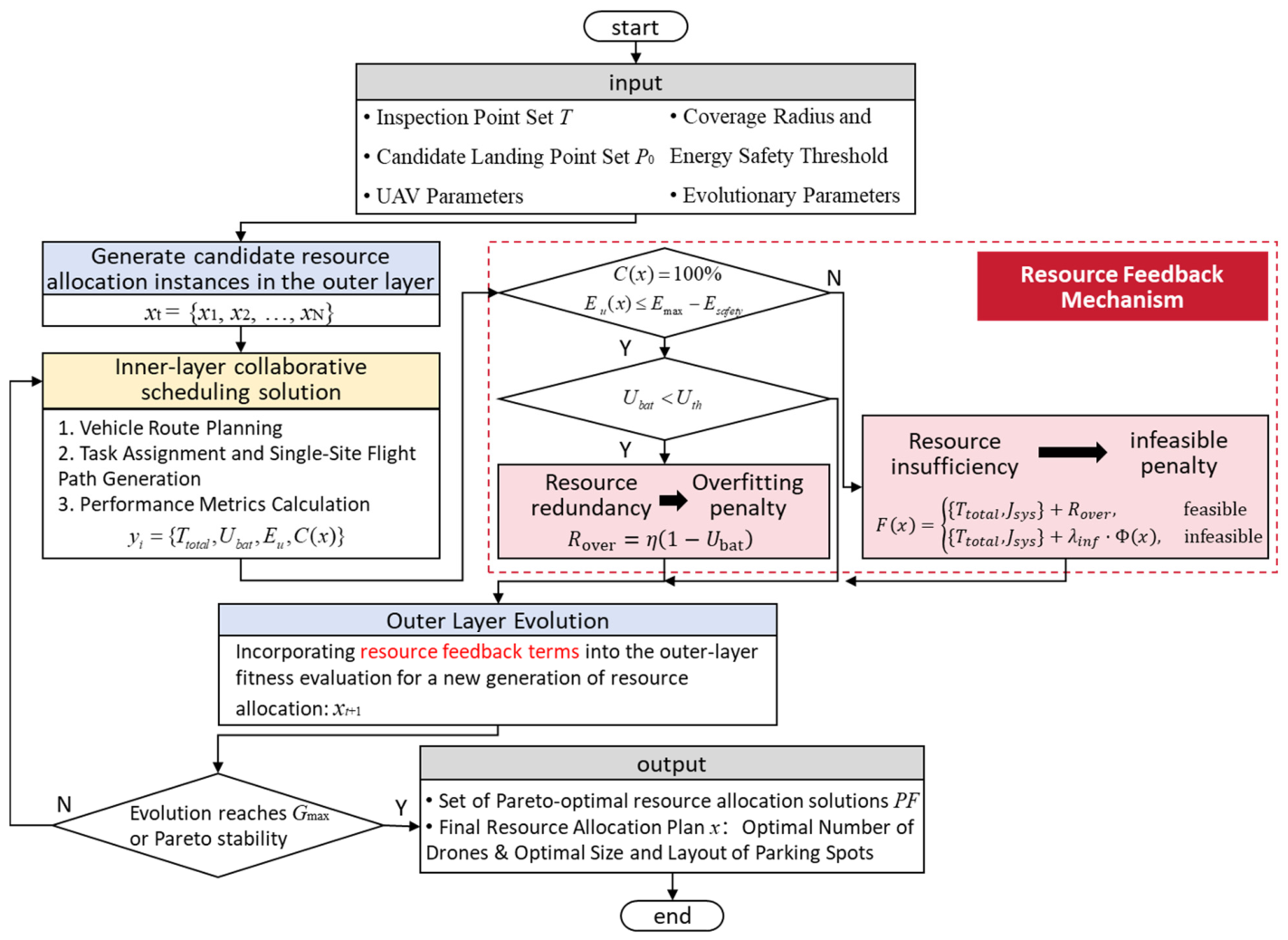
The overall framework of the algorithm is shown in Figure 2. Resource allocation is adaptively adjusted through a feedback mechanism based on task coverage, energy constraints, and battery utilization. At its core, the algorithm performs multi-objective evolutionary search on resource allocation at the outer layer, while the inner layer solves the corresponding vehicle–UAV collaborative scheduling problem under given resource constraints. The resulting performance metrics are fed back to guide the outer-layer search, forming a data-driven evolutionary optimization process. This process embodies a two-level optimization paradigm between resource allocation and execution scheduling [27], thereby avoiding the disconnect between resource allocation and scheduling results found in traditional hierarchical or sequential optimization approaches [28].
By introducing a performance feedback mechanism, the algorithm adaptively adjusts resource allocation based on execution-level scheduling results, promoting resource enhancement when constraints are violated and suppressing redundant expansion under saturation. Consequently, a stable closed-loop is formed between resource allocation and collaborative scheduling, enabling adaptive resource adjustment based on execution performance. The final output is a set of Pareto-optimal resource allocation schemes and corresponding collaborative inspection plans, including key decisions such as the number of UAVs, parking scale, and spatial layout.
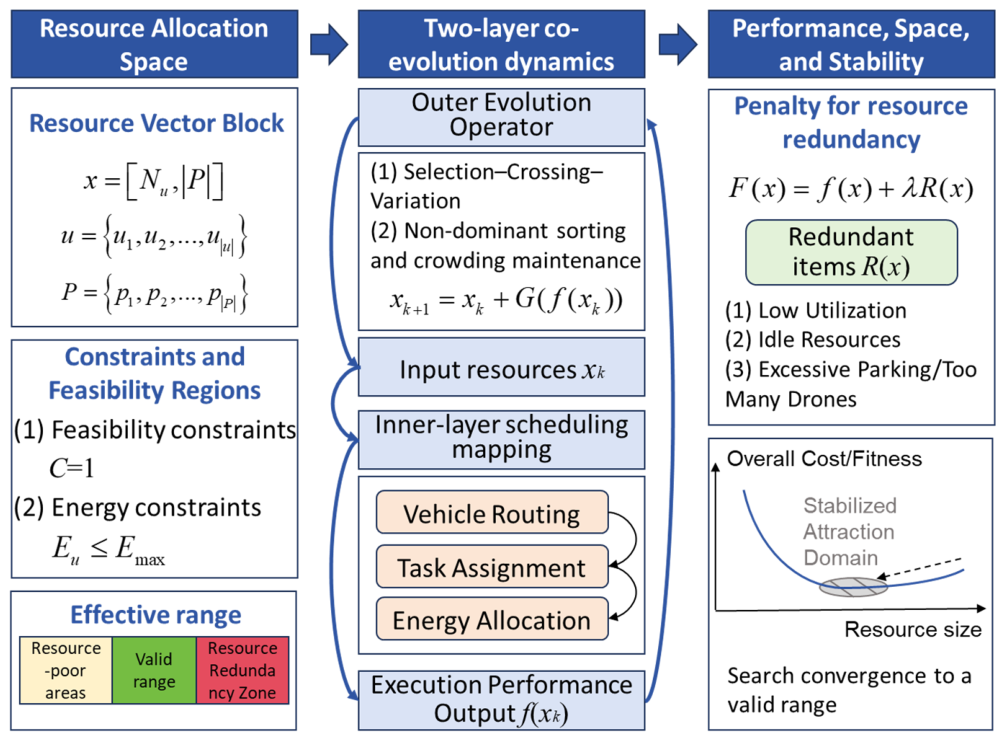
Through this two-layer closed-loop structure, the algorithm can effectively identify the optimal range of resource allocation while satisfying coverage and safety constraints, thereby avoiding resource redundancy and efficiency degradation. From a theoretical perspective, the proposed framework can be viewed as a data-driven adaptive resource evolution system, whose convergence and stability can be further analyzed as follows. Let the outer-layer resource allocation be x Χ , and the inner-layer scheduling mapping be
f : Χ m
where f ( x ) represents the multidimensional execution performance metrics obtained from the inner-layer scheduling.
Since the resource space is a finite, discrete set subject to upper bounds, and the inner-loop solution is deterministic for a given input, the outer-loop evolutionary process can be viewed as an iterative search over a deterministic fitness function, with its set of Pareto solutions exhibiting asymptotic convergence during evolution.
Updates to external resources are driven by the execution performance feedback loop, which can be expressed as
x k + 1 = x k + G ( f ( x k ) )
where G ( ) represents the search operator based on fitness-based ranking. This closed-loop structure uses execution performance as a data-driven control signal, enabling the resource search direction to dynamically adjust in response to performance feedback, thereby forming a stable evolutionary trajectory within the resource space.
The resource update mechanism is further elaborated by specifying the outer-layer evolutionary operator G ( ) . Within the multi-objective optimization framework of the Non-dominated Sorting Genetic Algorithm II (NSGA-II), G ( ) is composed of fundamental operations including selection, crossover, and mutation, and can be expressed in a composite operator form as:
G ( ) = M ( ) C ( ) S ( )
where S ( ) represents the selection operator based on the NSGA-II framework, which is used to identify and retain high-quality individuals from the current population; C ( ) represents the crossover operator (implemented via simulated binary crossover, SBX), which performs recombination of resource allocation solutions; and M ( ) represents the mutation operator (implemented via polynomial mutation, PM), which enhances population diversity and helps prevent premature convergence to local optima.
During the evolutionary process, the population size is set to N p , while the crossover and mutation probabilities are denoted by P c and P m , respectively. In each generation, individuals are evaluated via the inner-layer scheduling module to obtain performance metrics, based on which fitness ranking and updating are conducted according to the Pareto dominance criterion. The outer-layer evolution terminates when the maximum number of generations G max is reached or when the fitness variation becomes negligible.
Furthermore, after introducing the feasibility discrimination and resource redundancy suppression mechanisms, the fitness function can be expressed as
F ( x ) = f ( x ) + λ R ( x )
where R ( x ) represents the resource redundancy penalty term; λ represents the adjustment coefficient.
This negative feedback introduces a damping effect on resource expansion, guiding the search trajectory toward regions of efficient resource utilization while suppressing redundant solutions. In summary, the proposed method exhibits stable convergence and closed-loop stability within a finite resource space. From a data-driven perspective, the performance feedback mechanism provides interpretable guidance for resource evolution, revealing the relationship between allocation decisions and system-level performance. The two-layer cooperative evolution mechanism based on performance feedback is illustrated in Figure 3.
To further illustrate the detailed execution procedure of the proposed algorithm, Figure 4 presents the overall solution process of the FB-MOC2 framework.

3.2. Decision Coding and Fitness Evaluation Mechanisms

In the FB-MOC2 algorithm, the core of the outer-layer evolutionary search lies in mapping system resource allocation schemes to evolvable decision-making individuals and effectively evaluating them based on the execution results of the inner-layer scheduler. To this end, this paper encodes the outer-layer individuals using a resource allocation vector x and constructs a data-driven fitness-evaluation mechanism using execution-layer feedback.
Under a given resource configuration x, the inner-layer scheduling problem can be formulated as a vehicle–UAV collaborative task decomposition and path optimization problem with energy constraints, and its optimal scheduling solution can be formally expressed as
π * ( x ) = arg min π Π ( x ) T t o t a l ( π )
where π represents the vehicle–UAV collaborative scheduling strategy; Π ( x ) represents the feasible solution set under the resource configuration x that satisfies both inspection coverage and energy safety constraints; and T t o t a l represents the total operation time of the system.
To obtain an approximate solution, an energy-aware clustering and dynamic programming hybrid scheduling method (EAC-DPHS) is employed. Specifically, the task set is first partitioned into energy-constrained clusters according to the spatial distribution of inspection points and the endurance limits of UAVs:
T = k = 1 K T k
where T k represents the k-th sub-task set.
Subsequently, within each sub-task set, the task execution sequence and flight path are optimized by considering vehicle parking locations and UAV takeoff and landing constraints, and the corresponding subproblem can be formulated as
π k = arg min π k T ( π k ) ,   s . t . E ( π k ) E m a x
Finally, the overall scheduling strategy π * ( x ) is obtained by integrating the solutions of all subproblems. Based on the resulting schedule, the execution performance of the system under the resource configuration x can be further evaluated, including T t o t a l , the battery utilization rate U b a t , and the task coverage ratio C. These metrics are used to characterize the overall operational effectiveness of the resource allocation and scheduling scheme, and to provide the basis for fitness evaluation in the outer-layer evolutionary search.
T t o t a l is defined as
T total = T v + max u { 1 , , N u } T u
where T v is the total travel and waiting time required for the vehicle to visit all parking spots; T u is the inspection execution time for the u-th drone, including flight and operation time.
U b a t is defined as
U bat = u = 1 N u E u N u E max
C is defined as
C = 1 T A i T I u = 1 N u I ( i T A u ) 1
where T A represents the set of inspection points; T A u represents the set of tasks assigned to the u-th UAV. When C = 1, it indicates that all inspection tasks have been effectively covered.
The above metrics do not participate in the evolution as independent decision variables; rather, they exert a feedback effect on the outer-layer search through a data-driven fitness evaluation mechanism.
Based on the results of the inner-layer scheduling, the multi-objective fitness function for the outer-layer individuals is defined as
f ( x ) = f 1 ( x ) , f 2 ( x )
where f 1 ( x ) is the first objective function, used to measure the overall operational efficiency of the system, comprehensively reflecting execution-level costs such as vehicle travel time, UAV inspection time, and parking wait time:
f 1 ( x ) = T t o t a l ( x )
f 2 ( x ) is the second objective function, which captures the system costs associated with resource allocation and scheduling. By introducing a penalty term for resource idleness, it effectively curbs the unnecessary expansion of resource capacity:
f 2 ( x ) = λ 1 N u N u max + λ 2 P P max + λ 3 1 U bat ( x )
where N u max and P max represent the upper limits for the number of drones and the capacity of parking spots, respectively; λ 1 , λ 2 and λ 3 are the normalized aggregation weights within the resource cost function, used to map the number of UAVs, the scale of parking locations, and the battery utilization into a unified evaluation space. The weighted formulation is used solely to construct the resource cost function f 2 ( x ) whereas the trade-offs among objectives are determined by the Pareto dominance mechanism.
Feasibility determination and resource feedback mechanism based on execution results. If the inner-layer scheduling results do not satisfy the full-coverage constraint or violate the UAV energy safety constraint, the corresponding outer-layer individual is deemed an infeasible solution. Its feasibility conditions can be expressed as follows:
C = 1 , E u E max , u
Individuals that do not meet the above conditions are directly eliminated during the evolutionary process.
For individuals that satisfy the feasibility requirements, in order to avoid over-allocation during the resource allocation search, this paper introduces a resource redundancy feedback term in the fitness evaluation stage:
R F o v e r = η ( 1 U b a t )
where η is the resource redundancy penalty weight, which characterizes the impact of battery utilization loss on system cost; its value is selected to balance the trade-off between resource utilization efficiency and scheduling performance.
To unify the feasibility assessment and resource feedback mechanisms, a constraint penalty strategy is introduced during the fitness evaluation phase. For individuals that do not satisfy the above conditions, a penalty term is applied to reduce their selection probability during the evolutionary process. The corresponding fitness function can be uniformly expressed as follows:
F ( x ) = { T t o t a l , J s y s } + R o v e r , feasible { T t o t a l , J s y s } + λ i n f Φ ( x ) , infeasible
where Φ ( x ) represents the degree of constraint violation, used to quantify deviations from the coverage and energy constraints, and λ i n f is the penalty coefficient.
To facilitate a quantitative analysis of the rationality of resource allocation, the redundancy penalty term is further normalized, and the normalized result is defined as the resource redundancy ratio R r , which is used to characterize the degree of redundancy in resource allocation:
R r = R F o v e r R max
where R max represents the normalized upper bound of the resource redundancy term, determined by the boundary conditions of the resource configuration space. Given that N u and P are subject to explicit upper bounds, the redundancy level under the maximum resource configuration ( N u max , P max ) is adopted as the basis for determining R max .
The penalty term does not directly affect the feasibility assessment, but regulates the expansion tendency of resource allocation through its incorporation into the fitness function (Equation (11)). R ( x ) increases as the resource utilization decreases, as given by the following:
R ( x ) U b a t < 0
Consequently, when resource allocation exceeds the effective demand range, an additional cost is introduced, reducing the competitiveness of the corresponding individuals in non-dominated sorting; conversely, as resource utilization approaches saturation, this term diminishes to zero and has a negligible impact on high-quality solutions.
Based on the above, the outer-layer multi-objective evolutionary process optimizes the objective vector consisting of the total operation time f 1 ( x ) and the comprehensive resource cost f 2 ( x ) , and performs ranking and selection among resource allocation schemes using Pareto dominance. Specifically, let X denote the set of outer-layer individuals. If there does not exist another solution x X such that
f i ( x ) f i ( x ) , i 1 , 2
If there exists at least one objective function that satisfies the strict inequality, then x is said to be a Pareto-optimal solution. The resulting set of Pareto-optimal solutions characterizes the trade-off between job efficiency and system cost across different resource allocation schemes.
By introducing a resource redundancy feedback term, the Pareto frontier no longer simply shifts toward larger resource scales but instead adaptively converges to an effective equilibrium region between resource input and execution efficiency. This data-driven mechanism enables the algorithm to automatically eliminate configurations with high redundancy and low utilization while satisfying inspection coverage and energy safety constraints, thereby enhancing the interpretability and feasibility of the Pareto solution set in engineering applications.

4. Case Study Analysis

4.1. Simulation Environment Setup

To evaluate the proposed method, a representative vehicle–UAV collaborative inspection scenario for distribution networks is constructed, and key environmental and system parameters are specified as listed in Table 1. The scenario defines the spatial distribution of inspection tasks, road network constraints, and UAV energy limits. The number and deployment of parking sites, together with the UAV fleet size, are determined adaptively by the optimization model.
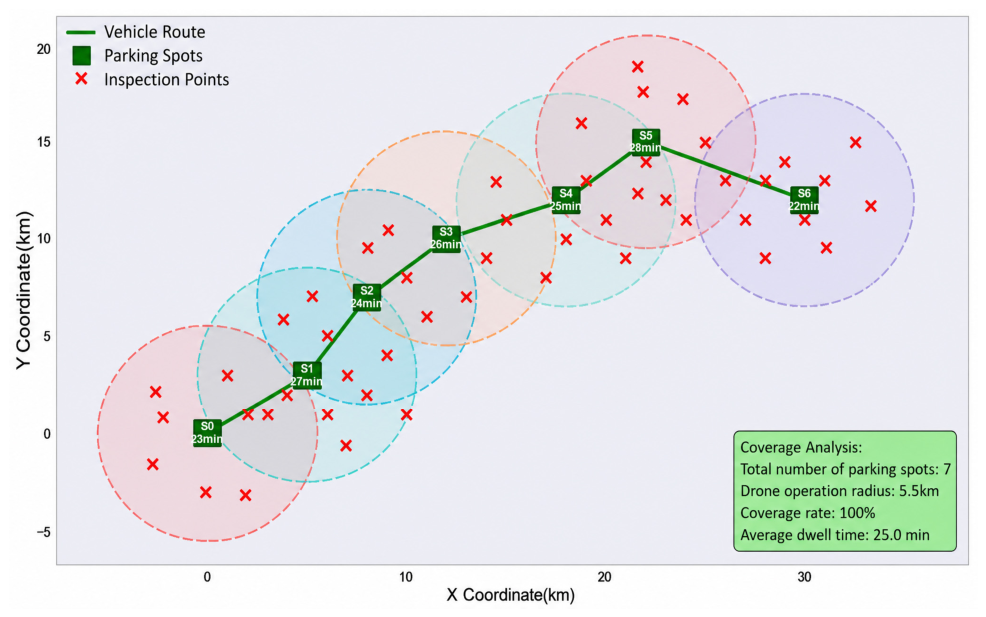
Figure 5 presents the spatial coordination under the optimized resource allocation. In the obtained configuration, 7 parking sites are selected with a UAV operational radius of approximately 5.5 km, achieving full inspection coverage (100%). The colored circles represent the UAV coverage regions associated with different parking locations. The coverage regions of adjacent sites exhibit moderate overlap, ensuring task continuity while limiting redundancy. The average parking duration is approximately 25 min, reflecting the temporal coordination between vehicle routing and UAV operations.
The above case is used as the baseline scenario. Subsequent experiments are conducted under environmental disturbances, multiple spatial configurations, and different problem scales to examine robustness and generalization.

4.2. Convergence Behavior and Resource Allocation Mechanism Analysis

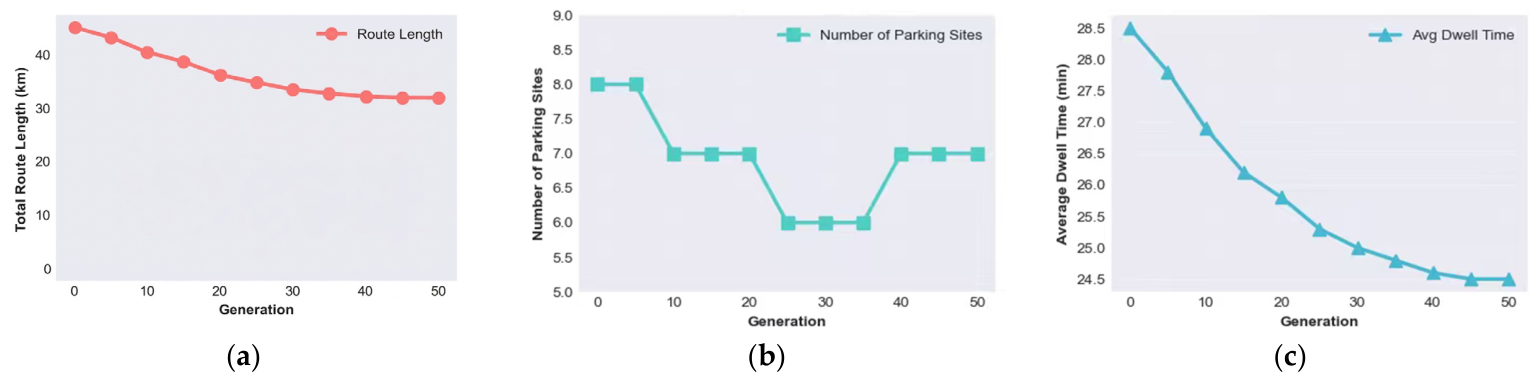
To examine the convergence of FB-MOC2, the evolution of key metrics is analyzed in the baseline scenario from path, resource, and coordination perspectives. As shown in Figure 6a, route length decreases monotonically, indicating reduced redundant travel under feedback. Figure 6b shows early fluctuations and subsequent stabilization in parking site number, reflecting resource selection guided by scheduling outcomes. Figure 6c shows decreasing and convergent vehicle dwell time, indicating improved coordination. Overall, convergence is achieved through execution-driven feedback under coupled constraints.
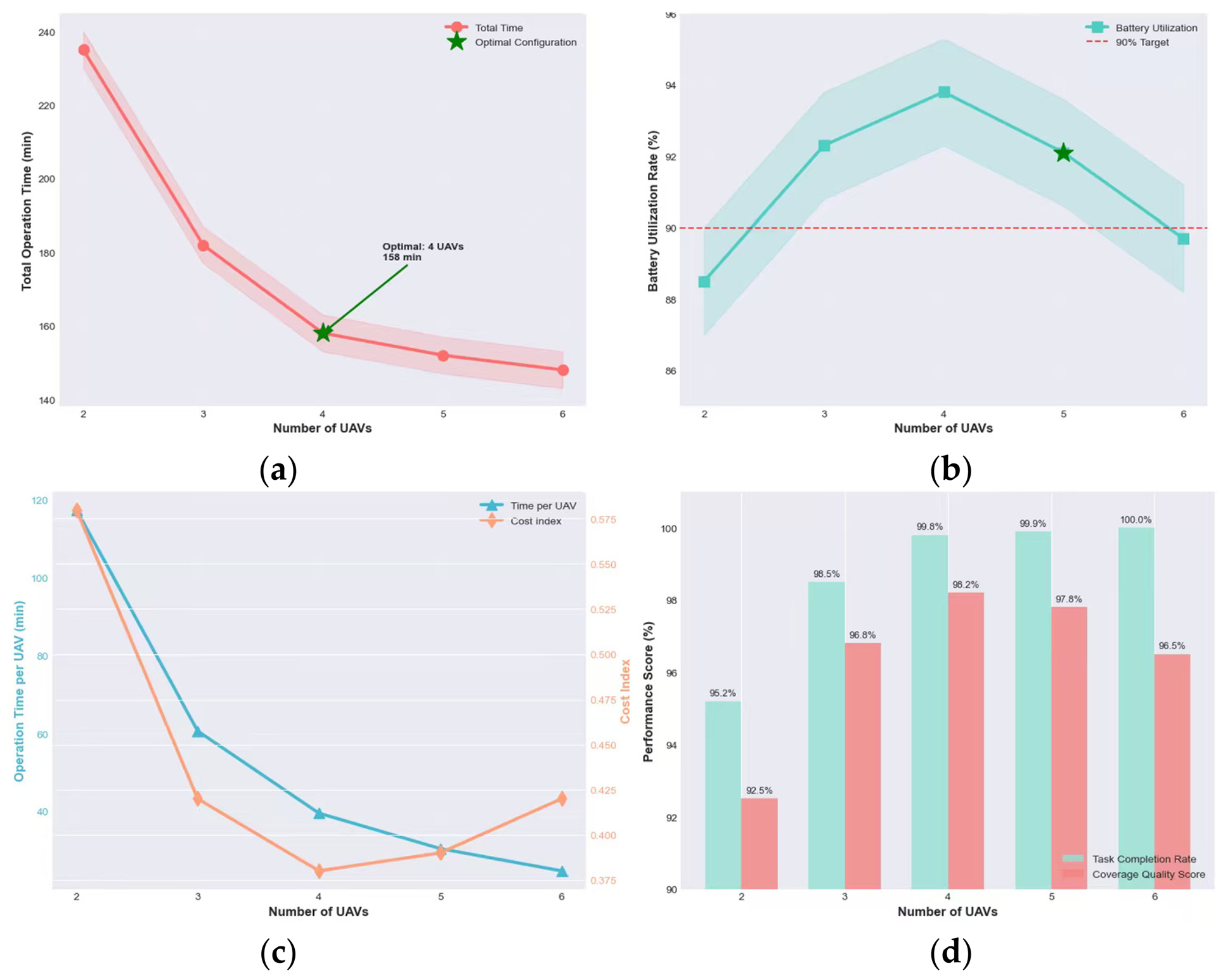
With fixed task distribution and route structure, the number of UAVs is varied to examine system response. As shown in Figure 7, performance varies with resource scale in a stage-wise manner: total operation time decreases with UAV number and exhibits an inflection point at approximately four UAVs, indicating diminishing marginal gains; battery utilization increases initially and then decreases, reflecting redundancy at high resource levels; the average task time per UAV decreases, while system cost increases in the high-resource region; task completion and coverage approach saturation at moderate resource levels, indicating a bounded effective operating region.
The shaded regions in Figure 7a,b are obtained from 30 independent simulations and represent variability in performance using mean ± standard deviation, capturing the effects of task randomness and scheduling uncertainty. The green star in Figure 7b denotes the selected configuration based on the trade-off among multiple performance metrics. The results show that the variation in all metrics remains limited, without noticeable performance degradation, indicating stable behavior under uncertain conditions.
Overall, the FB-MOC2 algorithm transforms inner-layer execution outcomes into feedback signals for outer-layer optimization, enabling the resource search to adjust according to scheduling performance. Under multi-objective constraints, this feedback mechanism drives the solution toward an effective operating region, balancing system efficiency and resource utilization.

4.3. Robustness and Generalization Analysis

Experiments are conducted under environmental disturbances, diverse spatial configurations, and varying problem scales. In addition, failure recovery scenarios are considered to evaluate performance under uncertainty.

4.3.1. Robustness Analysis

Robustness is examined from two aspects: environmental disturbances and resource failures. Environmental effects such as wind and rain are modeled as stochastic variations in execution time and energy consumption, and performance stability is quantified using the coefficient of variation (CV) over multiple independent simulations. Resource failures are evaluated by varying the UAV failure ratio to assess recovery scheduling capability.
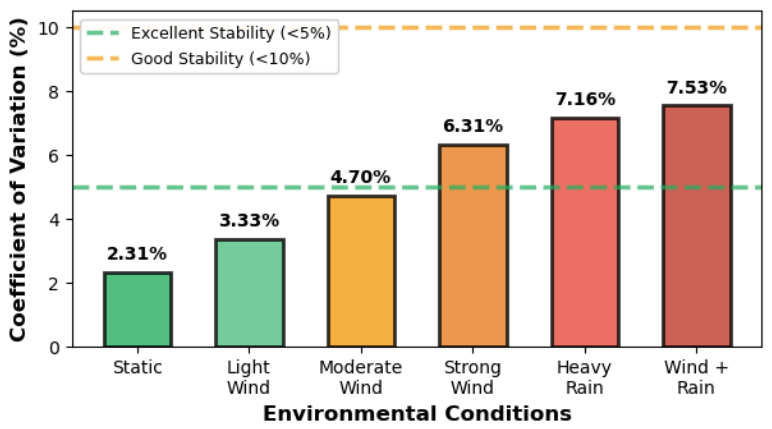
As shown in Figure 8, under environmental disturbances, the CV of total operation time increases with disturbance intensity: 2.31% and 3.33% under static and light-wind conditions, and 4.70% under moderate wind, all within 5%; under strong wind, heavy rain, and combined conditions, the CV increases to 6.31%, 7.16%, and 7.53%, respectively, remaining below 10% without instability. These results indicate that execution feedback enables adjustment to disturbance-induced deviations, maintaining stable system performance.
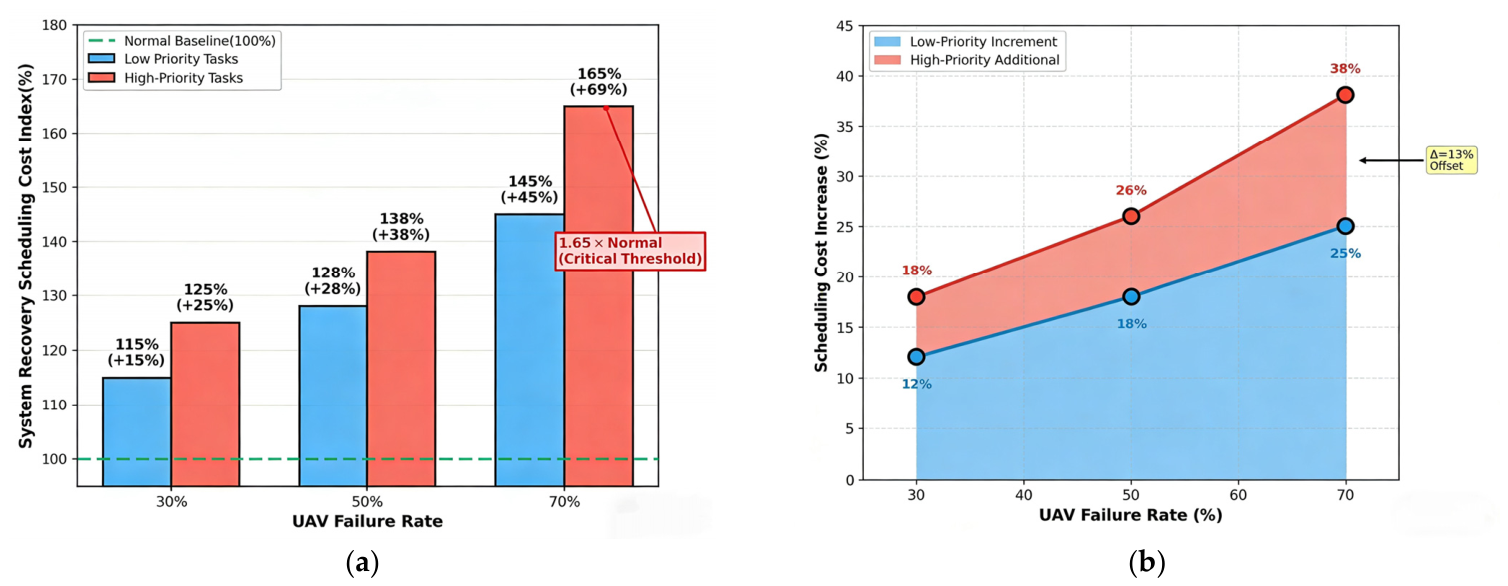
On this basis, the impact of UAV failures on system performance is further examined. Failure scenarios are simulated by setting UAV failure ratios of 30%, 50%, and 70%. Figure 8 shows the variation in recovery scheduling cost under different failure levels. As shown in Figure 9a, the normalized recovery cost increases with failure ratio and remains within 1.65 times the baseline even at 70% failure. Figure 9b shows that the relative cost increases approximately linearly, without nonlinear amplification. These results indicate that, under reduced resource availability, task reassignment and schedule reconfiguration enable the system to absorb failure-induced disruptions.

4.3.2. Generalization and Scalability Analysis

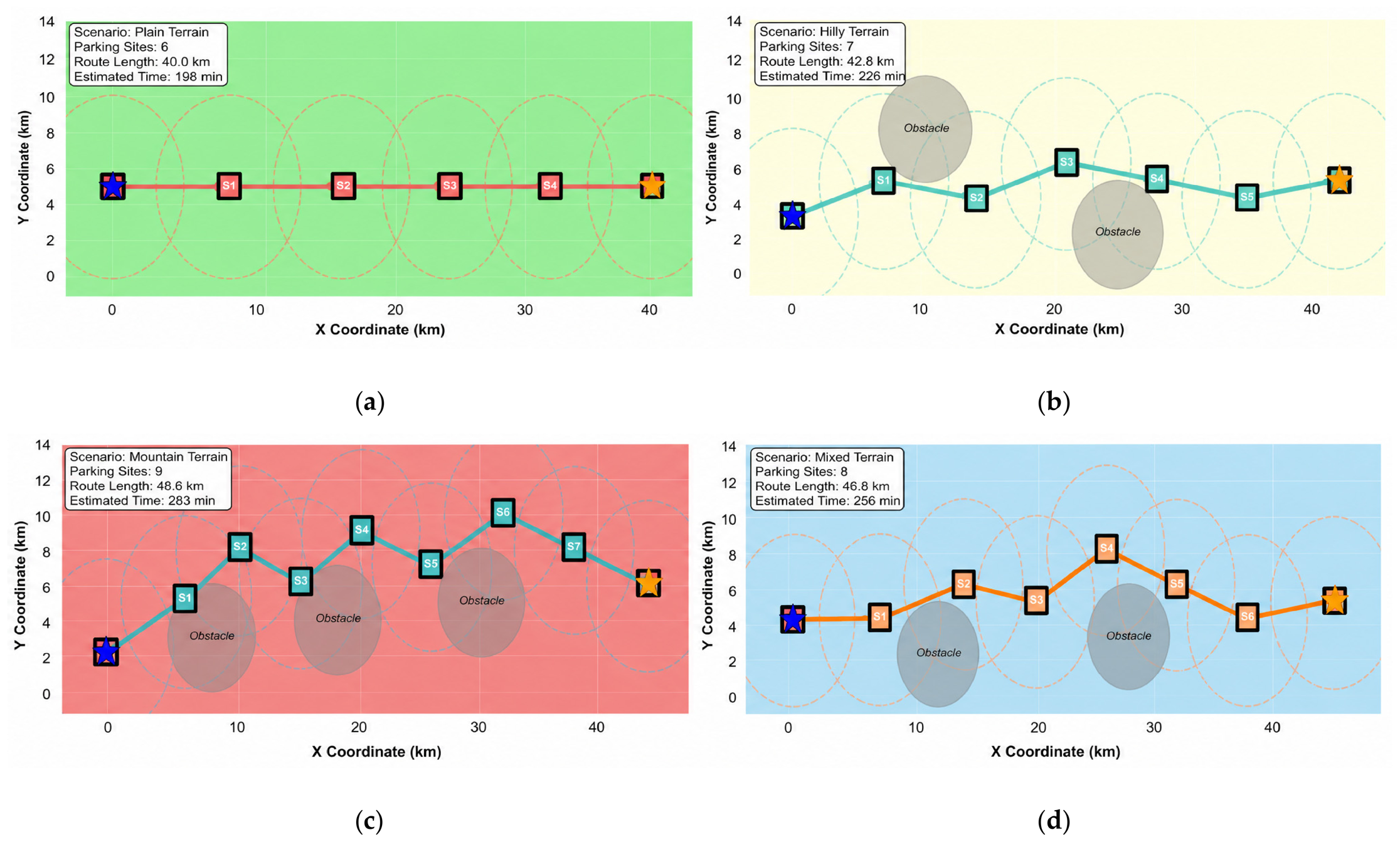
Generalization is examined from two aspects: variations in spatial structure and problem scale. To this end, multiple scenario variants are constructed based on the baseline distribution network inspection setting, including plain, hilly, mountainous, and mixed configurations, as shown in Figure 10. These scenarios are generated by varying the spatial distribution of inspection points, the complexity of the road network, and obstacle constraints, representing different structural characteristics encountered in distribution line inspection across diverse environments. In Figure 10, the stars denote the start and end points of the inspection route, the dashed circles represent UAV coverage regions associated with parking sites, and the gray circles indicate obstacle areas.
Across scenarios, plain (Figure 10a) shows aligned routes under regular structure, hilly (Figure 10b) introduces detours due to local obstacles, mountainous (Figure 10c) yields nonlinear routes with expanded parking deployment, and mixed (Figure 10d) combines these effects. In all cases, routes and parking deployment adapt to task distribution and feedback, maintaining coverage and feasibility.
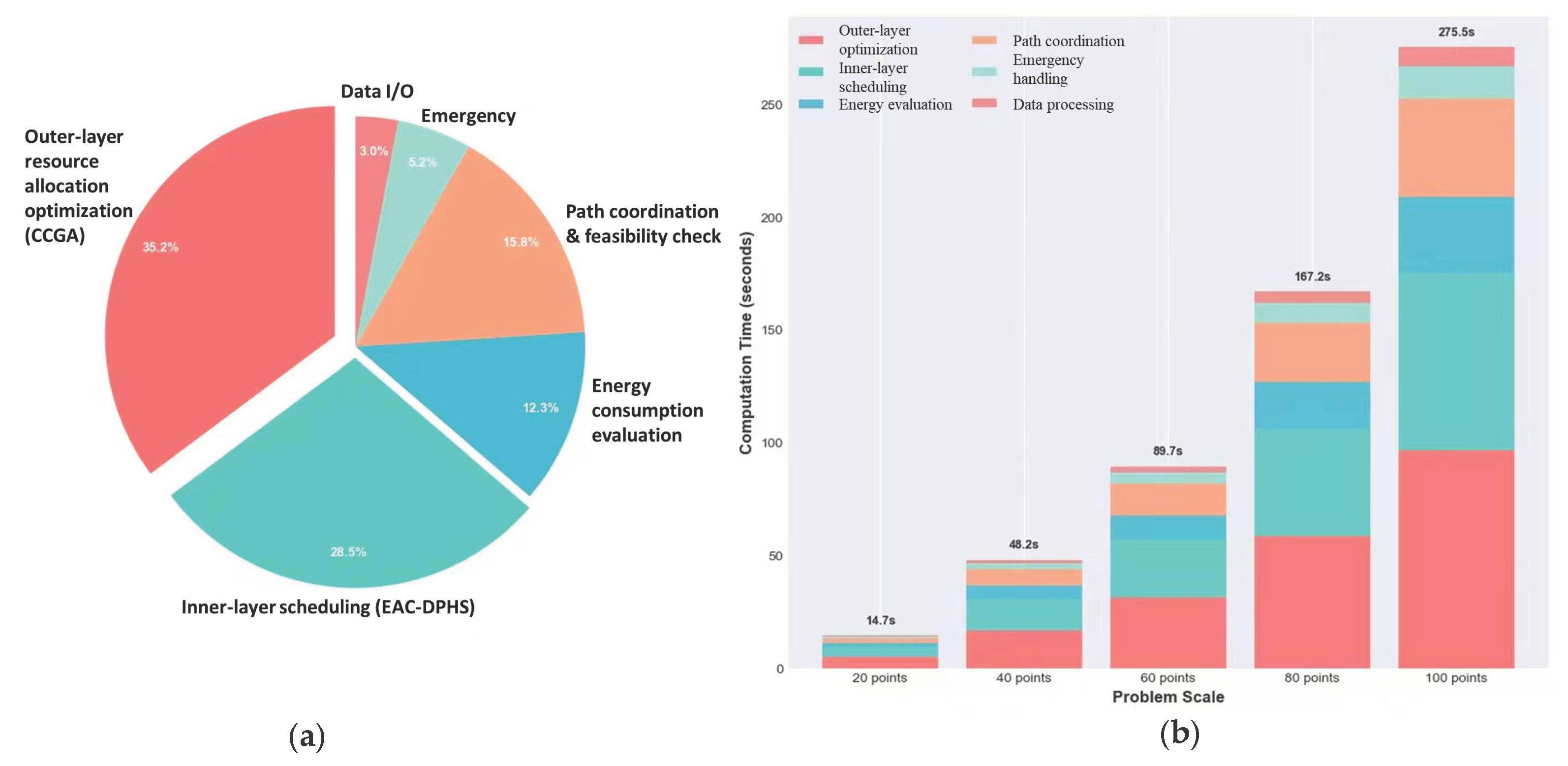
For scalability, scenarios with 20–100 tasks are evaluated. As shown in Figure 11a, outer-layer search and inner-layer clustering account for 35.2% and 28.5% of computation time, while other modules remain minor and stable across scales.
As shown in Figure 11b, as the number of inspection points increases from 20 to 100, the total computation time grows from 14.7 s to 275.5 s in a smooth and approximately linear manner, without abrupt or exponential increases. Across all scales, the solutions exhibit stable convergence, with no significant performance fluctuations observed as the problem size increases.
To quantify system performance under different scenarios and scales, Table 2 summarizes key metrics. As the number of inspection points increases from 20 to 100, the total operation time rises from 85 min to 315 min, and the computation time increases from 14.7 s to 275.5 s, both following smooth trends. Meanwhile, battery utilization decreases from 93.5% to 88.2% but remains at a relatively high level. Under different spatial configurations, the total operation time reaches 283 min and 256 min in mountainous and mixed scenarios, respectively, compared to 198 min in the plain scenario, reflecting the impact of structural complexity on scheduling cost. Across all scenarios and scales, full coverage (100%) is maintained, indicating consistent scheduling performance and resource utilization under varying conditions.
Overall, the proposed method maintains stable performance under environmental disturbances, resource failures, and variations in spatial structure and problem scale. Under disturbance and failure conditions, performance variation remains limited (with a maximum CV of 7.53%), and the recovery cost stays within 1.65× the baseline even at a 70% UAV failure rate. Across different spatial configurations and scales, consistent convergence behavior and scheduling performance are observed. This behavior arises from the feedback mechanism that links execution outcomes to resource allocation and path–scheduling decisions, enabling the optimization process to adapt to system states and problem characteristics and to approach a stable operating region with balanced efficiency and resource utilization.

4.4. Comparison of Resource Allocation Strategies and Validation of Mechanisms

To further validate the effectiveness and theoretical advantages of the proposed feedback-driven two-level optimization method and considering the lack of a unified benchmark for vehicle–UAV collaborative inspection resource allocation, this paper constructs a baseline comparison framework from both engineering and methodological perspectives. The comparison strategies are implemented under consistent modeling assumptions to ensure structural comparability and experimental fairness. On this basis, a comparative analysis is conducted using a sequential optimization strategy, a fixed-resource strategy, and a feedback-free two-layer strategy.
The sequential optimization strategy adopts a traditional phased process, where resource allocation is determined first, followed by path planning and scheduling. The fixed-resource strategy pre-sets the number of UAVs and parking scale, executing only inner-layer scheduling. The feedback-free two-layer strategy removes the performance feedback term in the outer-layer update (i.e., setting the feedback weight to zero) while maintaining the remaining optimization structure. Under unified simulation settings, system efficiency, resource utilization, and redundancy are evaluated, as summarized in Table 3.
As shown in Table 3, the sequential optimization strategy yields the longest operation time (412 min) and the highest resource redundancy (32.0%) due to the decoupling of resource allocation and execution scheduling. The fixed-resource strategy improves efficiency (365 min), but predefined resource scales still result in significant redundancy (24.0%). The feedback-free two-layer strategy further reduces operation time to 338 min and increases battery utilization to 70.0%, demonstrating the global optimization capability of the two-layer framework; however, the lack of execution-level feedback leads to higher redundancy (15.0%) compared to the proposed method. In contrast, FB-MOC2 achieves the best overall performance, reducing operation time to 315 min, increasing battery utilization to 78.5%, and lowering redundancy to 8.0%. This indicates that performance feedback effectively suppresses excessive resource expansion and improves overall system efficiency.
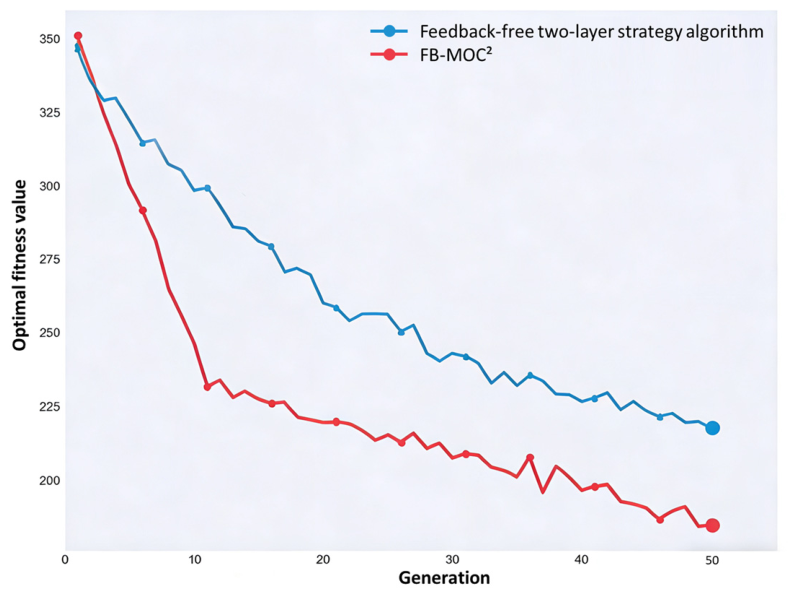
Figure 12 compares the convergence processes of the proposed method and the feedback-free two-layer strategy. Both methods show rapid fitness reduction in early iterations, indicating the effectiveness of the two-layer framework in reducing system cost. However, their convergence behaviors diverge in later stages. FB-MOC2 achieves a rapid decline within the first 10 generations and maintains stable convergence, reaching a lower fitness level. In contrast, the feedback-free strategy exhibits slower convergence and remains in a higher fitness range due to the absence of execution-level feedback. Sequential and fixed-resource strategies, lacking evolutionary search and closed-loop adjustment, fail to form effective convergence trajectories and show inferior optimization performance. These results indicate that performance feedback effectively guides resource search and enhances convergence efficiency.
These phenomena can be explained by the mechanism of two-layer cooperative evolution. Without feedback, the resource search trajectory struggles to converge to the effective region, while the sequential strategy fails to form a stable co-evolutionary path due to decoupling between resource allocation and execution. In contrast, the proposed method introduces performance feedback into the fitness function, enabling the search trajectory to converge toward the effective resource utilization region and form a stable attractor set, consistent with the theoretical analysis.
In summary, the feedback-driven two-layer optimization method demonstrates clear advantages in system efficiency, resource utilization, and convergence stability, validating the effectiveness of data-driven closed-loop feedback mechanisms in complex inspection scenarios and providing interpretable insights into the relationship between resource allocation and system performance.

5. Conclusions

To address the limitations of experience-based resource configuration and the challenge of balancing efficiency and stability in vehicle–UAV collaborative inspection of distribution lines, this paper proposes a path-scheduling feedback-driven evolutionary optimization framework. The main conclusions are as follows:
(1)
The proposed FB-MOC2 method significantly improves collaborative inspection efficiency by enabling joint optimization of vehicle routing, UAV scheduling, and resource allocation within a unified framework. In the case study, the optimized configuration achieves 100% inspection coverage, reduces total operation time from 412 min to 315 min, and effectively decreases redundant travel, demonstrating enhanced system-level coordination and execution efficiency.
(2)
The results reveal a distinct phased evolutionary pattern of resource allocation, where system performance improves rapidly under resource-constrained conditions and gradually saturates as resource scale increases, indicating an effective operating region for resource deployment. The proposed feedback-driven mechanism establishes a closed-loop interaction between resource allocation and execution performance, enabling adaptive resource regulation and achieving a data-driven trade-off between efficiency and cost.
(3)
The proposed method demonstrates strong robustness under failure conditions. Even with a UAV failure rate of 70%, the recovery scheduling cost remains within 1.65 times the baseline and exhibits an approximately linear growth trend, indicating that the feedback-driven mechanism effectively mitigates cascading effects and maintains stable system performance under disturbances.

Author Contributions

Conceptualization, K.W. and J.Z.; methodology, K.W.; software, K.W. and Y.D.; validation, K.W., Y.D. and X.L.; formal analysis, K.W.; investigation, K.W.; resources, J.Z.; data curation, K.W. and Y.Y.; writing—original draft preparation, K.W.; writing—review and editing, J.Z. and X.L.; visualization, K.W.; supervision, J.Z.; project administration, J.Z.; funding acquisition, J.Z. All authors have read and agreed to the published version of the manuscript.

Funding

This research received no external funding.

Institutional Review Board Statement

Not applicable.

Data Availability Statement

The data supporting the findings of this study are available from the corresponding author upon reasonable request.

Conflicts of Interest

The authors declare no conflict of interest.

References

  1. Li, Z.; Wang, Q.; Zhang, T.; Ju, C.; Suzuki, S.; Namiki, A. UAV High-Voltage Power Transmission Line Autonomous Correction Inspection System Based on Object Detection. IEEE Sens. J. 2023, 23, 10215–10230. [Google Scholar] [CrossRef]
  2. He, C.; Ouyang, H.; Huang, W.; Li, S.; Zhang, C.; Ding, W.; Zhan, Z.-H. An adaptive heuristic algorithm with a collaborative search framework for multi-UAV inspection planning. Appl. Soft Comput. 2025, 174, 112969. [Google Scholar] [CrossRef]
  3. Ghommam, J.; Saad, M.; Rahman, M.H.; Zhu, Q. Prescribed Performance Resilient Motion Coordination With Actor–Critic Reinforcement Learning Design for UAV-USV Systems. IEEE Trans. Artif. Intell. 2025, 6, 3336–3350. [Google Scholar] [CrossRef]
  4. Xu, C.; Wang, J.; Ding, Y.; Zheng, C. UAV power line inspection strategy based on SAC algorithm. Electr. Power Syst. Res. 2025, 248, 111925. [Google Scholar] [CrossRef]
  5. He, X.; Liu, Y.; Cheng, K.; Xiao, L.; Zhang, H.; Zhang, Y. AI-Driven Secure Map Construction for UAV Inspection in Edge-Cloud Collaborative IIoT Systems. Int. J. Commun. Syst. 2025, 38, e70235. [Google Scholar] [CrossRef]
  6. Liang, Y.; Yang, L.; Sun, S.; Li, Z.; Shi, Y.; Zhang, Z.; Zhang, H.; Li, Z.; Zhou, L.; Zhang, Z.; et al. YOLOv11-RAH: A recurrent attention-enhanced edge intelligence network for UAV-based power transmission line insulator inspection. Int. J. Intell. Netw. 2025, 6, 244–252. [Google Scholar] [CrossRef]
  7. Meng, B.; Lu, N.; Wang, Q.; Lin, C. The Progress and Trend of UAV Power Line Inspection: A Bibliometrics-based Visualization Analysis. Recent Adv. Electr. Electron. Eng. 2025, 18, 1188–1204. [Google Scholar] [CrossRef]
  8. Liu, X.; Zhao, Q.; Zhu, Z.; Xing, K.; Han, B.; Zheng, Y. The Multi-UAV Path Planning for the Power Transmission Line Inspection. In Proceedings—2024 China Automation Congress; IEEE: New York, NY, USA, 2024; pp. 6226–6231. [Google Scholar]
  9. Zhang, M.; Xu, Y.; Yu, X.; Zhang, C.; Zhang, J. M-SIALNS for Air–Ground Collaborative Inspection: Spatio-Temporal Conflict Mitigation in Complex Bi-Layer Networks. IEEE Trans. Intell. Transp. Syst. 2026, 15, 3530–3545. [Google Scholar] [CrossRef]
  10. Shuang, F.; Chen, X.; Li, Y.; Wang, Y.; Miao, N.; Zhou, Z. PLE: Power Line Extraction Algorithm for UAV-Based Power Inspection. IEEE Sens. J. 2022, 22, 19941–19952. [Google Scholar] [CrossRef]
  11. Feng, B.; Yang, Y.; Wen, J.; Xu, F.; Dong, W. Construction of a Hierarchical Algorithm System for Oil and Gas Pipeline Inspection Path Planning under the Vehicle-UAV Collaborative Inspection Mode. In Proceedings of SPIE—The International Society for Optical Engineering; SPIE: Bellingham, WA, USA, 2026; p. 14055. [Google Scholar]
  12. Pu, Q.; Yang, L.; Li, T. A Levenberg-Marquardt-based optimization algorithm for multi-UAV path planning in complex media. Appl. Math. Model. 2026, 156, 116761. [Google Scholar] [CrossRef]
  13. Meng, K.; Wu, B.; Xin, B.; Deng, F.; Chen, C. Multiobjective multi-UAV path planning via evolutionary multitasking optimization with adaptive operator selection and knowledge fusion. Swarm Evol. Comput. 2025, 99, 102145. [Google Scholar] [CrossRef]
  14. Xu, Y.; Xue, N.; Zhang, Y. An Improved Red-Billed Blue Magpie Optimization Algorithm for 3D UAV Path Planning in Complex Terrain. Biomimetics 2026, 11, 43. [Google Scholar] [CrossRef]
  15. Chen, Z.; Chang, H.; Han, D.; Chen, M.; Cui, H.; Zhang, S.; Zhang, K.; Hao, X.; Zhang, S.; Zhang, D. Dynamic hybrid optimization for complex engineering and UAV path planning in threat-rich environments. Clust. Comput. 2026, 29, 120. [Google Scholar] [CrossRef]
  16. Wang, H.; Yang, K.; Chen, J.; Huang, H.; Yang, J. Multi-strategy collaborative improved Snake Optimizer for complex optimization problems and 3D UAV path planning. Clust. Comput. 2025, 28, 1067. [Google Scholar] [CrossRef]
  17. Li, C.; Zhao, Q.; Che, C. 3D Flight Path Planning for UAV Based on Improved Particle Swarm Optimization Algorithm. IEEE Access 2025, 13, 36637–36646. [Google Scholar] [CrossRef]
  18. Li, K.; Yan, X.; Han, Y. Multi-mechanism swarm optimization for multi-UAV task assignment and path planning in transmission line inspection under multi-wind field. Appl. Soft Comput. 2024, 150, 111033. [Google Scholar] [CrossRef]
  19. Lopez Lopez, R.; Batista Sanchez, M.J.; Perez Jimenez, M.; Arrue, B.C.; Ollero, A. Autonomous UAV System for Cleaning Insulators in Power Line Inspection and Maintenance. Sensors 2021, 21, 8488. [Google Scholar] [CrossRef]
  20. Yang, X.; Zhao, S.; Gao, W.; Li, P.; Feng, Z.; Li, L.; Jia, T.; Wang, X. Three-Dimensional Path Planning for UAV Based on Multi-Strategy Dream Optimization Algorithm. Biomimetics 2025, 10, 551. [Google Scholar] [CrossRef] [PubMed]
  21. Ma, X.; Wang, S.; Guo, Y.; Li, D. Multi-objective Optimization of Structural Parameters of Double-Disk Magnetic Coupler Based on Improved NSGA-II. IEEE Sens. J. 2025, 25, 43821–43838. [Google Scholar] [CrossRef]
  22. Fang, S.; Chou, H.; Liu, S.; Wang, X. A Framework of Power Pylon Detection for UAV-based Power Line Inspection. In Proceedings of 2020 IEEE 5th Information Technology and Mechatronics Engineering Conference; IEEE: New York, NY, USA, 2020; pp. 350–357. [Google Scholar]
  23. Alqefari, S.; Menai, M.E.B. A Hybrid Method to Solve the Multi-UAV Dynamic Task Assignment Problem. Sensors 2025, 25, 2502. [Google Scholar] [CrossRef] [PubMed]
  24. Li, D.; Wang, X.; Zhang, J.; Ji, Z. Automated deep learning system for power line inspection image analysis and processing: Architecture and design issues. Glob. Energy Interconnect. 2023, 6, 614–633. [Google Scholar] [CrossRef]
  25. Chen, X.; Yang, J.; Zhang, L. A Multi-UAV Cooperative Coverage Method Based on Sparse Dual-Attention Reinforcement Learning. IEEE Robot. Autom. Lett. 2026, 11, 4058–4065. [Google Scholar] [CrossRef]
  26. Gan, W.; Xu, H.; Bai, Y.; Zhou, X.; Wu, W.; Du, X. Large-Scale Multi-UAV Task Allocation via a Centrality-Driven Load-Aware Adaptive Consensus Bundle Algorithm for Biomimetic Swarm Coordination. Biomimetics 2026, 11, 69. [Google Scholar] [PubMed]
  27. Wu, K.; Hu, J.; Li, Z.; Ding, Z.; Arvin, F. Distributed Collision-Free Bearing Coordination of Multi-UAV Systems with Actuator Faults and Time Delays. IEEE Trans. Intell. Transp. Syst. 2024, 25, 11768–11781. [Google Scholar]
  28. Ren, H.; Han, C.; Pan, H.; Sun, J.; Li, S.; An, D.; Hu, K. Multi-UAV Cooperative Pursuit Planning via Communication-Aware Multi-Agent Reinforcement Learning. Aerospace 2025, 12, 993. [Google Scholar] [CrossRef]
Figure 1. System architecture diagram.
Technologies 14 00283 g001
Figure 2. A feedback-driven bi-level multi-objective collaborative optimization framework.
Technologies 14 00283 g002
Figure 3. Schematic diagram of the double-layer closed-loop collaborative evolution mechanism.
Technologies 14 00283 g003
Figure 4. Algorithmic procedure of the feedback-driven bi-level multi-objective collaborative optimization.
Technologies 14 00283 g004
Figure 5. Optimal resource allocation scheme for collaborative inspection.
Technologies 14 00283 g005
Figure 6. Convergence characteristics of key metrics: (a) vehicle path length; (b) number of parking sites; (c) average vehicle dwell time.
Technologies 14 00283 g006
Figure 7. Resource-scale sensitivity analysis: (a) total operation time; (b) battery utilization; (c) system cost and unit operation time; (d) task completion rate and coverage quality.
Technologies 14 00283 g007
Figure 8. Comparison of total operation time under dynamic environmental conditions.
Technologies 14 00283 g008
Figure 9. Robustness analysis under different UAV failure rates: (a) normalized recovery scheduling cost; (b) relative cost increase.
Technologies 14 00283 g009
Figure 10. Spatial coordination results under different scenario configurations: (a) plain terrain; (b) hilly terrain; (c) mountain terrain; (d) mixed terrain.
Technologies 14 00283 g010
Figure 11. Computational time breakdown of the algorithm: (a) computation time distribution by module (total 48.2 s); (b) time breakdown across different problem scales.
Technologies 14 00283 g011
Figure 12. Comparison of convergence curves for different strategies.
Technologies 14 00283 g012
Table 1. Simulation environment and system parameter settings.
CategoryParameterValue/Description
Inspection TaskNumber of Inspection Points50
Spatial DistributionCorridor-shaped distribution
Average Spacing0.9 km
Maximum Spacing3.2 km
Road ConstraintsRoad–Line Spatial RelationshipSpatial inconsistency
Vehicle Movement ConstraintsTravel along the existing road network
Parking PointsCandidate LocationsKey nodes in the road network
Layout PrinciplesCoverage + accessibility
UAV ParametersMaximum Flight Time30 min
Cruising Speed60 km/h
Optimization VariablesNumber of Parking PointsAdaptively determined
Number of UAVsAdaptively determined
Table 2. System performance comparison under different scenarios and scales.
ScenarioNumber of Inspection PointsTotal Operation Time/minBattery Utilization/%Coverage/%Computation Time/s
Plain208393.510014.7
5019892.310051.2
10031588.2100275.5
Hilly5022691.110055.6
Mountainous5028389.710064.4
Mixed5025690.510060.8
Table 3. Comparison results of different resource allocation strategies.
Strategy T t o t a l /min J s y s U b a t /% R r
Sequence Optimization4121.0058.032.0
Fixed Resources3650.8662.524.0
Two-Layer Model Without Feedback3380.7870.015.0
FB-MOC23150.7078.58.0
Disclaimer/Publisher’s Note: The statements, opinions and data contained in all publications are solely those of the individual author(s) and contributor(s) and not of MDPI and/or the editor(s). MDPI and/or the editor(s) disclaim responsibility for any injury to people or property resulting from any ideas, methods, instructions or products referred to in the content.