Review

Additive Manufacturing in Space: Technologies, Flight Heritage, and Materials

by
Emilia Georgiana Prisăcariu
*,
Oana Dumitrescu
and
Raluca Andreea Roșu
The Romanian Research and Development Institute for Gas Turbines COMOTI, 061126 Bucharest, Romania
*
Author to whom correspondence should be addressed.
Technologies 2026, 14(3), 165; https://doi.org/10.3390/technologies14030165
Submission received: 12 January 2026 / Revised: 9 February 2026 / Accepted: 28 February 2026 / Published: 5 March 2026
(This article belongs to the Section Innovations in Materials Science and Materials Processing)

Abstract

Additive manufacturing (AM) is increasingly recognized as a critical enabler for sustainable space exploration, offering on-demand fabrication, reduced reliance on Earth-based resupply, and enhanced mission autonomy. Over the past decade, in-space AM has progressed from early polymer extrusion experiments aboard the International Space Station (ISS) to the demonstration of multi-material capabilities involving polymers, metals, ceramics, recycling systems, and in situ resource utilization (ISRU) concepts. This review provides a comprehensive synthesis of AM technologies developed for space applications, with emphasis on demonstrated flight heritage, process behavior under microgravity and vacuum conditions, and materials validated in orbit. The paper surveys major AM process families relevant to space, including fused filament fabrication, directed energy deposition, ceramic stereolithography, bioprinting, and closed-loop recycling systems. Key ISS-based platforms—such as the Additive Manufacturing Facility, Ceramic Manufacturing Module, and Refabricator—are reviewed to assess technological maturity and system-level integration. Materials performance across polymers, metals, ceramics, and regolith-based feedstocks is discussed, highlighting the influence of microgravity, thermal transport, and environmental exposure. By comparing in-space results with terrestrial and reduced-gravity studies, this review identifies consistent trends, critical limitations, and remaining knowledge gaps, providing a structured perspective on the readiness of in-space additive manufacturing for future orbital and deep-space missions.

1. Introduction

Despite steady progress, in-space additive manufacturing (AM) remains constrained by limited material diversity, immature multi-material and ceramic systems, and the absence of space-specific qualification standards. Microgravity, vacuum, radiation, and extreme thermal cycling fundamentally alter process physics, introducing uncertainties in part quality and certification that hinder the transition from experimental demonstrations to operational capability. Addressing these challenges requires a consolidated understanding of materials, processes, environmental effects, and demonstrated systems. Accordingly, this review synthesizes the current state of in-space AM across polymers, metals, ceramics, and regolith-based feedstocks, highlighting flight-proven platforms such as the Zero-G Printer, AMF, the Ceramic Manufacturing Module, and ESA’s Metal 3D Printer. The objective is to provide a technology-focused framework for assessing readiness, identifying research gaps, and guiding the development of resilient, multi-material, and autonomous in-space manufacturing systems.

1.1. State of the Art in Additive Manufacturing for Space Applications

Over the past decade, additive manufacturing for space applications has evolved from conceptual feasibility studies to experimentally validated, flight-demonstrated technologies. Early research focused on assessing whether established terrestrial additive manufacturing processes could operate under microgravity and vacuum conditions, with particular emphasis on polymer material extrusion. Experimental campaigns conducted aboard parabolic flights, drop towers, and ultimately the International Space Station (ISS) have confirmed that fused filament fabrication (FFF) can reliably produce functional polymer components in orbit, with mechanical performance comparable to that of ground-printed counterparts when appropriate thermal control is applied [1].
Subsequent studies expanded the scope of in-space additive manufacturing to include materials beyond conventional thermoplastics. Directed energy deposition (DED) processes have been investigated for metallic component fabrication, with reduced-gravity experiments demonstrating stable wire-fed melt pools dominated by surface-tension-driven dynamics rather than buoyancy [2]. These findings directly informed recent in-orbit demonstrations of metal additive manufacturing aboard the ISS, validating the feasibility of producing dense metallic parts under true microgravity conditions.
In parallel, photopolymer-based routes have enabled access to ceramic and composite materials through stereolithography of pre-ceramic resins. Research shows that microgravity mitigates sedimentation and density gradients in ceramic-loaded photopolymers, improving green-body homogeneity and dimensional fidelity [3]. Although final debinding and sintering steps are currently performed on Earth, these demonstrations establish a viable pathway toward high-temperature, electrically insulating components manufactured from orbitally produced precursors.
Beyond material diversification, the recent literature emphasizes the importance of closed-loop manufacturing and resource efficiency. Integrated recycling systems combining shredding, re-extrusion, and fused-filament fabrication have been successfully tested on the ISS, demonstrating repeated reuse of polymer feedstocks with acceptable mechanical degradation [4]. Complementary studies on regolith-based additive manufacturing indicate that in situ resource utilization (ISRU) is a technically viable strategy for large-scale surface construction on the Moon and Mars, using laser or microwave sintering of local materials [5].
Collectively, these studies establish that additive manufacturing in space has progressed from proof-of-concept experiments to a set of validated process families with growing flight heritage. At the same time, they reveal persistent gaps related to multi-material integration, qualification standards, long-term material degradation, and autonomous operation. These challenges define the current research frontier and motivate the comprehensive, system-level review presented in this work.

1.2. The Need for In Situ Fabrication

The high cost and logistical constraints of launch-based architectures have made in situ fabrication a central enabler for sustainable space exploration. Hoffmann and Elwany [6] show that in-space manufacturing (ISM) enables on-demand production of parts and structures, reducing resupply needs and allowing designs optimized for microgravity rather than launch loads. Abdulhamid et al. [7] extend this concept to a “factory-in-space” paradigm, emphasizing localized materials, recyclable feedstocks, and closed-loop manufacturing as prerequisites for mission autonomy and sustainability.
Although additive manufacturing is mature on Earth, its deployment in orbit remains limited by gaps in process physics under reduced gravity. Taghizadeh et al. [8] and Su et al. [2] identify unresolved challenges related to melt pool behavior, powder handling, and microstructural evolution, motivating experimental validation aboard the ISS and in parabolic flight. From a systems perspective, Gupta et al. [9] and Thai et al. [10] argue that ISM is essential for deep-space missions, where reliance on Earth-based supply chains is impractical. For surface operations, ISRU-based manufacturing is equally critical: Zhang et al. [11] and Zhang P. [12] demonstrate that regolith-based construction is the only viable path for sustainable lunar infrastructure, while Yeshiwas [13] and Prater et al. [14] link additive manufacturing to resource efficiency, recycling, and on-demand repair.
Beyond logistics, in situ fabrication enables capabilities unattainable on Earth. Luria et al. [15] show that certain precision processes, such as fluidic shaping of optical components, can perform better in microgravity. The James Webb Space Telescope further illustrates this shift: as noted by Menzel [16], much of JWST’s complexity arises from launch survivability rather than operational requirements, suggesting that future large optical systems would be simpler and more efficient if fabricated directly in space. Collectively, these studies establish in situ fabrication not as a convenience, but as a strategic necessity for autonomous, scalable, and sustainable human presence beyond Earth.

1.3. Historical Evolution

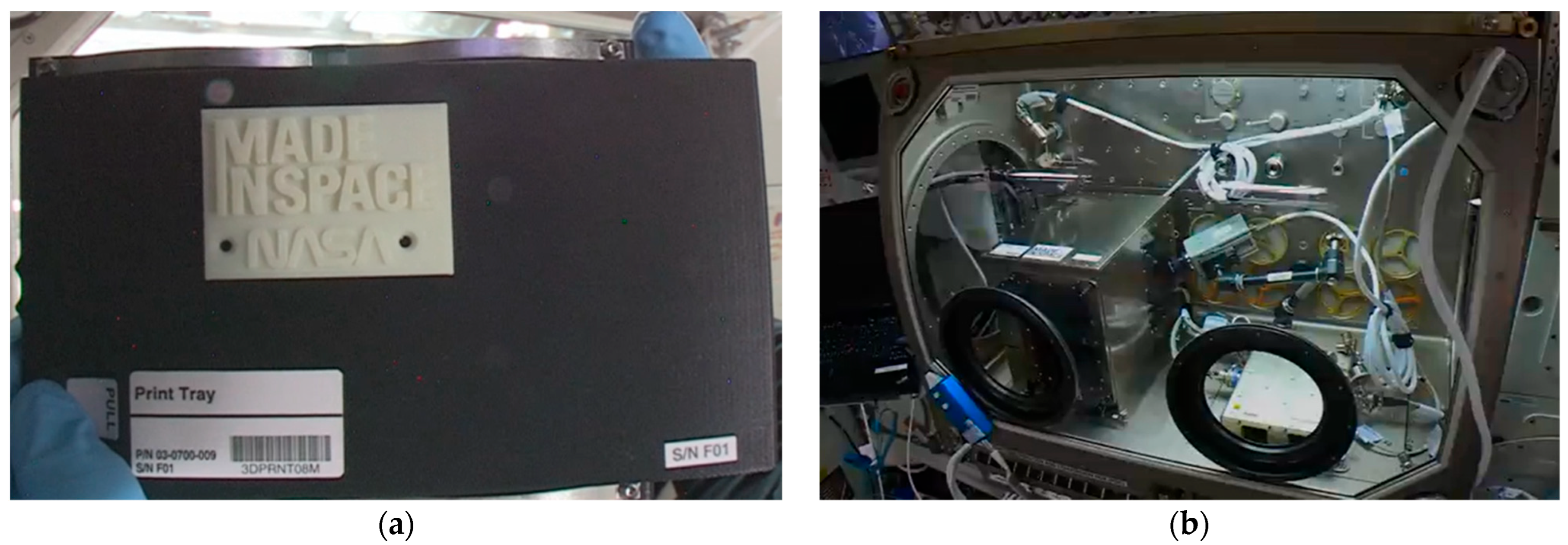
The first verified demonstration of additive manufacturing in space was carried out under NASA’s 3D Printing in Zero-G Technology Demonstration, a joint effort between Made In Space, Inc. [17] and NASA’s Marshall Space Flight Center [18]. The flight unit, launched aboard SpaceX CRS-4 [19] in September 2014, implemented the fused-filament fabrication (FFF) process, extruding a low-temperature thermoplastic filament in successive layers to build three-dimensional structures directly from digital files. After installation on 17 November 2014, a sequence of calibration samples was produced under both crew-assisted and ground-commanded modes to validate mechanical alignment and extrusion stability [20]. On 24 November 2014, the system successfully printed its first operational component, the faceplate of the printer’s own extruder assembly, therefore becoming the first machine to manufacture a functional object in orbit. Subsequent prints continued through December 2014, producing a total of 21 parts that were later returned to Earth for microstructural and dimensional comparison with ground-based reference specimens. Analysis confirmed the efficiency of thermoplastic extrusion in microgravity and revealed subtle variations in adhesion and layer bonding compared to terrestrial conditions, which were further investigated in later phases of the project [21]. As noted in [21], this experiment represented “a transformative moment in space development,” demonstrating the capability for on-demand, self-sustaining part production in orbit and establishing the foundation for permanent additive manufacturing facilities on the ISS. Both the first ever 3D-printed part in space and the installation integrated into the MSG module are presented in Figure 1a and Figure 1b respectively.
After the success of the 3D Printing in Zero-G Technology Demonstration, NASA and Made In Space, Inc., advanced toward a continuous, operational manufacturing capability aboard the International Space Station. This effort culminated in the launch of the Additive Manufacturing Facility (AMF) [22], delivered to the ISS [23] on the Cygnus CRS-OA-6 mission in March 2016 [24]. Unlike the prototype Zero-G Printer, which was designed primarily for proof-of-concept experiments, the AMF was conceived as a permanent, crew-operable 3D printing platform integrated into the Microgravity Science Glovebox (MSG). The system features a hardened mechanical structure, sealed build chamber, and automated calibration routines to ensure reliable operations in the station’s microgravity environment. The AMF employs fused-filament fabrication (FFF) technology, printing with engineering-grade thermoplastics such as acrylonitrile butadiene styrene (ABS) [25], high-density polyethylene (HDPE) [26], and ULTEM 9085 (a PEI/PC copolymer) [27].
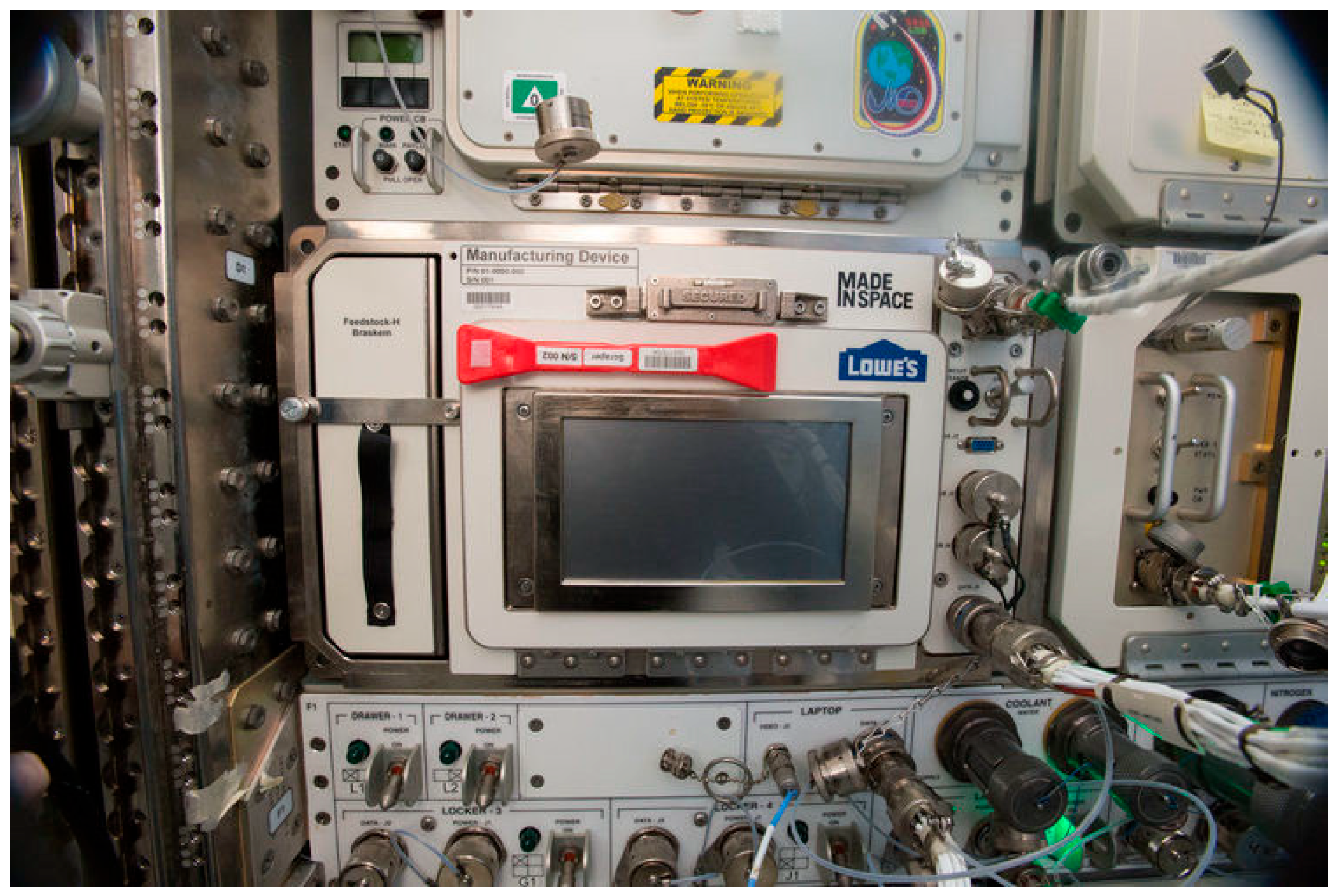
By late 2019, the AMF (Figure 2) had produced more than 200 functional parts, tools, and mechanical components for both NASA and commercial customers, marking the first transition of additive manufacturing from an experimental capability to an on-demand service in orbit [28,29,30].
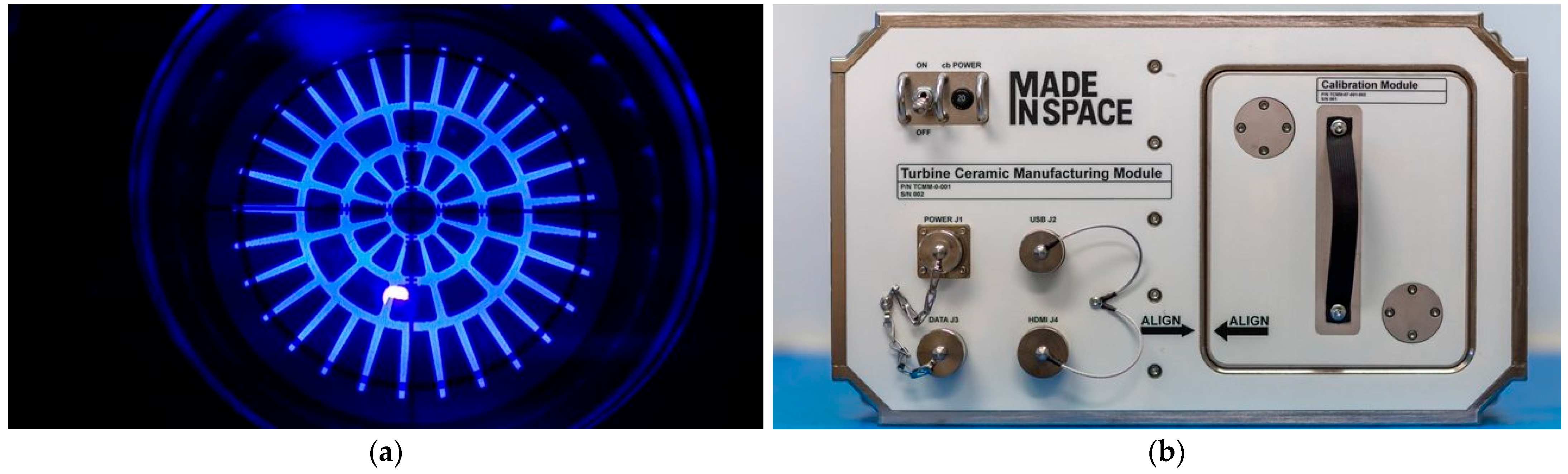
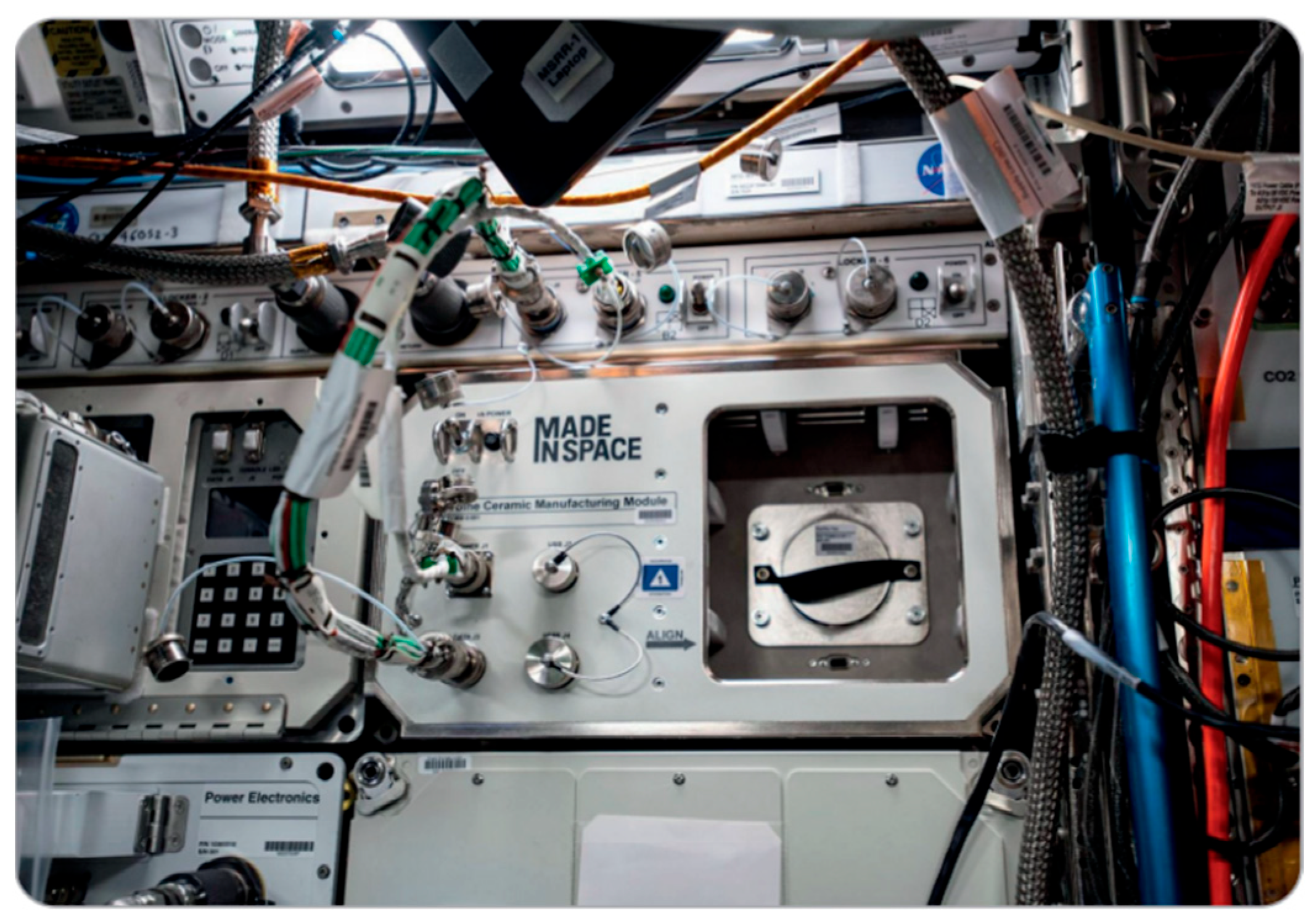
Many of these parts were used for real operational tasks, such as protective housings, clips, tool adapters, and alignment fixtures, confirming the reliability of polymer extrusion in a closed microgravity environment [14,31,32]. The facility is teleoperated primarily from Redwire Space’s mission control center in Moffett Field, California, allowing Earth-based teams to upload print files and monitor manufacturing through video and sensor feedback [33]. The AMF marks the first true manufacturing capability in space, shifting from isolated tests to ongoing production in orbit. Its success directly shaped the design of subsequent multi-material platforms such as the Ceramic Manufacturing Module (CMM) [34,35,36] depicted in Figure 3 and Redwire FabLab [37], both of which are intended to expand the range of materials and functions available for in situ manufacturing during long-duration missions. Figure 3a presents the ceramic turbine blisk part projection printed in the CMM, and the ceramic manufacturing module is shown in Figure 3b.
The technical progression of orbital additive manufacturing reached a new phase in 2023 with the initiation of the Redwire FabLab (Fabrication Laboratory) [38], a NASA-funded platform designed to consolidate and expand the material range of in-space production [39]. Developed by Redwire Space as part of NASA’s In-Space Manufacturing 2.0 program, FabLab builds directly upon the operational experience gained from the Additive Manufacturing Facility (AMF) and Ceramic Manufacturing Module (CMM). Whereas the AMF demonstrated polymer extrusion reliability and the CMM extended the process envelope to photopolymer-ceramic materials, the FabLab introduces a multi-material capability, combining polymer, metal, and electronic printing within a single autonomous unit [38]. The system is intended to facilitate the fabrication of both structural and functional components in orbit, ranging from mechanical brackets to conductive assemblies, and to serve as a pathfinder for fully automated manufacturing laboratories supporting sustained lunar-to-Martian missions. By integrating onboard process monitoring, teleoperation from Redwire’s Mission Control Center at Moffett Field, California, and modular hardware design, the FabLab represents the transition from experimental manufacturing payloads to a comprehensive in situ production ecosystem, capable of supporting long-duration exploration and infrastructure development beyond Earth orbit.

1.4. Strategic Frameworks

The funding mechanisms presented in Table 1 illustrate the institutional commitment on both sides of the Atlantic to advance in-space manufacturing and ISRU technologies. In the United States, NASA’s Space Technology Mission Directorate (STMD) remains the central driver, allocating over one billion USD annually for technology maturation, within which the In-Space Manufacturing (ISM 2.0) portfolio supports projects such as Redwire FabLab and related autonomous fabrication systems. Complementary early-stage research is supported through the SBIR/STTR program, fostering SME participation and rapid innovation. In Europe, long-term investment is coordinated through Horizon Europe’s Cluster 4—Space, EUSPA’s downstream calls, and ESA’s GSTP and Advanced Manufacturing activities, together channeling hundreds of millions of euros each year into additive manufacturing, materials qualification, and ISRU demonstrators. Collectively, these frameworks form the financial backbone enabling the transition from isolated in-orbit experiments to sustainable, multi-material production infrastructures.
Institutional programs indicate that in-space additive manufacturing has transitioned from experimental demonstrations to a strategic capability for sustained exploration beyond Earth orbit. NASA emphasizes autonomous, closed-loop manufacturing through its ISM 2.0 portfolio and the FabLab platform, while ESA and European initiatives focus on qualification, standardization, and efficient in situ resource utilization. Despite different implementation approaches, these efforts converge on reducing Earth-dependent logistics by enabling self-sustained, multi-material manufacturing systems that underpin future orbital, lunar, and Martian infrastructure.
While the United States and the European Union have established formal strategic frameworks, namely NASA’s In-Space Manufacturing (ISM 2.0) and ESA’s Advanced Manufacturing programs, both Japan and Russia remain at a more exploratory stage in institutionalizing orbital additive manufacturing. Japan’s efforts, coordinated through JAXA’s Space Exploration Innovation Hub and J-SPARC initiatives [48,49], emphasize ground-based AM for propulsion and lunar infrastructure and reflect an emerging intent to integrate in situ fabrication capabilities into future Gateway [50] and LUPEX missions [51], though no orbital demonstrator has yet been deployed. Russia’s activities, driven by Roscosmos [52] and TsNIIMash [53], similarly focus on additive production of spacecraft components and propulsion hardware, with earlier plans for an ISS-mounted 3D printer postponed. In contrast to the structured, budgeted frameworks of NASA and ESA, these national programs remain fragmented and project-based, indicating a gap between the established Western ecosystems supported by sustained funding, clear TRL pathways, and industrial partnerships and the more prototype-driven or conceptual efforts underway in Asia and Russia.
Table 2 provides a comparative overview of the leading national and regional initiatives in in-space manufacturing and additive technologies as of 2025. It highlights the focus and current status of programs across major spacefaring nations, including NASA’s operational ISM 2.0 program, ESA’s active demonstrators under GSTP and Horizon Europe, and early-stage efforts by JAXA and Roscosmos.
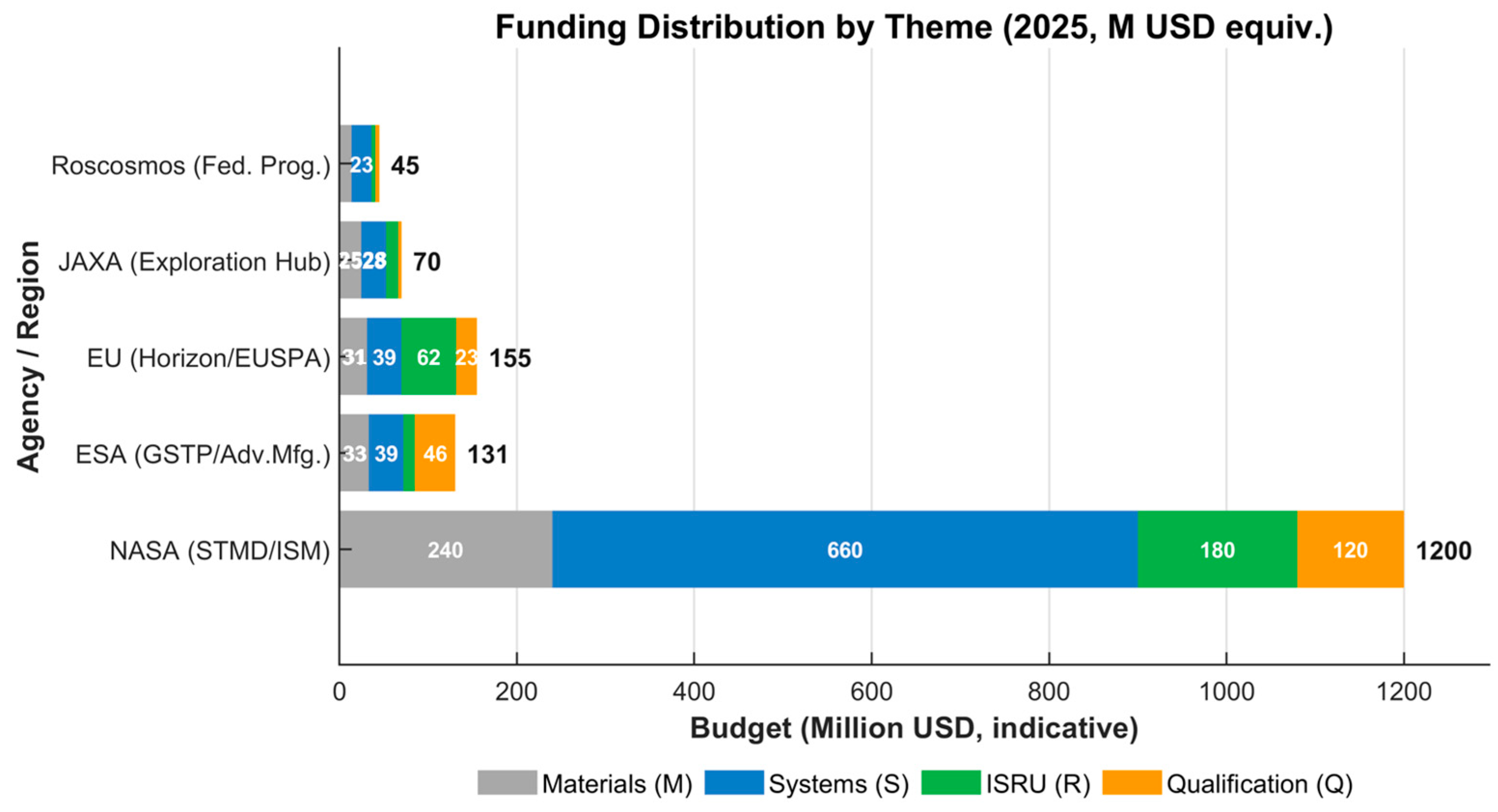
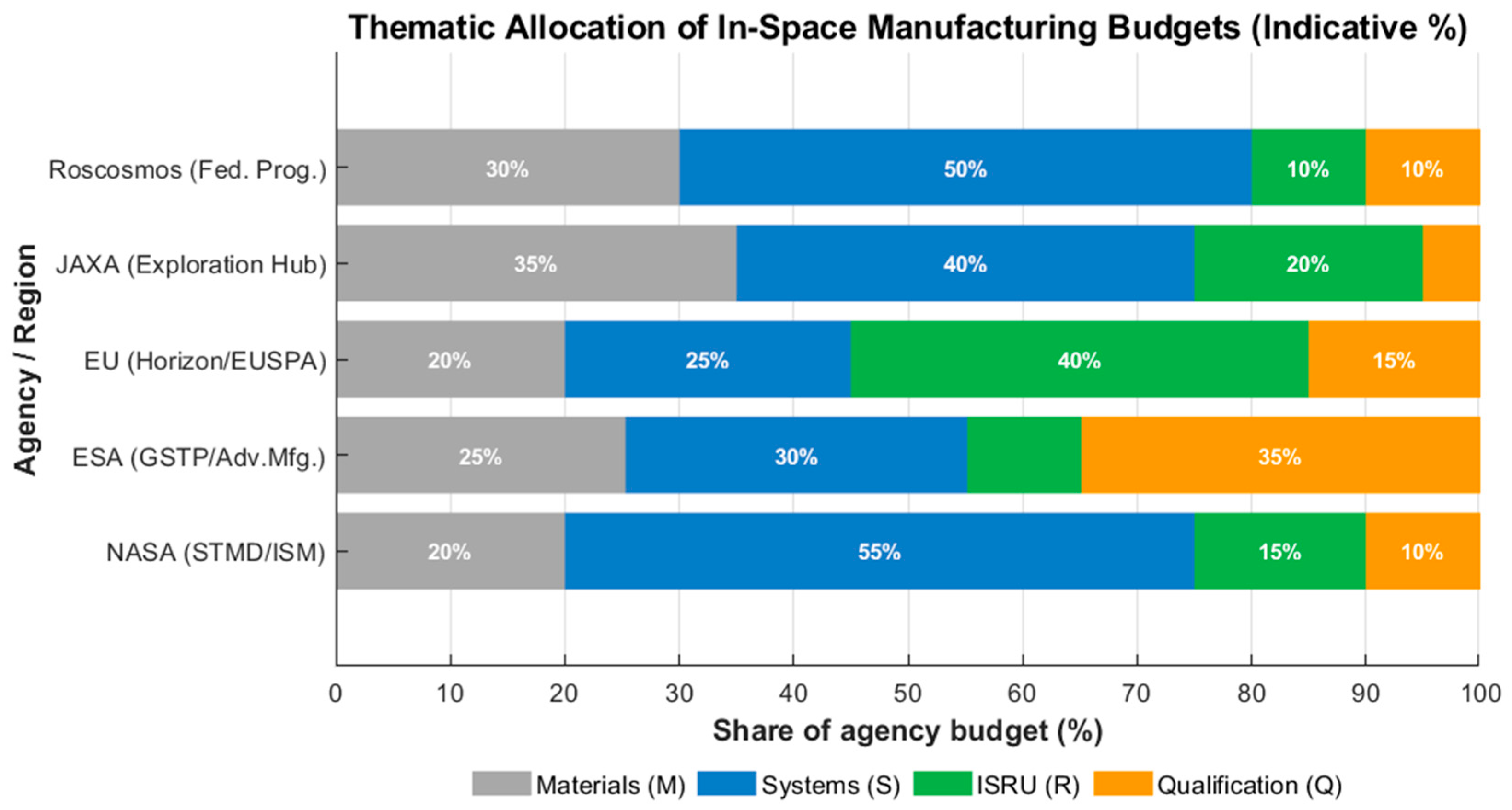
To better illustrate the distribution of resources supporting in-space additive manufacturing and in situ resource utilization (ISRU), Figure 4 and Figure 5 summarize both the thematic orientation and the absolute magnitude of public investment across major space agencies and regions. Figure 4 presents the thematic allocation of in-space manufacturing budgets in percentage terms, highlighting distinct strategic emphases—NASA’s strong focus on manufacturing systems and automation, ESA’s increased investment in qualification and industrialization, the European Union’s pronounced orientation toward ISRU, and the comparatively smaller, exploratory-level programs pursued by Japan and Russia. Figure 5 compares the approximate absolute annual budgets allocated by NASA, ESA, the European Union, JAXA, and Roscosmos to additive manufacturing–related programs, expressed in million USD equivalents and grouped by materials research, manufacturing systems, ISRU, and qualification activities.
Together, these figures visualize both the divergence in research prioritization and the asymmetry in funding scale, underscoring the leading role of the United States and Europe in structuring long-term additive manufacturing frameworks for orbital and surface operations.

2. Classification of Additive Manufacturing in Space

The growing diversity of additive manufacturing technologies for space applications requires a systematic classification that accounts for operational environments, process mechanisms, and technology maturity. Unlike terrestrial AM, in-space manufacturing must explicitly incorporate the effects of microgravity, vacuum, radiation, and logistical constraints, which fundamentally influence system architecture and process control.
Quantitative separation of microgravity-induced effects from vacuum-driven thermal effects in space additive manufacturing is typically achieved through comparative experimental design rather than direct in-orbit isolation. In the literature, vacuum effects are assessed through ground-based high-vacuum printing experiments (10−4–10−7 mbar) conducted under 1 g conditions, where convection suppression, radiative heat transfer, and volatile behavior can be isolated independently of gravity. Microgravity-specific effects are then inferred by comparison with results obtained from parabolic flights, drop-tower experiments, sounding rockets, or ISS operations, where gravitational acceleration is reduced while pressure and thermal boundary conditions are controlled or matched as closely as possible.
Across different AM process families, this approach enables partial quantitative attribution: for material extrusion processes, changes in interlayer diffusion, cooling rates, and bead geometry are primarily linked to altered heat-transfer regimes, whereas differences observed only under reduced gravity—such as melt-pool symmetry in DED or particle sedimentation behavior in ceramic photopolymers—are attributed to gravity-independent fluid dynamics. While fully decoupling gravity and vacuum effects remains experimentally challenging, the combined use of controlled-vacuum ground tests and reduced-gravity flight experiments provides a consistent framework for distinguishing dominant physical drivers across AM technologies.
To capture these distinctions, the present section introduces a three-tier classification scheme that delineates (i) the operational domains in which AM systems function, (ii) the process families defining their underlying fabrication principles, and (iii) a comparative synthesis summarizing their performance and readiness characteristics. This taxonomy provides a structured basis for evaluating the technological state-of-the-art, identifying application niches, and tracing the evolution of in-space manufacturing toward higher autonomy and integration.

2.1. Operational Domains

In-space additive manufacturing can be grouped into three primary operational domains according to the environment in which production occurs: orbital, surface, and transit or deep-space. Each domain is characterized by unique physical conditions and mission objectives that shape the selection of materials, process architectures, and levels of system autonomy.
For instance, orbital AM, exemplified by AMF and CMM, operates under microgravity and vacuum, prioritizing compactness and reliability for tool and component fabrication aboard spacecraft or stations. Surface manufacturing, by contrast, focuses on lunar or Martian applications and leverages in situ resource utilization (ISRU) to reduce launch mass. The emerging transit domain addresses long-duration missions, emphasizing self-sufficiency and repair capabilities. Understanding these environments is essential for mapping process feasibility, equipment design, and material requirements across the space manufacturing continuum.
  • The orbital domain
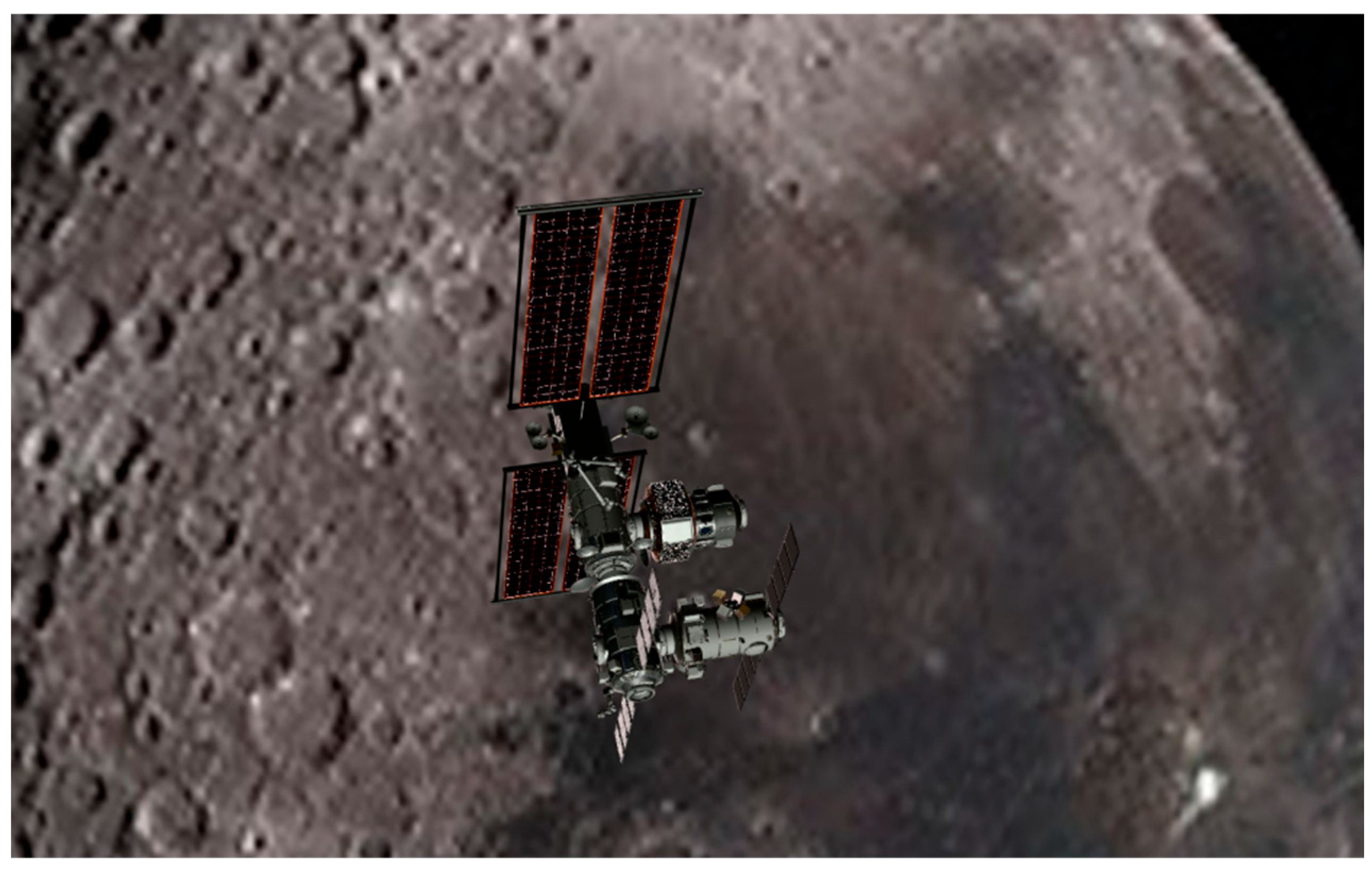
The orbital domain integrates manufacturing activities conducted in microgravity aboard platforms such as the International Space Station (ISS), the Lunar Gateway [58] (Figure 6), or dedicated free-flyer modules.
The Lunar Gateway is expected to provide solutions to RnR (Recycle and Reuse), on-demand manufacturing of metal parts and on-demand electronics [59]. These capabilities are expected to be accompanied by development and testing resources.
These systems operate in vacuum or controlled low-pressure environments, under strict limits on power, volume, and crew interaction. Demonstrated platforms such as the Additive Manufacturing Facility (AMF), Ceramic Manufacturing Module (CMM), and Redwire FabLab have validated polymer and ceramic printing in orbit, focusing primarily on spare-part production, tool fabrication, and component repair. The absence of buoyancy and convection in microgravity necessitates careful thermal management and precise process control to ensure interlayer adhesion and geometric stability.
Other applications propose taking advantage of the conditions in space. Reduced buoyancy can be considered a plus in the realm of printing optical parts, as specified in 2022 in the study [60] and again in 2025 in study [15].
  • The surface domain
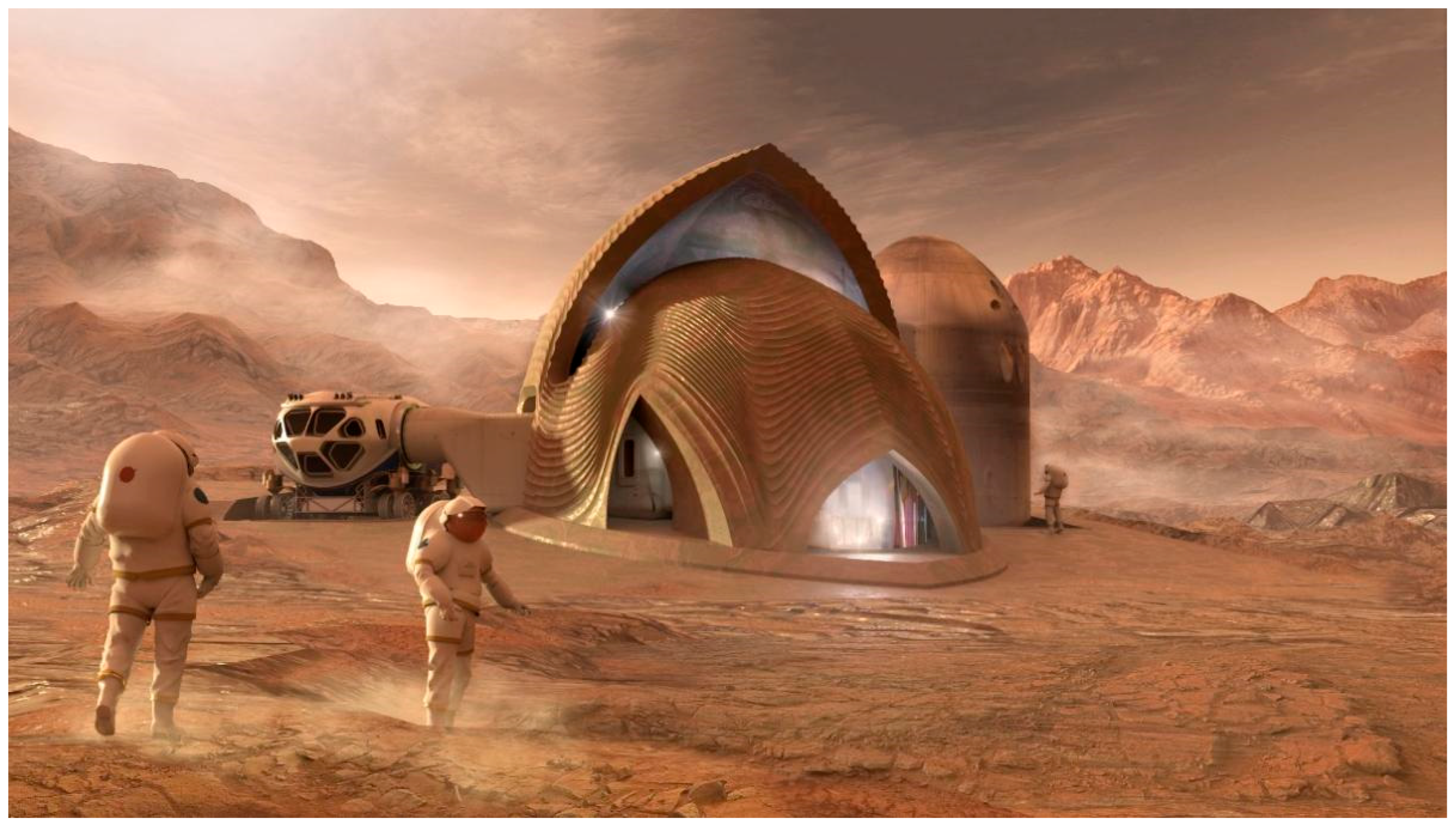
Outside the Lunar Gateway, the possibility of using lasers in the future to create landing sites, roads, or buildings from lunar dust, also known as regolith, is explored in the MOONRISE [61] project. Microwave Sintering Lunar Landing Pads & Horizontal Infrastructure is pursued by NASA through the MSCC project [62]. These projects follow the development of infrastructure able to accommodate future exploration.
  • Transit or in-deep domain
The transit or in-deep domain refers to additive manufacturing activities carried out during long-duration transfer phases, such as transit from Earth to the Moon or Mars, deep-space cruise under microgravity, or interplanetary operations far from logistical support. In this regime, AM systems must operate autonomously in persistent microgravity, limited power availability, and thermally variable environments, while ensuring continuous functionality for months or years without resupply. Manufacturing tasks in this domain include producing replacement components, repairing structural elements, fabricating scientific tools, and supporting closed-loop resource management through recycling and refabrication. Compared with low Earth orbit manufacturing, the transit/in-deep domain requires higher system reliability, radiation-tolerant electronics, greater feedstock efficiency, and reduced dependence on crew interaction, positioning in-transit AM as a critical enabler of sustainable deep-space exploration architectures.

2.2. Process Families

2.2.1. Material Extrusion (Fused Filament Fabrication—FFF)

Fused filament fabrication (FFF), also referred to as fused deposition modeling (FDM) [63], is the most technologically mature and operationally established additive manufacturing process currently employed in orbit. The process relies on the controlled melting and deposition of a continuous thermoplastic filament through a heated nozzle, forming parts layer by layer along a digitally defined toolpath. Its mechanically simple architecture, characterized by a closed material flow and a limited number of moving components, makes FFF particularly well suited for the confined and safety-critical environment of crewed spacecraft. In contrast to powder-based or photopolymerization techniques, material extrusion avoids issues such as particle dispersion, volatile emissions, and radiation-sensitive liquid phases, which complicate process integration in microgravity environments.
The physical behavior of FFF changes significantly under orbital or high-vacuum conditions. Under terrestrial conditions, convective heat transfer dominates filament cooling and interlayer solidification. In microgravity or high-vacuum environments (10−4–10−7 mbar), convection is largely suppressed, and thermal dissipation is governed primarily by conduction and radiation, altering the local temperature gradients around the nozzle and deposited strand. From a physics perspective, the implications of this altered heat-transfer regime are commonly interpreted using polymer thermal welding and interdiffusion models, in which interlayer bonding strength depends on the time–temperature history at the interface and the extent of chain mobility and reptation across adjacent layers.
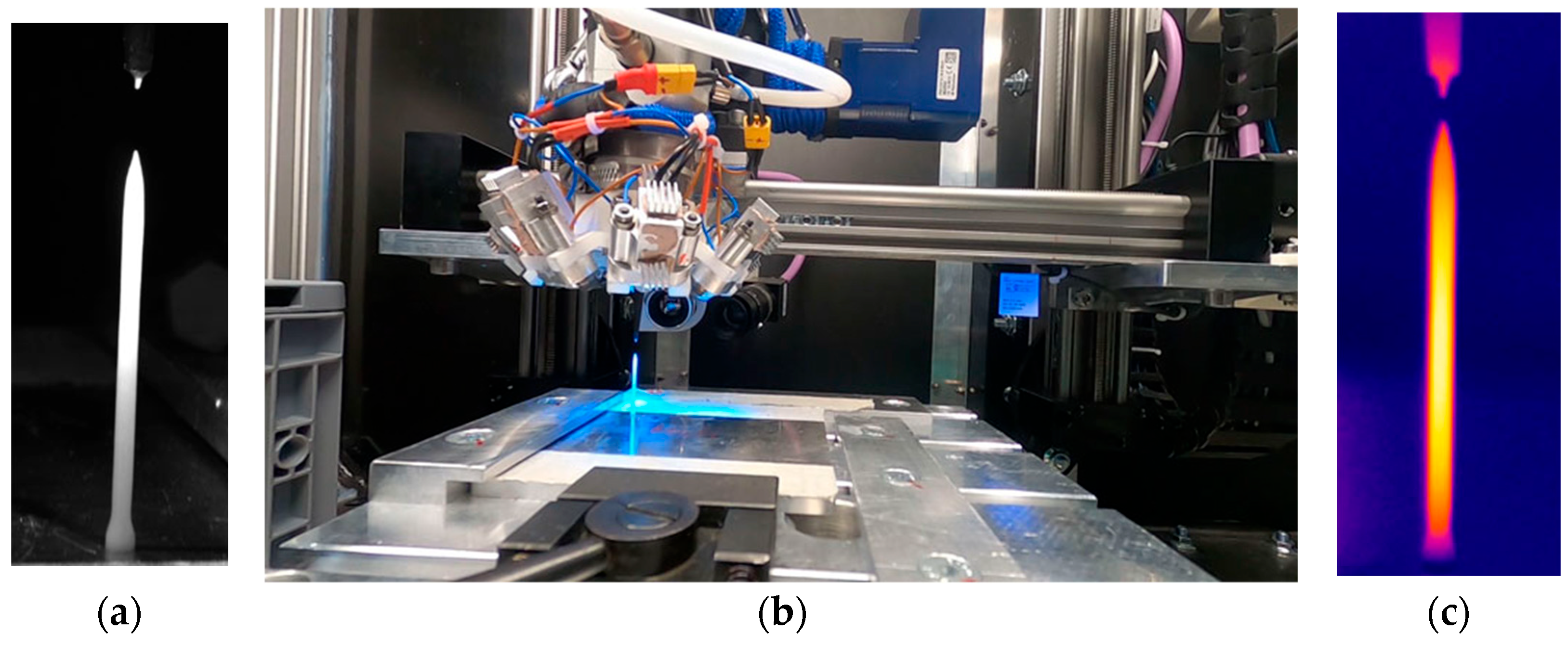
As demonstrated in [64] the convection-free thermal environment can, under appropriately controlled process conditions, extend the effective melt-state residence time and promote enhanced interlayer diffusion, leading to reduced porosity and improved mechanical coherence across printed layers. Their high-vacuum-compatible FFF system operated stably at pressures of 5 × 10⁻⁴ mbar, maintaining extrusion continuity without overheating or structural drift. Infrared temperature measurements confirmed that nozzle surfaces reached 10–15 °C higher temperatures in vacuum than under atmospheric conditions, requiring recalibrated PID control and reduced print velocities to ensure consistent solidification and dimensional stability [64].
Spicer et al. [65] further verified the stability of FFF under vacuum conditions representative of low Earth orbit, demonstrating precise layer stacking and dimensional accuracy during extended print cycles. Their results showed that the absence of convective losses, when compensated by active thermal management and feedback-controlled heating, does not degrade print quality or geometric fidelity. Under these conditions, a more uniform thermal field can reduce interlayer anisotropy and promote smoother material deposition, although such benefits remain contingent on appropriate control of cooling and extrusion parameters.
Complementary investigations by Laurenzi et al. [66] expanded the understanding of FFF behavior in convection-free environments by examining the role of extrusion dynamics, nozzle control, and cooling rates on print homogeneity. Their findings emphasize that maintaining constant extrusion pressure and a stable thermal boundary layer is essential for preserving surface quality and interlayer adhesion when convective heat transfer is absent.
Overall, the literature indicates that fused filament fabrication remains the most robust and predictable additive manufacturing process for orbital applications. Its intrinsic mechanical simplicity, compatibility with closed-loop thermal control, and adaptability to recycling-based material architectures position FFF as the baseline platform for sustainable in-space manufacturing. Ongoing advances in vacuum-compatible extrusion systems, dynamic temperature regulation, and real-time process monitoring continue to improve print precision and reliability, reinforcing FFF’s role as the cornerstone of current and near-term autonomous manufacturing capabilities in microgravity.

2.2.2. Directed Energy Deposition (DED)

Directed Energy Deposition (DED) comprises a family of additive manufacturing processes in which a focused energy source—typically a laser, electron beam, plasma, or electric arc—melts feedstock material supplied as either wire or powder. The molten material is deposited directly onto a substrate and solidifies under controlled thermal conditions to form near-net-shape metallic components. Because the process couples localized energy input, material delivery, and coordinated motion control, DED is among the most adaptable and scalable additive manufacturing technologies for structural fabrication, including applications in microgravity environments.
Within the context of space manufacturing, wire-based DED has emerged as the preferred configuration due to its operational cleanliness, high deposition efficiency, and avoidance of powder contamination or dispersal hazards. Powdered feedstocks present unacceptable particulate risks in microgravity and high vacuum, whereas continuous wire feed enables closed-loop control of deposition rate and geometry. The system architecture allows independent control of laser power, wire feed speed, and traverse speed—parameters that collectively govern melt pool dynamics, dilution, and final bead geometry [67].
A central aspect of DED performance is melt-pool stability, which is strongly influenced by the balance of forces acting on the molten metal. Under terrestrial conditions, melt pool behavior is governed by surface tension, gravity-driven hydrostatic pressure, buoyancy-induced convection, thermocapillary (Marangoni) flow, and recoil pressure. In sustained microgravity, hydrostatic pressure and buoyancy-driven convection are effectively eliminated, shifting the dominant force balance toward surface tension, thermocapillary flow, recoil pressure, and the spatial distribution of energy input. Consequently, melt pool stability becomes more sensitive to laser power density, beam profile, wire–melt-pool interaction, and focal position, rather than to gravity-assisted drainage or buoyant flow.
Maintaining a stable melt pool under these conditions therefore requires careful coordination between laser irradiance and translation speed to ensure adequate wetting while avoiding overheating. Excessive power or insufficient traverse speed can lead to keyhole formation, dripping, or excessive dilution, whereas insufficient power or rapid motion promotes stubbing or lack of fusion. Studies show that constant linear energy density alone does not guarantee consistent melt pool geometry, as local variations in heat accumulation, conduction, and reflectivity can induce significant fluctuations in temperature and pool shape. Continuous laser operation typically produces an elongated trailing melt pool, while pulsed operation allows partial solidification between pulses, limiting thermal accumulation and improving dimensional fidelity.
Laser beam configuration further plays a decisive role in thermal uniformity and melt-pool symmetry—effects that become more pronounced in the absence of gravity. Gaussian, annular, and pedestal beam profiles distribute energy differently across the interaction zone: annular beams promote lower thermal gradients and more symmetric, surface-tension–dominated melt pools, while pedestal beams provide more uniform substrate heating with reduced peak energy density [68,69]. Controlled defocusing, typically by a few tenths of a millimeter below the substrate, is commonly employed to stabilize melt pool oscillations and mitigate recoil-driven instabilities when gravity-assisted damping is absent. The resulting energy envelope defines the thermal boundary conditions of the process and directly influences bead morphology and interlayer adhesion.
In addition to energy delivery, wire feeding strategy critically affects geometric accuracy and melt pool stability. Lateral wire feeding at approximately 45° ahead of the melt pool provides optimal absorptivity and smooth surface finish, whereas rear feeding or misaligned incidence angles increase instability and irregular track formation. Coaxial feeding systems, in which the wire is delivered through the center of an annular or multi-beam laser configuration, enable omnidirectional deposition and are therefore favored for robotic and microgravity applications. However, such systems require precise optical alignment and exhibit increased sensitivity to variations in standoff distance.
The resulting bead geometry—characterized by parameters such as aspect ratio, dilution, and contact angle—reflects the combined influence of energy input, wire feed rate, and traverse speed. Higher laser power or slower motion increases dilution and bead width while reducing height, whereas excessive wire feed raises the bead profile and limits lateral spreading. Optimal process windows are typically associated with dilution levels below 30%, aspect ratios above 3, and contact angles below 80°, ensuring adequate wetting and minimal porosity [70]. Appropriate lateral and vertical overlap ratios, generally between 40% and 70%, are required to achieve uniform multilayer deposition without gaps or excessive overbuild.
DED process stability is commonly evaluated through the presence of external and internal defects. External anomalies such as dripping or stubbing originate from imbalanced heat flow or wire-feed synchronization, while internal porosity arises from trapped gas or insufficient fusion between adjacent tracks. Stable operation is associated with the formation of a continuous liquid bridge between the wire tip and the melt pool, enabling uniform mass transfer without oscillations or droplet detachment. In microgravity, where gravitational damping is absent, this stability criterion becomes more stringent, increasing the importance of closed-loop thermal feedback and optical monitoring to maintain a surface-tension–dominated deposition regime [68,69].
Within the scope of this review, the emphasis on wire-fed laser DED reflects demonstrated system maturity and operational suitability for orbital environments, rather than a universal assessment of process superiority. Compared to WAAM and electron beam melting (EBM), wire-fed laser DED offers a more compact system architecture, lower electrical power requirements, and compatibility with sealed or inert-gas enclosures, while avoiding the high-current arcs of WAAM and the high-vacuum, high-voltage constraints of EBM. As a result, wire-fed laser DED has emerged as the most extensively demonstrated metallic AM configuration for space-relevant applications to date, although alternative processes remain viable candidates for future, mission-specific architectures.
Predicting residual stress evolution in in-space metal additive manufacturing remains subject to significant uncertainty. The absence of gravity-driven melt pool flattening alters thermal gradients, solidification symmetry, and constraint conditions, while the limited availability of in-space residual stress measurements restricts model validation. As a result, current understanding is largely extrapolated from terrestrial laser-based AM models, and the development of predictive residual stress frameworks for sustained microgravity environments remains an open research challenge.
Overall, DED’s independence from gravity-assisted powder flow and its ability to fabricate or repair large metallic structures make it a cornerstone process for orbital and lunar manufacturing platforms. The combination of high deposition rate, minimal consumable waste, and compatibility with sealed or inert-gas chambers aligns well with the constraints of crewed environments. As developments in beam modulation, real-time sensing, and adaptive control continue, wire-based DED systems are progressively converging toward autonomous and contamination-free operation, enabling large-scale structural manufacturing beyond Earth orbit.
At present, no dedicated, fully standardized qualification pathway exists for certifying in-space manufactured parts for mission-critical use. Instead, current approaches adopted by space agencies rely on risk-based qualification strategies that combine heritage space hardware standards with established additive manufacturing qualification practices. These typically emphasize process qualification and repeatability, material characterization, and post-fabrication inspection, rather than individual part certification. For near-term applications, in-space manufactured components are therefore limited to non-critical or contingency roles, while ongoing efforts focus on extending qualification methodologies toward higher criticality classes as confidence in process control and environmental stability increases.

2.2.3. Material Extrusion—Bioprinting

Bioprinting constitutes a specialized branch of additive manufacturing focused on the precise deposition of biologically active materials to create functional living structures. It operates through the controlled extrusion or patterning of cell-laden phases that subsequently crosslink and mature into organized tissue constructs. What sets bioprinting apart from other additive manufacturing methods is its dependence on a careful balance between mechanical integrity and biological viability, a relationship that changes fundamentally in microgravity environments.
In the absence of gravitational acceleration, the extrusion and stabilization of biofluids are governed almost exclusively by surface tension and viscous forces. This shift in dominant physics eliminates sagging and sedimentation effects, enabling highly uniform layer formation and geometric precision. Droplets and filaments remain suspended where deposited, allowing the creation of intricate three-dimensional structures that would otherwise collapse under their own weight on Earth. The resulting constructs exhibit enhanced shape fidelity and isotropic internal organization, as the lack of gravitational gradients prevents density-driven cell segregation or collapse of soft scaffolds [70].
Microgravity also alters the post-deposition dynamics that dictate tissue development. On Earth, buoyancy-driven convection aids heat and mass transfer during crosslinking and culture. In orbit, diffusion becomes the dominant method of nutrient and gas transport, which requires careful control of environmental parameters such as temperature, pressure, and flow rate. When these conditions are properly regulated, diffusion-driven transport promotes uniform cell growth and minimizes shear stresses, creating an environment well suited to preserving tissue integrity. By contrast, even small changes in local flow or temperature can spread through the construct and lead to spatial differences in stiffness and tissue maturation [71].
As construct dimensions increase, diffusion-dominated transport imposes fundamental scaling limits on tissue viability. In the absence of convective flow or perfusable vascular networks, oxygen and nutrient diffusion typically constrain viable tissue thickness to sub-millimeter length scales, with metabolic gradients becoming increasingly pronounced in larger constructs. In microgravity, while diffusion-driven transport can be more spatially uniform, it does not eliminate these intrinsic biological limits, making construct size, cell density, and culture duration key factors governing long-term viability in orbit.
At the process-engineering level, bioprinting in microgravity demonstrates that complex biological constructs can be produced autonomously through digital patterning alone, with minimal human intervention. The absence of gravitational bias allows equal fidelity in all orientations, which is particularly advantageous for closed-loop or robotic fabrication scenarios envisioned for long-duration missions. Furthermore, the capability to assemble tissue analogs directly within a microgravity environment reduces dependence on terrestrial manufacturing and enables localized biomedical production. This paradigm introduces the idea of regenerative manufacturing in space, where fabrication extends beyond mechanical components to include living biological systems capable of sustaining, repairing, or enhancing human health in isolated environments [72].
From a broader perspective, bioprinting in reduced gravity provides a scientific platform for understanding how physical forces influence morphogenesis, cellular organization, and structural self-assembly. The technique serves as both a manufacturing tool and a research instrument, allowing the observation of developmental processes unaffected by sedimentation, convection, or mechanical loading. Insights gained from such studies contribute to the advancement of tissue engineering and regenerative medicine on Earth while simultaneously informing the design of medical and life-support infrastructure for space exploration.
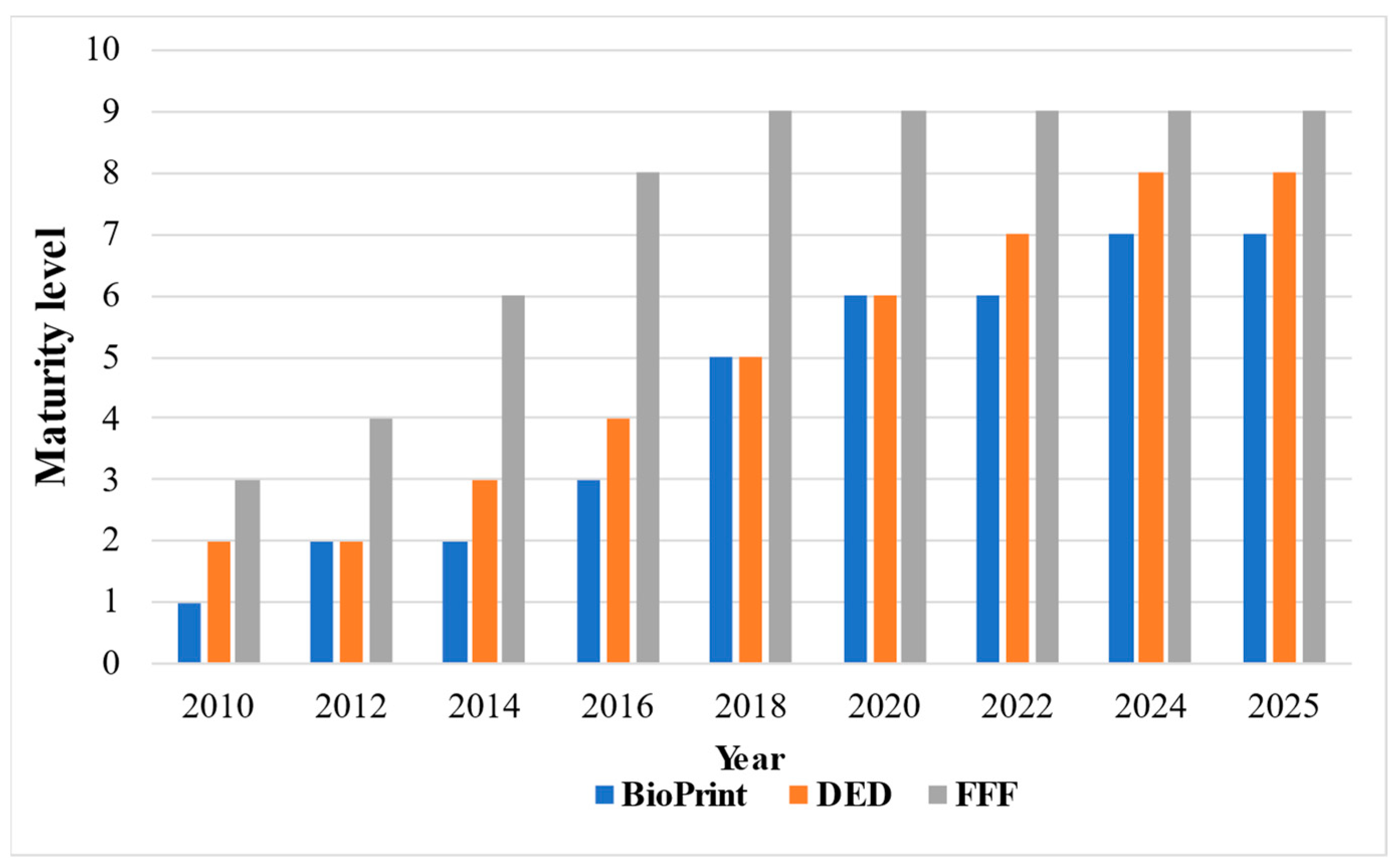
In summary, bioprinting in microgravity demonstrates that the removal of gravitational constraints transforms not only the mechanics of additive manufacturing but also the biological outcomes of tissue formation. The process capitalizes on surface-tension stabilization, diffusion-driven mass transport, and orientation-independent precision, making it uniquely suited for the fabrication of soft, complex, and biologically active structures in extraterrestrial environments. Figure 7 presents a comparison of the three techniques described above, on a 15-year span, starting in 2010.
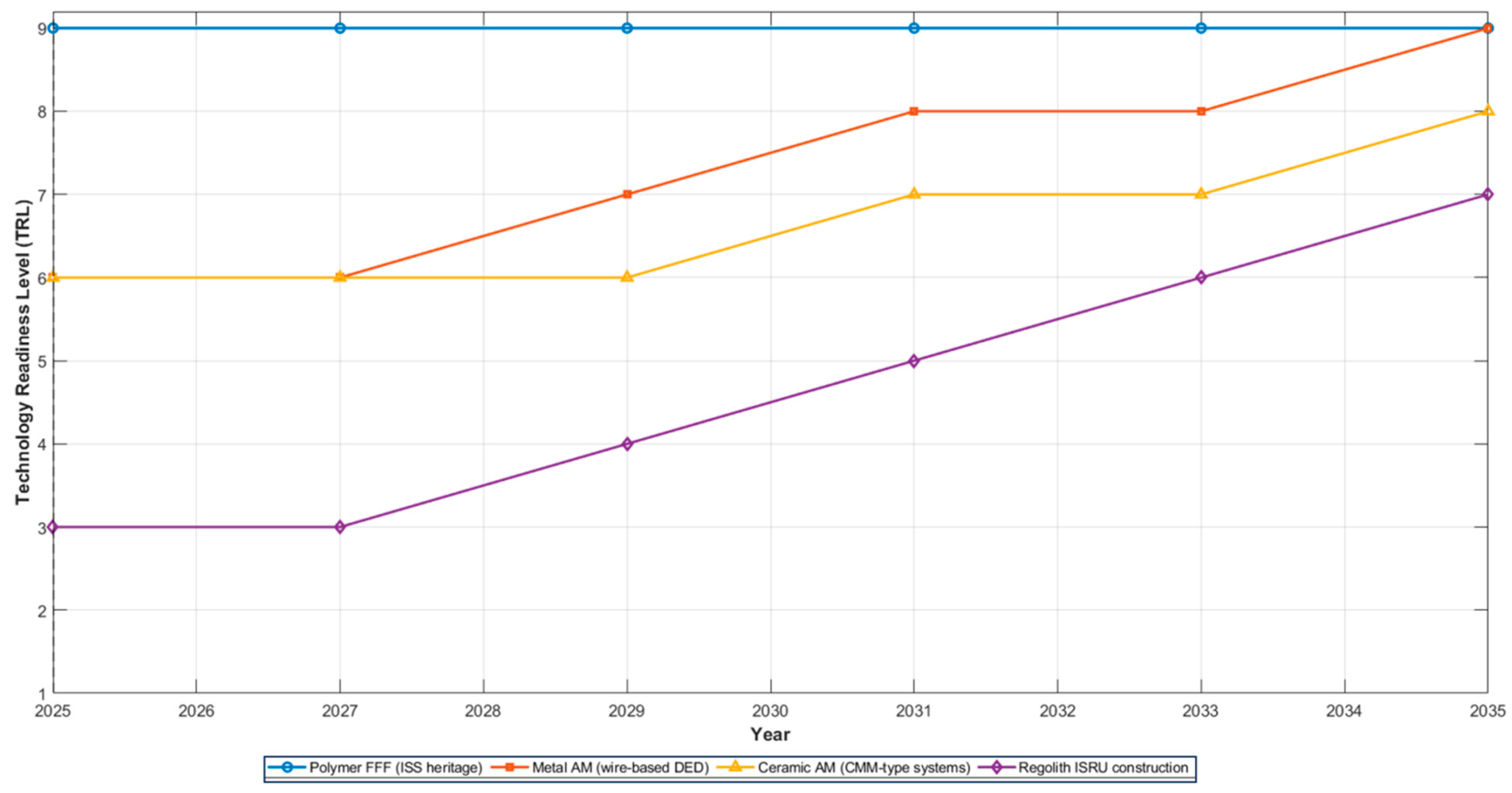
In this review, technology readiness levels are discussed using NASA and ESA functional TRL definitions [73,74], rather than formal programmatic certification. Classification is based on quantitative and qualitative criteria commonly applied in space manufacturing assessments, including: (i) operation in a relevant or operational environment (e.g., sustained microgravity aboard the ISS), (ii) system-level integration and autonomous operation, (iii) successful fabrication of representative components, and (iv) post-flight material and process verification through mechanical testing and microstructural analysis.
Ceramic and metal additive manufacturing systems demonstrated aboard the ISS therefore correspond to TRL 6–7, reflecting system-level validation in an operational microgravity environment, while ground-based or reduced-gravity demonstrations without sustained orbital operation are discussed at lower readiness levels. This approach is consistent with established NASA and ESA TRL guidelines, which emphasize environmental relevance and functional demonstration rather than production qualification.

3. Flight Heritage and Demonstrated Systems

3.1. ISS Polymer Printing (AMF, Zero-G Printer, POP3D)

Polymer additive manufacturing represents the first, most mature, and only fully operational in-orbit manufacturing capability aboard the International Space Station (ISS). The technology was initially validated through the Zero-G 3D Printing Technology (developed by NASA’s Marshall Space Flight Center and Redwire—formerly Made in Space). Demonstration Mission in 2014, conducted during the SpaceX CRS-4 resupply flight. This experiment produced the first object ever manufactured in microgravity, proving that fused-filament fabrication (FFF) can reliably extrude, fuse, and solidify thermoplastics in a gravity-independent environment [28].
The 3D printer on the ISS was designed to produce multi-layer objects that generate data on operational parameters, dimensional control, and mechanical properties, enhancing understanding of space-based 3D printing. Selected prints were tested for tensile, flexural, compressional, and torque strength using ASTM standard samples, with multiple copies printed to assess strength variation and feedstock aging. Each part was compared to a duplicate printed on Earth, focusing on dimensions, layer adhesion, strength, and flexibility [75]. These comparisons help refine 3D printing technologies for both space and Earth applications.
During the initial operational phase, spanning November 2014 to December 2015, the main goals were to verify the printer’s performance in space, examine how microgravity affected printed materials, and demonstrate remote operation, including uplinking part files from Earth. Previous parabolic flight tests provided only brief microgravity periods, making the ISS the ideal platform for extended testing of the FFF process in space. In terms of logistics, the ISS requires substantial supplies of maintenance spares: about 3190 kg are sent annually, and 13,170 kg are stored on orbit. Another 17,990 kg are stored on the ground for potential use [76]. This 3D printing capability could significantly reduce the need for such on-orbit spare parts by easing the creation of parts directly in space.
In Phase II of the 3D printing mission on the ISS, the specimens underwent a rigorous set of tests to evaluate their material properties and structural integrity. These included photographic and visual inspections to identify surface flaws or delamination, and mass measurements for calculating gravimetric density. Structured light scanning created 3D models of the parts, allowing comparisons with the CAD design and other specimens, while also aiding in the density calculation by combining the scan data with mass measurements. Computed tomography (CT) scans assessed the internal structure, identifying holes and defects, and provided density values by comparing the scanned part with a reference ABS disk. Mechanical testing involved tensile tests (ASTM D638 [77]) to measure ultimate strength, elastic modulus, and elongation at failure, as well as compression tests (ASTM D695 [78]) to determine compressive strength and modulus. Additionally, optical microscopy and scanning electron microscopy (SEM) were used to examine internal structures and fracture surfaces, noting layer height, printing defects, and pore sizes. Finally, Fourier Transform Infrared Spectroscopy (FTIR) was conducted to analyze the chemical composition of the specimens and detect any changes in the material caused by environmental exposure or aging in space, with a comparison to Phase I data to monitor potential degradation of the on-orbit feedstock [79].
Following this milestone, NASA deployed the Additive Manufacturing Facility (AMF) in 2016, establishing polymer FFF as a routine, crew-accessible fabrication capability. Operated commercially on ISS, AMF enables on-demand production of tools, brackets, scientific hardware, replacement components, and educational payloads. The system supports a range of engineering-grade thermoplastics, including ABS, HDPE, and high-performance PEI/PC blends such as ULTEM™ 9085, facilitating the manufacture of functional parts with favorable mechanical strength, dimensional stability, and low outgassing [80,81].
AMF’s extrusion architecture is specifically optimized for microgravity: it uses a closed-feedstock filament path, controlled thermal environment, and low-power operation, making it sturdy and safe for crewed spacecraft. Because FFF requires minimal post-processing, operates without powders or reactive photopolymers, and exhibits stable material flow in microgravity, it remains the only flight-qualified AM process used operationally on ISS [82].
In 2020, the Portable On-Board 3D Printer (P3DP) developed by ESA and ASI expanded these capabilities, demonstrating that compact, plug-and-play systems can function reliably within the ISS cabin environment. Designed and built in Italy by Altran and Thales Alenia Space, the compact, cube-shaped unit (25 × 25 × 25 cm) was launched aboard the International Space Station (ISS) in 2015 during ESA astronaut Samantha Cristoforetti’s Futura mission. The system employs a fused filament fabrication (FFF) process, extruding biodegradable and non-toxic thermoplastic feedstock using a controlled, heat-based deposition mechanism. Each print cycle required approximately 30 min to fabricate simple structural components such as antenna brackets or connectors. All printed parts were returned to Earth at a later stage for detailed analysis and comparison with identical ground-printed specimens. The results confirmed that microgravity does not significantly influence layer adhesion, dimensional accuracy, or surface quality, validating the viability of portable, crew-operated 3D printing inside a pressurized environment [83].
The most recent and technologically advanced additive manufacturing process to become operational in orbit is Directed Energy Deposition (DED). In this process, a focused energy source, typically a laser or electric arc, melts metal feedstock wire or powder as it is deposited layer by layer, forming dense metallic components. In 2023, the European Space Agency (ESA), in collaboration with Airbus Defence and Space, launched the Metal 3D Printer aboard the International Space Station. This system represents the first successful use of metal additive manufacturing in a true microgravity environment. The 180 kg Metal 3D printer was installed in the European Draw Rack Mark II within ESA’s Columbus module, where it was controlled and monitored remotely from Earth. Developed by an industrial team led by Airbus Defence and Space, with co-funding from ESA’s Directorate of Human and Robotic Exploration, the printer used a stainless-steel wire commonly employed in medical implants and water treatment due to its corrosion resistance [84]. The wire was fed into the printing area, where a high-power laser melted the wire, adding metal to the print as it solidified in the melt pool. The technology makes it possible to produce strong, high-density metal components in situ, such as brackets, tools, and repair parts, which were previously impractical in space because of mass and cost constraints. Early results reported by ESA engineers in 2024 confirmed that the deposited layers exhibited uniform microstructure and mechanical integrity comparable to those manufactured under terrestrial conditions.
Beyond demonstrating technical operability, the deployment of directed energy deposition (DED) metal printing on the ISS marks a major step toward fully autonomous manufacturing in orbit. It lays the groundwork for future on-site fabrication of load-bearing structures, radiation shielding elements, and mechanical subsystems for lunar and Martian missions, while substantially reducing reliance on Earth-based supply chains. Notably, this represents the first instance of true metal additive manufacturing being performed directly in space, rather than under simulated conditions on Earth [80,81].
In contrast to metal DED systems, the IMPERIAL Printer, developed from ESA’s MELT project, addresses limitations associated with polymer fused-filament fabrication (FFF) in microgravity. By incorporating a temperature-controlled conveyor belt, the system enables continuous extrusion-based printing without conventional build-volume constraints [85]. This architecture supports the fabrication of larger polymer structures in space, with the added benefit that printed parts do not require wrapping or mechanical restraint in microgravity. The printer processes high-performance thermoplastic materials with favorable mechanical and thermal properties for space and terrestrial applications. Thermal challenges are mitigated through a precisely controlled heating system that ensures uniform temperature distribution during printing, thereby reducing shrinkage and warping. Breadboard-level demonstrations validated the system’s capability for continuous polymer extrusion and highlight its potential for scalable in situ manufacturing beyond traditional fixed-volume printers.

3.2. Ceramic Manufacturing Module (CMM, ESA/Redwire)

The Ceramic Manufacturing Module (CMM), launched aboard Northrop Grumman’s Cygnus spacecraft on its 14th resupply mission, was the first ceramic 3D printing facility on the ISS. It demonstrated the ability to manufacture ceramic green bodies in microgravity using pre-ceramic resins processed through an additive stereolithography (SLA) route. This approach enabled the fabrication of complex geometries, such as single-piece ceramic turbine blisks, while benefiting from the absence of gravity-related effects such as sedimentation and density gradients during printing.
Unlike traditional fused deposition modeling (FDM) systems used for polymer printing on the ISS, the CMM employed a vat photopolymerization process, in which ceramic particles or ceramic precursors are suspended within a UV-curable resin to form a ceramic matrix composite (CMC) precursor. During printing, selective photopolymerization produced a dimensionally accurate green part, representing the first stage of a multi-step ceramic manufacturing process. The microgravity environment helped prevent particle settling within the resin, thereby improving material homogeneity and green-body quality.
Following the in-orbit printing step, the ceramic manufacturing workflow required post-processing on Earth to convert the printed green bodies into fully dense ceramic components. This included thermal debinding and pyrolysis, during which the organic polymer matrix was decomposed and removed, followed by high-temperature sintering to densify the ceramic structure and achieve the final mechanical and thermal properties. The CMM’s ability to produce single-piece turbine blisks therefore demonstrated the feasibility of manufacturing complex ceramic precursors in space, while relying on terrestrial facilities for the final consolidation stages [34].
Developed by Redwire’s subsidiary Made In Space, the CMM successfully operated autonomously in orbit, producing a ceramic turbine blisk (bladed disk) and a series of material test samples. These printed components were returned to Earth aboard the SpaceX Dragon CRS-21 spacecraft for controlled debinding, sintering, and subsequent microstructural and mechanical characterization. This achievement marked a key milestone in demonstrating the potential of photopolymer-derived ceramic manufacturing in microgravity, while clearly delineating the separation between in-space printing and ground-based ceramic densification.
The Ceramic Manufacturing Module (Figure 8) featured a circular build platform with a diameter of 80 mm and a cross-sectional build area of 5000 mm2, enabling the fabrication of small but high-precision components. The platform provided a vertical translation of 30 mm, corresponding to a total build volume of approximately 150,000 mm3, and operated with a power draw of approximately 75–80 W. The CMM was capable of processing multiple ceramic-loaded resins, including Tethon 3D’s Porcelite, achieving layer thicknesses as fine as 25 µm using SLA technology. After debinding and sintering, Porcelite-based parts exhibited high thermal stability, withstanding temperatures exceeding 1000 °C. The CMM’s demonstration thus highlighted the potential of photopolymer-based ceramic additive manufacturing as a viable pathway for producing high-temperature, high-precision components for future space applications, while indicating the need for integrated debinding and sintering solutions in next-generation in-space manufacturing systems [86].
In terrestrial ceramic stereolithography, several defect formation mechanisms are directly influenced by buoyancy-driven phenomena, including particle sedimentation, density gradients within the slurry, and convective transport of entrapped gas bubbles. Under 1 g conditions, ceramic particles suspended in photopolymer resins can gradually settle during printing, leading to vertical compositional gradients, local variations in curing behavior, and differential shrinkage during debinding and sintering. Buoyancy-driven convection can also promote bubble migration and coalescence, increasing the likelihood of pore formation and surface defects.
In the absence of buoyancy under microgravity conditions, these defect mechanisms are significantly altered. Particle sedimentation is suppressed, resulting in a more uniform particle distribution throughout the resin during layer-by-layer photopolymerization. Likewise, gas bubbles generated during resin handling or photopolymerization no longer rise or coalesce preferentially, reducing bubble-induced porosity gradients within the printed green body. As a result, ceramic SLA performed in microgravity tends to produce green parts with improved compositional homogeneity and more symmetric microstructural features compared to terrestrial printing under otherwise similar process parameters.
Importantly, not all defect mechanisms are eliminated by the absence of buoyancy. Photopolymerization-induced shrinkage, cure-depth nonuniformity, and resin–ceramic interfacial bonding limitations remain governed by optical exposure, resin chemistry, and process control. Subsequent debinding and sintering steps can still introduce porosity or cracking if thermal gradients and shrinkage are not properly managed. Consequently, microgravity primarily modifies defect formation during the printing stage, rather than eliminating the need for careful post-processing control.

3.3. In-Orbit Recyclers and Material Loops (Refabricator, Redwire Recycler)

Another strategy for supporting long-duration space missions involved recycling plastic waste into new, usable tools and components. Rather than discarding items such as worn 3D-printed tools, plastic bags, or packing foam used for cargo delivery, astronauts could repurpose these materials into new objects, for example, by transforming an old 3D-printed wrench into a spoon. This approach reduced the amount of raw material that needed to be launched from Earth and minimized the volume of waste that would otherwise accumulate during extended missions.
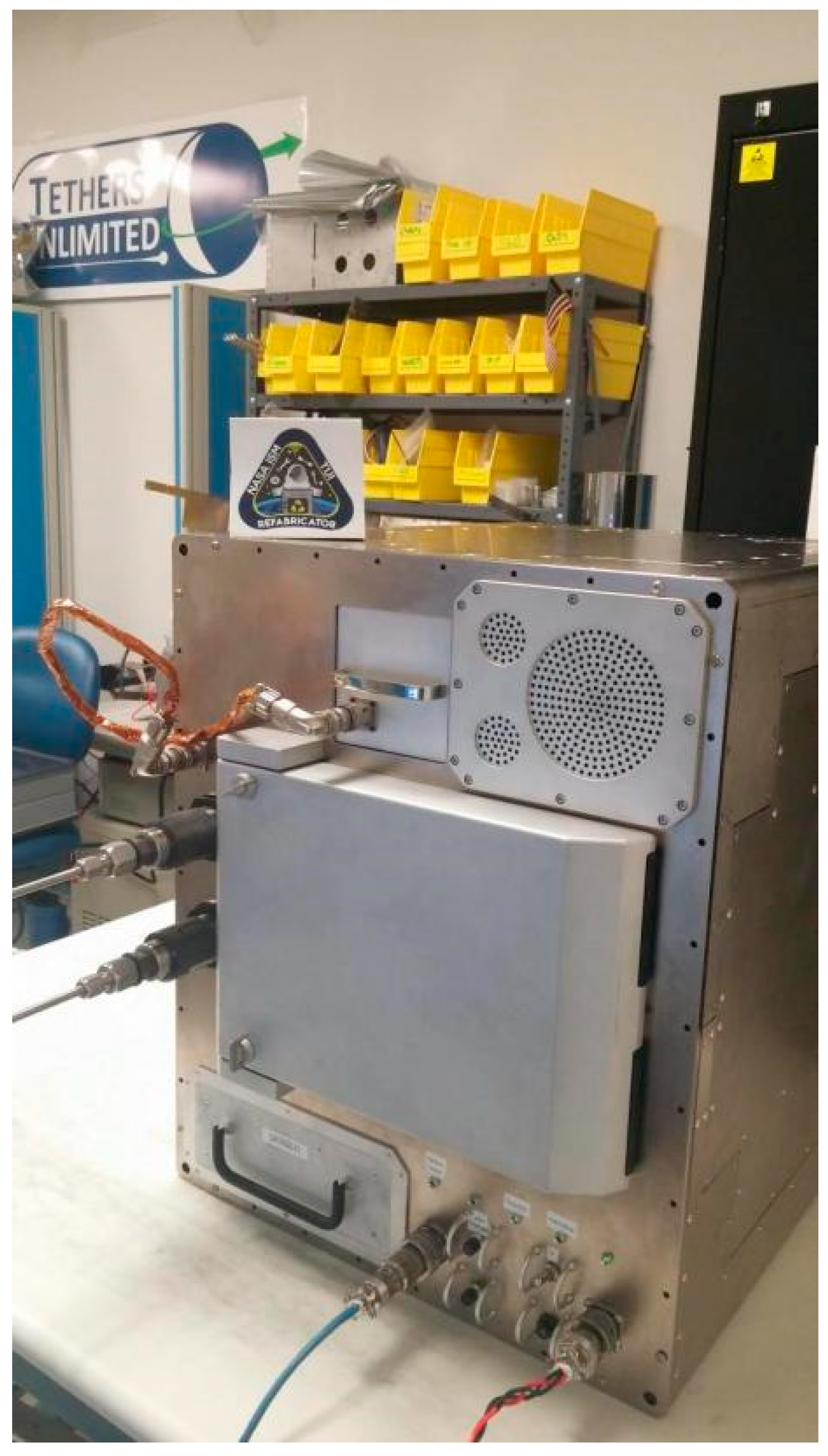
Central to testing this concept was the Refabricator (Figure 9, which was the first device deployed on the International Space Station (ISS) to integrate polymer recycling and fused-filament fabrication (FFF) within a single, closed-loop unit. The system employed a mechanical shredding and granulation stage, in which discarded polymer items and previously printed parts were reduced to feedstock fragments, followed by thermal melting and extrusion to produce new 3D-printing filament. The Refabricator was primarily demonstrated using engineering thermoplastics based on PEI/ULTEM feedstocks, selected for their mechanical performance and compatibility with ISS safety requirements. The regenerated filament was subsequently fed directly into the integrated FFF print head to fabricate new polymer components [88]. This closed-loop recycling and manufacturing capability represented a critical step toward sustainable in-space manufacturing, aligning with NASA’s long-term goals for material efficiency, waste reduction, and mission autonomy.
Although the Refabricator successfully produced its first printed object in orbit, it encountered some bonding issues likely caused by microgravity. These challenges provided valuable data, helping researchers understand the limits of repeatedly recycling plastic in space environments.
Installed in an ISS EXPRESS Rack, the Refabricator went through a series of controlled recycling and printing cycles, with at least seven completed in total. After each cycle, astronauts removed the printed specimens and recycled filament samples and stored them for return to Earth. These samples permitted detailed ground testing to evaluate material degradation, structural performance, and the overall feasibility of repeated recycling in microgravity. By demonstrating the ability to transform waste into usable feedstock, the Refabricator marked a significant advancement in closing the materials loop in space. This technology could ultimately support long-term missions by reducing dependence on resupply, promoting self-sufficiency, and enabling more sustainable fabrication and repair capabilities for future deep-space exploration.
The Redwire Regolith Print (RRP) experiment tested whether simulated regolith—the dust found on the moon and other planetary bodies—could serve as a viable feedstock for 3D printing in microgravity. Using the Made In Space Manufacturing Device (ManD) aboard the ISS, the system employed specialized extruders and print beds to demonstrate on-orbit manufacturing and produce samples for scientific analysis. Building on Redwire’s decade of in-space manufacturing experience, RRP advances technologies that support in situ resource utilization (ISRU), including recycling, electronics printing, metal manufacturing, and self-repair techniques. Its goal is to support human explorers to rely more heavily on local materials rather than Earth-supplied resources, ultimately reducing launch mass and supporting more sustainable deep-space missions. The technology also has Earth-based applications, offering a method for constructing infrastructure such as landing pads, roads, bridges, foundations, pipelines, and buildings. Designed to operate safely in crewed environments, the system prints regolith simulant mixed with binder within a 140 × 100 × 100 mm build volume and operates at 28 V DC and 600 W of power. To evaluate its performance, RRP produced samples for compressive, tensile, and flexural testing (ASTM D638-14 [77], D695-15 [78] and D790-17 [89]), each printed from a single batch to ensure consistent material analysis [6].
Table 3 summarizes key in-orbit additive manufacturing systems aboard the ISS, detailing their first flight or demonstration year, the materials used, operational status, technology readiness level (TRL), and managing operators. It highlights the progression from early polymer FFF printers to advanced metal, ceramic, recycling, and regolith-based 3D printing technologies, illustrating the evolution of space manufacturing capabilities and their applications for both orbital and planetary exploration.
Figure 9. Refabricator flight hardware viewed from the front [90].
Technologies 14 00165 g009

4. Materials for In-Space Manufacturing

4.1. Polymers and Composites

Polymers remain the most mature and widely demonstrated class of materials for in-space additive manufacturing, owing to their relatively low processing temperatures, manageable rheology in microgravity, and compatibility with compact, low-power hardware. The first 3D Printing in Zero-G Technology Demonstration on the ISS used ABS and other engineering thermoplastics (e.g., PPSF, PC), selected because their properties and toxicology were already well characterized for crewed environments. Building on this, the commercial Additive Manufacturing Facility (AMF) developed by Made In Space/Redwire introduced a multi-material capability, processing ABS, HDPE and PEI/PC (ULTEM 9085) for the production of functional flight hardware.
Using these polymers, AMF has fabricated antenna components, adapters for the ISS oxygen generation system, and mechanical interfaces for the SPHERES free-flying robots [91], demonstrating that thermoplastic parts can perform real operational tasks in orbit.
Under these conditions, PEI/PC blends such as ULTEM 9085 [92] represent a step toward higher-performance structural parts. ULTEM 9085, already qualified in terrestrial aerospace as a flame-retardant, high-strength thermoplastic, has been tested extensively in the AMF and in ground campaigns to assess its mechanical and environmental performance for spaceflight applications [93].
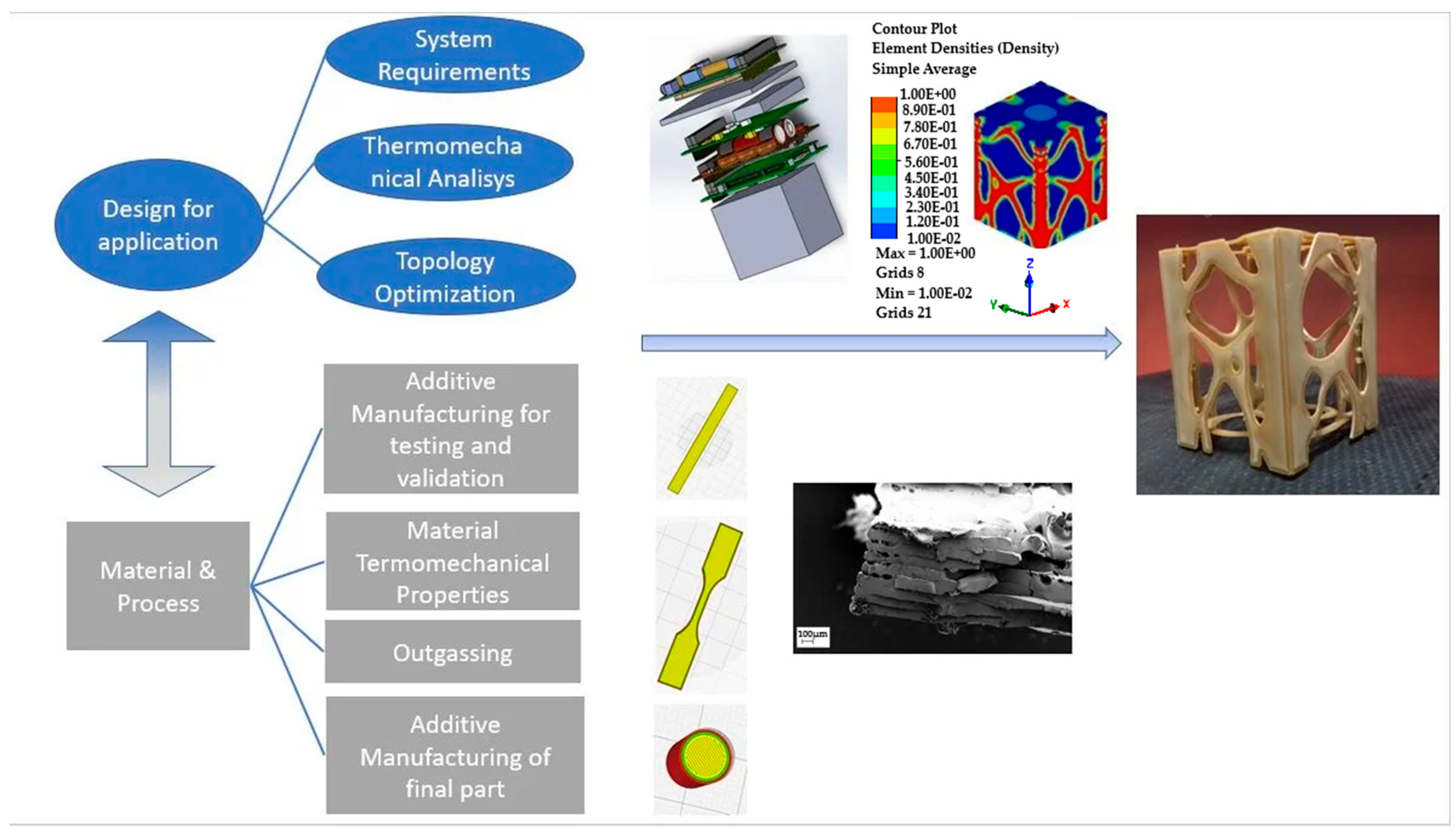
Parallel research on high-temperature polymers such as PEEK has explored their use for nanosatellite structures and other load-bearing components; outgassing and thermo-mechanical tests indicate that additively manufactured PEEK can meet many space-environment requirements, although its narrow processing window and high melt temperature pose challenges for compact in-orbit printers [94]. Figure 10 presents the optimized printing process dedicated to PEEK.
Beyond neat polymers, fiber-reinforced composites are emerging as attractive candidates for in-space AM where high stiffness-to-weight ratios are required. Recent work includes investigations of 3D-printed carbon-fiber-reinforced thermoplastics exposed on the ISS to quantify radiation and atomic oxygen effects, for example, in the Lamborghini–Houston Methodist ISS National Lab experiment on forged and 3D-printed carbon fiber materials, and subsequent space-exposure studies on CFRP parts [95].
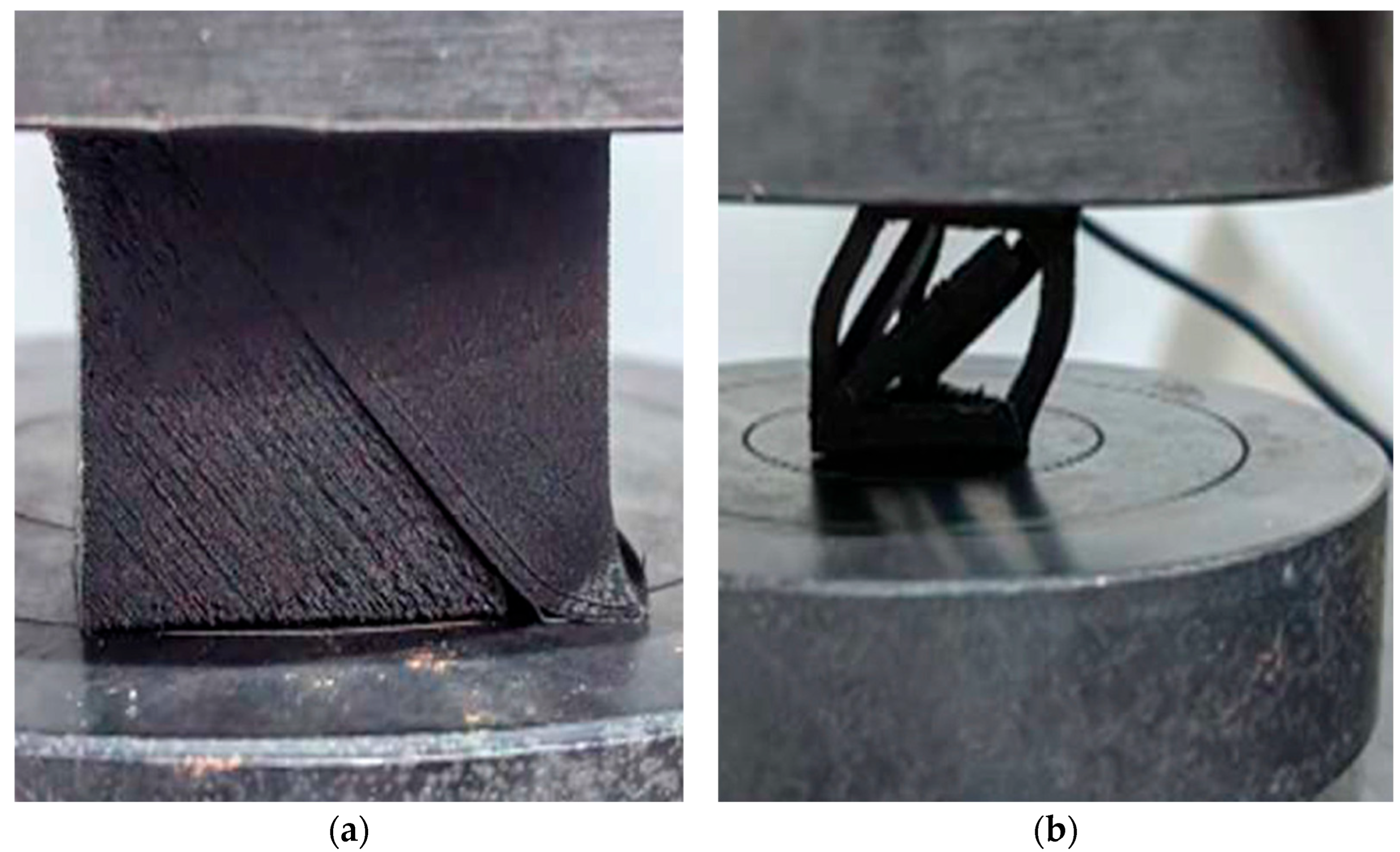
Additional research on in-space printing of short-fiber-reinforced truss structures and composite feedstocks points to significant potential for deployable and load-bearing architectures, while also revealing challenges in fiber alignment, void control and anisotropic thermal expansion in microgravity [96]. Figure 11 presents the result from compression tests developed for the short carbon-fiber-reinforced PA612 filament.
Across these programs, radiation-induced aging, changes in glass-transition temperature and mechanical degradation under combined UV, vacuum and thermal cycling remain critical factors, prioritizing the need for long-duration exposure data and tailored polymer formulations for orbital and deep-space use [97,98,99,100].
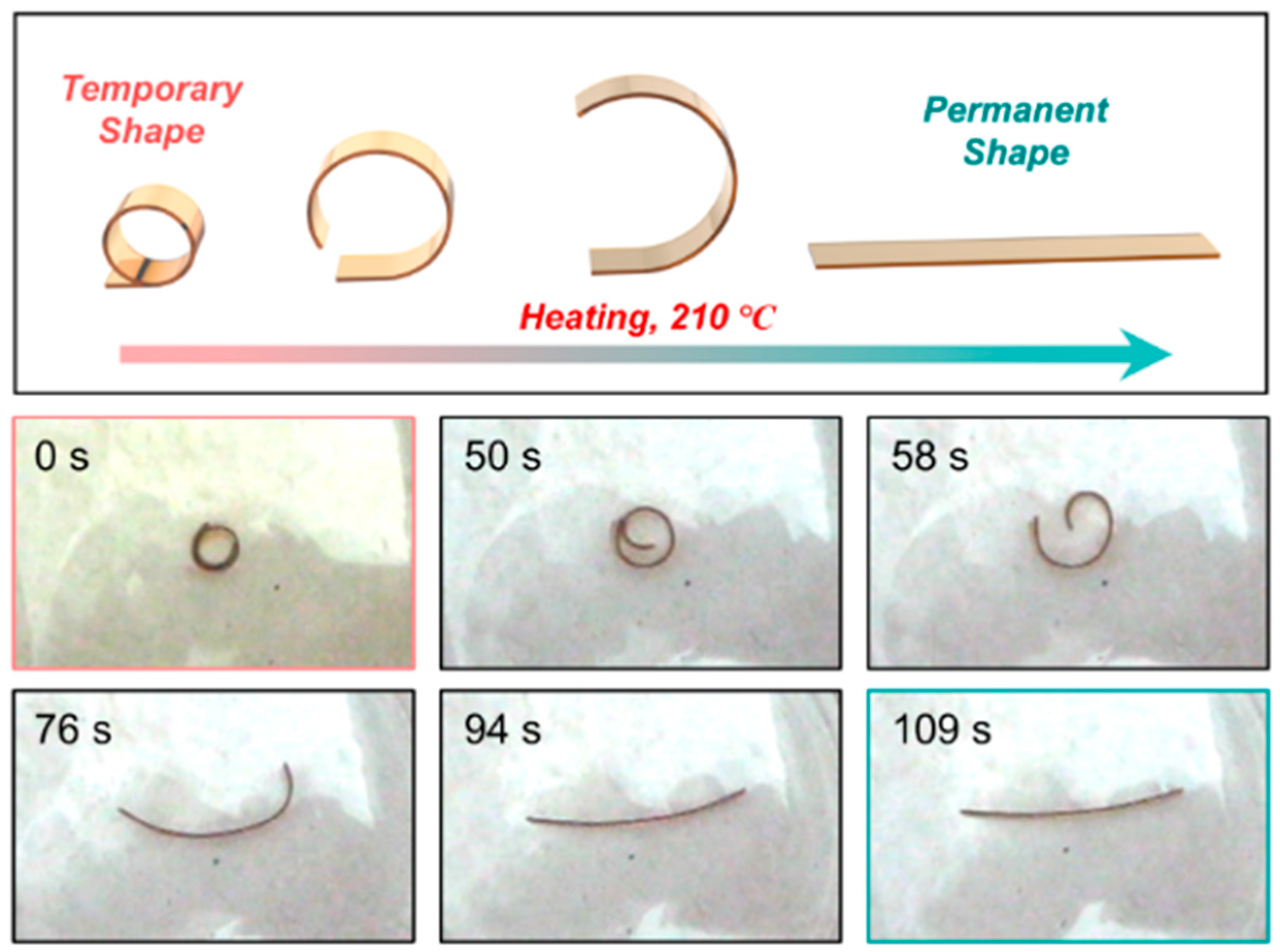
Ping et al. [93] provide one of the most detailed experimental investigations so far, examining cyanate-based shape memory polymers subjected to repeated vacuum thermal cycling, a dominant degradation mechanism in low Earth orbit and cislunar environments. Their results show notable shifts in glass-transition temperature, reductions in mechanical strength, and changes in recovery behavior after accelerated aging, pointing to the sensitivity of polymer networks to combined radiative and thermal stresses typical of orbital AM applications. Figure 12 [97] illustrates the shape-recovery sequence of the SMCR-50C material from a toroidal temporary shape, visually demonstrating both the material’s functional resilience and the subtle degradation effects that accumulate with repeated cycling. Such evidence is directly relevant to in-space manufacturing, where printed polymer components may be required to maintain complex geometries, deployable shapes, or self-recovering functionality under long-duration exposure to the orbital thermal environment.
Overall, polymers and polymer-matrix composites represent the most operationally mature material class for in-space additive manufacturing, supported by a growing body of ISS flight heritage and extensive ground-based environmental testing [98]. Their low processing temperatures, favorable mass-to-performance ratios, and compatibility with compact extrusion-based architectures make them the logical foundation for current orbital manufacturing capabilities. Exposure studies involving vacuum thermal cycling, UV irradiation, and atomic oxygen erosion show that the long-term stability of printed components is strongly influenced by polymer chemistry, cross-link density, and filler reinforcement. These results confirm the need for carefully designing space-qualified material formulations. At the same time, ongoing development of high-performance thermoplastics such as PEEK and ULTEM, together with emerging fiber-reinforced composites and shape memory systems, points to a clear shift toward multifunctional polymer materials that can support structural, deployable, and repair-focused applications.
The long-term mechanical reliability of additively manufactured polymers in space is governed by the combined effects of ionizing radiation, atomic oxygen (AO) exposure, and cyclic thermal loading, which act through partially coupled degradation mechanisms. Ionizing radiation induces chain scission and crosslinking, altering molecular weight distribution and reducing ductility over time. Atomic oxygen primarily causes surface erosion and oxidation, leading to mass loss, increased surface roughness, and the formation of microcracks that can act as stress concentrators. Thermal cycling, driven by repeated transitions between sunlight and eclipse, imposes cyclic thermo-mechanical strains due to mismatches in thermal expansion and anisotropic print-induced microstructures.
When acting synergistically, these effects can accelerate degradation beyond the sum of individual contributions. Radiation-induced embrittlement increases susceptibility to crack initiation, while AO-driven surface erosion exposes fresh polymer material and facilitates further oxidative attack. Repeated thermal cycling can then promote crack propagation along interlayer boundaries, particularly in extrusion-based prints where anisotropy and interfacial diffusion govern strength. Experimental studies and space exposure data indicate that polymers exhibiting higher crystallinity, aromatic backbones, and radiation-stable chemistries (e.g., PEI, PEEK) demonstrate improved resistance to this coupled degradation environment, whereas amorphous or low-molecular-weight polymers show more rapid mechanical property decay.
Although fully coupled lifetime models remain an open research challenge, current qualification approaches combine accelerated radiation testing, AO exposure simulations, and thermal cycling experiments to bound expected property degradation envelopes. These studies suggest that, with appropriate material selection and print parameter optimization, additively manufactured polymers can maintain functional mechanical performance over mission-relevant durations in low Earth orbit.
As will be discussed in the following sections, expanding the available material set to include metals, ceramics, and in situ-derived regolith will be vital for achieving greater mission autonomy. Nevertheless, polymers are likely to remain a foundational element of early- and mid-term in-space manufacturing because of their low mass and favorable strength-to-weight ratio, reliability, versatility, and proven performance in the space environment.

4.2. Metals and Alloys

Metal additive manufacturing (AM) represents a critical pathway toward producing load-bearing, thermally stable, and mission-critical components in space, yet its implementation remains far less mature than polymer-based systems due to the significantly higher thermal, power, and safety requirements associated with metal processing.
Terrestrial metal AM technologies, such as laser powder bed fusion (LPBF) [100], directed energy deposition (DED) [63], wire-arc additive manufacturing (WAAM) [101], and electron beam melting (EBM) [102], form the foundational process families under consideration for orbital or planetary use. Among these approaches, NASA considers wire-based systems, such as WAAM and laser wire DED, to be the most immediately transferable to microgravity. This is because wire feedstocks are contained, easier to manage, and present a lower risk of contamination than free-flowing powder systems. In contrast, powder-based feedstocks pose safety concerns related to inhalation, electrostatic adhesion, and uncontrolled particle dispersion in microgravity and vacuum environments [39]. Powder-based processes remain technically attractive for high-resolution and high-performance alloys, but require stringent environmental control, vacuum-compatible recoating systems, and robust containment architectures not yet validated for crewed environments.
Stainless steels have emerged as the most mature metallic feedstock for in-space additive manufacturing, largely due to their weldability, thermal robustness, and resistance to oxidation in controlled atmospheres. Stainless steel, in particular, has been processed successfully in microgravity using laser-wire fusion on the ISS, producing dense specimens with continuous bead formation and no evidence of melt-pool instability [103].
Stainless steels exhibit surface-tension-dominated molten-pool behavior that remains relatively stable without buoyancy, making them ideal for early orbital demonstrations. Drop-tower experiments and parabolic-flight laser-melting tests have further confirmed that stainless-steel alloys retain predictable solidification morphology, although microgravity can slightly increase vapor recoil pressure, affecting melt-pool depth and spatter dynamics. Their mechanical resilience and corrosion resistance also make them suitable candidates for fabricating functional brackets, replacement interfaces, and load-bearing components in orbital environments.
Drop-tower facilities such as the Einstein-Elevator [104] have been used to demonstrate laser metal deposition and substrate-free additive manufacturing under microgravity and lunar-gravity conditions, including tests with aerospace-relevant alloys and regolith simulants [9,104,105].
Ti-6Al-4V [106] is the most widely used titanium alloy in aerospace structures due to its exceptional specific strength, corrosion resistance, fatigue performance, and thermal stability, making it one of the most strategically important candidate materials for in-space additive manufacturing. Its well-characterized weldability and solidification behavior under terrestrial conditions translate favorably to reduced-gravity environments, where surface-tension–dominated melt-pool dynamics remain stable even in the absence of buoyancy. Several space-relevant experiments have demonstrated the operational potential of metal additive manufacturing under reduced gravity conditions. These include laser melting campaigns conducted during parabolic flights aboard the Novespace A310 [107] and microgravity deposition trials carried out in DLR’s Einstein Elevator drop tower facility. Together, these studies showed continuous formation of Ti6Al4V melt pools, stable wire feeding, and predictable bead geometry in both microgravity and partial gravity environments representative of the Moon and Mars. These studies also show that microgravity subtly alters β-phase growth kinetics, melt-pool lifetime, and cooling rates, leading to differences in martensitic α’ formation and microstructural anisotropy compared with 1 g processing. Such effects underline the importance of microgravity-specific process modeling and real-time monitoring for future qualification of titanium components manufactured in orbit or on the lunar surface. Despite the higher energy requirements and tighter oxygen-control tolerances associated with Ti-6Al-4V, its structural performance makes it one of the most promising metallic feedstocks for long-duration missions, habitat infrastructure, and repair or replacement of mission-critical flight hardware.

4.3. Ceramics and Photopolymers

Ceramics for in-space manufacturing are currently accessed almost exclusively via photopolymer-based routes, in which a UV-curable resin is used as a carrier for ceramic precursors or ceramic particles. Vat photopolymerization processes (SLA/DLP-type) based on pre-ceramic polymers or ceramic-filled resins can produce highly resolved green bodies that are subsequently pyrolyzed and sintered into dense ceramic components [108]. This approach underpins the Ceramic Manufacturing Module (CMM) on the ISS, which employs a UV laser and a pre-ceramic resin in a stereolithography configuration to fabricate turbine blisks and other thermally robust parts in microgravity. Similar hybrid systems on the ground combine acrylate or epoxy matrices with silica, alumina, or silicon carbide fillers, enabling the printing of complex geometries that would be difficult to realize using powder-based ceramic processes alone.
From a processing standpoint, viscosity and suspension stability are primary constraints for ceramic photopolymers in space. High ceramic loading is needed to achieve acceptable sintered density and mechanical performance, but this increases viscosity, complicates recoating and layer renewal, and promotes sedimentation or agglomeration of particles. In microgravity, sedimentation is reduced, but the lack of buoyancy also means that entrapped bubbles are less likely to float out of the resin, which can lead to defects or scattering during exposure. Formulation design therefore has to balance solid loading, rheology modifiers, and photoinitiator content to maintain a printable, optically homogeneous resin under both 1 g and microgravity conditions.
Outgassing is a second critical issue for UV-curable systems in closed space habitats. Both uncured resins and freshly printed parts can emit volatile organic compounds (VOCs) [109] and condensable species, which may contaminate optical surfaces, filters, or sensitive instrumentation, and pose crew health risks if not properly managed. Ground studies on vat photopolymerization resins have shown significant VOC and particle emissions during printing and post-curing, and ISS hardware such as CMM must therefore operate within sealed or filtered volumes with controlled venting and material certification. This drives the development of low-outgassing formulations and careful selection of monomers, oligomers, and additives tailored to spaceflight toxicology requirements.
At the reaction level, oxygen inhibition and cure kinetics are key to reliable photopolymerization in thin layers. Free-radical systems (acrylates, methacrylates) are strongly affected by dissolved and atmospheric oxygen, which scavenges radicals and reduces surface conversion, leading to tacky surfaces, under-cured regions, or poor interlayer adhesion. On Earth, this is often mitigated by inert gas blanketing, tailored photoinitiator systems, or controlled oxygen “windows” (e.g., CLIP-type processes) [110]; similar strategies are needed in microgravity, but must be compatible with sealed chambers and limited consumables. Cure kinetics, governed by light intensity, exposure time, penetration depth, and initiator concentration, must also be tuned for the altered heat transfer and potentially different oxygen transport in space. For ceramic-loaded resins, strong scattering and absorption by particles further modify the effective cure depth and can lead to non-uniform crosslinking if not properly modeled [3].
A complementary approach to vat photopolymerization is the Direct Robotic Extrusion of Photopolymers (DREPP) process, in which a UV-curable resin is extruded through a nozzle and cured in flight by a UV source. Kringer et al. [111] demonstrated DREPP in two parabolic-flight campaigns, showing that various rod-like geometries can be manufactured under microgravity and that a comparatively large curing zone is easier to manage in 0 g than at 1 g, leading to increased process stability and new options for in situ process control. The printing process is presented in Figure 13.
A notable recent development in photopolymer-based in-space manufacturing is the DCUBED (Deployables Cubed GmbH (DCUBED, Munich, Germany)) [112] open-space 3D-printing demonstration, which aims to fabricate structural elements directly in orbit using an extrusion-and-UV-curing process. Unlike vat-based photopolymerisation, DCUBED’s system extrudes a fiber-reinforced UV-curable resin into free space, where it is immediately solidified by a dedicated UV source to form stiff rod- or truss-like elements. The project, scheduled for its first on-orbit demonstration in 2024, will be deployed from a D-Orbit platform and represents one of the earliest attempts to perform additive manufacturing outside a pressurized environment, exposing the material directly to vacuum, thermal cycling, and unfiltered solar UV. This approach takes advantage of the intrinsically low energy requirements of photopolymer systems, which do not require powder containment or high temperature melting, while also investigating how resin curing kinetics, fiber alignment, and interlayer bonding behave under orbital conditions. If successful, DCUBED’s technology could enable the on-orbit fabrication of deployable booms, antenna supports, and lightweight truss structures, illustrating the potential of extrusion-based photopolymer composites as a complementary pathway to the ceramic and polymer photo-polymerization platforms currently demonstrated inside the ISS.
Despite these challenges, successful CMM operations and ground-based studies on UV-curable pre-ceramic and hybrid photopolymers indicate that ceramic vat photopolymerization is a highly promising route for in-space production of heat-resistant, electrically insulating, and chemically stable components. Continued work on low-outgassing, oxygen-tolerant formulations and robust cure-control strategies will be essential to move from demonstration parts to flight-qualified ceramic hardware manufactured directly in orbit.
Ceramic and photopolymer-based additive manufacturing are based heavily on the chemistry of the resin system, where the choice of pre-ceramic polymer, ceramic filler, and photo-initiator directly governs printability, curing kinetics, and the final ceramic microstructure. To contextualize these developments, Table 4 summarizes the major ceramic and photopolymer formulations reported in space-relevant projects and laboratory studies, along with the photo-initiators and curing approaches they employ. This overview highlights the diversity of chemistries used across vat photopolymerization and UV-assisted extrusion pathways and illustrates how these materials underpin emerging ceramic manufacturing capabilities in orbit.

4.4. Regolith-Based Materials (ISRU)

A major driver of regolith-based additive construction research has been the NASA 3D-Printed Habitat Challenge (2015–2019) [116], which accelerated the evolution of large-scale AM processes capable of producing structural components for lunar and Martian habitats using locally sourced materials. Across its three phases, the program advanced from conceptual architectural designs to the robotic fabrication of full-scale structural elements using regolith-simulant concretes, polymer-regolith composites, and cementitious extrusion systems. Figure 14 presents the concept presented by Team SEArch+/Apis Cor, which shows astronauts outside of what a 3D-printed habitat could look like on Mars.
The challenge provided one of the first systematic evaluations of how regolith-derived feedstocks behave under large-scale AM conditions, bringing attention to the issues of print rheology, layer adhesion, structural anisotropy, and cure behavior. In doing so, it established foundational principles for ISRU-enabled habitat construction and continues to influence contemporary lunar surface architecture efforts, including NASA and commercial initiatives targeting Artemis-era infrastructure.
ESA’s PAVER (Paving the Road for Large-Area Sintering of Regolith) project [118] investigates how lunar regolith simulants, primarily EAC-1A [119], a basaltic, glass-rich soil analog developed by ESA, can be transformed into structurally functional pavement elements using laser-based additive sintering. The process relies on the natural absorptivity of basaltic regolith particles, which couple efficiently with infrared radiation and permit rapid heating and localized melting. In the PAVER approach, a high-power CO2 laser is scanned across a thin layer of EAC-1A, selectively fusing particles into contiguous crystalline–glassy agglomerates. By controlling the thermal gradients and scan strategy, the process produces interlocking geometric tiles with well-defined edges, high compressive strength, and reduced porosity compared to loose regolith. These tiles can be arranged into roads, landing pads, or dust-mitigating platforms for lunar surface operations.
A key innovation of PAVER is that the sintering process is designed to be directly transferable to the lunar environment. Because EAC-1A closely reproduces the optical and thermal behavior of real lunar soil, the same approach can use concentrated solar energy, via a Fresnel lens or solar-tracked mirror array, in place of the terrestrial CO2 laser. This solar-driven sintering concept eliminates high electrical power demands and leverages the Moon’s vacuum, which suppresses convective losses and facilitates sharply defined melt pools. The resulting structures exhibit a hybrid microstructure of partially melted basaltic grains embedded in a vitrified matrix, providing sufficient strength to withstand lander blast effects, rover traffic, and thermal cycling. By focusing on feedstock properties and energy–matter interaction under reduced-pressure conditions, PAVER provides a realistic pathway for large-area regolith-based additive construction using only locally available materials [113].
The MOONRISE initiative [120], led by the German Laser Zentrum Hanover (LZH) and TU Berlin in partnership with commercial and academic stakeholders, is specifically designed to demonstrate mobile selective laser melting (M-SLM) of lunar-regolith analogs for infrastructure creation on the Moon, including roads, landing pads, and structural platforms. The central feedstock is a high-fidelity lunar mare simulant (similar to JSC-1A and JSC-2A regolith [61]) processed in thin-layer deposition form, onto which a high-power fiber-coupled diode laser array (in the 1 kW–5 kW class) selectively melts the surface to produce solidified tracks and interlocking modules. The laser optics are mounted on a robotic gantry that mimics a lunar lander–deployed system, allowing in situ alignment and mobility across the printed area.
One of MOONRISE’s key material innovations is the use of laser-absorbing additives mixed into the simulant, such as iron-rich pigments or metallic powders, to increase coupling efficiency with the diode laser and reduce power consumption. The melt pool geometry is controlled by scanning parameters, layer thickness (~5–10 mm), and hatch distance, producing consolidated volumes reaching >90% relative density. The simulated lunar vacuum environment in ground tests shows reduced convective cooling and finer microstructures compared to terrestrial sintering, suggesting improved mechanical properties for the final product. MOONRISE’s engineering focus on a mobile, energy-efficient, and large-area regolith fabrication system is emblematic of the next-generation ISRU AM architectures required for scalable lunar surface infrastructure.
Another prominent initiative advancing regolith-based additive construction is Project Olympus [121], a NASA-funded effort led by ICON [122] under the Space Technology Mission Directorate (STMD). The project aims to develop a large-scale construction 3D-printing system designed to use lunar and Martian regolith as the primary structural material, supporting the direct fabrication of habitats, landing pads, roads, and other surface infrastructure on extraterrestrial bodies.
Unlike terrestrial concrete printing, Olympus targets a process regime in which energy, rather than imported binders, becomes the dominant consumable, aligning with ISRU principles and the resource constraints of the lunar environment. ICON, together with architectural partners, has been maturing robotic construction concepts that use regolith-derived feedstock to print radiation-shielding shells, structural berms, and load-bearing components optimized for the Moon’s vacuum and thermal extremes. NASA envisions the Olympus printer as a key enabling technology for Artemis-era infrastructure, with long-term goals of demonstrating full-scale printed surface elements on the Moon. This program represents a significant step toward automated, ISRU-based construction systems that can scale to the demands of sustained lunar presence.
In regolith-based additive manufacturing, both particle size distribution and mineralogical composition play critical roles in governing extrusion stability and sintering behavior, independent of gravity level. Broad particle size distributions generally improve packing density and reduce void formation, enhancing extrusion continuity and green-body integrity, whereas narrow or poorly graded distributions are more prone to flow instability and segregation. Mineralogical composition influences melting temperature, viscosity, and sintering kinetics, with glass-rich or basaltic regolith analogs exhibiting more favorable viscous flow and densification behavior than highly crystalline or refractory-rich compositions.
Under microgravity conditions, the absence of gravity-driven settling and segregation alters the relative importance of these factors. Particle size distribution primarily affects interparticle friction and cohesion, rather than weight-induced compaction, while extrusion stability becomes more sensitive to binder rheology, extrusion pressure, and confinement geometry. Similarly, sintering outcomes in microgravity remain governed by diffusion, viscous flow, and thermal gradients, with reduced buoyancy suppressing convective effects but not fundamentally changing the mineral-dependent densification mechanisms. As a result, microgravity modifies the process sensitivity to PSD and mineralogy without introducing new sintering physics, reinforcing the need for carefully tailored feedstock preparation in space-based ISRU concepts.
In addition to U.S. and European programs, China has reported sustained research activity in space-related additive manufacturing, spanning microgravity process studies and lunar ISRU-oriented construction concepts. Recent peer-reviewed work includes gravity-sensitive characterization of polymer extrusion relevant to in-orbit FDM/FFF operation [123] and broader analyses of in-space 3D printing across structural and bio fabrication domains [124]. In the ISRU context, multiple studies by Chinese-led teams investigate regolith-based feedstocks and consolidation routes for lunar infrastructure, including laser-assisted regolith composites and regolith–polymer composite printing formulations [125].

4.5. Recycling and Circular Manufacturing

Closed-loop recycling is increasingly recognized as a fundamental requirement for sustainable in-space manufacturing as mission durations grow and dependence on logistics resupply diminishes. Early demonstrations aboard the ISS have shown that polymer waste streams can be converted into usable additive-manufacturing feedstock, establishing the first operational recycling loops in orbit. NASA’s Refabricator [119], developed by Tethers Unlimited and installed on the ISS in 2018, demonstrated polymer shredding and re-extrusion with multiple reuse cycles of thermoplastics such as ULTEM/PEI blends, providing a practical proof of circular manufacturing under microgravity conditions.
Repeated recycling of polymer feedstocks through the Refabricator introduces a set of well-defined degradation and failure modes that evolve with reuse count [126]. The dominant mechanisms reported in extrusion-based recycling studies include thermo-oxidative chain scission, leading to molecular weight reduction; increased melt viscosity variability, which degrades extrusion stability; and progressive interlayer weakening, manifested as reduced tensile strength and elongation at break. Secondary effects include the accumulation of contaminants, void nucleation, and surface roughness amplification, particularly when shredding and re-extrusion are performed without strict atmosphere control [127].
Statistically, these effects are typically observed as a gradual downward shift in mean mechanical properties (e.g., tensile strength and strain-to-failure) accompanied by an increase in variance with each recycling cycle, rather than an abrupt loss of functionality [128]. Experimental studies on space-relevant thermoplastics indicate that property degradation often follows a quasi-linear or weakly exponential trend over the first few reuse cycles, after which performance stabilizes or declines more rapidly depending on polymer chemistry and processing temperature [129]. Importantly, the Refabricator demonstrations show that, for a limited number of recycling iterations, recycled filament remains within the acceptable performance envelope for non-critical structural and functional components, provided extrusion temperature, residence time, and moisture content are carefully controlled.
These observations suggest that the primary limitation of closed-loop polymer reuse in space is not catastrophic failure after a small number of cycles, but the progressive broadening of property distributions, which necessitates conservative design margins and motivates ongoing work on in situ material rejuvenation, blending strategies, and real-time filament quality monitoring.
Complementary efforts, including the University of Connecticut’s XHab project [113], have advanced compact, integrated recycler–filament production systems that combine shredding, melting, filtering, and controlled filament winding within crew-safe architectures compatible with ISS facilities.
Beyond generic feedstock recovery, academic studies have extended circular-manufacturing concepts to application-specific domains, such as the re-manufacturing of spacesuit components through repeated material recovery and reprinting of complex geometries. These investigations highlight the impact of recycling cycles on printability, dimensional accuracy, and mechanical performance—key considerations for flight qualification. While polymer recycling remains the most mature pathway, future in-space manufacturing systems increasingly target multi-material loops, including resin depolymerization, metal remelting, and ceramic powder recovery. Together, these developments indicate a transition toward fully circular ISM ecosystems [36], in which recycling evolves from a demonstration capability into a mission-critical production asset for long-duration and surface-based space operations.

5. Emerging Trends and Future Directions

Multi-material and hybrid additive manufacturing (AM) is emerging as a critical capability for next-generation in-space manufacturing, enabling autonomous, on-demand production of integrated polymer, ceramic, metal, and conductive components for long-duration missions. Recent advances in multi-material vat photopolymerization (VPP) provide high-resolution fabrication of heterogeneous structures using microgravity-compatible architectures that minimize fluid motion and contamination. A structured methodology for multi-material VPP demonstrated effective resin switching, inter-material bonding, dynamic layer-height control, and automated cross-contamination mitigation within a single-vat system, highlighting its suitability for space environments [130].
Advances in ceramic stereolithography (SLA/VPP) demonstrate that microgravity conditions can enhance the fabrication of high-performance ceramic components, with experiments showing altered curing kinetics, improved free-surface stability, and increased material homogeneity in the absence of sedimentation and buoyancy effects [124]. These findings highlight microgravity as a favorable environment for producing dense, defect-reduced ceramic parts compared to terrestrial processing.
Hybrid multi-material extrusion combined with in situ thermal processing extends in-space additive manufacturing to structural metals and metal–ceramic composites. A fully integrated platform developed by ESA and TU Berlin combines fused filament fabrication, laser-based binder removal, and induction sintering within a single build volume, enabling the fabrication of stainless-steel–zirconia multi-material components in space-relevant conditions [131]. This integrated approach reduces system mass and complexity by eliminating toxic solvents, separate furnaces, and dedicated processing chambers, while enabling rapid densification of metal–ceramic structures.
Hybrid additive manufacturing has enabled the fabrication of integrated electronic components in microgravity, with multi-axis, multi-material material-extrusion printing combined with copper electroplating producing conformal surface-mounted device (SMD) circuitry on complex aerospace geometries [132]. The use of printed three-dimensional bridges enables PCB-like routing without electrical shorting, supporting functional structural–electronic integration and on-demand replacement electronics for in-orbit repair and reconfiguration.
NASA-sponsored experiments demonstrated the first successful laser sintering of electro-hydro-dynamically (EHD) printed silver films in microgravity and simulated lunar gravity, showing that reduced-gravity conditions enhance thermal transport and sintering efficiency [133,134,135]. Microgravity samples exhibited greater nanoparticle melting, improved coalescence, and uniformity, achieving conductivities of 106–107 S/m—meeting functional requirements for in-orbit electronic circuits and indicating that hybrid electronics manufacturing may outperform terrestrial processing.
Outside the U.S. and Europe, countries like India have also begun leveraging additive manufacturing for aerospace and space-related applications. For example, private space company AgniKul Cosmos [136] has developed and tested 3D-printed rocket engines and established large-format AM facilities for aerospace systems, while ISRO has exercised AM hardware in structural and propulsion components through ground and test-bed evaluations. Although these efforts focus primarily on terrestrial aerospace manufacturing and propulsion hardware rather than flight-demonstrated in-orbit AM systems, they reflect growing investment in AM technologies with potential future space applications.
Collectively, these developments show that multi-material and hybrid additive manufacturing (AM) is converging toward fully integrated in-space manufacturing ecosystems. By combining polymers, ceramics, metals, and electronic conductors in unified platforms, these technologies enable mass reduction, autonomous repair, spare-part minimization, and rapid mission adaptation. As space agencies advance toward long-term habitation, multi-material hybrid AM will be central to resilient, self-sufficient spacecraft and off-world infrastructure.

6. Conclusions

In-space additive manufacturing has progressed from proof-of-concept polymer printing aboard the ISS to a diverse, multi-material ecosystem encompassing metals, ceramics, and regolith-based ISRU. This review shows that material capability, process physics, and system integration all remain strongly conditioned by the space environment. The flight heritage accumulated through the AMF, the Zero-G Printer, ESA’s Metal 3D Printer, and the Ceramic Manufacturing Module demonstrates that autonomous, crew-safe manufacturing is not only feasible but increasingly central to orbital operations. Emerging ISRU technologies—including PAVER, MOONRISE, and Project Olympus—extend this trajectory toward sustainable surface infrastructure.
Reported mechanical properties of ISS-fabricated specimens are derived from testing campaigns conducted under varying standards, specimen geometries, and sample sizes, reflecting practical constraints associated with in-space manufacturing experiments. In this review, comparisons between in-space and terrestrial additive manufacturing results are therefore made at the level of property ranges, trends, and variability envelopes, rather than through direct one-to-one normalization of test methodologies. This approach is consistent with common practice in additive manufacturing reviews, where conclusions are drawn based on reproducibility of microstructural features and mechanical performance trends across independently reported studies.
Closed-loop control in current ISS-based additive manufacturing systems relies on a limited but flight-validated sensor set, including temperature sensing (thermocouples, infrared imaging), motor current and torque monitoring, and basic optical monitoring of the deposition zone. These sensors support stability and fault detection under crew supervision but do not constitute fully autonomous control architectures. More advanced sensing modalities required for deep-space autonomy—such as high-speed melt pool imaging, spectroscopic monitoring, or AI-driven anomaly detection—remain largely ground-demonstrated and have not yet been flight-validated.
Current additive manufacturing systems deployed aboard the ISS are intentionally limited in build volume, deposition rate, and power consumption to comply with station safety, crew interaction, and payload constraints. As such, they are not designed to scale directly to lunar infrastructure applications. Instead, ISS-based demonstrations primarily validate process physics, material behavior, and system operability in sustained microgravity, which serve as enabling knowledge for the design of future surface-based manufacturing systems operating under fundamentally different environmental and power conditions.
Reduced material anisotropy and orientation independence observed in microgravity have direct implications for structural design. When interlayer bonding and microstructural uniformity are less sensitive to build orientation, components can be designed with greater geometric freedom, reduced reliance on conservative safety factors, and simplified load-path alignment. This orientation independence is particularly advantageous in space applications, where parts may experience multi-axial loading and where constraints on build orientation, support structures, and assembly access are significant. As a result, microgravity-enabled additive manufacturing can facilitate lighter, more topology-efficient structures while improving confidence in mechanical performance across different loading directions.
Coordinated NASA–ESA initiatives, together with Horizon Europe ISRU programs and commercial platforms such as Redwire’s FabLab, are collectively driving technology readiness upward.
While ISS-based additive manufacturing demonstrations provide critical validation of process physics, materials behavior, and closed-loop control under sustained microgravity, their direct transferability to cislunar or deep-space transit environments remains limited. Higher radiation flux, prolonged mission durations, and increased autonomy requirements introduce additional constraints on material durability, system redundancy, and fault tolerance that are not fully represented in low Earth orbit. Consequently, ISS experiments should be regarded as enabling technology demonstrations rather than complete operational analogs for deep-space manufacturing architectures.
When viewed in the context of existing terrestrial and reduced-gravity additive manufacturing literature, the results summarized in this review indicate a high degree of consistency in the underlying process physics governing polymer, metal, and ceramic AM. ISS-based demonstrations largely confirm trends previously reported under vacuum or short-duration microgravity conditions, while extending them to sustained orbital operation and system-level integration. Differences observed between in-space and terrestrial results are primarily attributable to altered thermal transport, suppression of buoyancy-driven phenomena, and operational constraints rather than fundamentally new material behaviors. This comparative perspective reinforces the role of ISS experiments as validation platforms that bridge laboratory-scale studies and future space manufacturing architectures.
While ISS-based additive manufacturing experiments provide critical validation of process physics and material behavior in sustained microgravity, several key experimental gaps remain before such systems can transition toward fully autonomous deep-space manufacturing. These include limited data on long-duration process stability, cumulative material degradation under combined radiation and thermal cycling, robust in situ inspection and fault detection without crew intervention, and closed-loop process adaptation across extended mission timescales. Addressing these gaps will require experiments that emphasize endurance, autonomy, and verification rather than short-term fabrication demonstrations, and they remain active areas of ongoing research rather than capabilities established by current ISS platforms.
Finally, the overall technological trajectory indicates a clear and measurable maturation arc for in-space AM systems in the decade ahead. Figure 15 presents the TRLs of key in-space AM technologies. The plot summarizes the projected maturation trajectories of (i) polymer fused-filament fabrication, which has reached operational readiness in low Earth orbit (TRL 9); (ii) metal wire-based directed energy deposition systems, expected to progress from TRL ~6 to 9 as ISS and Gateway demonstrations expand; (iii) ceramic photopolymer-derived manufacturing platforms (e.g., CMM), advancing from TRL ~6 toward 8; and (iv) regolith-based ISRU construction techniques for lunar infrastructure, anticipated to evolve from experimental validation (TRL 3–4) to early operational capability (TRL 6–7) during the Artemis timeframe. This consolidated roadmap highlights the convergence of multi-material AM toward higher autonomy and mission integration across the coming decade.

Author Contributions

Conceptualization, E.G.P., O.D. and R.A.R.; methodology, E.G.P.; software, investigation, O.D.; resources, E.G.P.; data curation, R.A.R.; writing—original draft preparation, E.G.P., O.D. and R.A.R.; writing—review and editing, E.G.P., O.D. and R.A.R. All authors have read and agreed to the published version of the manuscript.

Funding

This work was carried out through the “Nucleu” Program, within the framework of the National Plan for Research, Development and Innovation 2023–2026, supported by the Romanian Ministry of Research, Innovation and Development, project number PN23.12.06.02.

Data Availability Statement

Data is contained within the article.

Acknowledgments

The authors acknowledge the use of ChatGPT 5.1 (OpenAI, https://chat.openai.com accessed on 9 January 2026) for language improvement purposes only. The authors have reviewed and edited the output and take full responsibility for the content of this publication.

Conflicts of Interest

The authors declare no conflicts of interest.

References

  1. Prater, T.; Werkheiser, N.; Ledbetter, F.; Timucin, D.; Wheeler, K.; Snyder, M. 3D Printing in Zero-G Technology Demonstration Mission: Complete Experimental Results and Summary of Related Material Modeling Efforts. Int. J. Adv. Manuf. Technol. 2019, 101, 391–417. [Google Scholar] [CrossRef] [PubMed]
  2. Su, X.; Zhang, P.; Huang, Y. Research Progress of Metal Additive Manufacturing Technology and Application in Space: A Review. Metals 2024, 14, 1373. [Google Scholar] [CrossRef]
  3. Bove, A.; Calignano, F.; Galati, M.; Iuliano, L. Photopolymerization of Ceramic Resins by Stereolithography Process: A Review. Appl. Sci. 2022, 12, 3591. [Google Scholar] [CrossRef]
  4. Naser, M.Z.; Chehab, A.I. Polymers in Space Exploration and Commercialization. In Polymer Science and Innovative Applications; Elsevier: Amsterdam, The Netherlands, 2020; pp. 457–484. [Google Scholar]
  5. Zhang, R.; Wang, T.; Wang, G. Review of Lunar Regolith Forming Technologies for In-Situ Manufacturing/Construction on the Lunar Surface. Addit. Manuf. Front. 2025, 4, 200238. [Google Scholar] [CrossRef]
  6. Hoffmann, M.; Elwany, A. In-Space Additive Manufacturing: A Review. J. Manuf. Sci. Eng. 2023, 145, 020801. [Google Scholar] [CrossRef]
  7. Abdulhamid, F.; Sullivan, B.P.; Terzi, S. Factory in Space: A Review of Material and Manufacturing Technologies for In-Situ Fabrication. Acta Astronaut. 2025, 229, 90–112. [Google Scholar] [CrossRef]
  8. Neri, A.; Butturi, M.A.; Gamberini, R. A Comprehensive Review on Metal Laser Additive Manufacturing in Space Exploration. J. Manuf. Syst. 2024, 75, 455–470. [Google Scholar] [CrossRef]
  9. Gupta, A.; Patel, H.; Das, S. Additive Manufacturing for Space Applications: A Review of Technologies, Challenges, and Future Directions. Mater. Des. 2025, 241, 113673. [Google Scholar] [CrossRef]
  10. Thai, D.; Gibson, E.; Moreno, C. Manufacturing Beyond Earth: A Comprehensive Review of In-Space Manufacturing. Int. J. Hum. Space Res. 2024, 6, 44–67. Available online: https://terra-docs.s3.us-east-2.amazonaws.com/IJHSR/Articles/volume6-issue5/IJHSR_2024_65_44.pdf (accessed on 29 October 2025). [CrossRef]
  11. Zhang, L.; Wang, J.; Liu, C. Review of Lunar Regolith Forming Technologies for In-Situ Fabrication. Acta Astronaut. 2025, 213, 45–63. [Google Scholar] [CrossRef]
  12. Zhang, P. Overview of the Lunar In-Situ Resource Utilization Landscape. Space Sci. Adv. 2023, 3, 0037. [Google Scholar] [CrossRef]
  13. Yeshiwas, T.A. A Review Article on the Assessment of Additive Manufacturing (AM) Technologies. J. Manuf. Sci. Eng. (Spr. Open) 2025, 12, 306. [Google Scholar] [CrossRef]
  14. Prater, T.J.; Bean, Q.A.; Werkheiser, N. An Overview of NASA’s In-Space Manufacturing Project; NASA Technical Report 20180003506; NASA: Washington, DC, USA, 2018. Available online: https://ntrs.nasa.gov/api/citations/20180003506/downloads/20180003506.pdf (accessed on 29 October 2025).
  15. Luria, O.; Moldavsky, A.; Yosef, R.; Rosenbluh, M. In-Space Manufacturing of Optical Lenses: Fluidic Shaping Aboard the International Space Station. arXiv 2025, arXiv:2510.06474. Available online: https://arxiv.org/abs/2510.06474 (accessed on 29 October 2025). [CrossRef]
  16. Real Enginnering. The Insane Engineering of James Webb Telescope—Interview with Michael T. Menzel, Mission Systems Engineer. Available online: https://www.youtube.com/watch?v=aICaAEXDJQQ (accessed on 29 October 2025).
  17. Made in Space. Available online: https://www.madeinspace.com/ (accessed on 29 October 2025).
  18. NASA. Available online: https://www.nasa.gov/marshall/ (accessed on 29 October 2025).
  19. NASA. SpaceX CRS-4 Mission Overview; NASA: Washington, DC, USA, 2014. Available online: https://www.nasa.gov/wp-content/uploads/2018/07/spacex_crs-4_mission_overview-1.pdf (accessed on 29 October 2025).
  20. NASA. 3-D Printer Creates First Object in Space on International Space Station. 2014. Available online: https://www.nasa.gov/missions/station/open-for-business-3-d-printer-creates-first-object-in-space-on-international-space-station/ (accessed on 29 October 2025).
  21. Johnston, M.M.; Werkheiser, M.J.; Cooper, K.G.; Snyder, M.P.; Edmunson, J.E. 3D Printing in Zero-G ISS Technology Demonstration; NASA Technical Report 2014; NASA Marshall Space Flight Center: Huntsville, AL, USA, 2014. Available online: https://ntrs.nasa.gov/api/citations/20140012888/downloads/20140012888.pdf (accessed on 29 October 2025).
  22. Snyder, M.P. Additive Manufacturing Facility (AMF); NASA Technical Report NTRS 20160011465; NASA Marshall Space Flight Center: Huntsville, AL, USA, 2016. Available online: https://ntrs.nasa.gov/api/citations/20160011465/downloads/20160011465.pdf (accessed on 29 October 2025).
  23. NASA. International Space Station. Available online: https://www.nasa.gov/international-space-station/ (accessed on 29 October 2025).
  24. NASA. Cygnus Launches Atop Atlas V. 2016. Available online: https://www.nasa.gov/image-article/cygnus-launches-atop-atlas-v/ (accessed on 29 October 2025).
  25. Acrylonitrile-Butadiene-Styrene (ABS). Available online: https://www.specialchem.com/plastics/guide/acrylonitrile-butadiene-styrene-abs-plastic (accessed on 29 October 2025).
  26. TotalEnergies. Polyethylene HDPE 5502. 2023. Available online: https://polymers.totalenergies.com/sites/g/files/wompnd5016/files/site_collection_documents/Technical%20Datasheets/HDPE_5502.pdf (accessed on 29 October 2025).
  27. SABIC. ULTEM™ 9085 Resin—High-Heat Polyetherimide (PEI)/PC Blend. 2025. Available online: https://www.sabic.com/en/products/specialties/ultem-resin-family-of-high-heat-solutions/ultem-9085 (accessed on 29 October 2025).
  28. ISS National Lab. Additive Manufacturing Facility (AMF). Available online: https://issnationallab.org/facilities/additive-manufacturing-facility/ (accessed on 29 October 2025).
  29. Howell, E. NASA Bets on Spacecraft That Can 3D Print and Self-Assemble in Orbit. 2019. Available online: https://www.astronomy.com/space-exploration/nasa-bets-on-spacecraft-that-can-3d-print-and-self-assemble-in-orbit/ (accessed on 29 October 2025).
  30. Sacco, E. Analysis and Modelling of 3D Printed Springs for Use in Spacecraft. Doctoral Thesis, Nanyang Technological University, Singapore, 2020. Available online: https://dr.ntu.edu.sg/bitstream/10356/141038/2/Thesis_library_copyCompressed.pdf (accessed on 29 October 2025).
  31. Prater, T.J. In-Space Manufacturing (ISM); NASA Technical Report NTRS 20170012301; NASA: Washington, DC, USA, 2017. Available online: https://ntrs.nasa.gov/api/citations/20170012301/downloads/20170012301.pdf (accessed on 29 October 2025).
  32. 3D Printing and Space Exploration: How NASA Will Use Additive Manufacturing. 2020. Available online: https://www.techbriefs.com/component/content/article/35871-3d-printing-and-space-exploration-how-nasa-will-use-additive-manufacturing (accessed on 29 October 2025).
  33. NASA. In-Situ Monitoring and Process Control (AMARU); NASA TechPort Project 94628; NASA: Washington, DC, USA, 2019. Available online: https://techport.nasa.gov/projects/94628 (accessed on 29 October 2025).
  34. Redwire Technology. Ceramics Manufacturing: Increasing Capability + Scaling Commercial Industry in Space. 2020. Available online: https://rdw.com/newsroom/ceramics-manufacturing/ (accessed on 29 October 2025).
  35. Wall, M. Made in Space Makes Ceramic Turbine Part in Orbit in Another 3D Printing Milestone. 2020. Available online: https://www.space.com/made-in-space-3d-print-ceramic-turbine-part (accessed on 29 October 2025).
  36. Sertoglu, K. Redwire 3D Prints First Set of Ceramic Components on Board the ISS. 2020. Available online: https://3dprintingindustry.com/news/redwire-3d-prints-first-set-of-ceramic-components-on-board-the-iss-180764/ (accessed on 29 October 2025).
  37. Redwire Space. Redwire Wins NASA Contract to Advance New In-Space Manufacturing Capability for Journeys to Moon, Mars and Beyond. 2023. Available online: https://redwirespace.com/newsroom/redwire-wins-nasa-contract-to-advance-new-in-space-manufacturing-capability-for-journeys-to-moon-mars-and-beyond/ (accessed on 29 October 2025).
  38. Ruggles, M. Redwire Nabs $5.9 M Contract to Design 3D Printer Astronauts Can Use in Space. 2023. Available online: https://www.manufacturingdive.com/news/redwire-awarded-nasa-contract-space-3d-printing-FabLab/646602/ (accessed on 29 October 2025).
  39. Courtright, Z.S. In-Space Manufacturing Portfolio Plan: Baseline for Public Release; NASA Technical Report NTRS 20250004020; NASA: Washington, DC, USA, 2025. Available online: https://ntrs.nasa.gov/api/citations/20250004020/downloads/ISM%20Portfolio%20Plan%20Baseline%20for%20Public%20Release%20R1c.pdf (accessed on 29 October 2025).
  40. NASA. FY 2025 Budget Estimates: Space Technology Mission Directorate. 2025. Available online: https://www.nasa.gov/budget (accessed on 29 October 2025).
  41. NASA. Space Technology Mission Directorate Budget Overview. 2025. Available online: https://www.nasa.gov/fy-2025-budget-request/ (accessed on 9 January 2026).
  42. NASA. Small Business Innovation Research/Small Business Technology Transfer (SBIR/STTR) Program. 2025. Available online: https://www.nasa.gov/centers-and-facilities/nssc/small-business-innovation-research-sbir-and-small-business-technology-transfer-sttr/ (accessed on 9 January 2026).
  43. European Commission. Horizon Europe Work Programme 2023–2024: Cluster 4—Space Research and Innovation. 2023. Available online: https://research-and-innovation.ec.europa.eu/funding/funding-opportunities/funding-programmes-and-open-calls/horizon-europe/cluster-4-digital-industry-and-space_en (accessed on 9 January 2026).
  44. European Union Agency for the Space Programme (EUSPA). Space Downstream R&I Call 2025. Available online: https://european-union.europa.eu/institutions-law-budget/institutions-and-bodies/search-all-eu-institutions-and-bodies/european-union-agency-space-programme-euspa_en (accessed on 9 January 2026).
  45. ESA. General Support Technology Programme (GSTP) Overview; European Space Agency: Paris, France, 2024. [Google Scholar]
  46. ESA. GSTP Annual Report 2024; European Space Agency: Paris, France, 2025. [Google Scholar]
  47. ESA. Advanced Manufacturing Initiative; European Space Agency: Paris, France, 2024. [Google Scholar]
  48. Japan Aerospace Exploration Agency (JAXA). Space Exploration Innovation Hub Center (TansaX). 2025. Available online: https://www.ihub-tansa.jaxa.jp/english/ (accessed on 29 October 2025).
  49. Japan Aerospace Exploration Agency (JAXA). JAXA Develops a Single-Wavelength, Wide-Angle Camera to Monitor the Moon’s Surface. 2020. Available online: https://global.jaxa.jp/press/2020/06/20200605-1_e.html (accessed on 29 October 2025).
  50. Japan Aerospace Exploration Agency (JAXA). International Space Exploration—Program Overview—Gateway. 2025. Available online: https://www.exploration.jaxa.jp/e/program/#gateway (accessed on 29 October 2025).
  51. Japan Aerospace Exploration Agency (JAXA). Lunar Polar Exploration (LUPEX) Project Underway—Working with India to Investigate if There is Water on the Moon. 2020. Available online: https://global.jaxa.jp/activity/pr/jaxas/no092/02.html (accessed on 29 October 2025).
  52. International Astronautical Federation (IAF). ROSCOSMOS—Member Profile. Available online: https://www.iafastro.org/membership/all-members/roscosmos.html (accessed on 29 October 2025).
  53. Joint Stock Company. Central Research Institute for Machine Building (JSC TsNIIMash). Available online: https://www.iafastro.org/membership/all-members/central-research-institute-for-machine-building-jsc-tsniimash.html (accessed on 29 October 2025).
  54. ISM—In Space Manufacturing. Available online: https://ntrs.nasa.gov/api/citations/20190033503/downloads/20190033503.pdf (accessed on 30 October 2025).
  55. Advanced Manufacturing. Available online: https://research-and-innovation.ec.europa.eu/research-area/industrial-research-and-innovation/advanced-manufacturing_en (accessed on 30 October 2025).
  56. JAXA. J-SPARC (JAXA Space Innovation through Partnership and Co-creation). Available online: https://aerospacebiz.jaxa.jp/solution/j-sparc/ (accessed on 30 October 2025).
  57. Russian Federal Space Agency (Roscosmos). Available online: http://archive.government.ru/eng/power/106/ (accessed on 30 October 2025).
  58. NASA. Gateway Lunar Space Station. Available online: https://science.nasa.gov/3d-resources/gateway-lunar-space-station/ (accessed on 9 November 2025).
  59. Clinton, R.G. Don’t Take It—Make It on the Moon: Manufacturing, Construction, and Outfitting on the Lunar Surface. Available online: https://ntrs.nasa.gov/api/citations/20220005590/downloads/UK_ADDITIVE%20WORLD_4.20.2022%20%20FINAL.pdf (accessed on 3 November 2025).
  60. Prisacariu, E.; Suciu, C.; Nicoara, R.; Enache, M.; Dobromirescu, C. Manufacturing of 3D Printed Lenses. 2021. Available online: https://comoti.ro/wp-content/uploads/2022/12/9.Scientific-Journal-Turbo-Vol-VIII_1_2021.pdf (accessed on 9 November 2025).
  61. Laser Zentrum Hannover e.V. (LZH). MOONRISE—Additive Manufacturing for Lunar Infrastructure. Available online: https://www.lzh.de/en/moonrise (accessed on 10 November 2025).
  62. Michael Effinger, Microwave Sintering Lunar Landing Pads & Horizontal Infrastructure. Available online: https://ntrs.nasa.gov/api/citations/20205010871/downloads/Moon%20Village-MSCC%202020-12-09.pptx.pdf (accessed on 3 November 2025).
  63. Elsevier. Fused Deposition Modeling. Available online: https://www.sciencedirect.com/topics/engineering/fused-deposition-modeling (accessed on 3 November 2025).
  64. Kühn-Kauffeldt, M.; Kühn, M.; Perrin, N.; Saur, W. Fused Filament Fabrication of Thermoplastics in High Vacuum Without Convective Heat Transfer. Sci. Rep. 2025, 15, 27497. [Google Scholar] [CrossRef]
  65. Spicer, R.; Miranda, F.; Cote, T.; Itchkawich, T.; Black, J. High-Vacuum-Capable Fused Filament Fabrication 3D Printer, Part II. J. Spacecr. Rocket. 2024, 61, 526–542. [Google Scholar] [CrossRef]
  66. Laurenzi, S.; Zaccardi, F.; Toto, E.; Santonicola, M.G.; Botti, S.; Scalia, T. Fused Filament Fabrication of Polyethylene/Graphene Composites for In-Space Manufacturing. Materials 2024, 17, 1888. [Google Scholar] [CrossRef]
  67. Cailleux, S.; Sanchez-Ballester, N.M.; Gueche, Y.A.; Bataille, B.; Soulairol, I. Fused Deposition Modeling (FDM), the New Asset for the Production of Tailored Medicines. J. Control. Release 2021, 330, 821–841. [Google Scholar] [CrossRef]
  68. Thompson, C. Additive Manufacturing for Tool Manufacturing and Repair in Reduced Gravity Environments—A Survey. 2024. Available online: https://www.diva-portal.org/smash/get/diva2%3A1904626/FULLTEXT01.pdf (accessed on 9 November 2025).
  69. Ghanadi, N.; Pasebani, S. A Review on Wire-Laser Directed Energy Deposition: Parameter Control, Process Stability, and Future Research Paths. J. Manuf. Mater. Process. 2024, 8, 84. [Google Scholar] [CrossRef]
  70. Overmeyer, L.; Raupert, M.; Pusch, M.; Griemsmann, T.; Katterfeld, A.; Lotz, C. Laser Powder Directed Energy Deposition and Substrate-Free Single-Layer Powder Bed Fusion under Micro- and Lunar Gravity Conditions. CIRP Ann.—Manuf. Technol. 2025, 74, 297–301. [Google Scholar]
  71. Klarmann, G.J.; Rogers, A.; Gilchrist, K.H.; Ho, V.B. 3D Bioprinting Meniscus Tissue Onboard the International Space Station. Life Sci. Space Res. 2024, 43, 82–91. [Google Scholar]
  72. Singha Ray, A.; Parvez, F.M.R.; Islam, M. A Scoping Review on Microgravity Medicine: Challenges and Breakthroughs in Space Healthcare. Space Habitat. 2025, 1, 100017. [Google Scholar] [CrossRef]
  73. NASA. Technology Readiness Levels (TRL). Available online: https://www.nasa.gov/directorates/somd/space-communications-navigation-program/technology-readiness-levels/ (accessed on 11 November 2025).
  74. ESA. Technology Readiness Levels (TRL). Available online: https://www.esa.int/Enabling_Support/Space_Engineering_Technology/Shaping_the_Future/Technology_Readiness_Levels_TRL (accessed on 11 November 2025).
  75. Rezapour Sarabi, M.; Yetisen, A.K.; Tasoglu, S. Bioprinting for Microgravity and Space Medicine Applications. Adv. Drug Deliv. Rev. 2025, 213, 114234. [Google Scholar]
  76. Space Station Research Explorer. Available online: https://www.nasa.gov/mission/station/research-explorer/investigation/?#id=1039 (accessed on 3 November 2025).
  77. Cirillo, C.; Goodliff, K.; Aaseng, G.; Stromgren, C.; Maxell, A. Supportability for beyond low earth orbit missions. In Proceedings of the AIAA Space and Astronautics Forum and Exposition, Long Beach, CA, USA, 12–14 September 2017. [Google Scholar]
  78. ASTM D638-14; Standard Test Method for Tensile Properties of Plastics. ASTM International: West Conshohocken, PA, USA, 2014.
  79. ASTM D695-15; Standard Test Methods for Compressive Properties of Rigid Plastics. ASTM International: West Conshohocken, PA, USA, 2015.
  80. Sassanelli, C.; Sullivan, B.P.; Sindoni, E.; Cambertoni, R.; Carli, R.; Catalano, A.R.; Lucchini, F.; Dughiero, F.; Dotoli, M.; Digiesi, S.; et al. The Enhanced Factory for Extra-terrestrial Space Technology Operations: Conceptualization and scenarios’ definition. In Proceedings of the IJCIEOM 2024—International Joint Conference on Industrial Engineering and Operations Management, Salvador, Brazil, 26–28 June 2024; pp. 1–12. [Google Scholar]
  81. Cowley, A.; Perrin, J.; Meurisse, A.; Micallef, A.; Fateri, M.; Rinaldo, L.; Bamsey, N.; Sperl, M. Effects of Variable Gravity Conditions on Additive Manufacture by Fused Filament Fabrication Using Polylactic Acid Thermoplastic Filament. Addit. Manuf. 2019, 28, 814–820. [Google Scholar] [CrossRef]
  82. Musso, G.; Lentini, G.; Enrietti, L.; Volpe, C.; Ambrosio, E.; Mascetti, G.; Valentini, G. Portable on Orbit Printer 3D: 1st European Additive Manufacturing Machine on International Space Station. In Advances in Physical Ergonomics and Human Factors; Goonetilleke, R., Karwowski, W., Eds.; Advances in Intelligent Systems and Computing; Springer: Cham, Switzerland, 2016; Volume 489. [Google Scholar] [CrossRef]
  83. European Space Agency (ESA). ESA Launches First Metal 3D Printer to ISS. Available online: https://www.esa.int/Science_Exploration/Human_and_Robotic_Exploration/ESA_launches_first_metal_3D_printer_to_ISS (accessed on 3 November 2025).
  84. European Space Agency (ESA). Breaking Boundaries: A 3D Printer Taking Space Manufacturing Beyond Limits. 2024. Available online: https://www.esa.int/Enabling_Support/Space_Engineering_Technology/Shaping_the_Future/Breaking_boundaries_A_3D_Printer_taking_space_manufacturing_beyond_limits (accessed on 3 November 2025).
  85. Redwire Space. Space Manufacturing Capabilities Overview (Flysheet). 2021. Available online: https://rdw.com/wp-content/uploads/2023/06/redwire-space-mfg-flysheet.pdf (accessed on 3 November 2025).
  86. NASA. Investigation: 3D Printing in Zero-G Technology Demonstration Mission. 2014. Available online: https://www.nasa.gov/mission/station/research-explorer/investigation/?#id=7321 (accessed on 3 November 2025).
  87. NASA. Additive Manufacturing and the Future of Spaceflight Manufacturing Technologies. 2017. Available online: https://ntrs.nasa.gov/citations/20180000392 (accessed on 3 November 2025).
  88. Stratasys. ULTEM™ 9085 Resin. Available online: https://www.stratasys.com/en/materials/materials-catalog/fdm-materials/ultem-9085/ (accessed on 3 November 2025).
  89. ASTM D790-17; Standard Test Methods for Flexural Properties of Unreinforced and Reinforced Plastics and Electrical Insulating Materials. ASTM International: West Conshohocken, PA, USA, 2017. Available online: https://store.astm.org/d0790-17.html (accessed on 11 January 2026).
  90. The International Space Station’s New 3-D Printer Recycles Old Plastic into Custom Tools. Available online: https://www.astronomy.com/science/the-international-space-stations-new-3-d-printer-recycles-old-plastic-into-custom-tools/ (accessed on 3 November 2025).
  91. ISS National Lab. Lamborghini & Houston Methodist Research: NGCRS-12. Available online: https://issnationallab.org/iss360/lamborghini-houston-methodist-research-ngcrs12/ (accessed on 4 November 2025).
  92. He, J.; Wang, F.; Wang, Q.; Zhang, J.; Wang, H.; Jia, Z.; Wang, G.; Shi, Y. 3D Printing of Thermoplastic Composite Truss Structures in High–Low Temperature Vacuum Environments: Effects of Printing Speed and Structural Geometry on Forming Accuracy and Mechanical Performance. Addit. Manuf. Front. 2025, 4, 200239. [Google Scholar] [CrossRef]
  93. Ping, Z.; Xie, F.; Gong, X.; Liu, L.; Leng, J.; Liu, Y. Effects of Accelerated Aging on Thermal, Mechanical and Shape Memory Properties of Cyanate-Based Shape Memory Polymer: III Vacuum Thermal Cycling. Polymers 2023, 15, 1893. [Google Scholar] [CrossRef]
  94. Rinaldi, M.; Cecchini, F.; Pigliaru, L.; Ghidini, T.; Lumaca, F.; Nanni, F. Additive Manufacturing of Polyether Ether Ketone (PEEK) for Space Applications: A Nanosat Polymeric Structure. Polymers 2021, 13, 11. [Google Scholar] [CrossRef]
  95. Tan, Q.; Li, F.; Liu, L.; Liu, Y.; Leng, J. Effects of Vacuum Thermal Cycling, Ultraviolet Radiation and Atomic Oxygen on the Mechanical Properties of Carbon Fiber/Epoxy Shape Memory Polymer Composite. 2023. Available online: https://smart.hit.edu.cn/_upload/article/files/0e/41/28ed5bbc47d1a205a1b8575f75b4/1b2907af-8cb9-491e-a153-63f6bd3a01fa.pdf (accessed on 29 October 2025).
  96. Shulman, H.; Ginell, S.W. Nuclear and Space Radiation Effects on Materials (NASA SP-8053). 1970. Available online: https://ntrs.nasa.gov/api/citations/19710015558/downloads/19710015558.pdf (accessed on 29 October 2025).
  97. Liu, T.; Tian, X.; Kang, Y.; Li, H.; Yang, T.; Zhang, H.; Wen, Y.; Lei, M.; Wang, X.; Zhu, C.; et al. Progress in 3D Printing of Polymer and Composites for On-Orbit Structure Manufacturing. Addit. Manuf. Front. 2025, 4, 200234. [Google Scholar] [CrossRef]
  98. Elsevier. Laser Powder Bed Fusion. Available online: https://www.sciencedirect.com/topics/materials-science/laser-powder-bed-fusion (accessed on 5 November 2025).
  99. Shah, A.; Aliyev, R.; Zeidler, H.; Krinke, S. A Review of the Recent Developments and Challenges in Wire Arc Additive Manufacturing (WAAM) Process. J. Manuf. Mater. Process. 2023, 7, 97. [Google Scholar] [CrossRef]
  100. Elsevier. Electron Beam Melting. Available online: https://www.sciencedirect.com/topics/chemistry/electron-beam-melting (accessed on 5 November 2025).
  101. European Space Agency (ESA). First Metal 3D Printing on Space Station. 2024. Available online: https://www.esa.int/ESA_Multimedia/Images/2024/06/First_metal_3D_printing_on_Space_Station (accessed on 6 November 2025).
  102. German Aerospace Center (DLR). The Einstein Elevator at Leibniz University Hannover. 2021. Available online: https://www.dlr.de/en/images/2021/2/the-einstein-elevator-at-leibniz-university-hannover (accessed on 6 November 2025).
  103. D’Andrea, D. Additive Manufacturing of AISI 316L Stainless Steel: A Review. Metals 2023, 13, 1370. [Google Scholar] [CrossRef]
  104. Heidt, T. Quantum Sensing in Microgravity. Presentation at ECT*Star Workshop. 2023. Available online: https://indico.ectstar.eu/event/175/contributions/4035/attachments/2587/3607/Quantum%20sensing%20in%20microgravity_Heidt.pdf (accessed on 6 November 2025).
  105. Clark, R.K.; Unnam, J. Residual Mechanical Properties of Ti-6Al-4V After Simulated Space Shuttle Reentry. 1984. Available online: https://ntrs.nasa.gov/citations/19840024436 (accessed on 6 November 2025).
  106. Takahashi, R.J.; Assis, J.M.K.d.; Fazan, L.H.; Rodríguez, L.A.A.; Capella, A.G.; Reis, D.A.P. TBC Development on Ti-6Al-4V for Aerospace Application. Coatings 2025, 15, 47. [Google Scholar] [CrossRef]
  107. AirZeroG. The Airbus A310 Zero-G. AirZeroG. Available online: https://www.airzerog.com/the-airbus-a310-zero-g/ (accessed on 6 November 2025).
  108. Wang, Z.-H.; Zhang, Y.-Z.; Miao, W.-J.; Wu, F.-B.; Wang, S.-Q.; Ouyang, J.-H.; Wang, Y.-M.; Zou, Y.-C. Vat Photopolymerization-Based Additive Manufacturing of Si3N4 Ceramic Structures: Printing Optimization, Debinding/Sintering, and Applications. Materials 2025, 18, 1556. [Google Scholar] [CrossRef]
  109. David, E.; Niculescu, V.-C. Volatile Organic Compounds (VOCs) as Environmental Pollutants: Occurrence and Mitigation Using Nanomaterials. Int. J. Environ. Res. Public Health 2021, 18, 13147. [Google Scholar] [CrossRef]
  110. Hu, J.; Wang, D.; Peng, H. Photoreaction Drives Efficient, Precise, and Sustainable Additive Manufacturing. Chem Bio Eng. 2024, 1, 414–426. [Google Scholar] [CrossRef] [PubMed] [PubMed Central]
  111. Kringer, M.; Böhrer, C.; Frey, M.; Pimpi, J.; Pietras, M. Direct Robotic Extrusion of Photopolymers (DREPP): Influence of Microgravity on an In-Space Manufacturing Method. Front. Space Technol. 2022, 3, 899242. [Google Scholar] [CrossRef]
  112. Daring AM: DCUBED’s Cosmic Journey to 3D Print in Open Space. Available online: https://3dprint.com/302785/daring-am-dcubeds-cosmic-journey-to-3d-print-in-open-space/ (accessed on 11 November 2025).
  113. Li, S.; Zhang, Y.; Zhao, T.; Han, W.; Duan, W.; Wang, L.; Dou, R.; Wang, G. Additive Manufacturing of SiBCN/Si3N4w Composites from Preceramic Polymers by Digital Light Processing. RSC Adv. 2020, 10, 5681–5689. [Google Scholar] [CrossRef]
  114. Brickmann, S.A.; Yao, J.; Young, J.C.; Jones, M.H.; Fertig, R.S., III; Frick, C.P. Additive Manufacturing of SiCNO Polymer-Derived Ceramics via Step-Growth Polymerization. Open Ceram. 2023, 15, 100414. [Google Scholar] [CrossRef]
  115. Lim, D.-S.; Chung, J.-K.; Yun, J.-S.; Park, M.-S. Fabrication of 3D Printed Ceramic Part Using Photo-Polymerization Process. Polymers 2023, 15, 1601. [Google Scholar] [CrossRef] [PubMed]
  116. NASA. 3D Printed Habitat Challenge. Available online: https://www.nasa.gov/prizes-challenges-and-crowdsourcing/centennial-challenges/3d-printed-habitat-challenge/ (accessed on 6 November 2025).
  117. NASA. 3D Printed Habitat Mars Competition Winners Announced. Available online: https://www.icmimarlikdergisi.com/2018/09/19/nasa-mars-icin-3d-baskili-yasam-alani-tasarim-yarismasinin-kazananlarini-belirledi/nasa-3d-printed-habitat-mars-competition-winners-search_apis_cor/ (accessed on 6 November 2025).
  118. Gómez Palomares, J.C.; Fateri, M.; Klöbföder, E.; Schubert, T.; Meyer, L.; Kolsch, N.; Lipińska, M.B.; Davenport, R.; Imhof, B.; Waclavicek, R.; et al. Laser Melting Manufacturing of Large Elements of Lunar Regolith Simulant for Paving on the Moon. Sci. Rep. 2023, 13, 15593. [Google Scholar] [CrossRef] [PubMed]
  119. Ramos Somolinos, D.; Plaza Gallardo, B.; Cidrás Estévez, J.; Stepanyan, N.; Cowley, A.; Auñón Marugán, A.; Poyatos Martínez, D. Electromagnetic Characterization of EAC-1A and JSC-2A Lunar Regolith Simulants. Materials 2024, 17, 3633. [Google Scholar] [CrossRef]
  120. European Space Agency (ESA). How to Make Roads on the Moon. Available online: https://www.esa.int/Enabling_Support/Space_Engineering_Technology/How_to_make_roads_on_the_Moon (accessed on 7 November 2025).
  121. Meurisse, A.; Makaya, A.; Willsch, C.; Sperl, M. Solar 3D Printing of Lunar Regolith. Acta Astronaut. 2018, 152, 800–810. [Google Scholar] [CrossRef]
  122. ICON. Project Olympus. Available online: https://www.iconbuild.com/projects/project-olympus (accessed on 10 November 2025).
  123. NASA. NASA, ICON Advance Lunar Construction Technology for Moon Missions. Available online: https://www.nasa.gov/centers-and-facilities/marshall/nasa-icon-advance-lunar-construction-technology-for-moon-missions/ (accessed on 10 November 2025).
  124. Bao, C.; Wang, Y.; Pearce, G.; Zhao, P.; Liu, M.; Mushtaq, R.T. 3D printing of regolith-based epoxy composites with excellent tem-perature resistance and mechanical strength. Acta Astronaut. 2025, 229, 787–803. [Google Scholar] [CrossRef]
  125. Mao, M.; Meng, Z.; Huang, X.; Zhu, H.; Wang, L.; Tian, X.; He, J.; Li, D.; Lu, B. 3D printing in space: From mechanical structures to living tissues. Int. J. Extrem. Manuf. 2024, 6, 023001. [Google Scholar] [CrossRef]
  126. Zhao, H.; Meng, L.; Li, S.; Zhu, J.; Yuan, S.; Zhang, W. Development of lunar regolith composite and structure via laser-assisted sintering. Front. Mech. Eng. 2022, 17, 6. [Google Scholar] [CrossRef]
  127. Risdon, D. In-Space Manufacturing (ISM) ISS Refabricator Technology Demonstration. 2019. Available online: https://ntrs.nasa.gov/citations/20190005004 (accessed on 10 November 2025).
  128. Prater, T.; Edmunson, J.; Ledbetter, F.; Fiske, M.; Hill, C.; Meyyappan, M.; Roberts, C.; Huebner, L.; Hall, P.; Wekheiser, N. NASA’s In-Space Manufacturing Project and the Refabricator Payload. 2019. Available online: https://ntrs.nasa.gov/citations/20190033332 (accessed on 9 January 2026).
  129. Vidakis, N.; Petousis, M.; Tzounis, L.; Maniadi, A.; Velidakis, E.; Mountakis, N.; Papageorgiou, D.; Liebscher, M.; Mechtcherine, V. Sustainable Additive Manufacturing: Mechanical Response of Polypropylene over Multiple Recycling Processes. Sustainability 2021, 13, 159. [Google Scholar] [CrossRef]
  130. Hidalgo-Carvajal, D.; Muñoz, Á.H.; Garrido-González, J.J.; Carrasco-Gallego, R.; Alcázar Montero, V. Recycled PLA for 3D Printing: A Comparison of Recycled PLA Filaments from Waste of Different Origins after Repeated Cycles of Extrusion. Polymers 2023, 15, 3651. [Google Scholar] [CrossRef]
  131. University of Connecticut, Materials Science & Engineering Department. MSE Seniors Reach for the Stars with NASA Senior Design Project. 2019. Available online: https://mse.engr.uconn.edu/mse-seniors-reach-for-the-stars-with-nasa-senior-design-project.php (accessed on 29 October 2025).
  132. Revenga Riesco, I.; Lampret, B.; Myant, C.; Boyle, D. Multi-Axis, Multi-Material Additive Fabrication of Multi-Layer Conformal SMD Circuitry to Support In-Space Mission Resilience. In SpaceCHI 2025; Schloss Dagstuhl–Leibniz-Zentrum für Informatik: Wadern, Germany, 2025. [Google Scholar] [CrossRef]
  133. Dou, R.; Tang, W.; Hu, K.; Wang, L. Ceramic paste for space stereolithography 3D printing technology in microgravity environment. J. Eur. Ceram. Soc. 2022, 42, 3968–3975. [Google Scholar] [CrossRef]
  134. de Seijas, M.O.V.; Bardenhagen, A.; Rohr, T.; Stoll, E. A Novel Route to Produce Metal or Ceramic Parts in Space: Local Debinding and Sintering of Powdered Filaments. CEAS Space J. 2025, 17, 393–405. [Google Scholar] [CrossRef]
  135. Schlake, E.; Verma, S.K.; Jiang, L.; Zhang, P.; Qin, H.; Kandadai, N. Laser Sintering of Electrohydrodynamic Inkjet-Printed Silver in Microgravity for In-Space Manufacturing of Electronic Devices. npj Adv. Manuf. 2025, 2, 42. [Google Scholar] [CrossRef]
  136. India Test Fires 3D-Printed Rocket Engine. Available online: https://www.space.com/india-test-fires-3d-printed-rocket-engine (accessed on 10 November 2025).
Figure 1. (a) The first object produced in space using the Made In Space Zero-G Printer aboard the ISS [20]; (b) Front view of the Microgravity Science Glovebox (MSG) Engineering Unit showing the integrated 3D printer used for ground validation before flight [21].
Technologies 14 00165 g001
Figure 2. The AMF onboard the ISS [22].
Technologies 14 00165 g002
Figure 3. Made in space’ CMM: (a) Projection of the ceramic turbine blisk printed in the CMM [36]; (b) The Ceramic Manufacturing Module [36].
Technologies 14 00165 g003
Figure 4. Thematic allocation of in-space manufacturing budgets (indicative %) for major agencies and regions in 2025, showing the relative emphasis on materials research, manufacturing systems, ISRU, and qualification activities.
Technologies 14 00165 g004
Figure 5. Approximate distribution of 2025 funding for in-space manufacturing and ISRU by thematic category and agency (million USD equivalents). Values derived from publicly available program budgets; proportions are indicative.
Technologies 14 00165 g005
Figure 6. The Lunar Gateway as depicted by NASA, in low lunar orbit [58].
Technologies 14 00165 g006
Figure 7. Comparison table for the maturity levels of bioprinting, DED and FFF, according to literature review studies.
Technologies 14 00165 g007
Figure 8. Redwire Ceramics Manufacturing Module [87].
Technologies 14 00165 g008
Figure 10. Schematic description of the Additive Manufacturing process for PEEK [94].
Technologies 14 00165 g010
Figure 11. Compression performance testing of two types of trusses: (a) compression test of the infilling truss; (b) compression test of the diagonal-strut truss [96].
Technologies 14 00165 g011
Figure 12. Shape-recovery sequence of the SMCR-50C cyanate-based shape memory polymer during heating at 210 °C following vacuum thermal cycling, showing the time-dependent transition from a temporary toroidal configuration to the programmed permanent shape [97].
Technologies 14 00165 g012
Figure 13. DREPP installation depicted by three cameras: (a) detail view, (b) overall view and (c) thermal view [111].
Technologies 14 00165 g013
Figure 14. Digital mock-up of the habitat proposed by Team SEArch+/Apis Cor [117].
Technologies 14 00165 g014
Figure 15. Technology Readiness Level (TRL) roadmap for key in-space additive manufacturing technologies from 2025 to 2035.
Technologies 14 00165 g015
Table 1. Principal U.S. and European funding programs supporting in-space additive manufacturing and ISRU research (2025–2030).
Region/
Agency
Program/CallMain Objective/FocusIndicative Budget ScaleRelevant Examples/Notes
U.S. (NASA)Space Technology Mission Directorate (STMD)Core NASA R&D portfolio funding technology maturation in propulsion, manufacturing, and autonomy, including In-Space Manufacturing (ISM) [40,41]≈USD 1.18–1.2 B (FY-2025) total STMD budget.Encompasses ISM 2.0, FabLab, recyclers, autonomous QA, process-physics work.
In-Space Manufacturing
(ISM 2.0)
Multi-material, autonomous, closed-loop manufacturing systems for long-duration missions [39]Part of STMD allocation (individual projects ≈ USD 3–6 M).Redwire FabLab development; NASA NTRS 2025 Portfolio Plan
NASA SBIR/STTR ProgramEarly-stage and SME-led research on advanced materials, sensors, and in-space manufacturing components [42]Phase I ≈ USD 150 k/
Phase II ≈ USD 750 k typical
Regular AM & recycling topics under Game Changing Development.
E.U. (ESA)Horizon Europe—Cluster 4 “Digital, Industry & Space”Research & innovation in AM, ISRU, and space infrastructure (e.g., HORIZON-CL4-2025-SPACE-01-13) [43]≈EUR 139 M (2025 space call)Supports ISRU demonstrators using regolith/recycled feedstocks
EUSPA Downstream CallsMarket uptake and space-based applications using new AM/ISRU technologies [44]≈EUR 15 M (call 2025)Complements Horizon Europe upstream R&I.
ESA General Support Technology Programme (GSTP)Technology maturation and qualification for space hardware, including Advanced Manufacturing [45,46]≈EUR 120 M per year overall; EUR 0.2–3 M per activity.Funds metallic/ceramic AM demonstrators, process qualification.
ESA Advanced Manufacturing InitiativeIndustrialization, qualification, and standardization of AM for space [47]Included in GSTP budget.Focus on Metal 3D Printer Demonstrator (2024–2025).
Table 2. Comparative overview of national and regional strategic frameworks for in-space manufacturing and additive technology development (status 2025).
Country/AgencyProgram/FrameworkFocus/Status (2025)Relation to NASA/ESA AMF-CMM Lineage
U.S. (NASA)In-Space Manufacturing (ISM 2.0) [54]Operational (FabLab, recycling, AMF heritage)Core driver and origin of AMF & CMM
E.U. (ESA)Advanced Manufacturing, GSTP, Horizon Europe ISRU [55]Active; multiple in-orbit and ground demonstratorsComplementary, with distinct industrial base
Japan (JAXA)J-SPARC, Space Exploration Vision 2040 [56]Early-stage studies; no orbital AM payload yetExpressed interest in cooperation; no direct hardware.
Russia (Roscosmos)Federal Space Program 2025–2035 [57]Ground R&D, postponed orbital demoIndependent efforts; no integration with AMF/CMM.
Table 3. In-Orbit Additive Manufacturing Systems.
Flight SystemYear (First Flight/Demo)Material (s)StatusApprox. TRLOperator (s)
Zero-G Printer (NASA/MSFC & Made In Space)2014Thermoplastics (ABS)Completed tech demo; validated first FFF in microgravityTRL 7–8NASA MSFC, Made In Space (now Redwire)
Additive Manufacturing Facility (AMF)2016Engineering thermoplastics (ABS, HDPE, PEI/PC, ULTEM™ 9085)Fully operational on ISSTRL 9Redwire
POP3D/P3DP (ESA/ASI)2015 flight, 2020 demo resultsBiodegradable thermoplasticsCompleted demonstration; portable crew-operated printerTRL 7–8ESA, ASI,
Altran,
Thales
Alenia Space
ESA Metal 3D Printer (DED)2023–2024Stainless-steel wire (medical-grade, corrosion-resistant)Operational demo on ISS; first metal printing in orbitTRL 6–7ESA, Airbus Defence and Space, AddUp
IMPERIAL Printer (MELT project)2024–2025 (breadboard tested)High-performance polymersGround and early ISS-oriented demonstrations; continuous printing via conveyorTRL 4–6ESA (MELT/IMPERIAL), Airbus consortium
Ceramic Manufacturing Module (CMM)2020Pre-ceramic resins, ceramic composites (CMCs)Successful ISS demo; printed single-piece ceramic bliskTRL 6–7Redwire/Made In Space, ESA
Refabricator (Tethers Unlimited)2018ULTEM-based thermoplastics (recycled → filament → printed parts)Successful ISS demo; first recycler + 3D printerTRL 6–7NASA ISM, Tethers Unlimited Inc.
Redwire Recycler (follow-on recycling tech)Post-Refabricator testsMixed polymer waste streamsDevelopment/testing; expanding to integrated ISRU loopsTRL 4–6Redwire
Redwire Regolith Print (RRP)2022–2023Regolith simulant + binderISS demo; printed mechanical-test samplesTRL 5–6Redwire, NASA ISM
Table 4. Summary of ceramic and pre-ceramic photopolymer systems and photoinitiators used in vat-photopolymerization and UV-based AM routes relevant to in-space manufacturing.
Project/SystemCeramic/Pre-Ceramic SystemPhotoinitiator (Type/Example)Process & Context
Ceramic Manufacturing Module (CMM, Redwire/Made In Space, ISS) [34]HRL-developed pre-ceramic resin reinforced with ceramic particles, used to form a ceramic matrix composite turbine blisk in orbit.Proprietary UV photoinitiator (not publicly disclosed; likely radical type suitable for SLA in vacuum).SLA-type vat photopolymerization in microgravity on the ISS; prints green bodies which are converted to ceramics via post-processing.
Wang et al. [108]—AM of ceramics from preceramic polymers (thiol–ene SLA) Mixtures of polysiloxanes, polycarbosilane, polycarbosilazane (pre-ceramic polymers) + thiol crosslinker; converted to Si–O–C(N) ceramics after pyrolysis.Phenylbis (2,4,6-trimethylbenzoyl) phosphine oxide (BAPO), used as the main radical photoinitiator.SLA/DLP vat photopolymerization in air, followed by debinding and pyrolysis to dense polymer-derived ceramics.
Li et al. [113]—SiBCN/Si3N4w composites via SLA SiBCN/Si3N4 ceramic composites from pre-ceramic polymer + Si3N4 whiskers; printed as a UV-curable slurry then sintered.IRGACURE® photoinitiator (Irgacure-type radical system, e.g., 819 or similar), used to cure the ceramic-filled resin.SLA of ceramic-filled resin, followed by debinding and high-temperature sintering to dense composites.
Brinckmann et al. [114]—SiCNO polymer-derived ceramics (PDC) by SLASiCNO polymer-derived ceramics from preceramic polymers processed by photopolymerization and subsequent pyrolysis.Irgacure 819 (phenylbis(2,4,6-trimethylbenzoyl) phosphine oxide) as radical photoinitiator.Mask-SLA or DLP processing of preceramic resin slabs, then pyrolysis to SiCNO ceramic parts with high density and good surface finish.
Generic photopolymerization-based ceramic AM [115]Inorganic–organic hybrid resins: silicon oxycarbide/silicate preceramic polymers and ceramic–polymer mixtures for PDC-based parts.Typical radical photoinitiators: BAPO, TPO, Irgacure 819, sometimes combined with co-initiators to tune cure depth and kineticsSLA/DLP/two-photon polymerization of preceramic or ceramic-loaded resins, followed by debinding and sintering to achieve dense ceramics.
DREPP-style resin (microgravity photopolymer extrusion) [111]Highly filled epoxy-based UV-curable resin (DELO Katiobond GE680) with ~78 wt% inorganic filler; not necessarily fully ceramic after cure, but relevant as a high-inorganic photopolymer.Cationic photoinitiator system (proprietary onium salt) for epoxy cationic UV curing.Extrusion + UV curing studied on parabolic flights; demonstrates microgravity-compatible curing of highly filled photopolymer.
Disclaimer/Publisher’s Note: The statements, opinions and data contained in all publications are solely those of the individual author(s) and contributor(s) and not of MDPI and/or the editor(s). MDPI and/or the editor(s) disclaim responsibility for any injury to people or property resulting from any ideas, methods, instructions or products referred to in the content.