1. Introduction
Hydraulic drilling rigs are critical assets in modern hydrogeological and geotechnical engineering, where mobility, structural integrity, and operational efficiency are paramount. Among these, the Romanian FA125 prototype, developed by the authors within a multidisciplinary research initiative, represents an original engineering solution designed to meet field-specific performance standards.
The system was designed and validated using Romanian national mechanical standards, CAD-based geometry, and realistic boundary conditions, embodying a modular and scalable platform for the integration of high-performance macromolecular composites into critical drilling components.
Recent literature supports and contextualizes this approach. Optimization of drilling rig structures, including mast geometry and material selection, has been effectively addressed through advanced meta-heuristic and multi-condition structural optimization techniques, which balance stiffness, stability, and mass reduction [
1]. The integration of dynamic control strategies in hydro-mechanical drilling systems further highlights the importance of analyzing system-level dynamic behavior under operational loads [
2]. Computational studies that apply finite element and multiscale analysis to composite materials, including damping characterization of laminated polymers, offer valuable insights into material behavior under dynamic loading, reinforcing the selection of CFRP and GFRP as high-performance alternatives to steel [
3,
4].
Additionally, optimization methods for composite structures and parameterized drilling processes demonstrate the broader applicability of FEM-based design techniques in enhancing structural efficiency and performance [
5,
6].
Complementary finite element studies on mast-like support structures have also investigated static strength and buckling stability under external loading, further emphasizing the relevance of numerical evaluation for slender load-bearing frames subjected to complex service conditions [
7].
Conventional drilling mast assemblies are typically constructed from high-strength structural steels (such as S355J2/E315), offering robust mechanical resistance under static and dynamic loads. However, their significant mass contributes to elevated inertial forces, dynamic stress concentrations, and higher energy demands during operation [
8,
9,
10,
11].
To address these limitations, this study extends previous work on the FA125 system by analyzing its dynamic response and structural performance through advanced finite element simulations. Three material configurations are investigated: structural steel, glass-fiber-reinforced polymer (GFRP), and carbon-fiber-reinforced polymer (CFRP), under realistic dynamic loads including drill string pull-out and harmonic excitations, using the MSC Visual Nastran simulation platform.
Following a comparative evaluation of candidate materials and manufacturing techniques, GFRP and CFRP were selected as optimal options for high-load drilling structures, due to their mechanical efficiency, environmental resistance, and industrial scalability. These macromolecular composites, thanks to their anisotropic stiffness and favorable strength-to-weight ratios, enable superior structural optimization compared to traditional metals.
Drilling rig masts and derricks represent slender load-bearing structures subjected to complex combinations of static, quasi-static, and dynamic loads, including self-weight, hook load, torque reactions, wind action, and transient operational events. Among these, short-duration dynamic phenomena associated with drilling operations—such as pull-out events during drill string extraction—may induce significant transient stresses, amplified displacements, and vibration responses that are not adequately captured by purely static design approaches.
International design standards for drilling and well-servicing structures, such as API Specification 4F and ISO 19901-3 [
9], primarily focus on strength verification and static load combinations, while dynamic effects are often treated using simplified amplification factors. However, recent failure investigations and numerical studies have shown that localized resonance phenomena, dynamic stress concentration, and fatigue accumulation may occur even when static criteria are satisfied, particularly in tall and lightweight mast structures.
Finite element-based dynamic analyses of drilling derricks have been reported in the literature, addressing modal characteristics, harmonic excitation, and operational loading scenarios. Previous studies have investigated the dynamic response of offshore and onshore derricks under variable operational loads, highlighting the importance of accurate modal identification, resonance avoidance, and damping characterization. Experimental and numerical investigations have also demonstrated that dynamic amplification factors may exceed conventional design assumptions, especially during transient operational phases [
10,
11,
12,
13,
14,
15].
In parallel, the use of advanced composite materials—such as glass fiber reinforced polymers (GFRP) and carbon fiber reinforced polymers (CFRP)—has gained increasing attention in civil, mechanical, and offshore engineering due to their high specific stiffness, favorable damping properties, and corrosion resistance. Several studies have documented the superior vibration attenuation and mass reduction achievable through composite structural components, yet their application to drilling rig mast structures remains limited and insufficiently explored in the open literature [
4,
5,
16,
17].
Most existing contributions addressing composite materials in drilling-related structures focus either on local components or static performance indicators, while comprehensive comparative investigations covering modal behavior, transient dynamic response, resonance susceptibility, and damping influence are still scarce. In particular, the dynamic response of composite-based drilling rig masts under realistic pull-out excitation scenarios has not been systematically quantified [
1,
2,
3,
10,
11,
12].
Therefore, the present study aims to address this gap by providing a comparative finite element investigation of a real drilling rig mast structure manufactured from structural steel, GFRP, and CFRP materials. The analysis integrates modal, transient, and harmonic response simulations under identical geometric and loading conditions, with explicit consideration of dynamic pull-out excitation, damping effects, and resonance risk. By combining structural optimization with advanced material solutions, the work contributes to the development of safer, lighter, and dynamically efficient drilling rig mast designs.
Accordingly, this paper offers both a validated computational methodology and an applied contribution toward the dynamic assessment of hybrid metallic–composite structures using finite element methods, as well as the development of lightweight, sustainable mast designs employing macromolecular materials with enhanced vibration control and energy efficiency.
2. Materials and Methods
2.1. Geometric Model and Structural Configuration
The investigated structure corresponds to a real hydrogeological drilling rig mast with a nominal height of approximately 7.5 m, consisting of a truss-type assembly composed of longitudinal chords, diagonal bracing elements, and base anchorage components. The geometric configuration was preserved identical for all investigated material variants to ensure direct comparability of the structural response.
The finite element model includes the mast body, base connection region, and top assembly, while auxiliary equipment masses were accounted for through equivalent concentrated loads applied at corresponding nodes. All structural members were modeled using three-dimensional beam elements, suitable for capturing bending, axial, and torsional effects in slender frame structures.
2.2. Material Models
Three mast configurations (
Table 1) were investigated: structural steel (S355J2/E315), glass-fiber-reinforced polymer (GFRP)—a unidirectional composite with E-glass fibers in epoxy matrix—and carbon-fiber-reinforced polymer (CFRP), a high-stiffness laminate with carbon fibers in epoxy resin.
The relevant mechanical properties used in the simulations are summarized in
Table 1. The values were selected from standardized engineering datasets (EN and ISO materials standards) and validated against manufacturer specifications to ensure physical consistency and industrial relevance. For steel, an isotropic linear-elastic material model was adopted. For GFRP and CFRP, equivalent homogeneous orthotropic material models were employed, assuming quasi-isotropic laminate behavior suitable for preliminary structural optimization studies. The adopted elastic moduli, densities, and strength limits correspond to typical engineering-grade composite materials reported in the literature [
4,
5,
16,
17].
Compared with steel, both composite materials exhibit significantly lower density while maintaining high stiffness and strength. CFRP, due to its higher modulus, ensures superior dynamic rigidity and better damping performance.
The numerical model of the FA125 mast-and-support assembly was developed in MSC Visual Nastran based on the validated CAD geometry. The structure includes the base frame, telescopic mast, and upper mast head.
The analysis included both:
Modal analysis, to determine natural frequencies and mode shapes;
Dynamic harmonic response, to capture vibration amplitudes, stress distribution, and displacements under variable frequency loads.
2.3. Finite Element Discretization and Mesh Convergence
The structural model was discretized using beam elements with an average element length of approximately 12 mm. A mesh convergence study was performed by refining the discretization until variations in maximum displacement and von Mises stress remained below ±3%. The selected mesh represents a compromise between numerical accuracy and computational efficiency.
2.4. Boundary Conditions
The mast base was constrained to simulate fixed support conditions at the interface with the drilling rig platform. Translational degrees of freedom were fully restrained, while rotational constraints were defined in accordance with the actual base anchorage configuration. The top of the mast remained free to respond dynamically under applied loads.
Boundary conditions simulated real field conditions: lower frame fully constrained; operational load applied at the drill head joint; harmonic excitation introduced in the range 0–100 Hz to reproduce drill-induced vibration spectra.
2.5. Load Cases and Load Combinations
Three fundamental load cases were defined:
LC1—Self-weight, applied through gravitational acceleration (g = −9.81 m/s2).
LC2—Hook load, corresponding to the vertical force transmitted through the drilling line, with a nominal magnitude of 14.9 kN.
LC3—Reactive torque, representing operational torsional effects, modeled as an equivalent moment of 5.5 kN·m applied at the mast head.
The primary design load combination used in the dynamic analyses was defined as:
This combination reflects the most critical operational condition during drilling and pull-out events.
2.6. Definition of the Dynamic Pull-Out Excitation
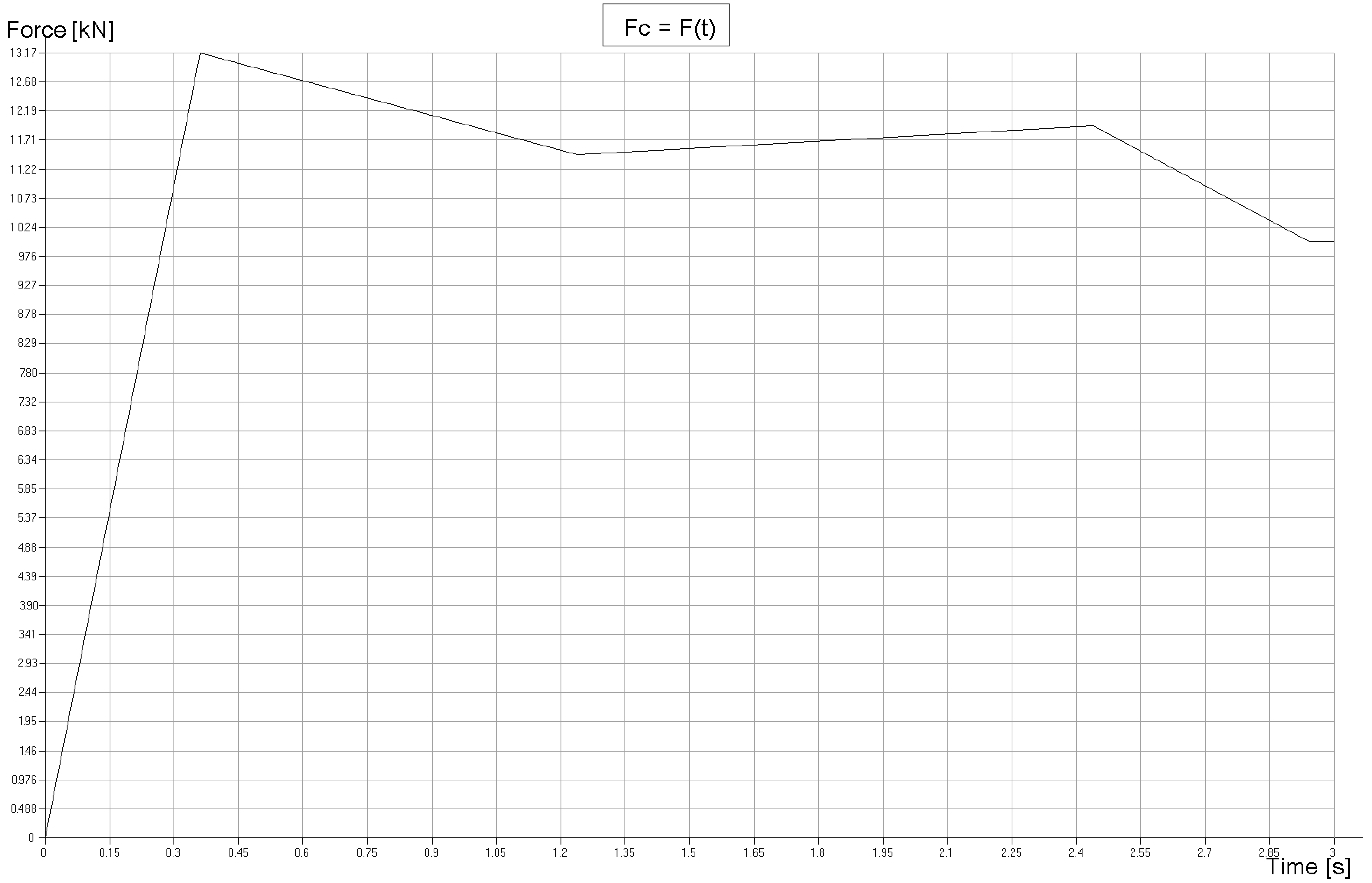
The pull-out excitation function Fc(t) was derived from field measurements performed during real drilling operations. The variation in the hook load during drill string release was recorded in operational conditions as an oscillographic time history. The experimentally captured signal was then digitized and introduced as a time-dependent excitation function in the transient dynamic simulations.
From this measured dataset, the dominant excitation period (Tp ≈ 2.94 s) and frequency (Fp ≈ 0.34 Hz) were determined and used as primary input parameters for the dynamic analysis.
The pull-out event was modeled as a transient dynamic load applied at the mast head, representing the extraction of the drill string. The excitation force was defined as a time-dependent function Fc(t), derived from experimentally observed operational data.
The pull-out excitation was characterized by:
Total duration: Tp = 2.94 s; Dominant excitation frequency: Fp = 0.34 Hz
Time integration step: Δt = 0.015 s; Total number of time steps: 200
Dynamic response calculation duration: 3 s
These parameters were selected to accurately capture the transient response while ensuring numerical stability and convergence of the time integration scheme.
The hook load variation during drill string pull-out was recorded in field conditions and used to define the Fc(t) excitation profile. This approach ensures that the simulated transient response reflects realistic operating scenarios.
The pull-out excitation function Fc(t) is illustrated in
Figure 1.
2.7. Damping Model
Structural damping was incorporated using an equivalent modal damping approach. A baseline damping ratio of ζ = 0.05 (5% of critical damping) was adopted for the steel configuration, corresponding to an overall structural damping coefficient G = 0.1.
For composite configurations, additional damping scenarios were investigated by varying the damping ratio within the range ζ = 0.015–0.030, in accordance with values reported for fiber-reinforced polymer structures [
5,
16,
17]. The selected damping ratios were adopted as representative values commonly reported for similar structural systems, enabling comparative dynamic assessment at structural scale. This approach allows for a realistic assessment of the vibration attenuation potential offered by composite materials.
2.8. Solution Procedures
The numerical investigation consisted of the following analyses:
Modal analysis to extract natural frequencies and mode shapes.
Transient dynamic analysis under pull-out excitation using direct time integration.
Harmonic response analysis over a frequency range of 0–100 Hz to identify resonance-prone regions.
Both direct and modal superposition solvers were employed where appropriate to ensure numerical robustness and computational efficiency.
To ensure physical relevance, computed dynamic parameters were compared with available empirical data from prototype testing and literature. The dynamic amplification factor and deflection patterns obtained for steel were consistent with experimental results of comparable hydraulic rigs (frequency range 14–16 Hz for first bending mode).
The computed stress safety coefficient (Ce) ranged between 4.5–15 for steel and 5.2–16.8 for composites, confirming higher stability margins for lightweight materials.
3. Results and Discussion
3.1. Modal Analysis and Natural Frequencies
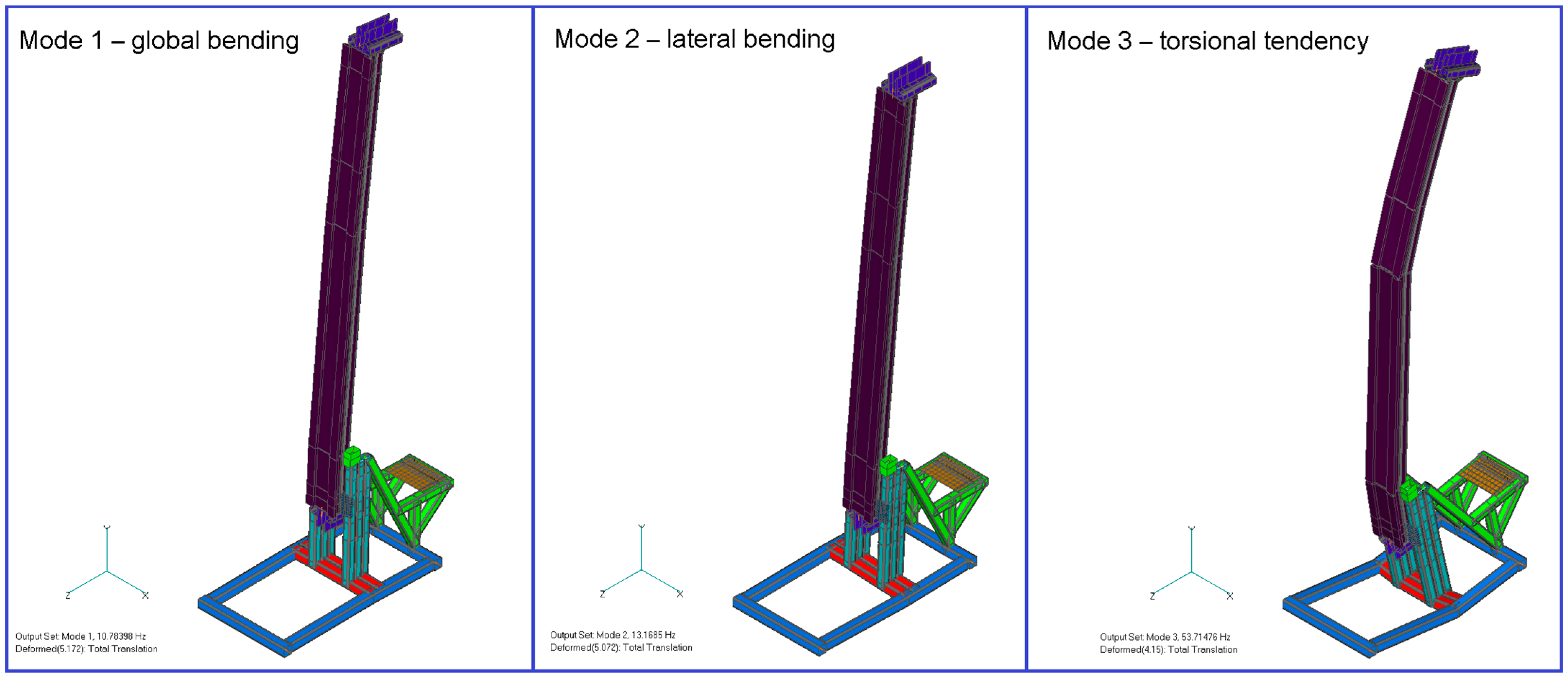
The modal analysis revealed that the fundamental vibration modes (
Figure 2) of the mast correspond to global bending and torsional deformation patterns. The use of composite materials resulted in a noticeable increase in the fundamental natural frequencies, which can be primarily attributed to the favorable stiffness-to-mass ratio of GFRP and CFRP configurations [
1,
10,
12].
The modal analysis (
Table 2) revealed clear differences between the steel and compo-site mast configurations. For the steel mast, the first natural frequency was identified at 15.4 Hz, whereas the GFRP and CFRP variants exhibited higher fundamental frequencies of 19.2 Hz and 21.7 Hz, respectively.
The increase in natural frequency with decreasing structural mass directly confirms the stiffness-to-weight advantage of polymer composite materials. In particular, the CFRP mast exhibited a frequency increase of approximately 40% compared to the steel reference, which significantly reduces resonance susceptibility and contributes to improved operational safety.
These results indicate that CFRP achieved approximately 40% frequency increase, 44% reduction in displacement, and 27% stress reduction compared with steel. The GFRP configuration also improved performance, though with slightly higher deflections due to lower modulus.
These results confirm that carbon-fiber-reinforced polymer laminates represent a viable structural replacement for steel in critical drilling mast components, supporting recent optimization-oriented studies on drilling rig structures and numerical investigations on mast-like load-bearing systems [
1,
5,
7].
3.2. Transient Dynamic Response Under Pull-Out Excitation
The transient analysis showed that the maximum structural response occurred at approximately t = 0.375 s, corresponding to the peak of the pull-out excitation. At this instant, both maximum nodal displacement and peak equivalent stress were recorded.
Dynamic amplification factors were evaluated by comparing transient results with corresponding static values. The displacement amplification factor Cd reached values of approximately 1.7, while the dynamic stress amplification factor Ceu approached 1.4 for the steel configuration. Composite configurations exhibited reduced dynamic amplification, confirming their superior vibration mitigation capability.
3.3. Harmonic Response and Resonance Assessment
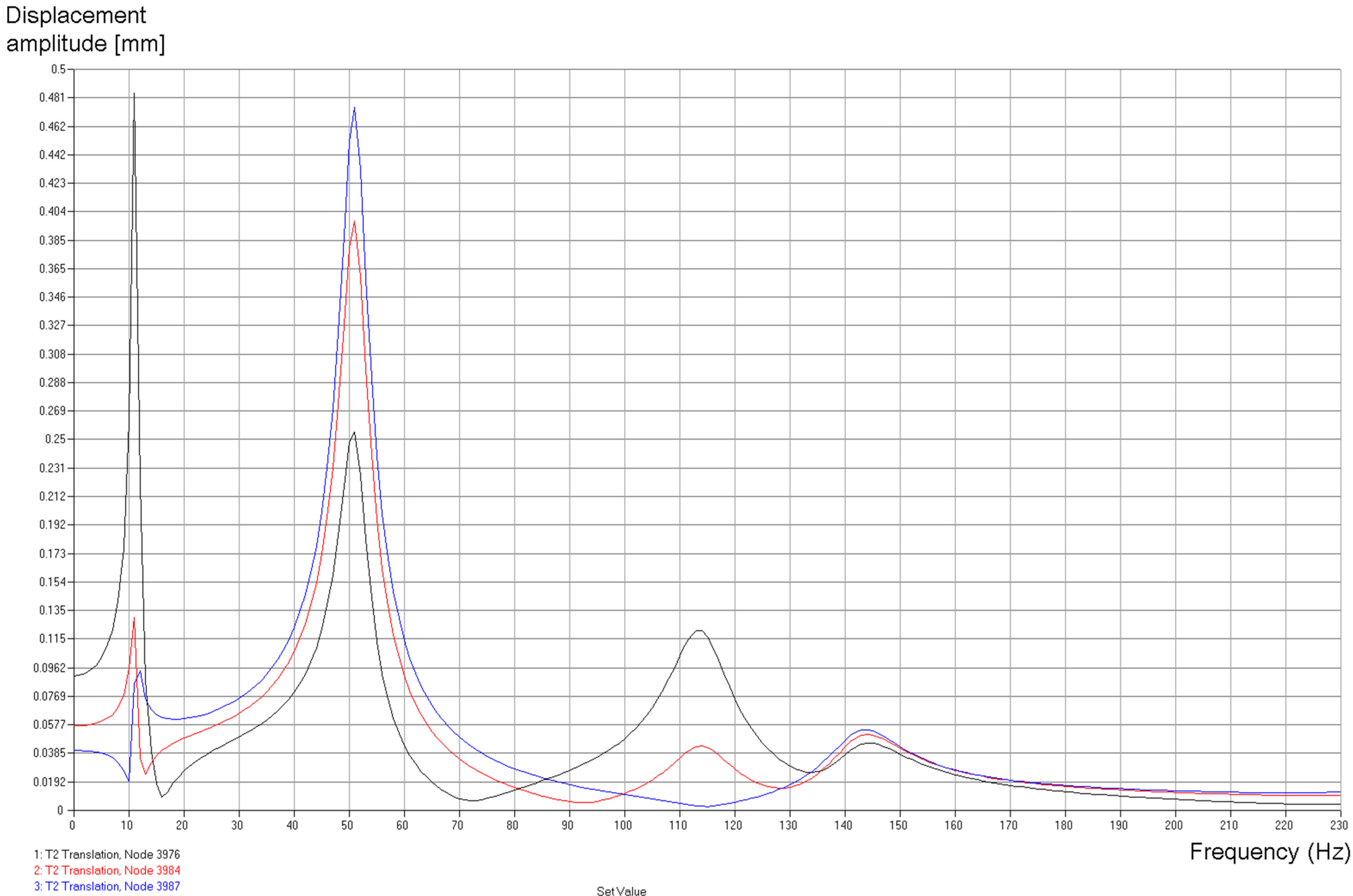
The harmonic response analysis was conducted to assess the resonance susceptibility of the mast structure over a frequency range of 0–200 Hz. The resulting deformation amplitudes at the mast head are presented in
Figure 3, where several resonance peaks can be identified.
The identified resonance frequencies occur at approximately 11 Hz, 51 Hz, 115 Hz, and 145 Hz. Importantly, the dominant pull-out excitation frequency (Fp = 0.34 Hz) lies well below the first natural frequency of the structure, indicating that the pull-out operation does not pose a resonance risk under normal operational conditions [
10,
11,
12,
13,
14,
15].
3.4. Comparative Performance of Steel and Composite Configurations
The comparative results demonstrate that the adoption of GFRP and CFRP materials leads to mass reductions of approximately 53–60%, while simultaneously increasing natural frequencies and reducing dynamic response amplitudes.
CFRP exhibited the most favorable performance in terms of stiffness and vibration suppression, whereas GFRP offers a balanced compromise between performance improvement and material cost.
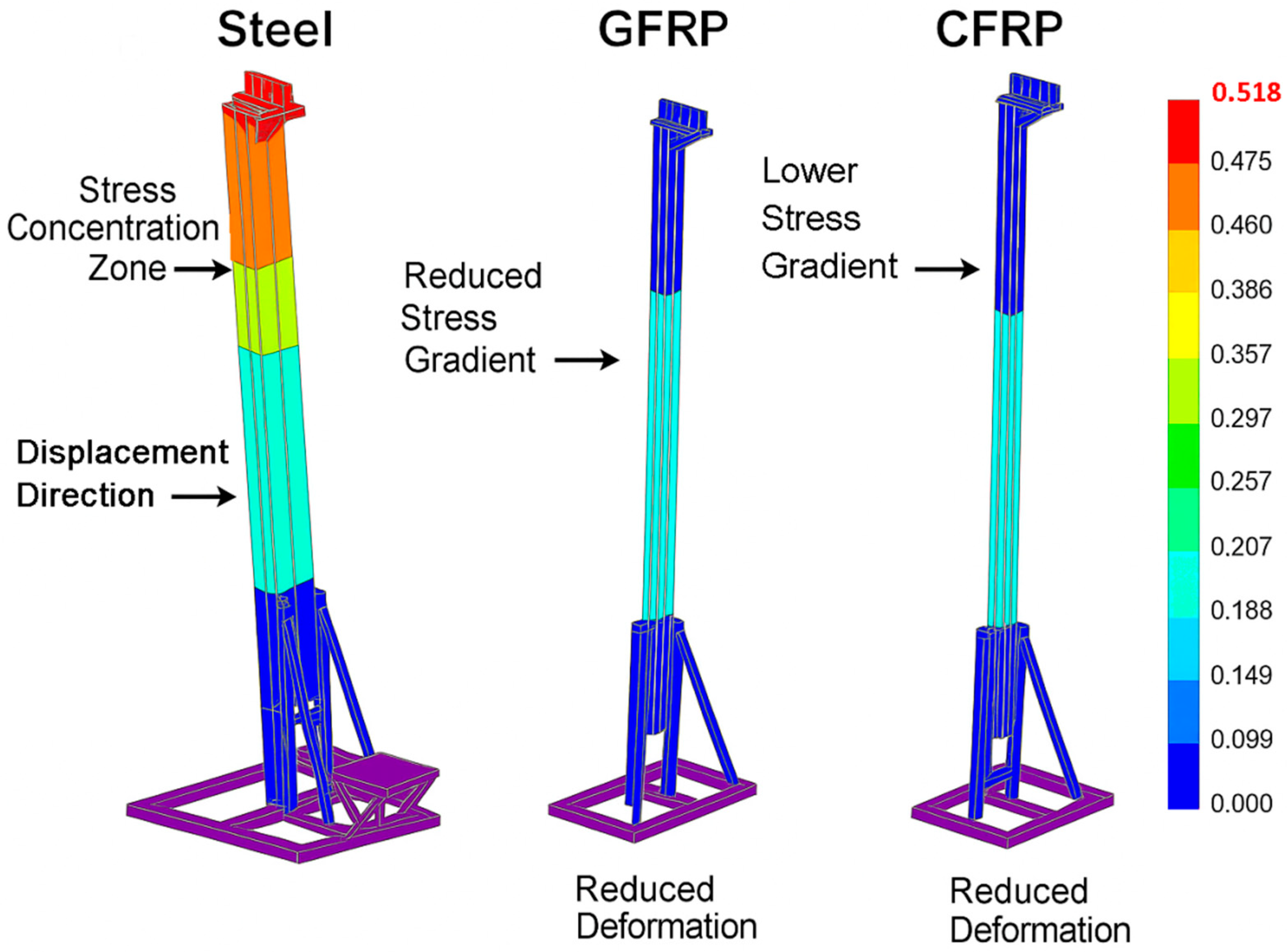
Figure 4 illustrates the stress contour maps for the three materials under harmonic excitation.
The steel configuration displayed clear stress concentration at the upper mast head and lateral joints, with peak von Mises stress around 230 MPa.
The GFRP variant showed a smoother distribution, with stress values reduced to 180–190 MPa and smaller tip deflections.
The CFRP structure exhibited the most uniform stress pattern, with minimal hot spots and the lowest top displacement (≈2.7 mm).
Furthermore, the present work complements ongoing research on the dynamic performance and process optimization of composite systems subjected to drilling and multi-scale loading conditions [
3,
4,
5,
16,
17], while reinforcing the relevance of integrated hydro-mechanical system behavior in drilling operations [
2].
The enhanced damping capacity of composite materials plays a crucial role in operational stability. The effective modal damping ratio (ζ) increased from approximately 0.01 for the steel configuration to about 0.03 for the CFRP mast, resulting in a 35–40% reduction in vibration amplitude at resonance.
The analysis also demonstrated that the lighter composite mast induces lower inertial forces, reducing oscillatory loads on hydraulic actuators and joints. This improves service life and minimizes maintenance requirements.
Additionally, the CFRP configuration provided a higher safety coefficient (Ce = 16.8) under peak loads compared with 15.0 for steel, emphasizing improved reliability for long-term operation.
The substantial mass reduction achieved by using composites translates directly into lower energy consumption during lifting and rotation operations. Field-level extrapolation suggests up to 12–15% fuel savings for drilling cycles, due to reduced hydraulic effort.
From a sustainability perspective, polymer composites offer corrosion resistance and longevity under environmental exposure, making them suitable for multi-climate field applications. The potential for localized fabrication using filament winding or RTM further supports the feasibility of these materials in industrial production within Romania and other European contexts.
In addition to the quantitative indicators presented in
Table 2, the spatial distribution of equivalent stress and global deformation patterns provides important insight into the structural behavior of the mast for different material solutions.
As illustrated in
Figure 4, the steel configuration exhibits pronounced stress concentration zones in the upper mast region, accompanied by steeper stress gradients along the structural height. In contrast, both GFRP and CFRP configurations show a more uniform stress distribution and reduced deformation gradients, indicating improved load redistribution and enhanced dynamic performance. The CFRP mast, in particular, demonstrates the lowest deformation level and the smoothest stress transition, confirming its superior stiffness-to-mass efficiency and vibration mitigation capability.
4. Conclusions
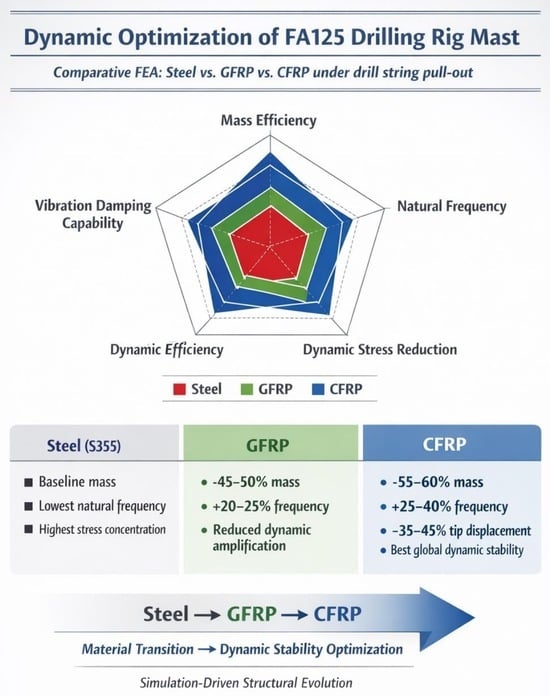
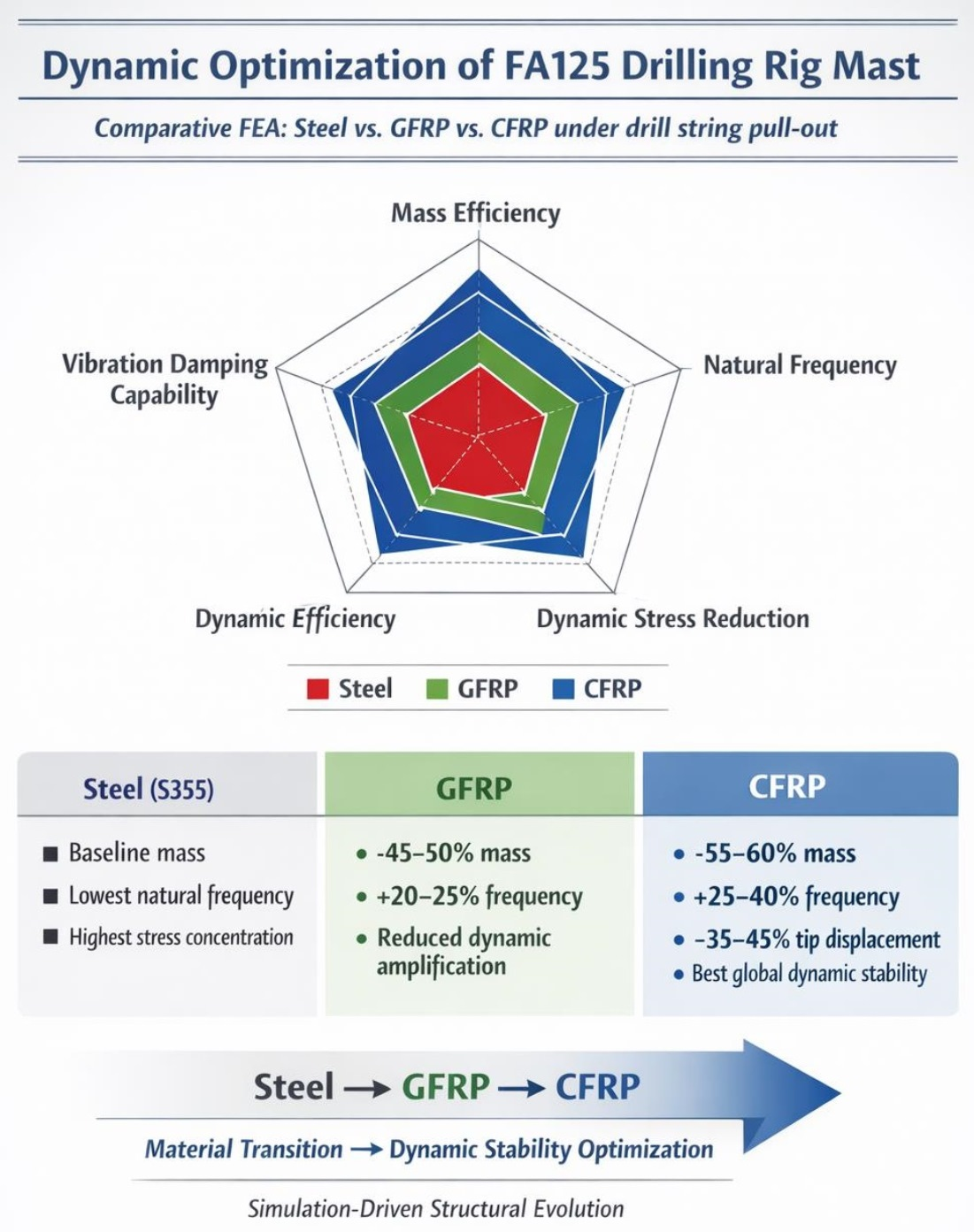
The finite element dynamic analysis conducted on the FA125 drilling rig mast demonstrated that replacing steel with macromolecular composite materials (GFRP and CFRP) substantially improves structural behavior under dynamic loading. Mass reduction of up to 55–60% leads to lighter, more energy-efficient systems, while the first natural frequency increased by up to 40%, providing improved robustness against resonance phenomena. At the same time, the maximum tip displacement was reduced by 35–45%, confirming enhanced global stiffness and superior damping capabilities. Among the evaluated alternatives, the CFRP configuration exhibited the most balanced performance, combining rigidity, vibration attenuation, and manufacturability.
Overall, the FA125 mast study demonstrates that the integration of advanced composite materials enables lighter, safer, and more sustainable drilling equipment aligned with global engineering trends in structural optimization and digital simulation-based design.
The present study represents a simulation-driven structural assessment supported by experimentally derived dynamic loading data. The present results should be interpreted in the context of modeling assumptions, including simplified material representation, idealized boundary conditions, and literature-based damping values.
Future work will focus on experimental modal testing, numerical model updating, and fatigue life assessment under repeated dynamic loading, including hybrid steel–composite configurations. Experimental validation will include strain gauge-based measurements on representative structural elements.
In addition, fatigue life assessment under repeated dynamic loading and hybrid steel–composite configurations will be investigated to support practical implementation in drilling rig mast design.
These directions will support the broader industrial adoption of macromolecular composite masts in Romanian drilling systems and similar mechanical applications worldwide.