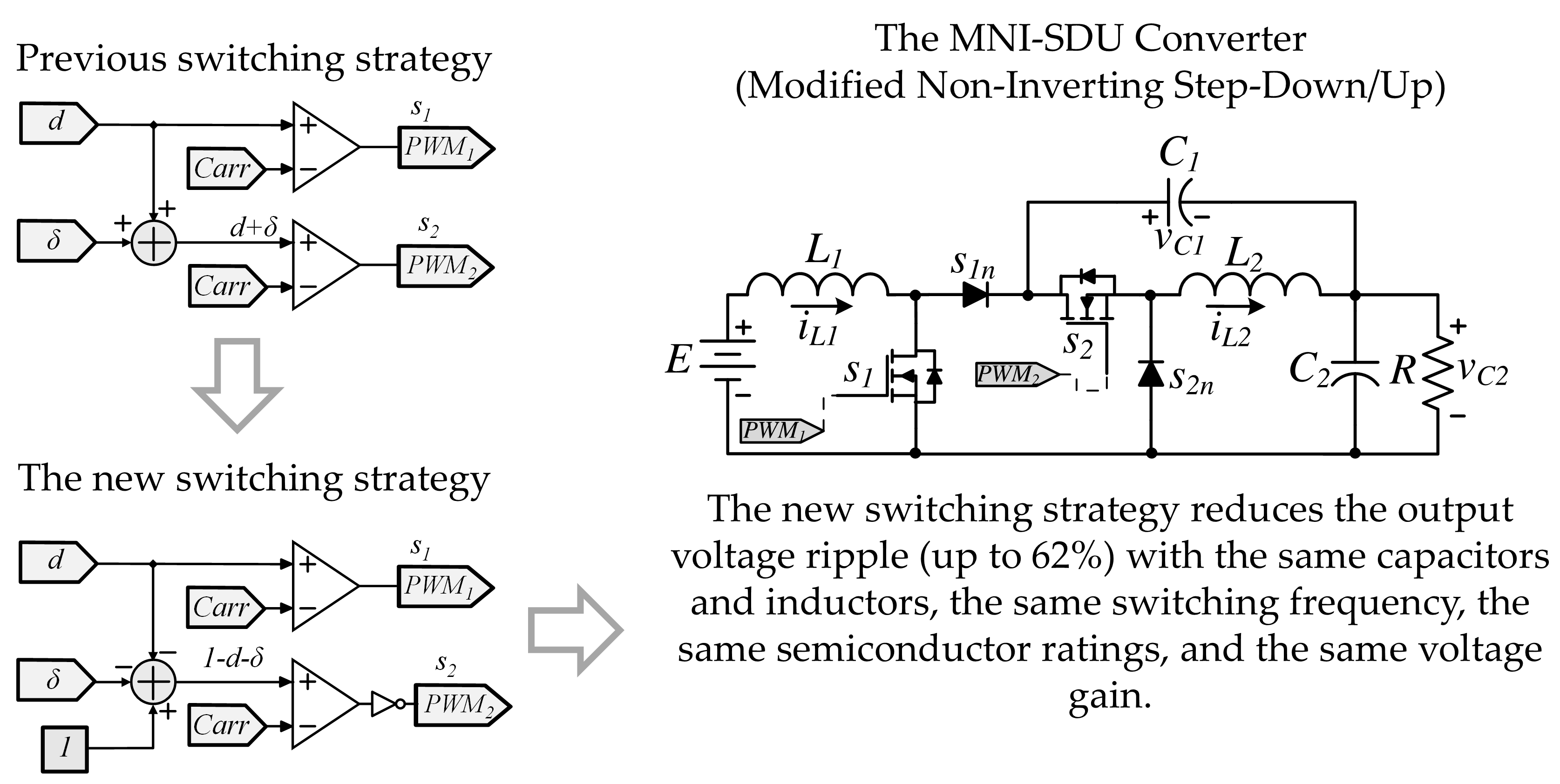

Ripple Minimization Method for a Modified Non-Inverting Buck–Boost DC–DC Converter

 , ,
, ,  , and
, and
Abstract
1. Introduction
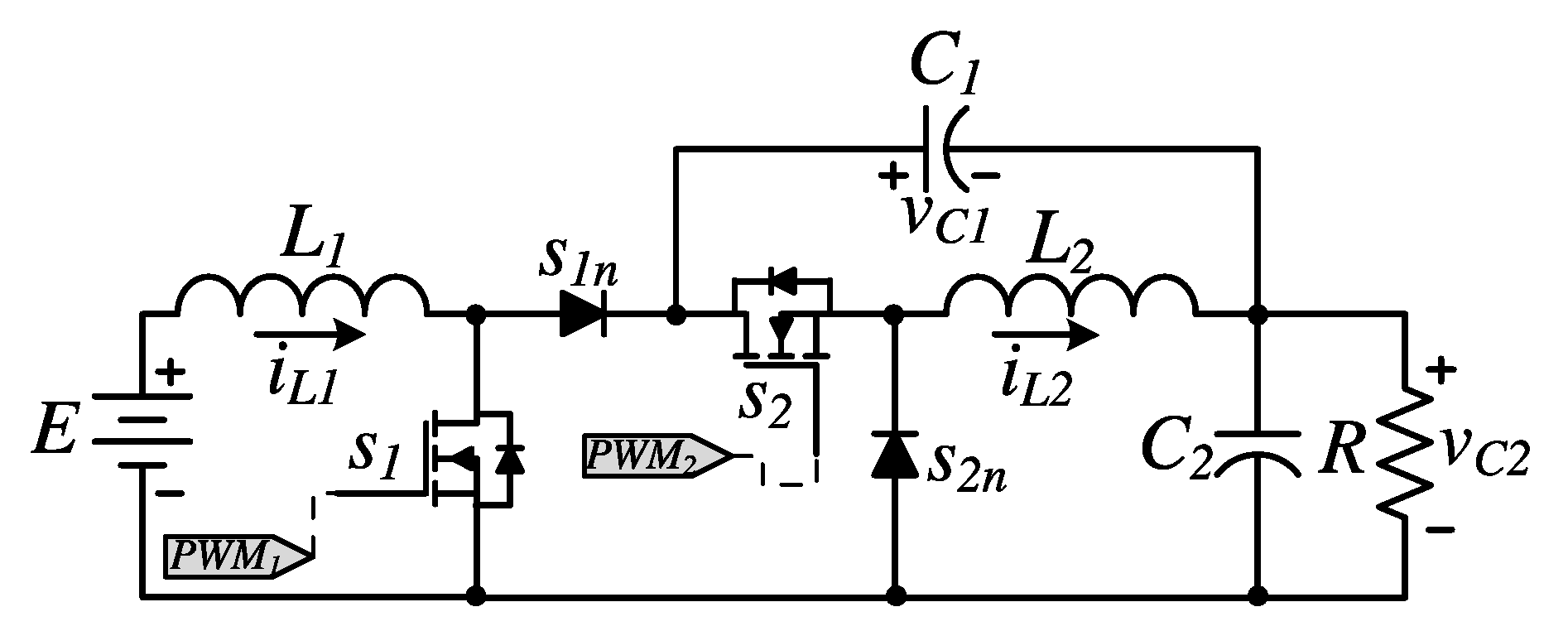
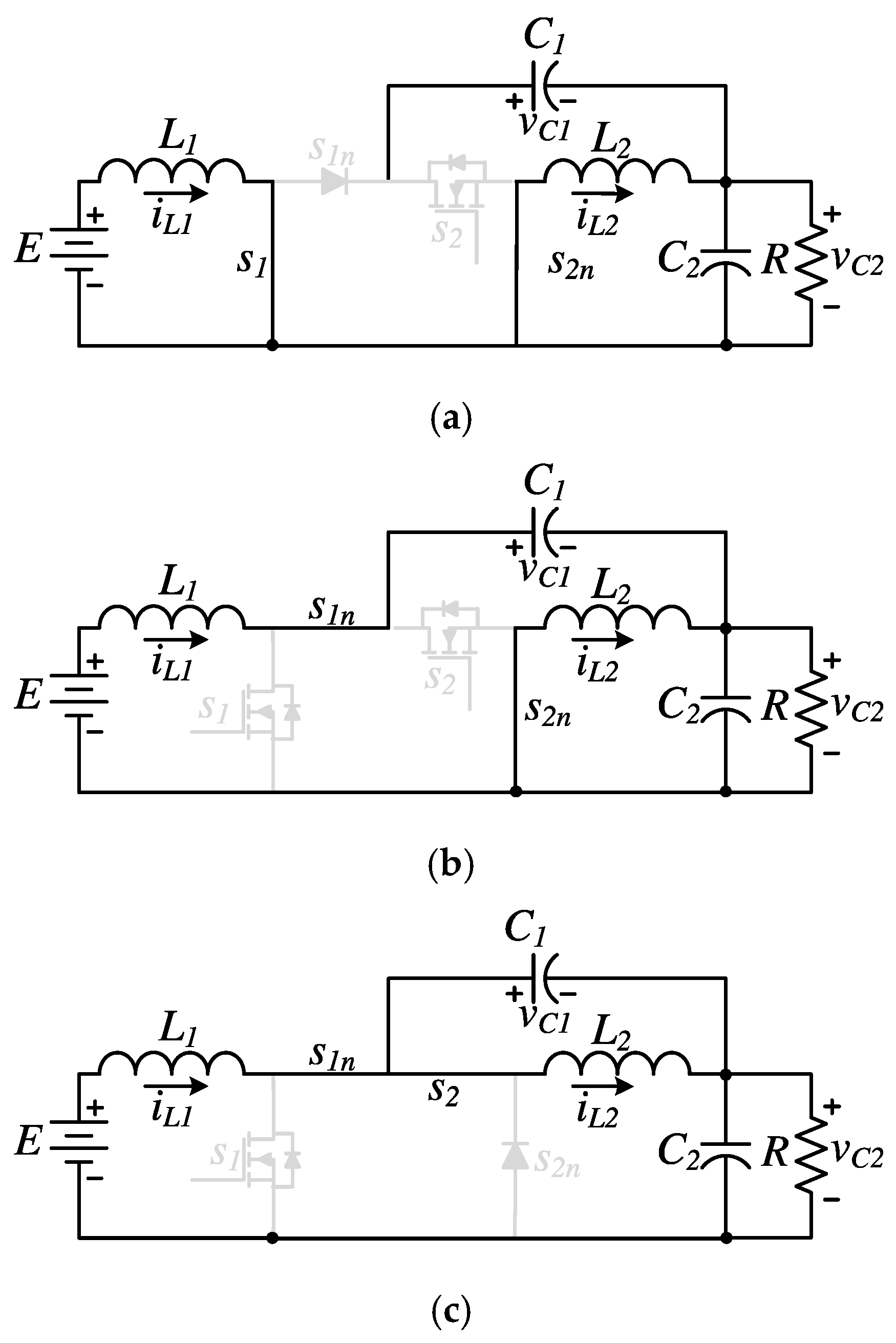
2. The MNI-SDU Converter
- The ability to step down or step up the input voltage.
- The transfer capacitor ensures a non-cascading interconnection between the input stage and the output stage, which reduces the redundant power processing.
- Low number of active and passive switches as well as electrical components.
- Non-pulsating input current, which makes it suitable for renewable energy processing applications.
- Non-inverting output voltage, with both input and output sharing a common ground reference.
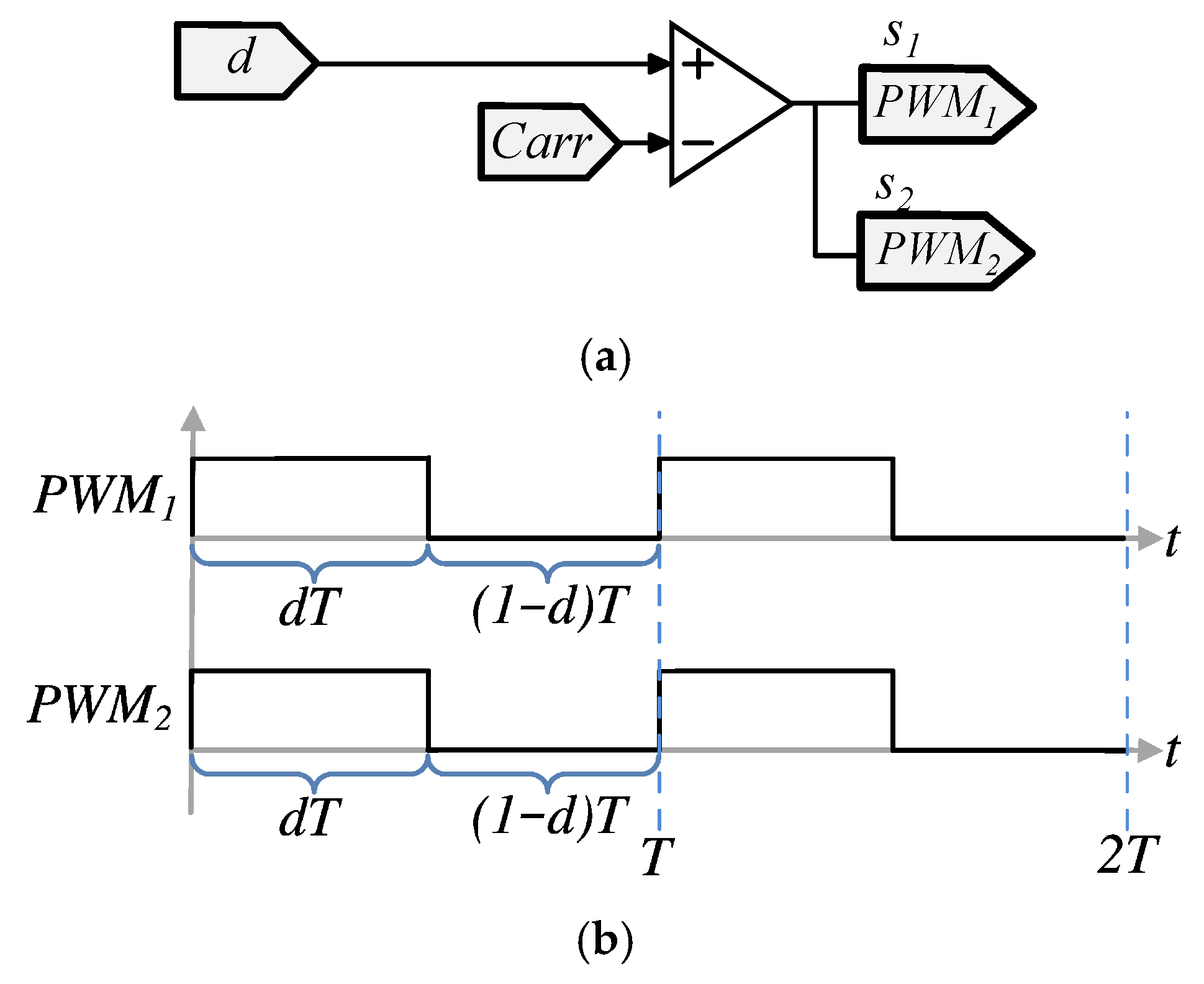
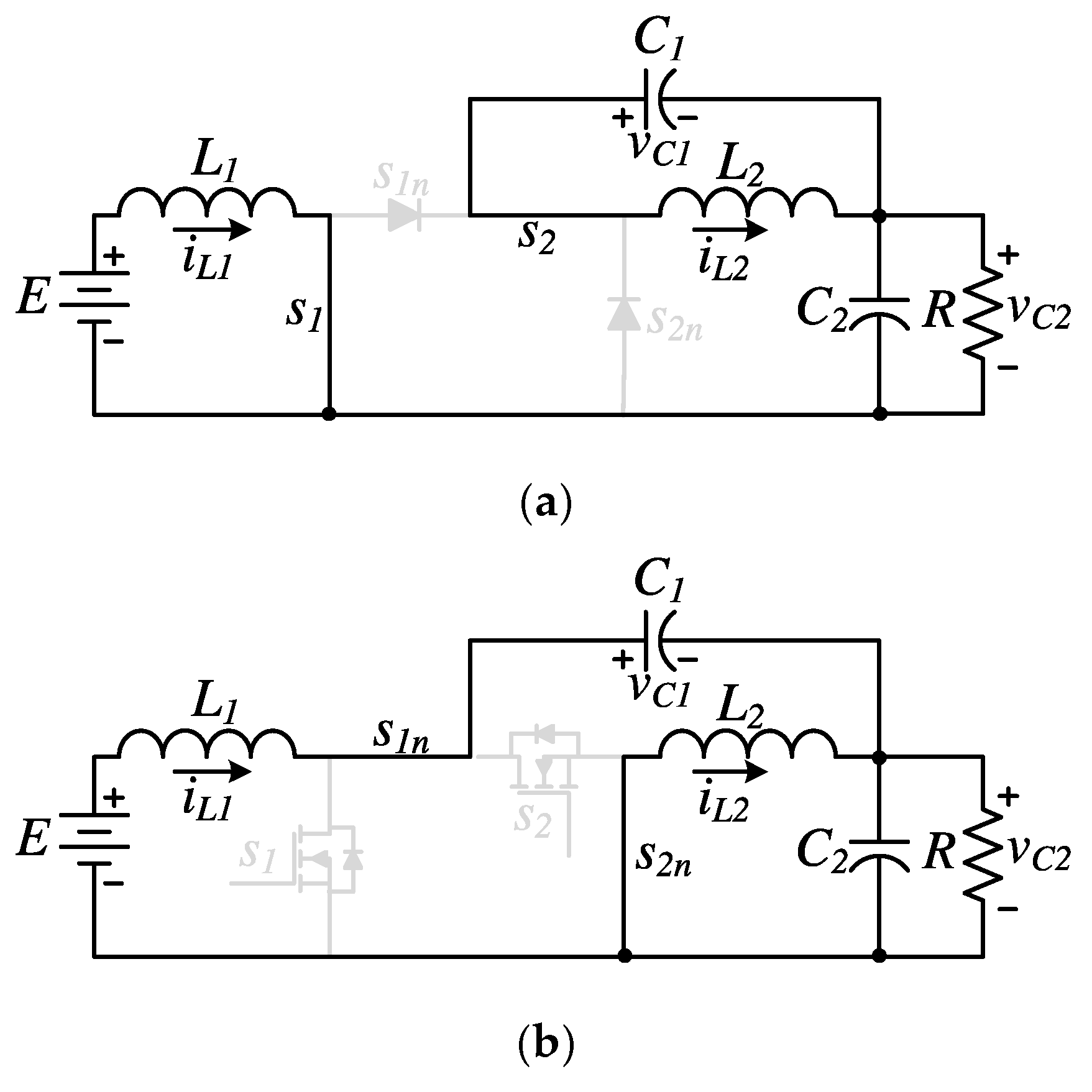
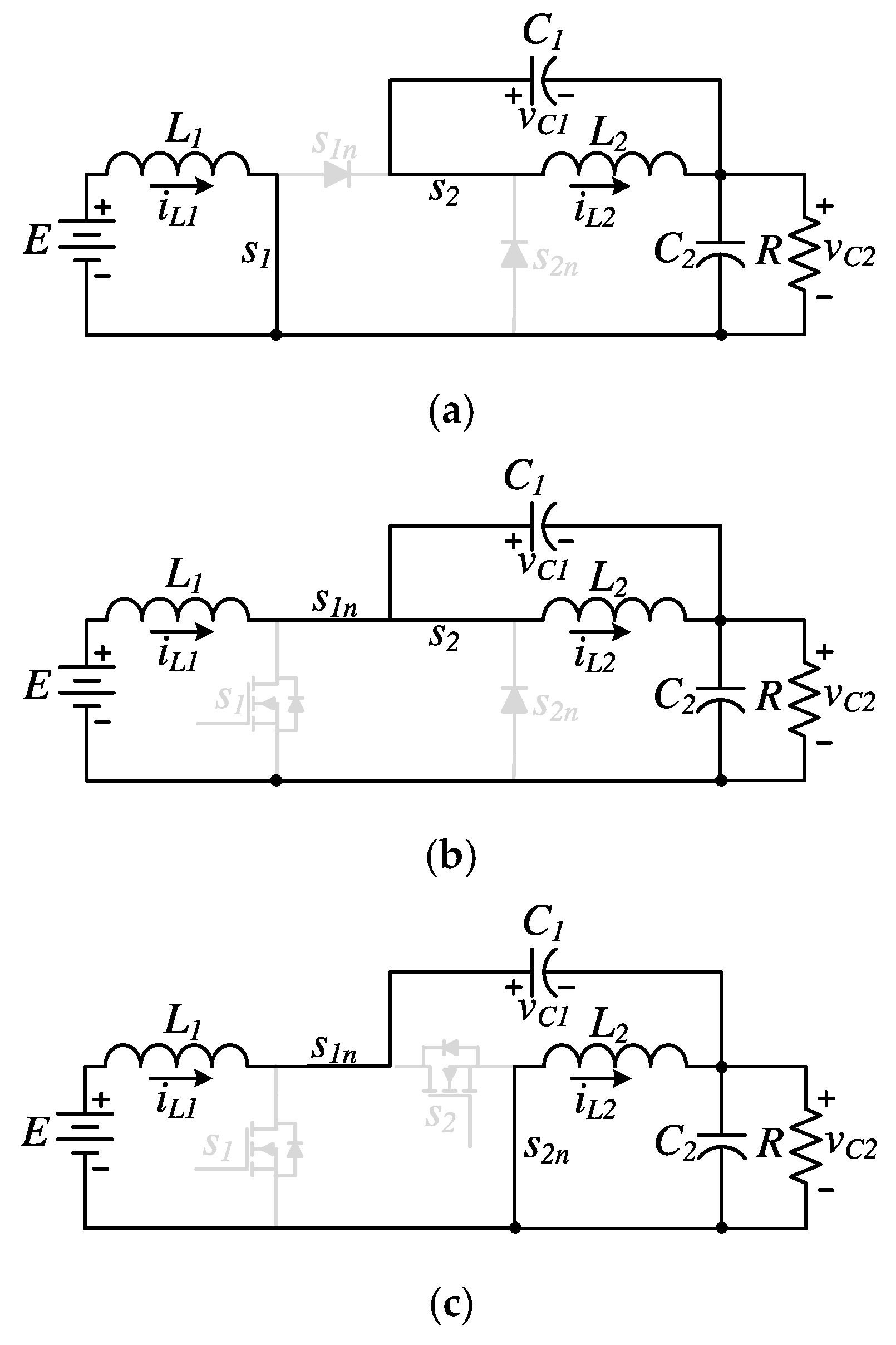
2.1. The Two-State Switching Strategy
- A simple circuit is used to generate pulse-width modulation (PWM), as both transistors share the same control signal.
- The converter analysis is straightforward since only two switching states are involved.
- For the proposed application, the required voltage gains remain close to unity. To achieve these gains, the operating mode requires duty cycles near 50%.
2.2. The Three-State Switching Strategy
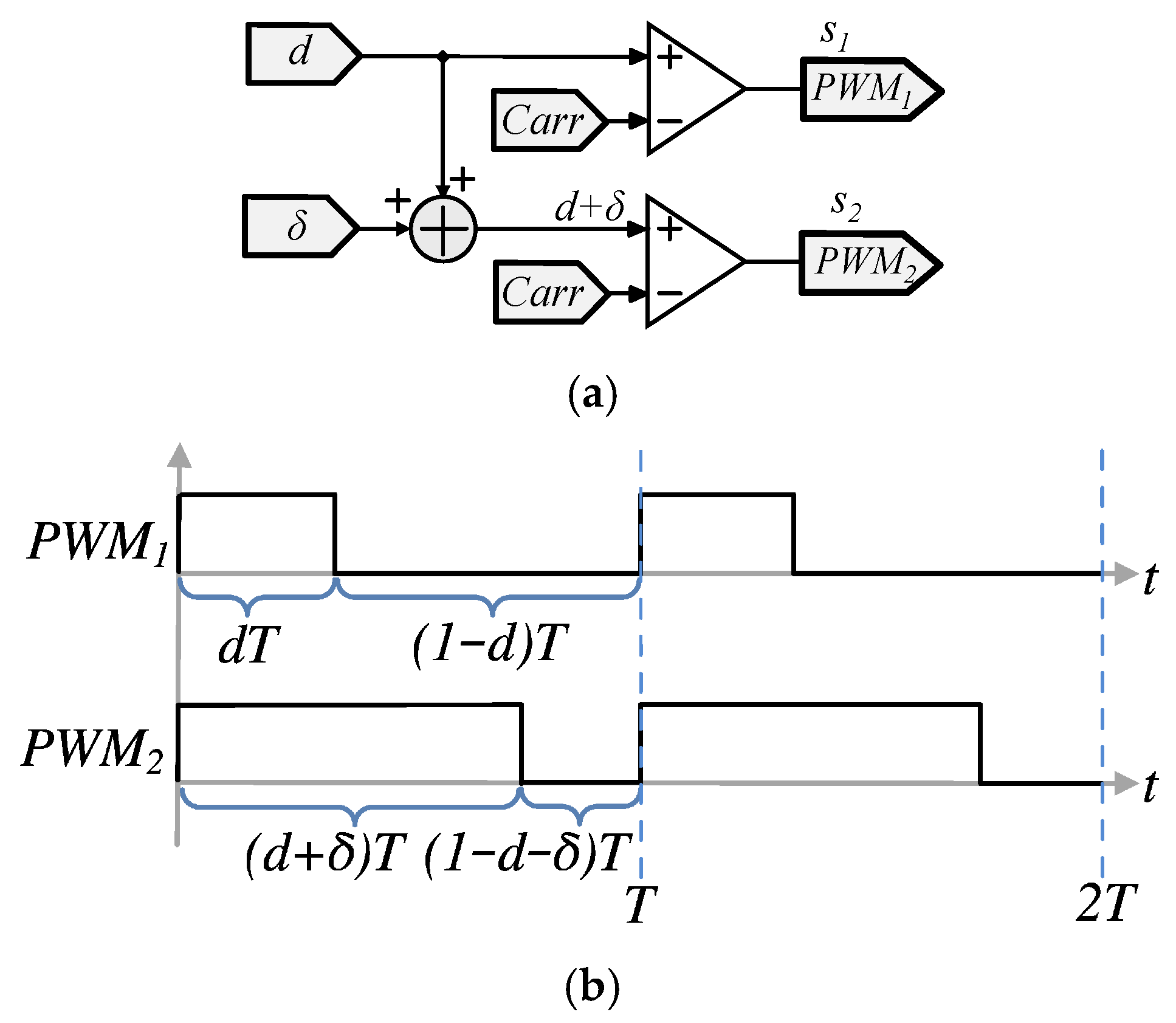
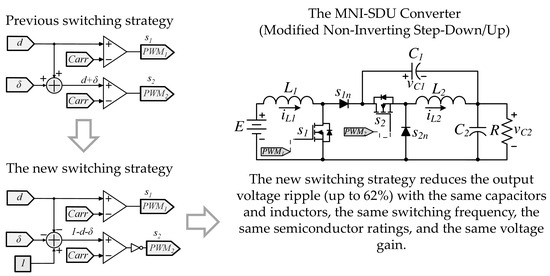
- The switching state {, } = {0, 1} increases the time in which energy from the source is directly delivered to the load; this further reduces redundant energy processing.
- It reduces current ripple values in inductors and voltage ripple values in capacitors.
- It decreases the voltage value of the transfer capacitor.
- It improves the overall efficiency.
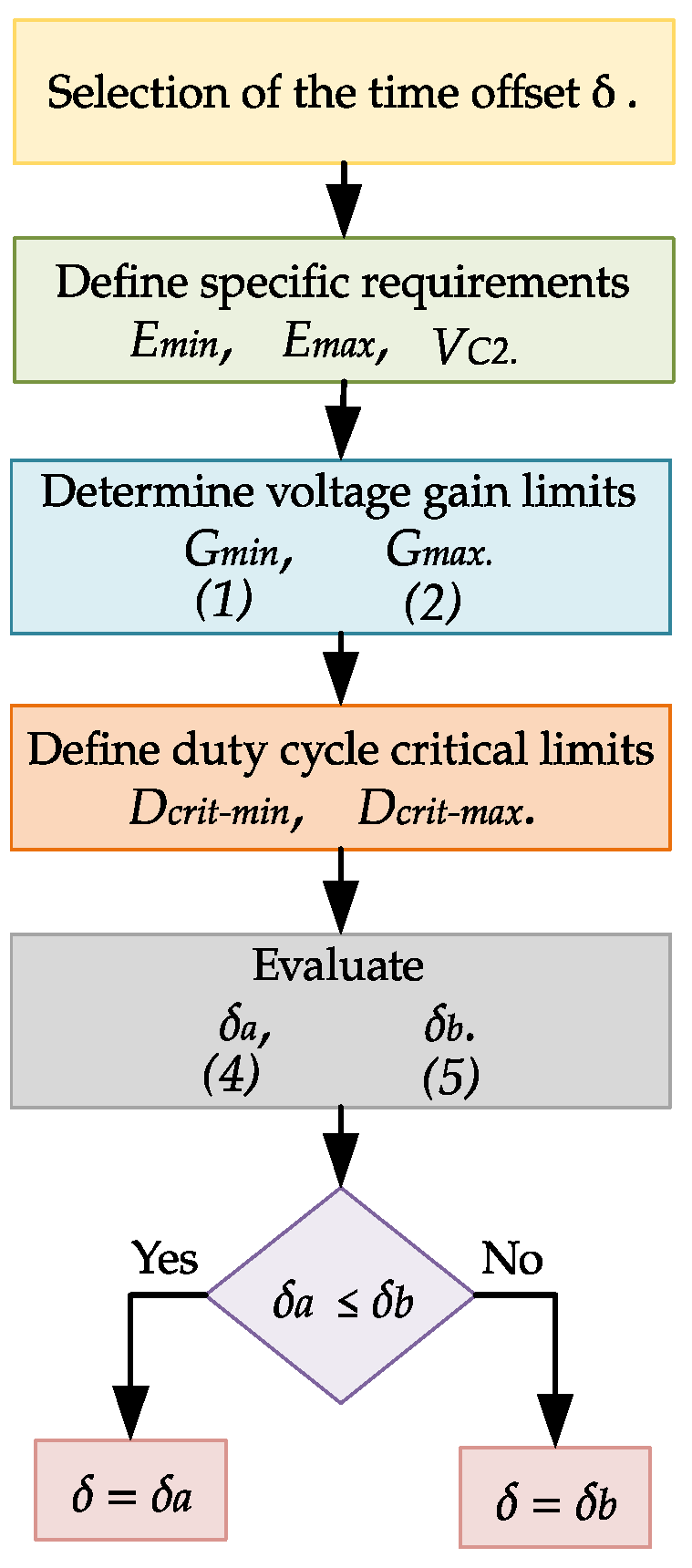
- To ensure proper operation of the system, it is essential to define the voltage requirements according to the application. These specifications include the minimum voltage of the source , the maximum voltage of the source , and the required steady-state output voltage .
- Determine the voltage gain limits according to
- Define the minimum and maximum critical duty cycles, denoted as and , which establishes the operational boundaries required for reliable converter performance. To guarantee proper operation, the following inequality must be satisfied,
- Obtain values that meet the maximum and minimum requirements. The value of to obtain the minimum voltage gain with the critical minimum duty cycle conditions isMeanwhile, the value of to obtain the maximum voltage gain with the critical maximum duty cycle conditions is
- Select the value of as the lowest between and , i.e.,this is the highest that achieves the set gain value without exceeding the duty cycle critical limits.
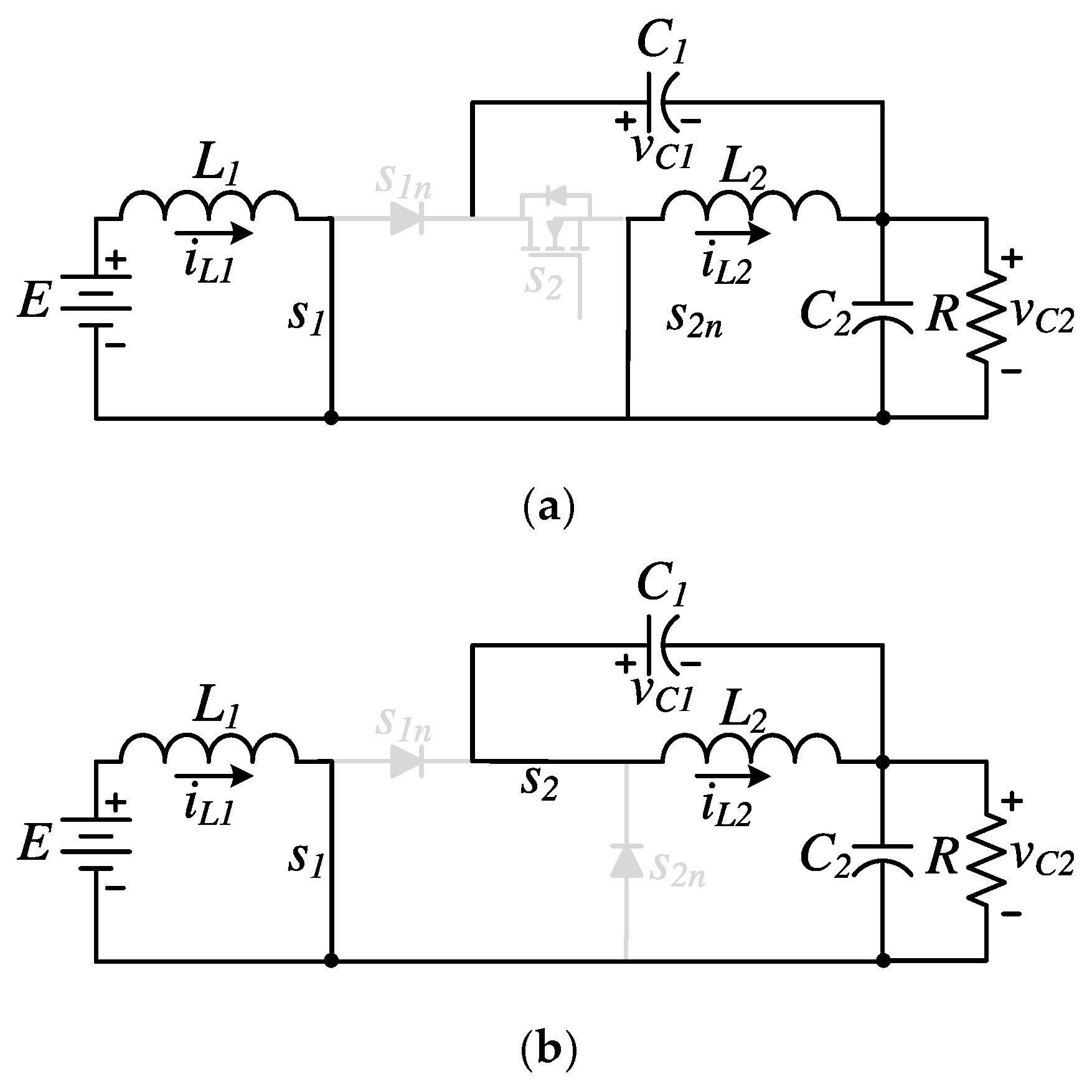
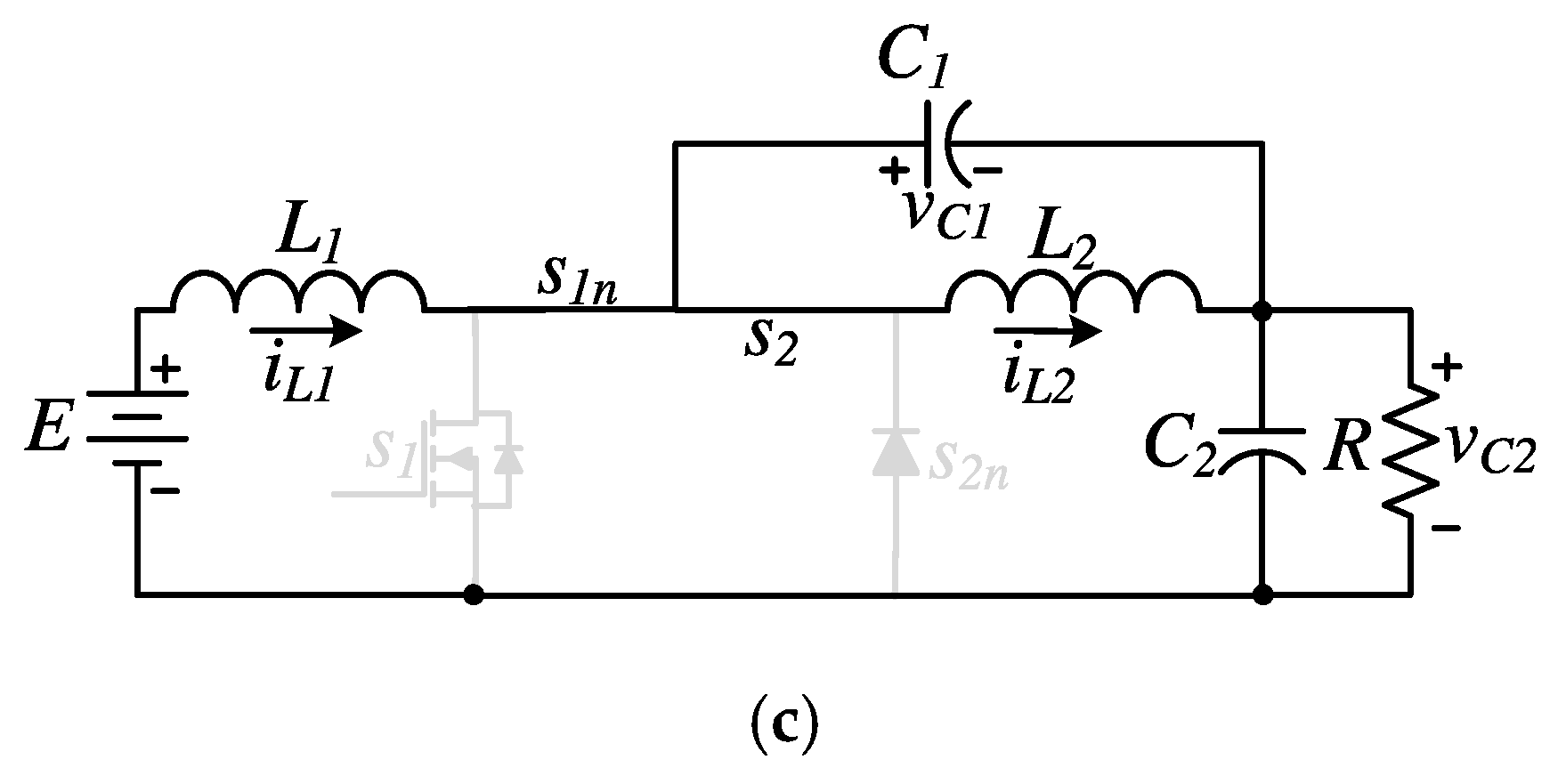
3. The Proposed Switching Strategy
Modeling and Steady State Analysis
4. Experimental Results
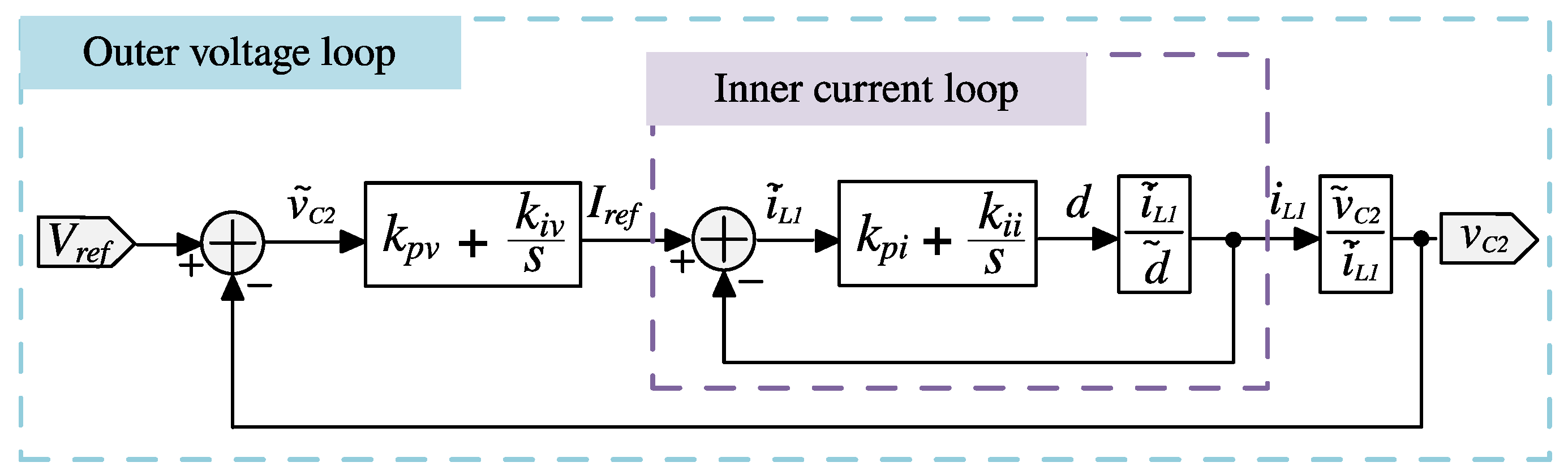
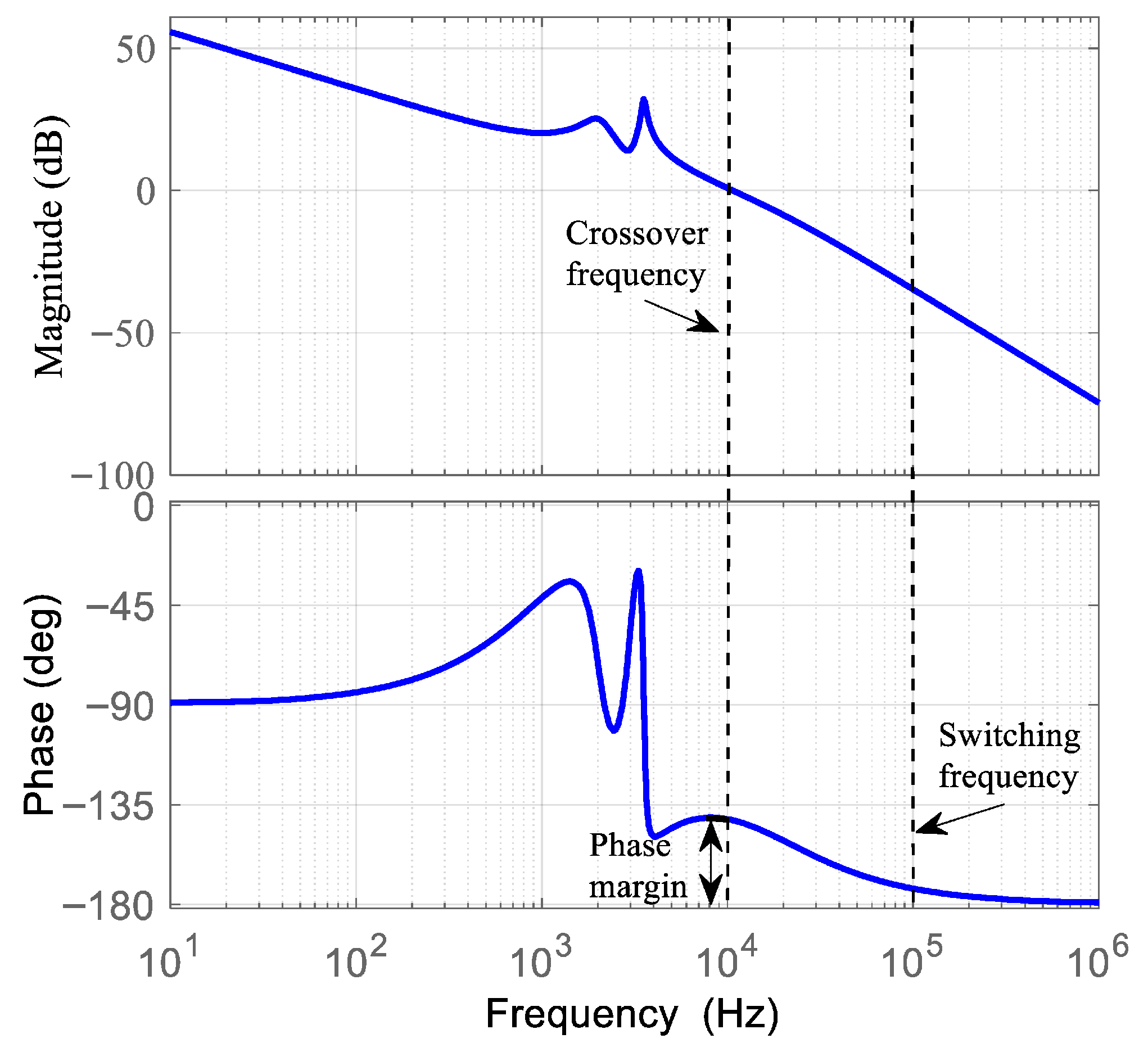
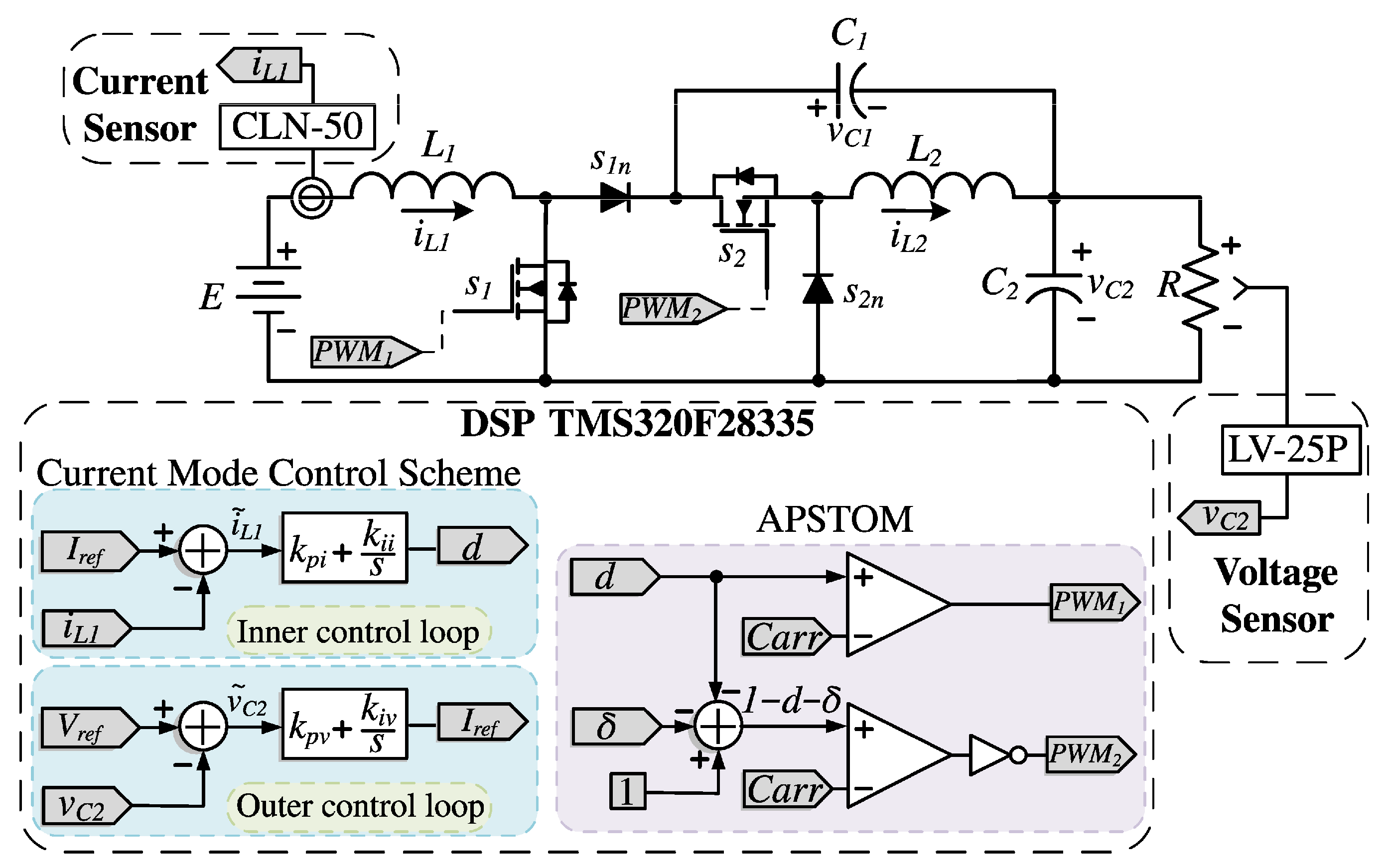
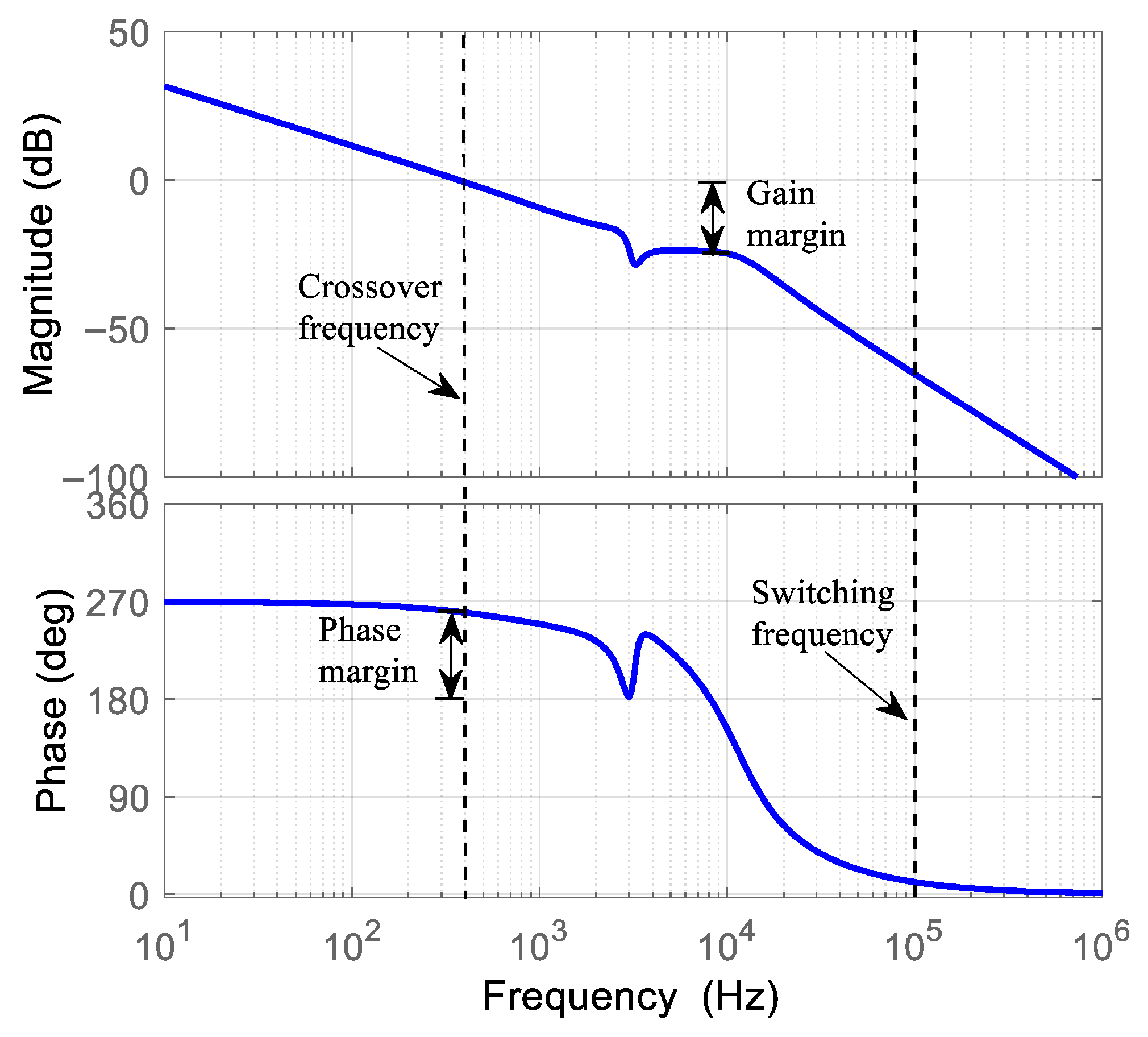
4.1. PI-PI Current Mode Controller
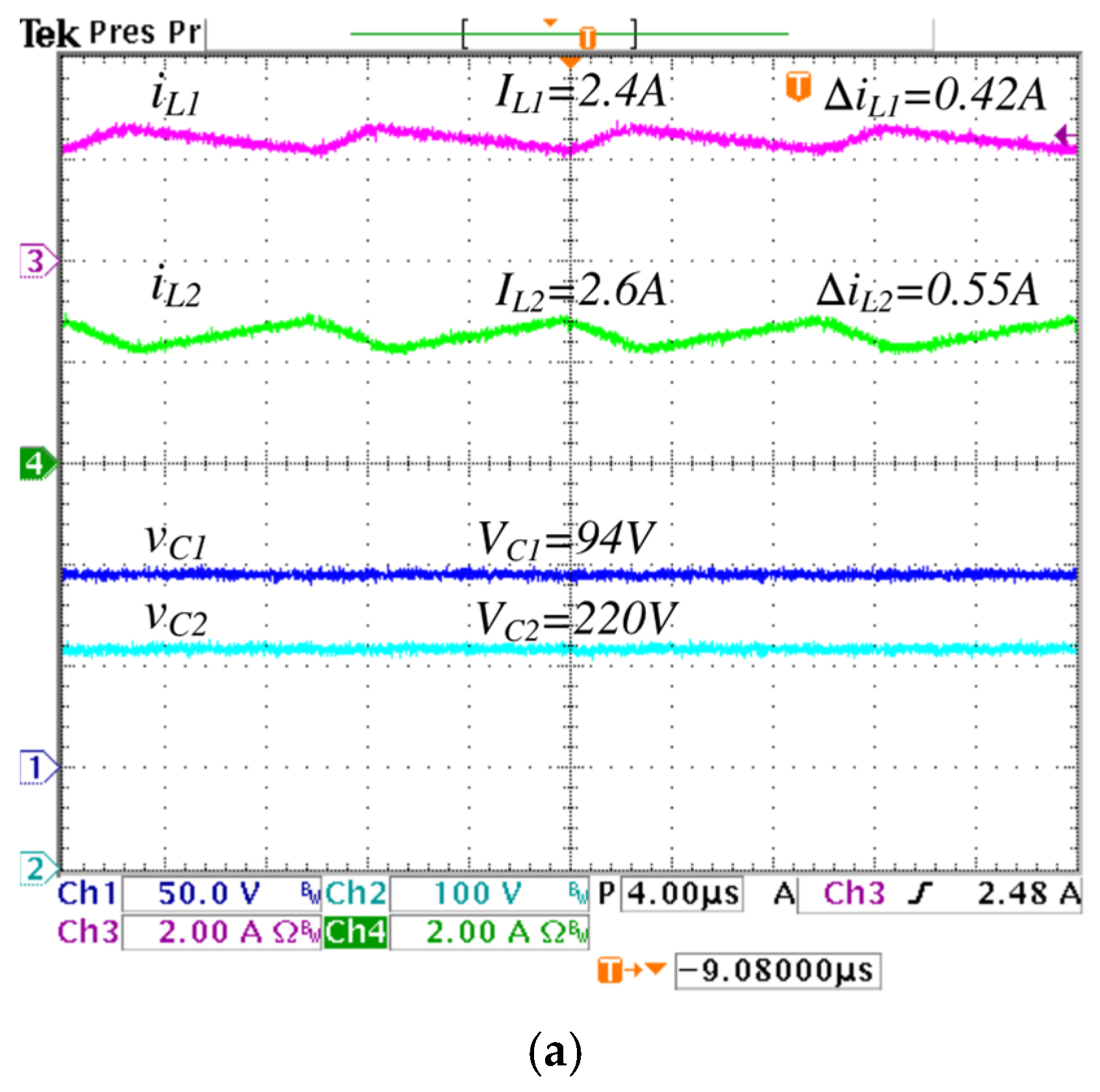
4.2. Closed-Loop Tests
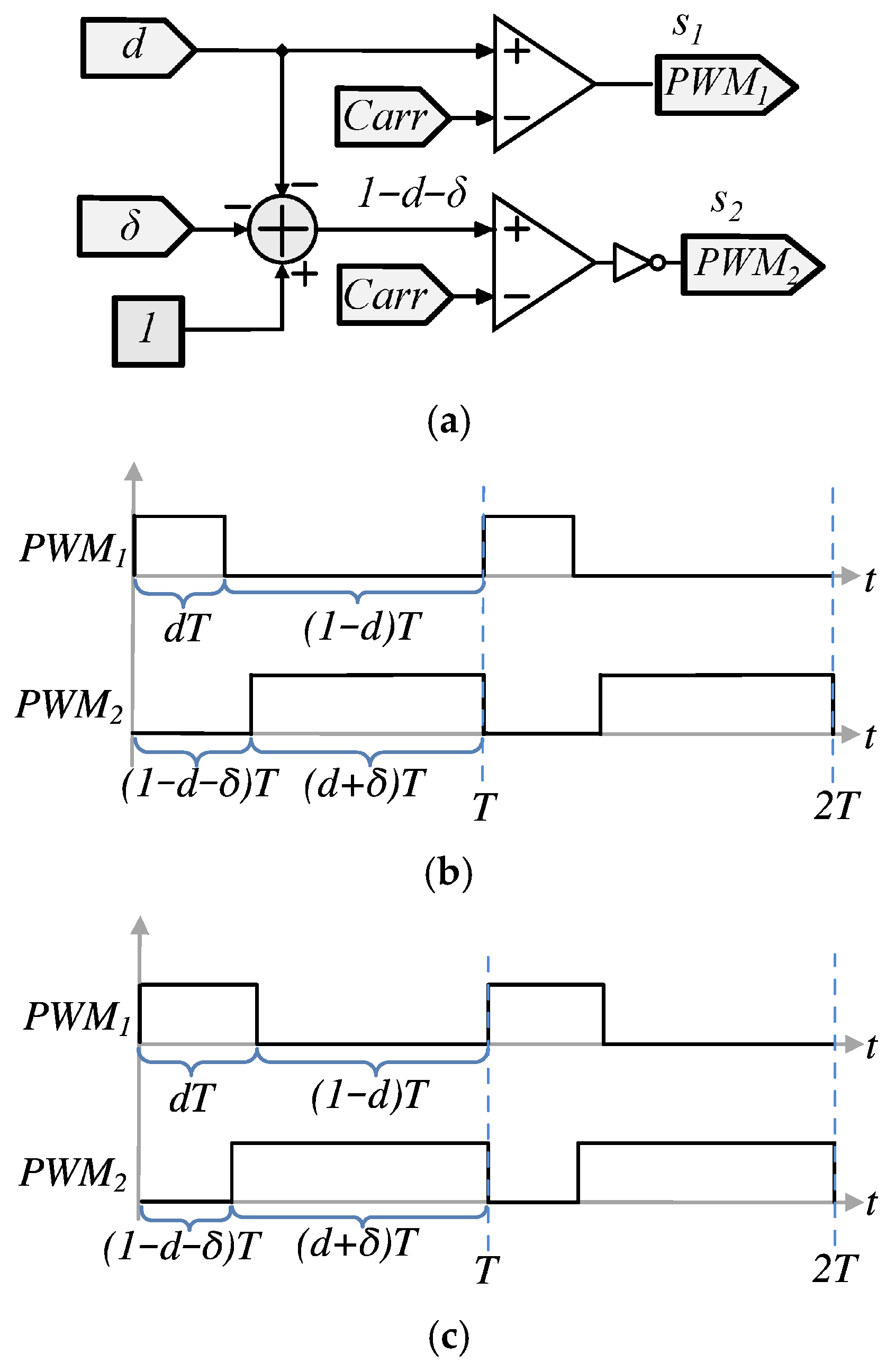
- The converter ratio of the converter decreases as the time offset increases according to (39).
- The proposed strategy is specifically designed for two-switch step-down/up converters.
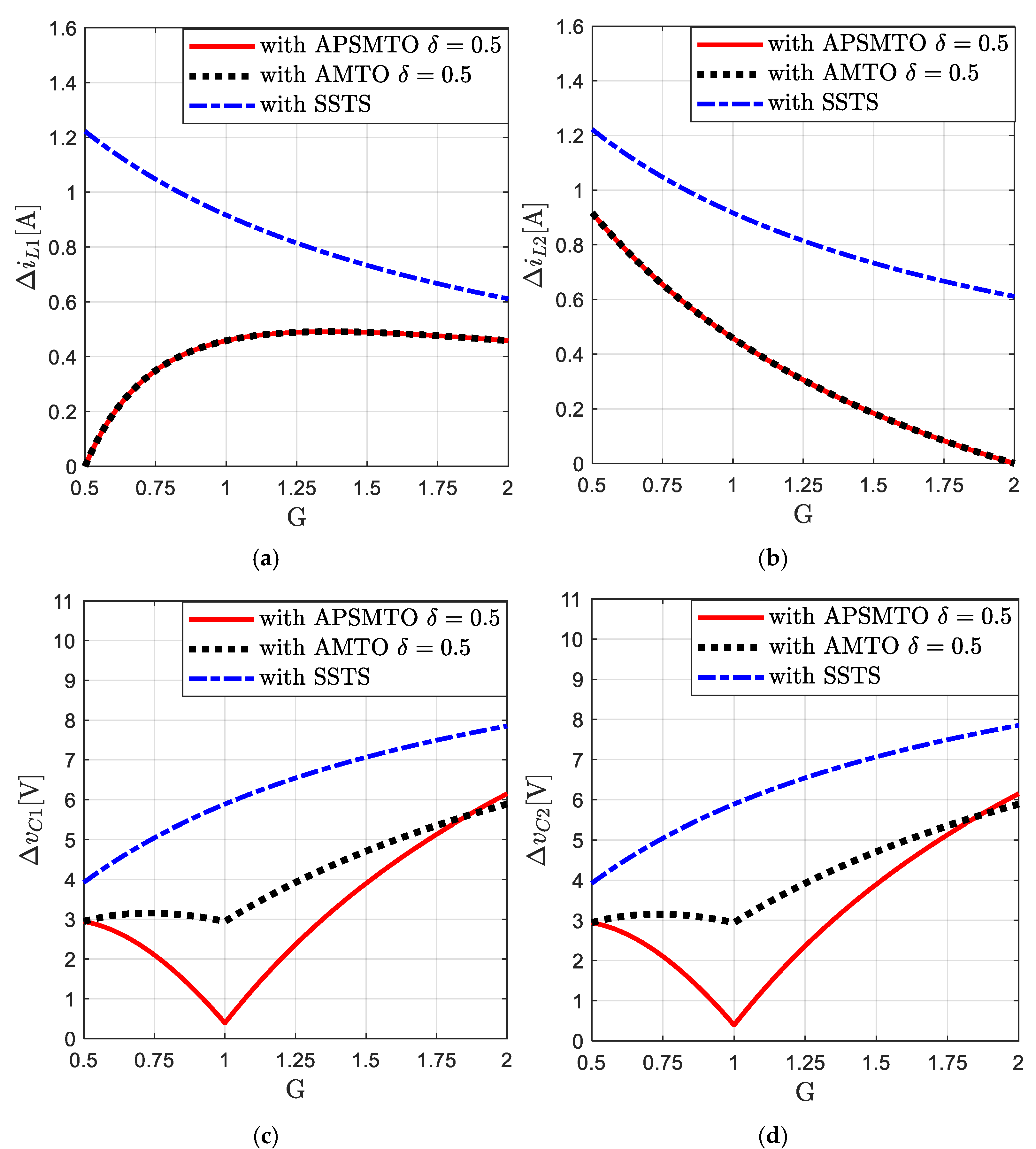
- The benefits of this approach are most pronounced near unity gain, as in the present case, where the gain range is 0.88 to 1.1.
- The active switches operate close to the critical limits of duty cycles.
5. Conclusions
Author Contributions
Funding
Institutional Review Board Statement
Informed Consent Statement
Data Availability Statement
Acknowledgments
Conflicts of Interest
References
- Rashid, M.H. Power Electronics: Circuits, Devices, and Applications, 3rd ed.; Pearson Education: Hoboken, NJ, USA, 2009; pp. 289–292. [Google Scholar]
- Mohan, N.; Undeland, T.M.; Robbins, W.P. Power Electronics in Converters, Applications, and Design, 3rd ed.; Whiley: Hoboken, NJ, USA, 2002. [Google Scholar]
- Morales-Saldana, J.A.; Loera-Palomo, R.; Palacios-Hernandez, E.; González-Martínez, J.L. Modelling and control of a DC–DC quadratic boost converter with R2P2. IET Power Electron. 2014, 7, 11–22. [Google Scholar] [CrossRef]
- Raghavendra, K.V.G.; Zeb, K.; Muthusamy, A.; Krishna, T.N.V.; Kumar, S.V.S.V.P.; Kim, D.-H.; Kim, M.-S.; Cho, H.-G.; Kim, H.-J. A Comprehensive Review of DC–DC Converter Topologies and Modulation Strategies with Recent Advances in Solar Photovoltaic Systems. Electronics 2020, 9, 31. [Google Scholar] [CrossRef]
- Wu, X.; Wang, J.; Zhang, Y.; Chen, H.; Liu, S. Review of DC–DC Converter Topologies Based on Impedance Network with Wide Input Voltage Range and High Gain for Fuel Cell Vehicles. Automot. Innov. 2021, 4, 351–372. [Google Scholar] [CrossRef]
- Koundi, M.; El Idrissi, Z.; El Fadil, H.; Belhaj, F.Z.; Lassioui, A.; Gaouzi, K.; Rachid, A.; Giri, F. State-Feedback Control of Interleaved Buck–Boost DC–DC Power Converter with Continuous Input Current for Fuel Cell Energy Sources: Theoretical Design and Experimental Validation. World Electr. Veh. J. 2022, 13, 124. [Google Scholar] [CrossRef]
- Loera-Palomo, R.; Morales-Saldaña, J.A.; Leyva-Ramos, J. Signal Flow Graphs for Modelling of Switching Converters with Reduced Redundant Power Processing. IET Power Electron. 2012, 5, 1008–1016. [Google Scholar] [CrossRef]
- Azer, P.; Emadi, A. Generalized State Space Average Model for Multi-Phase Interleaved Buck, Boost and Buck-Boost DC–DC Converters: Transient, Steady-State and Switching Dynamics. IEEE Access 2020, 8, 77735–77745. [Google Scholar] [CrossRef]
- Valdez-Resendiz, J.E.; Sanchez, V.M.; Rosas-Caro, J.C.; Mayo-Maldonado, J.C.; Sierra, J.M.; Barbosa, R. Continuous input-current buck-boost DC–DC converter for PEM fuel cell applications. Int. J. Hydrogen Energy 2017, 42, 30389–30399. [Google Scholar] [CrossRef]
- Yu, G.; Dong, J.; Soeiro, T.B.; Zhu, G.; Yao, Y.; Bauer, P. Three-Mode Variable-Frequency ZVS Modulation for Four-Switch Buck + Boost Converters With Ultra-High Efficiency. IEEE Trans. Power Electron. 2023, 38, 4805–4819. [Google Scholar] [CrossRef]
- Yao, Z.; He, X.; Xiao, Z.; Deng, F.; Dai, C.; Lu, S.; Tang, Y. Current Ripple Prediction and ZVS-Based Variable Switching Frequency Control for Interleaved Multiphase Three-Level DC–DC Converter. IEEE Trans. Power Electron. 2025, 40, 5109–5119. [Google Scholar] [CrossRef]
- Villanueva-Loredo, J.A.; Ortiz-Lopez, M.G.; Leyva-Ramos, J.; Diaz-Saldierna, L.H. Switching Regulator Based on a Non-Inverting Step-Down/Up DC–DC Converter for Lithium-Ion Battery Applications. Micromachines 2023, 14, 1144. [Google Scholar] [CrossRef]
- Villanueva-Loredo, J.A.; Rosas-Caro, J.C.; Martinez-Rodriguez, P.R.; Rodriguez-Cortes, C.J.; Langarica-Cordoba, D.; Vazquez-Guzman, G. Improved Operation of the Modified Non-Inverting Step-Down/Up (MNI-SDU) DC–DC Converter. Micromachines 2025, 16, 1063. [Google Scholar] [CrossRef]
- Hidalgo, H.; Vázquez, N.; Orosco, R.; Huerta-Ávila, H.; Pinto, S.; Estrada, L. Floating Interleaved Boost Converter with Zero-Ripple Input Current Using Variable Inductor. Technologies 2023, 11, 21. [Google Scholar] [CrossRef]
- Rana, N.; Kumar, M.; Ghosh, A.; Banerjee, S. A Novel Interleaved Tri-State Boost Converter with Lower Ripple and Improved Dynamic Response. IEEE Trans. Ind. Electron. 2018, 65, 5456–5465. [Google Scholar] [CrossRef]
- Al-Shammaa, A.A.; Farh, H.M.H.; Omotoso, H.O.; Ibrahim, A.-W.; Abdurraqeeb, A.M.; Alshaabani, A. RST-Controlled Interleaved Boost Converters for Enhanced Stability in CPL-Dominated DC Microgrids. Symmetry 2025, 17, 1585. [Google Scholar] [CrossRef]
- Mishra, A.; Mandal, S.; Dieulot, J.-Y.; Bachute, M.R.; Faizan, M.; Pinnarelli, A.; Heidari, M.; Soleimani, A. Non-Linear Control of Interleaved Boost Converter Using Disturbance Observer-Based Approach. IEEE Access 2025, 13, 23833–23840. [Google Scholar] [CrossRef]
- Kassakian, J.G.; Schlecht, M.F.; Verghese, G.C. Principles of Power Electronics; Pearson Education: New Delhi, India, 2010. [Google Scholar]
- Bacha, S.; Munteanu, I.; Bratcu, A.I. Power Electronic Converters Modeling and Control: With Case Studies; Springer: London, UK, 2014. [Google Scholar]
- Leyva-Ramos, J.; Mota-Varona, R.; Ortiz-Lopez, M.G.; Diaz-Saldierna, L.H.; Langarica-Cordoba, D. Control Strategy of a Quadratic Boost Converter With Voltage Multiplier Cell for High-Voltage Gain. IEEE J. Emerg. Sel. Top. Power Electron. 2017, 5, 1761–1770. [Google Scholar] [CrossRef]
- Tse, C.K.; Chow, M.H.L. Theoretical study of switching power converters with power factor correction and output regulation. IEEE Trans. Circuits Syst. I 2000, 47, 1047–1055. [Google Scholar] [CrossRef]
- Zogogianni, C.G.; Tatakis, E.C.; Vekic, M.S. Non-Isolated Reduced Redundant Power Processing DC/DC Converters: A Systematic Study of Topologies With Wide Voltage Ratio for High-Power Applications. IEEE Trans. Power Electron. 2019, 34, 8491–8502. [Google Scholar] [CrossRef]
- Villanueva-Loredo, J.A.; Martinez-Rodriguez, P.R.; Rodriguez-Cortés, C.J.; Langarica-Cordoba, D.; Hernández-Gómez, Á.; Guilbert, D. Analysis and Control Design of a Step-Up/Step-Down Converter for Battery-Discharge Voltage Regulation. Electronics 2025, 14, 877. [Google Scholar] [CrossRef]
- An, L.; Lu, D.D.-C. Analysis of DC Bus Capacitor Current Ripple Reduction in Basic DC/DC Cascaded Two-Stage Power Converters. IEEE Trans. Ind. Electron. 2016, 63, 7467–7477. [Google Scholar] [CrossRef]
- Ramya, G.; Nagarajan, R. Implementation of Novel Control Strategies for a Cascaded Boost–Buck DC-to-DC Converter. Int. J. Photoenergy 2025, 2025, 6637807. [Google Scholar] [CrossRef]











| Parameters | Values |
|---|---|
| 2.2 µF | |
| 2.2 µF | |
| 1.2 mH | |
| 1.2 mH | |
| 570 W | |
| 85 Ω | |
| Input voltage, | 220 V nominal (200 V–250 V) |
| Switching frequency, | 100 kHz |
| Reference voltage, | 220 V |
| SCS315AHGC9 | |
| SCS315AHGC9 | |
| IPP026NIONF25 | |
| SCT3120ALGC11 |
| Step-Down Mode | Step-Up Mode | |||||
|---|---|---|---|---|---|---|
| V | ||||||
| APSMTO with δ = 0.5 Proposed | AMTO with δ = 0.5 [13] | STSS [12] | APSMTO with δ = 0.5 Proposed | AMTO with δ = 0.5 [13] | STSS [12] | |
| 0.2 | 0.2 | 0.47 | 0.29 | 0.29 | 0.52 | |
| δ | 0.7 | 0.7 | 0.47 | 0.79 | 0.79 | 0.52 |
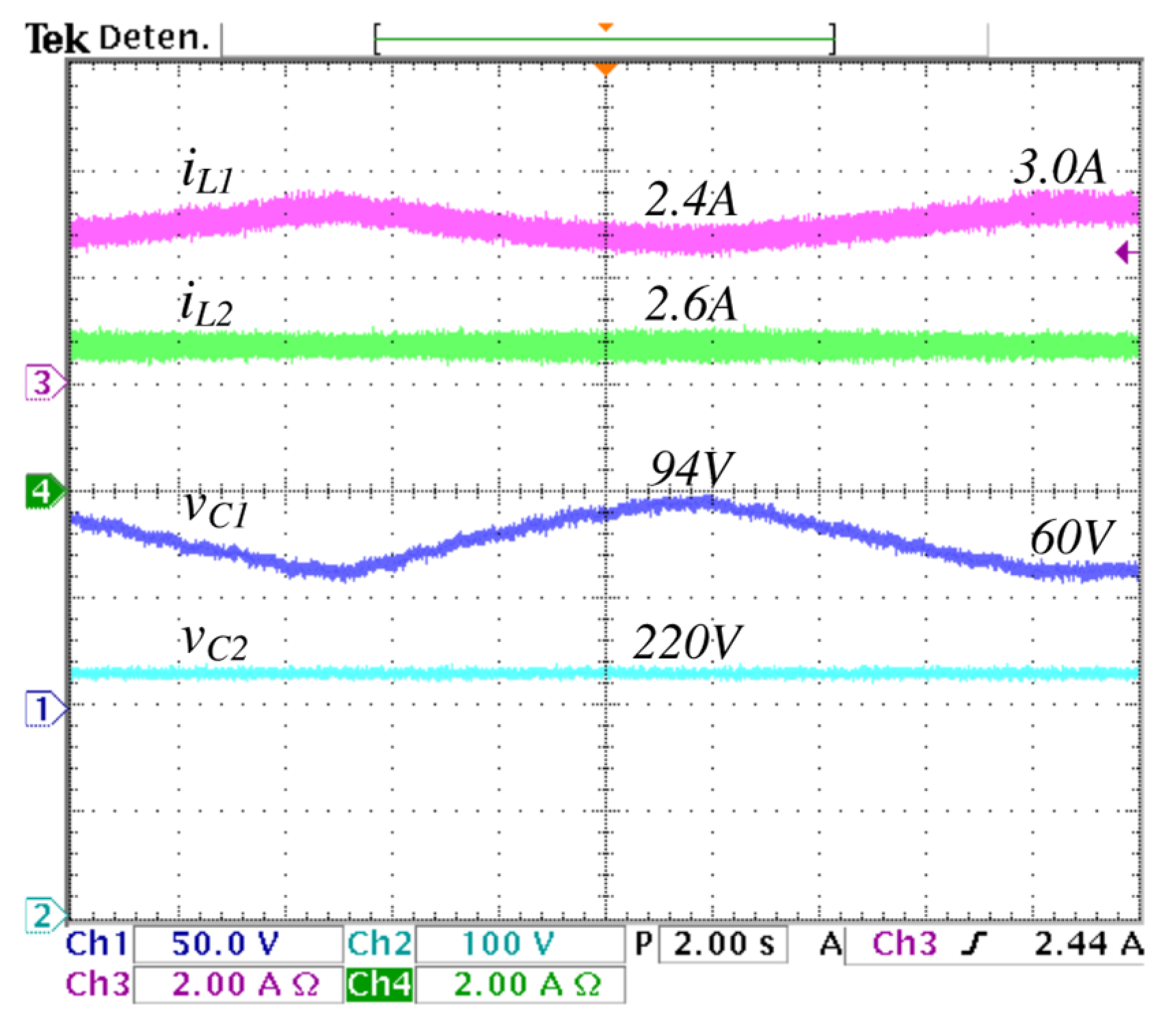
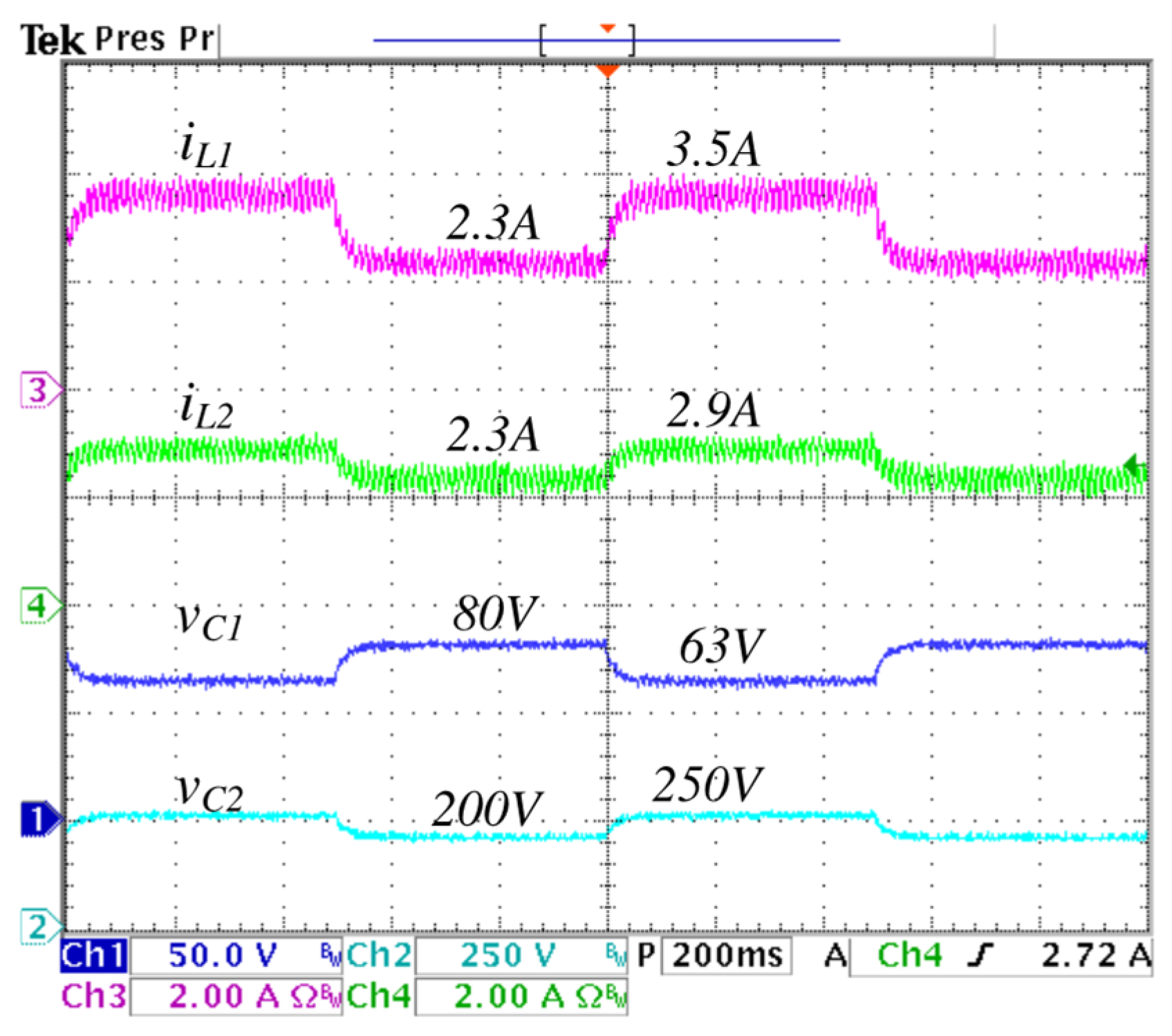
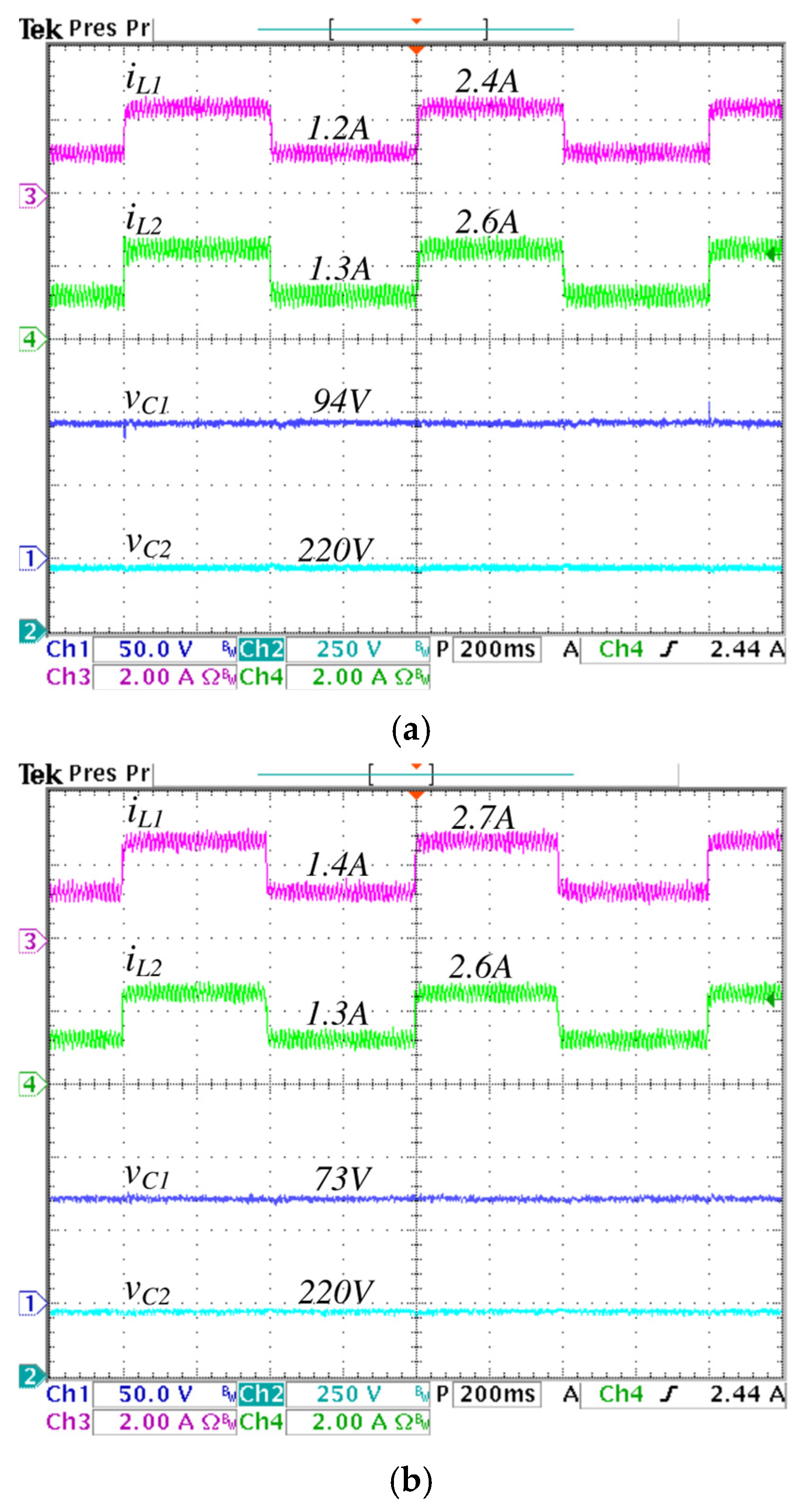
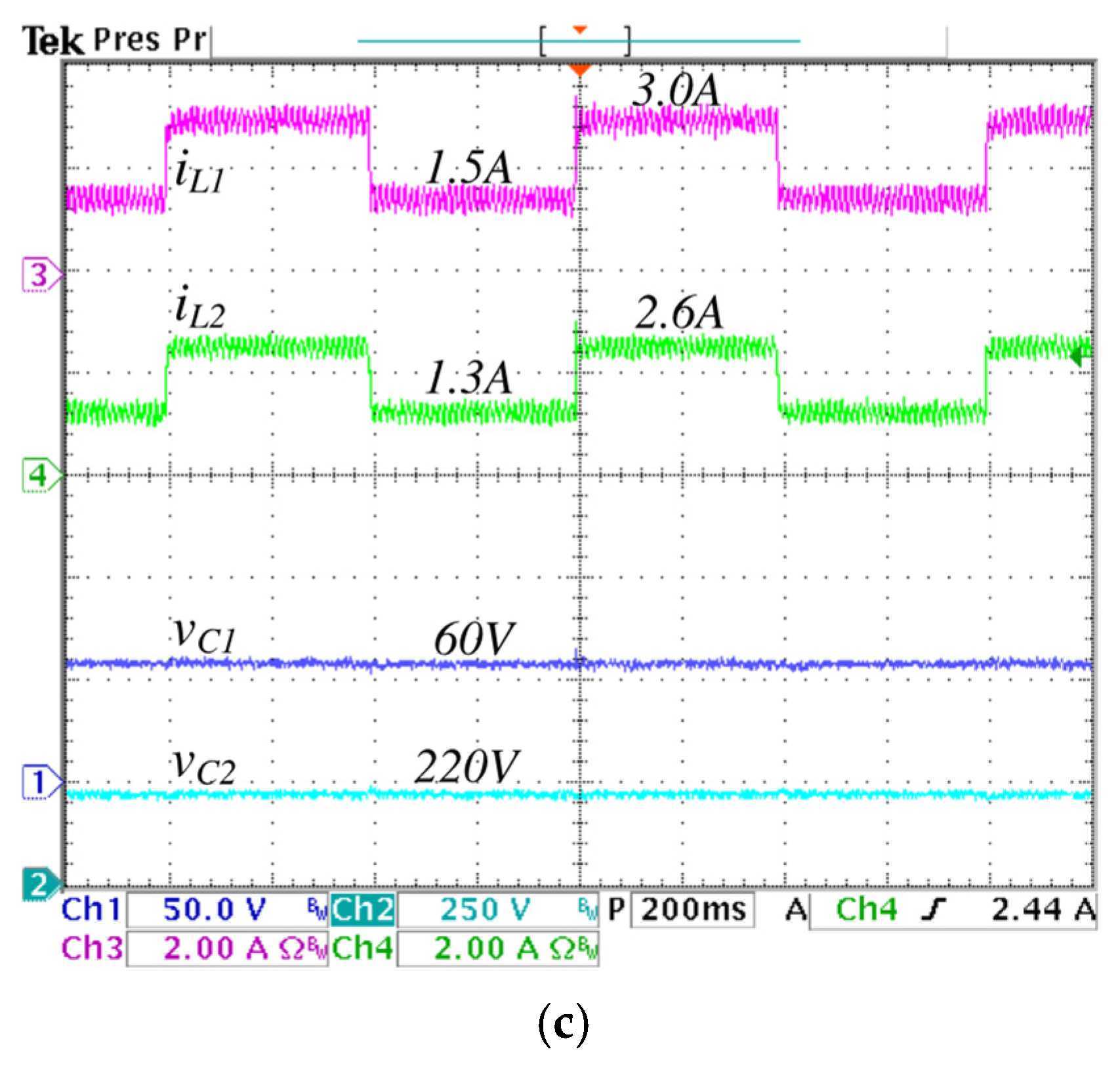
| 2.4 A | 2.4 A | 2.5 A | 3.0 A | 3.0 A | 3.1 A | |
| 2.6 A | 2.6 A | 2.6 A | 2.6 A | 2.6 A | 2.6 A | |
| 94 V | 94 V | 250 V | 60 | 60 | 200 V | |
| 220 V | 220 V | 220 V | 220 V | 220 V | 220 V | |
| Δ | 0.4 A | 0.4 A | 1 A | 0.48 A | 0.48 A | 0.9 A |
| Δ | 0.55 A | 0.55 A | 1 A | 0.4 A | 0.4 A | 1 A |
| 1.0 V | 2.4 V | 5.5 V | 1.4 V | 3.4 V | 6.2 V | |
| Δ | 0.7 V | 2.4 V | 5.5 V | 1.1 V | 3.4 V | 6.2 V |
| 312 V | 312 V | 472 V | 280 V | 280 V | 420 V | |
| Step-Down Mode | Step-Up Mode | |||
|---|---|---|---|---|
| APSMTO vs. STSS | APSMTO vs. AMTO | APSMTO vs. STSS | APSMTO vs. AMTO | |
| 62.4% | 0% | 70% | 0% | |
| 60% | 0% | 46.7% | 0% | |
| 45% | 0% | 60% | 0% | |
| 81.8% | 58.3% | 77.4% | 58.8% | |
| 87.3% | 70.8% | 82.2% | 67.6% | |
| 33.9% | 0% | 33.3% | 0% | |
Disclaimer/Publisher’s Note: The statements, opinions and data contained in all publications are solely those of the individual author(s) and contributor(s) and not of MDPI and/or the editor(s). MDPI and/or the editor(s) disclaim responsibility for any injury to people or property resulting from any ideas, methods, instructions or products referred to in the content. |
© 2026 by the authors. Licensee MDPI, Basel, Switzerland. This article is an open access article distributed under the terms and conditions of the Creative Commons Attribution (CC BY) license.
Share and Cite
Villanueva-Loredo, J.A.; Martinez-Rodriguez, P.R.; Rosas-Caro, J.C.; Rodriguez-Cortes, C.J.; Langarica-Cordoba, D.; Vazquez-Guzman, G. Ripple Minimization Method for a Modified Non-Inverting Buck–Boost DC–DC Converter. Technologies 2026, 14, 123. https://doi.org/10.3390/technologies14020123
Villanueva-Loredo JA, Martinez-Rodriguez PR, Rosas-Caro JC, Rodriguez-Cortes CJ, Langarica-Cordoba D, Vazquez-Guzman G. Ripple Minimization Method for a Modified Non-Inverting Buck–Boost DC–DC Converter. Technologies. 2026; 14(2):123. https://doi.org/10.3390/technologies14020123
Chicago/Turabian StyleVillanueva-Loredo, Juan Antonio, Panfilo R. Martinez-Rodriguez, Julio C. Rosas-Caro, Christopher J. Rodriguez-Cortes, Diego Langarica-Cordoba, and Gerardo Vazquez-Guzman. 2026. "Ripple Minimization Method for a Modified Non-Inverting Buck–Boost DC–DC Converter" Technologies 14, no. 2: 123. https://doi.org/10.3390/technologies14020123
APA StyleVillanueva-Loredo, J. A., Martinez-Rodriguez, P. R., Rosas-Caro, J. C., Rodriguez-Cortes, C. J., Langarica-Cordoba, D., & Vazquez-Guzman, G. (2026). Ripple Minimization Method for a Modified Non-Inverting Buck–Boost DC–DC Converter. Technologies, 14(2), 123. https://doi.org/10.3390/technologies14020123