Article

Single VDCC-Based Mixed-Mode First-Order Universal Filter and Applications in Bio-Signal Processing Systems


by
Pitchayanin Moonmuang
,
Natchanai Roongmuanpha
,
Worapong Tangsrirat
* and
Tattaya Pukkalanun
School of Engineering, King Mongkut’s Institute of Technology Ladkrabang (KMITL), Bangkok 10520, Thailand
*
Author to whom correspondence should be addressed.
Technologies 2026, 14(2), 101; https://doi.org/10.3390/technologies14020101
Submission received: 5 January 2026 / Revised: 24 January 2026 / Accepted: 2 February 2026 / Published: 4 February 2026
(This article belongs to the Section Information and Communication Technologies)

Abstract

This paper presents a compact mixed-mode first-order universal filter based on a single voltage differencing current conveyor (VDCC), which can function in all four possible operation modes, i.e., voltage mode (VM), trans-admittance mode (TAM), current mode (CM), and trans-impedance mode (TIM). The proposed configuration requires only two grounded resistors and one floating capacitor, which contributes to a low component count, facilitates integration, and allows for the electronic tunability of the pole frequency through the transconductance gain of the VDCC. This work also demonstrates two practical biomedical applications: an electrocardiogram (ECG) acquisition system utilizing the VM low-pass filter for noise suppression and a bioimpedance (BioZ) measurement system employing the proposed configuration-based CM oscillator circuit as a sinusoidal excitation source. The performance validation confirms the accuracy of impedance extraction and the preservation of waveforms using tissue-equivalent models. The results demonstrate that the proposed VDCC-based filter offers a compact, power-efficient, and versatile analog signal-processing solution suitable for modern biomedical instrumentation.

1. Introduction

The design of continuous-time analog filters remains a vital and challenging topic for research. Recently, universal active filter designs that provide the simultaneous implementation of several filtering functions—specifically low-pass (LP), high-pass (HP), and all-pass (AP) filters from a single topology—have garnered significant interest. These filters are widely utilized in instrumentation and control systems, sensor interfaces, and low-power electronic systems. Furthermore, they are very useful in bio-signal processing applications, such as electrocardiogram (ECG) acquisition systems, bioimpedance (BioZ) analyzers, and phase-sensitive detectors, owing to their versatility across different circuit configurations. In the design of high-order active filters of odd order, first-order universal filters are necessary. Consequently, considerable efforts have been aimed at the development of first-order universal filters utilizing various contemporary analog active building blocks [1,2,3,4,5,6,7,8,9,10,11,12,13,14,15,16,17,18,19,20,21,22,23,24,25,26,27].
The work given in [1] simultaneously realized LP, HP, and AP filter functions in voltage mode (VM) using two second-generation current conveyors (CCIIs), two floating resistors, two grounded resistors, and one grounded capacitor. For the realization of an AP filter, the circuit had to maintain an equal resistor state to ensure independent control of the pole frequency (fp). In [2], a single fully differential current conveyor (FDCCII), three resistors, and one grounded capacitor were employed to implement three different first-order filter designs. These designs had voltage inputs and voltage and current outputs, and they operated in VM and trans-admittance mode (TAM). The design in [3] described a versatile first-order current mode (CM) universal filter composed of two multiple-output CCIIs (MO-CCIIs), one grounded resistor, and one grounded capacitor. The given filter comprised one grounded capacitor, making it appropriate for integration technology. However, it did not feature electronic adjustment of its fp. A single differential voltage current conveyor (DVCC) containing two resistors and one grounded capacitor was utilized to implement a VM first-order universal filter, as detailed in [4]. There were numerous matching requirements for this circuit in the AP realization. Once more, in [5], a DVCC-based VM first-order universal filter structure using two DVCCs, one grounded resistor, and one grounded capacitor were reported. A first-order CM AP filter with amplitude equalization based on only one multi-output operational transconductance amplifier (MO-OTA) was described in [6]. Nonetheless, the circuits were incapable of providing all three first-order filter functions. The CM first-order universal filter in [7] was realized with one dual-X second-generation multi-output current conveyor (DX-MOCCII) and four passive elements. It still lacked the ability to electronically modify the fp. The previous comparable circuit in [8] suggested a CM first-order filter configuration employing two MO-CCIIs and all three grounded passive components to achieve low-input and high-output impedance features. The constraints on element matching were needed to facilitate the implementation of all three first-order filter functions. The construction of the VM first-order universal filter topology with one DVCC, one floating resistor, and one grounded capacitor was proposed in [9]. By choosing suitable input voltages, it could achieve all three first-order filter functions without necessitating component matching. As reported in [10], a first-order VM universal filter with digital programmability using a digitally controlled current conveyor (DPCCII) was developed. The implementation required three identical resistors and one grounded capacitor. According to [11], a CM first-order multifunction filter circuit was realized using a single current differencing buffered amplifier (CDBA), two resistors, and one grounded capacitor, which could synthesize LP and HP filter functions simultaneously. This structure did not utilize the full capacity of the CDBA device, as it did not utilize the terminal n. Furthermore, the circuit of [12] employed two dual-output CCIIs (DO-CCIIs), a floating resistor, and a grounded capacitor to develop the CM first-order universal filter. For this circuit, no matching constraint were used to derive LP, HP, and AP responses. In [13], a single configuration work for both inverting and non-inverting CM first-order LP, HP, and AP filters were presented using two inverting CCIIs (ICCIIs), one electronic MOS resistor, and a floating capacitor. The first-order CM and VM universal filters described in [14] and [15], respectively, required one active element and two passive grounded components. However, they possessed complicated internal architecture that included a minimum of 40 MOS transistors and a compensating capacitor and resistor. The electronic tunability of these circuits was also unfeasible. In [16], two different first-order VM filter structures were introduced. Each consisted of two voltage subtractors, one floating resistor, and one grounded capacitor. They needed no component matching constraints, but they lacked electronic control. A first-order CM filter structure, which was made up of a single extra-X current-controlled conveyor (EX-CCCII) and a single grounded capacitor, was introduced in [17]. The design provided low-input and high-output impedance while concurrently generating three current filter functions. None of the three implemented filter functions required matching requirements. The research in [18] described a first-order universal filter that could be controlled electronically. It had two operational transconductance amplifiers (OTAs), a grounded resistor, and a grounded capacitor, with both input and output impedances being ideal and infinite. The work, however, achieved VM filter functionality only for AP filters. Two circuit topologies for first-order filters were suggested in [19]. The first employed one multiple-output dual-X current conveyor transconductance amplifier (MO-DXCCTA), three identical transconductors, and one capacitor to carry out CM filter functions. The second filter required a MOSFET, a grounded capacitor, and one DXCCTA to perform three TAM filter functions. Based on a single modified DXCCTA, a first-order generic CM filter circuit has recently been presented in [20]. The circuit featured electronic tunability, easy cascadability, and low-voltage operation. However, it was non-canonical with respect to the capacitors. The resistorless implementation in [21] addressed the first-order CM universal filter with a differential difference dual-X second-generation current conveyor (DD-DXCCII), a grounded capacitor, and four MOSFETs. It required component-matching conditions for the implementation of all three CM filter responses. First-order LP, HP, and AP filters operating in CM were introduced in [22] and [23], each utilizing two active components, a resistor, and a capacitor. The work in [22] used MO-CCIIs as the active components, whereas [23] employed plus-type inverting current conveyors (ICCII+s) for its active components. Conversely, a configuration from [24] involved designing a VM electrically tunable first-order universal filter using the readily available LT1228 IC. It comprised a single LT1228 IC along with two floating resistors and a floating capacitor. In [25], five designs of first-order universal filters were presented, consisting of two current feedback operational amplifiers (CFOAs), along with three or four resistors and a grounded capacitor. Two of the five circuits needed specific criteria to achieve HP function, whereas all five circuits needed matching criteria for realizing the AP function. The presented filters provided filtering functionality in all four modes; however, the filter parameters were not electronically modifiable. As demonstrated in the fully differential configuration from [26], it used only one multiple-output current differencing transconductance amplifier (MO-CDTA) and one capacitor to implement first-order LP, HP, and AP filter current responses. A recent report in [27] described a mixed-mode first-order universal filter with electronic tunability. The realization required three OTAs and one grounded capacitor to obtain all three first-order generic filter functions across four operation modes.
The voltage differencing current conveyor (VDCC) has emerged as a promising active building block that enhances the functionality of conventional current conveyors. It offers increased adaptability for analog signal processing applications, including filters, oscillators, and impedance converters [28]. Owing to its high bandwidth, low power consumption, and ability to process both voltage and current, the VDCC is particularly well-suited for implementing compact, electronically tunable analog building blocks. Although various VDCC-based filters and oscillators have been reported, the realization of a simple mixed-mode first-order universal filter using only one VDCC and minimal passive components has not been sufficiently explored. Therefore, the above critical review inspired the authors to develop a minimum-component mixed-mode first-order universal filter based on a single VDCC. The filter supports VM, CM, TAM, and trans-impedance mode (TIM) operations while employing only two grounded resistors and one capacitor, yielding an easy layout for integrated circuit fabrication. By relying on a single active element, the design simplifies the overall topology while retaining full multi-mode functionality, which is rare in comparable designs. The pole frequency can be electronically controlled through the VDCC transconductance gain, which enhances flexibility in practical design. To validate the usefulness of the proposed configuration, two biomedical applications are demonstrated: an ECG acquisition system using the VM low-pass filter for noise reduction and a BioZ measurement interface utilizing the CM oscillator configuration as a sinusoidal excitation source. Both PSPICE simulation results based on 0.13-μm IBM process parameters and practical measurement scenarios confirm the accuracy, robustness, and low-power performance of the proposed design.
Accordingly, to explicitly summarize the main technical contributions of the proposed work, the following can also be highlighted:
(i)
The development of a mixed-mode first-order universal filter that utilizes only a single VDCC along with a minimum number of passive components.
(ii)
The capability of a single topology to simultaneously facilitate VM, TAM, CM, and TIM operations.
(iii)
The electronic tunability of the pole frequency via VDCC transconductance without requiring component matching in both VM and TAM modes.
(iv)
The exploration of practical biomedical applications, including ECG signal conditioning and BioZ excitation.
The remainder of this paper is structured as follows: Section 2 introduces the proposed mixed-mode first-order universal filter and presents its theoretical formulation along with the analyses of non-ideal factors; Section 3 provides simulation results generated using the PSPICE program; Section 4 demonstrates a dual-mode sinusoidal oscillator circuit derived from the proposed filter; Section 5 explores the application of the proposed circuit in the ECG and BioZ measurement systems; and, finally, Section 6 concludes the key findings of this work.

2. The Proposed Mixed-Mode First-Order Universal Filter Configuration

In the proposed design, the VDCC served as an active component. The symbolic circuit representation of the VDCC is illustrated in Figure 1, with the corresponding description matrix expressed as:
i p i n i z v x i w p i w n = 0 0 0 0 0 0 0 0 g m g m 0 0 0 0 1 0 0 0 0 1 0 0 0 1 v p v n v z i x .
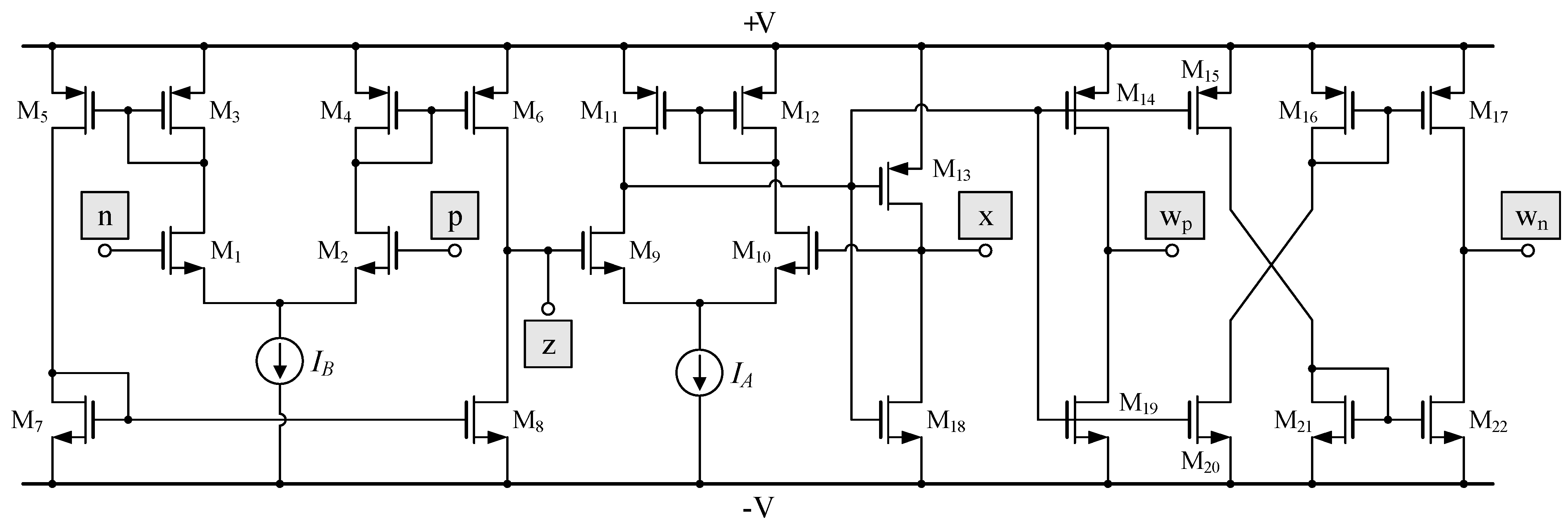
The parameter gm in Equation (1) represents the transconductance gain of the amplifier, which is generally regulated through electronic methods. Based on the definition matrix of Equation (1), the implementation of the VDCC using the CMOS technology is given in Figure 2. The realized gm of the CMOS VDCC can be electronically modified using the balanced output OTA (M1–M8). This adjustment is determined in the following manner [29]:
g m = K n W L I B ,
where Kn = μnCox, μn denotes the channel carrier mobility, Cox indicates the per-unit-area gate-oxide capacitance, and IB represents the external DC bias current. Additionally, (W/L) refers to the width-to-length ratio of transistors M1 and M2.
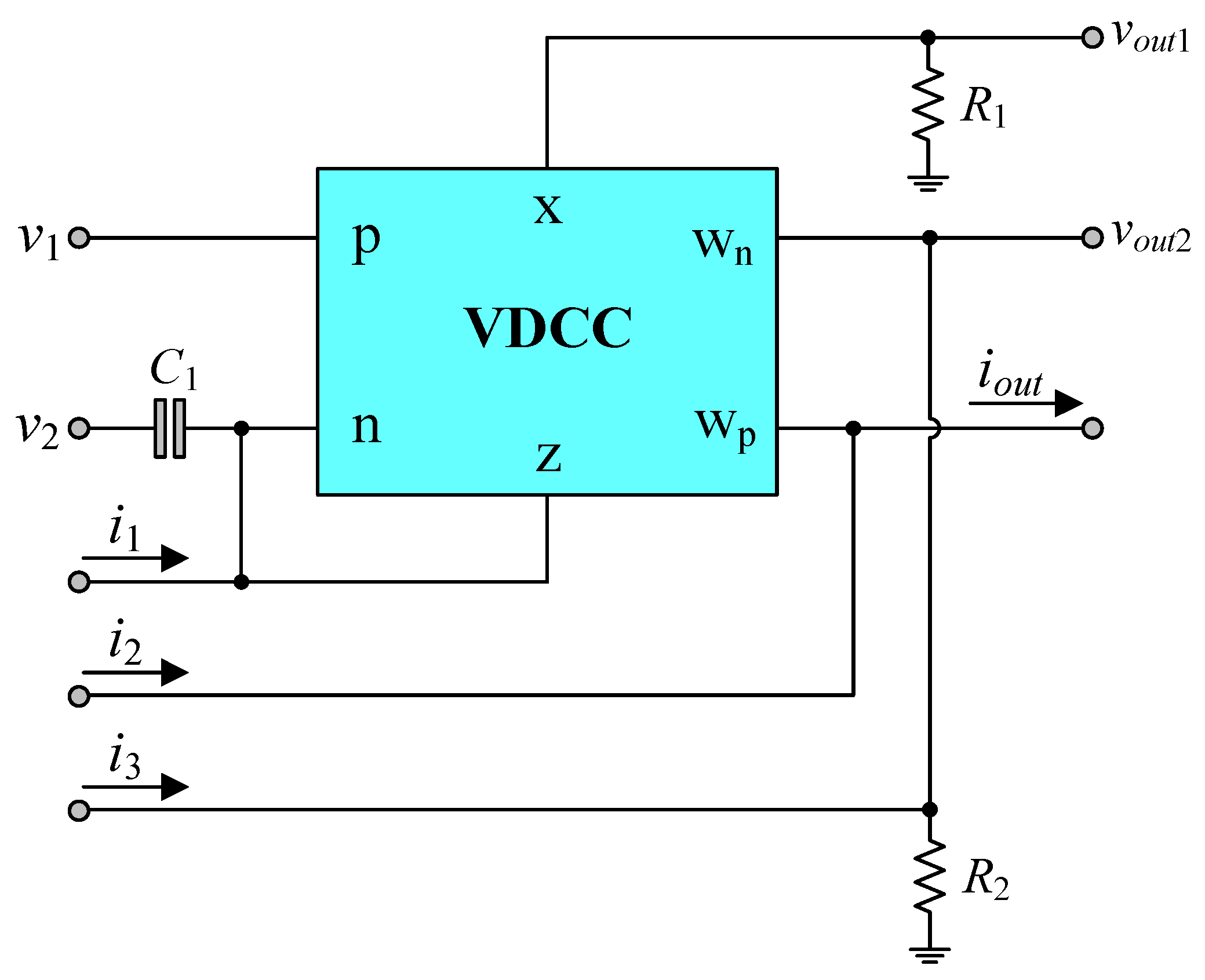
Utilizing the VDCC as an active element, the proposed mixed-mode first-order universal filter can be implemented with two grounded resistors and one capacitor as depicted in Figure 3. It is important to note that, with the appropriate selection of input and output signals, the circuit can operate as a mixed-mode, first-order multi-function filter with the same circuit design. Assuming ideal circumstances and disregarding tracking errors and parasitic impedances of the VDCC, the circuit analysis of Figure 3 provides the following details for VM, TAM, CM, and TIM.

2.1. VM and TAM First-Order Universal Filters

To generate VM and TAM filter responses, the input currents i1, i2, and i3 were set at zero (open circuit). The two input voltages v1 and v2 were set as detailed in Table 1. The filter outputs were derived from vout1 for VM and iout for TAM. The transfer functions for the VM and TAM of the two-input two-output first-order multi-function filter can be expressed as follows:
VM ; v o u t 1 = s C 1 v 2 + g m v 1 s C 1 + g m ,
and
TAM ; i o u t = 1 R 1 s C 1 v 2 + g m v 1 s C 1 + g m .
Therefore, the corresponding pole frequency (ωp) of the realized filter in Figure 3 can be given by:
ω p = 2 π f p = g m C 1 .
Further examination of Equations (3) and (4) indicates that all three standard first-order filters, i.e., LP, HP, and AP, can be obtained in both VM and TAM with passband gains of unity and (1/R1), respectively. Additionally, the relationship outlined in Equation (5) describes that the frequency ωp of the proposed filter is electronically controllable through the transconductance gain (gm) of the VDCC. In both realizations, there was no need for matching circuit components.

2.2. CM and TIM First-Order Universal Filters

The proposed mixed-mode first-order universal filter circuit in Figure 3 can also be operated in CM and TIM by setting v1 = v2 = 0 (ground potential connected). The CM filter output is taken from the iout terminal, whereas the output for the TIM filter is obtained from the vout2 terminal. The signal currents i1, i2, and i3 are injected into the filter as specified in Table 2. Consequently, this configuration produces two distinct output responses for the CM and TIM, respectively:
CM ; i o u t = s C 1 + g m i 2 + g m i 1 s C 1 + g m ,
and
TIM ; v o u t 2 = R 2 s C 1 + g m i 3 g m i 1 s C 1 + g m .
Table 2 demonstrates that the proposed circuit achieved the CM filter functions with a passband gain of unity. In contrast, the TIM filter functions for LP, HP, and AP first-order responses exhibited a passband gain of R2. For both operational modes, it was necessary to keep a simple component matching constraint of gmR1 = 1.

2.3. Non-Ideal Gain Effects

In case of the non-ideal behavior, the characteristic equation of the VDCC was modified as follows:
i p i n i z v x i w p i w n = 0 0 0 0 0 0 0 0 α g m α g m 0 0 0 0 β 0 0 0 0 γ p 0 0 0 γ n v p v n v z i x ,
where α represents the non-ideal transconductance gain, β denotes the non-ideal transfer voltage gain, and γp and γn indicate the non-ideal transfer current gains of the VDCC. Ideally, these transfer gains are all equal to unity (α = β = γp = γn = 1). Thus, when analyzing the filter transfer functions with these non-ideal gains taken into consideration, the output voltages and currents of the proposed circuit depicted in Figure 3 would be altered in each mode to:
VM ; v o u t 1 = β s C 1 v 2 + α g m v 1 s C 1 + α g m ,
TAM ; i o u t = β γ p R 1 s C 1 v 2 + α g m v 1 s C 1 + α g m ,
CM ; i o u t = s C 1 + α g m i 2 + β γ p g m i 1 s C 1 + α g m ,
and
TIM ; v o u t 2 = R 2 s C 1 + α g m i 3 β γ n g m i 1 s C 1 + α g m .
Equations (9)–(12) indicate that the non-ideal transfer gains of the VDCC directly influence the derived transfer functions of the proposed circuit. Consequently, the non-ideal dependencies for each filter mode can be summarized in Table 3. As described in the four transfer functions, the modified pole frequency of the universal filter affected by the non-ideal gains can be expressed as:
ω p = 2 π f p = α g m C 1 .
It can be concluded that the pole frequency of the filter shows a slight deviation from the theoretical value derived from the non-ideal parameter α. Also note that this deviation can be mitigated and adjusted through the pre-distortion value of gm.

2.4. Parasitic Element Effects

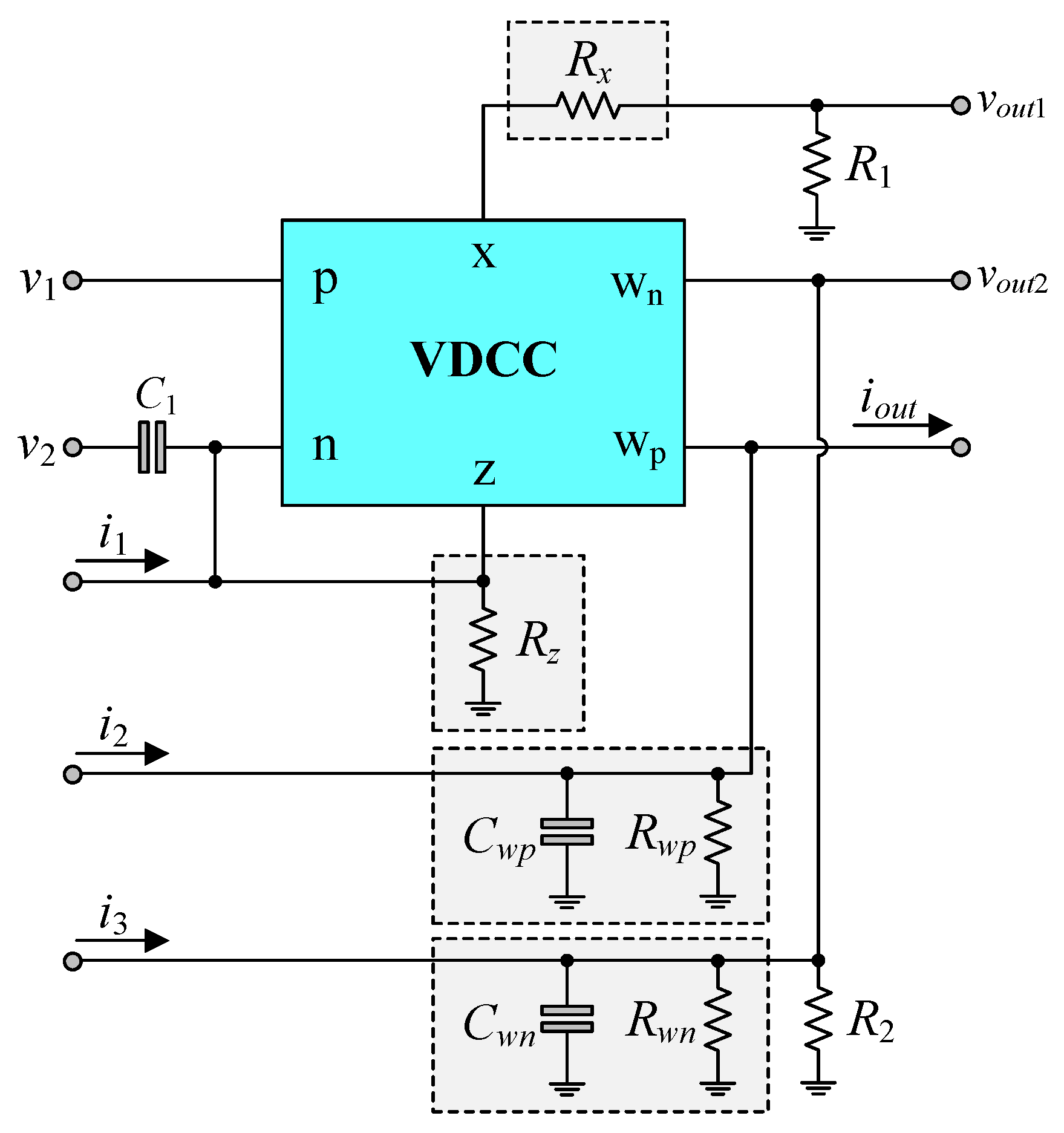
Next, the proposed mixed-mode first-order universal filter shown in Figure 3 was analyzed in terms of the effects of VDCC terminal parasitics. In the CMOS VDCC structure in Figure 2, a low-value parasitic resistance (Rx) was connected in series with the x terminal, while a high-value parasitic resistance (Rwp) and a low-value parasitic capacitance (Cwp) were arranged in parallel between the wp terminal and the ground [28]. Additionally, high-value resistance (Rwn) and low-value capacitance (Cwn) were also configured in parallel between the wn terminal and the ground. Furthermore, a grounded high-value parasitic resistance (Rz) was located at the z terminal. Figure 4 presents the proposed filter configuration, which accounts for VDCC terminal parasitics.
Considering the effect of the VDCC parasitic impedance on the proposed mixed-mode first-order filter shown in Figure 4, the expression of the non-ideal pole frequency (ω″p) in this case was determined as:
ω p = 2 π f p = g m + 1 R z C 1 .
Moreover, the impact of the low-serial parasitic resistance Rx can be absorbed with the external resistor R1. Additionally, at the terminal wn, the resistor R2 was connected in parallel with a high-value parasitic resistance Rwn. As a result, the merging of Rwn with R2 eliminated its influence. Therefore, we could significantly reduce the influence of parasitic elements by adhering to the following component selections:
min g m > > 1 R z ,
min {R1} >> parasitic resistance Rx,
and
max {R2} << parasitic resistance Rwn.
The presence of these parasitics has also introduced two undesirable dominant poles that limited the effective frequency range of the filter. The non-ideal pole frequencies of the proposed mixed-mode first-order universal filter circuit in Figure 3 have been evaluated and are described as follows:
ω 1 = 1 R z C 1 ,
and
ω 2 = 1 R 2 / / R w n C w n .
To achieve the proper frequency operation, the filter circuit should function at a frequency that is greater than ω1 and less than ω2. Therefore, the useful frequency region for the suggested filter circuit in Figure 3 was defined as follows:
max ω 1 < < ω < < min ω 2 .

3. Performance Verification

In this section, the proposed circuit in Figure 3 was subjected to performance verification through simulation using the PSPICE program, which employed 0.13-μm IBM model parameters. The simulation included the CMOS VDCC shown in Figure 2 with the transistor aspect ratios specified in Table 4. The symmetrical supply voltages, +V and −V, used for biasing the VDCC were set to ±0.5 V.
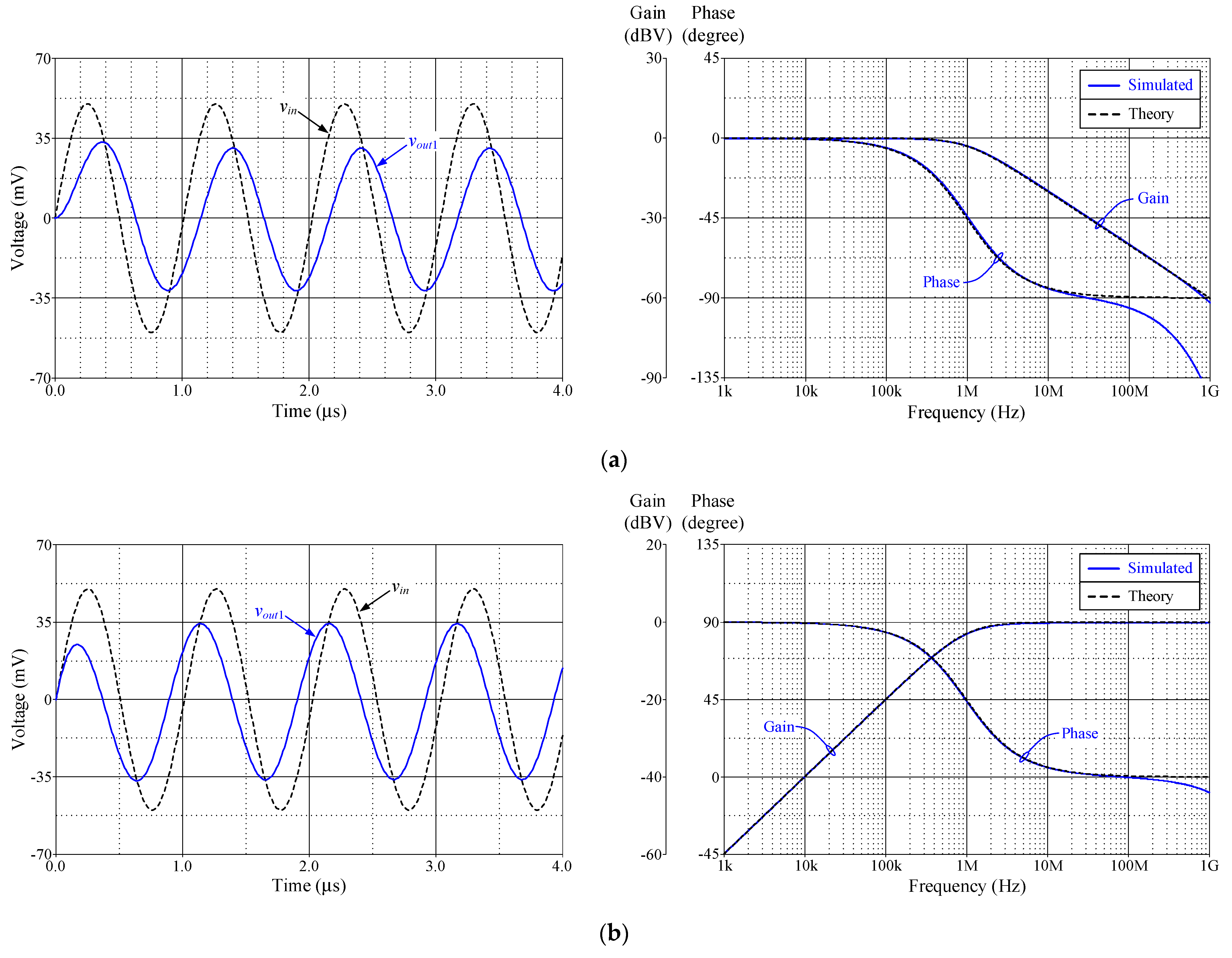
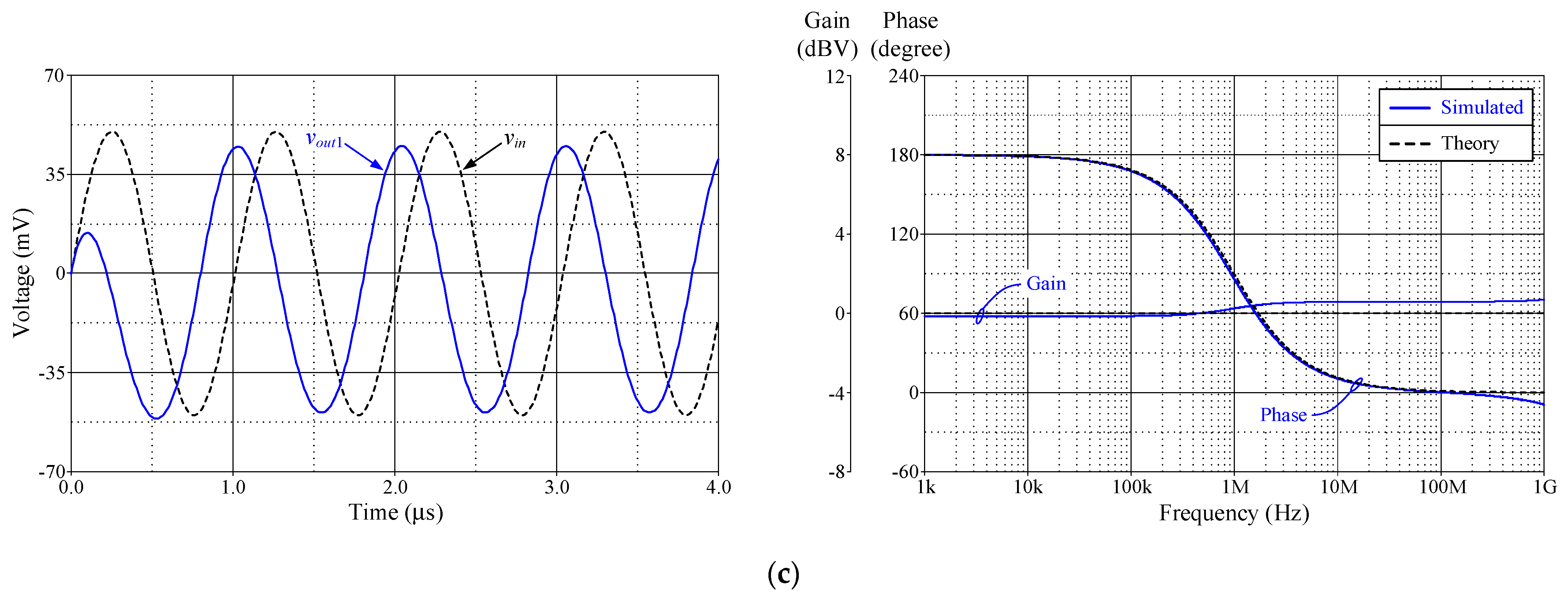
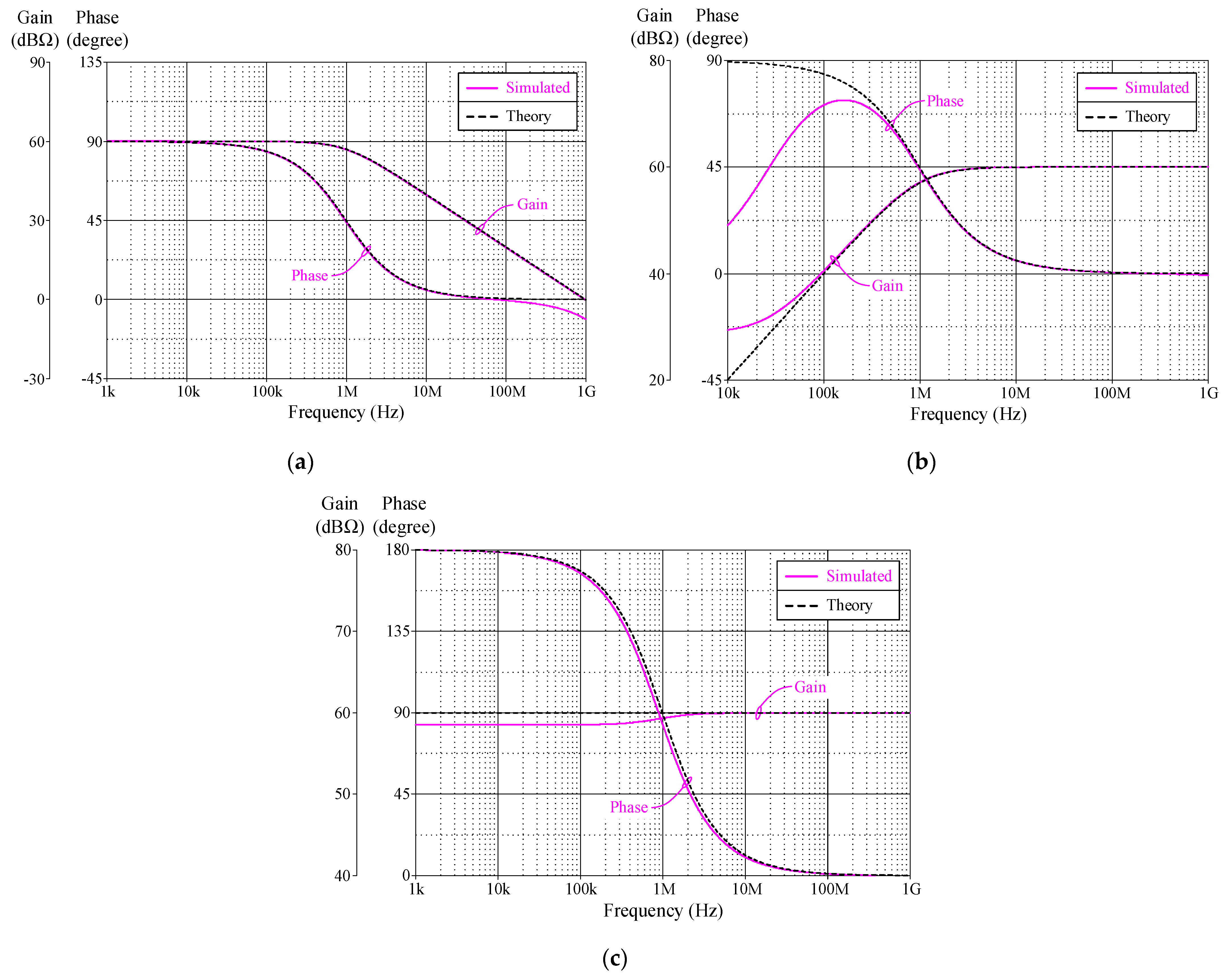
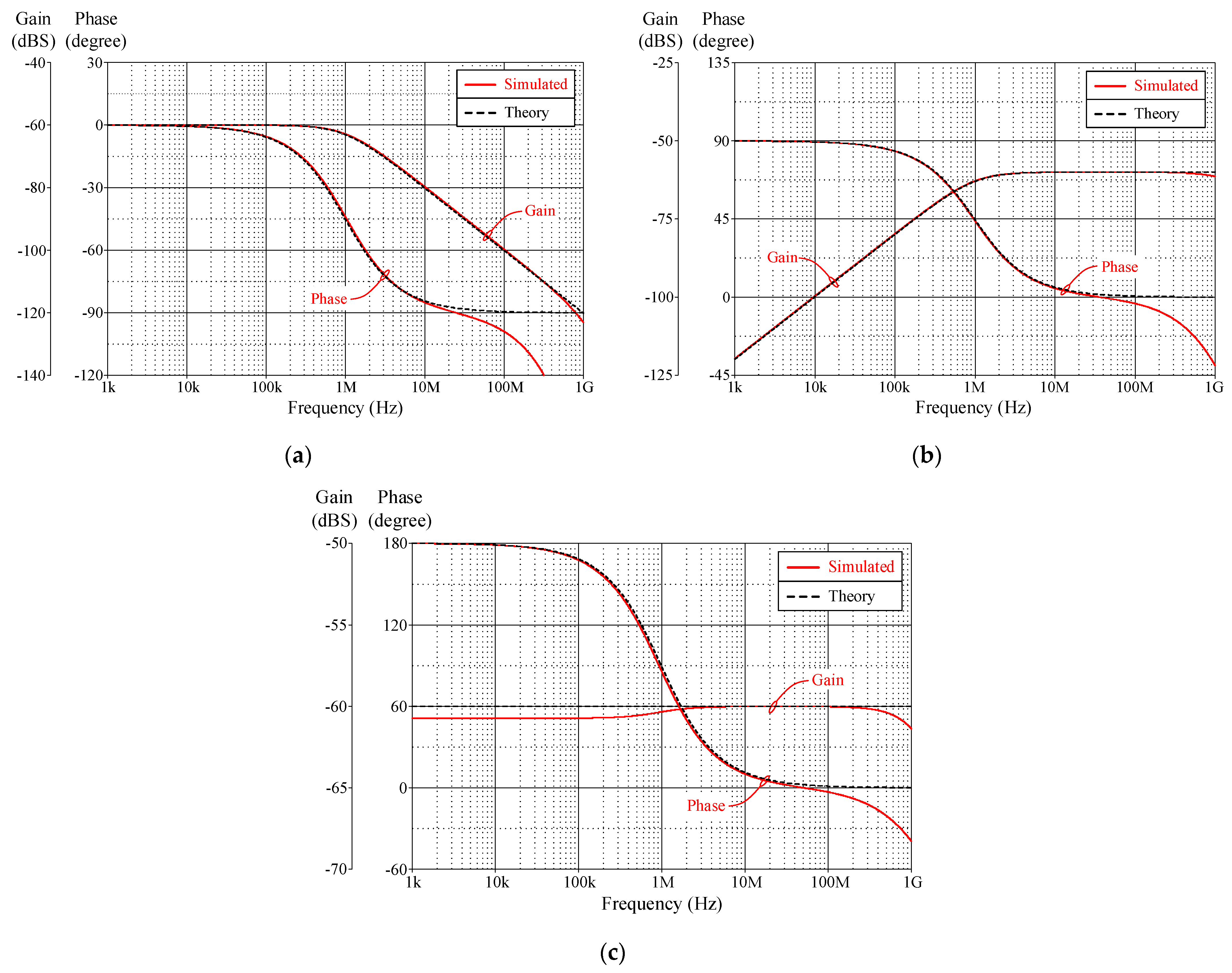
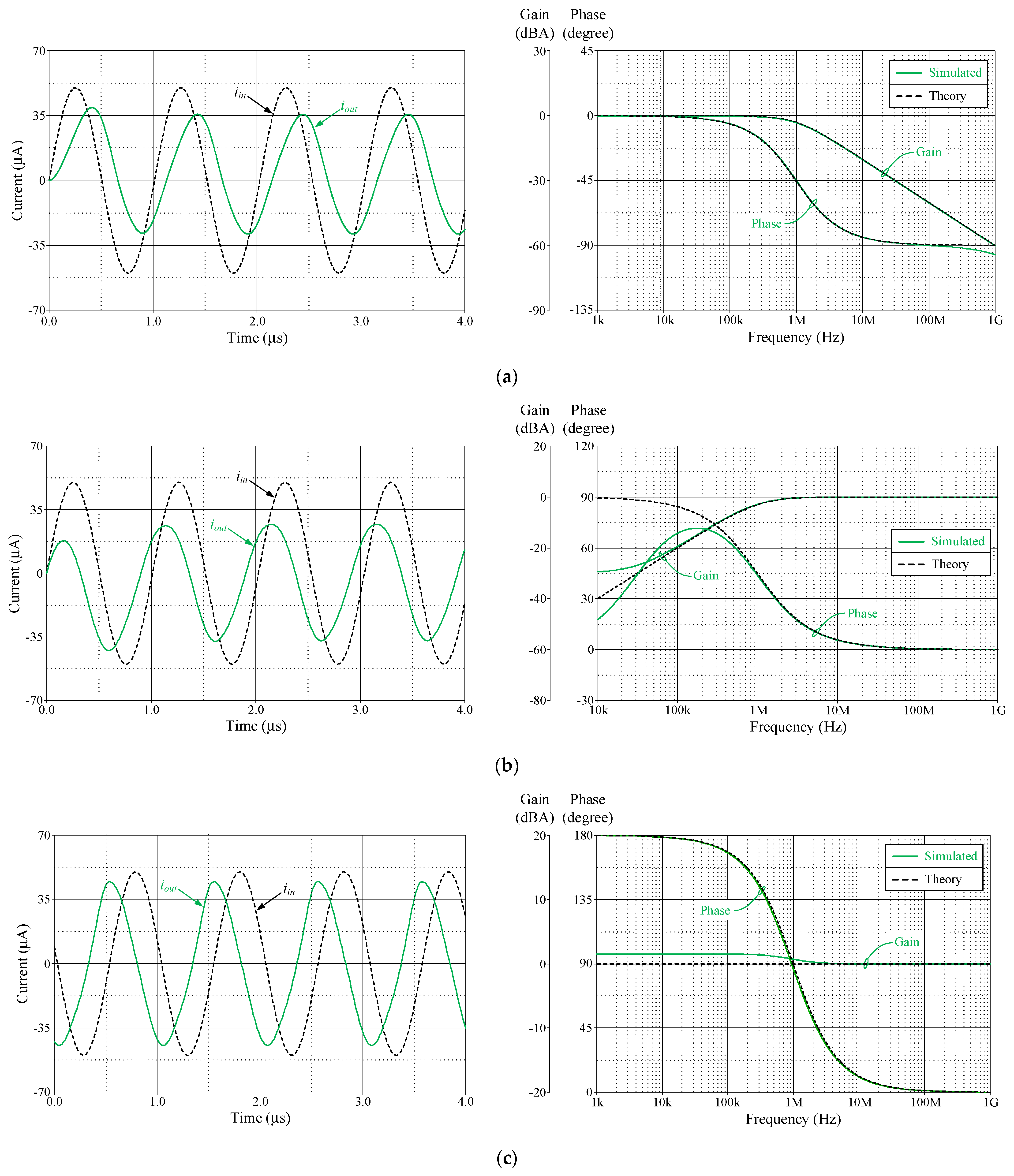
The expected and simulated results are shown in Figure 5, Figure 6, Figure 7 and Figure 8. The proposed filter was designed for a pole frequency of fp = 987 kHz using the following components: gm = 124 μA/V (IB = 10 μA), R1 = 8 kΩ, R2 = 1 kΩ, and C1 = 20 pF. Figure 5 illustrates the transient and frequency responses of the proposed VM filter, including LP, HP, and AP responses, whereas Figure 6 depicts the frequency response for the proposed TAM filter. The slight deviation from the exact unity gain observed in Figure 5c is mainly attributed to the non-ideal characteristics of the VDCC, including finite transconductance accuracy, non-unity voltage and current transfer gains, and the influence of parasitic elements inherent in the CMOS implementation. These effects were explicitly analyzed in Section 2.3 and Section 2.4. Importantly, the all-pass phase response, which was the primary functional objective of the AP filter, remained in close agreement with theoretical expectations. For transient response analysis, a sinusoidal signal with a peak voltage of 50 mV at 987 kHz was applied to the filter. In contrast, Figure 7 and Figure 8 present the proposed filter responses in cases of the CM and TIM, respectively. The close alignment between simulation results and theoretical predictions validated the practical performance of the circuit. As measured in simulation, the proposed circuit showed a maximum power consumption of 0.25 mW when the bias current was set to IA = IB = 10 μA.
To evaluate the linearity performance of the proposed VDCC-based VM filter, a total harmonic distortion (THD) analysis was carried out. Time-domain simulations were performed using a sinusoidal input signal at the pole frequency with various input voltage amplitudes. The THD values were extracted and provided in Table 5. For a peak-to-peak input amplitude of 20 mV, the simulated THD was found to be approximately 0.32%, indicating a highly linear operation. When the input amplitude was increased to 60 mV (p-p), the THD increased slightly to 1.10%, while for 100 mV(p-p) it reached 1.92%. These results demonstrated that the proposed filter maintained good linearity over a practical input signal range.
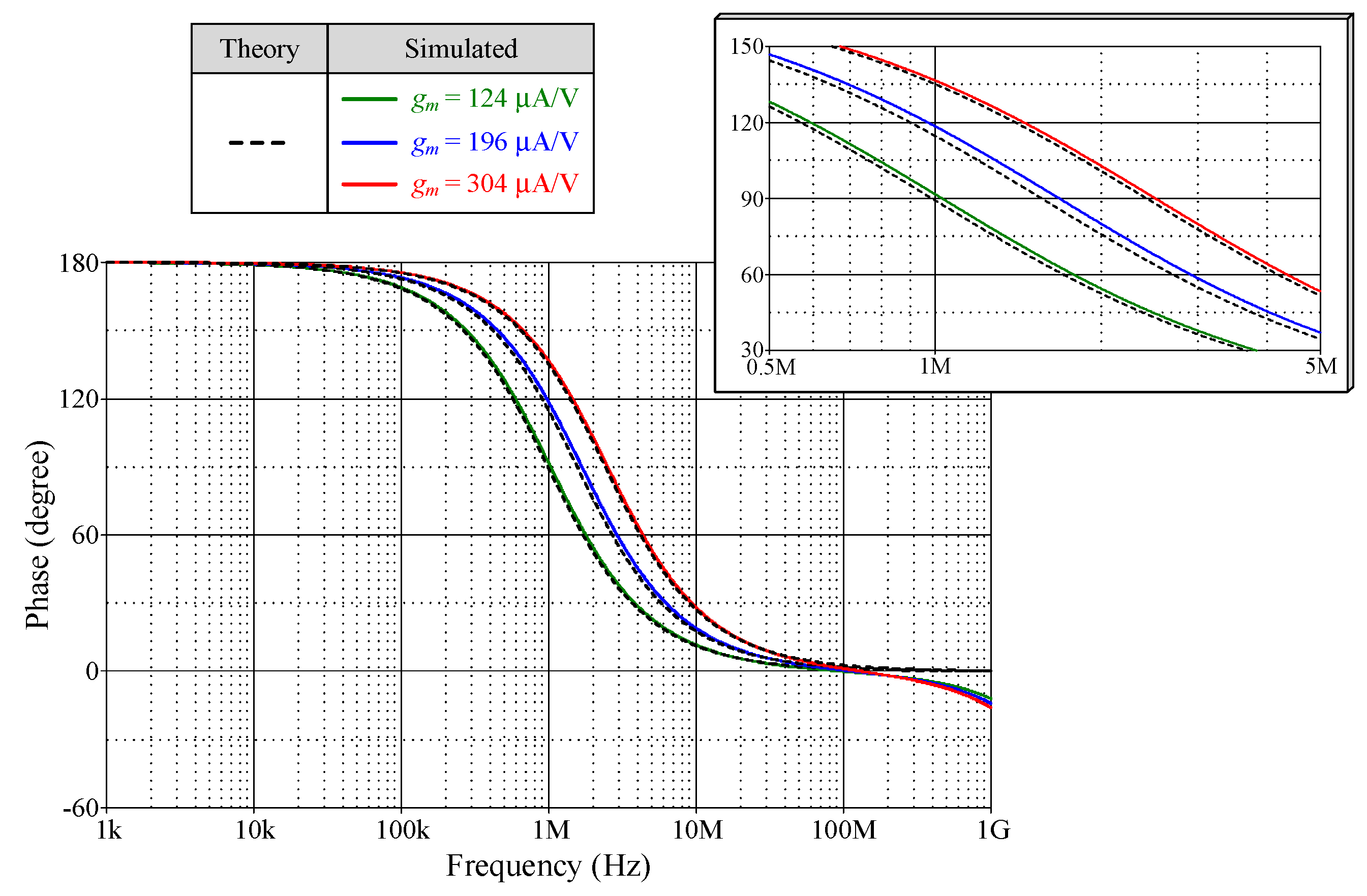
The proposed AP filter in VM depicted in Figure 3 was also simulated for various transconductance values of gm = 124 μA/V, 196 μA/V, and 304 μA/V (IB = 10 μA, 25 μA, and 60 μA), which ideally correspond to pole frequency values of fp = 987 kHz, 1.56 MHz, and 2.42 MHz, respectively. The resultant phase responses are shown in Figure 9, with the simulated fp values recorded at 1.03 MHz, 1.68 MHz, and 2.51 MHz. These values reflected relative deviations of 4.26%, 7.75%, and 3.97%, respectively, in comparison to the theoretical values.
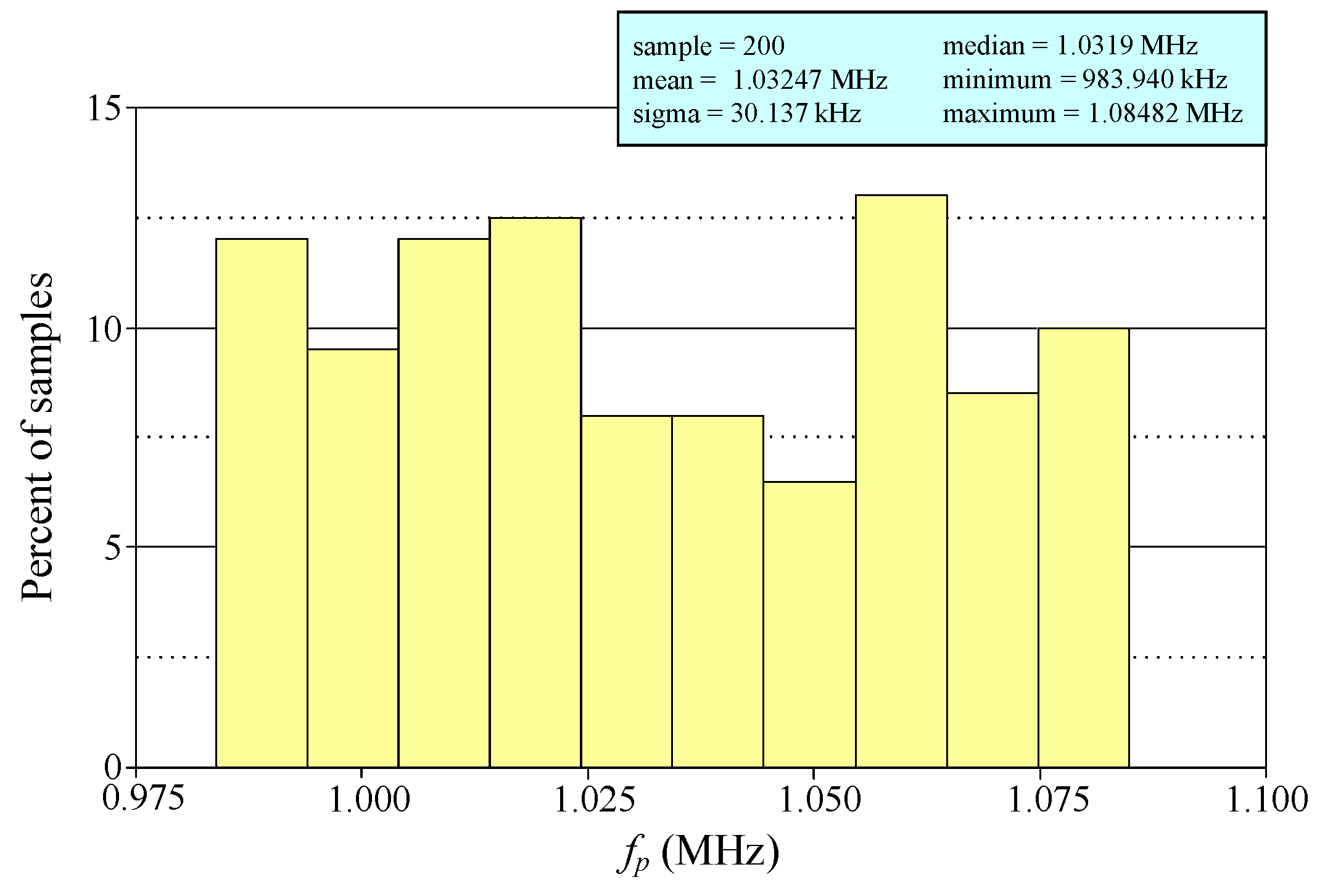
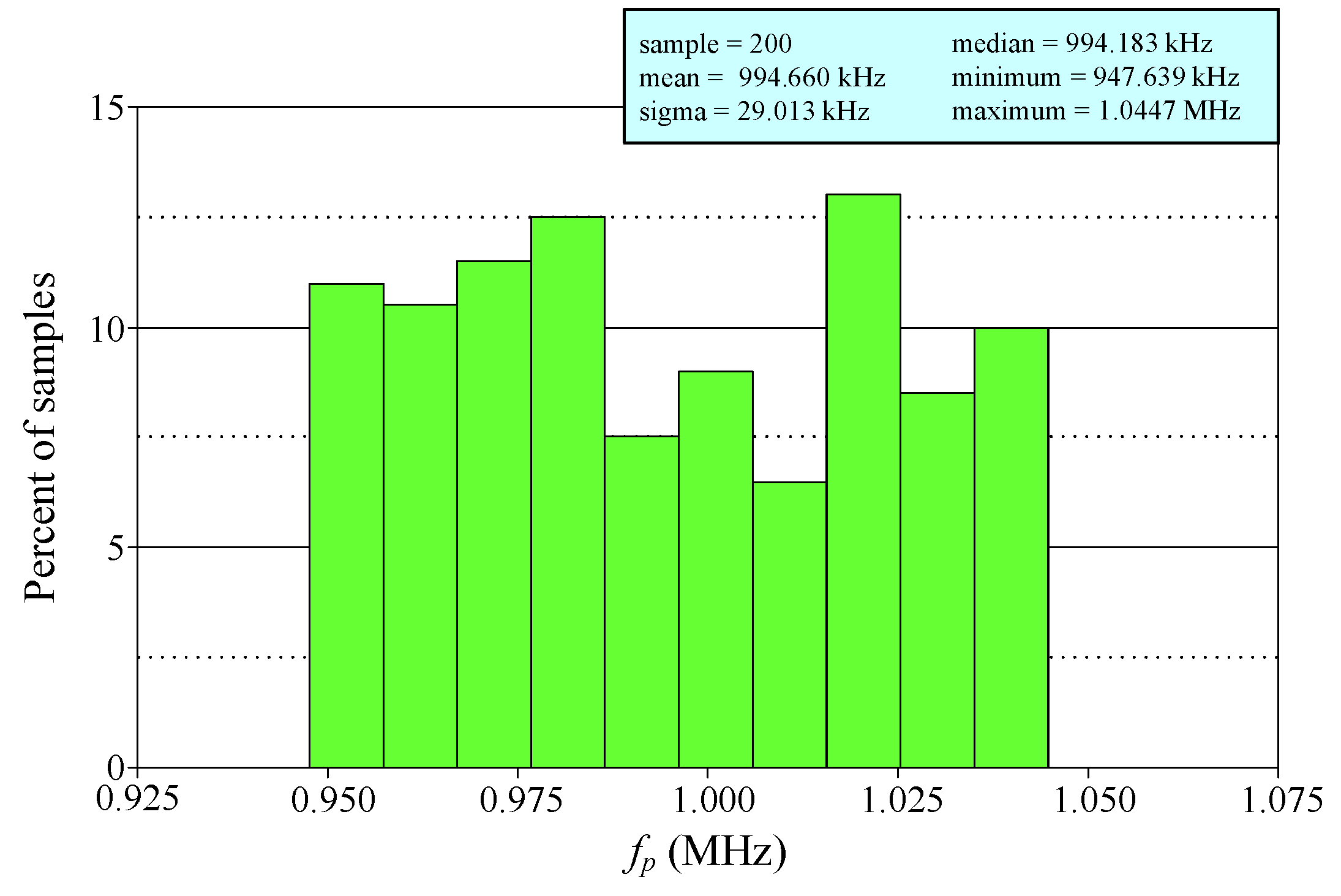
To evaluate the performance of the proposed circuit in relation to process variations, a Monte Carlo (MC) statistical analysis was conducted with 200 simulation runs, focusing on the 5% deviation in values of gm, R1, R2, and C1. The histogram resulting from the MC simulation for the VM LP gain response is presented in Figure 10, while the histogram for the VM HP gain response is illustrated in Figure 11. The findings of the MC analysis indicated the robustness of the proposed configuration in the presence of mismatches.
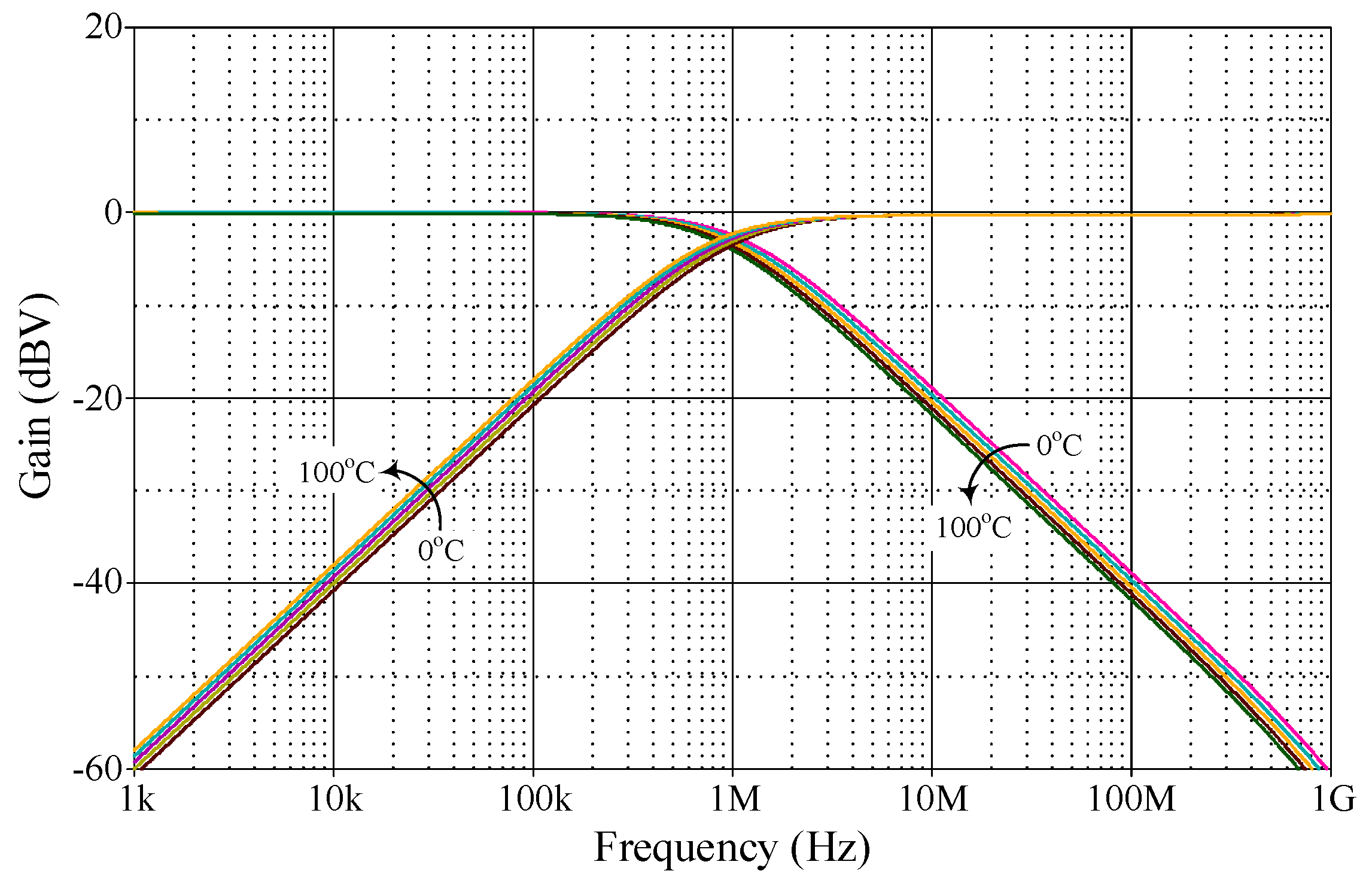
A further investigation was conducted into the influences of temperature variations on filter performance. In order to achieve this, a simulation of the suggested filter was performed using ambient temperature fluctuations varying from 0 °C to 100 °C in increments of 25 °C. Figure 12 shows the variations in the gain response for both LP and HP filters during the VM operation. According to the findings, the passband gain for the LP filter varied from 0.902 dBV to 0.893 dBV at varying temperatures, while for the HP filter, it spanned from 0.181 dBV to 0.228 dBV.

4. Dual-Mode Sinusoidal Oscillator Realization Using the Proposed Mixed-Mode First-Order Universal Filter

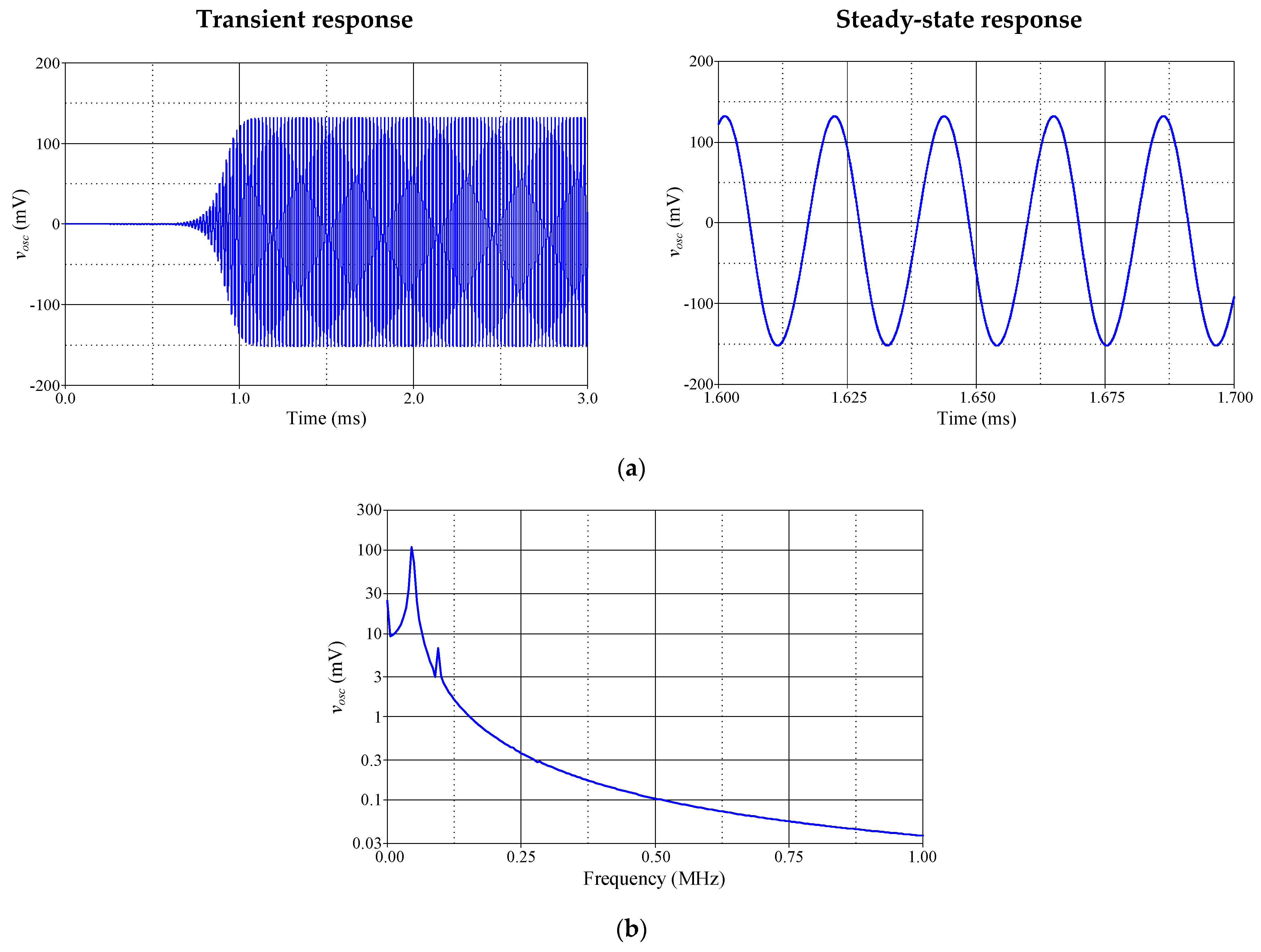
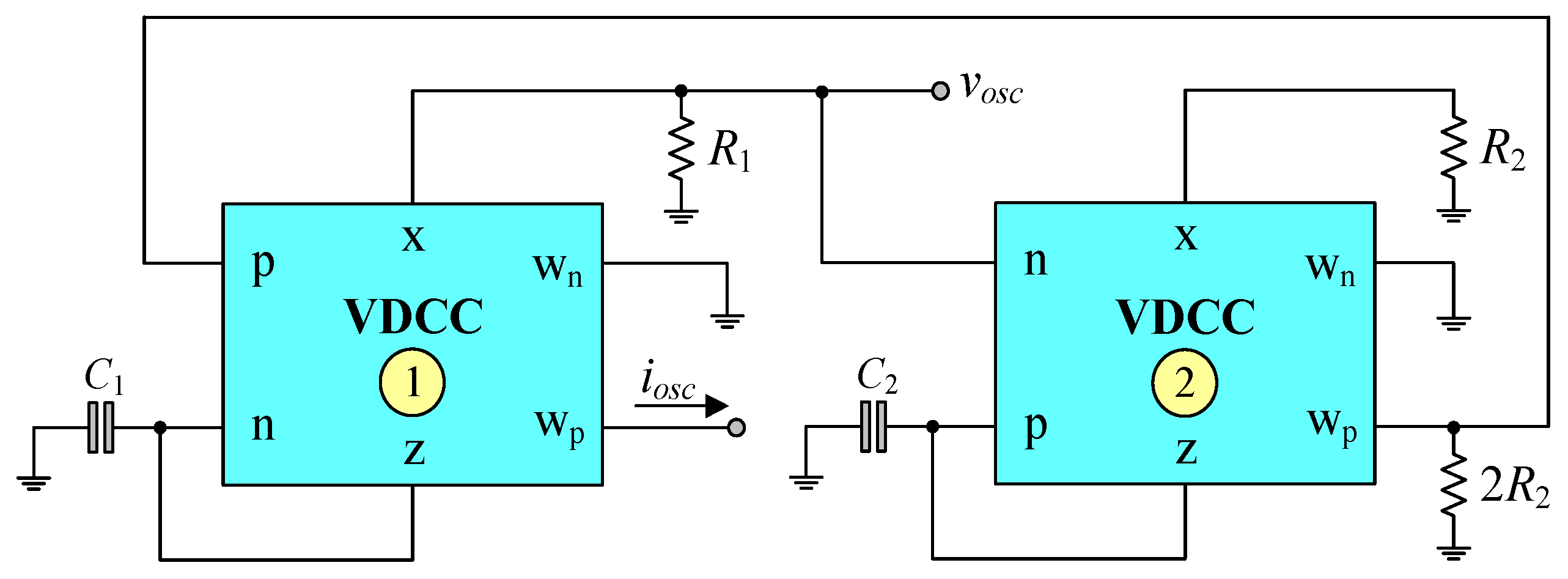
Figure 13 presents a simple circuit realization of the dual-mode sinusoidal oscillator, which simultaneously generates both a voltage output (vosc) and a current output (iosc). This configuration comprises the cascade connection of two identical mixed-mode first-order universal filters, as shown in Figure 3. The characteristic equation can be expressed in the following form:
s 2 + g m 1 C 1 g m 2 C 2 s + g m 1 g m 2 C 1 C 2 = 0 .
In this context, gmi (where i = 1, 2) denotes the transconductance parameter gm associated with the i-th VDCC. As evident from (21), the conditions for oscillation (CO) and the frequency of oscillation (FO) are derived from the dual-mode second-order oscillator as follows:
CO : g m 1 C 2 = g m 2 C 1 ,
and
FO : ω o s c = 2 π f o s c = g m 1 g m 2 C 1 C 2
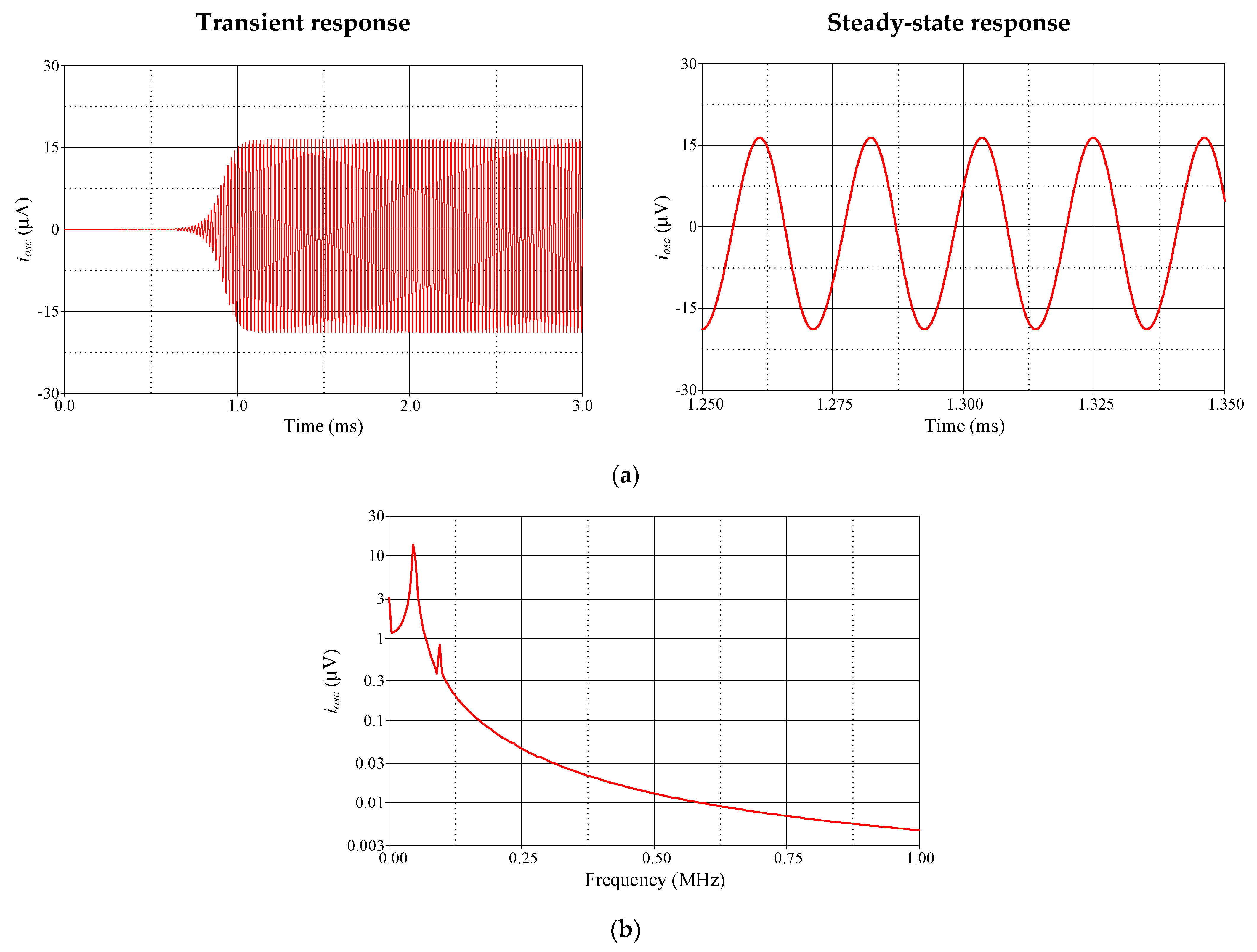
The presented oscillator circuit in Figure 13 was tested through simulation with the following parameters: gm1 = gm2 = 316 μA/V (IB1 = IB2 = 65 μA), R1 = 3.16 kΩ, R2 = 1 kΩ, and C1 = C2 = 1 nF. For this configuration, the ideal value of fosc was determined to be 50.29 kHz. The simulated time-domain responses of output voltage and current waveforms, designated as vosc and iosc, together with the spectral analysis are shown in Figure 14 and Figure 15, respectively. The observed frequencies (FOs) for both vosc and iosc were found to be 47.85 kHz in this particular case. The total harmonic distortion (THD) values of oscillated signals were recorded at only 5.20%.

5. Applications in Bio-Signal Processing Systems

Some applications of the proposed mixed-mode first-order universal filter in Figure 3 were further explored in bio-signal processing systems. The circuit was employed as an essential section in both the ECG acquisition system and the BioZ analyzer circuit. These applications demonstrated the practicality of the proposed circuit, which exhibited signal clarity and accuracy in biomedical diagnostics. Detailed descriptions of the circuits were provided as follows.

5.1. Application in the ECG Acquisition System

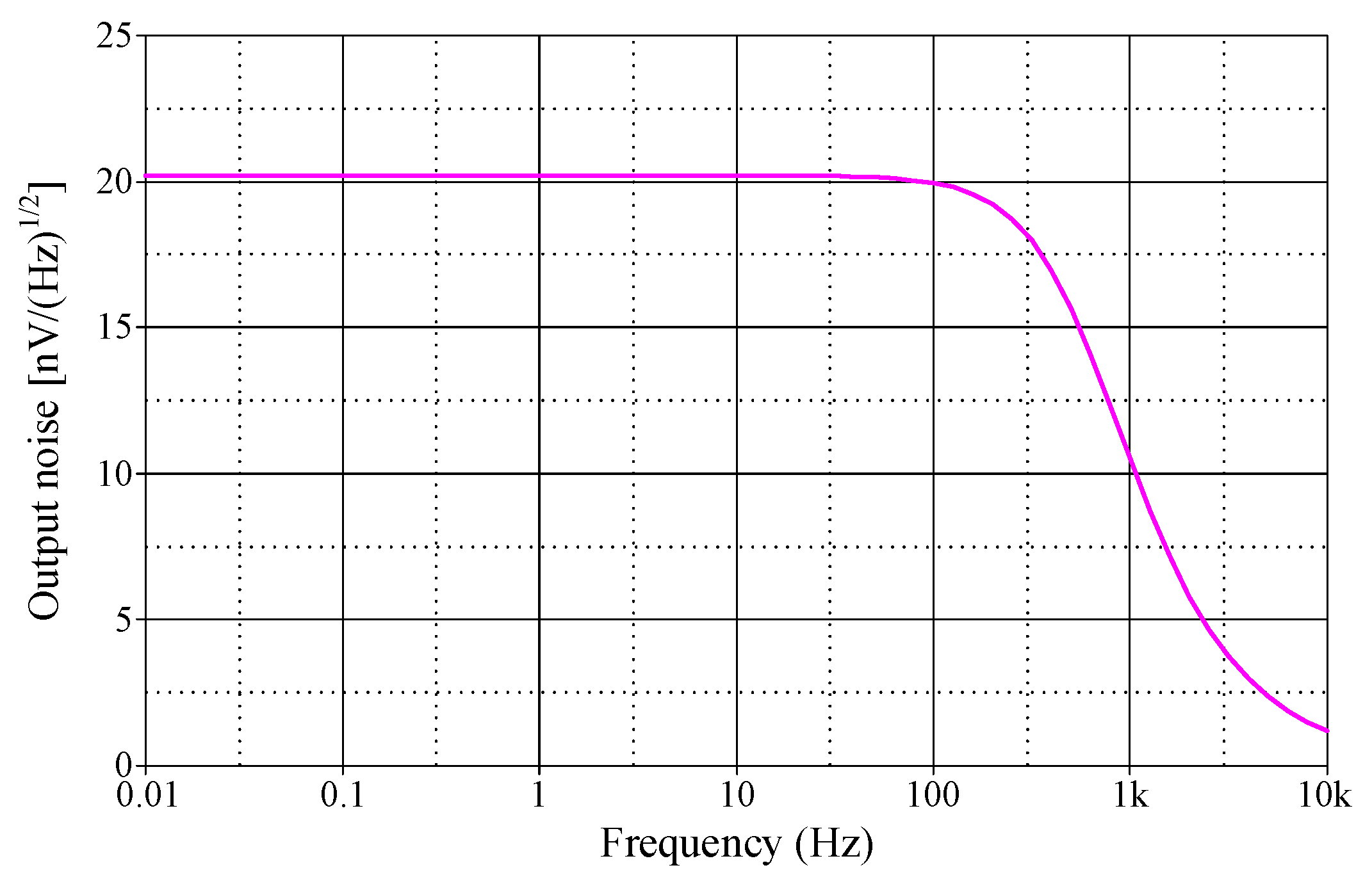
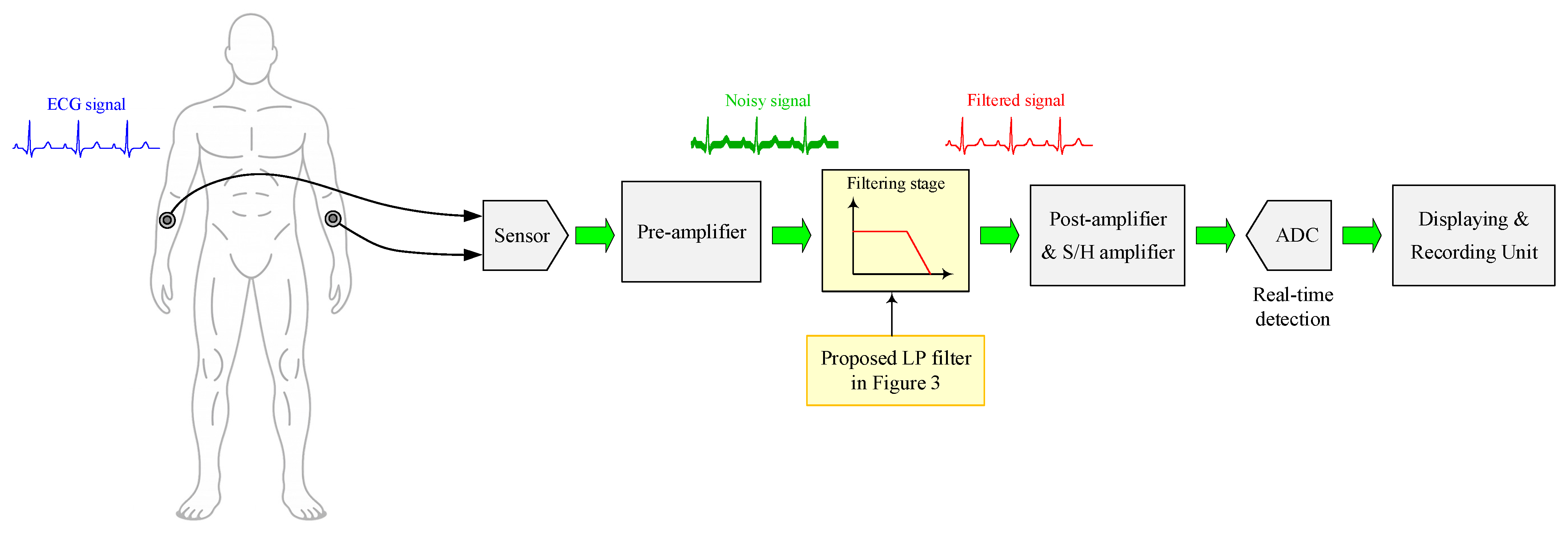
Electrocardiogram (ECG) signals play a crucial role in biomedical engineering for diagnosing and monitoring various heart conditions. Figure 16 shows an analog front-end block diagram for the acquisition and processing of ECG signals. The ECG system comprises a pre-amplifier, an LP filter, a post-amplifier, and an analog-to-digital converter (ADC). To filter out unwanted signals from the ECG, the proposed VM LP filter from Figure 3 was implemented as a filtering stage. This filter employed R1 = 8 kΩ, R2 = 1 kΩ, C1 = 100 nF, and gm = 152 μA/V (IB = 15 μA). The resulting pole frequency was obtained at fp = 242 Hz, with the output-referred noise of approximately 20.20 nV/(√Hz) in the 0.01–100 Hz range, as shown in Figure 17. This indicated a low internal noise contribution from the circuit.
In practical ECG acquisition systems, low-noise instrumentation amplifiers are typically employed for initial signal amplification, followed by band-limiting filters to reduce noise. This work proposes a mixed-mode universal filter designed for the signal conditioning stage. Furthermore, the voltage gain of the proposed filter can be adjusted by passive component ratios and electronically controlled transconductance parameters if additional amplification is required.
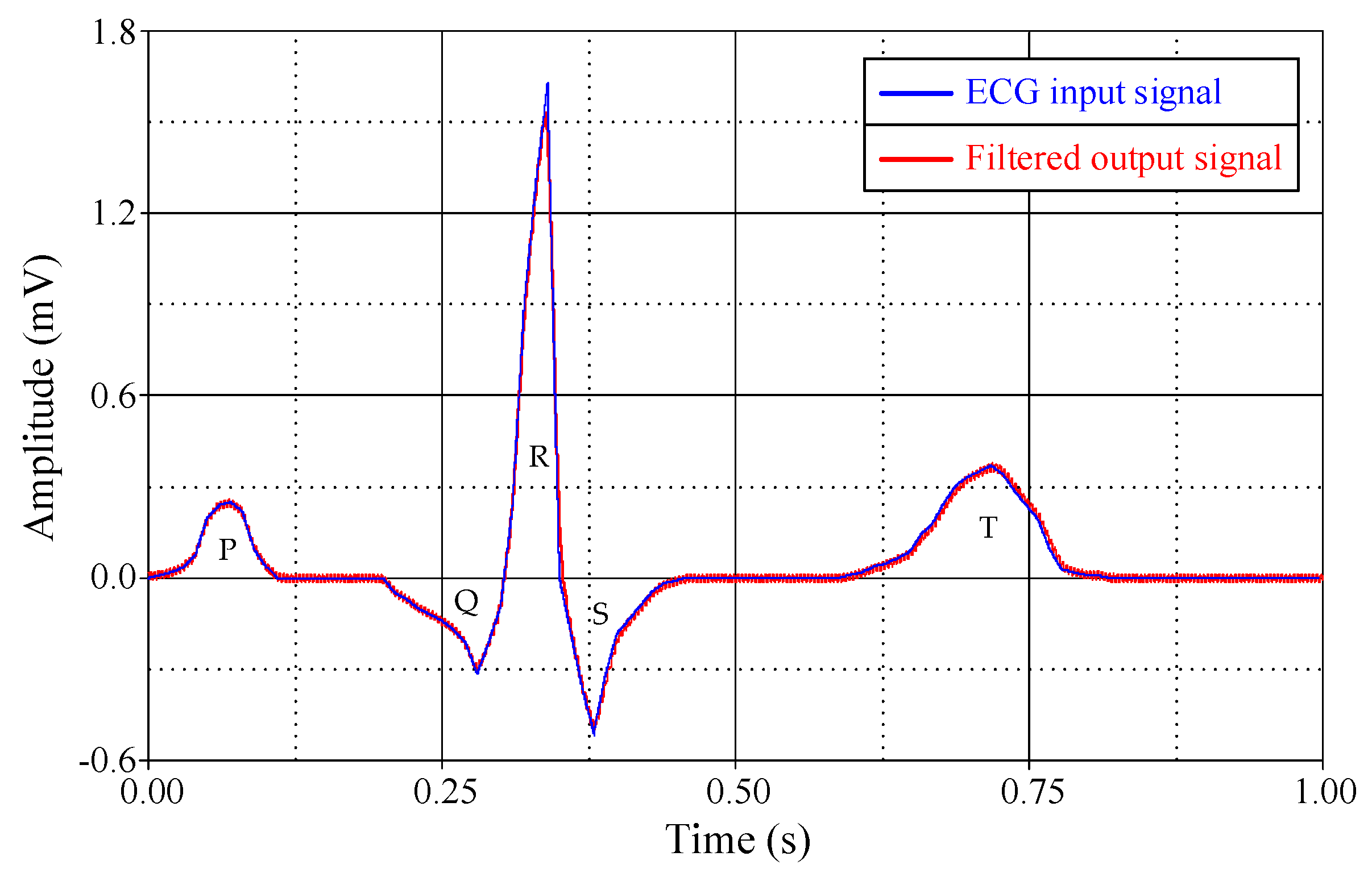
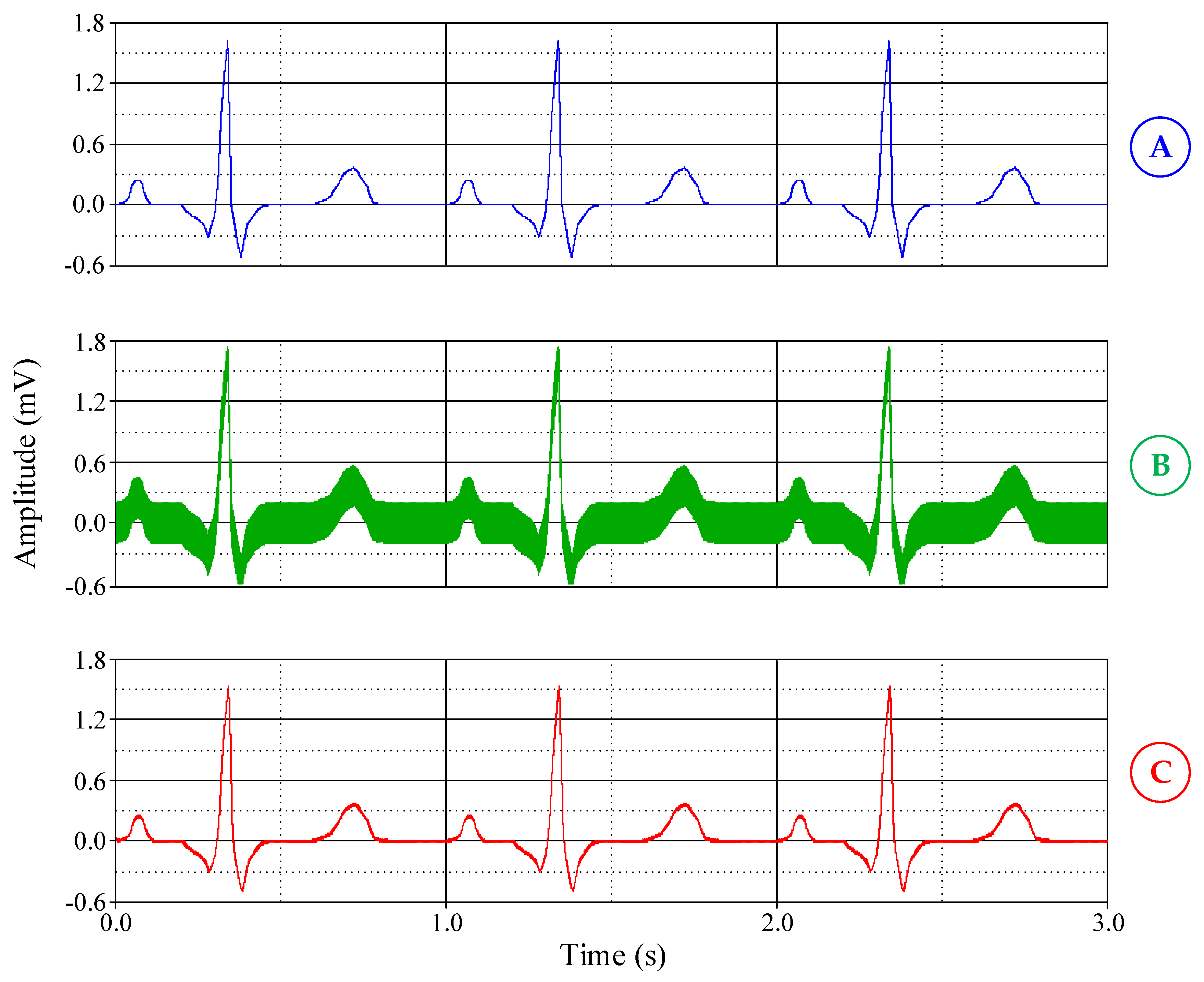
To evaluate the proposed LP filter for ECG signal processing, an ECG input signal (shown in the channel A of Figure 18) was intentionally combined with a 0.2 mV noise signal at 300 Hz to simulate electrical interference common in real ECG recordings, e.g., from power lines or muscle artifacts. The resulting noisy signal, shown in channel B, was subsequently processed through the proposed LP filter. The filtered output, which represents the clean ECG waveform, is shown in the channel C of Figure 18. Figure 19 also illustrates a wave comparison of the ECG input signal and the filtered output signal from Figure 18. It is clear that the filtered ECG closely reproduced the morphology of the clean input, with noticeable suppression of the 300 Hz interference.
Additionally, the results of filtering ECG signal were compared to those of the normal ECG signal in terms of wave amplitude [30] and timing characteristics [31], as summarized in Table 6 and Table 7, respectively. The results showed that the proposed filter effectively suppressed high-frequency noise (300 Hz) while preserving key ECG waveform features, such as the P-QRS-T complex. The minimal amplitude attenuation (<6% difference for R-wave) and identical timing values suggested that the filter maintained signal fidelity and did not introduce phase distortion. Therefore, the proposed circuit effectively enhanced the signal-to-noise ratio and diagnostic reliability of ECG measurements.

5.2. Application in the Bioimpedance Measurement System

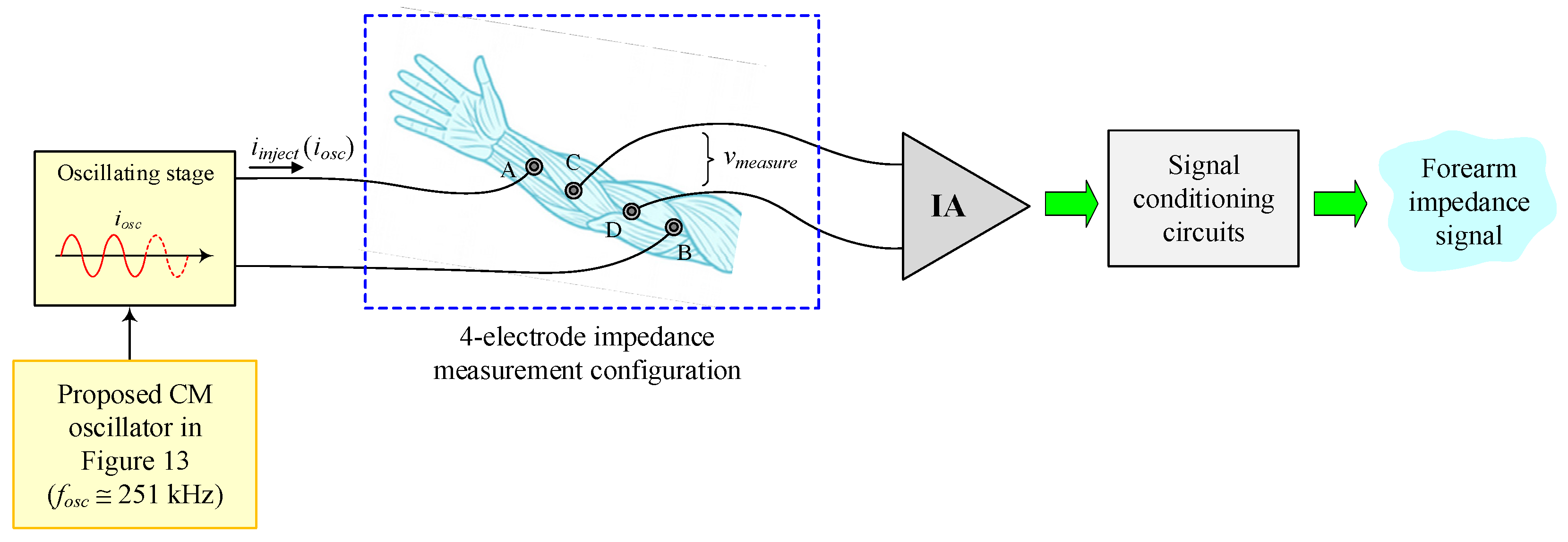
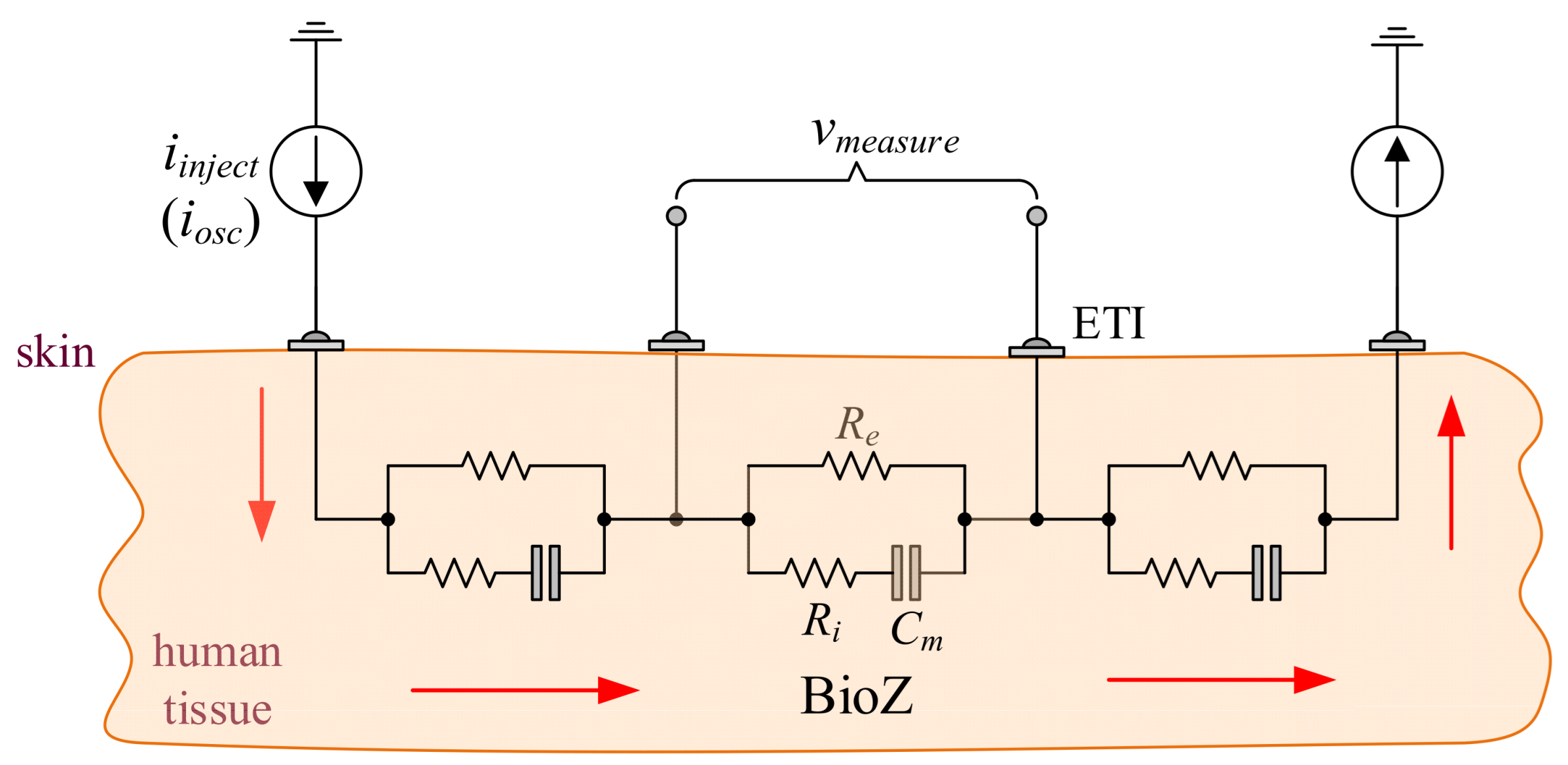
The bioimpedance (BioZ) measurement is extensively used to evaluate characteristics of biological tissues, particularly for distinguishing between intra- and extracellular fluid compositions. Figure 20 shows the block diagram of the general BioZ measurement system, which employs a four-electrode configuration to minimize the influence of electrode-tissue impedance (ETI). In this approach, an alternating stimulus current (iinject) was driven through a pair of outer electrodes, while the resulting voltage across tissue impedance (vmeasure) was sensed through the inner electrode pair using a high-gain instrumentation amplifier (IA). To generate the sinusoidal excitation current, the proposed mixed-mode first-order universal filter was configured as a CM sinusoidal oscillator, as described in Section 4. The oscillator was designed to operate at an oscillation frequency of fosc ≅ 251 kHz, which lies within the frequency range typically used in impedance spectroscopy, where the capacitive behavior of cell membranes becomes significant. The design parameters for the oscillator circuit were selected as: gm1 = gm2 = 316 μA/V (IB1 = IB2 = 65 μA), R1 = 3.16 kΩ, R2 = 1 kΩ, and C1 = C2 = 0.2 nF.
The electrical model of biological tissue employed for verification is shown in Figure 21, consisting of extracellular fluid resistance (Re), intracellular fluid resistance (Ri), and cell membrane capacitance (Cm) [32,33]. For validation testing, the tissue model parameters were set to Re = Ri = 100 Ω and Cm = 220 nF, consistent with established tissue-equivalent models [34]. A generated sinusoidal current (iosc) from the oscillator was injected into this model, while the IA measured the voltage vmeasure developed across the tissue impedance.
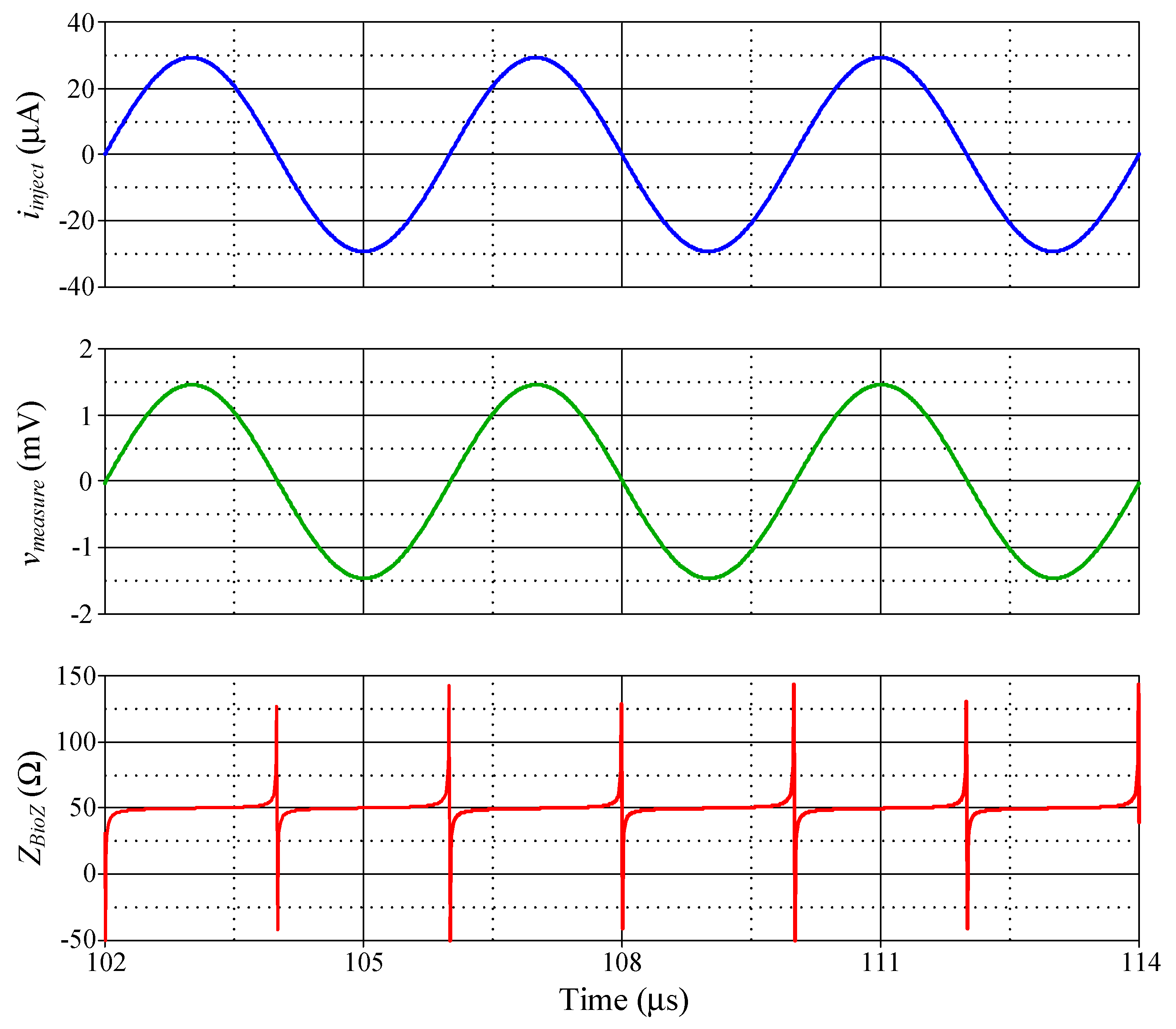
Figure 22 presents the transient responses of iinject, vmeasure, and the extracted BioZ magnitude (ZBioZ). The injected current (iinject = iosc) exhibited a clean sinusoidal waveform with stable amplitude, indicating that the oscillator provided a stable and distortion-free excitation source. The voltage vmeasure was properly synchronized with iinject and maintained as an amplitude consistent with the expected ZBioZ. At 251 kHz, the capacitive reactance of Cm is XC = (1/2πfCm) ≅ 2.88 Ω, which is much smaller than Re and Ri (each 100 Ω). Therefore, the total impedance is dominated by the resistive path, giving ZBioZ = Re//Ri ≅ 50 Ω, which closely matches with the obtained value in Figure 22. These findings validated that the proposed mixed-mode first-order universal filter, when performed as a CM sinusoidal oscillator, enables an effective, compact, and low-power solution for BioZ measurement. The system provided stable AC excitation, accurate voltage sensing, and reliable impedance extraction, highlighting its suitability for portable or wearable biomedical sensing platforms.

5.3. Practical Implementation Considerations in Bio-Signal Processing Applications

In practical bio-signal processing applications, component tolerances, process variations, and temperature dependence may lead to slight deviations in the pole frequency and gain of the proposed VDCC-based mixed-mode universal filter. However, since the pole frequency can be electronically tuned through the VDCC transconductance, these variations can be effectively compensated by adjusting the bias current. This capability is particularly beneficial in integrated implementations. Simulation results under varying temperature conditions indicate only minor fluctuations in gain, suggesting that the system demonstrates adequate robustness for ECG and BioZ applications.
In ECG acquisition systems, non-ideal factors such as variations in electrode skin impedance, motion artifacts, and external interference can adversely affect signal quality. The proposed VM LP filter, characterized by high input impedance and a tunable pole frequency, effectively suppresses high-frequency noise while preserving essential ECG waveform features. In BioZ measurement systems, the stability of the excitation signal and parasitic effects of the active devices can influence measurement accuracy, especially at high frequencies. Nevertheless, the low distortion and parasitic-aware design presented in this work ensure reliable sinusoidal excitation and precise impedance extraction within the typical biomedical frequency range.
In conclusion, despite inherent non-idealities in real biomedical environments, the proposed filter topology offers sufficient tunability, robustness, and compactness to serve as an effective analog front-end building block for ECG acquisition and BioZ measurement systems.

6. Conclusions

This work presented a compact mixed-mode first-order universal filter based on a single VDCC and employing only two grounded resistors and one floating capacitor. Owing to its simple structure and electronically tunable pole frequency, the proposed scheme supports four operation modes—VM, TAM, CM, and TIM—without the need for additional active components. Theoretical derivations, non-ideal analysis, and PSPICE simulation results verify that the filter achieves high accuracy and stable frequency characteristics and that it is well-suited for low-voltage, low-power analog signal processing systems. To demonstrate its practical utility, the proposed filter was applied to two biomedical signal-processing tasks. The VM low-pass response was used to implement an ECG acquisition filter capable of effective noise suppression and waveform preservation. In addition, the filter-based CM oscillator configuration was utilized as a sinusoidal excitation source in a bioimpedance (BioZ) measurement system, resulting in stable current generation and precise impedance extraction from tissue-equivalent models. These application results verified that the proposed topology provides reliable performance across different operation modes, all while maintaining compactness and low power consumption. The fabrication and experimental characterization of the proposed circuit will be considered in future work.

Author Contributions

Conceptualization, P.M., N.R., and W.T.; methodology, P.M., N.R., and W.T.; software, P.M. and N.R.; validation, P.M., N.R., W.T., and T.P.; formal analysis, W.T. and T.P.; investigation, P.M., N.R., W.T., and T.P.; resources, P.M. and N.R.; data curation, T.P.; writing—original draft preparation, P.M. and N.R.; writing—review and editing, W.T. and T.P.; visualization, N.R.; supervision, W.T. and T.P.; project administration, T.P.; funding acquisition, P.M. All authors have read and agreed to the published version of the manuscript.

Funding

This work was financially supported by King Mongkut’s Institute of Technology Ladkrabang [2567-02-01-025].

Institutional Review Board Statement

Not applicable.

Informed Consent Statement

Not applicable.

Data Availability Statement

The original contributions presented in the study are included in the article, further inquiries can be directed to the corresponding author.

Acknowledgments

The authors appreciate the support and infrastructure provided by the School of Engineering, King Mongkut’s Institute of Technology Ladkrabang, for the completion of this work.

Conflicts of Interest

The authors declare no conflicts of interest.

References

  1. Shah, N.A.; Iqbal, S.Z.; Parveen, B. Simple first-order multifunction filter. Indian J. Pure Appl. Phys. 2004, 42, 854–856. [Google Scholar]
  2. Maheshwari, S.; Khan, I.A.; Mohan, J. Grounded capacitor first-order filters including canonical forms. J. Circuits Syst. Comput. 2006, 15, 289–300. [Google Scholar] [CrossRef]
  3. Khan, I.A.; Beg, P.; Ahmed, M.T. First order current mode filters and multiphase sinusoidal oscillators using CMOS MOCCIIs. Arab. J. Sci. Eng. 2007, 32, 119–126. [Google Scholar] [CrossRef]
  4. Horng, J.W. High input impedance first-order allpass, highpass and lowpass filters with grounded capacitor using single DVCC. Indian J. Eng. Mater. Sci. 2009, 17, 175–178. [Google Scholar]
  5. Horng, J.W. DVCCs based high input impedance voltage-mode first-order allpass, highpass and lowpass filters employing grounded capacitor and resistor. Radioengineering 2010, 19, 653–656. [Google Scholar]
  6. Kamat, D.V.; Mohan, P.V.A.; Prabhu, K.G. Novel first-order and second-order current-mode filters using multiple-output operational transconductance amplifiers. Circuits Syst. Signal Process. 2010, 29, 553–576. [Google Scholar] [CrossRef]
  7. Beg, P.; Siddiqi, M.A.; Ansari, M.S. Multi output filter and four phase sinusoidal oscillator using CMOS DX-MOCCII. Int. J. Electron. 2011, 98, 1185–1198. [Google Scholar] [CrossRef]
  8. Horng, J.W.; Hou, C.L.; Tseng, C.Y.; Chang, R.; Yang, D.Y. Cascadable current-mode first-order and second-order multifunction filters employing grounded capacitors. Act. Passiv. Electron. Compon. 2012, 2012, 261075. [Google Scholar] [CrossRef]
  9. Chen, H.P. DVCC-based first-order filter with grounded capacitor. Int. J. Inf. Electron. Eng. 2012, 2, 50–54. [Google Scholar] [CrossRef][Green Version]
  10. Khan, I.A.; Nahhas, A.M. Reconfigurable voltage mode first order multifunctional filter using single low voltage digitally controlled CMOS CCII. Int. J. Comput. Appl. 2012, 45, 37–40. [Google Scholar] [CrossRef]
  11. Pal, R.; Tiwari, R.C.; Pandey, R.; Pandey, N. Single CDBA based current mode first order multifunction filter. Int. J. Eng. Sci. Technol. 2014, 6, 444–451. [Google Scholar]
  12. Yuce, E.; Minaei, S. A First-order fully cascadable current-mode universal filter composed of dual output CCIIs and a grounded capacitor. J. Circuits Syst. Comput. 2016, 25, 1650042. [Google Scholar] [CrossRef]
  13. Safari, L.; Yuce, E.; Minaei, S. A new ICCII based resistor-less current-mode first-order universal filter with electronic tuning capability. Microelectron. J. 2017, 67, 101–110. [Google Scholar] [CrossRef]
  14. Kumar, A.; Paul, S.K. Current mode first order universal filter and multiphase sinusoidal oscillator. AEU—Int. J. Electron. Commun. 2017, 81, 37–49. [Google Scholar] [CrossRef]
  15. Tarunkumar, H.; Ranjan, A.; Pheiroijam, N.M. First order and second order universal filter using four terminal floating nullor. Int. J. Eng. Technol. 2018, 7, 192–198. [Google Scholar]
  16. Abaci, A.; Yuce, E. Voltage-mode first-order universal filter realizations based on subtractors. AEU—Int. J. Electron. Commun. 2018, 90, 140–146. [Google Scholar] [CrossRef]
  17. Agrawal, D.; Maheshwari, S. An active-C current-mode universal first-order filter and oscillator. J. Circuits Syst. Comput. 2019, 28, 1950219. [Google Scholar] [CrossRef]
  18. Jaikla, W.; Talabthong, P.; Siripongdee, S.; Supavarasuwat, P.; Suwanjan, P.; Chaichana, A. Electronically controlled voltage mode first order multifunction filter using low-voltage low-power bulk-driven OTAs. Microelectron. J. 2019, 91, 22–35. [Google Scholar] [CrossRef]
  19. Chaturvedi, B.; Kumar, A. Electronically tunable first-order filters and dual-mode multiphase oscillator. Circuits Syst. Signal Process. 2019, 38, 2–25. [Google Scholar] [CrossRef]
  20. Chaturvedi, B.; Kumar, A.; Mohan, J. Low voltage operated current-mode first-order universal filter and sinusoidal oscillator suitable for signal processing applications. AEU—Int. J. Electron. Commun. 2019, 99, 110–118. [Google Scholar] [CrossRef]
  21. Chaturvedi, B.; Mohan, J.; Jitender; Kumar, A. Resistorless realization of first-order current mode universal filter. Radio Sci. 2020, 55, e2019RS006932. [Google Scholar] [CrossRef]
  22. Chaturvedi, B.; Mohan, J.; Kumar, A.; Pal, K. Current-mode first-order universal filter and its voltage-mode transformation. J. Circuits Syst. Comput. 2020, 29, 2050149. [Google Scholar] [CrossRef]
  23. Yuce, E.; Minaei, S. A new first-order universal filter consisting of two ICCII + s and a grounded capacitor. AEU—Int. J. Electron. Commun. 2021, 137, 153802. [Google Scholar] [CrossRef]
  24. Jaikla, W.; Buakhong, U.; Siripongdee, S.; Khateb, F.; Sotner, R.; Silapan, P.; Suwanjan, P.; Chaichana, A. Single commercially available ic-based electronically controllable voltage-mode first-order multifunction filter with complete standard functions and low output impedance. Sensors 2021, 21, 7376. [Google Scholar] [CrossRef]
  25. Raj, A.; Bhaskar, D.R.; Senani, R.; Kumar, P. Extension of recently proposed two-CFOA-GC all pass filters to the realisation of first order universal active filters. AEU—Int. J. Electron. Commun. 2022, 146, 154119. [Google Scholar] [CrossRef]
  26. Kumar, A.; Kumar, S.; Elkamchouchi, D.H.; Urooj, S. Fully Differential Current-Mode Configuration for the Realization of First-Order Filters with Ease of Cascadability. Electronics 2022, 11, 2072. [Google Scholar] [CrossRef]
  27. Raj, A. Mixed-mode electronically-tunable first-order universal filter structure employing operational transconductance amplifiers. J. Circuits Syst. Comput. 2022, 31, 2250234. [Google Scholar] [CrossRef]
  28. Srivastava, M.; Prasad, D. VDCC based dual-mode quadrature sinusoidal oscillator with outputs at appropriate impedance levels. Adv. Electr. Electron. Eng. 2016, 14, 168–177. [Google Scholar] [CrossRef]
  29. Srivastava, M.; Bhardwaj, K.; Prasad, D.; Singh, R.; Tangsrirat, W. New single VDCC based electronically adjustable FDNR using grounded capacitances. Indian J. Pure Appl. Phys. 2022, 60, 650–661. [Google Scholar] [CrossRef]
  30. Harris, P.R.E. The normal electrocardiogram: Resting 12-lead and electrocardiogram monitoring in the hospital. Crit. Care Nurs. Clin. N. Am. 2016, 28, 281–296. [Google Scholar] [CrossRef]
  31. Saini, D.; Grober, A.F.; Hadley, D.; Froelicher, V. Normal computerized Q wave measurements in health young athletes. J. Electrocardiol. 2017, 50, 316–322. [Google Scholar] [CrossRef]
  32. Groenendaal, W.; Lee, S.; Hoof, C.V. Wearable bioimpedance monitoring: Viewpoint for application in chronic conditions. JMIR Biomed. Eng. 2021, 6, e22911. [Google Scholar] [CrossRef] [PubMed]
  33. Arabsalmani, N.; Ghouchani, A.; Ashtiani, S.J.; Zamani, M. Exploring bio-impedance sensing for intelligent wearable devices. Bioengineering 2025, 12, 521. [Google Scholar] [CrossRef] [PubMed]
  34. Xu, J.; Hong, Z. Low power bio-impedance sensor interfaces: Review and electronics design methodology. IEEE Rev. Biomed. Eng. 2022, 15, 23–35. [Google Scholar] [CrossRef] [PubMed]
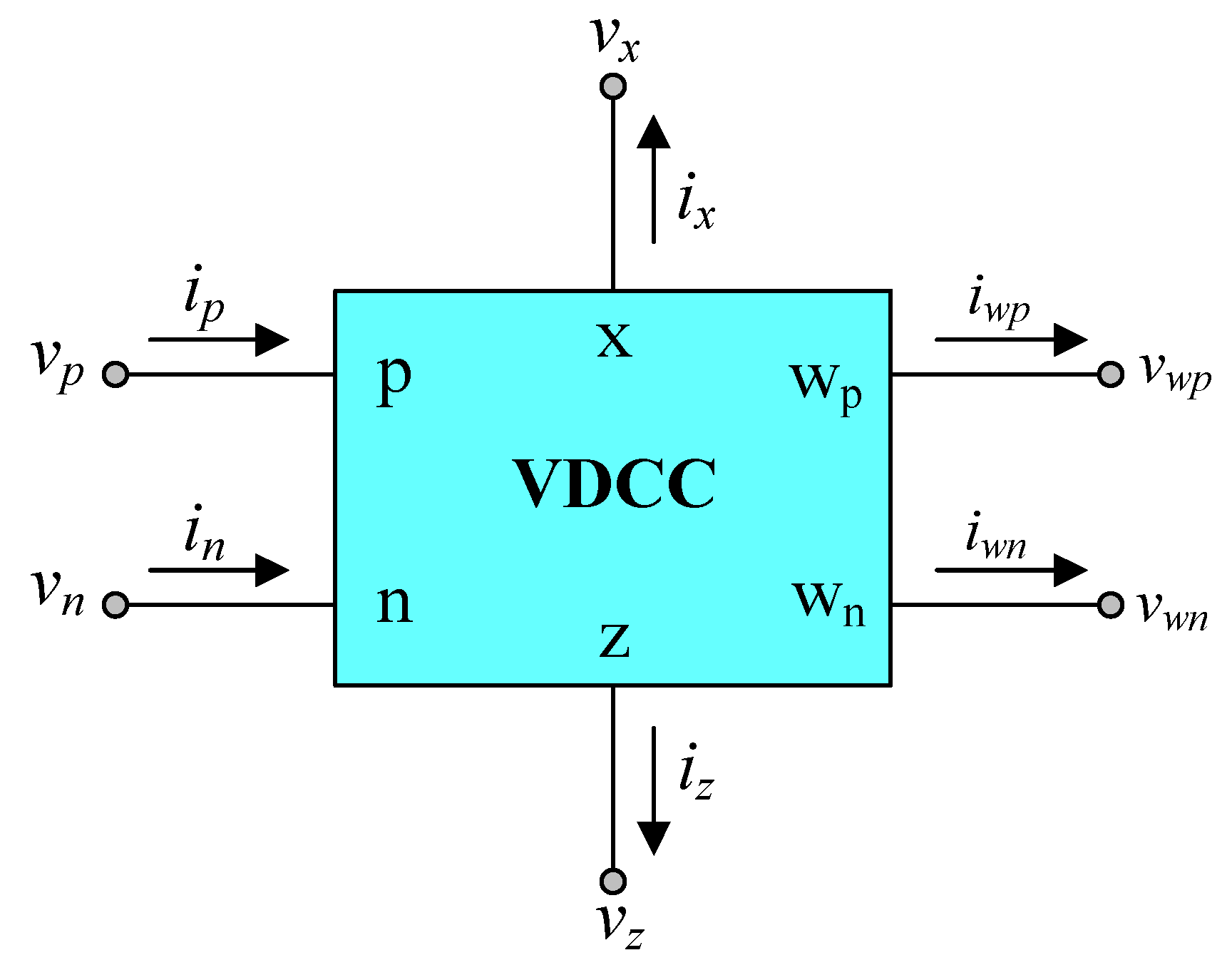
Figure 1. The symbolic circuit representation of the VDCC showing its voltage input terminals (p and n), current output terminals (wp and wn), high-impedance z terminal, and low-impedance x terminal.
Technologies 14 00101 g001
Figure 2. The CMOS transistor-level implementation of the VDCC used in this work.
Technologies 14 00101 g002
Figure 3. The proposed mixed-mode first-order universal filter configuration.
Technologies 14 00101 g003
Figure 4. The proposed mixed-mode first-order universal filter, including the parasitic elements associated with practical VDCC terminals.
Technologies 14 00101 g004
Figure 5. Time-domain and frequency-domain responses of the proposed VM filter: (a) LP; (b) HP; and (c) AP.
Technologies 14 00101 g005aTechnologies 14 00101 g005b
Figure 6. Frequency responses of the proposed TAM filter for: (a) LP; (b) HP; and (c) AP.
Technologies 14 00101 g006
Figure 7. Time-domain waveforms and frequency responses of the proposed CM filter: (a) LP; (b) HP; and (c) AP.
Technologies 14 00101 g007
Figure 8. Frequency responses of the proposed TIM filter for: (a) LP; (b) HP; and (c) AP.
Technologies 14 00101 g008
Figure 9. Phase-frequency responses of the proposed VM AP filter with the tuning frequency fp.
Technologies 14 00101 g009
Figure 10. The histogram of MC simulation results for fp of the VM LP filter.
Technologies 14 00101 g010
Figure 11. The histogram of MC simulation results for fp of the VM HP filter.
Technologies 14 00101 g011
Figure 12. Gain-frequency characteristics of the LP and HP responses of the proposed VM filter for various ambient temperatures (0 °C, 25 °C, 50 °C, 75 °C, and 100 °C).
Technologies 14 00101 g012
Figure 13. Dual-mode sinusoidal oscillator derived from cascading two identical proposed first-order universal filters in Figure 3.
Technologies 14 00101 g013
Figure 14. The simulated waveforms of vosc: (a) generated time-domain response and (b) spectral analysis.
Technologies 14 00101 g014
Figure 15. The simulated waveforms of iosc: (a) generated time-domain responses and (b) spectral analysis.
Technologies 14 00101 g015
Figure 16. Analog front-end block diagram for the ECG acquisition system.
Technologies 14 00101 g016
Figure 17. Output-referred noise of the proposed VM LP filter.
Technologies 14 00101 g017
Figure 18. ECG signal filtering results where (A) = ECG input signal (clean ECG signal), (B) = noisy ECG signal, and (C) = filtered output signal.
Technologies 14 00101 g018
Figure 19. ECG wave comparison between ECG input signal and filtered output signal.
Technologies 14 00101 g019
Figure 20. The block diagram of the BioZ measurement system.
Technologies 14 00101 g020
Figure 21. The four-electrode BioZ measurement configuration and the equivalent electrical model of the biological tissue.
Technologies 14 00101 g021
Figure 22. Transient responses of the BioZ measurement using the proposed CM oscillator as the excitation source.
Technologies 14 00101 g022
Table 1. Voltage signal excitation for VM and TAM filter realizations.
Applied Signal VoltageFilter
Type
Matching
Condition
Passband Gain
v1v2VMTAM
vin (input voltage)0LPno11/R1
0vinHPno11/R1
vinvinAPno11/R1
Table 2. Current signal excitation for CM and TIM filter realizations.
ModeApplied Signal CurrentFilter
Type
Matching
Condition
Passband
Gain
i1i2i3
CMiin (input current)00LPgmR1 = 11
iiniin0HP
iin/2iin0AP
TIMiin00LPgmR1 = 1R2
iin0iinHP
iin/20iinAP
Table 3. Non-ideal parameters of the proposed mixed-mode first-order universal filter in Figure 3.
Operational
Mode
Filter
Type
Transfer
Function
Matching
Condition
Passband
Gain
VMLP v o u t 1 v i n = β α g m D n ( s ) noβ
HP v o u t 1 v i n = β s C 1 D n ( s )
AP v o u t 1 v i n = β s C 1 α g m D n ( s )
TAMLP i o u t v i n = β γ p R 1 α g m D n ( s ) no β γ p R 1
HP i o u t v i n = β γ p R 1 s C 1 D n ( s )
AP i o u t v i n = β γ p R 1 s C 1 α g m D n ( s )
CMLP i o u t i i n = β γ p g m D n ( s ) gmR1 = 1,
α = βγp
1
HP i o u t i i n = s C 1 D n ( s )
AP i o u t i i n = s C 1 α g m D n ( s )
TIMLP v o u t 2 i i n = R 2 β γ n g m D n ( s ) gmR1 = 1,
α = βγn
R2
HP v o u t 2 i i n = R 2 s C 1 D n ( s )
AP v o u t 2 i i n = R 2 s C 1 α g m D n ( s )
Note:  D n s = s C 1 + α g m .
Table 4. Transistor aspect ratios of the CMOS VDCC in Figure 2.
TransistorW/L (μm/(μm)
M1, M2, M9, M100.35/0.13
M3–M6, M11–M175/0.13
M7, M83/0.13
M18-M221/0.13
Table 5. THD versus input signal amplitude for the proposed VM LP filter at f = fp.
Input Amplitude (mVp-p)THD (%)
200.32
400.67
601.01
801.60
1001.92
Table 6. Wave amplitude of ECG signals.
Wave TypeECG Input Signal
(Channel A in Figure 18)
(mV)
Filtered Output Signal
(Channel C in Figure 18)
(mV)
Normal ECG Signal [30]
(mV)
P-wave0.2490.2450.250
R-wave1.6261.5321.600
Q-wave−0.315−0.30525% of R-wave
T-wave0.3700.3660.1–0.5
Table 7. Timing values of ECG signals.
Wave TypeECG Input Signal
(Channel A in Figure 18)
(s)
Filtered Output Signal
(Channel C in Figure 18)
(s)
Normal ECG Signal [31]
(s)
PR-wave0.2000.2000.12–0.20
QRS-wave0.2510.251>0.10
ST-wave0.1330.1330.05–0.15
Disclaimer/Publisher’s Note: The statements, opinions and data contained in all publications are solely those of the individual author(s) and contributor(s) and not of MDPI and/or the editor(s). MDPI and/or the editor(s) disclaim responsibility for any injury to people or property resulting from any ideas, methods, instructions or products referred to in the content.