


Solid-State Transformers: A Review—Part II: Modularity and Applications

Abstract
1. Introduction
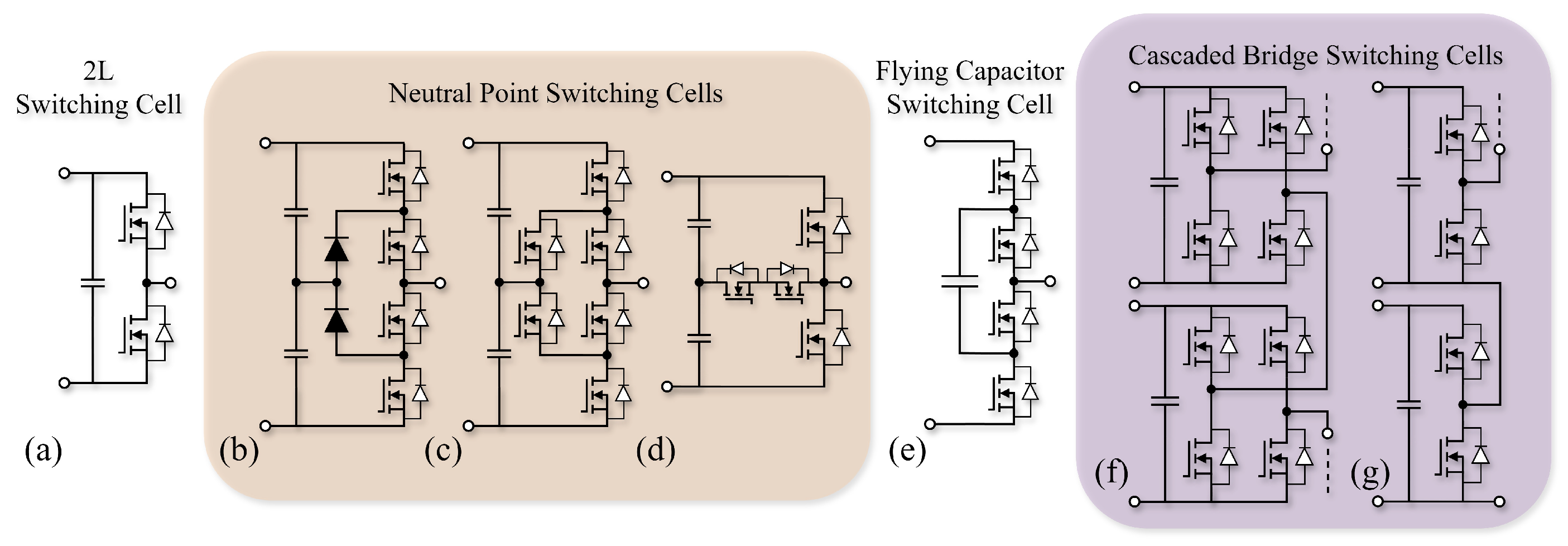
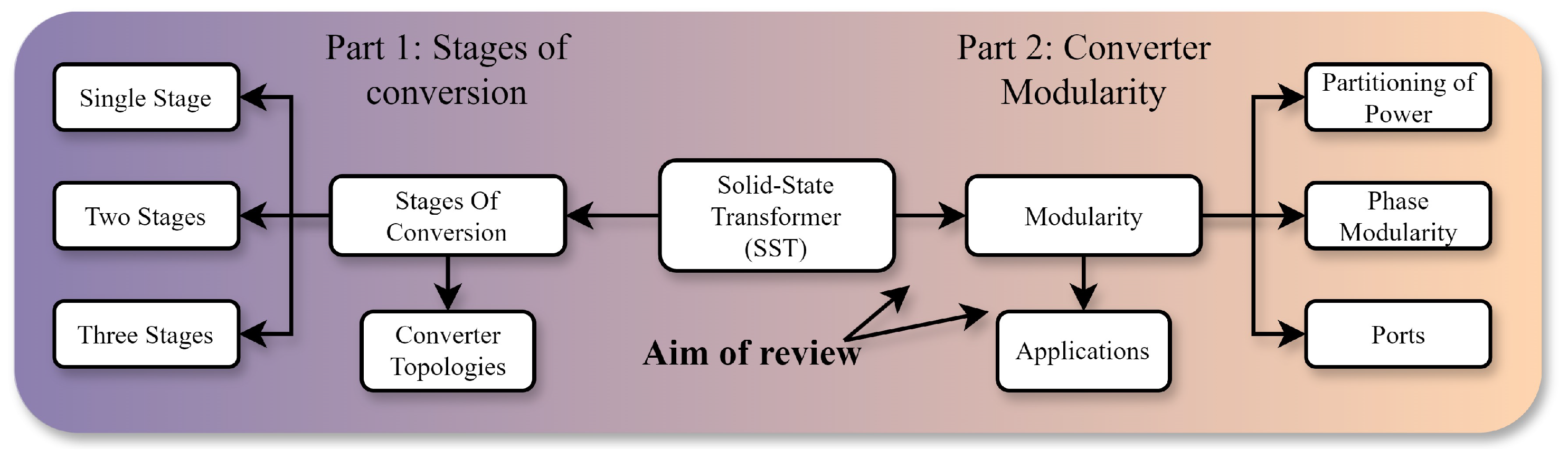
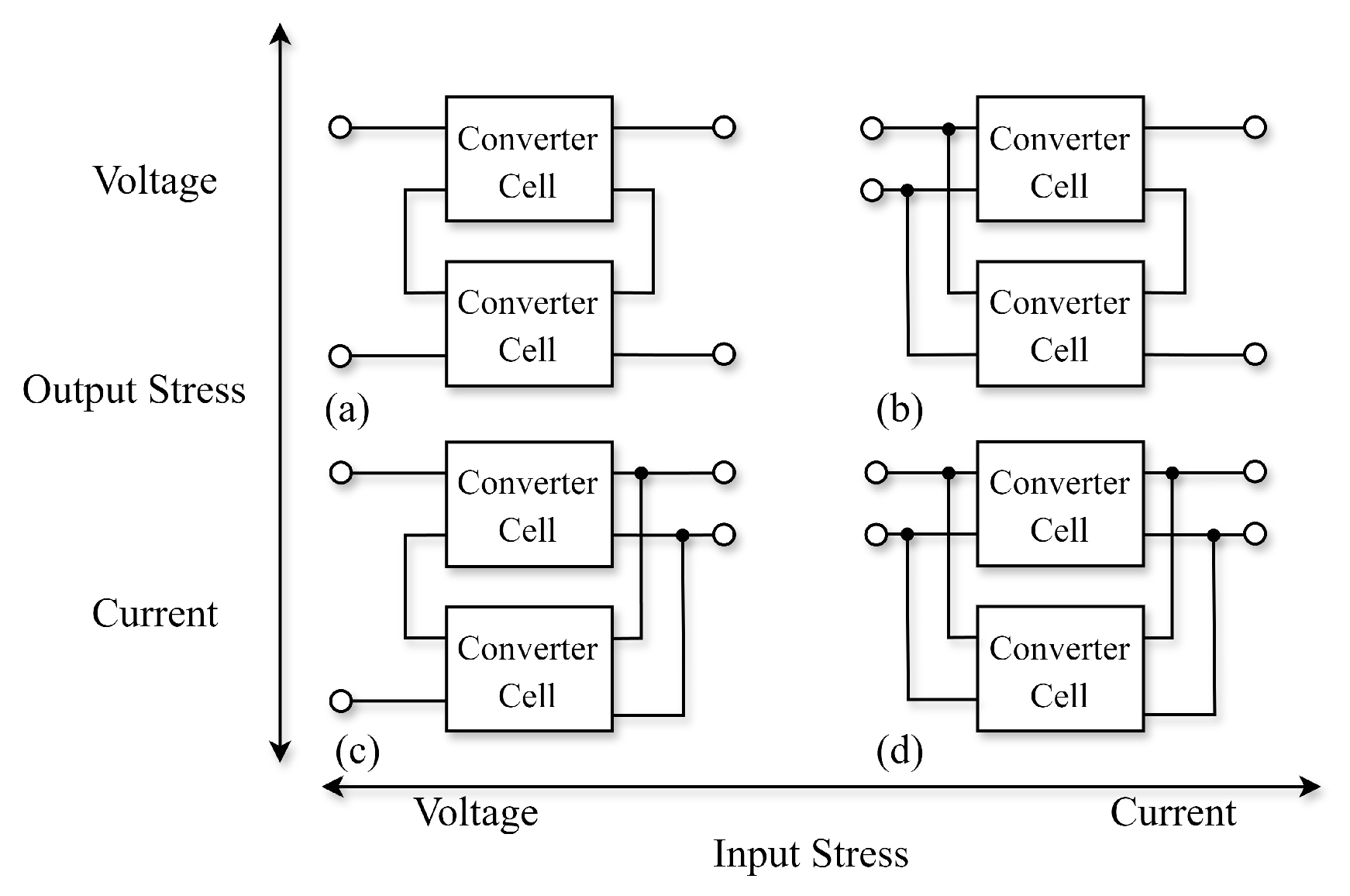
- Partitioning of power deals with the fundamental switching cells and the broader arrangement of converter modules. Converters realized with two-level switching cells are limited in both power handling and performance; as such, utilizing switching cells that allow for a higher number of voltage levels is of importance. To further increase the power-handling capabilities, multiple converters may be used at each stage of conversion in various connections, such a structure being called a multicell converter in this review. Modularity in this context means the use of multiple identical switching or converter cells during a stage of conversion to share power and component stresses, whereas non-modular implementations use non-scalable switching cells or use multiple switches in series/parallel.
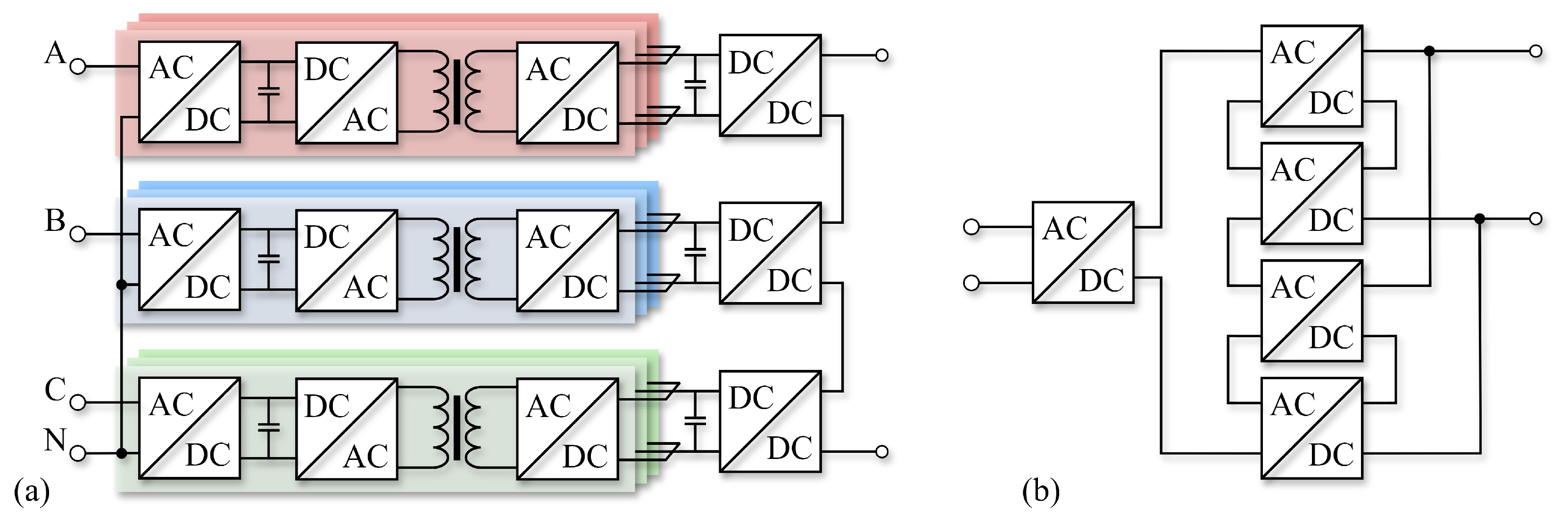
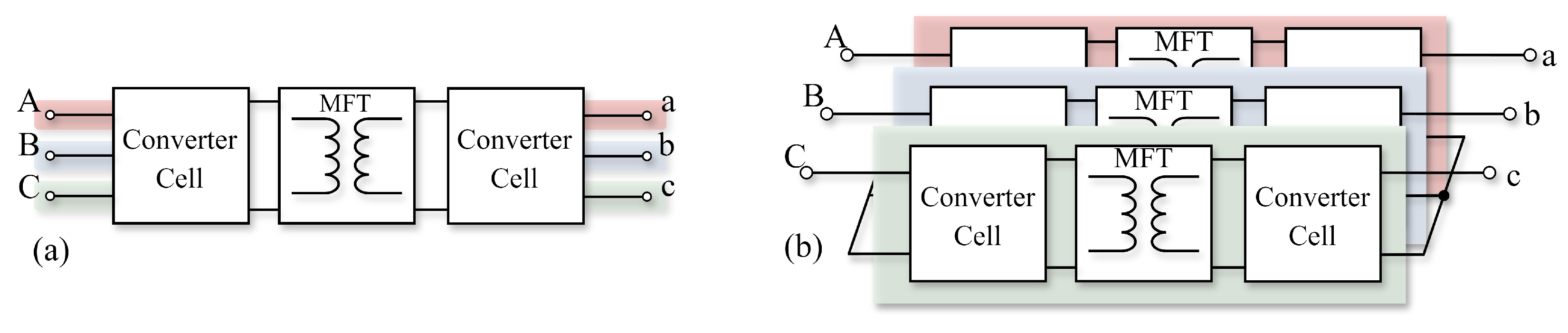
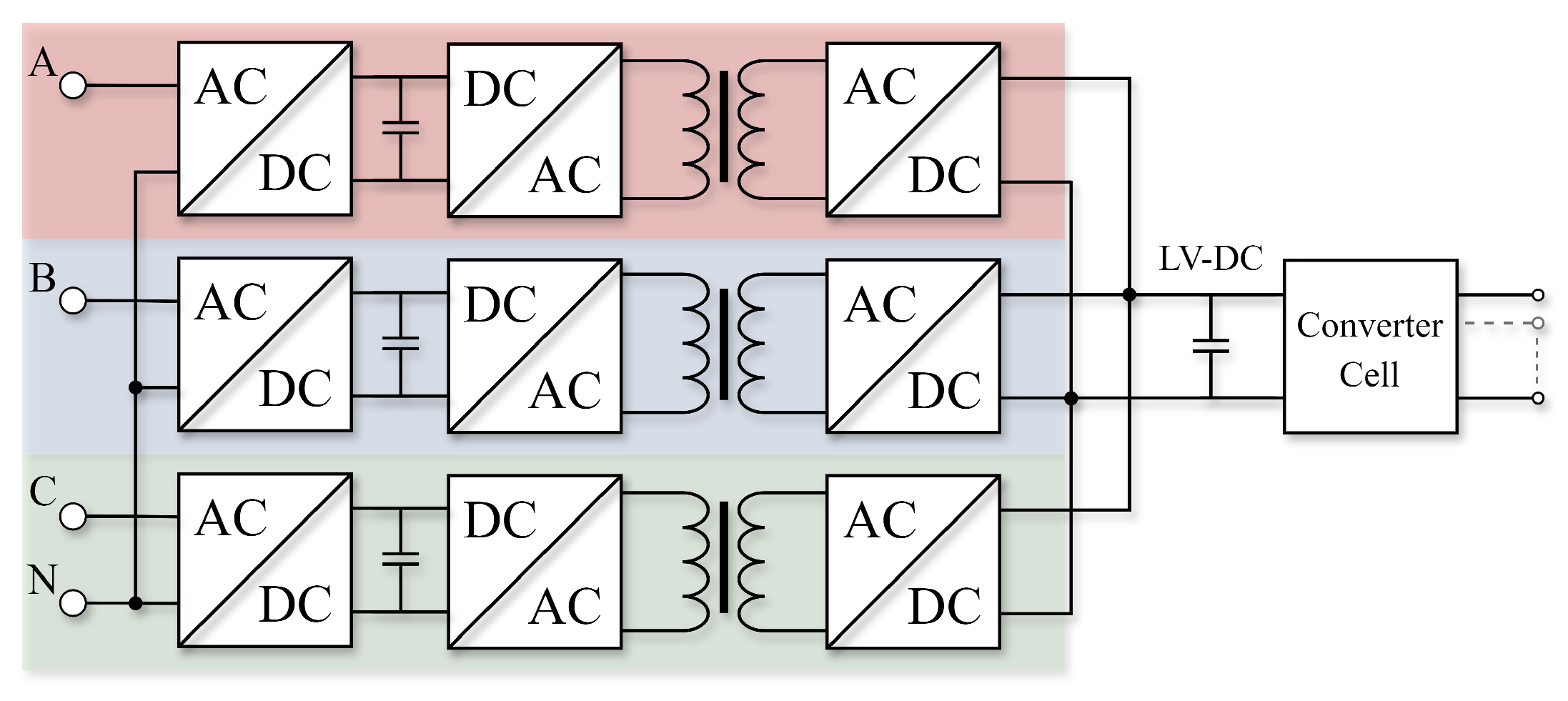
- Phase modularity represents the constructive ways in which an SST is adapted for a multiphase system and how the individual phases are managed during a stage of conversion. SST structures may use a single converter for all phases (non-modular) or separate them into single-phase systems (modular) for various performance and robustness reasons.
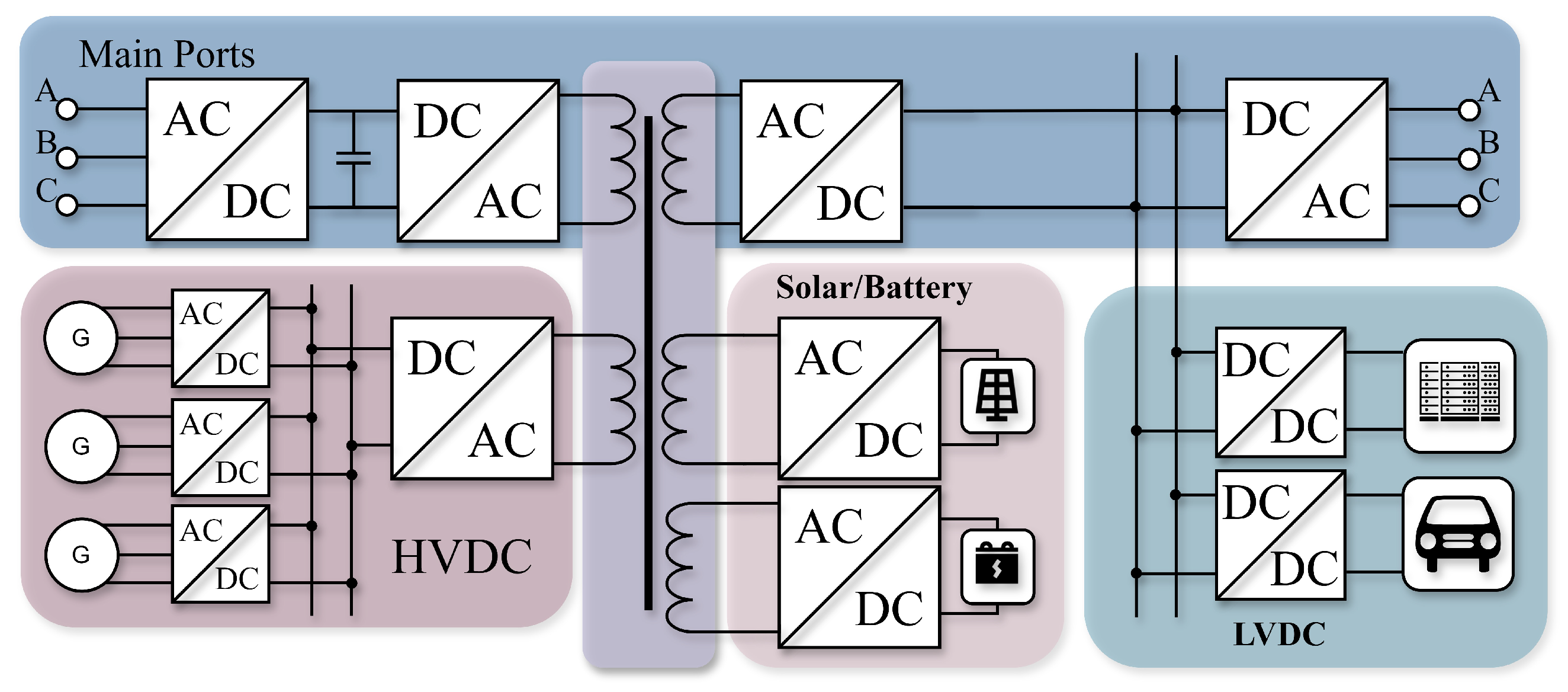
- Ports’ configuration relates to the ways in which the SST structure interacts with external supplies and consumers. The number of ports, their placement, and configuration are analyzed, with multiport implementations representing a modular structure and single input single output, a non-modular one.
2. Partitioning of Power
2.1. Fundamental Multilevel Cells
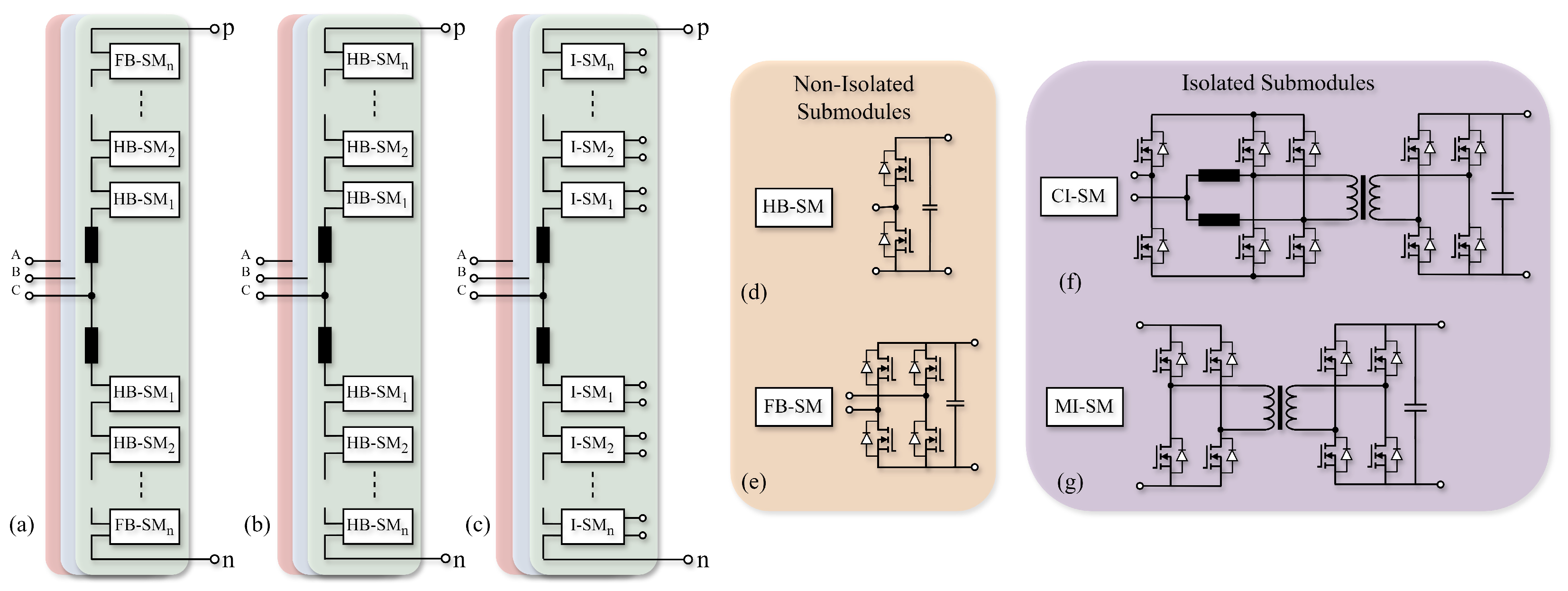
2.2. Modular Multilevel Converters
2.3. Cascaded Multicell Structures
2.4. Overview of Modulation and Control for Converter Structures
- 1.
- Multilevel Switching Cells
- Neutral-Point-Clamped Converters are limited in some control regards as they cannot achieve even power loss distribution and voltage balancing at more than three levels, using classical modulation, depending on the operating region [10,12,140]. However, they are able to achieve voltage balancing in the classical 3L configuration for all states, and more levels can be achieved if the modulation index is limited [140,141]. Novel modulation techniques have been proposed to attempt to increase the voltage levels for all operating points [125,142], whereas other papers have proposed model predictive control [127]. In [20,26], the modulation of NPC Dual Active Bridges is detailed, presenting the cells’ quasi-resonant capabilities, and in [22,143], voltage balancing methods are proposed.
- Active Neutral-Point-Clamped Converters can achieve equal power distribution, and voltage balancing for more than three levels, through the additional switching states introduced by the clamping switches [10,144]. Dual-Active-Bridge modulation has also been extended to the ANPC in [26], where its soft switching conditions are detailed. Other novel implementations have proposed the ANPC to work as a single-stage SST, incorporating modulation principles from totem pole converters and Dual-Active-Bridge phase shifting [28].
- Cascaded bridge converters have increased reliability as they allow redundant states [2]. Control algorithms have been proposed to allow independent capacitor voltage levels for each bridge [146,147]. A slow-start and voltage-balancing procedure for CHBs in SST applications has been realized in [36]. In [43], cascaded bridge topologies are suggested to be incorporated into high-power, active PFC topologies, and their respective modulation/control presented.
- 2.
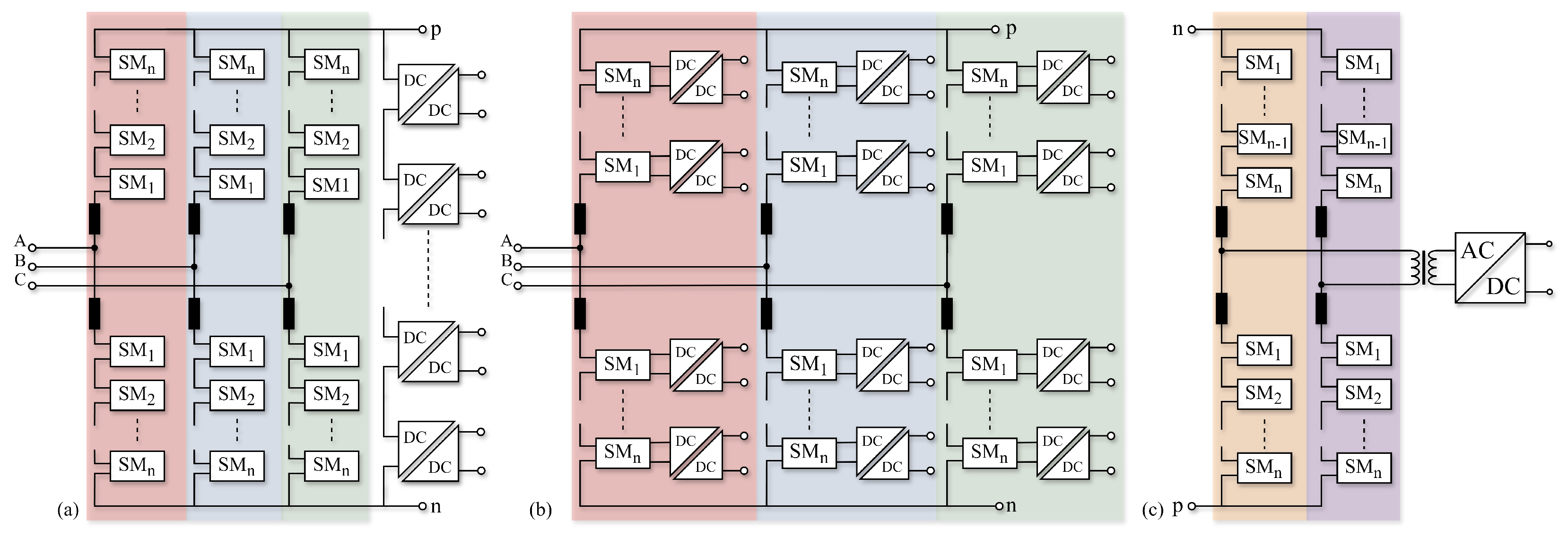
- Modular Multilevel Converters, compared to FCs, present superior control capabilities, due to multiple available degrees of freedom, such as energy balancing, loss reduction, arm currents and voltages, etc. [148]. An in-depth review of MMC control objectives, algorithms, as well as a classification of modulation techniques can be found in [60]. Comparative analyses between phase-shifted, and various Phase-Disposition PWM techniques were realized in [44,48,149]. To ensure voltage balancing and even distribution of SM insertion, sorting algorithms based on measured/predicted SM voltages have been proposed [47,48,76]. Hybrid MMCs provide unique challenges compared to single-type SM structures; an analysis of the considerations and adequate control has been conducted in [53,62]. Matrix converters require more advanced control, in contrast to indirect AC/AC topologies, as such MMC integrations of matrix converters, and especially their control, are of note. In [73], a power-decoupling algorithm that manages to realize voltage balancing across arms in matrix MMCs is proposed; in [150], an algorithm to extend fault tolerance is presented, and in [74], Nearest Level Control with an SM voltage-balancing controller is proposed. Given the emergence of novel SMs for SST applications, new commutation steps are proposed, such as in [59] for matrix converter SMs or in [62], where current-fed DABs are used as submodules in a hybrid MMC and both modulation and control are studied. For MMC isolated converters, resonant modulation/control has been extended in [69,70]. A unique operating mode of the MMC isolated converter is the Quasi-Two-Level (Q2L) modulation [67], which does not have multiple output level voltages, just two, with the transition between these voltage levels controlled by the SM’s capacitors, creating a trapezoidal waveform. The capacitors have reduced volume and cost as they are no longer being used for energy storage, but rather for harmonics filtering. This operation allows for higher frequencies at the MFT while maintaining reduced dv/dt and capacitor volumes, eliminating common-mode noise and reducing SM volume [67,69,70,151]. The Q2L concept has also been applied to flying capacitor converters [18,152].
- 3.
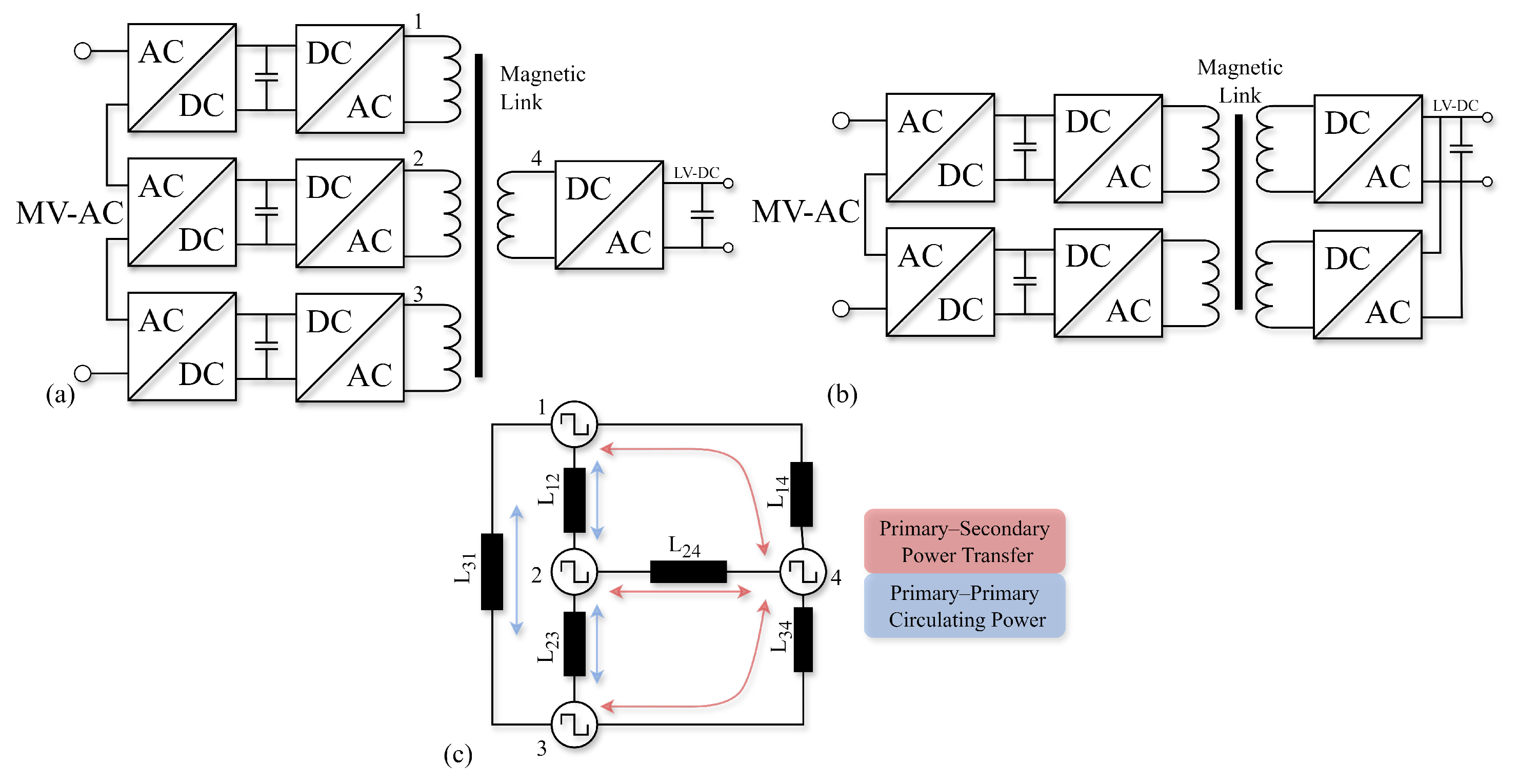
- Multicell structures aim to share power equally across modules. Component mismatch and unbalanced supplies/loads may affect this, and as such, the structures require balancing. For ISOP and IPOS arrangements, voltage balancing is natural, whereas IPOP and ISOP configurations require additional considerations [83,94,95,96,97].
3. Phase Modularity
4. Port Modularity
4.1. Classification of Ports
4.2. Multi-Active Bridges (MAB)
4.3. Multiport SST Control
5. Overview of Modularity
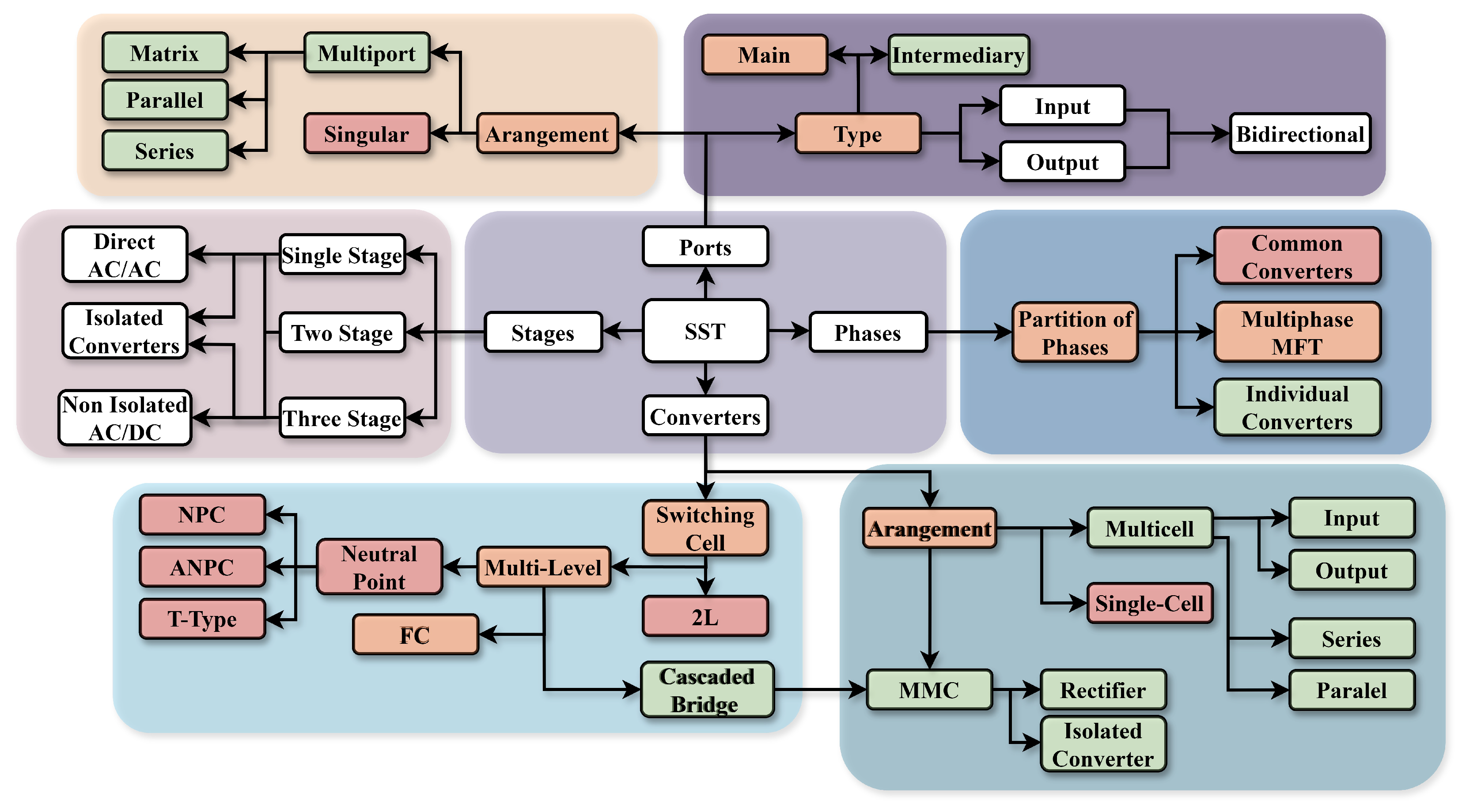
- The partition in Figure 13 focuses on the available elements during the realization of the SST. Four areas of interest were identified across the two-part review: stages (of conversion) (in Part I), port (configurations), phase (modularity) and converter (structures).
- 1.
- Stages (of conversion), ranging from one to three, determine the functionalities that the converters must cover and the available topologies, with a detailed analysis presented in Part I.
- 2.
- Port (configurations) cover the arrangement of the ports, covering single-port (non-modular) and multiport (modular) implementations; their hierarchy: main ports (modularity depends on implementation) or intermediary ports (modular); as well as their purpose: input/output in case of unidirectional systems or dual purpose for bidirectional ones.
- 3.
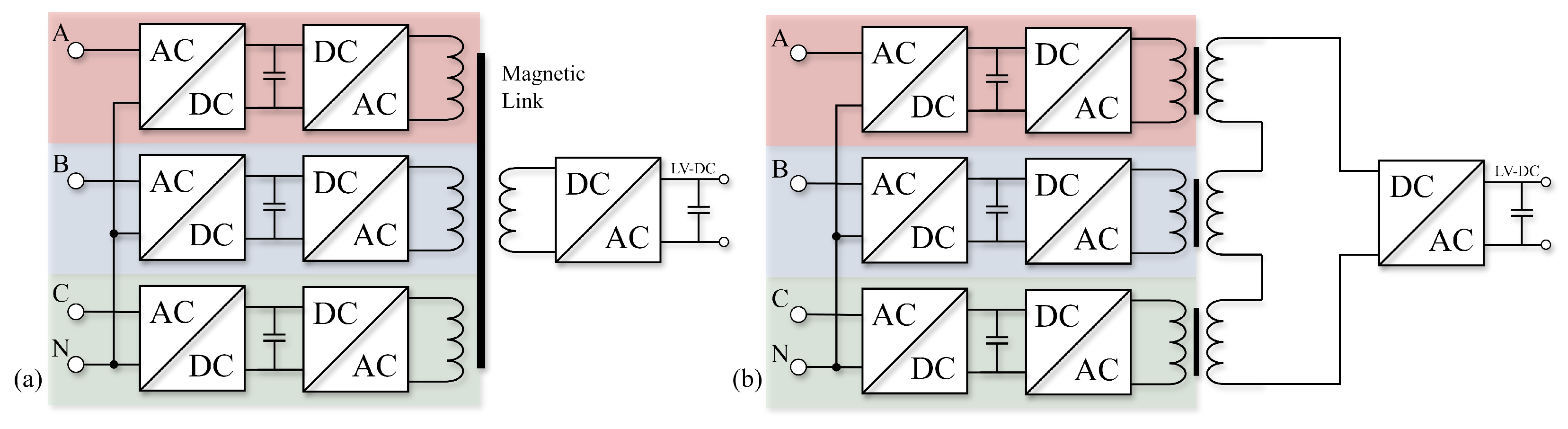
- Phase (modularity) relates to the partition of phases across converters and the transformer, and the choice whether to separate them or not (modular vs. non-modular approach).
- 4.
- Converter (structures) have been presented using two characteristics: the switching cells and the arrangement of modules. Switching cells can be non-modular (2L, NPC), or modular (cascaded Half/Full Bridges), the distinction between the two categories being the scalability of the switching cell to multiple voltage levels. Modular Multilevel Converters are an extension of the concept. The arrangement of the converters covers the use of one (non-modular) or multiple (modular) converters. In the case of multiple converter cells, they can be arranged in different configurations at their inputs and outputs.
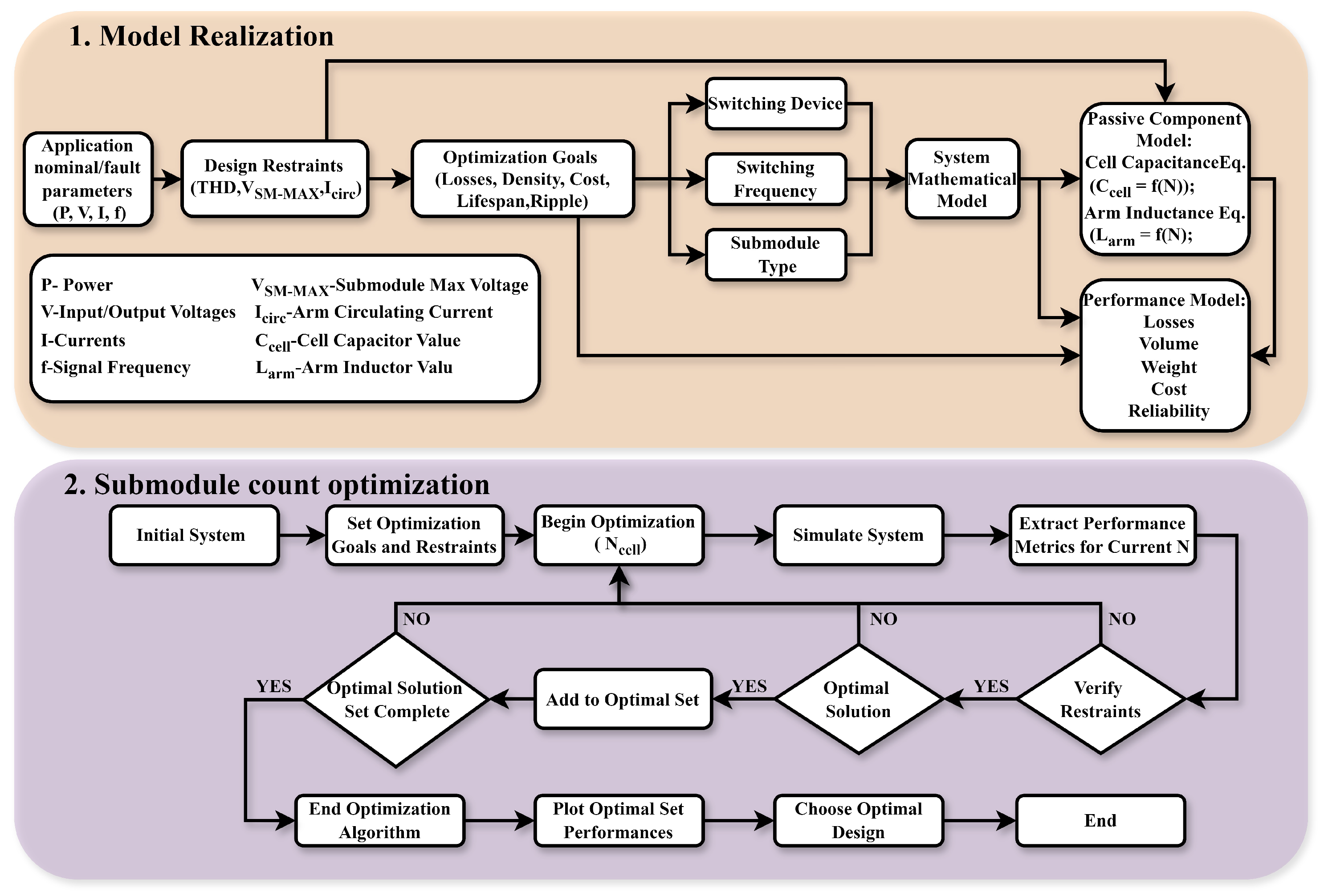
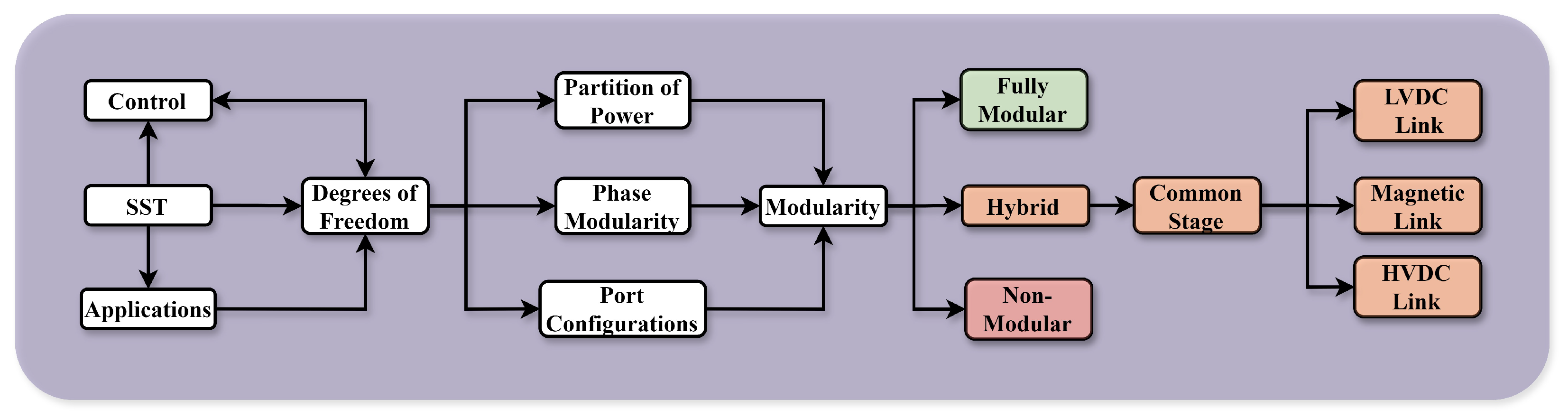
- The partition in Figure 14 focuses on a top-down analysis of the relationship between design stages. In this context the SST can be defined by the context of its application, the control methods and the three proposed degrees of freedom.
- The application dictates the requirements of the structure, and based upon its particularities, different design choices can be made utilizing the available degrees of freedom to optimize performance.
- Control of the SST represents the control algorithms and modulation techniques used at both the system level and across the individual converters. Available control methods impact the degrees of freedom, but also based on the chosen implementation, the control system must be adapted.
- Degrees of freedom represent the ways in which a system can be adapted to suit a given application. The three identified degrees were analyzed at large throughout the review, and the use of such degrees has been quantified through the term modularity and was given one of three ratings: non-modular (no modular stages), hybrid modular (some modular stages), and fully modular (all stages are modular). The ratings are independent for each degree of freedom. Hybrid modular implementations were further classified by the common stage.
Areas of Future Research
- Whereas the fundamental, voltage-source multilevel switching cells have been incorporated into the SST’s converters, hybrid and current-fed cells have not been implemented.
- Papers suggesting incorporating the MMC structure into other rectifier topologies, such as the VIENNA rectifier, have promising results but physical implementation is needed to validate them.
- Incorporating the isolation stage into the submodules has been suggested as an effective way to reduce costs and volume in high-power applications.
- Q2L modulation seems fitting for high-power single- and two-stage SSTs, particularly for the isolated converter, as it does not limit the frequency of the signal passing through the MFT.
- Regarding cascaded multicell structures, hybrid arrangements of SMs could see further research.
- In phase-modular systems, novel ways have been proposed to increase redundancy and balance the phases; these directions of research are of note.
- Novel port configurations such as series-connected outputs and matrix inputs show the most potential for further study as they allow scalability and redundancy.
- Among all three categories of modularity, the Multi-Active Bridge configuration has been proposed, and its many benefits have been presented from multiple perspectives, but the difficulty of decoupling power flow across the bridges combined with the difficult transformer design hold it back and require further analysis to streamline its design.
6. Conclusions
Author Contributions
Funding
Institutional Review Board Statement
Informed Consent Statement
Data Availability Statement
Conflicts of Interest
References
- Shamshuddin, M.A.; Rojas, F.; Cardenas, R.; Pereda, J.; Diaz, M.; Kennel, R. Solid State Transformers: Concepts, Classification, and Control. Energies 2020, 13, 2319. [Google Scholar] [CrossRef] [Scilit]
- Rodriguez, J.; Franquelo, L.; Kouro, S.; Leon, J.; Portillo, R.; Prats, M.; Perez, M. Multilevel Converters: An Enabling Technology for High-Power Applications. Proc. IEEE 2009, 97, 1786–1817. [Google Scholar] [CrossRef] [Scilit]
- Azurza Anderson, J.; Zulauf, G.; Papamanolis, P.; Hobi, S.; Miric, S.; Kolar, J.W. Three Levels Are Not Enough: Scaling Laws for Multilevel Converters in AC/DC Applications. IEEE Trans. Power Electron. 2021, 36, 3967–3986. [Google Scholar] [CrossRef] [Scilit]
- Qashqai, P.; Sheikholeslami, A.; Vahedi, H.; Al-Haddad, K. A Review on Multilevel Converter Topologies for Electric Transportation Applications. In Proceedings of the 2015 IEEE Vehicle Power and Propulsion Conference (VPPC), Montreal, QC, Canada, 19–22 October 2015; pp. 1–6. [Google Scholar] [CrossRef] [Scilit]
- Lei, Y.; Barth, C.; Qin, S.; Liu, W.C.; Moon, I.; Stillwell, A.; Chou, D.; Foulkes, T.; Ye, Z.; Liao, Z.; et al. A 2-kW Single-Phase Seven-Level Flying Capacitor Multilevel Inverter with an Active Energy Buffer. IEEE Trans. Power Electron. 2017, 32, 8570–8581. [Google Scholar] [CrossRef] [Scilit]
- Meynard, T.; Foch, H.; Thomas, P.; Courault, J.; Jakob, R.; Nahrstaedt, M. Multicell converters: Basic concepts and industry applications. IEEE Trans. Ind. Electron. 2002, 49, 955–964. [Google Scholar] [CrossRef] [Scilit]
- Schweizer, M.; Lizama, I.; Friedli, T.; Kolar, J.W. Comparison of the chip area usage of 2-level and 3-level voltage source converter topologies. In Proceedings of the IECON 2010—36th Annual Conference on IEEE Industrial Electronics Society, Glendale, AZ, USA, 7–10 November 2010; pp. 391–396. [Google Scholar] [CrossRef] [Scilit]
- Lei, Y.; Liu, W.C.; Pilawa-Podgurski, R.C.N. An analytical method to evaluate flying capacitor multilevel converters and hybrid switched-capacitor converters for large voltage conversion ratios. In Proceedings of the 2015 IEEE 16th Workshop on Control and Modeling for Power Electronics (COMPEL), Vancouver, BC, Canada, 12–15 July 2015; pp. 1–7. [Google Scholar] [CrossRef] [Scilit]
- Yadeo, D.; Chaturvedi, P.; Lai, J.S.J.; Suryawanshi, H.; Saketi, S.K. A T-type dual active bridge with symmetrical configuration for solid state transformer. Int. J. Electron. 2021, 108, 2019–2038. [Google Scholar] [CrossRef] [Scilit]
- Kouro, S.; Malinowski, M.; Gopakumar, K.; Pou, J.; Franquelo, L.G.; Bin, W.; Rodriguez, J.; Pérez, M.A.; Leon, J.I. Recent Advances and Industrial Applications of Multilevel Converters. IEEE Trans. Ind. Electron. 2010, 57, 2553–2580. [Google Scholar] [CrossRef] [Scilit]
- Rao, A.P.C.; Obulesh, Y.P.; Babu, C.S. Analysis and effect of switching frequency and voltage levels on total harmonic distortion in multilevel inverters. In Proceedings of the 2012 International Conference on Emerging Trends in Electrical Engineering and Energy Management (ICETEEEM), Chennai, Tamil Nadu, India, 13–15 December 2012; pp. 339–344. [Google Scholar] [CrossRef] [Scilit]
- Van Der Merwe, W.; Mouton, T. Solid-state transformer topology selection. In Proceedings of the 2009 IEEE International Conference on Industrial Technology, Churchill, VIC, Australia, 10–13 February 2009; pp. 1–6. [Google Scholar] [CrossRef] [Scilit]
- Hasan, N.S.; Rosmin, N.; Osman, D.A.A.; Musta’amal@Jamal, A.H. Reviews on multilevel converter and modulation techniques. Renew. Sustain. Energy Rev. 2017, 80, 163–174. [Google Scholar] [CrossRef] [Scilit]
- Dodge, J. 3L-ANPC vs. 3L-NPC Inverters; Application Note AN0023; UnitedSiC: Princeton, NJ, USA, 2021. [Google Scholar]
- Stecca, M.; Soeiro, T.B.; Elizondo, L.R.; Bauer, P.; Palensky, P. Comparison of Two and Three-Level DC-AC Converters for a 100 kW Battery Energy Storage System. In Proceedings of the 2020 IEEE 29th International Symposium on Industrial Electronics (ISIE), Delft, The Netherlands, 17–19 June 2020; pp. 677–682. [Google Scholar] [CrossRef] [Scilit]
- Lee, K.; Shin, H.; Choi, J. Comparative analysis of power losses for 3-Level NPC and T-type inverter modules. In Proceedings of the 2015 IEEE International Telecommunications Energy Conference (INTELEC), Osaka, Japan, 18–22 October 2015; pp. 1–6. [Google Scholar] [CrossRef] [Scilit]
- Kieferndorf, F.; Basler, M.; Serpa, L.; Fabian, J.H.; Coccia, A.; Scheuer, G. The Five-Level Converter; Review; ABB: Zürich, Switzerland, 2011. [Google Scholar]
- Lu, C.; Hu, W.; Wu, H.; Lee, F. Quasi-Two-Level Bridgeless PFC Rectifier for Cascaded Unidirectional Solid State Transformer. IEEE Trans. Power Electron. 2021, 36, 12033–12044. [Google Scholar] [CrossRef] [Scilit]
- Jeong, D.K.; Yun, H.J.; Park, S.H.; Kim, M.H.; Ryu, M.H.; Baek, J.W.; Kim, H.S. 13.2 kV Class 3-Phase Solid State Transformer System Based on EtherCAT Communication. Electronics 2022, 11, 3092. [Google Scholar] [CrossRef] [Scilit]
- Zhao, X.; Li, B.; Fu, Q.; Mao, S.; Xu, D.; Leon, J.I.; Franquelo, L.G. DC Solid State Transformer Based on Three-Level Power Module for Interconnecting MV and LV DC Distribution Systems. IEEE Trans. Power Electron. 2021, 36, 1563–1577. [Google Scholar] [CrossRef] [Scilit]
- Yun, H.J.; Jeong, D.K.; Kim, H.S.; Kim, M.; Baek, J.W.; Kim, J.Y.; Kim, H.J. Implementation of a Single-Phase SST for the Interface between a 13.2 kV MVAC Network and a 750 V Bipolar DC Distribution. Electronics 2018, 7, 62. [Google Scholar] [CrossRef] [Scilit]
- Filba-Martinez, A.; Busquets-Monge, S.; Nicolas-Apruzzese, J.; Bordonau, J. Operating Principle and Performance Optimization of a Three-Level NPC Dual-Active-Bridge DC–DC Converter. IEEE Trans. Ind. Electron. 2016, 63, 678–690. [Google Scholar] [CrossRef] [Scilit]
- Chen, K.T.; Chen, J.F.; Wang, T.J.; Liao, H. Study and Implementation of High Frequency Cast Resin Transformer Applied for Medium-Voltage Solid-State Transformer. In Proceedings of the 2021 IEEE International Future Energy Electronics Conference (IFEEC), Taipei, Taiwan, 16–19 November 2021; pp. 1–6. [Google Scholar] [CrossRef] [Scilit]
- Klumpner, C.; Lee, M.; Wheeler, P. A New Three-Level Sparse Indirect Matrix Converter. In Proceedings of the IECON 2006—32nd Annual Conference on IEEE Industrial Electronics, Paris, France, 6–10 November 2006; pp. 1902–1907, ISSN 1553-572X. [Google Scholar] [CrossRef] [Scilit]
- Pham N., H.; Mannen, T.; Wada, K. A Three-Phase Isolated Rectifier using Current Unfolding and Active Damping Methods. In Proceedings of the 2020 IEEE Energy Conversion Congress and Exposition (ECCE), Detroit, MI, USA, 11–15 October 2020; pp. 4587–4593. [Google Scholar] [CrossRef] [Scilit]
- Guan, Q.X.; Zhang, Y.; Zhao, H.B.; Kang, Y. Optimized Switching Strategy for ANPC–DAB Converter Through Multiple Zero States. IEEE Trans. Power Electron. 2022, 37, 2885–2898. [Google Scholar] [CrossRef] [Scilit]
- Sotoodehkia, M.; Arasteh, M.; Soleymani Mucheh Khorti, S.; Hoseinpour, M. Design and control strategy of solid state transformer using CHB MMC and 5-L ANPC multilevel converters. Int. J. Nonlinear Anal. Appl. 2022, 14, 161–179. [Google Scholar] [CrossRef]
- Rajendran, S.; Huang, A.Q. A novel Three-level Three-phase Single Stage Solid State Transformer with An Integrated DC Link. In Proceedings of the 2022 IEEE Energy Conversion Congress and Exposition (ECCE), Detroit, MI, USA, 9–13 October 2022; pp. 1–7. [Google Scholar] [CrossRef] [Scilit]
- Krug, D.; Bernet, S.; Fazel, S.S.; Jalili, K.; Malinowski, M. Comparison of 2.3-kV Medium-Voltage Multilevel Converters for Industrial Medium-Voltage Drives. IEEE Trans. Ind. Electron. 2007, 54, 2979–2992. [Google Scholar] [CrossRef] [Scilit]
- Fazel, S.S.; Bernet, S.; Krug, D.; Jalili, K. Design and Comparison of 4-kV Neutral-Point-Clamped, Flying-Capacitor, and Series-Connected H-Bridge Multilevel Converters. IEEE Trans. Ind. Appl. 2007, 43, 1032–1040. [Google Scholar] [CrossRef] [Scilit]
- Ghias, A.M.; Ciobotaru, M.; Agelidis, V.G.; Pou, J. Solid state transformer based on the flying capacitor multilevel converter for intelligent power management. In Proceedings of the IEEE Power and Energy Society Conference and Exposition in Africa: Intelligent Grid Integration of Renewable Energy Resources (PowerAfrica), Johannesburg, South Africa, 9–13 July 2012; pp. 1–7. [Google Scholar] [CrossRef] [Scilit]
- Borges, V.L.F.; Da Silva, R.L.; Possamai, C.E.; Bettiol, A.L.; Barbi, I. A ISOP AC-AC Hybrid Switched-Capacitor SRC for Solid State Transformer Applications. In Proceedings of the 2019 IEEE 15th Brazilian Power Electronics Conference and 5th IEEE Southern Power Electronics Conference (COBEP/SPEC), Santos, Brazil, 1–4 December 2019; pp. 1–6. [Google Scholar] [CrossRef] [Scilit]
- Huber, J.; Wallmeier, P.; Pieper, R.; Schafmeister, F.; Kolar, J.W. Comparative Evaluation of MVAC-LVDC SST and Hybrid Transformer Concepts for Future Datacenters. In Proceedings of the 2022 International Power Electronics Conference (IPEC-Himeji 2022—ECCE Asia), Himeji, Japan, 15–19 May 2022; pp. 2027–2034. [Google Scholar] [CrossRef] [Scilit]
- Zhao, T.; Wang, G.; Bhattacharya, S.; Huang, A.Q. Voltage and Power Balance Control for a Cascaded H-Bridge Converter-Based Solid-State Transformer. IEEE Trans. Power Electron. 2013, 28, 1523–1532. [Google Scholar] [CrossRef] [Scilit]
- Elsanabary, A.I.; Konstantinou, G.; Mekhilef, S.; Townsend, C.D.; Seyedmahmoudian, M.; Stojcevski, A. Medium Voltage Large-Scale Grid-Connected Photovoltaic Systems Using Cascaded H-Bridge and Modular Multilevel Converters: A Review. IEEE Access 2020, 8, 223686–223699. [Google Scholar] [CrossRef] [Scilit]
- Pugliese, S.; Buticchi, G.; Mastromauro, R.A.; Andresen, M.; Liserre, M.; Stasi, S. Soft-Start Procedure for a Three-Stage Smart Transformer Based on Dual-Active Bridge and Cascaded H-Bridge Converters. IEEE Trans. Power Electron. 2020, 35, 11039–11052. [Google Scholar] [CrossRef] [Scilit]
- Rahman, M.A.; Islam, M.R.; Muttaqi, K.M.; Sutanto, D. Data Driven Coordinated Control of Converters in a Smart Solid State Transformer for Reliable and Automated Distribution Grids. IEEE Trans. Ind. Appl. 2020, 56, 4532–4542. [Google Scholar] [CrossRef] [Scilit]
- Rahman, M.A.; Islam, M.R.; Muttaqi, K.M.; Guo, Y.; Zhu, J.; Sutanto, D.; Lei, G. A Modified Carrier-Based Advanced Modulation Technique for Improved Switching Performance of Magnetic-Linked Medium-Voltage Converters. IEEE Trans. Ind. Appl. 2019, 55, 2088–2098. [Google Scholar] [CrossRef] [Scilit]
- Wen, W.; Li, K.; Zhao, Z.; Yuan, L.; Mo, X.; Cai, W. Analysis and Control of a Four-Port Megawatt-Level High-Frequency-Bus-Based Power Electronic Transformer. IEEE Trans. Power Electron. 2021, 36, 13080–13095. [Google Scholar] [CrossRef] [Scilit]
- Elserougi, A.; Abdelsalam, I.; Massoud, A. An isolated-boost-converter-based unidirectional three-phase off-board fast charger for electric vehicles. IET Electr. Syst. Transp. 2022, 12, 79–88. [Google Scholar] [CrossRef] [Scilit]
- Iyer, K.V.; Baranwal, R.; Mohan, N. A High-Frequency AC-Link Single-Stage Asymmetrical Multilevel Converter for Grid Integration of Renewable Energy Systems. IEEE Trans. Power Electron. 2017, 32, 5087–5108. [Google Scholar] [CrossRef]
- Makoschitz, M. Unidirectional medium voltage rectifier utilizing sinusoidal input currents. Electron. Lett. 2022, 58, 474–476. [Google Scholar] [CrossRef] [Scilit]
- Jonas, H. A New Family of Three-Phase-Unfolder-Based MVAC-LVDC Solid-State Transformers; VDE VERLAG GMBH: Berlin, Germany, 2024. [Google Scholar] [CrossRef]
- Barros, L.A.M.; Martins, A.P.; Pinto, J.G. A Comprehensive Review on Modular Multilevel Converters, Submodule Topologies, and Modulation Techniques. Energies 2022, 15, 1078. [Google Scholar] [CrossRef] [Scilit]
- Sun, X.; Teng, J.; Bu, Z.; Pan, Y.; Zhao, W.; Li, X. Research on Triple-Port SST Scheme Based on the Natural Elimination of MMC Submodule Voltage Fluctuation and Imbalance. IEEE J. Emerg. Sel. Top. Power Electron. 2022, 10, 3697–3710. [Google Scholar] [CrossRef] [Scilit]
- Liserre, M.; Buticchi, G.; Andresen, M.; De Carne, G.; Costa, L.F.; Zou, Z.X. The Smart Transformer: Impact on the Electric Grid and Technology Challenges. IEEE Ind. Electron. Mag. 2016, 10, 46–58. [Google Scholar] [CrossRef] [Scilit]
- Kenzelmann, S.; Rufer, A.; Dujic, D.; Canales, F.; De novaes, Y.R. Isolated DC/DC Structure Based on Modular Multilevel Converter. IEEE Trans. Power Electron. 2015, 30, 89–98. [Google Scholar] [CrossRef] [Scilit]
- Debnath, S.; Qin, J.; Bahrani, B.; Saeedifard, M.; Barbosa, P. Operation, Control, and Applications of the Modular Multilevel Converter: A Review. IEEE Trans. Power Electron. 2015, 30, 37–53. [Google Scholar] [CrossRef] [Scilit]
- Raju, M.N.; Sreedevi, J.; P Mandi, R.; Meera, K. Modular multilevel converters technology: A comprehensive study on its topologies, modelling, control and applications. IET Power Electron. 2019, 12, 149–169. [Google Scholar] [CrossRef] [Scilit]
- Rothmund, D.; Ortiz, G.; Kolar, J.W. SiC-based unidirectional solid-state transformer concepts for directly interfacing 400 V DC to Medium-Voltage AC distribution systems. In Proceedings of the 2014 IEEE 36th International Telecommunications Energy Conference (INTELEC), Vancouver, BC, Canada, 28 September–2 October 2014; pp. 1–9. [Google Scholar] [CrossRef] [Scilit]
- Nami, A.; Liang, J.; Dijkhuizen, F.; Demetriades, G.D. Modular Multilevel Converters for HVDC Applications: Review on Converter Cells and Functionalities. IEEE Trans. Power Electron. 2015, 30, 18–36. [Google Scholar] [CrossRef] [Scilit]
- Xiong, J.; Li, Y.; Cao, Y.; Panasetsky, D.; Sidorov, D. Modeling and operating characteristic analysis of MMC-SST based shipboard power system. In Proceedings of the 2016 IEEE PES Asia-Pacific Power and Energy Engineering Conference (APPEEC), Xi’an, China, 25–28 October 2016; pp. 28–32. [Google Scholar] [CrossRef] [Scilit]
- Zeng, R.; Xu, L.; Yao, L.; Williams, B.W. Design and Operation of a Hybrid Modular Multilevel Converter. IEEE Trans. Power Electron. 2015, 30, 1137–1146. [Google Scholar] [CrossRef] [Scilit]
- Chen, Y.; Ren, C.; Sheng, J.; Wang, J.; Zhou, Y.; Cao, W.; Ding, R.; Wang, W. An Optimized Fault-Ride-Through Control Strategy of Hybrid MMC with Fewer FBSMs. Electronics 2024, 13, 1797. [Google Scholar] [CrossRef] [Scilit]
- Zapico, A.; Lopez, M.; Rodriguez, A.; Briz, F. Fault tolerant cell design for MMC-based multiport power converters. In Proceedings of the 2016 IEEE Energy Conversion Congress and Exposition (ECCE), Milwaukee, WI, USA, 18–22 September 2016; pp. 1–8. [Google Scholar] [CrossRef] [Scilit]
- Li, X.; Liu, W.; Song, Q.; Rao, H.; Xu, S. An enhanced MMC topology with DC fault ride-through capability. In Proceedings of the IECON 2013—39th Annual Conference of the IEEE Industrial Electronics Society, Vienna, Austria, 10–13 November 2013; pp. 6182–6188. [Google Scholar] [CrossRef] [Scilit]
- Jianqiao, Z.; Jianwen, Z.; Xu, C.; Jiacheng, W.; Jiajie, Z. Family of Modular Multilevel Converter (MMC) Based Solid State Transformer (SST) Topologies for Hybrid AC/DC Distribution Grid Applications. In Proceedings of the 2018 IEEE International Power Electronics and Application Conference and Exposition (PEAC), Shenzhen, China, 4–7 November 2018; pp. 1–5. [Google Scholar] [CrossRef] [Scilit]
- Yan, Y.; Sun, Y.; Guo, W.; Jiang, H.; Hu, M. Arm integrated double capacitor submodule for modular multilevel solid-state transformers with DC short-circuit fault ride-through capability. J. Power Electron. 2024, 24, 862–874. [Google Scholar] [CrossRef] [Scilit]
- Liu, C.; Liu, C.; Cai, G.; Ying, H.; Zhang, Z.; Shan, R.; Pei, Z.; Song, X. An Isolated Modular Multilevel Converter (I-M2 C) Topology Based on High-Frequency Link (HFL) Concept. IEEE Trans. Power Electron. 2020, 35, 1576–1588. [Google Scholar] [CrossRef] [Scilit]
- Bashir, S.B.; Ismail, A.A.A.; Elnady, A.; Farag, M.M.; Hamid, A.K.; Bansal, R.C.; Abo-Khalil, A.G. Modular Multilevel Converter-Based Microgrid: A Critical Review. IEEE Access 2023, 11, 65569–65589. [Google Scholar] [CrossRef] [Scilit]
- Li, D.; Ji, Z.; Sun, Y.; Zhao, J.; Zhang, C. Four-port solid-state transformer based on hybrid MMC with enhanced dual half-bridge submodules. IET Power Electron. 2020, 13, 2432–2441. [Google Scholar] [CrossRef] [Scilit]
- Pei, Z.; Kong, D.; Liu, C.; Liu, C.; Guo, D.; Zhu, D.; Sun, Y.; Heldwein, M.L. Hybrid Isolated Modular Multilevel Converter Based Solid-State Transformer Topology with Simplified Power Conversion Process and Uneven Voltage Ratio. IEEE Trans. Power Electron. 2023, 38, 12757–12773. [Google Scholar] [CrossRef] [Scilit]
- Adabi, M.E.; Martinez-Velasco, J.A.; Alepuz, S. Modeling and simulation of a MMC-based solid-state transformer. Electr. Eng. 2018, 100, 375–387. [Google Scholar] [CrossRef] [Scilit]
- Linlin, B.; Danni, C.; Jianlong, Z.; Wanyu, J. Topology and Control Strategy Improvement of Middle Stage of Power Electronic Transformer Based on Modular Multilevel Converter. In Proceedings of the 2019 4th International Conference on Power and Renewable Energy (ICPRE), Chengdu, China, 21–23 September 2019; pp. 259–263. [Google Scholar] [CrossRef] [Scilit]
- Ma, D.; Chen, W.; Shu, L.; Qu, X.; Hou, K. A MMC-Based Multiport Power Electronic Transformer with Shared Medium-Frequency Transformer. IEEE Trans. Circuits Syst. II Express Briefs 2021, 68, 727–731. [Google Scholar] [CrossRef] [Scilit]
- Xiang, X.; Zhang, X.; Luth, T.; Merlin, M.M.C.; Green, T.C. A Compact Modular Multilevel DC–DC Converter for High Step-Ratio MV and HV Use. IEEE Trans. Ind. Electron. 2018, 65, 7060–7071. [Google Scholar] [CrossRef] [Scilit]
- Gowaid, I.A.; Adam, G.P.; Massoud, A.M.; Ahmed, S.; Holliday, D.; Williams, B.W. Quasi Two-Level Operation of Modular Multilevel Converter for Use in a High-Power DC Transformer with DC Fault Isolation Capability. IEEE Trans. Power Electron. 2015, 30, 108–123. [Google Scholar] [CrossRef] [Scilit]
- Mo, R.; Li, R.; Li, H. Isolated modular multilevel (IMM) DC/DC converter with energy storage and active filter function for shipboard MVDC system applications. In Proceedings of the 2015 IEEE Electric Ship Technologies Symposium (ESTS), Old Town Alexandria, VA, USA, 21–24 June 2015; pp. 113–117. [Google Scholar] [CrossRef] [Scilit]
- Lu, Z.; Lin, L.; Wang, X.; Xu, C. LLC-MMC Resonant DC-DC Converter: Modulation Method and Capacitor Voltage Balance Control Strategy. In Proceedings of the 2020 IEEE Applied Power Electronics Conference and Exposition (APEC), New Orleans, LA, USA, 15–19 March 2020; pp. 2056–2061. [Google Scholar] [CrossRef] [Scilit]
- Zhou, Q.; He, Z.; Li, Z.; Guan, R.; Zhou, B.; Huang, X.; Wang, L.; Xu, Q.; Chen, Y. A Step-Down Resonant Modular Multilevel DC/DC Converter with Extendable ZVS Range Based on Asymmetric Triangular Current. IEEE Trans. Ind. Electron. 2022, 69, 11088–11099. [Google Scholar] [CrossRef] [Scilit]
- Essakiappan, S.; Krishnamoorthy, H.S.; Enjeti, P.; Balog, R.S.; Ahmed, S. Multilevel Medium-Frequency Link Inverter for Utility Scale Photovoltaic Integration. IEEE Trans. Power Electron. 2015, 30, 3674–3684. [Google Scholar] [CrossRef] [Scilit]
- Luo, J.; Lin, K.; Li, J.; Xue, Y.; Zhang, X.-P. Cost Analysis and Comparison between Modular Multilevel Converter (MMC) and Modular Multilevel Matrix Converter (M3C) for Offshore Wind Power Transmission. In Proceedings of the 15th IET International Conference on AC and DC Power Transmission (ACDC 2019), Coventry, UK, 5–7 February 2019; pp. 1–6. [Google Scholar] [CrossRef] [Scilit]
- Liu, S.; Wang, X.; Meng, Y.; Sun, P.; Luo, H.; Wang, B. A Decoupled Control Strategy of Modular Multilevel Matrix Converter for Fractional Frequency Transmission System. IEEE Trans. Power Deliv. 2017, 32, 2111–2121. [Google Scholar] [CrossRef] [Scilit]
- Droguett, G.; Rojas, F.; Arancibia, D.; Diaz, M.; Mirzaeva, G.; Uriarte, M. Nearest Level Control for a three-phase to single-phase Modular Multilevel Converter for Solid State Transformers. In Proceedings of the 2018 IEEE International Conference on Automation/XXIII Congress of the Chilean Association of Automatic Control (ICA-ACCA), Concepcion, Chile, 17–19 October 2018; pp. 1–6. [Google Scholar] [CrossRef] [Scilit]
- Ma, D.; Chen, W.; Shu, L.; Qu, X.; Zhan, X.; Liu, Z. A Multiport Power Electronic Transformer Based on Modular Multilevel Converter and Mixed-Frequency Modulation. IEEE Trans. Circuits Syst. II Express Briefs 2019, 67, 1284–1288. [Google Scholar] [CrossRef] [Scilit]
- Far, A.A.J. High Power DC/DC Converter and DC Hub Design Based on Modular Multilevel Topology; Technical Report TR-SSEN-HVDC-UoA-001; The National HVDC Centre: Cumbernauld, UK, 2015. [Google Scholar]
- Azimi, M.; Asadi, M. Optimum number of cascade cells for multilevel inverter considering redundancy strategies based on cost and reliability optimization. IET Gener. Transm. Distrib. 2023, 17, 4423–4436. [Google Scholar] [CrossRef] [Scilit]
- Farzamkia, S.; Iman-Eini, H.; Khoshkbar-Sadigh, A.; Khaleghi, M.; Noushak, M. Comparative and Quantitative analyze on Reliability of MMC-Based and CHB-Based Drive Systems Considering Various Redundancy Strategies. In Proceedings of the 2020 11th Power Electronics, Drive Systems, and Technologies Conference (PEDSTC), Tehran, Iran, 4–6 February 2020; pp. 1–6. [Google Scholar] [CrossRef] [Scilit]
- Akbar, S.M.; Hasan, A.; Watson, A.; Wheeler, P.; Odhano, S. Finite Control Set Model Predictive Control of Isolated DC/DC Modular Multilevel Converter. In Proceedings of the IECON 2020 the 46th Annual Conference of the IEEE Industrial Electronics Society, Singapore, 18–21 October 2020; pp. 5282–5289. [Google Scholar] [CrossRef] [Scilit]
- Hillers, A.; Biela, J. Optimal design of the modular multilevel converter for an energy storage system based on split batteries. In Proceedings of the 2013 15th European Conference on Power Electronics and Applications (EPE), Lille, France, 2–6 September 2013; pp. 1–11. [Google Scholar] [CrossRef] [Scilit]
- Hui, L.; Xie, X.; McDonald, A.; Chai, Z.; Yang, T.; Wu, Y.; Yang, W. Cost and reliability optimization of modular multilevel converter with hybrid submodule for offshore DC wind turbine. Int. J. Electr. Power Energy Syst. 2020, 120, 105994. [Google Scholar] [CrossRef] [Scilit]
- Costa, L.F.; Hoffmann, F.; Buticchi, G.; Liserre, M. Comparative analysis of MAB dc-dc converters configurations in modular smart transformer. In Proceedings of the 2017 IEEE 8th International Symposium on Power Electronics for Distributed Generation Systems (PEDG), Florianopolis, Brazil, 17–20 April 2017; pp. 1–8. [Google Scholar] [CrossRef] [Scilit]
- Kasper, M.; Bortis, D.; Kolar, J.W. Scaling and balancing of multi-cell converters. In Proceedings of the 2014 International Power Electronics Conference (IPEC-Hiroshima 2014—ECCE ASIA), Hiroshima, Japan, 18–21 May 2014; pp. 2079–2086. [Google Scholar] [CrossRef] [Scilit]
- Huber, J. Conceptualization and Multi-Objective Analysis of Multi-Cell Solid-State Transformers. Ph.D. Thesis, ETH Zurich, Zürich, Switzerland, 2016. [Google Scholar] [CrossRef] [Scilit]
- Magne, P.; Liu, P.; Bilgin, B.; Emadi, A. Investigation of impact of number of phases in interleaved dc-dc boost converter. In Proceedings of the 2015 IEEE Transportation Electrification Conference and Expo (ITEC), Dearborn, MI, USA, 14–17 June 2015; pp. 1–6. [Google Scholar] [CrossRef] [Scilit]
- Huber, J.E.; Kolar, J.W. Optimum Number of Cascaded Cells for High-Power Medium-Voltage AC–DC Converters. IEEE J. Emerg. Sel. Top. Power Electron. 2017, 5, 213–232. [Google Scholar] [CrossRef] [Scilit]
- Iyer, V.M.; Sharma, S.; Bhattacharya, S. A Methodology to Select the Number of Cascaded Cells for a Medium Voltage Multilevel AC-DC Solid State Transformer. In Proceedings of the 2020 IEEE Transportation Electrification Conference & Expo (ITEC), Chicago, IL, USA, 23–26 June 2020; pp. 55–61. [Google Scholar] [CrossRef] [Scilit]
- Li, Y.; Zhang, Y.; Cao, R.; Liu, X.; Lv, C.; Liu, J. Redundancy design of modular DC solid-state transformer based on reliability and efficiency evaluation. CPSS Trans. Power Electron. Appl. 2021, 6, 115–126. [Google Scholar] [CrossRef] [Scilit]
- Matthias Joachim Kasper. Analysis and Multi-Objective Optimization of Multi-Cell DC/DC and AC/DC Converter Systems. Ph.D. Thesis, ETH ZURICH, Zürich, Switzerland, 2016.
- Beiranvand, H.; Rokrok, E.; Liserre, M. Vf -constrained ηρ-pareto Optim. Medium Freq. Transform. ISOP-DAB Convert. IET Power Electron. 2020, 13, 1984–1994. [Google Scholar] [CrossRef] [Scilit]
- Makoschitz, M. Multi-megawatt charging to foster the mobility transition. E I Elektrotechnik Und Informationstechnik 2022, 139, 734–736. [Google Scholar] [CrossRef] [Scilit]
- López, A.; Oliveira, T.H.; Arias, M.; Miaja, P.F.; Villarejo, J.A.; Fernández, A. Modular Fault Tolerant DC/DC Transformer Enabled by Natural Power Sharing. IEEE Open J. Power Electron. 2024, 5, 902–919. [Google Scholar] [CrossRef] [Scilit]
- Huber, J.E.; Rothmund, D.; Kolar, J.W. Comparative evaluation of isolated front end and isolated back end multi-cell SSTs. In Proceedings of the 2016 IEEE 8th International Power Electronics and Motion Control Conference (IPEMC-ECCE Asia), Hefei, China, 22–26 May 2016; pp. 3536–3545. [Google Scholar] [CrossRef] [Scilit]
- Oi, K.; Higa, H.; Morita, K.; Sato, Y. Voltage Balancing Control of Bidirectional Input-Series Output—Series (ISOS) Dual Active Bridge DC/DC Converters without Auxiliary Circuits; Technical Report Series No.192 2024 No.3; Meiden Review: Tokyo, Japan, 2024. [Google Scholar]
- Kroics, K.; Zakis, J.; Suzdalenko, A.; Gaigals, G. A simplified approach to input voltage balancing for series connected isolated DC-DC converters. In Proceedings of the 2016 18th European Conference on Power Electronics and Applications (EPE’16 ECCE Europe), Karlsruhe, Germany, 5–9 September 2016; pp. 1–10. [Google Scholar] [CrossRef] [Scilit]
- Kim, M.; Park, H.P.; Jung, J.H. Hybrid Input Power Balancing Method of Modular Power Converters for High Efficiency, High Reliability, and Enhanced Dynamic Performance. IEEE Trans. Ind. Electron. 2022, 69, 5132–5141. [Google Scholar] [CrossRef] [Scilit]
- Wang, P.; Chen, X.; Tong, C.; Zhang, X.; Jia, P.; Wen, C. High-frequency-link DC solid state transformer based on voltage self-balancing control for MVDC power distribution application. IET Power Electron. 2021, 14, 2620–2636. [Google Scholar] [CrossRef] [Scilit]
- Sadat, A.R.; Krishnamoorthy, H.S. Fault-Tolerant ISOSP Solid-State Transformer for MVdc Distribution. IEEE J. Emerg. Sel. Top. Power Electron. 2021, 9, 6985–6996. [Google Scholar] [CrossRef] [Scilit]
- Tian, J.; Mao, C.; Wang, D.; Nie, S.; Yang, Y. A Short-Time Transition and Cost Saving Redundancy Scheme for Medium-Voltage Three-Phase Cascaded H-Bridge Electronic Power Transformer. IEEE Trans. Power Electron. 2018, 33, 9242–9252. [Google Scholar] [CrossRef] [Scilit]
- Alshawish, A.M.; Jafarishiadeh, S.; Ghasemi, A.; Shojaeighadikolaei, A.; Ahmadi, R. A New Fault Tolerant SST Topology and Operation Strategy for Alleviating HVAC Grid Faults. In Proceedings of the 2020 IEEE Kansas Power and Energy Conference (KPEC), Manhattan, KS, USA, 13–14 July 2020; pp. 1–6. [Google Scholar] [CrossRef] [Scilit]
- Kasper, M.; Antivachis, M.; Bortis, D.; Kolar, J.W.; Deboy, G. 4D-Interleaving of Isolated ISOP Multi-Cell Converter Systems for Single Phase AC/DC Conversion. In Proceedings of the PCIM Europe 2016 International Exhibition and Conference for Power Electronics, Intelligent Motion, Renewable Energy and Energy Management, Nuremberg, Germany, 10–12 May 2016; pp. 1–9. [Google Scholar]
- Vasiladiotis, M.; Rufer, A. A Modular Multiport Power Electronic Transformer with Integrated Split Battery Energy Storage for Versatile Ultrafast EV Charging Stations. IEEE Trans. Ind. Electron. 2015, 62, 3213–3222. [Google Scholar] [CrossRef] [Scilit]
- Li, Z.; Hsieh, E.; Li, Q.; Lee, F.C. High-Frequency Transformer Design with Medium-Voltage Insulation for Resonant Converter in Solid-State Transformer. IEEE Trans. Power Electron. 2023, 38, 9917–9932. [Google Scholar] [CrossRef] [Scilit]
- Liu, L.; Li, H.; Xue, Y.; Liu, W. Decoupled Active and Reactive Power Control for Large-Scale Grid-Connected Photovoltaic Systems Using Cascaded Modular Multilevel Converters. IEEE Trans. Power Electron. 2015, 30, 176–187. [Google Scholar] [CrossRef] [Scilit]
- Follo, A.; Saborío-Romano, O.; Tedeschi, E.; Cutululis, N.A. Challenges in All-DC Offshore Wind Power Plants. Energies 2021, 14, 6057. [Google Scholar] [CrossRef] [Scilit]
- Chuangpishit, S.; Tabesh, A.; Moradi-Sharbabk, Z.; Saeedifard, M. Topology Design for Collector Systems of Offshore Wind Farms with Pure DC Power Systems. IEEE Trans. Ind. Electron. 2014, 61, 320–328. [Google Scholar] [CrossRef] [Scilit]
- Chen, W.W.; Zane, R.; Corradini, L. Isolated Bidirectional Grid-Tied Three-Phase AC–DC Power Conversion Using Series-Resonant Converter Modules and a Three-Phase Unfolder. IEEE Trans. Power Electron. 2017, 32, 9001–9012. [Google Scholar] [CrossRef] [Scilit]
- Chen, W.; Riar, B.; Zane, R. Battery Integrated Modular Multifunction Converter for Grid Energy Storage. In Proceedings of the 2018 IEEE Energy Conversion Congress and Exposition (ECCE), Portland, OR, USA, 23–27 September 2018; pp. 2157–2163. [Google Scholar] [CrossRef] [Scilit]
- Boris, J.S.; Evgny, H.N. Methods and Apparatus for Three-Phase Inverter with Reduced Energy Storage. US Patent US7839023B2, 22 January 2009. [Google Scholar]
- Anderson, J.A.; Haider, M.; Bortis, D.; Kolar, J.W.; Kasper, M.; Deboy, G. New Synergetic Control of a 20 kW Isolated VIENNA Rectifier Front-End EV Battery Charger. In Proceedings of the 2019 20th Workshop on Control and Modeling for Power Electronics (COMPEL), Toronto, ON, Canada, 17–20 June 2019; pp. 1–8. [Google Scholar] [CrossRef] [Scilit]
- Tahir, Y.; Khan, I.; Rahman, S.; Nadeem, M.F.; Iqbal, A.; Xu, Y.; Rafi, M. A state-of-the-art review on topologies and control techniques of solid-state transformers for electric vehicle extreme fast charging. IET Power Electron. 2021, 14, 1560–1576. [Google Scholar] [CrossRef] [Scilit]
- Tu, H.; Feng, H.; Srdic, S.; Lukic, S. Extreme Fast Charging of Electric Vehicles: A Technology Overview. IEEE Trans. Transp. Electrif. 2019, 5, 861–878. [Google Scholar] [CrossRef] [Scilit]
- Lee, M.; Yeh, C.S.; Yu, O.; Kim, J.W.; Choe, J.M.; Lai, J.S. Modeling and Control of Three-Level Boost Rectifier Based Medium-Voltage Solid-State Transformer for DC Fast Charger Application. IEEE Trans. Transp. Electrif. 2019, 5, 890–902. [Google Scholar] [CrossRef] [Scilit]
- Koohi, P.; Watson, A.J.; Clare, J.C.; Soeiro, T.B.; Wheeler, P.W. A Survey on Multi-Active Bridge DC-DC Converters: Power Flow Decoupling Techniques, Applications, and Challenges. Energies 2023, 16, 5927. [Google Scholar] [CrossRef] [Scilit]
- Zhang, Y.; Kotecha, R.; Mantooth, H.A.; Balda, J.C.; Zhao, Y.; Farnell, C. Cascaded bridgeless totem-pole multilevel converter with model predictive control for 400 V dc-powered data centers. In Proceedings of the 2017 IEEE Applied Power Electronics Conference and Exposition (APEC), Tampa, FL, USA, 26–30 March 2017; pp. 2745–2750. [Google Scholar] [CrossRef] [Scilit]
- Lagier, T.; Ladoux, P.; Dworakowski, P. Potential of silicon carbide MOSFETs in the DC/DC converters for future HVDC offshore wind farms. High Volt. 2017, 2, 233–243. [Google Scholar] [CrossRef] [Scilit]
- Fabre, J.; Ladoux, P.; Caron, H.; Verdicchio, A.; Blaquiere, J.M.; Flumian, D.; Sanchez, S. Characterization and Implementation of Resonant Isolated DC/DC Converters for Future MVdc Railway Electrification Systems. IEEE Trans. Transp. Electrif. 2021, 7, 854–869. [Google Scholar] [CrossRef] [Scilit]
- Jammy, R.R.; Annamalai, K. A new configuration of seven-level quasi Z-source–based isolated inverter for renewable applications. Int. Trans. Electr. Energy Syst. 2019, 29, e2833. [Google Scholar] [CrossRef] [Scilit]
- Pereira, T.; Hoffmann, F.; Zhu, R.; Liserre, M. A Comprehensive Assessment of Multiwinding Transformer-Based DC–DC Converters. IEEE Trans. Power Electron. 2021, 36, 10020–10036. [Google Scholar] [CrossRef] [Scilit]
- Song, Y.; Madawala, U.K.; Thrimawithana, D.J.; Vilathgamuwa, M. Three-phase bi-directional wireless EV charging system with high tolerance to pad misalignment. IET Power Electron. 2019, 12, 2697–2705. [Google Scholar] [CrossRef] [Scilit]
- Varghese, B.J.; Zane, R.A.; Kamineni, A.; Tavakoli, R.; Pantic, Z.; Chou, C.; Liu, L. Multi-Pad Receivers for High Power Dynamic Wireless Power Transfer. In Proceedings of the 2020 IEEE Energy Conversion Congress and Exposition (ECCE), Detroit, MI, USA, 11–15 October 2020; pp. 5162–5168. [Google Scholar] [CrossRef] [Scilit]
- Ferreira Costa, L.; De Carne, G.; Buticchi, G.; Liserre, M. The Smart Transformer: A solid-state transformer tailored to provide ancillary services to the distribution grid. IEEE Power Electron. Mag. 2017, 4, 56–67. [Google Scholar] [CrossRef] [Scilit]
- Liu, C.; Xu, X.; He, D.; Liu, H.; Tian, X.; Guo, Y.; Cai, G.; Ma, C.; Mu, G. Magnetic-Coupling Current-Balancing Cells based Input-parallel Output-parallel (IPOP) LLC Resonant Converter Modules for High-Frequency Isolation of DC Distribution Systems. IEEE Trans. Power Electron. 2015, 31, 6968–6979. [Google Scholar] [CrossRef] [Scilit]
- Mo, R.; Yang, Y.; Chen, R.; Wu, W.; Hu, J.; Wen, H.; Wang, Y.; Fang, G.; Rodriguez, J. Low-Complexity Virtual-Vector-Based FCS-MPC with Unaffected Neutral-Point Voltage for Three-Phase T-Type Inverters. IEEE J. Emerg. Sel. Top. Power Electron. 2024, 12, 1683–1693. [Google Scholar] [CrossRef] [Scilit]
- Busquets Monge, S.; Filba-Martinez, A.; Alepuz, S.; Calle-Prado, A. A Modulation Strategy to Operate Multilevel Multiphase Diode-Clamped and Active-Clamped DC–AC Converters at Low Frequency Modulation Indices with DC-Link Capacitor Voltage Balance. IEEE Trans. Power Electron. 2017, 32, 7521–7533. [Google Scholar] [CrossRef] [Scilit]
- Jayakumar, V.; Chokkalingam, B.; Munda, J.L. A Comprehensive Review on Space Vector Modulation Techniques for Neutral Point Clamped Multi-Level Inverters. IEEE Access 2021, 9, 112104–112144. [Google Scholar] [CrossRef] [Scilit]
- Yaramasu, V.; Wu, B.; Rivera, M.; Rodriguez, J. A New Power Conversion System for Megawatt PMSG Wind Turbines Using Four-Level Converters and a Simple Control Scheme Based on Two-Step Model Predictive Strategy—Part I: Modeling and Theoretical Analysis. IEEE J. Emerg. Sel. Top. Power Electron. 2014, 2, 3–13. [Google Scholar] [CrossRef] [Scilit]
- Shao, S.; Clare, J.C.; Watson, A.J.; Wheeler, P.W. Detection and isolation of multiple faults in a modular multilevel converter based on a sliding mode observer. In Proceedings of the 2014 IEEE Energy Conversion Congress and Exposition (ECCE), Pittsburgh, PA, USA, 14–18 September 2014; pp. 3491–3495. [Google Scholar] [CrossRef] [Scilit]
- Liu, B.; Zha, Y.; Zhang, T.; Chen, S. Baolong Liu.; Zha, Y.; Zhang, T.; Chen, S. Sliding mode control for rectifier stage of solid state transformer. In Proceedings of the 2016 14th International Workshop on Variable Structure Systems (VSS), Nanjing, China, 1–4 June 2016; pp. 286–289. [Google Scholar] [CrossRef] [Scilit]
- Bergna Diaz, G.; Formentini, A.; Zanchetta, P.; Tedeschi, E. Particle Swarm Optimization Tuning of Modular Multilevel Converters in a Time-Invariant Framework. In Proceedings of the 2019 IEEE 13th International Conference on Power Electronics and Drive Systems (PEDS), Toulouse, France, 9–12 July 2019; pp. 1–8. [Google Scholar] [CrossRef] [Scilit]
- Tasiu, I.A.; Wang, H.; Liu, Z.; Zhang, Y.; Zhang, Q.; Meng, X.; Zhao, W. Robust fuzzy stabilization control for the traction converters in high-speed train. Control Eng. Pract. 2023, 132, 105423. [Google Scholar] [CrossRef] [Scilit]
- Liu, X.; Qiu, L.; Fang, Y.; Wang, K.; Li, Y.; Rodríguez, J. A Fuzzy Approximation for FCS-MPC in Power Converters. IEEE Trans. Power Electron. 2022, 37, 9153–9163. [Google Scholar] [CrossRef] [Scilit]
- Long, B.; He, Z.; Garcia, C.; Rodríguez, J.; Chong, K.T. A Model-Data Hybrid Driven Diagnosis Method for Open-Switch Faults in Three-Phase T-Type Grid-Connected Converters. IEEE J. Emerg. Sel. Top. Power Electron. 2024, 12, 3925–3935. [Google Scholar] [CrossRef] [Scilit]
- Meng, X.; Hu, G.; Liu, Z.; Wang, H.; Zhang, G.; Lin, H.; Sadabadi, M.S. Neural Network-Based Impedance Identification and Stability Analysis for Double-Sided Feeding Railway Systems. IEEE Trans. Transp. Electrif. 2024. Early Access. [Google Scholar] [CrossRef] [Scilit]
- Oliveira, T.; Mendes, A.; Caseiro, L. Model Predictive Control for Solid State Transformers: Advances and Trends. Energies 2022, 15, 8349. [Google Scholar] [CrossRef] [Scilit]
- Garcia, C.; Mora, A.; Norambuena, M.; Rodriguez, J.; Aly, M.; Carnielutti, F.; Pereda, J.; Acuna, P.; Aguilera, R.; Tarisciotti, L. Model Predictive Control in Multilevel Inverters Part I: Basic Strategy and Performance Improvement. IEEE Open J. Ind. Appl. 2024, 5, 428–441. [Google Scholar] [CrossRef] [Scilit]
- Norambuena, M.; Mora, A.; Garcia, C.; Rodriguez, J.; Aly, M.; Carnielutti, F.; Pereda, J.; Castillo, C.; Zhang, Z.; Yaramasu, V.; et al. Model Predictive Control in Multilevel Inverters Part II: Renewable Energies and Grid Applications. IEEE Open J. Ind. Appl. 2024, 5, 414–427. [Google Scholar] [CrossRef] [Scilit]
- Liu, Y. Sector-based finite-set model predictive control of three-level grid-connected inverters. UPB Sci. Bull. Ser. C 2024, 86, 269–288. [Google Scholar]
- Zhang, D.; Guacci, M.; Kolar, J.W.; Everts, J. Synergetic Control of a 3-ϕ Buck-Boost Current DC-Link EV Charger Considering Wide Output Range and Irregular Mains Conditions. In Proceedings of the 2020 IEEE 9th International Power Electronics and Motion Control Conference (IPEMC2020-ECCE Asia), Nanjing, China, 29 November–2 December 2020; pp. 1688–1695. [Google Scholar] [CrossRef] [Scilit]
- Pou, J.; Pindado, R.; Boroyevich, D. Voltage-balance limits in four-level diode-clamped converters with passive front ends. IEEE Trans. Ind. Electron. 2005, 52, 190–196. [Google Scholar] [CrossRef] [Scilit]
- Guan, Y.; Li, L. DC-link capacitor voltage balancing in five-level neutral point clamped Inverters using space vector modulation. In Proceedings of the IECON 2017—43rd Annual Conference of the IEEE Industrial Electronics Society, Beijing, China, 29 October–1 November 2017; pp. 1037–1042. [Google Scholar] [CrossRef] [Scilit]
- Wang, K.; Zheng, Z.; Xu, L.; Li, Y. Neutral-Point Voltage Balancing Method for Five-Level NPC Inverters Based on Carrier-Overlapped PWM. IEEE Trans. Power Electron. 2021, 36, 1428–1440. [Google Scholar] [CrossRef] [Scilit]
- Dai, L.; Wen, H.; Xu, P.; Feng, Z.; Wang, G.; Wang, X.; Rodriguez, J. Boundary Control Based Capacitor Voltage Balancing for Two/Three-Level Neutral-Point-Clamped Dual-Active-Bridge Converters. In Proceedings of the 10th International Power Electronics and Motion Control Conference (IPEMC2024-ECCE Asia), Chengdu, China, 17–20 May 2024; pp. 3101–3106. [Google Scholar] [CrossRef] [Scilit]
- Pan, D.; Chen, M.; Wang, X.; Wang, H.; Blaabjerg, F.; Wang, W. EMI Modeling of Three-Level Active Neutral-Point-Clamped SiC Inverter Under Different Modulation Schemes. In Proceedings of the 2019 10th International Conference on Power Electronics and ECCE Asia (ICPE 2019—ECCE Asia), Busan, Republic of Korea, 27–30 May 2019; pp. 1–6. [Google Scholar] [CrossRef] [Scilit]
- Sadigh, A.K.; Dargahi, V.; Corzine, K. Active voltage balancing of five-level H-bridge flying capacitor multicell converter controlled with level-shifted-carrier PWM. In Proceedings of the 2015 Clemson University Power Systems Conference (PSC), Clemson, SC, USA, 10–13 March 2015; pp. 1–8. [Google Scholar] [CrossRef] [Scilit]
- Villanueva, E.; Correa, P.; Rodriguez, J.; Pacas, M. Control of a Single-Phase Cascaded H-Bridge Multilevel Inverter for Grid-Connected Photovoltaic Systems. IEEE Trans. Ind. Electron. 2009, 56, 4399–4406. [Google Scholar] [CrossRef] [Scilit]
- Leon, J.I.; Vazquez, S.; Watson, A.J.; Franquelo, L.G.; Wheeler, P.W.; Carrasco, J.M. Feed-Forward Space Vector Modulation for Single-Phase Multilevel Cascaded Converters with Any DC Voltage Ratio. IEEE Trans. Ind. Electron. 2009, 56, 315–325. [Google Scholar] [CrossRef] [Scilit]
- Le Goff, G.; Chorfi, I.; Alonso, C. Comparison of modular multilevel and flying capacitor converters made of wide bandgap switches for new MVDC grids. In Proceedings of the ELECTRIMACS 2024—The International Conference on Modeling and Simulation of Electric Machines, Converters and Systems, Castello de la Plana, Spain, 27–30 May 2024. [Google Scholar]
- Ronanki, D.; Williamson, S.S. Modified Phase-disposition PWM Technique for Modular Multilevel Converters. In Proceedings of the 2018 IEEE Transportation Electrification Conference and Expo (ITEC), Long Beach, CA, USA, 13–15 June 2018; pp. 26–31. [Google Scholar] [CrossRef] [Scilit]
- Wang, C.; Zheng, Z.; Wang, K.; Yang, B.; Zhou, P.; Li, Y. Analysis and Control of Modular Multilevel Matrix Converters Under Branch Fault Conditions. IEEE Trans. Power Electron. 2022, 37, 1682–1699. [Google Scholar] [CrossRef] [Scilit]
- Kopacz, R.; Menzi, D.; Krismer, F.; Rąbkowski, J.; Kolar, J.W.; Huber, J. New single-stage bidirectional three-phase ac-dc solid-state transformer. Electron. Lett. 2024, 60, e13084. [Google Scholar] [CrossRef] [Scilit]
- Czyz, P.; Papamanolis, P.; Guillod, T.; Krismer, F.; Kolar, J.W. New 40 kV/300 kVA Quasi-2-Level Operated 5-Level Flying Capacitor SiC “Super-Switch” IPM. In Proceedings of the 2019 10th International Conference on Power Electronics and ECCE Asia (ICPE 2019—ECCE Asia), Busan, Republic of Korea, 27–30 May 2019; pp. 813–820. [Google Scholar] [CrossRef] [Scilit]
- Wang, L.; Zhang, D.; Wang, Y.; Wu, B.; Athab, H.S. Power and Voltage Balance Control of a novel Three-Phase Solid-State Transformer Using Multilevel Cascaded H-Bridge Inverters for Microgrid Applications. IEEE Trans. Power Electron. 2016, 31, 3289–3301. [Google Scholar] [CrossRef] [Scilit]
- Zhang, X.; Zhou, L.; Qiu, D.; Xiao, W.; Zhang, B.; Xie, F. Phase-modular three-phase isolated bridgeless PFC converter. In Proceedings of the IECON 2015—41st Annual Conference of the IEEE Industrial Electronics Society, Yokohama, Japan, 9–12 November 2015; pp. 001723–001728. [Google Scholar] [CrossRef] [Scilit]
- Isobe, T.; Barrera-Cardenas, R.A.; He, Z.; Zou, Y.; Terazono, K.; Tadano, H. Control of Three-Phase Solid-State Transformer with Phase-Separated Configuration for Minimized Energy Storage Capacitors. IEEE J. Emerg. Sel. Top. Power Electron. 2020, 8, 3014–3028. [Google Scholar] [CrossRef] [Scilit]
- Ouyang, S.; Liu, J.; Chen, X.; Yang, Y. Control Strategy for Single-Phase Open-Circuit Operation of a Modular Solid-State Transformer. IEEE Trans. Power Electron. 2019, 34, 8555–8573. [Google Scholar] [CrossRef] [Scilit]
- Yang, T.; Meere, R.; Feely, O.; O’Donnell, T. Performance of 3-phase 4-wire solid state transformer under imbalanced loads. In Proceedings of the 2014 IEEE PES T&D Conference and Exposition, Chicago, IL, USA, 14–17 April 2014; pp. 1–5. [Google Scholar] [CrossRef] [Scilit]
- Chattopadhyay, R.; Viju Nair, R.; Bhattacharya, S. An Isolated DC-AC Converter Module Integrating Renewable Energy Source and Energy Storage for Cascaded Inverter. In Proceedings of the 2018 IEEE Energy Conversion Congress and Exposition (ECCE), Portland, OR, USA, 23–27 September 2018; pp. 3647–3652. [Google Scholar] [CrossRef] [Scilit]
- Le, T.T.; Hakim, R.M.; Choi, S. A High-Efficiency Bidirectional Single-Stage AC-DC Converter Under Wide Voltage Range for Fast Chargers. IEEE Trans. Power Electron. 2023, 38, 4945–4956. [Google Scholar] [CrossRef] [Scilit]
- Meng, F.; Man, Z.; Gao, L. A 12-pulse Rectifier Based on Power Electronic Phase-shifting Transformer. In Proceedings of the 2018 IEEE International Power Electronics and Application Conference and Exposition (PEAC), Shenzhen, China, 4–7 November 2018; pp. 1–4. [Google Scholar] [CrossRef] [Scilit]
- Forouzesh, M.; Liu, Y.F.; Sen, P.C. Implementation of an Isolated Phase-Modular-Designed Three-Phase PFC Rectifier Based on Single-Stage LLC Converter. In Proceedings of the 2021 IEEE Energy Conversion Congress and Exposition (ECCE), Vancouver, BC, Canada, 10–14 October 2021; pp. 2266–2273. [Google Scholar] [CrossRef] [Scilit]
- Saha, J.; Yadav, G.N.B.; Panda, S.K. A Matrix-Based Solid-State-Transformer For A Hybrid Nanogrid. In Proceedings of the 2018 IEEE International Conference on Power Electronics, Drives and Energy Systems (PEDES), Chennai, India, 18–21 December 2018; pp. 1–6. [Google Scholar] [CrossRef] [Scilit]
- Schrittwieser, L.; Cortes, P.; Fassler, L.; Bortis, D.; Kolar, J.W. Modulation and Control of a Three-Phase Phase-Modular Isolated Matrix-Type PFC Rectifier. IEEE Trans. Power Electron. 2018, 33, 4703–4715. [Google Scholar] [CrossRef] [Scilit]
- Chen, H.; Prasai, A.; Divan, D. Dyna-C: A Minimal Topology for Bidirectional Solid-State Transformers. IEEE Trans. Power Electron. 2017, 32, 995–1005. [Google Scholar] [CrossRef] [Scilit]
- Hafez, B.; Krishnamoorthy, H.S.; Enjeti, P.; Ahmed, S.; Pitel, I.J. Medium voltage power distribution architecture with medium frequency isolation transformer for data centers. In Proceedings of the 2014 IEEE Applied Power Electronics Conference and Exposition—APEC 2014, Fort Worth, TX, USA, 16–20 March 2014; pp. 3485–3489. [Google Scholar] [CrossRef] [Scilit]
- Krishnamoorthy, H.S.; Essakiappan, S.; Enjeti, P.N.; Balog, R.S.; Ahmed, S. A new multilevel converter for Megawatt scale solar photovoltaic utility integration. In Proceedings of the 2012 Twenty-Seventh Annual IEEE Applied Power Electronics Conference and Exposition (APEC), Orlando, FL, USA, 5–9 February 2012; pp. 1431–1438. [Google Scholar] [CrossRef] [Scilit]
- Nair, A.C.; Fernandes, B.G. Solid-State Transformer Based Fast Charging Station for Various Categories of Electric Vehicles with Batteries of Vastly Different Ratings. IEEE Trans. Ind. Electron. 2021, 68, 10400–10411. [Google Scholar] [CrossRef] [Scilit]
- Costa, L.F.; Buticchi, G.; Liserre, M. Modular Smart Transformer architectures: An overview and proposal of a interphase architecture. In Proceedings of the 2017 IEEE 8th International Symposium on Power Electronics for Distributed Generation Systems (PEDG), Florianopolis, Brazil, 17–20 April 2017; pp. 1–7. [Google Scholar] [CrossRef] [Scilit]
- Ohno, T.; Mirić, S.; Guillod, T.; Krismer, F.; Huber, J.; Kolar, J.W. New Triple-Output Quad-Active-Bridge DC/DC Converter Employing a Four-Leg Inverter Input Stage. In Proceedings of the 2023 26th International Conference on Electrical Machines and Systems (ICEMS), Zhuhai, China, 5–8 November 2023; pp. 3984–3991. [Google Scholar] [CrossRef] [Scilit]
- Pool-Mazun, E.I.; Sandoval, J.J.; Enjeti, P.N.; Pitel, I.J. An Integrated Solid-State Transformer with High-Frequency Isolation for EV Fast-Charging Applications. IEEE J. Emerg. Sel. Top. Ind. Electron. 2020, 1, 46–56. [Google Scholar] [CrossRef] [Scilit]
- Vermulst, B.J.D.; Duarte, J.L.; Wijnands, C.G.E.; Lomonova, E.A. Quad-Active-Bridge Single-Stage Bidirectional Three-Phase AC–DC Converter with Isolation: Introduction and Optimized Modulation. IEEE Trans. Power Electron. 2017, 32, 2546–2557. [Google Scholar] [CrossRef] [Scilit]
- Sal Y Rosas, D.; Chavez, D.; Frey, D.; Ferrieux, J.P. Single-Stage Isolated and Bidirectional Three-Phase Series-Resonant AC–DC Converter: Modulation for Active and Reactive Power Control. Energies 2022, 15, 8070. [Google Scholar] [CrossRef] [Scilit]
- Keister, J.D.; Keister, T.L.; John, B.; Andreas, M.E. Power Management Utilizing Synchronous Common Coupling. US Patent US10811988B2, 20 October 2020. [Google Scholar]
- Weise, N.; Mohapatra, K.; Mohan, N. Universal utility interface for Plug-in Hybrid electric vehicles with vehicle-to-grid functionality. In Proceedings of the Power and Energy Society General Meeting, Minneapolis, MN, USA, 25–29 July 2010; pp. 1–8. [Google Scholar] [CrossRef] [Scilit]
- Younus, S.; Nardello, M.; Tosato, P.; Brunelli, D. Power Controlling, Monitoring and Routing Center Enabled by a DC-Transformer. Energies 2017, 10, 403. [Google Scholar] [CrossRef] [Scilit]
- Bahmani, M.A.; Thiringer, T.; Rabiei, A.; Abdulahovic, T. Comparative Study of a Multi-MW High-Power Density DC Transformer with an Optimized High-Frequency Magnetics in All-DC Offshore Wind Farm. IEEE Trans. Power Deliv. 2016, 31, 857–866. [Google Scholar] [CrossRef] [Scilit]
- Huber, J.E.; Kolar, J.W. Applicability of Solid-State Transformers in Today’s and Future Distribution Grids. IEEE Trans. Smart Grid 2019, 10, 317–326. [Google Scholar] [CrossRef] [Scilit]
- Hannan, M.A.; Ker, P.J.; Lipu, M.S.H.; Choi, Z.H.; Rahman, M.S.A.; Muttaqi, K.M.; Blaabjerg, F. State of the Art of Solid-State Transformers: Advanced Topologies, Implementation Issues, Recent Progress and Improvements. IEEE Access 2020, 8, 19113–19132. [Google Scholar] [CrossRef] [Scilit]
- Jakka, V.N.S.R.; Shukla, A. A triple port active bridge converter based multi-fed power electronic transformer. In Proceedings of the 2016 IEEE Energy Conversion Congress and Exposition (ECCE), Milwaukee, WI, USA, 18–22 September 2016; pp. 1–8. [Google Scholar] [CrossRef] [Scilit]
- Pham, V.L.; Wada, K. Applications of Triple Active Bridge Converter for Future Grid and Integrated Energy Systems. Energies 2020, 13, 1577. [Google Scholar] [CrossRef] [Scilit]
- Frutos, P.; Briz, F.; Sanchez, A.; Guerrero, J.M. Quad-Active-Bridge as the basic cell of a MMC Based SST for DER and DESS Integration. In Proceedings of the 2019 IEEE 28th International Symposium on Industrial Electronics (ISIE), Vancouver, BC, Canada, 12–14 June 2019; pp. 2349–2355. [Google Scholar] [CrossRef] [Scilit]
- Rashidi, M.; Baniahmed, S.; Nasiri, R.; Mazaheri, A.; Nasiri, A. Design and implementation of a multi winding high frequency transformer for MPSST application. In Proceedings of the IEEE 6th International Conference on Renewable Energy Research and Applications (ICRERA), San Diego, CA, USA, 5–8 November 2017; pp. 491–494. [Google Scholar] [CrossRef] [Scilit]
- Nie, J.; Yuan, L.; Wen, W.; Duan, R.; Shi, B.; Zhao, Z. Communication-Independent Power Balance Control for Solid State Transformer Interfaced Multiple Power Conversion Systems. IEEE Trans. Power Electron. 2020, 35, 4256–4271. [Google Scholar] [CrossRef] [Scilit]
- Xu, J.; Mirić, S.; Bortis, D.; Blickenstorfer, M.; Hitz, M.; Kolar, J.W.; Huber, J. Automatic Time-Division Multiplexing for Inductive Power Transfer to Multiple Stainless-Steel-Enclosed Receivers. IEEE J. Emerg. Sel. Top. Power Electron. 2024, 12, 2333–2344. [Google Scholar] [CrossRef] [Scilit]
- Rodrigues, W.A.; Oliveira, T.R.; Morais, L.M.F.; Rosa, A.H.R. Voltage and Power Balance Strategy without Communication for a Modular Solid State Transformer Based on Adaptive Droop Control. Energies 2018, 11, 1802. [Google Scholar] [CrossRef] [Scilit]
- Zhu, C. High-Efficiency, Medium-Voltage-Input, Solid-State-Transformer-Based 400-kW/1000 V/400 A Extreme Fast Charger for Electric Vehicles; Technical Report EE–0008361, 1987553; DELTA: Livonia, MI, USA, 2023. [Google Scholar] [CrossRef] [Scilit]
- Zhao, S.; Li, Q.; Lee, F.C.; Li, B. High-Frequency Transformer Design for Modular Power Conversion from Medium-Voltage AC to 400 VDC. IEEE Trans. Power Electron. 2018, 33, 7545–7557. [Google Scholar] [CrossRef] [Scilit]
- Zheng, L.; Han, X.; Xu, C.; Kandula, R.; Graber, L.; Saeedifard, M.; Divan, D. 7.2 kV Three-Port SiC Single-Stage Current-Source Solid-State Transformer with 90 kV Lightning Protection. IEEE Trans. Power Electron. 2022, 37, 12080–12094. [Google Scholar] [CrossRef] [Scilit]
- Mumuluh, R.N. Design Considerations for a High Power Medium Frequency Transformer for a DC-DC Converter Stage of a Solid State Transformer. Ph.D. Thesis, University College Dublin, School of Electrical and Electronic Engineering, Dublin, Ireland, 2016. [Google Scholar]
- Siddique, H.A.B.; Ali, S.M.; De Doncker, R.W. DC collector grid configurations for large photovoltaic parks. In Proceedings of the 2013 15th European Conference on Power Electronics and Applications (EPE), Lille, France, 2–6 September 2013; pp. 1–10. [Google Scholar] [CrossRef] [Scilit]
- Costa, L.F.; Buticchi, G.; Liserre, M. Comparison of basic power cells for quad-active-bridge DC-DC converter in smart transformer. In Proceedings of the 2015 17th European Conference on Power Electronics and Applications (EPE’15 ECCE-Europe), Geneva, Switzerland, 8–10 September 2015; pp. 1–10. [Google Scholar] [CrossRef] [Scilit]
- Falcones, S.; Ayyanar, R.; Mao, X. A DC–DC Multiport-Converter-Based Solid-State Transformer Integrating Distributed Generation and Storage. IEEE Trans. Power Electron. 2013, 28, 2192–2203. [Google Scholar] [CrossRef] [Scilit]
- Bandyopadhyay, S.; Purgat, P.; Qin, Z.; Bauer, P. A Multiactive Bridge Converter with Inherently Decoupled Power Flows. IEEE Trans. Power Electron. 2021, 36, 2231–2245. [Google Scholar] [CrossRef] [Scilit]
- Buticchi, G.; Costa, L.F.; Barater, D.; Liserre, M.; Amarillo, E.D. A Quadruple Active Bridge Converter for the Storage Integration on the More Electric Aircraft. IEEE Trans. Power Electron. 2018, 33, 8174–8186. [Google Scholar] [CrossRef] [Scilit]
- Zhao, C.; Round, S.D.; Kolar, J.W. An Isolated Three-Port Bidirectional DC-DC Converter with Decoupled Power Flow Management. IEEE Trans. Power Electron. 2008, 23, 2443–2453. [Google Scholar] [CrossRef] [Scilit]
- Tao, H.; Kotsopoulos, A.; Duarte, J.; Hendrix, M. A Soft-Switched Three-Port Bidirectional Converter for Fuel Cell and Supercapacitor Applications. In Proceedings of the 2005 IEEE 36th Power Electronics Specialists Conference, Dresden, Germany, 16 June 2005; pp. 2487–2493. [Google Scholar] [CrossRef] [Scilit]
- Wang, L.; Wang, Z.; Li, H. Asymmetrical Duty Cycle Control and Decoupled Power Flow Design of a Three-port Bidirectional DC-DC Converter for Fuel Cell Vehicle Application. IEEE Trans. Power Electron. 2012, 27, 891–904. [Google Scholar] [CrossRef] [Scilit]
- Chen, Y.; Wang, P.; Li, H.; Chen, M. Power Flow Control in Multi-Active-Bridge Converters: Theories and Applications. In Proceedings of the 2019 IEEE Applied Power Electronics Conference and Exposition (APEC), Anaheim, CA, USA, 17–21 March 2019; pp. 1500–1507. [Google Scholar] [CrossRef] [Scilit]
- Biswas, I.; Kastha, D.; Bajpai, P. Small Signal Modeling and Decoupled Controller Design for a Triple Active Bridge Multiport DC–DC Converter. IEEE Trans. Power Electron. 2021, 36, 1856–1869. [Google Scholar] [CrossRef] [Scilit]
- Rahman, M.A.; Islam, M.R.; Muttaqi, K.M.; Sutanto, D. Design of a Multiloop Control Structure for Load-Disturbance Attenuation and Power-Mismatch Mitigation in Isolated Multiport Power Converters. IEEE Trans. Ind. Electron. 2022, 69, 8984–8996. [Google Scholar] [CrossRef] [Scilit]
- Pereira, T.; Wei, Y.; Pascal, Y.; Mantooth, H.A.; Liserre, M. Self-Tuning Multiport Resonant DC/DC Converter Based on Actively-Controlled Inductors for Hybrid Storage System Integration. IEEE Trans. Power Electron. 2023, 38, 4787–4804. [Google Scholar] [CrossRef] [Scilit]
- Cai, Y.; Gu, C.; Li, J.; Yang, J.; Buticchi, G.; Zhang, H. Dynamic Performance Enhancement of a Triple Active Bridge with Power Decoupling-Based Configurable Model Predictive Control. IEEE Trans. Transp. Electrif. 2023, 9, 3338–3349. [Google Scholar] [CrossRef] [Scilit]
- Karami, M.; Baranwal, R. Optimal Control of Triple Active Bridge Based on Deep Machine Learning Techniques. In Proceedings of the 2022 IEEE Energy Conversion Congress and Exposition (ECCE), Detroit, MI, USA, 9–13 October 2022; pp. 1–7. [Google Scholar] [CrossRef] [Scilit]
- Buticchi, G.; Farjudian, A.; Oh, J.; Tarisciotti, L. An ANN-Assisted Control for the Power Decoupling of a Multiple Active Bridge DC-DC Converter. In Proceedings of the IECON 2022–48th Annual Conference of the IEEE Industrial Electronics Society, Brussels, Belgium, 17–20 October 2022; pp. 1–6. [Google Scholar] [CrossRef] [Scilit]
- Jafari, M.; Malekjamshidi, Z.; Lei, G.; Wang, T.; Platt, G.; Zhu, J. Design and Implementation of an Amorphous High-Frequency Transformer Coupling Multiple Converters in a Smart Microgrid. IEEE Trans. Ind. Electron. 2017, 64, 1028–1037. [Google Scholar] [CrossRef] [Scilit]
- Pham, V.L.; Wada, K. Normalization Design of Inductances in Triple Active Bridge Converter for Household Renewable Energy System. IEEJ J. Ind. Appl. 2020, 9, 227–234. [Google Scholar] [CrossRef] [Scilit]
- Costa, L.F.; Buticchi, G.; Liserre, M. Quad-Active-Bridge DC–DC Converter as Cross-Link for Medium-Voltage Modular Inverters. IEEE Trans. Ind. Appl. 2017, 53, 1243–1253. [Google Scholar] [CrossRef] [Scilit]
- Hoffmann, F.; Lafrenz, J.L.; Liserre, M.; Vazquez, N. Multiwinding based Semi-Dual Active Bridge Converter. In Proceedings of the 2020 IEEE Applied Power Electronics Conference and Exposition (APEC), New Orleans, LA, USA, 15–19 March 2020; pp. 2142–2149. [Google Scholar] [CrossRef] [Scilit]
- Wang, P.; Zhang, S.; Xu, D.; Lu, X. A series-resonance-based three-port converter with unified autonomous control method in DC microgrids. In Proceedings of the 2018 IEEE Applied Power Electronics Conference and Exposition (APEC), San Antonio, TX, USA, 4–8 March 2018; pp. 3270–3274. [Google Scholar] [CrossRef] [Scilit]
- Krishnaswami, H.; Mohan, N. Three-Port Series-Resonant DC–DC Converter to Interface Renewable Energy Sources with Bidirectional Load and Energy Storage Ports. IEEE Trans. Power Electron. 2009, 24, 2289–2297. [Google Scholar] [CrossRef] [Scilit]
- Tran, Y.K.; Dujić, D.; Barrade, P. Multiport resonant DC-DC converter. In Proceedings of the IECON 2015—41st Annual Conference of the IEEE Industrial Electronics Society, Yokohama, Japan, 9–12 November 2015; pp. 003839–003844. [Google Scholar] [CrossRef] [Scilit]
- Tomas Manez, K.; Zhang, Z.; Ouyang, Z. Multi-port isolated LLC resonant converter for distributed energy generation with energy storage. In Proceedings of the 2017 IEEE Energy Conversion Congress and Exposition (ECCE), Cincinnati, OH, USA, 1–5 October 2017; pp. 2219–2226. [Google Scholar] [CrossRef] [Scilit]
- Zhang, X.; Liu, H. A Novel Multi-Resonant Isolated Three-port Converter Capable of Achieving Power Decoupling. IEICE Electron. Express 2024, 21, 1–17. [Google Scholar] [CrossRef] [Scilit]
- Rai, R.; Tummuru, N.R. Circulating and Leakage Power Flow Elimination Technique between Source Ports in Triple Active Bridge Topology. In Proceedings of the 2020 IEEE International Conference on Power Electronics, Smart Grid and Renewable Energy (PESGRE2020), Cochin, India, 2–4 January 2020; pp. 1–6. [Google Scholar] [CrossRef] [Scilit]
- Chen, D.; Zhang, S.; Bai, B.; Zhang, Z.; Yang, Z. Study of the decoupling magnetic integrated high-frequency transformer for DC/DC converter. IET Power Electron. 2024, 17, 92–106. [Google Scholar] [CrossRef] [Scilit]
- Ouyang, Z.; Zhang, Z.; Andersen, M.A.E.; Thomsen, O.C. Four Quadrants Integrated Transformers for Dual-Input Isolated DC–DC Converters. IEEE Trans. Power Electron. 2012, 27, 2697–2702. [Google Scholar] [CrossRef] [Scilit]
- Ouyang, Z.; Andersen, M.A.E.; Thomsen, O.C. Decoupled power solution for dual-input isolated dc-dc converters using four quadrants integrated transformers (FQIT). In Proceedings of the 7th International Power Electronics and Motion Control Conference, Harbin, China, 2–5 June 2012; Volume 1, pp. 698–704. [Google Scholar] [CrossRef] [Scilit]
- Fei, C.; Gadelrab, R.; Li, Q.; Lee, F.C. High-Frequency Three-Phase Interleaved LLC Resonant Converter with GaN Devices and Integrated Planar Magnetics. IEEE J. Emerg. Sel. Top. Power Electron. 2019, 7, 653–663. [Google Scholar] [CrossRef] [Scilit]
- Nabih, A.; Li, Q. Design of 98.8% Efficient 400-to-48-V LLC Converter with Optimized Matrix Transformer and Matrix Inductor. IEEE Trans. Power Electron. 2023, 38, 7207–7225. [Google Scholar] [CrossRef] [Scilit]
- Nabih, A.; Gadelrab, R.; Prakash, P.R.; Li, Q.; Lee, F.C. High Power Density 1 MHz 3 kW 400 V-48 V LLC Converter for Datacenters with improved Core Loss and Termination Loss. In Proceedings of the 2021 IEEE Applied Power Electronics Conference and Exposition (APEC), Phoenix, AZ, USA, 14–17 June 2021; pp. 304–309. [Google Scholar] [CrossRef] [Scilit]
- Kougioulis, I.; Pal, A.; Wheeler, P.; Ahmed, M.R. An Isolated Multiport DC–DC Converter for Integrated Electric Vehicle On-Board Charger. IEEE J. Emerg. Sel. Top. Power Electron. 2023, 11, 4178–4198. [Google Scholar] [CrossRef] [Scilit]
- Tarraf, R.; Morel, B.; Frey, D.; Leirens, S.; Carcouet, S.; Maynard, X.; Lembeye, Y. Modeling and Control of a Decoupled Hybrid-Fed Multi-Active Bridge (MAB) Converter. In Proceedings of the PCIM Europe 2023 International Exhibition and Conference for Power Electronics, Intelligent Motion, Renewable Energy and Energy Management, Nürnberg, Germany, 9–11 May 2023; pp. 1–9. [Google Scholar] [CrossRef]
- Tarisciotti, L.; Zanchetta, P.; Watson, A.; Wheeler, P.; Clare, J.C.; Bifaretti, S. Multiobjective Modulated Model Predictive Control for a Multilevel Solid-State Transformer. IEEE Trans. Ind. Appl. 2015, 51, 4051–4060. [Google Scholar] [CrossRef] [Scilit]
- Havrlík, M.; Libra, M.; Poulek, V.; Kouřím, P. Analysis of Output Signal Distortion of Galvanic Isolation Circuits for Monitoring the Mains Voltage Waveform. Sensors 2022, 22, 7769. [Google Scholar] [CrossRef] [Scilit] [PubMed]
- Bojoi, I.; Armando, E.; Pellegrino, G.; Rosu, S. Self-commissioning of inverter nonlinear effects in AC drives. In Proceedings of the 2012 IEEE International Energy Conference and Exhibition (ENERGYCON), Florence, Italy, 9–12 September 2012; pp. 213–218. [Google Scholar] [CrossRef] [Scilit]
- Yang, W.; Ma, J.; Zhu, M.; Hu, C.; Wen, S.; Liu, B. Fault Diagnosis and Tolerant Method of Open-circuit Fault for Triple Active-bridge DC-DC Converter. Proc. CSEE 2024, 44, 2374–2385. [Google Scholar] [CrossRef]
- Wang, R.; Sun, Q.; Cheng, Q.; Ma, D. The Stability Analysis of a Multi-Port Single-Phase Solid-State Transformer in the Electromagnetic Timescale. Energies 2018, 11, 2250. [Google Scholar] [CrossRef] [Scilit]
- Mishra, D.K.; Abbasi, M.H.; Eskandari, M.; Paudel, S.; Sahu, S.K.; Zhang, J.; Li, L. State–Space Modelling and Stability Analysis of Solid-State Transformers for Resilient Distribution Systems. Appl. Sci. 2024, 14, 1915. [Google Scholar] [CrossRef] [Scilit]
- Granata, S.; Leuzzi, R.; Tresca, G.; Bassi, E.; Benzi, F.; Zanchetta, P. Stability Assessment Study for a Triple-Stage Three-Phase Solid-State Transformer. In Proceedings of the 2022 IEEE Energy Conversion Congress and Exposition (ECCE), Detroit, MI, USA, 9–13 October 2022; pp. 1–8. [Google Scholar] [CrossRef] [Scilit]
- Khazraei, M.; Prabhala, V.A.K.; Ahmadi, R.; Ferdowsi, M. Solid-state transformer stability and control considerations. In Proceedings of the 2014 IEEE Applied Power Electronics Conference and Exposition—APEC 2014, Fort Worth, TX, USA, 16–20 March 2014; pp. 2237–2244. [Google Scholar] [CrossRef] [Scilit]
- Rashidi, M.; Altin, N.N.; Ozdemir, S.S.; Bani-Ahmed, A.; Nasiri, A. Design and Development of a High-Frequency Multiport Solid-State Transformer with Decoupled Control Scheme. IEEE Trans. Ind. Appl. 2019, 55, 7515–7526. [Google Scholar] [CrossRef] [Scilit]
- Mauger, M.J.; Chowdhury, V.R.; Kandula, P.; Divan, D. A Multiport DC Transformer to Enable Flexible Scalable DC as a Service. In Proceedings of the 2021 IEEE Energy Conversion Congress and Exposition (ECCE), Vancouver, BC, Canada, 10–14 October 2021; pp. 1197–1204. [Google Scholar] [CrossRef] [Scilit]







Disclaimer/Publisher’s Note: The statements, opinions and data contained in all publications are solely those of the individual author(s) and contributor(s) and not of MDPI and/or the editor(s). MDPI and/or the editor(s) disclaim responsibility for any injury to people or property resulting from any ideas, methods, instructions or products referred to in the content. |
© 2025 by the authors. Licensee MDPI, Basel, Switzerland. This article is an open access article distributed under the terms and conditions of the Creative Commons Attribution (CC BY) license (https://creativecommons.org/licenses/by/4.0/).
Share and Cite
Predescu, D.-M.; Roșu, Ș.-G. Solid-State Transformers: A Review—Part II: Modularity and Applications. Technologies 2025, 13, 50. https://doi.org/10.3390/technologies13020050
Predescu D-M, Roșu Ș-G. Solid-State Transformers: A Review—Part II: Modularity and Applications. Technologies. 2025; 13(2):50. https://doi.org/10.3390/technologies13020050
Chicago/Turabian StylePredescu, Dragoș-Mihail, and Ștefan-George Roșu. 2025. "Solid-State Transformers: A Review—Part II: Modularity and Applications" Technologies 13, no. 2: 50. https://doi.org/10.3390/technologies13020050
APA StylePredescu, D.-M., & Roșu, Ș.-G. (2025). Solid-State Transformers: A Review—Part II: Modularity and Applications. Technologies, 13(2), 50. https://doi.org/10.3390/technologies13020050