1. Introduction
Sustainability has traditionally been conceptualized as the integration of economic, environmental, and social dimensions. The Triple Bottom Line, established by
Elkington (
1997), is one of the most widely used conceptual frameworks for integrating sustainability principles into organizational practices, encouraging a broader assessment of organizational performance (one that extends beyond financial results).
The concept of environmental, social and governance (ESG) disclosure gained prominence during the 2010s, particularly in finance literature, as a growing body of evidence highlighted its relevance to both corporate value (e.g.,
Sajnóg & Gawęda, 2025) and financial performance (e.g.,
Pulino et al., 2022). The European regulatory framework for non-financial and sustainability reporting has further enhanced the importance of ESG disclosures. From a stakeholder theory perspective, ESG reporting increases transparency, strengthens the relationship with stakeholders, and ultimately contributes to improving firm value (
Gholami et al., 2022). From a signaling theory perspective, companies disclose ESG information to convey positive signals about their performance to stakeholders, which may reduce information asymmetry and enhance firm value (
Mahmood et al., 2025).
The Global Reporting Initiative (GRI) standards, introduced in 2016, provided organizations with a comprehensive and flexible framework for sustainability reporting. Their widespread adoption has contributed to making the GRI the most widely used sustainability reporting framework worldwide (
KPMG, 2024). In Europe, sustainability reporting has been gradually transitioning from a voluntary practice to a more regulated and mandatory one. The Non-Financial Reporting Directive (NFRD)—Directive 2014/95/EU—made ESG disclosure mandatory for large public-interest entities in the European Union (EU), demanding a non-financial statement in their financial accounts or a standalone report containing information on environmental and social issues, as well as human rights, anti-corruption and anti-bribery efforts. The NFRD was transposed into Portuguese law by Decree-Law 89/2017 of 28 July, establishing mandatory non-financial reporting for large entities. In 2022, the NFRD was replaced by the Corporate Sustainability Reporting Directive (CSRD), which expanded the sustainability reporting requirements. However, subsequent regulatory developments sought to ease these obligations. The 2025 Stop-the-Clock Directive postponed certain requirements and implementation deadlines, while the 2026 Omnibus Directive reduced the scope of the CSRD and simplified reporting requirements, namely the European Sustainability Reporting Standards (ESRS), developed by EFRAG. Given the widespread use of the GRI standards in Europe, EFRAG has been working closely with GRI in ESRS development and revision to promote alignment between the two frameworks.
Despite the growing importance of ESG reporting, the empirical evidence on the relationships between financial performance, ESG reporting and corporate value remains inconclusive. While previous studies have predominantly examined the impact of ESG disclosures on financial performance (e.g.,
Pulino et al., 2022;
Gholami et al., 2022) and firm value (e.g.,
Saona & Muro, 2023;
Mahmood et al., 2025), considerably less attention has been devoted to investigating whether more profitable firms are more likely to engage in ESG reporting. Furthermore, evidence on these relationships in smaller European capital markets such as Portugal is scarce.
This study therefore analyses the relationship between financial performance, ESG reporting and corporate value, using a sample of Portuguese listed corporations during the period from 2019 to 2022. Specifically, it addresses two research questions: (i) Does financial performance influence ESG reporting? (ii) Does ESG reporting influence corporate value?
According to the Slack Resources Theory, firms with stronger financial performance have more resources available to invest in sustainability initiatives, data collection systems and more sophisticated ESG reporting practices (
Wong et al., 2023). Consistent with this argument, studies conducted in the European context (mainly focused on large and listed companies) tend to report a positive relationship between financial performance and ESG disclosures (e.g.,
Dănilă, 2025). Likewise, European evidence often links ESG reporting to higher corporate value (e.g.,
Saona & Muro, 2023;
Li et al., 2018). However, the existing studies do not provide specific evidence for the Portuguese stock market. Consequently, it remains unclear whether the relationships observed in other European countries also hold true in Portugal.
The Portuguese context offers a particularly interesting setting for ESG-related research. Portugal is recognized as one of the European countries with a strong level of business commitment to the 2030 Agenda and the Sustainable Development Goals (SDGs) (
Monteiro et al., 2023). The latest UN Sustainable Development Report (
Sachs et al., 2025) ranks Portugal among the top-performing countries in terms of SDG achievement, placing it 20th worldwide.
The study focuses on the 2019–2022 period, corresponding to the years immediately preceding the publication of the CSRD. Methodologically, a content analysis of non-financial reports is used to construct an ESG disclosure index, based on the 89 items recommended by the 2021 GRI standards. Sub-indices were also constructed to consider the different ESG dimensions. Panel regression models are used to investigate the impact of financial performance on ESG reporting and the impact of ESG reporting on corporate value, controlling for the effects of firm size, sector and reputation.
This study makes three key contributions to the existing literature. First, this study adopts a broader analytical framework, investigating financial performance as a determinant of ESG reporting, while simultaneously assessing whether ESG reporting influences corporate value. Second, it provides novel empirical evidence on the relationship between financial performance, ESG reporting, and corporate value for the Portuguese stock market, thereby addressing an important gap in the Portuguese literature. Third, by focusing on the final years preceding the implementation of the CSRD and employing a comprehensive ESG disclosure index based on the 2021 GRI standards, the study establishes a valuable pre-CSRD benchmark that can support future comparisons of sustainability reporting practices before and after the implementation of the CSRD and the ESRS.
The results show that financial performance has no significant impact on ESG reporting. In fact, only firm size seems to positively and significantly impact ESG reporting, as well as the social and governance sub-indices. On the other hand, environmental disclosures seem to be mostly affected by corporate reputation. These findings support prior literature linking larger and more visible firms to higher ESG disclosure levels. Regarding the impact of ESG reporting on corporate value, negative and non-significant coefficients were observed for both the overall index and all the sub-indices. Instead, firm size had a negative and significant effect on corporate value, in line with recent studies suggesting that larger and more mature firms may benefit less from the relationship between ESG reporting and firm value. Overall, the results suggest that, in the pre-CSRD Portuguese context, structural factors (namely firm size) appear to influence more ESG reporting and corporate value.
The remainder of the paper is as follows:
Section 2 presents the research hypothesis, sample, variables and statistical methods.
Section 3 presents the results.
Section 4 discusses the results in the light of theory and prior empirical evidence. Finaly,
Section 5 concludes.
2. Materials and Methods
2.1. Research Hypotheses
The objective of this research is twofold: first, to investigate whether financial performance boosts ESG reporting and, second, to investigate whether ESG reporting enhances corporate value, while controlling for firm size, sector, and reputation.
While most studies focus on the impact of ESG disclosure on financial performance (
Dutt et al., 2025;
Monteiro et al., 2024;
Faria et al., 2024;
Pulino et al., 2022), there is less evidence regarding the reverse relationship. Financial performance is usually not considered an isolated determinant, but rather one of several drivers of ESG reporting along with other firm attributes and corporate governance mechanisms (
Sundarasen et al., 2026). However, theoretically, it is reasonable to expect that firms with better financial performance have more resources to engage in ESG practices, invest in ESG reporting, and disclose more thorough ESG information.
Prior empirical studies suggest that firms with higher profitability are more likely to engage in comprehensive ESG disclosures. For instance,
Carreira et al. (
2025) show that firms with a higher Return on Assets (ROA) exhibit significantly higher ESG performance.
García-Benau et al. (
2022) find that more profitable Spanish firms tend to disclose more non-financial information through sustainability or management reports.
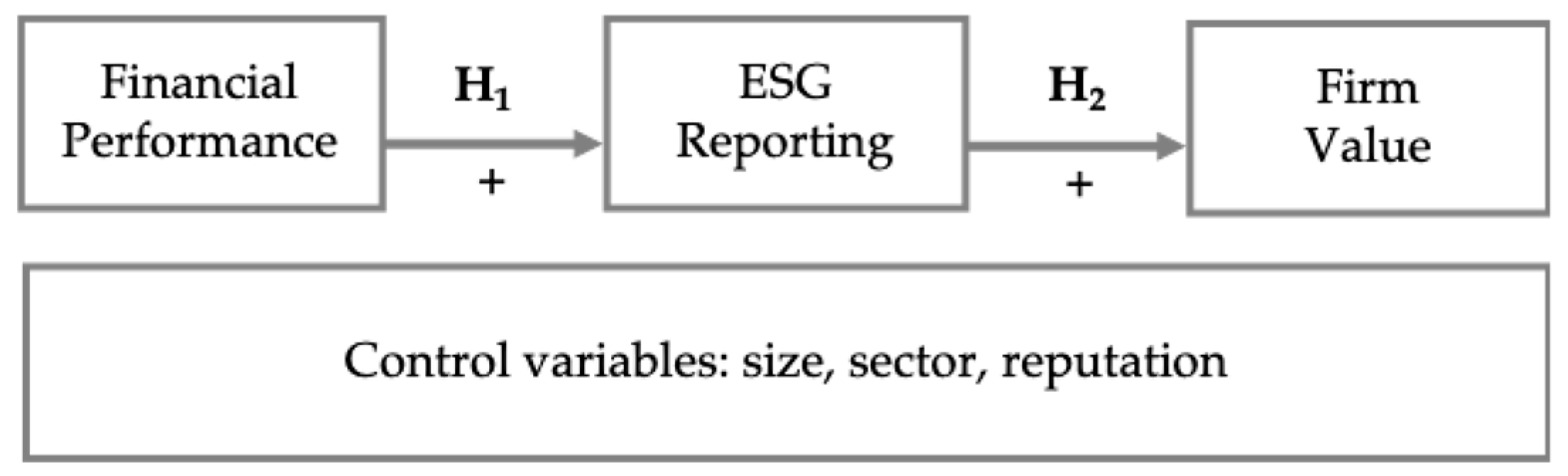
Thus, the following research hypothesis was formulated:
H1. Financial performance has a positive effect on ESG reporting.
Several studies suggest that ESG reporting has a positive influence on firm value. However, the effects vary by sector and region, as well as by the specific ESG component.
In the European context,
Saona and Muro (
2023) examined the impact of ESG disclosures on the value of European firms (proxied by Tobin’s Q) and found that the three pillars of ESG disclosures are positively associated with firm value, with firms from environmentally friendly industries benefiting more than firms in less environmentally friendly industries.
Albitar et al. (
2020) also found that ESG disclosures positively influence firm value (proxied by Tobin’s Q) in UK-listed companies, with stronger effects observed in firms with more robust governance mechanisms. The positive association was also confirmed for the environmental, social, and governance dimensions analyzed separately. In emerging markets, several studies (e.g.,
Difalla, 2026;
M. Hussain et al., 2025;
D’Costa et al., 2025) show that ESG reporting enhances firm value, which supports the idea that markets reward transparency and sustainability initiatives.
While ESG reporting is generally associated with an increase in corporate value (
Saini et al., 2026), this effect may be dependent on the ESG dimensions considered. For instance,
Riaz and Ousama (
2023) found that there is a significant positive impact of social and governance disclosures on corporate value, whereas environmental disclosures have a significant negative impact on corporate value. On the contrary,
Alhamar et al. (
2024) found that governance disclosures have a negative impact on market value, whereas environmental and social disclosures have no significant impact on market value. Thus, the relationship remains inconclusive.
Theoretically, it can be argued that disclosing and improving ESG information can enhance transparency, improve reputation, provide a better alignment with stakeholder expectations, and therefore contribute to enhance firm value.
Thus, the following research hypothesis was formulated:
H2. ESG reporting has a positive effect on firm value.
The research design is summarized in
Figure 1.
2.2. Sample
The sample comprises non-financial corporations listed on Euronext Lisbon that disclosed ESG information according to GRI standards from 2019 to 2022. The application of these criteria resulted in a sample of 9 firms: Altri; Corticeira Amorim; EDP—Energias de Portugal; Mota-Engil; NOS; SEMAPA—Sociedade de Investimento e Gestão; SONAE; Teixeira Duarte; and The Navigator Company. Observing each firm over a 4-year consecutive period yielded a balanced panel of 36 firm-year observations.
The small sample size is a consequence of both the characteristics of the Portuguese stock market and the selection criteria. The Portuguese stock market is relatively small, comprising only 34 non-financial listed corporations, after excluding sports and real estate corporations. Of these, 12 corporations did not disclose ESG information during the 2019–2022 period, 4 disclosed ESG information without following GRI standards, and 9 adopted GRI standards but did not report consistently throughout the 4-year period (2019–2022). To integrate the sample, firms were required to report ESG information according to GRI standards in each year from 2019 to 2022. As a result, only 9 corporations met the selection criteria. The criteria substantially reduced the number of eligible firms but ensured consistency and comparability across years. Note that a larger sample could have been obtained by relaxing some of the selection criteria. For example, limiting the analysis to 2021–2022 would have allowed the inclusion of 3 additional firms, while a cross-sectional analysis based solely on 2022 data would have increased the sample by 9 firms. However, this would have compromised the study’s objective of examining the evolution of ESG disclosure over time. Thus, the consistency and comparability in the longitudinal analysis was prioritized over the sample size.
We could have also relaxed the criteria of ESG reporting according to GRI standards. However, according to
F. Hussain and Zhou (
2026), the relevance of ESG disclosures increases when the information provided is perceived as credible and comparable. This is particularly the case when it is prepared in accordance with robust reporting frameworks, such as the GRI standards. As previously noted, the GRI standards are the world’s most widely used sustainability reporting framework and were widely adopted by companies during the period of the mandatory application of the NFRD (
KPMG, 2024). Additionally,
Sreepriya et al. (
2023) reveal that GRI compliance moderates the relationship between sustainability disclosures and firm value, with firms adopting the GRI framework exhibiting higher market valuation. For these reasons, we have decided to maintain GRI standards as the basis for collecting ESG-related information.
2.3. Variables
Data on ESG reporting was collected manually, through a detailed content analysis of sustainability reports or integrated reports, to extract information on the 89 items defined by the 2021 GRI standards. These items were then categorized in environmental, social and governance dimensions, as shown in
Table A1 of
Appendix A.
For each of these 89 items, we assigned a value of 1 if the item k was disclosed by corporation i in year t and 0 if it was not disclosed. Then, for each corporation i in each year t, we constructed an ESG reporting index as the ratio between the total number of items disclosed by the corporation and the total number of items comprising the index, as in Equation (1):
The same procedure was used to construct the E, S and G sub-indices, but considering totals of 32, 47, and 10 items, respectively. (Please see
Table A1 of
Appendix A for a description of the items included in each category.)
The ESG reporting index, as well as the E, S and G sub-indices, are considered as the dependent variables when testing H1 and as the independent variables when testing H2.
Financial performance (the independent variable in H1) was assessed by ROA, which is calculated by dividing net profit by total assets (data obtained from income statement and balance sheet, respectively). A higher ROA is associated with better financial performance, since it indicates that the company is using its assets efficiently to generate profits.
Firm value (the dependent variable on H
2) was proxied by a simplified version of Tobin’s Q, as proposed by
Chung and Pruitt (
1994). Firm value was computed as in Equation (2):
The market value of equity was calculated by multiplying the number of shares outstanding by the share price at the end of the year (data from the Investing website). Market value of debt was proxied by its book value (obtained from balance sheets). Tobin’s Q is a valid measurement of firm value because it not only reflects past performance but also represents the firm’s future development expectations (
Albitar et al., 2020).
Additionally, the following control variables were considered:
Size, as measured by the natural logarithm of total assets;
Sector, proxied by a dummy that takes a value of 1 if the firm belongs to the industry sector and 0 if it belongs to the services sector;
Reputation, proxied by a dummy that takes a value of 1 if the firm is included in the Portuguese Stock Index (PSI) and 0 otherwise.
2.4. Statistical Methods
To assess the impact of financial performance on ESG reporting (H
1) we used panel data regressions with random effects to estimate Equation (3):
To assess the impact of ESG reporting on corporate value (H
2) we used panel data regressions with random effects to estimate Equation (4).
Random (rather than fixed) effects were chosen to allow for the inclusion of time-invariant variables, namely sector and reputation. The Hausman test failed to reject the null hypothesis, indicating that the random effects estimator was consistent and appropriate. For robustness purposes, we also estimated Equations (3) and (4) using panel data regression with maximum likelihood estimation (MLE). We used STATA 16 software.
3. Results
3.1. ESG Reporting
Table 1 presents the ESG reporting index and sub-indices, in each year of analysis, allowing us to see the evolution of ESG reporting over time and to see which categories of information (environmental, social, and governance) were most reported by the companies in the sample. On average, Portuguese listed corporations in the sample disclose 56% of the items defined in the 2021 GRI standards. The degree of compliance with GRI standards is higher for environmental topics (60%), followed by social topics (55%) and governance topics (46%).
We can also note a significant increase in the value of the ESG index, as well as of all sub-indices, over the four years (from 2019 to 2022). Notably, there was a substantial increase in the disclosure of ESG information between 2019 and 2020, with the percentage of disclosed criteria rising from 38% to 56%. From 2021 to 2022, there was also an increase in ESG disclosures, albeit a less significant one (rising from 63% to 67%).
3.2. The Impact of Financial Performance on ESG Reporting
Table 2 presents the results of the panel regression models regarding the impact of financial performance on ESG reporting (H
1), summarized in Equation (3). The analysis was performed for the ESG disclosure index, as well as the environmental, social and governance sub-indices.
The results show that financial performance exhibits a positive coefficient across all models, suggesting that more profitable Portuguese firms may have a greater propensity to disclose ESG information. However, the coefficients are not statistically significant. Thus, the evidence is insufficient to validate H1.
Regarding the control variables, firm size emerges as the most consistent determinant of ESG reporting. The positive and significant effect of firm size on the ESG index is consistent with the prior literature which argues that larger firms have higher public visibility, face stronger stakeholder scrutiny, and possess more resources to implement and communicate sustainability practices. A positive and statistically significant relationship is likewise observed for the social and the governance sub-indices, whereas the effect on the environmental sub-index is not significant.
Environmental disclosures appear to be more influenced by firm reputation, as measured by inclusion on the PSI. The economic magnitude of this effect is also noteworthy: firms included in the PSI exhibit an environmental index value that is 0.263 higher relative to that of firms not included in the PSI. Given the mean of environmental disclosures (0.60), this represents a sizeable difference. This suggests that more visible firms place greater emphasis on environmental disclosures, possibly in response to stronger reputational pressures and higher stakeholder scrutiny.
The sector also exerts an effect on environmental disclosures (although it is only significant at the 10% level). The negative sign suggests that firms belonging to industrial sectors tend to disclose less environmental information. One possible explanation for this is that industrial sectors are generally more polluting than non-industrial sectors and therefore environmental disclosures are more sensitive to sector characteristics than social and governance disclosures.
Overall, firm size emerges as the most consistent determinant of ESG reporting, particularly for the social and governance dimensions, while reputation and sector characteristics primarily influence environmental disclosures.
Except for the fourth model, which considers the governance sub-index, all models are statistically significant and have a reasonable explanatory power (overall R squared is 48% for the ESG index, 54% for the environmental sub-index and 40% for the social sub-index). The models are more efficient at explaining the between-firm, rather than the within-firm, variability in ESG reporting.
3.3. The Impact of ESG Reporting on Corporate Value
Table 3 presents the results from the panel regression models used to investigate the effect of ESG reporting on firm value (H
2), as in Equation (4). The analysis was conducted using the ESG disclosure index, as well as the environmental, social and governance sub-indices.
The results reveal that ESG reporting does not significantly influence firm value. The coefficients of the ESG index and all the sub-indices are negative, but none are statistically significant. Therefore, H
2 is not supported, suggesting that ESG reporting is still not valued by the Portuguese stock market. The economic magnitude of the estimated coefficients also appears relatively modest. Given that the ESG index ranges from 0 to 1, a 0.1 variation in the index value (i.e., a 10% increase in ESG disclosures) is associated with a decrease of approximately 0.10 points in Tobin’s Q, which is a modest value given the average value of Tobin’s Q (please see
Table A2,
Appendix A). Similar results are observed for the environmental, social and governance dimensions. Therefore, the findings indicate that ESG disclosures have neither a statistically significant nor an economically meaningful impact on the value of the Portuguese firms in the sample during the period under analysis.
In addition, the estimated effects of the control variables (firm size, sector and reputation) on firm value are economically larger than that of ESG disclosures, suggesting that traditional firm characteristics may impact the value of Portuguese listed corporations more than ESG disclosures. Nevertheless, only firm size is statistically significant in all estimated models. The negative coefficient of firm size is also economically meaningful: a one-unit increase in firm size decreases Tobin’s Q by 1.212. This is a considerable effect, given that the average value of Tobin’s Q for the sample is 2.86.
Note that firm reputation shows a positive and significant association with corporate value (at the 10% level) when the environmental index is considered. The economic magnitude of the reputation effect is substantial: firms included in the PSI exhibit a Tobin’s Q 2.94 higher than other firms. This suggests that more visible firms benefit from stronger market recognition and reputation effects, which translate into firm value.
Finally, although the estimated coefficient of firm sector is relatively large in magnitude, it is not statistically significant. Therefore, there is insufficient evidence to conclude that firm value is affected by sector.
3.4. Robustness
For robustness purposes, we also estimated Equations (3) and (4) using panel data regression with MLE. The results are presented in
Table 4 and
Table 5, respectively. As before, we consider not only the overall ESG disclosure index, but also the individual ESG dimensions sub-indices.
Regarding H
1, the empirical results obtained from the MLE (
Table 4) are broadly consistent with those obtained using random effects (
Table 2). Financial performance remains an insignificant determinant of ESG reporting and of all its dimensions. Firm size remains a positive and statistically significant determinant of ESG disclosures across all specifications. Notably, the size of the coefficient is very similar in both models, suggesting that the effect is stable and economically meaningful irrespective of the estimation approach. Corporate size, reputation, and sector present similar coefficients but with stronger statistical significance in the MLE model than in the random effect estimation, for both the ESG index and the environmental sub-index.
Regarding H
2, the empirical results obtained from the MLE (
Table 5) are broadly consistent with those obtained using random effects (
Table 3). The estimated coefficients are broadly similar in magnitude, sign, and statistical significance, regardless of the estimation approach. ESG reporting, and all its dimensions, remains statistically insignificant. Firm size coefficients remain negative and statistically significant across all models, in both estimation methods. Corporate reputation is positive and significant at the 10% level across all models under the MLE, whereas it was only significant at the 10% level in model 2 in the random effects estimation.
Overall, both estimation methods lead to similar conclusions, suggesting that the results are not driven by the choice of estimation technique, thus reinforcing the robustness of the empirical findings.
4. Discussion
Contrary to expectations, financial performance does not significantly influence ESG reporting, leading to the rejection of H
1. Although Slack Resources Theory argues that financially stronger firms have greater capacity to invest in sustainability initiatives and reporting activities, the findings suggest that, in the Portuguese context, ESG disclosure is driven more by structural and reputational factors than by firms’ profitability. These findings are consistent with legitimacy theory, which posits that firms disclose social and environmental information to ensure alignment with societal expectations and maintain legitimacy. Larger firms are more visible and face greater scrutiny from regulators, the media, and the public, thereby having increasing incentives for ESG transparency and reporting. Similarly, the results support the stakeholder theory, according to which firms respond to pressures from a broad range of stakeholders. Larger firms typically have more diverse stakeholders—including institutional investors, regulators, and civil society—which increases demand for ESG disclosures. Moreover, larger firms generally possess more financial and organizational resources to implement and communicate ESG practices. Therefore, the positive effect of size and reputation on ESG disclosure corroborates previous evidence (e.g.,
Pertiwi et al., 2026) that associates corporate size and reputational concerns with higher levels of sustainability reporting.
Regarding the impact of ESG reporting on firm value (H2), our results show that ESG reporting does not significantly influence firm value. Therefore, H2 is not supported. This suggests that investors did not attribute additional value to ESG disclosure during the period under analysis. One possible explanation may be related to the characteristics of the pre-CSRD environment, in which non-financial reporting under the NFRD framework was characterized by relatively low standardization and comparability. Sustainability disclosures remained heterogeneous during this transitional regulatory period, which may have limited their usefulness for investment decisions. Consequently, investors may have continued to rely primarily on traditional financial indicators, not yet fully incorporating ESG information in investment decisions. Another explanation for the absence of a significant relationship between ESG reporting and corporate value is the small sample size. The limited number of observations may reduce the statistical power to detect a significant relationship.
These findings differ from those reported by
D’Costa et al. (
2025), who documented a positive relationship between sustainability reporting and firm value in the Indian context. However, both studies converge in highlighting the importance of firm size. While
D’Costa et al. (
2025) found that firm size negatively moderates the relationship between ESG reporting and firm value, the present study identifies a direct negative effect of size on corporate value. This result suggests that larger and more mature firms may benefit less from sustainability-related value creation due to lower growth opportunities and greater organizational complexity.
Since both studies employ Tobin’s Q as a proxy for firm value, the contrasting findings are unlikely to result from differences in measurement. Instead, they may reflect differences in institutional settings, market characteristics and the maturity of sustainability reporting frameworks. In particular, the Portuguese pre-CSRD context represented a transitional stage in which ESG disclosure practices were still evolving and remained relatively heterogeneous.
Furthermore, previous evidence generally suggests that ESG disclosure contributes positively to firm value (
Li et al., 2018;
Giannopoulos et al., 2022;
Nazarova & Lavrova, 2022), particularly in highly regulated industries (
Glova & Panko, 2025). However, more recent studies have produced mixed findings, with some reporting negative associations between ESG scores and market valuation (
Al-Tarawneh et al., 2024). For example,
Al-Tarawneh et al. (
2024) found a negative correlation between ESG scores and Tobin’s Q in India, indicating that investors might view ESG initiatives as incurring extra costs or imposing short-term limitations. While the present study found a negative but non-significant relationship, both studies support the idea that the value of ESG information is not always positive and may depend on institutional context and market perceptions.
Similar evidence has been reported in the Nordic context. Using Tobin’s Q as a proxy for firm value,
Granberg and Dalunde (
2025) found a negative relationship between ESG scores and firm valuation among Nordic small-cap firms. Their findings suggest that the short-term costs associated with sustainability initiatives may outweigh their immediate market benefits. Therefore, the present findings reinforce the view that the relationship between ESG and firm value remains context-dependent and far from consensual. These findings also suggest that the benefits of ESG reporting may not be reflected immediately in firm value. In the Portuguese context prior to the CSRD, investors may not have fully recognized these benefits due to the limited comparability and standardization of sustainability disclosures.
Finally, corporate reputation, proxied by PSI membership, was found to be a significant determinant of environmental disclosure, as well as a significant determinant of corporate value, when the environmental index was considered. Interestingly, reputation appears to be more strongly associated with firm value than environmental disclosure per se. This finding suggests that investors may attribute greater importance to firms’ market visibility and established reputation than to the quantity of environmental information disclosed. In line with
Ding and Wang (
2025), reputation may constitute a strategic asset that helps firms preserve legitimacy, reduce reputational risks and maintain stakeholder confidence in increasingly demanding regulatory environments.
Overall, the findings suggest that firm value in the Portuguese stock market was influenced more by structural and reputational characteristics than by the extent of ESG disclosure itself under the pre-CSRD framework. This emphasizes the importance of examining whether the increased standardization and comparability introduced by the CSRD will enhance the relevance of ESG information in the future.
5. Conclusions
This study makes a valuable contribution to the literature by examining the relationship between financial performance, ESG reporting, and firm value in the Portuguese stock market during the final years preceding the implementation of the CSRD.
The results suggest that, in the pre-CSRD context, ESG disclosures were primarily driven by structural and reputational factors, rather than by firms’ profitability. Firm size emerged as an important determinant of ESG reporting, particularly on its economic and social dimensions, while reputation and sector characteristics primarily influence environmental disclosures. Moreover, the results show that corporate value was strongly associated with traditional firms’ characteristics, particularly firm size and reputation, than with ESG disclosures. Thus, the findings do not allow to confirm the existence of a significant relationship between financial performance and ESG disclosure, nor between and firm value.
However, this study has some limitations that should be mentioned. First, the small sample size may have reduced the statistical power of the analysis and hindered the detection of significant relationships, particularly when underlying effects were modest. The small sample size may also reduce the reliability and generalizability of the findings. Consequently, the findings should be interpreted with caution. Second, the study considers the period preceding the implementation of the CSRD, and the relationship between ESG reporting and corporate value may be dependent on the regulatory context. Recent evidence from
Mahmood et al. (
2025) also reveals a general decline in Tobin’s Q during the period surrounding the introduction of the CSRD. The authors attribute this decline to stricter regulatory requirements, uncertainty among market participants, and concerns regarding potential greenwashing practices. Third, while the ESG disclosure index in this study captures the extent of reporting based on GRI topics, it does not assess the materiality, credibility or depth of the information disclosed. Therefore, investors may value the quality and reliability of ESG information more than the mere number of reported items. In fact,
Fatemi et al. (
2018) show that a firm’s ESG activities are value-relevant, whereas disclosure alone is insufficient to enhance market valuation and may be viewed skeptically if not supported by genuine ESG performance. This suggests that the market rewards the substance of ESG practices rather than merely the act of disclosing ESG information. Fourth, although Tobin’s Q is an accepted and widely used proxy for corporate value, the choices involved in its calculation and interpretation remain debated, and it should ideally be complemented by other measures of value, such as market capitalization or stock returns.
These limitations open several avenues for future research. Future research could extend the analysis to a larger set of firms, a longer time period, or multiple European countries, thereby increasing statistical power and improving the external validity of the findings. Cross-country studies would also allow researchers to examine whether the observed relationships persist across different institutional, regulatory, and capital market environments.
Future research could also examine whether the harmonization, comparability, and transparency introduced by the CSRD and the ESRS have strengthen the relationship between ESG reporting and firm value. In line with institutional theory, the coercive pressures associated with the new regulatory framework may encourage firms to adopt more substantive ESG disclosure practices (
Ding & Wang, 2025), thereby increasing the likelihood that sustainability information is perceived by investors as credible and aligned with organizations’ actual performance. Consequently, future studies could compare the pre- and post-CSRD periods and examine the moderating role of reporting quality, external assurance of sustainability information and ESG decoupling practices.
The distinction between ESG disclosure and actual ESG performance opens promising avenues for future research. Future studies could move beyond ESG reporting and investigate the potential misalignment between ESG disclosure and ESG practices and performance, an academic phenomenon known as ESG decoupling, which reflects the gap between symbolic commitments and substantive sustainability performance. Although recent evidence suggests that firms with higher market value may be more susceptible to ESG decoupling (
Cepêda et al., 2026), the reverse relationship, i.e., whether ESG decoupling affects firm value, remains largely unexplored. Examining this relationship could provide further insights into whether investors reward genuine sustainability performance or merely symbolic disclosure practices. The role of external assurance of ESG reports could also be investigated.