1. Introduction
Over the past period, the Romanian ICT sector has experienced significant growth, represented also by the increasing number of listed firms on AeRO (Alternative Exchange Regulated Own) segment of Bucharest Stock Exchange BSE (AROBS Transilvania Software S.A.—AROBS, Bittnet Systems S.A.—BNET, Connections Consult S.A.—CC, Arctic Stream S.A.—AST). After listing, these firms registered accelerated market value growth until 2023, which was sustained by optimistic expectations towards the sector development. However, the years 2023–2025 were characterized by a marked stagnation. In several cases, the market prices of listed Romanian ICT firms have consistently decreased. The average annual price ranged between approximately −20% and −44%. Four representative firms are analyzed in
Table 1. AROBS recorded a 41% decrease, BNET recorded a 44% decrease, CC recorded a 12% decrease, while AST recorded a 23% decrease. These decreases occurred despite continued positive earnings. Firms also continued dividend distributions. This development contrasts sharply with analysts’ forecasts. It also contrasts with the development of the BET index, which recorded positive returns in the same period. Thus, this evolution creates a relevant context to investigate financial and investment mechanisms specific to ICT firms, together with factors that influence their trajectory after listing. Romanian ICT firms made various relevant moves such as share buybacks, capital increases, and distributed dividends. This paradox highlights a discrepancy between market infrastructure development and results at a microeconomic level. In Romania, this issue is amplified by the structure of investors, dominated by individual participants, emotionally influenced investment behaviors and lack of advanced tools to manage risks. Even though it has registered real progress in recent years and recently received the status of emerging market, the Romanian capital market faces numerous problems related to liquidity (
Prelipcean et al., 2026), the reduced depth of market microstructures, the lack of minimum financial education that would convey the propensity of small investors to participate. These elements overlap on a turbulent global landscape with overlapping crises that provides an opportunity to study the behaviors of ICT firms operating in VUCA (Volatility, Uncertainty, Complexity, Ambiguity) environments. In this context, the proposed analysis contributes to understanding these discrepancies and courses of action for investors and managers, in an environment characterized by uncertainty and specific constraints of emerging markets. In emerging markets, maintaining the attractiveness of the ICT sector listed on BSE, even in adverse market conditions. Investors are interested, but with the firms being small and newly listed, the available data are scarce and delayed. The courage of entrepreneurs to list on BSE must be complemented by stimulating investors and creating synergies of action in the market operation specific to the ICT sector in an emerging market.
The purpose of this study is to develop and apply a dynamic investment model that captures how financial constraints, liquidity management, and the cost of capital shape liquidity and firm-value dynamics in recently listed Romanian ICT firms under adverse macroeconomic conditions. The research questions addressed in this paper are: (i) how do liquidity constraints and the cost of capital affect liquidity accumulation and firm value of newly listed Romanian ICT firms in a high-inflation environment, and (ii) to what extent does incorporating a realistic risk-free rate alter the optimal liquidity threshold and firm value relative to simplified theoretical benchmarks? The principal contribution of this study is the development of a simple, scalable, simulation-based decision framework that allows managers and investors to quickly assess the joint impact of macroeconomic volatility and the cost of capital on liquidity strategy, in a context where conventional empirical calibration is not feasible due to data scarcity.
Despite the significant progress, the capital market of Romania is challenged by structural limitations that impact the efficiency of funding entrepreneurial firms. The lack of derivative instruments and margin trading, low liquidity and institutional constraints influence the way firms access external capital and manage their financial resources. These aspects are extremely important for ICT firms, such as AROBS Transilvania Software S.A., which depend on financing to sustain their growth. In this context, the current study proposes an investment model adapted to emerging markets. The model analyses the determination of optimal cash, investment decisions and external financing options to improve financial decisions through a useful framework. Also, it represents a basis for the substantiation of market development policies. BSE indices have performed remarkably well in the last 3 years while the listed Information Technology (IT) segment has been surprisingly stagnant. Investors have been trying to understand the management approach of ICT firms in a difficult and volatile context. Capital market includes the share market as well as other segments such as credit market or financial derivatives. In this study, the share market dynamics are linked to the general development of BSE Bucharest Stock Exchange ecosystem. It also includes the growing number of firms listed on AeRO, capitalization growth and international visibility. This distinction is rather important as the favorable evolution of market overall does not reflect the uniform performance of all listed firms, especially for ICT firms.
Table 1 presents a comparative overview of four Romanian ICT firms listed on the Bucharest Stock Exchange: AROBS Transilvania Software S.A Bittnet Systems S.A., Connections Consult S.A. and Arctic Stream S.A. The selected indicators reflect their market positioning, trading performance, and valuation level (data collected on 10 December 2025). Despite having a slightly negative EPS throughout the time under analysis, BNET was kept in the analysis because of its significance in Romania’s IT industry and its standing as a representative of newly established technology firms.
Thus, the contrast between solid financial performance (EPS, dividends) and the weaker market reaction (price stagnation, valuation differences) is highlighted. The analysis of indicators such as market capitalization, PER, EPS and dividend yield highlights the existence of a gap between economic fundamentals and investor expectations in the Romanian ICT sector. The newly listed entrepreneurial ICT firms had a high degree of attractiveness immediately post-listing, and the managers tried interesting market operations. The ICT-BSE market decoupling has persisted for over 3 years and investors are trying to decipher the reasons and what courses of action should be followed in the future. There is great interest in this from both sides: managers and shareholders. The differences highlighted in
Table 1 support the hypothesis that share prices do not fully reflect the financial performance of Romanian ICT firms in recent years.
This suboptimal performance contradicted the analysts’ expectations and reduced investor confidence in subsequent developments.
To analyze the behavior of relevant firms in the Romanian ICT sector, an analysis based on an innovative investment model is proposed that captures elements of liquidity management and the cost of capital under restrictive monetary policies (inspired by the literature of dynamic investment models, models for substantiating financial decisions regarding external financing or asset sales, optimal cash management).
The proposed model will also be oriented towards determining optimal cash, the implications for investments, the effective ways of accessing external financing (equity type) with the highlighting of a relevant set of parameters: earnings growth and liquidity risk, external cost of financing, liquidation value of the company, opportunity cost associated with holding cash (a critical element in the case of emerging markets in high inflation periods), and investment adjustments. These issues of adapting portfolios to new market dynamics involve new architectures of external finance, portfolio movements, the integration of new dividend policies and, finally, readjustments to external factors such as external turbulences and crises, and persistent domestic inflation. Extending the framework to include external equity financing, portfolio rebalancing, and new dividend-policy architectures remains an important direction for future research. A balanced reconfiguration of investment strategies will provide strategic success based on increased resilience, agility and robustness.
In the literature, there is a conventional approach of defining the domain of optimal policies starting from two barriers, the condition of paying dividends to shareholders (endogenous barrier) and the condition of attracting external financing; the firm adjusts its capital expenditure, asset sales and hedging policies in the area defined by these two barriers. A relationship is also identified between q-Tobin (the ratio between the firm’s market value and the replacement cost of capital) and the return on investments, which highlights the effect of the risk-free rate, the effect of increased productivity and future income, operational expectations).
This results in the need to decipher the elements of a complex dynamic framework in which to suggestively characterize optimal investments, possible external financing and even risk management policies. The main possible risks resulting from macroeconomic factors consider immediate liquidity problems and how to anticipate and deal with possible operational shocks that reduce production and income. In this case, solutions must be configured starting with cash flow allocation strategies (e.g., building a financial risk buffer) and building operational resilience (to ensure the functionality of contracts).
The literature suggests that, given current external financing costs, investments, risk management and financial decisions are strongly interrelated, while the model developed in this study focuses on the liquidity-investment channel, ICT firms can more broadly create value through efficient liquidity management and hedging strategies (
Clifford & Smith, 1995;
Gamba & Triantis, 2008;
Graham & Rogers, 2002;
Mello & Parsons, 2000). In principle, risk management contributes to reducing the financing costs of investments, especially through structuring external financing (e.g., cash available in situations where investments are valuable or urgent) or hedging operations (reducing the volatility of net earnings and reducing the need and cost of holding cash) in which derivatives exploit the covariance between the company’s earnings and the earnings from derivatives; although in turbulent conditions, the asset sale strategy can also be considered, given the importance and quality of the ICT sector in an emerging market, this aspect will not be detailed. This is the case of share-buyback programs that aim to reduce the discount of the market price compared to the intrinsic value of the respective shares.
2. Literature Review
In the specialized literature, studies on investment decisions, financial behavior, and corporate liquidity management have evolved from simplified static models to more complex dynamic models that better reflect the realities of modern economic and financial environments. This shift reflects the need for a better understanding of the interactions between investments, external financing, capital cost and liquidity risk assessment which are essential elements found in emergent economies and innovative sectors, as is the case in the information technology sector.
The first part of the literature review covers the description of pillar models developed over time by several researchers to support investment and financial decisions.
A fundamental stepping stone is represented by static evaluation models of external financial costs, which were developed since the early 90s. In the presence of risks and incomplete markets firms should not consider financial, investment and liquidity holding decisions as being independent of one another (
Froot et al., 1993). In this framework, access to external financing incurs extra costs, usually generated due to informational asymmetry and financial markets constraints, which in turn forces a prudent policy making regarding the firms’ asset holdings. These models offer a basis for understanding how firms react when external disturbances affect their investment trajectory.
The literature has focused on inter-temporal models based on the principles mentioned, in which decisions regarding liquidity and investments are analyzed in different periods, based on financing cost evolution and possible anticipated asset gains. Some cash-optimal models based on a three-period framework propose that firms plan the optimal level of cash needed to balance current investment needs and future financial requirements (
Clifford & Smith, 1995;
Froot et al., 1993). These models show that liquidity retention has an essential role in dampening the negative effects of financial shocks and in preserving investment capability, especially in periods of macroeconomic uncertainty or reduced cash-flow.
An important theoretic development direction is represented by dynamic investment models that examine decisions regarding capital, liquidity and external finance in an intertemporal optimization framework. The works done in other research papers (
Gamba & Triantis, 2014;
Hennessy et al., 2007) provide a formal analytical framework for investment decision analysis in the presence of financial friction and financial adjustment costs. These models suggest that firms tend to keep an optimal level of liquidity and take into consideration the adjustments to marginal financing adjustment costs, anticipated return and the risk associated with fluctuating future cash flows.
In a complementary approach, Euler type models (
Hart & Moore, 1994) extract the equilibrium conditions that govern investment and financing decisions, starting from the equality between marginal capital yields and internal/external opportunity costs. These models highlight the effect of financing costs, taxation and liquidity constraints over the investments and, implicitly, on the value of the business.
A significant contribution to literature on liquidity and financial behavior of firms is the optimal cash-flow models (
Bukvic & Pavlovic, 2023;
Harbula, 2001). They show that having an optimum level of cash is not a passive behavior, but a strategic action with the intent to minimize the associated costs regarding external financing and to maximize the firm’s flexibility in the face of economic uncertainty. In this context liquidity becomes an instrument of protection against market shocks, but also a means of capitalization on investment opportunities when external conditions are favorable.
In addition, dedicated literature that pertains to business in financial difficulty (
Rampini & Viswanathan, 2010) explores the impact that the credit risk and lack of liquidity have on operational continuity and on market value. In these types of situations, the decisions regarding investment cost reductions, asset sales or capital restructuring are directly correlated with the capacity of cash flow administration and solvency management of the firm.
On a related plane, the research on the effect of taxation on financial and investment decisions (
Desai et al., 2004;
Foley et al., 2007) shed light on the influence of fiscal policies on the behavior of international business and those with entrepreneurial capital. These studies show that the level of taxation can affect the actions of profit repatriation, capital structure and liquidity management strategies, thus determining significant differences between firms in mature and emerging economies.
From literature analysis, a conclusion can be drawn that even though a solid theoretical framework exists regarding the interactions between investments, liquidity and external financing, it cannot be easily applied to IT firms operating in emerging markets. In Romania, where the capital market is currently in a maturing process and external financial costs are relatively high, lack of consistent empirical studies leaves certain observed behaviors of firms listed on the Bucharest Stock Exchange unresolved (
Nițescu, 2009).
The scientific literature gap is represented by the limited number of studies dedicated to emerging markets and the lack of applied research to a recently listed field at BSE Bucharest Stock Exchange. From this gap also derives the limited amount of available data and the impossibility of directly applying the standard hypotheses of financial models. Furthermore, there is a pressing need for managers and investors to better understand the evaluation mechanisms and how to devise market strategies (capital increases, buy-back programs or corporate bond issues) in an environment characterized by volatility and rapid growth of the ICT field. The paper proposes an analysis framework adapted to these conditions, without considering strict predictive precision, but focusing on understanding the strategic path to follow. This approach is unique for an emerging market of a small size, with an entrepreneurial field recently listed and may open new directions of research for other industries on BSE.
Thus, the current literature offers a useful conceptual framework but insufficiently calibrated to the specificities of emerging economies and of the ICT sector, which are defined by intensive investment in human resources, innovation and technology, to the detriment of tangible assets. It therefore became necessary to develop a dynamic model tailored for the Romanian context, which permits the simultaneous evaluation of the decisions that govern liquidity and investments within a framework that could be extended to incorporate external financing, considering institutional constraints, market volatility and restrictive monetary policies.
Therefore, this research is based on a diverse theoretical background, proposing a framework to integrate specialized scientific literature to determine optimal cash flow, investment analysis in financial friction conditions and the impact evaluation of capital costs on strategic decisions of ICT firms from Romania. This approach addresses a significant gap in the specialized literature and has the potential to make a relevant contribution to understanding the behavior of firms from a field which, even though dynamic and innovative, faces challenges in risk management and funding.
Recent studies place increased emphasis on establishing the optimum level of liquidity and on the effects of financial friction in emerging markets. Other researchers (
Diaw, 2021;
Nenu & Vintila, 2017) indicate that firms from emerging economies accumulate cash primarily as a precautionary measure in the context of high cost of access to external financing. Also, scientific researchers highlight that indicators such as firm size, asset structure, or stock market liquidity have a significant impact on cash holdings policies, suggesting that the financial strategy must be adapted to local institutional conditions (
Vuong et al., 2025;
Yilmaz, 2024).
Other studies explore the role of governance and ownership structure in managing liquidity. Studies (
Hussain et al., 2023;
Thai & Hoang, 2024) show that firms with a solid governance or with a certain type of shareholder tend to maintain more efficient levels of cash, while
Das et al. (
2025) point out that institutional investors are extremely important to reduce excessive hoarding of cash.
Towards the link between liquidity and performance,
Lim and Jeong (
2025) demonstrate that in the ICT sector the relationship is nonlinear: an adequate level of liquidity supports investments, but excessive cash hoarding may signal a lack of profitable investment opportunities. This idea is also supported by
Zhao et al. (
2023), who underline the risk of inefficient asset allocation.
Risk management and hedging strategies have regained attention, confirming the reduction in capital costs for firms that embrace such policies (
Alexandridis et al., 2021;
Hankins & Hoberg, 2024). Some studies (
Bustos et al., 2022;
Upreti et al., 2022) complement this perspective by showing that hedging increases the capacity for financing and stabilizes the cash flows, which are critical aspects in the presence of financial frictions.
Integrated literature of Tobin’s q and investments is extended by the contributions of
Cao et al. (
2019), which interpret q in a framework of financial constraints, and by the studies of
Jeenas and Lagos (
2024), that describe the monetary policy transmission through q on investments. Even more, researchers highlight the role of shareholders and of the economic cycle in modifying the relation between q, cash flow and investments (
Mendieta-Muñoz, 2024;
Piluso, 2025).
These studies strengthen the idea that investments, liquidity and access to financing are strongly interdependent, and in ICT fields from emerging markets such as Romania, these mechanisms are amplified by high volatility, reduced liquidity of capital market and high costs of external financing. Therefore, the use of a dynamic model that optimally integrates cash, financial frictions and technological parameters is essential to understand the ICT firms’ decisions and to explain their suboptimal behavior in the stock market.
3. Materials and Methods
This study uses an exploratory simulation-based methodology instead of a traditional empirical approach, as historical data for newly listed entrepreneurial ICT firms on the BSE are scarce. Rather than focusing on predictive accuracy, the goal is to gain a comprehensive understanding of investment and financing dynamics in the context of macroeconomic variations. The research methodology was designed to account for the limited data available from recently listed companies on the BSE/AeRO, the structural characteristics of the BSE market, and the prevailing high-inflation macroeconomic environment. The main parameters of interest were selected on this basis, and the simulations were carried out accordingly.
This research is based on the theoretical framework of the investment–Euler equation with external financing (IEEF) used as a starting point for the formulation of the dynamic optimization problem of the firm and the Hamilton–Jacobi–Bellman (HJB) representation. In this framework, the optimal investment decision results from equating the marginal cost of investment with the marginal benefit obtained through financing:
Since the objective of the article is mainly applied and numerical, the complete analytical derivation is not reproduced in full; the model is presented in the reduced form used later in the simulation.
The IEEF yields a series of interesting implications for the analyzed field in the current context of an emerging market:
Low cash holdings, specific to stocks in the ICT sector in emerging markets, lead to an increase in the marginal cost of financing, the impact being further aggravated by high interest rates;
Marginal ρ increases with financial leverage, again a specific aspect of ICT firms recently listed on the AeRO market of the Bucharest Stock Exchange; investment decreases with leverage (in a context in which marginal q is inversely related to investments);
Increasing the degree of indebtedness, again a specific aspect of the ICT sector in Romania, implies an adjustment based on the preference for asset sales, a negative aspect with a long-term impact.
The general objective of this research is to develop a simple, scalable strategic decision capability based on conventional corporate operations and liquidity management that provides a quick overview and the elements needed to design flexible sets of financial strategies (liquidity management, the capability to access external financing, but also some risk management aspects) in the current context of high inflation and high cost of capital.
The operational objectives of this research are:
Understanding the behavior of Romanian ICT firms in the current context of expensive external financing, in comparison with classical liquidity management (the simple cash holdings);
Contribution to understanding the impact of financial constraints on investments in the Romanian ICT industry in the actual macroeconomic context in a highly illiquid and underdeveloped emerging market;
Sketching an innovative way of designing and integrating alternative strategies without financial hedging based on conventional corporate operations and liquidity management assets (with the mention that in BSE there is no market for derivative instruments).
The two research hypotheses formulated below are directly derived from these operational objectives. H1 tests the financing-hierarchy behavior implied by the first and second objectives—namely, whether firms favor internal liquidity over costly external financing when facing constrained access to capital. H2 tests the role of the real cost of external financing in shaping investment and liquidity decisions, addressing the third objective concerning the design of alternative strategies under restrictive financing conditions. Together, these hypotheses operationalize the general objective of the study by linking the conceptual framework to testable implications of the model.
Research hypotheses:
H1. Romanian ICT firms listed on BSE follow a conventional financing hierarchy, prioritizing internal funds, with external equity issuance representing a last-resort instrument with limited accessibility in the current market context.
H2. The introduction of the real cost of capital in the proposed analysis has direct implications for liquidity and investment management.
The first hypothesis is about the financing sequence that is natural for newly listed ICT entrepreneurial firms even if accessibility and efficiency are limited, as evidenced by the decoupling from market dynamics.
The second hypothesis concerns the real cost of financing, which is also a difficult issue to formulate for the real conditions of the BSE, because the evaluation of risk premiums and ERP (equity risk premium) is extremely complex. Introducing a liquidity-oriented view is well adapted to the real conditions of the BSE at this moment of development against a background of a high level of volatility. Testing cannot be performed on such a limited data history—in this research the authors aim to contribute to the understanding of the processes specific to the ICT—entrepreneurial sector listed on the BSE by providing general milestones for interpretation by managers and investors (the vast majority of investors do not have the critical mass of knowledge and trade emotionally). Therefore, the paper aims to respond to the interest of managers and investors in deciphering some mechanisms and to prepare future research that will benefit from additional data and the fruition of knowledge of new trends and correlations currently unavailable.
The objectives were formulated in relation to the research requirements of managers and investors, in the real conditions of the BSE at the present time. The classical methods are based on assumptions that cannot be applied in the ICT–BSE context, the focus is on signaling opportunities and improving the understanding of market mechanisms for the managers and shareholders who operate in an extremely sensitive and volatile environment.
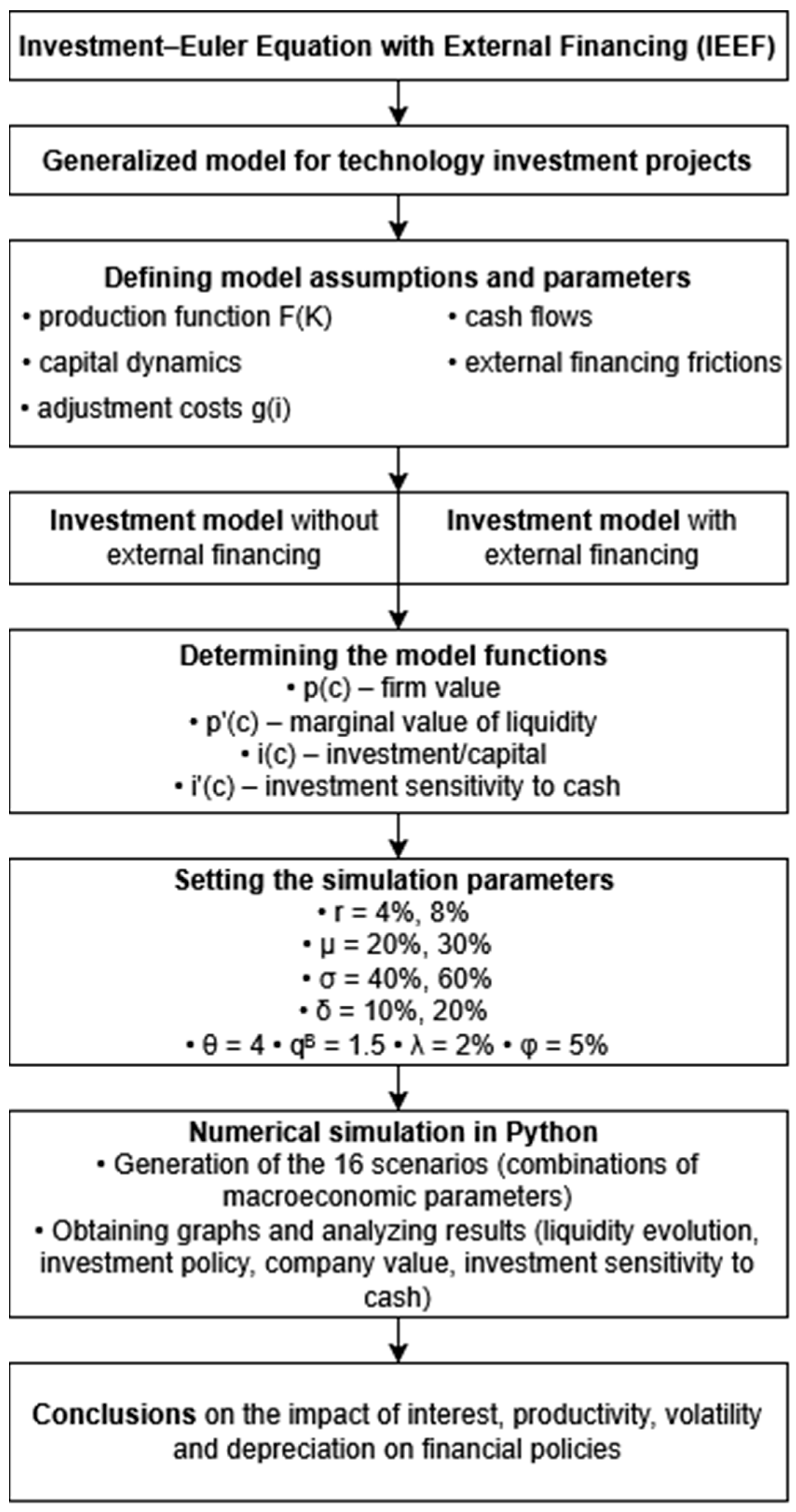
Thus, starting from the investment–Euler equation with external financing (IEEF) as a theoretical starting point, a simplified generalized model of technological investments under conditions of uncertainty and financial constraints is built (
Figure 1). The choice of this methodology is justified by the model’s ability to capture the effects of interest rates, productivity, volatility and depreciation on firms’ liquidity decisions and, to a more limited extent, on the level of investment at the endogenously determined liquidity threshold. The parameters used in the simulation were selected to reflect both normal economic conditions and scenarios characterized by high uncertainty and higher financial costs, which allows the assessment of the applicability of the model in different economic contexts. Then, the authors used a numerical simulation in Python 3.10.11 to assess the behavior of the model. The Python simulation was chosen due to the complexity of analytical solutions in the presence of endogenous liquidity threshold and the generalized Wiener process. The simulation obtained allows the determination of the functions p(c)—the value of the firm relative to capital, p′(c)—the marginal value of liquidity, i(c)—the investment/capital ratio and i′(c)—the sensitivity of investments to cash, thus providing a clear picture of how changes in macroeconomic parameters influence the financial and investment policies of the firm.
The profit equation was developed starting from classical hypotheses, capital stock dynamics (with depreciation rate), the proportional income hypothesis, and considering a Geometric Brownian Motion. In the process, many parameters accumulated that cannot be reliably measured in the conditions of the shares of ICT companies recently listed on the BSE, an emerging market that offers very little public information. The filtering allowed a simplification of the problem and a focus on the parameters of real interest for the current context (the impossibility of operating on futures or derivatives markets, requires special attention to liquidity management and market operations, all in an inflationary environment with high volatility of interest rates).
3.1. A Generalized Model for Technological Investment Projects
In general, the conventional analysis of industrial investment projects starts from the production function:
and the capital stock:
where
δ = depreciation rate,
K = firm’s share capital and
I = investments.
In this case the interest is to understand the dynamics of operating income that could be expressed by using a generalized Wiener process (or GBM, Geometric Brownian Motion):
where
is the dynamics of productivity;
The expression for the generalized Wiener process (GBM) is expressed as:
with the main parameters, μ > 0 mean, σ > 0 volatility and
Z the Brownian motion.
The dynamics of the profit could be expressed by:
with
AC—adjustment costs related to investment process:
where
i is investment–capital ratio:
and the function
g(
i) (variable convex adjustment cost) appears in specialized literature in the conventional setting:
with
θ measure of adjustment costs. Also,
ϕ ≥ 0 is a fixed cost of investment that captures recurring administrative, legal, and market access costs that do not depend on the scale of investment. For newly listed ICT firms, this fixed cost reflects the baseline associated with maintaining a listing and complying with BSE disclosure requirements.
The residual (liquidation) value of the company is:
where
l ≥ 0.
Next, the mechanisms generated by external financing frictions (EF) are analyzed.
For this, fixed issuance costs ΦK are considered with an impact on .
In situations where external financing becomes extremely difficult or unavailable, the firm may be forced to liquidate part of its assets to maintain financial stability, up to the limit established by:
Returning to the dynamics of profit (6) and integrating the financing costs
and payout process to stakeholders
, it results in the cash-flow dynamics
.
where
r is the risk-free rate, and
λ is the opportunity cost associated with holding cash. In this study, the risk-free rate is the most critical parameter, given the persistently high inflation and the pronounced volatility of the risk-free rate driven by successive monetary policy announcements.
The condition for maximizing the value of the firm (the case without liquidation) is:
Equation (13) represents the firm’s objective function, maximizing the present value of net cash flows to shareholders, defined as payouts to shareholders () less external financing costs (), discounted at the risk-free rate r.
3.2. The Case of Investment Without External Financing
In perfect markets, the optimal investment policy is written:
With:
and the capital stock is
and is expressed by highlighting the Tobin’s Q (
:
and expected productivity
.
Even if this case is not used in practice, it offers an image of the behavior in certain limit situations of this type (high inflation and high rates, high volatility). In this research the focus is on the impact of risk-free rate, with the mention that Romania is experiencing a period of high inflation.
3.3. The Case of Leverage with External Financing
All technology firms aim for a higher rate of development, possibly through leverage with external financing (debt or equity). In Romania, technology firms typically enter the capital market in stages: first through bond issuance, then through an IPO on AeRO, and subsequently on the main BSE market. In conditions of high inflation, in addition to the increase in the risk-free rate, there is an increase in the risk premium that drives away potential investors.
The value of the firm
FV(
K,
CF) depends on the capital stock K and cash inventory CF. Using Hamilton’s optimality principle, and specifically applying Itô’s lemma to the value function (
FV(
K,
CF))—subject to the capital stock dynamics in Equation (3), the cash flow accumulation dynamics in Equation (12), and the firm’s objective function in Equation (13)—yields the following Hamilton–Jacobi–Bellman (HJB) equation:
The firm value FV(K, CF) is defined as the maximized expected present value of all future shareholder cash flows (dividends less equity issuance costs), conditional on the current state (K, CF). The first term, , captures the contribution of net capital accumulation (gross investment less depreciation) to the marginal value of capital: when the firm invests, capital grows and firm value increases proportionally to Tobin’s marginal q (FV_K). The second term, , captures the impact of net cash accumulation on firm value: it reflects the combined effect of cash returns (r·CF), the opportunity cost of holding cash (−λ·CF), operating profit (μ·K), and cash outflows for investment and adjustment costs. This term is the key linkage between the firm’s operating and financing policies. The third term, , is the Itô correction arising from the stochastic volatility of the cash accumulation process. It captures the precautionary value of liquidity under uncertainty. When FV is concave in CF (FV_{CF,CF} < 0), this term reduces firm value, reflecting the cost of cash flow risk.
In a simplified version, the firm value is expressed as:
where c is the cash-capital ratio, which represents an intuitive parameter for both managers and investors at BSE Bucharest Romania. The complexity of the phenomena requires a new way of thinking focused on the selection of a small number of relevant parameters that are practically followed by both managers and investors.
In this way, the optimization reduces to solving the dynamics p(c) where
In Equation (20), the term
shows the net effect of the firm’s cash holdings. The firm earns the risk-free rate
r from its cash, either through short-term deposits or money market instruments. However, this gain is diminished by the carrying cost
λ > 0. The parameter
λ is not a fiscal cost. It expresses the opportunity cost of holding cash. More precisely, the firm forgoes the opportunity to invest capital in productive projects that could generate returns higher than the risk-free rate
r. Thus, a firm that maintains a high level of cash loses the difference between the return on productive investments and the risk-free rate. The return on productive assets, denoted
r_investment, is assumed to be higher than
r. The parameter
λ approximately captures this difference. This approach is frequently used in the dynamic corporate finance literature, including in the works of
Bolton et al. (
2011) and
Gamba and Triantis (
2008). In the context of the BSE, the value
λ = 2% reflects the approximate difference between the overnight interest rate in Romania and the estimated average return on capital investments in the ICT sector during the period 2023–2025.
Finally, substituting (21), (22) and (23) into (17) results in the form of the differential equation for p(c):
4. Results and Discussions
To evaluate the model presented above, a numerical simulation was performed in Python that generates the solutions of the functions p(c), p′(c), i(c) and i′(c) for a set of 16 scenarios, resulting from the combination of the macroeconomic and technological parameters in
Table 2.
The parameter values used in
Table 2 and
Table 3 for the simulations performed were selected in such a way as to allow the analysis of the model’s behavior in plausible economic intervals. For entrepreneurial ICT firms recently listed on the Bucharest Stock Exchange, there are no sufficiently long historical series or published structural estimates to allow for a robust econometric calibration. For this reason, the methodology used in the study is exploratory in nature and aims to highlight the influence of macroeconomic indicators on the financial practices and investment dynamics of the analyzed firms. The high volatility values (σ = 40% and σ = 60%) were chosen to reflect the variability specific to start-up tech firms, significantly higher than that found in mature firms in developed markets (
Lundmark et al., 2020). The structural parameters θ = 4, ϕ = 5%, λ = 2% and qB = 1.5 were selected based on the literature on adjustment costs, financial constraints and Tobin’s q theory (
Hayashi, 1982;
Lan et al., 2012.;
DeMarzo et al., 2012;
Bolton et al., 2011). In particular, the parameter θ captures the adjustment costs of investments and investment frictions frequently used in dynamic corporate finance models. Since the literature does not provide benchmark values for newly listed entrepreneurial firms in emerging markets, the value θ = 4 is used as a reasonable baseline assumption. Similarly, the values ϕ = 5% and λ = 2% were chosen to reflect plausible financing and liquidity conditions for Romanian ICT firms during the analyzed period.
Apart from these values, the values of the structural parameters in
Table 3 were kept constant in all scenarios.
In the following simulations, c represents the cash-to-capital ratio (liquidity-to-capital) and is used as the main state variable of the model. The investment policy is parameterized as:
implying:
The parameters were set to α = 200% and
= (
− 1)/θ = 12.5%, with
derived directly from the q-theory benchmark
and the adjustment cost parameter θ already introduced in
Table 3, rather than chosen independently.
The functions p(c)and p′(c) are obtained numerically by solving Equation (24) as a two-point boundary value problem (BVP), using Python’s solve_bvp routine, subject to the boundary condition p(0) = ℓ (liquidation value at zero cash) and the smooth-pasting conditions p′(c*) = 1 and p″(c*) = 0 at the endogenously determined liquidity target c*. Unlike a fixed simulation horizon, c* is not set in advance but varies across scenarios, reflecting the point at which each firm optimally begins paying out dividends. The stochastic component of the model is incorporated through the volatility parameter σ and the diffusion term of Equation (24), while the reported results represent deterministic conditional solutions for each parameter scenario. The simulations performed in Python generated 16 scenarios, which were automatically structured into separate sheets in the exported Excel file (
Table 4). Stochastic processes describe the behavior or evolution over time of a random variable. The Wiener process (denoted dz) models the evolution of a variable with normal distribution, zero drift, and unit variance rate. The generalized Wiener process extends this framework by adding a zero drift and a volatility scaling factor. For numerical simulations, the continuous-time interval is discretized, preferring a discrete-time model.
These scenarios regarding the possible behavior of firms in the ICT sector were built in realistic conditions specific to the Romanian capital market in the current context of market turbulence.
For each of these scenarios, the following variables were generated and saved: p(c)—the value of the firm relative to capital, p′(c)—the marginal value of liquidity, i(c)—the investment/capital ratio, i′(c)—the sensitivity of investments to cash. These 16 numerical scenarios form the basis of the following analysis (
Figure 2,
Figure 3,
Figure 4,
Figure 5,
Figure 6,
Figure 7,
Figure 8 and
Figure 9) and allow for comparative analysis of the influence of the risk-free rate, uncertainty and depreciation on the financial policies of the firm.
By analyzing
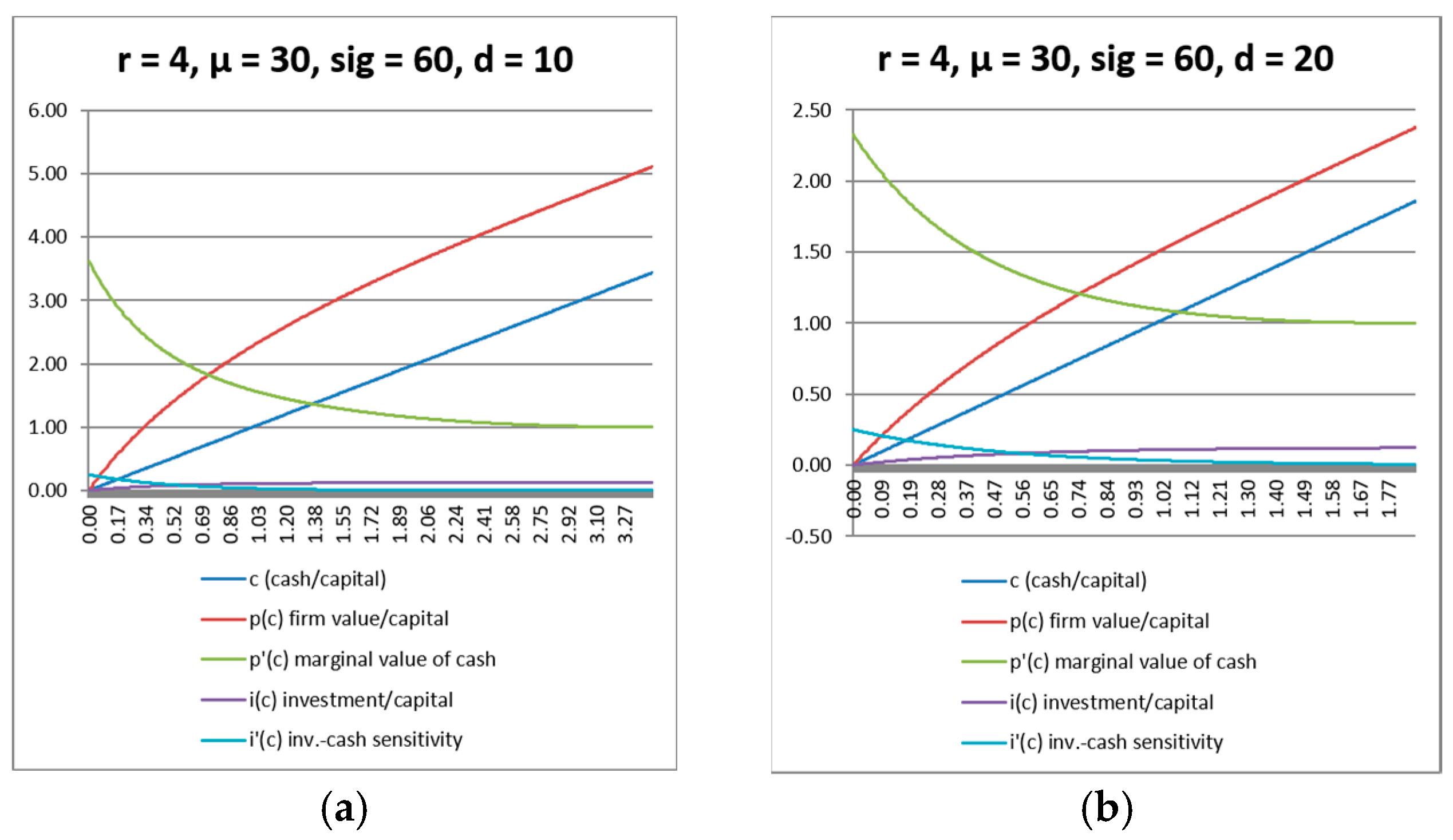
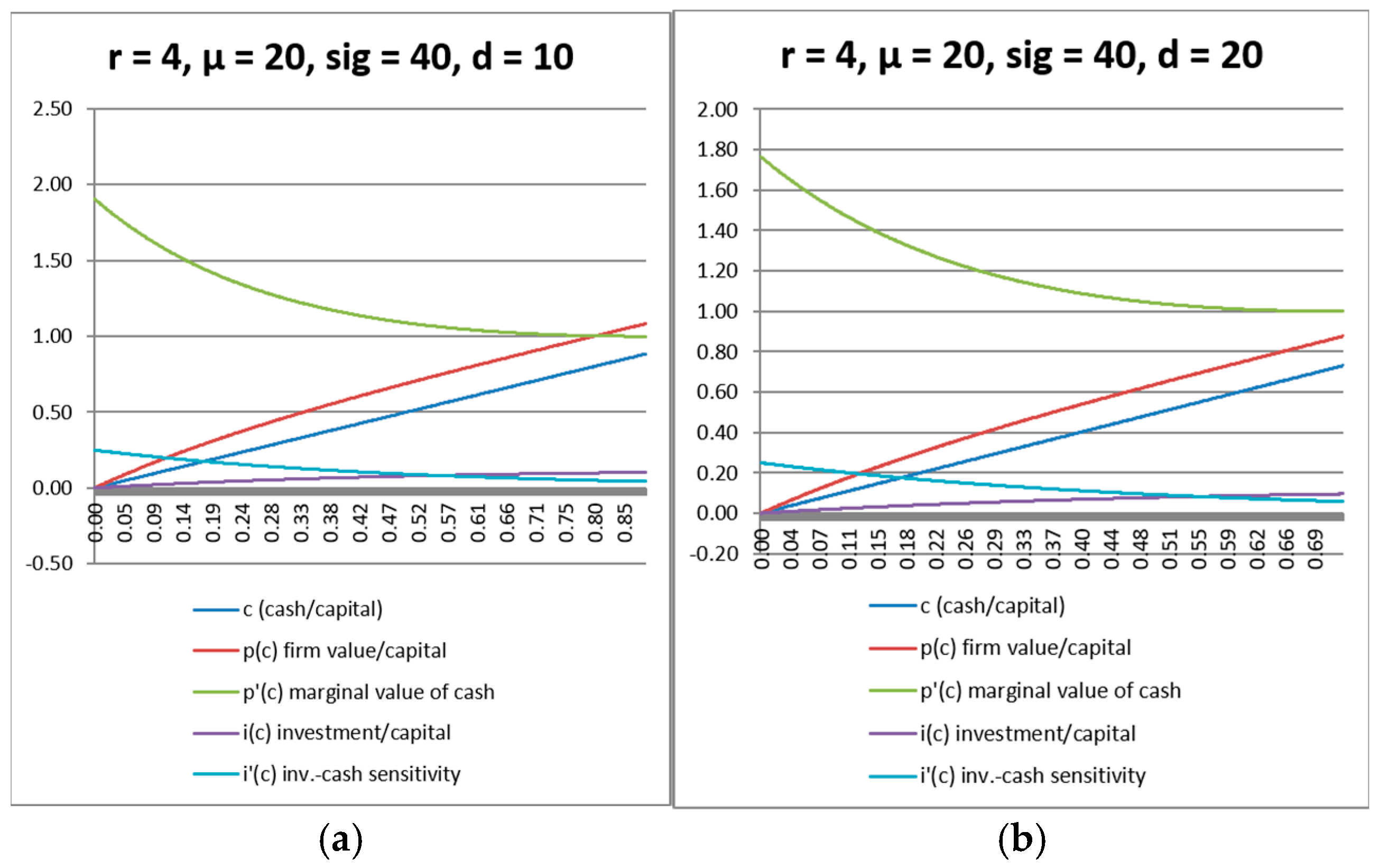
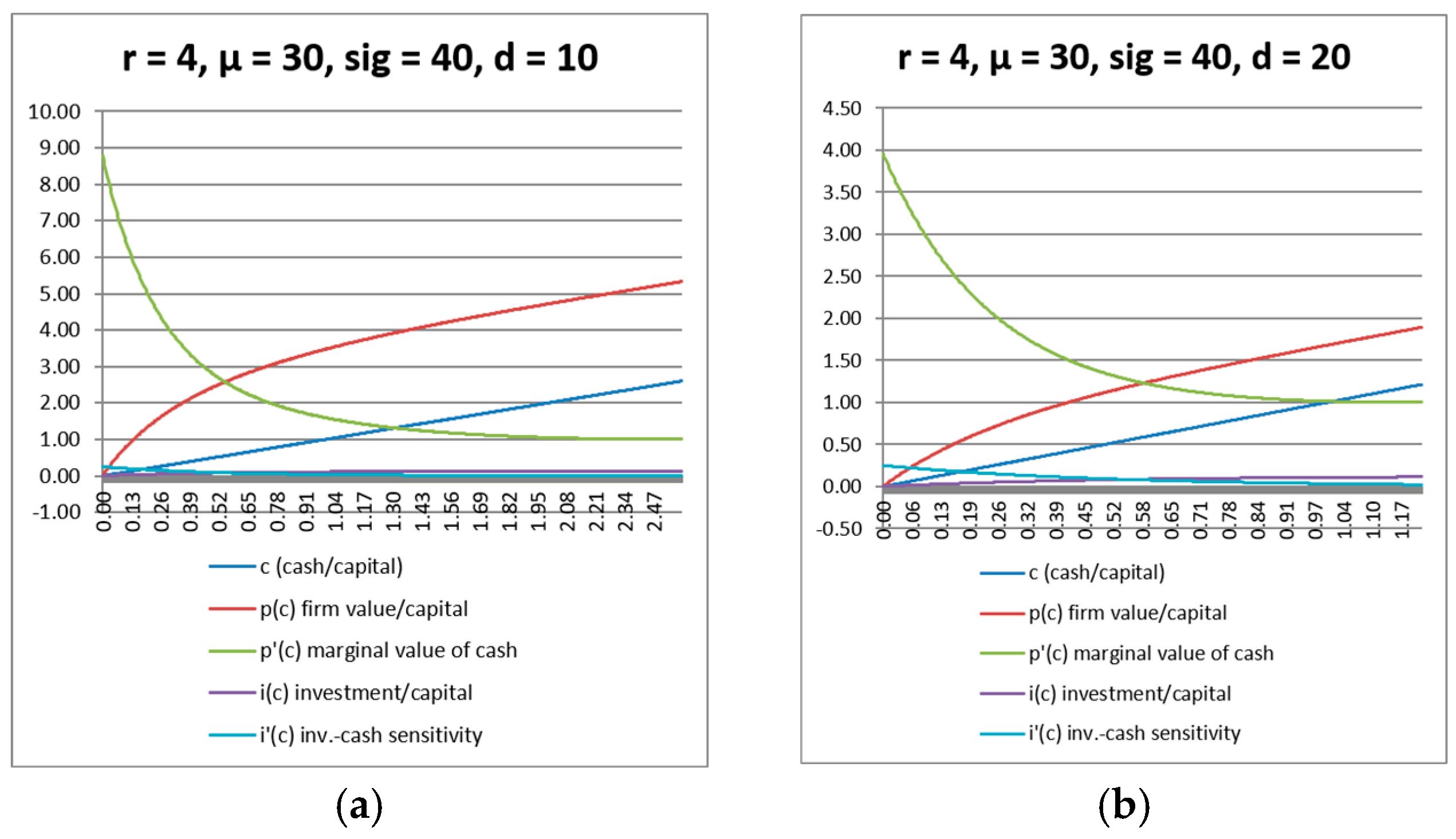
Figure 2, it can be seen that the investment curve i(c) increases with the level of liquidity. Thus, firms are willing to invest more when they have more cash available, consistent with the self-financing structure of the model, where firms do not rely on external financial sources. The differences between
Figure 2a (δ = 10%) and
Figure 2b (δ = 20%) may indicate that this 10% increase in the depreciation rate has a small effect on firms; liquidity and uncertainty are perhaps more influential than a depreciation of capital. Comparing
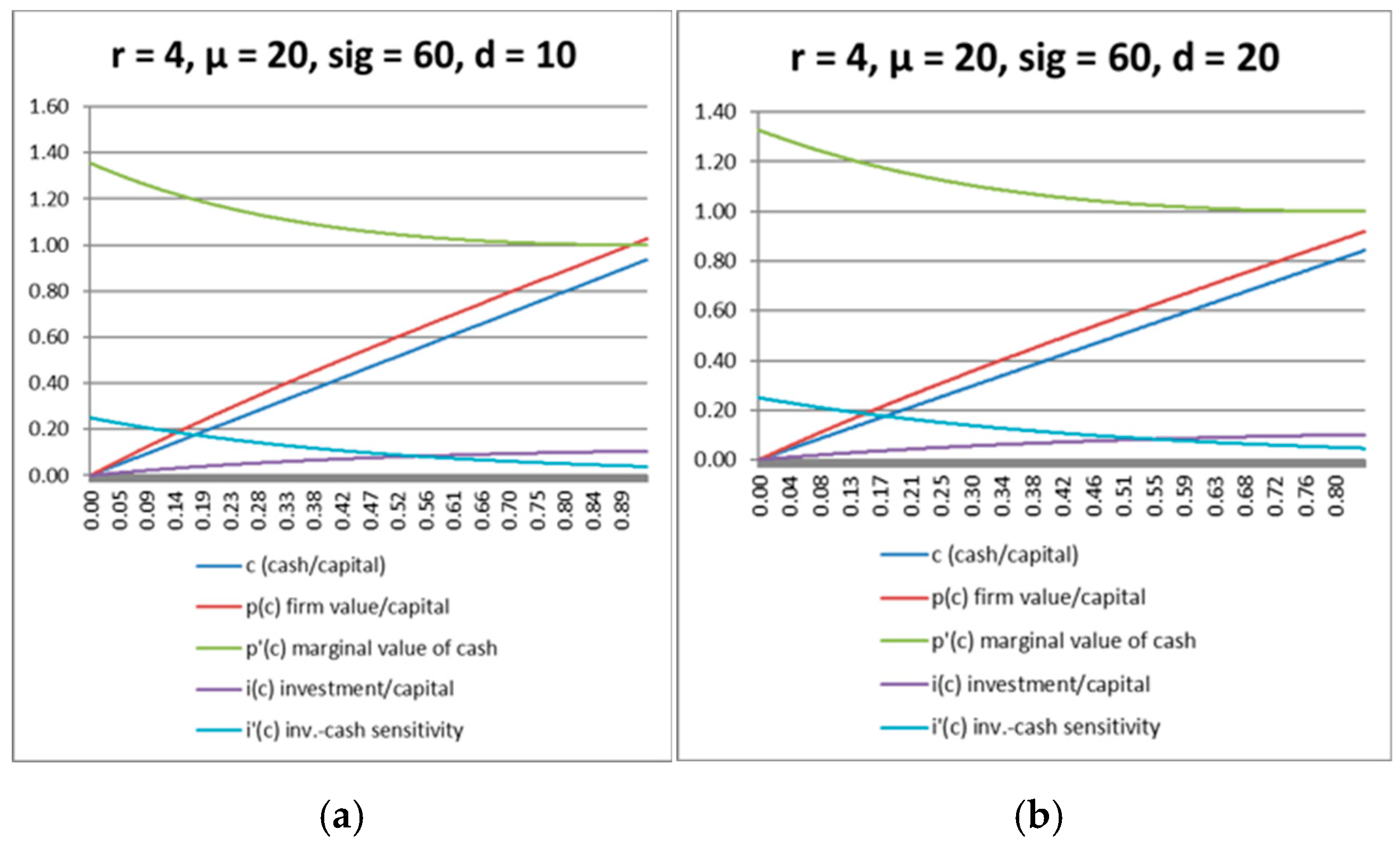
Figure 2 and
Figure 3 highlights the fact that the values of p(c), i(c) and p′(c) change substantially, with firms reacting very strongly to the increase in productivity. However, they continue to invest cautiously and value their available cash, both
Figure 3a,b, showing how investments grow slowly but gradually with the increase in cash. Therefore, firms still tend to keep this cash for as long as possible, wanting to invest gradually, even if the economic environment is relatively favorable.
Figure 4 shows how the marginal value of liquidity p′(c) is lower than in
Figure 2 when volatility was lower (σ = 40%). These curves indicate that uncertain situations cause firms to hold more cash, while investing gradually, as in the lower-volatility scenarios to be more cautious, investing gradually, not aggressively to be more stable and secure from an economic point of view.
Figure 5 reinforces the idea that cash becomes important in periods when uncertainty is high, with the marginal value of liquidity p′(c) is in fact lower in
Figure 5a,b. In these cases, investments i(c) increase only gradually, although productivity is higher than in the previous scenarios. Thus, when the environment is uncertain, firms hold a larger cash buffer, while investment itself continues to follow the same gradual profile regardless of the level of uncertainty.
In
Figure 6,
Figure 7,
Figure 8 and
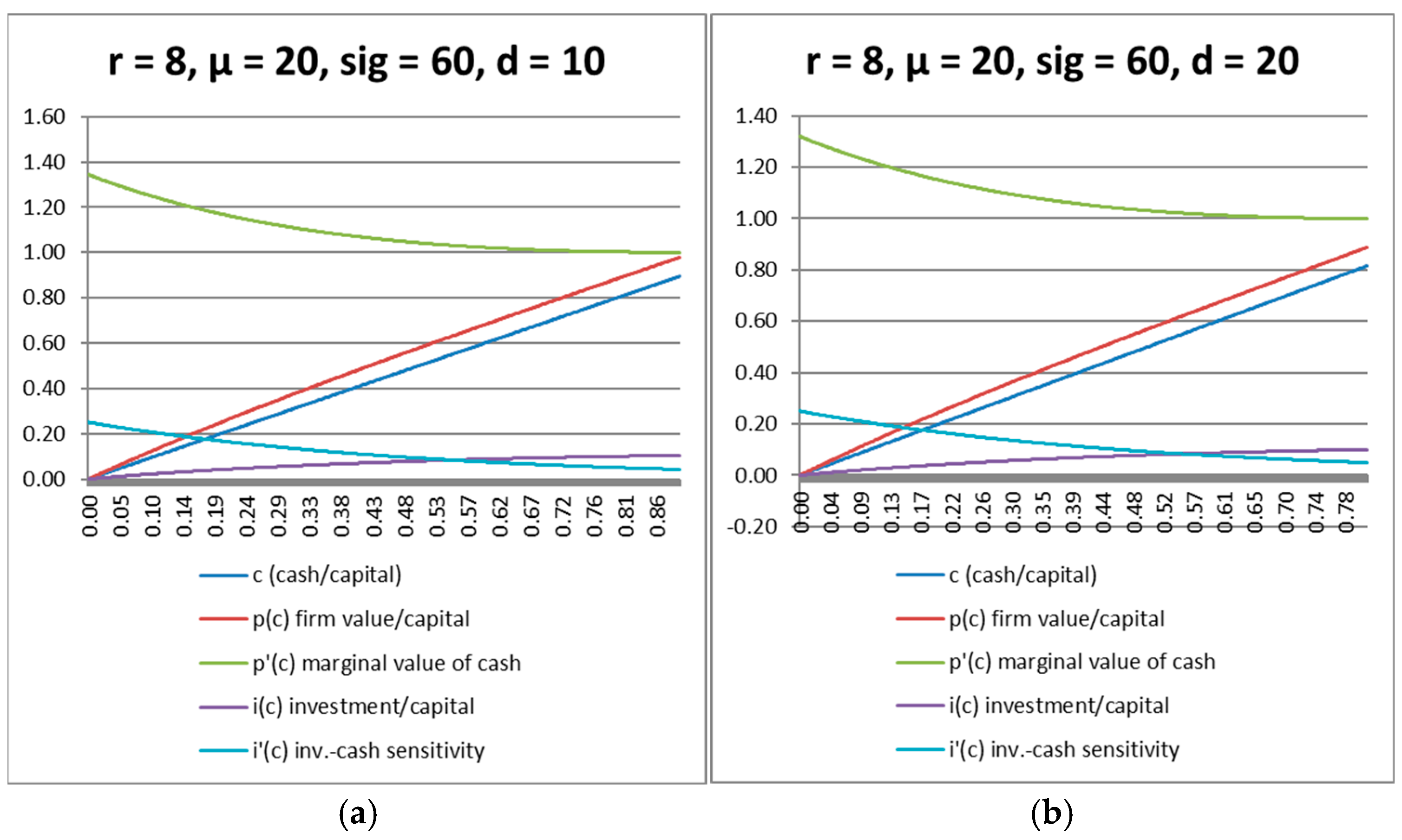
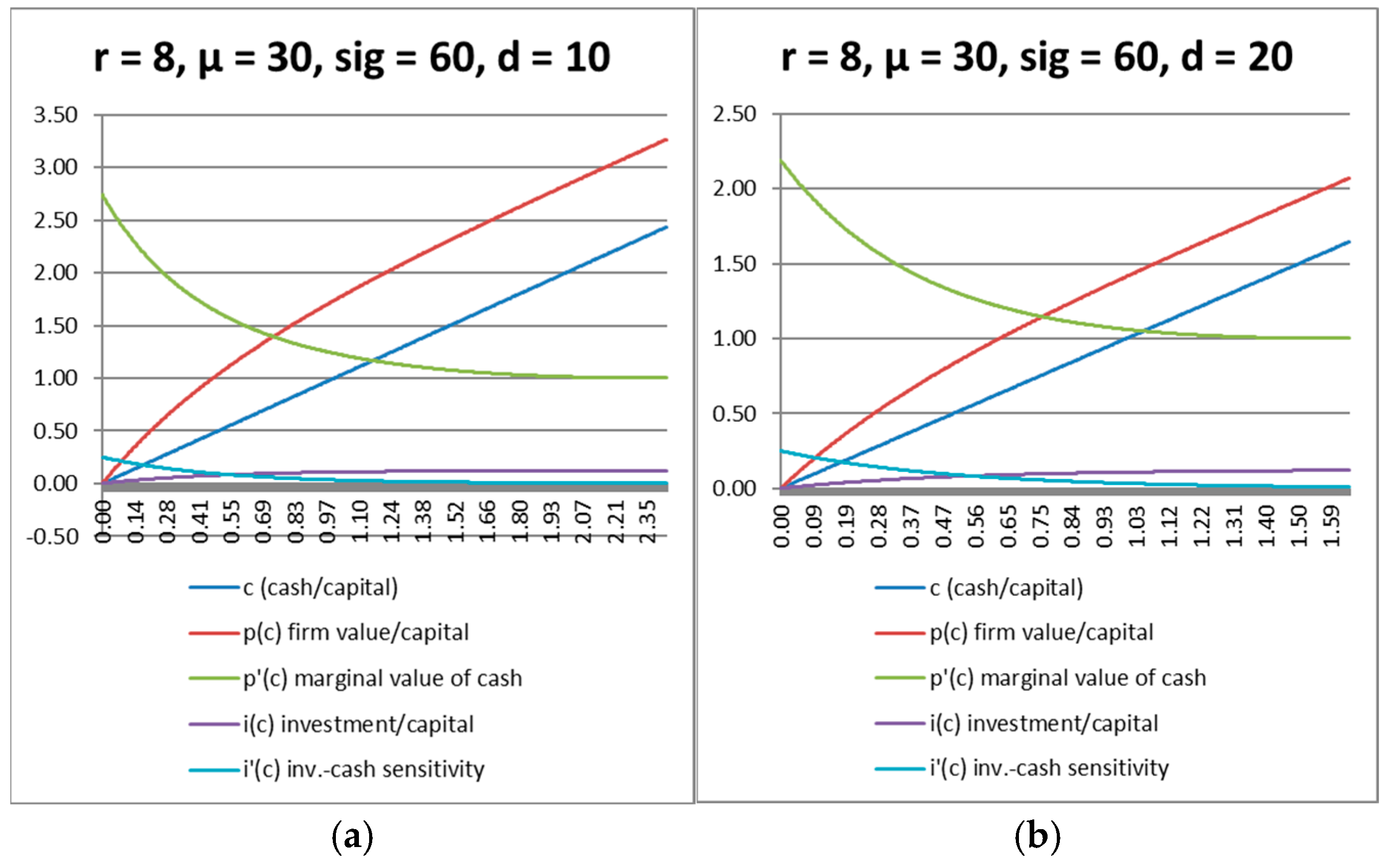
Figure 9, the scenarios with a higher interest rate r = 8 are analyzed.
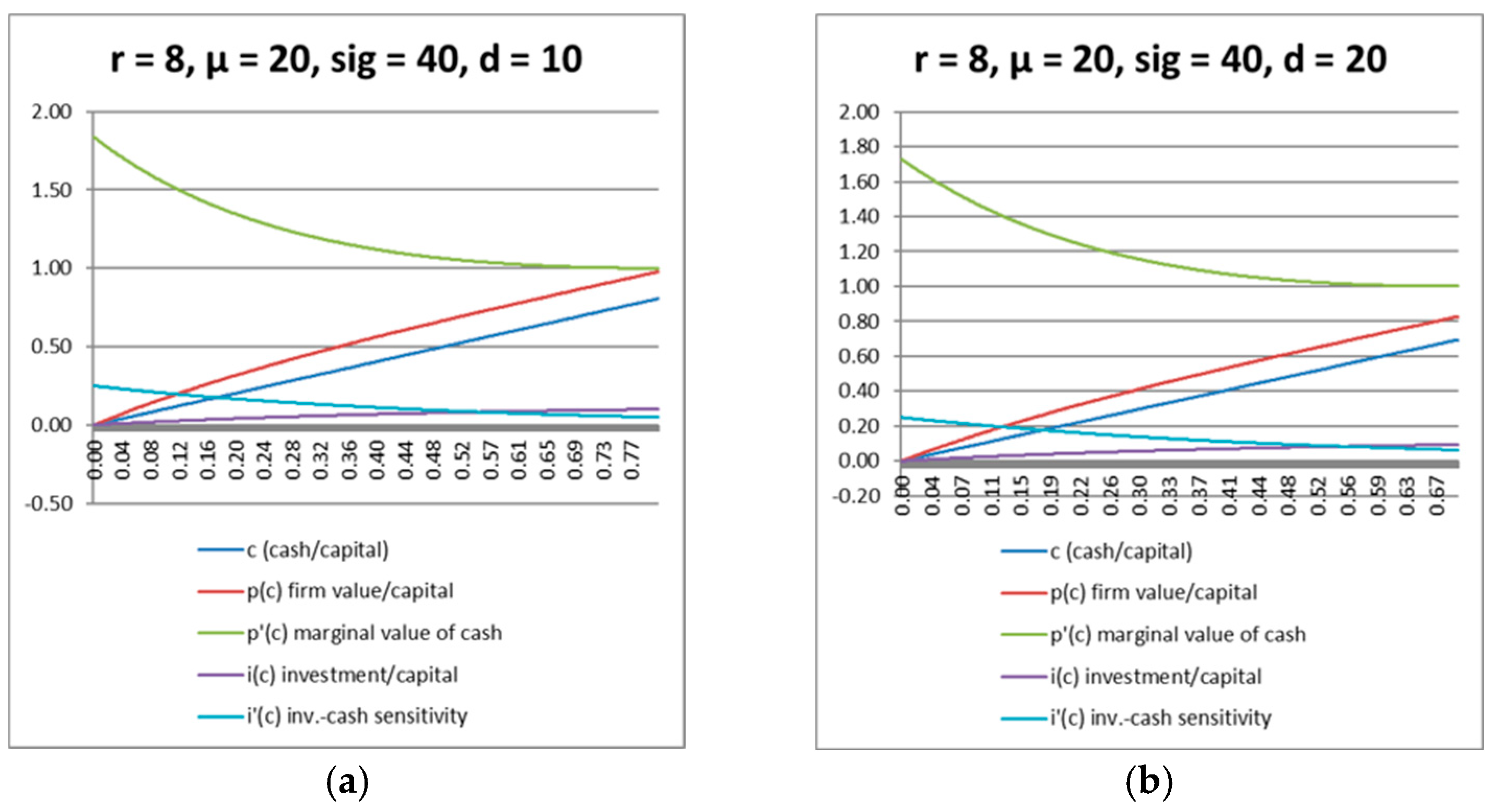
Figure 6 shows that the value of the firm p(c) is lower than in similar scenarios with r = 4%. A higher interest rate of 8%, which practically determines a higher cost of external financing, reduces firm value and leads firms to target a smaller cash buffer and continue to invest cautiously. In
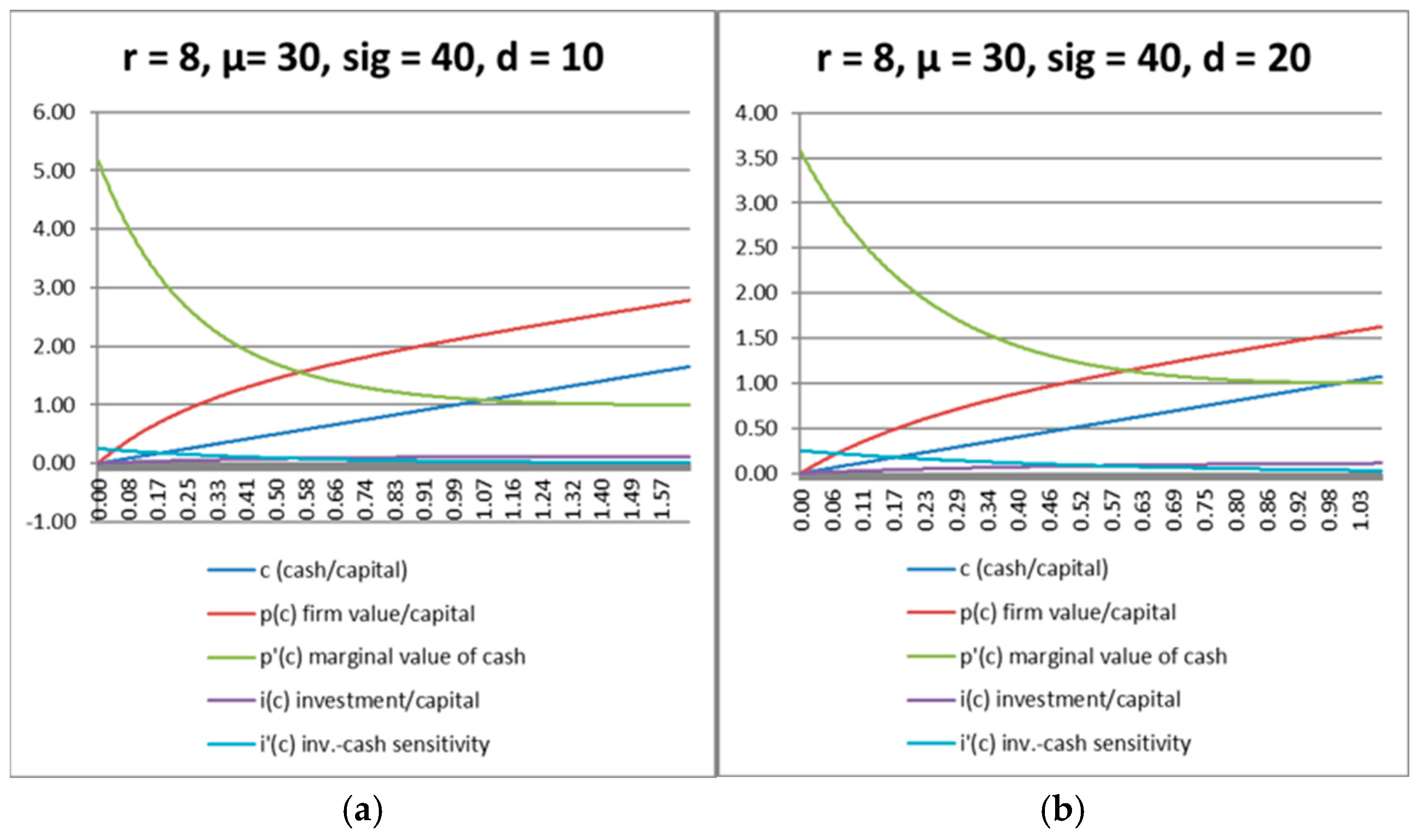
Figure 7a,b (μ = 30%), investments and the value of the firm increased substantially compared to those in
Figure 6a,b where productivity was lower
Figure 6b (μ = 20%), which confirms that productivity continues to have a strong influence on firm value, even at the higher interest rate. The importance of cash, especially in the case of high uncertainties, is also highlighted by
Figure 8, where the marginal value of liquidity p′(c) is in fact lower than in the corresponding lower-volatility
Figure 6, even though firms still build up a larger cash buffer, firms choosing a prudent behavior regarding investments (investments i(c) grow with liquidity, the growth rate remains slow, the sensitivity of investments to cash i′(c) gradually decreases). The last
Figure 9a,b (r = 8%, μ = 30%, σ = 60%) emphasize that although productivity is higher, when uncertainty and interest rates are high, investments i(c) also grow only gradually, firms being cautious. They build up an even larger cash buffer than in
Figure 7 (even though p′(c) itself is lower there than under lower volatility), necessary to have financial flexibility in the future.
Thus, the 16 scenarios presented in
Figure 2,
Figure 3,
Figure 4,
Figure 5,
Figure 6,
Figure 7,
Figure 8 and
Figure 9 highlight the fact that productivity is the most important factors when it comes to changing the behavior of firms, with uncertainty and available cash playing a secondary but still meaningful role When market interest rates become higher, firms become more careful with the use of available liquidity. When the value of available cash also increases, investments can also increase, but the growth rate is slow and cautious. On the other hand, even if the depreciation rate or interest rate changes, the behavior of firms does not change that much compared to the effect of productivity, which has by far the largest impact on firm value and cash accumulation. They basically prefer financial stability in periods of risk and economic uncertainty.
Starting from the 16 generated scenarios (
Figure 2,
Figure 3,
Figure 4,
Figure 5,
Figure 6,
Figure 7,
Figure 8 and
Figure 9) which cover all combinations of risk-free rates (rϵ{4%, 8%}), productivity (
ϵ{20%, 30%}), volatility (
ϵ{40%, 60%}) and the depreciation rate (
ϵ{10%, 20%})), four graphical representations (
Figure 10,
Figure 11,
Figure 12 and
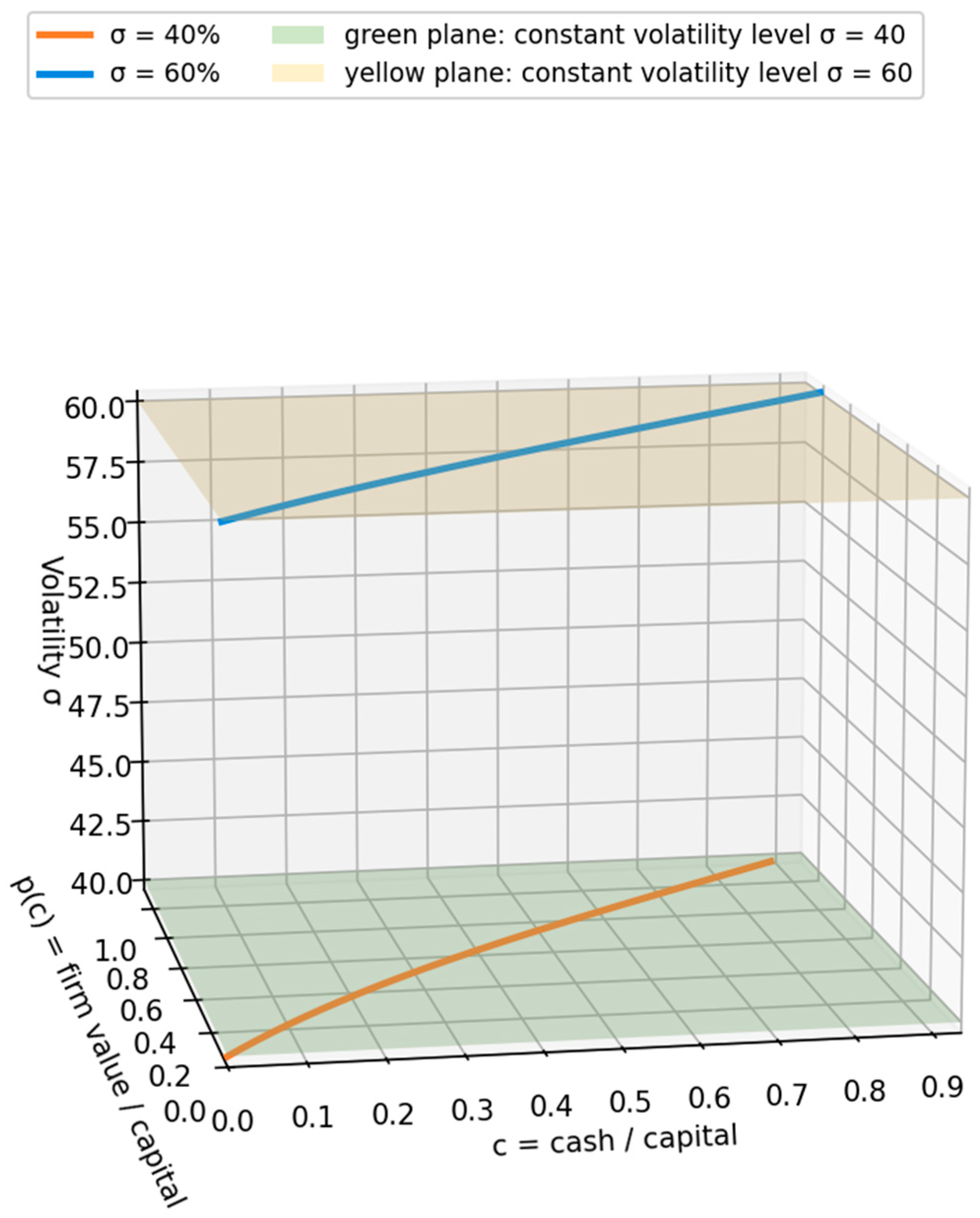
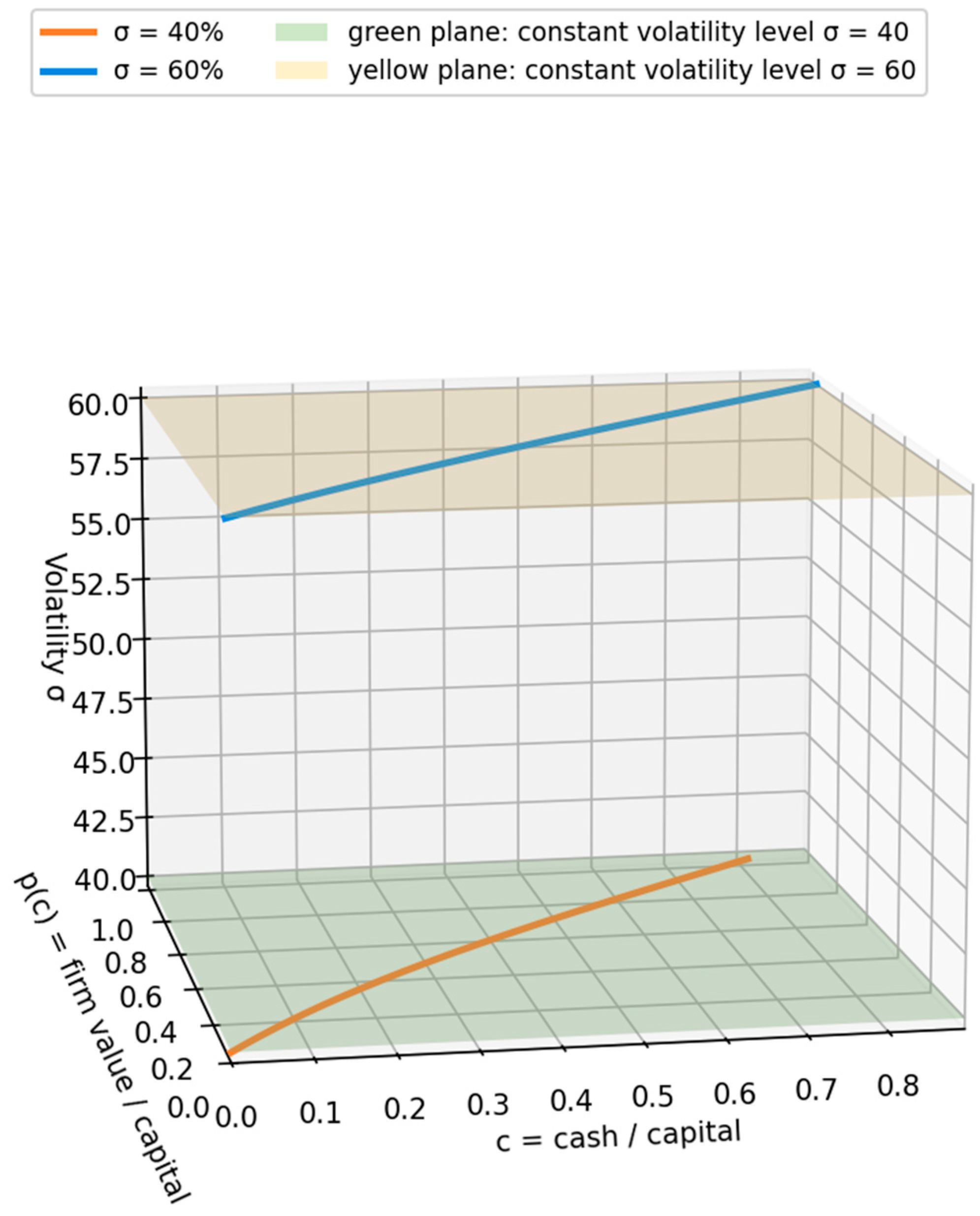
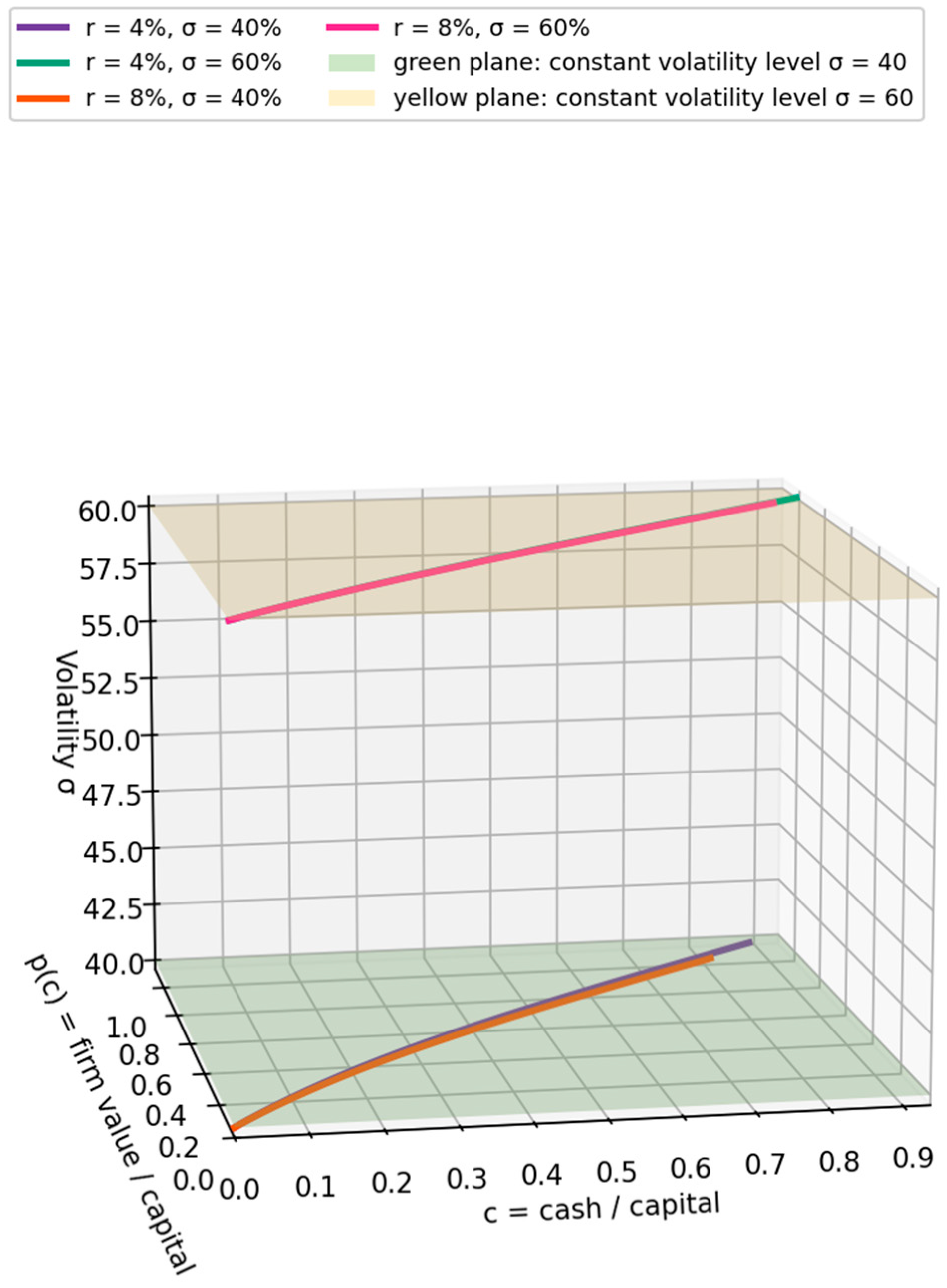
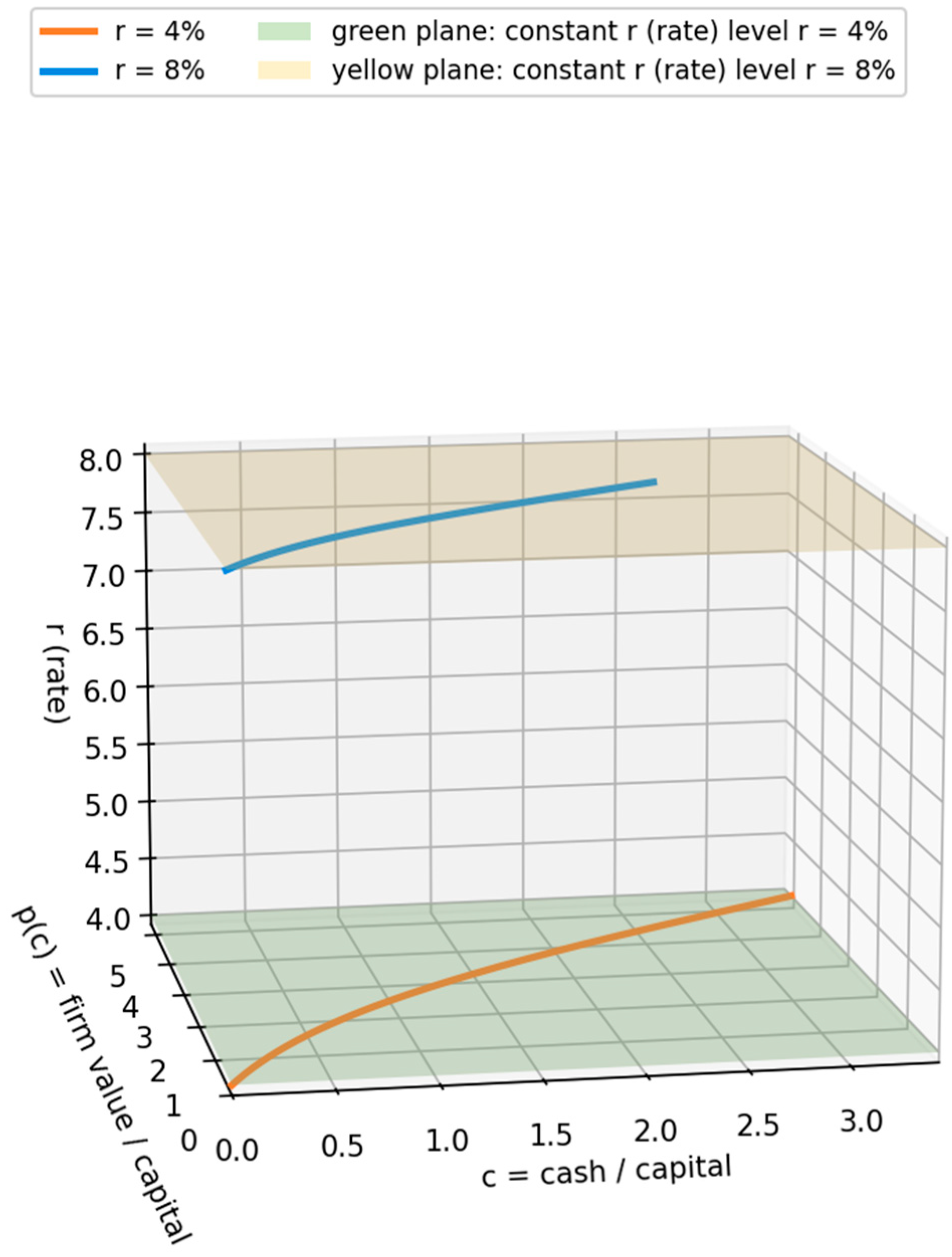
Figure 13) of the relationships between the firm value p(c) and other key variables of the model were created, presenting: the effect of volatility on the firm value, r = 4%; the effect of volatility on the firm value, r = 8%; comparison of the sensitivity of the firm value to volatility for r = 4% and r = 8%; the effect of the interest rate on the firm value; and the effect of volatility on the firm value, r = 4%. The graphs were generated using Python programming language.
On the X-axis is represented c = cash/capital, which translates into the company’s liquidity level, indicating the proportion of cash held in relation to invested capital. When higher values are observed, then the company has more solid financial reserves, which makes it less vulnerable.
On the Y-axis is represented p(c) = firm value/capital, which measures the economic value of the company in relation to capital, capturing the economic benefit that liquidity brings to shareholders.
On the Z-axis is represented volatility σ, which shows the degree of uncertainty of the company’s flows, where higher values indicate both a higher operational risk and a more unstable economic environment.
Figure 10 shows how volatility (σ) influences the value of a firm, when the risk-free rate is 4%. For this analysis, the authors considered two scenarios: σ = 40 or σ = 60. Looking at these values, in the case of higher volatility, lower values are recorded across almost all levels of liquidity. In addition, in this case of high volatility, the value of the firm grows slightly slower when c is small. Analyzing the p(c) values in comparison to the same c values, the results show that the σ = 60 curve is above the σ = 40 one, which suggests that the value of the firm is higher when the risk is lower. Furthermore, the analysis of the X-axis suggests that as liquidity increases, the curves associated with different levels of volatility move slightly further apart before stabilizing at a roughly constant gap, indicating diminishing marginal returns to liquidity. Furthermore, the smaller distance between the curves for very low values of c shows that uncertainty only begins to reduce the value of the firm once some liquidity has already been built up, rather than under extreme financial constraint.
Figure 11 shows how the value of a company changes when it has cash (available money), both when the risk is lower and when the risks become higher, at high volatility. Analyzing the two curves, the findings show that under higher risk conditions, cash holdings become slightly less valuable at the margin. At lower levels of cash, the difference between the two curves is smaller. However, as the company has more cash, the curves move further apart before settling into a roughly constant gap, arguing that the impact of risk on firm value is only fully apparent once the business has accumulated some liquidity, as opposed to when it is severely financially constrained.
Figure 12 shows how the value of a firm changes when the risk-free rate is 4% and 8%, respectively, as well as how these values evolve under different risk conditions (σ = 40 or 60), depending on the cash held. When low levels of cash are observed, then a smaller difference between the curves can be observed, which may suggest that market volatility has little influence on firm value when cash reserves are extremely low. At higher cash values, it is found that these curves move apart before settling into a roughly constant gap, which may suggest that the influence of volatility on firm value only fully emerges once the firm has accumulated some liquidity. In general, it can be concluded that volatility reduces firm value once some cash has been accumulated, rather than cash fully protecting firms from risk, but when the cost of money (risk-free rate) is higher, firms are worth less regardless of risk.
Figure 13 presents the effects of interest rates on firm value in a typical emerging market under conditions of high valuations and high volatility. The results show that a higher interest rate (8%) leads to a lower firm value (blue curve) across all levels of cash holdings. In fact, higher interest rates make financing more expensive, which suggests that firms are worth less. In addition, as a firm has more cash, its value initially increases, but then the growth slows down, suggesting that cash is very useful if you have little, but if you already have a lot, it does not help so much.
Thus, following the analysis of the 16 scenarios and
Figure 10,
Figure 11,
Figure 12 and
Figure 13, it can be stated that the hypotheses initially formulated in the research are confirmed.
Figure 10 and
Figure 11, which present the impact of volatility for r = 4% and r = 8%, respectively, show that internal liquidity is the main resource that supports the value of the firm, particularly at low levels of cash. According to the graphs presented, for low levels of the ratio c = cash/capital, the value of the firm p(c) is much more sensitive to volatility, which reflects the fact that, in the absence of internal funds, the firm becomes vulnerable, and access to external equity may be necessary.
Figure 12, which presents a simultaneous comparison of the scenarios r = 4% and r = 8% with σ = 40 and σ = 60, highlights that the role of liquidity as a protection mechanism increases with uncertainty. However, this role is reduced when the firm has substantial cash reserves. This evolution indicates diminishing marginal returns to liquidity, which also confirms the limit of the efficiency of self-financing in situations with excess cash.
Figure 13, which shows the impact of the risk-free rate on the value of the firm, shows that when r increases from 4% to 8%, the value of the firm decreases for all levels of liquidity. The introduction of the real cost of external financing directly influences liquidity and investment management decisions, which confirms the second hypothesis of the research.
Obtaining these results is not only of theoretical relevance but also contributes to the description of a behavior in the technology sector, where firms in investment expansion phases simultaneously face pressures on liquidity and on the financing structure.
In Romania, a relevant example can be that of Digi Communications, which aims to expand into the Spanish telecom market. Even though this company is experiencing accelerated operational growth, it requires annual investments of over 350 million euros, while at the same time resorting to the capital market to balance liquidity and debt, which reaches almost three times the value of EBITDA (
Dinu, 2026). In this situation, the planned listing on the stock exchange becomes more than a financing instrument, it has the role of managing the financial risks associated with massive technological investments, exactly the mechanism highlighted by the model presented in this paper.
The same situation can be found globally, not only in Romania. Firms such as Amazon, Microsoft, Meta Platforms and Alphabet Inc. have presented their intentions to invest a combined
$650 billion in AI infrastructure (
Ziarul Bursa, 2026). These actions not only reduce cash flows, but also require external financing or bond issuance, which leads to increased indebtedness. The recent declines in the share prices of Big Tech firms, even as their revenues continue to grow, show that the market is not primarily concerned with current profits, but with the financial risk generated by very large investments. In other words, investors are reacting more to the pressure on liquidity and the increase in indebtedness than to short-term operational performance.
Thus, the examples presented both locally and globally suggest that the fundamental problem of technology firms in a highly volatile and turbulent environment is not whether to invest, but how much cash to accumulate before investing more aggressively, to maintain their financial balance. The model proposed in this paper shows that the value of a firm depends not only on the profitability of feasible and efficient technology projects, but also on its ability to go through periods when financing becomes more difficult. Therefore, it is possible that the ICT sector has many growth opportunities, even if the stock market performance seems modest. Future research could further examine the implications for risk management, as the dynamics and volatility of future cash flows generate both direct and indirect effects on the overall level of risk. These aspects highlight several important issues, including the relationship between managerial performance and firm performance, as reflected by managerial risk aversion, restrictions on raising external funds, constraints on leverage and capital structure, and practical implications for maximizing shareholder wealth.
5. Conclusions
This research offers a strategic decision capability grounded in an intuitive picture of the key pillars underlying investment strategy design (liquidity management, the capability to access external financing, risk management aspects) in the current context of high inflation and high cost of capital. The scarcity of data and the lack of a sufficiently long time series, necessary for a classical analysis, require an alternative approach based on a dynamic, focused model that also incorporates different aspects like optimal cash or the alternative paths for accessing equity financing. The advantage lies in the possibility of constructing a rich parameter space (earnings dynamics, liquidity risk, cost of financing, liquidation value, and opportunity cost of holding cash). This leads to implications for the design of optimal policies, most directly -dividend payouts, while extending the framework to include equity financing, capital expenditure flexibility, asset sales and hedging remains a direction for future work. Managers could, in an extended version of the model where investment responds to Tobin’s Q rather than following a fixed rule, visualize the key relations between Tobin’s Q and return on investments, for a high and volatile risk-free rate, as well as the implications for productivity and future performance.
The presented analysis highlights that investment decisions and financial behavior of ICT firms from Romania are deeply influenced by the risk of liquidity and changing macroeconomics conditions. The developed numerical simulations through the generalized model indicate that high levels of the risk-free rate slightly reduce the tendency of firms towards investment and lead to a smaller liquidity buffer, while high productivity volatility encourages enterprises toward the stockpiling of liquidity as a protective mechanism, even without cutting investment at that higher level. In the scenarios where technological productivity grows, investments become more responsive and move toward optimal levels, although their sensitivity to additional cash declines once the firm has accumulated substantial liquidity.
An important result is given by the fragile balance of firms between liquidity protection and capitalization of investment opportunities. High financing costs led to somewhat more cautious behavior, which may limit the innovative potential of this sector. On the other hand, scenarios with low costs of capital show that investments move closer to their optimal level when anticipated productivity is favorable, which confirms the importance of a stable macroeconomic framework for technological firms’ development.
This research highlights the critical role of liquidity management and well-calibrated financial decisions to maintain operational resilience. The necessity of a liquidity buffer becomes increasingly important in scenarios with high anticipated productivity or high volatility. Extending the model to include external financing constraints remains an important direction for future work.
Both research hypotheses are supported by the outcomes of the 16 simulated scenarios. The results indicate a reliance on internal liquidity in all scenarios—with the accumulated buffer becoming smaller when interest rates are high—supporting H1.
Figure 13, which shows that increasing the risk-free rate directly lowers company value and reduces the optimal liquidity buffer and investment level across all cash holdings levels, supports H2.
The main contribution of this study is demonstrating that a simple, dynamic, and scalable model, designed forthe IT field and adapted to emerging economies, offers a deeper understanding of firms’ behavior than static models. By integrating macroeconomic factors and technological parameters, this research presents an applicable tool in the analysis of strategic decisions for ICT firms. In the current context, characterized by volatility and uncertainty, these types of approaches are essential for elaborating sustainable investment policies for financial resilience and long-term development of the ICT sector.