1. Introduction
In bank-dominated financial systems, the transmission of monetary policy is traditionally described as operating through adjustments in bank credit and, ultimately, inflation. This quantitative perspective implicitly assumes that variations in lending and portfolio allocation constitute the primary observable manifestation of monetary policy effects, while financial market variables are often treated as secondary or merely reflective of underlying balance sheet dynamics.
However, this approach risks overlooking an important dimension of monetary transmission, particularly in the short run. Adjustments in bank balance sheets are subject to contractual rigidities, internal evaluation procedures, and prudential constraints, which may limit their immediate responsiveness. Similarly, inflation dynamics are influenced by nominal rigidities and expectation mechanisms, making short-term effects difficult to identify. By contrast, expectations can adjust rapidly, and monetary policy-related information may be more quickly incorporated into financial valuations, especially through bank equity prices.
This suggests that short-term monetary transmission may be characterized not only by differences in magnitude but also by differences in the timing of observable responses. In this context, focusing exclusively on bank credit or inflation provides only a partial view of how monetary policy innovations affect the economic system.
From a theoretical perspective, this interpretation is grounded in the interaction between informational efficiency and financial frictions. Signaling theory (
Spence, 1973) suggests that monetary policy decisions may convey information about future macro-financial conditions, while the semi-strong form of informational efficiency (
Fama, 1991) implies that asset prices can rapidly incorporate such information. In contrast, the literature on information asymmetry and credit rationing (
Stiglitz & Weiss, 1981) highlights that lending decisions depend on risk assessment processes that may delay balance sheet adjustments.
Empirical evidence partially supports this distinction. A large body of research documents the rapid response of financial markets to monetary policy announcements, often driven by revisions in expectations (
Bernanke & Kuttner, 2005;
Gürkaynak et al., 2005;
Nakamura & Steinsson, 2018;
Jarociński & Karadi, 2020). By contrast, credit aggregates, bank portfolios, and inflation tend to adjust more gradually and heterogeneously, particularly in emerging economies. However, existing studies have generally examined these dimensions separately, with limited attention to their joint dynamics within a unified empirical framework.
This paper contributes to the literature by proposing a unified framework to analyze the relative timing of monetary transmission across financial markets, bank balance sheets, and inflation. Unlike existing studies that focus on individual transmission channels or long-run relationships, the analysis emphasizes short-run adjustment dynamics using monthly data in a bank-dominated emerging economy. By jointly examining market-based indicators, balance-sheet variables, and macroeconomic outcomes, this paper shifts the focus from the intensity of transmission to its temporal structure, highlighting differences in adjustment speeds across the financial system.
In this context, this paper addresses the following research question: Are monetary policy innovations more rapidly reflected in bank equity valuations than in balance-sheet variables and inflation? To address this question, the study analyzes the joint dynamics of the policy rate, the MASI banking index, banks’ holdings of Treasury securities, credit to the non-financial private sector, and inflation in Morocco over the period 2018–2024. Credit to the non-financial private sector is used as it more directly captures the transmission of monetary policy to the real economy, whereas credit to financial institutions primarily reflects interbank and financial sector dynamics. The MASI banking index refers to the stock market index of listed Moroccan banks and is used as a proxy for market-based valuations of the banking sector, reflecting expectations regarding profitability, risk, and financial conditions. As an aggregate index, it captures the overall evolution of listed banks rather than the behavior of individual institutions. Morocco provides a relevant setting due to its bank-dominated financial structure, where banks play a central role in financial intermediation and where market indicators offer a meaningful proxy for banking sector valuations.
Methodologically, the analysis relies on a reduced-form VAR model designed to capture short-term interactions without imposing strong structural assumptions. The objective is not to identify specific transmission channels or establish causal relationships, but rather to document whether monetary policy innovations are associated with heterogeneous short-run response patterns across variables.
Overall, this study contributes to a better understanding of short-term monetary transmission by showing that differences in observed responses across financial, banking, and macroeconomic variables may reflect variations in adjustment timing rather than distinct transmission mechanisms.
The remainder of this paper is structured as follows.
Section 2 reviews the relevant literature.
Section 3 presents the conceptual framework and research hypotheses.
Section 4 describes the methodology and econometric strategy.
Section 5 reports the empirical results.
Section 6 discusses the findings. Finally,
Section 7 concludes this paper.
2. Literature Review
A substantial body of economic research shows that financial systems operate under persistent informational frictions, which fundamentally shape the transmission of monetary policy. In banking systems, lending decisions are made under conditions of asymmetric and incomplete information regarding borrower quality, project risk, and future cash flows. Early contributions, notably
Hodgman (
1960), already pointed out that banks do not rely exclusively on interest rate adjustments to manage credit risk. When higher interest rates increase default probabilities and deteriorate borrower composition, restricting credit supply may constitute a rational equilibrium outcome rather than a market failure. This intuition was later formalized by
Akerlof (
1970) through adverse selection, and by
Stiglitz and Weiss (
1981), who showed that credit rationing can emerge as a stable equilibrium under information asymmetry and moral hazard.
From this perspective, price-based adjustments alone are insufficient to ensure efficient financial allocation. The responsiveness of credit to monetary policy is therefore inherently constrained by risk considerations and informational frictions. In such an environment, financial markets play a complementary role by aggregating dispersed information and incorporating it into observable prices. Signaling theory (
Spence, 1973) highlights how policy actions convey information in the presence of asymmetric information, while
Ross (
1977) shows that asset prices reflect expectations regarding future cash flows and risk.
Within this framework,
Fama (
1991) argues that asset prices adjust rapidly to publicly available information under semi-strong informational efficiency. This property is particularly relevant for monetary policy transmission, as financial markets may incorporate policy-related information almost instantaneously. Bank stock prices can thus be interpreted as forward-looking indicators reflecting revisions in expectations regarding profitability, risk, and macroeconomic conditions, and may anticipate subsequent adjustments in balance-sheet variables.
Empirical evidence consistently shows that financial markets react strongly to monetary policy announcements, primarily through revisions in expectations and risk premia (
Bernanke & Kuttner, 2005;
Nakamura & Steinsson, 2018;
Jarociński & Karadi, 2020;
Tanahara et al., 2023). In this setting, the terms “informational signal” and “informational channel” are commonly used in the literature to describe the information content embedded in monetary policy announcements and its transmission to financial markets and expectations. However, in reduced-form empirical settings, these notions should be interpreted with caution, as they do not imply a structural identification of distinct informational effects. Taken together, these findings point to a sequential transmission mechanism in which monetary policy first affects expectations and financial prices, before gradually influencing credit and real economic activity. Accordingly, the apparent weakness of the short-term credit channel should not be interpreted as ineffective transmission, but rather as reflecting differences in adjustment speeds across variables, particularly in environments characterized by informational frictions and credit rationing (
Stiglitz & Weiss, 1981;
Bernanke & Gertler, 1995;
Mishra & Montiel, 2013;
Boutfssi et al., 2026;
Boutfssi & Quamar, 2026).
Complementing this view, the portfolio equilibrium framework suggests that changes in monetary conditions alter relative asset returns, leading to portfolio reallocation across assets with different risk and liquidity profiles (
Tobin, 1969;
Friedman, 1968). In bank-dominated systems, sovereign securities play a central role due to their liquidity and regulatory treatment.
Empirical studies show that banks adjust their portfolios in response to uncertainty, regulatory constraints, and risk considerations, often substituting private lending with sovereign assets (
Acharya & Steffen, 2015;
Ongena et al., 2019;
Bottero et al., 2019;
Odendahl et al., 2024;
Altavilla et al., 2018;
Gambacorta & Shin, 2018;
Fraisse & Mésonnier, 2023). These dynamics highlight the importance of balance-sheet constraints, including capital adequacy, liquidity requirements, and risk-weighted asset optimization.
Such mechanisms are particularly pronounced in emerging economies, where financial systems are more bank-centered and less diversified. In these contexts, informational frictions contribute to incomplete and sometimes unstable monetary transmission (
Mishra & Montiel, 2013). Empirical evidence suggests that monetary policy operates primarily through financial conditions and asset prices in the short run, while credit responses remain more gradual and heterogeneous (
Pirozhkova et al., 2024). Structural factors, including fiscal conditions, banking sector characteristics, and risk perceptions, further shape credit dynamics (
Tenreyro & Thwaites, 2016;
Brandão-Marques et al., 2021;
Najab et al., 2022).
The transmission of monetary policy to inflation adds another layer of complexity. Within the New Keynesian framework, monetary policy influences inflation through interest rates, aggregate demand, and expectations (
Clarida et al., 1999;
Galí, 2008;
Woodford, 2003). Empirical evidence indicates that monetary policy innovations affect expectations and asset prices rapidly, while their transmission to real activity and inflation is more gradual due to nominal rigidities and expectation dynamics (
Romer & Romer, 2004;
Nakamura & Steinsson, 2018). In emerging economies, this process is further complicated by external shocks, exchange rate fluctuations, and less anchored expectations (
Mishra & Montiel, 2013). Although credible monetary frameworks can improve inflation control (
Svensson, 2010), short-term effects remain difficult to identify empirically.
Overall, the literature points to a multi-stage transmission process in which monetary policy signals are first incorporated into financial markets, then transmitted to bank balance sheets, and finally reflected in inflation with a lag. However, most existing studies examine these mechanisms separately. Limited attention has been paid to their joint analysis within a unified empirical framework, particularly in bank-dominated emerging economies and at a monthly frequency.
Against this backdrop, the present study aims to analyze the timing and relative intensity of monetary transmission across financial markets, banking variables, and inflation dynamics.
3. Conceptual Framework and Research Hypotheses
The conceptual framework of this study is grounded in signaling theory and the literature on monetary transmission in bank-based financial systems, with the objective of analyzing differences in the timing of short-term adjustments across key components of the banking system.
In conventional interpretations of the credit channel, variations in the policy rate affect financing conditions, which then translate into adjustments in bank lending and portfolio allocation. Within this framework, stock market valuations are generally interpreted as reflecting realized changes in banking performance.
This study adopts an alternative perspective in which monetary transmission is viewed as a process characterized by heterogeneous adjustment speeds across variables. Monetary policy actions may convey information regarding future macro-financial conditions (
Spence, 1973). Under the semi-strong form of informational efficiency (
Fama, 1991), this information may be incorporated into asset prices through expectation adjustments, even when balance sheet quantities remain temporarily inert.
From this perspective, the banking system can be viewed as consisting of two interrelated dimensions. The first corresponds to an informational dimension, captured by bank equity valuations, which reflects rapid adjustments in expectations. The second corresponds to an allocation dimension, represented by balance sheet variables particularly sovereign bond holdings and credit to the private sector which are shaped by contractual rigidities, internal risk assessment processes, and regulatory constraints (
Adrian & Shin, 2010;
Gambacorta & Shin, 2018). These frictions may be associated with more gradual quantitative adjustments relative to price-based responses.
Credit to the non-financial private sector is especially sensitive to information asymmetries and risk evaluation mechanisms (
Stiglitz & Weiss, 1981;
Jiménez et al., 2012), which may be associated with gradual and non-synchronous adjustments. In this context, differences in observed dynamics are interpreted as differences in adjustment timing rather than as evidence of incomplete transmission.
Extending this reasoning, inflation can be interpreted as reflecting later adjustments in macroeconomic dynamics, capturing the cumulative effects of expectations, financial conditions, and credit developments. As a result, its response to monetary policy innovations may appear delayed and less clearly identifiable in the short run.
Consistent with this perspective, the empirical strategy relies on a reduced-form VAR framework, which is suited to capturing short-run dynamic interactions across variables without imposing structural restrictions. This approach allows the analysis to focus on the relative timing of responses rather than on the identification of specific causal transmission channels.
Within this framework, the analysis focuses on bank credit to the non-financial private sector rather than to the financial sector, as it more directly reflects financing conditions relevant to real economic activity. This choice avoids conflating real-sector responses with intra-financial system dynamics.
This conceptual framework leads to the following testable implications. If monetary policy innovations are associated with changes in expectations in the short run, financial variables are expected to respond more rapidly than balance-sheet aggregates, while inflation may display weaker and less stable short-term responses.
In line with this conceptual framework, the following hypotheses are formulated to assess differences in short-run adjustment patterns across variables.
H1. At short horizons, monetary policy innovations are associated with statistically significant responses in bank equity valuations.
H2. At short horizons, balance-sheet variables exhibit weaker and non-contemporaneous responses compared to bank equity valuations.
H3. At short horizons, inflation responses are less stable and less clearly identifiable than those observed in financial and balance-sheet variables.
4. Methodology and Econometric Strategy
4.1. General Methodological Framework
The objective of this study is to analyze the propagation of monetary policy innovations in a bank-dominated emerging economy, with a focus on the timing of adjustments between financial valuations, balance-sheet variables, and inflation. The analysis does not aim to identify specific structural channels but rather to characterize the relative dynamics across these different dimensions of the financial system.
Given the dynamic and interdependent nature of macro-financial interactions, a single-equation approach appears insufficient to capture the simultaneous relationships between expectations, asset prices, credit decisions, and macroeconomic variables. In this context, a reduced-form vector autoregressive (VAR) model (
Sims, 1980;
Lütkepohl, 2005) is employed to model these interdependencies without imposing a priori causal structure, while capturing the short-term dynamics at the core of this study.
The identification of monetary innovations relies on a recursive Cholesky decomposition, interpreted as an intra-period sequencing assumption, in which some variables may adjust more rapidly than others within the same period. This approach introduces a temporal structure consistent with the analysis, without implying a strict causal interpretation of the estimated relationships.
However, this identification strategy relies on a strong assumption regarding the ordering of variables, which may influence the empirical results. In particular, the chosen ordering may affect the interpretation of impulse response functions, which limits the robustness of conclusions when the actual temporal structure between variables remains uncertain. This limitation is especially relevant in the context of this study, where differences in adjustment timing are central to the analysis.
To address this issue, generalized impulse response functions (GIRFs) are also employed. Unlike the recursive approach, GIRFs are invariant to the ordering of variables and therefore provide a robustness check for the observed dynamics. The joint use of Cholesky-based impulse responses and GIRFs allows us to distinguish results that depend on identification assumptions from those that reflect more robust empirical regularities.
The analysis is complemented by Forecast Error Variance Decomposition (FEVD), which evaluates the relative contribution of innovations to the dynamics of each variable. This approach provides an additional perspective by assessing the importance of different sources of fluctuations.
Finally, model stability is assessed using Chow-type structural break tests. The identification of potential breaks allows us to evaluate the robustness of the estimated relationships and, where relevant, incorporating indicator variables to account for regime changes.
In line with the short-run focus of the analysis, the empirical framework is specified in stationary form using transformed variables and does not aim to capture long-run equilibrium relationships. Consequently, no cointegration analysis is conducted within this framework.
Overall, this methodological framework allows for the analysis of short-term dynamic interactions across financial, banking, and macroeconomic variables, with a particular focus on differences in adjustment timing.
4.2. Data
The empirical analysis relies on monthly macro-financial data covering the period from January 2018 to December 2024, for a total of 83 observations. This period corresponds to the longest interval for which a consistent and continuous dataset is available for all variables, based on official institutional sources, notably Bank Al-Maghrib and the Casablanca Stock Exchange.
The use of monthly data is motivated by the objective of capturing the timing of short-term adjustments between financial variables, balance-sheet indicators, and inflation. This frequency allows for the identification of sequential reactions across variables while avoiding the complexity associated with higher-frequency data.
The sample includes the years 2020 and 2021, marked by macro-financial disruptions related to the COVID-19 crisis. Rather than segmenting the sample into sub-periods, the analysis adopts a unified framework in order to preserve model coherence and ensure sufficient degrees of freedom for estimation. Sample segmentation would reduce statistical power and weaken the reliability of dynamic analyses, including impulse response functions and variance decomposition.
Within this framework, the COVID-19 episode is treated as part of the macro-financial environment rather than as a distinct regime. This approach allows for the analysis of monetary transmission across heterogeneous economic conditions without imposing a structural break a priori.
Overall, the choice of data and frequency is consistent with the objective of analyzing short-run dynamics while ensuring empirical coherence and robustness.
4.3. Variable Selection
The VAR model relies on a set of endogenous variables selected to capture the key dimensions of short-term monetary dynamics in a bank-dominated financial system. The specification aims to articulate, within a unified framework, the interactions between financial valuations, balance-sheet variables, and inflation, in accordance with the study’s objective of analyzing the timing of adjustments.
Bank credit to the non-financial sector is retained as an indicator of real-economy financing. By focusing on non-financial borrowers, this variable captures credit flows directly linked to productive activity, excluding interbank transactions. It constitutes a standard proxy for the credit channel, widely used in the literature (
Bernanke & Gertler, 1995;
Stiglitz & Weiss, 1981).
Treasury bond holdings are introduced to capture portfolio reallocations within banks’ balance sheets. In bank-dominated systems, sovereign bonds represent highly liquid assets benefiting from favorable prudential treatment and relatively low capital requirements. Their inclusion allows for the analysis of potential substitutions between riskier and safer assets in response to changes in monetary conditions (
Tobin, 1969;
Acharya & Steffen, 2015;
Ongena et al., 2019).
The joint inclusion of credit and Treasury securities allows for the characterization of the allocative dimension of bank balance sheets. While credit involves risk assessment and information processing, sovereign bonds constitute a more liquid and less risky alternative.
The policy rate is introduced as a monetary policy instrument, enabling the identification of monetary policy innovations without imposing an explicit structural assumption on the central bank’s reaction function, in accordance with the standard VAR approach (
Sims, 1980;
Christiano et al., 2005).
The MASI banking index is included as a market-based indicator reflecting the valuation of listed Moroccan banks. It corresponds to a sectoral index derived from the Casablanca Stock Exchange and captures the aggregate performance of bank equities. Stock valuations aggregate expectations regarding profitability, financing conditions, and balance-sheet risks. Under informational efficiency (
Fama, 1991), asset prices may rapidly incorporate changes in expectations related to monetary conditions (
Bernanke & Kuttner, 2005;
Nakamura & Steinsson, 2018). While this indicator provides a synthetic measure of market valuations, it does not capture potential heterogeneity across individual banks.
Inflation is measured using the Consumer Price Index (CPI) and expressed as first logarithmic differences. It is included to capture the macroeconomic dimension of monetary dynamics, reflecting the diffusion of monetary effects through aggregate demand, financial conditions, and expectations (
Clarida et al., 1999;
Galí, 2008;
Woodford, 2003). Given nominal rigidities, its dynamics are generally more gradual, making it a relevant indicator of later-stage adjustments.
Overall, this set of variables allows us to structure the analysis around three complementary dimensions: (i) a market dimension, captured by equity valuations; (ii) an allocative dimension, reflected by balance-sheet variables; and (iii) a macroeconomic dimension, represented by inflation.
This structure provides a coherent framework for examining differences in the timing of responses to monetary policy innovations across variables.
4.4. Time-Series Properties
Macroeconomic balance-sheet aggregates observed at monthly frequency typically display strong persistence and stochastic trends. This is the case for bank credit to the non-financial sector (CREDIT-NFS) and banks’ holdings of Treasury securities (TBILLSs), which are measured in levels and represent cumulative stock positions. Both variables are therefore expressed in first logarithmic differences:
The central bank policy rate (PR_t), although bounded, also exhibits persistence at the monthly frequency and is transformed in first differences:
The MASI Banking Index (MASI-B) is expressed in first logarithmic differences:
Inflation (INF_t) is introduced as a macroeconomic variable reflecting price dynamics. Consistent with standard practice in macro-financial VAR models, inflation is expressed in logarithmic differences, allowing for a stationary representation of its dynamics:
Unit root tests confirm that all transformed variables are stationary at conventional significance levels. The VAR model is therefore estimated using stationary first-difference representations of the variables. While this transformation ensures stationarity, it also implies that potential long-run relationships between variables are not captured within this specification.
4.5. VAR Model Spécification
Given the stationarity of the transformed variables, the empirical analysis relies on a Vector Autoregressive (VAR) framework specified in stationary form. The VAR approach provides a flexible representation of the joint dynamics among macro-financial variables, allowing for feedback effects and endogenous interactions without imposing a priori structural assumptions on the underlying relationships between variables.
The vector of endogenous variables is defined as follows:
where:
measures changes in the monetary policy stance of Bank Al-Maghrib;
reflects short-term adjustments in banks’ holdings of sovereign Treasury securities;
captures short-term changes in bank credit to the non-financial private sector;
represents monthly returns of banking sector equities;
denotes changes in inflation dynamics.
The general VAR model of order
is given by the following:
where
is a vector of intercepts,
are coefficient matrices to be estimated, and
is a vector of reduced-form innovations assumed to be serially uncorrelated with constant variance.
All variables are treated as endogenous, reflecting the joint determination of monetary policy, financial market valuations, portfolio allocation, credit supply, and inflation within a system characterized by short-run feedback mechanisms.
The ordering of variables in the VAR is consistent with the timing assumptions underlying the identification strategy discussed in the subsequent section.
While a lower-dimensional VAR could provide complementary insights into specific transmission mechanisms, the chosen specification is retained in order to capture the joint interactions across financial, banking, and macroeconomic variables within a unified framework.
4.6. Pre-Estimation Diagnostics and Model Adequacy
4.6.1. Unit Root Tests
Prior to estimating the VAR model, the time-series properties of all variables are examined using Augmented Dickey–Fuller (ADF) and Phillips–Perron (PP) unit root tests in order to determine their order of integration.
Ensuring stationarity is a standard requirement in VAR analysis, as non-stationary series may generate spurious results and invalidate inference (
Lütkepohl, 2005). The tests are conducted under specifications including intercept terms, consistent with the statistical characteristics of the data.
4.6.2. Structural Stability: Chow Breakpoint Test
The stability of the relationships among variables over the sample period is examined using the Chow breakpoint test. This test allows for the detection of structural changes at specified breakpoints by comparing the fit of the model across sub-periods.
In the present study, particular attention is given to the COVID-19 period and its aftermath, which constitute major macro-financial disruptions likely to affect monetary transmission dynamics. Breakpoints are therefore selected around key dates associated with the onset of the pandemic and the subsequent post-COVID adjustment phase.
This approach provides a useful framework for assessing whether the relationships between variables remain stable or exhibit structural shifts in response to these events. When structural breaks are identified, they can be accounted for through the inclusion of appropriate dummy variables in the VAR specification.
4.6.3. Multicollinearity Test
Potential multicollinearity among the explanatory variables is assessed prior to estimation. High multicollinearity may affect the precision and stability of coefficient estimates and complicate the interpretation of dynamic interactions.
The analysis relies on standard diagnostic measures, including correlation matrices and variance inflation factors (VIFs), to evaluate the degree of linear dependence among variables. This step ensures that the variables included in the VAR system do not exhibit excessive collinearity that could undermine the reliability of the estimated relationships.
4.7. VAR Specification and Lag Order Selection
In order to determine the appropriate number of lags, several information criteria are used, notably the Akaike Information Criterion (AIC), the Schwarz Criterion (BIC), and the Hannan–Quinn Criterion (HQ). These criteria allow for a trade-off between the quality of fit and the parsimony of the model by penalizing the introduction of additional parameters.
The final choice of the number of lags is based on a combination of these criteria while taking into account the economic coherence of the model and the stability of the estimates. This approach ensures a balanced specification, suitable for the analysis of short-term dynamics.
4.8. Post-Estimation Diagnostic Tests
After estimating the VAR model, a series of diagnostic tests are conducted to verify the statistical validity of the model and the robustness of the results.
First, the absence of autocorrelation of the residuals is examined using the Lagrange multiplier (LM) test. This test allows us to verify if the model’s innovations are independent over time, a necessary condition to ensure the validity of the inferences.
Next, the normality of the residuals is assessed using the Jarque–Bera test. Although normality is not a strict condition for VAR estimation, it is a useful element for interpreting impulse response functions and variance decompositions.
The homoscedasticity of the residuals is also tested to verify the constancy of the error variance. The presence of heteroscedasticity could affect the accuracy of the estimates and the reliability of the confidence intervals.
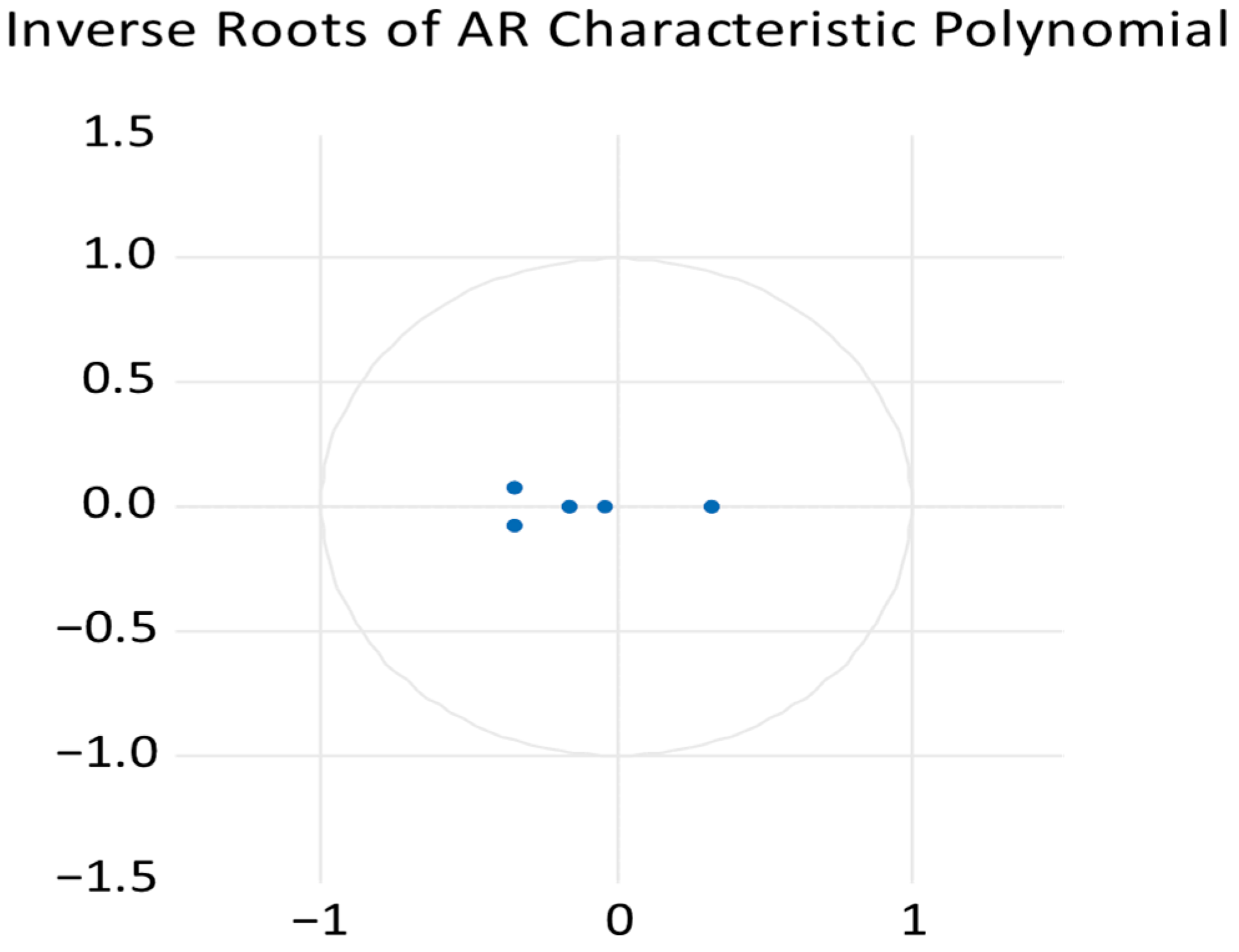
Furthermore, the stability of the model is examined through the roots of the characteristic polynomial. A VAR is considered stable when all the roots are located inside the unit circle. This condition guarantees the validity of impulse response functions and variance decompositions.
Overall, these tests ensure that the estimated model meets the necessary conditions for a reliable interpretation of the observed dynamics.
4.9. Dynamic Analysis: IRFs and FEVDs
The dynamic behavior of the VAR system is analyzed using impulse response functions (IRFs) and forecast error variance decompositions (FEVDs). IRFs trace the temporal response of each endogenous variable to a one-standard-deviation innovation, while FEVDs quantify the relative contribution of each innovation to forecast error variance at different horizons (
Sims, 1980;
Lütkepohl, 2005).
Identification of innovations relies on a Cholesky decomposition of the variance–covariance matrix of reduced-form residuals. This approach imposes a recursive contemporaneous ordering of variables and yields orthogonal innovations, facilitating the analysis of conditional dynamic responses. The resulting IRFs and FEVDs are therefore interpreted as conditional dynamic responses, rather than as structural causal effects.
Statistical inference is conducted using bootstrap confidence intervals, which are well suited to finite samples and macro-financial environments characterized by potentially non-Gaussian innovations (
Kilian, 1998).
4.10. Robustness to Identification: Generalized Impulse Response Functions
To assess the sensitivity of the results to the recursive identification implied by the Cholesky decomposition, generalized impulse response functions (GIRFs) are computed following
Pesaran and Shin (
1998). Unlike orthogonalized IRFs, GIRFs do not require orthogonality of shocks and are invariant to the ordering of variables in the VAR system.
Confidence intervals for the GIRFs are obtained using Monte Carlo simulations. This robustness exercise allows for verification that the qualitative dynamic patterns identified in the baseline analysis are not driven by the specific identifying assumptions and remain stable when these constraints are relaxed.
5. Results
5.1. Preliminary Diagnostic Tests
5.1.1. Multicollinearity Diagnostics
Although multicollinearity is generally less critical in a VAR framework where all variables are treated as endogenous, it may still affect the precision of estimated coefficients and the stability of the system. As a robustness check, pairwise correlations and Variance Inflation Factors (VIFs) are examined.
As reported in
Table 1, the correlation matrix indicates relatively low linear associations across variables, with the highest coefficient equal to 0.219 between inflation and Treasury bill holdings. These values suggest that the variables capture distinct dimensions of the macro-financial system, without exhibiting strong linear dependence.
This assessment is confirmed by the variance inflation factor (VIF) in
Table 2. The centered VIF values range between 1.02 and 1.06, remaining close to unity and well below conventional thresholds associated with multicollinearity concerns.
Taken together, these results do not provide evidence of severe multicollinearity in the system. The specification therefore appears suitable for VAR estimation, with limited risk of coefficient instability due to linear dependence among variables.
5.1.2. Structural Stability and Chow Breakpoint Test
The stability of the estimated VAR system is assessed using Chow breakpoint tests at selected dates corresponding to major macro-financial disruptions, with particular attention to the COVID-19 period.
The breakpoint dates are not chosen from the entire sample; instead, they are chosen to show economically significant events that are likely to change the stability of the estimated relationships. March 2020 captures the onset of the COVID-19 shock, while December 2021 and June 2022 correspond to post-crisis phases characterized by macro-financial adjustment and evolving monetary conditions. The objective is not to test all possible breakpoints, which could lead to data-driven inference, but to assess the robustness of the model around clearly identifiable episodes of potential structural stress.
As reported in
Table 3 the breakpoint test for March 2020 yields a
p-value of 0.0979. While this value remains above the conventional 5% threshold, it is close to the 10% level, suggesting weak and non-conclusive evidence of parameter instability, without allowing for formal rejection of the null hypothesis of stability.
For the post-COVID period, including December 2021 and June 2022, the reported p-values are well above standard significance levels, indicating no evidence of structural breaks. Overall, the results do not provide strong statistical support for the presence of structural instability in the VAR system over the sample period.
From a methodological perspective, these findings support the use of a unified VAR specification rather than a segmented sample. Splitting the sample would significantly reduce the number of observations and undermine the reliability of impulse response functions and forecast error variance decomposition.
It is important to note that the Chow test evaluates the stability of estimated coefficients rather than changes in the underlying variables. As such, the absence of statistically significant breakpoints should be interpreted as evidence of relatively stable relationships within the system, rather than the absence of macroeconomic shocks.
At the same time, the borderline result observed for March 2020 suggests that the interpretation of short-run dynamics around the COVID shock should be approached with caution.
5.1.3. Stationarity Tests (ADF and Phillips-Perron)
The stationarity of the series is assessed using the Augmented Dickey–Fuller (ADF) and Phillips–Perron (PP) tests in order to ensure the validity of the VAR estimation and to avoid spurious regression issues.
The variables included in the model are expressed as transformations capturing short-term dynamics, mainly through logarithmic differences. As reported in
Table 4, the unit root test results indicate that all transformed variables are stationary at level. Both ADF and PP statistics are significant at the 1% level for most variables, allowing rejection of the null hypothesis of a unit root. These variables can therefore be considered integrated of order zero, I(0), in their specified form.
An exception arises for the monetary policy variable (ΔPR_t). As shown in
Table 4, the ADF test does not reject the null hypothesis of a unit root (
p-value = 0.1018), whereas the PP test indicates stationarity at the 1% level (
p-value = 0.0000). This divergence can be explained by the higher sensitivity of the ADF test to model specification and potential heteroskedasticity, while the PP test is generally more robust in such contexts.
Given the robustness properties of the PP test, the variable ΔPR_t is retained in its specified form. However, this discrepancy calls for cautious interpretation and may justify additional robustness checks.
Overall, the results confirm that the variables used in the model satisfy the stationarity conditions in their chosen form. The VAR model is therefore estimated on stationary series, ensuring the validity of the short-term dynamics analyzed, while not capturing potential long-run relationships between variables.
5.2. VAR Model Specification
5.2.1. Lag Length Selection and Model Estimation
The selection of the optimal lag length is based on standard information criteria (AIC, SC, HQ, and FPE) as well as the likelihood ratio (LR) test. As reported in
Table 5, the results indicate a divergence across criteria. Information criteria consistently favor a highly parsimonious specification with zero lags (AIC = −22.4433; SC = −22.2901), while the LR test identifies the VAR(3) specification as optimal (LR = 48.5360).
This divergence reflects the classical trade-off between parsimony and dynamic specification. However, a zero-lag model is not consistent with the VAR framework, as it fails to capture intertemporal relationships. A dynamic specification is therefore required.
As reported in
Table 6, the VAR(1) model exhibits the best overall performance according to both AIC (−22.6466) and SC (−21.7661), outperforming VAR(2) and VAR(3). In contrast, higher-order specifications substantially increase model complexity, with the number of estimated parameters rising from 30 in VAR(1) to 55 in VAR(2) and 80 in VAR(3), without a commensurate improvement in fit.
Given the relatively limited sample size (83 observations), such an increase in dimensionality raises concerns regarding overparameterization and potential instability of the estimated system. In this context, the LR test result favoring VAR(3) must be interpreted with caution, as this criterion does not sufficiently penalize model complexity and may lead to overfitting.
Importantly, the objective of this study is to analyze short-run dynamics and the relative timing of responses across variables. From this perspective, a VAR(1) specification provides a sufficient dynamic structure to capture immediate interactions while preserving estimation reliability.
Accordingly, the VAR(1) specification is retained based on standard information criteria (AIC, SC) and its consistency with the short-run focus of the analysis. While longer lag structures may capture more persistent monetary transmission effects, the VAR(1) model allows us to focus on immediate adjustments while preserving degrees of freedom, given the sample size.
5.2.2. Residual Diagnostics and Robustness of Statistical Inference
The results indicate that the joint statistics are significant at the 1% level, leading to a rejection of the null hypothesis of multivariate normality. As reported in
Table 7, this deviation from normality appears to be driven by skewness and excess kurtosis in several equations of the system.
However, this result should be interpreted with caution. In VAR models applied to macro-financial data, the normality of residuals is not a necessary condition for consistent estimation. Instead, non-normality mainly affects the validity of standard asymptotic inference.
To address this issue, statistical inference particularly for impulse response functions and variance decomposition is based on bootstrap procedures, which do not rely on normality assumptions. This approach ensures robust inference despite the presence of non-normal residuals.
5.2.3. Residual Heteroskedasticity Test
The homoskedasticity of the VAR(1) residuals is assessed using a multivariate heteroskedasticity test. As reported in
Table 8, the joint test yields a
p-value of 0.0393, leading to a rejection of the null hypothesis of homoskedasticity at the 5% significance level.
However, this result should be interpreted with caution. A closer examination of individual components indicates that heteroskedasticity is not uniformly distributed across the system. Most variance terms are not statistically significant, and only a limited number of cross-residual interactions exhibit significance.
These findings suggest that the detected heteroskedasticity is not pervasive, but rather limited to specific elements of the system. In the context of VAR models, such deviations from homoskedasticity do not affect the consistency of parameter estimates but may impact the reliability of standard inference based on asymptotic assumptions.
To address this issue, statistical inference in the analysis particularly for impulse response functions and variance decomposition is based on bootstrap procedures, which are robust to heteroskedasticity. This approach ensures that confidence intervals and significance assessments remain valid despite the presence of residual heteroskedasticity.
Overall, while the null hypothesis of homoskedasticity is formally rejected, the evidence does not suggest severe or systematic instability in the residual structure, and the VAR specification remains suitable for dynamic analysis under robust inference.
5.2.4. Stability Test of VAR(1) Model
The stability of the VAR(1) model is assessed by examining the roots of the characteristic polynomial.
As illustrated in
Figure 1, the results indicate that all characteristic roots have a modulus strictly less than one, meaning that they lie inside the unit circle. This condition ensures that the VAR system is dynamically stable and covariance-stationary.
As a result, shocks affecting the system are transitory and gradually dissipate over time. This property is essential for the validity of dynamic analyses, including impulse response functions and forecast error variance decomposition.
From a methodological perspective, the stability condition supports the use of the estimated VAR(1) specification for analyzing short-run interactions between variables.
Overall, the diagnostic tests suggest that the model satisfies the main requirements for VAR estimation. While some deviations from normality and homoskedasticity are observed, these do not affect the consistency of the estimates, and robust inference procedures are employed to ensure the reliability of the results.
5.3. Impulse Response Functions
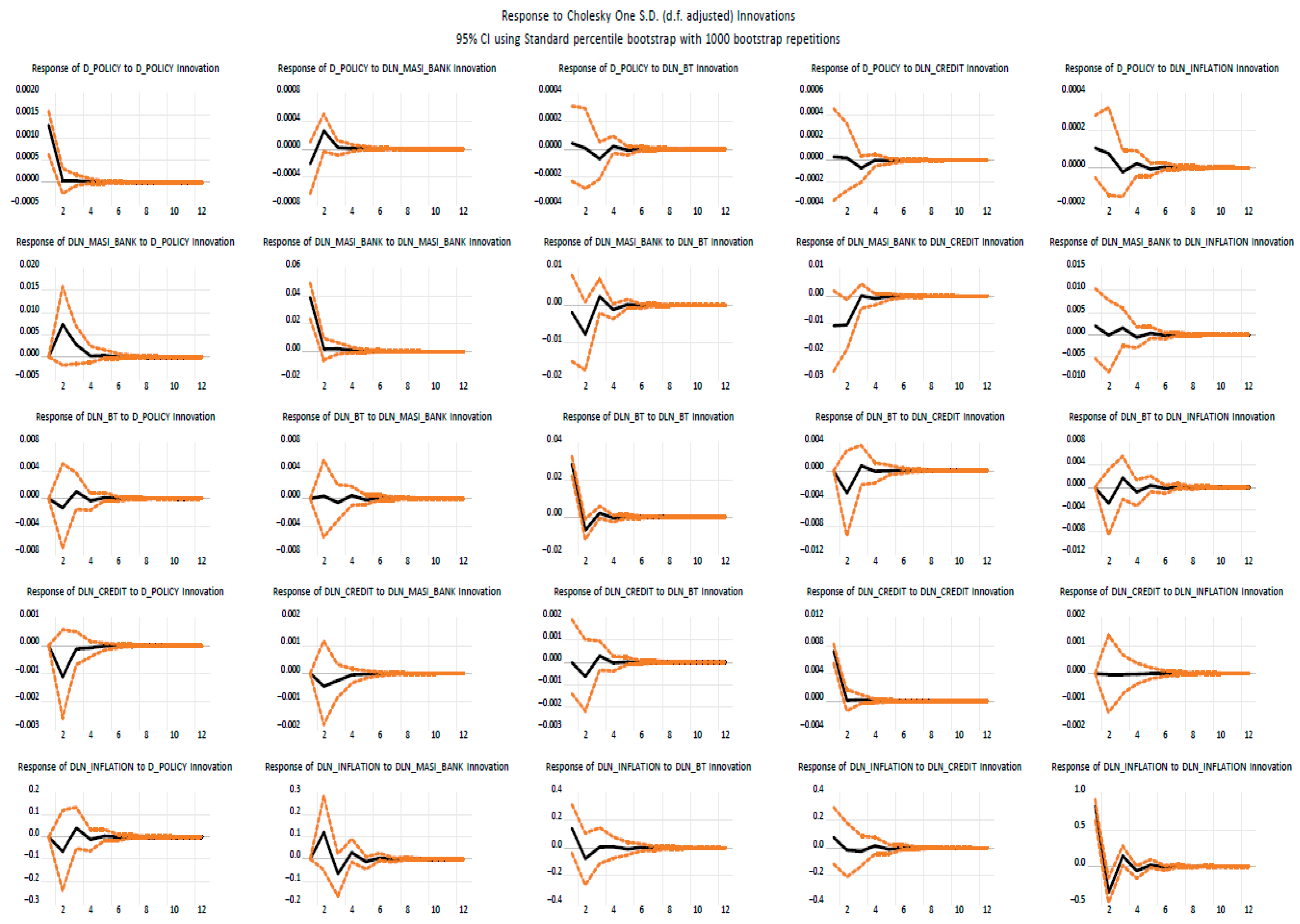
Following a monetary policy innovation, the impulse response functions reveal heterogeneous adjustment patterns across variables, particularly at short horizons. The responses are presented with 95% bootstrap confidence intervals (1000 replications), allowing for an assessment of their statistical significance.
As illustrated in
Figure 2, bank equity valuations, proxied by Δlog(MASI_B_t), display the most pronounced short-run response. The effect increases from 0.001293 in period 1 to a peak of 0.008281 in period 2, before declining rapidly and becoming negligible after period 3. This pattern suggests a relatively fast adjustment concentrated in the immediate periods following the innovation. This pattern suggests a relatively fast adjustment concentrated in the immediate periods following the innovation. This reflects the rapid incorporation of policy-related information into financial markets, where asset prices adjust quickly to changes in expectations.
However, given the associated confidence intervals, the magnitude of the response remains moderate and should be interpreted with caution, particularly in light of the short-run nature of the analysis.
In contrast, balance-sheet variables exhibit weaker and less structured responses. The reaction of Treasury securities, proxied by Δlog(TBILLS_t), is small and unstable, alternating in sign and fluctuating around zero, which does not indicate a persistent adjustment pattern. Similarly, credit to the private sector, proxied by Δlog(CREDIT_NFS_t), shows a negative response at short horizons, reaching −0.001138 in period 2 before converging toward zero. This may reflect a short-term tightening effect, as monetary policy innovations are rapidly incorporated into lending conditions and risk assessments, while credit supply adjusts more gradually. These short-lived responses should be interpreted in light of the monthly frequency of the data and the reduced-form VAR framework, which captures immediate adjustments rather than longer-term transmission dynamics. They may also reflect the fact that balance-sheet variables adjust more gradually within the system relative to financial variables, resulting in more attenuated short-run dynamics.
Inflation, proxied by Δlog(INF_t), displays the most volatile dynamics, with alternating signs and no clear directional pattern. The initial increase is followed by a sharp decline and subsequent fluctuations, making it difficult to identify a stable short-run response to monetary policy innovations. This behavior is consistent with the presence of nominal rigidities, which delay the transmission of monetary policy effects to prices.
Taken together, these results suggest that monetary policy innovations are associated with heterogeneous short-run adjustment patterns across variables. This pattern reflects the sequential nature of monetary transmission, where financial variables react immediately to policy-related information, while balance-sheet and macroeconomic variables adjust more gradually.
From a comparative perspective, although the peak response of bank equity valuations exceeds those observed for credit and Treasury securities in absolute terms, this should not be interpreted as evidence of stronger transmission through financial markets. Rather, it is consistent with the interpretation that monetary policy innovations, viewed as policy-related information, may be reflected more rapidly in asset prices, while balance-sheet variables adjust more gradually under institutional and informational constraints.
Importantly, given the reduced-form nature of the VAR framework, these results should be interpreted as empirical dynamic associations rather than as evidence of structurally identified causal relationships. Overall, the observed patterns should be understood as reflecting differences in adjustment timing across variables rather than a clearly identified transmission mechanism. These findings are consistent with the variance decomposition results, which indicate that system dynamics are largely dominated by own innovations.
5.4. Forecast Error Variance Decomposition Results
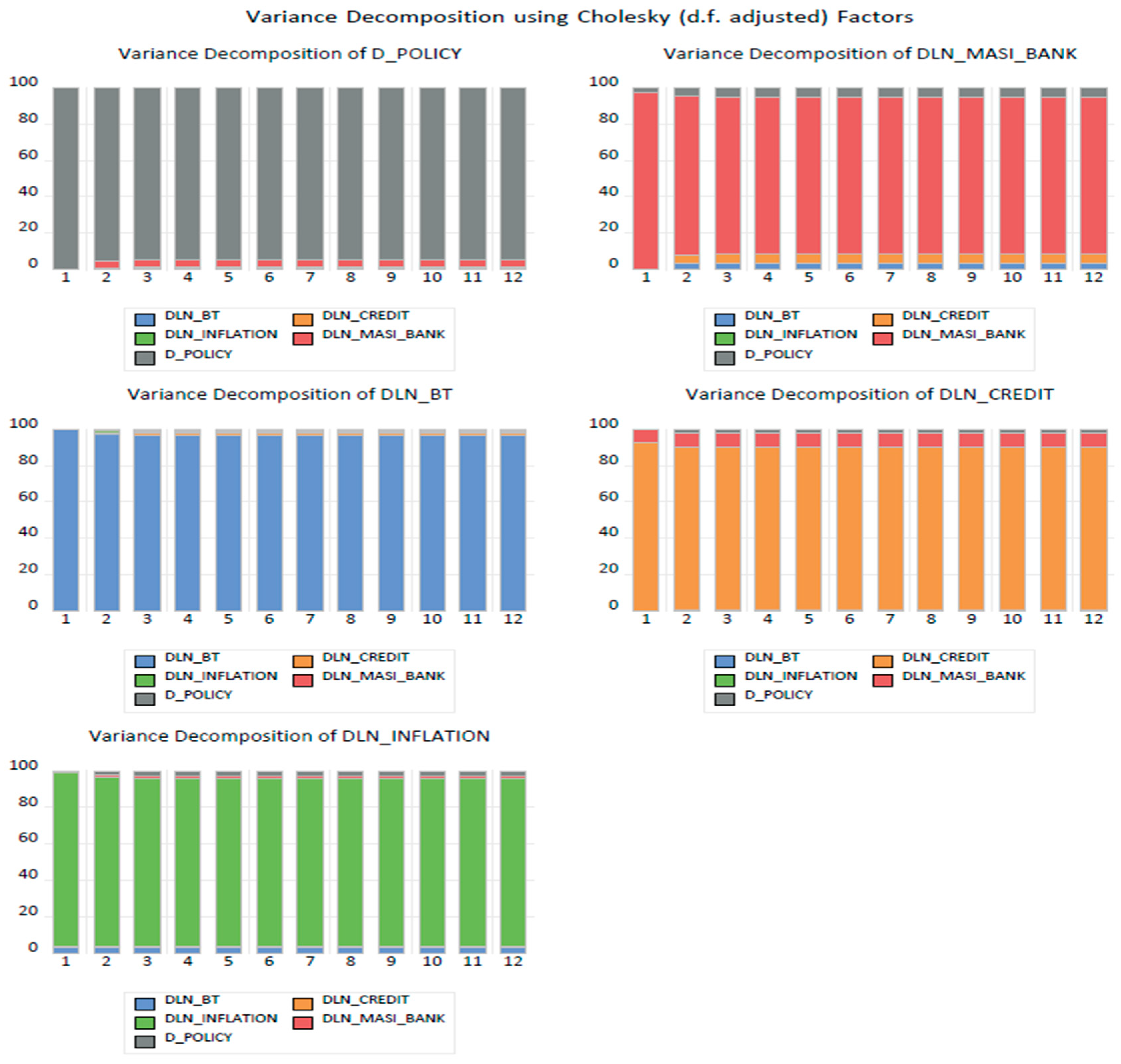
The forecast error variance decomposition (
Figure 3) reveals a marked heterogeneity in the sources of fluctuations across variables. Overall, the results indicate that system dynamics are largely dominated by their own innovations, suggesting a high degree of persistence, particularly for credit and inflation.
For credit to the private sector, own innovations account for around 88–90% of its variance at short horizons and remain close to this level at longer horizons. The contribution of monetary policy innovations remains limited, at around 2%, while bank equity valuations account for a limited but non-negligible share, remaining below 10% at medium horizons. This pattern suggests that short-run credit dynamics are primarily driven by internal factors, with only modest empirical associations with monetary policy innovations.
By contrast, bank equity valuations display a relatively higher sensitivity to monetary policy innovations. While their variance is still largely explained by their own innovations (declining from about 95% at short horizons to around 90% at longer horizons), the contribution of monetary policy innovations increases from approximately 2–3% to around 5%. This result is consistent with the interpretation that financial variables may reflect policy-related information more rapidly, although this interpretation remains indicative given the reduced-form nature of the framework.
Treasury securities exhibit highly self-driven dynamics, with their own innovations explaining more than 95% of their variance at short horizons and remaining at similarly high levels at longer horizons. The contribution of monetary policy innovations remains limited, at approximately 0.5–1%, indicating modest short-run adjustments.
Similarly, inflation is largely dominated by its own innovations, accounting for around 92–95% of its variance across horizons. The contribution of monetary policy innovations remains modest, increasing slightly from about 0.5–1% to around 2–3%. This finding is consistent with the absence of a clearly identifiable short-run response of inflation and supports the interpretation of gradual adjustment dynamics.
Taken together, these results suggest that monetary policy innovations are associated with heterogeneous short-run adjustment patterns across variables. In particular, financial market variables appear to reflect policy-related information more visibly at short horizons, while credit and inflation exhibit more limited and gradual adjustments. Importantly, these results should be interpreted with caution, as variance decomposition outcomes are conditional on the identification scheme and the ordering of variables within the Cholesky framework. More broadly, these findings reflect empirical dynamic associations within a reduced-form VAR framework and do not imply the identification of distinct structural innovations.
5.5. Generalized Impulse Response Functions
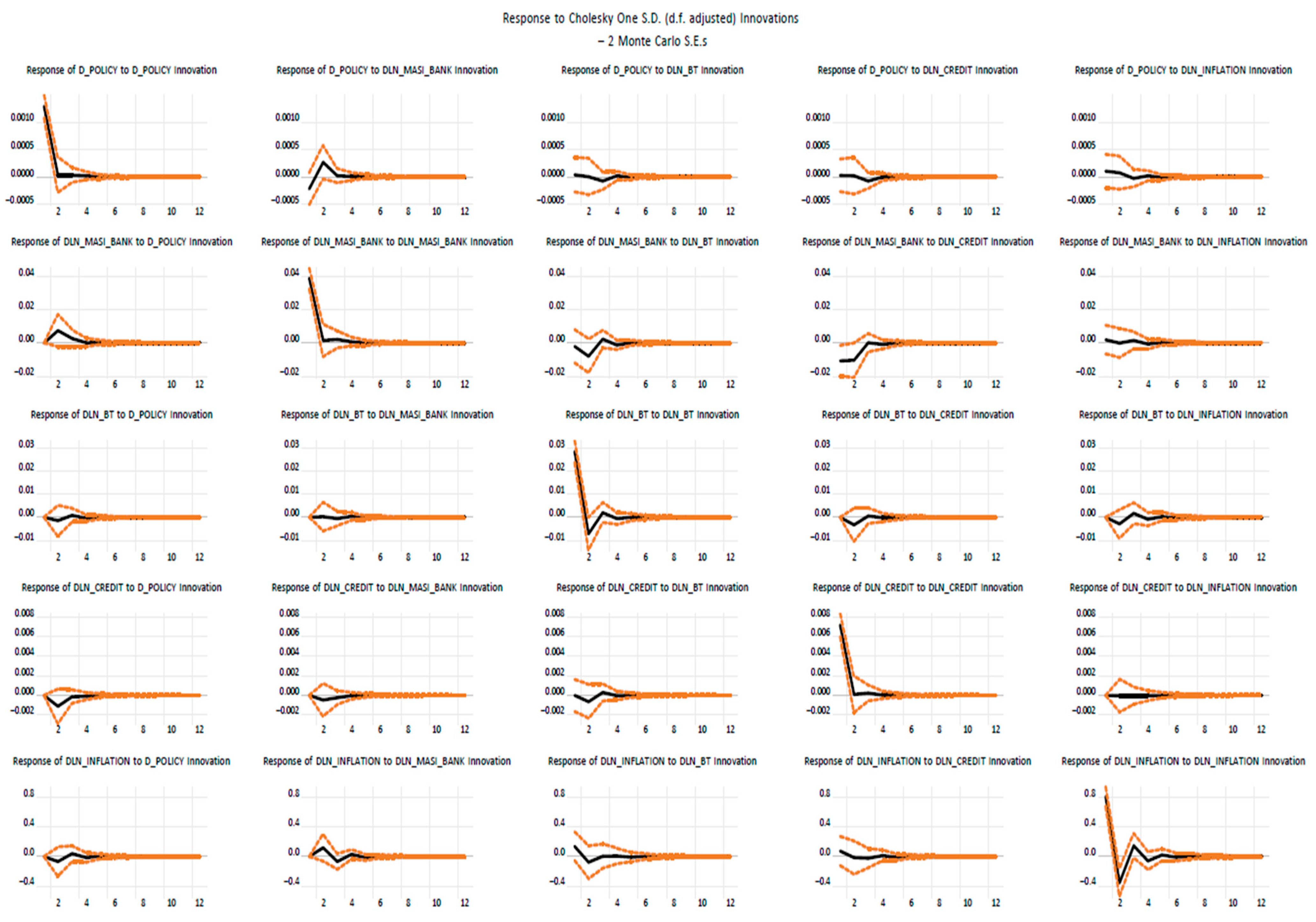
Generalized impulse response functions (GIRFs) are used to examine the dynamic responses of the variables to a monetary policy innovation without relying on a specific variable ordering. In this respect, they provide a robustness check to assess whether the dynamic responses identified through standard impulse response functions and variance decomposition are sensitive to the ordering assumptions inherent in the Cholesky identification scheme. The interpretation focuses on the magnitude, persistence, and short-run patterns of adjustment. The responses are reported with Monte Carlo standard errors, allowing for a cautious assessment of statistical uncertainty. Differences in scale across variables should be taken into account when interpreting the responses.
As illustrated in
Figure 4, following a monetary policy innovation (ΔPR_t), the response of bank equity valuations, proxied by Δlog(MASI-B_t), appears more pronounced at very short horizons relative to the other variables. The response is initially negative (−0.000655 in period 1), before turning positive in period 2 (+0.000659) and period 3 (+0.000255. The observed pattern is consistent with a rapid adjustment followed by quick stabilization, reflecting the rapid incorporation of policy-related information into financial markets.
However, given the associated uncertainty, the magnitude remains moderate, and the response converges toward zero from around period 5, indicating a short-lived effect.
These short-lived responses are consistent with the short-run focus of the analysis and the use of monthly data, where rapid adjustment and attenuation of effects are expected, and may also reflect differences in the speed of adjustment across variables within the system.
By comparison, the response of credit to the private sector, proxied by Δlog(CREDIT-NFS_t), is weaker and more diffuse. The initial effect is very small (+0.000017 in period 1 and +0.000218 in period 2), followed by rapid attenuation and fluctuations around zero. The overall response remains confined within a narrow range, suggesting moderate short-run sensitivity within the estimated framework. Such dynamics may reflect the gradual adjustment of lending conditions and risk assessments, which typically respond more slowly than financial market variables.
Treasury securities, proxied by Δlog(TBILLS_t), also display low-amplitude responses. The initial effect is positive but marginal (+0.0000285 in period 1), followed by fluctuations close to zero without clear persistence. The pattern indicates that adjustments in this segment remain modest at short horizons. This can be explained by the role of Treasury securities in liquidity management, where adjustments are less sensitive to immediate policy signals.
Inflation, proxied by Δlog(INF_t), exhibits a larger initial response (+0.0725 in period 1), which should be interpreted with caution given the different scale of the variable. Subsequent responses are unstable, alternating in sign and remaining limited in relative terms, with no clear short-run trajectory. Such behavior is consistent with the presence of nominal rigidities, which delay the transmission of monetary policy effects to prices.
Taken together, the GIRFs highlight heterogeneous short-run response patterns across variables. Bank equity valuations appear to display relatively more visible immediate responses, whereas balance-sheet variables and inflation exhibit more muted and less stable adjustments. These dynamics reflects the sequential nature of monetary transmission, where financial variables react rapidly to policy-related information, while balance-sheet and macroeconomic variables adjust more gradually.
Consistent with the impulse response functions and variance decomposition results, these findings suggest that monetary policy innovations are associated with relatively modest short-run adjustments across the system. In particular, the response of credit remains moderate in magnitude and short-lived within the considered horizon. This pattern should be interpreted as reflecting differences in adjustment timing rather than a lack of economic relevance.
Importantly, given the use of generalized impulse responses and the reduced-form VAR framework, these results should be interpreted as empirical dynamic associations rather than as evidence of structurally identified monetary or information-related effects. In particular, the GIRF analysis does not allow for a clear identification of distinct monetary transmission effects versus information-related effects. Overall, the consistency between GIRFs, IRFs, and variance decomposition supports the robustness of the observed short-run dynamics across alternative identification approaches.
6. Discussion
Empirical results suggest that, in the short term, monetary policy innovations are more visibly reflected in bank stock valuations approximated by the MASI banking index than in balance sheet aggregates or inflation. This phenomenon can be interpreted in light of research on informational frictions and the role of financial markets in information consolidation.
In a context of information asymmetry, lending decisions are not based solely on price adjustments, but also involve risk selection and assessment mechanisms (
Stiglitz & Weiss, 1981). Consequently, private sector credit aggregates may exhibit a low short-term responsiveness to monetary policy innovations. Conversely, bank stock valuations, proxied by the MASI banking index, are more likely to incorporate new information quickly, which is consistent which can be interpreted as consistent with the semi-strong form of informational efficiency (
Fama, 1991).
From this perspective, monetary policy decisions may be interpreted as conveying policy-related information regarding future macro-financial conditions (
Spence, 1973). The reaction of the banking index is part of an information absorption mechanism, meaning that expectations change even before any changes in balance sheet variables become observable. It is important to note that this phenomenon should not be interpreted as evidence of direct transmission through financial markets, but rather as an early reflection of policy-related information in asset prices. This interpretation remains indicative, as the empirical framework does not allow for a clear identification of distinct monetary and information-related effects.
The gap between the rapid change in financial valuations and the slowness of changes in balance sheet variables is consistent with the structural limitations of the bank credit transmission channel. In the presence of prudential regulations and informational frictions, banks adjust their behavior gradually, which can delay observable changes in the supply of credit. The limited contribution of monetary policy innovations to credit variance supports this interpretation and suggests that balance sheet adjustments are not concurrent with changes in financial valuations.
This interpretation is consistent with recent data from emerging economies, where short-term monetary transmission tends to be reflected first in financial conditions, while credit adjustments remain more gradual and heterogeneous (
Mishra & Montiel, 2013;
Pirozhkova et al., 2024), with similar patterns reported in recent studies.
Regarding inflation, the results do not reveal a stable or directional short-term response. Impulse reactions appear volatile, and the variance decomposition indicates a relatively modest contribution from monetary policy innovations. These observations can be interpreted in light of studies highlighting nominal rigidities and the role of expectations in shaping price dynamics (
Clarida et al., 1999;
Woodford, 2003;
Romer & Romer, 2004).
Overall, the results are consistent with an apparent temporal ordering of responses across variables.
Monetary policy innovations appear to be reflected first in financial valuations, then progressively in bank balance sheets, and finally, later, in macroeconomic variables. This interpretation, however, should be treated with caution and should be interpreted as descriptive differences in adjustment timing rather than evidence of a causal transmission sequence In this context, the relatively moderate short-term response of credit and inflation should not be interpreted as evidence of monetary policy ineffectiveness, but rather as a reflection of differences in the speed of adjustment between variables. This pattern should be interpreted as reflecting differences in transmission dynamics across variables rather than as evidence of limited economic relevance.
The main contribution of this study lies in its joint analysis of financial valuations, balance sheet aggregates, and inflation within a unified empirical framework. It suggests that observed differences in monetary transmission may reflect temporal heterogeneity rather than inconsistencies between theoretical channels. In this perspective, differences in magnitude should be understood in conjunction with differences in adjustment timing across financial, banking, and macroeconomic variables.
Overall, the empirical results are broadly consistent with the proposed hypotheses. Monetary policy innovations are associated with stronger responses in bank equity valuations (H1), while balance sheet variables exhibit weaker and non-contemporaneous adjustments (H2). Finally, inflation does not display a clear short-term response pattern (H3).
Policy Implications
From a macro-financial perspective, these results suggest that assessing monetary transmission at short horizons solely through credit aggregates or inflation may provide an incomplete picture. The absence of immediate responses in these variables does not necessarily imply weak transmission, but may instead reflect a sequencing process in which policy-related information is first incorporated into financial valuations.
In this context, market-based variables should be interpreted as indicators of expectation adjustments rather than as direct transmission channels. For policymakers, this implies that financial market indicators, such as bank equity valuations, may serve as early signals of monetary policy transmission, complementing traditional quantity-based measures.
More broadly, the findings highlight the role of structural features of the banking system in shaping transmission dynamics. Informational asymmetries, prudential constraints, and internal risk management practices may contribute to delaying adjustments in credit supply, even when financial variables appear to react. This suggests that regulatory and institutional factors should be taken into account when evaluating the short-term effectiveness of monetary policy.
Importantly, these results also indicate that short-run monetary transmission may be more difficult to detect using standard quantity-based indicators. This has implications for the design of policy monitoring frameworks, which may benefit from integrating both market-based and balance-sheet indicators.
Given the reduced-form nature of the VAR framework, these implications remain indicative and should be interpreted with caution. Further research using structural approaches or micro-level data would be necessary to more precisely identify the underlying transmission mechanisms.
7. Conclusions
This study examines the short-run dynamics of monetary policy transmission in a bank-dominated emerging economy, with a particular focus on the relative timing of adjustments across bank equity valuations, balance-sheet aggregates, and inflation.
The empirical results suggest that monetary policy innovations are more visibly reflected in bank equity valuations proxied by the MASI banking index at short horizons, while balance-sheet variables and inflation exhibit more limited and less stable responses. This pattern can be interpreted as consistent with a configuration in which policy-related information appears to be incorporated into financial valuations before becoming observable in slower-moving variables.
Importantly, this interpretation does not imply the existence of a direct transmission channel through financial markets. Rather, it suggests that, asset prices may reflect the early incorporation of policy-related information through expectation adjustments while the diffusion toward credit and inflation remains more gradual and constrained.
The contribution of this paper lies in documenting heterogeneous short-run adjustment patterns across variables within a unified empirical framework. In this perspective, differences in observed responses may reflect variations in adjustment timing rather than the absence of transmission.
7.1. Limitations
Several limitations should be acknowledged. First, the analysis relies on a reduced-form VAR framework, which captures dynamic interactions but does not identify structural causal mechanisms or allow for testing theory-specific transmission channels. The results should therefore be interpreted as conditional associations rather than causal effects.
Second, although the sample period includes the COVID-19-episode, structural stability tests do not provide strong statistical evidence of parameter instability within the VAR system. However, the borderline result observed for March 2020 suggests that the interpretation of short-run dynamics around this period should be approached with caution.
Third, although the retained VAR(1) specification is supported by standard lag-selection criteria and helps preserve degrees of freedom, longer lag structures may capture more persistent transmission effects. This should be considered when interpreting the results.
Fourth, while monthly data are appropriate for short-run analysis, they may not fully capture very high-frequency adjustments or longer-term transmission mechanisms affecting credit and inflation.
In addition, the use of differenced variables, while ensuring stationarity, implies that potential long-run relationships between variables are not captured. As a result, no cointegration analysis is conducted, and the framework does not allow for the identification of long-run equilibrium dynamics.
Moreover, the use of aggregated variables may mask underlying heterogeneity across banks. In particular, the MASI banking index does not capture bank-level differences in risk profiles and responses to monetary policy. Similarly, the transformation of inflation into first differences may reduce the interpretability of its dynamics.
Furthermore, the empirical specification excludes certain macro-financial variables, such as exchange rate dynamics, global financial conditions, and fiscal policy indicators. The omission of these factors may affect the interpretation of the results and introduce potential omitted variable bias.
Finally, the identification strategy relies on recursive assumptions, which may influence the interpretation of impulse response functions, despite the use of complementary generalized approaches. Moreover, the single-country focus of this study may limit the external validity of the findings.
7.2. Future Research
These limitations open several avenues for future research. First, structural approaches such as SVAR or DSGE models could help disentangle policy innovations from informational components and provide a clearer identification of transmission mechanisms.
Second, the use of micro-level data, particularly at the bank or firm level, could offer deeper insights into credit allocation, risk assessment, and heterogeneity across borrowers, especially in the presence of information asymmetries and credit rationing mechanisms.
Third, extending the analysis over a longer time horizon would allow for a better assessment of the persistence and stability of monetary transmission, particularly across different economic cycles and in the presence of major shocks such as the COVID-19 pandemic.
Fourth, future research could explore alternative model specifications, including reduced-dimensional VAR frameworks (e.g., three-variable systems), to isolate basic transmission mechanisms and compare them with higher-dimensional models.
Fifth, the use of alternative lag structures and time-varying parameter models (e.g., TVP-VAR) could help capture potential changes in transmission dynamics over time and across different macro-financial regimes.
Sixth, extending the analysis to alternative frequencies or employing high-frequency identification strategies could improve the understanding of short-term market reactions and the informational content of policy announcements.
Finally, further research could explore the interaction between monetary policy, financial variables, and macroeconomic outcomes across different institutional contexts, particularly in emerging economies, to assess the generalizability of the findings.