Article

Do Credit and Liquidity Risks Interact to Shape Bank Stability? Evidence from an Emerging Banking System


1
Department of Administrative and Financial Sciences, Arab American University, Jenin P.O. Box 240, Palestine
2
Faculty of Business and Economics, Birzeit University, Birzeit 627, Palestine
3
College of Business Administration, University of Business and Technology, Jeddah 21448, Saudi Arabia
4
College of Business and Finance, Ahlia University, Manama P.O. Box 10878, Bahrain
5
Faculty of Business and Economics, Palestine Technical University—Kadoorie, Tulkarm P.O. Box 7, Palestine
*
Author to whom correspondence should be addressed.
Int. J. Financial Stud. 2026, 14(5), 105; https://doi.org/10.3390/ijfs14050105
Submission received: 23 February 2026 / Revised: 15 April 2026 / Accepted: 22 April 2026 / Published: 28 April 2026

Abstract

This paper examines whether the interaction between credit risk and liquidity conditions helps explain bank stability in a fragile and institutionally constrained banking environment. Using an annual panel of 13 Palestinian banks over 2011–2024 and measuring stability by the (log) Z-score, we estimate static panel models (pooled OLS, fixed effects, and random effects), a simultaneous two-stage least squares (2SLS) system to probe the direction of causality between credit risk and liquidity, and a dynamic panel GMM specification to address persistence and endogeneity. The static models show that credit risk is negatively associated with stability and that the interaction term is economically meaningful but not robust across static specifications. In the dynamic GMM model, credit risk remains significantly destabilizing, liquidity holdings are stabilizing, and the interaction term is positive and significant—consistent with liquidity buffers mitigating the adverse stability implications of higher credit risk. The 2SLS system suggests no strong contemporaneous reciprocal causality between credit risk and liquidity once controls are included, while regulatory and conflict-period dummies are associated with shifts in the risk profiles. The results highlight the importance of integrated risk management and liquidity buffers for banking stability in high-uncertainty contexts.

1. Introduction

Bank stability constitutes a cornerstone of macroeconomic resilience, as a sound banking system underpins financial intermediation, credit provision, and confidence in the broader economy. A stable banking sector is generally defined as one that can absorb financial shocks and unexpected disturbances without disrupting its core functions or transmitting stress to the real economy. In this context, the ability of banks’ board of directors and senior management to accurately assess, price, and manage financial risks is central to sustaining long-term performance and institutional viability (Morgan & Pontines, 2014).
Banking institutions play a pivotal role in economic development by mobilizing savings, allocating capital, and providing essential financial information to markets. Their effectiveness and continuity are therefore critical for economic growth and financial sustainability (Palečková et al., 2024; Rahman & Khan, 2024). However, over the past decade, banking systems worldwide have faced mounting challenges arising from economic volatility, political instability, rising non-performing loans, and sharp interest rate fluctuations. These pressures have intensified the importance of risk–return management as a determinant of bank profitability and stability (Isomiddinovich & Jasurbek, 2024).
Banks are inherently exposed to multiple sources of risk, including credit risk, liquidity risk, market risk, operational risk, foreign exchange risk, and interest rate risk. Rather than eliminating these risks, banking activity fundamentally revolves around their effective identification, pricing, and management (Mendoza & Rivera, 2017). Among these, credit risk and liquidity risk are particularly critical, as they directly affect banks’ asset quality, funding capacity, and solvency position. Credit risk arises when borrowers fail to meet their contractual obligations, potentially eroding capital buffers and threatening financial stability, while liquidity risk reflects banks’ inability to meet short-term obligations, especially during periods of sudden deposit withdrawals or funding stress.
The global financial crisis underscored the systemic relevance of these risks, as the failure of major banking and financial institutions transmitted severe shocks across interconnected economic sectors. Such episodes have reinforced the role of financial regulators and supervisory authorities in strengthening prudential frameworks to safeguard depositors’ interests and preserve financial stability (Sundaresan & Xiao, 2024). Consequently, modern regulatory regimes emphasize integrated risk management practices, recognizing that credit risk and liquidity risk are often interdependent rather than isolated phenomena.
Despite the growing recognition of this interdependence, empirical evidence on the joint effect of credit risk and liquidity risk on bank stability remains limited and inconclusive. Prior studies report mixed findings across countries, with liquidity risk shown to either undermine or enhance bank stability depending on institutional and economic contexts. This inconsistency suggests that country-specific characteristics play a crucial role, limiting the generalizability of results across banking systems.
Prior empirical studies have documented that credit risk and liquidity conditions are important determinants of bank stability, although the direction and magnitude of their effects may vary across banking systems. For example, Imbierowicz and Rauch (2014) examined the relationship between liquidity risk and credit risk in banks and showed that their interaction can affect bank default risk in a non-uniform manner. Similarly, Chen et al. (2018) highlighted the importance of liquidity risk for bank performance, while other studies have emphasized the destabilizing role of deteriorating asset quality in banking systems. However, most of the existing literature has focused either on the separate effects of credit risk and liquidity risk or on banking systems operating in more stable institutional environments. However, studies such as Vazquez and Federico (2015) highlight the importance of bank funding structures in shaping risk and stability, reinforcing the need to consider both credit and liquidity dimensions jointly. Furthermore, evidence from studies such as Ghenimi et al. (2017) and Abdelaziz et al. (2022) emphasizes the interaction between credit and liquidity factors in determining bank stability across different banking systems. Despite this, limited attention has been given to how these two risks interact to shape bank stability in fragile, emerging, and conflict-affected economies such as Palestine. This gap is particularly important because the institutional setting, regulatory environment, and liquidity behavior of Palestinian banks differ from those documented in other banking contexts.
This issue is particularly relevant in fragile and conflict-affected economies such as Palestine. The Palestinian banking sector represents the backbone of the domestic financial system, and the distress of any major banking institution could have systemic repercussions. Persistent political and economic instability, combined with elevated non-performing loan ratios relative to regional peers, heightens banks’ vulnerability to credit and liquidity shocks. Moreover, ongoing geopolitical tensions further exacerbate uncertainty and risk exposure, reinforcing the need for rigorous empirical analysis tailored to the Palestinian context.
Despite the growing body of literature on bank risk and financial stability, several important gaps remain. First, empirical evidence on the interaction between credit risk and liquidity remains scarce in fragile and conflict-affected banking systems, particularly in Palestine. While extensive research has examined these risks in Western and developed economies, findings from such contexts cannot be readily generalized to economies characterized by persistent political instability, institutional constraints, and heightened uncertainty. Existing studies in the Palestinian banking sector have largely examined credit risk, liquidity, or bank stability in isolation, leaving the joint and interactive effects of these risks underexplored.
Second, much of the existing empirical work relies on cross-sectional or static approaches, which are limited in capturing the dynamic nature of risk transmission and adjustment over time—especially during periods of economic and political instability. Moreover, prior studies frequently employ basic econometric techniques, with limited use of advanced panel data methods capable of addressing endogeneity, persistence, and feedback effects between credit risk and liquidity. Third, macroeconomic conditions and structural shocks—such as inflation dynamics, economic growth fluctuations, regulatory reforms under Basel III, and conflict-related disruptions—are often insufficiently controlled for, despite their critical role in shaping banks’ risk profiles and stability. These limitations highlight the need for a comprehensive and context-specific analysis of credit risk–liquidity interactions in the Palestinian banking sector.
This study contributes to the financial stability literature in several important ways. First, it provides novel empirical evidence on the interaction between credit risk and liquidity and their joint impact on bank stability in Palestine—an underrepresented and institutionally fragile context in global banking research. By focusing on a banking system operating under prolonged political and economic uncertainty, the study extends existing evidence beyond developed and relatively stable economies.
Second, the contribution of this study is primarily empirical and contextual, rather than methodological, as it provides evidence from an underexplored and institutionally fragile banking environment.
Third, the findings offer practical implications for policymakers, regulators, and bank managers—particularly the Palestinian Monetary Authority, boards of directors, and senior management—by providing evidence that supports integrated risk management and supervisory strategies. Finally, the study lays a foundation for future research on risk interdependencies in emerging and developing banking systems, contributing to a broader understanding of financial stability in the Middle East and similar high-uncertainty environments.

2. Theoretical Framework and Hypothesis Development

2.1. Financial Stability and Its Measurement

Financial stability refers to the capability of the financial system to tolerate shocks and prevent financial disorder It also reflects the ability of banks to absorb the adverse effects of financial crises and effectively manage risks to ensure continuity of their core functions.
In empirical banking literature, financial stability is commonly measured using the Z-score (B. Awwad & Razia, 2021), which captures the distance of a bank from insolvency by combining profitability, leverage, and earnings volatility. A higher Z-score indicates greater stability and a lower probability of default. Compared to alternative measures such as CAMELS indicators or structural models (e.g., Merton model), the Z-score provides a widely used and transparent proxy for bank stability, particularly suitable for panel data analysis in emerging and data-constrained environments.

2.2. Credit Risk and Bank Stability

Credit risk constitutes one of the most fundamental sources of fragility in banking institutions, given that lending activities represent the primary source of income, risk-weighted assets, and regulatory capital requirements (Choudhry, 2018; Naili & Lahrichi, 2022). Credit risk arises when borrowers fail to meet their contractual obligations related to principal or interest repayments, exposing banks to financial losses and capital erosion (Hopkin, 2018; Basel Committee on Banking Supervision, 2004). Such deterioration in asset quality weakens profitability, increases provisioning needs, and reduces banks’ distance-to-default, thereby undermining financial stability.
Credit risk refers to the potential that borrowers may default on meeting their contractual obligations and meeting their loan payments as they become due. Credit risk is one of the most critical risks faced by banks, as their core intermediation function depends on borrowers’ ability and willingness to meet their contractual repayment obligations.
A substantial body of empirical literature documents a negative relationship between credit risk and bank stability or performance. Studies using non-performing loans or loan loss provisions as proxies for credit risk consistently report adverse effects on bank stability and financial performance (Ahmed et al., 2022; Ekinci & Poyraz, 2019; Abdelaziz et al., 2022; Ghenimi et al., 2017; Khoffash & Awwad, 2025). Similar findings are reported for banks operating in developing and emerging economies, where weaker institutional environments amplify credit risk transmission to financial distress.
Although some studies find insignificant or context-dependent effects (Fatoni & Sidiq, 2019 (the dominant theoretical and empirical expectation remains that elevated credit risk erodes capital buffers and increases insolvency risk. Accordingly, in a fragile economic and political environment such as Palestine, credit risk is expected to exert a destabilizing influence on banks.
H1: 
Credit risk has a negative effect on the stability of banks in Palestine.

2.3. Liquidity and Bank Stability

Liquidity risk reflects the inability of banks to meet their financial obligations as they fall due without incurring excessive costs or losses (Ismail & Ahmed, 2023; IMF, 2020). This risk typically originates from maturity mismatches between assets and liabilities, unstable funding structures, or sudden withdrawals of deposits, as highlighted during the global financial crisis (Kim et al., 2015; Choudhry, 2018). Theoretically, insufficient liquidity forces banks into fire sales of assets or reliance on costly funding, which compresses margins and can escalate into solvency stress (Skoglund & Chen, 2015).
Liquidity risk denotes the insufficiency of liquidity in financial markets, as it is hard for firms and organizations to get financing to meet their daily needs or finance their investment projects.
Empirical evidence largely supports a negative association between liquidity risk and bank stability. Numerous studies document that higher illiquidity or weaker liquidity buffers reduce financial stability and performance (Gadzo et al., 2019; Noman et al., 2015; Ruziqa, 2013; Chen et al., 2018; Adelopo et al., 2018; Onsongo et al., 2020; Saleh & Abu Afifa, 2020). Additional evidence suggests that rising illiquidity increases banks’ vulnerability to distress, especially under adverse macroeconomic conditions (Marozva, 2015; Abbas et al., 2021).
Nevertheless, some studies report mixed or insignificant effects, particularly across different banking models or regions (Chowdhury & Zaman, 2018; Salim & Bilal, 2016; Ismail & Ahmed, 2023; Saif-Alyousfi, 2022; Derbali, 2021). These discrepancies imply that institutional characteristics and market conditions shape the liquidity–stability nexus. In the Palestinian context—characterized by political uncertainty and funding fragility—liquidity risk is expected to weaken bank stability.
H2: 
Liquidity risk has a negative effect on the stability of banks in Palestine.

2.4. Interaction Between Credit Risk and Liquidity

Modern financial intermediation theory emphasizes that credit risk and liquidity are not independent but mutually reinforcing. The financial intermediation theory underscores the central role of banks in channeling short-term deposits into long-term loans. This maturity transformation is at the heart of banking, but it naturally gives rise to both liquidity and credit risk.
These perspectives highlight how credit and liquidity risks interact to influence bank stability. Rising credit risk reduces earnings and capital buffers, making funding more fragile and increasing the likelihood of distress. Liquidity strains, in turn, may force banks into rapid asset sales, crystallizing losses and further eroding capital—thereby amplifying credit risk.
Classical models of banking fragility demonstrate that uncertainty regarding withdrawals and borrower defaults jointly threaten bank soundness (Bryant, 1980; Diamond & Dybvig, 1983). From a balance-sheet perspective, rising credit risk reduces expected cash inflows and erodes capital, thereby increasing funding costs and liquidity pressure. Conversely, liquidity stress can force banks to curtail lending or liquidate assets at depressed prices, amplifying credit losses and reinforcing instability (Huang & Ratnovski, 2011; Heider et al., 2009).
Empirical studies largely confirm the destabilizing nature of this interaction. Evidence from the United States, the MENA region, Africa, and Asia shows that joint exposure to credit and liquidity risks increases default probability and reduces bank stability (Ejoh et al., 2014; Ghenimi et al., 2017; Djebali & Zaghdoudi, 2020). While some studies document mixed or insignificant interaction effects depending on country context (Ahmad et al., 2019; Bencharles & Nwankwo, 2021), the prevailing evidence suggests that simultaneous credit and liquidity stress amplifies bank fragility.
In fragile economies subject to political instability and macroeconomic shocks, such as Palestine, this reinforcing mechanism is likely to be particularly pronounced. Borrower repayment capacity and funding stability can deteriorate concurrently, intensifying systemic vulnerability. Therefore, examining the interaction between credit risk and liquidity provides critical insight into bank stability beyond their individual effects.
H3: 
The interaction between credit risk and liquidity has a negative effect on the stability of banks in Palestine.

3. Methodology

3.1. Research Design

This study adopts a quantitative, explanatory research design to examine how credit risk, liquidity, and their interaction affect bank stability in Palestine. The empirical strategy relies on secondary, bank-level and macroeconomic data assembled in a panel framework. In this study, the determinants of bank stability are classified into microeconomic (bank-specific) factors, including credit risk (CR), liquidity, capital adequacy (CAR), net interest margin (NIM), loan growth (Loans/Assets), bank size (SIZE), and efficiency (EFF), and macroeconomic factors, including Gross Domestic Product (GDP) and inflation (INF). In addition, structural factors are captured through dummy variables, namely Basel III adoption (D1) and the Gaza war shock (D2). The analysis covers the period 2011–2024 and employs an unbalanced panel due to variation in data availability across banks and years. Given the dynamic nature of bank stability and the likelihood of endogeneity between risk and stability, the study employs advanced econometric techniques, namely dynamic System GMM and Two-Stage Least Squares (2SLS), complemented by robustness specifications consistent with the related literature (e.g., Imbierowicz & Rauch, 2014).
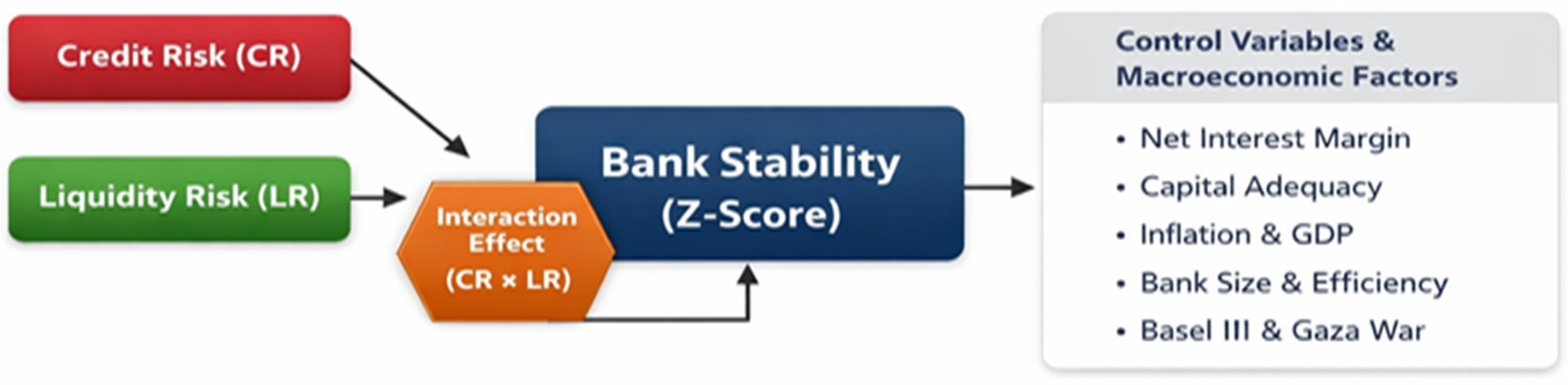
The conceptual relationships examined in this study are summarized in Figure 1, which illustrates the direct effects of credit risk and liquidity on bank stability, as well as their interaction effect within the Palestinian banking context.

3.2. Data and Sampling

The study uses annual data for all banks operating in Palestine (13 banks). It is also important to note that the sample includes both conventional and Islamic banks, which differ in their risk-sharing mechanisms, liquidity management practices, and asset structures. However, we did not include an additional dummy variable to distinguish between banking types due to model parsimony and econometric considerations, particularly given the relatively small sample size (13 banks) and the inclusion of existing structural dummy variables (e.g., regulatory and conflict-related dummies), which could otherwise lead to over-parameterization and reduced estimation efficiency. The data covered the years from 2011 to 2024. Bank-level financial data were obtained from audited annual reports and complemented, where relevant, by information from the Palestine Monetary Authority (PMA) and the Palestine Exchange (PEX). Macroeconomic indicators, specifically inflation and real GDP, were sourced from the Palestinian Central Bureau of Statistics. The use of audited annual reports is justified because they are formal, legally recognized disclosures and provide consistent, traceable financial statement items required for constructing the study variables.
The Palestinian banking sector operates under the supervision of the Palestine Monetary Authority (PMA), which has progressively adopted Basel III regulatory standards, with formal implementation beginning in 2019. All banks operating in Palestine are subject to PMA regulations, including capital adequacy and liquidity requirements aligned with Basel III principles. In addition, the sector benefits from a formal deposit insurance framework and strong regulatory oversight, which play an important role in maintaining confidence in the banking system. These institutional and regulatory characteristics are important for interpreting the empirical findings of this study, particularly in understanding banks’ liquidity behavior and risk management practices in a fragile economic environment.
The sample covers the full population of banks operating in Palestine, thereby ensuring a high level of representativeness for the domestic banking sector. However, given the relatively small size of the banking system and its unique institutional and economic context, the findings should be interpreted as context-specific and may not be directly generalizable to other countries or banking systems with different regulatory and economic environments.
Note that the dataset is unbalanced due to differences in data availability across banks and years. No imputation methods were applied. As a robustness check, a sensitivity analysis was conducted by omitting one year from the sample, and the results remained qualitatively unchanged.

3.3. Variable Definitions and Measurement

3.3.1. Dependent Variable: Bank Stability

The dependent variable in this study is the log Z score, which represents bank stability and refers to the extent to which the bank is distant from insolvency. This measurement, as presented by Roy (1952), is the z-score, which has a negative relationship with the probability of default. It is usually used as a research measure for stability.
The following formula measures the Z score:
Z = (Uit + Kit)/σi.
where Uit denotes the performance of the assets owned by the bank (ROA) at time t, Kit is the equity divided by the size of the assets taken in a total value at time t, and σi is the standard deviation of ROA as a measure of the return’s unpredictability for a certain bank during the total period. When the Z score increases, this indicates that the likelihood of the bank’s bankruptcy will decrease.
The natural logarithm of the Z-score was applied, and its one-year lag was included to capture the persistence of bank stability over time.

3.3.2. Key Explanatory Variables

Credit Risk (CR) is measured as loan loss provisions divided by total loans. Credit risk in this study is measured using loan loss provisions to total loans, which is widely used in the banking literature as a forward-looking indicator of expected credit losses. Compared to non-performing loans, this measure captures anticipated credit risk and reflects banks’ provisioning behavior. Although alternative proxies such as non-performing loans or capital adequacy ratios may also be used to assess credit risk, the selected measure is considered appropriate for capturing the risk exposure in this context. Nevertheless, future research may consider employing multiple indicators to further validate the robustness of the results.
Liquidity: Measured as the ratio of liquid assets to total assets.
This measure reflects banks’ liquidity buffers and is widely used in empirical banking literature due to its availability and comparability (e.g., Ismail & Ahmed, 2023; Setiawan et al., 2021; Ghenimi et al., 2017). While alternative measures such as the funding gap ratio and loan-to-deposit ratio are also used in the literature (e.g., Chen et al., 2018), data limitations in the Palestinian context constrain their consistent application across banks and years. Therefore, the selected measure is considered appropriate for capturing liquidity conditions in this study.

3.3.3. Controls and Structural Dummies

Net Interest Margin (NIM): Measured as net interest income to earning assets.
Capital Adequacy Ratio (CAR): Measured as shareholders’ equity to total assets (B. A. Awwad, 2023). The capital adequacy ratio in this study is measured using the equity-to-total-assets ratio, which is widely employed in empirical banking literature as a simplified proxy for capital strength. While the Basel III regulatory capital ratio provides a more detailed risk-weighted measure, consistent and comparable data on risk-weighted assets are not always publicly available across banks and over time in emerging and data-constrained contexts such as Palestine. Therefore, the equity-to-assets ratio offers a transparent, consistently reported, and comparable indicator of bank capitalization suitable for panel analysis.
Loan Growth: Net loans to total assets.
Bank Size: Natural log of total assets.
Bank Efficiency: The cost-to-income ratio.
Inflation Rate: Measured as the consumer price index.
GDP: Measured as Real GDP
To account for structural and geopolitical disruptions during the study period, we incorporate two binary (dummy) variables:
Basel III Dummy: Takes the value of 1 for the years 2019 and onward to reflect the adoption of Basel III regulatory standards, and value of zero otherwise.
Gaza War Dummy: Assigned the value of 1 for 2023 and 2024 to capture potential effects from the Gaza War, and the value of zero otherwise.
A detailed description of all variables, including their definitions, measurement procedures, and sources, is provided in Table 1.

3.4. Econometric Models

3.4.1. Dynamic Panel Model (System GMM)

To address potential endogeneity and account for the dynamic nature of bank performance, we employ the dynamic GMM, which is specified using a restricted lag structure (lag = 1). This choice is motivated by the relatively small sample size (13 banks) and limited time dimension, where increasing the number of instruments could lead to overfitting and weaken model reliability. Therefore, we adopt a parsimonious specification by limiting the lag length to one period. In addition, instrument reduction techniques (e.g., collapsing the instrument matrix) are applied to avoid instrument proliferation and ensure estimation stability. The validity of the GMM results is assessed using the Hansen test for instrument validity and the Arellano–Bond AR(2) test for absence of second-order serial correlation. This method is well-suited for panel data that include a lagged dependent variable and potential correlation between repressors and the error term. The model is specified as follows:
log(Z_{it}) = α + β1 log(Z_{i,t−1}) + β2 CR_{it} + β3 L_{it} + β4 (CR × L)_{it} + ∑ θ_j Bank_{jit} + ∑ λ_l Macro_{lt} + ε_{it}
Bank stability exhibits strong persistence over time, as banks that are stable in one period tend to remain stable in subsequent periods. To capture this dynamic behavior, the empirical model includes a lagged dependent variable, which renders conventional estimators such as pooled OLS and fixed effects biased and inconsistent. In addition, credit risk, liquidity, and their interaction are potentially endogenous, as risk and stability may jointly influence each other.
System GMM provides an appropriate framework to address these challenges by controlling for unobserved bank-specific heterogeneity, mitigating dynamic panel bias, and instrumenting endogenous regressors using internal instruments. By combining equations in differences and levels, System GMM improves efficiency and instrument strength, particularly in panels with small samples and persistent variables. This approach has been widely applied in the banking stability literature and is well-suited to producing robust and credible estimates of the effects of credit risk, liquidity, and their interaction on bank stability.

3.4.2. Simultaneous Equations (2SLS)

To better understand the causal direction between credit and liquidity, we apply a simultaneous equation model using 2SLS. This allows us to control for potential endogeneity and observe reciprocal effects. The model includes two equations:
C R i , t = C + β 1 C R i , t 1 + β 2 L + j = 1 J β j B a n k j , i , t + l = 1 L β l M a c r o l , t + ϵ i , t
L i , t = C + β 1 L i , t 1 + β 2 C R i , t + p = 1 P β p B a n k p , i , t + q = 1 Q β q M a c r o q , t + ϵ i , t

3.4.3. Alternative Stability Specification (Z-Score Model)

For consistency with earlier research such as Imbierowicz and Rauch (2014), we also estimate the following equation:
Z_{it} = β0 + β1 Z_{i,t−1} + β2 L_{it} + β3 CR_{it} + β4 (CR × L)_{it} + ∑ φ_p Bank_{pit} + ∑ ψ_q Macro_{qt} + ε_{it}

3.5. Diagnostic Tests and Robustness Checks

GMM diagnostics
-
Arellano–Bond autocorrelation tests AR(1) and AR(2);
-
Hansen J-test for instrument validity- 2SLS diagnostics;
-
Durbin–Wu–Hausman test for endogeneity;
-
First-stage instrument strength (F-statistic);
-
Over-identification tests (Sargan/Hansen).
Given the small, unbalanced panel, the analysis emphasizes diagnostic validity and careful instrumenting to avoid weak-instrument and overfitting concerns.

4. Results

4.1. Empirical Strategy

The results are based on three complementary frameworks. First, we estimate static models using pooled OLS and bank fixed effects. The fixed effects specification controls for unobserved, time-invariant bank-specific heterogeneity, while random effects are used as a robustness check. The baseline specification relates log(Z) to credit risk, liquidity, their interaction, and a set of control variables
Differences between static and dynamic models stem from the inability of static estimators to capture the persistence of bank stability and to adequately address endogeneity issues, such as reverse causality and omitted variable bias. In contrast, the dynamic System GMM approach incorporates the lagged dependent variable to model persistence and utilizes internal instruments to control for endogeneity, resulting in more consistent and unbiased parameter estimates.
Second, to probe whether credit risk and liquidity are jointly determined, we estimate a 2SLS simultaneous system where credit risk and liquidity are treated as endogenous in each other’s equations, while incorporating lagged stability and standard controls.
Third, we estimate a dynamic panel model using system GMM. This accounts for persistence in stability and reduces endogeneity bias from reverse causality and omitted variables. We report standard diagnostics (AR(1)/AR(2) tests and the Hansen J-test).

4.1.1. Descriptive Statistics

Descriptive statistics for the core variables used in the analysis are reported in Table 2.

4.1.2. The Static Models

Table 3 compares pooled OLS, fixed effects (FE), and random effects (RE) estimates. Credit risk is negatively associated with stability across specifications. Liquidity is positively signed but not uniformly significant. The interaction term is negative in the static models and is only weakly significant in the pooled OLS column, suggesting that the joint effect may be sensitive to unobserved heterogeneity. Cost inefficiency is consistently and strongly associated with lower stability.
Table 4 reports the 2SLS system results. Neither risk variable is statistically significant in the other’s equation, which suggests limited contemporaneous reciprocal causality once controls are included. Lagged stability is negatively associated with credit risk and positively associated with liquidity, consistent with better-managed banks maintaining stronger buffers and lower provisioning intensity. The Gaza-war dummy is associated with higher credit risk and lower liquidity, indicating a shock-induced deterioration in risk conditions.

4.1.3. Dynamic Panel GMM

Table 5 reports the dynamic GMM estimates. Stability is highly persistent, as indicated by the significant lagged dependent variable. Credit risk is significantly destabilizing, while liquidity is stabilizing. Importantly, the interaction term is positive and significant, which supports the interpretation that stronger liquidity buffers mitigate the adverse effect of credit risk on bank stability. Cost inefficiency remains significantly negative. Standard diagnostic tests suggest no second-order serial correlation and acceptable instrument validity.
It is important to clarify the interpretation of the interaction term between credit risk and liquidity. In this study, liquidity is measured as the ratio of liquid assets to total assets, which represents a buffer against liquidity risk rather than liquidity risk itself. Therefore, a higher value of the liquidity variable reflects lower liquidity risk.
Accordingly, the positive coefficient of the interaction term between credit risk and liquidity should not be interpreted as a positive joint effect of credit risk and liquidity risk. Instead, it indicates that higher liquidity buffers mitigate the adverse effect of credit risk on bank stability.
In other words, when liquidity levels are high (i.e., liquidity risk is low), the negative impact of credit risk on bank stability is reduced. Conversely, when liquidity levels are low (i.e., liquidity risk is high), the combined effect of credit risk and liquidity risk is expected to negatively affect bank stability. This interpretation is consistent with prior literature emphasizing the destabilizing interaction between credit and liquidity (e.g., Imbierowicz & Rauch, 2014).
This study provides robust empirical evidence on the role of credit risk, liquidity conditions, and their interaction in shaping bank stability in Palestine. Across alternative specifications, including System GMM and 2SLS, the results consistently confirm that credit risk undermines bank stability, while liquidity plays a stabilizing role. Most notably, the interaction results indicate that liquidity acts as a buffer that mitigates the adverse effects of credit risk on stability.
The negative impact of credit risk on bank stability becomes more pronounced once endogeneity and dynamics are explicitly addressed. While static models may understate the relevance of credit risk, the dynamic specifications reveal that rising credit risk significantly erodes bank stability. This finding is consistent with core banking theory and aligns with extensive international evidence emphasizing asset quality as a cornerstone of financial soundness (e.g., Ghenimi et al., 2017; Abdelaziz et al., 2022). It also corroborates supervisory assessments by the Palestine Monetary Authority, which identify credit risk as a persistent vulnerability, particularly during periods of economic contraction.
Liquidity, by contrast, emerges as a critical stabilizing factor in the Palestinian banking sector. Banks with higher liquidity ratios exhibit significantly stronger stability, reflecting the sector’s traditionally conservative liquidity posture. In an environment characterized by limited lending opportunities, political uncertainty, and regulatory constraints, Palestinian banks have historically maintained liquidity buffers well above international minima. The results indicate that this strategy has been effective, supporting the view that liquidity management is as important as capital adequacy in fragile banking systems.
The interaction results should therefore be interpreted with caution. Rather than indicating that the joint occurrence of credit risk and liquidity improves stability, the findings suggest that sufficient liquidity buffers enable banks to absorb the adverse effects of credit risk more effectively. This reflects a context-specific dynamic in which surplus liquidity functions as a form of self-insurance, allowing banks to absorb loan losses and meet withdrawal demands without resorting to fire sales or credit contraction.
From a policy perspective, these findings carry important implications. First, they support the continuation—and potentially the strengthening—of liquidity requirements under Basel III, including the liquidity coverage ratio and net stable funding ratio, as implemented by the Palestine Monetary Authority. Second, they underscore the need for integrated risk management frameworks that jointly consider credit risk and liquidity rather than treating them in isolation. In fragile and conflict-affected economies, importing policy conclusions from other regions without accounting for local institutional and economic conditions may lead to suboptimal outcomes.
Overall, the results suggest that prudent liquidity management can fundamentally alter the transmission of credit risk to bank stability, reducing its adverse impact and transforming a potentially destabilizing interaction into a more manageable challenge.

5. Conclusions

This study examines the impact of credit risk, liquidity, and their interaction on bank stability in Palestine using panel data for the period 2011–2024 and advanced econometric techniques. The findings confirm that higher credit risk significantly reduces bank stability, while stronger liquidity positions enhance it. Importantly, the interaction between credit risk and liquidity exerts a positive effect on stability, highlighting the buffering role of liquidity in a fragile banking environment.
The preferred System GMM specification captures the persistence of bank stability and addresses key econometric challenges related to endogeneity and unobserved heterogeneity. The consistency of results across dynamic and instrumental-variable approaches strengthens confidence in the empirical conclusions. Together, the findings indicate that past stability, current risk exposure, and the interaction of credit risk and liquidity jointly determine banks’ resilience.
From a policy standpoint, the evidence supports supervisory strategies that promote both asset quality and strong liquidity buffers. In the Palestinian context, liquidity should not be viewed as idle resources but rather as an effective insurance mechanism against credit deterioration. While excessive liquidity may entail profitability trade-offs, the results show that it plays a vital role in preserving stability during periods of heightened credit risk.
More broadly, this study contributes to the financial stability literature by demonstrating that risk interactions are highly context-dependent. In fragile and conflict-affected economies, conservative liquidity behavior can reverse the destabilizing effects commonly observed elsewhere. These insights emphasize the importance of tailoring regulatory and risk management frameworks to local economic and institutional conditions rather than relying on generalized regional evidence.

Author Contributions

Conceptualization, S.A. and R.B.S.; methodology, S.A., R.B.S. and B.S.A.; software, S.A.; validation, R.B.S. and B.S.A.; formal analysis, B.S.A.; investigation, S.A., R.B.S. and B.S.A.; resources, B.S.A.; data curation, R.B.S.; writing—original draft preparation, S.A.; writing—review and editing, R.B.S. and B.S.A.; visualization, S.A.; supervision, B.S.A. All authors have read and agreed to the published version of the manuscript.

Funding

This research received no external funding.

Institutional Review Board Statement

The study used publicly available, non-sensitive secondary data from the Palestinian Monetary Authority and Ministry of Statistics, and involved the analysis of quantitative financial data, exempting it from further ethical approval.

Informed Consent Statement

Informed consent was obtained from all subjects involved in the study.

Data Availability Statement

The data presented in this study were obtained from annual reports of Palestinian banks and official publications of the Palestine Monetary Authority. The compiled dataset used for the analysis is available from the corresponding author upon reasonable request due to the absence of a unified public repository for these data.

Conflicts of Interest

The authors declare no conflicts of interest.

References

  1. Abbas, F., Ali, S., Yousaf, I., & Wong, W. K. (2021). Dynamics of funding liquidity and risk-taking: Evidence from commercial banks. Journal of Risk and Financial Management, 14(6), 281. [Google Scholar] [CrossRef]
  2. Abdelaziz, H., Rim, B., & Helmi, H. (2022). The interactional relationships between credit risk, liquidity risk and bank profitability in MENA region. Global Business Review, 23(3), 561–583. [Google Scholar] [CrossRef]
  3. Adelopo, I., Lloydking, R., & Tauringana, V. (2018). Determinants of bank profitability before, during, and after the financial crisis. International Journal of Managerial Finance, 14(4), 378–398. [Google Scholar] [CrossRef]
  4. Ahmad, I., Salam, S., Ahmad, A., & Abbas, S. (2019). The nexus between CR and LR and their impact on banks financial performance: Evidence from Pakistan. Sarhad Journal of Management Sciences, 5(1), 67–86. [Google Scholar] [CrossRef]
  5. Ahmed, H. M., El-Halaby, S. I., & Soliman, H. A. (2022). The consequence of the credit risk on the financial performance in light of COVID-19: Evidence from Islamic versus conventional banks across MEA region. Future Business Journal, 8(1), 21–43. [Google Scholar] [CrossRef]
  6. Awwad, B., & Razia, B. (2021). Adapting Altman’s model to predict the performance of the Palestinian industrial sector. Journal of Business and Socio-Economic Development, 1(2), 149–164. [Google Scholar] [CrossRef]
  7. Awwad, B. A. (2023). Capital adequacy and profitability indicators: An empirical study on Palestinian banks. In International conference on business and technology (pp. 145–160). Springer International Publishing. [Google Scholar] [CrossRef]
  8. Ayinuola, T. F., & Gumel, B. I. (2023). The nexus between liquidity and credit risks and their impact on bank stability. Asian Journal of Economics, Business and Accounting, 23(11), 15–27. [Google Scholar] [CrossRef]
  9. Basel Committee on Banking Supervision. (2004). Basel II: International Convergence of capital measurement and capital standards: A revised framework. Bank for International Settlements. Available online: https://www.bis.org/publ/bcbs107.htm (accessed on 22 February 2026).
  10. Bencharles, K. O., & Nwankwo, C. D. (2021). Credit risk management and deposit money banks stability in Nigeria: Does good corporate governance matter. Research Journal of Finance and Accounting, 12(16), 1–14. Available online: https://www.iiste.org/Journals/index.php/RJFA/article/view/57146 (accessed on 22 February 2026).
  11. Bryant, J. (1980). A model of reserves, bank runs, and deposit insurance. Journal of Banking & Finance, 4(4), 335–344. [Google Scholar] [CrossRef]
  12. Chakroun, S., Salhi, B., Ben Amar, A., & Jarboui, A. (2020). The impact of ISO 26000 social responsibility standard adoption on firm financial performance: Evidence from France. Management Research Review, 43(5), 545–571. [Google Scholar] [CrossRef]
  13. Chen, Y., Liu, C., & Zhang, J. (2018). Liquidity risk and bank performance: Evidence from China’s banking industry. Emerging Markets Finance and Trade, 54(14), 3140–3157. [Google Scholar]
  14. Choudhry, M. (2018). An introduction to banking: Principles, strategy and risk management. John Wiley & Sons. [Google Scholar]
  15. Chowdhury, M. M., & Zaman, S. (2018). Effect of liquidity risk on performance of Islamic banks in Bangladesh. IOSR Journal of Economics and Finance, 9(4), 1–9. Available online: https://www.iosrjournals.org/iosr-jef/papers/Vol9-Issue4/Version-1/A0904010109.pdf (accessed on 22 February 2026).
  16. Derbali, A. (2021). Determinants of the performance of Moroccan banks. Journal of Business and Socio-Economic Development, 1(1), 102–117. [Google Scholar] [CrossRef]
  17. Diamond, D. W., & Dybvig, P. H. (1983). Bank runs, deposit insurance, and liquidity. Journal of Political Economy, 91(3), 401–419. [Google Scholar] [CrossRef]
  18. Djebali, N., & Zaghdoudi, K. (2020). Threshold effects of liquidity risk and credit risk on bank stability in the MENA region. Journal of Policy Modeling, 42(5), 1049–1063. [Google Scholar] [CrossRef]
  19. Ejoh, N., Okpa, I., & Inyang, E. (2014). The relationship and effect of credit and liquidity risk on bank default risk among deposit money banks in Nigeria. Research Journal of Finance and Accounting, 5(16), 142–150. [Google Scholar]
  20. Ekinci, R., & Poyraz, G. (2019). The effect of credit risk on financial performance of deposit banks in Turkey. Procedia Computer Science, 158, 979–987. [Google Scholar] [CrossRef]
  21. Fatoni, A., & Sidiq, S. (2019). Analisis perbandingan stabilitas sistem perbankan syariah dan konvensional di Indonesia. Ekspansi: Jurnal Ekonomi, Keuangan, Perbankan, Dan Akuntansi, 11(2), 179–198. [Google Scholar] [CrossRef]
  22. Gadzo, S. G., Kportorgbi, H. K., & Gatsi, J. G. (2019). Credit risk and operational risk on financial performance of universal banks in Ghana: A partial least squared structural equation model (PLS SEM) approach. Cogent Economics & Finance, 7(1), 1589406. [Google Scholar] [CrossRef]
  23. Ghenimi, A., Chaibi, H., & Omri, M. A. B. (2017). The effects of liquidity risk and credit risk on bank stability: Evidence from the MENA region. Borsa Istanbul Review, 17(4), 238–248. [Google Scholar] [CrossRef]
  24. Heider, F., Hoerova, M., & Holthausen, C. (2009). Liquidity hoarding and interbank market spreads: The role of counterparty risk. ECB Working Paper Series No. 1126. European Central Bank. Available online: https://www.ecb.europa.eu/pub/pdf/scpwps/ecbwp1126.pdf (accessed on 22 February 2026).
  25. Hopkin, P. (2018). Fundamentals of risk management: Understanding, evaluating and implementing effective risk management. Kogan Page Publishers. [Google Scholar]
  26. Huang, R., & Ratnovski, L. (2011). The dark side of bank wholesale funding. Journal of Financial Intermediation, 20(2), 248–263. [Google Scholar] [CrossRef]
  27. Imbierowicz, B., & Rauch, C. (2014). The relationship between liquidity risk and credit risk in banks. Journal of Banking & Finance, 40, 242–256. [Google Scholar] [CrossRef]
  28. International Monetary Fund (IMF). (2020). Liquidity management, SM/04/149, April. International Monetary Fund. [Google Scholar]
  29. Ismail, S., & Ahmed, E. (2023). The impact of LR, CR, and operational risk on financial stability in conventional banks in Jordan. Uncertain Supply Chain Management, 11(2), 433–442. [Google Scholar] [CrossRef]
  30. Isomiddinovich, A. A., & Jasurbek, N. (2024). Improvement of risk management system in commercial banks. Excellencia: International Multi-Disciplinary Journal of Education (2994-9521), 2(3), 166–170. [Google Scholar]
  31. Khoffash, S., & Awwad, B. S. (2025). The effect of credit risk on the cash dividend policy of banks listed on the Palestine Stock Exchange. Banks and Bank Systems, 20(2), 166–176. [Google Scholar] [CrossRef]
  32. Kim, B. H., Kim, H., & Lee, B. S. (2015). Spillover effects of the US financial crisis on financial markets in emerging Asian countries. International Review of Economics & Finance, 39, 192–210. [Google Scholar] [CrossRef]
  33. Kwashie, A. A., Baidoo, S. T., & Ayesu, E. K. (2022). Investigating the impact of credit risk on financial performance of commercial banks in Ghana. Cogent Economics & Finance, 10(1), 2109281. [Google Scholar] [CrossRef]
  34. López-Penabad, M. C., Iglesias-Casal, A., & Neto, J. F. S. (2021). Competition and financial stability in European listed banks. SAGE Open, 11(3). [Google Scholar] [CrossRef]
  35. Marozva, G. (2015). Liquidity and bank performance. The International Business & Economics Research Journal (Online), 14(3), 453. [Google Scholar]
  36. Mendoza, R. R., & Rivera, J. P. R. (2017). The Effect of credit risk and capital adequacy on the profitability of rural banks in the Philippines. Scientific Annals of Economics and Business, 64(1), 83–96. [Google Scholar] [CrossRef]
  37. Morgan, P., & Pontines, V. (2014). Financial stability and financial inclusion. In ADBI working paper 488. Asian Development Bank Institute. [Google Scholar]
  38. Musau, S., Muathe, S., & Mwangi, L. (2018). Financial inclusion, bank competitiveness and credit risk of commercial banks in Kenya. International Journal of Financial Research, 9(1), 203–218. [Google Scholar] [CrossRef]
  39. Naili, M., & Lahrichi, Y. (2022). The determinants of banks’ credit risk: Review of the literature and future research agenda. International Journal of Finance & Economics, 27(1), 334–360. [Google Scholar]
  40. Noman, A. H. M., Pervin, S., Chowdhury, M. M., & Banna, H. (2015). The effect of credit risk on the banking profitability: A case on Bangladesh. Global Journal of Management and Business Research, 15(3), 41–48. [Google Scholar]
  41. Onsongo, S. K., Muathe, S. M., & Mwangi, L. W. (2020). Financial risk and financial performance: Evidence and insights from commercial and services listed companies in Nairobi securities exchange, Kenya. International Journal of Financial Studies, 8(3), 51. [Google Scholar] [CrossRef]
  42. Palečková, I., Přečková, L., & Hlawiczka, R. (2024). The contribution of financial institutions to economic growth. In Modeling economic growth in contemporary Czechia (pp. 251–263). Emerald Publishing Limited. [Google Scholar]
  43. Pasaribu, D. (2017). Analisis pengaruh struktur modal, profitabilitas, kebijakan dividen dan ukuran perusahaan terhadap nilai perusahaan pada perusahaan farmasi yang terdaftar di Bursa Efek Indonesia. Methosika: Jurnal Akuntansi dan Keuangan Methodist, 1(1), 32–44. [Google Scholar]
  44. Rahman, A., & Khan, M. A. (2024). The relationship between financial development and economic growth: New insights using quadruple and quintuple helix innovation framework and way forward. Journal of the Knowledge Economy, 15(2), 5939–5964. [Google Scholar] [CrossRef]
  45. Roy, A. D. (1952). Safety first and the holding of assets. Econometrica, 20(3), 431–449. [Google Scholar] [CrossRef]
  46. Ruziqa, A. (2013). The impact of credit and liquidity risk on bank financial performance: The case of Indonesian conventional bank with total asset above 10 trillion rupiah. International Journal of Economic Policy in Emerging Economies, 6(2), 93–106. [Google Scholar] [CrossRef]
  47. Saif-Alyousfi, A. Y. (2022). Determinants of bank profitability: Evidence from 47 Asian countries. Journal of Economic Studies, 49(1), 44–60. [Google Scholar] [CrossRef]
  48. Saleh, I., & Abu Afifa, M. (2020). The effect of credit risk, liquidity risk and bank capital on bank profitability: Evidence from an emerging market. Cogent Economics & Finance, 8(1), 1814509. [Google Scholar] [CrossRef]
  49. Salim, B. F., & Bilal, Z. O. (2016). The impact of liquidity management on financial performance in Omani banking sector. International Journal of Accounting, Business and Economic Research, 14(1), 545–565. [Google Scholar]
  50. Setiawan, A., Sudarto, S., & Widiastuti, E. (2021). The influence of credit risk and liquidity risk on bank stability. Icore, 5(1), 1169–1177. [Google Scholar]
  51. Skoglund, J., & Chen, W. (2015). Financial risk management: Applications in market, credit, asset and liability management and firm wide risk. John Wiley & Sons. [Google Scholar]
  52. Sundaresan, S., & Xiao, K. (2024). Liquidity regulation and banks: Theory and evidence. Journal of Financial Economics, 151, 103747. [Google Scholar] [CrossRef]
  53. Vazquez, V., & Federico, P. (2015). Bank funding structures and risk: Evidence from the global financial crisis. Journal of Banking and Finance, 61, 1–4. [Google Scholar] [CrossRef]
Figure 1. Theoretical framework. Source: Authors’ own elaboration.
Ijfs 14 00105 g001
Table 1. Variable measurement and sources.
CategoryVariableSymbolMeasurementKey Sources (Examples)
DependentBank stabilityZ((ROA + Equity/Assets)/\sigma(ROA)) (used as (\log Z))Setiawan et al. (2021); Naili and Lahrichi (2022)
IndependentCredit riskCRLoan loss provisions/Total loansEjoh et al. (2014); Ghenimi et al. (2017)
IndependentLiquidity LLiquid assets/Total assetsIsmail and Ahmed (2023); Setiawan et al. (2021)
IndependentInteractionCR × LCR multiplied by LGhenimi et al. (2017)
ControlsNet interest marginNIMNet interest income/Earning assetsLópez-Penabad et al. (2021)
ControlsCapital adequacyCARShareholders’ equity/Total assets(Common in bank stability literature)
ControlsLoan growthLGNet loans/Total assetsPasaribu (2017)
ControlsBank sizeSIZENatural log of total assetsChakroun et al. (2020)
ControlsEfficiencyEFFCost-to-income ratioAyinuola and Gumel (2023)
ControlsInflationINFConsumer price index (CPI)Kwashie et al. (2022)
ControlsEconomic activityGDPReal GDPMusau et al. (2018)
DummyBasel III adoptionD11 for 2019+; 0 otherwiseRegulatory timing definition
DummyGaza war shockD21 for 2023–2024; 0 otherwiseEvent timing definition
Source: Authors’ compilation based on prior empirical literature on bank stability and risk measurement indicators.
Table 2. Descriptive statistics for the study variables (2011–2024).
VariableMeanStd. Dev.MinMax
Z-score2.8941.013−2.8174.529
CR (Credit Risk)0.0100.012−0.0010.066
L (Liquidity)2.8240.6551.2654.668
CR × L (Interaction)0.0260.037−0.0030.272
NIM (Net Interest Margin)0.0400.0130.0040.087
CAR (Capital Adequacy)0.1450.0870.0690.837
Loans/Assets0.4820.1070.0540.702
Size (Log Assets)8.9240.4127.9409.922
EFF (Cost Efficiency)0.8560.9280.43112.529
INF (Inflation)1.8971.2850.2104.200
GDP (Economic Growth)1.4795.266−11.5009.900
Notes: Z-score represents bank stability measured as the natural logarithm of the Z-score; CR denotes credit risk measured by loan loss provisions to total loans; L represents liquidity measured as liquid assets to total assets; CR × L denotes the interaction term between credit risk and liquidity; NIM is net interest margin; CAR is capital adequacy ratio; EFF represents cost efficiency measured by the cost-to-income ratio; INF denotes inflation; GDP represents economic growth. All variables are annual. N = 146.
Table 3. Static models: Effect of credit risk, liquidity and their interaction on stability.
VariableOLSFERE
Credit Risk (CR)−0.842 (−1.30)0.655 (−0.39)−0.811 (−1.17)
Liquidity +0.512 (+0.44)+0.833 (+0.99)+0.610 (+0.56)
Interaction (CR × L)−1.255 (−1.66)−0.175 (−0.31)−1.004 (−1.45)
Net Interest Margin+4.621 (+0.52)+6.513 (+0.95)+5.208 (+0.61)
Capital Adequacy (CAR)−7.450 *** (−4.80)+0.160 (+0.10)−3.982 * (−2.11)
Loan Growth (Loans/Assets)−0.561 (−0.68)+0.595 (+0.74)−0.084 (−0.10)
Size (Log Assets)+0.112 (+0.47)+0.510 (+1.40)+0.208 (+0.81)
Cost Efficiency (Cost/Income)−2.866 *** (−5.17)−2.718 *** (−5.26)−2.774 *** (−5.08)
Inflation−0.078 (−1.58)−0.055 (−1.55)−0.067 (−1.60)
GDP Growth+0.024 (+1.94)+0.011 (+1.24)+0.018 (+1.64)
Constant5.000 (1.85)4.321 (1.61)
Observations146146146
R-squared (within)0.6310.4280.445
Notes: t-statistics are reported in parentheses; *, **, and *** denote statistical significance at the 10%, 5%, and 1% levels, respectively.2SLS Simultaneous System.
Table 4. 2SLS system: Credit-risk and liquidity equations (robust standard errors in parentheses).
VariableCR Eqn (dep: CR)Liquidity Eqn (dep: L)
L (Liquidity)−0.0023 (0.0041)
CR (Credit risk)−0.075 (0.082)
log(Z)_{t − 1}−0.010 ** (0.004)+0.021 ** (0.008)
Loans/Assets+0.087 *** (0.022)−0.504 *** (0.061)
Net Interest Margin+0.015 (0.019)
Cost Efficiency−0.073 (0.050)
Capital Adequacy (CAR)−0.045 (0.037)−0.021 (0.046)
GDP Growth−0.0025 ** (0.0012)
Inflation−0.0031 * (0.0017)
D1 (Basel III)−0.0011 (0.0009)+0.0028 * (0.0015)
D2 (Gaza War)+0.0034 *** (0.0008)−0.0087 *** (0.0020)
Constant+0.021 (0.015)+0.217 *** (0.054)
Observations148148
R-squared0.390.52
Notes: Robust standard errors are reported in parentheses. *, **, and *** denote statistical significance at the 10%, 5%, and 1% levels, respectively.
Table 5. Dynamic model (system GMM): Stability, risks, and interaction (robust standard errors in parentheses).
VariableCoef. (SE)
Lagged Stability (Z_{t − 1})0.583 *** (0.115)
Credit Risk (CR)−2.104 ** (0.842)
Liquidity (L)+1.337 * (0.712)
Interaction (CR × L)+3.890 ** (1.268)
Cost Efficiency−1.887 *** (0.450)
Capital Adequacy (CAR)−1.205 (0.881)
Loan Growth (Loans/Assets)−0.076 (0.159)
Size (Log Assets)−0.214 (0.194)
D1 Baseell D2 Gaza Warincluded
Constant0.411 (0.652)
Obs./Banks169/13
AR(1) p/AR(2) p0.003/0.289
Hansen J p0.428
Notes: Robust standard errors are reported in parentheses; *, **, and *** denote statistical significance at the 10%, 5%, and 1% levels, respectively. AR(1) and AR(2) refer to the Arellano–Bond tests for autocorrelation, and Hansen J p-value tests the validity of instruments.
Disclaimer/Publisher’s Note: The statements, opinions and data contained in all publications are solely those of the individual author(s) and contributor(s) and not of MDPI and/or the editor(s). MDPI and/or the editor(s) disclaim responsibility for any injury to people or property resulting from any ideas, methods, instructions or products referred to in the content.