1. Introduction
In recent years, the global economy has been shaped by multiple overlapping shocks, including geopolitical tensions, supply chain disruptions, sharp fluctuations in commodity prices, and persistent instability in financial markets. These developments have affected not only macroeconomic outcomes at the national level but also firms’ day-to-day operations, profitability, cash flow management, investment planning, and access to external finance. The COVID-19 pandemic, in particular, exposed these vulnerabilities simultaneously and made it evident that firms’ internal preparedness and adaptive capacity play a crucial role when the external environment deteriorates abruptly.
Against this backdrop, a fundamental question arises: why do some firms remain relatively stable in the face of the same shock, while others deteriorate rapidly? Addressing this question requires closer attention to firm-level concepts such as resilience, flexibility, and adaptability. Although these concepts are related in that they all concern responses to changing environments, they are not identical. Resilience typically refers to the capacity to absorb shocks and maintain core functions, whereas adaptability emphasizes the ability to adjust to new conditions by reconfiguring decision-making processes, resource allocation, and organizational responses. Recent scholarship increasingly views adaptability as an important source of long-term competitiveness in volatile environments, a view supported by studies such as
Reeves and Deimler (
2012) and
Duchek (
2020). Earlier work by
McKee et al. (
1989) also highlighted the connection between strategic adaptability and firm outcomes.
In finance, firms’ ability to withstand adverse shocks has most often been discussed through the lens of financial flexibility. This research has emphasized the importance of cash holdings, debt structure, access to financing, and financial buffers in protecting firms during periods of stress. However, much of this work relies on one or a few proxy indicators, which may not fully capture the multidimensional nature of firms’ actual adjustment capacity. Put differently, financial flexibility can indicate whether a firm possesses financial slack, but it does not always adequately reflect how effectively that slack can be mobilized, reallocated, or restructured when conditions change abruptly.
For this reason, the present study adopts the concept of financial adaptability. We view this construct as broader than financial flexibility alone. In this study, financial adaptability refers to a firm’s capacity to adjust and reorganize its financial structure, liquidity position, cash buffers, debt burden, and asset utilization in response to external shocks and changing macroeconomic conditions. This perspective is closely related to the dynamic capabilities approach. As argued by
Teece et al. (
1997) and
Volberda (
1999), sustainable performance in volatile environments depends not merely on possessing resources, but on the ability to renew, recombine, and redeploy those resources in ways that fit evolving circumstances.
The COVID-19 pandemic created an especially relevant setting in which to observe this issue at the firm level. During the pandemic, demand contracted sharply, supply channels were disrupted, mobility restrictions were imposed, and financial market volatility intensified. Yet these effects were not distributed evenly across firms. Some firms remained relatively stable, while others became markedly more vulnerable. Such variation may not be explained solely by sectoral structure or market conditions; it may also reflect differences in firms’ internal financial capacity to adjust under pressure. Nevertheless, empirical studies that directly measure firm-level financial adaptability and link it to performance remain limited.
In addition, the existing literature tends to follow two separate lines of inquiry. One strand examines the economic consequences of COVID-19 as a distinct shock, while another focuses on commodity price shocks as a separate source of firm vulnerability. Compared with how firms’ financial responses evolve when shocks overlap, less attention has been paid to this. This gap is particularly important for commodity-dependent emerging economies, where external disturbances can affect firms simultaneously through exchange rates, revenue streams, financing conditions, and investment prospects.
Mongolia provides a particularly relevant empirical context in this regard. Its export structure remains highly dependent on commodities such as coal and copper, making the domestic corporate sector strongly exposed to fluctuations in external markets. Listed firms in Mongolia operate under considerable financing constraints, with limited access to long-term capital markets and heavy reliance on short-term bank credit, conditions that make internal financial adjustment capacity especially consequential during periods of external stress. As a result, the Mongolian setting offers a useful opportunity to examine whether firm-level financial adaptability becomes more consequential when firms operate under layered and externally driven macroeconomic stress.
This study uses panel data for firms listed on the Mongolian Stock Exchange over the period 2015–2024. To operationalize the concept of financial adaptability, the study develops a Firm Adaptability Index (FAI) that combines several observable financial indicators into a composite measure. The index is constructed using principal component analysis (PCA) to avoid arbitrary equal-weighting, and the debt ratio is deliberately excluded to prevent multicollinearity with the leverage control variable in the regression models. Empirically, the analysis primarily relies on panel-data regression models with interaction terms to assess whether the association between financial adaptability and firm performance becomes more pronounced under adverse macroeconomic conditions. In addition, DID-style shock comparisons and an event-study-based diagnostic are used as supporting checks rather than as the main identification strategy. The validity of this quasi-experimental design is confirmed through a formal parallel-trend test and placebo checks using artificial shock dates.
The contribution of this study is threefold. First, it proposes a firm-level operational approach to measuring financial adaptability through a composite index constructed using PCA weighting, which avoids arbitrary assumptions and addresses multicollinearity concerns, rather than relying on a single proxy. Second, it provides firm-level evidence from an emerging, commodity-dependent economy exposed to overlapping macroeconomic shocks, including both the COVID-19 crisis and commodity price fluctuations. Third, and most importantly, it examines financial adaptability not simply as a direct driver of profitability, but as a conditional firm characteristic whose empirical relevance becomes more visible when firms are exposed to macroeconomic stress. Accordingly, this study does not assume that financial adaptability uniformly improves performance in all settings; instead, it investigates whether adaptability is more closely associated with firm resilience when external conditions deteriorate. In doing so, this study seeks to clarify the empirical relevance of financial adaptability in a setting characterized by heightened uncertainty and structural vulnerability.
2. Literature Review
2.1. Conceptual Foundations: Resilience, Adaptability, and Firm-Level Response Capacity
The concepts of resilience, flexibility, and adaptability are widely used across the literature, yet their meanings, applications, and measurement boundaries remain far from fully standardized.
Linnenluecke (
2015), in a comprehensive review, showed that resilience research has expanded rapidly within business and management studies, while also noting that the concept continues to be interpreted in different ways. Some scholars define resilience as the ability to recover after a shock, others emphasize the capacity to maintain stability during disruption, and still others view it as the capability to adapt, renew, and transform under changing conditions.
Duchek (
2020) offered a capability-based conceptualization of resilience and proposed three interrelated dimensions: anticipation, coping, and adaptation. A major strength of this perspective is that it treats resilience not merely as an end-state or outcome, but as a dynamic capability involving preparation, response, adjustment, and renewal.
McManus et al. (
2008) advanced a similar logic through the linked dimensions of preparedness, adaptive response, and recovery, while
Barasa et al. (
2018) emphasized that resilience is not simply an inherent characteristic but can be cultivated within organizations.
Vogus and Sutcliffe (
2007), in turn, highlighted reliability, continuity, and stable response under uncertain conditions as core expressions of organizational resilience. Taken together, these studies suggest that resilience is better understood not as a static condition, but as a bundle of interrelated capabilities.
Adaptability is closely related to resilience, yet its analytical emphasis differs somewhat. Whereas resilience often focuses on shock absorption and continuity, adaptability is more directly concerned with response capacity and adjustment logic under changing conditions.
McKee et al. (
1989) examined strategic adaptability in market-contingent settings and linked it to firm performance.
Oktemgil and Greenley (
1997) likewise showed that firms with stronger adaptive capability tended to exhibit different performance outcomes from those with weaker capability.
Reeves and Deimler (
2012) described adaptability as a new source of competitive advantage in unstable environments, while
Day and Schoemaker (
2016) argued that the quality and speed of organizational response have become increasingly important in fast-changing markets and technological landscapes. From this perspective, adaptability should not be reduced to a vague notion of general flexibility; rather, it is more appropriately understood as the capacity to make context-appropriate decisions, reallocate resources, and adjust operational logic in response to environmental change.
At the same time, adaptability is more than a simple willingness or ability to change.
Chakrabarti (
2014) showed that organizational adaptation during periods of economic shock often takes place through processes of growth reconfiguration. In other words, it is not enough for a firm merely to change; what matters is whether that change involves effective reorientation of resources, priorities, decision structures, and growth trajectories. This implies that adaptability should be examined across interconnected levels, including response capacity, reconfiguration processes, and performance consequences.
A broad implication of this discussion is that firm-level response capacity is not a one-dimensional phenomenon. It involves the ability to recognize threats, absorb short-term shocks, preserve operational continuity, and subsequently realign the firm to fit new conditions. For the purposes of the present study, however, these broader organizational concepts are translated into the financial domain rather than treated in their full managerial or operational scope. For this reason, the present study treats resilience and adaptability as a capability bundle, which serves as the conceptual foundation for the analysis that follows.
2.2. Dynamic Capabilities as the Theoretical Basis of Financial Adaptability
Among the available theoretical perspectives, the dynamic capabilities framework offers a suitable foundation for understanding financial adaptability.
Teece et al. (
1997) argued that in unstable environments, firms must be able to integrate, build, and reconfigure internal and external competencies in response to change. This logic aligns directly with the notion of adaptability. From this perspective, firm success depends not only on the resources it possesses but also on how effectively it reshapes and redeploys those resources as conditions evolve.
Eisenhardt and Martin (
2017) described dynamic capabilities not as fixed sources of enduring advantage in themselves, but as organizational processes through which firms respond to environmental change.
Teece (
2007) further refined the framework through the now well-known tripartite logic of sensing, seizing, and reconfiguring. In later work,
Teece (
2014) emphasized the distinction between ordinary capabilities and dynamic capabilities, arguing that firm performance depends on the interaction between the two.
Endres (
2018) similarly suggested that adaptability is most directly and productively interpreted through a dynamic capabilities lens, particularly where organizations must continuously renew arrangements and resource configurations in response to environmental turbulence.
Volberda’s (
1999) concept of the flexible firm adds a more practical dimension to this theoretical logic. He argued that under conditions of environmental turbulence, flexibility becomes a central condition for competitiveness. This idea can be extended to the financial domain. It is not sufficient for a firm merely to possess liquid resources or financial slack. Equally important is how those resources are timed, sequenced, reallocated, and structurally employed in response to external pressure. For this reason, financial adaptability is more appropriately understood not as a static indicator of financial strength, but as a capacity for dynamic financial reconfiguration during periods of stress.
In this study, financial adaptability is conceptualized as the financial dimension of broader organizational resilience. Specifically, a firm is considered financially adaptable when it can reorganize its financial structure, liquidity position, cash resources, debt burden, and asset utilization to better align with changing external conditions. This definition is intentionally narrower than general organizational adaptability because the empirical analysis relies on observable firm-level financial indicators. This conceptualization provides the theoretical basis for treating financial adaptability as an internal capability rather than a simple snapshot of financial status.
2.3. Financial Flexibility and the Transition Toward Financial Adaptability
The literature on financial flexibility represents the closest theoretical and empirical foundation for the present study.
Gamba and Triantis (
2008) clarified the value of flexibility at the theoretical level, while
Denis (
2011) linked it closely to corporate liquidity.
Bates et al. (
2009) associated rising cash holdings with rising uncertainty, and
Almeida et al. (
2012) documented the real effects of debt maturity during financial crises. The common message across these studies is clear: when firms face shocks, uncertainty, and financing constraints, access to financial resources becomes critically important.
Subsequent empirical studies have further reinforced the practical relevance of financial flexibility.
Marchica and Mura (
2010) demonstrated the value of spare debt capacity.
Bancel and Mittoo (
2011) noted the limitations of capturing financial flexibility through a single measure.
Yung et al. (
2015) examined its role in protecting firm value in emerging economies.
Ferrando et al. (
2016) showed that buffer effects become visible during liquidity shocks.
Yousefi and Yung (
2021) analyzed how flexibility helps protect firm value under economic policy uncertainty. More recent studies, including
Wu et al. (
2024a,
2024b), and
Nguyen et al. (
2025), likewise reported evidence consistent with a positive role of financial flexibility in firm performance, in mitigating financial distress, and in enhancing resilience during adverse conditions.
Even so, the financial flexibility literature exhibits an important limitation. Many studies rely on a single proxy, such as cash holdings, leverage, or debt capacity. Yet firm-level adjustment capacity is likely more complex than any single indicator can capture. During periods of stress, firm outcomes may be shaped jointly by liquidity, coverage capacity, debt tolerance, cash reserves, and the efficiency with which assets are used. For this reason, there is a strong case for extending the analysis from flexibility toward a broader concept of financial adaptability.
Financial adaptability, as used in this study, is more process-oriented than resource-oriented. A firm may possess financial buffers, but firms differ in how effectively they deploy, reallocate, and reorganize those buffers when circumstances deteriorate. This distinction marks an important boundary between financial flexibility and financial adaptability. The present study, therefore, does not reject the resource logic of the flexibility literature; rather, it extends that logic by incorporating an explicit adjustment dimension. At the same time, because the empirical proxy used in this study is constructed from observable financial ratios, financial adaptability should be interpreted as an approximation of reconfiguration capacity rather than as a direct observation of managerial decision-making processes.
2.4. Crisis Response, Buffers, and the Role of Internal Adjustment Capacity
Commodity price shocks are particularly important for economies whose export structure is concentrated in a small number of products. Prior studies have shown that such shocks are heterogeneous in nature and may arise from changes in demand, supply, or market expectations (
Kilian, 2009;
Hamilton, 2011).
Frankel (
2014) further emphasized that changes in commodity prices can affect commodity-dependent economies through multiple channels, including exchange rates, revenue flows, financing conditions, and investment prospects. As a result, firm-level exposure to macroeconomic shocks cannot be understood solely in terms of external conditions; internal buffers and adjustment capacity must also be considered.
The COVID-19 literature provides especially clear evidence on the firm-level consequences of systemic shocks.
Shen et al. (
2020),
Phan and Narayan (
2020), and
Ding et al. (
2021) documented substantial deterioration in firm outcomes during the pandemic. At the same time, these effects were far from uniform.
Ding et al. (
2021) highlighted considerable heterogeneity across firms, while
Fahlenbrach et al. (
2020) highlighted the role of financial flexibility in shaping crisis responses.
Zheng (
2022) used a difference-in-differences design to show that cash reserves exerted a buffering effect during the pandemic. Collectively, these studies suggest that the impact of shocks depends, at least in part, on firms’ internal financial conditions.
The broader literature on corporate responses to crisis further strengthens this interpretation.
Cheema-Fox et al. (
2021) argued that resilience should not be reduced to financial indicators alone, highlighting the importance of stakeholder response, operations, supply chains, and workforce-related factors. This implies that crisis response cannot be fully explained through a one-dimensional financial metric.
Grewal and Tansuhaj (
2001) likewise showed that during economic crises, market orientation and strategic flexibility play important roles in protecting firm performance. These insights suggest that, beyond macroeconomic exposure, firms’ internal adjustment capacity deserves closer attention.
In this context, slack and buffer resources are especially relevant.
Tognazzo et al. (
2016) showed that slack resources do not exert a uniform effect across all circumstances. The mere existence of resources is not sufficient; what matters is how those resources are used, organized, and reallocated. This distinction helps move the analysis beyond simplistic interpretations of financial strength as merely “having more cash” or “having less debt.” It highlights the importance not only of the buffer’s size but also of the ability to manage it under stress.
Accordingly, when explaining firm performance during macroeconomic shocks, it is useful to distinguish between two analytical levels. First, firms differ in the amount and quality of their internal buffers. Second, firms differ in their effectiveness at reconfiguring those buffers when conditions change. The first dimension is more closely related to financial flexibility, whereas the second is more directly aligned with financial adaptability. This distinction is also important to the conceptual contribution of the present study. This distinction is also important for interpreting the empirical results of the present study, which focus less on whether adaptability always directly raises profitability and more on whether its relevance becomes more pronounced under adverse macroeconomic conditions.
2.5. Measuring Multidimensional Adaptability and the Case for a Composite Index
A major challenge in studying resilience and adaptability is that they are not directly observable and are inherently multidimensional. This makes them difficult to capture through any single indicator. Recent studies reinforce this point.
Ciasullo et al. (
2023) emphasized the broad scope of resilience, while
Garrido-Moreno et al. (
2024) examined its relationship with innovation.
Akpan et al. (
2021) linked dynamic capabilities to resilience, and
Yuan et al. (
2022) clarified the role of absorptive capacity in adaptive response. A common implication across these studies is that resilience and adaptability should not be treated as single-indicator phenomena.
Sheng and Li (
2025) addressed this issue more directly at the measurement level by attempting to quantify corporate resilience through dynamic factor analysis. Their study concluded that resilience is a multidimensional, dynamic, and only indirectly observable construct. This strengthens the argument that response capacity cannot be adequately represented by a single financial ratio.
This insight aligns closely with the measurement logic of the present study. The Firm Adaptability Index (FAI) is constructed as a composite index because financial adaptability is unlikely to be meaningfully captured by a single ratio. Indicators related to liquidity and the current assets-to-total assets (CATA) ratio may collectively provide a more realistic representation of a firm’s capacity to respond financially. To preserve the independence of the FAI from the leverage control variable used in the regression models, the debt ratio is deliberately excluded from the index construction; this choice is supported by variance inflation factor (VIF) diagnostics, which confirm the absence of multicollinearity across all main specifications. In this sense, the use of a composite index is not merely an empirical convenience; it is also a theoretically grounded choice consistent with the multidimensional nature of the underlying construct. At the same time, because some of these underlying dimensions are closely related to one another, the composite measure should be interpreted as a summarized financial-capacity indicator rather than as a perfectly orthogonal construct with respect to each individual component.
2.6. Theoretical Channels Linking Financial Adaptability to Firm Performance
Building on the frameworks discussed above, it is useful to clarify how financial adaptability translates into performance differences across firms. While the dynamic capabilities and financial flexibility studies emphasize internal adjustment capacity, they are less explicit about the specific financial mechanisms at work under macroeconomic stress. Three interrelated channels are considered here.
One mechanism operates through liquidity. When financing conditions tighten, as during periods of monetary contraction or market stress, firms without sufficient short-term buffers face difficult trade-offs, including cutting investment, delaying payments, or relying on costly emergency financing. Firms with adequate liquid reserves are less exposed to these pressures and can sustain operations while others seek refinancing. As noted by
Denis (
2011), corporate liquidity is central in such adjustments, and
Fahlenbrach et al. (
2020) show that firms entering the COVID-19 shock with stronger financial positions performed better. In this study, the current ratio and cash-to-assets ratio capture this dimension. A second channel relates to the efficiency with which firms utilize existing resources. Although revenue declines during downturns are largely exogenous, the ability to preserve profitability is not. Firms that actively manage assets, by accelerating inventory turnover, improving receivables collection, and limiting idle capacity, are better able to sustain margins.
Teece et al. (
1997) emphasize that resource reconfiguration is central to dynamic capabilities, applying equally to financial and operational domains. Asset turnover serves as the empirical proxy for this mechanism within the FAI.
A third channel concerns the ability to absorb adverse cost shocks without falling into distress. Commodity price volatility, exchange rate movements, and input cost increases place immediate pressure on firm performance. Firms with weak coverage, where earnings barely meet interest obligations, have limited flexibility, whereas those with stronger coverage can absorb temporary shocks without triggering creditor pressure.
Tognazzo et al. (
2016) note that the value of slack resources depends on their management. The interest coverage ratio captures this buffering capacity within the FAI. Taken together, these channels correspond directly to the core components of the FAI, explaining its construction as a theoretically grounded composite rather than a mechanical aggregation of financial ratios. The empirical hypotheses derived from these mechanisms are presented in the next section.
2.7. Conceptual Synthesis and Research Gaps
The foregoing discussion reveals four broad but interconnected strands of the literature. The first is the literature on financial flexibility, which emphasizes resources, buffers, and financing choices. The second is the literature on organizational resilience, which focuses on shock absorption, continuity, recovery, and renewal. The third is the dynamic capabilities literature, which explains how firms reconfigure resources and processes under changing conditions. The fourth is the literature on strategic adaptability, which links adaptive capacity to firm outcomes in uncertain environments. Although these strands are clearly related, they have largely evolved in parallel rather than being fully integrated.
The present study brings these perspectives together under the concept of financial adaptability. Within this framework, financial adaptability is defined as a firm’s capacity to adjust its financial structure, liquidity position, cash resources, debt burden, and asset utilization in response to external shocks. In this sense, financial adaptability may be understood as the financial dimension of broader organizational resilience.
Several research gaps emerge from the existing literature. First, relatively few studies have attempted to measure firm-level financial adaptability using a multidimensional financial framework rather than a single proxy. Second, firm-level evidence that jointly considers the overlapping effects of COVID-19 and commodity price shocks remains limited. Third, although prior work has examined the role of financial buffers, fewer studies have explicitly evaluated whether adaptability functions as a conditional shock-absorbing characteristic rather than simply as a direct driver of profitability. To address these gaps, this study raises the following research questions:
- RQ1.
Is financial adaptability associated with firm performance, and does this association become more visible under adverse macroeconomic conditions?
- RQ2.
Can financial adaptability mitigate the adverse effects of macroeconomic shocks on firm performance?
- RQ3.
Does the strength of this relationship vary according to firm characteristics and macroeconomic conditions?
Based on these questions, this study proposes the following hypotheses. Each hypothesis is grounded in the dynamic capabilities framework (
Teece et al., 1997;
Volberda, 1999) and the financial flexibility literature (
Gamba & Triantis, 2008;
Denis, 2011), which jointly predict that firms with stronger internal reconfiguration capacity should exhibit more stable performance outcomes when external conditions deteriorate.
H1. Financial adaptability is associated with firm performance, though this relationship may vary across empirical specifications.
This hypothesis follows from the dynamic capabilities argument that firms capable of reorganizing their financial resources are better positioned to sustain profitability; however, because the FAI captures a composite of related financial dimensions, its direct effect may be attenuated once standard balance-sheet controls are included.
H2. Financial adaptability weakens the adverse effects of selected macroeconomic shocks on firm performance.
This hypothesis is derived from the buffering logic of the financial flexibility literature: firms with stronger liquidity, coverage capacity, and asset efficiency should be better insulated from external shocks, implying a significant negative interaction between the FAI and adverse macroeconomic conditions.
H3. The relationship between financial adaptability and firm performance is heterogeneous across firm size, sectoral characteristics, and macroeconomic conditions.
This hypothesis reflects the dynamic capabilities prediction that the value of adaptive capacity is context-dependent; smaller firms and those in sectors more exposed to commodity price volatility are expected to rely more heavily on internal financial adjustment capacity.
3. Methodology
3.1. Data and Sample
This study used panel data constructed from the financial statements of firms listed on the Mongolian Stock Exchange. The analysis draws on publicly available balance sheets, income statements, and cash flow statements for the period 2015 to 2024. The sample includes firms from mining, finance, manufacturing, services, construction, and other sectors. Using data from multiple industries allows the analysis to assess firm adaptability not only in relation to sectoral operating characteristics but also to firms’ financial structure and internal resource organization.
The initial sample included all listed firms for which financial statements were publicly available during the study period. However, some observations were excluded because the data required to compute the main variables were incomplete. Observations with missing balance sheet or income statement information necessary for the construction of financial ratios were also removed. As a result, the final sample consists of an unbalanced panel of 544 firm-year observations from 63 firms. The use of panel data makes it possible to examine not only differences across firms, but also changes within firms over time. This structure is therefore appropriate for assessing whether changes in firm adaptability are associated with changes in financial performance. All firm-level variables were constructed from annual financial statements, while macroeconomic variables were matched by calendar year. Because the panel is unbalanced, the estimation strategy focuses on within-sample associations rather than requiring a balanced sequence for each firm.
3.2. Measuring Firm Adaptability
In this study, firm adaptability is defined as the capacity to withstand financial pressure, maintain operational continuity through available financial resources, and adjust financial structure under conditions of economic uncertainty and market shocks. Because this capacity cannot be observed directly, it was operationalized through a set of financial indicators that reflect firms’ financial condition.
The measurement includes indicators related to liquidity, financial stability, and operating efficiency. Specifically, the current ratio captures short-term payment capacity; the interest coverage ratio reflects the firm’s ability to meet interest obligations from operating earnings; the asset turnover ratio captures the efficiency with which assets generate revenue; and the current assets-to-total assets ratio (CATA) provides a summary measure of the firm’s short-term financial buffer. The debt ratio was deliberately excluded from the FAI construction to avoid multicollinearity with the leverage control variable used in the regression models; this exclusion is supported empirically by variance inflation factor (VIF) diagnostics, which confirm that all variables in the main specifications fall well below the conventional threshold of 10 (all VIF <3).
To reduce the influence of extreme values, all variables were first winsorized and then standardized by year. After reversing the sign of variables with a negative direction so that all measures moved in the same conceptual direction, the composite Firm Adaptability Index was constructed as follows:
where
denotes the Financial Adaptability Index for firm
i in year
t,
represents the standardized financial indicators, and K is the total number of indicators included. A higher index value indicates greater financial adaptability and a stronger capacity to absorb external shocks. Because the index is built from several related balance-sheet and performance ratios, it should be interpreted as a summarized measure of financial capacity rather than as a construct fully independent of its individual components. The primary specification of the FAI is based on principal component analysis (PCA), which allows the data to determine the relative contribution of each indicator and avoids the arbitrary assumption of equal weighting. The PCA-based index is defined as:
where
denotes the PCA factor loading for each variable and
represents the underlying financial indicators. The PCA-based index accounts for 33.6% of the variance across the four indicators, with the current ratio receiving the highest loading (0.707), followed by CATA (0.552) and the interest coverage ratio (0.432). The equal-weight version of the index (Equation (1)) was retained as a robustness check to confirm that the main findings are not sensitive to the weighting structure.
3.3. External Shocks and Control Variables
External economic shocks that may affect firm performance were captured using several macroeconomic variables. Because the Mongolian economy is highly dependent on commodity exports, changes in international coal and copper prices were used as proxies for commodity-related shocks. Commodity price shocks are defined as:
To capture the effect of the COVID-19 pandemic, a time dummy variable is introduced:
Firm performance is measured primarily by return on assets (ROA), defined as:
The control variables include firm size, financial leverage, and sales growth. Firm size is measured as the natural logarithm of total assets, while leverage is defined as total debt divided by total assets. In the interaction-based macro specifications, additional macro controls such as GDP growth, inflation, exchange rate movement, and interest rate conditions are incorporated where relevant in order to isolate whether the association between adaptability and profitability becomes more pronounced under adverse external conditions. Thus, the control structure varies slightly across specifications depending on the particular macroeconomic shock under examination.
3.4. Econometric Identification Strategy
The main empirical specification is a panel regression model designed to examine the interaction between firm adaptability and macroeconomic shocks:
where
denotes the vector of control variables,
captures firm-specific fixed effects,
captures year effects, and
is the error term. This specification allows the analysis to examine whether financial adaptability is associated with differences in firms’ responses to macroeconomic shocks. In empirical implementation, the study estimates pooled OLS, fixed-effects, and random-effects specifications as baseline panel models, and model selection is informed by standard panel diagnostics. Because some key shock variables vary at the macro-level, the interaction term between firm-level adaptability and external shocks is central to interpreting the results.
The main emphasis of the empirical analysis is therefore not limited to the direct coefficient on FAI alone, but rather to whether the interaction between FAI and adverse macroeconomic conditions is statistically and economically meaningful. This is consistent with the theoretical expectation that financial adaptability may matter most when firms are exposed to external stress, rather than uniformly improving profitability across all periods and conditions. To provide additional supporting evidence, the COVID-19 period was also treated as an external disruption and examined using a DID-style comparison framework. Firms with relatively high adaptability are classified as the treatment group as follows:
The post-shock period is defined as:
The difference-in-differences specification is written as:
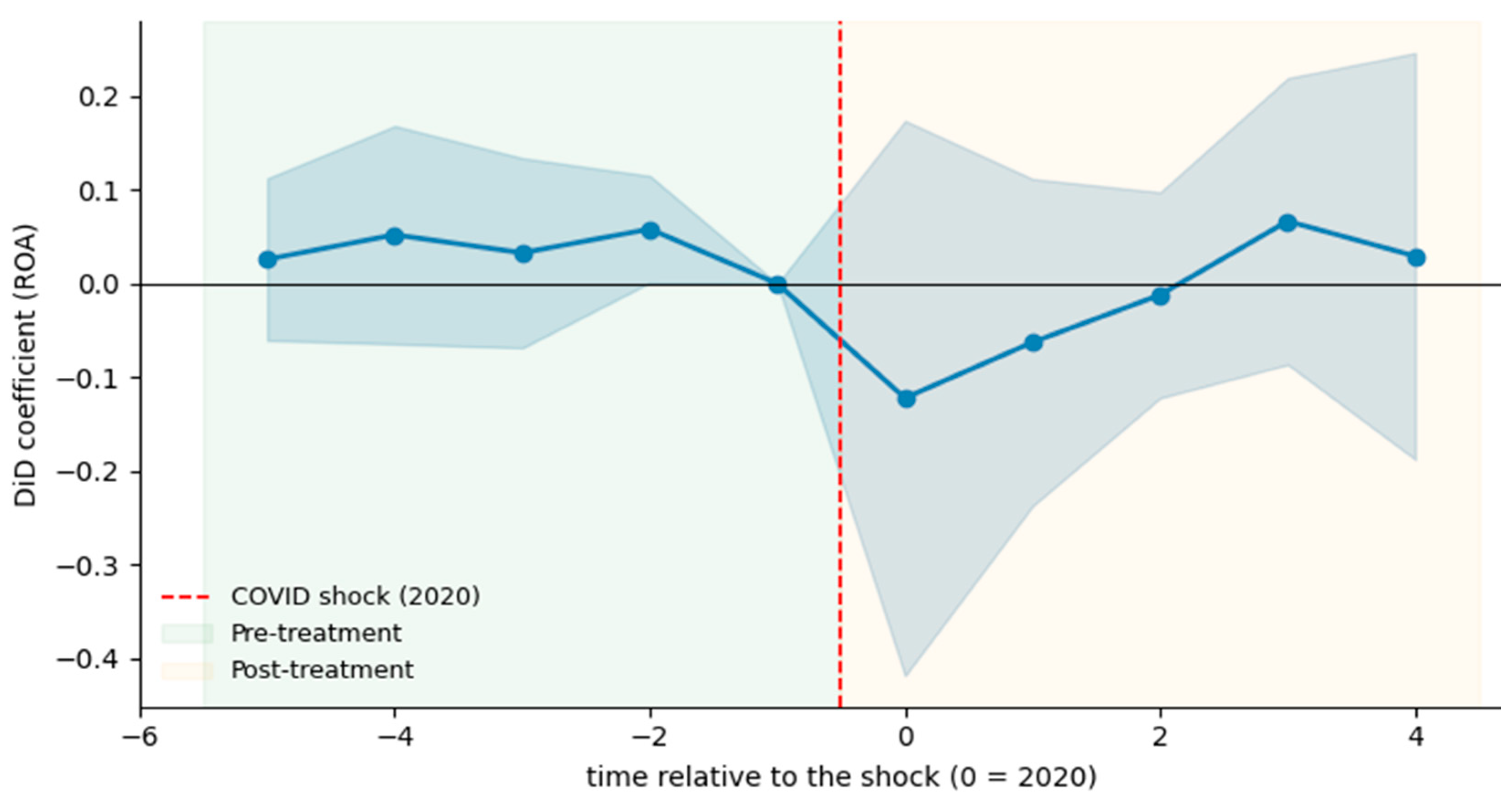
This specification was used as a supplementary empirical check rather than as the primary identification strategy. The validity of this design was assessed through a dynamic event-study specification in which the DiD interaction was replaced by a set of relative-year dummies. A joint F-test of the pre-treatment coefficients yields F = 1.496 (p = 0.216), confirming that the parallel-trend assumption holds prior to the COVID-19 shock. In addition, placebo tests using artificial shock dates of 2016, 2017, and 2018 produced uniformly insignificant DiD coefficients (p = 0.74, 0.70, and 0.35, respectively), providing further support for the validity of the identification strategy. Accordingly, the DID-style and event-study results were interpreted cautiously and were used to reinforce, rather than replace, the findings from the main interaction-based panel regressions.
3.5. Empirical Framework Summary
Overall, this study employs an empirical framework that combines interaction-based panel econometric analysis as the main empirical approach with a DID-style shock comparison and event-study diagnostic as supporting evidence. The robustness of the main findings was examined through alternative FAI specifications (PCA-based and equal-weight), a lagged FAI specification to address reverse causality concerns, and the formal parallel-trend and placebo tests described above.
4. Results
4.1. Descriptive Statistics
Table 1 presents the descriptive statistics for the Financial Adaptability Index (FAI) used in this study. The table reports the mean, median, standard deviation, and number of observations by sector. The results suggest that financial adaptability varies across industries. In particular, firms in the finance sector record the highest average FAI value (Mean = 0.555), reflecting comparatively stronger liquidity buffers and coverage capacity. By contrast, the service sector and the “other” category show negative average FAI values, suggesting relatively weaker financial adaptability. The food and light industry sectors also display comparatively large standard deviations, indicating substantial within-sector variation in financial structure and liquidity conditions.
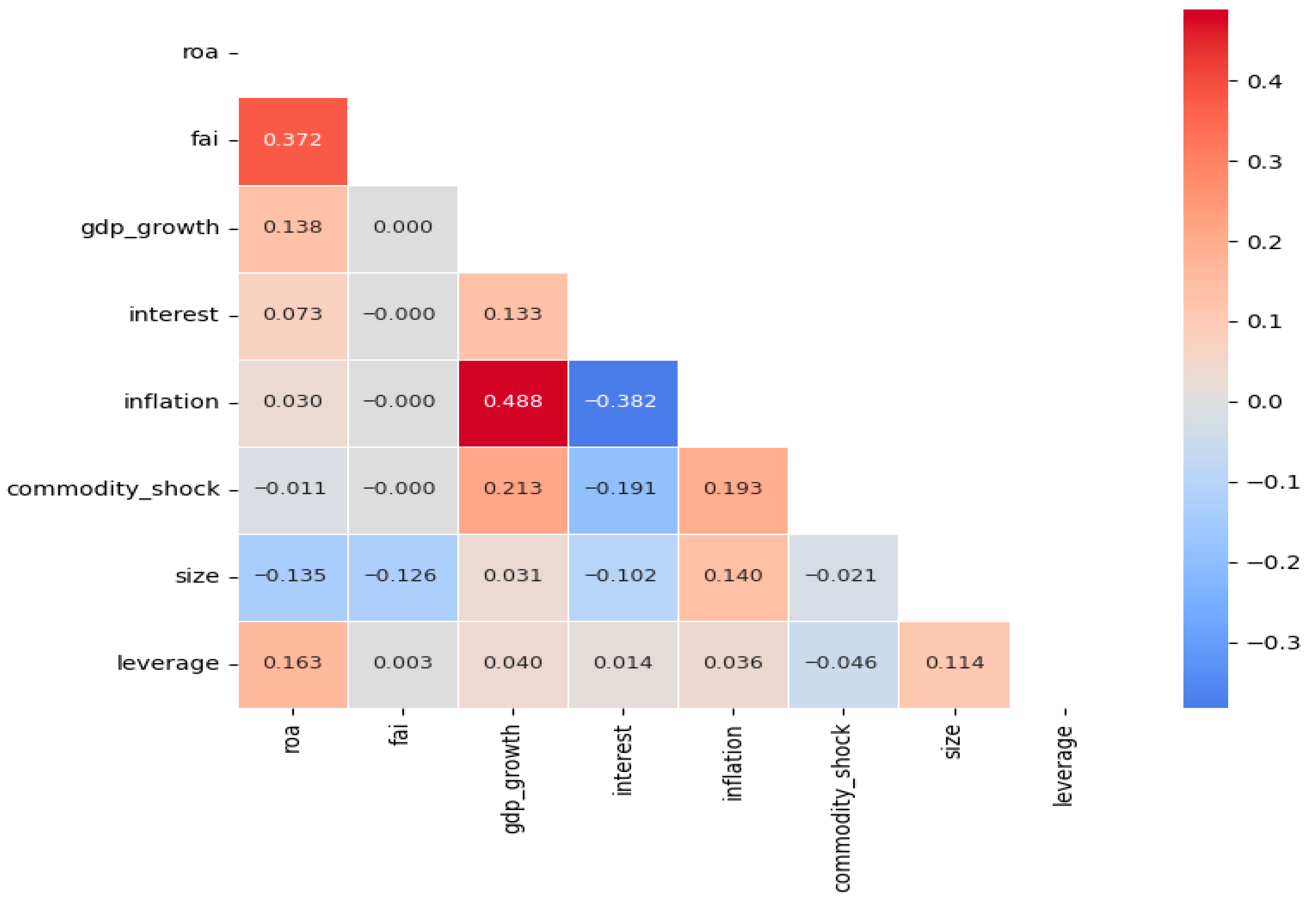
Prior to estimation, pairwise correlations among the main variables were examined and variance inflation factors (VIFs) were computed. All VIF values fall below 3, confirming the absence of multicollinearity across the main specifications. The regression sample consists of 505 firm-year observations from 56 firms after listwise deletion. The full correlation matrix is reported in
Appendix A Figure A2.
4.2. Baseline Regression and Firm-Level Controls
To determine the more appropriate panel specification, a Hausman test was conducted. The test produced a chi-square statistic of 2.545 with a p-value of 0.467, indicating that the null hypothesis could not be rejected. On this basis, the random-effects model is treated as the main reference specification, while fixed-effects estimates are also reported for comparison.
Table 2 reports the baseline regression results. Across the three models, the coefficient on the Firm Adaptability Index (FAI) is positive and statistically significant. In the OLS model, the coefficient is 0.0839 and statistically significant at the 1 percent level. In the random-effects model, the coefficient is 0.0825 and remains highly significant. In the fixed-effects model, the coefficient is 0.0778 and significant at the 5 percent level. Taken together, these results suggest that firms with higher financial adaptability tend to show better profitability on average in the baseline specification. However, these initial estimates should be interpreted as unconditional associations rather than evidence of a stable direct effect.
However, the baseline models do not account for firm-level characteristics that may also be related to profitability. To address this, firm size and leverage were added as control variables. The results are presented in
Table 3. Once these controls are included, the coefficient on the FAI remains positive and statistically significant in both the random-effects (β = 0.079,
p < 0.01) and fixed-effects (β = 0.070,
p < 0.05) specifications. This finding suggests that the association between financial adaptability and firm profitability is not driven solely by firm size or capital structure, but reflects a distinct dimension of firms’ internal financial capacity.
Firm size is negatively associated with profitability, indicating that larger firms tend to record lower returns on assets within this sample. Leverage is positive and statistically significant in the random-effects model, suggesting that debt use is associated with financing capacity or investment support in some firms, although this relationship is not stable across specifications. Overall, financial adaptability retains a meaningful and independent association with profitability after controlling for these firm characteristics. Accordingly, the subsequent analysis examines whether this association becomes more pronounced under adverse macroeconomic conditions.
4.3. Macroeconomic Shocks and Interaction Effects
The results are organized by type of macroeconomic shock: financing-cost shocks (interest rates), demand-side shocks (GDP growth), price-level shocks (inflation), external-exposure shocks (exchange rates), and commodity price shocks.
Table 4 shows that several macroeconomic variables are significantly related to firm profitability. In particular, the coefficients on GDP growth and commodity prices are positive and statistically significant, suggesting that firm profitability tends to improve when macroeconomic conditions are relatively more favorable along these dimensions.
The interaction term between the FAI and interest rate conditions is positive and statistically significant at the 10 percent level (β = 0.0311, p = 0.067), indicating that firms with higher financial adaptability are less adversely affected when interest rates rise. The interaction terms for GDP growth and commodity prices are in the expected direction but do not reach conventional significance thresholds. By contrast, the interaction terms for exchange rate changes and inflation are not statistically significant. Taken together, these results suggest that the moderating role of financial adaptability is most visible under interest rate stress, while its buffering effect is weaker or absent for other macroeconomic shocks. Rather than indicating that adaptability uniformly raises profitability, the evidence points to a context-specific moderating characteristic that becomes relevant under particular conditions.
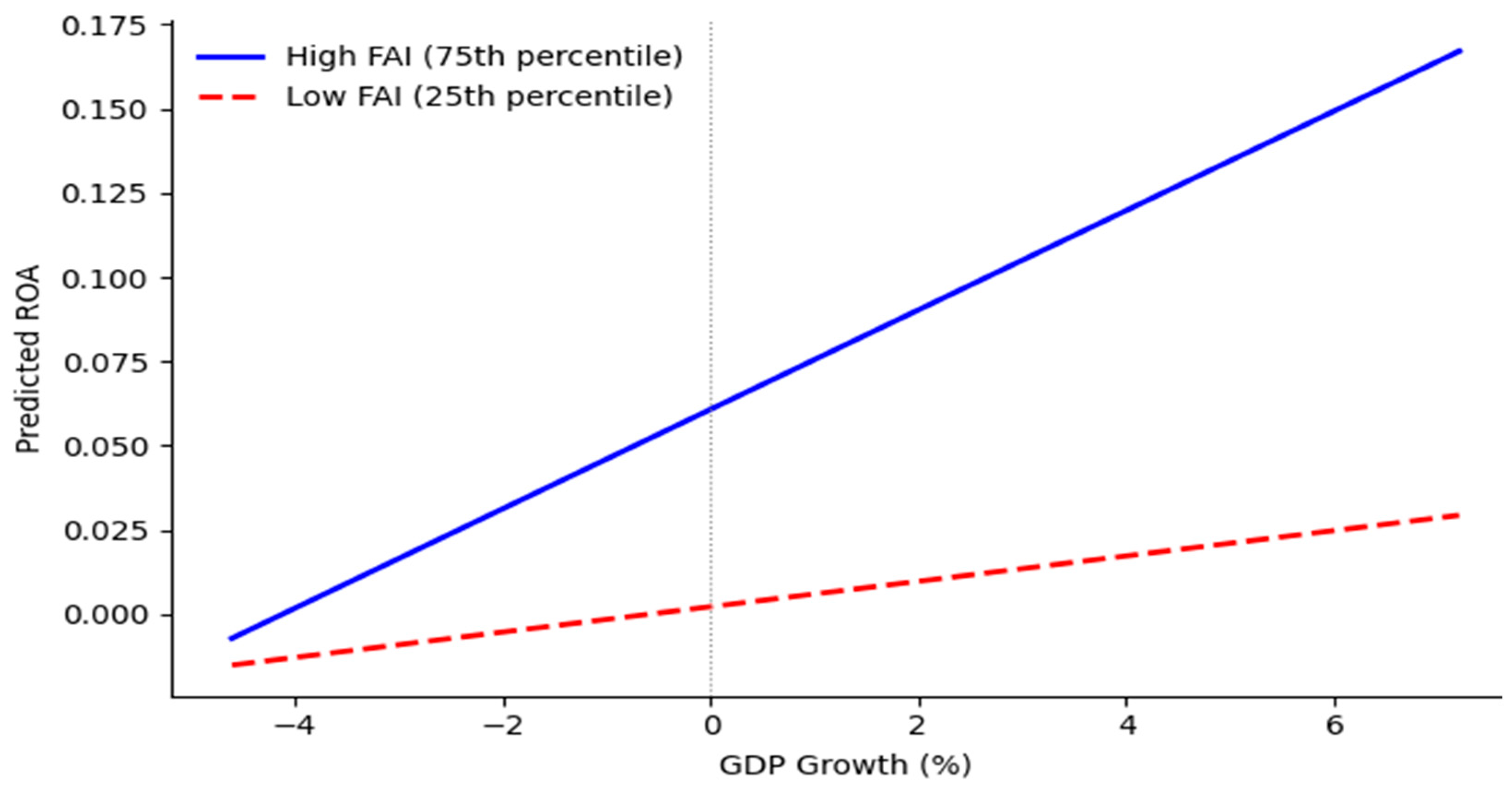
To make the interaction effects easier to interpret,
Figure 1 presents the marginal effect of GDP growth at different levels of financial adaptability. The figure suggests that firms with a higher FAI exhibit more stable predicted ROA across changes in GDP growth, whereas firms with a lower FAI appear more sensitive to macroeconomic conditions.
4.4. Mechanism and Heterogeneity Analysis
To explore a possible channel through which financial adaptability may be related to firm performance, the analysis examines the role of short-term liquidity buffers, proxied by the current assets-to-total assets ratio (CATA).
Table 5 shows that the FAI is strongly and positively associated with CATA (β = 0.168,
p < 0.001), confirming that firms with higher adaptability tend to maintain larger short-term financial reserves. However, CATA is not a statistically significant predictor of profitability in the second step of the specification (β = −0.090,
p = 0.238), suggesting that the transmission from liquidity to profitability is not direct or linear. This pattern indicates that liquidity may be one dimension through which adaptability operates, but that other channels are likely also at work. This exercise is therefore interpreted as indicative of a mechanism rather than as a formal causal mediation test.
This study also examines whether the effect of financial adaptability differs across firms. The heterogeneity analysis by firm size is reported in
Table 6. The coefficient on the FAI is positive and statistically significant for both small and large firms, though the magnitude is larger for the former (β = 0.080 vs. β = 0.056). This pattern suggests that financial adaptability is relevant across firm-size groups, with somewhat stronger effects among smaller firms, which are likely more dependent on internal financial capacity to navigate macroeconomic uncertainty. The interaction between the FAI and commodity price shocks is not statistically significant in either subsample, indicating that the moderating effect of adaptability against commodity price movements does not differ systematically by firm size.
The sectoral analysis also indicates that the relationship is not uniform across (see
Table 7). The sectoral analysis reveals that the direct effect of FAI on profitability is positive and statistically significant in the other, finance, mining, and light industry sectors, with the strongest coefficient observed in mining (β = 0.096,
p < 0.01). In the food sector, the coefficient on the FAI is positive but not statistically significant. The interaction between the FAI and commodity price shocks is not statistically significant in any sector, suggesting that the moderating role of adaptability against commodity price movements does not concentrate in a particular industry within this sample.
In addition, a threshold regression was estimated to examine whether the effect of financial adaptability changes once firms pass a certain level of internal financial capacity.
As reported in
Appendix A Table A2, the estimated threshold value of FAI is approximately 0.566. The results suggest that commodity price shocks are negatively associated with firm performance among firms below this threshold (β = −0.069,
p < 0.05), whereas the relationship is statistically insignificant for firms above this threshold. This pattern is consistent with the view that financial adaptability becomes more consequential only after firms reach a minimum level of internal financial preparedness, although this result should be interpreted cautiously, given the limited sample size in some subgroups.
4.5. Robustness Checks
Several additional analyses were conducted to examine the stability of the main results. These included a baseline random-effects model, a specification with firm and year fixed effects, and a lagged specification using the one-period lag of FAI. As reported in
Table 8, the effects of firm size and leverage remain positive and statistically significant across all three specifications. The coefficient on FAI in the baseline random-effects model is 0.079 (
p < 0.01), consistent with the main results reported in
Table 3. The coefficient on the lagged FAI is positive and statistically significant (β = 0.062,
p < 0.05), indicating that prior-year adaptability predicts subsequent profitability and providing evidence consistent with the assumed direction of causality from adaptability to performance. Taken together, the robustness exercises reinforce the interpretation developed in earlier sections: the association between financial adaptability and firm profitability is stable across alternative specifications.
Robustness across FAI specifications is further examined by re-estimating the main model using the equal-weight FAI. As reported in
Table 9, the coefficient on the equal-weight FAI is positive and statistically significant (β = 0.187,
p < 0.001), confirming that the main findings are not sensitive to the choice of weighting structure.
Finally, the validity of the DID identification strategy is assessed through two formal procedures. A dynamic event-study specification yields a pre-treatment joint F-statistic of 1.496 (
p = 0.216), confirming that the parallel-trend assumption holds prior to the COVID-19 shock. Placebo tests using artificial shock dates of 2016, 2017, and 2018 produce DiD coefficients that are uniformly statistically insignificant (
p = 0.74, 0.70, and 0.35, respectively), providing further support for the validity of the identification strategy. The dynamic event-study results are reported in
Appendix A Figure A1.
5. Discussion
The purpose of this study was to examine how firms’ financial adaptability is associated with firm performance under external macroeconomic stress. The results show that financial adaptability is not best understood as a factor that consistently and directly improves profitability. Its importance becomes more evident when firms operate under unfavorable macroeconomic conditions.
The baseline models indicate a positive association between the Firm Adaptability Index (FAI) and profitability. This association remains statistically significant after firm size and leverage are included as controls, reflecting the revised FAI construction in which the debt ratio is excluded to avoid collinearity. This suggests that financial adaptability captures a distinct dimension of firms’ internal financial capacity rather than simply mirroring their capital structure.
The main contribution of the empirical results comes from the interaction models. The interaction term between the FAI and interest rate conditions is statistically significant, indicating that firms with higher adaptability are less sensitive to financing cost pressure. The moderating effect on GDP growth is in the expected direction but does not reach conventional significance thresholds in this sample. At the same time, the same pattern does not appear for inflation, exchange rates, or commodity prices in the full sample. For this reason, financial adaptability should not be interpreted as a universal protective factor across all shocks.
These findings are broadly consistent with the dynamic capabilities perspective and with the literature on financial flexibility. Earlier studies have shown that liquidity, debt capacity, and financial slack can help reduce firm vulnerability during crisis periods. The present study adds to the literature by showing that the broader combination of liquidity, coverage capacity, and asset efficiency may matter more than any single financial ratio when firms face disruption. In this respect, the evidence supports the move from a narrow view of financial flexibility toward a broader understanding of financial adaptability. In the Mongolian context, where firms operate under high commodity dependence and limited access to external financing, this conditional role of financial adaptability becomes particularly important. Firms are frequently exposed to fluctuations in coal and copper prices, and their ability to internally reallocate liquidity and manage financial buffers may serve as a critical mechanism for maintaining operational stability.
The mechanism analysis shows that the FAI is strongly and positively associated with the current assets-to-total assets ratio (CATA), confirming that more adaptable firms maintain larger short-term liquidity reserves. The direct association between CATA and profitability is not statistically significant, suggesting that the transmission from liquidity to performance is not direct or linear. Liquidity should therefore be treated as one plausible dimension of the adaptability channel rather than as definitive evidence of mediation.
The heterogeneity analysis shows that the relevance of financial adaptability differs across firms. The coefficient on the FAI is positive and significant for both small and large firms, though the magnitude is somewhat larger for smaller firms, suggesting that they rely more heavily on internal financial adjustment capacity when macroeconomic conditions worsen. Sectoral results indicate that the direct effect of FAI is significant in the other, finance, mining, and light industry sectors, with the strongest effect observed in mining. Still, these subgroup results should be interpreted with caution because some subsamples include only a small number of firms.
The threshold analysis also points to a nonlinear relationship. For firms below the estimated FAI threshold of 0.566, commodity price shocks are negatively associated with profitability, whereas the relationship becomes statistically insignificant above that threshold. This pattern is consistent with the view that financial adaptability becomes more relevant only after firms reach a minimum level of internal financial preparedness.
The robustness checks reinforce these conclusions. The coefficient on the lagged FAI is positive and statistically significant (β = 0.062, p < 0.05), providing evidence consistent with the assumed direction of causality from adaptability to performance. Results are also stable across PCA-based and equal-weight FAI specifications, and the DID design is validated by formal parallel-trend and placebo tests. Taken together, these findings suggest that financial adaptability matters, but its role is better understood as conditional and context-specific rather than as a dominant standalone determinant of profitability.
From a practical point of view, the results suggest that firms should not focus only on holding cash. What seems to matter more is the overall balance among liquidity, coverage capacity, and asset utilization, as well as the ability to adjust these elements when external conditions become less favorable. This appears to be especially important for smaller firms and for sectors more exposed to input-price volatility and broader macroeconomic uncertainty. These findings carry several practical implications. For firms, maintaining flexible liquidity structures and avoiding excessive reliance on short-term debt may enhance resilience under volatile macroeconomic conditions. For financial institutions, improving access to counter-cyclical financing could help mitigate firm-level vulnerability. For policymakers, targeted support measures during commodity downturns may help stabilize firm performance in a highly export-dependent economy.
This study also has several limitations. The sample includes only listed firms, and the FAI is based on accounting indicators rather than direct measures of governance, managerial capability, or supply chain resilience. In addition, the macroeconomic variables do not capture every possible channel through which shocks affect firms. For this reason, the results should be interpreted as evidence of firm adaptability on the financial side rather than as a complete account of organizational resilience.
Overall, this study does not support the claim that financial adaptability consistently raises firm performance under all conditions. Instead, the evidence suggests that financial adaptability is most meaningful as a conditional stabilizing capability whose value becomes more visible during periods of macroeconomic stress.
6. Conclusions
This study examined whether firms’ financial adaptability matters for performance under macroeconomic volatility. Using panel data for companies listed on the Mongolian Stock Exchange from 2015 to 2024, this study constructed a Firm Adaptability Index based on PCA weighting across four financial dimensions—liquidity, coverage capacity, asset efficiency, and short-term buffer capacity—and applied multiple empirical approaches to assess its relationship with firm performance. The results do not support the view that financial adaptability has a strong, consistently positive direct effect on firm performance across settings. Instead, the evidence suggests that its relevance becomes clearer when firms face unfavorable macroeconomic conditions.
In particular, the interaction results, liquidity-related evidence, threshold effects, and differences across firm size and sector indicate that financial adaptability is more likely to matter as a conditional and context-dependent capability. The buffering role of FAI is most visible under interest rate stress, while its moderating effect on other macroeconomic shocks is weaker or statistically insignificant in this sample. The analysis also suggests that firms do not respond to similar shocks in the same way. Part of this difference may be related to internal financial conditions, including liquidity, coverage capacity, and asset use. This implies that financial strength should be understood not only in static balance-sheet terms but also in terms of a firm’s capacity to adjust its financial position when external conditions change.
This study contributes by bringing together ideas related to financial flexibility, resilience, and adaptability within a single empirical setting. It proposes a composite measure constructed through PCA weighting, which avoids arbitrary equal-weighting assumptions and helps mitigate the multicollinearity concern between the FAI and leverage. More broadly, the study shows that the financial dimension of firm adaptability can be examined empirically, even when direct measures of managerial response capacity are unavailable. At the same time, the results should be interpreted cautiously. The sample covers only listed firms, the index is based on accounting indicators, and the macroeconomic measures may not capture all relevant transmission channels. The validity of the empirical design is supported by a formal parallel-trend test (F = 1.496, p = 0.216) and placebo checks using artificial shock dates, and the main findings are robust across alternative FAI specifications and a lagged FAI robustness check.
In the Mongolian context, characterized by high commodity dependence and exposure to external price volatility, the conditional role of financial adaptability is particularly relevant for maintaining firm-level stability. From a policy perspective, these findings suggest that firms should prioritize flexible liquidity management and balanced capital structures, while financial institutions and regulators may support resilience by facilitating access to counter-cyclical financing during periods of macroeconomic stress.
Future research may extend this approach by incorporating governance, managerial capabilities, ownership structure, and supply chain factors, and by testing the framework on private firms and SMEs. Further work could also apply stronger identification strategies such as instrumental variables or natural experiments, and explore how the role of financial adaptability varies across different commodity price cycles in resource-dependent economies. Overall, the findings suggest that financial adaptability is better understood not as a constant driver of profitability, but as an internal capacity whose relevance increases when firms face greater macroeconomic uncertainty.