Review

Sustainability Reporting Between Financial Market Forces and Regulatory Mandates: A Global Bibliometric Analysis

1
Business Department, Higher Colleges of Technology, Dubai P.O. Box 15825, United Arab Emirates
2
Business Department, Higher Colleges of Technology, Abu Dhabi P.O. Box 25026, United Arab Emirates
3
Laboratory of International Economic Integration, Faculty of Economic Sciences and Management of Tunis, University of Tunis El Manar, Tunis B.P 248 2092, Tunisia
4
Higher Institute of Management, University of Tunis, Tunis 2000, Tunisia
*
Author to whom correspondence should be addressed.
Int. J. Financ. Stud. 2026, 14(4), 82; https://doi.org/10.3390/ijfs14040082
Submission received: 26 January 2026 / Revised: 1 March 2026 / Accepted: 3 March 2026 / Published: 1 April 2026

Abstract

This study examines the evolution of sustainability reporting research by integrating financial market dynamics, regulatory frameworks, and digital transformation into a unified analytical lens. It explores how these forces shape the credibility, comparability, and strategic relevance of sustainability disclosure. A bibliometric analysis of 683 publications indexed in the Web of Science (2006–2025) was conducted. Performance indicators and science-mapping techniques were applied to identify the intellectual structure of the field. Four major thematic clusters were detected: (i) corporate social responsibility and disclosure performance, (ii) governance and accountability, (iii) regulatory and institutional frameworks, and (iv) financial market and digital innovation drivers. Findings reveal that Disclosure, corporate social responsibility, and performance remain the field’s core anchors, while governance, accountability, innovation, and strategy increasingly shape reporting credibility. Sustainability reporting reduces information asymmetry, lowers financing costs, and builds stakeholder trust; however, persistent fragmentation, greenwashing, and weak assurance highlight the need for global harmonization. Regulatory initiatives and market instruments are converging to institutionalize sustainability disclosure. The study advances a policy and managerial agenda advocating stronger governance oversight, harmonized disclosure frameworks, and technology-enabled assurance mechanisms to enhance transparency, accountability, and investor confidence.

1. Introduction

The growing prominence of sustainability reporting in both academic and policy debates reflects increasing attention to environmental, social, and governance (ESG) accountability at the corporate level. Over the past two decades, disclosure of non-financial information has evolved from a peripheral communication tool into a strategic component of corporate governance and transparency (Diwan & Amarayil Sreeraman, 2024; Novicka & Volkova, 2025). In the context of climate change, social inequality, and heightened global scrutiny, sustainability reporting has become a central mechanism for aligning corporate behavior with societal expectations. It enables firms to communicate their environmental and social impacts, enhance stakeholder trust, and demonstrate long-term value creation (Rusu et al., 2024).
Existing research consistently links sustainability disclosure to enhanced corporate reputation, competitiveness, and market performance (Hummel & Schlick, 2016; Raimo et al., 2021). The diffusion of disclosure practices has been accelerated by both voluntary global frameworks—such as the Global Reporting Initiative (GRI), International Integrated Reporting Council (IIRC), and Sustainability Accounting Standards Board (SASB) and mandatory regimes like the European Union’s Non-Financial Reporting Directive and its successor, the Corporate Sustainability Reporting Directive (CSRD). Beyond advanced economies, emerging markets are increasingly formalizing ESG disclosure mandates. For example, the Abu Dhabi Securities Exchange (ADX) now requires listed firms to publish sustainability reports, signaling the institutionalization of ESG norms in the Gulf region.
Parallel to regulatory developments, financial markets increasingly act as catalysts for credible disclosure. ESG indices, sustainability-linked loans, and green bonds embed transparency into investment decision-making, linking capital access to disclosure quality. Yet the relative influence of regulatory mandates versus market-based incentives remains insufficiently examined. Studies suggest that mandatory frameworks improve comparability (Raimo et al., 2021; Matakanye et al., 2021), whereas voluntary initiatives often reflect deeper strategic intent and stakeholder engagement (Darnall et al., 2022). Understanding this interplay is essential to explain both the quality and motivation of sustainability reporting.
Internal factors—such as governance quality, ethical leadership, and digital innovation—further shape disclosure credibility and performance outcomes (Fernandez-Feijoo et al., 2014; Luo & Tang, 2023; Moussa & Elmarzouky, 2024). Yet significant challenges persist: fragmented standards, assurance gaps, and greenwashing undermine comparability, while technological and resource burdens from digital reporting mandates (e.g., iXBRL) complicate implementation across jurisdictions (Novicka & Volkova, 2025).
Despite growing scholarly attention, three gaps remain. First, prior bibliometric reviews of sustainability reporting have examined disclosure trends, theoretical foundations, or governance mechanisms in isolation. They rarely integrate regulatory, market, and technological drivers within a single analytical framework. Second, the financial materiality dimension—how ESG reporting affects firms’ cost of capital, investor confidence, and liquidity—has not been systematically mapped through bibliometric evidence. Third, recent studies also highlight digitalization as an emerging driver of sustainability reporting, raising new questions about disclosure reliability, standardization, and regulatory alignment across jurisdictions (Cordazzo et al., 2020; Novicka & Volkova, 2025; Sun et al., 2025).
Addressing these gaps, this study investigates how regulation, market dynamics, and digital innovation jointly shape the evolution of sustainability reporting. It is guided by three core research questions:
RQ1.
How do financial market sustainability initiatives influence corporate reporting practices?
RQ2.
What are the main organizational and institutional drivers underpinning sustainability disclosure?
RQ3.
What are the opportunities and challenges associated with sustainability reporting?
This study makes three key contributions. First, it offers a systematic mapping of 683 publications spanning 2006 to 2025, employing bibliometric techniques to reveal the intellectual and conceptual structure of sustainability reporting research. Unlike prior reviews, the analysis explicitly integrates financial market mechanisms (e.g., ESG indices, green bonds, sustainability-linked loans) with regulatory and technological developments (e.g., CSRD, ISSB, iXBRL), thereby bridging corporate governance, finance, and digitalization perspectives. Second, it applies an advanced semantic retrieval and dual-keyword strategy within the Web of Science database to ensure comprehensive and context-sensitive identification of relevant literature across disciplines. This approach reduces keyword and coverage bias, ensuring that both seminal and emerging contributions are systematically captured. The search protocol was fully documented to ensure query reproducibility, while semantic retrieval enhanced inclusiveness by capturing conceptually related studies beyond exact keyword matches. Third, the study advances a forward-looking research agenda aligned with evolving investor priorities, regulatory shifts, and technological innovation. It demonstrates how sustainability reporting has transitioned from a voluntary communication practice to a governance-embedded, data-driven, and financially material dimension of corporate accountability.
The findings carry particular policy relevance for emerging markets, where disclosure regulation is expanding rapidly but institutional capacity and assurance infrastructures remain limited. Insights derived from this analysis can inform regulators and stock exchanges in designing proportionate yet credible ESG disclosure frameworks that enhance investment transparency, comparability, and investment competitiveness. The results further underscore the importance of harmonized standards, credible verification mechanisms, and digital infrastructure to ensure consistency with global initiatives such as the ISSB and EU CSRD.
Accordingly, the paper is structured as follows: Section 2 introduces the conceptual foundations and theoretical frameworks underpinning sustainability reporting, including legitimacy theory, voluntary disclosure theory, stakeholder theory, and institutional theory. Section 3 presents previous bibliometric studies on sustainability reporting. Section 4 outlines the adopted methodology. Section 5 provides the analysis of the findings of this review. Section 6 concludes by summarizing the main insights and outlining the limitations and theoretical and practical implications of the bibliometric review.

2. Conceptualization and Theoretical Background

Building on the identified research gaps, this section develops the conceptual foundations underpinning sustainability reporting. Rather than viewing disclosure as a single phenomenon, prior scholarship explains it through complementary theoretical, governance, strategic, regulatory, financial, and technological perspectives. Integrating these perspectives enables a structured interpretation of how sustainability reporting has evolved from a voluntary communication practice into a multidimensional governance mechanism shaped by institutional pressures, market incentives, and digital transformation.
These dynamics help explain why firms across jurisdictions often converge in reporting form while diverging in substance, as disclosure simultaneously serves legitimacy objectives and institutional conformity.
Taken together, these perspectives position sustainability reporting as a hybrid, multidimensional practice influenced by economic incentives, societal legitimacy, stakeholder engagement, and institutional conformity. Firms disclose simultaneously to reduce information asymmetry, maintain legitimacy, meet stakeholder expectations, and comply with evolving regulatory requirements thereby explaining the diversity of global reporting practices and the continuing challenges of harmonization.

2.1. Governance and Accountability Perspectives

Beyond foundational theories explaining why firms disclose sustainability information, governance and accountability perspectives focus on how internal structures shape disclosure quality and credibility. Strong governance systems such as independent boards, specialized sustainability committees, and effective oversight processes are consistently associated with greater transparency and substantive reporting (Ammer et al., 2020; Jamil et al., 2021). These mechanisms embed sustainability into decision-making, ensuring disclosures serve stakeholders and investors rather than mere compliance. Leadership orientation and organizational culture further influence reporting integrity. Ethically driven CEOs and accountability-oriented cultures foster comprehensive and credible reports, whereas weak governance environments often produce superficial or disclosures that erode trust (Zimon et al., 2022). External assurance further enhances disclosure credibility by mitigating opportunistic behavior and strengthening investor confidence (Du & Wu, 2019).
Moreover, firm-level characteristics such as size, industry sensitivity, ownership structure, and national context influence how governance mechanisms translate into reporting practices (Raimo et al., 2020). Larger firms and those in high-impact sectors tend to disclose more extensively under scrutiny, while cultural and institutional differences across countries shape reporting outcomes (Ikpor et al., 2022; Hassanein et al., 2024). Governance thus extends beyond formal structures to encompass corporate values, contextual pressures, and assurance mechanisms that collectively determine disclosure credibility and comparability.
Ultimately, governance and accountability perspectives suggest that sustainability reporting credibility depends not solely on external mandates but on the quality of internal oversight, leadership integrity, and embedded control systems. When systematically integrated into governance structures, sustainability reporting transitions from a compliance-driven activity to a strategic organizational capability that enhances transparency, credibility, and investor confidence. While governance perspectives clarify the determinants of disclosure credibility, the strategic deployment of sustainability reporting as a source of differentiation and value creation is more fully explained through resource-based and signaling perspectives.

2.2. Strategic, Resource-Based, and Innovation Views

A growing body of research frames sustainability reporting not only as a compliance response but as a strategic resource that creates long-term value. The resource-based view (RBV) positions ESG disclosure as an intangible, path-dependent asset that is socially complex, and hard to imitate (Hart, 1995). High-quality sustainability reporting strengthens reputational capital, fosters stakeholder loyalty, and improves market positioning, generating competitive advantage (Darnall et al., 2022). When supported by external assurance and alignment with global frameworks, disclosure becomes a distinctive capability linked to sustained performance (S. F. Lo & Sheu, 2007; Delmas & Toffel, 2008).
Signaling theory complements this view by emphasizing disclosure’s role in reducing information asymmetry. Detailed and credible reports signal resilience, transparency, and long-term orientation, attracting investors, lowering financing costs, and improving capital access (Clarkson et al., 2008; Dhaliwal et al., 2011). This signaling function is critical in voluntary or fragmented regulatory contexts, enabling firms to differentiate and shape stakeholder perceptions (Luo & Tang, 2023). Thus, reporting serves as a deliberate strategic act rather than mere accountability.
Building on these perspectives, recent scholarship has drawn attention to innovation and digitalization as enablers of reporting credibility and comparability. Tools such as digital taxonomies, Inline XBRL, blockchain verification, and AI-driven analytics enable transparent, accessible, and verifiable disclosures (Novicka & Volkova, 2025). Integrating reporting into digital infrastructures improves monitoring, reduces information asymmetry, and strengthens stakeholder engagement. Evidence shows that digitally agile firms meet regulatory and investor expectations while gaining reputational and financial benefits (Luo & Tang, 2023; Sun et al., 2025).
Collectively, strategic, resource-based, and innovation perspectives underscore sustainability reporting as a vehicle for differentiation, value creation, and long-term resilience. This recognition invites deeper analysis of how governance interacts with these strategic orientations, and how external forces such as regulation and financial markets shape firms’ ability to translate disclosure into competitive advantage.
Although firms may adopt sustainability reporting strategically, disclosure practices remain shaped by institutional constraints, as regulatory frameworks and standard setters define reporting boundaries and comparability across jurisdictions.

2.3. Regulatory and Institutional Dimensions

Sustainability reporting is strongly influenced by regulatory mandates and institutional contexts that define its scope and comparability. Legal frameworks such as the European Union’s Non-Financial Reporting Directive (NFRD) and Corporate Sustainability Reporting Directive (CSRD) mark a shift from voluntary to mandatory disclosure, embedding sustainability into corporate transparency and ensuring minimum levels of comparability and accountability (Mion & Loza Adaui, 2019; Pantazi, 2024). Evidence from EU member states shows that mandatory regimes improve disclosure completeness and reliability, particularly when supported by enforcement mechanisms and sector-specific guidelines (Fekete et al., 2021; Kosi & Relard, 2024).
Empirical evidence illustrates that firms adapt their reporting practices under coercive, normative, and mimetic pressures consistent with institutional theory (DiMaggio & Powell, 1983). Raimo et al. (2020) demonstrate that European firms adopt integrated reporting primarily under regulatory and peer influence, highlighting these mechanisms. Yet convergence remains contested. The coexistence of multiple standard setters such as the GRI, SASB, the IFRS Foundation, and the International Sustainability Standards Board (ISSB) illustrates ongoing political and institutional struggles over global harmonization (Afolabi et al., 2023). These tensions between principle-based and metrics-driven approaches reveal not only technical divergence but also competing institutional logics shaping the credibility and comparability of ESG disclosure.
In sum, regulatory and institutional perspectives reveal sustainability reporting as a contested arena shaped by law, politics, and market forces. Mandatory frameworks like the CSRD raise the baseline for accountability (Mion & Loza Adaui, 2019; Pantazi, 2024), while market-based mechanisms reward firms that go beyond compliance (Christensen et al., 2021; Flammer, 2021). Persistent fragmentation underscores the need for technological innovation to bridge gaps, enhance credibility, and advance global harmonization (Raimo et al., 2021; Afolabi et al., 2023).
Beyond establishing minimum disclosure requirements, regulatory frameworks interact also with financial markets, where transparency increasingly influences capital allocation and investor decision-making.

2.4. Financial Market and Capital Constraints

Sustainability reporting is increasingly influenced by capital market dynamics that connect transparency with financial performance. Financial instruments such as ESG indices, sustainability-linked loans, and green bonds link access to capital with the quality of ESG disclosures, positioning reporting as a strategic tool to reduce information asymmetry, lower financing costs, and enhance liquidity (Christensen et al., 2021; Raimo et al., 2021). Empirical evidence indicates that voluntary ESG reporting is associated with reduced equity and debt costs (Dhaliwal et al., 2011), while green bonds benefit from favorable pricing when supported by credible targets and enforcement mechanisms (Flammer, 2021; Feldhütter et al., 2024).
Stock exchanges and rating agencies further institutionalize these dynamics by embedding ESG criteria into listing requirements and investment screening processes. As a result, credible sustainability reporting becomes essential for investor confidence, market participation, and liquidity (Raimo et al., 2021; Dhaliwal et al., 2011; Grewal et al., 2019; Krueger et al., 2024).
These dynamics are particularly salient in emerging markets, where transparent reporting attracts international investors and mitigates financing frictions (Mohammad & Wasiuzzaman, 2021; Jyoti & Khanna, 2021). Robust disclosure improves credit ratings, borrowing costs, and stock liquidity (M. Chen et al., 2023), but benefits depend on credibility and enforcement; fragmented standards and weak assurance sustain investor uncertainty (Liu, 2022; Tsang et al., 2023).
The dual influence of regulation and market incentives underscores the financial materiality of sustainability reporting and positions transparency as a determinant of competitive advantage in global capital markets (Shaban & Barakat, 2023). While regulation establishes a baseline level of accountability, capital markets increasingly reward firms that exceed compliance through improved financing conditions, liquidity, and investor confidence (Darnall et al., 2022; Rusu et al., 2024). ESG reporting thus functions as both an accountability tool and a strategic mechanism to reduce information asymmetry and enhance market valuation. (Dhaliwal et al., 2011; Flammer, 2021; M. Chen et al., 2023). As sustainability information becomes financially material, technological innovation emerges as a critical enabler of reliable, standardized, and scalable disclosure practices.

2.5. Technology and Innovation Perspectives

Recent scholarship increasingly positions technology as a structural driver of sustainability reporting, transforming it from a compliance-oriented activity into an innovation-led, strategic practice. Digital infrastructures such as Inline XBRL (iXBRL) make non-financial data machine-readable, improving transparency, accessibility, and cross-country comparability (Novicka & Volkova, 2025). Blockchain applications offer tamper-proof verification of ESG data, reducing manipulation risks and strengthening trust in disclosed information, while AI-driven analytics provide stakeholders with real-time insights into firms’ sustainability performance (Luo & Tang, 2023).
These technologies enhance efficiency and reliability complementing traditional assurance mechanisms and reinforcing disclosure credibility. Evidence shows that firms with advanced digital capabilities are better equipped to meet evolving regulatory requirements, respond to investor scrutiny, and signal long-term resilience (Sun et al., 2025). Integrated reporting further reflects this shift by embedding ESG indicators into financial communication, aligning sustainability with corporate strategy and performance measurement (Eccles et al., 2014).
Technological innovation thus redefines sustainability reporting as both a governance instrument and a strategic asset. By enabling standardized, verifiable, and accessible disclosure, digital solutions address persistent challenges of comparability, enforcement, and assurance. More broadly, they illustrate the evolution of sustainability reporting from a fragmented, often symbolic exercise toward a data-driven, performance-integrated, and future-oriented practice (Luo & Tang, 2023; Novicka & Volkova, 2025).
Taken together, sustainability reporting should not be viewed as a linear process driven by a single force, but as the outcome of interacting institutional, organizational, financial, and technological dynamics. Legitimacy and stakeholder theories explain firms’ need to secure social approval and respond to stakeholder expectations, while institutional pressures shape reporting convergence and the resource-based view frames disclosure as a strategic capability that enhances reputation and competitive advantage. Building on these perspectives, this study conceptualizes sustainability reporting as an integrated ecosystem in which regulation sets disclosure boundaries, governance ensures credibility, financial markets translate transparency into economic value, and digital innovation improves reliability and comparability. This integrative lens clarifies the shift from symbolic disclosure toward a data-driven and financially material dimension of corporate accountability. It also provides the foundation for examining how these themes have been addressed in prior scholarship. The following section reviews existing bibliometric studies and identifies the gaps motivating the present bibliometric review.

3. Previous Bibliometric Studies on Sustainability Reporting

Bibliometric research on sustainability reporting has evolved significantly, though early studies often addressed isolated themes. For example, Botica Redmayne et al. (2021) focused on transitions in public-sector reporting frameworks, while Afolabi (2022) examined standard-setting without linking regulatory reforms to market behavior. Similarly, Pellegrini et al. (2020) and Chopra et al. (2021) explored ESG leadership and knowledge diffusion, yet lacked integration across economic, environmental, and social dimensions. Climate-related disclosures were also reviewed (e.g., Shepherd & Patzelt, 2011; Muñoz et al., 2018), but broader market implications remained underexplored. Recent bibliometric contributions adopt more comprehensive approaches. Raimo et al. (2021) map sustainability disclosure within financial markets, identifying thematic clusters such as integrated reporting, governance, and stakeholder influence. Bose et al. (2021) extend this by analyzing cross-country regulatory dynamics in the banking sector, highlighting the role of normative pressures in adopting global standards like GRI and the Equator Principles. In the domain of green finance, Hu and Gan (2025) trace its scholarly evolution, revealing increased attention post-2015 alongside persistent challenges such as definitional ambiguity and limited private-sector engagement. Large-scale mappings have further enriched the field. Siao et al. (2022) analyze over 3500 articles to illustrate the growing interdisciplinarity of ESG research, while Benameur et al. (2024) identify emerging clusters around assurance, digitalization, and stakeholder accountability. Ellili (2022) emphasizes regional research patterns, and Bilal et al. (2024) highlight conceptual fragmentation, calling for greater cross-disciplinary integration.
Among the most comprehensive reviews, Diwan and Amarayil Sreeraman (2024) employ a PRISMA-guided approach to examine the shift from traditional financial reporting to ESG disclosures. Their findings underscore the integration of frameworks such as GRI, TCFD, and CDP into corporate communication, and the frequent use of institutional, stakeholder, and legitimacy theories. They also identify a gap in operational performance metrics and call for more empirical, framework-driven studies to assess ESG’s strategic impact.
Table 1 summarizes prior bibliometric studies on sustainability reporting, which collectively advance understanding of its conceptual and institutional evolution but remain fragmented across governance, regulatory, and disclosure domains. Few studies systematically integrate financial-market mechanisms, regulatory convergence, and digital innovation within a unified analytical framework. Addressing this gap, the present study adopts an integrated bibliometric approach to map the field’s intellectual structure through a combined governance–finance–digitalization perspective, as outlined in Section 4.

4. Methodology

4.1. Data Collection

To assemble the literature base on sustainability reporting, we employed the Smart Search function of Web of Science, rather than the Advanced Search interface. Smart Search was selected because it enables queries to be formulated in natural language, which is particularly suitable for capturing complex and evolving constructs such as sustainability reporting and ESG disclosure. Leveraging natural language processing (NLP) and semantic algorithms, Smart Search interprets keywords and phrases beyond exact matches, tolerates variations in terminology, and retrieves more relevant results across disciplines (Web of Science, 2025). This semantic capability reduces the risk of selection bias by minimizing the exclusion of relevant studies due to wording differences. In contrast, Advanced Search relies primarily on Boolean operators and field-specific codes, which may constrain exploratory flexibility and limit retrieval to predefined expressions. Accordingly, Smart Search was deemed more appropriate given the multidimensional and interdisciplinary nature of the research questions.
The keywords used in the search were directly derived from the three research questions guiding this study (see Table 2). The list was constructed with the assistance of artificial intelligence to identify relevant keywords. It was then refined iteratively by integrating synonyms and related expressions to improve coverage of the literature. Multiple queries and keyword combinations were executed rather than relying on a single predefined search string. Given the iterative and semantic nature of the retrieval process, it is not feasible to report a single Boolean search formula (e.g., TS = (…) OR AB = (…) OR AK = (…)). However, full documentation of the query logic and screening procedure is provided to enhance methodological transparency and reproducibility.
The search protocol followed a structured procedure (Figure 1):
Step 1.
A single Marked List was created in Web of Science to store and organize all retrieved records.
Step 2.
Keywords were entered individually and in combination within Smart Search, using quotation marks where appropriate to ensure phrase precision. This initial retrieval yielded 793 records.
Step 3.
To ensure the accuracy and relevance of the dataset, the results were refined by:
This refinement is methodologically justified. The Web of Science predominantly indexes English-language journals (Mongeon & Paul-Hus, 2016), and prior bibliometric studies demonstrate that single-language datasets improve semantic consistency, network robustness, and analytical reliability (Dharmani et al., 2021). Given that English remains the dominant language of global scholarly communication (Xiao et al., 2025), this restriction enhances comparability, internal validity, and reproducibility.
After refinement, a total of 752 documents were retained. No temporal restriction was imposed, as the objective was to capture the full intellectual evolution of sustainability reporting, including foundational contributions as well as recent developments reflecting current regulatory and market dynamics.
In the exported dataset, each record contained two types of keywords: Author Keywords (DE) and Keywords Plus® (ID). While Author Keywords are provided directly by the authors, Keywords Plus® are algorithmically generated from the titles of cited references. However, 70 articles lacked Keywords Plus® entries. To ensure completeness and avoid informational bias, missing Keywords Plus® fields were supplemented with Author Keywords. This procedure guaranteed that each article in the dataset was associated with a complete keyword set, thereby strengthening the robustness and reliability of subsequent bibliometric analyses.

4.2. Bibliometric Analysis Tools

The final set of references was analyzed using the Bibliometrix program of the software R version 4.1.2 and its Biblioshiny feature (Aria & Cuccurullo, 2017).

4.3. Bibliometric Analysis Procedure

The Bibliometrix R package (version 4.1.2) allows to perform two-pronged bibliometric approach: performance analysis and science mapping (Cobo et al., 2011; Donthu et al., 2021). Performance analysis examines the contributions of research constituents (Donthu et al., 2021). It offers insights into the most prolific authors, influential journals, and productive institutions contributing to the sustainability reporting–financial market interface.
In parallel, science mapping analyzes the relationships among these research constituents (Donthu et al., 2021) offering a structural visualization of the intellectual landscape. Common techniques for science mapping include citation analysis, co-citation analysis, bibliographic coupling, co-word analysis, and co-authorship analysis.
Three enrichment pathways based on network analysis are typically applied: network metrics, clustering, and visualization.
Network metrics help highlight the relative importance of nodes—such as authors, institutions, or countries—beyond raw publication or citation counts. Metrics such as degree centrality, betweenness centrality, eigenvector centrality, closeness centrality, and PageRank reveal influence and connectivity within the network. Clustering aims at creating thematic or social clusters, depending on the type of analysis conducted. Curating these network clusters and tracking their evolution can provide valuable insights into how a research field develops over time. For instance, thematic clusters generated through co-citation analysis and bibliographic coupling highlight the major themes underpinning the intellectual structure and their temporal evolution. Various techniques can be used for clustering, including exploratory factor analysis, hierarchical clustering, the Island algorithm, the Louvain method, multidimensional scaling, and simple centers.
Visualization is often used alongside bibliometric analysis to provide intuitive insights into complex networks. In this study, we employ a thematic map as the primary enrichment technique. The main reason is that this visualization enables us to structure the literature according to our research questions. This approach aligns with the recommendations of Börner et al. (2003), who emphasize the significance of thematic mapping in bibliometric studies. Following the classification proposed by Della Corte et al. (2019), the thematic map is divided into four quadrants, each representing a different category of themes: Motor Themes, Basic Themes, Niche Themes, and Emerging or Declining Themes.
During the bibliometric mapping stage, 69 papers were not assigned to any cluster because they lacked sufficient bibliographic coupling or keyword co-occurrence links with other publications. Following previous methodological guidelines (e.g., Van Eck & Waltman, 2010; Cobo et al., 2011), these isolated papers were excluded, and a total of 683 papers is obtained (Figure 1, Step 4). They may represent emerging or marginal research themes that warrant further investigation to better understand the evolving landscape of the field. Then, the descriptive statistics for each cluster were performed. This procedure ensured that the subsequent analysis was based on a robust and thematically connected corpus, minimizing the risk of bias from unconnected or marginal contributions.
After generating the thematic map, we proceeded by linking each identified cluster to one of our research questions, thereby ensuring that the bibliometric analysis directly addressed the study’s objectives. Within each cluster, we identified the key papers—that were most cited or occupied central positions in the network—and analyzed their contributions.
We then outline the thematic logic of the cluster by examining the dominant concepts, debates, and methodological approaches. Finally, we develop a focused literature review for each cluster to demonstrate how it informs the corresponding research problem.

5. Results and Discussion

5.1. Performance Analysis

Table 3 lists the selected papers on sustainable reporting published between 2006 and 2025 across 592 academic journals. The average age of these papers is 3 years, with each paper receiving an average of 28.57 citations. Approximately 29,652 references were utilized in total. The 1807 authors of these studies used 1667 unique keywords. On average, there are 2.89 authors per document, with 88 documents authored by a single individual. The collaboration index, which gauges the level of cooperation among authors in this field (Donthu et al., 2021), is reported to be 2.89.
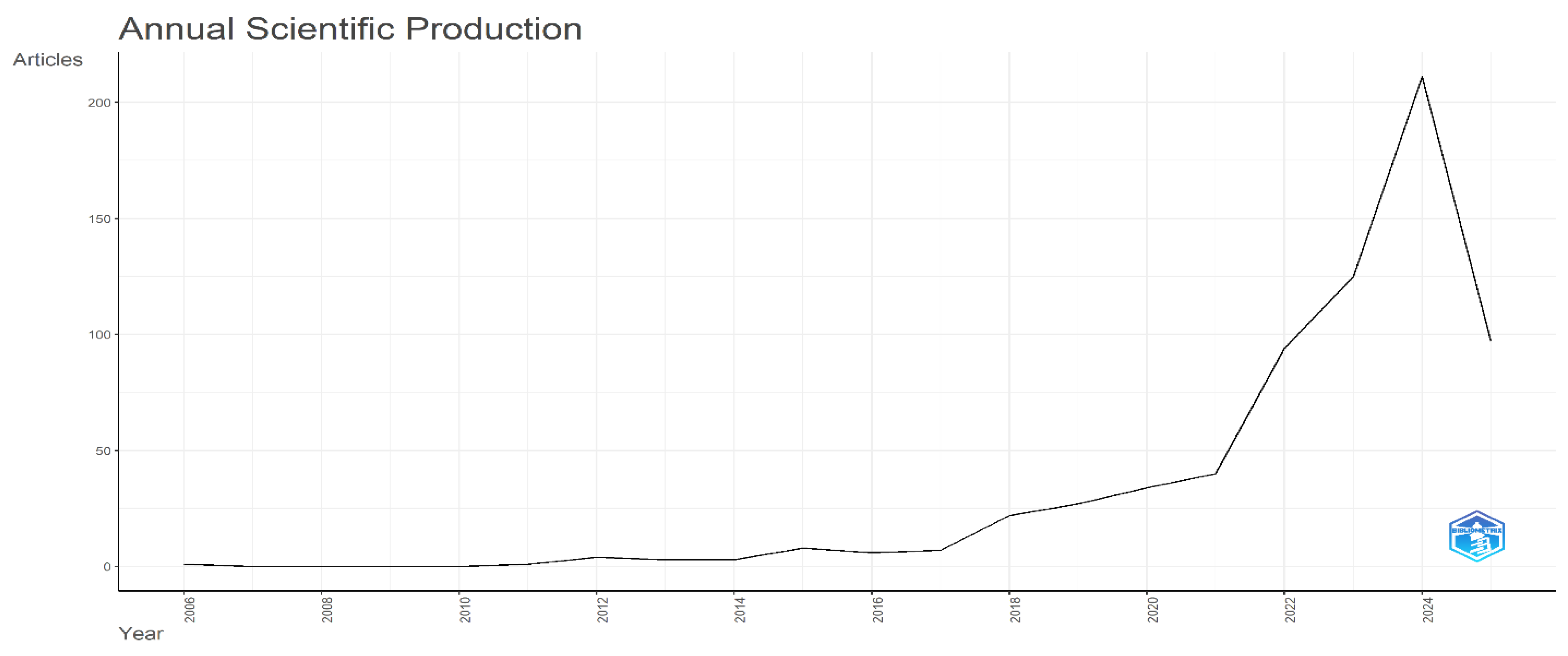
The analysis of the trend in publication related to the theme of sustainability reporting (Figure 2) has demonstrated a notable increase since 2021, rising from around 40 papers to over 200 in 2024. This growth has been realized at an annual percentage increase of 27.22% each year.
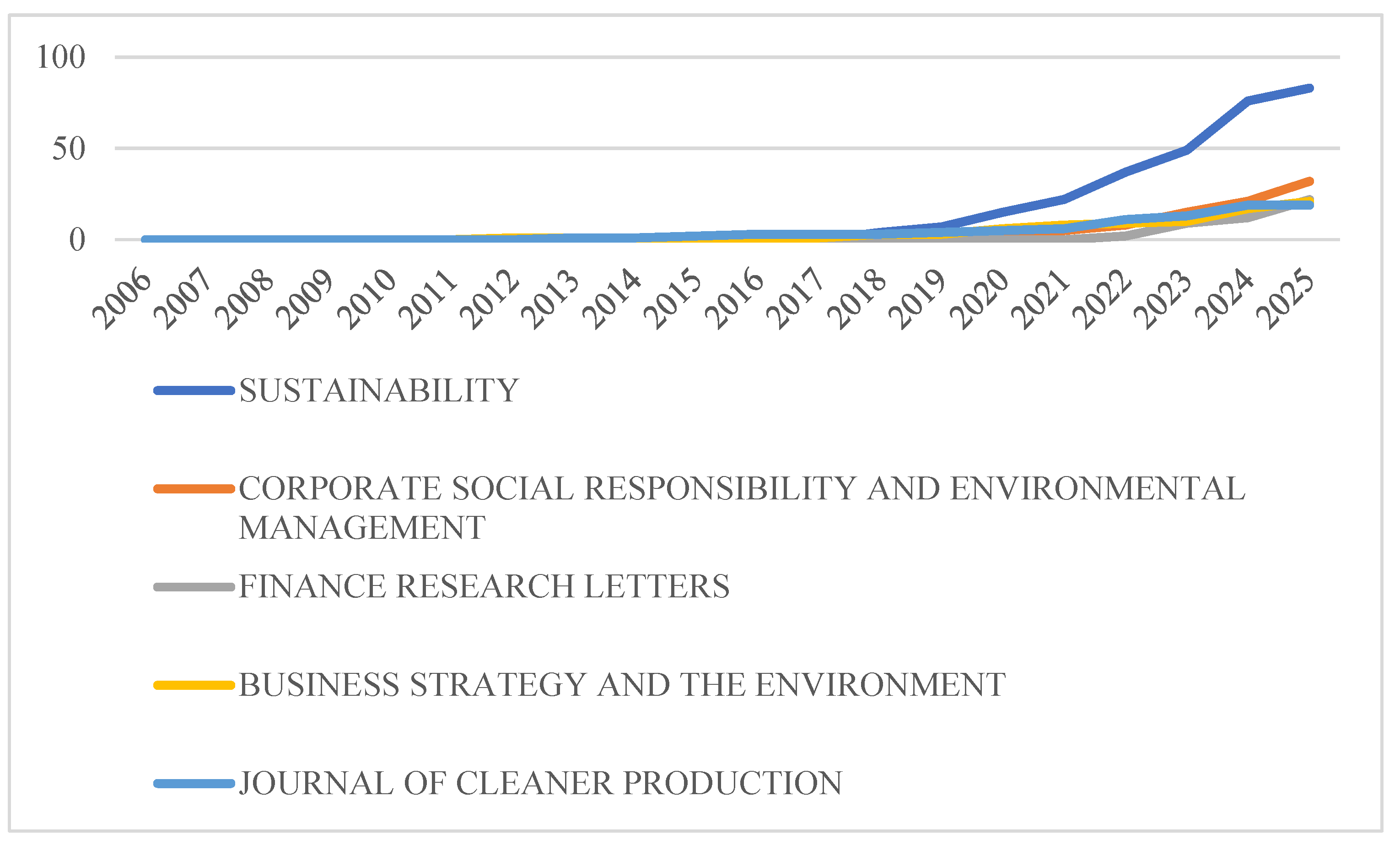
Figure 3 illustrates the production evolution of journals, including a minimum of 1 publication dealing with sustainable reporting theme. The 5 sources began publishing papers on the current research theme in 2012.
Table 4 depicts the most relevant academic journals on sustainable reporting, showing that Sustainability leads with 83 articles, indicating its prominence in the field, while Corporate Social Responsibility and Environmental Management follows with 32 articles.
Table 5 depicts the top 10 most cited documents on sustainable reporting. The most cited article is the paper submitted by Hahn and Kühnen (2013), which has been published in Journal of Cleaner Production. The authors review 178 articles published between 1999 and 2011 in journals related to business, management, and accounting. The aim is to identify the determinants of sustainability reporting examined in the literature, as well as the (in)consistencies, gaps, and opportunities for future research. It highlights factors influencing the adoption, extent, and quality of reporting. Next, the study by Fatemi et al. (2018), published in Global Finance Journal. This study examines the impact of ESG activities and their disclosure on firm value. The findings indicate that ESG strengths enhance firm value, while weaknesses diminish it. However, ESG disclosure itself tends to lower valuation. More significantly, disclosure serves as a critical moderating factor, reducing the negative impact of weaknesses and lessening the positive impact of strengths.
The distribution of countries, according to the corresponding authorship and citations, is presented in Table 6. The most corresponding authors are from China, India, and Italy, respectively, with 88, 59, and 58 publications. Regarding publications, China occupies first place with 213 papers, followed by Italy with 123, and India with 116. The countries with more than 2000 citations are Italy with 2352, China with 2057, and the USA with 2024.

5.2. Conceptual Structure Analysis

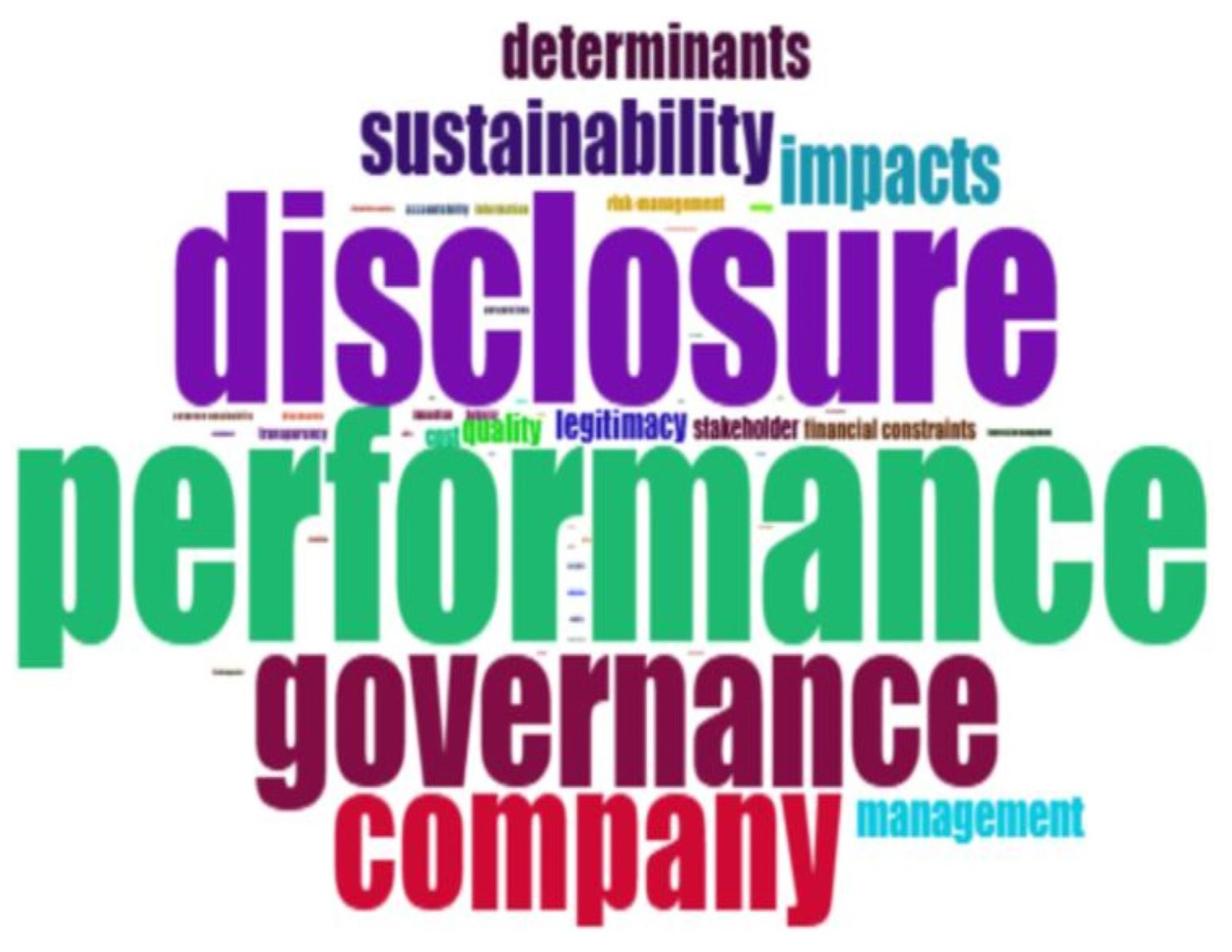
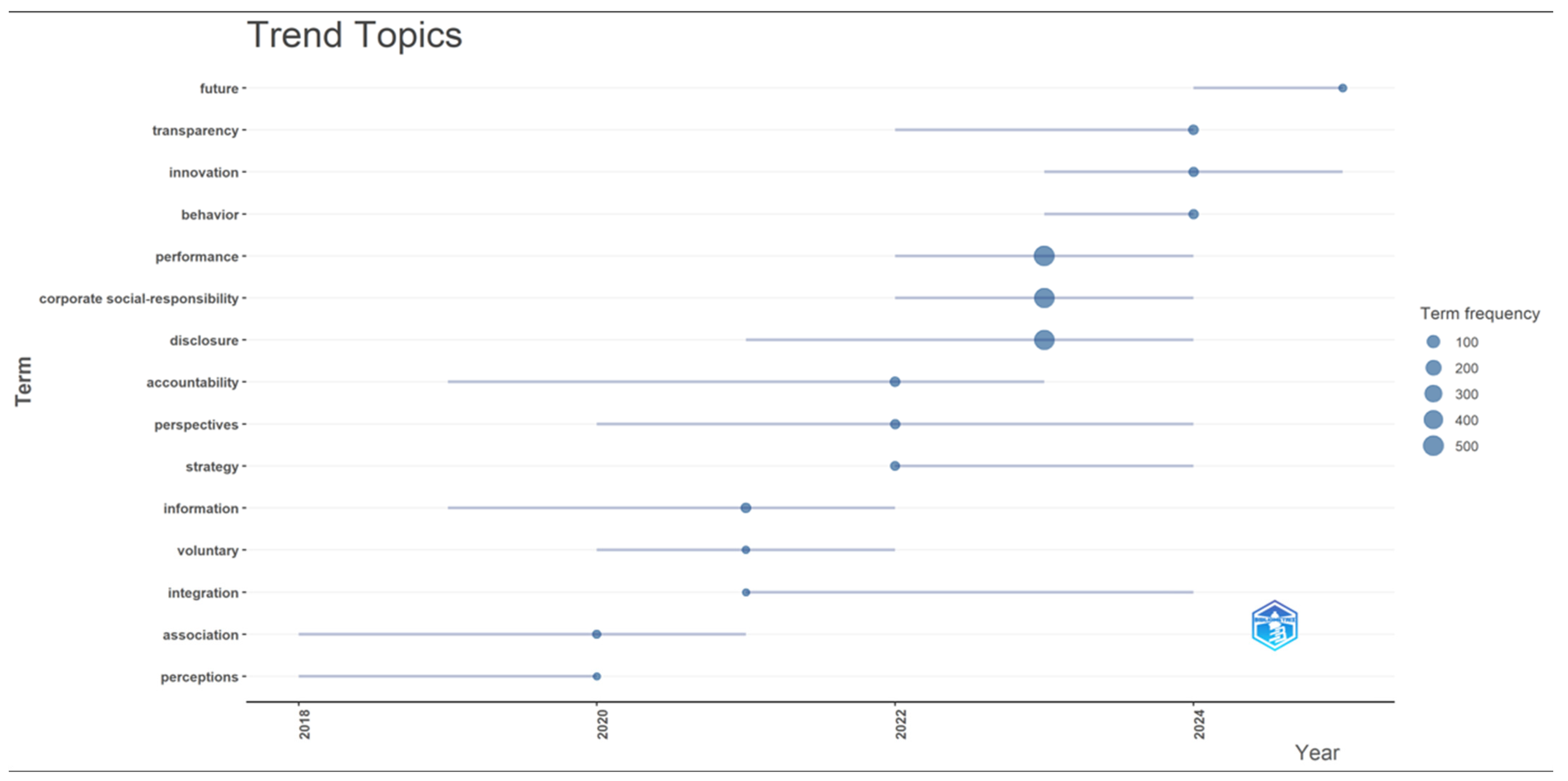
Figure 4 and Figure 5 highlight the evolving intellectual structure of sustainability reporting research, where disclosure, performance, and corporate social responsibility (CSR) dominate both frequency and visibility. These themes peaked between 2021 and 2022, reflecting the surge in global ESG debates, regulatory reforms, and investor-driven demand for transparency (Mion & Loza Adaui, 2019; Rusu et al., 2024). Governance also features prominently, underscoring the role of internal oversight mechanisms and accountability structures in shaping disclosure quality (Ammer et al., 2020; Jamil et al., 2021). The keyword cloud reinforces these findings, positioning performance, disclosure, and governance as conceptual anchors within the field.
Emerging topics revealed important shifts in scholarly priorities. Innovation first appeared in 2013, rose sharply in 2017, and has re-emerged in recent years, closely linked to digitalization, integrated reporting, and AI-driven analytics (Luo & Tang, 2023; Novicka & Volkova, 2025). Transparency gained prominence after 2020, aligning with growing debates on credibility and comparability as regulators sought harmonized frameworks such as the EU’s CSRD and ISSB standards (Afolabi, 2022; Pantazi, 2024). Accountability demonstrates consistent attention from 2019 to 2023, reflecting the convergence of governance and legitimacy concerns in ensuring meaningful disclosure (Hummel & Schlick, 2016). More recently, the appearance of “strategy” in 2022 signals a turn toward viewing sustainability reporting not merely as compliance but as a strategic instrument for competitive positioning and long-term value creation (Porter & Kramer, 2006; Darnall et al., 2022).

5.3. Thematic Map

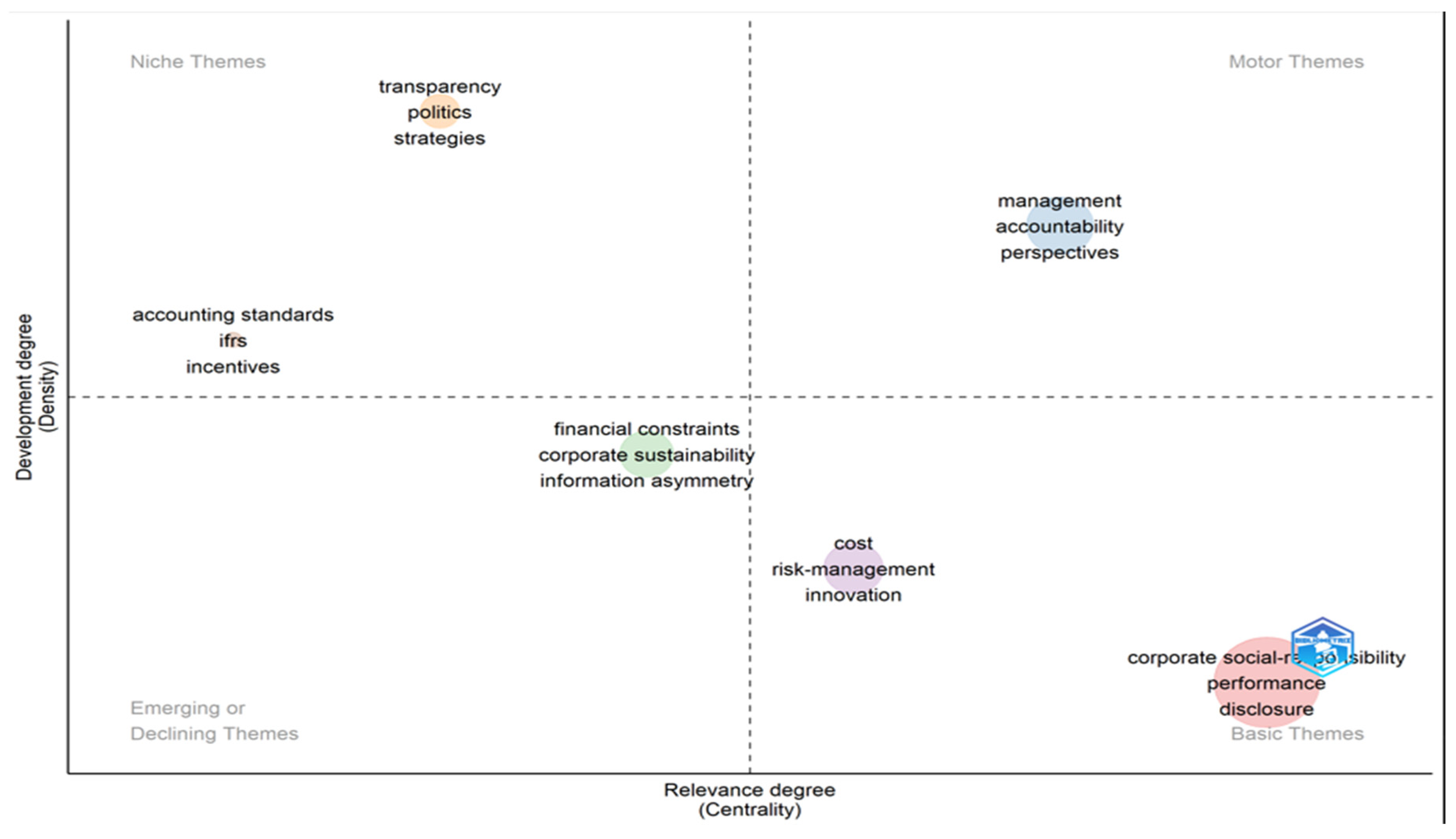
Figure 6 presents the thematic map derived from keyword co-occurrence analysis, with centrality on the horizontal axis representing a theme’s relevance to the broader field, and density on the vertical axis capturing the degree of its internal development.
The analysis below synthesizes the most relevant studies within each thematic cluster, thereby providing a structured literature review aligned with the bibliometric mapping. To ensure that the review captures both influence and quality, the selection of studies is guided primarily by their citation impact, reflecting their recognition and uptake within the scholarly community. Organizing the literature in this way allows us to highlight not only the conceptual foundations of each cluster and its related themes but also the empirical evidence that has shaped subsequent debates, ensuring coherence between the bibliometric results and the qualitative synthesis that follows.

5.4. Cluster-Based Literature Review by Research Problem

  • Basic theme cluster
The basic theme cluster corresponds to the core research focus on the drivers of sustainability disclosure, integrating CSR, performance, and the determinants of transparency. Positioned at high centrality but moderate density on the thematic map, it reflects strong connectivity with the broader literature while remaining conceptually open to refinement. These studies collectively highlight how regulatory frameworks, stakeholder pressures, and digitalization shape disclosure quality and accountability—concepts grounded in voluntary disclosure and legitimacy theories (Clarkson et al., 2008; Rezaee & Tuo, 2017).
Network and country collaboration analyses (Table A1) revealed that European and Asian institutions—particularly those from Italy, China, and India—dominate this research stream, often focusing on comparative policy and market effects. Keyword evolution patterns showed that CSR and performance have remained persistent anchors since 2012, while digitalization, transparency, and ESG integration emerged after 2018, mirroring the rise in technology-enabled disclosure and harmonization initiatives such as the CSRD and ISSB. Within this cluster, scholars progressively link CSR and disclosure performance to institutional and technological enablers. Early studies emphasized voluntary reporting and reputation management, whereas more recent contributions associate disclosure with financial resilience, governance quality, and innovation capacity. Digitalization now functions both as an enabler of real-time, standardized reporting and as a source of emerging challenges related to data reliability and verification. In this sense, reporting is no longer conceptualized as a static communication instrument but as an embedded managerial process integrated into performance evaluation and strategic oversight.
Closely connected to these dynamics are transitional themes such as cost efficiency, risk management, and innovation, which extend sustainability disclosure into the broader domain of financial resilience. Positioned near the center of the thematic map, these themes display increasing centrality, indicating their emerging structural importance within the field. Although still evolving, they demonstrated strong potential to develop into motor themes as scholarship on financial risk exposure, ESG integration, and digital transformation continues to expand (Christensen et al., 2021; Novicka & Volkova, 2025).
Empirical evidence indicates that high-quality sustainability reporting can reduce firms’ cost of capital by lowering information asymmetry, improving credit ratings, and building investor confidence (Raimo et al., 2021; Krueger et al., 2024). Simultaneously, robust disclosure practices mitigate financial and reputational risks, enhancing resilience in sectors such as banking and energy (Orazalin & Mahmood, 2020; Agnese & Giacomini, 2023). Innovation further reinforces this relationship: ESG reporting, when paired with green technologies and process innovation, enhances long-term performance while aligning firms with policy-driven transitions such as local green finance initiatives (Xue et al., 2023). Collectively, these findings illustrate both the opportunities and structural tensions embedded in sustainability reporting. While the integration of cost efficiency, risk mitigation, and innovation underscores its strategic and financial relevance, it also introduces challenges related to enforcement heterogeneity, sectoral disparities, and short-term performance trade-offs. Taken together, CSR drivers, regulatory pressures, digitalization, and cost–risk–innovation mechanisms position sustainability disclosure as a central yet evolving governance practice requiring continuous adaptation to institutional and market dynamics.
  • Motor theme cluster
The positioning of “management,” “accountability,” and “perspectives” in the upper-right quadrant confirms their status as motor themes—conceptually mature and highly central to the field (Table A2). This placement underscores their role in shaping the evolution of sustainability disclosure research and reflects the increasing integration of governance perspectives into reporting practices. Empirical evidence demonstrates that accountability mechanisms and board-level oversight enhance disclosure credibility and reporting quality (Ammer et al., 2020; Jamil et al., 2021; Arkoh et al., 2024). These findings indicate a structural shift from symbolic or voluntary disclosure toward governance-embedded and performance-integrated reporting systems. Earlier work by Hummel and Schlick (2016) documented reciprocal relationships between CSR performance and disclosure, while Fernandez-Feijoo et al. (2014) highlighted stakeholder pressure as a determinant of transparency. Together, these studies suggest that disclosure evolves from a reputational exercise into a management practice rooted in accountability, oversight, and stakeholder alignment.
Thus, the motor theme status of management and accountability reflects both conceptual consolidation and practical diffusion. Sustainability disclosure is increasingly positioned as a strategic driver of value creation and legitimacy, with governance and accountability acting as the connective tissue between stakeholder expectations, regulatory demands, and organizational performance.
  • Niche theme cluster
Niche themes—including transparency, politics, strategies, and accounting standards—appear in the upper-left quadrant of the thematic map, reflecting domains that are well-developed but less central to the overall structure of the sustainability disclosure literature. Their positioning suggests that although these themes are not primary drivers of the field, they offer specialized insights into institutional and regulatory dynamics.
These topics align closely with regulatory and institutional perspectives, where comparative and policy-oriented studies examine how political structures, governance frameworks, and strategic responses shape disclosure practices (Table A3). For instance, Afolabi (2022) and Pantazi (2024) emphasize the influence of political institutions and emerging regulatory agendas on transparency mandates, while Baldini et al. (2018) and Jackson et al. (2020) demonstrate how country-level institutional diversity explains cross-national variation in disclosure quality and scope. The accounting standards theme reinforces the regulatory dimension of sustainability disclosure by highlighting how IFRS incentives, harmonization efforts, and standard-setting processes directly shape credibility and comparability. Studies such as Hummel and Rötzel (2019), Zimon et al. (2022) and Afolabi et al. (2023) show that mandatory disclosure requirements and competition among standard setters significantly influence firms’ approaches to ESG transparency.
This cluster occupies a transitional position. While harmonization initiatives such as the ISSB and the EU CSRD strengthen comparability and enhance disclosure credibility, persistent regulatory fragmentation constrains their effectiveness and risks reinforcing symbolic compliance (Cordazzo et al., 2020). Without consistent enforcement and aligned incentives, firms may revert to minimal or strategic disclosure, thereby limiting improvements in information asymmetry and financing efficiency. The relative maturity of these niche themes underscores their analytical depth within specialized regulatory and institutional contexts. Comparative analyses of disclosure regulation, attention to political incentives, and strategic responses—such as greenwashing (Santos et al., 2024) or proactive ESG positioning (Z. Chen & Xie, 2022)—demonstrate that, although less central, these domains provide important insights into the structural conditions shaping reporting behavior. Similarly, research on accounting standards shows that adoption depends not only on firm-level characteristics or market pressures but also on the institutional authority of standard setters and the rigor of enforcement mechanisms. This perspective highlights that sustainability reporting adoption is contingent on political structures, governance incentives, and the credibility provided by internationally recognized accounting rules.
Taken together, transparency, politics, strategies, and accounting standards extend sustainability disclosure research beyond performance-centered analyses. They illustrate how institutional contexts, political priorities, and standard-setting dynamics interact with firm-level strategic behavior to shape global reporting practices. At the same time, these themes expose persistent structural tensions—political contestation, competing frameworks, and institutional heterogeneity—that coexist with opportunities for harmonization, enhanced comparability, and strategic differentiation in sustainability reporting.
  • Emerging/declining theme cluster
The financial constraints cluster intersects strongly with debates on corporate sustainability and information asymmetry, emphasizing how disclosure quality influences firms’ access to capital. Empirical evidence shows that high-quality ESG reporting reduces opacity and lowers financing costs, particularly in emerging markets characterized by credit frictions (Christensen et al., 2021; Tsang et al., 2023). This helps explain why financially constrained firms may adopt sustainability reporting strategically to attract investment and meet lenders’ expectations. Additional studies demonstrate that ESG disclosure enhances stock liquidity (M. Chen et al., 2023) and generates positive market reactions (K. Y. Lo & Kwan, 2017), connecting this cluster directly to opportunities and challenges in the evolution of sustainability reporting (Table A4). Positioned as a transitional theme, this cluster connects financial constraints with disclosure practices but remains in the process of consolidating around global accounting standardization and IFRS-aligned sustainability frameworks.
These findings indicated that, while financial constraints are likely to remain an important driver of corporate disclosure decisions, the long-term effectiveness of accounting standards in reducing information asymmetry ultimately depends on the consistent implementation and rigorous enforcement of global sustainability frameworks, including the ISSB standards and the EU CSRD.

6. Conclusions and Future Agenda

This study examined the drivers, dynamics, and challenges of sustainability reporting across evolving financial, regulatory, and technological contexts through a bibliometric analysis of 683 publications. The analysis revealed four interrelated thematic clusters reflecting the field’s theoretical and practical evolution. Basic themes—CSR, disclosure, and performance—remain foundational, capturing firms’ responses to stakeholder pressure, legitimacy concerns, and voluntary disclosure motives. Digitalization has emerged as a transformative enabler, enhancing comparability and stakeholder engagement but raising challenges of data reliability and verification.
Transitional themes encompassing cost efficiency, risk management, and innovation extend the debate toward financial resilience, providing cumulative evidence that robust ESG reporting is associated with lower financing costs, reduced risk exposure, and enhanced innovation capacity. Motor themes—management, accountability, and governance—indicated the field’s maturation toward performance-integrated, governance-driven reporting, where board oversight and assurance mechanisms enhance credibility. Niche themes, including transparency and accounting standards, and financial constraints, revealed persistent institutional fragmentation yet underscore the growing influence of global harmonization efforts such as the ISSB and CSRD.
Finally, emerging yet transitional themes such as financial constraints highlight how disclosure mitigates information asymmetry, reduces financing costs, and improves liquidity, particularly in emerging markets. However, the continued prominence of this theme depends on the extent to which regulatory convergence translates into consistent enforcement and measurable improvements in reporting comparability.
Overall, sustainability reporting has evolved from a voluntary CSR initiative to a multidimensional field shaped by governance, regulation, markets, and digital transformation. Persistent fragmentation, greenwashing, and inconsistent enforcement highlight the urgency for regulatory convergence, credible assurance mechanisms, and technology-enabled reporting frameworks. Strengthening these pillars will ensure that sustainability disclosure functions as a robust instrument for transparency, accountability, and long-term value creation rather than symbolic compliance.
The findings carry important managerial and policy implications. For regulators, the harmonization of disclosure standards and the promotion of interoperability across frameworks such as the ISSB, CSRD, and IFRS are essential for enhancing comparability and enforcement. Greater alignment among global initiatives would reduce reporting fragmentation and improve the reliability of cross-border disclosures. For investors, the systematic integration of ESG data into valuation models and risk assessments can enhance capital allocation efficiency while incentivizing firms to engage in credible and decision-useful reporting. From a corporate perspective, embedding sustainability disclosure within governance structures and leveraging digital tools such as iXBRL, blockchain, and AI analytics can strengthen transparency, streamline assurance processes, and build stakeholder trust. At the policy level, targeted capacity-building initiatives are needed, particularly in emerging markets, to address disparities in reporting infrastructure and the quality of external verification.
As with any bibliometric study, reliance on co-word analysis limits theoretical depth and interpretative nuance. Future research should therefore complement bibliometric mapping with systematic reviews, longitudinal designs, and qualitative case-based approaches to provide richer explanatory insights. Such integration would strengthen the link between macro-level market dynamics, organizational adoption mechanisms, and the evolving opportunities and constraints of sustainability reporting, enabling the field to move beyond descriptive mapping toward theory-informed and practice-relevant contributions.
The evolving nature of sustainability reporting also opens several avenues for further research. One critical direction concerns the development of standardized metrics that link disclosure quality to long-term financial, social, and environmental outcomes. Such efforts would enable more rigorous evaluation of the substantive impact of sustainability reporting beyond compliance. Another promising line of inquiry involves examining how governance structures, assurance practices, and cultural contexts shape the transition from symbolic to substantive disclosure in the context of growing regulatory convergence under frameworks such as the EU CSRD and the ISSB. Moreover, the accelerating digital transformation of reporting—driven by AI-assisted analytics, blockchain verification, and machine-readable taxonomies—warrants closer investigation, particularly regarding its implications for credibility, inclusivity, and data integrity in emerging markets where institutional capacity remains uneven.
In integrating bibliometric evidence with conceptual reflection, this study advances understanding of sustainability reporting as an evolving interdisciplinary domain situated at the intersection of governance, finance, and digitalization. Continued collaboration among scholars, practitioners, and policymakers is essential to ensure that future reporting practices are not only harmonized and credible but also technologically adaptive, empirically grounded, and capable of supporting transparent and accountable corporate behavior.
By integrating bibliometric evidence with conceptual synthesis, this study advances understanding of sustainability reporting as an evolving interdisciplinary domain situated at the intersection of governance, finance, and digitalization. Sustained collaboration among scholars, practitioners, and policymakers will be essential to ensure that reporting frameworks are not only harmonized and credible, but also technologically adaptive, empirically grounded, and capable of supporting transparent corporate accountability.
The analysis was limited to English-language publications indexed in the Web of Science database. This restriction may have led to the exclusion of relevant studies published in other languages or indexed in other databases, such as Scopus. Future research could expand the methodological approach by including additional languages and databases to provide a more comprehensive overview of the scientific literature on sustainability reporting. It would also be interesting to compare the results obtained from different databases in order to assess the consistency and robustness of the findings.


Author Contributions

Conceptualization, H.Z.; Methodology, T.E.G.; Software, T.E.G.; Validation, A.N. and T.E.G.; Formal Analysis, H.Z.; Investigation, A.N.; Resources, A.N.; Data Curation, A.N.; Writing—Original Draft Preparation, A.N. and T.E.G.; Writing—Review & Editing, H.Z.; Visualization, A.N., H.Z. and T.E.G. All authors have read and agreed to the published version of the manuscript.

Funding

This research received no external funding.

Institutional Review Board Statement

Not applicable.

Informed Consent Statement

Not applicable.

Data Availability Statement

Bibliometric data employed in this work were retrieved from the Web of Science database and can be provided by the corresponding author upon reasonable request. The full list of keywords used in the search is available from the corresponding author upon request.

Conflicts of Interest

The authors declare no conflicts of interest.

Abbreviations

The following abbreviations are used in this manuscript:
ESGenvironmental, social, and governance
GRIGlobal Reporting Initiative
IIRCInternational Integrated Reporting Council
SASBSustainability Accounting Standards Board
CSRDCorporate Sustainability Reporting Directive
ADXAbu Dhabi Securities Exchange
NLPnatural language processing
CSRcorporate social responsibility

Appendix A

Table A1. Corporate Social Responsibility, Disclosure and Financial Factors as Fundamental Drivers of Sustainability reporting: Evidence from Key Studies.
Major ThemeRelated Themes
(Performance/Disclosure)
Main Studies and Findings
Corporate Social ResponsibilityESG Performance and Value CreationFatemi et al. (2018) demonstrate that ESG performance increases firm value only when paired with transparent, credible disclosure, highlighting disclosure quality as a moderator.
Banking and Financial PerformanceBuallay (2019) finds that in European banks, sustainability reporting is strongly associated with improved financial performance, framing disclosure as a strategic tool.
Performance–Disclosure LinkHummel and Schlick (2016) provide evidence of a reciprocal relationship: firms with stronger CSR activities disclose more, and disclosure itself reinforces legitimacy and trust.
Performance/Islamic Banking ContextPlatonova et al. (2018) conclude that CSR disclosure in GCC Islamic banks positively influences financial outcomes, reflecting how ethical finance principles align with stakeholder expectations.
Disclosure/Debt FinancingRaimo et al. (2021) show that ESG disclosure reduces firms’ cost of debt, confirming that creditors value transparency and sustainability information is financially material.
Disclosure/UN SDGs IntegrationTsalis et al. (2020) highlight that integrating SDGs into corporate reports raises governance and measurement challenges in aligning practices with global goals.
Board Governance and disclosureArayssi et al. (2020) demonstrate that board independence and financial expertise significantly increase ESG disclosure in GCC firms.
Assurance and CredibilityGarcía-Sánchez et al. (2019) show that high-quality assurance enhances ESG report credibility, improving financing access and stakeholder trust.
Performance/MENAT BanksEl Khoury et al. (2023) find a nonlinear ESG–performance relationship: moderate ESG improves profitability, but excessive ESG may reduce short-term returns.
Disclosure/Innovation LinkKhanchel et al. (2023) demonstrate that ESG disclosure combined with green innovation produces superior performance, bridging transparency and innovation outcomes.
CostReporting BurdenStolowy and Paugam (2018) conclude that expansion of non-financial reporting strengthens accountability but also raises compliance costs, questioning efficiency vs. transparency.
Cross-listing and Capital CostsYu and Luu (2021) find that cross-listed companies disclose more ESG information, with transparency linked to lower capital costs due to international investor scrutiny.
Mandatory Disclosure and EnforcementKrueger et al. (2024) demonstrate that mandatory ESG disclosure lowers financing costs only when strong institutional enforcement is present.
Australia CaseBachoo et al. (2013) show that in Australia, high-quality sustainability reports enhance firm value and reduce capital costs, proving financial materiality.
Investment EfficiencyEllili (2022) concludes that ESG disclosure reduces financing frictions and improves investment efficiency by mitigating information asymmetry.
Risk management/Debt and Equity CostsShad et al. (2020) demonstrate that sustainability disclosure reduces both cost of debt and equity, lowering overall financing costs by reducing risk perceptions.
Risk Management/Portfolio EfficiencyIazzolino et al. (2023) show that incorporating ESG factors improves portfolio efficiency and delivers superior risk-adjusted returns.
Policy-Finance-InnovationXue et al. (2023) demonstrate that local green finance policies drive ESG performance improvements, reduce financing costs, and stimulate corporate innovation.
Sector-specific RiskOrazalin and Mahmood (2020) conclude that in oil & gas, sustainability indicators enhance financial stability and reduce default risk, highlighting sectoral materiality.
Risk management/Bank Funding CostsAgnese and Giacomini (2023) find that ESG practices reduce banks’ funding costs, demonstrating that sustainability lowers financial risk and strengthens resilience.
Source: Authors’ own work.
Table A2. Management and Accountability Perspectives as Driving Concepts in Sustainability Disclosure: Evidence from Key Studies.
Major ThemeRelated Themes
(Accountability/Perspective)
Main Studies and Findings
ManagementStakeholder salience, legitimacy, institutional embeddingHahn and Kühnen (2013) conduct a comprehensive review of sustainability reporting determinants. They identified stakeholder salience, legitimacy, and institutional embedding as key drivers, and stressed the need for theoretical grounding and a stronger focus on disclosure quality over quantity, positioning CSR reporting as institutionally embedded.
ESG–performance link (context-dependent)Khan (2022) performs a meta-analysis of ESG–performance studies. The study demonstrates a generally positive relationship but one that varies across contexts. It emphasizes bias, methodological inconsistencies, and endogeneity, concluding that ESG improves outcomes but impact depends on institutional and regional conditions.
Decision-usefulness, assurance credibilityArvidsson and Dumay (2022) argue that ESG disclosure must move beyond compliance to be decision useful. They show that integration of KPIs and financial metrics enhances quality, while assurance mechanisms strengthen credibility, reduce boilerplate, and position ESG data as a strategic resource.
CSR integration in management control systemsMaas et al. (2016) develop a framework linking CSR strategy with management accounting and control. They demonstrate how KPIs, incentives, and budgets embed sustainability into strategy, creating measurable links between sustainability objectives and financial performance.
Financial materiality, governance, TCFDO’Dwyer and Unerman (2020) analyze the TCFD framework. They show how reframing sustainability reporting as financial risk and governance strengthens accountability. The study highlighted that scenario analysis aligns climate/ESG with investor priorities, elevating them to matters of strategic oversight.
Regulation, comparability, digitalizationLa Torre et al. (2020b) examine the EU NFRD/CSRD. They find that regulation enforces comparability and accountability but risks boilerplate. The study concluded that digital filing and XBRL enhance accessibility and oversight.
Global standards, materiality clarityDe Villiers et al. (2022) investigate GRI/ISSB developments. They emphasize clarity around materiality and the need for interoperability to ensure disclosure quality, arguing that international standardization remains a pressing challenge.
Assurance and integrated thinkingBaboukardos et al. (2021) demonstrate that assurance combined with integrated reporting strengthens investor trust, enhances legitimacy, and embeds accountability within organizational culture.
NGOs, voluntary regimes, enforcementSchleifer et al. (2019) study voluntary ESG regimes. They show that credibility depends on monitoring, verification, and sanctioning, concluding that voluntary approaches are fragile without strong enforcement.
Regulation–practice interactionImperiale et al. (2023) conduct a utilities sector study. They find that ESG disclosure quality improves when KPIs are systematically embedded into performance management, demonstrating how regulation interacts with internal practices.
Global South institutional influenceDissanayake et al. (2021) examine governance traditions and institutional contexts in the Global South. They show how these factors shape heterogeneous CSR disclosure practices, often constrained by limited resources and weak regulation.
SOEs, materiality alignmentRuiz-Lozano et al. (2022) analyze state-owned enterprises. They find that materiality processes are applied inconsistently, revealing weak alignment between disclosure and performance, and pointing to the need for formalized systems.
ESG–IFRS integrationWagenhofer (2024) theorizes the convergence of ESG with IFRS reporting. The study argued that financially material ESG issues should be integrated into financial statements, reinforcing the relevance of ESG data.
Regulatory pressure, sector contextZhao et al. (2018) investigate the Chinese power sector. They find that regulatory pressure shapes ESG–performance links, concluding that sector-specific regulation decisively influences disclosure quality and outcomes.
Firm heterogeneity in ESG valueAzikiwe Abdi et al. (2022) show that firm size and age moderate the ESG–value link. They demonstrate that larger, mature firms better translate ESG into financial value, while smaller firms struggle due to resource constraints and perception barriers.
Source: Authors’ own work.
Table A3. Regulatory, Institutional and Strategic Dimensions of Sustainability Disclosure: Key Studies and Findings.
Major ThemeRelated Themes
(Politics/Strategies)
Main Studies and Findings
TransparencyInstitutional determinants, stakeholder salienceHahn and Kühnen (2013) provide a systematic review of determinants shaping sustainability reporting, highlighting transparency as both an outcome of stakeholder and institutional pressures and a mechanism to enhance legitimacy. They emphasize the need for theoretical grounding and improved measures of disclosure quality, noting that transparency is central to bridging organizational practice with societal expectations.
ESG–performance link, disclosure credibilityKhan (2022) conducts a meta-analysis of ESG–performance studies, showing that transparent ESG disclosure generally strengthens performance outcomes. However, the effect is context-dependent and shaped by methodological biases and disclosure credibility, underlining the importance of transparency as a moderating factor in assessing ESG impact.
Comparability, investor use of informationArvidsson and Dumay (2022) argue that transparency in ESG disclosure must shift from quantity to quality to enhance decision-usefulness for investors. They highlight that comparative and reliable disclosures reduce information asymmetries and enhance capital allocation efficiency, thereby reinforcing the strategic role of transparency in sustainability reporting.
Institutional diversity, global regulationLa Torre et al. (2020a) examine transparency under regulatory diversity, noting that while mandatory disclosure regimes enhance comparability, they also risk boilerplate reporting. Their findings suggest transparency must be supported by enforcement and assurance mechanisms to ensure credibility across institutional contexts.
Accounting StandardsIFRS incentives, managerial behaviorAmer et al. (2025) investigate how IFRS-based incentives influence corporate disclosure practices, showing that standard-setting enhances transparency and aligns managerial behavior with reputational incentives. They argue that accounting standards act as accountability mechanisms that reinforce disclosure credibility.
Mandatory disclosure effectsHummel and Rötzel (2019) provide evidence from the UK that mandatory sustainability disclosure requirements increased transparency and comparability. However, they caution that while accounting standards enforce disclosure, the quality and depth depend on institutional monitoring and corporate governance commitment.
Incentives/Harmonization and competing standardsAfolabi (2022) explores the challenges of global harmonization in sustainability reporting, highlighting political struggles among competing standard setters. They conclude that while harmonization can improve transparency, institutional diversity and competing interests risk fragmentation of accountability practices.
Incentives/Enforcement and comparabilityPrather-Kinsey et al. (2022) propose enforcement mechanisms to enhance global IFRS comparability, arguing that without robust enforcement, the transparency and accountability benefits of standardization remain limited. Their findings underscore the role of accounting standards as both technical and institutional instruments of governance.
Source: Authors’ own work.
Table A4. Financial Market and Capital Constraints as Drivers of Sustainability Disclosure: Key Studies and Findings.
Major ThemeRelated Themes (CSR and Information Asymmetry)Main Studies and Findings
Financial ConstraintsMandatory CSR/Reporting regulationChristensen et al. (2021) review mandatory CSR/sustainability reporting. They conclude that such regulation reduces information asymmetry, improves transparency, and eases financing frictions.
ESG disclosure literatureTsang et al. (2023) conduct a literature review showing that ESG disclosure mitigates capital constraints by lowering opacity, though benefits depend on credibility and assurance.
ESG disclosure, performanceMohammad and Wasiuzzaman (2021) provide evidence from Malaysia demonstrating that ESG disclosure enhances competitive advantage and performance, easing funding constraints in emerging markets.
Market response to ESG initiativesK. Y. Lo and Kwan (2017) find positive stock market reactions to ESG initiatives, suggesting that investors value transparency and reduce capital restrictions for proactive firms.
Non-financial information directiveCordazzo et al. (2020) show that the EU directive on non-financial reporting improves the value relevance of ESG disclosure; firms face lower cost of equity through reduced asymmetry.
Board governance and disclosureSuttipun (2021) demonstrates that board composition drives ESG disclosure among Thai firms, signaling quality to capital providers and alleviating constraints.
Local government sustainability reportingNiemann and Hoppe (2018) find that sustainability reporting in European local governments acts as a tool for legitimacy and resource allocation, reducing constraints in the public sector.
ESG performance vs. financial performanceJyoti and Khanna (2021) provide evidence from Indian service firms showing that sustainability performance positively impacts financial performance, reducing financing barriers.
ESG reporting determinantsAbdul Rahman and Alsayegh (2021) identify firm-level determinants (size, governance, risk) of ESG reporting; conclude that stronger disclosure improves access to finance.
ESG standardsCort and Esty (2020) discuss challenges in ESG standard-setting; highlight comparability as key to lowering information risk and financing costs.
ESG disclosure & liquidityM. Chen et al. (2023) find that ESG disclosure improves stock liquidity in China, showing reduced information asymmetry and easier access to equity markets.
Materiality & sustainabilityCalabrese et al. (2019) show that materiality analysis guides firms toward decision-useful disclosures, helping align capital allocation with sustainability.
Accounting-based performance & ESGKumar and Firoz (2022) demonstrate that accounting-based financial performance measures value ESG disclosure, confirming its role in reducing capital frictions.
Credit risk & reporting qualityAkins (2018) shows that financial reporting quality reduces uncertainty about credit risk, highlighting how robust disclosure lowers borrowing costs.
Divergence of ESG ratingsLiu (2022) finds that divergence in ESG ratings creates uncertainty for investors, sustaining financing constraints unless disclosure is standardized.
Source: Authors’ own work.

References

  1. Abdul Rahman, R., & Alsayegh, M. F. (2021). Determinants of corporate environment, social and governance (ESG) reporting among Asian firms. Journal of Risk and Financial Management, 14(6), 167. [Google Scholar] [CrossRef]
  2. Afolabi, H. (2022). Harmonization of sustainability reporting regulation. Sustainability, 14(9), 5517. [Google Scholar] [CrossRef]
  3. Afolabi, H., Ram, R., & Rimmel, G. (2023). Influence and behaviour of the new standard setters in the sustainability reporting arena: Implications for the Global Reporting Initiative’s current position. Sustainability Accounting, Management and Policy Journal, 14(4), 743–775. [Google Scholar] [CrossRef]
  4. Agnese, P., & Giacomini, E. (2023). Bank’s funding costs: Do ESG factors really matter? Finance Research Letters, 51, 103437. [Google Scholar] [CrossRef]
  5. Akins, B. (2018). Financial reporting quality and uncertainty about credit risk among ratings agencies. The Accounting Review, 93(4), 1–22. [Google Scholar] [CrossRef]
  6. Amer, A. M. M., Azimli, A., & Adedokun, M. W. (2025). Earnings management and IFRS adoption influence on corporate sustainability performance: The moderating roles of institutional ownership and board independence. Sustainability, 17(17), 7981. [Google Scholar] [CrossRef]
  7. Ammer, M. A., Aliedan, M. M., & Alyahya, M. A. (2020). Do corporate environmental sustainability practices influence firm value? The role of independent directors: Evidence from Saudi Arabia. Sustainability, 12(22), 9768. [Google Scholar] [CrossRef]
  8. Arayssi, M., Jizi, M., & Tabaja, H. H. (2020). The impact of board composition on the level of ESG disclosures in GCC countries. Sustainability Accounting, Management and Policy Journal, 11(1), 137–161. [Google Scholar] [CrossRef]
  9. Aria, M., & Cuccurullo, C. (2017). Bibliometrix: An R-tool for comprehensive science mapping analysis. Journal of Informetrics, 11(4), 959–975. [Google Scholar] [CrossRef]
  10. Arkoh, P., Costantini, A., & Scarpa, F. (2024). Determinants of sustainability reporting: A systematic literature review. Corporate Social Responsibility and Environmental Management, 31(3), 1578–1597. [Google Scholar] [CrossRef]
  11. Arvidsson, S., & Dumay, J. (2022). Corporate ESG reporting quantity, quality and performance: Where to now for environmental policy and practice? Business Strategy and the Environment, 31(3), 1091–1110. [Google Scholar] [CrossRef]
  12. Azikiwe Abdi, Y., Li, X., & Cámara-Turull, X. (2022). Exploring the impact of sustainability (ESG) disclosure on firm value and financial performance (FP) in the airline industry: The moderating role of size and age. Environment, Development and Sustainability, 24(4), 5052–5079. [Google Scholar] [CrossRef]
  13. Baboukardos, D., Mangena, M., & Ishola, A. (2021). Integrated thinking and sustainability reporting assurance: International evidence. Business Strategy and the Environment, 30(4), 1580–1597. [Google Scholar] [CrossRef]
  14. Bachoo, K., Tan, R., & Wilson, M. (2013). Firm value and the quality of sustainability reporting in Australia. Australian Accounting Review, 23(1), 67–87. [Google Scholar] [CrossRef]
  15. Baldini, M., Dal Maso, L., Liberatore, G., Mazzi, F., & Terzani, S. (2018). Role of country- and firm-level determinants in environmental, social, and governance disclosure. Journal of Business Ethics, 150(1), 79–98. [Google Scholar] [CrossRef]
  16. Benameur, K. B., Mostafa, M. M., Hassanein, A., Shariff, M. Z., & Al-Shattarat, W. (2024). Sustainability reporting scholarly research: A bibliometric review and a future research agenda. Management Review Quarterly, 74(2), 823–866. [Google Scholar] [CrossRef]
  17. Bilal, B., Gerged, A. M., Arslan, H. M., Abbas, A., Chen, S., & Manzoor, S. (2024). A bibliometric review of corporate environmental disclosure literature. Journal of Accounting Literature, 46(2), 214–237. [Google Scholar] [CrossRef]
  18. Bose, S., Khan, H. Z., & Monem, R. M. (2021). Does green banking performance pay off? Evidence from a unique regulatory setting in Bangladesh. Corporate Governance: An International Review, 29(2), 162–187. [Google Scholar] [CrossRef]
  19. Botica Redmayne, N., Laswad, F., & Ehalaiye, D. (2021). Evidence on the costs of changes in financial reporting frameworks in the public sector. Public Money & Management, 41(5), 368–375. [Google Scholar] [CrossRef]
  20. Börner, K., Chen, C., & Boyack, K. W. (2003). Visualizing knowledge domains. Annual Review of Information Science and Technology, 37(1), 179–255. [Google Scholar] [CrossRef]
  21. Buallay, A. (2019). Is sustainability reporting (ESG) associated with performance? Evidence from the European banking sector. Management of Environmental Quality: An International Journal, 30(1), 98–115. [Google Scholar] [CrossRef]
  22. Calabrese, A., Costa, R., Levialdi Ghiron, N., & Menichini, T. (2019). Materiality analysis in sustainability reporting: A tool for directing corporate sustainability towards emerging economic, environmental and social opportunities. Technological and Economic Development of Economy, 25(5), 746–768. [Google Scholar] [CrossRef]
  23. Chen, M., Yang, D., Zhang, W., & Wang, Q. (2023). How does ESG disclosure improve stock liquidity for enterprises? Environmental Impact Assessment Review, 97, 107005. [Google Scholar] [CrossRef]
  24. Chen, Z., & Xie, G. (2022). ESG disclosure and financial performance: Moderating role of ESG investors. International Review of Financial Analysis, 83, 102291. [Google Scholar] [CrossRef]
  25. Chopra, M., Saini, N., Kumar, S., Varma, A., Mangla, S. K., & Lim, W. M. (2021). Past, present, and future of knowledge management for business sustainability. Journal of Cleaner Production, 328, 129592. [Google Scholar] [CrossRef]
  26. Christensen, H. B., Hail, L., & Leuz, C. (2021). Mandatory CSR and sustainability reporting: Economic analysis and literature review. Review of Accounting Studies, 26(3), 1176–1248. [Google Scholar] [CrossRef]
  27. Clarkson, P. M., Li, Y., Richardson, G. D., & Vasvari, F. P. (2008). Revisiting the relation between environmental performance and environmental disclosure: An empirical analysis. Accounting, Organizations and Society, 33(4–5), 303–327. [Google Scholar] [CrossRef]
  28. Cobo, M. J., López-Herrera, A. G., Herrera-Viedma, E., & Herrera, F. (2011). An approach for detecting, quantifying, and visualizing the evolution of a research field: A practical application to the fuzzy sets theory field. Journal of Informetrics, 5(1), 146–166. [Google Scholar] [CrossRef]
  29. Cordazzo, M., Bini, L., & Marzo, G. (2020). Does the EU directive on non-financial information influence the value relevance of ESG disclosure? Italian evidence. Business Strategy and the Environment, 29(6), 2403–2416. [Google Scholar] [CrossRef]
  30. Cort, T., & Esty, D. (2020). ESG standards: Looming challenges and pathways forward. Organization & Environment, 33(4), 493–502. [Google Scholar] [CrossRef]
  31. Darnall, N., Ji, H., Iwata, K., & Arimura, T. H. (2022). Do ESG reporting guidelines and verifications enhance firms’ information disclosure? Corporate Social Responsibility and Environmental Management, 29(5), 1214–1230. [Google Scholar] [CrossRef]
  32. Della Corte, V., Del Gaudio, G., Sepe, F., & Sciarelli, F. (2019). Sustainable tourism in the open innovation realm: A bibliometric analysis. Sustainability, 11(21), 6114. [Google Scholar] [CrossRef]
  33. Delmas, M. A., & Toffel, M. W. (2008). Organizational responses to environmental demands: Opening the black box. Strategic Management Journal, 29(10), 1027–1055. [Google Scholar] [CrossRef]
  34. De Villiers, C., La Torre, M., & Molinari, M. (2022). The Global Reporting Initiative’s (GRI) past, present and future: Critical reflections and a research agenda on sustainability reporting (standard-setting). Pacific Accounting Review, 34(5), 728–747. [Google Scholar] [CrossRef]
  35. Dhaliwal, D. S., Li, O. Z., Tsang, A., & Yang, Y. G. (2011). Voluntary nonfinancial disclosure and the cost of equity capital: The initiation of corporate social responsibility reporting. The Accounting Review, 86(1), 59–100. [Google Scholar] [CrossRef]
  36. Dharmani, P., Das, S., & Prashar, S. (2021). A bibliometric analysis of creative industries: Current trends and future directions. Journal of Business Research, 135, 252–267. [Google Scholar] [CrossRef]
  37. DiMaggio, P. J., & Powell, W. W. (1983). The iron cage revisited: Institutional isomorphism and collective rationality in organizational fields. American Sociological Review, 48(2), 147–160. [Google Scholar] [CrossRef]
  38. Dissanayake, D., Kuruppu, S., Qian, W., & Tilt, C. (2021). Barriers for sustainability reporting: Evidence from Indo-Pacific region. Meditari Accountancy Research, 29(2), 264–293. [Google Scholar] [CrossRef]
  39. Diwan, H., & Amarayil Sreeraman, B. (2024). From financial reporting to ESG reporting: A bibliometric analysis of the evolution in corporate sustainability disclosures. Environment, Development and Sustainability, 26(6), 13769–13805. [Google Scholar] [CrossRef]
  40. Donthu, N., Kumar, S., Mukherjee, D., Pandey, N., & Lim, W. M. (2021). How to conduct a bibliometric analysis: An overview and guidelines. Journal of Business Research, 133, 285–296. [Google Scholar] [CrossRef]
  41. Du, K., & Wu, S.-J. (2019). Does external assurance enhance the credibility of CSR reports? Evidence from CSR-related misconduct events in Taiwan. Auditing: A Journal of Practice & Theory, 38(4), 101–130. [Google Scholar] [CrossRef]
  42. Eccles, R. G., Ioannou, I., & Serafeim, G. (2014). The impact of corporate sustainability on organizational processes and performance. Management Science, 60(11), 2835–2857. [Google Scholar] [CrossRef]
  43. El Khoury, R., Nasrallah, N., & Alareeni, B. (2023). ESG and financial performance of banks in the MENAT region: Concavity–convexity patterns. Journal of Sustainable Finance & Investment, 13(1), 406–430. [Google Scholar] [CrossRef]
  44. Ellili, N. O. D. (2022). Impact of ESG disclosure and financial reporting quality on investment efficiency. Corporate Governance: The International Journal of Business in Society, 22(5), 1094–1111. [Google Scholar] [CrossRef]
  45. Fatemi, A., Glaum, M., & Kaiser, S. (2018). ESG performance and firm value: The moderating role of disclosure. Global Finance Journal, 38, 45–64. [Google Scholar] [CrossRef]
  46. Fekete, H., Kuramochi, T., Roelfsema, M., den Elzen, M., Forsell, N., Höhne, N., Luna, L., van Soest, H. L., & Vandyck, T. (2021). A review of successful climate change mitigation policies in major emitting economies and the potential of global replication. Renewable and Sustainable Energy Reviews, 137, 110602. [Google Scholar] [CrossRef]
  47. Feldhütter, P., Halskov, K., & Krebbers, A. (2024). Pricing of sustainability-linked bonds. Journal of Financial Economics, 162, 103944. [Google Scholar] [CrossRef]
  48. Fernandez-Feijoo, B., Romero, S., & Ruiz, S. (2014). Effect of stakeholders’ pressure on transparency of sustainability reports within the GRI framework. Journal of Business Ethics, 122(1), 53–63. [Google Scholar] [CrossRef]
  49. Flammer, C. (2021). Corporate green bonds. Journal of Financial Economics, 142(2), 499–516. [Google Scholar] [CrossRef]
  50. García-Sánchez, I.-M., Hussain, N., Martínez-Ferrero, J., & Ruiz-Barbadillo, E. (2019). Impact of disclosure and assurance quality of corporate sustainability reports on access to finance. Corporate Social Responsibility and Environmental Management, 26(4), 832–848. [Google Scholar] [CrossRef]
  51. Grewal, J., Riedl, E. J., & Serafeim, G. (2019). Market reaction to mandatory nonfinancial disclosure. Management Science, 65(7), 3061–3084. [Google Scholar] [CrossRef]
  52. Hahn, R., & Kühnen, M. (2013). Determinants of sustainability reporting: A review of results, trends, theory, and opportunities in an expanding field of research. Journal of Cleaner Production, 59, 5–21. [Google Scholar] [CrossRef]
  53. Hart, S. L. (1995). A natural-resource-based view of the firm. Academy of Management Review, 20(4), 986–1014. [Google Scholar] [CrossRef]
  54. Hassanein, A., Bani-Mustafa, A., & Nimer, K. (2024). A country’s culture and reporting of sustainability practices in energy industries: Does a corporate sustainability committee matter? Humanities and Social Sciences Communications, 11(1), 1140. [Google Scholar] [CrossRef]
  55. Hu, D., & Gan, C. (2025). Green finance development and its origin, motives, and barriers: An exploratory study. Environment, Development and Sustainability, 1–25. [Google Scholar] [CrossRef]
  56. Hummel, K., & Rötzel, P. (2019). Mandating the sustainability disclosure in annual reports—Evidence from the United Kingdom. Schmalenbach Business Review, 71(2), 205–247. [Google Scholar] [CrossRef]
  57. Hummel, K., & Schlick, C. (2016). The relationship between sustainability performance and sustainability disclosure—Reconciling voluntary disclosure theory and legitimacy theory. Journal of Accounting and Public Policy, 35(5), 455–476. [Google Scholar] [CrossRef]
  58. Iazzolino, G., Bruni, M. E., Veltri, S., Morea, D., & Baldissarro, G. (2023). The impact of ESG factors on financial efficiency: An empirical analysis for the selection of sustainable firm portfolios. Corporate Social Responsibility and Environmental Management, 30(4), 1917–1927. [Google Scholar] [CrossRef]
  59. Ikpor, I. M., Bracci, E., Kanu, C. I., Ievoli, R., Okezie, B., Mlanga, S., & Ogbaekirigwe, C. (2022). Drivers of sustainability accounting and reporting in emerging economies: Evidence from Nigeria. Sustainability, 14(7), 3780. [Google Scholar] [CrossRef]
  60. Imperiale, F., Pizzi, S., & Lippolis, S. (2023). Sustainability reporting and ESG performance in the utilities sector. Utilities Policy, 80, 101468. [Google Scholar] [CrossRef]
  61. Jackson, G., Bartosch, J., Avetisyan, E., Kinderman, D., & Knudsen, J. S. (2020). Mandatory non-financial disclosure and its influence on CSR: An international comparison. Journal of Business Ethics, 162(2), 323–342. [Google Scholar] [CrossRef]
  62. Jamil, A., Mohd Ghazali, N. A., & Puat Nelson, S. (2021). The influence of corporate governance structure on sustainability reporting in Malaysia. Social Responsibility Journal, 17(8), 1251–1278. [Google Scholar] [CrossRef]
  63. Jyoti, G., & Khanna, A. (2021). Does sustainability performance impact financial performance? Evidence from Indian service sector firms. Sustainable Development, 29(6), 1175–1187. [Google Scholar] [CrossRef]
  64. Khan, M. A. (2022). ESG disclosure and firm performance: A bibliometric and meta-analysis. Research in International Business and Finance, 61, 101668. [Google Scholar] [CrossRef]
  65. Khanchel, I., Lassoued, N., & Baccar, I. (2023). Sustainability and firm performance: The role of environmental, social and governance disclosure and green innovation. Management Decision, 61(9), 2720–2739. [Google Scholar] [CrossRef]
  66. Kosi, U., & Relard, P. (2024). Are firms (getting) ready for the corporate sustainability reporting directive? Sustainability Nexus Forum, 32, 5. [Google Scholar] [CrossRef]
  67. Krueger, P., Sautner, Z., Tang, D. Y., & Zhong, R. (2024). The effects of mandatory ESG disclosure around the world. Journal of Accounting Research, 62(5), 1795–1847. [Google Scholar] [CrossRef]
  68. Kumar, P., & Firoz, M. (2022). Does accounting-based financial performance value environmental, social and governance (ESG) disclosures? A detailed note on a corporate sustainability perspective. Australasian Accounting, Business and Finance Journal, 16(1), 41–72. [Google Scholar] [CrossRef]
  69. La Torre, M., Dumay, J., Rea, M. A., & Abhayawansa, S. (2020a). A journey towards a safe harbour: The rhetorical process of standard setting in sustainability reporting. The British Accounting Review, 52(2), 100836. [Google Scholar] [CrossRef]
  70. La Torre, M., Sabelfeld, S., Blomkvist, M., & Dumay, J. (2020b). Rebuilding trust: Sustainability and non-financial reporting and the European Union regulation. Meditari Accountancy Research, 28(5), 701–725. [Google Scholar] [CrossRef]
  71. Liu, M. (2022). Quantitative ESG disclosure and divergence of ESG ratings. Frontiers in Psychology, 13, 867302. [Google Scholar] [CrossRef]
  72. Lo, K. Y., & Kwan, C. L. (2017). The effect of environmental, social, governance and sustainability initiatives on stock value: Examining market response to initiatives undertaken by listed companies. Corporate Social Responsibility and Environmental Management, 24(6), 606–619. [Google Scholar] [CrossRef]
  73. Lo, S. F., & Sheu, H. J. (2007). Is corporate sustainability a value-increasing strategy for business? Corporate Governance: An International Review, 15(2), 345–358. [Google Scholar] [CrossRef]
  74. Luo, L., & Tang, Q. (2023). The real effects of ESG reporting and GRI standards on carbon mitigation: International evidence. Business Strategy and the Environment, 32(6), 2985–3000. [Google Scholar] [CrossRef]
  75. Maas, K., Schaltegger, S., & Crutzen, N. (2016). Integrating corporate sustainability assessment, management accounting, control, and reporting. Journal of Cleaner Production, 136, 237–248. [Google Scholar] [CrossRef]
  76. Matakanye, R. M., van der Poll, H. M., & Muchara, B. (2021). Do companies in different industries respond differently to stakeholders’ pressures when prioritising Environmental, Social and Governance sustainability performance? Sustainability, 13(21), 12022. [Google Scholar] [CrossRef]
  77. Mion, G., & Loza Adaui, C. R. (2019). Mandatory nonfinancial disclosure and its consequences on the sustainability reporting quality of Italian and German companies. Sustainability, 11(17), 4612. [Google Scholar] [CrossRef]
  78. Mohammad, W. M. W., & Wasiuzzaman, S. (2021). ESG disclosure, competitive advantage and performance of firms in Malaysia. Cleaner Environmental Systems, 2, 100015. [Google Scholar] [CrossRef]
  79. Mongeon, P., & Paul-Hus, A. (2016). The journal coverage of Web of Science and Scopus: A comparative analysis. Scientometrics, 106(1), 213–228. [Google Scholar] [CrossRef]
  80. Moussa, A. S., & Elmarzouky, M. (2024). Beyond compliance: How ESG reporting influences the cost of capital in UK firms. Journal of Risk and Financial Management, 17(8), 326. [Google Scholar] [CrossRef]
  81. Muñoz, P., Janssen, F., Nicolopoulou, K., & Hockerts, K. (2018). Advancing sustainable entrepreneurship through substantive research. International Journal of Entrepreneurial Behavior & Research, 24(2), 322–332. [Google Scholar] [CrossRef]
  82. Niemann, L., & Hoppe, T. (2018). Sustainability reporting by local governments: A magic tool? Lessons on use and usefulness from European pioneers. Public Management Review, 20(1), 201–223. [Google Scholar] [CrossRef]
  83. Novicka, J., & Volkova, T. (2025). Regulation of sustainability reporting requirements—Digitalization path. Sustainability, 17(1), 138. [Google Scholar] [CrossRef]
  84. O’Dwyer, B., & Unerman, J. (2020). Shifting the focus of sustainability accounting from impacts to risks and dependencies: Researching the transformative potential of TCFD reporting. Accounting, Auditing & Accountability Journal, 33(5), 1113–1141. [Google Scholar] [CrossRef]
  85. Orazalin, N., & Mahmood, M. (2020). Determinants of GRI-based sustainability reporting: Evidence from an emerging economy. Journal of Accounting in Emerging Economies, 10(1), 140–164. [Google Scholar] [CrossRef]
  86. Pantazi, T. (2024). The introduction of mandatory corporate sustainability reporting in the EU and the question of enforcement. European Business Organization Law Review, 25, 509–532. [Google Scholar] [CrossRef]
  87. Pellegrini, M. M., Ciampi, F., Marzi, G., & Orlando, B. (2020). The relationship between knowledge management and leadership: Mapping the field and providing future research avenues. Journal of Knowledge Management, 24(6), 1445–1492. [Google Scholar] [CrossRef]
  88. Platonova, E., Asutay, M., Dixon, R., & Mohammad, S. (2018). The impact of corporate social responsibility disclosure on financial performance: Evidence from the GCC Islamic banking sector. Journal of Business Ethics, 151(2), 451–471. [Google Scholar] [CrossRef]
  89. Porter, M. E., & Kramer, M. R. (2006). Strategy and society: The link between competitive advantage and corporate social responsibility. Harvard Business Review, 84(12), 78–92. [Google Scholar]
  90. Prather-Kinsey, J., De Luca, F., & Phan, H.-T. P. (2022). Improving the global comparability of IFRS-based financial reporting through global enforcement: A proposed organizational dynamic. International Journal of Disclosure and Governance, 19(3), 330–351. [Google Scholar] [CrossRef]
  91. Raimo, N., Caragnano, A., Zito, M., Vitolla, F., & Mariani, M. (2021). Extending the benefits of ESG disclosure: The effect on the cost of debt financing. Corporate Social Responsibility and Environmental Management, 28(4), 1412–1421. [Google Scholar] [CrossRef]
  92. Raimo, N., Vitolla, F., Marrone, A., & Rubino, M. (2020). The role of ownership structure in integrated reporting policies. Business Strategy and the Environment, 29(6), 2238–2250. [Google Scholar] [CrossRef]
  93. Rezaee, Z., & Tuo, L. (2017). Voluntary disclosure of non-financial information and its association with sustainability performance. Advances in Accounting, 39, 47–59. [Google Scholar] [CrossRef]
  94. Ruiz-Lozano, M., de Vicente-Lama, M., Tirado-Valencia, P., & Cordobés-Madueño, M. (2022). The disclosure of the materiality process in sustainability reporting by Spanish state-owned enterprises. Accounting, Auditing & Accountability Journal, 35(2), 385–412. [Google Scholar] [CrossRef]
  95. Rusu, T. M., Odagiu, A., Pop, H., & Paulette, L. (2024). Sustainability performance reporting. Sustainability, 16(19), 8538. [Google Scholar] [CrossRef]
  96. Santos, C., Coelho, A., & Marques, A. (2024). A systematic literature review on greenwashing and its relationship to stakeholders: State of art and future research agenda. Management Review Quarterly, 74(3), 1397–1421. [Google Scholar] [CrossRef]
  97. Schleifer, P., Fiorini, M., & Auld, G. (2019). Transparency in transnational governance: The determinants of information disclosure of voluntary sustainability programs. Regulation & Governance, 13(4), 488–506. [Google Scholar] [CrossRef]
  98. Shaban, O. S., & Barakat, A. (2023). The impact of sustainability reporting on a company’s financial performance: Evidence from the emerging market. Journal of Governance & Regulation, 12(4), 306–314. [Google Scholar] [CrossRef]
  99. Shad, M. K., Lai, F. W., Shamim, A., & McShane, M. (2020). The efficacy of sustainability reporting towards cost of debt and equity reduction. Environmental Science and Pollution Research, 27(18), 22511–22522. [Google Scholar] [CrossRef]
  100. Shepherd, D. A., & Patzelt, H. (2011). The new field of sustainable entrepreneurship: Studying entrepreneurial action linking “what is to be sustained” with “what is to be developed”. Entrepreneurship Theory and Practice, 35(1), 137–163. [Google Scholar] [CrossRef]
  101. Siao, H.-J., Gau, S.-H., Kuo, J.-H., Li, M.-G., & Sun, C.-J. (2022). Bibliometric analysis of environmental, social, and governance management research from 2002 to 2021. Sustainability, 14(23), 16121. [Google Scholar] [CrossRef]
  102. Stolowy, H., & Paugam, L. (2018). The expansion of non-financial reporting: An exploratory study. Accounting & Business Research, 48(5), 525–548. [Google Scholar] [CrossRef]
  103. Sun, Z., Zhao, L., Mehrotra, A., Salam, M. A., & Yaqub, M. Z. (2025). Digital transformation and corporate green innovation: An affordance theory perspective. Business Strategy and the Environment, 34(1), 433–449. [Google Scholar] [CrossRef]
  104. Suttipun, M. (2021). The influence of board composition on environmental, social and governance (ESG) disclosure of Thai listed companies. International Journal of Disclosure and Governance, 18, 391–402. [Google Scholar] [CrossRef]
  105. Tsalis, T. A., Malamateniou, K. E., Koulouriotis, D., & Nikolaou, I. E. (2020). New challenges for corporate sustainability reporting: United Nations’ 2030 Agenda for sustainable development and the sustainable development goals. Corporate Social Responsibility and Environmental Management, 27(4), 1617–1629. [Google Scholar] [CrossRef]
  106. Tsang, A., Frost, T., & Cao, H. (2023). Environmental, social, and governance (ESG) disclosure: A literature review. The British Accounting Review, 55(3), 101134. [Google Scholar] [CrossRef]
  107. Van Eck, N. J., & Waltman, L. (2010). Software survey: VOSviewer, a computer program for bibliometric mapping. Scientometrics, 84(2), 523–538. [Google Scholar] [CrossRef] [PubMed]
  108. Wagenhofer, A. (2024). Sustainability reporting: A financial reporting perspective. Accounting in Europe, 21(1), 1–13. [Google Scholar] [CrossRef]
  109. Web of Science. (2025, August 20). Smart search. Available online: https://webofscience.zendesk.com/hc/en-us/articles/32587676013713-Smart-Search (accessed on 20 September 2025).
  110. Xiao, G., Pan, L., & Lai, F. (2025). Application, opportunities, and challenges of digital technologies in the decarbonizing shipping industry: A bibliometric analysis. Frontiers in Marine Science, 12, 1523267. [Google Scholar] [CrossRef]
  111. Xue, Q., Wang, H., & Bai, C. (2023). Local green finance policies and corporate ESG performance. International Review of Finance, 23(4), 721–749. [Google Scholar] [CrossRef]
  112. Yu, E. P.-Y., & Luu, B. V. (2021). International variations in ESG disclosure—Do cross-listed companies care more? International Review of Financial Analysis, 75, 101731. [Google Scholar] [CrossRef]
  113. Zhao, C., Guo, Y., Yuan, J., Wu, M., Li, D., Zhou, Y., & Kang, J. (2018). ESG and corporate financial performance: Empirical evidence from China’s listed power generation companies. Sustainability, 10(8), 2607. [Google Scholar] [CrossRef]
  114. Zimon, G., Arianpoor, A., & Salehi, M. (2022). Sustainability reporting and corporate reputation: The moderating effect of CEO opportunistic behavior. Sustainability, 14(3), 1257. [Google Scholar] [CrossRef]
Figure 1. Workflow of the Bibliometric Literature Selection. Source: Authors’ own work.
Ijfs 14 00082 g001
Figure 2. Annual production. Source: Authors’ own work using Bibliometrix R package.
Ijfs 14 00082 g002
Figure 3. Production evolution of the 5 most productive sources. Source: Authors’ own work using Bibliometrix R package.
Ijfs 14 00082 g003
Figure 4. Keywords cloud. Source: Authors’ own work using Bibliometrix R package.
Ijfs 14 00082 g004
Figure 5. Trend topics. Source: Authors’ own work using Bibliometrix R package.
Ijfs 14 00082 g005
Figure 6. Thematic evolution over time based on keyword plus. Source: Authors’ own work using Bibliometrix R package.
Ijfs 14 00082 g006
Table 1. Comparative Summary of Key Recent Bibliometric Studies on Sustainability Reporting.
StudyDatabase/SourceSample SizeFocus/Methodological ScopeIdentified Gaps and Limitations
Raimo et al. (2021)Web of Science512Mapping sustainability disclosure within financial markets.Strong on regulation–culture link; limited technological dimension.
Bose et al. (2021)Scopus342ESG disclosure in banking; regulatory and normative forces.No integration of innovation or digital reporting.
Siao et al. (2022)Web of Science3559Bibliometric analysis of ESG-management research (2002–2021).Broad thematic coverage but limited link to firm-level outcomes and regional institutional factors.
Ellili (2022)Scopus161Bibliometric and content review of ESG-disclosure papers (2010–2021).Small-scale dataset; limited cross-country comparison and insufficient linkage to regulatory reforms.
Bilal et al. (2024)Multi-source (215 journals)560Corporate-environmental-disclosure bibliometric review (1982–2020).Fragmented theoretical coverage; no integration with sustainability-reporting frameworks or post-2020 ESG trends.
Benameur et al. (2024)Scopus1053Science-mapping of sustainability-reporting scholarship (2000–2022).Lacks integration of financial disclosure mechanisms and digital-reporting innovation.
Diwan and Amarayil Sreeraman (2024)Web of Science/Springer931PRISMA-guided bibliometric review tracing shift from financial to ESG reporting (2000–2023).Focuses on theoretical evolution but omits integration of financial markets and digitalization.
Source: Authors’ own work.
Table 2. Sample Keywords by Research Question (Bibliometric Analysis).
Research ProblemsSample Keywords
QR1“financial market sustainability initiatives”, “sustainable finance regulation”, “stock exchange ESG requirements”, “investor-driven ESG disclosure”, “financial regulation and corporate ESG practices”, “sustainability indices and reporting behavior”, etc.
QR2“drivers of sustainability reporting”, “firm characteristics and ESG disclosure”, “stakeholder pressure and sustainability reporting”, “institutional theory and ESG adoption”, “regulatory pressure and non-financial disclosure”, etc.
QR3“challenges in sustainability reporting”, “greenwashing and ESG credibility”, “standardization of sustainability reporting”, “assurance of sustainability reports”, “value creation through ESG reporting”, “risks of poor ESG disclosure”, etc.
Source: Authors’ own work.
Table 3. Database description.
DescriptionResults
Timespan2006:2025
Sources (Journals, Books, etc.)262
Documents683
Annual Growth Rate %27.22
Document Average Age2.54
Average citations per doc28.57
References29,652
DOCUMENT CONTENTS
Keywords Plus (ID)1051
Author’s Keywords (DE)1667
AUTHORS
Authors1807
Authors of single-authored docs88
AUTHORS COLLABORATION
Single-authored docs94
Co-Authors per Doc2.89
International co-authorships %27.53
DOCUMENT TYPES
article592
article; early access49
review39
review; early access3
Source: Authors’ own work using Bibliometrix R package.
Table 4. Top 10 relevant sources on sustainable reporting.
SourcesArticles
Sustainability83
Corporate Social Responsibility and Environmental Management32
Finance Research Letters22
Business Strategy and the Environment21
Journal of Cleaner Production19
Meditari Accountancy Research17
Sustainability Accounting Management and Policy Journal15
International Journal of Disclosure and Governance11
Journal of Financial Reporting and Accounting11
International Review of Economics & Finance9
Source: Authors’ own work using Bibliometrix R package.
Table 5. Top 10 most cited documents on sustainable reporting.
PaperTotal
Citations
TC per YearNormalized TC
Hahn, R., & Kühnen, M. (2013). Determinants of sustainability reporting: A review of results, trends, theory, and opportunities in an expanding field of research. Journal of Cleaner Production, 59, 5–21. https://doi.org/10.1016/j.jclepro.2013.07.00589869.082.69
Fatemi, A., Glaum, M., & Kaiser, S. (2018). ESG performance and firm value: The moderating role of disclosure. Global Finance Journal, 38, 45–64. https://doi.org/10.1016/j.gfj.2017.03.00163679.505.11
Christensen, H. B., Hail, L., & Leuz, C. (2021). Mandatory CSR and sustainability reporting: economic analysis and literature review. Review of Accounting Studies, 26(3), 1176–1248. https://doi.org/10.1007/s11142-021-09609-544388.608.64
Baldini, M., Maso, L. D., Liberatore, G., Mazzi, F., & Terzani, S. (2018). Role of country-and firm-level determinants in environmental, social, and governance disclosure. Journal of Business Ethics, 150(1), 79–98. https://doi.org/10.1007/s10551-016-3139-143153.883.47
Chen, Z., & Xie, G. (2022). ESG disclosure and financial performance: Moderating role of ESG investors. International Review of Financial Analysis, 83, 102291. https://doi.org/10.1016/j.irfa.2022.102291426106.5011.49
Buallay, A. (2019). Is sustainability reporting (ESG) associated with performance? Evidence from the European banking sector. Management of Environmental Quality: An International Journal, 30(1), 98–115. https://doi.org/10.1108/MEQ-12-2017-014940257.437.39
Fernandez-Feijoo, B., Romero, S., & Ruiz, S. (2014). Effect of stakeholders’ pressure on transparency of sustainability reports within the GRI framework. Journal of Business Ethics, 122(1), 53–63. https://doi.org/10.1007/s10551-013-1748-534128.421.71
Tsalis, T. A., Malamateniou, K. E., Koulouriotis, D., & Nikolaou, I. E. (2020). New challenges for corporate sustainability reporting: United Nations’ 2030 Agenda for sustainable development and the sustainable development goals. Corporate Social Responsibility and Environmental Management, 27(4), 1617–1629. https://doi.org/10.1002/csr.191032454.004.73
Hummel, K., & Schlick, C. (2016). The relationship between sustainability performance and sustainability disclosure—Reconciling voluntary disclosure theory and legitimacy theory. Journal of Accounting and Public Policy, 35(5), 455–476. https://doi.org/10.1016/j.jaccpubpol.2016.06.00131931.902.03
Alsayegh, M. F., Abdul Rahman, R., & Homayoun, S. (2020). Corporate economic, environmental, and social sustainability performance transformation through ESG disclosure. Sustainability, 12(9), 3910. https://doi.org/10.3390/su1209391031352.174.57
Source: Authors’ own work using Bibliometrix R package.
Table 6. Countries classification by corresponding authors, publications, and citations.
Corresponding AuthorsPublicationsCitations
CountryArticlesCountryFrequencyCountryTotal CitationsAverage Article Citations
China 88China213Italy235240.60
India59Italy123China205723.40
Italy58India116USA202469.80
Malaysia34Malaysia75Germany179789.80
United Kingdom29USA75United Kingdom151052.10
USA29United Kingdom65India106818.10
Australia28Australia57Australia75026.80
Spain24Indonesia45Malaysia 64318.90
Saudi Arabia22Saudi Arabia44Spain54622.80
Germany20Spain44Italy50723.00
Source: Authors’ own work using Bibliometrix R package.
Disclaimer/Publisher’s Note: The statements, opinions and data contained in all publications are solely those of the individual author(s) and contributor(s) and not of MDPI and/or the editor(s). MDPI and/or the editor(s) disclaim responsibility for any injury to people or property resulting from any ideas, methods, instructions or products referred to in the content.