Article

Beyond the Playing Field: Financial Literacy Competencies for Professional Athletes in Team Sports


Department of Management Accounting, University of South Africa, Pretoria 0002, South Africa
Int. J. Financ. Stud. 2026, 14(3), 68; https://doi.org/10.3390/ijfs14030068
Submission received: 8 January 2026 / Revised: 14 February 2026 / Accepted: 27 February 2026 / Published: 5 March 2026
(This article belongs to the Special Issue Sports Finance (2nd Edition))

Abstract

The importance of financial literacy for professional athletes is undeniable. This study aimed to build on previous research by identifying the financial literacy content areas that require the highest level of competence for professional athletes competing in team sports. To address this, 12 structured one-on-one interviews were conducted with a purposively selected sample of participants drawn from a network of potential actors capable of influencing the financial decisions of professional athletes, as informed by Actor-Network Theory. The research findings show that skills to avoid unethical behaviour, the acumen to navigate the transition to a post-sports career, savings and financial control are the content areas that require a higher level of competence. This study innovatively visualizes research findings through a heatmap to identify and prioritize focus areas. This study offers insights that may assist professional athletes to reduce their exposure to financial risks. The study may also engage sport’s governing bodies, professional clubs, players’ associations, researchers, and financial advisors aiming to deepen their knowledge of the financial literacy competencies required by professional athletes.

1. Introduction

Insufficient financial literacy and misguided financial decisions frequently result in adverse outcomes for individuals and the broader economy, posing a persistent global challenge (Goyal & Kumar, 2020). Financial literacy encompasses an individual’s ability to comprehend and efficiently manage their financial resources towards long-term financial security and financial well-being (Huston, 2010). The multi-faceted concept of financial literacy is built on the core themes of financial knowledge, self-efficacy, financial attitude, and financial behavior (Goyal & Kumar, 2020). Individuals are faced with many complex financial decisions and financial literacy has emerged as an essential life skill to guide financial choices and foster greater financial wellbeing (Björklund & Sandahl, 2023; Lusardi & Mitchell, 2014).
This, arguably, takes on added significance for professional athletes whose sports careers and psychological well-being are often threatened by age, injuries, and deselection (Schmid et al., 2025; Trainor et al., 2025), while their financial wellbeing is at times jeopardized because they forgo a secure salary and education and take on substantial economic risk to pursue a career in professional sport (Lindt et al., 2025). Although Laschowski and O’Reilly (2025) report than many retired professional athletes’ express satisfaction with their financial well-being and certain financial skills, other scholars argue that professional athletes often lack financial literacy, leaving them vulnerable to financial losses (Balliauw & Van Den Spiegel, 2018; Moolman, 2023; Van Heerden, 2018). Their limited financial literacy has also been linked to inadequate organisational support, with many professional athletes developing financial and self-management skills independently, often relying on self-help resources and learning through trial and error (Hong & Fraser, 2021). Consequently, many of them encounter unique financial challenges upon retirement from professional sport, which often occurs when they are in their thirties and well before the conventional retirement age. This is a concern given that many professional athletes do not plan for life beyond sport and the transition to a new occupation is often complex and difficult (McGraw et al., 2019; Schmid et al., 2025). It is therefore evident that while some earn exorbitant salaries in the multi-billion-dollar global sporting industry, many face distinctive financial circumstances, which highlights the need for more research on this phenomenon and their money management skills (Hong & Fraser, 2021; Ferrel, 2021; Van Heerden, 2018).
While previous research has emphasized the significance of financial literacy for athletes (Hong & Fraser, 2021), there remains a significant gap in understanding the specific content areas that require the highest level of competence. Moolman (2023) developed a financial literacy framework consisting of 20 key content areas for professional athletes. A key takeaway from this study is that professional athletes must develop financial literacy skills, take ownership of their financial planning, and cultivate the ability to seek, evaluate, and implement financial advice effectively. This framework offers a structured approach, specifically designed to address the distinct financial needs of professional athletes competing in a team sports environment. However, it does not distinguish which content areas require a basic or more advanced level of financial literacy skills. Therefore, the following research question was considered: which financial literacy content areas require the highest level of competence from professional athletes competing in team sports?

1.1. Defining Financial Literacy

In their definition the Organisation for Economic Co-operation and Development (OECD, 2016) defines financial literacy as the integration of financial knowledge, a sound financial attitude and behavior that enable individuals to make informed decisions and attain financial well-being. Similarly, Potrich et al. (2016) highlight that financial literacy involves the financial knowledge, self-efficacy (confidence in one’s capacity to handle your personal finances), financial attitude and motivation essential to foster sound financial behavior in pursuit of sustainable and long-term financial well-being. Simply stated, financial literacy equips individuals with the ability to organize their finances and control their expenses to provide financial security after retirement (Goyal & Kumar, 2020).
Although research has consistently shown that financial literacy is low in many parts of the world (Lusardi & Messy, 2023; Lusardi & Mitchell, 2014), the value of financial literacy is clear, since it encourages greater savings, reduced debt exposure and promotes sound financial decisions for wealth accumulation (French & McKillop, 2016; Lyons & Kass-Hanna, 2021; Van Rooij et al., 2024). Moreover, financial literacy skills are becoming essential for making prudent financial decisions, while navigating an increasingly complex economic landscape and being a good citizen (Lusardi & Messy, 2023). The complexity of financial instruments, including new assets like cryptocurrencies, inflation, and growing global uncertainties, for instance climate change and geopolitical conflicts, along with changes to pension plans, highlight the urgent need for people to become more resilient and financially literate to safeguard their well-being (Lusardi & Messy, 2023).

1.2. Financial Literacy Content Areas

The OECD INFE Core Competencies Framework on Financial Literacy for Adults (OECD, 2016) highlight four content areas of financial literacy. The first, “money and transactions”, includes an understanding of the various forms and functions of money, making informed purchasing decisions and maintaining financial records. The second content area is “planning and managing” and relates to day-to-day financial planning competencies. The next content area is “risk and reward” and includes competencies to build a financial buffer and to balance risks and rewards. The last content area refers to the “financial landscape”, which involves understanding the broader financial system, regulatory structures, consumer protection, tax literacy and considerations when accessing financial advice.
While some studies have opted to focus on certain areas such as planning and money management (Lusardi & Mitchell, 2014), or debt literacy (French & McKillop, 2016; Galariotis & Monne, 2023), there remains a paucity of research to show which content areas are more important than others. While financial literacy is a multi-faceted construct, with boundless cognitive and non-cognitive skills and content areas (Lusardi & Mitchell, 2014), understanding which skills are more or less important for a targeted group may aid in better understanding the financial literacy needs of such a group. Essentially, more data are required to gain a better understanding of individuals’ financial decisions and more research is needed to expand knowledge in the field of financial literacy (Du Preez & Ferreira-Schenk, 2024; Van Rooij et al., 2024). This could also further support efforts to develop targeted educational initiatives by identifying key financial education topics that promote long-term financial resilience (Zhang & Chatterjee, 2023). Professional athletes could be seen as such a specific target group and more education initiatives are recommended to improve their financial literacy (Hong & Fraser, 2021). Furthermore, the effects of herding behavior have been observed to influence the financial literacy and retirement planning of a group and influencing some individuals may produce a broader ripple effect in the medium to long-term (Harahap et al., 2022).

1.3. Financial Literacy Needs of Professional Athletes

Despite the unique nature of their circumstances many professional athletes lack essential financial literacy acumen (McGraw et al., 2019). This could lead to poor financial decisions and inadequate attention to medium- and long-term financial well-being (Moolman, 2023; Nashruddin et al., 2026). Van Heerden (2018) reported on the financial challenges and distress faced by various retired athletes, highlighting examples from marathon running, boxing, football, basketball, tennis, and other sports. Brian Mitchell, the former world champion boxer, explains that he was a millionaire at the age of 30, but by 32, he was on the brink of bankruptcy (Van Heerden, 2018). Additionally, United States-based research revealed that 16% of former National Football League (NFL) players filed for bankruptcy within 12 years after ending their professional athletic careers (Carlson et al., 2015). This is underscored by some high-profile bankruptcy cases of former NFL players who despite reported earning up to $80 million during their playing careers struggled to remain financially secure after leaving the sport (Brandner & Omondi-Ochieng, 2022). Balliauw and Van Den Spiegel (2018) also report that one in four football players in Belgium’s top division experience intermittent financial difficulties, which in turn negatively affect their on-field performance. The literature further indicates that retired rugby and cricket players are not immune to financial hardships following the end of their playing careers (Van Reenen, 2012; Vaidya & Natarajan, 2015).
Their financial challenges may be underestimated due to the widespread belief that many receive substantial earnings and should be able to build long-term financial security (Schlesinger et al., 2023). However, the earning of many fall short of the headline-grabbing salaries frequently portrayed in the media, and some struggle with overspending and occasional financial difficulties (Balliauw & Van Den Spiegel, 2018; McGraw et al., 2019). Therefore, only some professional athletes successfully accumulate sustainable wealth during their sport careers (Schlesinger et al., 2023). Given that high-performance sport careers are often relatively short in the broader context of an individual’s working life and many athletes do not earn enough during their playing careers to sustain them, it necessitates a transition to another post-sport career for many (Lindt et al., 2025). This shift to a vocational career after sport, typically at a relatively young age, is often difficult, stressful, and is frequently linked to unemployment and financial distress (McGraw et al., 2019; Van Heerden, 2018). Adding to this challenge is the ongoing shift in responsibility from governments to individuals for financial and retirement planning (Lusardi & Mitchell, 2014; Phelps & Metzler, 2025), which emphasizes the growing need for financial literacy skills.
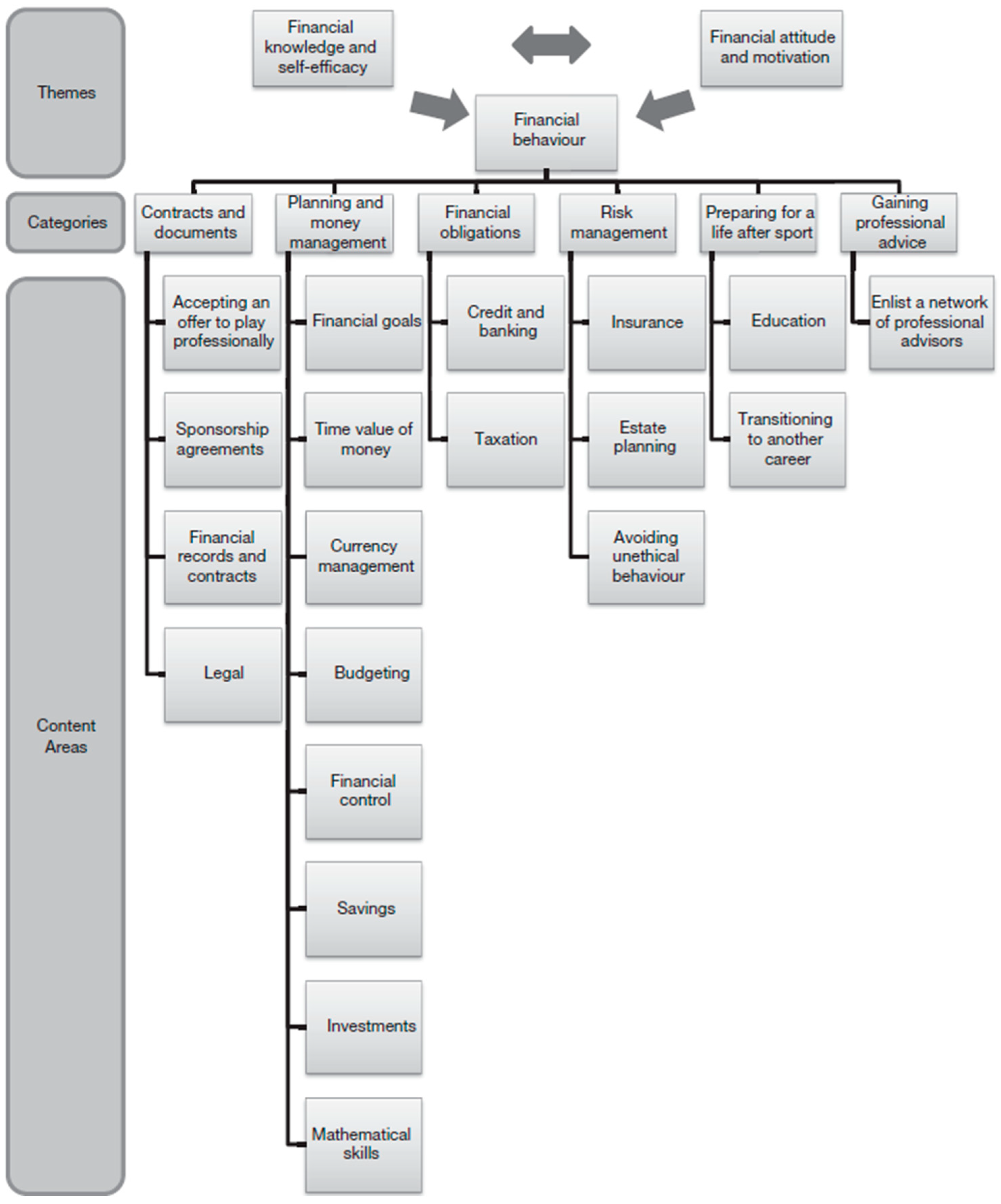
To address the financial challenges faced by this unique group, Moolman (2023), developed a framework based on semi-structured interviews as part of a qualitative study. This framework highlights 20 key content areas that collectively provide a comprehensive overview of the financial literacy skills needed by professional athletes competing in team sports, as illustrated in Figure 1 below. These key content areas call for the application of financial knowledge, self-efficacy, a sound financial attitude and the motivation necessary to translate knowledge into constructive financial behavior.
Despite the framework depicted in Figure 1, there remains a paucity of research on which content areas may be more or less relevant for professional athletes. Goyal and Kumar (2020) also note that more qualitative research is required in the field of financial literacy. To achieve this, the study builds on the research and framework of Moolman (2023). This study aims to offer targeted guidance to professional athletes, their financial advisors, educators, and employers by identifying the fundamental financial literacy content areas most relevant for professional athletes. In addition, this study could inform the development of a tailored financial education initiative, recognizing that financial literacy education is critical to enhance individuals’ financial knowledge and decision-making skills (Huston, 2010). Moreover, education continues to be a prominent and evolving area within financial literacy research (Goyal & Kumar, 2020). Financial education is also critical to increase awareness about the significance of financial literacy and to encourage behavioral change (Lusardi, 2019). Given that perceived knowledge itself is a driver of sound financial behavior (Abreu et al., 2025), sports clubs and organisations should also bear a fundamental responsibility and share good practice to educate and assist professional athletes in their financial management (Hong & Fraser, 2022).

2. Materials and Methods

This deductive qualitative study was undertaken to identify which financial literacy content areas may require a greater level of competence. Previous research and the financial literacy content areas for professional athletes identified by Moolman (2023) underpinned the development of a structured interview schedule to assess the relevance of each financial literacy content area shown in Figure 1 above. The interview schedule included succinct explanations of each content area to advance the credibility and trustworthiness of the research findings. Similar to the study by Moolman (2023), this study focused on professional rugby and cricket players competing in a team sport environment in South Africa. This was deemed to be appropriate because rugby and cricket enjoy worldwide popularity and have been recognized as “professional” sports for decades, allowing players to receive financial rewards and remuneration for their services. Both sports enjoy widespread popularity in South Africa, and the countries triumphs in the 1995, 2007, 2019 and 2023 Rugby World Cups have served as powerful sources of inspiration and unity.

2.1. Research Design—Structured Interviews

Twelve structured one-on-one interviews were conducted in person by the researcher for the purpose of this study. The structured interview schedule included the 20 financial literacy content areas developed by Moolman (2023) and required interviewees to assess and explain whether professional athletes needed to have ‘basic’, ‘competent’ or ‘expert’ financial acumen in each area. The interview schedule guided participants by defining basic financial literacy acumen as familiarity with key features and the ability to recognize when certain actions may be required, which may include consulting with an expert. Competence was described as having the knowledge and motivation to analyze information from different sources, identify priorities and to select appropriate plans of action to effectively manage financial outcomes. Expert skill was characterized by the capacity to draw on prior experience in financial planning and management, with the ability to demonstrate advanced knowledge, motivation, and competence to implement effective courses of action and achieve desired outcomes.
The levels of competency were highlighted in green for ‘basic’, yellow for ‘competent’ and deep orange for ‘expert’ towards developing a heatmap to help with the visualization of the data (Chiu et al., 2023). In black-and-white print, competency levels are distinguished as follows: light gray denotes ‘basic’, medium gray signifies ‘competent’, and dark gray represents ‘expert’. This facilitated the interpretation and ranking of the findings by illustrating the varying levels of skills required through colors. Although heatmaps have been employed to visualize big data and support data analytics (Van Craenendonck et al., 2020), as well as to enhance the explainability, interpretation and understanding of financial analysis, their direct application in finance research remains relatively limited (Chen et al., 2023).
To determine an average skill rating for each content area based on the interviews, a numerical value was assigned to each skill level, namely, 1 for ‘basic’, 2 for ‘competent’ (intermediate) and 3 for ‘expert’. The following formula was then applied to determine a weighted average skill level for each content area.
Average skill rating per content area = (‘Basic’ Ratings × 1 + ‘Competent’ Ratings × 2 + ‘Expert’ Ratings)
/(‘Basic’ Ratings + ‘Competent’ Ratings + ‘Expert’ Ratings)                    
This formula presented a weighted average value between 1 (if all participants selected ‘basic’) and 3 (if all participants placed an emphasis on ‘expert’) as the required level of financial literacy for a professional athlete for each content area. This method created a rating of the content areas according to their discriminatory power, which was then analysed to highlight the most pertinent financial literacy content areas for professional athletes.
To gain more insights during the face-to-face interviews, the researcher encouraged participants to supplement their responses by either writing or verbally elaborating on their assessment of the required level of competence for each financial literacy content area. Participants were encouraged to verbalize their thought processes and explain their reasoning, enabling the researcher to better interpret and understand their responses (Willis, 2005).

2.2. Research Participants and Sampling Method

Drawing on Actor-Network Theory (ANT), the researcher considered a network of potential “actors” capable of influencing a professional athlete’s financial decisions by focusing on the flow of information around the athlete (Latour, 1996; Justesen & Mouritsen, 2011) needed to guide the athlete towards informed financial decisions for financial well-being. These actors were organized into four homogeneous groups. The interviewees or actors in each group were organized based on their shared roles or perspectives. Financial and other advisors made up the first group, leaders of professional sports clubs made up the second group, while educators, researchers and academics specializing in financial management and financial literacy made up the third group, and current and former professional athletes who could act as peers to a professional athlete, as the central figure within this network, made up the fourth group. Gaining insights from these actors was appropriate, as they should understand what level of financial literacy acumen is expected of professional athletes within this network. Since many professional athletes are often young and inexperienced in navigating financial matters (Bass, 2016; McGraw et al., 2019), incorporating the perspectives of multiple potential actors or stakeholders facilitates the identification of knowledge gaps that the athletes may not readily recognize. Experienced advisors and subject-matter experts are often better positioned to highlight common blind spots, while this study still valued and integrated the perspectives and lived experiences of the athletes themselves. Non-human actors such as online tools that may form part of a network of resources offering financial guidance and advice to a professional athlete were not considered for obvious reasons.
As shown in Table 1 below, 12 expert interviewees from the four groups were deemed to be a suitable sample size for gaining sufficient insights and to gather a range of perspectives (Englander, 2019). Moreover, data saturation was achieved after the eleventh interview because no real new insights emerged reflecting the point of information redundancy as described by Braun and Clarke (2019) while acknowledging that data saturation requires subjective judgment and cannot be determined in advance. Purposive sampling was employed, supplemented by snowball sampling, to ensure the inclusion of knowledgably and suitable participants to enrich the research findings (Leonard et al., 2023). Further guided by ANT, quota sampling was employed to guarantee representation across all identified actor groups, thereby reducing selection bias and strengthening the credibility of the findings (Monette et al., 2011). This also allowed for data to be gathered from multiple perspectives. Additionally, many of the interviewees were recognized leaders in their respective fields, possessing extensive exposure alongside relevant professional or personal lived experiences essential to answering the research question of this study. All the participants met the minimum inclusion criterion of having at least two years of domain-specific expertise. All the group 1 professional advisors were also registered with their respective professional or governing bodies related to their profession.
The interviewees in Table 1 were chosen because they characterised expertise, experience, time, reflective capacity, and communication skills relevant to the research question (Morse, 1994).

2.3. Data Collection

The structured interview schedule was initially piloted (Leonard et al., 2023; Potts et al., 2019) with two participants. Feedback from these pilot interviews confirmed that the interview schedule was well-structured and easy to comprehend. Since the interview schedule remained unchanged, the insights gathered were incorporated into the broader research findings. Although a structured interview schedule was employed for the one-on-one in-person interviews based on the content areas depicted in Figure 1, the researcher allowed flexibility for follow-up questions and the inclusion of personal narratives (Sobiech & Leipert, 2021).
Following the data analysis, the size of the sample was re-evaluated and deemed to be adequate because several participants offered recurring insights (Wiltshire & Stevinson, 2018). This aligns with principle in qualitative research that the value of the research is not determined by the number of participants, but by the depth and significance of their responses. The adequacy of the sample was supported by the qualitative focus of this study namely “what is general about a phenomenon” instead of attempting to establish what is generalizable across a population (Englander, 2019). Key ethical principles were also upheld during data collection with measures to safeguard participants’ anonymity and privacy, while ensuring voluntary participation, informed consent and protection from potential discomfort, harm, and victimization (Tracy, 2010). The interviews were scheduled at times and locations that were mutually convenient (Stansen & Chambers, 2019). These measures strengthened the integrity of the research findings and the study received formal approval from the relevant Institutional Research Review Committee.

2.4. Data Analysis

A database of interview transcriptions and responses facilitated a systematic evaluation of the clarity and relevance of expert insights gathered through the structured interviews. Guided by Braun and Clarke (2006), theoretical thematic analysis was applied to analyse the open-ended responses and the rationales underpinning the relevance of specific content areas. This deductive approach was appropriate because the interview questions were based on predefined themes from the literature (Leonard et al., 2023). ATLAS.ti 22 facilitated the analysis of the interview data while a qualitative expert reviewed the preliminary coding, and their suggestions also informed the resulting patterns and themes to limit bias (Williamson et al., 2020). A subsequent concordance meeting demonstrated a high level of agreement in the data analysis, further deepened the primary coder’s understanding of the dataset and ensured that any differences were systematically resolved.
Enumeration was used to condense and refine the interview data enabling clearer interpretations and to extract meaningful insights (Sandelowski et al., 2009). Contrary to the notion that qualitative researchers avoid counting or quantification, Sandelowski (2001) argues that counting plays a valuable role in qualitative analysis. This researcher (2001) explains that numeric scoring can assist researchers in assessing the prevalence or absence of specific events, experiences, or themes. In this study, responses categorized as ‘very relevant’, ‘relevant’, and ‘not relevant’ provided an empirical foundation for the identification of financial literacy content areas that are more relevant for professional athletes. The structured enumeration yielded quantifiable data that facilitated the recognition of response patterns (Leonard et al., 2023; McGreary et al., 2020). Moreover, the in-depth written and oral responses offered by interviewees to provide further insights regarding their ratings were instrumental in identifying the content areas that were more, or less relevant. These findings were subsequently reported and visualized using a heatmap (Chiu et al., 2023) in combination with insightful verbatim quotations (Potts et al., 2019).

3. Research Findings

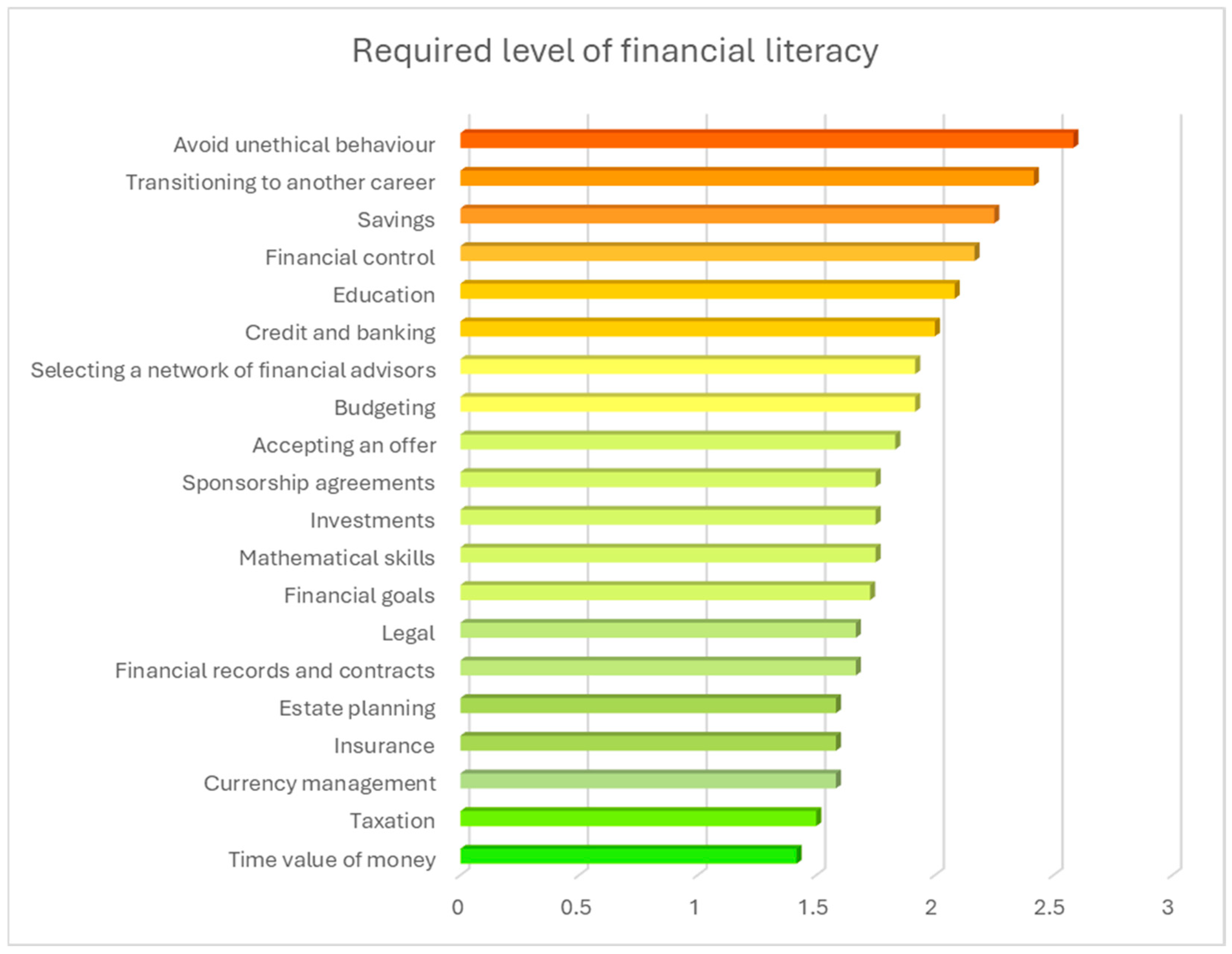
The research findings graphically illustrated in the heatmap (see Figure 2) below show the required level of financial literacy skills required per content area by professional athletes competing in a team sports environment based on the interview findings.
The findings from the assessment of each content area are discussed in more detail below. The participants assessed each content area, and the skills and acumen to avoid unethical behaviour were highlighted as an area in which professional athletes need near ‘expert’ knowledge. Given the profound effect that unethical behaviour such as doping, match fixing, social media misconduct or serious off-field indiscretions could have on the life and financial well-being of a professional athlete, the skills attached to successfully navigate this ranked highest among the 20 competency areas assessed.
Interviewee 2 highlighted: “Athletes need to place a big focus on their ethical behaviour because any sanctions have a massive effect on your finances now and in the future.”
The interviewee noted that education and awareness about doping and match fixing are already provided to outstanding high school and youth athletes ensuring that awareness is established. Interviewees 2 and 5 emphasized their belief that the temptation to engage in match fixing and doping is likely to be greater among athletes nearing the end of their sports careers.
The skills to transition to another post-sports career was also consistently emphasized as a content area that requires athletes to possess a very high level of relevant acumen, with more than half the interviewees suggesting that ‘expert’ skills are required to successfully and intentionally plan for and manage this shift and transition. This is significant because many athletes focus solely on becoming professionals often neglecting to prepare for life after retirement from competitive sport (McGraw et al., 2019; Van Heerden, 2018).
Interviewee 2 explained: “Professional athletes need to start thinking about this [their future transition to another career] at the beginning of their sports careers. Their time in sport is limited and very few can play at the highest level for several years or compete at the highest level.”
Interviewee 7 noted: “For me this is the most important content area, since athletes require guidance from a career development officer or mentor from a young age as well as opportunities to develop some entrepreneurial or business skills while still competing. Relying solely on obtaining a formal qualification is often not enough.”
Savings and financial control were identified as key content areas ranking among the top four out of the 20 competency areas. In the interview schedule, savings was defined as the motivation to save from a young age and having emergency funds available. Financial control, in turn, was broadly conceptualised to encompass the capacity to resist impulsive spending, compare the prices of similar goods and to avoid committing future income such as bonuses before it has been received (Moolman, 2019). This was highlighted by five of the 12 interviewees who regarded these as areas that require ‘expert’ skill. Interviewees 2 and 7 underscored the importance of understanding the need for savings and having financial control to inform the right financial decisions. This aligns with the findings of Laschowski and O’Reilly (2025) who emphasize that initiatives aimed at enhancing the financial well-being of professional athletes should prioritize encouraging adherence to a consistent savings plan and promoting self-discipline to prevent overspending. A systematic literature review by Ouachani et al. (2021) also shows that savings is consistently highlighted as a core aspect of financial literacy among the general population.
The content area of education referred to gaining a formal qualification or artisan skill and learning effective time management. The interviewees intricately linked this to transitioning or planning for another career. Therefore, nearly all the interviewees emphasized this as an area that requires ‘competent’ or ‘expert’ skills, purposeful planning, and dedication. This is of particular interest since the research of Ehnold et al. (2024) revealed that very few professional athletes sought guidance on education-related matters, illustrating the expanded role that career advisors could fulfil.
Interviewee 5 noted: “Gaining another qualification or artisan skill and thinking about a career after sport is critical. Many professional athletes have enough time to gain an education and to use their IP to network to ensure they can transition to another career after sport.”
Credit and banking was defined as the motivation to maintain a sound credit score, the prudent use of credit to increase asset holdings and understanding credit and overdraft facilities. The majority of participants recognized that credit and banking require ‘competent’ skills. Interviewee 3 highlighted the significance of this, noting that many athletes purchase homes with 20-year mortgages despite the unpredictability of their income due to performance-based bonuses and potential career changes. Meanwhile, Interviewee 7 underscored the importance of financial discipline for professional athletes, stressing that avoiding excessive debt is crucial for long-term wealth accumulation.
Eight of the 12 interviewees noted that selecting a network of financial advisors such as sports agents, career guidance counsellor, financial and legal advisors require ‘competent’ or ‘expert’ skills. This is consistent with the literature emphasizing that professional athletes should empower themselves to seek reputable, qualified, and appropriate advisors to guide their financial decisions (Moolman, 2023).
Interviewee 12 stated: “Us athletes can’t be expected to know everything and need to ask agents and professionals for admin, legal, financial and tax advice.”
Interviewee 1 explained: “Professional athletes don’t have to be knowledgeable in all the fields that impact their finances, but they must have sufficient knowledge and skills to be able to consult with and understand an expert.” This was supported by Interviewee 7 who stated: “They need to be competent to critically evaluate the advice they receive.”
Interviewee 8 highlighted: “Advisors are very much part of athletes’ lives, and they [the athletes] need to be financially oriented and savvy enough to select knowledgeable and reputable advisors.”
This is consistent with the literature which highlights that gaps in financial literacy cannot be addressed solely by obtaining professional financial advice (Lusardi & Mitchell, 2014).
Nine of the 12 interviewees viewed budgeting and the ability to draft a budget and monitor income, savings and expenditure as a content area that required competent skills. Interviewee 2 regarded budgeting as a core financial literacy skill and highlighted that individuals need to have the right financial attitude to stay within their budget.
While two interviewees believed that basic skills were adequate when accepting an offer to play sports professionally, or when signing an employment contract, 10 interviewees highlighted that competent skills were necessary in this area. Interviewee 7 explained that contractual obligations can impose significant opportunity costs, because unfavourable contract terms can limit opportunities, restrict career advancement, result in earnings below market value, and have long-term repercussions for a player’s prospects and financial well-being. Similarly, the ability to critically evaluate sponsorship agreements and understanding your associated rights and responsibilities was seen as demanding a comparable level of acumen. Interviewee 11 explained that sponsorships can be a significant revenue stream and athletes need to adhere to the contract terms. This is consistent with the observations of Moolman and Shuttleworth (2023), who emphasize the importance of professional athletes exercising careful consideration when entering into contractual and sponsorship agreements.
Investments, basic computational or mathematical skills and financial goal setting ranked just outside the top 10 of the 20 competency areas considered by this study. Nonetheless, many interviewees stressed the importance of establishing financial goals, and particularly the evaluation of suitable investments as important competencies. Although they felt that experts could be consulted hence many interviewees agreed that a ‘competent’ level of skill was sufficient to assess investments, consider retirement planning and to discern between good and bad financial advice.
Interviewee 2 explained: “While younger players can be risk takers, they need to understand the basics of investment strategy to identify when they need professional advice.”
Furthermore, Interviewee 8 warned: “Professional athletes are often influenced by their peers and exposed to investments that should prompt them to realize that if something looks too good to be true it probably is”.
Legal acumen and the ability to safeguard, critically evaluate and organize financial records and contracts were similarly viewed as content areas that require a reasonable level of competence. These content areas were not regarded as critical, and half the interviewees agreed that a ‘competent’ level of skill would suffice since professional advice could be sought when needed. However, Interviewee 2 underscored the importance for professional athletes to understand the fine print in their contracts such as ‘re-signing clauses’ that could extend their contractual obligations beyond the anticipated period.
Skills related to estate planning such as having a will and arranging insurance scored relatively low, since most interviewees recognized that a ‘basic’ level of competence would be adequate. Interviewee 2 remarked that athletes must understand whether contract insurance is included in their player contracts, or if they need to arrange coverage themselves, if necessary. Contract insurance is designed to protect athletes and their employers, such as sports clubs, from financial losses resulting from injuries or illness. The belief that basic financial acumen is sufficient for insurance related decisions may be supported by Yakoboski et al. (2022), who found insurance and risk comprehension to be the weakest of eight financial literacy domains across a diverse population. Thus, many individuals likely require professional guidance to make informed decisions in this area.
Many interviewees also considered a ‘basic’ level of competence sufficient for currency management. Some noted that the associated risks are relatively low particularly since only a few athletes competing in team sports will earn income in multiple currencies.
Taxation management skills scored 19th out of the 20 competencies assessed. Eight of the 12 interviewees regarded a ‘basic’ level of competence as adequate, because many acknowledged that some of the unique tax rules and regulations affecting professional athletes constitute a niche field requiring expert guidance.
Interviewee 7 remarked: “Taxation is a specialized field, but they need to understand the advice they receive. [Professional athletes] should also recognize that this is a critical area because non-compliance could have dire consequences and even lead to imprisonment.”
Interviewee 2 underscored: “They need to take responsibility [for their taxes] and can’t shift the blame irrespective of who is advising them. As we have seen recently, for example, the tax authorities in Spain will keep the individual athlete accountable.”
However, overall, most interviewees concurred that athletes need only a fundamental level of competence, as professional advice should support and ensure their tax compliance.
A basic understanding of the time value of money and inflation was deemed sufficient by most interviewees. Interviewee 11 noted that understanding the time value of money and compound interest was necessary because it affected many financial decisions but acknowledged that basic knowledge would be enough. Interviewees may have perceived this as a relatively simple content area, believing that foundational knowledge was sufficient, as reflected in Interviewee 6’s remark that “these are basic concepts”. Although this content area ranked the lowest overall, some participants nonetheless noted the need for a competent level of skill to effectively account for the time value of money and inflation in financial decision-making.
Based on the research findings, and the majority view of participants, the prioritized content areas included avoiding unethical behaviour, the acumen to navigate the transition to a post-sports career as well as savings and financial control. Nonetheless, the other content areas were also regarded as relevant and important, while there was a sense that basic acumen for some areas would be sufficient for professional athletes to identify where expert advice could be obtained.

4. Discussion and Conclusions

This study contributes to the literature by deepening the understanding of financial literacy content areas that demand higher levels of competence and acumen for professional athletes competing in a team sports environment. This study expands on previous research by Moolman (2023) and addresses the call for further research in this field while being cognizant of the multi-layered definition of financial literacy, which encompasses financial knowledge, self-efficacy, financial attitude, and financial behavior. It was evident from the research findings that skills to avoid unethical behavior, the acumen to navigate the transition to a post-sports career, savings and financial control were the key content areas that require the highest level of competence for professional athletes competing in team sports. Understanding the areas to prioritize when guiding or educating professional athletes to make informed and sustainable financial decisions could promote their overall well-being and athletic performance, while yielding mutual benefits for sports managers, advisors, and support teams. The article also shows a novel way to apply heatmaps when reporting research findings in the field of financial literacy. Furthermore, this study addressed the paucity of qualitative research in this field (Batham et al., 2025; Goyal & Kumar, 2020). While ANT aided the clearer identification of the financial literacy skills required by professional athletes as recognized by individuals who understand the flow of financially orientated information around athletes.
Utilising an exploratory qualitative research approach, this study provides nuanced insights during the early stages of knowledge development, thus creating space for future research to deepen and expand the field without prematurely restricting variables or theoretical constructs. This study did not consider individual factors, such as professional athletes’ life stages, background, socio-demographic factors, level of education, unique psychological factors, the potential for social desirability bias in responses or cognitive biases. Furthermore, the unit of analysis was South African male professional rugby and cricket players. Therefore, future research could consider athletes competing in other sports, in other countries and female athletes to broaden the scope of the research.
Furthermore, this study reflects the perspectives of actors or stakeholders that could constitute a broader support network around a professional athlete to guide and contribute towards shaping their financial decisions. This allowed for a more holistic understanding of the financial context in which athletes operate. Nonetheless, future studies could exclusively focus on athletes’ perspectives to allow for a more athlete-centered analysis. The lower priority given to competencies such as taxation and currency management in this study also warrant further investigation. This could extend to determining whether complex long-term topics are deprioritized in favor of immediate needs, or whether this was a function of the specific context of this study.
A weighted average formula was utilized in this study to inform the findings, under the assumption of equal intervals between competency levels. Future research may consider alternative weighting schemes to address this potential limitation. There was an uneven distribution of participants across the different groups. Although this imbalance is not expected to have substantially influenced the credibility of the findings, it is recognized as a limitation. Subsequent research could ensure a more balanced representation of interviewees across groups. Future studies could also consider a longitudinal approach, gender differences, cultural contexts and the financial literacy needs of athletes competing in individual sports. Moreover, this study encourages future research to apply heat maps and ranking approaches in other contexts.
The findings from this study are expected to offer valuable insights for interested parties across diverse geographical regions, demographic groups, and sporting disciplines. The research may also prove beneficial to professional athletes seeking to maximize their financial well-being and manage their financial risk after retiring from professional sports. Additionally, the study could be of interest to training providers, players’ associations, sports agents, legal advisors, financial planners, accountants, tax specialists, and other financial advisors that serve the interests of professional athletes. Universities with prominent sports teams, sport’s governing bodies, policymakers, and the leadership of professional sports clubs with a fundamental responsibility to educate, inform and enhance the financial literacy of professional athletes may also benefit from this study. In support of the literature, it is also recommended that sports clubs mandate workshops in fundamental areas of financial literacy for professional athletes to bear long-term sustainable value for them and their families. Such workshops could benefit from a curriculum designed around the heatmap illustration of the findings of this study.

Funding

This research received no external funding.

Institutional Review Board Statement

The study was approved by the University of South Africa College of Accounting Sciences Ethics Review Committee (Reference number: 2018_CAS_023 on 9 July 2018) for studies involving humans.

Informed Consent Statement

Informed consent was obtained from all participants who were involved in the study.

Data Availability Statement

Some original contributions from participants are anonymously included in the article. Additional information and data presented in this study are available on request from the corresponding author due to privacy and ethical reasons.

Acknowledgments

The author would like to thank the participants for making this research project possible.

Conflicts of Interest

The author declares no conflicts of interest.

Abbreviations

The following abbreviations are used in this manuscript:
ANTActor-Network Theory
OECDOrganization for Economic Co-operation and Development

References

  1. Abreu, M., Mendes, V., & Coutinho dos Santos, M. (2025). Financial literacy, financial resilience and participation in securities markets: Evidence from Portugal. Journal of Risk and Financial Management, 18(12), 677. [Google Scholar] [CrossRef]
  2. Balliauw, M., & Van Den Spiegel, T. (2018). Managing professional footballers’ finances to avoid financial problems: A Belgian survey. Sport, Business and Management: An International Journal, 8(4), 318–334. [Google Scholar] [CrossRef]
  3. Bass, C. M. (2016). Don’t drop the ball: Estate planning for professional athletes. Entertainment & Sports Law, 33, 3–12. [Google Scholar]
  4. Batham, S., Arora, H., & Gupta, V. (2025). Investigation of the antecedents of personal saving behavior: A systematic literature review using TCM-ADO framework. Journal of Risk and Financial Management, 18(10), 554. [Google Scholar] [CrossRef]
  5. Björklund, M., & Sandahl, J. (2023). Teaching and learning financial literacy within social studies—A case study on how to realise curricular aims and ambitions. Journal of Curriculum Studies, 55(3), 325–338. [Google Scholar] [CrossRef]
  6. Brandner, J., & Omondi-Ochieng, P. (2022). Bankruptcy-based divorces in the national football league and the national basketball association: Causes, cases, and cures. Journal of Multidisciplinary Research, 14(1), 71–86. [Google Scholar]
  7. Braun, V., & Clarke, V. (2006). Using thematic analysis in psychology. Qualitative Research in Psychology, 3(2), 77–101. [Google Scholar] [CrossRef]
  8. Braun, V., & Clarke, V. (2019). To saturate or not to saturate? Questioning data saturation as a useful concept for thematic analysis and sample-size rationales. Qualitative Research in Sport, Exercise and Health, 13(2), 201–216. [Google Scholar] [CrossRef]
  9. Carlson, K., Kim, J., Lusardi, A., & Camerer, C. F. (2015). Bankruptcy rates among NFL players with short-lived income spikes. American Economic Review, 105(5), 381–384. [Google Scholar] [CrossRef]
  10. Chen, Y., Huang, P., Day, M. Y., Ni, Y., & Liang, M. C. (2023). Using heatmap visualization to assess the performance of the DJ30 and NASDAQ100 indices under diverse VMA trading rules. PLoS ONE, 18(5), e0284918. [Google Scholar] [CrossRef]
  11. Chiu, C. L., Ni, Y., Hu, H. C., Day, M. Y., & Chen, Y. (2023). Enhancing crypto success via heatmap visualization of big data analytics for numerous variable moving average strategies. Applied Sciences, 13(23), 12805. [Google Scholar] [CrossRef]
  12. Du Preez, M., & Ferreira-Schenk, S. J. (2024). Demographic and sociocultural determinants of financial literacy in South Africa. International Journal of Economics and Financial Issues, 14(2), 111–119. [Google Scholar] [CrossRef]
  13. Ehnold, P., Gohritz, A., Lotzen, L., & Schlesinger, T. (2024). Soccer above all? Analysis of academic and vocational education among female soccer players in the German women’s Bundesliga and 2nd women’s Bundesliga. Frontiers in Sports and Active Living, 6, 1294803. [Google Scholar] [CrossRef]
  14. Englander, M. (2019). General knowledge claims in qualitative research. The Humanistic Psychologist, 47(1), 1–14. [Google Scholar] [CrossRef]
  15. Ferrel, S. (2021). Professional athletes going broke: Perspectives from financial advisors [Unpublished master’s thesis, University of Florida]. [Google Scholar]
  16. French, D., & McKillop, D. (2016). Financial literacy and over-indebtedness in low-income households. International Review of Financial Analysis, 48, 1–11. [Google Scholar] [CrossRef]
  17. Galariotis, E., & Monne, J. (2023). Basic debt literacy and debt behavior. International Review of Financial Analysis, 88, 102673. [Google Scholar] [CrossRef]
  18. Goyal, K., & Kumar, S. (2020). Financial literacy: A systematic review and bibliometric analysis. International Journal of Consumer Studies, 45(1), 80–105. [Google Scholar] [CrossRef]
  19. Harahap, S., Thoyib, A., Sumiati, S., & Djazuli, A. (2022). The impact of financial literacy on retirement planning with serial mediation of financial risk tolerance and saving behavior: Evidence of medium entrepreneurs in Indonesia. International Journal of Financial Studies, 10(3), 66. [Google Scholar] [CrossRef]
  20. Hong, H. J., & Fraser, I. (2021). My sport won’t pay the bills forever: High-performance athletes’ need for financial literacy and self-management. Journal of Risk and Financial Management, 14(7), 324. [Google Scholar] [CrossRef]
  21. Hong, H. J., & Fraser, I. (2022). Organisational support for high-performance athletes to develop financial literacy and self-management skills. Journal of Risk & Financial Management, 15, 17. [Google Scholar]
  22. Huston, S. J. (2010). Measuring financial literacy. Journal of Consumer Affairs, 44(2), 296–316. [Google Scholar] [CrossRef]
  23. Justesen, L., & Mouritsen, J. (2011). Effects of actor-network theory in accounting research. Accounting, Auditing & Accountability Journal, 24(2), 161–193. [Google Scholar]
  24. Laschowski, G., & O’Reilly, N. (2025). The financial well-being of retired professional athletes: Debunking the myth about financial irresponsibility. Sport, Business and Management: An International Journal, 16(2), 301–319. [Google Scholar] [CrossRef]
  25. Latour, B. (1996). On actor-network theory: A few clarifications. Soziale Welt, 47(4), 369–381. [Google Scholar]
  26. Leonard, C., Moolman, J., & Shuttleworth, C. C. (2023). Factors that motivate millennial accountancy professionals in industry to become academics. Journal of Economic and Financial Sciences, 16(1), 872–883. [Google Scholar] [CrossRef]
  27. Lindt, K., Wallrodt, S., & Thieme, L. (2025). A high-performance sports career as a signal in the job application process. German Journal of Exercise and Sport Research, 55(3), 391–401. [Google Scholar] [CrossRef]
  28. Lusardi, A. (2019). Financial literacy and the need for financial education: Evidence and implications. Swiss Journal of Economics and Statistics, 155(1), 1. [Google Scholar] [CrossRef]
  29. Lusardi, A., & Messy, F.-A. (2023). The importance of financial literacy and its impact on financial wellbeing. Journal of Financial Literacy and Wellbeing, 1(1), 1–11. [Google Scholar] [CrossRef]
  30. Lusardi, A., & Mitchell, O. S. (2014). The economic importance of financial literacy: Theory and evidence. Journal of Economic Literature, 52(1), 5–44. [Google Scholar] [CrossRef]
  31. Lyons, A. C., & Kass-Hanna, J. (2021). Financial inclusion, financial literacy and economically vulnerable populations in the Middle East and North Africa. Emerging Markets Finance and Trade, 57(9), 2699–2738. [Google Scholar] [CrossRef]
  32. McGraw, S., Deubert, C. R., Fernandez Lynch, H., Nozzolillo, A., & Cohen, I. G. (2019). NFL or ‘not for long’? Transitioning out of the NFL. Journal of Sport Behavior, 42(4), 461–492. [Google Scholar]
  33. McGreary, M., Eubank, M., Morris, R., & Whitehead, A. (2020). Thinking aloud: Stress and coping in junior cricket batsmen during challenge and threat states. Perceptual and Motor Skills, 127(6), 1095–1117. [Google Scholar] [CrossRef]
  34. Monette, D. R., Sullivan, T. J., & DeJong, C. R. (2011). Applied social research: A tool for the human services. Cengage Learning. [Google Scholar]
  35. Moolman, J. (2019). A framework for the financial literacy skills required by professional athletes in pursuit of sustainable financial well-being [Unpublished doctoral thesis, University of South Africa]. [Google Scholar]
  36. Moolman, J. (2023). Financial literacy content areas for professional athletes: Evidence from a qualitative study. Journal of Financial Counseling and Planning, 34(1), 112–126. [Google Scholar] [CrossRef]
  37. Moolman, J., & Shuttleworth, C. C. (2023). Guidance for professional athletes in selecting a sustainably rewarding player contract. International Journal of Sport Management and Marketing, 23(6), 523–542. [Google Scholar] [CrossRef]
  38. Morse, J. M. (1994). Designing funded qualitative research. In N. K. Denzin, & Y. S. Lincoln (Eds.), Handbook of qualitative research. Sage. [Google Scholar]
  39. Nashruddin, S. N. A. M., Mahdzan, N. S., & Hanifa, M. H. (2026). Financial well-being of professional athletes and football players: Integrating bibliometric and content analysis. Journal of Economic Surveys, 40(1), 93–115. [Google Scholar] [CrossRef]
  40. OECD. (2016). G20/OECD INFE core competencies framework on financial literacy for adults. OECD Publishing. Available online: https://www.gpfi.org/sites/default/files/documents/Core-Competencies-Framework-Adults.pdf (accessed on 14 April 2025).
  41. Ouachani, S., Belhassine, O., & Kammoun, A. (2021). Measuring financial literacy: A literature review. Managerial Finance, 47(2), 266–281. [Google Scholar] [CrossRef]
  42. Phelps, N., & Metzler, A. (2025). The effects of financial knowledge, skill, and self-assessed knowledge on financial well-being, behavior, and objective situation. International Journal of Financial Studies, 13(1), 44. [Google Scholar] [CrossRef]
  43. Potrich, A. C. G., Vieira, K. M., & Mendes-Da-Silva, W. (2016). Development of a financial literacy model for university students. Management Research Review, 39(3), 356–376. [Google Scholar] [CrossRef]
  44. Potts, A. J., Didymus, F. F., & Kaiseler, M. (2019). Exploring stressors and coping among volunteer, part-time and full-time sports coaches. Qualitative Research in Sport, Exercise and Health, 11(1), 46–68. [Google Scholar] [CrossRef]
  45. Sandelowski, M. (2001). Real qualitative researchers do not count: The use of numbers in qualitative research. Research in Nursing & Health, 24(3), 230–240. [Google Scholar] [CrossRef]
  46. Sandelowski, M., Voils, C. I., & Knafl, G. (2009). On quantitizing. Journal of Mixed Methods Research, 3(3), 208–222. [Google Scholar] [CrossRef]
  47. Schlesinger, T., Barth, M., Bartsch, M., & Pitsch, W. (2023). An analysis of precautionary savings practices of professional football players. Sport, Business and Management: An International Journal, 13(3), 354–375. [Google Scholar] [CrossRef]
  48. Schmid, M. J., De Crom, L., Conzelmann, A., & Schmid, J. (2025). Patterns of reasons for retirement in Olympic athletes from Switzerland: A person-oriented study. International Journal of Sport and Exercise Psychology. Advanced online publication. [Google Scholar] [CrossRef]
  49. Sobiech, G., & Leipert, S. (2021). Older women being active in fitness gyms: Benefits or constraints? Results from a qualitative interview study (southern Germany and East Coast of USA). German Journal of Exercise and Sport Research, 51(4), 457–467. [Google Scholar] [CrossRef]
  50. Stansen, C., & Chambers, T. P. (2019). An interpretative phenomenological analysis of the player development manager role in Australian professional sports. Qualitative Research in Sport, Exercise and Health, 11(2), 152–167. [Google Scholar] [CrossRef]
  51. Tracy, S. J. (2010). Qualitative quality: Eight “big-tent” criteria for excellent qualitative research. Qualitative Inquiry, 16(10), 837–851. [Google Scholar] [CrossRef]
  52. Trainor, L. R., Bundon, A., Wadey, R., Faulkner, G., & Crocker, P. R. (2025). What is an athlete’s psychological well-being? Constructing concepts with Olympic and Paralympic athletes. Qualitative Research in Sport, Exercise and Health, 17(4), 277–295. [Google Scholar] [CrossRef]
  53. Vaidya, N. P., & Natarajan, H. (2015). 16 cricketers who endured extreme financial woes and a terrible life as a result. Cricket Country. Available online: https://www.cricketcountry.com/criclife/16-cricketers-who-endured-extreme-financial-woes-and-a-terrible-life-as-a-result-505648 (accessed on 30 November 2025).
  54. Van Craenendonck, T., Elen, B., Gerrits, N., & De Boever, P. (2020). Systematic comparison of heatmapping techniques in deep learning in the context of diabetic retinopathy lesion detection. Translational Vision Science & Technology, 9(2), 64. [Google Scholar] [CrossRef] [PubMed]
  55. Van Heerden, K. (2018). Waking from the dream. Viking Publications. [Google Scholar]
  56. Van Reenen, R. (2012). From locker room to boardroom: Converting rugby talent into business success. Zebra Press. [Google Scholar]
  57. Van Rooij, M., Alessie, R., & Lusardi, A. (2024). Financial literacy in the DNB household survey: Insights from innovative data collection. Journal of Financial Literacy and Wellbeing, 2(1), 21–37. [Google Scholar] [CrossRef]
  58. Williamson, C., Van Rooyen, A., Shuttleworth, C., Binnekade, C., & Scott, D. (2020). Wuity as a philosophical lens for qualitative data analysis. International Journal of Qualitative Methods, 19, 1609406920926885. [Google Scholar] [CrossRef]
  59. Willis, G. B. (2005). Cognitive interviewing: A tool for improving questionnaire design. SAGE. [Google Scholar]
  60. Wiltshire, G., & Stevinson, C. (2018). Exploring the role of social capital in community-based physical activity: Qualitative insights from parkrun. Qualitative Research in Sport, Exercise and Health, 10(1), 47–62. [Google Scholar] [CrossRef]
  61. Yakoboski, P., Lusardi, A., & Hasler, A. (2022). How financial literacy varies among US adults: The 2022 TIAA institute-GFLEC personal finance index. TIAA institute research paper series. SSRN. [Google Scholar]
  62. Zhang, Y., & Chatterjee, S. (2023). Financial well-being in the United States: The roles of financial literacy and financial stress. Sustainability, 15(5), 4505. [Google Scholar] [CrossRef]
Figure 1. Framework for the financial literacy skills required by professional athletes. Source: Moolman (2023).
Ijfs 14 00068 g001
Figure 2. A heatmap to visualize the required level of competence per financial literacy content area for professional athletes. Source: Author.
Ijfs 14 00068 g002
Table 1. The anonymized demographics of the individual interviewees.
Interviewee NumberDescription of the Actor in the Network Around a Professional AthleteGroupMore Than Two Years’ Experience
1An independent broker and Certified Financial Planner® whose clientele include professional athletes1Yes
2Tax advisor who holds professional designations as a Chartered Accountant [CA (SA)], and member of the Chartered Institute of Management Accountants1Yes
3Sports agent and qualified lawyer experienced in local and global contracting matters with unique insight as a former professional rugby player1Yes
4Sports psychologist and career development consultant with extensive experience supporting both local and international sports teams1Yes
5Chief executive officer of a high-profile cricket franchise2Yes
6Financial manager of a high-profile rugby union/franchise2Yes
7CA(SA) and accomplished academic with specialized knowledge in financial literacy3Yes
8CA(SA) and accomplished academic with specialized knowledge in financial literacy3Yes
9CA(SA) and accomplished academic with specialized knowledge in financial literacy3Yes
10CA(SA) and accomplished academic with specialized knowledge in financial literacy3Yes
11Former international cricketer with multi-format playing experience in South Africa and abroad, complemented by prior service on a players’ association executive committee4Yes
12Active professional rugby player who has featured for leading South African and European clubs4Yes
Disclaimer/Publisher’s Note: The statements, opinions and data contained in all publications are solely those of the individual author(s) and contributor(s) and not of MDPI and/or the editor(s). MDPI and/or the editor(s) disclaim responsibility for any injury to people or property resulting from any ideas, methods, instructions or products referred to in the content.