Article

How Does Artificial Intelligence Reshape Bank Profitability in China?—Evidence from a Multi-Period Difference-in-Differences Model


School of Economics and Management, Guangxi Normal University, Guilin 541004, China
*
Author to whom correspondence should be addressed.
Int. J. Financ. Stud. 2026, 14(2), 39; https://doi.org/10.3390/ijfs14020039
Submission received: 16 December 2025 / Revised: 15 January 2026 / Accepted: 26 January 2026 / Published: 4 February 2026
(This article belongs to the Special Issue Artificial Intelligence in Banking and Insurance)

Abstract

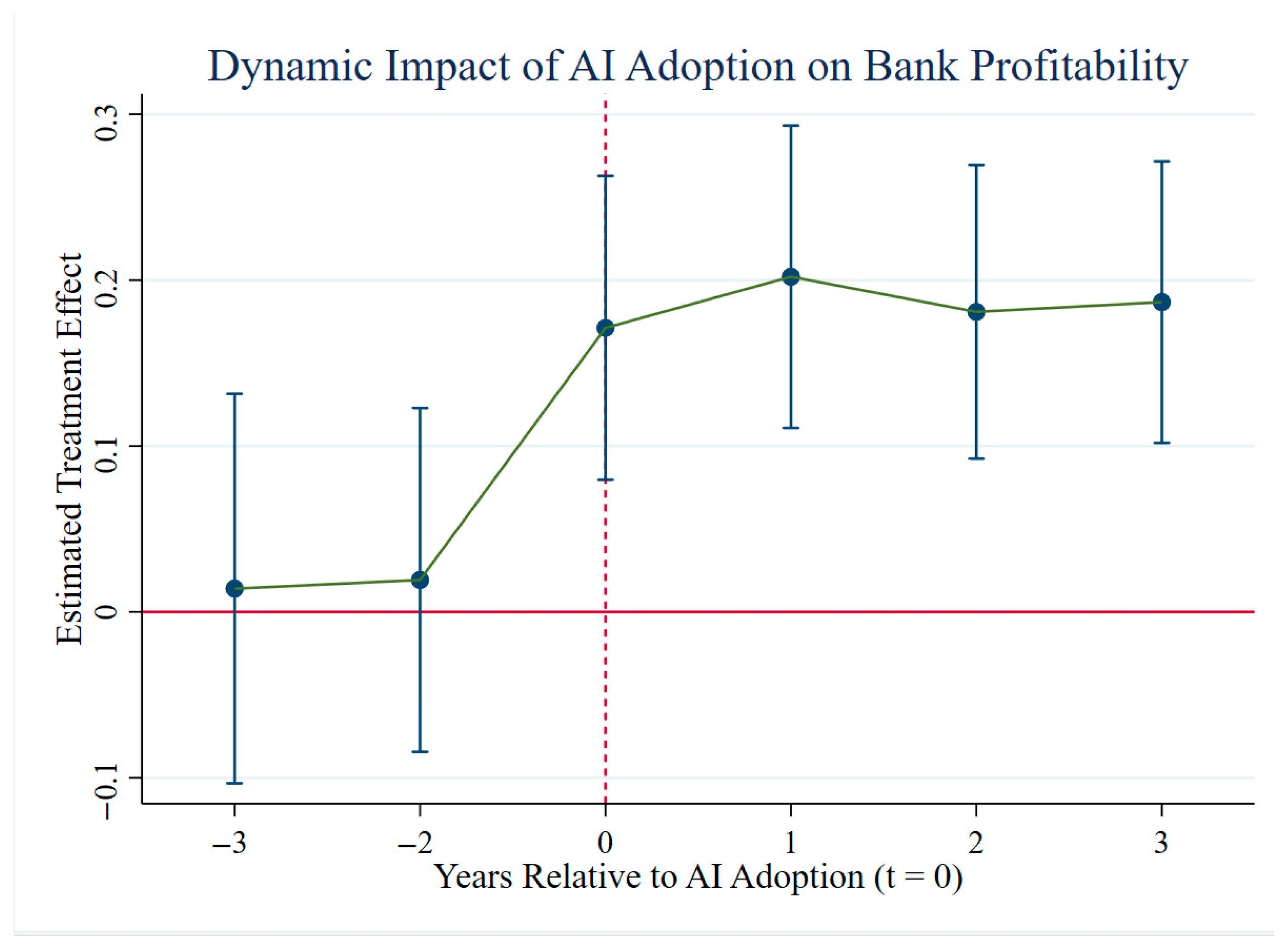
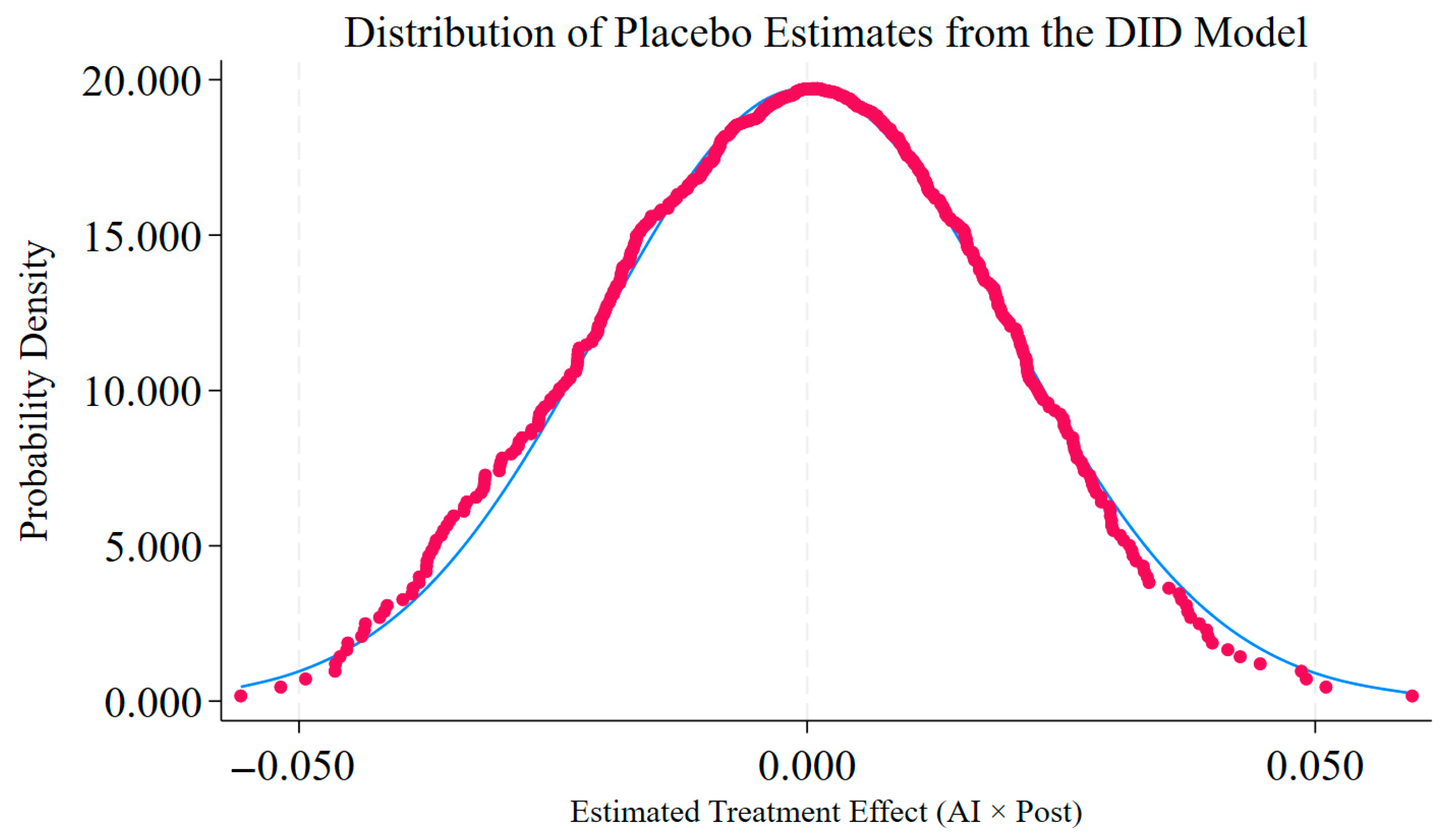
Artificial intelligence (AI) has become an integral driver of digital transformation in the banking sector, fundamentally influencing operational efficiency, resource allocation, and profitability. This study investigates how AI adoption affects the profitability of Chinese commercial banks and through which mechanisms these effects occur, within the context of the country’s broader financial digitalization process. Using panel data for 17 A-share listed banks in China from 2009 to 2022, we employ a multi-period difference-in-differences (DID) framework—whose validity rests on the parallel trend assumption, empirically verified through an event-study specification—and combine it with propensity score matching (PSM) and placebo simulations to ensure credible causal identification. The results indicate that AI adoption significantly improves bank profitability. Mechanism analyses suggest that AI enhances profitability through two overarching channels—operational efficiency and resource allocation—manifested in (i) higher cost elasticity of income, (ii) improved deposit–loan turnover adaptability via more efficient liquidity and funding-cycle management, and (iii) optimized cross-business capital allocation efficiency through better risk–return matching in diversified operations. The effects are stronger for banks with higher digital investment intensity and tighter customer stickiness–liability cost coupling, and vary systematically across ownership types, bank sizes, and policy cycles. Overall, the findings provide policy-relevant evidence on how AI-driven digital transformation can enhance bank performance and risk management in modern financial systems. This study contributes by constructing a disclosure-based AI adoption measure from bank annual reports and exploiting staggered adoption with a multi-period DID design to provide causal evidence from China’s listed banking sector.
Keywords: artificial intelligence; digital transformation; financial services; resource allocation; deposit–loan turnover adaptability; multi-business capital allocation efficiency; customer stickiness–liability cost coupling artificial intelligence; digital transformation; financial services; resource allocation; deposit–loan turnover adaptability; multi-business capital allocation efficiency; customer stickiness–liability cost coupling