1. Introduction
Finance is crucial for the functioning of national economies, facilitating resource distribution and ensuring macroeconomic stability (
Setiawan & Wisna, 2021). Banks serve as key intermediaries, collecting savings and channeling them to borrowers via loans (
Maudos & de Guevara, 2004). The stability and profitability of banks are vital since the economy relies heavily on the resilience of the sector (
Butola et al., 2022). This is especially true in developing nations like Ethiopia, where commercial banks dominate the financial landscape and are the leading providers of investment capital (
Muhammed et al., 2024). Consequently, bank performance and efficiency directly influence economic growth and financial stability. To sustain stability, banks must prioritize profit generation, which supports sustainable development and operational efficiency (
Saksonova, 2014).
In Ethiopia, the banking sector is a key player in the country’s economy, accounting for nearly 93% of total financial sector capital and contributing 4.2% to national GDP (
Muhammed et al., 2023). Hence, the industry’s stability and profitability are crucial, as the overall economy relies on its resilience. In the last two decades, the sector has shown significant improvement as more banks entered the market and market dynamics changed dramatically (
Lemi et al., 2020). Despite these improvements, problems such as high operating expenses, credit risk, and insufficient technology remain (
Haile et al., 2025). Therefore, given the significant importance that Ethiopian commercial banks play in the country’s economy, it is important to maintain stable profits and resilience.
The profitability of a banking institution is typically measured by its net interest margin (NIM), calculated as interest income minus interest expense divided by interest-bearing assets (
Harimurti, 2022). It shows banks’ ability to generate income from their primary business operations through interest-bearing assets (
Busch & Memmel, 2017). A low or fluctuating margin may indicate inefficiencies, high market competition, economic instability, or weak regulation; conversely, a high and stable margin points to good asset management and solid financial health (
Hijazeen, 2017). Therefore, understanding the factors that influence net interest margin is key to evaluating the bank’s performance and long-term sustainability.
The literature identifies two primary categories of factors influencing NIM: bank-related factors such as bank size, capital adequacy, liquidity, asset quality, and operational efficiency, which directly affect the net interest margin; and macroeconomic factors like inflation and economic growth, which are also recognized by research as critical influences on NIM (
Abdeljawad et al., 2025;
Belay, 2024;
Kuhil, 2018;
Lemi et al., 2020;
Obeid, 2024;
Setiawan & Wisna, 2021). While these variables are well-documented and used in various studies, foreign direct inflow, a crucial route for macro-financial factors, is missing from the literature.
Foreign direct investment (FDI) can affect banks’ net interest margins via several interconnected channels. From a financial intermediation viewpoint, FDI inflows increase the availability of foreign currency and domestic liquidity, allowing banks to lend more and benefit from economies of scale (
Kithandi, 2025). This growth in interest-earning assets can boost net interest income relative to funding costs, widening NIM.
From a risk–return perspective, continuous FDI inflows bolster macroeconomic stability by promoting growth, improving external balances, and alleviating foreign exchange constraints (
Wang et al., 2017). A stable macroeconomic environment decreases credit and liquidity risks, enabling banks to set loan prices more confidently and sustain healthy margins (
Wang et al., 2017).
From a capital flow theory perspective, international capital moves from capital-abundant to capital-scarce economies in search of higher returns, thereby expanding domestic liquidity, investment capacity, and financial intermediation in host countries (
Betz et al., 2013;
Suliman & Elian, 2014). In bank-dominated financial systems, these inflows are primarily intermediated through commercial banks, directly affecting their funding structures and lending activities.
Despite its significance, foreign direct investment (FDI) has been largely overlooked in empirical research on the determinants of the net interest margin. Early research by
Demirgüç-Kunt and Huizinga (
1999) highlighted the role of foreign capital in banking performance but did not directly include FDI, instead suggesting it should be examined in future studies. So far,
Ferrouhi (
2017) remains one of the few to explore this relationship empirically and found a positive impact of FDI on NIM. To the authors’ knowledge, no study has yet incorporated this variable within the Ethiopian banking sector.
Furthermore, research has yielded inconsistent findings regarding the determinants of Net Interest Margin (NIM) globally. Certain studies identify positive effects of bank size, capital adequacy, efficiency, loan ratios, gross domestic product (GDP) growth, and inflation, whereas others observe negligible or adverse impacts. These variations originate from differences in regulatory frameworks, market conditions, and macroeconomic environments across nations. This highlights the necessity for country-specific research, particularly in Ethiopia, where comprehending local factors that influence NIM is crucial for banking operations and policy formulation. Consistent with global trends, Ethiopian research exhibits inconsistency, likely attributable to limited sample sizes, brief study periods, and inconsistent variable definitions. These disparities constrain the generalizability of findings and underscore the importance of conducting further research to address and reconcile them.
Overall, this study fills important gaps in the literature by examining Ethiopian banks from 2012 to 2024, including both state and private institutions to reflect sectoral variety and current trends. Unlike earlier studies, it considers foreign direct investment (FDI) as an explanatory variable, which has often been overlooked. The paper examines the drivers of net interest margin (NIM) using this dataset and its unique variable inclusion, giving evidence-based insights to inform policy and improve the efficiency, competitiveness, and resilience of Ethiopia’s banking sector.
This paper is structured into six main sections. The introduction presents the research problems, objectives, and motivations. The second section reviews existing theories and empirical research on the factors influencing net interest margin. The materials and methods section details the data sources, variable definitions, research design, and analytical techniques employed. The results and discussion sections outline the key findings and interpret them in the context of prior studies. The conclusion and recommendation section summarizes insights and provides practical advice for banks and policymakers. Lastly, the limitations and future directions sections discuss the study’s constraints and propose areas for future research.
2. Literature
Net Interest Margin (NIM) is the difference between interest income earned on loans and interest paid on deposits, expressed as a percentage of interest-earning assets (
Hanzlík & Teplý, 2019). As a primary source of revenue for commercial banks, NIM reflects their efficiency as financial intermediaries by balancing risk, managing costs, and exercising market power (
Khalaf & Alnabulsi, 2019). Essentially, NIM is influenced by banks’ pricing strategies, regulatory limits, and macroeconomic conditions, serving as a key link between banking performance and economic growth (
Gurung et al., 2024).
The determinants of Net Interest Margin (NIM) can be understood through three interconnected theories of finance. First, financial intermediation theory emphasizes the role of banks in transforming deposits into loans amidst information asymmetry, transaction costs, and monitoring challenges, suggesting that factors such as balance sheet structure, liquidity management, and operational efficiency directly impact interest margins (
Kithandi, 2025). Second, the risk returns trade-off theory states that banks need higher interest margins to compensate for increased credit and liquidity risks, as well as overall macroeconomic uncertainty, leading to wider spreads during riskier economic conditions (
Celik & Aslanertik, 2011;
Wang et al., 2017). Third, the structure–conduct–performance (SCP) hypothesis posits that banks operating in concentrated or less competitive markets can exercise their pricing power, allowing larger, well-capitalized institutions to set loan and deposit rates, thereby maintaining higher net interest margins (
Asngari, 2024). Drawing on these theoretical perspectives, empirical studies on banking regularly highlight bank-specific factors such as size, capitalization, efficiency, and capital adequacy, as well as macroeconomic factors such as inflation, economic growth, and capital flows, as the main influences on NIM in both developed and emerging banking systems.
2.1. Global Studies on Drivers of Net Interest Margin (NIM)
This section reviews global research on NIM drivers, emphasizes key factors affecting NIM, and identifies contingent findings that substantiate the need for a country-specific study.
Research from various countries, such as Indonesia, Palestine, Europe, Sub-Saharan Africa, and Asia, shows that factors such as capital adequacy, loan-to-deposit ratio, bank size, and operational efficiency significantly affect NIM (
Abdeljawad & Bahlaq, 2023;
Ahokpossi, 2013;
Angori et al., 2019;
Setiawan & Wisna, 2021). All these studies confirm that better capitalization is linked to higher interest margins, stating that well-capitalized banks face lower funding risks, gain greater market trust, and have stronger pricing power, supporting the risk–return trade-off theory (
Wang et al., 2017). Similarly, empirical research indicates that an elevated loan-to-deposit ratio signifies heightened financial intermediation activity, allowing banks to more efficiently transform deposits into income-generating loans, thereby enhancing interest margins. This phenomenon has been corroborated across diverse contexts, including Indonesia, Kosovo, and Vietnam (
Hao et al., 2023;
Mustafa-Zatriqi & Ahmeti, 2022;
Setiawan & Wisna, 2021), underscoring the critical role of the balance-sheet structure in influencing bank profitability.
On the other hand, inflation has shown mixed results across different regions. Some argue that inflation can boost margins by allowing banks to raise lending rates faster than deposit rates (
Bushashe, 2023;
Khan et al., 2024). In contrast, others state that high and unpredictable inflation can increase funding costs and credit risks, potentially reducing margins (
Kunwar & Jnawali, 2023;
Dumicic & Rizdak, 2013). Similarly, the link between GDP growth and banks’ net interest margin (NIM) remains debated. Some argue that GDP growth is associated with positive NIM, while others show that GDP growth has little or no significant effect on NIM. This demonstrates that NIM is strongly context-dependent, shaped by factors such as regulatory environments, market dominance, and macroeconomic stability. These differences emphasize the need for country-specific research, especially in emerging and uniquely structured banking systems.
2.2. Studies on Drivers of NIM: Ethiopian Perspective
Ethiopia’s banking sector operates in a regulated oligopoly, with Net Interest Margin (NIM) serving as a crucial measure of profitability and financial stability (
Jima, 2017). Empirical studies emphasize the influence of various factors on IM, though findings differ in the magnitude and direction of their effects.
Capital adequacy consistently plays a crucial role in shaping net interest margins (NIM) within Ethiopian banking studies. Findings from (
Leykun, 2016;
Mesfin & Ram, 2019;
Keneni, 2022) show that banks with higher capital reserves tend to secure higher margins, which are linked to lower risk, cheaper funding, and greater market trust. This connection mainly supports the risk buffer hypothesis, which posits that higher capital enables banks to absorb unexpected losses better and preserve stable profits (
Wang et al., 2017). It also aligns with the structure–conduct–performance (SCP) hypothesis, which posits that financially robust banks have greater pricing power, leading to higher margins (
Asngari, 2024).
Bank size is also identified as a driver of net interest margin (NIM) in many Ethiopian studies; however, its effects are mixed. Some studies state that larger banks can boost margins by leveraging economies of scale and greater market power, thereby improving cost efficiency and profitability (
Mesfin & Ram, 2019). However, many studies also find a negative relationship between bank size and NIM, suggesting that big banks may prioritize market share through competitive pricing or face scale-related inefficiencies (
Lelissa, 2019).
Liquidity and loan intensity are also key factors that influence NIM in the Ethiopian context. Studies show that banks with higher loan-to-deposit ratios boost their NIM by increasing income-generating assets, whereas excess liquidity can lower margins due to the opportunity costs of holding low-yield assets (
Yigermal, 2017;
Kuhil, 2018). Additionally, operational efficiency and cost control influence margins, with higher operational costs often passed on to borrowers via wider spreads (
Jima, 2017)
Macroeconomic factors show the most inconsistent results in the Ethiopian context. Some studies suggest that inflation and GDP growth positively affect NIM by increasing loan demand (
Alamirew, 2024), whereas others report adverse or insignificant effects (
Lelissa, 2019;
Mesfin & Ram, 2019). These discrepancies likely stem from variations in sample periods, macroeconomic volatility, and policy environments.
While studies on factors influencing the net interest margin in Ethiopia exist, their results are often inconsistent, reducing their usefulness. These inconsistencies are likely due to small sample sizes, short study periods, and diverse methodologies. Moreover, earlier studies have neglected foreign direct investment and employed different definitions of NIM components, further restricting their applicability. This study seeks to address these issues by including larger samples, more data, and previously ignored variables, thereby improving its relevance and reliability.
2.3. Drivers of Net Interest Margin
This section examines each determinant of net interest margin by integrating the theoretical frameworks of financial intermediation, the risk–return trade-off, and the Structure–Conduct–Performance (SCP) hypothesis, modeling net interest margin (NIM) in relation to banks’ balance sheet structures, cost efficiency, risk exposure, and macroeconomic variables. The model incorporates essential bank-specific factors, including bank size, capital adequacy, operational efficiency, and the loan-to-deposit ratio, in conjunction with macroeconomic indicators such as GDP growth, inflation, and foreign direct investment (FDI). The next part examines these elements, recognized as essential predictors of NIM in the current research literature, which serve as the foundation for hypothesis construction.
2.3.1. Bank Size (BS)
Bank size, measured by the natural logarithm of total assets, is a crucial determinant of the net interest margin (NIM) (
Kunwar & Jnawali, 2023). Larger banks benefit from economies of scale, increased market power, and easier access to funding, which reduce operating costs and enable higher margins (
Abdeljawad et al., 2025;
Yitayaw et al., 2023).
The Structure–Conduct–Performance (SCP) theory proposes that larger banks possess greater market power, enabling them to increase spreads via loan portfolio adjustments, fee income, and low-cost deposits (
O’Connell, 2023). The diversification of this portfolio contributes to the stabilization of interest income, resulting in a more consistent net interest margin (NIM). The ‘too-big-to-fail’ perspective posits those larger banks face heightened risks due to operational complexity and substantial debt, requiring wider margins as a protective measure (
Muhammed et al., 2023). Considering Ethiopia’s highly concentrated banking system, the advantages of scale are expected to surpass these concerns. Overall, these factors support a positive relationship between bank size and NIM.
H1. NIM is positively and significantly influenced by bank size.
2.3.2. Capital Adequacy Ratio (CAR)
The capital adequacy ratio, calculated as total equity divided by total assets, demonstrates a bank’s ability to withstand losses while remaining solvent (
Saleem et al., 2020). Strong capital buffers boost market trust and funding stability, allowing banks to maintain wider interest rate spreads and hence higher net interest margins (
Hao et al., 2023;
Leykun, 2016). Higher capital levels boost banks’ tolerance for lending risk, allowing them to price loans more appropriately (
Wang et al., 2017). Furthermore, signaling theory argues that well-capitalized banks communicate financial strength to depositors, strengthening funding stability, an impact that is especially pronounced in regulated and less competitive banking systems (
Connelly et al., 2025).
In Ethiopia’s banking industry, interest rate limitations limit banks’ capacity to change lending and deposit rates, and the financial system remains primarily bank-based, with limited competition and access to external capital (
Mesfin & Ram, 2019). Within this institutional context, robust capital adequacy serves as both a risk buffer and a reliable indicator of stability (
Del Sarto et al., 2025). Improved depositor confidence and more stable financing conditions allow banks to better manage risk and price financial products within regulatory restrictions (
Duho, 2023). As a result, banks with stronger capital levels are better positioned to maintain higher net interest margins. Thus, capital adequacy is predicted to have a favorable impact on net interest margins in Ethiopia’s banking sector.
H2. Capital adequacy has a positive and significant influence on NIM.
2.3.3. Operational Efficiency (OE)
The operational efficiency demonstrates how banks manage their operating expenses relative to income (
Anisa & Sutrisno, 2020). A higher OE indicates lower efficiency, as increased administrative, personnel, and technology costs diminish earnings (
Obeid, 2024). According to X-efficiency theory, cost inefficiencies directly weaken net interest margins by raising overhead costs and reducing the portion of interest income retained after expenses (
Corden, 1997).
In Ethiopia, where banks face high administrative costs from outdated technology and regulatory compliance, poor efficiency heightens funding costs and risk premia, negatively impacting margins (
Jima, 2017). In contrast, banks with lower cost-to-income ratios exhibit stronger cost discipline and operational efficiency, enabling them to minimize intermediation costs and sustain higher and more stable net interest margins (
Angori et al., 2019). Empirical findings confirm a negative relationship, as inefficiency in banks, driven by branch expansion and personnel costs, squeezes profitability (
Abdeljawad et al., 2025;
Tarus et al., 2012;
Yitayaw et al., 2023).
H3. NIM is negatively and significantly influenced by operational Efficiency.
2.3.4. Loan-to-Deposit Ratio (LDR)
The Loan-to-Deposit Ratio (LDR) indicates the percentage of a bank’s loan portfolio funded by customer deposits (
Muhammed et al., 2024). Studies have found that banks with higher LDRs are more efficient at converting deposits into profitable loans, thereby positively impacting the net interest margin (NIM) (
Khan et al., 2024;
Lestari et al., 2021;
Mustafa-Zatriqi & Ahmeti, 2022;
Setiawan & Wisna, 2021). This means that institutions with higher ratios can earn more from interest, effectively converting deposits into a more lucrative lending process.
Furthermore, liquidity risk theory emphasizes that while augmented loan deployment boosts revenues, it simultaneously heightens liquidity risk, requiring diligent risk management (
Acerbi & Scandolo, 2008). In Ethiopian banks, characterized by controlled interest rates and weak capital markets, lending activities provide the principal source of revenue (
Finance in Africa, 2025;
Muhammed et al., 2024). Banks with elevated LDRs are consequently more proficient in employing deposit funds to produce interest income within regulatory constraints. Assuming effective management of credit risk, increased loan deployment enhances interest revenue in relation to funding costs, resulting in expanded net interest margins (
Yitayaw et al., 2023). This study anticipates a favorable and statistically significant relationship between the loan-to-deposit ratio and net interest margin.
H4. Loan-to-deposit ratio has a positive and significant effect on NIM.
2.3.5. GDP Growth
GDP indicates a nation’s overall economic condition and average living standards (
Belay, 2024). According to business cycle theory, periods of strong economic growth stimulate investment and consumption, increasing demand for bank credit (
Bhari et al., 2020). Higher loan demand enables banks to expand their lending activities and improve interest income, which can enhance net interest margins. Studies show mixed results regarding the impact of GDP growth on NIM.
In the context of Ethiopia, where the banking sector is the primary source of external finance and interest rates are regulated, economic growth mainly affects NIM through credit expansion rather than price adjustments (
Alamirew, 2024). During periods of robust GDP growth, increased borrowing by firms and households improves loan volumes and utilization of bank assets, leading to higher interest income relative to funding costs (
Keneni, 2022). Although prior empirical evidence on the GDP to NIM relationship is mixed, this study follows the demand-driven view that stronger economic activity enhances banks’ intermediation performance. Accordingly, a positive and statistically significant relationship between GDP growth and net interest margin is expected.
H5. GDP growth positively and significantly impacts NIM.
2.3.6. Inflation
Inflation, which is the persistent increase in prices for goods and services, significantly influences a country’s standing in the global economy (
Meher & Getaneh, 2019). Its effect on a bank’s Net Interest Margin (NIM) is still under investigation. Some studies suggest that higher inflation causes banks to increase interest rates on loans, potentially boosting NIM (
Lestari et al., 2021). Conversely, other research indicates that inflation might have negative or neutral effects, as it increases deposit costs and credit risks, possibly hindering economic growth (
Bushashe, 2023;
Islam & Nishiyama, 2016).
Financial intermediation theory asserts that inflation elevates operational and funding expenses while diminishing borrowers’ actual income and ability to repay (
Kithandi, 2025). In Ethiopia, where interest rates are controlled, and inflation remains consistently high, increased inflation correlates with heightened credit risk and greater probabilities of loan default, in accordance with the risk–return trade-off hypothesis (
Finance in Africa, 2025). When inflation-related risks cannot be entirely incorporated into lending rates, effective interest margins are diminished (
Celik & Aslanertik, 2011;
Mesfin & Ram, 2019). Furthermore, increasing deposit expenses and diminished genuine loan demand during inflationary phases exert further negative pressure on banks’ net interest margins. This study anticipates that inflation will have a negative and statistically significant impact on net interest margins.
H6. Inflation negatively and significantly influenced NIM.
2.3.7. Foreign Direct Investment (FDI)
FDI affects banks’ net interest margins (NIM) through a variety of mechanisms. From a financial intermediation standpoint, FDI boosts local liquidity and foreign exchange reserves, allowing banks to grow lending and gain scale economies, resulting in greater NIM (
Kithandi, 2025). From a risk–return standpoint, continued FDI enhances macroeconomic stability by increasing growth and reducing currency pressures, lowering credit and liquidity concerns, and allowing banks to price loans with greater confidence (
Wang et al., 2017). According to capital flow theory, international investment focuses on capital-scarce economies, hence enhancing local liquidity and lending prospects. In Ethiopia’s bank-dominated system, these inflows pass through commercial banks, enhancing financing profiles and NIM (
Ferrouhi, 2017). While factors such as poor infrastructure, political instability, and currency volatility may limit inflows (
Azmete & Tsaedu, 2021), FDI deposits from multinational corporations improve liquidity and profitable lending opportunities when credit risk is controlled (
Muse & Mohd, 2021).
Due to structural changes such as currency liberalization, privatization, and capital market expansion, foreign direct investment (FDI) is anticipated to significantly increase bank profitability in Ethiopia (
Ashine, 2024). FDI inflows allow financial institutions to increase lending and optimize interest spreads, which raises net interest margins (NIM) in a bank-dominated economy with developing capital markets (
Ashine, 2024).
H7. FDI has a positive and significant influence on NIM.
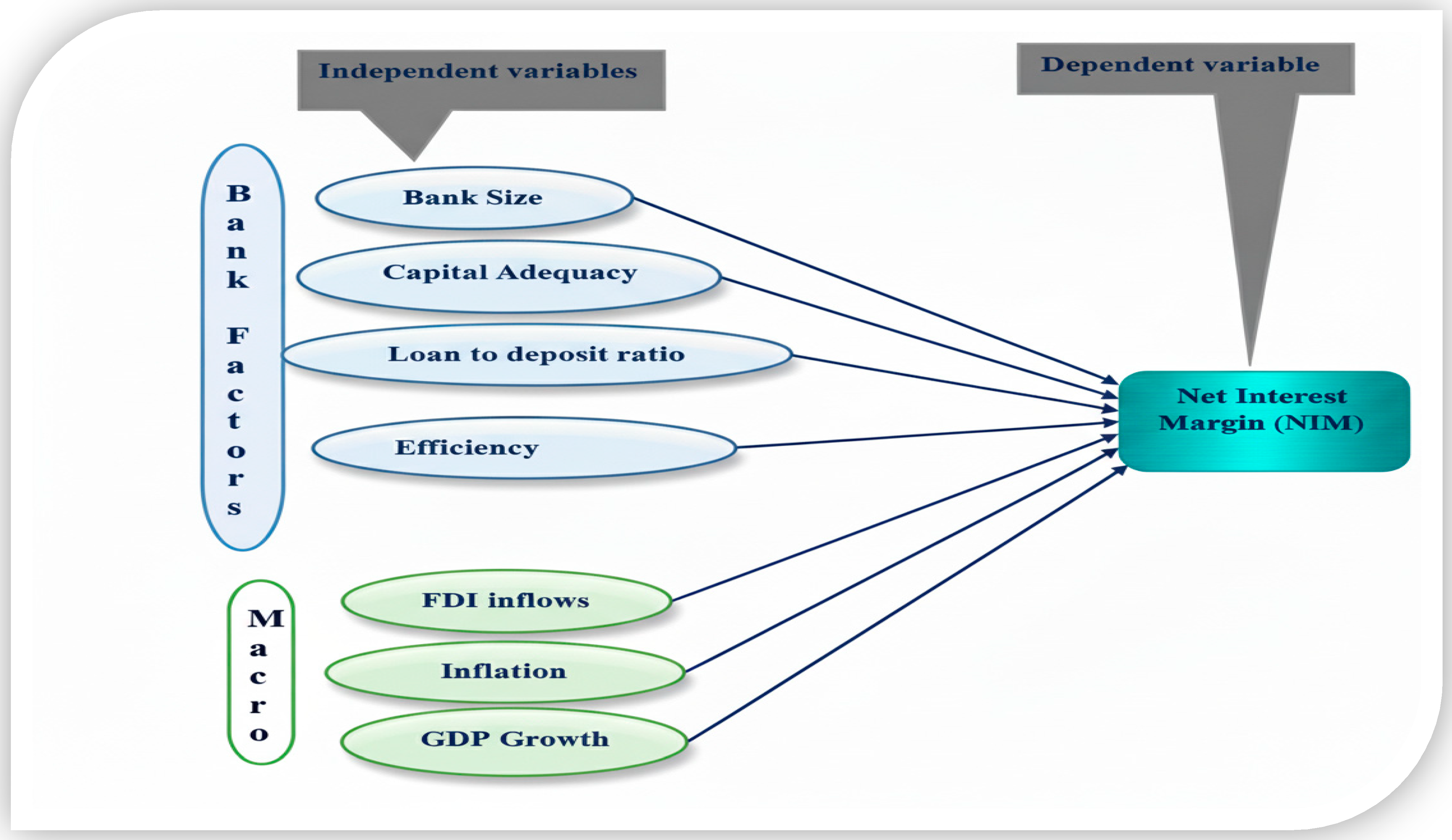
Based on the literature and identified gaps, the following conceptual framework is created.
Figure 1 shows the study’s conceptual framework.
3. Materials and Methods
This study aims to explore the factors affecting the net interest margin (NIM) in developing economies, with a focus on Ethiopian commercial banks. Data were sourced from the National Bank of Ethiopia (NB) for the author’s ongoing research and are reused here, having been verified for accuracy and consistency. An explanatory research design employing a quantitative approach is utilized in this study.
Ethiopia has 32 licensed commercial banks (
National Bank of Ethiopia, 2025), but this study focuses on 13 banks selected based on their operational start dates and data availability. The analysis covers the period from 2012 to 2024, using consistent financial statements for accurate panel estimation. Sixteen banks that began operations in or after 2019 were excluded due to limited data. Additionally, three banks, Abay Bank S.C. (November 2010), Addis International Bank S.C. (2012), and Global Bank Ethiopia S.C. (August 2012), were omitted despite their earlier founding dates because their initial years lack comprehensive, stable data and are close to the start of the sample period. Early-stage banks often show atypical balance sheets, limited lending, and volatile income, which could bias net interest margin estimates and make meaningful comparisons over time difficult.
The final sample comprises 13 banks with complete data from 2012 to 2024, including Commercial Bank of Ethiopia, Awash Bank S.C., Dashen Bank S.C., Bank of Abyssinia, Wegagen Bank S.C., Hibret Bank S.C., Nib International Bank S.C., Cooperative Bank of Oromia, Lion International Bank S.C., Zemen Bank S.C., Oromia Bank S.C., Berhan Bank S.C., and Bunna Bank S.C. This selection creates a balanced panel, strengthening the robustness and credibility of the results. Consequently, the study examines data from 13 banks over 13 years, totaling 169 observations.
To ensure the robustness of the study, both Driscoll–Kraay fixed-effect and random-effects regression were conducted in RStudio using R version 4.5. Guided by the Hausman test, only the Driscoll–Kraay random effect output is used for the analysis, while the Driscoll–Kraay fixed effect is also presented for a robustness check. To ensure the trustworthiness and validity of the findings, diagnostic tests for normality, multicollinearity, heteroscedasticity, and serial correlation were examined. Lastly, to validate and contextualize the findings, the findings are cross-referenced with existing studies.
To maintain technical consistency in the regression analysis, all variables are presented in decimal form, except for Bank Size (BS) and FDI inflows (LnFDI), which are transformed using natural logarithms.
The model is written as follows.
where
Net interest margin (NIM)
i = bank t = Time
β0 = the intercept,
β1, β2…, β9 are the coefficient
CAR = Capital Adequacy Ratio
BS = Bank Size
LDR = Loan-to-deposit ratio
OE = Operational Efficiency
FDI = Foreign Direct Investment
Inflation = Annual inflation
RGDPG = Real GDP growth
ε = Error term.
Operationalization of the Study Variable
The operational definitions of the variables, along with their notations, are indicated in
Table 1.
4. Results and Discussion
4.1. Descriptive Statistics
The statistical measures described below were calculated using panel data comprising 13 banks over 13 years, yielding 169 observations.
Table 2 below demonstrates descriptive statistics os the study.
The logarithmic mean of bank size is 23.99, ranging from 21.34 to 26.72, with a standard deviation of 1.22. This indicates variability in bank asset sizes, highlighting industry concentration, with larger banks dominating. These size differences can affect access to funding, economies of scale, and market influence, thereby affecting banks’ ability to set interest margins and underscoring the significance of bank size in determining NIM.
The CAR ranges from 8% to 19%, averaging 13%, with a slight standard deviation of 0.03. Ethiopian banks generally maintain capital adequacy above the 8% minimum, indicating stability despite differences in loss-absorption mechanisms. Robust capital reserves boost depositor confidence and reduce funding risks, enabling more lending and interest income. Variations may reflect different risk appetites and strategies. Overall, capital buffers significantly influence NIM.
Ethiopian banks’ loan-to-deposit ratio (LDR) ranges from 39% to 100%, with an average of 69% and a standard deviation of 0.14, meaning banks use about two-thirds of deposits for lending. Higher LDRs reflect aggressive pursuit of interest income, while lower LDRs indicate a conservative focus on liquidity. The variation reflects different risk tolerances and funding strategies, influencing profitability and liquidity through the net interest margin (NIM). An overly high LDR may signal low liquidity, requiring banks to balance profitability with liquidity risks.
The inflation rate varies from 7% to 34%, with an average of 17% and a standard deviation of 0.08. This indicates economic volatility that increases banks’ funding costs, affects loan pricing, and raises uncertainty. Persistent inflation fluctuations make risk management more challenging, thereby reducing banks’ interest margins.
The minimum and maximum GDP growth rates were between 6% and 10%, with a mean of 8% and a standard deviation of 0.02, suggesting favorable economic conditions and relatively stable growth.
The logarithmic mean of FDI inflows is 21.91 with a standard deviation of 1.26, ranging from 20.22 to 24.77. This steady FDI flow suggests banks used capital to expand lending and boost net interest margins. FDI can also strengthen liquidity via corporate deposits and increase demand for investment and trade finance, further enhancing banks’ lending capacity and margins.
The average efficiency is 58% (34–89%) with a standard deviation of 0.13, reflecting variability within the banking sector. Some banks operate efficiently, others face challenges. While some are near the efficiency frontier, structural and managerial issues may affect service quality and sustainability. These differences do not necessarily impact interest margins immediately.
4.2. Correlation Analysis
As the following table shows, NIM is strongly correlated with the loan-to-deposit ratio, indicating that banks with higher LDRs have higher NIMs. Bank size and operational efficiency are moderately positively associated with NIM, indicating that banks with greater assets and better operational efficiency have higher net interest margins. Moreover, NIM is positively linked to FDI but negatively correlated with inflation. Capital buffers and GDP have shown a weak and moderate negative relationship with NIM, respectively. The correlation analysis result is detailed in
Table 3.
4.3. Assumptions of the Regression Model
The study conducted underlying assumptions of linear regression to increase the credibility and robustness of the findings. The following section demonstrates the results of each assumption.
4.3.1. Normality Test
Shapiro–Wilk and Anderson–Darling tests were conducted to verify the normality of the residuals. Both results showed no significant
p-values, indicating normal distribution of the residuals.
Table 4 presents the test results.
4.3.2. Multicollinearity Test
Both the test results for the variable inflation factor (VIF) and its tolerance (1/VIF) are below the threshold, indicating no multicollinearity problem.
Table 5 summarizes the test results.
Table 5 shows VIF and tolerance statistics to assess multicollinearity among variables. VIFs below five and tolerances above 0.20 are acceptable (
Rendón, 2012). All variables have VIFs from 1.13 to 3.50 and tolerances from 0.29 to 0.88, within these limits. Although inflation and real GDP growth have slightly higher VIFs, they remain below critical levels and reflect expected macroeconomic co-movement. Overall, multicollinearity does not significantly impact the model, allowing for reliable coefficient interpretation.
4.3.3. Heteroscedasticity Test
The test result indicates a
p-value of 0.39, supporting homoscedasticity in the model and no heteroscedasticity in the data.
Table 6 details the results.
4.3.4. Autocorrelation Test
The Breusch–Godfrey test indicates significant autocorrelation (
p < 0.05), which suggests that robust correction methods, such as Driscoll–Kraay and cluster-robust standard errors, are necessary.
Table 7 below shows the test results.
4.3.5. Model Selection Test
The Hausman test was computed to choose between fixed- and random-effects models. The test outcome shows a
p-value of 0.923, suggesting the random effect is the best fit.
Table 8 below indicates the test result.
4.4. Robust Driscoll–Kraay Random Effects Regression Results
The output from the robust Driscoll–Kraay standard error is presented in
Table 9 below.
4.5. Discussion of Results
Table 7 suggests that the Breusch–Godfrey test indicates statistically significant serial correlation (
p < 0.05), thereby necessitating the use of robust inference methods. Thus, both cluster-robust and Driscoll–Kraay standard errors are employed to mitigate potential breaches of the linear regression assumption. Cluster-robust standard errors address heteroskedasticity and within-bank serial correlation, but they fail to account for contemporaneous correlation among banks. In contrast, the Driscoll–Kraay estimator is resilient to heteroskedasticity, serial correlation, and cross-sectional dependency (
Driscoll & Kraay, 1998;
Hoechle, 2007). Due to the existence of serial correlation and the potential for cross-sectional dependence, Driscoll–Kraay standard errors are utilized as the correction method.
Both Driscoll–Kraay fixed-effects and random-effects models are estimated, yielding similar findings across specifications. The stability of coefficient estimates signifies that the findings are not influenced by the selection of the estimator, hence enhancing the robustness of the results. The Hausman test, which endorses the random-effects specification, indicates that the Driscoll–Kraay random-effects model is chosen as the primary estimation method. To ensure robustness, fixed-effects results utilizing Driscoll–Kraay standard errors are also shown.
Table 9 displays both sets of estimates.
The adjusted R2 of 0.71 indicates that the explanatory factors account for 71% of the variation in NIM, suggesting that the model is both accurate and well-fitted. Driscoll–Kraay random effects of the study are discussed below.
4.5.1. Bank Size
The results reveal a positive and significant relationship between bank size (measured as the natural logarithm of total assets) and NIM. The estimated coefficient of 0.01 implies that a 1% increase in total assets is associated with a 0.01 percentage point (1 base point) increase in NIM. This finding is consistent with that of (
Abdeljawad et al., 2025;
Lelissa, 2019;
Lestari et al., 2021;
Mesfin & Ram, 2019). These results can be explained by the competitive advantage, substantial capital, and financial stability of larger banks, which enable them to expand their lending and generate higher NIM. Conversely, smaller banks must grow strategically to stay competitive and attain economies of scale. Additionally, policymakers should promote measures that enhance the capital base of smaller banks.
4.5.2. Capital Adequacy Ratio (CAR)
The research results indicate that CAR has a significant, positive influence on NIM. The coefficient of 0.10 indicates that a one percentage point increase in CAR raises NIM by 0.10 percentage points (10 basis points), suggesting that banks with higher capital adequacy ratios boost their NIM. This finding is consistent with studies by (
Alamirew, 2024;
Hao et al., 2023;
Lestari et al., 2021;
Leykun, 2016;
Mesfin & Ram, 2019). The results imply that banks with substantial capital inspire greater market confidence and secure funding at low cost. Therefore, banks should maintain a considerable capital reserve to improve financial resilience and lending capacity. These findings strongly support the National Bank of Ethiopia’s (NBE’s) recent emphasis on raising capital adequacy standards and its shift to a risk-based capital policy under Directive No. SBB/95/2025 (
Finance in Africa, 2025).
4.5.3. Loan-to-Deposit Ratio (LDR)
The results further suggest that the LDR is a significant and positive driver of NIM, with a low
p-value of 0.05. The estimated coefficient 0.05 indicates that a one percentage point increase in the loan-to-deposit ratio is associated with a 0.05 percentage point (5 basis points) increase in NIM. This is consistent with findings by (
Abdeljawad & Bahlaq, 2023;
Harimurti, 2022;
Lestari et al., 2021;
Setiawan & Wisna, 2021;
Siauwijaya et al., 2023), which support the significance of the LDR in enhancing banks’ NIMs. In the Ethiopian context, the National Bank of Ethiopia (NBE) increased the credit growth limit from 18% to 24% to encourage lending (
Finance in Africa, 2025). This finding highlights the necessity of effective liquidity management and deposit mobilization through initiatives such as digital banking to optimize LDR. However, banks need to balance optimizing their LDRs to improve margins with policy requirements that direct lending to specific priority sectors to support national development goals.
4.5.4. Operational Efficiency
The results show that operational efficiency does not affect the NIM of Ethiopian banks. This indicates that structural and macro-financial factors have a bigger influence on NIM than internal cost management. Furthermore, Ethiopia’s regulated interest rate environment, limited competition, and underdeveloped financial markets may reduce banks’ incentive to translate operational gains into pricing advantages. In such situations, NIM mainly reflects market structure, liquidity, and risk pricing rather than managerial efficiency. This finding contrasts with the conclusions of (
Angori et al., 2019;
Hao et al., 2023;
Setiawan & Wisna, 2021). The policy takeaway is that comprehensive reforms—such as accelerating digital transformation and fostering a more competitive banking sector are necessary to make operational efficiency a significant factor in NIM going forward.
4.5.5. Inflation
The findings established that inflation has a negative and significant effect on NIM. The coefficient of −0.04 indicates that a one percentage-point increase in inflation reduces NIM by 0.04 percentage points (4 basis points). This adverse effect in the Ethiopian context likely stems from operational and funding costs outpacing interest income adjustments, mainly due to the highly regulated environment where the minimum savings rate remains fixed at 7%, which compresses margins during spikes. The National Bank of Ethiopia prevents banks from adjusting their lending interest rates in line with inflation, despite inflation increasing banks’ operating costs. This finding is consistent with studies by (
Dumicic & Rizdak, 2013;
Khan et al., 2024;
Mesfin & Ram, 2019). The results affirm the need for the National Bank of Ethiopia (NBE) to adopt an interest rate-based monetary policy framework. Such reforms are essential to control inflation, restore pricing flexibility within banks, enhance financial system stability, and foster sustainable economic growth amid challenging conditions.
4.5.6. Foreign Direct Investment Inflows
The study findings show a positive relationship between FDI inflows and NIM, with a coefficient of 0.001. Given the log level specification, the coefficient implies that a 1% increase in FDI inflows raises NIM by approximately 0.001 percentage points (0.1 basis points). This means FDI enhances a bank’s lending capacity and interest income by adding foreign currency into the economy, boosting economic activity, and creating new corporate deposits. These results indirectly support Ethiopia’s ongoing liberalization policies, which seek to open the economy and attract foreign capital. Ethiopia’s policymakers should simplify investment processes and ensure stability to leverage the benefits of FDI fully. These strategies can foster sustainable economic growth, strengthen banks’ balance sheets, and facilitate greater credit availability for productive sectors. This finding is similar to that of
Ferrouhi (
2017), underscoring the importance of foreign direct inflows in determining NIM.
4.5.7. Real GDP Growth
The findings indicate that GDP growth does not affect the NIM of Ethiopian Banks. This is in line with (
Jima, 2017;
Mesfin & Ram, 2019;
Rani & Zergaw, 2017). The results suggest that the state of Ethiopian banks is anchored in structural factors, such as direct lending, capital requirements, market concentration, and monetary policy, including interest regulation, rather than in the aggregate pace of economic expansion itself. Therefore, achieving higher GDP growth will not automatically expand bank margins; thus, policymakers should align pro-growth fiscal policies with institutional and financial sector reforms to channel macroeconomic upticks through the banking system. This approach can improve banks’ profitability and strengthen the link between economic growth and financial intermediation.
5. Conclusions and Recommendations
This study provides empirical evidence on the main factors affecting the net interest margin (NIM) in Ethiopian commercial banks, offering valuable insights for policymakers, banking leaders, and other stakeholders interested in profitability and financial stability in emerging economies. The findings show that bank-specific features and certain macroeconomic variables have varied but significant effects on interest margins. Specifically, the results reveal that the loan-to-deposit ratio, bank size, capital adequacy, and foreign direct investment (FDI) inflows all significantly positively influence NIM.
The positive effect of the loan-to-deposit ratio underscores Ethiopian banks’ capacity to convert deposits into income-generating loans, thus boosting interest spreads. Likewise, the strong relationship between bank size and NIM indicates that economies of scale, increased market influence, and diverse funding sources enable larger banks to sustain higher profit margins. Capital adequacy also significantly contributes, showing that well-capitalized banks are better equipped to absorb risks, lower funding costs, and maintain healthy lending spreads.
Furthermore, the positive impact of FDI inflows emphasizes the importance of external capital in expanding deposit bases, supporting lending activities, and increasing interest income. Conversely, inflation significantly reduces NIM by raising deposit costs, increasing credit risk, and delaying interest rate adjustments, thus posing a major macroeconomic challenge to banking profitability in Ethiopia. Meanwhile, operational efficiency and gross domestic product (GDP) growth do not show statistically significant effects on NIM, indicating that regulatory constraints, competitive pressures, and prudent risk management limit the impact of efficiency gains and economic growth on interest margins.
Overall, the study indicates that NIM in Ethiopian banks is mainly driven by internal financial strength and external capital flows. However, macroeconomic instability, especially inflation, poses a threat to the sustainability of profit margins. The results imply that banks should prioritize asset expansion, maintain strong capital levels, manage liquidity effectively, and pursue strategic foreign investments. Controlling inflation also remains a crucial factor. From a policy standpoint, fostering macroeconomic stability and establishing an investment-friendly environment are essential for enhancing the resilience of the banking sector.