1. Introduction
Creative accounting, broadly understood as the discretionary use of accounting flexibility to influence reported outcomes, has become increasingly relevant as entities face pressure to present favorable financial results. Although such practices may fall within existing standards, their use can distort the enterprise’s economic reality and affect the quality of information available to stakeholders. Despite the development of international reporting frameworks and intensified standard-setting efforts, financial statements do not consistently achieve their intended objective of faithfully representing an entity’s performance and financial position. Financial scandals and economic crises have shown that reporting discretion—whether motivated by earnings management, income smoothing, or other techniques—continues to challenge the credibility of financial information (
Abed et al., 2022a;
Egolum & Onodi, 2021;
Svabova et al., 2020).
Creative accounting remains a controversial phenomenon, encompassing both legitimate professional judgment and opportunistic manipulation (
D. Balaciu & Pop, 2007). While fraud involves intentional non-compliance with legal requirements, creative accounting exploits ambiguities within standards and can therefore blur the boundary between accuracy and distortion (
Jones, 2011;
Knežević et al., 2012). Understanding how these practices operate is important to enhance transparency in financial reporting and support effective corporate governance (
Alsalim et al., 2018).
In Romania, interest in creative accounting has grown significantly over the past decade, driven by market development and regulatory changes. However, existing studies focus predominantly on conceptual discussions or on isolated financial scandals, offering limited evidence of how creative accounting is perceived by practitioners and how such perceptions relate to its actual financial effects. This gap is particularly relevant for an emerging market context, where reporting credibility is essential for investor confidence.
Against this background, the present study aims to: (1) examine how creative accounting practices are perceived to influence financial position and performance within Romanian listed companies, and (2) statistically assess the risk of fraud associated with such practices across different industries and leverage levels. By combining a perception-based survey with a financial case study, this research provides a dual perspective on the subjective and measurable impacts of creative accounting. This study offers a novel comparison between perceived and actual financial effects of creative accounting practices by jointly analyzing professional perceptions and scenario-based financial evidence.
The remainder of this paper is structured as follows:
Section 2 reviews the literature on creative accounting and its implications for reporting quality.
Section 3 describes the research design, including the survey instrument, sample characteristics, and the rationale for the case study.
Section 4 presents empirical findings, followed by a discussion of the results in
Section 5.
Section 6 concludes this study and outlines its implications, limitations, and avenues for future research.
2. Literature Review and Research Hypothesis Formulation
2.1. Conceptual Perspectives on Creative Accounting
Creative accounting is one of the most debated concepts in contemporary financial reporting, as it operates at the intersection of legitimate professional judgment and opportunistic manipulation.
From a regulatory standpoint, the flexibility embedded in accounting standards—particularly those issued by the IASB—allows for alternative measurement and recognition methods that can faithfully represent different economic contexts. The Conceptual Framework for Financial Reporting acknowledges the need for managerial judgment to achieve relevance and faithful representation while enhancing characteristics such as comparability, verifiability, timeliness, and understandability, which guide the selection among permissible treatments when several options similarly portray economic reality (
Burcă & Cotleț, 2014;
Tabără & Rusu, 2011). However, this very flexibility constitutes the conceptual space in which creative accounting emerges. In practice, managers may use discretion not only to reflect underlying economic substance but also to influence stakeholder perceptions. This dual perspective is widely recognized in the literature: creative accounting may be benign—arising from legitimate interpretative choices in complex or uncertain reporting environments—or it may be used strategically to alter reported performance in a way that benefits preparers at the expense of users (
Jones, 2011;
Mansour & Spătariu, 2024;
Uşurelu et al., 2010). Moreover, studies show that professional perceptions and cognitive associations significantly influence how preparers interpret and apply discretionary accounting techniques, with many practitioners attributing creative accounting predominantly negative connotations related to manipulation and risk (
D. E. Balaciu et al., 2014). Survey-based evidence also shows that both accountants and accounting students acknowledge the use of legally compliant creative accounting techniques, highlighting the role of professional perceptions in shaping such practices (
Cernusca et al., 2016). Such practices are facilitated by the inherent asymmetry of information between managers and external stakeholders, a condition extensively theorized within agency theory, which posits that managerial incentives often diverge from those of owners and creditors. The distinction between creative accounting and fraud is conceptually important yet empirically difficult to observe. Fraud implies intentional misrepresentation and clear violations of accounting or legal requirements, whereas creative accounting generally operates within the letter of the law while deviating from its spirit (
Knežević et al., 2012). As several studies note, the boundary between the two is porous: aggressive accounting choices may remain technically compliant even when they substantially distort the entity’s actual financial position (
Chou et al., 2025;
Kliestik et al., 2020). Evidence also suggests that weak corporate governance structures increase the likelihood of financial misreporting by reducing oversight and accountability mechanisms (
Martins & Ventura Júnior, 2020). This blurred line complicates detection efforts and raises concerns for regulators, auditors, and investors, particularly in environments with limited enforcement capacity (
Omurgonulsen & Omurgonulsen, 2009). Emerging evidence shows that fintech-enabled reporting and audit tools can enhance fraud detection and strengthen investor protection by reducing opportunities for manipulative practices (
Roszkowska, 2021).
Contemporary definitions of creative accounting emphasize the use of accounting techniques, estimates, judgments, and classification alternatives to modify reported results without overt noncompliance (
Blazek et al., 2023). It may include adjustments to provisions, depreciation and amortization policies, valuation choices, reclassifications within financial statements, and the timing of revenue or expense recognition. Such flexibility enables managers to construct a narrative about performance—sometimes referred to in the literature as accounting engineering—that may diverge, subtly or significantly, from the firm’s actual economic trajectory. Moreover, the literature points to the contextual drivers that shape creative accounting practices. During periods of financial stress or economic crisis, companies face heightened pressure to signal stability, maintain investor confidence, and satisfy financing requirements. Historically, these conditions have amplified the use of creative accounting, as observed both in global scandals (e.g., Enron, WorldCom, Parmalat) and in more localized cases within emerging markets (
Baker & Hayes, 2004;
Delesalle & Delesalle, 2000;
Jones & Stanton, 2021;
Morariu & Jianu, 2009). In Romania, interest in the phenomenon intensified following economic downturns and regulatory changes, which exposed vulnerabilities in reporting practices and underscored the limitations of traditional accounting systems in capturing modern business dynamics. Overall, creative accounting can be understood as a discretionary reporting behavior arising from a combination of regulatory flexibility, managerial incentives, information asymmetry, and contextual pressures. While not inherently illegal, its misuse undermines the fundamental qualitative characteristics of financial reporting and raises significant concerns regarding transparency, governance, and investor protection.
2.2. Techniques and Motivations Underlying Creative Accounting
Creative accounting encompasses a broad spectrum of techniques through which managers can influence reported financial performance and position while formally complying with accounting regulations. These techniques generally exploit areas of flexibility allowed by accounting standards, estimation processes, or classification choices. Literature typically groups creative accounting methods into three broad categories: accrual-based manipulation, real activity manipulation, and presentation or classification shifting (
Cooray et al., 2020;
Kıllı et al., 2024). Empirical evidence from emerging economies further illustrates that these categories are widely used in practice and produce measurable effects on reported outcomes (
Ozkaya, 2014).
Accrual-based techniques rely on the inherent discretion in estimating provisions, depreciation, impairment losses, fair values, and other elements that depend on managerial judgment. Adjustments to provisions for doubtful debts, warranties, restructuring costs, or contingent liabilities are among the most common tools used to increase or decrease reported earnings in line with managerial objectives. Similarly, the choice of depreciation method or changes in the useful life of assets can significantly alter the timing of expense recognition, thereby affecting profit levels without altering underlying operational performance.
These practices are central to earning management literature, which demonstrates that accrual manipulation remains one of the most prevalent forms of discretionary reporting behavior, particularly in environments with weaker enforcement or monitoring mechanisms (
Kliestik et al., 2020;
Blazek et al., 2023). Although creative accounting is often associated with accrual manipulation, managers may also alter operational decisions to influence accounting results. Examples include accelerating or delaying sales, offering excessive discounts to boost revenues near reporting dates, postponing necessary expenditures, or modifying production levels to absorb fixed costs. While these behaviors may not violate accounting standards, they distort the firm’s economic reality and may have negative long-term consequences for performance and financial stability (
Riyadh et al., 2024). Such activities are particularly prominent during periods of financial stress or heightened scrutiny from investors, creditors, or regulators.
Another category of creative accounting involves altering how information is presented in financial statements. Managers may reclassify items between operating, investing, and financing categories, capitalize expenditures that would ordinarily be expensed, or manipulate subtotal reporting (e.g., EBITDA, operating profit) to create a more favorable financial narrative. Classification shifting is subtle but effective because it often avoids direct manipulation of profits while influencing analyst and investor perceptions (
Cooray et al., 2020). The motivations behind these practices are well-grounded in agency theory, which highlights conflicts of interest between managers (agents) and stakeholders (principals). Recent evidence based on managerial and auditor perceptions indicates that pressures to meet performance targets, maintain market confidence, and manage stakeholder expectations remain central drivers of creative accounting practices (
Aldahiyat et al., 2021). These incentives motivate managers to engage in a variety of creative accounting techniques, a pattern widely documented in empirical studies (
Bhasin, 2016). When managerial compensation, job security, or reputation is tied to reported performance, incentives arise to manipulate accounting figures. Managers may seek to meet or exceed earnings benchmarks, avoid violating debt covenants, maintain or increase share prices, ensure dividend continuity, signal financial stability, and smooth earnings to reduce perceived risk (
Hadani et al., 2011) and in many cases optimize the tax burden through discretionary accounting choices, a practice documented across international settings (
Blazek, 2021). Several contextual and organizational factors have also been identified as drivers of creative accounting practices, including weak internal controls, regulatory gaps, and pressure to present favorable performance (
Debbarma & Roy, 2023;
Hussein et al., 2020;
Olojede & Erin, 2021). Comparable evidence from the public sector shows that fiscal indicators may also be distorted through creative accounting to comply with externally imposed constraints (
Maltritz & Wüste, 2015). Further evidence from service industries indicates that performance pressures, competitive conditions, and stakeholder expectations significantly influence the adoption of creative accounting practices, often with subsequent negative effects on reporting quality (
Saleh et al., 2023).
In emerging markets such as Romania, additional motivations include regulatory ambiguity, limited enforcement capacity, and pressures related to taxation or liquidity constraints. Economic downturns further amplify these incentives, as entities face heightened expectations to demonstrate resilience or safeguard access to financing (
Ado et al., 2022;
Delesalle & Delesalle, 2000;
Hirota & Yunoue, 2022;
Reischmann, 2016). Beyond economic incentives, behavioral factors also contribute to the prevalence of creative accounting. Studies indicate that managerial overconfidence, ethical relativism, risk tolerance, and organizational culture play a significant role in shaping discretionary reporting behavior (
Elitzur, 2011). In companies with weak internal controls or underdeveloped internal audit functions, managers may perceive greater opportunities to manipulate results with minimal risk of detection (
Uwuigbe et al., 2019). Moreover, information asymmetry, an inherent characteristic of financial reporting, creates fertile ground for such practices. When stakeholders lack access to timely or complete information, managers have greater latitude to influence financial narratives. This dynamic reinforces the importance of transparency and strong governance mechanisms to deter opportunistic reporting.
In summary, creative accounting arises from the interplay between accounting flexibility, managerial discretion, economic incentives, and contextual pressures. Techniques range from accrual manipulation to real operation adjustments and classification shifting, while motivations span personal, organizational, and market-driven factors. Understanding these mechanisms is crucial for evaluating how creative accounting affects both perceived and actual financial performance and for developing effective regulatory and governance responses.
2.3. Effects of Creative Accounting on Reporting Quality and Performance
Creative accounting has significant implications for the quality of financial reporting and for the interpretation of an entity’s financial performance. While accounting standards aim to provide users with relevant and faithfully represented information, discretionary reporting practices compromise these objectives by altering the transparency, consistency, and comparability of financial statements. The literature consistently highlights that creative accounting reduces the reliability of reported information and undermines stakeholders’ ability to make informed economic decisions (
Abed et al., 2022b;
Riyadh et al., 2024;
Svabova et al., 2020;
Tassadaq & Malik, 2015). A primary consequence of creative accounting is the erosion of the qualitative characteristics that underpin high-quality financial reporting. Manipulating estimates, classification choices, or the timing of recognition affects faithful representation, by creating discrepancies between economic substance and reported values; comparability, through inconsistent application of accounting methods across periods or between entities; verifiability, as subjective judgments impede auditors’ ability to corroborate reported amounts; transparency, by obscuring the firm’s actual financial condition. Research further shows that the use of creative accounting undermines the reliability of financial information by weakening faithful representation and increasing the risk of misinterpretation by stakeholders. Through discretionary choices in measurement and classification, managers may present figures that comply with formal standards yet obscure the entity’s actual economic condition. As noted by
Ahmed (
2022), such practices diminish the credibility of financial statements and reduce their usefulness for informed decision-making. Similar findings are reported by
Ismael (
2017), who concludes that creative accounting techniques systematically weaken the reliability of financial reporting by distorting users’ understanding of an entity’s true financial performance and position, even when such techniques remain within the limits of accounting standards.
Empirical studies show that entities engaging in extensive accrual manipulation or classification shifting exhibit systematically lower reporting quality and higher levels of information asymmetry (
Cooray et al., 2020). This asymmetry increases investor uncertainty and undermines market efficiency, particularly in contexts with weak external monitoring. Creative accounting can produce substantial distortions in key financial indicators used to evaluate firm performance and risk. Adjustments to accruals, provisions, asset valuations, or depreciation policies may artificially inflate or deflate profitability ratios (net profit margin, return on assets, EBITDA), leverage indicators (debt-to-equity, gearing ratios), liquidity measures (current ratio, quick ratio), solvency, and capital adequacy positions. These distortions can mislead analysts and investors into believing that financial performance is improving or deteriorating, when in fact changes reflect reporting choices rather than underlying operational outcomes (
Rahman et al., 2023). Studies in emerging markets show that such distortions are more pronounced in regulatory environments characterized by limited enforcement capacity or significant economic volatility (
Ado et al., 2022;
Blazek et al., 2023;
Abdurrahmani & Doğan, 2021).
The manipulation of accounting information has broader implications for stakeholders, including creditors, employees, regulators, customers, and potential investors. Misrepresentations in financial statements may lead investors to allocate resources inefficiently, influence credit rating decisions and borrowing costs, affect contractual arrangements tied to performance thresholds, distort managerial compensation outcomes, and reduce overall trust in corporate governance mechanisms (
Akpanuko & Umoren, 2018). High-profile corporate failures such as Enron, WorldCom, and Parmalat illustrate how aggressive accounting practices can escalate into systemic failures when discretion is abused, and monitoring mechanisms prove inadequate (
Morariu & Jianu, 2009). These cases demonstrate that creative accounting not only affects internal reporting quality but also poses risks to market stability and stakeholder welfare.
In emerging markets, where institutional frameworks may be evolving, the effects of creative accounting are particularly significant. Limited transparency, weaker enforcement, and pressure to attract investment increase incentives for earnings manipulation. Romanian studies acknowledge that discretionary reporting reduces investor confidence and weakens perceptions of financial sustainability in local firms (
Feleagă & Malciu, 2002;
Ionaşcu, 2003). Despite these concerns, empirical evidence connecting creative accounting to measurable financial outcomes in Romanian listed companies remains scarce. Most existing literature discusses conceptual dimensions or isolated scandals rather than systematically assessing how creative accounting affects financial indicators and reporting credibility. This gap underscores the need for empirical studies that examine both the perceived and actual impacts of creative accounting practices in the Romanian market.
Overall, the literature demonstrates that creative accounting affects both reporting quality and financial performance, with consequences that extend beyond the firm to the broader economic environment. These effects are especially critical in emerging markets, where investor protection and governance structures may be less robust. The documented distortions in financial indicators, combined with inconsistent or misleading reporting practices, emphasize the importance of assessing how professionals perceive creative accounting and how it manifests in measurable financial outcomes.
2.4. Research Gap and Hypotheses Development
Despite extensive international literature on creative accounting, significant conceptual and empirical gaps persist, particularly in emerging economies. Prior studies predominantly examine either the theoretical boundaries between legitimate discretion and manipulation or focus on high-profile corporate failures that illustrate extreme reporting abuses. Although several studies have examined the determinants and consequences of creative accounting, far fewer have developed systematic metrics capable of quantifying its occurrence. Recent attempts, such as the Transparency and Disclosure Index (TDI) proposed by
Denich and Hajdu (
2021), illustrate the value of structured measurement frameworks but remain limited in scope and industry coverage. This highlights the need for further research that assesses creative accounting using broader samples and context-specific indicators. However, far fewer studies address how creative accounting practices are perceived by the financial professionals who prepare, analyze, or audit financial statements, even though such perceptions strongly influence reporting behavior and organizational governance. A second limitation concerns the empirical assessment of the actual financial effects of creative accounting. While international evidence shows that discretionary accounting practices distort profitability, leverage, liquidity, and equity indicators, systematic analyses in Romanian listed companies remain scarce. Most national studies emphasize conceptual distinctions or anecdotal evidence, without integrating perceptual data and quantitative financial analysis within a unified research framework. Addressing these two gaps is essential for improving reporting transparency and strengthening market confidence.
Building on these gaps and the mechanisms outlined in
Section 2.1,
Section 2.2 and
Section 2.3, the present study develops three hypotheses. Financial-accounting professionals operate close to the reporting process and are therefore well positioned to evaluate the influence of creative accounting on the representation of financial position and performance. Prior research suggests that professional judgment, exposure to reporting practices, and organizational constraints shape their views on reporting discretion (
Jones, 2011;
Cooray et al., 2020). Accordingly, we propose:
H1. Financial-accounting professionals perceive creative accounting techniques as having a significant impact on the financial position and performance of Romanian listed companies.
Empirical studies have shown that creative accounting produces measurable distortions in key financial indicators, particularly through accrual manipulation, valuation choices, and classification shifting (
Kıllı et al., 2024;
Svabova et al., 2020). To verify whether similar effects occur in Romania, this study analyzes multi-year financial data from a representative listed entity. This leads to:
H2. The application of creative accounting techniques results in measurable changes in key financial indicators for the analyzed Romanian listed company.
Finally, evidence from behavioral and reporting research suggests that differences often arise between the perceived and actual consequences of discretionary accounting practices due to informational asymmetry, context-specific incentives, and varying professional experience (
Riyadh et al., 2024). Combining a perception-based survey with empirical financial analysis allows for a direct comparison, motivating the third hypothesis:
H3. There is a significant discrepancy between the perceived and the actual financial effects of creative accounting practices.
Together, these hypotheses address the dual research gap identified above and establish the analytical foundation for the methodological design presented in the subsequent section.
3. Research Methodology
This study adopts a mixed-method research design consisting of two complementary components: (1) an exploratory survey targeting financial–accounting professionals, and (2) an applied financial case study assessing the measurable effects of creative accounting techniques on key financial indicators.
This design aligns with the dual aim of this research: to examine professionals’ perceptions of creative accounting (H1) and to analyze the actual financial consequences of accounting discretion through a detailed scenario-based evaluation of a Romanian listed company (H2, H3). Mixed approaches are commonly employed when investigating phenomena that involve both behavioral and technical dimensions of financial reporting (
Creswell & Plano Clark, 2018). While the survey provides contextual insights into attitudes toward creative accounting, the financial case study constitutes the core empirical component of this research and serves as the primary basis for hypothesis testing.
The survey serves an exploratory purpose: to capture how financial–accounting professionals perceive the prevalence and impact of creative accounting techniques within Romanian listed entities. These perceptions inform the interpretation of the case study and provide a behavioral reference point for evaluating discrepancies between perceived and actual financial outcomes (H1, H3). A purposive sampling strategy was applied to individuals working in financial positions (accountants, financial directors, internal auditors, financial auditors) across companies listed on the Bucharest Stock Exchange (BVB). A total of 360 questionnaires were distributed, and 311 valid responses were collected. Participation was voluntary and anonymous.
The empirical analysis focuses on a large Romanian listed entity operating in the dairy processing and manufacturing sector. The company was selected based on: availability of detailed multi-year financial statements and notes; exposure to accounting areas with high managerial discretion (inventory valuation, depreciation, provisions, asset revaluation); representativeness for Romanian industries where creative accounting incentives may be significant. The identity of the company analyzed is anonymized to prevent potential reputational impact. Only publicly available financial data were used, ensuring compliance with research ethics standards. The case study approach is well-suited for analyzing how accounting policy choices influence financial indicators in real-world reporting environments. This study relies on publicly available annual financial statements (statement of financial position, profit and loss account, notes to the financial statements) for multiple consecutive years. The period allows for evaluating trends and identifying the financial effects of specific accounting techniques and adjustments.
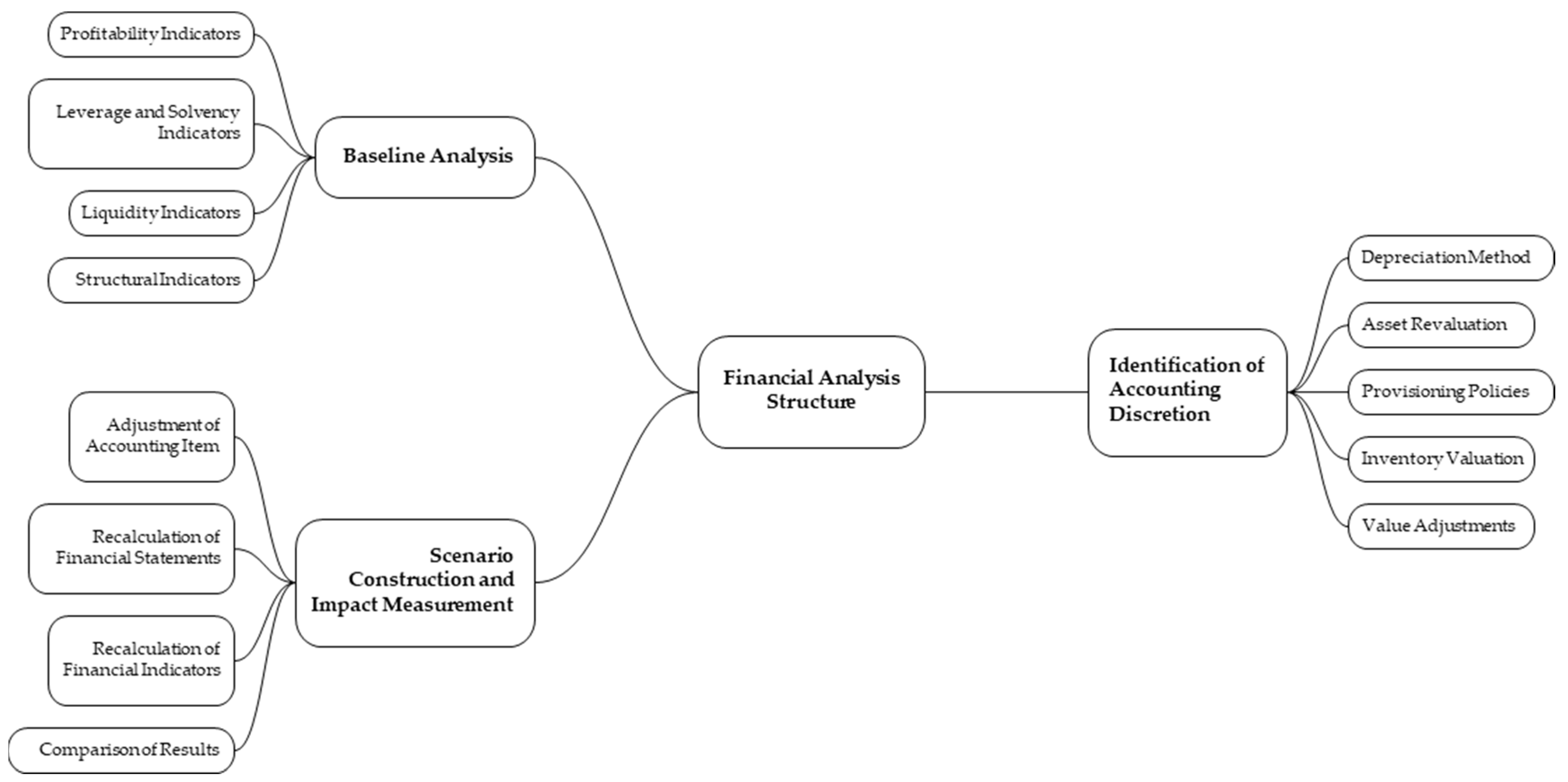
The financial analysis was structured into three steps (
Figure 1):
- (a)
Baseline analysis of actual financial statements: The company’s reported profitability indicators (ROA, ROE, EBITDA margin, net profit margin), leverage and solvency indicators (debt ratio, equity ratio, gearing), liquidity indicators (current ratio, quick ratio) and structural indicators (asset structure, liability structure, fixed asset ratio, inventory rotation) are computed based on the reported accounting policies.
- (b)
Identification of accounting areas subject to managerial discretion: Based on the literature and the notes to the financial statements, the following accounting policies were selected due to their capacity to alter reported outcomes: (i) depreciation method and applicable life estimates; (ii) asset revaluation vs. cost model; (iii) provisioning policies (warranties, receivables impairment, litigation risks); (iv) inventory valuation method (“standard cost” vs. FIFO-related adjustments); (v) recognition or non-recognition of value adjustments. These areas correspond to techniques commonly used in creative accounting (
Cooray et al., 2020;
Kıllı et al., 2024).
- (c)
Scenario construction and impact measurement: Alternative accounting treatments were simulated to determine the effect of creative accounting techniques on financial indicators. For each scenario, the following steps were applied: (i) adjustment of the accounting item (e.g., increasing/decreasing depreciation, recognizing provisions, altering inventory valuation); (ii) recalculation of the profit and loss account and statement of financial position; (iii) recalculation of financial indicators under the adjusted scenario; and (iv) a comparison between actual and simulated results.
This approach allows for quantifying the extent to which discretionary accounting choices influence financial performance and position (tests H2 and H3).
Given the relationship between aggressive accounting and increased fraud risk, the analysis includes an evaluation of indicators that may signal financial reporting manipulation. These include disproportionate increases in specific expense categories, inconsistencies in depreciation policies, abnormal changes in fixed assets and inventories, and divergence between operational performance and reported profits. Such red flags are consistent with frameworks used in earnings manipulation and fraud detection studies (
Svabova et al., 2020).
This study faces several limitations. The case study approach limits generalizability beyond the analyzed entity. Survey results rely on self-reported perceptions and may be subject to desirability bias. Scenario-based simulations depend on assumptions regarding alternative accounting treatments. The absence of access to internal managerial decision-making restricts the analysis to observable financial statement effects. Despite these limitations, the combination of perceptual and empirical analyses increases the robustness of the findings and provides a comprehensive understanding of creative accounting effects.
4. Results
To address the objectives of this study, the empirical analysis was conducted in two complementary stages: an exploratory survey targeting financial–accounting professionals and a subsequent financial case study.
4.1. Survey Results: Perceived Prevalence of Creative Accounting Techniques
The primary purpose of the survey was not to quantify the financial magnitude of creative accounting techniques, but to document their perceived prevalence and practical relevance within Romanian listed entities, as reported by professionals directly involved in financial reporting and managerial decision-making. In this respect, the survey provides a necessary contextual basis for interpreting the quantitative results obtained from the case study analysis.
The questionnaire consisted of standardized items addressed to management staff and to internal or external financial–accounting professionals from 25 Romanian companies listed on the Bucharest Stock Exchange. Given the sensitive and often non-transparent nature of creative accounting practices, as well as the limited availability of observable firm-level disclosures, a perception-based survey represents an appropriate exploratory research instrument. Such an approach is widely employed in prior studies to capture informed professional judgment regarding the use of discretionary accounting policies. Respondents were asked to indicate whether specific creative accounting techniques were applied frequently, occasionally, or not applied within the entities with which they were professionally associated.
Of the 360 distributed questionnaires, 311 valid responses were obtained, yielding a response rate of 86.38% and indicating a high level of engagement among the targeted respondents, supporting the reliability of the collected data. In addition to the high response rate, the survey’s relevance is further strengthened by the respondents’ professional profiles.
Table 1 presents the distribution of survey participants by professional category and length of experience, showing that the majority are experienced financial–accounting professionals and managers directly involved in financial reporting, auditing, evaluation, or related activities. Professional experience ranges differ slightly across respondent categories due to the applied purposive sampling approach. The survey targeted respondents with a minimum level of professional experience relevant to financial reporting and accounting decision-making, rather than aiming at strict statistical comparability across groups. This respondent profile enhances the credibility of the reported perceptions as reflections of informed professional practice rather than speculative opinion.
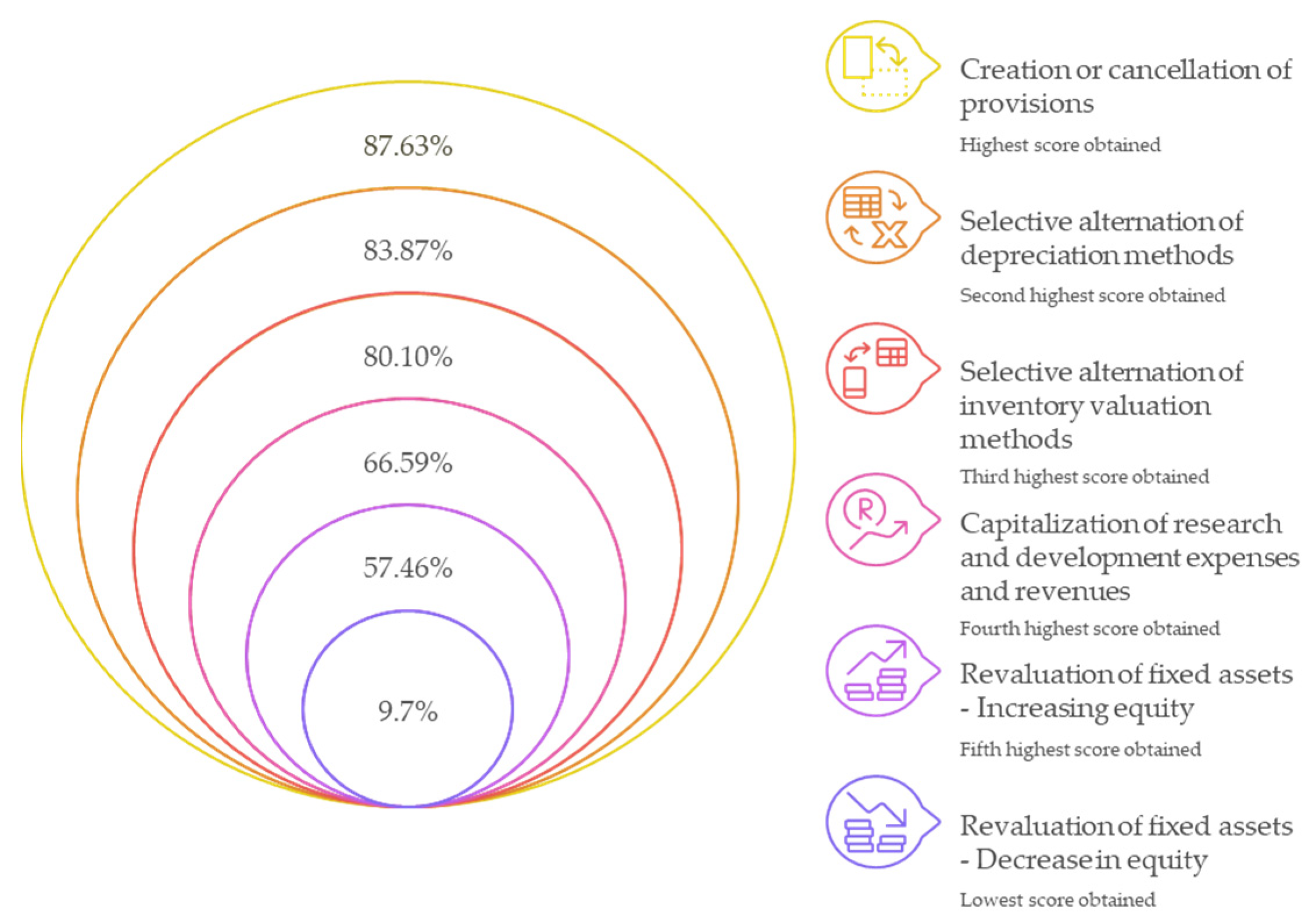
Table 2 summarizes respondents’ perceptions regarding the most frequently used creative accounting techniques and their perceived influence on financial position and performance. The reported percentages represent an applicability coefficient, defined as the proportion of respondents indicating frequent or systematic use of a specific technique within the entities they are familiar with. These coefficients allow for a descriptive ranking of creative accounting practices based on professional perception, without implying statistical causality or quantifying their direct financial impact.
Figure 2 illustrates respondents’ perceptions of the most frequently used creative accounting techniques to influence the financial position and performance of Romanian entities. The results indicate clear hierarchical preferences across practices involving managerial discretion. The creation or cancellation of provisions is perceived as the most frequently applied creative accounting technique (87.63%), followed by the selective alternation of depreciation methods (83.87%) and inventory valuation methods (80.10%). These findings are consistent with prior literature identifying provisions, depreciation policies, and inventory valuation as accounting areas characterized by substantial managerial discretion within existing standards. Capitalization of research and development expenditures also exhibits a relatively high perceived prevalence (66.59%), reflecting its potential to defer expenses and enhance short-term reported performance. In contrast, downward revaluation of fixed assets is perceived as rarely applied (9.7%), whereas upward revaluation to increase equity is more common (57.46%). This asymmetry is consistent with expectations that entities tend to favor accounting choices that strengthen solvency indicators and borrowing capacity while avoiding practices that adversely affect equity and perceived financial stability.
Overall, the survey results indicate that financial–accounting professionals perceive creative accounting practices as being concentrated in areas where accounting standards allow substantial managerial discretion. Although these findings do not quantify financial effects, they provide a structured justification for selecting the techniques examined in the subsequent case study. These descriptive results support H1, confirming that professionals perceive creative accounting techniques as having a significant influence on financial position and performance.
4.2. Case Study Results: Asset Revaluation and Equity Effects
In the second stage of the empirical analysis, attention was directed toward assessing the measurable financial effects of creative accounting techniques through a case study. For this purpose, we analyzed a listed Romanian entity operating in the dairy processing industry, focusing specifically on the revaluation of a major tangible asset. This approach allows us to illustrate how discretionary accounting choices may alter the presentation of financial position and performance.
The entity owns a production facility with an initial carrying amount of EUR 70 million and accumulated depreciation of EUR 15 million. The asset has a remaining useful life of 10 years and is depreciated using the straight-line method. At the beginning of 2024, management decided to revalue the asset to a fair value of EUR 80 million. As a result, the revaluation surplus amounts to EUR 25 million (EUR 80 million–EUR 55 million net book value).
To examine the implications of this adjustment, we compared the entity’s financial results before and after the revaluation. The effects on equity, asset structure, and depreciation expenses are summarized in
Table 3, which presents the changes reflected in the statement of changes in equity and their impact on the entity’s financial indicators.
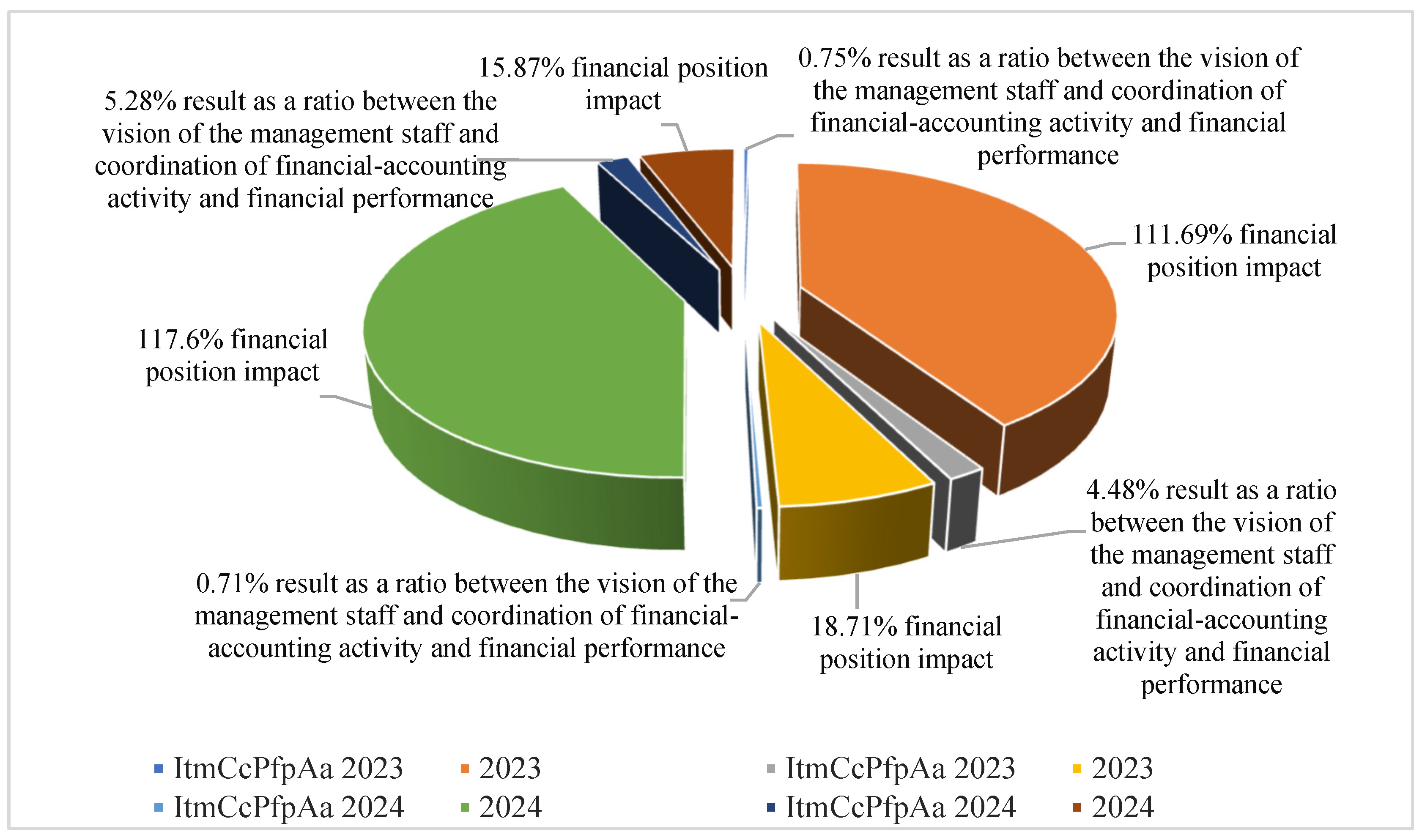
The revaluation of depreciable fixed assets leads, as expected, to an increase in annual depreciation expenses and, consequently, to a reduction in the accounting result. In the analyzed case, annual depreciation prior to revaluation amounted to EUR 550,000 (EUR 5.5 million × 10%), whereas after revaluation it increased to EUR 800,000 (EUR 8 million × 10%). As a result, the profit for the period decreased by EUR 250,000 following the adjustment.
The revaluation of non-depreciable assets leads to the recognition of a revaluation surplus within equity, without affecting current-year profit. In the analyzed scenario, the surplus generated by the revaluation is allocated to the revaluation reserve, resulting in an increase in equity while reported profitability remains unchanged. The revaluation of the asset amounting to EUR 8 million increases annual depreciation expenses by EUR 800,000. At the same time, the revaluation reserve is reduced by EUR 2.5 million per year, calculated as the revalued amount of EUR 25 million allocated over a ten-year period.
Table 4 presents the effects of these scenarios on equity, total liabilities, total expenses, and the accounting result for the financial year 2024, illustrating the changes generated by different revaluation approaches.
Following the analysis of the revaluation scenarios, we observe significant differences in both equity structure and financial leverage depending on the type of revaluation applied. Upward revaluation of assets increases total equity and reduces leverage, whereas recognizing additional depreciation reduces profitability and may weaken performance indicators. These results underline the degree of discretion available to management and highlight how revaluation policies may be strategically employed to influence the firm’s financial presentation. These results illustrate that asset revaluation policies can substantially alter equity structure and leverage, confirming the presence of measurable financial effects generated by discretionary accounting choices.
4.3. Equity Sensitivity Analysis Under Alternative Revaluation Scenarios
To further evaluate the influence of creative accounting techniques on changes in equity,
Table 5 introduces a set of analytical indicators developed for this study. These indicators and their calculation formulas aim to illustrate how management decisions—independent of revaluation policies—can modify the structure of equity and the presentation of financial performance. The indicators were constructed to provide a comparative framework for assessing the effects of different discretionary accounting treatments on financial position.
To avoid over-reliance on proprietary metrics, this study interprets all scenario effects primarily through standard financial indicators (profitability, leverage, and liquidity ratios). The additional analytical indicators introduced below are used only as illustrative, scenario-comparison tools to summarize relative variations across accounting treatments, not as standalone performance measures.
The indicators in
Table 5 retain their original nomenclature to ensure consistency with subsequent figures and analysis. Formulas have been standardized for mathematical accuracy and clarity. The corresponding results are presented in
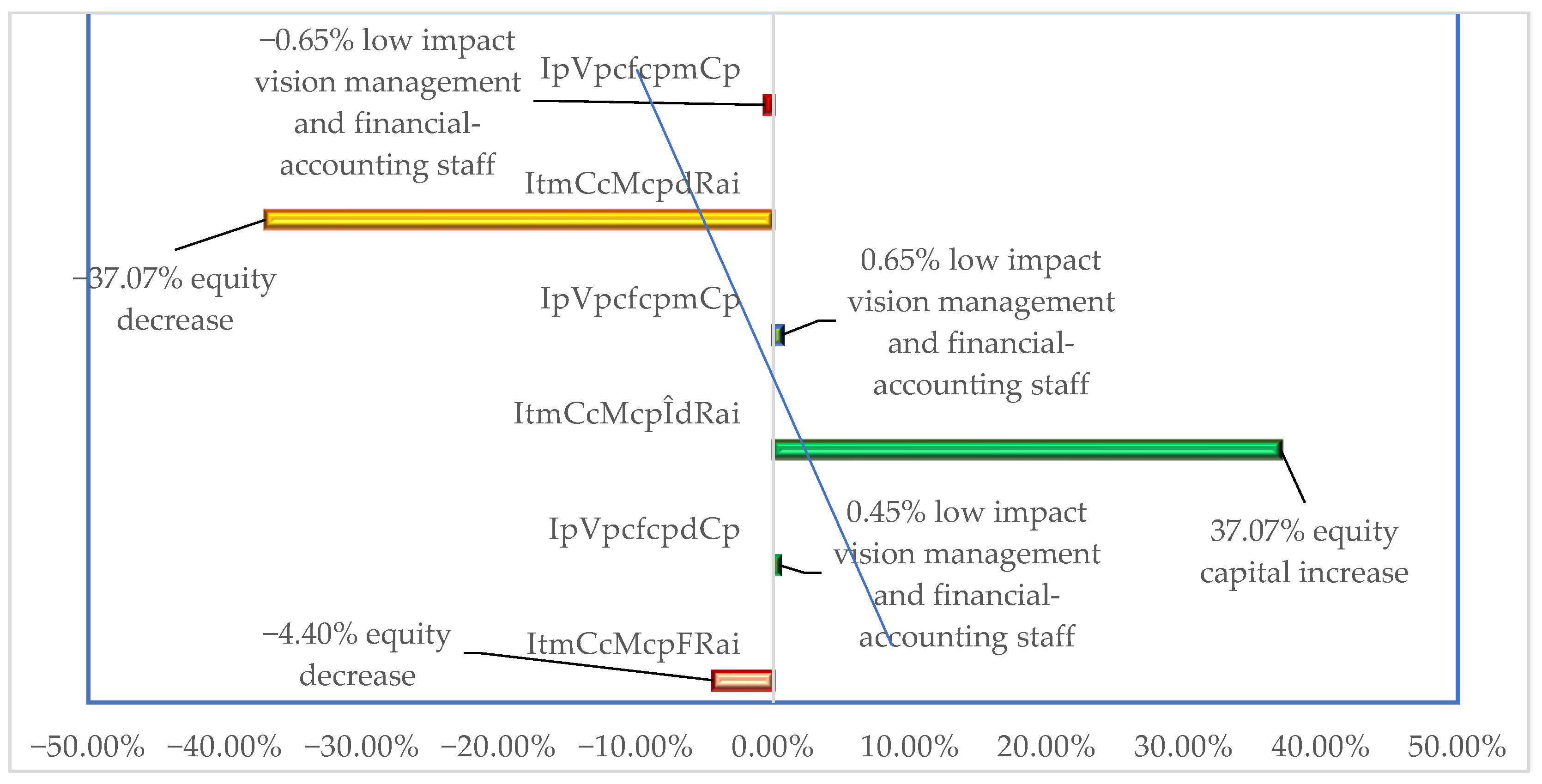
Figure 3, which summarizes the effects discussed above.
The trend line illustrated in
Figure 3 shows a relatively stable pattern across the analyzed scenarios, with predicted values ranging approximately from −0.65% to +0.45%. This narrow variation indicates that the measurable impact of discretionary accounting choices on equity—both before and after asset revaluation—is relatively modest. When contrasted with the perception-based indicators derived from the survey, the results suggest that managerial and financial–accounting staff tend to slightly overestimate the extent to which creative accounting practices influence equity movements. These findings reinforce the distinction between perceived exposure to accounting discretion and its actual quantitative effect on reported equity.
4.4. Performance Effects of Depreciation Policy Choices
To extend the assessment of how creative accounting techniques influence financial performance, we further analyzed several key components of the profit and loss account. The objective of this stage is to determine the extent to which discretionary accounting choices—such as alternative depreciation methods, inventory valuation methods, or adjustments related to provisions—affect the entity’s profitability and cost structure. Building on the results obtained from the revaluation scenarios, we introduced a set of analytical indicators designed to capture the sensitivity of profit to changes in four major components of operating expenses: depreciation, raw materials and consumables, personnel expenses, and other operating expenses. These components were selected because they represent the areas where creative accounting practices are most frequently applied in practice, as documented in the specialized literature and supported by the survey results.
To further assess the sensitivity of equity and reported performance to alternative accounting assumptions, the analysis examines the relative changes in shareholders’ equity and accounting result under different accounting assumptions. The assessment focuses on how variations in key expense components and valuation choices propagate into standard financial indicators, allowing a comparative evaluation of their impact on reported performance. Detailed analytical formulas and supporting calculations used in this stage of the analysis are provided in
Appendix A (
Table A1). The resulting effects are synthesized and illustrated in
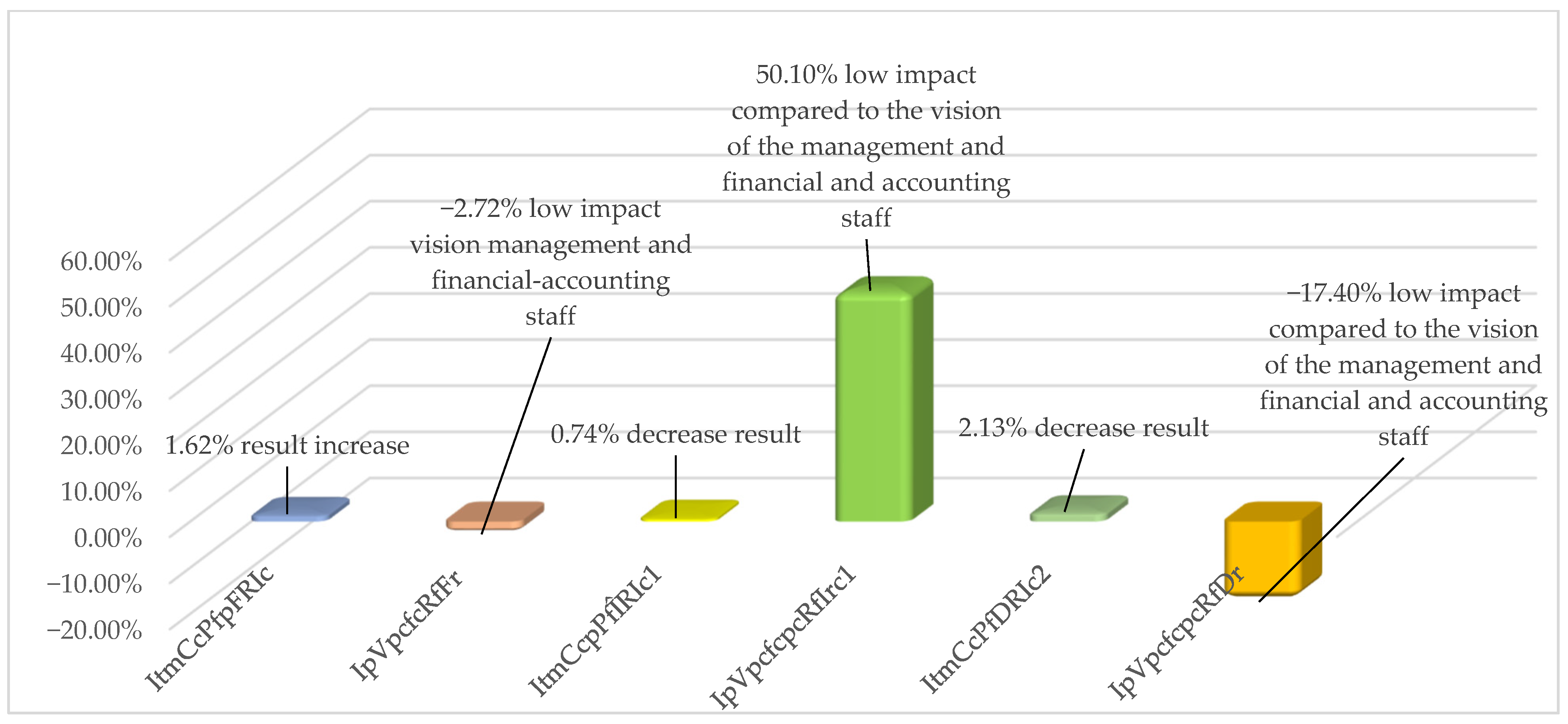
Figure 4.
The results illustrated in
Figure 4 indicate that the measurable impact of creative accounting practices on reported financial performance is considerably more moderate than suggested by perception-based survey responses. While respondents associate asset revaluation and related accounting choices with substantial effects on financial results, the scenario-based analysis shows that the actual variations in reported outcomes remain relatively limited and context-dependent. This finding highlights a gap between perceived and observed effects, suggesting that accounting discretion primarily influences the presentation of financial information rather than its underlying economic substance.
When we discuss the depreciation expenses of tangible assets, we emphasize that the depreciable cost of an asset should be systematically allocated over the entire useful life of that asset. Typically, a depreciation method is chosen that reflects the rate at which the future economic benefits resulting from the use of the asset are consumed. Entities benefit from choosing different depreciation methods, which often lead to different results, which we also try in this analysis of creative accounting methods and techniques on the depreciation methods available to users. In the case of the analyzed entity, linear depreciation is used. To analyze the three depreciation methods that the entity has at its disposal, we decided to carry out an analysis of the depreciation expenses for the period 2023–2024, using the indicators from the annual financial reports, and to carry out an evaluation of the three methods.
As shown in
Table 6, in both 2023 and 2024, the straight-line depreciation method produced higher reported performance than the degressive and accelerated methods. The application of degressive or accelerated depreciation would have resulted in a lower financial performance for the analyzed entity. In addition, under the straight-line depreciation method, the financial result reported for 2024 increased by EUR 334,000 compared to 2023.
To evaluate the impact of alternative annual depreciation methods on reported financial performance and financial position, the analysis examines how different amortization schedules affect key expense structures and standard profitability and leverage indicators. This scenario-based assessment allows a comparative interpretation of the financial effects generated by depreciation policy choices. Detailed analytical indicators and calculation formulas supporting this evaluation are provided in
Appendix A (
Table A2). The resulting effects are summarized and illustrated in
Figure 5.
4.5. Capitalization of R&D Expenditures and Income
The results presented in this subsection are based on scenario-based calculations applied consistently across the analyzed periods.
Table 7 reports the effects of capitalizing R&D expenditures and related income on the profit and loss statement and selected financial indicators for 2023 and 2024.
The results indicate that capitalizing R&D expenditures and income significantly affect reported operating performance. In 2023, capitalization had a positive effect on operating results, resulting in higher reported profitability than in the non-capitalization scenario. By contrast, in 2024, capitalizing R&D expenditures and income led to a decrease in operating results, highlighting the sensitivity of reported performance to capitalization policies across different periods.
To assess the effects of research and development capitalization on reported operating performance and financial position, the analysis examines scenario-based variations in operating result and equity under alternative capitalization assumptions. The interpretation focuses on standard performance indicators, highlighting how the capitalization of R&D expenditures and related income influences reported outcomes across different periods. The detailed analytical indicators and calculation structures supporting this assessment are reported in
Appendix A (
Table A3). The resulting effects are visually synthesized and illustrated in
Figure 6.
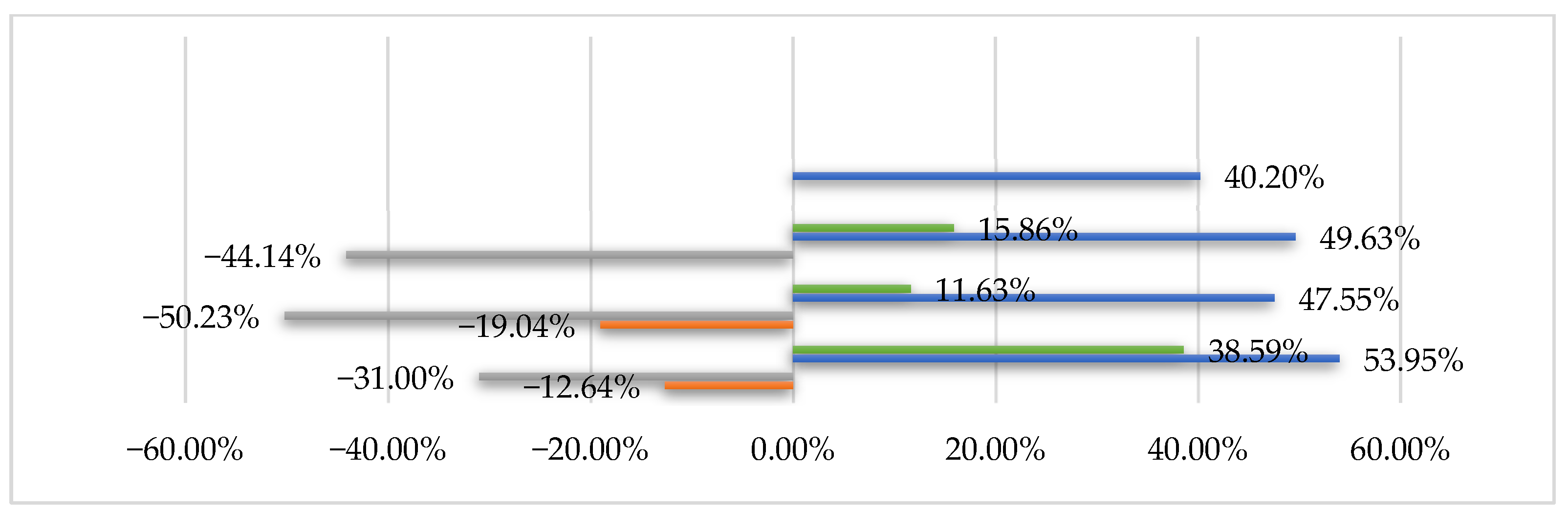
In addition to performance effects, capitalization policies also influence the financial position of the analyzed entity. As shown illustrated in
Figure 6, the capitalization of both expenditures and income reduces the negative impact on equity compared to scenarios in which only expenditures are capitalized. Specifically, the impact on financial position decreased from −12.64% to −8.44% in 2023 and from −31.00% to −26.76% in 2024 when income capitalization was applied.
Overall, the findings indicate that capitalization policies materially affect both operating result and financial position; however, the direction and magnitude of these effects vary across periods.
Figure 6 summarizes these variations by illustrating the relative impact of capitalization scenarios on performance and financial position over the analyzed timeframe.
4.6. Inventory Valuation Methods and Financial Position Effects
This subsection examines the effects of alternative inventory valuation methods on the financial position of the analyzed entity.
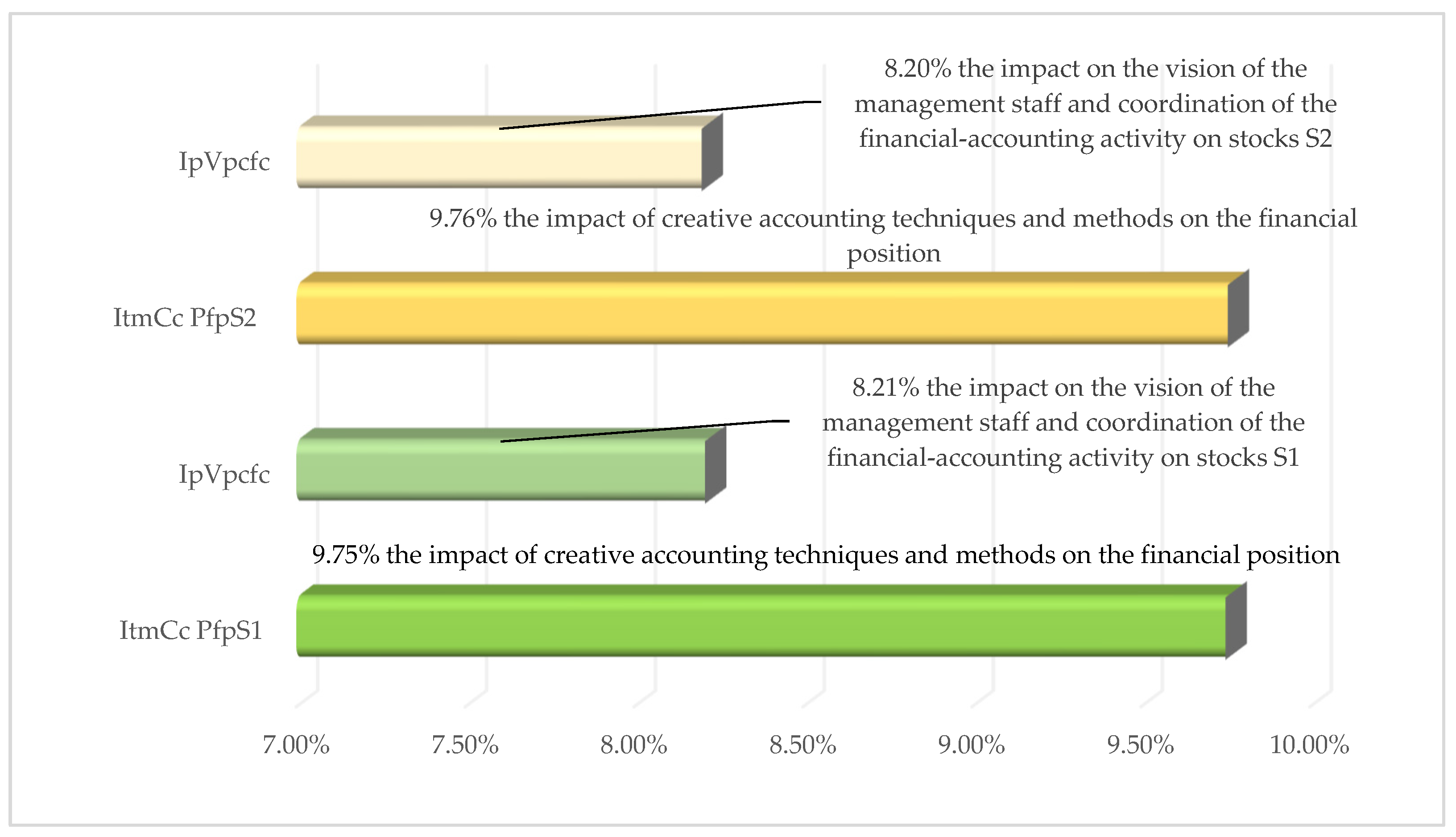
Table 8 reports inventory values calculated under FIFO, LIFO, and weighted average cost (CMP) methods as of 31 December 2024.
The results indicate that inventory valuation methods generate measurable differences in reported financial position. Under the analyzed price dynamics, the FIFO method yields higher ending inventory values than CMP, while the LIFO method yields the highest reported result. By contrast, the weighted-average cost method results in lower inventory valuation and, consequently, a lower reported financial position.
It can be seen from the presented study that the result obtained by the evaluated company depends on the chosen stock valuation method. The LIFO method determines the highest result and the CMP method the lowest result (the method also used by the company analyzed in the present study) and implicitly the lowest expense with the profit tax. In addition, if the entity decides to change the method of valuation of stocks from one year to another, it will allow it to smooth the result.
These differences are interpreted by examining how alternative inventory valuation methods propagate into reported financial position, particularly through changes in ending inventory values and related balance-sheet indicators. The analysis focuses on standard financial position measures to illustrate the sensitivity of reported outcomes to inventory valuation choices. Detailed analytical indicators and supporting calculations are provided in
Appendix A (
Table A4).
Figure 7 visually synthesizes these effects, highlighting the magnitude of variation in reported financial position across alternative valuation scenarios.
Overall, the findings indicate that inventory valuation methods constitute a discretionary accounting area through which creative accounting practices may influence the reported financial position, in line with survey evidence suggesting a high perceived prevalence of selective inventory valuation.
4.7. Provisions and Short-Term Liabilities: Impact on Performance and Risk
This subsection examines the effects of recognizing short-term provisions on operating performance and financial position.
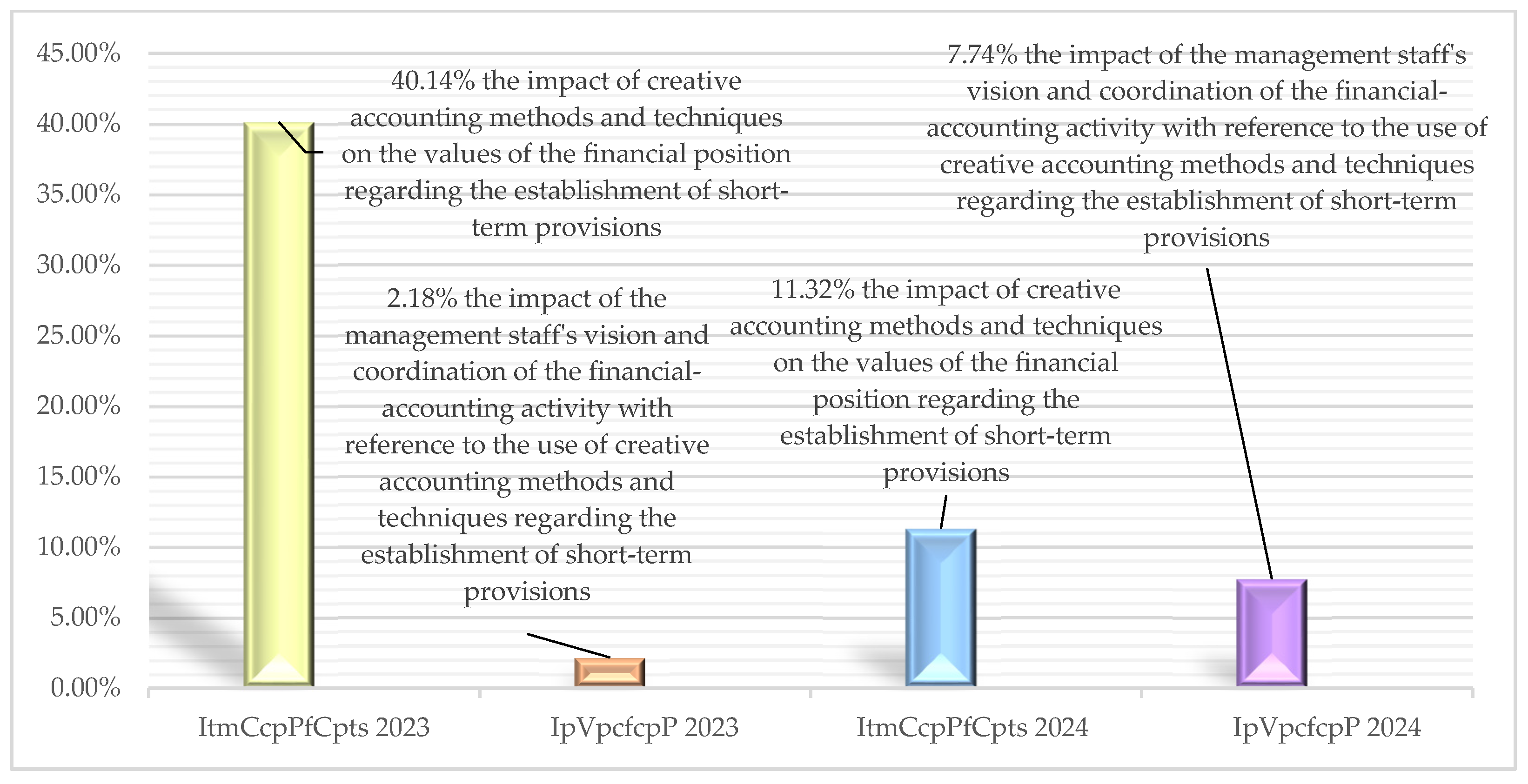
Table 9 presents comparative profit and loss account data for 2023 and 2024 under scenarios with and without the recognition of short-term provisions. The results indicate that recognition of short-term provisions reduces operating results, accompanied by changes in equity levels and financial leverage. In both analyzed periods, provision expenses reduced reported profitability while simultaneously affecting leverage indicators, reflecting the sensitivity of performance and risk measures to provisioning policies.
The effects of recognizing short-term provisions are examined by analyzing how changes in provisioning policies influence reported operating performance, equity levels, and financial leverage. The interpretation focuses on standard performance and risk-related indicators, illustrating how discretionary provisioning affects reported profitability and perceived financial risk. Detailed analytical indicators and supporting calculations used in this assessment are reported in
Appendix A.
Figure 8 visually synthesizes these effects, highlighting the direction and magnitude of variations in operating result and financial position across the analyzed periods.
Overall, the findings suggest that short-term provisions constitute a discretionary accounting area through which creative accounting practices may influence reported performance and perceived financial risk, consistent with survey evidence indicating a high perceived prevalence of provision-based adjustments.
4.8. Fraud Risk Indicators Associated with Creative Accounting Practices
This subsection complements the previous analyses by examining selected fraud risk indicators associated with the use of discretionary accounting practices. Consistent with ISA 240, fraud risk is assessed through observable financial and structural indicators rather than direct evidence of fraudulent behavior.
Table 10 presents the set of financial and structural indicators used to assess fraud risk associated with creative accounting practices over the 2023–2024 period. The selected indicators capture dimensions of financial structure, leverage dynamics, and sectoral activity, which the literature commonly identifies as areas of heightened vulnerability to discretionary accounting behavior. These variables provide a contextual framework for evaluating how the accounting techniques analyzed in the previous subsections may be associated with elevated fraud risk.
The selected indicators focus on areas characterized by heightened managerial discretion, such as leverage dynamics, sectoral activity, and financial structure. These dimensions overlap with the accounting techniques analyzed in
Section 4.2,
Section 4.3,
Section 4.4,
Section 4.5,
Section 4.6 and
Section 4.7, particularly provisions, asset valuation, and inventory accounting, which may amplify fraud risk when used extensively.
Table 11 further details the distribution of the analyzed entity’s activities by sector, providing additional context for the assessment of fraud risk indicators.
As shown in
Table 11, the activity structure of the analyzed entity is predominantly oriented toward industrial production, which accounts for more than half of total activities in both analyzed years, followed by wholesale trade and, to a lesser extent, service activities. This activity profile provides relevant context for the fraud risk assessment, as production-intensive, trade-oriented operations are typically associated with more complex accounting processes, higher inventory volumes, and greater reliance on discretionary accounting estimates. Consequently, the distribution of activities supports the relevance of the selected fraud risk indicators presented in
Table 10.
Overall, the descriptive analysis of fraud risk indicators suggests that the extensive use of discretionary accounting practices, as documented in the previous subsections, may be associated with heightened fraud risk exposure, reinforcing the role of creative accounting practices as potential early warning signals rather than direct evidence of fraudulent behavior.
4.9. Comparison Between Perceived and Actual Effects
This subsection integrates the findings from the perception-based survey with the results of the scenario-based financial analysis to assess the extent to which professionals’ perceptions of creative accounting effects correspond to their measurable financial impact. By juxtaposing perceived prevalence and influence with empirically observed variations in financial indicators, the analysis addresses Hypothesis H3, which concerns the potential discrepancy between perceived and actual effects of creative accounting practices.
Survey results presented in
Section 4.1 indicate that financial–accounting professionals perceive creative accounting practices as having a substantial influence on both financial position and performance, particularly in areas characterized by high managerial discretion. Techniques such as the creation or cancellation of provisions, selective alternation of depreciation methods, inventory valuation choices, and capitalization of R&D expenditures were reported as being frequently used and as exerting a significant impact on reported outcomes. These perceptions reflect practitioners’ proximity to the reporting process and their awareness of the flexibility embedded in accounting standards.
However, the case study results presented in
Section 4.2,
Section 4.3,
Section 4.4,
Section 4.5,
Section 4.6 and
Section 4.7 reveal a more nuanced picture. While discretionary accounting choices do generate measurable changes in profitability, equity structure, and leverage indicators, the magnitude of these effects is generally moderate and strongly dependent on the specific technique applied and on the accounting scenario considered. For example, asset revaluation policies significantly alter equity levels and leverage ratios, yet their direct impact on operating performance remains limited. Similarly, alternative depreciation methods produce notable differences in reported profit, but the asset base and depreciation horizon constrain these effects. In the case of inventory valuation and short-term provisions, the analysis confirms that accounting choices influence financial position and risk indicators, though again within bounded ranges.
A particularly relevant contrast emerges in the analysis of R&D capitalization. Survey respondents attribute a relatively high impact to capitalization practices, consistent with their potential to defer expenses and improve short-term performance. The empirical results partially confirm this perception, showing that capitalization materially affects both operating result and equity. Nevertheless, the direction and intensity of the effect vary across periods, with capitalization enhancing reported performance in one year and reducing it in another. This temporal variability suggests that professional perceptions tend to emphasize the existence of discretion rather than its context-dependent financial consequences.
Overall, the comparative analysis indicates that financial–accounting professionals tend to overestimate the magnitude of the financial effects of creative accounting, even though they correctly identify the accounting areas most exposed to discretionary behavior. This discrepancy can be explained by informational asymmetry and by the tendency to associate accounting flexibility with manipulation risk, irrespective of its actual quantitative impact. The findings thus support Hypothesis H3, highlighting a gap between perceived and actual effects of creative accounting practices.
By explicitly contrasting perception-based evidence with scenario-based financial outcomes, this subsection underscores this study’s contribution to the literature. Creative accounting may be understood not only as a set of discretionary techniques, but also as a phenomenon whose financial consequences appear to be more context-dependent and, in some cases, more limited than commonly assumed. This insight provides a critical foundation for the discussion in the following section, which interprets these findings considering prior research and their implications for financial reporting quality and governance.
5. Discussion
This study examined the effects of selected creative accounting practices using a mixed-method empirical design that combined perception-based evidence with scenario-based financial analysis. The purpose of this section is to interpret empirical findings within a broader conceptual framework by integrating the scenario-based financial analysis with the existing literature on creative accounting and discretionary reporting behavior. While the results demonstrate that the analyzed entity maintains a generally stable financial structure across alternative accounting scenarios, the discussion focuses on how creative accounting practices influence the presentation of financial performance, position, and risk rather than their underlying economic substance.
The comparative analysis summarized in
Table 12 highlights that financial leverage remains within low to medium ranges across the analyzed scenarios, indicating a generally stable financial structure. However, the observed variations in leverage ratios across alternative accounting treatments—including depreciation methods, asset revaluation, R&D capitalization, and the recognition of short-term provisions—illustrate the sensitivity of leverage indicators to discretionary accounting choices.
These results reinforce the view that creative accounting does not necessarily alter an entity’s economic fundamentals but can materially influence how financial risk and capital structure are portrayed in financial statements. When examined by technique, the findings provide a differentiated perspective on the relative importance of creative accounting mechanisms. Depreciation policy choices and asset revaluations primarily affect equity levels and leverage ratios, consistent with prior studies emphasizing their role in balance-sheet management. Inventory valuation methods and short-term provisions exhibit more immediate effects on both financial position and reported performance, reflecting their direct interaction with cost recognition and expense timing. R&D capitalization, while frequently perceived by practitioners as a powerful earnings management tool, shows context-dependent effects in the case study, with its impact varying significantly across periods. This nuanced evidence aligns with research suggesting that the consequences of creative accounting are contingent on economic conditions, accounting horizons, and the interaction between multiple discretionary choices rather than on any single technique in isolation.
A key contribution of this study lies in the comparison between perceived and actual effects of creative accounting practices. While survey respondents correctly identify the accounting areas most exposed to discretion, the empirical analysis suggests that the magnitude of their financial impact is often more moderate and variable than commonly assumed. This discrepancy supports the argument that professional perceptions tend to emphasize the existence of accounting flexibility and associated risk. In contrast, scenario-based analyses reveal more bounded and context-specific financial consequences. In this respect, the findings extend existing literature by empirically illustrating the gap between perceived and measured effects of creative accounting. The indicators used in this study are exploratory and serve a comparative analytical purpose rather than statistical inference. Questionnaire-based coefficients are applied as descriptive weights reflecting professional perceptions, not as econometric parameters. Consequently, empirical analysis is designed as a comparative scenario assessment aimed at illustrating relative financial effects of creative accounting practices, rather than establishing causal or statistically generalizable relationships.
The financial case study presented in this research is intentionally positioned as illustrative and exploratory. Its purpose is not to achieve statistical generalization from a single entity, but to support analytical generalization by demonstrating the mechanisms through which discretionary accounting choices propagate into standard financial indicators. The analyzed company operates under IFRS and exhibits accounting features standard to many listed firms, including material inventories, depreciable fixed assets, provisioning policies, and R&D-related expenditures. Consequently, while the numerical results are entity-specific, the accounting mechanisms illustrated—revaluation effects, depreciation policy choices, inventory valuation, R&D capitalization, and provisioning practices—are broadly applicable to listed companies with similar reporting structures. The integration of survey-based evidence further supports this analytical generalization by confirming that professionals widely perceive the same discretionary accounting areas as relevant in practice.
The results also have implications for the interpretation of financial information. The sensitivity of leverage and performance indicators to accounting choices implies that users of financial statements—such as analysts, auditors, and regulators—should exercise caution when comparing entities or periods without considering the underlying accounting policies applied. From a theoretical perspective, this study contributes to creative accounting literature by demonstrating that discretionary practices function less as mechanisms for systematically altering economic reality and more as tools that shape financial representation within the limits of accounting standards.
Taken together, the empirical findings provide differentiated support for the research hypotheses. Hypothesis H1 is supported, as the survey evidence indicates that financial–accounting professionals perceive creative accounting practices as having a significant influence on reported financial position and performance. Hypothesis H2 is partially supported, since the scenario-based financial analysis confirms that discretionary accounting techniques generate observable changes in key financial indicators, although the magnitude and direction of these effects vary across techniques and reporting periods. Hypothesis H3 is supported, indicating a discrepancy between perceived and actual effects of creative accounting practices, with professionals tending to overestimate the quantitative financial impact despite correctly identifying the accounting areas most exposed to discretion.
This study underscores that creative accounting should be interpreted as a context-dependent phenomenon whose financial effects depend on the interaction between accounting discretion, economic conditions, and reporting objectives. By integrating perception-based insights with empirical financial analysis, this study offers a balanced perspective that refines existing understanding of creative accounting practices and their implications for financial reporting quality.
6. Conclusions
This study investigated creative accounting practices in Romanian listed companies using a mixed-method research design combining a perception-based survey and a scenario-based financial case study. This integrated approach provides insight into both how discretionary accounting techniques are perceived by financial–accounting professionals and how they translate into measurable effects on financial position, performance, and risk indicators. The survey results show that professionals perceive creative accounting practices as having a substantial influence on reported outcomes, particularly in areas characterized by high managerial discretion, such as provisions, depreciation policies, inventory valuation methods, and R&D capitalization. These findings support the first research hypothesis (H1) and reflect practitioners’ awareness of the flexibility embedded in accounting standards. The empirical analysis confirms that creative accounting techniques generate observable changes in key financial indicators, including profitability, equity structure, and financial leverage, thereby supporting the second hypothesis (H2). However, the magnitude and direction of these effects vary across techniques and reporting periods. The results suggest that discretionary accounting choices primarily affect the presentation of financial position and performance rather than fundamentally altering the entity’s underlying economic reality. A central contribution of this study lies in the comparison between perceived and actual effects of creative accounting practices. While professionals correctly identify the accounting areas most exposed to discretion, the empirical findings indicate that the financial impact of these practices is often more moderate and context-dependent than commonly assumed. This discrepancy supports the third hypothesis (H3) and highlights a gap between professional perception and measured financial outcomes. The descriptive assessment of fraud risk indicators suggests that accounting professionals should consider how discretionary accounting practices may be associated with increased risk exposure while reinforcing the distinction between creative accounting and fraudulent behavior, thereby informing risk management strategies.
This study’s limitations, such as the single-entity case study design, reliance on perception-based survey data, and the descriptive nature of the scenario analysis, should be acknowledged to inform future research and address concerns about the robustness and generalizability of the findings. Overall, the findings underscore the importance of interpreting financial statements with an awareness of accounting discretion and its potential influence on reported outcomes, particularly in emerging market contexts.
Author Contributions
Conceptualization, A.H., V.M. and G.C.; methodology, M.-R.Z., G.C., L.I. and M.-D.C. investigation/investigation A.H., M.-R.Z. and A.-O.M., software, M.-R.Z. and A.H.; validation, V.M., A.H., G.C., L.I. and M.-D.C.; formal analysis, M.-D.C. and A.-O.M.; resources, A.H. and M.-R.Z.; data cleaning, A.-O.M.; writing—preparation of the original draft, V.M., A.H., G.C., M.-D.C. and L.I.; writing—review and editing, A.H., M.-D.C. and V.M.; visualization, M.-R.Z., and G.C.; supervision, V.M.; administration project, A.H.; acquisition financing, V.M., A.-O.M., G.C., L.I., M.-D.C. and A.H. All authors have read and agreed to the published version of the manuscript.
Funding
This research received no external funding.
Institutional Review Board Statement
Ethical review and approval were waived for this study because it did not involve any sensitive personal data and/or invasive procedures. This research was conducted in accordance with the regulations of the Valahia University of Târgoviște. The specific approval details are maintained by the Valahia University of Târgoviște.
Informed Consent Statement
Informed consent for participation was obtained from all subjects involved in this study.
Data Availability Statement
Conflicts of Interest
The authors declare no conflicts of interest.
Appendix A. Supplementary Analytical Indicators
The analytical indicators reported in this appendix are exploratory and provided for transparency and replication. They are not intended as standardized performance measures and should be interpreted in conjunction with the standard financial indicators discussed in the main text.
Table A1.
Analytical indicators measuring the variation in key expense components before and after revaluation.
Table A1.
Analytical indicators measuring the variation in key expense components before and after revaluation.
| Variables and Method of Calculation | Explanations |
|---|
| ItmCcPfpFRIc = the impact of creative accounting techniques and methods on the financial position without revaluation of tangible assets;
RexfIFr = result of the initial financial year without revaluation;
Rexfsrp = the result of the financial exercise with amounts from the previous revaluation case 1. |
| IpVpcfcpRfFrIc = the impact regarding the vision of the management staff and coordination of the financial-accounting activity within the entity regarding the use of creative accounting methods and techniques regarding the financial result without revaluation of tangible assets;
ItmCcMcpFRai = the impact of creative accounting techniques and methods on changes in equity without revaluation of fixed assets;
ItmCcPfpFRIc = the impact of creative accounting techniques and methods on the financial position without revaluation of tangible assets. |
| ItmCcpPfÎRIc1 = the impact of creative accounting techniques and methods on the financial position before the initial revaluation in case 1;
Rexfsrp = the result of the financial exercise with amounts from the previous revaluation case 1;
Rexfsrc = result of the financial year with amounts from the current revaluation case 2. |
| IpVpcfcpcRfIrc1 = the impact on the vision of the management staff and coordination of the financial-accounting activity within the entity regarding the use of creative accounting methods and techniques on the financial result before the revaluation case 1;
ItmCcMcpÎdRcai = the impact of creative accounting techniques and methods on changes in equity before the current revaluation of fixed assets;
ItmCcpPfÎRIc1 = of the impact of creative accounting techniques and methods on the financial position before the initial revaluation in case 1. |
| ItmCcPfdRIc2 = the impact on the use of creative accounting methods and techniques on financial performance after the initial revaluation case 2;
Rexfdrc3 = the result of the financial year after revaluation case 3;
Rexfrc2 = the result of the financial year current revaluation case 2. |
| IpVpcfcpcRfdRc3 = the impact regarding the vision of the management staff and coordination of the financial-accounting activity within the entity regarding the use of creative accounting methods and techniques regarding the financial result after the reevaluation of case 3;
ItmCcMcpdRai = the impact of creative accounting techniques and methods on changes in equity after the current revaluation of fixed assets;
ItmCcPfDRIc2 = the impact on the use of creative accounting methods and techniques on financial performance after the initial revaluation case 2. |
Table A2.
Calculation formulas for determining the impact of creative accounting techniques and methods regarding alternative annual depreciation on the financial position of the entity.
Table A2.
Calculation formulas for determining the impact of creative accounting techniques and methods regarding alternative annual depreciation on the financial position of the entity.
| Variables and Method of Calculation |
|---|
|
|
Table A3.
Indicators used to assess the impact of R&D capitalization on operating result.
Table A3.
Indicators used to assess the impact of R&D capitalization on operating result.
| Indicator | Definition/Operational Meaning |
|---|
| ItmCcReCcheR&D | Relative change in operating result in 2023 and 2024 generated by the capitalization of R&D expenditures, computed as the difference between operating result under capitalization and operating result without capitalization.; |
| ItmCcVpccVbexR&D | Survey-based weighting coefficient reflecting the perceived prevalence of R&D capitalization practices, applied to the change in gross income from R&D activities in 2023 and 2024. |
| ItmCcReCcheVR&D | Aggregated indicator capturing the combined effect of R&D expenditure and income capitalization on operating result in 2023 and 2024, integrating scenario-based results with survey-based weighting. |
| ItmCcReCcheVR&D | Aggregated indicator capturing the combined effect of R&D expenditure and income capitalization on operating result in 2023 and 2024, integrating scenario-based results with survey-based weighting. |
Table A4.
Indicators used to assess the impact of inventory valuation methods on financial position.
Table A4.
Indicators used to assess the impact of inventory valuation methods on financial position.
| Indicator | Definition/Operational Meaning |
|---|
| ItmCcPfpS1 | Relative change in financial position generated by applying the FIFO method compared to the weighted average cost method (CMP). |
| ItmCcPfpS2 | Relative change in financial position generated by applying the LIFO method compared to the weighted average cost method (CMP). |
| IpVpcfcpS | Survey-based weighting coefficient reflecting the perceived prevalence of selective inventory valuation method changes, applied to the relative financial position indicators. |
Table A5.
Indicators used to assess the impact of short-term provisions on financial position and performance.
Table A5.
Indicators used to assess the impact of short-term provisions on financial position and performance.
| Indicator | Definition/Operational Meaning |
|---|
| ItmCcpPfCpts | Relative change in operating result and financial position in 2023 or 2024 generated by the recognition of short-term provisions, compared to a scenario without provisions. |
| IpVpcfcpP | Survey-based weighting coefficient reflecting the perceived prevalence of short-term provision adjustments, applied to the 2023 or 2024 provision impact indicator |
References
- Abdurrahmani, E., & Doğan, Z. (2021). Creative accounting and its influence on corporate performance and financial reporting: A case study of Kosovo. Problems and Perspectives in Management, 19(4), 385. [Google Scholar] [CrossRef] [Scilit]
- Abed, I. A., Hussin, N., Ali, M. A., Haddad, H., Shehadeh, M., & Hasan, E. F. (2022a). Creative accounting determinants and financial reporting quality: Systematic literature review. Risks, 10, 76. [Google Scholar] [CrossRef] [Scilit]
- Abed, I. A., Hussin, N., Haddad, H., Almubaydeen, T. H., & Ali, M. A. (2022b). Creative accounting determination and financial reporting quality: The integration of transparency and disclosure. Journal of Open Innovation: Technology, Market, and Complexity, 8(1), 38. [Google Scholar] [CrossRef] [Scilit]
- Ado, A. B., Rashid, N. N. M., Mustapha, U. A., & Ademola, L. S. (2022). Audit quality and creative accounting strategy: Evidence from Nigerian public listed companies. Australasian Accounting, Business and Finance Journal, 16(3), 40–54. [Google Scholar] [CrossRef] [Scilit]
- Ahmed, F. H. (2022). The impact of applying creative accounting on the reliability of accounting information in the financial statements. World Economics and Finance Bulletin, 12, 55–64. [Google Scholar]
- Akpanuko, E. E., & Umoren, N. J. (2018). The influence of creative accounting on the credibility of accounting reports. Journal of Financial Reporting and Accounting, 16(2), 292–310. [Google Scholar] [CrossRef] [Scilit]
- Aldahiyat, M., Dahiyat, A., Sarayreh, A., Al Abed, S., & Tkryty, I. (2021). Perceptions and views of financial managers and auditors on creative accounting practices, motives, and impact on financial reporting quality: Evidence from Jordan. Academy of Strategic Management Journal, 20(3), 1–16. [Google Scholar]
- Alsalim, M., Amin, H., & Youssef, A. (2018). The role of corporate governance in achieving accounting information quality (field study in the mishraq sulfur state co.). Studies and Scientific Researches, Economics Edition, 1, 1–24. [Google Scholar] [CrossRef] [Scilit]
- Baker, C. R., & Hayes, R. (2004). Reflecting form over substance: The case of Enron corp. Critical Perspectives on Accounting, 15(6–7), 767–785. [Google Scholar] [CrossRef] [Scilit]
- Balaciu, D., & Pop, M. (2007). Is creative accounting a form of manipulation? Economic Science Series Annals of the University of Oradea, 17(3), 936–941. [Google Scholar]
- Balaciu, D. E., Bogdan, V., Feleaga, L., & Popa, A. L. (2014). “Colorful” approach regarding creative accounting. An introspective study based on the association technique. Journal of Accounting and Management Information Systems (JAMIS), 13(4), 643–664. [Google Scholar]
- Bhasin, M. L. (2016). Survey of creative accounting practices: An empirical study. Wulfenia Journal, 23(1), 143–162. [Google Scholar]
- Blazek, R. (2021). Creative accounting as a global tool for tax optimization. In SHS web of conferences (Vol. 92, p. 02007). EDP Sciences. [Google Scholar]
- Blazek, R., Durana, P., & Michulek, J. (2023). Renaissance of creative accounting due to the pandemic: New patterns explored by correspondence analysis. Stats, 6(1), 411–430. [Google Scholar] [CrossRef] [Scilit]
- Burcă, V., & Cotleț, D. (2014). Considerations on IASB recent issued standards. Studia Universitatis Vasile Goldiș Arad, Seria Științe Economice, 24(1), 72–95. [Google Scholar]
- Cernusca, L., David, D., Nicolaescu, C., & Gomoi, B. C. (2016). Empirical study on the creative accounting phenomenon. Studia Universitatis Vasile Goldiș Arad, Seria Științe Economice, 26(2), 63–87. [Google Scholar] [CrossRef] [Scilit]
- Chou, Y. Y., Lin, Y. C., & Lin, Y. C. (2025). The impacts of aggressive accounting choices on auditor changes. Review of Quantitative Finance and Accounting, 1–33. [Google Scholar] [CrossRef] [Scilit]
- Cooray, T., Gunarathne, A. N., & Senaratne, S. (2020). Does corporate governance affect the quality of integrated reporting? Sustainability, 12(10), 4262. [Google Scholar] [CrossRef] [Scilit]
- Creswell, J. W., & Plano Clark, V. L. (2018). Designing and conducting mixed methods research (3rd ed.). Sage. [Google Scholar]
- Debbarma, J., & Roy, C. (2023). Effects of corporate governance on creative accounting practices: Evidence from NSE-listed companies in India. Indian Journal of Corporate Governance, 16(1), 52–78. [Google Scholar] [CrossRef] [Scilit]
- Delesalle, F., & Delesalle, E. (2000). La comptabilite et le dix commandements. FID Edition. [Google Scholar]
- Denich, E., & Hajdu, D. (2021). Measurement of creative accounting by transparency and disclosure index (TDI) method in automobile industry. Public Finance Quarterly = Pénzügyi Szemle, 66(3), 381–396. [Google Scholar] [CrossRef] [Scilit]
- Egolum, P. U. P., & Onodi, B. E. P. (2021). Effect of creative accounting practice on financial reporting in Nigerian deposit money bank. Journals of Accounting Innovation and Information, 4(8), 67–79. [Google Scholar]
- Elitzur, R. (2011). The accounting art of war: Bounded rationality, earnings management and insider trading. Journal of Accounting and Public Policy, 30(3), 203–216. [Google Scholar] [CrossRef] [Scilit]
- Feleagă, N., & Malciu, L. (2002). Accounting policies and options. Economic Publishing House. [Google Scholar]
- Hadani, M., Goranova, M., & Khan, R. (2011). Institutional investors, shareholder activism, and earnings management. Journal of Business Research, 64(12), 1352–1360. [Google Scholar] [CrossRef] [Scilit]
- Hirota, H., & Yunoue, H. (2022). Fiscal rules and creative accounting: Evidence from Japanese municipalities. Journal of the Japanese and International Economies, 63, 101172. [Google Scholar] [CrossRef] [Scilit]
- Hussein, A. M., Kadhim, H. O., & Mohammad, R. A. (2020). Factors affecting creative accounting practices and means used to limit their effect on the credibility of financial statements. International Journal of Innovation, Creativity and Change, 13(6), 1082–1100. [Google Scholar]
- Ionaşcu, I. (2003). Dinamica doctrinelor contabile contemporane. In Dynamics of contemporary accounting doctrines. Economic Publishing House. [Google Scholar]
- Ismael, A. Y. A. (2017). The impact of creative accounting techniques on the reliability of financial reporting with particular reference to Saudi auditors and academics. International Journal of Economics and Financial Issues, 7(2), 283–291. [Google Scholar]
- Jaba, E., Balan, C. B., Robu, I. B., & Roman, M. (2012). Evaluarea statistica a riscului de frauda în scopul fundamentarii opiniei de audit, pe baza modelelor de durata. Audit Financiar, 10(4), 14. [Google Scholar]
- Jones, M. (2011). Creative accounting, fraud and international accounting scandals. John Wiley & Sons Ltd., The Atrium. [Google Scholar]
- Jones, M., & Stanton, P. (2021). Negative accounting stereotype: Enron cartoons. Accounting History, 26(1), 35–60. [Google Scholar] [CrossRef] [Scilit]
- Kıllı, M., Evci, S., & Kefe, İ. (2024). The conceptual, social, and intellectual structure of the financial information/accounting manipulation literature: A bibliometric analysis. Journal of Risk and Financial Management, 17(7), 297. [Google Scholar] [CrossRef] [Scilit]
- Kliestik, T., Valaskova, K., Nica, E., Kovacova, M., & Lazaroiu, G. (2020). Advanced methods of earnings management: Monotonic trends and change-points under spotlight in the Visegrad countries. Oeconomia Copernicana, 11(2), 371–400. [Google Scholar] [CrossRef] [Scilit]
- Knežević, G., Mizdraković, V., & Arežina, N. (2012). Management as cause and instrument of creative accounting suppression. Management-Časopis za Teoriju i Praksu Menadžmenta, 17(62), 89–95. [Google Scholar]
- Maltritz, D., & Wüste, S. (2015). Determinants of budget deficits in Europe: The role and relations of fiscal rules, fiscal councils, creative accounting and the Euro. Economic Modelling, 48, 222–236. [Google Scholar] [CrossRef] [Scilit]
- Mansour, L., & Spătariu, E. C. (2024). Creative accounting in financial reporting. Ovidius University Annals, Series Economic Sciences, 24(2), 567–574. [Google Scholar] [CrossRef] [Scilit]
- Martins, O. S., & Ventura Júnior, R. (2020). The influence of corporate governance on the mitigation of fraudulent financial reporting. Revista Brasileira de Gestão de Negócios, 22, 65–84. [Google Scholar] [CrossRef] [Scilit]
- Morariu, A., & Jianu, I. (2009). Autentic sau iluzoriu în activitatea profesioniştilor contabili—La limita dintre contabilitatea creativă şi frauda contabilă (Authentic or illusory in the activity of accounting professionals—On the border between creative accounting and accounting fraud). Audit Financiar, 7(12), 27–35. [Google Scholar]
- Olojede, P., & Erin, O. (2021). Corporate governance mechanisms and creative accounting practices: The role of accounting regulation. International Journal of Disclosure and Governance, 18(3), 207–222. [Google Scholar] [CrossRef] [Scilit]
- Omurgonulsen, M., & Omurgonulsen, U. (2009). Critical thinking about creative accounting in the face of a recent scandal in the Turkish banking sector. Critical Perspectives on Accounting, 20(5), 651–673. [Google Scholar] [CrossRef] [Scilit]
- Ozkaya, A. (2014). Creative accounting practices and measurement methods: Evidence from Turkey. Open-Assessment E-Journal, 8(29), 1–27. [Google Scholar] [CrossRef] [Scilit]
- Rahman, M. S., Hasan, M. J., Khan, M. S. H., & Jahan, I. (2023). Antecedents and effect of creative accounting practices on organizational outcomes: Evidence from Bangladesh. Heliyon, 9(2), e13759. [Google Scholar] [CrossRef] [Scilit] [PubMed]
- Reischmann, M. (2016). Creative accounting and electoral motives: Evidence from OECD countries. Journal of Comparative Economics, 44(2), 243–257. [Google Scholar] [CrossRef] [Scilit]
- Riyadh, H. A., Al-Shmam, M. A., & Ahmed, M. G. (2024). Empirical relationship between board characteristics, earnings management, insolvency risk, and corporate social responsibility. Cogent Business & Management, 11(1), 2321300. [Google Scholar] [CrossRef] [Scilit]
- Roszkowska, P. (2021). Fintech in financial reporting and audit for fraud prevention and safeguarding equity investments. Journal of Accounting & Organizational Change, 17(2), 164–196. [Google Scholar]
- Saleh, M. M. A., Jawabreh, O., & Abu-Eker, E. F. M. (2023). Factors of applying creative accounting and its impact on the quality of financial statements in Jordanian hotels, sustainable practices. Journal of Sustainable Finance & Investment, 13(1), 499–515. [Google Scholar]
- Svabova, L., Kramarova, K., Chutka, J., & Strakova, L. (2020). Detecting earnings manipulation and fraudulent financial reporting in Slovakia. Oeconomia Copernicana, 11(3), 485–508. [Google Scholar] [CrossRef] [Scilit]
- Tabără, N., & Rusu, A. (2011). Considerații privind impactul contabilității creative asupra calității informațiilor prezentate în situațiile financiare anuale (Considerations regarding the impact of creative accounting on the quality of the information presented in the annual financial statements). Audit Financiar, 9(11), 37–44. Available online: https://www.cafr.ro/uploads/AF%2011%202011%20-%20site-b9ae.pdf (accessed on 11 October 2025).
- Tassadaq, F., & Malik, Q. A. (2015). Creative accounting & financial reporting: Model development & empirical testing. International Journal of Economics and Financial Issues, 5(2), 544–551. [Google Scholar]
- Uşurelu, V. I., Nedelcu, M., Andrei, A. E., & Loghin, D. (2010). Accounting ethics—Responsibility versus creativity. Annals of the University of Petroșani Economics, 10(3), 349–356. [Google Scholar]
- Uwuigbe, O. R., Olorunshe, O., Uwuigbe, U., Ozordi, E., Asiriuwa, O., Asaolu, T., & Erin, O. (2019, September). Corporate governance and financial statement fraud among listed firms in Nigeria. In IOP conference series: Earth and environmental science (Vol. 331, No. 1, p. 012055). IOP Publishing. [Google Scholar]
Figure 1.
Financial analysis structure and techniques.
Figure 1.
Financial analysis structure and techniques.
Figure 2.
Perceived frequency of creative accounting techniques used in practice.
Figure 2.
Perceived frequency of creative accounting techniques used in practice.
Figure 3.
Impact of creative accounting techniques on equity across revaluation scenarios.
Figure 3.
Impact of creative accounting techniques on equity across revaluation scenarios.
Figure 4.
Analysis of the impact of creative accounting methods and techniques vs. the vision of the management staff and coordination of the financial-accounting activity on the financial position and the financial result without revaluation of tangible assets on 31 December 2024. Source: Authors processing based on the calculation formulas developed by them.
Figure 4.
Analysis of the impact of creative accounting methods and techniques vs. the vision of the management staff and coordination of the financial-accounting activity on the financial position and the financial result without revaluation of tangible assets on 31 December 2024. Source: Authors processing based on the calculation formulas developed by them.
Figure 5.
Analysis of the impact of creative accounting methods and techniques regarding alternative annual depreciation on the financial position of the entity, period 2023–2024. Source: Authors processing based on the calculation formulas developed by them.
Figure 5.
Analysis of the impact of creative accounting methods and techniques regarding alternative annual depreciation on the financial position of the entity, period 2023–2024. Source: Authors processing based on the calculation formulas developed by them.
Figure 6.
Impact of R&D Expenditure and Income Capitalization on Operating Result and Financial Position (2023–2024). Source: authors own processing.
Figure 6.
Impact of R&D Expenditure and Income Capitalization on Operating Result and Financial Position (2023–2024). Source: authors own processing.
Figure 7.
Impact of inventory valuation methods on financial position as of 31 December 2024. Source: authors own processing.
Figure 7.
Impact of inventory valuation methods on financial position as of 31 December 2024. Source: authors own processing.
Figure 8.
Impact of short-term provisions on operating result and financial position (2023–2024). Source: authors own processing.
Figure 8.
Impact of short-term provisions on operating result and financial position (2023–2024). Source: authors own processing.
Table 1.
Structure of survey respondents by professional category and experience.
Table 1.
Structure of survey respondents by professional category and experience.
| Respondent Category | Entity Management | Certified Accountants | Professional Accountants | Auditors | Valuers | Others (IT Field) | Total |
|---|
| Professional experience (years) | 10–25 years | 5–25 years | 5–25 years and above | 5–25 years and above | 5–25 years and above | 5–15 years and above | x |
Management staff
% | 18 | 33 | 25 | 12 | 6 | 4 | 98 |
| 18.37% | 33.67% | 25.52% | 12.24% | 6.12% | 4.08% | 100% |
Internal/external financial–accounting staff
% | 48 | 75 | 52 | 21 | 12 | 5 | 213 |
| 22.54% | 35.21% | 24.41% | 9.86% | 5.63% | 2.35% | 100% |
| Total validated respondents | 66 | 108 | 77 | 33 | 18 | 9 | 311 |
| 21.22% | 34.73% | 24.76% | 10.61% | 5.79% | 2.89% | 100% |
Table 2.
The results obtained following the centralization of the data obtained based on a questionnaire regarding the most frequently used creative accounting techniques and methods.
Table 2.
The results obtained following the centralization of the data obtained based on a questionnaire regarding the most frequently used creative accounting techniques and methods.
| Creative Accounting Techniques and Methods | Perception Scores on the Impact of Creative Accounting on Financial Position and Performance (%) |
|---|
| Revaluation of fixed assets—Decrease in equity | 9.7 |
| Revaluation of fixed assets—Increasing equity | 57.46 |
| Selective alternation of depreciation methods | 83.87 |
| Selective alternation of inventory valuation methods | 80.10 |
| Capitalization of research and development expenses and revenues | 66.59 |
| Creation or cancellation of provisions in order to adjust the results | 87.63 |
Table 3.
Statement of changes in equity, before and after the revaluation of the fixed asset and the profit and loss account in the financial year 2024, phase 1 (thousands of euros).
Table 3.
Statement of changes in equity, before and after the revaluation of the fixed asset and the profit and loss account in the financial year 2024, phase 1 (thousands of euros).
| Indicator | No Re-Evaluation | Before the Current Re-Evaluation | After the Reassessment
Stream |
|---|
| Subscribe capital | 264,835 | 264,835 | 264,835 |
| Reserves from revaluation | - | 111,651 | 114,151 |
| Total equity | 264,835 | 276,486 | 378,986 |
| Turnover | 366,209 | 366,209 | 366,209 |
| Income from exercise production | 48,639 | 48,639 | 48,639 |
| Total revenue | 414,848 | 414,848 | 414,848 |
| Amortization expenses | (23,574) | (23,574) | (23,574) |
| Depreciation expenses new section | | (550) | (800) |
| Expenditure on raw materials and consumables | (147,682) | (147,682) | (147,682) |
| Salary expenses | (114,906) | (114,906) | (114,906) |
| Other operating expenses | (94,101) | (94,101) | (94,101) |
| Total expenses | 380,263 | 380,813 | 381,063 |
| Accounting result | 34,585 | 34,035 | 33,785 |
Table 4.
Statement of changes in equity and profit and loss account before and after revaluation (thousands of euros).
Table 4.
Statement of changes in equity and profit and loss account before and after revaluation (thousands of euros).
| Indicator | No Reassessment | Before Reassessment
Current Case 1 | After the Current Reassessment Case 2 | After
Re-Evaluation
Case 3 |
|---|
| Subscribed capital | 264,835 | 264,835 | 264,835 | 264,835 |
| Reserves from revaluation | - | 111,651 | 114,151 | 111,651 |
| Total debts | 244,559 | 363,869 | 363,869 | 363,869 |
| Total equity | 264,835 | 276,486 | 378,986 | 276,486 |
| Turnover | 366,209 | 366,209 | 366,209 | 366,209 |
| Other operating income | 48,639 | 48,639 | 48,639 | 48,639 |
| Total revenue | 414,848 | 414,848 | 414,848 | 414,848 |
| Amortization expenses | (23,574) | (23,574) | (23,574) | (23,574) |
| Depreciation expenses new section | | (550) | (800) | (80) |
| Expenditure on raw materials and consumables | (147,682) | (147,682) | (147,682) | (147,682) |
| Salary expenses | (114,906) | (114,906) | (114,906) | (114,906) |
| Other operating expenses | (94,101) | (94,101) | (94,101) | (94,101) |
| Total expenses | 380,263 | 380,813 | 381,063 | 380,343 |
| Accounting result | 34,585 | 34,035 | 33,785 | 34,505 |
| Financial leverage = DT/CPR | 0.92 | 1.31 | 0.96 | 1.31 |
Table 5.
Calculation formulas for assessing the impact of creative accounting techniques on equity (before and after revaluation).
Table 5.
Calculation formulas for assessing the impact of creative accounting techniques on equity (before and after revaluation).
| Variables | Formula | Explanations |
|---|
| Impact on Equity without Revaluation (Case 1) | | = impact of creative accounting techniques on changes in equity without revaluation.
= initial capital/equity without revaluation.
= equity including amounts from previous revaluations. |
| Managerial Perception Impact (Case 1) |
(where the questionnaire coefficient = 9.7%) | = impact on the managerial and accounting staff’s perception concerning the use of creative accounting techniques related to the revaluation of fixed assets. |
| Impact on Equity Before Current Revaluation (Case 2) | | = the impact of creative accounting techniques and methods on changes in equity before the current revaluation of fixed assets. |
| Managerial Perception Impact (Case 3) |
(where the questionnaire coefficient = 57.46%) | = the impact on the vision of the management staff and coordination of the financial-accounting activity within the entity with reference to the use of creative accounting methods and techniques regarding the reduction in own capital. |
Table 6.
Depreciation methods account sheet 2023–2024 (thousands of euros).
Table 6.
Depreciation methods account sheet 2023–2024 (thousands of euros).
| Indicator | | 2023 | | | 2024 | |
|---|
| X | Amortization
Straight | Amortization
Digressive | Amortization
Accelerated | Amortization
Straight | Amortization
Digressive | Amortization
Accelerated |
|---|
| Total revenue | 406,515 | 406,515 | 406,515 | 414,848 | 414,848 | 414,848 |
| Amortization expenses | (21,794) | (44,326) | (53,624) | (24,124) | (46,399) | (56,572) |
| Cost of raw materials and materials | (131,865) | (131,865) | (131,865) | (147,682) | (147,682) | (147,682) |
| Salary expenses | (111,822) | (111,822) | (111,822) | (114,906) | (114,906) | (114,906) |
| Other operating expenses | (107,333) | (107,333) | (107,333) | (94,101) | (94,101) | (94,101) |
| Total equity | 264,835 | 242,303 | 233,005 | 276,486 | 356,711 | 244,038 |
| Total debts | 244,559 | 244,559 | 244,559 | 363,869 | 363,869 | 363,869 |
| Financial leverage = DT/CPR | 0.92 | 1.00 | 1.04 | 1.31 | 1.02 | 1.49 |
| Accounting result or PB | 33,701 | 11,169 | 1871 | 34,035 | 11,760 | 1587 |
Table 7.
Profit and loss statement 2023–2024 (thousands of euros).
Table 7.
Profit and loss statement 2023–2024 (thousands of euros).
| Indicators | Capitalized CDI Income and Expenditure 2023 | Income and Expenses
Non-Capitalized CDI | Capitalized CDI Income and Expenditure 2024 | Income and Expenses
Non-Capitalized CDI |
|---|
| Turnover | 340,424 | 340,424 | 366,209 | 366,209 |
| Other revenues from exploitation | 14,031 | 14,031 | 13,235 | 13,235 |
| Non-capitalized CDI income | 52,060 | 52,060 | 35,404 | 35,404 |
| Total revenue | 406,515 | 406,515 | 414,848 | 414,848 |
| CDI income after capitalization | 56,391 | 52,060 | 39,521 | 35,404 |
| Total general income | 410,846 | 406,515 | 418,965 | 414,848 |
| Expenditure on raw materials and consumables | (131,865) | (131,865) | (147,682) | (147,682) |
| Salary expenses | (111,822) | (111,822) | (114,906) | (114,906) |
| Depreciation expenses | 21,794 | 21,794 | 24,124 | 24,124 |
| Other operating expenses | (59,272) | (59,272) | (61,401) | (61,401) |
| Total expenses | 324,753 | 324,753 | 348,113 | 348,113 |
| The operating result | 86,093 | 81,762 | 70,852 | 66,735 |
| Capitalized RDI expenses phase 1 | (49,325) | (48,061) | (35,803) | (32,700) |
| Capitalized CDI expenses phase 2, together with the capitalization of revenues | (50,488) | 0 | (41,840) | 0 |
| Accounting result with capitalization and before income capitalization | 32,437 | 33,701 | 30,932 | 34,035 |
| Total equity capital phase 1 | 263,571 | 264,835 | 273,383 | 276,486 |
| Financial leverage = DT/CPR | 1.01 | 0.92 | 1.33 | 1.31 |
| Total equity capital phase 2 | 266,739 | 264,835 | 271,463 | 276,486 |
| Total debts | 244,559 | 244,559 | 363,869 | 363,869 |
| Financial leverage = DT/CPR | 0.91 | 0.92 | 1.34 | 1.31 |
| The accounting result | 35,605 | 33,701 | 29,012 | 34,035 |
Table 8.
Stock analysis on 31 December 2024.
Table 8.
Stock analysis on 31 December 2024.
| Date | Initial Stock | Inputs | Get Out | FIFO Stock | LIFO Stock | CMP Stock |
|---|
| 1 December 2023 | 9,764,995 × 11.918 | | | 9,764,995 × 11.918 | 9,764,995 × 11.918 | 9,764,995 × 10.859 |
| 3 December 2023 | | 1580 × 9.799 | | 9,764,995 × 11.918
1580 × 9.799 | 9,764,995 × 11.918
1580 × 9.799 | 9,766,575 × 10.859 |
| 15 December 2023 | | | 2200 | 9,762,795 × 11.918
1580 × 9.799 | 9,764,375 × 11.918 | 9,764,375 × 10.859 |
| 20 December 2023 | | 1627 × 9.800 | | 9,762,795 × 11.918
1580 × 9.799
1627 × 9.800 | 9,764,375 × 11.918
1627 × 9.800 | 9,766,002 × 10.859 |
| 25 December 2023 | | | 2440 | 9,760,355 × 11.918
1580 × 9.799
1627 × 9.800 | 9,763,562 × 11.918 | 9,763,562 × 10.859 |
| 31 December 2023 | 116,379 | | | 116,355 | 116,362 | 106,018 |
Table 9.
Profit and loss account sheet 2023–2024 (thousands of euros).
Table 9.
Profit and loss account sheet 2023–2024 (thousands of euros).
| Indicators | Short-Term Provision Expenses 2023 | Result Before the Constitution
Provisions | Short-Term Provision Expenses 2024 | Result Before the Constitution
Provisions |
|---|
| Turnover | 340,424 | 340,424 | 366,209 | 366,209 |
| Other revenues from exploitation | 66,091 | 66,091 | 48,639 | 48,639 |
| Income from provisions | - | - | - | - |
| Total revenue | 406,515 | 406,515 | 414,848 | 414,848 |
| Expenditure on raw materials and consumables | (131,865) | (131,865) | (147,682) | (147,682) |
| Salary expenses | (111,823) | (111,823) | (114,906) | (114,906) |
| Depreciation expenses | 21,794 | 21,794 | 24,124 | 24,124 |
| Other operating expenses | (93,804) | (93,804) | (90,241) | (90,241) |
| Short-term provision expenses | 13,529 | | 3854 | |
| Total expenses | 372,815 | 359,286 | 380,813 | 376,959 |
| Total equity | 264,835 | 278,363 | 276,486 | 280,340 |
| Total debts | 244,559 | 244,559 | 363,869 | 363,869 |
| Financial leverage = DT/CPR | 0.92 | 0.87 | 1.31 | 1.29 |
| The operating result | 33,701 | 47,229 | 34,035 | 37,889 |
Table 10.
Fraud risk indicators used in the descriptive assessment of creative accounting practices (2023–2024).
Table 10.
Fraud risk indicators used in the descriptive assessment of creative accounting practices (2023–2024).
| Symbol | Fraud Risk Indicator | Operational Meaning |
|---|
| Time | Time dimension | Time span considered for observing the emergence of fraud-related risk signals. |
| Condition | Entity status | Binary indicator distinguishing between fraud-related risk presence (1) and absence (0). |
| COActive | Activity category | Classification of the entity’s main activity: industry, trade, or services. |
| Lf | Financial leverage | Ratio of total debt to equity (DT/CPR). |
| Ctg Lf | Financial leverage category | Classification of leverage into critical, low, medium, or high-risk intervals. |
| VDi | Industry activity indicator | Binary variable indicating industrial activity. |
| CDc | Trade activity indicator | Binary variable indicating commercial activity. |
| Lfc | Critical financial leverage indicator | Binary variable identifying critical leverage levels. |
| Lfs | Low financial leverage indicator | Binary variable identifying low leverage levels. |
| Lfm | Medium financial leverage indicator | Binary variable identifying medium leverage levels. |
Table 11.
Distribution by activities carried out.
Table 11.
Distribution by activities carried out.
| Activities Performed | Percentage of Activities Performed 2023 | Percentage of Activities Performed 2024 |
|---|
Industry
(production) | 50 | 55 |
| Wholesale finished products | 40 | 40 |
| Services | 10 | 5 |
| Total | 100 | 100 |
Table 12.
Comparative synthesis of financial leverage under alternative accounting scenarios.
Table 12.
Comparative synthesis of financial leverage under alternative accounting scenarios.
| | | X | No Reassessment | Before Reassessment
Current Case 1 | After the Current Reassessment Case 2 | After Re-Evaluation
Case 3 |
|---|
| | | Financial leverage = DT/CPR | 0.92, low | 1.31, environment | 0.96, low | 1.31,
environment |
| X | Amortization
straight | Amortization
digressive | Amortization
accelerated | Amortization
straight | Amortization
digressive | Amortization
accelerated |
| Financial leverage = DT/CPR | 0.92, low | 1.00, low | 1.04, environment | 1.31, environment | 1.02, environment | 1.49, environment |
| | | X | Capitalized CDI income and expenses 2023 | Income and Expenses
Non-capitalized CDI | Capitalized CDI income and expenses 2024 | Income and Expenses
Non-capitalized CDI |
| | | Financial leverage = DT/CPR, before income capitalization | 1.01 environment | 0.92, low | 1.33, environment | 1.31 environment |
| | | Financial leverage = DT/CPR, together with capitalization of income | 0.91, low | 0.92, low | 1.34, environment | 1.31, environment |
| | | X | Short-term provision expenses 2023 | Result before the constitution
provisions | Short-term provision expenses 2024 | Result before the constitution
provisions |
| | | Financial leverage = DT/CPR | 0.92, low | 0.87, low | 1.31 environment | 1.29 environment |
| Disclaimer/Publisher’s Note: The statements, opinions and data contained in all publications are solely those of the individual author(s) and contributor(s) and not of MDPI and/or the editor(s). MDPI and/or the editor(s) disclaim responsibility for any injury to people or property resulting from any ideas, methods, instructions or products referred to in the content. |




 ,
,