Article

Financing Startups and Impact Investing: Evidence Across MENA Countries

Department of Finance, College of Business, Imam Mohammad Ibn Saud Islamic University (IMSIU), Riyadh 11432, Saudi Arabia
Int. J. Financial Stud. 2026, 14(1), 7; https://doi.org/10.3390/ijfs14010007
Submission received: 1 November 2025 / Revised: 14 December 2025 / Accepted: 24 December 2025 / Published: 5 January 2026

Abstract

This study empirically investigates the determinants of financial success for startups engaged in impact versus conventional investment, performing a landscape analysis of the MENA region’s financial ecosystem. Using the total equity funding amount (TEFA) as a performance proxy, we analyzed data from Crunchbase on 6772 deals involving 4381 startups and 1771 investors across 23 countries from 2009 to 2023. The sample was categorized into impact (702 firms) and conventional (2431 firms) investment groups. The results reveal a significant negative effect of impact investment on startup funding levels; a nonparametric test confirmed that impact-backed startups exhibit a significantly lower mean TEFA than their conventional counterparts. Other factors, including the number of funding rounds, founders, employees, and investors, positively influenced financial success. The study concludes that, within the MENA context, a discernible trade-off exists, with startups pursuing impact investment receiving less equity funding than those utilizing conventional investment models. Our study provides the first large-scale empirical evidence from the MENA region, revealing a significant funding penalty for impact-aligned startups. This quantifies a structural trade-off between socio-environmental goals and equity capital access. These findings address a critical literature gap and provide actionable insights for investors and policymakers in this emerging ecosystem.

1. Introduction

Venture capital (VC) is a crucial source of funding for entrepreneurs and startups, helping them turn innovative concepts into viable businesses. This support is particularly vital for fostering a culture of entrepreneurship and encouraging risk-taking behavior, and contributing to economic development through job creation, sectoral diversification, and technological advancement (Ressin, 2022). Venture capitalists (VCs) seek to manage risk effectively (Macmillan et al., 1985; Norton & Tenenbaum, 1993; Teti et al., 2024), while supporting startups that drive technological advancement and digital transformation in fields such as fintech, e-commerce, healthtech, and edtech (Kherbachi, 2023; Jeong et al., 2020).
VC-backed firms also benefit from mentorship, strategic guidance, and access to global networks, facilitating international expansion (Haslanger et al., 2022). These combined mechanisms illustrate how VC contributes to job creation, innovation capacity, and long-term economic growth, supporting evidence from Bugg-Levine and Emerson (2011) and Block et al. (2021), who show that investment can simultaneously pursue financial and socio-environmental returns. High-growth MENA startups such as Careem, Souq.com, Fetchr, Kitopi, and Yassir (names of reputed startups in MENA region) exemplify how VC catalyzes rapid scaling in technology-driven industries.
Recent studies further reinforce the importance of VC in startup resilience. Zapata-Molina et al. (2025), for example, demonstrate that financial solvency, venture capital, public policy, banking regulations, and pricing strategies are essential for overcoming the early-stage “Valley of Death”.
Startups themselves are key actors in economic development; they introduce new products and business models (Ressin, 2022), create employment opportunities, and operate as high-risk, high-reward ventures capable of generating substantial returns (Te et al., 2023). Given the uncertainty surrounding early-stage ventures, VCs often diversify their portfolios of startups to balance risk and opportunity. Equity funding becomes a preferred mechanism because it allows ventures (e.g., startups or growing companies) to raise capital without additional debt and is relevant across the startup lifecycle (Denis, 2004; Drover et al., 2017; Picken, 2017; Deias & Magrini, 2023).
Investors range from angel investors and VC funds to private equity firms and crowdfunding platforms. Their decisions increasingly incorporate environmental and social considerations, as shown by Siefkes et al. (2025), who highlight the rising importance of sustainability values in shaping investment patterns. Yet early-stage startups often face difficulties accessing traditional financing due to limited track records and higher perceived risk (Ueda, 2004; Marsh, 1982).
These dynamics make the MENA region a particularly relevant and underexplored empirical setting for examining the mission–finance trade-off. Entrepreneurial ecosystems in this region are shaped by a distinctive combination of factors, including rapidly expanding venture capital activity, a strong youth-driven orientation toward social innovation, and ongoing economic diversification away from traditional, resource-dependent sectors. Concurrently, impact-investing infrastructures remain underdeveloped, regulatory frameworks for social enterprises are still in flux, and cultural–institutional norms regarding risk and return often differ from those in mature markets. This juxtaposition of high impact venture potential against nascent support structures provides an ideal context to test whether the theorized trade-off between impact alignment and financial outcomes is particularly pronounced in emerging economies. Evidence from the MENA region therefore contributes not only region-specific insights but also a critical test of the generalizability of impact-investing theories beyond advanced Western contexts.
However, a critical gap persists in our understanding of how this impact influences startup financing outcomes, particularly within emerging ecosystems. While predictive models leveraging datasets such as Crunchbase have enhanced assessments of conventional startup performance (Ali-Yrkkö et al., 2005; Słowiński et al., 1997), the distinct funding dynamics and structural constraints affecting impact-driven ventures remain underexplored. In the MENA region, no large-scale empirical study has yet compared the financial performance and determinants of success between impact-aligned and conventional startups. Our study addresses this gap by thoroughly investigating funding disparities across these two startup groups using a comprehensive multi-country dataset.
Driven by this gap, the current study is driven by three key motivations. Firstly, there is a noticeable increase in interest and attention toward impact investing globally. Secondly, the MENA region provides a unique and understudied context, characterized by dynamic entrepreneurial ecosystems and a rising number of impact-oriented ventures. Thirdly, there is a noticeable gap in prior research comparing the financial outcomes of impact versus conventional startups in MENA countries, particularly regarding the determinants of success for startups and funding disparities.
Accordingly, the study addresses several core research questions:
(1)
What factors drive the financial success of impact-investing startups compared with conventional startups in MENA?
(2)
Do the determinants of success differ structurally between these two groups?
(3)
What challenges characterize startups engaged in impact investment relative to conventional firms.
To our knowledge, this is the first empirical study to examine the impact of investment in the MENA region using Crunchbase, covering investor profiles, deal characteristics, startup attributes, and impact objectives. The paper provides a detailed description of VCs and companies (startups) in various dimensions: geographic location, investment size, target sectors, investment stages, and impact objectives. Also, the study provides a comprehensive mapping of VC dynamics in the MENA region and offers the first evidence on how impact investment influences startups in this geographic context.
The remainder of the paper is structured as follows: Section 2 presents the theoretical framework; Section 3 describes the data (the landscape of investors and startups’ ecosystem and the rationale behind the sample selection procedure) and methodology; Section 4 reports the results and analysis; and Section 5 concludes with future research directions.

2. Theoretical Background

2.1. Emergence and Definition of Impact Investment

In 2007, the concept of “impact investment” was coined by the Rockefeller Foundation, creating a name for investment that integrates financial goals with a deliberate focus on social or environmental impact (Jackson & Harji, 2012). Martin (2013) considers several concepts used by researchers, such as “social finance,” “social impact investment,” “blended value investment,” and “impact finance,” as synonyms for impact investment. The GIIN (2019) defines it as follows: “investments made into companies, organizations, and funds with the intention to generate measurable social and environmental impact alongside a financial return”. From a theoretical standpoint, this dual objective aligns with the notion of “blended value” (Bugg-Levine & Emerson, 2011), where economic and social returns are jointly pursued rather than traded off.
Impact investment is also defined as investment in companies, organizations, and funds to pursue the dual goals of social and environmental impact and to ensure net positive financial returns (Agrawal & Hockerts, 2019; Louche et al., 2012). Intrinsically, impact investment integrates philanthropic goals with mainstream financial considerations. In addition to financial returns, impact investment represents explicit consideration of nonfinancial impacts and distinguishes it from traditional investment (Yaşar, 2021).
Many institutional investors (both asset owners and asset managers) believe that impact investment simply refers to micro-finance (Hebb, 2013). Impact investment includes a wider range of investment opportunities beyond micro-finance. Impact investment, socially responsible investment (SRI), and environmental, social, and corporate governance (ESG) share a commitment to ethical considerations (Höchstädter & Scheck, 2015; Patrisia & Dastgir, 2017). Boerner (2012) describes impact investment as “using the AUM to have a defined impact with consideration of not just risk and return, but also the ESG effects.”
Some differences arise between the three concepts: impact investment is guided by an “intentionality” principle and proactive investor engagement, whereas SRI typically emphasizes negative screening (Donohoe & Bugg-Levine, 2010), and ESG investment seeks risk-adjusted performance through sustainability criteria (Ahmad et al., 2023).

2.2. Performance Debate: The Mission–Finance Trade-Off

A central theoretical question in the literature concerns the financial performance of impact-oriented ventures. Perspectives are divided, reflecting a fundamental tension between two views.
The first view, aligned with stakeholder theory and the concept of shared value, argues that aligning business with social good can mitigate risk, enhance reputation, and unlock new markets, potentially leading to competitive financial returns (Bugg-Levine & Emerson, 2011; Hawley & Lukomnik, 2018; Trelstad, 2016). Empirical studies supporting this view find that some impact funds achieve returns comparable to conventional benchmarks (GIIN, 2021; Gray et al., 2016).
The opposing view is grounded in financial trade-off theory and the constraints of modern portfolio theory. Scholars argue that the explicit pursuit of non-financial objectives inherently imposes constraints—such as higher due diligence costs, a narrower investable universe, and potentially concessionary return expectations—that can depress financial performance (Calderini et al., 2018; Trinks & Scholtens, 2017; Wilson, 2014; Yaşar, 2021). This perspective predicts a systematic performance gap, a hypothesis supported by studies finding lower internal rates of return for impact funds (Barber et al., 2021; Mogapi et al., 2019).
This study engages directly with this unresolved debate. It tests the trade-off hypothesis in the underexplored context of the MENA startup ecosystem, where institutional and market dynamics may uniquely shape this relationship.
Globally, impact investment has delivered well against investor expectations. According to the GIIN (2021), private equity impact investment can achieve high returns, outperforming the S&P 500 index by 15 percent. In addition, a study by the International Finance Corporation (University of California, GIIN (2021)) finds that the median impact fund has an internal rate of return (IRR) of 6.4 percent, compared with 7.4 percent for the median “impact-agnostic” fund. Brander et al. (2015) examine government programs across 25 countries and identify 406 government VCs that received public funding and had an ancillary community development role and 4689 private VCs. They find that government-backed VC firms outperform private VCs. Gray et al. (2016) collect detailed mission and financial data from 53 impact investment private equity funds, representing 557 individual investments. They find that impact investment had gross returns comparable to those of traditional investment using a broad range of measures, and it is possible to generate market returns as an impact fund. In many cases, impact investment has returns similar to those of the S&P500. In contrast, later studies argue that impact investors tend to underperform traditional VC funds. Barber et al. (2021) find that 159 impact funds (out of a sample of 4659 funds over the period 1995–2014) earn IRRs that are 4.7 percentage points lower than those of traditional VC funds. Kovner and Lerner (2015) study 305 investments by 28 community development venture capital firms (CDVCs) compared with more than 65,000 investments by over 5500 non-CDVC funds. They show that the CDVC-backed firms have a small number of VC investors contributing in the funding rounds and undertake fewer financing rounds. The CDVC-backed firms are substantially less likely than portfolio companies of traditional VC firms to go public (1% vs. 13%) or to be successful (18% vs. 33%).

2.3. Measuring Startup Financial Success: A Signaling Perspective

Assessing the financial success of early-stage startups presents challenges, as traditional accounting metrics (e.g., ROA, ROE) are often inapplicable. In venture finance, the total amount of equity capital raised is a critical, widely used proxy for startup performance and potential (Colombo et al., 2023; Crișan et al., 2021). This metric aligns with signaling theory, which posits that in contexts of high information asymmetry (like early-stage investing), observable actions—such as securing funding from reputable investors —act as credible signals of quality to the market (Jeong et al., 2020). Consequently, higher total equity funding (TEFA) reflects greater investor confidence and facilitates enhanced resource access for growth, establishing it as a robust dependent variable for studies of startup financial outcomes (Esposito et al., 2023; Singh & Mungila Hillemane, 2023).
Using a database of 70,000 transactions from peer-to-peer lending between June 2014 and October 2018, Kollenda (2022) studies the influence of financial returns and social impact on funding success. Kollenda uses three dependent variables: whether an investment occurred, the amount invested, and total funding duration. The results show that investment decisions are largely determined by the consideration of financial returns, even when loans vary considerably in their expected social impact. Block et al. (2021) analyze the relative importance of impact investors’ investment criteria with a multilevel logistic regression. They use a binary dependent variable for individual decisions (“investment, yes or no”). Block et al. (2021) use a sample of 179 impact investors interviewed between November 2017 and March 2018. The results show that the three most important determinants of investment decisions are the authenticity of the founding team, the importance of the social problem targeted by the venture, and the venture’s financial sustainability. Zhyber et al. (2021) analyze the success of obtaining venture financing by startups through the use of logistic regression methods, using a database of 167 startups, 29 of which obtained external venture funding in 2010–2020. The binary variable takes a value of 1 if a startup obtains external funding; otherwise, 0. The key factor that influences a startup’s ability to secure funding is its capacity to articulate and demonstrate substantial performance potential to market participants.
Esposito et al. (2023) use a sample of 341 new biotech ventures from Crunchbase and test the hypothesis that increased past activity by academics and early-stage venture investors in a specific academic field is linked to the early-stage equity financing of new ventures related to that field. The final sample covers only ventures that received funds at an early stage from professional investors. Esposito et al. (2023) use the log of the USD amount of equity funding as the dependent variable and find that new ventures related to academic fields in which academic activity has grown in the past receive more early-stage equity capital. Singh and Mungila Hillemane (2023) examine financing’s impact on a tech startup’s performance in a specific lifecycle stage with 93 tech startups. Revenue (the dependent variable) is used as a proxy for startup success. They introduce the total amount of financing obtained that is related to its source/s during a particular lifecycle stage as independent variables. The results highlight the importance of funding during a specific lifecycle stage, and financial support can differ depending on the source of the funds. Díaz-Santamaría and Bulchand-Gidumal (2021) provide evidence on the factors that influence startup success, using three categories of factors: company, entrepreneur, and environment. They use achieving significant revenue and obtaining financing as two indicators of success, using 340 startups. They identify four factors that have significantly influenced startups’ success: the location of the startup, the dedication of the promoting partners, the age of the company, and the existence of no promoting partners.
Based on signaling theory and information asymmetry, Jeong et al. (2020) show that VC investment affects startup firms’ sustainable growth and performance. They employ different models that regress Tobin’s Q on total invested capital, intangible assets, leverage ratio, firm age, number of employees, ROA, sectors, initial investment round, and other variables as explanatory variables. Using a sample of 363 firms listed from 2000 to 2007, the findings indicate a positive correlation between receiving VC investment at the initial stage and the sustainability and performance of startups. Seitz et al. (2023) investigate the organizational setup and program design of 15 corporate accelerators in Germany using a dataset of 223 alumni startups. Two dependent variables are used to study the success of startups: strategic performance and financial performance (total capital raised by a startup). The level of external funding secured by a startup is an external indicator of the startup’s quality and potential (Colombo et al., 2023; Crișan et al., 2021; Regmi et al., 2015).
Based on the previous discussion, we posit the following hypotheses for testing:
Hypothesis 1.
Consistent with the constraints predicted by Modern Portfolio Theory and the signaling disadvantage of impact ventures, the first funding amount (first round) received by startups through impact investment is less than that of startups without impact investment.
Hypothesis 2.
Reflecting the theoretical trade-off between financial return and impact commitment, the total equity funding amount received by startups through impact investment is less than that of startups without impact investment.
Hypothesis 3.
Based on organizational and investment signaling theories, the financial performance of startups measured by the TEFA is significantly influenced by the number of deals financed, the number of founders, the types of funds, the number of employees, and the number of investors.

3. Methods

3.1. Sample, Data, and Landscape of Financing the MENA Ecosystem

Many entrepreneurship scholars have taken advantage of opportunities presented by a new database, Crunchbase, which monitors startup activities. Crunchbase was created in 2007, and its scope and coverage have expanded significantly in recent years. The information collected by Crunchbase is organized into five macro areas, each focusing on specific aspects related to organizations (e.g., legal name, founding date, headquarters location, operating status, category groups, industry description), investment activities (e.g., funding rounds, number of rounds, state of stage, type of investors, total amount of investment made), and people (e.g., founders, investment partners), along with key events such as exits and public announcements.
The study covers 23 countries in the MENA region, some of which have little activity in terms of startups seeking financing. Consequently, these countries (Iraq, Libya, Mauritania, Somalia, Sudan, Syria, and Yemen) are grouped together with other countries, primarily due to the perceived weakness of their entrepreneurial ecosystems. The study, therefore, provides a nuanced understanding of the regional landscape.
Table 1 details the distribution of announced and funded deals, along with the total financing amount in millions of USD for each country and sector. The last column presents these metrics for the MENA region and for each sector. The number of deals actually funded is in parentheses, indicating the proportion of successful funding. The methodology used to identify sectors in the study involves two steps: firstly, classification based on the Crunchbase system, which has predefined categories for industries or business sectors, and, secondly, a manual review of the description of each startup company’s business activity. The second step enables a more nuanced understanding of each company’s operations. The combination of these steps resulted in the distribution of companies into 21 sectors. Descriptions of sectoral activities add a qualitative dimension, offering insights into the nature of startups within each sector.
Of the 6772 rounds announced by startups, 4713 deals were actually funded (an acceptance rate of 70%), and the funded deals comprise 65 percent of the total rounds announced. The sample consists of 4381 startups, representing the demand side of the startup ecosystem, and a total of 1771 investors participated in financing the deals, representing the supply side of the ecosystem. The sample covers a long time frame, from 2009 until the third quarter of 2023.
The volume of investment in startups totaled USD 22.579 billion from 2009 to the third quarter of 2023. The analysis on the cumulative investment calculation focuses on startup investment beginning in 2009, reflecting the robust and significant trend in financing entrepreneurial projects from this period going forward. The volume of deals funded by investors in the UAE, Türkiye, and Saudi Arabia totaled USD 18.485 billion (approximately 82% of the total in the MENA region). The UAE had the highest percentage of the total, with a rate of 46.4 percent, Türkiye followed with 14.3 percent, Saudi Arabia ranked third with 12.8 percent, and Egypt with 8.4 percent.
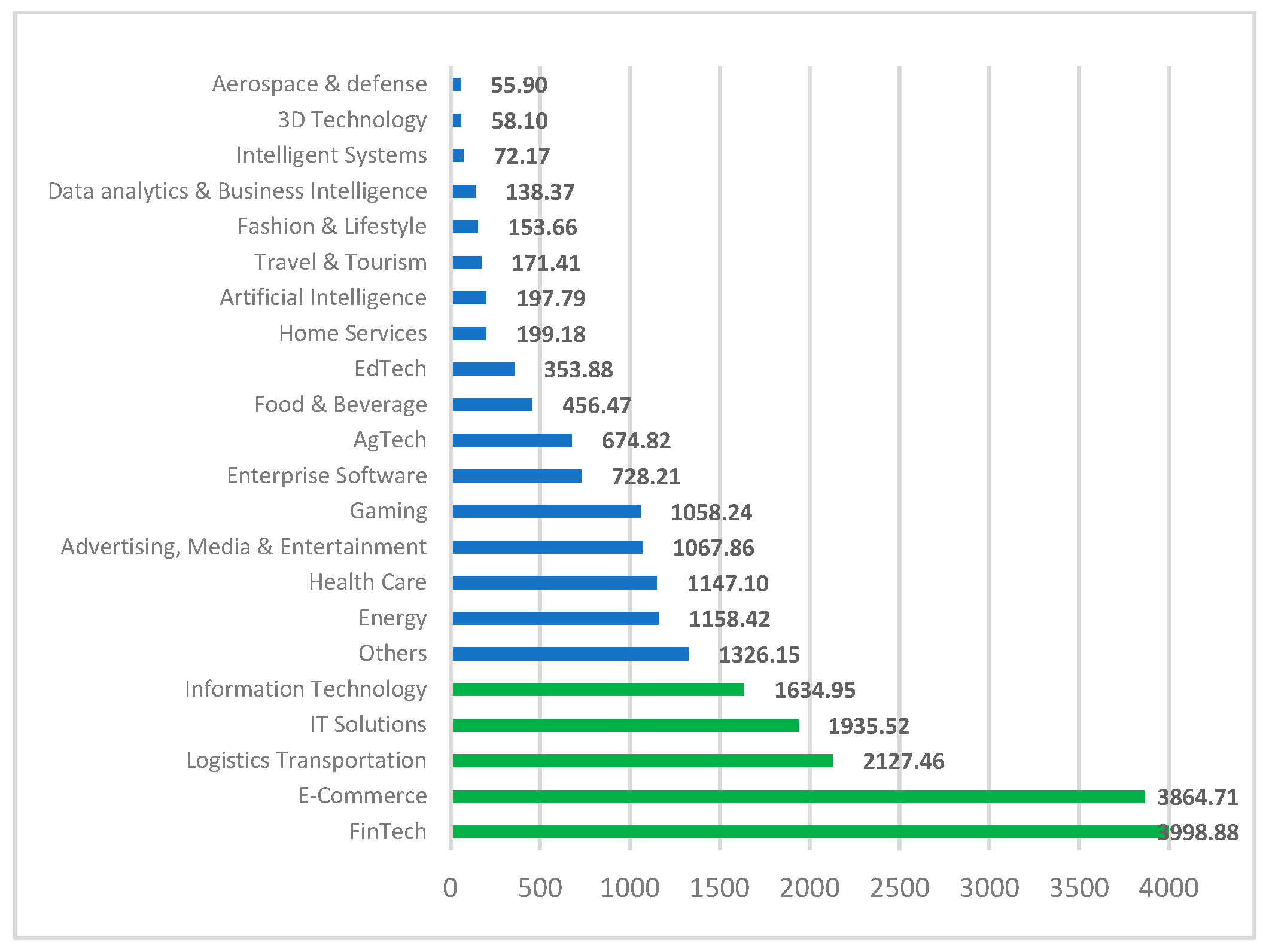
Figure 1 and Figure 2 illustrate the distribution of funding across key sectors and the average amount raised per deal in specific sectors (for the main leading sector per sector per year, see also Table 2). The five dominant sectors—fintech, e-commerce, logistics transportation, IT solutions, and information technology—together had the largest share of the volume of funded deals. They accumulated more than USD 13 billion, representing approximately 60 percent of total funding. The dominance of certain sectors in terms of total funding shows the concentration of investor interest in these areas.
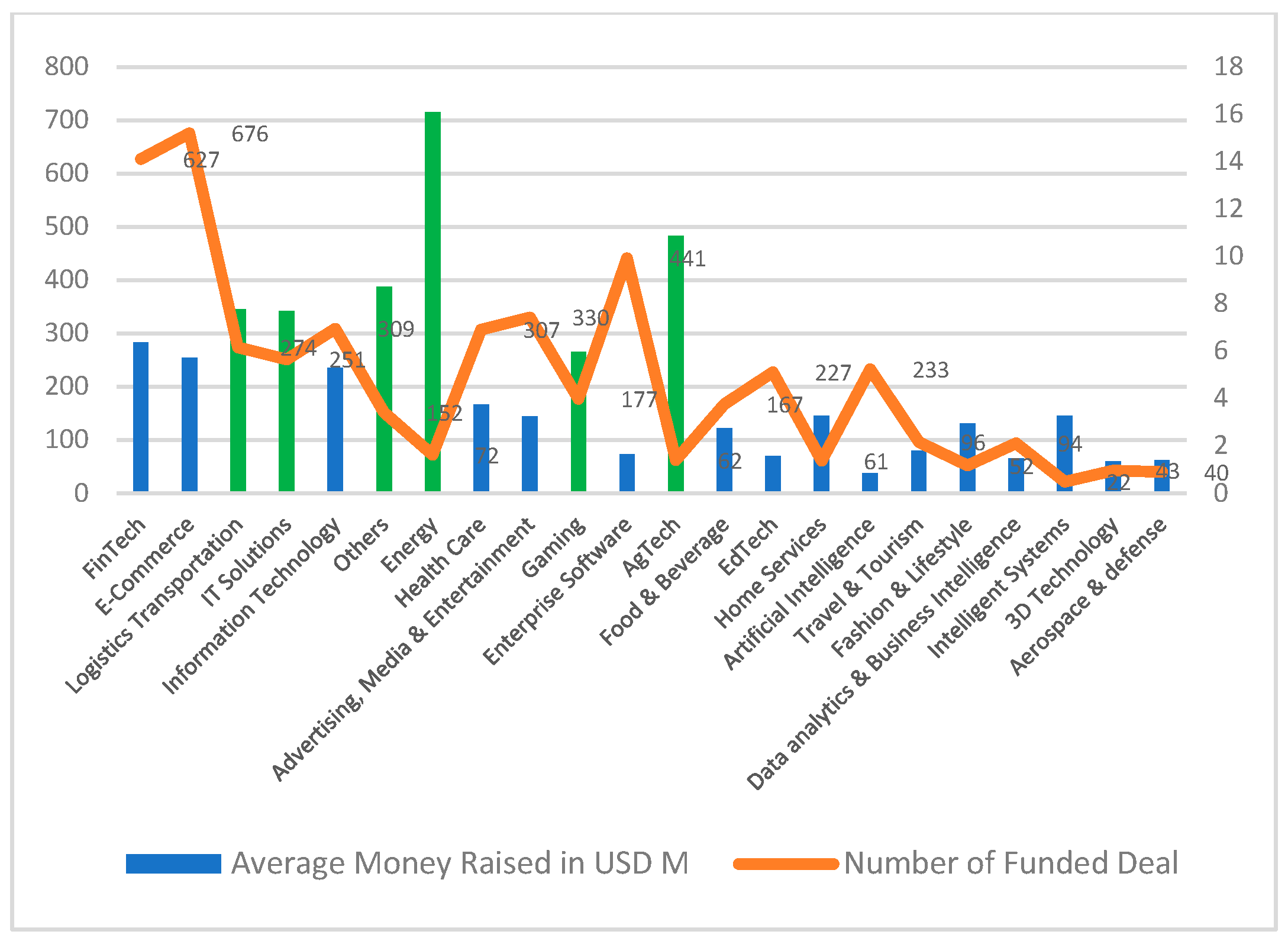
As shown in Figure 2, the sectors with the highest average amount raised per deal (green bar) are as follows: energy: USD 16 million; agtech: USD 10.9 million; logistics transportation: USD 7.8 million; IT solutions: USD 7.7 million; and fintech: USD 6.4 million. The average amounts per deal show the relative financial strength and attractiveness of different sectors in the startup ecosystem.
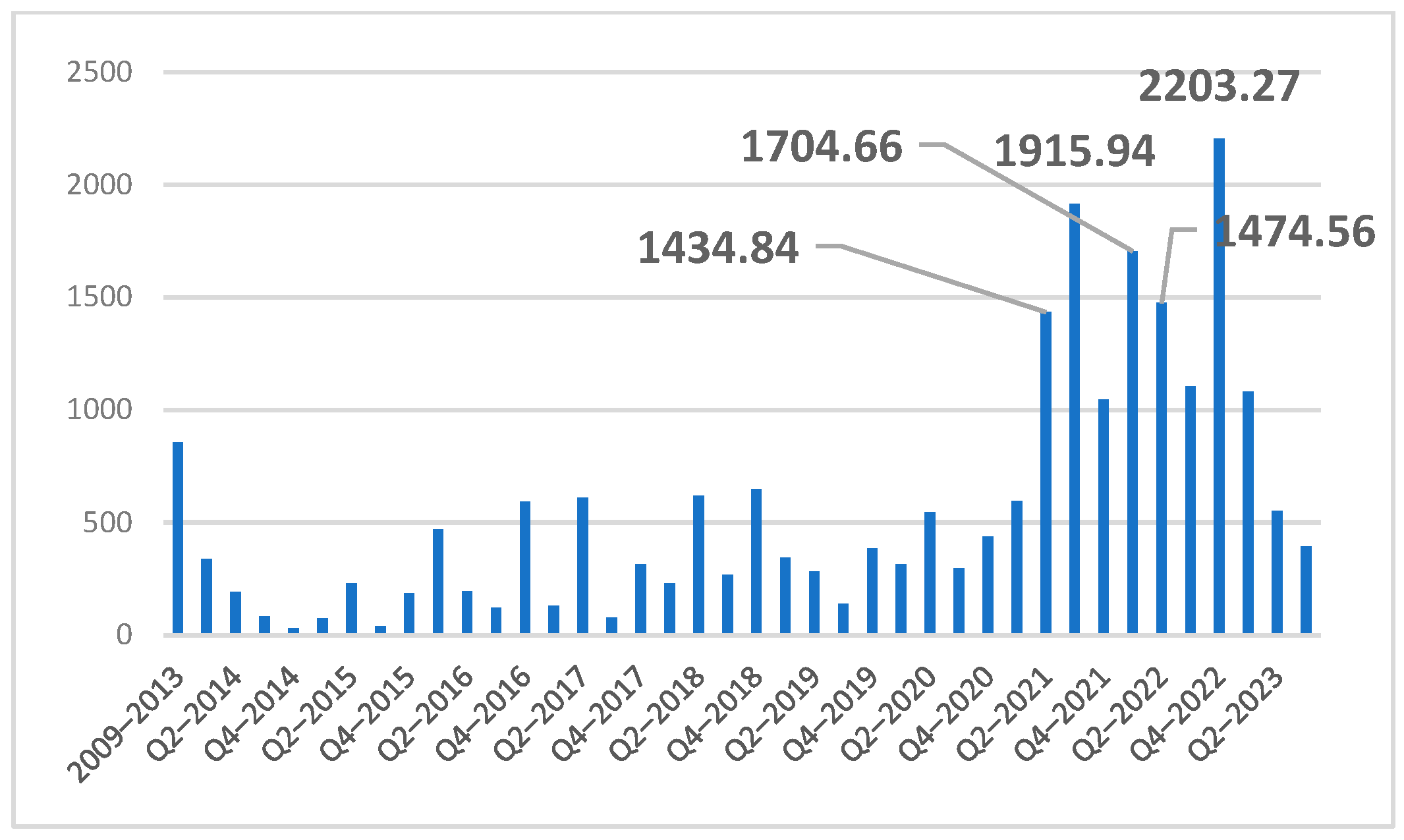
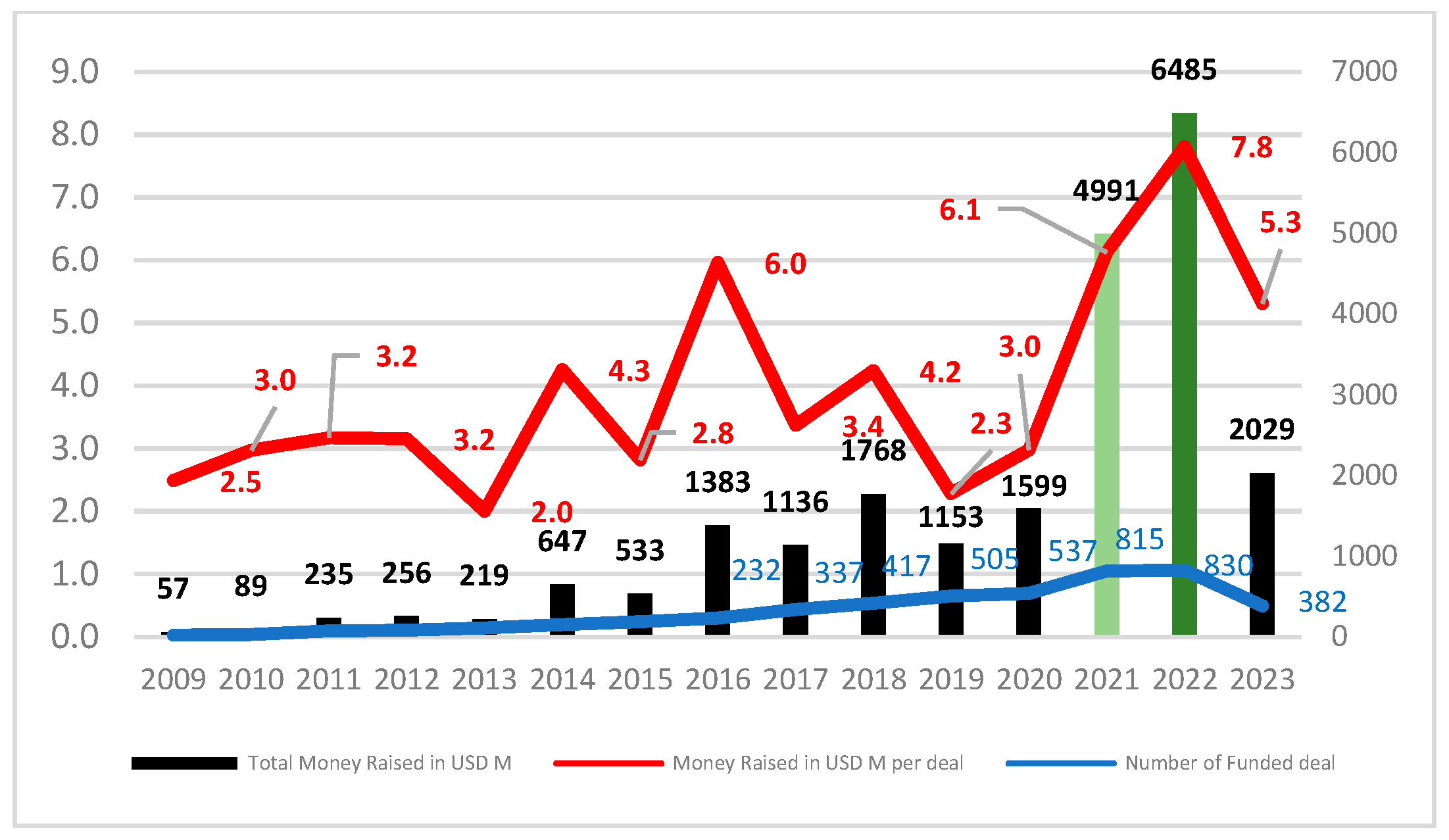
The study offers a nuanced understanding of the evolution of startup funding in the MENA region, considering distinct phases and the impact of external factors such as the COVID-19 pandemic. Figure 3 and Figure 4 describe the evolution in the volume of transactions in millions of USD over different periods. In the first period (2009–2013), the cumulative amount did not exceed USD 0.9 billion. In the second period (2014–2019), before the COVID-19 pandemic, financing of startups rose slightly. This period is characterized as one of establishing, building, and completing the entrepreneurial ecosystem in the MENA region, with some exceptions (e.g., Yemen, Syria, Iraq) that remain in the establishment stage. The third period (2020–2021) covers the outbreak of the pandemic, when the sector experienced some significant development driven by the urgent need for quick solutions that would facilitate economic activity. At the end of 2021, funded deals increased from USD 1.6 billion (in 2020) to about USD 5 billion (light green bar), an increase of 212 percent over the level in 2020. In the last period, which began in 2022, the growth trend continued, reaching USD 6.5 billion (dark green bar) at the end of 2022, an increase of 30 percent compared to 2021.
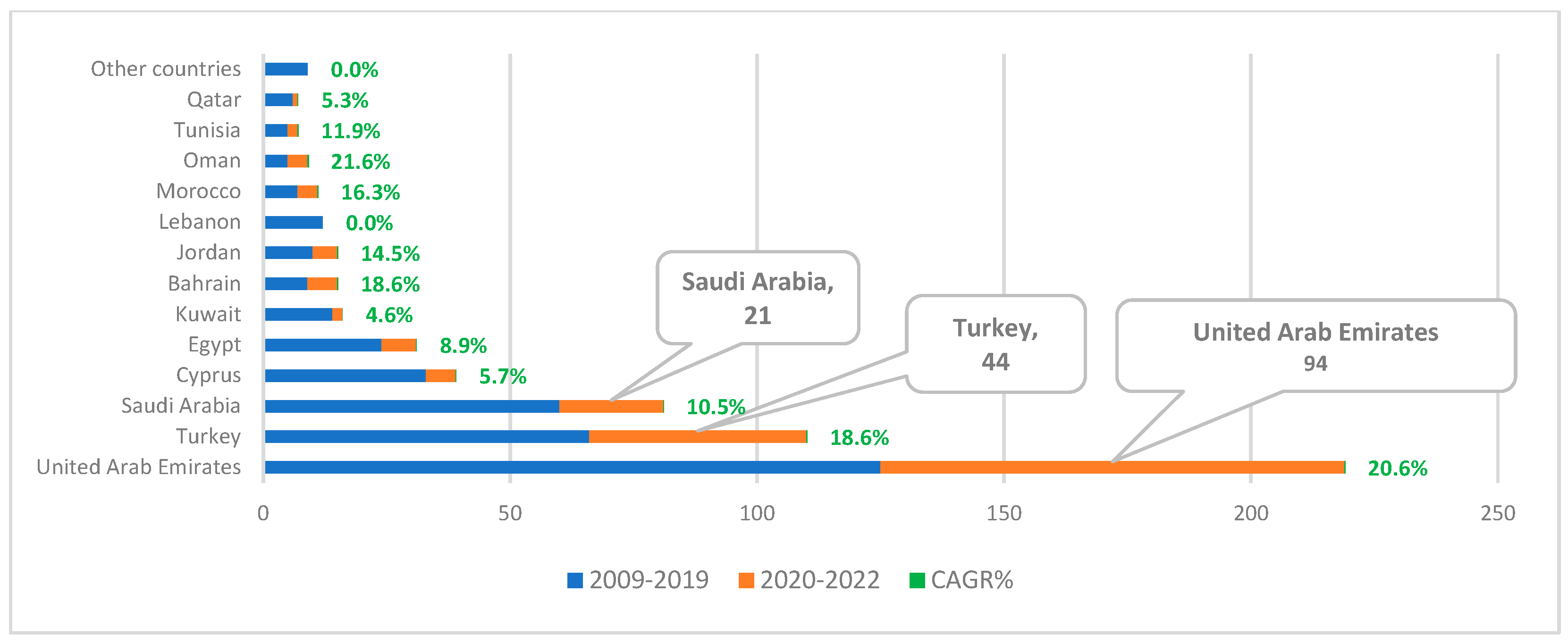
The MENA region experienced a substantial increase in the number and value of funded deals after 2019, coinciding with the growth of the startup financing market. VC companies played a crucial role in contributing to this growth. These companies were involved either as pure VCs or as firms with multiple specializations, including VC activities. Between 2020 and 2022, 196 new companies formed in this sector (385 existed at the end of 2019), reflecting the dynamism and expansion of the startup ecosystem in the region. The annual growth rate for the three years combined (2020–2022) was 14.7 percent, indicating a sustained and notable expansion in the startup financing market. Figure 5 illustrates the evolution in the number of VC firms before and after 2019. The majority of new firms were concentrated in particular countries in the MENA region. The UAE had a significant increase (the compound annual growth rate (CAGR) of more than 20%), with 94 new VC firms, giving it a total of 219. Türkiye also experienced growth, with 44 new institutions, for a total of 110 (CAGR of more than 18%). Saudi Arabia added 21 institutions (CAGR of more than 10%), for a total of 81. The concentrated growth in these countries highlights their prominence in fostering startup innovation and attracting investment.

3.2. Impact Investment in the MENA Region

Global (e.g., PRI,1 ESG Investing2) and regional organizations (e.g., Magnitt)3 (EC, 2015; Magnitt, 2021; Morriesen, 2018) and researchers (Bathaei & Štreimikienė, 2023; Colombo et al., 2019; D’Adamo et al., 2022; Fernandes et al., 2023; Ferraz & Pyka, 2023; Kaczam et al., 2022; Marzuki et al., 2023) have distinguished related sectors and subsectors in order to identify sectors and activities that are directly related to the topic of impact investment. (Kaya & Orpiszewski, 2025) analyze impact investment determinants across global SMEs and find that younger, medium-sized firms in developing countries—especially in agriculture, health, and education—receive higher equity funding, emphasizing impact investing’s role in closing SME financing gaps. Based on the previous reports and research, we use keywords to divide investors and startups into two groups: those that are and are not involved in impact investment. They indicate the various sectors and subsectors within impact investment: renewable energy, social enterprises, environmental conservation, health care innovation, education technology, financial inclusion, sustainable agriculture, circular economy, water and sanitation, impact investment platforms, climate change mitigation, gender equality, affordable housing, tech for social good, and community development.
Next, we compare startups and investors that engage in impact investment. Their division into groups based on impact investment involves four steps:
Step 1: Identifying keywords related to impact investment activities (see above);
Step 2: Conducting keyword searches in the descriptions, mission statements, and activities of startups and investors;
Step 3: Dividing startups and investors into two categories: those involved in impact investment activities and those that are not involved in them;
Step 4: Analyzing data and performing comparisons using quantitative and qualitative analysis.
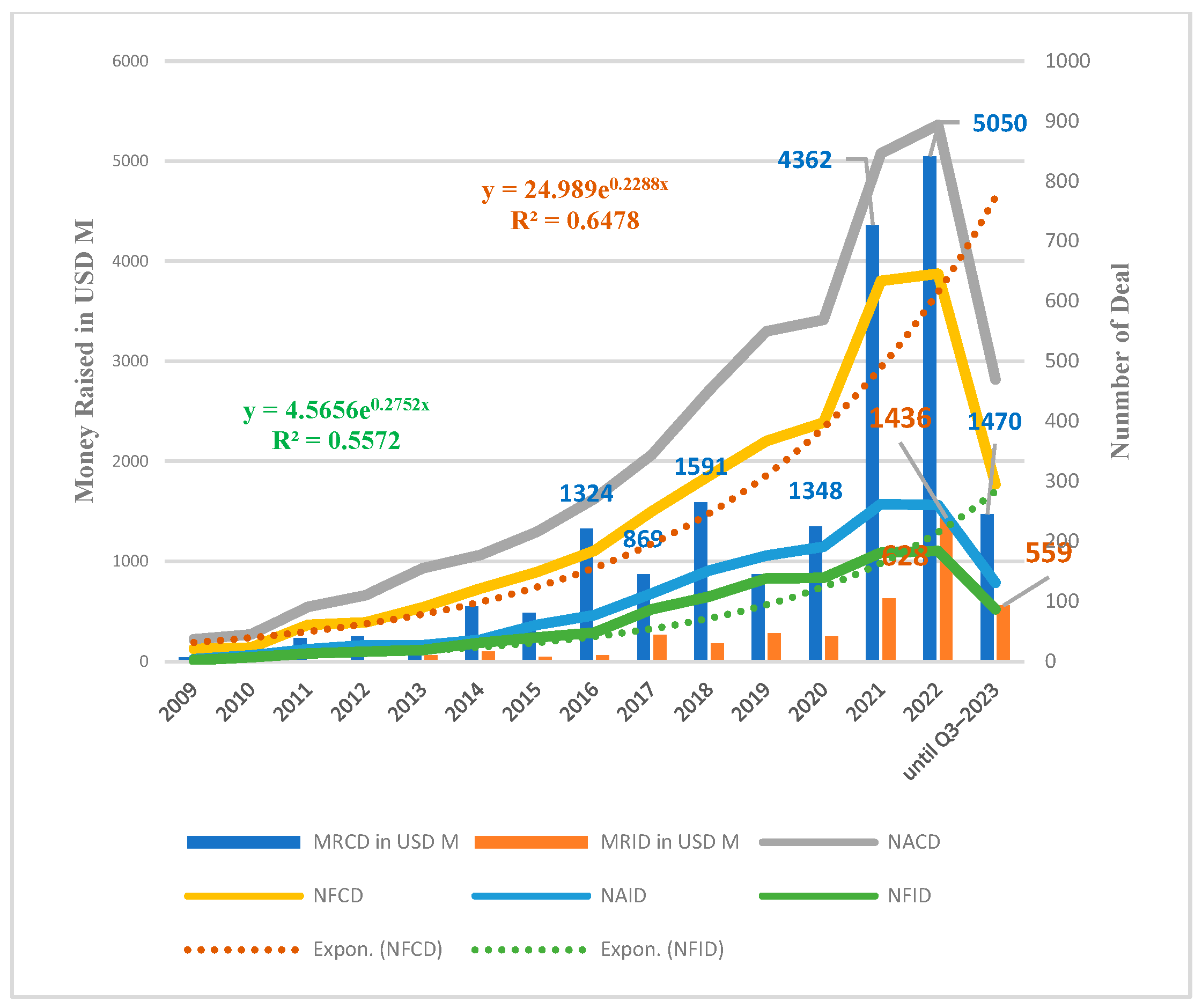
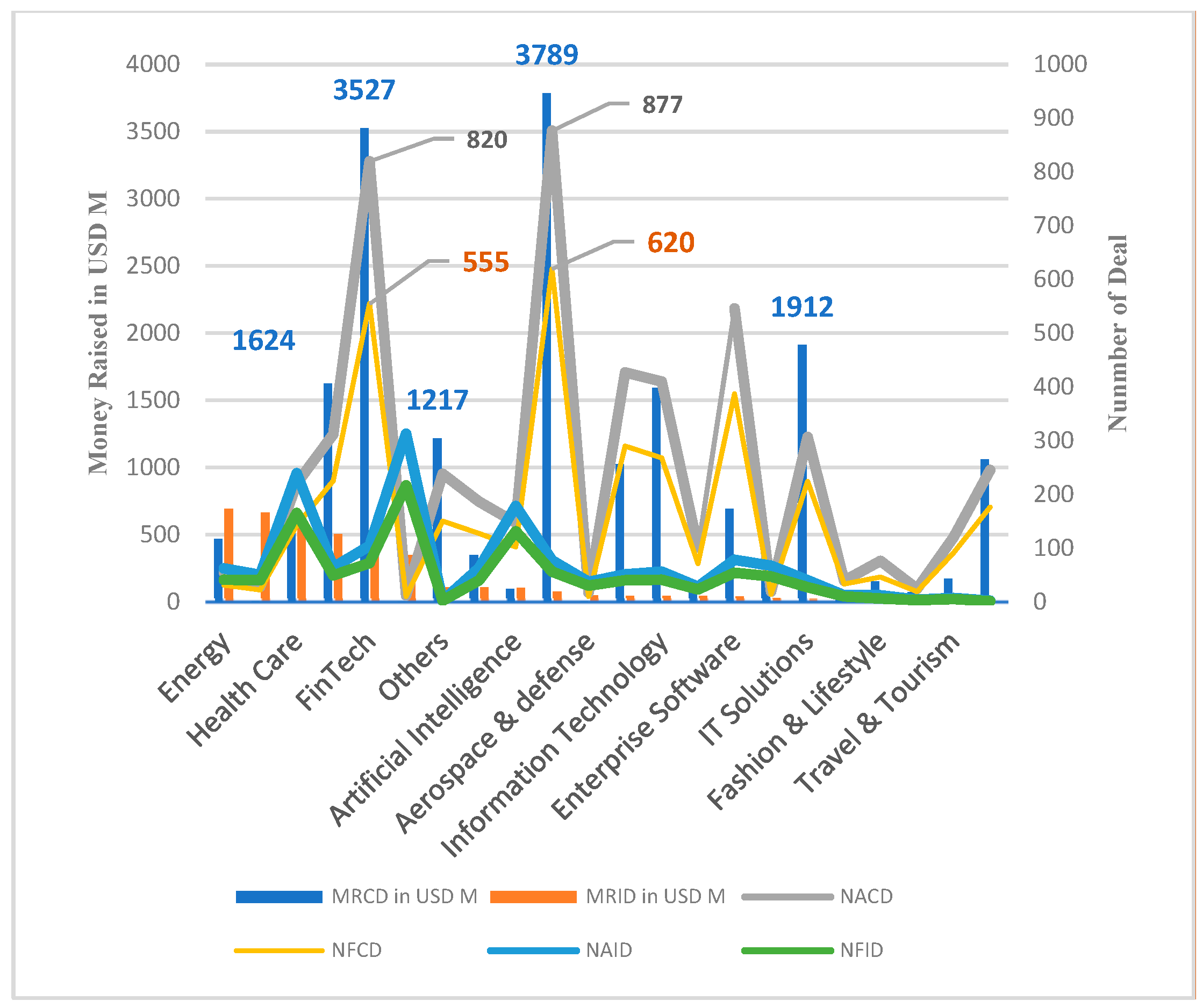
Figure 6 and Figure 7 display various metrics related to conventional and impact deals in the MENA region, revealing interesting insights into the startup financing ecosystem. They provide metrics such as the money raised for conventional deals in millions of USD (MRCD), money raised for impact deals in millions of USD (MRID), the number of announced conventional deals (NACD), the number of financed conventional deals (NFCD), the number of announced impact deals (NACD), and the number of financed impact deals (NFCD), for the period 2009 to Q3 2023 (Figure 6) and by sector (Figure 7), respectively.
In Figure 6, both announced deals (894 for conventional deals [CD] vs. 260 for impact deals [ID]) and funded deals (262 CD vs. 181 ID) recorded their highest numbers to date in 2022. The average funded deal in both CD and ID was USD 7.8 million per deal, a record amount, indicating rapid growth in startup financing activity in the MENA region. From 2009 to Q3 2023, the MENA market size of financing startups totaled USD 22.579 billion (USD 18.654 billion in CD and USD 3.925 billion in ID). Figure 7 displays the top five sectors in CD (e-commerce, fintech, IT solutions, logistics transportation, and information technology), which received 66.7 percent (USD 12.45 billion out of a total of USD 18.65 billion). E-commerce and fintech attracted the most investment, USD 3.8 billion and USD 3.5 billion, respectively. By comparison, energy, agtech, health care, logistics transportation, and fintech received 74.1 percent (USD 2.9 billion out of a total of USD 3.9 billion) in investor financing for ID.
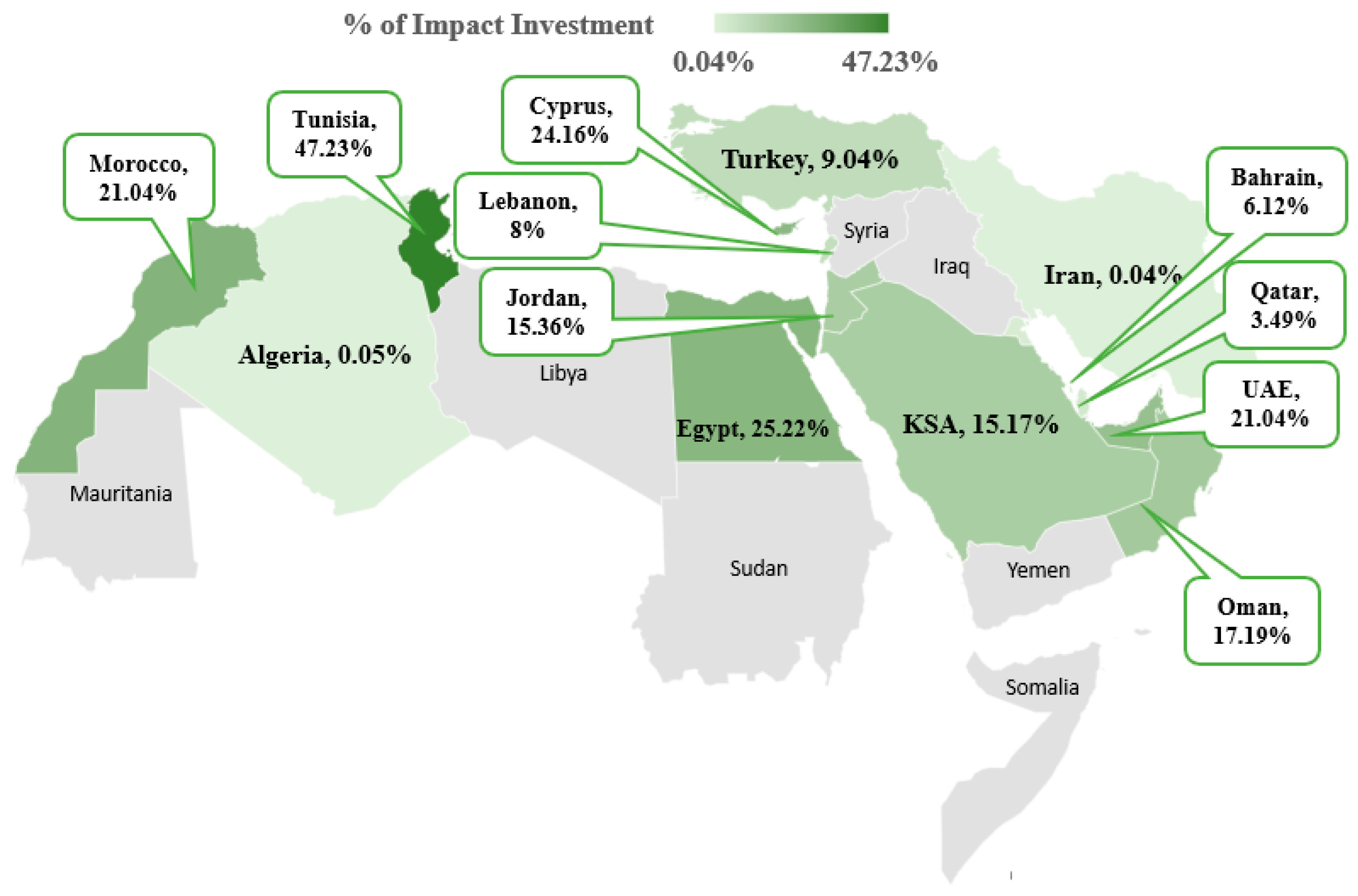
Figure 8 sheds light on the impact investment ecosystem in various countries, highlighting the top five countries (Morocco, UAE, Egypt, Cyprus, and Tunisia) in terms of financing deals with impact, from 21 percent to 47.23 percent. The UAE, Egypt, Saudi Arabia, Türkiye, and Cyprus raised the highest total amount of money during the period 2009 to Q3 2023, mostly the UAE, which raised USD 2.2 billion in impact investment. The varying impact investment rates among countries indicate their different levels of commitment and emphasis on socially and environmentally conscious startups.
From an investor perspective, 1771 investors participated in funding the startup market. Table 3 details the types of investors participating in the startup market, with a focus on key metrics related to their engagement: venture capital (VC), corporate venture capital (CVC), private equity (PE), angel, accelerator, and other types. Many metrics are used, such as presence in the capital of a country, number of investments, number of exits, number of portfolios, and number of lead investments. Angel and VC investors are the main contributors to the startup sector. The total number of VC companies is 397, of which 36 (9.1%) have declared an intention to support impact investment. The VC sector alone contributed to financing 4112 projects, including 356 impact investments (8.7%). VCs invest in 3416 startups (or portfolio organizations), of which 308 have impact investments (9%).

3.3. Variables

3.3.1. Dependent Variable

The study investigates the broader trends in investment, specifically the trend toward impact investment. The financial perspective involves assessing the financial outcomes and performance of impact-driven startups compared to conventional ones. The study offers insights into how the success of impact startups influences the overall investment landscape, potentially affecting future investment strategies and trends among VCs as pivot investors. Using the TEFA of startups as a dependent variable and a proxy for financial success is a common approach in many studies on the startup ecosystem (see Section 2.3). It reflects the level of confidence in the startup by investors, including VCs and other funding sources. Higher funding amounts generally indicate stronger belief in the company’s potential for success. A higher TEFA indicates greater potential for the startup to achieve significant growth. We use the natural logarithm of the TEFA to measure financing success.

3.3.2. Independent Variables

Table 4 defines the variables in the study with their sources.

4. Results and Analysis

Table 5 displays the descriptive statistics of the variables, with the average and the standard deviation. The sample consists of 4381 startups, with 961 (22%) considered impact startups and 3420 (78%) as conventional startups. The analysis includes one dependent variable that effectively measures the financial success of startups, LnTEFA (natural logarithm of the total equity funding amount). Based on this sample, the average TEFA for impact startups is USD 5.5 million, which is lower than the average for conventional startups (USD 7.6 million). The average first funding amount is also USD 1.4 million lower for impact startups than for conventional startups. This finding supports the hypothesis that impact startups receive less initial funding. Differences in means are observed for other variables, including the number of funded deals, announced rounds, and the number of employees. These differences support the hypotheses about the funding disparities between impact and conventional startups.
To better understand the statistical significance of the differences observed, we perform a nonparametric test (Table 6), specifically the Mann–Whitney U test, to compare the distribution of different variables between impact and conventional startups. The significance of the test indicates whether statistically significant differences exist between the two groups.
The nonparametric test (Mann–Whitney U test) is significant for variables related to financial metrics (e.g., total equity funding amount, first funding amount) and operational metrics (e.g., number of funded deals, announced rounds, number of employees). For the remaining variables, the Mann–Whitney U test is not significant. There are no statistically significant differences in the distribution of these variables between impact and conventional startups.
Before performing the regression analysis, we analyze the bivariate correlations among predictor variables (see Appendix A, Table A1) to check for significant correlations among the predictor variables. We find significant correlation among certain pairs of predictor variables, including announced rounds, number of investors, age of startups, and obtaining funding from VCs. All the correlations between the variables are low (below 0.49), indicating generally weak linear relationships, except the correlation between announced and funded deals (0.715) and between announced deals and number of investors (0.61).
We also conduct the variance inflation factor (VIF) test (Table 7). VIF values below 5 indicate no serious multicollinearity concerns. A VIF value higher than 5 indicates that the corresponding regression coefficient is poorly estimated because of multicollinearity. The VIF values obtained are lower than 2.7 and thus far below 5 (mean VIF = 1.27).
Multiple linear regression is used to study the determinants of success by startups. Three models are employed to analyze the full sample, impact startups, and conventional startups. Starting with an initial sample of 4381 startups, we then filtered the sample to omit those with missing data for some variables, resulting in a final dataset of 2302 startups (comprising 532 startups with an impact focus and 1770 conventional startups). The estimated coefficients of the variables, t-test, and VIF are presented in Table 7. R2 is from 0 to 1 and approximates how much variation in the outcome is explained by the variables in the model. R2 and adjusted R2 in the three models are from 41.6 percent to 44.4 percent and from 41.1 percent to 42.8 percent, respectively. The impact startups have the highest R2 and adjusted R2. All the Fisher values are significant at a high confidence level, with p < 0.01. The Durbin–Watson statistics are nearly 2 (2.047, 1.936, and 1.968, respectively); thus, there is no strong evidence of autocorrelation in the residuals.
Next, the three models are examined to evaluate the influence of fundraising on the success of startups. In Model 1, the full sample, 4381 startups, is used to explain the performance of startups, measured by the natural logarithm of the TEFA (LnTEFA). Model 1 includes nineteen independent variables, with one unique to this model: a dichotomous variable for startups (impact or conventional). This variable enables us to assess the specific impact of startups on their success, along with the influence of other relevant factors. These other variables are for localization, experience (age), deals (funding type, number of announced deals, and the number of financed deals), the number of investors, size (number of employees), team composition (number of founders), VC financing, and the eight main industry sectors. The variables related to startups—localization, experience, deals, the number of investors, size, team composition, and VC financing—have significant coefficients at the 1 percent level (p ≤ 0.01). The industry sector variables have high significance levels (p ≤ 0.01) for fintech and energy sectors, and e-commerce and logistics transportation have significant coefficients at the 5 percent level.
Model 2 uses a subset of the dataset, consisting of 532 impact startups. This model incorporates fifteen dependent variables, including factors such as localization, experience, deals, the number of investors, size, team composition, and VC financing, and focuses on the main sectors that are pertinent to startups (as indicated in Figure 6), namely fintech, logistics transportation, energy, agtech, and health care. The variables for the funding type, the number of financed deals, the number of deals, the number of employees, the number of investors, experience, VC financing, and the energy sector are significant at the 1 percent level. The coefficients of fintech and logistics transportation are significant at the 5 percent level.
Model 3, which covers the second subset of the dataset, comprising 1770 conventional startups, uses the same set of variables as Model 2, with some modifications. Specifically, Model 3 substitutes certain variables associated with industry sectors for those relevant to conventional startups, as illustrated in Figure 7. The majority of the variables are significant at the 1 percent level (p ≤ 0.01), but e-commerce, IT solutions, and information technology are not found to be significant.
Model 1 reveals a notable negative association between the success of startups and engagement in impact investment activities, with a statistically significant coefficient at the 1 percent level. This result supports the hypotheses (H1 and H2) that the impact investments negatively influence the success of startups. The literature has some explanations for this finding, for example, Saltuk and El Idrissi (2015) analyze the ongoing debate in the impact investment market concerning whether a trade-off necessarily exists between financial returns and the pursuit of social impact. The negative coefficient can also be explained by the cost of transactions (Calderini et al., 2018; Wilson, 2014; Yaşar, 2021) due to the complex deal structure (e.g., gathering additional information about investment).
The geographic location emerges as a critical factor that influences startup performance, highlighting variations in the development of the entrepreneurial ecosystem. Factors such as the business environment, innovation encouragement, and provision of financial resources directly correlate with the sector’s success. This finding aligns with those by Díaz-Santamaría and Bulchand-Gidumal (2021), emphasizing the significance of spatial factors in startup success. Factors such as the presence of synergies due to geographic proximity, accessibility to essential infrastructure, and the availability of an active labor market strongly influence startup performance. Brandstetter and Lehner (2015) find that the impact investment market depends on infrastructure, such as policy support and measurement systems.
Startups located in the capital of a country have a higher likelihood of securing appropriate financing, potentially due to the capital’s population density, higher average wages, and robust infrastructure, fostering a conducive entrepreneurial ecosystem. This finding is consistent with that of Shuwaikh and Dubocage (2022), in which geographic proximity between the corporate investor and the startup enables access to complementary resources for the investor. Experience, represented by the age of startups, is important for entrepreneurial success. Startup age is a proxy for resilience, indicating a sustained market presence and increased prospects of success, leading to enhanced opportunities for expansion through access to additional financing. Singh and Mungila Hillemane (2023) find a positive correlation between a startup’s age and its success measured by revenue. This relationship can be attributed to the maturation process, in which a startup, as it survives and evolves over time, benefits from the founders’ enhanced understanding of the market and target customers (Marvel et al., 2022).
The study also shows that the success of startups is closely linked to the funding that they receive, particularly from VCs. They play a crucial role, not only by providing financial support but also by offering expertise to help startups overcome numerous challenges. Their involvement extends beyond capital infusion, contributing significantly to the overall growth and development of these startups. These results corroborate the main argument by Jeong et al. (2020): the earlier a startup is initially offered investment by VC firms, the higher the startup’s performance is.
The team (proxied by the number of founders) has significant importance in enhancing company performance due to the shared burdens, responsibilities, and risks among team members, fostering a collaborative environment. Additionally, a well-structured team enhances the potential for securing self-financing, facilitating access to more rounds of funding. A positive and significant relationship is expected to be found between the number of financed deals and startup performance, in which a higher number of financed deals is correlated with raising money. However, the relationship with the number of announced deals is anticipated to be negative. Previous statistics indicate that 30 percent of announced deals do not secure funding approval, contributing to this negative association.
The results of Model 2 reveal a correlation between the startups’ success in adopting an impact investment strategy and fifteen exogenous variables. The country code has a positive and significant coefficient, indicating a positive environment for encouraging impact startups. Interestingly, the location in capital cities is found to be insignificant, indicating that impact investment is sometimes directed at less developed cities. Other variables—such as the funding type, the number of financed deals, the number of employees, the number of announced rounds, the number of investors, age, and VC financing—are also significant at the 1 percent level, echoing the findings of Model 1. Among the five sectors considered, three (fintech, logistics transportation, and energy) have significantly positive coefficients, highlighting their contribution to the success of startups in pursuing impact investment. Finally, the results of Model 3 are similar to those of Model 1 except for e-commerce, which is not found to be statistically significant.

5. Conclusions

This study provides the first large-scale empirical evidence on the financial outcomes of impact versus conventional investment in the MENA startup ecosystem. By examining the determinants of financial success using a unique multi-country dataset, it highlights funding disparities and structural differences between these two startup groups.
Our results indicate that startups aligned with impact investment objectives face significantly lower financial success—measured by the TEFA—compared to their conventional peers. This result supports Hypotheses 1 and 2, and aligns with prior research suggesting a trade-off between social impact and financial performance (Calderini et al., 2018; Wilson, 2014; Yaşar, 2021). Our findings contradict the view of Gray et al. (2016) and the GIIN (2021), who propose that impact funds can achieve returns comparable to traditional venture capital. Consequently, the evidence contributes to this ongoing debate by providing region-specific insights that reinforce the existence of a funding disadvantage for impact-driven ventures in emerging markets.
Additionally, the analysis confirms that internal firm characteristics, such as the number of funded deals, founders, employees, and investor diversity, have a positive influence on startup performance, thereby validating Hypothesis 3. These findings are consistent with the conclusions of Díaz-Santamaría and Bulchand-Gidumal (2021), Singh and Mungila Hillemane (2023), and Jeong et al. (2020), who emphasize the importance of firm characteristics and funding dynamics in predicting venture performance.
Theoretically, this analysis extends the VC literature by incorporating impact orientation as a relevant dimension in performance evaluation in emerging markets. From a practical perspective, the findings provide the need for tailored investment mechanisms, policy incentives, and ecosystem-level interventions to reduce structural barriers faced by impact ventures in the MENA region.
Our evidence leads to specific recommendations for entrepreneurs, investors, and policymakers. For impact entrepreneurs, the findings highlight the necessity of effectively communicating both social mission and financial viability to help bridge the observed funding gap. For investors, particularly venture capitalists and impact funds, the findings indicate the importance of adopting specialized due diligence processes and risk assessment models capable of accurately evaluating dual-purpose ventures and identifying potential investment opportunities. For policymakers, the findings support the use of targeted public interventions, including blended finance instruments, co-investment schemes, or fiscal incentives, in order to strengthen the financial position of impact ventures and address the structural funding imbalance identified.
This study has limitations associated with its reliance on secondary quantitative data, which may not capture the full complexity of investment decisions. Future research should therefore incorporate additional firm-level and contextual variables—such as founder backgrounds, strategic orientations, and regulatory environments—and employ complementary qualitative methods, including interviews and surveys with founders and investors. Longitudinal studies may also examine whether the observed trade-off persists through later growth stages or during exit events. Extending this comparative framework to other emerging regions would further clarify whether the patterns observed in MENA reflect context-specific dynamics or broader global trends.

Funding

This work was supported and funded by the Deanship of Scientific Research at Imam Mohammad Ibn Saud Islamic University (IMSIU) (grant number IMSIU-DDRSP2604).

Institutional Review Board Statement

Not applicable.

Informed Consent Statement

Not applicable.

Data Availability Statement

The raw data supporting the conclusions of this article will be made available by the author on request.

Conflicts of Interest

The author declares no conflicts of interest.

Appendix A. Correlation Matrix

The correlation matrix below presents pairwise Pearson correlations among all key variables used in the regression analysis.
Table A1. Correlation matrix of key variables.
Variable1234567891011121314151617181920
(1) lnMoneyR1
(2) StartIMP−0.05 ***1
(3) CountryCode0.15 ***−0.011
(4) LOC0.12 ***00.16 ***1
(5) FundType0.34 ***00.03 **−0.03 **1
(6) NFDeals0.36 ***0.03 **0.020.05 ***−0.02 *1
(7) Nfounders0.15 ***000.04 **−0.03 *0.15 ***1
(8) Nempl0.26 ***0.03 **0.010.010.23 ***−0.02 *−0.03 **1
(9) NRound0.35 ***0.05 ***−0.04 ***0.05 ***0.09 ***0.71 ***0.18 ***0.021
(10) NInvestors0.43 ***0.010.05 ***0.11 ***0.04 **0.49 ***0.21 ***0.03 **0.61 ***1
(11) Age0.19 ***0.02−0.03 **−0.02 *0.38 ***−0.1 ***−0.06 ***0.35 ***−0.02−0.11 ***1
(12) VC_Fin0.15 ***0.02 *−0.03 **0.03 **−0.06 ***0.17 ***0.09 ***−0.05 ***0.22 ***0.18 ***−0.07 ***1
(13) E_Com0.02 *−0.14 ***−0.03 **0.04 ***−0.05 ***0.03 **−0.020.010.03 **0.04 **−0.020.011
(14) FinTech0.16 ***−0.11 ***0.04 ***0.05 ***0.020.04 ***0.01−0.010.06 ***0.16 ***−0.08 ***0.02−0.15 ***1
(15) IT_Sol−0.03 **−0.06 ***−0.02−0.01−0.02−0.010.01−0.01−0.03 **−0.020.03 **−0.01−0.1 ***−0.09 ***1
(16) Log_Transp0.07 ***−0.04 ***0.03 **00.020.05 ***0.04 **0.06 ***0.06 ***0.04 ***0.010.02−0.09 ***−0.08 ***−0.05 ***1
(17) Inf_Tech−0.03 **−0.07 ***000.02−0.04 ***−0.03 **0.01−0.05 ***−0.05 ***0.01−0.02−0.11 ***−0.11 ***−0.07 ***−0.06 ***1
(18) Energy0.05 ***0.09 ***0.01−0.05 ***0.08 ***−0.03 **00.01−0.01−0.03 *0.08 ***−0.01−0.06 ***−0.05 ***−0.03 **−0.03 **−0.04 ***1
(19) AgTech00.1 ***0.0100.04 ***0.04 ***00.03 **0.06 ***0.03 *0.010.02 *−0.04 ***−0.04 ***−0.02 *−0.02 *−0.03 **−0.011
(20) H_Care−0.03 *0.2 ***−0.02 *00.02 *−0.03 **−0.03 **0.03 **−0.01−0.02 *0.04 **0.02−0.11 ***−0.1 ***−0.07 ***−0.06 ***−0.08 ***−0.04 ***−0.03 **1
Notes: *, **, and *** denote significance levels of 10%, 5%, and 1%, respectively.

Notes

1
Principles for Responsible Investment (PRI) is an investor initiative in partnership with the Financial Initiative of the United Nations Environment Program (UNEP FI) and the United Nations (UN) Global Compact.
2
Environmental, social, and governance reflect the three key factors used to evaluate the sustainability and ethical impact of an investment.
3
A regional platform focused on startup ecosystems in the MENA region.

References

  1. Agrawal, A., & Hockerts, K. (2019). Impact investing strategy: Managing conflicts between impact investor and investee social enterprise. Sustainability, 11(15), 4117. [Google Scholar] [CrossRef]
  2. Ahmad, H., Yaqub, M., & Lee, S. H. (2023). Environmental-, social-, and governance-related factors for business investment and sustainability: A scientometric review of global trends. Environment, Development and Sustainability, 26(2), 2965–2987. [Google Scholar] [CrossRef] [PubMed]
  3. Ali-Yrkkö, J., Hyytinen, A., & Pajarinen, M. (2005). Does patenting increase the probability of being acquired? Evidence from cross-border and domestic acquisitions. Applied Financial Economics, 15(14), 1007–1017. [Google Scholar] [CrossRef]
  4. Barber, B. M., Morse, A., & Yasuda, A. (2021). Impact investing. Journal of Financial Economics, 139(1), 162–185. [Google Scholar] [CrossRef]
  5. Bathaei, A., & Štreimikienė, D. (2023). Renewable energy and sustainable agriculture: Review of indicators. Sustainability, 15(19), 14307. [Google Scholar] [CrossRef]
  6. Berger, A. N., & Udell, G. F. (1998). The economics of small business finance: The roles of private equity and debt markets in the financial growth cycle. Journal of Banking and Finance, 22(6–8), 613–673. [Google Scholar] [CrossRef]
  7. Block, J. H., Hirschmann, M., & Fisch, C. (2021). Which criteria matter when impact investors screen social enterprises? Journal of Corporate Finance, 66, 101813. [Google Scholar] [CrossRef]
  8. Boerner, H. (2012). The corporate ESG beauty contest continues: Recent developments in research and analysis. Corporate Finance Review, 17(3), 32. [Google Scholar]
  9. Brander, J. A., Du, Q., & Hellmann, T. (2015). The effects of government-sponsored venture capital: International evidence. Review of Finance, 19(2), 571–618. [Google Scholar] [CrossRef]
  10. Brandstetter, L., & Lehner, O. M. (2015). Opening the market for impact investments: The need for adapted portfolio tools. Entrepreneurship Research Journal, 5(2), 87–107. [Google Scholar] [CrossRef]
  11. Bugg-Levine, A., & Emerson, J. (2011). Impact investing: Transforming how we make money while making a difference. Innovations: Technology, Governance, Globalization, 6(3), 9–18. [Google Scholar] [CrossRef]
  12. Calderini, M., Chiodo, V., & Michelucci, F. V. (2018). The social impact investment race: Toward an interpretative framework. European Business Review, 30(1), 66–81. [Google Scholar] [CrossRef]
  13. Calopa, M. K., Horvat, J., & Lalic, M. (2014). Analysis of financing sources for startup companies. Management: Journal of Contemporary Management Issues, 19(2), 19–44. [Google Scholar]
  14. Carter, N. M., Stearns, T. M., Reynolds, P. D., & Miller, B. A. (1994). New venture strategies: Theory development with an empirical base. Strategic Management Journal, 15(1), 21–41. [Google Scholar] [CrossRef]
  15. Collewaert, V., & Sapienza, H. J. (2016). How does angel investor-entrepreneur conflict affect venture innovation? It depends. Entrepreneurship: Theory and Practice, 40(3), 573–597. [Google Scholar] [CrossRef]
  16. Colombo, M. G., D’Adda, D., & Quas, A. (2019). The geography of venture capital and entrepreneurial ventures’ demand for external equity. Research Policy, 48(5), 1150–1170. [Google Scholar] [CrossRef]
  17. Colombo, M. G., Montanaro, B., & Vismara, S. (2023). What drives the valuation of entrepreneurial ventures? A map to navigate the literature and research directions. Small Business Economics, 61(1), 59–84. [Google Scholar] [CrossRef]
  18. Crișan, E. L., Salanță, I. I., Beleiu, I. N., Bordean, O. N., & Bunduchi, R. (2021). A systematic literature review on accelerators. Journal of Technology Transfer, 46(1), 62–89. [Google Scholar] [CrossRef]
  19. Croce, A., Ughetto, E., Scellato, G., & Fontana, F. (2021). Social impact venture capital investing: An explorative study. Venture Capital, 23(4), 345–369. [Google Scholar] [CrossRef]
  20. D’Adamo, I., Ioppolo, G., Shen, Y., & Rosen, M. A. (2022). Sustainability Survey: Promoting solutions to real-world problems. Sustainability, 14(19), 12244. [Google Scholar] [CrossRef]
  21. Deias, A., & Magrini, A. (2023). The Impact of Equity Funding Dynamics on Venture Success: An Empirical Analysis Based on Crunchbase Data. Economies, 11(1), 19. [Google Scholar] [CrossRef]
  22. Denis, D. J. (2004). Entrepreneurial finance: An overview of the issues and evidence. Journal of Corporate Finance, 10(2), 301–326. [Google Scholar] [CrossRef]
  23. Díaz-Santamaría, C., & Bulchand-Gidumal, J. (2021). Econometric estimation of the factors that influence startup success. Sustainability, 13(4), 2242. [Google Scholar] [CrossRef]
  24. Donohoe, N. O., & Bugg-Levine, A. (2010). Impact investments: An emerging asset class (Rockefeller Foundation). JP Morgan Social Finance. [Google Scholar]
  25. Drover, W., Busenitz, L., Matusik, S., Townsend, D., Anglin, A., & Dushnitsky, G. (2017). A review and road map of entrepreneurial equity financing research: Venture capital, corporate venture capital, angel investment, crowdfunding, and accelerators. Journal of Management, 43(6), 1820–1853. [Google Scholar] [CrossRef]
  26. EC. (2015). Closing the loop—An EU action plan for the circular economy. In Communication from the commission to the European parliament, the council, the European economic and social committee and the committee of the regions. EC. [Google Scholar]
  27. Esposito, C. D., Szatmari, B., Sitruk, J. M. C., & Wijnberg, N. M. (2023). Getting off to a good start: Emerging academic fields and early-stage equity financing. Small Business Economics, 62(4), 1591–1613. [Google Scholar] [CrossRef]
  28. Fernandes, E. d. S., Grochau, I. H., & Ten Caten, C. S. (2023). Impact investing: Determinants of external financing of social enterprises in Brazil. Sustainability, 15(15), 11935. [Google Scholar] [CrossRef]
  29. Ferraz, D., & Pyka, A. (2023). Circular economy, bioeconomy, and sustainable development goals: A systematic literature review. Environmental Science and Pollution Research. [Google Scholar] [CrossRef]
  30. Geroski, P. A. (1995). What do we know about entry? International Journal of Industrial Organization, 13(4), 421–440. [Google Scholar] [CrossRef]
  31. GIIN. (2019). Core characteristics of impact investing. Global Impact Investing Network. Available online: http://www.thegiin.org (accessed on 17 March 2025).
  32. GIIN. (2021). Impact investing decision-making: Insights on financial performance. Global Impact Investing Network. Available online: www.thegiin.org (accessed on 17 March 2025).
  33. Gray, J., Ashburn, N., Douglas, H. V., Jeffers, J. S., Musto, D. K., & Geczy, C. (2016). Great expectations: Mission preservation and financial performance in impact investing. SSRN Electronic Journal. [Google Scholar] [CrossRef]
  34. Guo, B., Lou, Y., & Pérez-Castrillo, D. (2015). Investment, duration, and exit strategies for corporate and independent venture capital-backed start-ups. Journal of Economics and Management Strategy, 24(2), 415–455. [Google Scholar] [CrossRef]
  35. Hand, J. R. M. (2005). The value relevance of financial statements in the venture capital market. Accounting Review, 80(2), 613–648. [Google Scholar] [CrossRef]
  36. Haslanger, P., Lehmann, E. E., & Seitz, N. (2022). The performance effects of corporate venture capital: A meta-analysis. Journal of Technology Transfer, 48(6), 2132–2160. [Google Scholar] [CrossRef]
  37. Hawley, J., & Lukomnik, J. (2018). The purpose of asset management. Pension Insurance Corporation. [Google Scholar]
  38. Hebb, T. (2013). Impact investing and responsible investing: What does it mean? Journal of Sustainable Finance and Investment, 3(2), 71–74. [Google Scholar] [CrossRef]
  39. Henderson, V., Kuncoro, A., & Turner, M. (1995). Industrial development in cities. Journal of Political Economy, 103(5), 1067–1090. [Google Scholar] [CrossRef]
  40. Höchstädter, A. K., & Scheck, B. (2015). What’s in a name: An analysis of impact investing understandings by academics and practitioners. Journal of Business Ethics, 132(2), 449–475. [Google Scholar] [CrossRef]
  41. Jackson, E. T., & Harji, K. (2012). Accelerating impact: Achievements, challenges and what’s next in building the impact investing industry. The Rockefeller Foundation. [Google Scholar]
  42. Jeong, J., Kim, J., Son, H., & Nam, D. I. (2020). The role of venture capital investment in startups’ sustainable growth and performance: Focusing on absorptive capacity and venture capitalists’ reputation. Sustainability, 12(8), 3447. [Google Scholar] [CrossRef]
  43. Kaczam, F., Siluk, J. C. M., Guimaraes, G. E., de Moura, G. L., da Silva, W. V., & da Veiga, C. P. (2022). Establishment of a typology for startups 4.0. Review of Managerial Science, 16(3), 649–680. [Google Scholar] [CrossRef]
  44. Kaya, O., & Orpiszewski, T. (2025). Determinants of impact investments: Evidence from portfolio-level data. Journal of Sustainable Finance and Accounting, 6, 100018. [Google Scholar] [CrossRef]
  45. Keasey, K., & Watson, R. (1991). The state of the art of small firm failure prediction: Achievements and prognosis. International Small Business Journal, 9(4), 11–29. [Google Scholar] [CrossRef]
  46. Kherbachi, S. (2023). Digital economy under fintech scope: Evidence from African investment. FinTech, 2(3), 475–483. [Google Scholar] [CrossRef]
  47. Kollenda, P. (2022). Financial returns or social impact? What motivates impact investors’ lending to firms in low-income countries. Journal of Banking and Finance, 136, 106224. [Google Scholar] [CrossRef]
  48. Kovner, A., & Lerner, J. (2015). Doing well by doing good? Community development venture capital. Journal of Economics and Management Strategy, 24(3), 643–663. [Google Scholar] [CrossRef]
  49. Louche, C., Arenas, D., & van Cranenburgh, K. C. (2012). From preaching to investing: Attitudes of religious organisations towards responsible investment. Journal of Business Ethics, 110(3), 301–320. [Google Scholar] [CrossRef]
  50. Macmillan, I. C., Siegel, R., & Narasimha, P. N. S. (1985). Criteria used by venture capitalists to evaluate new venture proposals. Journal of Business Venturing, 1(1), 119–128. [Google Scholar] [CrossRef]
  51. Magnitt. (2021). 2021 MENA VC impact investment report. Magnitt Report. Saudi Aramco Entrepreneurship Center Wa’ed. [Google Scholar]
  52. Marsh, P. (1982). The Choice Between Equity and Debt: An Empirical Study. The Journal of Finance, 37(1), 121–144. [Google Scholar] [CrossRef]
  53. Martin, M. (2013). Making impact investible. Impact Economy Working Papers, 4(4), 1–36. [Google Scholar] [CrossRef]
  54. Marvel, M. R., Wolfe, M. T., Kuratko, D. F., & Fisher, G. (2022). Examining entrepreneurial experience in relation to pre-launch and post-launch learning activities affecting venture performance. Journal of Small Business Management, 60(4), 759–785. [Google Scholar] [CrossRef]
  55. Marzuki, A., Nor, F. M., Ramli, N. A., Basah, M. Y. A., & Aziz, M. R. A. (2023). The influence of ESG, SRI, Ethical, and impact investing activities on portfolio and financial performance—Bibliometric analysis/mapping and clustering analysis. Journal of Risk and Financial Management, 16(7), 321. [Google Scholar] [CrossRef]
  56. Mata, J., Portugal, P., & Guimarães, P. (1995). The survival of new plants: Start-up conditions and post-entry evolution. International Journal of Industrial Organization, 13(4), 459–481. [Google Scholar] [CrossRef]
  57. Mogapi, E. M., Sutherland, M. M., & Wilson-Prangley, A. (2019). Impact investing in South Africa: Managing tensions between financial returns and social impact. European Business Review, 31(3), 397–419. [Google Scholar] [CrossRef]
  58. Morriesen, K. A. (2018). Impact investment market map. UNEP Financial Initiative and Global Compact. [Google Scholar]
  59. Norton, E., & Tenenbaum, B. H. (1993). Specialization versus diversification as a venture capital investment strategy. Journal of Business Venturing, 8(5), 431–442. [Google Scholar] [CrossRef]
  60. Patrisia, D., & Dastgir, S. (2017). Diversification and corporate social performance in manufacturing companies. Eurasian Business Review, 7(1), 121–139. [Google Scholar] [CrossRef]
  61. Picken, J. C. (2017). From startup to scalable enterprise: Laying the foundation. Business Horizons, 60(5), 587–595. [Google Scholar] [CrossRef]
  62. Regmi, K., Ahmed, S. A., & Quinn, M. (2015). Data driven analysis of startup accelerators. Universal Journal of Industrial and Business Management, 3(2), 54–57. [Google Scholar] [CrossRef]
  63. Ressin, M. (2022). Start-ups as drivers of economic growth. Research in Economics, 76(4), 345–354. [Google Scholar] [CrossRef]
  64. Rosenbusch, N., Brinckmann, J., & Müller, V. (2013). Does acquiring venture capital pay off for the funded firms? A meta-analysis on the relationship between venture capital investment and funded firm financial performance. Journal of Business Venturing, 28(3), 335–353. [Google Scholar] [CrossRef]
  65. Saltuk, Y., & El Idrissi, A. (2015). Impact assessment in practice. J.P. Morgan Global Social Finance Research. [Google Scholar]
  66. Seitz, N., Lehmann, E. E., & Haslanger, P. (2023). Corporate accelerators: Design and startup performance. Small Business Economics, 62(4), 1615–1640. [Google Scholar] [CrossRef]
  67. Shuwaikh, F., & Dubocage, E. (2022). Access to the corporate investors’ complementary resources: A leverage for innovation in biotech venture capital-backed companies. Technological Forecasting and Social Change, 175, 121374. [Google Scholar] [CrossRef]
  68. Siefkes, M., Bjørgum, Ø., & Sørheim, R. (2025). Business angels investing in green ventures: How do they add value to their start-ups? Venture Capital, 27(1), 79–108. [Google Scholar] [CrossRef]
  69. Singh, S., & Mungila Hillemane, B. S. (2023). An analysis of the financial performance of tech startups: Do quantum and sources of finance make a difference in India? Small Enterprise Research, 30(3), 374–399. [Google Scholar] [CrossRef]
  70. Słowiński, R., Zopounidis, C., & Dimitras, A. I. (1997). Prediction of company acquisition in Greece by means of the rough set approach. European Journal of Operational Research, 100(1), 1–15. [Google Scholar] [CrossRef]
  71. Storey, D. J. (1985). The problems facing new firms. Journal of Management Studies, 22(3), 327–345. [Google Scholar] [CrossRef]
  72. Storey, D. J. (1994). Understanding the small business sector (1st ed.). Routledge. [Google Scholar]
  73. Te, Y. F., Wieland, M., Frey, M., Pyatigorskaya, A., Schiffer, P., & Grabner, H. (2023). Making it into a successful series a funding: An analysis of Crunchbase and LinkedIn data. Journal of Finance and Data Science, 9, 100099. [Google Scholar] [CrossRef]
  74. Teti, E., Dell’Acqua, A., & Bovsunovsky, A. (2024). Diversification and size in venture capital investing. Eurasian Business Review, 14(2), 475–500. [Google Scholar] [CrossRef]
  75. Trelstad, B. (2016). Impact investing: A brief history. Capitalism and Society, 11(2), 1–14. [Google Scholar]
  76. Trinks, P. J., & Scholtens, B. (2017). The opportunity cost of negative screening in socially responsible investing. Journal of Business Ethics, 140(2), 193–208. [Google Scholar] [CrossRef]
  77. Tykvová, T. (2018). Legal framework quality and success of (different types of) venture capital investments. Journal of Banking and Finance, 87, 333–350. [Google Scholar] [CrossRef]
  78. Ueda, M. (2004). Banks versus venture capital: Project evaluation, screening, and expropriation. Journal of Finance, 59(2), 601–621. [Google Scholar] [CrossRef]
  79. Wagner, J. (1994). The post-entry performance of new small firms in German manufacturing industries. The Journal of Industrial Economics, 42(2), 141–154. [Google Scholar] [CrossRef]
  80. Wilson, K. E. (2014). Social investment: New investment approaches for addressing social and economic challenges. SSRN Electronic Journal, 15, 1–41. [Google Scholar] [CrossRef]
  81. Yaşar, B. (2021). Impact investing: A review of the current state and opportunities for development. Istanbul Business Research, 50(1), 177–196. [Google Scholar]
  82. Zapata-Molina, C., Bedoya-Villa, M., Castro-Gómez, J., Gutiérrez-Broncano, S., Román, E., & Rave-Gómez, E. (2025). Factors affecting the financial sustainability of startups during the valley of death: An empirical study in an innovative ecosystem. International Journal of Financial Studies, 13(2), 73. [Google Scholar] [CrossRef]
  83. Zhyber, T. V., Lihonenko, L. O., Piskunova, O. V., Srivastava, P., & Huzik, T. A. (2021). Logit-model for predicting startup’s venture funding. Socio-Economic Problems of the Modern Period of Ukraine, 5(151), 29–36. [Google Scholar] [CrossRef]
Figure 1. Money raised in USD M per sector.
Ijfs 14 00007 g001
Figure 2. Average money raised per deal.
Ijfs 14 00007 g002
Figure 3. Money raised in USD M by quarter (2009 to Q3–2023).
Ijfs 14 00007 g003
Figure 4. Funded deals (in USD M) 2009 to Q3-2023.
Ijfs 14 00007 g004
Figure 5. Number of venture capital before and after the COVID-19 pandemic.
Ijfs 14 00007 g005
Figure 6. Impact vs. conventional deals per year 2009 to Q3-2023.
Ijfs 14 00007 g006
Figure 7. Impact vs. conventional deals per sector 2009 to Q3-2023.
Ijfs 14 00007 g007
Figure 8. MENA impact investing as % of total money raised 2009 to Q3-2023.
Ijfs 14 00007 g008
Table 1. Number of announced (financed) deals, and total money raised (million USD) in all countries in the MENA region over the period 2009 to Q3 2023.
AlgeriaBahrainCyprusEgyptIranJordan
SectorsAR(F)MR in M USDAR(F)MR in M USDAR(F)MR in M USDAR(F)MR in M USDAR(F)MR in M USDAR(F)MR in M USD
3D Technology------3(3)0.122(2)0.171(1)0.03
Advertising, Media, and Entertainment6(4)55.165(1)0.1337(27)49.0933(23)20.9617(15)4.6742(30)57.96
Aerospace and Defense1(1)0.11--1(1)2.101(1)0.01--3(2)7.00
AgTech1(1)0.08--1(1)17.468(4)0.38--2(1)0.10
Artificial Intelligence2(2)0.225(2)13.8016(13)10.9026(18)7.301(0)-12(10)3.59
Data Analytics and Business Intelligence3(3)0.28--11(9)5.347(3)0.581(1)1.406(5)0.99
E-Commerce4(2)0.0515(13)7.239(7)19.19148(106)604.7915(9)11.1352(39)67.19
EdTech1(1)0.088(7)0.9914(9)83.2633(23)10.353(2)0.0237(26)40.36
Energy1(0)---5(2)10.0315(9)46.84--2(2)0.60
Enterprise Software4(4)0.1518(9)3.1233(28)38.5479(60)45.753(2)0.2018(14)5.72
Fashion and Lifestyle3(3)0.10--2(2)7.3010(6)0.461(1)0.2310(4)0.44
FinTech2(2)0.1014(11)268.3956(45)233.90101(66)715.2910(3)0.7128(26)298.84
Food and Beverage1(0)-12(8)28.991(1)0.1833(27)63.62--9(6)0.97
Gaming--1(1)0.0734(23)60.4417(12)6.35--14(8)24.90
Health Care2(0)-7(5)0.4012(7)5.1883(53)75.907(2)0.1515(13)55.01
Home Services------13(8)3.491(0)-3(3)0.04
Information Technology12(7)217.744(3)2.6512(11)108.7258(40)35.915(3)1.1221(9)0.74
Intelligent Systems------1(1)0.10----
IT Solutions4(3)5.852(2)2.5520(17)13.9147(30)34.176(5)296.3619(14)187.10
Logistics Transportation4(1)0.16--7(5)25.5043(33)219.821(1)22.392(0)-
Others9(9)0.792(2)6.3019(12)35.0419(12)3.815(5)3.0411(9)3.42
Travel and Tourism--3(3)0.0813(11)7.708(7)1.826(5)27.601(1)0.03
Grand Total60(43)280.8596(67)334.71303(231)733.78786(545)1897.7984(56)369.19308(223)755.02
KuwaitLebanonMoroccoOmanQatarSaudi Arabia
SectorsAR(F)MR in M USDAR(F)MR in M USDAR(F)MR in M USDAR(F)MR in M USDAR(F)MR in M USDAR(F)MR in M USD
3D Technology--1(1)0.08--------
Advertising, Media, and Entertainment5(4)0.8324(15)21.735(4)125.475(4)125.473(3)7.023(3)0.09
Aerospace and Defense------------
AgTech--------1(0)---
Artificial Intelligence--14(12)2.16--------
Data Analytics and Business Intelligence--4(4)6.52----1(1)0.504(3)0.39
E-Commerce12(8)23.1512(6)2.625(3)0.455(3)0.4511(6)2.018(5)11.20
EdTech6(3)7.505(3)0.442(1)0.052(1)0.052(1)0.03--
Energy--4(0)-----1(0)---
Enterprise Software22(14)66.5517(11)5.331(1)0.161(1)0.163(2)0.118(7)4.14
Fashion and Lifestyle2(1)45.007(6)3.98--------
FinTech7(6)7.1518(12)26.067(5)18.987(5)18.98--3(3)0.96
Food and Beverage6(2)1.4315(9)23.53----3(2)1.65--
Gaming--12(8)3.16----1(1)0.13--
Health Care6(5)3.7115(10)4.056(6)8.306(6)8.302(2)0.36--
Home Services--2(2)13.70--------
Information Technology3(1)8.496(6)5.666(6)17.316(6)17.316(6)3.102(1)0.08
Intelligent Systems------------
IT Solutions1(0)-5(3)20.332(2)9.002(2)9.00--1(0)-
Logistics Transportation2(1)3.003(1)0.505(3)17.275(3)17.273(2)10.54--
Others2(1)520.004(0)-1(1)0.121(1)0.122(1)8.001(0)-
Travel and Tourism--1(0)-------2(1)2.50
Grand Total74(46)686.82169(109)139.8240(32)197.1140(32)197.1139(27)33.4532(23)19.35
TunisiaTurkeyUnited Arab EmiratesOther CountriesAll MENA Countries
SectorsAR(F)MR in M USDAR(F)MR in M USDAR(F)MR in M USDAR(F)MR in M USDAR(F)MR in M USD
3D Technology6(5)0.4921(17)10.3413(10)14.83--51(43)58.10
Advertising, Media, and Entertainment6(2)0.14142(94)88.41118(81)605.926(6)7.11478(330)1067.86
Aerospace and Defense5(5)1.9813(8)10.8915(11)17.75--54(40)55.90
AgTech7(6)1.4328(23)24.3220(16)589.511(0)78(62)674.82
Artificial Intelligence4(4)0.35132(105)51.1669(41)41.05--325(233)197.79
Data Analytics and Business Intelligence4(2)0.8949(33)40.6726(20)9.975(4)0.89129(94)138.37
E-Commerce12(11)1.68249(178)816.14243(174)1439.2219(11)13.21954(676)3864.71
EdTech18(16)13.7270(54)20.5777(52)137.892(1)0.03325(227)353.88
Energy7(4)1.8247(32)95.8822(16)748.491(0)-117(72)1158.42
Enterprise Software8(8)5.35195(134)155.81124(85)114.6111(9)4.25624(441)728.21
Fashion & Lifestyle3(2)0.6321(11)7.2720(10)85.81--88(52)153.66
FinTech19(14)40.65177(124)249.28382(251)1317.393(3)0.96924(627)3998.88
Food and Beverage3(1)10.2365(46)88.5868(46)192.273(2)1.65249(167)456.47
Gaming3(2)0.22131(91)779.5122(21)179.411(1)0.13247(177)1058.24
Health Care7(4)18.83127(85)99.09106(75)699.322(2)0.36459(307)1147.10
Home Services--28(20)158.3914(8)11.46--86(61)199.18
Information Technology11(4)0.69120(80)114.00146(96)1008.338(7)3.18466(309)1634.95
Intelligent Systems--10(8)6.041(0)---28(22)72.17
IT Solutions4(4)0.77105(80)81.7087(65)1240.661(0)-347(251)1935.52
Logistics Transportation13(12)3.66100(81)254.21113(76)1282.783(2)10.54376(274)2127.46
Others2(1)0.1061(37)43.6674(47)658.903(1)8.00240(152)1326.15
Travel and Tourism4(3)0.2430(21)33.6249(37)81.642(1)2.50127(96)171.41
Grand Total146(110)103.861921(1362)3229.561809(1238)10,477.1971(50)52.806772(4713)22,579.26
Notes: AR(F): Announced Rounds (Financed Deals); MR in M USD: Money Raised (in million USD); Other countries: Iraq, Libya, Mauritania, Somalia, Sudan, Syria, and Yemen. “-” indicates the absence of reported startup investments in the corresponding sector for the specified country during the period 2009 to Q3 2023.
Table 2. Distribution of amount raised (million USD) per year per deal in all countries in the MENA region during the period 2009 to Q3–2023.
Sector/Year200920102011201220132014201520162017201820192020202120222023All
3D Technology-1.0---0.40.32.630.14.00.93.58.94.22.258.1
Ad. Med., and Ent-3.512.35.814.811.917.3214.912.739.673.426.3563.533.538.11067.9
Aer. and Def.--0.00.22.84.05.33.47.29.12.50.43.94.512.655.9
AgTech-------5.54.62.83.748.1105.8502.02.3674.8
Art. Int.-----0.10.22.013.412.612.362.739.639.016.0197.8
D. A. and Bus. Int0.5-0.20.10.70.55.415.310.63.87.35.216.571.20.8138.4
E-Commerce-20.735.4122.184.288.461.5392.8101.3339.5221.7272.1821.5745.6557.93864.7
EdTech14.03.20.92.95.621.60.722.43.734.495.112.185.334.417.3353.9
Energy--65.30.5-75.00.37.520.61.794.77.24.0720.0161.41158.4
Ent. Sof.16.54.12.424.23.83.05.352.513.215.340.181.1101.5281.683.6728.2
Fash. and Life.--0.50.61.51.40.20.80.346.72.351.25.611.131.5153.7
FinTech4.01.163.933.96.614.4124.6205.2110.4103.1183.1312.4918.51391.2526.53998.9
Food and Bev.---44.00.0-13.67.90.811.316.962.9156.894.048.2456.5
Gaming5.711.517.50.621.23.10.20.52.62.012.618.1378.5549.834.41058.2
Health Care4.012.01.92.356.5361.46.26.971.568.418.794.9116.9117.4208.11147.1
Home Services--13.5-0.5-1.69.411.514.52.5132.61.54.86.7199.2
Inf. Tech.0.516.60.715.43.46.523.83.671.424.122.781.9196.71134.233.31635.0
Int. Sys.--------0.70.554.71.49.05.80.172.2
IT Solutions11.615.212.32.04.64.7176.536.1307.9192.770.373.8610.2394.023.61935.5
Log. Transp.----11.717.077.0379.7298.0258.9182.7141.4393.3326.341.32127.5
Others--8.10.90.132.00.10.75.5544.422.4103.3442.616.8149.41326.2
Trav. and Tour.--0.0-0.41.313.213.638.038.012.56.210.54.133.6171.4
All57.289.2234.9255.7218.5646.7533.41383.21135.91767.51153.01598.84990.86485.52029.022,579.3
Notes: Ad. Med. and Ent. = Advertising, Media, and Entertainment, Aer. and Def. = Aerospace and Defense, Art. Int. = Artificial Intelligence, D. A. and Bus. Int. = Data Analytics and Business Intelligence, Ent. Sof. = Enterprise Software, Fash. and Life. = Fashion and Lifestyle, Food and Bev. = Food and Beverage, Inf. Tech. = Information Technology, Int. Sys. = Intelligent Systems, Log. Transp. = Logistics Transportation, Trav. and Tour. = Travel and Tourism. Ijfs 14 00007 i001 Ranked first in value of financed deals; Ijfs 14 00007 i002 Ranked second in value of financed deals; Ijfs 14 00007 i003 Ranked third in value of financed deals.
Table 3. Investors by type: Conventional investors and impact investors in the MENA region.
Types of InvestorsNumber of InvestorsHeadquarters in CapitalNumber of InvestmentsNumber of ExitsNumber of Portfolio OrganizationsNumber of Lead Investments
Venture capital361 (36)309 (28)3756 (356)233 (19)3108 (308)1135 (151)
Private equity firm99 (17)83 (14)321 (253)39 (39)292 (231)129 (111)
Corporate venture capital32 (2)25 (1)277 (49)21 (0)226 (41)114 (41)
Micro VC23 (1)18 (1)332 (1)31 (0)250 (1)109 (0)
VC and micro VC12 (1)8 (1)115 (2)7 (2)97 (2)46 (1)
VC and private equity45 (7)41 (5)337 (28)36 (3)299 (25)134 (11)
PE/VC/CVC and other partners84 (10)73 (8)1247 (136)98 (13)1027 (112)371 (38)
Individual/angel673 (34)436 (24)1245 (65)94 (10)1144 (62)156 (13)
Angel group33 (1)29 (1)345 (45)29 (2)293 (31)79 (9)
Investment partner, individual/angel97 (6)63 (4)616 (42)41 (0)481 (35)48 (5)
Angel group and other partners7 (2)7 (2)130 (29)34 (2)114 (24)59 (5)
Accelerator46 (8)40 (6)612 (42)19 (0)575 (40)211 (25)
Accelerator and other partners8 (2)7 (2)38 (193)0 (6)36 (192)15 (56)
Family investment office32 (3)28 (3)166 (15)25 (1)137 (14)48 (6)
Incubator19 (3)19 (2)70 (8)3 (0)69 (7)45 (4)
Investment bank58 (4)53 (2)216 (5)33 (1)192 (5)105 (3)
Others4 (1)2 (1)12 (5)3 (0)12 (5)3 (1)
Conventional investors (impact investors)1633 (138)1241 (105)9835 (1274)746 (98)8352 (1135)2807 (480)
All investors1771134611,10984494873287
Note: For each type of investor, the table gives traditional investment, with impact investment activities in parentheses.
Table 4. Definition of variables and their sources.
VariableDefinitionType of VariableSources
Headquarter of startupLocation of startupDichotomous:
startup in the country’s capital = 1; 0, otherwise
(Henderson et al., 1995; Storey, 1994; Carter et al., 1994; Tykvová, 2018; Colombo et al., 2019)
Startup ageAge of company in yearsContinuous(Geroski, 1995; Singh & Mungila Hillemane, 2023; Berger & Udell, 1998)
Size of the startupNumber of employeesContinuous(Keasey & Watson, 1991; Mata et al., 1995; Storey, 1985; Berger & Udell, 1998)
InvestmentNumber of investors
Number of funders
Continuous(Wagner, 1994; Storey, 1994; Rosenbusch et al., 2013; Collewaert & Sapienza, 2016)
FinancingNumber of rounds
Number of financed deals
Continuous(Hand, 2005; Guo et al., 2015; Shuwaikh & Dubocage, 2022)
VC financing startups Obtained finance from VCDichotomous;
funded VC = 1; 0, otherwise
(Calopa et al., 2014; Singh & Mungila Hillemane, 2023)
Sector groups (top five sectors)Impact startups: Fintech, logistics transportation, energy, agtech, health care.
Conventional startups: E-commerce, fintech, IT solutions, logistics transportation, information technology
Dichotomous: e.g., startup invests in e-commerce = 1; 0, otherwise(Croce et al., 2021; Jeong et al., 2020)
Type of funding (last funding type)1 = pre-seed, 2 = seed, 3 = series a, 4 = series b, 5 = series c, 6 = series d, 7 = series f, 8 = angel, 9 = corporate round, 10 = equity crowdfunding, 11 = initial coin offering, 12 = equity after initial public offering, 13 = private equity, 14 = undisclosed venture series, 15 = unknown or unfundedThe numerical values assigned do not imply any inherent order or ranking among the countries(Croce et al., 2021)
Table 5. Descriptive statistics.
VariablesVariable LabelAll the SampleImpact StartupsConventional Startups
MeanSDNMeanSDNMeanSDN
TEFA (in USD)TAFA7,129,54337,744,78231675,530,84514,594,2267117,595,29739,883,4332456
First Funding (in USD)First funding3,642,08722,294,33031672,551,98014,545,4577113,957,66824,069,7832456
lnTEFAlnTEFA13.222.20316713.042.0971113.282.222456
Startup ImpactStartIMP0.220.414381
LocalizationLOC0.800.4043810.790.419610.800.403420
Funding TypeFundType4.184.4442984.194.529364.184.423362
Number Funded DealsNFDeals1.081.0743811.141.179611.061.033420
Number of FoundersNfounders1.810.9532041.820.937341.810.962470
Number of EmployeesNempl150830409119310619081387513183
Number of RoundsNRound1.741.3643101.851.559421.701.293368
Number of InvestorsNInvestors2.773.2832492.823.227242.753.292525
Startup AgeAge6.003.9541935.753.629216.074.043272
VC FundingVC_Fin0.320.4743810.340.489610.320.463420
E-CommerceE_Com0.130.3443810.160.373420
FinTechFinTech0.120.3343810.060.239610.140.353420
IT SolutionsIT_Sol0.060.2343810.060.243420
Logistics TransportationLog_Transp0.050.2143810.030.179610.050.223420
Information TechnologyInf_Tech0.080.2743810.090.283420
EnergyEnergy0.020.1443810.040.20961
AgTechAgTech0.010.1043810.030.16961
Health CareH_Care0.070.2643810.170.38961
Note: Table 6 reports the descriptive statistics of 4381 startups during the sample period from January 2009 to September 2023. Min is the minimum return, and Max is the maximum return, SD denotes the standard deviation.
Table 6. Independent sample Mann–Whitney U test.
Null Hypothesis, the Distribution ofSig.Decision
The distribution TEFA is the same across categories of startups0.007Reject the null hypothesis
The distribution of first round is the same across categories of startups0.001Reject the null hypothesis
The distribution of number of deals is the same across categories of startups0.098Reject the null hypothesis
The distribution of number of employees is the same across categories of startups0.078Reject the null hypothesis
The distribution of announced rounds is the same across categories of startups0.005Reject the null hypothesis
Table 7. Determinants of startup success.
ModelsModel 1: All Startups
(N = 2302)
Model 2: Impact Startups
(N = 532)
Model 3: Conventional Startups
(N = 1770)
VariablesBetat-TestTOLVIFBetat-TestTOLVIFBetat-TestTOLVIF
(Constant)10.148 ***70.5710.326 ***37.8910.033 ***61.17
StartIMP−0.047 ***−2.770.9021.109
CountryCode0.108 ***6.560.9541.0480.078 **2.320.9601.0420.117 ***6.200.9481.055
LOC0.061 ***3.710.9561.0460.0381.110.9641.0370.067 ***3.560.9511.051
FundType0.266 ***15.010.8121.2310.177 ***4.730.7711.2970.287 ***14.230.8231.215
NFDeals0.262 ***11.240.4722.1170.348 ***7.210.4652.1520.236 ***8.870.4742.111
Nfounders0.073 ***4.430.9421.0620.0471.370.9201.0870.076 ***4.020.9411.063
Nempl0.165 ***9.510.8511.1750.161 ***4.270.7641.3090.165 ***8.450.8771.140
NRounds−0.078 ***−2.990.3752.669−0.114 **−2.130.3772.653−0.066 **−2.180.3732.684
Ninvestors0.287 ***13.650.5781.7310.283 ***6.640.5971.6760.289 ***11.910.5671.764
Age0.104 ***5.620.7491.3350.193 ***4.880.6951.4380.086 ***4.130.7711.298
VC_Fin0.096 ***5.790.9351.0700.098 ***2.870.9351.0690.095 ***5.010.9301.075
E_Com0.038 **2.170.8641.1580.0422.160.8891.124
FinTech0.112 ***6.460.8541.1710.078 **2.310.9561.0460.116 ***5.900.8681.151
IT_Sol−0.007−0.420.9371.068−0.009−0.440.9441.059
Log_Transp0.036 **2.170.9381.0660.068 **1.990.9341.0700.031 *1.640.9491.054
Inf_Tech0.0040.230.9191.0880.0070.330.9311.074
Energy0.048 ***2.910.9601.0410.135 ***4.010.9521.050
AgTech−0.017−0.990.9751.0260.0080.240.9611.040
H_Care0.0040.230.9031.1080.041.180.9511.052
R20.4180.4440.416
Adjusted R20.4130.4280.411
Fisher86.23 ***27.48 ***83.24 ***
Durbin-Watson2.0471.9361.968
Notes: *, **, and *** denote significance levels of 10%, 5%, and 1%, respectively.
Disclaimer/Publisher’s Note: The statements, opinions and data contained in all publications are solely those of the individual author(s) and contributor(s) and not of MDPI and/or the editor(s). MDPI and/or the editor(s) disclaim responsibility for any injury to people or property resulting from any ideas, methods, instructions or products referred to in the content.