Next Article in Journal
Lender of Last Resort and Financial Systemic Risks in Times of Economic Stability: Evidence from 55 Countries
Previous Article in Journal
Financing Startups and Impact Investing: Evidence Across MENA Countries
error_outline You can access the new MDPI.com website here. Explore and share your feedback with us.
 
 
Article

Market Structure, Efficiency, and the Quest for Banking Performance: New Insights from an Evolving Banking Market


1
Institute of International Studies, Shandong University, Weihai 264299, China
2
Department of Economics, COMSATS University Islamabad, Abbottabad Campus, Abbottabad 22060, Pakistan
3
USN School of Business, University of South-Eastern Norway, 3199 Borre, Norway
4
Department of Business Administration, Oslo New University College, 0454 Oslo, Norway
*
Author to whom correspondence should be addressed.
Int. J. Financial Stud. 2026, 14(1), 8; https://doi.org/10.3390/ijfs14010008
Submission received: 16 November 2025 / Revised: 19 December 2025 / Accepted: 31 December 2025 / Published: 5 January 2026

Abstract

This study investigates the impact of market structure on the performance of banks in Pakistan. It explicitly tests two competing hypotheses: the Structure–Conduct–Performance paradigm and the Efficient Structure Hypothesis, providing insights into whether profitability stems from market concentration or efficiency. The study employs the Data Envelopment Analysis approach to measure banking efficiency and uses the concentration ratio to capture market structure. A regression framework is applied, with efficiency and market structure as key explanatory variables. Further, bank-specific controls are included to examine their effects on performance, measured by Return on Assets. Results show that although the concentration of the five largest banks slightly declined, it remains relatively high at 58.5%. Banks, on average, operate at 67% efficiency with an upward trend over time. The findings lend more substantial support to the Efficient Structure Hypothesis, indicating that profitability is primarily driven by technical and scale efficiency rather than market concentration, with individual bank market share affecting performance only as an outcome of efficiency gains. The analysis highlights that efficiency improvements are crucial in enhancing banks’ performance in Pakistan. Over the years, the banking sector of Pakistan has evolved in terms of market structure, efficiency, and banks’ performance. This study interprets the changes in the market structure in the context of the structure conduct performance hypothesis and/or the efficient structure performance hypothesis and answers the question regarding whether market power and/or efficient structure is relevant to the banks’ performance. For policymakers, the results suggest that efforts to improve competitive efficiency, such as encouraging innovation, risk management, and capacity utilization, are more effective than focusing solely on altering market concentration.

1. Introduction

Due to evolving regulatory requirements, the consolidations of banks have attracted policymakers’ attention to a range of structural and performance-related issues within the banking sector. In the post-liberalization epoch, unrestrained failures to meet regulatory requirements and the subsequent state intervention to avert the banking sector’s collapse resulted in structural reforms (Paulet et al., 2015). Simultaneously, the promulgations of certain sorts of discretionary regulatory laws levied by the state transformed the entire market structure and affected the behavior of banks operating in various regulatory environments across different countries (Maghyereh & Awartani, 2014). The structural transformations and the subsequent changes in market structure attracted researchers to focus on assessing banks’ performance in terms of competition, concentration, efficiency, and the interlinkages of these issues.
In the post-privatization era of the late 1980s, Pakistan experienced structural shifts in the banking sector. The financial sector reforms and privatization of state-owned banks resulted in immense induction of information technology (to accomplish efficiency), solidified consumer base by vying for deposits, increased focus on automation and online banking or branchless banking, reduced costs in comparison to total income, and led to the induction of professional staff and the adoption of adequate policy at every level. The banking market was transformed further when the State Bank of Pakistan (SBP hereafter), the country’s central bank, announced the imposition of Minimum Capital Requirement (MCR hereafter), Capital Adequacy Ratios, and minimum rate on profit and loss accounts in the subsequent years. These prerequisites pushed the sector towards fast-paced consolidations, resulting in a market structure transformation. Structural reforms, therefore, to avoid banking crises and the subsequent intervention of governments, encouraged small banks (unable to meet MCR) to merge (Shih, 2003). As stated otherwise, mergers between banks are the most appropriate tool to minimize social costs, thereby improving banks’ efficiency and the overall structure of the banking market.
Pakistan’s banking sector moved from strict nationalization in the 1970s to a more open, private-sector approach. This shift was more than just a change in ownership. The State Bank of Pakistan led a full restructuring, and regulators introduced new rules and higher capital requirements, resulting in market consolidation. These reforms, along with the rise in digital banking, have changed how banks operate and compete. Because of these changes, Pakistan offers valuable evidence for a key question in finance: Is bank performance driven by real efficiency or by market power? These financial development indicators were resultantly transformed and changed the entire market structure, efficiency, and the banks’ performance over the subsequent years of operations. Hence, one can interpret these changes in the market structure in the context of the structure conduct performance hypothesis and the efficient structure performance hypothesis. Thus, it allows us to ask what matters more for banks’ performance in Pakistan: market power or efficient structure? This study answers this question by investigating the influence of the changing market structure. Therefore, the performance of the banking sector of Pakistan is of utmost significance, as the banking market, in the aftermath of privatization, like in other countries, experienced considerable structural transformations. Researchers have attempted to answer the same question but have found weak evidence (Khan & Hanif, 2019) for two reasons. Firstly, they took a very long period, 1996 to 2015, for the analysis, which contains the late 90s and early 2000s, periods in which significant banking policies were formed and implemented. Secondly, the four largest banks were privatized in that period, which changed the outlook of the banking market, so the impact of changes in policies and market structure may be reflected after a while or a lag period. Hence, taking the period that may reflect all the policy changes related to market power, efficiency, and banks’ performance is appropriate. This study tries to add to the literature by exploring the period (2007–2023) in which policy implications were expected regarding changes in market structure and whether these changes in market structure (market power or efficiency) translate into banks’ performance.
The rest of the study is organized as follows: Section 2 discusses the existing literature related to the market structure and firms’ performance across different countries. Section 3 details data sources and explains the study’s econometric modeling. Section 4 discusses empirical results and policy implications. The conclusion is presented in Section 5.

2. Literature Review

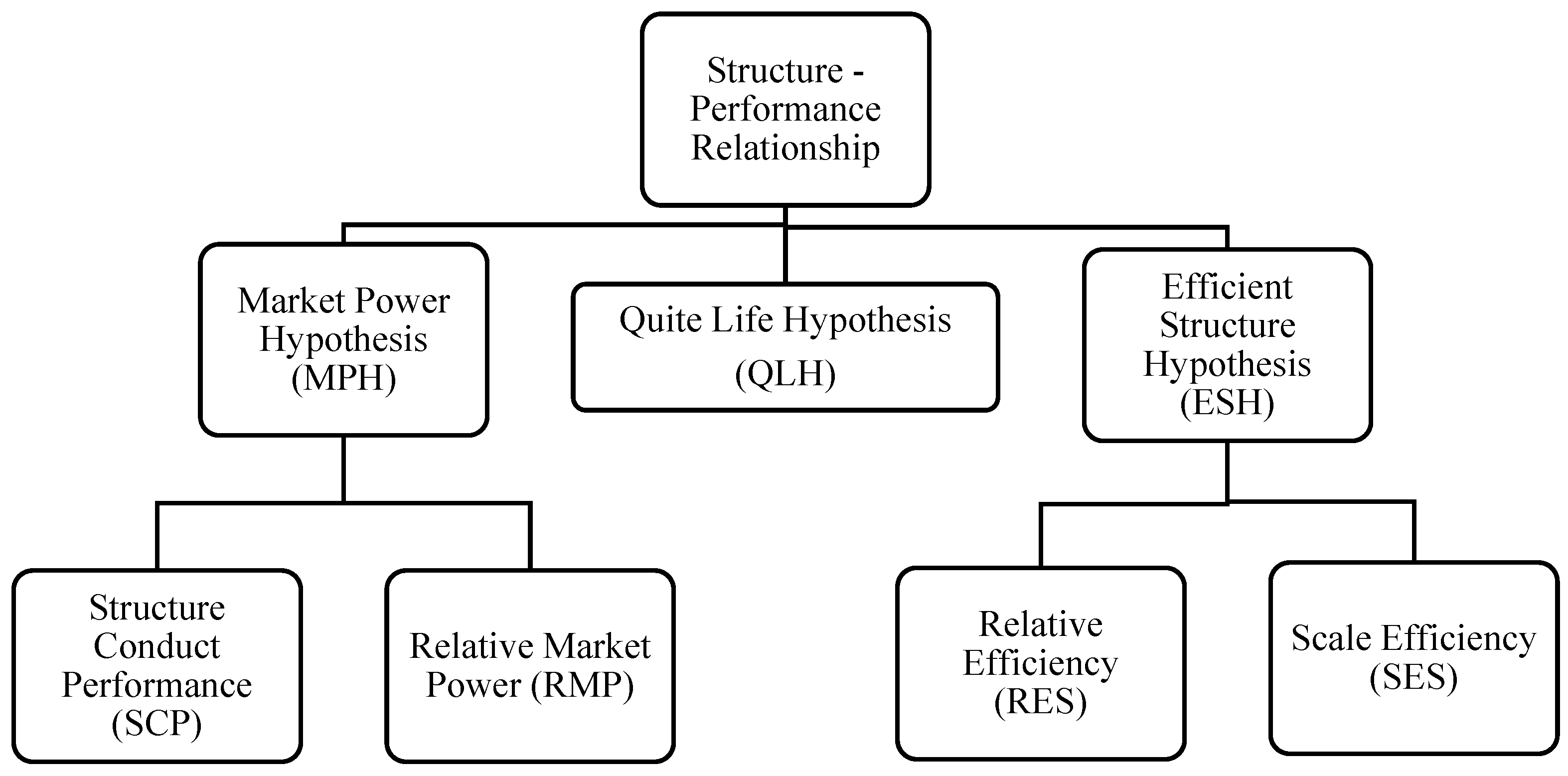
The literature widely debates market structure in relation to firms’ performance, resulting in five competing hypotheses, as summarized in Figure A1 (see Appendix A). The Market Power Hypothesis (MPH) and Efficient Structure Hypothesis (ESH) are the basis for identifying the market structure of the financial system.

2.1. Market Power Hypothesis (MPH)

MPH is then further explained collectively by two hypotheses: the Structure Conduct Performance Hypothesis (SCP) and the Relative Market Hypothesis (RMP). The SCP argues that market concentration determines the level of competition among firms. More precisely, SCP assumes that concentration encourages market power and, later, gives rise to collusive behavior among banks, resulting in higher prices and fattening profitability (Mason, 1939; Bain, 1951; Sinkey, 1992). The RMP hypothesis asserts that large firms in the market do not need to collude for higher profits. Rather, they may set higher prices and skim the profits in the market by offering diversified products and services. Hence, the RMP hypothesis purports that regardless of whether the market structure is concentrated or not, large firms with high market share collect high profits. Both SCP and RMP contemplate market power as a driving force for firm performance.

2.2. Efficient Structure Hypothesis (ESH)

The ESH, in contrast, suggests a reverse link between performance and concentration. Higher profitability by firms is garnered and attained only by employing information technology and efficient management at every level (Demsetz, 1973; Abbasoglu et al., 2007). The ESH says that the market structure develops due to the operating efficiency of some firms. This hypothesis assumes that the high profits of the firms are mainly because of higher efficiency and lower costs, as higher efficiency leads to an expansion in market shares and concentrated markets. Hence, gains through market share by efficient firms ensure the positive association between firms’ performance and market structure. Higher profits then develop a concentrated market, which means that these profits arise due to efficient behavior and not because of collusion among firms, as argued by SCP. Hence, it is clear that ESH offers a unique perspective on how market structure impacts firm performance, distinguishing it from conventional explanations, i.e., the efficiency of firms leads to higher profit and market share, which results in enhanced market concentration. The ESH can be represented by two sub-hypotheses, i.e., the relative efficiency hypothesis (RES) and the scale efficiency hypothesis (SES). The RES assumes that the higher profitability of firms is garnered and attained only by employing information technology and efficient management at every level. At the same time, the SES hypothesis argues that some firms adopt a better scale of operation despite the similar level of management skills and production technologies to lower costs and achieve higher profits. Hence, the SES hypothesis asserts that scale is a clinching factor, while management style, skills, and technology are of peripheral importance in determining higher profits for the firms. Thus, the efficiency distinction is primarily linked to scale efficiency, where larger firms achieve economies of scale, gain higher market shares, and can expand further, leading to market concentration.
In a nutshell, the MPH considers market concentration as an exogenous and primary determinant of higher profits. In contrast, ESH considers efficiencies exogenous and assumes that higher efficiencies lead to a more concentrated market and profits (Berger & Hannan, 1989). All four hypotheses support that market structure induces firms’ performance, but there is a paucity of empirical evidence in the literature. This inconsistency can be justified by the Quite Life Hypothesis (Hicks, 1935), implying that a high market share ensures market power. Yet, the firms do not exploit noncompetitive pricing to attain abnormal profits. Hicks was of the view that in relaxed environments, the firms may not have the incentive to bring down costs. Hence, inefficiency may result from the concentrated market and higher market share. This hypothesis postulates that the efficiency of a firm is inversely related to the market share and market concentration.
Various studies have quantified the relationship between market structure and firms’ performance across different countries (Abbas & Malik, 2008; Zeitun & Benjelloun, 2012). The results, and whether they support SCP or ESH, vary across countries (Bhatti and Hussain, 2010). Among countries such as Malaysia (Ab-Rahim & Chiang, 2016), India (Ataullah & Le, 2006), Turkey (Isik, 2008), and Singapore (Sufian, 2007), an extensive amount of the literature focuses on efficiency in the U.S (Berger, 2007). Likewise, investigating the banking sector of Tunisia, the findings of the study conducted by Mensi and Zouari (2011) show that the performance was generated by employing efficient, productive activities rather than using market power by the banking firms. On the contrary, in a study by Chirwa (2001) on the Malawian banking sector, the ESH is firmly rejected.
Further, in the case of Ghana, banks can generate massive returns through market shares and concentration (Nabieu, 2013). The primary determinant of profitability in the banking sector of Hong Kong is the banks’ cost efficiency (Wong et al., 2008). An examination of the Cameroon banking sector by Atemkeng and Nzongang (2006) shows that the principal determinant of the banking sector’s profitability is the market concentration, in addition to the size of the bank, loan/deposit ratio, and devaluation. A two-step procedure followed by Bailey (2007) in the banking sector of Jamaica to explore the influence of bank concentration suggests that banks in Jamaica need to enhance efficiency to earn higher profits. The domestic banks of Malaysia, in terms of technical and scale efficiency, respectively, are less efficient than their foreign competitor banks operating in Malaysia (Tahir et al., 2009); the efficiency and productivity, however, improved considerably (Abd-Kadir et al., 2010) by the enforcement of mergers in the country’s banking market.
Past studies in Pakistan present a mixed picture. Arby (2003) employed the SCP model to examine Pakistani banks (1990–2000), revealing that loans and capital-to-asset ratios positively influenced bank profits. The study also noted a need for a more competitive environment in Pakistan’s banking sector. Interestingly, the profit function did not incorporate any inequality indicators, which is an intriguing omission. Conversely, Bhatti and Hussain (2010) evaluated SCP and ES hypotheses by analyzing the impact of market structure on banking system profitability using data for 20 banks, and their findings diverged from Arby (2003), suggesting differing conclusions regarding the profitability of Pakistan’s banking system. Further, Khan and Hanif (2019) examined the applicability of SCP, RMP, and ESH theories to Pakistan’s banking sector, discovering a limited correlation between market structure and banks’ performance. They concluded that ESH is more relevant than SCP and RMP in the banking sector of Pakistan. This study tested this by using data from Pakistan over an estimation period. The inconclusive results did not show data that agreed with the ES hypothesis.
Several measures are employed to measure market concentration in the related literature. Concentration Ratios (CR) and the Herfindahl–Hirschman Index (HHI) are the most widely used methodologies. The results obtained from these measures are mixed. For instance, the study of Civelek and Al-Alami (1991) indicates the existence of a significant relationship between concentration and performance in some years and the perverse relationship between the former and the latter in another period. On the other hand, the study conducted by Lloyd-Williams et al. (1994) shows a statistically significant relationship between concentration and profitability. Similarly, numerous studies on SCP have used Return on Assets (ROA) and Return on Equity (ROE) in the banking sector. The survey of Keeton and Matsunaga (1985) lends the most robust support to the employment of ROA in the concentration–performance relationship in the banking industry.
This study aims to expand the existing literature on the Pakistani banking sector by examining diverse views on market structure and performance across countries and time periods. It focuses on the sector’s evolution and changes, contributing to a deeper understanding of its structure and efficiency. This study employs relevant econometric models for 2007–2023 to test the five competing hypotheses. The next section of the study discusses the data sources and methodologies in detail.

3. Model, Data, and Methodology

3.1. Model

To measure the impact of market structure and efficiency on the performance of the banking sector, this study adopts the models used by Ye et al. (2012), which are as follows:
R O A i t = β o + β 1 M C O N C i t + β 2 M K S R i t + β 3 T C E F F i t + β 4 S C E F F i t + j = 1 3 β j Z i t + ϵ i t
where subscripts i = 1 to n refers to the bank and t = 1 to t refers to the year. ROA is the bank’s profitability and is used as a proxy for the performance of banks. The market structure represented by market concentration ( M C O N C i t ) is measured alternatively through two variables, i.e., the concentration ratio (CR) and the Herfindahl–Hirschman Index (HHI). M K S R i t is the market share of bank i, calculated as the ratio of its total assets to total banking-sector assets. T C E F F i t and S C E F F i t denote technical efficiency and scale efficiency, respectively. Z i t is a vector of bank-specific control variables including size, operating expense ratio, and loan ratio. ϵ i t is the idiosyncratic error term. The concentration ratio ( C R k ) for measuring market concentration is the function of some or all banks’ market share. Similarly, C R k is the sum of the 5 largest market shares of banks and is defined as follows:
C R k =   i k s i m
where s is the ith bank’s assets, and m is the sum of assets of all banks. A more refined measure of market structure is HHI, which measures the market concentration as the sum of squared shares of all banks, and it takes market share as weight. While HHI is defined as follows:
H H I = i = 1 n ( s i m ) 2
where n represents the total number of banks operating in the market, and s i m denotes the market share of bank i at time t.
The market share of individual banks (MKSR) is calculated as the ratio of a bank’s assets to the banking industry’s total assets. Efficiency variables (TCEFF and SCEFF) are determined using DEA methodology (see Appendix D). Control variables are represented by vector Z, with the first variable (ASSET) measuring bank assets in natural logarithms to proxy for economies of scale and control differences in operating costs between small and large banks. The second control variable is the ratio of a bank’s operating expenses to total assets, indicating the bank’s cost efficiency. A lower ratio suggests higher profitability. The third variable is the ratio of a bank’s total loans to total assets, reflecting the riskiness of the bank’s assets. Higher loan ratios imply higher risk and potential for greater returns. These variables are analyzed using the DEA Excel Solver method by Zhu (2014). Technical efficiency (TCEFF) reflects a bank’s ability to maximize outputs given inputs, while scale efficiency (SCEFF) captures whether a bank operates at an optimal scale; both are bounded between 0 and 1.
The specified econometric model (1) anticipates a positive correlation between market structure and banks’ performance. However, the efficiency of banks impacts both market structure and performance, leading to endogeneity issues in Equation (1). This implies that the relationship between efficiency and performance could be misleading. Hence, to check for possible endogeneity in Equation (1), we impose conditions by following the study of Ye et al. (2012) and specify Equations (4)–(7).
M C O N C i t = a 1 + a 2 T C E F F i t + a 3 S C E F F i t + e 1 i t
M K S R i t = b 1 + b 2 T C E F F i t + b 3 S C E F F i t + e 2 i t
T C E F F i t = c 1 + c 2 M C O N C i t + c 3 M K S R i t + c j Z i t + e 3 i t
S C E F F i t = d 1 + d 2 M C O N C i t + d 3 M K S R i t + d j Z i t + e 4 i t
For the validation of the five competing hypotheses, the coefficients of the five estimated equations shall fulfill the following conditions, i.e., for SCP to hold ( β 1 > 0 and significant; a 2   a n d   a 3 must be insignificant), for RMP to hold ( β 2 > 0 and significant; b 2   a n d   b 3 must be insignificant), for RES to hold ( β 3 ,   a 2   a n d   b 2   > 0 and significant), for SES to hold ( β 4 ,   a 3   a n d   b 3   > 0 and significant), and for QLH to hold ( c 2 ,   c 3   a n d   d 2 ,   d 3 < 0 and significant).

3.2. Data

In total, 31 banks are operating in Pakistan, and this study considers 20 banks in Pakistan for the period 2007–2023 based on the operations of the banks for the period under study. The 20 banks include the largest five banks in terms of the size of their total assets on the balance sheet. These five large banks comprise almost 60% of the size of the banking sector of Pakistan. The sample includes public sector and private sector banks for analysis. The required data have been extracted from the central bank’s official website1. A list of the banks is given in Appendix B. The variables are tabulated in Appendix E.

3.3. Methodology

This study comprises two stages: firstly, estimating pure technical and scale efficiencies, and secondly, assessing market concentration and share. Efficiency scores for banks are calculated using the Data Envelopment Analysis (DEA) method, which selects input variables (deposits, personnel expenses, equity) and output variables (loans, earning assets) through the intermediation approach. In the second step, to check the impact of market structure and efficiency on the performance of banks, we estimate the regression models as highlighted in Section 3.1.

4. Empirical Findings/Results

4.1. Analysis of the Descriptive Statistics

Table 1 provides detailed descriptive statistics. The mean value of the ROA is 0.0600, ranging from −0.0640 to 0.0445, which may reflect the effects of the global crisis period and fluctuation during the period of its operations. The extreme values of ROA could be attributed to factors like vital provisioning requirements against non-performing loans, strike regulation on credit facilities, and an uncertain economic and business environment. The average value of MCONC is 0.5847, with a minimum value of 0.5408 and a maximum value of 0.6230. The ranges of MCONC suggest the contribution of the largest banks, in concentration terms, incorporated in Pakistan. The mean value of HHI is around 0.0918, ranging between 0.0808 and 0.0984. This suggests monopolistic competition increased moderately, although it is heading toward perfect competition. Based on the structure conduct performance (SCP) paradigm, higher concentration reduces competition by fostering collusive behavior among banking sectors in Pakistan.
Simultaneously, the average market share is 0.0500 and ranges from 0.0033 to 0.1766 from 2007 to 2023. The ranges show that almost all the banks have some market share in most regions of Pakistan. The mean value of technical efficiency at 0.6700 reveals that banks are technically efficient at producing and delivering their services to customers. The minimum value of 0.5125 is interesting and true because banks backed by sovereign guarantees, instead of employing efficient ways to earn profits, rely on the number of employees and thus lag in technical efficiency, compared to private competitor banks operating under the same regulatory environment. This is lower than the 0.899 found by Ye et al. (2012).
On the other hand, the range for Scale efficiency is 0.3244 to 1.0000, with a mean value of 0.9428, which shows that banks are more efficient and are operating almost at their optimal scale. The minimum value of 0.3244 indicates that some banks also have scale inefficiencies. The mean value of banks is 12.3539, which suggests that banks with a larger asset base perform better than banks with a smaller asset base, as they have more resources for greater product diversification and investment in performance improvement. The asset base of the banking sector has shown massive growth2 over the years. Whereas the mean values of operating expenses, as well as the loan ratio, stand at 0.0124 and 0.4692, respectively.
The table provided in Appendix C shows the correlation between the variables under study. Concentration variables (both CR5 and HHI) have a negative correlation with ROA, and the relationship is statistically significant. The Market share of an individual bank is also positively and significantly correlated with ROA, concentration and loan ratio. Technical efficiency is also positively correlated with ROA and negatively correlated with concentration and market share, but its relationship is statistically significant with ROA, and concentration and statistically insignificant with market share. Scale efficiency is also positively correlated with ROA, technical efficiency, and market share but negatively correlated with concentration. The relationship of scale efficiency with ROA, concentration, and technical efficiency is statistically significant but insignificant with market share.

4.2. Empirical Findings

Table 2 displays the findings for the model depicted in Equation (1). We estimated Equation (1) twice to examine the structure performance model in the banking sector of Pakistan. Our results show that in both versions, the market concentration, as measured by CR and HHI, is insignificant, inferring that market concentration is unrelated to banks’ performance, which means that the SCP hypothesis is invalid. Although the five large banks capture more than half of the banking market, this concentration is getting thinner over time, see Appendix D. The five large banks do not collude but compete for their commercial interests. These five large banks were initially government sector banks, which may be perceived as “too big to fail”, and were least concerned about profits and losses. Four of the largest banks were later privatized to enhance their performance and competition and increase the cost of collusion. Furthermore, the large banks consider them more commercialized than before, as the significant stakes and the decision power lie in the private sector by acquiring control shares. This explains the absence of a relationship between market concentration and banks’ performance in Pakistan. Since banks cannot exploit concentration through collusion for profit maximization, they must adopt other efficient ways to derive higher profitability.
The market share coefficients are positive and significant, indicating that banks with higher market shares perform better; however, subsequent estimations show that these higher market shares are themselves driven by technical efficiency rather than market power. Banks with higher market shares are able to generate increased profits and strengthen their positions in the banking market, prompting them to adopt more efficient methods to ensure sustained profitability. This is likely due to banks reducing production costs to maximize profits (Demsetz, 1973). Consequently, ESH holds true in this case. Additionally, the coefficients for the Scale Efficiency Hypothesis (SES) and technical efficiency are significantly and positively linked to banking performance in Pakistan across both model versions. This suggests that the higher technical and scale efficiencies employed by banks result in greater profitability, supporting the SES and RES expectations.
In terms of control variables, the results indicate a significant positive correlation between the loan ratio and bank profitability. This implies that a higher volume of commercial loans issued by banks leads to increased income, despite raising risks and requiring proportional provisioning against advances. A positive asset base also has a favorable impact on banks’ return on assets (ROA) in the long term. On the other hand, operating expenses negatively affect ROA, as higher expenses on operations and projects can undermine financial performance. Overall, the results show a decrease in the market concentration in the banking sector of Pakistan, alongside improvements in technical and scale efficiencies over the years, allowing banks to operate at optimal levels.
We further estimated Equations (4) and (5) and tabulated the results in Table 3. The dependent variable in Equation (4) is market concentration and in Equation (5) is market share. The coefficients of the technical efficiency variable are significantly different from zero (i.e., a2 > 0 and b2 > 0), while the coefficients of the scale efficiency variable are insignificant (i.e., a3 = 0 and b3 = 0). These results imply that the relative efficiency hypothesis (RES) holds, as the coefficient of technical efficiency is also significantly different from zero (i.e., B3 > 0) in Equation (1), while the results in Equations (4) and (5), along with the results of Equation (1), exclude the scale efficiency hypothesis (SES) and both versions of the MPH Hypothesis (i.e., SCP and RMP). Furthermore, banks’ performance is not driven by market power or market concentration; rather, individual bank market share influences performance only when it reflects superior technical efficiency. The reason could be the higher cost of collusion among large banks or a higher level of competition in the banking market. These results are expected, given the banking reforms and massive adoption of information and communication technology (ICT) in the banking sector in Pakistan. It can be seen from Appendix D that the scale efficiency of banks is optimal over the sample in this study. In contrast, technical efficiency might be a factor that banks can rely on to increase their market share and enhance their profits. The results also suggest that technical efficiency is not the cause of the market concentration and high market shares of the four large private banks but a policy outcome of the government. Rather, it is the other way around: the banks’ technical efficiency is driving the market share, which in turn leads to enhanced banks’ performance.
Finally, the study tested the validity of the “quiet life” hypothesis in the context of Pakistan’s banking sector. The results for whether the QLH hypothesis holds in the Pakistani context are documented in Table 4, using Equations (6) and (7). We find no evidence for the QLH hypothesis in the banking sector of Pakistan, as the coefficients c2 < 0, c3 = 0, d2 < 0, and d3 = 0, which do not correspond to the conditions for the validity of the QLH Hypothesis. The coefficient of market concentration, measured by HHI, is negatively significant in Equations (6) and (7), which is not likely to hold the conditions of the QLH hypothesis. Moreover, the market share is statistically insignificant in both equations of Table 4, as the four large banks are concentrated in the banking sector of Pakistan, even though this percentage shows a declining trend from 2007 to 2023. Both measurements of market concentration (i.e., CR and HHI) explain this, coupled with the lower level of scale efficiency.

4.3. Discussion and Policy Implications

It is essential to deliberate about the results based on the facts about the banking sector of Pakistan. The empirical evidence in support of the MPH or ESH hypotheses is scarce in developing countries, yet enough evidence exists (Ye et al., 2012; Holló & Nagy, 2006; Perera et al., 2010; Perera et al., 2006; Sahile et al., 2015) validating the RMP hypothesis. Moreover, Pruteanu-Podpiera et al. (2007) rejected the ‘quiet life’ hypothesis in their study on the Czech banking industry. While SCP and RMP hypotheses are relevant in some banking systems, our empirical evidence does not support their validity in the context of Pakistan during 2007–2023, where efficiency—rather than concentration or market power—explains bank performance. The prospective reasons for SCP and RMP hypotheses and getting most of the banks out of quiet life status is the policy of privatization of public sector banks and enhancing bank competition by allowing more private banks in the sector, which may also lead to establishing the relationship between market structure and performance of banks. Additionally, a quiet life hypothesis may not hold in the context of Pakistan, as the higher concentration of large banks is mainly due to large private stakes in the banking industry. The five large banks in Pakistan that capture more than half of the banking market in Pakistan were initially established by the government, and later on, four of them were privatized to enhance their performance. Thus, the four dominant banks of Pakistan may not enjoy the ‘quiet life’ in commercial terms, implying that competition and fewer government interventions are necessary to improve banks’ efficiency in Pakistan.
The SES hypothesis argues that some firms adopt a better scale of operation despite a similar level of management skills and production technologies to lower costs and achieve higher profits. The private banks in Pakistan, particularly the top four largest banks, are essential in enabling them to commercialize and improve their efficiency over the years, while many small banks in Pakistan have also enhanced their efficiency and performance. Hence, considering both large and small banks in our selected sample, the scale of economies may not be a determining factor of banks’ performance, and thus, the SES hypothesis may not be likely to hold. At the same time, the RES hypothesis assumes that the higher profitability of firms is garnered and attained only by employing information technology and efficient management at every level. RES hypothesis may hold in our context because Pakistan’s banking sector has an efficient and effective infrastructure. The most significant feature of the infrastructure is the banks’ adoption and use of technology, as it serves both considerable value and retail transactions through established channels.
Hence, the policymakers in Pakistani banks need to improve performance and drive profitability by increasing technical efficiency. Financial development mainly depends on introducing new products into the market to provide financial services, and on the technical efficiency which is paramount for such financial innovations. Further, the stakeholders of the banking sector in Pakistan should implement policies that increase individual banks’ market share regardless of the size of the banks. This is also true as the concentration is insignificant and does not imply reductions in the performance of banks.

5. Conclusions

This study investigates the influence of market structure on the performance of banks in Pakistan. The study spanned over ten years, 2007–2023. The efficiency of the banking market was assessed using the DEA methodology, which considered multiple inputs and outputs. The widely used HHI technique was employed for econometric tests to measure concentration in the banking industry. ROA was proxied to measure the performance of the banks for the period under analysis. Data analysis was conducted with multiple regression and random-effect panel models. The results obtained from the econometric specifications are mixed. The study results reveal that concentration negatively influences the performance of banks in Pakistan. Banks in Pakistan are deriving their profits by taking maximum advantage of technical and scale efficiencies, in addition to their higher market shares in the banking market. Overall, the findings suggest that observed differences in bank performance in Pakistan arise from efficiency-driven advantages rather than from structural market power or concentration, thereby providing strong support for the Efficient Structure Hypothesis. Even though technical and scale efficiencies are satisfactory in the banking sector of Pakistan, it is worrisome that the ROA still needs to catch up to the 1 percent mark at 0.6 percent.
Principally, the stakeholders should review and revisit the policies related to the country’s banking market. Despite being equipped with efficiency and market shares, the banking sector’s earnings must be revamped and enhanced considerably. Bank profits may be impacted by regulatory requirements set by the central bank. It is encouraging that the government’s balanced policies have enabled smaller banks to operate and compete with their larger competitors in the market. Such policies have resulted in declining concentration in the banking sector.

Author Contributions

Conceptualization, N.K.; methodology, N.K., M.A.A. and M.T.; validation, M.A.A.; formal analysis, N.K.; investigation, M.A.A. and U.B.; data curation, N.K.; writing—original draft preparation, M.A.A. and U.B.; writing—review and editing, M.T. and U.B.; visualization, M.T.; supervision, U.B.; project administration, U.B.; funding acquisition, U.B. All authors have read and agreed to the published version of the manuscript.

Funding

This research received no external funding.

Institutional Review Board Statement

Not applicable.

Informed Consent Statement

Not applicable.

Data Availability Statement

The original contributions presented in this study are included in the article. Further inquiries can be directed to the corresponding author.

Conflicts of Interest

The authors declare no conflicts of interest.

Appendix A

Figure A1. Five competing hypotheses.
Ijfs 14 00008 g0a1

Appendix B

Table A1. List of banks.
Serial No.Name of BankOwnership of the Bank
1Habib Bank LimitedPrivate Sector
2National Bank of PakistanPublic Sector
3United Bank LimitedPrivate Sector
4Meezan Bank LimitedPrivate Sector
5Bank Alfalah LimitedPrivate Sector
6MCB Bank LimitedPrivate Sector
7Allied Bank LimitedPrivate Sector
8Bank Al Habib LimitedPrivate Sector
9Askari Bank LimitedPrivate Sector
10Faysal Bank LimitedPrivate Sector
11Habib Metropolitan Bank LimitedPrivate Sector
12Standard Chartered Bank (Pakistan) LimitedPrivate Sector
13Soneri Bank LimitedPrivate Sector
14JS Bank LimitedPrivate Sector
15Bank Islami Pakistan LimitedPrivate Sector
16NIB Bank LimitedPrivate Sector
17Summit Bank LimitedPrivate Sector
18Silk Bank LimitedPrivate Sector
19The Bank of KhyberPublic Sector
20Samba Bank LimitedPrivate Sector

Appendix C

Table A2. Correlation matrix.
ROACRHHIMarket ShareTech EfficiencyScale EfficiencyExpensesLoan RatioSize
ROA1.00
CR−0.18 ***1.00
HHI−0.16 **0.76 **1.00
Market Share0.426 ***0.0010.0011.00
Tech efficiency0.18 ***−0.58 ***−0.58 **−0.011.00
Scale efficiency0.24 ***−0.17 **−0.16 **0.080.22 ***1.00
Expenses−0.47 ***0.21 ***0.21 ***−0.11−0.20 ***−0.13 *1.00
Loan ratio−0.19 ***0.46 ***0.42 ***−0.07−0.37 ***−0.020.32 ***1.00
Size0.43 ***−0.27 ***−0.25 **0.70 ***0.22 ***0.27 ***−0.24 ***−0.17 **1.00
***, **, and * means significant at 1%, 5%, and 10%, respectively.

Appendix D

The measures of technical efficiency (TCEFF) and scale efficiency (SCEFF) are estimated for the 20 banks using the Data Envelopment Approach (DEA) by considering multiple inputs and outputs of the banks. The relative efficiency is measured by taking the ratio of weighted output to weighted input for the Decision-Making Unit (DMU: each bank in this study). The worst practice bank and best practice bank are assigned the value 0 and 1, respectively. In other words, the input and output are the basis for forming a production frontier while measuring the efficiency of the individual banks in the sample (Coelli et al., 1996). It is pertinent to mention here that the efficiency of firms relies immensely on other firms’ performance; hence, DEA measures of efficiency are relative rather than absolute. To arrive at the efficiency score of DEA, the ratio of weighted outputs/weighted inputs are considered. This is because of a single ‘virtual’ input a i and a single ‘virtual’ output b i are ensured by the outputs and inputs in the sample. For instance:
max u , v ( u   b i v   a i ) subject   to   u   b i v   a i 1 where u , v 0 and j = 1 , 2 , 3 , , n
The vectors a i and b i are the K × N input, and K × M outputs matrices, respectively, for the ith (DMU). Similarly, u b i v a i is the vector of all outputs to the inputs ratio. u and v are M × 1 and K × 1 vectors of output and input weights. Hence, the DMU’s efficiency score can be maximized by finding the values of u and v; however, it is conditional on the efficiency measures being ≤1. This results in an infinite number of solutions; therefore, there is a need to impose ρ a i = 1 , a constant constraint on Equation (A1), and thus the equation takes the following form:
max u , v   ( u   b i ) Since   ρ   a i = 1 , Therefore ,   µ   b j   ρ   a j   0 where j = 1 , 2 , , n µ , ρ 0
µ and ρ are the transformation of u and v. Following Charnes et al. (1978) and Ab-Rahim and Chiang (2016), the constant return to scale (CRS) model of the envelopment form is as follows:
min Ω , ϕ     Ω b i +   B ϕ   0 , Ω a i A ϕ   0 ϕ 0
The scalar Ω , ranging between 0 and 1, is the efficiency score of banks, whereas ϕ is vector N × 1 constant. While assessing efficiency, Banker (1984) assumed variable return to scale (VRS) by relaxing the CRS assumption offered by Charnes et al. (1978) model and then applying the convexity constraint N 1 ϕ = 1 . Thus,
min Ω , ϕ     Ω b i + B ϕ   0 , Ω a i A ϕ   0 N 1 ϕ = 1 ϕ 0
where N 1 is the N × 1 vector of ones. The technical efficiency scores are obtained from the variable return scale model, whereas scale efficiency, on the other hand, is calculated from the difference between scores from a constant return to scale and variable return to scale models.
Table A3. The trend in Main Variables (2007–2023).
YearCRTechnical EfficiencyScale EfficiencyROA
20070.60720.61210.84340.0054
20080.6230.63170.95670.0015
20090.62040.64270.9406−0.0011
20100.59090.66050.92190.0017
20110.5940.66590.94650.01
20120.59540.67250.96910.009
20130.57540.6790.9390.0035
20140.55170.68750.96860.0076
20150.54080.72230.96830.009
20160.54810.72610.97420.013
20170.54730.72770.97310.009
20180.54010.72950.97660.007
20190.53880.72990.97910.007
20200.53770.73080.97730.01
20210.54110.73210.96770.009
20220.53990.73240.97030.009
20230.54280.73630.97440.009
Mean0.56670.69520.95570.0070
Source authors’ calculations.
Technical efficiency and scale efficiency are used to measure the banking market efficiency score using the DEA method from the years 2007 to 2023. Furthermore, we used the intermediation approach in choosing a list of input variables (such as deposits, personnel expenses, and equity) and output variables (such as loans and earning assets). The data for these input and output variables are analyzed using the DEA Excel Solver, Zhu (2014). As shown in the above Table, the results demonstrate unevenness in technical and scale efficiencies over the analysis periods. The technical efficiency score for the banks operating in Pakistan varies between the range of 61.12% to 73.63%, which indicates that banks are technically able to convert their various inputs into multiple productive outputs. Similarly, scale efficiency also revealed mixed results by averaging at around 95%, which depicts that the banking sector is almost operating at an optimum scale. Furthermore, the large banks may achieve economies of scale, which makes them grow faster, thereby resulting in higher concentration.

Appendix E

VariableDescriptionExpected Impact on ROASupported by Literature
ROAReturn on Assets; proxy for bank performance(Keeton & Matsunaga, 1985; Ye et al., 2012)
CR (Concentration Ratio)Share of assets of the five largest banks in total banking assetsNegative (SCP/RMP), Neutral (ESH)(Mason, 1939; Bain, 1951; Sinkey, 1992; Khan & Hanif, 2019)
HHI (Herfindahl-Hirschman Index)Sum of squared market shares of all banksNegative (SCP), Positive (ESH), Insignificant if no collusion(Berger & Hannan, 1989; Gilbert, 1984; Khan & Hanif, 2019)
MKSR (Market Share)Individual bank’s assets relative to total banking sector assetsPositive (RMP/ESH)(Demsetz, 1973; Khan & Hanif, 2019)
TCEFF (Technical Efficiency)Bank’s ability to convert inputs (deposits, personnel, equity) into outputs (loans, earning assets)Positive(Demsetz, 1973; Abbasoglu et al., 2007; Ye et al., 2012)
SCEFF (Scale Efficiency)Bank’s operational efficiency due to optimal scalePositive(Abbasoglu et al., 2007; Ye et al., 2012)
Operating Expenses RatioRatio of operating expenses to total assetsNegative(Khan & Hanif, 2019; Berger, 2007)
Loan RatioRatio of total loans to total assets; indicates risk levelPositive (higher risk may yield higher returns)(Arby, 2003; Berger, 2007)
Size (log of total assets)Proxy for economies of scalePositive(Khan & Hanif, 2019; Berger, 2007)

Notes

1
2
According to the State Bank of Pakistan, the Asset base expanded by 29.5 percent to touch Rs 46.4 trillion by December 2023.

References

  1. Abbas, K., & Malik, M. H. (2008). Impact of financial liberalisation and deregulation on banking sector in Pakistan. The Pakistan Development Review, 47, 287–313. [Google Scholar] [CrossRef]
  2. Abbasoglu, O. F., Aysan, A. F., & Gunes, A. (2007). Concentration, competition, efficiency and profitability of the Turkish banking sector in the post-crises period. Banks & Bank Systems, 2(3), 106–115. [Google Scholar]
  3. Abd-Kadir, H., Selamat, Z., & Idros, M. (2010). Productivity of Malaysian banks after mergers and acquisition. European Journal of Economics, Finance and Administrative Sciences, 24, 111–122. [Google Scholar]
  4. Ab-Rahim, R., & Chiang, S. N. (2016). Market structure and performance of Malaysian banking industry. Journal of Financial Reporting and Accounting, 14(2), 158–177. [Google Scholar] [CrossRef]
  5. Arby, M. F. (2003). Structure and performance of commercial banks in Pakistan. MPRA Paper No. 4983. Available online: https://mpra.ub.uni-muenchen.de/4983/ (accessed on 30 March 2025).
  6. Ataullah, A., & Le, H. (2006). Economic reforms and bank efficiency in developing countries: The case of the Indian banking industry. Applied Financial Economics, 16(9), 653–663. [Google Scholar] [CrossRef]
  7. Atemkeng, T., & Nzongang, J. (2006). Market structure and profitability performance in the banking industry of CFA countries: The case of commercial banks in Cameroon. Journal of Sustainable Development in Africa, 8(2), 1–14. [Google Scholar]
  8. Bailey, S. A. (2007). Investigating the market-structure-performance relationship in the commercial banking sector: Evidence from Jamaica. Financial Stability Department, Bank of Jamaica. [Google Scholar]
  9. Bain, J. S. (1951). Relation of profit rate to industry concentration: American manufacturing, 1936–1940. The Quarterly Journal of Economics, 65(3), 293–324. [Google Scholar] [CrossRef]
  10. Banker, R. D. (1984). Estimating most productive scale size using data envelopment analysis. European Journal of Operational Research, 17(1), 35–44. [Google Scholar] [CrossRef]
  11. Berger, A. N. (2007). International comparisons of banking efficiency. Financial Markets, Institutions & Instruments, 16(3), 119–144. [Google Scholar] [CrossRef]
  12. Berger, A. N., & Hannan, T. H. (1989). The price-concentration relationship in banking. The Review of Economics and Statistics, 71, 291–299. [Google Scholar] [CrossRef]
  13. Bhatti, G. A., & Hussain, H. (2010). Evidence on structure conduct performance hypothesis in Pakistani commercial banks. International Journal of Business and Management, 5(9), 174. [Google Scholar] [CrossRef]
  14. Charnes, A., Cooper, W. W., & Rhodes, E. (1978). Measuring the efficiency of decision making units. European Journal of Operational Research, 2(6), 429–444. [Google Scholar] [CrossRef]
  15. Chirwa, E. W. (2001). Market structure, liberalization and performance in the Malawian banking industry. African Economic Research Consortium. [Google Scholar]
  16. Civelek, M. A., & Al-Alami, M. W. (1991). An empirical investigation of the concentration-profitability relationship in the Jordanian banking system [Etude d’investigation empirique sur les relations entre concentration et rentabilite dans le systeme bancaire Jordanien]. Savings and Development, 15, 247–260. [Google Scholar]
  17. Coelli, T., Lauwers, L., & Van Huylenbroec, G. (1996). A guide to DEAP version 2.1: A data envelopment analysis (computer) program. Centre for Efficiency and Productivity Analysis. [Google Scholar]
  18. Demsetz, H. (1973). Industry structure, market rivalry, and public policy. The Journal of Law and Economics, 16(1), 1–9. [Google Scholar] [CrossRef]
  19. Gilbert, R. A. (1984). Bank market structure and competition: A survey. Journal of Money, Credit and Banking, 16(4), 617–645. [Google Scholar] [CrossRef]
  20. Hicks, J. R. (1935). Annual survey of economic theory: The theory of monopoly. Econometrica: Journal of the Econometric Society, 3, 1–20. [Google Scholar] [CrossRef]
  21. Holló, D., & Nagy, M. (2006). Bank efficiency in the enlarged European Union (No. 2006/3, MNB working papers). Magyar Nemzeti Bank. [Google Scholar]
  22. Isik, I. I. (2008). Productivity, technology and efficiency of de novo banks: A counter evidence from Turkey. Journal of Multinational Financial Management, 18(5), 427–442. [Google Scholar] [CrossRef]
  23. Keeton, W. R., & Matsunaga, L. (1985). Profits of commercial banks in tenth district states. Economic Review, 70, 3–22. [Google Scholar]
  24. Khan, M. U. H., & Hanif, M. N. (2019). Empirical evaluation of ‘structure-conduct-performance’ and ‘efficient-structure’ paradigms in banking sector of Pakistan. International Review of Applied Economics, 33(5), 682–696. [Google Scholar] [CrossRef]
  25. Lloyd-Williams, D. M., Molyneux, P., & Thornton, J. (1994). Market structure and performance in Spanish banking. Journal of Banking & Finance, 18(3), 433–443. [Google Scholar] [CrossRef]
  26. Maghyereh, A. I., & Awartani, B. (2014). The effect of market structure, regulation, and risk on banks efficiency: Evidence from the Gulf cooperation council countries. Journal of Economic Studies, 41(3), 405–430. [Google Scholar] [CrossRef]
  27. Mason, E. S. (1939). Price and production policies of large-scale enterprise. The American Economic Review, 29(1), 61–74. [Google Scholar]
  28. Mensi, S., & Zouari, A. (2011). Banking industry, market structure and efficiency: The revisited model to intermediary hypotheses. International Journal of Economics and Research, 2(1), 23–36. [Google Scholar]
  29. Nabieu, G. A. (2013). The structure, conduct and performance of commercial banks in Ghana. European Journal of Business and Innovation Research, 1(4), 34–47. [Google Scholar]
  30. Paulet, E., Parnaudeau, M., & Relano, F. (2015). Banking with ethics: Strategic moves and structural changes of the banking industry in the aftermath of the subprime mortgage crisis. Journal of Business Ethics, 131(1), 199–207. [Google Scholar] [CrossRef]
  31. Perera, S., Skully, M., & Wickramanayake, J. (2006). Competition and structure of South Asian banking: A revenue behaviour approach. Applied Financial Economics, 16(11), 789–801. [Google Scholar] [CrossRef]
  32. Perera, S., Skully, M., & Wickramanayake, J. (2010). Bank market concentration and interest spreads: South Asian evidence. International Journal of Emerging Markets, 5(1), 23–37. [Google Scholar] [CrossRef]
  33. Pruteanu-Podpiera, A., Weill, L., & Schobert, F. (2007). Banking competition and efficiency: A micro-data analysis on the Czech banking industry (Research Seminar Paper Series 07-5). CERGE-EI. [Google Scholar]
  34. Sahile, S. W. G., Tarus, D. K., & Cheruiyot, T. K. (2015). Market structure-performance hypothesis in Kenyan banking industry. International Journal of Emerging Markets, 10(4), 697–710. [Google Scholar] [CrossRef]
  35. Shih, M. S. (2003). An investigation into the use of mergers as a solution for the Asian banking sector crisis. The Quarterly Review of Economics and Finance, 43(1), 31–49. [Google Scholar] [CrossRef]
  36. Sinkey, J. F. (1992). Commercial bank financial management: In the financial-services industry. Prentice Hall. [Google Scholar]
  37. Sufian, F. (2007). Trends in the efficiency of Singapore’s commercial banking groups: A non-stochastic frontier DEA window analysis approach. International Journal of Productivity and Performance Management, 56(2), 99–136. [Google Scholar] [CrossRef]
  38. Tahir, I. M., Bakar, N. M. A., & Haron, S. (2009). Evaluating efficiency of Malaysian banks using data envelopment analysis. International Journal of Business and Management, 4(8), 96–106. [Google Scholar] [CrossRef]
  39. Wong, J., Fong, T. P. W., Wong, E. T. C., & Choi, K. F. (2008). Determinants of the performance of banks in Hong Kong. In The banking sector in Hong Kong (pp. 50–65). Palgrave Macmillan. [Google Scholar]
  40. Ye, Q., Xu, Z., & Fang, D. (2012). Market structure, performance, and efficiency of the Chinese banking sector. Economic Change and Restructuring, 45(4), 337–358. [Google Scholar] [CrossRef]
  41. Zeitun, R., & Benjelloun, H. (2012). The efficiency of banks and financial crisis in a developing economy: The case of Jordan. International Review of Accounting, Banking & Finance, 4(2), 28–60. [Google Scholar]
  42. Zhu, J. (2014). Quantitative models for performance evaluation and benchmarking: Data envelopment analysis with spreadsheets (Vol. 213). Springer. [Google Scholar]
Table 1. Descriptive statistics.
VariablesMeanStd. Dev.MinMax
Profitability
Return on Assets (ROA)0.06000.0162−0.06400.0445
Market Structure (MCONC)
Concentration of loans of 5 large banks (CR)0.58470.02820.54080.6230
HHI0.09180.00600.08080.0984
Market Share (MKSR)0.05000.04630.00330.1766
Efficiency
Technical Efficiency (TCEFF)0.67000.05420.51251.0000
Scale Efficiency (SCEFF)0.94280.09770.32441.0000
Control Variables
Operating Expenses ratio0.01240.00410.00120.0418
Loan ratio0.46920.10880.19160.8029
Size12.35391.38581.521314.7360
Source authors’ calculations. Gilbert’s (1984) survey summarizes three commonly used measures of market concentration (MCONC): the number of banks, concentration ratio, and Herfindahl–Hirschman Index (HHI). This study uses two proxies for market concentration, i.e., concentration ratio or HHI. MKSR represents the market share of each bank, TCEFF and SCEFF are the technical efficiency and scale efficiency, respectively.
Table 2. Regression results for Equation (1).
ROACoef.Coef.
Concentration (CR)−0.051
(0.070)
HHI (Hirschman-Hirfindhal Index) −0.162
(0.308)
Market Share0.127 **
(0.040)
0.126 ***
(0.040)
Technical Efficiency0.037 **
(0.019)
0.038 **
(0.019)
Scale Efficiency0.024 ***
(0.009)
0.024 ***
(0.009)
Operating Expenses−1.266 ***
(0.260)
−1.264 ***
(0.261)
Loan ratio0.011
(0.010)
0.011
(0.010)
Size0.0001
(0.001)
0.0001
(0.001)
Constant−0.006
(0.051)
−0.022
(0.039)
R-sq0.37980.3796
Wald chi2(7)68.4068.08
Prob > chi20.0000.000
Number of obs200200
Notes: *** Significant at 1% level, and ** significant at 5% level. The values of the standard deviations are shown in parentheses.
Table 3. Regression results for Equations (4) and (5).
Equation (4) a’sEquation (4) a’sEquation (5) b’s
Dep. VariableConcentration (CR)Concentration (HHI)Market Share
Technical Efficiency0.033 ***
(0.014)
0.007 ***
(0.003)
0.013 *
(0.008)
Scale Efficiency−0.016
(0.018)
−0.005
(0.004)
0.0004
(0.010)
Constant0.618 ***
(0.010)
0.099 ***
(0.002)
0.037 ***
(0.012)
Notes: *** Significant at 1% level, and * significant at 10% level. The values of the standard deviations are shown in parentheses. Dependent Variable: concentration (Equation (2)); HHI (Equation (2)); market Share (Equation (3)).
Table 4. Regression results for Equations (6) and (7).
Technical EfficiencyScale Efficiency
Concentration (HHI)−1.997 ***
(0.632)
−1.128 **
(0.519)
Market Share0.289
(0.342)
−0.307
(0.216)
Loan Ratio0.210 **
(0.093)
0.113
(0.072)
Size0.013
(0.010)
0.023 ***
(0.007)
Constant1.845 ***
(0.406)
1.317 ***
(0.331)
Notes: *** Significant at 1% level, and ** significant at 5% level. The values of the standard deviations are shown in parentheses.
Disclaimer/Publisher’s Note: The statements, opinions and data contained in all publications are solely those of the individual author(s) and contributor(s) and not of MDPI and/or the editor(s). MDPI and/or the editor(s) disclaim responsibility for any injury to people or property resulting from any ideas, methods, instructions or products referred to in the content.