


Abstract
Fulfilling social responsibilities within the ESG framework has gradually become a core competitive advantage for sustainable corporate development that also serves to enhance future returns. Charitable donations constitute a crucial method through which corporations fulfill social responsibilities and represent a primary indicator in ESG ratings, ratings that in turn have an impact on future stock market returns. This study, based on data from listed companies on the Shanghai and Shenzhen stock exchanges from 2018 to 2022, employed a fixed effects model to analyze the influence of charitable donations on future returns under ESG rating constraints. The research reveals that ESG rating constraints can reduce speculative charitable donations and help to optimize the peak value of a company’s future returns. After a series of robustness tests, including using the one-period lagged explanatory variable, changing the measurement method of the explained variable, replacing the ESG with the assignment method for value determination, and considering the impact of outliers, the conclusion still holds. Heterogeneity analysis indicates that in state-owned enterprises, companies in a recessionary phase, and industries with lower levels of competition, a decelerating effect of ESG ratings on the impact of charitable donations on future returns dominates. Conversely, for mature companies, ESG ratings accelerate the positive effect of charitable donations on future returns. This paper contributes to the ESG economic consequences literature by offering empirical evidence on corporate social responsibility implementation under sustainability strategies.
1. Introduction
Amidst prevalent global challenges such as climate change, public health crises, and biodiversity loss, an increasing international focus on the formidable challenges posed by environmental issues has emerged. In 2020, China articulated its commitment to achieve carbon peaking by 2030 and carbon neutrality by 2060 at the United Nations General Assembly, garnering widespread attention for the concept of sustainable development. As the concept of sustainable development continuously deepens from macro-level strategies to concrete practices, its focus is progressively shifting toward verifiable and actionable micro-level implementation. Businesses, serving as pivotal agents in resource allocation and value creation, directly influence the internalization of environmental externalities and the enhancement of social welfare through their operational decisions, thereby positioning themselves as crucial actors in translating the principles of sustainable development into practice. Indeed, the ESG (Environmental, Social, and Governance) framework has gained traction across the globe as a set of guidelines under which companies can fulfill environmental, social, and governance responsibilities (Wu et al., 2023). ESG advocates for enterprises to pursue the integration of economic benefits with societal and environmental ones in their production and operations, and the rise of ESG is rooted in the market’s acknowledgment and demand for sustainable development (Reber et al., 2022). In contrast to the traditional risk-return analysis framework, the ESG investment philosophy emphasizes the performance of enterprises in terms of environment, social responsibility and corporate governance to achieve a balance between social and economic benefits.
As a vital means of “third distribution”, philanthropy plays an irreplaceable role in promoting social income equality and fostering shared prosperity (Y. Jiang & Yu, 2021). Companies that consciously link charitable donations with economic objectives often do so to align business interests with stakeholder interests. With the deepening resonance of the ESG concept, an increasing number of enterprises have come to view charitable donations as a primary method by which to fulfill social responsibilities and enhance corporate performance.
The Chinese economy has entered a new stage, where the concept of sustainable development necessitates balanced economic and social progress and aims for equilibrium among economic efficiency, ecological harmony, and social equity. Consequently, the traditional practice of corporations using donations as defensive measures following adverse events such as environmental pollution and financial manipulation (Godfrey, 2005; C. Zhang et al., 2018) may have experienced a reduction in efficacy due to constraints imposed by ESG ratings. ESG ratings feature an “environmental incentive effect” rather than an “environmental concealment effect” (Q. H. Song et al., 2023). Therefore, within the overarching goal of profit maximization, it is essential to elucidate how charitable donations, under the constraints of ESG ratings, influence corporate earnings and in what manner. Clarifying these issues is essential for mitigating corporate concerns regarding ESG rating constraints, fostering greater corporate acceptance of ESG principles, and facilitating more effective corporate fulfillment of social responsibility within the ESG framework. This in turn, can promote sustainable economic development.
The existing ESG literature extensively discusses the impact of charitable donations on future benefits for businesses and predominantly emphasizes the positive aspects of charitable donations as a strategic tool. Many authors argue that such donations can assist companies in building their reputation, enhancing investment attractiveness (L. Chen et al., 2023), mitigating or concealing the impact of improper conduct or negative information (Godfrey, 2005), obtaining external support, and fostering improvements in corporate performance (Gu & Peng, 2022). From the perspective of resource dependence theory, companies engage in charitable donations to gain “political dividends” from the government (Dai et al., 2014), by which they may secure a competitive advantage and increased corporate value. From the stakeholder perspective, corporate philanthropy can generate positive societal sentiment and cultivate intangible brand capital, which can also enhance corporate value (Zhu et al., 2019; Pan et al., 2015). Scholars have also approached the subject from an agency theory perspective, positing that corporate philanthropy is a self-serving activity that helps companies garner prestige and reputation but does not yield any value in return. According to this view, charitable donations neither exhibit a “strategic philanthropy” effect in increasing corporate value nor harm corporate value, as they lack substantive correlation (Zou, 2019).
However, the philanthropic landscape in China still exhibits an imbalanced and atypical development pattern characterized by relatively low donation levels and widespread speculative donations (Q. L. Zhang, 2016). With the development of philanthropy, corporate values have correspondingly reached a peak, making it challenging to consistently maintain an optimal state (Yuan & Wang, 2021). Regrettably, studies on this topic have not considered the speculative nature of the “peak” of corporate philanthropy, nor have they addressed the distinct impacts and economic consequences that arise from limitations on “greenwashing” behavior under the requirements of sustainable development.
With the introduction of China’s strategies for “carbon peaking”, “carbon neutrality”, and “common prosperity”, the adoption of ESG (Environmental, Social, and Governance) development principles has become fashionable among enterprises, financial institutions, and investors alike (Yan et al., 2023). Consequently, the ESG rating business has flourished and now plays a pivotal role in filtering and guiding investment targets and fund flows within the investment ecosystem (W. Wang et al., 2023). Whether driven by voluntary or involuntary motives, enterprises that are increasingly focused on the need for sustainable development are placing greater importance on their ESG ratings, thus creating an ESG-constrained framework for sustainable corporate development. In the long-term, the question of whether the ESG framework can restrict excessive and suboptimal “greenwashing” behaviors, including charitable donations, and consequently promote balanced development in both social and economic environments, is worth exploring in detail.
Against this backdrop, this paper explores the effects of charitable donations on future corporate returns under the ESG framework, both theoretically and empirically. Employing empirical testing methods, a utility model that considers the impact of charitable donations was constructed to analyze the influence of corporate philanthropy on future yield rates. Using data from Chinese A-share listed companies on the Shanghai and Shenzhen stock exchanges from 2018 to 2022, empirical tests were conducted to assess the effects, mechanisms, and heterogeneity of corporate philanthropy. This objective evaluation of the economic consequences of ESG construction aims to provide empirical evidence for the current development of ESG and the fulfillment of micro-level corporate social responsibility.
This paper makes marginal contributions to the existing literature in the following aspects. First, it explores the economic consequences of charitable donations for micro-enterprises within the overarching framework of ESG sustainable development. This addresses a gap in previous studies that have overlooked the costs associated with corporate donations and speculative philanthropy. Consequently, the paper provides a crucial literature supplement for existing enterprises involved in ESG investments and development. Second, in terms of analytical frameworks, the paper considers the potential economic costs and resource expenditures associated with corporate donations. It constructs a theoretical framework for the peak economic benefits of corporate donations and introduces ESG into the model. From a theoretical perspective, it elucidates the inherent mechanisms of how charitable donations impact future corporate returns. This analysis possesses theoretical reference value for understanding the current effects of ESG on micro-enterprise economic consequences, providing a general logical framework for relevant empirical research. Third, in its mechanism analysis, the paper further explores mechanisms such as the alleviation of financing constraints, risk mitigation, and value growth. It also takes into account heterogeneity factors such as enterprise lifecycle and property rights that enhance the depth of the analysis.
This paper is structured as follows. Section 2 begins with a review of the literature on corporate charitable donations, encompassing existing research on future corporate returns and ESG ratings. Building on this foundation, we develop the theoretical analysis and research hypotheses. The research design and data are then detailed in Section 3. In Section 4, the empirical results are presented and discussed in depth. Finally, Section 5 concludes the paper by summarizing the key findings, acknowledging limitations, and suggesting directions for future research.
2. Literature Review and Theoretical Analysis
2.1. The Impact of Charitable Donations on Future Corporate Returns
The influence of charitable donations on corporate returns has been extensively discussed within the academic community. Research grounded in stakeholder theory reveals that charitable donations can enhance or improve a company’s intangible assets, such as its social relationships (Y. Liu & Yin, 2020) and reputation, benefiting stakeholders. The bolstered reputations that result from charitable donations incentivize internal stakeholders and foster a sense of pride in increasing productivity, thereby improving the company’s operational efficiency (Gillan et al., 2021). Charitable donations also enhance external stakeholders’ trust in the company, reduce credit risk (Barth et al., 2022), alleviate financing constraints (Tang & Liu, 2022), broaden a company’s customer base (Z. G. Zhang et al., 2016), and ultimately lead to enhanced corporate performance. Studies based on shareholder value maximization theory suggest that corporate donations can be viewed as a political tool, strategically employing donations as a means of transaction. This often involves acquiring political resources from the government (M. Zhang et al., 2013), paving the way for the company’s growth and development. With increased resources and opportunities, company revenue is typically expected to increase accordingly (Fombrun & Gardberg, 2000). Analyzed from a differentiation strategy perspective, corporate philanthropy can function instrumentally to divert attention from concerns about low employee compensation or environmental harm, and may even help to address potential pressure from labor unions (Y. Q. Gao et al., 2012). It also serves to disguise the negative information (X. L. Li et al., 2017; Cao & Meng, 2019) and engage in “social cleansing”, whitewashing a company’s negative image. Although such whitewashing behavior may not be commendable, as a corporate development strategy, it does enable a company to operate more normally, remain unaffected by negative news, and potentially yield higher returns due to a more positive image established through donations.
Various scholars have provided arguments from different perspectives demonstrating that corporate philanthropic donations can lead to an increase in corporate revenue, but this research has overlooked the speculative nature of corporate donations. When corporations engage in speculative philanthropy to offset negative externalities for opportunistic purposes, it results in rapid growth in corporate costs. For instance, in 2020, the board of directors of Guizhou Maotai passed a resolution approving four “irregular donation” proposals totaling 818 million yuan. Due to the potential violation and significant cost increase associated with these speculative donations, the company faced litigation from 197 shareholders and subsequently suspended them. When negative information is eventually revealed externally, there are often significant fluctuations in the stability of the company’s stock. Any donations made by the enterprise before the emergence of negative information cannot play a role in improving the enterprise’s image and enhancing its reputation to cope with the impact of negative information. Therefore, they can only be regarded as sunk costs, adding to the enterprise’s expenses in vain, price and reputation, reducing the efficiency of corporate investments. Additionally, due to the existence of agency problems, as the amount of charitable donations increases, there may be dissenting voices at the shareholder level, offsetting the growth in corporate performance and leading to higher costs (H. Wang et al., 2008). Cao and Meng (2019) endorse this view, suggesting that attempts by companies to conceal negative information through donations may result in a stock price collapse and trigger excessive investments due to agency problems (Shen et al., 2020), leading to greater expenditures. Therefore, as corporate philanthropic donations increase, the gradual rise in resource consumption and cost expenditures associated with donations leads to a diminishing marginal utility for every unit brought by the corporation. Consequently, we propose the following hypothesis.
H1.
Charitable donations have an inverted U-shaped impact on future corporate returns, initially increasing and subsequently decreasing.
2.2. ESG Rating Constraints Accelerate the Diminishing Effect of Charitable Donations on Future Corporate Returns
Donations serve as a significant means by which to fulfill corporate social responsibility, and speculative donations remain a prevalent issue in China’s philanthropic landscape (Q. L. Zhang, 2016). Although such donations may temporarily “greenwash” noncompliant behaviors, they do not contribute to the enhancement of future corporate returns. With the emergence of the ESG evaluation system, the consideration of corporate social responsibility extends beyond mere charitable donations or any single metric. As an integrated framework for sustainable development, ESG places greater emphasis on the dual pursuit of social responsibility and profitability and aims to promote societal balance and long-term development (S. Li & Huang, 2022). The widespread implementation of ESG rating services involves numerous evaluating entities, making the extent of constraints on various dimensions of a company ambiguous. However, theoretically, ESG investment, as a strategy for sustainable corporate development, constrains behaviors that drive value enhancement solely through individual investments, thus reducing speculative charitable donations. Actions such as using charitable donations to “greenwash” noncompliant behaviors, such as wastewater discharge or air pollution, are negatively graded. ESG ratings also curb excessive donation practices, reduce speculative measures that utilize charitable donations as negative externalities, and prevent the onset of diminishing economic utility associated with donations. This, in turn, sustains economic and social sustainability.
For example, in the Maotai donation controversy of October 2021, the latest ESG rating of 238 A-share companies listed on MSCI (Morgan Stanley Capital International) was published on the MSCI official website, and Maotai’s ESG rating was downgraded to the CCC level. A higher ESG rating signifies a better performance in environmental protection, social responsibility, and corporate governance. In 2021, the China Securities Regulatory Commission (CSRC) increased its requirements for mandatory disclosure of ESG reports for listed companies, aiming to reduce speculative actions, such as using charitable donations for personal gains related to environmental damage and information manipulation (Godfrey, 2005; C. Zhang et al., 2018). The hope was to address the external challenges posed to economic and social sustainability through market-oriented means.
For a company to maintain robust sustainable development, a commendable overall ESG performance is imperative. ESG, as a comprehensive indicator system that emphasizes holistic balance, serves to curtail excessive charitable donations, preventing the onset of diminishing marginal utility and ensuring that the company’s overall utility remains maximized. This, in turn, mitigates instances of speculative philanthropy.
The reduction in speculative charitable donations can result in a transformation of corporate revenue. ESG ratings diminish speculative donations, limiting the increase in charitable contributions, thus reducing the quantity of charitable donations at the point of maximum future corporate returns. Furthermore, given ESG’s comprehensive nature, companies with higher ESG ratings are generally perceived favorably by the public since they typically align with environmentally friendly practices (W. Wang et al., 2023), better corporate liquidity (K. Song et al., 2022), and higher investment efficiency (J. Gao et al., 2021), thereby increasing the likelihood of enhanced corporate revenue—a phenomenon referred to as the “incentive effect”.
Consequently, investors tend to increase short-term investments and stock purchases in companies with high ESG ratings. This is reflected in capital markets through stock price surges that often lead to rapid short-term improvement in corporate revenue. This accelerated realization of higher future corporate returns, even if it precedes the peak between charitable donations and the future corporate rate of return, reshapes the inverted U curve relationship between charitable donations and future corporate returns. We offer the following additional hypotheses.
H2a.
ESG ratings reduce speculative philanthropic donations.
H2b.
ESG rating constraints advance the peak impact of charitable donations on future corporate returns.
3. Data Sources and Features
3.1. Data Sources and Model Design
3.1.1. Data Sources
The release of the Code of Corporate Governance for Listed Companies by the China Securities Regulatory Commission (CSRC) in 2018 marked the beginning of China’s comprehensive ESG regulatory requirements in areas such as securities trading, green finance, and social responsibility (X. Y. Chen, 2025). Therefore, we selected data from 2018 to 2022 for companies listed on the Shanghai and Shenzhen A-shares exchanges. The future earnings of companies were sourced from the Wind database operated by Wind Information Technology Co., Ltd., and data on speculative philanthropic donations were gathered manually from the announcements of each listed company. Other data were obtained from the China Stock Market and Accounting Research (CSMAR) database. Following the common approach in the literature, we excluded data from the financial and insurance industries, ST or *ST data, and samples with substantial amounts of missing observations (Guo et al., 2024). Tail truncation at 1% was applied to continuous variables (G. M. Zhang, 2025). The final sample consisted of 2625 observations, comprising 525 companies.
3.1.2. Model Design
This study primarily employed the fixed-effects model. To test the hypotheses proposed earlier, we first constructed Model (1) to assess the impact of charitable donations on future company returns. Subsequently, we built Model (2) to examine the impact of ESG rating constraints on charitable donations. Finally, Model (3) was constructed to investigate the impact of charitable donations on company returns under ESG constraints.
After considering ESG rating constraints,
In this context, the dependent variable RET represents the annual risk-adjusted stock rate of return of the firm. Dona represents corporate charitable donations, and Dona2 is its squared term. Controls denotes the control variables introduced into the model. Year and Industry respectively stand for year fixed effects and industry fixed effects, and ε is a random disturbance term. Robust standard errors clustered at the firm level were employed when estimating the model parameters.
3.2. Variable Definitions
Measurement of Firms’ Future Rates of Return (RET): This was assessed based on each firm’s stock performance. That is, RET = Annual stock rate of return considering cash dividend reinvestment—Annual risk-free interest rate. The annual risk-free interest rate was proxied by the one-year China government bond rate (C. N. Zhang, 2023).
Measurement of Corporate Opportunistic Charitable Donations (Dona): Approximately 580,000 corporate announcements were collected through web crawling various types of announcements released daily. Announcements related to corporate donations, and those made after the publication of negative reports about a company, were extracted. The donation amounts mentioned in the announcements were manually extracted, and for those without specified amounts, the disclosed social donations in the China Stock Market and Accounting Research (CSMAR) database were used. Specifically, we measured Corporate Opportunistic Charitable Donations (Dona) by taking the natural logarithm of the donation amount disclosed in the corporate social responsibility reports, after adding one. The web crawling process included keywords such as “tax evasion”, “tax avoidance”, ”contradiction”, ”pollution”, “deterioration”, “exacerbation”, “emission”, “exhaust gas”, “wastewater”, “excess emission”, “closure”, “violation”, “illegal”, and “harmful”. These terms served to describe the phenomenon of companies making donations after negative information reports, and incorporating additional keywords did not alter the main results.
Measurement of ESG: The Huazheng ESG evaluation indicators were used for ESG ratings. Specifically, ESG scores ranging from 0 to 100 standardized points were obtained and used in the models.
The selected control variables were as follows: (1) Book-to-market ratio (BTM). This ratio determines the market value of a company relative to its actual value, distinguishing the true value of listed companies. If the ratio is higher than 1, the stock is said to be undervalued. (2) Turnover rate (Turn). Turnover rate reflects the liquidity of a company’s stock; a higher turnover rate indicates more active stock trading. (3) Firm size (Size). Larger companies are more likely to achieve economies of scale and generally have higher earnings (Agarwal & Audretsch, 2001). (4) Profitability (Roa). A stronger profitability indicates higher profit-making ability, reflecting higher corporate value (Xian & He, 2005). (5) Shareholding ratio of the top ten shareholders (LR). The higher the shareholding level of major shareholders, the stronger their control over the company, affecting corporate decisions and future earnings (Xu & Li, 2021). (6) Debt-to-equity ratio (Lev). A higher debt-to-equity ratio may lead to more severe financing constraints, increased financial risk, and a higher probability of reduced future earnings for a company. (7) Corporate age (Age). Companies of different ages may have different cost structures; older companies may exhibit organizational inertia, which can impact company performance (Barnett & Salomon, 2006). (8) Ownership nature (State). The selection of whether a company is state-owned controls for the influence of ownership type. (9) Board size (Board). The board, as the most crucial internal governance mechanism, exercises supervisory and advisory functions over a corporation (F. Jiang et al., 2020). (10) Ownership concentration (Dttoprc). This variable reveals the financial risk of the company and the level of shareholder protection against debt. A lower ratio indicates smaller financial risk and better corporate performance (C. Zhang et al., 2018). (11) Cash flow (Cash). The more free cash flow a company has, the more funds are available for social responsibility and charitable donations. High operational flexibility is favorable for enhancing corporate value. Specific variable definitions and measurements are illustrated in Table 1.
Table 1.
Variable Definitions and Measurements.
4. Empirical Analysis
4.1. Descriptive Statistics
Table 2 presents the key descriptive statistics. The mean of the market rate of return (RET) for the sampled period was −2.2985, with a standard deviation of 0.7087, a minimum value of −3.8127 and a maximum value of 1.4813, indicating an overall downward trend in future rates of return during this time period. The variable for charitable donations (Dona) showed a notable difference between the maximum value of 18.9154 and the minimum value of 2.0666, with a standard deviation of 2.0666. This suggests a significant disparity in the levels of charitable donations between the sampled companies.
Table 2.
Data description.
4.2. Correlation Analysis
Table 3 presents the results of the correlation analysis for the key variables. There was a weak correlation among the variables in the model. Additionally, the Variance Inflation Factor (VIF) values for each variable were significantly below 10, suggesting the absence of substantial multicollinearity.
Table 3.
Correlation Analysis Results
4.3. Regression Analysis
Regression analysis was conducted on the sample data using Equations (1)–(3), and the baseline regression results are presented in Table 4. Column (1) represents the impact of charitable donations on future stock market rates of return without considering ESG, column (2) depicts the influence of ESG rating constraints on corporate opportunistic charitable donations, and column (3) illustrates the impact of charitable donations on future stock market rates of return considering ESG constraints. In column (1), the coefficient of the squared charitable donation variable (Dona2) is −0.0023 (p < 0.01). This suggests that the future rate of return (RET) is a quadratic function of charitable donations, implying an inverted U-shaped relationship between charitable donations and future corporate returns. Economically, as charitable donations increase, the future rate of return gradually increases (α = 0.0096, p < 0.05) until reaching a critical point, after which further charitable donations lead to a gradual decline in the future rate of return (α = −0.0023, p < 0.01). Thus, Hypothesis 1 is validated. In column (2), the ESG coefficient is negative and significant at the 1% level, indicating that ESG rating constraints can reduce opportunistic charitable donations to some extent. Hypothesis 2a is confirmed.
Table 4.
Estimation Results.
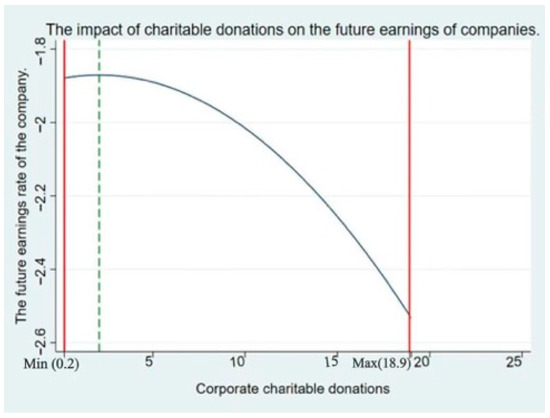
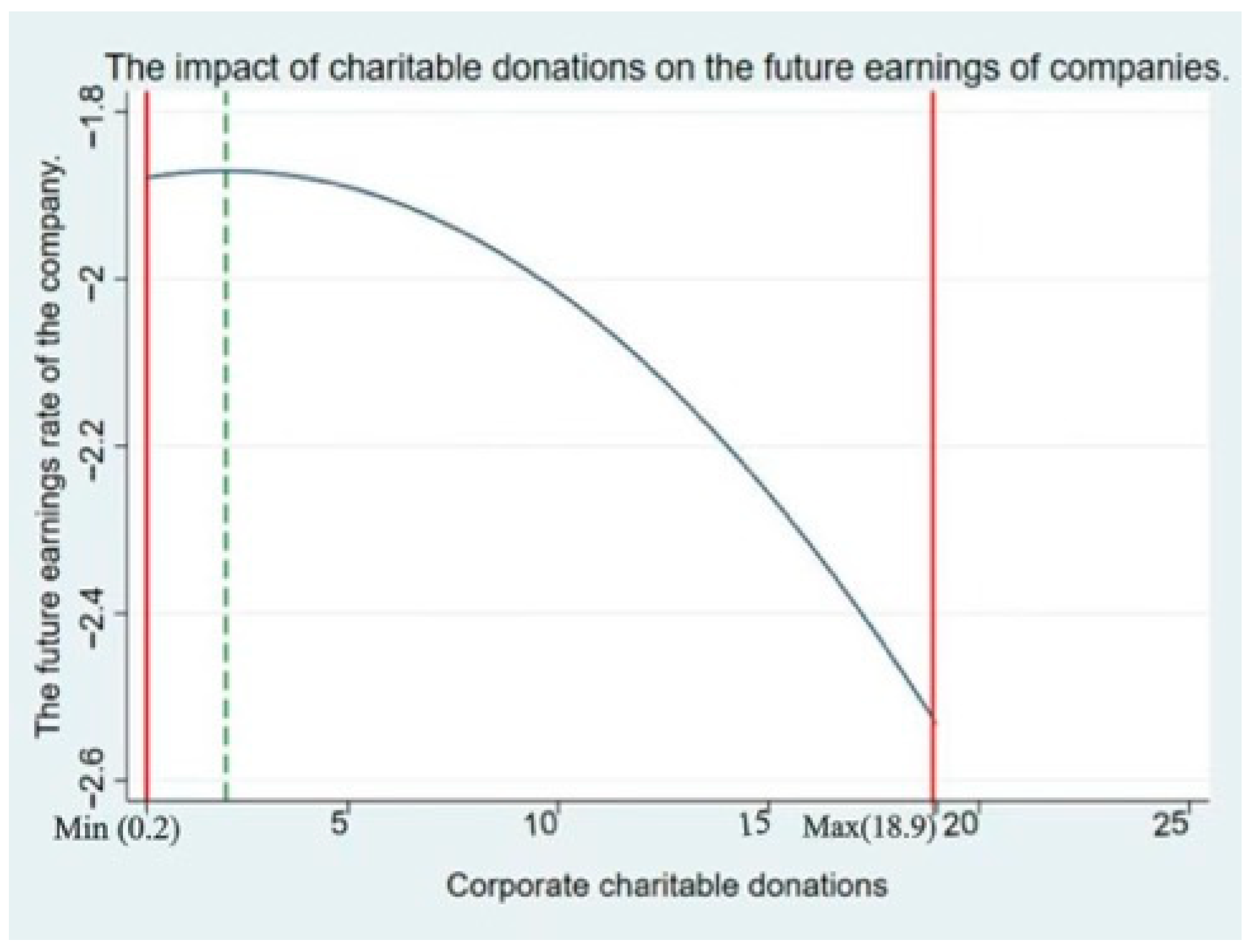
Further estimation of the inflection point of the inverted U-shape was also conducted. According to the U-test, the inflection point for the function of charitable donations and future corporate returns is 2.08. In the left interval, where charitable donations are in the range of 0.18 to 2.08, the slope of the curve is 0.008 (p < 0.05). In the right interval, where charitable donations are in the range of 2.08 to 18.92, the slope of the curve is −9.42 (p < 0.01). This indicates that the slopes in the two intervals have opposite signs (p < 0.05), indicating an inverted U-shaped relationship (Figure 1).
Figure 1.
The Impact of Corporate Charitable Donations on Future Earnings Rates.
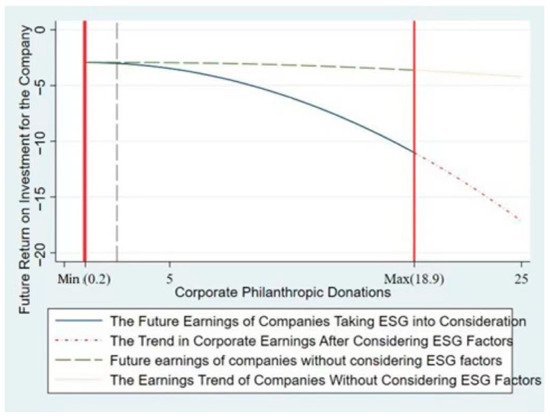
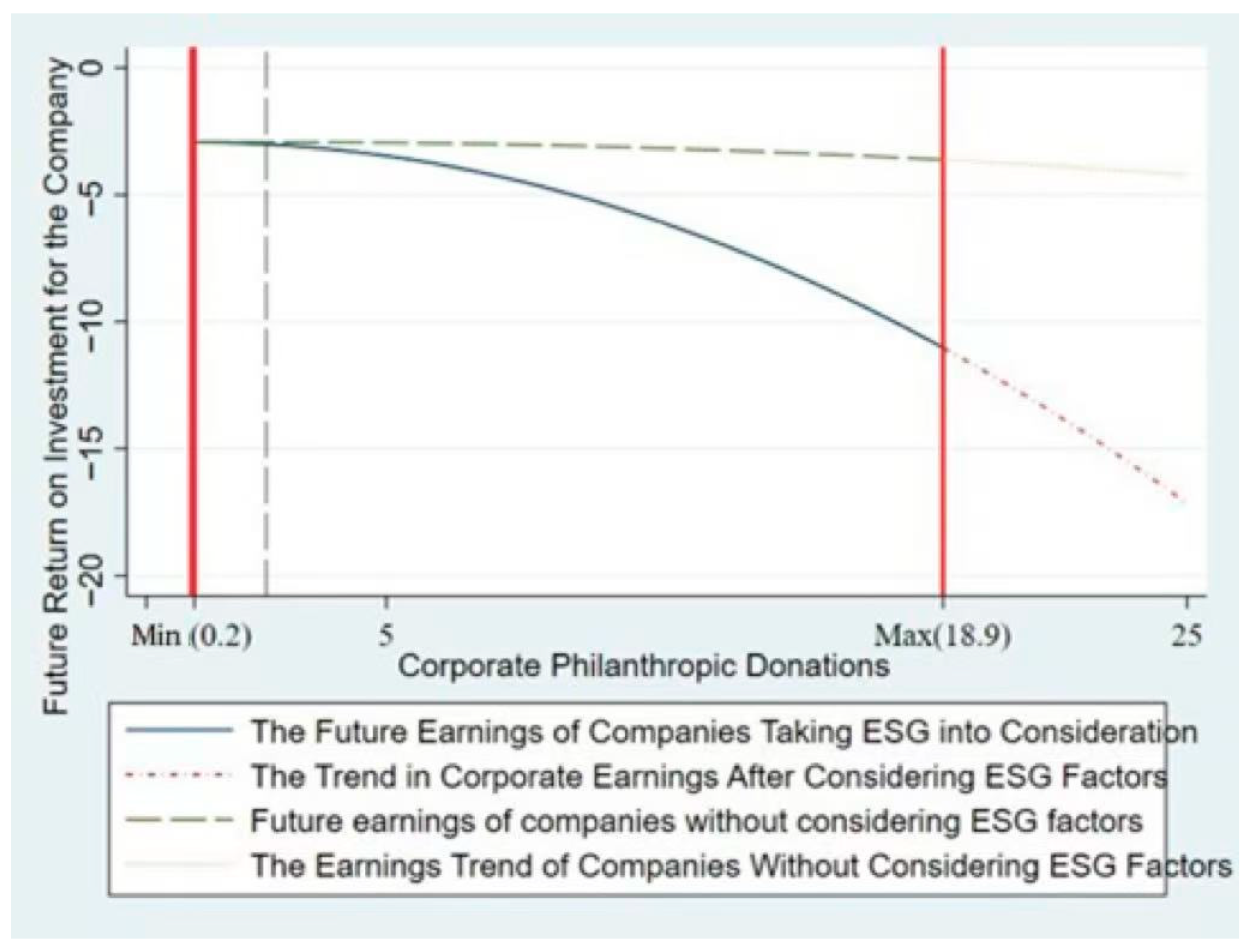
Column (3) incorporates the interaction terms between corporate charitable donations, squared charitable donations, and ESG. After decentralization, the regression results indicate that the coefficient of the squared charitable donation term and the ESG interaction term (ESG × Dona2) is −0.0006 (p < 0.01). Economically, under ESG constraints, the relationship between corporate charitable donations and future corporate returns still exhibits an inverted U-shaped pattern. Further graphical examination, as depicted in Figure 2, reveals that compared to the scenario without considering ESG constraints, the inflection point shifts to the left under ESG constraints, and the curvature of the function narrows. In economic terms, under ESG rating constraints, corporate motives and strategies to mitigate opportunistic behavior through charitable donations are optimized at lower levels, leading to an earlier attainment of the optimal point by the firm. Additionally, ESG evidently alters the instantaneous rate of change in corporate charitable donations concerning future returns. Specifically, the steepness of the relationship between charitable donations and future returns is enhanced by ESG performance. Under high ESG performance, the steepness of the inverted U-shaped relationship between charitable donations and future returns deepens. Hypothesis 2b is supported.
Figure 2.
A Study on the Impact of Charitable Donations on Corporate Value under ESG Constraints.
Moreover, the impacts of other control variables on future corporate returns generally align with theoretical expectations. Specifically, the turnover rate (Turn), profitability (Roa), leverage (Lev), and company age (Age) coefficients are positive, indicating that higher turnover rates, stronger profitability, higher leverage, and longer company existence are associated with higher future returns. Conversely, the book-to-market ratio (BTM), board size (Board), and ownership concentration (Dttoprc) coefficients are negative. These findings are consistent with the research of Xu and Li (2021).
4.4. Robustness Tests
4.4.1. Lagged Regression
In this study, the core explanatory variables, charitable donations (Dona, Dona2), were also regressed with a lag of one period. As indicated in Table 5, column (1), the squared value of charitable donations exhibited a negative correlation with future returns. This suggests the existence of an inverted U-shaped relationship between charitable donations and future firm returns. In column (2), the coefficient of the interaction term between lagged charitable donations and ESG is significantly negative, indicating that even after considering the constraining impact of ESG, charitable donations still demonstrate an inverted U-shaped correlation with future returns.
Table 5.
Robustness Tests Results.
4.4.2. Change in Future Returns Measurement
We also modified the measurement of future returns using Tobin’s Q, representing firm value, as a proxy variable for earnings. The estimation was then re-conducted, and these regression results are presented in Table 5, columns (3) and (4). The squared value of charitable donations continues to have a significantly negative coefficient on Tobin’s Q, and in the presence of ESG impact, the corresponding interaction term coefficient remains significantly negative, further validating the robustness of the baseline regression results.
4.4.3. Change in ESG Measurement
To mitigate the interference caused by variations in ESG measurements, we employed an imputation method to re-measure ESG. Specifically, drawing on the research of Fang and Hu (2023), this study adopted the Huazheng ESG Rating System and assigned ordinal values (1–9) to the rating results (ranging from C to AAA), thereby constructing the ESG score variable, and reevaluated the impact of ESG on the economic consequences of charitable donations through our regression analysis. The results in Table 5, columns (5) and (6), show that even under different measurement approaches, the estimated coefficients of ESG on the economic consequences of corporate charitable donations (RET) remained significant, consistently supporting the main conclusions.
4.4.4. Consideration of Outliers
In order to eliminate the influence of extreme values, we applied a 1% winsorization to all continuous variables and reran our regression estimations. Columns (7) and (8) in Table 5 present these new regression results, which confirm the robustness of the baseline regression to outliers.
4.5. Heterogeneity Analysis
Given the significant differences among enterprises in ownership nature, lifecycle stage, and industry competitiveness, the impact of charitable donations on future corporate earnings may exhibit varying intensities across different types of companies. Recognizing this, we carried out heterogeneity analysis from the following three perspectives.
4.5.1. Heterogeneity in Ownership
The influence of ESG on the relationship between charitable donations and future corporate earnings may differ based on the varying ownership of enterprises. To deal with this possibility, we employed a group regression approach, and the relevant results are presented in Table 6. Columns (1) and (2) of Table 6 report the outcomes of the group regression. In the state-owned enterprises group, the coefficient of the squared term of charitable donations in interaction with ESG is negative (p < 0.01), but no significant relationship was observed in nonstate-owned enterprises. This suggests that compared to nonstate-owned enterprises, the impact of ESG on the relationship between charitable donations and future corporate earnings is more pronounced. The reason for this may be that state-owned enterprises, due to their inherent political attributes, face higher public pressure and societal expectations, necessitating greater consideration of environmental protection and corporate governance issues. Contrary to this, nonstate-owned enterprises may view social responsibility fulfillment through charitable donations as the most costly aspect of their ESG investments in terms of expenditure. Consequently, the impact of ESG investments on the relationship between charitable donations and future nonstate-owned corporate earnings is not statistically significant.
Table 6.
Heterogeneity Analysis Results
4.5.2. Lifecycle Heterogeneity
The concept of the corporate lifecycle was initially proposed by Mason Haire (1959), who asserted that enterprises are socio-economic organizations characterized by a lifecycle akin to that of a biological entity in which they progress from birth to death, and subsequent research has found significant differences in aspects such as size and profitability across various stages of the corporate lifecycle (Wei, 2005). Consequently, the operational conditions and characteristics of enterprises also differ at different lifecycle stages. For instance, newly established enterprises may experience “new venture disadvantages” (Xie et al., 2019). Therefore, the impact of corporate social responsibility (CSR) on enhancing corporate value may vary across different lifecycle stages. Drawing inspiration from S. Y. Liu et al.’s (2020) research, we next employed a classification based on the combinations of operating net cash flow, investing net cash flow, and financing net cash flow to categorize the lifecycle stages of the sampled companies. The companies were classified into “growth stage” (LifeCycle = 1), “mature stage” (LifeCycle = 2), and “decline stage” (LifeCycle = 3) groups and subjected to group regression analysis.
The results in columns (3) to (5) in Table 6 demonstrate that the coefficient of the squared term of charitable donations in interaction with ESG is significantly positive for mature-stage companies, significantly negative for decline-stage, and not statistically significant growth-stage companies. In economic terms, companies in the growth stage face certain “new venture disadvantages”, with higher survival risks. Due to capital constraints, they may be unable to engage in extensive ESG investments, or their investment levels may not be sufficient to yield returns.
Companies in the mature stage possess fully mature production and operation systems, and their efficiency has reached its maximum. At this point, to obtain more returns, they may elect to pursue comprehensive development of ESG items in order to achieve high ESG ratings. Initially, this may lead to increased corporate expenditures. However, when ESG investments yield increased returns, such as attracting more external investments, the returns from ESG outweigh the expenditures, resulting in an enhancement of corporate profitability.
After experiencing growth and maturity stages, companies in the decline stage can no longer attain additional profits. To facilitate further development, these companies may choose to realign various production factors with ESG. As they achieve a high ESG rating or attract more investments and benefits, their profits increase. However, when the production factors reach an optimal matching level and the income generated by ESG investments is insufficient to offset the associated costs, future earnings decline.
4.5.3. Heterogeneity in Industry Competitiveness
Industry competitiveness reflects the intensity of competition for limited resources and significantly influences corporate value. When industry competitiveness is low, monopolistic enterprises can shift production costs to other enterprises in the same industry to maintain their operating profits. Such motivation to transfer costs and risks when facing external shocks (Zhao et al., 2025) may affect the effectiveness of ESG responsibility fulfillment on corporate survival.
Building upon this concept, we borrowed from existing research methods and used the Herfindahl–Hirschman Index (HHI) to assess the industry competitive environment, where smaller HHI values indicate more intense industry competition. The sample was divided into two groups based on the annual median, and group regression was performed once again based on these groupings, as shown in Table 6, columns (6) and (7). In markets with lower competition, the squared term coefficient of charitable donations is negative (p < 0.01), but in markets with higher competition levels, this relationship is not present. These results indicate that in markets with lower competition, the constraint of ESG ratings on charitable donations exhibits an inverted U-shaped effect on the enhancement of corporate value, initially promoting it then later inhibiting it. This could be due to the fact that in markets with lower competition, competition strategies are relatively nonexistent, making the marginal utility and value enhancement brought by ESG investments more substantial and thus exerting a more significant impact on corporate value. In contrast, in enterprises with higher competition, the market already has a sufficient array of diversified competitive strategies. Therefore, ESG, as a strategic means for value enhancement does not offer a substantial competitive.
5. Conclusions
This study empirically examined the impact of charitable donations on future earnings under ESG sustainable development constraints using a sample of A-share listed companies on the Shanghai and Shenzhen stock exchanges from 2018 to 2022. The research findings indicate the following. (1) Charitable donations, within a certain limit, promote an increase in future earnings, but beyond that limit, they exhibit an inhibitory effect. (2) ESG rating constraints can mitigate speculative motives behind corporate charitable donations. (3) ESG sustainable development requirements reduce the level of corporate charitable donations, primarily by decreasing speculative donations, thus advancing the peak impact of charitable donations on future earnings. These results are also robust to several different model specification and potential data issues. (4) Heterogeneity analysis revealed a significant impact of charitable donations on future earnings in state-owned enterprises but not for nonstate-owned enterprises. When categorizing companies based on cash flow characteristics to determine their lifecycle stages, the inverted U-shaped relationship between charitable donations and future earnings was only apparent in the decline stage, instead showing a U-shaped pattern in the mature stage, and no significant correlation in the growth stage. These findings imply that under the overarching requirements of ESG sustainable development, companies subject to ESG constraints face reduced whitewashing motives and expenditures associated with “negative externalities” in charitable donations, ultimately enhancing future earnings over the long-term. From a theoretical perspective, this study elucidates the inherent mechanisms of how charitable donations impact future corporate returns. This analysis possesses theoretical reference value for understanding the current effects of ESG on micro-enterprise economic consequences, providing a general logical framework for relevant empirical research.
In addition, the findings of this study have significant practical implications. Based on the above conclusions, we make the following policy recommendations. (1) Companies should intensify their focus on ESG principles. However, the establishment of a sustainable development ideology should not be limited to the singular dimension of corporate social responsibility but should instead encompass multiple dimensions, including environmental and internal governance aspects. This approach may be able to balance the maximization of social and economic benefits by both reducing speculative donations and maximizing corporate social impact. (2) Governments should strengthen the supervision of corporate charitable donations in an attempt to minimize speculative donation behaviors that come at the cost of negative externalities such as environmental pollution or the manipulation of financial statements that disrupt market economies. It is essential to enhance corresponding detection systems, including monitoring and supervision of environmental information, in order to enforce sustainable development practices. (3) Institutional and individual investors alike should endeavor to acquire an in-depth understanding of ESG investment principles. When evaluating financial products for investment, individual investors should focus on the three major elements of ESG investment to pay attention to traditional indicators such as company financial statements and reputations. (4) A distinctive ESG rating system tailored to Chinese characteristics should be established. Currently, there is a multitude of ESG rating agencies in the market, but they exhibit significant disparities between countries. Therefore, it is crucial to start from the national level when clarifying ESG rating standards and coordinating efforts to construct an accurate ESG investment framework and rating system.
Limitations and Future Developments
There are several limitations to the research that should be mentioned. First, the number of time series and firm samples was limited. This study only collected data on charitable donations from A-share listed companies in Shanghai and Shenzhen, China. However, in reality, many non-listed enterprises also actively participate in public charitable activities. Due to difficulties in data acquisition, they were not included in the scope of this research, which imposes certain limitations on the study. Therefore, future research could aim to collect more comprehensive sample data to enhance the rigor of the findings. Furthermore, enterprises engage in charitable donations in various forms. Chinese laws and regulations do not mandate companies to disclose social responsibility-related information, and some companies only report in-kind donations without converting them into monetary values. This study did not classify donation methods, which may affect the accuracy of the charitable donation variable. Therefore, future research could categorize and compare different forms of corporate donations to provide more specific management recommendations for enterprises.
Author Contributions
Methodology: Y.W.; Software: Y.W.; Formal analysis: Y.C. and Y.W.; Investigation: Y.W.; Data curation: C.L.; Writing—original draft preparation: Y.W.; Writing—review and editing: C.L.; Visualization: Y.W.; Supervision: Y.C.; Funding acquisition: Y.C. All authors have read and agreed to the published version of the manuscript.
Funding
This research was funded by the Key Research Project of Shaanxi Provincial Government Research Office in 2022, grant number 2022HZ1560, and “Research on Strengthening Financial Risk Prevention and Promoting High-quality Development of Listed Enterprises in Our Province”. It was also funded by the National Social Science Foundation Project, grant number 23BJY180, and the “Study on the Symbiosis Mechanism of Rural Chain Finance under Dual Effect Pressure”.
Institutional Review Board Statement
Not applicable.
Informed Consent Statement
Not applicable.
Data Availability Statement
The original contributions presented in this study are included in the article. Further inquiries can be directed to the corresponding author.
Conflicts of Interest
The authors declare no conflicts of interest.
References
- Agarwal, R., & Audretsch, D. B. (2001). Does entry size matter? The impact of the life cycle and technology on firm survival. Journal of Industrial Economics, 49(1), 21–43. Available online: https://kns.cnki.net/kcms2/article/abstract?v=cP5JN5wNT8BtTf9op47C1IZLMiqjPB3D9yu0xpEQfEwDRyxkI1B57nfQgmj_cCsGDuEQM_YTiZhbNnDDZsYOyDfjpWO3AZ3mVwPZxLF0lBAwNBXTIm8gD_9n7tN6YHAIPWLqpiYE8BX0McMJAEgiCc28I2BHlssC0111YU6ZQrHYKt6Slf8WhzRiYSHqqLkY&uniplatform=NZKPT&language=CHS (accessed on 18 November 2025). [CrossRef] [Scilit]
- Barnett, M. L., & Salomon, R. M. (2006). Beyond dichotomy: The curvilinear relationship between social responsibility and financial performance. Strategic Management Journal, 27(11), 1101–1122. Available online: https://kns.cnki.net/kcms2/article/abstract?v=A8ynNhXZdPn9XRSnJaqFk0bQUU58e7Ty-wEKQc1P-1k2CTOJVAwK-rCLlIQbNwkzINSz3DIFcXDggpjTUcEgdHQdGEXJeyON515I4GeMYETvGZXE-ty7D9SKk7YPiYurKCWSF9GES0FnJT7d-N1WuphmmM441Ox2vsWYV5q6qJx8KrgzVN0w4mbJOXaPLi2V&uniplatform=NZKPT&language=CHS (accessed on 18 November 2025). [CrossRef] [Scilit]
- Barth, F., Hübel, B., & Scholz, H. (2022). ESG and corporate credit spreads. Journal of Risk Finance, 23(2), 169–190. [Google Scholar] [CrossRef] [Scilit]
- Cao, H. M., & Meng, Y. (2019). Is corporate charitable donation hypocritical? A study based on the perspective of stock price crash risk. Accounting Research, (04), 89–96. Available online: https://kns.cnki.net/kcms2/article/abstract?v=A8ynNhXZdPmBIIETdyRW_63WuoQ0pRhS2g_68Bde2tDcOkTaK5xDeUxG3cXpqZh6mNiQP7vJVgMUVtTfBRqzblRu9IhMM08LjyhD7TsEjUfRQqEecYz7xxJtv2slozyWE2fh9DTxrY___VUSQ-caWVqjqdNmWK4J2Zsr79tykdZpyfhnzjPI2w==&uniplatform=NZKPT&language=CHS (accessed on 18 November 2025).
- Chen, L., Yang, Y., & Wu, Y. (2023). The social catalyst of “good begets good”: The role of media reporting in enhancing corporate performance through charitable donations. Western Forum, 3, 50–63. Available online: https://link.cnki.net/urlid/50.1200.C.20230703.1704.002 (accessed on 18 November 2025).
- Chen, X. Y. (2025). Regulatory dilemmas and optimization paths of ESG regulation in China. Jianghuai Forum, (02), 94–103. [Google Scholar] [CrossRef]
- Dai, Y., Pan, Y., & Feng, S. (2014). Are corporate charitable donations “political contributions” in China? Evidence from changes in municipal party secretaries. Economic Research, 49(2), 74–86. Available online: https://kns.cnki.net/kcms2/article/abstract?v=A8ynNhXZdPm3fqGg9Qt3GGK9KL0ILjtas7U154oi67NgolYBkkOEP--V42_O5F0focZSqNzCvJfs50-U94pgf6aWbOAOy21n1zOj6lfYcKeAnktzbAKwSOl__KyYYIV07hOMwRXupcBc4yLSQ1emSTV3uxyVr3EFa5IiH42RSSAqot9-U6Vqrh27wD4WxG49&uniplatform=NZKPT&language=CHS (accessed on 18 November 2025).
- Fang, X. M., & Hu, D. (2023). Corporate ESG performance and innovation: Evidence from A-share listed companies. Economic Research Journal, 58(02), 91–106. Available online: https://kns.cnki.net/kcms2/article/abstract?v=A8ynNhXZdPl3etSC7p9r0PRAJzH5cFwAXnZjZZ95JWtkKvGaXW_XEc7p8nudiYZvLtJWOOmfT7hmvltEa8RPbooJenV_C6xKGyV6eCmug84UXsD2YBTxgywELf6sITCgeOjZjUJ-vPRgbQXOQOrofXdOVh887ZjpUHvAk0wVzQmpTUOsEu5ENw_0NxpKD8v-&uniplatform=NZKPT&language=CHS (accessed on 18 November 2025).
- Fombrun, C. J., & Gardberg, N. (2000). Who’s tops in corporate reputation? Corporate Reputation Review, 3(1), 13–17. [Google Scholar] [CrossRef] [Scilit]
- Gao, J., Chu, D., Lian, Y., & Zheng, J. (2021). Can ESG performance improve corporate investment efficiency? Securities Market Herald, 11, 24–34+72. Available online: https://link.cnki.net/urlid/44.1343.F.20211028.1139.004 (accessed on 18 November 2025).
- Gao, Y. Q., Chen, Y., & Zhang, Y. (2012). “Red scarf” or “green scarf”: A study on the motivation of charitable donations by private enterprises. Management World, 8, 106–114+146–154. [Google Scholar] [CrossRef]
- Gillan, S. L., Koch, A., & Starks, T. (2021). Firms and social responsibility: A review of ESG and CSR research in corporate finance. Journal of Corporate Finance, 66, 101889. [Google Scholar] [CrossRef] [Scilit]
- Godfrey, P. C. (2005). The relationship between corporate philanthropy and shareholder wealth: A risk management perspective. The Academy of Management Review, 30(4), 777–798. Available online: https://kns.cnki.net/kcms2/article/abstract?v=A8ynNhXZdPn7wQ8JTFzmIxd6cTA4uVXRugK59GfEzpv5AK3_eNZviN2I7awgvyZTIcTiOmrmOuIYR2hLwTwMF31IWWPTx-pQZG9HAHvTK9Uqk4s1BZroN8Z4alyGCVOraUIh1uBk_egJE_FtEvaJj7sl6hNVcL1i9FoNeewcLzxQ7PDPnnPPtj1lv-XiRoUwemkEGDwxel-bvNsw4s27ag==&uniplatform=NZKPT&language=CHS (accessed on 18 November 2025). [CrossRef] [Scilit]
- Gu, L., & Peng, Y. (2022). The impact of charitable donations on corporate performance: The moderating effect of corporate lifecycle. Management Review, 3, 243–254. [Google Scholar] [CrossRef]
- Guo, X. C., Fu, X. R., & Li, P. C. (2024). Top managers’ cognition, open innovation, and enterprise digital transformation: An empirical study based on high-tech enterprises. Scientific Management Research, 42(03), 66–75. [Google Scholar] [CrossRef]
- Jiang, F., Shen, Y., & Cai, X. (2020). Corporate governance effects of multiple large shareholders: A perspective from controlling shareholders equity pledges. World Economy, 2, 74–98. [Google Scholar] [CrossRef]
- Jiang, Y., & Yu, J. (2021). The role and mechanism of the third distribution in promoting common prosperity. Zhejiang Social Science, 9, 76–83+157–158. [Google Scholar] [CrossRef]
- Li, S., & Huang, S. (2022). From CSR to ESG: Evolution, literature review, and future prospects. Financial Research, 4, 13–25. [Google Scholar] [CrossRef]
- Li, X. L., Hou, X. T., & Ge, C. F. (2017). Is charitable donation genuine or hypocritical? Perspective of corporate violations. Journal of Shanghai University of Finance and Economics, 4, 66–78. [Google Scholar] [CrossRef]
- Liu, S. Y., Lin, Z. F., & Leng, Z. P. (2020). Does tax incentive increase corporate innovation? An empirical test based on the theory of corporate lifecycle. Economic Research, 55(6), 105–121. Available online: https://kns.cnki.net/kcms2/article/abstract?v=A8ynNhXZdPnFjFgvs6VOBhwAjbaDIHoGgecJHI2XoiHTfK_sNQAMsYDH9tjwcHjl5sLcktNF_w4dAMJChwPCPQzac9DtAuiBVDTQcDYdbSPq82G5vyjehed-AaIFSjDTqRWdJucfjd6f7ylbs1Ke4REwDO8vGP2AXnWO2TR9vNnrCT6y8U3lKckIih9z-vA0&uniplatform=NZKPT&language=CHS (accessed on 18 November 2025).
- Liu, Y., & Yin, J. (2020). Stakeholder relationships and organizational resilience. Management and Organization Review, 16(5), 986–990. [Google Scholar] [CrossRef] [Scilit]
- Pan, Q., Zhu, Y. M., & Lin, F. (2015). The optimal donation strategy of state-owned enterprises in a dilemma: Empirical findings based on the differences in property rights donations and their performance. China Industrial Economics, 9, 145–160. [Google Scholar] [CrossRef]
- Reber, B., Gold, A., & Gold, S. (2022). ESG disclosure and idiosyncratic risk in initial public offerings. Journal of Business Ethics, 179(3), 867–886. [Google Scholar] [CrossRef] [Scilit]
- Shen, Y., Lv, M. H., & Xu, G. H. (2020). Charitable donations, corporate governance, and investment-cash flow sensitivity of listed companies. Management World, 17(2), 269–277. Available online: https://kns.cnki.net/kcms2/article/abstract?v=cP5JN5wNT8DtrCDKZYrb_DzTqLqqoDerlr8LUxdnMqE-LuVZXjtWX7rtyky3wNlDqnzQONPE_vDtSmPDhutsNOp5GmbwFY7nql_xU1v5LvEBYKFF7ShA5dXUVxXDhVf1TMkgPm9MYiWCZpftCayRR4tmo8NNnMY0BFuArx6Y0MveF65ozuDO5A==&uniplatform=NZKPT&language=CHS (accessed on 18 November 2025).
- Song, K., Xu, L., & Li, Z. (2022). Can ESG investment promote banks to create liquidity? Dual effects of economic policy uncertainty. Financial Research, 2, 61–79. Available online: https://kns.cnki.net/kcms2/article/abstract?v=A8ynNhXZdPnHtDEUtwAasz3MwipjJ-4sTcKGfsZw0XvJOtS0G7i5-em5G5Oyl0FayzY2CxhIOOXltgT2JXIb5uRqA1-Mq7l8vdz0wCNXOftZSIqqmEHpXZtHlTETb1BAvmgp1CuNh7RMZuhZpSqvQ_d3Ldvk8GztLwZD2PdGpndt86MBqoI8QZPlHoc98eUV&uniplatform=NZKPT&language=CHS (accessed on 18 November 2025).
- Song, Q. H., Zhou, X. Q., & Deng, X. (2023). ESG ratings and corporate environmental investment: Incentives or concealment? Financial Forum, 11, 60–70. [Google Scholar] [CrossRef]
- Tang, Y. L., & Liu, X. (2022). Can corporate charitable donations get value returns? Dual perspectives on technological innovation and financial constraints. Journal of Hunan University of Technology (Social Science Edition), 27(4), 49–58. Available online: https://kns.cnki.net/kcms2/article/abstract?v=A8ynNhXZdPmDPn2FUcsRTGDWJdDmKfFI6HTkqPwpMYLCRyo6z_XZE1yXDlvCOCMD5uG210TVp7jRMkG8iHcejSrhnHoyae1AfCs8RYOVKVq6SkUU-5dk28UQu3V_xKTfRnCebkCO_Gkd_QzZzSRrrGb1EV-coQt5ZtSnlkUxS4INWqESSdp4Ow==&uniplatform=NZKPT&language=CHS (accessed on 18 November 2025).
- Wang, H., Choi, J., & Li, J. (2008). Too little or too much? Untangling the relationship between corporate philanthropy and firm financial performance. Organization Science, 19(1), 143–159. Available online: https://kns.cnki.net/kcms2/article/abstract?v=A8ynNhXZdPmNly_dUCpSSooWq5BcNV4hxjAtVB0-y72LSBRmyzd1p6qL8BIcgvcWM_AbIzfid4ox6lX0QdkfJ6pHq7Kl9ejONEOW9cgB0m8BvRmIszmT55pN7AJVwEGls5Iw9jzICFNfz7358EQFcYd6FbSCXviE2UzjbNan1-ER7scBOEOb4izj8O5by1Ok&uniplatform=NZKPT&language=CHS (accessed on 18 November 2025). [CrossRef] [Scilit]
- Wang, W., Liu, J. T., & Ge, M. (2023). Analysis and future development of China’s ESG ratings. Academic Exploration, 8, 67–78. Available online: https://kns.cnki.net/kcms2/article/abstract?v=A8ynNhXZdPl9Qn3IgOHNGZZrk-AVmYgNH7eo0yy42adDvN5MIoZXkIrbx3NnN2MkCiLQh_iknpFxfH1du11qEmgbc-8tAs4ICIb0FkGxyqN5lUmtMpLdeIdoqay74FXLI6uQ87TTKvjwG9dQWqv4WhqtWRG9ZUV1UZt7xnLe4iMqcFFjkofzQw==&uniplatform=NZKPT&language=CHS (accessed on 18 November 2025).
- Wei, G. X. (2005). A review and brief comment on the theory of enterprise life cycle. Productivity Research, (06), 231–232. [Google Scholar] [CrossRef]
- Wu, P., Yang, K., Jiang, J. S., & Wang, H. (2023). Does corporate ESG performance affect the relevance of earnings-value? Financial Research, 6, 137–152+169. [Google Scholar] [CrossRef]
- Xian, W. D., & He, Q. (2005). A brief analysis of factors affecting corporate value. Finance and Accounting Monthly, 26, 77–78. [Google Scholar] [CrossRef]
- Xie, Y. H., Shi, H. R., & Qin, Y. Z. (2019). The impact of the gap between internal and external corporate social responsibility on corporate value. Journal of Hunan University (Social Science Edition), 6, 48–55. [Google Scholar] [CrossRef]
- Xu, S., & Li, M. Y. (2021). The impact of major shareholders’ shareholding levels on open market repurchases: Mutual maintenance or mutual harm? Southern Finance, 3, 61–75. Available online: https://link.cnki.net/urlid/44.1479.F.20210518.1647.002 (accessed on 18 November 2025).
- Yan, W. X., Zhao, Y., & Meng, D. F. (2023). Research on the impact of ESG ratings on the financial performance of listed companies. Journal of Nanjing University of Finance and Economics, 6, 71–80. Available online: https://link.cnki.net/urlid/32.1867.F.20231109.1050.008 (accessed on 18 November 2025).
- Yuan, Z. M., & Wang, P. L. (2021). Did the contagion effect of negative events affect the donations of affected companies? Journal of Zhongnan University of Economics and Law, 2, 17–27+158–159. [Google Scholar] [CrossRef]
- Zhang, C., Fu, L. H., & Zheng, B. H. (2018). Motivation for charitable donations by listed companies: Altruistic or selfish? Empirical evidence based on the earnings management of Chinese listed companies. Audit and Economic Research, 2, 69–80. Available online: https://link.cnki.net/urlid/32.1317.F.20180206.2243.010 (accessed on 18 November 2025).
- Zhang, C. N. (2023). The impact of innovation investment on the future stock returns of listed companies [Master’s thesis, Northeastern University]. [Google Scholar] [CrossRef]
- Zhang, G. M. (2025). How open public data stimulates the vitality of the private economy: From the perspective of private investment. Modern Economic Research, (12), 72–88. [Google Scholar] [CrossRef]
- Zhang, M., Ma, L. J., & Zhang, W. (2013). The political and corporate tie effect of corporate charitable donations: Empirical evidence from Chinese listed companies. Management World, 7, 163–171. [Google Scholar] [CrossRef]
- Zhang, Q. L. (2016). The “Charity Law” and the sustainable development of charity in China. Jianghuai Forum, 4, 10–15. [Google Scholar] [CrossRef]
- Zhang, Z. G., Li, Y. J., & Li, L. (2016). Research on the relationship between corporate charitable donations, acquisition of technological resources, and innovation performance: Based on the perspective of resource exchange between enterprises and governments. Nankai Management Review, 19(3), 123–135. Available online: https://kns.cnki.net/kcms2/article/abstract?v=A8ynNhXZdPmYOoczNPwAQInTJm1zflvVHWtOPB99wBJj2XN0_7lGT69H1loWNcu6lDeC5aXSi64oa-v5LCRJslNKfRSGhkdsU7f33LJArnncwZ3akSxTodGxvHEtcqm43aafktAyrTCL_kRjKcw3XVB1vDGqnUuVJZLcH2HBdseTw3jvibfeyw==&uniplatform=NZKPT&language=CHS (accessed on 18 November 2025).
- Zhao, W. H., Ren, Y. Y., Zhang, L., & Liu, J. L. (2025). The impact of digitalization level of entrepreneurial enterprises on innovation performance. Studies in Science of Science, 43(5), 1027–1038. [Google Scholar] [CrossRef]
- Zhu, Y. M., Chang, M. K., & Zhang, S. C. (2019). Charitable donations, government-business relationships, and corporate value. Accounting Friends, 4, 66–71. Available online: https://link.cnki.net/urlid/14.1063.f.20190123.1514.026 (accessed on 18 November 2025).
- Zou, P. (2019). Research on the dynamic adjustment mechanism and heterogeneity of charitable donations. Management Journal, 16(6), 904–914. Available online: https://kns.cnki.net/kcms2/article/abstract?v=A8ynNhXZdPnBkc58rRPOGP6d3lXYeH6RveBv3VcoJKpUHN7Hv4vZK_YjqTt6ohDUBq-5pF71lxmISJ1TiU-7ks1m-lcyhTu2yE-ZW_sLreDIgdvIhXHZ2EYjoW1n6N_2fBozP2apA5f9U4e6HhC1ecaP8PptytD8tNVH2F7pc67ubY0vhOn18A==&uniplatform=NZKPT&language=CHS (accessed on 18 November 2025).

Disclaimer/Publisher’s Note: The statements, opinions and data contained in all publications are solely those of the individual author(s) and contributor(s) and not of MDPI and/or the editor(s). MDPI and/or the editor(s) disclaim responsibility for any injury to people or property resulting from any ideas, methods, instructions or products referred to in the content. |
© 2025 by the authors. Licensee MDPI, Basel, Switzerland. This article is an open access article distributed under the terms and conditions of the Creative Commons Attribution (CC BY) license.