Article

Do Financial Development and Exchange Rates Drive the Tourism–Growth Relationship?

by
Pat Obi
1,*,
Kwaku Addae-Ankrah
2 and
Emmanuel Sarpong-Kumankoma
3
1
Department of Quantitative Business Studies, College of Business, Purdue University Northwest, Hammond, IN 46323, USA
2
Department of Economics, W.P. Carey School of Business, Arizona State University, Tempe, AZ 85281, USA
3
Department of Finance, University of Ghana Business School, Legon, Accra GA-490-9425, Ghana
*
Author to whom correspondence should be addressed.
Int. J. Financ. Stud. 2025, 13(2), 59; https://doi.org/10.3390/ijfs13020059
Submission received: 17 February 2025 / Revised: 24 March 2025 / Accepted: 2 April 2025 / Published: 8 April 2025

Abstract

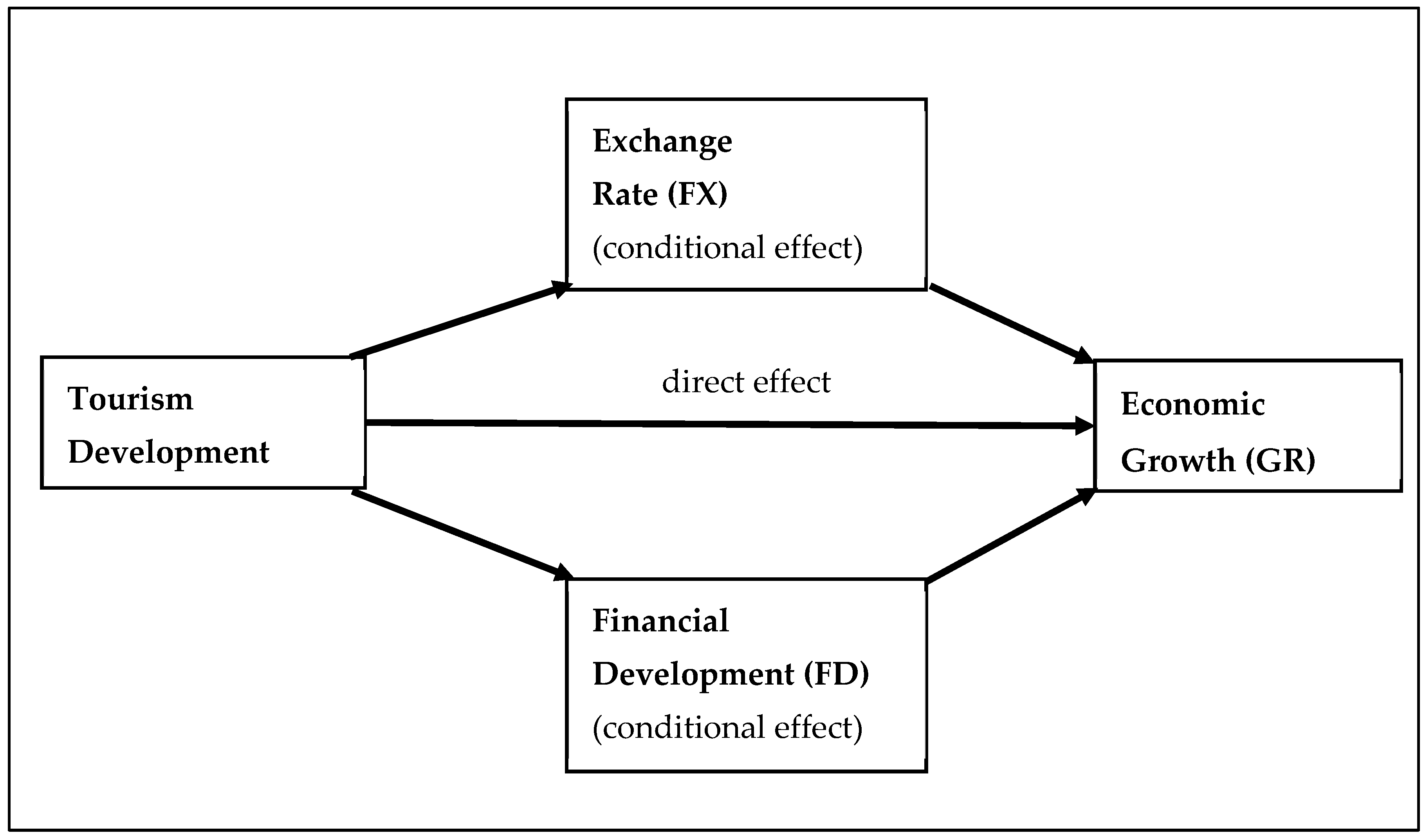
This study expands the tourism development literature by examining how currency valuation and financial sector maturity influence the tourism–growth relationship. While prior research emphasizes direct or bidirectional causality, this study distinguishes itself by exploring the mediating and moderating roles of financial development and exchange rate stability. Using an instrumental variables approach and empirical data from Africa, we find that exchange rates and financial development partially mediate tourism’s effect on economic growth, particularly in economies with weaker currencies and more developed financial systems. Our results challenge the tourism–growth neutrality hypothesis by demonstrating that exchange rates not only influence tourism demand but also actively shape its growth effects. A panel ARDL analysis confirms bidirectional causality, which reinforces the interdependence between tourism and growth. However, unlike previous studies that view tourism as an isolated driver of growth, we demonstrate that its economic impact depends on a country’s financial maturity and exchange rate competitiveness. Policy recommendations aimed at enhancing economic growth through improved tourism and financial infrastructure are offered.
Keywords: panel ARDL; 2SLS; tourism and growth; exchange rate; financial development panel ARDL; 2SLS; tourism and growth; exchange rate; financial development