


Abstract
Three Higher Education Institutions (HEIs) in Ireland are accredited to provide education and training, successful completion of which, entitles one to register as a pharmacist with the Pharmaceutical Society of Ireland (PSI). Legislation (2014) mandated that these HEIs replace their existing structure (four-year degree followed by a one-year internship), with a five-year ‘integrated Master’s programme’. Integration includes ‘in-service practical training’ (placement) at the beginning of Year 4 (four months), and the end of Year 5 (eight months). Year 4 placements do not have to be ‘patient-facing’. Students receive a Bachelor’s degree at the end of Year 4. The Affiliation for Pharmacy Practice Experiential Learning (APPEL), established by the HEIs, manages student placements, training establishments, preceptor training, the preceptors’ competency assessment process, and the virtual learning environment (VLE) that enables delivery of co-developed online modules aligned with placements in Years 4 and 5. This case report aims to describe the process by which this integration has taken place across and within these HEIs and the challenges faced by educators, students, preceptors, and other stakeholders along the way.
1. Background and Introduction
In Ireland, three Higher Education Institutions (HEIs)—the Royal College of Surgeons in Ireland (RCSI), Trinity College Dublin (TCD), and University College Cork (UCC)—are accredited to provide programmes of ‘education and training’, graduates of which are entitled to apply to register as a pharmacist [1]. Prior to September 2015, students completed a four-year undergraduate degree, followed by a 12-month period of pre-registration training: The National Pharmacy Internship Programme (NPIP) [2]. A review of undergraduate and pre-registration training, the Pharmacy Education and Accreditation Review (PEARs) project [3] was commissioned by the Pharmaceutical Society of Ireland (PSI) and recommended the introduction of an integrated five-year Master’s level programme of education and training for pharmacists. The PSI accepted the PEARs findings and following legislative change in 2014, the five-year integrated programme was introduced in the three HEIs in September 2015 [4]. The PSI’s Core Competency Framework (CCF) for Pharmacists [5] was a mandatory component informing the design of the integrated programmes in each HEI. The CCF delineates 6 domains of practice, and associated 25 competencies. The CCF informs the PSI’s standards for accrediting pharmacy degree programmes [5,6]. Curriculum design must therefore map to the CCF. The reference to ‘integrated’ includes ‘in service practical training’ (placement) for four months at the beginning of Year 4, and for the final eight months of Year 5 [6]. An overview of the CCF is provided in Table 1.
Table 1.
Core Competency Framework (CCF) for Pharmacists.
Aim and Objectives
The aim of this case report is to detail the process by which HEIs in Ireland collaborated to design a common curriculum, integrated both within and across HEIs, for delivery to students while undertaking placement in Year 4 and to consider the associated challenges faced by educators, students, preceptors, and other stakeholders.
The objectives are to describe this process according to three distinct constituent phases as follows: planning, implementation, and review.
Planning Phase:
- (i)
- To describe the structures necessary to operationalize these new requirements.
- (ii)
- To explain the alignment of student contact hours in the online modules with placement hours.
- (iii)
- To define Preceptors and their scope.
- (iv)
- To outline the criteria for curriculum design.
- (v)
- To define and explain the two stages of the work programme, i.e., Stage 1: Establishment of Working Group (WG) and Stage 2: Curriculum Design.
Implementation Phase:
- (i)
- To designate the outcomes achieved and their linkage to CCF, learning outcomes, assessment, teaching, and learning.
- (ii)
- To describe the outputs achieved, and to discuss in the context of the literature.
Review Phase:
To describe the challenges, learnings, and recommendations for future iterations
2. Planning Phase
2.1. Structures
The three HEIs established the Affiliation for Pharmacy Practice Experiential Learning (APPEL) with the Head of each HEI being appointed to its Board of Directors. APPEL is responsible for the management of (a) student placements; (b) training establishments; (c) preceptor-student matching; (d) preceptor training; and (e) the workplace-based competency assessment process [6]. It also manages the virtual learning environment (VLE) that enables delivery of co-developed online modules aligned with placement in Years 4 and 5.
With respect to training establishments, unlike in Year 5 where placements are restricted to hospital or community settings, students in Year 4 also have a range of non-clinical options available for placements—e.g., in a pharmaceutical company, a pharmaceutical wholesaler, or a regulatory body [6]. Additionally, in some circumstances the student may undertake a Year 4 placement outside of the State [7]. As many placement establishments are geographically removed from the HEIs, students would not be able to attend the HEI while on placement, therefore all activities aligned with the online modules, including assessment, needed to be completed at a distance on the APPEL VLE.
As Year 4 placement options do not necessarily facilitate students engaging directly with patients, curriculum design must preclude any activity or assignment that requires student access to patients or patient-records. Accordingly, only three of the six domains in the CCF, namely: professional practice, personal skills, and organisation and management skills (Table 1), are directly aligned with the online modules for Year 4.
2.2. Alignment of Student Contact Hours
Degree awards in HEIs in the Republic of Ireland align with the European Credit Transfer and Accumulation System (ECTS). These credits represent the workload and defined learning outcomes in a programme [8]. Sixty ECTS, representing 1500–1800 h of student effort, are equivalent to a full year of study or work in an undergraduate degree programme [8]. As the Year 4 placement aligns with half the academic year for an undergraduate student, this represents 30 ECTS of placement time and study, and the corresponding student workload in each HEI is set at a maximum of 750 h (equivalent to 50 h per week for 15 weeks). The Board of APPEL agreed that students would complete 30 h per week in their placement, between the hours of 9 a.m. to 5.30 p.m., four days per week, during Monday to Friday. Therefore, curriculum design had to take account that the time remaining after that assigned to placement activities that could be allotted to Year 4 online modules was a maximum of 20 h per week.
2.3. Preceptors and Their Scope
Preceptors are registered pharmacists who agree to mentor and assess students on the skills that they demonstrate. Their role (in Year 4), is to complete the competency assessment of the student and determine whether, upon completion of the placement, the student has achieved a minimum of, a Level 3 (“mostly”) rating (Table 2) in all relevant behaviours (51 behaviours) (see Appendix A, Table A1).
Table 2.
Assessment Ratings.
While the competency assessment has no marks associated with it per se, it is a compulsory element that must be successfully completed—i.e., attain a Level 3 award in the designated competencies—in order to pass the module. Further discussion on the competency assessment process is outside the scope of this case report.
2.4. Criteria for Curriculum Design
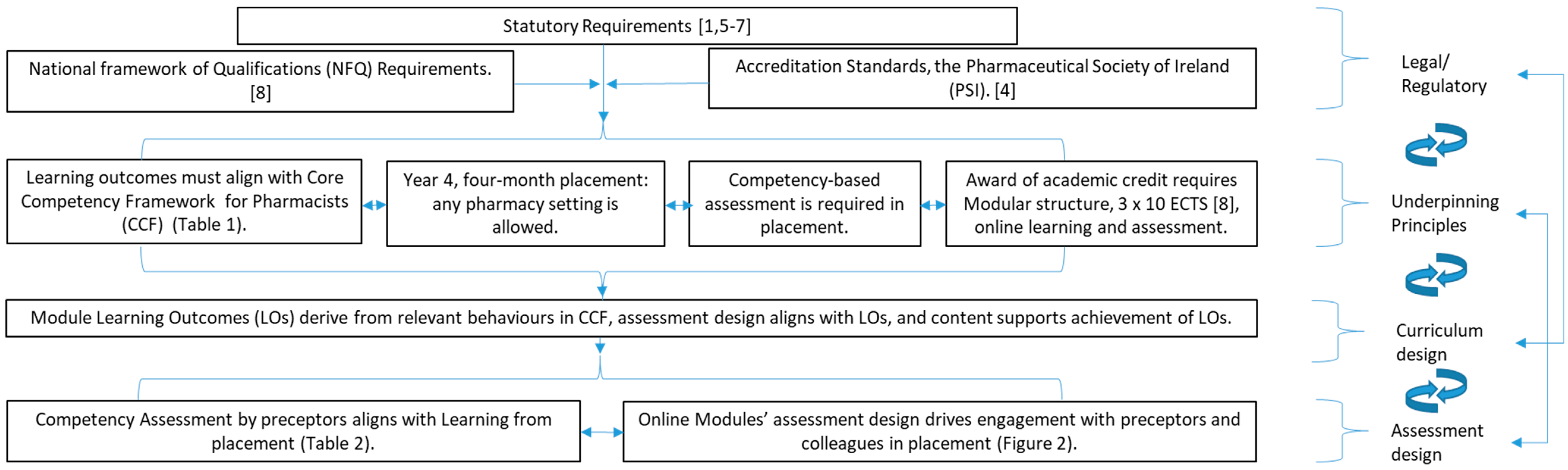
When designing the curriculum for students completing placements in Year 4 of the programme, it was necessary to take account of a complex series of interrelationships, summarised in Figure 1.
Figure 1.
Interrelationships between legal requirements, underpinning principles, and curriculum and assessment design.
APPEL provided further requirements that further informed the curriculum design as follows:
- Materials should be co-delivered to students from all three HEIs while on Year 4 placement, from September to December of that academic year;
- there should be no requirement for students to attend the HEI at any stage during the placement;
- activities that require access to patients or patients’ records should be excluded;
- learning outcomes to be derived from the same CCF behaviours as used for the placement assessment;
- alignment with 30 ECTS academic credit for Year 4 of the Degree award, and with student workload of a maximum 20 h per week for a total of 15 weeks is a requirement;
- there should be no additional preceptor workload when designing activities/assessment; and
- standards and/or regulations for curriculum design, and for progression and award of Degrees, at all three HEIs were to be accommodated.
2.5. Stages of Work Programme
Stage 1: Establishment of Working Group
APPEL appointed a working group (WG), composed of one pharmacist nominee from each of the HEIs (CR, MF, and LJS) charged with drafting a proposal by December 2017 for a curriculum design that would be common to all HEIs and which would be co-delivered to students while undertaking practice placements in Year 4. APPEL stipulated that the curriculum design should have a University character, including its expectation that there would be synchronous, online activity on a regular basis—preferably no less than once weekly.
All members of the WG had experience in curriculum design, online learning, and assessment. A Practice educator at RCSI/APPEL, the project manager at APPEL, and the instructional designer at TCD provided support to the WG, and each member of the WG collaborated with colleagues in their respective HEIs, working towards the preparation and delivery of curriculum materials in September-December 2018.
Stage 2: Curriculum Design—Alignment of Learning Outcomes with Activities and Assessment
The WG adopted a student-centred, outcomes-focused approach to curriculum design [8,9,10] and prioritised integration of content and activities to the assessment design [11,12,13]. Rubrics were sufficiently detailed to guide both students and assessors [14]. Online modules were designed to be in synergy with the experiential nature of placements—i.e., to support learning by doing while on placement [15,16,17]. Developmental approaches to reasoning and decision-making through the ambiguity experienced in ‘practice’ [18,19,20], as previously used in online and blended learning in Pharmacy education in Ireland [21,22,23], were a central component of curriculum design.
The WG committed to providing a guided approach to reflective writing [24,25] and, combined with promoting repeated cycles of reflection [15,16,26], this commitment further informed the format, sequencing, and timing of activities and student submissions [27,28,29]. Individual and social constructivist theories [15,30], which propose that learning is an active process wherein new information is added to ‘prior knowledge’ which may have been derived from experience as well as formal teaching and learning, and that can take place on an individual or social basis, underpinned curriculum design. Assessment that was simultaneously ‘of’ (demonstrating achievement), ‘for’ (to provide feedback by e.g., self and peer assessment against comparators), and ‘as’ (wherein students self-regulate) learning [31,32,33] was the aim. Peer interaction and debate [34,35] was stimulated by appropriate sequencing of the order in which students completed activities [20,21,22,23]. Selection of team tasks, and Community of Inquiry methodologies which prompted emphasis on social presence (e.g., interacting in teams to agree decisions), cognitive presence (e.g., activities requiring critical and independent thinking), and teaching presence (i.e., the establishment of a defined process to drive reflection and interaction online) [36] further encouraged student engagement [37,38] with their online groups, and with the range of experts (e.g., preceptors) accessible during their placements. Participation in peer review and feedback [39], required for programme accreditation purposes [3], was introduced as a group activity. The WG aimed to maximise the potential arising from an entirely online learning, feedback and assessment environment [40], especially with respect to demonstration of professionalism and online etiquette (“netiquette”) when interacting with peers [41].
The WG convened on six occasions for two days meetings, from April to October 2017, and issued progress reports, including recommendations for decision to the Board of APPEL, after each meeting.
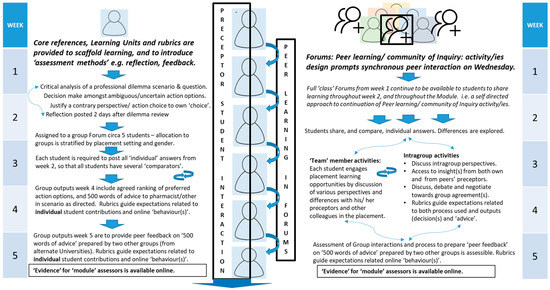
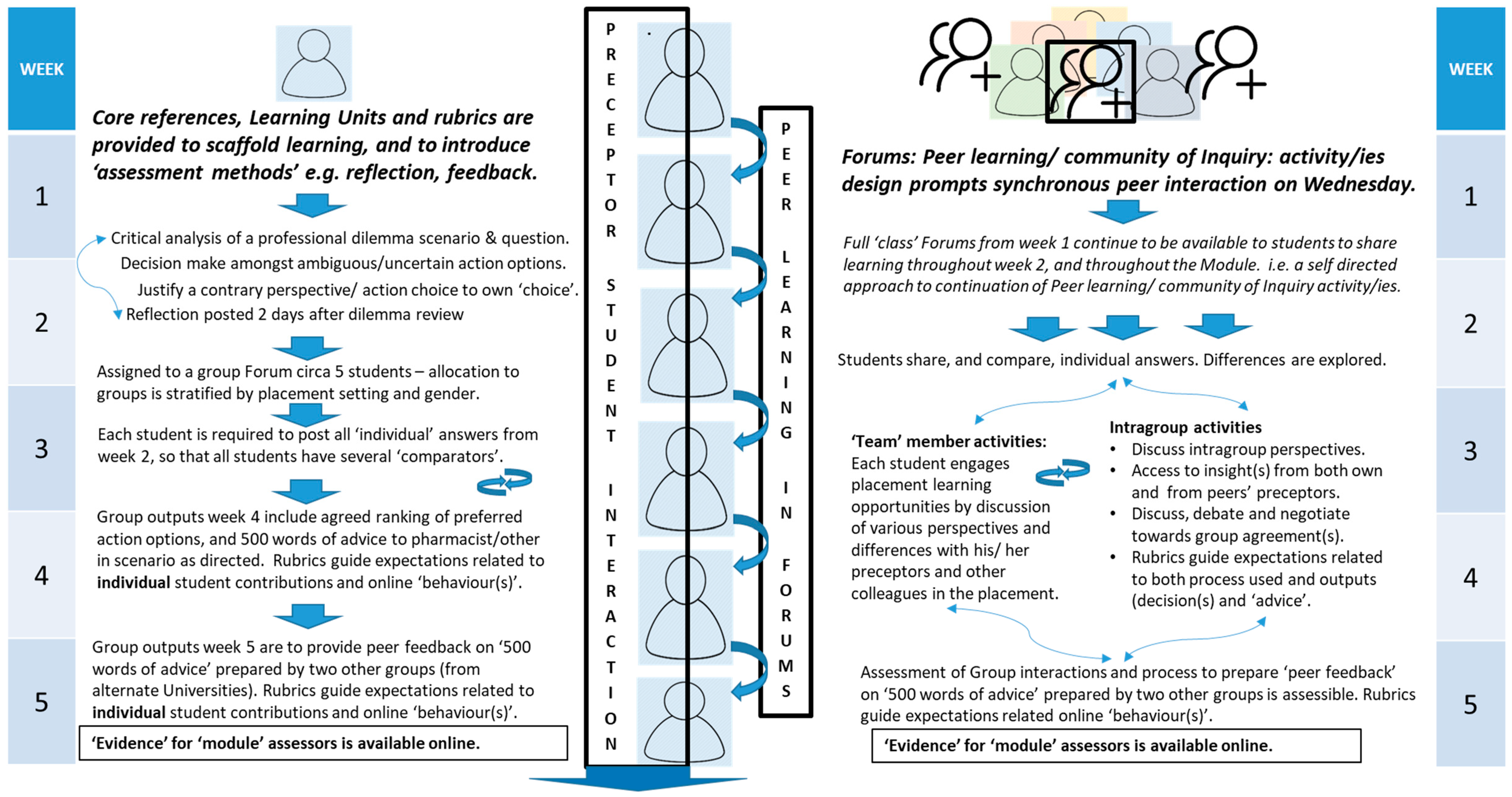
An overview of the assessment design, and its alignment with content, activities and the placement, is provided in Figure 2.
Figure 2.
Student learning process aligned with online modules and Assessment of, for and as learning. * Assessment of (to demonstrate achievement), for (to provide feedback by e.g., self or peer assessment against comparators) and as learning wherein students self-regulate) [31].
3. Implementation Phase
The curriculum design for modules for Year 4 were progressed in terms of:
3.1. Module Links to CCF
- The WG reviewed behaviours listed in the three Domains in the CCF and recommended that 51 behaviours be included (Appendix A, Table A1).
- Each module was linked to a number of CCF competencies and behaviours relevant to the range of placement types possible in Year 4 (Appendix A, Table A1).
- These behaviours guided the development of LOs for each module.
3.2. Module Learning Outcomes (LOs)
- Module learning outcomes were devised based on covering the cognitive (knowledge, comprehension, application, analysis, synthesis), affective, and psychomotor domains relevant to a student in Ireland. [42]
- Eight LOs were agreed for each module, of which three LOs were common across each module—i.e., (i) Participate in accordance with the behaviours in domain [x] of the CCF; (ii) Integrate knowledge and skills to ensure safe and effective practice; and (iii) Demonstrate engagement in reflective practice and continuing professional development.
3.3. Approaches to Assessment
- Each module included one case-based assessment, to assist in achieving the LOs, that requires (i) Individual and group work, and (ii) self- and peer assessment (Figure 2).
3.4. Approaches to Teaching and Learning
- Student workload was determined to be ten hours per week on structured learning (directed learning (DL)) activities, and 10 h per week on personal learning (self-directed learning (SDL)) activities.
- 30 h per week were assigned to placement related activity.
- Reference to DL included provision of nine 20 min interactive vodcasts/Learning Units (LUs) and two ‘core references’, that collectively supported achievement of the LOs and completion of assignments in each module.
An outline module descriptor for the first module delivered is provided in Appendix A, Table A2.
3.5. Outputs
- Three 10 ECTS Modules, each of which aligned with 200 to 250 h of student effort, [43] were developed.
- Credits aligned with 10ECTS are divided between individual (50%) and group activities (50%). Nine LUs were developed, and weekly synchronous, online activities which include self-directed learning, individual and group activities are aligned with scheduled time online, between 1:00 p.m. and 5:00 p.m. on Wednesday afternoons.
- Case video (Appendix A, Table A3) is used as a vehicle to pose relevant questions and motivate discussion within groups. Two core references, available to students prior to viewing the video, provide background information for the case.
- All student activities/outputs were collated to the group’s online discussion Forum i.e., all ‘evidence’ is available in the one discussion Forum.
- Detailed rubrics, with a total of 10 criteria, provided guidance to students and to assessors. (See Appendix A, Table A4 for individual activities rubric and Appendix A, Table A5 for group activities rubric).
- A student guidance booklet and a module co-ordinator information booklet were developed.
- Weekly announcements, reminding students of activities and related expectations of them during that week, were prepared.
- A weekly schedule, of student learning and assessment, is provided in Appendix A, Table A6.
The module was delivered to students from all three HEIs on time, and all activities were completed as required. LUs and core references were accessed by all students, averages grades were comparable across the HEIs, and were in line with what would be expected at Year 4 of the Bachelor’s Degree. The range of marks awarded to students was acceptably in line with institutional norms.
4. Review Phase
Following the implementation phase, a review of the initial iteration of the Year 4 programme was undertaken. Arising from this, various challenges, learnings, and recommendations emerged as follows.
4.1. Challenges
The technology raised challenges regarding risks of plagiarism and impersonation. While efforts to manage this risk included the use of detailed rubrics, the expectation that students make multiple contributions to module discussion forums and that rubrics allow the alignment of grades to meaningful contributions in group discussions, there remained some risk of online impersonation and/or plagiarism.
Incorporation of online groups included the need for assurance that activities occur in a timely fashion. Accordingly, the design process must pay particular attention to guidelines that prompt timely engagement by all group members, so that those engaging in the early stages do not become despondent with the online teamwork.
Allocation of 50% of module marks to the individual component, which restricted students to a 500 words submission, required students to accommodate a significant change in their usual approach to such assignments. This limited word count aligned with the experiential nature of placements, wherein patient notes and recordings of events must be complete yet cogent and concise.
The requirement that students had to be online synchronously on Wednesdays was queried by various parties including preceptors wanting students to engage in other placement activities occurring at that time. However, the realization that one late or non-engaging student can impact on their entire group’s performance, combined with the stipulation by APPEL that there be must be regular synchronous online activity, generally overcame this difficulty.
4.2. Learnings
Concerns raised by academic colleagues across each HEI, that there would be no summative examination and that group work could lead to grade inflation and/or poor grade differentiation, did not materialise as the mean and distribution of grades across each module were within institutional norms.
Rubrics, collaboratively prepared by the module leads in each HEI, motivated detailed planning regarding grading expectations and supported consistency in approach to subsequent module development—i.e., the rubric format remained constant across modules—and serendipitously much of the rubric descriptors required little amendment for subsequent modules (Appendix A, Table A4 and Table A5).
Assessment load for assessors for the first module is estimated at 30 to 40 min per student. This estimation includes two face-to-face meetings involving the module leads from each HEI for the purpose of quality assurance within the module whereby the leads collectively reviewed a sample of individual and group work, prior to grading and discussed the approach to grading. Notwithstanding that streamlining of the administrative elements may reduce time required in future cycles, this time allocation is considered to be acceptable for a 10 ECTS module in Year 4.
While the use of a shared VLE whose management was outsourced externally required advance agreement across the three HEIs regarding content and process, and restricted the freedom of leads to change material, this ensured a common template and structure for students across each HEI.
4.3. Recommendations for Future Work
Staff development should be prioritized in a number of areas including (i) moderating and grading online forums, (ii) development of rubrics, and (iii) development of reflective writing skills in students.
The collaborative approach of the working group should be explored as a potential framework for development of cross-institutional curriculums.
5. Discussion and Conclusions
The aim of this case report was to detail the process by which HEIs in Ireland collaborated to design a common curriculum, integrated both within and across HEIs, for delivery to students while undertaking placements in Year 4 and to consider the associated challenges faced by educators, students, preceptors, and other stakeholders.
While the curriculum design process was informed by a number of important interrelationships (Figure 1) and APPEL requirements, the need for it to be student-centered and outcomes-focused [8,9,10], both from experiential learning perspectives (learning by doing while on placement [15,16,17]), and with respect to activities and assessment were key determinants. The student view was sought during development, when students attended the face-to-face pre-placement day and during delivery of the first module. The approach was organic in that changes were made as required to take account of particular situations that presented for either individual students or the wider student cohort—e.g., when students requested a later submission time for one assignment to accommodate commuting time from their training establishments. Themes for case scenarios in the three online modules (unlicensed medicines usage, interpersonal relationships and pharmacoeconomic assessment) reflected issues relevant to the profession as a whole, thereby exposing students to a range of dilemmas typically faced in pharmacy practice. As allocation to groups was stratified by training establishment and by gender, groupwork enabled learning from (i) peers in different practice contexts, (ii) collective engagement with a range of preceptors in their role as ‘experts’, and (iii) interaction with others in the training establishment [15,16,17] and Figure 2. Constructivism, both individual and social, is the key learning theory used [15,26,27,31,32,33]. A guided approach to reflective writing was provided, using both LUs and the rubric to directly support students’ ability to engage with the four levels of written reflection [24,25]. By revisiting their own initial response, each student was encouraged to reflect on learning from ‘practice’. Group work activity facilitated further expansion of the range of perspectives that could support resolution of the dilemma(s) presented in the relevant scenario.
Integration of learning with the assessment design was achieved by designing activities to act as catalysts for learning from module content and from interaction with the placement, and by setting up and managing the learning environment in a manner that supported students through activities in a specific sequence (Appendix A, Table A6) [11,12,13]. Student completion of activities provided evidence of ‘achievement’ that could be objectively assessed. Design of assessment that is ‘of’, ‘for’, and ‘as’ learning reduces assessment load for students [31]. Detailed rubrics were provided to students at the beginning of the module thereby clarifying expectations and supporting learning [14]. When assessing student work, each module lead ‘benchmarked’ submissions against the rubric, thereby enabling student self-assessment prior to engaging in assignments for subsequent modules [39].
Developmental approaches to reasoning and decision-making [18,19,20,21,22,23]—namely the incorporation of logic or relevant decision-making frameworks, role-play, and peer interaction [18,34,35]—were a central component of the curriculum design. The LUs added to the knowledge accrued in Years 1–3 of the programme. These also emphasised decision-making frameworks (Appendix A, Table A2), and the requirement that each student, first independently, identify ethical concepts in the dilemma and justify what action should be taken, introduced critical and independent thinking/individual constructivism, logic, and role-play to the process (Appendix A, Table A3 and Table A6) [35]. Role-play, or the taking account of the perspectives of others, was achieved when students (i) individually completed the ranking of ‘less than ideal’ action options and (ii) explained how a pharmacist might try to justify the action options that the student chose as least preferred.
Having committed to individual choices regarding rating and ranking of action options offered, students had to agree a group decision regarding the ranking process within a defined time-frame (Figure 2). This inevitably involved negotiation and active discussion, debate and persuasion as the group sought to complete the task by the deadline imposed. The debate also demanded deeper reflection on the student’s individual decisions made prior to discussion with their peers. Peer interaction was stimulated by appropriate sequencing of the order in which students completed activities [20,21,22,23,34,35]. Group composition was changed for subsequent modules, thereby forcing repeated exposure to ‘new’ perspectives and approaches to decision-making.
The design enabled and stimulated students to participate as online ‘Communities of Inquiry’ while collectively sharing the expertise available from preceptors practising in a range of contexts. The requirement to collaboratively prepare 500 words of advice promoted and facilitated student engagement [36,37,38] with the range of experts (e.g., preceptors) accessible during their placements. The provision of peer feedback on ‘advice’ prepared by groups from other HEIs required each member to engage with perspectives of their ‘own’ peers who had studied in different contexts, while also developing the ability to review and feedback on colleagues’ work. Students become familiar with the learning and assessment process in this first module and, by repeating the process in subsequent modules, students have opportunity to adapt this ‘expertise’ so that decision-making through ambiguity becomes tacit, or acquired at a ‘bedrock’ level [18,19,20,21,22,23].
The WG used the potential arising from the online learning environment [39] for additional benefit such as to (i) identify whether students had successfully engaged with all online activity ‘types’ during orientation week and provide struggling students with support prior to the start of the module; (ii) identify that all students completed required individual assignments during the defined timeframe(s), especially during week 2; (iii) provide evidence of, or lack thereof, professionalism in forums; and (iv) accommodate different learner styles by means of incorporating both synchronous and asynchronous interaction [40]. Benchmarking against a detailed rubric enabled feedback from module leads in a timely fashion, while rubric descriptors for higher levels than achieved by students (Appendix A, Table A4 and Table A5) provided guidance to students as they self-assessed how they might improve performance in subsequent modules.
As all contributions were recorded online, they collectively provided evidence of the standard to which students had engaged in the process in a format that accommodated individual HEI rules and regulations related to examinations, and decisions related to student progression and awards.
In Section 4, the outcome from the review undertaken after the first iteration of the programme was detailed.
In conclusion, while the overall rollout was successful, it was not without its challenges and there are important learnings that will be taken on board both for future iterations of Year 4 and for the delivery of an analogous education programme for Year 5. Furthermore, they offer valuable insights for those who may be contemplating the development of similar programmes to be delivered in the practice setting in a related educational context.
Author Contributions
All authors contributed to the design and development of the co-delivered modules outlined in this case report, and all authors contributed to and reviewed the manuscript for submission.
Funding
This research received no external funding.
Acknowledgments
The Board of APPEL, who provided guiding principles for the design group and approved the design proposed; Instructional designer Jonathan Walsh; Experts external to the HEIs who supported module coordinators with case development and provided learning units in support of cases for each module; module co-ordinators and practice educators from the three HEIs; The APPEL Project manager Michael Creswell, Practice Educator Ann Teresa Morgan, and wider team who provided technical and other support to all involved in the development and delivery of these modules; and academic and administrative staff in the HEIs who supportive adaptation of existing processes and ‘rules’ to accommodate the use of online processes for learning and assessment in this manner.
Conflicts of Interest
The authors declare no conflict of interest.
Appendix A
Table A1.
CCF Behaviours aligned with Year 4 online modules [5].
Table A2.
Module descriptor extracts Professional practice.
Table A3.
Case study development guidelines (First module delivered 2018).
The components are a professional-specific scenario written as a script for recording of the video, a question posed to students to prompt critical review of the scenario and 12 action options that might be taken immediately after encountering the scenario.
The case aligns with the Module LOs and incorporates material covered in the module.
(a). Year 4 Professional Practice Module
Box A1. Case study—narration for videoclip.
Narrator to introduce as follows:
It is after 5 p.m. in a large teaching Children’s Hospital in Ireland and Dr. Claire Browne, Consultant Paediatrician in the hospital was hoping to catch someone in its pharmacy department before it closed. She has a drug query relating to a young child on the neurology ward that she would like to discuss and was hoping to catch Sean, the pharmacist on that ward before he left for the day.
Dialogue:
Claire: Hi Sean, I was down at the pharmacy hoping to catch you before you headed off. I see you’re ready to leave but any chance I could have a quick word?
Sean: No problem Claire, but I need to pick up Killian from the crèche by six so it will have to be quick.
Claire: Great Sean, are you familiar with Eve Brennan on the neurology ward with you is on IV sodium valproate because of her swallowing difficulties.
Sean: Yes, I am.
Claire: We need to get her onto another formulation as soon as possible. Anything by mouth is not an option.
Sean: I understand that.
Claire: I was talking to a colleague in my former hospital in London and he suggested sodium valproate suppositories. He mentioned a 300 mg strength suppository. Do you know anything about them?
Sean: I’ve heard about them but never come across them in practice. There is no authorised sodium valproate suppository available in Ireland as far as I know so it won’t be on the hospital formulary.
Claire: Does that mean we can’t use it?
Sean: Not necessarily
Claire: Even though I’m back from London six months, this whole exempt medicines situation here has me mightily confused.
Sean (smiling): It’s not that bad really
Claire (cheerfully): Isn’t it? Any chance you could investigate whether the suppositories are an option for Eve? Until, we get her off IV valproate and stabilised on another formulation, we can’t start planning for her discharge.
Sean: I know can you leave it with me. It will probably be a day or two.
Claire: Thanks Sean, that would be great.
Sean: Fine so. I will need to have a look at her kardex to get more details but leave it with me.
Claire: Perfect, let me know if you need to clarify anything
Sean: Will do, bye now
MPharm Year 4 PP module case development–video script 180524 ML/LS/CR
Claire: Bye now, blame me if the crèche staff give out to you!
Sean and Claire depart in opposite directions down the corridor.
The camera follows Sean who thinks aloud as follows:
This is an interesting one. We need to get Eve stabilised on another valproate formulation so that the team can try and get her home. I haven’t come across these suppositories before.
There’s lots of issues to be investigated.
It took a while to get her seizures controlled so looking at an alternative drug isn’t an option.
“I wonder if sodium valproate suppositories are authorised in any other EU country or will it be a “specials” order
Sometimes, these exempt medicines can be very expensive so that is something else to be considered. If Eve is discharged back home on these suppositories, then we will need to investigate whether she will be able to get them dispensed under one of the drug reimbursement schemes from her local pharmacy.
And that just for starters……busy day ahead tomorrow!
Narrator says? … If you were Sean, what would you do next?
(b) First Module Professional Practice Case Study Video Question Posed
Identify the main professional and/or ethical concepts, principles in the Code of Conduct and/or relevant legislation that you think might be at risk in this scenario, list what stakeholders you think need to be contacted, and then recommend, with justifications, what the pharmacist should do next i.e., directly after this scenario occurs (wordcount limit 250 words).
(c) Action options that students were required to rate and rank online in 2018
Figure A1.
Range of 12 action options, related to the Case scenario (Box A1), provided to students.
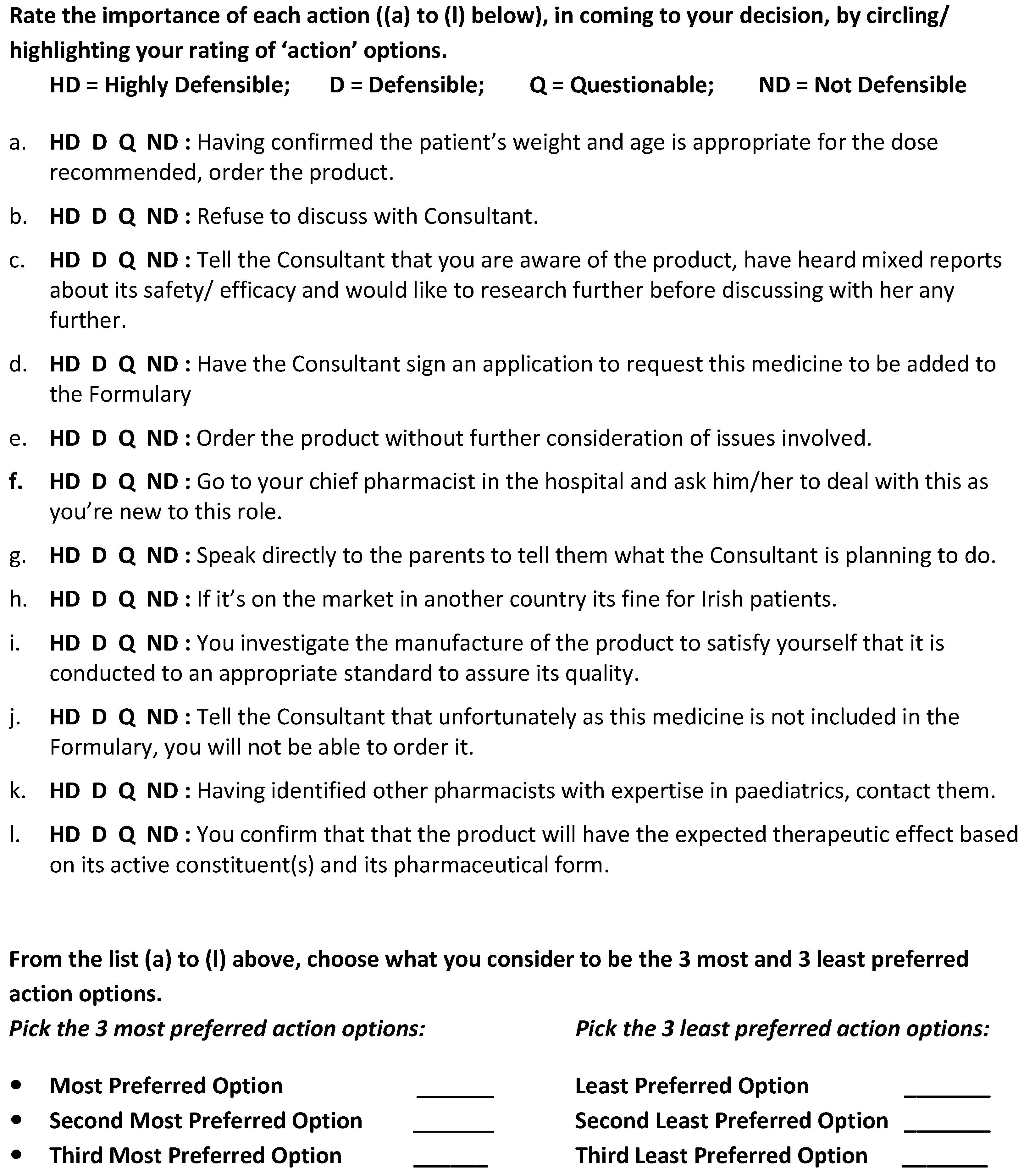
Table A4.
Professional practice module (individual work) rubric.
Table A5.
Professional practice module (group work) rubric.
Table A6.
Summary of student learning and assessment activities (first module).
References
- Pharmacy Act. 2007. Available online: http://www.oireachtas.ie/documents/bills28/acts/2007/a2007.pdf (accessed on 20 April 2019).
- Pharmaceutical Society of Ireland (PSI). Interim Accreditation Standards for the Level 9 Master’s Degree Awarded on the Successful Completion of The National Pharmacy Internship Programme. 2010. Available online: https://www.thepsi.ie/Libraries/Consultations/Interim_Accreditation_Standards.sflb.ashx (accessed on 24 April 2019).
- Wilson, K.; Langley, C. Pharmacy Education and Accreditation Reviews (PEARs) Project. Report Commissioned by the Pharmaceutical Society of Ireland. 2010. Available online: https://www.thepsi.ie/Libraries/Education/PEARs_Project_Report.sflb.ashx (accessed on 20 April 2019).
- Pharmaceutical Society of Ireland (PSI). Accreditation Standards for the Five-Year Fully Integrated Master’s Degree Programmes in Pharmacy. 2014. Available online: https://www.thepsi.ie/Libraries/Education/5Yr_Prog_Accreditation_Standards_FINALApproved_03102014.sflb.ashx (accessed on 21 April 2019).
- Pharmaceutical Society of Ireland (PSI). Core Competency Framework for Pharmacists. Available online: https://www.thepsi.ie/gns/Pharmacy_Practice/core-competency-framework.aspx (accessed on 21 April 2019).
- Pharmaceutical Society of Ireland (Education and Training) (Integrated Course) Rules 2014 [S.I. No. 377 of 2014]. Available online: https://www.thepsi.ie/Libraries/Legislation/SI_2014_0377_PSI_Education_and_Training_Integrated_Course_Rules_2014.sflb.ashx (accessed on 21 April 2019).
- Pharmaceutical Society of Ireland (Education and Training) (Integrated Course) Rules 2017 [S.I. No. 97 of 2017]. Available online: http://www.irishstatutebook.ie/eli/2017/si/97/made/en/pdf (accessed on 21 April 2019).
- European Commission (European Credit Transfer and Accumulation System (ECTS)). Available online: https://ec.europa.eu/education/resources-and-tools/european-credit-transfer-and-accumulation-system-ects_en (accessed on 22 April 2019).
- General Level Framework, a Framework for Pharmacist Development in General Pharmacy Practice, 2nd ed.; Competency Development and Evaluation Group (CoDEG): London, UK, 2007; Available online: http://www.codeg.org/fileadmin/codeg/pdf/glf/GLF_October_2007_Edition.pdf (accessed on 7 May 2019).
- Hussey, T.; Smith, P. The uses of learning outcomes. Teach. High. Educ. 2003, 13, 107–115. [Google Scholar] [CrossRef] [Scilit]
- Treleaven, L.; Voola, R. Integrating the development of graduate attributes through constructive alignment. J. Mark. Educ. 2009, 30, 160–173. [Google Scholar] [CrossRef] [Scilit]
- Biggs, J. Constructing learning by aligning teaching: Constructive alignment. In Teaching for Quality Learning at University, 2nd ed.; SRHE and Open University Press: Berkshire, UK, 2004; pp. 11–33. [Google Scholar]
- Huball, H.; Burt, H. An integrated approach to developing and implementing learning centred curricula. Intern. J. Acad. Dev. 2004, 1, 51–65. [Google Scholar] [CrossRef] [Scilit]
- Malini Reddy, Y.; Andrade, H. A review of rubric use in higher education. Assess. Eval. High. Educ. 2010, 35, 435–448. [Google Scholar] [CrossRef] [Scilit]
- Kolb, D.A. Experiential Learning: Experience as the Source of Learning and Development, 2nd ed.; Pearson Education Inc.: Upper Saddle River, NJ, USA, 2015. [Google Scholar]
- Gibbs, G. Learning by Doing: A Guide to Teaching and Learning Methods; Oxford Polytechnic: Oxford, UK, 1988. [Google Scholar]
- Yardley, S.; Teunissen, P.W.; Dornan, T. Experiential learning: Transforming theory into practice. Med. Teach. 2012, 34, 161–164. [Google Scholar] [CrossRef] [Scilit] [PubMed]
- Rest, J.; Narvaez, D.; Bebeau, M.J.; Thoma, S.J. Postconventional Moral Thinking: A Neo-Kohlbergian Approach; Lawrence Erlbaum Associates: Mahwah, NJ, USA, 1999. [Google Scholar]
- Thoma, S.J.; Bebeau, M.J.; Bolland, A. The role of moral judgment in context—Specific professional decision making. In Getting Involved: Global Citizenship Development and Sources of Moral Values; Sense Publishers: Amsterdam, The Netherlands, 2008; pp. 147–160. [Google Scholar]
- Bebeau, M.J.; Thoma, S.J. “Intermediate” concepts and the connection to moral education. Educ. Psychol. Rev. 1999, 11, 343–360. [Google Scholar] [CrossRef] [Scilit]
- Roche, C.; Thoma, S.J.; Grimes, T.; Radomski, M. Promoting peer debate in pursuit of moral reasoning competencies development: Spotlight on educational intervention design. Innov. Pharm. 2017, 8. [Google Scholar] [CrossRef] [Scilit]
- Roche, C.; Thoma, S.J. Insights from the defining issues test on moral reasoning competencies Development in community pharmacists. Am. J. Pharm. Educ. 2017, 81. [Google Scholar] [CrossRef] [Scilit]
- Roche, C.; Thoma, S.; Wingfield, J. From workshop to E-Learning: Using technology-enhanced “Intermediate Concept Measures” as a framework for pharmacy ethics education and assessment. Pharmacy 2014, 2, 137–160. [Google Scholar] [CrossRef] [Scilit]
- Hatton, N.; Smith, D. Reflection in teacher education: Towards definition and implementation. Teach. Teach. Educ. 1995, 11, 33–49. [Google Scholar] [CrossRef] [Scilit]
- Moon, J. Reflection in Learning and Professional Development; Kogan: Lonfon, UK, 1999. [Google Scholar]
- Schon, D.A. Educating the Reflective Practitioner: Towards a New Design for Teaching and Learning in the Professions; Jossey-Bass: San Fransisco, CA, USA, 1991. [Google Scholar]
- Hew, K.F.; Cheung, W.S. Student facilitators’ habits of mind and their influences on higher-level knowledge construction occurrences in online discussions: A case study. Innov. Educ. Teach. Int. 2011, 48, 275–285. [Google Scholar] [CrossRef] [Scilit]
- Hrastinski, S. A theory of online learning as online participation. Comput. Educ. 2009, 52, 78–82. [Google Scholar] [CrossRef] [Scilit]
- Palloff, R.M.; Pratt, K. Assessing the Online Learner: Resources and Strategies for Faculty; Jossey Bass: San Fransisco, CA, USA, 2009. [Google Scholar]
- Sthapornnanon, N.; Sakulbumrungsil, R.; Theeraroungchaisri, A.; Watcharadamrongkun, S. Social constructivist learning environment in an online professional practice course. Am. J. Pharm. Educ. 2009, 73. [Google Scholar] [CrossRef] [Scilit] [PubMed]
- National Forum for the Enhancement of Teaching and Learning in Higher Education. Assessment of/for/as Learning: Principles. Dublin, Ireland, 2016. Available online: https://www.teachingandlearning.ie/resource-hub/student-success/assessment-of-for-as-learning/#!/Principles (accessed on 28 April 2018).
- Amin, Z.; Boulet, J.R.; Cook, D.A.; Ellaway, R.; Fahal, A.; Kneebone, R.; Maley, M.; Ostergaard, D.; Ponnamperuma, G.; Wearn, A.; et al. Technology-enabled assessment of health professions education: Consensus statements from the Ottawa 2010 conference. Med. Teach. 2011, 33, 364–369. [Google Scholar] [CrossRef] [Scilit] [PubMed]
- Norcini, J.; Anderson, B.; Bollela, V.; Burch, V.; Costa, M.J.; Duvivier, R.; Galbraith, R.; Hays, R.; Kent, A.; Perrott, V.; et al. Criteria for good assessment: Consensus statement and recommendations from the Ottawa 2010 Conference. Med. Teach. 2011, 33, 206–214. [Google Scholar] [CrossRef] [Scilit] [PubMed]
- Schlaefli, A.; Rest, J.R.; Thoma, S.J. Does moral education improve moral judgment? A meta-analysis of intervention studies using the Defining Issues Test. Rev. Educ. Res. 1985, 55, 319–352. [Google Scholar] [CrossRef]
- Penn, W.Y. Teaching ethics—A direct approach. J. Moral Educ. 1990, 19, 124–138. [Google Scholar] [CrossRef] [Scilit]
- Garrison, R.G.; Arbaugh, J.B. Researching the community of inquiry framework: Review, issues, and future directions. Internet High. Educ. 2007, 10, 157–172. [Google Scholar] [CrossRef] [Scilit]
- Carini, R.M.; Kuh, G.D.; Klein, S.P. Student engagement and student learning: Testing the linkages. Res. High. Educ. 2006, 47, 1–32. [Google Scholar] [CrossRef] [Scilit]
- Zhao, C.M.; Kuh, G.D. Adding value: Learning communities and student engagement. Res. High. Educ. 2004, 45, 115–138. [Google Scholar] [CrossRef] [Scilit]
- Price, M.; Handley, K.; Millar, J.; O’Donovan, B. Feedback: All that effort, but what is the effect? Assess Eval. High. Educ. 2010, 35, 277–289. [Google Scholar] [CrossRef] [Scilit]
- Vai, M.; Sosulski, K. Essentials of Online Course Design: A Standards Based Guide; Routledge: New York, NY, USA, 2011. [Google Scholar]
- Ellaway, R.; Coral, J.; Topps, D.; Topps, M. Exploring digital professionalism. Med. Teach. 2015, 37, 844–849. [Google Scholar] [CrossRef] [Scilit] [PubMed]
- Kennedy, D.; Hyland, A.; Ryan, N. Implementing Bologna in Your Institution. Writing and Using Learning Outcomes: A Practical Guide. 2007. Available online: https://www.researchgate.net/publication/238495834_Writing_and_Using_Learning_Outcomes_A_Practical_Guide (accessed on 28 April 2019).
- Quality and Qualifications Ireland (QQI). Irish National Framework of Qualifications (NFQ). Dublin, Ireland, 2012. Available online: https://www.qqi.ie/Articles/Pages/National-Framework-of-Qualifications-%28NFQ%29.aspx (accessed on 28 April 2019).

© 2019 by the authors. Licensee MDPI, Basel, Switzerland. This article is an open access article distributed under the terms and conditions of the Creative Commons Attribution (CC BY) license (http://creativecommons.org/licenses/by/4.0/).