
From Discourse to Practice—Facilitating Factors and Barriers to the Implementation of Pharmaceutical Care in Primary Health Care: A Qualitative Study
 , , , and
Abstract
1. Introduction
2. Methods
2.1. Study Design
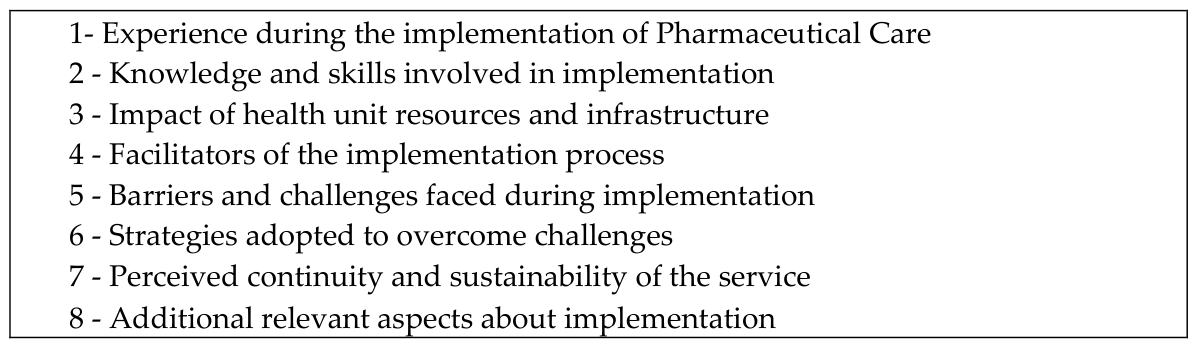
2.2. Development of the Interview Script
2.3. Interviews
2.4. Data Analysis
2.5. Ethical Aspects
3. Results
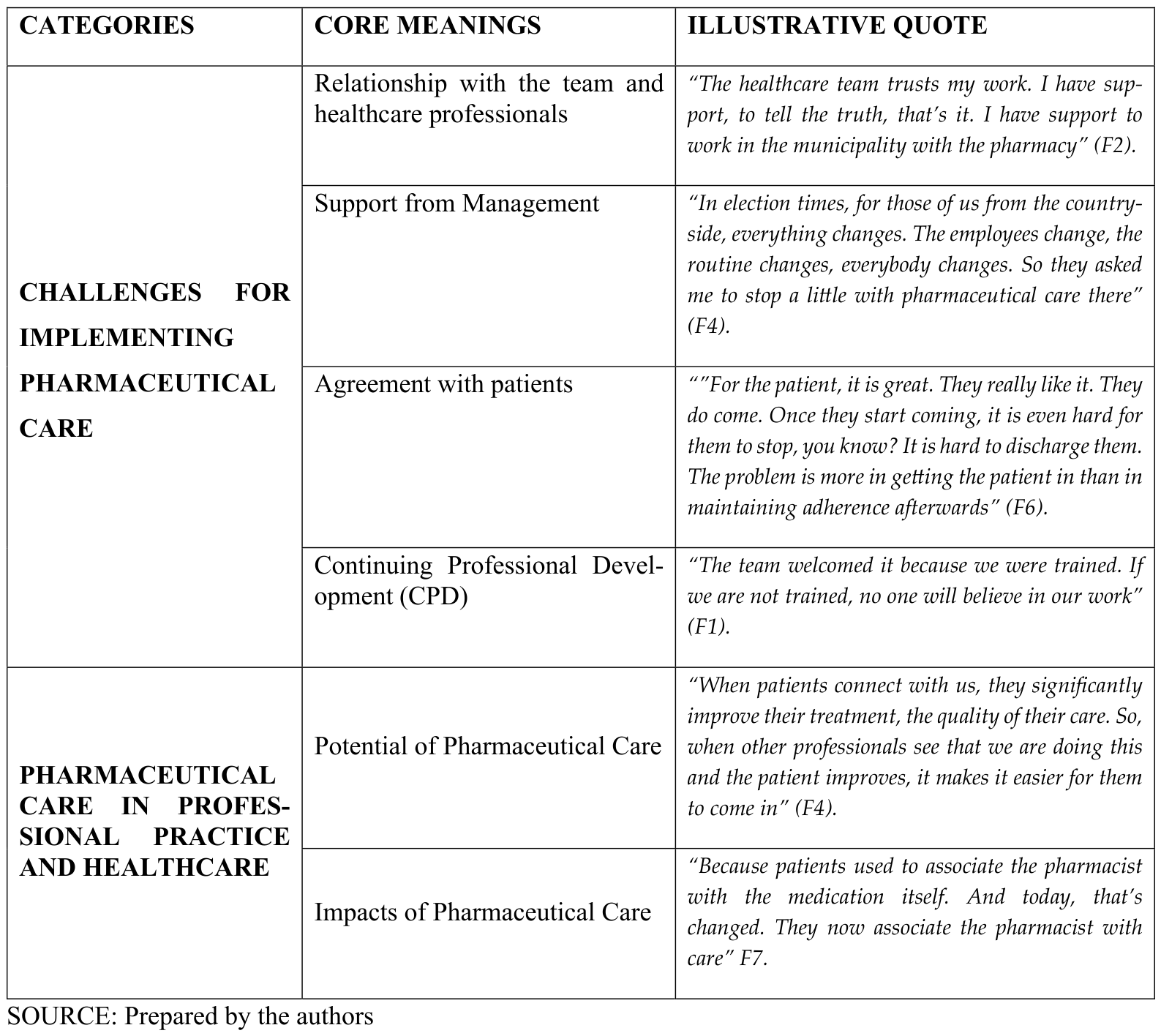
3.1. Challenges for Implementing Pharmaceutical Care
“The healthcare team trusts my work. I have support, to tell the truth, that’s it. I have support to work in the municipality with the pharmacy. Support as a professional. The issue of management support, this assistance, this support from the multidisciplinary team, they believe in the service, they have this trust in referring patients to me, the patients do too. Because the population has this access to me, as a pharmacist. So, that helps a lot too. This patient trust. The patient needs to have this trust in the professional, this credibility.”(F2)
“And I also emphasize that if there isn’t good communication with the team, the service doesn’t work. It doesn’t work because they don’t know you’re there, they don’t know what your service is. So, if you don’t have them present reinforcing, showing what you do, showing what you did it for, you will become invisible.”(F1)
“[I] work in two units, the doctor has a pre-set schedule, so while he was seeing patients, I wasn’t there. Often, to meet with the doctor, I had to wait until he was off duty to talk to him about the patient. There was a resolution, the doctor saw him, but I wanted feedback, you know? I didn’t get that feedback. I had to go to the doctor to find out.”(F4)
“The nurses were the ones who referred patients… The nutritionist never referred patients, nor did the doctor. So, the doctor supported me by running the tests, right? Sometimes, I asked him about some things, and seeing patients to adjust their doses. But then, I think it’s a lack of understanding of the importance of the service, right? By the professional, by the nutritionist, for example. Because I’m not going to say that the psychologist, the other professionals, sometimes they don’t know much about it, right? They don’t really understand the severity of diabetes. But the nutritionist understands… And they need a specific workload for these appointments, right?”(F5)
“Regarding management, I had a lot of support. They have great confidence in my work. […] But when I received the notice that I could no longer perform capillary blood glucose testing due to the unsafe conditions, I was disappointed.”(F2)
“Today, for example, we have an opening for a pharmacist, right? But they’re hired through a selection process without any criteria. So, a pharmacist arrives who’s never seen a patient before, doesn’t know what clinical pharmacy is. Unfortunately, they end up staying at the unit doing nothing. This leads to questions like, ‘What is the pharmacist doing here? What is the pharmacist’s job? Why is the pharmacist at the unit?’”(F6)
“There have even been some suggestions for us to provide services in other locations, but I think it disrupts the relationship, and these are usually locations that aren’t under the jurisdiction of the city, so how can I bring a computer there that has access to patient records? So, providing services outside the FHS (Family Health Strategy), I think, completely undermines the multidisciplinary team’s services; it becomes a specialized service, and that’s not our goal.”(F7)
“I had to organize my work schedule, my routine. Because when it was time to see patients, I had to stop doing some things. I had to take work home a few times.”(F8)
“With the change of Mayor, I don’t know how it will continue. Because you don’t know who will be the health secretary.”(F4)
“At first, I don’t think they really understood where this was going, you know? … I had a patient, for example, who took six meetings to understand why he had to check his glucose, capillary blood glucose, every day, you know? Just like I had a patient who understood everything by the second meeting, and she was so interesting that she summoned the courage to discuss it with the doctor that the doctor changed her entire treatment. And it’s what I told you, each patient takes time to realize and understand.”(F8)
“If I hadn’t had this time, I might not have been so successful, because we need to study. I didn’t have the training to do this, nor the technical knowledge to do it. For a long time, I was deprived of this knowledge of medication. To perform any type of intervention, you have to understand the patient’s clinical condition a little better. So, I studied to be able to perform any type of intervention.”(F4)
3.2. Pharmaceutical Care in Professional Practice and Healthcare
- Qualified care and a patient-centered approach:
“I believe that this clinical pharmacy work was created to focus on the patient, right? And also to improve the patient’s quality of life, both in prevention and treatment. Primary health care units are already overwhelmed with patient numbers, so we need to have this patient-centered approach… So I think this approach was missing, the presence of pharmacists was missing in primary care.”(F1)
- Strengthening PHC and shared care:
“When patients connect with us, they significantly improve their treatment, the quality of their care. So, when other professionals see that we are doing this and the patient improves, it makes it easier for them to come in. And often, when we provide guidance here in the pharmacy, we don’t follow up with the patient, and then they return to make the same mistake. And when you do it within primary care, the staff see your knowledge, your capabilities, and they start wanting to even refer patients to you.”(F4)
- Moving beyond the biomedical model and strengthening the pharmacist’s clinical role:
“Although we’re still in our infancy, we’ll continue… until we change the idea of centralizing everything around the doctor, things won’t move forward. Primary care is about caring, right? It’s about prevention. So, the pharmacist would be essential. It’s not a matter of choice, it’s a matter of being essential.”(F6)
- Production of health indicators and outcomes for municipalities
“We’ve had very good responses, very good results. We had glycated hemoglobin levels go from 13.8% to 8%, 13.6% to 7.8%, so this shows that it was effective, it had good results, favorable results.”(F2)
- Personal and professional satisfaction:
“So, it was really good for both of us, you know? I changed as a professional, and she changed as a patient. I was important to her, she was important to me.”(F8)
- Recognition of the pharmacist by patients
“Because patients used to associate the pharmacist with the medication itself. And today, that’s changed. They now associate the pharmacist with care. I think it’s even interesting. I overheard one day. I was leaving the clinic downtown and I heard two patients talking at the reception desk. There was a patient I had just seen, and this patient said to another: “But doesn’t your clinic have a pharmacist? Because here, the pharmacist takes care of us diabetics.” I thought her comment was so beautiful. So I think she stopped associating the pharmacist with the medicine, with the medication, and started associating the pharmacist with care.”(F7)
- Transformation of professional practice and continuity of the bond with the patient
“There are people who have never been to the clinical pharmacy and say, ‘I wonder if she’ll give me medicine?’ And they immediately think that, right? And when they leave the pharmacy appointment there, they truly understand the importance of a clinical pharmacist and start asking for it […] So, when they come in and see me, wow, it’s nothing but praise. And being able to help, I’m so happy, right? Being able to help the patient.”(F3)
4. Discussion
5. Conclusions
Author Contributions
Funding
Institutional Review Board Statement
Informed Consent Statement
Data Availability Statement
Acknowledgments
Conflicts of Interest
References
- Michaels, N.M.; Jenkins, G.F.; Pruss, D.L.; Heidrick, J.E.; Ferreri, S.P. Retrospective analysis of community pharmacists’ recommendations in the North Carolina Medicaid medication therapy management program. J. Am. Pharm. Assoc. 2010, 50, 347–353. [Google Scholar] [CrossRef]
- Helling, D.K.; Johnson, S.G. Defining and advancing ambulatory care pharmacy practice: It is time to lengthen our stride. Am. J. Health-Syst. Pharm. 2014, 71, 1348–1356. [Google Scholar] [CrossRef] [PubMed]
- Gonçalves, A.C.O.; Cazarim, M.d.S.; Sanches, C.; Pereira, L.R.L.; Camargos, A.M.T.; Aquino, J.A.; Baldoni, A.O. Cost-effectiveness analysis of a pharmacotherapeutic empowerment strategy for patients with type 2 diabetes mellitus. BMJ Open Diabetes Res. Care 2019, 7, e000647. [Google Scholar] [CrossRef]
- King, C.; King, B.; Nagaraj, T.; Gothard, D. Cost-Effectiveness Analysis of Pharmacist-Led Diabetes Management Across Primary Care Clinics. Innov. Pharm. 2024, 15, 6300. [Google Scholar] [CrossRef]
- Brasil, Lei n° 8.080, de 19 de Setembro de 1990, Diário Oficial da União. 20 September 1990. Available online: https://www.planalto.gov.br/ccivil_03/leis/l8080.htm (accessed on 15 October 2025).
- Brazil, Ministry of Health, Ordinance GM/MS No. 4379 of 14 June 2024, Amends Consolidation Ordinance GM/MS No. 2 of 28 September 2017 to Establish the National Guidelines for Pharmaceutical Care Within the Unified Health System (SUS), Official Gazette of the Union, 17 June 2024; Volume 114, p. 139. Available online: https://bvsms.saude.gov.br/bvs/saudelegis/gm/2024/prt4379_17_06_2024.html (accessed on 17 April 2026).
- Federal Pharmacy Council, Resolution No. 585 of 29 August 2013, Regulates the Clinical Responsibilities of Pharmacists and Provides Other Measures, Brasília, 2013. Available online: https://www.cff.org.br/userfiles/file/resolucoes/585.pdf (accessed on 17 April 2026).
- Arantes, L.J.; Shimizu, H.E.; Merchán-Hamann, E. The benefits and challenges of the Family Health Strategy in Brazilian Primary Health Care: A literature review. Cienc. Saude Coletiva 2016, 21, 1499–1510. [Google Scholar] [CrossRef]
- Brasil, Ministério da Saúde, Portaria GM/MS n° 635, de 22 de Maio de 2023, Institui Incentivo Financeiro Federal para Custeio de Equipes Multiprofissionais na Atenção Primária à Saúde, Diário Oficial da União, 23 May 2023; Volume 97, p. 212. Available online: https://bvsms.saude.gov.br/bvs/saudelegis/gm/2023/prt0635_22_05_2023.html (accessed on 25 July 2025).
- Shoemaker, S.J.; Curran, G.M.; Swan, H.; Teeter, B.S.; Thomas, J. Application of the Consolidated Framework for Implementation Research to community pharmacy: A framework for implementation research on pharmacy services. Res. Soc. Adm. Pharm. 2017, 13, 905–913. [Google Scholar] [CrossRef]
- Altawalbeh, S.M.; Al-Khatib, M.; Almomani, B.A.; Nuseir, K.; Al-Husein, B.A.; Mukattash, T.L. Students’ experiences and attitudes toward a newly developed simulation-based pharmaceutical care clinical rotation: A pre-post study design. Saudi Pharm. J. 2023, 31, 808–814. [Google Scholar] [CrossRef]
- Borges, A.P.d.S.; Guidoni, C.M.; de Freitas, O.; Pereira, L.R.L. Economic evaluation of outpatients with type 2 diabetes mellitus assisted by a pharmaceutical care service. Arq. Bras. Endocrinol. Metabol. 2011, 55, 686–691. [Google Scholar] [CrossRef]
- Correr, C.J.; Otuki, M.F.; Soler, O. Assistência farmacêutica integrada ao processo de cuidado em saúde: Gestão clínica do medicamento. Rev. Pan-Amaz. Saude 2011, 2, 41–49. [Google Scholar] [CrossRef]
- Franco, M.D.C.S.; Jesus, F.M.; Abreu, C.R.C. Papel do farmacêutico no controle glicêmico do paciente diabético. Rev. JRG Estud. Acad. 2020, 3, 636–645. [Google Scholar]
- Wang, W.; Geng, L.; Sun, C.; Li, H.; Wang, J. Efficacy of pharmaceutical care in patients with type 2 diabetes mellitus and hypertension: A randomized controlled trial. Int. J. Clin. Pract. 2022, 2022, 7681404. [Google Scholar] [CrossRef]
- Aquino, J.A.; Baldoni, A.O.; Oliveira, C.D.L.; Cardoso, C.S.; de Figueiredo, R.C.; Sanches, C. Pharmacotherapeutic empowerment and its effectiveness in glycemic control in patients with diabetes mellitus. Diabetes Metab. Syndr. Clin. Res. Rev. 2019, 13, 137–142. [Google Scholar] [CrossRef]
- Cazarim, M.d.S.; de Freitas, O.; Penaforte, T.R.; Achcar, A.; Pereira, L.R.L. Impact assessment of pharmaceutical care in the management of hypertension and coronary risk factors after discharge. PLoS ONE 2016, 11, e0155204. [Google Scholar] [CrossRef]
- Onozato, T.; Cruz, C.F.d.S.; Farre, A.G.M.d.C.; Silvestre, C.C.; Silva, R.d.O.S.; Júnior, G.A.d.S.; de Lyra, D.P. Factors influencing the implementation of clinical pharmacy services for hospitalized patients: A mixed-methods systematic review. Res. Soc. Adm. Pharm. 2020, 16, 437–449. [Google Scholar] [CrossRef] [PubMed]
- Reis, M.L.; Medeiros, M.; Pacheco, L.R.; Caixeta, C.C. Avaliação do trabalho multiprofissional do Núcleo de Apoio à Saúde da Família (NASF). Texto Context.-Enferm. 2016, 25, e2810014. [Google Scholar] [CrossRef]
- Tomassi, M.H.; Ribeiro, E. Conhecimentos e atitudes de farmacêuticos em farmácias e drogarias do Butantã—São Paulo. J. Bas. Appl. Pharm. Sci. 2012, 33, 125–132. [Google Scholar]
- Miccas, F.L.; Batista, S.H.S.d.S. Permanent education in health: A review. Rev. Saude Publica 2014, 48, 170–185. [Google Scholar] [CrossRef]
- Da Silva, L.G.R.; Mendonça, T.S.; Obreli-Neto, P.R.; Pereira, M.L.; Baldoni, A.O. Implementation of pharmaceutical care: Important aspects for a lasting service. Braz. J. Pharm. Sci. 2025, 61, e23856. [Google Scholar] [CrossRef]
- Da Silva, L.G.R. Implementation of Pharmaceutical Care in the Unified Health System: ImplanFarSUS Project. Ph.D. Thesis, Federal University of São João del-Rei, Divinópolis, Brazil, 2025. [Google Scholar]
- Tong, A.; Sainsbury, P.; Craig, J. Consolidated criteria for reporting qualitative research (COREQ): A 32-item checklist for interviews and focus groups. Int. J. Qual. Health Care 2007, 19, 349–357. [Google Scholar] [CrossRef]
- Pope, C.; Mays, N. (Eds.) Pesquisa Qualitativa na Atenção à Saúde, 3rd ed.; Artmed: Porto Alegre, Brazil, 2009. [Google Scholar]
- Brasil, Ofício Circular n° 2/2021/CONEP/SECNS/MS, Orientações para Procedimentos em Pesquisas com Qualquer Etapa em Ambiente Virtual [Internet], Ministério da Saúde, Brasília, 2021. Available online: https://propp.ufu.br/sites/propp.ufu.br/files/media/documento/oficio_circular_n.2_2021_ambiente_virtual.pdf (accessed on 31 March 2021).
- Morse, J.M.; Field, P.A. Qualitative Research Methods for Health Professionals, 2nd ed.; SAGE: Thousand Oaks, CA, USA, 1995. [Google Scholar]
- Bardin, L. Análise de Conteúdo, Edições 70; Almedina Brasil: São Paulo, Brazil, 2016. [Google Scholar]
- Ceccim, R.B. Educação Permanente em Saúde: Desafio Ambicioso e Necessário. Physis 2005, 15, 161–177. [Google Scholar] [CrossRef]
- Salim, A.M.; Elgizoli, B. Exploring self-perception of community pharmacists of their professional identity, capabilities, and role expansion. J. Res. Pharm. Pract. 2016, 5, 116–120. [Google Scholar] [CrossRef]
- Ramos, S.F.; Santos, G.A.D., Jr.; Pereira, A.M.; Dosea, A.S.; Rocha, K.S.S.; Pimentel, D.M.M.; De Lyra, D.P., Jr. Facilitators and strategies to implement clinical pharmacy services in a metropolis in Northeast Brazil: A qualitative approach. BMC Health Serv. Res. 2018, 18, 632. [Google Scholar] [CrossRef]
- Doucette, W.R.; Nevins, J.C.; Gaither, C.; Kreling, D.H.; Mott, D.A.; Pedersen, C.A.; Schommer, J.C. Organizational factors influencing pharmacy practice change. Res. Soc. Adm. Pharm. 2012, 8, 274–284. [Google Scholar] [CrossRef] [PubMed]
- Al Khalidi, D.; Wazaify, M. Assessment of pharmacists’ job satisfaction and job related stress in Amman. Int. J. Clin. Pharm. 2013, 35, 821–828. [Google Scholar] [CrossRef]
- Alcântara, T.d.S.; Onozato, T.; Neto, F.d.C.A.; Dosea, A.S.; Cunha, L.C.; de Araújo, D.C.S.A.; Pimentel, D.; Junior, D.P.L. Perceptions of a group of hospital pharmacists and other professionals of the implementation of clinical pharmacy at a high complexity public hospital in Brazil. BMC Health Serv. Res. 2018, 18, 242. [Google Scholar] [CrossRef] [PubMed]
- Feletto, E.; Wilson, L.K.; Roberts, A.S.; Benrimoj, S.I. Flexibility in community pharmacy: A qualitative study of business models and cognitive services. Pharm. World Sci. 2010, 32, 130–138. [Google Scholar] [CrossRef]
- Alyazeedi, A.; Stewart, C.; Soiza, R.L.; Stewart, D.; Awaisu, A.; Ryan, C.; Alhail, M.; Aldarwish, A.; Myint, P.K. Enhancing medication management of older adults in Qatar: Healthcare professionals’ perspectives on challenges, barriers and enabling solutions. Ther. Adv. Drug Saf. 2024, 15, 20420986241272846. [Google Scholar] [CrossRef]
- Albanese, N.P.; Pignato, A.M.; Monte, S.V. Provider Perception of Pharmacy Services in the Patient-Centered Medical Home. J. Pharm. Pract. 2017, 30, 612–620. [Google Scholar] [CrossRef]
- Santos Júnior, G.A.D.; Ramos, S.F.; Pereira, A.M.; Dosea, A.S.; Araújo, E.M.; Onozato, T.; Pimentel, D.M.M.; De Lyra, D.P. Perceived barriers to the implementation of clinical pharmacy services in a metropolis in Northeast Brazil. PLoS ONE 2018, 13, e0206115. [Google Scholar] [CrossRef]
- Brazinha, I.; Fernandez-Llimos, F. Barreiras à implementação de serviços avançados de farmácia clínica em hospitais portugueses. Int. J. Clin. Pharm. 2014, 36, 1031–1038. [Google Scholar] [CrossRef] [PubMed]
- Kraemer, D.F.; Kradjan, W.A.; Bianco, T.M.; Low, J.A. Low, A randomized study to assess the impact of pharmacist counseling of employer-based health plan beneficiaries with diabetes: The EMPOWER study. J. Pharm. Pract. 2012, 25, 169–179. [Google Scholar] [CrossRef]
- Hermanns, N.; Kulzer, B.; Ehrmann, D.; Bergis-Jurgan, N.; Haak, T. The effect of a diabetes education programme (PRIMAS) for people with type 1 diabetes: Results of a randomized trial. Diabetes Res. Clin. Pract. 2013, 102, 149–157. [Google Scholar] [CrossRef]
- Evans, I.; Patel, R.; Stoner, C.R.; Melville, M.; Spector, A. A Systematic review of educational interventions for informal caregivers of people living with dementia in low and middle-income countries. Behav. Sci. 2024, 14, 177. [Google Scholar] [CrossRef] [PubMed]
- Ryan, R.; Santesso, N.; Lowe, D.; Hill, S.; Grimshaw, J.; Prictor, M.; Kaufman, C.; Cowie, G.; Taylor, M. Interventions to improve safe and effective medicines use by consumers: An overview of systematic reviews. Cochrane Database Syst. Rev. 2014, 2022, CD007768. [Google Scholar] [CrossRef]
- Araújo-Neto, F.d.C.; Dosea, A.S.; da Fonseca, F.L.; Tavares, T.M.A.; Santos, D.d.M.; Pimentel, D.M.M.; Mesquita, A.R.; de Lyra, D.P., Jr. Perceptions of formal pharmacy leadership on the social role of the profession and its historical evolution: A qualitative study. Explor. Res. Clin. Soc. Pharm. 2024, 13, 100405. [Google Scholar] [CrossRef] [PubMed]
- Ferraz, E.d.M.; Mendonça, F.d.F.; Carvalho, B.G.; Nunes, E.d.F.P.d.A.; Santini, S.M.L. Educação permanente em saúde: Estratégia de fortalecimento na formação e atuação de equipes gestoras municipais no SUS. Physis 2025, 35, e350304. [Google Scholar] [CrossRef]
- Etukakpan, A.; Uzman, N.; Ozer, O.; Tofade, T.; Leite, S.N.; Joda, A.; Choonara, Y.; Mwila, C.; Azzopardi, L.M.; Mantel-Teeuwisse, A.K.; et al. Transforming pharmaceutical education: A needs-based global analysis for policy development. Explor. Res. Clin. Soc. Pharm. 2023, 9, 100234. [Google Scholar] [CrossRef]
- Wiedenmayer, K.; Summers, R.S.; Mackie, C.A.; Gous, A.G.S.; Andries, G.S.; Everard, M.; Tromp, D. Developing Pharmacy Practice—A Focus on Patient Care; WHO/FIP: Geneva, Switzerland, 2006; Available online: https://www.fip.org/files/fip/publications/DevelopingPharmacyPractice/DevelopingPharmacyPracticeEN.pdf (accessed on 1 December 2025).
- Van Mil, J.W.F.; Fernandez-Llimos, F. What is ‘pharmaceutical care’ in 2013? Int. J. Clin. Pharm. 2013, 35, 1–2. [Google Scholar] [CrossRef]
- Dawodu, P.; Rutter, P. How do pharmacists construct, facilitate and consolidate their professional identity? Pharmacy 2016, 4, 23. [Google Scholar] [CrossRef]
- Obaid, D.; El-Dahiyat, F.; Babar, Z.-U. Pharmacy practice and clinical pharmacy research in the Middle East: A scoping review of studies from Bahrain, Iraq, Jordan, Kuwait, Lebanon, Oman, Palestine, Qatar, Saudi Arabia, Syria, United Arab Emirates, and Yemen. J. Pharm. Policy Pract. 2022, 15, 40. [Google Scholar] [CrossRef]
- Kellar, J.; Singh, L.; Bradley-Ridout, G.; Martimianakis, M.A.; van der Vleuten, C.P.M.; Egbrink, M.G.A.O.; Austin, Z. How pharmacists perceive their professional identity: A scoping review and discursive analysis. Int. J. Pharm. Pract. 2021, 29, 299–307. [Google Scholar] [CrossRef]
- Gustafsson, M.; Mattsson, S.; Wallman, A.; Gallego, G. Pharmacists’ satisfaction with their work: Analysis of an alumni survey. Res. Soc. Adm. Pharm. 2018, 14, 700–704. [Google Scholar] [CrossRef]
- Araújo-Neto, F.d.C.; Dosea, A.S.; de Lyra, D.P., Jr. Performance, interpersonal relationships and professional satisfaction: Determinants to support pharmaceutical reengineering. Explor. Res. Clin. Soc. Pharm. 2024, 15, 100497. [Google Scholar] [CrossRef] [PubMed]
- Hepler, C.D.; Strand, L.M. Opportunities and responsibilities in pharmaceutical care. Am. J. Hosp. Pharm. 1990, 47, 533–543. [Google Scholar] [CrossRef]



| Interviewee | Sex | Age Range (Years) | Type of University from Which Graduated | Post-Graduate | Time Since Graduation (Years) | Time Working in the Public Health System (Years) | Exclusive eMulti Pharmacist |
|---|---|---|---|---|---|---|---|
| F1 | F | 30–39 | Public | Yes | 6 to 10 | 0–5 | Yes |
| F2 | F | 40–49 | Public | No | More than 15 | More than 15 | No |
| F3 | F | 30–39 | Private | Yes | 11 to 15 | 0–5 | No |
| F4 | M | 40–49 | Public | Yes | More than 15 | More than 15 | No |
| F5 | F | 40–49 | Public | Yes | More than 15 | 6–10 | Yes |
| F6 | F | 40–49 | Public | Yes | More than 15 | 11–15 | No |
| F7 | F | 30–39 | Private | Yes | 6–10 | 6–10 | Yes |
| F8 | M | 30–39 | Private | Yes | 11 to 15 | 11–15 | No |
Disclaimer/Publisher’s Note: The statements, opinions and data contained in all publications are solely those of the individual author(s) and contributor(s) and not of MDPI and/or the editor(s). MDPI and/or the editor(s) disclaim responsibility for any injury to people or property resulting from any ideas, methods, instructions or products referred to in the content. |
© 2026 by the authors. Licensee MDPI, Basel, Switzerland. This article is an open access article distributed under the terms and conditions of the Creative Commons Attribution (CC BY) license.
Share and Cite
Aquino, J.A.; Guimarães, D.A.; Pereira, M.L.; Silva, L.G.R.; Paolinelli, J.P.V.; Baldoni, A.O. From Discourse to Practice—Facilitating Factors and Barriers to the Implementation of Pharmaceutical Care in Primary Health Care: A Qualitative Study. Pharmacy 2026, 14, 67. https://doi.org/10.3390/pharmacy14030067
Aquino JA, Guimarães DA, Pereira ML, Silva LGR, Paolinelli JPV, Baldoni AO. From Discourse to Practice—Facilitating Factors and Barriers to the Implementation of Pharmaceutical Care in Primary Health Care: A Qualitative Study. Pharmacy. 2026; 14(3):67. https://doi.org/10.3390/pharmacy14030067
Chicago/Turabian StyleAquino, Jéssica Azevedo, Denise Alves Guimarães, Mariana Linhares Pereira, Luanna G. Resende Silva, João Pedro Vasconcelos Paolinelli, and André Oliveira Baldoni. 2026. "From Discourse to Practice—Facilitating Factors and Barriers to the Implementation of Pharmaceutical Care in Primary Health Care: A Qualitative Study" Pharmacy 14, no. 3: 67. https://doi.org/10.3390/pharmacy14030067
APA StyleAquino, J. A., Guimarães, D. A., Pereira, M. L., Silva, L. G. R., Paolinelli, J. P. V., & Baldoni, A. O. (2026). From Discourse to Practice—Facilitating Factors and Barriers to the Implementation of Pharmaceutical Care in Primary Health Care: A Qualitative Study. Pharmacy, 14(3), 67. https://doi.org/10.3390/pharmacy14030067