3.1. Demographic Characteristics
The group of participants consisted of 437 respondents who completed a structured questionnaire, reflecting a predominantly young profile, with 52.6% of respondents under the age of 45. This age group is essential in the implementation of pharmaceutical communication. It is important to adapt messages and campaigns to meet the needs of this segment, but without neglecting men, in order to reduce information inequalities and promote inclusive services in pharmacies. The predominance of female respondents (approx. 90%) is not a sampling bias but a reflection of the actual professional demographics in Romania, where the pharmaceutical workforce is overwhelmingly female.
The majority come from urban areas (79.2%) suggesting a higher degree of exposure to technology and modern medical services. This urban preponderance highlights greater access to pharmacies and medical services in cities, but also a potential need for strategies dedicated to rural areas. Pharmaceutical communication must include channels that are accessible and relevant to the rural population, thus reducing differences in information and access to quality counseling. We acknowledge the lower response rate from rural areas, which may be attributed to differences in digital infrastructure and workload distribution.
Additional cohort analyses, respectively, independent samples t-test, were performed to assess the influence of gender and place of residence on the perception of AI. The results did not indicate any statistically significant differences between men and women (p = 0.51), neither between respondents from rural and urban areas (p = 0.32). Ethics and professional vision in pharmacy are standardized, regardless of gender, and communication challenges (lack of time, noise, patient volume) are universally felt by pharmacists, regardless of the geographical location of the pharmacy. These data confirm that, although the sample shows an uneven distribution of these variables, the view of the usefulness of AI in pharmaceutical care is uniform across the entire study group. The composition of the sample included mostly students and specialists in the pharmaceutical field, indicating a high level of familiarity with specialized terminology. This research focused exclusively on licensed pharmacists, excluding pharmacy technicians/assistants. This choice was based on the fact that pharmacists bear the ultimate clinical and legal responsibility for adopting AI tools in patient care. Nevertheless, we recognize that including technicians in future studies would provide a more holistic view of the operational impact of AI on the entire pharmacy team.
Regarding the professional status of respondents, there were no statistically significant differences between students’ perceptions and those of pharmacists regarding the impact of AI on communication. To validate the use of the consolidated sample, a comparative analysis was performed between the subgroups of students and pharmacists. Independent samples t-test revealed a high homogeneity of responses (p = 0.42), confirming that professional status did not significantly influence perceptions of artificial intelligence. This absence of variance allowed the sample to be treated as a single group in subsequent analyses. This homogeneity suggests that the current academic training of students aligns with the professional perspective of practicing pharmacists regarding technological integration.
This demographic structure is relevant to the research objectives, as it allows for the capture of perceptions of a segment of the population with high potential for adaptation and increased use of innovative technologies and AI-based applications in pharmaceutical practice. The profile of the participants, illustrated in
Table 1, also suggests a greater willingness to change, innovate, and integrate digital solutions into pharmaceutical services, while highlighting the importance of adapting AI implementation strategies to the specific characteristics of the target audience.
3.2. Recognition of Disruptive Factors Involved in the Communication Process During Pharmaceutical Care
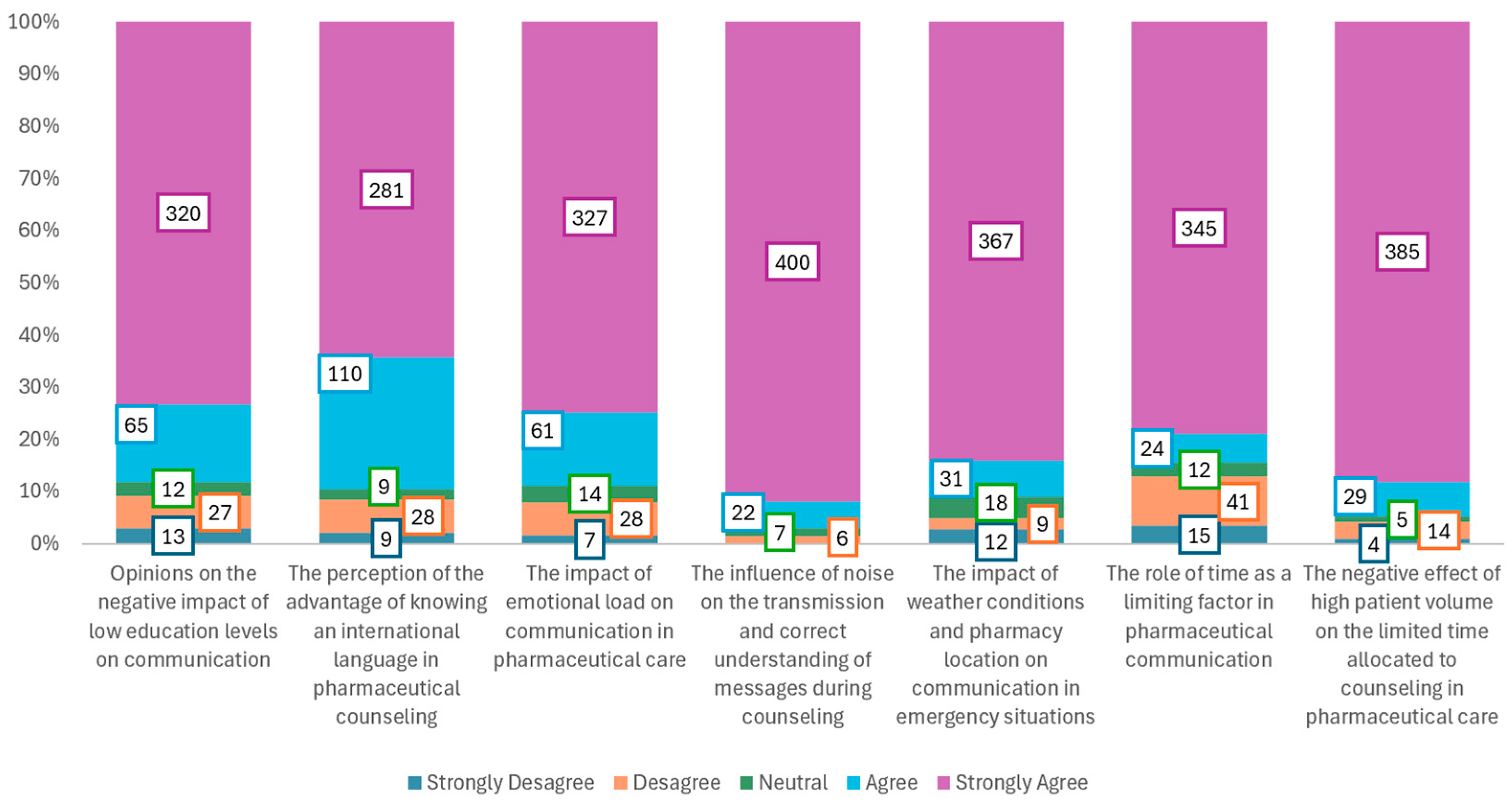
Figure 1 shows the participants responses regarding the recognition of external (linguistic, emotional, noise, crowding, time) barriers on a 5-point Lickert Scale.
The question regarding the recognition of the low level of education of the patient, the pharmacist, or both parties as a disruptive factor in the communication process in the provision of pharmaceutical care obtained a majority who stated that they strongly agree (73.2%), agree (14.8%), neutral (2.7%), disagree (6.1%), and strongly disagree (2.9%). This distribution highlights the importance of education in pharmaceutical communication. Professionals in the field need to develop continuing education programs for staff and educational campaigns for patients. The lack of clear and accessible language can lead to confusion, reducing adherence to treatment. Interdisciplinary collaboration cand reduce barriers, leading to empathetic and effective counseling tailored to each person’s level of understanding.
When asked about the advantage of knowing an international language in pharmaceutical practice, most respondents strongly agreed (64.3%), followed by 25.7% who agree, 2.0% who are neutral, 6.4% who disagree, and 2.0% who strongly disagree. The results suggest a broad consensus on the importance of language skills in pharmaceutical counseling. Providing services in multiple languages contributes to inclusion and equal access. Pharmacists can thus clearly explain treatments to foreign or minority patients. Multilingual training is becoming a necessity in a globalized context, reducing the risk of communication errors and increasing patient satisfaction.
On the other hand, the emotional burden was also considered by the majority (74.8%) to be a factor that can positively or negatively influence the communication relationship in the pharmaceutical act. The data reflects a clear awareness of the effect of emotions on the quality of interaction. Patients’ emotions can amplify stress or mistrust, requiring emphatic and personalized approaches. Pharmacists need to develop socio-emotional skills, listen actively, and offer support without judgment.
Major obstacles to patient communication, such as noise, weather conditions and the location of the pharmacy, time and congestion, were reported by the majority of respondents, with 91.5%, 83.9%, 78.9% and 88.1%, respectively, agreeing that they have a negative impact on pharmaceutical counseling.
Noise and interruptions caused by street sounds or communication devices compromise the quality of communication and increase the risk of errors. Combined with possible hearing problems in patients, this can result in the information provided by the pharmacist not being received correctly. Extreme weather conditions, such as blizzards, floods, or very low temperatures, together with the unfavorable geographical location of some pharmacies, especially in rural areas, can significantly affect immediate communication in emergency situations. The digitization of pharmaceuticals services through AI, using mobile applications, notifications, or telepharmacy services, can save lives in critical situations. It is necessary to expand online counseling services and home deliveries. This can overcome barriers caused by distance or unfavorable weather, ensuring continuity of care and patient safety.
Based on the hypothesis that environmental conditions such as noise and location, along with the large volume of patients accessing pharmaceuticals services, are recognized as obstacles to pharmacist–patient communication,
Table 2 provides a detailed analysis of respondents’ perceptions of the predominant barriers in the pharmacist–patient communication process.
The average responses indicated that participants generally agreed with the statements related to barriers in pharmacist–patient communication. For the item on noise, the average of 3.55 (on a scale of 1 to 4) suggests strong agreement that noise interferes with the transmission and correct understanding of messages in pharmacies (
Table 2). Weather conditions or the location of the pharmacy were recognized as significant obstacles, but somewhat more moderately, with an average of 3.17, still indicating a clear perception that they limit emergency communication. High patient volume scored an average of 3.49, showing a high level of agreement that crowding reduces the time available for effective counseling.
These average scores above 3 confirm the hypothesis that environmental conditions such as noise and location, along with high patient volume, are recognized as significant barriers to pharmacist–patient communication. The results support the need for strategies to reduce these barriers in order to improve the quality of counseling and patient safety in the medication dispensing process.
For the item “Does noise the correct transmission and understanding of messages during counseling in pharmacies?”, the results show a
t-value is 101.846, significance
p < 0.001, with an estimated mean of 3.554 (95% confidence interval: 3.49–3.62). This indicates a very clear agreement among respondents with the statement, well above the neutral threshold, demonstrating that noise is perceived as a major obstacle to communication (
Table 3).
For the question “Do weather conditions and/or the location of the pharmacy prevent immediate communication in emergency situations?”, the t-value is 69.912, with p < 0.001, and the mean response is 3.172 (95% confidence interval: 3.08–3.26). Respondents tend to agree here as well, although the level of agreement is somewhat more moderate, indicating that location and weather conditions are recognized as real barriers to communication.
For the item “Does the high volume of patients contribute to limiting the time allocated for pharmaceutical counseling?”, the t-value is 84.888, with p < 0.001 and a mean of 3.485 (95% confidence interval: 3.40–3.57). The results highlight a strong agreement among participants that crowding reduces the quality and time devoted to pharmacist–patient counseling.
3.3. Assessment of Perceptions of AI Applications and Their Associated Benefits
Continuing education for pharmacy staff and clear clarification of the role and limitations of AI-based applications are recommended to ensure effective and responsible adoption of new technologies. AI streamlines routine operations, allowing the pharmacist to tailor communication and address individual patient needs.
Table 4 shows respondents’ opinions on the usefulness of certain types of AI applications. 123 respondents opted for the implementation of programs for information and automatic analysis of drug interactions and adverse reactions, followed by applications that provide for the personalization and automatic design of a drug treatment plan, with a percentage of 18.5%. Only 5 respondents considered automatic prescription programming.
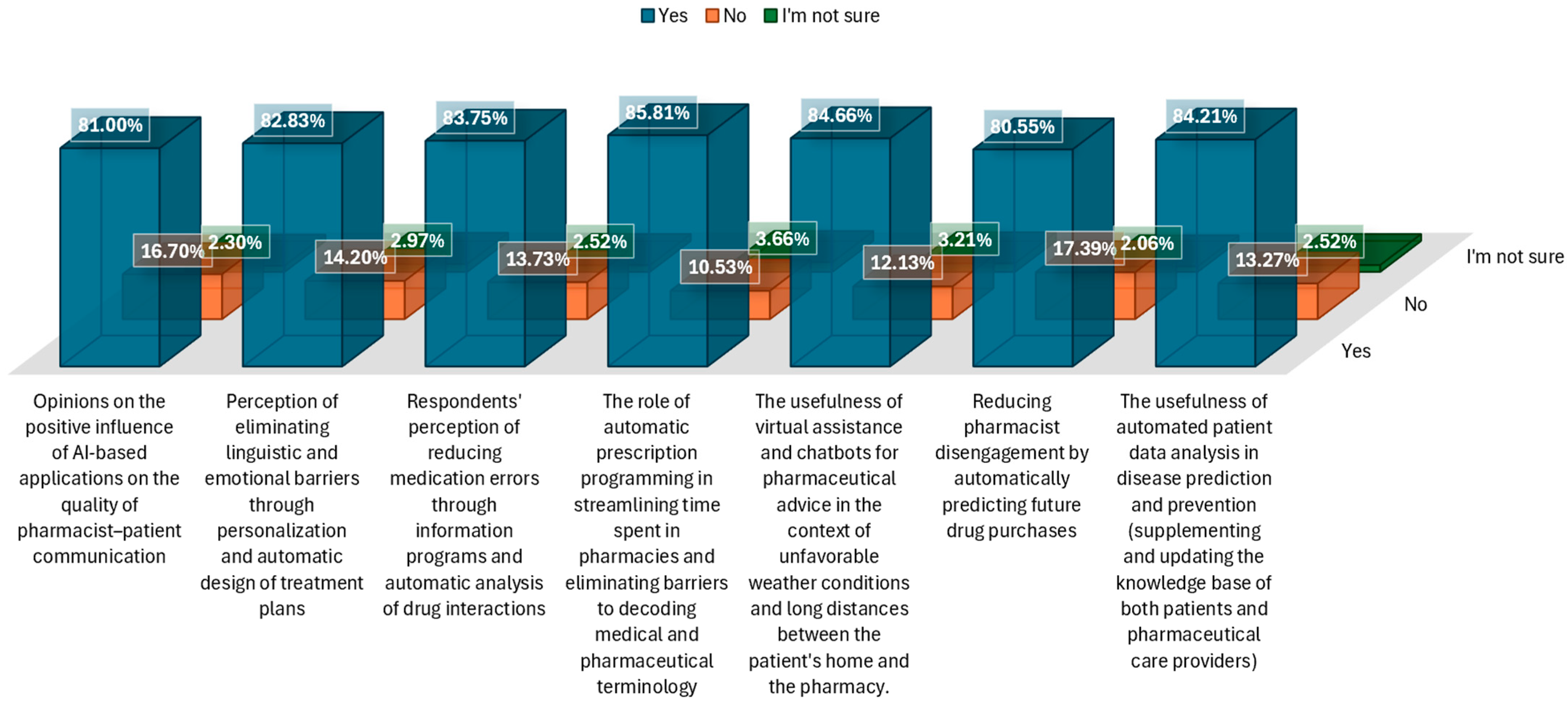
More than half of respondents (81.0%) believe that AI-based applications could positively influence the quality of communication between pharmacists and patients, while 2.2% are unsure and 16.7% say no (
Figure 2). A clear majority recognize the positive potential of AI-based applications in communication quality. However, a quarter of respondents indicate uncertainty, suggesting a need for education and clarification of the concrete benefits of AI technologies in the patient relationship.
More than half of participants (82.8%) believe that personalization and automatic design of a medication treatment plan could eliminate language and emotional barriers, 2.9% are unsure, and 14.1% say no. The majority of respondents believe that AI can reduce language and emotional barriers. This perception supports the development of patient-centered solutions that are adaptable to linguistic and cultural diversity. Most respondents (83.7%) believe that medication errors can be eliminated through automated programs that analyze drug interactions, 2.5% are unsure, and 13.7% say no. Most see a clear role for AI in increasing therapeutic safety by reducing human error. This validates investments in automatic alert systems and complex analysis of drug interactions.
Regarding the question, “Does automatic prescription programming help reduce the time spent in the pharmacy and eliminate barriers to decoding medical and pharmaceutical terminology?”, the majority of participants (85.8%) believe that automatic prescription scheduling reduces the time spent in the pharmacy and eliminates barriers to decoding medical terminology, 3.6% are unsure, and 10.5% say no. This is the highest consensus in the entire set of questions. Respondents strongly appreciate the practical value of automation for efficiency and clarity in the pharmaceutical process.
More than half of respondents (84.6%) believe that virtual assistance and chatbots are useful in adverse weather conditions or over long distances, 3.2% are unsure, and 12.1% say no. Our results indicate a generally positive perception of the usefulness of AI in facilitating access to care. This view, uniformly supported by both urban and rural respondents (p > 0.05), underpins the need for teleconsultation solutions to overcome physical accessibility barriers specific to isolated areas or adverse weather conditions.
Regarding the question “Can the pharmacist’s lack of interest in the patient be eliminated by automatically predicting future drug purchases?”, three-quarters of participants (80.5%) believe that the pharmacist’s lack of interest can be eliminated by automatically predicting future drug purchases, 2.0% are unsure, and 17.3% answered no. More than half believe in the potential of AI to anticipate patient needs and personalize interactions, but a third are skeptical or unsure, highlighting the need to clarify the ethics and confidentiality of these tools.
Most respondents (84.2%) believe that disease predictability and prevention through automated data analysis helps to update the knowledge of patients and pharmaceutical staff, 2.5% are unsure, and 13.2% say no. The results confirm the interest in using data analysis for educational purposes, both for patients and pharmacists. They support the idea of a digital pharmacy as a hub for personalized information.
According to
Table 5, most respondents (33.2%) consider that the main advantage of artificial intelligence applications in the pharmacist–patient relationship is quick access to information, followed by the elimination of human error (18.1%), cost reduction (16.0%), unconditional availability (15.3%), and adaptability to all patient types (12.8%). Rapid access to information is perceived as the key factor in improving dialog with patients, suggesting the need for AI tools that support quick and accurate decisions. This prioritization highlights the expectation for informed, transparent, and personalized pharmaceutical care.
The hypothesis that “The use of artificial intelligence in pharmaceutical activities will significantly improve pharmacist–patient communication by reducing consultation time, increasing the quality of information provided, and strengthening patient confidence in pharmaceutical services, provided that human interaction is maintained” is confirmed by the results of the descriptive statistics highlighted in
Table 6.
The average values obtained show a high level of agreement among respondents regarding the role of artificial intelligence in improving pharmacist–patient communication, with an average of 1.48 indicating a clearly positive perception of AI’s potential to increase the quality of dialog (
Table 6). Regarding automatic prescription scheduling, the average of 1.58 suggests that participants recognize the clear benefits in reducing the time spent in the pharmacy and simplifying specialized language. Similarly, the average of 1.76 reflects fairly solid acceptance of the idea that automatic data analysis can update the knowledge of patients and pharmacy staff, supporting overall openness to the integration of AI into pharmacy services.
Following the application of the
t-test, the results obtained were included in
Table 7. Thus, for the question “Could artificial intelligence positively influence the quality of communication in the pharmacist–patient relationship?”, a very high
t-value was obtained (
t = 45.802,
p = 0.000) with an average difference of 1.481 and a confidence interval between 1.42 and 1.54. This shows that respondents clearly evaluate this statement positively in relation to the zero-reference value, suggesting strong agreement with the beneficial role of AI in improving communication. In the case of the question “Does automatic prescription scheduling help reduce the time spent in the pharmacy and eliminate barriers to decoding medical and pharmaceutical terminology?”, the result is
t = 47.141 with
p = 0.000 and an average difference of 1.581 (range 1.52–1.65). The result highlights a significant agreement among respondents regarding the impact of AI in reducing consultation time and facilitating understanding of terminology. For the item “Does the predictability of diseases and their prevention through automatic analysis of patient data complement and update the knowledge base of both patients and pharmaceutical care staff?”, the test indicates
t = 45.821,
p = 0.000, with an average difference of 1.757 and an interval of 1.68–1.83. This underscores strong support for the idea that AI contributes to increasing the quality and clarity of information provided to patients.
Analyzing these results, all t-values are very high and p < 0.001 in all cases, demonstrating that the differences from zero are extremely statistically significant. The positive means and narrow confidence intervals, all clearly above zero, confirm that respondents perceive the use of artificial intelligence in pharmacy as having a substantial beneficial impact on the quality of communication, reducing consultation time, and strengthening patient confidence in pharmaceutical services.
While the current implementation of artificial intelligence in pharmacies in eastern Romania is still in its early stages, the study reveals a remarkable professional openness to this technology. Respondents identified automatic prescription scheduling and predictive analysis of patient data as the main functions capable of optimizing pharmaceutical care. This positive perception (p < 0.001) suggests that pharmacists do not view AI as a substitute for human interaction, but rather as an essential tool for managing pragmatic barriers such as excessive workload and time constraints.
Thus, the results obtained support the research hypothesis from a professional perception perspective, indicating that pharmacists and students foresee an improvement in communication with patients through the integration of AI. These data reflect a high degree of confidence in the technology’s potential to optimize consultation time and information quality. However, definitive confirmation of these benefits requires future prospective studies that objectively measure the performance of AI platforms in the clinical setting, using samples that are balanced in terms of demographics and professional experience.




 ,
,