2.1. Derivation of VEAs: Holmberg (2016)
Holmberg (
2016) is an intriguing cross-linguistic investigation dealing with the syntax of yes/no questions and their answers across languages. Yes/no questions can be answered not only with answer particles such as English
yes and
no but also with VEAs. He reports that among 130 languages from various families, 62 allow VEAs, while 68 do not. The former category includes languages from diverse areas such as Finnish, Japanese, and Thai, while the latter encompasses many Germanic and Romance languages such as English, Dutch, Italian, and Spanish, as well as languages of other families.
Holmberg claims that answers to yes/no questions have sentential structure and that VEAs as well as answer particles are derived by ellipsis of full sentences. He assumes the following structures in (2) for a yes/no question and answer in many languages such as English and Finnish (
Holmberg, 2016, p. 53).
| (2) | a. | Does John like this book? |
| | | [Q-force [cp [does, ±Pol] C [PolP John [Pol’ <does, ±Pol> [TP like this book]]]]] |
| | b. | Yes. |
| | | [FocP [+Pol] [Foc’ Foc [PolP John [Pol’ [+Pol] [TP like this book]]]]] |
| | | | yes |  |
| | | (Holmberg, 2016, p. 53) |
As shown in (2a), the question has an unvalued polarity variable [±Pol] meaning “positive or negative polarity,” which is the highest head in the TP domain. [±Pol] moves to the C-domain to assign sentential scope to the disjunction and become the center of attention, and a Q-force operator, which means “Tell me the value of [±Pol] such that
p, expressed by PolP, is true,” is added to this. Accordingly, (2a) is interpreted as “Tell me the value of [±Pol] such that ‘John [±Pol] likes this book’ is true”.
He claims that the answer in (2b) has the same PolP as (2a). The PolP in the question is copied and merged with a focused valued polarity feature, i.e., [+Pol] in (2b). This [+Pol] is merged with a phrase headed by Foc, which assigns the positive value to the [±Pol] in PolP, resulting in a positive proposition. The PolP in the answer can be elided since it is recoverable from the question, but the value of [±Pol] remains and is realized as the answer particle yes.
A question–answer pair in (3) shows how Holmberg assumes VEAs in Finnish are derived. In (3a), the verb moves to the C-domain and hosts the question particle -
ko. The VEA in (3b) has the same PolP as (3a), except it has [+Pol], which is externally merged with FocP. [+Pol] assigns the positive value to the [±Pol] in PolP, which yields an affirmative sentence. The PolP in the answer is not spelled out at PF, resulting in the VEA.
3| (3) | a. | Luki-ko | Jussi | sen | kirjan? |
| | | read-Q | Jussi | that | book? |
| | | ‘Did Jussi read that book?’ |
| | | [Q-force [CP [±Pol luki [±Pol -ko]] C [PolP Jussi [Pol’ [<±Pol> luki [±Pol -ko]] [T/MP [vP <Jussi> |
| | | <luke> sen kirjan]]]]]] |
| | | | | (Holmberg, 2016, p. 109) |
| | b. | Luki. | | | |
| | | read | | | |
| | | ‘Yes’ | | | |
| | | [FocP [+Pol luki, +Pol] [Foc’ Foc [PolP Jussi [Pol’ [+Pol luki, +Pol] [T/MP T/M [vP <Jussi> |
| | | |  |
| | | <luke> sen kirjan]]]]]] |
| | | | | (Holmberg, 2016, p. 110) |
Holmberg states that it is uncontroversial that VEAs are derived from a full sentence through ellipsis because the verbs in VEAs have tense and agreement. For example, the Finnish VEA in (4) not only has subject person information but also carries conditional mood marking.
| (4) | Q: | Osta-isi-t | -ko | sen kirjan? | |
| | | buy-con-2sg | Q | that book | |
| | | ‘Would you buy that book?’ | |
| | A: | Osta-isi-n | | | |
| | | buy-con-1sg | | | |
| | | ‘I would buy.’ (=Yes.) | | (Holmberg, 2016, p. 73) |
Holmberg argues that there are at least two possible explanations for how VEAs are derived: One is
pro-drop plus verb-stranding VP ellipsis; and the other is what he calls big ellipsis, i.e., ellipsis of a large chunk of a sentence containing a subject, such as TP.
4 In order to distinguish these two types of derivation, he proposes the following test: If a VEA is possible as a response to a question with an existential indefinite subject, the response cannot be derived by
pro-drop, because an indefinite pronoun cannot be
pro-dropped (
Holmberg, 2016, p. 79). The sentence in Italian in (5) has a null subject, which can be interpreted only as definite third person singular. The subject is not allowed to be interpreted as an indefinite pronoun.
| (5) | Può | controllare | questo | macchinario | con | una | mano | sola. |
| | can.3sg | control | this | machine | with | one | hand | only |
| | ‘He/She/*Someone can control this machine with one hand.’ |
| | | | | | | (Holmberg, 2016, p. 79) |
Likewise, in the following Thai sentence in (6), the null subject in the embedded clause can be interpreted as a definite person in the local discourse or as an inclusive generic pronoun, but it cannot be interpreted as an existential indefinite subject. This shows that existential indefinite subjects cannot be
pro-dropped.
| (6) | cim | bɔ̀ɔk | wâa | khrûuŋcàk | níi | [e] | baŋkháb | dâaj | dûaj | muu | diiw |
| | Jim | say | comp | machine | dem | control | able | with | hand | one |
| | ‘Jim says that he/one/*someone can control this machine with one hand.’ |
| | | | | | | | | (Holmberg, 2016, p. 80) |
On the other hand, the Thai question in (7) has an indefinite subject and the VEA is perfectly acceptable. According to Holmberg’s diagnosis, this fact indicates that the
pro-drop analysis cannot be maintained.
| (7) | Q: | khray | maa | mǎy | mʉ̂a-waan? | |
| | | who | come | Q | yesterday | |
| | | ‘Did somebody come yesterday?’ | |
| | A: | maa | | | | |
| | | come | | | | |
| | | ‘Yes.’ | | | | (Holmberg, 2016, p. 84) |
Similarly, (8) demonstrates that the VEA is grammatical as an affirmative answer to a question containing an existential indefinite pronoun in Finnish.
| (8) | Q: | Toi-ko | joku | sokeria? | |
| | | brought-Q | someone | sugar | |
| | | ‘Did someone bring sugar?’ | |
| | A: | Toi. | | | |
| | | brought.3sg | | | |
| | | ‘Yes.’ | | | (Holmberg, 2016, p. 82) |
In contrast, (9) shows that Georgian, a VEA language, does not allow VEAs when the question contains an indefinite subject. This suggests that Georgian VEAs are derived through
pro-drop and VP ellipsis.
| (9) | Q: | Gushin | vinme | movida? | |
| | | yesterday | anyone-nom | came-aor | |
| | | ‘Did anyone come yesterday?’ | |
| | A: | xo (*movida) | | |
| | | yes (*came) | | | |
| | | ‘Yes.’ | | | (Holmberg, 2016, p. 84) |
In this way, Holmberg demonstrates that VEAs in languages such as Finnish and Thai are derived by big ellipsis, while languages such as Georgian use subject
pro-drop and verb-stranding VP ellipsis to derive VEAs.
Holmberg claims that those languages which employ the big ellipsis derivation can be further categorized into at least two types: languages such as Finnish in which VEAs are derived by verb movement and TP ellipsis, as shown in (10); and languages such as Thai in which VEAs are derived by remnant PolP movement and TP ellipsis, as shown in (11).
| (11) | Remnant PolP movement and TP ellipsis (Holmberg, 2016, pp. 123–124) |
| | a. | nát | tɔ̂ŋ | khàp | rót | măy |
| | | Nath | must | drive | car | Q/or |
| | | ‘Must Nath drive a car?’ |
| |  |
| | b. | tɔ̂ŋ | | | | |
| | | must | | | | |
| |  |
In (11a), the predicate consists of a disjunction of an affirmative PolP and a negative PolP. In (11b), the disjunctive PolP in the question is copied and the vP of +PolP and -PolP is ATB-moved to SpecTopP. Subsequently, one of the PolPs moves to SpecFocP, and the TP is elided in PF.
Holmberg (
2016, p. 121) observes that Thai lacks head movement of V, noting that in Thai transitive clauses, the verb must directly precede the object unless the object itself has moved. Any sequence of the type S-V-X-O, where X represents an element such as an adverb, a negator, or a partially fronted object, is ungrammatical.
2.2. Japanese VEAs
As outlined in the preceding section,
Holmberg (
2016) shows that VEAs in different languages exhibit variation in their derivation. This influential study has inspired many other studies on VEAs in various languages, such as Chinese (e.g.,
Simpson, 2015;
Chen, 2022), Korean (
Park and Park, 2018), and Mongolian (
Sakamoto and Bao, 2019). As we have seen in (1), Japanese is a language that permits VEAs, and some studies have examined the question of how VEAs in Japanese are derived.
5Japanese is a radical
pro-drop language and permits both subjects and objects to have a definite pronominal interpretation.
Sato and Hayashi (
2018) argue that the Japanese null subject cannot receive an indefinite reading, and, therefore, Japanese follows
Holmberg’s (
2016, p. 79) indefinite
pro-drop restriction. In sentence (12) below, the null subject in the embedded clause can be interpreted as a definite person in the local discourse or as an inclusive generic pronoun, but not as an existential indefinite subject. This shows that existential indefinite subjects cannot be
pro-dropped in Japanese.
| (12) | Yoichiro-ga | [kono | kikai-wa | e | katate-de | soosadekiru-to] | itteiru. |
| | Yoichiro-nom | this | machine-top | one hand-with | can.control-comp say |
| | ‘Yoichiro says that he/one can control this machine with one hand.’ |
| | *‘Yoichiro says that someone can control this machine with one hand.’ |
| | | | | (Sato and Hayashi, 2018, p. 75) |
On the other hand, the question in (13) has the indefinite subject
dareka ‘someone,’ and both VEAs in Answer 1 and Answer 2 are perfectly acceptable.
| (13) | Q: | Dareka-ga | daigaku-ni | ki-ta | no? |
| | | someone-nom | university-dat | come-pst | Q |
| | | ‘Did someone come to the university?’ | |
| | A1: | Ki-ta | yo. | | |
| | | come-pst | prt | | |
| | | ‘Came.’ (=‘Someone came.’) | | |
| | | | | |
| | A2: | Ko-nakat-ta | yo. | | |
| | | come-neg-pst | prt | | |
| | | ‘Didn’t come.’ (=‘Nobody came.’) | |
Thus, while Japanese does not allow existential indefinite subjects to be
pro-dropped, VEAs are allowed even when questions have indefinite subjects. According to
Holmberg’s (
2016) diagnosis, this fact indicates that the
pro-drop analysis for Japanese VEAs cannot be maintained even if the VP can be elided through VP ellipsis (
Sato and Hayashi, 2018, p. 76). Instead, following
Holmberg (
2016),
Sato and Hayashi (
2018) and
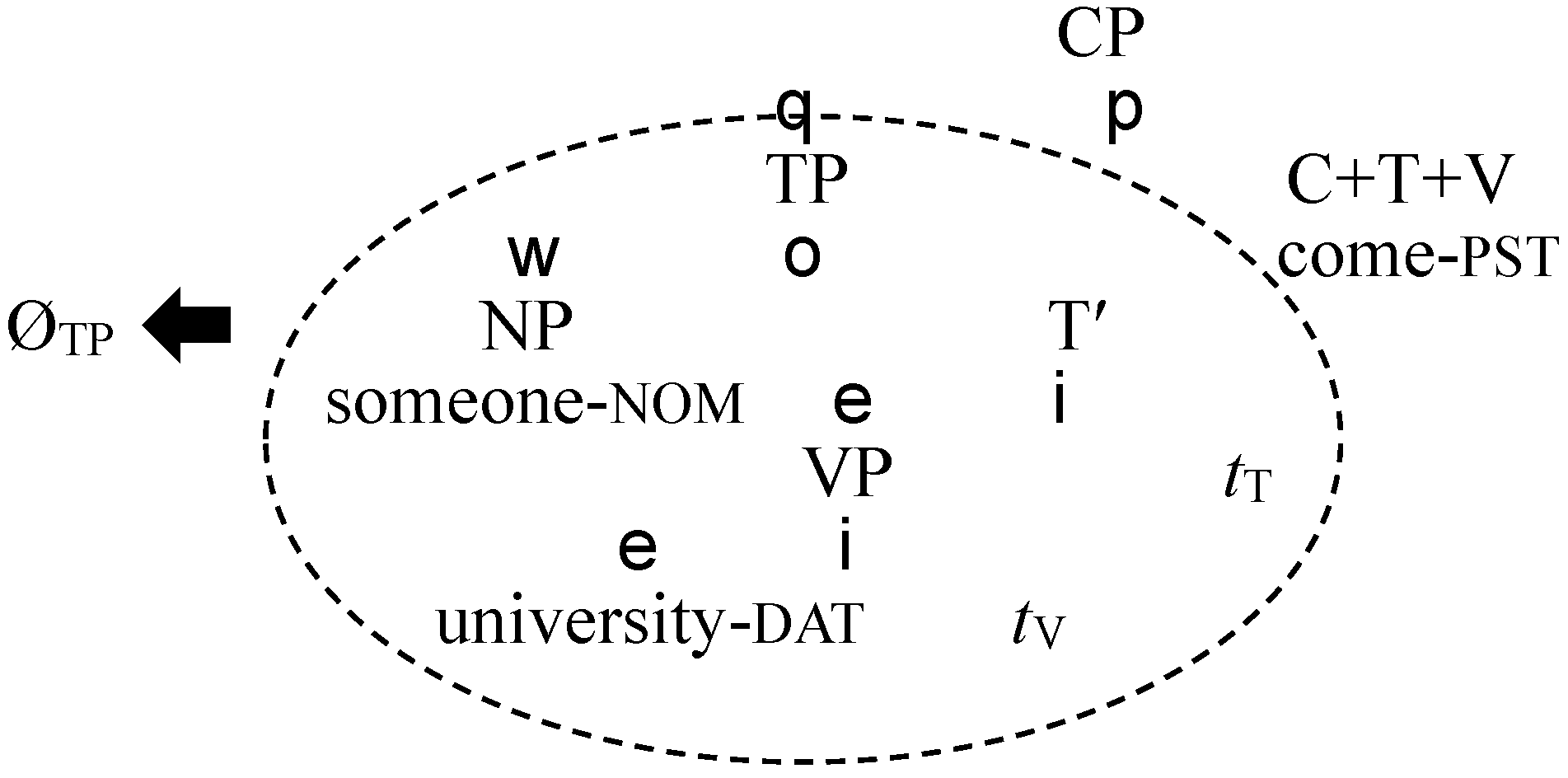
Sato and Maeda (
2021) propose that Japanese VEAs are derived through string-vacuous V-T-C movement in overt syntax, followed by TP ellipsis at PF as shown in
Figure 1.
Sato and Hayashi (
2018) also claim that the TP ellipsis analysis can nicely explain why negation can take scope over the existential subject in (13, A2), but not in (14) below.
| (14) | Dareka-ga | daigaku-ni | ko-nakat-ta. |
| | someone-nom | university-dat | come-neg-pst |
| | ‘Someone didn’t come to the university.’ |
The declarative sentence in (14), which corresponds to the question in (13), has the indefinite subject
dareka ‘someone,’ which is a positive polarity item. Therefore, the subject cannot take scope below negation, and the sentence simply means “There is someone who didn’t come to the university.” As for (13, A2), the
pro-drop analysis would predict that it means the same as (14), because this analysis assumes that the subject argument in (13, A2) can be
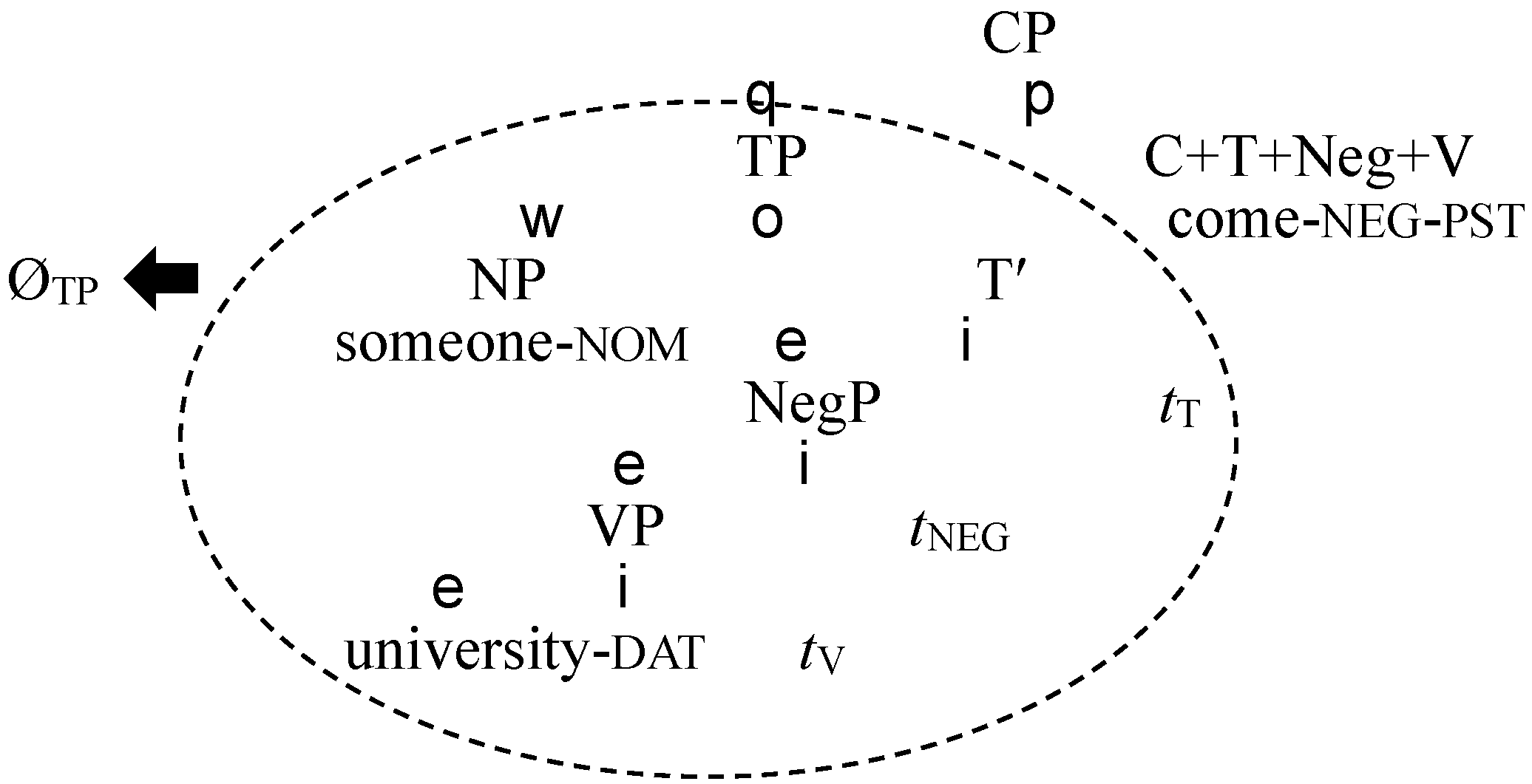
pro-dropped. On the contrary, the VEA in (13) means “Nobody came to the university,” i.e., it is not the case that someone came to the university. The TP ellipsis analysis can explain why the negation can take scope over the indefinite pronoun: The VEA in (13) is derived by TP ellipsis after the negated and tensed verb has moved to C, while the subject stays in Spec TP, making the negation structurally higher than the subject, as shown in
Figure 2.
Sato and Hayashi (
2018) and
Sato and Maeda (
2021) further point out that if VEAs are derived through verb movement and TP ellipsis, the adverb-inclusive interpretation should be available. It has been argued since
Oku (
1998) that Japanese adjuncts cannot be elided in isolation. Therefore, the second clause in (15) cannot be interpreted as “Hanako didn’t polish a car carefully.” Rather, it simply means “Hanako didn’t polish a car”.
| (15) | Taro-wa | kuruma-o | teineini | migai-ta | kedo, |
| | Taro-top | car-acc | carefully | polish-pst | but |
| | Hanako-wa | kuruma-o | | migaka-nakat-ta | |
| | Hanako-top | car-acc | | polish-neg-pst | |
| | ‘Taro polished a car carefully, but Hanako didn’t polish a car.’ |
| | *‘Taro polished a car carefully, but Hanako didn’t polish a car carefully.’ |
In contrast, the question in (16) “Did you already polish a car carefully?” has the adverb
teineini ‘carefully,’ and the adverb-inclusive interpretation in the VEA is not only available, but it is actually the only possible reading. This means that the adverb is included within the TP in the answer and the VEA is derived through TP ellipsis after string-vacuous V-T-C movement.
| (16) | Q: | Moo | kuruma-o | teineini | migai-ta | no? |
| | | already | car-acc | carefully | polish-pst | Q |
| | | ‘Did you already polish your car carefully?’ |
| | A: | Migai-ta | yo. | | | |
| | | polish-pst | prt | | | |
| | | ‘Polished’ (=‘Yes, I already polished my car carefully.’) |
| | | | | | (Sato and Hayashi, 2018, p. 83) |
2.3. Cross-Linguistic Variation of VEAs
As we have seen above,
Holmberg (
2016) points out based on his extensive survey on many languages, that languages which allow VEAs are further divided into at least two types: those in which VEAs are derived by big ellipsis (e.g., Finnish, Thai, and Japanese); and those which use subject
pro-drop and verb-stranding VP ellipsis to derive VEAs (e.g., Georgian). The key distinction between these two types of VEA languages lies in the indefinite subject test (
Holmberg, 2016, p. 79). While languages such as Finnish and Japanese do not allow indefinite subjects to be
pro-dropped, VEAs are still permitted in questions with existential indefinite subjects, as shown in (8) and (13). In contrast, languages like Georgian do not permit VEAs to questions with an indefinite subject, as illustrated in (9).
According to
Holmberg (
2016), the languages analyzed as employing big ellipsis to derive VEAs are further divided into at least two groups based on the type of movement producing the VEAs. More specifically, Finnish and Japanese derive VEAs by verb movement, while Thai resorts to remnant PolP movement. This difference in movement type seems to be linked to the availability of adverb-inclusive readings for VEAs. In the languages which employ verb movement, including Japanese, a verb moves all the way to SpecCP string-vacuously, with an adverb being left behind in the TP domain to be elided in PF. These languages yield adverb-inclusive readings for VEAs even when the adverb is not overtly expressed. Conversely, in the languages using PolP movement, including Thai, since an adverb is included in the PolP which is moved out of the TP domain, the adverb should overtly exist in the VEA as an answer to a question involving the adverb. Thus, the adverb-inclusive reading is not available for VEAs without an overt adverb.
According to judgements by our native-speaker consultants, the adjunct-inclusive interpretation for Finnish VEAs exemplified in (17) is permitted, whereas that for Thai VEAs is not, as shown in (18).
| (17) | Finnish | | | | |
| | Q: | Luki-ko | Jussi | sen | kirjan | hiljaa? |
| | | read-Q | Jussi | that | book | quietly |
| | | ‘Did Jussi read that book quietly?’ |
| | A: | Ei | lukenut. | | | |
| | | neg | read | | | |
| | | ‘Didn’t read.’ (=No, Jussi did not read that book quietly.) |
| (18) | Thai | | | | | |
| | Q: | nát | àan | nǎŋ-sǔu | ngiap-ngiap | rǔu-plaaw |
| | | Nath | read | book | quietly | Q |
| | | ‘Did Nath read that book quietly?’ |
| | A1: | mây | àan | | | |
| | | neg | read | | | |
| | | ‘Didn’t read.’ (=No, Nath did not read any book.) |
| | A2: | mây | àan | ngiap-ngiap | | |
| | | neg | read | quietly | | |
| | | ‘Didn’t read quietly.’ | |
In Finnish, the VEA with negation in (17, A) means that Jussi did read the book but not quietly, even though the VEA does not have the overt adverb
hiljaa ‘quietly.’ As expected, adverb-inclusive reading is possible for VEAs in Finnish. The VEA with negation in Thai in (18, A1), on the other hand, cannot mean that Nath did not read the book quietly. Instead, the consultant pointed out that the VEA (18, A2) which has an overt adverb is the appropriate answer to the question. This observation is compatible with the analysis that VEAs in Thai are derived by PolP movement.
This constitutes further evidence that Finnish VEAs are derived by verb movement and TP ellipsis while Thai VEAs are derived by remnant PolP movement; and Japanese VEAs are similar to Finnish VEAs in this respect. Based on the previous syntactic studies reviewed in the preceding section and the availability or unavailability of adverb-inclusive interpretation in Japanese, Finnish, and Thai, we can say that Japanese should be categorized together with Finnish in terms of its VEA derivation.
6 Furthermore, it follows that the adverb-inclusion property constitutes a necessary condition for Japanese and Finnish VEAs to questions with an existential indefinite subject.
2.4. Prediction for Acquisition
Considering the cross-linguistic variations discussed above, questions arise as to whether there are parameters that regulate the types of VEAs in VEA languages and how children acquire the linguistic properties of their own languages. While the exact parameters have not yet been fully identified, previous studies on VEAs have uncovered relevant properties, including the indefinite pro-drop restriction and the adverb-inclusive interpretation, as reviewed above. Based on these studies, we can speculate that the pro-drop parameter and a parameter regulating the possibility of verb movement determine the availability and the variation of VEAs. In other words, setting these parameters is a prerequisite for children to acquire VEAs in their grammar.
Several acquisition studies have been conducted regarding Japanese-speaking children’s setting of these two parameters. For the parameter related to the indefinite
pro-drop restriction,
Nakayama (
1996) analyzed three children’s spontaneous speech produced at ages one and two, as well as adults’ speech. He found that the occurrence of null arguments did not differ between children and adults, and he argued that children as young as one year of age had already acquired adult-like knowledge of empty arguments in Japanese. The finding suggests that the
pro-drop parameter is set very early.
7 If that is the case, as “an indefinite pronoun cannot be null by virtue of the usual rule deriving a null subject in
pro-drop languages (
Holmberg, 2016, p. 79),” we can assume that the knowledge that an existential indefinite subject cannot be
pro-dropped is readily acquired once the
pro-drop parameter is correctly set.
As for verb movement, there has been a long-standing debate on whether string-vacuous head movement exists in Japanese syntax (e.g.,
Otani and Whitman, 1991;
Hoji, 1998;
Koizumi, 2000;
Fukui and Sakai, 2003). While there is no widely accepted evidence for overt head movement,
Hayashi and Fujii (
2015) provide new evidence supporting head movement in Japanese, focusing on benefactive V(erb)-
te constructions such as V-
te morau ‘get’ and V-
te ageru ‘give.’ They argue that in the example of V-
te morau in (19) below, for instance, the head of the complement
te-clause undergoes string-vacuous movement to the higher verb, i.e.,
morau, and merges with it, while the head of an adjunct
te-clause does not.
| (19) | Taro-ga | [Ziro-ni | piza-o | tukut-te] | morat-ta. |
| | Taro-nom | Ziro-dat | pizza-acc | cook-te | get-pst |
| | ‘Taro had Ziro cook pizza.’ |  | (Hayashi and Fujii, 2015, p. 32) |
Acquisitional studies on Japanese V-
te constructions have shown that children acquire these constructions by age 4 at the latest, suggesting that verb movement is available to them by then.
Okabe (
2019) analyzed spontaneous speech data from five Japanese-speaking children, available in the CHILDES database (
MacWhinney, 2000), to identify their utterances containing benefactives such as V-
te morau. Her analysis found that children’s FRU (First clear use, followed soon after by Repeated Uses; e.g.,
Snyder, 2007) of benefactive V-
te clauses appears at age 2. In addition,
Ohba and Deen (
2020) experimentally demonstrated that Japanese-speaking 4-year-olds correctly interpret sentences containing complement
te-clauses. These studies provide evidence that young children have already acquired Japanese verb movement; in other words, they have correctly set the parameter regulating verb movement.
Now that we have established that Japanese-speaking children complete the setting of both parameters as a prerequisite for the acquisition of VEAs by age 4 at the latest, our next step is to examine when and how children successfully acquire the properties that Japanese VEAs exhibit. As we have seen in the previous section, the availability of the adverb-inclusive reading in Japanese constitutes a necessary condition for VEAs to questions with an existential indefinite subject. It is therefore reasonable to assume that the knowledge of the following two properties of VEAs in (20a) and (20b) is a prerequisite for the acquisition of Japanese VEAs in addition to the setting of parameters as described above.
| (20) | a. VEAs to a question with an existential indefinite subject are possible. |
| | b. VEAs have adverb-inclusive interpretations. |
Building on this, we can further formulate the following acquisitional prediction shown in (21).
| (21) | Prediction for acquisition: |
| | Any child who knows adverb-inclusion property of Japanese VEAs will also understand VEAs to existential subject questions. |
To test the prediction in (21), we first manually examined a total of 55 files for Aki (1;6–3;0) (
Miyata, 2004a) and 82 files for Ryo (1;6–3;0) (
Miyata, 2004b), which are available in CHILDES, to identify their FRU of a VEA. The results showed that Aki’s FRU of a VEA occurred at the age of 2;1 and Ryo’s at 1;11.
8 The mother-child interactions containing these FRUs are presented in (22).
| (22) | a. | MOT: | Ommo | mi-e-ta? | |
| | | | outside | see-can-pst | |
| | | | ‘Could you see outside?’ | |
| | | CHI: | Mi-e-ta. | | |
| | | | see-can-pst | | |
| | | | ‘Could see.’ | | (Aki (2;1), File 20117) |
| | b. | MOT: | Hait-ta? | | |
| | | | go into-pst | | |
| | | | ‘Did it go into (the box)?’ | |
| | | CHI: | Hei-ta.9 | | |
| | | | go into-pst | | |
| | | | ‘Went into.’ | | (Ryo (1;11), File 11109) |
These findings suggest that Japanese-speaking children begin to produce VEAs around age two.
Next, let us focus on the property in (20a), i.e., a VEA is a grammatical response to a question with an existential indefinite subject. If
Holmberg (
2016) and
Sato and Hayashi (
2018) are on the right track regarding the cross-linguistic variations and syntactic derivations of VEAs, upon hearing the use of a VEA to a question with an existential subject, the child realizes that Japanese VEAs are derived by TP ellipsis, not
pro-drop along with VP-ellipsis. This is because
pro cannot have an existential pronoun as its antecedent and thus the elided subject in the VEA cannot be
pro. Since we found that corpus database of Aki and Ryo did not contain any question–VEA interactions with existential subjects, we conducted addition search for database of five children; Asato (1;1–5;0, 63 files,
Miyata and Nisisawa, 2009), Nanami (1;1–5;0, 57 files,
Nisisawa and Miyata, 2009), Tai (1;5–3;1, 75 files,
Miyata, 2004c), Taro (2;2–3;7, 32 files,
Hamasaki, 2004), and Tomito (1;2–5;0, 61 files,
Nisisawa and Miyata, 2010). As a result, we found two interactions from Tomito’s files in which existential indefinite subjects such as
nanika ‘something’ and
dareka ‘someone’ appeared in the questions followed by VEAs. The interactions are given in (23).
| (23) | a. | MOT: | Nanika | at-ta? | |
| | | | something | be-pst | |
| | | | ‘Was there something?’ |
| | | CHI: | At-ta | yo, | mama. | |
| | | | be-pst | prt | Mom | |
| | | | ‘(There) was, Mom.’ | | (Tomito (2;1), File 20113) |
| | b. | CHI: | Dareka | ki-ta | kana? | |
| | | | someone | come-pst | Q | |
| | | | ‘Did someone come?’ | |
| | | MOT: | Ki-te-nai | ya. | | |
| | | | come-pst-neg | prt | | |
| | | | ‘Didn’t come.’ | | (Tomito (3;3), File 30302) |
We can see that Tomito not only heard a VEA to his question with
dareka ‘someone’ in (23b), but he also replied using a VEA to his mother’s question with
nanika ‘something’ in (23a), which was observed more than one year before (23b). These examples show that VEAs to questions with existential indefinite subjects are available in the input, and that children even have the ability to produce them before long, though they are far from frequent. Therefore, it is essential to examine in an experimental condition whether children have knowledge that VEAs preceded by a question with an existential indefinite subject are possible in Japanese. A positive result would further show that children’s VEAs are derived by TP ellipsis.
As for the property in (20b), we propose that an effective trigger for children to acquire the adverb-inclusion property of Japanese VEAs is overt morphology for tense. Recall that verb movement is involved in derivation of Japanese VEAs while PolP movement in Thai VEAs, and that this distinction determines the availability of adverb-inclusive readings of VEAs in each language. Moreover, considering grammatical difference between Japanese and Thai, we may well be able to attribute the distinction regarding the adverb-inclusion property to the presence or absence of tense morphology in VEAs. In Japanese, there is overt morphology for tense, such as the past form -
ta, and it is quite autonomous, i.e., it can be separated from the verb by other morphemes such as negation and passive morphemes, such as
mi-rare-nakat-ta (see-
pass-
neg-
pst) ‘was/were not seen.’ On the other hand, Thai does not have any overt morphology for tense on verbs (e.g.,
Dahl, 1985). Given the grammatical distinction between these two languages, we can think of the following scenario: Upon noticing a tense morpheme such as past tense -
ta on a verb of the VEA, Japanese-acquiring children realize that the VEA is derived by verb movement, which automatically allows them to acquire the availability of adverb-inclusive reading in Japanese. We thus propose that a tense morpheme attached to the verb in VEAs is an effective trigger which tells a child that Japanese VEAs have the adverb-inclusion property.
As already shown in (22), our corpus search of the CHILDES database for Aki and Ryo identified interactions in which the mother produced a yes/no question in the past tense, and the child echoed the past-tense verb. In total, we found 14 caregiver-child exchanges containing yes/no questions in the past tense and past-tensed VEAs for Aki and 40 for Ryo. It is therefore reasonable to assume that, if our proposal is correct, positive evidence indicating that Japanese VEAs are interpreted adverb-inclusively is available for children.
However, spontaneous speech data do not provide sufficient and direct evidence for children’s knowledge of the adverb-inclusion property. In fact, some of the caregiver-child exchanges mentioned above include questions containing an adjunct, such as densya-de itta no (by-train go-pst) ‘(Did you) go (there) by train?’ (Aki, File 20513). The children appropriately respond to the questions using VEAs; for example, Aki answers properly with Itta (go-pst) ‘(I) went (there).’ These VEAs, however, do not decisively reveal that the VEA is adjunct-inclusive. Accordingly, to test the prediction in (21), analysis of spontaneous speech alone is insufficient; therefore, we conducted experiments with children. The next section reports these experiments and their evaluation of prediction (21).