
ChakapBot: A Generative AI-Powered Chatbot for the Revitalisation of Baba Malay

Abstract
1. Introduction
1.1. Contextualising ChakapBot for Baba Malay Revitalisation
“Intergenerational transmission, the ultimate goal of language revitalization efforts, can only be achieved by (re)establishing the conditions under which an imperiled language can be acquired by the community’s children.”
1.2. AI Projects for Language Revitalisation
2. Materials and Methods
2.1. The Core of ChakapBot: Team and Technology
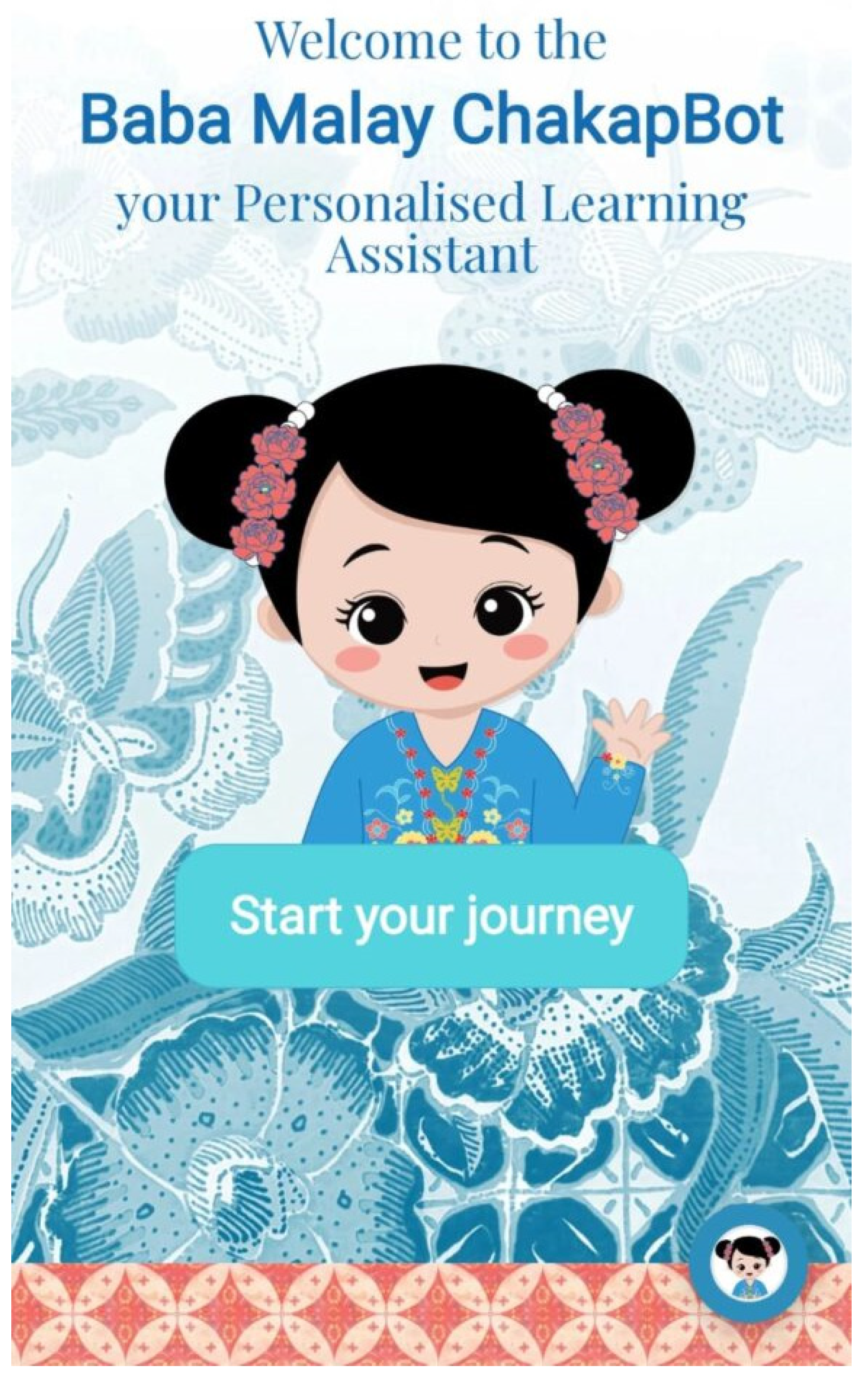
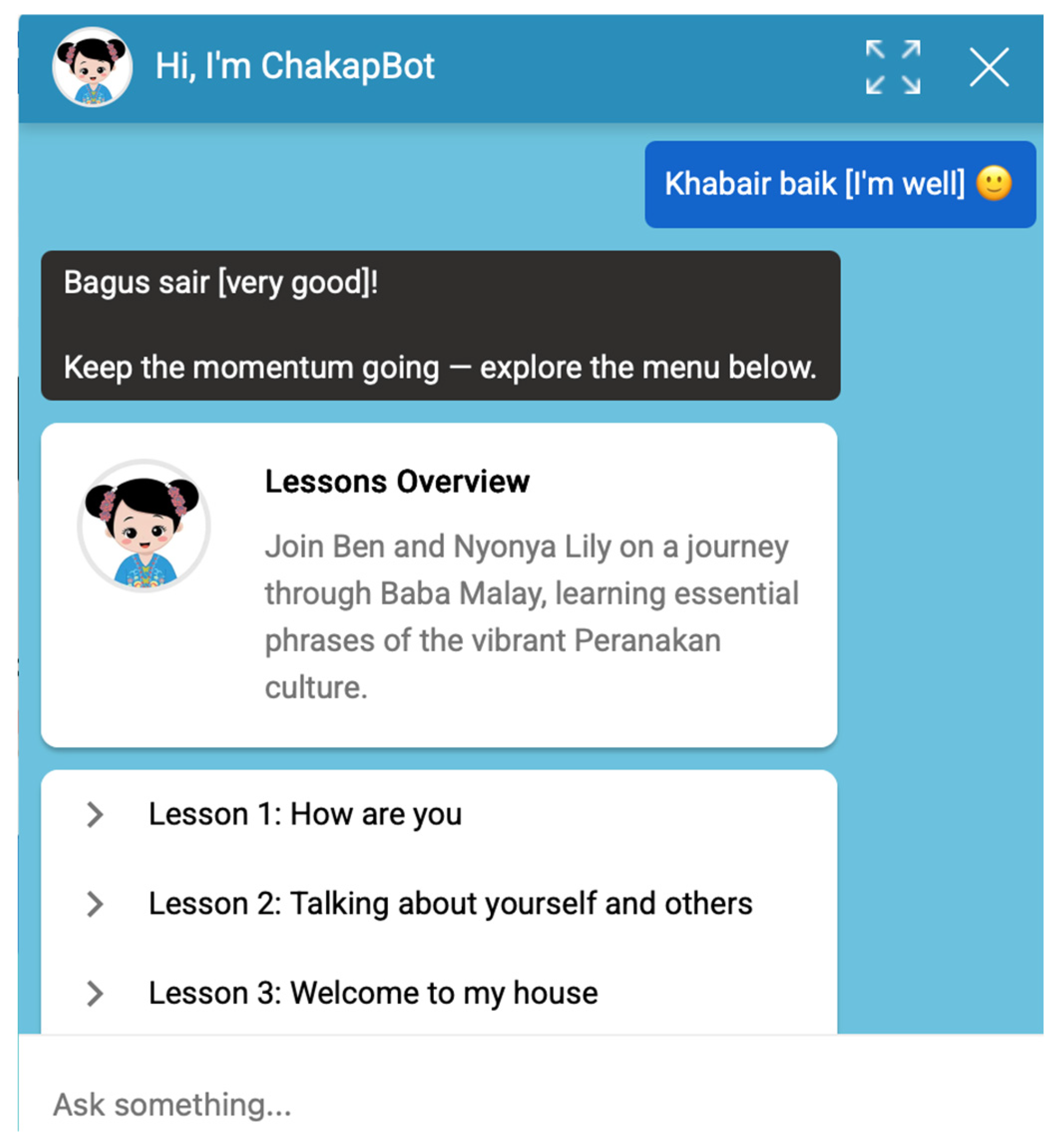
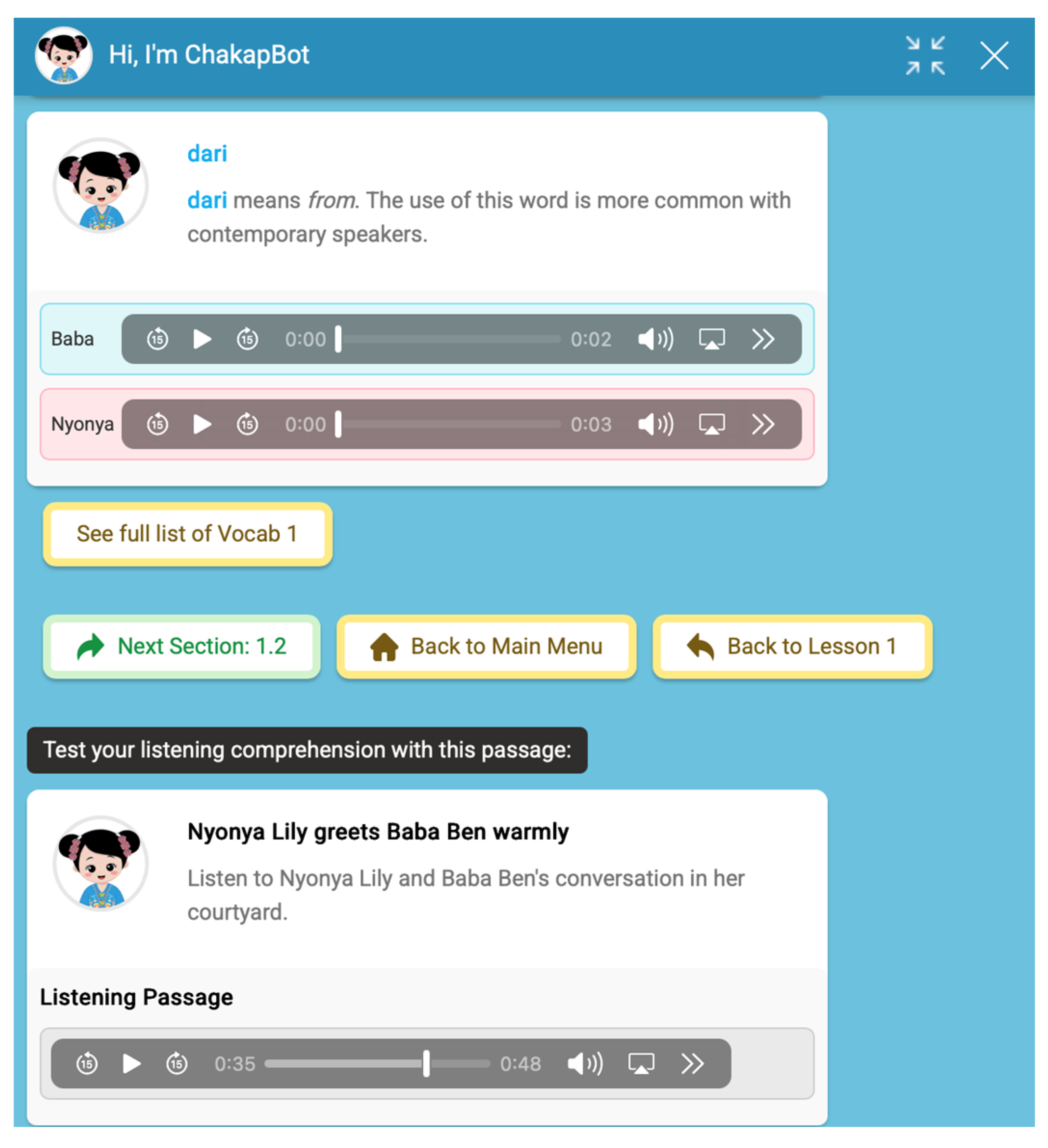
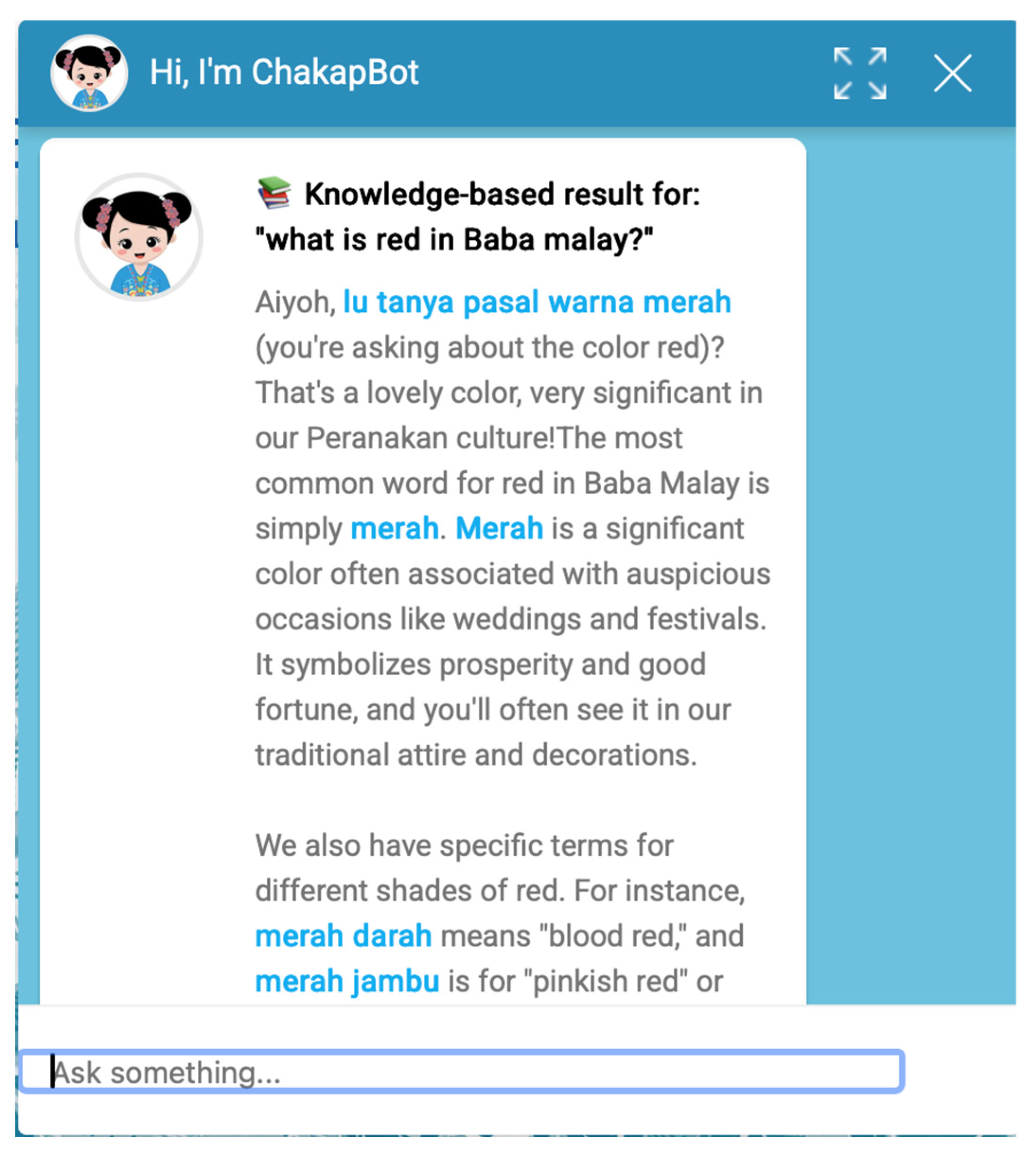
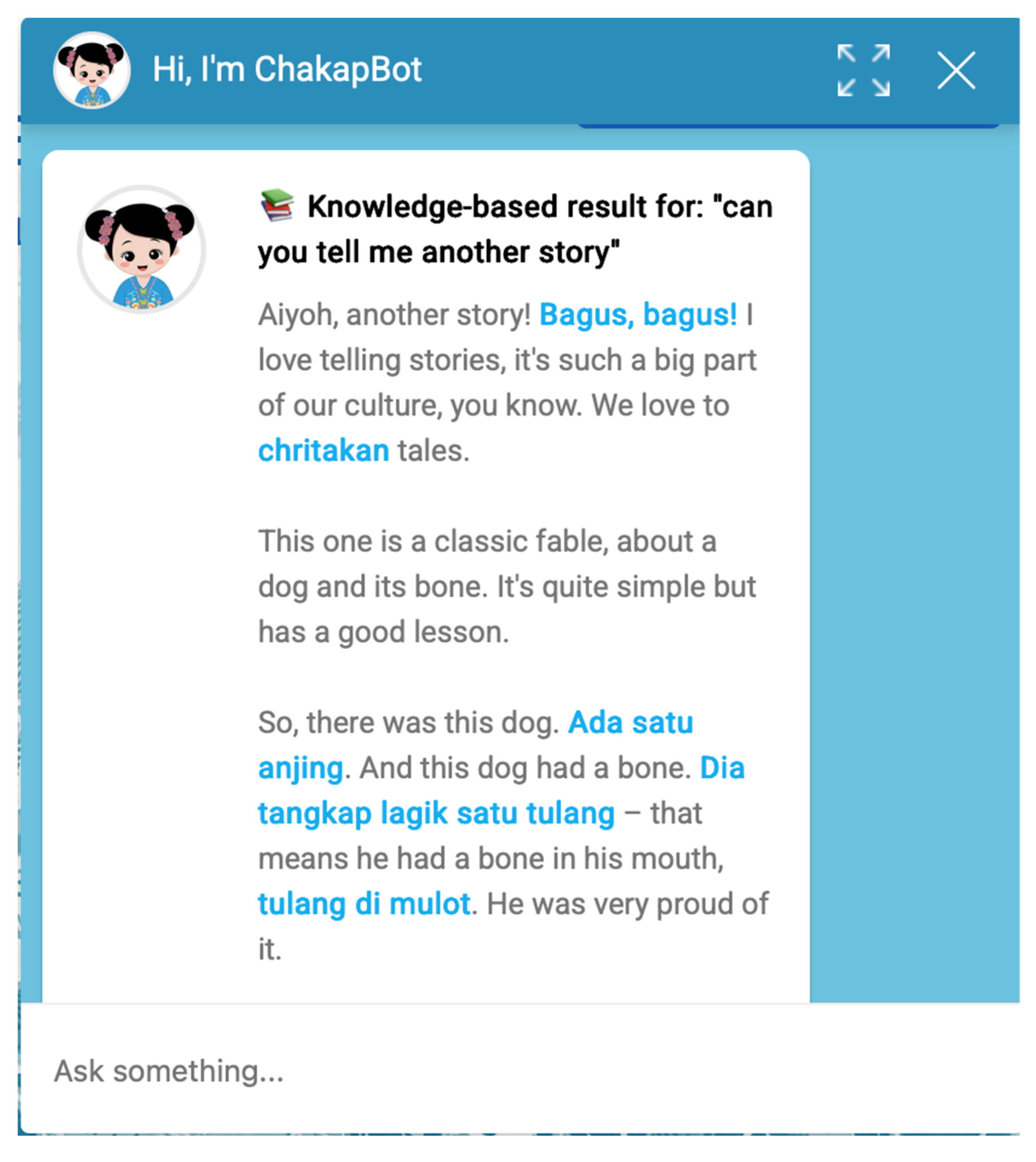
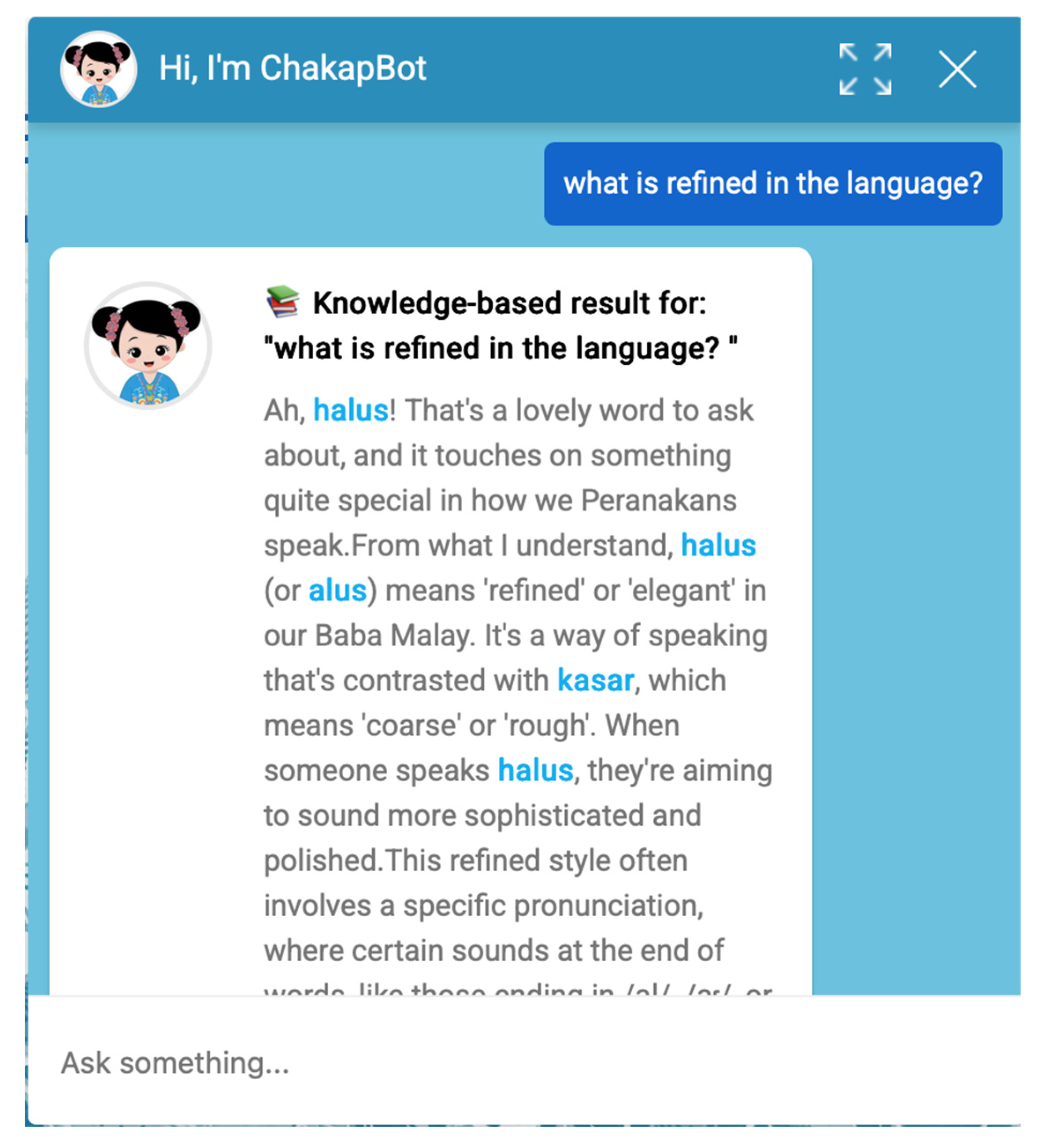
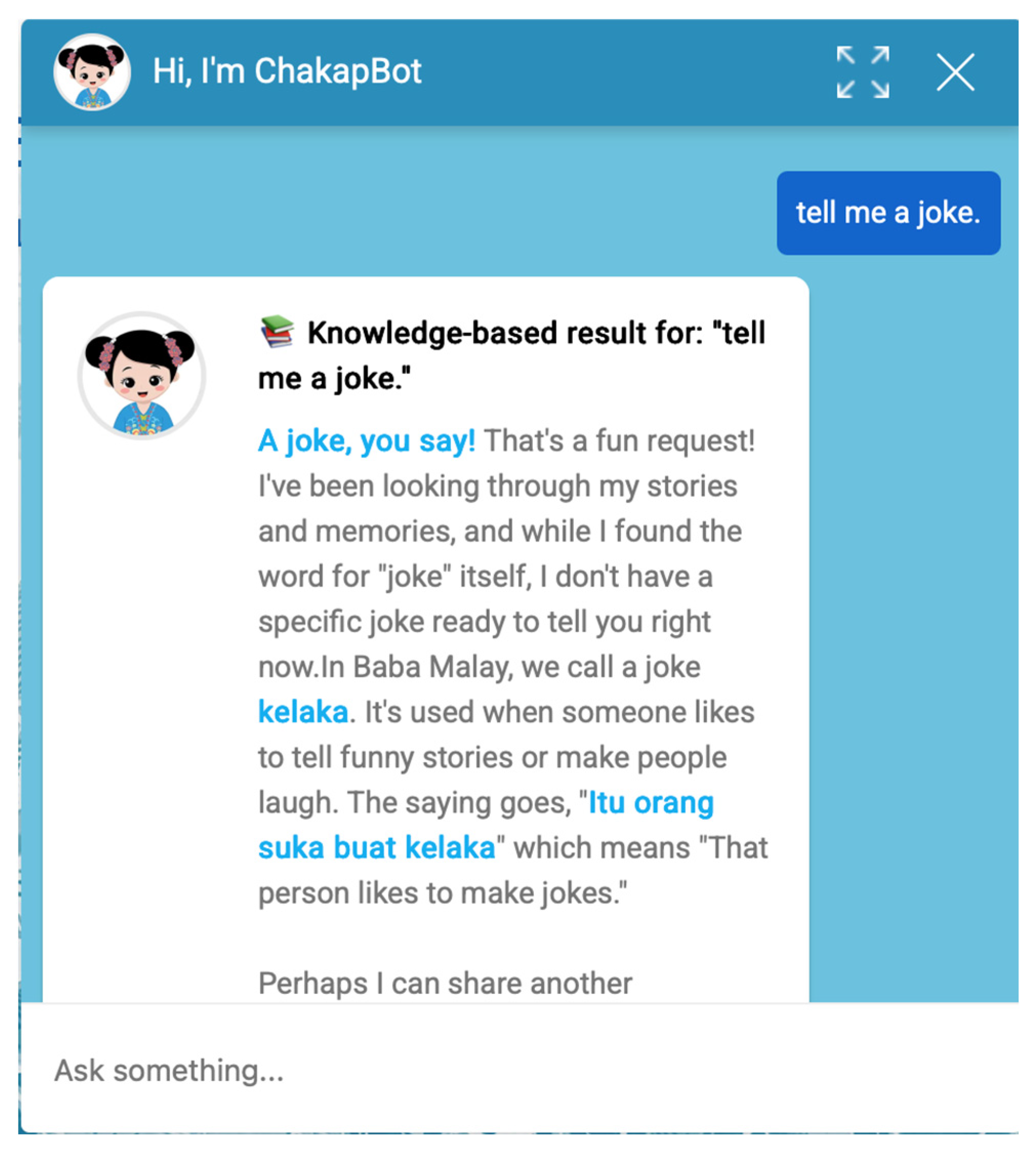
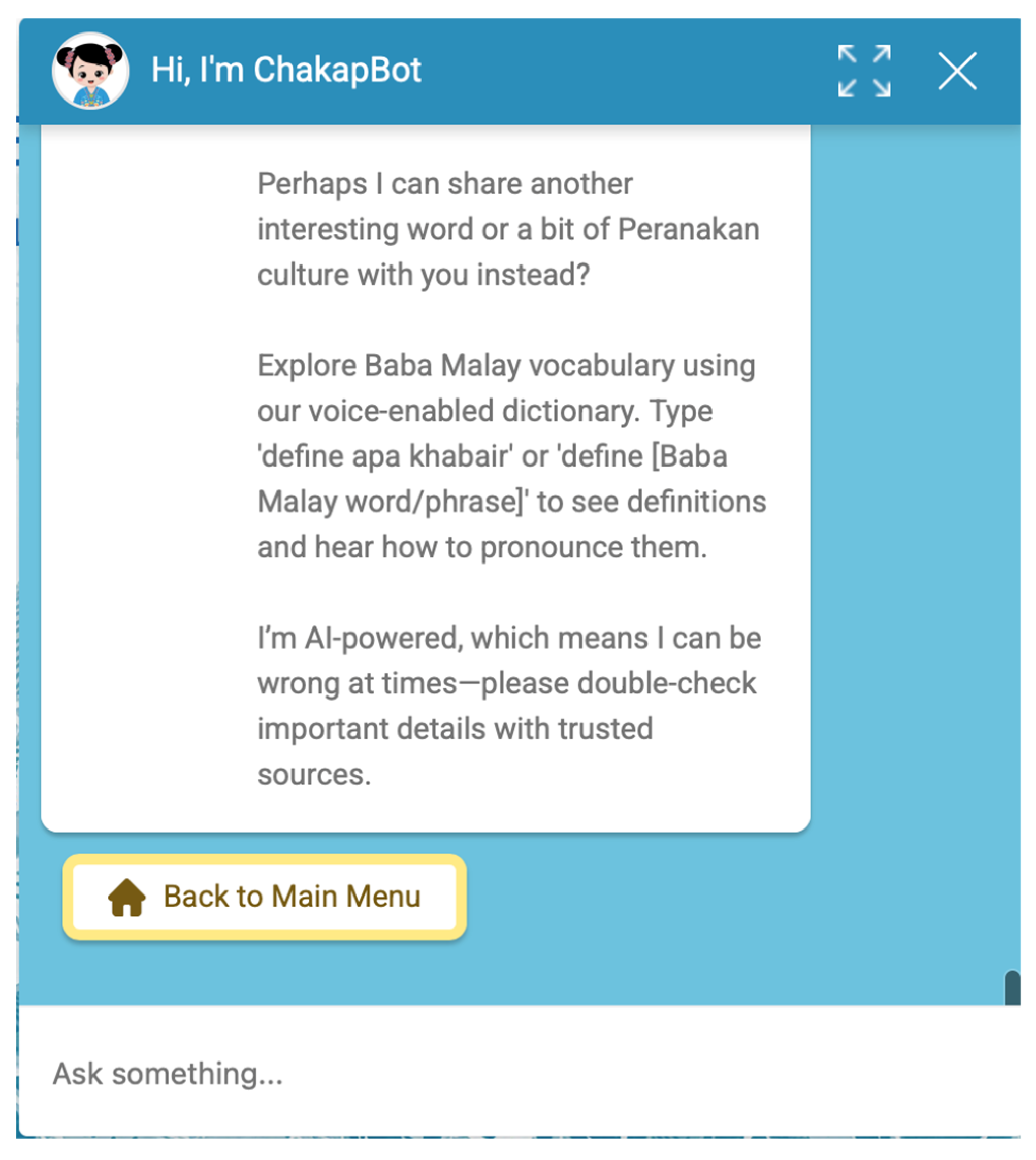
2.2. ChakapBot’s User Interface
3. Results
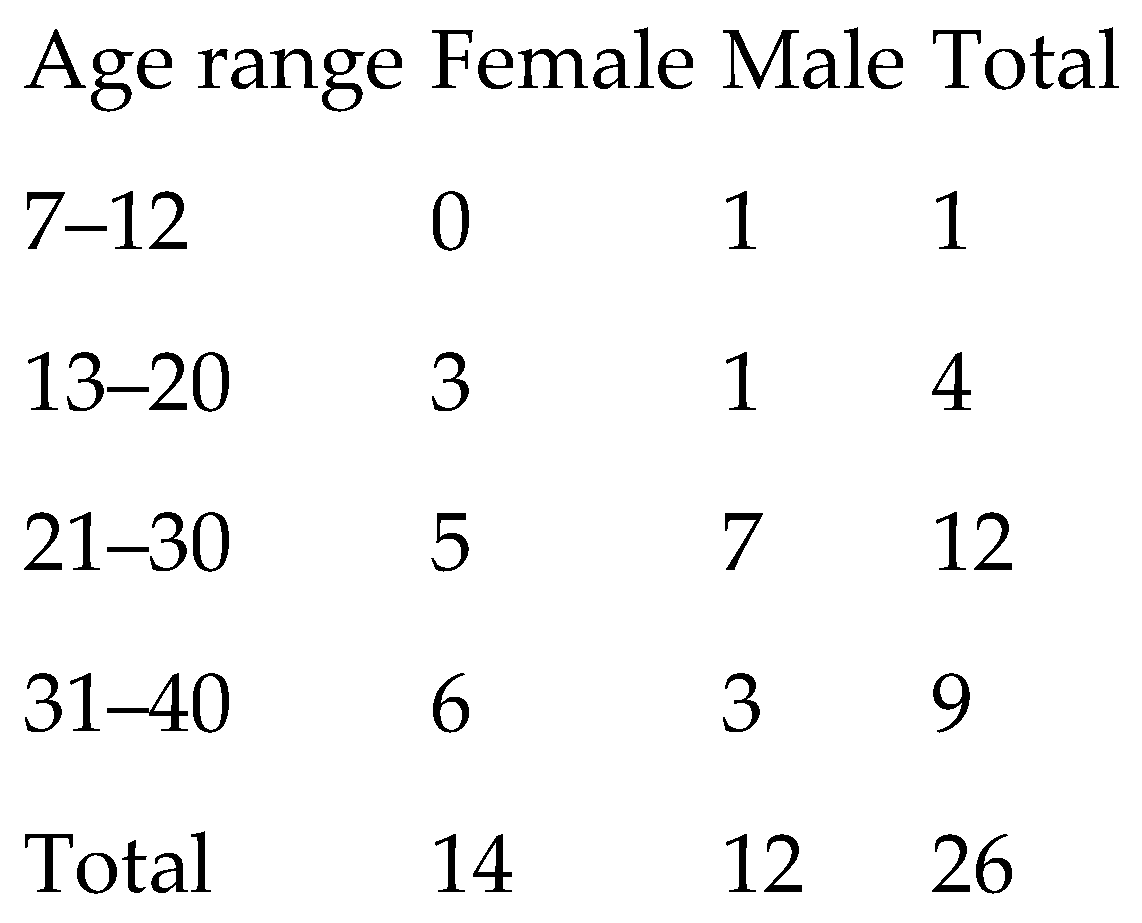
3.1. Pre-Pilot Survey: Participant Demographics, Motivation, and Concerns
“I was interested in trying a new language.”
“Pick it up for fun and understand the culture.”
“…it’s important for me to reconnect with my heritage and the language of Baba Malay, my ancestors, is integral to that.”
“Finding the heritage in my family. Understand that my great-grandmother is a peranakan and wanted to be closer to my roots.”
“…I am interested in investigating the conversation surrounding preservation vs. conservation, why is it worth it to preserve a culture and how we might preserve traditions.”
“Think it would be a good way to bond with the maternal side of my family and to preserve the language that I never got to learn.”
“Authenticity.”
“How to ensure that what I am learning is correct.”
“mainly the invasion of privacy (afterall it is giant data collection).”
“will this form of reinforcement learning help the AI to proceed towards AGI and ASI?”
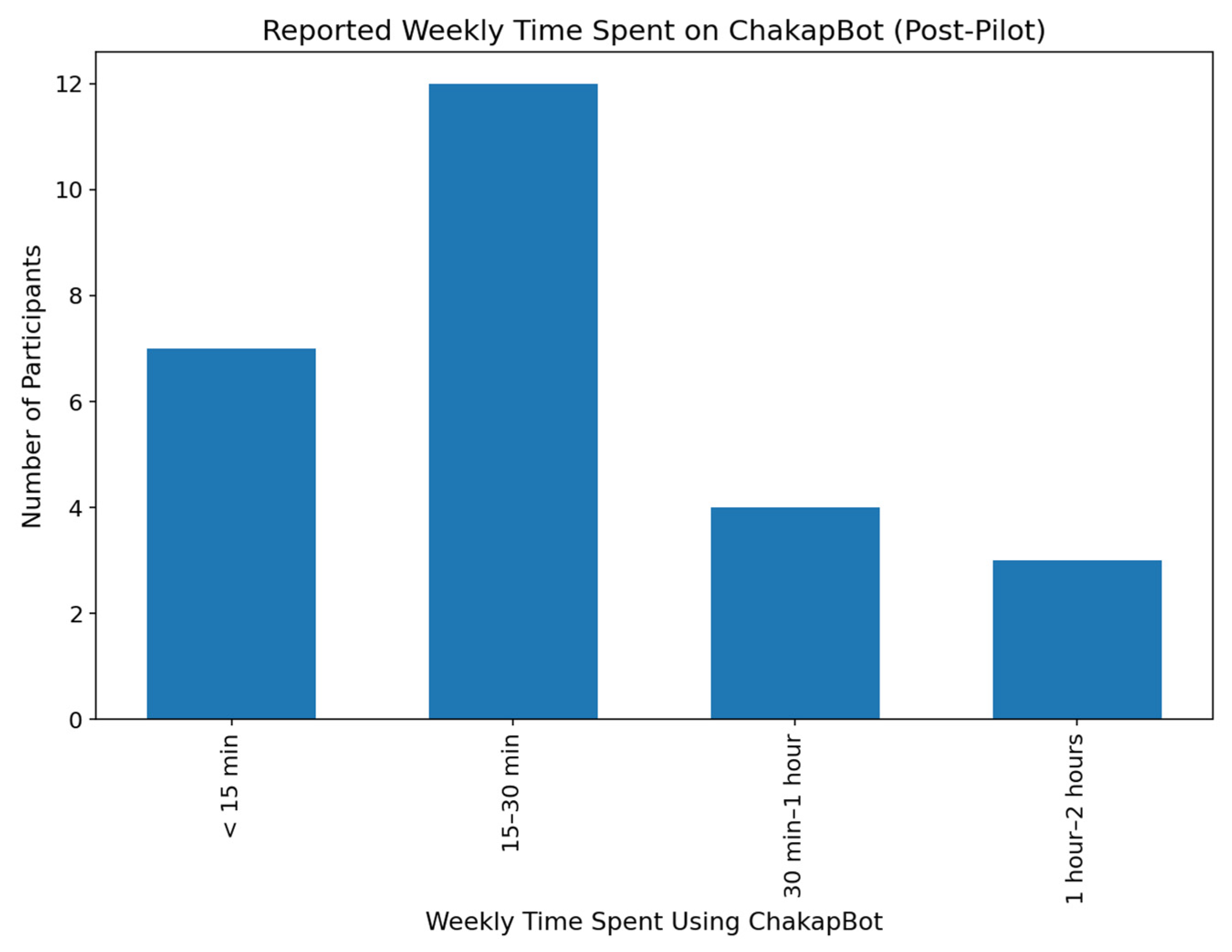
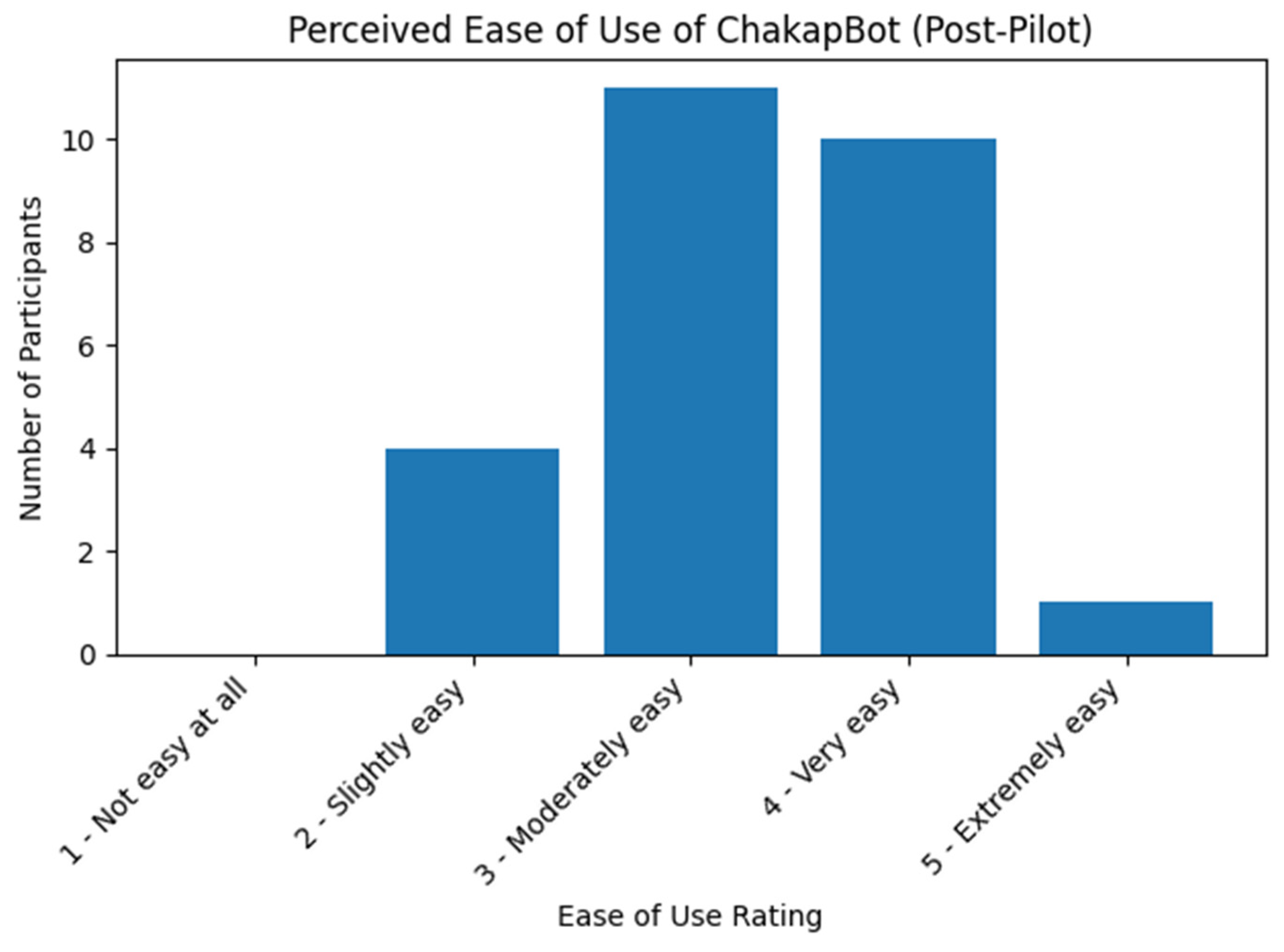
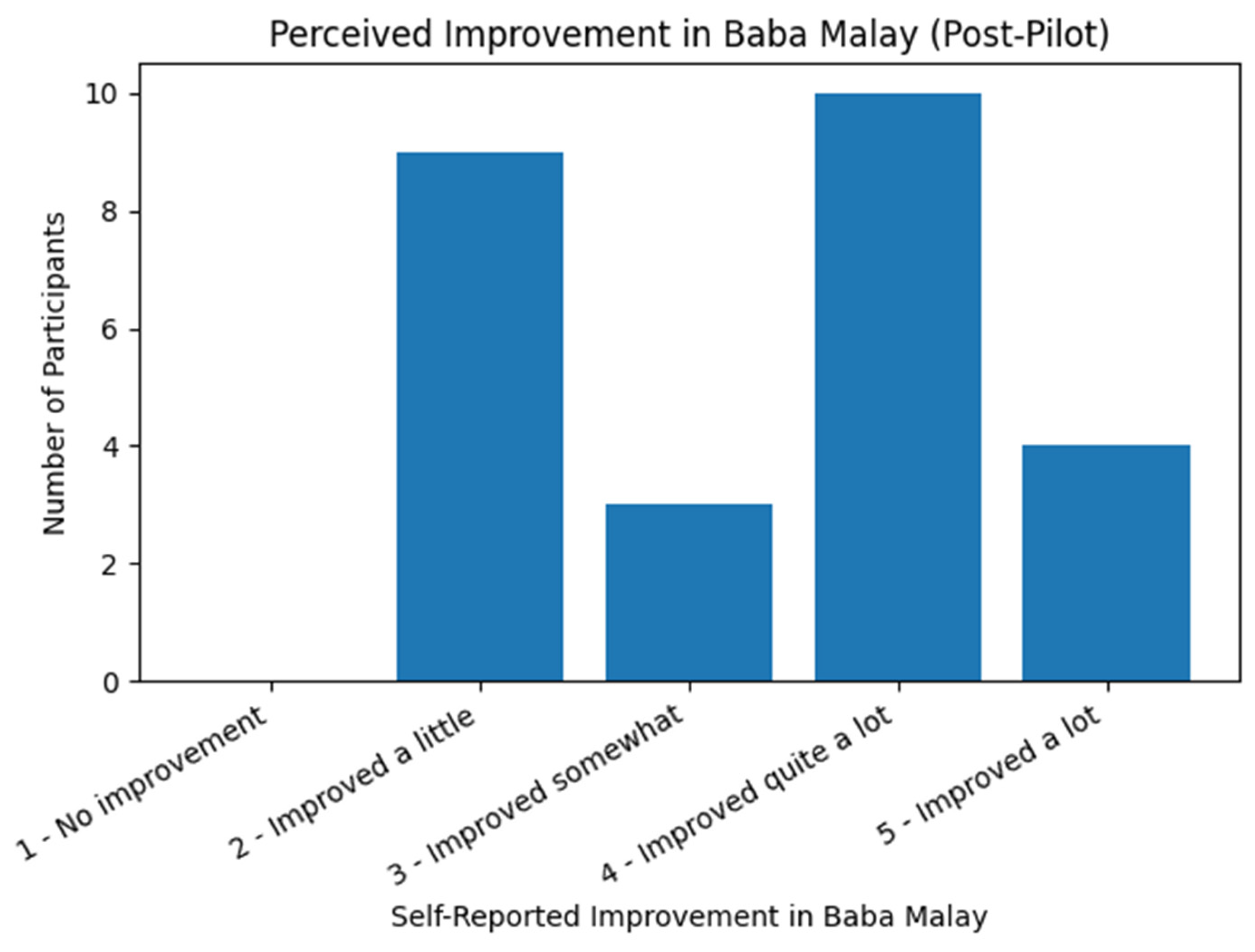
3.2. Post-Pilot Survey: Where ChakapBot Succeeds and Areas for Improvement
“The app was easy and intuitive to use.”
“I can learn anytime anywhere.”
“I like that it is available 24/7, and is a good source of vocabulary or sentences that may not be found in the textbooks or covered during classes.”
“It has audio function which has been really helpful for learning pronunciation.”
“The AI feature that allows us to pose any question and it will answer to the best of its availability just like the likes of Chatgpt and Copilot….I also appreciate the voice recordings as it accurately captures how the language should be spoken from an expert POV.”
“the LLM structure where I can spontaneously send question prompts to clarify my queries/doubts.”
“It had no speak-to-check function or function for us to ask questions.”
“how the efficiency decreases when further prompting is given.”
It’s still not comprehensively trained to answer every kind of questions related to Baba Malay, like list me all words that have alus form.”
“ChakapBot could have more interactive element when prompted, e.g., games, videos to add to the learning and understanding culture. Focusing not just on language.”
“To understand social nuances and culture.”
“The speaking portion. Hearing the organic use of the language made picking up the intonation and nuances of the language easier.”
“I could practice speaking Baba Malay and get an active feedback…”
“More Engagement with the actual speakers of the language.”
4. Discussion: Implications of an AI-Powered Chatbot for Language Revitalisation and Language Documentation
Author Contributions
Funding
Institutional Review Board Statement
Informed Consent Statement
Data Availability Statement
Acknowledgments
Conflicts of Interest
References
- Ansaldo, U., Lim, L., & Mufwene, S. S. (2007). The sociolinguistic history of the Peranakans: What it tells us about “creolization”. In U. Ansaldo, S. Matthews, & L. Lim (Eds.), Deconstructing creole. Typological studies in language. 73 (pp. 203–226). John Benjamins. [Google Scholar]
- Barath, H. (2025, April 9). Language preservation efforts gets an AI boost. Darthmouth University. Available online: https://home.dartmouth.edu/news/2025/04/language-preservations-efforts-get-ai-boost?utm_source=chatgpt.com (accessed on 1 February 2026).
- Basar, E., Balaji, D., He, L., Hendrickx, I., Krahmer, E., De Bruijn, G., & Bosse, T. (2023, July 19–21). HyLECA: A framework for developing hybrid long-term engaging controlled conversational agents. Proceedings of the 5th International Conference on Conversational User Interfaces, Eindhoven, The Netherlands. [Google Scholar]
- Blanks, K. (n.d.). Linguistic revival: How Japan restored the native Ainu language with “AI Pirika”. Rewired. Available online: https://stanfordrewired.com/post/japan-restored-ainu-ai-pirika (accessed on 1 February 2026).
- Brewer, G. L. (2022, June 3). Lakota elders helped a white man preserve their language. Then he tried to sell it back to them. NBC News. Available online: https://www.nbcnews.com/news/us-news/native-american-language-preservation-rcna31396 (accessed on 1 February 2026).
- Brixey, J., & Traum, D. (2020). Masheli: A Choctaw-English bilingual chatbot. In Proceedings of the 11th international workshop on spoken dialog systems. IWSDS. [Google Scholar]
- Chan, K. (2018). Mari Chakap Baba: A comprehensive guide to the Baba Nyonya language. Gunong Sayang Association. [Google Scholar]
- Chia, F. (1983, August 19). Peeping through the nonya window curtain and seeing the decline of the Baba culture. A Talk Held at the Central Library, National University of Singapore.
- Cohen, Y., & Norst, M. J. (1989). Fear, dependence and loss of self-esteem: Affective barriers in second language learning among adults. RELC Journal, 20(2), 61–77. [Google Scholar] [CrossRef]
- Dasgupta, D. (2025, October 7). India launches AI app to save its many tribal languages before they vanish. The Straits Times. Available online: https://www.straitstimes.com/asia/south-asia/india-launches-ai-app-to-save-its-many-tribal-languages-before-they-vanish (accessed on 1 February 2026).
- Department of Statistics Singapore. (2020). Singapore census of population 2020, statistical release 1: Demographic characteristics, education, language and religion. Available online: https://www.singstat.gov.sg/publication-resources/singapore-census-of-population-2020-statistical-release-1-demographic-characteristics-education-language-and-religion (accessed on 5 February 2026).
- Glorieux-Stryckman, M. (2024, December 16). AI outrage: Error-riddled Indigenous language guides do real harm, advocates say. The Gazette. Available online: https://montrealgazette.com/news/ai-outrage-error-riddled-indigenous-language-guides-do-real-harm-advocates-say (accessed on 1 February 2026).
- Gwee, W. T. H. (1993). Mas sepuloh: Baba conversational gems. Armour Publishing. [Google Scholar]
- Gwee, W. T. H. (2006). A Baba Malay dictionary: The first comprehensive compendium of straits Chinese terms and expressions. Tuttle Publishing. [Google Scholar]
- Ingram, M. (2025). The role of AI in language preservation and revitalization. In AI for community (pp. 55–80). Chapman and Hall/CRC. [Google Scholar]
- Jain, R. (Ed.). (2021). Multilingual Singapore: Language policies and linguistic realities. Routledge. [Google Scholar]
- Jampel, S. (2025, July 31). Can A.I. help revitalize indigenous languages? Smithsonian Magazine. Available online: https://www.smithsonianmag.com/science-nature/can-ai-help-revitalize-indigenous-languages-180987060/ (accessed on 1 February 2026).
- Lau, A. G. L. (1984). Language death with particular reference to the Baba Malay of Singapore [Master’s thesis, University of York]. [Google Scholar]
- Lau, J. (2025, June 26). Can AI speak the language Japan tried to kill? BBC. Available online: https://www.bbc.com/future/article/20250625-can-ai-speak-the-language-japan-tried-to-kill (accessed on 1 February 2026).
- Lee, N. H. (2014). A grammar of Baba Malay with sociophonetic considerations [Ph.D. dissertation, University of Hawai’i]. [Google Scholar]
- Lee, N. H. (2019). Peranakans in Singapore: Responses to language endangerment and documentation. Language Documentation & Conservation, 19, 123–140. [Google Scholar]
- Lee, N. H. (2022). A grammar of modern Baba Malay. Mouton de Gruyter. [Google Scholar]
- Lee, N. H., & Van Way, J. (2018). Assessing degrees of endangerment. In K. Rehg, & L. Campbell (Eds.), Oxford handbook of endangered languages (pp. 48–65). Oxford University Press. [Google Scholar]
- Lewis, M. P., & Simons, G. F. (2010). Assessing endangerment: Expanding Fishman’s GIDS. Revue Roumaine de Linguistique, 55(2), 103–120. [Google Scholar]
- Lewis, P., Perez, E., Piktus, A., Petroni, F., Karpukhin, V., Goyal, N., Küttler, H., Lewis, M., Yih, W., Rocktäschel, T., Riedel, S., & Kiela, D. (2020). Retrieval-augmented generation for knowledge-intensive NLP tasks. In Advances in neural information processing systems (Vol. 33, pp. 9459–9474). Curran Associates, Inc. [Google Scholar]
- Lim, C. (2024, June 16). Commentary: Are Singapore children overscheduled during school holidays? Channel News Asia. Available online: https://www.channelnewsasia.com/commentary/kid-school-june-december-holiday-activities-play-benefits-parenting-4410586?utm_source=chatgpt.com (accessed on 5 February 2026).
- Long, Y., & Zhang, Y. (2024). Enhanced classroom dialogue sequences analysis with a hybrid AI agent: Merging expert rule-base with large language models. arXiv. [Google Scholar] [CrossRef]
- Mila—Quebec Artificial Intelligence Institute. (n.d.). First languages AI reality. Available online: https://mila.quebec/en/ai4humanity/applied-projects/first-languages-ai-reality (accessed on 1 February 2026).
- Nguyen, H., Nguyen, T., & Nguyen, V. (2025). Enhancing retrieval-augmented generation with hierarchical text segmentation chunking. arXiv. [Google Scholar] [CrossRef]
- O’Grady, W., & Hattori, R. (2016). Language acquisition and language revitalization. Language Documentation & Conservation, 10, 45–57. [Google Scholar]
- OpenAI Press Release. (2025, March 14). How Iceland is using GPT-4 to preserve its language. Arctic Today. Available online: https://www.arctictoday.com/how-iceland-is-using-gpt-4-to-preserve-its-language/ (accessed on 1 February 2026).
- Pakir, A. (1986). A linguistic investigation of Baba Malay [Ph.D. dissertation, University of Hawai’i]. [Google Scholar]
- Patil, R., & Gudivada, V. (2024). A review of current trends, techniques, and challenges in Large Language Models (LLMs). Applied Sciences, 14(5), 2074. [Google Scholar] [CrossRef]
- Qin, Y., Zhou, Y., Huang, X., & Huricha, B. (2025). Empowering foreign language education with large language models: Applications and insights. Journal of Higher Education Teaching, 2, 100–101. [Google Scholar] [CrossRef]
- Rappa, A. L., & Wee, L. (2006). Language policy and modernity in Southeast Asia: Malaysia, the Philippines, Singapore, and Thailand. Springer. [Google Scholar]
- Schumann, J. H. (1975). Affective factors and the problem of age in second language acquisition. Language Learning, 25(2), 209–235. [Google Scholar] [CrossRef]
- Tan, C. B. (1979). Baba and Nyonya: A study of the ethnic identity of the Chinese Peranakan in Malacca. Cornell University. [Google Scholar]
- Te Hiku Media. (n.d.). Te Hiku Tech. Available online: https://tehiku.nz/te-hiku-tech/ (accessed on 1 February 2026).
- The Steam Connection. (2024). SkoBots. Available online: https://www.steamconnection.org/skobots (accessed on 1 February 2026).
- Turing, A. M. (1950). Computing machinery and intelligence. Mind, 59, 433–460. [Google Scholar] [CrossRef]
- UNESCO. (2022, January 5). Indigenous languages: Gateways to the world. UNESCO. Available online: https://www.unesco.org/en/articles/cutting-edge-indigenous-languages-gateways-worlds-cultural-diversity?utm_source=chatgpt.com (accessed on 1 February 2026).
- UNESCO Ad Hoc Expert Group on Endangered Languages. (2003, March 10). Language vitality and endangerment. Document adopted by the international expert meeting on UNESCO programme safeguarding of endangered languages. UNESCO. [Google Scholar]
- Wang, L. (2024). Artificial intelligence’s role in the realm of endangered languages: Documentation and teaching. Applied and Computational Engineering, 48, 123–129. [Google Scholar] [CrossRef]
- Wiltshire, B., Bird, S., & Hardwick, R. (2024). Understanding how language revitalisation works: A realist synthesis. Journal of Multilingual and Multicultural Development, 45(9), 3946–3962. [Google Scholar] [CrossRef]
- Zhao, J., Ji, Z., Fan, Z., Wang, H., Niu, S., Tang, B., Xiong, F., & Li, Z. (2025). MoC: Mixtures of text chunking learners for retrieval-augmented generation system. In Proceedings of the 63rd annual meeting of the association for computational linguistics: Vol. 1, Long Papers (pp. 5172–5189). Association for Computational Linguistics. [Google Scholar]


Disclaimer/Publisher’s Note: The statements, opinions and data contained in all publications are solely those of the individual author(s) and contributor(s) and not of MDPI and/or the editor(s). MDPI and/or the editor(s) disclaim responsibility for any injury to people or property resulting from any ideas, methods, instructions or products referred to in the content. |
© 2026 by the authors. Licensee MDPI, Basel, Switzerland. This article is an open access article distributed under the terms and conditions of the Creative Commons Attribution (CC BY) license.
Share and Cite
Lee, N.H.; Zhang, H. ChakapBot: A Generative AI-Powered Chatbot for the Revitalisation of Baba Malay. Languages 2026, 11, 145. https://doi.org/10.3390/languages11070145
Lee NH, Zhang H. ChakapBot: A Generative AI-Powered Chatbot for the Revitalisation of Baba Malay. Languages. 2026; 11(7):145. https://doi.org/10.3390/languages11070145
Chicago/Turabian StyleLee, Nala H., and Huiyu Zhang. 2026. "ChakapBot: A Generative AI-Powered Chatbot for the Revitalisation of Baba Malay" Languages 11, no. 7: 145. https://doi.org/10.3390/languages11070145
APA StyleLee, N. H., & Zhang, H. (2026). ChakapBot: A Generative AI-Powered Chatbot for the Revitalisation of Baba Malay. Languages, 11(7), 145. https://doi.org/10.3390/languages11070145