1. Introduction
The argument realization of verbs is both diverse and highly constrained, a duality reflected in the number and types of arguments a verb governs, as well as their specific syntactic configurations. Consider the English verb
sweep as an example. In terms of quantity, it can license a single argument (1a), two arguments (1b), or even three (1f, h). Regarding semantic types,
sweep can be associated with an Agent (
Pat), a Patient (
the floor in 1b), a Theme (
the crumbs in 1f), a Goal (
the floor in 1f), a Material (
the crumbs in 1h), and a Result (
a pile in 1h). Finally, with respect to syntactic realization, while Agent and Patient arguments can appear in isolation (1a, b), Theme, Goal, Material, and Result arguments cannot (1c, d, e). Furthermore, a Theme may precede a Goal introduced by a preposition (1f) but cannot follow it (1g); similarly, a Material argument may precede a Resultative prepositional phrase (1h) but cannot follow it (1i).
| (1) | a. Pat swept. |
| | b. Pat swept the floor. |
| | c. *Pat swept the crumbs. |
| | d. *Pat swept onto the floor. |
| | e. *Pat swept into a pile. |
| | f. Pat swept the crumbs onto the floor. |
| | g. *Pat swept onto the floor the crumbs. |
| | h. Pat swept the crumbs into a pile. |
| | i. *Pat swept into a pile the crumbs. |
The same applies to the argument realization of Chinese verbs. Take the Chinese verb 扫
sǎo ‘sweep’ as an example. It can take one argument (2a), two (2b, c), or three (2d). It can take an Agent (
Zhāng Sān ‘Zhang San’), a Patient (
dì ‘floor’ in 2b and
suìxiè ‘crumbs’ in 2c), a Theme (
suìxiè in 2d), and a Goal (
dìshang ‘on the floor’ in 2d), but it cannot directly take Source or Result arguments without other predicates. Agents and Patients can appear independently (2a, b, c). A Theme can precede a Goal introduced by a preposition (2d) but cannot follow it (2e).
| (2) | a. 张三 | 扫 | 了。 | | | | | | |
| | Zhāng Sān | sǎo | le. | | | | | | |
| | Zhang San | sweep | PFV | | | | | | |
| | ‘Zhang San swept.’ | | | | | | |
| | b. 张三 | 扫 | 了 | 地。 | /张三 | 把 | 地 | 扫 | 了。 |
| | Zhāng Sān | sǎo | le | dì | / Zhāng Sān | bǎ | dì | sǎo | le |
| | Zhang San | sweep | PFV | floor | / Zhang San | BA | floor | sweep | PFV |
| | ‘Zhang San swept the floor.’ |
| | c. 张三 | 扫 | 了 | 碎屑。 | / 张三 | 把 | 碎屑 | 扫 | 了。 |
| | Zhāng Sān | sǎo | le | suìxiè. | / Zhāng Sān | bǎ | suìxiè | sǎo | le. |
| | Zhang San | sweep | PFV | crumbs | / Zhang San | BA | crumbs | sweep | PFV |
| | ‘Zhang San swept the crumbs.’ |
| | d. 张三 | 把 | 碎屑 | 扫 | 地上 | 了。 | | | |
| | Zhāng Sān | bǎ | suìxiè | sǎo | dìshang | le | | | |
| | Zhang San | BA | crumbs | sweep | floor.on | PFV/CRS | | | |
| | ‘Zhang San swept the crumbs onto the floor.’ | | | |
| | e. *张三 | 扫 | 地上 | 了 | 把 | 碎屑。 | | | |
| | * Zhāng Sān | sǎo | dìshang | le | bǎ | suìxiè. | | | |
| | Zhang San | sweep | floor.on | PFV/CRS | BA | crumbs | | | |
| | ‘Zhang San swept onto the floor the crumbs.’ | | | |
These examples demonstrate that verbs in both English and Chinese exhibit rich yet constrained argument realization, and semantically similar verbs can vary across languages. Capturing these generalizations is fundamental to describing grammaticality and remains a core issue in grammatical research. To address this, most modern frameworks assume that a verb’s syntactic behavior is, to some extent, predictable from its lexical–semantic content. This view is explicitly stated in the Principles and Parameters framework (
Chomsky, 1981, pp. 29, 38), Lexical Functional Grammar (
Kaplan & Bresnan, 1995, p. 65), Role and Reference Grammar (
Foley & Van Valin, 1984, p. 183), and Construction Grammar (
Goldberg, 1995, p. 50). Consequently, extensive research has sought to extract syntactically relevant meaning from verbal semantics. Two main approaches have emerged. The first focuses on the event structural relations, such as the spatial displacement (
Jackendoff, 1972,
1983), the aspectual configuration (
Tenny, 1987,
1994), and causal chain (
Croft, 1991). The second, and perhaps more foundational, focuses on the event roles—specifically, the entities involved in an event and the relations between them.
The present study focuses exclusively on this latter domain: how role information is represented in verb meaning. Within this tradition, three major approaches have dominated the literature: Semantic Role Lists, Predicate–Argument Structures, and Participant Roles. While they share the premise that roles are the building blocks of verbal semantics, they differ in their representational focus. Specifically, we categorize Semantic Role Lists and Participant Roles as role-based approaches, which emphasize the event participants a verb denotes. In contrast, we define Predicate–Argument Structures as a structure-based approach, which emphasizes the syntactic templates a verb projects.
Despite the explanatory power of these models, a critical question remains: Which components of these theoretical representations possess psychological reality during real-time processing? While English has provided a wealth of processing evidence, Chinese offers a unique and arguably cleaner test case. As an isolating language, Chinese lacks overt morphological markers (such as case, gender, or number agreement) that might otherwise signal argument relations. Consequently, the cognitive system must rely more heavily on the verb’s inherent semantic specifications. Investigating Chinese verbs, therefore, allows us to isolate the impact of role-based versus structure-based complexity without the confounding noise of complex morphology.
The present study compares two major perspectives within the lexical–semantic domain—the role-based and structure-based approaches—to investigate their competing accounts of lexical complexity in Chinese. Specifically, we aim to determine whether the cognitive processing load of Chinese verbs is primarily driven by the richness of the event participants associated with the verb or the multiplicity of the syntactic templates it projects. Through a lexical decision experiment, we aim to determine which representational model better captures the mental lexicon of Chinese speakers. In doing so, this study provides new empirical evidence for argument realization theory and offers insights into how such representations interact with typological factors in real-time comprehension. The following sections first present a systematic comparison of the three theoretical frameworks of argument realization, highlighting their different assumptions about lexical–semantic representation. Building on this comparison, we then derive their respective predictions for real-time language processing. We next introduce the experimental design and methodology used to test these predictions and finally discuss the implications of our findings for predictive processing, cross-linguistic variation, and the integration of grammatical theory with psycholinguistic evidence.
2. Three Models of Verbal Representation
The three approaches examined in this study—Semantic Role Lists, Predicate–Argument Structures, and Participant Roles—share a core ontological commitment: they assume that the mental representation of a verb is primarily composed of information regarding the participants involved in the denoted event. However, they diverge in the format of this information. The first two are primarily role-based, while the third is structure-based.
2.1. Role-Based Approach (I): Semantic Role Lists
The Semantic Role List approach, rooted in Case Grammar (
Fillmore, 1968) and Thematic Relations (
Gruber, 1965;
Jackendoff, 1972), represents the most traditional projectionist view. It posits that each verb is associated with a fixed, universal set of unanalyzable atomic units—such as Agent, Patient, and Instrument. Syntactic realization is then achieved through a mapping algorithm that links these roles to grammatical positions. Within this paradigm, roles are viewed as discrete units whose definitions remain independent of a verb’s specific idiosyncratic meaning (
Croft, 1991, p. 156).
The classic contrast between
break verbs (e.g.,
slap,
strike) and
hit verbs (e.g.,
bend,
shatter) illustrates this approach. As shown in (3–5), although both involve a physical impact, their syntactic flexibility differs:
break allows a causative-inchoative alternation (5a), whereas
hit does not (5b).
| (3) | a. John broke the stick (with a rock). |
| | b. John hit the tree (with a rock). |
| (4) | a. A rock broke the stick. |
| | b. A rock hit the tree. |
| (5) | a. The stick broke. |
| | b. *The tree hit. |
Fillmore (
1970) accounts for this divergence by specifying the obligatoriness of roles within the lexical entry as in (6–7).
| (6) | break: (Agent) (Instrument) Patient |
| (7) | hit: Agent/Instrument Patient |
Under this view,
break selects for an obligatory Patient but only an optional Agent or Instrument (6), licensing the intransitive causative-inchoative alternation. In contrast,
hit requires both an obligatory Patient and an obligatory Agent/Instrument (7), restricting it to transitive structures. However, this approach suffers from the granularity problem: there is no cross-theoretical consensus on the definitive inventory of roles or the diagnostic tests used to identify them (
Croft, 1991, pp. 155–158;
1998, pp. 27–34;
Davis, 2001, pp. 20–25;
Dowty, 1991;
Levin & Rappaport Hovav, 2005, pp. 38–44;
Parsons, 1990, p. 1995).
2.2. Role-Based Approach (II): Participant Roles
Rooted in Construction Grammar (
Goldberg, 1995,
2006), the Participant Role approach, while also role-based, differs from Semantic Role Lists by shifting the focus from abstract categories to scene-specific frames. Rather than a generic Agent and Patient, a verb like
break is associated with the specific roles of
breaker and
broken.
This approach introduces two key innovations. First, participant roles are specific to a particular scene the verb denotes and thus constitute an open-ended and infinite set of concepts rather than a closed, finite one. Second, it utilizes lexical profiling to designate which roles are semantically core and syntactically obligatory. As shown in (8–9), roles in bold are profiled.
| (8) | break: <breaker broken> |
Argument realization is thus viewed as a process of fusion between the participant roles of a verb and the argument roles of a construction. Syntactic contrasts observed in examples (3–5) is explained by the role matching between participant roles and argument roles in fusion. Break has only one lexically profiled participant role, allowing it to fuse with the Intransitive Construction. In contrast, hit has two lexically profiled participant roles and therefore cannot fuse with the Intransitive Construction.
The Participant Role approach successfully predicts argument structure patterns and provides insightful analyses, particularly for syntactic and idiomatic structures. By assuming that verbs represent scene-specific roles, this method bypasses the difficulties faced by the Semantic Role List approach in determining the number and granularity of roles. However, whether constructions should be considered the primary units of meaning—especially for highly compositional and transparent structures such as Subject-Predicate or Verb-Object sequences—remains a subject of debate. These issues impact the ability of Construction Grammar to provide a comprehensive, global explanation for argument realization.
2.3. Structure-Based Approach: Predicate–Argument Structure
To bypass the label-dependency of semantic roles, the Predicate–Argument Structure (PAS) approach (
Grimshaw, 1990) abstracts away from specific role content, focusing instead on the prominence relations between arguments. In this framework, a verb’s representation reflects a hierarchical organization determined by two tiers: the thematic hierarchy (e.g., Agent > Goal > Theme) and the event structure (e.g., Cause > Result).
Unlike the role lists, PAS explains the syntactic contrasts observed in examples (3–5) by specifying the number of lexical templates as in (10–11).
| (10) | a. break: (x (y)) |
| | b. break: (x) |
Here, break possesses two distinct lexical entries—one for its transitive use (10a) and another for its intransitive use (10b). In contrast, hit is restricted to a single representation (11), where two arguments are obligatorily required. Notably, within this model, the specific semantic identities of x and y are omitted from the representation; it is the hierarchical prominence and the sheer number of available structures that dictate the verb’s argument realization.
By representing arguments as variables (
x, y) rather than fixed labels, PAS avoids the difficulties encountered by the Semantic Role List approach in role identification and has offered insightful analyses regarding nominalization phenomena and the usage of psych-verbs in English. However, this parsimony comes at a theoretical cost: by stripping away specific semantic content, PAS struggles to distinguish between certain verb classes, such as the nuanced behavior of unaccusative and unergative verbs (
Zaenen et al., 1993), where the specific nature of the role is cognitively salient.
2.4. Synthesis: Role-Based vs. Structure-Based Representation
The three models discussed above can be synthesized along two primary dimensions: representational content and syntactic framework. Regarding content, a clear distinction exists between the role-based and structure-based approaches. The Semantic Role List and Participant Role models emphasize the semantic richness of the event, assuming that a verb’s lexical representation is centered on the participants it evokes. In contrast, the PAS model focuses on the relational prominence between variables while abstracting away from specific role content.
From a framework perspective, these models diverge in their view of the lexicon-grammar interface. The Semantic Role List and PAS approaches are both projectionist, viewing the verb’s lexical entry as a self-contained source of syntactic instructions. The Participant Role approach, however, adopts a constructionist view, where argument realization is an emergent product of the interaction (fusion) between verbs and argument structure constructions.
Crucially, these differing formats imply different metrics for quantifying lexical–semantic complexity. While they all agree that the verb’s representation constrains its syntax, they disagree on which units of information—whether role-based or structure-based—constitute the primary source of processing load. This theoretical tension sets the stage for examining how these competing insights translate into specific psycholinguistic predictions, a topic explored in the following section.
4. Experiment: A Lexical Decision Task on Chinese Verbs
This experiment aims to examine the semantic complexity of verbs during lexical access. Specifically, it tests whether the processing load is modulated by the number of semantic participants (H1) or the number of syntactic templates (H2). Research has shown that semantic representations are activated during lexical decision tasks (
Manouilidou & de Almeida, 2013;
McKoon & Love, 2011;
McKoon & Macfarland, 2000,
2002). Therefore, this experiment employed a lexical decision task and used lexical decision time as an indicator of semantic complexity.
To systematically adjudicate between these two theoretical perspectives, this study operationalizes the competing accounts within a 2 × 2 factorial design (Role Quantity: One vs. Two x Structure Quantity: One vs. Two). By intersecting these two independent variables, the four canonical verb combinations allow us to simultaneously evaluate the distinct main effects of role/structural complexity and their potential interaction. The Role-Quantity Hypothesis (H1), derived from the Semantic/Participant Role paradigm, predicts a main effect of role complexity: verbs containing two roles (e.g., 面临 miànlín ‘face’) will elicit longer reaction times and lower accuracy than those with one role (e.g., 考试 kǎoshì ‘take an exam’), regardless of structural variations. The Structure-Quantity Hypothesis (H2), derived from the Predicate–Argument Structure approach, predicts a main effect of structural complexity: verbs containing two argument structures (e.g., 出席 chūxí ‘attend’) will elicit longer reaction times and lower accuracy than those with one argument structure (e.g., 考试 kǎoshì ‘take an exam’), irrespective of role quantity. Crucially, testing the interaction between these two dimensions serves as a diagnostic tool for the complex conditions (e.g., two-structure, two-role verbs like 晓得 xiǎode ‘know’). A significant interaction would reveal a compounding, non-linear processing mechanism when a verb is complex in both dimensions. Conversely, a non-significant interaction would demonstrate that role activation and structural retrieval operate as mutually independent cognitive processes during early lexical access.
4.1. Methods
The lexical decision task (LDT) required participants to quickly judge whether a character string constituted a real word while ensuring accuracy; for example, 考试 (
kǎoshì ‘exam’) is a real word, whereas 壮饰 (
zhuàngshì) is a pseudo-word
1. This experiment employed the aforementioned 2 × 2 factorial design, creating four groups of experimental verbs (14 words per group, totaling 56): one-structure one-role, one-structure two-role, two-structure one-role, and two-structure two-role (see
Table 1).
One-structure verbs included intransitive verbs and obligatorily transitive verbs, while two-structure verbs included transitive verbs and intransitive verbs that can take objects introduced by prepositions. To illustrate the structural and argument-related contrasts among the four classes of verbs, consider the following examples:
| (15) | a. One-structure, One-role (e.g., 考试 kǎoshì ‘take an exam’): |
| | 学生 | 明天 | 考试。 | | |
| | xuéshēng | míngtiān | kǎoshì. | | |
| | student | tomorrow | take_exam | | |
| | ‘The students will take an exam tomorrow.’ |
| | b. One-structure, Two-role (e.g., 面临 miànlín ‘face’): |
| | 传统 | 工艺 | 正 | 面临 | 挑战。 |
| | chuántǒng | gōngyì | zhèng | miànlín | tiǎozhàn. |
| | traditional | craft | PROG | face | challenge |
| | ‘Traditional crafts are facing challenges.’ |
| | c. Two-structure, One-role (e.g., 出席 chūxí ‘attend’): |
| | (i) 各 | 组 | 组长 | 务必 | 出席。 |
| | gè | zǔ | zǔzhǎng | wùbì | chūxí. |
| | each | group | leader | must | attend |
| | ‘The leaders of each group must attend.’ |
| | (ii) 校长 | 出席 | 了 | 开幕式。 | |
| | xiàozhǎng | chūxí | le | kāimùshì. | |
| | principal | attend | PFV | opening_ceremony | |
| | ‘The principal attended the opening ceremony.’ |
| | d. Two-structure, Two-role (e.g., 晓得 xiǎode ‘know’): |
| | (i) 我 | 晓得 | 了。 | | |
| | wǒ | xiǎode | le. | | |
| | I | know | CRS | | |
| | ‘I know.’ |
| | (ii) 我 | 晓得 | 这个 | 人。 | |
| | wǒ | xiǎode | zhège | rén. | |
| | I | know | this | person | |
| | ‘I know this person.’ |
To ensure the operational rigor of these independent variables, the identification of number of roles followed
Yuan’s (
2002,
2003) systematic analysis of Chinese argument roles and the participant role diagnostic test proposed by
Goldberg (
1995, p. 43). Crucially, to isolate core roles in lexical representations from optional information, adjuncts. This study referred to the Semantic Obligatoriness Criterion (15a) and the Semantic Specificity Criterion (15b) proposed by
Koenig et al. (
2003). A component was identified as a role only if it necessarily exists in all situations described by the verb (SOC) and is specific to that verb class (SSC).
| (16) | a. Semantic Obligatoriness Criterion (SOC): If r is an argument participant role of predicate P, then any situation that P felicitously describes includes the referent of the filler of r. |
| | b. Semantic Specificity Criterion (SSC): If r is an argument participant role of predicate P denoted by verb V, then r is specific to V and a restricted class of verbs/events. |
The determination of the number of predicate–argument structures was based on
Grimshaw’s (
1990) theoretical analysis and the material design logic of
Shapiro et al.’s (
1987,
1991) experimental research. When determining specific verbs, the classification of nominal objects for each verb in the
Usage Dictionary of Chinese Verbs and real-world examples from the Beijing Language and Culture University Corpus Center (BCC) corpus (
Xun et al., 2016,
https://bcc.blcu.edu.cn/ (accessed on 20 March 2022)) were also consulted.
In addition to the differences in the number of argument structures and roles, the experimental words were controlled as follows. First, all experimental words were verbs (referring to
The Contemporary Chinese Dictionary (7th Edition)), excluding cases of category ambiguity to ensure that participants activated the semantic representation of verbs in the lexical decision. Second, all experimental words were monosemous (referring to
The Contemporary Chinese Dictionary (7th Edition)) to control for the impact of the number of senses on processing complexity. Third, the word frequency and stroke counts of the four groups of experimental words were roughly equal (see
Table 2 and
Table 3 for details), with word frequency data originating from the State Language Commission’s Modern Chinese Balanced Corpus (
http://www.china-language.edu.cn/#/languageResources/corpus (accessed on 20 October 2021)).
The experiment also used 56 disyllabic pseudo-words to balance the number of yes-and-no responses in the task. Pseudo-words were designed by changing one character in a real word (non-experimental word) to another character similar in shape or sound; for example, 营业 (
yíngyè ‘in operation’) was changed to 菅业 (
jiānyè), and 同情 (
tóngqíng ‘sympathize’) was changed to 同晴 (
tóngqíng) (see
Supplementary files for details), to increase the difficulty of judgment. The average word frequency of the real words used as the basis for the pseudo-words was 77.498, similar to the experimental words. The average stroke count of the resulting pseudo-words was 16.696, also similar to the experimental words. Finally, to avoid repetition priming effects, no repeated characters were included in the 56 experimental words and 56 pseudo-words.
Forty college students from a university in Guangzhou were recruited for this experiment. Their ages ranged from 19 to 24 years (Mean = 20.4). They were native speakers of Chinese, had learned and used simplified characters since childhood, and had no uncorrected visual impairments. Participants were provided with 10 RMB as compensation, and all participated voluntarily.
The experiment used a laptop, the E-prime 3.0 software platform, and a Chronos reaction box to capture millisecond-level reaction time differences. The entire experiment was divided into four parts. First, the instructions explained that participants needed to quickly press the button on the reaction box to judge whether the Chinese characters on the screen constituted a word while ensuring accuracy. Then, Practice 1 provided 8 strings (4 real words and 4 pseudo-words) for judgment, with feedback provided after each judgment. Feedback included reaction time, accuracy, and whether the response was recorded due to failure to respond within 2000 ms, to help participants balance accuracy and speed. Next, Practice 2 again provided 8 strings (4 real words and 4 pseudo-words) for judgment, but no feedback was given, and participants were informed that the formal task would be the same. Finally, after participants had no questions about the practice, they entered the formal task phase to judge 112 strings (56 real words and 56 pseudo-words). The 112 strings were divided into 8 groups, each with 14 strings, appearing in a pseudo-random order to reduce the probability of real words or pseudo-words appearing consecutively. In all lexical decisions, the response time could not exceed 2000 ms, or the program would skip to the next item. The entire experiment took 3–5 min.
4.2. Results
A total of 4480 lexical decisions, including accuracy and reaction time, were collected from 40 participants for 112 strings. The data cleaning steps were as follows. First, the accuracy of all participants’ lexical decisions was significantly greater than 50%, indicating that all participants made judgments based on the strings; thus, no participant data were excluded. Second, the minimum reaction time was 293 ms and the maximum was 1993 ms; no reaction times were excluded for being too short (possible accidental touch) or too long (possible non-linguistic processing). Third, reaction times exceeding 3 standard deviations from the average reaction time for the same verb and 3 standard deviations from the average reaction time for the same participant were excluded. Data cleaning resulted in a loss of 2.30% of the data, leaving 4377 lexical decisions for analysis. That is, even if a lexical decision was incorrect, its reaction time was still an object of data analysis.
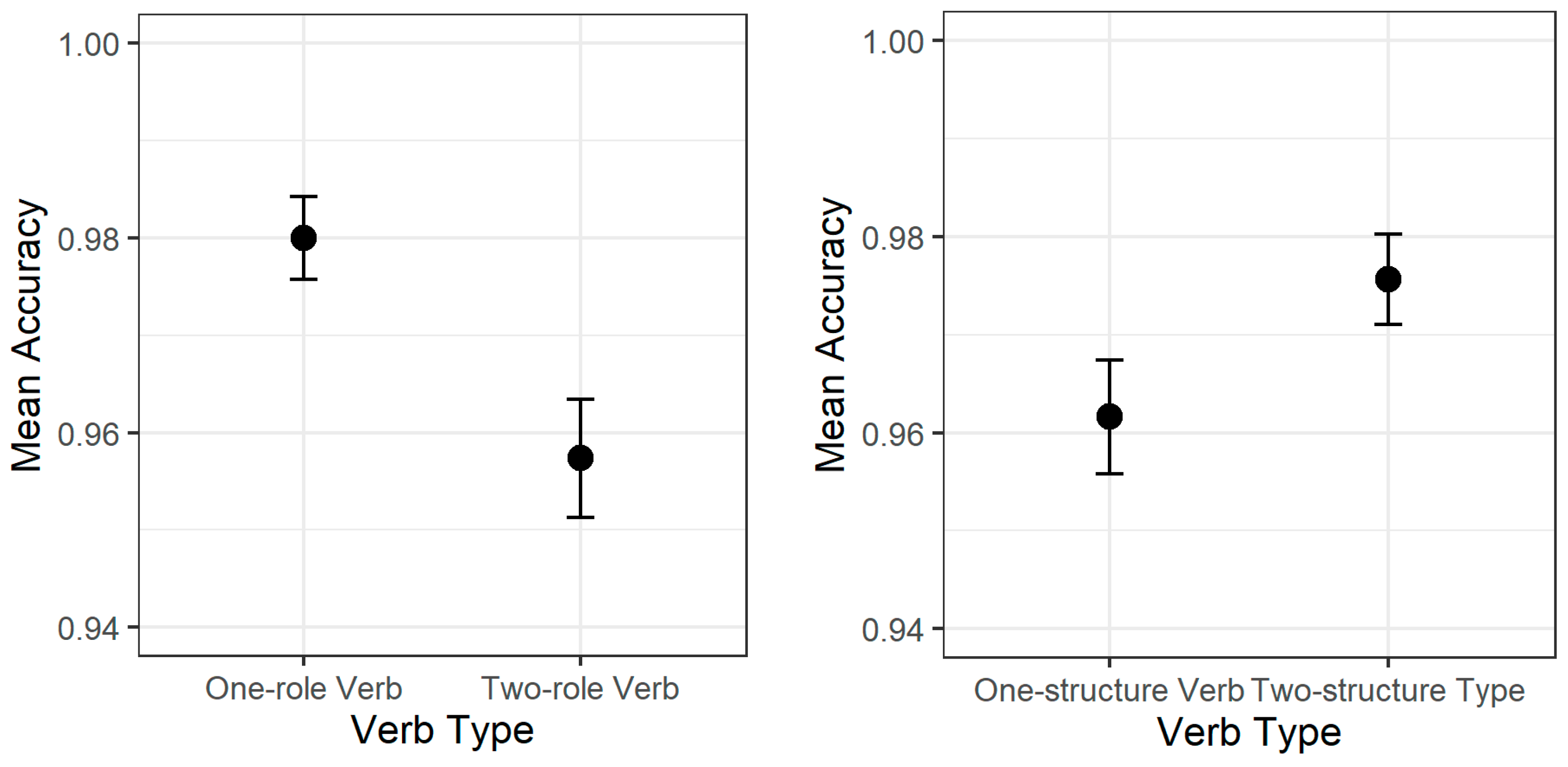
First, let us examine the accuracy of the four types of verbs. The accuracy for judging one-role verbs (Mean = 0.98, SE = 0.14) was higher than that for judging two-role verbs (Mean = 0.96, SE = 0.20). The accuracy for judging one-structure verbs (Mean = 0.96, SE = 0.19) was lower than that for judging two-structure verbs (Mean = 0.98, SE = 0.15). See
Figure 1 for details.
Further analysis of accuracy used the lmerTest package (
Kuznetsova et al., 2017) in R (
R Core Team, 2013) to fit linear mixed-effects models (LLM,
Baayen, 2012) to predict the accuracy of different verbs. Fixed effects included the role type, structure type, their interaction, word frequency, and stroke count. Role type and structure type were sum-contrast coded (1 and −1). Crucially, although word frequency and stroke count were statistically matched across conditions during material design (experimental control), they were still included as continuous fixed covariates in the models (statistical control). This standard psycholinguistic modeling practice allows the framework to explicitly account for and partition out any trial-level variance tied to lower-level orthographic complexity or lexical familiarity, thereby reducing residual error and maximizing the statistical power to detect the net effects of our critical semantic variables. Random effects included participants and items as random intercepts. Finally, the model was simplified based on the Akaike Information Criterion (AIC) using likelihood ratio tests. The results are shown in
Table 4.
The results indicated a significant main effect of role type (t (53.791) = 2.407, p = 0.020), where one-role verbs were processed with higher accuracy than two-role verbs by 0.012 ± 0.005. In contrast, no significant effect was found for structure type (t (53.799) = −1.409, p = 0.165), suggesting that structural multiplicity does not compromise accuracy in Chinese lexical access. Additionally, the interaction between role type and structure type was not significant (t (53.816) = 0.782, p = 0.438). This non-significant interaction suggests that the drop in accuracy driven by role quantity is robustly constant, regardless of whether the verb projects one or two syntactic structures.
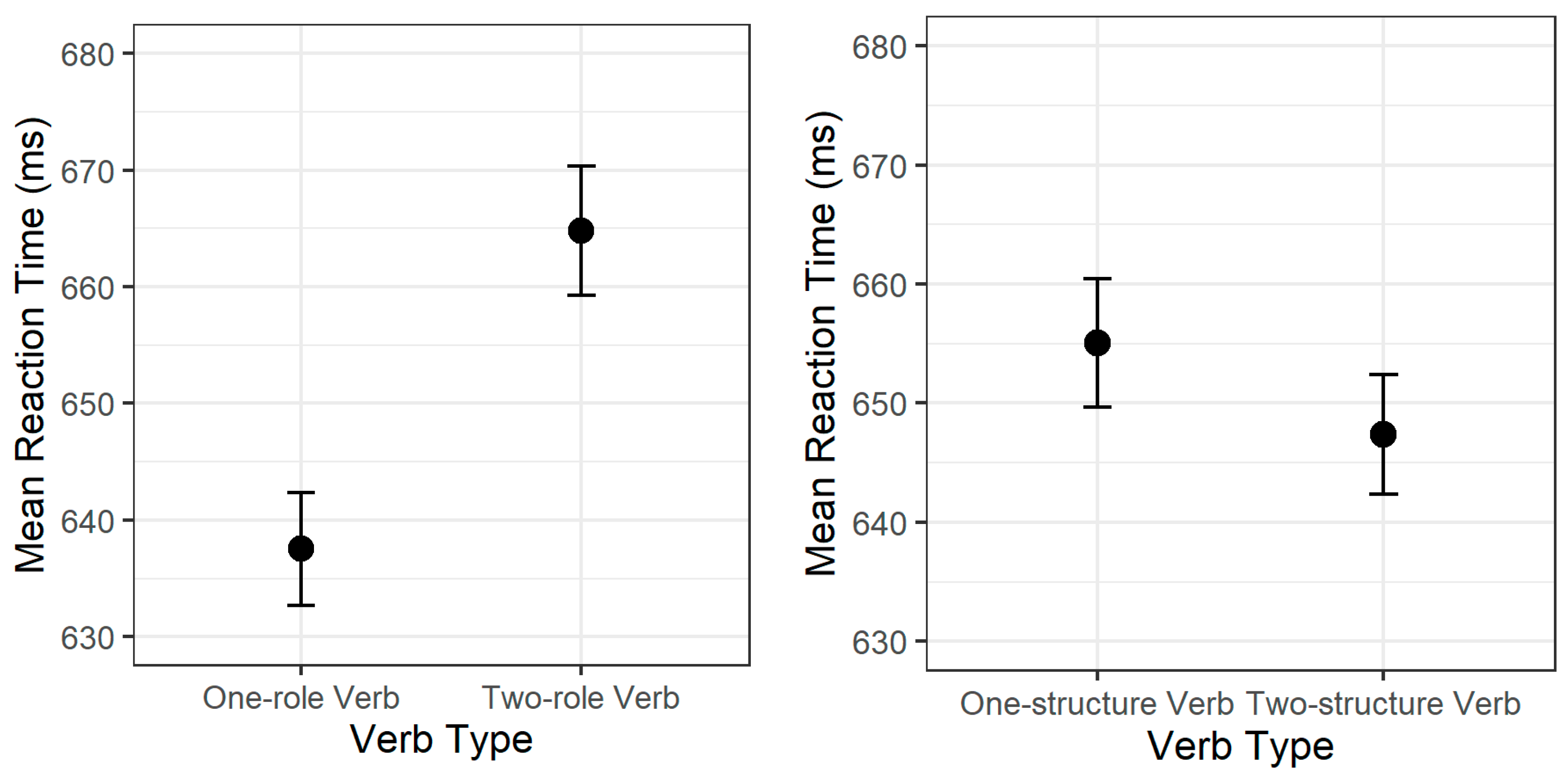
Next, let us examine the reaction times of the four types of verbs. The reaction time for judging one-role verbs (Mean = 637.53, SE = 160.17) was shorter and faster than for judging two-role verbs (Mean = 664.80, SE = 183.79). The reaction time for judging one-structure verbs (Mean = 655.04, SE = 177.76) was longer and slower than for judging two-structure verbs (Mean = 647.36, SE = 167.95). See
Figure 2 for details.
The analysis of reaction time also used the lmerTest package in R to predict the reaction times of different verbs. The structure and simplification process of the model were the same as the analysis of accuracy described above. The results are shown in
Table 5.
The LMM analysis for reaction times corroborated the accuracy data. We observed a significant main effect of role type (t (55.000) = −2.278, p = 0.027), with one-role verbs being processed significantly faster than two-role verbs by 15.086 ± 6.622 ms. Crucially, the effect of structure type remained non-significant (t (55.006) = 0.658, p = 0.514). Additionally, the interaction between role type and structure type was not significant (t (55.012) = −0.653, p = 0.517). This non-significant interaction suggests that the drop in reading times driven by role quantity is robustly constant, regardless of whether the verb projects one or two syntactic structures.
Furthermore, as presented in
Table 5, stroke count emerged as a significant predictor of reaction times (t (54.966) = −3.314,
p = 0.002). This significant effect reflects the well-established cognitive reality of Chinese word recognition, where character-level visual and orthographic complexity naturally modulates early perceptual decoding speed. The fact that this covariate achieved statistical significance—even after group-level mean matching—justifies our rationale for including it in the LMM. By successfully parsing out this lower-level visual processing noise, the model provides a cleaner and more robust estimation of the target semantic effects, confirming that the processing disadvantage of two-role verbs over one-role verbs is a genuine semantic-level phenomenon rather than an artifact of orthographic variance.
5. Discussion
This study investigated the complexity effects of the mental representation of Chinese verbs through a lexical decision task, providing a crucial empirical basis for rethinking the organization of the Chinese mental lexicon. Crucially, our behavioral data directly adjudicate between the two competing theoretical accounts proposed earlier. The results consistently revealed a significant main effect of role quantity on processing efficiency, with two-role verbs exhibiting longer reaction times and lower accuracy than one-role verbs. Conversely, the number of predicate–argument structures exerted no significant influence. These findings provide robust empirical support for the Role-Quantity Hypothesis (H1), while the Structure-Quantity Hypothesis (H2) was not supported.
By validating H1 over H2, this study provides significant insights into grammatical theory, psycholinguistic research, and the broader methodology of related disciplines. First, from a theoretical validation perspective, the clear support for H1 demonstrates that role-based representation models possess greater psychological reality in the Chinese mental lexicon than structure-based models. The data indicate that during the early stage of lexical access, semantic/participant role information is prioritized for activation. This suggests that the cognitive system first retrieves the “who does what” event schema rather than a list of potential syntactic templates, supporting the primacy of roles in the architecture of verb semantics. Second, from a typological and cognitive perspective, the rejection of H2 clarifies that the representational complexity of Chinese verbs is event-driven rather than template-driven. The absence of a structural multiplicity effect—contrasting with the findings of
Shapiro et al. (
1987,
1991) in English—suggests that for an isolating language with sparse morphology, the cognitive system may prioritize role-based content over abstract syntactic templates during initial lexical retrieval. On this basis, the following subsections further contextualize these findings along three interconnected lines of inquiry: the role-based and event-driven nature of lexical–semantic representation, the predictive function of role information in real-time sentence processing across typological contexts, and the methodological integration of argument realization theory with experimental psycholinguistics.
5.1. Lexical–Semantic Representation and Psychological Reality
First, this study contributes to the exploration of the lexical–semantic representation of verbs and argument realization theory from the perspective of psychological reality. As established by the confirmation of H1, verb processing complexity in Chinese is significantly correlated with the number of semantic and participant roles, while the effect of the number of predicate–argument structures remains non-significant.
This suggests, primarily, that the lexical–semantic representation of Chinese verbs is event-driven. At least during the stage of lexical access, the cognitive system prioritizes the retrieval of the event scene and its associated participants rather than activating the full range of potential syntactic frames. This phenomenon may be attributed to the typological characteristics of Chinese as an isolating language. Lacking overt morphological marking (such as case or agreement) and exhibiting high degrees of argument omission, Chinese relies heavily on semantic inference for argument realization. Consequently, the mental lexicon may prioritize content-heavy role information—which provides the necessary semantic constraints—over structure-heavy syntactic templates. This asymmetric cognitive prioritization echoes the typological and structural account by
Morbiato (
2018), who utilizes cross-linguistic constituenthood tests to demonstrate that the empirical evidence for a rigid syntactic VP template in Chinese is remarkably weak, meaning that arguments are not structurally pre-packaged during early grammatical organization. Instead, Chinese grammatical processes are fundamentally governed by semantic role prominence and the conceptualization of event participants. Our behavioral data provide a direct cognitive verification for this architectural layout: since the mental lexicon bypasses abstract syntactic skeletons (H2), verb processing load is uniquely driven by the semantic density of the roles that language users must conceptualize online (H1). For instance, encountering a two-role verb like 面临 (
miànlín ‘face’) immediately activates an event scene involving two interacting entities, imposing a heavier semantic processing load than a one-role verb like 考试 (
kǎoshì ‘exam’), irrespective of the number of syntactic templates they project.
Furthermore, while the Semantic Role List and Participant Role approaches exhibit stronger psychological reality than the PAS approach, they represent different theoretical commitments. Semantic roles are closed, abstract categories; the various syntactic theories aligned with this view typically assume that argument structure is a projection of the verb’s representation based on specific mapping rules (
Levin & Rappaport Hovav, 2005, pp. 145–152). In contrast, participant roles are open-ended and specific; the Construction Grammar framework associated with this view assumes that argument structures are constructions—independent mental representations that possess their own meaning (
Allen et al., 2012;
Johnson & Goldberg, 2013). The fact that role quantity, regardless of the specific framework, drives complexity highlights the fundamental importance of roles in Chinese grammar. Future research could further distinguish between these two by focusing on the specific nature of the roles involved (e.g., general Agent vs. verb-specific Divorcer for 离婚
líhūn ‘divorce’).
5.2. Predictive Functions and Typological Implications
Secondly, this study offers new understandings and hypotheses regarding the mental representation of verbs and their role in sentence processing. If the Chinese mental lexicon is indeed role-based, this information must serve a functional purpose during real-time comprehension.
In the canonical SVO order of both Chinese and English, the verb often appears before the full argument structure is realized. We hypothesize that when a user encounters a verb, the activated role information acts as a predictive heuristic, assisting the processor in forecasting the upcoming argument structure and nominal components. For example, upon encountering the verb 面临 (
miànlín ‘face’), the language processor immediately utilizes its encoded two-role semantics to predict and pre-activate an upcoming Stimulus/Object slot (e.g., 面临挑战
miànlín tiǎozhàn ‘face challenges’) in real-time SVO comprehension. From a typological perspective, this predictive mechanism may vary across word orders (
Hao, 2024):
| (17) | Verb-initial (VSO/VOS): Role information should provide maximal predictability for the entire sentence. |
| (18) | Verb-medial (SVO): Role information facilitates middle-to-end integration and prediction. |
| (19) | Verb-final (SOV): The predictive effect may be limited since arguments appear before the verb. |
This differentiation suggests that language users develop specialized processing strategies based on their language’s word-order typology. From the perspective of bilingualism, these typological variations open up intriguing questions for second language (L2) acquisition. Specifically, future research might explore whether and how L2 learners adapt their L1 processing biases—such as transitioning from a late-verb integration strategy to an early-verb predictive strategy—when acquiring an isolating, role-based language like Chinese.
5.3. Methodological Integration: A Path Forward
Finally, this study demonstrates the value of an interactive research path that combines argument realization theory with experimental psycholinguistics. By testing grammatical hypotheses through millisecond-level reaction times, we have demonstrated the operability of theoretical linguistics within an experimental framework.
Grammatical theory provides the ‘what’ identifying core variables and constraints, while psycholinguistics provides the ‘how’ explaining the cognitive mechanisms of acquisition and processing. The mutual integration of these paths enhances the explanatory power of linguistic inquiry. This interdisciplinary approach not only provides empirical grounding for Chinese grammar but also opens new avenues for methodological innovation in the study of the human faculty of language.