Article

Multilingual Past-Tense Constructions in Spanish–Italian Language Contact: A Diasystematic Construction Grammar Perspective

by
Beatrice Bernasconi
* and
Eugenio Goria
*
Department of Humanities, University of Turin, Via Sant’Ottavio 20, 10124 Turin, Italy
*
Authors to whom correspondence should be addressed.
Languages 2026, 11(7), 132; https://doi.org/10.3390/languages11070132 (registering DOI)
Submission received: 2 April 2026 / Revised: 5 June 2026 / Accepted: 15 June 2026 / Published: 23 June 2026
(This article belongs to the Special Issue Heritage Languages in Italy: New Issues and Perspectives)

Abstract

This paper presents a qualitative analysis of multilingual past-tense constructions produced by Italian–Peruvian speakers in Turin (Italy). Drawing on data from the Stra-ParlaTO corpus, the study aims both to describe the multilingual practices of this community and to assess the explanatory potential of Diasystematic Construction Grammar for language-contact phenomena. After reviewing code-mixing, translanguaging, and second-language acquisition approaches, the paper argues that these frameworks converge in recognising the role of structural similarity in the emergence of hybrid productions, but leave underspecified the nature of the abstract linguistic knowledge that makes them possible. The analysis shows that speakers generalise across Italian passato prossimo and Spanish pretérito perfecto compuesto, developing an abstract language-unspecific construction that licenses both monolingual and mixed realisations. These findings suggest that Diasystematic Construction Grammar provides a cognitively plausible account of multilingual constructions and can be fruitfully extended to recent migration settings.

1. Introduction

In this study, we present a qualitative analysis of multilingual1 past-tense constructions in the speech of Italian–Peruvian individuals with a migratory background. Our aim is twofold. First, we seek to contribute to the description of the linguistic practices of this community, thereby shedding light both on its sociolinguistic dynamics and on the linguistic processes that characterise contact between structurally similar and genealogically related languages, such as Italian and Spanish. Second, and more specifically, we adopt a Construction Grammar perspective on multilingual speech in order to build a bridge between different theories of language contact that have addressed the description of multilingual productions in different ways.
The data were collected in the city of Turin, Italy, where Peruvian-born residents constitute the third largest group of foreign citizens, after Romanians and Moroccans. Yet detailed analyses of multilingual practices within this community remain scarce. The main exception is Vietti’s (2005) study, which hypothesises the emergence of an ethnic variety of Italian within the Peruvian community, characterised by the systematic transfer of quasi-homophonous function words. More recently, Andorno and Della Putta (in press) have analysed multilingual practices in the same community from a second-language acquisition perspective. Their study provides evidence for the use of an Italian–Spanish “bilingual mode” (Grosjean, 2012), which relies heavily on intercomprehension and crosslinguistic similarity, also as a resource in the early stages of acquiring Italian as a target language. These studies form part of a broader scholarly interest in the social and linguistic processes involving Latin American communities in Italy, as shown by work on similar settings in other Italian cities, such as Bonomi (2010), Calvi (2016), and Bonomi and Sanfelici (2018).
In this paper, we adopt a linguistic perspective centred on the systematic analysis of a specific type of hybrid productions attested in the Peruvian community of Turin, which we provisionally label ‘multilingual past-tense constructions’. These include forms such as hemos partito ‘we departed’, mi hubiese piaciuto ‘I would have liked’, and ho parlado ‘I spoke’, in which lexical and grammatical elements from both languages are combined within the same abstract pattern, namely the compound past-tense construction. This phenomenon is open to different interpretations depending on the theoretical assumptions of the models used to approach language contact. After briefly comparing how this type of phenomenon is treated in different frameworks, we propose Diasystematic Construction Grammar (Höder, 2018) as a useful tool for analysing these productions, since it makes it possible to address their cognitive status and to describe the kind of abstract linguistic knowledge that must be posited in order to account for them.
The remainder of the paper is structured as follows: Section 2 reviews selected theories of language contact that have described outcomes of contact between structurally similar and genealogically related languages. Section 3 presents the main assumptions of Construction Grammar, with particular attention to its application to multilingual data in the form of Diasystematic Construction Grammar. Section 4 introduces the corpus used for the analysis, and Section 5 presents the qualitative analysis and discussion of Italian–Spanish past-tense constructions. Section 6 offers some concluding remarks.

2. Different Approaches to Language Contact and Structural Similarity

Rather than foregrounding the differences between the various approaches to language contact, which largely follow from their different theoretical premises and research aims, this section seeks to identify the main points of convergence among them. The most important of these, for the purposes of the present study, is the role of structural similarity in the emergence of hybrid multilingual productions. As the following overview will show, this factor is relevant not only in structurally oriented accounts, but also in SLA studies and usage-based approaches, where similarity is treated as emerging from recurrent patterns in actual language use. In this sense, the present discussion also prepares the ground for the constructionist perspective introduced in Section 3.

2.1. Code-Mixing

One of the most influential models for the description of multilingual productions is the one proposed by Muysken (2000, 2013). From a structure-oriented perspective, Muysken’s framework identifies four main code-mixing patterns, namely insertion, alternation, congruent lexicalisation, and backflagging (see Muysken, 2013, for a detailed description of each pattern). While individual contact settings may display more than one of these patterns, corpus-based studies (e.g., Deuchar et al., 2007) suggest that single linguistic ecologies tend to be characterised predominantly by one of them. The prevailing pattern in a given contact situation is shaped both by structural factors, such as the typological properties of the languages involved and their degree of structural distance or similarity, and by social factors, such as power relations between languages, the type of multilingualism involved, and local language policies.
While an extensive review of Muysken’s theory is way beyond the scope of this paper, a particularly relevant aspect for the purposes of the present discussion, in his account of bilingual speech, is that the different code-mixing patterns reflect different degrees of separation between the languages involved. Treffers-Daller (2009), for instance, characterises alternation- and insertion-based patterns, as illustrated in (1) and (2), as types of mixing in which the participating languages remain relatively distinct, and speakers retain control over which language is being used at a given point.
(1)me ha costado pero (.) eh piano piano ho imparato
‘I found it difficult (lit. ‘it cost me’). But little by little I learned’
[Spanish–Italian; Stra-ParlaTO corpus, STIS009]
(2)prima c’erano più canciones, quelle del mio paese
‘Before, there used to be more songs, those from my country’
[Spanish–Italian; Stra-ParlaTO corpus, STIS015]
Example (1) is an instance of alternation and may be analysed as the juxtaposition of two monolingual stretches in different languages, typically in correspondence of a major syntactic boundary. In such cases, the languages appear to be deployed one at a time, and the units involved are syntactically independent from one another. A different case is represented by (2), which contains an insertion of the noun canciones ‘songs’ into an otherwise Italian sentence. Although a deeper intertwining between the languages is observed than in (1), the two languages may still be considered relatively distinct. The utterance can be analysed as Italian overall, which pragmatically functions as the base language of the interaction (Auer, 2000) and, syntactically, as the matrix language for the clause (Myers-Scotton, 2002), while Spanish is confined to the inserted noun phrase.
At the opposite end of the continuum lies congruent lexicalisation, which Treffers-Daller (2009) identifies as the pattern in which languages are least clearly separated in production. Consider example (3):
(3)y nada, et- andiamo a la scuola per aprender un poco más el idioma no? per poder parlare
‘so and nothing, we go to school to learn a bit more the language, no? To be able to speak’
[Spanish–Italian; Stra-ParlaTO corpus, STIS011]
Various chunks within this extract may undoubtedly be associated with Spanish (un poco más ‘a bit more’, el idioma ‘the language’, aprender ‘learn’), and some others with Italian (andiamo ‘we go’, scuola ‘school’, parlare ‘speak’). At the same time, most of the structures involved in (3) are either structurally identical across the two languages or are quasi-homophones. The motion construction andiamo a la scuola ‘we go to school’, while lexically Italian, follows the same syntactic pattern as Spanish vamos a la escuela; un poco ‘a bit’ is homophonous in both languages and poder ‘can’ is quasi-homophonous to the Italian apocopated form poter of the same verb. Thus, as is typical of congruent lexicalisation, lexical and grammatical units from both languages are recruited within a shared syntactic structure. This makes it theoretically challenging to assign either the utterance as a whole, or many of its parts, discretely to one language only and, most notably, prevents the identification of a single matrix language (Myers-Scotton, 2002) for the sentence.
Structural similarity and at least partial mutual intelligibility between the languages involved is to be considered as one of the main factors that motivate the production of mixed utterances like (3) (Muysken, 2000, 2013). Typical cases of congruent lexicalisation involve languages that share typological features due to shared inheritance, long-term historical and cultural contact, or areal convergence. Many of the contact settings where congruent lexicalisation has been described as the dominant pattern involve historical multilingualism such as standard-dialect constellations or minority language ecologies. Similar patterns, however, are also found in migration-related scenarios involving languages with greater structural distance. Demirçay and Backus (2014) and Backus and Demirçay (2021), for example, show that in Dutch–Turkish language contact similar patterns have arisen, probably due to the fact that the community’s multilingual practices have shifted towards a globally multilingual style, in which chunks from both languages, with different degrees of complexity and schematicity (see Section 3), are recruited in ways that no longer fit neatly into insertion or alternation. In this respect, the usage-based perspective adopted by these authors shifts attention from abstract typological relations between languages to recurrent similarities as they emerge in actual multilingual usage (see also Hakimov & Backus, 2021).

2.2. Translanguaging

A global-level analysis of a community’s multilingual practices seems thus an appropriate lens to gain insight into the types of mixing observed within it. Similar ideas have been extensively argued, for example in Auer’s (1999, 2014) work, as he describes the process whereby locally meaningful code-switching may become conventionalised in usage and turn into more stable patterns of mixing, potentially acquiring socio-indexical value as opposed to monolingual language modes. Similar analyses have flourished especially in the study of linguistic practices within migrant communities. Examples are Rampton’s (2017) studies on language crossing and Wiese’s (2009) accounts of multiethnolects, both of which analyse the social environments and motivations that may foster the emergence of code-mixing-based styles.
A further perspective relevant to the present discussion is provided by the translanguaging framework (Li, 2018; García & Li, 2014). With a stronger emphasis on social practice than on linguistic structures per se, this approach shares with code-mixing research the observation that multilingual speakers may produce utterances in which boundaries between languages are crossed, suspended, or locally renegotiated, with outcomes that are in many respects comparable to those described above for congruent lexicalisation. The translanguaging perspective is grounded in the assumption that multilingual practices are best described as the creative mobilisation of an integrated repertoire comprising multiple linguistic and semiotic resources. From this standpoint, the speaker’s repertoire, rather than “named” languages as bounded systems, is given conceptual primacy (García & Li, 2014). Translanguaging thus converges with code-mixing research in recognising the existence of hybrid productions that cannot always be straightforwardly assigned to one language at every point of the utterance, but differs from structure-oriented models in that it questions whether such bounded languages should be taken as the primary units of analysis in the first place.

2.3. Second-Language Acquisition

Structural similarity has also been discussed in second language acquisition research, where the degree of distance between source and target language is assumed to influence the learner’s acquisitional path (Corder, 1979). This perspective is relevant here because it likewise supports the idea that hybrid productions may emerge where languages share lexical and grammatical structure. In a recent study, Andorno and Della Putta (in press) identify several points of congruence between Spanish and Italian that appear to guarantee a degree of mutual intelligibility between the two languages. Spanish-speaking learners of Italian are shown to exploit these similarities in the development of multilingual practices grounded in intercomprehension (Doyé, 2005), especially in the early stages of L2 learning, where such practices are strategic for social interaction. This perspective converges with accounts of congruent lexicalisation, which likewise assign a key role to structural similarity in the emergence of mixed productions, and to some extent also with translanguaging, insofar as both approaches recognise the strategic value of mobilising heterogeneous resources. Unlike translanguaging, however, the acquisitional perspective interprets such practices primarily as part of a developmental trajectory: while rooted in multilingual interaction, the recognition of structural matches between source and target language also contributes to the progressive restructuring of learner language towards greater proficiency, including in more monolingual styles.

3. A Constructionist Approach to Language Contact and Multilingualism

Taken together, the approaches reviewed so far differ substantially in their assumptions, terminology, and explanatory aims. Nevertheless, they converge in recognising that multilingual practice may give rise to hybrid productions in which linguistic resources associated with different languages are not fully separated and in which structural similarity may facilitate the emergence of shared or overlapping patterns. For the purposes of the present study, this convergence is crucial because it invites a shift from the sole observation and description of multilingual productions, as is typical of structuralist frameworks, to the question of what kind of abstract knowledge has to be assumed to account for these productions in a cognitively adequate way. As both a cognitive and a usage-based theory of language (see Bybee, 2010), Construction Grammar represents, in our view, an appropriate framework to address this issue, since it treats linguistic knowledge as a structured inventory of form–meaning pairings emerging from usage and organised at different levels of abstraction. More specifically, in the next section, we adopt Diasystematic Construction Grammar (Höder, 2018; Boas & Höder, 2018, 2021, 2025), as this model is explicitly designed to account for multilingual knowledge and for constructions that may extend across the boundaries of named languages. This will allow us to show how contact phenomena can be modelled in constructional terms and how this framework may account for the Italian–Spanish data analysed in this paper.

3.1. Construction Grammar

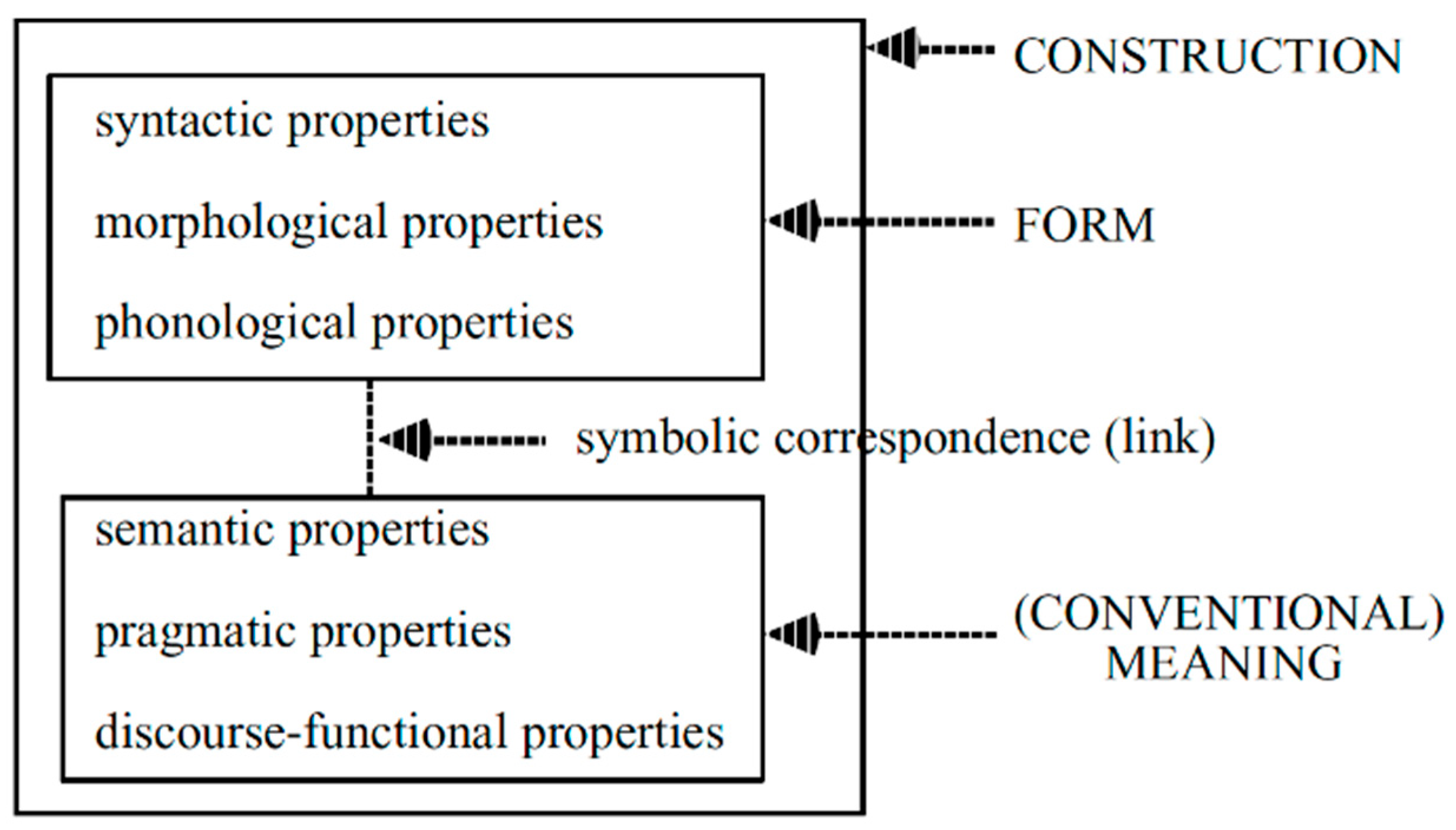
Construction Grammar (CxG) is a cluster of cognitive and usage-based theories of grammar that has been developing since the 1980s, growing out of a concern to find a principled place for idioms and multiword expressions within grammatical description, at a time when linguistics was dominated by a strict lexicon–grammar dichotomy that relegated such phenomena to the margins (Fillmore et al., 1988). CxG then developed into a broader theoretical framework whose central tenet is that the basic units of language are constructions, namely, conventional, learned pairings of (phonological, morphological, and syntactic) form and (semantic, pragmatic, and discourse) meaning (Goldberg, 1995, 2006), as represented in Figure 1.
Constructions are typically identifiable through non-predictable properties, including formal idiomaticity (deviation from canonical patterns), functional idiomaticity (non-compositional meaning), idiosyncratic constraints, and collocational preferences (Hilpert, 2014, pp. 12–22). At the same time, predictability is not a necessary condition for constructionhood, as “patterns are stored as constructions even if they are fully predictable as long as they occur with sufficient frequency” (Goldberg, 2006, p. 5). Frequency of use is therefore itself a diagnostic of the arbitrariness and conventionality that define a construction, and motivates CxG’s adherence to usage-based approaches. Repetition and learning drive the entrenchment of constructions at every level of linguistic analysis: any form–meaning pairing is in principle eligible for conventionalisation, and thus constructionalisation, provided it is sufficiently frequent and established in use.
Constructions are defined along two dimensions: complexity and schematicity. Along the complexity dimension, constructions span the full range of linguistic units, from morphologically simple words to complex syntactic structures. Along the schematicity dimension, constructions range from the most substantive—with fully lexically specified slots—to the most schematic, with open slots that can be filled by a wide range of expressions. Between these poles lie constructions with intermediate degrees of schematicity, allowing for partial variation in their slots or syntactic realisation. These two dimensions interact to form what is known as the lexicon–syntax continuum (Fried & Östman, 2004; Boas, 2010), which enables CxG to avoid a principled distinction between elements of the lexicon and syntactic structures.
Constructions do not exist as a mere list or in isolation from each other, but are organised into a structured network, also called the construct-i-con, which is stored within speakers’ minds (e.g., Goldberg, 1995; Diessel, 2019, 2023). Within the constructicon, constructions are connected through vertical—or hierarchical—and horizontal relations. Vertical relations, referred to as inheritance links, allow a construction to inherit formal and/or functional properties from a more abstract one. Horizontal relations, by contrast, hold between constructions with near-synonymous functions and highly similar or identical forms (e.g., Cappelle, 2006; Van de Velde, 2014; Sommerer & Smirnova, 2020).

3.2. Diasystematic Construction Grammar

Among the many “flavours” of Construction Grammar (CxG) that have been developing over the last few decades (see Ungerer & Hartmann, 2023, for an overview), Diasystematic Construction Grammar (DCxG) stands out as the framework specifically designed to model what a multilingual constructicon looks like (Höder, 2018; Boas & Höder, 2021, 2018, 2025). Rooted in Weinreich’s (1954) original notion of the diasystem, DCxG posits that multilingual speakers do not store separate, compartmentalised grammars for each language in their repertoire, but rather rely on a unified diasystem that encompasses all their linguistic knowledge as a whole. This is a significant departure from monolingual-biased models, which tend to treat each language as a self-contained system and describe contact phenomena as the mere transfer of elements from language A to language B.
Within the diasystem, two types of constructions can be identified. On the one hand, there are language-specific constructions, idioconstructions (or idiosyncratic constructions), which do not share any formal or functional properties with constructions of other languages in the repertoire. An example would be a morphosyntactic pattern that is unique to one of the speaker’s languages or, more generally, lexical constructions that represent a unique form–meaning combination. On the other hand, there are language-unspecific constructions, diaconstructions (diasystematic constructions), namely, more abstract, schematic constructions shared across two or more languages within the repertoire. Thus, the motion construction presented in (3) can be argued to function as a diaconstruction in the Spanish–Italian bilingual repertoire, as several aspects of both its form and meaning are shared by the two languages.
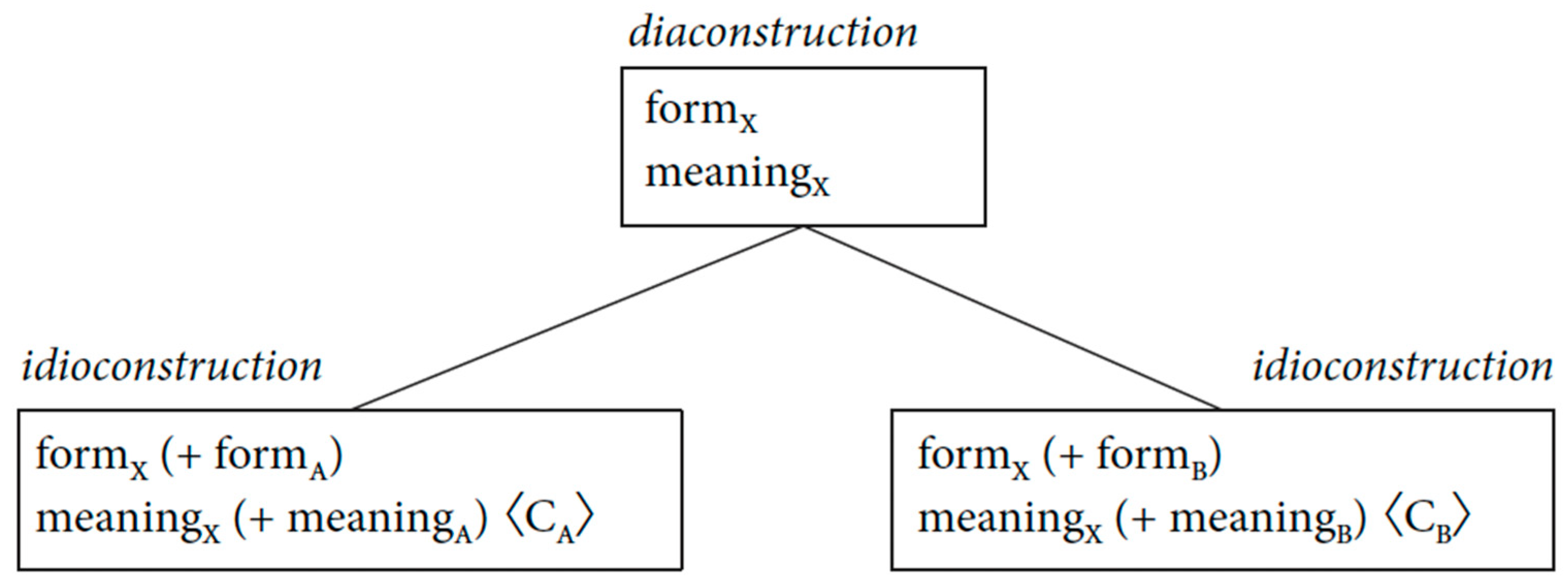
Diaconstructions can be abstracted and generalised from idioconstructions. To describe how this process works, Höder (2018) relies on Weinreich’s notion of ‘interlingual identification’ (Weinreich, 1953; Croft, 2000). For instance, the Verb-Initial Interrogative Construction in German and Danish is used to form polar questions, as in the Danish Kommer du? and its German equivalent Kommst du? ‘Are you coming?’. Höder (2018) argues that although these two constructions are phonologically and morphologically distinct, they share both a functional property (asking a yes/no question) and a formal property (the finite verb occupies the clause-initial position). According to DCxG, when a speaker who has already acquired the Danish construction encounters the structurally analogous German one, they do not simply store it as an entirely new, independent entry in their constructicon. Instead, the acquisition process involves three steps (Höder, 2018): first, the speaker interlingually identifies the two constructions based on their shared formal and functional features; second, they establish a diaconstruction by generalizing over those shared properties, effectively abstracting away from language-specific surface differences; and third, they reorganise their constructicon by replacing the two language-specific entries with this more abstract, overarching diaconstruction. The diaconstruction is now the source schema that allows for the production of various constructs (concrete realisations of a construction) by filling it with language-specific material. Such a constructional network can be represented as in Figure 2, where a more abstract diaconstruction is linked, through inheritance relations, to two idioconstructions (<CA> vs. <CB>) that display language-specific properties (formA vs. formB, meaningA vs. meaningB).
One last major point in DCxG is that language-specificity is viewed as a pragmatic property of a given construction, which makes it tied to community norms rather than to an a priori definition of a language (Höder, 2018; Boas & Höder, 2021). This means that the boundaries between idioconstructions and diaconstructions are gradient and usage-based, shifting depending on the speaker’s repertoire configuration and the communicative situation. In this view, grammar is community-specific in that what counts as a shared or language-particular construction depends on the practices and conventions of a given speech community.

3.3. Interim Summary: Bridging Construction Grammar and Other Models of Language Contact

As should have emerged from the previous sections, Diasystematic Construction Grammar addresses many of the issues that also characterise other approaches to language contact. Despite their various differences, all the mentioned frameworks converge on one point that is central to the present study: multilingual speakers may produce hybrid utterances in which lexical and grammatical items associated with different languages are combined within partially shared patterns. What remains less explicit in most of these approaches is how such patterns are represented in speakers’ linguistic knowledge.
As a usage-based framework, Construction Grammar provides a relevant interpretive tool, because it treats linguistic knowledge as the product of generalisation over usage, shaped by frequency and similarity. Multilingualism makes no exception in this respect: under appropriate conditions, even partial similarity (see Perek & Hilpert, 2016) may support interlingual identification across constructions (Croft, 2000) and the emergence of more abstract representations which are responsible for multilingual productions. More specifically, Diasystematic Construction Grammar represents an attempt to systematically account for multilingual knowledge with the same tools that are used to describe monolingual uses of language.
The review in Section 2 already presented some contact points that link DCxG with other theories of language contact. They include in particular the identification of shared structures across languages as the basis for (at least some types of) multilingual production and the social relevance of such communicative practices. It should be added that the now well-known claim by translanguaging researchers about the primacy of multilingual and idiolectal repertoires over named languages (see Otheguy et al., 2015) finds an interesting parallel in DCxG, as multilingual knowledge is represented within this framework as a generalised set of constructions, part of which are non-language specific. Conversely this represents a major difference with structuralist approaches, which rely instead on broader typological description of languages and classificatory taxonomies which do not take into account the cognitive status of constructions.
Besides advocating for cognitive adequacy in the description of multilingual production, DCxG also reconnects with other code-mixing theories in that it identifies community norms and practices as the trigger for the development of a diasystem. As already argued by Muysken (2000), different linguistic ecologies and power relations associated with languages play a major role along with linguistic factors in determining the code-mixing patterns observed in one community. Moreover, the existence of translanguaging spaces (Li, 2018) where language boundaries are strategically crossed creates the appropriate conditions for the development of multilingual knowledge, both as a stable register (Auer, 1999, 2014) and as a bridge towards more normative monolingual styles (Andorno & Della Putta, in press).
It must be observed, though, that DCxG has extensively focussed on situations of historical language contact as the ideal context for the emergence of a multilingual repertoire (see, e.g., Blevins, 2018; Boas, 2018; Dux, 2018 on Texas German or Höder, 2018, 2021; Goll, 2023 on Southern Schleswig Danish). Extending a constructional model of multilingual knowledge to migration scenarios therefore represents, in our view, an important step, since it allows one to test whether a framework developed mainly for more stable contact ecologies can also account for multilingual practices shaped by recent mobility, which are, as is well-known, inherently dynamic and involve multiple levels of diversity (and inequality). The following analysis explores this possibility with reference to Spanish–Italian data.

4. The Stra-ParlaTO Corpus

The data for this study come from the Stra-ParlaTO module of the KIParla corpus (Mauri et al., 2019). The KIParla corpus is currently the largest existing corpus of spoken Italian accessible online.2 The corpus has a modular structure and is currently made up of seven separate subcorpora that, although with their internal differences, share the same general structure and participant metadata system. Such a modular structure allows for the continuous expansion of the corpus across time while ensuring searchability as a whole. Up to 2024, the data included in the KIParla corpus had been collected exclusively among L1 speakers of Italian, thus excluding people who have learnt and use Italian as a second language and, more in general, people with a multilingual repertoire that goes beyond Romance dialects or historical minority languages. This gap was filled by the collection and publication of two new modules between 2024 and 2026, namely, the Stra-ParlaTO and Stra-ParlaBO modules, which comprise speech by either L2 Italian speakers with an international migratory background or people born in Italy but with a multilingual repertoire that includes a heritage/home language. As far as Stra-ParlaTO is concerned, the data were collected in Turin (Italy) among multilingual speakers with either Moroccan Arabic, Peruvian Spanish, or Romanian/Moldovan languages as part of their linguistic repertoire. Speakers’ metadata for this module include: gender, age range, place of birth, age upon arrival in Italy, number of years spent in Italy, L1, education title, and occupation. All speakers were asked to read and sign an informed consent form that fully complies with the current European norms on data protection. The recordings were transcribed with ELAN (Wittenburg et al., 2006) following the same transcription conventions already used for the other corpus modules. These guidelines are based on a simplified version of the Jefferson (2004) transcription system for Conversation Analysis and are accessible on the corpus website.3

4.1. Data Collection: A Community-Based Approach

Data collection presented significant methodological challenges that prompted a shift away from conventional approaches (Labov, 1982; Tagliamonte, 2006) towards a Community-Based Language Research (CBLR) framework (Czaykowska-Higgins, 2009; Rice, 2010; Stenzel, 2014; Bischoff & Jany, 2018). Under the project’s original corpus design, data collection required two interaction types: semi-structured interviews conducted mostly in Italian, with conversational asymmetry between interviewer and interviewee, and spontaneously occurring free conversations recorded through non-participant observation, with no constraints imposed by the researcher and no conversational asymmetry among participants. Although this methodology proved to be successful for the design of the other KIParla modules, in practice, several obstacles made this design difficult to implement for the Stra-ParlaTO subcorpus.
First, interview participants tended to be selected based on their Italian proficiency, as individuals with lower competence would not have been able to give an interview in Italian. Language choices were further constrained by the interaction format and the interviewer’s own repertoire: when the interviewer shares the full linguistic repertoire with the interviewee, languages other than Italian may surface in the interaction; but when Italian is the only language in common, the interviewee is actually confined to monolingual Italian regardless of their everyday multilingual practice.
For free conversations, the most naturally occurring interactional contexts that we could access were predominantly monolingual in the L1 or home language. Furthermore, participants were rarely available for recording in private settings, and the spontaneous format only proved workable with a specific subset of informants, namely, second-generation university students already involved in the project.
These tensions between a fixed research design (with predetermined data constraints, goals, and timelines) and the fluid, context-dependent nature of community engagement led us to adopt a participatory, community-based approach, in which, as Czaykowska-Higgins (2009, p. 17) argues, knowledge is constructed not merely for researchers/linguists but “for, with, and by community members”. This framework foregrounds several key principles, including collaborative research design, shared ownership of outcomes, training of community members, practical long-term impact, equitable distribution of resources, and genuine consideration of the needs of all parties involved (Czaykowska-Higgins, 2009).
We were able to adopt this methodology for the Peruvian and Romanian/Moldovan cases. In the former case (the latter will not be addressed here), our partner was Paradero NOMiS (Nuove Opportunità per Minori Stranieri), a project working with young people aged 14–23 and their families from Latin America and providing them with practical support to facilitate integration upon arrival. The collaboration with Paradero NOMiS developed through three consecutive activities. The first, Relatar, was a task-based, collaborative workshop designed to produce a mock-up tourist guide of Latin American Turin. Jointly designed with the Paradero team—who had expressed the need for a summer activity that would also serve as Italian language practice—the workshop consisted of a series of meetings where participants had to discuss the format of the final product, the themes to be addressed, and the type of content to be included. Participants were trained in interviewing and recording techniques, which allowed them to collect photos, videos, and oral testimonies of local Latin American people and places in the city. Then, they collaboratively selected materials, wrote captions and texts, and made design choices. The workshop yielded 5 hours of interviews and 2 hours of conversation. The second activity, World Anthropology Day (February 2025), grew directly out of the Relatar collaboration. Four young participants from Paradero planned and led a guided walking tour of the Borgo San Paolo neighbourhood. During four preparatory weekly meetings, tour routes were discussed, contacts established, and the tour rehearsed. A further 5 hours of conversations were collected across these sessions.
Reflecting on the outcomes of this approach, the CBLR framework yielded several advantages over more traditional methods: it enabled a successful collaboration with the communities that benefited both parties, produced richer and more ecologically valid data by incorporating ethnographic knowledge and emic perspectives, and opened access to a broader range of speaker profiles from within the same community. At the same time, the approach unavoidably entailed some trade-offs: it required significantly greater investment of time and effort at the design and data-collection stages; introduced longer and less predictable timelines; and demanded a series of methodological compromises. Most notably, first, the majority of participants in both projects were under 16, whereas speakers in the existing corpus modules are typically aged 16 or above due to privacy management reasons, and second, the task-based nature of the interactions differed from the free conversations envisioned in the original corpus design, which typically involve unconstrained topics. To overcome the former problem, we adapted the informed consent form for participants under 16 and involved parents in both the explanation of the research and the signing process. To address the latter, we adapted the interaction classification labels accordingly: these recordings are now classified in the corpus as ‘free conversations’ but specified as ‘task-oriented’ rather than having a ‘free topic’.

4.2. The Corpus Overall Characteristics

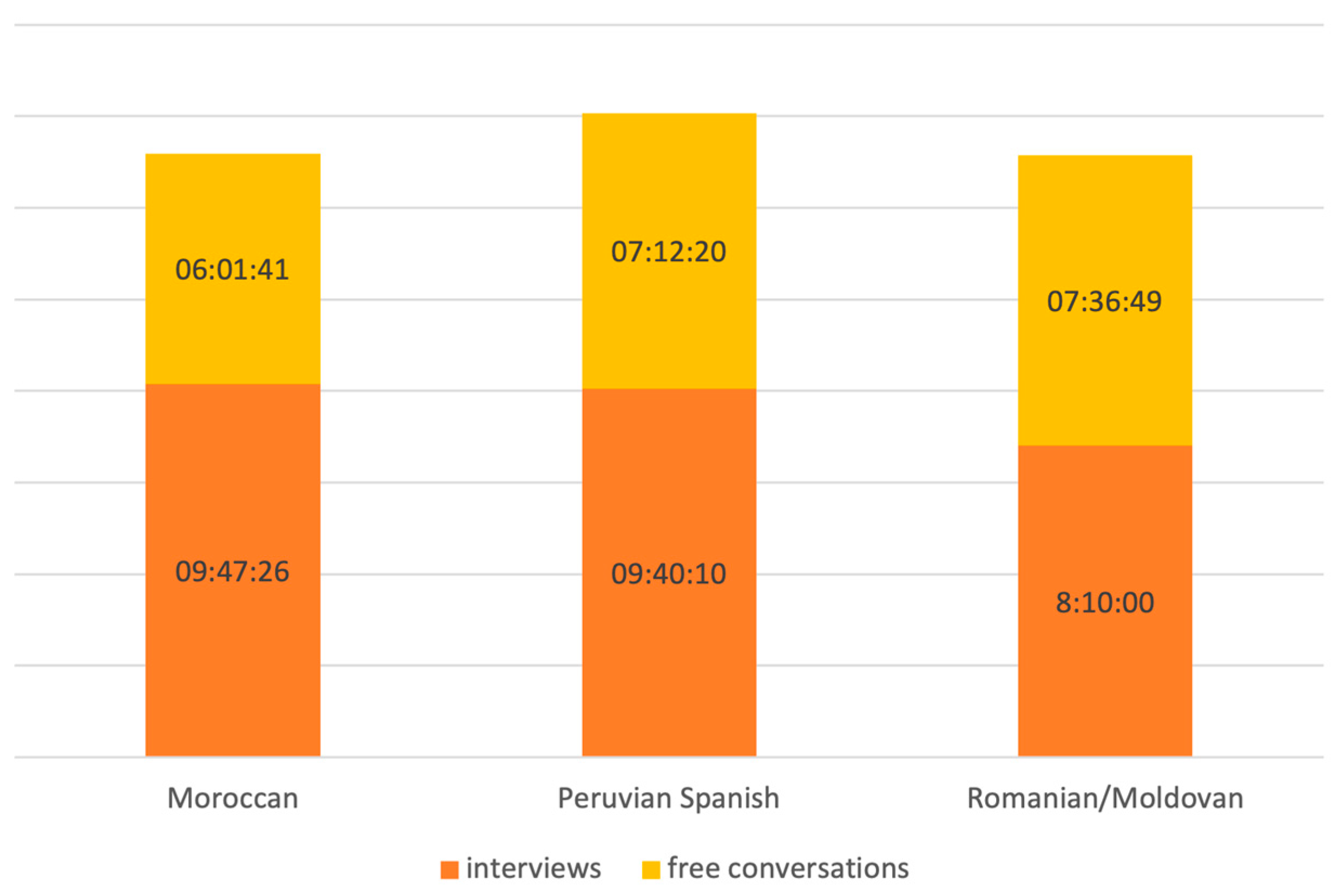
The Stra-ParlaTO subcorpus currently amounts to approximately 48:28:26 h of speech. The module includes 51 semi-structured, sociolinguistic interviews (27:37:36 h) and 31 free conversations (20:50:50 h). The distribution of recordings across speakers, based on their linguistic repertoire, is shown in Figure 3.
The data collection involved 138 participants, 53 of whom were born in Italy and 85 in another country. Most participants are between 21 and 35 years old (59), 33 are aged 36–50, 18 are older than 50, 25 are between 16 and 20, and only three are between 11 and 15; 61 of them hold a degree or are university students at the time of the recording, 60 hold a high-school diploma, 13 hold a middle-school diploma, and four are PhDs. Most participants declared that they have more than one L1, whereas only 40 stated that Italian is their only L1. In this respect, the participants were categorised based on what they identified as their dominant language, whereas information concerning other languages within individual repertoires was collected from interviews and conversations, and was not included in the corpus metadata. Regarding the number of years already spent in Italy, out of 85 speakers born abroad, 24 of them had been in Italy for 0–5 years, 17 of them for 6–15 years, 37 participants for 16–30 years, and 4 for more than 30 years. One speaker had a discontinuous stay during their childhood and was therefore labeled as a separate case.
As for the Peruvian Spanish subcorpus, 42 participants were involved (26 females and 16 males), 31 of whom were born in Peru and 10 in Italy; 1 person was born in Venezuela but from Peruvian parents. Most participants are between 16 and 20 years old (11) or between 21 and 35 (12), 10 are aged 36–50, and 9 are older than 50 (only 2 are between 61 and 65 years old). The majority of them hold (or are obtaining) a high-school diploma (13 from a Peruvian institution, 14 from an Italian institution), 10 hold a university degree, and only 5 hold a middle-school diploma. Most speakers identified Spanish as their L1, while 10 stated their L1 was Italian; only 3 people declared to have both Spanish and Italian as their L1s. As for the aboriginal languages of Peru, during both conversations and interviews, a minority of speakers were able to recall isolated words or idioms in Quechua, but none of them claimed to be a fluent speaker of the language, while still acknowledging its cultural importance both in Peru and in Peruvian communities in Italy. Lastly, out of the 32 participants born in Peru, 12 of them had been in Italy for 1–3 years, 7 for 6–15 years, 6 for 16–25 years, and 6 for 26–35 years; only 1 speaker experienced a discontinuous stay in Italy and was labeled separately.

5. The Multilingual Past-Tense Construction in the Stra-ParlaTO Corpus

Drawing from the data of the Stra-ParlaTO corpus, we now focus on a specific case-study to provide evidence of how DCxG can be a useful framework to explain language-contact phenomena. In particular, we examine how the compound past tense construction is used by Peruvian Spanish speakers of Italian.
Romance languages distinguish between two main types of past tense forms encoding a perfective meaning, namely, a simple form (e.g., French passé simple, Italian passato remoto, Spanish pretérito perfecto simple, Portuguese pretérito perfeito simples) and a compound one made up of an auxiliary in the present tense and a past participle (e.g., French passé composé, Italian passato prossimo, Spanish pretérito perfecto compuesto, Portuguese pretérito perfeito composto). Formal and functional similarities across these constructions are easily found, as they share the same etymology and are used in similar contexts.
Let us look more closely at the two main languages in contact in the scrutinised community, namely Italian and Peruvian Spanish. Although the two past tenses do overlap to a good extent, they cannot be claimed to be identical neither in terms of form and function, nor internal variation. From a formal point of view, the two languages select auxiliaries differently: Italian verbs require either essere ‘be’ (if inaccusative) or avere ‘have’ (if inergative) (4), whereas Spanish always requires haber ‘avere’ (5).
(4)Italian
(a)sonoand-at-o
be.1SG.PRSgo-PTCP-M.SG
‘I went’
(b)homangi-ato
have.1SG.PRSeat-PTCP
‘I ate’
(5)Spanish
(a)hei-do
have.1SG.PRSgo-PTCP
‘I went’
(b)hecom-ido
have.1SG.PRSeat-PTCP
‘I ate’
From a functional point of view, the two tenses might not share all the possible uses. In Peruvian Spanish, the pretérito perfecto compuesto has been described as expressing specific pragmatic, epistemic, and discourse-related values (Jara Yupanqui, 2011; Howe, 2018), which do not straightforwardly correspond to the ordinary distribution of the Italian passato prossimo. Conversely, in Italian, diatopic variation plays an important role in the distribution of simple and compound past tenses in perfective contexts, with the compound form, passato prossimo, predominating in northern varieties and the simple one, passato remoto, remaining more frequent in southern varieties (Lepschy & Lepschy, 1981).4 However, in spite of these and other potential mismatches, both constructions share the same core meaning of reference to a past, finished event. As shown in other theoretical frameworks (cfr., Matras, 2009 ‘pivot matching’), it is precisely this partial similarity—a case whereby two forms share sufficient structural and semantic overlap to be perceived as functionally equivalent by bilingual speakers—that makes the passato prossimo and the pretérito perfecto compuesto a plausible fertile site for hybrid constructions, such as (6) and (7).
(6)hemos visitato il museo de radio y tecnologia
‘we visited the museum of radio and technology’
[Speaker: PST001; Recording: STIS001]
(7)desde il giorno che he arrivado sono diciassette anni
‘since the day I arrived, it’s been seventeen years’
[Speaker: PST061; Recording: STIS009]
In hemos visitato (6), the Spanish auxiliary combines with the Italian past participle, while in he arrivado (7), the Spanish auxiliary is combined with a hybrid past participle form, which in turn combines the Italian lexical stem of the verb arrivare ‘arrive’, but adopts the Spanish inflectional morpheme -ado.
Such cases challenge a monolingual-based view on contact, as these productions cannot be described as mechanical transfers of a specific element from one language into another. In this respect, Diasystematic Construction Grammar offers a valuable analytical framework for examining these phenomena, as it allows us to account for the interplay of constructions across different (though similar) languages at a more abstract level.
Looking at the Stra-ParlaTO corpus data, compound past tense forms produced within Spanish–Italian multilingual practices amount to 704 occurrences and can be grouped into four main categories (relative frequencies are specified in brackets).
  • Fully monolingual forms that can entirely be assigned to one language or the other (83.38%).
(8)io l’altra volta que he ido alla questura
‘I, that time that I went to the central police station’
[Speaker: PST006; Recording: STIS003]
(9)quando abbiamo iniziato la scuola abbiamo avuto un po’ più di facilità
‘when we started going to school, it was easier (lit. we have had a little more ease)’
[Speaker: PST065; Recording: STIS012]
B.
Forms that combine the Spanish auxiliary with an Italian/Spanish homophone past participle (1.28%), such as visto ‘seen’ in (10), in a context where no single matrix language can be identified, and the production mostly resembles congruent lexicalisation (Muysken, 2000).
(10)però quando se trovan entre loro un è compromiso sì // he visto che lo parlan he sentito che lo parlan
‘but when they see each other it’s an agreement, yes, I saw that they speak it, I heard that they speak it’
[Speaker: PST061; Recording: STIS009]
C.
Forms that combine the auxiliary of one language with the past participle of the other (7.95%). Within this group, examples like (13) are also included, where the participial form is “entirely” Spanish, even though the verbal root is identical to the Italian form, and the inflectional suffixes are quasi-homophonous (Italian pensato vs. Spanish pensado).
(11)solo he lavorato aquí // eh como le ditto solo weekend
‘I only worked here, as I said, only during weekends’
[Speaker: PST004; Recording: STIA001]
(12)io non ho trovato gente del mio paese che parla il quechua // cioè a me mi hubiese piaciuto impararlo
‘I didn’t find people from my country who speak Quechua, I mean, I would have liked to learn it’
[Speaker: PST074; Recording: STIS015]
(13)io ho pensado // mh // il fegato io ho pensado prima che le ha dato il caffè
‘I thought mh the kidney, I thought before giving her coffee’
[Speaker: PST074; Recording: STIS015]
D.
Forms that combine the Spanish or Italian auxiliary with a mixed past participle where the verbal lexeme and the inflectional morpheme come from the other language (7.39%). Into this group we also include cases like (7) above and (14), where the verbal root could be analysed as Spanish, but carries the Italian meaning rather than the Spanish one (e.g., emparar meaning ‘learn’, as in Italian imparare, and not ‘protect’; sentir meaning ‘hear’, as in Italian sentire, and not ‘feel/be sorry’).
(14)sì sardegna è bello he sentido che questo mare è es- bellissimo
 ‘yes in Sardinia it’s beautiful, I heard that this sea is beautiful’
[Speaker: PST160; Recording: STCS009]
(15)he trovado eh io la // un ristorante piemontese
 ‘I found, eh, I the, a piedmontese restaurant’
[Speaker: PST008; Recording: STIS004]
(16)non ha estudiato non è che tu puoi mettere quello che hai estudiato a a perù
 ‘(he) didn’t study, you cannot put what you studied in Peru’
[Speaker: PST104; Recording STCS005]
(17)mi sono avvicinata a scuola senza chiedere niente io a mio figlio // sì perché poi // mh // ho parlado con il suo tutore
 ‘I approached the school without asking anything to my son, yes because then, mh, I spoke with his advisor’
[Speaker: PST161; Recording: SCTS009]
What these instances have in common is that they occur in utterances that cannot be clearly assigned to one language or the other. Rather, the speakers appear to engage, to varying degrees, in what may be broadly described as a bilingual mode (Grosjean, 2012), in which lexical and grammatical resources from their repertoires are systematically combined. Within such a mode, speakers of Peruvian Spanish in Torino appear to have developed a more general schema encompassing both the Italian passato prossimo and the Spanish pretérito perfecto compuesto, which they use productively in the formation of multilingual past-tense constructions. The selection of the lexical and grammatical material instantiating this construction in individual usage events can plausibly be accounted for within a usage-based perspective, and is likely to reflect both the availability of particular elements at certain points in discourse and their frequency in the input. This aspect, however, will need to be examined more systematically in future quantitative research.
Let us now turn to how the inferential path of ‘interlingual identification’ mentioned above works. We identified three different levels. First, speakers recognise that, at the syntactic level, in both languages the compound past tense is formed by an auxiliary verb (Italian essere/avere and Spanish haber) and a past participle. Then, the more specific, though partial, similarity regarding the auxiliary verb is identified. The two language-specific constructions share the possibility of having avere/haber ‘have’ as an auxiliary; thus, speakers tend to generalise and adopt it as an overarching feature, discarding the possibility of Italian to choose essere ‘to be’, which indeed was not found in any mixed construction in the corpus.5 Evidence of such generalisation is provided by examples (7) and (12) above, where Spanish haber is used with an Italian past participle, even though Italian arrivare ‘arrive’ and piacere ‘like’ would require the auxiliary essere.
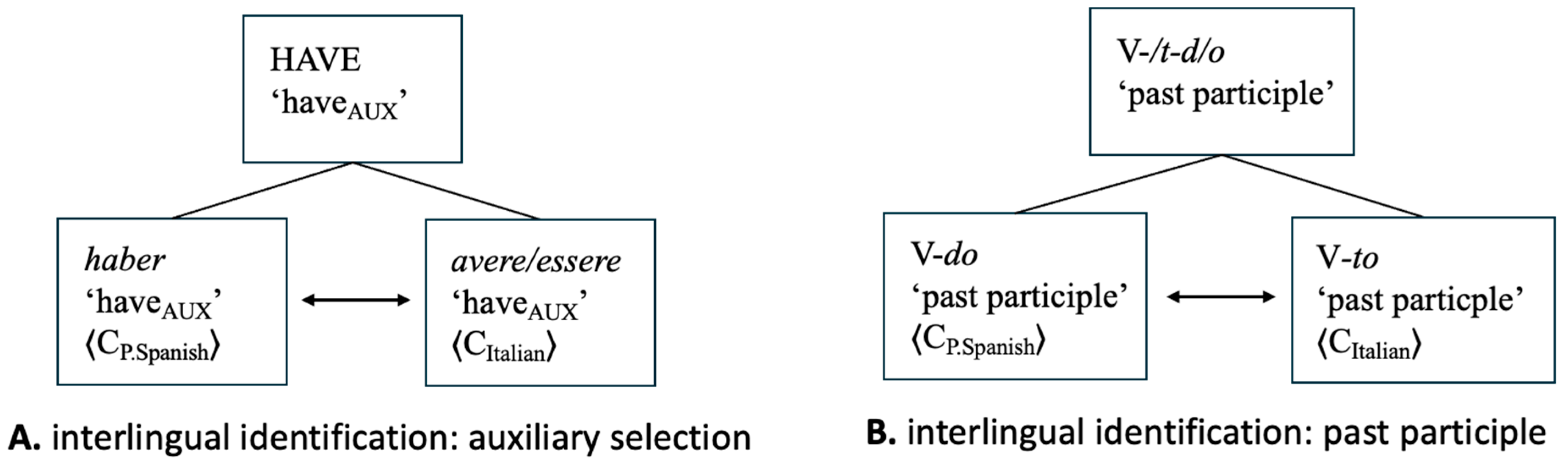
At the morphophonological level, speakers recognise the similarity in the past participle formation across the two languages. What clearly stands out from a comparison of the two forms is the correspondence between the Spanish voiced /d/and the Italian voiceless /t/ in the inflectional morpheme (Italian -ato/-ito and Spanish -ado/-ido). As shown in examples (14)–(17), speakers seem to have stored a more abstract pattern where either consonant can be used to form a past participle, regardless of the lexicon they select for the lexical verb. Both cases where the Spanish inflectional morpheme is attached to an Italian lexical verb (e.g., trovado, parlado) and, conversely, where the Italian inflectional morpheme is attached to a Spanish lexical verb (e.g., estudiato) are attested. After identifying partial similarities, speakers reorganise their mental constructicon introducing a new overarching diaconstruction, namely, a more abstract pattern that is language-unspecific and displays the characteristics shared by the two idioconstructions. Such reorganised networks (which are just a section of the whole mental constructicon) are visualised in Figure 4.6 What the figure shows is that, once that interlingual identification has occurred, the two language-specific constructions (at the bottom, 〈CP.Spanish〉 and 〈CItalian〉) are generalised into a more abstract pattern (on top) that is language-unspecific (thus lacking the language-specificity notation). This diaconstruction is then inserted in the constructional network at a more abstract level and is connected to the specific schemas, i.e., the idioconstructions, through a vertical, inheritance link.
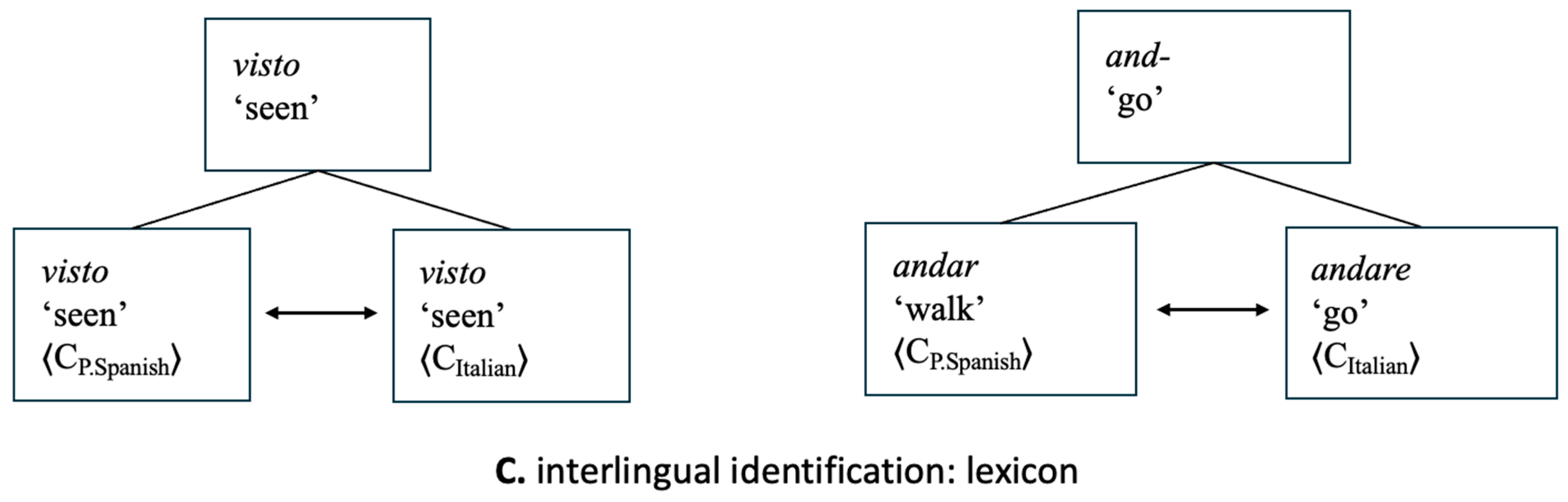
A third step of interlingual identification occurs at the lexical level, and is mainly composed of two types. The first concerns the case of irregular participle forms, such as visto ‘seen’ (from Italian vedere and Spanish ver), that are homophones and completely coincide in both languages. We argue that, in these cases, the participle form is stored as a separate, lexical item, rather than as a pattern that allows for generalisation. The second case regards lexemes that share a similar or identical form but differ in terms of semantic nuances. This is the case of Italian andare ‘go’ and Spanish andar ‘walk’, in which the two verbs have an identical lexical root and- but convey slightly different meanings: andare includes all types of motion regardless of the means of transport or the direction, whereas andar is more specific and refers to ‘moving by walking’. Despite this difference, both verbs share the core meaning of ‘motion’, which is what speakers identify when comparing the two languages looking for similarities. As in the case of the auxiliary illustrated above, it seems that, in such cases, the broader, shared meaning is the one that gets easily generalised and stored within the diaconstruction. This is motivated by the attested use of the lexical root and- with the meaning of ‘go’ even in—apparently—fully Spanish forms, as in (18).
(18)quando hemos andado a vedere il mondiale in russia
‘when we went to see the World Cup in Russia’
[Speaker: PST061; Recording: STIS009]
The process of interlingual identification and construction reorganisation at the lexical level is portrayed in Figure 5. On the left, the case of homophone participle forms is reported, while the network on the right represents how similarities are identified and generalised in lexical verbs with almost identical form and shared core semantics.
The process described so far allows us to assume that the complete past tense diaconstruction (19) that emerged from our data of Italian–Spanish contact features three, partially specified slots, namely, the auxiliary verb, the verbal root, and the past participle ending, each with its own constraints or requirements. The meaning associated with this form is the general one of ‘reference to a past event’, given that no other specific semantic or pragmatic nuances seem to have been generalised into this schema.
(19)[ HAVEAUX + [V-]/t-d/o ]‘reference to a past event’
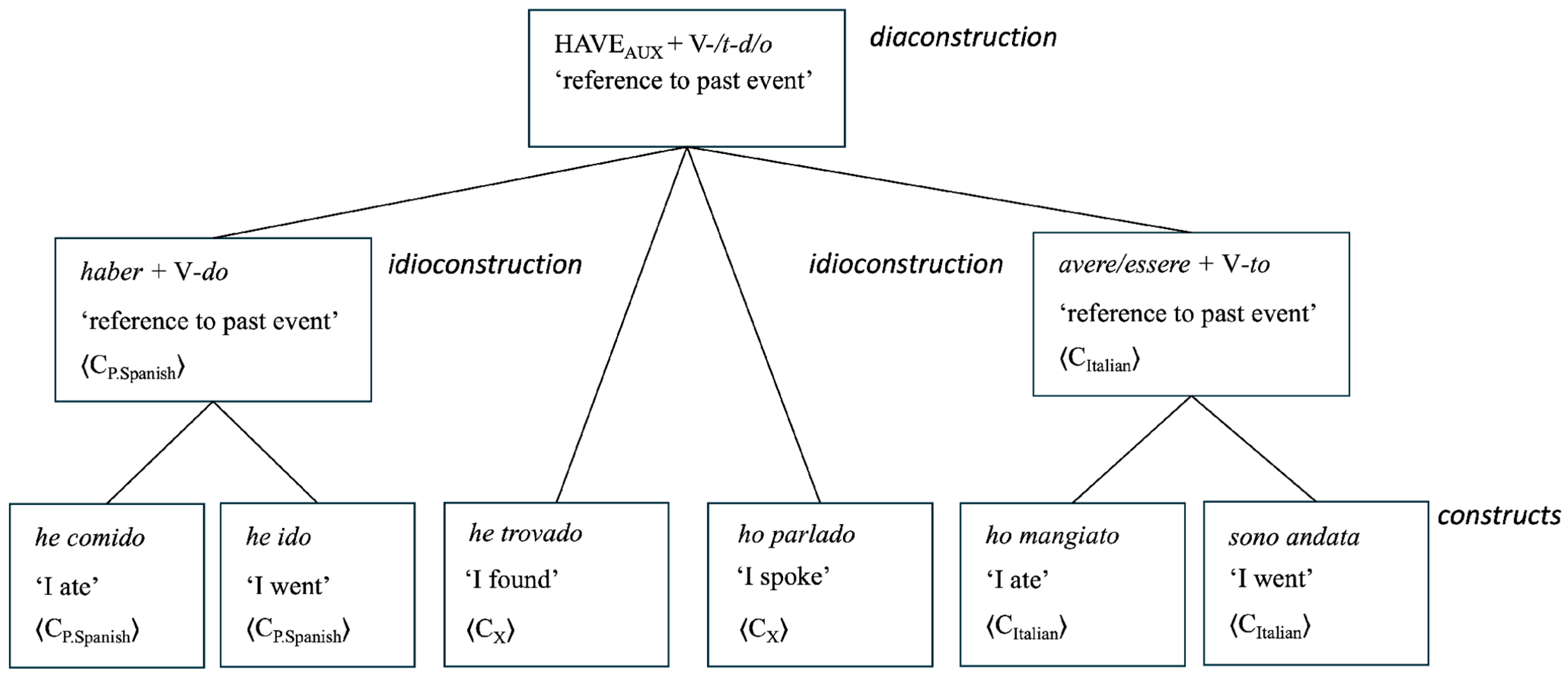
A final, more thorough representation of the constructional network that encompasses both the more general diaconstructions and the specific idioconstructions, following the interlingual identification at the syntactic and morphological levels, is proposed in Figure 6.
In this network, three levels of schematicity of the construction under scrutiny are represented, namely, the more abstract, semi-schematic level of the diaconstruction; the more specific, though still semi-schematic, level of the two idioconstructions; and, at the bottom, the lexically specified level of concrete realisations of the construction, i.e., constructs. All the three levels are connected one to the other through vertical links, meaning that each construction at a lower level inherits properties from the overarching one. Language-specific constructs, such as Spanish he comido or Italian ho mangiato, are direct realisations of their respective, more general and still language-specific, idioconstructions. In turn, each idioconstruction is linked to the overarching diaconstruction that is the result of the process of interlingual identification and constructicon reorganisation outlined above. Lastly, the diaconstruction itself licenses new constructs in which the empty slots are filled with lexical material from either language, as in he trovado or ho parlado. These latter cases must be regarded as community-specific, in that they reflect the social conventions of the community under scrutiny, as well as the variable availability of Italian and Spanish repertoires for its members, and hence their mobilisation in language production (see Section 3.2). However, it has not yet been demonstrated to what extent the diaconstructions identified here are conventionalised within the community as a whole, or represent individual or context-dependent strategies. For this reason, we remain agnostic as to whether the mentioned constructs are to be considered as parts of an emerging ethnolect (Vietti, 2005) or fused lect (Auer, 1999). We therefore consider it safer at the current state of investigation to leave the 〈CX〉 notation unspecified in Figure 6, in order to merely state that diaconstructions of this type cannot be assigned categorically to any of the monolingual repertoires involved.
After having the data guide us toward a theoretical explanation of what linguistic knowledge lies behind such mixed constructions, we now turn back to the data to verify that the proposed constructional network is indeed able to account for the different types of forms attested in the corpus.
Cases that fall into group A, with fully language-specific realisations such as he ido ‘I went’ (8) or abbiamo avuto ‘we had’ (9), instantiate the idioconstruction and show full inheritance from a language-bound schema, without activating the more abstract diaconstruction. Moving to group C, forms like he lavorato (11) reveal a different pattern: here, the Spanish auxiliary he and the Italian past participle lavorato are combined, suggesting that speakers are drawing directly on the more schematic diaconstruction and filling its slots with material selected independently from each language. This becomes even more evident in cases such as io ho pensado (13), where the participle can be interpreted both as “entirely” Spanish in morphology or as partially language-unspecific, given that the lexical root pens- has the same form in Italian. Group D examples like he trovado (15) and ho parlado (17) provide the strongest confirmation of the proposed model, as they involve hybrid participles in which the lexical root and the inflectional morpheme come from different languages. Such forms can only be explained if we assume that, at the morphophonological level, the participial pattern itself has been abstracted into the diaconstruction, allowing speakers to recombine stems and endings across languages. Finally, the insertion of homophone irregular participle forms belonging to group B, as in he visto (10), constitutes a slightly different case. Here, we assume that the speaker relies on the even more general diaconstruction [AUX + PP] and instantiates it by retrieving the past participle visto as a non-language-specific unit (see Figure 5) and inserting it in the available PP slot. Overall, these examples show that speakers operate flexibly across different levels of the network, with the diaconstruction(s) serving as an overarching template that licenses both fully language-specific and mixed realisations.


6. Conclusions and Future Directions

This paper set out with a twofold aim: to contribute to the description of the multilingual practices of the Peruvian community in Turin, and to propose Diasystematic Construction Grammar as a unifying analytical framework for the study of language contact phenomena. The review of existing approaches presented in Section 2 has shown that, despite their substantial differences in assumptions, terminology, and explanatory aims, code-mixing research, translanguaging, and second language acquisition studies converge on a set of shared observations: multilingual speakers may produce hybrid utterances in which resources from different languages are combined within partially overlapping patterns, and structural similarity plays a key role in facilitating such productions. What these frameworks have largely left underspecified, however, is the nature of the abstract linguistic knowledge that underlies such productions. As a usage-based, cognitive framework that treats linguistic knowledge as a structured inventory of form–meaning pairings organised at different levels of abstraction, DCxG is well positioned to fill this gap, capturing the generalisations that speakers make across their repertoire without relying on the assumption of separate, bounded grammars. The analysis of compound past-tense constructions in the Stra-ParlaTO corpus has demonstrated the empirical validity of this approach. By identifying partial formal and functional similarities between the Italian passato prossimo and the Spanish pretérito perfecto compuesto, speakers appear to have developed an abstract, language-unspecific diaconstruction that licenses a range of hybrid realisations, from fully monolingual forms to mixed constructs in which auxiliary, lexical verbs, and past-participle morphology are drawn from different language repertoires.
The patterns observed in the Stra-ParlaTO data also suggest that the conditions for the emergence of diaconstructions are met even in communities shaped by more recent and dynamic migration histories. At the same time, important differences exist on the social side. Unlike the historically rooted ethnolinguistic minorities that have typically served as the testing ground for DCxG, the Peruvian community in Turin displays a considerably more heterogeneous profile: individuals vary substantially in terms of their exposure to standard Italian, their educational histories, the length of their stay in Italy, the social networks they are embedded in, and their attitudes towards code-mixing itself (see Bonomi & Sanfelici, 2018). This heterogeneity raises an open question that future research will need to address more systematically: namely, to what extent the diaconstructions identified here are conventionalised within the community as a whole, as opposed to being individual or context-dependent strategies, and how their distribution compares to that of the corresponding monolingual idioconstructions.
Thus, what remains to be established is the degree of entrenchment and social spread of the diaconstructions proposed here. A frequency-based account of their distribution across speakers, interaction types, and social contexts will be essential in order to assess their degree of conventionalisation and to determine whether they constitute a stable, community-wide feature or a more fluid and individually variable phenomenon. Therefore, the most urgent direction for future research is a quantitative analysis that builds on the qualitative findings presented here.

Author Contributions

Conceptualization, B.B. and E.G.; methodology, B.B. and E.G.; formal analysis, B.B.; investigation, B.B. and E.G.; data curation, B.B. and E.G.; writing—original draft preparation, B.B. and E.G.; writing—review and editing, B.B. and E.G.; visualization, B.B. and E.G.; supervision, B.B. and E.G.; project administration, E.G.; funding acquisition, E.G. All authors have read and agreed to the published version of the manuscript.

Funding

This research was funded by the European Union—NextGenerationEU with the The National Recovery and Resilience Plan (NRRP)—Mission 4 ‘Education and Research’—Component 2 ‘From Research to Business’, grant number J53D23017320001. The APC was funded by the University of Napoli L’Orientale and the University of Napoli Federico II.

Institutional Review Board Statement

The study was conducted in accordance with the Declaration of Helsinki and approved by the Ethics Committee of the University of Bologna (protocol code 0217273, 29 July 2024).

Informed Consent Statement

Informed consent was obtained from all subjects involved in the study.

Data Availability Statement

Since the focus of this paper is mainly theoretical, we refer for data access to the KIParla corpus, which is available in open access at www.kiparla.it.

Acknowledgments

This paper is the result of the close collaboration between the two authors. For the purposes of Italian academia only, Beatrice Bernasconi is responsible for Section 3.1, Section 3.2 and Section 4, while Eugenio Goria is responsible for Section 1, Section 2 and Section 3.3. Section 5 and Section 6 are to be attributed to both authors equally.

Conflicts of Interest

The authors declare no conflict of interest.

Notes

1
The terms ‘multilingual’ and ‘bilingual’ are variously used within the scientific community, both as quasi-synonyms and with entailed theoretical differences. Since in this paper we analyse data from an international migration setting characterised by superdiversity (Vertovec, 2007), we prefer to adopt the terms ‘multilingual ’ and ‘multilingualism’, in order to overcome dualisms such as L1 vs. L2, or ‘dominant language’ vs. ‘minority language’. There are in fact cases where, for instance, English appears to be used within more globally defined multilingual practices; consider for example: te metten una semana o asì de lunes a domingo full time ‘they put you a week or so from Monday to Sunday full time’.
2
The KIParla corpus is accessible through NoSketchEngine at the following link: https://search.corpuskiparla.it/corpus/crystal/#open, accessed on 1 June 2026.
3
https://kiparla.it/en/il-corpus/, accessed on 1 June 2026.
4
In this study, we refer specifically to Northern varieties, given that data were collected in Turin, Piedmont. As for Peruvian Spanish, we refer to the main variety of our speakers, namely, Limeño Spanish, the urban variety of the coastal dialect of Peru, typical of the city of Lima. All the speakers involved in this study, except for those who were born in Italy, were either born in the Lima area or had lived there most of their lives before moving to Italy.
5
It is worth specifying that in Italian avere can function both as an auxiliary and a lexical verb meaning ‘have’, in Spanish haber is just employed as an auxiliary (instead, the verb tener is used to express possession).
6
Constructions are represented within boxes and are made up of a form (first line in each box) and a meaning (second line in each box, within single quotation marks). In the case of language-specific constructions, such specificity is conceived as a pragmatic property (third line, see Section 3.2) and is marked by the 〈CX〉 notation, where X stands for the specific language.

References

  1. Andorno, C., & Della Putta, P. (in press). The basic variety in learners of closely related languages: A case study of young Spanish-speaking migrants learning Italian. LIA—Language, Interaction, Acquisition, 17(1).
  2. Auer, P. (1999). From codeswitching via language mixing to fused lects: Toward a dynamic typology of bilingual speech. International Journal of Bilingualism, 3(4), 309–332. [Google Scholar] [CrossRef]
  3. Auer, P. (2000). Why should we and how can we determine the ‘base language’ of a bilingual conversation? Sociolinguistic Studies, 1(1), 1976. [Google Scholar] [CrossRef]
  4. Auer, P. (2014). Language mixing and language fusion: When bilingual talk becomes monolingual. In J. Besters-Dilger, C. Dermarkar, S. Pfänder, & A. Rabus (Eds.), Congruence in contact-induced language change (pp. 294–334). Mouton de Gruyter. [Google Scholar] [CrossRef]
  5. Backus, A., & Demirçay, D. (2021). Intense Turkish-Dutch bilingualism leads to intense Turkish-Dutch mixing: A usage-based account of increasing integration of two typologically different languages. Belgian Journal of Linguistics, 35, 13–33. [Google Scholar] [CrossRef]
  6. Bischoff, S. T., & Jany, C. (Eds.). (2018). Insights from practices in community-based research: From theory to practice around the globe. Mouton De Gruyter. [Google Scholar] [CrossRef]
  7. Blevins, M. (2018). Towards a constructional analysis of the progressive aspect in Texas German. In H. C. Boas, & S. Höder (Eds.), Constructions in contact (pp. 73–113). John Benjamins Publishing Company. [Google Scholar] [CrossRef]
  8. Boas, H. C. (2010). The syntax–lexicon continuum in Construction Grammar: A case study of English communication verbs. Belgian Journal of Linguistics, 24, 54–82. [Google Scholar] [CrossRef]
  9. Boas, H. C. (2018). A constructional account of the modal particle ‘ja’ in Texas German. In H. C. Boas, & S. Höder (Eds.), Constructions in contact (pp. 253–276). John Benjamins. [Google Scholar]
  10. Boas, H. C., & Höder, S. (Eds.). (2018). Constructions in contact: Constructional perspectives on contact phenomena in Germanic languages. John Benjamins. [Google Scholar] [CrossRef]
  11. Boas, H. C., & Höder, S. (Eds.). (2021). Constructions in contact 2: Language change, multilingual practices, and additional language acquisition. John Benjamins. [Google Scholar] [CrossRef]
  12. Boas, H. C., & Höder, S. (Eds.). (2025). Constructions in contact 3: Constructional schemas and patterns in language contact. John Benjamins. [Google Scholar] [CrossRef]
  13. Bonomi, M. (2010). Hablamos mitá y mità. Varietà linguistiche di immigrati ispanofoni in Italia. In M. V. Calvi, G. Mapelli, & M. Bonomi (Eds.), Lingua, identità e immigrazione. Prospettive interdisciplinari (pp. 53–70). Franco Angeli. [Google Scholar]
  14. Bonomi, M., & Sanfelici, L. (2018). Spanish as a Heritage Language in Italy. In K. Potowski (Ed.), The Routledge handbook of Spanish as a heritage language (1st ed., pp. 479–491). Routledge. [Google Scholar] [CrossRef]
  15. Bybee, J. (2010). Language, usage and cognition. Cambridge University Press. [Google Scholar]
  16. Calvi, M. V. (2016). Spagnolo e italiano nelle seconde generazioni di migranti ispanofoni in Italia. Quaderns d’Italià, 21, 45–62. [Google Scholar]
  17. Cappelle, B. (2006). Particle placement and the case for ‘allostructions’. Constructions, 1, 1–28. [Google Scholar] [CrossRef]
  18. Corder, S. P. (1979). Language distance and the magnitude of the language learning task. Studies in Second Language Acquisition, 2(1), 27–36. [Google Scholar] [CrossRef]
  19. Croft, W. (2000). Explaining language change: An evolutionary approach. Longman. [Google Scholar]
  20. Croft, W., & Cruse, D. A. (2004). Cognitive linguistics (1st ed.). Cambridge University Press. [Google Scholar] [CrossRef]
  21. Czaykowska-Higgins, E. (2009). Research models, community engagement, and linguistic fieldwork: Reflections on working within Canadian indigenous communities. Language Documentation and Conservation, 3(1), 15–50. [Google Scholar]
  22. Demirçay, D., & Backus, A. (2014). Bilingual constructions: Reassessing the typology of code-switching. Dutch Journal of Applied Linguistics, 3(1), 30–44. [Google Scholar] [CrossRef]
  23. Deuchar, M., Muysken, P., & Wang, S.-L. (2007). Structured variation in codeswitching: Towards an empirically based typology of bilingual speech patterns. International Journal of Bilingualism, 10, 44. [Google Scholar] [CrossRef]
  24. Diessel, H. (2019). The grammar network: How linguistic structure is shaped by language use. Cambridge University Press. [Google Scholar]
  25. Diessel, H. (2023). The constructicon: Taxonomies and networks. Cambridge University Press. [Google Scholar]
  26. Doyé, P. (2005). Intercomprehension. Guide for development of language education policies in Europe: From linguistic diversity to plurilingual education. Reference study. Council of Europe. [Google Scholar]
  27. Dux, R. (2018). Texas German and English word order constructions in contact. In H. C. Boas, & S. Höder (Eds.), Constructions in contact (pp. 211–249). John Benjamins. [Google Scholar] [CrossRef]
  28. Fillmore, C. J., Kay, P., & O’Connor, M. C. (1988). Regularity and idiomaticity in grammatical constructions: The case of let alone. Language, 64(3), 501. [Google Scholar] [CrossRef]
  29. Fried, M., & Östman, J.-O. (2004). Construction grammar: A thumbnail sketch. In M. Fried, & J.-O. Östman (Eds.), Construction grammar in a cross-language perspective (pp. 11–86). John Benjamins. [Google Scholar] [CrossRef]
  30. García, O., & Li, W. (2014). Translanguaging: Language, bilingualism and education. Palgrave McMillan. [Google Scholar]
  31. Goldberg, A. E. (1995). Constructions: A construction grammar approach to argument structure. The University of Chicago Press. [Google Scholar]
  32. Goldberg, A. E. (2006). Constructions at work: The nature of generalization in language. Oxford University Press. [Google Scholar]
  33. Goll, S. (2023). Südschleswigdänisch: Eine strukturelle bestandsaufnahme aus dialektologischer perspektive [Doctoral dissertation, Kiel University]. [Google Scholar] [CrossRef]
  34. Grosjean, F. (2012). Bilingual and monolingual language modes. In C. A. Chapelle (Ed.), The encyclopedia of applied linguistics (1st ed.). Wiley. [Google Scholar] [CrossRef] [PubMed]
  35. Hakimov, N., & Backus, A. (2021). Usage-based contact linguistics: Effects of frequency and similarity in language contact. Journal of Language Contact, 13(3), 459–481. [Google Scholar] [CrossRef]
  36. Hilpert, M. (2014). Construction grammar and its application to English. Edinburgh University Press. [Google Scholar]
  37. Howe, C. (2018). El pasado compuesto en el español peruano. Hacia una explicación unificada de su significado. In R. Risco (Ed.), Estudios de variación y contacto lingüístico en el español peruano (pp. 169–197). Universidad Nacional de La Plata. [Google Scholar]
  38. Höder, S. (2018). Grammar is community-specific: Background and basic concepts of Diasystematic Construction Grammar. In H. C. Boas, & S. Höder (Eds.), Constructions in contact (pp. 37–70). John Benjamins. [Google Scholar] [CrossRef]
  39. Höder, S. (2021). Grammatical arealisms across the Danish-German border from a constructional perspective. In C. Zimmer (Ed.), German(ic) in language contact: Grammatical and sociolinguistic dynamics (pp. 11–42). Language Science Press. [Google Scholar]
  40. Jara Yupanqui, I. M. (2011). Funciones discursivas y gramaticalización del pretérito perfecto compuesto en el español de Lima. Spanish in Context, 8(1), 95–118. [Google Scholar] [CrossRef]
  41. Jefferson, G. (2004). Glossary of transcript symbols with an introduction. In G. H. Lerner (Ed.), Conversation analysis: Studies from the first generation (pp. 13–31). John Benjamins. [Google Scholar] [CrossRef]
  42. Labov, W. (1982). Building on empirical foundations. In W. P. Lehmann, & Y. Malkiel (Eds.), Perspectives on historical linguistics (pp. 17–92). John Benjamins. [Google Scholar] [CrossRef]
  43. Lepschy, A. L., & Lepschy, G. (1981). La lingua italiana: Storia, varietà dell’uso, grammatica. Bompiani. [Google Scholar]
  44. Li, W. (2018). Translanguaging as a practical theory of language. Applied Linguistics, 39(1), 9–30. [Google Scholar] [CrossRef]
  45. Matras, Y. (2009). Language contact. Cambridge University Press. [Google Scholar] [CrossRef]
  46. Mauri, C., Ballarè, S., Goria, E., Cerruti, M., & Suriano, F. (2019). KIParla corpus: A new resource for spoken Italian. In R. Bernardi, R. Navigli, & G. Semeraro (Eds.), Proceedings of the 6th Italian conference on computational linguistics CLiC-it. CEUR Workshop Proceedings. [Google Scholar]
  47. Muysken, P. (2000). Bilingual speech. A typology of code-mixing. Cambridge University Press. [Google Scholar]
  48. Muysken, P. (2013). Language contact outcomes as the result of bilingual optimization strategies. Bilingualism: Language and Cognition, 16(4), 709–730. [Google Scholar] [CrossRef]
  49. Myers-Scotton, C. (2002). Contact linguistics: Bilingual encounters and grammatical outcomes. Oxford University Press. [Google Scholar]
  50. Otheguy, R., García, O., & Reid, W. (2015). Clarifying translanguaging and deconstructing named languages: A perspective from linguistics. Applied Linguistics Review, 6(3), 281–307. [Google Scholar] [CrossRef]
  51. Perek, F., & Hilpert, M. (2016). Constructional tolerance: Cross-linguistic differences in the acceptability of non-conventional uses of constructions. In M. Hilpert, & J.-O. Östman (Eds.), Constructions across grammars (pp. 131–168). John Benjamins. [Google Scholar] [CrossRef]
  52. Rampton, B. (2017). Crossing: Language and ethnicity among adolescents (3rd ed.). Routledge. [Google Scholar] [CrossRef]
  53. Rice, K. (2010). The linguist’s responsibilities to the community of speakers: Community-based research. In L. A. Grenoble, & N. L. Furbee (Eds.), Language documentation: Practice and values (pp. 25–36). John Benjamins. [Google Scholar] [CrossRef]
  54. Sommerer, L., & Smirnova, E. (Eds.). (2020). Nodes and networks in diachronic construction grammar. John Benjamins. [Google Scholar] [CrossRef]
  55. Stenzel, K. (2014). The pleasures and pitfalls of a ‘participatory’ documentation project: An experience in Northwestern Amazonia. Language Documentation and Conservation, 8, 287–306. [Google Scholar]
  56. Tagliamonte, S. A. (2006). Analysing sociolinguistic variation (1st ed.). Cambridge University Press. [Google Scholar] [CrossRef]
  57. Treffers-Daller, J. (2009). Code-switching and transfer: An exploration of similarities and differences. In B. E. Bullock, & A. J. Toribio (Eds.), The Cambridge handbook of linguistic code-switching (1st ed., pp. 58–74). Cambridge University Press. [Google Scholar] [CrossRef]
  58. Ungerer, T., & Hartmann, S. (2023). Constructionist approaches: Past, present, future. Cambridge University Press. [Google Scholar] [CrossRef]
  59. Van de Velde, F. (2014). Degeneracy: The maintenance of constructional networks. In R. Boogaart, T. Colleman, & G. Rutten (Eds.), Extending the scope of construction grammar (pp. 141–180). Mouton de Gruyter. [Google Scholar] [CrossRef]
  60. Vertovec, S. (2007). Super-diversity and its implications. Ethnic and Racial Studies, 30(6), 1024–1054. [Google Scholar] [CrossRef]
  61. Vietti, A. (2005). Come gli immigrati cambiano l’italiano: L’italiano di peruviane come varietà etnica. FrancoAngeli. [Google Scholar]
  62. Weinreich, U. (1953). Languages in contact. Findings and problems. Mouton de Gruyter. [Google Scholar]
  63. Weinreich, U. (1954). Is a structural dialectology possible? Word, 10(2–3), 388–400. [Google Scholar] [CrossRef]
  64. Wiese, H. (2009). Grammatical innovation in multiethnic urban Europe: New linguistic practices among adolescents. Lingua, 119(5), 782–806. [Google Scholar] [CrossRef]
  65. Wittenburg, P., Brugman, H., Russel, A., Klassmann, A., & Sloetjes, H. (2006, May 22–28). ELAN: A professional framework for multimodality research. Proceedings of the Fifth International Conference on Language Resources and Evaluation, Genoa, Italy. [Google Scholar]
Figure 1. The symbolic structure of a construction (Croft & Cruse, 2004, p. 258).
Languages 11 00132 g001
Figure 2. Representation of how diaconstructions and idioconstructions are organised in the constructional network (Höder, 2018, p. 52).
Languages 11 00132 g002
Figure 3. Distribution of interaction types across the three groups of speakers, based on their repertoire.
Languages 11 00132 g003
Figure 4. Interlingual identification at the syntactic and morphophonological level.
Languages 11 00132 g004
Figure 5. Interlingual identification at the lexical level.
Languages 11 00132 g005
Figure 6. Constructional network of the Italian–Spanish past tense construction.
Languages 11 00132 g006
Disclaimer/Publisher’s Note: The statements, opinions and data contained in all publications are solely those of the individual author(s) and contributor(s) and not of MDPI and/or the editor(s). MDPI and/or the editor(s) disclaim responsibility for any injury to people or property resulting from any ideas, methods, instructions or products referred to in the content.