Article

Aspects of Use of the Modern Lesbian Dialect in the Linguistic Landscape of Mytilene

Department of Social Anthropology and History, University of the Aegean, 811 00 Mitilini, Greece
*
Authors to whom correspondence should be addressed.
Languages 2026, 11(6), 122; https://doi.org/10.3390/languages11060122
Submission received: 4 March 2026 / Revised: 12 May 2026 / Accepted: 3 June 2026 / Published: 12 June 2026
(This article belongs to the Special Issue The Modern Dialect of Lesbos: Selected Topics)

Abstract

We focus on the use of the Modern Lesbian dialect in the linguistic landscape (LL), highlighting its diverse forms and functions. Since LL research primarily investigates written language in public space, emphasizing the dynamic relationship between language, place, and historicity, the growing visibility of the dialect in both physical and digital contexts (cf. the online–offline nexus) is particularly noteworthy. The presence of non-standard varieties in public discourse has been widely studied, revealing that aspects of language choice and use are related to the sustainability of minority languages, the shaping of linguistic attitudes and stereotypes, and the commodification of language as a cultural and economic resource. Within this framework, the data analyzed here illustrate positive attitudes toward Modern Lesbian, expressions of pride and comfort among its speakers, efforts to destigmatize dialectal speech, and indications of broader acceptance of Modern Lesbian. Meanwhile, the increasing commodification of the dialect is evident in its use for the promotion of products and services, capitalizing on its distinctiveness, despite its historical stigmatization vis-à-vis the standard. This development does not dissolve entrenched beliefs on the incompatibility of dialects with written discourse; rather, it capitalizes on the surprise (and humor) generated by their written presence in promotional contexts without resorting to humorous stereotyping.

1. Introduction

This paper focuses on the use of the Modern Lesbian dialect in the linguistic landscape (henceforth LL), aiming to highlight the multiple facets of its deployment. Given that linguistic landscape research primarily investigates written language in public space, emphasizing the dynamic relationship between a place and its history (Blommaert, 2013; Blommaert & Maly, 2014; Canakis, 2022; Tsiplakou, 2023; Kallen, 2023; Tufi, 2025), the increasing presence of the Modern Lesbian dialect in both physical and digital environments (online–offline nexus; Androutsopoulos, 2024) is of particular interest.
Methodologically, the paper adopts a qualitative linguistic landscape approach, examining written instances of Modern Lesbian in public space, both physical and digital, collected in Mytilene and other locations on Lesbos. The dataset consists of photographs of physical spaces and screenshots of virtual spaces gathered between 2020 and 2025, which were analyzed in terms of their linguistic, semiotic, and contextual features. Data selection followed maximum variation sampling, prioritizing publicly visible written instances of Modern Lesbian across commercial, affective, and community-oriented contexts. Categorization was based on the primary semiotic function of each example (promotion vs. commodification) while acknowledging intermediate cases. Within this framework, the study addresses the following questions: (a) In which types of public, commercial, and digital contexts does Modern Lesbian appear in written form? (b) How is the dialect mobilized as a semiotic resource indexing locality, authenticity, and cultural memory? (c) To what extent does its increasing visibility in the LL reflect shifting language attitudes and processes of commodification? The paper is structured as follows: Section 2 outlines the theoretical premises of contemporary LL research; Section 3 discusses ethnic spaces, authenticity, and language commodification; Section 4 presents and analyzes the data, distinguishing between the use of Modern Lesbian in promoting services and products and its commodification as a marketable commodity; finally, Section 5 summarizes the main findings and reflects on their implications for the study of dialects in the LL.
The presence of non-standard varieties in public discourse has attracted considerable scholarly attention (e.g., Heller et al., 2014; Stamou & Dinas, 2011; Tsiplakou, 2017, 2023; Kouniarelli, 2022a, 2022b), highlighting issues related to the sustainability of minority/weaker languages (Landry & Bourhis, 1997; Sabri & Blackwood, 2021), the shaping of linguistic attitudes through stereotypes (often for humorous purposes; Papazachariou et al., 2018), and the exchange value of language as a commodifiable product (Heller, 2010), particularly in tourism contexts (Heller et al., 2014).
The examples analyzed here reveal positive language attitudes toward the dialect, expressions of comfort and pride among speakers, attempts to destigmatize dialectal speech, and indications of shared acceptance of Modern Lesbian as an equal linguistic variety. At the same time, they demonstrate its growing commodification through its use in promoting products and services, capitalizing on its distinctiveness—historically a source of stigmatization in relation to the standard—within a specific chronotopic framework (cf. Canakis, 2021). This occurs without necessarily overturning the entrenched belief that dialects are incompatible with written discourse. Rather, promotional practices capitalize on the element of surprise (and humor) elicited by dialect use in writing without engaging in humorous targeting or mockery (pace Papazachariou et al., 2018).

2. Linguistic Landscapes: Theoretical Prerequisites

Research on the “linguistic landscape” focuses on the use of (primarily) written language in public space and on the complex bidirectional relationship between language use and lived space in the process by which space is constructed as place through human agency. In this sense, it draws on the theoretical positions advanced by Lefebvre (1974). Although Landry and Bourhis (1997) are generally credited with first introducing the term in reference to Montreal, more recent scholarship (Kallen, 2010, 2023; Gorter & Cenoz, 2024) has pointed out that the underlying idea is considerably older and may be traced at least as far back as the work of Rosenbaum et al. (1977) and Spolsky and Cooper (1991) on Jerusalem.
The fact that early research concerned language in public space in Israel suggests a symbiotic relationship between LL research and multilingual, ethnically complex communities and the challenges they face (Shohamy & Gorter, 2009; Matras & Gaiser, 2020; Blackwood & Røyneland, 2022; Gorter & Cenoz, 2024, 2025; Spolsky, 2024). Over the past twenty-five years, however, LL research has developed remarkably and now addresses issues that extend far beyond multidialectalism and multilingualism (see the entries in Blackwood et al., 2024). Multilingualism, as an expression of linguistic diversity, nevertheless situates LL at the center of contemporary sociolinguistics (Eckert, 2012, 2018). Although the field initially developed in closer proximity to language policy, sociology, and social psychology than to sociolinguistics proper, LL research has evolved into an interdisciplinary domain that draws on areas as diverse as cultural studies, public history, critical literacy and education studies, media studies, and digitally mediated communication (see Tufi, 2025).
At the same time, the impetus provided by the “semiotic turn” (Jaworski & Thurlow, 2010) has reshaped the field and strengthened its commitment to the study of multimodal communication. The term linguistic landscape is now often used interchangeably with “semiotic landscape” in studies concerned with the use of language and related semiotic resources in public space. This shift is reflected in the annual Linguistic Landscape Workshops (organized since 2008), the journal Linguistic Landscape (since 2015), and numerous edited volumes, some of which explore modalities of perception and interaction with the LL that extend beyond vision (see Pennycook & Otsuji, 2015).
Therefore, LL research concerns the use of written language and other semiotic resources in public space and refers to visible linguistic/semiotic signs within a defined area (see, inter alia, Gorter, 2006; Torkington, 2009; Brito, 2016). Rowland (2012, p. 503) defines the linguistic landscape as “an ideologically loaded space shaped by both local and global forces and displaying a full range of communicative modalities. It exists as an authentic, dynamic, public mega-text. It serves real world purposes; it is constantly changing; and it is accessible to all.”
According to Blommaert (2013, p. 41), the linguistic landscape has the capacity to narrate “stories about the cultural, historical, political, and social backgrounds of a certain space” while foregrounding the interaction between users and textual content and linking it to community practices and norms. Moreover, Blommaert and Maly (2014) stress the importance of an ethnographic analysis of LLs, linking what is observable in the present with what is known about the past while assessing its potential for possible future developments, notably transformation and change in configurations of language-in-place. In this respect, LLs are closely related to the dynamically expanding field of public history (see Exertzoglou, 2020). Recent scholarship converges on defining the linguistic landscape as “a localized, dynamic interplay of space and language with historical depth,” and more specifically as “a manifestation of a dynamic relationship between space and language, which is, on the one hand, produced within space and, on the other, delineates and structures it while also being structured by it,” as Tsiplakou (2017, p. 729) aptly notes.
In the contemporary era, the transition of the LL from the physical public sphere to the digital and online domain—digital LLs—calls for a hybrid analytical approach that acknowledges the online/offline distinction (Blommaert & Maly, 2019; Androutsopoulos, 2024) while simultaneously recognizing the high degree of permeability between these two domains.

3. Ethnic Spaces, Authenticity, and Language Commodification

From an early stage, LL research focused, among other topics, on ethnic enclaves—that is, areas marked by a distinct ethnic profile within major metropolitan centers of the Western world, with the United States serving as a paradigmatic case. Emblematic examples include Chinatowns (cf. Lou, 2024) as well as Greektowns in cities such as Chicago and New York (Kallen, 2023), where the construction of space is not limited to architectural or pictorial elements but extends to a dense network of semiotic resources. Recent research has also dealt with the semiotic resources exploited by ethnic restaurants (cf. Androutsopoulos & Chowchong, 2021 for Thai restaurants in Hamburg, Germany) as another area of investigation. Beyond stereotypical visual representations—such as images of the Great Wall of China or the Parthenon—language plays a decisive role, contributing to the construction of a sense of “authenticity” in spaces that are primarily products of performative representation rather than of uninterrupted cultural continuity (Dunlevy, 2024).
Beyond its communicative function, language is transformed into a commodity endowed with exchange value (Heller et al., 2014), whether as a means of promoting goods and services—for instance, through the use of archaizing angular Greek fonts in English-language texts—or as an object of sale itself, as in the case of Asian calligraphic banners or the use of ideograms in tattoos and decorative items. This commodification extends beyond aesthetic considerations to encompass the social function of language, which becomes a point of reference for identity construction and the reinforcement of communal belonging.
Within this framework, research on ethnic enclaves provides the theoretical grounding for analyzing dialect use in the LL, particularly from a perspective that moves beyond literacy per se to foreground the dialect as a semiotic resource with social and cultural significance. Dialect may function as an index of “localness,” confer authenticity, and strengthen collective identity and contribute to changing affective regimes (Wee, 2025) while simultaneously acquiring exchange value within the cultural and economic management of language. Consequently, the study of dialects in the LL is not confined to questions of linguistic variation; rather, it is situated within a broader semiotic and sociolinguistic analytical framework in which language and its varieties emerge as central mechanisms in the construction of space, identity, and value (cf. Tsiplakou, 2017, 2023).

4. Exchange Value and the Commodification of Dialects: Shifting Language Attitudes?

The discussion on the exchange value of languages is inextricably linked to processes of linguistic evaluation and hierarchization and, consequently, forms part of the broader debate on language attitudes (see Dragojevic, 2018; Dragojevic et al., 2021; Bubenik et al., 2024), both at the theoretical level and within ethnographic sociolinguistic research focusing on specific linguistic varieties (see Kouniarelli, 2022a, 2022b). The notion of exchange value cannot be disentangled from the ideological constructions that surround languages and their varieties since evaluation and hierarchization function simultaneously as mechanisms of social differentiation and cultural capitalization.
A crucial consideration in this line of research is that language attitudes are not fixed but dynamic (cf. Kourdis, 2007). This suggests that the social significance of a linguistic variety is not given once and for all but is continuously renegotiated through practices of use, ideological representations, and shifting economic conditions. Only by acknowledging such shifts in language attitudes can we account for the fact that the linguistic varieties of Lesbos are employed in the LL for a variety of purposes, including the promotion of products. The transition from perceiving these varieties as peripheral or “inferior” to recognizing them as carriers of authenticity and local identity renders their commodification possible.
Thus, the use of local varieties in commercial contexts does not constitute a mere linguistic choice; rather, it is embedded in a broader semiotic, affective, and socio-economic framework in which language functions as a resource endowed with both cultural and exchange value. In this way, the dynamic interrelationship between linguistic variation, social attitudes, and economic exploitation becomes particularly salient. Before turning to the analysis of the examples, it is important to clarify that the two-way categorization adopted here reflects the dominant semiotic orientation of each instance rather than mutually exclusive functional types. Several examples, notably in Figures 4 through 6, occupy an intermediate position, combining promotional aims with affective, identity-related, and community-oriented meanings. Their placement in one category or the other is therefore based on their primary communicative function while acknowledging that the use of Modern Lesbian in the LL often operates at the intersection of commodification, locality, and cultural memory.

4.1. Use of Modern Lesbian in Promoting Services and Products

The example in Figure 1 presents the logo of the handmade hot sauce company Chileli/Tσιλέλι (tsiléli ‘little chili’), whose linguistic choice and semiotic strategy are inextricably linked to locality and cultural identity. On the company’s website, the owner—originally from Cyprus and permanently settled in Mytilene—characteristically states: “The name obviously reflects the main ingredient of my sauces, chili peppers, which may originate from all corners of the globe, but are planted and cultivated on the beloved island of Lesbos. It is, therefore, only fitting that they bear a suffix [i.e., the diminutive suffix -éli] characteristic of Mytilene!”
This statement, which manifests metalinguistic awareness, goes beyond a mere description of the raw material and constitutes an act of linguistic and cultural performativity. The use of the local diminutive suffix, appearing in both the Greek and Roman alphabets, functions as a semiotic index of authenticity, embedding the product within a framework that exceeds its material dimension and transforms it into a carrier of cultural value. The linguistic choice thus becomes a mechanism of market differentiation as locality is presented not simply as a geographical attribute but as symbolic capital (Bourdieu, 1991) conferring prestige, distinctiveness, and exchange value, all of which contribute to marketability.
The logo and the producer’s narrative provide a characteristic example of how language and semiotic resources are mobilized to construct a narrative of authenticity. Within this narrative, Lesbos is not merely a site of production but a point of reference inscribed in the very name of the product, rendering it both commercially appealing and culturally emblematic.
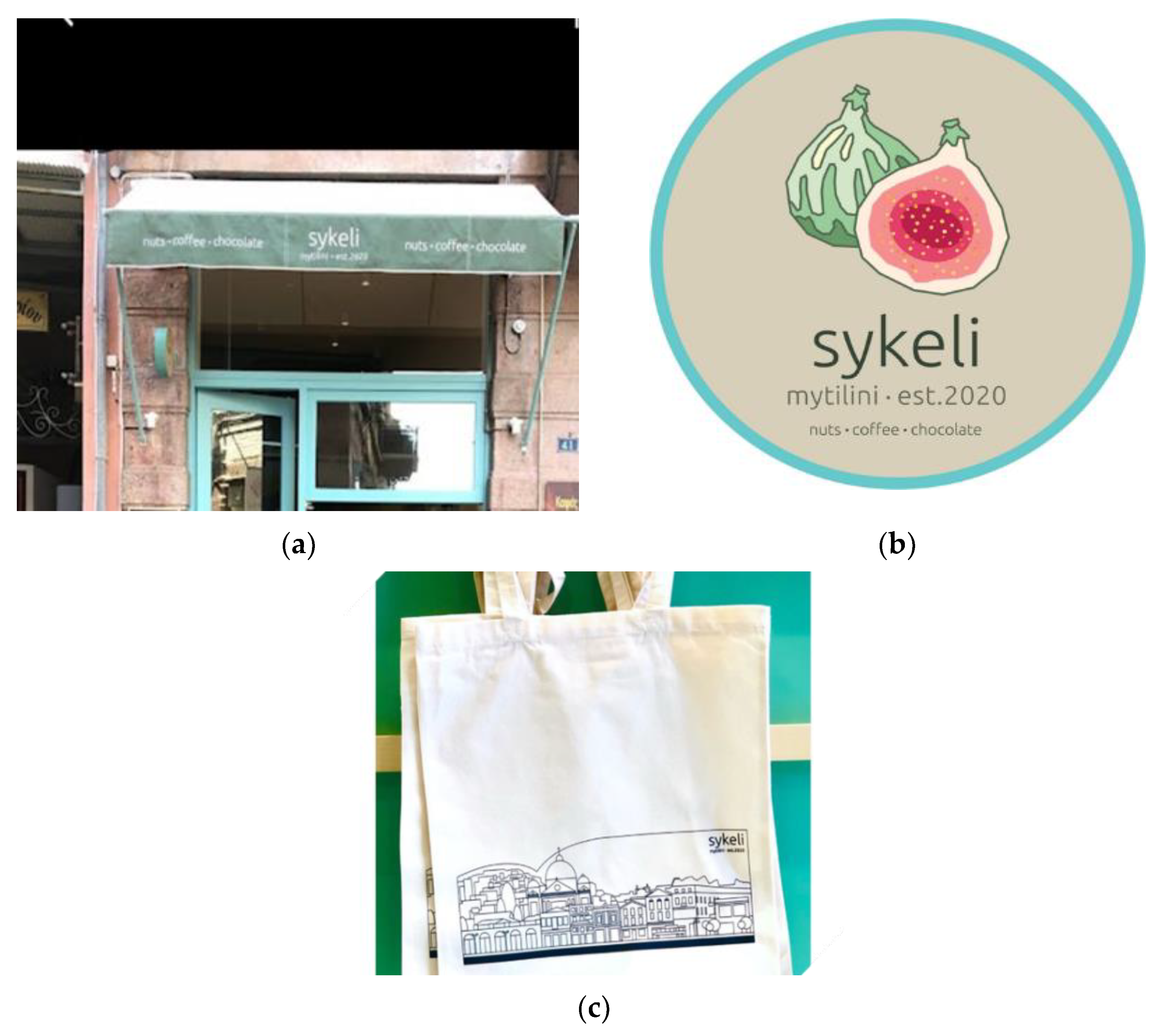
In the examples featured in Figure 2, we provide aspects of the marketing options of the store Sykeli (sykéli ‘little fig’), whose name follows the logic of the previous example; i.e., the business name features the diminutive suffix -éli, which is a well-known shibboleth of Modern Lesbian. This suffix functions not merely as a morphological element but as an indicator of locality and cultural authenticity. This choice situates the store’s name within a framework of linguistic and semiotic market strategy, where the morphology of the dialect is transformed into a resource with symbolic and exchange value. The diminutive suffix -éli not only conveys familiarity and emotional load but also renders the name emblematic of Mytilene, embedding the product or service within a narrative that connects commercial activity to local identity. Thus, the linguistic choice extends beyond the aesthetic level, functioning as a mechanism of differentiation in the market, where Modern Lesbian and its morphological peculiarities emerge as central semiotic resources for constructing authenticity and enhancing the cultural value of the store. The recent establishment date of the business (2020, see Figure 2b) aligns with the equally recent trend of using dialects for commercial purposes.
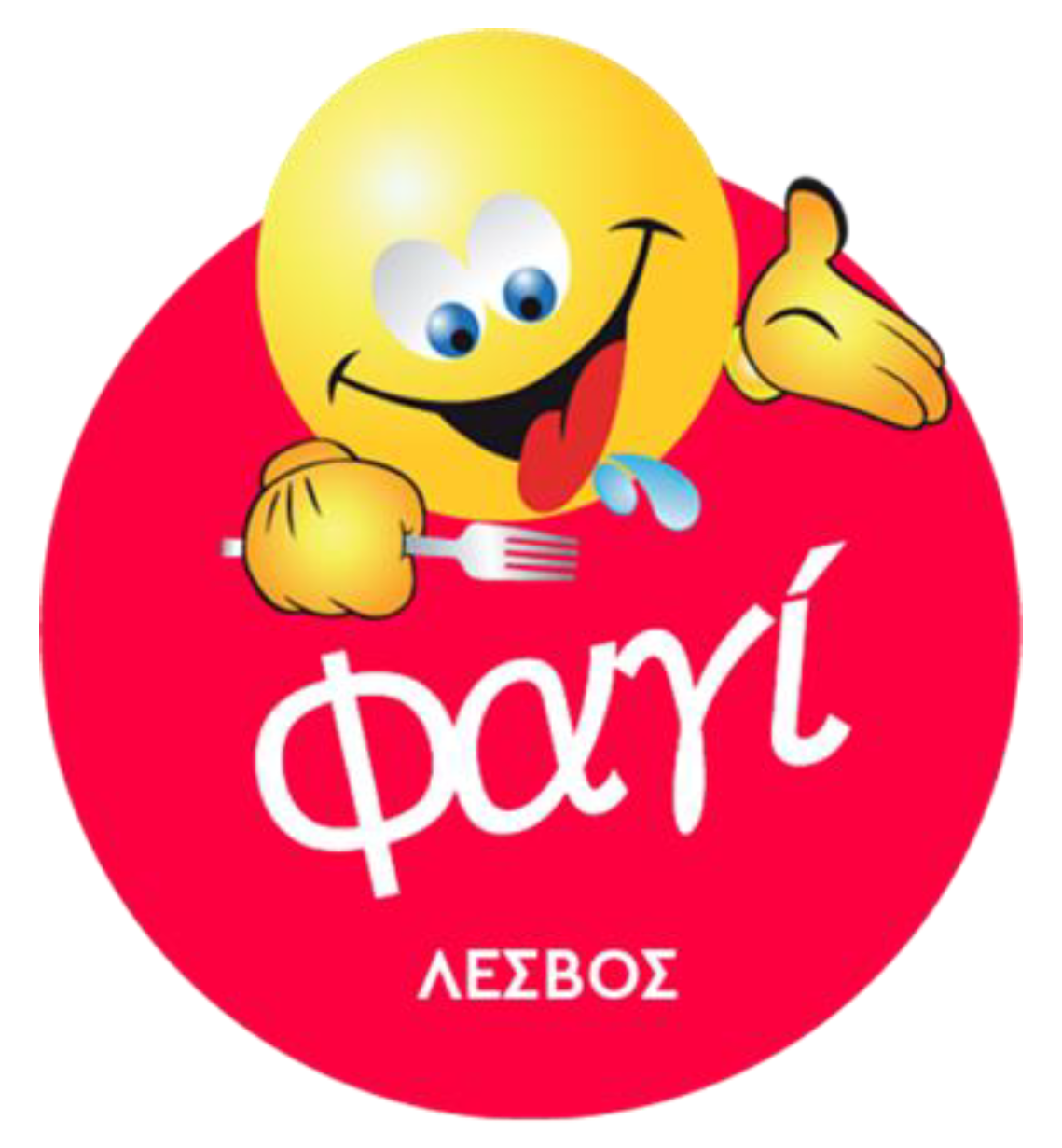
The example in Figure 3 features the logo of the platform fagi/φαγί (faγí ‘food’) for online orders from dining establishments, which originated in Mytilene and has expanded to other areas of Greece. The choice of this specific term, with the epenthesis of a /ɣ/ in Standard Modern Greek φαΐ/faí ‘food’, found in many northern dialects, including Modern Lesbian, aims to avoid vowel hiatus (see, for example, Kretschmer, 1905; Newton, 1972; Ralli, 2007) and is not coincidental. It is a word drawn from the local linguistic variety and carries significant cultural weight as it is connected to the everyday practice of sharing meals and the familiarity of spoken language. Its use in a commercial and technological context, such as an online platform, transforms the dialect into a semiotic resource that imparts authenticity and distinctiveness, casting the business as a service which is not merely catering to convenience but also as a bearer of local identity. Fagi/φαγί functions as a linguistic sign that bridges the traditional experience of food with the modern practices of digital consumption and delivery services while simultaneously placing Mytilene on the map of innovation. Thus, the linguistic choice acquires exchange value as locality is transformed into a commercial advantage and Modern Lesbian into a tool for cultural and economic capitalization.
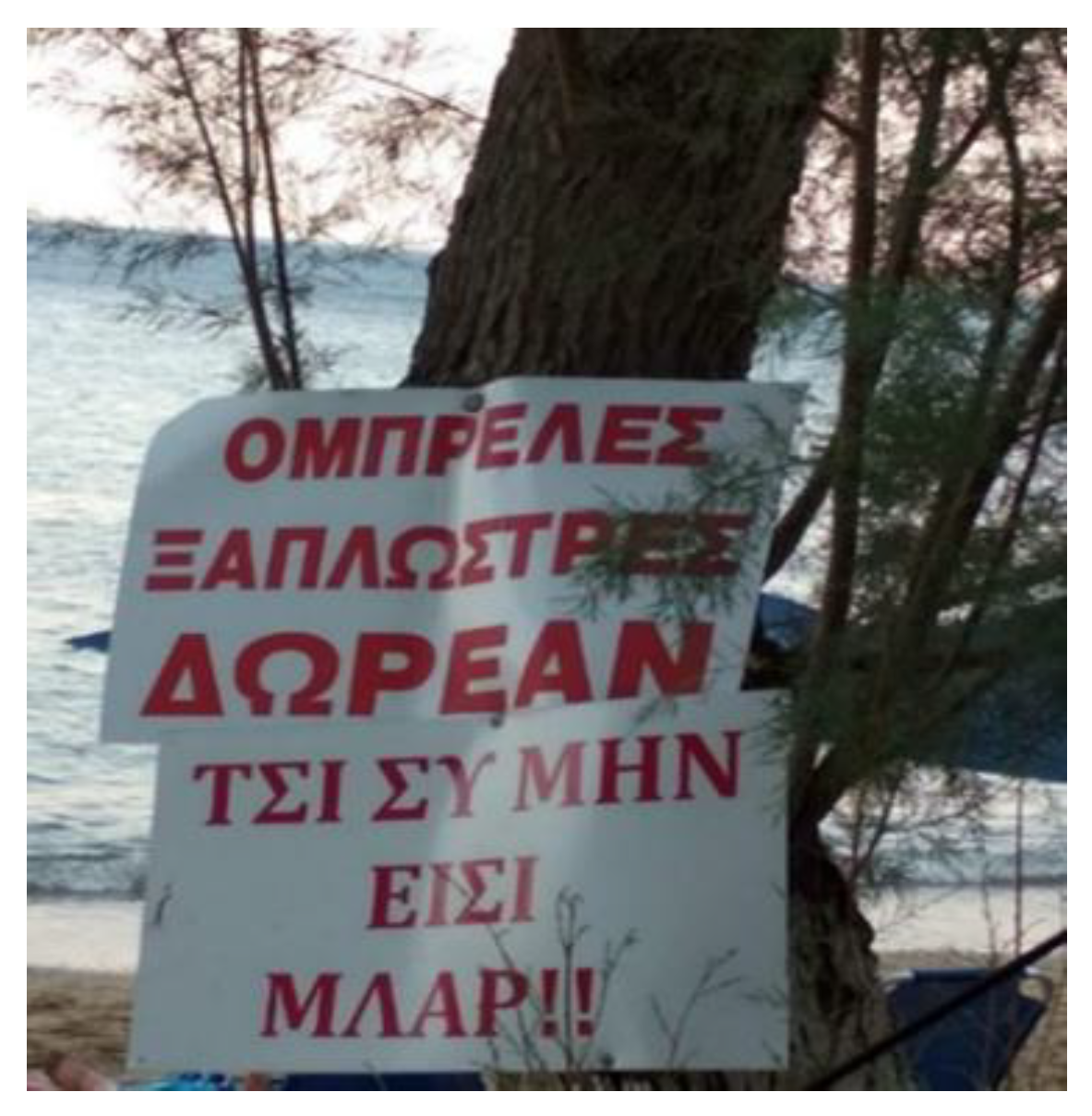
The example in Figure 4 features the phrase TΣI ΣY MHN EIΣI MΛAP (tsi si min ísi mlar ‘and you, don’t be an ass’) which is found on signs (in two locations) at one of the most well-known and crowded beaches of Lesbos. It is worth noting the contrast between the first informative part of the sign, which is written in Standard Modern Greek, and the second directive part, which appears in the Modern Lesbian dialect. The choice of this phrase is not incidental: it is an everyday expression drawn from colloquial local linguistic practices and carries significant social and cultural weight. Its use in public space, particularly on a sign put up by a business and relating to the consumption of food and beverages, transforms the expression into a preemptive tool of persuasion aiming at indirect regulation of visitors’ behavior. The linguistic choice serves as a mechanism of familiarity and humor, avoiding the strict or impersonal tone of a typical directive while simultaneously enhancing the sense of locality and authenticity of the space. The phrase aims to remind that umbrellas and sunbeds are provided free of charge; thus, ordering food and drinks from the establishment constitutes the “compensation”, which ensures the sustainability of this service. Therefore, language does not limit itself to a communicative function but acquires exchange value as it is integrated into a thick web of economic and social relations, where the local idiomatic expression becomes a semiotic resource that connects commercial activity with the cultural identity (and values) of Lesbos.
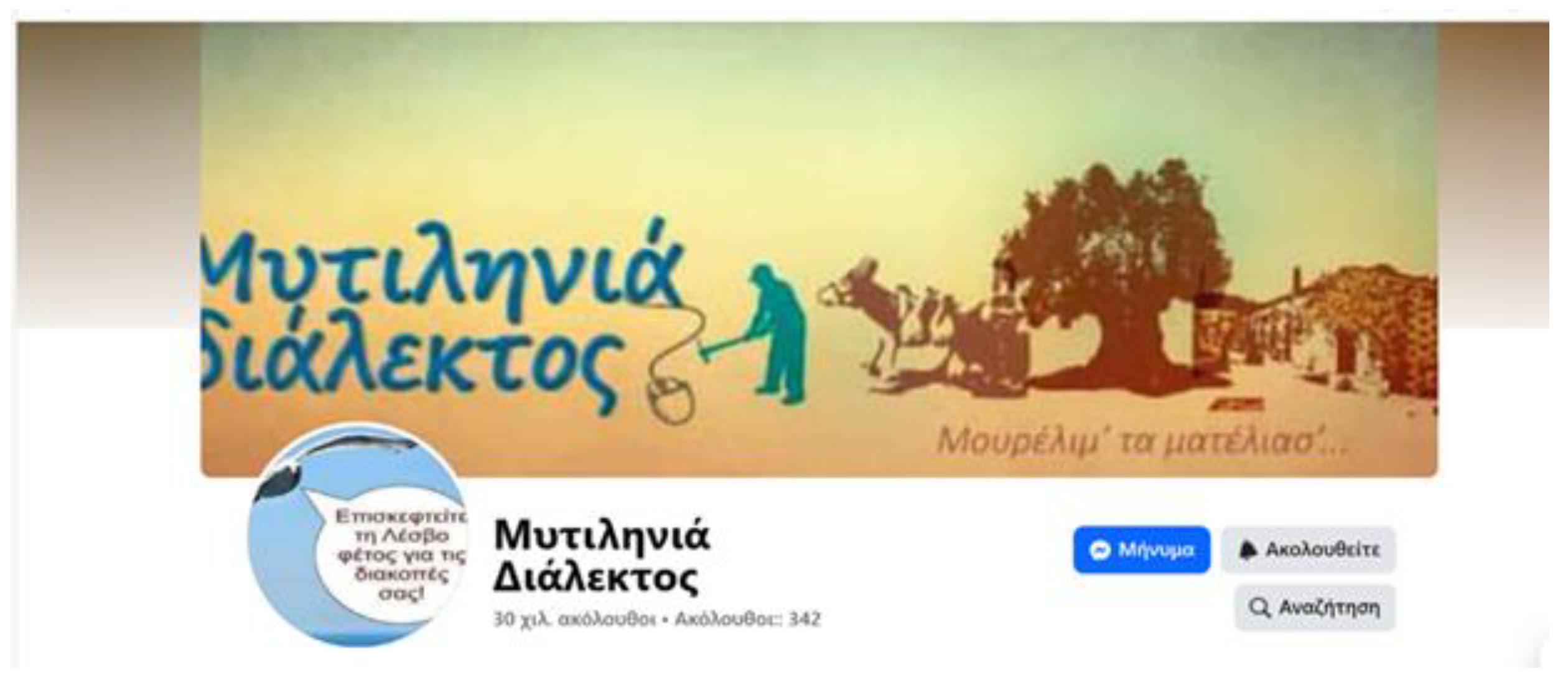
There is a corresponding website named “Mytilenian Dialect” (Figure 5), Mytilene being the capital of Lesbos, often used as a metonym for the entire island. As stated on the website, “Emphasizing the local dialect, the website was created in 2007, providing texts, photographs, and the opportunity for Mytilenians to learn daily about their place. The website is divided into various sections, concerning both local news and presentations and broadcasts related to the island, local recipes, videos, and a variety of articles.” In his interview with the news portal lesvosnews.net, the website’s founder, Giannis Koukellis, notably states: “The idea for creating the website was inspired by the note you see upon visiting it: ‘We will lose our language!’ The page was thus driven by an interest in our linguistic variety. However, it was also nurtured by the distance from the homeland. And I must tell you this: Only trees may have roots, but people also take root in the place where they were born and raised. And when circumstances force them to leave their homeland, they do not cease to think about their ‘roots.’” This testimony highlights how Modern Lesbian functions as a reference point for cultural identity and collective memory, while the website itself constitutes an example of digital practice that transforms the local linguistic variety into a resource for cultural preservation and promotion. Language is understood here not only as a medium of communication but as an element that constitutes the sense of “roots” and belonging, bridging the distance between homeland and diaspora, thus making the dialect an object of both affective and cultural capitalization (cf. Besnier, 1990).
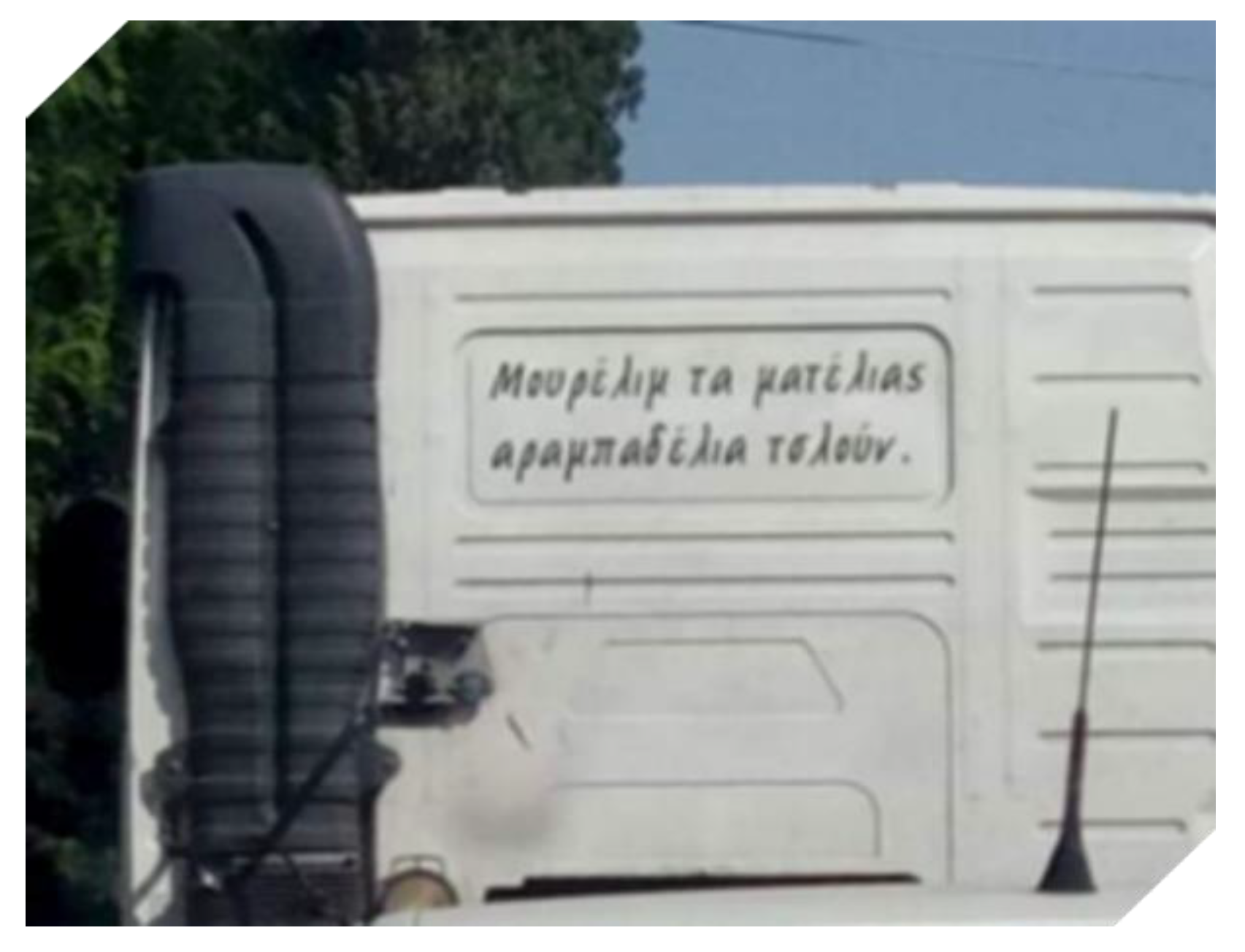
In the example featured in Figure 6, we have a mobile LL sign; a moving vehicle displaying a well-known saying understood by the public throughout Lesbos: Mωρέλιμ τα ματέλιας αραμπαδέλια τσλούν (morelím ta matélias arambaδélia tslún ‘my little one, your little eyes are rolling carts’). The presence of this expression written on a sign appearing in public space, particularly on a moving vehicle, constitutes a characteristic case of linguistic performativity, where Modern Lesbian is not limited to private use but is projected as an element of collective identity. The choice of a proverbial phrase, laden with affective and cultural significance (and featuring three tokens of the local diminutive suffix -éli, at that), serves as a semiotic resource that enhances the sense of familiarity and shared cultural memory. Its use in a mobile medium, such as a vehicle, simultaneously adds a dynamic dimension to the dialect, making it visible and accessible to a wide audience beyond the confines of private communication. Although it has not been possible to identify more details about the vehicle so far, the very fact of the public display of this expression demonstrates how local linguistic varieties can be transformed into carriers of cultural authenticity and social recognition, integrating into a broader web of semiotic and sociolinguistic practices.

4.2. Modern Lesbian as a Marketable Commodity

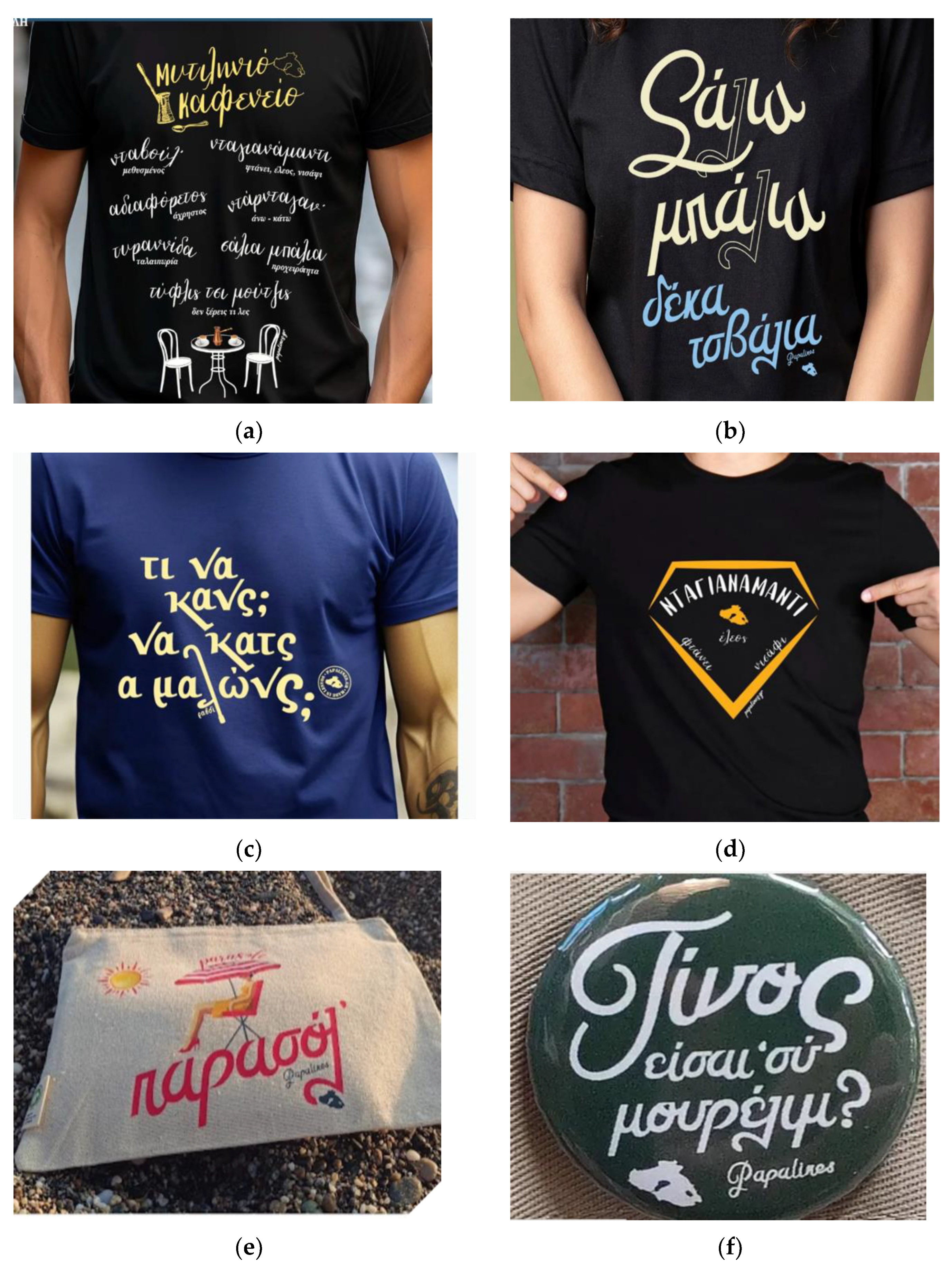
The examples in Figure 7 illustrate cases where Modern Lesbian is used as a marketable product, fitting into a broader context of linguistic and cultural capitalization. The first example concerns the business Papalines (papalínes ‘small sardines’), founded in Mytilene in 2023 by two young professionals, a graphic designer and a web designer. They say “[w]e created the brand of Lesbos, Papalines by Lemonart, with unique designs and Mytilenian phrases on t-shirts, bags, aprons, accessories, and much more! We want, in this humorous way, to make the language of our place, the products, and the beauties of our island known to visitors and the whole world.” The choice of the name Papalines, a type of sardine for which Lesbos is famous, and the systematic use of local expressions on items on sale is not limited to an aesthetic strategy; it represents an act of linguistic performativity that transforms the dialect into a semiotic resource with exchange value. Through humorous phrases and artistic applications, Modern Lesbian becomes a bearer of authenticity and local identity while simultaneously acquiring commercial potential as it is incorporated into products aimed at both locals and visitors. This endeavor illustrates how language can function as a differentiation mechanism in the market, offering a cultural advantage that connects consumption with the perception of locality and promotes Lesbos to a broader audience. Among these examples, it is noteworthy that (c) “τι να κάνς να κάτς α μαλώνς” (ti na káns na káts a malóns, ‘why would you sit and argue’) is not a native Modern Lesbian expression; its presence in the material (written as it would be pronounced by locals) reflects its wide circulation through social media, which has led to its use also in Lesbos.
In Figure 7a, titled Mytilinio kafeneio, the following dialect words appear: νταβουλ’ (davoulj, ‘drunk’), νταγιανάμαντι (daγianámadi, ‘enough, stop, have mercy’), αδιαφόρετος (aδiafóretos, ‘useless’), ντάρνταγαν (dárdaγan, ‘in complete disorder’), τυραννίδα (tiraníδa, ‘hardship, trouble’), σάλια μπάλια (sálja bálja, ‘sloppiness’), and τύφλις τσι μούτζις (tίflis tsi moútzis, ‘you don’t know what you’re saying’). Figure 7b includes the rhyming expression Σάλια μπάλια δέκα τσβάλια (sálja bálja δéka tsvalja, ‘complete mess; literally “ten sacks”’). Figure 7c presents the phrase τι να κανς να κατς α μαλώνς (ti na kans na kats a malóns, ‘why would you sit and argue’), which is discussed in the analysis. In Figure 7d, the word NTAΓIANAMANTI (daγianámadi, ‘enough, stop’) appears in uppercase, accompanied by its meaning in lowercase. Figure 7e features the lexical item παρασόλ’ (parasólj, ‘umbrella’), illustrated with an image of a beach umbrella. Finally, Figure 7f displays the well-known Lesbian interrogative expression Tίνος είσαι, συ μουρέλιμ; (Tínos íse si, mourélim?, ‘Whose child are you, my little one?’), which includes the characteristic local diminutive form μουρέλιμ.
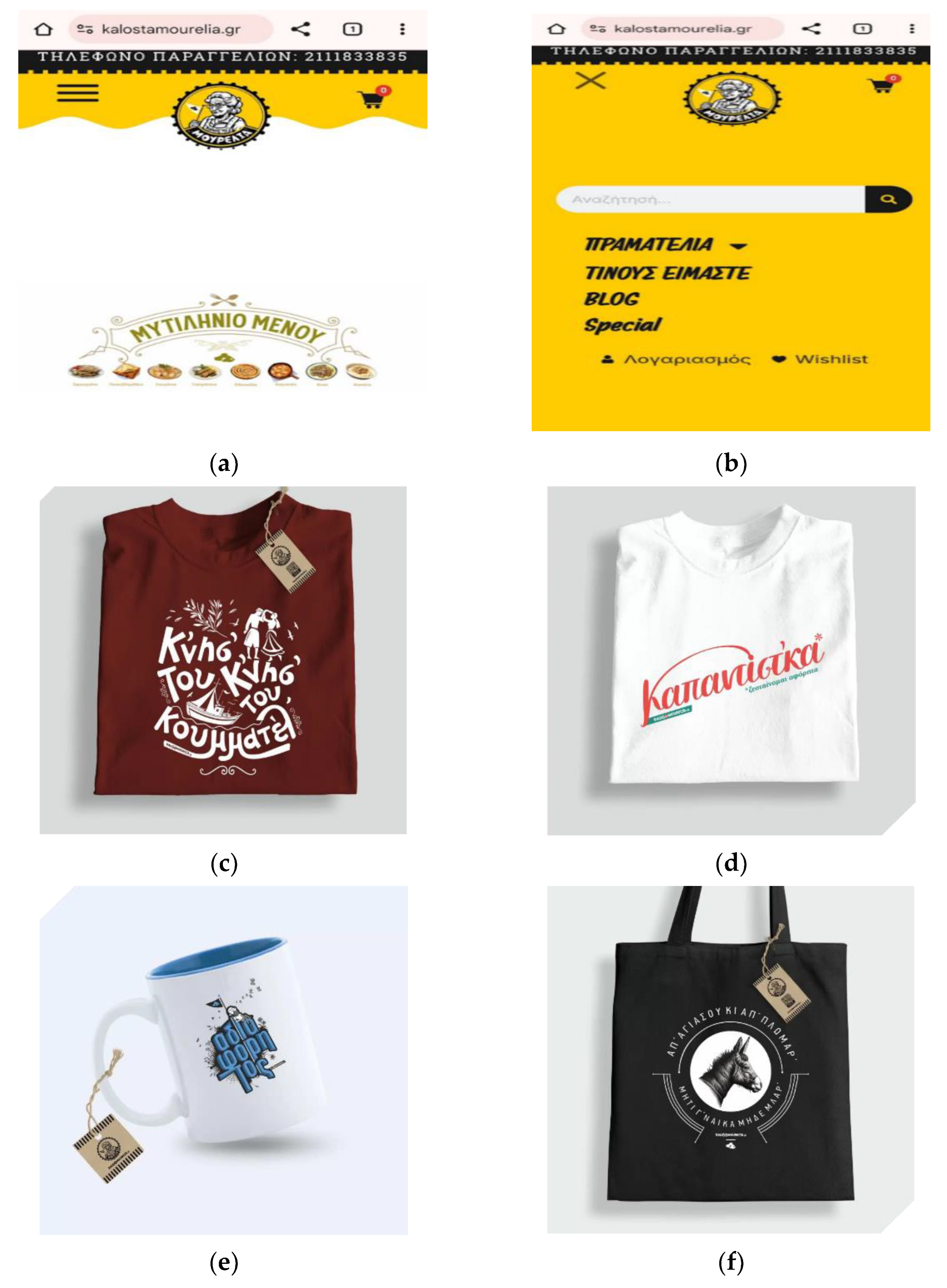
Figure 8 features items created by the company Kalós ta Mourélia, which is the Modern Lesbian equivalent of ‘welcome, guys’, founded by two graphic designers from Lesbos who are professionally active in Athens. As the owners characteristically say: “[w]e love the local dialect of Mytilene… we are inspired by the distinctive humor and the countless words and phrases of the inhabitants of Lesbos. For years, as a kind of game, we have tried to imitate the pronunciation of our grandfathers and grandmothers, whose smiles live on in every new word we learn.”
This statement illustrates the manner in which dialect is transformed into a source of inspiration and creativity, functioning as a semiotic resource that links entrepreneurship and commercial activity with cultural memory. It also demonstrates that linguistic stylization (see Coupland, 2007) is not necessarily performed with ironic or disparaging intent. The use of the local vernacular is not confined to the aesthetic level; rather, it forms part of a strategy of cultural capitalization whereby the language of previous generations is revitalized and instrumentalized in visual applications for catchy marketing of contemporary products.
This initiative foregrounds Modern Lesbian as a carrier of authenticity and collective identity while simultaneously rendering it a marketable commodity addressed to a broader audience, both within and beyond Lesbos. The linguistic choice, with its emphasis on humor and familiarity, operates as a mechanism of distinctiveness within the marketplace, offering a cultural advantage that connects consumption with the experience of locality and the representation of cultural heritage.
In Figure 8a,b, the company’s webpage displays menus, contact information, and product categories, foregrounding the centrality of the dialect in its branding. Figure 8c features a t-shirt inscribed with the dialectal phrase κ’νησ’ του κ’νησ’ του κουμματέλ’ (k’nis’ tou k’nis’ tou koumatélj, ‘move it, move it, little piece/get going, you little thing’). Figure 8d presents a t-shirt inscribed with the dialectal vocabulary item καπαντιστ’κα (kapadist’ká, ‘I got soaked/I got drenched’). Figure 8e displays a mug featuring the dialectal adjective αδιαφόρητος (aδiafóritos, ‘carefree, indifferent’), a word strongly associated with everyday Lesbian speech. Figure 8f shows a canvas tote bag inscribed in uppercase with the well-known Lesbian saying AΠ’ AΓIAΣOY KI AΠ’ ΠΛOMAP’ MHTI Γ’NAIKA MHΔE MΛAP (Ap’ Agíasou ki ap’ Plomar’ míti γ’neka miδe mlar, ‘From Agiasos and from Plomari, neither woman nor a mule [is predictable]’), a humorous saying widely recognized across Lesbos.
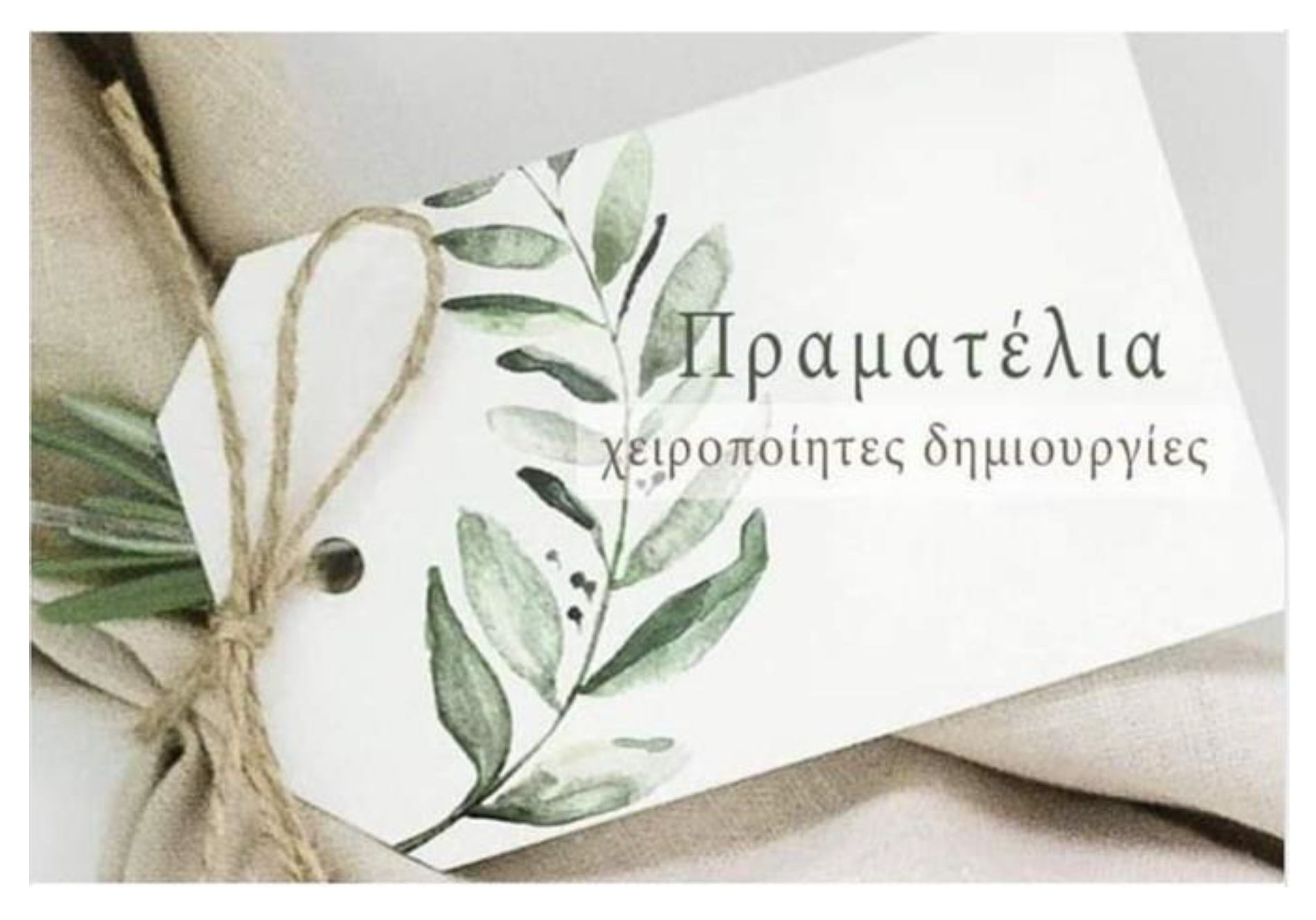
Figure 9 features a gift packaging card bearing the logo of the online store operated by the urban non-profit organization Iliaktída. Pramatélia, in Modern Lesbian, means ‘small things’—a word strongly marked by local resonance and associated with everyday experience and affective oral speech. The reason for its selection as a commercial name is not merely linguistic but profoundly semiotic: it transforms a dialectal element into a marketable resource, thereby endowing the initiative with authenticity and a sense of locality while capitalizing on its affective load.
As noted, over the past twenty-one years, unique handmade creations have been produced within the framework of Iliaktída (a civil non-profit organization) by people with disabilities, with the support of instructors and volunteers. The use of the word Pramatélia to describe these small, beautifully crafted and distinctive objects situates linguistic variation within a social economy framework where dialect functions both as a carrier of cultural memory and as a mechanism of distinctiveness, a quality that is sought after in the contemporary competitive marketplace.
This linguistic choice is not confined to the aesthetic level; rather, it becomes an instrument of social empowerment, linking the production of handmade artifacts by vulnerable groups to the promotion of the local identity of Lesbos (a dimension further reinforced, of course, by the use of the olive branch, indexing the local flora par excellence). In this way, Modern Lesbian acquires a dual value: on the one hand, as a semiotic index of authenticity and cultural rootedness; on the other, as a commodified asset that strengthens the social and economic sustainability of the initiative.
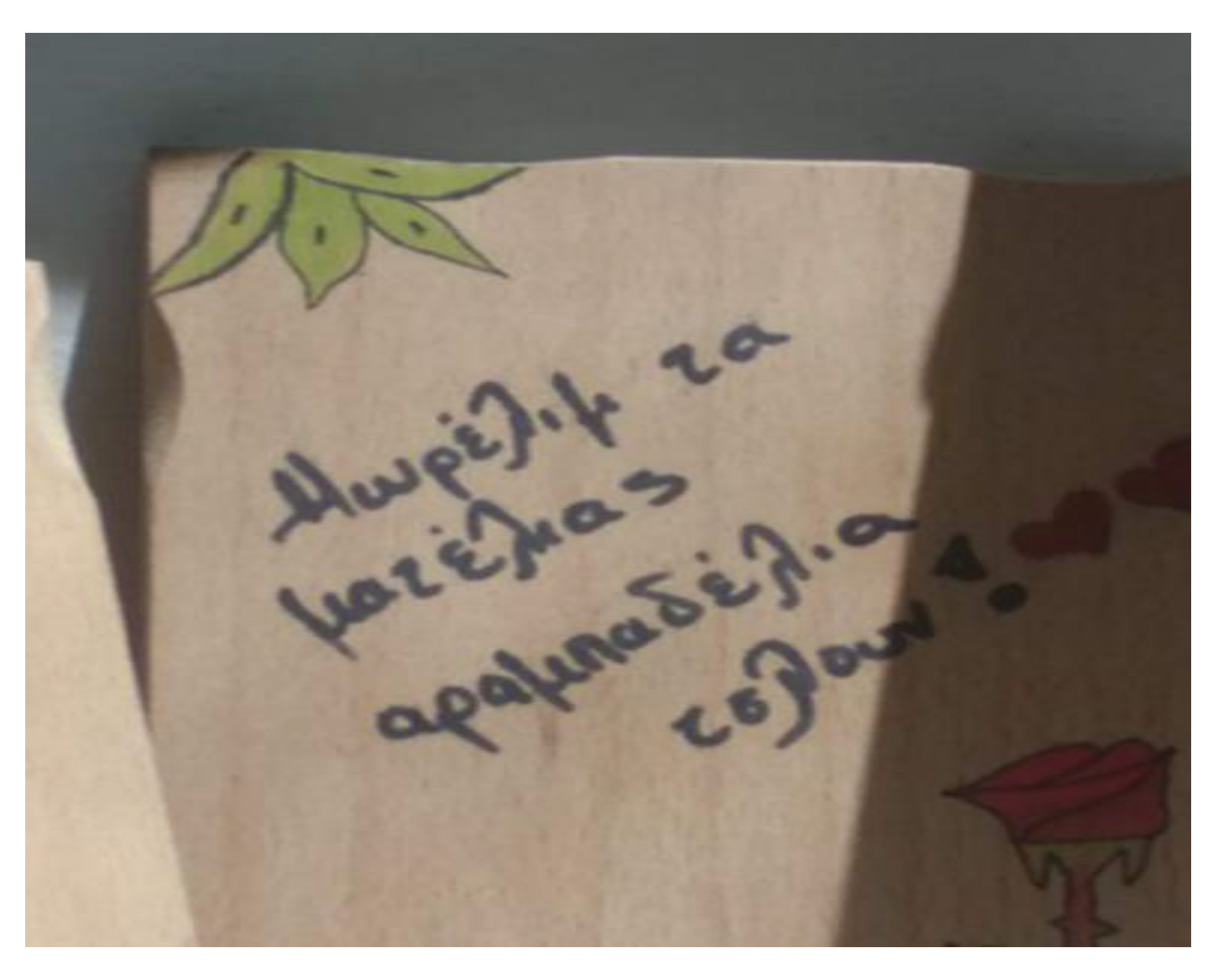
The wooden inscribed object (featured in Figure 10) is marketed as a souvenir. It bears the same inscription as the sign in Figure 6, i.e., the popular saying Mωρέλιμ τα ματέλιας αραμπαδέλια τσλούν, which translates in Standard Greek as ‘My little one, your little eyes are rolling carts.’ In this case, the commodified item is essentially dialectal discourse itself, inscribed on materials that are indexically associated with its place of production. The choice of wood and ceramic is not incidental; these materials carry strong cultural connotations and function in a privileged relation to Agiasos, a mountain village of Lesbos, as they are linked to the area’s local artisanal tradition and material cultural heritage. The inscription of the dialect—conceived as “intangible heritage”—onto these materials transforms speech into a tangible object, a material bearer of memory and identity, rendering it a marketable resource combining linguistic and material authenticity. The souvenir thus constitutes not merely an object of consumption but a semiotic field in which the dialect acquires exchange value as it is embedded in materials that index the place of production and its cultural distinctiveness.
This case is directly connected to the findings of Kouniarelli’s (2022a) doctoral dissertation, which, among other contributions, highlighted the exchange value of the linguistic variety of Agiasos on artifacts marketed as souvenirs. Through ethnographic research and the analysis of language attitudes, she demonstrated that the Agiasos dialect is no longer perceived exclusively as a local variety of limited use; rather, it is being re-signified as an element of cultural capital capable of conferring authenticity and functioning as a distinctive identitarian resource. Its inscription on commemorative objects crafted from materials that evoke local tradition constitutes a characteristic example of this shift: the dialect, part of immaterial heritage and often disparaged in the past, acquires material substance; it is transformed into a carrier of economic and cultural value and becomes integrated into a broader framework for the valorization of linguistic diversity. In this way, language operates not only as a means of communication but also as a commodified product that enhances the cultural projection of Lesbos and contributes to shaping a contemporary understanding of the role of dialects in the public sphere, including their potential use in entrepreneurial activities.
The same logic may be extended to Modern Lesbian as a whole, as demonstrated by the examples of commercial ventures and cultural practices examined. Chileli (Figure 1) and Sykeli (Figure 2) construct narratives of authenticity, positioning Lesbos not merely as a site of production but as a point of reference inscribed in the very name of the product; Fagí integrates the local vernacular into contemporary digital platforms (Figure 3); Papalines (Figure 7) and Kalós ta mourélia (Figure 8) capitalize on humorous catchphrases and local expressions in clothing and accessories. While humor underlies several of these expressions, its role here is not merely to elicit amusement but to demonstrate how such phrasing becomes a semiotic and commercial resource within processes of linguistic commodification. Signs bearing expressions such as min isi mlar ‘don’t be an ass’ (Figure 4) and proverbial phrases displayed on vehicles (Figure 6) and souvenirs (Figure 10) transform everyday speech into a public semiotic resource; the website Mytiliniá Diálektos (Figure 5) functions as a digital space for the preservation and dissemination of the linguistic variety; Pramatélia, the commercial initiative of Iliaktída (Figure 9), employs the dialect in products with particular symbolic value; and the souvenirs of Agiasos (Figure 10) inscribe discourse onto materials that evoke local tradition.
These contemporary examples of written use are best understood against the backdrop of long-standing oral practices, which have shaped the social meanings and pragmatic functions of the dialect. In oral interaction, such shifts have long been part of everyday linguistic practice, for instance. Speakers from Lesbos who had acquired Standard Modern Greek would revert to the local dialect when back home, sometimes even for pragmatic—if not affective—reasons, such as receiving better service in shops or tavernas. This point becomes even more compelling when one considers that dialectal features are also adopted by non-native entrepreneurs, as in the case of Chileli (Figure 1), demonstrating that Modern Lesbian circulates beyond its traditional speaker base.
All these examples indicate that Modern Lesbian, in diverse forms and contexts, is being transformed into cultural and commercial capital. While the notion of language as a form of cultural and economic capital (Bourdieu, 1991) is indeed broadly applicable, the present analysis demonstrates how this general principle becomes locally instantiated in the case of Modern Lesbian through specific commercial and cultural practices. Within this framework, the dialect operates as a common denominator linking consumption with the experience of locality, thereby enhancing the island’s cultural representation on various levels. This process of re-signification is inherently ambivalent. While the commodification of Modern Lesbian contributes to its symbolic elevation and public legitimacy, many of the examples examined here still rely on the markedness of dialect writing—its perceived incongruity, humor, or indexical distance from the standard. The dialect thus gains visibility and value not because it has become fully normalized but precisely because it remains semiotically charged. Its contemporary circulation in the linguistic landscape therefore reflects a dual movement: the weakening of older stigma and, simultaneously, the strategic mobilization of the dialect’s marked status as a resource for authenticity, locality, and cultural distinction. Rather than a straightforward “success story” of revaluation, the commodification of Modern Lesbian exemplifies a more complex and ambivalent form of destigmatization.

5. Conclusions

In this paper we have attempted to show that, in the LL of Mytilene in the third decade of the twenty-first century, the local vernacular frequently appears in the public sphere in written form. This is in stark contrast to what has been the case until recently. A fundamental precondition for this development is changing language attitudes—at least among a segment of speakers—who appear to be intent on promoting dialectal discourse as part of everyday life rather than relegating it to the necrophiliac domain of linguistic folklore or to the sphere of humorous stereotypes. The presence of dialectal discourse in our data pertains primarily to the field of commercial activity and, by extension, to commodification. Within this context, we have identified two subcategories: (1) the use of Modern Lesbian to promote services and products, and (2) the use and commodification of dialectal discourse itself as a marketable product, particularly in the case of non-utilitarian souvenirs bearing sayings or aphorisms. We have argued that these practices provide tangible evidence of a shift in language attitudes. At the same time, however, the very use of the dialect in written form—and specifically for the promotion of products—capitalizes on the element of surprise generated by its deployment in contexts beyond everyday spoken interaction. Namely, this recent development draws upon historical attitudes and practices with which it is in a complex and dynamic dialectic relation (cf. Blommaert & Maly, 2014).
This observation forms part of a broader sociolinguistic dynamic in which Modern Lesbian is being re-signified as a semiotic resource: from a medium of everyday communication to a carrier of authenticity, memory, and economic potential. It no longer functions solely as a means of oral communication but also as an element of cultural memory and authenticity that is capable of acquiring exchange value within the sphere of commercial activity. Its appearance in written form in the public domain—whether through signage or commercial initiatives—demonstrates that language itself is being transformed into cultural and economic capital.
In this way, Modern Lesbian is no longer confined to the realm of folklore but acquires renewed potential: it becomes a tool of distinctiveness, an index of identity, and a mechanism for promoting the island on multiple levels. The capitalization on the “surprise” produced by its use outside ordinary spoken contexts illustrates that language can simultaneously function as an element of cultural heritage and as a commodified product, thereby reinforcing the cultural promotion of Lesbos in the contemporary public sphere.

Author Contributions

Conceptualization, C.C. and I.K.; methodology, I.K.; investigation, C.C. and I.K.; resources, C.C. and I.K.; data curation, I.K.; writing—original draft preparation, C.C. and I.K.; writing—review and editing, C.C. All authors have read and agreed to the published version of the manuscript.

Funding

This research received no external funding.

Data Availability Statement

No new data was created.

Acknowledgments

We would like to thank the editor and the two anonymous reviewers for their valuable comments. This submission is a revised and expanded version of a conference paper (in Greek) entitled “Όψεις της χρήσης της λεσβιακής διαλέκτου στο γλωσσικό τοπίο της Mυτιλήνης” [Aspects of the use of the Dialect of Lesbos in the Linguistic Landscape of Mytilene], at the International Conference on the Dialect of Lesbos, convened by Emerita A. Ralli in Mytilene, 4–6 July 2025, https://icdl.ct.aegean.gr/en, accessed on 2 June 2026.

Conflicts of Interest

The authors declare no conflicts of interest.

References

  1. Androutsopoulos, J. (2024). The offline–online nexus. In R. Blackwood, S. Tufi, & W. Amos (Eds.), The Bloomsbury handbook of linguistic landscapes (pp. 441–455). Bloomsbury. [Google Scholar]
  2. Androutsopoulos, J., & Chowchong, A. (2021). Sign-genres, authentication, and emplacement: The signage of Thai restaurants in Hamburg, Germany. Linguistic Landscape, 7(2), 204–234. [Google Scholar] [CrossRef]
  3. Besnier, N. (1990). Language and affect. Annual Review of Anthropology, 19, 419–451. [Google Scholar] [CrossRef]
  4. Blackwood, R., & Røyneland, U. (2022). Introduction. In R. Blackwood, & U. Røyneland (Eds.), Spaces of multilingualism (pp. 1–8). Routledge. [Google Scholar]
  5. Blackwood, R., Tufi, S., & Amos, W. (Eds.). (2024). The Bloomsbury handbook of linguistic landscapes. Bloomsbury. [Google Scholar]
  6. Blommaert, J. (2013). Ethnography, superdiversity and linguistic landscapes: Chronicles of complexity. Multilingual Matters. [Google Scholar]
  7. Blommaert, J., & Maly, I. (2014). Ethnographic linguistic landscape analysis and social change: A case study. Tilburg Papers in Culture Studies, 100. Available online: https://repository.tilburguniversity.edu/server/api/core/bitstreams/fdbc1972-645b-451a-9e32-bbf4b524d490/content (accessed on 3 March 2026).
  8. Blommaert, J., & Maly, I. (2019). Invisible lines in the online–offline linguistic landscape. Tilburg Papers in Culture Studies, 223. Available online: https://repository.tilburguniversity.edu/server/api/core/bitstreams/2b1b5df6-63ef-426a-8533-c9a926f2494d/content (accessed on 1 March 2026).
  9. Bourdieu, P. (1991). Language and symbolic power. Polity Press. [Google Scholar]
  10. Brito, A. (2016). Multilingualism and mobility: A linguistic landscape analysis of three neighborhoods in Malmö, Sweden [Master’s Thesis, Lund University]. [Google Scholar]
  11. Bubenik, V., Crespo, E., Hinterberger, M., & Canakis, C. (2024). Attitudes to language. In Brill encyclopedia of Greek language and linguistics online. Brill. Available online: https://referenceworks.brill.com/search?q=Attitudes+to+language (accessed on 1 March 2026).
  12. Canakis, C. (2021). Indexing chronotopes: An ethnographic approach of the changing linguistic landscape of Mytilene. In Proceedings of the 14th international conference of Greek linguistics (pp. 221–236). University of Patras. [Google Scholar]
  13. Canakis, C. (2022). Γλώσσα, κρίση και δημόσιος λόγος: Γλωσσικό τοπίο, πανδημία και χρονοτόπος [Language, crisis, and public discourse: Linguistic landscape, pandemic, and chrnotope]. Aegean Working Papers in Ethnographic Linguistics, 3, 314–350. Available online: https://ejournals.epublishing.ekt.gr/index.php/awpel/article/view/30655 (accessed on 3 March 2026).
  14. Coupland, N. (2007). Style: Language variation and identity. Cambridge University Press. [Google Scholar]
  15. Dragojevic, M. (2018). Language attitudes. In H. Giles, & J. Harwood (Eds.), Oxford research encyclopedia of communication (Vol. 2, pp. 179–192). Oxford University Press. [Google Scholar]
  16. Dragojevic, M., Fasoli, F., Cramer, J., & Rakić, T. (2021). Towards a century of language attitudes research: Looking back and moving forward. Journal of Language and Social Psychology, 40(1), 60–79. [Google Scholar]
  17. Dunlevy, D. A. (2024). Minority languages. In R. Blackwood, S. Tufi, & W. Amos (Eds.), The Bloomsbury handbook of linguistic landscapes (pp. 285–300). Bloomsbury. [Google Scholar]
  18. Eckert, P. (2012). Three waves of variation study: The emergence of meaning in the study of sociolinguistic variation. Annual Review of Anthropology, 41, 87–100. [Google Scholar] [CrossRef]
  19. Eckert, P. (2018). Meaning and linguistic variation: The third wave in sociolinguistics. Cambridge University Press. [Google Scholar]
  20. Exertzoglou, C. (2020). H δημόσια ιστορία: Mια εισαγωγή [Public history: An introduction]. Eikostos Protos. [Google Scholar]
  21. Gorter, D. (2006). Linguistic landscape: A new approach to multilingualism. Multilingual Matters. [Google Scholar]
  22. Gorter, D., & Cenoz, J. (2024). A panorama of linguistic landscape studies. Multilingual Matters. [Google Scholar]
  23. Gorter, D., & Cenoz, J. (Eds.). (2025). The handbook of linguistic landscapes and multilingualism. Wiley Blackwell. [Google Scholar]
  24. Heller, M. (2010). The commodification of language. Annual Review of Anthropology, 39(1), 101–114. [Google Scholar] [CrossRef]
  25. Heller, M., Jaworski, A., & Thurlow, C. (2014). Introduction: Sociolinguistics and tourism—Mobilities, markets, multilingualism. Journal of Sociolinguistics, 18(4), 425–458. [Google Scholar] [CrossRef]
  26. Jaworski, A., & Thurlow, C. (2010). Introducing semiotic landscapes. In A. Jaworski, & C. Thurlow (Eds.), Semiotic landscapes: Language, image, space (pp. 1–40). Continuum. [Google Scholar]
  27. Kallen, J. (2010). Changing landscapes: Language, space and policy in the Dublin linguistic landscape. In A. Jaworski, & C. Thurlow (Eds.), Semiotic landscapes: Language, image, space (pp. 41–58). Continuum. [Google Scholar]
  28. Kallen, J. (2023). Linguistic landscapes: A sociolinguistic approach. Cambridge University Press. [Google Scholar]
  29. Kouniarelli, I. (2022a). Kοινωνιογλωσσολογική προσέγγιση της γλωσσικής ποικιλίας της Aγιάσου Λέσβου: Γλωσσικές στάσεις των ηλικιακών ομάδων 20–40 ετών [A sociolinguistic approach of the linguistic variety of Agiasos, Lesbos: Language attitudes among people aged 20-40]. In M. Kisilier (Ed.), Proceedings of the 9th Conference on Modern Greek Dialects and Linguistic Theory (pp. 201–219). Tsakonia Archives. [Google Scholar]
  30. Kouniarelli, I. (2022b). O διαλεκτικός λόγος στο διαδίκτυο κατά την πανδημία του COVID-19: H Λεσβιακή στα μέσα κοινωνικής δικτύωσης [Dialectal speech online during the COVID-19 pandemic: The Lesbian dialect in social media]. Aegean Working Papers in Ethnographic Linguistics, 3, 292–313. Available online: https://ejournals.epublishing.ekt.gr/index.php/awpel/article/view/30654 (accessed on 3 March 2026).
  31. Kourdis, E. (2007). Θεσσαλικό ιδίωμα [The Thessalian dialect]. University of Thessaly Press. [Google Scholar]
  32. Kretschmer, P. (1905). Der heutige lesbische dialekt. Alfred Hölder. [Google Scholar]
  33. Landry, R., & Bourhis, R. Y. (1997). Linguistic landscape and ethnolinguistic vitality: An empirical study. Journal of Language and Social Psychology, 16(1), 23–49. [Google Scholar] [CrossRef]
  34. Lefebvre, H. (1974). La production de l’espace. Anthropos. [Google Scholar]
  35. Lou, J. J. (2024). Ethnic spaces. In R. Blackwood, S. Tufi, & W. Amos (Eds.), The Bloomsbury handbook of linguistic landscapes (pp. 187–201). Bloomsbury. [Google Scholar]
  36. Matras, Y., & Gaiser, L. (2020). Signage as event: Deriving “community” from language practice. Linguistic Landscape, 6(2), 213–236. [Google Scholar]
  37. Newton, B. (1972). The generative interpretation of dialect: A study of modern Greek phonology. Cambridge University Press. [Google Scholar]
  38. Papazachariou, D., Fterniati, A., Archakis, A., & Tsami, V. (2018). Metapragmatic stereotypes about geographical diversity in Greece: Evidence from elementary school pupils’ responses to mass culture texts. Journal of Greek Linguistics, 18(1), 124–154. [Google Scholar]
  39. Pennycook, A., & Otsuji, E. (2015). Making scents of the landscape. Linguistic Landscape, 1(3), 191–212. [Google Scholar] [CrossRef]
  40. Ralli, A. (2007). H διάλεκτος Kυδωνιών–Mοσχονησίων: Mια πρώτη προσέγγιση [The dialect of Kydonies–Moschonisia: A preliminary approach]. In P. Kitromilides, & P. Michailaris (Eds.), Mυτιλήνη και Aϊβαλί (Kυδωνίες): Mια αμφίδρομη σχέση στο Βορειοανατολικό Aιγαίο [Mytilene and Aivali (Kydonies): A bidirectional relation in the Northeast Aegean] (pp. 187–202). Iνστιτούτο Nεοελληνικών Eρευνών [National Hellenic Research Foundation]. [Google Scholar]
  41. Rosenbaum, Y., Nadel, E., Cooper, R., & Fishman, J. (1977). English on keren kayemet street. In J. Fishman, R. Cooper, & A. Conrad (Eds.), The spread of English: The sociology of English as an additional language (pp. 179–194). Newbury House. [Google Scholar]
  42. Rowland, L. (2012). The pedagogical benefits of a linguistic landscape project in Japan. International Journal of Bilingual Education and Bilingualism, 16(4), 494–505. [Google Scholar] [CrossRef]
  43. Sabri, M., & Blackwood, R. (2021). Countering linguistic violence by place-making in the public space: Tamazight and the linguistic landscape of Tizi-Ouzou, Algeria. Journal of Language Aggression and Conflict. [Google Scholar] [CrossRef]
  44. Shohamy, E., & Gorter, D. (Eds.). (2009). Linguistic landscape: Expanding the scenery. Routledge. [Google Scholar]
  45. Spolsky, B. (2024). Linguistic landscapes. In R. Blackwood, S. Tufi, & W. Amos (Eds.), The Bloomsbury handbook of linguistic landscapes (pp. 5–16). Bloomsbury. [Google Scholar]
  46. Spolsky, B., & Cooper, R. (1991). The languages of Jerusalem. Oxford University Press. [Google Scholar]
  47. Stamou, A. G., & Dinas, K. D. (2011). Γλώσσα και τοπικότητες: H αναπαράσταση γεωγραφικών ποικιλιών στην ελληνική τηλεόραση [Language and localities: The representation of geographical varieties on Greek television]. In G. Paschalidis, E. Chontolidou, & I. Vamvakidou (Eds.), Σύνορα, περιφέρειες, διασπορές [Borders, peripheries, diasporas] (pp. 289–305). University Studio Press. [Google Scholar]
  48. Torkington, K. (2009). Exploring the linguistic landscape: The case of the “Golden Triangle” in the Algarve, Portugal. In Papers from the Lancaster University Postgraduate Conference in Linguistics and Language Teaching (LAEL PG) (Volume 3, pp. 122–144). Lancaster University. [Google Scholar]
  49. Tsiplakou, S. (2017). Aστικά γλωσσικά τοπία και διάλεκτοι: Χώροι της Λευκωσίας [Urban linguistic landscapes and dialects: Spaces of Nicosia]. Mελέτες για την Eλληνική Γλώσσα [Studies in Modern Greek Linguistics], 37, 727–746. [Google Scholar]
  50. Tsiplakou, S. (2023). Conflictual translanguaging in the linguistic landscape of a divided city. Journal of Language Aggression and Conflict. [Google Scholar] [CrossRef]
  51. Tufi, S. (2025). Theorizing space. In D. Gorter, & J. Cenoz (Eds.), The handbook of linguistic landscapes and multilingualism (pp. 29–46). Wiley Blackwell. [Google Scholar]
  52. Wee, L. (2025). Landscapes of affect. In D. Gorter, & J. Cenoz (Eds.), The handbook of linguistic landscapes and multilingualism (pp. 113–126). Wiley Blackwell. [Google Scholar]
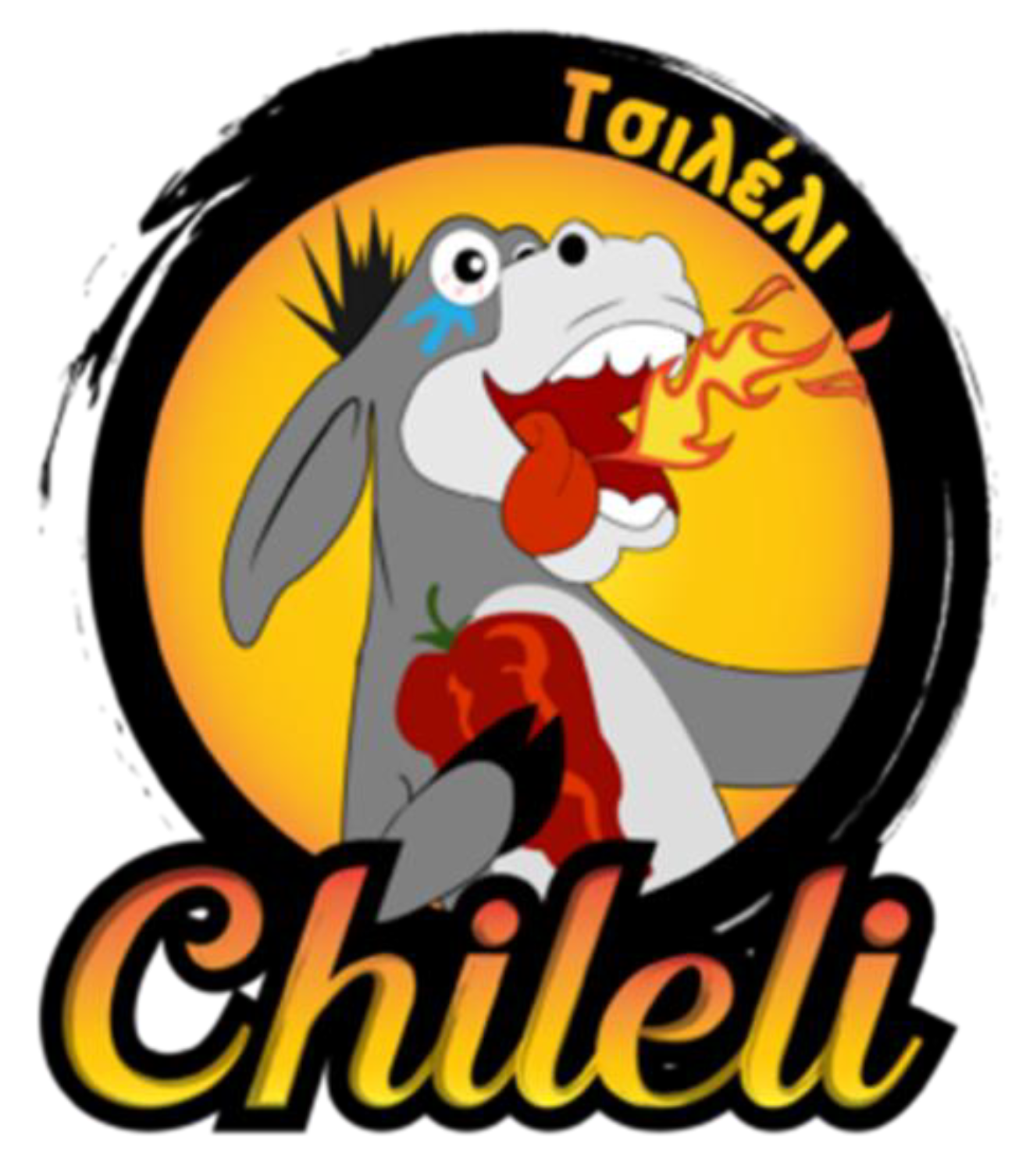
Figure 1. Chileli brand logo.
Languages 11 00122 g001
Figure 2. (a) Sykeli store entrance and awning; (b) Sykeli brand logo; (c) Sykeli canvas tote bags.
Languages 11 00122 g002
Figure 3. Fagi e-platform logo.
Languages 11 00122 g003
Figure 4. TΣI ΣY MHN EIΣI MΛAP Sign at a beach bar.
Languages 11 00122 g004
Figure 5. Mytilini (Lesbos) dialect Facebook page.
Languages 11 00122 g005
Figure 6. Dialectal proverbial phrase on vehicle.
Languages 11 00122 g006
Figure 7. (a) T-shirt inscribed with dialectal vocabulary; (b) t-shirt inscribed with dialectal proverbial phrase; (c) t-shirt inscribed with common dialectal phrase; (d) t-shirt inscribed with common dialectal phrase; (e) Parasol beach bar cushion by Papalines; (f) button with common dialectal phrase by Papalines.
Languages 11 00122 g007
Figure 8. (a) Webpage, menu; (b) webpage, contact, products, etc.; (c) t-shirt inscribed with dialectal phrase; (d) t-shirt inscribed with dialectal vocabulary item; (e) mug with dialectal vocabulary item; (f) canvas tote bag featuring humorous dialectal saying.
Languages 11 00122 g008
Figure 9. Pramatélia logo printed on gift packaging card.
Languages 11 00122 g009
Figure 10. Souvenir from Agiasos featuring local saying on wood.
Languages 11 00122 g010
Disclaimer/Publisher’s Note: The statements, opinions and data contained in all publications are solely those of the individual author(s) and contributor(s) and not of MDPI and/or the editor(s). MDPI and/or the editor(s) disclaim responsibility for any injury to people or property resulting from any ideas, methods, instructions or products referred to in the content.