1. Introduction
Among
Kachru’s (
1985) Three Concentric Circles of World Englishes theory, expanding circle Englishes, the ones used in countries that were not colonized by the Britain or the United States, comprise a neglected and even denigrated category despite their “prominent presence and role” (
Baratta, 2022, p. 7). Desiring to push
Kachru’s (
1991) “liberation linguistics” forward,
The Societal Codification of Korean English (2022) advocates for their linguistic legitimization, focusing on the case of a variety of English typically associated mostly with South Korea, henceforth Korea.
The author, Alex Baratta, who has taken a personal interest in the language variety since he was stationed on the peninsula in the late 1990s and taught English (t)here while serving in the United States army and after being discharged, argues in seven chapters for the respect and recognition of this and other varieties he calls “non-inner-circle Englishes” (NICE) (p. 8; see also
Baratta, 2019). Meanwhile, he passionately argues against the use of the more common and often denigrated/stigmatized term “Konglish,” which, “for some, refers to a variety of English which is not quite one or the other … not somehow ‘fully formed’” (p. 3).
This hybrid book review, which begins with chapter overviews and moves to a critical reflection, is an outcome of an English language teachers’ (ELT) study circle within an existing professional learning community, the Social Justice Special Interest Group of Korea TESOL. We, the reviewers, all long-time researchers of English language teaching and learning in Korea, opted to explore the topic of Korean English (KE) in order to better understand the localized variety in both meaning and form, as well as Korean learners’ usage. As a result of our reading and in an effort to help others (positioned similarly or differently) to navigate the complexity of KE, we here contribute a matrix, a pin cushion metaphor, and a new term, “K-English(es)” (K-영어, K-yeongeo).
2. Chapter Overviews
After presenting an overview of the book’s organization, indicating the purpose (linguistic recognition and legitimization), and intended audience (non-specialists interested in Korean culture or those teaching English domestically) in the rather long (21-page) introduction (i.e., Chapter 1), Baratta argues against the use of “Konglish” to refer to KE on the grounds that blended nomenclatures may not be taken seriously and can be stigmatized, and Konglish may be seen as unstable (p. 3, referring to
Ahn, 2014). He also argues against
Song’s (
2016) merely descriptive label “English in Korea,” which results from Song’s opinion that, as a “learner English,” it would be premature to call it a new English. He then proposes to counter these by presenting evidence for the widespread use of KE and its societal codification, or “the myriad ways that English is being used in Korea by Koreans” (p. 7). Baratta goes on to discuss
Kachru’s (
1985) three circles of English, aligning with the inclusiveness of World Englishes, before addressing linguistic errors versus innovations, which he describes as new “fixed forms of language” (p. 9), and native speakerism and ownership (
Widdowson, 1994). Then, he offers four reasons for his focus on KE and five points related to societal codification.
Despite its title, “A discussion of four key topics” (30 pages), Chapter 2 only focuses on three main topics. Baratta first highlights several issues related to expanding-circle Englishes, including the use of blended nomenclatures, or “terms used to refer to Englishes within the expanding circle” (p. 1) such as Chinglish and Konglish, which he views as holding negative connotations. He then emphasizes the importance of codifying linguistic innovations, distinguishing these from mere errors. Finally, he examines processes of linguistic nativization, particularly in relation to “native” versus “non-native” speaker norms. Together, he feels, these points provide essential background and a rationale for understanding KE and other expanding circle Englishes.
Chapter 3, “Societal codification” (26 pages), distinguishes between traditional codification (
Bamgbose, 1998) and a more modern approach, societal codification, as in “the people’s use of language” (p. 57). Baratta, drawing on
Mufwene’s (
2001) critical perspective and process of codification, builds a case for the linguistic establishment of KE. He argues that this language is codified through its prevalent everyday use and provides examples of how blended or mixed English and Korean forms appear across media, advertising, business, and daily communication, functioning as legitimate language. In doing so, he reframes codification as a bottom-up, socially-driven process. Although (“Standard”) English holds prestige and is tied to global mobility, Baratta views KE as representing users’ agency in shaping the variety, challenging deficit views of “non-native” Englishes.
Chapter 4, “The lexical and grammatical aspects of Korean English” (71 pages), attempts to define and distinguish Konglish from KE and provide clarifying discussion and examples. Yet, it mostly contributes to greater confusion without yielding new analytical insights, by providing a poorly organized and relatively lengthy coverage overly dedicated to describing predictable paradigmatic and, to a lesser extent, syntagmatic aspects of so-called KE previously identified in academic research and “‘societal literature’—websites, blogs and online sources” (p. 83). While lexical and grammatical analysis can require detail, the chapter could achieve the same goals with a more effective presentation.
Next, Chapter 5, “Media English in Korea” (21 pages), discusses examples of “medialect” (pp. 141–142), focusing on Hallyu, the Korean Wave phenomenon, notably English use in K-pop and K-dramas, and advertisements inside Korea. Baratta emphasizes that these sub-varieties of KE “use English, broadly, as a means of code-switching” (p. 155). Because of its broad reach, medialect serves to cement and standardize usages that may differ from “native” English or Korean norms, creating blended or localized expressions. At the same time, Baratta acknowledges that English in popular culture and consumer branding reflects both aspirational global identities and Korean linguistic practices. He closes the chapter suggesting that, because media shapes real-world English use, institutions in Korea should acknowledge these media-driven forms rather than treating them as errors or unofficial usages.
Chapter 6, “Korean English in the EFL classroom” (13 pages), argues that NICE (non-inner-circle Englishes), including KE, should be promoted and taught in English-as-a-foreign-language (EFL) classrooms, if not as the primary, then as an additional variety. While acknowledging the need for appropriate alignment of student needs/goals and varieties, he highlights the usefulness of NICE, like KE, as a pedagogical tool to raise awareness of diverse, real-world Englishes, transform teacher attitudes, and as an opportunity for translating between varieties rather than correcting language use. While he merely touches on the local Korean EFL context, he asserts classroom activities should be “reflective of more modern approaches” (p. 36) and, citing
Crystal (
2008), advocates for “relativistic models” (p. 181) and linguistic inclusion.
The book ends with a very short conclusion (2 pages) that reiterates the main point about legitimization and Baratta’s efforts to provide evidence that KE includes more than just lexis, is used intranationally as well as internationally across “multiple sites of deployment” (p. 193), and is societally codified contrary to the views of scholars such as
Song (
2016). The book includes ample, relevant references (19 pages) but would have been easier to navigate with a more detailed index (only 2 pages) and stronger had it included a glossary, especially for technical terms that might be recent, unfamiliar to the targeted readership, presented without definition, or used only once (e.g., NICE, linguicism, Global Englishes, and liberation linguistics).
3. Critical Reflection
The writing style and lack of organization of this text detracted from the important message that Baratta attempted to present. Chapter 4, in particular, could be improved (e.g., by reducing excessive repetition and circular argumentation and adding clear subtitles and signposts) to provide a more concise and coherent presentation. Nonetheless, the text prompted both reflection and vibrant in-group discussion. As the keywords themselves can serve as a valuable conversation starter, this part begins with KE nomenclature, then moves to societal codification before commenting on language coverage.
3.1. Nomenclature
To date (as of early 2026), this book appears to provide one of the lengthiest, single-authored English coverages of KE, variously defined/described by the author as, for example:
“a wide variety of English, as appropriated by Koreans” (p. 84).
“a variety of English which is otherwise used by Koreans—and non-Koreans—with a fully functioning use of vocabulary and grammar” (p. 3).
“the variety of English as used in Korea which exhibits a systematic and predictable use of its own grammar and lexis” (p. 90).
“the systematic use of specific grammar and lexis that is used in everyday conversation and even in writing, to include newspapers” (p. 86).
“the systematic use of lexis and grammar which pertains specifically to the English as used by Koreans in as much as it differs from inner-circle standard, and before sub-varieties are considered” (p. 127).
“a symbol of linguistic arrival that goes beyond mere word borrowings and instead reflects a codified and established variety of English” (p. 140).
“a codified variety of English … in use by Koreans, both internationally and intranationally” (p. 193).
These different definitions/descriptions highlight a variety of points, including use, location of use (intra- and international), users/ownership, language components, modality and media, and the status of language development, so Baratta’s grappling with the phenomenon brings up more questions than answers. With so many aspects, he does not clearly address the concept of KE as an object of study for readers.
The terminology used in the literature and online helps little. It varies widely and includes terms such as Konglish, Korean English(es) (e.g.,
Shim, 1999;
J. W. Lee & Jenks, 2017), English(es) in Korea (e.g.,
Ahn, 2017;
Song, 2016), Englishized Korean (e.g.,
Shim, 1994), Koreanized English (e.g.,
Rüdiger, 2014), and Korea English (e.g.,
Park, 2007;
K.-Y. Lee, 2007). In Korean, there are also terms such as 콩글리시 (
konggeullisi, Konglish) and 한국어식 영어 (
hangugeosik yeongeo, referring to Korean-style English) as well as 외래어 (
oeraeeo, meaning foreign words used in Korean). The above terms are sometimes used interchangeably, while in other instances, they carry distinct meanings. Some scholars even use the terms when discussing the Korean language itself rather than a variety of English. Baratta seems to refer to research related to all of these conceptions, which may be a source of confusion.
Because Baratta ambitiously chooses to write to two very different audiences (i.e., English language teachers and
Hallyu fans) and aims to define KE yet “look beyond [a definable KE] to the ways the English language is used in Korea in toto” (p. 85), our need for understanding is left unsatisfied. To gain clarity on what KE could be, we considered whether KE varieties should be understood as a continuum, a matrix, or another form of conceptual model.
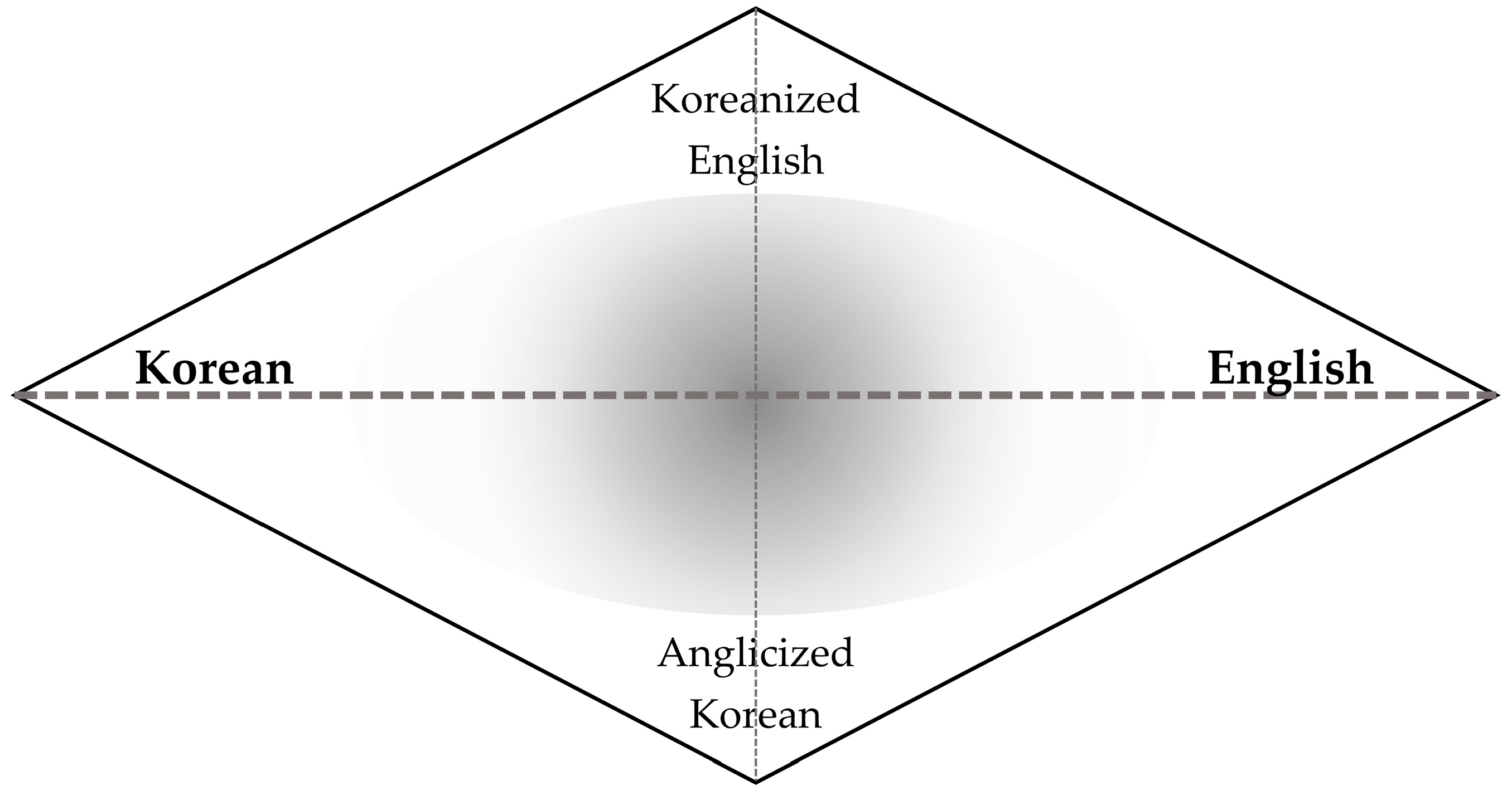
Figure 1, a fruit of this reflection, shows a dynamic matrix that aims to illustrate the evolving language contact between Korean and English that produces two prototypical hybrid varieties, which differ in terms of their directionality of influence (e.g., Korean → English or English → Korean, here labeled as Koreanized English and Anglicized Korean) and their level of development. No variety in the matrix is superior to another; none is necessarily tied to a specific geographical space; and each one can be used in various ways and to differing degrees at different times by Koreans and non-Koreans alike. Further, these can include contextual sub-varieties such as classroom or media KE. The convex in the center can morph to represent the development of the variety in question and change over time. Thus, the proposed language varieties matrix highlights the fluid, dynamic, and multidirectional nature of KE. This conceptual model could also be depicted as multilayered to reflect various language components (see
Section 3.3). Moreover, due to its intersectionality, it could serve not only for bilingualism but become a multidimensional model that could account for multilingual repertoires. This matrix overcomes various critiques of previous World Englishes models (see
Khedun-Burdoine & Kiaer, 2023, pp. 5–8).
As an additional outcome of our reflection and discussion, we envisioned the metaphor of a pin cushion (
Figure 2), where pins of varying lengths are arranged within each area. These would symbolize varying degrees in the evolution of (sub-)varieties themselves or, more personally, levels of individual linguistic proficiency. The pin cushion metaphor and the matrix allow for inclusion of various communities of users of Korean English(es): those using Korean in English communication (Koreanized English) as well as those using English in Korean (Anglicized Korean), whether Koreans using English in Korea as an intranational language, possibly as mere “decoration” (
Baratta, 2021, pp. 75, 84) or with a high degree of proficiency, Koreans using English as an international language to communicate with non-Koreans, Koreans using English transnationally, such as when code-mixing in the diaspora as an expression of self-identity, and non-Koreans whether inside or outside of Korea, using the varieties for distinct purposes, from survival and daily use to education or employment to leisure and beyond. Conceptualizing KE this way also allows us to better situate discussions in the literature and gauge the relevance (e.g., to ELT vs.
Hallyu fandom) of different linguistic phenomena and data according to personal, practical, or research interests.
While our matrix and metaphor are helpful in illustrating existing perceptions on KE, future efforts could point towards more precisely defining these terms and identifying specific criteria for each.
3.2. Societal Codification
At the heart of Baratta’s discussion is the issue of codification, which, for him, “refers to the practice of selecting, developing and overall, establishing [of
sic] a particular language use in, and for, society” (p. 18). Traditional codification, in his view, follows conventionalization. While he does not discount traditional methods of codification (e.g., textbooks, dictionaries, and grammar references), he calls for reconceptualization of the term, claiming
it is the speakers who ultimately approve of a language variety, reflecting a lack of overt codification but instead a more societal level of codification, one initiated with the development of innovations, which become conventions of the community’s use of English and, in turn, are legitimized by the community itself and not outsiders.
(p. 19)
Whereas
Hadikin (
2014) argues for the possibility of KE as a World English in his corpus-driven study, Baratta goes much further. In this book, he repeatedly declares that “we cannot wait” for traditional codification (
Bamgbose, 1998) and official status. His impatience for KE “to be understood as established and ultimately reinforced by its speakers” (p. 2) is apparent, although he admits that his use of the term KE “will be to some readers unconvincing, perhaps even naïve” (p. 6).
Baratta’s introduction of the term “societal codification” is necessary as one of the central purposes of his book is
to argue that Korean English, not only like other expanding circle Englishes but also as with language overall, is legitimate, established, and in everyday use, but largely without the need for such establishment to be provided by more ‘traditional’ means. That is, the people who use this variety of English are responsible for perpetuating its use within society, and in turn establishing it as a recognized variety.
(p. 2)
To support his purpose, Baratta presents evidence of KE in various domains (media, advertising, and English education). Providing such an explanation could satisfy
Mollin’s (
2007, p. 170) first developmental criterion for regarding a language as a new variety, expansion, or functional use across various domains of society, with widespread competence being a prerequisite (other criteria include so-called nativization and institutionalization), and counter
Song’s (
2016) critique from a decade ago that there is a lack of sociolinguistic data to back up the claim. Unfortunately, Baratta’s presentation, while going further, still falls short of “research that involves Koreans from all walks of life and systematically investigates their linguistic practices in different domains such as home, school and work” (p. 60). Nevertheless, the phenomenon of societal codification, the “societal use of language” (p. 83), is supported on the global stage by others.
Kiaer and Ahn (
2024), for instance, state that KE “is undeniably spreading rapidly and in large volumes through highly transcultural and translingual forms, becoming a part of people’s everyday vernacular” (p. ix).
3.3. Language Coverage
The final point we wish to discuss is language coverage. Language is not static, and descriptions of linguistic features, like linguistic theory, can only ever be partial. When it comes to discussing a World English, a modern approach might describe the language variety as consisting of a phonological inventory, phonological features, lexis, morphology, syntactic features, discourse, and pragmatics (
Li & Mahboob, 2012). If modalities other than speech are taken into account, additional points could also require consideration (such as orthography in writing).
Unlike many other works on KE,
The Societal Codification of Korean English attempts to go beyond just words and lexical chunks, delving into grammar as well. While it is impossible to comprehensively and definitively describe all components of a living language, in focusing predominantly on two traditional areas of KE (lexis and grammar), Baratta is fairly dismissive of pronunciation (but see p. 123). Furthermore, he mostly ignores pragmatic and sociolinguistic aspects and only refers to spelling when mentioning errors (mistakes?), while World Englishes studies have a more expansive view. (See, for example,
Botha and Bernaisch (
2025) for recent developments and future directions.) While he seemingly collects more sociolinguistic data in this text than in previous English-language sources, the selection is limited, and the presentation is not systematic and coherent. In this regard, other recent works might be more informative, like
Kiaer and Ahn’s (
2024), which highlights phonological, syntactic, and pragmatic features alongside broader cultural implications, although this one still focuses very much on words.
However, depending on which area in the matrix (
Figure 1) sources are situated in and the language components they address, some may be more relevant to certain audiences than others. Corpus research by
Rüdiger (
2019), which presents morpho-syntactic analysis, may be valuable for those of us in ELT, while translingual work like
Khedun-Burdoine and Kiaer’s (
2023) or
Kiaer and Ahn’s (
2024) or transnational work like
Rüdiger and Baratta’s (
2025), while interesting, might appeal more to
Hallyu fans.
4. Conclusions
The lack of clarity that resulted from reading The Societal Codification of Korean English prompted us to consult further references by other authors on the topic, which helped us, as ELT professionals, to better grasp the enormous complexity of KE and the breadth of scholarship on the topic and to discover that the literature is expanding in thought-provoking directions. It also led us to visually represent and localize our interests in a specific area of the matrix (i.e., Koreanized English).
While we felt the need to look elsewhere for answers, all in all, we believe Baratta makes a good effort to diminish the sociocultural prejudice of NICE and argues for legitimizing KE, or what we might even call “K-English” (K-영어,
K-yeongeo), if adopting an empowering, bottom-up perspective of usage. This framing tends to offer a positive image, as the K-prefix represents pride associated with
Hallyu and Korean cultural products (
Khedun-Burdoine & Kiaer, 2023;
Rüdiger & Baratta, 2025). Moreover, if and when a second edition of this book rolls out, more time will have passed, likely ensuring even deeper societal and academic codification.