


Érase una vez: An Exploratory Study of a Therapeutic Game for Enhancing Verbal Fluency in Children

 and
and
Abstract
1. Introduction
2. Methodology
2.1. Participants
2.2. Materials
2.3. Procedure
- (i)
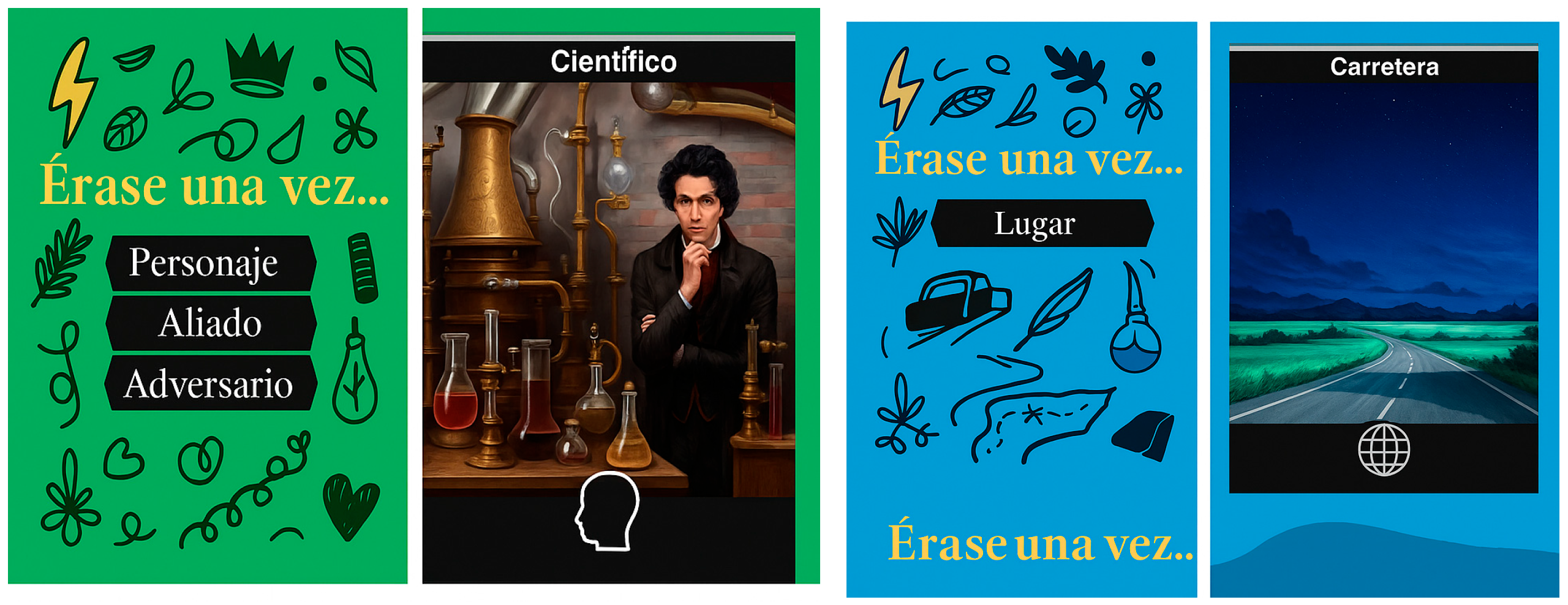
- Individual written task: Each child rolled a die to draw category-based cards and created a story incorporating all cards. Stories were transcribed without orthographic correction.
- (ii)
- Group oral task: Participants constructed a collective story by turn-taking, with real-time transcription via dictation software.
2.4. Data Analysis
3. Results
3.1. Participants’ Perceptions of the Game
3.2. Individual Narrative Production
3.3. Group Narrative Production
4. Discussion
Author Contributions
Funding
Institutional Review Board Statement
Informed Consent Statement
Data Availability Statement
Acknowledgments
Conflicts of Interest
Appendix A

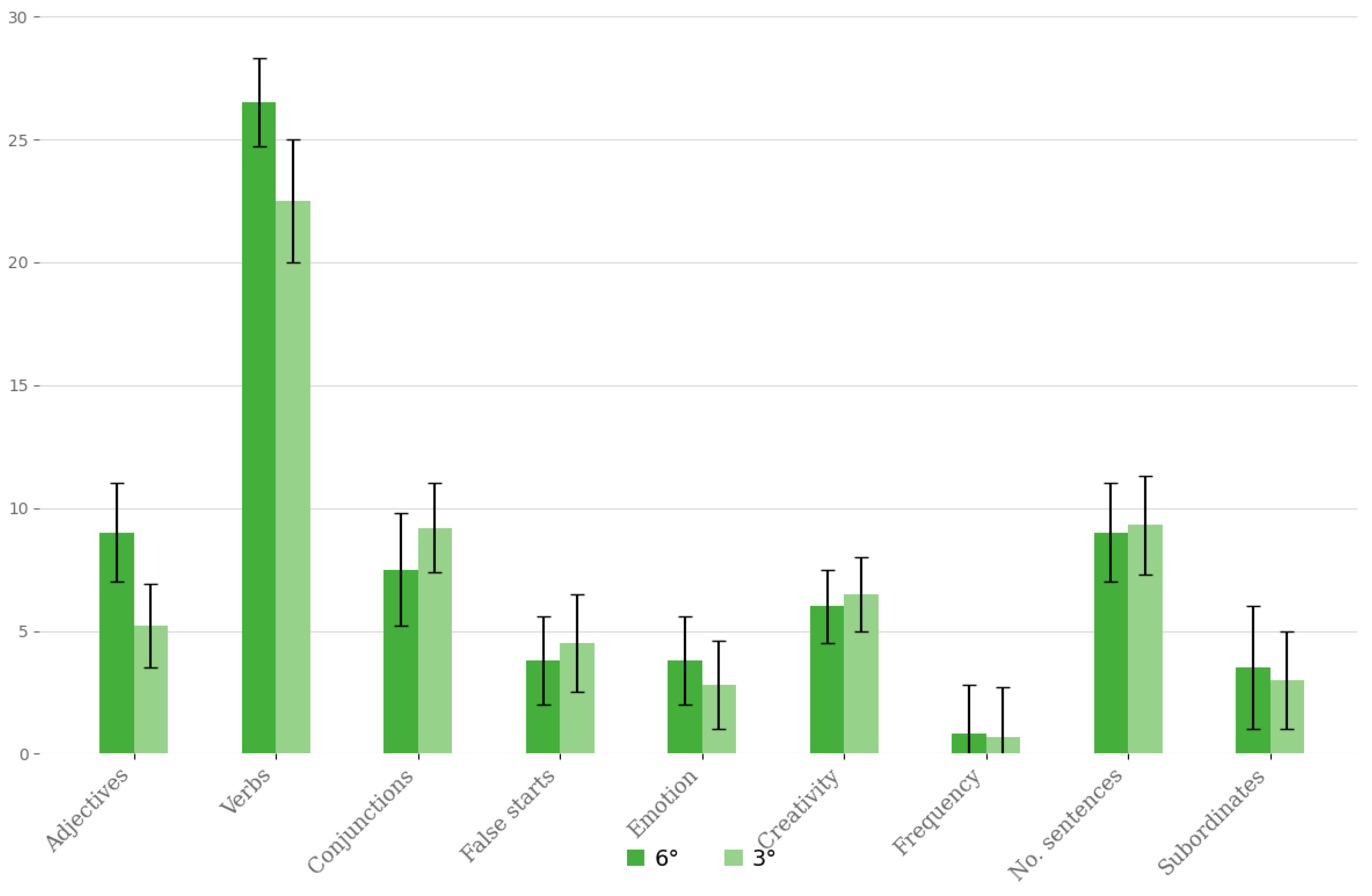
| Variable | Age | Tokens | Adjectives | Verbs | Conjunctions | False Starts | Emotion | Creativity | Frequency | Lexical Density | Sentences | Words per Sentence | Subordinate Clauses |
|---|---|---|---|---|---|---|---|---|---|---|---|---|---|
| Age | — | ||||||||||||
| Tokens | 0.108 | — | |||||||||||
| Adjectives | 0.052 | 0.982 *** | — | ||||||||||
| Verbs | 0.084 | 0.994 *** | 0.981 *** | — | |||||||||
| Conjunctions | 0.038 | 0.900 *** | 0.895 *** | 0.928 *** | — | ||||||||
| False Starts | −0.030 | 0.776 *** | 0.768 *** | 0.781 *** | 0.876 *** | — | |||||||
| Emotion | 0.040 | 0.794 *** | 0.761 *** | 0.797 *** | 0.773 *** | 0.815 *** | — | ||||||
| Creativity | 0.126 | 0.722 *** | 0.756 *** | 0.719 *** | 0.646 ** | 0.613 ** | 0.689 *** | — | |||||
| Word Frequency | −0.026 | 0.650 ** | 0.655 ** | 0.698 *** | 0.870 *** | 0.683 *** | 0.506 * | 0.336 | — | ||||
| Lexical Density | −0.259 | −0.238 | −0.211 | −0.257 | −0.387 | −0.442 | −0.301 | 0.056 | −0.461 * | — | |||
| Sentences | 0.145 | 0.984 *** | 0.945 *** | 0.979 *** | 0.896 *** | 0.781 *** | 0.818 *** | 0.719 *** | 0.644 ** | −0.282 | — | ||
| Words per Sentence | −0.056 | 0.839 *** | 0.879 *** | 0.864 *** | 0.839 *** | 0.679 ** | 0.586 ** | 0.647 ** | 0.672 ** | −0.098 | 0.754 *** | — | |
| Subordinate Clauses | 0.046 | 0.913 *** | 0.885 *** | 0.936 *** | 0.933 *** | 0.829 *** | 0.874 *** | 0.709 *** | 0.751 *** | −0.319 | 0.916 *** | 0.817 *** | — |
References
- Acosta-Rodríguez, V. M., Ramírez-Santana, G. M., & Hernández-Expósito, S. (2022). Intervention for oral language comprehension skills in preschoolers with developmental language disorder. International Journal of Language & Communication Disorders, 57(1), 90–102. [Google Scholar]
- Ahulló, A. M., Montesinos-Magraner, L., Navarro, X. S., Rivero, T. C., González, L. M., & Massó, X. G. (2022). Diseño y usabilidad de ParaSportAPP: Una mHealth destinada a promocionar la actividad física en personas con lesión medular. Revista Andaluza de Medicina del Deporte, 15(2), 65–71. [Google Scholar] [CrossRef] [Scilit]
- Amorim, A. N., Jeon, L., Abel, Y., Felisberto, E. F., Barbosa, L. N. F., & Dias, N. M. (2020). Using Escribo play video games to improve phonological awareness, early reading, and writing in preschool. Educational Researcher, 49(3), 188. [Google Scholar] [CrossRef] [Scilit]
- Arán Filippetti, V. (2011). Funciones ejecutivas en niños escolarizados: Efectos de la edad y del estrato socioeconómico. Avances en Psicología Latinoamericana, 29(1), 98–113. [Google Scholar]
- Banu, L. A. M., Saad, T., Hossain, M. K., & Hossain, M. A. (2023). Speech language disorder in children: An overview. Journal of Comilla Medical College Teachers’ Association, 27(2), 75–82. [Google Scholar] [CrossRef] [Scilit]
- Barab, S. A., Dodge, T., Ingram-Goble, A., Pettyjohn, P., Peppler, K., Volk, C., & Solomou, M. (2010). Pedagogical dramas and transformational play: Narratively rich games for learning. Mind Culture and Activity, 17(3), 235. [Google Scholar] [CrossRef] [Scilit]
- Barnes, S., & Prescott, J. (2018). Empirical evidence for the outcomes of therapeutic video games for adolescents with anxiety disorders: Systematic review. JMIR Serious Games, 6(1), e9530. [Google Scholar] [CrossRef] [Scilit]
- Beck, J. S. (2021). Terapia cognitivo-comportamental. Artmed Editora. [Google Scholar]
- Botting, N. (2002). Narrative as a tool for the assessment of linguistic and pragmatic impairments. Child Language Teaching and Therapy, 18(1), 1. [Google Scholar] [CrossRef] [Scilit]
- Brooke, J. (1986). System usability scale. Digital Equipment Corporation. [Google Scholar]
- Chapman, J. R., & Rich, P. (2018). Does educational gamification improve students’ motivation? If so, which game elements work best? Journal of Education for Business, 93(7), 315. [Google Scholar] [CrossRef] [Scilit]
- Danger, S., & Landreth, G. (2005). Child-centered group play therapy with children with speech difficulties. International Journal of Play Therapy, 14(1), 81. [Google Scholar] [CrossRef] [Scilit]
- Demir, Ö. E., Fisher, J. A., Goldin-Meadow, S., & Levine, S. C. (2013). Narrative processing in typically developing children and children with early unilateral brain injury: Seeing gesture matters. Developmental Psychology, 50(3), 815. [Google Scholar] [CrossRef] [Scilit] [PubMed]
- Deterding, S., Dixon, D., Khaled, R., & Nacke, L. (2011, September). From game design elements to gamefulness: Defining “gamification”. In Proceedings of the 15th international academic MindTrek conference: Envisioning future media environments (pp. 9–15). Association for Computing Machinery. [Google Scholar]
- Dewhirst, A., Laugharne, R., & Shankar, R. (2022). Therapeutic use of serious games in mental health: Scoping review. BJPsych Open, 8(2), e37. [Google Scholar] [CrossRef] [Scilit]
- Du, Y., Lubniewski, K., Price, L., Breslin, G., Thomson, P., Jinadasa, N., & Soni, N. (2023). “They can’t believe they’re a tiger”: Insights from pediatric speech-language pathologist mobile app users and app designers. International Journal of Language & Communication Disorders, 58(5), 1717–1737. [Google Scholar]
- Georgieva-Tsaneva, G., Andreeva, A., Tsvetkova, P., Lekova, A., Simonska, M., Stancheva-Popkostadinova, V., Dimitrov, G., Rasheva-Yordanova, K., & Kostadinova, I. (2023). Exploring the potential of social robots for speech and language therapy: A review and analysis of interactive scenarios. Machines, 11(7), 693. [Google Scholar] [CrossRef] [Scilit]
- Gillam, S. L., Olszewski, A., Fargo, J. D., & Gillam, R. B. (2014). Classroom-based narrative and vocabulary instruction: Results of an early-stage, nonrandomized comparison study. Language Speech and Hearing Services in Schools, 45(3), 204. [Google Scholar] [CrossRef] [Scilit]
- Hambleton, R. K. (1993). Guidelines for adapting educational and psychological. School Psychology International, 12, 119–132. [Google Scholar]
- Huizinga, J. (2020). Homo ludens: O jogo como elemento da cultura. Perspectiva. [Google Scholar]
- Hwang, D., Shields, S., Calderwood, A., Johnson-Bey, S., Mateas, M., Wardrip-Fruin, N., & Melcer, E. F. (2025). Clicking some of the silly options: Exploring player motivation in static and dynamic educational interactive narratives. arXiv, arXiv:2505.08891. [Google Scholar] [CrossRef] [Scilit]
- Ifenatuora, G. P., Olanrewaju, A., & Atobatele, A. A. (2021). Advances in arts-based instructional approaches for enhancing verbal fluency in multilingual learning environments. Journal of Frontiers in Multidisciplinary Research, 2(1), 127–132. [Google Scholar] [CrossRef] [Scilit]
- Kalogiannakis, M., Papadakis, S., & Zourmpakis, A.-I. (2021). Gamification in science education. A systematic review of the literature. Education Sciences, 11(1), 22. [Google Scholar] [CrossRef] [Scilit]
- Kapp, K. M. (2012). The gamification of learning and instruction: Game-based methods and strategies for training and education. John Wiley & Sons. [Google Scholar]
- Kaya, O. S., & Erçağ, E. (2023). The impact of applying challenge-based gamification program on students’ learning outcomes: Academic achievement, motivation and flow. Education and Information Technologies, 28(8), 10053. [Google Scholar] [CrossRef] [Scilit]
- Khoiriyah, K., & Purwanta, E. (2025). Chain message games as an effective intervention for improving speech fluency in children with speech delays. Journal of Innovation and Research in Primary Education, 4(4), 2242–2251. [Google Scholar] [CrossRef] [Scilit]
- Lane, N., & Prestopnik, N. (2017). Diegetic connectivity. In CHI PLAY ‘17: The annual symposium on computer-human interaction in play (p. 229). Association for Computing Machinery. [Google Scholar] [CrossRef] [Scilit]
- Li, M., Ma, S., & Shi, Y. (2023). Examining the effectiveness of gamification as a tool promoting teaching and learning in educational settings: A meta-analysis. Frontiers in Psychology, 14, 1253549. [Google Scholar] [CrossRef] [Scilit]
- Lindgren, J. (2023). Age and task type effects on comprehension and production of narrative macrostructure: Storytelling and retelling by Swedish-speaking children aged 6 and 8. Frontiers in Communication, 8, 1252260. [Google Scholar] [CrossRef] [Scilit]
- Mahzan, M. S. W., Alias, N. A., & Ismail, I. S. (2020). Unboxing the design of English as a second language (ESL) learning video game for indigenous learners: An empathic designbased approach. Asia Pacific Journal of Educators and Education, 35(2), 39. [Google Scholar] [CrossRef] [Scilit]
- Maurin, K. D., Girod, C., Consolini, J. L., Belzeaux, R., Etain, B., Cochet, B., Leboyer, M., Genty, C., Gamon, L., Picot, M. C., Courtet, P., & Olié, D. E. (2020). Use of a serious game to strengthen medication adherence in euthymic patients with bipolar disorder following a psychoeducational programme: A randomized controlled trial. Journal of Affective Disorders, 262, 182–188. [Google Scholar] [CrossRef] [Scilit]
- Merry, S. N., Stasiak, K., Shepherd, M., Frampton, C., Fleming, T., & Lucassen, M. F. (2012). The effectiveness of SPARX, a computerised self help intervention for adolescents seeking help for depression: Randomised controlled non-inferiority trial. BMJ, 344, e2598. [Google Scholar] [CrossRef] [Scilit]
- Pinto, G., Tarchi, C., & Bigozzi, L. (2018). Promoting narrative competence in kindergarten: An intervention study. Early Childhood Research Quarterly, 47, 20–29. [Google Scholar] [CrossRef] [Scilit]
- Regis, M. S., Lima, I. L. B., Almeida, L. N. A., Alves, G. Â. D. S., & Delgado, I. C. (2018). Speech-language therapy stimulation in children with Down’s syndrome. Revista CEFAC, 20(3), 271–280. [Google Scholar] [CrossRef] [Scilit]
- Rizvić, S., Bošković, D., Okanović, V., Šljivo, S., & Zukić, M. (2020). Interactive digital storytelling: Bringing cultural heritage in a classroom. arXiv, arXiv:2011.03675. [Google Scholar] [CrossRef] [Scilit]
- Rubegni, E., & Paolini, P. (2010). Comparing canonical and digital-based narrative activities in a formal educational setting. In IDC ‘10: The 9th international conference on interaction design and children (p. 258). Association for Computing Machinery. [Google Scholar] [CrossRef] [Scilit]
- Schoneveld, E. A., Lichtwarck-Aschoff, A., & Granic, I. (2018). Preventing childhood anxiety disorders: Is an applied game as effective as a cognitive behavioral therapy-based program? Prevention Science, 19, 220–232. [Google Scholar] [CrossRef] [Scilit]
- Sevilla-Gonzalez, M. D. R., Moreno Loaeza, L., Lazaro-Carrera, L. S., Bourguet Ramirez, B., Vázquez Rodríguez, A., Peralta-Pedrero, M. L., & Almeda-Valdes, P. (2020). Spanish version of the system usability scale for the assessment of electronic tools: Development and validation. JMIR Human Factors, 7(4), e21161. [Google Scholar] [CrossRef] [Scilit]
- Shao, Z., Janse, E., Visser, K., & Meyer, A. S. (2014). What do verbal fluency tasks measure? Predictors of verbal fluency performance in older adults. Frontiers in Psychology, 5, 772. [Google Scholar] [CrossRef] [Scilit]
- Soltani, A., Schworer, E. K., & Esbensen, A. J. (2022). Executive functioning and verbal fluency performance in youth with Down syndrome. Research in developmental disabilities, 131, 104358. [Google Scholar] [CrossRef] [Scilit]
- Spencer, T. D., & Petersen, D. B. (2020). Narrative intervention: Principles to practice. Language Speech and Hearing Services in Schools, 51(4), 1081. [Google Scholar] [CrossRef] [Scilit]
- Stallard, P. (2019). Think good, feel good: A cognitive behavioural therapy workbook for children and young people. John Wiley & Sons. [Google Scholar]
- Utepbayeva, A., Zhiyenbayeva, N., Assylbekova, L., & Tapalova, O. (2024). Artificial intelligence applications (fluency SIS, articulation station pro, and apraxia farm) in the psycholinguistic development of preschool children with speech disorders. International Journal of Information and Education Technology, 14(7), 927–935. [Google Scholar] [CrossRef] [Scilit]
| Game | Authors | Description | Targeted Skills | Key Findings |
|---|---|---|---|---|
| Play Therapy (Child-Centered/Group Play) | (Danger & Landreth, 2005) | Free or guided play sessions integrated with therapeutic goals | Expressive language, receptive language, social communication | Improves expressive and receptive language; supports fluency development indirectly |
| Digital Game-Based Therapy (Apps & AI tools) | (Du et al., 2023; Utepbayeva et al., 2024) | Mobile apps and AI-based interactive games used in therapy sessions | Speech production, engagement, repetition, phonological skills | Moderate improvements; high engagement and motivation enhance outcomes |
| Technology-Enhanced Interactive Systems (e.g., social robots) | (Georgieva-Tsaneva et al., 2023) | Game-like interaction with robots or conversational AI systems | Communication skills, turn-taking, engagement | Promising results for improving communication via interactive scenarios |
| Arts-Based/Creative Play Approaches | (Ifenatuora et al., 2021) | Use of drama, storytelling, music, and visual arts in interactive formats | Vocabulary, pronunciation, expressive fluency, narrative skills | Enhancement of verbal expression and communication through immersive contexts |
| Structured Language Games (e.g., chain message games) | (Khoiriyah & Purwanta, 2025) | Rule-based verbal interaction games involving repetition, sequencing, and message passing | Speech fluency, articulation, coherence, confidence | Strong improvements in fluency, communication response, and speaking confidence |
| Early Intervention Play-Based Programs | (Regis et al., 2018) | Structured early therapy combining play with language stimulation techniques | Overall language development, fluency foundations | Early stimulation leads to significant improvements in communication skills |
| Component | Group 1 (M) | Group 1 (SD) | Group 2 (M) | Group 2 (SD) |
|---|---|---|---|---|
| Tokens | 85.50 | 37.89 | 294.00 | 95.13 |
| Adjectives | 4.70 | 2.26 | 16.00 | 5.44 |
| Verbs | 14.50 | 5.99 | 40.70 | 10.13 |
| Conjunctions | 4.70 | 1.83 | 10.20 | 1.62 |
| False Starts | 2.10 | 0.74 | 3.80 | 1.03 |
| Emotion | 2.50 | 0.71 | 3.60 | 0.84 |
| Creativity | 4.70 | 1.16 | 5.70 | 1.06 |
| Word Frequency | 1.13 | 0.05 | 1.25 | 0.07 |
| Lexical Density | 0.573 | 0.015 | 0.564 | 0.008 |
| Sentences | 5.40 | 2.01 | 12.70 | 3.59 |
| Words per Sentence | 15.60 | 2.32 | 22.90 | 2.23 |
| Subordinate Clauses | 1.80 | 1.03 | 4.40 | 0.97 |
Disclaimer/Publisher’s Note: The statements, opinions and data contained in all publications are solely those of the individual author(s) and contributor(s) and not of MDPI and/or the editor(s). MDPI and/or the editor(s) disclaim responsibility for any injury to people or property resulting from any ideas, methods, instructions or products referred to in the content. |
© 2026 by the authors. Licensee MDPI, Basel, Switzerland. This article is an open access article distributed under the terms and conditions of the Creative Commons Attribution (CC BY) license.
Share and Cite
Pozza, D.R.; Alapont, N.P.; Moret-Tatay, C.; Argimon, I.d.L. Érase una vez: An Exploratory Study of a Therapeutic Game for Enhancing Verbal Fluency in Children. Languages 2026, 11, 116. https://doi.org/10.3390/languages11060116
Pozza DR, Alapont NP, Moret-Tatay C, Argimon IdL. Érase una vez: An Exploratory Study of a Therapeutic Game for Enhancing Verbal Fluency in Children. Languages. 2026; 11(6):116. https://doi.org/10.3390/languages11060116
Chicago/Turabian StylePozza, Dan Roger, Nuria Presencia Alapont, Carmen Moret-Tatay, and Irani de Lima Argimon. 2026. "Érase una vez: An Exploratory Study of a Therapeutic Game for Enhancing Verbal Fluency in Children" Languages 11, no. 6: 116. https://doi.org/10.3390/languages11060116
APA StylePozza, D. R., Alapont, N. P., Moret-Tatay, C., & Argimon, I. d. L. (2026). Érase una vez: An Exploratory Study of a Therapeutic Game for Enhancing Verbal Fluency in Children. Languages, 11(6), 116. https://doi.org/10.3390/languages11060116

