

How a Usage-Based Approach Promotes Conceptual Development and Natural Use of Japanese Passives: Evidence from Concept-Based Language Instruction

Abstract
1. Introduction
2. Background
2.1. What Are Japanese Passives and Why Are They Challenging for L2 Learners?
| (1) | Active sentence:5 | |||
| ?Densha de | dareka ga | watashi no ashi o | fun-da. | |
| train LOC | someone NOM | I GEN foot ACC | step on-PST | |
| ‘On the train, someone stepped on my foot.’ | ||||
| (2) | Affective passive with English-transferred thinking: | ||
| ?Densha de | watashi no ashi ga | fum-are-ta. | |
| train LOC | I GEN foot NOM | step on-PASS-PST | |
| ‘On the train, my foot was stepped on.’ (Okay English, unnatural Japanese.) | |||
| (3) | Adversative passive, which expresses the experiencer’s perspective: | ||
| Densha de | ashi o | fum-are-ta. | |
| train LOC | foot ACC | step on-PASS-PST | |
| ‘On the train, [somebody] stepped on [my] foot.’ (The underlined verb here is in the passive form in the Japanese sentence. The words in brackets are implied in the Japanese sentence.) | |||
2.2. Applying UB Approaches to Japanese Grammar, Speaker’s Perspective, and Passives
| (4) | Being lost and asking the way (Ikegami, 2016: p. 305; glossing revised) | |
| a. | Koko wa doko desu ka? | |
| Here TOP where COP Q | ||
| ‘Where is this?’ | ||
| b. | Where am I? | |
2.3. How Are Japanese Passives Used, Acquired and Learned?
2.4. Concept-Based Language Instruction, SCOBAs, and Languaging
2.5. C-BLI of Japanese Passives
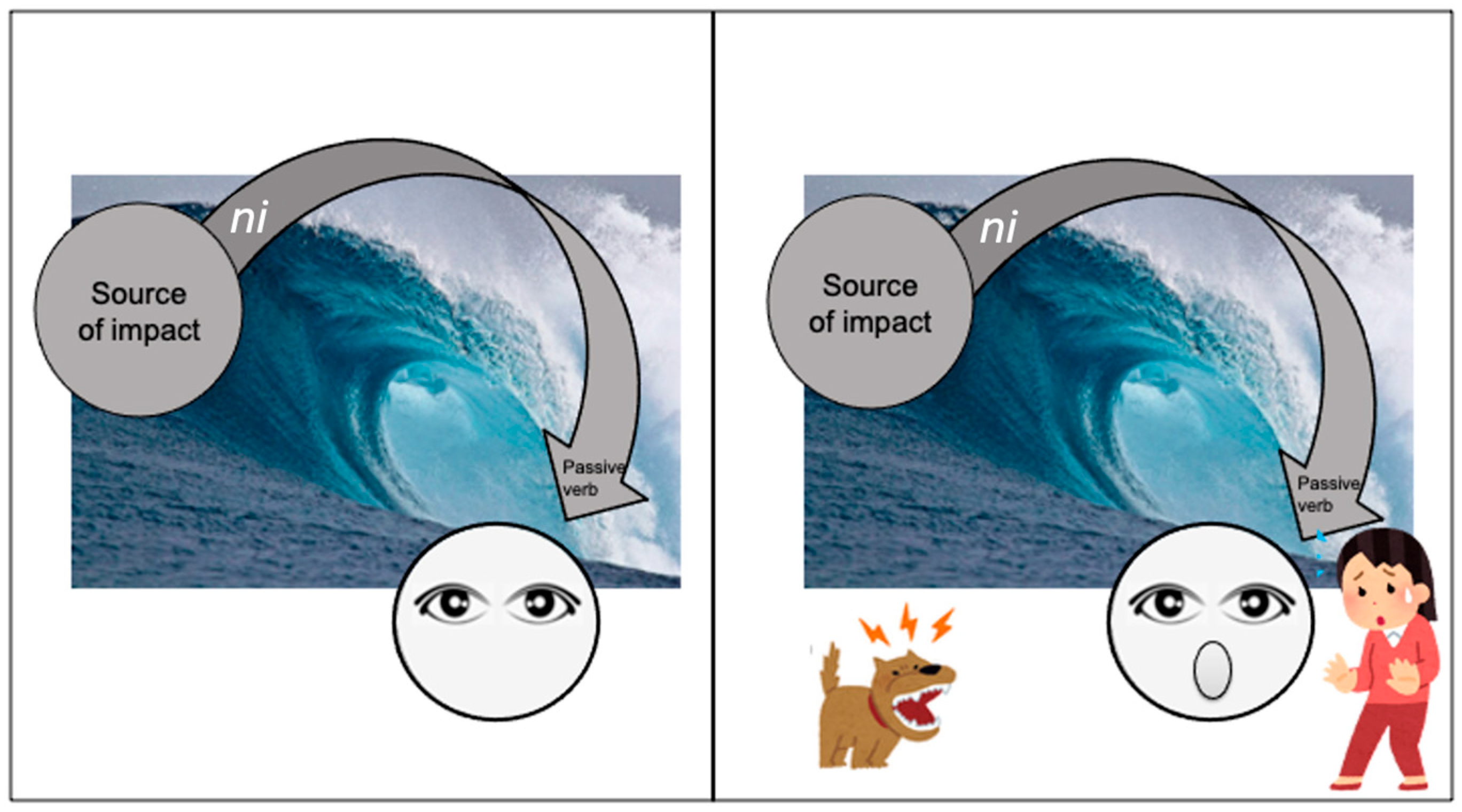
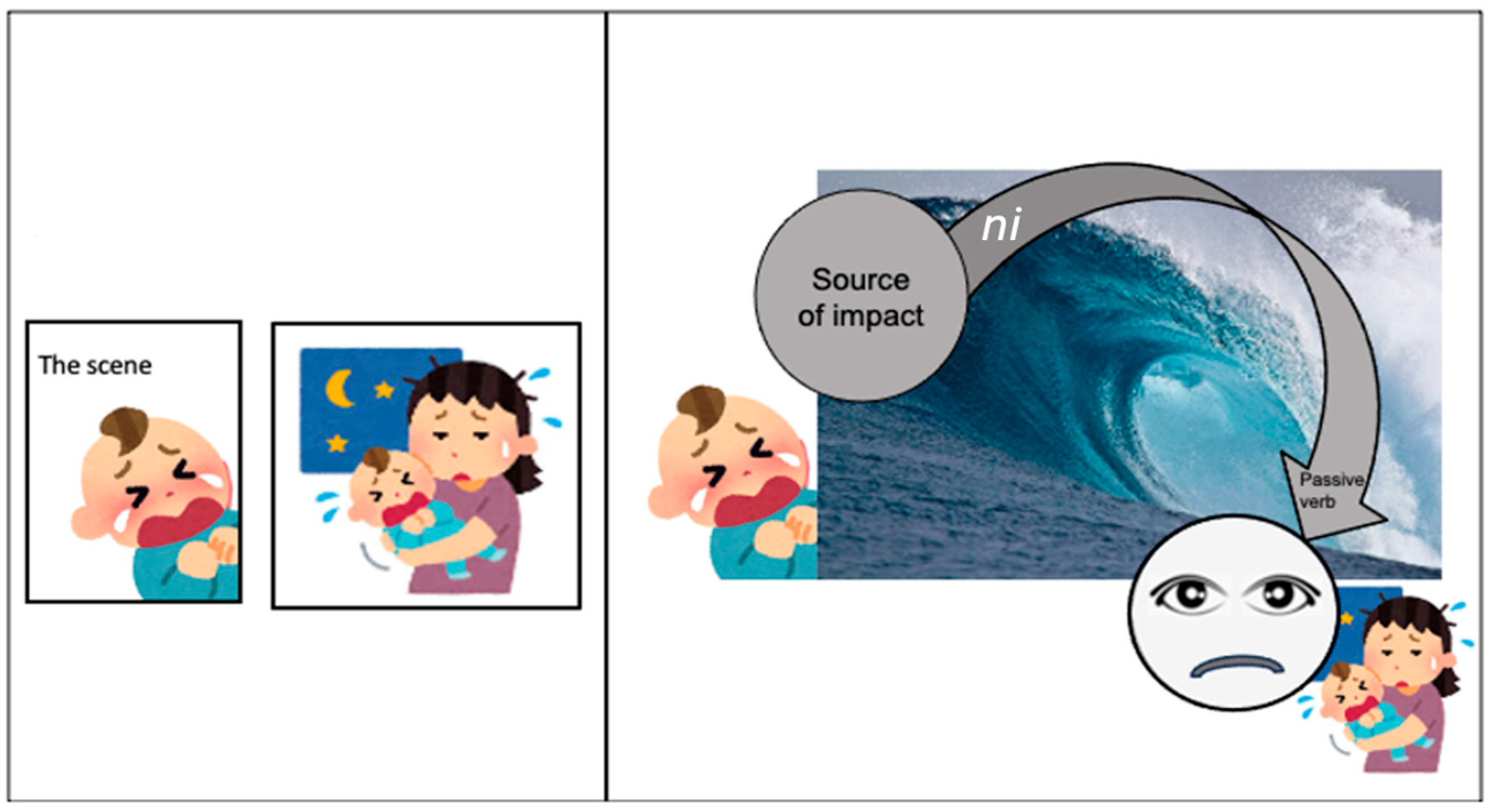
- Experiencer: the person affected/impacted by the passive verb.
- Agent: the entity performing the action that affects/impacts the experiencer.
- Action: the event that happens to the experiencer, expressed by the verb.
3. The Study
3.1. Research Questions
3.2. Participants and Study Design
3.3. Data Analysis Methodology
4. Results and Discussion
4.1. Conceptual Development of Japanese Passives (RQ1)
4.2. Development of Passives in Story-Writing (RQ2)
| (5) | Student uses of iu ‘say’ in the passive | |
| a. | Ano yoru rūmumeito ni ‘warui’ to iwaremashita. (Isaac, post-test 1) | |
| ‘That evening my room-mate said “sorry” to me.’ | ||
| b. | Bāsu ga sanjikan okureru to iwaremashita. (Greg, post-test 3) | |
| ‘They told me the bus would be three hours late.’ | ||
| c. | *Hayai yoteisuru yoyaku wa ichigatsu desu to iwaremashita.14 (Erica, post-test 3) | |
| ‘They told me that the earliest appointment I could schedule is January.’ | ||
| (6) | Students’ use of benefactive, viewpoint, and non-human passives | |
| a. | Uchūjin ni …tasukeraremashita. (benefactive passive, Greg, post-test 2) | |
| ‘(I) was helped by an alien.’ | ||
| b. | *Byōin ni ‘hayai yotei suru yoyaku wa ichigatsu desu’ to iwaremashita. (viewpoint, Erica, post-test 3) | |
| ‘I was told by the hospital “January is an early appointment time.”’ | ||
| c. | *Shawā o shimerarete arimashita. (non-human passive, Bill, post-test 3) | |
| ‘The showers were closed.’ | ||
| (7) | Student passives describing difficult situations | |
| a. | Rūmumeito ni bentō o taberarete shimai mashita (te-shimau, Isaac, post-test 1) | |
| ‘My roommate ate my lunch.’ | ||
| b. | Tomodachi ni hotte okareta kedo… (other, Greg, post-test 2) | |
| ‘My friend left me by myself.’ | ||
| c. | *Shawā o shimerarete arimashita. (other, Bill, post-test 3) | |
| ‘The showers were closed.’ | ||
- Alice sometimes overused passives where te-shimau would have been appropriate. She expressed surprise by saying bikkuri sareta ‘was surprised,’ perhaps a direct translation from English, where, in Japanese, using te-shimau/chau is natural, as in bikkuri shichatta ‘was (completely) surprised.’ Her TLU score improved on post-test 2 but declined on post-test 3.
- Bill used just one passive verb on post-test 1, and it was correct, which resulted in a TLU score of 100. On subsequent post-tests, he attempted multiple new verbs. His uses were often inaccurate, but he showed a strong conceptual grasp of passives for expressing a negative impact on the writer. He creatively described being hit by bird droppings *Tori kara kami ya atama ni purezento o otosaremashita, ‘From the bird, presents were dropped on my hair and head,’ and also described the shower being turned off on him *Shawā o shimerarete arimashita, ‘The showers were turned off,’ and missing a quiz because he arrived late *“Poppu kuizu ga ageraremashita,” ‘A pop-quiz was given.’ These clearly convey the negative impact of these actions on him. Like Alice, he also over-used passive in a context where the -te shimau/chau predicate would have been correct.
- Greg used passives a lot on post-tests 2 and 3, making many errors, and also overused passives, sometimes producing a passive where a causative-passive was required (e.g., on post-test 3, matareta instead of matasareta ‘was made to wait’).
- Erica developed more slowly than the others, moving from just one use on post-test 1 to four uses on post-test 2 and three on post-test 3. On post-test 2, she used a variety of verbs, including writing *Ame ga furaremashita, ‘It rained,’ hana ni aruite koraremashita, hana ni ijimeraremashita ‘The monster flower came to me and he bullied me.’ On post-test 3, she used the passive correctly twice, but once she passivized the wrong verb: *…renraku shite komararemashita instead of … renraku sarete komarimashita, ‘I was contacted and it was annoying.’
- Isaac consistently produced correct passives but generally relied on memorized chunks (expressions used in class and in the textbook) rather than using language more creatively. This strategy resulted in generally high TLU scores compared to the other students. Despite the lack of risk-taking in his writing, his oral languaging showed mastery of passives-related concepts, including via his gestures, as was discussed in Section 4.1.
5. Conclusions
Author Contributions
Funding
Institutional Review Board Statement
Informed Consent Statement
Data Availability Statement
Acknowledgments
Conflicts of Interest
Appendix A. Instructions for Oral Languaging Homework (Post-Tests 1–3)
| 1 | Target-like use (TLU) means use that is correct in the target language. TLU is a measure of the L2 accuracy of grammatical morphemes in an individual’s interlanguage. To calculate TLU, the researcher counts correct uses (correct form used in an appropriate context) of a target form, nouns in an obligatory context (where the form should have been used but was not), and incorrect uses (incorrect form or usage); the formula is supplied in the text of the article. |
| 2 | From a cognitive linguistics perspective, Langacker (2004, p. 78) further explains that the English passive is not derived from the active but instead constitutes a different construal of the action chain, namely the asymmetrical transmission of energy from the agent (source) to the patient (target). |
| 3 | Viewpoint, a central organizing principle in Japanese discourse, is a core element of Japanese passives. From the perspective of kokugogaku (traditional Japanese linguistics), Sadanobu (2022, p. 127) explains that the active sentence Taro ga Jiro o nagutta (‘Taro hit Jiro’) is constructed from Taro’s viewpoint, whereas the passive equivalent, Jiro ga Taro ni nagurareta (‘Jiro was hit by Taro’), is constructed from Jiro’s viewpoint. Although passive sentences can express a neutral viewpoint, they tend to align with the perspective of their grammatical subjects. Sadanobu (2022, p. 121) further argues that certain passive constructions involve an abrupt shift in construal and discourse perspective, thereby disrupting the preferred continuity of viewpoint in Japanese discourse. Based on survey data from over 100 L1 speakers of Japanese, he reports that the sentence Tomodachi ga boku no raburetā o mite warawareta yo (‘My friend looked at my love letter, and I was laughed at by my friend’) is judged unnatural (Sadanobu, 2022, p. 121). |
| 4 | Murakami (2022) provides an overview of research on Japanese passives and their analyses in pedagogical grammar books and sixteen Japanese language textbooks and argues that the impact of the other’s actions (eikyō in Japanese) is a key notion in Japanese pedagogy over 15 years. We employed the term ‘impact’ for SCOBA creation. |
| 5 | The abbreviations used in this paper for Japanese grammatical particles and affixes are: ACC, accusative marker o; GEN, genitive marker no; LOC, locative marker de; NOM, nominative marker ga; PASS, passive affix -rare/-are; and PST, past affix -ta/-da. This paper romanizes Japanese using a modified Hepburn system, which notates the long vowels oo and uu with a macron instead of a repeated vowel. |
| 6 | The intermediate-level textbook Quartet vol. II (Sakamoto et al., 2020, p. 200) briefly mentions viewpoint as a motivation for using passives but does not go into detail or provide instruction on this. |
| 7 | Mitsugi (2018) analyzed the KY spoken corpus (Kamada, 2006) and the Hypermedia Corpus of Spoken Japanese (Uemura, 1995). |
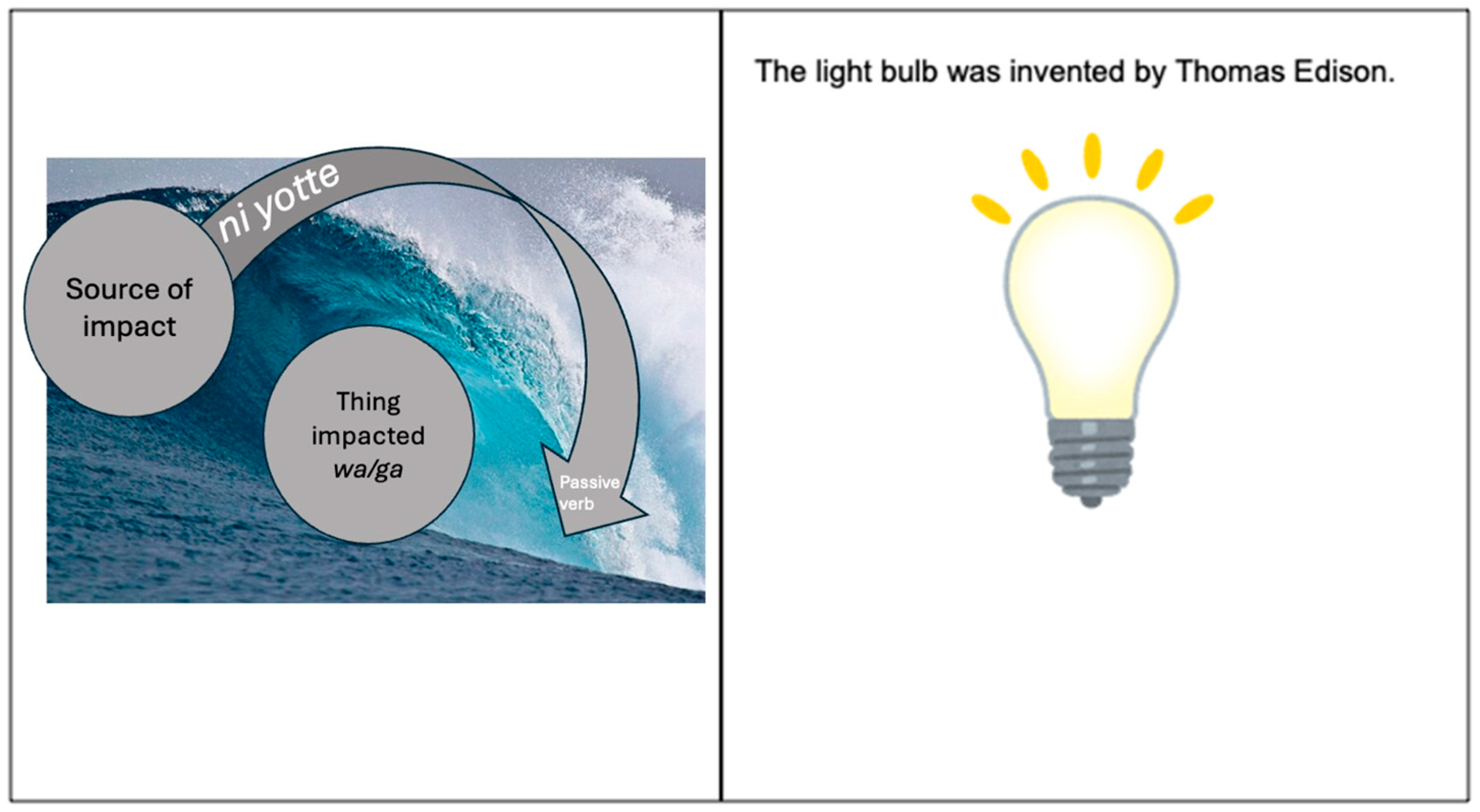
| 8 | Ni-passive constructions are closely tied to the notions of perspective and affectedness, while ni yotte-passive constructions place greater emphasis on the topicality of the subject (Sadanobu, 2022). |
| 9 | This study was classified as ‘exempt’ via human subjects review. We also obtained written informed consent from the participants prior to data collection. We received separate written permission to publish anonymized images (see Figure 4) from ‘Isaac.’ |
| 10 | This is a qualitative study, with no use of inferential statistics, the use of which is precluded by the small number of participants. |
| 11 | Students’ scores on the SPOT (Simple Performance-Oriented Test) version B, administered at the beginning of the semester, ranged from 47 to 59 among the five learners, with a mean score of 54.5. Based on N. Iwasaki’s (2002) investigation of the correlation between the ACTFL OPI and SPOT, the average proficiency level of this class can be considered equivalent to intermediate-mid on the ACTFL OPI. |
| 12 | A reviewer commented that using a different methodology to collect the post-test 3 oral languaging introduced ‘a confounding element that could have been controlled for.’ Because post-test 3 occurred five months after the end of the course, there was no Canvas site for students to submit work to, as was the case for oral languaging from post-tests 1 and 2; instead, students made appointments with the teacher on Zoom and performed oral languaging at that time. As for post-tests 1 and 2, no teacher was present during the post-test 3 oral languaging. |
| 13 | The research assistant was an undergraduate student assistant, a native speaker of English who was double-majoring in Japanese and computer science. The research assistant assisted with the transcription of students’ oral languaging, which was in English, was trained to identify passives concepts, and assisted with coding the oral languaging. |
| 14 | The asterisk (*) marks a grammatical error. Here, the particle should be ni, instead of ga. |
| 15 | A reviewer asked us to explain why we used different categories to classify students’ explanations of passives in their oral languaging and their use of passives in their writing in Japanese. Students’ oral languaging was in English. To analyze the transcripts for passives concepts, we first used the concepts taught in the course, the semantic categories of affective, adversative and non-human passives. Then, because students also mentioned additional concepts when comparing Japanese and English passives, we coded using mention of direct/indirect passives (DpIp; our goal in analyzing the students’ oral languaging was to understand the impact of C-BLI, over time, on their understanding of passives-related concepts). When coding students’ story-telling, we analyzed their Japanese using Ōzeki’s classification system, which was most useful for coding Japanese usage. We did not use Ōzeki’s categories to examine students’ conceptual development, because we did not teach these fine-grained distinctions. |
References
- Buescher, K., & Strauss, S. (2015). A cognitive linguistic analysis of French prepositions à, dans, and en and a sociocultural theoretical approach to teaching them. In K. Masuda, C. Arnett, & A. Labarca (Eds.), Cognitive linguistics and sociocultural theory: Applications to foreign and second language teaching (pp. 155–181). Mouton de Gruyter. [Google Scholar] [CrossRef] [Scilit]
- Bybee, J. (2006). From usage to grammar: The mind’s response to repetition. Language, 82(4), 711–733. [Google Scholar] [CrossRef] [Scilit]
- Bybee, J. (2008). Usage-based grammar and second language acquisition. In P. Robinson, & N. Ellis (Eds.), Handbook of cognitive linguistics and second language acquisition (pp. 216–236). Routledge. Available online: https://www.taylorfrancis.com/chapters/edit/10.4324/9780203938560-18/usage-based-grammar-second-language-acquisition-joan-bybee (accessed on 20 April 2026).
- Bybee, J., & Hopper, P. (2001). Frequency and the emergency of linguistic structure. John Benjamins. [Google Scholar] [CrossRef] [Scilit]
- Ellis, N. (2002). Reflections of frequency effects in language processing: A response to commentaries. Studies in Second Language Acquisition, 24(2), 297–339. [Google Scholar] [CrossRef] [Scilit]
- Ellis, N. (2015). Implicit AND explicit language learning: Their dynamic interface and complexity. In P. Rebuschat (Ed.), Implicit and explicit learning of language (pp. 1–24). John Benjamins. [Google Scholar] [CrossRef] [Scilit]
- Ellis, N., & Ferreira-Junior, F. (2009). Construction learning as a function of frequency, frequency distribution, and function. Modern Language Journal, 93(3), 370–385. [Google Scholar] [CrossRef] [Scilit]
- Eskildsen, S. (2015). What counts as a developmental sequence? Exemplar-based L2 learning of English questions. Language Learning, 65(1), 33–62. [Google Scholar] [CrossRef] [Scilit]
- Gal’perin, P. Y. (1992). Stage-by-stage formation as a method of psychological investigation. Journal of Russian and East European Psychology, 30(4), 60–80. [Google Scholar] [CrossRef] [Scilit]
- Gass, S. (1997). Input, interaction, and the second language learner. Lawrence Erlbaum Associates. [Google Scholar] [CrossRef] [Scilit]
- Goldberg, A., & Casenhiser, D. (2008). Construction learning and second language acquisition. In P. Robinson, & N. Ellis (Eds.), Handbook of cognitive linguistics and second language acquisition (pp. 197–215). Routledge. Available online: https://www.taylorfrancis.com/chapters/edit/10.4324/9780203938560-17/construction-learning-second-language-acquisition-adele-goldberg-devin-casenhiser (accessed on 20 April 2026).
- Granger, S., & Wynne, M. (2000). Optimizing measure of lexical variation in EFL learner corpora. In J. Kirk (Ed.), Corpora galore: Analyses and techniques in describing English (pp. 249–257). Rodopi. [Google Scholar] [CrossRef] [Scilit]
- Ikegami, Y. (2005). Indices of a ‘subjectivity-prominent’ language: Between cognitive linguistics and linguistic typology. Annual Review of Cognitive Linguistics, 3, 132–164. [Google Scholar] [CrossRef] [Scilit]
- Ikegami, Y. (2016). Subject-object contrast (shukaku-tairitsu) and subject-object merger (shukaku-gouitsu) in “thinking for speaking”: A typology of the speaker’s preferred stances of construal across languages and its implications for language teaching. In K. Kabata, & K. Toratani (Eds.), Cognitive-functional approaches to the study of Japanese as a second language (pp. 301–318). Mouton de Gruyter. [Google Scholar]
- Ikegami, Y., & Moriya, M. (Eds.). (2009). Shizenna nihongo o oshieru tameni: Ninchi gengogaku o fumaete [How can cognitive linguistics help teach natural Japanese]. Hituzi Syobo. [Google Scholar]
- Iori, I. (2012). Bunpō shirabasu kaitei no tame no ichi shian: Boisu no bāi [A proposal for revising grammatical syllabi: The case of voice]. Nihongo/Nihongo Kyōiku Kenkyū, 3, 39–55. [Google Scholar]
- Iori, I. (Ed.). (2022). Nihongo ukemi bun no atarashii oshiekata [New approaches to teaching Japanese passives]. Kurosio. [Google Scholar]
- Iwasaki, N. (2002). Nihongo nōryoku kani shiken (SPOT) no tokuten to ACTFL kōtōnōryoku sokutei (OPI) no reberu no kankei nit suite [The simple performance-oriented test (SPOT) vs. the ACTFL orla profieicny interview (OPI)]. Nihongo Kyōiku, 114, 100–105. [Google Scholar]
- Iwasaki, S. (1993). Subjectivity in grammar and discourse. John Benjamins. [Google Scholar] [CrossRef] [Scilit]
- Kamada, O. (2006). KY-kōpasu to nihongo kyōiku kenkyū [KY corpus and Japanese language education research]. Nihongo Kyōiku, 130, 42–51. [Google Scholar]
- Kawaguchi, S. (2005). Daini gengo to shite no nihongo shūtoku kenkyū: Purosesabiriti riron to nihongo [Processability theory and Japanese as a second language]. Daini Gengo to Shite no Nihongo Shūtoku Kenkyū, 8, 83–114. [Google Scholar]
- Kikuchi, Y., & Masuda, M. (2022). Nihongo kyōiku no ukemi no shidōhō kaizen to higai no umu no shikibetsuhō [Revision of teaching Japanese passives and discrimination of adversity in Japanese passives]. In Nihongo ukemibu no atarashii toraekata [A new approach to Japanese passive construction] (pp. 167–198). Kurosio Shuppan. [Google Scholar]
- Kissling, E., & Muthusamy, T. (2022). Exploring boundedness for concept-based instruction of aspect: Evidence from learning the Spanish preterite and imperfect. Modern Language Journal, 106(2), 371–392. [Google Scholar] [CrossRef] [Scilit]
- Koga, Y. (2018). Gendai Nihongo no shiten no kenkyū: Taikeika to chimizuka [Studies on perspective in contemporary Japanese: Systematization and refinement]. Hitsuji Shobō. [Google Scholar]
- Kuno, S. (1978). The grammar of discourse. Taishūkan Shoten. [Google Scholar]
- Langacker, W. R. (2000). A dynamic usage-based model. In M. Barlow, & S. Kemmer (Eds.), Usage-based models of language (pp. 1–63). CSLI. [Google Scholar] [CrossRef] [Scilit]
- Langacker, W. R. (2004). Grammar as image: The case of voice. In B. Lewandowska-Tomaszczyk, & A. Kwiatkowska (Eds.), Imagery in language: Festschrift in honour of professor Ronald W. Langacker (pp. 63–114). Peter Lang. [Google Scholar]
- Langacker, W. R. (2008a). Cognitive grammar: A basic introduction. Oxford University Press. [Google Scholar] [CrossRef] [Scilit]
- Langacker, W. R. (2008b). Cognitive grammar as a basis for language instruction. In P. Robison, & N. Ellis (Eds.), Handbook of cognitive linguistics and second language acquisition (pp. 66–88). Routledge. [Google Scholar]
- Lantolf, J. P., & Poehner, M. E. (2014). Sociocultural theory and the pedagogical imperative in L2 education. Routledge. [Google Scholar] [CrossRef] [Scilit]
- Lantolf, J. P., & Tsai, M.-H. (2018). L2 developmental education and systemic theoretical instruction: The case of English verb + noun collocations. In A. Tyler, L. Ortega, M. Uno, & H.-I. Park (Eds.), Usage-inspired L2 instruction: Researched pedagogy (pp. 29–53). John Benjamins. [Google Scholar] [CrossRef] [Scilit]
- Maeda, N. (2011). Jūdō hyōgen no shidō to kakudai bunkei no kokoromi [Teaching passive expressions in expanded sentence patterns]. Nihongo/Nihongo Kyōiku Kenkyū, 2, 67–84. [Google Scholar]
- Masuda, K. (Ed.). (forthcoming). Konseputo bēsu no gengo kyōiku: Nihongo kyōiku eno ōyō to kanōsei [Concept-based language instruction: Application and potential for Japanese pedagogy]. Hituzi Syobo. [Google Scholar]
- Masuda, K., & Labarca, A. (2015). Schematic diagram use and languaging quality in learning Japanese polysemous particles ni and de. In K. Masuda, C. Arnett, & A. Labarca (Eds.), Cognitive linguistics and sociocultural theory: Applications to foreign and second language teaching (pp. 203–232). Mouton de Gruyter. [Google Scholar] [CrossRef] [Scilit]
- Masuda, K., & Labarca, A. (2018). A usage-based approach to presenting the polysemous particles ni and de in JFL instruction. In K. Masuda (Ed.), Cognitive linguistics and Japanese pedagogy: A usage-based approach to language learning and instruction (pp. 129–164). Mouton de Gruyter. Available online: https://www.degruyterbrill.com/document/doi/10.1515/9783110456554-006/html (accessed on 20 April 2026).
- Masuda, K., & Ohta, A. S. (2021). Teaching subjective construal and related constructions with SCOBAs: Concept learning as a foundation for Japanese language development. Language and Sociocultural Theory, 8(1), 35–67. [Google Scholar] [CrossRef] [Scilit]
- Masuda, K., & Ohta, A. S. (forthcoming). Nihongo kyōiku eno ōyō to kanōsei [How to teach passive expressions and their practice]. In K. Masuda (Ed.), Konseputo bēsu no gengo kyōiku: Nihongo kyōiku eno ōyō to kanōsei [Concept-based language instruction: Application and potential for Japanese pedagogy]. Hituzi Syobo. [Google Scholar]
- Masuda, K., Ohta, A. S., & Tsujihara, R. (2025). Concept-based language instruction: Usage-based linguistics and sociocultural theory in teaching Japanese. Routledge. [Google Scholar]
- Minami, M. (2021). Narrative as cultural representation: An analysis of Japanese-language learners’ storytelling styles from the perspective of coherence and cohesion. Narrative Inquiry, 31(1), 223–251. [Google Scholar] [CrossRef] [Scilit]
- Mitsugi, S. (2018). Characterizing learners’ use of passive constructions: A corpus-driven approach. In K. Masuda (Ed.), Cognitive linguistics and Japanese pedagogy: A usage-based approach to language learning and instruction (pp. 99–128). Mouton de Gruyter. [Google Scholar]
- Mitsugi, S., & Fukada, H. (2022). Maternal passives addressed to Japanese-speaking children: A usage-based approach. First Language, 42(5), 628–648. [Google Scholar] [CrossRef] [Scilit]
- Morita, E. (2016). Kaiwa no hajime no ippo: Kodomo ni okeru sōgokōishi yo no shiyō [First steps in conversation: Children’s use of the interactional particle yo]. In A. Takada, Y. Shimada, & R. Kawashima (Eds.), Kosodate no kaiwa bunseki: Otona to kodomo no sekinin wa dō sodatsuka [Conversation analysis of child care: How adults’ and children’s responsibility develops] (pp. 145–170). Shōwado. [Google Scholar]
- Murakami, K. (2022). Shokyū no nihongo no kyōkasho no ukemi no toriatsukai [How Japanese passives are explained in beginning Japanese textbooks]. In I. Iori (Ed.), Nihongo ukemibu no atarashii toraekata [A new approach to Japanese passive construction] (pp. 27–59). Kurosio Shuppan. [Google Scholar]
- Nakamata, N. (2014). Nihongo kyōiku no tame no bumpō korokēshon handobukku [Handbook for Japanese grammar collocation for Japanese pedagogy]. Kurosio Shuppan. [Google Scholar] [CrossRef]
- Ohta, A. S. (2001). Second language acquisition process in the classroom: Learning Japanese. Lawrence Erlbaum. [Google Scholar]
- Ohta, A. S. (2017). From SCOBA development to implementation in concept-based instruction: Conceptualization and teaching Japanese address honrofics as expressing modes of self. Language and Sociocultural Theory, 4(2), 187–218. [Google Scholar] [CrossRef] [Scilit]
- Ohta, A. S. (2024). Sociocultural theory and L2 discoures: From descriptive to interventionist research in SLA. In B. Paltridge, & M. T. Prior (Eds.), The Routledge handbook of second language acquisition and discourse (pp. 116–131). Routledge. [Google Scholar]
- Ōzeki, H. (2023). Nihongo gakushūsha kōpasu kara mita judōbun [Passive constructions used in JSL corpus]. In I. Iori (Ed.), Nihongo ukemibu no atarashii toraekata [A new approach to Japanese passive construction] (pp. 89–113). Kurosio Shuppan. [Google Scholar]
- Pica, T. (2008). Methods of morpheme quantification: The effect on the interpretation of second language data. Studies in Second Language Acquisition, 6(1), 69–78, (Original work published 1983). [Google Scholar] [CrossRef] [Scilit]
- Poehner, M., & Infante, P. (2019). Mediated development and the internalization of psychological tools in second language (L2) education. Learning, Culture and Social Interaction, 22, 1–14. [Google Scholar] [CrossRef] [Scilit]
- Sadanobu, T. (2022). Ukemibu no shiza [Viewpoint of passives]. In I. Iorisao (Ed.), Nihongo ukemibu no atarashii toraekata [A new approach to Japanese passive construction] (pp. 115–129). Kurosio Shuppan. [Google Scholar]
- Sakamoto, T., Yasui, A., Ide, Y., Doi, M., & Hamada, H. (2020). Quartet II: Intermediate Japanese across the four language skills. Japan Times. Available online: https://quartet.japantimes.co.jp/ (accessed on 20 April 2026).
- Stam, G. (2018). Gesture as a window onto conceptualization in second language acquisition: A Vygotskian perspective. In J. P. Lantolf, M. E. Poehner, & M. Swain (Eds.), The Routledge handbook of sociocultural theory and second language development (pp. 65–177). Routledge. [Google Scholar] [CrossRef] [Scilit]
- Stam, G., Urbanski, K., & Lantolf, J. P. (2023). How concept-based language instruction works in teaching thinking for speaking in an L2. International Review of Applied Linguistics in Language Teaching, 61(1), 111–153. [Google Scholar] [CrossRef] [Scilit]
- Swain, M. (2006). Languaging, agency, and collaboration in advanced language proficiency. In H. Byrnes (Ed.), Advanced language learning: The contribution of Halliday and Vygotsky (pp. 95–108). Georgetown University Press. [Google Scholar]
- Swain, M., Lapkin, S., Knouzi, I., Suzuki, W., & Brooks, L. (2009). Languaging: University students learn the grammatical concept of voice in French. Modern Language Journal, 93(1), 5–19. [Google Scholar] [CrossRef] [Scilit]
- Taguchi, K. (2001). Burajirujin jidō no ukemi shieki no shūtoku ni kansuru jirei kenkyū: Nihonjin jidō yōji tono hikaku o tōshite [A comparative case study of Brazilian and Japanese children’s acquisition of Japanese passives and causatives]. Acquisition of Japanese as a Second Language, 4, 116–133. [Google Scholar]
- Takeda, T. (2005). Shizenna nagare no hatsuwa o dō oshieruka-bogowasha no shizenkaiwa ni okeru ukemi shiyōno karano hinto. In M. Minami (Ed.), Gengo to Nihongo Kyōiku (Vol. IV, pp. 49–60). Kurosio Shuppan. [Google Scholar]
- Tanaka, M. (2010). Daini gengo to shite no nihongo ukemibun no shūtoku kenkyū: Kongo no kenkyū no kanōsei [Acquisition of passives by L2 learners: Future directions]. Acquisition of Japanese as a Second Language, 13, 114–145. [Google Scholar]
- Tanno, K. (2010). Development of narrative skills in second language speakers: Mental and speech representations in Japanese oral and written personal narratives [Ph.D. thesis, University of Washington]. [Google Scholar]
- Tomasello, M. (2003). Constructing a language: A Usage-based theory of language acquisition. Harvard University Press. [Google Scholar] [CrossRef] [Scilit]
- Tsujihara, R. (2022). Teaching the Japanese aspectual form -te iru using Concept-Based Language Instruction (C-BLI) in an intact beginning-level classroom. Language and Sociocultural Theory, 9(1), 91–121. [Google Scholar] [CrossRef] [Scilit]
- Tyler, A. (2012). Cognitive linguistics and second language learning. Routledge. [Google Scholar] [CrossRef] [Scilit]
- Tyler, A., & Ortega, L. (2018). Usage-inspired L2 instruction. In A. Tyler, L. Ortega, M. Uno, & H. I. Park (Eds.), Usage-inspired L2 instruction: Researched pedagogy (pp. 315–321). John Benjamins. [Google Scholar] [CrossRef] [Scilit]
- Uemura, R. (1995). B-5 maruchimedia gata gengo dētabēsu no kōchiku to sono ōyō ni tsuite [B-5 project: Hypermedia corpus and its application]. In Proceedings of the third annual conference of the Japan Society of Information and Knowledge (Vol. 3, pp. 83–86). Japan Society of Information and Knowledge. [Google Scholar]
- Vygotsky, L. S. (1987). Thinking and speech. In R. W. Rieber, & A. S. Carton (Eds.), The collected works of L. S. Vygotsky: Vol. 1. Problems of general psychology (pp. 39–285). Plenum Press. [Google Scholar]
- Yabuki, S. N. (2017). Nihongo gakushūsha no danwa ni okeru shiten hyōgen: Nihongo bogowasha to no hikaku kara [Perspective expressions in the discourse of Japanese language learners: A comparison with native speakers of Japanese]. Journal of CAJLE, 18, 90–112. [Google Scholar]
- Yabuki, S. N., & Okuno, Y. (2020). Nihongo gakushūsha wa jitai hāku no shukansei o dō hyōgen suru no ka: I-JAS no sutōrī byōsha ni okeru bogo ni yoru sōiten kara no bunseki [How do learners of Japanese express subjectivity in event construal? An analysis of cross-linguistic differences in I-JAS story descriptions]. In Proceedings of the 26th Princeton Japanese pedagogy forum (pp. 289–300). Princeton University. [Google Scholar]
- Yamamoto, H., Komori, S., Homma, T., & Lanigan, M. (2017). Kōpasu shisutemu Co-Chu no kensaku hikaku kinō o tukatta kenkyū jirei [A case study using the result comparison feature of the corpus system Co-Chu]. In Proceedings of 7th international conference on computer assisted systems for teaching & learning Japanese (CASTEL/J) (pp. 40–49). Kurosio Shuppan. [Google Scholar]


| In-Class Activities and Homework Assignments (Study Components Are in All Caps) | |
|---|---|
| 4th week 1/30 | PRE-TEST, a Homework 1: Assessment of learners’ prior knowledge of Japanese passives |
| 5th week Day 1 of instruction 2/4 | Class Activities 1
|
| Day 2 of instruction 2/6 | Class Activities 2
|
| 6th week Day 3 of instruction 2/11 | Class Activities 3
|
| 7th week Day 4 of instruction | Class Activities 4
|
| 8th week | Unit Test: Includes written languaging tasks targeting passive constructions |
| 10th week 3/12 and 3/14 | POST-TEST 2, Homework 5 (3 weeks after the passives unit)
|
| Mid-August | POST-TEST 3 (6 months after the passives unit)
|
| AfP | Mor | ni | AdvP | SP | OmSub | DpIp | Inan | Total | |
|---|---|---|---|---|---|---|---|---|---|
| Post-test 1 | 4 | 4 | 5 | 2 | 2 | 0 | 0 | 0 | 17 |
| Post-test 2 | 4 | 3 | 5 | 3 | 4 | 3 | 1 | 3 | 26 |
| Post-test 3 | 5 | 5 | 3 | 3 | 2 | 0 | 3 | 1 | 22 |
| Name | Post-Test 1 | Post-Test 2 | Post-Test 3 |
|---|---|---|---|
| Alice | AfP, Mor, ni | AfP, Mor, ni, Inan | Mor, AdvP |
| Bill | AfP, Mor, ni, AdvP, SP | AfP, ni, AdvP, SP | AfP, Mor, AdvP, SP, DpIp |
| Erica | AfP, Mor, ni, SP | AfP, Mor, ni, AdvP, SP, OmSub, DpIp, Inan | AfP, Mor, ni, DpIp |
| Greg | ni, OmSub, Inan | ni, SP, OmSub, Inan | AfP, Mor, ni, SP, Inan |
| Isaac | AfP, Mor, ni | AfP, Mor, ni, AdvP, SP, OmSub | AfP, Mor, ni, AdvP, DpIp |
| Types | Tokens | Token Average | |
|---|---|---|---|
| Post-test 1 | 181 | 527 | 105.4 |
| Post-test 2 | 237 | 747 | 149.4 |
| Post-test 3 | 240 | 818 | 163.6 |
| Types | Tokens | Token Average | |
|---|---|---|---|
| Post-test 1 | 9 | 13 | 2.6 |
| Post-test 2 | 12 | 15 | 3.0 |
| Post-test 3 | 18 | 21 | 4.2 |
| Post-Test 1 | Post-Test 2 | Post-Test 3 | |||
|---|---|---|---|---|---|
| Verb | Freq. | Verb | Freq. | Verb | Freq. |
| iu ‘say’ | 3 | nusumu ‘steal’ | 2 | iu ‘say’ | 3 |
| taberu ‘eat’ | 2 | suru ‘do’ | 2 | nusumu ‘steal’ | 2 |
| torikesu ‘cancel’ | 2 | furu ‘rain’ | 2 | suru ‘do’ | 1 |
| iku ‘go’ | 1 | ou ‘chase’ | 1 | iku ‘go’ | 1 |
| nusumu ‘steal’ | 1 | hiku ‘play an instrument’ | 1 | shimeru ‘shut’ | 1 |
| oku ‘put’ | 1 | kuru ‘come’ | 1 | taberu ‘eat’ | 1 |
| yaku ‘burn’ | 1 | utau ‘sing’ | 1 | nomu ‘drink’ | 1 |
| yogosu ‘soil’ | 1 | bikkurisuru ‘be surprised’ | 1 | ageru ‘give’ | 1 |
| suru ‘do’ | 1 | ijimeru ‘burry’ | 1 | bikkurisuru ‘be surprised’ | 1 |
| ochiru ‘drop’ | 1 | komaru ‘be troubled’ | 1 | ||
| hotte oku ’leave’ | 1 | kau ‘buy’ | 1 | ||
| tasukeru ‘help’ | 1 | kawaru ‘change’ | 1 | ||
| owaru ‘end’ | 1 | ||||
| matsu ‘wait’ | 1 | ||||
| yameru ‘quit’ | 1 | ||||
| okureru ‘delay’ | 1 | ||||
| wasureru ‘forget’ | 1 | ||||
| otosu ‘drop’ | 1 | ||||
| Negative | Benefactive | Viewpoint | Background | Non-Human | Total | |
|---|---|---|---|---|---|---|
| Post-test 1 | 75.0 (10) | 0 | 25.0 (3) | 0 | 0 | 100 (13) |
| Post-test 2 | 73.3 (11) | 6.7 (1) | 6.7 (1) | 0 | 13.3 (2) | 100 (15) |
| Post-test 3 | 71.4 (15) | 0 | 14.3 (3) | 9.5 (2) | 4.8 (1) | 100 (21) |
| Sentence-Final | Te-iru | Te-shimau | Te-form | Other | Total | |
|---|---|---|---|---|---|---|
| Post-test 1 | 61.5 (8) | 0 | 7.7 (1) | 15.4 (2) | 15.4 (2) | 100 (13) |
| Post-test 2 | 53.3 (8) | 0 | 0 | 20.0 (3) | 26.7 (4) | 100 (15) |
| Post-test 3 | 66.7 (14) | 0 | 0 | 19.0 (4) | 14.3 (3) | 100 (21) |
| Alice | Bill | Erica | Greg | Isaac | Average | |
|---|---|---|---|---|---|---|
| Post-test 1 | 17 (3) | 100 (1) | 50 (1) | 66 (3) | 80 (5) | 62.6 |
| Post-test 2 | 50 (2) | 37.5 (4) | 87.5 (4) | 50 (4) | 75 (2) | 60.0 |
| Post-test 3 | 33 (3) | 33 (3) | 83 (3) | 43.8 (8) | 100 (4) | 58.6 |
Disclaimer/Publisher’s Note: The statements, opinions and data contained in all publications are solely those of the individual author(s) and contributor(s) and not of MDPI and/or the editor(s). MDPI and/or the editor(s) disclaim responsibility for any injury to people or property resulting from any ideas, methods, instructions or products referred to in the content. |
© 2026 by the authors. Licensee MDPI, Basel, Switzerland. This article is an open access article distributed under the terms and conditions of the Creative Commons Attribution (CC BY) license.
Share and Cite
Masuda, K.; Ohta, A.S. How a Usage-Based Approach Promotes Conceptual Development and Natural Use of Japanese Passives: Evidence from Concept-Based Language Instruction. Languages 2026, 11, 108. https://doi.org/10.3390/languages11060108
Masuda K, Ohta AS. How a Usage-Based Approach Promotes Conceptual Development and Natural Use of Japanese Passives: Evidence from Concept-Based Language Instruction. Languages. 2026; 11(6):108. https://doi.org/10.3390/languages11060108
Chicago/Turabian StyleMasuda, Kyoko, and Amy Snyder Ohta. 2026. "How a Usage-Based Approach Promotes Conceptual Development and Natural Use of Japanese Passives: Evidence from Concept-Based Language Instruction" Languages 11, no. 6: 108. https://doi.org/10.3390/languages11060108
APA StyleMasuda, K., & Ohta, A. S. (2026). How a Usage-Based Approach Promotes Conceptual Development and Natural Use of Japanese Passives: Evidence from Concept-Based Language Instruction. Languages, 11(6), 108. https://doi.org/10.3390/languages11060108