
Narrative Skills in Autistic and Non-Autistic Preschool Children: A Scoping Review
 ,
,  , , ,
, , , 
Abstract
1. Introduction
1.1. Narratives of Non-Autistic Children
1.2. Narratives of Autistic Children
1.3. Aim and Objectives
- (a)
- To identify the factors influencing narrative abilities across high-functioning autistic and non-autistic preschoolers.
- (b)
- To evaluate how autism influences the narrative production and comprehension skills of preschool-aged children.
- (c)
- To highlight gaps in the existing literature and recommend directions for future research.
2. Materials and Methods
2.1. Search Strategy
2.2. Eligibility Criteria
2.3. Data Collection
2.4. Quality Assessment
2.5. Study Selection Criteria
3. Results
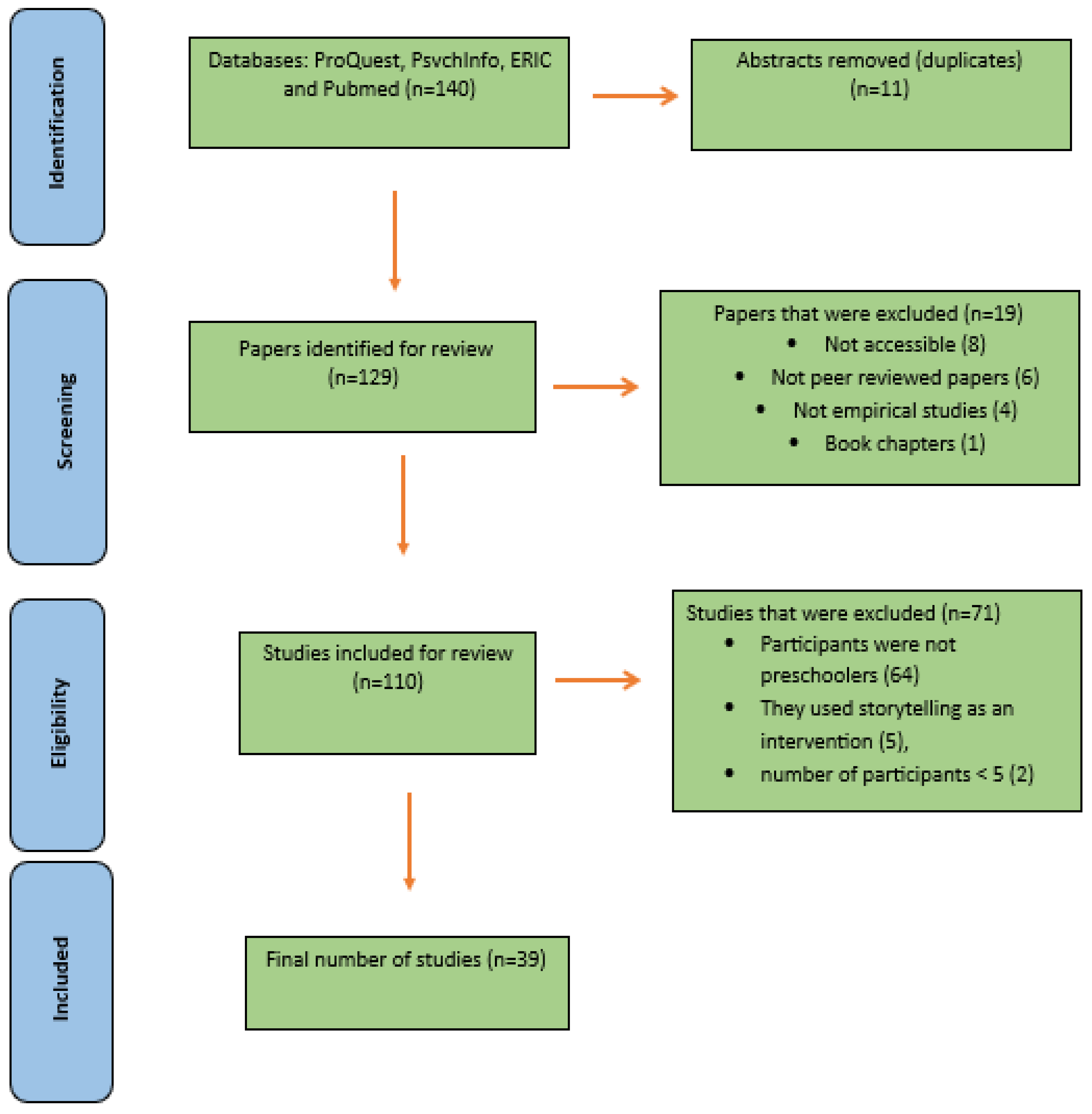
3.1. Identification and Selection of the Studies
3.2. Narrative Skills in Non-Autistic Children
3.3. Narrative Skills in Autism
3.4. Summary of the Reviewed Findings
4. Discussion
4.1. Narrative Production in Non-Autistic and Autistic Children
4.2. Story Retelling in Non-Autistic and Autistic Children
4.3. Narrative Comprehension and Inference Skills in Non-Autistic and Autistic Children
4.4. Language Skills and Narrative Performance in Non-Autistic and Autistic Children
4.5. Cognitive, Social, and Environmental Factors, and Narratives in Non-Autistic and Autistic Children
4.6. Comparison Between Non-Autistic and Autistic Preschool Children’s Narrative Abilities
4.7. Gaps in the Existing Literature and Directions for Future Research
5. Conclusions
Author Contributions
Funding
Institutional Review Board Statement
Informed Consent Statement
Data Availability Statement
Conflicts of Interest
Abbreviations
| MLU | Mean Length of Utterance |
| NDW | Number of Different Words |
| SES | Socio-economic status |
| TNW | Total Number of Words |
| ToM | Theory of Mind |
References
- Abbott, J. A., & McCarthey, S. J. (2001). Classroom influences on first-grade students’ oral narratives. Journal of Literacy Research, 33(3), 389–421. [Google Scholar] [CrossRef] [Scilit]
- Adlof, S. M., Baron, L. S., Bell, B. A., & Scoggins, J. (2021). Spoken word learning in children with developmental language disorder or dyslexia. Journal of Speech, Language, and Hearing Research, 64(9), 2734–2749. [Google Scholar] [CrossRef] [Scilit] [PubMed]
- Adornetti, I., Chiera, A., Altavilla, D., Deriu, V., Lecci, C. M., Marini, A., Valeri, G., Magni, R., & Ferretti, F. (2022). How do we comprehend linguistic and visual narratives? A study in children with typical development. Language Sciences, 93, 101500. [Google Scholar] [CrossRef] [Scilit]
- Astington, J. W. (1993). The child’s discovery of the mind. Harvard University Press. Available online: https://www.hup.harvard.edu/books/9780674116429 (accessed on 1 January 2025).
- Baixauli, I., Colomer, C., Roselló, B., & Miranda, A. (2016). Narratives of children with high-functioning autism spectrum disorder: A meta-analysis. Research in Developmental Disabilities, 59, 234–254. [Google Scholar] [CrossRef] [Scilit]
- Barnes, J. L., & Baron-Cohen, S. (2012). The Big Picture: Storytelling ability in adults with autism spectrum conditions. Journal of Autism and Developmental Disorders, 42(8), 1557–1565. [Google Scholar] [CrossRef] [Scilit]
- Bitetti, D., Hammer, C. S., & López, L. M. (2020). The narrative macrostructure production of Spanish–English bilingual preschoolers: Within- and cross-language relations. Applied Psycholinguistics, 41, 79–106. [Google Scholar] [CrossRef] [Scilit] [PubMed]
- Bohanek, J. G., Fivush, R., Zaman, W., Lepore, C. E., Merchant, S., & Duke, M. P. (2009). Narrative interaction in family dinner time conversations. Merrill-Palmer Quarterly, 55(4), 488–515. [Google Scholar] [CrossRef] [Scilit] [PubMed]
- Bohnacker, U. (2016). Tell me a story in English or Swedish: Narrative production and comprehension in bilingual preschoolers and first graders. Applied Psycholinguistics, 37, 19–48. [Google Scholar] [CrossRef] [Scilit]
- Bonifacci, P., Barbieri, M., Tomassini, M., & Roch, M. (2018). In few words: Linguistic gap but adequate narrative structure in preschool bilingual children. Journal of Child Language, 45, 120–147. [Google Scholar] [CrossRef] [Scilit]
- Boudreau, D. (2008). Narrative abilities: Advances in research and implications for clinical practice. Topics in Language Disorders, 28(2), 99–114. [Google Scholar] [CrossRef] [Scilit]
- Cain, K., Oakhill, J. V., Barnes, M. A., & Bryant, P. E. (2001). Comprehension skill, inference-making ability, and their relation to knowledge. Memory & Cognition, 29(6), 850–859. [Google Scholar] [CrossRef] [Scilit]
- Capps, L., Losh, M., & Thurber, C. (2000). “The frog ate the bug and made his mouth sad”: Narrative competence in children with autism. Journal of Abnormal Child Psychology, 28(2), 193–204. [Google Scholar] [CrossRef] [Scilit]
- Castilla-Earls, A. P., Petersen, D. B., Spencer, T. D., & Hammer, K. (2015). Narrative development in monolingual Spanish-speaking preschool children. Early Education and Development, 26(8), 1166–1186. [Google Scholar] [CrossRef] [Scilit]
- Chang, C. (2004). Telling stories of experiences: Narrative development of young Chinese children. Applied Psycholinguistics, 25(1), 83–104. [Google Scholar] [CrossRef] [Scilit]
- Charest, M., Skoczylas, M. J., & Schneider, P. (2020). Properties of lexical diversity in the narratives of children with typical language development and developmental language disorder. American Journal of Speech-Language Pathology, 29(4), 1866–1882. [Google Scholar] [CrossRef] [Scilit]
- Colle, L., Baron-Cohen, S., Wheelwright, S., & van der Lely, H. K. (2008). Narrative discourse in adults with high-functioning autism or Asperger syndrome. Journal of Autism and Developmental Disorders, 38(1), 28–40. [Google Scholar] [CrossRef] [Scilit]
- Colletta, J. M., Pellenq, C., & Guidetti, M. (2010). Age-related changes in co-speech gesture and narrative: Evidence from French children and adults. Speech Communication, 52(6), 565–576. [Google Scholar] [CrossRef] [Scilit]
- Crawshaw, C. E., Kern, F., Mertens, U., & Rohlfing, K. J. (2020). Children’s narrative elaboration after reading a storybook versus viewing a video. Frontiers in Psychology, 11, 569891. [Google Scholar] [CrossRef] [Scilit]
- Diehl, J. J., Bennetto, L., & Young, E. C. (2006). Story recall and narrative coherence of high-functioning children with autism spectrum disorders. Journal of Abnormal Child Psychology, 34(1), 87–102. [Google Scholar] [CrossRef] [Scilit] [PubMed]
- Dillon, G. V., & Underwood, J. D. M. (2012). Parental perspectives of students with autism spectrum disorders transitioning from primary to secondary school in the United Kingdom. Focus on Autism and Other Developmental Disabilities, 27(2), 111–121. [Google Scholar] [CrossRef] [Scilit]
- Dore, R. A., Amendum, S. J., Golinkoff, R. M., & Hirsh-Pasek, K. (2018). Theory of mind: A hidden factor in reading comprehension? Educational Psychology Review, 30(4), 1067–1089. [Google Scholar] [CrossRef] [Scilit]
- Dosi, I., & Boni, N. (2023). Pragmatic and language abilities in Autism Spectrum Disorder: A case study approach. In D. Katsarou (Ed.), Developmental language disorders in childhood and adolescence (pp. 71–84). IGI Global. [Google Scholar]
- Filiatrault-Veilleux, P., Bouchard, C., Trudeau, N., & Desmarais, C. (2016). Comprehension of inferences in a narrative in 3- to 6-year-old children. Journal of Speech, Language, and Hearing Research, 59(5), 1099–1110. [Google Scholar] [CrossRef] [Scilit]
- Florit, E., Roch, M., & Levorato, M. C. (2014). Listening text comprehension in preschoolers: A longitudinal study on the role of semantic components. Reading and Writing, 27(5), 793–817. [Google Scholar] [CrossRef] [Scilit]
- Friend, M., & Bates, R. P. (2014). The union of narrative and executive function: Different but complementary. Frontiers in Psychology, 5, 469. [Google Scholar] [CrossRef] [Scilit]
- Gabig, C. S. (2008). Verbal working memory and story retelling in school-age children with autism. Language, Speech, and Hearing Services in Schools, 39, 498–511. [Google Scholar] [CrossRef] [Scilit] [PubMed]
- Gagarina, N. (2016). Narratives of Russian–German preschool and primary school bilinguals: Rasskaz and Erzaehlung. Applied Psycholinguistics, 37, 91–122. [Google Scholar] [CrossRef] [Scilit]
- Gardner-Neblett, N., & Iruka, I. U. (2015). Oral narrative skills: Explaining the language–emergent literacy link by race/ethnicity and SES. Developmental Psychology, 51(7), 889–904. [Google Scholar] [CrossRef] [Scilit]
- Geelhand, P., Papastamou, F., Deliens, G., & Kissine, M. (2020). Narrative production in autistic adults: A systematic analysis of the microstructure, macrostructure and internal state language. Journal of Pragmatics, 164, 57–81. [Google Scholar] [CrossRef] [Scilit]
- Govindarajan, K., & Paradis, J. (2022). Narrative macrostructure and microstructure profiles of bilingual children with autism spectrum disorder: Differentiation from bilingual children with developmental language disorder and typical development. Applied Psycholinguistics, 43, 1359–1390. [Google Scholar] [CrossRef] [Scilit]
- Griffin, T. M., Hemphill, L., Camp, L., & Wolf, D. P. (2004). Oral discourse in the preschool years and later literacy skills. First Language, 24(2), 123–147. [Google Scholar] [CrossRef] [Scilit]
- Hamilton, L. G., O’Halloran, I., & Cutting, N. (2021). Individual differences in narrative production in late childhood: Associations with age and fiction reading experience. First Language, 41(2), 179–199. [Google Scholar] [CrossRef] [Scilit]
- Happé, F. G. E., & Booth, R. D. L. (2008). The power of the positive: Revisiting weak coherence in autism spectrum disorders. The Quarterly Journal of Experimental Psychology, 61, 50–63. [Google Scholar] [CrossRef] [Scilit]
- Harvey, A., Spicer-Cain, H., Botting, N., Ryan, G., & Henry, L. (2023). Assessing ‘coherence’ in the spoken narrative accounts of autistic people: A systematic scoping review. Research in Autism Spectrum Disorders, 102, 102108. [Google Scholar] [CrossRef] [Scilit]
- Hayward, D. V., Schneider, P., & Gillam, R. B. (2009). Age and task-related effects on young children’s understanding of a complex picture story. Alberta Journal of Educational Research, 55(1), 54–72. [Google Scholar] [CrossRef] [Scilit]
- He, C., Miyamoto, S., & Lin, Y. (2025). Narratives of Chinese kindergarteners with autism spectrum disorder: Comparison with typically developing children. Clinical Linguistics & Phonetics, 39(12), 1117–1141. [Google Scholar] [CrossRef] [Scilit]
- Heilmann, J., Miller, J., Nockerts, A., & Dunaway, C. (2010). Properties of the narrative scoring scheme using narrative retells in young school-age children. American Journal of Speech-Language Pathology, 19(2), 154–166. [Google Scholar] [CrossRef] [Scilit]
- Hilvert, E., Davidson, D., & Gámez, P. B. (2016). Examination of script and non-script based narrative retellings in children with autism spectrum disorders. Research in Autism Spectrum Disorders, 29, 79–92. [Google Scholar] [CrossRef] [Scilit]
- Hipfner-Boucher, K., Milburn, T., Weitzman, E., Greenberg, J., Pelletier, J., & Girolametto, L. (2015). Narrative abilities in subgroups of English language learners and monolingual peers. International Journal of Bilingualism, 19, 677–692. [Google Scholar] [CrossRef] [Scilit]
- Isbell, R., Sobol, J., Lindauer, L., & Lowrance, A. (2004). The effects of storytelling and story reading on the oral language complexity and story comprehension of young children. Early Childhood Education Journal, 32(3), 157–163. [Google Scholar] [CrossRef] [Scilit]
- Justice, L. M., Petscher, Y., Schatschneider, C., & Mashburn, A. (2011). Peer effects in preschool classrooms: Is children’s language growth associated with their classmates’ skills? Child Development, 82(6), 1768–1777. [Google Scholar] [CrossRef] [Scilit]
- Kanellou, M. A., Korvesi, E. A., Ralli, A. M., Mouzaki, A., Antoniou, F., Diamanti, V., & Papaioannou, S. (2016). Narrative skills in preschool & primary school children. Preschool and Primary Education, 4(1), 35–67. [Google Scholar] [CrossRef] [Scilit]
- Kang, H., Lundeberg, M., Wolter, B., del Mas, R., & Herreid, C. (2012). Gender differences in student performance in large lecture classrooms using personal response systems (“clickers”) with narrative case studies. Learning, Media and Technology, 37(1), 53–76. [Google Scholar] [CrossRef] [Scilit]
- Karlsen, J., Hjetland, H. N., Hagtvet, B. E., Braeken, J., & Melby-Lervåg, M. (2021). The concurrent and longitudinal relationship between narrative skills and other language skills in children. First Language, 41(5), 555–572. [Google Scholar] [CrossRef] [Scilit]
- Kauschke, C., van der Beek, B., & Kamp-Becker, I. (2016). Narratives of girls and boys with autism spectrum disorders: Gender differences in narrative competence and internal state language. Journal of Autism and Developmental Disorders, 46(3), 840–852. [Google Scholar] [CrossRef] [Scilit]
- Kelter, S., Kaup, B., & Claus, B. (2004). Representing a described sequence of events: A dynamic view of narrative comprehension. Journal of Experimental Psychology: Learning, Memory, and Cognition, 30(3), 451–464. [Google Scholar] [CrossRef] [Scilit] [PubMed]
- Kenan, N., Zachor, D. A., Watson, L. R., & Ben-Itzchak, E. (2019). Semantic-pragmatic impairment in the narratives of children with autism spectrum disorders. Frontiers in Psychology, 10, 2756. [Google Scholar] [CrossRef] [Scilit]
- Kendeou, P., Bohn-Gettler, C. M., White, M. J., & van den Broek, P. (2008). Children’s inference generation across different media. Journal of Research in Reading, 31(3), 259–272. [Google Scholar] [CrossRef] [Scilit]
- Khan, K. S., Gugiu, M. R., Justice, L. M., Bowles, R. P., Skibbe, L. E., & Piasta, S. B. (2016). Age-related progressions in story structure in young children’s narratives. Journal of Speech, Language, and Hearing Research, 59(6), 1395–1408. [Google Scholar] [CrossRef] [Scilit] [PubMed]
- Kim, Y. S. (2015). Language and cognitive predictors of text comprehension: Evidence from multivariate analysis. Child Development, 86(1), 128–144. [Google Scholar] [CrossRef] [Scilit]
- Kim, Y. S., & Phillips, B. (2014). Cognitive correlates of listening comprehension. Reading Research Quarterly, 49(3), 269–281. [Google Scholar] [CrossRef] [Scilit]
- King, D., Dockrell, J. E., & Stuart, M. (2014). Constructing fictional stories: A study of story narratives by children with autistic spectrum disorder. Research in Developmental Disabilities, 35(10), 2438–2449. [Google Scholar] [CrossRef] [Scilit]
- Kintsch, W. (1988). The role of knowledge in discourse comprehension: A construction-integration model. Psychological Review, 95(2), 163–182. [Google Scholar] [CrossRef] [Scilit]
- Kintsch, W. (1994). Text comprehension, memory, and learning. American Psychologist, 49(4), 294–303. [Google Scholar] [CrossRef]
- Kirby, M., Spencer, T., & Chen, Y. J. (2021). Oral narrative instruction improves kindergarten writing. Reading & Writing Quarterly, 37(6), 574–591. [Google Scholar] [CrossRef] [Scilit]
- Kuijper, S. J., Hartman, C. A., Bogaerds-Hazenberg, S. T., & Hendriks, P. (2017). Narrative production in children with autism spectrum disorder (ASD) and children with attention-deficit/hyperactivity disorder (ADHD): Similarities and differences. Journal of Abnormal Psychology, 126(1), 63–75. [Google Scholar] [CrossRef] [Scilit] [PubMed]
- Lee, M., Martin, G. E., Hogan, A., Hano, D., Gordon, P. C., & Losh, M. (2018). What’s the story? A computational analysis of narrative competence in autism. Autism, 22(3), 335–344. [Google Scholar] [CrossRef] [Scilit] [PubMed]
- Leinonen, E., Ryder, N., Ellis, M., & Hammond, C. (2003). The use of context in pragmatic comprehension by specifically language-impaired and control children. Linguistics, 41(2), 407–423. [Google Scholar] [CrossRef] [Scilit]
- Lepola, J., Lynch, J., Laakkonen, E., Silvén, M., & Niemi, P. (2012). The role of inference making and other language skills in the development of narrative listening comprehension in 4–6-year-old children. Reading Research Quarterly, 47(3), 259–282. [Google Scholar] [CrossRef] [Scilit]
- Lervåg, A., Hulme, C., & Melby-Lervåg, M. (2018). Unpicking the developmental relationship between oral language skills and reading comprehension: It’s simple, but complex. Child Development, 89(5), 1821–1838. [Google Scholar] [CrossRef] [Scilit]
- Lever, R., & Sénéchal, M. (2011). Discussing stories: On how a dialogic reading intervention improves kindergartner’s oral narrative construction. Journal of Experimental Child Psychology, 108(1), 1–24. [Google Scholar] [CrossRef] [Scilit]
- Lindgren, J. (2019). Comprehension and production of narrative macrostructure in Swedish: A longitudinal study from age 4 to 7. First Language, 39, 412–432. [Google Scholar] [CrossRef] [Scilit]
- Mason, R. A., & Just, M. A. (2009). The role of the theory-of-mind cortical network in the comprehension of narratives. Language and Linguistics Compass, 3(1), 157–174. [Google Scholar] [CrossRef] [Scilit] [PubMed]
- Mayer, M. (1992). Frog goes to dinner. Puffin Books. [Google Scholar]
- Mäkinen, L., Loukusa, S., Nieminen, L., Leinonen, E., & Kunnari, S. (2014). The development of narrative productivity, syntactic complexity, referential cohesion and event content in four- to eight-year-old Finnish children. First Language, 34(1), 24–42. [Google Scholar] [CrossRef] [Scilit]
- Mäkinen, L., Soile, L., Ilaria, G., & Sari, K. (2018). Are story retelling and story generation connected to reading skills? Evidence from Finnish. Child Language Teaching and Therapy, 34(2), 129–139. [Google Scholar] [CrossRef] [Scilit]
- McCabe, A., Hillier, A., & Shapiro, C. (2013). Brief report: Structure of personal narratives of adults with autism spectrum disorder. Journal of Autism and Developmental Disorders, 43(3), 733–738. [Google Scholar] [CrossRef] [Scilit] [PubMed]
- McCabe, A., & Peterson, C. (1991). Developing narrative structure. Lawrence Erlbaum Associates. Available online: http://psycnet.apa.org/record/1991-97724-000 (accessed on 10 November 2025).
- Méndez, L. I., Perry, J., Holt, Y., Bian, H., & Fafulas, S. (2018). Same or different: Narrative retells in bilingual Latino kindergarten children. Bilingual Research Journal, 41, 150–166. [Google Scholar] [CrossRef] [Scilit]
- Moola, S., Munn, Z., Tufanaru, C., Aromataris, E., Sears, K., Sfetcu, R., Currie, M., Qureshi, R., Mattis, P., Lisy, K., & Mu, P. F. (2020). Systematic reviews of etiology and risk. In E. Aromataris, & Z. Munn (Eds.), JBI manual for evidence synthesis (pp. 219–269). JBI Global. Available online: https://synthesismanual.jbi.global (accessed on 26 April 2026). [CrossRef] [Scilit]
- Muñoz, M. L., Gillam, R. B., Peña, E. D., & Gulley-Faehnle, A. (2003). Measures of language development in fictional narratives of Latino children. Language, Speech, and Hearing Services in Schools, 34(4), 332–342. [Google Scholar] [CrossRef] [Scilit]
- Nicolopoulou, A., & Richner, E. S. (2007). From actors to agents to persons: The development of character representation in young children’s narratives. Child Development, 78(2), 412–429. [Google Scholar] [CrossRef] [Scilit]
- Norbury, C., Gemmell, T., & Paul, R. (2014). Pragmatic abilities in narrative production: A cross-disorder comparison. Journal of Child Language, 41(3), 485–510. [Google Scholar] [CrossRef] [Scilit]
- Norbury, C. F., & Bishop, D. V. M. (2002). Inferential processing and story recall in children with communication problems: A comparison of specific language impairment, pragmatic language impairment and high-functioning autism. International Journal of Language & Communication Disorders, 37(3), 227–251. [Google Scholar] [CrossRef] [Scilit]
- Novogrodsky, R., & Edelson, L. R. (2016). Ambiguous pronoun use in narratives of children with autism spectrum disorders. Child Language Teaching and Therapy, 32(2), 241–252. [Google Scholar] [CrossRef] [Scilit]
- Nuske, H. J., & Bavin, E. L. (2011). Narrative comprehension in 4–7-year-old children with autism: Testing the weak central coherence account. International Journal of Language & Communication Disorders, 46, 108–119. [Google Scholar] [CrossRef] [Scilit]
- Oakhill, J. V., & Cain, K. (2011). The precursors of reading ability in young readers: Evidence from a four-year longitudinal study. Scientific Studies of Reading, 16(2), 91–121. [Google Scholar] [CrossRef] [Scilit]
- O’Neill, D. K., Pearce, M. J., & Pick, J. L. (2004). Preschool children’s narratives and performance on the Peabody individualized achievement test–revised: Evidence of a relation between early narrative and later mathematical ability. First Language, 24(2), 149–183. [Google Scholar] [CrossRef] [Scilit]
- Page, M. J., McKenzie, J. E., Bossuyt, P. M., Boutron, I., Hoffmann, T. C., Mulrow, C. D., Shamseer, L., Tetzlaff, J. M., Akl, E. A., Brennan, S. E., Chou, R., Glanville, J., Grimshaw, J. M., Hróbjartsson, A., Lalu, M. M., Li, T., Loder, E. W., Mayo-Wilson, E., McDonald, S., … Moher, D. (2021). The PRISMA 2020 statement: An updated guideline for reporting systematic reviews. BMJ, 372, n71. [Google Scholar] [CrossRef] [Scilit] [PubMed]
- Paris, A. H., & Paris, S. G. (2003). Assessing narrative comprehension in young children. Reading Research Quarterly, 38(1), 36–76. [Google Scholar] [CrossRef] [Scilit]
- Paris, S. G., Carpenter, R. D., Paris, A. H., & Hamilton, E. E. (2005). Spurious and genuine correlates of children’s reading comprehension. In S. G. Paris, & S. A. Stahl (Eds.), Children’s reading comprehension and assessment (pp. 131–160). Lawrence Erlbaum. [Google Scholar]
- Pavias, M., van den Broek, P., Hickendorff, M., Beker, K., & van Leijenhorst, L. (2016). Effects of social-cognitive processing demands and structural importance on narrative recall: Differences between children, adolescents, and adults. Discourse Processes, 53(7), 488–512. [Google Scholar] [CrossRef] [Scilit]
- Petersen, D. B., Gillam, S. L., Spencer, T., & Gillam, R. B. (2010). The effects of literate narrative intervention on children with neurologically based language impairments: An early stage study. Journal of Speech, Language, and Hearing Research, 53(4), 961–981. [Google Scholar] [CrossRef] [Scilit] [PubMed]
- Pistav Akmese, P., & Kanmaz, S. (2021). Narrative to investigate language skills of preschool children. International Electronic Journal of Elementary Education, 14(1), 9–22. [Google Scholar] [CrossRef] [Scilit]
- Potocki, A., Ecalle, J., & Magnan, A. (2013). Narrative comprehension skills in 5-year-old children: Correlational analysis and comprehender profiles. The Journal of Educational Research, 106(1), 14–26. [Google Scholar] [CrossRef] [Scilit]
- Ralli, A. M., Kazali, E., Kanellou, M., Mouzaki, A., Antoniou, F., Diamanti, V., & Papaioannou, S. (2021). Oral language and story retelling during preschool and primary school years: Developmental patterns and interrelationships. Journal of Psycholinguistic Research, 50, 949–965. [Google Scholar] [CrossRef] [Scilit]
- Rezzonico, S., Goldberg, A., Mak, K. K.-Y., Yap, S., Milburn, T., Belletti, A., & Girolametto, L. (2016). Narratives in two languages: Storytelling of bilingual Cantonese–English preschoolers. Journal of Speech, Language, and Hearing Research, 59, 521–532. [Google Scholar] [CrossRef] [Scilit] [PubMed]
- Rodina, Y. (2017). Narrative abilities of preschool bilingual Norwegian–Russian children. International Journal of Bilingualism, 21, 617–635. [Google Scholar] [CrossRef] [Scilit]
- Rollins, P. R. (2014). Narrative skills in young adults with high-functioning autism spectrum disorders. Communication Disorders Quarterly, 36(1), 21–28. [Google Scholar] [CrossRef] [Scilit]
- Safwat, R. F., El-Dessouky, H., Shohdi, S. S., & Hussien, I. A. (2013). Assessment of narrative skills in preschool children. The Egyptian Journal of Otolaryngology, 29(2), 130–135. [Google Scholar] [CrossRef] [Scilit]
- Shapiro, L. (1991). From knowing to telling: The development of children’s scripts, stories, and personal narratives. In A. McCabe, & C. Peterson (Eds.), Developing narrative structure (pp. 89–136). Lawrence Erlbaum. [Google Scholar]
- Siller, M., Swanson, M. R., Serlin, G., & Teachworth, A. G. (2014). Internal state language in the storybook narratives of children with and without autism spectrum disorder: Investigating relations to theory of mind abilities. Research in Autism Spectrum Disorders, 8(5), 589–596. [Google Scholar] [CrossRef] [Scilit]
- Silva, M., Strasser, K., & Cain, K. (2014). Early narrative skills in Chilean preschool: Questions scaffold the production of coherent narratives. Early Childhood Research Quarterly, 29(2), 205–213. [Google Scholar] [CrossRef] [Scilit]
- Slobin, D. I. (2004). The many ways to search for a frog: Linguistic typology and the expression of motion events. In S. Strömqvist, & L. Verhoeven (Eds.), Relating events in narrative: Vol. 2. Typological and contextual perspectives (pp. 219–257). Lawrence Erlbaum. [Google Scholar]
- Smith, J., Levickis, P., Eadie, T., Bretherton, L., Conway, L., & Goldfeld, S. (2019). Associations between early maternal behaviours and child language at 36 months in a cohort experiencing adversity. International Journal of Language & Communication Disorders, 54(1), 110–122. [Google Scholar] [CrossRef] [Scilit]
- Souza, M. S. L., & Cáceres-Assenço, A. M. (2021). Do vocabulary and narrative skills correlate in preschoolers with typical language development? CoDAS, 33, e20200169. [Google Scholar] [CrossRef] [Scilit] [PubMed]
- Spencer, T., & Petersen, D. (2020). Narrative intervention: Principles to practice. Language, Speech, and Hearing Services in Schools, 51(4), 1081–1096. [Google Scholar] [CrossRef] [Scilit] [PubMed]
- Stadler, M. A., & Ward, G. C. (2005). Supporting the narrative development of young children. Early Childhood Education Journal, 33(2), 73–80. [Google Scholar] [CrossRef] [Scilit]
- Strasser, K., & del Río, F. (2014). The role of comprehension monitoring, theory of mind, and vocabulary depth in predicting story comprehension and recall of kindergarten children. Reading Research Quarterly, 49(2), 169–187. [Google Scholar] [CrossRef] [Scilit]
- Thordardottir, E., Keheyia, E., Lessard, N., Sutton, A., & Trudeau, N. (2010). Typical performance on tests of language knowledge and language processing of French-speaking 5-year-olds. Revue Canadienne D’orthophonie et D’audiologie, 34, 5–16. [Google Scholar]
- Tompkins, V., Guo, Y., & Justice, L. M. (2013). Inference generation, story comprehension, and language skills in the preschool years. Reading and Writing, 26(3), 403–429. [Google Scholar] [CrossRef] [Scilit]
- Uccelli, P., & Páez, M. M. (2007). Narrative and vocabulary development of bilingual children from kindergarten to first grade: Developmental changes and associations among English and Spanish skills. Language, Speech, and Hearing Services in Schools, 38, 225–236. [Google Scholar] [CrossRef] [Scilit]
- Veneziano, E., & Nicolopoulou, A. (2019). Introduction to narrative, literacy and other skills. In E. Veneziano, & A. Nicolopoulou (Eds.), Narrative, literacy and other skills: Studies in intervention (pp. 1–18). John Benjamins Publishing Company. [Google Scholar]
- Veraksa, A., Bukhalenkova, D., Kartushina, N., & Oshchepkova, E. (2020). The relationship between executive functions and language production in 5–6-year-old children: Insights from working memory and storytelling. Behavioral Sciences, 10, 52. [Google Scholar] [CrossRef] [Scilit] [PubMed]
- Vretudaki, H. (2022). Tell me the whole story: Moving from narrative comprehension to narrative production skills. European Early Childhood Education Research Journal, 30(6), 949–960. [Google Scholar] [CrossRef] [Scilit]
- Vretudaki, H., & Tafa, E. (2022). Personal and fictional narratives development in kindergarten children: The effects of an intervention programme. Early Child Development and Care, 192(15), 2545–2558. [Google Scholar] [CrossRef] [Scilit]
- Westerveld, M. F., & Gillon, G. T. (2010). Profiling oral narrative ability in young school-aged children. International Journal of Speech-Language Pathology, 12(3), 178–189. [Google Scholar] [CrossRef] [Scilit]
- Westerveld, M. F., Gillon, G. T., & Boyd, L. (2012). Evaluating the clinical utility of the profile of oral narrative ability in 4-year-old children. International Journal of Speech-Language Pathology, 14(2), 130–140. [Google Scholar] [CrossRef] [Scilit]
- Westerveld, M. F., & Roberts, J. M. A. (2017). The oral narrative comprehension and production abilities of verbal preschoolers on the autism spectrum. Language, Speech, and Hearing Services in Schools, 48(4), 260–272. [Google Scholar] [CrossRef] [Scilit] [PubMed]
- Yang, J., Kim, J. H., Tuomainen, O., & Rattanasone, N. X. (2022). Bilingual Mandarin–English preschoolers’ spoken narrative skills and contributing factors: A remote online story-retell study. Frontiers in Psychology, 13, 797602. [Google Scholar] [CrossRef] [Scilit] [PubMed]
- Yuan, Y., Major-Girardin, J., & Brown, S. (2018). Storytelling is intrinsically mentalistic: A functional magnetic resonance imaging study of narrative production across modalities. Journal of Cognitive Neuroscience, 30(9), 1298–1314. [Google Scholar] [CrossRef] [Scilit] [PubMed]


| Study | Country | Method | Results |
|---|---|---|---|
| Studies with non-autistic children | |||
| Bitetti et al. (2020) | USA | Participants: 200 Spanish-English non-autistic children, aged between 3;0 to 5;3 years old Measures: Narrative production—story telling through wordless picture books, separately in Spanish and English Coding: narrative macrostructure, narrative comprehension; Language ability tests in Spanish and English to assess language dominance |
|
| Bohnacker (2016) | Sweden | Participants: 52 Swedish-English non-autistic children, aged between 5 and 7 years old Measures: Narrative production—story telling in Swedish and English Coding: narrative macrostructure and microstructure, narrative comprehension |
|
| Bonifacci et al. (2018) | Italy | Participants: 64 bilingual non-autistic children, aged between 4 and 5 years old (various first languages: Tagalog, Urdu, Arabic, Romanian, Bengali, Spanish, Chinese, Russian, Hindi, Albanian, French and Polish; second language: Italian); 64 monolingual Italian-speaking non-autistic children, aged between 4 and 5 years old Measures: General language ability battery testing, story sequencing, articulation and vocabulary, phonological awareness, morphosyntactic comprehension, phonological memory, and letter knowledge |
|
| Castilla-Earls et al. (2015) | USA | Participants: 104 Spanish-speaking non-autistic children, aged between 3 and 5 years old Measures: Narrative production—story retelling Coding: Index of Narrative Complexity |
|
| Crawshaw et al. (2020) | Germany | Participants: 46 non-autistic children, aged between 4 and 5 years old (27 boys—19 girls), Sample sizes unbalanced in number and gender Measures: Narrative production—story retelling, focusing on story content, Same story (The mole and the green star)—2 narrative input conditions: (a) illustrated storybook format & (b) non-verbal animated cartoon-video format | The video condition gave significantly more elaborated retellings (in Who, What, and Where components, as compared to When, How, and Why components). |
| Filiatrault-Veilleux et al. (2016) | Canada | Participants: 121 non-autistic children, 3 age groups (3–4-, 4–5- & 5–6-year-olds), 62 boys Measures: Narrative comprehension assessing causal inference type targeting elements of the story grammar, iPad application |
|
| Florit et al. (2014) | Italy | Participants: 156 non-autistic children, aged 4–5.11 years old, 71 girls (Time 1) & 152 of the above children, 68 girls (Time 2, 8 months later), middle to lower-middle socio-economic status Measures: Longitudinal design, The Test for Listening Comprehension-TOR 3–8, Lower-level semantic components, Expressive & Receptive word knowledge, Higher-level semantic components: Inferential tasks, Short-term & working memory tasks |
|
| Friend and Bates (2014) | USA | Participants: 42 non-autistic children aged between 4 and 5 years old & their caregivers Measures: Narrative production (“Frog, where are you?”), a complexity scale with 4 subscales used to code children’s narratives: (a) elements, (b) sequence, (c) syntax & (d) lexicon, executive function (EF) task: attention network test, language sample: a 10 min interaction between child and caregiver during play at home |
|
| Gagarina (2016) | Germany | Participants: 21 Russian-German non-autistic preschoolers aged 4 years old, 15 non-autistic Russian-German first graders aged 7 years old, 22 Russian-German non-autistic third graders aged 9 years old Measures: Narrative telling in each language via a wordless picture book; assessment of macrostructure and use of mental state terms |
|
| Hipfner-Boucher et al. (2015) | Canada | Participants: 2 groups of English Language Learners (ELLs: ELL minority language group & ELL English language group), and a group of English monolingual (EL1) preschool children. 25 participants in each group, averaged 56 months of age. Measures: Narrative retell tasks, examining macrostructure and microstructure |
|
| Isbell et al. (2004) | USA | Participants: 38 non-autistic children aged between 3 and 4 years old. Measures: Narrative retelling from storytelling (Group 1) & reading (Group 2), 12-week study, 24 stories from picture books |
|
| Kanellou et al. (2016) | Greece | Participants: 237 non-autistic children aged between 4 to 7 years old, Greek-speaking, from various regions of Greece Measures: Narrative production & retelling skills, 4 wordless illustrated stories (2 stories for retelling and 2 stories for telling/narrative production), Criteria assessed: microstructure/cohesion (conjunction and lexical cohesion) & macrostructure/coherence (story grammar and temporal sequencing of actions and events) |
|
| Karlsen et al. (2021) | Norway | Participants: 215 non-autistic children (Mage = 4.3 years), 109 boys & 106 girls Measures: Longitudinal study—initial assessment at age 4 and the second assessment at age 7; At age 4: Story retelling (Norwegian version of the Renfrew Bus Story Test), receptive vocabulary (Norwegian version of the British Picture Vocabulary Scale), sentence memory (Sentence Memory subtest of the Norwegian language screening test ‘Language 6–16’), and grammatical knowledge (Norwegian version of the Grammatic Closure subtest from the Illinois Test of Psycholinguistic Abilities). At age 7: a listening comprehension test (Norwegian version of the Neale Analysis of Reading Ability). |
|
| Kendeou et al. (2008) | Canada & USA | Participants: 113 non-autistic children aged between 4 and 6 years old (Time 1), and 108 of them between 6 and 8 years old (Time 2) Measures: Longitudinal study, Time 2: 2 years later, two narratives for narrative comprehension assessment (“The Cat’s Purr” on audiotape & “The Autumn Leaves”, audio-visual episode from television series), Open-ended comprehension questions followed each narrative, Evaluation of phonological awareness, letter and word identification (Woodcock Reading Mastery Test) & vocabulary (Peabody Picture Vocabulary Test—III) [Time 1], two different narratives for narrative comprehension (“The Rabbit and the Moon” on audiotape & “Granny’s New Glasses” audio-visual episode from television series), Open-ended comprehension questions followed each narrative [Time 2], Same tests of basic language skills used at Time 1 were used at Time 2. |
|
| Khan et al. (2016) | USA | Participants: 386 non-autistic children aged between 3 and 6 years old Measures: Narrative retelling: two randomly selected stories read to each child, Wordless picture books developed for this study (Wolf Cleans His Bedroom, Tiger Gets Ready for Bed, Raccoon Makes Lemonade, and Rabbit Goes for a Bike Ride)—all stories had an identical format |
|
| Lepola et al. (2012) | Finland | Participants: 130 Finnish-speaking non-autistic children, 62 boys and 68 girls, Time 1 (age 4), Time 2 (age 5), Time 3 (age 6) Measures: 2-year longitudinal study, Early narrative listening comprehension, Language skills (receptive vocabulary, sentence memory, & phonological awareness) |
|
| Lindgren (2019) | Sweden | Participants: 17 non-autistic children aged between 4 and 7 years old. Longitudinal design: assessment at age 4;4, 5;10 and 7;4 Measures: Comprehension and production of narrative macrostructure in Swedish monolingual children |
|
| Mäkinen et al. (2014) | Finland | Participants: 172 non-autistic children aged between 4 and 8 years old Measures: Picture-elicited narrations which were analysed for productivity, syntactic complexity, referential cohesion & event content. |
|
| Méndez et al. (2018) | USA | Participants: 14 Spanish-English bilingual non-autistic children aged between 4 and 6 years Measures: Picture-elicited narrative retellings in both languages, which were analysed for microstructure (mean length of utterance in words, lexical diversity, use of subordinate clauses), and macrostructure (introduction, conflict resolution, conclusion), as well as use of mental state terms |
|
| Nicolopoulou and Richner (2007) | USA | Participants: 30 non-autistic children, 3 age groups: early 3-year-olds, early 4-year-olds & late 4-year-olds Measures: Storytelling & story-acting, children voluntarily dictated self-initiated stories to teachers and peers every day, as a self-chosen free-play activity, and acted them out later with their friends. Children chose their own characters, subjects, and plots. The stories were neither solicited by adults nor channelled by props, story stems, or suggested topics. |
|
| Pistav Akmese and Kanmaz (2021) | Turkey | Participants: 100 non-autistic children, 50 in the age group of 4–5 years, 50 children in the age group of 5–6 years Measures: Descriptive survey, Receptive and expressive verbal language skills, Narrative production, Mean Length of Utterance (MLU), Number of Different Words (NDW), Total Number of Words (TNW) |
|
| Ralli et al. (2021) | Greece | Participants: 237 non-autistic children, 98 boys—139 girls, Greek-speaking, Middle class from various parts of Greece, 3 age groups: (a) 79 children (33.3%) 4–5 year old (Mage = 4.5), (b) 58 children (24.5%), 5–6 year old (Mage = 5.5), (c) 100 children (42%), 6–7 year old (Mage = 6.5) Measures: Story Retelling, Oral Language Measures: Vocabulary Knowledge Tasks, Phonological Awareness & Processing Tasks, Morphological Awareness Tasks, Pragmatics Task |
|
| Rezzonico et al. (2016) | Canada | Participants: 23 English-Cantonese bilingual non-autistic children aged 4 years old; 24 English-Cantonese bilingual non-autistic children aged 5 years old Measures: Narrative story telling (a wordless picture story) in both languages, English and Cantonese; assessing macrostructure and microstructure (sentence length, lexical diversity, morphosyntactic quality); Language ability assessment: expressive and receptive vocabulary |
|
| Rodina (2017) | Norway | Participants: 16 Norwegian (dominant language)-Russian (minority language) bilingual non-autistic children aged 4 years old, 16 Norwegian monolingual non-autistic children aged 4 years old, 16 Russian monolingual non-autistic children aged 4 years old Measures: Narrative production separately in each language, i.e., Norwegian and Russian (assessment of both microstructure and macrostructure), narrative comprehension |
|
| Safwat et al. (2013) | Egypt | Participants: 60 non-autistic children, 29 boys & 31 girls—4 groups: Group A: 2–2.11-year-olds, Group B: 3–3.11-year-olds, Group C: 4–4.11-year-olds, Group D: 5–5.11-year-olds Measures: Narrative story retelling (a wordless picture story, specially designed for this study)—assessing macrostructure & microstructure, Language ability assessment: Standardized Arabic language test, Articulation, General & neurological examination, & audiological evaluation | Results for Group C & D only:
|
| Silva et al. (2014) | Chile | Participants: 60 non-autistic children, aged between 5 and 6 years old, from 3 public and private Chilean schools Measures: Narrative skills: (a) picture-walk (look the story from a wordless picture-book: ‘A boy, a dog, and a frog’), (b) narrative comprehension questions (10 questions about the characters, setting, mental states, such as feelings & thoughts, the initiating event, the problem and its resolution, and predictions targeting memory and story comprehension, (c) book storytelling |
|
| Souza and Cáceres-Assenço (2021) | Brazil | Participants: 39 non-autistic children aged between 4 and 6 years old, 48.7% boys, 3 age groups: (a) 4-year-olds (25.6%), (b) 5-year-olds (33.3%), (c) 6-year-olds (41%), family variables: mothers with higher education (38.5%) or a master’s degree (38.5%) Measures: Language assessment: vocabulary, phonology, fluency, speech, phonological short-term memory, Narrative production (book “Frog, where are you?”) |
|
| Thordardottir et al. (2010) | Canada | Participants: 78 monolingual speakers of Quebec French—three age groups (4;6, 5;0 and 5;6 years) Measures: Tests of language knowledge and linguistic processing, addressing vocabulary, morphosyntax, syntax, narrative structure, nonword repetition, sentence imitation, rapid automatized naming, following directions, and short-term memory |
|
| Tompkins et al. (2013) | USA | Participants: 42 non-autistic children aged between 3.8 and 5.8 years old, Mother-child participation, Medium to high socio-economic status Measures: Vocabulary: Receptive (PPVT-4: Peabody Picture Vocabulary Test-4th edition) & Expressive (EVT-2: The Expressive Vocabulary Test-2nd edition, Narrative comprehension: 5 questions assessed literal understanding of the story (initiating event, overarching goal, characters, setting, and outcome resolution) & 5 questions assessed children’s ability to make inferences (dialogue, causal inference, feelings, predicting what happens next, and the theme), Narrative production from a wordless picture book (Frog Goes to Dinner—Mayer, 1992) |
|
| Uccelli and Páez (2007) | USA | Participants: 24 bilingual non-autistic children were assessed in English and Spanish at the end of kindergarten (Time 1) and at the end of first grade (Time 2) Measures: Narrative production in each language, English and Spanish; narrative microstructure (lexical diversity) and macrostructure (story structure) |
|
| Veraksa et al. (2020) | Russia | Participants: 269 non-autistic children, aged between 5 and 6 years old (Mage = 5.6 years; Sd = 0.48), 133 boys & 136 girls Measures: NEPSY II: (a) Verbal working memory (sentence repetition), (b) Visual working memory (memory of designs), Story retelling (“The Jackdaw and the Pigeons” by L.N. Tolstoy)—in the absence of a story, up to 3 reading rounds, Narrative production (create a story on a series of pictures: (i) “The Tower”, (ii) “The Cat and the Dog”, (iii) “The Broken Cup”)—children assembled the pictures in alogical sequence of events, and built a story, Text’s macrostructure: semantic completeness & adequacy, story programming, speech pace, number of words and paragrammatisms (i.e., number of lexical and grammatical mistakes), narrative type (complete, i.e., the child includes full amount of relevant information; simplified, i.e., the child provides partial, yet, relevant information; or distorted, i.e., the child provides inaccurate or irrelevant information), and narrative structure, Text’s microstructure: lexical and grammatical accuracy |
|
| Westerveld et al. (2012) | New Zealand | Participants: 73 non-autistic children, aged between 4 and 4.11 years old, 43 girls (59%) & 29 boys (41%), low-mid to high socio-economic backgrounds, NZ English Measures: Longitudinal design (Time 1: age 4, Time 2: age 5), Narrative ability at age 4 and age 5, (a) Listened an audio-recording of unfamiliar story, while looking at the pictures of the story book on a computer screen, (b) Oral narrative comprehension (ONC): 8 factual and inferential questions (targeting the main idea, sequence, story details, and predictive information) followed the first exposure to the story, (c) Story retelling, without the use of pictures, following the second exposure to the story: examination of oral narrative quality (ONQ) with (a) macrostructure (6 text structure elements: introduction, main character/s, supporting character/s, conflict, resolution, conclusion, holistic coherence ‘theme’) & (b) microstructure (semantic diversity: Number of Different Words (NDW), verbal productivity: total number of utterances (UTT), grammatical ability: mean length of utterance in morphemes (MLU-M), and grammatical competency: grammatical accuracy (GA) in percentiles of grammatically correct utterances, Receptive vocabulary skills at age 4 |
|
| Yang et al. (2022) | Australia | Participants: 25 Mandarin–English speaking children between 3 and 6 years old Measures: remote online story retelling in Mandarin and English; microstructural elements total number of words, number of different words, total number of C- and T-units, and mean length of utterance in words; macrostructural elements (Introduction, Theme, Main Character, Supporting Character(s), Conflict, Coherence, Resolution and Conclusion); weekly diary detailing daily Mandarin, English, and mixed language input and output per hour |
|
| Study with autistic children | |||
| Westerveld and Roberts (2017) | Australia | Participants: 29 autistic children aged between 4 and 5.9 years old, Ability to speak in short sentences, Age equivalent score of 36 months on the expressive communication subscale of the VABS-II Measures: Level of nonverbal ability: Visual Reception and Fine Motor skills (Mullen Scales of Early Learning—MSEL), Communication skills (Vineland Adaptive Behavior Scales-II—VABS-II), Receptive vocabulary (Peabody Picture Vocabulary Test 4—PPVT-4), Narrative comprehension: children listened twice to an audio-recording (“Ana gets Lost”), while looking at the pictures from the book on a computer screen—8 factual and inferential questions, Narrative retelling without the use of pictures—only neutral prompts to start and/or continue retelling the story, Micro-and macrostructure |
|
| Studies with non-autistic and autistic children | |||
| Gabig (2008) | USA | Participants: 10 non-autistic children and 15 autistic children (13 boys) aged between 5 and 7.11 years old Measures: Nonverbal intelligence, Language skills, Story retelling task (The Renfrew Bus Story) & Verbal working memory tasks |
|
| Govindarajan and Paradis (2022) | Canada | Participants: 9 bilingual autistic children aged 5;4 to 9;1 (diverse first languages-English as second language), 10 bilingual non-autistic children aged 5;4 to 9;1 (diverse first languages-English as second language), 10 bilingual children with DLD aged 5;4 to 9;1 (diverse first languages-English as second language) Measures: Narrative telling through a pictured story; assessment of narrative microstructure (utterance length, syntactic complexity, lexical diversity, story length) and narrative macrostructure (character introductions, settings, initiating events, attempts, outcomes, use of mental state terms) |
|
| He et al. (2025) | China | Participants: 19 non-autistic children (Mage = 5.14 years) and 19 autistic children (Mage = 5.57 years) (age range: 3.5–7.2 years old), Mandarin speaking Measures: Narrative Assessment Protocol–2 (NAP-2): assessment of microstructural (linguistic & syntactic complexity) & macrostructural (story organization and coherence) features, Story retelling (wordless picture book ‘Raccoon Makes Lemonade’), Story length, Linguistic performance (mean length of utterance, number of different words, vocabulary diversity) |
|
| Kenan et al. (2019) | Israel | Participants: 24 non-autistic children and 24 autistic children aged between 4.10 and 7 years old, only boys, IQ > 80 Measures: Autism Diagnostic Observation Scales (ADOS), Wechsler Preschool and Primary Scale of Intelligence (3rd ed), Picture book, Language measures: (a) total length of story and syntactic complexity, (b) semantic-pragmatic measures: details of history, key ideas, evaluative comments and irrelevant text |
|
| Nuske and Bavin (2011) | Australia | Participants: 14 non-autistic children aged between 4.2 and 5.4 years old (7 boys & 7 girls) and 14 autistic children aged between 4.6 and 7.11 years old (13 boys & 1 girl) Measures: two narrative comprehension tasks: short stories were read followed by comprehension questions, Understanding Spoken Paragraphs & Inferential Processing, Receptive Vocabulary and Picture Completion sub-tests from the WPPSI-3 |
|
Disclaimer/Publisher’s Note: The statements, opinions and data contained in all publications are solely those of the individual author(s) and contributor(s) and not of MDPI and/or the editor(s). MDPI and/or the editor(s) disclaim responsibility for any injury to people or property resulting from any ideas, methods, instructions or products referred to in the content. |
© 2026 by the authors. Licensee MDPI, Basel, Switzerland. This article is an open access article distributed under the terms and conditions of the Creative Commons Attribution (CC BY) license.
Share and Cite
Kouvava, S.; Antonopoulou, K.; Stampoltzis, A.; Mavropoulou, S.; Patroumpa, E.; Tzoumailis, A.; Peristeri, E. Narrative Skills in Autistic and Non-Autistic Preschool Children: A Scoping Review. Languages 2026, 11, 93. https://doi.org/10.3390/languages11050093
Kouvava S, Antonopoulou K, Stampoltzis A, Mavropoulou S, Patroumpa E, Tzoumailis A, Peristeri E. Narrative Skills in Autistic and Non-Autistic Preschool Children: A Scoping Review. Languages. 2026; 11(5):93. https://doi.org/10.3390/languages11050093
Chicago/Turabian StyleKouvava, Sofia, Katerina Antonopoulou, Aglaia Stampoltzis, Sofia Mavropoulou, Eirini Patroumpa, Aggelos Tzoumailis, and Eleni Peristeri. 2026. "Narrative Skills in Autistic and Non-Autistic Preschool Children: A Scoping Review" Languages 11, no. 5: 93. https://doi.org/10.3390/languages11050093
APA StyleKouvava, S., Antonopoulou, K., Stampoltzis, A., Mavropoulou, S., Patroumpa, E., Tzoumailis, A., & Peristeri, E. (2026). Narrative Skills in Autistic and Non-Autistic Preschool Children: A Scoping Review. Languages, 11(5), 93. https://doi.org/10.3390/languages11050093