

Beyond “Move” and “Go”: A Hierarchy-Based Analysis of Chinese EFL Learners’ Acquisition of Motion Verbs

Abstract
1. Introduction
1.1. Literature Review
1.2. Research Gap
2. Theoretical Framework
2.1. Talmy’s Motion Events Framework and Semantic Granularity
2.1.1. Talmy’s Motion Events Framework
2.1.2. The “Equipollent-Framed” Characteristics of Chinese
| Chinese: | 他 | 跑 | 进 | 了 | 教室。 |
| Tā | pǎo | jìn | le | jiàoshì | |
| He | run | enter | classroom | ||
| English: | He ran into the classroom. | ||||
2.1.3. Semantic Granularity
2.2. Levin’s English Verb Classes
2.3. Conceptual Metaphor Theory
2.4. Slobin’s “Thinking for Speaking”
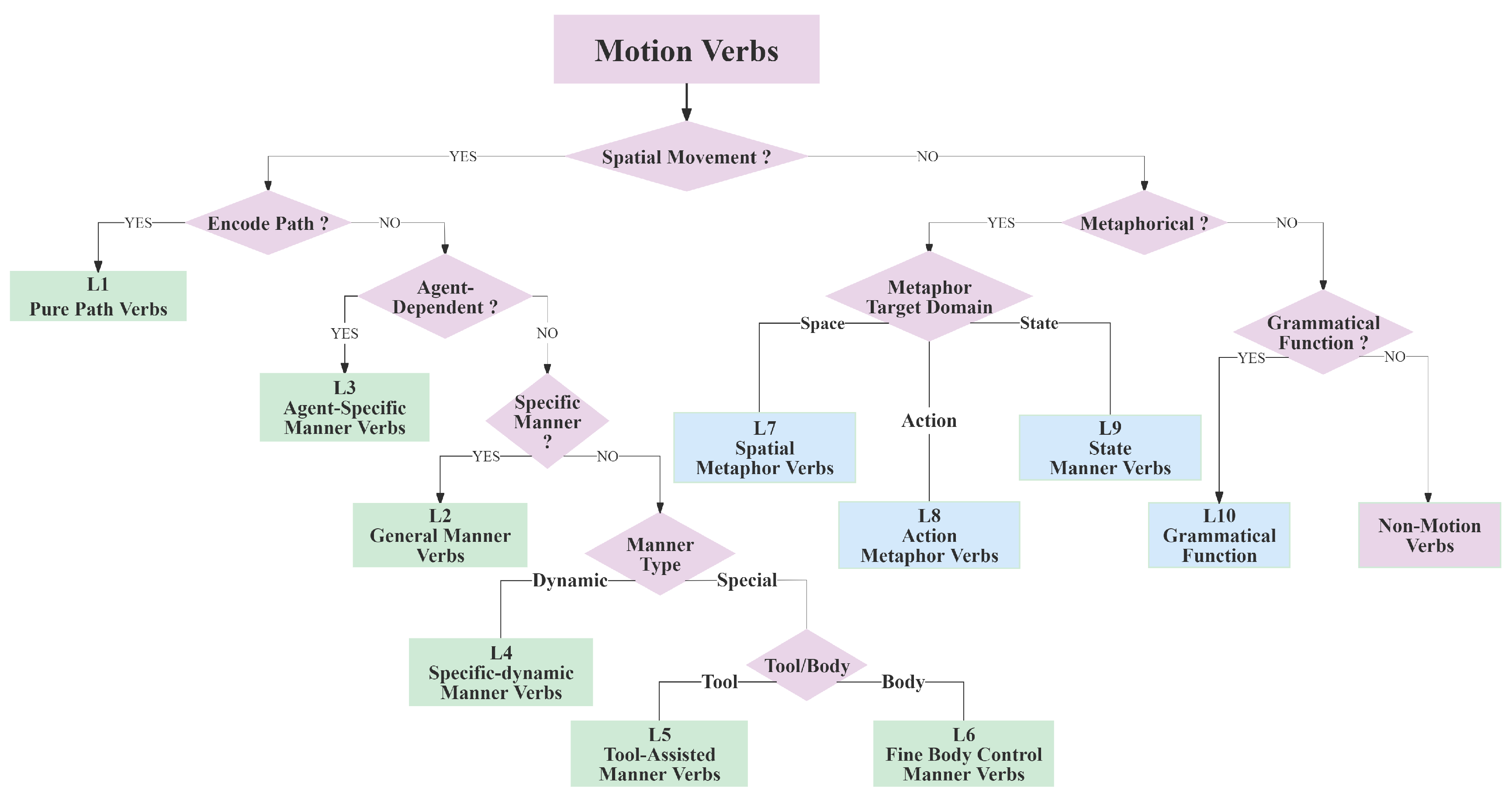
2.5. New Hierarchical Levels of Motion Verbs
2.5.1. The Two Categories
2.5.2. The Two Criteria
2.5.3. Semantic Feature Matrix
2.6. Aims and Questions
- (1)
- What significant differences exist between Chinese learners of English and native English speakers regarding the hierarchical usage of motion verbs, particularly in overall distribution and variations across genres?
- (2)
- Does learners’ usage of motion verbs, especially manner verbs, exhibit specific patterns? More specifically, do learners exhibit preference or avoidance of certain levels of manner verbs, both in the physical motion category and metaphorical extensions? How do learners adopt compensatory strategies to express the fine-grained manner?
- (3)
- How do these distribution patterns and compensatory strategies reveal the typological constraints for learners during the conceptualization of motion events?
3. Experimental Design and Procedure
3.1. Experimental Objectives
3.2. Participants
3.3. Experimental Tasks
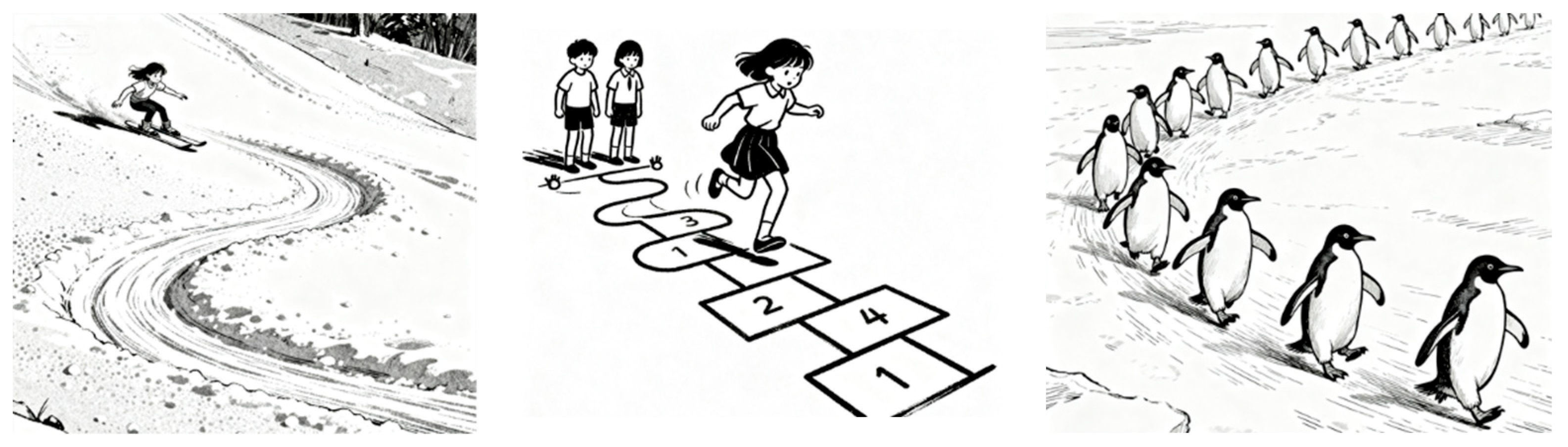
3.3.1. Sub-Task A: Image/Video Description
3.3.2. Sub-Task B: Narrative Writing Based on Videos (Manner Salience Test)
3.3.3. Sub-Task C: Narrative Writing (Metaphorical Salience Test)
3.3.4. Sub-Tasks D and E: Opinion Writing
3.4. Annotation
4. Results for the COCA
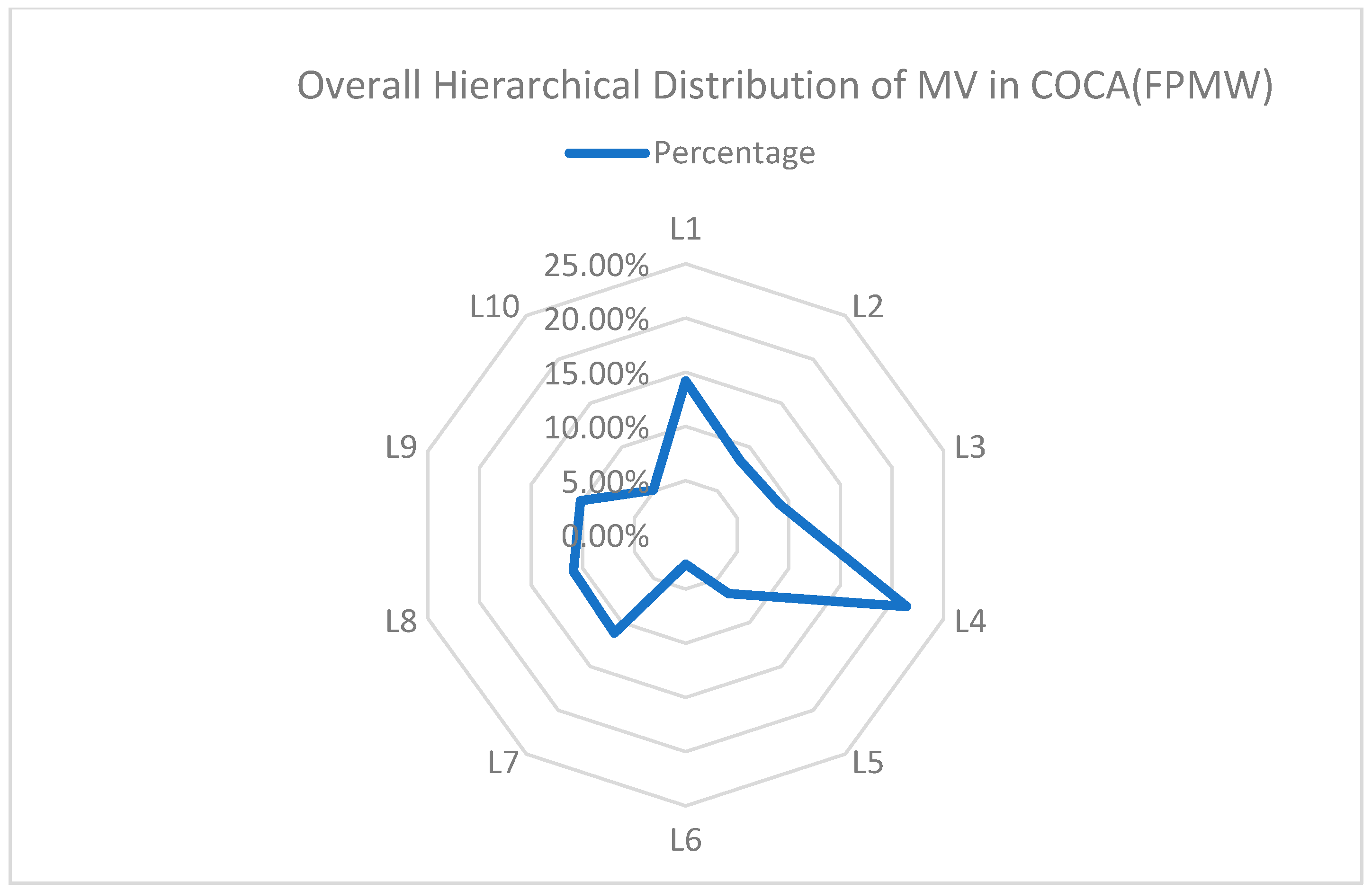
4.1. Overall Frequency Distribution of Motion Verbs (MV)Across Levels in COCA
4.2. Variation Across Genres in COCA
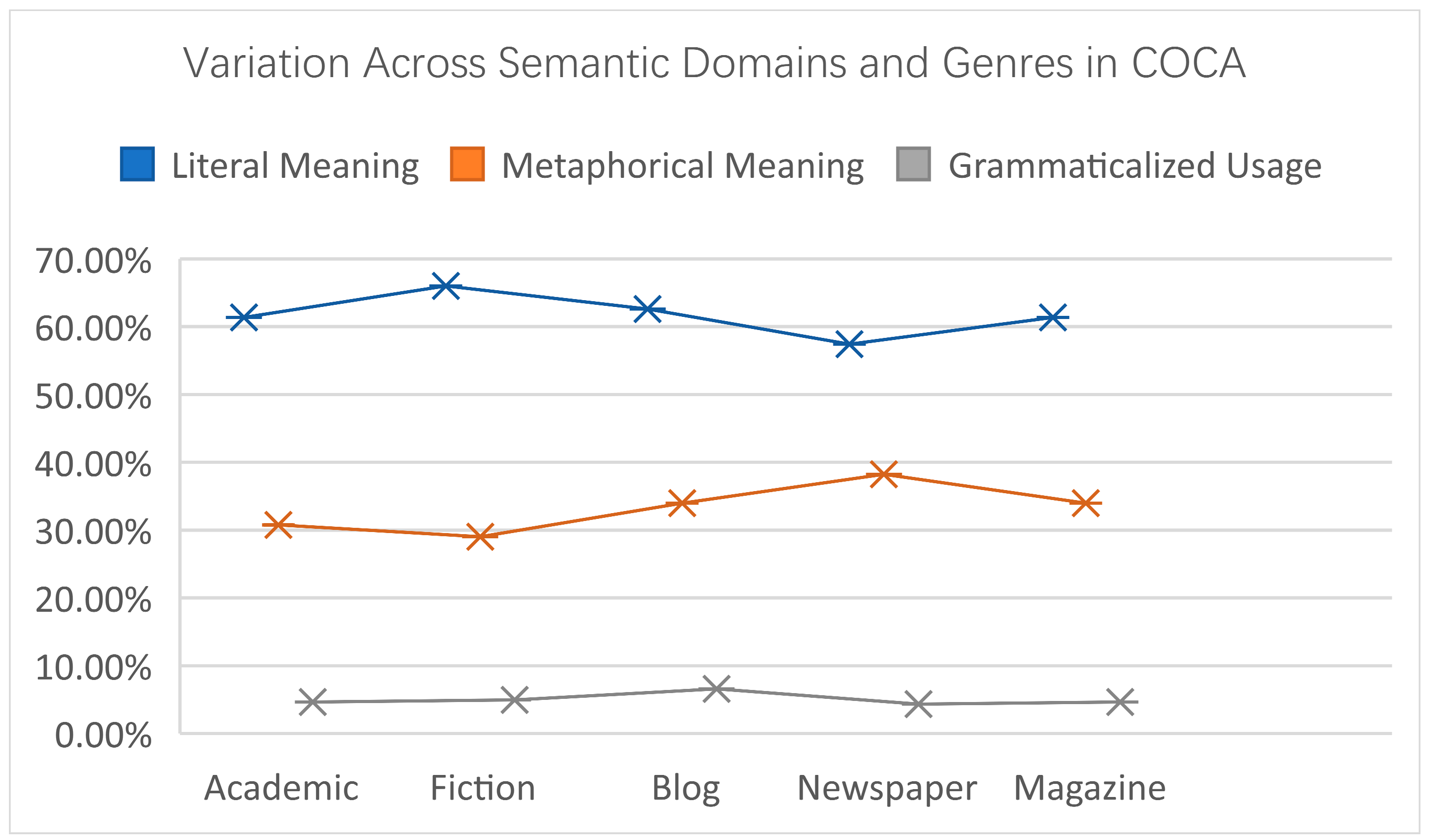
4.3. Variation Across Semantic Categories and Genres
5. Results for the Learner Corpus
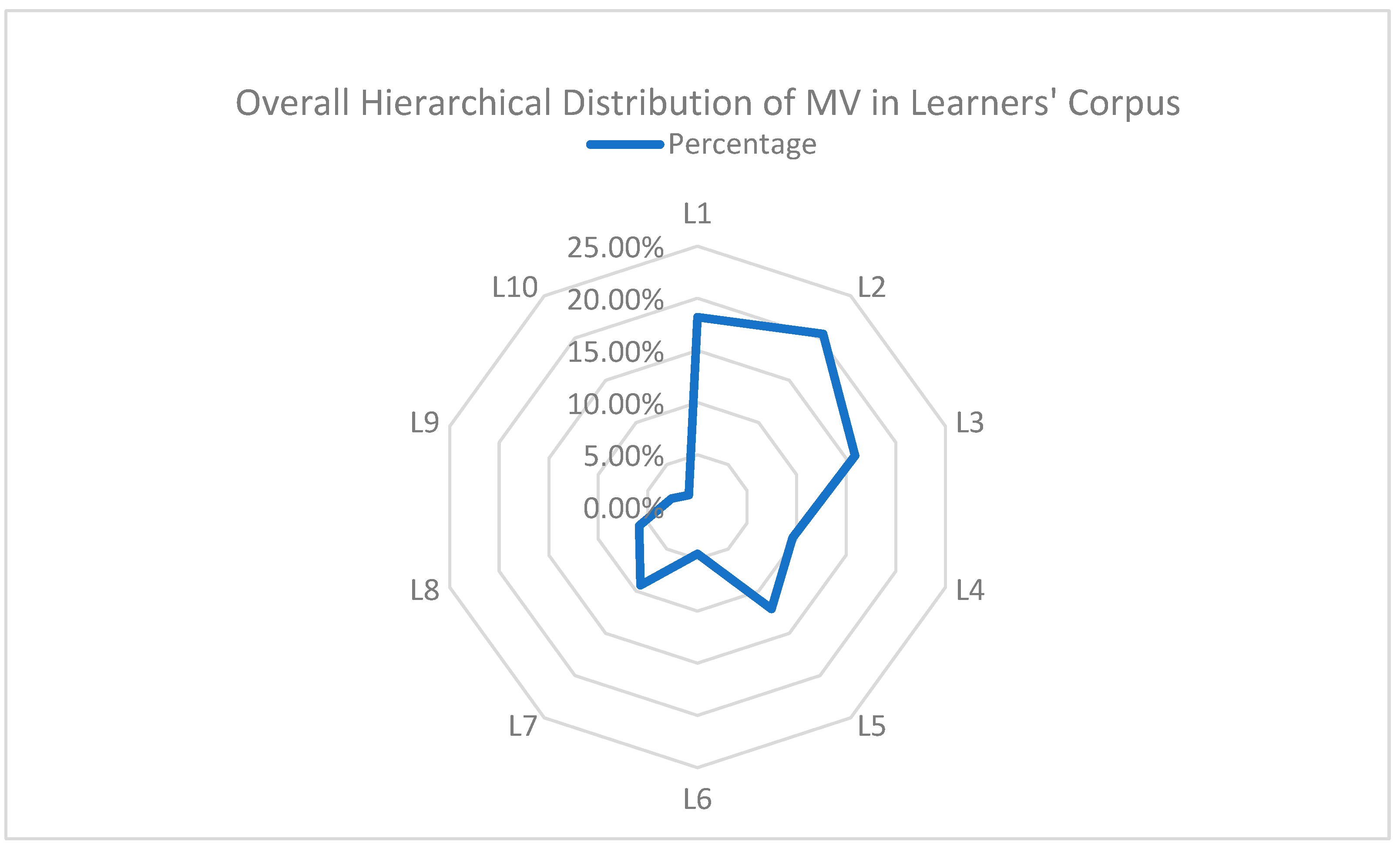
5.1. Overall Frequency Distribution Across Levels
5.2. Variation Across Genres in the Learner Corpus
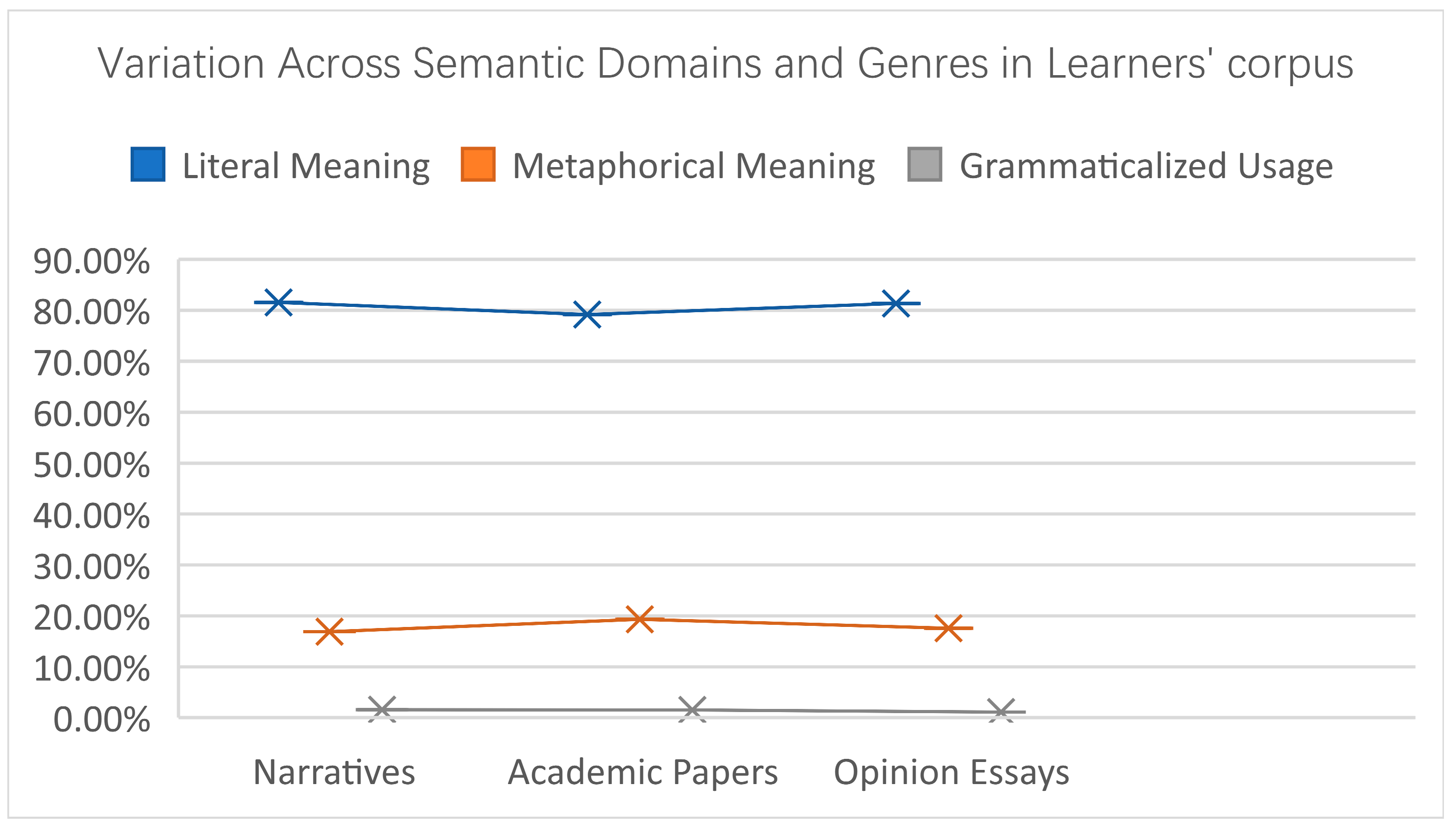
5.3. Genre Variation Across Semantic Categories
6. Discussion
6.1. Overall Distributional Differences Across Levels
6.2. Variation Across Genres
6.3. Learners’ Overuse of Certain Manner Verbs
| (1) | Participant: He moved quickly in the crowds. (L1) (CHL3295) |
| Native revision: He weaved through the crowds. (L4) | |
| (2) | Participant: He came into the room quietly. (L1) (CHL3318) |
| Native revision: He tiptoed into the room. (L4) | |
| (3) | Participant: The price went down. (L1) (CHL3217) |
| Native revision: The price dropped/declines. (L9) | |
| (4) | Participant: He went into the room confidently with long steps. (L1) (CHL3452) |
| Native revision: He strode into the room. (L2) | |
| (5) | Participant: She came to the decision finally. (L1) (CHL5614) |
| Native revision: She reached a decision finally. (L8) | |
| (6) | Participant: The news went to every corner of the school. (L1) (CHL5621) |
| Native revision: The news spread to every corner of the school. (L7) |
6.3.1. Semantic Density
| Example 1 | ||||||
| Learner: | He walked quickly with long steps into the meeting room. | |||||
| Semantic features: walk, quickly, long step | ||||||
| Number of semantic features = 3; | Ways of expression = 3 | |||||
| Average semantic density = 1 | ||||||
| Native speaker: | He strode into the meeting room. | |||||
| Semantic features: strode (integrates “walk + quickly + long steps”, counts as 3) | ||||||
| Number of semantic features = 3; | Ways of expression = 1 | |||||
| Average semantic density = 3 | ||||||
| Chinese: | 他 | 大步 | 快快地 | 走 | 进 | 会议室 |
| Tā | dàbù | kuàikuài de | zǒu | jìn | huìyìshì, | |
| He | big strides | quickly | walked | into | the meeting room | |
| Semantic features: 走 (zǒu, “walk”), 大步地 (dàbù de, “with big strides”), 快快地 (kuàikuài de, “quickly”) | ||||||
| Number of semantic features = 3; | Ways of expression = 3 | |||||
| Average semantic density = 1 | ||||||
| Example 2 | ||||
| Learner: | She ran very fast to catch the bus before it left. | |||
| Semantic features: run, fast, catch the bus, before it left | ||||
| Number of semantic features = 4; | Ways of expression = 4 | |||
| Average semantic density = 1 | ||||
| Native speaker: | He dashed for the bus. | |||
| Semantic features: dashed (integrates “run + fast”, counts as 2) | ||||
| Number of semantic features = 2; | Ways of expression = 1 | |||
| Average semantic density = 2 | ||||
| Chinese: | 他 | 快速地 | 冲向 | 公交车。 |
| Tā | kuàisù de | chōng xiàng | gōngjiāochē | |
| He | quickly | rushed toward | the bus | |
| Semantic features: 快速地 (kuàisù de, “quickly”), 冲 (chōng, “rush” integrates run + fast, counts as 2) | ||||
| Number of semantic features = 3; | Ways of expression = 2 | |||
| Average semantic density = 1.5 | ||||
| Example 3 | ||||
| Learner: | She bent down and went quietly, so that no one would notice her. | |||
| Semantic features: bend, go, quietly, no one would notice | ||||
| Number of semantic features = 4; | Ways of expression = 4 | |||
| Average semantic density = 1 | ||||
| Native speaker: | She tiptoed down the hallway. | |||
| Semantic features: tiptoed (integrates “go + quietly + no one would notice,” counts as 3) | ||||
| Number of semantic features = 3; | Ways of expression = 1 | |||
| Average semantic density = 3 | ||||
| Chinese: | 她 | 弯着身子 | 走得很轻, | 没人发现她。 |
| Tā | wān zhe shēnzi | zǒu de hěn qīng, | méi rén fāxiàn tā, | |
| She | bent over | very quietly | no one notice her | |
| Semantic features: 走 (zǒu, “walk”), 弯着身子 (wān zhe shēnzi, “bent over”), 轻 (qīng, “quietly”), 没人发现她 (méi rén fāxiàn tā, “no one noticed her”) | ||||
| Number of semantic features = 4; | Ways of expression = 4 | |||
| Average semantic density = 1 | ||||
| Example 4 | |||||
| Learner: | He walked slowly through the water that came up to his knees. | ||||
| Semantic features: walk, slowly, water came up to his knees | |||||
| Number of semantic features = 3 | |||||
| Ways of expression = 3; | Average semantic density = 1 | ||||
| Native speaker: | He waded across the river. | ||||
| Semantic features: waded (integrates “walk + slowly + water context”, counts as 3) | |||||
| Number of semantic features = 3; | Ways of expression = 1 | ||||
| Average semantic density = 3 | |||||
| Chinese: | 他 | 慢慢地 | 从没过膝盖的 | 水中 | 走过来。 |
| Tā | màn man de | cóng méi guò xīgài de | shuǐ zhōng | zǒu guòlái | |
| He | slowly | came up to his knees | through the water | go over | |
| Semantic features: 走 (zǒu, “walk”), 慢慢地 (màn man de, “slowly”), 从没过膝盖的水中 (cóng méi guò xīgài de shuǐ zhōng, “through the water that came up to his knees”) | |||||
| Number of semantic features = 3; | Ways of expression = 3 | ||||
| Average semantic density = 1 | |||||
| Example 5 | ||||||
| Learner: | The ball hit the ground and came back up again and again while going down the stairs. | |||||
| Semantic features: hit the ground, come up, again and again, go down stairs | ||||||
| Number of semantic features = 4; | Ways of expression = 4 | |||||
| Average semantic density = 1 | ||||||
| Native speaker: | The ball bounced down the stairs. | |||||
| Semantic features: bounced (integrates “hit + come up + again and again”, counts as 3) | ||||||
| Number of semantic units = 3; | Ways of expression = 1 | |||||
| Average semantic density = 3 | ||||||
| Chinese: | 球 | 咚咚咚地, | 一弹一弹地 | 滚下 | 楼梯 | |
| Qiú | dōng dōng dōng de | yī tán yī tán de | gǔn xià | lóutī | ||
| The ball | dong-dong-dong, | bounce by bounce | roll down | the stairs | ||
| Semantic features: 滚 (gǔn, “jump”), 咚咚咚地 (dōng dōng dōng de, “dong-dong-dong”), | ||||||
| 一弹一弹地 (yī tán yī tán de, “bounce by bounce”) | ||||||
| Number of semantic units = 3; | Ways of expression = 3 | |||||
| Average semantic density = 1 | ||||||
| Example 6 | |||||||
| Learner: | She went quickly and took him away from the crowd. | ||||||
| Semantics: went quickly, take him away | |||||||
| Number of semantic units = 2 | |||||||
| Ways of expression = 2 | |||||||
| Average semantic density = 1 | |||||||
| Native speaker: | She whisked him away from the crowd. | ||||||
| Semantic features: whisked (integrates “move quickly + take away”, counts as 2) | |||||||
| Number of semantic features = 2; | Ways of expression = 1 | ||||||
| Average semantic density = 2 | |||||||
| Chinese: | 她 | 飞奔 | 过去, | 一把 | 将他从人群中 | 拉了 | 出来 |
| Tā | fēibēn | guòqù, | yī bǎ | jiāng tā cóng rénqún zhōng | lā le | chūlái, | |
| She | rushed | over | one tug | pulling him out from the crowd | pull | out | |
| Semantic features: 飞奔 (fēibēn, “rush over,” contains rapid movement, counts as 2), 拉 (lā, “pull,” counts as 1) | |||||||
| Number of semantic features = 3; | Ways of expression = 2 | ||||||
| Average semantic density = 1.5 | |||||||
6.3.2. Semantic Density Analysis
6.3.3. Information Packing Analysis
7. Conclusions
7.1. Reasons for Learners’ Preference
7.1.1. Availability and Proficiency of the Target Language
7.1.2. Negative Transfer of the First Language
7.2. Four Compensatory Strategies
7.2.1. Analytic Manner Externalization Strategy
7.2.2. Path Salience Strategy
7.2.3. Image-Schematic Transfer Strategy
7.2.4. Semantic Simplification Strategy
- (a)
- Loss of detail (e.g., loss of motion continuity (move up and down → bounce), loss of instrumentality (go down with a rope → abseil), loss of body part specificity (take something in arms → cradle).
- (b)
- Loss of affective meaning (e.g., be in proud → strut).
- (c)
- Semantic redundancy (e.g., slam the door angrily).
7.3. Analysis of the Four Compensatory Strategies Within Levelt’s Model
7.3.1. Analytic Manner Externalization Strategy
7.3.2. Path Salience Strategy
7.3.3. Image-Schematic Transfer Strategy
7.3.4. Semantic Simplification Strategy
7.4. Overall Conclusion
7.4.1. The Source of Difficulty in English Acquisition
7.4.2. Mechanism of Transfer
7.4.3. Focus of Difficulty
7.4.4. Resources for Compensation
8. Pedagogical Implications
Funding
Institutional Review Board Statement
Informed Consent Statement
Data Availability Statement
Acknowledgments
Conflicts of Interest
References
- Bautista Maldonado, S. (2011). The acquisition of English manner of motion and resultative constructions by native speakers of Spanish [Unpublished doctoral dissertation, University of Essex]. [Google Scholar]
- Bautista Maldonado, S. (2021). Learnability problems in the acquisition of the manner of motion verbs in L2 English by L1 Spanish speakers. RIDE. Revista Iberoamericana para la Investigación y el Desarrollo Educativo, 12(22), 1–21. [Google Scholar]
- Cadierno, T., Ibarretxe Antuñano, I., & Hijazo Gascón, A. (2016). Semantic categorization of placement verbs in L1 and L2 Danish and Spanish. Language Learning, 66(1), 191–223. [Google Scholar]
- Choi, S., & Bowerman, M. (1991). Learning to express motion events in English and Korean: The influence of language-specific lexicalization patterns. Cognition, 41(1–3), 83–121. [Google Scholar]
- Croft, W., & Cruse, D. A. (2004). Cognitive linguistics. Cambridge University Press. [Google Scholar]
- Cruse, D. A. (1986). Lexical semantics. Cambridge University Press. [Google Scholar]
- De Bot, K. (1992). A bilingual production model: Levelt’s ‘speaking’ model adapted. Applied Linguistics, 13, 1–24. [Google Scholar]
- Deng, Q., & Li, F. (2017). An empirical study of reverse conceptual transfer in Chinese EFL Learners’ verbalization of motion event in Chinese. Foreign Languages and Their Teaching, 1, 73–85+148. [Google Scholar]
- Ellis, N. C., & Cadierno, T. (2009). Constructing a second language: Introduction to the special section. Annual Review of Cognitive Linguistics, 7, 111–139. [Google Scholar] [CrossRef] [Scilit]
- Ellis, N. C., O’Donnell, M., & Römer, U. (2014). Second language verb-argument constructions are sensitive to form, function, frequency, contingency, and prototypicality. Linguistic Approaches to Bilingualism, 4, 405–431. [Google Scholar] [CrossRef] [Scilit]
- Filipović, L., & Hawkins, J. (2013). Multiple factors in second language acquisition: The CASP model. Linguistics, 51, 145–176. [Google Scholar]
- Goschler, J., & Stefanowitsch, A. (Eds.). (2013). Variation and change in the encoding of motion events. John Benjamins. [Google Scholar]
- Hawkins, R. (2019). How second languages are learned: An introduction. Cambridge University Press. [Google Scholar]
- Ji, Y. (2019). Cognitive representation of spontaneous motion in a second language: An exploration of Chinese learners of English. Frontiers in Psychology: Cognition, 10, 2706. [Google Scholar]
- Ji, Y. (2020). The conceptualization of motion events by English-Chinese bilinguals: Evidence from behavioral tasks. Modern Foreign Languages, 43(5), 654–666. [Google Scholar]
- Ji, Y., Hendriks, H., & Hickmann, M. (2011). The expression of caused motion events in Chinese and in English: Some typological issues. Linguistics, 49(5), 1041–1077. [Google Scholar] [CrossRef] [Scilit]
- Ji, Y., & Hohenstein, J. (2018). English and Chinese children’s motion event similarity judgments. Cognitive Linguistics, 29(1), 45–76. [Google Scholar] [CrossRef] [Scilit]
- Lakoff, G., & Johnson, M. (1980). Metaphors we live by. The University of Chicago Press. [Google Scholar]
- Levelt, W. J. M. (1989). Speaking: From intention to articulation. MIT Press. [Google Scholar]
- Levelt, W. J. M., Roelofs, A., & Meyer, A. S. (1999). A theory of lexical access in speech production. Behavioral and Brain Sciences, 22(1), 1–38. [Google Scholar] [CrossRef] [Scilit]
- Levin, B. (1993). English verb classes and alternations: A preliminary investigation. University of Chicago Press. [Google Scholar]
- Li, H., & Cao, Y. (2016). The influence of motion event semantic features and learning styles on vocabulary acquisition among Chinese learners of English. Foreign Languages Bimonthly, 39(5), 113–120. [Google Scholar]
- Liu, X., & Wen, Q. F. (2023). Judgment method of conceptualization transfer: An eye-tracking study of motion events based on Cognitive contrastive analysis. Foreign Language Teaching and Research, 55(2), 212–224+319. [Google Scholar]
- Liu, X., & Wen, Q. F. (2024). Cognitive processing of motion events by Chinese learners of English: Evidence from eye-tracking experiments. Foreign Language Education, 45(4), 60–66. [Google Scholar]
- Rosch, E., & Lloyd, B. B. (Eds.). (1978). Cognition and categorization (1st ed., pp. 70–137). Routledge. [Google Scholar]
- Selinker, L. (1972). Interlanguage. IRAL: International Review of Applied Linguistics in Language Teaching, 10, 209–231. [Google Scholar] [CrossRef] [Scilit]
- Slobin, D. I. (1991). Learning to think for speaking: Native language, cognition and rhetorical style. Pragmatics, 1(1), 7–25. [Google Scholar] [CrossRef] [Scilit]
- Slobin, D. I. (1996). Two ways to travel: Verbs of motion in English and Spanish. In M. Shibatani, & S. A. Thompson (Eds.), Grammatical constructions: Their form and meaning (pp. 195–219). Oxford University Press. [Google Scholar]
- Slobin, D. I. (2004). The many ways to search for a frog: Linguistic typology and the expression of motion events. In S. Strömqvist, & L. Verhoeven (Eds.), Relating events in narrative (Vol. 2, pp. 219–257). Lawrence Erlbaum Associates. [Google Scholar]
- Slobin, D. I. (2006). What makes manner of motion salient? Explorations in linguistic typology, discourse, and cognition. In M. Hickmann, & S. Robert (Eds.), Space in languages: Linguistic systems and cognitive categories (pp. 59–81). John Benjamins. [Google Scholar]
- Soroli, E. (2024). How language influences spatial thinking, categorization of motion events, and gaze behavior: A cross-linguistic comparison. Language and Cognition, 16(4), 924–968. [Google Scholar] [CrossRef] [Scilit]
- Spring, R., & Horie, K. (2013). How cognitive typology affects second language acquisition: A study of Japanese and Chinese learners of English. Cognitive Linguistics, 24(4), 689–710. [Google Scholar] [CrossRef] [Scilit]
- Talmy, L. (1985). Lexicalization patterns: Semantic structure in lexical form. In T. Shopen (Ed.), Language typology and syntactic description (Vol. 3, pp. 57–149). Cambridge University Press. [Google Scholar]
- Talmy, L. (2000). Toward a cognitive semantics (II): Typology and process in concept structuring. MIT Press. [Google Scholar]
- Zeng, Y., & Bai, J. H. (2013). On the Chinese English learners’ acquisition of motion events. Foreign Languages and Their Teaching, 6, 44–48. [Google Scholar]
- Zhu, H. (2019). Learning to express manner of motion in self-motion events: The case of Chinese learners of English. Foreign Languages and Their Teaching, 308(5), 105–114. [Google Scholar]



| Alternation Type | Basic Form | Alternated Form | Semantic Effect |
|---|---|---|---|
| Locative Preposition Drop Alternation | John climbed up the ladder. | John climbed the ladder. | Omission of path satellite; manner verb without explicit direction |
| Resultative Construction | John hammered the metal. | John hammered the metal flat. | Manner verb combines with result state predicate |
| Conative Alternation | John hit the door. | John hit at the door. | Manner of force exertion with attempted but incomplete contact |
| Characteristic Property Alternation | This car drives smoothly. | John drives this car smoothly. | Middle construction highlighting manner property of subject |
| Productive Causative Alternation | John walked. | John walked the dog. | Intransitive manner of motion verb becomes causative transitive |
| Verb Class | Example Verbs |
|---|---|
| Verbs of Putting | put, pour, spray, fill |
| Verbs of Removing | remove, clear, wipe |
| Verbs of Sending and Carrying | send, carry, drive |
| Verbs of Exerting Force | push, pull |
| Verbs of Throwing | throw, pelt |
| Verbs of Contact by Impact | hit, swat, spank |
| Verbs of Cutting | cut, carve |
| Verbs of Perception | see, peer |
| Psych-Verbs | amuse, admire |
| Verb Class | Example Verbs |
|---|---|
| Inherently directed motion | arrive, go, come, exit |
| Non-volitional manner of motion by inanimate entities | bounce, drift, float, glide, move, roll, slide, swing |
| Volitional manner of motion by animate entities | bounce, bound, climb, crawl, creep, dart, dash, hop, jump, leap, limp, run, skip, slink, slither, stagger, stroll, strut, stumble, tiptoe, trot, trudge, waddle, walk, wander |
| Vehicle motion verbs (Nouns) | bicycle, boat, bus, canoe, cycle, kayak, skate, ski, sled, taxi |
| Vehicle motion verbs (Verbs) | cruise, drive, fly, paddle, pedal, ride, row, sail |
| Level | Category | Features | Examples |
|---|---|---|---|
| Level 1 | Pure Path Verbs | [+Path, −Manner] | go, come, arrive, exit |
| Level 2 | General Manner Verbs | [+Motion, −Manner Spec.] | carry, transfer, shift |
| Level 3 | Agent-specific Manner Verbs | [+Manner, +Agent, inherent] | fly (wings required), swim (aquatic), roll (round object) |
| Level 4 | Specific-dynamic Manner Verbs | [+Manner, −Agent, inherent, +Dynamic Spec.] | dash, stride, slide, bounce |
| Level 5 | Tool-assisted Manner Verbs | [+Manner, +Tool, dependent] | cycle (bicycle), row (oars), ski (skis) |
| Level 6 | Fine Body control Manner Verbs | [+Manner, +Body, +Fine Control] | tiptoe (toes), shuffle (feet), waddle (gait), limp (leg) |
| Level 7 | Spatial Metaphor verbs | [+Metaphor, +Spatial Mapping] | climb (career), navigate (system) |
| Level 8 | Action Metaphor Verbs | [+Metaphor, +Action Simulation] | stumble (error), bulldoze (force), leap (decision) |
| Level 9 | State Metaphor Verbs | [+Metaphor, +State Change] | soar (spirits), plummet (confidence), wander (mind) |
| Level 10 | Grammaticalized Motion Verbs | [+Grammatical Function, −Lexical Meaning] | going to (future), get invited (passive), come to know (inchoative) |
| Feature | Definition | L1 | L2 | L3 | L4 | L5 | L6 | L7 | L8 | L9 | L10 |
|---|---|---|---|---|---|---|---|---|---|---|---|
| Motion | Encode Motion | + | + | + | + | + | + | + | + | + | + |
| Path | Encodes path information (direction, source, goal) | + | − | − | − | − | − | + | + | + | − |
| Manner | Encodes manner of motion | − | − | + | + | + | + | ± 1 | ± 1 | ± 1 | − |
| Agent Inherent | Dependent on inherent properties of the agent (e.g., biological class, shape) | − | − | + | − | − | − | − | − | − | − |
| Instrumental | Dependent on or implies a tool/instrument | − | − | − | − | + | − | − | − | − | − |
| Body Part | Specifies or emphasizes a particular body part | − | − | − | − | − | + | − | − | − | − |
| Dynamic Specificity | Encodes specific dynamic manner details (speed, rhythm, force, etc.) | − | − | − | + | − 2 | + 2 | − | − | − | − |
| Speed | Encodes speed (fast/slow) | − | − | ± 3 | + | − | + | − | − | − | − |
| Volitionality | Encodes agent’s volition | − | − | − | + | − | + | − | − | − | − |
| Force Dynamics | Encodes force dynamics (exertion, resistance, etc.) | − | − | − | − | − | + | − | + | − | − |
| Contact | Encodes contact pattern with ground/object | − | − | − | − | − | + | − | − | − | − |
| Metaphorical | Involves cross-domain mapping (space → abstract) | − | − | − | − | − | − | + | + | + | − |
| Grammaticalized | Loses lexical meaning, retains only grammatical function | − | − | − | − | − | − | − | − | − | + |
| Feature | Walk (L2) | Stroll (L4) | Tiptoe (L6) |
|---|---|---|---|
| Motion | + | + | + |
| Path | − | − | − |
| Manner | − | + | + |
| Agent Inherent | − | − | − |
| Instrumental | − | − | − |
| Body Part | − | − | +(foot) |
| Dynamic Specificity | − | +(leisurely, slow, aimless) | +(light, quiet, cautious) |
| Speed | − | +(slow) | +(slow) |
| Volitionality | − | +(volitional, active) | +(volitional, active) |
| Force Dynamics | − | − | +(resisting noise/detection) |
| Contact | − | − | +(toe-touch) |
| Metaphorical | − | − | − |
| Grammaticalized | − | − | − |
| Corpus | Motion Verb | Type | Characteristics | Level |
|---|---|---|---|---|
| He tiptoed into the room. | tiptoe | literal | [+Manner, +Body(toes), +Fine Control] | L6 |
| He went across the forest. | go | polysemy (literal) | [+Path, −Manner] | L1 |
| Stocks went up… | go | polysemy (metaphorical) | [+Metaphor, +Spatial Mapping] | L7 |
| What would be going to happen? | go | polysemy (grammatical) | [+Grammatical Function, −Lexical Meaning] | L10 |
| Level | Overall Frequency | Genre Frequency Range (MAX–MIN) | χ2 | p-Value |
|---|---|---|---|---|
| L1 | 1852 | 898 | 598.2 | <0.001 |
| L2 | 1105 | 422 | 387.5 | <0.001 |
| L3 | 1187 | 517 | 421.3 | <0.001 |
| L4 | 2785 | 1091 | 512.6 | <0.001 |
| L5 | 865 | 417 | 487.2 | <0.001 |
| L6 | 351 | 167 | 365.4 | <0.001 |
| L7 | 1452 | 589 | 421.8 | <0.001 |
| L8 | 1420 | 589 | 598.7 | <0.001 |
| L9 | 1324 | 498 | 432.1 | <0.001 |
| L10 | 658 | 334 | 387.9 | <0.001 |
| Total | 12,999 | - | - | - |
| Semantic Type | Overall FPMW | Cross-Genre F-Value | p-Value | Post-Hoc (Tukey HSD) |
|---|---|---|---|---|
| Literal Meaning | 8042 | F = 128.7 | <0.001 | Fiction > Academic: Δ = +1944, 95% CI [1752, 2136]; blog > academic: Δ = +1062, 95% CI [870, 1254] |
| Metaphorical Meaning | 4299 | F = 97.5 | <0.001 | newspaper > fiction: Δ = +830, 95% CI [638, 1022] **; blog > academic: Δ = +56, 95% CI [−136, 248] |
| Grammaticalized Usage | 658 | F = 76.8 | <0.001 | blog > academic: Δ = +334, 95% CI [142, 526] **; fiction > magazine: Δ = +143, 95% CI [−49, 335] |
| Level | Overall Frequency (FPMW) | Genre Frequency Range (MAX–MIN FPMW) | χ2 | p-Value |
|---|---|---|---|---|
| L1 | 6220 | 4075 (8794–4719) | 498.7 | <0.001 |
| L2 | 6989 | 4520 (9678–5158) | 632.4 | <0.001 |
| L3 | 5418 | 3211 (7473–4262) | 421.1 | <0.001 |
| L4 | 3291 | 2023 (4530–2507) | 287.5 | <0.001 |
| L5 | 4118 | 2834 (5675–2841) | 395.2 | <0.001 |
| L6 | 1528 | 999 (2135–1136) | 165.3 | <0.001 |
| L7 | 3176 | 861 (4413–3552) | 88.2 | <0.001 |
| L8 | 2029 | 673 (2804–2131) | 56.4 | <0.001 |
| L9 | 905 | 490 (1201–711) | 42.1 | <0.001 |
| L10 | 484 | 241 (667–426) | 28.9 | <0.001 |
| Total | 34,158 |
| Semantic Type | Overall FPMW | F-Value | p-Value | Post Hoc Test (Tukey’s HSD) |
|---|---|---|---|---|
| Literal Meaning | 27,564 | F (2, 597) = 865.3 | <0.001 | Narratives > Academic Papers: Δ = +4415 [4212, 4618]; Narratives > Opinion Essays: Δ = +5562 [5359, 5765]; Academic Papers > Opinion Essays: Δ = +1147, FPMW [944, 1350] ** |
| Metaphorical Meaning | 6594 | F (2, 597) = 142.1 | <0.001 | Academic Papers > Opinion Essays: Δ = +984 FPMW [732, 1236]; Narratives > Opinion Essays: Δ = +920 FPMW [668, 1172]; Academic Papers vs. Narratives: Δ = +64 FPMW [−188, 316] |
| Grammaticalized Usage | 484 | F (2, 597) = 71.2 | <0.001 | Narratives > Opinion Essays: Δ = +241 FPMW [142, 340]; Academic Papers > Opinion Essays: Δ = +163 FPMW [64, 262]; Narratives vs. Academic Papers: Δ = +78 FPMW [−21, 177] |
| Learners Expression | Fine-Grained Verbs (Target Verb) | Target Verb Features | Gap in Learners Expression |
|---|---|---|---|
| walk slowly and heavily (L1) | trudge (L4) | +Specific Dynamic Manner (heavy, labored steps) | adverbs slowly and heavily fail to convey precise manner (e.g., fatigue or reluctance). |
| move unsteadily (L1) | stagger (L6) | +Fine-grained Bodily Motion (e.g., swaying, off-balance) | lacks information about fine bodily control and instability. |
| go up quickly | scamper (L4) | +Dynamic Manner (scurrying/climbing nimbly) | lacks information about climbing nimbly |
| hold tightly | clench (L6) | +Fine-grained Bodily Motion (tight grip, often with emotion) | ignores the emotional context (e.g., anger) associated with the action. |
| come together | converge (L7) | +Spatial Metaphor (multidirectional meeting at a point) | ignores the multidirectional origin of the paths. |
| Learners Expression | Fine-Grained Verbs (Target Verb) | Prepositional Strategy | Redundancy Analysis |
|---|---|---|---|
| climb up over the wall | scramble (L5) | up | 1. lacks precise manner: using hands and feet to climb; 2. redundantly emphasizes “up” |
| fly up high into the sky | soar into the sky (L6) | up high | 1. lacks precise manner: gliding/circling; 2. redundantly emphasizes “up high” |
| jump down into the water | dive (L4) | down | 1. lacks precise manner: plunging head first; 2. redundantly emphasizes “down”. |
| two roads split apart from… | diverge (L4) | apart | redundantly emphasizes “separation”. |
| fall down from the wall | fall from the wall (L1) | down | redundantly emphasizes “down” |
| Learners Expression | Fine-Grained Verbs (Target Verb) | Mapping Process | Metaphor Type |
|---|---|---|---|
| move like a snake | slither (L7) | analogy based on shape | A PATH IS A SPATIAL FORM |
| keep rising like a screw | spiral (L7) | analogy based on tool trajectory | CHANGE IN CIRCULAR MOTION |
| look at sb. angrily, like a tiger | glare (L9) | tiger’s ferocity → anger in gaze | ANGER IS FIRE |
| move like a fish in water | weave (L6) | analogy based on environmental adaptation | EASE OF ACTION IS EASE OF MOVEMENT |
| my heart broke like glasses | shatter | analogy based on fragility | THE MIND IS A BRITTLE OBJECT |
| Learners Expression | Fine-Grained Verbs (Target Verb) | Information Loss and Cognitive Mechanism | Metaphor Mapping/ No Mapping |
|---|---|---|---|
| say… suddenly without thinking | blurt (L8) | loss of the semantics of “emotional impulse” and “control losing” | THE MIND IS A CONTAINER/IDEAS ARE ENTITIES |
| increase quickly | soar (L8) | loss of the semantics of “rapid”, and “unimpeded increase” | GOOD IS UP/RAPID INCREASE IS RAPID ASCENT |
| hold the baby tightly in her arms | cradle (L6) | loss of the semantics of “gentleness” and “swaying” | (Non-metaphorical usage) |
| get down by holding the rope | abseil (L5) | loss of mountaineering specificity and tool dependency | (Non-metaphorical usage) |
| cut … into small pieces | chop/dice/mince (L5) | inability to distinguish fine actions: chop, dice, and mince | (Non-metaphorical usage) |
Disclaimer/Publisher’s Note: The statements, opinions and data contained in all publications are solely those of the individual author(s) and contributor(s) and not of MDPI and/or the editor(s). MDPI and/or the editor(s) disclaim responsibility for any injury to people or property resulting from any ideas, methods, instructions or products referred to in the content. |
© 2026 by the author. Licensee MDPI, Basel, Switzerland. This article is an open access article distributed under the terms and conditions of the Creative Commons Attribution (CC BY) license.
Share and Cite
Zhu, H. Beyond “Move” and “Go”: A Hierarchy-Based Analysis of Chinese EFL Learners’ Acquisition of Motion Verbs. Languages 2026, 11, 84. https://doi.org/10.3390/languages11050084
Zhu H. Beyond “Move” and “Go”: A Hierarchy-Based Analysis of Chinese EFL Learners’ Acquisition of Motion Verbs. Languages. 2026; 11(5):84. https://doi.org/10.3390/languages11050084
Chicago/Turabian StyleZhu, Haiyan. 2026. "Beyond “Move” and “Go”: A Hierarchy-Based Analysis of Chinese EFL Learners’ Acquisition of Motion Verbs" Languages 11, no. 5: 84. https://doi.org/10.3390/languages11050084
APA StyleZhu, H. (2026). Beyond “Move” and “Go”: A Hierarchy-Based Analysis of Chinese EFL Learners’ Acquisition of Motion Verbs. Languages, 11(5), 84. https://doi.org/10.3390/languages11050084