


Insights on the Realization of Nominal Evaluative Morphology in the Modern Greek Dialect of Lesbos


Abstract
1. Introduction
2. Background
3. Diminution in Lesbian Dialect
3.1. Data
| (1) | -ur(i)]N: | klaˈði | klaˈð-ur ‘branch-dim |
| (2) | -ar(i)]N: | vno | vn-ar | ‘mountain-dim’ |
| ˈpita | pt-ar | ‘pie-dim’ |
| (3) | -uð(i)]N: | kuˈpela | kupiˈl-uð | ‘girl-dim’ |
| fots | fuˈt-uð | ‘proper name-dim’ | ||
| munaˈxos | munaˈx-uð | ‘alone-dim | ||
| skaˈʎi | skaˈl-uð | ‘step-dim’ |
| (4) | -uða]F: | iˈʎa | iˈʎ-uða | ‘olive-tree-dim’ |
| aˈvʎ i | aˈvl-uða | ‘yard-dim’ | ||
| ak ʎiˈsa | akʎiˈs-uða | ‘church-dim’ |
| (5) | -i]N: | ˈporta | purˈt-eʎ | ‘door-dim’ |
| ˈkaknus | kaˈkn-i | ‘turkey-dim’ |
| (6) | -eʎ]N (<-eli): | ||||
| a. | ˈðaskalus | ðaskaˈl-eʎ | ‘teacher-dim’ | (masculine) | |
| b. | kaˈreɣla | kariˈɣl-eʎ | ‘chair-dim’ | (feminine) | |
| c. | karˈpuz | karpuˈz-eʎ | ‘water mellon’ | (neuter) | |
| d. | ajvaˈʎ i | ajvaˈl-eʎ | ‘Aivali-dim’ | (place name) | |
| e. | ʝaɲs | ʝaˈneʎ | ‘John-dim’ | (proper name) | |
| f. | mkros | mkr-eʎ | ‘small/young’ | (adjective) | |
| g. | mnaˈres | mna-ˈreʎ | ‘minaret’ | (loan) | |
| h. | kuduˈɣuɲ | kuduˈɣneʎ | ‘a kind of clothinɡ’ | (compound) |
3.2. Analysis
| (7) | |||||
| -uɖɖi: | ˈanem(o) | > | aneˈm-uɖɖi | (Griko) | |
| ‘wind’ | ‘wind-dim’ | ||||
| -opon: | ˈelaf(o) | > | elaˈf-opon | (Pontus) | |
| ‘deer’ | ‘deer-dim’ | ||||
| -o(k)ko: | koritsi | > | koriˈts-okko | (Cappadocia) | |
| ‘girl’ | ‘girl-dim’ | ||||
| -uin: | ˈðondin | > | ðonˈd-uin | (Cyprus) | |
| ‘tooth’ | ‘tooth-dim’ | ||||
| -opulo: | peˈði | > | peˈð-opulo | (Achaia-Peloponnese) | |
| ‘child’ | ‘child-dim’ | ||||
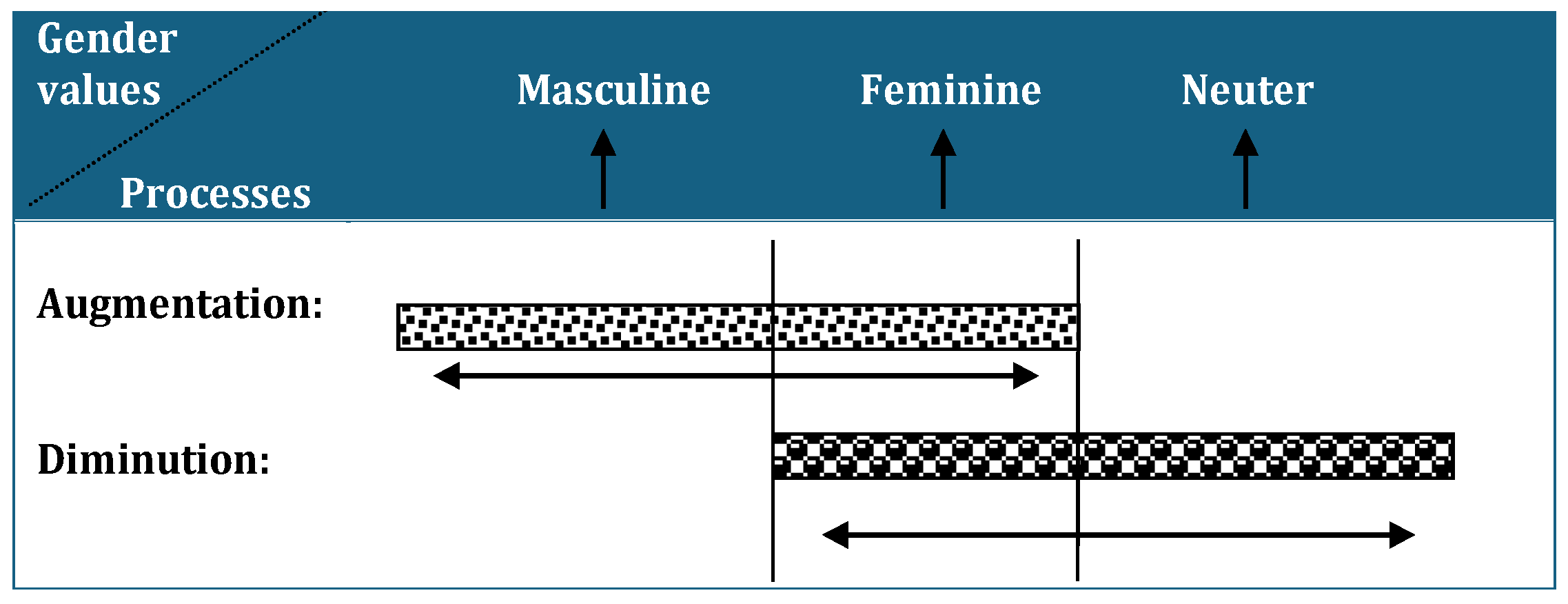
4. Augmentation
4.1. Data
| (8) | ||||
| -a]F: | paˈputs | paˈputs-a | ‘shoe-augm’ | |
| aˈçiʎ | aˈçil-a | ‘lip-augm’ | ||
| kvar | ˈkvar-a | ‘skein-augm’ |
| (9) | ||||
| -ara]F: | mit | mˈt-ara | ‘nose-augm’ | |
| kuˈrits | kurˈts-ara | ‘girl-augm’ | ||
| paˈtuna | patˈn-ara | ‘sole-augm’ |
| (10) | ||||
| -arus]M: | voð | ˈvoð-arus | ‘ox-augm’ | |
| aˈraps | aˈrap-arus | ‘nigger-augm’ | ||
| mat | ˈmat-arus | ‘eye-augm’ |
| (11) | ||||
| -ˈ_us]M: | puˈtana | ˈputanus | ‘hooker-augm’ | |
| ciˈfaʎ | ˈcefalus | ‘head-augm’ |
| (12) | |||||
| - ukla]F: | laˈɣos | laˈγ-ukla | ‘rabbit-augm’ | ||
| muˈro | muˈrukla | ‘baby-augm’ | (mainly in Agiasos) | ||
4.2. Analysis
| (13) | |||||||
| a. | maˈçer | maˈçer-a | maçiˈr-ara | maˈçer-ar(us) | ‘knife-augm’ | ||
| kuˈmat | kuˈmat-a | kumaˈt-ara | kuˈmat-ar(us) | ‘piece-augm’ | |||
| kaˈlaθ | kaˈlaθ-a | kalaˈθ-ara | kaˈlaθ-ar(us) | ‘basket-augm’ | |||
| b. | knup | knuˈp-ara | ˈknup-ar(us) | ‘mosquito-augm’ | |||
| putˈk(os) | putˈk-ara | puˈtik-ar(us) | ‘mouse-augm’ | ||||
| fið | fˈð-ara | ˈfið-ar(us) | ‘snake-augm’ | ||||
| c. | ˈʝneka | ʝneˈk-ara | ˈʝnek-ar(us) | ‘woman-augm’ | |||
| cʎa | cl-ara | ˈcil-ar(us) | ‘paunch-augm’ | ||||
| d. | ˈfurn(us) | ˈfurnar(us) | ‘oven-augm’ | not *furˈn-ara | |||
| ˈpseft(s) | ˈpseft-ar(us).M | ‘thief-augm’ | not *psiˈft-ara.F | ||||
| (examples from Melissaropoulou, 2007, 2009) | |||||||
5. Other Productive Morphological Strategies of Nominal Evaluation
5.1. Prefixoids for the Realization of Negative Evaluation
- Affixoids in spoken languages are usually very productive;
- They exist alongside a formally identical, and usually free “parent” morph (formal similarity Ralli, 2020);
- The meaning of the affixoid is more generalized and abstract than the formally identical parent;
- There is a shift in the meaning of the relationship between the parent morph and the affixoid;
- An affixoid is in competition with or in complementary distribution with an affix.
- With regard to the first criterion, the specific elements are extremely productive and can be linked to many different nominal bases, realizing negative evaluation, as shown by the indicative examples in (14) above. Moreover, it should be noted that apart, perhaps, from the word klefts ‘thief’, which could be considered to carry a negative semantic content per se, the other bases are more or less semantically neutral and the negative readings result from their combination with the specific elements.
- They do indeed coexist with morphologically identical free parent morphemes, the paˈʎos.Adj ‘old’, vroma.Noun ‘stink’, skaˈta. Noun ‘shit’ devil, ˈðʝavolos.Noun/ˈðemunas.Noun ‘devil, demon’ (see, among others, Papanis & Papanis, 2004; Ralli, 2017; Anagnostopoulou, 2021). Some indicative examples5 can be seen under (14) below:
| (14) | |||||||
| a. | aˈdamusa | tun | Panaˈʝot | ˈenan | ˈfilum | paˈʎo | |
| meet.pst.1.sg the.acc.sg Panagioti.acc.sg a.acc.sg friend of mine.acc.sg old.m.acc.sg | |||||||
| ‘I ‘I met Panagiotis, an old friend of mine’ | (Dedekis, 2015, p. 269) | ||||||
| b. | ˈvroma ðe tsi ðisuˈzmia | ||||||
| stink.nom.sg and stench.nom.sg | |||||||
| ‘stink and stench’ | (Dedekis, 2015, p. 126) | ||||||
| c. | mes | tu | ˈlaku | mi ta | skaˈta | ||
| in | the.acc.pl | hole.acc.pl | with the.acc.pl | shit.acc.pl | |||
| ‘in the shit hole’ | (Anagnostopoulou, 2021, p. 72) | ||||||
| d. | in | kaˈmomata | t | ðʝaˈvol | |||
| be.prs.3.pl | action.nom.pl. | the.gen.sg | devil.gen.sg | ||||
| ‘It’s devil’s actions’ | (Dedekis, 2015, p. 220) | ||||||
| e. | ðiˈmon | piˈði | |||||
| devil.gen.sg | kid. nom.sg | ||||||
| ‘devil’s kid’ | (p.c.) | ||||||
- 3.
- Their meaning is more general and abstract in relation to the parent morphemes. In the examples shown in Table 1 above, one can clearly see that the meaning of oldness has been lost completely from the element paʎo-, similarly the meaning of stink and shit or crap from the forms vromu- and skatu- respectively, as well as the meaning of devil, demon from ðʝavulu- and ðimunu- respectively; they all converge to pejoration, that is realizing the central meaning ‘bad’, (and/or the related ‘useless’, ‘annoying’, ‘problematic’, and ‘unpleasant’). On the contrary, the original meanings are clearly retained when used as independent words (cf. the examples under (14) above and the corresponding lemma of HDMG (1933–2021)).
- 4.
- Consequently, there is a significant change in the semantic relationship between the elements of each one of the observed pairs.
- 5.
- Regarding the fifth criterion, the peculiarity observed here has to do with the fact that the specific elements do not seem to be in competition or in complementary distribution with an affix but in alternation with other affixes that perform the same function. As illustrated by the examples in (14), these elements may alternate on the same nominal base (e.g., paʎuˈðʎa ‘pej-work’, vrumu-ˈðʎa ‘pej-work’, skatu-ˈðʎa ‘pej-work’), yielding comparable derogatory evaluative meanings that cluster around the semantic notion ‘bad’ (and the related ‘useless’, ‘annoying’, ‘problematic’, and ‘unpleasant’). Interestingly, this is also depicted in some dialectal lexicographic works, such as the one by Anagnostopoulou (2021, p. 211), where, by way of illustration, it is explicitly commented that all following terms, namely vrumu-ˈratsa, paʎu-ˈratsa, ðʝavulu-ˈratsa ‘pej-ˈratsa’ realize the same meaning, that is ‘bad family’.
5.2. Adaptation of Loan Elements as Evaluative Markers
| (15) | |||
| kara-: | a. kara-biˈcars | ‘intens-bachelor’ | |
| b. kara-ruˈfçana | ‘intens-bimp’ | ||
| c. kara-ˈmostra | ‘intens-showcase |
| (16) | |||
| kudza-: | a. kudza-biˈcars | ‘intens-bachelor’ | |
| b. kudza-ˈmanol | ‘intens-proper name’ | ||
| c. kudzam-ˈʝneka | ‘intens-woman’ |
| (17) | |||
| do | goˈdzan | do | neka |
| the.nom/acc.sg | old | the.nom/acc.sg | woman.nom/acc.sg |
| ‘the old woman’ | Ulaghatsh, Cappadocian | ||
| ɣaˈra | piˈper | ||
| black | piper.nom/acc.sg | ||
| ‘black peper’ | Sinassos, Cappadocian |
6. Conclusions
Funding
Institutional Review Board Statement
Informed Consent Statement
Data Availability Statement
Acknowledgments
Conflicts of Interest
| 1 | In the context of this work, those parts of the suffixes that are not realized due to the activation of unstressed high vowel deletion in Lesbian are placed in parentheses. |
| 2 | In cases like eparçiuˈtel ‘villager-dim’, negative connotations result primarly from the semantics of the base expressing underes-timation and or contempt and not from the semantics/pragmatics of the diminutive marker. |
| 3 | The element plaku- (<ˈplaka - plaˈkono ‘slab’) is not addressed in this paper on the basis of its appearance almost exclusively with verbal bases. In our data, the one and only example of its attachment with a nominal base is the formation plakuˈçer ‘pej-hand’, signaling probably signs of expanding productivity. For a more detailed discussion the author is referred to Ralli (2020). |
| 4 | For a contrastive analysis of the status of pale-, paʎ-, and paʎo- in Standard Modern Greek the reader is referred to Marinis (2024) contra Giannoulopoulou (1999, pp. 146, 199–200). |
| 5 | Glossing generally follows the Leipzig glossing rules and their list of standard abbreviations. |
References
- Alexelli, V. (2021). Χαρτογράφηση της διαλεκτικής ποικιλίας της Λέσβου [Mapping the dialectal variety of Lesbos] [Doctoral dissertation, University of Patras]. [Google Scholar]
- Anagnostopoulou, M. (2021). Θεματικό Λεξικό της Λεσβιακής Διαλέκτου [Thematic lexicon of the lesbian dialect]. Mythos Editions. [Google Scholar]
- Andriotis, N. (1992). Ετυμολογικό λεξικό της Κοινής Νεοελληνικής [Etymological dictionary of Modern Greek koine] (3rd ed.). Institute of Modern Greek Studies (Manolis Triantaphyllidis Foundation). [Google Scholar]
- Chatzidakis, G. (1905–1907). Μεσαιωνικά και Νέα Ελληνικά, τόμοι A και Β [Medieval and Modern Greek volumes A and B]. Typois P. D. Sakellariou. [Google Scholar]
- Corbett, G. (1991). Gender. Cambridge University Press. [Google Scholar]
- Creissels, D. (1999). Origine et evolution des diminutives et augmentatifs dans quelques langues africaines. Silexicales, 2, 29–35. [Google Scholar]
- Daltas, P. (1985). Some patterns of variability in the use of diminutive and augmentative suffixes in spoken Modern Greek Koine (MGK). Glossologia, 4, 63–88. [Google Scholar]
- Dedekis, S. (2015). Εφημερίδα Γιατζίδα (Έτη 2004–2014). In A. Ralli (Ed.), Επιμέλεια: Aγγελική Ράλλη [Giatzida news paper (years 2004–2014)]. University of Patras. [Google Scholar]
- Efthymiou, A. (2017). Intensification and deintensification in Modern Greek verbs. Lexis-Journal in English Lexicology 10, 1–17. [Google Scholar] [CrossRef]
- Efthymiou, A. (2024). Unveiling prefix systems: Exploring semantic and lexical categories in Modern Greek through onomasiological and semasiological perspectives. Skase Journal of Theoretical Linguistics, 21(2), 2–17. [Google Scholar]
- Giannoulopoulou, G. (1999). Μορφοσημασιολογική σύγκριση παραθημάτων και συμφυμάτων στα Νέα Ελληνικά και τα Ιταλικά [Morphosemantic comparison between affixes and confixes in Modern Greek and Italian] [Doctoral Dissertation, Aristotle University of Thessaloniki]. [Google Scholar]
- Grandi, N. (2002). Sufissi valutativi. Francoangelli. [Google Scholar]
- Grandi, N., & Körtvélyessy, L. (Eds.). (2015). Edinburgh handbook of evaluative morphology. Edinburgh University Press. [Google Scholar]
- HDMG. (1933–2021). Λεξικόν της Nέας Ελληνικής τής τε κοινώς ομιλουμένης και των ιδιωμάτων, 7 τόμοι (A—δόγης) [Dictionary of Modern Greek, both the spoken language and its dialects, 7 vols. (A—δόγης]. Athens. [Google Scholar]
- Hickey, R. (2014). Accommodation. In A dictionary of varieties of English. John Wiley & Sons. [Google Scholar]
- Jurafsky, D. (1996). Universal tendencies in the semantics of the diminutive. Language, 72(3), 533–578. [Google Scholar] [CrossRef] [PubMed]
- Kakaronis, G. (2020). Λεξικό Ιδιωματικού Λόγου Άγρας Λέσβου [Lexicon of dialectal speech of agra lesbos]. Mytilene. [Google Scholar]
- Kallergi, H., Katsouda, G., Konstantinidou, M., & Tsangalidis, A. (2023). Expressivity in Modern Greek: Some morphological mechanisms for the expression of negative emotions. In J. P. Williams (Ed.), Expressivity in European languages (pp. 123–228). Cambridge University Press. [Google Scholar]
- Klimaszewska, Z. (1983). Diminutive und augmentative ausdruckmoeglichkeiten des niederlaedishchen, deutschen und polinischen: Eine konfrontative darstellung. Wroclaw etc. Q Zaklad Narodowy Imienia Ossolinskich Wydawnictwo Polskiej Akademii Nauk. [Google Scholar]
- Koutita-Kaimaki, M. (1984). O Υποκορισμός στην Ποντιακή [Diminution in Pontic] [Doctoral dissertation, Aristotle University of Thessaloniki]. [Google Scholar]
- Kretschmer, P. (1905). Der heutige lesbischen dialekt. Alfred Holder. [Google Scholar]
- Kyranoudis, P. (2001). Μορφολογία των τουρκικών δανείων της ελληνικής: μέρος A΄:προσαρμογή ονομάτων, μέρος Β':τουρκικά παραγωγικά μορφήματα [Morphology of Turkish loans in Greek: Part A’ adaptations of nouns, part B. Turkish derivational morphemes] [Doctoral dissertation, Aristotle University of Thessaloniki]. [Google Scholar]
- Labov, W. (2001). Principles of linguistic change: Social factors. Blackwell. [Google Scholar]
- Magni, E. (1999). Sémantique du diminutif et relations d’appartenance. Silexicales, 2, 139–148. [Google Scholar]
- Manova, S., Grestenberger, L., & Korecky-Kröll, K. (Eds.). (2024). Diminutives across languages, theoretical frameworks and linguistic domains. Walter de Gruyter. [Google Scholar]
- Marinis, M. (2024). Stem, prefix or prefixoid? Resolving the status of pale-, paʎ-, and paʎo- in standard Modern Greek. Journal of Greek Linguistics, 24, 242–263. [Google Scholar] [CrossRef]
- Melissaropoulou, D. (2006). H μορφολογική διαδικασία του υποκορισμού στη διαλεκτική ποικιλία της Ελληνικής-Σύγκριση με την ΚΝΕ [The morphological process of diminution in Modern Greek dialectal variation-comparison with standard Modern Greek] [Master’s thesis, University of Patras]. [Google Scholar]
- Melissaropoulou, D. (2007). Μορφολογική περιγραφή και ανάλυση του Μικρασιατικού ιδιώματος Κυδωνιών και Μοσχονησίων: η παραγωγή λέξεων [Morphological description and analysis of the dialectal variety of kydonies and moschonisia: Word formation] [Doctoral dissertation, University of Patras]. [Google Scholar]
- Melissaropoulou, D. (2009). Augmentation vs. diminution in Greek dialectal variation: An optimal system. In F. Montermini, G. Boyé, & J. Tseng (Eds.), Selected proceedings of décembrettes 6—Morphology in bordeaux (pp. 125–137). Cascadilla Proceedings Project. Available online: http://www.lingref.com/cpp/decemb/6/paper2240.pdf (accessed on 10 January 2026).
- Melissaropoulou, D. (2015). Evaluative morphology in Greek. In N. Grandi, & L. Korvelyessy (Eds.), Handbook of evaluative morphology (pp. 269–277). Edinburgh University Press. [Google Scholar]
- Melissaropoulou, D. (2016). Variation in word formation in the light of the language contact factor: The case of Cappadocian Greek. Journal of Language Sciences, 55, 55–67. [Google Scholar] [CrossRef]
- Melissaropoulou, D., & Ralli, A. (2008). Headedness in diminutive formation: Evidence from Modern Greek and its dialectal variation. Acta Linguistica Hungarica, 55, 183–204. [Google Scholar] [CrossRef][Green Version]
- Mutz, K. (2015). Evaluative morphology in a diachronic perspective. In N. Grandi, & L. Körtvélyessy (Eds.), Edinburgh handbook of evaluative morphology (pp. 142–154). Edinburgh University Press. [Google Scholar]
- Niedzielski, N., & Giles, H. (1996). Linguistic accommodation. In H. von Goebl, P. Nelde, Z. Stary, & W. Wölck (Eds.), Kontaktlin-guistik: Ein internationales Handbuch zeitgenössischer Forschung (Vol. 1, pp. 332–342). De Gruyter. [Google Scholar]
- Papadopoulos, A. (1926). Γραμματική των Βορείων Ιδιωμάτων [Grammar of northern Greek dialects]. Sakellarios. [Google Scholar]
- Papanis, D., & Papanis, G. (2004). Λεξικό του Aγιασώτικου Ιδιωματικού Λόγου. Ερμηνευτικό- Ετυμολογικό [Explanatory and etymological lexicon of the agiasos dialectal variety] (3rd ed.). Mytilene. [Google Scholar]
- Psarianos, P. (2023). Πίτσα Μυτιληνέζα [Mytilene pizza]. Iera. (In Greek) [Google Scholar]
- Ralli, A. (2017). Λεξικό Διαλεκτικής Ποικιλίας Κυδωνιών, Μοσχονησίων & Βορειοανατολικής Λέσβου [Lexicon of the dialect of kydonies, moschonisia & northeast lesbos]. Hellenic Institute of Historical Studies. [Google Scholar]
- Ralli, A. (2019). Γλωσσική χαρτογράφηση. O ηλεκτρονικός διαλεκτικός άτλαντας της Λέσβου [Linguistic mapping: The electronic dialectal atlas of Lesbos]. In G. Karla, G. Katsouda, I. Manolessou, & N. Pantelidis (Eds.), Λέξεις—Τόμος αφιερωμένος στη Χ. Μπασέα [Lekseis—Honorary volume for christina basea] (pp. 435–456). Kardamitsa. [Google Scholar]
- Ralli, A. (2020). Affixoids, an intriguing intermediate morphological category. In L. Körtvélyessi, & P. Štekauer (Eds.), Complex words, festschrift to laurie bauer (pp. 217–240). Cambridge University Press. [Google Scholar]
- Ralli, A. (2022). Μορφολογία2 [Morphology]. Patakis. [Google Scholar]
- Ralli, A., & Melissaropoulou, D. (2008). O Υποκορισμός στη Διαλεκτική Ποικιλία της Κοινής Νεοελληνικής. In 3rd european conference of european association of Modern Greek studies, Bucharest, Romania, 2–4 June 2006 (pp. 569–582). Ellinika Grammata. [Google Scholar]
- Rácz, P. (2013). Salience in sociolinguistics—A quantitative approach. Walter de Gruyter GmbH. [Google Scholar]
- Ruch, H., & de Benito Moreno, C. (2023). Linguistic accommodation. In R. van Gijn, H. Ruch, M. Wahlström, & A. Hasse (Eds.), Language contact: Bridging the gap between individual interactions and areal patterns (pp. 17–48). Language Science Press. [Google Scholar]
- Sakkaris, G. (1940). Περὶ τῆς διαλέκτου τῶν Κυδωνιέων ἐν συγκρίσει πρὸς τὰς Λεσβιακάς [On the dialect of Kydonies in comparison with Lesbian]. Μικρασιατικά Χρονικά [Asia Minor Greek Chronicles], 3, 74–141. [Google Scholar]
- Schmidt, G. D. (1987). Das Affixoid. Zur Notwendigkeit und Brauchbarkeit eines beliebten Zwischenbegriffs in der deutschen Wortbildung. In G. Hoppe, A. Kirkness, E. Link, I. Nortmeyer, W. Rettig, & G.-D. Schmidt (Eds.), Deutsche Lehnwortbildung. Beiträge zur Erforschung der Wortbildung mit entlehnten WB-Einheiten im Deutschen (pp. 53–101). Narr. [Google Scholar]
- Stevens, C. (2000). The derivational suffixes and suffixoids of Old Saxon. A panchronic approach to a linguistic category. American Journal of Germanic Linguistics and Literatures, 12, 53–79. [Google Scholar] [CrossRef]
- Stevens, C. (2005). Revisiting the affixoid debate: On the grammaticalization of the word. In T. Leuschner, T. Mortelmans, & S. De Groodt (Eds.), Grammatikalisierung im deutschen (pp. 71–83). Mouton de Gruyter. [Google Scholar]
- Štekauer, P., Valera, S., & Körtvélyessy, L. (2012). Word-formation in the world’s languages. A typological survey. Cambridge University Press. [Google Scholar]
- Vogiatzis, N. (2026). Comparative study of the Northern Greek dialectal systems of thassos and lesbos. Languages, 11(4), 80. [Google Scholar] [CrossRef]

| Element | paʎu- | vrumu- | skatu- | ðʝavulu-/ðimunu- |
|---|---|---|---|---|
| Origin | <paˈʎos.Adj ‘old’ | <ˈvroma.Noun ‘stink’ | <skaˈta.Noun ‘shit’ | <ˈðʝavulus.Noun/ ˈðemunas.Noun ‘devil’ |
| Examples | paʎuˈðʎa ‘pej-work’ | vrumu-ˈðʎa ‘pej-work’ | skatu-ˈðʎa ‘pej-work’ | ðʝavuˈlo-piða ‘pej-kids’ |
| paʎu-ˈsoʝ ‘pej-family’ | vrumu-ˈsoʝ ‘pej-family’ | skatu-ˈsoʝ ‘pej-family’ | ðimuˈno-spurus ‘pej-seed’ | |
| paˈʎ-aθripus ‘pej-(hu)man’ | vruˈmo-mɣa | skatu-ˈkleftis ‘pej-thieves’ | ðʝavuˈlo-fitra ‘pej-germ’ |
| Criteria | paʎu- | skatu- | vromu- | ðʝavulu-/ðimunu- | |
|---|---|---|---|---|---|
| Elements | |||||
| Affixoids in spoken languages are usually very productive | √ | √ | √ | √ | |
| They exist alongside a formally identical, and usually free “parent” morph (formal similarity Ralli, 2020) | √ | √ | √ | √ | |
| The meaning of the affixoid is more generalized and abstract than the formally identical parent | √ | √ | √ | √ | |
| There is a shift in the meaning of the relationship between the parent morph and the affixoid | √ | √ | √ | √ | |
| An affixoid is in competition with or in complementary distribution with an affix or (an)other affixoid(s) | √ | √ | √ | √ | |
Disclaimer/Publisher’s Note: The statements, opinions and data contained in all publications are solely those of the individual author(s) and contributor(s) and not of MDPI and/or the editor(s). MDPI and/or the editor(s) disclaim responsibility for any injury to people or property resulting from any ideas, methods, instructions or products referred to in the content. |
© 2026 by the author. Licensee MDPI, Basel, Switzerland. This article is an open access article distributed under the terms and conditions of the Creative Commons Attribution (CC BY) license.
Share and Cite
Melissaropoulou, D. Insights on the Realization of Nominal Evaluative Morphology in the Modern Greek Dialect of Lesbos. Languages 2026, 11, 100. https://doi.org/10.3390/languages11050100
Melissaropoulou D. Insights on the Realization of Nominal Evaluative Morphology in the Modern Greek Dialect of Lesbos. Languages. 2026; 11(5):100. https://doi.org/10.3390/languages11050100
Chicago/Turabian StyleMelissaropoulou, Dimitra. 2026. "Insights on the Realization of Nominal Evaluative Morphology in the Modern Greek Dialect of Lesbos" Languages 11, no. 5: 100. https://doi.org/10.3390/languages11050100
APA StyleMelissaropoulou, D. (2026). Insights on the Realization of Nominal Evaluative Morphology in the Modern Greek Dialect of Lesbos. Languages, 11(5), 100. https://doi.org/10.3390/languages11050100

