
Article

Tracking Pragmatic Contexts of Pronominal Subjects: Acquisition and Attrition in Brazilian–European Portuguese Late-Sequential Bidialectals

Linguistic Research Center of NOVA University of Lisbon (CLUNL), Department of Linguistics, NOVA University of Lisbon, 1099-085 Lisbon, Portugal
*
Author to whom correspondence should be addressed.
Languages 2026, 11(4), 72; https://doi.org/10.3390/languages11040072

Submission received: 16 July 2025 / Revised: 29 March 2026 / Accepted: 31 March 2026 / Published: 3 April 2026

Abstract

This study investigates cross-dialectal influence in native Brazilian Portuguese (BP) immigrants in Portugal regarding the pragmatic distribution of pronominal subjects within a novel framework of second dialect acquisition and first dialect attrition, the Bidialectal Dynamics Model (BDM). Twenty-eight immigrants completed a spontaneous oral production task in both BP and European Portuguese (EP). Two control groups (24 BP speakers in Brazil and 24 EP speakers in Portugal) did the same in their respective native varieties only. All groups favored overt subjects for topic shift. For topic maintenance, BP speakers in Brazil preferred overt subjects despite omitting more pronouns in this context than in topic shift, while EP speakers strongly favored null subjects. At the group level, immigrants produced fewer null subjects than EP controls and more than BP controls, suggesting bidirectional cross-dialectal influence. At the individual level, profiles varied: most participants displayed bidirectional cross-dialectal influence, some maintained their native preferences, others used their second dialect across the board, and only a few displayed target-like behavior. Following the BDM, it is argued that this cross-dialectal influence stems from the co-activation of dialects’ overlapping grammars, particularly in the lexicon, and the different profiles observed reflect bidialectals’ diverse and dynamic environments.

1. Introduction

First language (L1) attrition is commonly understood as observable changes in a speaker’s L1 that arise as a consequence of sustained exposure to another linguistic system, reduced L1 use, or both (Gallo et al., 2021). Empirical work in this field has largely focused on late-sequential bilinguals, who may experience cross-linguistic influence from their second language (L2) acquired later in life on their L1.
A comparable situation arises in contexts of second dialect acquisition (SDA; see Siegel, 2010). Late-sequential bidialectal speakers—individuals who acquired a second dialect (D2) of their L1 after acquiring the first dialect (D1)—may likewise experience changes in their native dialect in a migration context (Castro et al., 2017, 2020; Pereira, 2025). Within L1 research, changes observed in bilingual and bidialectal speakers’ native grammars are often considered part of the same broader phenomenon (Domínguez & Hicks, 2016; Hicks & Domínguez, 2020; for overviews of grammatical attrition research, see also Domínguez, 2013; Schmid & Köpke, 2019; Gallo et al., 2021; Baker, 2024). Nevertheless, compared to bilingualism, relatively less attention has been paid to attrition in bidialectal contexts.
Exposure to a D2 rather frequently leads speakers to use D2 variants during interactions with other D1 speakers (i.e., cross-dialectal influence; Castro et al., 2020; Kupisch et al., 2023; Lønes et al., 2023; Pereira, 2025). However, the extent to which bidialectal speakers’ D1 is affected by their D2 varies considerably. Some speakers show little to no evidence of D2 influence, while others exhibit extensive mixing, with substantial variability both across individuals and across linguistic domains (Kubota et al., 2023; Pereira, 2025). This variability raises important questions about the conditions under which attrition emerges, as well as the mechanisms that regulate the selection of dialectal variants.
To contribute to this line of research and to further investigate the scope of attrition across different input contexts, the present study examines patterns of individual grammatical variation in late-sequential bidialectal speakers. Specifically, it focuses on native speakers of Brazilian Portuguese (BP) who immigrated to Portugal in adulthood and came into sustained contact with European Portuguese (EP). Given the variability observed in outcomes in bidialectal contexts, this study adopts the Bidialectal Dynamics Model (BDM; Pereira, 2025), which characterizes bidialectal speakers according to their ability to use their dialects and suggests that structural overlap, mainly in lexicon, between the dialects plays a central role in how dialect features are selected during communication.

2. Bidialectal Dynamics Model

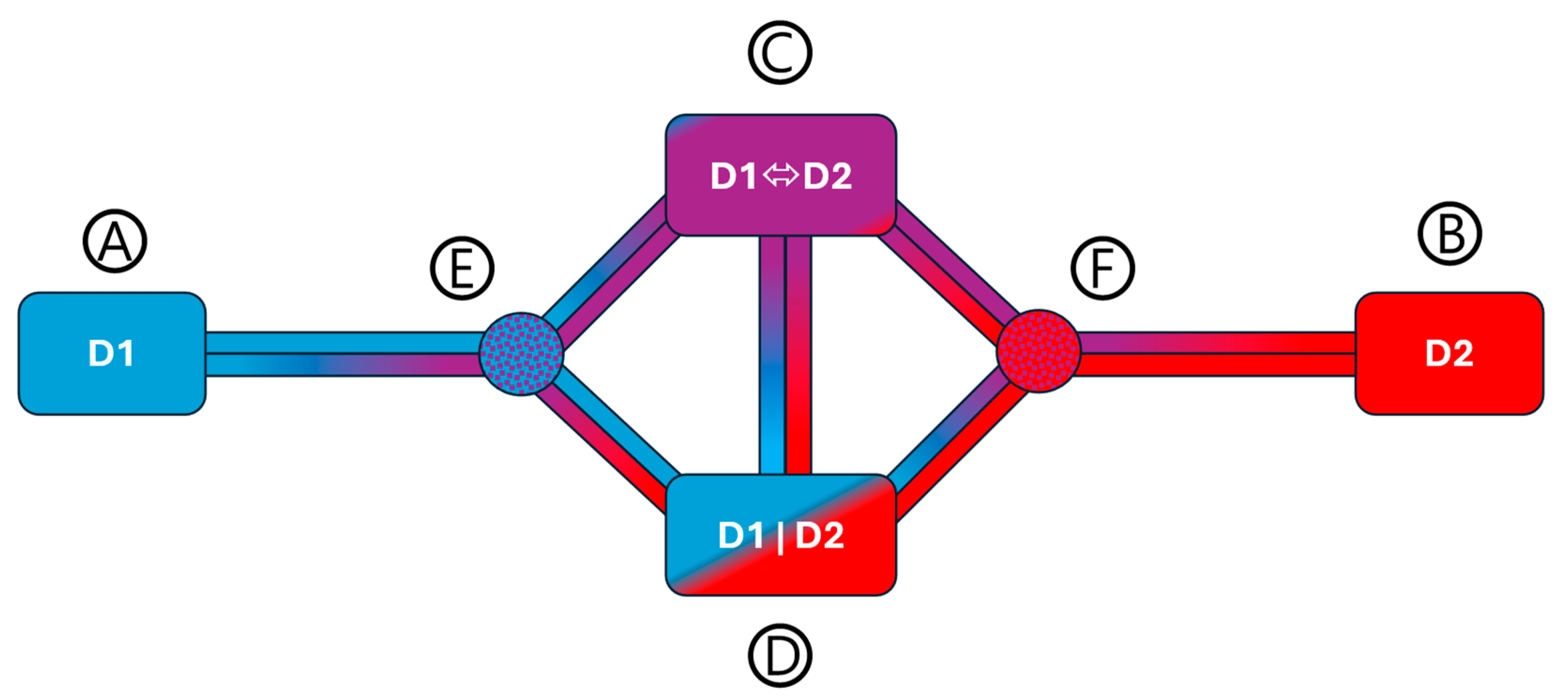
While many bidialectal speakers exhibit elements of both dialects in their speech (Lønes et al., 2023, p. 122), others may keep their dialects more distinct. The BDM attempts to capture all these possible profiles by characterizing speakers regarding their use of their dialects, as illustrated in Figure 1:
In the model, bars refer to the dialect of the interaction (the upper bars and the left bar in the central axis represent the D1; the lower bars and the right bar in the central axis represent the D2) and colors refer to the dialect used by the speaker (blue represents the D1; red represents the D2; purple represents cross-dialectal influence). In other words, one profile comprises speakers who use their D1 (profile A), and another comprises speakers who use their D2 (profile B), regardless of whether their interlocutors are speaking their D1 or D2. A third profile comprises speakers who use variants of both dialects regardless of whether their interlocutors are speaking their D1 or D2 (profile C). Speakers who are able to use the target dialect of the interaction without displaying cross-dialectal influence are represented by profile D. Finally, profiles E and F indicate speakers who present cross-dialectal influence in interactions in only one dialect—D2 and D1, respectively. Therefore, profiles B, C, and F correspond to speakers who display attrition, as D2 variants emerge to differing extents in interactions in the D1.
Pereira (2025) considers that Blanco-Elorrieta and Caramazza’s (2021) connectionist framework is compatible with the observed profiles. According to these authors, the selection of linguistic items across grammatical components is governed by their activation thresholds (cf. Paradis, 2004), which must be reached for an item to be accessed in speech or comprehension. Lower thresholds facilitate activation and access; as such, the higher the activation threshold of a given linguistic item is, the harder it is to retrieve it. A combination of factors modulates these thresholds, including, among others, activation impulses from a language (or dialect) node at the semantic–conceptual level, the communicative context, the frequency of items within each linguistic system, the speaker’s proficiency level, the intended semantic meaning, and recency effects.
At the same time, considering that morphosyntactic representations are directly connected to other grammatical components and the lexicon, these components can then be co-activated (cf. Levelt, 1989; de Bot, 1992; Hartsuiker et al., 2004; Lønes et al., 2023). As a consequence, the threshold of morphosyntactic items is influenced by the activation of associated lexical items. This interaction becomes particularly relevant in bidialectal contexts, where there is typically substantial lexical overlap between dialects. Evidence from bilingualism shows that L1 morphosyntactic structures exhibit stronger priming effects when the L2 lexical items are cognate (i.e., sharing the same meaning and form; cf. Mahowald et al., 2016). Given the high degree of lexical overlap in bidialectal settings, this co-activation effect is therefore expected to be more pronounced.
Once D2 representations are acquired, it is expected that links to other relevant levels of representation will be established. For example, morphosyntactic representations will form links with modules responsible for semantic, phonological, and lexical information. Furthermore, these newly acquired D2 representations will be linked not only to specific D2 linguistic items, but also to the broader lexical module shared between the D1 and the D2. As such, activation impulses will spread throughout this interconnected network of representations, but, as D1 representations may initially benefit from lower activation thresholds, they are more likely to be selected for production. In this sense, the BDM assumes a unified system where dialectal representations with the same function co-exist while interconnected across all grammatical components.
Nevertheless, the BDM also posits that the D2 representations can become more readily accessible than D1 representations. This scenario is likely to occur if shifts in the speaker’s sociolinguistic environment promote greater use of the D2 forms over and above those of the D1, leading to lower thresholds for D2 items. In such cases, the D2 representation may even be selected in interactions in the speaker’s D1. Crucially, considering the high degree of mutual intelligibility between dialects, using D2 forms in the D1 is unlikely to impede communication (cf. Hazen, 2001).
To be clear, the BDM is a model of language use, which aims to map out the possible outcomes of acquisition and attrition among late-sequential bidialectals at a certain point in time, rather than a model of language acquisition and/or attrition processes themselves. In fact, the only developmental element implicit in the BDM is the assumption that profile A corresponds to the initial stages of acquisition, when speakers have not yet had the opportunity to acquire the D2 variants. Although difficult to test empirically, it might well be the case that the D2 variants have been acquired, but, in line with the aforementioned mechanism, the D1 variant remains with a lower threshold. Similarly, the other profiles do not necessarily represent the end stage of acquisition, since shifts in the sociolinguistic environment over time may move the speaker to a different point in the model.
Pereira (2025) analyzed spontaneous oral production data from native BP speakers living in Portugal in light of BDM profiles, focusing on two grammatical domains that differ between BP and EP: the morphology of third-person accusative pronouns and clitic placement (cf. Duarte, 2020; Luís & Kaiser, 2016). In the first case, there is a direct correspondence between an element of the D1 (strong pronoun) and an element of the D2 (clitic pronoun). In contrast, clitic placement shows only partial correspondence: while the D1 consistently exhibits pre-verbal placement, the D2 uses post-verbal placement in unmarked contexts, with pre-verbal placement being conditioned by syntactic contexts.
The percentage of participants who fell within each profile assumed by the BDM differed across domains. Regarding third-person accusative pronouns, 34.8% of the sample fell within profile A; thus, only using the D1 variant regardless of whether their interlocutors are speaking their D1 or D2. A small subset (8.7%) was able to use D2 variants but still displayed unidirectional cross-dialectal influence from BP on EP (profile E). Conversely, 43.5% of the sample presented unidirectional cross-dialectal influence from EP on BP to different degrees (profiles B and F). Profile C, which indicates bidirectional cross-dialectal influence, composed only 4.3% of the sample. When looking at clitic placement, 42.3% of the sample fell within profile A, and 15.4% within profile E. Regarding the influence of EP on BP, profiles B and F characterized 11.5% of the sample. Bidirectional cross-dialectal influence (profile C) was more prevalent with this variable (23.1%) than with third-person accusative pronouns. Finally, in both cases, only two participants were able to produce the target variant in both dialects without any signs of cross-dialectal influence (profile D)—this corresponds to 8.7% of the sample for third-person accusative pronouns and 7.7% for clitic placement. Importantly, the two participants classified as profile D for third-person accusative pronouns were not the same as those classified as profile D for clitic placement. This indicates that patterning with respect to a given profile is structure-specific: falling within profile D for one grammatical domain does not necessarily entail the same classification for another, even within the same individuals.
Such results highlight the need for individual-level analyses in bidialectal contexts, particularly because group-level analyses may obscure intragroup variation (cf. Kubota et al., 2023); this can lead to the mistaken assumption that all speakers in a bidialectal context share the same profile. In studies of bilingual attrition, a similar trend has recently begun to be adopted (e.g., Baker, 2024; Smeets, 2024). Pereira’s (2025) results also suggest a relationship between acquisition and attrition in this population, further highlighting that D2 acquisition is necessary for D1 attrition (see Baker, 2024, for a detailed discussion and investigation of the acquisition–attrition relationship). Participants falling within profiles B, D, and F, which assume target performance in the D2, correspond to 52.2% for third-person accusative pronouns and 19.2% for clitic placement. When attention turns to profiles that display D1 attrition to any extent (profiles B, C, and F), it is more prevalent with third-person accusative pronouns (47.8%) than with clitic placement (34.6%).
The literature in bilingual attrition has assumed that structures with a corresponding form in both languages are more likely to undergo attrition than those with no corresponding form (e.g., Altenberg, 1991; Schmid & Köpke, 2017; Hicks & Domínguez, 2020). In Portuguese, both third-person accusative pronouns and clitic placement instantiate such cross-dialectal correspondences, yet their nature differs. As Pereira (2025) argues, in cases involving a categorical contrast between variants in the two dialects (e.g., third-person accusative pronouns), the mapping between them can be established relatively early once the speaker is exposed to the D2. This allows them to start using the D2 variant more readily and more frequently, which in turn lowers the activation threshold necessary for its selection over D1, thereby facilitating its emergence even in interactions in D1. For clitic placement, however, this mapping is only partially useful due to the presence of distributional variability in EP, which permits both enclisis and proclisis. Therefore, an extra step is needed: establishing which syntactic contexts license enclisis and which license proclisis. Crucially, this must be achieved based on input that is not fully transparent, as both placements are attested in the input.
To further develop the empirical scope of the BDM, it is necessary to systematically investigate additional linguistic properties within bidialectal contexts. In this respect, Portuguese null subjects provide a particularly suitable testing ground. In EP, a consistent null subject language, null referential pronominal subjects (NSs) are the unmarked option in finite domains; overt referential pronominal subjects (OSs), on the other hand, are usually used for pragmatic purposes (e.g., for emphasis or to introduce a new topic). Conversely, BP is described as a partial null subject language whose OSs bear no pragmatic value (Barbosa et al., 2005) and only when a topic is provided by the discourse are NSs optionally used (i.e., topic-drop; cf. Modesto, 2008).

3. Pronominal Subjects in Portuguese

Unlike languages such as English or French, which require referential pronominal subjects to be phonetically realized in finite clauses (i.e., non-null subject languages), Portuguese allows their omission. However, although both BP and EP permit null subjects, important differences exist between these two varieties1 (cf. Kato et al., 2023, p. 142).
The European variety is considered a consistent null subject language, as NSs are preferred in neutral discourse contexts and typically refer to the subject of the previous matrix clause, supporting topic maintenance:
(1)Ochefei disseaoamigoj que Øi precisavade descansar.
theboss say-pst-3sg to-the friendthatneed-pst-3sg of to-rest
‘The bossi told hisi friendj hei needed to rest.’
Conversely, OSs must be used when the subject is in focus or contrastive (2), as well as when referring back to an antecedent that is not a subject, signaling topic shift (3):
(2)ORuii eaAnaj vãotirarférias,mas elei prefereficarem
theRui and the Ana go.prs.3pl to-take vacations buthe prefer.prs.3sg to-stay at
casaeelaj prefereviajar.
home and she prefer.prs.3sg to-travel
‘Ruii and Anaj are going to take vacations, but hei prefers to stay home and shej prefers to travel.’
(3)Ochefei disseaoamigoj que elej precisavade descansar.
thebosssay.pst.3sg to-the friend that heneed.pst.3sg of to-rest
‘The bossi told hisi friendj hej needed to rest.’
The Brazilian variety, on the other hand, features OSs more broadly (Lobo & Martins, 2017, p. 65), which is why it is classified as a partial null subject language (cf. Holmberg et al., 2009). This group of languages is characterized by the possibility of omitting pronominal subjects, but only in highly restricted contexts, which are typically defined by specific morphological and syntactic conditions (Roberts & Holmberg, 2010, p. 6).
Duarte (1993) shows that, by the end of the 19th century, NSs in BP accounted for over 75% of all pronominal subjects in this variety, comparable to what is currently observed in EP. However, one century later, this proportion dropped to approximately 25%, indicating a diachronic change in this property apparently linked to the weakening of BP’s verbal inflection paradigm (Duarte, 2000). As a result, similar to what is observed in non-null subject languages, OSs in BP may refer not only to the subject of the previous sentence but also to other constituents (4) (Lobo & Martins, 2017, p. 74), a pattern that contrasts with the one seen in EP (Example 3 above):
(4)AAnai disseàRosaj que elai/j precisavade descansar.
theAna say.pst.3sg to-the Rosa that she need.pst.3sg of to-rest
‘Anai told Rosaj shei/j needed to rest.’
In this regard, Kato (1999) suggests that BP is undergoing a transition from a consistent null subject language to a non-null subject language, currently occupying an intermediate position between the two typologies. However, it cannot be fully classified as a non-null subject language, as it still requires indefinite and expletive pronominal subjects to be null (see Note 1), a feature not found in non-null subject languages. Modesto (2008, p. 401) argues that, although BP exhibits characteristics of a non-null subject language (at least with respect to referential pronominal subjects), it may also be considered a topic-prominent language, allowing such subjects to be omitted only when they occupy the topic position within the sentence structure. In sentences such as (5b), although a NS is superficially permitted in both varieties, in BP, this omission stems from the omission of the topic:
(5)a.Onde está aMariai?
where isthe Maria
‘Where is Mariai?”
b.Øi acaboude sair.
finish.pst.3sg ofto-go-out
‘Shei has just left.’
Importantly, when comparing the response in (5b) with that in (6b) below, it is possible to see that while in EP the NS allows coreference with the subject of the question in both cases, in BP, the answer in (6b) does not permit this coreference, as topics are not compatible with moved interrogative constituents (Kato et al., 2023, p. 154):
(6)a.Onde está aMariai?
where isthe Maria
‘Where is Mariai?”
b.O que Øi fezdestavez? (EP: OK; BP: *)
the whatdo.pst.3sg in-this turn
‘What did shei do this time?’
Martins and Nunes (2021) argue that, although the verbal morphology for third-person pronominal subjects is identical in BP and EP, the underlying morphological specifications for person and number differ across the two varieties. Specifically, they claim that, while third-person pronouns in EP are fully specified for both person and number, in BP they are underspecified (except for the number feature in plural third-person subject pronouns). Given these characteristics, NSs in EP can be licensed even in sentences like (6b), as they satisfy the Prominent Feature Valuation Condition. According to this condition, a referential pronominal subject may only be omitted if the most prominent feature of the inflection is valued, following the hierarchy person > number > gender > case. In contrast, in BP, where such features are not specified, NSs can only be licensed through topic-drop, as in Example 5b (Kato et al., 2023, p. 179).
To summarize, both EP and BP allow referential pronominal subjects to be omitted. Nonetheless, there are differences in their nature and distribution across the two varieties. In EP, NSs are the default option in unmarked contexts, while OSs typically signal a shift in topic, focus, or emphasis, in line with the behavior of consistent null subject languages. The categorization of BP as a partial null subject language stems from the fact that OSs are not linked to any pragmatically marked context and instead represent the default in this variety. Consequently, NSs in BP are restricted to instances of topic-drop (cf. Modesto, 2008). Although both varieties share identical lexical forms, these distributional contrasts are argued to arise due to differences in the morphological specification of the pronouns in the two varieties (Martins & Nunes, 2021).

4. Attrition and Acquisition Among Bidialectal Speakers

Within L1 grammatical attrition, despite the focus on late-sequential bilinguals, there are some notable studies that have investigated late-sequential bidialectals. For example, Domínguez and Hicks (2016) report on speakers of Caribbean Spanish, a variety characterized by higher rates of OS usage compared to other Latin American Spanish varieties. They assume, following Sheehan (2006), that the speakers of this dialect have two syntactic configurations in their grammar: one copy of the functional head T(ense) specified with a [uD] feature, which when selected permits pronominal subjects to be omitted in pragmatically appropriate contexts, and a second copy of T without [uD], which when selected requires the pronoun to be overt.
Domínguez and Hicks (2016) report data from interviews with 20 speakers of Caribbean Spanish who immigrated to Miami, with an average length of residence of 32.4 years. These speakers show a higher tendency to omit pronominal subjects, including in topic shift contexts, after contact with speakers of other Latin American Spanish varieties. In these varieties, pronominal subjects are consistently omitted in pragmatically appropriate contexts, as they only possess the T[uD] option. The authors argue that, since the input in the United States differs both quantitatively (displaying more NS) and qualitatively (differing in pragmatic properties), such differences may allow for grammatical restructuring, which can be regarded as attrition: from the authors’ perspective, these immigrants now have T[uD] as the only option available in their grammar.
Works by Castro et al. (2017, 2020) focusing on Portuguese varieties provide a broader picture of SDA and how it interplays with attrition by focusing on participants’ performance in both their D1 and D2. Castro et al. (2017) examined the constraints on null objects with 32 native BP speakers who had been living in Portugal for at least six years (M = 10;2). These immigrants arrived in Portugal during or after adolescence (between 13 and 42; M = 22;11) and reported using BP in 45.3% of the time and EP in 54.7% of the time. Briefly, both BP and EP allow for null objects, but EP seems to be more restrictive than BP, presenting stronger syntactic and semantic constraints (cf. Raposo, 2004). Participants completed a bimodal acceptability judgement task that tested different semantic and syntactic constraints on object use. This task was applied twice—an EP and a BP version—and their results were compared to EP and BP monolectal controls.
When tested in EP, immigrants did not reach target-like performance, and they even matched with BP controls in one condition involving inanimate referents in strong islands. When tested in BP, immigrants generally differed from BP controls across conditions, except in one that involved inanimate referents in simple clauses. When considering overt pronouns, the bidialectals consistently displayed lower ratings of strong overt pronouns than the controls, though they still rated these as acceptable overall. As noted in Section 2, strong pronouns are characteristic of the Brazilian variety and are ungrammatical in EP (cf. Luís & Kaiser, 2016; Duarte, 2020), whilst clitic pronouns are consistently used in EP. Castro et al. (2017) interpreted these results as evidence of cross-dialectal influence and evidence of attrition in this population. The authors considered that the typological similarity between EP and BP facilitates attrition, in line with previous studies (e.g., Altenberg, 1991); at the same time, it hinders SDA due to D1 syntactic co-activation (cf. Hartsuiker et al., 2004). A similar rationale is posited by the BDM.
Focusing on production, Castro et al. (2020) analyzed the oral production of pronominal objects and subjects of 20 native BP speakers who had been living in Portugal for at least six years (M = 10 years). These immigrants arrived in Portugal in adulthood (between 19 and 43 years old) and reported using EP at an average rate of 42% (against 58% of BP). Speakers performed an elicited oral production task twice, after a five-minute mode trigger conversation with a BP speaker (BP mode) and an EP speaker (EP mode).
The authors observed that BP and EP controls differed in their rates of object omission. Specifically, BP speakers produced overt and null objects in roughly equal proportions, whereas EP speakers showed a tendency to produce overt objects. The experimental group mirrored these patterns when tested in the corresponding modes, suggesting the SDA of EP null objects constraints without attrition of BP. The authors, however, did not report on the morphology of the pronominal object when overt objects were produced; this was further explored by Pereira (2025) (cf. Section 2).
When looking at null subjects, Castro et al. (2020) observed that, once again, speakers of the two control groups differed from each other (Table 1). As expected, BP controls produced significantly more OSs than EP controls. The experimental group, however, did not distinguish between dialectal modes; in other words, their behavior remained consistent regardless of the dialect used in the interaction. Notably, this behavior diverged from that of both control groups, indicating bidirectional cross-dialectal influence that resulted in an “intermediate” grammar between BP and EP preferences.
It is important to mention, though, that the authors only reported overall rates of NSs and OSs. As outlined in Section 3, EP tends to follow a pragmatically driven distribution of pronominal objects, with NSs typically used for topic maintenance and OSs for topic shift (cf. Lobo & Martins, 2017). Since Castro et al. (2020) did not analyze this point in detail, it remains unclear whether the changes reflect only quantitative or also qualitative changes. Furthermore, they present only group results but no individual-level analysis. The present study addresses these points by providing a more detailed investigation of the pragmatic contexts and an analysis of individual results.

5. Research Questions and Hypotheses

Considering the theoretical and empirical background presented, this research seeks to answer the following questions:
  • RQ1: To what extent does cross-dialectal influence from EP to BP and from BP to EP occur in the pragmatic distribution of pronominal subjects of native BP speakers who immigrated to Portugal?
  • RQ2: At the individual level, where do speakers fall within the Bidialectal Dynamics Model?
Based on Martins and Nunes’s (2021) proposal, the acquisitional task faced by these immigrants is to develop a new grammatical representation for pronominal subjects that is morphologically specified with the features present in EP (person and number). As the BDM predicts, once this new representation is established, it will be directly linked to all the other relevant linguistic items, including an identical lexical form that is morphologically underspecified (BP pronominal subjects). Furthermore, this new representation should be employed in the appropriate pragmatic contexts.
Therefore, no difficulties are expected regarding topic shift, as BP and EP favor OSs in this context. Consequently, even if immigrants select the underspecified BP variant, its surface realization will remain the same. This pattern is expected to hold across both EP and BP modes. On the other hand, in topic maintenance, it is anticipated that, in EP mode, immigrants will omit pronominal subjects less frequently than native EP speakers due to the influence of BP grammar and the need to integrate that morphosyntactic information with pragmatic information. Conversely, in BP mode, they are expected to omit pronominal subjects more frequently than native BP speakers who have not immigrated, as a result of the occasional selection of the EP grammatical configuration along with the BP one.
Following the BDM’s assumptions, these varying outcomes are anticipated, as both grammatical systems are likely to be simultaneously activated more strongly due to structural similarities between the two varieties. Such diversity in profiles observed would reflect the extensive variability in sociolinguistic profiles among speakers in bidialectal contexts. Furthermore, based on the literature indicating persistent difficulties in acquiring the pragmatic distribution of pronominal subjects (e.g., Castro et al., 2020; Clements & Domínguez, 2017; Sorace, 2011), at the individual level, profiles showing unidirectional cross-dialectal influence from BP to EP (i.e., profiles A and E) are expected to be more prevalent. At the same time, following Pereira’s (2025) proposal that D1 attrition is facilitated by target-like performance in the D2, profiles displaying D1 attrition (i.e., B, C, and F) are expected to be comparatively less frequent, precisely because the conditions that promote attrition—namely, stable target-like performance in the D2—may be harder to attain. The possibility of native-like EP performance in the EP mode and no signs of attrition in the BP mode (i.e., profile D) is not ruled out, however, for some participants.

6. Materials and Methods

6.1. Participants

Twenty-eight native BP speakers who had immigrated to Portugal in adulthood (M = 30;2) and had been living continuously in that country for a minimum of six years (M = 10;2) participated in this study. They were all schooled at least at the secondary education level, though most of them had a post-graduate degree. Regarding their interactions in Portuguese, these participants reported an average exposure to EP of 71.4% at their workplace, 40.5% at home, and 56.6% in their social circle. Table 2 summarizes the participants’ sociolinguistic profiles:
Control groups were composed of 24 non-immigrant native BP speakers (BPC) and 24 native EP speakers residing in Portugal (EPC). Similar to the experimental group, they were all schooled at least at the secondary level. All participants in the experimental and control groups had Portuguese as their L1, although most of them had learned at least another L2 (mainly English). Appendix A includes their sociolinguistic profiles.

6.2. Procedure

Following studies by Castro et al. (2017, 2020), participants in the experimental group were tested twice, in two different modes. The concept of “mode” here refers to completing the same experimental task, once in their D1, once in their D2, allowing for the examination of both SDA (in D2 mode) and attrition (in D1 mode). Participants completed the two testing sessions with an interval of at least four weeks between each session to minimize any possible priming effects.
In an attempt to ensure the participants were aware of the test mode, native speakers of each dialect (henceforth, “interviewers”) conversed with them by means of Zoom for a brief period (around five minutes). The topic of this conversation depended on test mode, focusing on Portugal in EP mode and in Brazil in BP mode; it included different aspects of such countries and the participants’ feelings towards them. This conversation was not recorded.
The main experimental task was a spontaneous oral production task, specifically, a Charlie Chaplin story retelling task. Participants first had to watch an extract (around four minutes) of a silent movie starring Charles Chaplin. In this extract, Charles Chaplin can be seen walking down an alley and finding an abandoned baby. After that, he tries to get rid of the baby, for example, by putting it in a baby carriage that belonged to a woman who was not the baby’s mother or handing it to a man passing by. The extract ends with Charles Chaplin’s character finding a note amidst the baby’s clothes that says it is an orphan and deciding to help the baby.
After watching the extract, participants had to narrate what they had seen to the interviewer, trying to be as thorough as possible.3 They were expected to speak for around four to five minutes. In case the minimum amount of time was not reached, the interviewers would intervene, asking the participants for more details or about their perceptions of the movie. Participants in the control groups did the same, but only in their D1. All oral narratives were recorded, transcribed using the transcribing tool from Word software, and then manually reviewed.
All third-person NSs and OSs were identified, as well as the pragmatic context in which they occurred (topic maintenance or topic switch). The criterion to decide whether the NSs or OSs maintained or switched the topic was based on a comparison between the pronominal subject and the subject of the immediate previous sentence or matrix sentence, excluding subjects of parenthetical sentences. In cases of coreference, it was considered topic maintenance; if they referred to different entities, it was considered topic switch.
Given that coordinate clauses favor NSs even in non-null subject languages (cf. Duarte & Marins, 2021), this type of clause was removed from the analysis. Likewise, pronominal subjects that referred to inanimate beings were also removed from the analysis, as they also favor NSs in Portuguese4 (see Cyrino et al., 2000). Importantly, a significant number of NSs referring to the baby were observed. This suggests it may have been interpreted as [-semantic gender], since the absence of semantic gender is argued to favor NSs in BP (Othero & Spinelli, 2019). As this could be a confounding variable, only pronominal subjects that referred to entities whose semantic gender was clearly identifiable in the movie extract were kept.

7. Results

7.1. Descriptive Results

Table 3 summarizes the overall production of NSs and OSs by group:
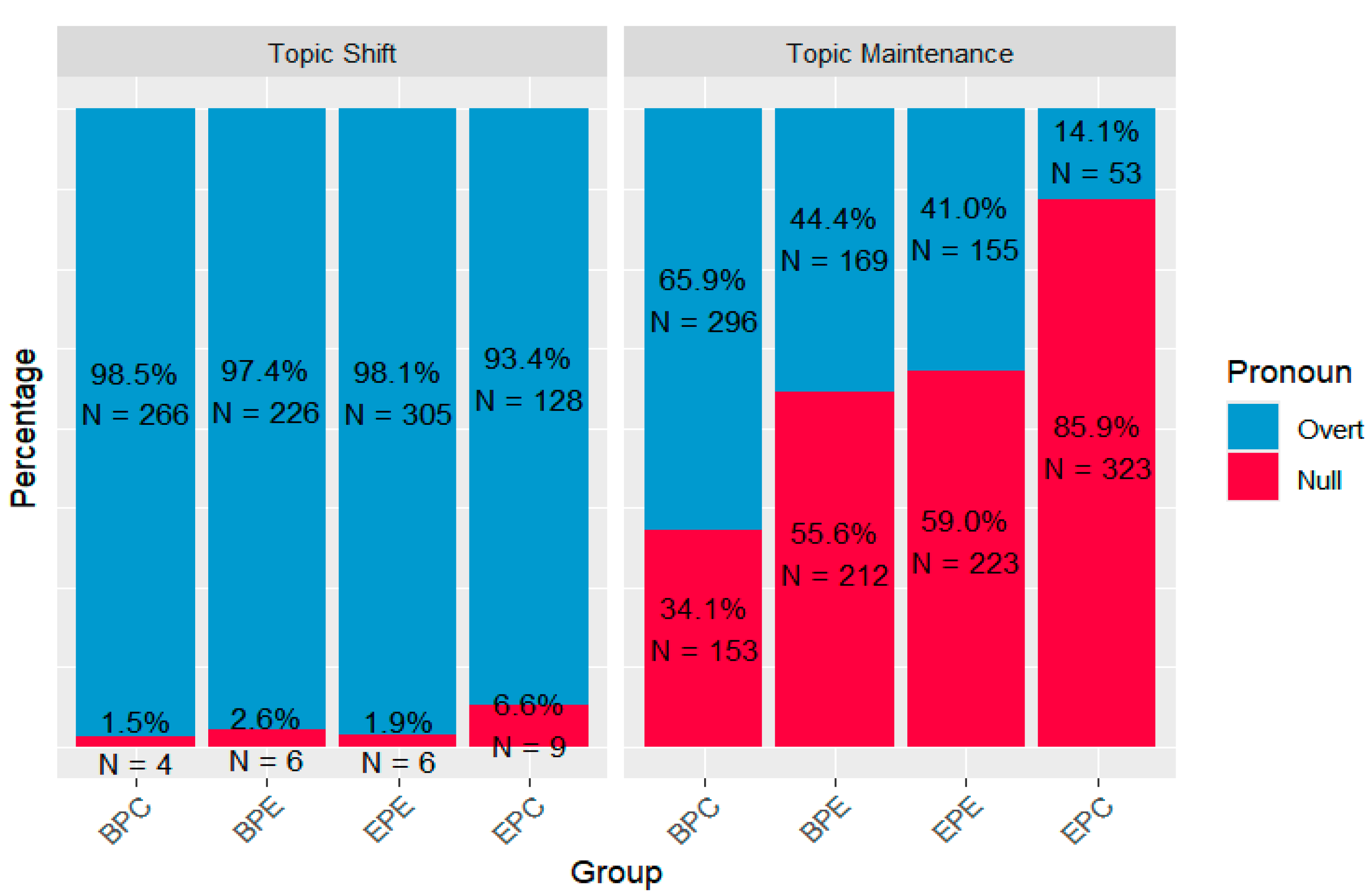
A further analysis of the pragmatic contexts considered in this study identified a clear preference for OSs in topic shift among all groups. In topic maintenance, participants in the experimental group showed a slight preference for NSs, regardless of mode. The EPC group, on the other hand, presented a clear preference for NSs in this context, whereas the BPC group preferred OSs, although not as marked as in topic shift. Figure 2 shows the results by group and pragmatic context.

7.2. Inferential Statistics

Statistical analysis was conducted on RStudio (2025.05.1+513) (Posit Team, 2025) and based on a generalized linear mixed model with binominal distribution using lme4 (Bates et al., 2015). The model was fitted to predict the probability of NSs (vs. OSs). It included pragmatic context (topic shift and maintenance), group (BPC, BPE, EPE, and EPC), and their interaction as fixed effects, with random intercepts for participants. Categorical predictors were treatment-coded, with overt subjects, topic maintenance, and BPC as the reference levels. Main effects and interactions were assessed using likelihood ratio chi-square tests using the car package (Fox & Weisberg, 2019), post hoc pairwise comparisons were made by means of emmeans (Lenth, 2021), and model performance was based on conditional and marginal R2 by means of performance (Lüdecke et al., 2021). Full statistics and outputs can be accessed in the Open Science Framework (OSF) at https://osf.io/4chdf/ (accessed on 29 March 2026).
The effect of both pragmatic context (χ2(1) = 50.057, p < 0.001) and group (χ2(3) = 92.023, p < 0.001) was significant, but their interaction was not (χ2(3) = 3.480, p = 0.323). The post hoc pairwise comparison showed that all groups are less likely to omit pronominal subjects in topic shift compared to topic maintenance (Table 4). Between-group comparisons in topic shift showed no significant difference across groups in their preference for OSs in this context. In topic maintenance, however, whereas immigrants in both test modes differed from their corresponding control groups, they did not differ from each other. Both control groups differed from each other.

7.3. Individual Analysis

Before presenting individual results, it is important to note that, in this specific case, variants are not categorically used by native speakers of each variety (cf. the control group’s results). To determine whether a participant patterned with BP speakers, EP speakers, or showed evidence of mixing, the following metric was applied. First, the arithmetic mean of the percentages of pronominal subjects omitted by the BPC and EPC groups was calculated. Next, a second arithmetic mean was calculated, this time between the percentages of NSs of each control group and the value obtained in the first step. Based on the values obtained, any individual percentage of NSs below 47% was considered to pattern with the BPC group, whereas any individual percentage above 73% was considered to pattern with the EPC group. Values falling between these cutoffs were considered to display mixing of both varieties.
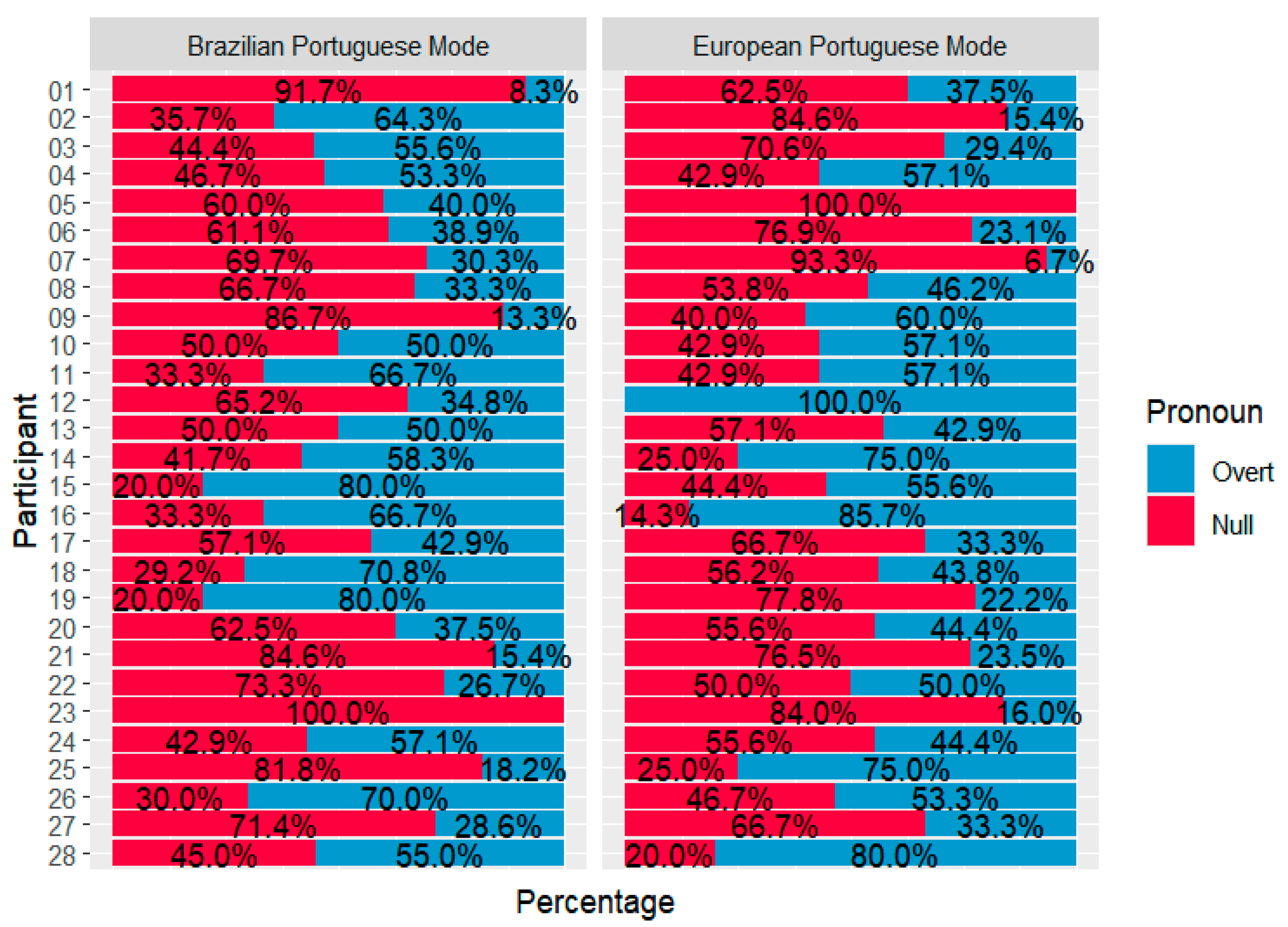
Following the outlined metric, an individual analysis of the immigrants’ performance in topic maintenance in both modes showed high variability across participants and test modes. Individual proportions of OSs and NSs by test mode can be seen in Figure 3; Table 5 presents the different BDM profiles, their expected behavior in each mode, and which profile each participant falls within. Six participants patterned with the BPC group regardless of mode, thus falling within profile A. Two participants patterned with the EPC group regardless of mode, thus falling within profile B. Profile C was the most prevalent in this sample, with 11 participants displaying bidirectional cross-dialectal influence. Two participants seemed to be able to differentiate both modes, performing similarly to the EPC group in EP mode and to the BPC group in BP mode (profile D). Four participants patterned with the BPC group in BP mode and presented cross-dialectal influence in EP mode (profile E). The remaining three participants displayed cross-dialectal influence in BP mode while patterning with the EPC group in EP mode (profile F).

8. Discussion

8.1. The Pragmatic Distribution of Pronominal Subjects

This study focuses on OSs and NSs as produced by native BP speakers who immigrated to Portugal, following the approach taken by Castro et al. (2020), but expanding upon it to analyze contexts of topic shift and topic maintenance in depth. As outlined in Section 3, in consistent null subject languages such as EP, NSs are typically preferred for topic maintenance, while OSs are used to introduce new referents into the discourse; BP, in contrast, omits pronominal subjects less frequently than EP, a difference attributed by Martins and Nunes (2021) to differences in the morphological specification of these pronouns. In EP, singular third-person referential pronominal subjects bear person and number specifications, satisfying the Prominent Feature Valuation Condition and enabling their omission. In BP, however, such pronominal subjects are underspecified. Consequently, in this variety, they may only be omitted when they function as topics, due to BP’s topic-prominent nature (cf. Modesto, 2008).
When looking at the overall production and omission of pronominal subjects, it is seen that, while the control groups behave as expected—more NSs than OSs in EP and more OSs than NSs in BP, and immigrants fall somewhere in between, producing NSs and OSs almost equally. Such a pattern holds across both test modes and closely resembles the one reported by Castro et al. (2020) (Table 6):
When focusing on pragmatic contexts in order to answer RQ1 (To what extent does cross-dialectal influence from EP to BP and from BP to EP occur in the pragmatic distribution of pronominal subjects of native BP speakers who immigrated to Portugal?), a more detailed analysis of the data revealed that all groups favored OSs for topic shift. In topic maintenance, the BPC group, while omitting pronominal subjects more frequently in this context, still exhibited a preference for OSs. Conversely, NSs were preferred by native EP speakers and, although less strongly, by immigrants in both test modes, exhibiting bidirectional cross-dialectal influence (cf. Figure 2). These patterns, therefore, indicate that these differences in the omission of pronominal subjects by immigrants are not only quantitative, reflecting overall increased NSs use, but also qualitative, as the increase occurs mainly in topic maintenance contexts.
Given the challenges associated with acquiring the distribution of pronominal subjects, it is not surprising that immigrants did not exhibit native-like performance in this domain, particularly in EP mode. In the acquisition of consistent null subject languages, even advanced learners may struggle with the distribution of pronominal subjects, as it requires the integration of syntactic and pragmatic knowledge (cf. Sorace, 2011; Clements & Domínguez, 2017). A similar challenge might be faced by BP speakers; however, their difficulties are further shaped by the fact that BP also allows for NSs, albeit in a more restricted manner (i.e., in topic-drop; cf. Modesto, 2008). These facts taken together were expected to lead to a higher use of OSs in BP mode compared to EP mode. Nevertheless, immigrants in BP mode also prioritized NSs in this context, indicating influence from their D2. Overall, these results show that cross-dialectal influence between EP and BP is measurable in magnitude and occurs in both directions, highlighting the interplay between immigrants’ D1 and D2 in shaping pronominal subject omission.
To further assess the nature of this cross-dialectal influence, it is important to determine whether the immigrants’ use of NSs in topic maintenance indeed reflects the EP underlying morphological configuration. Because NSs in both varieties appear similar on the surface, this analysis should include an examination of the contexts in which NSs are restricted in BP, as NSs in these varieties do not stem from the same grammatical property (cf. Section 3). Kato et al. (2023, p. 180) note that topic omission is tendentially a matrix clause phenomenon; in this regard, NSs in embedded clauses in BP result from the movement of the embedded subjects to the subject position of the matrix clause (ibid., p. 183). To support this claim, the authors point out that the extractability of a subject from an embedded clause is constrained by syntactic island effects. Complement clauses (Example 1, reproduced here as Example 7 for convenience) permit such extraction, whereas relative clauses (8) do not; this restriction, however, would not apply to EP, as its NSs stem from the valuation of morphological features:
(7)Ochefei disse aoamigoj que Øi precisavade descansar.
the bosssay-pst-3sg to-the friendthatneed-pst-3sg of to-rest
‘The bossi told hisi friendj hei needed to rest.’
(8)Elei vaireveros testes que Øi fez. (EP: OK; BP: *)
hego-prs.3sg to-review the tests thatdo-pst-3sg
‘Hei is going to review the tests hei took.’
To investigate this contrast, an additional analysis was carried out focusing on the distribution of NSs in complement and relative clauses across the sample (Table 7):
Production of NSs in relative clauses in the experimental group was restricted to seven participants in EP mode and to five participants in BP mode; only three of them produced NSs in relative clauses in both modes. Despite the limitations of the dataset for a fully robust analysis of embedded clauses, these results appear to further support the possibility that some instances of immigrants’ NSs in matrix clauses used for topic maintenance may stem from the acquisition of EP morphological specification, particularly in EP mode. However, in this dataset, the BPC group also omits pronominal subjects in relative clauses, an unexpected context for NSs in BP according to Kato et al.’s (2023) proposal. As immigrants in BP mode and the BPC group omit pronominal subjects at a similar rate in relative clauses, this could indicate no cross-dialectal influence from EP on BP. However, based on the limited available data from embedded clauses, this conclusion remains tentative and warrants further investigation.

8.2. Accounting for Patterns of Attrition and Acquisition with the Bidialectal Dynamics Model

When looking more closely at individual performance in order to answer RQ2 (At the individual level, where do speakers fall within the Bidialectal Dynamics Model?), it was initially hypothesized that profiles displaying attrition to any extent would be less prevalent in this sample. This assumption draws on Pereira’s (2025) suggestion that stronger influence from EP on BP may occur when target performance in the EP mode is more frequently observed. As mentioned above, L2 learners often struggle with the pragmatic distribution of pronominal subjects even at advanced proficiency levels. Extending this observation to a bidialectal context provided the basis for the present hypothesis.
Participants were distributed across BDM profiles reflecting different patterns of dialect use (cf. Table 5). Participants who showed no signs of either acquisition or attrition, relying solely on their D1 (profile A), comprised 21.5% of the sample. Participants who displayed dialect mixing only in EP mode (profile E) comprised 14.3% of the sample. Only 7.1% of the participants showed target-like performance in both dialects (profile D). When focusing on profiles that exhibit attrition to any extent, EP-like behavior in both EP and BP modes (profile B) was observed in 7.1% of the sample. Profile F, which exhibits target behavior in EP mode but dialect mixing in BP mode, comprised 10.7% of the sample. Finally, bidirectional cross-dialectal influence (profile C) comprised 39.3% of participants.
Interestingly, five participants (9, 10, 12, 25, and 27; cf. Figure 3) actually display a curious behavior: they appear to pattern with the EPC group in BP mode and with the BPC group in EP mode. Pereira (2025) also reports on one participant with the same behavior when producing third-person accusative pronouns. According to the author, these participants should be characterized as profile C, because, although not necessarily mixing both varieties across test modes, they still display bidirectional cross-dialectal influence. At first glance, such a pattern could be interpreted as evidence of attrition without acquisition. However, this interpretation is at odds with the assumptions of the BDM, which requires that a representation be established in order to be selected. Thus, even in cases where the D2 is not selected in D2 interactions, its emergence in D1 interactions implies that the corresponding representation must have been acquired.
Taken together, all participants who display cross-dialectal influence from EP to BP to any extent correspond to 57.1% of the sample. This stands in contrast to the initial hypothesis that unidirectional cross-dialectal influence from BP on EP would be most prevalent, since profiles A and E comprised only 35.8% of participants. This indicates that most speakers are able to acquire EP’s NSs and use these pronouns, including in D1 interactions, even if they do not consistently exhibit fully target-like performance in EP.
The prevalence of profile C implies that the observed variation arises from competition between D1 and D2 representations operating at similar activation thresholds. One might alternatively hypothesize, though, that a new representation is unnecessary if the D1 representation is simply “updated” to conform to the D2’s specification. Under such an account, relatively uniform behavior would be expected across test modes, reflecting the properties of a single, restructured system. Although this could be the case for participants in profile B, as they pattern with D2 speakers in both test modes, this approach cannot fully explain profiles in which both D1 and D2 variants are used to a certain extent in a given test mode (profiles C, E, and F). It also fails to account for the pattern described above, where each variant surfaces in the non-corresponding test mode, a distribution that is difficult to reconcile with a single, updated representation. Because it is unlikely that mental representations are continually updated back and forth to enable such a within-participant variation, having two co-existing representations offers a unified explanation for all observed outcomes.
The distribution of profiles further indicates that EP exerts greater influence on BP in the domain of pronominal subjects than in other grammatical domains, even though target-like performance in the D2 was not maximized, as originally expected. Specifically, relative to Pereira (2025), EP influence on BP regarding NSs (profiles B, C, and F = 57.1%) exceeded that observed for third-person accusative pronouns (47.8%) and clitic placement (34.6%). By contrast, profiles corresponding to target-like production (B, D, and F) comprised 24.9% of the sample for pronominal subjects, 52.2% for third-person accusative pronouns, and 19.2% for clitic placement. This suggests that attrition in this population does not necessarily depend on achieving stable target-like performance in the D2, a claim consistent with Baker (2024) regarding bilingual attrition, highlighting further parallels between attrition in bidialectal and bilingual contexts.
Importantly, examining attrition by BDM profiles reveals distinct patterns across grammatical domains. In the case of third-person accusative pronouns, attrition is primarily driven by profile B, reflecting categorical selection of the D2 variant in interactions in both dialects. By contrast, in pronominal subjects and clitic placement, attrition is largely driven by profile C, which reflects bidirectional cross-dialectal influence.
These quantitative differences across structures likely stem from the nature of the grammatical domains involved. In the case of third-person accusative pronouns, the contrast between the two varieties involves a largely categorical structural difference—clitic pronouns in EP, strong pronouns in BP (cf. Luís & Kaiser, 2016). Conversely, clitic placement involves distributional variability, as EP has both enclisis and proclisis, which are largely syntactically conditioned, but BP has generalized proclisis (ibid.). Pronominal subjects in EP and BP involve a categorical structural difference, as EP pronouns are fully specified for number and gender, whereas BP pronouns are underspecified (cf. Martins & Nunes, 2021); at the same time, they also involve distributional variability, as both dialects allow NSs and OSs but not to the same extent—EP morphological specification allows NSs whenever pragmatic needs are met (cf. Lobo & Martins, 2017) and in BP, NSs are mostly instances of topic-drop (cf. Modesto, 2008).
The comparison across these domains suggests that the relationship between acquisition and attrition may be more nuanced than initially assumed. While Pereira (2025) proposes that higher target-like performance in D2 is associated with increased attrition, the distribution of profiles indicates that this relationship depends on the nature of the grammatical property.
Domains characterized by categorical contrasts (e.g., third-person accusative pronouns) tend to favor consistent selection of the D2 variant across dialects (profile B), whereas domains involving distributional variability (e.g., clitic placement) favor sustained competition between D1 and D2 (profile C). However, in domains where categorical contrasts and distribution variability co-exist, such as pronominal subjects, the latter appears to play a more putative role in shaping bidialectal behavior, promoting competition rather than categorical selection. From a BDM perspective, this indicates that domains involving distributional variability may promote similar activation thresholds for both D1 and D2 representations, as their context-sensitive nature does not favor consistent selection of a single variant, thereby prolonging bidirectional cross-dialectal influence.5

9. Final Remarks

The data in this study provide further evidence of bidirectional cross-dialectal influence among late-sequential bidialectals. Consistent with prior research, including Castro et al. (2017, 2020), bidialectal speakers differed both from the D1 grammar in D1 mode and from the D2 grammar in D2 mode, but their two modes did not differ from each other, indicating group-level bidirectional cross-dialectal influence.
At the individual level, in light of the BDM, profile C, characterized by bidirectional cross-dialectal influence, was the most prevalent profile. This scenario is attributed to the co-activation of linguistic representations from both dialects, facilitated by their shared lexicon, as proposed by the model. As such, the cross-dialectal influence reported here (and, potentially, in other studies on SDA) may be understood as a consequence of structural similarities between the two dialects, especially in lexicon, which frequently lead to competition between dialectal variants.
Nonetheless, the nature of the specific linguistic properties involved must be acknowledged. As Pereira (2025) highlights, each property should be analyzed individually, whether because the D1 variant, for instance, has a direct correspondence in the D2 (e.g., third-person accusative pronouns) or because it is syntactically constrained (e.g., clitic placement). These differences are likely to modulate the extent and direction of cross-dialectal influence, leading to distinct distributions of profiles across structures.
Regarding pronominal subjects, pragmatic constraints are involved, and there is a partial lexical overlap between NSs in BP and EP. This overlap is particularly relevant in the context of topic shift: as both BP and EP prioritize OSs in this context, speakers may rely more heavily on shared surface forms. This potentially hinders the process of morphological specification, since there is no linguistic cue in the input that would suggest their underlying specifications are different. However, if certain contexts in which NSs are not permitted in BP but are permitted in EP do indeed exist (e.g., in relative clauses; cf. Kato et al., 2023), as exposure to EP increases, EP input may trigger language acquisition mechanisms. This, in turn, could lead to the formation of a new grammatical representation aligned with the EP configuration linked to other relevant linguistic representations, including the lexicon shared between the two varieties.
As a result, BP-EP bidialectal speakers must deal with the constant co-activation of representations via that shared lexicon. However, EP representations might, in some cases, have the lowest activation threshold, enabling their selection even during interactions in BP. From this perspective, and in line with the BDM, this will not necessarily imply the full replacement of D1 representations by those of the D2. Rather, it reflects how easily each representation is selected under a certain environment—since these environments vary greatly from person to person, significant individual variation is anticipated. Finally, this phenomenon should not be considered permanent: a shift in the sociolinguistic environment of bidialectal speakers would likely lead to changes in how easily each variant is selected.
In conclusion, the findings reported here contribute both to the body of work on SDA and to broader discussions on language attrition. In this regard, the BDM offers insights into explaining how bidialectal speakers manage competing linguistic systems, accounting for the dynamic interaction and selection of dialectal representations.

Author Contributions

Conceptualization, R.P.; methodology, R.P., C.R. and M.S.; formal analysis, R.P., C.R. and M.S.; investigation, C.R. and M.S.; data curation, R.P.; writing—original draft preparation, R.P.; visualization, R.P., C.R. and M.S.; supervision, R.P.; project administration, R.P.; funding acquisition, R.P. All authors have read and agreed to the published version of the manuscript.

Funding

This research is supported by the Portuguese national funding through the FCT—Portuguese Foundation for Science and Technology, I.P., as part of the project UID/03213/2025—Linguistics Research Centre of NOVA University Lisbon (CLUNL) (https://doi.org/10.54499/UID/03213/2025), and the first author’s Ph.D. grant 2021.05667.BD.

Institutional Review Board Statement

Ethical review and approval were waived for this study, given local regulations.

Informed Consent Statement

Informed consent was obtained from all subjects involved in the study.

Data Availability Statement

The original data presented in the study are openly available in the Open Science Framework at https://osf.io/4chdf/ (accessed on 29 March 2026).

Acknowledgments

We thank Ana Madeira and Alexandra Fiéis for the valuable insights regarding this study. We also thank all reviewers and scientific editors for their contributions.

Conflicts of Interest

The authors declare no conflicts of interest.

Abbreviations

The following abbreviations are used in this manuscript:
BDMBidialectal Dynamics Model
BPBrazilian Portuguese
BPCBrazilian Portuguese controls
BPEExperimental group in Brazilian Portuguese mode
D1First dialect
D2Second dialect
EPEuropean Portuguese
EPCEuropean Portuguese controls
EPEExperimental group in European Portuguese mode
L1First language
L2Second language
NSNull referential pronominal subject(s)
OSOvert referential pronominal subject(s)
SDASecond dialect acquisition

Appendix A

Table A1. Control groups’ sociolinguistic profiles.
BPCEPC
n2424
GenderFemale = 12 (50.0%)Female = 12 (50.0%)
Male = 12 (50.0%)Male = 12 (50.0%)
Mean age (interval)33;5 (18–46)29;9 (19–46)
SchoolingSecondary—4 (16.7%)Secondary—6 (25.0%)
Undergraduate—13 (54.2%)Undergraduate—12 (50.0%)
Post-graduation—7 (29.1%)Post-graduation—6 (25.0%)
Region of origin Northeast—12 (50.0%)
South—12 (50.0%)
Alentejo—1 (4.2%)
Algarve—10 (41.7%)
Center—2 (8.3%)
Lisbon Area—8 (33.3%)
North—2 (8.3%)
Overseas—1 (4.2%)

Notes

1
Only referential pronominal subjects are covered in this section, as indefinite (a) and expletive (b) pronominal subjects are always null in both varieties:
(a)ØIND demitiram oJoão.
fire.pst.3pl the John
‘John was fired.’
(b)ØEXPL choveuontem.
rain.pst.3sg yesterday
‘It rained yesterday.’
Also, description focuses on third-person pronominal subjects; see Kato et al. (2023, p. 149) for details on other pronouns.
2
The only participant who arrived at the age of 17 had already finished their secondary studies in Brazil by the time they moved to Portugal.
3
An anonymous reviewer notes that, while the retelling task is not entirely unsuitable, other methodologies may better elicit vernacular speech. Pereira (2025), for instance, combined the retelling task with an elicited oral production task and observed that BP controls’ behavior in the retelling task more closely mirrored patterns associated with vernacular BP. Furthermore, unlike third-person accusative pronouns and clitic placement, whose EP variants are taught in Brazilian classrooms (cf. Kato et al., 2009), the pragmatic distribution of pronominal subjects is not explicitly addressed. Thus, a more conscious selection of a particular variant in this case is less likely to occur, whether because such a variant is understood as part of a given dialect or because the participants identify with one specific dialect and want to show that by their linguistic choices.
4
Only four OSs referring to inanimate subjects were found, all of them produced by participants in the BPC group.
5
Target-like performance in both dialects (i.e., profile D), in turn, appears to be relatively rare and independent of grammatical structure or degree of acquisition (pronominal subjects: 7.1%; third-person accusative pronouns: 8.7%; clitic placement: 7.7%). The factors underlying this pattern are left for future research (but see Pereira, 2025, for a tentative explanation).

References

  1. Altenberg, E. P. (1991). Assessing first language vulnerability to attrition. In H. W. Seliger, & R. M. Vago (Eds.), First language attrition (pp. 189–206). Cambridge University Press. [Google Scholar]
  2. Baker, L. M. (2024). The role of linguistic input in adult grammars: Modelling L1 morphosyntactic attrition [Unpublished Ph.D. dissertation, University of Southampton]. Available online: https://eprints.soton.ac.uk/487888/ (accessed on 1 June 2025).
  3. Barbosa, P., Duarte, M. E., & Kato, M. A. (2005). Null subjects in European and Brazilian Portuguese. Journal of Portuguese Linguistics, 4, 11–52. [Google Scholar] [CrossRef]
  4. Bates, D., Mächler, M., Bolker, B., & Walker, S. (2015). Fitting linear mixed-effects models using lme4. Journal of Statistical Software, 67(1), 1–48. [Google Scholar] [CrossRef]
  5. Blanco-Elorrieta, E., & Caramazza, A. (2021). A common selection mechanism at each linguistic level in bilingual and monolingual language production. Cognition, 213, 104625. [Google Scholar] [CrossRef]
  6. Castro, T., Rothman, J., & Westergaard, M. (2017). On the directionality of cross-linguistic effects in bidialectal bilingualism. Frontiers in Psychology, 8, 1382. [Google Scholar] [CrossRef] [PubMed]
  7. Castro, T., Rothman, J., & Westergaard, M. (2020). Syntactic contrasts in early and late Brazilian Portuguese-European Portuguese bidialectal bilinguals: Data from production. In K. V. Molsing, C. B. Perna, & A. M. Ibaños (Eds.), Linguistic approaches to Portuguese as an additional language (pp. 35–59). John Benjamins. [Google Scholar] [CrossRef]
  8. Clements, M., & Domínguez, L. (2017). Reexamining the acquisition of null subject pronouns in a second language: Focus on referential and pragmatic constraints. Linguistic Approaches to Bilingualism, 7(1), 33–62. [Google Scholar] [CrossRef]
  9. Cyrino, S. M., Duarte, M. E., & Kato, M. A. (2000). Visible subjects and invisible clitics in Brazilian Portuguese. In M. A. Kato, & E. V. Negrão (Eds.), Brazilian Portuguese and the null subject parameter (pp. 55–73). Iberoamericana/Vervuert Verlag. [Google Scholar] [CrossRef]
  10. de Bot, K. (1992). A bilingual production model: Levelt’s “Speaking” Model adapted. Applied Linguistics, 13, 1–24. [Google Scholar]
  11. Domínguez, L. (2013). Understanding interfaces: Second language acquisition and first language attrition of Spanish subject realization and word order variation. John Benjamins. [Google Scholar] [CrossRef]
  12. Domínguez, L., & Hicks, G. (2016). Synchronic change in a multidialectal community: Evidence from Spanish null and postverbal subjects. In A. Cuza, L. Czerwionka, & D. Olson (Eds.), Inquiries in Hispanic linguistics: From theory to empirical evidence (pp. 53–72). John Benjamins Publishing Company. [Google Scholar] [CrossRef]
  13. Duarte, M. E. L. (1993). Do pronome nulo ao pronome pleno: A trajetória do sujeito no português do Brasil [From a null pronoun to an overt pronoun: The trajectory of the subject in Brazilian Portuguese]. In I. Roberts, & M. A. Kato (Eds.), Português Brasileiro: Uma viagem diacrônica (Homenagem a Fernando Tarallo) (pp. 107–128). Editora da UNICAMP. [Google Scholar]
  14. Duarte, M. E. L. (2000). The loss of the “Avoid pronoun” principle in Brazilian Portuguese. In M. A. Kato, & E. V. Negrão (Eds.), Brazilian Portuguese and the null subject parameter (pp. 17–36). Iberoamericana/Vervuert Verlag. [Google Scholar] [CrossRef]
  15. Duarte, M. E. L. (2020). Aspetos contrastivos entre o português do Brasil e o português europeu [Contrastive aspects between Brazilian Portuguese and European Portuguese]. In E. A. P. Raposo, M. F. Bacelar, M. A. Mota, L. Segura, & A. Mendes (Eds.), Gramática do Português (Vol. III, pp. 2732–2779). Fundação Gulbenkian. [Google Scholar]
  16. Duarte, M. E. L., & Marins, J. E. (2021). Brazilian Portuguese: A partial null subject language? Cadernos de Estudos Linguísticos, 63, e021021. [Google Scholar] [CrossRef]
  17. Fox, J., & Weisberg, S. (2019). An R companion to applied regression (3rd ed.). Sage. Available online: https://www.john-fox.ca/Companion/ (accessed on 5 June 2025).
  18. Gallo, F., Bermudez-Margareto, B., Shtyrov, Y., Abutalebi, J., Kreiner, H., Chitaya, T., Petrova, A., & Myachykov, A. (2021). First language attrition: What it is, what it isn’t, and what it can be. Frontiers in Human Neuroscience, 15, 686388. [Google Scholar] [CrossRef]
  19. Hartsuiker, R. J., Pickering, M. J., & Veltkamp, E. (2004). Is syntax separate or shared between languages? Cross-linguistic syntactic priming in Spanish-English bilinguals. Psychological Science, 15, 409–414. [Google Scholar] [CrossRef] [PubMed]
  20. Hazen, K. (2001). An introductory investigation into bidialectalism. University of Pennsylvania Working Papers in Linguistics, 7(3), 8. [Google Scholar]
  21. Hicks, G., & Domínguez, L. (2020). A model for L1 grammatical attrition. Second Language Research, 36(2), 143–165. [Google Scholar] [CrossRef]
  22. Holmberg, A., Nayudu, A., & Sheehan, M. (2009). Three partial null subject languages: A comparison of Brazilian Portuguese, Finnish and Marathi. Studia Linguistica, 63, 59–97. [Google Scholar] [CrossRef]
  23. Kato, M. A. (1999). Strong and weak pronominals and the null subject parameter. Probus, 11, 1–37. [Google Scholar] [CrossRef]
  24. Kato, M. A., Cyrino, S., & Corrêa, V. (2009). Brazilian Portuguese and the recovery of lost clitics through schooling. In Minimalist inquiries into child and adult language acquisition (pp. 245–272). De Gruyter Mouton. [Google Scholar] [CrossRef]
  25. Kato, M. A., Martins, A. M., & Nunes, J. (2023). The syntax of Portuguese. Cambridge University Press. [Google Scholar]
  26. Kubota, M., Alonso, J. G., Anderssen, M., Jensen, I. N., Luque, A., Soares, S. M., Prystauka, Y., Vangsnes, Ø. A., Sandstedt, J. J., & Rothman, J. (2023). Bilectal exposure modulates neural signatures to conflicting grammatical properties: Norway as a natural laboratory. Language Learning, 74(2), 436–467. [Google Scholar] [CrossRef]
  27. Kupisch, T., Castro, T., Krämer, M., & Westergaard, M. (2023). Phonological influence in bilectal speakers of Brazilian and European Portuguese. International Journal of Bilingualism, 28(3), 406–423. [Google Scholar] [CrossRef]
  28. Lenth, R. V. (2021). emmeans: Estimated marginal means, Aka least-square means. R package version 1.6.1. Available online: https://CRAN.R-project.org/package=emmeans (accessed on 5 June 2025).
  29. Levelt, W. J. (1989). Speaking: From intention to articulation. MIT Press. [Google Scholar] [CrossRef]
  30. Lobo, M., & Martins, A. M. (2017). Subjects. In A. Dufter, & E. Stark (Eds.), Manual of Romance morphosyntax and syntax (pp. 27–88). De Gruyter. [Google Scholar]
  31. Lønes, E. H., Kamide, Y., & Melinger, A. (2023). Speaking in dialects: How dialect words are represented and selected for production. In K. D. Federmeier, & J. L. Montag (Eds.), Psychology of learning and motivation (Vol. 78, pp. 119–159). Academic Press. [Google Scholar] [CrossRef]
  32. Luís, A. R., & Kaiser, G. A. (2016). Clitic pronouns. In W. L. Wetzels, J. Costa, & S. Menuzzi (Eds.), The handbook of Portuguese linguistics (pp. 210–233). Wiley-Blackwell. [Google Scholar] [CrossRef]
  33. Lüdecke, D., Ben-Shachar, M. S., Patil, I., Waggoner, P., & Makowski, D. (2021). performance: An R package for assessment, comparison and testing of statistical models. Journal of Open Source Software, 6(60), 3139. [Google Scholar] [CrossRef]
  34. Mahowald, K., James, A., Futrell, R., & Gibson, E. (2016). A meta-analysis of syntactic priming in language production. Journal of Memory and Language, 91, 5–27. [Google Scholar] [CrossRef]
  35. Martins, A. M., & Nunes, J. (2021). Brazilian and European Portuguese and Holmberg’s 2005 typology of null subject languages. In S. Baauw, F. Drijkoningen, & L. Meroni (Eds.), Romance languages and linguistic theory 2018 (pp. 171–190). Selected papers from ‘Going Romance’ 32. John Benjamins. [Google Scholar] [CrossRef]
  36. Modesto, M. (2008). Topic prominence and null subjects. In T. Biberauer (Ed.), The limits of syntactic variation (pp. 375–409). John Benjamins. [Google Scholar] [CrossRef]
  37. Othero, G. A., & Spinelli, A. C. (2019). Sujeito expresso e nulo no começo do séc. XXI (e sua relação com o objeto nulo em PB) [Overt and null subjects at the beginning of the 21st Century (and its relationship with null objects in BP)]. Domínios da Lingu@gem, 13(1), 7–33. [Google Scholar] [CrossRef]
  38. Paradis, M. (2004). A neurolinguistic theory of bilingualism. John Benjamins. [Google Scholar] [CrossRef]
  39. Pereira, R. (2025). Aquisição de segundo dialeto e influência translinguística: Os pronomes objeto nas gramáticas dos imigrantes adultos nativos do português brasileiro em Portugal [Second dialect acquisition and cross-linguistic influence: Object pronouns in the grammar of adult Brazilian Portuguese-speaking immigrants in Portugal] [Unpublished Ph.D. dissertation, Department of Linguistics, NOVA University of Lisbon]. [Google Scholar]
  40. Posit Team. (2025). RStudio: Integraded development environment for R. Posit Software, PBC. Available online: https://www.posit.co (accessed on 5 June 2025).
  41. Raposo, E. P. (2004). Objectos nulos e CLLD: Uma teoria unificada [Null objects and clitic left dislocation: A unified theory]. Revista da ABRALIN, 3, 41–73. [Google Scholar]
  42. Roberts, I., & Holmberg, A. (2010). Introduction: Parameters in minimalist theory. In T. Biberauer, A. Holmberg, I. Roberts, & M. Sheehan (Eds.), Parametric variation: Null subjects in minimalist theory (pp. 1–57). Cambridge University Press. [Google Scholar] [CrossRef]
  43. Schmid, M. S., & Köpke, B. (2017). The relevant of first language attrition to theories of bilingual development. Linguistic Approaches to Bilingualism, 7(6), 637–667. [Google Scholar] [CrossRef]
  44. Schmid, M. S., & Köpke, B. (2019). The Oxford handbook of language attrition. Oxford University Press. [Google Scholar] [CrossRef]
  45. Sheehan, M. (2006). The EPP and null subjects in Romance [Unpublished Ph.D. dissertation, University of Newcastle-upon-Tyne]. [Google Scholar]
  46. Siegel, J. (2010). Second dialect acquisition. Cambridge University Press. [Google Scholar] [CrossRef]
  47. Smeets, L. (2024). L1 grammatical attrition through the acquisition of competing L2 discourse features. Frontiers in Psychology, 15, 1399870. [Google Scholar] [CrossRef] [PubMed]
  48. Sorace, A. (2011). Pinning down the concept of ‘interface’ in bilingualism. Linguistic Approaches to Bilingualism, 1(1), 1–33. [Google Scholar] [CrossRef]
Figure 1. Bidialectal Dynamics Model. Source: Pereira (2025). Note: D1 = native dialect; D2 = second dialect.
Languages 11 00072 g001
Figure 2. Null and overt subjects by groups and pragmatic context. Note: BPC = Brazilian Portuguese controls; BPE = experimental group in Brazilian Portuguese mode; EPE = experimental group in European Portuguese mode; EPC = European Portuguese controls.
Languages 11 00072 g002
Figure 3. Individual percentages of null and overt pronominal subjects by pragmatic context in the experimental group by test mode.
Languages 11 00072 g003
Table 1. Rates of pronominal subjects in Castro et al. (2020).
BP ControlsBP ModeEP ModeEP Controls
Null34 (13%)124 (40.7%)96 (43.4%)141 (74%)
Overt226 (87%)181 (59.3%)112 (56.6%)50 (26%)
Note: BP = Brazilian Portuguese; EP = European Portuguese.
Table 2. Experimental group sociolinguistic profiles.
GenderFemale = 20 (71.4%)
Male = 8 (28.6%)
Mean age (interval)49;6 (24–63)
SchoolingSecondary—1 (3.6%)
Undergraduate—8 (28.6%)
Post-graduation—19 (67.8%)
Region of origin in BrazilMidwest—2 (7.1%)Southeast—17 (60.7%)
Northeast—5 (17.9%)South—4 (14.3%)
L2None—1 (3.6%)
English—25 (89.3%)
French—8 (28.6%)
Italian—2 (7.1%)
German—3 (10.7%)
Korean—1 (3.6%)
Spanish—14 (50.0%)
Mean age of arrival (interval)30;2 (172–57)
Mean length of residence (interval)10;2 (6–34)
Region of residence in PortugalAlentejo—1 (3.6%)
Algarve—2 (7.1%)
Center—4 (14.3%)
Lisbon Area—16 (57.1%)
North—5 (17.9%)
Exposure to PortugueseEPBP
At work71.4%28.6%
At home40.5%59.5%
Social life56.6%43.4%
Table 3. Null and overt pronominal subjects by group.
BPCBPEEPEEPC
Null157 (21.9%)218 (35.6%)229 (33.2%)332 (64.7%)
Overt562 (78.2%)395 (64.4%)460 (66.8%)181 (35.3%)
Total719613689513
Note: BPC = Brazilian Portuguese controls; BPE = experimental group in Brazilian Portuguese mode; EPE = experimental group in European Portuguese mode; EPC = European Portuguese controls.
Table 4. Post hoc pairwise comparison of the generalized linear mixed model.
βStandard Errorz-Valuep-Value
Intragroup
BPC–Maint/Shift3.640.527.07<0.001 *
BPE–Maint/Shift4.010.449.23<0.001 *
EPE–Maint/Shift4.440.4310.25<0.001 *
EPC–Maint/Shift4.760.4011.82<0.001 *
Intergroup—Topic Shift
EPC–EPE1.200.582.060.442
BPC–BPE−0.640.68−0.940.982
BPE–EPE0.300.590.520.999
BPC–EPC−1.540.65−2.370.259
Intergroup—Topic Maintenance
EPC–EPE1.520.275.59<0.001 *
BPC–BPE−1.010.24−4.18<0.001 *
BPE–EPE−0.120.16−0.760.995
BPC–EPC−2.650.28−9.56<0.001 *
Marginal R2 = 0.573/Conditional R2 = 0.622
Note: BPC = Brazilian Portuguese controls; BPE = experimental group in Brazilian Portuguese mode; EPE = experimental group in European Portuguese mode; EPC = European Portuguese controls; Maint = topic maintenance; * = statistically significant.
Table 5. Experimental group individual characterization by the Bidialectal Dynamics Model profiles.
ProfilePerformanceParticipants%
In BP modeIn EP mode
APatterns with BPCPatterns with BPC11, 14, 15, 16, 26, 2821.5%
BPatterns with EPCPatterns with EPC21, 237.1%
CMixes BP and EPMixes BP and EP4, 8, 9, 10, 12, 13,
17, 20, 22, 25, 27
39.3%
DPatterns with BPCPatterns with EPC2, 197.1%
EPatterns with BPCMixes BP and EP1, 3, 18, 2414.3%
FMixes BP and EPPatterns with EPC5, 6, 710.7%
Note: BP = Brazilian Portuguese; EP = European Portuguese; BPC = Brazilian Portuguese controls; BPE = experimental group in Brazilian Portuguese mode; EPE = experimental group in European Portuguese mode; EPC = European Portuguese controls.
Table 6. Percentages of null and overt pronominal subjects in this study and in Castro et al. (2020) by group.
This StudyCastro et al. (2020)
BPCBPEEPEEPCBPCBPEEPEEPC
Null157 (21.9%)218 (35.6%)229 (33.2%)332 (64.7%)34 (13%)124 (40.7%)86 (43.4%)141
(74%)
Overt562 (78.2%)395 (64.4%)460 (66.8%)181 (35.3%)226 (87%)181 (59.3%)112 (56.6%)50
(26%)
Total719613689513260305189191
Note: BPC = Brazilian Portuguese controls; BPE = experimental group in Brazilian Portuguese mode; EPE = experimental group in European Portuguese mode; EPC = European Portuguese controls.
Table 7. Percentage of null subjects in complement and relative clauses by group.
ClauseBPCBPEEPEEPC
Complement12 (80%)22 (78.6%)10 (58.8%)19 (41.3%)
Relative3 (20%)6 (21.4%)7 (41.2%)37 (58.7%)
Total15281746
Note: BPC = Brazilian Portuguese controls; BPE = experimental group in Brazilian Portuguese mode; EPE = experimental group in European Portuguese mode; EPC = European Portuguese controls.
Disclaimer/Publisher’s Note: The statements, opinions and data contained in all publications are solely those of the individual author(s) and contributor(s) and not of MDPI and/or the editor(s). MDPI and/or the editor(s) disclaim responsibility for any injury to people or property resulting from any ideas, methods, instructions or products referred to in the content.