
Majority Language Influence and Heritage Language Maintenance in a Small Transnational Community: Hungarian-Hebrew Families in Israel

Abstract
1. Introduction
2. Literature Review
2.1. Transnational Families
2.2. Heritage Language Maintenance and Vulnerability
2.3. Family Language Policy
2.4. Parental Language Input
2.5. Bilingual Language Use: Code-Switching (CS) and Translanguaging
2.6. The Current Study
3. Materials and Methods
3.1. Research Design
3.1.1. Participants
3.1.2. Data Collection
3.1.3. Data Analysis
4. Results
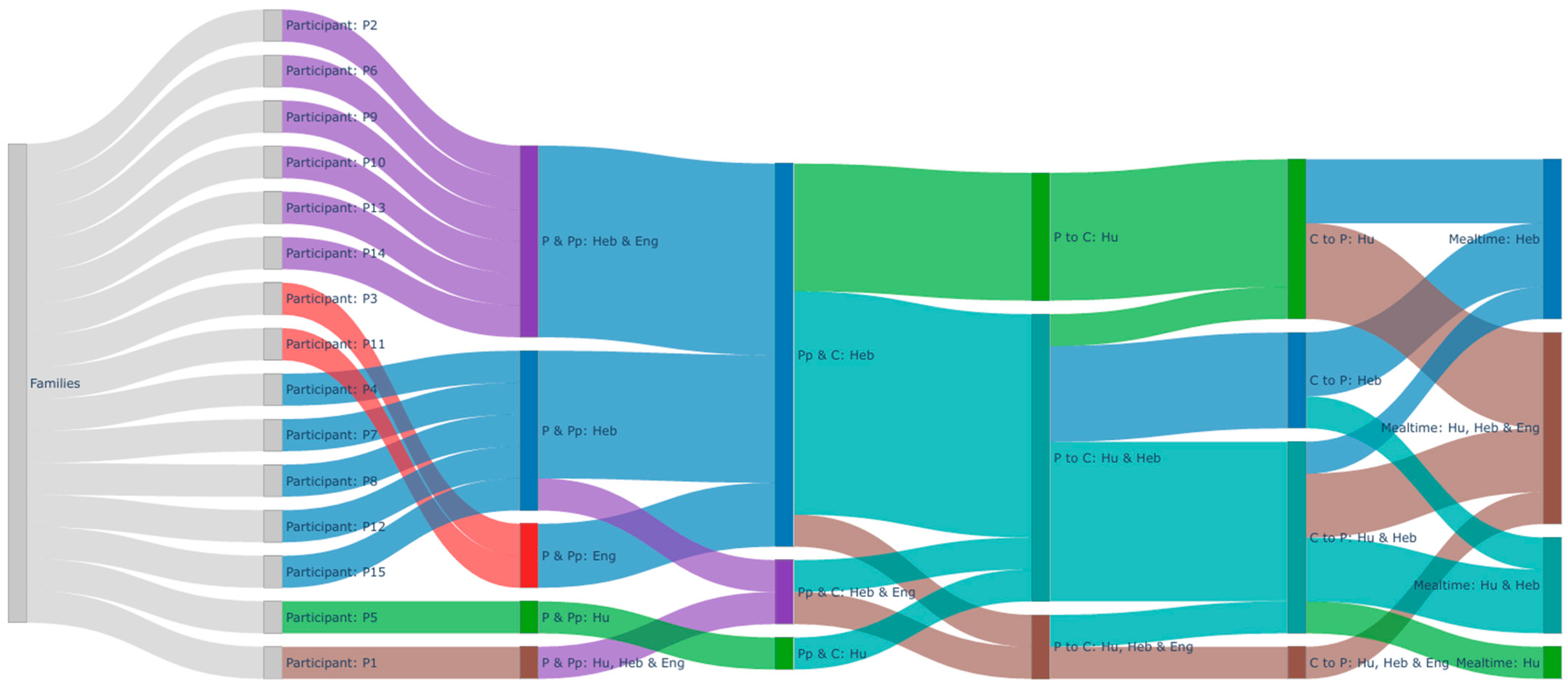
4.1. Characteristics of Parental Language Input
“I spoke Hungarian—that was never a question. My husband spoke Hebrew, but often English as well, since English is our shared language.”(P2)
“When we are all together, it is only Hebrew. And when I am with them, then it is only Hungarian. For example, dinner and talking about how your day was—that is in Hebrew.”(P7)
4.2. The Impacts of ML on HL Variation
4.2.1. Community-Level Factors: Expectations, Integration and Family Ideologies
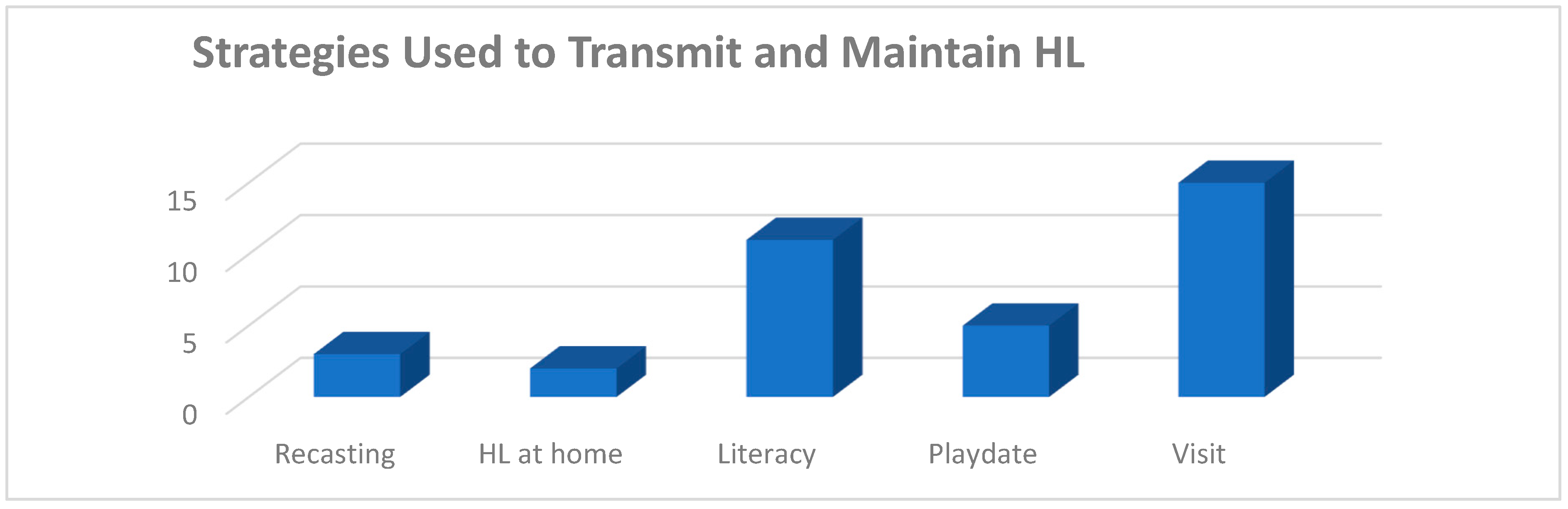
4.2.2. Interactional Level: Parental Strategies and Child Language Use
“When we are in Hungary, we basically speak Hungarian, and during those times the language also becomes stronger.”(P1)
“With the grandmother, there is Zoom—Zoom calls—and they also come to visit sometimes. So when they are here, and when they are not here but present this way, that also plays a role.”(P7)
“My rule is that everything should be done as much as possible in Hungarian. For example, I am not willing to read to them in Hebrew—I only read in Hungarian.”(P11)
“And then in the evening, there is bedtime story time, and I usually do the bedtime story, and that always happens in Hungarian.”(P1)
“She has Hungarian friends. A. has B. and C. there. But she has not met with C. for a long time, unlike with B, whom they meet often.”(P1)
“Similarly, there are other partly Hungarian families where the children also speak Hungarian very well, so he can practice the language with them.”(P10)
“I say almost everything twice, once in Hungarian and then in Hebrew. I feel like I am a tape recorder. Ever since I have been raising my child, I have been saying everything twice—I repeat almost everything.”(P8)
“If my husband is there, then the mealtime conversation is in Hebrew. If he is not there, then it is in Hungarian. But if he asks for a glass of water, he will ask me in Hungarian. So he automatically addresses me in Hungarian.”(P11)
“Well, at the moment, the common language for the three of us is Hebrew. He speaks Hebrew with his dad and Hungarian with me.”(P10)
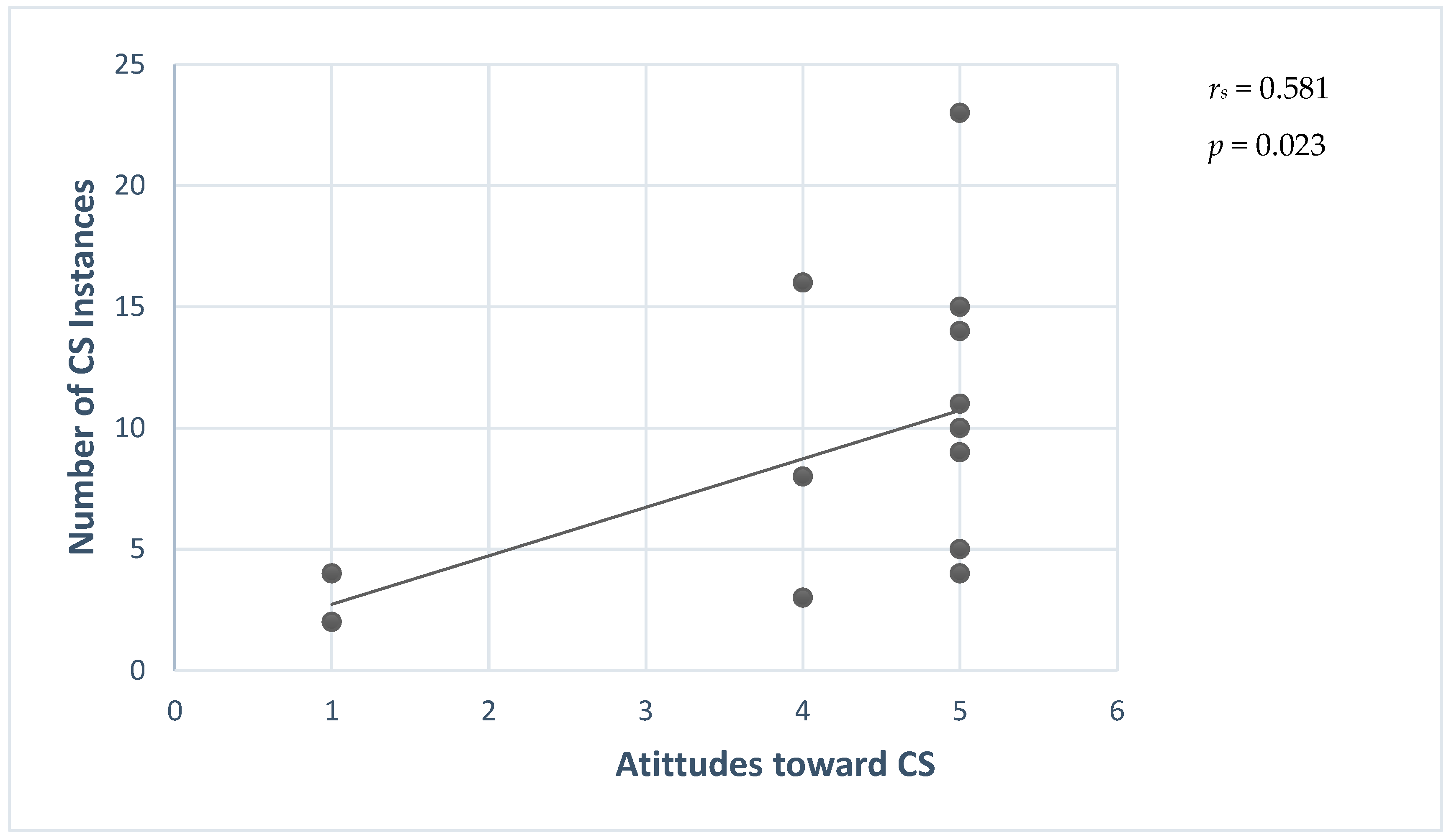
4.2.3. Ideological and Structural Levels: Attitudes Toward Switching to ML and Their Occurrence
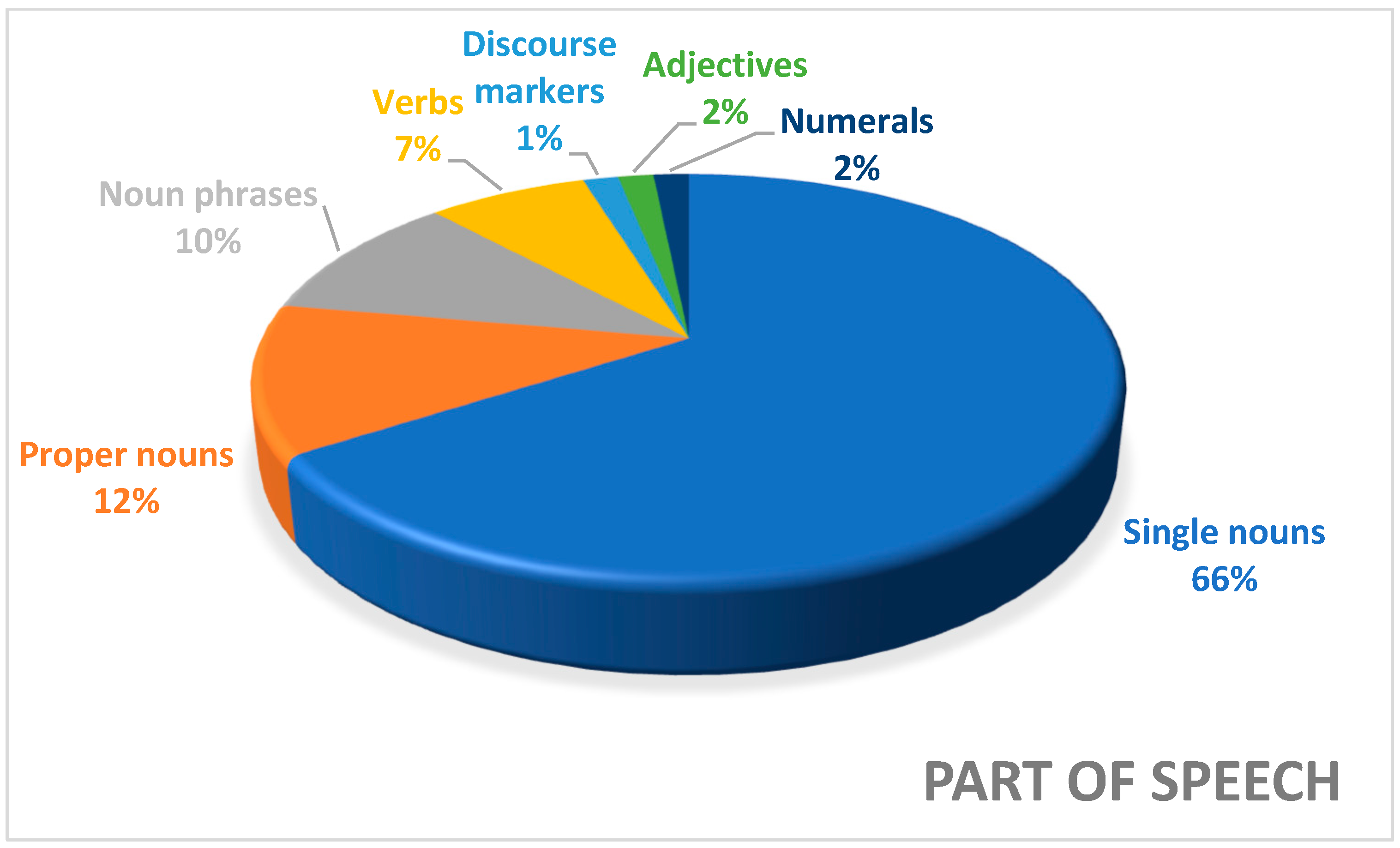
4.3. Structural Features and Functional Motivations of Hebrew Insertions
4.3.1. The Nominal Group and Its Functions
[1] A Miszrád Hápnimba voltunk.ɒ misraːd hɒpnimbɒ voltunkThe Misrad Hapnim—ILLATIVE be 1PL PASTWe were in the Ministry of Interior.
[2] és akkor végigcsináltam a rendes alíjáteːʃ ˈɒkːor ˈveːɡiɡt͡ʃiˌnaːltɒm ɒ ˈrɛndɛʃ ˈɒlijɒtAnd then I complete-1 Sg Past the proper Aliyah ACCAnd then I completed the proper immigration.
[3] Hát a schitzel és a krumplipüré.haːt ɒ ʃnitsɛl eːʃ ɒ krumplipur̪eːWell the schnitzel—NOMINATIVE and the mashed potatoes.Well, the schnitzel and the mashed potatoes.
[4] a mallavahot, ezt is szoktam csinálnieː ɒ malːavɒhot ɛst iʃ ˈsoktam ˈt͡ʃinaːlniAnd the malawach -ACCUSATIVE, I also usually make—1 Sg Past this.And the malawach, I also usually make this.
[5] Itt a SchoonábanItt ɒ ʃunaːbanHere the neighbourhood—INESSIVEHere in the neighbourhood.
4.3.2. The Verbs and Their Functions
[6] 2014-ben alijáztunk2014-ben ɒlija:ztunk2014 INESSIVE aliya—á—z—1PL PASTWe immigrated to Israel in 2014.
[7] Sokat ginázunk.ʃokat ɡinaːsunkMany park—á—z—1PL PRESENTWe are a lot in the park.
5. Discussion
5.1. Characteristics of Parental Language Input
5.2. The Impact of ML on HL Variation
5.3. Structural Patterns of CS and Translanguaging Practices
5.4. Theoretical Contributions and Synthesis
6. Limitation
7. Conclusions
Supplementary Materials
Author Contributions
Funding
Institutional Review Board Statement
Informed Consent Statement
Data Availability Statement
Acknowledgments
Conflicts of Interest
References
- Armon-Lotem, S., Rose, K., & Altman, C. (2021). The development of English as a heritage language: The role of chronological age and age of onset of bilingualism. First Language, 41(1), 67–89. [Google Scholar]
- Bail, A., Morini, G., & Newman, R. S. (2015). Look at the Gato! Code-switching in speech to toddlers. Journal of Child Language, 42(5), 1073–1101. [Google Scholar] [CrossRef] [Scilit]
- Baldassar, L., Nedelcu, M., Merla, L., & Wilding, R. (2016). ICT-based co-presence in transnational families and communities: Challenging the premise of face-to-face proximity in sustaining relationships. Global Networks, 16(2), 133–144. [Google Scholar] [CrossRef] [Scilit]
- Barron-Hauwaert, S. (2004). Language strategies for bilingual families: The one-parent-one-language approach. Multilingual Matters. [Google Scholar]
- Bartha, C. (1995). Social and linguistic characteristics of immigrant language shift: The case of Hungarian in Detroit. Acta Linguistica Hungarica, 43(3/4), 405–431. [Google Scholar]
- Ben-Rafael, E. (1994). Language, identity and social division: The case of Israel. Oxford studies in language contact. Clarendon. [Google Scholar]
- Bilgory-Fazakas, O., & Armon-Lotem, S. (2025). Resilient heritage language maintenance: The interplay of family, culture, and pragmatic choices. Frontiers in Psychology, 16, 1550704. [Google Scholar] [CrossRef] [Scilit]
- Blum-Kulka, S. (1997). Dinner talk: Cultural patterns of sociability and socialization in family discourse. Lawrence Erlbaum. [Google Scholar]
- Bohn, M., da Silva Vieira, W. F., Giner Torréns, M., Kärtner, J., Itakura, S., Cavalcante, L., Haun, D., Köster, M., & Kanngiesser, P. (2024). Mealtime conversations between parents and their 2-year-old children in five cultural contexts. Developmental Psychology, 60(7), 1255–1268. [Google Scholar] [CrossRef] [Scilit]
- Braun, V., & Clarke, V. (2006). Using thematic analysis in psychology. Qualitative Research in Psychology, 3(2), 77–101. [Google Scholar]
- Bryceson, D. F. (2019). Transnational families negotiating migration and care life cycles across nation-state borders. Journal of Ethnic and Migration Studies, 45(16), 3042–3064. [Google Scholar] [CrossRef] [Scilit]
- Bryceson, D. F., & Vuorela, U. (2002). The transnational family: New European frontiers and global networks. Routledge. [Google Scholar]
- Byers-Heinlein, K. (2013). Parental language mixing: Its measurement and the relation of mixed input to your bilingual children’s vocabulary size. Bilingualism: Language and Cognition, 16(1), 32–48. [Google Scholar]
- Carreira, M., & Kagan, O. (2011). The results of the national heritage language survey: Implications for teaching, curriculum design, and professional development. Foreign Language Annals, 44(1), 40–64. [Google Scholar] [CrossRef] [Scilit]
- CBS. (2010). Statistical abstract of Israel 2010. Table 4.4: Immigrants by period of immigration, country of birth and last country of residence. Available online: https://www.cbs.gov.il/he/publications/doclib/2010/4.%20shnatonimmigration/st04_04.pdf (accessed on 11 April 2024).
- CBS. (2025). Population—statistical abstract of Israel 2025. Available online: https://www.cbs.gov.il/he/publications/Pages/2025/%D7%90%D7%95%D7%9B%D7%9C%D7%95%D7%A1%D7%99%D7%99%D7%94-%D7%A9%D7%A0%D7%AA%D7%95%D7%9F-%D7%A1%D7%98%D7%98%D7%99%D7%A1%D7%98%D7%99-%D7%9C%D7%99%D7%A9%D7%A8%D7%90%D7%9C-2025-%D7%9E%D7%A1%D7%A4%D7%A8-76.aspx (accessed on 4 March 2026).
- Curdt-Christiansen, X. L. (2009). Invisible and visible language planning: Ideological factors in the family language policy of Chinese immigrant families in Quebec. Language Policy, 8, 351–375. [Google Scholar] [CrossRef] [Scilit]
- Curdt-Christiansen, X. L. (2013). Family language policy: Sociopolitical reality versus linguistic continuity. Language Policy, 12(1), 1–6. [Google Scholar] [CrossRef] [Scilit]
- Curdt-Christiansen, X. L. (2016). Conflicting language ideologies and contradictory language practices in Singaporean multilingual families. Journal of Multilingual and Multicultural Development, 37(7), 694–709. [Google Scholar] [CrossRef] [Scilit]
- De Houwer, A. (1999). Two or more languages in early childhood: Some general points and practical recommendations. ERIC. [Google Scholar]
- De Houwer, A. (2007). Parental language input patterns and children’s language use. Applied Psycholinguistics, 28, 411–424. [Google Scholar]
- De Houwer, A. (2021). Bilingual development in childhood. Cambridge University Press. [Google Scholar] [CrossRef] [Scilit]
- Dewaele, J.-M., & Wei, L. (2014). Attitudes towards code-switching among adults. Journal of Multilingual and Multicultural Development, 35(6), 521–540. [Google Scholar]
- Eurobarometer. (2023). Eurobarometer 540: Europeans and their languages. European Commission. [Google Scholar]
- Fenyvesi, A. (1995–1996). The case of American Hungarian case: Morphological change in McKeesport, PA. Acta Linguistica Hungarica, 43, 381–404. [Google Scholar]
- Fishman, J. A. (1991). Reversing language shift: Theoretical and empirical foundations of assistance to threatened languages. Multilingual Matters. [Google Scholar]
- Fuller, J. M. (2009). Multilingualism in educational contexts: Ideologies and identities. Language and Linguistics Compass, 3(1), 338–358. [Google Scholar] [CrossRef] [Scilit]
- García, O., & Wei, L. (2014). Translanguaging: Language, bilingualism and education. Palgrave Macmillan. [Google Scholar]
- Genesee, F., Nicoladis, E., & Paradis, J. (1995). Language differentiation in early bilingual development. Journal of Child Language, 22(3), 611–631. [Google Scholar] [CrossRef] [Scilit]
- Guzzo, S. (2014). Cross-cultural Adaptation as a Form of Translation: Translating Food in the UK Italian Community. Testi e Linguaggi, 2014(8), 161–169. [Google Scholar]
- Hatoss, A. (2006). Community-level approaches in language planning: The case of Hungarian in Australia. Current Issues in Language Planning, 7(2), 287–306. [Google Scholar] [CrossRef] [Scilit]
- Hatoss, A. (2016). Lexical borrowing in the speech of first-generation Hungarian immigrants in Australia. SAGE Open, 6, 1–12. [Google Scholar] [CrossRef] [Scilit]
- Hatoss, A. (2024). Shifting ecologies of family language planning: Hungarian Australian families during COVID-19. Current Issues in Language Planning, 25(5), 488–508. [Google Scholar] [CrossRef] [Scilit]
- He, A. W. (2010). The heart of heritage: Sociocultural dimensions of heritage language learning. Annual Review of Applied Linguistics, 30, 66–82. [Google Scholar] [CrossRef] [Scilit]
- Hirsch, T., & Lee, J. S. (2018). Understanding the complexities of transnational family language policy. Journal of Multilingual and Multicultural Development, 39(10), 882–894. [Google Scholar] [CrossRef] [Scilit]
- Hollebeke, I., Struys, E., & Agirdag, O. (2023). Can family language policy predict linguistic, socio-emotional and cognitive child and family outcomes? A systematic review. Journal of Multilingual and Multicultural Development, 44(10), 1044–1075. [Google Scholar] [CrossRef] [Scilit]
- Hornberger, N. H., & Wang, S. C. (2008). Who are our heritage language learners? Identity and biliteracy in heritage language education in the United States. In D. Brinton, O. Kagan, & S. Bauckus (Eds.), Heritage language education: A new field emerging (pp. 3–35). Routledge. [Google Scholar]
- Hu, J. (2019). Mealtime talk as a language learning context: Australian Chinese parents’ language use in interactions with their preschool-aged children at the dinner table. International Multilingual Research Journal, 13(3), 137–153. [Google Scholar] [CrossRef] [Scilit]
- Karpava, S., Ringblom, N., & Zabrodskaja, A. (2025). Translanguaging as a dynamic strategy for Heritage language transmission. Languages, 10(2), 19. [Google Scholar] [CrossRef] [Scilit]
- Kiefer, F. (2010). Hungarian. Revue belge de Philologie et d’Historie, 88(3), 715–739. [Google Scholar] [CrossRef] [Scilit]
- King, K., & Lanza, E. (2019). Ideology, agency, and imagination in multilingual families: An introduction. International Journal of Bilingualism, 23(3), 717–723. [Google Scholar] [CrossRef] [Scilit]
- King, K. A., Fogle, L., & Logan-Terry, A. (2008). Family language policy. Language and Linguistics Compass, 2(5), 907–922. [Google Scholar] [CrossRef] [Scilit]
- Kontra, M. (1990). Fejezetek a South Bend-i magyar nyelvhasználatból. MTA Nyelvtudományi Intézet. [Google Scholar]
- Kovács, M. (2001). Code-switching and language shift in Australian Finnish in comparison with Australian Hungarian. Åbo Akademi University Press. [Google Scholar]
- Kupisch, T., & Rothman, J. (2018). Terminology matters! Why difference is not incompleteness and how early child bilinguals are heritage speakers. International Journal of Bilingualism, 22(5), 564–582. [Google Scholar] [CrossRef] [Scilit]
- Labov, W. (1972). Sociolinguistic patterns. University of Pennsylvania Press. [Google Scholar]
- Lanza, E. (2004). Language mixing in infant bilingualism: A sociolinguistic perspective. Oxford University Press. [Google Scholar]
- Levitt, P., & Glick Schiller, N. (2004). Conceptualizing simultaneity: A transnational social field perspective on society. International Migration Review, 38(3), 1002–1039. [Google Scholar] [CrossRef] [Scilit]
- Matras, Y. (2009). Language contact. Cambridge University Press. [Google Scholar]
- Meir, N., Joffe, S., Shabtaev, R., Walters, J., & Armon-Lotem, S. (2021). Heritage languages in Israel: The multilingual tapestry with Hebrew threads. In S. Montrul, & M. Polinsky (Eds.), The Cambridge handbook of heritage languages and linguistics (pp. 129–155). Cambridge University Press. [Google Scholar]
- Multilingualism. (2009). European Union, EUR-LEX. 52009IP0162—EN. Available online: https://eur-lex.europa.eu/legal-content/EN/TXT/?uri=CELEX%3A52009IP0162 (accessed on 19 December 2024).
- Muysken, P. (2013). Two linguistic systems in contact: Grammar, phonology, and lexicon. In The handbook of bilingualism and multilingualism (pp. 193–215). John Wiley & Sons. [Google Scholar]
- Myers-Scotton, C. (1993). Social motivations for code-switching: Evidence from Africa. Oxford University Press. [Google Scholar]
- Otheguy, R., Garcia, O., & Reid, W. (2015). Clarifying translanguaging and deconstructing named languages: A perspective from linguistics. Applied Linguistics Review, 6(3), 281–307. [Google Scholar] [CrossRef] [Scilit]
- Otwinowska, A., Meir, N., Ringblom, N., Karpava, S., & La Morgia, F. (2021). Language and literacy transmission in heritage language: Evidence from Russian-speaking families in Cyprus, Ireland, Israel and Sweden. Journal of Multilingual and Multicultural Development, 42(4), 357–382. [Google Scholar] [CrossRef] [Scilit]
- Poeze, M., & Mazzucato, V. (2014). Ghanaian children in transnational families: Understanding the experiences of left-behind children through local parenting norms. In L. Baldassar, & L. Merla (Eds.), Transnational families, migration and the circulation of care. understanding mobility and absence in family life (pp. 149–169). Routledge/Taylor & Francis Group. [Google Scholar]
- Polinsky, M., & Montrul, S. (2013). Heritage language: A new field emerging. In The Cambridge handbook of Heritage languages and linguistics (pp. 163–183). Cambridge University Press. [Google Scholar]
- Rosenhouse, J. (2012). Israeli Hebrew and Hungarian interaction: Phonetic/phonological issues. Text, speech and language technology, 14/15. Rhythm, Melody and Harmony in Speech. Studies in Honour of Wiktor Jassem, 14(15), 211–224. [Google Scholar] [CrossRef] [Scilit]
- Rothman, J. (2009). Understanding the nature and outcomes of early bilingualism: Romance languages as heritage languages. International Journal of Bilingualism, 13(2), 155–163. [Google Scholar] [CrossRef] [Scilit]
- Schwartz, M. (2010). Family language policy: Core issues of an emerging field. Applied Linguistics, 31(2), 171–192. [Google Scholar] [CrossRef] [Scilit]
- Seals, C. A., & Beliaeva, N. (2023). Aspirational family language policy. Language Policy, 22, 501–521. [Google Scholar] [CrossRef] [Scilit]
- Snow, C. E. (2006). Mealtime talk that supports literacy development. New Directions for Child and Adolescent Development, 2006(111), 51–66. [Google Scholar] [CrossRef] [Scilit]
- Spolsky, B. (2004). Language policy. Cambridge University Press. [Google Scholar]
- Spolsky, B., & Shohamy, E. (1999). The languages of Israel: Policy, ideology and practice. Multilingual Matters. [Google Scholar]
- Szilágyi, J., & Szécsi, T. (2020). Why and how to maintain the Hungarian language: Hungarian-American families’ views on heritage language practices. Heritage Language Journal, 17, 114–139. [Google Scholar] [CrossRef] [Scilit]
- Tannenbaum, M., & Howie, P. (2002). The association between language maintenance and family relations: Chinese immigrant children in Australia. Journal of Multilingual and Multicultural Development, 23(5), 408–424. [Google Scholar] [CrossRef] [Scilit]
- Valdés, G. (2000). The teaching of heritage languages: An introduction for Slavic-teaching professionals. Slavic and East European Journal, 44(3), 437–466. [Google Scholar]
- Verdon, S., McLeod, S., & Winsler, A. (2014). Language maintenance and loss in a population study of young Australian children. Early Childhood Research Quarterly, 29(2), 168–181. [Google Scholar] [CrossRef] [Scilit]
- Vertovec, S. (2009). Transnationalism. Routledge. [Google Scholar]
- Wei, L. (2005). ‘How can you tell?’ Towards a common-sense explanation of conversational code-switching. Journal of Pragmatics, 37(3), 375–389. [Google Scholar] [CrossRef] [Scilit]
- Wei, L. (2012). Conceptual and methodological issues in bilingualism and multilingualism research. In T. Bhatia, & W. Ritchie (Eds.), The handbook of bilingualism and multilingualism (2nd ed., pp. 26–51). Wiley-Blackwell. [Google Scholar]
- Wei, L. (2018). Translanguaging as a practical theory of language. Applied Linguistics, 39(1), 9–30. [Google Scholar]
- Yamamoto, M. (2001). Language use in interlingual families: A Japanese-English sociolinguistic study. Multilingual Matters. [Google Scholar]
- Zabrodskaja, A., Meir, N., Karpava, S., Ringblom, N., & Ritter, A. (2023). Family language policies of multilingual families during the COVID-19 pandemic: Evidence from Cyprus, Estonia, Germany, Israel, and Sweden. Languages, 8(4), 263. [Google Scholar] [CrossRef] [Scilit]
- Zentella, A. C. (1997). Growing up bilingual: Puerto Rican children in New York. Blackwell. [Google Scholar]



Disclaimer/Publisher’s Note: The statements, opinions and data contained in all publications are solely those of the individual author(s) and contributor(s) and not of MDPI and/or the editor(s). MDPI and/or the editor(s) disclaim responsibility for any injury to people or property resulting from any ideas, methods, instructions or products referred to in the content. |
© 2026 by the authors. Licensee MDPI, Basel, Switzerland. This article is an open access article distributed under the terms and conditions of the Creative Commons Attribution (CC BY) license.
Share and Cite
Bilgory-Fazakas, O.; Armon-Lotem, S. Majority Language Influence and Heritage Language Maintenance in a Small Transnational Community: Hungarian-Hebrew Families in Israel. Languages 2026, 11, 65. https://doi.org/10.3390/languages11040065
Bilgory-Fazakas O, Armon-Lotem S. Majority Language Influence and Heritage Language Maintenance in a Small Transnational Community: Hungarian-Hebrew Families in Israel. Languages. 2026; 11(4):65. https://doi.org/10.3390/languages11040065
Chicago/Turabian StyleBilgory-Fazakas, Orsolya, and Sharon Armon-Lotem. 2026. "Majority Language Influence and Heritage Language Maintenance in a Small Transnational Community: Hungarian-Hebrew Families in Israel" Languages 11, no. 4: 65. https://doi.org/10.3390/languages11040065
APA StyleBilgory-Fazakas, O., & Armon-Lotem, S. (2026). Majority Language Influence and Heritage Language Maintenance in a Small Transnational Community: Hungarian-Hebrew Families in Israel. Languages, 11(4), 65. https://doi.org/10.3390/languages11040065