Article

A Mechanism of PF-Deletion Under the Probe–Goal System

Department of Business, Toyo University, Tokyo 112-8606, Japan
Languages 2026, 11(2), 28; https://doi.org/10.3390/languages11020028
Submission received: 2 September 2025 / Revised: 22 January 2026 / Accepted: 25 January 2026 / Published: 31 January 2026

Abstract

This paper develops a mechanism of PF-deletion within a probe–goal system that incorporates C-to-T feature inheritance. I propose that the phase head C enters the derivation not only with an edge feature (EF) and agree (φ-)features but also with a delete-feature, which licenses the deletion of an element at PF (PF-deletion). When C-to-T feature inheritance applies, the target of PF-deletion is determined through φ-probing from T; when it does not, it is determined through EF-probing from C. By linking PF-deletion to phase-internal probing, this approach dispenses with pro, traditionally assumed to exist in the lexicon of null subject languages such as Italian, as a theoretical primitive. Crucially, it offers a unified account of the distribution of null arguments in both Italian (a pro-drop language) and German (a topic-drop language), two language types that have traditionally resisted unified analysis under the principles-and-parameters approach. In addition to the synchronic study of the distribution of null arguments, I further argue that diachronic evidence from old languages such as Old French and Old English lends additional support to the proposal, and conclude that whether C-to-T inheritance applies or not is a crucial factor in explaining crosslinguistic variation in null argument phenomena.

1. Introduction

The ungrammaticality of sentences like (1) is typically attributed to a violation of the Extended Projection Principle (EPP), which stipulates that every clause must have a subject—specifically, that the specifier position of the Tense Phrase (Spec-TP) must be filled.
(1)*(She) speakes German
Under the VP-internal subject hypothesis, which has long been assumed within the Minimalist Program (MP), the EPP in (1) is satisfied as illustrated in (2): the subject she is first generated in Spec-v*P as the external argument of the verb speak, and then moves to Spec-TP to satisfy the EPP.
(2)Languages 11 00028 i001
Given that the EPP is assumed to be a part of Universal Grammar (UG), an immediate question arises: why are null subject constructions permitted in certain languages? This is illustrated by the Italian example in (3), where [e] represents an empty subject corresponding to a third-person feminine pronoun such as ella ‘she’.
(3)Italian
[e]parlatedesco.
speaksGerman
‘She speaks German.’
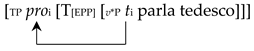
To account for this crosslinguistic variation, it has long been assumed, since Chomsky (1982), that the lexicon of null subject languages such as Italian includes a phonetically null pronominal element, pro, which occupies Spec-TP in order to satisfy the EPP.
(4)Languages 11 00028 i002
However, whether a phonetically null element can indeed fulfill the EPP requirement remains a matter of debate. Takahashi (2001), based on the ungrammaticality of examples like (5), argues that the EPP must be satisfied by an overt element rather than a null element.
(5)a. *John is easy to expect _ will see Mary.
b. *?John is easy to believe _ to know Mary well.
Given that easy-to-type constructions involve empty operator movement within the to-infinitival clause (Stowell, 1986), Takahashi argues that the ungrammaticality of these sentences results from a violation of the EPP: since the operator that moves to Spec-TP is phonologically null, it cannot satisfy the EPP.1
Abe (2015) strengthens this claim with evidence from parasitic gap constructions, which show a similar pattern of ungrammaticality when a null operator occupies subject position.
(6)a. *someone whoi John expected ti would be successful though believing that ei is incompetent.
b. *?someone whoi John expected ti would be successful though believing ei is incomepetent. (Chomsky, 1982, p. 53)
Although (6a) might be explained by the that-trace effect, the persistence of ungrammaticality in (6b)—despite the absence of that—suggests a more fundamental issue. Abe adopts Chomsky’s (1986) empty operator movement analysis and argues that these structures are ruled out because the null operator in the subject position of the parasitic clause cannot satisfy the EPP. Thus, these data cast doubt on the traditional assumption that a phonetically null element can occupy Spec-TP to satisfy the EPP.
I therefore depart from the standard analysis exemplified in (4). Instead, in this paper, I argue that pro can be eliminated from the grammar, proposing that apparent null subjects arise as the result of PF-deletion applied to fully specified overt pronouns, as illustrated in (7) (the deleted material is indicated by strikethrough, and how the EPP is satisfied under this analysis will be discussed in detail below).
(7)Ella parla tedesco.
This proposal offers several theoretical advantages over the traditional pro-based account. First, it dispenses with the need to posit pro as a primitive lexical item—an abstract, null pronominal bearing φ- and case-features but lacking phonological content (see Holmberg, 2005, for relevant discussion). If null subjects are derived via PF-deletion, such stipulations become unnecessary, thereby enhancing theoretical economy, a central goal of the MP. Second, this approach shifts parametric variation from the lexicon to narrow syntax and the interfaces, allowing crosslinguistic differences in null argument distribution to be captured by independently motivated mechanisms rather than stipulative parameter settings. In fact, as will be demonstrated below, it enables a unified analysis of null arguments in both Italian—a prototypical pro-drop language—and German—a representative topic-drop language. These language types have long resisted a unified account within the principles-and-parameters framework, which has at best provided a descriptive classification based on [±pro, ±topic] parameter values (e.g., Italian: [+pro, −topic]; German: [−pro, +topic]; English: [−pro, −topic]) without offering a principled theoretical explanation (see Chomsky, 1981; Huang, 1984).
Against this background, the present study aims to uncover the precise mechanism underlying PF-deletion and to derive null arguments on that basis. The paper is organized as follows. Section 2 outlines the probe–goal system with C-to-T feature inheritance adopted here. It begins by reviewing Chomsky’s (2008) proposal that all operations at the C-T level are driven by the phase head C, followed by Richards’ (2007) theoretical rationale for feature inheritance. It then introduces Goto’s (2011) argument concerning the applicability of feature inheritance, which follows naturally from Richards’ proposal and plays a key role in explaining crosslinguistic variation in null argument phenomena. In particular, Goto argues that C-to-T inheritance does not apply in so-called V2 environments, such as matrix clauses that involve T-to-C head movement. Section 3 develops a PF-deletion mechanism based on this system. It is proposed that the phase head C may enter the derivation not only with an edge feature (EF) and an agree (φ-)feature, but also with a delete-feature that licenses PF-deletion. This system predicts that in V2 environments such as matrix clauses, where feature inheritance does not apply, the delete-feature is assigned via EF-probing from C. In contrast, in non-V2 environments such as embedded clauses, where inheritance applies, it is assigned via φ-probing from T. This account captures the observed distribution of null arguments in Italian and German in a unified manner, and it also provides a natural explanation for the more complex null argument phenomena found in older languages such as Old French and Old English. Section 4 explores the theoretical implications of the proposal and concludes the paper.2

2. A Probe–Goal System That Incorporates C-to-T Feature Inheritance

2.1. Chomsky (2008)

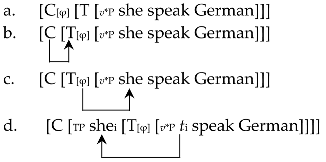
Drawing on the fact that T in raising and exceptional case marking (ECM) constructions—where T is not selected by C—lacks φ- and tense-features, Chomsky (2008) proposes that these features are not inherent to T but instead originate from C. He argues that subject agreement and EPP effects associated with T arise via a mechanism of feature inheritance. To illustrate this point, consider the derivation of the sentence in (8) (where I abstract away from a tense feature, as it plays no role in the relevant derivation).
(8)She speakes German.
Languages 11 00028 i003
In (8a), T is selected by C bearing φ-features. In (8b), φ-features are inherited by T from C. In (8c), T, now equipped with φ-features, probes the subject she and establishes a probe–goal (agree) relation, thereby valuing the uninterpretable φ-features on T and the uninterpretable case feature ([uCase]) on she (see Chomsky, 2000, 2001). Finally, in (8d), she moves to Spec-TP to satisfy the EPP, undergoing what is commonly referred to as A-movement.
Chomsky (2008), referring to the feature that enables an element to be merged as an edge feature (EF), argues that A′-movement involves EF-probing by C. In particular, he explicitly assumes EF-driven probing in wh-movement (Chomsky, 2008, pp. 147, 151). This claim is motivated by theoretical considerations regarding the architecture of wh-movement. In earlier works (e.g., Chomsky, 2000), uninterpretable features such as [uWh] on a wh-phrase or [uQ] on C were assumed to drive A′-movement. However, Chomsky (2008) proposes eliminating such uninterpretable features from the A′-system entirely. As a result, there is no need to postulate a movement-driving uninterpretable feature, thereby avoiding the long-standing problem of crash at lower phase levels in successive-cyclic movement. To illustrate the problem in the earlier system, consider successive-cyclic wh-movement in Chomsky (2000). A wh-phrase with uninterpretable [uWh] and interpretable [Q] must escape the transfer domains VP and TP by successively stopping in the edge positions of v*P and CP, eventually entering an agree relation with a C head bearing uninterpretable [uQ] and interpretable [Wh]. Here, transfer refers to the operation that sends a syntactic object to the interfaces. If, however, a C head lacking such features intervenes along the derivational path, the wh-phrase would necessarily leave its [uWh] feature unchecked in the transfer domain for that phase, which—contrary to fact—would cause the derivation to crash before convergence. The EF-based approach thus dispenses with this unnecessary theoretical complication and derives successive-cyclic A′-movement from independently required properties of phase theory.
With respect to minimality in probing, φ-probing and EF-probing are assumed to behave differently. Specifically, φ-probing, which involves feature valuation, is subject to intervention effects (Chomsky, 2008, p. 148), whereas EF-probing, which involves no valuation, is not (Chomsky, 2008, pp. 142, 151). This asymmetry follows naturally from the assumption that intervention effects arise only in the course of valuing uninterpretable features (Chomsky, 2000, p. 123).
The feature-inheritance-based probe–goal system has a significant consequence for the derivation of wh-subjects. Under this system, both the A′-movement of the wh-subject to Spec-CP and A-movement to Spec-TP apply in parallel from their base position in Spec-v*P, triggered by the introduction of C and the inheritance by T. As a result, there is no movement from Spec-TP to Spec-CP. The derivation in (9) illustrates this point.
(9)Who speakes German?
Languages 11 00028 i004
In (9a), T is selected by C, which bears both an EF and φ-features. In (9b), φ-features are inherited by T from C. In (9c), φ-probing by T and EF-probing by C apply in parallel to who in Spec-v*P. Finally, in (9d), who undergoes both A-movement to Spec-TP and A′-movement to Spec-CP directly from Spec-v*P. This parallel derivation permits the direct formation of an operator–variable chain (whok, ti), which can be regarded as a desirable consequence for chain formation under the principle of Full Interpretation, as thoroughly discussed in Chomsky (2008, p. 149).

2.2. Richards (2007)

Richards (2007) argues that the mechanism of C-to-T feature inheritance is indispensable for reconciling two independently motivated premises. The first premise holds that φ-feature valuation and transfer must occur simultaneously.3 The second premise, based on Chomsky (2000, p. 108) and Chomsky (2001, p. 13), maintains that the edge and non-edge domains of C—namely, TP—are transferred separately.
To illustrate this point, let us consider the relevant portion of the derivation in (8d) under two conditions, shown in (10) and (11), respectively (for expository convenience, the interpretable φ-features of she are included, and transfer is indicated by shading).
(10)No C-to-T feature inheritance
Languages 11 00028 i005
 *φ-valuation
(11)C-to-T feature inheritance
Languages 11 00028 i006
    φ-valuation
(10) illustrates a derivation without C-to-T feature inheritance, while (11) presents one in which feature inheritance from C to T occurs. In both cases, TP is transferred in accordance with the second premise. Crucially, when feature inheritance does not take place, as in (10), the derivation violates the first premise, which requires φ-feature valuation and transfer to occur simultaneously. In contrast, when feature inheritance does occur, as in (11), the derivation proceeds without violating either premise: by transmitting φ-features from C to T, as in (11), the system allows both the valuation and transfer of φ-features—on C and on she—to take place within the same domain, TP. Thus, Richards argues that C-to-T feature inheritance is indispensable for satisfying both premises simultaneously.

2.3. Goto (2011)

Noting that Richards’ (2007) argument for C-to-T feature inheritance presupposes that CP and TP are transferred separately, Goto (2011) observes that the mechanism becomes redundant when CP and TP are transferred as a single unit. As schematically illustrated in (12), even in the absence of feature inheritance, the requirement that φ-feature valuation and transfer take place simultaneously can still be satisfied under such a unified transfer.
(12)No C-to-T feature inheritance
Languages 11 00028 i007
 φ-valuation
The question, then, is in what kinds of environments CP and TP are transferred simultaneously. Drawing on Chomsky’s (2004, p. 108) suggestion that “[A]pplied to a phase PH, S-O [Spell-Out] must be able to spell out PH in full, or root clauses would never be spelled out,” Goto argues that in contexts such as German root declarative sentences like (13), CP and TP must be transferred as a single unit (note that S-O and transfer are used interchangeably in this context). Otherwise, elements at the edge of CP—der Mann hat—would fail to be transferred to the interfaces, violating the principle of Full Interpretation.
(13)German
[CPder Mannhat(C)[TPdenHund gesehen]]
the manhas thedogseen
‘The man has seen the dog.’
It should be noted that in German main clauses, the finite verb must obligatorily appear in the second position. Accordingly, in (13), hat is standardly assumed to occupy the C position, with der Mann occupying Spec-CP.
By contrast, note that the situation is different in embedded clauses. Unlike root clauses, an embedded C is selected by a higher head. Consequently, according to standard Phase Theory (Chomsky, 2000, et seq.), the complement of the phase head (i.e., TP) undergoes transfer separately from the phase edge (i.e., CP). Given Richards’ (2007) argument that unvalued features on T must be valued before TP is transferred, C-to-T feature inheritance becomes obligatory in these contexts to ensure that φ-feature valuation and transfer occur simultaneously. Crucially, this requirement holds even if the embedded clause exhibits V2 surface word order. While the verb may move to C in embedded V2 clauses, the structural fact that the clause is embedded dictates that TP is transferred separately, thereby necessitating feature inheritance.
Building on these theoretical and empirical observations, Goto (2011) proposes (14) as a general condition on the applicability of C-to-T feature inheritance.4
(14)C-to-T feature inheritance is unnecessary in root V2 environments.
In fact, since hat in (13) morphologically realizes both tense and φ-features on C, it is more economical not to apply C-to-T feature inheritance in deriving this structure. If such structures were to be derived via feature inheritance, it would be necessary first to transmit the relevant features to T from C and then, by some additional mechanism such as T-to-C head movement, have them realized back on C. However, if inheritance does not apply in these environments—as the empirical facts directly suggest—such additional operations become superfluous.5

3. Proposal and Predictions

Adopting the probe–goal system with C-to-T feature inheritance reviewed in Section 2, I make the following three proposals. First, I propose that, in addition to the EF and φ-features, the phase head C can enter the derivation bearing what I term a delete feature, which licenses the PF-deletion of a syntactic element.6
(15)C[EF][φ][Delete] … T
Second, I propose that an element carrying a delete feature may be deleted at PF, provided that the condition of recoverability of deletion is satisfied. Third, I propose that the assignment of the delete feature is implemented via probing—either by φ-probing from T or EF-probing from C.
Crucially, this PF-deletion mechanism, when combined with the generalization in (14), yields the prediction that while the delete feature is inherited from C to T along with the φ-features in non-V2 languages such as Italian, it remains on C and is not inherited in V2 languages such as German.
(16)C … T[φ][Delete] (in a non-V2 environment)
(17)C[EF][Delete] … T (in a V2 environment)
In (16), delete-feature assignment is carried out via φ-probing from T, whereas in (17), it is carried out via EF-probing from C. Thus, it is predicted that the distribution of null arguments in Italian is regulated by the behavior of φ-probing, which is subject to intervention effects, whereas in German it is determined by the behavior of EF-probing, which is not. The following subsections demonstrate that these predictions are indeed borne out.7

3.1. Deriving Null Arguments in Italian

Let us first examine how the present PF-deletion mechanism accounts for the null subject phenomenon illustrated in (3). Under the current system, the derivation of (3) proceeds as follows.
(18)[e] parla tedesco.
Languages 11 00028 i008
At the initial stage (18a), the phase head C is introduced bearing both φ- and delete-features. These features are then inherited by T, as shown in (18b). In (18c), the φ-feature on T probes the subject ella, establishing a probe–goal relation within its minimal search space. This agree relation leads not only to the valuation of φ- and case-features on both T and ella, but also to the assignment of the delete-feature to the agreeing subject. As shown in (18d), the subject ella is then deleted at PF, provided that the condition of recoverability is met. Crucially, this analysis derives the null subject without postulating pro as a primitive lexical item—an abstract null pronominal introduced solely to account for subjectless sentences. Instead, null subjects are derived through independently motivated operations such as φ-probing and PF-deletion.
At this point, one might wonder how the EPP requirement is satisfied in the derivation of (18d), where no overt element appears to occupy Spec-TP. This concern, however, is resolved if we adopt the mechanism of EPP satisfaction proposed by Goto (2017), which builds on the approach developed by Alexiadou and Anagnostopoulou (1998; henceforth A&A). According to A&A, in null subject languages such as Italian, the EPP can be satisfied through verb movement to T, provided that T bears rich agreement morphology. Building on this view, Goto argues that the EPP can be satisfied via verb movement to Spec-TP. It is therefore plausible to assume that this strategy is employed in the derivation of (18d), as illustrated below.
(19)Languages 11 00028 i009
In (19), the raising of parla to Spec-TP satisfies the EPP requirement, rendering the sentence grammatical despite the absence of an overt subject.8
Importantly, if non-null subject languages such as English lack this V-raising strategy for EPP satisfaction—as A&A and Goto argue—the ungrammaticality of the sentence in (1) can be attributed to a failure to satisfy the EPP. Specifically, under the present system, English T can in principle assign the delete feature to the agreeing subject, just as in Italian, as illustrated in (20a–b).
(20)*(She) speaks German.
Languages 11 00028 i010
However, if this option is taken, the derivation crashes due to a violation of the EPP. As shown in (21), without verb movement to T, the deletion of the subject leaves the EPP unsatisfied, resulting in ungrammaticality.
(21)Languages 11 00028 i011
Thus, under the current system, the contrast between Italian and English with respect to the availability of null subjects is attributed to the presence or absence of the V-raising strategy for EPP satisfaction, as originally proposed by A&A and further elaborated by Goto.
Remarkably, the present probe–goal (agree) analysis of null subjects offers a natural explanation for the general unavailability of null objects in Italian. Consider the following example.9
(22)a. *Mariohacostretto[e]a partire.
Mariohas.3SGforced(me/her/…)to leave
   b.*Giannisache Maria[e]vide.
Gianniknows.3SGthat Maria(him)saw(Rizzi, 1986, p. 517)
Under the current system, the ungrammaticality of (22a–b), which lacks an overt object, can be attributed to intervention effects. As shown in (23), since φ-probing from T is subject to minimal search, the delete feature cannot be assigned to the lower object across the intervening subject. As a result, the object cannot undergo PF-deletion and must be overtly realized.
(23)Languages 11 00028 i012
In this way, the current analysis offers a unified explanation of null argument phenomena in English and Italian, showing that crosslinguistic variation can be derived from independently motivated mechanisms such as φ-probing, feature inheritance, and PF-deletion, in conjunction with well-established assumptions regarding EPP satisfaction, agreement, and phase accessibility.

3.2. Deriving Null Arguments in German

Let us now turn to the other predicted possibility under the current system—namely, (17)—and examine how the proposed mechanism accounts for the distribution of null arguments in German. Unlike Italian, German permits a wide range of argument drop in matrix clauses. Consider the following examples.
(24)a. (Ich)hab’ihnschongesehen.
(I)havehimalreadyseen
‘(I) saw him already.’
   b.(Ihn)hab’ichschongesehen.
(him)haveIalreadybought
‘I saw (him) already.’ (Huang, 1984, p. 547)
   c.(Ich)habeesgesterngekauft.
(I)haveityesterdaybought
‘(I) bought it yesterday.’
   d.(Dass)habeichgesterngekauft.
(that)haveIyesterdaybought
(That,) I bought yesterday.’ (Deal, 2005, p. 33; Cardinaletti, 1990, p. 75)
As illustrated in (24a–d), both subjects and objects may be dropped in German matrix clauses. This contrasts with Italian, where null subjects are permitted but null objects are generally disallowed. This asymmetry has led some researchers to question the viability of a unified analysis of null arguments in the two languages.
Under the present analysis, however, this contrast follows naturally from the type of probe responsible for delete-feature assignment. In V2 environments, such as German matrix clauses, the delete feature remains on C rather than being inherited by T. As a result, the target of PF-deletion is determined through EF-probing from C, as schematized below.
(25)C[EF][Delete] … T
Under this configuration, PF-deletion applies to any element within the search domain of C: since EF is not constrained by minimality, EF-probing from C can target either the subject or the object directly.
(26)Languages 11 00028 i013
If the EF probes the subject, the delete feature is assigned to the subject, yielding (27a); if it probes the object, the object is deleted, as in (27b).
(27)Languages 11 00028 i014
Thus, the relatively free argument drop observed in German matrix clauses is attributed to the unrestricted probing capacity of the EF on C. Crucially, as illustrated in (27b), because EF-probing from C is not constrained by minimal search, the delete feature can target the lower object across the intervening subject.10 This, in turn, permits the object to undergo PF-deletion.11
One potential concern is how the EPP requirement on T is satisfied in derivations such as (27a), where the subject undergoes PF-deletion. This issue, however, does not arise if the EPP is triggered only when a tense feature is inherited from C to T (see Abe, 2015; Bošković, 2002, for relevant discussion; both argue that the EPP is absent in infinitival clauses lacking independent tense). Under the present proposal, since feature inheritance does not apply in V2 environments, the EPP on T is not activated. As a result, the presence or absence of the subject becomes immaterial in contexts such as (27a–b).
The current system makes the following prediction: if the EF on C is satisfied by some element, then C should no longer be able to probe either the subject or the object for the purpose of delete-feature assignment, as the EF becomes inactive once satisfied. This prediction is borne out by the following examples.
(28)a. Ihnhab’*(ich)schongesehen.
himhave(I)alreadyseen
‘(I) saw him already.’ (Huang, 1984, p. 547)
   b.Ichhab’*(ihn)schongesehen.
Ihave(him)alreadyseen
‘I saw (him) already.’ (Huang, 1984, p. 547)
   c.Jetztkenne*(ich)dasnicht.
nowrecognize(I)thatnot (Sigurðsson & Maling, 2008, p. 6)
d.Jetztkenne’ich*(dass)nicht.
nowrecognize’I(that)not (Sigurðsson & Maling, 2008, p. 14)
   e.Werhat*(es)schongesehen?
whohas(it)alreadyseen
‘Who has already seen it?’ (Rizzi, 1986, p. 513, fn. 8)
As schematically illustrated in (29), when another element occupies Spec-CP and satisfies the EF, EF-probing is not triggered, and the delete feature is no longer available for assignment to the arguments. As a result, neither the subject nor the object can undergo deletion.12
(29)Languages 11 00028 i015
This pattern stands in contrast to Italian. As shown in (30), the subject may remain null even when Spec-CP is occupied by another element such as dove ‘where’.
(30)Dove(egli) va?
wherego-3g
’Where is he going?’ (Deal, 2005, p. 35; see also Rizzi, 1994)
This follows straightforwardly from the present analysis. In Italian, since the deletion site is determined via φ-probing from T, the availability of subject deletion is independent of the EF on C. Accordingly, the subject may remain null even when the EF is satisfied by another element, as in (31), where dove satisfies the EF on C.
(31)Languages 11 00028 i016
Thus, under our analysis, the two key contrasts between Italian and German—the availability of null objects ((22) vs. (28b, d, e)) and the sensitivity to CP-edge occupancy ((28) vs. (30))—can be uniformly accounted for in terms of the type of probe involved in delete-feature assignment: φ-probing from T in Italian (a non-V2 language), and EF-probing from C in German (a V2 language).
It is important to recall here that German displays an asymmetry with respect to V2 effects between matrix and embedded clauses. As shown in (32a–b), German matrix clauses exhibit V2 word order, whereas embedded clauses do not.
(32)a. DerMannhatdenHundgesehen.(V2)
themanhavethedogseen
‘The man has seen the dog.’
   b.Ersagte daß der ManndenHundgesehenhat.(non-V2)
he saidthat the manthedogseenhave
‘He said that the man has seen the dog.’
If the present analysis is correct, then in non-V2 environments such as German embedded clauses, C-to-T feature inheritance applies, thereby activating the EPP on T. As a consequence, delete-feature assignment is carried out via φ-probing from T, as in languages like Italian and English. It follows, then, that null objects are disallowed in German embedded clauses due to intervention effects arising from φ-probing—unlike in matrix clauses, where delete-feature assignment is mediated by EF-probing from C (cf. (28b, d, e)). This prediction is indeed borne out, as shown in (33).
(33)a. Du weißt, dass ich*(sie/ihn/es) gesehenhabe.
you know that I(her/him/it) seenhave
‘You know that I have seen (her/him/it).’ (Cardinaletti, 1990, p. 76)
   b.Sagt Hans, hat/habeer*(es)gesehen.
says Hans has/have-subjhe(it)seen
‘Hans says he has seen (it).’ (Deal, 2005, p. 40; Cardinaletti, 1990, p. 77)
Furthermore, given that German lacks a morphologically rich agreement system compared to languages such as Italian (Müller, 2005), it is reasonable to assume that, like English, German does not employ V-raising as a means of satisfying the EPP in embedded contexts. Accordingly, although null subjects are in principle permitted via φ-probing, as in Italian and English, their deletion leads to an EPP violation in the absence of V-raising—for the same reason as in English. We therefore predict that null subjects are likewise disallowed in German embedded clauses. This prediction is supported by the data presented in (34).13
(34)Hansglaubt*(ich)habe esgesterngekauft.
HansbelievesIhave ityesterdatbought
‘Hans believes that I bought it yesterday.’ (Rizzi, 2005, p. 14)
One reviewer asked whether, in (34), given that the verb appears to occupy C, it should be EF-probing from C rather than φ-probing from T that drives the delete-feature assignment. However, as discussed in Section 2.3, in embedded clauses where further structure is built above CP, TP undergoes transfer, and the requirement of valuation–transfer simultaneity makes feature inheritance from C to T obligatory, regardless of whether the clause displays surface V2. Accordingly, I assume that feature inheritance applies here as well, and that the delete-feature assignment in (34) would therefore be carried out via φ-probing from T.
Taken together, the contrast between German matrix and embedded clauses with respect to the availability of null arguments can be systematically attributed to the nature of the probe responsible for delete-feature assignment: EF-probing from C in matrix contexts, and φ-probing from T in embedded contexts. In this respect, German embedded clauses pattern with English, where both null subjects and null objects are constrained by the interaction between φ-probing and the EPP.

3.3. Deriving Null Subjects in Old Languages

Thus far, I have proposed that in V2 environments, where C-to-T feature inheritance does not apply, delete-feature assignment is carried out via EF-probing from C. However, it is important to recognize that an alternative possibility remains. In such environments, φ-features are not inherited by T but remain on C, raising the possibility that even in V2 environments, delete-feature assignment may be carried out via φ-probing from C. In what follows, then, I propose that even in V2 environments, where C-to-T feature inheritance does not apply, languages with rich agreement determine the target of PF-deletion via φ-features on C, rather than via the EF. I argue that this proposal provides a principled account of the distribution of null subjects observed in Old French, which displays a hybrid pattern incorporating properties observed in both German and Italian.14
Old French displays an asymmetry with respect to V2 effects between matrix and embedded clauses. As shown in (35), Old French matrix clauses exhibit V2 word order, whereas embedded clauses do not (Adams, 1987; Vance, 1997).
(35)Old French
a.Einsint aama la damoiseleLancelot. (V2)
thus loved the young lady-NOMLancelot-ACC
‘Thus the young lady loved Lancelot.’ (Adams, 1987, p. 4)
   b.Einsi corurent___ipar mer tantqueilivindrent (non-V2)
Thus ran(they)by  sea untiltheycame
àCademelée
to Cadmée.(Adams, 1987, p. 2)
This pattern is also found in German. As shown in (36), repeated from (32), German displays an asymmetry in V2 effects between matrix and embedded clauses.
(36)German
a.DerMannhatdenHundgesehen. (V2)
themanhavethedogseen
‘The man has seen the dog.’
   b. Er sagtedaß derManndenHundgesehenhat. (non-V2)
he saidthat themanthedogseenhave
‘He said that the man has seen the dog.’
Based on this parallel, one might expect Old French to pattern with German with respect to the distribution of null arguments. As illustrated in (37a–b), repeated from (24a) and (34), German permits null subjects in matrix clauses but not in embedded ones.
(37)German
a. (Ich)hab’ihnschongesehen.
(I)havehimalreadyseen
‘(I) saw him already.’
   b. Hans glaubt*(ich)habeesgesterngekauft.
Hans believesIhaveityesterdatbought
‘Hans believes that I bought it yesterday.’
Contrary to this expectation, however, Old French allows null subjects not only in matrix clauses but also in embedded ones.
(38)Old French
a. Sifirent____grant joie lanuit.
Somade(they)great joy thatnight. (Adams, 1987, pp. 2–3)
‘So they made great joy that night.’
   b. S’il n’eüst lecueraillors, bien se peüst apercevoir par
if he not-hadthe heart elsewhere well REFL-can.SUBJ perceive by
samblantque___l’amastpor voir,
appearance that[he] her-love.SUBJ for to-see
‘If he had not had his heart elsewhere, it could clearly be seen by appearance that [he] loved her in order to see.’ (Hirschbuhler, 1989, p. 157)
This is, in fact, parallel to Italian, which, as shown in (39), permits null subjects in both matrix and embedded clauses.
(39)Italian
a. (Ella)parlatedesco.
ShespeaksGerman
‘She speaks German.
   b. sochecosa(te)haidetto.
know-1SGwhatthingyouhave-2SGsaid
‘I know what you said.’ (Deal, 2005, p. 35; Rizzi, 1994)
Thus, Old French exhibits a hybrid profile, combining properties of both German and Italian: it patterns with German in terms of V2 distribution, but aligns with Italian with respect to the availability of null subjects.
What is particularly noteworthy here is the behavior of null subjects in V2 matrix clauses in Old French. In such clauses, null subjects are permitted even when Spec-CP is occupied. For example, in (38a), the adverb si ‘so’ occupies Spec-CP, yet the subject remains null. Similarly, in (40a–c), au matin ‘in the morning’, einsi ‘thus’, and lors ‘then’ all appear in Spec-CP positions, and null subjects are nonetheless allowed.
(40)Old French
a. Aumatin s’apareilla____por aler au tornoiement.
In the morning himself prepared (he) for to go to the tournament.
   b. Einsi corurent____i parmer tant que ili vindrent à Cademelée.
Thus ran(they) bysea until they came toCadmée
   c. Lors s’acorderent____ique ili diroient que ili l’avoient
Then agreed(they)that they would say that they him had
baillié par lecommandement Nichodemus.
in their charge by the commandment (of) Nicodemus. (Adams, 1987, pp. 2–3)
Under the proposed analysis, the difficulty of providing a unified account of this pattern becomes evident when compared with German. As shown in (41a–b), repeated from (28a) and (28c), German does not allow null subjects in V2 matrix clauses when Spec-CP is filled.
(41)German
a. Ihnhab’*(ich)schongesehen.
himhave(I)alreadyseen
‘(I) saw him already.’
   b. Jetzt kenne *(ich)dasnicht.
now recognize (I)thatnot
Interestingly, the fact that null subjects are permitted even when Spec-CP is occupied by another element is attested in Italian, a non-V2 language, as shown in (42), repeated from (30).
(42)Italian
Dove(egli)va?
Where go-3g
‘Where is he going?’
Thus, while Old French shares the structural properties of V2 with German, its pattern of null subject availability more closely resembles that of Italian. The question, then, is how to account for this hybrid nature of Old French.
Based on the previous proposal, I assume that in Old French—like in German—C-to-T feature inheritance does not apply in V2 environments (i.e., matrix clauses), but does apply in non-V2 environments (i.e., embedded clauses). However, in languages with rich agreement like Old French, I propose that in V2 contexts where inheritance does not occur, delete-feature assignment is carried out not by the EF on C, but by φ-features that remain on C rather than being inherited by T. Accordingly, under this proposal, delete-feature assignment in Old French is carried out via φ-features on C in matrix clauses, and via φ-features on T in embedded clauses.
(43)C[φ][Delete] … T (Old French matrix V2 environments)
(44)C … T[φ][Delete] (Old French non-V2 embedded environments)
Significantly, the analysis in (43) offers a straightforward account of why null subjects remain permissible in V2 matrix clauses in Old French—even when Spec-CP is occupied, unlike in German. As shown in (45), although the EF on C is satisfied by an element XP in Spec-CP—such as si ‘so’ in (38a), or au matin ‘in the morning’, einsi ‘thus’, and lors ‘then’ in (40a–c)—φ-features on C remain active and are responsible for delete-feature assignment. As a result, the subject can be targeted for PF-deletion regardless of the presence of an element in Spec-CP.
(45)Languages 11 00028 i017
It is important to recall that the EPP on T is activated only when feature inheritance takes place. In configurations like (43), where inheritance does not apply, no EPP requirement is introduced on T. As a result, no EPP violation arises even if the subject is deleted, as shown in (45).
In contrast, in embedded contexts like (44), where inheritance does apply, delete-feature assignment is carried out via φ-features inherited by T, thereby allowing for null subjects, as illustrated in (46).
(46)Languages 11 00028 i018
At the same time, since feature inheritance introduces the EPP requirement on T, the derivation must also satisfy the EPP requirement. This issue, however, can be resolved if we assume that, like Italian, Old French employed a V-raising strategy for EPP satisfaction (see (19)).15
Accordingly, in Old French, delete-feature assignment is carried out via φ-features in both V2 matrix clauses and non-V2 embedded clauses, allowing for null subjects in both environments. In matrix clauses, where inheritance does not apply, the requirement to fill Spec-TP (EPP) does not arise. In embedded clauses, where inheritance does apply, the EPP requirement is introduced but satisfied through the V-raising strategy. What is crucial in this analysis is that, although Old French, like German, exhibits V2 word order in matrix clauses, the two languages differ with respect to the sensitivity of null subjects to CP-edge occupancy. While German disallows null subjects when Spec-CP is filled, Old French permits them regardless. This contrast is captured by attributing delete-feature assignment in German to the EF on C, which can target the subject independently of whether the CP-edge is occupied, whereas in Old French, assignment is mediated by φ-features on C, which remain active irrespective of CP-edge occupancy.
If Old German had a richer agreement morphology than Modern German, as is often assumed (Fuß, 2005; Axel & Weiß, 2011), then under the present analysis, we expect Old German—like Old French—to permit null subjects even in V2 matrix clauses where Spec-CP is occupied (see (45)). This prediction is supported by examples such as (47), where sume ‘some’ occupies Spec-CP, yet the subject remains null.
(47)Old High German
Sumehahet[e]incruci
somehang.2PL(you)tocross
‘Some of them, you will crucify.’ (Axel, 2007, p. 293)
This pattern aligns with the expectation that in languages with rich agreement, φ-features on C can trigger delete-feature assignment irrespective of CP-edge occupancy (for V2 effects in Old High German matrix clauses, see Axel, 2007).
Haeberli (2005) observes that Old English, like German and Old French, displays a V2–non-V2 asymmetry: matrix clauses exhibit verb-second order, while embedded clauses do not. At the same time, van Gelderen (2013) notes that Old English permits null subjects not only in matrix clauses but also in embedded ones.
(48)Old English matrix clauses (V2)
a. Nu scylun ___ herganhefaenricaes uard
now must pro praiseheaven.kingdom’s guard
‘Now we must praise the lord of the heavenly kingdom.’
   b. Nearwegenyddonon norðwegas.
Anxiouslyhastened pro onnorth.ways
‘Anxiously, they hastened north.’ (van Gelderen, 2013, p. 275)
(49)Old English embedded clauses (non-V2)
a. Him on mod bearn þæt ___ healreced hatan wolde medoærn
him to mind came that pro palace command would meadhall
micelmengewycrean
largemenbuild
   b.sumemen secgaðþæt þabeteran wærenþonne___  nu sien
somemen saythatthenbetter    werethanpro now are
‘Some men say that the tides were better then than they are now.’
(van Gelderen, 2013, p. 276)
These facts can be captured straightforwardly under the present proposal, in parallel with the analysis developed for Old French. Specifically, assuming that Old English also exhibits rich agreement, the system predicts that null subjects are licensed via φ-probing from C in V2 matrix clauses, and via inherited φ-features on T in non-V2 embedded clauses, with EPP satisfaction achieved through V-raising.


4. Concluding Remarks

This paper has developed a probe–goal-based mechanism of PF-deletion that crucially incorporates C-to-T feature inheritance. By positing that C enters the derivation not only with φ-features and an edge feature but also with a delete-feature, I have argued that the licensing of PF-deletion is a natural consequence of phase-internal probing. The proposal eliminates the need for pro as a primitive of the theory and instead derives the distribution of null arguments from independently motivated operations in the syntax–PF interface.16
This approach offers a unified account of the distribution of null arguments across two seemingly divergent systems: Italian-type pro-drop and German-type topic-drop. Moreover, diachronic evidence from Old French and Old English reinforces the central claim that variation in null argument phenomena hinges on whether C-to-T inheritance takes place.
Taken together, these results suggest that C-to-T inheritance plays a pivotal role not only in shaping the architecture of the clause but also in capturing both synchronic and diachronic variation in the grammar of null arguments. By linking PF-deletion to fundamental mechanisms of phase theory, the analysis moves toward a more restrictive and explanatory theory of crosslinguistic variation.17

Funding

This research received no external funding.

Institutional Review Board Statement

Not applicable.

Informed Consent Statement

Not applicable.

Data Availability Statement

The original contributions presented in the study are included in the article. Further inquiries can be directed to the corresponding author.

Conflicts of Interest

The author declares no conflicts of interest.

Notes

1
Takahashi (2001) argues that pro cannot satisfy the EPP and thus concludes that the EPP requirement on T is optional in Italian. As evidence, he analyzes (ia) as a case in which the EPP is satisfied, whereas in (ib), it is not.
(i)a. Gianni verra. (Italian)
    will-come
    ‘Gianni will come.’
b. Verra Gianni.
    ‘Gianni will come’
In this paper, following Alexiadou and Anagnostopoulou (1998), I adopt the traditional view that the EPP is obligatory in Italian and assume that in (ia), Gianni satisfies the EPP in Spec-TP, while in (ib), the EPP is satisfied by verb movement to Spec-TP (Goto, 2017). See Section 3.1 for details.
Note that, unlike a phonetically null operator, a phonetically full wh-phrase can satisfy the EPP, as illustrated in (i):
(i)a. Who do you expect _ will see Mary?
b. Who do you believe _ to know Mary well?
As one reviewer has pointed out, the contrast between (5) and (i) suggests that the quality of silence matters for the EPP. While the trace/copy of the wh-phrase in (i) is linked to a phonetically overt element (who) and thus retains potential phonetic features required to satisfy the EPP, the empty operator in (5) is inherently null, lacking any phonetic content throughout the derivation; only the latter fails to meet the requirement that the EPP be satisfied by an overt element.
2
Portions of this paper were presented at the workshop Towards a Theory of Syntactic Variation held at Bizkaia Aretoa, Bilbao, Spain (5–7 June 2013), and at the workshop Current Issues in Comparative Syntax: Past, Present, and Future held at the National University of Singapore (1–2 March 2018). I am grateful to Jun Abe, Richard Kayne, and Yosuke Sato for their invaluable comments and insightful discussions.
3
This view is supported by D’Alessandro and Roberts (2008), who argue that agreement relations are morphologically realized when the probe and the goal are transferred within the same domain.
4
For proposals suggesting that C-to-T inheritance is blocked under certain conditions, see Ouali (2006), Obata (2010), Goto (2011), Legate (2014), Gallego (2014), Aldridge (2017, 2018, 2019), and Erlewine (2018), among others.
5
I am grateful to the reviewer for raising the question of what drives head movement in the present analysis. I assume that the relevant trigger is a tense-feature, either on C or on T, depending on whether C-to-T feature inheritance applies. Under this view, the well-known asymmetry in English—namely, that subject–auxiliary inversion appears only in matrix clauses—follows straightforwardly. In matrix clauses, C-to-T feature inheritance does not apply, and thus the tense-feature remains on C; therefore, T raises to C. In embedded clauses, by contrast, feature inheritance applies, and the tense-feature is transferred to T; consequently, the tense-feature remains on T, and T does not raise to C.
The reviewer also raises an important related question: if English finite auxiliaries such as have and be undergo V-to-T head movement, why does English nevertheless fail to license pro-drop, unlike Italian (e.g., *Am having a coffee)? This may suggest that V-to-T head movement alone is not sufficient to satisfy the EPP or to license a null subject. Rather, a sufficiently rich agreement system may be necessary to establish a <φ, φ> label robust enough to support pro-drop (Chomsky, 2015). I must leave the precise nature of this requirement for future research.
6
For the purposes of this paper, it suffices to assume that the delete feature functions to instruct PF not to parse the element to which it is assigned—a view that has been adopted in various forms in the literature (see Merchant, 2008, among others). Note in passing that the present system assumes that only the C head can enter the derivation bearing a delete feature (see Sigurðsson, 2011, for a similar view). Given that v* is also a phase head, one might argue that it, too, could bear a delete feature. However, I set this possibility aside here. The main motivation for doing so stems from the widely held intuition that null argument phenomena are closely related to discourse topics, and that discourse-related notions are crucially anchored in the CP phase. See Rizzi (1997, p. 283).
A reviewer questions the conceptual motivation and formal status of the delete feature. The concern is that delete is described as something “assigned” rather than as a probe, which does not align with the probe–goal (agree) system, where unvalued features undergo valuation by a matching goal. Without treating delete as an uninterpretable/unvalued feature that requires valuation and inheritance under Richards’ (2007) value–transfer simultaneity approach, its necessity within the current theoretical architecture is not fully justified.
To address this concern, one possible implementation is to treat the delete feature on par with case. Case is a value “assigned” to an NP as the result of entering into an agree relation with T/v*, and delete may be handled in a similar way. Under this view, delete—like case—“rides on” uninterpretable/unvalued φ-features and does not itself function as a probe. Richards’ value–transfer simultaneity approach is assumed to apply to φ-features alone, with the assignment of case being parasitic on the valuation of φ. The precise nature of these features, including how case and delete participate in the externalization component, is an important issue that must be left for future research. I am grateful to the reviewer for drawing attention to this important point.
7
The present proposal also yields a third prediction: in V2 environments, where C-to-T feature inheritance does not apply, φ-features remain on C, and delete-feature assignment is carried out via φ-probing from C—a point to which we will return in Section 3.3. I am grateful to Koldo Sainz for drawing my attention to this possibility.
A reviewer has pointed out a fourth logical possibility: φ-feature inheritance from C to T takes place, but the delete feature nevertheless remains on C’s EF, rather than being inherited. This configuration would predict a distinct empirical profile—potentially allowing A′-ellipsis phenomena without φ-related recoverability effects. While highly insightful, a detailed empirical investigation of such a system goes beyond the scope of the present paper and must be left for future research. I am grateful to the reviewer for drawing my attention to this important theoretical possibility.
8
For head-to-Spec movement, see Fukui and Takano (1998); Toyoshima (2001); and Matushansky (2006). Based on Chomsky’s (2013, 2015) proposal that the EPP reduces to labeling TP as ⟨φ, φ⟩, Goto (2017) argues that this can be achieved via V-to-Spec movement. This raises the question of why such movement is not observed in English, if allowed under free merge. Goto (2017) suggests that while V-to-Spec movement may occur in English, it fails to converge due to the lack of rich φ-agreement on the verb, which prevents successful labeling. Crucially, the present analysis is compatible with either view, and the argument below does not depend on this issue.
9
Null objects are, in fact, attested in Italian. Consider the following example.
(i)Il bel tempo involgia __ a restare.
‘The nice weather induces __ to stay.’ (Rizzi, 1986, p. 503)
As Rizzi (1986) notes, however, such null objects are restricted to generic or arbitrary interpretations. While example (i) demonstrates that null argument phenomena in Italian are not exclusively subject-oriented, the present discussion is concerned specifically with referential null arguments—an option that is clearly confined to subjects. Accordingly, the case illustrated in (i) lies outside the scope of the current analysis.
10
One might ask whether object deletion in (27b) violates the Phase-Impenetrability Condition (PIC), defined in (i) (Chomsky, 2000, p. 108).
(i)The Phase Impenetrability Condition (PIC)
In phase α with head H, the domain of H is not accessible to operations outside α; only H and its edge are accessible to such operations.
However, in (27b), the edge feature on v* triggers object shift to the outer specifier of v*P, thereby placing the object at the phase edge and within the accessible domain of C. Consequently, potential PIC violations are avoided.
11
The reviewer correctly notes that West Flemish does not permit topic-drop despite being a V2 language (Sigurðsson, 2011, p. 271, footnote 5). One way to incorporate this fact within the analysis developed in the present paper is to adopt an underspecification approach to the ordering of narrow-syntactic operations (Obata et al., 2015). In this view, the relative ordering of operations such as move and probe is not fixed universally but may vary across languages. Given that C bears both EF and the delete-feature, two derivational possibilities arise: probe→move, where delete-feature assignment applies before EF-driven movement, and move→probe, where EF-movement precedes delete-feature assignment. I assume, as argued in the main text, that German instantiates the former option (probe→move). In contrast, if West Flemish is taken to instantiate the latter option (move→probe), then EF on C triggers movement to Spec-CP first. When the subsequent probing is initiated to assign the delete-feature, no matching goal is available within C’s probing domain, because move has already removed the relevant DP from that domain. As a result, delete-feature assignment fails to apply, and topic-drop is not derived. Under this underspecification approach, cross-linguistic variation arises from differences in the ordering of otherwise identical syntactic operations, and no lexical parametric differences concerning the features of C need to be assumed.
12
In V2 languages such as German, the EF associated with C is tied to the V2 requirement and typically attracts exactly one constituent to Spec-CP in root declaratives. As one reviewer rightly points out, although EF is theoretically undeletable in Chomsky’s (2008) framework—thereby allowing for multiple applications of merge—its use in such V2 environments becomes empirically exhausted once the V2-driven movement operation is satisfied. Consequently, no further EF-probing from C is permitted.
13
As one reviewer has pointed out, if German satisfies the EPP by VP-pied-piping to Spec-TP, as argued in Richards and Biberauer (2005), then the apparent EPP violation in (34) would seem to disappear. However, since (34) represents a V2 configuration, EPP satisfaction at Spec-TP is not at issue here.
14
With respect to null objects in Old French, two main approaches have been proposed. According to one view, Old French does not permit null objects (Marchello-Nizia, 1995; Schøsler, 1999). According to the other, null objects are allowed (Arteaga, 1997; Donaldson, 2013). A full evaluation of the validity of these competing approaches lies beyond the scope of this paper. In what follows, I focus exclusively on null subjects and set aside the issue of null objects in Old French.
15
This analysis raises an important question: why can Modern French not satisfy the EPP via the V-raising strategy, unlike Old French? To address this issue, I draw on two proposals: Chomsky’s (2013, 2015) analysis that reduces the EPP to the requirement for a <φ, φ> label, and Biberauer and Roberts’ (2012) claim that V-to-T movement in Italian is driven by φ-agreement, whereas in Modern French it is driven by tense-agreement. Building on these insights, I suggest that V-raising in Italian and Old French effectively satisfies the EPP—as it contributes to the formation of a <φ, φ> label—while V-raising in Modern French does not. The precise mechanisms involved are left for future research.
16
Although interpretive asymmetries between null and overt pronouns in pro-drop languages have traditionally been attributed to grammatical constraints such as the Overt Pronoun Constraint (OPC; Montalbetti, 1984), more recent studies suggest that these effects may instead arise from interface-driven principles. In particular, Alonso-Ovalle et al. (2002) argue that such asymmetries are better explained by processing principles sensitive to syntactic position, as further developed in Carminati’s (2002) Position of Antecedent Strategy, as well as by interactions with topic–focus structure.
Within the present proposal, pro is not treated as a primitive element with special interpretive properties. Rather, it is derived by PF-deletion of a syntactically ordinary pronoun licensed via agree (φ-probing). While our analysis does not in itself derive interpretive differences between deleted and overt pronouns, it is compatible with the view that any such effects follow from independently motivated principles of information structure and discourse recoverability, rather than requiring a distinct syntactic representation for pro. I am grateful to a reviewer for drawing our attention to this issue.
17
A reviewer raises the question of how the present proposal might account for radical pro-drop languages, such as Japanese and Chinese. With respect to this issue, I agree that the argument omission patterns in these languages are not straightforwardly reducible to φ-feature-driven PF-deletion, given the absence of obligatory φ-agreement. In this respect, it is conceivable that EF-probing may play a role. A fuller investigation of how such systems might interact with—or diverge from—the present deletion-based approach is left for future research.

References

  1. Abe, J. (2015). The EPP and subject extraction. Lingua, 159, 1–17. [Google Scholar] [CrossRef]
  2. Adams, M. (1987). From old French to the theory of pro-drop. Natural Language & Linguistic Theory, 5, 1–32. [Google Scholar] [CrossRef]
  3. Aldridge, E. (2017). Extraction asymmetries in ergative and accusative languages. In M. Y. Erlewine (Ed.), Proceedings of GLOW in Asia XI (pp. 1–20). MIT Working Papers in Linguistics. MIT. [Google Scholar]
  4. Aldridge, E. (2018). C-T inheritance and the left periphery in Old Japanese. Glossa: A Journal of General Linguistics, 3(1), 26. [Google Scholar] [CrossRef]
  5. Aldridge, E. (2019). Subject/non-subject movement asymmetries in Late Archaic Chinese. Glossa: A Journal of General Linguistics, 4, 115. [Google Scholar] [CrossRef]
  6. Alexiadou, A., & Anagnostopoulou, E. (1998). Parameterizing agr: Word order, V-movement and EPP checking. Natural Language & Linguistic Theory, 16, 491–539. [Google Scholar]
  7. Alonso-Ovalle, L., Fernández-Solera, S., Frazier, L., & Clifton, C., Jr. (2002). Null vs. overt pronouns and the topic-focus articulation in Spanish. Rivista di Linguistica, 14(2), 151–169. [Google Scholar]
  8. Arteaga, D. (1997). On null objects in Old French. In A. Schwegler, B. Tranel, & M. Uribe-Etxebarria (Eds.), Romance linguistics: Theoretical perspectives (pp. 1–11). John Benjamins. [Google Scholar]
  9. Axel, K. (2007). Studies on old high German syntax. John Benjamins. [Google Scholar]
  10. Axel, K., & Weiß, H. (2011). Pro-drop in the history of German from old high German to the modern dialects. In M. Wratil, & P. Gallmann (Eds.), Empty pronouns (pp. 21–52). De Gruyter. [Google Scholar]
  11. Biberauer, T., & Roberts, I. (2012). Subjects, tense and verb movement in Germanic and Romance. In N. C. Duy, & R. S. Sinha (Eds.), Proceedings of GLOW in Asia V (pp. 86–111). GLOW Linguistics. [Google Scholar]
  12. Bošković, Ž. (2002). A-movement and the EPP. Syntax, 5, 167–218. [Google Scholar] [CrossRef]
  13. Cardinaletti, A. (1990). Impersonal constructions and sentential arguments in German. Unipress. [Google Scholar]
  14. Carminati, M. N. (2002). The processing of Italian subject pronouns [Ph.D. dissertation, University of Massachusetts at Amherst]. [Google Scholar]
  15. Chomsky, N. (1981). Lectures on government and binding. Foris. [Google Scholar]
  16. Chomsky, N. (1982). Some concepts and consequences of the theory of government and binding. MIT Press. [Google Scholar]
  17. Chomsky, N. (1986). Barriers. MIT Press. [Google Scholar]
  18. Chomsky, N. (2000). Minimalist inquiries: The framework. In R. Martin, D. Michaels, & J. Uriagereka (Eds.), Step by step: Essays on minimalist syntax in honor of Howard Lasnik (pp. 89–155). MIT Press. [Google Scholar]
  19. Chomsky, N. (2001). Derivation by phase. In M. Kenstowicz (Ed.), Ken hale: A life in language (pp. 1–52). MIT Press. [Google Scholar]
  20. Chomsky, N. (2004). Beyond explanatory adequacy. In A. Belletti (Ed.), Structures and beyond: The cartography of syntactic structures (pp. 104–131). Oxford University Press. [Google Scholar]
  21. Chomsky, N. (2008). On phases. In R. Freidin, C. P. Otero, & M. L. Zubizarreta (Eds.), Foundational issues in linguistic theory: Essays in honor of jean-roger Vergnaud (pp. 133–166). MIT Press. [Google Scholar]
  22. Chomsky, N. (2013). Problems of projection. Lingua, 130, 33–49. [Google Scholar] [CrossRef]
  23. Chomsky, N. (2015). Problems of projection: Extensions. In E. Di Domenico, C. Hamann, & S. Matteini (Eds.), Structures, strategies and beyond: Studies in honor of Adriana Belletti (pp. 3–16). John Benjamins. [Google Scholar]
  24. D’Alessandro, R., & Roberts, I. (2008). Movement and agreement in Italian past participles and defective phases. Linguistic Inquiry, 39, 477–491. [Google Scholar] [CrossRef]
  25. Deal, A. R. (2005). Pro-drop, topic-drop, and the functional lexicon: A constructional account of null arguments [Honors thesis, Brandeis University]. [Google Scholar]
  26. Donaldson, B. (2013). Null objects in Old French. In D. Arteaga (Ed.), Research on Old French: The state of the art (pp. 61–86). Springer. [Google Scholar]
  27. Erlewine, M. Y. (2018). Extraction and licensing in Toba Batak. Language, 93, 662–697. [Google Scholar] [CrossRef]
  28. Fukui, N., & Takano, Y. (1998). Symmetry in syntax: Merge and demerge. Journal of East Asian Linguistics, 7, 27–86. [Google Scholar] [CrossRef]
  29. Fuß, E. (2005). The rise of agreement. A formal approach to the syntax and grammaticalization of verbal inflection. John Benjamins. [Google Scholar]
  30. Gallego, Á. J. (2014). Deriving feature inheritance from the copy theory of movement. The Linguistic Review, 31, 41–71. [Google Scholar] [CrossRef]
  31. Goto, N. (2011). Feature-inheritance: Its effects on agree, move, and delete [Ph.D. dissertation, Tohoku Gakuin University]. [Google Scholar]
  32. Goto, N. (2017). Eliminating the strong/weak parameter on T. In M. Y. Erlewine (Ed.), Proceedings of GLOW in Asia XI (Vol. 2, pp. 56–71). MIT Working Papers in Linguistics 85. MIT. [Google Scholar]
  33. Haeberli, E. (2005). Clause type asymmetries in Old English and the syntax of verb movement. In M. Batllori, & F. Roca (Eds.), Grammaticalization and parametric variation (pp. 267–283). Oxford University Press. [Google Scholar]
  34. Hirschbuhler, P. (1989). On the existence of null subjects in embedded clauses in Old and Middle French. In Studies in Romance linguistics (pp. 155–175). John Benjamins. [Google Scholar]
  35. Holmberg, A. (2005). Is there a little pro? Evidence from Finnish. Linguistic Inquiry, 36, 533–564. [Google Scholar] [CrossRef]
  36. Huang, C.-T. J. (1984). On the distribution and reference of empty pronouns. Linguistic Inquiry, 15, 531–574. [Google Scholar]
  37. Legate, J. (2014). Voice and v: Lessons from Acehnese. MIT Press. [Google Scholar]
  38. Marchello-Nizia, C. (1995). L’évolution du français: Ordre des mots, démonstratifs, accent tonique. Armand Colin. [Google Scholar]
  39. Matushansky, O. (2006). Head movement in linguistic theory. Linguistic Inquiry, 37, 69–109. [Google Scholar] [CrossRef]
  40. Merchant, J. (2008). Variable island repair under ellipsis. In K. Johnson (Ed.), Topics in ellipsis (pp. 132–153). Cambridge University Press. [Google Scholar]
  41. Montalbetti, M. M. (1984). After binding: On the interpretation of pronouns [Ph.D. dissertation, Massachusetts Institute of Technology]. [Google Scholar]
  42. Müller, G. (2005). Pro-drop and impoverishment. In P. Brandt, & E. Fuß (Eds.), Form, structure and grammar: A festschrift presented to günther grewendorf on the occasion of his 60th birthday (pp. 93–115). Narr. [Google Scholar]
  43. Obata, M. (2010). Root, successive-cyclic and feature-splitting internal merge: Implications for feature-inheritance and transfer [Ph.D. dissertation, University of Michigan]. [Google Scholar]
  44. Obata, M., Epstein, S., & Baptista, M. (2015). Can crosslinguistically variant grammars be formally identical? Third factor underspecification and the possible elimination of parameters of UG. Lingua, 156, 1–16. [Google Scholar] [CrossRef]
  45. Ouali, H. (2006). On C-to-T φ-feature transfer: The nature of agreement and anti-agreement in Berber. In R. D’Alessandro, S. Fischer, & G. H. Hrafnbjargarson (Eds.), Agreement restrictions (pp. 159–180). Mouton de Gruyter. [Google Scholar]
  46. Richards, M. (2007). On feature inheritance: An argument from the phase impenetrability condition. Linguistic Inquiry, 38, 563–572. [Google Scholar] [CrossRef]
  47. Richards, M., & Biberauer, T. (2005). Explaining expl. In M. den Dikken, & C. Tortora (Eds.), The function of function words and functional categories (pp. 115–154). John Benjamins. [Google Scholar]
  48. Rizzi, L. (1986). Null objects in Italian and the theory of pro. Linguistic Inquiry, 17, 501–558. [Google Scholar]
  49. Rizzi, L. (1994). Early null subjects and root null subjects. In T. Hoekstra, & B. Schwartz (Eds.), Language acquisition studies in generative grammar (pp. 151–176). John Benjamins. [Google Scholar]
  50. Rizzi, L. (1997). The fine structure of the left periphery. In L. Haegeman (Ed.), Elements of grammar: Handbook of generative syntax (pp. 281–337). Kluwer. [Google Scholar]
  51. Rizzi, L. (2005). On the grammatical basis of language development: A case study. In G. Cinque, & R. Kayne (Eds.), The Oxford handbook of comparative syntax (pp. 70–109). Oxford University Press. [Google Scholar]
  52. Schøsler, L. (1999). Réflexions sur l’optionnalité des compléments d’objet direct en latin, en ancien français, en moyen français et en français moderne. Études Romanes, 44, 9–27. [Google Scholar]
  53. Sigurðsson, H. Á. (2011). Conditions on argument drop. Linguistic Inquiry, 42, 267–304. [Google Scholar] [CrossRef]
  54. Sigurðsson, H. Á., & Maling, J. (2008). Argument drop and the empty left edge condition. Working Papers in Scandinavian Syntax, 81, 1–27. [Google Scholar]
  55. Stowell, T. (1986). Null antecedents and proper government. In Proceedings of NELS 16 (pp. 476–493). GLSA, University of Massachusetts. [Google Scholar]
  56. Takahashi, D. (2001). On the nature of the EPP. Tohoku University. [Google Scholar]
  57. Toyoshima, T. (2001). Head-to-spec movement. In G. M. Alexandrova, & O. Arnaudova (Eds.), The minimalist parameter: Selected papers from the open linguistics forum, Ottawa, 12–23 March 1997 (pp. 115–136). John Benjamins. [Google Scholar]
  58. Vance, B. (1997). Syntactic change in medieval French: Verb-second and null subjects. Kluwer. [Google Scholar]
  59. van Gelderen, E. (2013). Null subjects in Old English. Linguistic Inquiry, 44, 271–285. [Google Scholar] [CrossRef]
Disclaimer/Publisher’s Note: The statements, opinions and data contained in all publications are solely those of the individual author(s) and contributor(s) and not of MDPI and/or the editor(s). MDPI and/or the editor(s) disclaim responsibility for any injury to people or property resulting from any ideas, methods, instructions or products referred to in the content.