1. Introduction
This article reports on the absence of relative clause (RC) islands in the Ekhwa variety of Adara (EA
1) (ISO 639-3 [KAD]), an under-documented Benue-Congo language spoken by approximately 300,000 (
Hon et al., 2018) to 500,000 people (
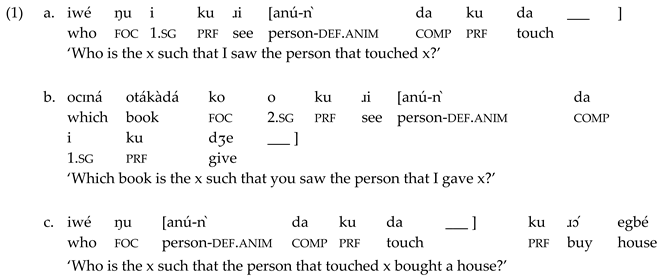
Simons & Fennig, 2018) in Nigeria. A-bar dependency formation across both subject and object-modifying RCs is possible in the language, as illustrated below. Examples (1a,b) show that
wh- fronting from the direct object position of an object-modifying RC is attested in the language. The datum in (1c) establishes that
wh- expressions may also be extracted from the direct object position of subject-modifying RCs. Adjunct
wh- expressions may freely extract from these environments as well.

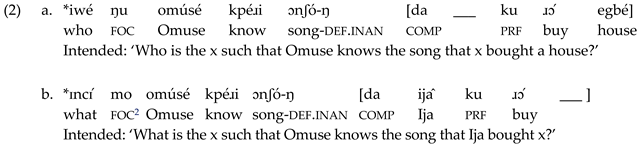
The facts in (1) are notable in light of the cross-linguistic tendency for complex NPs to constrain A-bar dependency formation. Other complex NPs in the language behave as expected with respect to constraints on A-bar movement. The data in (2) show that neither subjects (2a) nor direct objects (2b) may be extracted from clausal complements of definite nouns.

The facts in (1) are additionally notable in the context of other well-known strong island constraints. Domains that hinder A-bar movement cross-linguistically also block the formation of A-bar dependencies in EA. Extraction from sentential subjects (3a), reason clausal adjuncts (3b), and conditional clauses (3c) is systematically barred. RCs in the language, therefore, are unique. Unlike other expected island domains, escape from RC “islands” is possible.

Although surprising from a universalist Generative perspective on islands and constraints on movement, the A-bar transparency of RCs in EA is not surprising from an Africanist perspective.
Schurr et al. (
2024) demonstrate that RCs in Shupamem are fully transparent for the formation of A-bar dependencies.
3 Nominal constituents (though not VP or PP constituents) may freely extract from RCs in Limbum (
Hein, 2024).
Korsah and Murphy (
2024) show that RCs in Akan lack island status.
Smith (
2024) establishes that subject-modifying RCs in Mende (though not object-modifying RCs in the language) allow for the A-bar extraction of RC-internal material. Ekhwa Adara therefore represents yet another African language in which “island” escape is possible.
The data in (1) appear to show that escape from RC structures in the language is possible. In
Section 2, I adduce evidence from crossover effects, reconstruction effects, and quantifier float that the
wh- dependencies presented in (1) are the result of movement. In
Section 3, I show that RC-internal material may probe upwards and outwards, triggering agreement of RC-internal verbs with clause-external subjects in a way that is not possible with the true island structures in (2) and (3).
Section 4 concludes the article.
2. Escape from RCs
Bawa (
2025) presents several arguments that the derivations underpinning
wh- ex situ in EA are the result of movement and not base-generation. Among his arguments are the observations that ex situ
wh- structures: show sensitivity to crossover effects, manifest reconstruction effects, feed quantifier float, and license parasitic gaps. In this section, I will deploy some of these movement diagnostics to support the claim that A-bar escape from RCs is possible in the language.
2.1. Sensitivity to Crossover Effects
Ex situ wh- expressions connected to RC-internal positions must be interpreted as disjoint in reference from matrix pronominal subjects.

Given that the matrix pronominal subjects c-command the wh- gaps in (4), the impossibility of pronominal binding in structures such as these may be plausibly attributed to a strong crossover effect—an A-bar moved element cannot move across a c-commanding pronoun that it ends up binding.
We find a similar effect with non-c-commanding pronouns in subject position. Peripheral wh- expressions linked to positions within RCs may not receive interpretations in which they corefer with pronouns embedded inside the subject constituent.

Given that the possessive pronominals fail to c-command the wh- gaps in (5), the impossibility of pronominal binding in structures like these can be attributed to a weak crossover effect—an A-bar moved element cannot move across a non-c-commanding pronoun that it ends up binding.
The crossover data in (4) and (5) involve matrix pronominal expressions, and while suggestive of escape from RCs, they are only sufficient to diagnose wh- movement in the main clause. To complete the argument for RC escape from crossover effects, we observe that pronominals in embedded subject positions also trigger crossover effects with wh- expressions originating inside RCs. The data in (6) present these facts. (6a) illustrates a strong crossover effect, while (6b) shows a weak crossover effect.

Together, the interpretative asymmetries in these examples support the claim that the peripheral wh- occurrences have indeed escaped the RCs.
2.2. Reconstruction Effects
Peripheral wh- phrases connected to RC-internal positions behave as though they occupy those RC-internal positions with respect to binding theoretic interpretative considerations such as Condition C (7a) and Condition A (7b).

The expression Omúsé, which is embedded inside the peripheral complex wh- phrase in (7a), is unable to corefer with the matrix third person singular pronominal subject despite a lack of surface c-command between the two expressions. These facts are consistent with an analysis in which the complex wh- expression is interpreted inside the RC. In such a position, the inability of Omúsé to corefer with the matrix pronominal subject could be attributed to a violation of Condition C of the binding theory. Thus, the Condition C-based reconstruction effect in (7a) implicates an analysis in which the complex ex situ wh- phrase has evacuated the RC. In (7b), we find a comparable situation involving a complex ex situ wh- phrase that contains the reflexive expression icwí-ŋ. Despite the fact that the antecedent of the reflexive (Omúsé) fails to c-command it on the surface, the anaphor respects Condition A of the binding theory and is therefore licensed. This suggests an analysis in which the expression ‘which book about himself’ is interpreted inside the RC despite its surface position in the left periphery, once again supporting the conclusion that the complex wh- phrase has escaped the RC.
The reconstruction effects in (7) all involve matrix antecedents and are therefore sufficient to diagnose whether the
wh- expressions have moved in the main clause. It is important to also consider cases of reconstruction involving antecedents occupying RC-internal positions, for such cases would implicate movement out of the embedded domain.
4 Consider the following data.

Example (8a) instantiates another Condition C-based reconstruction effect, while (8b) represents another Condition A reconstruction effect. When paired with the data in (7), these facts once again support the claim that escape from RCs is possible in EA.
2.3. Quantifier Float
Additional evidence for A-bar escape from RCs in EA comes from quantifier float data.
5 Quantifier float refers to configurations in which a quantifier is construed with its associate despite a non-local (non-adjacent) relationship between them. Under the assumption that quantified expressions are licensed syntactically,
wh- quantifier float structures are expected to be impossible when the associate vacates an island, as in French (
Baunaz, 2008) and Irish English (
McCloskey, 2000), among other languages. In EA, floating quantifiers associated with left peripheral
wh- expressions may be found RC-internally (9b), strongly suggesting that RC domains do not have the status of islands in the language. Structures like (9b) yield the same interpretations as when the quantifier and its associate appear together in a left peripheral position (as in (9a)).

This contrasts sharply with the distribution of floating quantifiers inside clausal complements of definite nouns in the language, which have the status of islands in EA (see (2)). In these structures, quantifier float is systematically unavailable (10b), as is consistent with their status as islands.

3. Agreement
The data in
Section 2 reveal that A-bar dependency formation across RC boundaries is possible in EA. In this section, I show that another type of dependency formation across RC domains is possible in the language, namely, long-distance subject–verb agreement. Taken together, the facts show that outward-looking grammatical operations are not constrained by RC structures in the language, which is consistent with the claim that RCs do not have island status in EA.
Section 3.1 introduces the phenomenon of subject agreement in EA, and
Section 3.2 considers its application across a variety of island boundaries in the language.
3.1. Subject–Verb Agreement
Verbs in EA may optionally agree with subjects.
6 Agreeing elements appear as verbal suffixes and are formally identical to the accusative pronoun series.
7 There is no interpretive consequence of subject–verb agreement in the language. The data in (11) illustrate the phenomenon. Note that the 1.
pl agreement marker (11d) is syncretic with the 3.
pl form (11f).

In embedded contexts, verbs may optionally agree with local subjects, or they may enter into long-distance agreement relationships with higher subjects. The data in (12) illustrate this phenomenon.

When an embedded verb agrees with a local subject, a special intonation (greater intensity/amplitude on the subject, though no tone change) is required. No special intonation is required when a verb agrees with a non-local subject. Once again, there is no interpretative or pragmatic consequence of subject–verb agreement, regardless of whether it is local or long-distance.
3.2. Agreement Across Island Boundaries
Despite the availability of subject agreement across clause boundaries (12), verbs embedded in islands may not agree with island-external subjects. In these configurations, only local agreement is (optionally) possible. The data in (13) illustrate. Subject marking on the matrix verb, while possible, is omitted in this example set for readability.

The datum in (13a) shows that subject agreement out of clausal complements of definite nouns is not possible in EA. Example (13b) illustrates that verbs embedded in sentential subjects may not agree with outside subjects either. (13c) reveals that agreement with subjects external to reason clauses is not allowed, while (13d) shows that verbs embedded in conditional clauses may not agree with non-local subjects. These facts support the conclusion that clausal complements of definite nouns, sentential subjects, and adjunct clauses (i.e., so-called strong islands) are not only islands for A-bar dependency formation but also for long-distance agreement relations. That is, agreement cannot ignore island boundaries in EA. Similar facts concerning islands and agreement (albeit cases where the agreement controller is
inside the island and agreement is blocked) have been pointed out by
Polinsky and Potsdam (
2001),
Bruening (
2001),
Branigan and MacKenzie (
2002),
Bobaljik and Wurmbrand (
2005),
Bhatt (
2005) and
Keine (
2013), among others.
We observe an agreement asymmetry when it comes to RC structures in the language. Unlike the island configurations presented in (13), both local and non-local subject agreement is possible for RC-internal verbs. The facts in (14) demonstrate this phenomenon.

Example (14a) shows that in subject RCs in object position, agreement with the matrix subject is possible, as is agreement with the local embedded subject. (14b) establishes that the same agreement pattern is possible in object RCs. These facts are striking. In languages where RCs constitute strong islands, RC-internal probes fail to agree with island-external agreement controllers (
Bobaljik & Wurmbrand, 2005;
Bošković, 2007;
Heck & Cuartero, 2012;
Douglas, 2015; and
Deal, 2016, among others). The robust availability of agreement out of RCs in EA speaks to the porous nature of relative clause structures in the language.
Returning to those instances of successful wh- movement out of RCs discussed at the outset of Article (1), we find that here too the relativized verb may undergo long-distance agreement with the matrix subject.

These agreement facts, coupled with the extraction facts previously considered in
Section 2, are consistent with the conclusion that RCs in EA are fully porous domains for the formation of long-distance dependencies.
4. Conclusions
In this article, I argued that definite relative clauses, despite their stable strong island status cross-linguistically, lack island status in Ekhwa Adara. RCs in the language are neither selective nor weak, but rather completely permeable, allowing the free extraction of both arguments and adjuncts. In support of the claim that A-bar movement may escape relative clause domains in EA, I presented evidence from crossover effects, reconstruction effects, and quantifier float. In addition, I showed that relative clause-internal material may probe upwards and outwards, triggering long-distance agreement of relativized verbs with clause-external subjects in a way that is not possible with true island structures in the language. We thus observe two distinct types of escape from RCs in EA.
At present, it is not clear what structurally distinguishes RCs from those domains that constitute true islands in the language or why Adara RCs lack island status. I leave the exploration of this issue to future research, pointing out that
Schurr’s (
2026) work on the absence of clausal islands in Shupamem may offer valuable clues and insights.
Funding
This research received no external funding.
Institutional Review Board Statement
Not applicable.
Informed Consent Statement
Informed consent was obtained from all subjects involved in this study.
Data Availability Statement
Data is contained within the article.
Acknowledgments
I thank three anonymous Languages reviewers for their insightful comments and thoughtful questions. Their remarks improved the quality of this article. Special thanks to Emmanuel Bawa for providing all Adara data/judgments. For valuable feedback and helpful comments, I thank Jeongmi Cha, Jamie Hudson, and Hagay Schurr. All errors and oversights are my own.
Conflicts of Interest
The author declares no conflicts of interest.
Correction Statement
The article has been republished with a minor correction to resolve spelling and grammatical errors. This change does not affect the scientific content of the article.
Abbreviations
The following abbreviations are used in this manuscript:
| ANIM | Animate |
| CL | Class marker |
| COMP | Complementizer |
| COND | Conditional |
| DEF | Definite |
| FOC | Focus |
| FUT | Future |
| INAN | Inanimate |
| PRF | Perfect |
| PL | Plural |
| PROG | Progressive |
| SG | Singular |
| SBJV | Subjunctive |
Notes
| 1 | The data and judgments presented in this paper come exclusively from fieldwork in the context of two Field Methods classes taught at The CUNY Graduate Center in Fall 2022 and Fall 2023. Data are presented in IPA. Abbreviations for glosses follow the Leipzig Glossing Rules. The following diacritics are used to mark surface tone:  = high,  = low, v = mid;  = falling;  = rising. |
| 2 | Interrogative focus markers in EA vary according to the animacy and type of the fronted interrogative expression. For more on the realization of these particles, see Matte et al. ( 2026). |
| 3 | See also Kandybowicz and Nchare ( 2023) for evidence that both restrictive and non-restrictive RCs in Shupamem permit extraction (topicalization). |
| 4 | Thanks to a thoughtful reviewer for making this point. |
| 5 | Floating quantifiers have been argued by some authors (e.g., Déprez, 1989) to be a property of A, but not A-bar movement. Since the floating quantifiers examined in this section associate with wh- expressions, I assume that they are sufficient to diagnose A-bar movement, as in McCloskey ( 2000). |
| 6 | Although agreement with the subject is optional in most cases, there are contexts in which agreement is obligatory. One case concerns select causative–inchoative alternations. When certain transitive/causative verbs like ‘break’, ‘cook’, or ‘spill’ are used intransitively, subject agreement on the verb becomes mandatory. This pattern, however, is limited to a subset of verbs in the language that participate in the causative–inchoative alternation. For example, although ‘grow’ can be used causatively, subject agreement on the verb is not obligatory when ‘grow’ is used inchoatively. Further investigation into this phenomenon is clearly warranted. |
| 7 | A reviewer asks whether the morphemes I am calling agreement markers are more accurately subject clitics, given the identity between these markers and pronouns. Although this issue certainly warrants careful examination in future work, there are three reasons I analyze them as agreement markers. One, unlike clitics, the markers are for the most part (though see note 6) completely optional. Two, while clitics can sometimes be separated from their hosts, the markers in question occupy a fixed position—obligatorily right adjacent to the verb. Third, although many of the markers are in fact formally similar to pronouns, not all are (i.e., 3.sg and 1.pl/3.pl). |
References
- Baunaz, L. (2008). Floating quantifiers: French universal quantifiers and N-words. In P. Benincà, F. Damonte, & N. Penello (Eds.), Rivista di grammatica generativa 33 (selected proceedings of the 34th Incontro di grammatica generative) (pp. 25–42). Unipress. [Google Scholar]
- Bawa, E. (2025, May 16). The derivation of Wh- ex-situ and Wh- in-situ in Ekhwa Adara. Ms. The Graduate Center, City University of New York. Annual Conference on African Linguistics 56, Minneapolis, MN, USA. [Google Scholar]
- Bhatt, R. (2005). Long-distance agreement in Hindi-Urdu. Natural Language and Linguistic Theory, 23, 757–807. [Google Scholar] [CrossRef]
- Bobaljik, J. D., & Wurmbrand, S. (2005). The domain of agreement. Natural Language and Linguistic Theory, 23, 809–865. [Google Scholar] [CrossRef]
- Bošković, Ž. (2007). Agree, phases, and intervention effects. Linguistic Analysis, 93, 54–96. [Google Scholar]
- Branigan, P., & MacKenzie, M. (2002). Altruism, A-movement, and object agreement in Innu-aimûn. Linguistic Inquiry, 33, 385–407. [Google Scholar] [CrossRef]
- Bruening, B. (2001). Syntax at the edge: Cross-clausal phenomena and the syntax of passamaquoddy [Ph.D. thesis, Massachusetts Institute of Technology]. [Google Scholar]
- Deal, A. R. (2016). Cyclicity and connectivity in Nez Perce relative clauses. Linguistic Inquiry, 47, 427–470. [Google Scholar] [CrossRef]
- Déprez, V. (1989). On the typology of syntactic positions and the nature of chains: Move α to the specifier of functional projections [Ph.D. thesis, Massachusetts Institute of Technology]. [Google Scholar]
- Douglas, J. A. (2015). Agreement (and disagreement) among relatives. In J. N. Chancharu, X. F. Hu, & M. Mitrovic (Eds.), Cambridge occasional papers in linguistics (Vol. 7, pp. 33–60). University of Cambridge. [Google Scholar]
- Heck, F., & Cuartero, J. (2012). Long distance agreement in relative clauses. In A. Alexiadou, T. Kiss, & G. Müller (Eds.), Local modeling of non-local dependencies in syntax (pp. 49–85). De Gruyter. [Google Scholar]
- Hein, J. (2024). Category-sensitive escape from islands in Limbum and Asante Twi. Languages, 9(10), 317. [Google Scholar] [CrossRef]
- Hon, L., Ajaegbu, G., Magnusson, C., Nweke, U. S., & Yoder, Z. (2018). A sociolinguistic survey of the Adara of Kaduna and Niger States, Nigeria (SIL Electronic Survey Reports, 2018-004). SIL International. [Google Scholar]
- Kandybowicz, J., & Nchare, A. L. (2023). Integrated non-restrictive relative clauses in Shupamem. Natural Language and Linguistic Theory, 41, 655–677. [Google Scholar] [CrossRef]
- Keine, S. (2013). On the role of movement in Hindi/Urdu long-distance agreement. In S. Keine, & S. Sloggett (Eds.), Proceedings of the 42nd North East linguistic society (NELS 42) (pp. 273–284). GSLA. [Google Scholar]
- Korsah, S., & Murphy, A. (2024). The absence of islands in Akan: The role of resumption. Languages, 9(4), 127. [Google Scholar] [CrossRef]
- Matte, M., Nguyen, N. A., Bawa, E., Amaris, J., Liu, Z., Malanoski, A., Mignone, O., Quinn, S., Sharif, A., & Kandybowicz, J. (2026). Polar and Wh- question formation in Ekhwa Adara. In V. Carstens, K. Russell, O. Akingbade, D. Morton, & M. Diercks (Eds.), Pamoja Tena ‘together again’: African linguistics after COVID (selected papers from the 54th annual conference on African linguistics) (pp. 175–199). Language Science Press. [Google Scholar]
- McCloskey, J. (2000). Quantifier float and Wh-movement in an Irish English. Linguistic Inquiry 31, 57–84. [Google Scholar] [CrossRef]
- Polinsky, M., & Potsdam, E. (2001). Long distance agreement and topic in Tsez. Natural Language and Linguistic Theory 19, 583–646. [Google Scholar] [CrossRef]
- Schurr, H. (2026). Syntactic connectivity across clausal islands in Shupamem [Ph.D. thesis, The Graduate Center, City University of New York]. [Google Scholar]
- Schurr, H., Kandybowicz, J., Nchare, A. L., Bucknor, T., Ma, X., Markowska, M., & Tapia, A. (2024). Absence of clausal islands in Shupamem. Languages, 9, 7. [Google Scholar] [CrossRef]
- Simons, G. F., & Fennig, C. D. (2018). Ethnologue: Languages of the world (21st ed.). SIL International. [Google Scholar]
- Smith, J. (2024). On the absence of certain island effects in Mende. Languages, 9(4), 131. [Google Scholar] [CrossRef]
| Disclaimer/Publisher’s Note: The statements, opinions and data contained in all publications are solely those of the individual author(s) and contributor(s) and not of MDPI and/or the editor(s). MDPI and/or the editor(s) disclaim responsibility for any injury to people or property resulting from any ideas, methods, instructions or products referred to in the content. |







 = high,
  = low, v = mid;
  = falling;
  = rising.


