
L2 Pragmatics Instruction in the Greek EFL Classroom: Teachers’ Competence, Beliefs, and Classroom Challenges

Abstract
1. Introduction
2. Previous Research on L2 Pragmatics Instruction
2.1. The Importance of Pragmatics Instruction
2.2. EFL Teachers and the Instruction of L2 Pragmatics
2.3. Challenges in Teaching L2 Pragmatics
2.4. EFL Teachers’ Knowledge, Beliefs and Attitudes
2.5. EFL Teachers’ Pragmatics Instruction: Global and Greek Perspectives
2.6. Goals of the Study
- RQ1: To what extent do Greek EFL instructors have the necessary pragmatic competence to teach second language pragmatics?
- RQ1.1: Is there any correlation between instructors’ pragmatic competence and their years of teaching experience?
- RQ2: What are Greek EFL instructors’ beliefs and attitudes towards second language pragmatics?
- RQ3: What challenges do Greek EFL instructors face in integrating pragmatics instruction in their EFL classrooms?
3. Methods
3.1. Participants
3.2. Materials
3.2.1. The Electronic Questionnaire
Pragmatic Comprehension Scenarios
Discourse Completion Task (DCT)
Likert Scale Self-Reports (Beliefs and Attitudes)
3.3. Semi-Structured Interviews
3.4. Data Analysis
4. Findings and Discussion
4.1. Pragmatic Comprehension: Receptive Competence
- (1)
- You are in London for the Christmas holidays and are doing your shopping in Harrods. The department store closes in 30 min, and people are in a hurry to check out. You are walking carrying multiple bags while having a heated conversation with your partner on your mobile phone. A young woman accidentally knocks over some of your bags and causes you to drop your phone as well.Young woman: Very sorry, but you were in my way!
- (2)
- You are working at an international summer school. During the break, you discuss a student’s paper with a colleague.You: Have you finished reading John’s paper?Colleague: Yes, I read it yesterday.You: What did you think of it?Colleague: Well, I thought it was well-typed.What does your colleague mean by her answer?
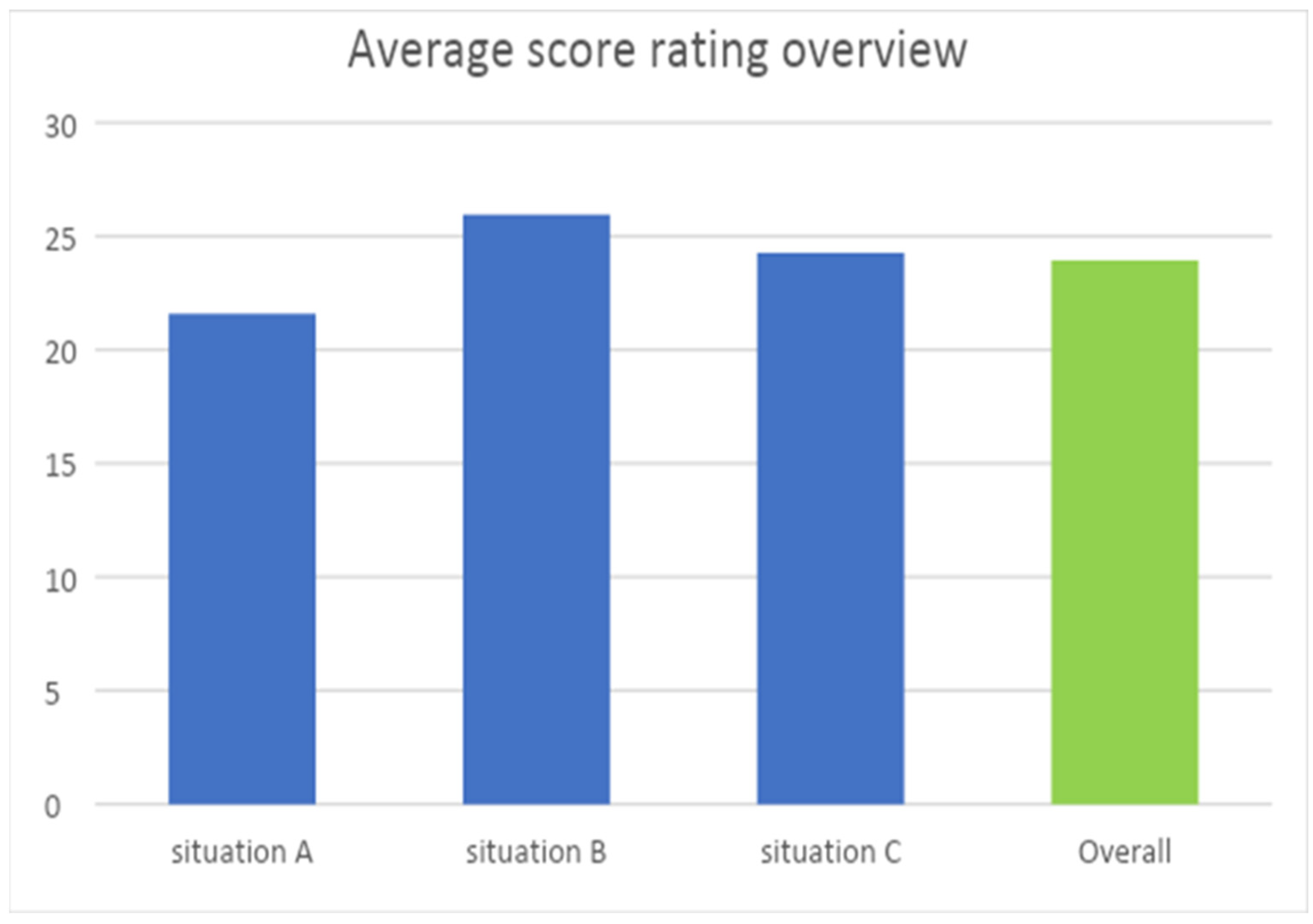
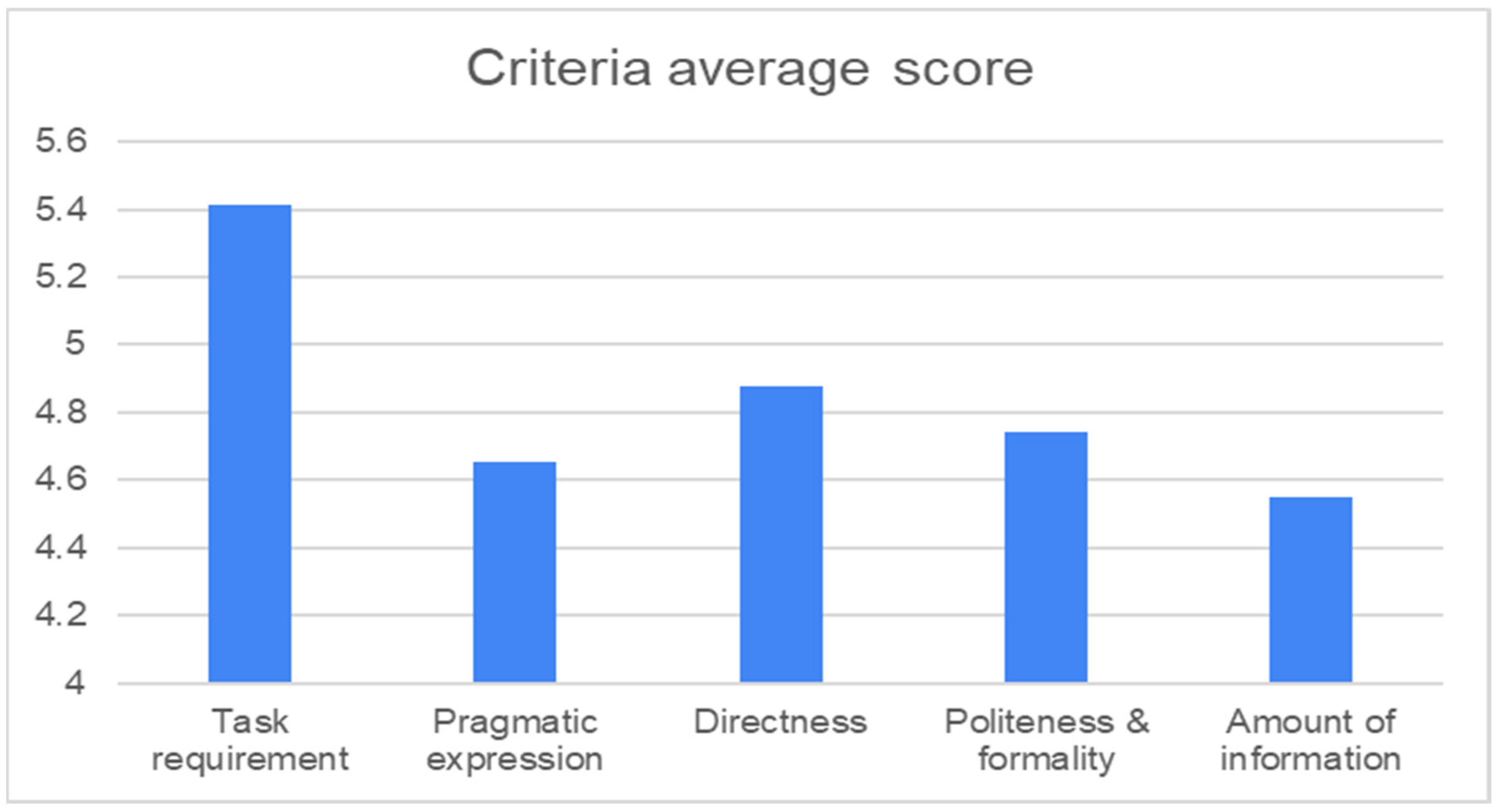
4.2. Discourse Completion Task: Productive Competence
4.2.1. Situation A: Speech Act of Complaining
4.2.2. Situation B: Speech Act of Offer
4.2.3. Situation C: Speech Act of Refusal
4.2.4. Correlations with Background Information
4.3. Self-Reported Attitudes and Abilities
4.4. Interview Results
4.4.1. Teachers’ Familiarity with Pragmatics
- (1)
- When you’re visiting England, and you have friends that live there, what do you say when they have birthdays, when they’re celebrating something because that’s very different from what we say here in Greece.
- (2)
- I think it refers [to] when we use, for instance, a word it refers to the actual meaning of the word. But […] I have to admit I don’t remember all the details at the moment.
- (3)
- I’m not absolutely sure about it, to be honest with you, but I have the feeling it’s the tone of your voice and, generally speaking, the mood that you convey through using words.
4.4.2. Incorporation of L2 Pragmatics Teaching
- (4)
- Students learn English for to achieve a certificate of competency in the other language, which is something they need to get a better job. So, in order to sit those exams, they must sometimes write a formal letter.
- (5)
- It’s never enough [but] yes, because it’s something that should be included in teaching, because you should give examples of real-life […] that students will meet in their further studies or life.
- (6)
- I think I do because it’s the nature of the language, phrases, idioms […]. Even if you don’t realize it, you do teach pragmatics
- (7)
- I could do it a bit more, I suppose, to be honest.
- (8)
- I don’t think that I include enough pragmatics in my teaching, although some things are dealt with without actually understanding it.
- (9)
- I’m not, I guess, as I’m not aware of it 100%, probably not; I don’t do that.
4.4.3. Challenges in L2 Pragmatics Teaching
- (10)
- what determines the Greek EFL classroom is the reality of students passing a B2 certification exam. It is an exam-driven market.
- (11)
- parents pressure us to focus on certificates rather than language use.
- (12)
- in Greek public schools, classrooms often have 25 students, which makes it even harder to diverge from the curriculum.
- (13)
- If you’re not taught how to use pragmatics, you can’t teach it.
4.4.4. Ways to Integrate L2 Pragmatics
- (14)
- I’ll give them something like a role play and say, you’re going to be a shop assistant and I will be the grumbling customer.
- (15)
- I usually try to find real life conversations or videos coming from certain contexts to give students a real sense of how language is used in reality.
- (16)
- I might encourage my learners to present their favorite YouTubers or their favorite influencers. And this gives me the opportunity to talk about the different cultures.
- (17)
- I think maybe inviting a native speaker to talk with the students would be beneficial.
- (18)
- I would also like to get them into gaming if that were possible. I’m a gamer myself, and I have noticed it as well, but every gamer has one or two levels above in vocabulary than an ordinary student.
5. Conclusions
Author Contributions
Funding
Institutional Review Board Statement
Informed Consent Statement
Data Availability Statement
Conflicts of Interest
Abbreviations
| DCT | Discourse Completion Task |
| EFL | English as a Foreign Language |
| L1 | First Language |
| L2 | Second Language |
| NT | Native Teacher |
| NNT | Non-native Teacher |
| SLA | Second Language Acquisition |
| TL | Target Language |
Appendix A
- -
- The researchers may use the information collected for research purposes.
- ○
- I consent, begin the study
- ○
- I do not consent, I do not wish to participate
- Name (optional)
- Gender
- ○
- Female
- ○
- Male
- ○
- Other
- ○
- Prefer not to say
- Where were you born?
- Where do you currently live?
- How old are you?
- Is one of your parents a native English speaker?
- ○
- yes
- ○
- no
- If no: Age of first acquisition (indicate your age when you started learning English.
- Have you ever lived, worked, or studied in another country? If yes, please state the country, the period of time you stayed (years, months, weeks, etc.), and the language you used.
- Do you hold a degree in English literature/language/linguistics?
- ○
- yes
- ○
- no
- If no, what did you study during your undergraduate studies?
- In which country or countries did you obtain the degree(s) below?
- ○
- Bachelor’s degree
- ○
- Master’s degree
- ○
- Ph.D.
- ○
- Other
- How many years of English teaching experience do you have?
- Do you currently work as an English language teacher?
- ○
- yes
- ○
- no
- If so, where do you work as an English language teacher?
- ○
- Public sector
- ○
- Private sector
- ○
- Self-employed
- ○
- Unemployed
- ○
- Other/Prefer not to say
- What levels of English do you usually teach?
- How often do you hear, read, or use English outside of your job responsibilities? (e.g., friends, online groups, through travelling, or other interactions)
- ○
- Never
- ○
- Less than once a month
- ○
- 2–4 times a month
- ○
- A couple of days a week
- ○
- Every day
- 17.
- You are in London for the Christmas holidays and are doing your shopping in Harrods. The department store closes in 30 min and people are in a hurry to check out. You are walking carrying multiple bags while having a heated conversation with your partner on your mobile phone. A young woman accidentally knocks over some of your bags and causes you to drop your phone as well.Young woman: Very sorry, but you were in my way!How would you rate the level of appropriateness of the young woman’s apology?
- ○
- High
- ○
- Moderate
- ○
- Low
- ○
- Non-existent
- 18.
- What is your rationale for your choice?
- 19.
- You are working at an international summer school. During the break, you discuss a student’s paper with a colleague.
- You: Have you finished reading John’s paper? Colleague: Yes, I read it yesterday.
- You: What did you think of it?
- Colleague: Well, I thought it was well-typed.
- What does your colleague mean by her answer?
- 20.
- You are in London for a five-day winter holiday. Your flight was delayed for five hours, and you arrive at the hotel after midnight really tired. The only thing on your mind is a hot shower! Eventually, you enter the room only to realise that the hot water isn’t working. You call the reception to complain. What do you say?
- 21.
- You are at the airport, and you see an elderly man struggling with a huge suitcase. You are travelling with only your backpack, so you offer to help. What do you say?
- 22.
- You and your friends are in Crete on a summer vacation and have rented a car in order to explore the island. Whilst driving to Matala, you see three hitchhikers and stop to ask where they are going. Unfortunately, they are headed to the opposite direction from the one you intend on going. So, you have to refuse your offer and not take them with you. What do you say?
- 23.
- Please pick one of the following. Pragmatics refers to:
- ○
- Knowing what language forms to use in what situation
- ○
- Speaking fluently with a native accent
- ○
- Having a rich vocabulary in the native accent.
- 24.
- Rate your level of agreement with each statement.
| Strongly Disagree | Strongly Agree | ||||||
| Beliefs, Perceptions, Attitudes | 1 | 2 | 3 | 4 | 5 | 6 | 7 |
| ST1: Effective communication in the target language requires more than just knowledge of grammar and vocabulary | |||||||
| ST2: I evaluate my pragmatic abilities as near-native | |||||||
| ST3: At university, I was adequately taught how to teach second language pragmatics | |||||||
| ST4: My lesson plans focus on socio-cultural aspects of the English language | |||||||
| ST5: There are enough pragmatic elements in the EFL textbooks that I use in my teaching | |||||||
| ST6: Second language pragmatics instruction is more effective than simple exposure in assisting learners’ acquisition of L2 pragmatic features | |||||||
| ST7: It is necessary that EFL teachers receive training on how to teach second language pragmatics, in addition to teaching other aspects of the language (grammar, vocabulary) | |||||||
| ST8: The teachers’ L1 affects greatly their acquisition of L2 pragmatics | |||||||
| ST9: The students’ L1 affects greatly their acquisition of L2 pragmatics | |||||||
| ST10: It is important for the language teacher to have lived in the target culture | |||||||
| ST11: I think it is important to assess students’ pragmatic abilities in the classroom | |||||||
- 25.
- Please indicate the textbook that you use (please include the name of the textbook series; if you use the same series for all your classes, do not list every level separately).
- 26.
- Please provide your email address if you wish to be contacted with the results of this research when it is completed. (optional)
- 27.
- Can we use it to contact you for a follow-up interview?
- ○
- yes
- ○
- no
Appendix B
- -
- The researcher may use the recordings and other information gathered for research purposes.
- -
- All data will always be treated anonymously. The researcher will never spread the recordings and further information outside the research community, nor will anything gathered ever be used for commercial purposes. If you need more information, please contact omitted for peer review. You can withdraw from participation at any time during or after the experiment, by contacting the researcher at the abovementioned email address.
- ○
- I consent
- ○
- I do not consent
- What in your view is pragmatics? Can you give some examples?
- In your view do you include enough L2 pragmatics in your classroom?
- If you want to incorporate pragmatics in your teaching what stops you from doing so?
- (And if you would like more) how would you do incorporate the teaching of L2 pragmatics in your classroom?
| 1 | Interestingly, a comparison of the interview responses with the questionnaire results reveals a discrepancy. In the questionnaire, all 12 interview participants correctly identified that pragmatics involves knowing what language forms to use in different situations. Yet, during the interviews, not all participants were familiar with the term itself, suggesting they intuitively understood pragmatics but lacked a clear theoretical grasp. Knowing what it is not pragmatics does not necessarily mean that they know what it is. |
References
- Aboulghazi, M., Amiri, E., & El Karfa, A. (2024). Teachers’ perceptions towards pragmatics and pragmatic teaching. Arab World English Journal, 15(3), 31–47. [Google Scholar] [CrossRef]
- Akikawa, K. (2010). Teaching pragmatics as a native speaker and as a non-native speaker. WATESOL NNEST Caucus Annual Review, 1, 43–69. [Google Scholar]
- Alcón Soler, E., & Martínez-Flor, A. (Eds.). (2008). Investigating pragmatics in foreign language learning, teaching and testing. Multilingual Matters. [Google Scholar] [CrossRef]
- Bardovi-Harlig, K. (2001). Evaluating the empirical evidence: Grounds for instruction in pragmatics? In K. R. Rose, & G. Kasper (Eds.), Pragmatics in language teaching (pp. 13–32). Cambridge University Press. [Google Scholar] [CrossRef]
- Bardovi-Harlig, K. (2004). Pragmatics and second language acquisition. In A. Davies, & C. Elder (Eds.), The handbook of applied linguistics (pp. 343–364). Blackwel. [Google Scholar]
- Bardovi-Harlig, K., & Griffin, R. (2005). L2 pragmatic awareness: Evidence from the ESL classroom. System, 33(3), 401–415. [Google Scholar] [CrossRef]
- Barron, A. (2003). Acquisition in interlanguage pragmatics: Learning how to do things with words in a study abroad context. J. Benjamins. [Google Scholar]
- Basturkmen, H. (2004). Teachers’ stated beliefs about incidental focus on form and their classroom practices. Applied Linguistics, 25(2), 243–272. [Google Scholar] [CrossRef]
- Basturkmen, H., & Nguyen, T. T. M. (2017). Teaching pragmatics. In A. Barron, Y. Gu, & G. Steen (Eds.), The routledge handbook of pragmatics (pp. 563–574). Routledge. [Google Scholar]
- Beebe, L., & Cummings, M. (1996). Natural speech data versus written questionnaire data: How data collection method affects speech behaviour. In S. Gass, & J. Neu (Eds.), Speech act across cultures: Challenges to communication in a second language (pp. 65–83). Mouton de Gruyter. [Google Scholar]
- Bektas-Cetinkaya, Y. (2012). Pre-service EFL teachers’ pragmatic competence: The Turkish case. International Journal of Language studies, 6(2), 1–20. [Google Scholar]
- Bella, S. (2011). Mitigation and politeness in Greek invitation refusals: Effects of length of residence in the target community and intensity of interaction on non-native speakers’ performance. Journal of Pragmatics, 43(6), 1718–1740. [Google Scholar] [CrossRef]
- Bella, S. (2012). Length of residence and intensity of interaction: Modification in Greek L2 requests. Pragmatics. Quarterly Publication of the International Pragmatics Association (IPrA), 22, 1–39. [Google Scholar] [CrossRef]
- Borg, S. (2003). Teacher cognition in language teaching: A review of research on what language teachers think, know, believe, and do. Language Teaching, 36(2), 81–109. [Google Scholar] [CrossRef]
- Borg, S. (2015). Teacher cognition and language education: Research and practice. Bloomsbury. [Google Scholar] [CrossRef]
- Braun, V., & Clarke, V. (2006). Using thematic analysis in psychology. Qualitative Research in Psychology, 3(2), 77–101. [Google Scholar] [CrossRef]
- Breen, M. (2001). Making sense of language teaching: Teachers’ principles and classroom practices. Applied Linguistics, 22(4), 470–501. [Google Scholar] [CrossRef]
- Brown, P., Levinson, S. C., & Gumperz, J. J. (1987). Politeness: Some universals in language usage (1st ed.). Cambridge University Press. [Google Scholar] [CrossRef]
- Chun, S. Y. (2014). EFL learners’ beliefs about native and non-native English-speaking teachers: Perceived strengths, weaknesses, and preferences. Journal of Multilingual and Multicultural Development, 35(6), 563–579. [Google Scholar] [CrossRef]
- Cohen, A. D. (2008). Teaching and assessing L2 pragmatics: What can we expect from learners? Language Teaching, 41(2), 213–235. [Google Scholar] [CrossRef]
- Cohen, A. D. (2016). The teaching of pragmatics by native and nonnative language teachers: What they know and what they report doing. Studies in Second Language Learning and Teaching, 6(4), 561–585. [Google Scholar] [CrossRef]
- Cohen, A. D. (2018). Learning pragmatics from native and nonnative language teachers. Multilingual Matters. [Google Scholar] [CrossRef]
- Cohen, A. D. (2020). Considerations in assessing pragmatic appropriateness in spoken language. Language Teaching, 53(2), 183–202. [Google Scholar] [CrossRef]
- Crandall, E., & Basturkmen, H. (2004). Evaluating pragmatics-focused materials. ELT Journal, 58(1), 38–49. [Google Scholar] [CrossRef]
- Dörnyei, Z. (2007). Creating a motivating classroom environment. In J. Cummins, & C. Davison (Eds.), International handbook of English language teaching (Vol. 15, pp. 719–731). Springer. [Google Scholar] [CrossRef]
- Economidou-Kogetsidis, M. (2002). Requesting strategies in English and Greek: Observations from an airline’s call centre. Nottingham Linguistic Circular, 17(1), 17–32. [Google Scholar]
- Economidou-Kogetsidis, M., & Halenko, N. (2022). Developing spoken requests during UK study abroad: A longitudinal look at Japanese learners of English. Study Abroad Research in Second Language Acquisition and International Education, 7(1), 23–53. [Google Scholar] [CrossRef]
- Economidou-Kogetsidis, M., Soteriadou, L., & Taxitari, L. (2018). Developing pragmatic competence in an instructed setting: The effectiveness of pedagogical intervention in Greek EFL learners’ request production. L2 Journal, 10(3), 3–30. [Google Scholar] [CrossRef]
- Economidou-Kogetsidis, M., Woodfield, H., & Savvidou, C. (2021). Non-native EFL teachers’ email production and perceptions of e-(im)politeness. Journal of Politeness Research, 17(2), 155–187. [Google Scholar] [CrossRef]
- Eslami, Z. R., & Eslami-Rasekh, A. (2008). 9. Enhancing the pragmatic competence of Non-native English-speaking Teacher Candidates (NNESTCs) in an EFL Context. In E. Alcón Soler, & A. Martínez-Flor (Eds.), Investigating pragmatics in foreign language learning, teaching and testing (pp. 178–198). Multilingual Matters. [Google Scholar] [CrossRef]
- Eslami-Rasekh, Z. (2005). Raising the pragmatic awareness of language learners. ELT Journal, 59(3), 199–208. [Google Scholar] [CrossRef]
- Eslami-Rasekh, Z., Eslami-Rasekh, A., & Fatahi, A. (2004). The effect of explicit metapragmatic instruction on the speech act awareness of advanced EFL Students. TESL-EJ, 8(2), n2. [Google Scholar]
- Finstad, K. (2010). Response interpolation and scale sensitivity: Evidence against 5-point scales. Journal of Usability Studies, 5(3), 104–110. [Google Scholar]
- Fordyce, K. (2014). The differential effects of explicit and implicit instruction on EFL learners’ use of epistemic stance. Applied Linguistics, 35(1), 6–28. [Google Scholar] [CrossRef]
- Glaser, K. (2023). Teachers’ awareness, knowledge and attitudes towards instruction in L2 pragmatics. In A. Martínez-Flor, A. Sanchez-Hernandez, & J. Baron (Eds.), L2 pragmatics in action: Teachers, learners and the teaching-learning interaction process (pp. 63–87). John Benjamins. [Google Scholar] [CrossRef]
- Glaser, K., & Martínez-Flor, A. (2025). Tracing a pre-service primary English teacher’s development in teaching L2 pragmatics: Knowledge, beliefs, and perceived challenges. System, 131, 103655. [Google Scholar] [CrossRef]
- Hymes, D. (1972). On communicative competence. In J. B. Pride, & J. Holmes (Eds.), Sociolinguistics (pp. 269–293). Penguin. [Google Scholar]
- Ifantidou, E. (2011). Genres and pragmatic competence. Journal of Pragmatics, 43(1), 327–346. [Google Scholar] [CrossRef]
- Ifantidou, E. (2013). Pragmatic competence and explicit instruction. Journal of Pragmatics, 59, 93–116. [Google Scholar] [CrossRef]
- Ishihara, N. (2010). Assessing learners’ pragmatic ability in the classroom. In D. Tatsuki, & N. Houck (Eds.), Pragmatics: Teaching speech acts (pp. 209–227). Teachers of English to Speakers of Other Languages. [Google Scholar]
- Ishihara, N. (2011). Co-constructing pragmatic awareness: Instructional pragmatics in EFL teacher development in Japan. TESL-EJ, 15(2), n2. [Google Scholar]
- Ishihara, N., & Cohen, A. D. (2010). Teaching and learning pragmatics: Where language and culture meet (1st ed.). Routledge. [Google Scholar] [CrossRef]
- Jeon, E. H., & Kaya, T. (2006). 5. Effects of L2 instruction on interlanguage pragmatic development: A meta-analysis. In J. M. Norris, & L. Ortega (Eds.), Language learning & language teaching (Vol. 13, pp. 165–211). John Benjamins Publishing Company. [Google Scholar] [CrossRef]
- Kasper, G. (1997a). Can pragmatic competence be taught? Second Language Teaching & Curriculum Center, University of Hawaiʻi at Mānoa. [Google Scholar]
- Kasper, G. (1997b). The role of pragmatics in language teacher education. In K. Bardovi-Harlig, & B. Hartford (Eds.), Beyond methods: Components of second language teacher education (pp. 113–136). McGraw-Hill. [Google Scholar]
- Kasper, G., & Rose, K. R. (2001). Pragmatics in language teaching. In K. R. Rose, & G. Kasper (Eds.), Pragmatics in language teaching (1st ed., pp. 1–10). Cambridge University Press. [Google Scholar] [CrossRef]
- Kasper, G., & Rose, K. R. (2002). Pragmatic development in a second language. Blackwell. [Google Scholar]
- Kidd, J. A. (2016). Face and enactment of identities in the L2 classroom. Multilingual Matters. [Google Scholar] [CrossRef]
- Koike, D. A., & Pearson, L. (2005). The effect of instruction and feedback in the development of pragmatic competence. System, 33(3), 481–501. [Google Scholar] [CrossRef]
- Korkmaz, S., & Karatepe, Ç. (2023). Exploring the pragmatic awareness and competence of EFL instructors at tertiary level. Anadolu Journal of Educational Sciences International, 13(1), 34–55. [Google Scholar] [CrossRef]
- Mahboob, A. (Ed.). (2010). The NNEST lens: Non native English speakers in TESOL. Cambridge Scholars Publishing. [Google Scholar]
- Marcet, E. (2024). Teaching pragmatics to instructors of L2 Japanese: A relevance-theoretic approach. System, 126, 103472. [Google Scholar] [CrossRef]
- Matsumura, S. (2003). Modelling the relationships among interlanguage pragmatic development, L2 proficiency, and exposure to L2. Applied Linguistics, 24(4), 465–491. [Google Scholar] [CrossRef]
- McConachy, T. (2019). L2 pragmatics as ‘intercultural pragmatics’: Probing sociopragmatic aspects of pragmatic awareness. Journal of Pragmatics, 151, 167–176. [Google Scholar] [CrossRef]
- Michail, E. (2016). Cross-cultural pragmatics in the Greek EFL context. Selected Papers on Theoretical and Applied Linguistics, 21, 684–697. [Google Scholar]
- Mirzaei, A., & Rezaei, M. S. (2012). Exploring the underrepresentation of pragmatic competence in the L2 classrooms in Iran. International Journal of Social Sciences and Humanity Studies, 4(1), 73–84. [Google Scholar]
- Nguyen, T. T. M., Pham, T. H., & Pham, M. T. (2012). The relative effects of explicit and implicit form-focused instruction on the development of L2 pragmatic competence. Journal of Pragmatics, 44(4), 416–434. [Google Scholar] [CrossRef]
- Oda-Sheehan, S. (2017). Making pragmatics and grammar work hand in hand. In P. Clements, A. Krause, & H. Brown (Eds.), Focus on the learner (pp. 24–40). JALT. [Google Scholar]
- Pinyo, S. (2010). Pragmatic competence in requests: A case study with Thai English teachers [Master’s thesis, Prince of Songla University]. [Google Scholar]
- Pratama, H., Nurkamto, J., Rustono, R., & Marmanto, S. (2017). Second language learners’ comprehension of conversational implicatures in English. 3L The Southeast Asian Journal of English Language Studies, 23(3), 50–66. [Google Scholar] [CrossRef]
- Roever, C. (2009). Teaching and testing pragmatics. In M. H. Long, & C. J. Doughty (Eds.), The handbook of language teaching (1st ed., pp. 560–577). Wiley. [Google Scholar] [CrossRef]
- Rose, K. R. (1997). Pragmatics in teacher education for nonnative-speaking teachers: A consciousness-raising approach. Language, Culture and Curriculum, 10(2), 125–138. [Google Scholar] [CrossRef]
- Savvidou, C., & Economidou-Kogetsidis, M. (2019). Teaching pragmatics: Nonnative-speaker teachers’ knowledge, beliefs and reported practices. Intercultural Communication Education, 2(1), 39–58. [Google Scholar] [CrossRef]
- Schmidt, R. (1993). Consciousness, learning, and interlanguage pragmatics. In G. Kasper, & S. Blum-Kulka (Eds.), Interlanguage pragmatics (pp. 21–42). Oxford University Press. [Google Scholar]
- Schmidt, R. W. (1990). The role of consciousness in second language learning. Applied Linguistics, 11(2), 129–158. [Google Scholar] [CrossRef]
- Sciberras, M. (2016). The pragmatic competence of pre-service and in-service FL teachers of Italian in Malta [Master’s thesis, University of Malta]. [Google Scholar] [CrossRef]
- Sifianou, M. (1992). Politeness phenomena in England and Greece. Oxford University Press. [Google Scholar] [CrossRef]
- Sifianou, M. (1993). Off-record indirectness and the notion of imposition. Multilingua—Journal of Cross-Cultural and Interlanguage Communication, 12(1), 69–80. [Google Scholar] [CrossRef]
- Taguchi, N. (2009). Pragmatic competence in Japanese as a second language: An introduction. In N. Taguchi (Ed.), Pragmatic competence (pp. 1–18). Mouton de Gruyter. [Google Scholar] [CrossRef]
- Taguchi, N. (2012). Context, individual differences and pragmatic competence. Multilingual Matters. [Google Scholar] [CrossRef]
- Taguchi, N. (2015). Instructed pragmatics at a glance: Where instructional studies were, are, and should be going. Language Teaching, 48(1), 1–50. [Google Scholar] [CrossRef]
- Taguchi, N. (2019). The routledge handbook of second language acquisition and pragmatics (N. Taguchi, Ed.; 1st ed.). Routledge. [Google Scholar] [CrossRef]
- Taguchi, N., & Kim, Y. (2018). Task-based approaches to teaching and assessing pragmatics (pp. 1–322). John Benjamins Publishing Company. [Google Scholar]
- Taguchi, N., & Roever, C. (2017). Second language pragmatics. Oxford University Press. [Google Scholar]
- Takahashi, S. (2010). The effect of pragmatic instruction on speech act performance. In A. Martínez-Flor, & E. Usó-Juan (Eds.), Language learning & language teaching (Vol. 26, pp. 127–142). John Benjamins Publishing Company. [Google Scholar] [CrossRef]
- Takimoto, M. (2009). Exploring the effects of input-based treatment and test on the development of learners’ pragmatic proficiency. Journal of Pragmatics, 41(5), 1029–1046. [Google Scholar] [CrossRef]
- Tatsuki, D. H., & Houck, N. R. (2010). Pragmatics from research to practice: Teaching speech acts. In Pragmatics: Teaching speech acts (pp. 1–6). TESOL. [Google Scholar]
- Terkourafi, M. (2004). Testing Brown and Levinson’s theory in a corpus of spontaneous conversational data from Cypriot Greek. International Journal of the Sociology of Language, 168, 119–134. [Google Scholar] [CrossRef]
- Terkourafi, M. (2009). Finding face between Gemeinschaft and Gesellschaft: Greek perceptions of the in-group. In M. Haugh, & F. Bargiela-Chiappini (Eds.), Face, communication, and social interaction (pp. 269–288). Equinox. [Google Scholar]
- Tzanne, A., Ifantidou, E., & Mitsikopoulou, B. (2009). Raising and assessing pragmatic awareness in L2 academic language learning. The International Journal of Learning: Annual Review, 16(9), 297–310. [Google Scholar] [CrossRef]
- Van Compernolle, R. A. (2014). Sociocultural theory and L2 instructional pragmatics. Multilingual Matters. [Google Scholar] [CrossRef]
- Vásquez, C., & Sharpless, D. (2009). The role of pragmatics in the Master’s TESOL curriculum: Findings from a nationwide survey. TESOL Quarterly, 43(1), 5–28. [Google Scholar] [CrossRef]
- Vellenga, H. (2011). Teaching L2 pragmatics: Opportunities for continuing professional development. The Electronic Journal for English as a Second Language, 15(2), 1–27. [Google Scholar]
- Vu, N. M. (2017). Teaching pragmatics in English as a foreign language at a Vietnamese university: Teachers’ perceptions, curricular content, and classroom practices [Doctoral dissertation, University of Sydney]. Available online: https://ses.library.usyd.edu.au/bitstream/handle/2123/16157/vu_mn_thesis.pdf?sequence=1&isAllowed=y (accessed on 10 September 2024).
- Wildner-Bassett, M. E. (1984). Improving pragmatic aspects of learners’ interlanguage: A comparison of methodological approaches for teaching gambits to advanced adult learners of English in industry. Narr. [Google Scholar]
- Wilkins, J. L. M. (2008). The relationship among elementary teachers’ content knowledge, attitudes, beliefs, and practices. Journal of Mathematics Teacher Education, 11(2), 139–164. [Google Scholar] [CrossRef]
- Yamagashira, H. (2001). Pragmatic transfer in Japanese ESL refusals. Bulletin Akademi Kagoshima, 31, 259–275. [Google Scholar]
- Yamashita, S. (2008). 10. Investigating interlanguage pragmatic ability: What are we testing? In E. Alcón Soler, & A. Martínez-Flor (Eds.), Investigating pragmatics in foreign language learning, teaching and testing (pp. 201–223). Multilingual Matters. [Google Scholar] [CrossRef]



| Appropriateness | Count | % |
|---|---|---|
| High | 3 | 4.17% |
| Moderate | 12 | 16.67% |
| Low | 45 | 62.50% |
| Non-existent | 12 | 16.67% |
| Total | 72 | 100% |
| Criticism | Count | % |
|---|---|---|
| Comprehension | 27 | 37.5% |
| No comprehension | 34 | 47.22% |
| Uncertainty | 5 | 6.94% |
| Unclear | 6 | 8.33% |
| Total | 72 | 100% |
| Situation A | Task Requirement | Pragmatic Expressions | Directness | Politeness & Formality | Amount of Information |
|---|---|---|---|---|---|
| Rater 1 | 4.86 | 4.25 | 4.69 | 4.19 | 3.29 |
| Rater2 | 5.08 | 4.15 | 4.57 | 4.50 | 4.22 |
| Rater3 | 4.00 | 4.21 | 4.01 | 4.60 | 4.15 |
| Total | 4.65 | 4.20 | 4.42 | 4.43 | 3.89 |
| Situation B | Task Requirement | Pragmatic Expressions | Directness | Politeness & Formality | Amount of Information |
|---|---|---|---|---|---|
| Rater 1 | 6.21 | 5.58 | 6.01 | 5.42 | 4.36 |
| Rater2 | 6.90 | 5.21 | 5.22 | 4.97 | 5.57 |
| Rater3 | 5.35 | 4.18 | 4.58 | 4.44 | 3.86 |
| Total | 6.15 | 5.00 | 5.27 | 4.94 | 4.60 |
| Situation C | Task Requirement | Pragmatic Expressions | Directness | Politeness & Formality | Amount of Information |
|---|---|---|---|---|---|
| Rater 1 | 6.05 | 5.60 | 5.51 | 5.04 | 5.37 |
| Rater2 | 6.53 | 4.96 | 5.42 | 5.37 | 5.82 |
| Rater3 | 3.74 | 3.72 | 3.87 | 4.14 | 4.28 |
| Total | 5.44 | 4.76 | 4.93 | 4.85 | 5.16 |
| Pragmatics Refers To | Knowing What Language Forms to Use in What Situation | Speaking Fluently with a Native Accent | Have Rich Vocabulary in the Target Language |
|---|---|---|---|
| 68 94.44% | 4 5.56% | 0 |
| Beliefs, Perceptions, Attitudes | Min | Max | Mean | SD |
|---|---|---|---|---|
| ST1: Effective communication in the target language requires more than just knowledge of grammar and vocabulary | 3 | 7 | 6.49 | 0.8 |
| ST2: I evaluate my pragmatic abilities as near-native | 3 | 7 | 5.51 | 1.12 |
| ST3: At university, I was adequately taught how to teach second language pragmatics | 1 | 7 | 3.86 | 1.67 |
| ST4: My lesson plans focus on socio-cultural aspects of the English language | 1 | 7 | 4.96 | 1.33 |
| ST5: There are enough pragmatic elements in the EFL textbooks that I use in my teaching | 1 | 7 | 4.33 | 1.58 |
| ST6: Second language pragmatics instruction is more effective than simple exposure in assisting learners’ acquisition of L2 pragmatic features | 1 | 7 | 4.71 | 1.52 |
| ST7: It is necessary that EFL teachers receive training on how to teach second language pragmatics, in addition to teaching other aspects of the language (grammar, vocabulary) | 4 | 7 | 6.25 | 0.92 |
| ST8: The teachers’ L1 affects greatly their acquisition of L2 pragmatics | 1 | 7 | 4.82 | 1.47 |
| ST9: The students’ L1 affects greatly their acquisition of L2 pragmatics | 1 | 7 | 5.42 | 1.39 |
| ST10: It is important for the language teacher to have lived in the target culture | 1 | 7 | 4.00 | 1.71 |
| ST11: I think it is important to assess students’ pragmatic abilities in the classroom | 1 | 7 | 5.11 | 1.37 |
| Themes | Quote Examples |
|---|---|
| Language in context | Deeper understanding of language context |
| Context of communication | |
| The way we perceive language in context | |
| Real life application | Things happening in real life |
| The way you apply language in your everyday life | |
| Language that is spoken, not ‘teaching book’ English | |
| If we use the language effectively and if it has real life applications | |
| Conveying meaning | What you convey through words |
| What we mean rather what we say | |
| Uncertainty | I’m not sure |
| I’m not aware of the term | |
| I don’t know |
| Themes-Challenges | |
|---|---|
| No challenges | |
| External factors | Time constraints |
| Exam-oriented classes | |
| Teaching material/syllabus | |
| Teacher factors | Teacher knowledge |
| Other priorities | |
| Learner factors | Students‘ level of English |
Disclaimer/Publisher’s Note: The statements, opinions and data contained in all publications are solely those of the individual author(s) and contributor(s) and not of MDPI and/or the editor(s). MDPI and/or the editor(s) disclaim responsibility for any injury to people or property resulting from any ideas, methods, instructions or products referred to in the content. |
© 2025 by the authors. Licensee MDPI, Basel, Switzerland. This article is an open access article distributed under the terms and conditions of the Creative Commons Attribution (CC BY) license.
Share and Cite
Tosounidou, D.; Terkourafi, M. L2 Pragmatics Instruction in the Greek EFL Classroom: Teachers’ Competence, Beliefs, and Classroom Challenges. Languages 2026, 11, 12. https://doi.org/10.3390/languages11010012
Tosounidou D, Terkourafi M. L2 Pragmatics Instruction in the Greek EFL Classroom: Teachers’ Competence, Beliefs, and Classroom Challenges. Languages. 2026; 11(1):12. https://doi.org/10.3390/languages11010012
Chicago/Turabian StyleTosounidou, Despoina, and Marina Terkourafi. 2026. "L2 Pragmatics Instruction in the Greek EFL Classroom: Teachers’ Competence, Beliefs, and Classroom Challenges" Languages 11, no. 1: 12. https://doi.org/10.3390/languages11010012
APA StyleTosounidou, D., & Terkourafi, M. (2026). L2 Pragmatics Instruction in the Greek EFL Classroom: Teachers’ Competence, Beliefs, and Classroom Challenges. Languages, 11(1), 12. https://doi.org/10.3390/languages11010012