
Requests in Greek as a Foreign Language by Spanish/Catalan Bilinguals: The Role of Proficiency



Abstract
1. Introduction
- What is the role of proficiency in the production of requests (head acts and modifications) in Greek as an FL by Spanish/Catalan bilinguals?
- How do sociopragmatic variables (Power, Social Distance, and Imposition) affect the production of requests in Greek as an FL by Spanish/Catalan bilinguals across different proficiency levels?
2. Materials and Methods
2.1. LETEGR2 Project
2.2. Participants
2.3. Instruments
2.3.1. Background Questionnaire
2.3.2. Role Plays
- Role Play 1: Cleaning Scenario (−P, −D, +I). A person asks their roommate to clean the apartment after hosting a party.
- Role Play 2: Shoes Scenario (−P, +D, −I). A person asks a store employee to bring them a pair of shoes they wish to buy.
- Role Play 3: Deadline Extension Scenario (+P, +D, +I). A student asks their professor for an extension to submit an assignment.
2.3.3. Retrospective Verbal Reports
2.4. Procedure
2.4.1. Data Collection
2.4.2. Data Coding and Analysis
3. Results
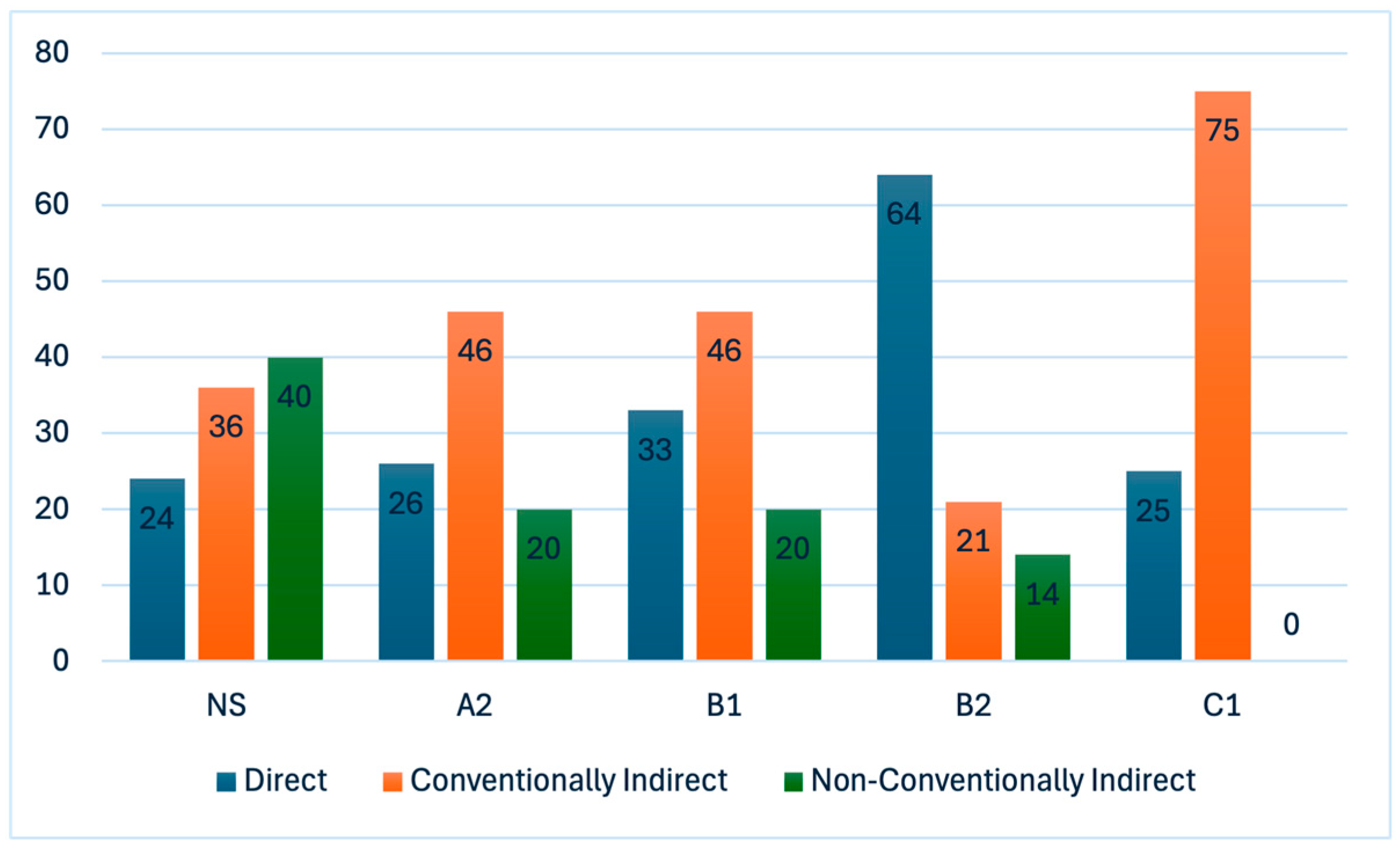
3.1. Cleaning Scenario (−P, −D, +I)
3.1.1. Head Acts
| (1) | a. | A2. Το σπίτι είναι βρόμικο. [Non-Con./Hint] |
| Eng. The house is dirty. | ||
| b. | B1. Aλλά δεν είναι καλά που όλα είναι βρόμικο. [Non-Con./Hint] | |
| Eng. It’s not good that everything is dirty. | ||
| c. | B2. Πρέπει να το καθαρίσεις. [Direct/Obligation Statement] | |
| Eng. You must clean it. | ||
| d. | C1. Μπορείς εσύ να μαζέψεις λίγο τα πράγματα και αν χρειάζεται αύριο μπορούμε να το τελειώσουμε μαζί; [Query Preparatory of Ability] | |
| Eng. Could you tidy up a bit, and if needed, we can finish it together tomorrow? | ||
| e. | NS. Το σπίτι είναι λίγο βρόμικο από χτες. [Non-Con./Hint] | |
| Eng. The house is a bit dirty since yesterday. |
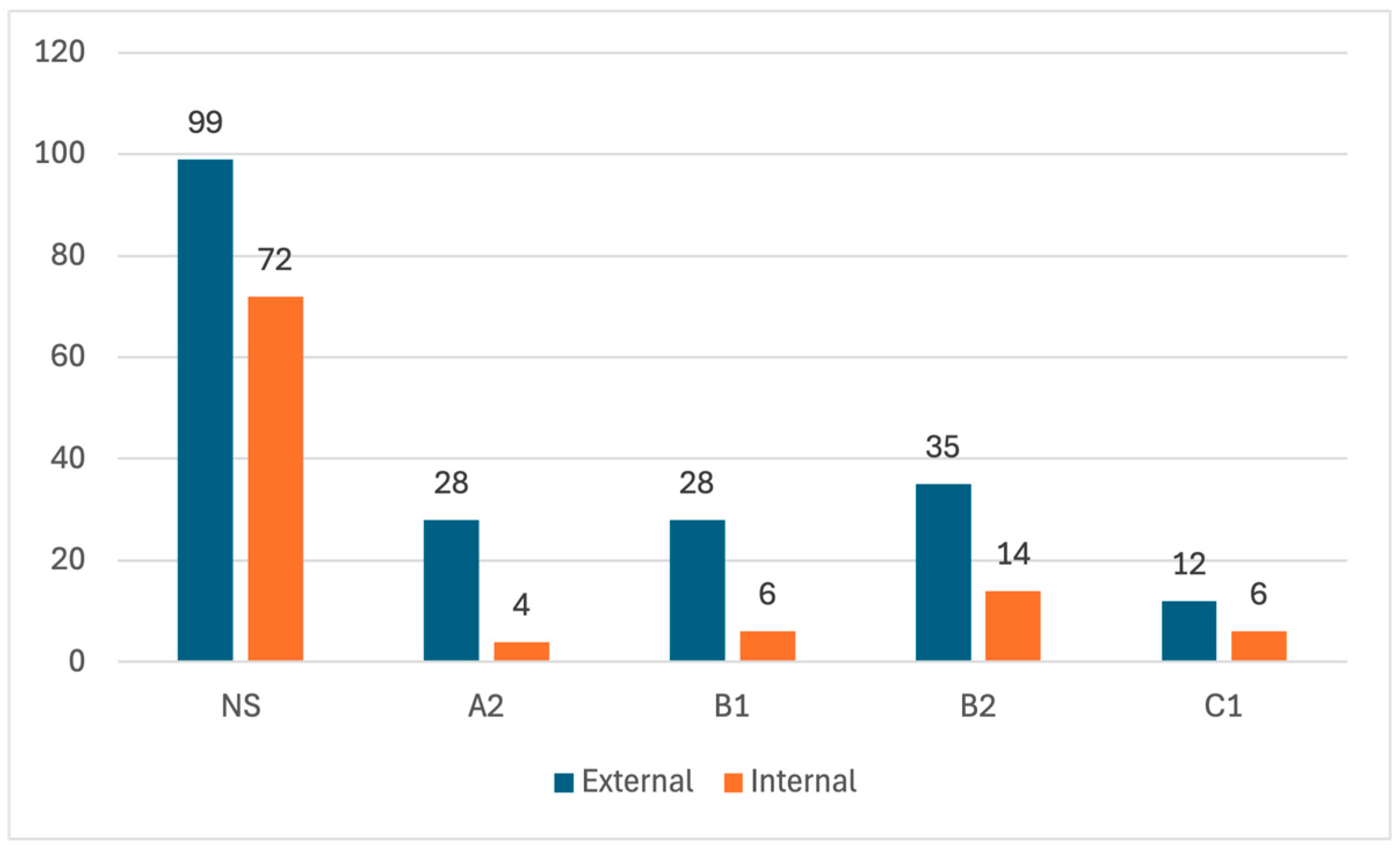
3.1.2. Modifications
| (2) | a. | C1. Πωπωπωπω, πολύ βρόμικο είναι. [Grounder] Κατερίνα [Attention Getter] τι έκανες εδώ; [Discourse Orientation Move] Ναι, αλλά όλα είναι βρόμικα. [Grounder] […] Κοίτα εγώ είμαι πτώμα, είμαι πολύ κουρασμένη, δεν μπορώ να σε βοηθήσω τώρα. [Grounder] μπορείς εσύ να μαζέψεις λίγο [Understater] τα πράγματα και αν χρειάζεται αύριο [Considerator] μπορούμε να το τελειώσουμε μαζί; |
| Eng. Wow, it’s so dirty. [Grounder] Katerina, [Attention Getter] what did you do here? [Discourse Orientation Move] Yeah, but everything’s a mess. [Grounder] Look, I’m exhausted, I’m really tired, I can’t help you right now. [Grounder] Can you… clean up a bit [Understater], and if you need it, [Considerator] we can finish it together tomorrow? | ||
| b. | NS. Να σου πω, [Attention Getter] νομίζω ότι [Subjectivizer] μετά τα χθεσινά πρέπει λίγο [Understater] να συμμαζέψουμε και να επικρατήσει η καθαριότητα στον χώρο. [Grounder] | |
| Eng. Listen, [Attention Getter] I think [Subjectivizer] after everything that happened yesterday, we should tidy up a bit [Understater] and bring some cleanliness back to the place. [Grounder] |
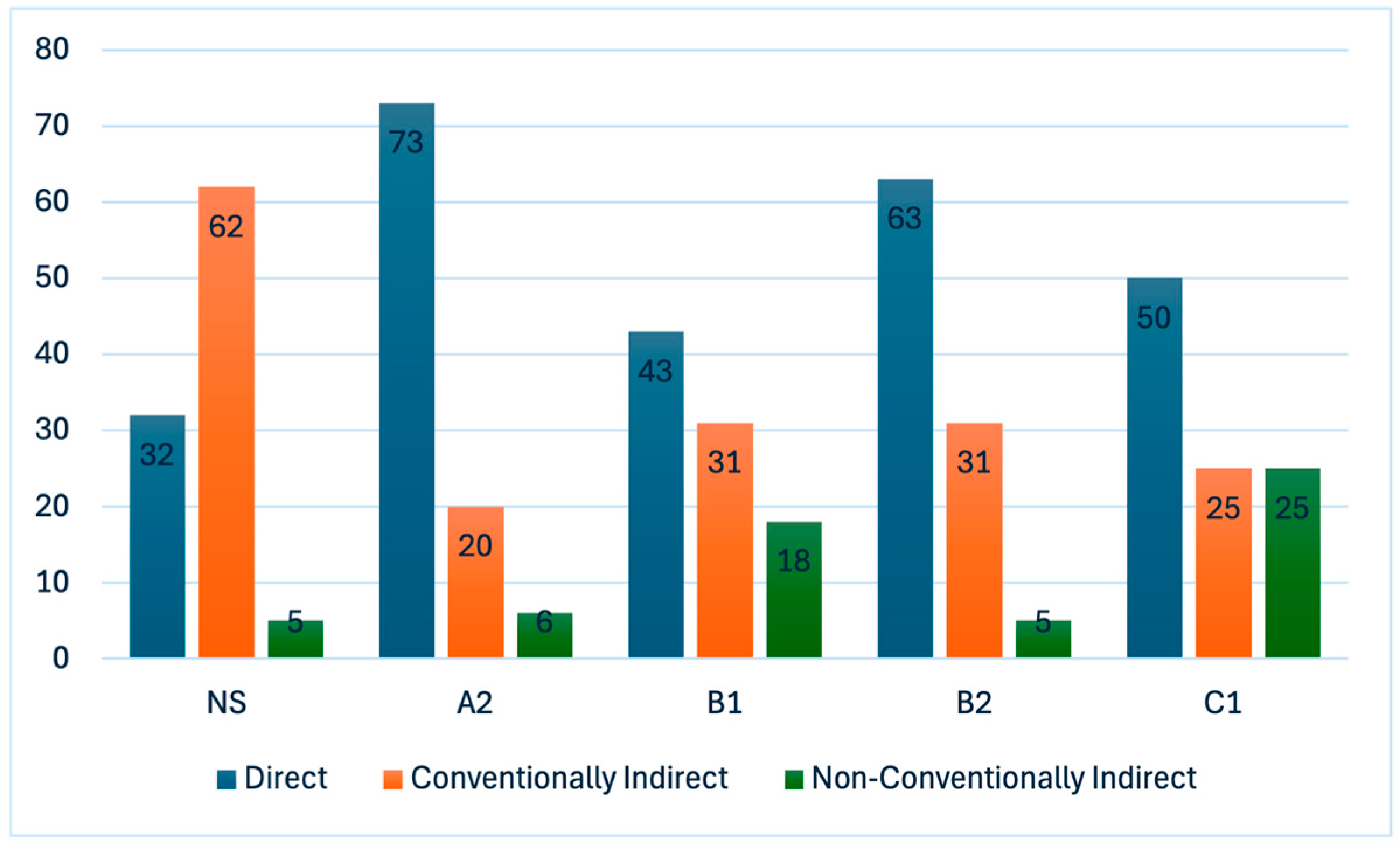
3.2. Shoes Scenario (−P, +D, −I)
3.2.1. Head Acts
| (3) | a. | A2. Το σπίτι είναι βρόμικο. [Direct/Need-Want Statement] |
| Eng. I want these shoes. | ||
| b. | B1. Εγώ θέλω ένα *φεγάρι παπούτσια. [Direct/Need-Want Statement] | |
| Eng. I want a pair of shoes. | ||
| c. | B2. Ήθελα να αγοράσω ένα ζευγάρι παπούτσια που είδα την περασμένη εβδομάδα. [Direct/Need-Want Statement] | |
| Eng. I wanted to buy a pair of shoes that I saw last week. | ||
| d. | C1. Θα ήθελα να αγοράσω αυτό το ζευγάρι παπούτσια που έχετε εδώ. [Direct/Need-Want Statement] | |
| Eng. I would like to buy this pair of shoes that you have here. | ||
| e. | NS. Μήπως έχετε αυτό το ζευγάρι παπούτσια σε 38; [Query Preparatory with Present Indicative] | |
| Eng. Do you have this pair of shoes in size 38? |
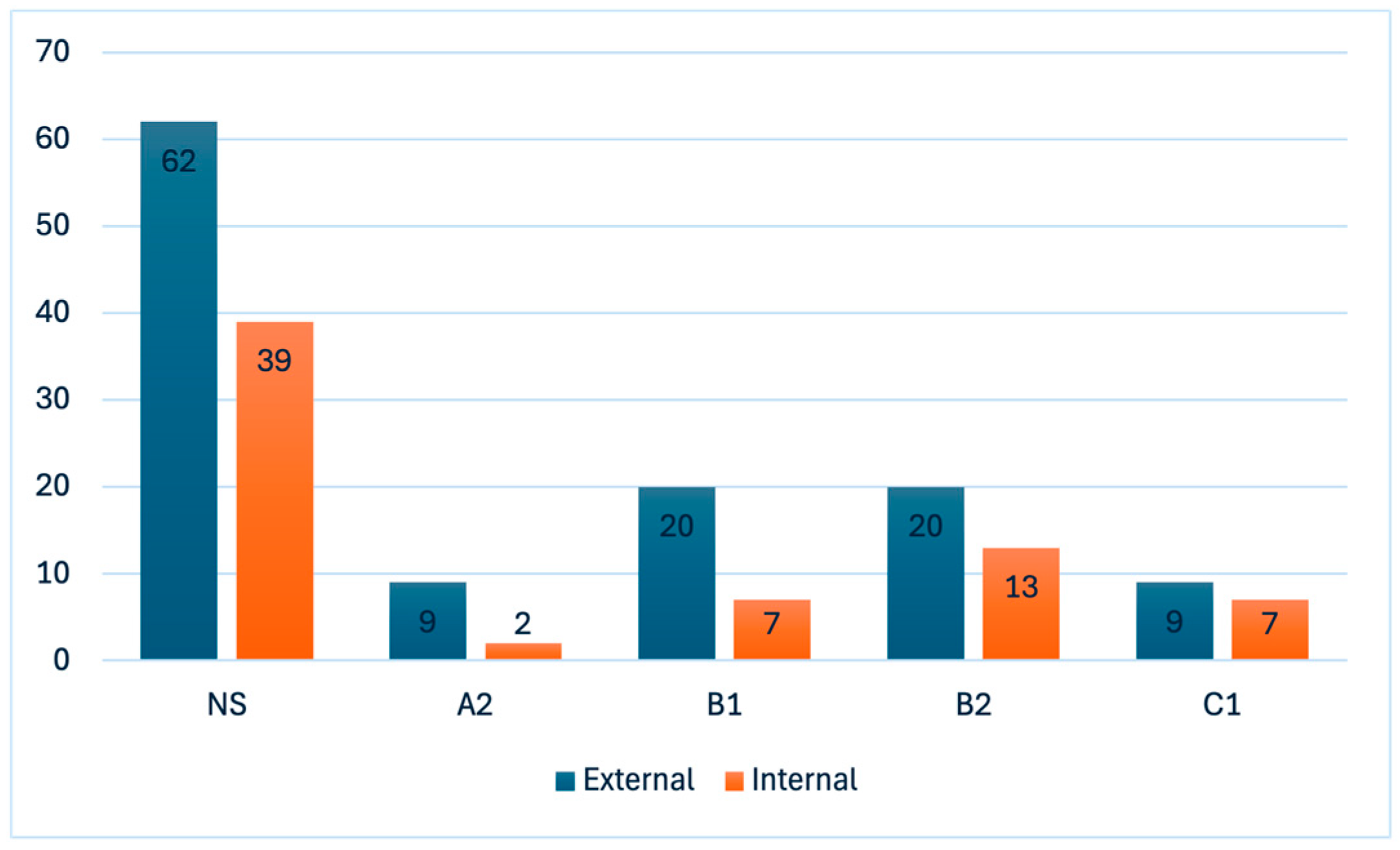
3.2.2. Modifications
| (4) | a. | A2. Μου αρέσουν αυτά τα παπούτσια πάρα πολύ. [Discourse Orientation Move] θέλω να αγοράσω. |
| Eng. I like these shoes a lot [Discourse Orientation Move]. I want to buy (them) | ||
| b. | B1. Θα ήθελα [Conditional] να δω δύο *ζευγάρι παπούτσια, για *ένα γιορτή [Grounder]. | |
| Eng. I would like to see two pairs of shoes, for a party [Grounder]. | ||
| c. | B2. Ήθελα [Past Tense] να αγοράσω ένα ζευγάρι παπούτσια που είδα την περασμένη εβδομάδα… | |
| Eng. I wanted [Past Tense] to buy a pair of shoes that I saw last week… | ||
| d. | C1. Συγγνώμη [Attention Getter], έχω δει ένα ζευγάρι παπούτσια εκεί στο παράθυρο [Grounder] και δεν ξέρω [Subjectivizer], αν έχετε το νούμερό μου. Είναι το τριάντα έξι [Grounder]. | |
| Eng. Excuse me [Attention Getter], I’ve seen this pair of shoes here in the store window and I don’t know [Subjectivizer] if you have my size. It’s thirty-six [Grounder]. | ||
| e. | NS. Συγγνώμη [Attention Getter], να σας ρωτήσω κάτι; [Preparator] υπάρχουν μήπως [Downtoner] σε 43; Γιατί τα βλέπω στη βιτρίνα μόνο μεγάλα… 45… [Grounder] | |
| Eng. Excuse me [Attention Getter], can I ask you something? [Preparator] do you happen to [Downtoner] have them in a size 43? Because I see them only big in the window case … 45… [Grounder] |
3.3. Deadline Extension Scenario (+P, +D, +I)
3.3.1. Head Acts
| (5) | a. | A2. Μπορώ να έχω *πολύ χρόνο; [Query Preparatory of Permission] |
| Eng. Can I have more time? | ||
| b. | B1. Μπορώ να σας δίνω την επόμενη εβδομάδα; [Query Preparatory of Permission] | |
| Eng. Can I give (it) to you next week? | ||
| c. | B2. Μπορώ να σας στείλω την έκθεση λίγο αργότερα; [Query Preparatory of Permission] | |
| Eng. Can I send you the report a bit later? | ||
| d. | C1. Ήθελα να ρωτήσω αν μπορείτε να μου δώσετε λίγο πιο χρόνο ακόμα για να το τελειώσω. [Query Preparatory of Ability] | |
| Eng. I wanted to ask you if you could give me a bit more time to finish it. | ||
| e. | NS. Ίσως θα μπορούσα να ζητήσω κάποιες λίγες μέρες παραπάνω προθεσμία κατ’ εξαίρεση; [Query Preparatory of Permission] | |
| Eng. Maybe I could ask for a few days as an exception? |
3.3.2. Modifications
| (6) | a. | A2. Θα ήθελα να σου λέω κάτι. [Preparator] Δεν είχα καιρό αρκετά να τελειώσω το δουλειά [Grounder] […] χρειάζομαι λίγο [Understater] *πιος καιρό. |
| Eng. I would like to tell you something [Preparator] I didn’t have enough time to finish the assignment [Grounder] […] I need a bit [Understater] more time. | ||
| b. | B1. Έχω, έχω πολλή δουλειά στο πανεπιστήμιο και δεν μπορώ να τελειώσω τη εργασία για μέρα [Grounder]. Μπορώ να έχω πιο πολύ χρόνο; παρακαλώ [Politeness Marker]. | |
| Eng. I have, I have a lot of work at university, and I can’t finish the assignment for today [Grounder]. Can I have more time? Please [Politeness Marker]. | ||
| c. | B2. Έχω ένα μικρό πρόβλημα με τα με την εργασία που μου πρέπει να σας δώσω [Preparator] και θα ήθελα [Conditional] να έχω λίγο [Understater] πιο χρόνο. | |
| Eng. I have a little problem with the assignment that I have to give you [Grounder], and I would like [Conditional] to have a bit [Understater] more time. | ||
| d. | NS. H εργασία που μας είχατε βάλει για να γράψουμε μέχρι σήμερα [Discourse Orientation Move], δυστυχώς λόγω κάποιων υποχρεώσεων που είχα δεν κατάφερα να την ολοκληρώσω [Grounder]. Θα μπορούσατε [Conditional], σας παρακαλώ [Politeness Marker + Solidarity], να μου δώσετε μία βδομάδα περιθώριο να σας τη φέρω; Θα με εξυπηρετούσε πολύ αυτό [Grounder], αν μπορούσατε αυτό να το κάνουμε [Considerator]. | |
| Eng. The assignment that you gave us to write today [Discourse Orientation Move], unfortunately, due to some obligations I had, I couldn’t finish it [Grounder]. Could you [Conditional], please [Politeness Marker + Solidarity], give me an extra week to bring it to you? It would really help me if we could do that [Considerator]. |
3.4. Results of Retrospective Verbal Reports
| (7) | a. | A2. Si, τα μαγαζιά muchas veces, cosas en clase, pocas y del resto poco, hacemos mucho de μαγαζιά, πελάτης… |
| Eng. Yes, the shops many times, things in class, very few, and the rest very little, we do a lot about the shops, client… | ||
| b. | B2. Στη ζωή μου, όταν εγώ ήμουν στην Ελλάδα, εγώ αγόρασα πράγματα και εγώ, έπαιξα τον ρόλο αυτό, στα μαγαζιά, και πιστεύω ότι εγώ ξέρω καλά τις λέξεις των ρούχων και εδώ στo μάθημα επίσης. | |
| Eng. In my life, when I went to Greece, I bought things and I played this role, in the shop, and I think that I know the words about clothes well and in the class too. | ||
| c. | B1. Este contexto lo conozco (Cleaning) por la familiaridad y porque las palabras son más sencillas. | |
| Eng. I’m familiar with this context (Cleaning) because I know it well and the vocabulary is simpler. | ||
| d. | A2. Quizás está la de… (Deadline Extension), me parece que en Grecia es señor profesor, aquí no. | |
| Eng. Perhaps this one of… (Deadline Extension), I think in Greece it is “Mr. Professor”, not here. | ||
| e. | C1. Με αυτή (Deadline Extension), δεν ξέρω, για τις λέξεις, λόγω των λέξεων, δεν ξέρω, για μένα είναι δύσκολα όλα. | |
| Eng. With this (Deadline Extension), I don’t know, for the words, because of the words, I don’t know, for me all are difficult. |
4. Discussion
Author Contributions
Funding
Institutional Review Board Statement
Informed Consent Statement
Data Availability Statement
Acknowledgments
Conflicts of Interest
Appendix A. Instructions for Role Plays Translated from Greek (Extracted from the LETEGR2 Corpus)
- Cleaning Scenario (−P, −D, +I). You are a university student and you share an apartment with another student (a roommate). Your roommate threw a party last night and now the apartment is dirty. You ask him/her to clean it.
- Shoes Scenario (−P, +D, −I). You have gone shopping in a store. You find a pair of shoes that you like and ask the seller to bring it to you.
- Deadline Extension Scenario (+P, +D, +I). You have an assignment to submit for a university course, but you don’t manage to complete it on time. You go to your professor’s office and ask for more time.
Appendix B. Retrospective Verbal Report Questions Translated from Greek (Extracted from the LETEGR2 Corpus)
- Have you played any of these roles in your life? (Which one(s)?)/Have you ever been in any of these situations? (Which one(s)?)
- Have you played any of these roles in your Greek class? Which one(s)?
- In which story do you think you performed better? Which role did you express best? Why?
- In which story was it more difficult for you to speak? Why?
| 1 | The LETEGR2 project (2018–2022) investigated effective methods for teaching and learning Greek as a second and foreign language, with a key focus on the development of pragmatic competence—specifically, the acquisition of speech acts by NNSs in diverse contexts (Andria, 2020, 2022; Andria & Iakovou, 2021; Iakovou, 2020; Iakovou et al., 2024; Panagopoulos et al., 2024; Rodríguez-Lifante & Andria, 2020). |
| 2 | Statistical analyses conducted within the framework of the LETEGR2 project indicated that participants from both schools share similar characteristics (Andria, 2024) and there were no statistically significant differences among the groups of these two schools (Panagopoulos et al., 2024). |
| 3 | The C1 group was excluded from this type of analysis in the three scenarios under study due to its small sample size. |
References
- Achiba, M. (2003). Learning to request in a second language: Child interlanguage pragmatics. Multilingual Matters. [Google Scholar] [CrossRef]
- Ackermann, T. (2023). Mitigating strategies and politeness in German requests. Journal of Politeness Research, 19(2), 355–389. [Google Scholar] [CrossRef]
- Alcón Soler, E., & Martínez-Flor, A. (Eds.). (2008). Investigating pragmatics in foreign language learning, teaching and testing. Multilingual Matters. [Google Scholar] [CrossRef]
- Alcón Soler, E., Martínez-Flor, A., & Safont Jordà, M. P. (2005). Towards a typology of modifiers for the speech act of requesting: A socio-pragmatic approach. RAEL: Revista Electrónica de Lingüística Aplicada, 4, 1–35. Available online: https://matrix.aesla.org.es/index.php/RAEL/article/view/104 (accessed on 3 March 2025).
- Al-Gahtani, S., & Roever, C. (2011). Proficiency and sequential organization of L2 requests. Applied Linguistics, 33(1), 42–65. [Google Scholar] [CrossRef]
- Al Masaeed, K. (2022). Bidialectal practices and L2 Arabic pragmatic development in a short-term study abroad. Applied Linguistics, 43(1), 88–114. [Google Scholar] [CrossRef]
- Alqurashi, H. S. (2022). The impact of social power and social distance on the request strategies employed by Saudi learners and teachers of English as a foreign language. Journal of Arts, Literature, Humanities and Social Sciences, 78, 198–213. [Google Scholar] [CrossRef]
- Andria, M. (2020). Learning to teach and teaching Greek as a second/foreign language: A preliminary approach on teachers’ and student-teachers’ perceptions. In J. Mackay, M. Birello, & D. Xerri (Eds.), ELT research in action: Bringing together two communities of practice (pp. 49–52). IATEFL. [Google Scholar]
- Andria, M. (2022). Pre-service language teachers’ perceptions of professional learning and development resulting from Greek as a foreign language teaching placements. EDUCAR, 58(1), 19–34. [Google Scholar] [CrossRef]
- Andria, M. (2024). Learning Modern Greek as foreign language in Barcelona, Spain. In M. Mattheoudakis, & C. Maligkoudi (Eds.), Exploring modern Greek as a second, foreign, and heritage language: In Greece and beyond (pp. 145–161). Routledge. [Google Scholar] [CrossRef]
- Andria, M., & Iakovou, M. (2021). Δεύτερη ή ξένη; Επαναπροσδιορίζοντας τους όρους στη διδασκαλία της Ελληνικής σε διαφορετικά περιβάλλοντα μάθησης. [Second or foreign? Redefining the terms in the acquisition of Greek in different learning contexts]. In Proceedings of the 14th international conference on Greek linguistics (ICGL14), Patras, Greece, September 5–8 (pp. 60–69). University of Patras. [Google Scholar]
- Antonopoulou, E. (2001). Brief service encounters: Gender and politeness. In A. Bayraktaroğlu, & M. Sifianou (Eds.), Linguistic politeness across boundaries: The case of Greek and Turkish. John Benjamins Publishing. [Google Scholar] [CrossRef]
- Bardovi-Harlig, K. (1999). Exploring the interlanguage of interlanguage pragmatics: A research agenda for acquisitional pragmatics. Language Learning, 49(4), 677–713. [Google Scholar] [CrossRef]
- Bardovi-Harlig, K. (2001). Evaluating the empirical evidence: Grounds for instruction in pragmatics? In G. Kasper, & K. R. Rose (Eds.), Pragmatics in language teaching (pp. 13–32). Cambridge University Press. [Google Scholar] [CrossRef]
- Bardovi-Harlig, K. (2013). Developing L2 pragmatics. Language Learning, 63, 68–86. [Google Scholar] [CrossRef]
- Bardovi-Harlig, K., & Dörnyei, Z. (1998). Do language learners recognize pragmatic violations? Pragmatic versus grammatical awareness in instructed L2 learning. TESOL Quarterly, 32(2), 233–259. [Google Scholar] [CrossRef]
- Barón, J. (2015). “Can I make a party, mum?” The development of requests from childhood to adolescence. Atlantis, 37(1), 179–198. Available online: http://www.jstor.org/stable/24757737 (accessed on 2 July 2025).
- Barron, A. (2003). Acquisition in interlanguage pragmatics: Learning how to do things with words in a study abroad context. John Benjamins Publishing. [Google Scholar]
- Beebe, L., & Cummings, M. (2006). Natural speech act data versus written questionnaire data: How data collection method affects speech act performance. In S. Gass, & J. Neu (Eds.), Speech acts across cultures: Challenges to communication in a second language (pp. 65–88). De Gruyter Mouton. [Google Scholar] [CrossRef]
- Bella, S. (2009). Invitations and politeness in Greek: The age variable. Journal of Politeness Research. Language, Behaviour, Culture, 5(2), 243–271. [Google Scholar] [CrossRef]
- Bella, S. (2011). Mitigation and politeness in Greek invitation refusals: Effects of length of residence in the target community and intensity of interaction on non-native speakers’ performance. Journal of Pragmatics, 43(6), 1718–1740. [Google Scholar] [CrossRef]
- Bella, S. (2012a). Length of residence and intensity of interaction: Modification in Greek L2 requests. Pragmatics. Quarterly Publication of the International Pragmatics Association (IPrA), 22(1), 1–39. [Google Scholar] [CrossRef]
- Bella, S. (2012b). Pragmatic development in a foreign language: A study of Greek FL requests. Journal of Pragmatics, 44(13), 1917–1947. [Google Scholar] [CrossRef]
- Bella, S. (2014a). A contrastive study of apologies performed by Greek native speakers and English learners of Greek as a foreign language. Pragmatics. Quarterly Publication of the International Pragmatics Association (IPrA), 24(4), 679–713. [Google Scholar] [CrossRef]
- Bella, S. (2014b). Developing the ability to refuse: A cross-sectional study of Greek FL refusals. Journal of Pragmatics, 61, 35–62. [Google Scholar] [CrossRef]
- Bella, S. (2014c). Καθάρισε αμέσως την κουζίνα παρακαλώ!: Aιτήματα μαθητών της Ελληνικής ως ξένης γλώσσας. [Clean the kitchen immediately, please!: Requests from students of Greek as a foreign language]. In N. Lavidas, T. Alexiou, & A. Sougari (Eds.), Major trends in theoretical and applied linguistics 3 (pp. 267–284). De Gruyter Mouton. [Google Scholar] [CrossRef]
- Bella, S. (2016). Offers by Greek FL learners: A cross-sectional developmental study. Pragmatics. Quarterly Publication of the International Pragmatics Association (IPrA), 26(4), 531–562. [Google Scholar] [CrossRef]
- Bella, S. (2019). Offers in Greek revisited. In E. Ogiermann, & P. G.-C. Blitvich (Eds.), From speech acts to lay understandings of politeness: Multilingual and multicultural perspectives (pp. 27–47). Cambridge University Press. [Google Scholar] [CrossRef]
- Bella, S. (2025). Mitigation, rapport, and identity construction in workplace requests. Languages, 10(8), 179. [Google Scholar] [CrossRef]
- Bella, S., & Ogiermann, E. (2019). An intergenerational perspective on (im)politeness. Journal of Politeness Research, 15(2), 163–193. [Google Scholar] [CrossRef]
- Beltrán-Palanques, V. (2020). Towards a learner-centred approach to design role-play instruments for ILP studies: A study based on complaints. Complutense Journal of English Studies, 28, 121–135. [Google Scholar] [CrossRef]
- Blanca, M., Alarcón, R., Arnau, J., Bono, R., & Bendayan, R. (2017). Non-normal data: Is ANOVA still a valid option? Psicothema, 4(29), 552–557. [Google Scholar] [CrossRef] [PubMed]
- Blanca, M., Arnau, J., García-Castro, F., Alarcón, R., & Bono, R. (2023). Non-normal data in repeated measures ANOVA: Impact on type I error and power. Psicothema, 1(35), 21–29. [Google Scholar] [CrossRef]
- Blum-Kulka, S., House, J., & Kasper, G. (1989). Cross-cultural pragmatics: Requests and apologies. Ablex Publishing. [Google Scholar] [CrossRef]
- Blum-Kulka, S., & Olshtain, E. (1984). Requests and apologies: A cross-cultural study of speech act realization patterns (CCSARP). Applied Linguistics, 5(3), 196–213. [Google Scholar] [CrossRef]
- Braun, V., & Clarke, V. (2006). Using thematic analysis in psychology. Qualitative Research in Psychology, 3(2), 77–101. [Google Scholar] [CrossRef] [PubMed]
- Brown, P., & Levinson, S. C. (1987). Politeness: Some universals in language usage (Vol. 4). Cambridge University Press. [Google Scholar]
- Cañas, J. (2025). Interlanguage pragmatics in Greek as a foreign language by Spanish/Catalan bilinguals: An analysis of requests [Unpublished Ph.D. dissertation, University of Barcelona]. TDX—Tesis Doctorals en Xarxa. Available online: https://hdl.handle.net/2445/222961 (accessed on 8 August 2025).
- Celaya, M. L., & Barón, J. (2015). The interface between grammar and pragmatics in EFL measurement and development. European Journal of Applied Linguistics, 3(2), 181–203. [Google Scholar] [CrossRef]
- Chang, Y. (2006). An inquiry into pragmatic data collection methods. Online submission. Paper presented at the Korea association of teachers of English (KATE) international conference (Seoul, Korea, 2006). Available online: https://files.eric.ed.gov/fulltext/ED508832.pdf (accessed on 20 February 2025).
- Codina-Espurz, V. (2022). Students’ perception of social contextual variables in mitigating email requests. The Grove—Working Papers on English Studies, 29, 57–79. [Google Scholar] [CrossRef]
- Cohen, A., & Shively, R. (2007). Acquisition of requests and apologies in Spanish and French: Impact of study abroad and strategy-building intervention. Modern Language Journal, 91, 189–212. [Google Scholar] [CrossRef]
- Cohen, A. D. (1996a). Speech acts in second language learning contexts. In S. McKay, & N. Hornberger (Eds.), Sociolinguistics and language teaching (pp. 383–420). Cambridge University Press. [Google Scholar] [CrossRef]
- Cohen, A. D. (1996b). Verbal reports as a source of insights into second language learner strategies. Applied Language Learning, 7(1), 11–27. Available online: https://eric.ed.gov/?id=EJ539335 (accessed on 1 December 2025).
- Cohen, J. (1988). Statistical power analysis for the behavioral sciences (2nd ed.). Erlbaum. [Google Scholar]
- Curell, H. (2012). Politeness and cultural styles of speaking in Catalan. In L. Payrató, & J. Cots (Eds.), The pragmatics of Catalan (pp. 273–308). De Gruyter Mouton. [Google Scholar] [CrossRef]
- Daskalovska, N., Ivanovska, B., Kusevska, M., & Ulanska, T. (2016). The use of request strategies by EFL learners. Procedia-Social and Behavioural Sciences, 232, 55–61. [Google Scholar] [CrossRef]
- Demeter, G. (2007). Role-plays as a data collection method for research on apology speech acts. Simulation & Gaming, 38(1), 83–90. [Google Scholar] [CrossRef]
- Economidou-Kogetsidis, M. (2002). Requesting strategies in English and Greek: Observations from an airline’s call centre. Nottingham Linguistic Circular, 17(1), 17–32. Available online: https://www.nottingham.ac.uk/research/groups/cral/documents/nlc/nlc-2000-2004/nlc-volume17-2002.pdf#page=21 (accessed on 13 April 2025).
- Economidou-Kogetsidis, M. (2003). Requesting strategies and cross-cultural pragmatics: Greek and English [Unpublished Ph.D. dissertation, University of Nottingham]. [Google Scholar]
- Economidou-Kogetsidis, M. (2005). “Yes, tell me please, what time is the midday flight from Athens arriving?”: Telephone service encounters and politeness. Intercultural Pragmatics, 2(3), 253–273. [Google Scholar] [CrossRef]
- Economidou-Kogetsidis, M. (2008). Internal and external mitigation in interlanguage request production: The case of Greek learners of English. Journal of Politeness Research. Language, Behaviour, Culture, 4(1), 111–138. [Google Scholar] [CrossRef]
- Economidou-Kogetsidis, M. (2009). Interlanguage request modification: The use of lexical/phrasal downgraders and mitigating supportive moves. Multilingua, 28(1), 79–111. [Google Scholar] [CrossRef]
- Economidou-Kogetsidis, M. (2011). “Please answer me as soon as possible”: Pragmatic failure in non-native speakers’ e-mail requests to faculty. Journal of Pragmatics, 43(13), 3193–3215. [Google Scholar] [CrossRef]
- Economidou-Kogetsidis, M. (2012). Modifying oral requests in a foreign language. In M. Economidou-Kogetsidis, & H. Woodfield (Eds.), Interlanguage request modification (pp. 163–201). John Benjamins Publishing. [Google Scholar]
- Economidou-Kogetsidis, M. (2018). “Mr Paul, please inform me accordingly”. Address forms, directness and degree of imposition in L2 emails. Pragmatics. Quarterly Publication of the International Pragmatics Association (IPrA), 28(4), 489–516. [Google Scholar] [CrossRef]
- Economidou-Kogetsidis, M. (2022). Pragmatic development in request performance: A cross-sectional study of Greek EFL learners. In N. Halenko, & J. Wang (Eds.), Pragmatics and English language learning. Cambridge University Press. [Google Scholar]
- Escandell-Vidal, M. V. (2005). La comunicación: Lengua, cognición y sociedad. Ediciones Gredos. [Google Scholar]
- Félix-Brasdefer, J. C. (2003). Declining an invitation: A cross-cultural study of pragmatic strategies in American English and Latin American Spanish. Multilingua: Journal of Cross-Cultural and Interlanguage Communication, 22(3), 225–255. [Google Scholar] [CrossRef]
- Félix-Brasdefer, J. C. (2007). Pragmatic development in the Spanish as a FL classroom: A cross-sectional study of learner requests. Intercultural Pragmatics, 4(2), 253–286. [Google Scholar] [CrossRef]
- Félix-Brasdefer, J. C. (2010). Data collection methods in speech act performance. In A. Martínez-Flor, & E. Usó-Juan (Eds.), Speech act performance: Theoretical, empirical and methodological issues (pp. 41–56). John Benjamins Publishing. [Google Scholar] [CrossRef]
- Félix-Brasdefer, J. C. (2018). Role plays. In A. Jucker, K. Schneider, & W. Bublitz (Eds.), Methods in pragmatics (pp. 305–331). De Gruyter Mouton. [Google Scholar] [CrossRef]
- Florou, D. (2021, November 25). How to use formal & informal correctly in Greek. Danae Florou | Alpha Beta Greek. Available online: https://www.alphabetagreek.com/blog/how-to-use-formal-and-informal-correctly-in-greek (accessed on 17 June 2025).
- Gilabert, R., & Barón, J. (2018). Independently measuring cognitive complexity in task design for interlanguage pragmatics development. In N. Taguchi, & Y. Kim (Eds.), Task-based approaches to teaching and assessing pragmatics (pp. 160–190). John Benjamins Publishing. [Google Scholar] [CrossRef]
- Gkouma, A. (2024). Πραγματολογική ικανότητα στην εκμάθηση της Ελληνικής ως Δεύτερης/Ξένης Γλώσσας: Η περίπτωση της γλωσσικής πράξης της ευχαριστίας από Φυσικούς Ομιλητές/Ομιλήτριες και Μαθητές/Μαθήτριες της Ελληνικής ως Δεύτερης/Ξένης Γλώσσας [Pragmatic competence in the acquisition of Greek as a second/foreign language: the case of the speech act of thanking by native speakers and learners of Greek as a second/foreign language] [Unpublished Ph.D. dissertation, National and Kapodistrian University of Athens]. Available online: https://www.didaktorika.gr/eadd/handle/10442/58817 (accessed on 15 February 2025).
- Gkouma, A., Andria, M., & Bella, S. (2023). Gratitude for compliance: A developmental study on the speech Act of thanking. Lingua, 283, 103469. [Google Scholar] [CrossRef]
- Gkouma, A., Andria, M., & Mikros, G. (2020). Thanking in L2 Greek: The role of proficiency in L2 pragmatic competence. CLIL. Journal of Innovation and Research in Plurilingual and Pluricultural Education, 3(2), 57–70. [Google Scholar] [CrossRef]
- Göy, E., Zeyrek, D., & Otcu, B. (2012). Developmental patterns in internal modification of requests: A quantitative study on Turkish learners of English. In M. Economidou-Kogetsidis, & H. Woodfield (Eds.), Interlanguage request modification (pp. 51–86). John Benjamins Publishing Company. [Google Scholar] [CrossRef]
- Harissi, M. (2005). Favour asking in Modern Greek: A sociolinguistic analysis. Selected Papers on Theoretical and Applied Linguistics, 16, 223–237. [Google Scholar] [CrossRef]
- Hartford, B. S., & Bardovi-Harlig, K. (1992). Experimental and observational data in the study of interlanguage pragmatics. Pragmatics and Language Learning, 3, 33–52. Available online: https://files.eric.ed.gov/fulltext/ED395520.pdf (accessed on 7 May 2025).
- Haugh, M., Kádár, D. Z., & Terkourafi, M. (2021). Introduction: Directions in sociopragmatics. In M. Haugh, D. Z. Kádár, & M. Terkourafi (Eds.), The Cambridge handbook of sociopragmatics (pp. 1–12). Cambridge University Press. [Google Scholar] [CrossRef]
- Hinkel, E. (2005). Handbook of research in second language teaching and learning. Routledge. [Google Scholar] [CrossRef]
- Houck, N., & Gass, S. (2006). Non-native refusals: A methodological perspective. In S. Gass, & J. Neu (Eds.), Speech acts across cultures: Challenges to communication in a second language (pp. 45–64). De Gruyter Mouton. [Google Scholar] [CrossRef]
- House, J., & Kádár, D. Z. (2023). Speech acts and interaction in second language pragmatics: A position paper. Language Teaching, 58(3), 396–407. [Google Scholar] [CrossRef]
- Iakovou, M. (2020). Classroom observation in second language classrooms: Bridging the gap between theory and practice for pre-service and in-service teachers of Greek as an L2. CLIL Journal of Innovation and Research in Plurilingual and Pluricultural Education, 3(2), 15–36. [Google Scholar] [CrossRef]
- Iakovou, M., Andria, M., Gkouma, A., & Panagopoulos, P. (2024). Σύντομη παραμονή στην Ελλάδα για σπουδές: ο ρόλος της βιωμένης εμπειρίας στην εκμάθηση της Ελληνικής ως Γ2 [Study abroad in Greece: The role of lived experience in the acquisition of Greek as an L2]. In Proceedings of the 15th international conference on Greek linguistics (ICGL15) 2022, Belgrade, Serbia, September 15–18 (Vol. 1, pp. 181–197). University of Belgrade. [Google Scholar] [CrossRef]
- Ishihara, N. (2019). Understanding English language learners’ pragmatic resistance. In X. Gao (Ed.), Second handbook of English language teaching (pp. 689–708). Springer International Handbooks of Education. [Google Scholar] [CrossRef]
- Kasper, G., & Dahl, M. (1991). Research methods in interlanguage pragmatics. Studies in Second Language Acquisition, 13(2), 215–247. [Google Scholar] [CrossRef]
- Kasper, G., & Roever, C. (2005). Pragmatics in second language learning. In E. Hinkel (Ed.), Handbook of research in second language teaching and learning (pp. 317–334). Routledge. [Google Scholar] [CrossRef]
- Kasper, G., & Rose, K. R. (2002). Pragmatic development in a second language. Wiley-Blackwell. [Google Scholar]
- Kecskés, I. (2013). Intercultural pragmatics. Oxford University Press. [Google Scholar]
- Khazdouzian, Y., Celaya, M., & Barón, J. (2021). When watching is not enough: The effects of captions on L2 pragmatics acquisition and awareness. RAEL—Revista Electrónica de Lingüística Aplicada, 19(2), 90–107. Available online: http://www.aesla.org.es/ojs/index.php/RAEL/article/view/435 (accessed on 2 April 2025).
- Koutsantoni, D. (2007). “I can now apologize to you twice from the bottom of my heart”: Apologies in Greek reality TV. Journal of Politeness Research, 3(1), 93–123. [Google Scholar] [CrossRef]
- Lazarescu, R. C. (2021). L2 Pragmatics in an English-medium university setting: Examining the production and perception of requests in business students’ email writing [Unpublished Ph.D. dissertation, Universidad Complutense de Madrid]. Available online: https://eprints.ucm.es/id/eprint/67058/ (accessed on 10 March 2025).
- Martínez-Flor, A. (2003). An analysis of request production by university and secondary school EFL students. ES: Revista de Filología Inglesa, 25(16), 167–182. Available online: http://uvadoc.uva.es/handle/10324/17298 (accessed on 10 March 2025).
- McManus, K., Kerschen, K., Khoruzhaya, Y., & Zhuang, J. (2025). Comparing lab-based and remote data collection methods in second language acquisition research: A close replication study. Research Methods in Applied Linguistics, 4(3), 100249. [Google Scholar] [CrossRef]
- Nguyen, T. T. M. (2019). Data collection methods in L2 pragmatics research: An overview. In N. Taguchi (Ed.), The Routledge handbook of second language acquisition and pragmatics (pp. 195–211). Routledge. [Google Scholar] [CrossRef]
- Panagopoulos, P., Andria, M., Mikros, G., & Varlokosta, S. (2024). Writing in L2 Greek: Exploring the effect of L2 proficiency and learning context on complexity, accuracy and fluency. Journal of Second Language Writing, 64, 101111. [Google Scholar] [CrossRef]
- Pavlidou, T. (1994). Contrasting German-Greek politeness and the consequences. Journal of Pragmatics, 21(5), 487–511. [Google Scholar] [CrossRef]
- Pérez-Ávila, E. A. (2005). Peticiones en español. Aproximación a la pragmática de interlengua. Artifara, (5), 141–155. Available online: https://ojs.unito.it/index.php/artifara/article/view/4999 (accessed on 5 September 2025).
- Pinto, D. (2012). Pragmatics and discourse: Doing things with words in Spanish as a heritage language. In S. M. Beaudrie, & M. Fairclough (Eds.), Spanish as a heritage language in the United States: The state of the field (pp. 121–138). Georgetown University Press. Available online: http://www.jstor.org/stable/j.ctt2tt42d.11 (accessed on 14 September 2025).
- Riazi, A. M., & Candlin, C. N. (2014). Mixed-methods research in language teaching and learning: Opportunities, issues and challenges. Language Teaching, 47(2), 135–173. [Google Scholar] [CrossRef]
- Rodríguez-Lifante, A., & Andria, M. (2020). Mi futuro, mi pasión favorita o un camino a la cultura antigua… El significado de las motivaciones en aprendientes de griego moderno como segunda lengua. CLIL Journal of Innovation and Research in Plurilingual and Pluricultural Education, 3(2), 71–86. [Google Scholar] [CrossRef]
- Rose, K. R. (2000). An exploratory cross-sectional study of interlanguage pragmatic development. Studies in Second Language Acquisition, 22(1), 27–67. [Google Scholar] [CrossRef]
- Ruiz, C. (2018). Requests: Strategies used by native and non-native Spanish speakers. Doblele. Revista de Lengua y Literatura, 4, 176–193. [Google Scholar] [CrossRef]
- Savić, M. (2015). “Can I very please borrow it?”: Request development in young Norwegian EFL learners. Intercultural Pragmatics, 12(4), 443–480. [Google Scholar] [CrossRef]
- Savić, M., Economidou-Kogetsidis, M., & Myrset, A. (2021). Young Greek Cypriot and Norwegian EFL learners: Pragmalinguistic development in request production. Journal of Pragmatics, 180, 15–34. [Google Scholar] [CrossRef]
- Schauer, G. (2004). “May you speak louder maybe?”: Interlanguage pragmatic development in requests. Eurosla Yearbook, 4(1), 253–272. [Google Scholar] [CrossRef]
- Schauer, G. (2007). Finding the right words in the study abroad context: The development of German learners’ use of external modifiers in English. Intercultural Pragmatics, 4(2), 193–220. [Google Scholar] [CrossRef]
- Searle, J. R. (1979). Expression and meaning: Studies in the theory of speech acts. Cambridge University Press. [Google Scholar] [CrossRef]
- Seniarika, S., Yufrizal, H., & Sinaga, T. (2017). Gender, proficiency level, and social power in English requests by Indonesian EFL Learners. Education Research Journal, 7(5), 103–108. Available online: http://repository.lppm.unila.ac.id/4074/1/Hery%20Yufrizal%20et%20al.pdf (accessed on 29 March 2025).
- Sifianou, M. (1992a). Politeness: Cross-cultural perspectives. In M. Sifianou (Ed.), Politeness phenomena in England and Greece (pp. 44–73). Oxford University Press. [Google Scholar] [CrossRef]
- Sifianou, M. (1992b). The use of diminutives in expressing politeness: Modern Greek versus English. Journal of Pragmatics, 17(2), 155–173. [Google Scholar] [CrossRef]
- Sifianou, M. (1999). Politeness phenomena in England and Greece: A cross-cultural perspective. Oxford University Press. [Google Scholar] [CrossRef]
- Sifianou, M. (2001). “Oh! How appropriate!” Compliments and politeness. In A. Bayraktaroğlu, & M. Sifianou (Eds.), Linguistic politeness across boundaries: The case of Greek and Turkish (pp. 391–430). John Benjamins Publishing. [Google Scholar] [CrossRef]
- Sifianou, M. (2023). On understandings of politeness in Greek, again! Roczniki Humanistyczne, 71(6), 251–271. [Google Scholar] [CrossRef]
- Sifianou, M., & Antonopoulou, E. (2005). Politeness in Greece: The politeness of involvement. In L. Hickey, & M. Stewart (Eds.), Politeness in Europe (pp. 263–276). Multilingual Matters. [Google Scholar] [CrossRef]
- Sifianou, M., & Tzanne, A. (2010). Conceptualizations of politeness and impoliteness in Greek. Intercultural Pragmatics, 7(4). [Google Scholar] [CrossRef]
- Su, Y., & Ren, W. (2017). Developing L2 pragmatic competence in Mandarin Chinese: Sequential realization of requests. Foreign Language Annals, 50(2), 433–457. [Google Scholar] [CrossRef]
- Taguchi, N. (2006). Analysis of appropriateness in a speech act of request in L2 English. Pragmatics. Quarterly Publication of the International Pragmatics Association (IPrA), 16(4), 513–533. [Google Scholar] [CrossRef]
- Taguchi, N. (2010). Longitudinal studies in interlanguage pragmatics. In A. Trosborg (Ed.), Handbook of pragmatics vol. 7: Pragmatics across languages and cultures (pp. 333–361). Mouton de Gruyter. [Google Scholar] [CrossRef]
- Taguchi, N. (2011). Teaching pragmatics: Trends and issues. Annual Review of Applied Linguistics, 31, 289–310. [Google Scholar] [CrossRef]
- Taguchi, N. (2018). Description and explanation of pragmatic development: Quantitative, qualitative, and mixed methods research. System, 75, 23–32. [Google Scholar] [CrossRef]
- Timpe-Laughlin, V. (2017). Adult learners’ acquisitional patterns in L2 pragmatics: What do we know? Applied Linguistics Review, 8(1), 101–129. [Google Scholar] [CrossRef]
- Trosborg, A. (1995). Interlanguage pragmatics: Requests, complaints, and apologies. Walter de Gruyter. [Google Scholar] [CrossRef]
- Usó Juan, E., & Martínez Flor, A. (2008). Teaching intercultural communicative competence through the four skills. Alicante Journal of English Studies/Revista Alicantina de Estudios Ingleses, (21), 157–170. [Google Scholar] [CrossRef]
- Vanrell, M. M., & Catany, J. (2021). La pragmàtica de la interllengua en estudiants polonesos de català com a LE: Una primera aproximació a l’adquisició dels oferiments i les peticions. RESERCLE. Revista de la Societat d’Ensenyament i Recerca del Català com a Llengua Estrangera, (2), 86–103. [Google Scholar] [CrossRef]
- Vassilaki, E., & Selimis, S. (2020). Children’s requestive behavior in L2 Greek: The core request. Journal of Pragmatics, 170, 271–283. [Google Scholar] [CrossRef]
- Woodfield, H., & Economidou-Kogetsidis, M. (2010). “I Just Need More Time”: A study of native and non-native students’ requests to faculty for an extension. Multilingua: Journal of Cross-Cultural and Interlanguage Communication, 29(1), 77–118. [Google Scholar] [CrossRef]
- Zhang, L., & Aubrey, S. (2024). The role of individual differences in second language pragmatics: A systematic review. International Journal of Applied Linguistics, 34(4), 1316–1334. [Google Scholar] [CrossRef]



| Level | No of Participants | Language School 1 | Language School 2 | ||
|---|---|---|---|---|---|
| Male | Female | Male | Female | ||
| A2 | 15 | 3 | 6 | 3 | 3 |
| B1 | 16 | 4 | 4 | 5 | 3 |
| B2 | 19 | 10 | 4 | 1 | 4 |
| C1 | 4 | 0 | 0 | 0 | 4 |
| Total | 54 | 17 | 14 | 9 | 14 |
| Degree of Directness | Strategy Types | Examples |
|---|---|---|
| Direct Request | Mood Derivable (Imperative) | Πλύνε τα ρούχα αμέσως./Wash the clothes immediately. |
| Performative | Σας ζητάω ένα τσιγάρο./I am asking you for a cigarette. | |
| Obligation Statement | Πρέπει να πληρώνεις το λογαριασμό./You must pay the check. | |
| Need/Want Statement | Χρειάζομαι αύξηση μισθού./I need a pay raise. | |
| Conventionally Indirect Request | Query Preparatory—Permission | Θα μπορούσα να δανειστώ το μολύβι σου;/Could I borrow your pencil? |
| Query Preparatory—Ability | Μπορείτε να μου δώσετε άδεια για διακοπές;/Can you grant me vacation leave? | |
| Query Preparatory with Present Indicative (no modal) | Ετοιμάζεις εσύ τον καφέ και τον πίνουμε όταν είναι έτοιμος;/(Do) you prepare [present ind.] the coffee and we’ll drink it when it’s done? | |
| Suggestory Formula | Δεν βάζεις τα ρούχα στην ντουλάπα;/(Why) don’t you put the clothes in the closet? | |
| Non-Conventionally Indirect Request | Hint | Τα έπιπλα είναι πολύ σκονισμένα./The furniture is very dusty. |
| Types | Examples |
|---|---|
| Attention Getter | Συγγνώμη/Excuse me, Άκουσε/Listen, Να σου πω…/Let me tell you, Λοιπόν/So…, etc., and proper names. |
| Preparator | Θα ήθελα να σας ζητήσω μια μεγάλη χάρη./I’d like to ask you for a big favor. |
| Getting a Precommitment | Moυ κάνεις μία xάρη;/Can you do me a favor? |
| Grounder | Σιδέρωσε το πουκάμισο γιατί έχω πάρτι σήμερα το βράδυ./Iron the shirt because I have a party tonight. |
| Disarmer | Ξέρω ότι είσαι κουρασμένη από το ταξίδι αλλά πρέπει να ξεπακετάρουμε τις βαλίτσες./I know you’re tired from the trip, but we have to unpack the suitcases. |
| Imposition Minimizer | Θα ήθελα να ζητήσω άδεια, αλλά μόνο για δύο ημέρες./I’d like to ask for leave but just for two days. |
| Promise of Future Action/ Reward | Θα σας ενημερώσω σύντομα./I’ll let you know soon. |
| Apology | Συγγνώμη που το ζητάω, αλλά ξέχασα τις φωτοτυπίες στο σπίτι./I apologize for asking, but I forgot the photocopies at home. |
| Considerator | Aν έχεις βέβαια χρόνο, αλλιώς να πάω στο μαγαζί./If you have time of course. Otherwise, I’ll go to the store. |
| Discourse Orientation Move | Ξέρεις το τεστ που δίνω στις 15 του μήνα…/You know the exam I’m taking on the 15th… |
| Sweetener | Είσαι πάντα πολύ ευγενικός, μπορείς να με βοηθήσεις με αυτό το πρόβλημα;/ You’re always very kind, can you help me with this problem? |
| Types | Examples | |
|---|---|---|
| Syntactic Downgraders | Negation | Δεν θα μπορούσες να μου δώσεις λίγο χρήματα;/Couldn’t you give me some money? |
| Subjunctive | Μήπως να στείλεις εσύ το γράμμα;/(Would you) maybe send [subjunctive] the letter? | |
| Conditional Structures | Θα ήθελα μία άδεια αν είναι δυνατόν./I would like a leave if it’s possible. | |
| Past Tense | Ήθελα να σας ζητήσω ένα δάνειο;/I wanted to ask you for a credit. | |
| Future Tense | Θα χρειαστώ ένα στυλό./I’ll need a pen. | |
| Aspect | Aναρωτιέμαι αν θα μπορούσα να έρθω μαζί σου στο σπίτι./I wonder if I can go back home with you. | |
| Passive Voice | Το σπίτι πρέπει να καθαριστεί./The house needs to be cleaned. | |
| Lexical/Phrasal Downgraders | Understaters/Hedgers | λίγο/a little, κάπως/a bit |
| Politeness Marker | παρακαλώ/please | |
| Subjectivizers | φοβάμαι/I’m afraid, νομίζω/I think, θεωρώ/I reckon, φαντάζομαι/I guess | |
| Downtoners | ίσως/perhaps, μήπως/maybe, απλώς οr απλά/just | |
| Cajolers | ξέρεις/you know, καταλαβαίνεις/you understand | |
| Solidarity Markers | ρε, μωρέ/dude, diminutives, affectionate terms, person’s name + possessive pronoun (Ελένη μου/My Helen), αγόρι μου/my boy, κορίτσι μου/my girl | |
| Consultative Devices | νομίζεις ότι θα μπορούσα…/do you think I could…, θα ήταν δυνατόν/would it be possible…, είναι εντάξει αν/is it ok if… | |
| Appealers | εντάξει;/ok? έτσι δεν είναι; isn’t it? Ναι;/right? | |
| Upgraders | Intensifiers | απολύτως/absolutely, εντελώς/completely, εξαιρετικά/extremely, αρκετά/rather, πραγματικά/really, τόσο/so, πάρα πολύ/totally, καθόλου/at all, αυτή τη στιγμή/right now, τώρα/now, αμέσως/immediately.—Πραγματικά πρέπει να κάνετε την εργασία σας./You really must do the homework. |
| NS | A2 | B1 | B2 | C1 | ||||||
|---|---|---|---|---|---|---|---|---|---|---|
| Request Type (Head Act) | f | % | f | % | f | % | f | % | f | % |
| Direct | ||||||||||
| Mood Derivable (Imperative) | 3 | 6 | 0 | 0 | 0 | 0 | 1 | 7 | 0 | 0 |
| Performative | 0 | 0 | 1 | 6 | 1 | 6 | 0 | 0 | 0 | 0 |
| Obligation Statement | 8 | 16 | 2 | 13 | 4 | 26 | 8 | 57 | 1 | 25 |
| Need/Want Statement | 1 | 2 | 1 | 6 | 0 | 0 | 0 | 0 | 0 | 0 |
| Total Direct | 12 | 24 | 4 | 26 | 5 | 33 | 9 | 64 | 1 | 25 |
| Conventionally Indirect | ||||||||||
| Query Preparatory—Permission | 0 | 0 | 0 | 0 | 0 | 0 | 1 | 7 | 0 | 0 |
| Query Preparatory—Ability | 10 | 20 | 5 | 33 | 4 | 26 | 1 | 7 | 3 | 75 |
| Query Preparatory with Present Indicative (no modal) | 1 | 2 | 1 | 6 | 2 | 13 | 0 | 0 | 0 | 0 |
| Suggestory Formula | 7 | 14 | 1 | 6 | 1 | 6 | 1 | 7 | 0 | 0 |
| Total Conventionally Indirect | 18 | 36 | 7 | 46 | 7 | 46 | 3 | 21 | 3 | 75 |
| Non-Conventionally Indirect | ||||||||||
| Hint | 20 | 40 | 3 | 20 | 3 | 20 | 2 | 14 | 0 | 0 |
| Total Non-Conventionally Indirect | 20 | 40 | 3 | 20 | 3 | 20 | 2 | 14 | 0 | 0 |
| Unclear/Incomplete Requests | 0 | 0 | 1 | 6 | 1 | 6 | 0 | 0 | 0 | 0 |
| Total Head Acts | 50 | 100 | 15 | 100 | 15 | 100 | 14 | 100 | 4 | 100 |
| Groups | Direct | Conventionally Indirect | Non-Conventionally Indirect | |
|---|---|---|---|---|
| NS | Mean | 3 | 4.5 | 20 |
| Standard Deviation | 3.8 | 4.15 | 0 | |
| A2 | Mean | 1 | 1.75 | 3 |
| Standard Deviation | 0.71 | 1.92 | 0 | |
| B1 | Mean | 1.25 | 1.75 | 3 |
| Standard Deviation | 1.64 | 1.48 | 0 | |
| B2 | Mean | 2.25 | 0.75 | 2 |
| Standard Deviation | 3.35 | 0.43 | 0 | |
| C1 | Mean | 0.25 | 0.75 | 0 |
| Standard Deviation | 0.43 | 1.30 | 0 |
| Groups | External | Internal | Total | |
|---|---|---|---|---|
| NS | Min | 0 | 0 | 0 |
| Max | 5 | 3 | 7 | |
| Mean | 1.87 | 1.38 | 3.25 | |
| Standard Deviation | 1.35 | 1.06 | 1.82 | |
| A2 | Min | 0 | 0 | 0 |
| Max | 3 | 1 | 3 | |
| Mean | 1.87 | 0.27 | 2.13 | |
| Standard Deviation | 0.91 | 0.45 | 0.91 | |
| B1 | Min | 0 | 0 | 1 |
| Max | 3 | 2 | 4 | |
| Mean | 1.75 | 0.38 | 2.13 | |
| Standard Deviation | 1.00 | 0.71 | 1.08 | |
| B2 | Min | 0 | 0 | 0 |
| Max | 11 | 2 | 12 | |
| Mean | 1.84 | 0.74 | 2.58 | |
| Standard Deviation | 2.60 | 0.80 | 3.00 | |
| C1 | Min | 2 | 0 | 2 |
| Max | 5 | 5 | 8 | |
| Mean | 3.00 | 1.50 | 4.50 | |
| Standard Deviation | 1.41 | 2.38 | 3.00 |
| External Modifications | Cleaning | |||||
|---|---|---|---|---|---|---|
| NS | A2 | B1 | B2 | C1 | ||
| Attention Getters | f | 24 | 6 | 3 | 3 | 1 |
| % | 24 | 21 | 10 | 8 | 8 | |
| Preparators | f | 5 | 1 | 3 | 3 | 0 |
| % | 5 | 3 | 10 | 8 | 0 | |
| Getting a Precommitment | f | 0 | 0 | 0 | 0 | 0 |
| % | 0 | 0 | 0 | 0 | 0 | |
| Grounder | f | 41 | 11 | 10 | 22 | 6 |
| % | 41 | 39 | 35 | 62 | 50 | |
| Disarmer | f | 1 | 0 | 2 | 0 | 1 |
| % | 1 | 0 | 7 | 0 | 8 | |
| Imposition Minimizer | f | 0 | 0 | 0 | 0 | 0 |
| % | 0 | 0 | 0 | 0 | 0 | |
| Promise of Reward/Future Action | f | 0 | 0 | 0 | 0 | 0 |
| % | 0 | 0 | 0 | 0 | 0 | |
| Apology | f | 0 | 0 | 0 | 0 | 0 |
| % | 0 | 0 | 0 | 0 | 0 | |
| Considerator | f | 2 | 0 | 0 | 1 | 1 |
| % | 2 | 0 | 0 | 3 | 8 | |
| Discourse Orientation Move | f | 26 | 10 | 10 | 6 | 3 |
| % | 26 | 35 | 35 | 17 | 25 | |
| Sweeteners | f | 0 | 0 | 0 | 0 | 0 |
| % | 0 | 0 | 0 | 0 | 0 | |
| Total | f | 99 | 28 | 28 | 35 | 12 |
| % | 57 | 87 | 82 | 71 | 66 | |
| Internal Modifications | Cleaning | ||||||
|---|---|---|---|---|---|---|---|
| NS | A2 | B1 | B2 | C1 | |||
| Syntactic | Negation | f | 1 | 0 | 1 | 0 | 0 |
| % | 1 | 0 | 16 | 0 | 0 | ||
| Subjunctive | f | 3 | 0 | 0 | 0 | 0 | |
| % | 4 | 0 | 0 | 0 | 0 | ||
| Conditional Structure | f | 6 | 0 | 0 | 1 | 0 | |
| % | 8 | 0 | 0 | 7 | 0 | ||
| Past Tense | f | 0 | 0 | 0 | 0 | 0 | |
| % | 0 | 0 | 0 | 0 | 0 | ||
| Future Tense | f | 10 | 0 | 1 | 0 | 0 | |
| % | 13 | 0 | 16 | 0 | 0 | ||
| Aspect | f | 0 | 0 | 0 | 0 | 0 | |
| % | 0 | 0 | 0 | 0 | 0 | ||
| Passive Voice | f | 2 | 0 | 0 | 0 | 0 | |
| % | 2 | 0 | 0 | 0 | 0 | ||
| Lexical/Phrasal | Understaters/Hedgers | f | 14 | 0 | 0 | 0 | 2 |
| % | 19 | 0 | 0 | 0 | 33 | ||
| Politeness Marker | f | 1 | 2 | 1 | 3 | 2 | |
| % | 1 | 50 | 16 | 21 | 33 | ||
| Subjectivizers | f | 3 | 0 | 0 | 3 | 0 | |
| % | 4 | 0 | 0 | 21 | 0 | ||
| Downtoners | f | 10 | 0 | 0 | 2 | 0 | |
| % | 13 | 0 | 0 | 14 | 0 | ||
| Cajolers | f | 0 | 0 | 0 | 1 | 0 | |
| % | 0 | 0 | 0 | 7 | 0 | ||
| Solidarity Markers | f | 10 | 0 | 0 | 1 | 2 | |
| % | 13 | 0 | 0 | 7 | 33 | ||
| Consultative Devices | f | 6 | 1 | 1 | 1 | 0 | |
| % | 8 | 25 | 16 | 7 | 0 | ||
| Appealers | f | 3 | 0 | 0 | 0 | 0 | |
| % | 4 | 0 | 0 | 0 | 0 | ||
| Intensifiers (Upgraders) | f | 3 | 1 | 2 | 2 | 0 | |
| % | 4 | 25 | 33 | 14 | 0 | ||
| Total | f | 72 | 4 | 6 | 14 | 6 | |
| % | 42 | 12 | 17 | 28 | 33 | ||
| NS | A2 | B1 | B2 | C1 | ||||||
|---|---|---|---|---|---|---|---|---|---|---|
| Request Type (Head Act) | f | % | f | % | f | % | f | % | f | % |
| Direct | ||||||||||
| Mood Derivable (Imperative) | 0 | 0 | 0 | 0 | 0 | 0 | 0 | 0 | 0 | 0 |
| Performative | 0 | 0 | 0 | 0 | 0 | 0 | 0 | 0 | 0 | 0 |
| Obligation Statement | 0 | 0 | 0 | 0 | 0 | 0 | 0 | 0 | 0 | 0 |
| Need/Want Statement | 17 | 32 | 11 | 73 | 7 | 43 | 12 | 63 | 2 | 50 |
| Total Direct | 17 | 32 | 11 | 73 | 7 | 43 | 12 | 63 | 2 | 50 |
| Conventionally Indirect | ||||||||||
| Query Preparatory—Permission | 9 | 16 | 0 | 0 | 3 | 18 | 2 | 10 | 0 | 0 |
| Query Preparatory—Ability | 10 | 18 | 0 | 0 | 1 | 6 | 0 | 0 | 0 | 0 |
| Query Preparatory with Present Indicative (no modal) | 14 | 26 | 3 | 20 | 1 | 6 | 4 | 21 | 1 | 25 |
| Suggestory Formula | 0 | 0 | 0 | 0 | 0 | 0 | 0 | 0 | 0 | 0 |
| Total Conventionally Indirect | 33 | 62 | 3 | 20 | 5 | 31 | 6 | 31 | 1 | 25 |
| Non-Conventionally Indirect | ||||||||||
| Hint | 3 | 5 | 1 | 6 | 3 | 18 | 1 | 5 | 1 | 25 |
| Total Non-Conventionally Indirect | 3 | 5 | 1 | 6 | 3 | 18 | 1 | 5 | 1 | 25 |
| Unclear/Incomplete Requests | 0 | 0 | 0 | 0 | 1 | 6 | 0 | 0 | 0 | 0 |
| Total Head Acts | 53 | 100 | 15 | 100 | 16 | 100 | 19 | 100 | 4 | 100 |
| Groups | Direct | Conventionally Indirect | Non-Conventionally Indirect | |
|---|---|---|---|---|
| NS | Mean | 4.25 | 8.25 | 3 |
| Standard Deviation | 8.5 | 5.9 | 0 | |
| A2 | Mean | 2.75 | 0.75 | 1 |
| Standard Deviation | 5.5 | 1.5 | 0 | |
| B1 | Mean | 1.75 | 1.25 | 3 |
| Standard Deviation | 3.5 | 1.25 | 0 | |
| B2 | Mean | 3 | 1.5 | 1 |
| Standard Deviation | 6 | 1.9 | 0 | |
| C1 | Mean | 0.5 | 0.25 | 1 |
| Standard Deviation | 1 | 0.5 | 0 |
| Groups | External | Internal | Total | |
|---|---|---|---|---|
| NS | Min | 0 | 0 | 0 |
| Max | 4 | 2 | 5 | |
| Mean | 1.17 | 0.74 | 1.91 | |
| Standard Deviation | 1.03 | 0.71 | 1.13 | |
| A2 | Min | 0 | 0 | 0 |
| Max | 2 | 1 | 2 | |
| Mean | 0.60 | 0.13 | 0.73 | |
| Standard Deviation | 0.63 | 0.35 | 0.79 | |
| B1 | Min | 0 | 0 | 0 |
| Max | 4 | 2 | 4 | |
| Mean | 1.25 | 0.44 | 1.63 | |
| Standard Deviation | 1.00 | 0.62 | 0.95 | |
| B2 | Min | 0 | 0 | 0 |
| Max | 3 | 2 | 3 | |
| Mean | 1.05 | 0.68 | 1.74 | |
| Standard Deviation | 0.91 | 0.67 | 0.99 | |
| C1 | Min | 1 | 1 | 2 |
| Max | 4 | 3 | 6 | |
| Mean | 2.25 | 1.75 | 4.00 | |
| Standard Deviation | 1.25 | 0.95 | 1.82 |
| External Modifications | Shoes | |||||
|---|---|---|---|---|---|---|
| NS | A2 | B1 | B2 | C1 | ||
| Attention Getters | f | 17 | 2 | 4 | 2 | 2 |
| % | 27 | 22 | 20 | 10 | 22 | |
| Preparators | f | 20 | 0 | 0 | 0 | 0 |
| % | 32 | 0 | 0 | 0 | 0 | |
| Getting a Precommitment | f | 3 | 0 | 1 | 0 | 0 |
| % | 5 | 0 | 5 | 0 | 0 | |
| Grounder | f | 11 | 1 | 3 | 11 | 7 |
| % | 17 | 11 | 15 | 55 | 77 | |
| Disarmer | f | 0 | 0 | 0 | 0 | 0 |
| % | 0 | 0 | 0 | 0 | 0 | |
| Imposition Minimizer | f | 0 | 0 | 0 | 0 | 0 |
| % | 0 | 0 | 0 | 0 | 0 | |
| Promise of Reward/Future Action | f | 0 | 0 | 0 | 0 | 0 |
| % | 0 | 0 | 0 | 0 | 0 | |
| Apology | f | 0 | 0 | 0 | 0 | 0 |
| % | 0 | 0 | 0 | 0 | 0 | |
| Considerator | f | 1 | 0 | 0 | 0 | 0 |
| % | 1 | 0 | 0 | 0 | 0 | |
| Discourse Orientation Move | f | 10 | 6 | 12 | 7 | 0 |
| % | 16 | 66 | 60 | 35 | 0 | |
| Sweeteners | f | 0 | 0 | 0 | 0 | 0 |
| % | 0 | 0 | 0 | 0 | 0 | |
| Total | f | 62 | 9 | 20 | 20 | 9 |
| % | 61 | 81 | 74 | 60 | 56 | |
| Internal Modifications | Shoes | ||||||
|---|---|---|---|---|---|---|---|
| NS | A2 | B1 | B2 | C1 | |||
| Syntactic | Negation | f | 0 | 0 | 0 | 0 | 0 |
| % | 0 | 0 | 0 | 0 | 0 | ||
| Subjunctive | f | 0 | 0 | 0 | 0 | 0 | |
| % | 0 | 0 | 0 | 0 | 0 | ||
| Conditional Structure | f | 19 | 2 | 3 | 6 | 2 | |
| % | 48 | 100 | 42 | 46 | 28 | ||
| Past Tense | f | 2 | 0 | 1 | 2 | 1 | |
| % | 5 | 0 | 14 | 15 | 14 | ||
| Future Tense | f | 0 | 0 | 0 | 0 | 0 | |
| % | 0 | 0 | 0 | 0 | 0 | ||
| Aspect | f | 1 | 0 | 1 | 0 | 0 | |
| % | 2 | 0 | 14 | 0 | 0 | ||
| Passive Voice | f | 1 | 0 | 0 | 0 | 0 | |
| % | 2 | 0 | 0 | 0 | 0 | ||
| Lexical/Phrasal | Understaters/Hedgers | f | 1 | 0 | 1 | 0 | 0 |
| % | 2 | 0 | 14 | 0 | 0 | ||
| Politeness Marker | f | 6 | 0 | 0 | 3 | 0 | |
| % | 15 | 0 | 0 | 23 | 0 | ||
| Subjectivizers | f | 0 | 0 | 0 | 0 | 1 | |
| % | 0 | 0 | 0 | 0 | 14 | ||
| Downtoners | f | 7 | 0 | 1 | 1 | 1 | |
| % | 18 | 0 | 14 | 7 | 14 | ||
| Cajolers | f | 0 | 0 | 0 | 0 | 0 | |
| % | 0 | 0 | 0 | 0 | 0 | ||
| Solidarity Markers | f | 0 | 0 | 0 | 1 | 0 | |
| % | 0 | 0 | 0 | 7 | 0 | ||
| Consultative Devices | f | 3 | 0 | 0 | 0 | 2 | |
| % | 7 | 0 | 0 | 0 | 28 | ||
| Appealers | f | 0 | 0 | 0 | 0 | 0 | |
| % | 0 | 0 | 0 | 0 | 0 | ||
| Intensifiers (Upgraders) | f | 0 | 0 | 0 | 0 | 0 | |
| % | 0 | 0 | 0 | 0 | 0 | ||
| Total | f | 39 | 2 | 7 | 13 | 7 | |
| % | 38 | 18 | 25 | 39 | 43 | ||
| NS | A2 | B1 | B2 | C1 | ||||||
|---|---|---|---|---|---|---|---|---|---|---|
| Request Type (Head Act) | f | % | f | % | f | % | f | % | f | % |
| Direct | ||||||||||
| Mood Derivable (Imperative) | 1 | 2 | 0 | 0 | 0 | 0 | 0 | 0 | 0 | 0 |
| Performative | 2 | 4 | 0 | 0 | 0 | 0 | 0 | 0 | 0 | 0 |
| Obligation Statement | 0 | 0 | 0 | 0 | 0 | 0 | 0 | 0 | 0 | 0 |
| Need/Want Statement | 17 | 32 | 3 | 20 | 5 | 31 | 6 | 33 | 1 | 25 |
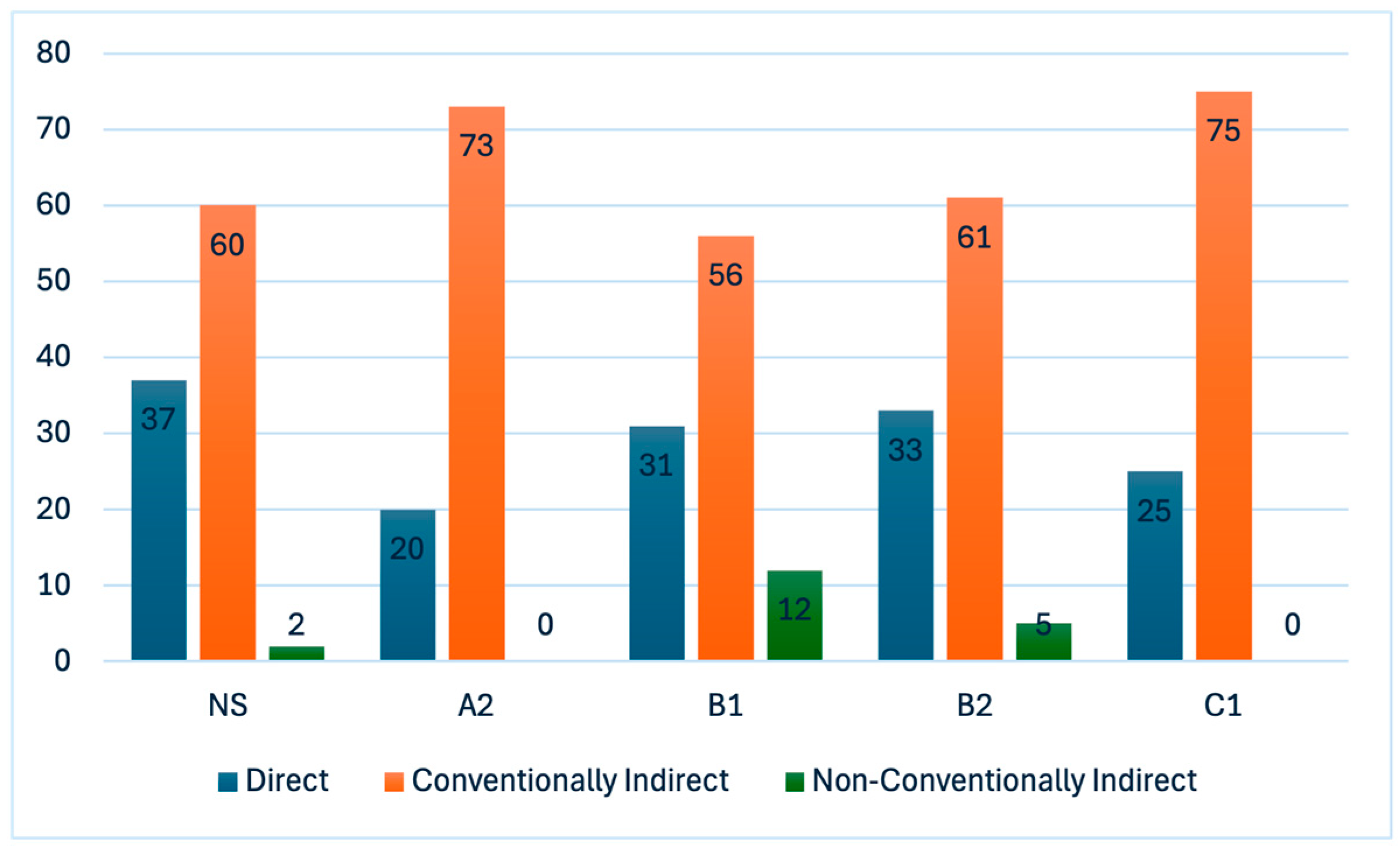
| Total Direct | 20 | 37 | 3 | 20 | 5 | 31 | 6 | 33 | 1 | 25 |
| Conventionally Indirect | ||||||||||
| Query Preparatory—Permission | 17 | 32 | 8 | 53 | 6 | 37 | 8 | 44 | 1 | 25 |
| Query Preparatory—Ability | 13 | 24 | 2 | 13 | 2 | 12 | 3 | 16 | 2 | 50 |
| Query Preparatory with Present Indicative (no modal) | 0 | 0 | 1 | 6 | 1 | 6 | 0 | 0 | 0 | 0 |
| Suggestory Formula | 2 | 4 | 0 | 0 | 0 | 0 | 0 | 0 | 0 | 0 |
| Total Conventionally Indirect | 32 | 60 | 11 | 73 | 9 | 56 | 11 | 61 | 3 | 75 |
| Non-Conventionally Indirect | ||||||||||
| Hint | 1 | 2 | 0 | 0 | 2 | 12 | 1 | 5 | 0 | 0 |
| Total Non-Conventionally Indirect | 1 | 2 | 0 | 0 | 2 | 12 | 1 | 5 | 0 | 0 |
| Unclear/Incomplete Requests | 0 | 0 | 1 | 6 | 0 | 0 | 0 | 0 | 0 | 0 |
| Total Head Acts | 53 | 100 | 15 | 100 | 16 | 100 | 18 | 100 | 4 | 100 |
| Groups | Direct | Conventionally Indirect | Non-Conventionally Indirect | |
|---|---|---|---|---|
| NS | Mean | 5.00 | 8.00 | 1.00 |
| Standard Deviation | 6.96 | 7.18 | 0 | |
| A2 | Mean | 0.75 | 2.75 | 0 |
| Standard Deviation | 1.30 | 3.11 | 0 | |
| B1 | Mean | 1.25 | 2.25 | 2.00 |
| Standard Deviation | 2.16 | 2.27 | 0 | |
| B2 | Mean | 1.50 | 2.75 | 1.00 |
| Standard Deviation | 2.60 | 3.27 | 0 | |
| C1 | Mean | 0.25 | 0.75 | 0 |
| Standard Deviation | 0.43 | 0.83 | 0 |
| Groups | External | Internal | Total | |
|---|---|---|---|---|
| NS | Min | 1 | 0 | 1 |
| Max | 9 | 3 | 11 | |
| Mean | 3.40 | 1.62 | 5.02 | |
| Standard Deviation | 1.60 | 0.76 | 1.84 | |
| A2 | Min | 1 | 0 | 1 |
| Max | 5 | 2 | 5 | |
| Mean | 2.33 | 0.53 | 2.87 | |
| Standard Deviation | 1.11 | 0.74 | 1.30 | |
| B1 | Min | 0 | 0 | 0 |
| Max | 4 | 2 | 6 | |
| Mean | 2.44 | 0.56 | 3.00 | |
| Standard Deviation | 1.26 | 0.81 | 1.41 | |
| B2 | Min | 0 | 0 | 1 |
| Max | 5 | 2 | 6 | |
| Mean | 2.47 | 0.89 | 3.37 | |
| Standard Deviation | 1.30 | 0.73 | 1.67 | |
| C1 | Min | 2 | 1 | 4 |
| Max | 4 | 3 | 6 | |
| Mean | 3.00 | 2.25 | 5.25 | |
| Standard Deviation | 0.81 | 0.95 | 0.95 |
| External Modifications | Deadline Extension | |||||
|---|---|---|---|---|---|---|
| NS | A2 | B1 | B2 | C1 | ||
| Attention Getters | f | 19 | 4 | 2 | 2 | 0 |
| % | 10 | 11 | 5 | 4 | 0 | |
| Preparators | f | 27 | 4 | 8 | 8 | 2 |
| % | 15 | 11 | 20 | 17 | 16 | |
| Getting a Precommitment | f | 1 | 0 | 1 | 0 | 0 |
| % | −1 | 0 | 2 | 0 | 0 | |
| Grounder | f | 84 | 20 | 18 | 23 | 8 |
| % | 46 | 57 | 46 | 48 | 66 | |
| Disarmer | f | 6 | 2 | 1 | 2 | 0 |
| % | 3 | 5 | 2 | 4 | 0 | |
| Imposition Minimizer | f | 0 | 0 | 2 | 3 | 0 |
| % | 0 | 0 | 5 | 6 | 0 | |
| Promise of Reward/Future Action | f | 1 | 1 | 2 | 0 | 0 |
| % | −1 | 3 | 5 | 0 | 0 | |
| Apology | f | 4 | 1 | 0 | 2 | 0 |
| % | 2 | 3 | 0 | 4 | 0 | |
| Considerator | f | 16 | 0 | 2 | 0 | 1 |
| % | 8 | 0 | 5 | 0 | 8 | |
| Discourse Orientation Move | f | 19 | 2 | 3 | 7 | 1 |
| % | 10 | 5 | 7 | 14 | 8 | |
| Sweeteners | f | 3 | 1 | 0 | 0 | 0 |
| % | 1 | 3 | 0 | 0 | 0 | |
| Total | f | 62 | 9 | 20 | 20 | 9 |
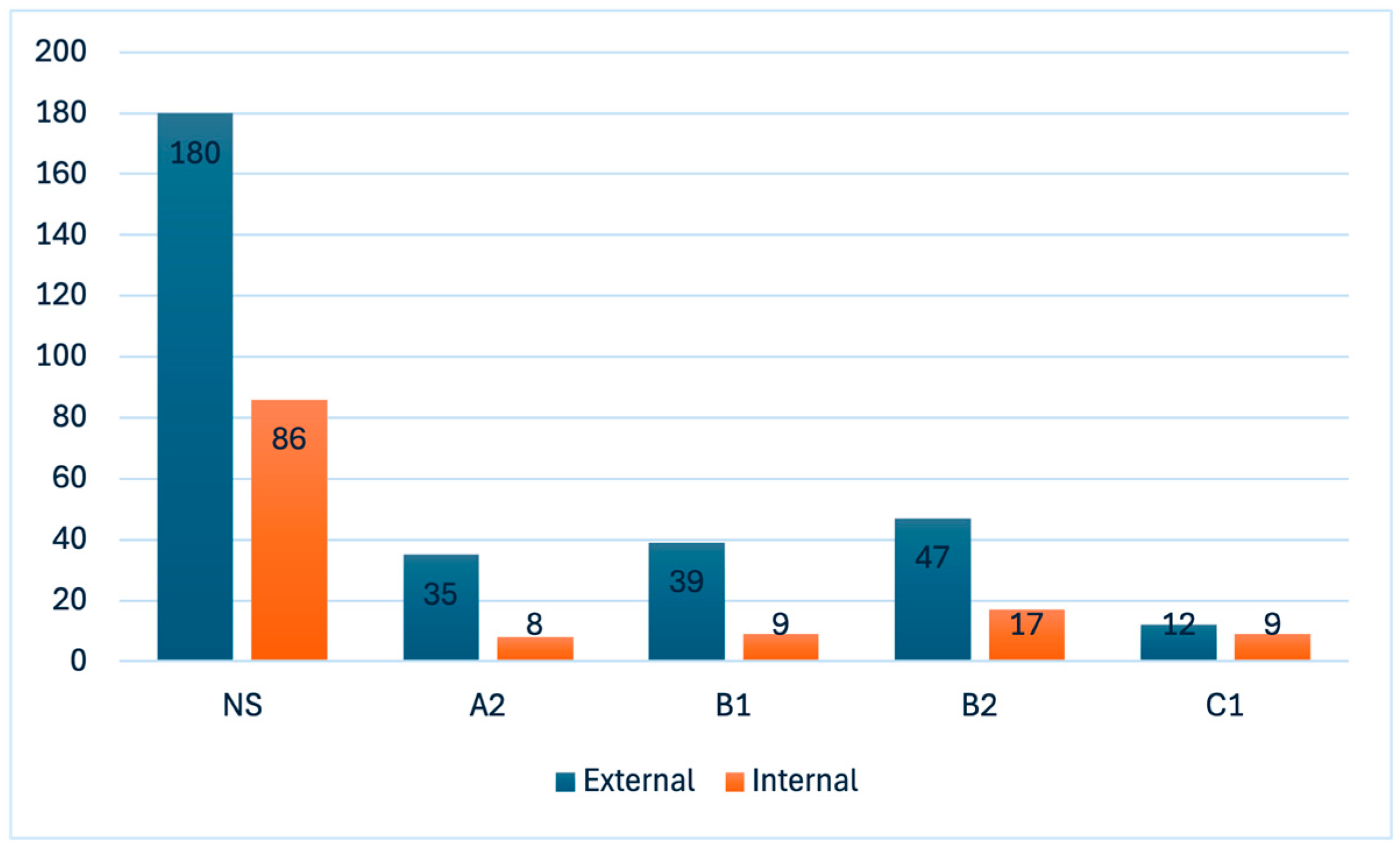
| % | 61 | 81 | 74 | 60 | 56 | |
| Internal Modifications | Deadline Extension | ||||||
|---|---|---|---|---|---|---|---|
| NS | A2 | B1 | B2 | C1 | |||
| Syntactic | Negation | f | 0 | 0 | 0 | 0 | 0 |
| % | 0 | 0 | 0 | 0 | 0 | ||
| Subjunctive | f | 0 | 0 | 0 | 0 | 0 | |
| % | 0 | 0 | 0 | 0 | 0 | ||
| Conditional Structure | f | 28 | 0 | 2 | 4 | 1 | |
| % | 32 | 0 | 22 | 23 | 11 | ||
| Past Tense | f | 3 | 0 | 0 | 1 | 1 | |
| % | 3 | 0 | 0 | 6 | 11 | ||
| Future Tense | f | 3 | 0 | 0 | 1 | 0 | |
| % | 3 | 0 | 0 | 6 | 0 | ||
| Aspect | f | 2 | 0 | 2 | 0 | 1 | |
| % | 2 | 0 | 22 | 0 | 11 | ||
| Passive Voice | f | 0 | 0 | 0 | 0 | 0 | |
| % | 0 | 0 | 0 | 0 | 0 | ||
| Lexical/Phrasal | Understaters/Hedgers | f | 20 | 4 | 2 | 5 | 3 |
| % | 23 | 50 | 22 | 29 | 33 | ||
| Politeness Marker | f | 4 | 1 | 2 | 1 | 0 | |
| % | 4 | 12 | 22 | 6 | 0 | ||
| Subjectivizers | f | 0 | 1 | 0 | 0 | 0 | |
| % | 0 | 12 | 0 | 0 | 0 | ||
| Downtoners | f | 9 | 1 | 0 | 3 | 1 | |
| % | 10 | 12 | 0 | 17 | 11 | ||
| Cajolers | f | 0 | 0 | 0 | 0 | 0 | |
| % | 0 | 0 | 0 | 0 | 0 | ||
| Solidarity Markers | f | 3 | 0 | 0 | 0 | 0 | |
| % | 3 | 0 | 0 | 0 | 0 | ||
| Consultative Devices | f | 13 | 1 | 1 | 2 | 2 | |
| % | 15 | 12 | 11 | 11 | 22 | ||
| Appealers | f | 0 | 0 | 0 | 0 | 0 | |
| % | 0 | 0 | 0 | 0 | 0 | ||
| Intensifiers (Upgraders) | f | 1 | 0 | 0 | 0 | 0 | |
| % | 1 | 0 | 0 | 0 | 0 | ||
| Total | f | 86 | 8 | 9 | 17 | 9 | |
| % | 32 | 18 | 18 | 26 | 42 | ||
Disclaimer/Publisher’s Note: The statements, opinions and data contained in all publications are solely those of the individual author(s) and contributor(s) and not of MDPI and/or the editor(s). MDPI and/or the editor(s) disclaim responsibility for any injury to people or property resulting from any ideas, methods, instructions or products referred to in the content. |
© 2025 by the authors. Licensee MDPI, Basel, Switzerland. This article is an open access article distributed under the terms and conditions of the Creative Commons Attribution (CC BY) license.
Share and Cite
Cañas, J.; Andria, M.; Celaya, M.-L. Requests in Greek as a Foreign Language by Spanish/Catalan Bilinguals: The Role of Proficiency. Languages 2026, 11, 7. https://doi.org/10.3390/languages11010007
Cañas J, Andria M, Celaya M-L. Requests in Greek as a Foreign Language by Spanish/Catalan Bilinguals: The Role of Proficiency. Languages. 2026; 11(1):7. https://doi.org/10.3390/languages11010007
Chicago/Turabian StyleCañas, Javier, Maria Andria, and María-Luz Celaya. 2026. "Requests in Greek as a Foreign Language by Spanish/Catalan Bilinguals: The Role of Proficiency" Languages 11, no. 1: 7. https://doi.org/10.3390/languages11010007
APA StyleCañas, J., Andria, M., & Celaya, M.-L. (2026). Requests in Greek as a Foreign Language by Spanish/Catalan Bilinguals: The Role of Proficiency. Languages, 11(1), 7. https://doi.org/10.3390/languages11010007