
Abstract
Visual simultaneous localization and mapping (v-SLAM) and navigation of unmanned aerial vehicles (UAVs) are receiving increasing attention in both research and education. However, extensive physical testing can be expensive and time-consuming due to safety precautions, battery constraints, and the complexity of hardware setups. For the efficient development of navigation algorithms and autonomous systems, as well as for education purposes, the ROS-Gazebo-PX4 simulator was customized in-depth, integrated into our previous released research works, and provided as an end-to-end simulation (E2ES) solution for UAV, v-SLAM, and navigation applications. Unlike most other similar works, which can only stimulate certain parts of the navigation algorithms, the E2ES platform simulates all of the localization, mapping, and path-planning kits in one simulator. The navigation stack performs well in the E2ES test bench with the absolute pose errors of 0.3 m (translation) and 0.9 degree (rotation), respectively, for an 83 m length trajectory. Moreover, the E2ES provides an out-of-box, click-and-fly autonomy in UAV navigation. The project source code is opened for the benefit of the research community.
1. Introduction
With the advent of modern artificial intelligence algorithms, multi-rotor unmanned aerial vehicles (UAVs) have become smart agents that can navigate in unknown environments. Given a target destination, UAVs can perceive the environment, reconstruct the environment map, and dynamically plan a trajectory to the target destination. Three types of tool kits have been applied in such scenarios: localization, mapping, and planning. The localization (or named pose estimation) kit utilizes onboard sensor information, such as that provided by a stereo camera, to estimate the vehicle’s six degrees of freedom (DoF) pose in real time. The pose feeds into the flight control unit (FCU) to achieve position–level control. Using the UAV’s pose and sensor inputs (e.g., point cloud input), the mapping kit reconstructs the environment throughout the mission. Typically, the environment is presented by a three-dimensional (3D) occupancy voxel map with Euclidean signed distance information [1]. The path-planning kit identifies the lowest-cost path to the destination, avoids obstacles, and generates a trajectory. That trajectory is then sent to the FCU as part of the time sequence used to navigate the UAV.
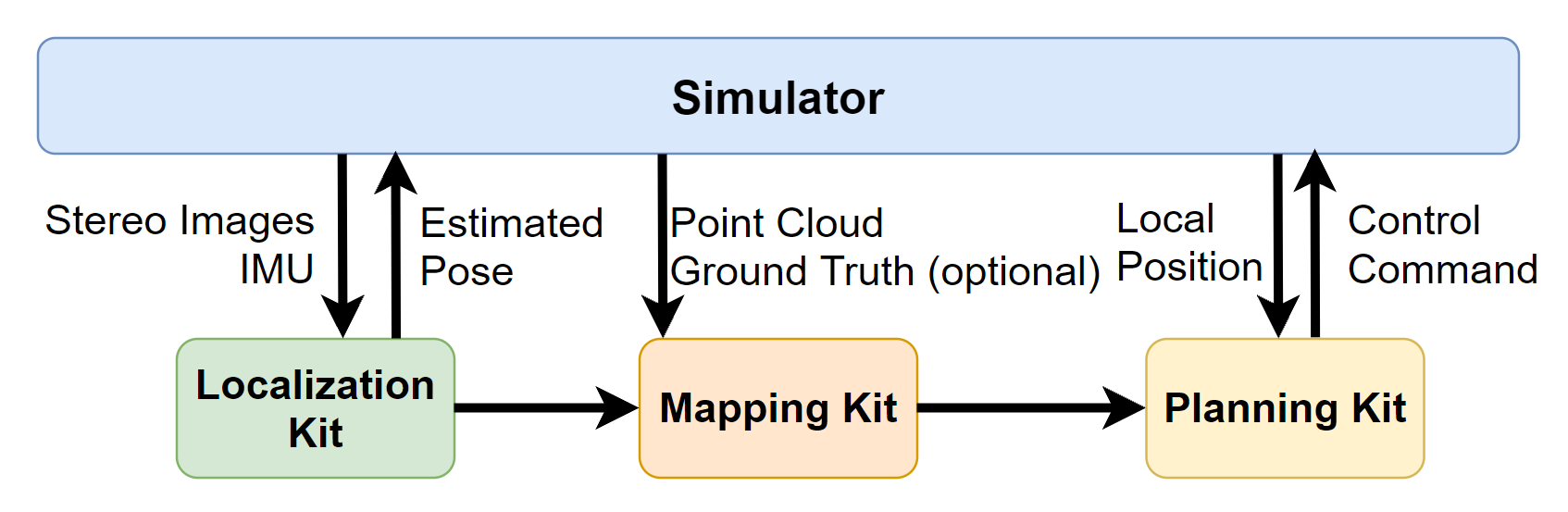
Verifying such UAV navigation systems under realistic scenarios can be effort-intensive, and failures during testing may damage the UAVs. To overcome these issues, simulators that provide simulated hardware components, such as perception sensors can be used, as they ease reconfiguration and enhance the flexibility of the environmental setup. Although various UAV simulation tools are currently available, most do not focus on a specific task. For example, flight-dynamic-oriented simulation ignores all environmental information. The simulation used in the visual simultaneous localization and mapping (vSLAM) study simplified the dynamic model of the UAV; the navigation-oriented simulation environment contained 3D information about the environment, but it neglected the features of 3D objects. Some simulation tools [2,3] achieve autonomous navigation to a certain degree, but their flexibility is limited, and their source codes have not been released. Thus, the motivation of this work is to construct an end-to-end simulation (E2ES) environment for research and education purposes. Throughout this paper, ’end-to-end’ refers to the capability of verifying the perception, reaction, and control algorithms in one simulator (Figure 1).
Figure 1.
System overview of the proposed end-to-end simulator, ‘E2ES’.
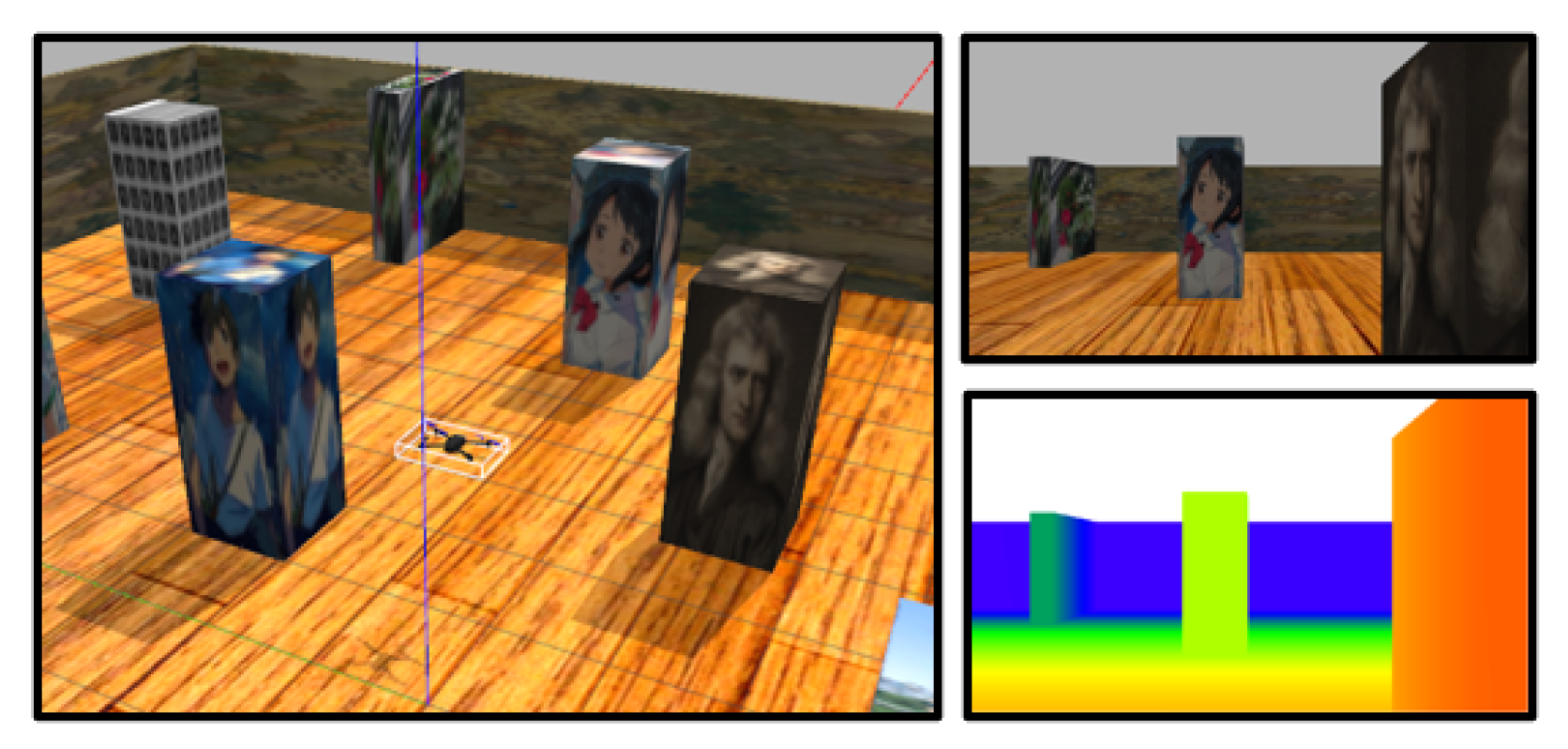
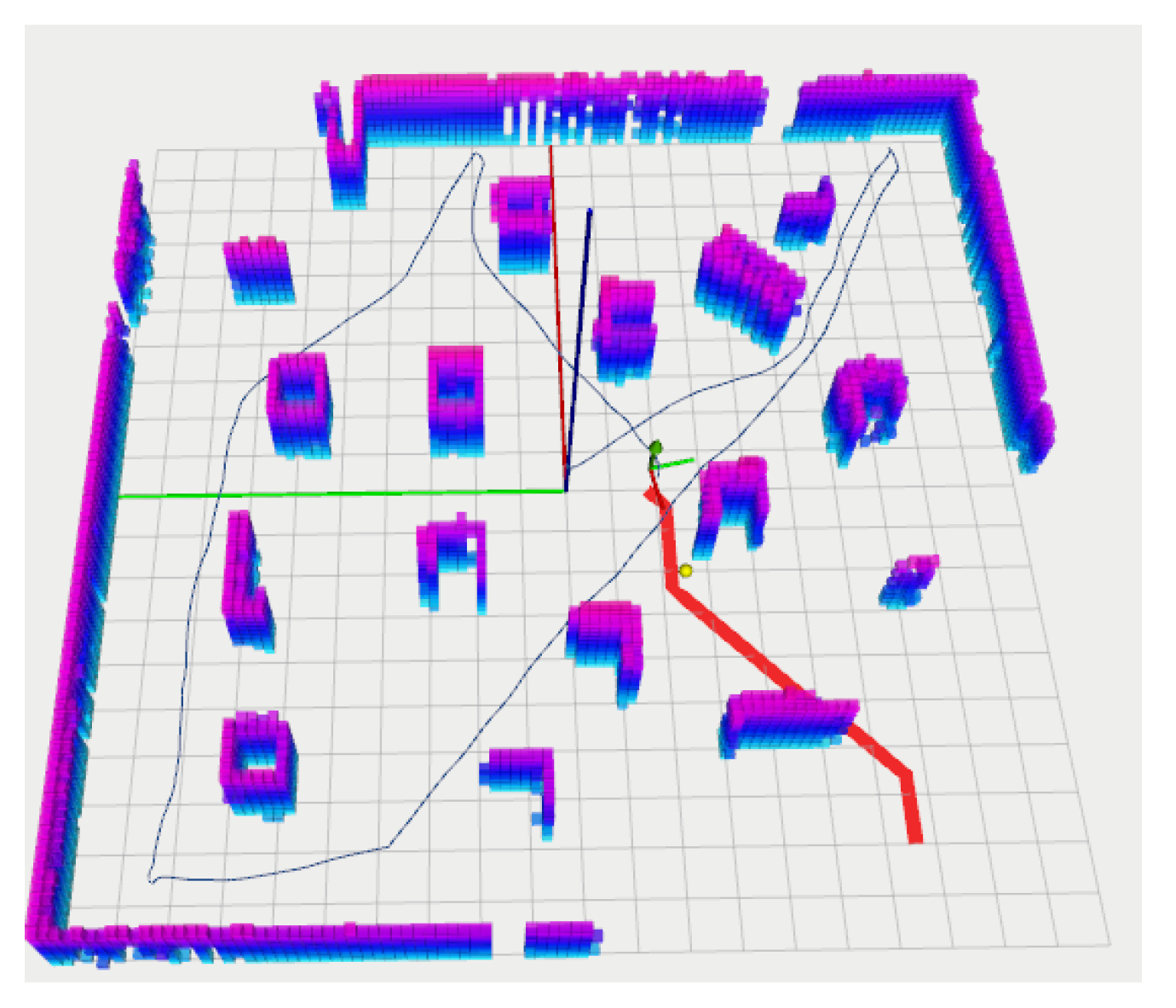
Based on the widely used ROS-Gazebo-PX4 toolchain, we made several improvements to the UAV model, environment, and function plugins to meet the requirement of UAV v-SLAM and navigation (Figure 2). These improvements include: (a) the construction of a simulated world, (b) the customization of UAV models, (c) the addition of a stereo camera model, and (d) the configuration of a vision-based control setup. At the end of this paper, we describe an E2ES for UAV navigation (Figure 3). In summary, the contributions of this work are as follows:
Figure 2.
The UAV in the simulator; the right-hand side images are the real time color and depth image from the on-board cameras.
Figure 3.
Click-and-fly navigation in the unknown environment (the blue path is the traveled path, and the red path is global planned path from the current position to the destination).
- Customization of the ROS-Gazebo-PX4 simulator in terms of the support of stereo inertial vision estimation, vision feedback control, and ground-truth level evaluation.
- Integration of functions, including localization, mapping, and planning, into tool kits.
- Achievement of click-and-fly level autonomy in the simulation environment.
- Release of the simulation setup, together with the localization kit, mapping kit, and planning kit as open-source tools for the research community (Supplementary Materials).
The remainder of this work is organized as follows. Section 2 describes related works. Section 3 introduces the customized simulation framework, and Section 4 shows the integrated vSLAM and navigation kits. Section 5 shows the simulation results and performance analysis. Finally, Section 6 concludes the paper.
2. Related Works
2.1. UAV Simulators
Depending on the scope of simulation, UAV simulators can be classified into two categories: flight dynamics simulators and environment-integrated simulators. The first type focuses on simulating the dynamics of different UAV platforms, and all environmental information is neglected except for the force of gravity. For example, based on Simulink in MATLAB, Quad-Sim [4] was demonstrated to be suitable to test flight-control algorithms for different dynamic models. Sun et al. [5] developed another Simulink-based simulator that includes a comprehensive aerodynamic model of the tail-sitter vertical take-off and landing UAV. The second type, the environment-integrated simulator (also known as the perception-supported simulator), includes perception sensors and environmental information. Users can access the simulated sensor outputs, such as camera images and the point cloud from the Lidar sensor [6]. For example, Schmittle et al. [7] developed an easy-access web-based UAV testbed for education and research. By applying the containers as a service technology, this simulator is deployed in the cloud; thus, the user does not need a high-performance computer to execute the simulation. Xiao et al. [8] developed a simulation platform called XTDrone. Comparing E2ES with XTDrone, both are based on ROS-Gazebo-PX4 toolchains, which means they have a similar kinetic model and flight controller. However, these two projects focus on solving different problems. XTDrone is focused on providing a general solution for UAV simulation, while the E2ES simulator is focused on providing an out-of-box solution for UAV SLAM and navigation. E2ES is more accessible for achieving full-stack navigation in the loop using its default localization, mapping, and planning tools or customized packages developed by users.
2.2. The UAV vSLAM and Navigation System
Typically, the v-SLAM and the navigation system consist of localization, mapping, and planning modules. The related works are reviewed in sequence.
2.2.1. Localization
The goal of localization is to achieve real-time pose estimations with the onboard computer and sensors. A wide range of methods has been pursued to solve this problem. Most preliminary methods use LiDAR [9,10,11] or cameras to perceive the environment. The LiDAR sensors have a wide detection range and can directly provide high-precision depth information. However, they are also expensive, heavy, and large, which limits the application scenarios of LiDAR on the UAV platform. In contrast, the camera has simple structure, light weight, and cheap price. These features make it very suitable for UAV applications, especially for the limited payload of quadcopter UAVs.
Visual localization (or visual pose estimation) can be realized using either monocular or stereo camera solutions. The monocular solution has the advantages of a simple structure and low weight. However, recovering the scale correctly is a challenge with such a system. Researchers have integrated IMU information [12] or predefined the object pattern [13,14] of the environment to eliminate this problem. Nowadays, stereo camera solutions are available off the shelf. As depth information can be directly extracted from every frame, the accuracy and robustness of this system is better than those of the monocular setup at the cost of a larger stereo data stream. Nevertheless, the use of powerful onboard computers can compensate for this issue.
In the UAV application, visual information is usually fused with the IMU data through either a filter-based framework or an optimization-based framework. Under the filter-based framework, the pose and the landmark are in the system states. IMU inputs propagate the pose states and the relevant con-variance matrices [15,16]. In the optimization-based framework, the IMU engaged through a pre-integration edge [17]. According to Delmerico et al. [18], the optimization-based approach outperforms the filter-based approach in terms of accuracy but requires more computational resources.
2.2.2. Mapping
The mapping system, which provides a foundation for onboard motion planning, is an essential component in the perception–planning–control pipeline. A mapping system needs to optimally trade-off measurement accuracy and the storage overhead. Three types of map have been successfully used in UAV navigation applications: the point cloud map [19], the occupancy map [20], and Euclidean Signed Distance Fields (ESDFs) [21] map.
The point cloud map can be easily obtained by measuring point stitching. However, this type of map is only suitable for high-precision sensors in static environments, because sensor noise and dynamic objects cannot be accessed and modified. Occupancy maps, such as OctoMap [20], store occupancy probabilities in a hierarchical octree structure. The main restrictions of these approaches is their fixed-size voxel grid, which requires a known map size in advance and cannot be dynamically changed [21]. In recent years, ESDF maps have gained popularity [22]. This type of map is suitable for dynamically growing maps and is advantageous in that it can evaluate distance and gradient information with relation to obstacles.
2.2.3. Planning
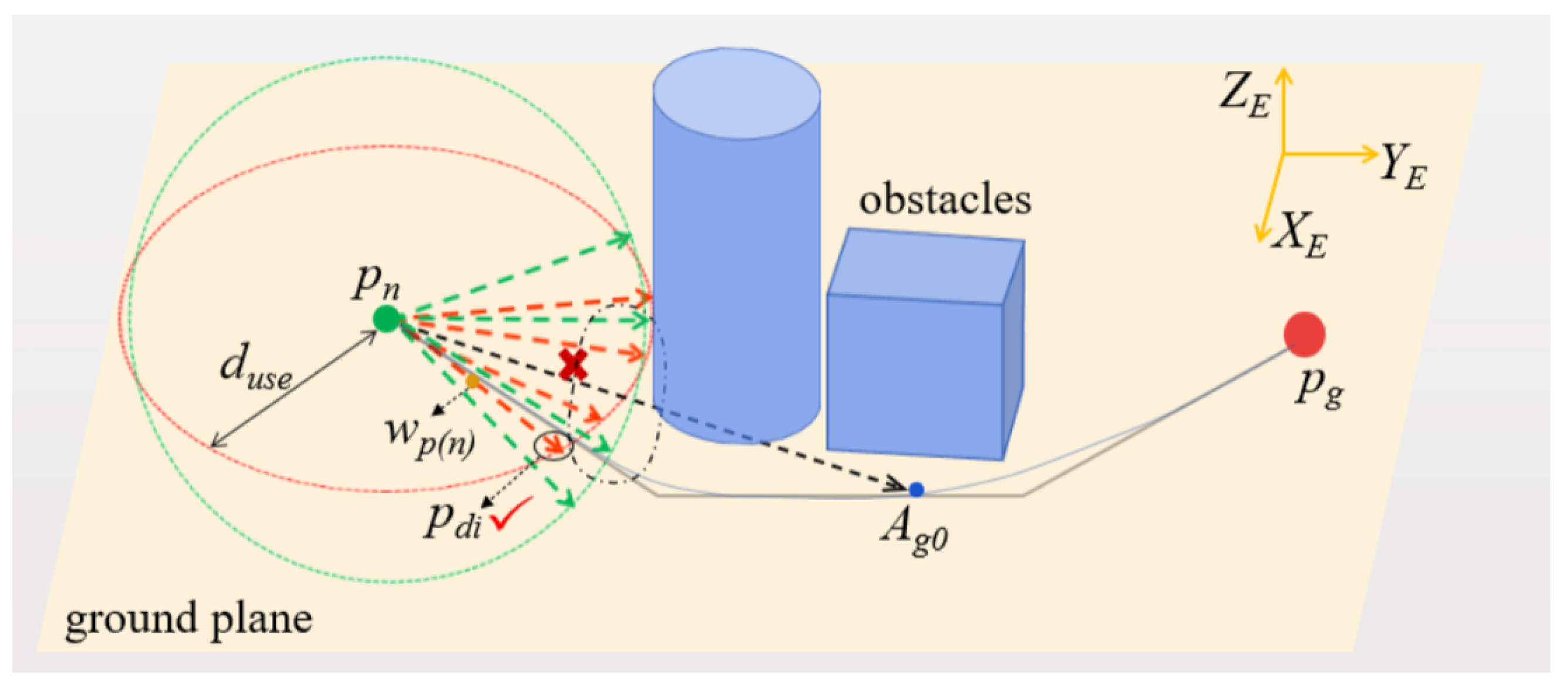
For UAV route planning, algorithms can be classified into two main categories: sampling-based algorithms [23] and optimization-based algorithms [24]. The rapidly exploring random tree (RRT) algorithm [23] is representative of sampling-based algorithms. In this method, samples are drawn randomly from the configuration space to guide the tree to grow toward the target [25]. The rapidly exploring random graph system [26] is an extension of the RRT algorithm and is asymptotically optimal. Although the sampling-based method is suitable for identifying safe paths, it is not easy for the UAV to follow. The minimum-snap algorithm [24] can be applied to generate a smooth trajectory. It formulates the trajectory generation problem as a quadratic programming problem. By instantly minimizing the cost function, the trajectory can be represented using piece-wise polynomial functions. The cost function includes two terms: the penalty for the trajectory with the potential of collision and the smoothness of the trajectory itself. With optimization-based methods, another way to add constraints to the optimization problem is to first obtain a series of waypoints using a sample search or a grid search and to then optimize the motion primitives to generate a smooth trajectory through the waypoints under the UAV’s dynamic constraints [27]. This approach combines the advantages of the two categories, and its computation efficiency is higher than those of pure optimization-based algorithms. However, the safe radius and other parameters must be tuned carefully.
2.3. UAV SLAM and Navigation Simulations
Some UAV SLAM and navigation simulations have previously been proposed. Zhang et al. [2] proposed a quadrotor UAV simulator integrated with a hierarchical navigation system. Under this approach, the UAV is equipped with two laser scanners and one monocular camera. One laser scanner is mounted on the bottom for altitude control and 3D map construction, while the other is attached to the top for navigation purposes. The monocular camera is attached to a tilting mechanism for target detection and visual guidance. The fused data are then constructed into OctoMap and used to facilitate a trajectory from an A* global path planner. In this approach, the environmental setup is quite simple and does not include visual features, and the navigation is based on Laser SLAM. In Alzugaray et al. [3], a point-to-point planner algorithm was designed to work with the SLAM estimation of a monocular-inertial system. In the simulator, the UAV was flown around the building to reconstruct the environment. However, as the UAV was flown outside the building, obstacle avoidance was not considered in their work.
3. Simulation Platform
3.1. Overview
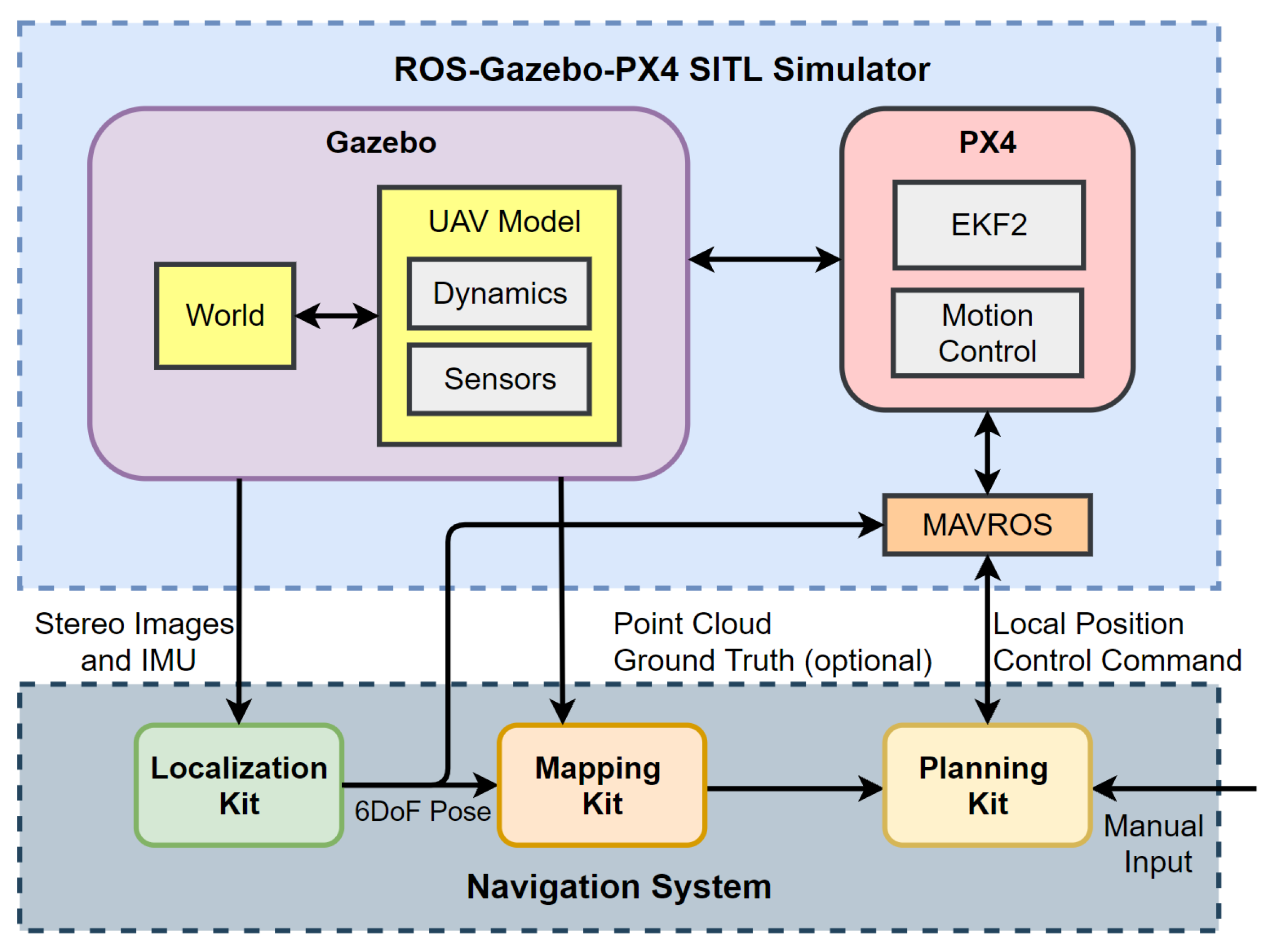
The proposed simulation platform is based on the ROS-Gazebo-PX4 toolchain. In the field of robotics, the robot operating system (ROS) [28] is the most convenient platform, because it provides powerful developer tools and software packages from drivers to state-of-the-art algorithms. Moreover, many navigation kits contain the ROS-version package, and it can be integrated conveniently. Moreover, Gazebo [29], which is an open-source robotics simulator, is the most widely used simulator used for ROSs. We selected the widely used open-source UAV autopilot stack, PX4 [30], which supports software in the loop (SITL) simulations.
As shown in Figure 4, the upper part of our simulation is the Gazebo SITL simulator. It has an environmental map, also called "the world", and a simulated UAV model, which supports the dynamic simulation and a series of onboard sensors, including a global positioning system, IMU, barometer, and custom-defined-depth camera sensors. All of these sensors are attached to the UAV through Gazebo plugins. The bottom panel of Figure 4 shows the navigation system. All components are coordinated and communicated through different ROS topics. The communication between the navigation system and PX4 is conducted through MAVROS (http://wiki.ros.org/mavros, accessed on 18 December 2021). In the simulator, PX4 communicates with Gazebo by receiving sensor data from the simulated world and sending motor and actuator commands to the UAV. The extended Kalman Filter-based state estimator and the motion control module run on the PX4 stack.
Figure 4.
Framework of simulation.
3.2. The UAV Dynamic Model
The dynamic model in the simulator follows the conventional quadcopter dynamic model, which can be found in general papers on dynamics and control, such as [31,32,33]. The UAV is modeled as a six-DoF rigid body (three DoF in position and three DoF in rotation). The position of the UAV’s center of gravity in the inertial frame is defined by ; the orientation of the UAV is denoted by the rotation matrix from the body frame (B) to the inertial frame (I) . The velocity, as the derivative of position, in the inertial frame is described by , and the angular velocity is denoted by . The kinematics and dynamics of the position and attitude are denoted by:
where m denotes the mass, denotes the inertia matrix of the vehicle, and denotes the skew-symmetric matrix, such that for any vector . and are the total force and moment acting on the body frame, respectively. The dynamic simulation of the UAV is achieved by the model in Gazebo. The PX4 SITL simulator handles the inner loop attitude, velocity, and position control. The user commands the UAV in the off-board control mode by sending the target position or velocity command through MAVROS.
3.3. On-Board Sensors
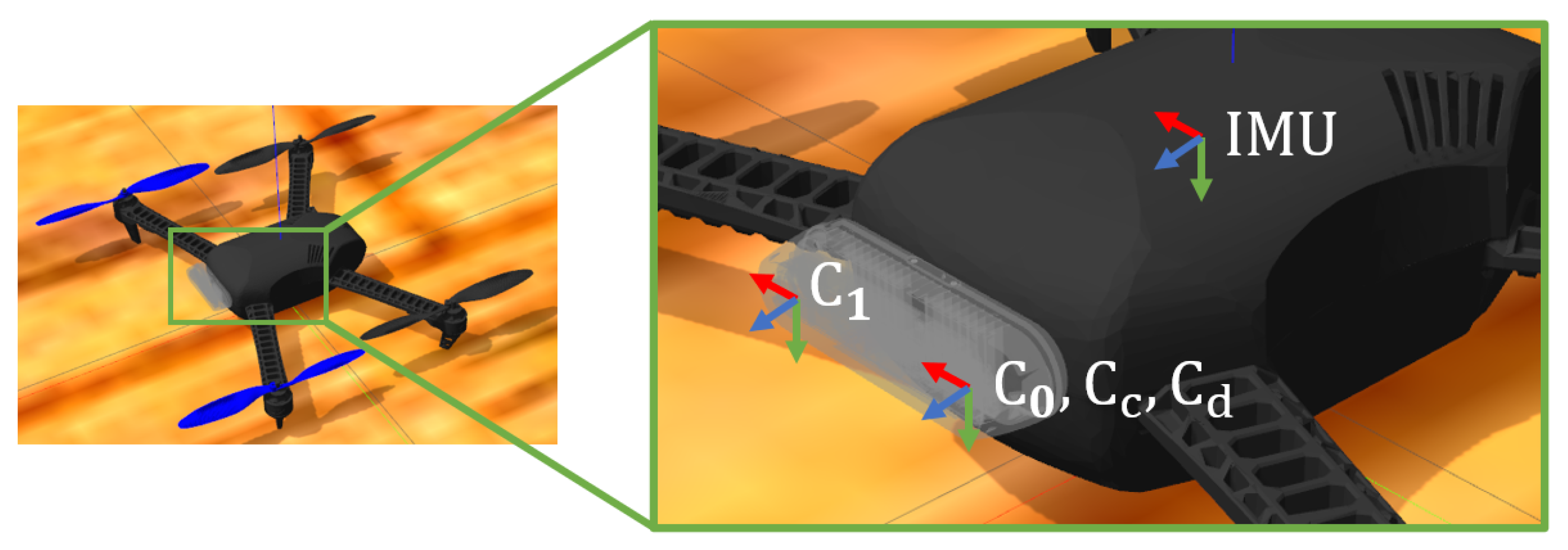
To improve the 3DR-IRIS model provided by the original PX4 firmware, we added a depth camera and customized the IMU sensor to support the visual–inertial pose estimator. To do this, we introduced the camera and IMU models. The coordinate definition of the body and the IMU are shown in Figure 5.
Figure 5.
Modified 3DR-IRIS model and the installation geometry of the vision sensor and IMU (the X–Y–Z axes in the reference frame are colored in red, green, and blue, respectively. The on-board vision sensor consist of four cameras. and are a stereo pair with the baseline of 5 cm. and are color and depth cameras, respectively. In the modified model, , and are installed at the same position).
3.3.1. The Visual Sensor
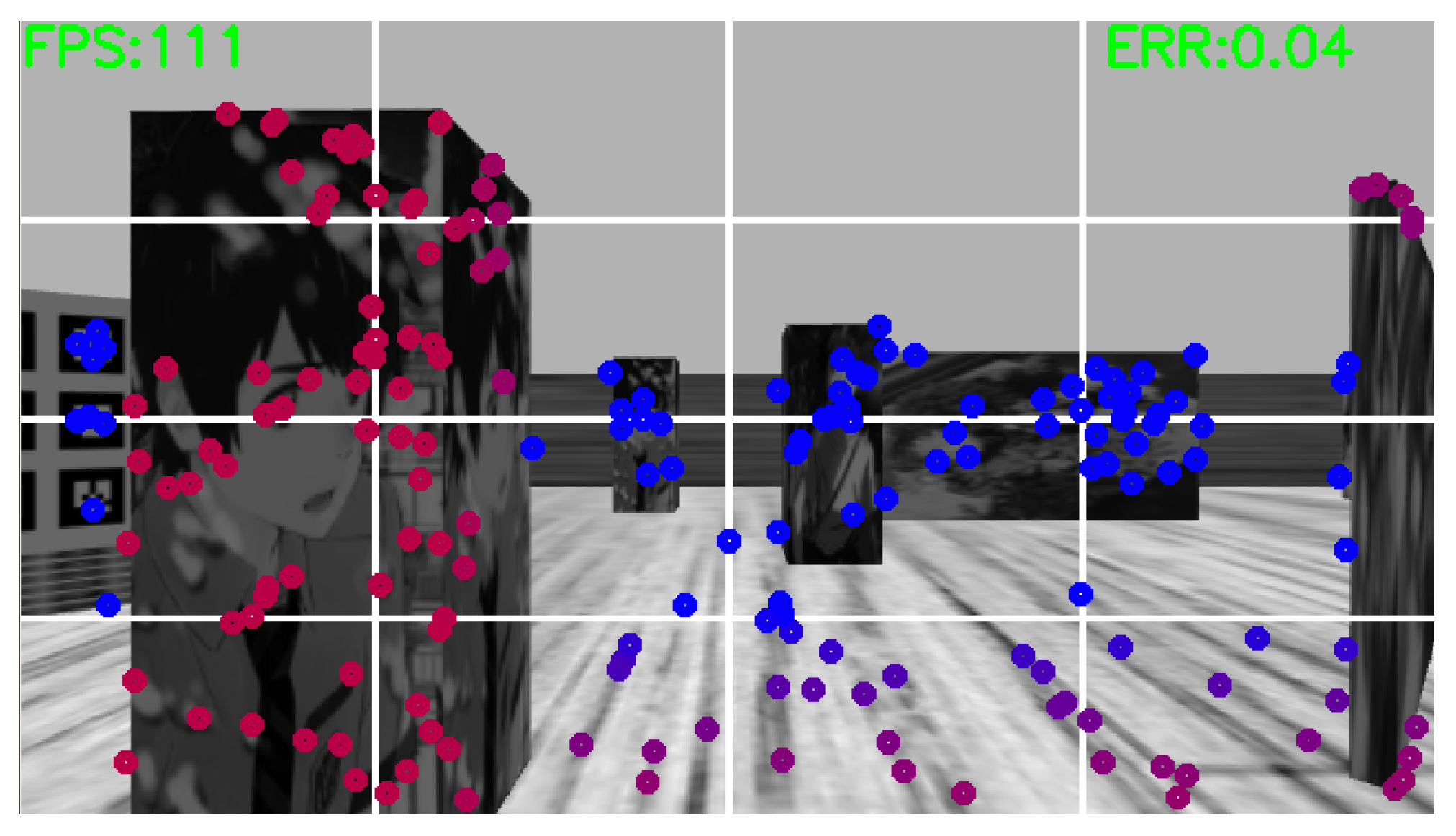
The visual sensor is based on librealsense_gazebo_plugin (https://github.com/pal-robotics/realsense_gazebo_plugin, accessed on 17 December 2021). The visual sensor in the simulator consists of two gray-scale cameras ( and ), a color camera (), and a depth camera (). All of these cameras are based on the non-distortion pinhole camera model. The output of the sensors includes two gray-scale images, a color image, a depth image, and a point cloud. All of these outputs are temporally synchronized. The horizon field of view () and resolution () define the intrinsic camera parameters (, , , ) as follows:
The installation geometry in the SDFormat (Simulation Description Format) file defines the extrinsic parameters. For convenience, the color camera, the depth camera, and the left pinhole camera were installed in the same link, which means the color image, depth image, left gray-scale image, and point cloud were all aligned.
3.3.2. The IMU
In the simulator, the IMU consists of a three-axis accelerometer and a three-axis gyroscope. The measured angular velocity and acceleration can be described using the following models:
where and refer to the intrinsic noise of the sensor, which follows the Gaussian distribution. Biases, including and , are affected by the temperature and change over time. Slow variations in the sensor biases are modeled using random walk noise in discrete time. That is, the time derivatives of the biases (i.e., and ) follow the Gaussian distribution. Furthermore, in the IRIS model provided by PX4 firmware, the update rate of the IMU is constrained by the MAVROS. To cross the speed limit, we added another IMU plugin, which publishes IMU information at a rate of 200 Hz.
3.4. The Simulation World Setup
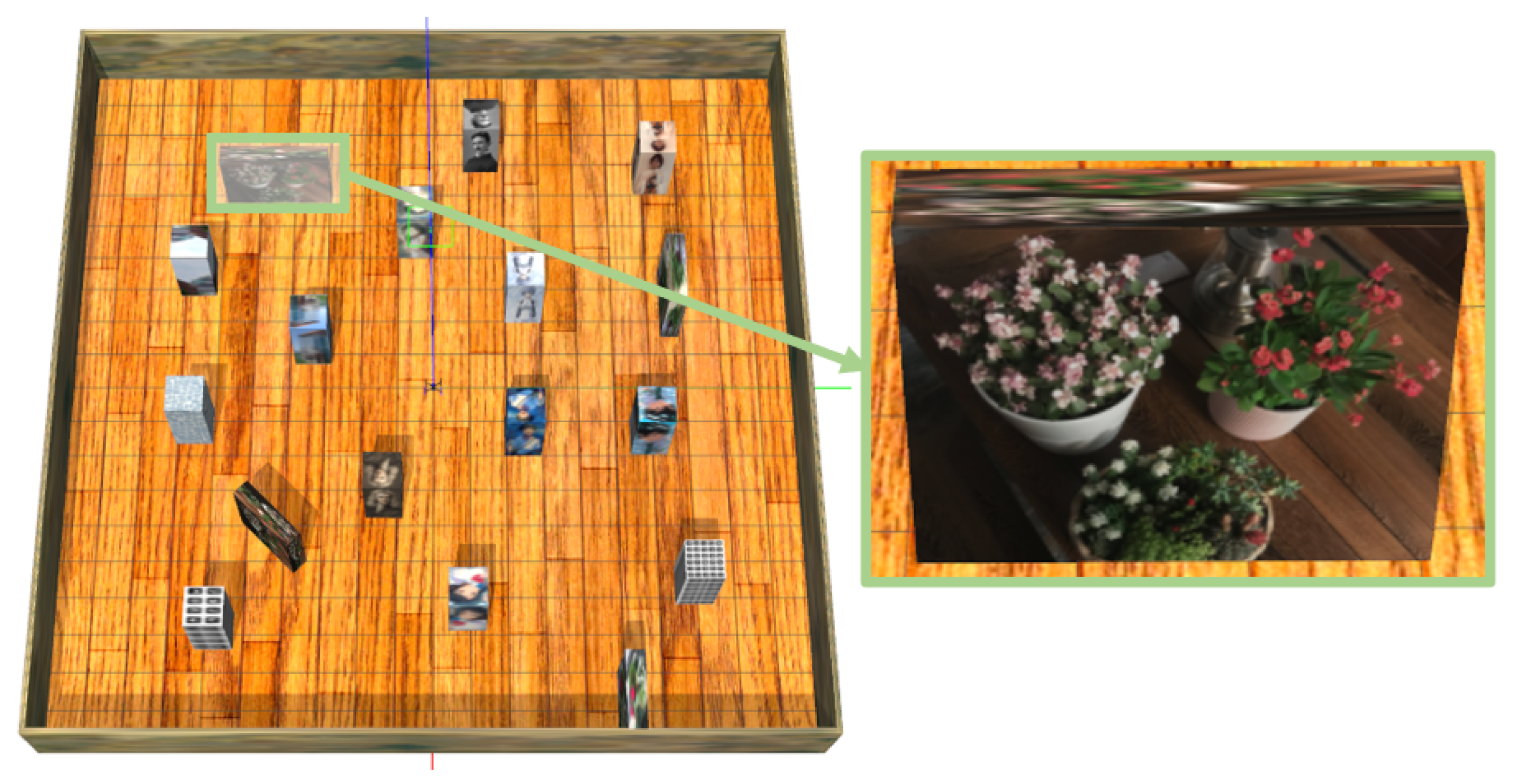
First, we added obstacles, such as walls and boxes, into a m empty world. Then, to meet the requirements of v-SLAM simulation, we furnished all of these items and the ground plane with various wallpaper, which contained rich visual features, as shown in Figure 6.
Figure 6.
The m simulation world with obstacles (wall paper contain rich visual features to support the visual tracking).
5. Simulation Results and Performance Analysis
In this section, we report two experiments conducted to demonstrate the performance of the proposed simulator. In the first experiment, the vehicle was manually flown in the simulation world using the keyboard to verify the performance of the localization and mapping kits. In the second experiment, click-and-fly autonomous navigation was used.
The accuracy of the v-SLAM localization is presented by the absolute pose error (APE) of translation and rotation [37]. The definitions of APE is:
where is the transformation of the ground truth of frame n, is the transformation estimate of frame n, and is the least-squares estimation of transformation between the estimated trajectory and the ground truth trajectory by Umeyama’s method [38]. The alignment transformation has six degrees of freedom (). In detail, the translation and rotation errors are defined by the root mean square error (RMSE) of APE, using:
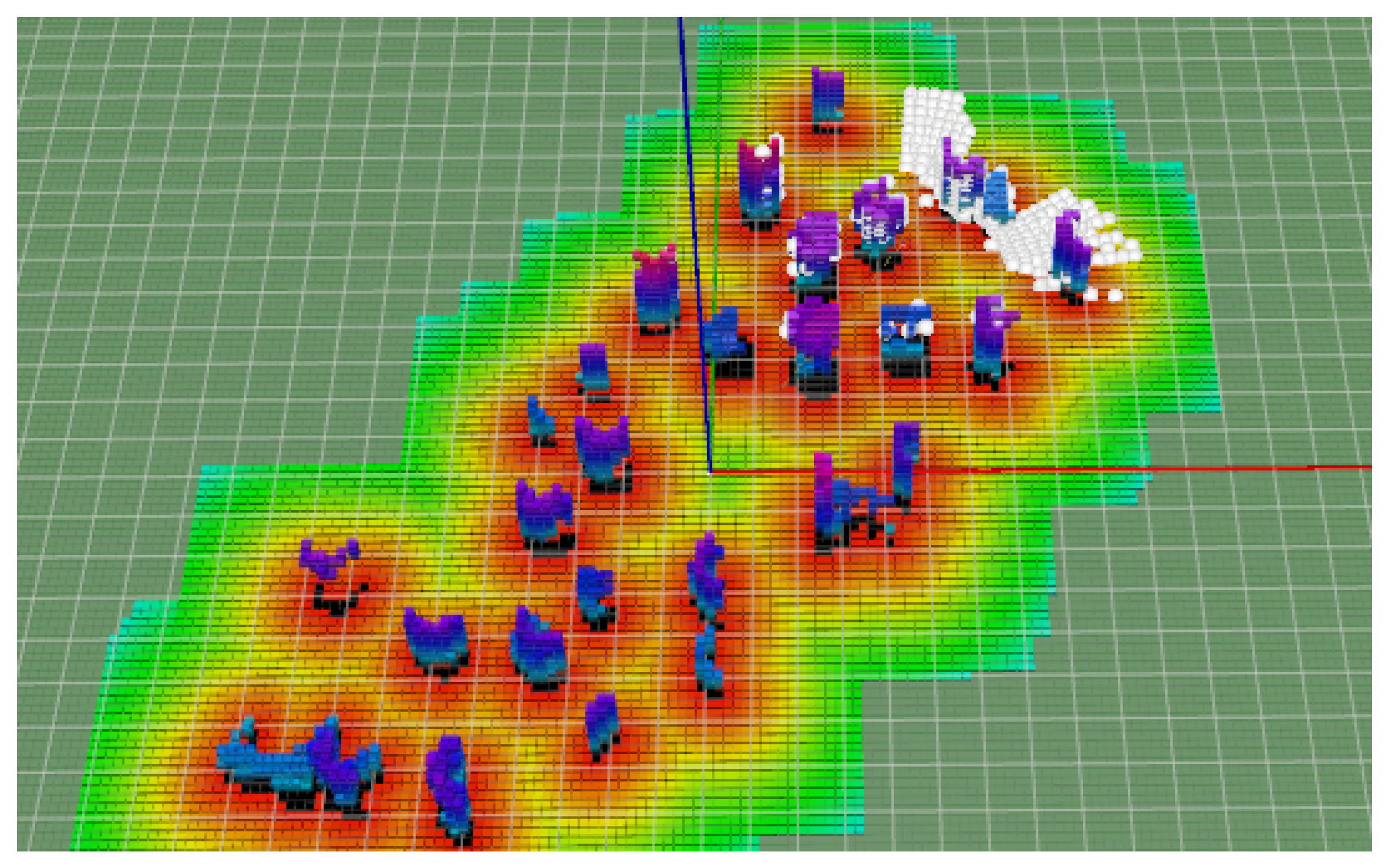
The mapping kit will generate an reconstructed map. The agreement of this reconstructed map and the simulation world can also represent the accuracy of the localization kit and the overall performance of the mapping kit.
5.1. Manual Exploration
5.1.1. A 20 m × 20 m Room Environment
In this experiment, the localization and mapping kits were integrated. Using the first-person view from the color camera and the real-time reconstructed map view, the UAV was controlled to explore the 20 m × 20 m unknown environment. The exploration mission took 7 min and 24 s, and the UAV traveled 82 m in the simulation world.
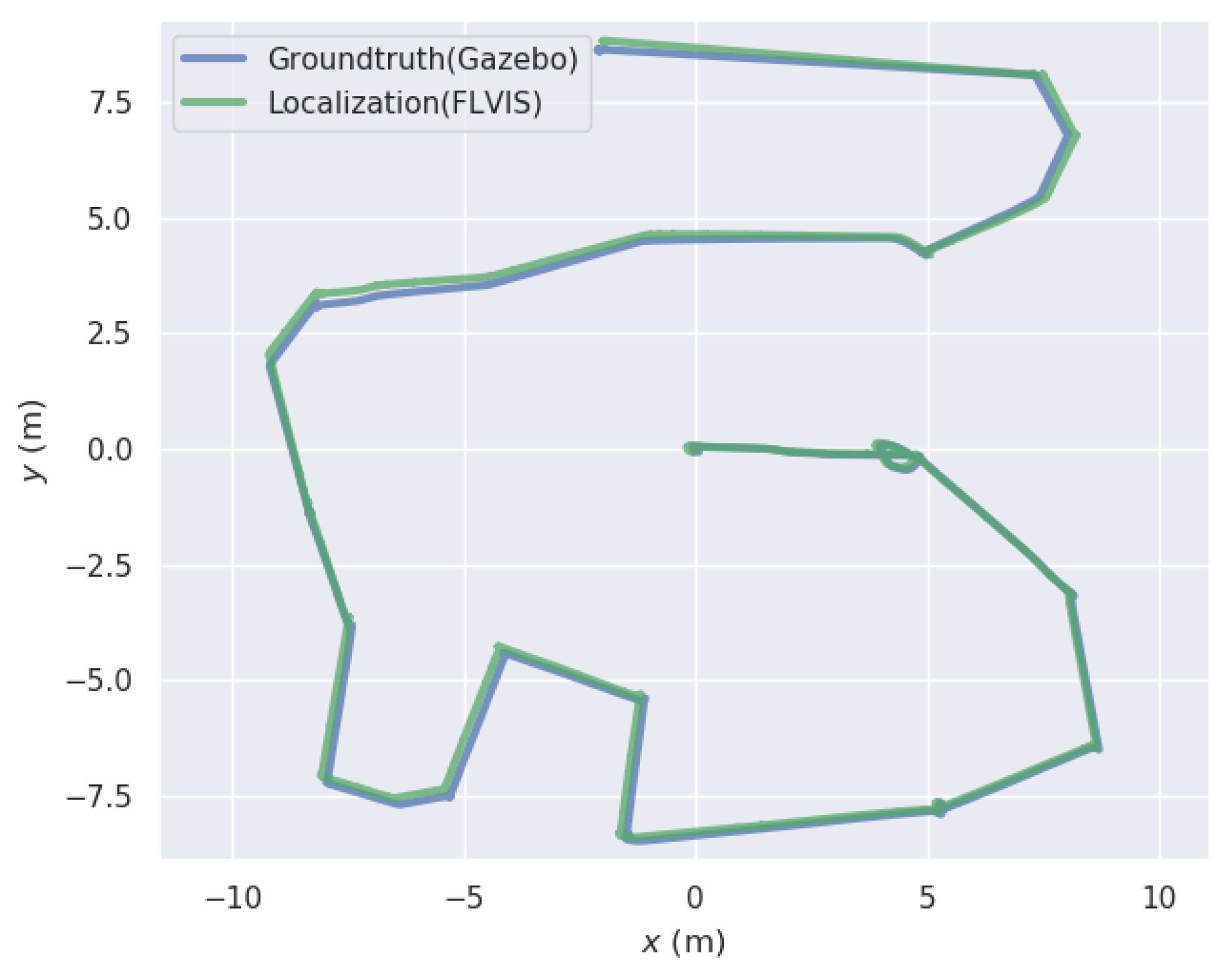
The excellent agreement between the ground truth path and the estimated path of the localization kit is shown in Figure 10. A tool from Michael Grupp [37] was also used to evaluate the accuracy of the localization kit. The and of the trajectory was 0.3 m and 0.9 degree.
Figure 10.
Comparison of the ground truth and the estimated pose from the localization kit.
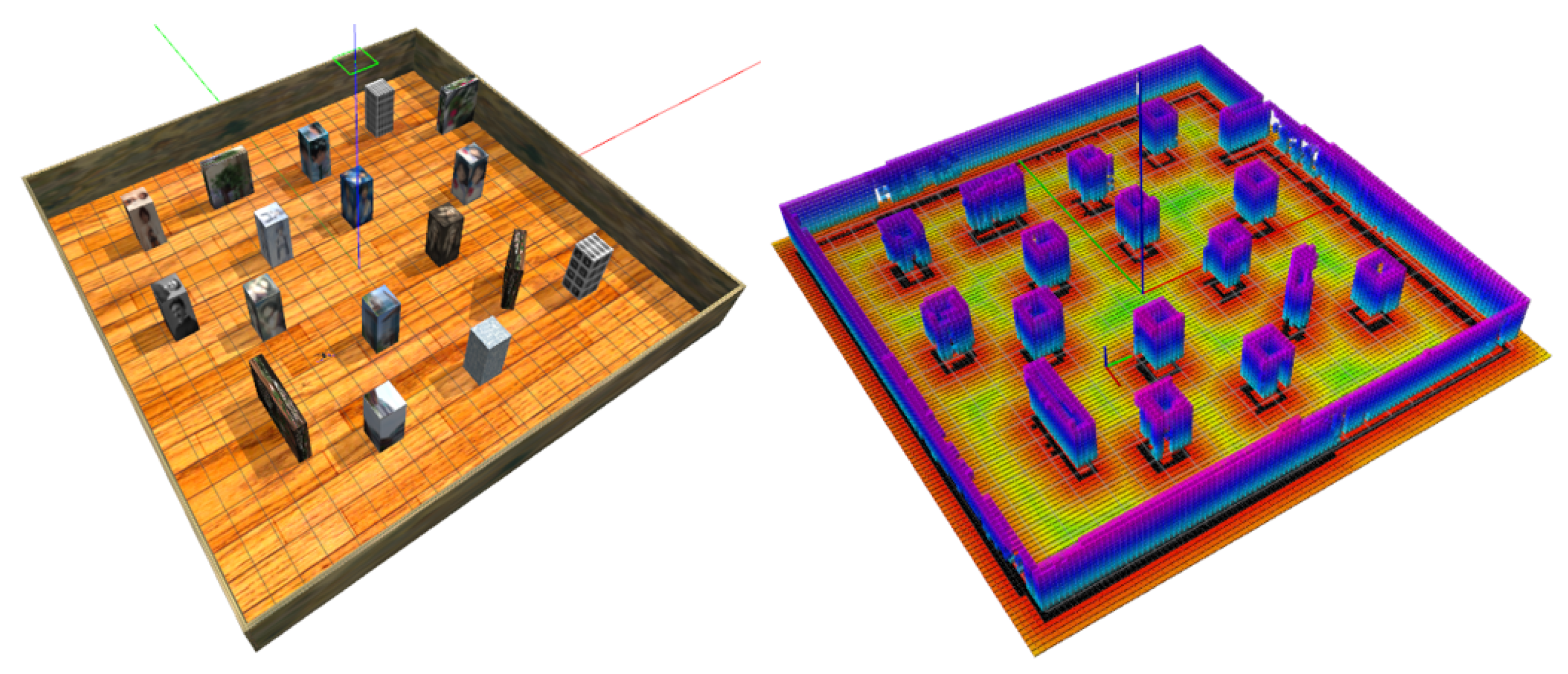
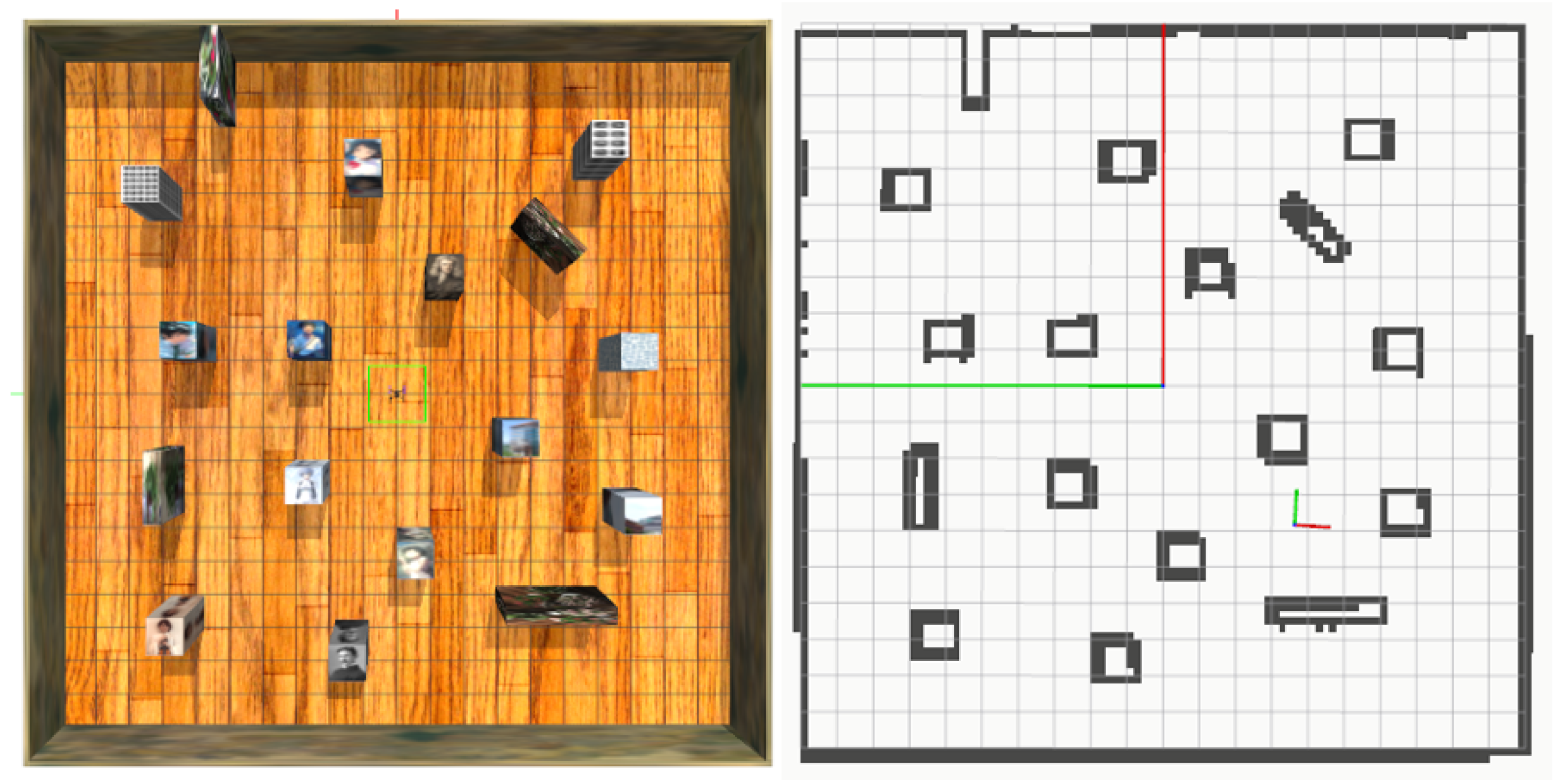
Images of the simulated world and the reconstructed map were captured from different viewpoints. Good agreement between them and the detail of the map can be observed in Figure 11 and Figure 12. The voxel size of the map was m.
Figure 11.
Top-down view of the simulation world (left) and the projected 2D occupancy grid map generated by the mapping kit (right).
Figure 12.
Oblique view of the simulation world (left) and oblique view of the reconstructed map by the mapping kit (right).
5.1.2. An 8 m × 40 m Corridor Environment
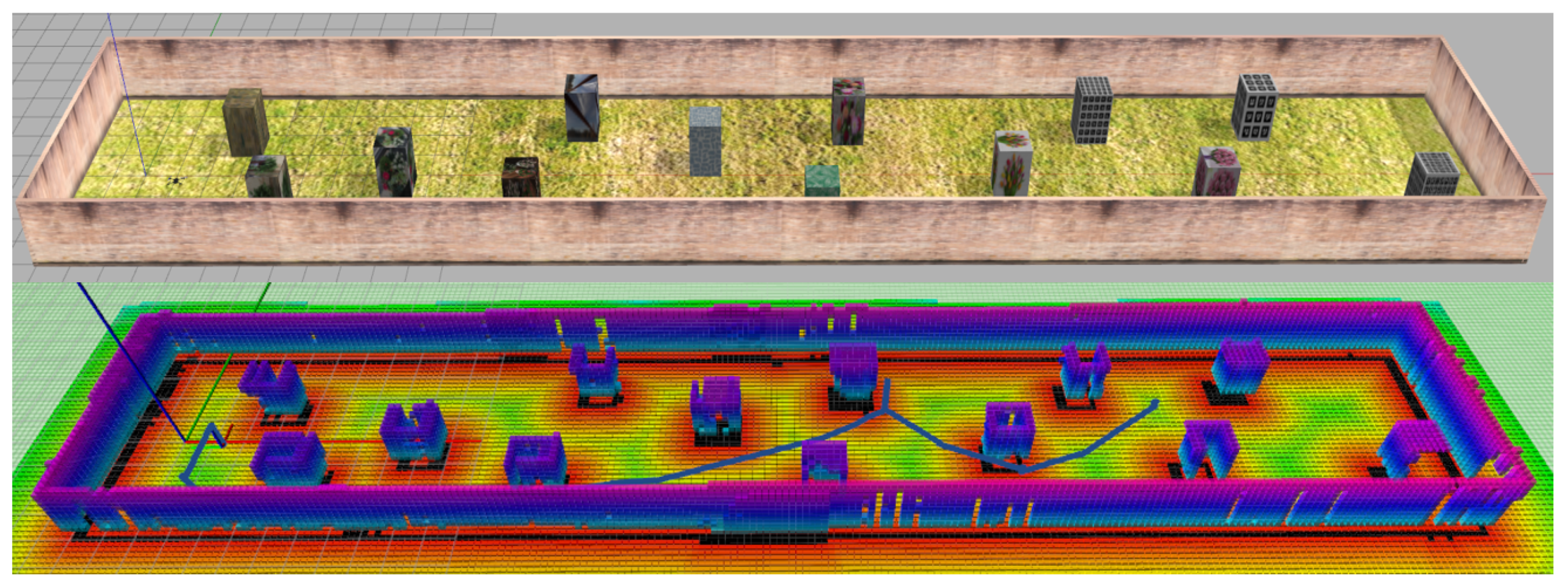
Another manual exploration experiment was carried out in an 8 m × 40 m unknown environment; this kind of environment setup represents the typical scenarios of flying in the jungle or a long corridor. Figure 13 shows the comparison of the ground truth and the estimated trajectory. The length of the trajectory was 100.4 m and the and of the trajectory were m and 0.9 degree, respectively. Figure 14 shows the good agreement of the simulation world and the reconstructed map.
Figure 13.
Comparison of the ground truth and the estimated pose from the localization kit.
Figure 14.
Oblique view of the simulation world (up) and the reconstructed map created by the mapping kit (down).
5.2. Click-and-Fly Level Autonomy
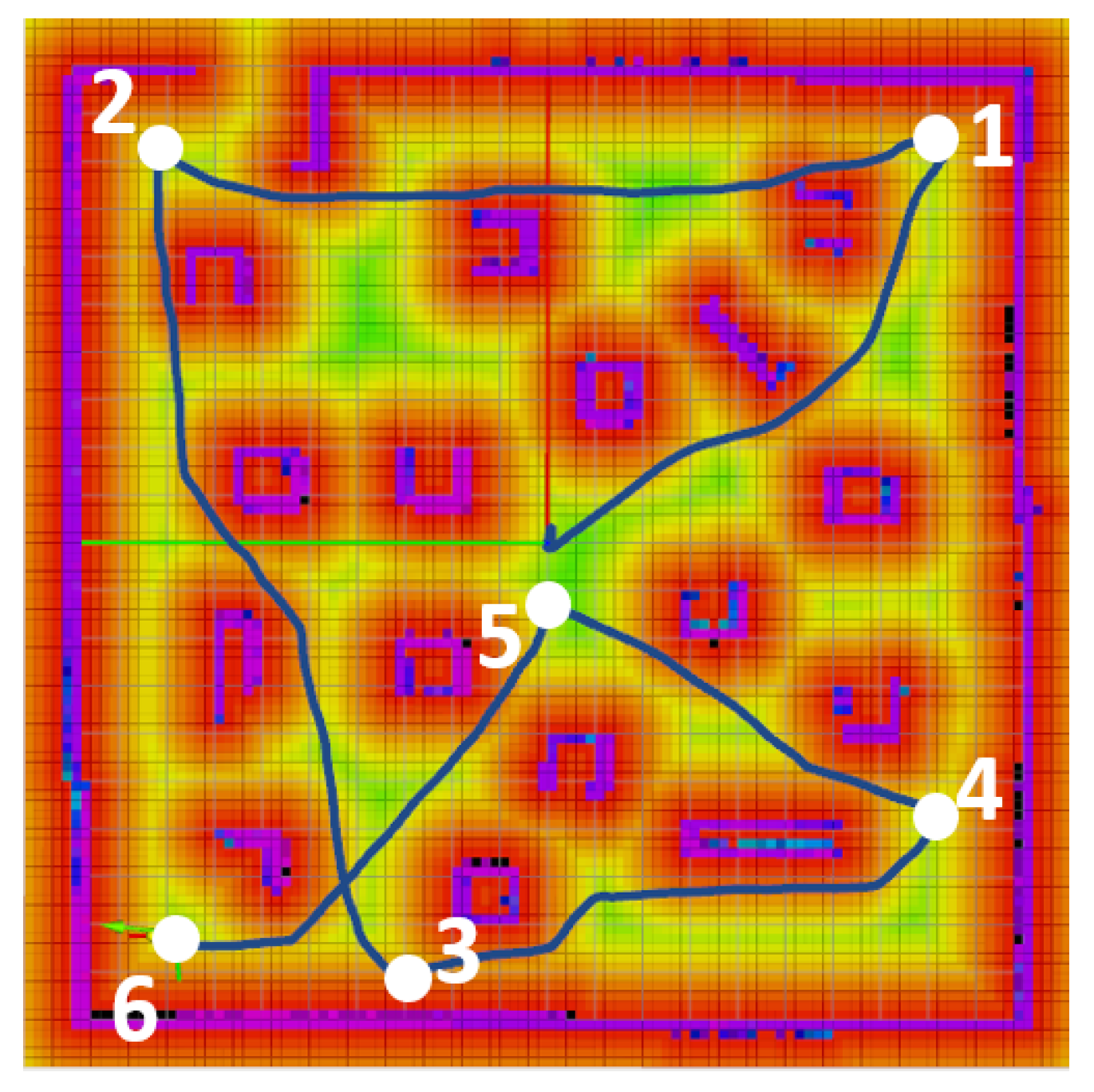
In this case, the path-planning kit was further integrated into the simulation platform. Only the target destination was provided to the UAV on the map. Following this, the UAV planned a path to avoid the obstacles and to automatically fly to the target destination. As shown in Figure 15, six waypoints were set during the mission. The UAV perceived the environment and planned a path to automatically visit these waypoints in sequence. The UAV kept a safe distance from the nearest obstacle to avoid collision.
Figure 15.
Click-and-fly navigation (the blue path is the traveled path, and the white marks in the image are the way points provided to the UAV).
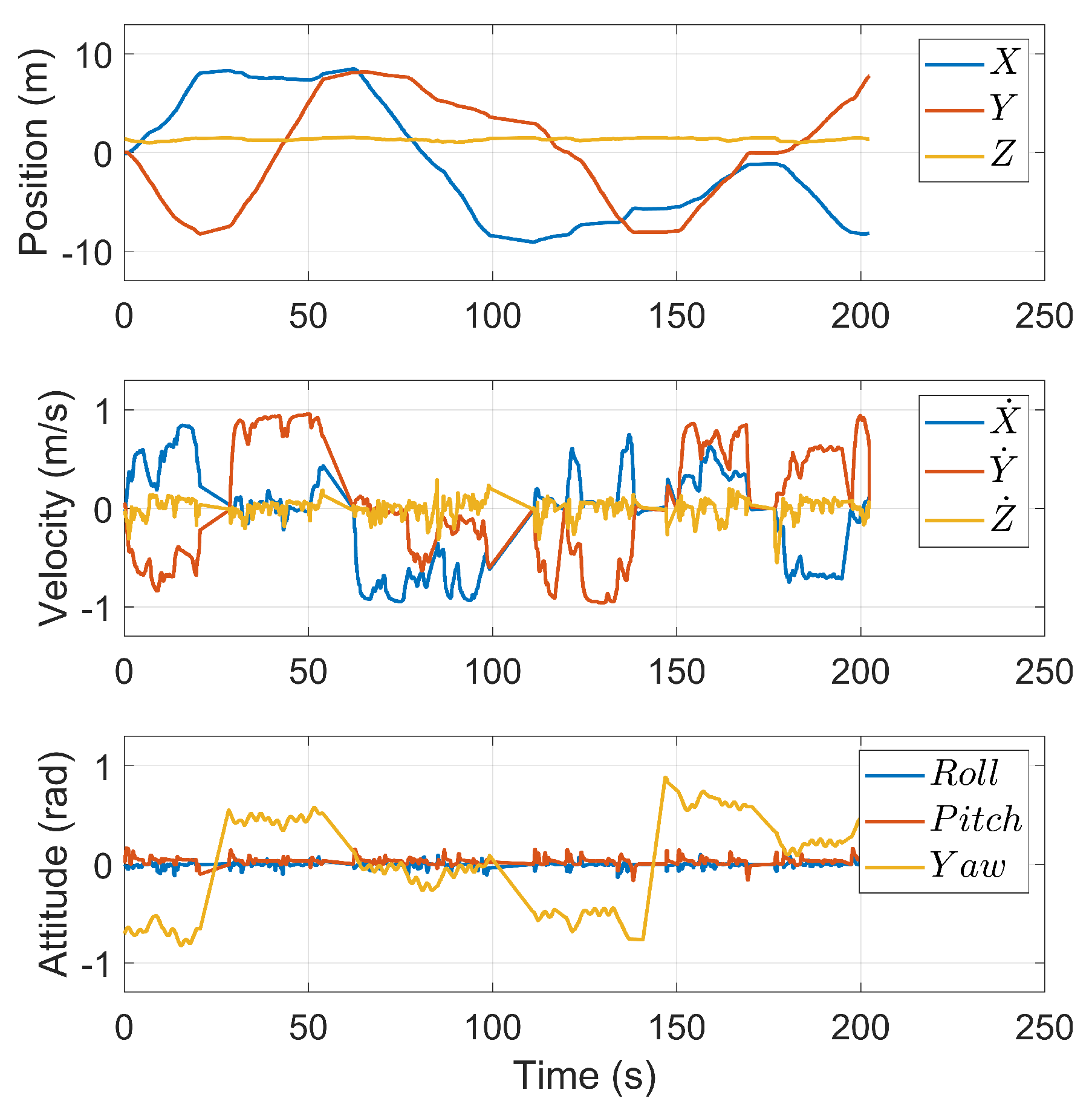
Figure 16 displays the position, velocity, and attitude plots of the simulation. The velocity was well controlled under the speed limit (1 m/s). Moreover, the position curves are fluent and pass all of the six goal points in a stable manner. The pitch and roll angles are small, suggesting that the vision localization kit had good performance.
Figure 16.
The record of position, velocity, and attitude in click-and-fly navigation.
5.3. The Processing Speed of Simulation
The navigation system was configured as follows. In the localization kit, the input image resolution was ; in the mapping kit, the voxel size was 0.2 m × 0.2 m × 0.2 m; and the map contained 181,500 () voxels. The simulation was verified on two different computers. The processing times are listed in Table 1. The average time factor refers to the ratio of the actual time over the simulation time. A time factor value of 1 means that the simulation was run in real time.
Table 1.
Processing Time of the Navigation System and the Simulation Time Factor.
5.4. Discussions
The main features of commonly used UAV simulators are listed in Table 2. The AirSim [39] and FlightGoggles [40] have more realistic visual effects, since they adopt game engines to render the scenes. The E2ES and XTDrone are based on the gazebo-PX4 toolchain, which means the algorithm can directly port to command the PX4 flight-control unit. Compared to other simulation frameworks, E2ES provides a full-stack solution. However, as this work focused on providing an out-of-box, end-to-end v-SLAM and navigation simulation, extended types of UAV models (airplanes, helicopters, etc.) and multi-vehicle simulation will be supported in the later versions.
Table 2.
Features of Several UAV Simulation Platforms.
6. Conclusions and Future Works
In this study, an end-to-end UAV simulation platform for SLAM, navigation research, and applications was introduced, including the detailed simulator setup and an out-of-box localization, mapping, and navigation system. The click-and-fly level autonomy navigation used by the simulator was also demonstrated. The flight results show that the simulator could provide a trustworthy data stream and versatile interfaces for the development of UAV autonomous function. We have offered all the kits for public access to promote further research and development of the autonomous UAV system based on this framework. Future work will focus on two aspects. One is to support more notable open-source navigation-related kits and, moreover, to design the benchmark scenario in the simulator to evaluate the performance of these kits. Another aspect is to expand the current simulator to encompass more perception sensors, more UAV models, and more challenging environments for a variety of potential tasks.
Supplementary Materials
The following are available online: video: https://youtu.be/sKkA5f62P6g; source code: https://github.com/HKPolyU-UAV/E2ES.
Author Contributions
Conceptualization: S.C. and B.L.; methodology: S.C. and H.C.; software: S.C. and H.C.; field testing: W.Z. and H.C.; writing–original draft preparation: S.C.; writing–review and editing: W.Z., B.L. and A.-S.Y.; supervision: C.-Y.W.; funding acquisition: A.-S.Y. and C.-Y.W. All authors have read and agreed to the published version of the manuscript.
Funding
This work was supported by the Innovation and Technology Commission of Hong Kong under grant number ITT/027/19GP.
Conflicts of Interest
The authors declare no conflict of interest.
References
- Oleynikova, H.; Millane, A.; Taylor, Z.; Galceran, E.; Nieto, J.; Siegwart, R. Signed distance fields: A natural representation for both mapping and planning. In Proceedings of the RSS 2016 Workshop: Geometry and Beyond-Representations, Physics, and Scene Understanding for Robotics, Ann Arbor, MI, USA, 19 June 2016. [Google Scholar]
- Zhang, M.; Qin, H.; Lan, M.; Lin, J.; Wang, S.; Liu, K.; Lin, F.; Chen, B.M. A high fidelity simulator for a quadrotor uav using ros and gazebo. In Proceedings of the IECON 2015-41st Annual Conference of the IEEE Industrial Electronics Society, Yokohama, Japan, 9–12 November 2015; pp. 2846–2851. [Google Scholar]
- Alzugaray, I.; Teixeira, L.; Chli, M. Short-term UAV path-planning with monocular-inertial SLAM in the loop. In Proceedings of the 2017 IEEE International Conference on Robotics and Automation (ICRA), Singapore, 29 May–3 June 2017; pp. 2739–2746. [Google Scholar]
- Hartman, D.; Landis, K.; Mehrer, M.; Moreno, S.; Kim, J. dch33/Quad-Sim. Available online: https://github.com/dch33/Quad-Sim (accessed on 17 December 2021).
- Sun, J.; Li, B.; Wen, C.Y.; Chen, C.K. Design and implementation of a real-time hardware-in-the-loop testing platform for a dual-rotor tail-sitter unmanned aerial vehicle. Mechatronics 2018, 56, 1–15. [Google Scholar] [CrossRef]
- Furrer, F.; Burri, M.; Achtelik, M.; Siegwart, R. Robot Operating System (ROS): The Complete Reference; Chapter RotorS—A Modular Gazebo MAV Simulator Framework; Springer International Publishing: Cham, Switzerland, 2016; Volume 1, pp. 595–625. [Google Scholar] [CrossRef]
- Schmittle, M.; Lukina, A.; Vacek, L.; Das, J.; Buskirk, C.P.; Rees, S.; Sztipanovits, J.; Grosu, R.; Kumar, V. OpenUAV: A UAV testbed for the CPS and robotics community. In Proceedings of the ACM/IEEE 9th International Conference on Cyber-Physical Systems (ICCPS), Porto, Portugal, 11–13 April 2018; pp. 130–139. [Google Scholar]
- Xiao, K.; Tan, S.; Wang, G.; An, X.; Wang, X.; Wang, X. XTDrone: A Customizable Multi-rotor UAVs Simulation Platform. In Proceedings of the 2020 4th International Conference on Robotics and Automation Sciences (ICRAS), Wuhan, China, 12–14 June 2020; pp. 55–61. [Google Scholar] [CrossRef]
- Qian, J.; Chen, K.; Chen, Q.; Yang, Y.; Zhang, J.; Chen, S. Robust Visual-Lidar Simultaneous Localization and Mapping System for UAV. IEEE Geosci. Remote. Sens. Lett. 2021, 19, 1–5. [Google Scholar] [CrossRef]
- Sadeghzadeh-Nokhodberiz, N.; Can, A.; Stolkin, R.; Montazeri, A. Dynamics-Based Modified Fast Simultaneous Localization and Mapping for Unmanned Aerial Vehicles With Joint Inertial Sensor Bias and Drift Estimation. IEEE Access 2021, 9, 120247–120260. [Google Scholar] [CrossRef]
- Demim, F.; Nemra, A.; Mouali, O.; Hedir, M.; Rouigueb, A.; Hamerlain, M.; Bendoumi, M.A.; Bazoula, A. Simultaneous Localization and Mapping Algorithm based on 3D Laser for Unmanned Aerial Vehicle. In Proceedings of the 4th International Conference on Electrical Engineering and Control Applications, Constantine, Algeria, 17–19 December 2019; Bououden, S., Chadli, M., Ziani, S., Zelinka, I., Eds.; Springer: Singapore; pp. 1003–1020. [Google Scholar]
- Qin, T.; Li, P.; Shen, S. Vins-mono: A robust and versatile monocular visual-inertial state estimator. IEEE Trans. Robot. 2018, 34, 1004–1020. [Google Scholar] [CrossRef] [Green Version]
- Frost, D.; Prisacariu, V.; Murray, D. Recovering stable scale in monocular SLAM using object-supplemented bundle adjustment. IEEE Trans. Robot. 2018, 34, 736–747. [Google Scholar] [CrossRef]
- Pfrommer, B.; Daniilidis, K. TagSLAM: Robust SLAM with fiducial markers. arXiv 2019, arXiv:1910.00679. [Google Scholar]
- Mourikis, A.I.; Roumeliotis, S.I. A multi-state constraint Kalman filter for vision-aided inertial navigation. In Proceedings of the 2007 IEEE International Conference on Robotics and Automation, Rome, Italy, 10–14 April 2007; pp. 3565–3572. [Google Scholar]
- Bloesch, M.; Burri, M.; Omari, S.; Hutter, M.; Siegwart, R. Iterated extended Kalman filter based visual-inertial odometry using direct photometric feedback. Int. J. Robot. Res. 2017, 36, 1053–1072. [Google Scholar] [CrossRef] [Green Version]
- Leutenegger, S.; Lynen, S.; Bosse, M.; Siegwart, R.; Furgale, P. Keyframe-based visual–inertial odometry using nonlinear optimization. Int. J. Robot. Res. 2015, 34, 314–334. [Google Scholar] [CrossRef] [Green Version]
- Delmerico, J.; Scaramuzza, D. A benchmark comparison of monocular visual-inertial odometry algorithms for flying robots. In Proceedings of the IEEE International Conference on Robotics and Automation (ICRA), Brisbane, QLD, Australia, 21–25 May 2018; pp. 2502–2509. [Google Scholar]
- Gao, F.; Wu, W.; Gao, W.; Shen, S. Flying on point clouds: Online trajectory generation and autonomous navigation for quadrotors in cluttered environments. J. Field Robot. 2019, 36, 710–733. [Google Scholar] [CrossRef]
- Hornung, A.; Wurm, K.M.; Bennewitz, M.; Stachniss, C.; Burgard, W. OctoMap: An efficient probabilistic 3D mapping framework based on octrees. Auton. Robot. 2013, 34, 189–206. [Google Scholar] [CrossRef] [Green Version]
- Oleynikova, H.; Taylor, Z.; Fehr, M.; Siegwart, R.; Nieto, J. Voxblox: Incremental 3d euclidean signed distance fields for on-board mav planning. In Proceedings of the IEEE/RSJ International Conference on Intelligent Robots and Systems (IROS), Vancouver, BC, Canada, 24–28 September 2017; pp. 1366–1373. [Google Scholar]
- Han, L.; Gao, F.; Zhou, B.; Shen, S. Fiesta: Fast incremental euclidean distance fields for online motion planning of aerial robots. arXiv 2019, arXiv:1903.02144. [Google Scholar]
- LaValle, S.M. Rapidly-Exploring Random Trees: A New Tool for Path Planning; Technical Report; Computer Science Department, Iowa State University: Ames, IA, USA, 1998. [Google Scholar]
- Mellinger, D.; Kumar, V. Minimum snap trajectory generation and control for quadrotors. In Proceedings of the IEEE International Conference on Robotics and Automation (ICRA), Shanghai, China, 9–13 May 2011; pp. 2520–2525. [Google Scholar]
- Gao, F.; Lin, Y.; Shen, S. Gradient-based online safe trajectory generation for quadrotor flight in complex environments. In Proceedings of the IEEE/RSJ International Conference on Intelligent Robots and Systems (IROS), Vancouver, BC, Canada, 24–28 September 2017; pp. 3681–3688. [Google Scholar]
- Karaman, S.; Frazzoli, E. Sampling-based algorithms for optimal motion planning. Int. J. Robot. Res. 2011, 30, 846–894. [Google Scholar] [CrossRef]
- Chen, H.; Lu, P.; Xiao, C. Dynamic Obstacle Avoidance for UAVs Using a Fast Trajectory Planning Approach. In Proceedings of the IEEE International Conference on Robotics and Biomimetics (ROBIO), Dali, China, 6–8 December 2019; pp. 1459–1464. [Google Scholar]
- Quigley, M.; Conley, K.; Gerkey, B.; Faust, J.; Foote, T.; Leibs, J.; Wheeler, R.; Ng, A.Y. ROS: An open-source Robot Operating System. In Proceedings of the ICRA Workshop on Open Source Software, Kobe, Japan, 12–17 May 2009; Volume 3, p. 5. [Google Scholar]
- Koenig, N.; Howard, A. Design and use paradigms for gazebo, an open-source multi-robot simulator. In Proceedings of the IEEE/RSJ International Conference on Intelligent Robots and Systems (IROS), Sendai, Japan, 28 September–2 October 2004; Volume 3, pp. 2149–2154. [Google Scholar]
- Meier, L.; Honegger, D.; Pollefeys, M. PX4: A node-based multithreaded open source robotics framework for deeply embedded platforms. In Proceedings of the IEEE International Conference on Robotics and Automation (ICRA), Seattle, WA, USA, 26–30 May 2015; pp. 6235–6240. [Google Scholar]
- Lee, T.; Leok, M.; McClamroch, N.H. Geometric tracking control of a quadrotor UAV on SE (3). In Proceedings of the 49th IEEE Conference on Decision and Control (CDC), Atlanta, GA, USA, 15–17 December 2010; pp. 5420–5425. [Google Scholar]
- Mahony, R.; Kumar, V.; Corke, P. Multirotor Aerial Vehicles: Modeling, Estimation, and Control of Quadrotor. IEEE Robot. Autom. Mag. 2012, 19, 20–32. [Google Scholar] [CrossRef]
- Verling, S.; Weibel, B.; Boosfeld, M.; Alexis, K.; Burri, M.; Siegwart, R. Full Attitude Control of a VTOL tailsitter UAV. IEEE Int. Conf. Robot. Autom. 2016. [Google Scholar] [CrossRef] [Green Version]
- Chen, S.; Wen, C.Y.; Zou, Y.; Chen, W. Stereo Visual Inertial Pose Estimation Based on Feedforward-Feedback Loops. arXiv 2020, arXiv:2007.02250. [Google Scholar]
- Chen, H.; Lu, P. Computationally Efficient Obstacle Avoidance Trajectory Planner for UAVs Based on Heuristic Angular Search Method. In Proceedings of the IEEE/RSJ International Conference on Intelligent Robots and Systems (IROS), Las Vegas, NV, USA, 24 October–24 January 2021; pp. 5693–5699. [Google Scholar] [CrossRef]
- Harabor, D.; Grastien, A. Improving Jump Point Search. In Proceedings of the Twenty-Fourth International Conferenc on International Conference on Automated Planning and Scheduling (ICAPS’14), Portsmouth, NH, USA, 21–26 June 2014; pp. 128–135. [Google Scholar]
- Grupp, M. EVO: Python Package for the Evaluation of Odometry and SLAM. Available online: https://github.com/MichaelGrupp/evo (accessed on 17 December 2021).
- Umeyama, S. Least-squares estimation of transformation parameters between two point patterns. IEEE Trans. Pattern Anal. Mach. Intell. 1991, 13, 376–380. [Google Scholar] [CrossRef] [Green Version]
- Shah, S.; Dey, D.; Lovett, C.; Kapoor, A. AirSim: High-Fidelity Visual and Physical Simulation for Autonomous Vehicles; Field and Service Robotic; Springer International Publishing: Berlin/Heidelberg, Germany, 2018; pp. 621–635. [Google Scholar]
- Guerra, W.; Tal, E.; Murali, V.; Ryou, G.; Karaman, S. FlightGoggles: Photorealistic Sensor Simulation for Perception-driven Robotics using Photogrammetry and Virtual Reality. In Proceedings of the IEEE/RSJ International Conference on Intelligent Robots and Systems (IROS), Macau, China, 3–8 November 2019; pp. 6941–6948. [Google Scholar] [CrossRef] [Green Version]
Publisher’s Note: MDPI stays neutral with regard to jurisdictional claims in published maps and institutional affiliations. |
© 2022 by the authors. Licensee MDPI, Basel, Switzerland. This article is an open access article distributed under the terms and conditions of the Creative Commons Attribution (CC BY) license (https://creativecommons.org/licenses/by/4.0/).