



Nozzle Erosion Reconstruction Model for Data Analysis in Rocket Engines and Correlation with Chamber Pressure



Abstract
1. Introduction
1.1. Graphite as a Nozzle Material for Small-Motor Development
1.2. Thermochemical Erosion Mechanisms
1.3. Mitigation Approaches and Their Limits
1.4. Motivation for Transient Throat Reconstruction
1.5. Prior Reconstruction Approaches
1.6. Scope and Contribution of the Present Work
2. Materials and Methods
2.1. Decoupled Reconstruction Algorithm
2.1.1. Array Initialization
2.1.2. Sensor-Lag Transient Removal
2.1.3. Erosion-Onset Detection by Smoothed Cumulative Differentiation
2.1.4. Two-Anchor Affine Scaling
2.1.5. Final Smoothing and Boundary Continuity
2.1.6. Robustness and Fallback Cases
2.2. Erosion-Rate Extraction
2.3. Hot-Fire Validation Datasets
2.3.1. Motor Hardware
2.3.2. Instrumentation
2.3.3. USU PRL Ambient Test Series
2.3.4. NASA MSFC CDA Vacuum Test Campaign
3. Results
3.1. CDA Firing-Record and Boundary-Metrology Overview
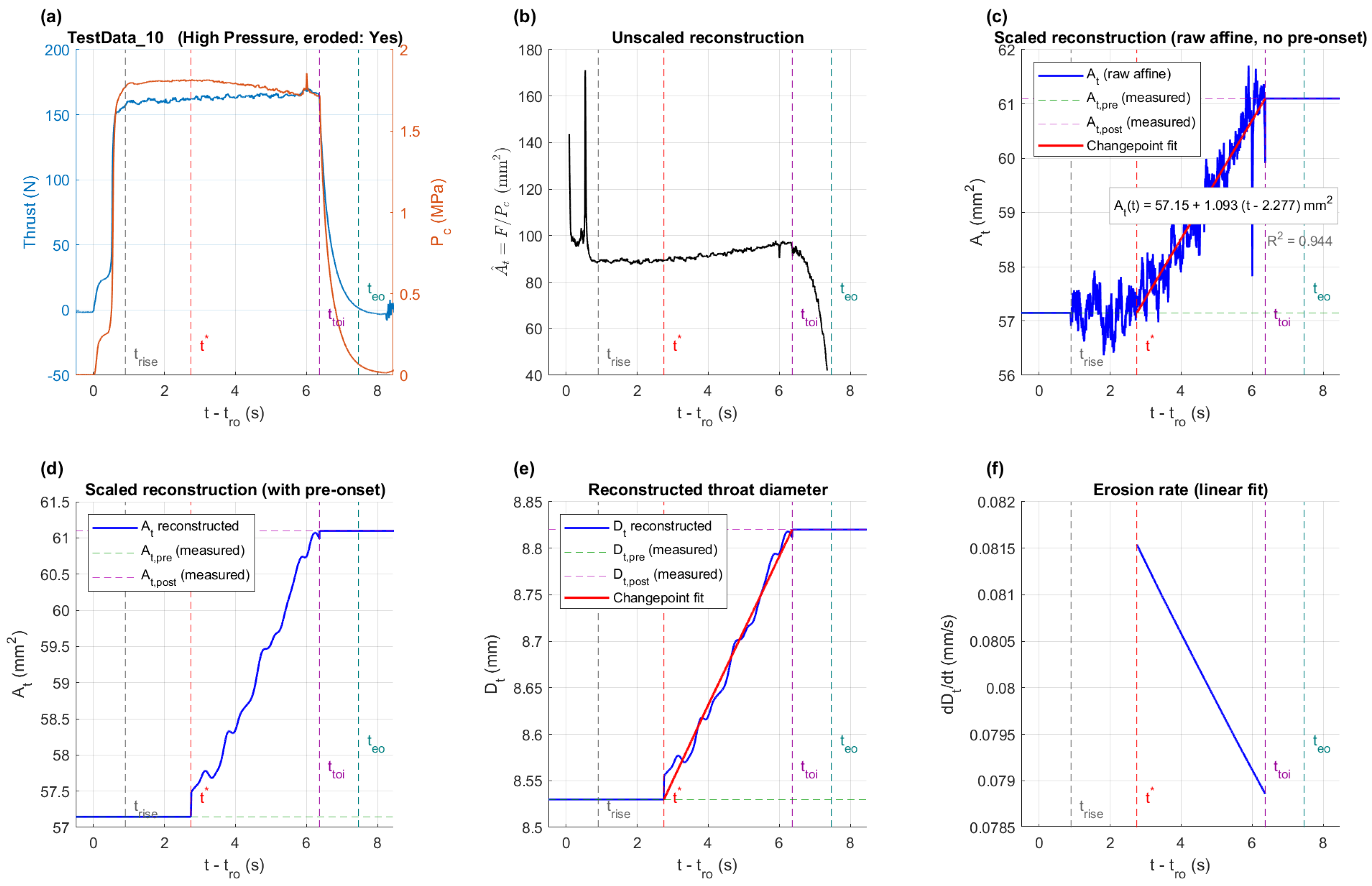
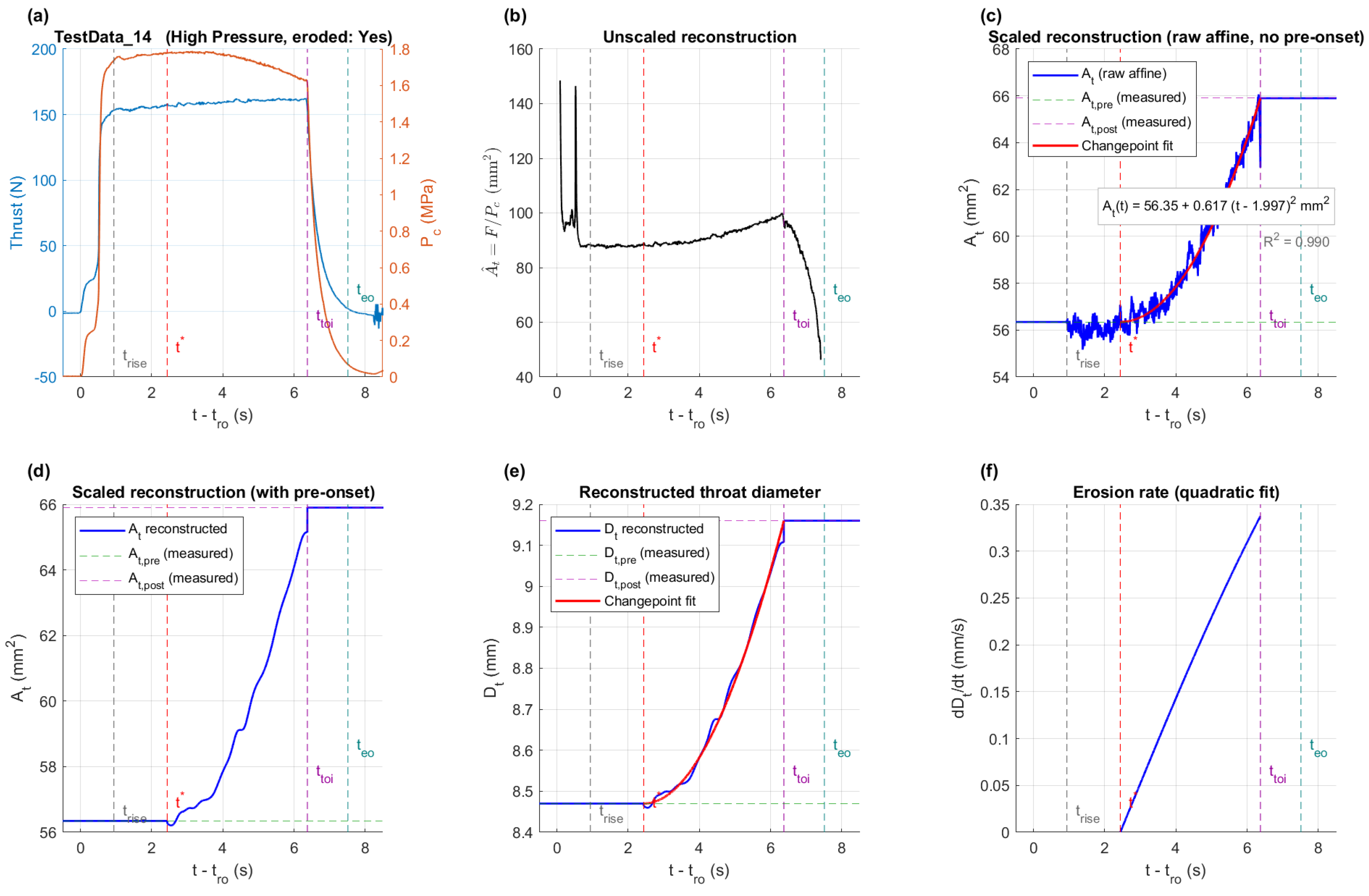
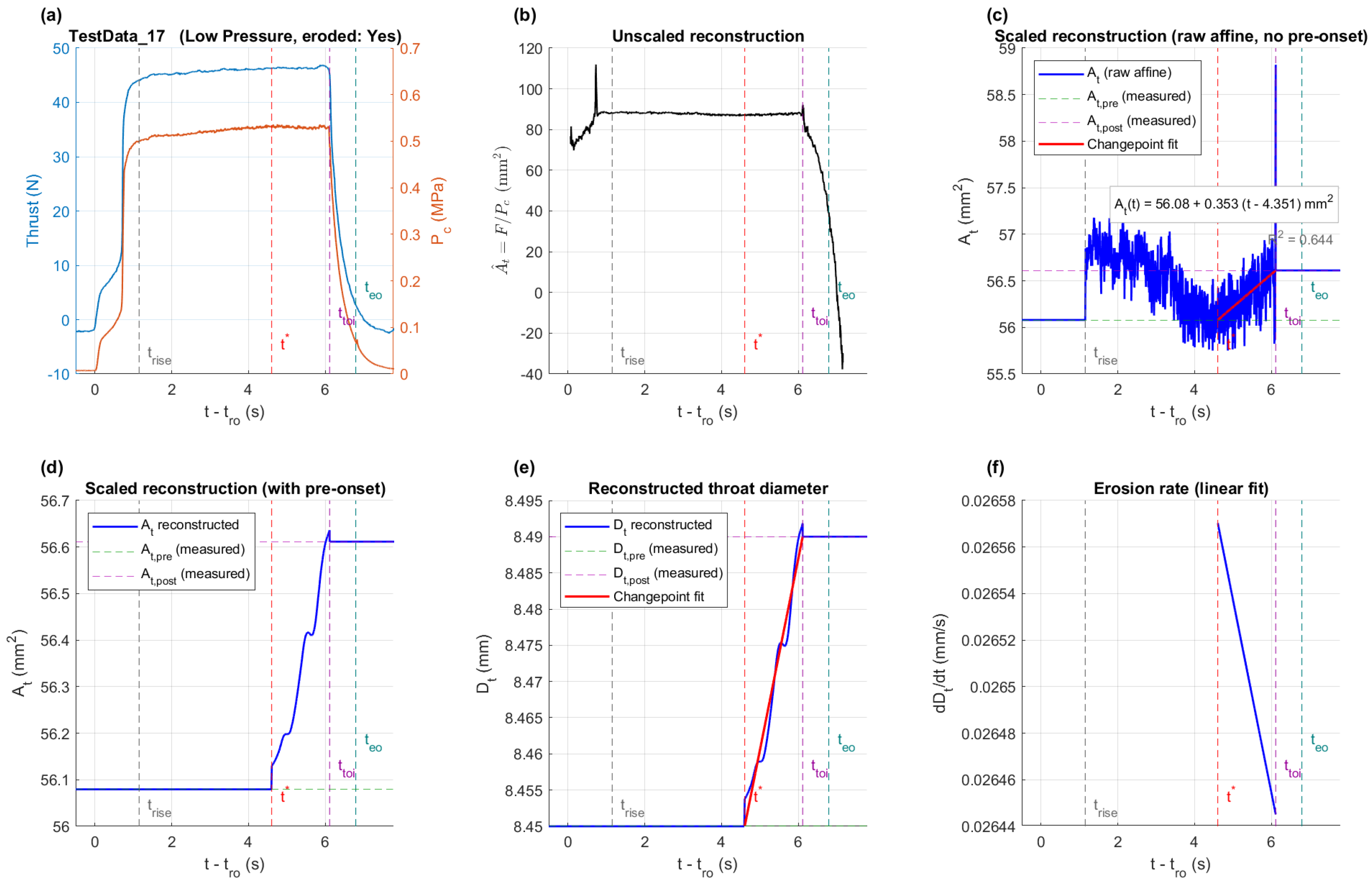
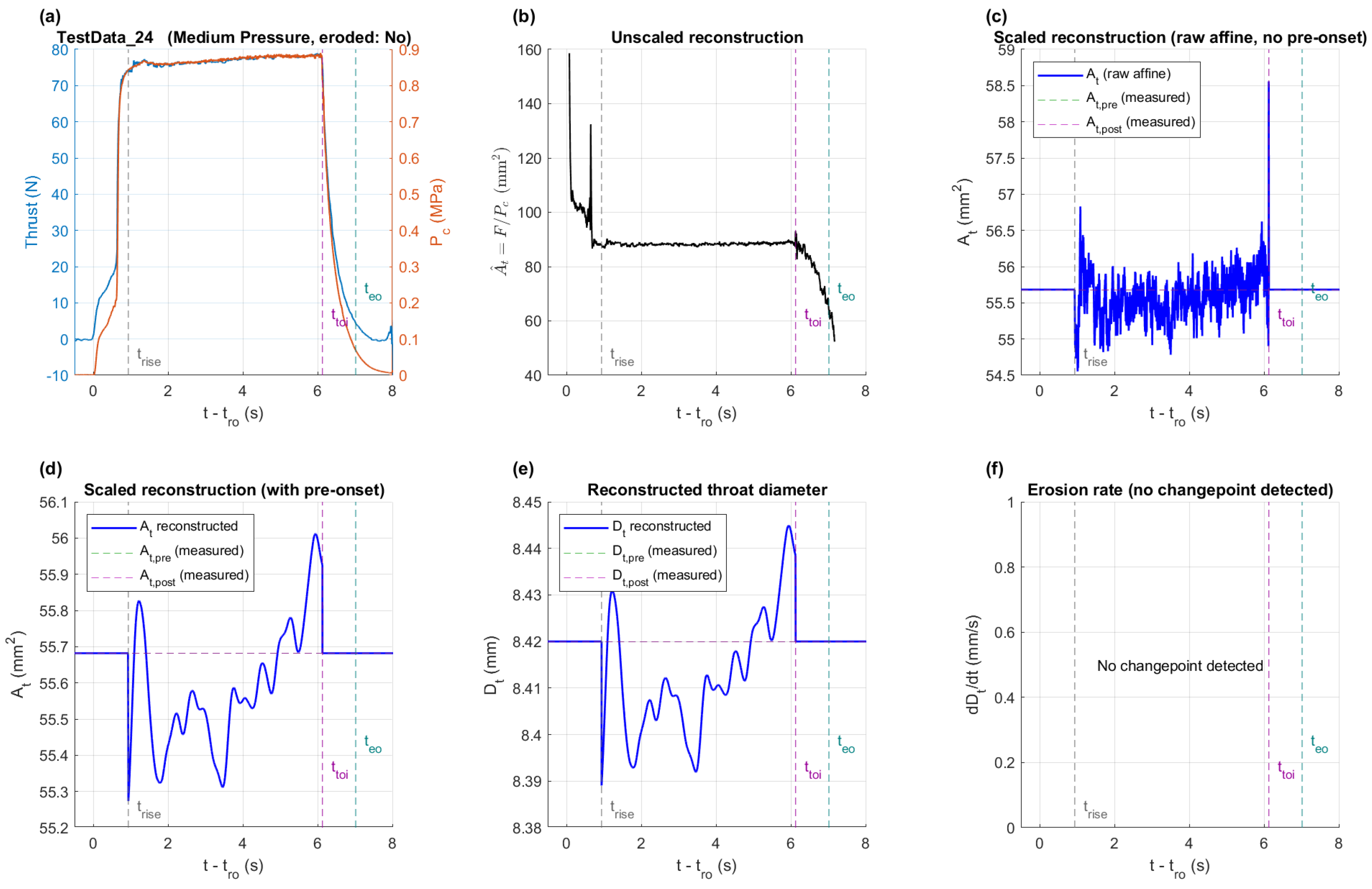
3.2. Per-Test CDA Throat-Area Reconstruction
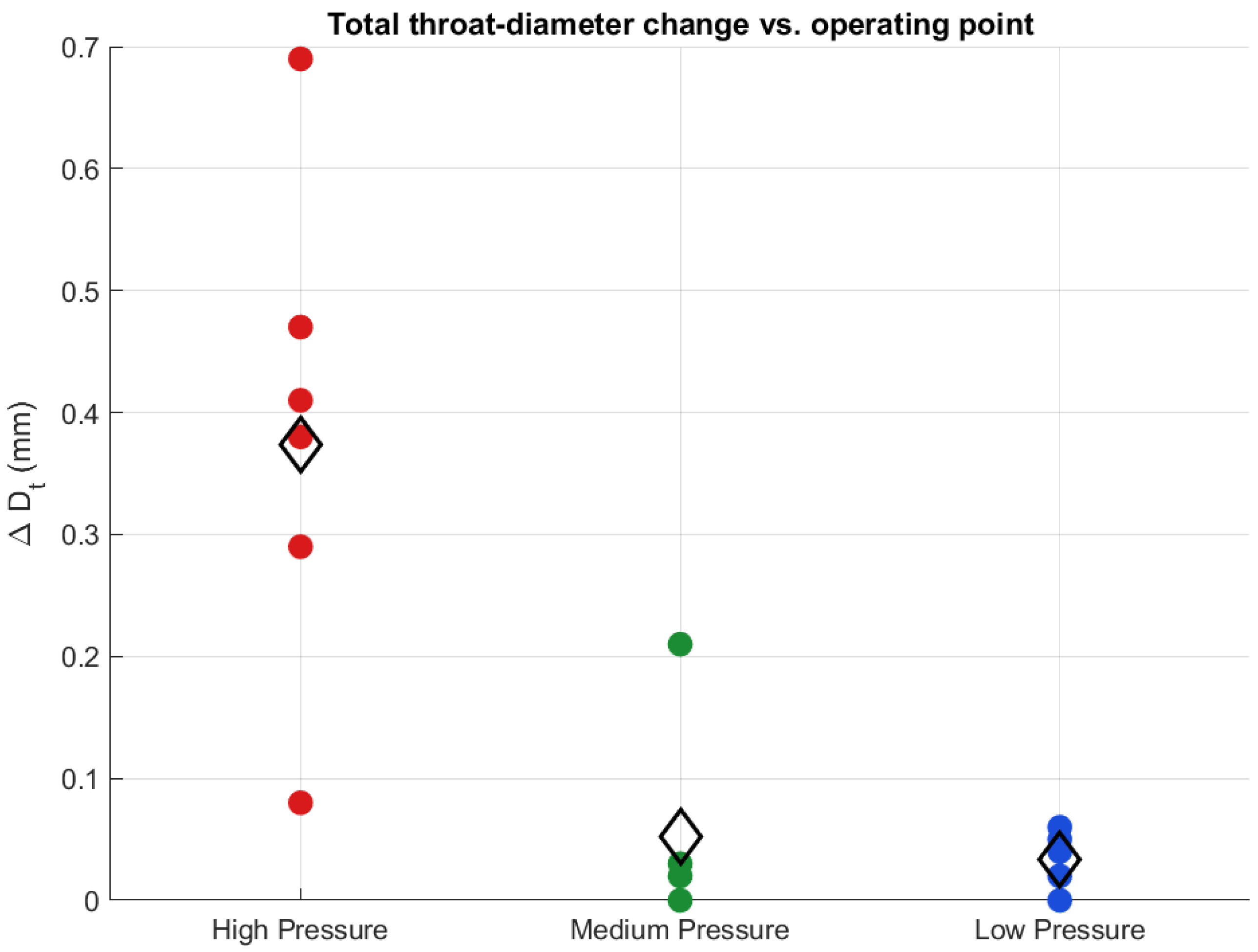
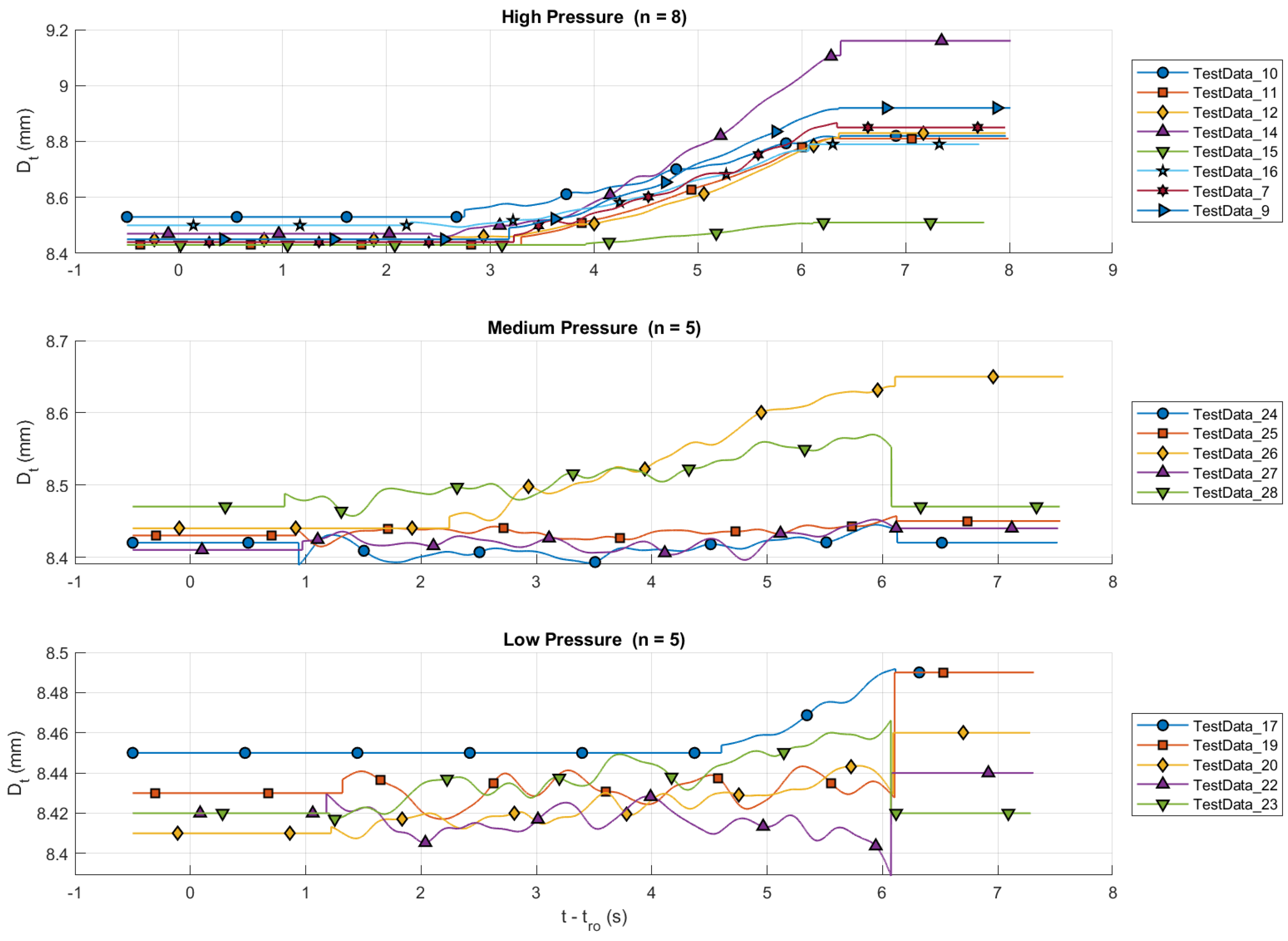
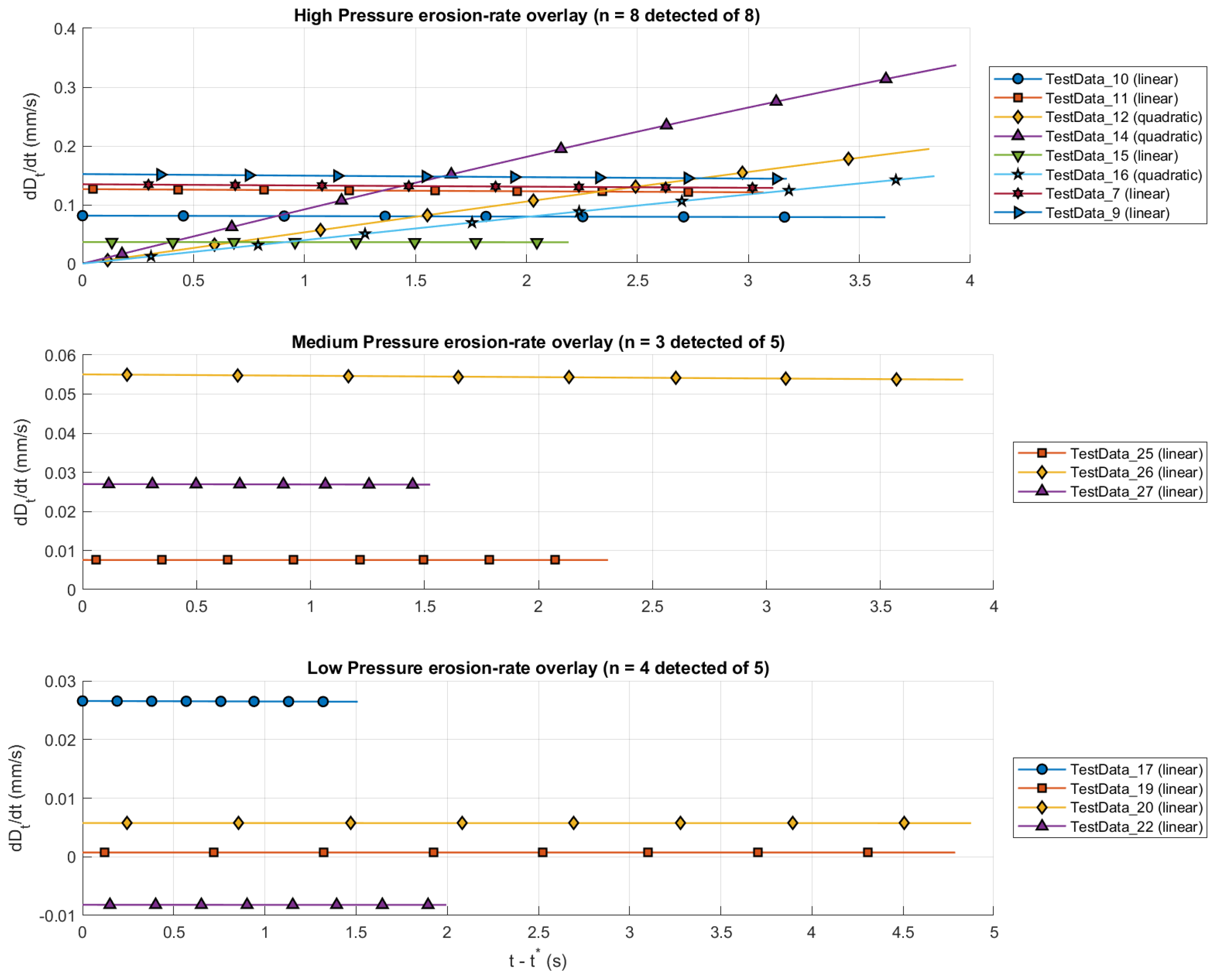
3.3. CDA Campaign-Level Erosion Summary
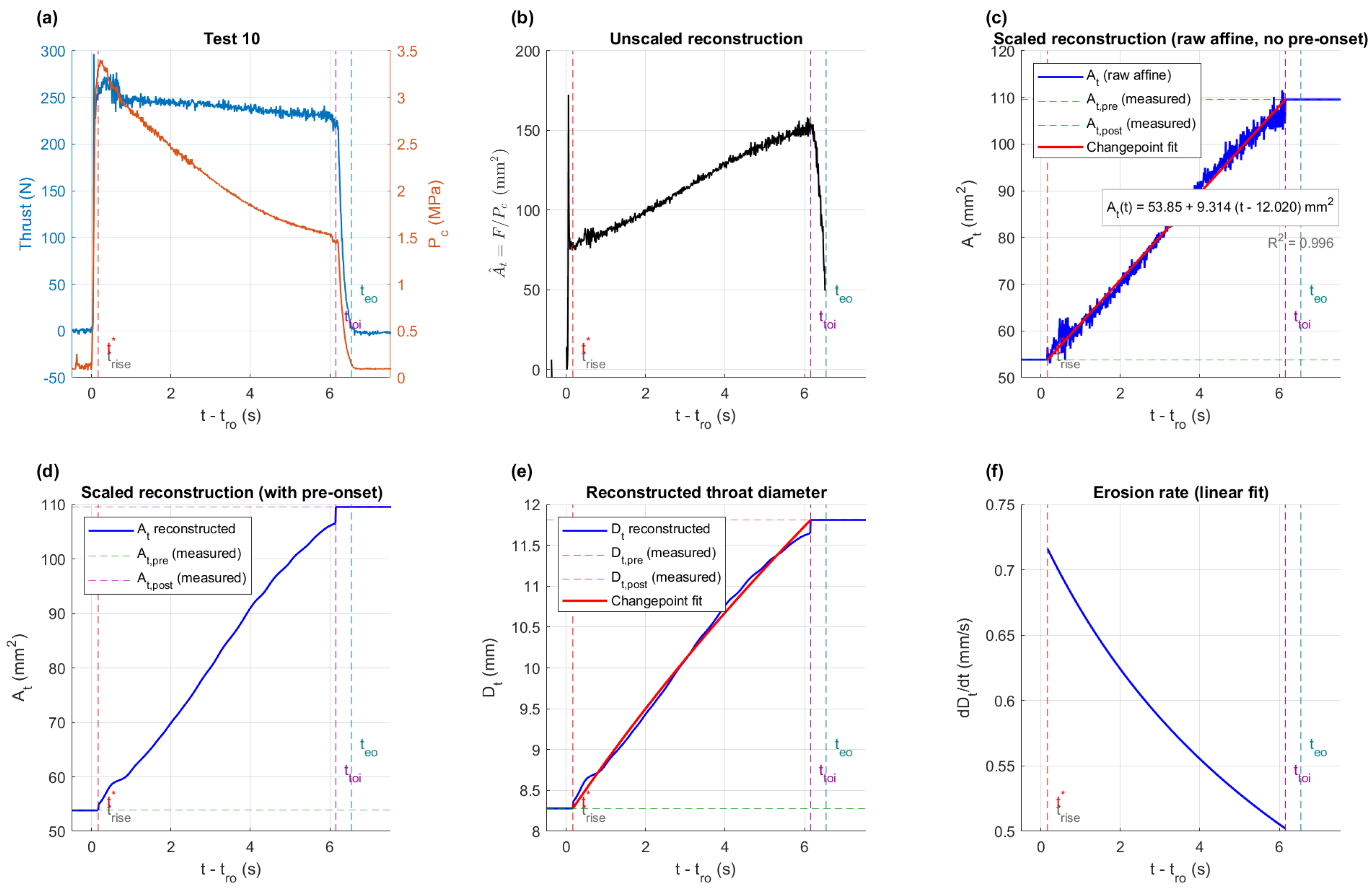
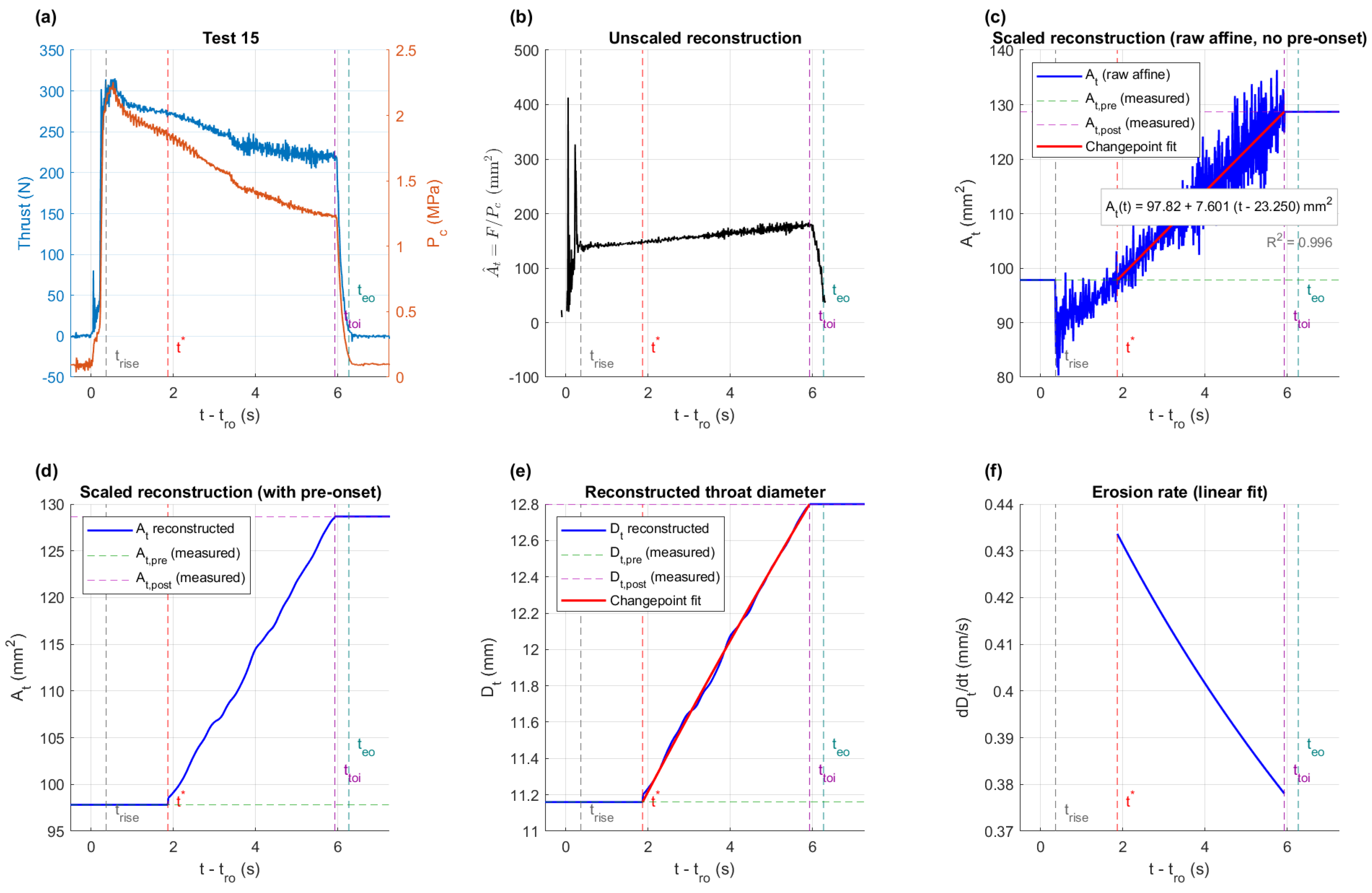
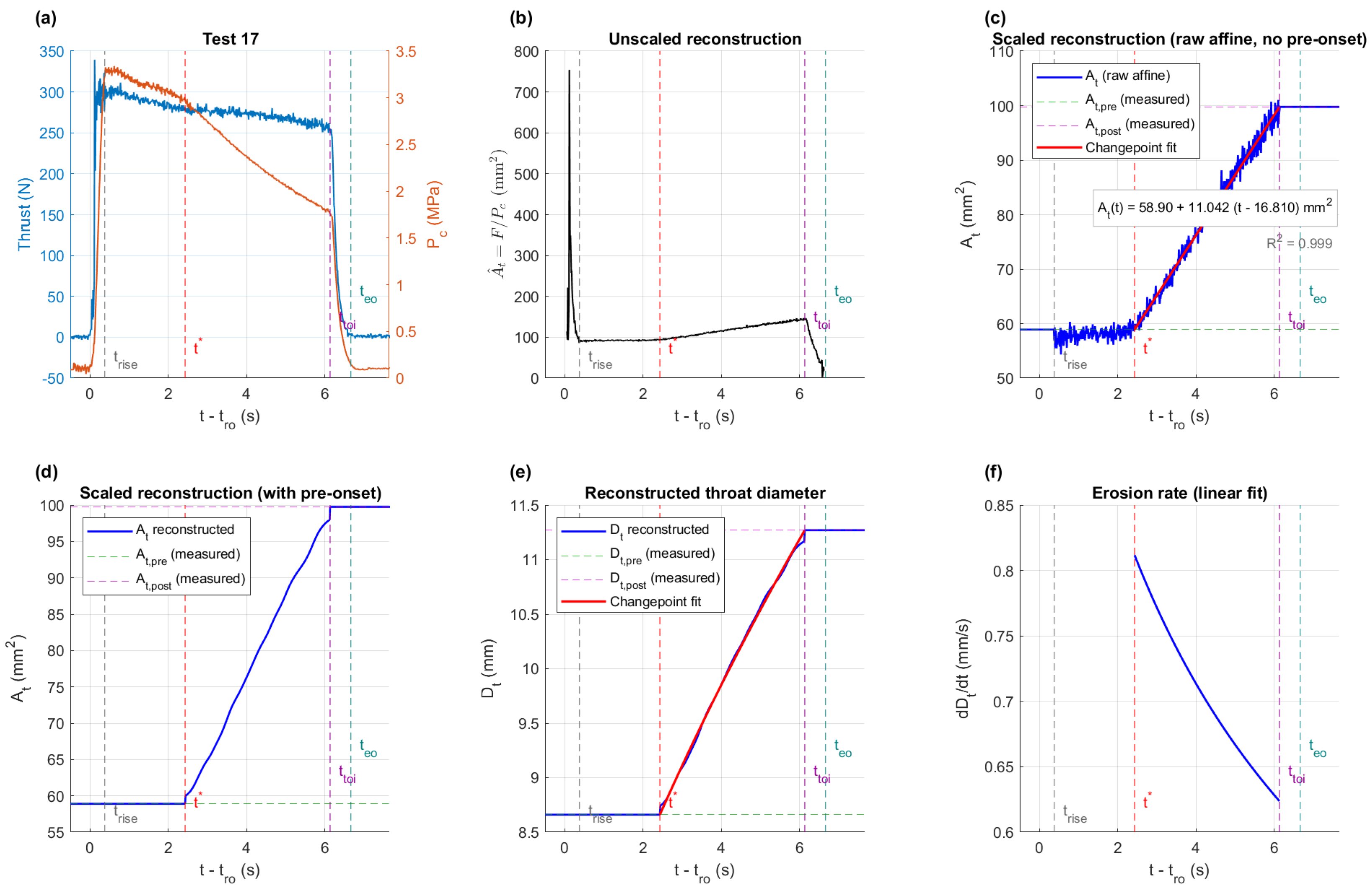
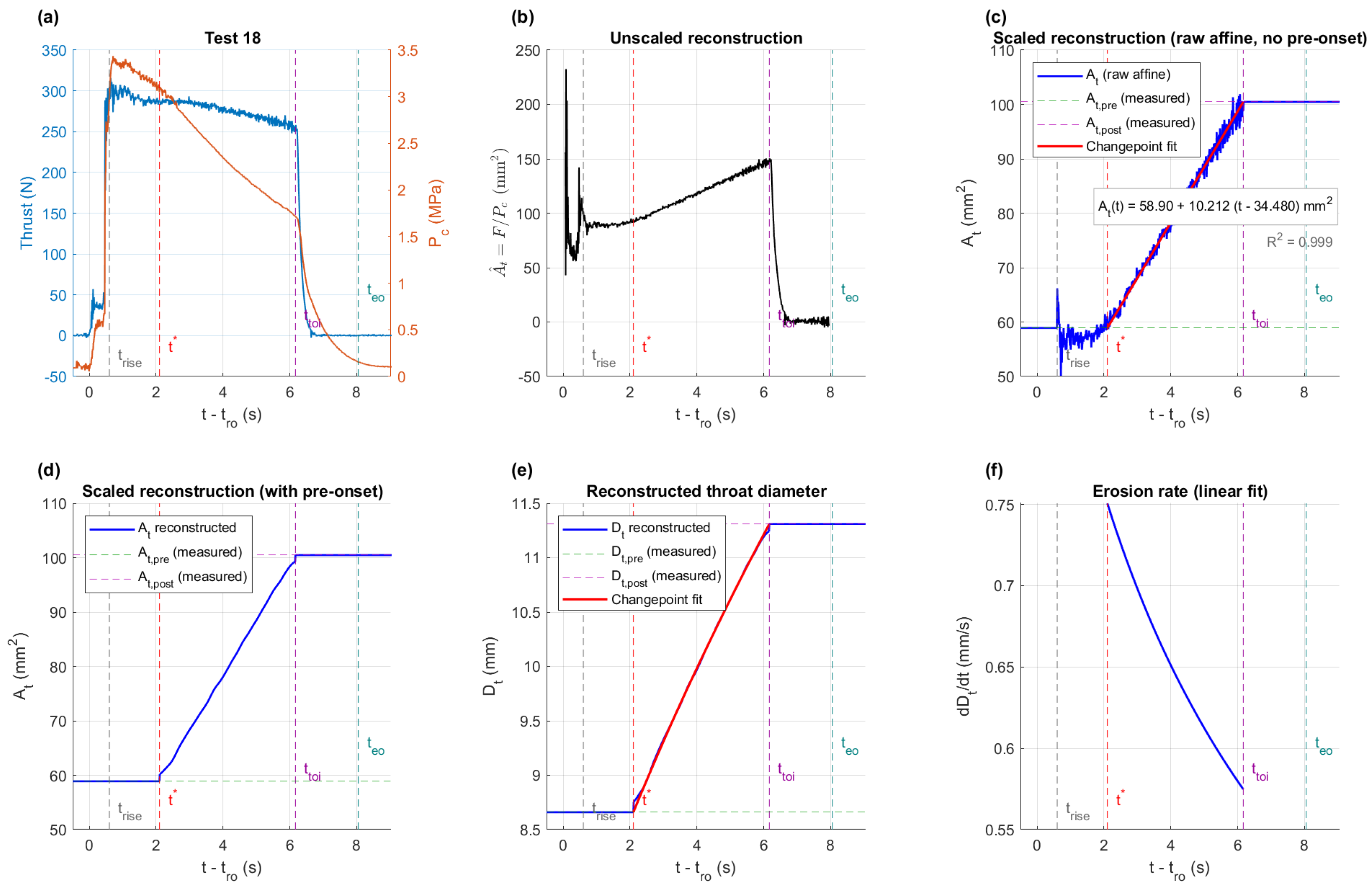
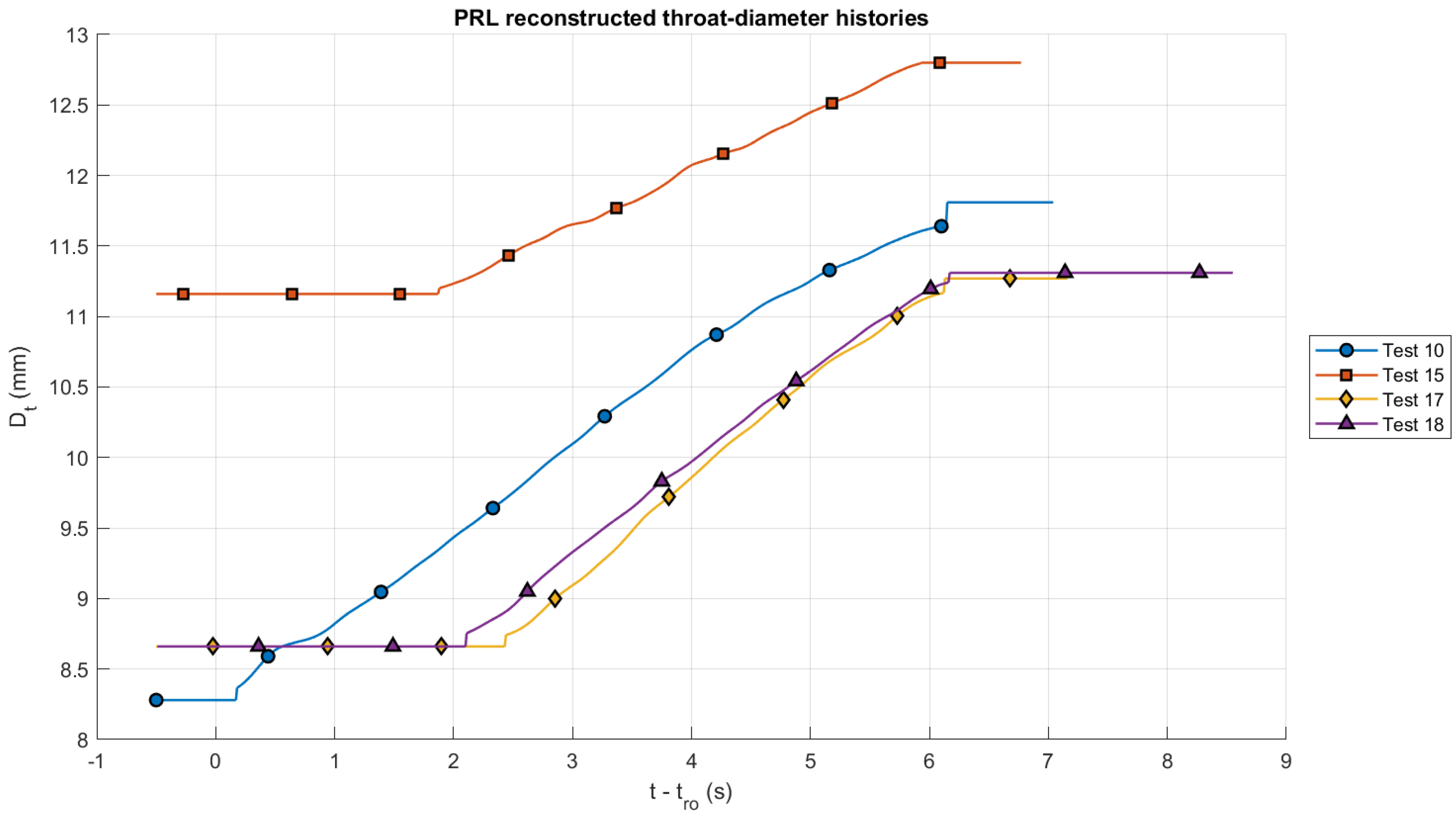
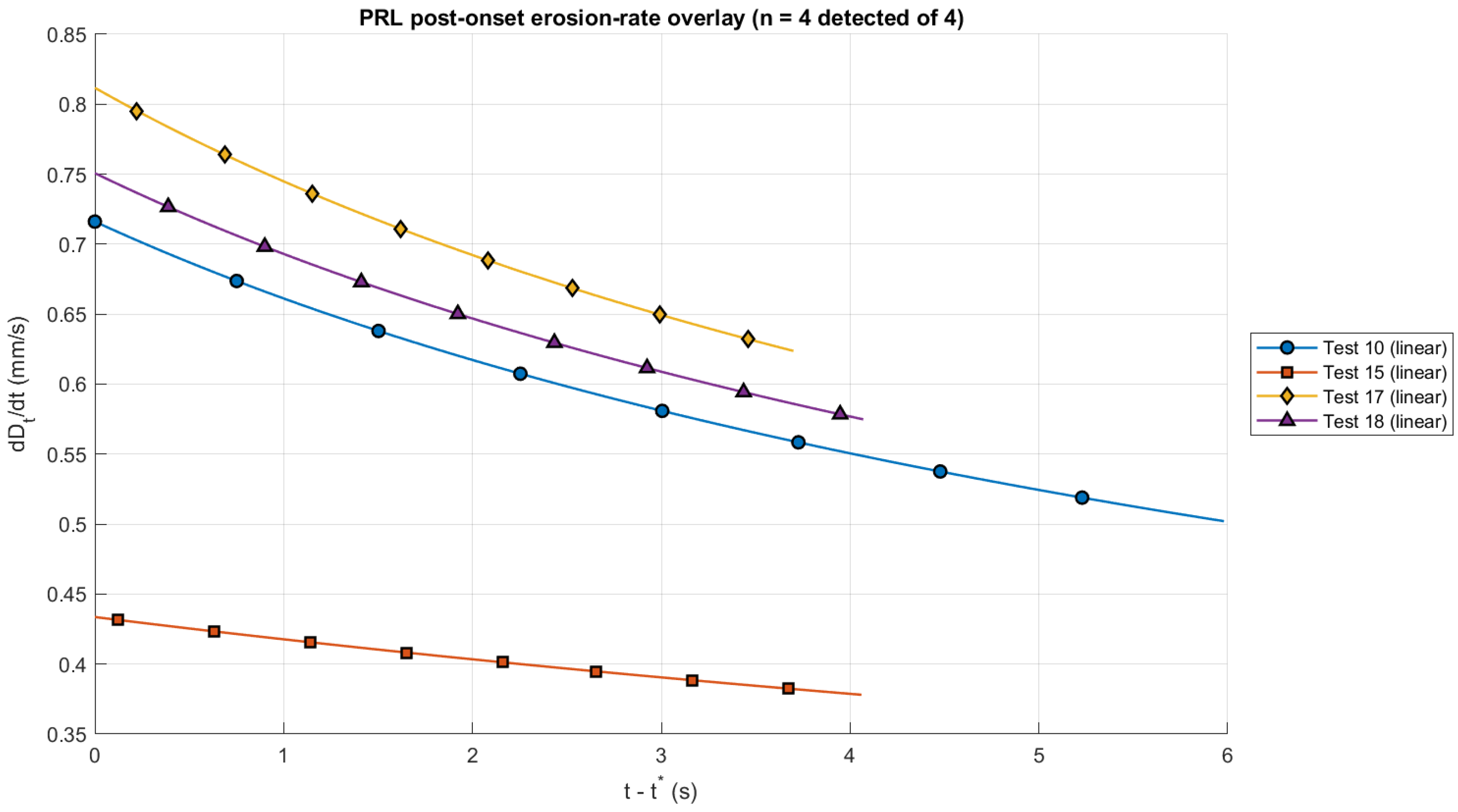
3.4. USU PRL High-Pressure Reconstruction Results
4. Discussion
4.1. Algorithm Performance and Detection Limits
4.2. Correlation of Chamber Pressure with Erosion
4.3. Secondary Drivers and Within-Group Variability
4.4. Limitations and Sources of Uncertainty
5. Conclusions
Author Contributions
Funding
Data Availability Statement
Acknowledgments
Conflicts of Interest
Nomenclature
| Roman Symbols | ||
| Nozzle exit area | m2 | |
| Nozzle throat area (corrected reconstruction) | m2 | |
| Unscaled reconstructed throat area, | m2 | |
| Low-pass-filtered unscaled throat-area history | m2 | |
| Pre-test throat area from pin-gauge measurement | m2 | |
| Post-test throat area from pin-gauge measurement | m2 | |
| Median of on the pre-erosion plateau anchor window | m2 | |
| Median of on the late-burn anchor window | m2 | |
| Throat-area erosion rate | m2/s | |
| Thrust coefficient, | – | |
| Ideal thrust coefficient (Sutton–Biblarz) | – | |
| Characteristic exhaust velocity | m/s | |
| Nozzle exit diameter | m | |
| Pre-test and post-test throat diameters | m | |
| F | Axial thrust (= from the 6-DOF thrust stand) | N |
| Force components measured by the 6-DOF thrust stand | N | |
| Moment components measured by the 6-DOF thrust stand | N·m | |
| Low-pass-filter cutoff frequency | Hz | |
| Data-acquisition sample rate | Hz | |
| Rise-time fractional threshold (taken as 0.95) | – | |
| Tail-off-initiation fractional threshold | – | |
| Specific impulse | s | |
| Onset-detection confidence multiplier | – | |
| Tail-off-detection confidence multiplier on and | – | |
| Plateau medians of and | Pa/s; N/s | |
| Plateau MAD-based standard deviations of and | Pa/s; N/s | |
| Minimum signal-to-noise ratio for two-anchor affine acceptance | – | |
| Isentropic exit Mach number | – | |
| Oxidizer and fuel mass-flow rates | kg/s | |
| Total propellant mass-flow rate, | kg/s | |
| N | Number of samples in the data-acquisition record | – |
| Oxidizer-to-fuel mass ratio | – | |
| Stagnation chamber pressure | Pa | |
| Static pressure at the nozzle exit | Pa | |
| Ambient back pressure | Pa | |
| Throat diameter | m | |
| Throat-diameter erosion rate | m/s | |
| a | Intercept (continuity value) of the changepoint fit at | m2 |
| Pre-erosion plateau slope of the changepoint fit | m2/s | |
| Post-onset linear slope (linear-right changepoint model) | m2/s | |
| Post-onset curvature coefficient (parabolic-right changepoint model) | m2/s2 | |
| t | Time | s |
| Erosion-onset time | s | |
| Engine-off time | s | |
| Greek Symbols | ||
| Multiplicative coefficient of two-anchor affine map | – | |
| Additive coefficient of two-anchor affine map | m2 | |
| Vandenkerckhove function | – | |
| Specific-heat ratio of combustion products at the throat | – | |
| Deviation of from the plateau mean | m2 | |
| Total throat-diameter change over the firing | m | |
| Anchor-window width | s | |
| Subscripts and Accents | ||
| pre | Pre-test value | |
| post | Post-test value | |
| plat | Plateau-region quantity | |
| cp | Changepoint-fit quantity | |
| Time derivative | ||
| Reconstructed quantity | ||
| Filtered quantity | ||
| Abbreviations | ||
| MAD | Median absolute deviation | |
| SNR | Signal-to-noise ratio | |
| DOF | Degrees of freedom | |
References
- Bianchi, D.; Nasuti, F. Numerical Analysis of Nozzle Material Thermochemical Erosion in Hybrid Rocket Engines. J. Propuls. Power 2013, 29, 547–558. [Google Scholar] [CrossRef]
- Thakre, P.; Yang, V. Chemical Erosion of Carbon-Carbon/Graphite Nozzles in Solid-Propellant Rocket Motors. J. Propuls. Power 2008, 24, 822–833. [Google Scholar] [CrossRef]
- Bianchi, D.; Leccese, G.; Nasuti, F.; Onofri, M.; Carmicino, C. Modeling of High Density Polyethylene Regression Rate in the Simulation of Hybrid Rocket Flowfields. Aerospace 2019, 6, 88. [Google Scholar] [CrossRef]
- Klager, K. The Interaction of the Efflux of Solid Propellants with Nozzle Materials. Propellants Explos. Pyrotech. 1977, 2, 55–63. [Google Scholar] [CrossRef]
- Acharya, R.; Kuo, K.K. Effect of Pressure and Propellant Composition on Graphite Rocket Nozzle Erosion Rate. J. Propuls. Power 2007, 23, 1242–1254. [Google Scholar] [CrossRef]
- Sutton, G.P.; Biblarz, O. Rocket Propulsion Elements, 9th ed.; John Wiley & Sons: Hoboken, NJ, USA, 2016. [Google Scholar]
- Gordon, S.; McBride, B.J. Computer Program for Calculation of Complex Chemical Equilibrium Compositions and Applications I: Analysis; Technical Report NASA RP-1311; NASA Lewis Research Center: Cleveland, OH, USA, 1994. [Google Scholar]
- McBride, B.J.; Gordon, S. Computer Program for Calculation of Complex Chemical Equilibrium Compositions and Applications II: Users Manual and Program Description; Technical Report NASA RP-1311-P2; NASA Lewis Research Center: Cleveland, OH, USA, 1996. [Google Scholar]
- Kamps, L.; Saito, Y.; Kawabata, R.; Wakita, M.; Totani, T.; Takahashi, Y.; Nagata, H. Method for Determining Nozzle-Throat-Erosion History in Hybrid Rockets. J. Propuls. Power 2017, 33, 1369–1377. [Google Scholar] [CrossRef]
- Kamps, L.; Hirai, S.; Sakurai, K.; Viscor, T.; Saito, Y.; Guan, R.; Isochi, H.; Adachi, N.; Itoh, M.; Nagata, H. Investigation of Graphite Nozzle Erosion in Hybrid Rockets Using Oxygen/High-Density Polyethylene. J. Propuls. Power 2020, 36, 423–434. [Google Scholar] [CrossRef]
- Bianchi, D.; Migliorino, M.T.; Rotondi, M.; Kamps, L.; Nagata, H. Numerical Analysis of Nozzle Erosion in Hybrid Rockets and Comparison with Experiments. J. Propuls. Power 2022, 38, 389–409. [Google Scholar] [CrossRef]
- Whitmore, S.A.; Thibaudeau, R.J. Development of a GOX/ABS Hybrid-Gas Generator System for the NASA Plume Surface Interaction (PSI) Experimental Campaign. In Proceedings of the AIAA SciTech 2026 Forum; AIAA: Orlando, FL, USA, 2026. [Google Scholar] [CrossRef]

| Parameter | Value |
|---|---|
| Oxidizer | GOX |
| Fuel | ABS |
| Motor casing diameter | 75 mm |
| Nozzle material | Bulk graphite |
| Pre-test throat diameter, | 8.45 mm (0.333 in) |
| Exit-cone diameter, | 14.35 mm |
| Nominal expansion ratio, | 2.75 |
| Nozzle conical half-angle | 3° |
| Fuel grain initial port diameter | 19.05 mm (0.75 in) |
| Nominal burn duration | 6 s |
| Oxidizer mass-flow rate, a | ≈35 g/s |
| Oxidizer mass flux a | ≈123 kg m s |
| Mixture ratio, a | ≈1.8–2.0 |
| Adiabatic flame temperature a,b | ≈3300 K |
| Test | Avg O/F | Peak (MPa) | Burn Duration (s) |
|---|---|---|---|
| PRL Test 10 | 3.1 | 3.40 | 6.54 |
| PRL Test 15 | 2.2 | 2.26 | 6.27 |
| PRL Test 17 | 2.0 | 3.34 | 6.66 |
| PRL Test 18 | 2.4 | 3.44 | 8.05 |
| Operating Point | Test | Target | Grain Length | Feed Pressure | Achieved |
|---|---|---|---|---|---|
| (MPa) | (mm) | (MPa) | (MPa) | ||
| High pressure | CDA Test 7 | 1.72 | 229 | 2.83 | 1.89 |
| CDA Test 9 | 1.80 | ||||
| CDA Test 10 | 1.86 | ||||
| CDA Test 11 | 1.86 | ||||
| CDA Test 12 | 1.83 | ||||
| CDA Test 14 | 1.83 | ||||
| CDA Test 15 | 1.85 | ||||
| CDA Test 16 | 1.86 | ||||
| Medium pressure | CDA Test 24 | 0.86 | 163 | 1.31 | 0.87 |
| CDA Test 25 | 0.88 | ||||
| CDA Test 26 | 0.85 | ||||
| CDA Test 27 | 0.87 | ||||
| CDA Test 28 | 0.87 | ||||
| Low pressure | CDA Test 17 | 0.55 | 129 | 0.90 | 0.52 |
| CDA Test 19 | 0.56 | ||||
| CDA Test 20 | 0.55 | ||||
| CDA Test 22 | 0.54 | ||||
| CDA Test 23 | 0.54 |
| Test | Group | (mm) | (mm) | Δ (mm) | Eroded |
|---|---|---|---|---|---|
| CDA Test 7 | High | 8.44 | 8.85 | 0.41 | Yes |
| CDA Test 9 | High | 8.45 | 8.92 | 0.47 | Yes |
| CDA Test 10 | High | 8.53 | 8.82 | 0.29 | Yes |
| CDA Test 11 | High | 8.43 | 8.81 | 0.38 | Yes |
| CDA Test 12 | High | 8.45 | 8.83 | 0.38 | Yes |
| CDA Test 14 | High | 8.47 | 9.16 | 0.69 | Yes |
| CDA Test 15 | High | 8.43 | 8.51 | 0.08 | Yes |
| CDA Test 16 | High | 8.50 | 8.79 | 0.29 | Yes |
| CDA Test 24 | Medium | 8.42 | 8.42 | 0.00 | No |
| CDA Test 25 | Medium | 8.43 | 8.45 | 0.02 | Yes |
| CDA Test 26 | Medium | 8.44 | 8.65 | 0.21 | Yes |
| CDA Test 27 | Medium | 8.41 | 8.44 | 0.03 | Yes |
| CDA Test 28 | Medium | 8.47 | 8.47 | 0.00 | No |
| CDA Test 17 | Low | 8.45 | 8.49 | 0.04 | Yes |
| CDA Test 19 | Low | 8.43 | 8.49 | 0.06 | Yes |
| CDA Test 20 | Low | 8.41 | 8.46 | 0.05 | Yes |
| CDA Test 22 | Low | 8.42 | 8.44 | 0.02 | Yes |
| CDA Test 23 | Low | 8.42 | 8.42 | 0.00 | No |
| Test | (s) | Model | (mm2/s) | (mm2/s2) | (mm2) | Status | ||
|---|---|---|---|---|---|---|---|---|
| CDA Test 7 | 2.75 | linear | 1.789 | — | 0.720 | 0.939 | two-anchor | |
| CDA Test 9 | 2.68 | linear | 2.021 | — | 0.703 | 0.988 | two-anchor | |
| CDA Test 10 | 2.28 | linear | 1.093 | — | 0.515 | 0.944 | two-anchor | |
| CDA Test 11 | 2.81 | linear | 1.677 | — | 0.999 | 0.988 | two-anchor | |
| CDA Test 12 | 2.07 | parabolic | — | 0.354 | 0.876 | 0.994 | two-anchor | |
| CDA Test 14 | 2.00 | parabolic | — | 0.617 | 0.831 | 0.990 | two-anchor | |
| CDA Test 15 | 3.67 | linear | 0.486 | — | 0.394 | 0.942 | two-anchor | |
| CDA Test 16 | 2.00 | parabolic | — | 0.267 | 0.816 | 0.987 | two-anchor | |
| Mean () | 2.53 | — | — | — | 0.732 | — | 0.971 | — |
| Std. dev. () | 0.57 | — | — | — | 0.197 | — | 0.025 | — |
| Test | (s) | Model | (mm2/s) | (mm2/s2) | (mm2) | Status | ||
|---|---|---|---|---|---|---|---|---|
| CDA Test 24 | — | — | — | — | 0.629 | 0 | — | no-erosion, single-anchor |
| CDA Test 25 | 3.48 | linear | 0.100 | — | 0.645 | 0 | 0.203 | low-SNR, single-anchor |
| CDA Test 26 | 2.01 | linear | 0.730 | — | 0.629 | 0.916 | two-anchor | |
| CDA Test 27 | 4.34 | linear | 0.356 | — | 0.655 | 0 | 0.412 | low-SNR, single-anchor |
| CDA Test 28 | — | — | — | — | 0.656 | 0 | — | no-erosion, single-anchor |
| Mean ( fits) | 3.28 | — | — | — | 0.643 | — | 0.511 | — |
| Std. dev. () | 1.18 | — | — | — | 0.013 | — | 0.366 | — |
| Test | (s) | Model | (mm2/s) | (mm2/s2) | (mm2) | Status | ||
|---|---|---|---|---|---|---|---|---|
| CDA Test 17 | 4.35 | linear | 0.353 | — | 0.579 | 0.644 | two-anchor | |
| CDA Test 19 | — | linear | 0.010 | — | 0.655 | 0 | 0.008 | low-SNR, forced-onset |
| CDA Test 20 | — | linear | 0.076 | — | 0.665 | 0 | 0.384 | low-SNR, forced-onset |
| CDA Test 22 | 3.87 | linear | — | 0.643 | 0 | 0.097 | low-SNR, single-anchor | |
| CDA Test 23 | — | — | — | — | 0.672 | 0 | — | no-erosion, single-anchor |
| Mean ( detected) | 4.11 | — | — | — | 0.611 | — | 0.370 | — |
| Std. dev. () | 0.34 | — | — | — | 0.045 | — | 0.387 | — |
| Test | (mm) | (mm) | Δ
(mm) | (mm2/s) | Mid-Burn Rate (mm/s) | Status | ||
|---|---|---|---|---|---|---|---|---|
| PRL Test 10 | 8.28 | 11.81 | 3.53 | 9.31 | 0.704 | 0.996 | 0.72 | two-anchor, forced-onset |
| PRL Test 15 | 11.16 | 12.80 | 1.64 | 7.60 | 0.976 | 0.996 | 0.43 | two-anchor |
| PRL Test 17 | 8.66 | 11.27 | 2.61 | 11.04 | 0.785 | 0.999 | 0.81 | two-anchor |
| PRL Test 18 | 8.66 | 11.31 | 2.65 | 10.21 | 0.731 | 0.999 | 0.75 | two-anchor |
| Approach | Required Inputs | Couples Erosion with Internal ballistics? | Advantages/Limitations |
|---|---|---|---|
| Fixed-throat-area reduction | F, ( held constant) | N/A—no reconstruction | Simplest; biases , , and by attributing erosion-driven pressure and thrust loss to efficiency or errors; unsuitable when erosion is significant. |
| Prescribed/averaged erosion | Pre- and post-test throat, or an assumed rate model | None—erosion imposed, not inferred | Gives total or mean recession; masks transient onset and rate; the forward-model variant conflates model error with measurement. |
| Conventional coupled-ballistics () | F, , CEA, regression-rate model | Full—co-solves , , , | Physically complete; iterative and model-dependent; erosion uncertainty entangled with the quantity being inferred. |
| Characteristic-velocity NTRT [9,10] | , , F, fuel mass, CEA, final radius/exit P | Full—co-solves throat radius and | Strong physical grounding; recovers history; validated across scales; still couples erosion to internal ballistics and CEA/ uncertainty. |
| Present decoupled reconstruction | F, , pre- and post-test throat anchors | None—throat-area inverse decoupled | No thermochemistry or regression inputs; shape-preserving affine scaling isolates the chamber-pressure correlation; requires two direct throat measurements and yields geometry and rate, not . |
Disclaimer/Publisher’s Note: The statements, opinions and data contained in all publications are solely those of the individual author(s) and contributor(s) and not of MDPI and/or the editor(s). MDPI and/or the editor(s) disclaim responsibility for any injury to people or property resulting from any ideas, methods, instructions or products referred to in the content. |
© 2026 by the authors. Licensee MDPI, Basel, Switzerland. This article is an open access article distributed under the terms and conditions of the Creative Commons Attribution (CC BY) license.
Share and Cite
Thibaudeau, R.J.; Whitmore, S.A. Nozzle Erosion Reconstruction Model for Data Analysis in Rocket Engines and Correlation with Chamber Pressure. Aerospace 2026, 13, 575. https://doi.org/10.3390/aerospace13070575
Thibaudeau RJ, Whitmore SA. Nozzle Erosion Reconstruction Model for Data Analysis in Rocket Engines and Correlation with Chamber Pressure. Aerospace. 2026; 13(7):575. https://doi.org/10.3390/aerospace13070575
Chicago/Turabian StyleThibaudeau, Ryan J., and Stephen A. Whitmore. 2026. "Nozzle Erosion Reconstruction Model for Data Analysis in Rocket Engines and Correlation with Chamber Pressure" Aerospace 13, no. 7: 575. https://doi.org/10.3390/aerospace13070575
APA StyleThibaudeau, R. J., & Whitmore, S. A. (2026). Nozzle Erosion Reconstruction Model for Data Analysis in Rocket Engines and Correlation with Chamber Pressure. Aerospace, 13(7), 575. https://doi.org/10.3390/aerospace13070575

