


Abstract
Accurate prediction of discharge coefficients (Cd) in rotating orifices is essential for the design of aero-engine internal air systems, yet existing correlations usually treat axial and radial orifices separately and do not fully represent intermediate wall inclination angles. In this study, steady-state RANS simulations in a rotating reference frame, supported by validation against published data and by rotating orifice experiments, are used to investigate the combined effects of wall inclination angle α and length-to-diameter ratio L/d on Cd. The numerical results show that, under typical conditions (N = 3000 rpm, Π = 1.03, L/d = 1.5), Cd increases from 0.301 to 0.340 as α increases from π/2 to π, corresponding to a 12.96% increase. Under low rotational speeds and high pressure ratios, the Coriolis force reduces the relative tangential velocity and the incidence angle, thereby increasing Cd with α; however, at high rotational speeds and low pressure ratios, the centrifugal resistance to radial inflow becomes dominant, and at N = 7000 rpm, the Cd for the α = π orifice is 38.96% lower than that for the α = π/2 orifice. Increasing L/d promotes flow redevelopment and amplifies the Coriolis-force effect, leading to a larger Cd increase for orifices with larger α. Based on these mechanisms, a generalized incidence-angle formulation incorporating Coriolis and centrifugal effects is developed, and a Cd prediction model applicable to π/2 ≤ α ≤ π and different L/d values is proposed. Experimental validation shows that the maximum prediction error is reduced to 2.37%, demonstrating the accuracy of the proposed model for rotating inclined orifices.
1. Introduction
The internal air system is a critical component of aero engines, typically handling up to 20% of the core mass flow [1,2,3]. As common flow elements within this system, orifices are widely employed in structures such as shrouds, turbine disks and rotors [4]. To minimize the required airflow while ensuring safe operation, accurate characterization of the discharge behavior of each orifice is essential [5,6].
The discharge coefficient parameter is defined as the ratio of the actual flow rate through the orifice to the ideal flow rate, characterizing the flow passage capability of the orifice [7,8]. Based on the studies of static orifices [9,10,11,12,13,14,15], the investigations on rotating orifices also conducted. Meang et al. [16] observed that for radius-edged orifices, the calculated Cd exceeded unity. To resolve this anomaly, they introduced the concept of rotational temperature () to account for the transferred rotational momentum and defined a rotation number (Ro), which was found to be inversely related to Cd. Zimmermann et al. [17] addressed a fundamental issue in data representation by proposing the use of a relative frame of reference, which effectively bounds the independent variable between 0 and 1, unlike the traditional U/Cax ratio, which can approach infinity. These early findings established the foundation for understanding rotational effects on orifice flow.
For axial rotating orifice, a large body of research has examined the effects of key parameters. Meyfarth et al. [18] conducted foundational work on orifices in a rotating disc, establishing that Cd remains constant for tangential speed parameter S values below approximately 0.5 but decreases as S increases further. Dittmann et al. [19] and Sousek et al. [20] demonstrated that increasing pressure ratio (Π) enhances compressibility effects, expanding the vena contracta and leading to a modest increase in Cd. Wittig et al. [21] employed experimental and numerical methods to investigate flow mechanisms in rotating orifices, linking parameter variations (N, Π, L/d) to flow phenomena such as rotation-induced enlargement of the inflow angle, which leads to flow separation and a shift in velocity profile. Idris et al. [22] emphasized the inflow angle i as the dominant factor, showing that Cd is maximized when this angle is approximately zero. Jie Wang [23] found that when the rotating orifice is inclined in the radial direction, a larger radial inclination angle results in a larger Coriolis force, which may weaken the flow separation effect induced by rotation and circumferential inclination, thereby increasing the discharge coefficient.
For radial rotating orifices, the dominant role of the Coriolis force has been recognized, yet a comprehensive explanation remains elusive. Sousek et al. [22,24] found that the effects of rotational speed and pressure ratio on the radial inflow rotating orifice follow the same trend as those on the axial orifice. Alexiou et al. [25] and Idris [26] found that the Coriolis force suppresses separation, thereby enhancing Cd. Counterintuitively, this effect weakens at higher speeds, leading to separation and a decline in performance. Their work confirmed the distinct flow physics in radial orifices but did not provide a unified explanation that bridges the gap between axial and radial configurations.
Building on these findings, predictive models for engineering applications have been developed, gradually incorporating various parameters [27]. Idris et al. [26] employed the inflow angle i to account for rotational effects and developed a discharge coefficient prediction model based on this parameter. Starting from a baseline model for stationary orifices, they incorporated corrections for Reynolds number effects, followed by modifications addressing inlet rounding, Π and L/d. The model was ultimately refined through the inclusion of an i correction. Notably, while corrections for inlet geometry under stationary conditions are well established, further adjustments specific to inlet rounding and chamfering remain necessary under rotating conditions. Zhu et al. [28] extended the discharge coefficient prediction model to axial rotating orifices. However, the empirical correlation they proposed for i correction exhibits significant discrepancies from that established by Idris et al. [26], indicating that orifice geometry plays a key role in shaping the correction model.
Despite these advances, axial and radial orifices are typically treated separately, with predictive models often yielding lower accuracy for radial configurations. In fact, axial and radial orifices can be regarded as special cases where the wall inclination angle α of the rotating orifice takes the values of π/2 and π, respectively, where α represents the angle between the rotation axis and the orifice wall. Yan et al. [29] observed that applying empirical correlations derived for axial rotating orifices to radial rotating orifices led to substantial discrepancies when compared with experimental data. By modifying the i definition to account for the effect of the wall inclination angle α, they developed a new empirical correlation that achieved a maximum error of 3.16%. Consistent with the approaches of Idris et al. [26] and Zhu et al. [28], their correction formulas were derived empirically. However, due to structural differences in the orifice configurations examined across studies, the general applicability of existing empirical correlations remains limited, and their accuracy is reliable only under the specific conditions for which they were developed.
Due to insufficient studies on the influence of α, current knowledge remains fragmented, preventing a unified treatment of rotating orifice flow. The available Cd prediction models, established separately for particular geometries [26,28,29], fail to address the variable-configuration cases with wall inclination angles in the range π/2 < α < π.
Therefore, the present study aims to investigate the combined effect of the wall inclination angle and rotation on the discharge coefficient of orifices. Numerical simulations are carried out on the discharge coefficient of rotating orifices with different wall inclination angles α (ranging from π/2 to π). The effects of the Coriolis force, centrifugal force, and length-to-diameter ratio on the discharge coefficient are analyzed separately. The concept of the incidence angle is extended to incorporate the influence of α, and a unified predictive model is developed that captures the transition from axial to radial configurations. Finally, a correlation model is presented to estimate the discharge coefficient of a rotating orifice with arbitrary wall inclination angles, integrating corrections for rotational effects and L/d. This work provides new insights into the flow physics of rotating orifices in aero-engine internal air systems and significantly improves the estimation accuracy of current orifice models, thereby contributing to the refined design of aero-engines.
2. Methods
2.1. Orifice Configuration
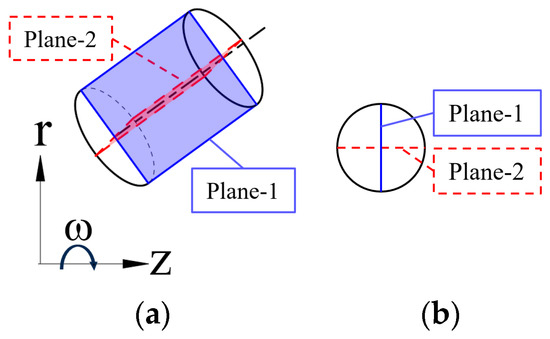
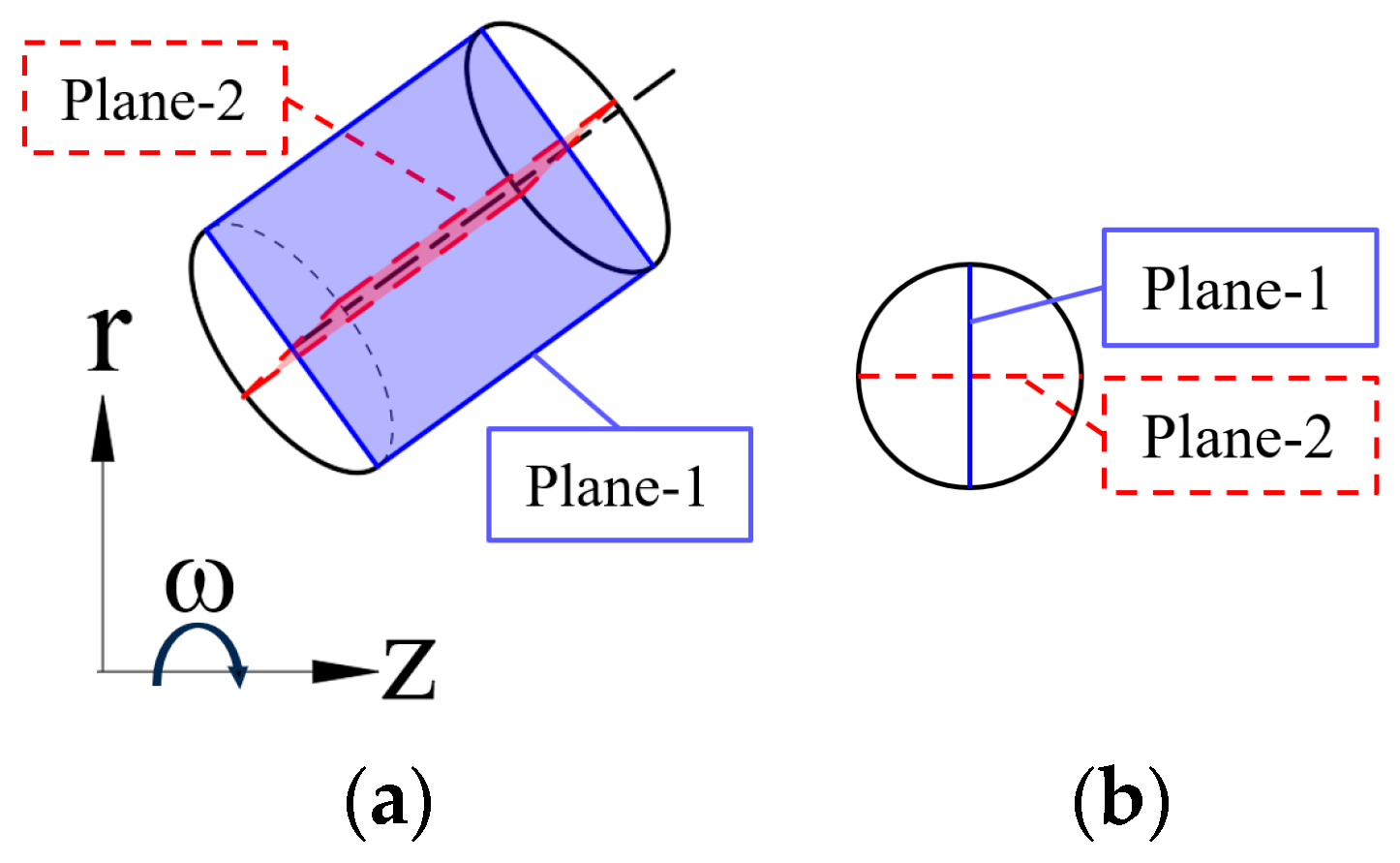
The axial and radial orifices differ in wall inclination angles. Therefore, the model established here represents a more generalized rotating orifice with walls of arbitrary inclination. Figure 1a shows a schematic diagram of the rotating orifice configuration. The orifice rotates about the Z-axis. The inclined black centerline in the diagram represents the axis of the rotating orifice. Two key cross-sections, designated as Plane-1 and Plane-2, are defined for analysis. As illustrated in Figure 1a, Plane-1 (solid blue line) is aligned with the orifice axis and the system’s axis of rotation (the positive Z-axis). Plane-2 (red dashed line in) is aligned with the orifice axis and the tangential direction of rotation. The relative positions of Plane-1 and Plane-2 are shown in Figure 1b. The spatial orientation of each plane is further detailed in Figure 2.
Figure 1.
Schematic of the rotating orifice structure and definition of the two reference planes. (a) The positions of Plane-1 and Plane-2 inside the orifice; (b) the relative positions of Plane-1 and Plane-2.
Figure 2.
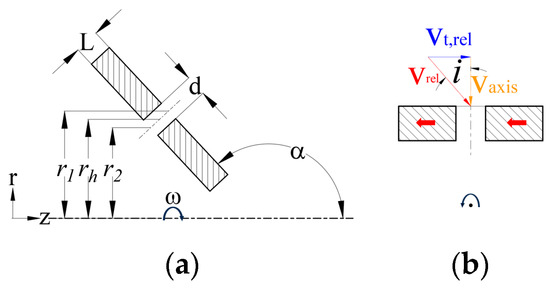
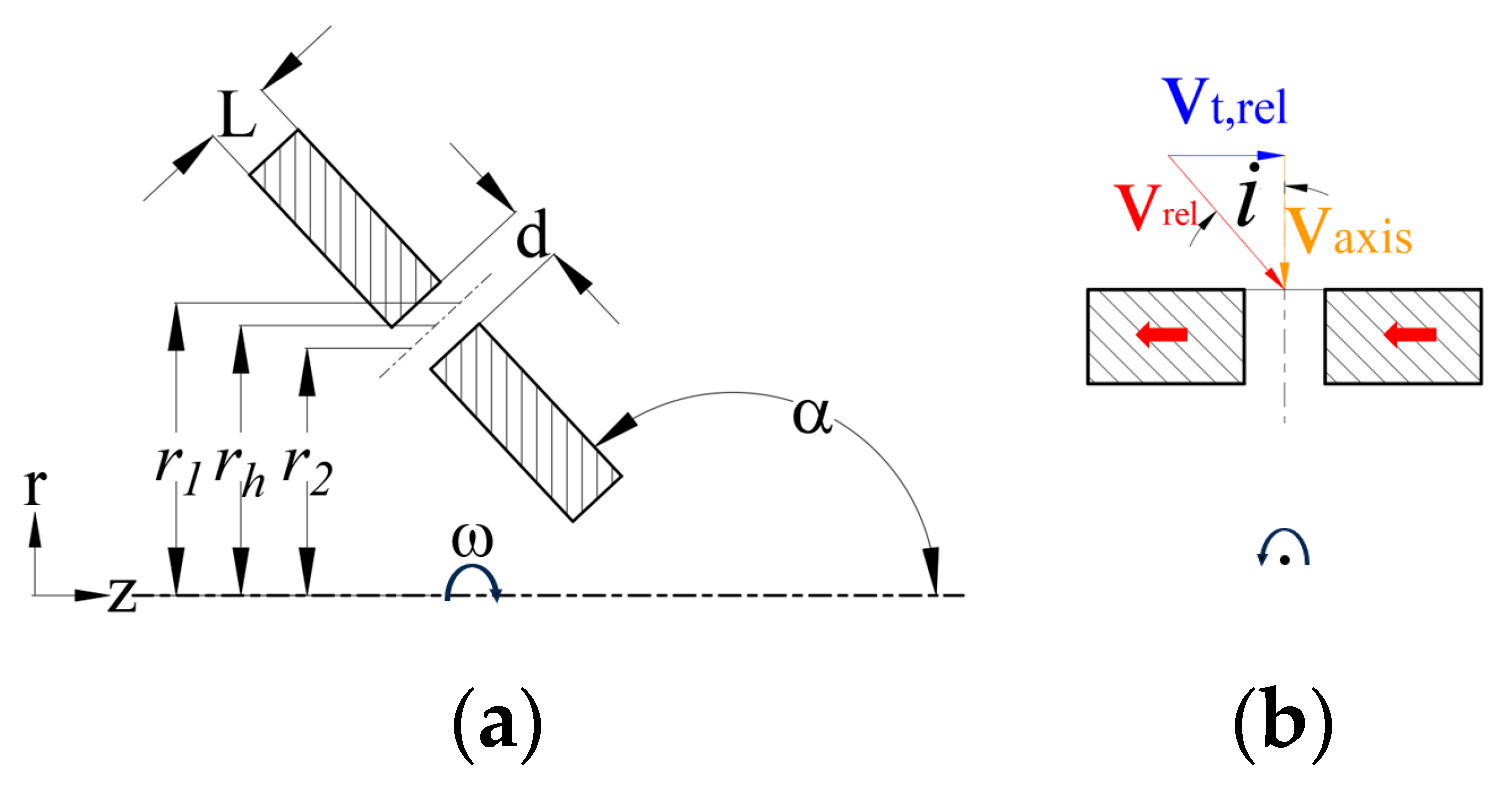
Cross-section of the rotating orifice. (a) Plane-1; (b) Plane-2. (The red arrows indicate the direction of rotation).
Figure 2a illustrates the dimensional drawing of the rotating orifice on Plane-1, with the positive Z-axis defined as the axis of rotation. The orifice has a diameter of d and a length of L. The angle between the orifice’s wall and the axis of rotation is denoted as α. α = π/2 represents an axial rotating orifice, while α = π corresponds to a radial inflow rotating orifice. and represent the rotational radii at the orifice’s inlet and outlet, respectively, while denotes the orifice’s rotational radius. The relationship between the rotational radius and the radial positions of the orifice inlet and outlet is given by Equation (1).
Figure 2b shows a schematic of the i on Plane-2. Two thick red arrows pointing from right to left indicate the tangential direction of rotation. The i denotes the angular separation between the relative velocity vector of the incoming air and the axis of the rotating orifice. The magnitude of i is determined by the relative tangential velocity and the axial velocity component along the orifice . The calculation for the i is provided in Equation (2).
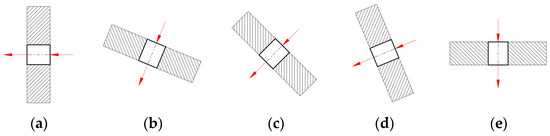
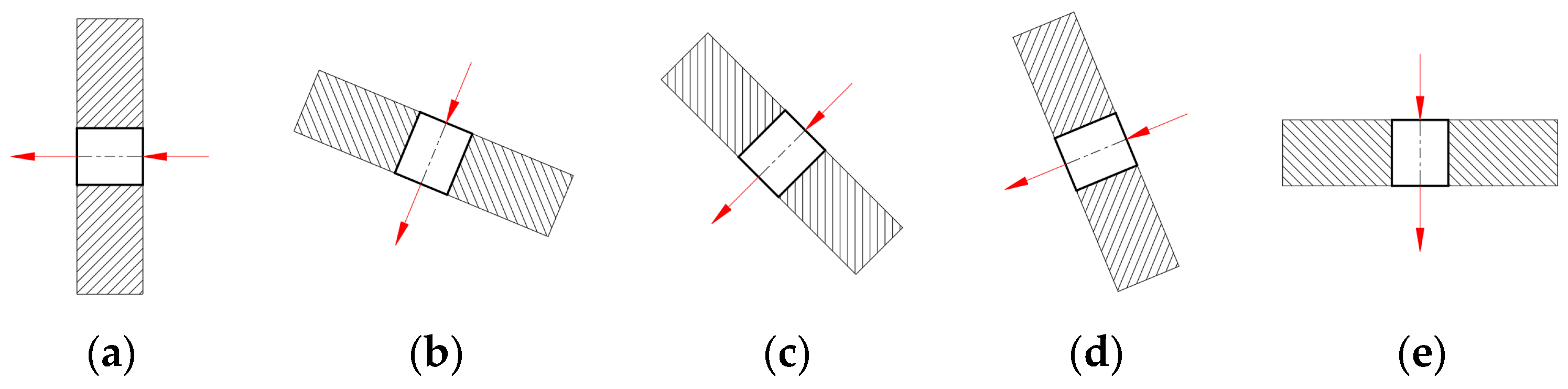
The schematic diagrams of the rotating orifices with different α are shown in Figure 3. The red arrows indicate the direction of air flow, and the corresponding angle values are given in both radians and degrees.
Figure 3.
Schematic diagram of different α. (a) α = π/2 (90°); (b) α = 5π/8 (112.5°); (c) α = 3π/4 (135°); (d) α = 7π/8 (157.5°); (e) α = π (180°).
The relative tangential velocity is calculated using Equation (3).
where ω represents the rotational angular velocity of orifice, and denotes the tangential velocity of the air upstream of the orifice.
The formulation of Cd for the rotating orifice is based on the steady-flow energy equation [16]:
in which
where represents the real mass flow rate passing through the orifice, represents the inlet total temperature, represents the inlet total pressure, A represents the cross-sectional area of the orifice, is the specific heat ratio, R is the gas constant, represents the outlet static pressure, is the ratio of the inlet total pressure to the outlet static pressure, refers to the rotational temperature and is defined as the specific heat at constant pressure.
2.2. Experimental Method
2.2.1. Experimental System
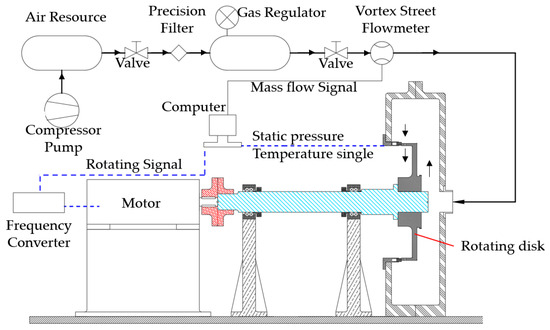
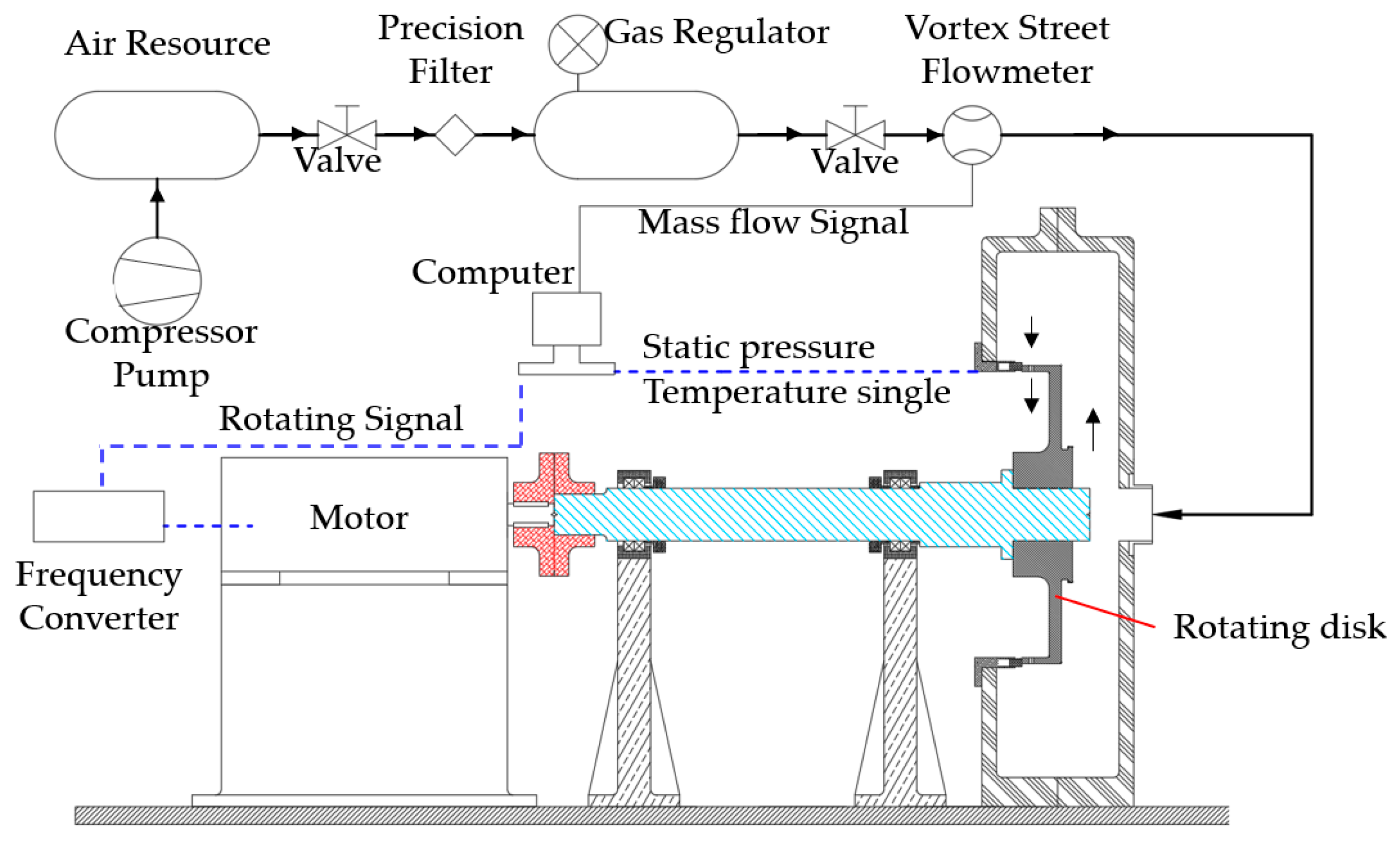
The experimental work in this study was designed to validate the accuracy of the discharge coefficient prediction model, and the validation results are presented in Section 3.4. Figure 4 presents a schematic of the experimental apparatus. The system comprises four major subsystems: a compressed air supply unit, a rotational test assembly, a data acquisition system, and an electric drive system. The air compression system generates high-pressure airflow that is subsequently conditioned through a series of regulation devices, including an air source assembly, precision particulate filter, and pressure regulator, to ensure stable and uniform flow conditions.
Figure 4.
Schematic of the experimental system. (The arrows indicate the direction of airflow).
The test section is driven by a 15 kW AC motor, enabling rotational speeds of up to 8000 rpm within the test cavity. Volumetric flow rate measurements through the pipeline network are obtained using a vortex-shedding flowmeter. Thermal monitoring is implemented through a multi-channel temperature inspection instrument that records total temperature values at key locations within both the supply pipelines and the internal test chamber. Pressure measurements, including static pressure in the internal chamber and differential pressure across sealing ring assemblies, are acquired using a National Instruments-based pressure scanning module. Rotational velocity is quantified through non-contact measurement using a photoelectric laser tachometer. Collectively, these instruments form an integrated data acquisition platform for experimental measurements.
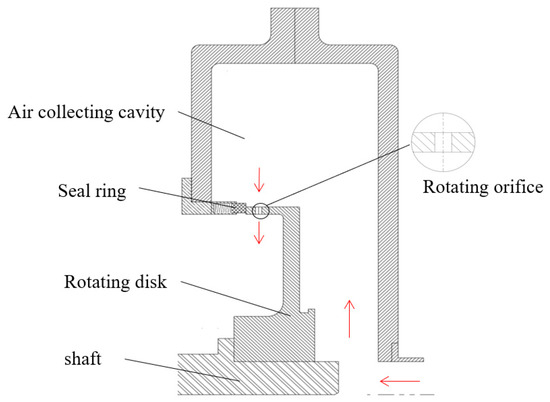
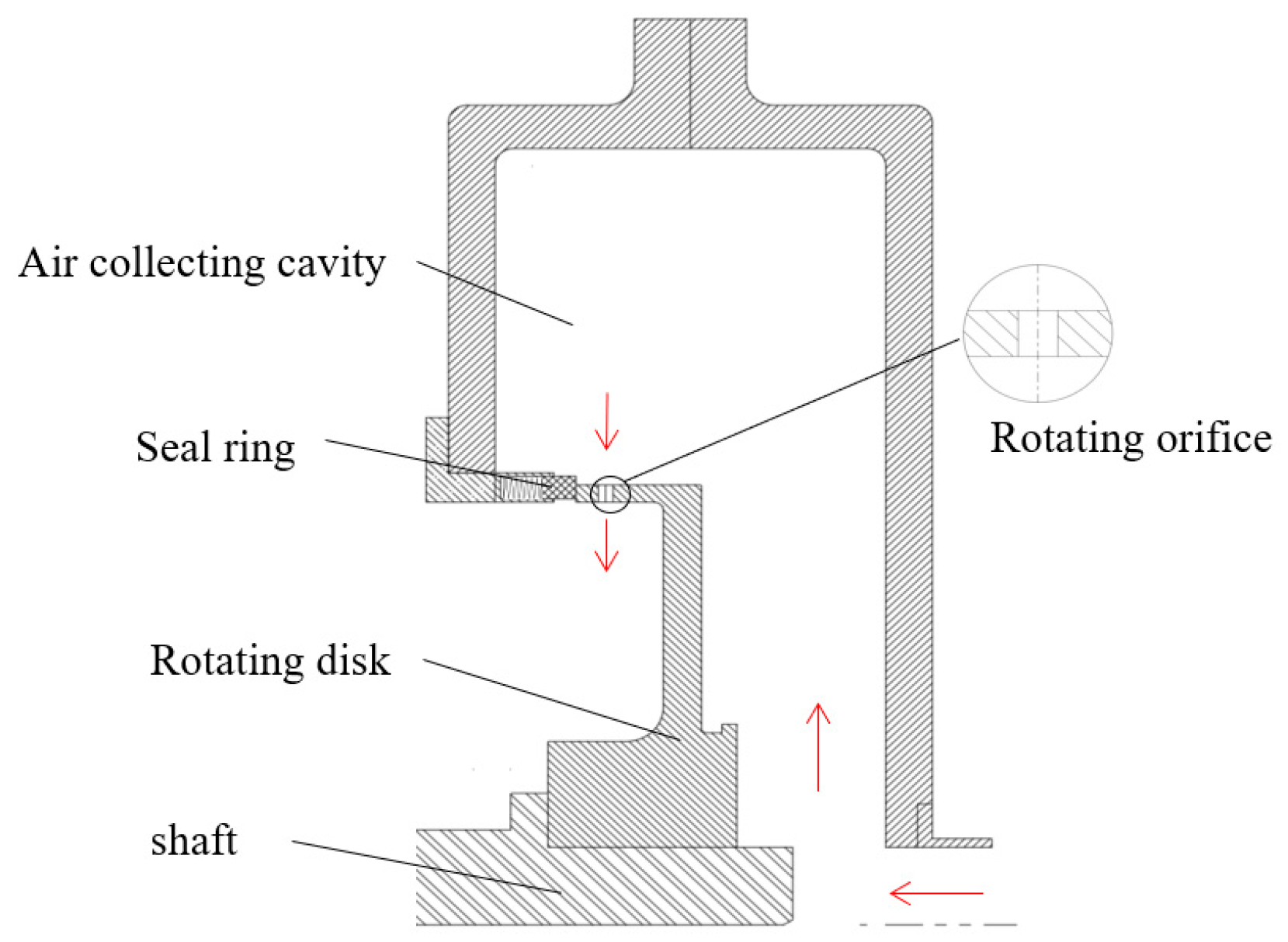
Figure 5 shows a schematic of the test section, which consists of an air collecting cavity, seal rings, a rotating disk and a shaft. The disk is secured to the shaft using keys, and the shaft is driven by a motor. The inner chamber is enclosed by the stationary fixture wall and the rotating disk. The rotating disk is equipped with radial rotating orifices. The rotor and stator are sealed by seal rings.
Figure 5.
The schematic of the test section. (The red arrows indicate the direction of airflow).
The red arrows in Figure 5 show the direction of air flow. Air flows from the supply pipes into the collecting cavity, then passes through the rotating orifices, and is finally discharged to the atmosphere. The measurement points include the static pressure (P1) and static temperature (T1) in the air collecting cavity. The maximum flow velocity in the cavity under all experimental conditions is calculated to be less than 5 m/s. Given this low velocity, the dynamic pressure component is negligible. Consequently, the measured static pressure is used directly as an approximation of the total pressure for calculating the Π in subsequent data processing.
2.2.2. Experimental Conditions and Experimental Uncertainties
Table 1 shows the experimental conditions, the Π changes from 1.04 to 1.08, N changes from 0 to 1560 rpm and L/d changes from 1.67 to 2 in the present test.
Table 1.
Experimental boundary conditions.
The overall uncertainty in the Cd, resulting from instrumentation errors, was estimated using the method of Kline et al. [30] for single-sample experiments. The accuracy and precision characteristics of the experimental instruments are given in Table 2. The uncertainty of the mass flow rate is 1.6%. The uncertainty of the Π is 1.42%, respectively. The uncertainty of the Cd is 3.51%.
Table 2.
Precision of experimental instruments.
2.3. Numerical Simulations
2.3.1. Fluid Domain Model
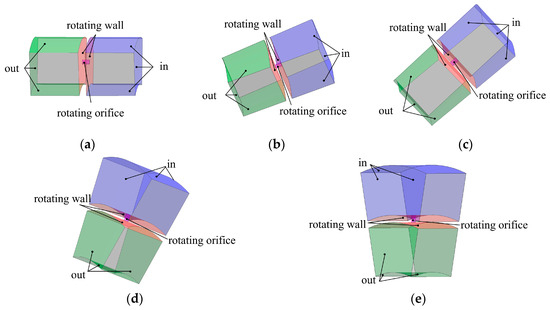
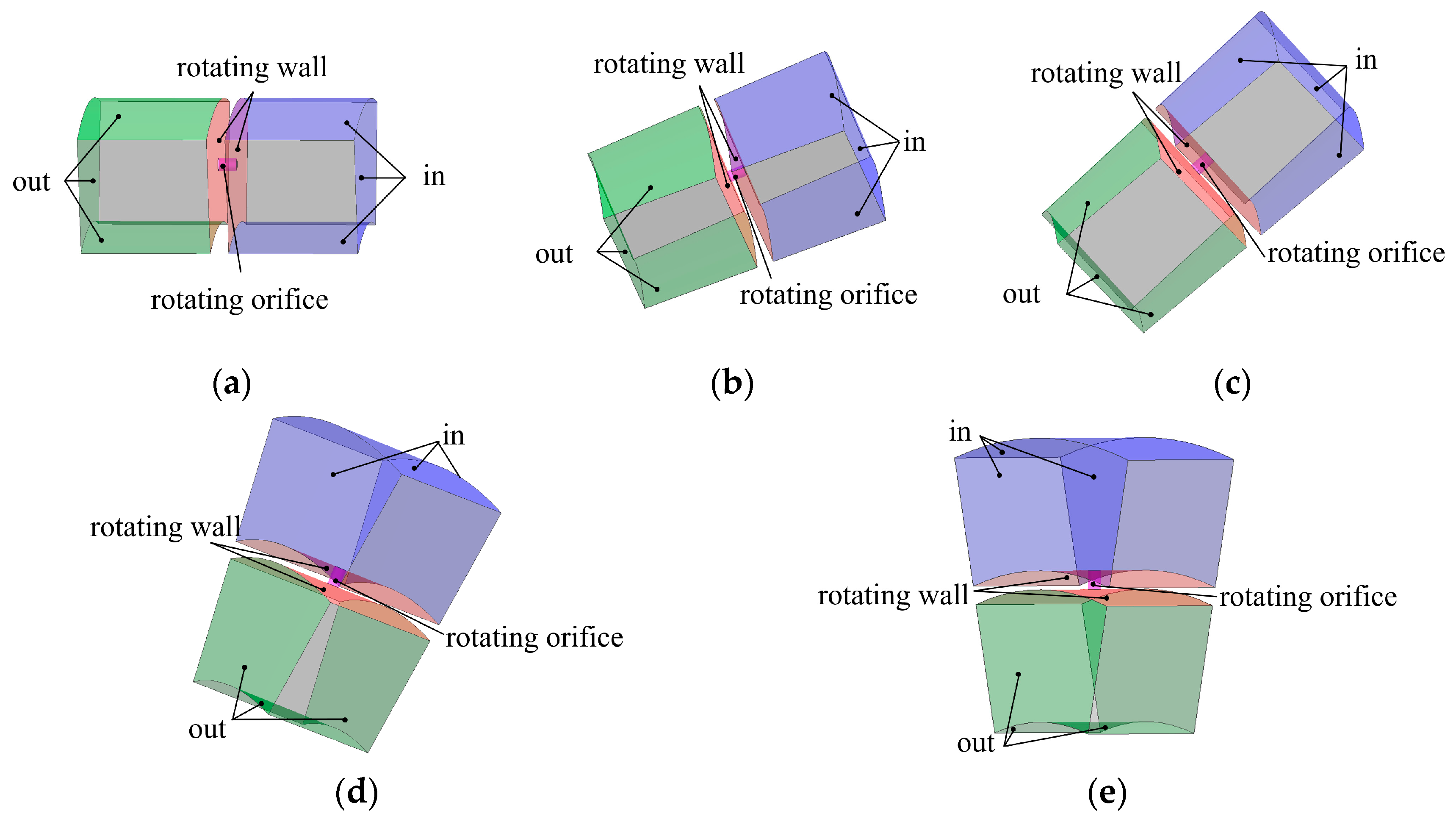
For all configurations, six rotating orifices are uniformly distributed around the circumference. To reduce computational cost, a 60° sector was used as the computational domain with periodic boundary conditions applied in the circumference direction. Based on the rotating orifice structure shown in Figure 3, the corresponding computational domain is established, as presented in Figure 6. In Figure 6, the blue surfaces represent the inlet boundaries, the green surfaces denote the outlet boundaries, the red surfaces indicate the rotating walls, the pink surfaces correspond to the rotating orifice, and the remaining gray surfaces are the periodic surfaces.
Figure 6.
Computational domain models with different α. (a) α = π/2; (b) α = 5π/8; (c) α = 3π/4; (d) α = 7π/8; (e) α = π.
2.3.2. Computational Setup and Boundary Conditions
The mesh was generated using ANSYS ICEM 2021 R1, and the numerical simulations were performed using ANSYS Fluent 2021 R1. Periodic boundary conditions were applied to the sector’s side surfaces to enforce circumferential symmetry. The realizable k-ε turbulence model was selected in the present CFD simulations, according to the studies of Yan et al. [29], Zhang et al. [31], Wei [32] and Ranran et al. [33], the realizable k-ε model can provide a reasonable estimation of the flow mechanism in rotating orifices. The scalable wall-function approach was selected, with no-slip wall conditions and adiabatic thermal boundaries implemented at all solid surfaces. Air was treated as the ideal gas, with molecular viscosity determined by the Sutherland equation, while specific heat capacity and thermal conductivity were maintained as constant values.
Steady-state RANS simulations were adopted in the present study using a rotating reference frame. Although local turbulent fluctuations may exist in rotating inclined orifices, the primary objective of this work is to predict the time-averaged discharge coefficient (Cd) rather than resolve instantaneous turbulent structures. Using steady-state simulations for predicting Cd of rotating orifices is a standard approach in the literature [21,25,26,28,34]. The computational domain is a periodic sector with steady pressure boundary conditions and no transient rotor–stator interaction. Recent validated CFD studies in aerospace flows have also shown that numerical analyses can resolve complex flow mechanisms when supported by experimental validation [35]. Furthermore, the numerical methodology used here was validated against experimental data from both axial and radial rotating-orifice configurations, confirming the reliability of the steady-state approach for predicting Cd.
The rotational frame of reference was adopted to simulate the flow characteristics within the rotating orifices. All walls in contact with the rotating disk were prescribed rotational motion. A pressure inlet boundary condition was applied, with the orifice outlet maintained at atmospheric pressure. A pressure-based implicit solver was utilized, with the SIMPLE algorithm applied for pressure–velocity coupling. A second-order upwind discretization was used to improve numerical stability. The convergence criterion is that the residual of mass flow is lower than 10−6. In addition, the residuals of the continuity, momentum, turbulence and energy equations, together with the outlet mass flow rate and area-averaged outlet temperature, were monitored until stable convergence was obtained.
Consistent with the studies in the literature [21,25,26], this work focuses on the flow characteristics of orifices under a relatively narrow pressure ratio range, with a maximum value of 1.09. To analyze the flow characteristics in the rotating orifices, a total of 240 computational cases in 2 groups were set (as shown in Table 3 and Table 4). Group A includes 200 cases configured to investigate how variations in the α influence the performance of the rotating orifice. Group B consists of 40 cases designed to illustrate the effects of L/d on the performance of the rotating orifices at α = π/2 and π. Specifically, Group A contains five wall inclination angles, eight rotational speeds and five pressure ratios at a fixed L/d of 1.5, giving 5 × 8 × 5 = 200 cases. Group B contains two wall inclination angles, four rotational speeds and five L/d values at Π = 1.03, giving 2 × 4 × 5 = 40 cases.
Table 3.
Group A: The effect of α.
Table 4.
Group B: The effect of L/d.
2.3.3. Grid Generation and Grid Independence Study
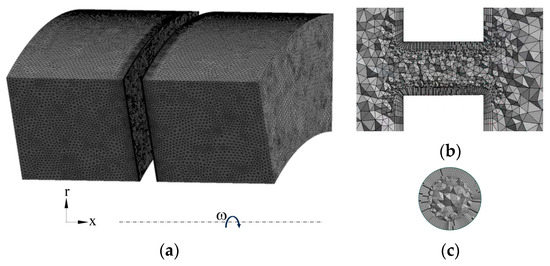
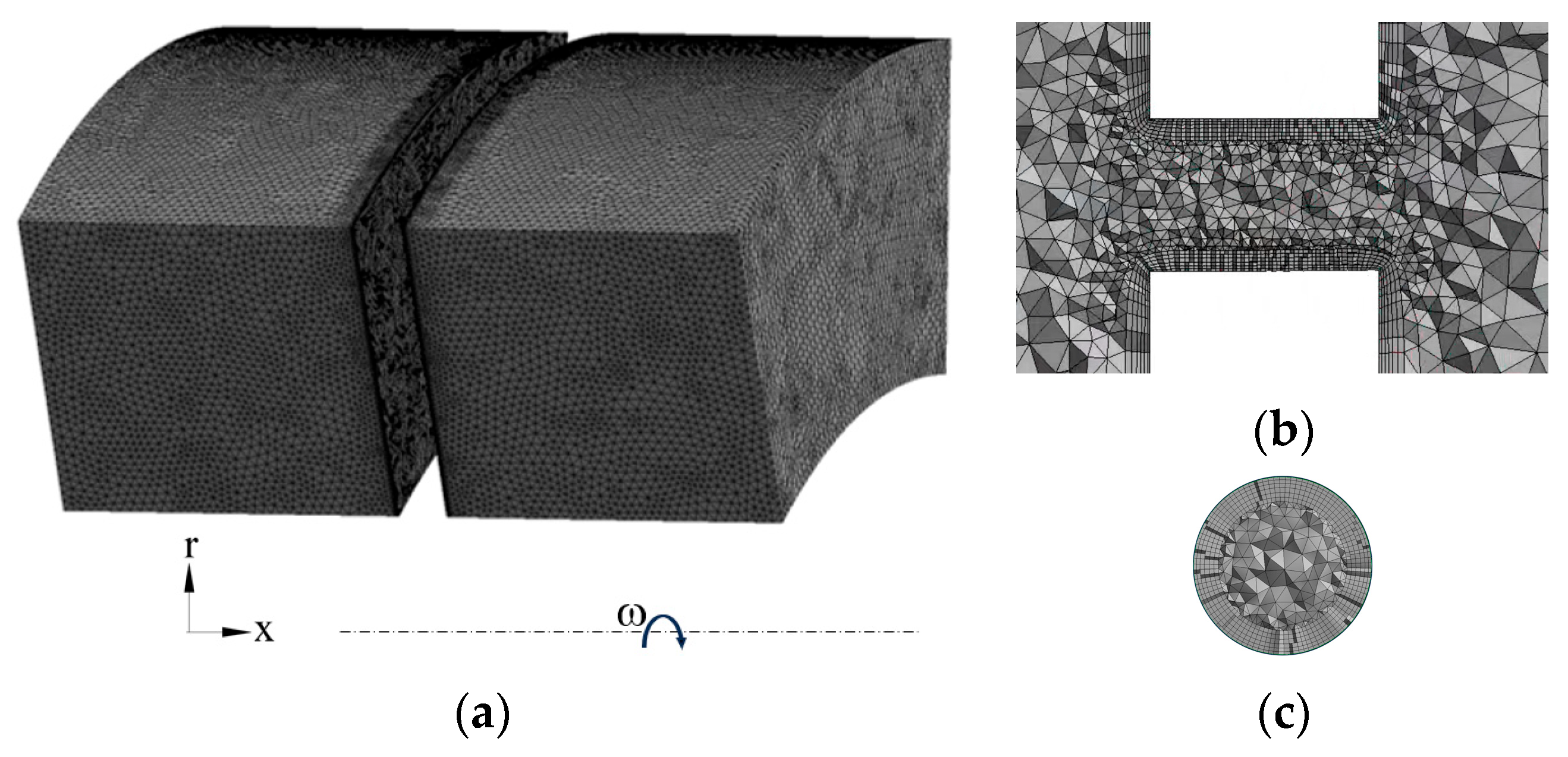
An unstructured grid was generated using the ANSYS ICEM meshing tool, with local mesh refinement applied near the orifices and the rotating wall, as shown in Figure 7. A global mesh size of 2 mm was applied to the computational grid. The mesh size on the rotating wall was set to 1 mm, while a refined mesh size of 0.2 mm was adopted for the orifice wall surfaces. The prism generation method was used to improve the grid quality in the near-wall regions. The first layer thickness is 0.1 mm, with six inflation layers and a growth rate of 1.2. The dimensionless wall distance y+ of the center of the first grid cell is approximately 25, meeting the requirements for the scalable wall-function approach [36].
Figure 7.
Schematic diagram of mesh for the rotating orifice with α = π/2. (a) Global mesh distribution; (b) the mesh across the orifice length; (c) the mesh across the orifice diameter.
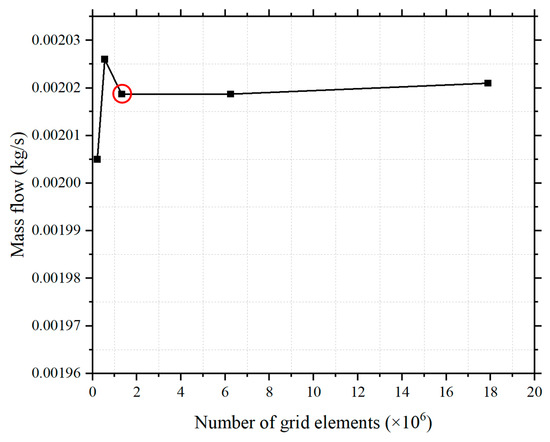
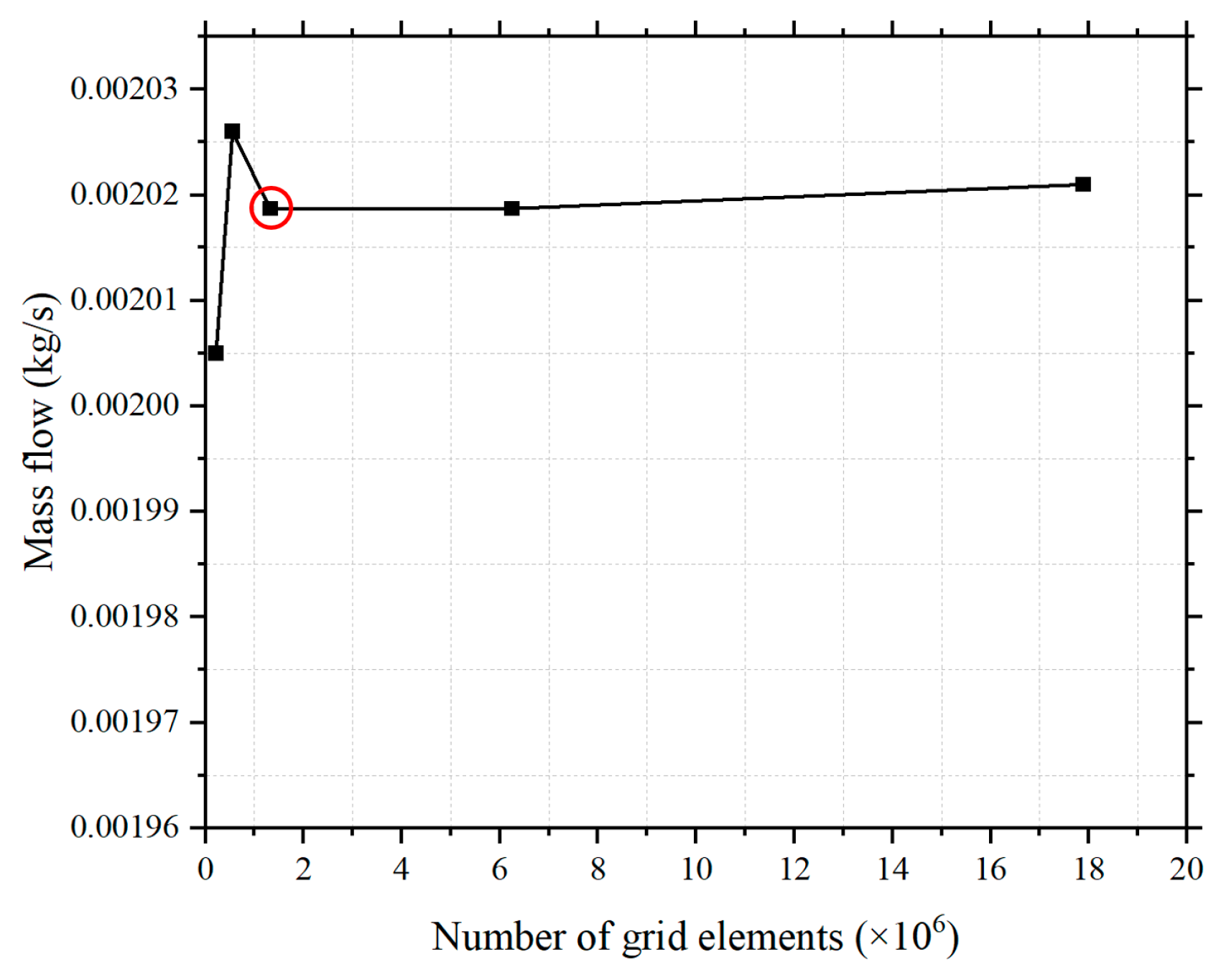
A grid independence study was conducted by successively refining the mesh until key solution parameters showed negligible variation with further refinement. Figure 8 presents the mass flow rate against the total numbers of mesh under identical flow conditions, showing that once the number of mesh reaches 1.32 × 10⁶, further mesh refinement has a negligible impact on the mass flow rate. Since Cd is directly calculated from the actual mass flow rate, mass flow rate was selected as the primary grid-independence parameter. To ensure that the thermal solution was also converged, the residual of the energy equation and the area-averaged outlet temperature were monitored together with the outlet mass flow rate. The outlet temperature and mass flow rate remained stable after convergence. Therefore, this grid resolution was selected for all subsequent simulations of the rotating orifices.
Figure 8.
Grid independence results for the rotating orifice with α = π/2.
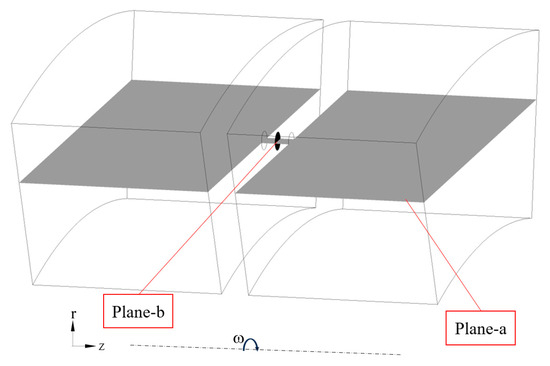
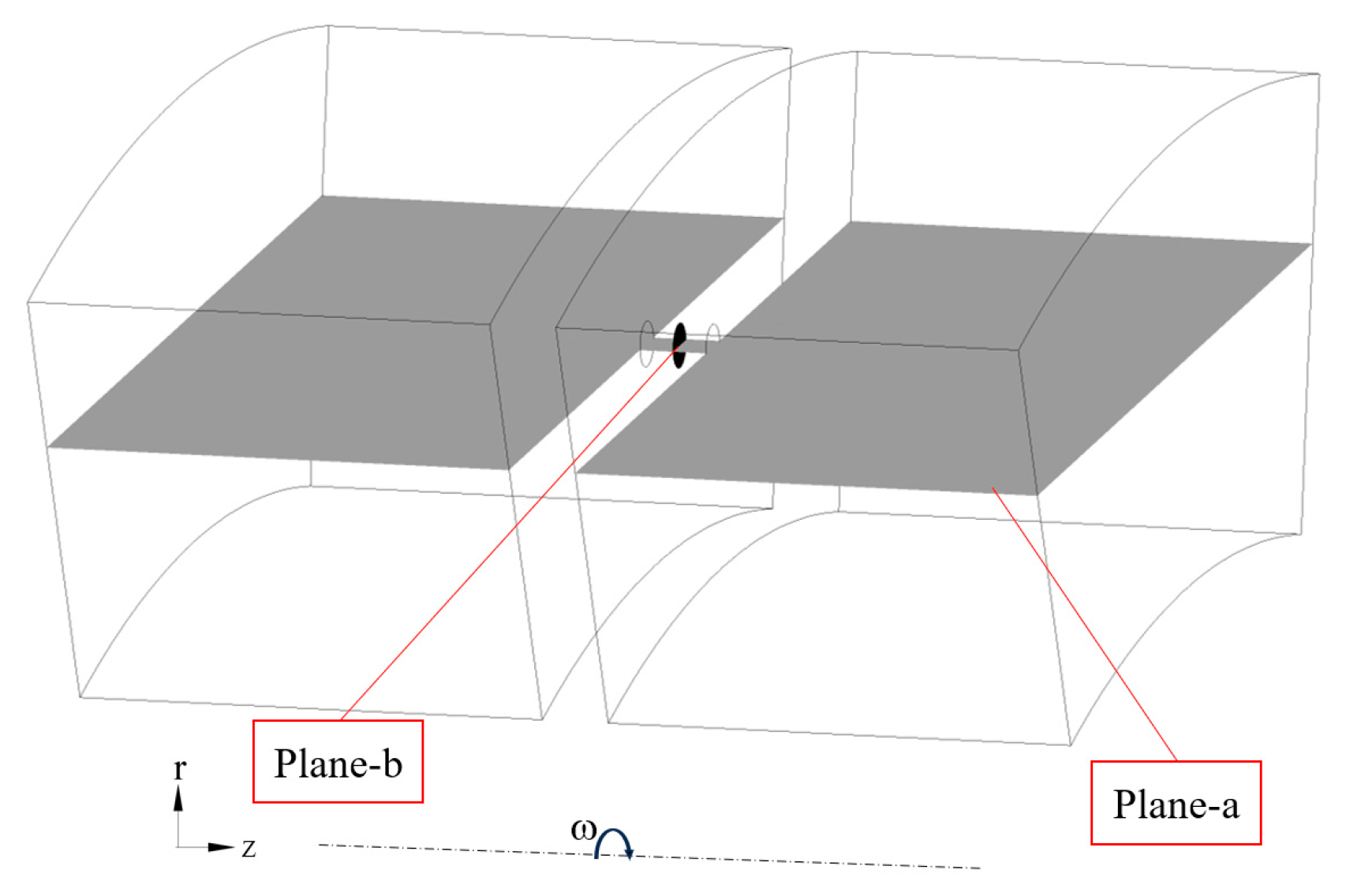
To facilitate detailed analysis, key cross-sections were defined within the computational domain. Their locations are shown in Figure 9 for the representative case of α = π/2. In this configuration, Plane-a is aligned with the orifice axis and the tangential direction of rotation. Plane-b is situated at the mid plane of the orifice, normal to its axis.
Figure 9.
Schematic diagram of the cross-section.
2.3.4. Validation
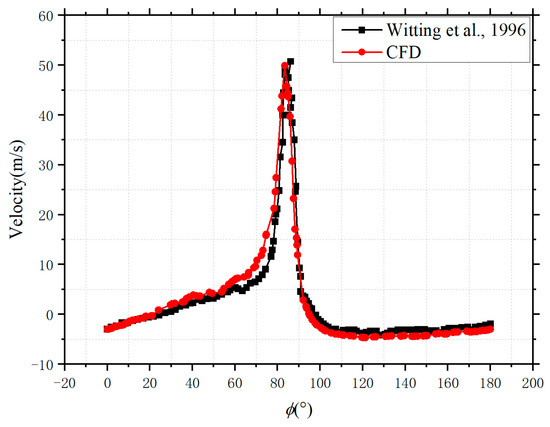
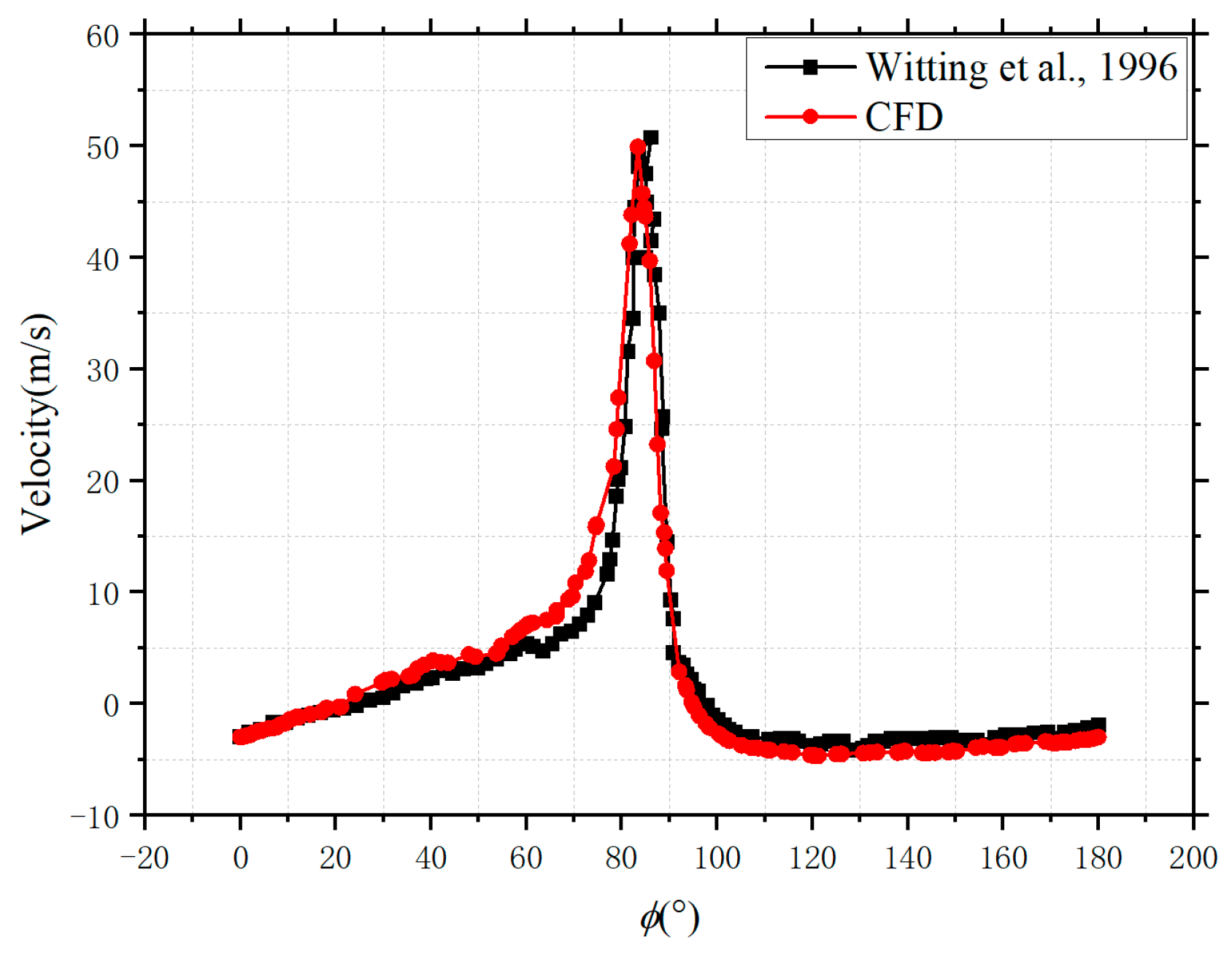
The accuracy of the numerical methodology was validated against experimental data reported in the literature. Figure 10 shows that a very good agreement is obtained between the predicted axial velocity at the outlet and the experimental data of the axial rotating orifice from Wittig et al. [21], with a maximum error in axial velocity of only 1.57% for a configuration with a rotation radius of 105 mm and N = 4500 rpm.
Figure 10.
Comparison of the axial velocity between the present CFD results and Wittig’s experimental data [21].
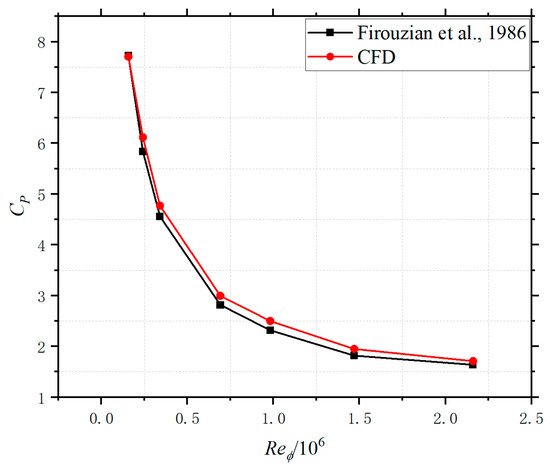
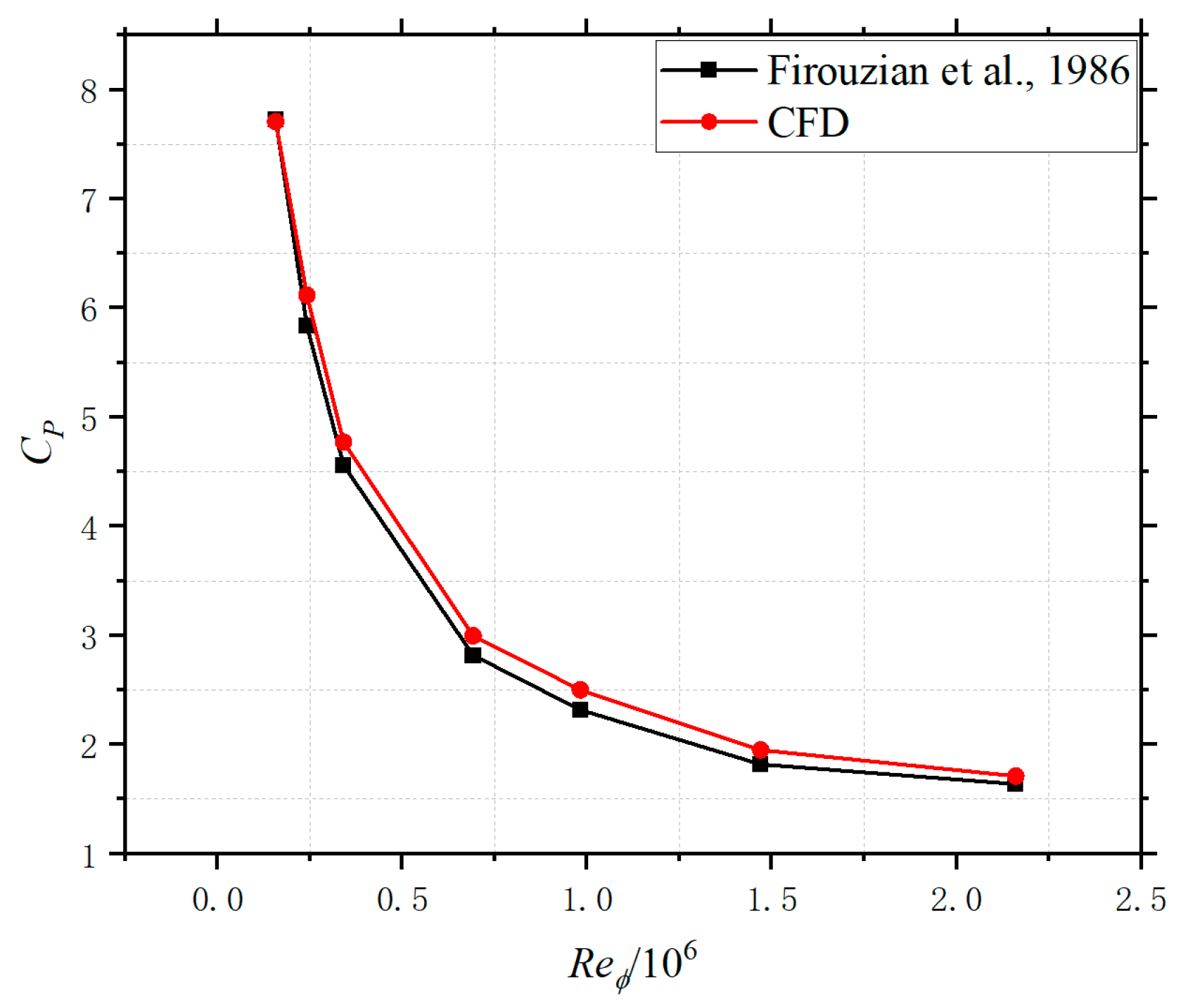
The model was further validated by comparing the calculated pressure drop for a radially inward configuration [34] against the corresponding experimental data. For this case, which has a rotation radius of 380.75 mm and N = 2500 rpm, the maximum error in the pressure coefficient is approximately 7.28%, as illustrated in Figure 11.
Figure 11.
Comparison of pressure coefficient between the present CFD results and Firouzian’s data [34].
The close agreement between the present results and the experimental data from both flow configurations confirms the accuracy and reliability of the numerical approach used in this study.
2.4. Prediction Model
2.4.1. Development Method
The method for establishing the prediction model in this study is consistent with that in the literature [26,28,29], both of which are derived from modifying a stationary orifice prediction model. The Cd for sharp-edged stationary orifices was initially proposed by Miller R. W. [37] as follows:
where the orifice Reynolds number is given by:
denotes the actual mass flow rate through the orifice, and is the dynamic viscosity of air.
To account for the effect of Π, the Cd of a stationary orifice is modified as follows [26]:
Zhu et al. [28] further modified the Cd by incorporating a correction for L/d, resulting in the following expression:
The influence of rotation is incorporated through a correction to the i. The expression is shown in Equations (15) and (16).
where i varies between 0 and π.
2.4.2. Improved Model
- (a)
- Calculation of the incidence angle
According to Equation (16), the incidence angle is a key parameter in establishing the prediction model for the discharge coefficient of the rotating orifice. Therefore, the following part of this subsection focuses on the calculation method of the incidence angle in the rotating reference frame.
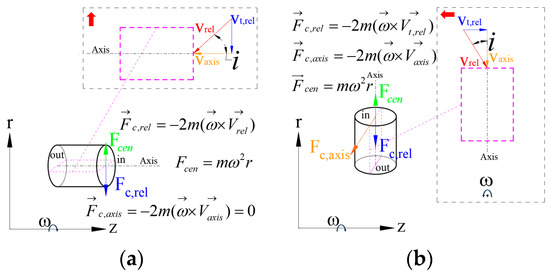
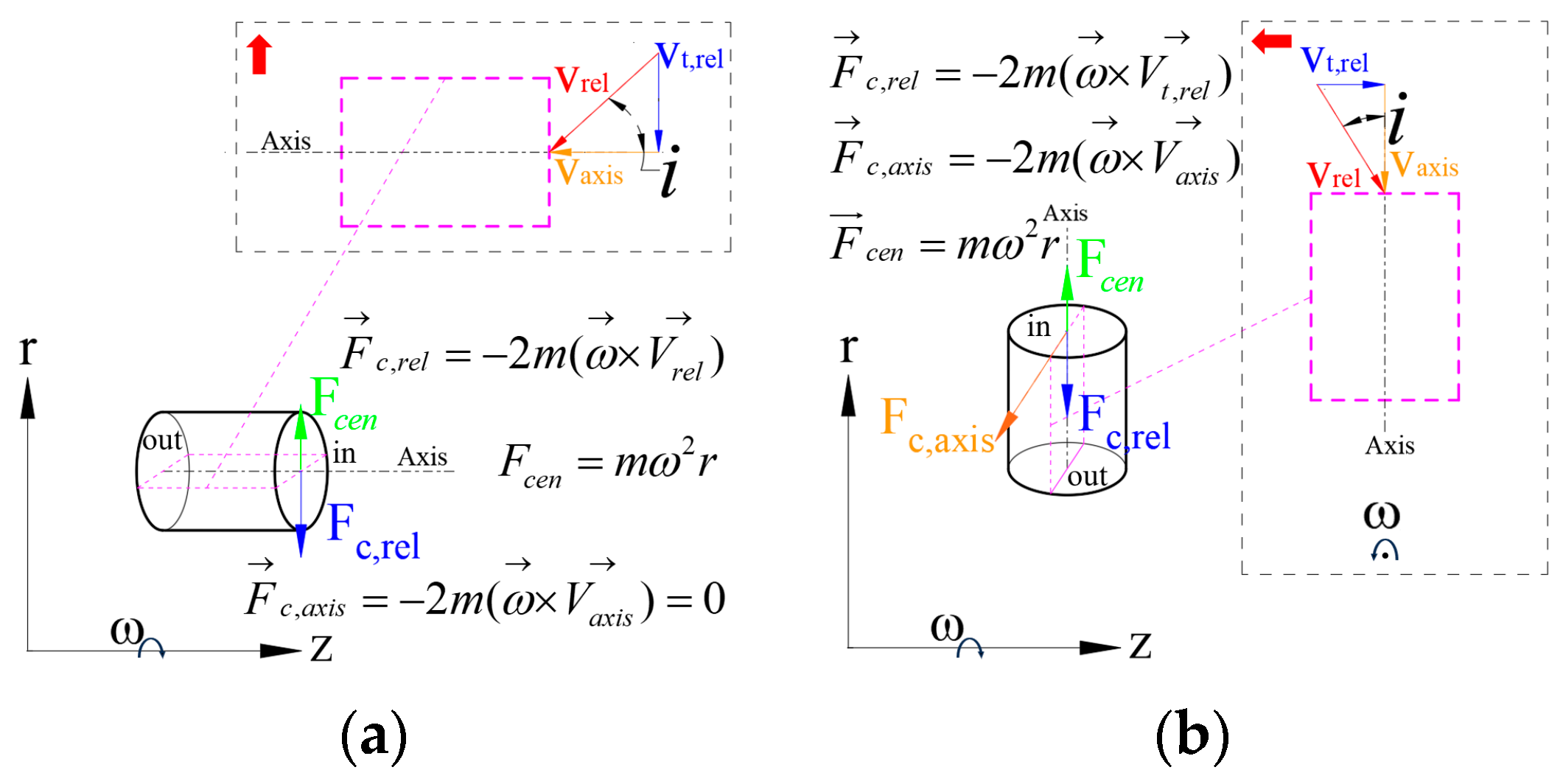
In the rotating reference frame, the motion of the air is deflected by the Coriolis force. Schematic diagrams of the Coriolis force acting on the air inside rotating orifices with α = π/2 and π are shown in Figure 12. The axis of rotation is the positive z-axis. The inset in the upper right corner illustrates the relationship between the relative velocity the relative tangential velocity , and the axial velocity , with the thick red arrow indicating the rotation direction on Plane-a.
Figure 12.
Schematic of the Coriolis force acting on the air inside rotating orifices with α = π/2 and π. (a) α = π/2; (b) α = π. (The red arrows indicate the direction of rotation).
As shown in Figure 12a, the air at the inlet of the α = π/2 orifice possesses a negative tangential relative velocity and a negative axial velocity . According to the Coriolis force formula provided in the figure, a radially inward Coriolis force is obtained. In the axial direction of the orifice, since the orifice axis is parallel to the z-axis, the calculated axial Coriolis force component = 0. Consequently, no Coriolis force acts in the axial direction, while the radially inward Coriolis force causes the air to deflect inward radially.
As shown in Figure 12b, the air at the inlet of the α = π orifice also exhibits a negative tangential relative velocity and a negative axial velocity . Based on the given formula, a radially inward Coriolis force and a positive tangential Coriolis force are obtained. The differences compared to the α = π/2 orifice are twofold: firstly, the radially inward Coriolis force aligns with the orifice axis, thereby enhancing the axial velocity; secondly, the positive tangential Coriolis force increases the tangential velocity of the air, thereby reducing the relative tangential velocity. The combined effect of these two aspects results in a smaller i for the α = π/2 orifice compared to the α = π orifice.
It is important to note that during the inward radial flow of the air, a positive tangential Coriolis force continuously acts, increasing the tangential velocity and decreasing the relative tangential velocity, which in turn reduces the deflection angle at the outlet.
Due to the significant influence of the Coriolis and centrifugal forces on the Cd of rotating orifices with different α, the next step involves incorporating their effects into the existing computational model for rotating orifices. In the literature [26,28], the parameter of i is commonly used to characterize the influence of rotation on the Cd. Therefore, this study also adopts the i as the starting point to establish a predictive model for the Cd of rotating orifices with different α.
Considering that the parameters related to the i are the relative tangential velocity and the orifice axial velocity , and that the positive tangential Coriolis force affects the tangential velocity direction, while the centrifugal force and the negative radial Coriolis force influence the axial velocity during the radial inflow process, their respective contributions are accounted for separately. Therefore, the influence of the positive tangential Coriolis force is reflected through the relative tangential velocity , whereas the combined influence of the centrifugal force and the negative radial Coriolis force is reflected through the orifice axial velocity .
Based on the formulas for the positive tangential Coriolis force and the negative radial Coriolis force provided in Figure 12, the following can be obtained:
From Equation (17), it can be observed that the direction of the resultant Coriolis force acting on the air is always aligned with the direction of airflow, indicating that the resultant Coriolis force consistently facilitates the airflow and increases the air velocity.
- (1)
- Influence of the tangential Coriolis force:
When the influence of the Coriolis force is not considered, the expression for the relative tangential velocity at the inlet is given by:
Since the air inlet in this study has no pre-swirl, the initial tangential velocity is = 0. Considering the effect of the positive tangential Coriolis force, the calculation of the relative tangential velocity is modified as follows:
where the tangential velocity induced by the Coriolis force is given by:
where is defined as the correction factor. It is obtained through fitting based on numerical simulation.
- (2)
- Influence of centrifugal and radial Coriolis forces:
For the rotating orifice with α = π, a positive radial centrifugal force and a negative radial Coriolis force act in the radial direction. Therefore, the pressure must be corrected when calculating the axial velocity through the orifice.
In the rotating reference frame:
The first term on the right-hand side of the equation represents the centrifugal term, and the second term corresponds to the radial Coriolis term. Substituting Equations (9) and (10) into Equation (11) yields
Regarding the radial rotating orifice:
Integrating Equation (22) and incorporating Equations (23) and (24) yields the flow resistance in the radial direction:
Therefore, the Π in the ideal flow velocity expression for the rotating orifice with a α = π becomes
For the calculation of the Cd of a rotating orifice with α = π, the ideal flow velocity is expressed as
When the inclination angle is α (π/2 ≤ α ≤ π), the centrifugal pressure drop becomes
When the wall inclination angle is α, the Π of the rotating orifice becomes
The ideal axial velocity is given by
Equation (2) for the i becomes
- (b)
- Discharge coefficient fitting
Based on the consideration of the Coriolis and centrifugal forces, the relationship between the incidence angle and the discharge coefficient is re-established using the same form as Equation (15), and is obtained through fitting.
Furthermore, to account for the effect of the length-to-diameter ratio on the discharge coefficient under rotation, the correlation between the length-to-diameter ratio and the discharge coefficient is established via fitting and is expressed as
is obtained by fitting.
3. Results and Discussion
3.1. Influence of the Wall Inclination Angle
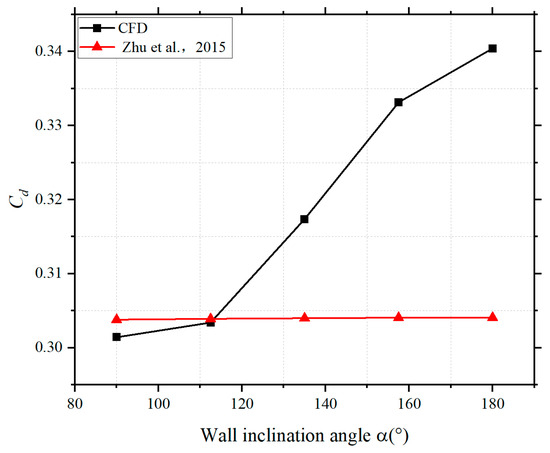
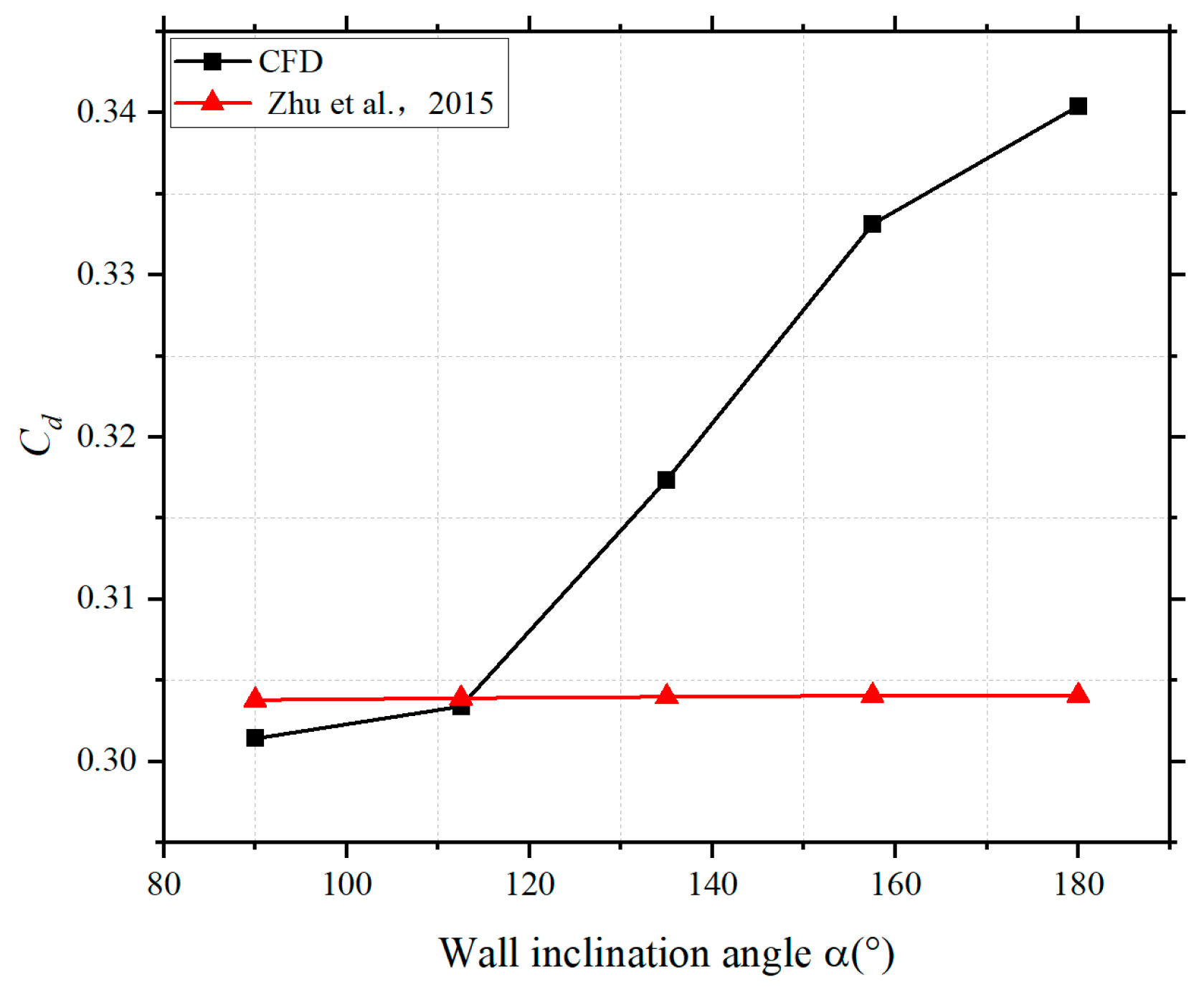
The variation in Cd with α for rotating orifices under typical conditions (N = 3000 rpm, Π = 1.03, L/d = 1.5) is illustrated in Figure 13. The numerical simulation results are represented by black squares, while the prediction results from the literature [28] are indicated by red triangles. It is revealed by the numerical results that the Cd of the rotating orifice is increased as α increases. Specifically, as α is increased from π/2 to π, Cd is increased from 0.301 to 0.340, which corresponds to an increase of 12.96%. In contrast, the prediction results from Zhu et al. [28] remain essentially unchanged with variations in α, and thus the influence of this parameter is not captured.
Figure 13.
Variation in the Cd with α for the rotating orifice under typical conditions (N = 3000 rpm, Π = 1.03, L/d = 1.5) [28].
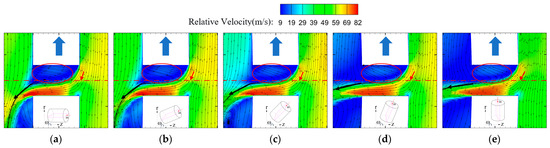
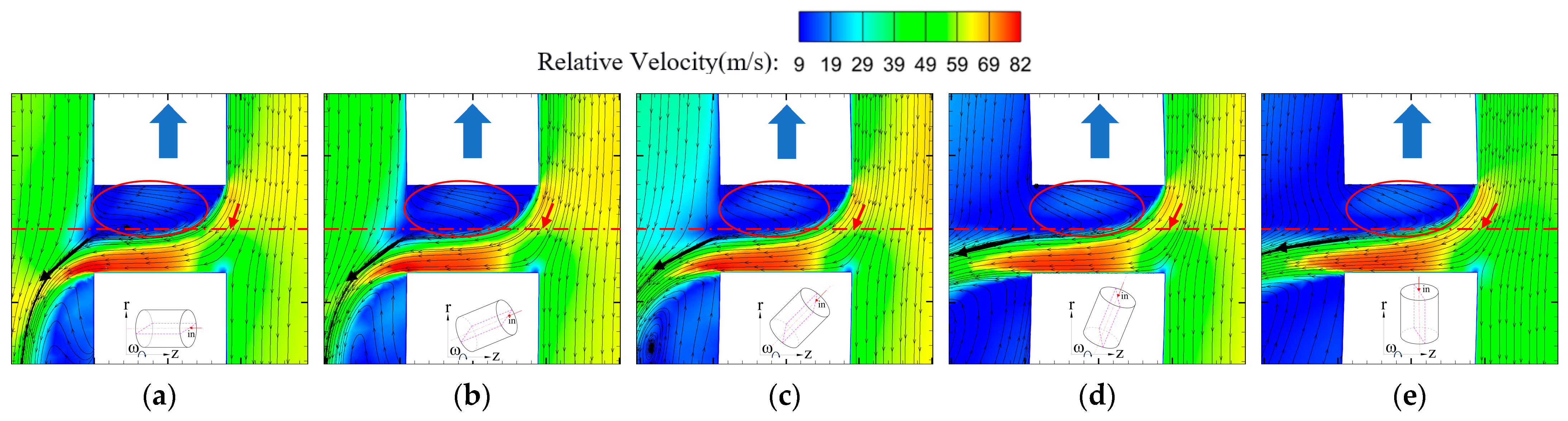
In order to elucidate the effect of α variation on Cd, the relative velocity contours on Plane-a for rotating orifices with different α (N = 3000 rpm) are presented in Figure 14. In the figure, the direction of air inflow is indicated by red arrows, the direction of air outflow is denoted by black arrows, and the direction of rotation is marked by the large blue arrow. The axis of the rotating orifice is represented by red centerlines. The red ellipses serve as reference objects, and their size and position are kept consistent across all subfigures. Beneath each subfigure, a schematic diagram shows the location of Plane-a (indicated by a pink dashed line) of the corresponding structure. To facilitate comparative analysis, Plane-a in the fluid domain of rotating orifices with different α is arranged in the same manner as that for the α = π/2 orifice.
Figure 14.
Contours of relative velocity and streamlines on Plane-a of orifices with different α under typical conditions. (a) α = π/2; (b) α = 5π/8; (c) α = 3π/4; (d) α = 7π/8; (e) α = π. (The blue arrows indicate the direction of rotation, the red arrows indicate the direction of air inflow, and the black arrows indicate the direction of air outflow. The red centerline represents the position of the orifice’s central axis, and the red circles indicate the size of the flow separation region).
As is observed in the figure, after air enters the rotating orifice, it is deflected on the windward side and continues to flow under the guiding effect of that surface. A flow separation is generated on the leeward side, and within the elliptical region, the area covered by this separation is found to extend past the orifice axis. By comparing the red arrows, it can be seen that as α increases, the direction of the incoming airflow at the orifice entrance gradually aligns closer to the orifice axis, and the incidence angle i (the angle between the red arrow and the orifice axis) is progressively decreased. With the reduction in i, the flow separation at the orifice entrance is gradually diminished, and the area within the orifice covered by flow separation is gradually shrunk to the region above the orifice axis. From the black arrows, it is observed that as α increases, the direction of the outflowing air at the outlet also moves closer to the orifice axis, and the corresponding deflection angle (the angle between the black arrow and the orifice axis) is decreased accordingly.
Therefore, as α increases, the i of the rotating orifice decreases, the internal flow separation is reduced, and the outflow deflection angle at the outlet also decreases, allowing air to pass through the orifice more smoothly. The combined effect of these three factors—the i, the internal flow separation and the outlet deflection angle—results in an increase in the Cd of the rotating orifice with increasing α under typical operating conditions.
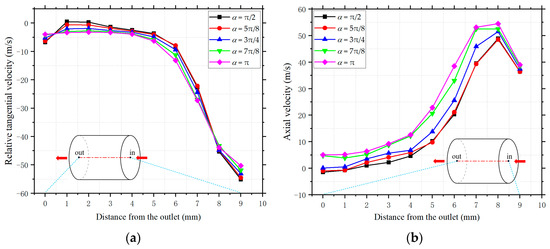
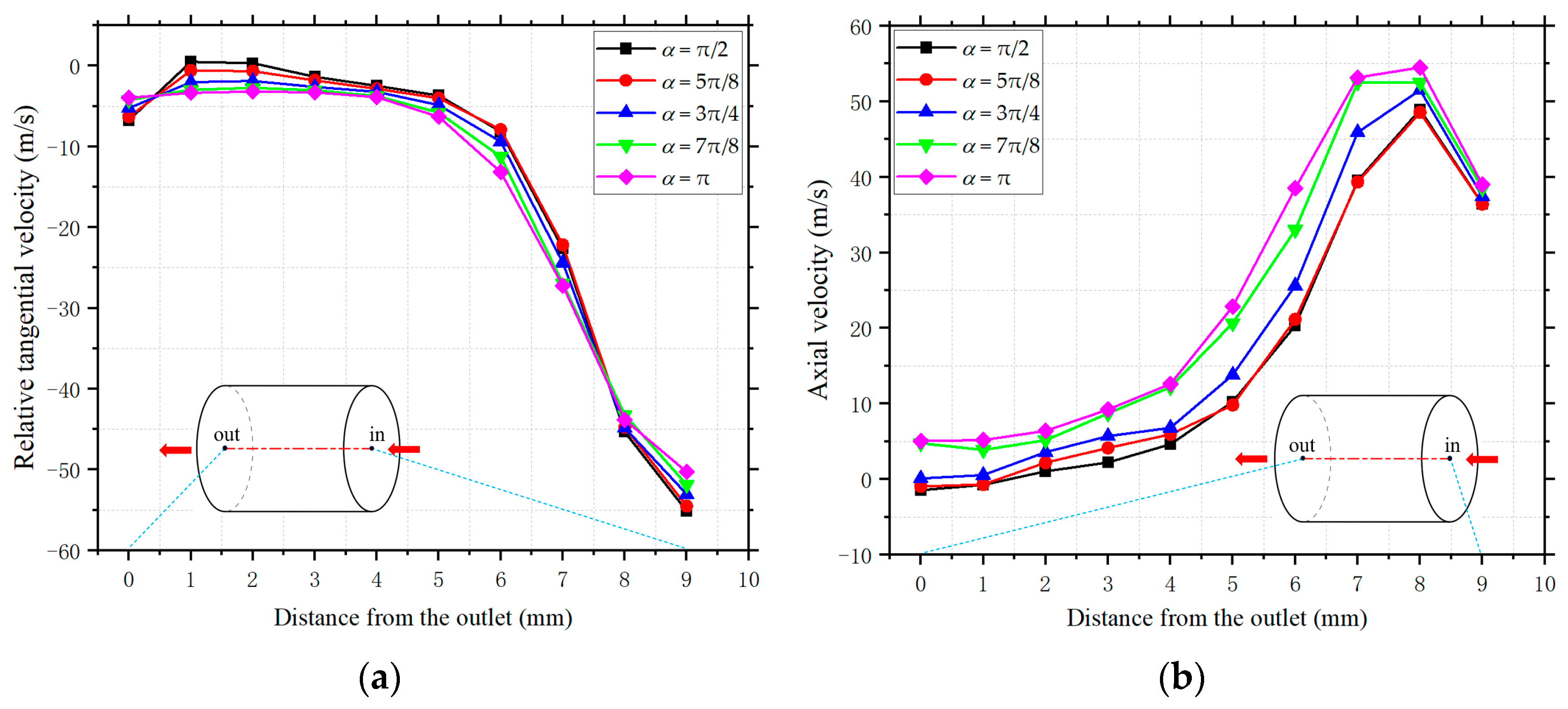
According to the incidence angle calculation Formula (2), the i is influenced by the relative tangential velocity and the orifice axial velocity . Therefore, the impact of α variation on the Cd of the rotating orifices is analyzed quantitatively through these two velocity components. The variations in relative velocity and the orifice axial velocity for different α are shown in Figure 15. In the figure, the horizontal and vertical axes represent the distance from the outlet and the velocity magnitude, respectively, while different symbols correspond to different α.
Figure 15.
Relative velocity and axial velocity along the axis of rotating orifices with different α. (a) Relative tangential velocity along the orifice axis; (b) axial velocity along the orifice axis.
In Figure 15a, a negative value of the relative tangential velocity indicates that its direction is opposite to the local tangential velocity direction, meaning the tangential velocity of the air is lower than the local tangential velocity. Therefore, in the subsequent analysis of the magnitude variation in the relative tangential velocity, the negative sign is disregarded and is only considered when assessing the direction of the relative velocity. As can be observed from the figure, as the α increases, the relative tangential velocity at the orifice inlet (located 9 mm from the outlet) decreases. This corresponds to a reduction in the numerator of the i computational formula (2). As the air flows inward through the orifice, guided by the orifice wall, the relative tangential velocity gradually decreases. Before reaching the outlet, because the orifice axis lies within the recirculation zone, the relative tangential velocity along the axis of orifices with smaller α approaches zero due to the influence of this zone. When the air reaches the outlet, the relative tangential velocity along the axis increases from 0.49 m/s to 6.74 m/s for the orifice with α = π/2, and from 3.35 m/s to 3.95 m/s for the orifice with α = π. At this point, a larger α results in a smaller relative tangential velocity, which leads to a decrease in the airflow deflection at the outlet as the α increases.
Figure 15b shows the variation in the axial velocity inside the rotating orifice for different α. It can be observed that, across all inclination angles, the axial velocity along the orifice axis exhibits a similar trend—first increasing and then decreasing as the air flows through. Upon entering the orifice, the axial velocity increases due to the reduction in flow area. As the air moves further inward, the region along the orifice axis gradually becomes covered by internal flow separation, leading to a decrease in velocity. At the same axial position, a larger α corresponds to a higher axial velocity. At the outlet, the axial velocity for α = π/2 becomes negative, indicating that the airflow along the axis is opposite to the main flow direction, meaning that the orifice axis lies entirely within the flow separation region. In contrast, when the α increases to α = π, the axial velocity rises from −1.47 m/s to 5.04 m/s, indicating that the orifice is not entirely engulfed by flow separation. This demonstrates that increasing the α suppresses flow separation and enhances the axial velocity within the rotating orifice.
Therefore, in Figure 15a, both the relative tangential velocity at the orifice inlet and outlet are decreased with increasing α, while in Figure 15b, the axial velocity is increased with larger α. Consequently, the Cd of the rotating orifice is increased with increasing α.
3.1.1. Coupled Influence of Rotational Speed and Wall Inclination Angle
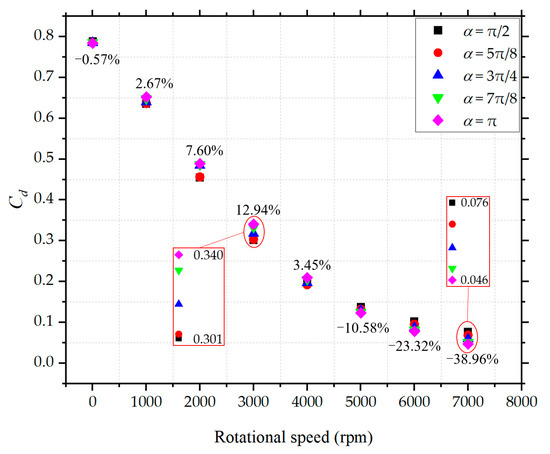
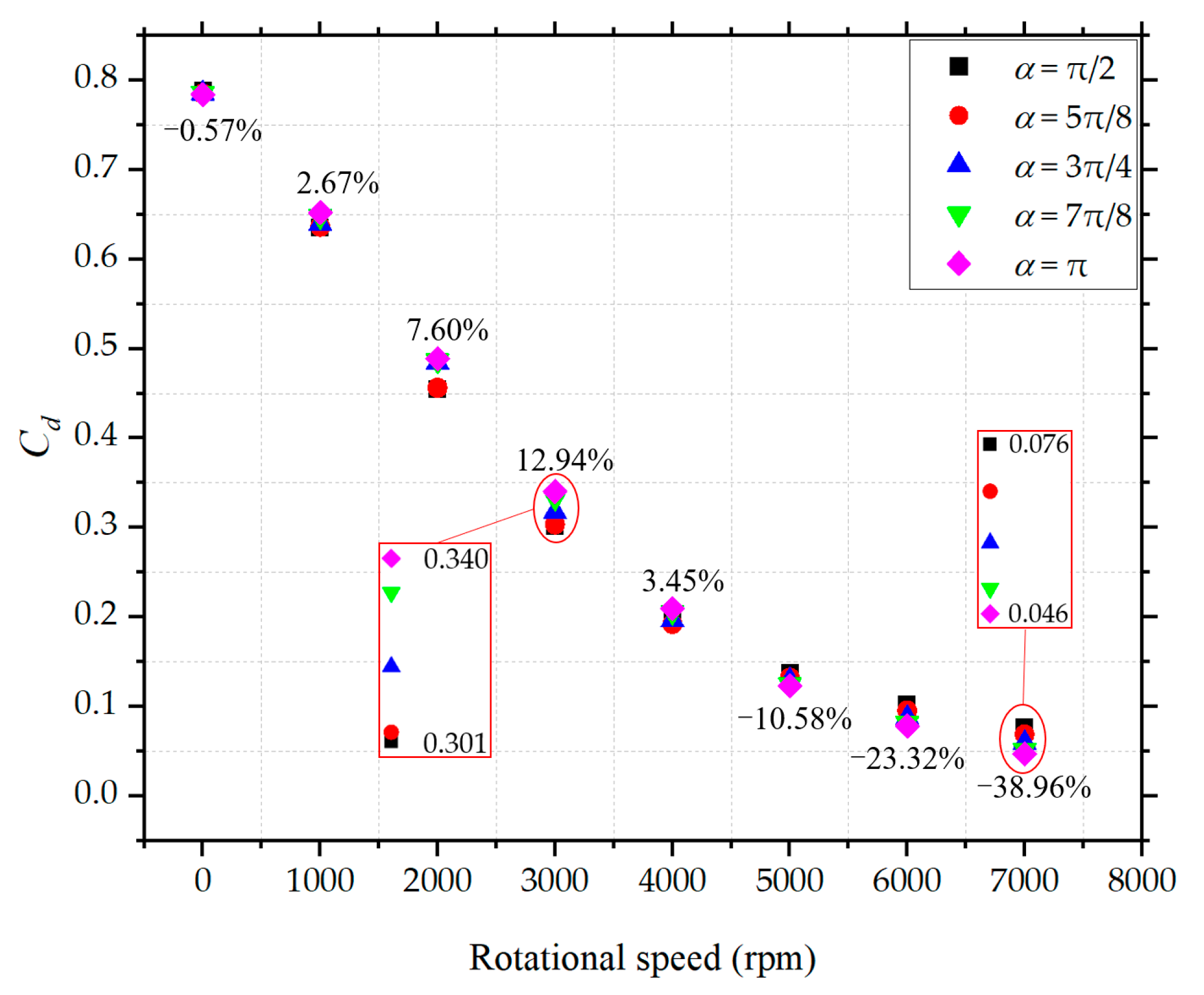
The variation in the Cd with N under different α is shown in Figure 16. In the figure, different symbols represent the Cd for orifices with different α. The horizontal and vertical axes denote the N and Cd, respectively. The percentage values in the figure represent the ratio of the difference between the Cd of the orifices with α = π/2 and π to the Cd of the α = π/2 orifice at the corresponding rotational speed. A negative sign indicates that the Cd for the α = π orifice is lower than that for the α = π/2 orifice. Regions corresponding to the maximum and minimum percentage values are magnified in the figure, with the specific Cd values annotated beside these extrema.
Figure 16.
Variation in the Cd with N under different α (Π = 1.01).
It can be observed from the figure that the variation trend of the Cd with N is consistent across all α—the Cd decreases as N increases. At any given N, the Cd for orifices with different inclination angles consistently fall between the values for the α = π/2 and π orifices. Thus, the maximum and minimum Cd among the different inclination angles is determined by those of the α = π/2 and π orifices.
When N is less than or equal to 4000 rpm, the Cd at a given N increases with larger α. For N < 3000 rpm, the magnitude of this increase gradually grows as N rises. At 3000 rpm, this incremental increase reaches its maximum. For N > 3000 rpm, the magnitude of the incremental increase with α begins to diminish.
When N > 4000 rpm, the trend reverses: at a given N, the Cd is decreased with larger α. As N increases further, the magnitude of this decrease is progressively grown. At 7000 rpm, this decrement reaches its maximum; in this case, the Cd is dropped from 0.076 to 0.046, representing a reduction of 38.96%.
As can be seen from Figure 16, the Cd of rotating orifices at different α follow a sequential order—either increasing or decreasing with the angle—and the boundary values are consistently defined by the Cd of orifices with α = π/2 and π. Therefore, the following analysis will quantitatively illustrate the influence of N on the Cd of rotating orifices by comparing these two limiting cases: the α = π/2 orifice and the α = π orifice.
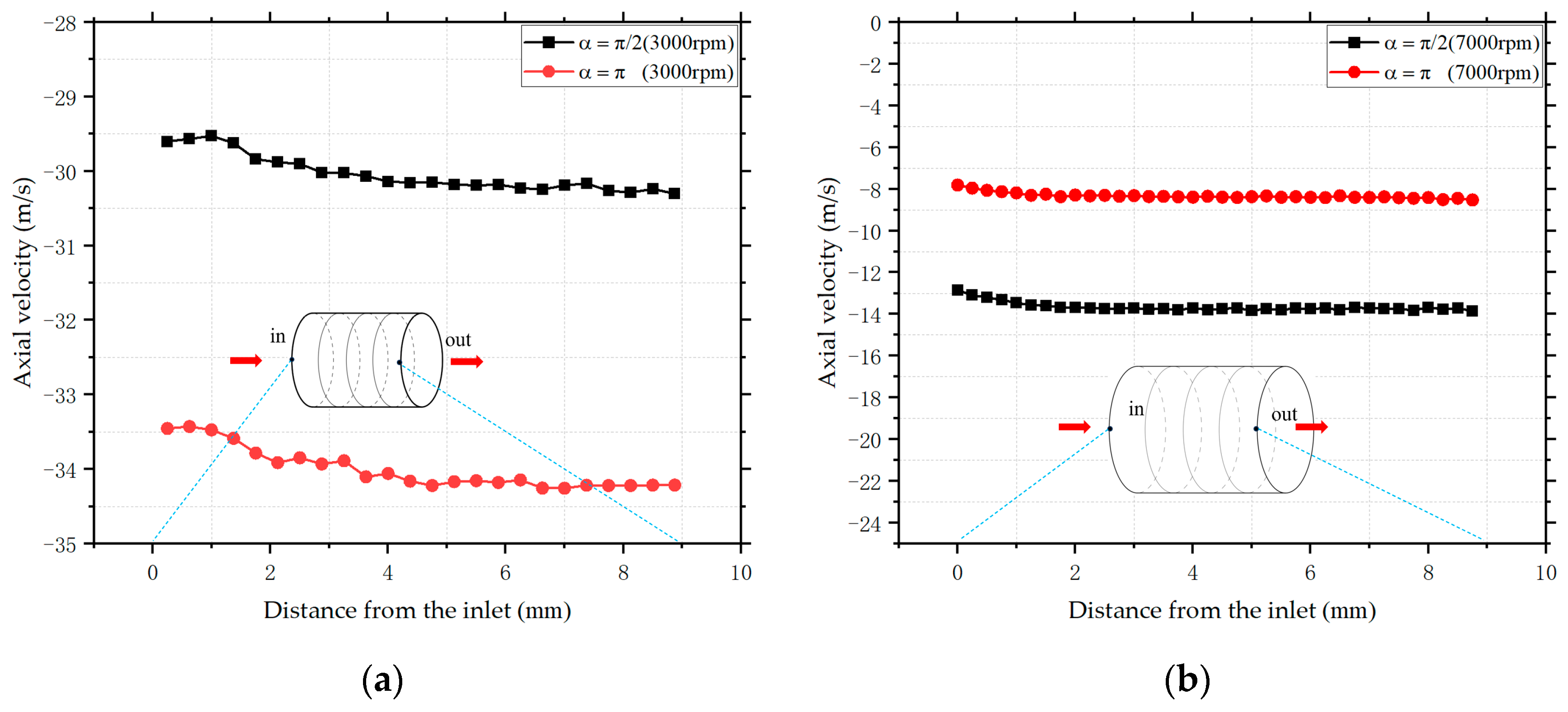
Figure 17a and Figure 17b show the comparative curves of the area-averaged axial velocity from the inlet to the outlet plane along the orifice axis for the rotating orifices with α = π/2 and π (N = 3000 rpm and 7000 rpm), respectively. In the figure, black squares and red circles represent the axial velocities of the orifices with α = π/2 and π, respectively. The horizontal and vertical axes indicate the distance from the orifice inlet and the axial velocity, respectively, with negative values on the vertical axis indicating that the flow direction is opposite to the positive direction of the coordinate system. As shown in Figure 17a, at 3000 rpm, the axial velocity of the α = π/2 orifice (around 30 m/s) is lower than that of the α = π orifice (34 m/s). The specific reasons for this difference have been analyzed in detail in Section 3.1 and are not reiterated here.
Figure 17.
Area-averaged axial velocity for rotating orifices with α = π/2 and π. (a) N = 3000 rpm; (b) N = 7000 rpm.
When N = 7000 rpm, as shown in Figure 17a, in contrast to the 3000 rpm case, the axial velocity inside the orifice with α = π is lower than that inside the orifice with α = π/2. At this high speed, centrifugal force becomes dominant. The inward radial flow of air must overcome this centrifugal force, resulting in increased flow resistance, which in turn reduces the axial velocity in the α = π orifice. Under this condition, the area-averaged axial velocity along the axis of the α = π orifice is approximately 8 m/s, significantly lower than the corresponding value of about 14 m/s for the α = π/2 orifice. This indicates that at high rotational speeds, the influence of the Coriolis force is relatively minor, while centrifugal force plays the dominant role. The flow resistance induced by centrifugal force leads to a pronounced reduction in the axial velocity. Consequently, as shown in Figure 16, when N > 4000 rpm, the Cd of the orifice with α = π/2 becomes greater than that of the orifice with α = π.
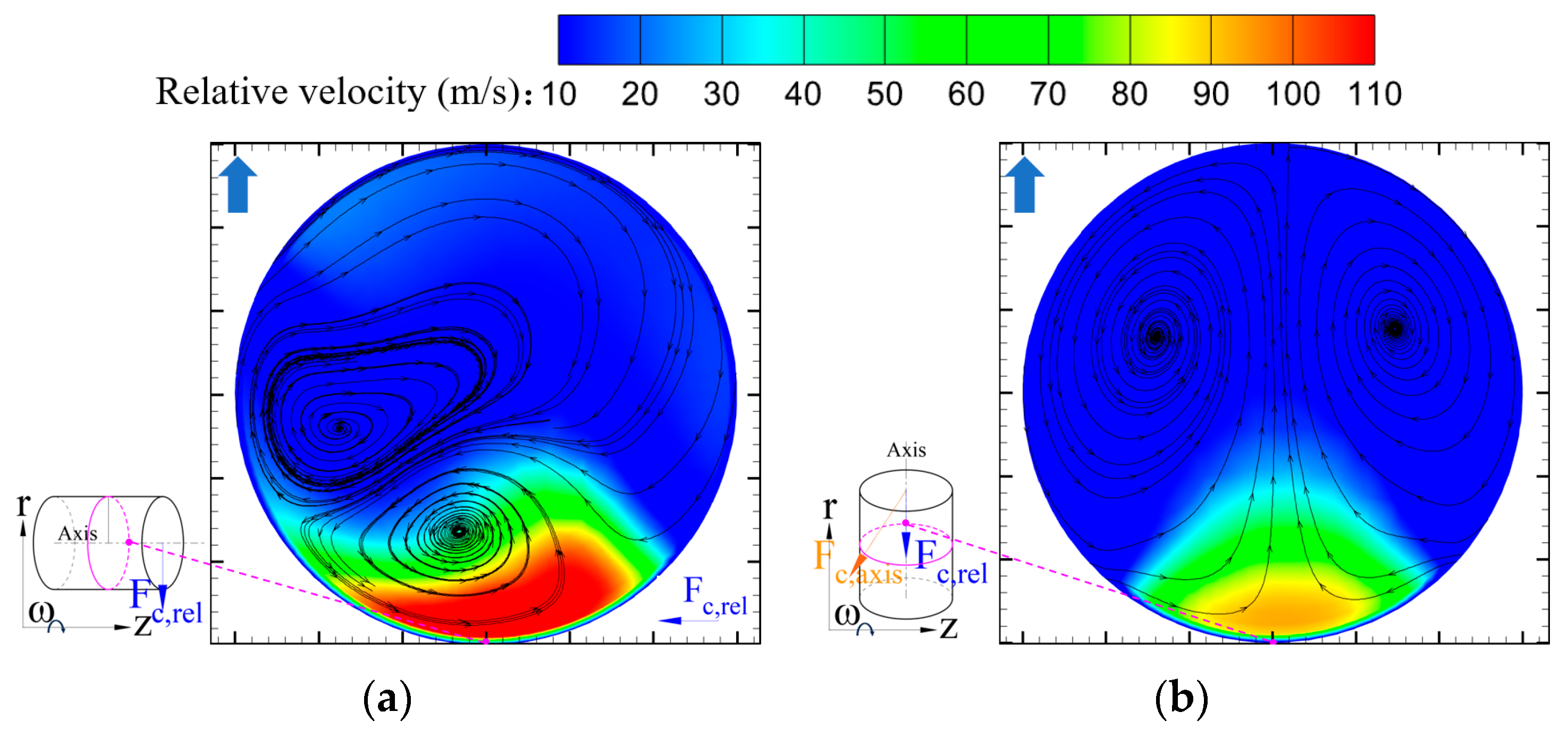
To further elucidate the influence of the Coriolis and centrifugal forces at high rotational speeds, Figure 18 presents the relative velocity contour plots and streamline patterns on Plane-b at the mid-plane of the rotating orifices with α = π/2 and π (N = 7000 rpm). A schematic of the cross-section location is provided in the lower-left corner of each sub-figure, and a thick blue arrow in the upper-left corner indicates the direction of rotation. In Figure 18a, the direction of the Coriolis force acting on the air inside the α = π/2 orifice is illustrated in the lower-left corner. It can be observed that, on this cross-section, the Coriolis force is perpendicular to the tangential velocity direction, causing the streamlines to tilt overall toward the left. Because the axis of the α = π/2 orifice is parallel to the rotation axis, the air flows at a constant radius, and therefore the flow is not influenced by centrifugal force. In contrast, as shown in Figure 18b, the axis of the α = π orifice is aligned with the direction of the centrifugal force, and the airflow opposes this force. Consequently, the air must overcome the centrifugal effect, leading to increased flow resistance. Compared with the α = π/2 orifice, the velocity inside the α = π orifice is significantly reduced, which explains the decrease in the Cd under this operating condition.
Figure 18.
Relative velocity contour and streamlines on Plane-b with α = π/2 and π (Π = 1.03, N = 7000 rpm). (a) α = π/2; (b) α = π.
3.1.2. Coupled Influence of Pressure Ratio and Wall Inclination Angle
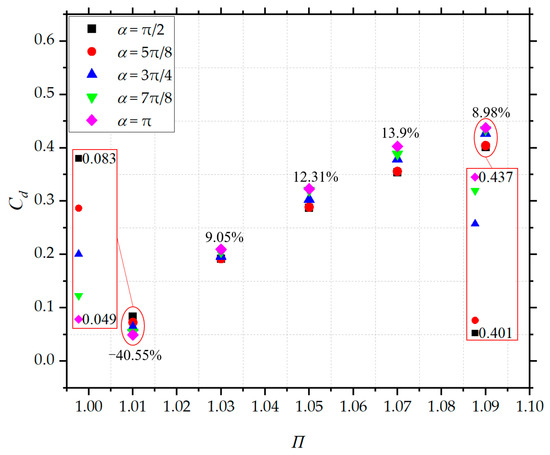
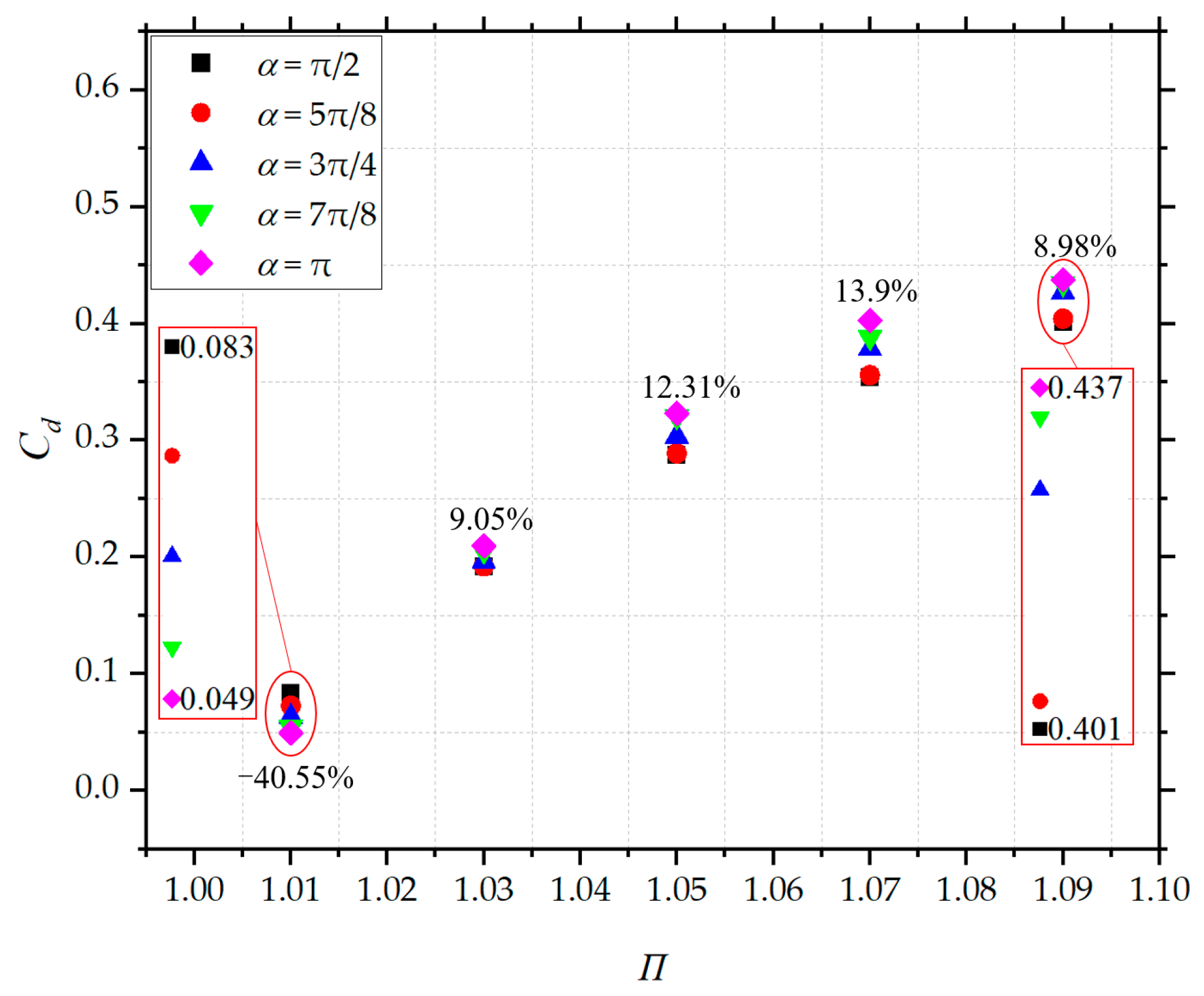
The variation in Cd with Π for rotating orifices under different α is shown in Figure 19. In the figure, different symbols represent the Cd for orifices with different α. The horizontal and vertical axes denote Π and Cd, respectively. It can be observed that the variation trend of Cd with Π is consistent across all α—the Cd is increased as the Π increases. At any given Π, the Cd for orifices with different α all lie between those of the orifices with α = π/2 and π. When Π = 1.01, the Cd is decreased with increasing α. For Π > 1.01, Cd is increased with larger α. As Π rises above this threshold, the magnitude of the increase in the Cd with α is gradually enlarger. When Π > 1.07, this incremental increase with α begins to diminish.
Figure 19.
Variation in the Cd with Π under different α (N = 4000 rpm).
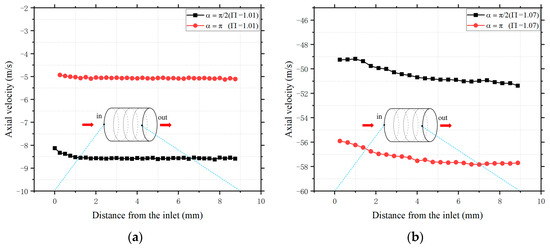
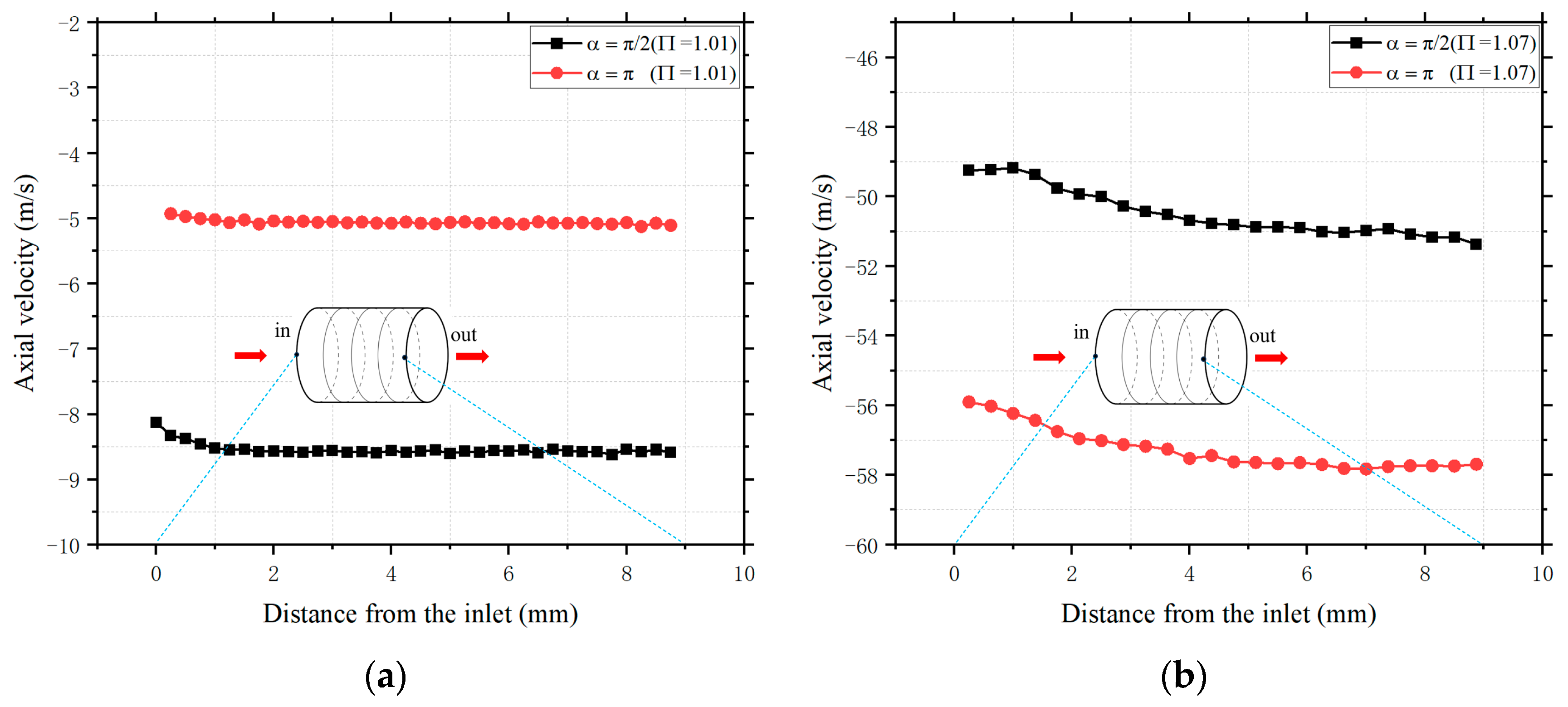
Similar to the influence of α under different N discussed earlier, the Cd for rotating orifices with different α at various Π also follow a sequential order (increasing or decreasing) with the angle. Therefore, two limiting pressure-ratio conditions, Π = 1.01 and 1.07, are used to illustrate the effect of α. Figure 20 shows a comparison of the area-averaged axial velocity between the rotating orifices with α = π/2 and π at of Π = 1.01 and 1.07. In the figure, black squares and red circles represent the Cd of the orifices with α = π/2 and π, respectively. The horizontal and vertical axes indicate the distance from the orifice inlet and the axial velocity, respectively. At Π = 1.01, the axial velocity of the α = π/2 orifice (around 8.5 m/s) is higher than that of the α = π orifice (about 5 m/s). This occurs because, at low Π, the α = π orifice must overcome additional centrifugal resistance for inward radial flow compared to the α = π/2 orifice, resulting in greater flow resistance, a reduced axial velocity, and consequently a lower Cd for the α = π orifice. When Π increases to 1.07, the axial velocity rises above 50 m/s. At this higher velocity, inertial effects diminish the influence of centrifugal force, allowing the Coriolis force to become dominant. As a result, the Cd of α = π orifice exceeds that of α = π/2 orifice.
Figure 20.
Area-averaged axial velocity of rotating orifices at α = π/2 and π (N = 4000 rpm). (a) Π = 1.01; (b) Π = 1.07.
In summary, when N is constant, an increase in Π leads to an increase in the axial velocity of the rotating orifice while the relative tangential velocity remains largely unchanged. Consequently, the i is decreased and the Cd is increased. Simultaneously, as the α increases, the promoting effect of the Coriolis force on the airflow is gradually strengthened. Therefore, under high-pressure-ratio conditions, the Cd is increased with increasing α.
3.2. Coupled Influence of Length-to-Diameter Ratio and Wall Inclination Angle
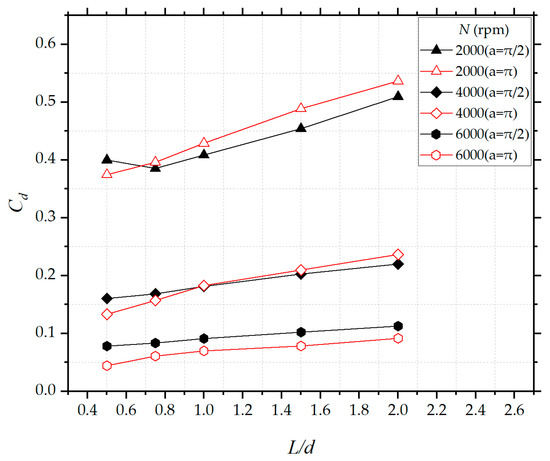
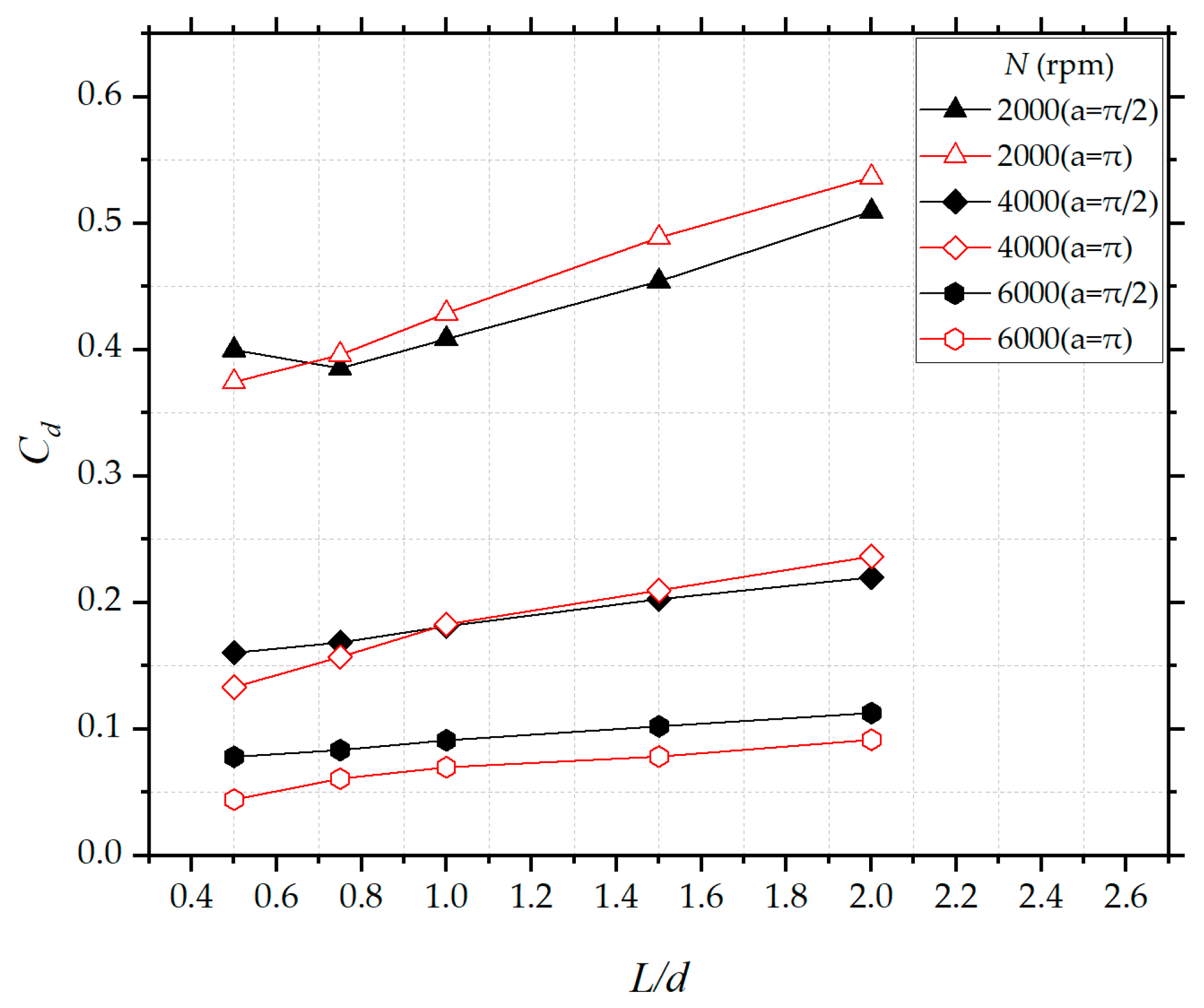
Figure 21 shows the relationship between Cd and L/d for rotating orifices with α = π/2 and π under various rotational speeds. The solid black dots and the hollow red dots represent the Cd of rotating orifices with α = π/2 and π, respectively. Different symbols denote different rotational speed conditions. The horizontal and vertical axes represent L/d and Cd, respectively. As can be seen, under all operating conditions, the variation in the Cd with L/d follows a similar trend—the Cd is increased as L/d increases. This is because a larger L/d promotes the recovery of flow separation inside the orifice, thereby enhancing airflow. At N = 2000 rpm, when L/d increases from 0.5 to 0.75, the Cd of the α = π/2 orifice is slightly decreased. For L/d ≥ 0.75, the Cd of the α = π/2 orifice remains lower than that of the α = π orifice. At 4000 rpm, the slope of increase in the Cd with L/d for the α = π/2 orifice is smaller than that for the α = π orifice; the two curves intersect near L/d = 1. At 6000 rpm, contrary to the trend at 2000 rpm, the Cd of the α= π/2 orifice is consistently higher than that of the α = π orifice across the tested range of L/d.
Figure 21.
Variation in Cd with L/d for rotating orifices with α = π/2 and π under different N (Π = 1.03).
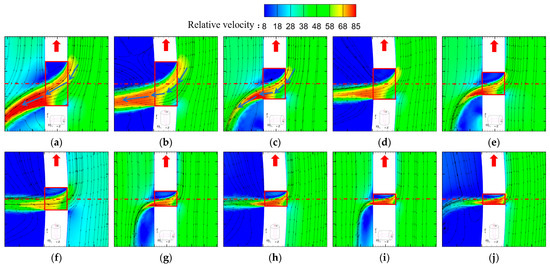
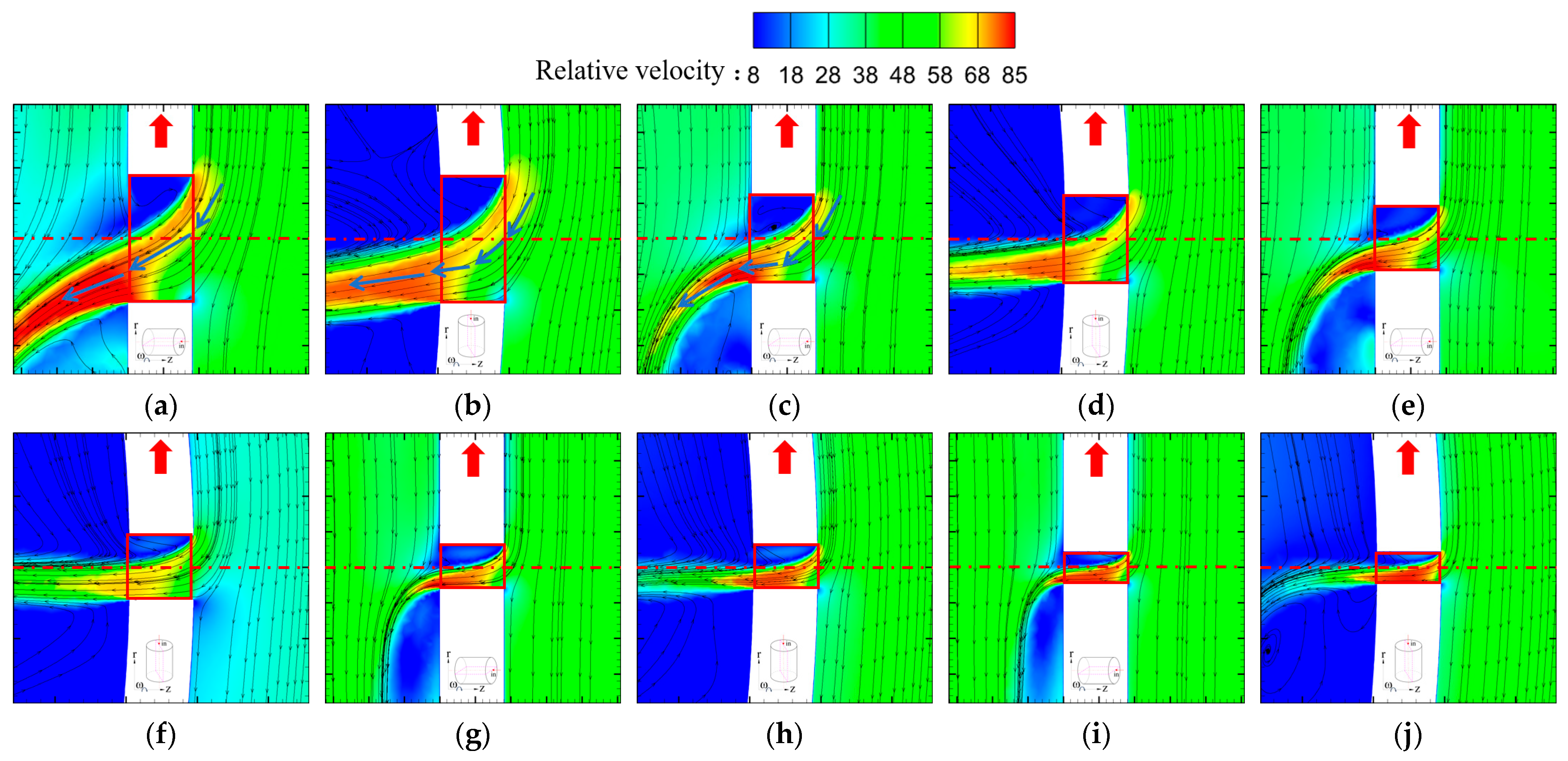
Figure 22 shows the relative velocity contour plots and streamline patterns for the rotating orifices with α = π/2 and π (N = 2000 rpm, Π = 1.03). The left and right sections of Figure 22 correspond to the α = π/2 and π orifices, respectively, each displaying results for L/d = 0.5, 0.75, 1, 1.5, and 2. In the figure, the orifice cross-section is outlined by red boxes, the orifice axis is indicated by the red centerline, and the direction of rotation is denoted by the thick red arrow at the top. The blue arrows in Figure 22a–c indicate the direction of airflow. Regarding the phenomenon observed at 2000 rpm where the Cd of the α = π/2 orifice slightly decreases as L/d increases from 0.5 to 0.75, a comparison between Figure 22a,c reveals the following: at L/d = 0.5, a portion of the air passes through the orifice without significant obstruction from the wall, allowing it to flow relatively smoothly. When L/d increases to 0.75, the extended flow path impedes this previously unobstructed airflow, thereby reducing the effective flow area and leading to a lower Cd. As established earlier, for the α = π orifice, the Coriolis force causes the airflow to deflect in the positive tangential direction. This results in a more pronounced deflection at L/d = 0.5 (compare Figure 22a,b) and a consequently lower Cd. As L/d increases further, the airflow develops more fully within the orifice, flow resistance decreases, and Cd rises.
Figure 22.
Relative velocity contours and streamlines for α = π/2 and π rotating orifices at different L/d (N = 2000 rpm, Π = 1.03). (a) α = π/2, L/d = 0.5; (b) α = π, L/d = 0.5; (c) α = π/2, L/d = 0.75; (d) α = π, L/d = 0.75; (e) α = π/2, L/d = 1; (f) α = π, L/d = 1; (g) α = π/2, L/d = 1.5; (h) α = π, L/d = 1.5; (i) α = π/2, L/d = 2; (j) α = π, L/d = 2. (The red arrows indicate the direction of air inflow. The red centerline represents the position of the orifice’s central axis, and the red rectangle represents the cross-section of the rotating orifice).
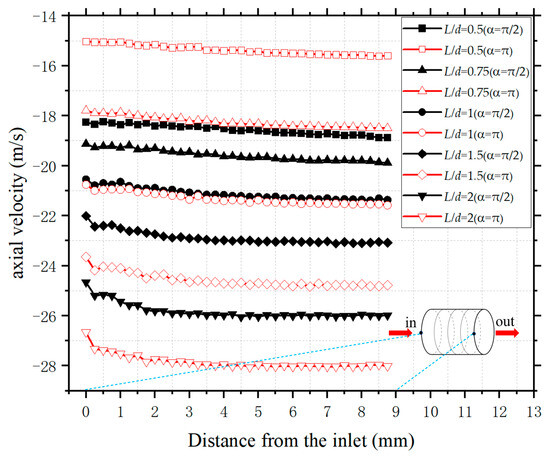
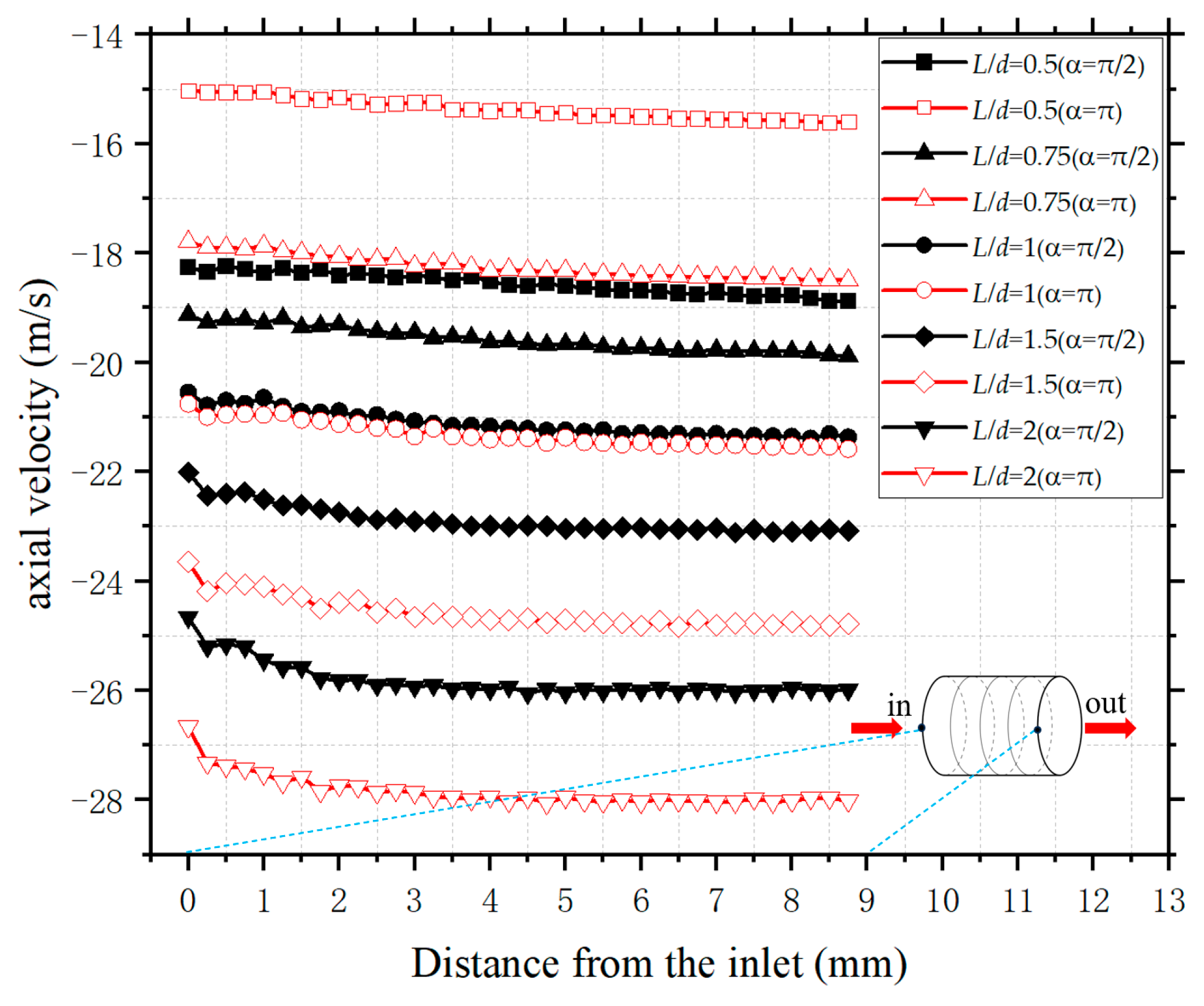
The variation in axial velocity along the orifice axis for the α = π/2 and π orifices at different L/d is shown in Figure 23. In the figure, red boxes and black squares correspond to the α = π/2 and π orifices, respectively, while different symbols represent the axial velocities for different L/d. The horizontal and vertical axes indicate the distance from the orifice inlet and the axial velocity, respectively, with negative values on the vertical axis indicating that the velocity direction is opposite to the positive coordinate direction. It can be observed from the figure that when L/d < 1, the axial velocity of the α = π/2 orifice is significantly higher than that of the α = π orifice. When L/d increases to 1, the axial velocities of the α = π/2 and π orifices become nearly equal. For L/d > 1, the axial velocity of the α = π/2 orifice becomes noticeably lower than that of the α = π orifice. Although the Cd of both orifices increase with increasing L/d, the results above indicate that the increase in axial velocity due to a larger L/d is more pronounced for the α = π orifice. In other words, the promoting effect of an increased L/d on the flow becomes more significant for larger α.
Figure 23.
Variation in axial velocity with L/d for α = π/2 and π (N = 4000 rpm, Π = 1.03).
In summary, increasing L/d amplifies the Coriolis force effect. Under identical aerodynamic conditions, this enhanced Coriolis effect leads to a more pronounced increase in the Cd with growing L/d for orifices with larger α.
3.3. Model Theory and Final Correlation
The incidence angle is a key parameter in calculating the discharge coefficient. The correction factor in Equation (20) is obtained by fitting the numerical results of this study, and its specific expression is given by Equation (33).
The influence of rotation is incorporated through a correction to the i. However, the correction of i proposed by Zhu et al. [28] does not account for the effect of wall inclination. In the present study, this approach is modified by calculating i using Equation (31), which includes the wall inclination effect. This leads to the following corrected expression for Cd of a rotating orifice:
It should be noted that Equations (34) and (35) incorporate corrections for centrifugal and Coriolis forces in the i calculation, and the applicable range of is given by Equation (36):
To account for the differential effects of L/d across α under rotation, the final expression proposed in this study for the Cd of rotating orifices is presented in Equations (37) and (38):
3.4. Experimental Validation of the Prediction Model
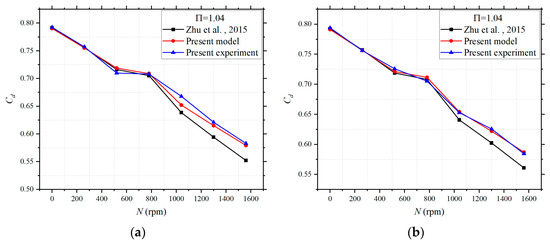
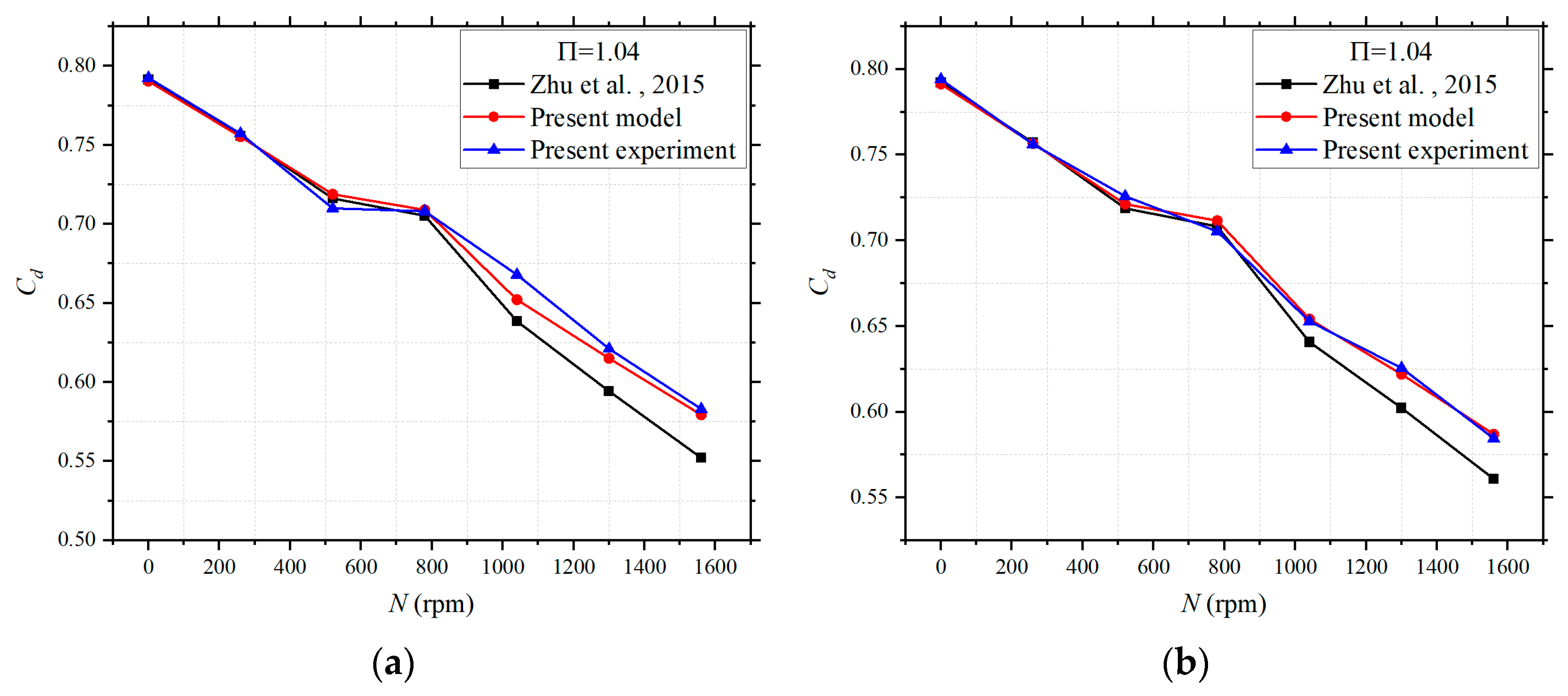
The results indicate that the maximum discrepancies occur primarily at α = π. Therefore, experimental validation of the predictive model was conducted specifically at this inclination angle. Figure 24 compares the experimental data with the prediction model of this study and literature [28]. Figure 24a and Figure 24b show the comparison of Cd variation with N at Π = 1.04 for L/d = 1.67 and 2.0, respectively. After incorporating the effects of the Coriolis and centrifugal forces, the maximum errors for L/d = 1.67 and 2.0 are reduced from 5.3% and 4.05% to 2.37% and 0.88%, respectively.
Figure 24.
Comparison between the model predictions and experimental data at α = π and = 1.04. (a) L/d = 1.67; (b) L/d = 2 [28].
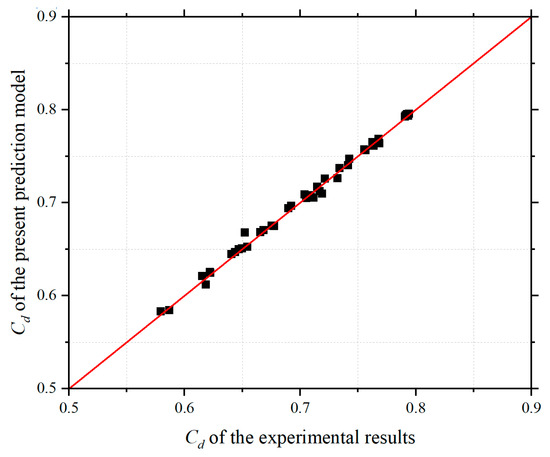
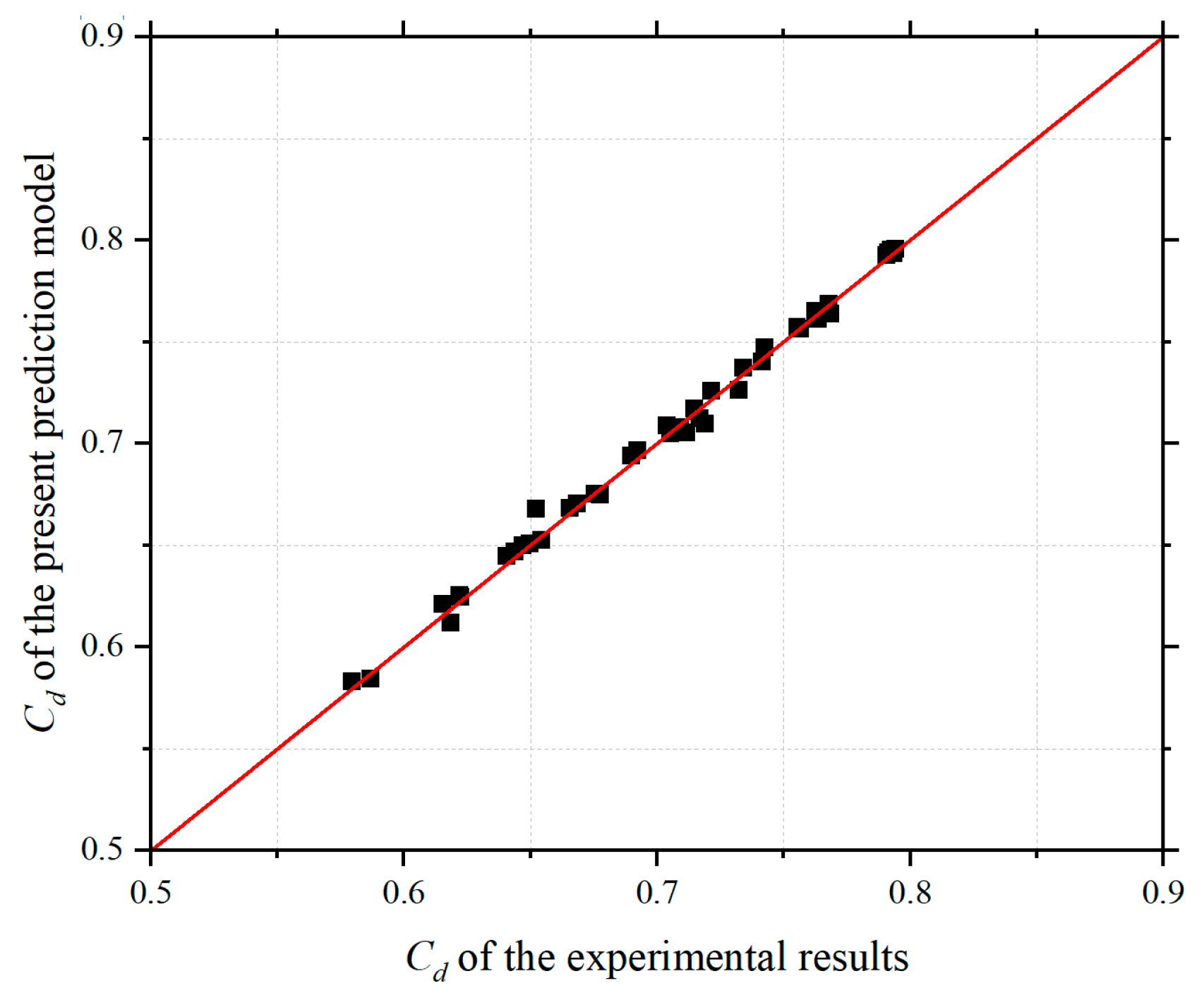
Figure 25 further compares the results of the Cd for the rotating orifice obtained in this study through experiments with those calculated by the corresponding the present prediction model. In the figure, the horizontal axis represents experimental results, while the vertical axis represents the results calculated by the present prediction model. The extent to which the black square data points plotted with these coordinates deviate from the red line with a slope of 1 indicates the magnitude of deviation between predictions and the experimental values. As can be seen from the figure, all data points are distributed near the red line of slope 1, and the error between the calculated values from the present prediction model and the experimental values is controlled within 2.37%. This demonstrates that the proposed prediction model for the Cd of rotating orifices can accurately account for the effects of Coriolis and centrifugal forces induced by changes in the α and possesses high predictive accuracy.
Figure 25.
Comparison of the present model predictions with experimental results.
4. Conclusions
In this study, numerical simulations and experiments are combined to systematically investigate the flow characteristics in rotating orifices with different α and L/d. The effects of Coriolis force and centrifugal force on the Cd are analyzed, and a high-accuracy prediction model is established. The main conclusions are as follows:
- (1)
- Under identical aerodynamic conditions, Cd is found to vary monotonically with increasing α, with its maximum and minimum values bounded by the axial (α = π/2) and radial (α = π) orifices. The underlying mechanism is that the Coriolis force deflects the airflow and changes the incidence angle, while the centrifugal force adds resistance to radial inflow. At typical conditions (N = 3000 rpm, Π = 1.03, L/d = 1.5), Cd is increased from 0.301 to 0.340 as α increases from π/2 to π, representing a 12.96% rise.
- (2)
- At low rotational speeds (N ≤ 4000 rpm), the Coriolis force is found to dominate: by this mechanism, the relative tangential velocity and the incidence angle are reduced, and Cd is increased with α; the largest increment occurs at 3000 rpm. At high rotational speeds (N > 4000 rpm), the centrifugal force becomes dominant: radial inflow must overcome an outward centrifugal force, which significantly reduces the axial velocity and increases the incidence angle, causing Cd to decrease with α; at 7000 rpm, Cd for the α = π orifice is 38.96% lower than that for the α = π/2 orifice. A similar trend is observed with pressure ratio: at low Π, centrifugal resistance prevails, whereas at high Π, inertial effects strengthen and the Coriolis effect becomes more pronounced, leading to higher Cd for larger α.
- (3)
- Increasing L/d allows the flow to develop more fully inside the orifice and promotes reattachment of separated flow, so Cd is increased with L/d. However, the extent of this increase depends on α: a larger L/d amplifies the Coriolis force effect, resulting in a greater Cd enhancement for orifices with larger α. At N = 4000 rpm and Π = 1.03, when L/d increases from 0.5 to 2, the Cd increase for the α = π orifice is significantly larger than that for the α = π/2 orifice, and the two curves cross near L/d = 1. This indicates that a larger L/d amplifies the Coriolis effect and thus alters the ordering of Cd with α.
- (4)
- By incorporating the Coriolis and centrifugal force effects into the relative tangential velocity and the axial velocity, respectively, a method is proposed in this study for calculating the incidence angle of rotating orifices for any α (π/2 ≤ α ≤ π). Based on this, a Cd prediction model is established with the incidence angle as the key parameter, and a further correction for L/d is introduced. Validation against experimental data shows excellent agreement, with a maximum deviation of only 2.37%, which is significantly better than the existing models (maximum deviation 5.3%).
Author Contributions
J.Y. contributed conceptualization, methodology, supervision, writing; S.W. contributed methodology, software, visualization, validation, writing; J.M. contributed conceptualization, methodology, supervision, funding acquisition; Z.Y. contributed conceptualization, supervision, funding acquisition; F.H. and L.W. contributed methodology, software, visualization, validation. All authors have read and agreed to the published version of the manuscript.
Funding
This work was funded by Jiangsu Provincial Natural Science Foundation [grant number BK20230890], the National Natural Science Foundation of China [grant number 52406048], the Foreign Expert Project Foundation [grant number H20240128], the National Natural Science Foundation of China [grant number 52476077], and WDZC Projects of AECC Sichuan Gas Turbine Establishment (WDZC).
Data Availability Statement
The data used to support the findings of this paper are contained in the text, and some of the cited data can be found in the publicly available literature.
Conflicts of Interest
The authors declare no conflicts of interest.
Nomenclature
| A | cross-sectional area |
| d | diameter of the orifice |
| L | length of the orifice |
| Cd | discharge coefficient |
| i | incidence angle |
| mass flow | |
| actual mass flow | |
| ideal mass flow | |
| P | static pressure |
| total pressure | |
| density of the air | |
| rh | rotation radius of orifices |
| r1 | inner rotation radius of orifices |
| r2 | outer rotation radii of orifices |
| Π | pressure ratio |
| angular velocity of the orifices. | |
| CP | specific heat at constant pressure |
| L/d | Length-to-diameter ratio |
| T | static temperature |
| total temperature | |
| rotating temperature | |
| Z | rotating axis |
| α | Wall inclination angle |
| specific heat ratio | |
| velocity | |
| Velocity in the direction of the orifice axis | |
| relative tangential velocity | |
| radial velocity | |
| Coriolis force |
References
- Owen, J.M. Modelling Internal-air Systems in Gas Turbine Engines. J. Aerosp. Power 2007, 22, 505–520. [Google Scholar]
- Young, C.; Snowsill, G.D. CFD Optimization of cooling air offtake passages within rotor cavities. J. Turbomach. 2003, 125, 380–386. [Google Scholar] [CrossRef] [Scilit]
- Gong, W.; Liu, G.; Wang, J.; Wang, F.; Lin, A.; Wang, Z. Aerodynamic and thermodynamic analysis of an aero-engine pre-swirl system based on structure design and performance improvement. Aerosp. Sci. Technol. 2022, 123, 107466. [Google Scholar] [CrossRef] [Scilit]
- Johnson, B.V. Internal Air and Lubrication Systems; Wiley Ltd. & John Wiley and Sons Ltd.: Hoboken, NJ, USA, 2010. [Google Scholar] [CrossRef] [Scilit]
- Kong, X.; Huang, T.; Liu, Y.; Chen, H.; Lu, H. Effects of pre-swirl radius on cooling performance of a rotor-stator pre-swirl system in gas turbine engines. Case Stud. Therm. Eng. 2022, 37, 102250. [Google Scholar] [CrossRef] [Scilit]
- Shen, W.; Wang, S.; Wang, M.; Suo, J.; Zhang, Z. Experimental and Numerical Investigation of a Novel Vortex Reducer in a Co-Rotating Cavity of Aeroengines. Aerospace 2024, 11, 225. [Google Scholar] [CrossRef] [Scilit]
- Binder, C.; Kinell, M.; Utriainen, E.; Eriksson, D.; Bahador, M.; Kneer, J.; Bauer, H. Experimental study on pressure losses in circular orifices for the application in internal cooling systems. J. Turbomach. 2014, 137, 031005. [Google Scholar] [CrossRef] [Scilit]
- Feseker, D.; Kinell, M.; Neef, M. Experimental study on pressure losses in circular orifices with inlet cross flow. J. Turbomach. 2018, 140, 071006. [Google Scholar] [CrossRef] [Scilit]
- Hay, N.; Lampard, D. Discharge Coefficient of Turbine Cooling Holes: A Review. In Proceedings of the ASME 1996 International Gas Turbine and Aeroengine Congress and Exhibition, Birmingham, UK, 10–13 June 1996. V004T09A056. [Google Scholar] [CrossRef] [Scilit]
- Mcgreehan, W.F.; Schotsch, M.J. Flow Characteristics of Long Orifices with Rotation and Corner Radiusing. ASME J. Turbomach. 1988, 110, 213–217. [Google Scholar] [CrossRef] [Scilit]
- Lichtarowicz, A.; Duggins, R.K.; Markland, E. Discharge Coefficients for Incompressible Non-Cavitating Flow Through Long Orifices. J. Mech. Eng. Sci. 2006, 7, 210–219. [Google Scholar] [CrossRef] [Scilit]
- Hay, N.; Khaldi, A.; Lampard, D. The Coefficient of Discharge of 30 Inclined Film Cooling Holes with Rounded Entries or Exits. In Proceedings of the ASME 1994 International Gas Turbine and Aeroengine Congress and Exposition, The Hague, The Netherlands, 13–16 June 1994. V004T09A030. [Google Scholar] [CrossRef] [Scilit]
- Gritsch, M.; Schulz, A.; Wittig, S. Effect of Crossflows on the Discharge Coefficient of Film Cooling Holes with Varying Angles of Inclination and Orientation. J. Turbomach. 2001, 123, 781–787. [Google Scholar] [CrossRef] [Scilit]
- Hay, N.; Spencer, A. Discharge Coefficients of Cooling Holes with Radiused and Chamfered Inlets. In Proceedings of the ASME 1991 International Gas Turbine and Aeroengine Congress and Exposition, Orlando, FL, USA, 3–6 June 1991. V004T09A019. [Google Scholar] [CrossRef] [Scilit]
- Idelchik, I.E. Handbook of Hydraulic Resistance; 4th Edition Revised and Augmented; Begell House, Inc.: Danbury, CT, USA, 2008. [Google Scholar] [CrossRef] [Scilit]
- Maeng, D.J.; Lee, J.S.; Jakoby, R.; Kim, S.; Wittig, S. Characteristics of Discharge Coefficient in a Rotating Disk System. ASME J. Eng. Gas Turbines Power 1999, 121, 663–669. [Google Scholar] [CrossRef] [Scilit]
- Zimmermann, H.; Kutz, J.; Fischer, R. Air System Correlations: Part 2—Rotating Holes and Two Phase Flow. In Proceedings of the ASME 1998 International Gas Turbine and Aeroengine Congress and Exhibition, Stockholm, Sweden, 2–5 June 1998. V004T09A049. [Google Scholar] [CrossRef] [Scilit]
- Meyfarth, P.F.; Shine, A.J. Experimental Study of Flow Through Moving Orifices. ASME J. Basic Eng. 1965, 87, 1082–1083. [Google Scholar] [CrossRef] [Scilit]
- Dittmann, M.; Dullenkopf, K.; Wittig, S. Discharge Coefficients of Rotating Short Orifices with Radiused and Chamfered Inlets. ASME J. Eng. Gas Turbines Power 2004, 126, 803–808. [Google Scholar] [CrossRef] [Scilit]
- Sousek, J.; Pfitzner, M.; Niehuis, R. Experimental Study of Discharge Coefficients for Radial Orifices in High-Speed Rotating Shafts. In Proceedings of the ASME Turbo Expo 2010: Power for Land, Sea, and Air, Glasgow, UK, 14–18 June 2010; Volume 4, pp. 1051–1060. [Google Scholar] [CrossRef] [Scilit]
- Wittig, S.; Kim, S.; Jakoby, R.; Weibert, I. Experimental and Numerical Study of Orifice Discharge Coefficients in High-Speed Rotating Disks. ASME J. Turbomach. 1996, 118, 400–407. [Google Scholar] [CrossRef] [Scilit]
- Idris, A.; Pullen, K.R.; Read, R. The Influence of Incidence Angle on the Discharge Coefficient for Rotating Radial Orifices. Turbo Expo. Power Land Sea Air 2004, 41693, 307–320. [Google Scholar] [CrossRef] [Scilit]
- Wang, J.; Liu, P.; Qiu, T.; Ding, S. An Investigation into the Flow of Rotating Orifices with Euler Angle and the Calculation Model of Discharge Coefficient Considering the Effect of Comprehensive Incidence Angle. Aerospace 2022, 9, 179. [Google Scholar] [CrossRef] [Scilit]
- Sousek, J.; Riedmueller, D.; Pfitzner, M. Experimental and numerical investigation of the flow field at radial holes in high-speed rotating shafts. J. Turbomach. 2014, 136, 85–97. [Google Scholar] [CrossRef] [Scilit]
- Alexiou, A.; Hills, N.J.; Long, C.A.; Turner, A.B.; Wong, L.S.; Millward, J.A. A Discharge Coefficients for Flow Through Holes Normal to a Rotating Shaft. Int. J. Heat Fluid Flow. 2000, 21, 701–709. [Google Scholar] [CrossRef] [Scilit]
- Idris, A.; Pullen, K.R. Correlations for the Discharge Coefficient of Rotating Orifices Based on the Incidence Angle. Proc. Inst. Mech. Eng. Part A J. Power Energy 2005, 219, 333–352. [Google Scholar] [CrossRef] [Scilit]
- Huning, M. Comparison of Discharge Coefficient Measurements and Correlations for Orifices with Cross-Flow and Rotation. J. Turbomach. 2010, 132, 10–17. [Google Scholar] [CrossRef] [Scilit]
- Zhu, P.; Liu, Z.; Lv, Y. Computational Model of Rotating Orifice Considering Incidence Angle. J. Propuls. Technol. 2015, 36, 1215–1221. Available online: https://link.cnki.net/doi/10.13675/j.cnki.tjjs.2015.08.014 (accessed on 16 May 2025).
- Yan, J.; Mao, J.; Wei, S.; Sun, Z.; Tian, R. An Investigation on the Discharge Coefficient of Compound Orifices in Rotating Disks. J. Eng. Gas. Turbines Power 2022, 144, 041007. [Google Scholar] [CrossRef] [Scilit]
- Kline, S.J.; McClintock, F.A. Describing Uncertainties in Single-Sample Experiments. Mech. Eng. 1953, 75, 3–8. [Google Scholar]
- Zhang, C.; Hassan, I. Rotational Effects on Film Cooling Performance: Simulation of a Louver Cooling Scheme on a Rotating Turbine Blade. Int. J. Numer. Methods Heat Fluid Flow 2012, 22, 622–640. [Google Scholar] [CrossRef] [Scilit]
- Song, W. The Flow Characteristics of Radial Bleed Element Under Rotating Conditions and The Pressure Drop Reduction Mechanism of a Hybrid Vortex Reducer System; Nanjing University of Aeronautics and Astronautics: Nanjing, China, 2022; Available online: https://link.cnki.net/doi/10.27239/d.cnki.gnhhu.2022.002714 (accessed on 16 May 2025).
- Ranran, T.; Junkui, M.; Jun, F.; Song, W.; Longfei, W.; Zecan, T. Numerical Calculation of Flow Characteristics of Hybrid Vortex Reducer. J. Aerosp. Power 2019, 34, 1677–1687. Available online: https://link.cnki.net/doi/10.13224/j.cnki.jasp.2019.08.006 (accessed on 12 August 2019).
- Firouzian, M.; Owen, J.M.; Pincombe, J.R.; Rogers, R.H. Flow and Heat Transfer in a Rotating Cylindrical Cavity with a Radial Inflow of Fluid: Part 2: Velocity, Pressure and Heat Transfer Measurements. Int. J. Heat Fluid Flow. 1986, 7, 21–27. [Google Scholar] [CrossRef] [Scilit]
- Kaya, M.N.; Satcunanathan, S.; Meinke, M.; Schroder, W. Leading-Edge Noise Mitigation on a Rod-Airfoil Configuration Using Regular and Irregular Leading-Edge Serrations. Appl. Sci. 2025, 15, 7822. [Google Scholar] [CrossRef] [Scilit]
- Fluent, Inc. Ansys Fluent 14 User’ s Guide; Fluent, Inc.: New York, NY, USA, 2011. [Google Scholar]
- Miller, R.W. Flow Measurement Engineering Handbook; McGraw-Hill: New York, NY, USA, 1996. [Google Scholar]

Disclaimer/Publisher’s Note: The statements, opinions and data contained in all publications are solely those of the individual author(s) and contributor(s) and not of MDPI and/or the editor(s). MDPI and/or the editor(s) disclaim responsibility for any injury to people or property resulting from any ideas, methods, instructions or products referred to in the content. |
© 2026 by the authors. Licensee MDPI, Basel, Switzerland. This article is an open access article distributed under the terms and conditions of the Creative Commons Attribution (CC BY) license.