Article

Landing Tail-Strike Risk Pattern Identification and Prediction Based on Functional QAR Data

1
School of Statistics, East China Normal University, Shanghai 200062, China
2
Aviation Safety Institute, China Academy of Civil Aviation Science and Technology, Beijing 100028, China
*
Authors to whom correspondence should be addressed.
Aerospace 2026, 13(6), 553; https://doi.org/10.3390/aerospace13060553 (registering DOI)
Submission received: 20 May 2026 / Revised: 11 June 2026 / Accepted: 12 June 2026 / Published: 15 June 2026
(This article belongs to the Section Air Traffic and Transportation)

Abstract

Tail striking is a typical safety event in the area of civil aviation, which is directly related to the aircraft pitch angle at landing. Based on 2933 A319 flights’ non-exceedance quick access recorder (QAR) data from Dali airport, the relationship between key flight parameters during the final approach and landing pitch angle is explored. Functional data analysis and the Group Lasso method are used to select the most important flight parameters, and cluster analysis and weighted logistic regression are used to identify and predict a “high-risk” flight pattern. Here, “high risk” refers to a flight pattern associated with a higher probability of large landing pitch attitude, which is used as a proxy indicator of potential tail-strike risk rather than as evidence of an actual tail-strike event. Finally, flight operation recommendations are provided. The research results indicate that the airspeed, pitch angle and engine speed are most closely related to the landing pitch angle. An unusually high-risk flight pattern is identified, characterized by “high airspeed, high attitude, low thrust” caused by improper energy management of light-load flights. About 32.4% of flights in this pattern land with “large landing attitude”, which means the landing pitch angle is larger than the 95% sample percentile. A prediction model for the high-risk pattern is established using QAR parameters at the heights of 500 ft, 450 ft, and 400 ft, with an accuracy rate of 99.7% on the test data. The prediction in advance at 400 ft can provide pilots with sufficient time to take necessary operations.

1. Introduction

Tail strike is a typical civil aviation safety event during takeoff and landing. In addition to causing considerable economic losses, hidden damage to the aircraft structure may become a major hazard to flight safety. The safety report of the International Air Transport Association (IATA) shows that tail-strike accidents accounted for 15% of accidents from 2019 to 2024, ranking third among all accident categories after runway excursion and landing-gear accidents [1]. According to Airbus statistics, more than 65% of tail strikes occur during landing, while only 25% occur during takeoff [2]. Therefore, research on tail-strike events during aircraft landing is of great significance. During the aircraft landing phase, the main cause of tail strike is that the aircraft attitude is larger than the normal landing attitude, that is, the pitch angle exceeds the limit. In general, the larger the pitch angle at landing, the higher the possibility of tail strike. Using Quick Access Recorder (QAR) data to explore the relationship between key flight parameters during the final approach and the landing pitch angle can provide an important reference for preventing tail-strike events.
Existing studies on tail-strike events mainly focus on two aspects: accident-cause analysis and risk assessment or prediction. Guo and Chen [3], Mao [4], and Zhang and Yu [5] mainly studied the causes of tail-strike events of civil aircraft from the perspective of civil aviation domain knowledge or pilot experience and proposed corresponding risk prevention and control recommendations. Yang [6] summarized four categories of causes, namely, pilot operational error, weather factors, equipment failures, and management factors, and pointed out that pilot operational error is the most important factor. Wang et al. [7] established a risk-index system for tail-strike events based on exceedance events, used the analytic hierarchy process to determine index weights, and built a risk assessment model for aircraft tail-strike events during takeoff. Some researchers have studied the distribution characteristics of the pitch angle. Sun and Yang [8] verified the normality of the lift-off pitch angle during takeoff and calculated the probability of tail-strike events for different fleets according to the distribution. Wang et al. [9] also focused on the distribution of takeoff pitch angles and used a t-test to verify significant differences between the takeoff pitch angles of a certain airline and those of the industry, indicating that this airline indeed had a hidden tail-strike risk. Wang and Yang [10] used a Monte Carlo method to simulate the distribution of landing pitch angles and tail-strike risk prediction curves for different fleets, which partly solved the problem of insufficient real tail-strike event samples. In addition, Yang and Wang [11] focused on pilot operational characteristics in the flare phase and, based on a pilot model, established a human-factor operational analysis model for civil aircraft tail-strike events. They analyzed the phase difference between the control column and pitch angle in the frequency domain and the influence of pilot-model parameter changes on the landing pitch angle. Chen et al. [12] used QAR data, including airport parameters, environmental parameters, basic aircraft parameters, and flight parameters, and established a multiple regression model based on stepwise regression, concluding that tail-strike events during takeoff can be avoided by controlling pitch attitude and airspeed. Other studies have used various machine learning and deep learning algorithms to establish prediction models for the number of tail-strike events and the landing pitch angle. Wang et al. [13] established a prediction model for the occurrence frequency of tail-strike events in Chinese civil aviation based on time series. Chen et al. [14] selected 22 parameters according to domain knowledge, used Lagrange interpolation to unify the sampling frequency, took the time span from 10 s to 2 s before touchdown as the input of a long short-term memory (LSTM) model, and predicted the maximum pitch angle within 1 s before and after touchdown. Compared with traditional machine learning algorithms, the model showed better performance. Lu and Song [15] used non-exceedance QAR data, calculated importance scores for different features using out-of-bag data, extracted the optimal feature combination accordingly, and used a random forest model to predict the pitch angle at the landing instant of 7 s in advance. Du et al. [16] used ensemble methods to predict the pitch angle at the landing instant of 5 s in advance. These studies all indicate the important value of non-exceedance QAR data for tail-strike event research.
However, existing studies still have several limitations. First, studies on event causes are limited by the small number of real tail-strike event samples. Some studies use methods such as oversampling to deal with imbalanced datasets, but these approaches have certain limitations. Second, there is a lack of identification of high-risk flight patterns. Understanding the causes of individual accident cases and numerically predicting the risk level alone cannot determine the safety boundaries of key QAR parameters that affect tail-strike risk. Third, existing studies cannot provide early warning at a certain altitude before landing. Some studies predict the landing pitch angle several seconds before touchdown. However, because the number of seconds before touchdown cannot be known in advance during landing, prediction models based on the time dimension are difficult to implement in practice.
Therefore, this paper uses non-exceedance QAR data from the landing phase to address the insufficient number of real tail-strike event samples. Functional data analysis, Group Lasso, and clustering analysis are used to identify key QAR parameters and high-risk flight patterns and to determine safety boundaries. Note that “high-risk” refers to a flight pattern associated with a higher probability of large landing pitch attitude, which is used as a proxy indicator of potential tail-strike risk rather than as evidence of an actual tail-strike event. A height-based early prediction model is then established through weighted logistic regression, and operational recommendations are proposed.

2. Data Description and Preprocessing

Tail strike is a complex event involving many explicit and implicit factors. Based on non-exceedance QAR data, this paper analyzes factors that affect the landing pitch attitude, aiming to identify critical factors that may lead to tail-strike events and to fully explore the research value of non-exceedance QAR data for this safety event. Because different aircraft types have different fuselage lengths and tail-strike angles, studying a single aircraft type can effectively avoid data bias caused by aircraft-type differences. Therefore, the common A319 aircraft type is used for the analysis. The data used in this paper come from Dali Airport and include 2933 flights from June 2019 to July 2020.
According to previous studies, 16 QAR parameters related to landing pitch angle are initially selected, including radio altitude, airspeed, pitch angle, descent rate, and engine speed. The specific parameter list and basic information are shown in Table 1. The radio altitude RALT_AVE is the average value of the left and right radio altimeters. Engine speed N1 is calculated as the mean of engine speeds N11 and N12 for engines 1 and 2 and reflects the operating state and thrust output of the engines. The throttle lever angle (TLA) is obtained by averaging throttle lever positions 1 and 2. Pitch control PITCH_CPT_FO and roll control ROLL_CPT_FO are obtained by adding the pitch-control and roll-control values of the captain and first officer, respectively.
The original QAR data contain the entire flight operation process. In this paper, only data below 500 ft in the landing phase are considered. In the original data, some QAR parameters may contain incomplete information because of decoding errors, sensor-sampling errors, and other reasons. To ensure data quality, missing values are completed using linear interpolation. Finally, the QAR data originally aligned by time are aligned by altitude, in preparation for subsequent analysis of QAR parameters in key flight altitude segments or at key altitude points. As shown in Table 1, different QAR parameters have different sampling frequencies. The sampling frequency of radio altitude is 4 Hz, and the other QAR parameters include four sampling frequencies: 1 Hz, 2 Hz, 4 Hz, and 8 Hz. For the pitch angle, which has the same sampling frequency of 4 Hz as radio altitude, the corresponding pitch angle at a specific altitude point can be directly obtained by linear interpolation using the ‘approx’ function in R. For QAR parameters with sampling frequencies of 1 Hz, 2 Hz, and 8 Hz, before applying linear interpolation, the radio-altitude data are first converted to the same sampling frequency to ensure parameter alignment. Specifically, for QAR parameters with sampling frequencies of 1 Hz and 2 Hz, the average of four or two adjacent altitude values is taken. For QAR parameters with a sampling frequency of 8 Hz, linear interpolation is used to generate a new altitude value between two data points.
In this paper, the “landing pitch angle” is defined as the maximum pitch angle from the touchdown instant to 2 s after touchdown during the landing phase. The touchdown instant is defined as the moment when either the left or right landing gear changes from AIR to GROUND. The tail-strike angle limit for the A319 when the main landing gear is fully compressed is 13.9 deg [17]. No real exceedance flight exists in the sample. For subsequent analysis, the 95th percentile of the landing pitch angle among all sample flights, namely, 7 deg, is used as the dividing threshold. Flights with a landing pitch angle greater than or equal to 7 deg are called “large-landing-attitude” flights, and flights with a landing pitch angle of less than 7 deg are called “small-landing-attitude” flights. Among all 2933 sample flights, 147 are large-landing-attitude flights, and 2786 are small-landing-attitude flights.
It is important to clarify that this study was conducted under clearly defined boundary conditions. The analysis is limited to Airbus A319 flights landing at Dali Airport, a plateau mountainous aerodrome, on Runway 17 equipped with an ILS facility. All analyzed flights utilize the Airbus A319 aircraft configured in the FULL flap landing setting. Owing to the complex operational environment at Dali Airport, every landing within the dataset is commanded and manipulated exclusively by the pilot-in-command. Furthermore, none of the sampled flights record operational exceedance occurrences, including landing ballooning.

3. Selection and Analysis of Key Parameters

3.1. Selection of Key QAR Parameters

In this section, the functional features of QAR data are fully considered. A variable-selection method combining Functional Principal Component Analysis (FPCA) and Group Lasso is used to identify key QAR parameters that have a clear influence on the landing pitch angle. FPCA can reduce and simplify the data while retaining important features of each QAR parameter curve, and Group Lasso can select the “grouped” principal component scores extracted by FPCA.
The l-th QAR parameter can be regarded as a random function of altitude X l ( h ) . The observed data of each flight are random samples of this random function at several discrete altitudes. The main idea of FPCA is to find a set of principal component functions ϕ l k h , k = 1 , , d to represent most of the information in the function, so that the curve can be represented as
X l ( h ) μ l ( h ) + k = 1 d ξ l k ϕ l k ( h ) ,
where μ l ( h ) = E ( X l h ) is the mean function, and ξ l k is the k-th principal component score. Then, each QAR curve can be represented as the vector of principal component scores ξ l 1 , , ξ l d .
The principal component functions ϕ l k h and principal component scores ξ l k can be estimated using the collected sample data, for example through the ‘fdapace’ package in R [18]. Let ξ i l k , k = 1 , , d , be the k-th principal component score of the l-th QAR parameter for the i-th flight. Let z i , l = ξ i l 1 , , ξ i l d . Through this operation, the 15 functional QAR parameters other than altitude in Table 1 are converted into 15 vectors z i , 1 , , z i , 15 for subsequent analysis. Note that the number of principal components d extracted from different QAR parameters is not exactly the same. The specific values and corresponding cumulative variance contribution rates are shown in Table 2. The cumulative variance contribution rate of the principal components extracted for each QAR parameter is above 80%, and most are 100%.
Let the landing pitch angle of the i-th flight sample be y i . The 15 QAR parameters can be represented by vectors of FPCA scores z i = ( z i , 1 , , z i , 15 ) . A linear model can be established between y i and z i , and variable selection can be performed using methods such as Lasso. However, variables in the score vector z i , l all come from the l-th QAR parameter. Therefore, during variable selection, they should either be selected simultaneously or not selected simultaneously. In other words, this group of variables should be selected as a group. This is achieved using the Group Lasso method [19]. Specifically, a linear model with a group penalty is established. Its objective function can be written as
L β = 1 2   y Z β 2 2 + λ d l l = 1 15     β l 2 ,
where y = ( y 1 , , y n ) , n is the sample size, the i-th row of the data matrix Z is z i , β = ( β 1 , , β 15 ) is the regression coefficient that needs to be estimated, β l is the regression coefficient for the l-th QAR parameter, d l is the number of principal components that can be found in Table 2, and λ 0 is a regularization parameter. When λ = 0 , the model is an ordinary linear regression model. As the regularization parameter gradually increases, some coefficient vectors become zero vectors, thereby achieving variable selection.
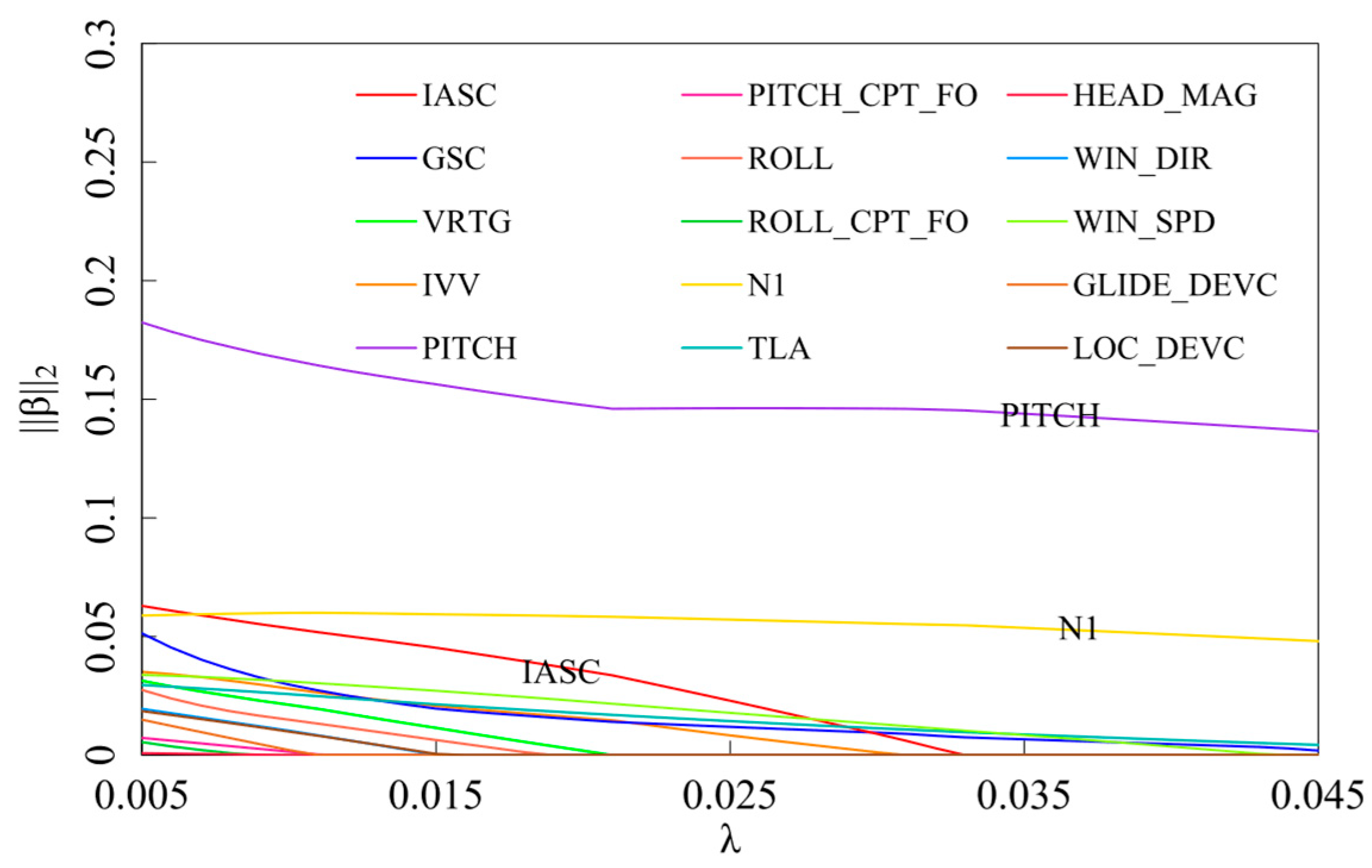
Figure 1 shows how the L2 norms of the estimated regression coefficients β l corresponding to different QAR parameters obtained by Group Lasso change as the regularization parameter increases. Overall, the regression coefficients of pitch angle PITCH, engine speed N1, and airspeed IASC are relatively large and decline to zero more slowly. Therefore, pitch angle, engine speed, and airspeed are considered the three variables that have relatively large influence on the landing pitch angle.

3.2. Analysis of Key QAR Parameters

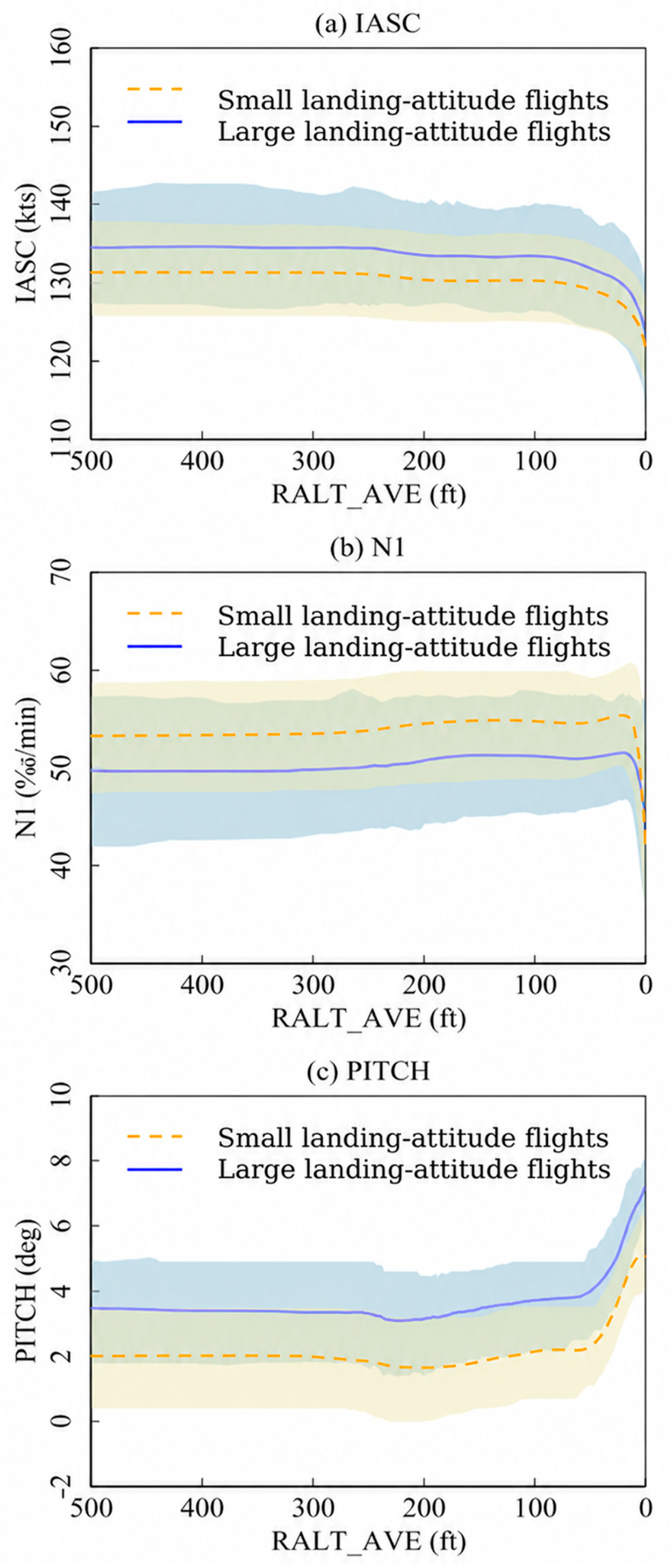
To specifically investigate the relationship between pitch angle, engine speed, and airspeed during the final approach and the final landing pitch angle, Figure 2 shows the quantile curves of airspeed, engine speed, and pitch angle from 500 ft before landing to touchdown. Blue and orange represent large-landing-attitude and small-landing-attitude flights, respectively. The upper boundary, lower boundary, and middle curve of the shaded area represent the 90th percentile, 10th percentile, and mean of the corresponding parameter. The mean curve and the 90th- and 10th-percentile curves of airspeed and pitch angle for large-landing-attitude flights are above those for small-landing-attitude flights, while the corresponding curves of engine speed are below them. This indicates that large-landing-attitude flights maintain a persistently higher pitch angle and airspeed before landing, but the thrust output of the engines is lower.
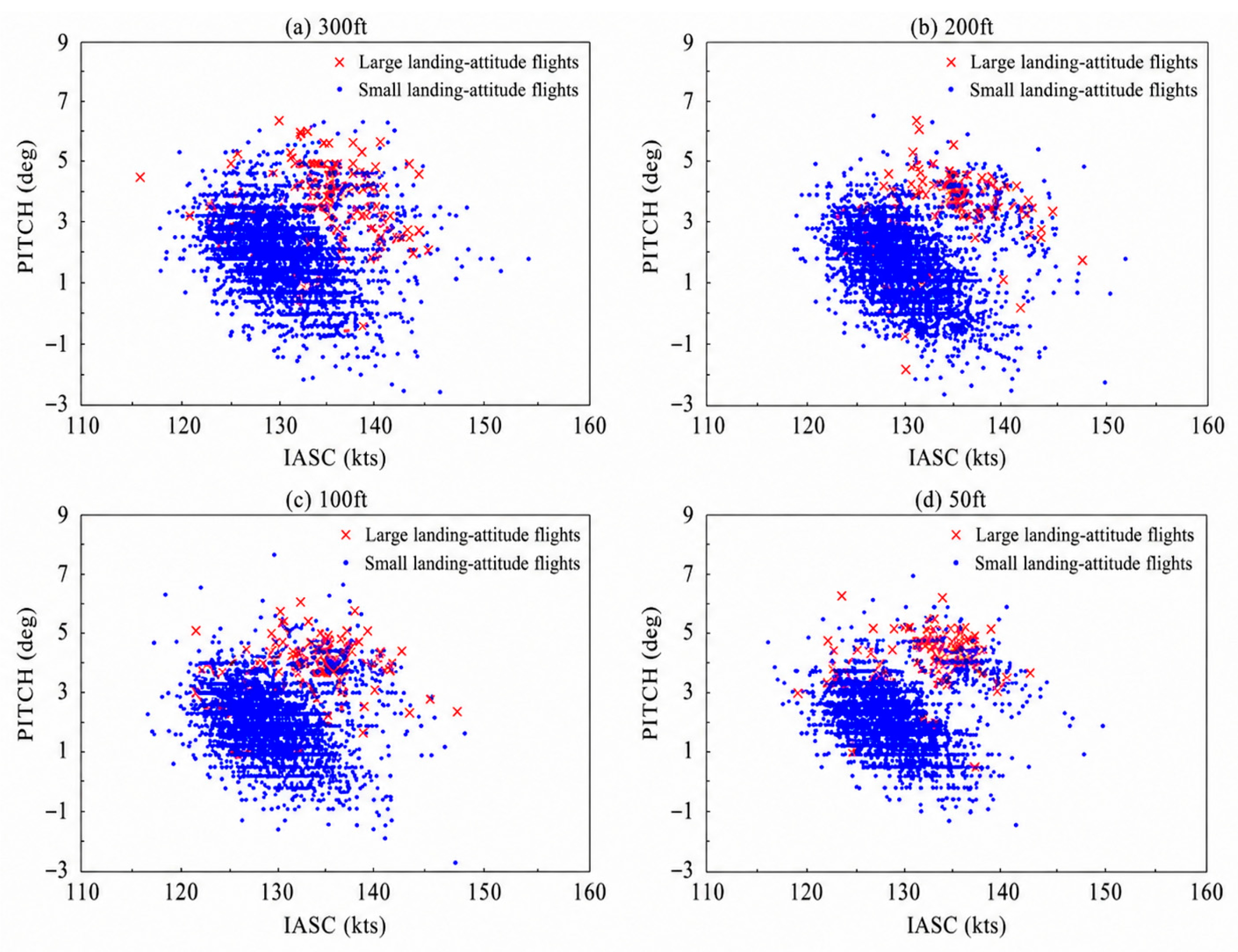
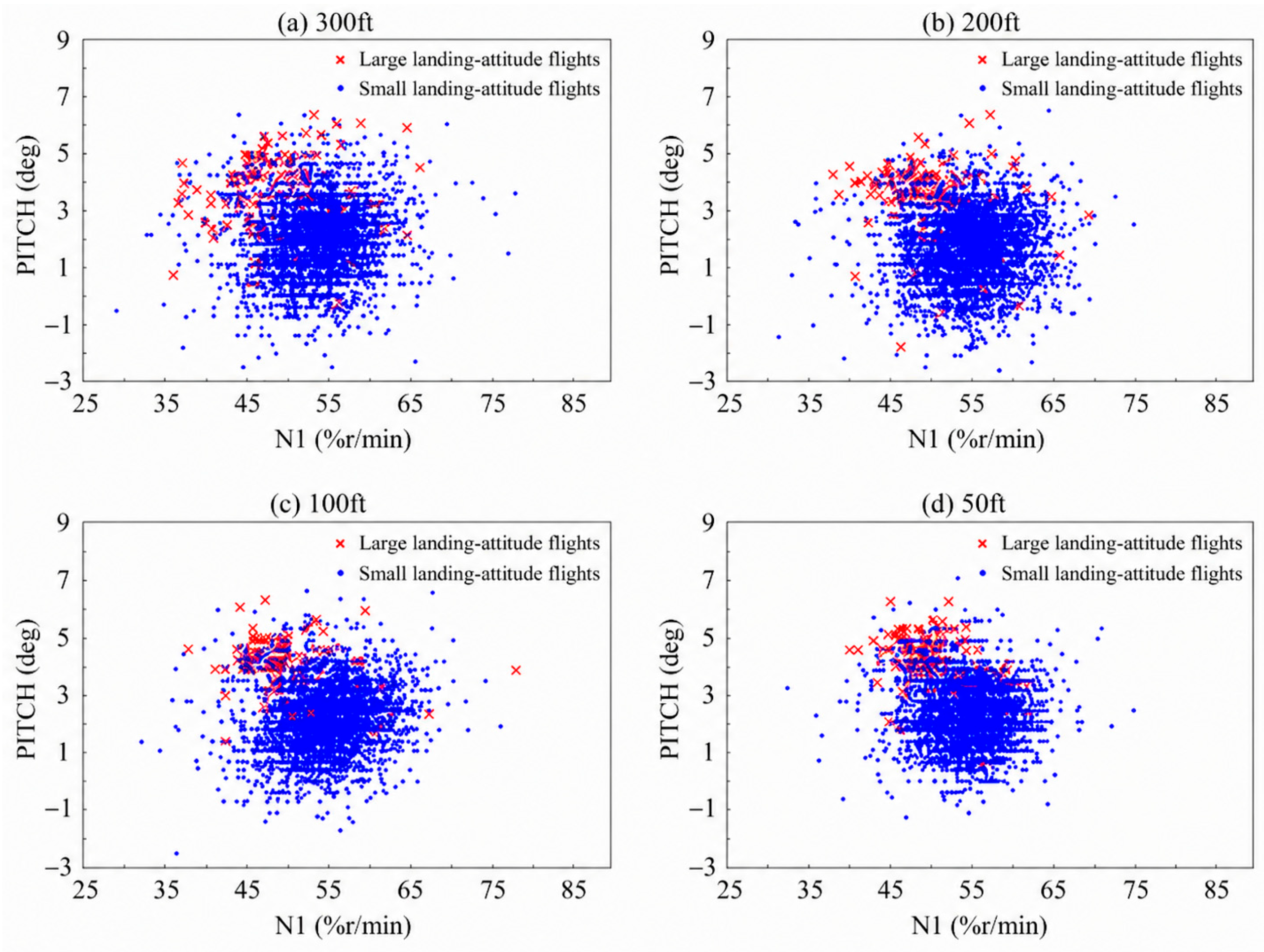
Furthermore, four specific altitude points, namely, 300 ft, 200 ft, 100 ft, and 50 ft, are selected to draw two-dimensional scatter plots of airspeed versus pitch angle and engine speed versus pitch angle, as shown in Figure 3 and Figure 4. In these figures, red cross-shaped points represent large-landing-attitude flights, and blue point-shaped points represent small-landing-attitude flights. In the scatter plots of airspeed versus pitch angle in Figure 3, the red points are basically distributed in the upper-right region, while the blue points are concentrated in the lower-left region. In the scatter plots of engine speed versus pitch angle in Figure 4, the red points are basically distributed in the upper-left region, while the blue points are concentrated in the lower-right region. This shows that, at these four altitude points, large-landing-attitude flights have a higher airspeed and larger pitch angle and lower engine speed than small-landing-attitude flights, which is consistent with the results in Figure 2.
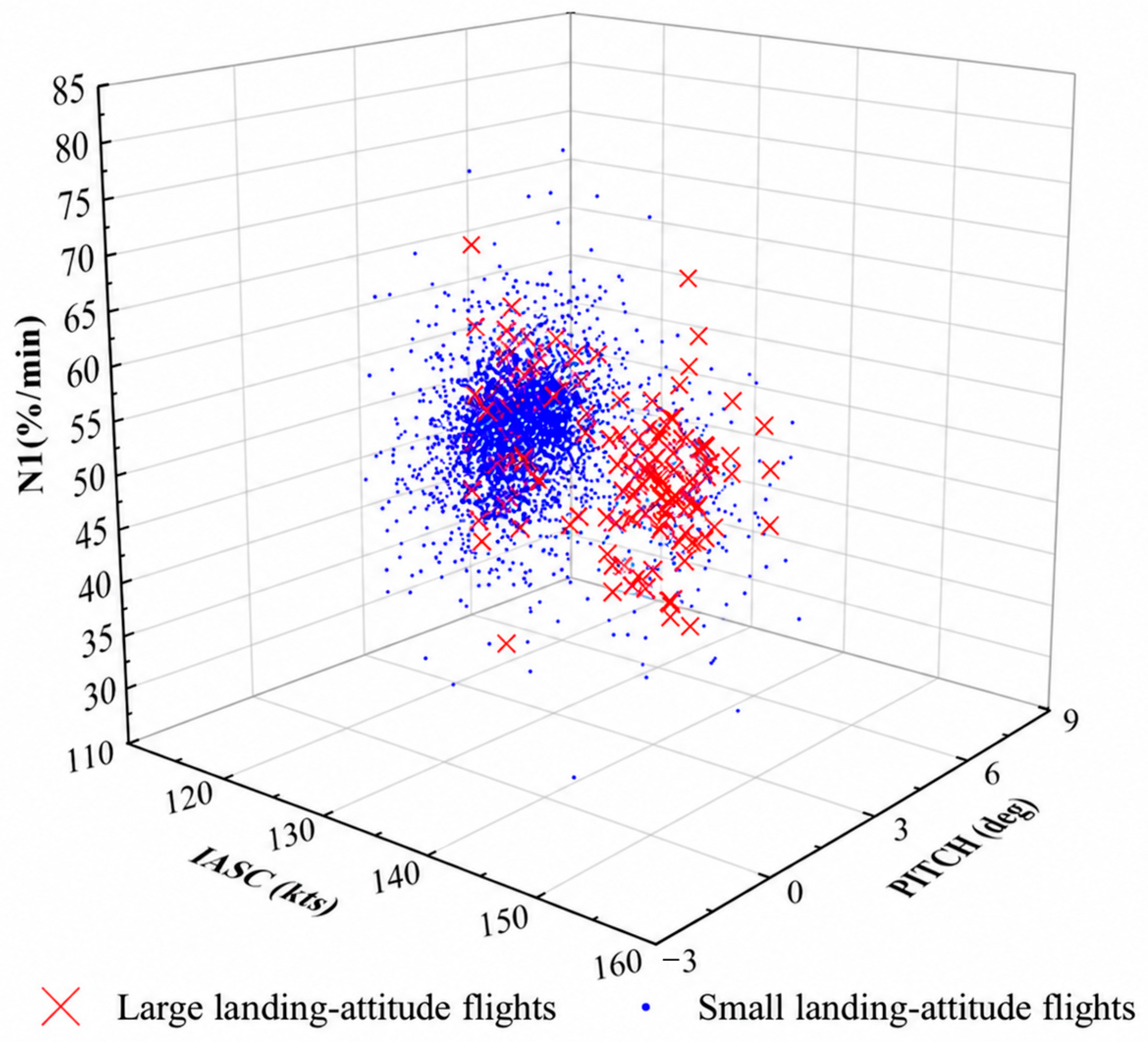
To better present the relationship between the three key parameters for large- and small-landing-attitude flights, Figure 5 uses the 300 ft altitude as an example and presents a three-dimensional scatter plot of pitch angle, engine speed, and airspeed. It can be seen that flights with a large landing attitude (red cross-shaped points) are mainly concentrated in the lower-right part of the scatter plot, corresponding to “high airspeed, high attitude, and low thrust”.
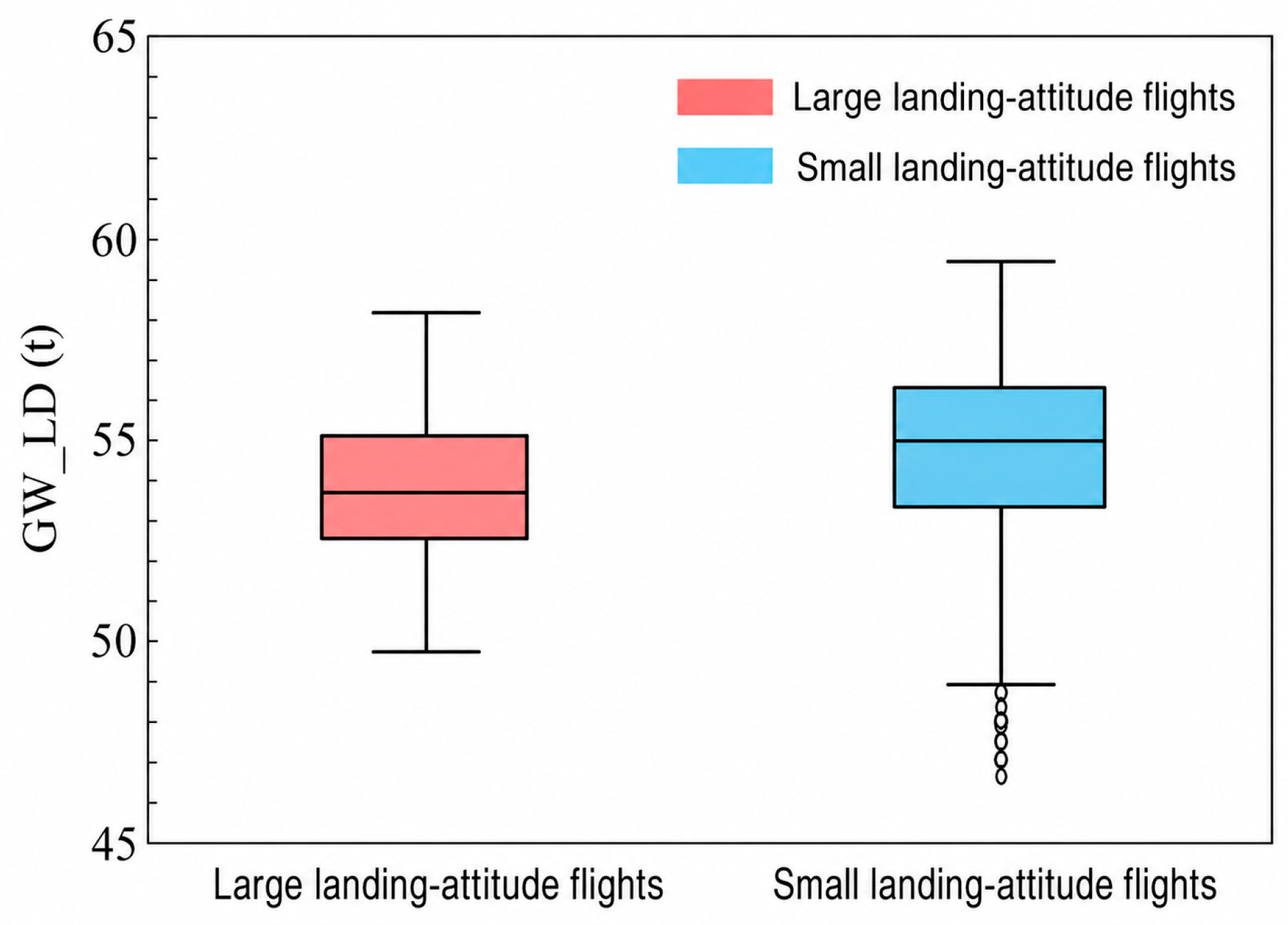
From the perspective of aircraft dynamics, aircraft airspeed and attitude are proportional to lift. A larger airspeed usually corresponds to a smaller attitude, whereas a smaller airspeed requires a larger attitude to maintain lift. In Figure 3, pitch angle and airspeed are negatively correlated overall when the distinction between large and small landing attitudes is ignored, which is consistent with theory. In addition, high thrust usually brings high airspeed. However, the large-landing-attitude flights identified above show the characteristics of “high airspeed, high attitude, and low thrust”, which seems different from the general case. This is because Dali Airport is a low-latitude plateau mountainous airport with an airport elevation of 2155.4 m and complex terrain and climatic conditions. When some lightly loaded flights are affected by increasing headwind during landing, the airspeed increases and the aircraft energy becomes high. To prevent the airspeed from continuing to increase, pilots reduce the throttle. To offset the nose-down moment caused by reduced aircraft thrust, pilots continuously pull the control column for compensation. In addition, because insufficient thrust may make trajectory control difficult, pilots may further rely on attitude adjustment, thereby forming the risk combination of “high airspeed, high attitude, and low thrust”. To verify this idea, Figure 6 compares the landing weight of large-landing-attitude and small-landing-attitude flights at touchdown. It can be seen that large-landing-attitude flights are, indeed, generally lighter.
In summary, the analysis of the three key parameters shows that, for lightly loaded flights, “high airspeed, high attitude, and low thrust” caused by improper energy management during the final approach will significantly increase the touchdown pitch angle, thereby bringing a larger tail-strike risk. This differs from the “low-speed, high-attitude” pattern frequently emphasized in the traditional tail-strike literature and deserves special attention.

4. Identification and Prediction of High-Risk Flight Patterns

4.1. Identification of High-Risk Flight Patterns

Figure 5 shows that large-landing-attitude flights at Dali Airport have relatively clear clustering characteristics. Therefore, in this section, clustering analysis is used to divide all flights into a “high-risk pattern” and a “low-risk pattern”. The high-risk pattern corresponds to the “high-airspeed, high-attitude, and low-thrust” region where large-landing-attitude flights are relatively concentrated.
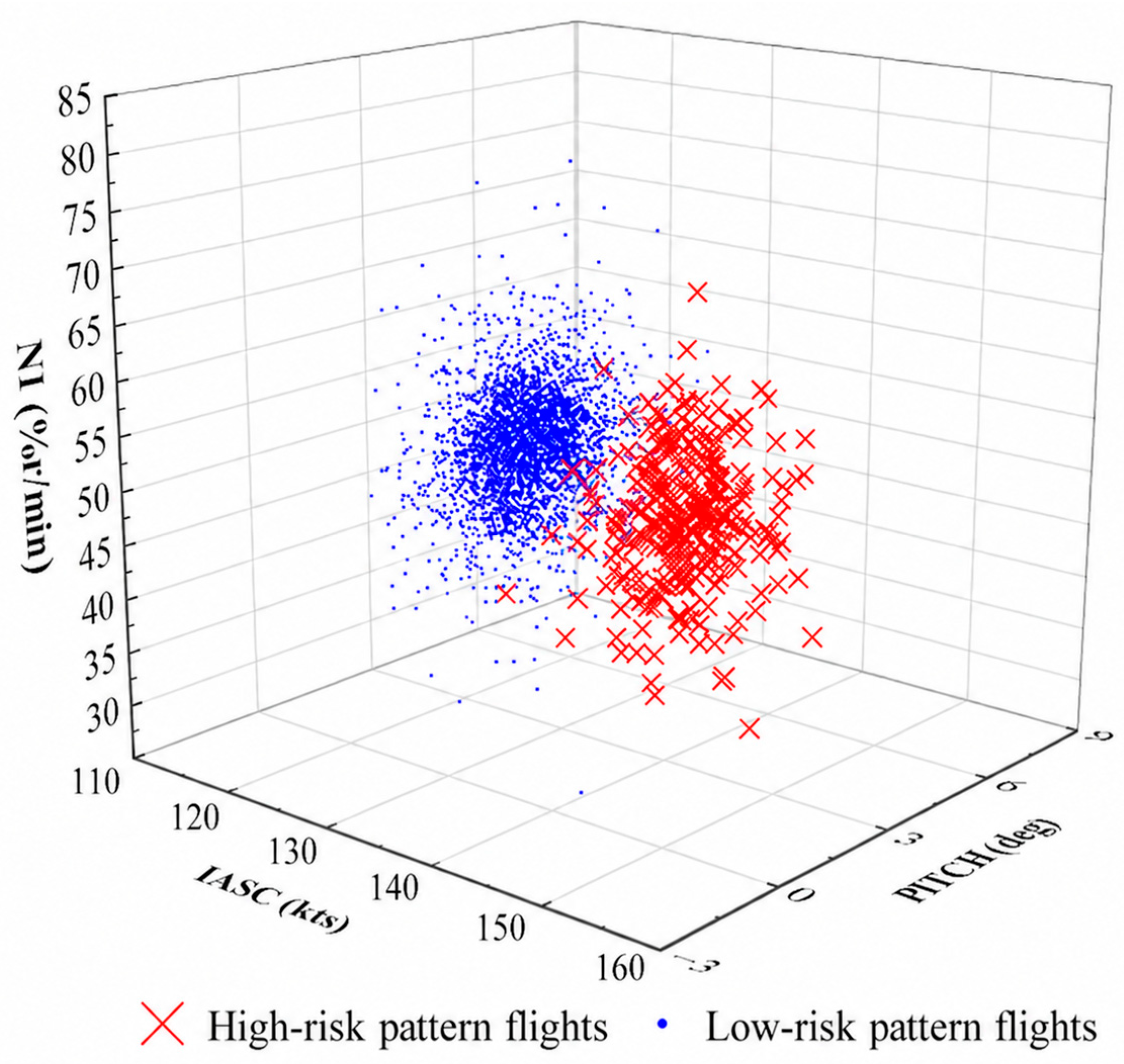
Specifically, the 24-dimensional vector obtained by FPCA dimensionality reduction of the three QAR parameter curves PITCH, N1, and IASC is considered. According to Table 2, the numbers of principal components for PITCH, N1, and IASC are 12, 5, and 7, respectively, which together give 24 dimensions. The K-means clustering algorithm is used to cluster the 2933 flights. Note that the objective of the clustering analysis is not to discover an arbitrary number of latent clusters, but to distinguish the two flight patterns identified in the previous section. Therefore, the number of clusters was prespecified as two in the K-means clustering analysis. The specific results are shown in Figure 7, where red crosses are high-risk-pattern flights and blue points are low-risk-pattern flights. By comparing Figure 7 and Figure 5, it can be seen that the clustering results capture well the region where large-landing-attitude flights are concentrated.
Among all 2933 flights, 272 flights are classified as high-risk-pattern flights, of which 88 flights are, indeed, large-landing-attitude flights at landing, accounting for 32.4%. A total of 2661 flights are classified as low-risk-pattern flights, of which 59 flights are, indeed, large-landing-attitude flights at landing, accounting for 2.2%. The two patterns show very clear differences. Therefore, if flights located in the high-risk flight pattern can be identified in advance during the final approach, pilots can be given a risk alert and sufficient time to take necessary actions.

4.2. Prediction of High-Risk Flight Patterns

As discussed in the previous section, this section attempts to predict in advance whether a flight belongs to the high-risk pattern using QAR parameters at 500 ft, 450 ft, and 400 ft during approach.
For the i-th flight, let c i = 1 if it is classified as a high-risk flight in the clustering in the previous section and c i = 0 otherwise. Let s i be the vector formed by concatenating the 15 QAR parameters of this flight at 500 ft, 450 ft, and 400 ft. A logistic regression model is considered. Assume P ( c i = 1 s i = 1 / { 1 + exp s i γ } , where γ is the regression coefficient that needs to be estimated.
Because the proportion of c i = 1 in the sample data is only 9.3%, the data categories are imbalanced. Therefore, weighted logistic regression is used for parameter estimation. In addition, because s i has 46 dimensions after including the intercept, a Lasso penalty is added for variable selection. The objective function is defined as
1 n i = 1 n   c i log p i π 1 + ( 1 c i ) l o g ( 1 p i ) π 0 + λ j = 1 46   γ j ,
where n is the training sample size, p i = P ( c i = 1 s i , π 1 = 9.3 % and π 0 = 90.7 % are the sample proportions of c i = 1   a n d   c i = 0 , γ j is the j-th element of γ , and λ 0 is a regularization parameter.
To evaluate the prediction performance of the model, all 2933 samples are randomly divided into a training set and a test set in a 7:3 ratio. On the training set, 10-fold cross-validation is used to select the optimal regularization parameter and estimate the parameters. The final model selects 14 variables, including the intercept. The specific variables and their regression coefficients are shown in Table 3. Because the variables are standardized (minus the sample mean and divided by the sample standard deviation) first during modeling, Table 3 contains two columns of regression coefficients. The “regression coefficient” column gives the coefficients obtained on the standardized data, and the “coefficient after restoration” column gives the coefficients restored to the original scale. From the regression coefficients, under the same scale, the variables with the largest effects are the pitch angle at 500 ft, the airspeed at 400 ft, and the engine speed at 400 ft. The first two have positive effects, and the last one has a negative effect, as indicated by the signs of the coefficients on the original scale. This is consistent with the pattern summarized in the previous section.
The model is applied to the test set for prediction, and the final prediction results are shown in Table 4. Among all 73 high-risk-pattern flights in the test set, the model accurately predicts 71 flights. Among all 806 low-risk-pattern flights, the model accurately predicts 805 flights. The calculated accuracy on the test set is 99.7%, the recall is 97.3%, and the precision is 98.6%, indicating excellent prediction performance.
Because this prediction model can provide a prediction when the aircraft descends to 400 ft, high-risk flights can be warned at 400 ft, leaving pilots sufficient time for possible adjustment.
We make some further comments on the prediction model. First, in this model, QAR parameter values at given altitude points are used as input variables rather than the FPCA method in Section 3.1. The main reason is that, during aircraft descent, the original QAR parameters are relatively easy to obtain directly, and the model can provide predictions quickly. Timeliness is crucial for real-time early warning. Second, landing weight is not used as an input variable, mainly because it needs to be estimated before touchdown using the aircraft takeoff weight and the specific flight situation, and the data accuracy is not easy to guarantee.
Finally, whether the flight is a high-risk-pattern flight is used as the dependent variable of the model, rather than whether the flight has a large landing attitude. The focus is on predicting the high-risk pattern. It is found that even among flights with “high airspeed, high attitude, and low thrust”, some flights still land with a small attitude. Therefore, within the high-risk pattern, the operational differences between pilots of large-landing-attitude flights and small-landing-attitude flights are further compared to obtain operational recommendations. This is the main focus of the next section.
It should be emphasized that the proposed high-/low-risk prediction is intended as an early-warning and risk-awareness tool, rather than an automatic decision rule for go-around. A go-around decision is a safety-critical operational action and depends on multiple factors beyond the QAR variables analyzed in this study, including aircraft state, runway environment, visibility, pilot judgment, airline procedures, and regulatory requirements. Therefore, the present model should be interpreted as providing timely information at 400 ft to support pilots’ situational awareness and corrective actions before the flare phase. If the aircraft remains in an unfavorable energy state, and the landing attitude becomes difficult to control, pilots should consider a go-around according to standard operating procedures.

5. Analysis of Pilot Operations for High-Risk Flights

Among all 272 high-risk flights, 88 flights are indeed large-landing-attitude flights at landing, but 184 flights still touch down with a small attitude. This section compares the key QAR parameters of large-landing-attitude and small-landing-attitude flights among high-risk flights and analyzes the pilot pitch-control parameter, attempting to identify what operational differences lead to different landing pitch-angle outcomes under similar flight patterns.
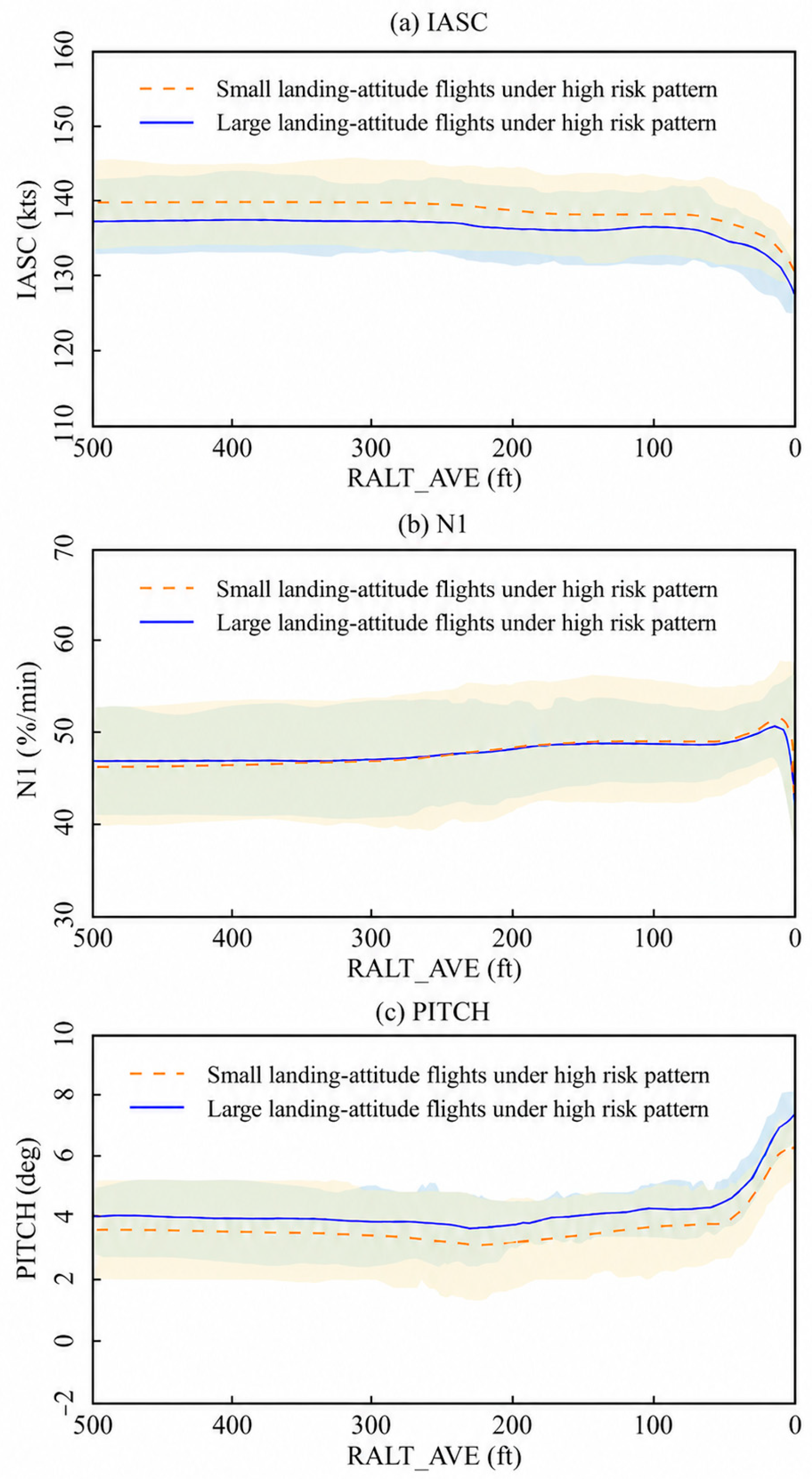
Figure 8 shows the quantile curves of airspeed, engine speed, and pitch angle for high-risk flights from 500 ft before landing to touchdown. Blue and orange represent large-landing-attitude and small-landing-attitude flights, respectively. The meanings of the curves are similar to those in Figure 2. Under the high-risk pattern, large-landing-attitude flights have a lower airspeed and larger pitch angle than small-landing-attitude flights, which is consistent with the traditional “low-speed, high-attitude” tail-strike risk pattern. It should be noted that the engine speed distributions of large-landing-attitude and small-landing-attitude flights are basically the same, indicating that there is no obvious difference in power output between them. This also means that the operational difference between pilots is mainly reflected in pitch control. Note that the flare phase is critical for tail-strike risk. However, the variables of the RETARD activation, flight director use, and visibility conditions are not reliably recorded in the available QAR dataset, so they cannot be directly analyzed in the present study.
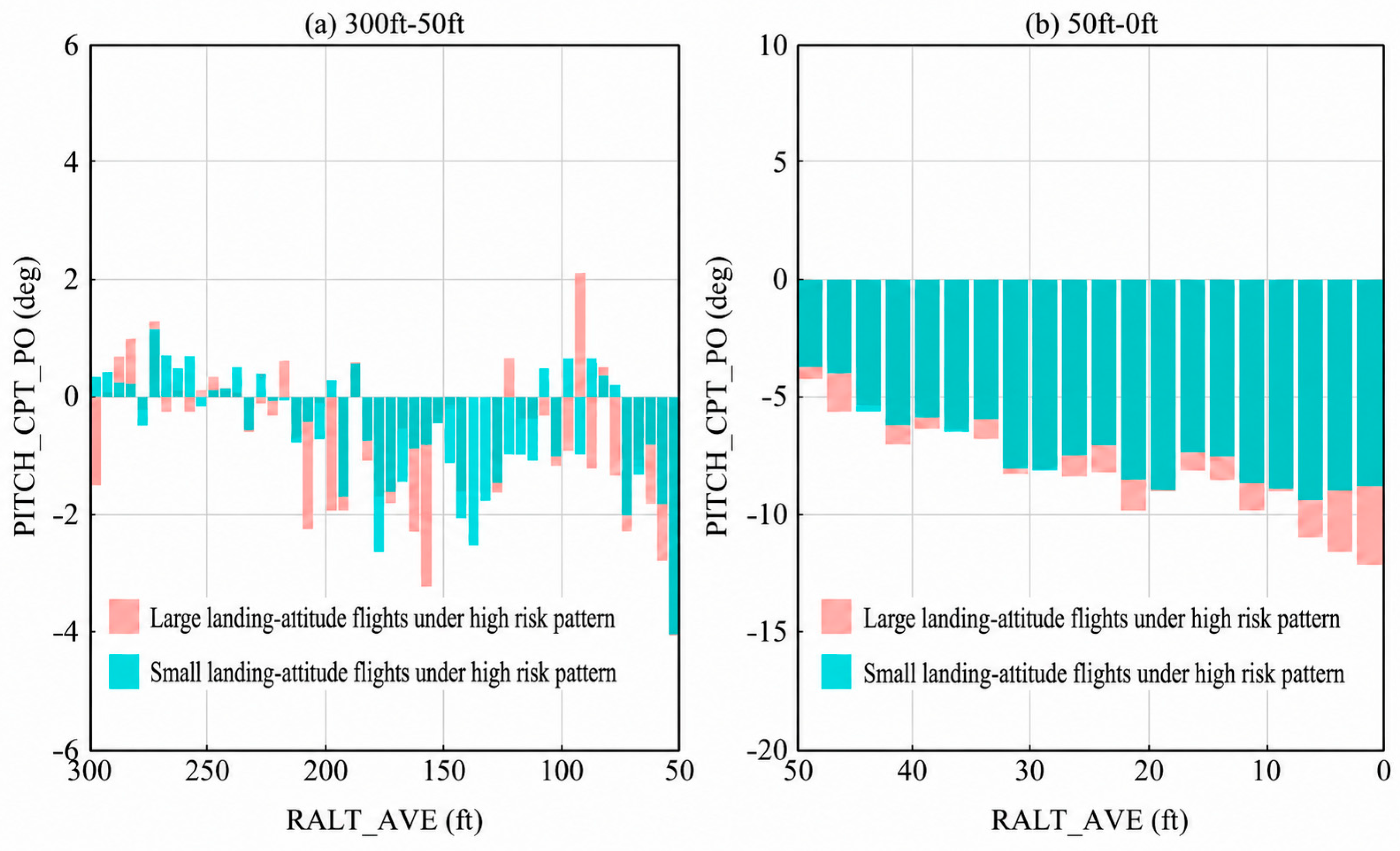
The pitch-control parameter PITCH_CPT_FO from 300 ft before landing to touchdown is selected to reflect pilot operational characteristics. As described in Section 2, this parameter is obtained by adding the captain’s and first officer’s pitch-control values and is used to manipulate the aircraft pitch angle. A positive value indicates that the pilot pushes the control column forward, causing the aircraft pitch angle to decrease; a negative value indicates that the pilot pulls the control column backward, causing the aircraft pitch angle to increase. Because pilot pitch-control inputs increase significantly near touchdown, the altitude segment from 300 ft before landing to touchdown is divided into two segments: 300 ft to 50 ft and 50 ft to touchdown. First, the 300 ft-to-50 ft segment is divided into a series of continuous altitude intervals with a step of 5 ft. For all large-landing-attitude flights and all small-landing-attitude flights, pitch-control values and operation frequencies are accumulated separately and divided to obtain the average control-column input of each type of flight in different altitude intervals. Second, the 50 ft-to-touchdown segment is divided into a series of continuous altitude intervals with a step of 2.5 ft, and the same processing is performed for pitch-control values and operation frequencies. Finally, the average pitch-control input curves of large-landing-attitude and small-landing-attitude flights under the high-risk flight pattern from 300 ft before landing to touchdown are obtained, as shown in Figure 9. In the figure, the red bars indicate the control input of large-landing-attitude flights, the blue bars indicate the control input of small-landing-attitude flights, and the overlapping part of the red and blue bars is shown in dark green.
Three main conclusions can be drawn from Figure 9. First, from 300 ft to 50 ft before landing, the fluctuation of pitch-control input for large-landing-attitude flights is clearly greater than that for small-landing-attitude flights. Large pull actions occur above 300 ft and 200 ft, and a relatively obvious push action even appears around 90 ft. Second, the pull actions of small-landing-attitude flights are concentrated around 180 ft and 135 ft, with no obvious push action. Third, from 50 ft before landing to touchdown, the pitch-control input of large-landing-attitude flights remains greater than that of small-landing-attitude flights, indicating a more obvious pull action, especially before final touchdown. This is consistent with the larger landing pitch angle of large-landing-attitude flights. Nevertheless, the relatively small difference in pitch-control input between the two groups suggests that the final landing attitude is not determined by pitch command alone, but by the combined effect of the pre-flare aircraft state, energy condition, and late flare control. Due to the limitations of the available QAR data, a more detailed analysis incorporating flare-related factors is left for future research.
Based on the above observations, for A319 flights at Dali Airport predicted to fall into the high-risk pattern of “high airspeed, high attitude, and low thrust”, the key pilot operations to avoid landing with a large attitude are as follows. First, from 300 ft to 50 ft before landing, pilots should maintain a stable flight trajectory as much as possible, keep pitch-control input smooth, and reduce fluctuations in control-column input. Second, pilots should eliminate as much as possible the changes in aircraft stable state caused by weather and other factors, especially avoiding a long period of large attitude above 200 ft and controlling deviations in time once they are found. Third, from the start of runway entry and flare at 50 ft to touchdown, backward control force should be applied gradually; push–pull control should be avoided; sudden or excessive pull should be avoided; and abrupt pull-up before touchdown should be avoided.

6. Conclusions

(1)
During the final approach, pitch angle, engine speed, and airspeed are the three QAR parameters that have relatively large influence on the landing pitch angle.
(2)
At Dali Airport, for lightly loaded flights, “high airspeed, high attitude, and low thrust” caused by improper energy management during the final approach significantly increases the touchdown pitch angle and, thus, brings a larger tail-strike risk. This differs from the “low-speed, high-attitude” pattern frequently emphasized in the traditional tail-strike literature and deserves special attention.
(3)
The prediction model based on QAR parameters at 500 ft, 450 ft, and 400 ft can relatively accurately predict which flights belong to the “high-risk pattern”. The model achieves an accuracy of 99.7%, a recall of 97.3%, and a precision of 98.6% on the test set. Based on this model, flights in the high-risk flight pattern can be identified in advance at 400 ft, and pilots can be given a risk alert so that they have sufficient time to take necessary measures.
(4)
For high-risk flights, the operational key for pilots to avoid landing with a large attitude is still to control the attitude during final approach. Pilots should keep pitch-control input smooth and precise, reduce fluctuations in control-column input, maintain a stable flight trajectory as much as possible, and avoid excessive pull before touchdown. If the airspeed remains high and attitude is difficult to control, pilots should decisively go around and re-establish a stable approach.
(5)
The analysis in this paper is based on data from Dali Airport, a high-altitude mountainous location. The “high-airspeed, low-thrust” risk pattern may be heavily climate-dependent and may not generalize to sea-level airports. Whether the obtained high-risk pattern and prediction model are applicable to other types of airports remains to be further explored. However, the analytical paradigm and methods adopted in this paper can be directly extended.
Finally, we make two further clarifications. First, the analysis was conducted under specific boundary conditions: the data are from Airbus A319 flights landing at Dali Airport, a plateau mountainous airport, with FULL flap configuration and manually controlled landings by the pilot-in-command. Therefore, the identified high-risk pattern and prediction model may not be directly generalizable to other aircraft types, airports, landing configurations, or operating environments. Second, no confirmed tail-strike events or maintenance inspection records are available in the present dataset. Therefore, the large landing pitch angle is used only as a proxy indicator or precursor characteristic of potential tail-strike risk, rather than as evidence of an actual tail-strike event. The identified high-risk pattern should be interpreted as a flight pattern associated with a higher probability of a large landing pitch angle. Its direct relationship with confirmed tail-strike events needs to be further validated when maintenance records or event reports become available.

Author Contributions

All authors conceived the idea together. X.Z. and Y.W. provided domain expertise and the QAR data. F.F. developed the methodology. Y.Z. and X.L. implemented the analysis and obtained the results. All authors contributed to the writing of this manuscript. All authors have read and agreed to the published version of the manuscript.

Funding

This research was funded by the National Natural Science Foundation of China (No. 72331005; 12301336), the Civil Aviation Safety Special Project (HA202507), and the Basic Research Funds for the China Academy of Civil Aviation Science and Technology (xxx252060302025022).

Data Availability Statement

The data used in this study are not publicly available because of confidentiality requirements for civil aviation flight data (Civil Aviation Safety Information Protection Management Measures, CAAC Regulation [2021] No. 29; Implementation and Management Requirements for Flight Data Analysis Programs, CAAC Regulation [2024] No. 74).

Conflicts of Interest

The authors declare no conflicts of interest.

Abbreviations

The following abbreviations are used in this manuscript:
QARQuick Access Recorder
IATAInternational Air Transport Association
FPCAFunctional Principal Component Analysis

References

  1. IATA. Interactive 2024 IATA Safety Report. Available online: https://www.iata.org/safetyreport-dashboard (accessed on 30 December 2024).
  2. Simple Flying. Tail Strikes: A Pilot’s Perspective. Available online: https://simpleflying.com/tail-strikes-pilot-perspective (accessed on 1 November 2022).
  3. Guo, H.J.; Chen, Z.H. How to prevent A320 tail strike. J. China Civ. Aviat. Fly. Coll. 2001, 12, 31. (In Chinese) [Google Scholar]
  4. Mao, J.X. Inspection and maintenance of tail strike of B737 aircraft. Aviat. Maint. Eng. 2012, 5, 78–80. (In Chinese) [Google Scholar] [CrossRef]
  5. Zhang, Y.S.; Yu, J. The risk prevention and analysis on tail strike of civil aircraft. J. Civ. Aviat. Flight Univ. China 2021, 32, 9–13. (In Chinese) [Google Scholar]
  6. Yang, X.Y. A study on the causes of civil aircraft tail strike events based on the bow-tie model. Sci. Technol. Innov. Appl. 2022, 12, 21–23. (In Chinese) [Google Scholar] [CrossRef]
  7. Wang, X.; Wang, H.; Yu, L. Aircraft tail strike events during take-off phase: A risk evaluation model. In Proceedings of the International Conference on Reliability, Maintainability and Safety, Shanghai, China, 17–19 October 2018; pp. 142–145. [Google Scholar]
  8. Sun, R.S.; Yang, Z.X. Risk prediction of aircraft tail strike events during take-off phase. Saf. Environ. Eng. 2016, 23, 153–156. (In Chinese) [Google Scholar] [CrossRef]
  9. Wang, X.; Yu, L.; Zhao, X. Discover the tail strike risk during take-off of an airline based on QAR big data. In Proceedings of the 2020 IEEE 3rd International Conference of Safe Production and Informatization, Chongqing, China, 28–30 November 2020; pp. 553–556. [Google Scholar]
  10. Wang, L.; Yang, X.Y. Risk prediction of tail strike during landing based on Monte Carlo method. J. Saf. Sci. Technol. 2019, 15, 45–50. (In Chinese) [Google Scholar] [CrossRef]
  11. Yang, X.Y.; Wang, L. Analysis of civil aircraft tail striking event based on pilot model. Flight Dyn. 2022, 40, 89–94. (In Chinese) [Google Scholar] [CrossRef]
  12. Chen, Y.; Han, Z.; Gu, J. Analyzing the causes of tail strike event during takeoff with stepwise regression. In Proceedings of the 2019 IEEE 1st International Conference on Civil Aviation Safety and Information Technology, Kunming, China, 17–19 October 2019; pp. 418–424. [Google Scholar]
  13. Wang, L.; Yang, X.Y.; Gao, S. Prediction of the incidence of tail striking based on time series model. Saf. Environ. Eng. 2020, 27, 216–220. (In Chinese) [Google Scholar] [CrossRef]
  14. Chen, H.; Shang, J.; Zhao, X.; Li, X.; Zheng, L.; Chen, F. A deep learning method for landing pitch prediction based on flight data. In Proceedings of the 2020 IEEE 2nd International Conference on Civil Aviation Safety and Information Technology, Weihai, China, 14–16 October 2020; pp. 199–204. [Google Scholar]
  15. Lu, F.; Song, J.J. Research on the application of random forest algorithm in predicting tail strike events. J. Saf. Environ. 2024, 24, 3028–3035. (In Chinese) [Google Scholar] [CrossRef]
  16. Du, X.; Xu, G.; Zhang, K.; Jin, H.; Chen, B. Prediction of tail strike incidents in flight training using ensemble learning methods. Aerospace 2025, 12, 123. [Google Scholar] [CrossRef]
  17. Civil Aviation Administration of China. Measures for the Administration of Flight Quality Monitoring Information. Available online: http://www.caac.gov.cn/PHONE/XXGK_17/XXGK/GFXWJ/202410/t20241031_225739.html (accessed on 24 October 2024).
  18. Wang, J.; Chiou, J.; Müller, H. Functional data analysis. Annu. Rev. Stat. Its Appl. 2016, 3, 257–295. [Google Scholar] [CrossRef]
  19. Yuan, M.; Lin, Y. Model selection and estimation in regression with grouped variables. J. R. Stat. Soc. Ser. B (Stat. Methodol.) 2006, 68, 49–67. [Google Scholar] [CrossRef]
Figure 1. L2 norms of the regression coefficients estimated by Group Lasso under different regularization parameters.
Aerospace 13 00553 g001
Figure 2. Comparison of IASC, N1, and PITCH curves between flights with large and small landing pitches.
Aerospace 13 00553 g002
Figure 3. Scatter plots of PITCH versus IASC for flights with large and small landing pitches at four altitudes.
Aerospace 13 00553 g003
Figure 4. Scatter plots of PITCH versus N1 for flights with large and small landing pitches at four altitudes.
Aerospace 13 00553 g004
Figure 5. Three-dimensional scatter plot of PITCH, N1, and IASC for flights with large and small landing pitches at 300 ft.
Aerospace 13 00553 g005
Figure 6. Landing-weight comparison between flights with large and small landing pitches.
Aerospace 13 00553 g006
Figure 7. Three-dimensional scatter plot of PITCH, N1, and IASC at 300 ft for high-risk and low-risk flights.
Aerospace 13 00553 g007
Figure 8. Comparison of IASC, N1, and PITCH between flights with large and small landing pitches under the high-risk pattern.
Aerospace 13 00553 g008
Figure 9. Differences in average pitch-control input between flights with large and small landing pitches under the high-risk pattern.
Aerospace 13 00553 g009
Table 1. Basic information of QAR parameters.
ParameterUnitFrequencyDescription
RALT_AVEft4 HzRadio altitude
IASCkt1 HzAirspeed
GSCkt1 HzGround speed
VRTGg8 HzVertical load
IVV_CAft/min1 HzDescent rate
PITCHdeg4 HzPitch angle
ROLLdeg2 HzRoll angle
HEAD_MAGdeg1 HzMagnetic heading
GLIDE_DEVCdot1 HzGlideslope deviation
LOC_DEVCdot1 HzLocalizer deviation
N1% r/min1 HzEngine speed
TLAdeg1 HzThrottle lever angle
WIN_DIRdeg1 HzWind direction
WIN_SPDkt1 HzWind speed
PITCH_CPT_FOdeg8 HzPitch control
ROLL_CPT_FOdeg8 HzRoll control
Table 2. Results of FPCA for QAR parameters.
ParameterNumber of Principal ComponentsCumulative Variance Contribution
IASC7100%
GSC2100%
VRTG1292%
IVV_CA8100%
PITCH12100%
ROLL1298%
HEAD_MAG1100%
GLIDE_DEVC8100%
LOC_DEVC10100%
N15100%
TLA3100%
WIN_DIR5100%
WIN_SPD4100%
PITCH_CPT_FO1283%
ROLL_CPT_FO1285%
Table 3. Coefficient estimates of the weighted logistic regression.
ParameterRegression CoefficientCoefficient After Restoration
Intercept4.428−40.267
IASC at 400 ft2.2400.350
GSC at 400 ft0.64111.721
VRTG at 500 ft0.862−15.527
VRTG at 450 ft0.449−7.932
VRTG at 400 ft0.189−0.002
IVV_CA at 400 ft0.221−0.170
PITCH at 500 ft2.9922.293
PITCH_CPT_FO at 400 ft0.0390.031
ROLL at 500 ft0.048−0.038
ROLL at 400 ft−0.132−0.028
N1 at 400 ft1.632−0.861
WIN_SPD at 500 ft0.0080.001
LOC_DEVC at 500 ft0.0010.008
Table 4. Prediction results of the weighted logistic regression on the test data.
Actual Low-Risk PatternActual High-Risk Pattern
Predicted low-risk pattern8052
Predicted high-risk pattern171
Disclaimer/Publisher’s Note: The statements, opinions and data contained in all publications are solely those of the individual author(s) and contributor(s) and not of MDPI and/or the editor(s). MDPI and/or the editor(s) disclaim responsibility for any injury to people or property resulting from any ideas, methods, instructions or products referred to in the content.