
Characterizations of Swept Shock/Boundary Layer Interactions: A Comparison Between Planar Shock, Curved Shock, and Isentropic Compression




Abstract
1. Introduction
2. Model Setup and Numerical Approach Validation
2.1. Numerical Methods
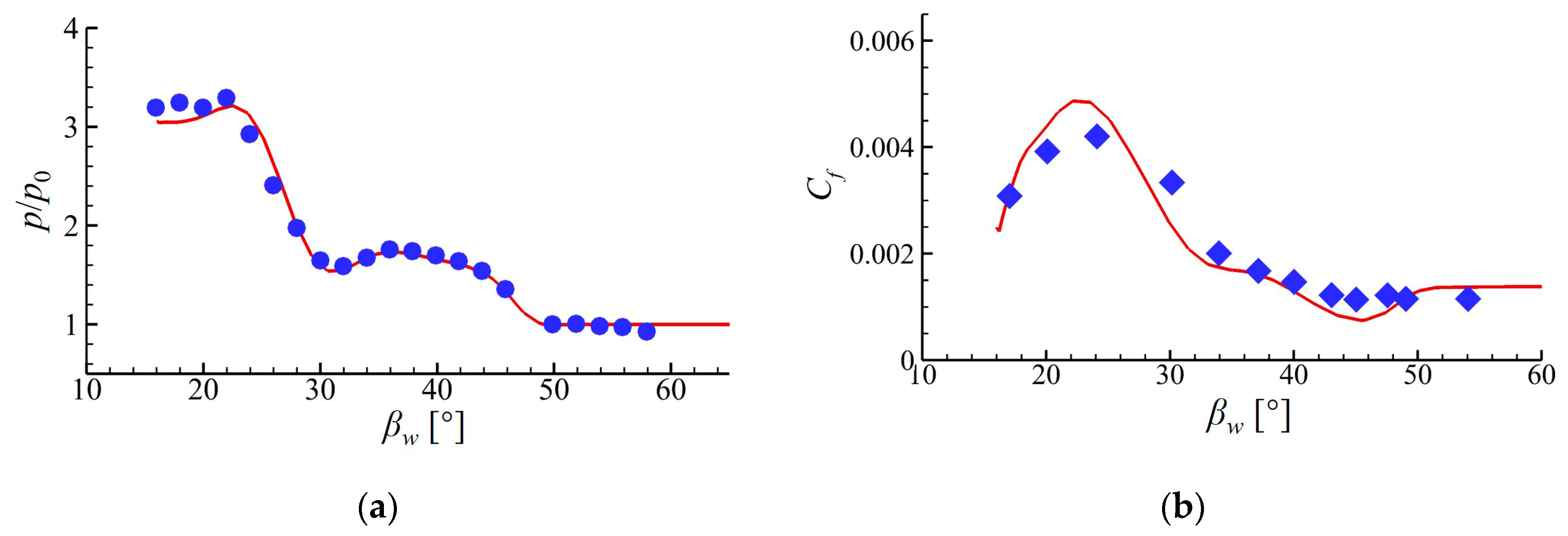
2.2. Numerical Approach Validation
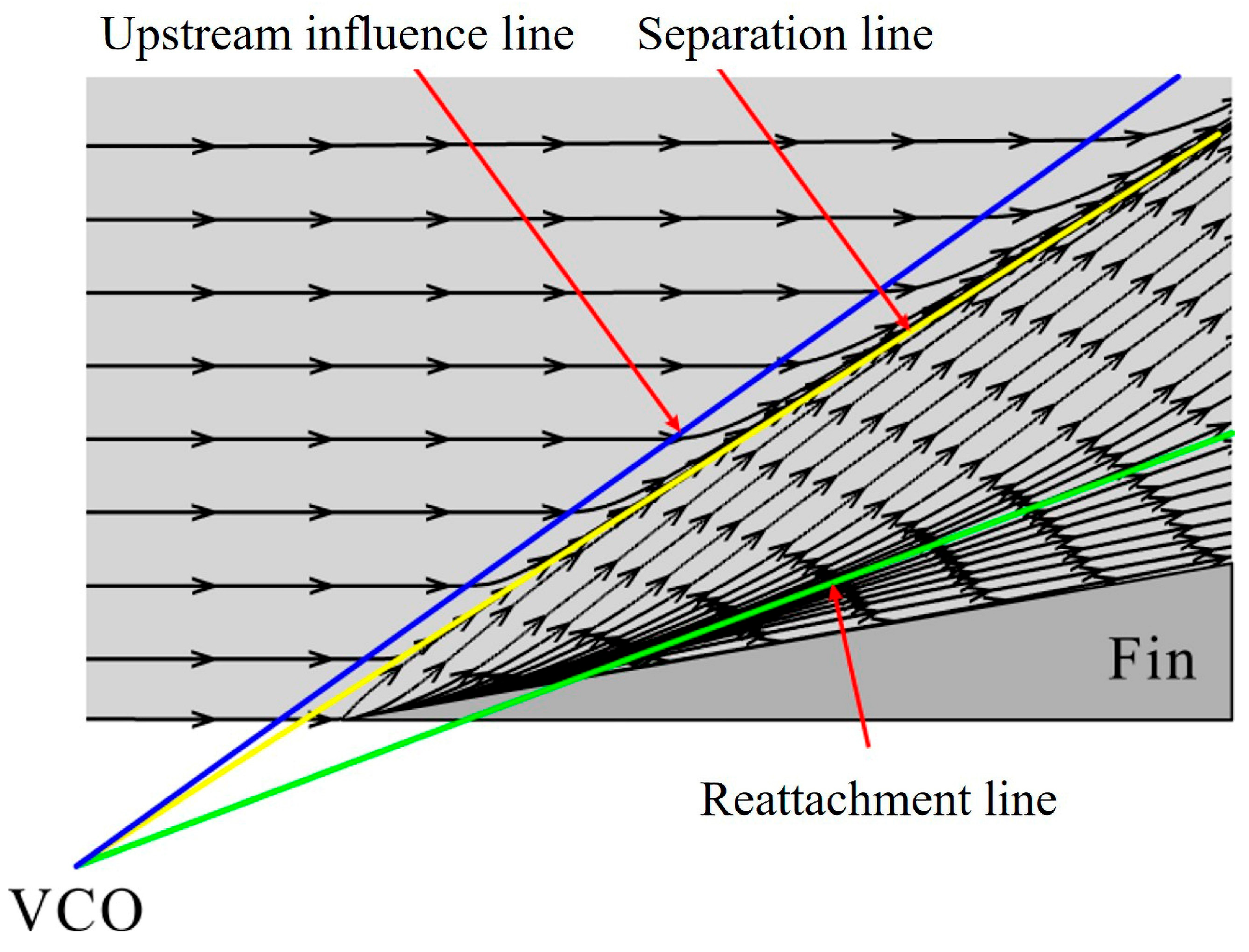
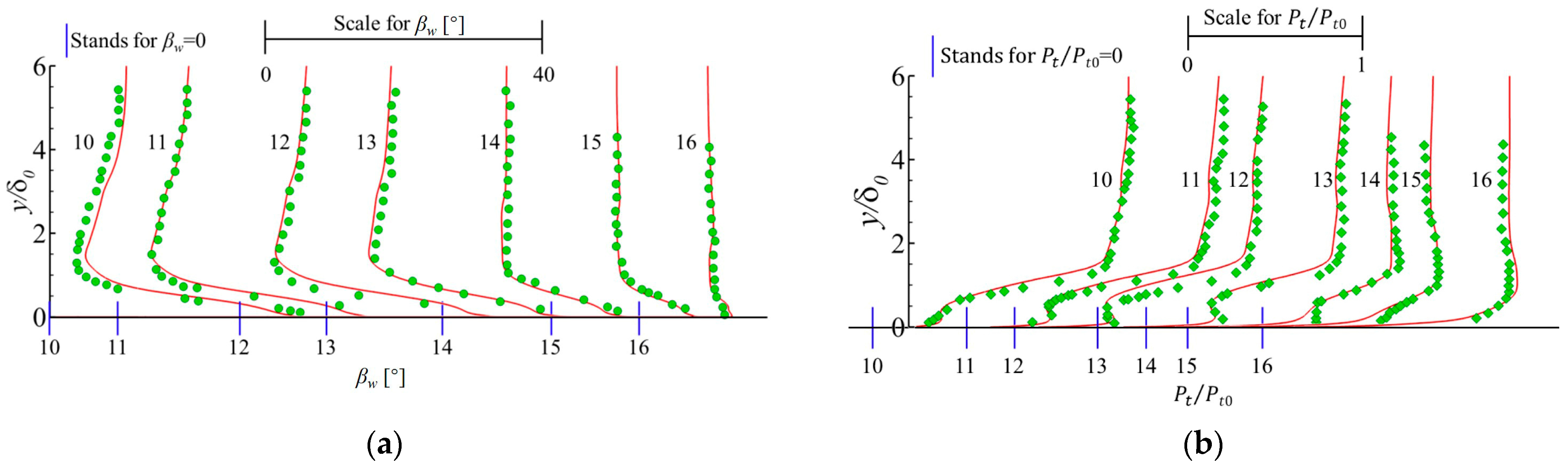
- Validation case 1: Primary Separation Interaction Mode
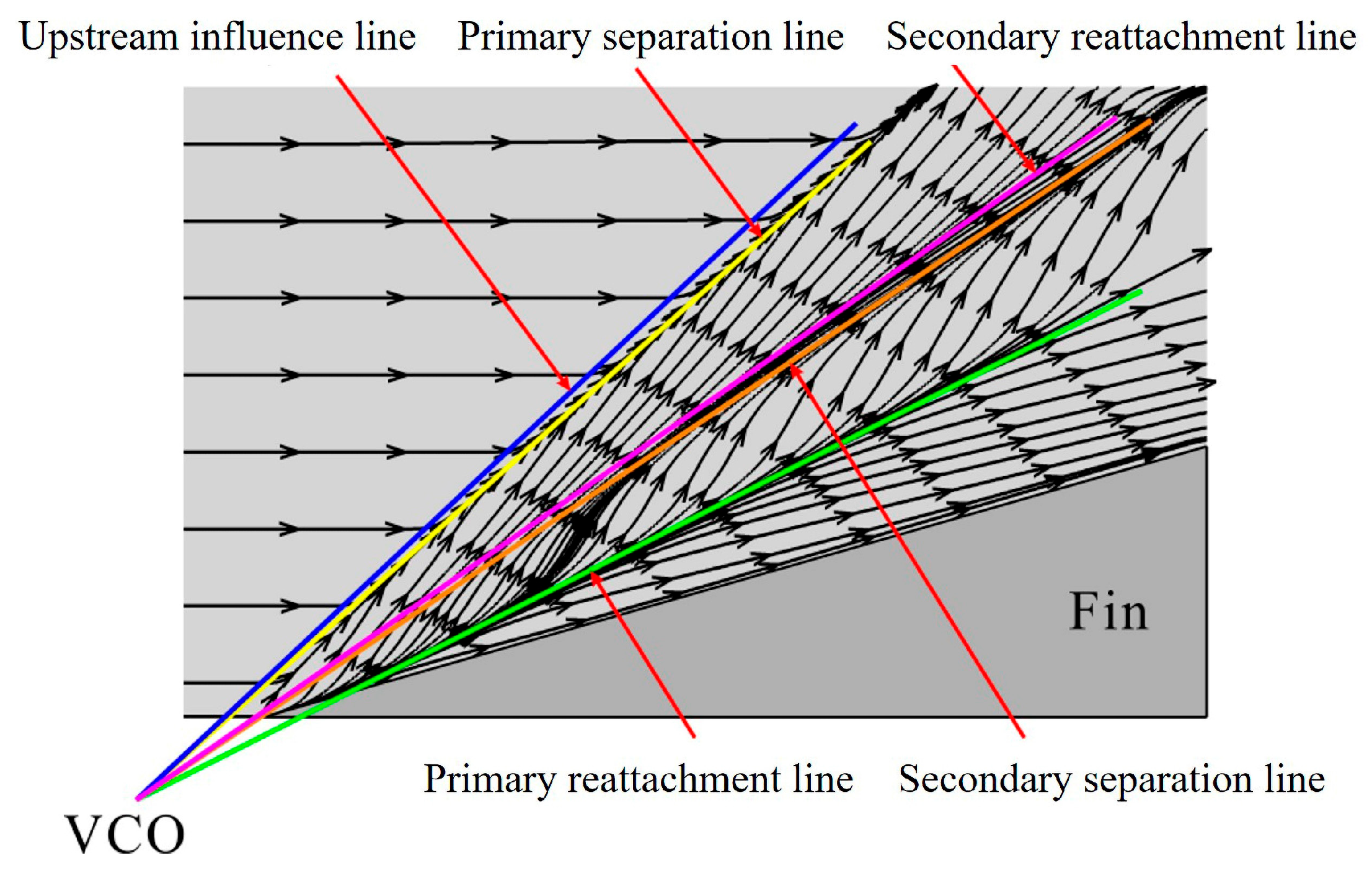
- Validation case 2: Secondary Separation Interaction Mode
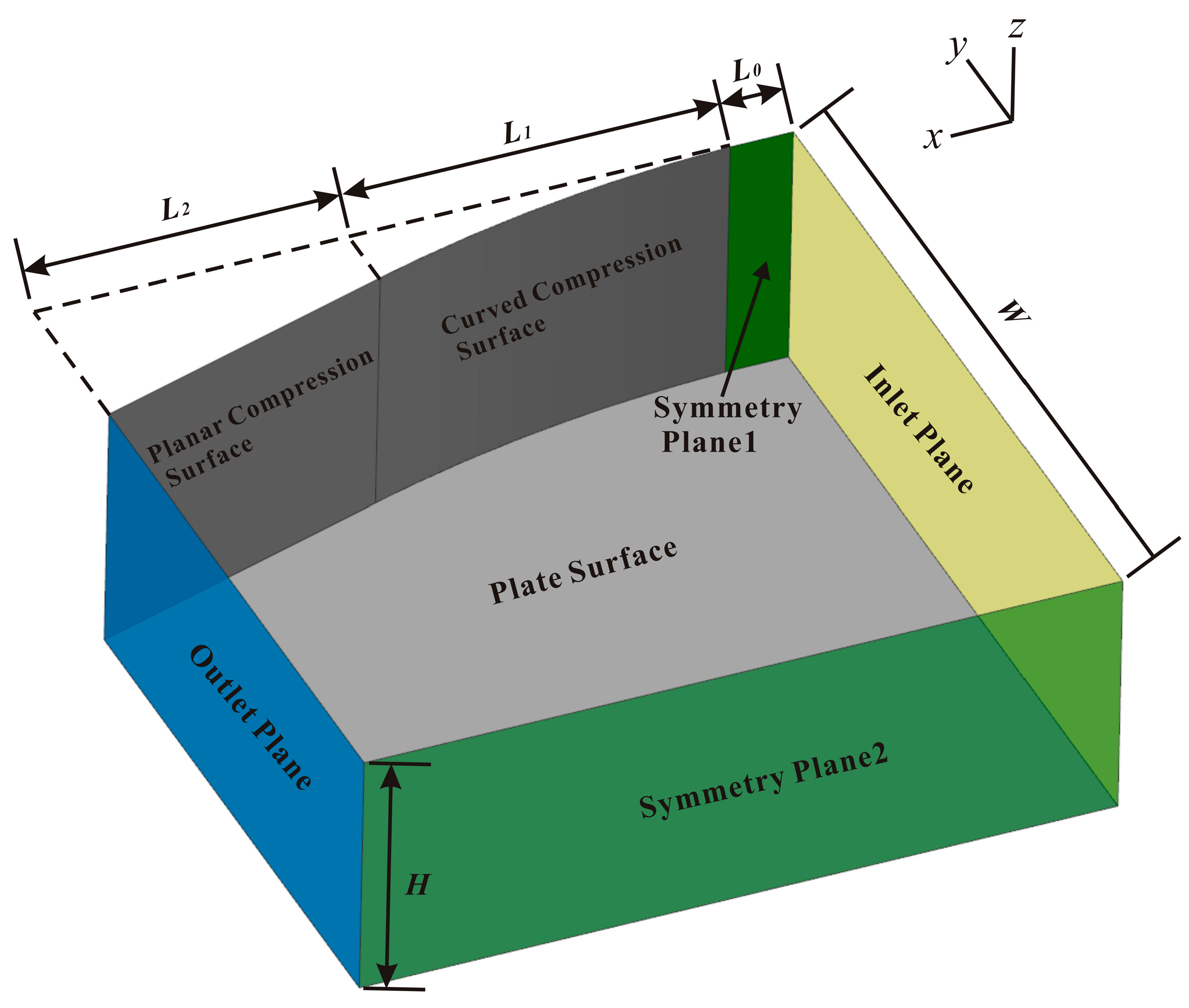
2.3. Model Setup
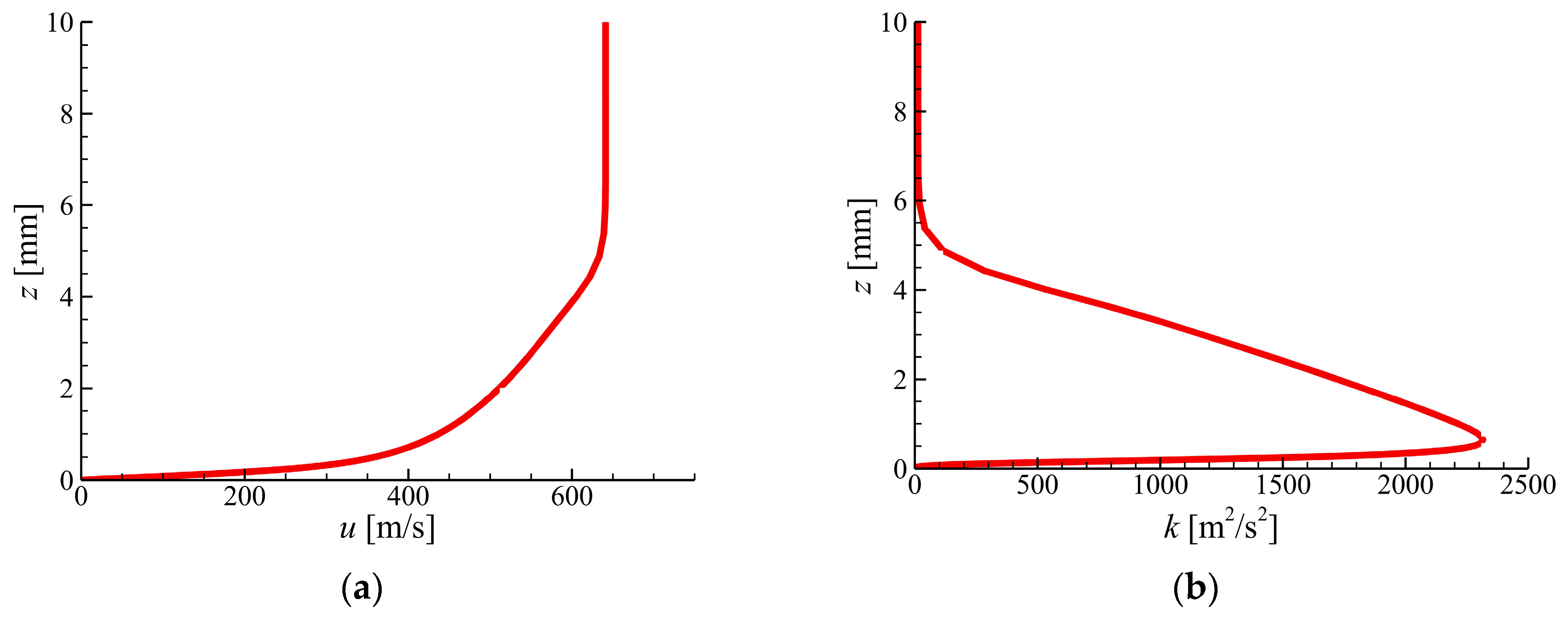
2.4. Computational Flow Conditions
3. Results and Discussion
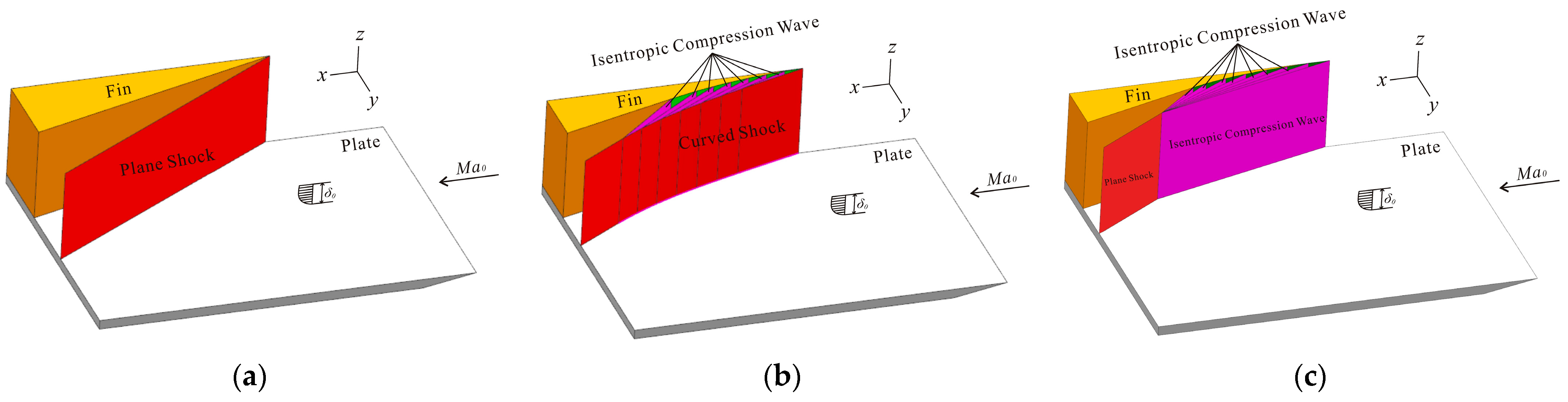
3.1. Inviscid Flow Field Structure and Flow Separation Mode
3.2. Three-Dimensional Vortex Structure and Lateral Flow Structure
3.3. Guidance for Inlet Design
4. Conclusions
- (1)
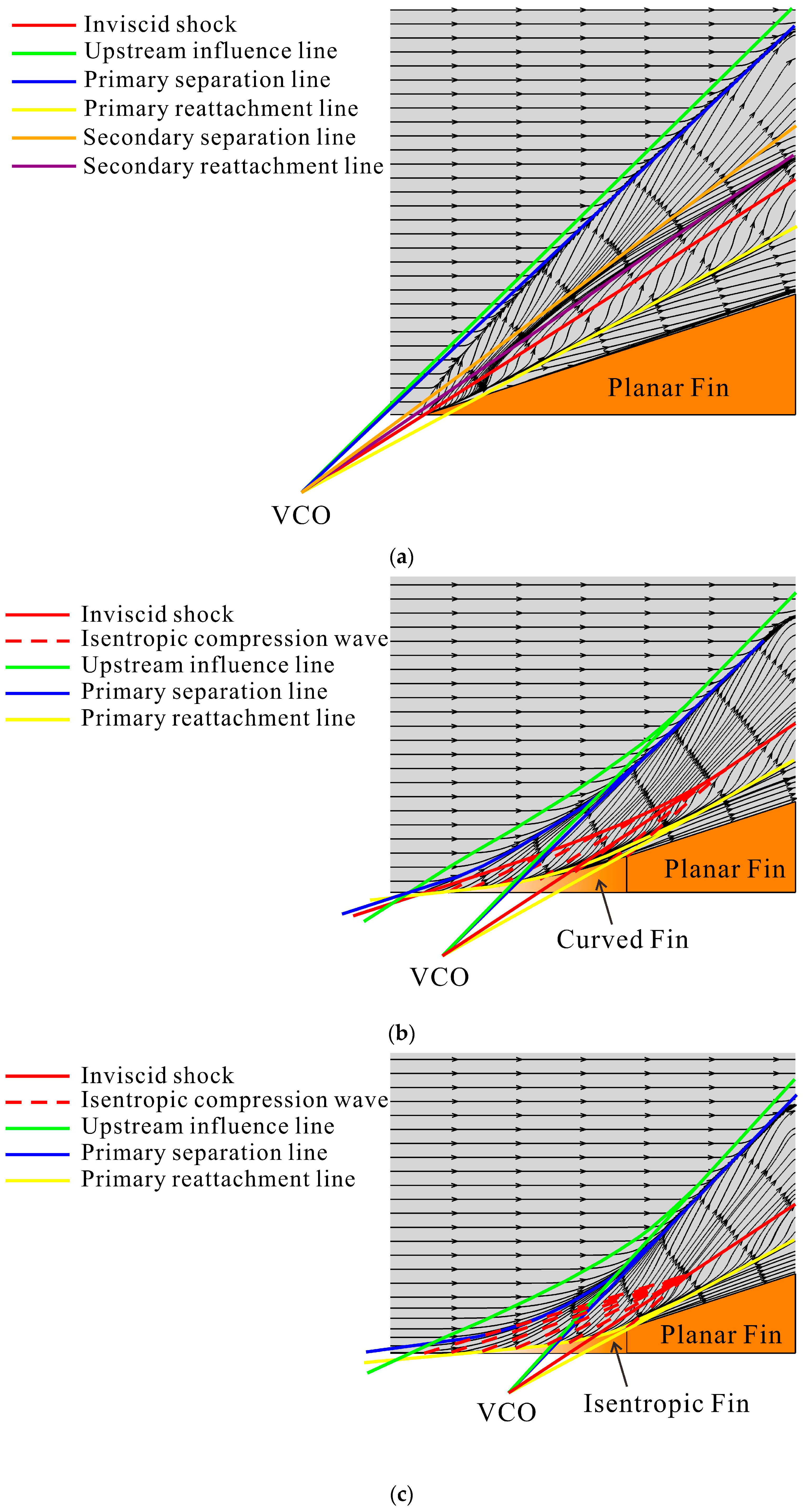
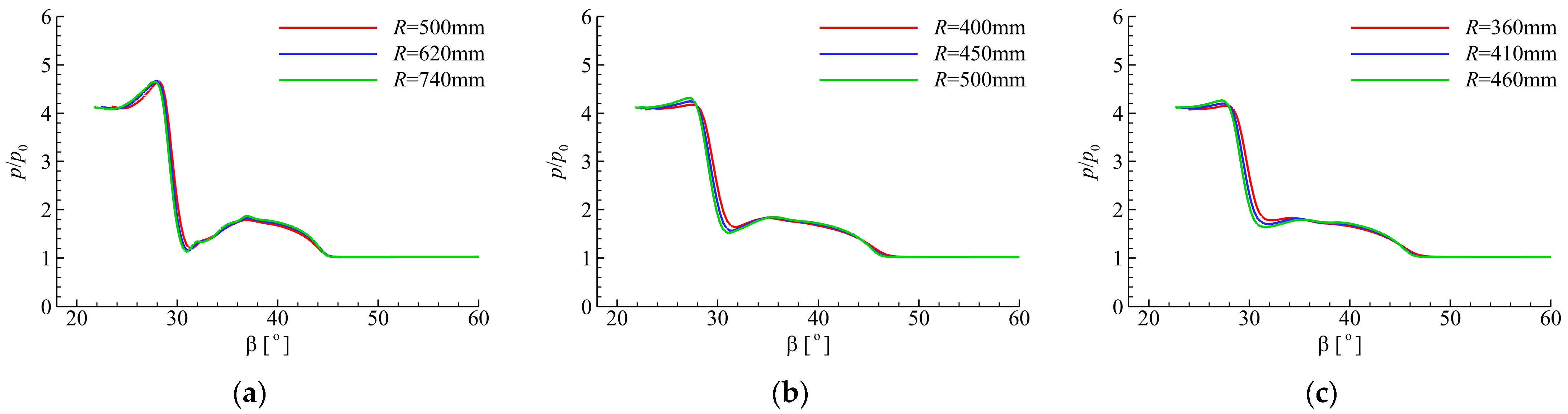
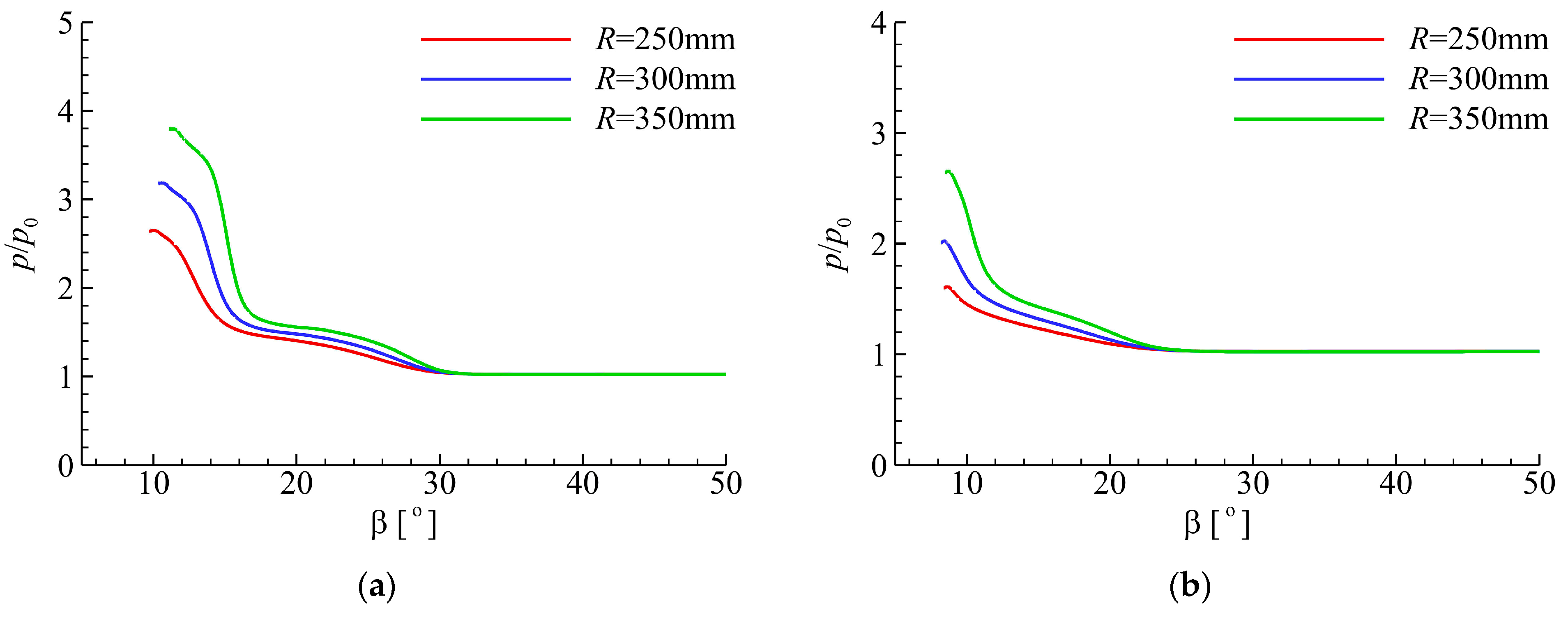
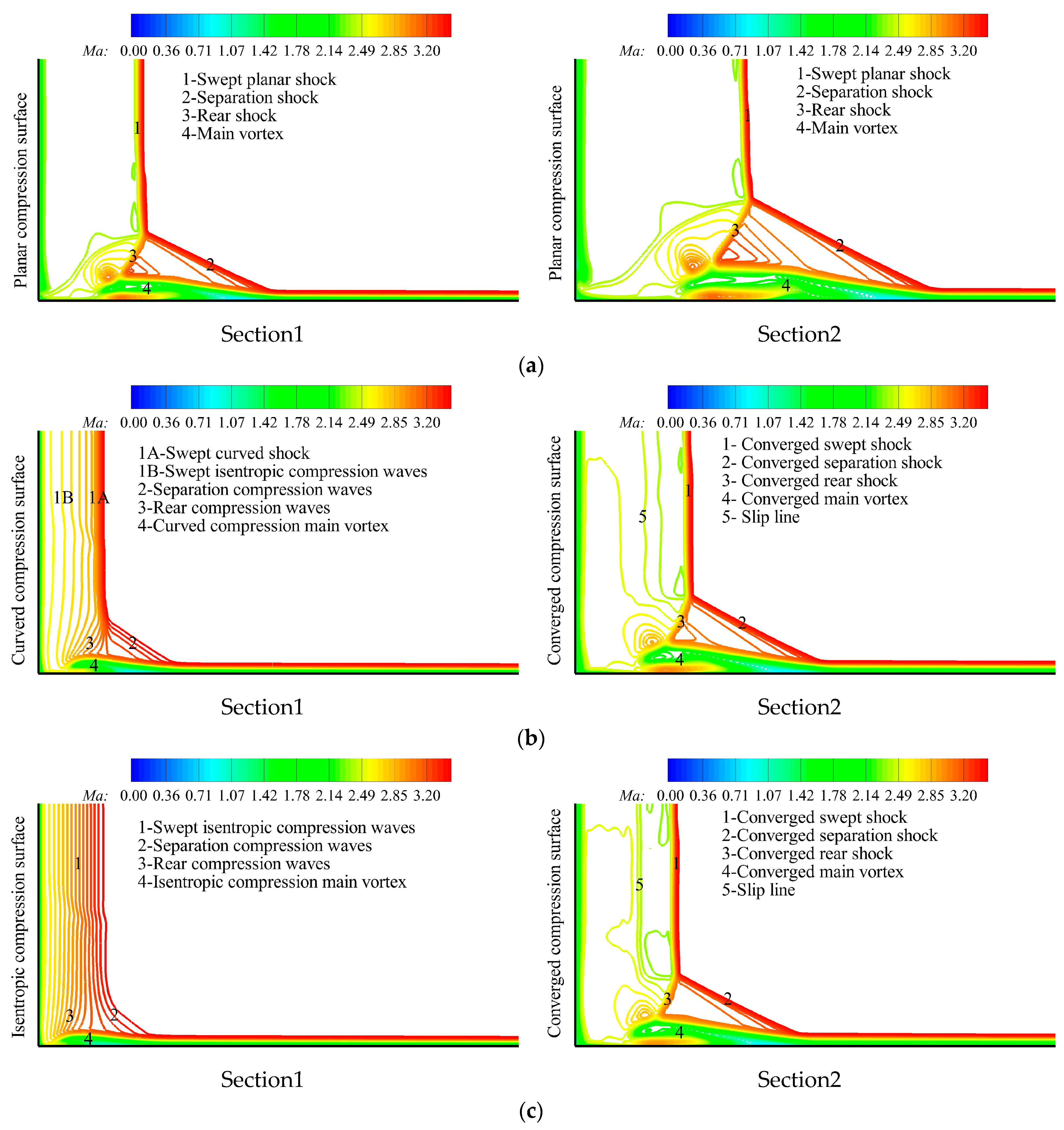
- The interactions induced by both curved swept shocks and isentropic swept compression depart from the classical conical similarity typically associated with planar configurations. However, downstream of the shock wave coalescence, the flow recovers its conical similarity within the resultant interaction region. Furthermore, the topological characteristics of separation in curved-compression interactions deviate from the classification framework established by Alvi and Settles [10,11], challenging the applicability of this conventional theory to non-planar swept compression systems.
- (2)
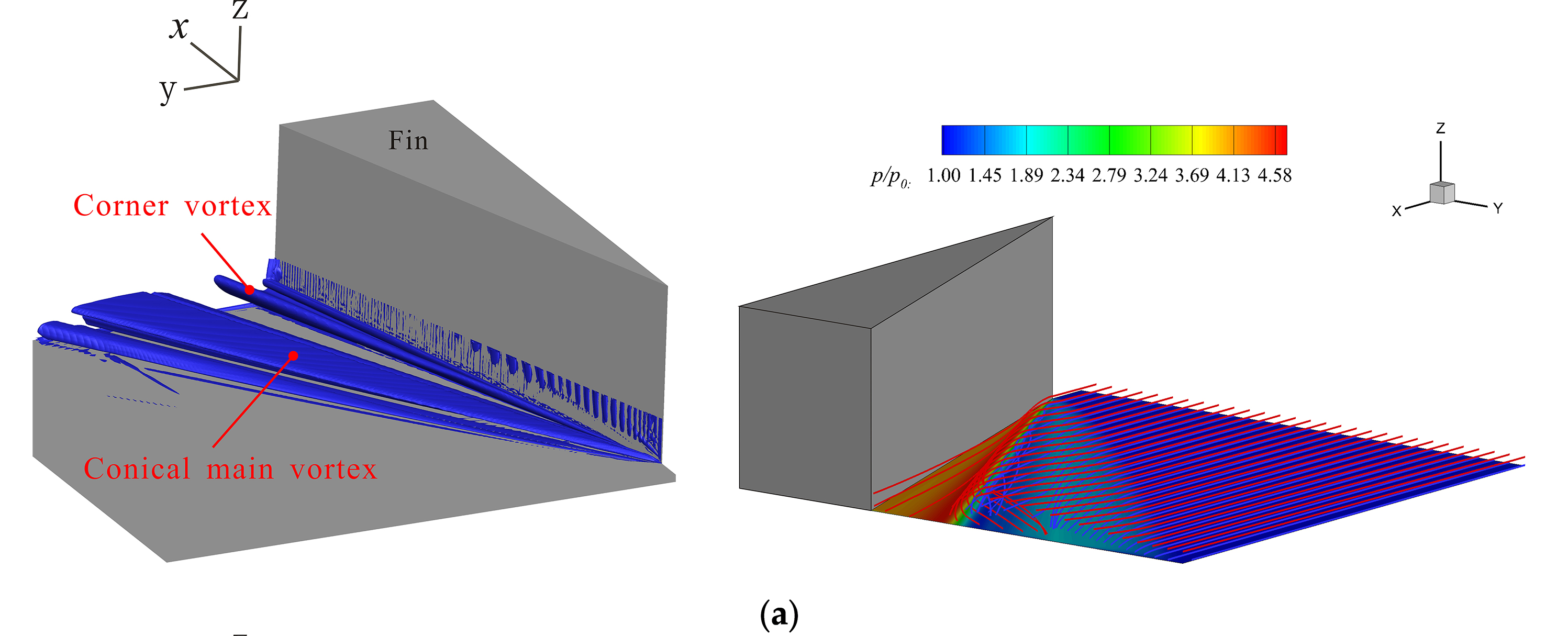
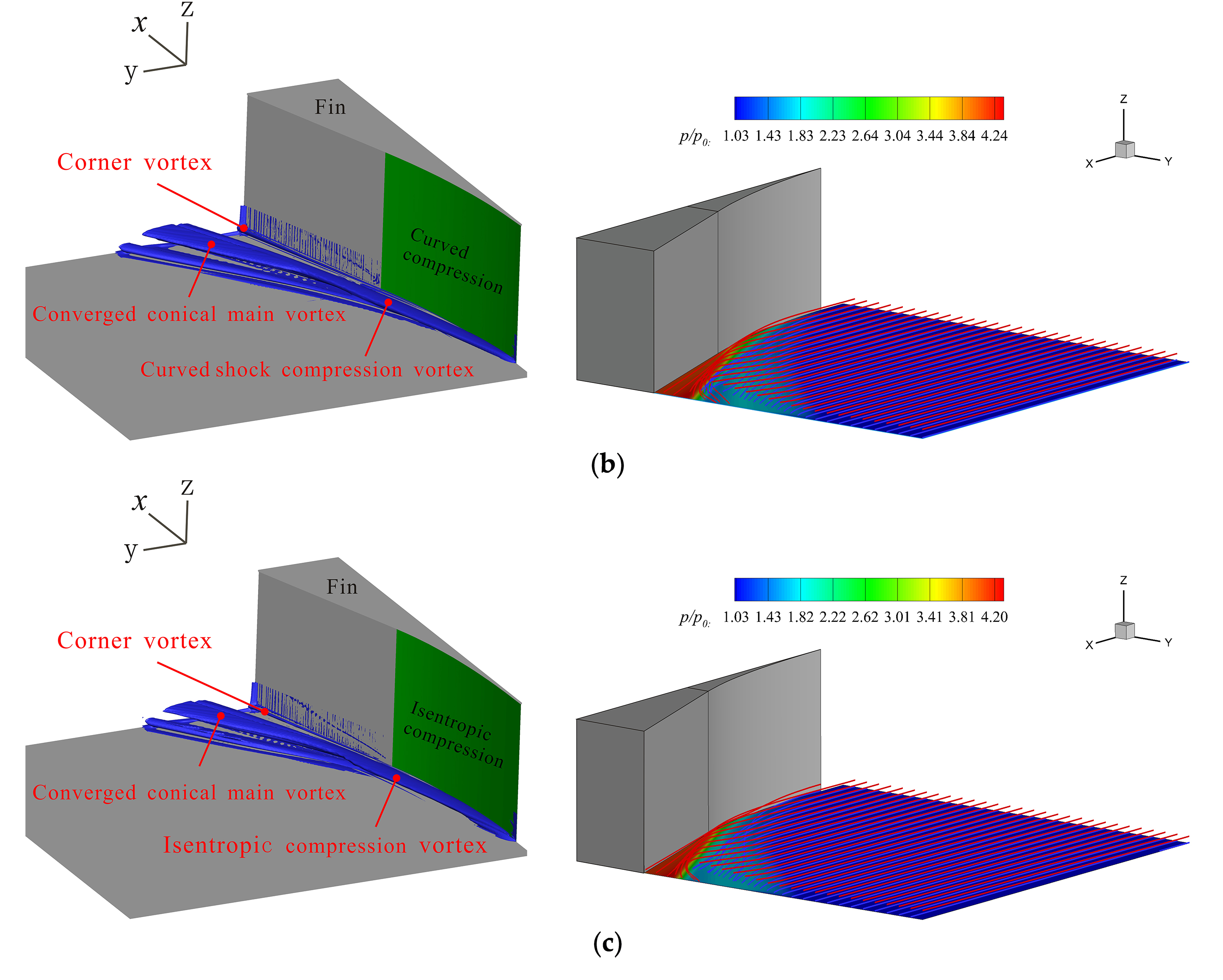
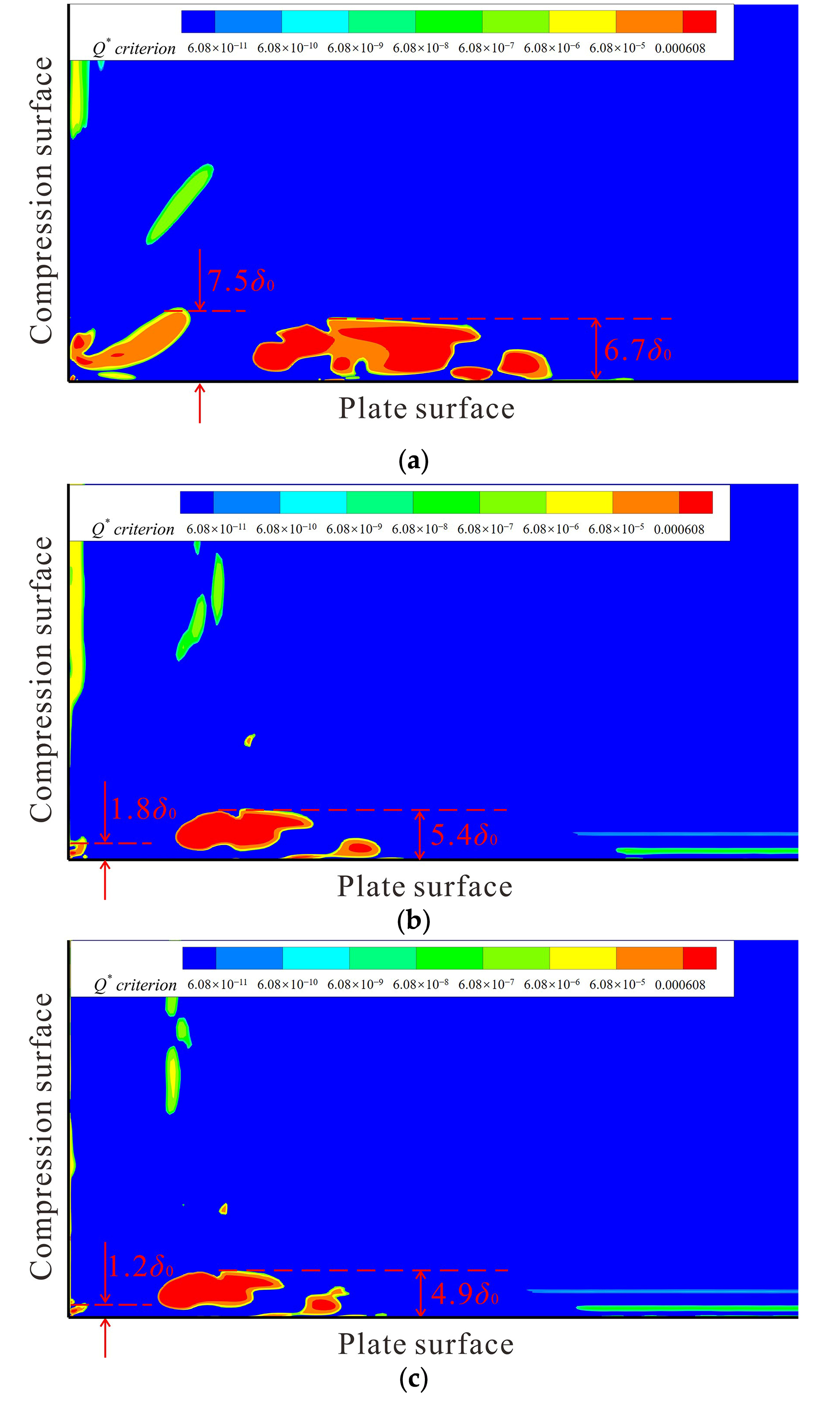
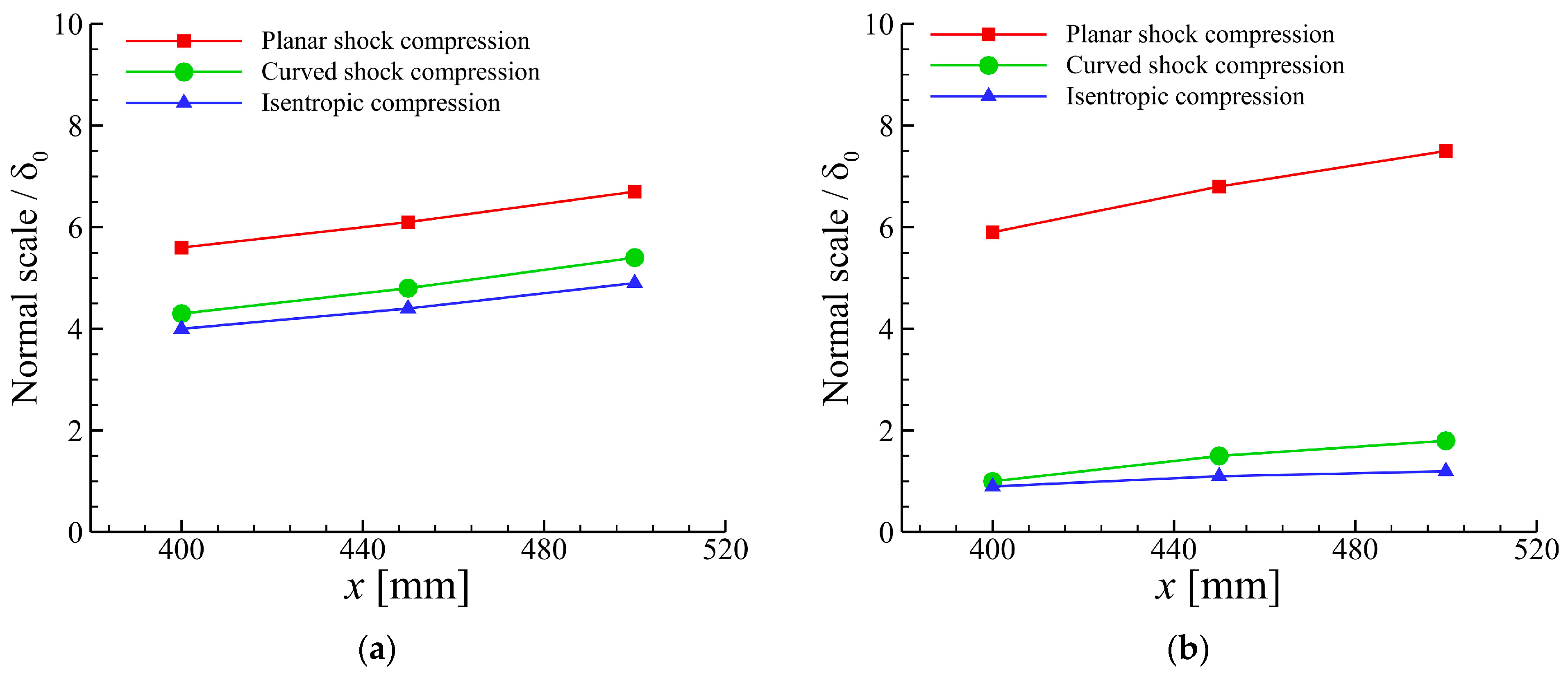
- Both curved shock and isentropic compression interactions induce large-scale primary vortices that evolve along curved trajectories downstream, accompanied by small-scale corner vortex structures. At a consistent total deflection angle, the baseline planar SSWTBLI exhibits the largest spatial extent for both vortex structures, with normal scales reaching 6.7δ0 and 7.5δ0, respectively. In comparison, curved shock compression results in reduced normal scales of 5.4δ0 and 1.8δ0. Isentropic compression manifests the most compact separation, with the minimum normal scales measured at 4.9δ0 for the primary vortex and 1.2δ0 for the corner vortex.
- (3)
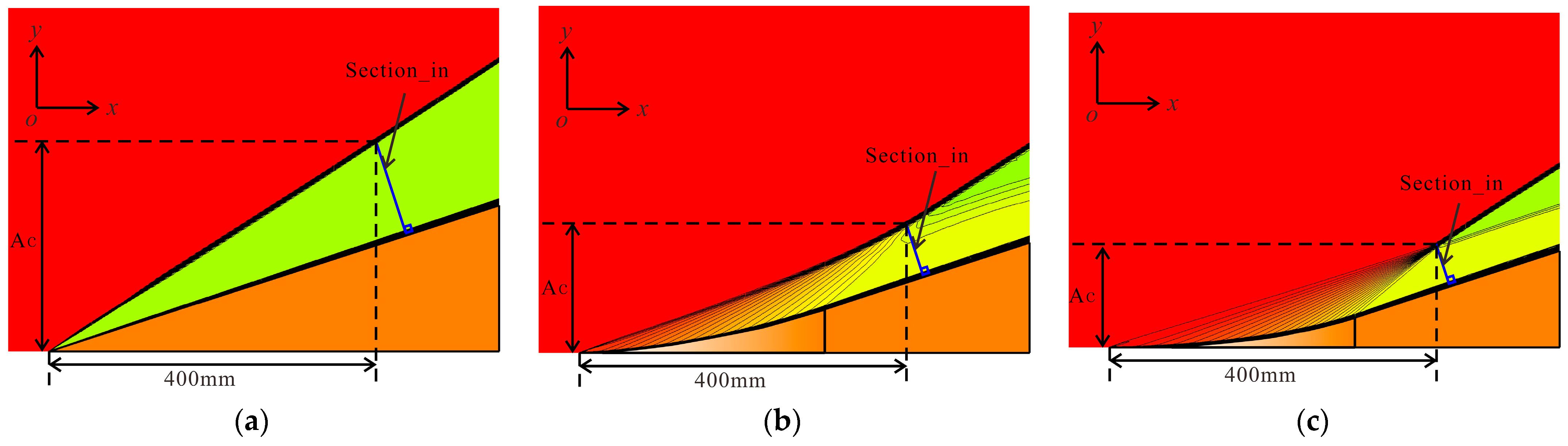
- Comparative analysis of compression efficiency and flow capture efficiency across the three swept compression configurations reveals a significant performance trade-off. While isentropic compression yields the maximum compression efficiency, it simultaneously results in the minimum flow capture efficiency. Conversely, planar shock compression provides superior flow capture at the expense of compression efficiency. In the aerodynamic design of high-speed inlets, a comprehensive evaluation of these competing metrics is required for selecting the optimal compression topology. Curved shock compression strikes a favorable balance between pressure gain and flow capture, emerging as a viable candidate for maximizing the integrated performance of the inlet system.
Author Contributions
Funding
Data Availability Statement
Acknowledgments
Conflicts of Interest
References
- Panaras, A.G. Review of the physics of swept-shock/boundary layer interactions. Prog. Aerosp. Sci. 1996, 32, 173–244. [Google Scholar] [CrossRef] [Scilit]
- Huang, H.; Tan, H.; Li, F.; Tang, X.; Qin, Y.; Xie, L.B.; Xu, Y.Y.; Li, C.; Gao, S.; Zhang, Y.; et al. A review of the shock-dominated flow in a hypersonic inlet/isolator. Prog. Aerosp. Sci. 2023, 143, 100952. [Google Scholar] [CrossRef] [Scilit]
- Huang, H.X.; Tan, H.J.; Sun, S.; Ling, Y. Evolution of supersonic corner vortex in a hypersonic inlet/isolator model. Phys. Fluids 2016, 28, 126101. [Google Scholar] [CrossRef] [Scilit]
- McCabe, A. The three-dimensional interaction of a shock wave with a turbulent boundary layer. Aeronaut. Q. 1966, 17, 231–252. [Google Scholar] [CrossRef] [Scilit]
- Korkegi, R.H. A simple correlation for incipient-turbulent boundary-layer separation due to a skewed shock wave. AIAA J. 1973, 11, 1578–1579. [Google Scholar] [CrossRef] [Scilit]
- Korkegi, R.H. Comparison of shock-induced two-and three-dimensional incipient turbulent separation. AIAA J. 1975, 13, 534–535. [Google Scholar] [CrossRef] [Scilit]
- Oskam, B.; Bogdonoff, S.M.; Vas, I.E. Study of Three-Dimensional Flow Fields Generated by the Interaction of a Skewed Shock Wave with a Turbulent Boundary Layer; Princeton University: Princeton, NJ, USA, 1975. [Google Scholar]
- Zheltovodov, A.A.; Maksimov, A.I.; Schülein, E. Development of turbulent separated flows in the vicinity of swept shock waves. Interact. Complex 1987, 3, 67–91. [Google Scholar]
- Deng, X.Y. Correlative behaviours of shock/boundary layer interaction induced by sharp fin and semicone. In Proceedings of the 22nd Fluid Dynamics, Plasma Dynamics and Lasers Conference, Honolulu, HI, USA, 24–26 June 1991. [Google Scholar] [CrossRef] [Scilit]
- Alvi, F.S.; Settles, G. Structure of swept shock wave/boundary-layer interactions using conical shadowgraphy. In Proceedings of the 21st Fluid Dynamics, Plasma Dynamics and Lasers Conference, Seattle, WA, USA, 18–20 June 1990. [Google Scholar] [CrossRef] [Scilit]
- Alvi, F.S.; Settles, G.S. Physical model of the swept shock wave/boundary-layer interaction flowfield. AIAA J. 1992, 30, 2252–2258. [Google Scholar] [CrossRef] [Scilit]
- Knight, D.D.; Badekas, D.; Horstman, C.C.; Settles, G.S. Quasiconical flowfield structure of the three-dimensional single fin interaction. AIAA J. 1992, 30, 2809–2816. [Google Scholar] [CrossRef] [Scilit]
- Rodi, P.E.; Dolling, D.S. Behavior of pressure and heat transfer in sharp fin-induced turbulent interactions. AIAA J. 1995, 33, 2013–2019. [Google Scholar] [CrossRef] [Scilit]
- Fang, J.; Yao, Y.; Zheltovodov, A.A.; Lu, L. Investigation of three-dimensional shock wave/turbulent-boundary-layer interaction initiated by a single fin. AIAA J. 2017, 55, 509–523. [Google Scholar] [CrossRef] [Scilit]
- Token, K.H. Heat Transfer Due to Shock Wave Turbulent Boundary Layer Interactions on High Speed Weapon Systems; Technical Report AFFDL-TR-74-77; Air Force Flight Dynamics Laboratory: Wright-Patterson AFB, OH, USA, 1974. [Google Scholar]
- Kubota, H.; Stollery, J.L. An experimental study of the interaction between a glancing shock wave and a turbulent boundary layer. J. Fluid Mech. 1982, 116, 431–458. [Google Scholar] [CrossRef] [Scilit]
- Bolton, J.T.; Thurow, B.S.; Alvi, F.S.; Arora, N. Single camera 3D measurement of a shock wave-turbulent boundary layer interaction. In Proceedings of the 55th AIAA Aerospace Sciences Meeting, Grapevine, TX, USA, 9–13 January 2017. [Google Scholar] [CrossRef] [Scilit]
- Clifford, C.J.; Klemkowsky, J.N.; Thurow, B.S.; Arora, N.; Alvi, F.S. Visualization of an SBLI using Plenoptic BOS. In Proceedings of the 55th AIAA Aerospace Sciences Meeting, Grapevine, TX, USA, 9–13 January 2017. [Google Scholar] [CrossRef] [Scilit]
- Jones, C.; Clifford, C.; Thurow, B.S.; Mears, L.; Arora, N.; Alvi, F.S. Two camera plenoptic PIV applied to shock wave-boundary layer interactions. In Proceedings of the 2018 Fluid Dynamics Conference, Atlanta, GA, USA, 25–29 June 2018. [Google Scholar] [CrossRef] [Scilit]
- He, G.; Zhou, J.; Zhao, Y.X. Application of free interaction theory in swept shock wave/turbulent boundary layer interactions. J. Vis. 2018, 21, 203–214. [Google Scholar] [CrossRef] [Scilit]
- Sheng, F.J.; Tan, H.J.; Zhuang, Y.; Huang, H.X.; Chen, H.; Wang, W.X. Visualization of conical vortex and shock in swept shock/turbulent boundary layer interaction flow. J. Vis. 2018, 21, 909–914. [Google Scholar] [CrossRef] [Scilit]
- Dolling, D.S.; Bogdonoff, S.M. Upstream influence in sharp fin-induced shock wave turbulent boundary-layer interaction. AIAA J. 1983, 21, 143–145. [Google Scholar] [CrossRef] [Scilit]
- Zheltovodov, A.A. Regimes and properties of three-dimensional separation flows initiated by skewed compression shocks. J. Appl. Mech. Tech. Phys. 1982, 23, 413–418. [Google Scholar] [CrossRef] [Scilit]
- Degrez, G.; Ginoux, J.J. Surface phenomena in a three-dimensional skewed shock wave/laminar boundary-layer interaction. AIAA J. 1984, 22, 1764–1769. [Google Scholar] [CrossRef] [Scilit]
- Dolling, D.S.; McClure, W.B. Flowfield scaling in sharp fin-induced shock wave/turbulent boundary-layer interaction. AIAA J. 1985, 23, 201–206. [Google Scholar] [CrossRef] [Scilit]
- Dolling, D.S. Upstream influence in conically symmetric flow. AIAA J. 1985, 23, 967–969. [Google Scholar] [CrossRef] [Scilit]
- Settles, G.S.; Lu, F.K. Conical similarity of shock/boundary-layer interactions generated by swept and unswept fins. AIAA J. 1985, 23, 1021–1027. [Google Scholar] [CrossRef] [Scilit]
- Knight, D.D.; Horstman, C.C.; Shapey, B.; Bogdonoff, S. Structure of supersonic turbulent flow past a sharp fin. AIAA J. 1987, 25, 1331–1337. [Google Scholar] [CrossRef] [Scilit] [PubMed]
- Kim, K.S.; Settles, G.S. Skin friction measurements by laser interferometry in swept shock/boundary-layer interactions. AIAA J. 1990, 28, 133–139. [Google Scholar] [CrossRef] [Scilit]
- Hsu, J.; Settles, G. Holographic flowfield density measurements in swept shock wave/boundary-layer interactions. In Proceedings of the 30th Aerospace Sciences Meeting and Exhibit, Reno, NV, USA, 6–9 January 1992. [Google Scholar] [CrossRef] [Scilit]
- Borovoy, V.; Egorov, I.; Mosharov, V.; Radchenko, V.; Skuratov, A.; Struminskaya, I. Entropy-layer influence on single-fin and double-fin/boundary-layer interactions. AIAA J. 2016, 54, 443–457. [Google Scholar] [CrossRef] [Scilit]
- Li, X.K.; Sheng, F.J.; Li, J.W.; Yin, C.; He, M.F.; Zhou, H.; Liu, J. Investigation on Flow Characteristics of Swept Shock/Turbulent Boundary Layer Interaction Considering Entropy Layer Effect. Phys. Gases. 2023, 8, 1–14. [Google Scholar] [CrossRef]
- Garrison, T.; Settles, G. Flowfield visualization of crossing shock-wave/boundary-layer interactions. In Proceedings of the 30th Aerospace Sciences Meeting and Exhibit, Reno, NV, USA, 6–9 January 1992. [Google Scholar] [CrossRef] [Scilit]
- Garrison, T.J.; Settles, G.S.; Narayanswami, N.; Knight, D.D. Structure of crossing-shock-wave/turbulent-boundary-layer interactions. AIAA J. 1993, 31, 2204–2211. [Google Scholar] [CrossRef] [Scilit] [PubMed]
- Thivet, F.; Knight, D.D.; Zheltovodov, A.A.; Maksimov, A.I. Insights in turbulence modeling for crossing-shock-wave/boundary-layer interactions. AIAA J. 2001, 39, 985–995. [Google Scholar] [CrossRef] [Scilit]
- Thivet, F.; Knight, D.D.; Zheltovodov, A.A.; Maksimov, A.I. Analysis of observed and computed crossing-shock-wave/turbulent-boundary-layer interactions. Aerosp. Sci. Technol. 2002, 6, 3–17. [Google Scholar] [CrossRef] [Scilit]
- Yao, Y.; Salin, A.; Lo, S. Numerical analysis of wall properties in crossing-shock-wave/turbulent-boundary-layer interactions. In Proceedings of the 49th AIAA Aerospace Sciences Meeting including the New Horizons Forum and Aerospace Exposition, Orlando, FL, USA, 4–7 January 2011. [Google Scholar] [CrossRef] [Scilit]
- Salin, A.; Yao, Y.; Zheltovodov, A. Comparison and improvement of wall heat transfer prediction in crossing-shock-wave/turbulent-boundary-layer interaction conditions. In Proceedings of the 51st AIAA Aerospace Sciences Meeting including the New Horizons Forum and Aerospace Exposition, Grapevine, TX, USA, 7–10 January 2013. [Google Scholar] [CrossRef] [Scilit]
- Jordan, C.; Edwards, J.R.; Stefanski, D.L. RANS closure model assessment using LES/RANS datasets for a hypersonic crossing-shock interaction. In Proceedings of the AIAA SCITECH 2022 Forum, San Diego, CA, USA, 3–7 January 2022. [Google Scholar] [CrossRef] [Scilit]
- Sebastian, J.J.; Lu, F.K. Numerical investigation of separated flowfield in a crossing shockwave/laminar boundary-layer interaction. In Proceedings of the AIAA SCITECH 2022 Forum, San Diego, CA, USA, 3–7 January 2022. [Google Scholar] [CrossRef] [Scilit]
- Seckin, S.; Mears, L.J.; Song, M.; Alvi, F.S.; Zigunov, F. Surface properties of double-fin generated shock-wave/boundary-layer interactions. AIAA J. 2023, 61, 5302–5319. [Google Scholar] [CrossRef] [Scilit]
- Sheng, F.J.; Tan, H.J.; Huang, H.X.; Liu, Y.Z.; Gao, W.N.; Wang, W.X. Investigation on Flow Characteristics of Successive Bi-Swept Shock Waves/Turbulent Boundary Layer Interaction. J. Propuls. Technol. 2019, 40, 1023–1031. [Google Scholar] [CrossRef]
- Sheng, F.J. Research on Characteristics of Ipsilateral Bi-Swept Shock Wave/Turbulent Boundary Layer Interactions. Master’s Thesis, College of Energy and Power Engineering, Nanjing University of Aeronautics and Astronautics, Nanjing, China, 2019. [Google Scholar] [CrossRef]
- He, G. Investigation on the Three-Dimensional Swept Impinging Oblique Shock/Turbulent Boundary Layer Interactions. Ph.D. Thesis, College of Aerospace Science and Engineering, National University of Defense Technology, Changsha, China, 2018. [Google Scholar] [CrossRef]
- Panaras, A.G. The effect of the structure of swept-shock-wave/turbulent-boundary-layer interactions on turbulence modelling. J. Fluid Mech. 1997, 338, 203–230. [Google Scholar] [CrossRef] [Scilit]
- Thivet, F.; Knight, D.D.; Zheltovodov, A.A.; Maksimov, A.I. Importance of limiting the turbulent stresses to predict 3D shock-wave/boundary-layer interactions. In Proceedings of the 23rd International Symposium on Shock Waves, Fort Worth, TX, USA, 22–27 July 2001. [Google Scholar]


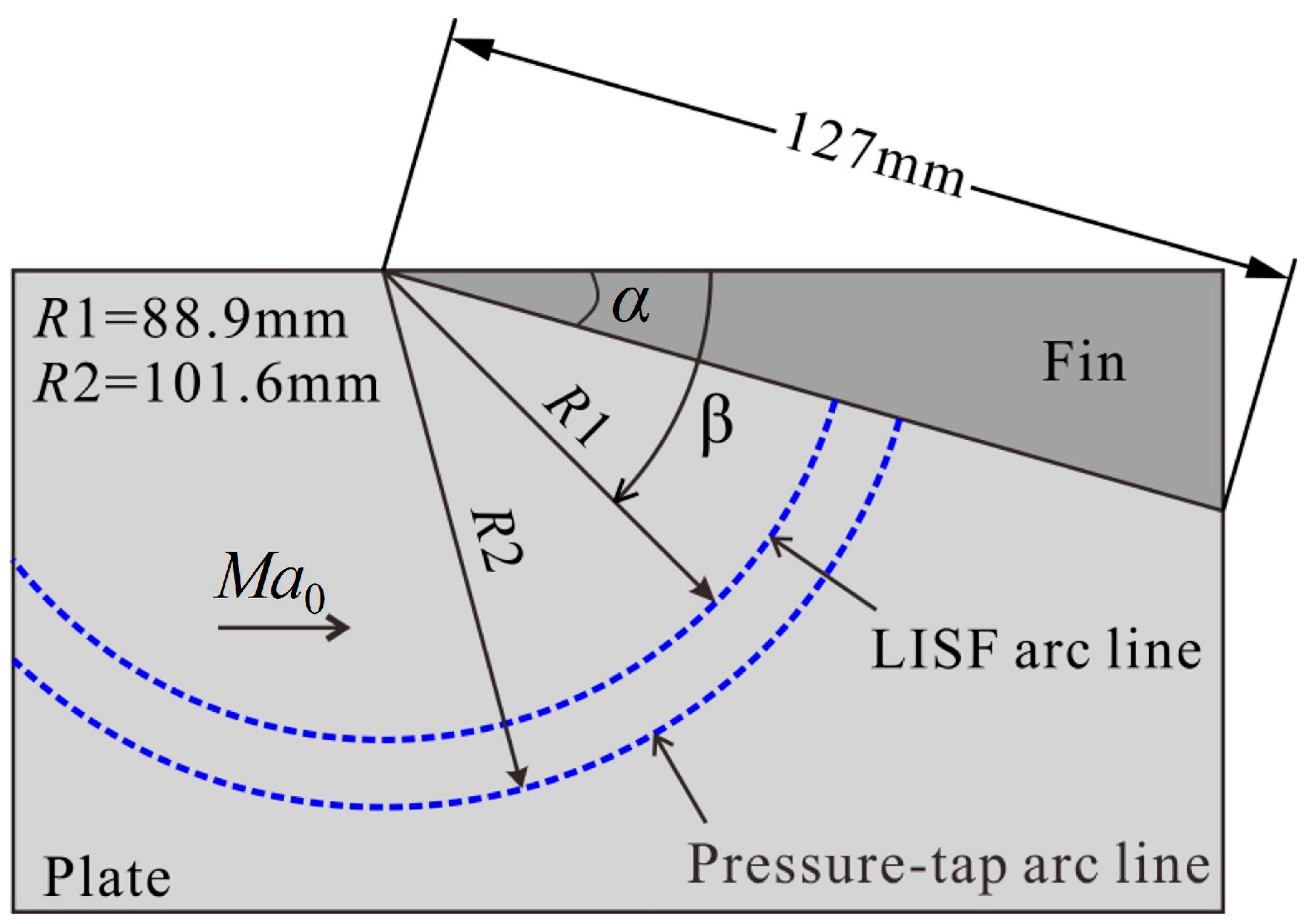





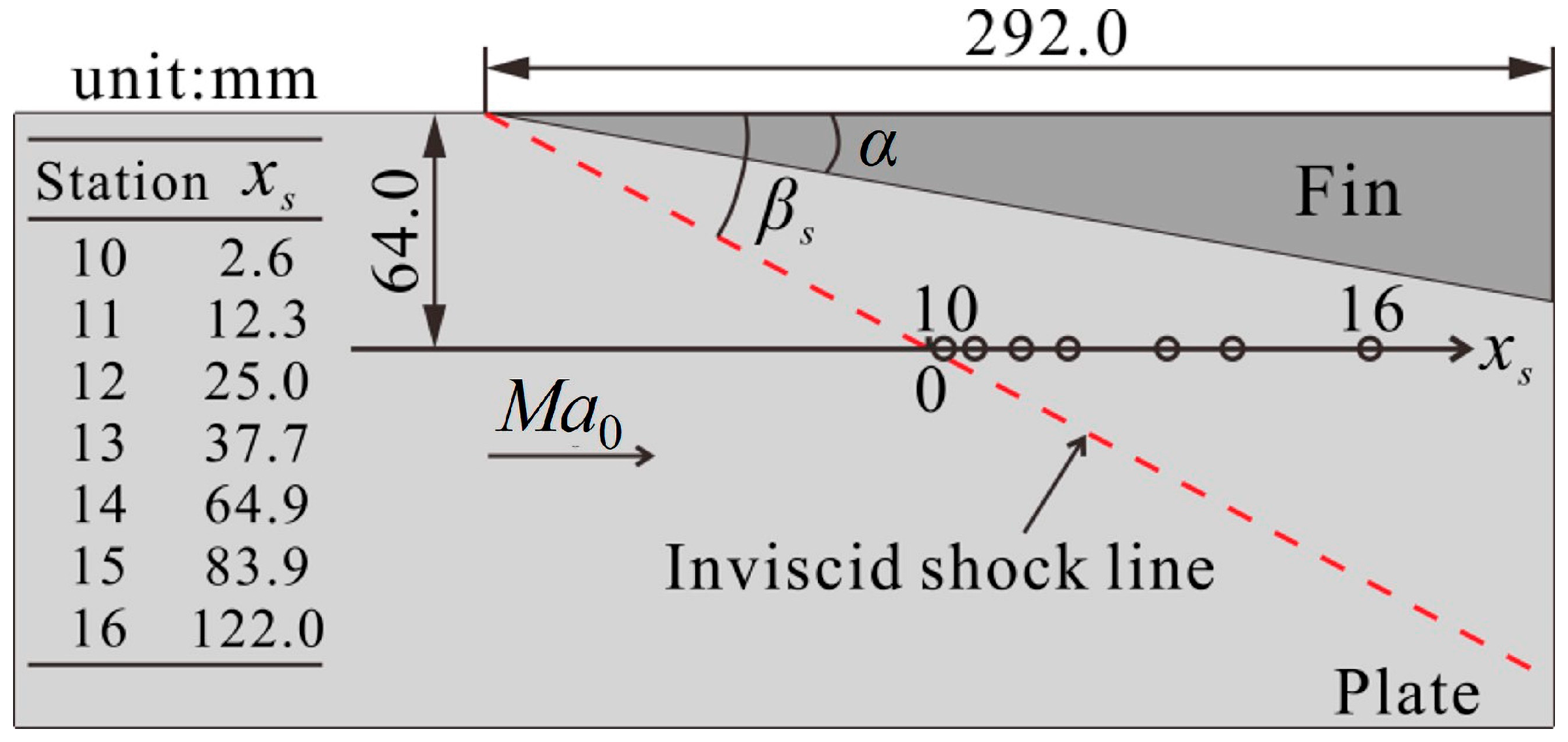
| δ0 [mm] | Ma0 | α [°] | Reδ0 | Pt0 [Pa] | Tt0 [K] |
|---|---|---|---|---|---|
| 5 | 2.91 | 10 | 3.04 × 10⁵ | 689,700 | 275.9 |
| δ0 [mm] | Ma0 | α [°] | Reδ0 | Pt0 [Pa] | Tt0 [K] |
|---|---|---|---|---|---|
| 3.02 | 3.03 | 16 | 1.88 × 10⁵ | 827,000 | 293.5 |
| Parameter | Value |
|---|---|
| Ma0 | 3.5 |
| Pt0/Pa | 101,325 |
| Tt0/K | 288.15 |
| Reδ0 | 30,955 |
| Fine Grid | Dense Grid | Relative Error | |
|---|---|---|---|
| Primary vortex | 5.38δ0 | 5.38δ0 | 0.0% |
| Corner vortex | 1.77δ0 | 1.72δ0 | 2.9% |
| Compression Types | Planar Shock Compression | Curved Shock Compression | Isentropic Compression |
|---|---|---|---|
| π | 3.90 | 3.96 | 4.06 |
| σ | 0.775 | 0.937 | 0.954 |
| φ | 0.964 | 0.973 | 0.972 |
| Ac/S | 0.560 | 0.365 | 0.293 |
| ηp | 3.023 | 3.709 | 3.868 |
| ηφ | 0.540 | 0.356 | 0.285 |
Disclaimer/Publisher’s Note: The statements, opinions and data contained in all publications are solely those of the individual author(s) and contributor(s) and not of MDPI and/or the editor(s). MDPI and/or the editor(s) disclaim responsibility for any injury to people or property resulting from any ideas, methods, instructions or products referred to in the content. |
© 2026 by the authors. Licensee MDPI, Basel, Switzerland. This article is an open access article distributed under the terms and conditions of the Creative Commons Attribution (CC BY) license.
Share and Cite
Sheng, F.; Song, D.; Huang, H.; Tan, H.; Li, X.; Zhang, Z. Characterizations of Swept Shock/Boundary Layer Interactions: A Comparison Between Planar Shock, Curved Shock, and Isentropic Compression. Aerospace 2026, 13, 539. https://doi.org/10.3390/aerospace13060539
Sheng F, Song D, Huang H, Tan H, Li X, Zhang Z. Characterizations of Swept Shock/Boundary Layer Interactions: A Comparison Between Planar Shock, Curved Shock, and Isentropic Compression. Aerospace. 2026; 13(6):539. https://doi.org/10.3390/aerospace13060539
Chicago/Turabian StyleSheng, Fajia, Dengxue Song, Hexia Huang, Huijun Tan, Xiankai Li, and Zhiyu Zhang. 2026. "Characterizations of Swept Shock/Boundary Layer Interactions: A Comparison Between Planar Shock, Curved Shock, and Isentropic Compression" Aerospace 13, no. 6: 539. https://doi.org/10.3390/aerospace13060539
APA StyleSheng, F., Song, D., Huang, H., Tan, H., Li, X., & Zhang, Z. (2026). Characterizations of Swept Shock/Boundary Layer Interactions: A Comparison Between Planar Shock, Curved Shock, and Isentropic Compression. Aerospace, 13(6), 539. https://doi.org/10.3390/aerospace13060539