
A Review of Intelligent Trajectory Planning and Optimization for Aerospace Vehicles

 ,
,  ,
,
Abstract
1. Introduction
1.1. Research Background and Significance
1.2. Flight Trajectory Characteristics of Aerospace Vehicles
2. Limitations of Traditional Trajectory Planning and Optimization Methods
2.1. Real-Time Trajectory Planning Computational Efficiency Bottlenecks
2.2. Limitations in the Fidelity of Kinetic Mechanism Models
2.3. Complex Constraints and Multi-Objective Optimization Challenges
2.4. Comparative Analysis of Traditional and Intelligent Trajectory Planning Methods
3. Intelligent Trajectory Planning and Optimization Method
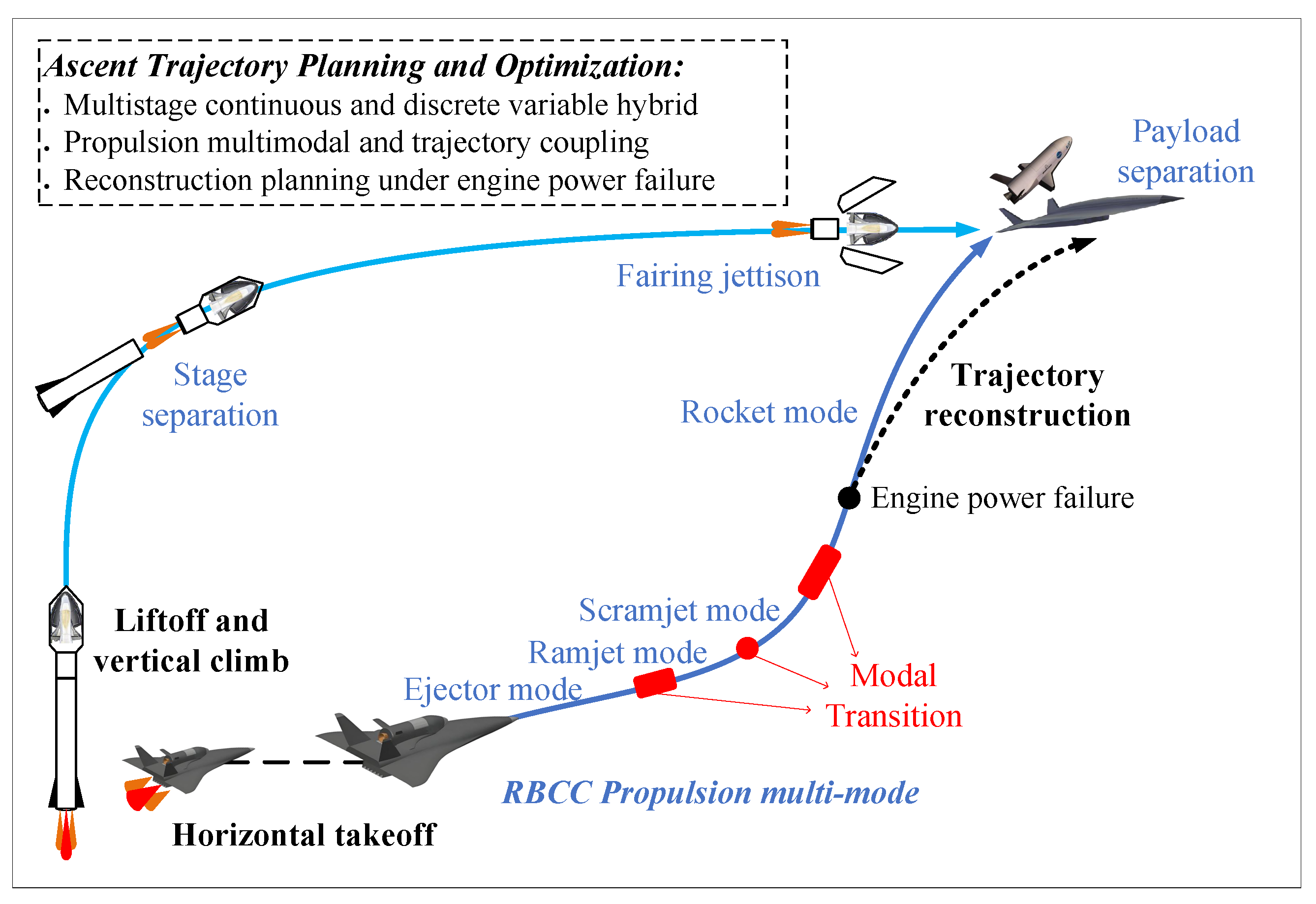
3.1. Intelligent Planning and Optimization of Ascent Trajectory
- Multistage Continuous and Discrete Variable Hybrid
- Propulsion Multimodal and Trajectory Coupling
- Reconstruction Planning under Engine Power Failure
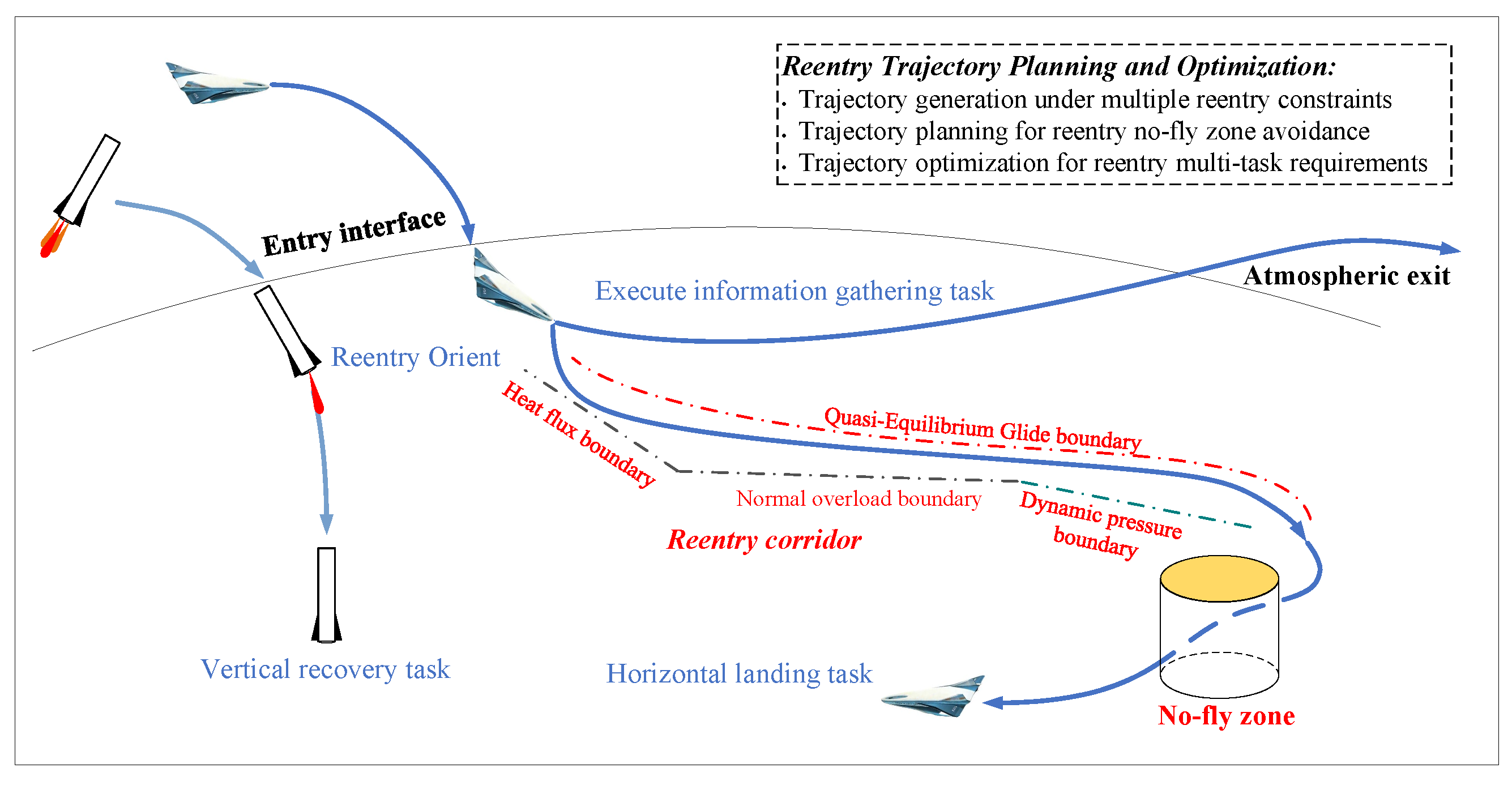
3.2. Intelligent Planning and Optimization of Reentry Trajectory
- Trajectory Generation under Multiple Reentry Constraints
- Trajectory Planning for Reentry No-Fly Zone Avoidance
- Trajectory optimization for Reentry Multi-Task Requirements
3.3. Hardware Computational Bottlenecks and Engineering Challenges
4. The Future Development Trend of Intelligent Trajectory Planning and Optimization Methods
4.1. Mechanism–Data Fusion and Cross-Domain Migration New Paradigm
4.2. On-Line Autonomous Trajectory Planning Adaptive Technology
4.3. Intelligent Control of Dynamic Multimodality and Trajectory Planning
4.4. Intelligent Planning of Cluster Collaboration and Distributed Trajectory
5. Conclusions
Author Contributions
Funding
Data Availability Statement
Conflicts of Interest
References
- Chen, H.; Wang, X.; Zhang, F. AI enabled launch vehicles: Next potential disruptive technology after reusability. Chin. J. Aeronaut. 2025, 38, 103756. [Google Scholar] [CrossRef]
- He, S.; Luo, H.; Lee, C.H.; Shin, H.S.; Tsourdos, A. Review of data-driven computational guidance for unmanned aerospace vehicles. Prog. Aerosp. Sci. 2025, 157, 101129. [Google Scholar] [CrossRef]
- Li, J.; Wu, Z.; Feng, Y.; Wang, G.; Liu, K. Intelligent model correction and trajectory planning for air-breathing hypersonic vehicle considering inlet unstart. Aerosp. Sci. Technol. 2025, 164, 110401. [Google Scholar] [CrossRef]
- Song, Z.; Pan, H.; Shao, M. Responsive tolerant control: An approach to extend adaptability of launch vehicles. Prog. Aerosp. Sci. 2024, 149, 101028. [Google Scholar] [CrossRef]
- Shraddha, C.; Priyadarshi, P.; Ghate, D.P. A survey of launch vehicle recovery techniques. Prog. Aerosp. Sci. 2025, 155, 101092. [Google Scholar] [CrossRef]
- Ding, Y.; Yue, X.; Chen, G.; Si, J. Review of control and guidance technology on hypersonic vehicle. Chin. J. Aeronaut. 2022, 35, 1–18. [Google Scholar] [CrossRef]
- Guo, J.; Liang, L.; Guo, Z. Combined-Cycle Propulsion-Involved Trajectory Optimization and Performance-Driven Attitude Control for Aerospace Plane During the Ascent Phase. IEEE Trans. Intell. Transp. Syst. 2024, 25, 21086–21096. [Google Scholar] [CrossRef]
- Zhou, H.; Li, X.; Bai, Y.; Wang, X. Optimal guidance for hypersonic vehicle using analytical solutions and an intelligent reversal strategy. Aerosp. Sci. Technol. 2023, 132, 108053. [Google Scholar] [CrossRef]
- Li, X.; Wang, X.; Zhou, H.; Li, Y. A novel evasion guidance for hypersonic morphing vehicle via intelligent maneuver strategy. Chin. J. Aeronaut. 2024, 37, 441–461. [Google Scholar] [CrossRef]
- Cheng, G.; Jing, W.; Gao, C. Recovery trajectory planning for the reusable launch vehicle. Aerosp. Sci. Technol. 2021, 117, 106965. [Google Scholar] [CrossRef]
- Hou, L.; Liu, H.; Yang, T.; An, S.; Wang, R. An intelligent autonomous morphing decision approach for hypersonic boost-glide vehicles based on DNNs. Aerospace 2023, 10, 1008. [Google Scholar] [CrossRef]
- Cao, R.; Shen, H.; Liu, Y.; Lu, Y. The LOES-based control scheme of aerospace vehicle under flying quality constraints. Acta Astronaut. 2020, 177, 258–269. [Google Scholar] [CrossRef]
- Su, L.; Wang, J.; Chen, H. A real-time and optimal hypersonic entry guidance method using inverse reinforcement learning. Aerospace 2023, 10, 948. [Google Scholar] [CrossRef]
- Lv, C.; Chang, J.; Bao, W.; Yu, D. Recent research progress on airbreathing aero-engine control algorithm. Propuls. Power Res. 2022, 11, 1–57. [Google Scholar] [CrossRef]
- Lv, C.; Huang, Q.; Chang, J.; Wang, Z.; Zheng, J.; Yu, D. Mode transition path optimization for turbine-based combined-cycle ramjet stage under uncertainty propagation of integrated airframe-propulsion system. Energy 2023, 268, 126718. [Google Scholar] [CrossRef]
- Guo, F.; Liu, M.; He, G.; Zhou, J.; Zhu, J.; You, Y. Analysis and Suppression of Thrust Trap for Turbo-Ramjet Mode Transition with the Integrated Optimal Control Method. Aerospace 2023, 10, 667. [Google Scholar] [CrossRef]
- Rui, X.; Xin, H.; Feixing, L.; Xiaogang, M.; Xing, Z.; Jianxun, D.; Chao, W. A survey on the conceptual design of hypersonic aircraft powered by RBCC engine. Proc. Inst. Mech. Eng. Part C J. Mech. Eng. Sci. 2023, 237, 4213–4245. [Google Scholar] [CrossRef]
- Luo, S.; Sun, Y.; Liu, J.; Xie, X.; Tian, J.; Song, J. Research status and development trend of air-breathing high-speed vehicle/engine integration. Aerosp. Sci. Technol. 2024, 155, 109675. [Google Scholar] [CrossRef]
- Cao, R.; Liu, Y.; Lu, Y. Robust optimization of control command for aerospace vehicles with aerodynamic uncertainty. Chin. J. Aeronaut. 2022, 35, 226–241. [Google Scholar] [CrossRef]
- Shirazi, A.; Ceberio, J.; Lozano, J.A. Spacecraft trajectory optimization: A review of models, objectives, approaches and solutions. Prog. Aerosp. Sci. 2018, 102, 76–98. [Google Scholar] [CrossRef]
- Chai, R.; Tsourdos, A.; Savvaris, A.; Chai, S.; Xia, Y.; Chen, C.P. Review of advanced guidance and control algorithms for space/aerospace vehicles. Prog. Aerosp. Sci. 2021, 122, 100696. [Google Scholar] [CrossRef]
- Xue, X.; Xie, Y.; Zhou, H.; Gong, Q.; Zhao, D. Ascent Trajectory Optimization Using Second-Order Birkhoff Pseudospectral Methods. Aerospace 2025, 12, 141. [Google Scholar] [CrossRef]
- Wang, Y.Z.; Dai, H.H. Secure model predictive static programming with initial value generator for online computational guidance of near-space vehicles. Aerosp. Sci. Technol. 2025, 156, 109768. [Google Scholar] [CrossRef]
- Zhao, Z.; Shang, H.; Dong, Y.; Wang, H. Multi-phase trajectory optimization of aerospace vehicle using sequential penalized convex relaxation. Aerosp. Sci. Technol. 2021, 119, 107175. [Google Scholar] [CrossRef]
- Li, K.; Guo, Y.; Ran, G.; Park, J.H. Adaptive Sequential Convex Programming for Mars Ascent Vehicle Multiphase Trajectory Optimization. IEEE Trans. Aerosp. Electron. Syst. 2024, 60, 9369–9382. [Google Scholar] [CrossRef]
- Ma, Y.; Pan, B.; Yan, R. Feasible sequential convex programming with inexact restoration for multistage ascent trajectory optimization. IEEE Trans. Aerosp. Electron. Syst. 2022, 59, 1217–1230. [Google Scholar] [CrossRef]
- Gasparetto, A.; Boscariol, P.; Lanzutti, A.; Vidoni, R. Path Planning and Trajectory Planning Algorithms: A General Overview; Springer International Publishing: Cham, Switzerland, 2015; pp. 3–27. [Google Scholar]
- Li, Z.; Fang, Z.; Jia, Z.; Yu, J. Entry trajectory optimization for cross-domain morphing vehicles using oscillation-avoidance-based multistage trust-region sequential convex programming. Chin. J. Aeronaut. 2026, 39, 103837. [Google Scholar] [CrossRef]
- Wang, Z. A survey on convex optimization for guidance and control of vehicular systems. Annu. Rev. Control 2024, 57, 100957. [Google Scholar] [CrossRef]
- Jorris, T.R.; Cobb, R.G. Three-dimensional trajectory optimization satisfying waypoint and no-fly zone constraints. J. Guid. Control. Dyn. 2009, 32, 551–572. [Google Scholar] [CrossRef]
- Sun, J.; Zhu, H.; Han, H.; Xu, D.; Cai, G. Optimization of mechanical deployable reentry vehicle based on multi-fidelity aerodynamic-trajectory coupling model. Aerosp. Sci. Technol. 2025, 157, 109777. [Google Scholar] [CrossRef]
- Runqi, C.; Tsourdos, A.; Savvaris, A.; Senchun, C.; Yuanqing, X. High-fidelity trajectory optimization for aeroassisted vehicles using variable order pseudospectral method. Chin. J. Aeronaut. 2021, 34, 237–251. [Google Scholar] [CrossRef]
- Chai, R.; Tsourdos, A.; Savvaris, A.; Chai, S.; Xia, Y.; Chen, C.P. Six-DOF spacecraft optimal trajectory planning and real-time attitude control: A deep neural network-based approach. IEEE Trans. Neural Netw. Learn. Syst. 2019, 31, 5005–5013. [Google Scholar] [CrossRef] [PubMed]
- Miao, X.; Song, Y.; Zhang, Z.; Gong, S. Successive convexification for ascent trajectory replanning of a multistage launch vehicle experiencing nonfatal dynamic faults. IEEE Trans. Aerosp. Electron. Syst. 2021, 58, 2039–2052. [Google Scholar] [CrossRef]
- Sun, X.; Chai, S.; Chai, R.; Zhang, B.; Felicetti, L.; Tsourdos, A. Convex–concave optimization for a launch vehicle ascent trajectory with chance constraints. J. Frankl. Inst. 2024, 361, 106849. [Google Scholar] [CrossRef]
- Zhang, P.; Li, W.; Gong, S. Ascent Trajectory Optimization for Boost-Glide Vehicle Using Homotopy Approximation Function Sequential Convex Programming. IEEE Trans. Aerosp. Electron. Syst. 2025, 61, 7576–7596. [Google Scholar] [CrossRef]
- Chai, R.; Savvaris, A.; Tsourdos, A.; Chai, S.; Xia, Y. A review of optimization techniques in spacecraft flight trajectory design. Prog. Aerosp. Sci. 2019, 109, 100543. [Google Scholar] [CrossRef]
- Ricciardi, L.A.; Maddock, C.A.; Vasile, M. Direct solution of multi-objective optimal control problems applied to spaceplane mission design. J. Guid. Control. Dyn. 2019, 42, 30–46. [Google Scholar] [CrossRef]
- Morante, D.; Sanjurjo Rivo, M.; Soler, M. A survey on low-thrust trajectory optimization approaches. Aerospace 2021, 8, 88. [Google Scholar] [CrossRef]
- Botros, A.; Wilde, N.; Sadeghi, A.; Alonso-Mora, J.; Smith, S.L. Regret-Based Sampling of Pareto Fronts for Multiobjective Robot Planning Problems. IEEE Trans. Robot. 2024, 40, 3778–3794. [Google Scholar] [CrossRef]
- Peng, G.; Wang, B.; Liu, L.; Fan, H. 3-D Autonomous Entry Trajectory Planning via Hybrid Action Reinforcement Learning. IEEE Trans. Aerosp. Electron. Syst. 2025, 61, 342–354. [Google Scholar] [CrossRef]
- Peng, G.; Wang, B.; Liu, L.; Fan, H.; Cheng, Z. Real-time adaptive entry trajectory generation with modular policy and deep reinforcement learning. Aerosp. Sci. Technol. 2023, 142, 108594. [Google Scholar] [CrossRef]
- Sun, L.; Yang, B.; Ma, J. Trajectory prediction in pipeline form for intercepting hypersonic gliding vehicles based on LSTM. Chin. J. Aeronaut. 2023, 36, 421–433. [Google Scholar] [CrossRef]
- Englander, J.A.; Conway, B.A. Automated solution of the low-thrust interplanetary trajectory problem. J. Guid. Control. Dyn. 2017, 40, 15–27. [Google Scholar] [CrossRef]
- Ceriotti, M.; Vasile, M. MGA trajectory planning with an ACO-inspired algorithm. Acta Astronaut. 2010, 67, 1202–1217. [Google Scholar] [CrossRef]
- Yang, Y.; Fu, Y.; Lu, D.; Xiang, H.; Xu, K. Three-Dimensional Unmanned Aerial Vehicle Trajectory Planning Based on the Improved Whale Optimization Algorithm. Symmetry 2024, 16, 1561. [Google Scholar] [CrossRef]
- Pontani, M.; Conway, B.A. Optimal trajectories for hyperbolic rendezvous with Earth–Mars cycling spacecraft. J. Guid. Control. Dyn. 2018, 41, 360–376. [Google Scholar] [CrossRef]
- Zhou, H.; Wang, X.; Bai, Y.; Cui, N. Ascent phase trajectory optimization for vehicle with multi-combined cycle engine based on improved particle swarm optimization. Acta Astronaut. 2017, 140, 156–165. [Google Scholar] [CrossRef]
- Shi, J.; Wang, J.; Su, L.; Ma, Z.; Chen, H. A neural network warm-started indirect trajectory optimization method. Aerospace 2022, 9, 435. [Google Scholar] [CrossRef]
- Zhu, L.; Wang, Y.; Wu, Z.; Cheng, C. The Intelligent Trajectory Optimization of Multistage Rocket with Gauss Pseudo-Spectral Method. Intell. Autom. Soft Comput. 2022, 33, 291–303. [Google Scholar] [CrossRef]
- Chai, R.; Tsourdos, A.; Savvaris, A.; Chai, S.; Xia, Y. Solving constrained trajectory planning problems using biased particle swarm optimization. IEEE Trans. Aerosp. Electron. Syst. 2021, 57, 1685–1701. [Google Scholar] [CrossRef]
- Gong, Z.; Yu, J.; Liu, X.; Xie, L.; Li, S. Deep Neural Networks Based Hypersonic Vehicle Reentry Impact Point Prediction with Fixed-Length Lightweight Training Data. IEEE Trans. Aerosp. Electron. Syst. 2025, 61, 17029–17040. [Google Scholar] [CrossRef]
- Izzo, D.; Märtens, M.; Pan, B. A survey on artificial intelligence trends in spacecraft guidance dynamics and control. Astrodynamics 2019, 3, 287–299. [Google Scholar] [CrossRef]
- Hua, H.; Fang, Y. A novel learning-based trajectory generation strategy for a quadrotor. IEEE Trans. Neural Netw. Learn. Syst. 2022, 35, 9068–9079. [Google Scholar] [CrossRef]
- Chai, R.; Savvaris, A.; Tsourdos, A.; Chai, S.; Xia, Y. Optimal fuel consumption finite-thrust orbital hopping of aeroassisted spacecraft. Aerosp. Sci. Technol. 2018, 75, 172–182. [Google Scholar] [CrossRef]
- Chai, R.; Savvaris, A.; Tsourdos, A.; Chai, S.; Xia, Y. Improved gradient-based algorithm for solving aeroassisted vehicle trajectory optimization problems. J. Guid. Control. Dyn. 2017, 40, 2093–2101. [Google Scholar] [CrossRef]
- Chai, R.; Savvaris, A.; Tsourdos, A.; Chai, S.; Xia, Y. Trajectory optimization of space maneuver vehicle using a hybrid optimal control solver. IEEE Trans. Cybern. 2017, 49, 467–480. [Google Scholar] [CrossRef]
- Wang, Z.; Grant, M.J. Minimum-fuel low-thrust transfers for spacecraft: A convex approach. IEEE Trans. Aerosp. Electron. Syst. 2018, 54, 2274–2290. [Google Scholar] [CrossRef]
- Li, H.; Chen, S.; Izzo, D.; Baoyin, H. Deep networks as approximators of optimal low-thrust and multi-impulse cost in multitarget missions. Acta Astronaut. 2020, 166, 469–481. [Google Scholar] [CrossRef]
- Malyuta, D.; Yu, Y.; Elango, P.; Açıkmeşe, B. Advances in trajectory optimization for space vehicle control. Annu. Rev. Control 2021, 52, 282–315. [Google Scholar] [CrossRef]
- Zhang, T.; Gong, C.; Zhang, L. Event-triggered nonlinear model-predictive control for optimal ascent guidance. IEEE Trans. Aerosp. Electron. Syst. 2024, 60, 7771–7784. [Google Scholar] [CrossRef]
- Hu, G.; Guo, Z.; Guo, J. Ascent Trajectory and Parameter Collaborative Optimization for Aerospace Vehicles with Rocket-Based Combined Cycle Propulsion. IEEE Trans. Aerosp. Electron. Syst. 2025, 61, 15857–15869. [Google Scholar] [CrossRef]
- Marchetti, F.; Minisci, E.; Riccardi, A. Single-stage to orbit ascent trajectory optimisation with reliable evolutionary initial guess. Optim. Eng. 2023, 24, 291–316. [Google Scholar] [CrossRef]
- Lu, P.; Liu, X.; Yang, R.; Zhang, Z. Ascent trajectory optimization with nonlinearity-kept convexification. IEEE Trans. Aerosp. Electron. Syst. 2022, 59, 3236–3250. [Google Scholar] [CrossRef]
- Cheng, X.; Li, H.; Zhang, R. Efficient ascent trajectory optimization using convex models based on the Newton–Kantorovich/Pseudospectral approach. Aerosp. Sci. Technol. 2017, 66, 140–151. [Google Scholar] [CrossRef]
- Zhao, J.; He, X.; Li, H.; Lu, L. An adaptive optimization algorithm based on clustering analysis for return multi-flight-phase of VTVL reusable launch vehicle. Acta Astronaut. 2021, 183, 112–125. [Google Scholar] [CrossRef]
- Wang, J.; Ma, H.; Li, H.; Chen, H. Real-time guidance for powered landing of reusable rockets via deep learning. Neural Comput. Appl. 2023, 35, 6383–6404. [Google Scholar] [CrossRef]
- Yang, B.; Wang, T.; Li, B.; Zhan, Q.; Wang, F. Real-Time Trajectory Prediction for Rocket-Powered Vehicle Based on Domain Knowledge and Deep Neural Networks. Aerospace 2025, 12, 760. [Google Scholar] [CrossRef]
- Li, S.; Yan, Y.; Qiao, H.; Guan, X.; Li, X. Reinforcement Learning for Computational Guidance of Launch Vehicle Upper Stage. Int. J. Aerosp. Eng. 2022, 2022, 2935929. [Google Scholar] [CrossRef]
- Zang, H.; Liu, L.; Hu, Y.; Gao, C.; Jing, W. Trajectory tracking algorithm of ballistic missile in the ascent phase based on deep learning. Aerosp. Sci. Technol. 2025, 163, 110296. [Google Scholar] [CrossRef]
- Yu, Q.; Chen, W.; Yu, W. Approximate analytical solutions for launch-vehicle ascent trajectory. IEEE Trans. Aerosp. Electron. Syst. 2023, 59, 4033–4048. [Google Scholar] [CrossRef]
- Zhao, Z.; Ma, Y.; Tian, Y.; Ding, Z.; Zhang, H.; Tong, S. Research on integrated design method of wide-range hypersonic vehicle/engine based on dynamic multi-objective optimization. Aerosp. Sci. Technol. 2025, 159, 110031. [Google Scholar] [CrossRef]
- Zhang, M.; Liu, J.; Liu, H.; Liu, M.; Yang, M.; Gao, X.; Gong, Y.; Tang, M.; Hou, J. An S-type Ascent Trajectory Control Method Based on Scramjet Engine Working Boundary of RBCC. In Proceedings of the 2021 33rd Chinese Control and Decision Conference (CCDC); IEEE: Piscataway, NJ, USA, 2021; pp. 5070–5073. [Google Scholar]
- Zhang, Y.; Nie, L.; Yu, B.; Lu, F.; Huang, J. Design Method of Mode Transition Control Law for TBCC Engine. In Proceedings of the 2022 International Conference on Automation, Robotics and Computer Engineering (ICARCE); IEEE: Piscataway, NJ, USA, 2022; pp. 1–5. [Google Scholar]
- Zhou, H.; Wang, X.; Shan, W.; Cui, N. Ascent guidance law for a horizontal take-off vehicle with a multi-combined cycle engine. Adv. Space Res. 2020, 65, 379–391. [Google Scholar] [CrossRef]
- Song, Z.; Pan, H.; Zhao, Y.; Yao, W.; He, Y.; Wang, C. Reviews and Challenges in Reliability Design of Long March Launcher Control Systems. AIAA J. 2022, 60, 537–550. [Google Scholar] [CrossRef]
- Miao, X.; Cheng, L.; Zhang, Z.; Li, J.; Gong, S. Convex optimization for post-fault ascent trajectory replanning using auxiliary phases. Aerosp. Sci. Technol. 2023, 138, 108336. [Google Scholar] [CrossRef]
- Ma, Z.; Wang, J.; Liang, Y.; Zhou, D.; Chen, H. Real-time fault-tolerant guidance for launch vehicle ascending flight under thrust drop failure. Acta Astronaut. 2024, 224, 338–352. [Google Scholar] [CrossRef]
- Song, Z.; Liu, Y.; He, Y.; Wang, C. Autonomous mission reconstruction during the ascending flight of launch vehicles under typical propulsion system failures. Chin. J. Aeronaut. 2022, 35, 211–225. [Google Scholar] [CrossRef]
- He, X.; Tan, S.; Wu, Z.; Zhang, L. Mission reconstruction for launch vehicles under thrust drop faults based on deep neural networks with asymmetric loss functions. Aerosp. Sci. Technol. 2022, 121, 107375. [Google Scholar] [CrossRef]
- Li, K.; Ran, G.; Guo, Y.; Park, J.H.; Zhang, Y. Joint Trajectory Replanning for Mars Ascent Vehicle Under Propulsion System Faults: A Suboptimal Learning-Based Warm-Start Approach. IEEE Trans. Neural Netw. Learn. Syst. 2025, 36, 20302–20314. [Google Scholar] [CrossRef]
- He, X.; Tan, S.; Wu, Z.; Zhang, L. Online rescue method based on offline learning of dynamics knowledge for launch vehicles under thrust-drop fault. Appl. Soft Comput. 2022, 114, 108140. [Google Scholar] [CrossRef]
- Luo, Y.; Wang, J.; Jiang, J.; Liang, H. Reentry trajectory planning for hypersonic vehicles via an improved sequential convex programming method. Aerosp. Sci. Technol. 2024, 149, 109130. [Google Scholar] [CrossRef]
- Zhou, C.; Li, M.; Shao, L.; Lei, H.; Luo, C. An improved predictor-corrector guidance algorithm for reentry glide vehicle based on fast landing points position prediction. In Proceedings of the International Conference on Guidance, Navigation and Control; Springer: Singapore, 2022; pp. 639–649. [Google Scholar]
- Hu, G.; Guo, J.; Guo, Z.; Cieslak, J.; Henry, D. ADP-Based Intelligent Tracking Algorithm for Reentry Vehicles Subjected to Model and State Uncertainties. IEEE Trans. Ind. Inform. 2023, 19, 6047–6055. [Google Scholar] [CrossRef]
- You, S.; Wan, C.; Dai, R.; Rea, J.R. Learning-based onboard guidance for fuel-optimal powered descent. J. Guid. Control. Dyn. 2021, 44, 601–613. [Google Scholar] [CrossRef]
- Cheng, L.; Jiang, F.; Wang, Z.; Li, J. Multiconstrained real-time entry guidance using deep neural networks. IEEE Trans. Aerosp. Electron. Syst. 2020, 57, 325–340. [Google Scholar] [CrossRef]
- Hu, G.; Guo, J.; Cieslak, J.; Ding, Y.; Guo, Z.; Henry, D. Fault-tolerant control based on adaptive dynamic programming for reentry vehicles subjected to state-dependent actuator fault. Eng. Appl. Artif. Intell. 2023, 123, 106450. [Google Scholar] [CrossRef]
- Su, Y.; Liu, Y. Onboard generation of reentry trajectory for RLV via regularized extreme learning machine and marine predator whale optimizer. Adv. Space Res. 2024, 74, 5023–5043. [Google Scholar] [CrossRef]
- Li, C.; Ma, J.; Liang, X.; Guo, Y. A segmented trajectory planning and guidance method for hypersonic glide vehicles considering target detection performance. Aerosp. Sci. Technol. 2024, 153, 109461. [Google Scholar] [CrossRef]
- Jiang, Q.; Wang, X.; Bai, Y.; Li, Y. Intelligent Online Multiconstrained Reentry Guidance Based on Hindsight Experience Replay. Int. J. Aerosp. Eng. 2023, 2023, 5883080. [Google Scholar] [CrossRef]
- Dai, P.; Feng, D.; Feng, W.; Cui, J.; Zhang, L. Entry trajectory optimization for hypersonic vehicles based on convex programming and neural network. Aerosp. Sci. Technol. 2023, 137, 108259. [Google Scholar] [CrossRef]
- Tong, X.; Song, J.; Xu, C.; Yu, J. Two-stage spatiotemporal cooperative reentry guidance strategy using transformer and improved beluga whale optimization. Control Eng. Pract. 2024, 153, 106078. [Google Scholar] [CrossRef]
- Xie, Y.; Liu, L.; Liu, J.; Tang, G.; Zheng, W. Rapid generation of entry trajectories with waypoint and no-fly zone constraints. Acta Astronaut. 2012, 77, 167–181. [Google Scholar] [CrossRef]
- He, R.; Liu, L.; Tang, G.; Bao, W. Rapid generation of entry trajectory with multiple no-fly zone constraints. Adv. Space Res. 2017, 60, 1430–1442. [Google Scholar] [CrossRef]
- Hu, Y.; Gao, C.; Li, J.; Jing, W.; Chen, W. A novel adaptive lateral reentry guidance algorithm with complex distributed no-fly zones constraints. Chin. J. Aeronaut. 2022, 35, 128–143. [Google Scholar] [CrossRef]
- Zhang, Y.; Zhang, R.; Li, H. Mixed-integer trajectory optimization with no-fly zone constraints for a hypersonic vehicle. Acta Astronaut. 2023, 207, 331–339. [Google Scholar] [CrossRef]
- Zhang, Y.; Zhang, R.; Li, H. Graph-based path decision modeling for hypersonic vehicles with no-fly zone constraints. Aerosp. Sci. Technol. 2021, 116, 106857. [Google Scholar] [CrossRef]
- Bao, C.; Li, X.; Xu, W.; Tang, G.; Yao, W. Coordinated Reentry Guidance with A* and Deep Reinforcement Learning for Hypersonic Morphing Vehicles Under Multiple No-Fly Zones. Aerospace 2025, 12, 591. [Google Scholar] [CrossRef]
- Bao, C.; Zhou, X.; Wang, P.; He, R.; Tang, G. A deep reinforcement learning-based approach to onboard trajectory generation for hypersonic vehicles. Aeronaut. J. 2023, 127, 1638–1658. [Google Scholar] [CrossRef]
- Zhou, H.; Wang, X.; Li, X.; Cui, N. Trajectory Optimization for Reusable Launch Vehicles Based on a Reinforcement Learning Heuristic Hybrid Algorithm. IEEE Trans. Intell. Transp. Syst. 2025, 26, 19679–19696. [Google Scholar] [CrossRef]
- Zhou, H.; Wang, X.; Liu, R.; Cui, N. Fast Prediction of Reachable Area for Reusable Vehicle Under Waypoint Constrains Using a Multiobjective DRL Heuristic Algorithm. IEEE Trans. Veh. Technol. 2025, 74, 2379–2389. [Google Scholar] [CrossRef]
- Zhou, H.; Wang, X.; Li, X.; Cui, N. Trajectory Planning for Reusable Launch Vehicle with Multisolution-Based Maximum Entropy Reinforcement Learning. IEEE Trans. Aerosp. Electron. Syst. 2025, 61, 11613–11627. [Google Scholar] [CrossRef]
- Li, X.; Wang, X.; Zhou, H. Entry guidance for spatial no-fly zones avoidance via model-based reinforcement learning. Aerosp. Sci. Technol. 2024, 153, 109405. [Google Scholar] [CrossRef]
- Wu, T.; Wang, H.; Liu, Y.; Li, T.; Yu, Y. Learning-based interfered fluid avoidance guidance for hypersonic reentry vehicles with multiple constraints. ISA Trans. 2023, 139, 291–307. [Google Scholar] [CrossRef]
- Bae, S.; Shin, H.S.; Savvaris, A.; Vaios, L.; Tsourdos, A. Multi-objective suborbit/orbit trajectory optimisation for spaceplanes. Acta Astronaut. 2020, 170, 431–442. [Google Scholar] [CrossRef]
- Chai, R.; Savvaris, A.; Tsourdos, A.; Xia, Y. An interactive fuzzy physical programming for solving multiobjective skip entry problem. IEEE Trans. Aerosp. Electron. Syst. 2017, 53, 2385–2398. [Google Scholar] [CrossRef]
- Chai, R.; Tsourdos, A.; Savvaris, A.; Xia, Y.; Chai, S. Real-time reentry trajectory planning of hypersonic vehicles: A two-step strategy incorporating fuzzy multiobjective transcription and deep neural network. IEEE Trans. Ind. Electron. 2019, 67, 6904–6915. [Google Scholar] [CrossRef]
- Tan, M.; Shen, H.; Xi, K.; Chai, B. Trajectory prediction of flying vehicles based on deep learning methods. Appl. Intell. 2023, 53, 13621–13642. [Google Scholar] [CrossRef]
- Li, L.; Zhang, W.; Li, Y.; Jiang, C.; Wang, Y. Multi-physical fields prediction model for turbine cascades based on physical information neural networks. Aerosp. Sci. Technol. 2024, 155, 109709. [Google Scholar] [CrossRef]
- Federici, L.; Scorsoglio, A.; Zavoli, A.; Furfaro, R. Meta-reinforcement learning for adaptive spacecraft guidance during finite-thrust rendezvous missions. Acta Astronaut. 2022, 201, 129–141. [Google Scholar] [CrossRef]
- Federici, L.; Scorsoglio, A.; Ghilardi, L.; D’Ambrosio, A.; Benedikter, B.; Zavoli, A.; Furfaro, R. Image-based meta-reinforcement learning for autonomous guidance of an asteroid impactor. J. Guid. Control. Dyn. 2022, 45, 2013–2028. [Google Scholar] [CrossRef]
- Federici, L.; Furfaro, R. Improving reinforcement learning performance in spacecraft guidance and control through meta-learning: A comparison on planetary landing. Neural Comput. Appl. 2025, 37, 17249–17271. [Google Scholar] [CrossRef]
- Scorsoglio, A.; D’Ambrosio, A.; Ghilardi, L.; Gaudet, B.; Curti, F.; Furfaro, R. Image-based deep reinforcement meta-learning for autonomous lunar landing. J. Spacecr. Rockets 2022, 59, 153–165. [Google Scholar] [CrossRef]
- Li, H.; Gao, Q.; Dong, Y.; Deng, Y. Spacecraft relative trajectory planning based on meta-learning. IEEE Trans. Aerosp. Electron. Syst. 2021, 57, 3118–3131. [Google Scholar] [CrossRef]
- Federici, L.; Zavoli, A. Robust interplanetary trajectory design under multiple uncertainties via meta-reinforcement learning. Acta Astronaut. 2024, 214, 147–158. [Google Scholar] [CrossRef]
- Cui, H.; Keller, T.; Khardon, R. Stochastic planning with lifted symbolic trajectory optimization. Proc. Int. Conf. Autom. Plan. Sched. 2019, 29, 119–127. [Google Scholar] [CrossRef]
- Xu, B.; Yang, C.; Pan, Y. Global neural dynamic surface tracking control of strict-feedback systems with application to hypersonic flight vehicle. IEEE Trans. Neural Netw. Learn. Syst. 2015, 26, 2563–2575. [Google Scholar] [CrossRef]
- Lv, C.; Lan, Z.; Ma, T.; Chang, J.; Yu, D. Hypersonic vehicle terminal velocity improvement considering ramjet safety boundary constraint. Aerosp. Sci. Technol. 2024, 144, 108804. [Google Scholar] [CrossRef]
- Wang, J.; Wu, Y.; Liu, M.; Yang, M.; Liang, H. A real-time trajectory optimization method for hypersonic vehicles based on a deep neural network. Aerospace 2022, 9, 188. [Google Scholar] [CrossRef]
- Shirobokov, M.; Trofimov, S.; Ovchinnikov, M. Survey of machine learning techniques in spacecraft control design. Acta Astronaut. 2021, 186, 87–97. [Google Scholar] [CrossRef]
- Alqudsi, Y.; Makaraci, M. UAV swarms: Research, challenges, and future directions. J. Eng. Appl. Sci. 2025, 72, 12. [Google Scholar] [CrossRef]
- Ekechi, C.C.; Elfouly, T.; Alouani, A.; Khattab, T. A survey on UAV control with multi-agent reinforcement learning. Drones 2025, 9, 484. [Google Scholar] [CrossRef]
- Arnold, R.; Mezzacappa, E.; Jablonski, M.; Jablonski, J.; Abruzzo, B. Performance comparison of decentralized undirected swarms versus centralized directed swarms at different levels of quality of knowledge. In Proceedings of the 2021 IEEE International Symposium on Technologies for Homeland Security (HST); IEEE: Piscataway, NJ, USA, 2021; pp. 1–9. [Google Scholar]
- Qian, F.; Su, K.; Liang, X.; Zhang, K. Task assignment for UAV swarm saturation attack: A deep reinforcement learning approach. Electronics 2023, 12, 1292. [Google Scholar] [CrossRef]
- Hai, X.; Qiu, H.; Wen, C.; Feng, Q. A novel distributed situation awareness consensus approach for UAV swarm systems. IEEE Trans. Intell. Transp. Syst. 2023, 24, 14706–14717. [Google Scholar] [CrossRef]
- Popescu, D.; Stoican, F.; Stamatescu, G.; Ichim, L.; Dragana, C. Advanced UAV-WSN System for Intelligent Monitoring in Precision Agriculture. Sensors 2020, 20, 817. [Google Scholar] [CrossRef]
- Song, W.; Wang, Z.; Zhang, F.; Ye, Y.; Fan, M. Empirical study of symbolic aggregate approximation for time series classification. Intell. Data Anal. 2017, 21, 135–150. [Google Scholar] [CrossRef]
- Hou, Y.; Zhao, J.; Zhang, R.; Cheng, X.; Yang, L. UAV swarm cooperative target search: A multi-agent reinforcement learning approach. IEEE Trans. Intell. Veh. 2023, 9, 568–578. [Google Scholar] [CrossRef]



| Scenario | Traditional & Formula | Intelligent & Formula |
|---|---|---|
| Autonomous Entry Trajectory Planning | SOCP [41] (1) | RL [41] (2) |
| Real-time ReentryTrajectory Planningfor HypersonicVehicles | RPM [42] (3) | DNNs [42] (4) |
| Skip–glide trajectory scenario | Function Approximation [43] (5) | LSTM [43] (6) |
| Method | Advantage | Disadvantage |
|---|---|---|
| DNNs [67] | Enhances solution efficiency under complex constraints and enables real-time trajectory optimization. | Requires large-scale disturbance datasets with high data acquisition cost. |
| CNNs + LSTM [70] | Improves model switching speed via feature extraction and real-time probability updating. | Complex architecture with high computational cost. |
| PNN + RBFNN [82] | Enforces terminal constraints and reduces the optimal search space. | Performance depends on training data coverage; limited generalization with insufficient samples. |
| TD3 [90] | Ensures convergence under complex constraints via online objective adjustment. | High structural complexity and computational burden. |
| DDPG [91] | Converts constraints into multi-objective optimization to address sparse rewards. | Trade-off between learning accuracy and model complexity; potential state inconsistency. |
| Transformer [93] | Improves terminal accuracy via error feedback correction. | Complex structure may reduce computational efficiency. |
| DRL [101] | Enhances optimization by adaptive hyperparameter tuning of swarm-based methods. | High computational cost; coordination between modules remains challenging. |
| MBPO [104] | Handles multi-local optima via branched rollouts. | Model bias propagates to policy learning and degrades performance. |
| FSGP [106] | Supports multi-objective prioritization and conflict balancing. | Relies on expert-defined rules with subjective priority settings. |
Disclaimer/Publisher’s Note: The statements, opinions and data contained in all publications are solely those of the individual author(s) and contributor(s) and not of MDPI and/or the editor(s). MDPI and/or the editor(s) disclaim responsibility for any injury to people or property resulting from any ideas, methods, instructions or products referred to in the content. |
© 2026 by the authors. Licensee MDPI, Basel, Switzerland. This article is an open access article distributed under the terms and conditions of the Creative Commons Attribution (CC BY) license.
Share and Cite
Hu, G.; Li, L.; Yi, Y.; Liang, L.; Guo, Z.; Guo, J.; Chang, J. A Review of Intelligent Trajectory Planning and Optimization for Aerospace Vehicles. Aerospace 2026, 13, 371. https://doi.org/10.3390/aerospace13040371
Hu G, Li L, Yi Y, Liang L, Guo Z, Guo J, Chang J. A Review of Intelligent Trajectory Planning and Optimization for Aerospace Vehicles. Aerospace. 2026; 13(4):371. https://doi.org/10.3390/aerospace13040371
Chicago/Turabian StyleHu, Guanjie, Linxin Li, Yingmin Yi, Lecheng Liang, Zongyi Guo, Jianguo Guo, and Jing Chang. 2026. "A Review of Intelligent Trajectory Planning and Optimization for Aerospace Vehicles" Aerospace 13, no. 4: 371. https://doi.org/10.3390/aerospace13040371
APA StyleHu, G., Li, L., Yi, Y., Liang, L., Guo, Z., Guo, J., & Chang, J. (2026). A Review of Intelligent Trajectory Planning and Optimization for Aerospace Vehicles. Aerospace, 13(4), 371. https://doi.org/10.3390/aerospace13040371